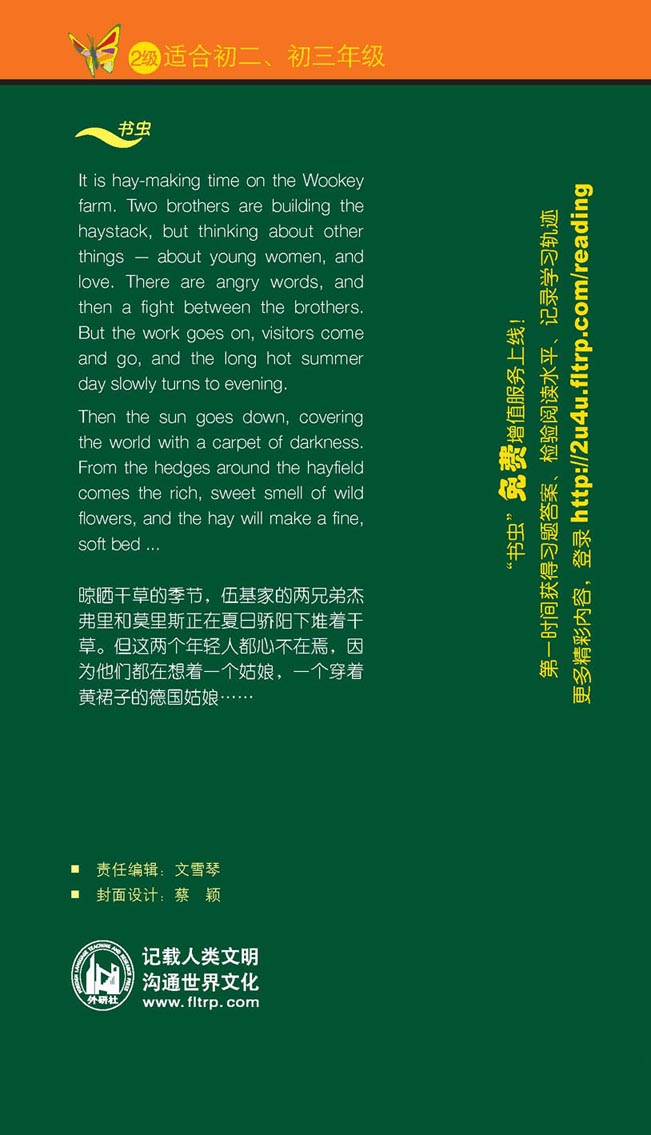
扉页
版权页
京权图字:01-2013-7821
Published by arrangement with Oxford University Press for sale in the People's Republic of China only and not for export therefrom. This edition is for sale in the mainland of China only, excluding Hong Kong SAR, Macao SAR and Taiwan.
© Oxford University Press 2008
Oxford is a registered trademark of Oxford University Press
图书在版编目(CIP)数据
草垛之恋:英汉对照 /(英)劳伦斯(Lawrence, D. H.)著;(英)巴西特(Bassett, J.)改写;(英)哈维(Harvey, B.)绘;周晶译.— 北京:外语教学与研究出版社,2014.2
(书虫·牛津英汉双语读物)
书名原文:Love among the haystacks
ISBN 978-7-5135-4065-0
Ⅰ.①草… Ⅱ.①劳… ②巴… ③哈… ④周… Ⅲ.①英语-汉语-对照读物②中篇小说-英国-现代 Ⅳ.①H319.4:I
中国版本图书馆CIP数据核字(2014)第029035号
出版人 蔡剑峰
责任编辑 文雪琴
封面设计 蔡 颖
出版发行 外语教学与研究出版社
社 址 北京市西三环北路19号(100089)
网 址 http://www.fltrp.com
版 次 2014年3月第1版
书 号 ISBN 978-7-5135-4065-0
凡侵权、盗版书籍线索,请联系我社法律事务部
举报电话:(010)88817519 电子邮箱:banquan@fltrp.com
法律顾问:立方律师事务所 刘旭东律师
中咨律师事务所 殷 斌律师
内容简介
内容简介
当高高的草浸透了夏日的阳光,散发出芬芳的时候,就可以收割,晾成干草了。在整个寒冷且食物匮乏的冬天里,干草将一直保存夏日的甜美。但干这个活儿必须抢时间,才能让新晾的干草免受风吹雨打。所有的农场主都知道这一点。
杰弗里和莫里斯也知道。他们是农场主的儿子,堆草垛时他们总是很卖力。他们在夏日骄阳下劳作的时候,各自怀着怎样的心思?他们都在想一个姑娘,一个叫葆拉的德国姑娘,她穿着一条黄裙子,长着一双闪亮的眼睛,说起话来轻快有趣。他们这会儿就能看见她,就在山坡上毗邻草场的人家的花园里。莫里斯吻过她,但是杰弗里却没有,他对弟弟满心愤恨。他嘴很笨,觉得不会有女人爱上他,因为他不懂如何甜言蜜语讨她们欢心。
但是爱情不一定需要言语,谁知道什么时候会发生什么事呢?那天来草场的年轻女人,可不只葆拉一个……
LOVE AMONG THE HAYSTACKS
When the grass is tall and sweet and full of summer sunshine, it is time to cut it down and make hay – hay that will hold that summer sweetness all through the cold, hungry winter months. But the work must be done quickly, to keep the new hay safe from wind and rain. Every farmer knows this.
Geoffrey and Maurice know it too. They are farmer's sons, and work hard, building the haystack. But what do these young men think about, while they work under the hot summer sun? They think about a girl, a German girl called Paula, a girl in a yellow dress, a girl with bright eyes and a funny, quick way of talking. They can see her now, up the hill, in the garden of a house next to the hayfield. Maurice has kissed her, but Geoffrey has not, and Geoffrey burns with hate for his brother. He finds words difficult. No woman will ever love him, he thinks, because he cannot find the words to win her love.
But love does not always need words, and who knows what the day or the night will bring? Paula is not the only young woman to visit the hayfield that day...
目录
1.Two brothers
1
Two brothers
The two large fields lay on a hillside that looked south. Most of the hay was already cut, and in the bright sunlight the fields were now golden green.
Across the hill, half-way up, was a high hedge, and they were building the haystack just above this hedge. It was a tall haystack, a great untidy thing standing high above the hedge, but the hay itself was light and silvery in colour, and looked as soft as a cloud. Not far away was another, finished haystack.
The empty wagon was going downhill, and in the far corner of the bottom field, where the hay was still uncut, the full wagon was just beginning its slow journey up the hill to the haystack. The hay-makers worked on, cutting the tall hay, while the wagon climbed the hill.
The two brothers on top of the haystack were having a moment's rest, waiting for the full wagon to arrive. They stood up to their knees in the soft hay, while above them the golden sun burned down, and all around them was the hot sweet smell of the silvery hay. The only two things in the world were hay and sun.
Maurice, the younger brother, was a good-looking young man of twenty-one. He was strong, full of life, with a quick bright eye and a ready smile.
'You thought,' he said to his brother, 'you were very clever last night, didn't you?' He pushed his fork into the hay, and stared at his brother, with a smile on his face.
'No. No, I didn't,' replied Geoffrey. He turned away, frowning. He was a tall, heavy young man, a year older than Maurice. He was full of strong feelings, but they burned silently inside him. He could never find words to say; he could never look anybody in the eye. He always thought the world was looking at him, and laughing.
'Oh, you did, I know you did.' Maurice laughed. 'It was your turn to sleep in the hayfield last night, but you went and hid yourself, so I had to go in your place.'
'I didn't hide myself,' said Geoffrey angrily. 'Father sent me to get some wood—'
'Oh yes, oh yes,' laughed Maurice. 'But you don't know, do you? You don't know what happened last night, up here in the hayfield.'
He laughed again, and threw himself down on his back in the hay. He put his arms across his face and lay there, smiling and remembering the night before.
Geoffrey leant on his fork and stared out over the fields. Far away was the city of Nottingham, and between, the country lay under the burning sun, with here and there the smoke from a factory going up into the sky. Geoffrey looked down again into the hayfield, at the wagon slowly climbing the hill to the haystack. 'Hurry up,' he thought. 'Hurry up.'
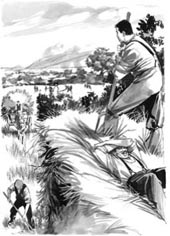
Geoffrey leant on his fork and stared out over the fields.
'You didn't think, did you?' said Maurice. 'You didn't think that she would be here with me, did you?'
Geoffrey stared at him, full of hate. Suddenly, he wanted to put his foot down hard on that smiling, good-looking face below him.
'Can you sing in German?' asked Maurice. 'Do you know how to kiss a German girl? Do you know how soft her neck is?' He laughed excitedly, remembering every moment of the night before.
Geoffrey burned with hate. He wanted to walk away, but he couldn't. The haystack, high above the field, was a prison holding him and his brother together.
Both brothers were shy of women. Neither of them had a girlfriend; neither of them knew what to say to a woman, or how to win her love. And now Maurice was first in the game, and the older brother did not like it.
The German girl was the governess from the house beside the top field. Geoffrey was working one day in the field when a baby pushed through a hole in the hedge from the garden of the house. Seconds later the German girl came through the hedge too, looking for the baby. Geoffrey helped her to catch the little boy, and then they stood talking for a while. Geoffrey liked her bright eyes, and her funny, quick way of talking.
'But now it's Maurice she likes best, not me,' he thought. 'She sits with him in the hayfield by moonlight, and he kisses her.'
Unhappily, he looked up the hill to the house beside the top field. From the top of the haystack he could see right into the garden, and there, suddenly, he saw the girl, in a yellow dress. He held up his arm and waved to her. She waved back, lazily. Geoffrey could see that she was not interested in him, and was waiting for Maurice.
Then Maurice stood up, and saw the girl himself. He laughed, and waved both arms at her.
'What's going on?' called a voice from below.
The full wagon was now standing at the foot of the haystack. Maurice's face turned deep red.
'Nothing!' he called.
There was the sound of laughing below, and soon a big, red-faced man climbed to the top of the hay in the wagon. He turned, stared up the hillside, and saw the yellow dress in the garden.
'Oh, it's a girl, is it?' he laughed. He was the father of Geoffrey and Maurice. 'Yes, I thought it was a girl.'
They began working again, throwing the hay from the wagon up to the top of the haystack. There the brothers had to place the hay carefully, building a stack with four strong walls which would not fall over. It was hard work. The father threw up great forkfuls of hay, Geoffrey then passed them along to Maurice, who built up the haystack's walls.
But Geoffrey was full of angry feelings. Usually he threw the hay into the places where Maurice wanted it. Now, he threw it into the middle of the stack, and Maurice had to work twice as hard, carrying it out to the walls. Once, a great forkful of hay from Geoffrey hit Maurice on the back.
'Be careful!' called Maurice angrily. 'And why are you throwing it in the middle, you stupid man?'
'I'll throw it where I like,' answered Geoffrey.
They worked on, both brothers angry now. They got hotter and tireder, and still the hay came up from the wagon below.
'There, that's the end,' the father called at last from the wagon. Geoffrey threw the last forkful into the middle of the stack, then stood still, watching Maurice.
'This side wall isn't very strong,' came the father's voice from below. 'You must build it up more.'
'No, it's fine,' called Maurice crossly.
Geoffrey moved across to the side wall, and pushed his fork down into the hay. He pushed harder, and the top of the haystack began to move just a little.
'What are you doing, you fool?' cried Maurice.
'Don't you call me a fool,' said Geoffrey, and he pushed again on his fork. Maurice jumped across to him, and pulled him away from the wall. It was not easy to stand in the soft bed of hay, and Geoffrey fell over.
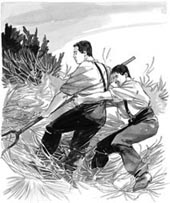
Maurice pulled Geoffrey away from the wall.
Maurice called down to his father below. 'This wall is fine. It's not going to fall down.'
'All right,' came the father's voice. 'We'll be off now to bring the next wagon up here.'
Geoffrey got to his feet. 'Don't call me a fool again, do you hear?' he said heavily.
'Not until next time,' said his brother.
Maurice went on working, moving round the stack and building up the walls. Geoffrey stood still, hand on his fork, looking out over the fields. He did not move even when Maurice needed to get past him.
'Move, will you?' said Maurice.
There was no reply. Maurice put out his arm and tried to push his brother out of his way.
'Who are you pushing?' said Geoffrey angrily.
'You,' replied Maurice, and at once the two brothers began to fight. Each pushed against the other as hard as he could, but Geoffrey was the heavier of the two men, and slowly he began to win.
Maurice had to move back, but his feet caught in the hay, and he fell over the side of the stack, all the way down to the ground.
hay n. grass which is cut and dried, and used as food for animals 干草
hedge n. a line of small trees that makes a kind of wall round a field 树篱
stare v. to look at someone or something for a long time 注视
frown v. to move your eyebrows together to make lines on your forehead (you frown when you are worried or angry) 皱眉
shy adj. not able to talk easily to people that you do not know 害羞的
governess n. a woman employed to teach the children of a rich family in their home 女家庭教师
wave v. to move your hand from side to side, to say hello or goodbye 挥手
twice adv. two times 两次;两倍
crossly adv. angrily 生气地
1
两兄弟
朝南的山坡上有两大片草场。大多数干草已经收割了,现在的草场在明亮的阳光下呈现一片金绿色。
半山坡上,有一道高高的树篱,人们正在这道树篱外面堆干草垛。草垛很高,乱糟糟的一大堆,高出树篱好大一截。不过干草本身很轻,泛着银色,看起来像云一样柔软。不远处是一个已经堆好的草垛。
空马车正在下山,在下面那片草场最远处的角落,还有尚未收割的干草。满载的马车就从那里出发,慢吞吞地朝着山坡上的草垛行进。马车上山的时候,收干草的工人继续干活儿,割着高高的干草。
草垛上的两兄弟这会儿得了空当儿,等着满载干草的马车上来。他们站在没膝的柔软干草里,头顶上金色的太阳炙烤着大地,周围热烘烘地弥漫着银色干草的芬芳。天地间只剩干草和阳光。
弟弟莫里斯21岁,是个英俊的小伙子。他很强壮,充满活力,眼睛明亮有神,脸上常常挂着微笑。
“你觉得,”他对哥哥说,“自己昨晚做得很精明,是不是?”他把草杈插到干草里,笑吟吟地看着他哥哥。
“不。不,我没有。”杰弗里回答。他皱着眉转过了头。他是个又高又壮的年轻人,比莫里斯大一岁。他有着热烈的情感,但都藏在心里,无声地沸腾。他总是不知该如何用语言表达;也不敢与人对视。他老觉得所有人都在看着他,笑话他。
“哦,你有,我知道你有。”莫里斯笑道,“昨天轮到你在干草场过夜,但是你却跑掉藏了起来,我只好替你值夜。”
“我没藏起来。”杰弗里生气地说,“爸爸叫我去弄些木头……”
“哦,好吧,好吧。”莫里斯笑了起来,“但你不知道,是不是?你不知道昨天晚上草场这儿发生了什么。”
他又笑了起来,仰面倒在干草上。他躺在那儿,用手臂挡住脸,笑吟吟地回忆起前一天晚上发生的事。
杰弗里倚在草杈上,望向田野。远处是诺丁汉城,中间则是太阳炙烤下的乡村,从工厂升起来的烟飘散在天空中。杰弗里又望向下方的草场,看着马车慢悠悠地爬坡,朝着草垛而来。“快点儿。”他想,“快点儿。”
“你没想到吧,是不是?”莫里斯说,“你没想到她会来这儿陪我,是不是?”
杰弗里恨恨地瞪着他。突然,他想把那张微笑的俊脸用力踩在脚下。
“你会用德语唱歌吗?”莫里斯问,“你知道怎么跟德国姑娘接吻吗?你知道她的脖子有多柔软吗?”他回味着头天夜里的每一刻,兴高采烈地笑了起来。
杰弗里心中燃烧着恨意。他想走开,但却不能。矗立在田野上的草垛,像牢房一样把他和弟弟关在一起。
两兄弟在女人面前都很害羞。他们俩都没有女朋友,也都不知道怎样跟女人说话和赢得她们的芳心。可现在莫里斯抢了先,做哥哥的可不高兴。
那个德国姑娘是山上草场旁那户人家的家庭教师。杰弗里有天在地里干活儿的时候,一个小孩儿从那户人家花园树篱上的一个洞口钻了出来。没过几秒,那个德国姑娘也从树篱那儿钻过来找孩子。杰弗里帮她抓住了那个小男孩儿,然后他们站着说了会儿话。杰弗里喜欢她明亮的眼睛,还有她那轻快有趣的说法方式。
“可现在她最喜欢的是莫里斯,而不是我。”他想,“她跟他一起坐在月光下的干草场上,他还吻了她。”
他郁闷地朝山坡高处那片草场旁的那户人家望去。站在草垛上,他能一直望到花园里,突然就看到了那个姑娘,她穿着一条黄裙子。他举起胳膊,朝她挥了挥。她也慵懒地向他招了招手。杰弗里看得出她对他并不感兴趣,而是在等莫里斯。
这时莫里斯站起来,也看见了那姑娘。他大笑起来,朝她挥舞双臂。
“怎么回事儿?”一个声音从下方传来。
满载干草的马车这会儿到了草垛跟前。莫里斯的脸一下子涨得通红。
“没什么!”他大声说。
下面传来笑声,很快一个魁梧的红脸汉子爬到了一车干草的顶上。他扭头朝山坡上张望,看到了花园里穿黄裙子的身影。
“哦,是因为姑娘,是吧?”他笑道。他是杰弗里和莫里斯的父亲。“没错,我就知道是因为姑娘。”
他们又开始干起活儿来,把马车上的干草抛到草垛上。两兄弟就在草垛顶上把这些干草小心地码放好,让草垛四壁牢固不倒。这活儿很辛苦。父亲大杈大杈地把干草扔上来,然后杰弗里把它们传给莫里斯,再由莫里斯堆放到草垛的四周。
但是杰弗里正一肚子火。平时他会把干草扔到莫里斯希望的地方,现在却都扔到了草垛中央。这下莫里斯还得把草拢到边上,费了双倍的力气。有一次,杰弗里扔过来的一大杈干草干脆砸到了莫里斯的背上。
“小心点儿!”莫里斯生气地喊着,“干吗把草扔到中间,你这笨蛋?”
“我想扔到哪儿就扔到哪儿。”杰弗里回答。
他们继续干活儿,现在两兄弟都憋了一肚子火。他们越来越热,越来越累,可干草还是不停地从下面抛上来。
“好啦,完事儿了。”马车上的父亲终于喊道。杰弗里把最后一杈干草扔到草垛中间,然后静静地站在那儿看着莫里斯。
“草垛这一面不是很牢靠。”下面传来父亲的声音,“你得把这边加固一下。”
“没事儿,不用。”莫里斯气恼地叫道。
杰弗里走到那边,把草杈插了进去。他又用力向下插了插,草垛顶部轻微地动了动。
“你在干吗,你这白痴?”莫里斯大叫。
“别叫我白痴。”杰弗里说完,又压了压草杈。莫里斯扑过去,把他从草垛边缘拽开。柔软的干草上不易站稳,杰弗里摔倒了。
莫里斯朝下面的父亲喊道:“这边没问题,不会倒的。”
“好吧。”父亲的声音传来,“我们这就再去拉一车草上来。”
杰弗里爬了起来。“别再叫我白痴,听见了吗?”他粗声粗气地说。
“下次之前不会了。”他弟弟说道。
莫里斯继续干活儿,沿着草垛四周堆放干草。杰弗里手扶草杈静静地站着,望向远处的原野。莫里斯要从他身边过去的时候,他也一动不动。
“让开点儿,行吗?”莫里斯说。
杰弗里没有回答。莫里斯伸手想把哥哥推到一边。
“你推谁呢?”杰弗里生气地说。
“你。”莫里斯话音刚落,两兄弟就扭打了起来。两人都使出全力推搡对方,不过杰弗里比较重,慢慢占了上风。
莫里斯不得不后退,可脚下被干草绊住了,一下子从草垛上掉了下来,摔在了地上。
两兄弟
1
Two brothers
The two large fields lay on a hillside that looked south. Most of the hay was already cut, and in the bright sunlight the fields were now golden green.
Across the hill, half-way up, was a high hedge, and they were building the haystack just above this hedge. It was a tall haystack, a great untidy thing standing high above the hedge, but the hay itself was light and silvery in colour, and looked as soft as a cloud. Not far away was another, finished haystack.
The empty wagon was going downhill, and in the far corner of the bottom field, where the hay was still uncut, the full wagon was just beginning its slow journey up the hill to the haystack. The hay-makers worked on, cutting the tall hay, while the wagon climbed the hill.
The two brothers on top of the haystack were having a moment's rest, waiting for the full wagon to arrive. They stood up to their knees in the soft hay, while above them the golden sun burned down, and all around them was the hot sweet smell of the silvery hay. The only two things in the world were hay and sun.
Maurice, the younger brother, was a good-looking young man of twenty-one. He was strong, full of life, with a quick bright eye and a ready smile.
'You thought,' he said to his brother, 'you were very clever last night, didn't you?' He pushed his fork into the hay, and stared at his brother, with a smile on his face.
'No. No, I didn't,' replied Geoffrey. He turned away, frowning. He was a tall, heavy young man, a year older than Maurice. He was full of strong feelings, but they burned silently inside him. He could never find words to say; he could never look anybody in the eye. He always thought the world was looking at him, and laughing.
'Oh, you did, I know you did.' Maurice laughed. 'It was your turn to sleep in the hayfield last night, but you went and hid yourself, so I had to go in your place.'
'I didn't hide myself,' said Geoffrey angrily. 'Father sent me to get some wood—'
'Oh yes, oh yes,' laughed Maurice. 'But you don't know, do you? You don't know what happened last night, up here in the hayfield.'
He laughed again, and threw himself down on his back in the hay. He put his arms across his face and lay there, smiling and remembering the night before.
Geoffrey leant on his fork and stared out over the fields. Far away was the city of Nottingham, and between, the country lay under the burning sun, with here and there the smoke from a factory going up into the sky. Geoffrey looked down again into the hayfield, at the wagon slowly climbing the hill to the haystack. 'Hurry up,' he thought. 'Hurry up.'
Geoffrey leant on his fork and stared out over the fields.
'You didn't think, did you?' said Maurice. 'You didn't think that she would be here with me, did you?'
Geoffrey stared at him, full of hate. Suddenly, he wanted to put his foot down hard on that smiling, good-looking face below him.
'Can you sing in German?' asked Maurice. 'Do you know how to kiss a German girl? Do you know how soft her neck is?' He laughed excitedly, remembering every moment of the night before.
Geoffrey burned with hate. He wanted to walk away, but he couldn't. The haystack, high above the field, was a prison holding him and his brother together.
Both brothers were shy of women. Neither of them had a girlfriend; neither of them knew what to say to a woman, or how to win her love. And now Maurice was first in the game, and the older brother did not like it.
The German girl was the governess from the house beside the top field. Geoffrey was working one day in the field when a baby pushed through a hole in the hedge from the garden of the house. Seconds later the German girl came through the hedge too, looking for the baby. Geoffrey helped her to catch the little boy, and then they stood talking for a while. Geoffrey liked her bright eyes, and her funny, quick way of talking.
'But now it's Maurice she likes best, not me,' he thought. 'She sits with him in the hayfield by moonlight, and he kisses her.'
Unhappily, he looked up the hill to the house beside the top field. From the top of the haystack he could see right into the garden, and there, suddenly, he saw the girl, in a yellow dress. He held up his arm and waved to her. She waved back, lazily. Geoffrey could see that she was not interested in him, and was waiting for Maurice.
Then Maurice stood up, and saw the girl himself. He laughed, and waved both arms at her.
'What's going on?' called a voice from below.
The full wagon was now standing at the foot of the haystack. Maurice's face turned deep red.
'Nothing!' he called.
There was the sound of laughing below, and soon a big, red-faced man climbed to the top of the hay in the wagon. He turned, stared up the hillside, and saw the yellow dress in the garden.
'Oh, it's a girl, is it?' he laughed. He was the father of Geoffrey and Maurice. 'Yes, I thought it was a girl.'
They began working again, throwing the hay from the wagon up to the top of the haystack. There the brothers had to place the hay carefully, building a stack with four strong walls which would not fall over. It was hard work. The father threw up great forkfuls of hay, Geoffrey then passed them along to Maurice, who built up the haystack's walls.
But Geoffrey was full of angry feelings. Usually he threw the hay into the places where Maurice wanted it. Now, he threw it into the middle of the stack, and Maurice had to work twice as hard, carrying it out to the walls. Once, a great forkful of hay from Geoffrey hit Maurice on the back.
'Be careful!' called Maurice angrily. 'And why are you throwing it in the middle, you stupid man?'
'I'll throw it where I like,' answered Geoffrey.
They worked on, both brothers angry now. They got hotter and tireder, and still the hay came up from the wagon below.
'There, that's the end,' the father called at last from the wagon. Geoffrey threw the last forkful into the middle of the stack, then stood still, watching Maurice.
'This side wall isn't very strong,' came the father's voice from below. 'You must build it up more.'
'No, it's fine,' called Maurice crossly.
Geoffrey moved across to the side wall, and pushed his fork down into the hay. He pushed harder, and the top of the haystack began to move just a little.
'What are you doing, you fool?' cried Maurice.
'Don't you call me a fool,' said Geoffrey, and he pushed again on his fork. Maurice jumped across to him, and pulled him away from the wall. It was not easy to stand in the soft bed of hay, and Geoffrey fell over.
Maurice pulled Geoffrey away from the wall.
Maurice called down to his father below. 'This wall is fine. It's not going to fall down.'
'All right,' came the father's voice. 'We'll be off now to bring the next wagon up here.'
Geoffrey got to his feet. 'Don't call me a fool again, do you hear?' he said heavily.
'Not until next time,' said his brother.
Maurice went on working, moving round the stack and building up the walls. Geoffrey stood still, hand on his fork, looking out over the fields. He did not move even when Maurice needed to get past him.
'Move, will you?' said Maurice.
There was no reply. Maurice put out his arm and tried to push his brother out of his way.
'Who are you pushing?' said Geoffrey angrily.
'You,' replied Maurice, and at once the two brothers began to fight. Each pushed against the other as hard as he could, but Geoffrey was the heavier of the two men, and slowly he began to win.
Maurice had to move back, but his feet caught in the hay, and he fell over the side of the stack, all the way down to the ground.
hay n. grass which is cut and dried, and used as food for animals 干草
hedge n. a line of small trees that makes a kind of wall round a field 树篱
stare v. to look at someone or something for a long time 注视
frown v. to move your eyebrows together to make lines on your forehead (you frown when you are worried or angry) 皱眉
shy adj. not able to talk easily to people that you do not know 害羞的
governess n. a woman employed to teach the children of a rich family in their home 女家庭教师
wave v. to move your hand from side to side, to say hello or goodbye 挥手
twice adv. two times 两次;两倍
crossly adv. angrily 生气地
1
两兄弟
朝南的山坡上有两大片草场。大多数干草已经收割了,现在的草场在明亮的阳光下呈现一片金绿色。
半山坡上,有一道高高的树篱,人们正在这道树篱外面堆干草垛。草垛很高,乱糟糟的一大堆,高出树篱好大一截。不过干草本身很轻,泛着银色,看起来像云一样柔软。不远处是一个已经堆好的草垛。
空马车正在下山,在下面那片草场最远处的角落,还有尚未收割的干草。满载的马车就从那里出发,慢吞吞地朝着山坡上的草垛行进。马车上山的时候,收干草的工人继续干活儿,割着高高的干草。
草垛上的两兄弟这会儿得了空当儿,等着满载干草的马车上来。他们站在没膝的柔软干草里,头顶上金色的太阳炙烤着大地,周围热烘烘地弥漫着银色干草的芬芳。天地间只剩干草和阳光。
弟弟莫里斯21岁,是个英俊的小伙子。他很强壮,充满活力,眼睛明亮有神,脸上常常挂着微笑。
“你觉得,”他对哥哥说,“自己昨晚做得很精明,是不是?”他把草杈插到干草里,笑吟吟地看着他哥哥。
“不。不,我没有。”杰弗里回答。他皱着眉转过了头。他是个又高又壮的年轻人,比莫里斯大一岁。他有着热烈的情感,但都藏在心里,无声地沸腾。他总是不知该如何用语言表达;也不敢与人对视。他老觉得所有人都在看着他,笑话他。
“哦,你有,我知道你有。”莫里斯笑道,“昨天轮到你在干草场过夜,但是你却跑掉藏了起来,我只好替你值夜。”
“我没藏起来。”杰弗里生气地说,“爸爸叫我去弄些木头……”
“哦,好吧,好吧。”莫里斯笑了起来,“但你不知道,是不是?你不知道昨天晚上草场这儿发生了什么。”
他又笑了起来,仰面倒在干草上。他躺在那儿,用手臂挡住脸,笑吟吟地回忆起前一天晚上发生的事。
杰弗里倚在草杈上,望向田野。远处是诺丁汉城,中间则是太阳炙烤下的乡村,从工厂升起来的烟飘散在天空中。杰弗里又望向下方的草场,看着马车慢悠悠地爬坡,朝着草垛而来。“快点儿。”他想,“快点儿。”
“你没想到吧,是不是?”莫里斯说,“你没想到她会来这儿陪我,是不是?”
杰弗里恨恨地瞪着他。突然,他想把那张微笑的俊脸用力踩在脚下。
“你会用德语唱歌吗?”莫里斯问,“你知道怎么跟德国姑娘接吻吗?你知道她的脖子有多柔软吗?”他回味着头天夜里的每一刻,兴高采烈地笑了起来。
杰弗里心中燃烧着恨意。他想走开,但却不能。矗立在田野上的草垛,像牢房一样把他和弟弟关在一起。
两兄弟在女人面前都很害羞。他们俩都没有女朋友,也都不知道怎样跟女人说话和赢得她们的芳心。可现在莫里斯抢了先,做哥哥的可不高兴。
那个德国姑娘是山上草场旁那户人家的家庭教师。杰弗里有天在地里干活儿的时候,一个小孩儿从那户人家花园树篱上的一个洞口钻了出来。没过几秒,那个德国姑娘也从树篱那儿钻过来找孩子。杰弗里帮她抓住了那个小男孩儿,然后他们站着说了会儿话。杰弗里喜欢她明亮的眼睛,还有她那轻快有趣的说法方式。
“可现在她最喜欢的是莫里斯,而不是我。”他想,“她跟他一起坐在月光下的干草场上,他还吻了她。”
他郁闷地朝山坡高处那片草场旁的那户人家望去。站在草垛上,他能一直望到花园里,突然就看到了那个姑娘,她穿着一条黄裙子。他举起胳膊,朝她挥了挥。她也慵懒地向他招了招手。杰弗里看得出她对他并不感兴趣,而是在等莫里斯。
这时莫里斯站起来,也看见了那姑娘。他大笑起来,朝她挥舞双臂。
“怎么回事儿?”一个声音从下方传来。
满载干草的马车这会儿到了草垛跟前。莫里斯的脸一下子涨得通红。
“没什么!”他大声说。
下面传来笑声,很快一个魁梧的红脸汉子爬到了一车干草的顶上。他扭头朝山坡上张望,看到了花园里穿黄裙子的身影。
“哦,是因为姑娘,是吧?”他笑道。他是杰弗里和莫里斯的父亲。“没错,我就知道是因为姑娘。”
他们又开始干起活儿来,把马车上的干草抛到草垛上。两兄弟就在草垛顶上把这些干草小心地码放好,让草垛四壁牢固不倒。这活儿很辛苦。父亲大杈大杈地把干草扔上来,然后杰弗里把它们传给莫里斯,再由莫里斯堆放到草垛的四周。
但是杰弗里正一肚子火。平时他会把干草扔到莫里斯希望的地方,现在却都扔到了草垛中央。这下莫里斯还得把草拢到边上,费了双倍的力气。有一次,杰弗里扔过来的一大杈干草干脆砸到了莫里斯的背上。
“小心点儿!”莫里斯生气地喊着,“干吗把草扔到中间,你这笨蛋?”
“我想扔到哪儿就扔到哪儿。”杰弗里回答。
他们继续干活儿,现在两兄弟都憋了一肚子火。他们越来越热,越来越累,可干草还是不停地从下面抛上来。
“好啦,完事儿了。”马车上的父亲终于喊道。杰弗里把最后一杈干草扔到草垛中间,然后静静地站在那儿看着莫里斯。
“草垛这一面不是很牢靠。”下面传来父亲的声音,“你得把这边加固一下。”
“没事儿,不用。”莫里斯气恼地叫道。
杰弗里走到那边,把草杈插了进去。他又用力向下插了插,草垛顶部轻微地动了动。
“你在干吗,你这白痴?”莫里斯大叫。
“别叫我白痴。”杰弗里说完,又压了压草杈。莫里斯扑过去,把他从草垛边缘拽开。柔软的干草上不易站稳,杰弗里摔倒了。
莫里斯朝下面的父亲喊道:“这边没问题,不会倒的。”
“好吧。”父亲的声音传来,“我们这就再去拉一车草上来。”
杰弗里爬了起来。“别再叫我白痴,听见了吗?”他粗声粗气地说。
“下次之前不会了。”他弟弟说道。
莫里斯继续干活儿,沿着草垛四周堆放干草。杰弗里手扶草杈静静地站着,望向远处的原野。莫里斯要从他身边过去的时候,他也一动不动。
“让开点儿,行吗?”莫里斯说。
杰弗里没有回答。莫里斯伸手想把哥哥推到一边。
“你推谁呢?”杰弗里生气地说。
“你。”莫里斯话音刚落,两兄弟就扭打了起来。两人都使出全力推搡对方,不过杰弗里比较重,慢慢占了上风。
莫里斯不得不后退,可脚下被干草绊住了,一下子从草垛上掉了下来,摔在了地上。
2.The German girl
2
The German girl
Geoffrey's face turned white. He heard the fall. He stood still, listening. He could hear no sound from below; he could hear no sound at all, anywhere. Then he was filled with sudden terror.
'Father!' he shouted, in his great deep voice. 'Father! FATHER!'
The cry rang across the fields. Men came running from the bottom field, and a girl ran down across the upper field. Geoffrey heard her strange, wild voice.
'Ah-h!' she cried out. 'Ah-h! Are you dead?'
On the top of the stack Geoffrey did not move or speak. He was too afraid to go down, too afraid even to hide in the hay. He listened to the voices below.
First to arrive was his older brother, Henry. Then came his father, and Bill, one of the farm workers.
'What's the matter? What's happened? Oh no!'
That was his father's voice. They were all silent for a few seconds, then came Henry's voice.
'He's not dead – look, he's opening his eyes.'
Geoffrey heard, but he was not pleased. Half of him wanted Maurice to be dead. 'If Maurice is not dead and only hurt, what will he say about me?' he thought. 'And what will mother say? I can never look anybody in the face again.' He felt lonely, and afraid.
Down below on the ground the German girl was crying and laughing at the same time. 'No, he's not dead, no, he's not dead, no-o.'
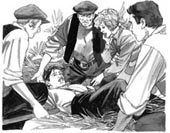
The German girl was crying and laughing at the same time.
'He can't speak. He needs some water,' said Henry.
'Yes, somebody must run and get some,' said the father. 'Bill, you go. The vicar's house is nearest.'
Bill ran up to the vicar's house beside the top field, where the German governess worked. Soon he came back, followed by the vicar. Maurice drank a little water, and began to make noises, trying to speak.
'What happened to him?' asked the vicar.
Everybody spoke at once, but the German girl's voice was the loudest.
'It was the brother – the other brother,' she cried. 'He knocked him over. I saw him, I was watching.'
'I don't think so,' said the father to the vicar. Then he got down next to Maurice, who was still making little noises. 'Where does it hurt, boy, eh?' he asked, worried.
'Wait a bit,' said Henry. 'Wait until he can speak.'
'Has he broken anything?' asked the vicar.
'He was lucky,' said the farm worker, Bill, 'lucky to fall on this bit of hay, and not the hard ground.'
Maurice could speak a little now, and the father asked him, 'What were you doing, boy? Were you playing around with our Geoffrey? Yes, and where is he?'
On top of the stack Geoffrey stood like a stone.
'I'll have a look on the stack,' said Henry.
Geoffrey did not want his big brother to come up on the stack, so he climbed down, and at the bottom of the ladder stood like a criminal, looking at the ground.
'What were you doing?' asked Henry's cold voice.
'I don't know. Nothing,' Geoffrey said.
'But I saw him!' cried the governess. She was sitting on the ground, holding Maurice in her arms. 'He knocked him over the side – bouf! like that!'
Henry looked from one brother to the other.
'No, girl,' whispered Maurice, smiling up at her. 'He wasn't near me. I just fell – fell over the side.'
'Oh!' cried the girl, not understanding.
'You just made a mistake,' said the father. 'That's all.'
'Oh no,' she cried. 'I saw him.'
Her name was Paula Jablonowsky, and her family came from Poland. She was twenty years old, quick and light as a wild-cat, with a strange, wild way of laughing. She had bright blue eyes and short golden hair. Everybody could see that the vicar hated her.
Maurice's face was still white, but he lay, smiling happily in the girl's arms. She smiled down at him, with her quick, bright smile. Her English was not very good, but there are stronger things than words.
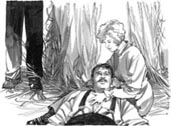
Maurice lay, smiling happily in the girl's arms.
'You say what you like,' she laughed, 'about your brother, about anything.'
'Perhaps you need to go back to the children now,' the vicar said to her, frowning a little.
'I will go soon,' the girl said. She smiled at Maurice again. 'You want to get up now?' she asked softly.
'I'm not in a hurry,' Maurice said, smiling happily.
'She's leaving us soon,' the vicar whispered to the father. 'My wife really doesn't like her.'
'Why, is she—?'
'Like a wild thing – she won't do what we tell her.'
Maurice decided to get up, and the girl helped him, with her strong arms. 'You are well,' she cried happily.
'Yes, I'm all right,' he said. 'The fall knocked the breath out of me, that's all.' After a moment he walked a few steps. 'See, father,' he laughed. 'I'm fine now.'
'Fine, fine!' the girl said, her eyes shining.
Maurice laughed, and touched her face gently.
'Don't worry. She's going at the end of three weeks,' the vicar said quietly in the farmer's ear.
terror n. the feeling when you are very, very afraid 恐惧
vicar n. a priest in the Church of England (英格兰圣公会的)代牧,教区牧师
criminal n. someone who is involved in illegal activities or has been proved guilty of a crime 罪犯
whisper v. to speak or say something very quietly, using your breath rather than your voice 低语
gently adv. kindly and carefully 轻柔地
2
德国姑娘
杰弗里的脸一下子白了。他听到了弟弟落地的声音。他站着一动不动,仔细听着。下面没有动静,到处都没有声响。他忽然满心恐惧。
“爸爸!”他粗着嗓门儿大叫起来,“爸爸!爸爸!”
叫声传遍了四野。在下面草场干活儿的人纷纷朝这里跑过来,还有一个姑娘从上面穿过草场跑下来。杰弗里听到了她奇特而焦急的声音。
“啊——!”她叫着,“啊——!你死了吗?”
草垛顶上的杰弗里没动,也没有说话。他吓坏了,不敢下来,甚至连藏到干草里也不敢。他听着下面的人声。
第一个到的是他的哥哥亨利,接着是他父亲,还有一个叫比尔的农场工人。
“怎么了?出了什么事?哦,不!”
那是他父亲的声音。大家沉默了几秒钟,接着传来亨利的声音。
“他没有死——看,他睁眼了。”
杰弗里听到了,但他并不觉得高兴。他私心里有一半是希望莫里斯死掉的。“如果莫里斯没死,只是受了伤,他会怎么说我呢?”他想,“妈妈会怎么说呢?我永远都没脸见人了。”他觉得又孤独又害怕。
草垛下面的地上,那个德国姑娘正在又哭又笑。“对,他没死,对,他没死,没有——”
“他说不出话。他需要些水。”亨利说。
“对,得有人赶快去弄些水来。”父亲说,“比尔,你去。牧师家离这儿最近。”
比尔朝上面草场旁的牧师家跑去,那也是德国女家庭教师工作的地方。他很快就回来了,身后还跟着牧师。莫里斯喝了一点儿水,开始发出声音,试图说话。
“他怎么了?”牧师问。
大家七嘴八舌地同时开口,不过那个德国姑娘的声音最大。
“是那个哥哥,另一个哥哥。”她大叫,“他把他撞下来的。我看见了,我一直看着呢。”
“我觉着不是。”父亲对牧师说。接着,他在莫里斯身旁蹲下来,莫里斯还在发出细碎的声音。“哪里疼,孩子,呃?”他担心地问。
“等会儿吧,”亨利说,“等他能开口说话再问。”
“他有哪儿骨折了吗?”牧师问。
“他很走运,”农场工人比尔说,“幸好掉在这点儿干草上,而不是摔在硬邦邦的地上。”
莫里斯现在能说一点儿话了,于是父亲问他:“你刚才在干吗,孩子?是在跟我们的杰弗里打闹吗?对了,他人呢?”
草垛顶上,杰弗里直挺挺地站着,就像块石头。
“我去草垛上看看。”亨利说。
杰弗里不想让哥哥爬到草垛上来,就自己爬了下来,像个罪犯似的站在梯子旁,垂头望着地面。
“你们刚才在干吗?”亨利冷冷地问道。
“我不知道。没干什么。”杰弗里说。
“可我看见他了!”女家庭教师叫道。她正坐在地上,把莫里斯抱在怀里。“他把他撞下来的——砰!就像这样!”
亨利看了看两个弟弟。
“不是的,姑娘。”莫里斯小声说,对她笑了笑,“他刚才没在我旁边。我就是摔下来的——从边上摔下来的。”
“哦!”那姑娘不解地叫了一声。
“你只是看错了。”父亲说,“就是这样。”
“哦,不是的。”她大叫,“我看见他了。”
她叫葆拉·亚布洛诺斯基,她一家来自波兰。她20岁年纪,像野猫一样敏捷轻巧,笑起来的样子很奇特,有种野性的味道。她长着明亮的蓝眼睛和一头金色的短发。人人都看得出牧师很不喜欢她。
莫里斯的脸色还很苍白,不过他靠在姑娘的怀里笑得很开心。她也低头给了他一个灿烂的微笑。她的英语不太好,但是言语并不是最有力的东西。
“你说怎样就怎样吧,”她笑道,“不管是关于你的兄弟,还是别的任何事情。”
“我看你该回去照顾孩子们了。”牧师对她说着,微微皱起了眉。
“我马上就去。”姑娘说。她又对莫里斯笑了笑。“你现在想站起来吗?”她柔声问道。
“我不着急。”莫里斯开心地笑着说。
“她很快就要离开了。”牧师对父亲悄声说,“我妻子很不喜欢她。”
“为什么,她——?”
“太野了——她根本不听我们的使唤。”
莫里斯打算站起来了,姑娘扶了他一把,她的胳膊很有力。“你没事了。”她开心地大叫。
“对,我没事了。”他说,“那一下把我摔背过气了,没别的。”过了一会儿,他走了几步。“瞧,爸爸,”他笑道,“我现在没事了。”
“太好了,太好了!”姑娘说着,眼睛闪闪发亮。
莫里斯笑了起来,轻轻地碰了碰她的脸颊。
“别担心。她再待三个星期就走。”牧师低声冲农场主耳语道。
德国姑娘
2
The German girl
Geoffrey's face turned white. He heard the fall. He stood still, listening. He could hear no sound from below; he could hear no sound at all, anywhere. Then he was filled with sudden terror.
'Father!' he shouted, in his great deep voice. 'Father! FATHER!'
The cry rang across the fields. Men came running from the bottom field, and a girl ran down across the upper field. Geoffrey heard her strange, wild voice.
'Ah-h!' she cried out. 'Ah-h! Are you dead?'
On the top of the stack Geoffrey did not move or speak. He was too afraid to go down, too afraid even to hide in the hay. He listened to the voices below.
First to arrive was his older brother, Henry. Then came his father, and Bill, one of the farm workers.
'What's the matter? What's happened? Oh no!'
That was his father's voice. They were all silent for a few seconds, then came Henry's voice.
'He's not dead – look, he's opening his eyes.'
Geoffrey heard, but he was not pleased. Half of him wanted Maurice to be dead. 'If Maurice is not dead and only hurt, what will he say about me?' he thought. 'And what will mother say? I can never look anybody in the face again.' He felt lonely, and afraid.
Down below on the ground the German girl was crying and laughing at the same time. 'No, he's not dead, no, he's not dead, no-o.'
The German girl was crying and laughing at the same time.
'He can't speak. He needs some water,' said Henry.
'Yes, somebody must run and get some,' said the father. 'Bill, you go. The vicar's house is nearest.'
Bill ran up to the vicar's house beside the top field, where the German governess worked. Soon he came back, followed by the vicar. Maurice drank a little water, and began to make noises, trying to speak.
'What happened to him?' asked the vicar.
Everybody spoke at once, but the German girl's voice was the loudest.
'It was the brother – the other brother,' she cried. 'He knocked him over. I saw him, I was watching.'
'I don't think so,' said the father to the vicar. Then he got down next to Maurice, who was still making little noises. 'Where does it hurt, boy, eh?' he asked, worried.
'Wait a bit,' said Henry. 'Wait until he can speak.'
'Has he broken anything?' asked the vicar.
'He was lucky,' said the farm worker, Bill, 'lucky to fall on this bit of hay, and not the hard ground.'
Maurice could speak a little now, and the father asked him, 'What were you doing, boy? Were you playing around with our Geoffrey? Yes, and where is he?'
On top of the stack Geoffrey stood like a stone.
'I'll have a look on the stack,' said Henry.
Geoffrey did not want his big brother to come up on the stack, so he climbed down, and at the bottom of the ladder stood like a criminal, looking at the ground.
'What were you doing?' asked Henry's cold voice.
'I don't know. Nothing,' Geoffrey said.
'But I saw him!' cried the governess. She was sitting on the ground, holding Maurice in her arms. 'He knocked him over the side – bouf! like that!'
Henry looked from one brother to the other.
'No, girl,' whispered Maurice, smiling up at her. 'He wasn't near me. I just fell – fell over the side.'
'Oh!' cried the girl, not understanding.
'You just made a mistake,' said the father. 'That's all.'
'Oh no,' she cried. 'I saw him.'
Her name was Paula Jablonowsky, and her family came from Poland. She was twenty years old, quick and light as a wild-cat, with a strange, wild way of laughing. She had bright blue eyes and short golden hair. Everybody could see that the vicar hated her.
Maurice's face was still white, but he lay, smiling happily in the girl's arms. She smiled down at him, with her quick, bright smile. Her English was not very good, but there are stronger things than words.
Maurice lay, smiling happily in the girl's arms.
'You say what you like,' she laughed, 'about your brother, about anything.'
'Perhaps you need to go back to the children now,' the vicar said to her, frowning a little.
'I will go soon,' the girl said. She smiled at Maurice again. 'You want to get up now?' she asked softly.
'I'm not in a hurry,' Maurice said, smiling happily.
'She's leaving us soon,' the vicar whispered to the father. 'My wife really doesn't like her.'
'Why, is she—?'
'Like a wild thing – she won't do what we tell her.'
Maurice decided to get up, and the girl helped him, with her strong arms. 'You are well,' she cried happily.
'Yes, I'm all right,' he said. 'The fall knocked the breath out of me, that's all.' After a moment he walked a few steps. 'See, father,' he laughed. 'I'm fine now.'
'Fine, fine!' the girl said, her eyes shining.
Maurice laughed, and touched her face gently.
'Don't worry. She's going at the end of three weeks,' the vicar said quietly in the farmer's ear.
terror n. the feeling when you are very, very afraid 恐惧
vicar n. a priest in the Church of England (英格兰圣公会的)代牧,教区牧师
criminal n. someone who is involved in illegal activities or has been proved guilty of a crime 罪犯
whisper v. to speak or say something very quietly, using your breath rather than your voice 低语
gently adv. kindly and carefully 轻柔地
2
德国姑娘
杰弗里的脸一下子白了。他听到了弟弟落地的声音。他站着一动不动,仔细听着。下面没有动静,到处都没有声响。他忽然满心恐惧。
“爸爸!”他粗着嗓门儿大叫起来,“爸爸!爸爸!”
叫声传遍了四野。在下面草场干活儿的人纷纷朝这里跑过来,还有一个姑娘从上面穿过草场跑下来。杰弗里听到了她奇特而焦急的声音。
“啊——!”她叫着,“啊——!你死了吗?”
草垛顶上的杰弗里没动,也没有说话。他吓坏了,不敢下来,甚至连藏到干草里也不敢。他听着下面的人声。
第一个到的是他的哥哥亨利,接着是他父亲,还有一个叫比尔的农场工人。
“怎么了?出了什么事?哦,不!”
那是他父亲的声音。大家沉默了几秒钟,接着传来亨利的声音。
“他没有死——看,他睁眼了。”
杰弗里听到了,但他并不觉得高兴。他私心里有一半是希望莫里斯死掉的。“如果莫里斯没死,只是受了伤,他会怎么说我呢?”他想,“妈妈会怎么说呢?我永远都没脸见人了。”他觉得又孤独又害怕。
草垛下面的地上,那个德国姑娘正在又哭又笑。“对,他没死,对,他没死,没有——”
“他说不出话。他需要些水。”亨利说。
“对,得有人赶快去弄些水来。”父亲说,“比尔,你去。牧师家离这儿最近。”
比尔朝上面草场旁的牧师家跑去,那也是德国女家庭教师工作的地方。他很快就回来了,身后还跟着牧师。莫里斯喝了一点儿水,开始发出声音,试图说话。
“他怎么了?”牧师问。
大家七嘴八舌地同时开口,不过那个德国姑娘的声音最大。
“是那个哥哥,另一个哥哥。”她大叫,“他把他撞下来的。我看见了,我一直看着呢。”
“我觉着不是。”父亲对牧师说。接着,他在莫里斯身旁蹲下来,莫里斯还在发出细碎的声音。“哪里疼,孩子,呃?”他担心地问。
“等会儿吧,”亨利说,“等他能开口说话再问。”
“他有哪儿骨折了吗?”牧师问。
“他很走运,”农场工人比尔说,“幸好掉在这点儿干草上,而不是摔在硬邦邦的地上。”
莫里斯现在能说一点儿话了,于是父亲问他:“你刚才在干吗,孩子?是在跟我们的杰弗里打闹吗?对了,他人呢?”
草垛顶上,杰弗里直挺挺地站着,就像块石头。
“我去草垛上看看。”亨利说。
杰弗里不想让哥哥爬到草垛上来,就自己爬了下来,像个罪犯似的站在梯子旁,垂头望着地面。
“你们刚才在干吗?”亨利冷冷地问道。
“我不知道。没干什么。”杰弗里说。
“可我看见他了!”女家庭教师叫道。她正坐在地上,把莫里斯抱在怀里。“他把他撞下来的——砰!就像这样!”
亨利看了看两个弟弟。
“不是的,姑娘。”莫里斯小声说,对她笑了笑,“他刚才没在我旁边。我就是摔下来的——从边上摔下来的。”
“哦!”那姑娘不解地叫了一声。
“你只是看错了。”父亲说,“就是这样。”
“哦,不是的。”她大叫,“我看见他了。”
她叫葆拉·亚布洛诺斯基,她一家来自波兰。她20岁年纪,像野猫一样敏捷轻巧,笑起来的样子很奇特,有种野性的味道。她长着明亮的蓝眼睛和一头金色的短发。人人都看得出牧师很不喜欢她。
莫里斯的脸色还很苍白,不过他靠在姑娘的怀里笑得很开心。她也低头给了他一个灿烂的微笑。她的英语不太好,但是言语并不是最有力的东西。
“你说怎样就怎样吧,”她笑道,“不管是关于你的兄弟,还是别的任何事情。”
“我看你该回去照顾孩子们了。”牧师对她说着,微微皱起了眉。
“我马上就去。”姑娘说。她又对莫里斯笑了笑。“你现在想站起来吗?”她柔声问道。
“我不着急。”莫里斯开心地笑着说。
“她很快就要离开了。”牧师对父亲悄声说,“我妻子很不喜欢她。”
“为什么,她——?”
“太野了——她根本不听我们的使唤。”
莫里斯打算站起来了,姑娘扶了他一把,她的胳膊很有力。“你没事了。”她开心地大叫。
“对,我没事了。”他说,“那一下把我摔背过气了,没别的。”过了一会儿,他走了几步。“瞧,爸爸,”他笑道,“我现在没事了。”
“太好了,太好了!”姑娘说着,眼睛闪闪发亮。
莫里斯笑了起来,轻轻地碰了碰她的脸颊。
“别担心。她再待三个星期就走。”牧师低声冲农场主耳语道。
3.The tramp and the woman
3
The tramp and the woman
'We're not going to finish that last bit of hay today,' Henry said crossly.
The father still looked worried about Maurice. 'Are you sure you're all right?' he asked.
'Yes, I'm all right. I've told you.'
'Then sit down and rest for a bit. In a while you can get the dinner out for us.'
The men went back to work, and the governess ran back to the vicar's house, to her job with the children. Maurice sat down under a tree. 'I'll marry her,' he thought. 'Yes, I will. I've got fifty pounds, and mother will help me.' For a long time he sat there, thinking about married life. Then he got up and went to get the dinner from the big wagon by the road.
The two fields belonged to the Wookey family, but they were four miles from the home farm. So the father had to bring dinner and tea to the fields every day, and the workers ate there. Cutting the hay usually took about two weeks, and somebody had to sleep in the field at night, to watch the tools. Either Maurice or Geoffrey usually did this.
Mrs Wookey always sent a good dinner, and today was no different. There were two big meat pies, cold potatoes, bread, and a great piece of cheese. Maurice put the food out in the shade of a big tree. Everybody sat down in a circle, and ate their meal.
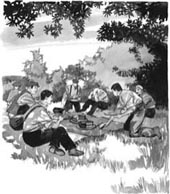
Everybody sat down in a circle, and ate their meal.
It was good to be out of the burning sun, under the shade of the tree. The men ate and drank silently, the father reading a newspaper, the others eating busily.
Then, 'She's here again!' said Bill. Everybody looked up. Paula was coming across the field, carrying a plate.
'She's bringing something for you, Maurice,' said Henry, laughing at him. Maurice was halfway through a great piece of meat pie and some cold potatoes.
The father laughed too. 'Put that away, Maurice. She'll want you to eat what she's brought for you.'
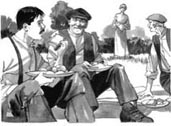
The father laughed. 'Put that away, Maurice.'
'Give it here,' said Bill. 'I'll eat it for you.'
Then Paula arrived. 'I bring him some chicken – him!'
She gave Maurice a bright smile. Maurice's face turned deep red, and everybody laughed aloud.
The father felt sorry for his shy son. 'Come and sit here by me,' he said to Paula.
'Thank you,' said Paula happily. She sat down next to the father and smiled at him.
'My name,' she said, 'is Paula Jablonowsky.'
'Paula, what?' said the father. The other men laughed. 'Paula, eh? Strange kind of name. My son's name is—'
'Maurice – I know.' She said the name sweetly, and Maurice's face turned an even deeper red.
'Tell me about yourself,' the father said to the girl.
'I come from Hanover, in Germany,' she said. 'My father is a shop-keeper, and I ran away from home because I didn't like him. I went to Paris and I worked in a girls' school there.'
'Did you like it?'
'Oh no – it was so boring! Nothing to do.'
'And do you like life in England?' said the father.
'No – ah, no. The vicar and his wife... no, no, no.'
'And what will you do?' the father asked.
'I will go to London, or to Paris. Or get married!' She laughed into the father's eyes.
The father laughed too. 'Get married, eh? Who to?'
'I don't know. I am going away.'
'Do you think you'd like making butter and cheese?'
'Oh yes!' She smiled her quick bright smile, and her eyes shone.
'I think she'd like anything different from her life now,' said Henry. He heard a noise and looked round. 'Hallo, who's this?' he said.
A tramp was crossing the field towards them. He was small, thin, and dirty, with mean little eyes.
'Have you got a bit of work for me?' he called out.
'A bit of work?' said the father. 'Can't you see that we've nearly finished these fields?'
'And you don't know anything about hay-making,' said Henry, coldly.
'I'm a hard worker,' said the tramp. His small eyes looked from father to son, and back again.
'Well, we've got no work for you,' said the father. 'But you can have a bit of something to eat, if you like.'
'Yes, I would,' said the man.
They gave him the last piece of meat pie. He ate it quickly, hungrily. 'That was good,' he said. He did not go away, so they gave him a piece of bread and cheese. Then he asked for a drink of water. He sat down to drink it, but the other men did not talk to him. They did not like him, and had nothing to say to him.
While he sat there, a young woman came into the field and walked down beside the hedge. She was small and finely made. Her clothes were neat and tidy, and her hair was pulled back under a sailor hat. She had a pretty face, but there was a hard, cold look in her eyes.
'Have you got some work?' she asked her man.
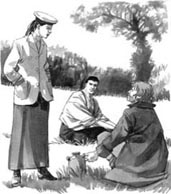
'Have you got some work?' the young woman asked.
'No, they haven't got any work for me. They just gave me a drink of water.'
He was a mean, hateful little man.
'And do I have to wait for you in the road all day?'
'You don't have to if you don't want to. You can go on. But if you wait a bit, perhaps you'll get something.'
The woman looked for the first time at the men, staring at them, unsmiling.
'Have you had your dinner?' asked the father. 'He's had a lot to eat. You can have some, if you want it.'
'What have you had?' she asked the man angrily.
'A great piece of meat pie, and a great piece of bread and cheese,' said Geoffrey.
The young woman looked at Geoffrey, and he at her. There was a kind of understanding between them. Both of them felt alone in the world. Geoffrey smiled a little, but she was too angry to smile.
'There's some cold potatoes,' Maurice said to the woman. 'You can have some of them.'
She frowned and did not answer. Again she looked at Geoffrey, and again there was a silent understanding between them. Then she turned and walked away.
'We must get back to work,' said Henry. He stood up and stared coldly at the tramp. 'Time to go.'
The tramp stood up too. 'Aren't you going to give me something for her? She's had nothing to eat all day.'
They gave him some bread and cheese. He pushed it into his pocket, and walked away.
tramp n. a person with no home or job, who goes from place to place 流浪汉
belong to to be the property of 属于
boring adj. not interesting in any way 无趣的,乏味的
mean adj. not kind 恶意的
3
流浪汉和女人
“最后一点儿干草我们今天弄不完了。”亨利不高兴地说。
父亲愁容满面,还在担心莫里斯。“你确定自己没事了?”他问。
“是的,我挺好的。我都说过了。”
“那就坐下休息一会儿。过会儿你去把我们的午饭拿出来。”
男人们回去继续干活儿,女家庭教师也跑回了牧师家照顾孩子们。莫里斯坐在一棵树下。“我要娶她。”他想,“是的,我会的。我已经存了50英镑,妈妈也会帮我的。”他在那儿坐了很长时间,脑子里想着婚后的生活。然后,他起身到路边的大马车上去取午饭。
这两片草场是伍基家的,离主农场有四英里的距离。所以父亲只好每天都把午饭和下午茶带到地里来,让干活儿的人就地吃。收割干草大约需要两个星期,晚上得留人在田里值夜,看守农具。这通常是莫里斯或杰弗里的活儿。
伍基太太给他们准备的午饭总是很丰盛,今天也不例外。有两个很大的肉馅饼、一些凉土豆、面包和一大块奶酪。莫里斯把食物摆放在一棵大树下的树荫里。大家围坐在一起吃饭。
树荫遮挡了炙热的太阳,让人感觉舒服多了。男人们安静地吃喝,父亲看着一份报纸,其他人都忙着吃东西。
这时,比尔说:“她又来了!”大家纷纷抬头看。葆拉正端着一个盘子穿过田野往这儿走来。
“她给你送吃的来了,莫里斯。”亨利笑着揶揄他。莫里斯正在吃一大块肉馅饼和一些凉土豆。
父亲也笑了起来。“把那个放下吧,莫里斯。她肯定希望你吃她给你带来的东西。”
“给我吧,”比尔说,“我帮你吃。”
这时葆拉走到了近前。“我给他带了些鸡肉——他!”
她冲莫里斯露出灿烂的微笑。莫里斯的脸顿时涨得通红,大伙儿全都大笑起来。
父亲有些同情他那害羞的儿子。“过来坐在我旁边吧。”他对葆拉说。
“谢谢。”葆拉高兴地说。她在父亲身边坐下,对他笑了笑。
“我叫葆拉·亚布洛诺斯基。”她说。
“葆拉,什么?”父亲问。其他人都笑了起来。“葆拉,呃?挺怪的名字。我儿子叫——”
“莫里斯——我知道。”她甜甜地说出这个名字,莫里斯的脸更红了。
“说说你自己吧。”父亲对姑娘说。
“我从德国的汉诺威来。”她说,“我父亲开了一家店铺。我是从家里跑出来的,因为我不喜欢他。我去了巴黎,在那儿的一所女校工作。”
“你喜欢那儿吗?”
“哦,不——太无聊了!没什么事情可做。”
“那你喜欢英国的生活吗?”父亲问。
“不——啊,不喜欢。牧师和他的妻子……不,不,不。”
“那你有什么打算?”父亲问。
“我想去伦敦,或是巴黎。或者结婚!”她望着父亲的眼睛笑道。
父亲也笑了起来。“结婚,呃?跟谁呢?”
“我不知道。我就快离开了。”
“你觉得你会喜欢做黄油和奶酪吗?”
“哦,是的!”她露出了明亮爽朗的笑容,眼睛闪闪发亮。
“我觉得只要跟她现在的生活不一样,她都会喜欢的。”亨利说。他听到了什么动静,扭头望去。“你好,你是谁?”他问。
一个流浪汉正穿过田野朝他们走来。他身材瘦小,邋里邋遢,一双小眼睛不怀好意。
“你们这儿有我干的活儿吗?”他大声问。
“活儿?”父亲说,“你没看见我们已经快把这些地收割完了吗?”
“而且你也不会晾晒干草。”亨利冷淡地说。
“我干活儿很卖力。”流浪汉说。他那双小眼睛先看了看父亲,又看了看儿子,最后回到父亲身上。
“嗯,我们没有活儿给你干。”父亲说,“但是如果你想吃东西的话,可以吃点儿。”
“我想吃。”那人说。
他们把最后一块肉馅饼给了他。他狼吞虎咽地吃完了。“味道真不错。”他说。他并没有离开,于是他们又给了他一片面包和奶酪。接着,他又要水喝。他坐下来喝水,但是其他人都不跟他搭话。他们不喜欢他,跟他也没什么可说。
他坐在那儿的时候,一个年轻女人来到了草场上,沿着树篱走下山坡。她身材娇小匀称,衣服干净整齐,头发向后梳,戴着一顶水手帽。她脸盘长得很漂亮,但眼中却流露出冷峻的神色。
“你找到活儿了吗?”她问自己的男人。
“没有,他们没有活儿给我干。他们只给我喝了口水。”
他是个卑鄙又讨厌的小个子。
“那我就得在大路上等你一整天吗?”
“你不想等就别等。你可以继续走。但是如果你等一会儿,说不定能得到点儿什么。”
女人第一次把目光转向了在场的其他人,板着脸瞅着他们。
“你吃午饭了吗?”父亲问,“他刚才吃了很多东西。如果你需要,可以吃一些。”
“你都吃了什么?”她生气地问那男人。
“一大块肉馅饼,还有一大片面包和奶酪。”杰弗里说。
年轻女人看向杰弗里,他也在看她。这两人之间存在着某种默契。他们都觉得自己在这世界上很孤单。杰弗里淡淡地笑了一下,但是她太生气,根本笑不出来。
“还有些凉土豆。”莫里斯对女人说,“你可以吃一些。”
她皱了皱眉,没有回答。她又看了看杰弗里,他们之间那无声的默契还在。接着,她转身走开了。
“我们得回去干活儿了。”亨利说。他站起来,冷冷地看着流浪汉,“该走了。”
流浪汉也站了起来。“你们不给我点儿吃的好带给她吗?她一整天没吃东西了。”
他们给了他一些面包和奶酪。他把食物塞进口袋,走了。
流浪汉和女人
3
The tramp and the woman
'We're not going to finish that last bit of hay today,' Henry said crossly.
The father still looked worried about Maurice. 'Are you sure you're all right?' he asked.
'Yes, I'm all right. I've told you.'
'Then sit down and rest for a bit. In a while you can get the dinner out for us.'
The men went back to work, and the governess ran back to the vicar's house, to her job with the children. Maurice sat down under a tree. 'I'll marry her,' he thought. 'Yes, I will. I've got fifty pounds, and mother will help me.' For a long time he sat there, thinking about married life. Then he got up and went to get the dinner from the big wagon by the road.
The two fields belonged to the Wookey family, but they were four miles from the home farm. So the father had to bring dinner and tea to the fields every day, and the workers ate there. Cutting the hay usually took about two weeks, and somebody had to sleep in the field at night, to watch the tools. Either Maurice or Geoffrey usually did this.
Mrs Wookey always sent a good dinner, and today was no different. There were two big meat pies, cold potatoes, bread, and a great piece of cheese. Maurice put the food out in the shade of a big tree. Everybody sat down in a circle, and ate their meal.
Everybody sat down in a circle, and ate their meal.
It was good to be out of the burning sun, under the shade of the tree. The men ate and drank silently, the father reading a newspaper, the others eating busily.
Then, 'She's here again!' said Bill. Everybody looked up. Paula was coming across the field, carrying a plate.
'She's bringing something for you, Maurice,' said Henry, laughing at him. Maurice was halfway through a great piece of meat pie and some cold potatoes.
The father laughed too. 'Put that away, Maurice. She'll want you to eat what she's brought for you.'
The father laughed. 'Put that away, Maurice.'
'Give it here,' said Bill. 'I'll eat it for you.'
Then Paula arrived. 'I bring him some chicken – him!'
She gave Maurice a bright smile. Maurice's face turned deep red, and everybody laughed aloud.
The father felt sorry for his shy son. 'Come and sit here by me,' he said to Paula.
'Thank you,' said Paula happily. She sat down next to the father and smiled at him.
'My name,' she said, 'is Paula Jablonowsky.'
'Paula, what?' said the father. The other men laughed. 'Paula, eh? Strange kind of name. My son's name is—'
'Maurice – I know.' She said the name sweetly, and Maurice's face turned an even deeper red.
'Tell me about yourself,' the father said to the girl.
'I come from Hanover, in Germany,' she said. 'My father is a shop-keeper, and I ran away from home because I didn't like him. I went to Paris and I worked in a girls' school there.'
'Did you like it?'
'Oh no – it was so boring! Nothing to do.'
'And do you like life in England?' said the father.
'No – ah, no. The vicar and his wife... no, no, no.'
'And what will you do?' the father asked.
'I will go to London, or to Paris. Or get married!' She laughed into the father's eyes.
The father laughed too. 'Get married, eh? Who to?'
'I don't know. I am going away.'
'Do you think you'd like making butter and cheese?'
'Oh yes!' She smiled her quick bright smile, and her eyes shone.
'I think she'd like anything different from her life now,' said Henry. He heard a noise and looked round. 'Hallo, who's this?' he said.
A tramp was crossing the field towards them. He was small, thin, and dirty, with mean little eyes.
'Have you got a bit of work for me?' he called out.
'A bit of work?' said the father. 'Can't you see that we've nearly finished these fields?'
'And you don't know anything about hay-making,' said Henry, coldly.
'I'm a hard worker,' said the tramp. His small eyes looked from father to son, and back again.
'Well, we've got no work for you,' said the father. 'But you can have a bit of something to eat, if you like.'
'Yes, I would,' said the man.
They gave him the last piece of meat pie. He ate it quickly, hungrily. 'That was good,' he said. He did not go away, so they gave him a piece of bread and cheese. Then he asked for a drink of water. He sat down to drink it, but the other men did not talk to him. They did not like him, and had nothing to say to him.
While he sat there, a young woman came into the field and walked down beside the hedge. She was small and finely made. Her clothes were neat and tidy, and her hair was pulled back under a sailor hat. She had a pretty face, but there was a hard, cold look in her eyes.
'Have you got some work?' she asked her man.
'Have you got some work?' the young woman asked.
'No, they haven't got any work for me. They just gave me a drink of water.'
He was a mean, hateful little man.
'And do I have to wait for you in the road all day?'
'You don't have to if you don't want to. You can go on. But if you wait a bit, perhaps you'll get something.'
The woman looked for the first time at the men, staring at them, unsmiling.
'Have you had your dinner?' asked the father. 'He's had a lot to eat. You can have some, if you want it.'
'What have you had?' she asked the man angrily.
'A great piece of meat pie, and a great piece of bread and cheese,' said Geoffrey.
The young woman looked at Geoffrey, and he at her. There was a kind of understanding between them. Both of them felt alone in the world. Geoffrey smiled a little, but she was too angry to smile.
'There's some cold potatoes,' Maurice said to the woman. 'You can have some of them.'
She frowned and did not answer. Again she looked at Geoffrey, and again there was a silent understanding between them. Then she turned and walked away.
'We must get back to work,' said Henry. He stood up and stared coldly at the tramp. 'Time to go.'
The tramp stood up too. 'Aren't you going to give me something for her? She's had nothing to eat all day.'
They gave him some bread and cheese. He pushed it into his pocket, and walked away.
tramp n. a person with no home or job, who goes from place to place 流浪汉
belong to to be the property of 属于
boring adj. not interesting in any way 无趣的,乏味的
mean adj. not kind 恶意的
3
流浪汉和女人
“最后一点儿干草我们今天弄不完了。”亨利不高兴地说。
父亲愁容满面,还在担心莫里斯。“你确定自己没事了?”他问。
“是的,我挺好的。我都说过了。”
“那就坐下休息一会儿。过会儿你去把我们的午饭拿出来。”
男人们回去继续干活儿,女家庭教师也跑回了牧师家照顾孩子们。莫里斯坐在一棵树下。“我要娶她。”他想,“是的,我会的。我已经存了50英镑,妈妈也会帮我的。”他在那儿坐了很长时间,脑子里想着婚后的生活。然后,他起身到路边的大马车上去取午饭。
这两片草场是伍基家的,离主农场有四英里的距离。所以父亲只好每天都把午饭和下午茶带到地里来,让干活儿的人就地吃。收割干草大约需要两个星期,晚上得留人在田里值夜,看守农具。这通常是莫里斯或杰弗里的活儿。
伍基太太给他们准备的午饭总是很丰盛,今天也不例外。有两个很大的肉馅饼、一些凉土豆、面包和一大块奶酪。莫里斯把食物摆放在一棵大树下的树荫里。大家围坐在一起吃饭。
树荫遮挡了炙热的太阳,让人感觉舒服多了。男人们安静地吃喝,父亲看着一份报纸,其他人都忙着吃东西。
这时,比尔说:“她又来了!”大家纷纷抬头看。葆拉正端着一个盘子穿过田野往这儿走来。
“她给你送吃的来了,莫里斯。”亨利笑着揶揄他。莫里斯正在吃一大块肉馅饼和一些凉土豆。
父亲也笑了起来。“把那个放下吧,莫里斯。她肯定希望你吃她给你带来的东西。”
“给我吧,”比尔说,“我帮你吃。”
这时葆拉走到了近前。“我给他带了些鸡肉——他!”
她冲莫里斯露出灿烂的微笑。莫里斯的脸顿时涨得通红,大伙儿全都大笑起来。
父亲有些同情他那害羞的儿子。“过来坐在我旁边吧。”他对葆拉说。
“谢谢。”葆拉高兴地说。她在父亲身边坐下,对他笑了笑。
“我叫葆拉·亚布洛诺斯基。”她说。
“葆拉,什么?”父亲问。其他人都笑了起来。“葆拉,呃?挺怪的名字。我儿子叫——”
“莫里斯——我知道。”她甜甜地说出这个名字,莫里斯的脸更红了。
“说说你自己吧。”父亲对姑娘说。
“我从德国的汉诺威来。”她说,“我父亲开了一家店铺。我是从家里跑出来的,因为我不喜欢他。我去了巴黎,在那儿的一所女校工作。”
“你喜欢那儿吗?”
“哦,不——太无聊了!没什么事情可做。”
“那你喜欢英国的生活吗?”父亲问。
“不——啊,不喜欢。牧师和他的妻子……不,不,不。”
“那你有什么打算?”父亲问。
“我想去伦敦,或是巴黎。或者结婚!”她望着父亲的眼睛笑道。
父亲也笑了起来。“结婚,呃?跟谁呢?”
“我不知道。我就快离开了。”
“你觉得你会喜欢做黄油和奶酪吗?”
“哦,是的!”她露出了明亮爽朗的笑容,眼睛闪闪发亮。
“我觉得只要跟她现在的生活不一样,她都会喜欢的。”亨利说。他听到了什么动静,扭头望去。“你好,你是谁?”他问。
一个流浪汉正穿过田野朝他们走来。他身材瘦小,邋里邋遢,一双小眼睛不怀好意。
“你们这儿有我干的活儿吗?”他大声问。
“活儿?”父亲说,“你没看见我们已经快把这些地收割完了吗?”
“而且你也不会晾晒干草。”亨利冷淡地说。
“我干活儿很卖力。”流浪汉说。他那双小眼睛先看了看父亲,又看了看儿子,最后回到父亲身上。
“嗯,我们没有活儿给你干。”父亲说,“但是如果你想吃东西的话,可以吃点儿。”
“我想吃。”那人说。
他们把最后一块肉馅饼给了他。他狼吞虎咽地吃完了。“味道真不错。”他说。他并没有离开,于是他们又给了他一片面包和奶酪。接着,他又要水喝。他坐下来喝水,但是其他人都不跟他搭话。他们不喜欢他,跟他也没什么可说。
他坐在那儿的时候,一个年轻女人来到了草场上,沿着树篱走下山坡。她身材娇小匀称,衣服干净整齐,头发向后梳,戴着一顶水手帽。她脸盘长得很漂亮,但眼中却流露出冷峻的神色。
“你找到活儿了吗?”她问自己的男人。
“没有,他们没有活儿给我干。他们只给我喝了口水。”
他是个卑鄙又讨厌的小个子。
“那我就得在大路上等你一整天吗?”
“你不想等就别等。你可以继续走。但是如果你等一会儿,说不定能得到点儿什么。”
女人第一次把目光转向了在场的其他人,板着脸瞅着他们。
“你吃午饭了吗?”父亲问,“他刚才吃了很多东西。如果你需要,可以吃一些。”
“你都吃了什么?”她生气地问那男人。
“一大块肉馅饼,还有一大片面包和奶酪。”杰弗里说。
年轻女人看向杰弗里,他也在看她。这两人之间存在着某种默契。他们都觉得自己在这世界上很孤单。杰弗里淡淡地笑了一下,但是她太生气,根本笑不出来。
“还有些凉土豆。”莫里斯对女人说,“你可以吃一些。”
她皱了皱眉,没有回答。她又看了看杰弗里,他们之间那无声的默契还在。接着,她转身走开了。
“我们得回去干活儿了。”亨利说。他站起来,冷冷地看着流浪汉,“该走了。”
流浪汉也站了起来。“你们不给我点儿吃的好带给她吗?她一整天没吃东西了。”
他们给了他一些面包和奶酪。他把食物塞进口袋,走了。
4.At night in the hayfield
4
At night in the hayfield
Geoffrey worked hard all afternoon, cutting the hay, while Maurice worked on the wagon. The brothers did not speak, but the feeling between them was warm and friendly. Geoffrey understood that their little fight would stay a secret – Maurice would not tell.
The sun got hotter and hotter. There was not a breath of wind, and everybody began to feel tired.
'There's another day's work here,' said the father at teatime, while they sat under the tree.
'Somebody will have to stay the night here then,' said Geoffrey. 'I'll do it.'
'No, I'll do it,' said Maurice.
'You did it last night,' said the father. 'You must get some rest tonight.'
'No, I'm staying,' said Maurice.
'He wants to meet his girl again,' explained Henry.
The father thought about this. 'I don't know...'
But in the end Maurice stayed. At eight o'clock, after sundown, the men got on their bicycles, the father got the wagon ready, and everybody left.
Slowly, the evening sky turned dark. The young man stood alone in the field, listening to the sounds of the night. It was still hot, and from the hedges came the rich, sweet smell of wild flowers. Then the moon came out, catching the flowers in its light, and they shone like white ghostly faces against the dark of the hedge.
Higher on the hill, the farm horses, free for the night, were moving around the field. Maurice had an hour to wait before Paula came, and he decided to take a bath in the little river at the bottom of the fields.
He washed himself in the cold water, and it felt good on his warm body. Above him the tall trees by the river whispered in a little wind. 'How beautiful the night is!' he thought. Laughing, he took a handful of white flowers from the hedge, and threw them over himself.
At nine o'clock he was waiting under the tree by the haystacks. He felt both excited, and afraid. She was late. At a quarter past nine she came, running across the field, as light and as quick as a bird.
'Oh, their little girl would not go to sleep tonight,' she cried. 'I sat in that bedroom for an hour.' She looked up at the sky and took a deep breath. 'Ah, the night smells so good!' She smiled.
She was full of life, quick and strong at the same time.
'I want' – she could not find the English words – 'I would like – to run – now!'
Maurice laughed. 'Let's run, then,' he said.
And in a second she was gone. Maurice ran after her, but he could not catch her easily. At last he caught her by the arm, and they stood together, laughing.
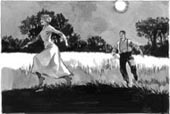
Maurice ran after her, but he could not catch her easily.
'I can run faster,' she cried happily. 'Yes?'
'No,' he replied, with his deep little laugh. 'No, you can't.' They walked on across the field, and then suddenly saw the three farm horses in front of them.
'We ride a horse?' she said.
'Now?' said Maurice. 'In the dark?'
'Yes, yes,' she cried, 'in the dark!'
Maurice caught one of the horses, put the girl on the horse's back, then climbed up in front of her. She put her arms round his waist.
The horse walked uphill and at the top they stopped and looked round. Clouds were moving across the sky, hiding the moon and the stars. The night lay across the fields and hills like a great dark carpet, with here and there the little lights of a house or a farm.
Maurice could feel the girl's warm arms around his waist. 'Do you want to go back now?' he asked.
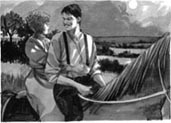
Maurice could feel the girl's warm arms around his waist.
'I stay with you,' she answered softly.
Maurice gave a little laugh. He wanted to kiss her, but he was afraid to. The horse moved under them.
'Let the horse go fast,' said Paula. 'Fast!'
'All right then,' Maurice said. He hit the horse's neck. 'Come on, boy, let's go!' he cried.
And away they went down the hill, faster and faster. It was a wild, dangerous, exciting ride. Maurice held on to the horse with hands and knees; Paula held on to Maurice, her arms around his waist, and her face against his strong, warm back.
At last the horse came to a stop. Paula half fell off its back, and Maurice quickly jumped down beside her. They were both laughing, and excited by their wild ride. And suddenly, he had her in his arms, and was kissing her. They did not move for some time. Then, silently, arm in arm, they walked to the haystacks.
The sky was now dark and heavy with cloud. Maurice looked up, and felt a drop of rain on his face.
'It's going to rain,' he said. 'I'll have to put the cover on the new stack.'
He left Paula, and went to the shed in the corner of the field. He pulled out the big heavy cover and pulled it across the ground to the stack.
'What are you going to do?' asked Paula.
'Put it over the top of the stack, to keep the rain out.'
'Ah!' she cried. 'Up there!'
Rain began to fall. It was very dark between the two great buildings of hay. Maurice put the long ladder up the side of the stack, and Paula stared up at the black wall of hay above her.
'You carry the cover up there?' she asked.
'Yes,' said Maurice.
'I must help you,' she said.
And she did. Maurice went first up the ladder, carrying one end of the cover, and Paula climbed up behind him, carrying the other end.
While they were climbing up the ladder, a light stopped on the road by the top field. It was Geoffrey on his bicycle, coming to help his brother with the cover for the haystack. Silently, he pushed his bicycle across the field to the shed. He was afraid to call out. If his brother was with the German girl, he did not want to surprise them together in the dark.
There was no one in the shed. He walked across to the stacks and was nearly there when he heard a noise. The ladder was slowly falling down the side of the stack. It hit the ground with a bang.
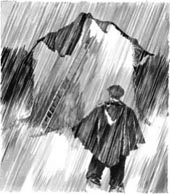
The ladder was slowly falling down the side of the stack.
'What was that?' he heard Maurice's voice, from the top of the stack.
'Something fell,' came the voice of the German girl.
Maurice lay down and looked over the side of the stack. 'It was the ladder!' he said. 'We knocked it down, when we were pulling the cover up.'
'We're in prison up here?' the girl said, excited.
'Yes. But if I shout, they'll hear at the vicar's house.'
'Oh no,' she said quickly.
'I don't want to,' he replied, with a short laugh.
He began to pull the cover across the top of the stack. Down below, Geoffrey moved quietly round the corner of the second haystack. He did not want them to see him. He heard Maurice's voice again.
'One good thing, we won't get wet. We can sit under the cover.'
'Maurice!' said the girl. She sounded worried.
'What is it?' he said gently. 'You'll be all right. Look, the cover's on now. We can sit under this corner.'
'Will I be all right, Maurice?'
'Of course you will. But do you want to go back to the vicar's house? Shall I shout for somebody?'
'No. No, I don't want to go back.'
'Are you sure?' he asked.
'Yes, yes, I am sure.' She laughed.
Geoffrey turned away at the last words, and walked back to the shed. The rain was now falling heavily. He felt miserable, and lonely.
In the shed he took the lamp off his bicycle and shone it round the walls. All the tools lay in one corner, and there was a big wooden box, and a deep bed of hay.
He put the lamp out and threw himself down on the hay. 'I'll put the ladder up for them later,' he thought. He lay there, thinking about his brother's luck, and the German girl, with her strange ways and her quick, bright laugh. 'Why does she like Maurice? Why doesn't she like me? No woman will ever love me,' he thought miserably. 'I'm too slow, I don't have the words.'
ghostly adj. like a ghost, not real 幽灵般的
waist n. the part around the middle of your body 腰
shed n. a small building for keeping tools, animals, etc 棚子
bang n. a sudden very loud noise 砰的一声
miserable adj. very sad or unhappy 难过的
4
草场之夜
杰弗里一下午都在卖力地收割干草,莫里斯则在马车上干活儿。兄弟俩没说话,但是两人之间的气氛融洽而友好。杰弗里明白他们的小争执不会有人知道——莫里斯不会说出去。
太阳越来越烈。一丝风也没有,大家都开始感觉累了。
“这儿的活儿还得再干一天。”他们围坐在树下喝下午茶的时候父亲说。
“那晚上这里还得有人守夜。”杰弗里说,“我来吧。”
“不,我来。”莫里斯说。
“你昨天晚上守夜了。”父亲说,“今晚你得休息一下。”
“不,我要留下。”莫里斯说。
“他想再见见他的姑娘。”亨利解释说。
父亲想了想。“我不知道……”
不过最后还是莫里斯留下了。晚上八点,太阳落山后,干活儿的人纷纷骑上自行车,父亲也套好了马车,大家都离开了。
慢慢地,傍晚的天空暗了下来。年轻人独自站在田野上,聆听着夜晚的各种声音。天还是很热,树篱那边传来野花浓郁的甜香。接着,月亮出来了,那些花儿沐浴在月亮的清辉里,在黑黢黢的树篱的映衬下,仿佛幽灵的面庞般泛着白光。
山坡高处,散放着过夜的农场马匹在田野上走来走去。莫里斯还得再等一个小时葆拉才会来,他决定先去田野下方的小河里洗个澡。
他在冷水里洗着,凉水浇在热烘烘的身上感觉很舒服。头顶上,河边高大的树木在微风中窃窃私语。“多美的夜晚!”他想。他从树篱上扯了一把白色的花,笑着撒在了自己身上。
九点钟,他在草垛旁的树下等候着,感觉又兴奋又害怕。她迟到了。九点过一刻她才穿过田野跑来,就像一只轻快的小鸟。
“哎,他们的小女儿今晚就是不肯睡。”她大声说,“我在那个卧室里坐了一个小时。”她仰望天空,深深吸了一口气。“啊,夜晚的味道真好闻!”她露出了微笑。
她充满活力,敏捷而又强壮。
“我想”——她找不到合适的英文词汇——“我想要——奔跑——就现在!”
莫里斯笑了起来。“那我们就奔跑吧。”他说。
一转眼她就跑开了。莫里斯跑着去追,却没那么容易捉住她。最后,他抓住了她的胳膊,两人一起站住,笑了起来。
“我跑得比你快。”她快乐地大声说,“对吧?”
“不,”他低沉地轻笑着回答,“不,你没我快。”他们继续走在田野上,突然看到前面有三匹农场里的马。
“我们骑马吧?”她说。
“现在?”莫里斯说,“摸着黑?”
“对啊,对啊,”她大声说,“摸着黑!”
莫里斯拉住了其中一匹马,把姑娘扶上马背,然后上马坐在了她前面。她伸手抱住了他的腰。
马朝山坡上走去,他们在山坡顶上停了下来,放眼四望。天上乌云滚滚,遮蔽了月亮和星光。夜色像一块巨大的黑毯覆盖了田野和山丘,四处是房舍或农场里闪着微弱的灯光。
莫里斯能感觉到姑娘温热的手臂环绕在他的腰上。“你想现在回去吗?”他问。
“我留下陪你。”她柔声回答。
莫里斯轻声笑了起来。他想吻她,却不敢。身下的马儿慢步走着。
“让马跑起来。”葆拉说,“快快地跑!”
“那好吧。”莫里斯说罢,拍了拍马脖子。“好啦,伙计,我们走!”他叫道。
他们冲下山坡,越来越快。真是一趟疯狂、危险又刺激的旅程。莫里斯双手抓紧缰绳,膝盖夹紧马身;葆拉紧紧地抱住莫里斯,双臂搂紧他的腰,脸贴着他强壮而温暖的后背。
最后马终于停了下来。葆拉几乎是半掉下马背的,莫里斯赶紧跳下来在她身边站定。两人都在大笑,为这次狂野的骑马经历兴奋不已。然后他忽然抱住了她,开始亲吻她。他们静静地待了片刻,然后默默地手挽着手朝草垛走去。
此刻天空黑沉沉的,乌云密布。莫里斯抬头看了看,感觉脸上落了一滴雨。
“要下雨了。”他说,“我得把新堆的草垛盖好。”
他丢下葆拉,走向草场一角的小棚子。他拖出又大又重的盖布,穿过田野朝草垛走去。
“你要怎么做?”葆拉问。
“把它盖在草垛顶上,可以防雨。”
“啊!”她叫起来,“要到上面去!”
雨开始落了下来。两个大草垛之间非常暗。莫里斯把长梯靠在草垛旁,葆拉看着上方黑色的草垛侧壁。
“你要把盖布弄上去?”她问。
“对。”莫里斯说。
“我得帮你。”她说。
她说干就干。莫里斯先拖着盖布的一头爬上梯子,葆拉抓着另一头跟着爬了上去。
就在他们爬上梯子的时候,一点灯光停在了山上草场旁的路上。那是杰弗里的。他骑着自行车来帮弟弟盖草垛。他静静地推着车穿过田野,朝棚子走去。他没敢大声招呼。如果他弟弟正跟那个德国姑娘在一起,他不想在黑暗里吓到他们。
棚子里没有人。他朝草垛走去,快走到的时候,突然听到了什么动静。梯子正顺着草垛侧壁慢慢地倒下去,砰的一声砸到了地上。
“那是什么声音?”他听到莫里斯的声音从草垛上传来。
“有东西倒了。”德国姑娘的声音传来。
莫里斯趴下,从草垛边缘望下去。“是梯子!”他说,“我们拖盖布的时候把它碰倒了。”
“我们被困在上面了?”姑娘说,显得挺兴奋。
“是的。不过如果我大声喊,牧师家里的人会听到的。”
“哦,别喊。”她赶紧说。
“我也不想喊。”他回道,笑了一声。
他开始用盖布把草垛顶部盖好。草垛下,杰弗里悄悄地转过了另一个草垛。他不想让他们看到他。他又听到了莫里斯的声音。
“好在我们不会被淋湿。我们可以坐在盖布底下。”
“莫里斯!”姑娘说。她听起来有点儿担心。
“怎么了?”他柔声问,“你不会有事的。”
“瞧,盖布现在已经盖好了。我们可以坐在这个角下面。”
“我不会有事的吧,莫里斯?”
“当然。不过,你是不是想回牧师家?我要不要叫人来?”
“不,不要。我不想回去。”
“你确定?”他问。
“是的,是的,我确定。”她笑了起来。
听到最后那句话,杰弗里转身走回了棚子。雨现在下大了。他感觉既难过又孤单。
在棚子里,他把灯从自行车上取下来,照了照四壁。所有的工具都堆在一角,棚子里还有一个大木箱和厚厚的一个草铺。
他熄了灯,躺倒在干草铺上。“我晚点儿再帮他们把梯子摆好。”他想。他躺在那儿,想着弟弟的好运,还有那个德国姑娘与众不同的举止和爽朗的笑声。“她为什么会喜欢莫里斯呢?她为什么不喜欢我呢?没有女人会爱上我。”他难过地想,“我太迟钝,也不会说话。”
草场之夜
4
At night in the hayfield
Geoffrey worked hard all afternoon, cutting the hay, while Maurice worked on the wagon. The brothers did not speak, but the feeling between them was warm and friendly. Geoffrey understood that their little fight would stay a secret – Maurice would not tell.
The sun got hotter and hotter. There was not a breath of wind, and everybody began to feel tired.
'There's another day's work here,' said the father at teatime, while they sat under the tree.
'Somebody will have to stay the night here then,' said Geoffrey. 'I'll do it.'
'No, I'll do it,' said Maurice.
'You did it last night,' said the father. 'You must get some rest tonight.'
'No, I'm staying,' said Maurice.
'He wants to meet his girl again,' explained Henry.
The father thought about this. 'I don't know...'
But in the end Maurice stayed. At eight o'clock, after sundown, the men got on their bicycles, the father got the wagon ready, and everybody left.
Slowly, the evening sky turned dark. The young man stood alone in the field, listening to the sounds of the night. It was still hot, and from the hedges came the rich, sweet smell of wild flowers. Then the moon came out, catching the flowers in its light, and they shone like white ghostly faces against the dark of the hedge.
Higher on the hill, the farm horses, free for the night, were moving around the field. Maurice had an hour to wait before Paula came, and he decided to take a bath in the little river at the bottom of the fields.
He washed himself in the cold water, and it felt good on his warm body. Above him the tall trees by the river whispered in a little wind. 'How beautiful the night is!' he thought. Laughing, he took a handful of white flowers from the hedge, and threw them over himself.
At nine o'clock he was waiting under the tree by the haystacks. He felt both excited, and afraid. She was late. At a quarter past nine she came, running across the field, as light and as quick as a bird.
'Oh, their little girl would not go to sleep tonight,' she cried. 'I sat in that bedroom for an hour.' She looked up at the sky and took a deep breath. 'Ah, the night smells so good!' She smiled.
She was full of life, quick and strong at the same time.
'I want' – she could not find the English words – 'I would like – to run – now!'
Maurice laughed. 'Let's run, then,' he said.
And in a second she was gone. Maurice ran after her, but he could not catch her easily. At last he caught her by the arm, and they stood together, laughing.
Maurice ran after her, but he could not catch her easily.
'I can run faster,' she cried happily. 'Yes?'
'No,' he replied, with his deep little laugh. 'No, you can't.' They walked on across the field, and then suddenly saw the three farm horses in front of them.
'We ride a horse?' she said.
'Now?' said Maurice. 'In the dark?'
'Yes, yes,' she cried, 'in the dark!'
Maurice caught one of the horses, put the girl on the horse's back, then climbed up in front of her. She put her arms round his waist.
The horse walked uphill and at the top they stopped and looked round. Clouds were moving across the sky, hiding the moon and the stars. The night lay across the fields and hills like a great dark carpet, with here and there the little lights of a house or a farm.
Maurice could feel the girl's warm arms around his waist. 'Do you want to go back now?' he asked.
Maurice could feel the girl's warm arms around his waist.
'I stay with you,' she answered softly.
Maurice gave a little laugh. He wanted to kiss her, but he was afraid to. The horse moved under them.
'Let the horse go fast,' said Paula. 'Fast!'
'All right then,' Maurice said. He hit the horse's neck. 'Come on, boy, let's go!' he cried.
And away they went down the hill, faster and faster. It was a wild, dangerous, exciting ride. Maurice held on to the horse with hands and knees; Paula held on to Maurice, her arms around his waist, and her face against his strong, warm back.
At last the horse came to a stop. Paula half fell off its back, and Maurice quickly jumped down beside her. They were both laughing, and excited by their wild ride. And suddenly, he had her in his arms, and was kissing her. They did not move for some time. Then, silently, arm in arm, they walked to the haystacks.
The sky was now dark and heavy with cloud. Maurice looked up, and felt a drop of rain on his face.
'It's going to rain,' he said. 'I'll have to put the cover on the new stack.'
He left Paula, and went to the shed in the corner of the field. He pulled out the big heavy cover and pulled it across the ground to the stack.
'What are you going to do?' asked Paula.
'Put it over the top of the stack, to keep the rain out.'
'Ah!' she cried. 'Up there!'
Rain began to fall. It was very dark between the two great buildings of hay. Maurice put the long ladder up the side of the stack, and Paula stared up at the black wall of hay above her.
'You carry the cover up there?' she asked.
'Yes,' said Maurice.
'I must help you,' she said.
And she did. Maurice went first up the ladder, carrying one end of the cover, and Paula climbed up behind him, carrying the other end.
While they were climbing up the ladder, a light stopped on the road by the top field. It was Geoffrey on his bicycle, coming to help his brother with the cover for the haystack. Silently, he pushed his bicycle across the field to the shed. He was afraid to call out. If his brother was with the German girl, he did not want to surprise them together in the dark.
There was no one in the shed. He walked across to the stacks and was nearly there when he heard a noise. The ladder was slowly falling down the side of the stack. It hit the ground with a bang.
The ladder was slowly falling down the side of the stack.
'What was that?' he heard Maurice's voice, from the top of the stack.
'Something fell,' came the voice of the German girl.
Maurice lay down and looked over the side of the stack. 'It was the ladder!' he said. 'We knocked it down, when we were pulling the cover up.'
'We're in prison up here?' the girl said, excited.
'Yes. But if I shout, they'll hear at the vicar's house.'
'Oh no,' she said quickly.
'I don't want to,' he replied, with a short laugh.
He began to pull the cover across the top of the stack. Down below, Geoffrey moved quietly round the corner of the second haystack. He did not want them to see him. He heard Maurice's voice again.
'One good thing, we won't get wet. We can sit under the cover.'
'Maurice!' said the girl. She sounded worried.
'What is it?' he said gently. 'You'll be all right. Look, the cover's on now. We can sit under this corner.'
'Will I be all right, Maurice?'
'Of course you will. But do you want to go back to the vicar's house? Shall I shout for somebody?'
'No. No, I don't want to go back.'
'Are you sure?' he asked.
'Yes, yes, I am sure.' She laughed.
Geoffrey turned away at the last words, and walked back to the shed. The rain was now falling heavily. He felt miserable, and lonely.
In the shed he took the lamp off his bicycle and shone it round the walls. All the tools lay in one corner, and there was a big wooden box, and a deep bed of hay.
He put the lamp out and threw himself down on the hay. 'I'll put the ladder up for them later,' he thought. He lay there, thinking about his brother's luck, and the German girl, with her strange ways and her quick, bright laugh. 'Why does she like Maurice? Why doesn't she like me? No woman will ever love me,' he thought miserably. 'I'm too slow, I don't have the words.'
ghostly adj. like a ghost, not real 幽灵般的
waist n. the part around the middle of your body 腰
shed n. a small building for keeping tools, animals, etc 棚子
bang n. a sudden very loud noise 砰的一声
miserable adj. very sad or unhappy 难过的
4
草场之夜
杰弗里一下午都在卖力地收割干草,莫里斯则在马车上干活儿。兄弟俩没说话,但是两人之间的气氛融洽而友好。杰弗里明白他们的小争执不会有人知道——莫里斯不会说出去。
太阳越来越烈。一丝风也没有,大家都开始感觉累了。
“这儿的活儿还得再干一天。”他们围坐在树下喝下午茶的时候父亲说。
“那晚上这里还得有人守夜。”杰弗里说,“我来吧。”
“不,我来。”莫里斯说。
“你昨天晚上守夜了。”父亲说,“今晚你得休息一下。”
“不,我要留下。”莫里斯说。
“他想再见见他的姑娘。”亨利解释说。
父亲想了想。“我不知道……”
不过最后还是莫里斯留下了。晚上八点,太阳落山后,干活儿的人纷纷骑上自行车,父亲也套好了马车,大家都离开了。
慢慢地,傍晚的天空暗了下来。年轻人独自站在田野上,聆听着夜晚的各种声音。天还是很热,树篱那边传来野花浓郁的甜香。接着,月亮出来了,那些花儿沐浴在月亮的清辉里,在黑黢黢的树篱的映衬下,仿佛幽灵的面庞般泛着白光。
山坡高处,散放着过夜的农场马匹在田野上走来走去。莫里斯还得再等一个小时葆拉才会来,他决定先去田野下方的小河里洗个澡。
他在冷水里洗着,凉水浇在热烘烘的身上感觉很舒服。头顶上,河边高大的树木在微风中窃窃私语。“多美的夜晚!”他想。他从树篱上扯了一把白色的花,笑着撒在了自己身上。
九点钟,他在草垛旁的树下等候着,感觉又兴奋又害怕。她迟到了。九点过一刻她才穿过田野跑来,就像一只轻快的小鸟。
“哎,他们的小女儿今晚就是不肯睡。”她大声说,“我在那个卧室里坐了一个小时。”她仰望天空,深深吸了一口气。“啊,夜晚的味道真好闻!”她露出了微笑。
她充满活力,敏捷而又强壮。
“我想”——她找不到合适的英文词汇——“我想要——奔跑——就现在!”
莫里斯笑了起来。“那我们就奔跑吧。”他说。
一转眼她就跑开了。莫里斯跑着去追,却没那么容易捉住她。最后,他抓住了她的胳膊,两人一起站住,笑了起来。
“我跑得比你快。”她快乐地大声说,“对吧?”
“不,”他低沉地轻笑着回答,“不,你没我快。”他们继续走在田野上,突然看到前面有三匹农场里的马。
“我们骑马吧?”她说。
“现在?”莫里斯说,“摸着黑?”
“对啊,对啊,”她大声说,“摸着黑!”
莫里斯拉住了其中一匹马,把姑娘扶上马背,然后上马坐在了她前面。她伸手抱住了他的腰。
马朝山坡上走去,他们在山坡顶上停了下来,放眼四望。天上乌云滚滚,遮蔽了月亮和星光。夜色像一块巨大的黑毯覆盖了田野和山丘,四处是房舍或农场里闪着微弱的灯光。
莫里斯能感觉到姑娘温热的手臂环绕在他的腰上。“你想现在回去吗?”他问。
“我留下陪你。”她柔声回答。
莫里斯轻声笑了起来。他想吻她,却不敢。身下的马儿慢步走着。
“让马跑起来。”葆拉说,“快快地跑!”
“那好吧。”莫里斯说罢,拍了拍马脖子。“好啦,伙计,我们走!”他叫道。
他们冲下山坡,越来越快。真是一趟疯狂、危险又刺激的旅程。莫里斯双手抓紧缰绳,膝盖夹紧马身;葆拉紧紧地抱住莫里斯,双臂搂紧他的腰,脸贴着他强壮而温暖的后背。
最后马终于停了下来。葆拉几乎是半掉下马背的,莫里斯赶紧跳下来在她身边站定。两人都在大笑,为这次狂野的骑马经历兴奋不已。然后他忽然抱住了她,开始亲吻她。他们静静地待了片刻,然后默默地手挽着手朝草垛走去。
此刻天空黑沉沉的,乌云密布。莫里斯抬头看了看,感觉脸上落了一滴雨。
“要下雨了。”他说,“我得把新堆的草垛盖好。”
他丢下葆拉,走向草场一角的小棚子。他拖出又大又重的盖布,穿过田野朝草垛走去。
“你要怎么做?”葆拉问。
“把它盖在草垛顶上,可以防雨。”
“啊!”她叫起来,“要到上面去!”
雨开始落了下来。两个大草垛之间非常暗。莫里斯把长梯靠在草垛旁,葆拉看着上方黑色的草垛侧壁。
“你要把盖布弄上去?”她问。
“对。”莫里斯说。
“我得帮你。”她说。
她说干就干。莫里斯先拖着盖布的一头爬上梯子,葆拉抓着另一头跟着爬了上去。
就在他们爬上梯子的时候,一点灯光停在了山上草场旁的路上。那是杰弗里的。他骑着自行车来帮弟弟盖草垛。他静静地推着车穿过田野,朝棚子走去。他没敢大声招呼。如果他弟弟正跟那个德国姑娘在一起,他不想在黑暗里吓到他们。
棚子里没有人。他朝草垛走去,快走到的时候,突然听到了什么动静。梯子正顺着草垛侧壁慢慢地倒下去,砰的一声砸到了地上。
“那是什么声音?”他听到莫里斯的声音从草垛上传来。
“有东西倒了。”德国姑娘的声音传来。
莫里斯趴下,从草垛边缘望下去。“是梯子!”他说,“我们拖盖布的时候把它碰倒了。”
“我们被困在上面了?”姑娘说,显得挺兴奋。
“是的。不过如果我大声喊,牧师家里的人会听到的。”
“哦,别喊。”她赶紧说。
“我也不想喊。”他回道,笑了一声。
他开始用盖布把草垛顶部盖好。草垛下,杰弗里悄悄地转过了另一个草垛。他不想让他们看到他。他又听到了莫里斯的声音。
“好在我们不会被淋湿。我们可以坐在盖布底下。”
“莫里斯!”姑娘说。她听起来有点儿担心。
“怎么了?”他柔声问,“你不会有事的。”
“瞧,盖布现在已经盖好了。我们可以坐在这个角下面。”
“我不会有事的吧,莫里斯?”
“当然。不过,你是不是想回牧师家?我要不要叫人来?”
“不,不要。我不想回去。”
“你确定?”他问。
“是的,是的,我确定。”她笑了起来。
听到最后那句话,杰弗里转身走回了棚子。雨现在下大了。他感觉既难过又孤单。
在棚子里,他把灯从自行车上取下来,照了照四壁。所有的工具都堆在一角,棚子里还有一个大木箱和厚厚的一个草铺。
他熄了灯,躺倒在干草铺上。“我晚点儿再帮他们把梯子摆好。”他想。他躺在那儿,想着弟弟的好运,还有那个德国姑娘与众不同的举止和爽朗的笑声。“她为什么会喜欢莫里斯呢?她为什么不喜欢我呢?没有女人会爱上我。”他难过地想,“我太迟钝,也不会说话。”
5.A meeting in the dark
5
A meeting in the dark
While Geoffrey lay there, thinking about his life, he suddenly heard a sound that was not the rain. Something was in the shed, moving towards him. For a second, terror filled him, then he jumped up, and caught the thing with his great hands.
It did not fight, just gave a small, unhappy cry.
'Let me go,' said a woman's voice.
'What do you want?' he asked, angrily.
'I thought he was here.' She began to weep, quietly.
'Who? Who did you think was here?' he said.
'My husband. He was here at dinner-time. You saw him.' She tried to pull away from his hands. 'Let me go.'
'It's you!' said Geoffrey, in surprise. 'Are you looking for that dirty little tramp that was here at dinner?' He still held her with both hands, but more gently now. 'Where did he leave you?'
'I left him – here,' she said. 'I've seen nothing of him since.'
Geoffrey gave a short laugh. 'That's a good thing, isn't it? Why would you want to see him again?'
'He's my husband – and he's not going to run away if I can stop him.'
Geoffrey was silent, not knowing what to say.
'Your clothes are wet,' he said at last.
'That's not surprising, is it, in this rain? But he's not here, so I'll go.'
'You're cold, aren't you?' said Geoffrey. 'I can feel it. You're shaking with cold.'
She did not answer. He did not know what to say.
'Wait a minute.' He found his bicycle lamp, lit it, and shone the light on her. He saw a white, tired face. Her old sailor hat and her brown coat were black with rain. Drops of water fell from her wet skirt onto her shoes.
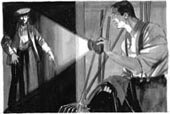
Geoffrey shone the light on her.
He looked worried. 'You're wet right through,' he said. 'Why don't you stay in here until the rain stops?'
No answer.
'You can take your wet things off, and put a blanket round you. There's a horse-blanket in the box here.'
He waited, but there was still no answer.
He put the lamp down, opened the wooden box, and took out a big grey blanket. 'Come on,' he said, kindly. 'Take your hat and coat off, and put this round you.'
Slowly, she took off her hat and coat and put the blanket round her. She was shaking all over with cold.
'Is something the matter with you?' he said, worried.
'I've walked to Bulwell and back,' she said tiredly, 'looking for him. I've eaten nothing since this morning.' She did not weep – she was too tired, too miserable.
'You've had nothing to eat?' he said. He went back to the box. There was food in there – bread and cheese. He cut some bread and put a big piece of cheese on it.
She sat down on the end of the bed of hay, and slowly began to eat. Then he gave her a drink of water, and saw that she was still shaking.
'Can't you get warm?' he asked.
'I will in a minute. Don't you worry. I'll go soon. I'm taking your seat – are you staying here all night?'
'Yes. But you must stay, and get warm. I've got to go and see that the haystacks are all right. Take your wet things off, and get warm with that blanket round you.'
'I'll go in ten minutes. This is your place, and I'm not going to push you out. It's not right.'
'You're not pushing me out,' he said. 'I'll come back when I've looked at the stacks.'
He went. A minute later, she put the lamp out. He stood between the stacks, listening. There was only the soft rain and the dark night all around him. Everything was still, silent, black – like death, he thought.
He found his way back to the shed and went in. 'Are you all right?' he said. He lit the lamp again. Her small face looked up at him, out of the grey blanket.
'You don't need a lamp,' she said. 'Lie down and get your night's rest. I can sit at this end, out of your way.'
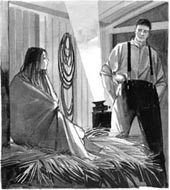
'I can sit at this end, out of your way,' she said.
He put the lamp out, and sat down on the hay, at the other end. Then he asked, 'Is he really your husband?'
'He is!' she answered, in a hard little voice.
'Do you follow him because you like him?' He was afraid to ask, but he wanted to know.
'I don't – I wish he was dead.' Her voice was coldly angry. Then, 'But he's my husband.'
He gave a short laugh. 'Not much of one,' he said. 'Have you been married long?'
'Four years. Since I was eighteen.'
'And do you just move about, all the time?' he asked.
'He says he's looking for a job. But he doesn't like work. He was a wagon-driver when I married him. He left that job when the baby was only two months old, and I've not had a kind word or a day's rest since then.'
'And where's the baby?'
'It died when it was ten months old.'
After that they were silent. At last Geoffrey said slowly, 'You've had a hard life.' He looked at her, but saw nothing in the dark. 'What will you do now?'
'I'll find him. He's not going to get away.'
'But why don't you leave him?'
'Because he's not going to win.'
He listened to her hard voice, and felt miserable for her. He could not see her; they were just two voices in the black night.
'Are you warm now?' he asked, half afraid.
'A bit warmer – but my feet are still terribly cold.'
'I can warm them with my hands. Shall I?'
'No, thank you,' she said, coldly. Then she felt sorry. He was kind, he was trying to help. 'But they do hurt.'
'Put them in my hands, then.'
His large, strong hands closed round her icy feet and held them. She felt his warm breath on her toes.
'Do they feel any better yet?' he asked, after a while.
She did not answer. She put out her hand and touched his hair. His hand came up to find hers, but found her face, which was wet with tears. Gently, his fingers followed the tears down her cheeks.
'What's the matter?' he said, in his slow, deep voice.
She put out both her arms and pulled his head to her. Four lonely, miserable years were suddenly behind her; she was no longer old before her time. Suddenly, it was possible to hope again, to be young, to be happy. She wept long and silently, holding Geoffrey's head close to her, with her wild tears falling on his hair.
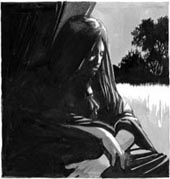
She wept long and silently, holding Geoffrey's head close to her, with her wild tears falling on his hair.
Geoffrey sat still, full of wonder, full of love. When at last she stopped weeping, he put his arms around her, gently. And in a while, they kissed, his first love kiss.
weep v. to cry 哭
blanket n. a cover that you sleep under, to keep you warm 毯子
icy adj. like ice; very, very cold 冰凉的
wonder n. a feeling you have when you see something very strange or beautiful or surprising 惊奇
5
夜晚相会
杰弗里正躺着思考自己的人生,忽然听到了什么动静,不是雨声。有什么东西在棚子里,正朝他过来。一开始他害怕极了,然后他跳了起来,用他那双大手抓住了那个东西。
那个东西没有挣扎,只是发出一记不满的轻叫声。
“放开我。”一个女人的声音说。
“你想干吗?”他生气地问。
“我以为他在这里。”她开始小声地哭了起来。
“谁?你以为谁在这里?”他说。
“我丈夫。他午饭的时候来过这儿的。你看见他了。”她试图挣脱他的手,“放开我。”
“是你!”杰弗里惊叫,“你是在找午饭时来过这儿的那个肮脏的小个子流浪汉?”他双手仍然钳制着她,但不那么用力了。“他是在哪儿撇下你的?”
“是我先撇下了他,就在这儿。”她说,“那以后我就再没见过他。”
杰弗里笑了一声。“那倒是件好事,不是吗?你为什么还想见他?”
“他是我丈夫,而且只要我能阻止,就不会让他跑掉。”
杰弗里没搭话,他不知道该说什么。
“你的衣服都湿了。”他最后说。
“下这么大的雨,没什么可惊讶的,不是吗?既然他不在这儿,那我走了。”
“你很冷,是吧?”杰弗里说,“我能感觉到,你冷得直发抖。”
她没有回答。他也不知道说什么好。
“等一下。”他找到了自行车灯,点亮后照向她。他看到一张苍白而疲惫的脸。她的旧水手帽和棕色外套被雨淋得透湿,变成了黑色。水从她的湿裙子上滴滴答答地落到鞋上。
他看起来有些担心。“你全身湿透了。”他说,“干吗不在这儿等到雨停呢?”
没有回答。
“你可以把湿衣服脱下来,围一条毯子。这儿的箱子里有一条遮马的毯子。”
他等了一会儿,但还是没有回答。
他把灯放下,打开木箱,取出了一条灰色的大毯子。“来吧,”他和气地说,“把你的帽子和外衣脱掉,围上这条毯子。”
她缓缓地摘掉帽子,脱下外衣,围上了毯子。但她还是冷得全身发抖。
“你有哪里不舒服吗?”他担心地问。
“我走着去了布尔韦尔,又走回来,”她疲惫地说,“一路上都在找他。我从今天早上就没吃过东西。”她没有哭——她太累,太难过了。
“你什么都没吃?”他说着,又走到了木箱跟前。箱子里有吃的,是面包和奶酪。他切了点面包,又在上面放了一大片奶酪。
她在干草铺的一角坐下,开始慢慢地吃起来。然后,他给她倒了些水喝,见她还在发抖。
“你暖和不起来吗?”他问。
“我很快就好了。别担心,我一会儿就离开。我占了你的地方——你要整夜待在这儿吗?”
“是的。不过你得留下,暖和起来。我得去看看草垛有没有问题。把你的湿衣服脱下来,围着毯子暖和一下吧。”
“我过十分钟就走。这是你的地方,我不能赶你出去。这样不对。”
“你没有把我赶出去。”他说,“我看过了草垛就回来。”
他出去了。过了片刻,她熄了灯。他站在两个草垛中间凝神细听。周围只有轻柔的雨声和黑暗的夜。天地万物静止幽暗——就像死亡,他想。
他摸索着返回棚子,走了进去。“你还好吧?”他说着,又点亮了灯。她抬头看他,小小的脸从灰色的毯子里露出来。
“你不需要点灯。”她说,“躺下休息吧。我可以坐在这头,不会妨碍你。”
他熄了灯,在干草铺的另一头坐下。接着,他问:“他真的是你丈夫?”
“他是!”她冷冷地低声回答。
“你跟着他流浪是因为喜欢他吗?”他不太敢问,但是很想知道答案。
“我不喜欢他——我巴不得他死了。”她的声音里有冷冷的怒意。接着,她又说:“但他是我丈夫。”
他笑了一声。“可不是什么好丈夫。”他说,“你们结婚很久了吗?”
“四年。我十八岁嫁给他的。”
“你们一直就这么居无定所?”他问。
“他说他在找工作,但他不喜欢工作。我嫁给他的时候,他是个赶车的。孩子刚两个月大的时候,他就不干了。从那以后我就没听过一句好话,也没有一天安宁。”
“那孩子在哪儿?”
“十个月大的时候死了。”
之后他们沉默了一阵。最后杰弗里慢慢地说:“你过得不容易。”他望向她,可是在黑暗中什么也看不见。“你现在有什么打算?”
“我要找到他。他跑不掉。”
“但你为什么不离开他呢?”
“因为我不能让他赢。”
他听着她冷硬的声音,替她感到难过。他看不见她,他们只是黑夜中的两个声音。
“你现在暖和了吗?”他有点儿担心地问。
“暖和点儿了,但我的脚还是冰凉的。”
“我用手帮你暖一暖,可以吗?”
“不用了,谢谢你。”她冷淡地说。说完,她又觉得抱歉。他是好意,想要帮忙。“但我的脚确实很疼。”
“那把脚放到我手里吧。”
他有力的大手包上她冰凉的脚,握住。她感觉到他在对她的脚趾哈气,暖暖的。
“现在感觉好点儿了吗?”过了一会儿,他问。
她没有回答,而是伸出手,摸了摸他的头发。他抬手寻找她的手,却碰到了她的脸,上面湿漉漉的,满是泪水。他的手指轻柔地顺着泪痕抚过她的脸颊。
“怎么了?”他问,声音低沉舒缓。
她伸出双手揽过了他的头。孤独而痛苦的四年忽然间就被抛到了脑后,她不再是那个未老先衰的自己。突然之间,她又有了希望,有了年轻和幸福的可能。她紧紧地抱着杰弗里的头,安静地哭泣了很久,汹涌的眼泪滚落在他的发间。
杰弗里静静地坐着,心中充满了惊奇和爱恋。最后,她终于停止了哭泣。他温柔地把她抱在怀里。过了一会儿,他们接吻了,那是他的初吻。
夜晚相会
5
A meeting in the dark
While Geoffrey lay there, thinking about his life, he suddenly heard a sound that was not the rain. Something was in the shed, moving towards him. For a second, terror filled him, then he jumped up, and caught the thing with his great hands.
It did not fight, just gave a small, unhappy cry.
'Let me go,' said a woman's voice.
'What do you want?' he asked, angrily.
'I thought he was here.' She began to weep, quietly.
'Who? Who did you think was here?' he said.
'My husband. He was here at dinner-time. You saw him.' She tried to pull away from his hands. 'Let me go.'
'It's you!' said Geoffrey, in surprise. 'Are you looking for that dirty little tramp that was here at dinner?' He still held her with both hands, but more gently now. 'Where did he leave you?'
'I left him – here,' she said. 'I've seen nothing of him since.'
Geoffrey gave a short laugh. 'That's a good thing, isn't it? Why would you want to see him again?'
'He's my husband – and he's not going to run away if I can stop him.'
Geoffrey was silent, not knowing what to say.
'Your clothes are wet,' he said at last.
'That's not surprising, is it, in this rain? But he's not here, so I'll go.'
'You're cold, aren't you?' said Geoffrey. 'I can feel it. You're shaking with cold.'
She did not answer. He did not know what to say.
'Wait a minute.' He found his bicycle lamp, lit it, and shone the light on her. He saw a white, tired face. Her old sailor hat and her brown coat were black with rain. Drops of water fell from her wet skirt onto her shoes.
Geoffrey shone the light on her.
He looked worried. 'You're wet right through,' he said. 'Why don't you stay in here until the rain stops?'
No answer.
'You can take your wet things off, and put a blanket round you. There's a horse-blanket in the box here.'
He waited, but there was still no answer.
He put the lamp down, opened the wooden box, and took out a big grey blanket. 'Come on,' he said, kindly. 'Take your hat and coat off, and put this round you.'
Slowly, she took off her hat and coat and put the blanket round her. She was shaking all over with cold.
'Is something the matter with you?' he said, worried.
'I've walked to Bulwell and back,' she said tiredly, 'looking for him. I've eaten nothing since this morning.' She did not weep – she was too tired, too miserable.
'You've had nothing to eat?' he said. He went back to the box. There was food in there – bread and cheese. He cut some bread and put a big piece of cheese on it.
She sat down on the end of the bed of hay, and slowly began to eat. Then he gave her a drink of water, and saw that she was still shaking.
'Can't you get warm?' he asked.
'I will in a minute. Don't you worry. I'll go soon. I'm taking your seat – are you staying here all night?'
'Yes. But you must stay, and get warm. I've got to go and see that the haystacks are all right. Take your wet things off, and get warm with that blanket round you.'
'I'll go in ten minutes. This is your place, and I'm not going to push you out. It's not right.'
'You're not pushing me out,' he said. 'I'll come back when I've looked at the stacks.'
He went. A minute later, she put the lamp out. He stood between the stacks, listening. There was only the soft rain and the dark night all around him. Everything was still, silent, black – like death, he thought.
He found his way back to the shed and went in. 'Are you all right?' he said. He lit the lamp again. Her small face looked up at him, out of the grey blanket.
'You don't need a lamp,' she said. 'Lie down and get your night's rest. I can sit at this end, out of your way.'
'I can sit at this end, out of your way,' she said.
He put the lamp out, and sat down on the hay, at the other end. Then he asked, 'Is he really your husband?'
'He is!' she answered, in a hard little voice.
'Do you follow him because you like him?' He was afraid to ask, but he wanted to know.
'I don't – I wish he was dead.' Her voice was coldly angry. Then, 'But he's my husband.'
He gave a short laugh. 'Not much of one,' he said. 'Have you been married long?'
'Four years. Since I was eighteen.'
'And do you just move about, all the time?' he asked.
'He says he's looking for a job. But he doesn't like work. He was a wagon-driver when I married him. He left that job when the baby was only two months old, and I've not had a kind word or a day's rest since then.'
'And where's the baby?'
'It died when it was ten months old.'
After that they were silent. At last Geoffrey said slowly, 'You've had a hard life.' He looked at her, but saw nothing in the dark. 'What will you do now?'
'I'll find him. He's not going to get away.'
'But why don't you leave him?'
'Because he's not going to win.'
He listened to her hard voice, and felt miserable for her. He could not see her; they were just two voices in the black night.
'Are you warm now?' he asked, half afraid.
'A bit warmer – but my feet are still terribly cold.'
'I can warm them with my hands. Shall I?'
'No, thank you,' she said, coldly. Then she felt sorry. He was kind, he was trying to help. 'But they do hurt.'
'Put them in my hands, then.'
His large, strong hands closed round her icy feet and held them. She felt his warm breath on her toes.
'Do they feel any better yet?' he asked, after a while.
She did not answer. She put out her hand and touched his hair. His hand came up to find hers, but found her face, which was wet with tears. Gently, his fingers followed the tears down her cheeks.
'What's the matter?' he said, in his slow, deep voice.
She put out both her arms and pulled his head to her. Four lonely, miserable years were suddenly behind her; she was no longer old before her time. Suddenly, it was possible to hope again, to be young, to be happy. She wept long and silently, holding Geoffrey's head close to her, with her wild tears falling on his hair.
She wept long and silently, holding Geoffrey's head close to her, with her wild tears falling on his hair.
Geoffrey sat still, full of wonder, full of love. When at last she stopped weeping, he put his arms around her, gently. And in a while, they kissed, his first love kiss.
weep v. to cry 哭
blanket n. a cover that you sleep under, to keep you warm 毯子
icy adj. like ice; very, very cold 冰凉的
wonder n. a feeling you have when you see something very strange or beautiful or surprising 惊奇
5
夜晚相会
杰弗里正躺着思考自己的人生,忽然听到了什么动静,不是雨声。有什么东西在棚子里,正朝他过来。一开始他害怕极了,然后他跳了起来,用他那双大手抓住了那个东西。
那个东西没有挣扎,只是发出一记不满的轻叫声。
“放开我。”一个女人的声音说。
“你想干吗?”他生气地问。
“我以为他在这里。”她开始小声地哭了起来。
“谁?你以为谁在这里?”他说。
“我丈夫。他午饭的时候来过这儿的。你看见他了。”她试图挣脱他的手,“放开我。”
“是你!”杰弗里惊叫,“你是在找午饭时来过这儿的那个肮脏的小个子流浪汉?”他双手仍然钳制着她,但不那么用力了。“他是在哪儿撇下你的?”
“是我先撇下了他,就在这儿。”她说,“那以后我就再没见过他。”
杰弗里笑了一声。“那倒是件好事,不是吗?你为什么还想见他?”
“他是我丈夫,而且只要我能阻止,就不会让他跑掉。”
杰弗里没搭话,他不知道该说什么。
“你的衣服都湿了。”他最后说。
“下这么大的雨,没什么可惊讶的,不是吗?既然他不在这儿,那我走了。”
“你很冷,是吧?”杰弗里说,“我能感觉到,你冷得直发抖。”
她没有回答。他也不知道说什么好。
“等一下。”他找到了自行车灯,点亮后照向她。他看到一张苍白而疲惫的脸。她的旧水手帽和棕色外套被雨淋得透湿,变成了黑色。水从她的湿裙子上滴滴答答地落到鞋上。
他看起来有些担心。“你全身湿透了。”他说,“干吗不在这儿等到雨停呢?”
没有回答。
“你可以把湿衣服脱下来,围一条毯子。这儿的箱子里有一条遮马的毯子。”
他等了一会儿,但还是没有回答。
他把灯放下,打开木箱,取出了一条灰色的大毯子。“来吧,”他和气地说,“把你的帽子和外衣脱掉,围上这条毯子。”
她缓缓地摘掉帽子,脱下外衣,围上了毯子。但她还是冷得全身发抖。
“你有哪里不舒服吗?”他担心地问。
“我走着去了布尔韦尔,又走回来,”她疲惫地说,“一路上都在找他。我从今天早上就没吃过东西。”她没有哭——她太累,太难过了。
“你什么都没吃?”他说着,又走到了木箱跟前。箱子里有吃的,是面包和奶酪。他切了点面包,又在上面放了一大片奶酪。
她在干草铺的一角坐下,开始慢慢地吃起来。然后,他给她倒了些水喝,见她还在发抖。
“你暖和不起来吗?”他问。
“我很快就好了。别担心,我一会儿就离开。我占了你的地方——你要整夜待在这儿吗?”
“是的。不过你得留下,暖和起来。我得去看看草垛有没有问题。把你的湿衣服脱下来,围着毯子暖和一下吧。”
“我过十分钟就走。这是你的地方,我不能赶你出去。这样不对。”
“你没有把我赶出去。”他说,“我看过了草垛就回来。”
他出去了。过了片刻,她熄了灯。他站在两个草垛中间凝神细听。周围只有轻柔的雨声和黑暗的夜。天地万物静止幽暗——就像死亡,他想。
他摸索着返回棚子,走了进去。“你还好吧?”他说着,又点亮了灯。她抬头看他,小小的脸从灰色的毯子里露出来。
“你不需要点灯。”她说,“躺下休息吧。我可以坐在这头,不会妨碍你。”
他熄了灯,在干草铺的另一头坐下。接着,他问:“他真的是你丈夫?”
“他是!”她冷冷地低声回答。
“你跟着他流浪是因为喜欢他吗?”他不太敢问,但是很想知道答案。
“我不喜欢他——我巴不得他死了。”她的声音里有冷冷的怒意。接着,她又说:“但他是我丈夫。”
他笑了一声。“可不是什么好丈夫。”他说,“你们结婚很久了吗?”
“四年。我十八岁嫁给他的。”
“你们一直就这么居无定所?”他问。
“他说他在找工作,但他不喜欢工作。我嫁给他的时候,他是个赶车的。孩子刚两个月大的时候,他就不干了。从那以后我就没听过一句好话,也没有一天安宁。”
“那孩子在哪儿?”
“十个月大的时候死了。”
之后他们沉默了一阵。最后杰弗里慢慢地说:“你过得不容易。”他望向她,可是在黑暗中什么也看不见。“你现在有什么打算?”
“我要找到他。他跑不掉。”
“但你为什么不离开他呢?”
“因为我不能让他赢。”
他听着她冷硬的声音,替她感到难过。他看不见她,他们只是黑夜中的两个声音。
“你现在暖和了吗?”他有点儿担心地问。
“暖和点儿了,但我的脚还是冰凉的。”
“我用手帮你暖一暖,可以吗?”
“不用了,谢谢你。”她冷淡地说。说完,她又觉得抱歉。他是好意,想要帮忙。“但我的脚确实很疼。”
“那把脚放到我手里吧。”
他有力的大手包上她冰凉的脚,握住。她感觉到他在对她的脚趾哈气,暖暖的。
“现在感觉好点儿了吗?”过了一会儿,他问。
她没有回答,而是伸出手,摸了摸他的头发。他抬手寻找她的手,却碰到了她的脸,上面湿漉漉的,满是泪水。他的手指轻柔地顺着泪痕抚过她的脸颊。
“怎么了?”他问,声音低沉舒缓。
她伸出双手揽过了他的头。孤独而痛苦的四年忽然间就被抛到了脑后,她不再是那个未老先衰的自己。突然之间,她又有了希望,有了年轻和幸福的可能。她紧紧地抱着杰弗里的头,安静地哭泣了很久,汹涌的眼泪滚落在他的发间。
杰弗里静静地坐着,心中充满了惊奇和爱恋。最后,她终于停止了哭泣。他温柔地把她抱在怀里。过了一会儿,他们接吻了,那是他的初吻。
6.Breakfast in the hayfield
6
Breakfast in the hayfield
When Geoffrey woke, a cold morning light was coming into the shed. Outside, a heavy mist lay across the field, hiding the trees and the hedges.
The woman was sleeping in his arms, and he held her gently, staring out into the mist, still full of wonder and love. He would never be afraid or lonely again, with her beside him.
Then he looked down at her, and saw that she was open-eyed, watching him. She had golden-brown eyes, that immediately smiled into his. He also smiled, and softly kissed her.
After a time, he asked shyly, 'What's your name?'
'Lydia,' she said.
'Lydia,' he said slowly, liking the sound of it. 'My name's Geoffrey. Geoffrey Wookey.'
She smiled at him, and for a while they were silent.
'We couldn't get married, could we?' he asked.
'No.'
He thought deeply about this for some time.
'Would you go to Canada with me?'
'Perhaps you'll think differently in two months' time,' she replied quietly.
'I'll think the same. I won't change,' he said, hurt.
She watched him. She would not push him, would not hurry him. She would stay with him, but he must decide, he must do what he wanted.
'Haven't you got any family?' he asked.
'A married sister at Crick. I can go there, if you want me to. I'll get a job on a farm perhaps.'
'And then, in the spring, we'll go to Canada. You will come with me, won't you?' he said, hopefully.
'When the time comes.'
She did not trust him yet, and he understood why.
'I'll give you some money before you go to Crick,' he said. 'You'll go past our farm on your way.'
'I don't need it. I've got some money.'
Her answer worried him. Perhaps she didn't need him or his help. He began to feel afraid. 'Can I write to you? What name shall I use?'
'Mrs Bredon.'
'Your married name!' he said, with a short, hard laugh. 'I'll never see you again, will I?'
She put her arms round him and held him. There were tears in her eyes, but he was still worried, unsure.
Outside the mist was getting thinner. He remembered Maurice then, and told her about him.
'Oh,' she said. 'You must go and put the ladder up for them, you must!'
'All right. But wait here, and see Maurice. Then I can tell him about us.'
She agreed to wait, and he went out to the haystack. There was no sound from above, and he could see nothing. He put the ladder back up in the same place, and then went along the hedge, looking for firewood.
Then he heard Maurice's voice. 'Well, look at that!'
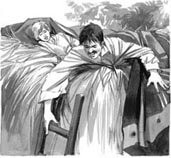
'Well, look at that!' said Maurice.
'Look at what?' That was the girl. 'The ladder – oh! You said it fell down!'
'It did,' said Maurice. 'Well, I heard a bang, and I couldn't see the ladder, or feel it.'
'You said it fell down – and it wasn't true!'
'It was true—' he began.
'Not true, not true!' she cried. 'You are bad, a mean person – mean, mean, mean!' She was wildly angry.
'All right then!' Maurice was also angry now. 'Are you coming down?'
'No! I will not come with you. You are mean – you tell me untrue things. I don't want you!'
Geoffrey, looking through the hedge, saw Maurice on the ladder. He climbed down, then stood at the bottom. 'Come on, I'll hold the ladder for you,' he called.
'No!' she cried, like a wild cat.
He waited for a while, but she did not come. 'Then stay there till you're ready,' he said quietly, and walked away. On the other side of the stack he met Geoffrey.
'What are you doing here?' he said.
'I've been here all night,' Geoffrey replied. 'I came to help you with the cover, but the cover was on, the ladder was down, and I couldn't find you.'
'Did you put the ladder up?'
'Yes, I did it just now.'
Maurice stood still, thinking. Geoffrey tried to find the words to tell him about Lydia. He began, stopped, began again, and at last told the story of his night.
'Oh!' said Maurice. He began to smile.
'The man is nothing, just a tramp, but she's different,' said Geoffrey. He wanted Maurice to understand.
'You please yourself, what you do,' said Maurice. He was quiet, worried, not like himself.
'What's the matter?' asked the older brother. It was strange to see Maurice like this, and for once Maurice was not laughing at him.
'Nothing,' said Maurice.
They went together to the shed. The woman was putting the blanket away in the box. She was washed, and tidy, and looked very neat and pretty.
'Hello,' said Maurice. He smiled, shyly. 'It was good you found somewhere to get out of the rain last night.'
'Yes,' she replied.
'Can you get more firewood?' Geoffrey asked him. It was a new thing for Geoffrey to ask Maurice to do something. Maurice agreed, and went out into the field. He did not go near the stack, afraid of meeting Paula.
At the shed Geoffrey was making a fire, while Lydia got out coffee and bread from the box. Breakfast was nearly ready when Paula arrived. She had no hat on, there were bits of hay in her hair, and she was white-faced. She did not look her best.
'Ah – you!' she cried, seeing Geoffrey.
'Hello!' he answered. 'You're out early.'
'Where's Maurice?'
'I don't know, he'll be back soon.'
Paula was silent. 'When did you come?' she asked.
'Last night, but I didn't see anybody. I got up just now, and put the ladder up, ready to take the cover off.'
Paula understood, and was silent. When Maurice returned with some wood, she was warming her hands at the fire. She looked up at him, but he would not look at her. Geoffrey met Lydia's eyes, and smiled. Maurice held out his hands to the fire.
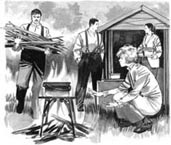
When Maurice returned, Paula was warming her hands at the fire.
'You are cold?' asked Paula, softly.
'A bit,' he answered, friendly but not too friendly.
The four of them sat round the fire, drinking their smoky coffee, eating their bread and cheese. All the time Paula watched Maurice's face hopefully, and he watched the fire. He was gentle, but he would not look at her. And Geoffrey smiled and smiled at Lydia, who watched him with her golden-brown eyes, and did not look away.
♡ ♡ ♡
The German girl got back into the vicar's house that morning, and her night out in the hayfield stayed a secret. A week later, she was engaged to Maurice, and when her last three weeks with the vicar's family were finished, she came to live at the Wookey farm.
Geoffrey and Lydia stayed true, one to the other.
♥ ♥ ♥
mist n. thin cloud near the ground that is difficult to see through 雾
engaged adj. if two people are engaged, they have agreed to marry 已订婚的
6
草场早餐
杰弗里醒来的时候,一道冷冷的晨光照进了棚子。棚外,浓雾笼罩着田野,遮蔽了树木和篱笆。
女人正在他怀中睡着,他轻轻地抱着她,望着外面的雾气,心中仍然充满了惊奇和爱恋。有她在身边,他再不会感觉害怕或孤独了。
接着,他低头看她,见她睁着眼正在看自己。她的眼睛是金棕色的,一见他看过来就盈满了笑意。他也笑了,轻轻地吻了吻她。
过了一会儿,他羞涩地问:“你叫什么名字?”
“莉迪亚。”她说。
“莉迪亚。”他慢慢重复这个名字,很喜欢它的发音,“我叫杰弗里,杰弗里·伍基。”
她对他笑了笑,两人沉默了一会儿。
“我们不能结婚,是吧?”他问。
“不能。”
他仔细想了想这个问题。
“你愿意跟我去加拿大吗?”
“或许两个月以后你就不这么想了。”她轻声回答。
“我不会改变想法的。我不会变。”他说,感觉有些受伤。
她看着他。她不想逼迫他,也不想催他做决定。她会跟他在一起,但他必须做决定,他必须按照自己的心意行事。
“你有亲人吗?”他问。
“在克里克有个已经结婚的姐姐。如果你想让我去那里,我可以去。我或许可以在哪个农场找份工作。”
“等到春天,我们就去加拿大。你会跟我一起去的,是吧?”他期待地问。
“到时候再说。”
她还不信任他,他明白为什么。
“你去克里克之前,我会给你些钱。”他说,“你会路过我们的农场。”
“不用了。我有一点儿钱。”
她的回答让他担心。或许她并不需要他或是他的帮助。他开始感到害怕。“我能写信给你吗?我应该用什么称呼?”
“布雷登太太。”
“你丈夫的姓!”他说着,嗤笑了一声,“我不会再见到你了,是吗?”
她伸出手臂抱住他。泪水涌上了她的眼睛,可他还是担心,感觉不确定。
外面的雾散了一些。这会儿他想起了莫里斯,跟她说起了他的事。
“哦,”她说,“你得去帮他们把梯子摆好,快去吧!”
“好吧。你在这儿等会儿,见见莫里斯。然后我就能跟他说我们的事啦。”
她答应等,于是他出门朝草垛走去。上面没有声音,他也看不到什么。把梯子放回原位后,他就沿着树篱寻找柴火。
这时,他听到了莫里斯的声音:“哦,看这个!”
“看什么?”是那个姑娘的声音,“梯子——哦!你还说它倒了!”
“它是倒了。”莫里斯说,“好吧,当时我听到砰的一声,又看不见也摸不到梯子。”
“你说它倒了,但那不是真的!”
“当时是真的——”他开口道。
“不是真的,不是真的!”她叫道,“你很坏,是个坏人。很坏,很坏,很坏!”她气得不行。
“那好吧!”莫里斯现在也生气了,“你要下来吗?”
“不!我不跟你一起。你很坏,你对我说假话。我不想理你!”
杰弗里透过树篱看到莫里斯正在梯子上。莫里斯爬了下来,然后站在梯子旁。“下来吧,我帮你扶着梯子。”他叫道。
“不要!”她像野猫一样大叫。
他等了一会儿,但她没有下来。“那就等你想下来时再说吧。”他低声说着,走开了。在草垛的另一边,他遇到了杰弗里。
“你在这儿干吗?”他说。
“我在这儿待了一晚上了。”杰弗里回答,“我来帮你盖草垛,但是草垛已经盖好了。梯子倒了,我又找不到你。”
“你把梯子扶起来了?”
“对,我刚才扶起来的。”
莫里斯站着没动,想了想。杰弗里在想怎么开口告诉他莉迪亚的事。他几番开口又停下,最后还是讲了他昨夜遇到的事。
“哦!”莫里斯说着,笑了一下。
“那男人没什么,就是个流浪汉,但她不一样。”杰弗里说。他希望莫里斯能明白。
“随你便,喜欢怎么做就怎么做吧。”莫里斯说。他不愿多说话,一副忧心忡忡的样子,不像平时的他了。
“你怎么了?”做哥哥的问。他不习惯莫里斯的这副样子,莫里斯这回居然没有嘲笑他。
“没什么。”莫里斯说。
他们一起朝棚子走去。女人正把毯子放回木箱。她洗了脸,收拾得很整齐,看起来整洁又漂亮。
“你好。”莫里斯说。他羞涩地笑了笑,“昨晚你能找到避雨的地方真是太好了。”
“是啊。”她答道。
“你能再找些柴火来吗?”杰弗里问莫里斯。杰弗里支使莫里斯做事还是头一次。莫里斯应下,出门朝田野走去。他没有去草垛附近,害怕遇到葆拉。
杰弗里在棚子里生了一堆火,莉迪亚从箱子里拿出咖啡和面包。葆拉到的时候,早饭已经差不多准备好了。她没戴帽子,头发里夹杂着干草屑,脸色苍白。她看起来没有平常漂亮。
“啊——是你!”她见到杰弗里,叫了起来。
“你好!”他回答,“你出门真早。”
“莫里斯呢?”
“我不知道,他很快就回来。”
葆拉没吭声。“你什么时候来的?”她问。
“昨天晚上,但是我没见这里有人。我刚刚才起来,把梯子放好,准备把盖布取下来。”
葆拉明白了他的话,没说什么。莫里斯抱着柴火回来的时候,她正在火堆前暖手。她抬头看他,但是他避开了她的目光。杰弗里与莉迪亚相视一笑。莫里斯也伸出手烤火。
“你冷吗?”葆拉轻声问。
“有点儿。”他的回答和气却不亲近。
四人围坐在火旁喝着热气腾腾的咖啡,吃着面包和奶酪。葆拉一直期待地望着莫里斯的脸,而他却看着火堆。他很和气,但就是不看她。杰弗里不断地冲莉迪亚微笑,她那双金棕色的眼睛也望着他,视线没离开过杰弗里。
♡ ♡ ♡
那天早上,德国姑娘回到了牧师家,没有人知道她在草场里过了一夜。一个星期后,她跟莫里斯订了婚,等她在牧师家最后三个星期的工作结束,她就住到了伍基农场。
杰弗里和莉迪亚一直相爱,忠贞不渝。
♥ ♥ ♥
草场早餐
6
Breakfast in the hayfield
When Geoffrey woke, a cold morning light was coming into the shed. Outside, a heavy mist lay across the field, hiding the trees and the hedges.
The woman was sleeping in his arms, and he held her gently, staring out into the mist, still full of wonder and love. He would never be afraid or lonely again, with her beside him.
Then he looked down at her, and saw that she was open-eyed, watching him. She had golden-brown eyes, that immediately smiled into his. He also smiled, and softly kissed her.
After a time, he asked shyly, 'What's your name?'
'Lydia,' she said.
'Lydia,' he said slowly, liking the sound of it. 'My name's Geoffrey. Geoffrey Wookey.'
She smiled at him, and for a while they were silent.
'We couldn't get married, could we?' he asked.
'No.'
He thought deeply about this for some time.
'Would you go to Canada with me?'
'Perhaps you'll think differently in two months' time,' she replied quietly.
'I'll think the same. I won't change,' he said, hurt.
She watched him. She would not push him, would not hurry him. She would stay with him, but he must decide, he must do what he wanted.
'Haven't you got any family?' he asked.
'A married sister at Crick. I can go there, if you want me to. I'll get a job on a farm perhaps.'
'And then, in the spring, we'll go to Canada. You will come with me, won't you?' he said, hopefully.
'When the time comes.'
She did not trust him yet, and he understood why.
'I'll give you some money before you go to Crick,' he said. 'You'll go past our farm on your way.'
'I don't need it. I've got some money.'
Her answer worried him. Perhaps she didn't need him or his help. He began to feel afraid. 'Can I write to you? What name shall I use?'
'Mrs Bredon.'
'Your married name!' he said, with a short, hard laugh. 'I'll never see you again, will I?'
She put her arms round him and held him. There were tears in her eyes, but he was still worried, unsure.
Outside the mist was getting thinner. He remembered Maurice then, and told her about him.
'Oh,' she said. 'You must go and put the ladder up for them, you must!'
'All right. But wait here, and see Maurice. Then I can tell him about us.'
She agreed to wait, and he went out to the haystack. There was no sound from above, and he could see nothing. He put the ladder back up in the same place, and then went along the hedge, looking for firewood.
Then he heard Maurice's voice. 'Well, look at that!'
'Well, look at that!' said Maurice.
'Look at what?' That was the girl. 'The ladder – oh! You said it fell down!'
'It did,' said Maurice. 'Well, I heard a bang, and I couldn't see the ladder, or feel it.'
'You said it fell down – and it wasn't true!'
'It was true—' he began.
'Not true, not true!' she cried. 'You are bad, a mean person – mean, mean, mean!' She was wildly angry.
'All right then!' Maurice was also angry now. 'Are you coming down?'
'No! I will not come with you. You are mean – you tell me untrue things. I don't want you!'
Geoffrey, looking through the hedge, saw Maurice on the ladder. He climbed down, then stood at the bottom. 'Come on, I'll hold the ladder for you,' he called.
'No!' she cried, like a wild cat.
He waited for a while, but she did not come. 'Then stay there till you're ready,' he said quietly, and walked away. On the other side of the stack he met Geoffrey.
'What are you doing here?' he said.
'I've been here all night,' Geoffrey replied. 'I came to help you with the cover, but the cover was on, the ladder was down, and I couldn't find you.'
'Did you put the ladder up?'
'Yes, I did it just now.'
Maurice stood still, thinking. Geoffrey tried to find the words to tell him about Lydia. He began, stopped, began again, and at last told the story of his night.
'Oh!' said Maurice. He began to smile.
'The man is nothing, just a tramp, but she's different,' said Geoffrey. He wanted Maurice to understand.
'You please yourself, what you do,' said Maurice. He was quiet, worried, not like himself.
'What's the matter?' asked the older brother. It was strange to see Maurice like this, and for once Maurice was not laughing at him.
'Nothing,' said Maurice.
They went together to the shed. The woman was putting the blanket away in the box. She was washed, and tidy, and looked very neat and pretty.
'Hello,' said Maurice. He smiled, shyly. 'It was good you found somewhere to get out of the rain last night.'
'Yes,' she replied.
'Can you get more firewood?' Geoffrey asked him. It was a new thing for Geoffrey to ask Maurice to do something. Maurice agreed, and went out into the field. He did not go near the stack, afraid of meeting Paula.
At the shed Geoffrey was making a fire, while Lydia got out coffee and bread from the box. Breakfast was nearly ready when Paula arrived. She had no hat on, there were bits of hay in her hair, and she was white-faced. She did not look her best.
'Ah – you!' she cried, seeing Geoffrey.
'Hello!' he answered. 'You're out early.'
'Where's Maurice?'
'I don't know, he'll be back soon.'
Paula was silent. 'When did you come?' she asked.
'Last night, but I didn't see anybody. I got up just now, and put the ladder up, ready to take the cover off.'
Paula understood, and was silent. When Maurice returned with some wood, she was warming her hands at the fire. She looked up at him, but he would not look at her. Geoffrey met Lydia's eyes, and smiled. Maurice held out his hands to the fire.
When Maurice returned, Paula was warming her hands at the fire.
'You are cold?' asked Paula, softly.
'A bit,' he answered, friendly but not too friendly.
The four of them sat round the fire, drinking their smoky coffee, eating their bread and cheese. All the time Paula watched Maurice's face hopefully, and he watched the fire. He was gentle, but he would not look at her. And Geoffrey smiled and smiled at Lydia, who watched him with her golden-brown eyes, and did not look away.
♡ ♡ ♡
The German girl got back into the vicar's house that morning, and her night out in the hayfield stayed a secret. A week later, she was engaged to Maurice, and when her last three weeks with the vicar's family were finished, she came to live at the Wookey farm.
Geoffrey and Lydia stayed true, one to the other.
♥ ♥ ♥
mist n. thin cloud near the ground that is difficult to see through 雾
engaged adj. if two people are engaged, they have agreed to marry 已订婚的
6
草场早餐
杰弗里醒来的时候,一道冷冷的晨光照进了棚子。棚外,浓雾笼罩着田野,遮蔽了树木和篱笆。
女人正在他怀中睡着,他轻轻地抱着她,望着外面的雾气,心中仍然充满了惊奇和爱恋。有她在身边,他再不会感觉害怕或孤独了。
接着,他低头看她,见她睁着眼正在看自己。她的眼睛是金棕色的,一见他看过来就盈满了笑意。他也笑了,轻轻地吻了吻她。
过了一会儿,他羞涩地问:“你叫什么名字?”
“莉迪亚。”她说。
“莉迪亚。”他慢慢重复这个名字,很喜欢它的发音,“我叫杰弗里,杰弗里·伍基。”
她对他笑了笑,两人沉默了一会儿。
“我们不能结婚,是吧?”他问。
“不能。”
他仔细想了想这个问题。
“你愿意跟我去加拿大吗?”
“或许两个月以后你就不这么想了。”她轻声回答。
“我不会改变想法的。我不会变。”他说,感觉有些受伤。
她看着他。她不想逼迫他,也不想催他做决定。她会跟他在一起,但他必须做决定,他必须按照自己的心意行事。
“你有亲人吗?”他问。
“在克里克有个已经结婚的姐姐。如果你想让我去那里,我可以去。我或许可以在哪个农场找份工作。”
“等到春天,我们就去加拿大。你会跟我一起去的,是吧?”他期待地问。
“到时候再说。”
她还不信任他,他明白为什么。
“你去克里克之前,我会给你些钱。”他说,“你会路过我们的农场。”
“不用了。我有一点儿钱。”
她的回答让他担心。或许她并不需要他或是他的帮助。他开始感到害怕。“我能写信给你吗?我应该用什么称呼?”
“布雷登太太。”
“你丈夫的姓!”他说着,嗤笑了一声,“我不会再见到你了,是吗?”
她伸出手臂抱住他。泪水涌上了她的眼睛,可他还是担心,感觉不确定。
外面的雾散了一些。这会儿他想起了莫里斯,跟她说起了他的事。
“哦,”她说,“你得去帮他们把梯子摆好,快去吧!”
“好吧。你在这儿等会儿,见见莫里斯。然后我就能跟他说我们的事啦。”
她答应等,于是他出门朝草垛走去。上面没有声音,他也看不到什么。把梯子放回原位后,他就沿着树篱寻找柴火。
这时,他听到了莫里斯的声音:“哦,看这个!”
“看什么?”是那个姑娘的声音,“梯子——哦!你还说它倒了!”
“它是倒了。”莫里斯说,“好吧,当时我听到砰的一声,又看不见也摸不到梯子。”
“你说它倒了,但那不是真的!”
“当时是真的——”他开口道。
“不是真的,不是真的!”她叫道,“你很坏,是个坏人。很坏,很坏,很坏!”她气得不行。
“那好吧!”莫里斯现在也生气了,“你要下来吗?”
“不!我不跟你一起。你很坏,你对我说假话。我不想理你!”
杰弗里透过树篱看到莫里斯正在梯子上。莫里斯爬了下来,然后站在梯子旁。“下来吧,我帮你扶着梯子。”他叫道。
“不要!”她像野猫一样大叫。
他等了一会儿,但她没有下来。“那就等你想下来时再说吧。”他低声说着,走开了。在草垛的另一边,他遇到了杰弗里。
“你在这儿干吗?”他说。
“我在这儿待了一晚上了。”杰弗里回答,“我来帮你盖草垛,但是草垛已经盖好了。梯子倒了,我又找不到你。”
“你把梯子扶起来了?”
“对,我刚才扶起来的。”
莫里斯站着没动,想了想。杰弗里在想怎么开口告诉他莉迪亚的事。他几番开口又停下,最后还是讲了他昨夜遇到的事。
“哦!”莫里斯说着,笑了一下。
“那男人没什么,就是个流浪汉,但她不一样。”杰弗里说。他希望莫里斯能明白。
“随你便,喜欢怎么做就怎么做吧。”莫里斯说。他不愿多说话,一副忧心忡忡的样子,不像平时的他了。
“你怎么了?”做哥哥的问。他不习惯莫里斯的这副样子,莫里斯这回居然没有嘲笑他。
“没什么。”莫里斯说。
他们一起朝棚子走去。女人正把毯子放回木箱。她洗了脸,收拾得很整齐,看起来整洁又漂亮。
“你好。”莫里斯说。他羞涩地笑了笑,“昨晚你能找到避雨的地方真是太好了。”
“是啊。”她答道。
“你能再找些柴火来吗?”杰弗里问莫里斯。杰弗里支使莫里斯做事还是头一次。莫里斯应下,出门朝田野走去。他没有去草垛附近,害怕遇到葆拉。
杰弗里在棚子里生了一堆火,莉迪亚从箱子里拿出咖啡和面包。葆拉到的时候,早饭已经差不多准备好了。她没戴帽子,头发里夹杂着干草屑,脸色苍白。她看起来没有平常漂亮。
“啊——是你!”她见到杰弗里,叫了起来。
“你好!”他回答,“你出门真早。”
“莫里斯呢?”
“我不知道,他很快就回来。”
葆拉没吭声。“你什么时候来的?”她问。
“昨天晚上,但是我没见这里有人。我刚刚才起来,把梯子放好,准备把盖布取下来。”
葆拉明白了他的话,没说什么。莫里斯抱着柴火回来的时候,她正在火堆前暖手。她抬头看他,但是他避开了她的目光。杰弗里与莉迪亚相视一笑。莫里斯也伸出手烤火。
“你冷吗?”葆拉轻声问。
“有点儿。”他的回答和气却不亲近。
四人围坐在火旁喝着热气腾腾的咖啡,吃着面包和奶酪。葆拉一直期待地望着莫里斯的脸,而他却看着火堆。他很和气,但就是不看她。杰弗里不断地冲莉迪亚微笑,她那双金棕色的眼睛也望着他,视线没离开过杰弗里。
♡ ♡ ♡
那天早上,德国姑娘回到了牧师家,没有人知道她在草场里过了一夜。一个星期后,她跟莫里斯订了婚,等她在牧师家最后三个星期的工作结束,她就住到了伍基农场。
杰弗里和莉迪亚一直相爱,忠贞不渝。
♥ ♥ ♥
ACTIVITIES: Before Reading
ACTIVITIES
Before Reading
1 Read the story introduction and the back cover. What do you know now about the story? Tick one box for each sentence.
1) The story takes place on a cold winter's day.
YES □/NO □
2) Maurice and Geoffrey are cutting the hay.
YES □/NO □
3) The two brothers like the same woman.
YES □/NO □
4) Geoffrey is pleased about Maurice and Paula.
YES □/NO □
5) Wind and rain are bad for new hay.
YES □/NO □
6) Maurice is luckier in love than Geoffrey.
YES □/NO □
7) Geoffrey finds it easy to talk about his feelings.
YES □/NO □
2 What happens to the people in this story? Can you guess? Choose words to complete this passage.
Maurice meets Paula / another woman in the hayfield that night / the next day. Geoffrey meets Paula / another woman in the hayfield that night / the next day. She is very angry / unhappy, and when Geoffrey is kind / unkind to her, she laughs / cries. Geoffrey kisses / does not kiss her.
By the next day, everybody / nobody is miserable / in love, and the story ends happily / unhappily.
ACTIVITIES: While Reading
ACTIVITIES
While Reading
1 Read Chapter 1, then match these people with the sentences. (You can use the names more than once.)
Geoffrey / Maurice / the German girl
1) _____ slept in the hayfield last night.
2) _____ has never kissed a girl.
3) _____ works at the house near the hayfield.
4) _____ is interested in _____, not _____.
5) _____ pushes _____ off the haystack.
2 Before you read Chapter 2, what do you think happens? Choose one answer for each sentence.
1) Maurice...
a) breaks a leg.
b) is all right.
c) breaks his neck.
2) The German girl...
a) cries.
b) kisses Maurice.
c) hits Geoffrey.
3) Geoffrey...
a) feels pleased.
b) feels angry.
c) feels afraid.
3 Read Chapters 2 and 3. Are these sentences true (T) or false (F)? Rewrite the false ones with the correct information.
1) Maurice was badly hurt by his fall.
2) Paula said that Geoffrey knocked Maurice over the side of the haystack.
3) Maurice told his father about the fight with Geoffrey.
4) Geoffrey did not say anything about the fight.
5) Paula worked for the vicar, but the vicar did not like her.
6) At dinner Maurice asked Paula lots of questions.
7) A tramp came into the field and asked for food.
8) The father gave the tramp something to eat.
9) The tramp's young woman had something to eat.
10) Geoffrey understood how the young woman felt.
4 Before you read Chapter 4, can you guess who will stay at the hayfield when the men stop work?
1) Geoffrey.
2) Maurice.
3) Henry.
5 Read Chapter 4, then put these sentences in the right order for the chapter.
1) Paula helped Maurice carry the cover up the ladder.
2) After the others left, Maurice washed himself in the river.
3) Geoffrey went to the shed and lay down on the hay bed.
4) The ladder fell down and Geoffrey left it there.
5) Paula came, and rode with Maurice across the hayfield.
6) Paula and Maurice stayed on top of the haystack.
7) Geoffrey arrived and walked across to the stacks.
8) It began to rain.
6 Before you read Chapter 5, A meeting in the dark, which of these people do you think meet in this chapter? Choose some names from this list.
| Maurice | the father | the vicar's wife |
| Geoffrey | Paula | the tramp |
| Henry | the vicar | the tramp's woman |
7 Read Chapter 5. Who said these words? Who or what were they talking about?
1) 'He's not going to run away if I can stop him.'
2) 'This is your place, and I m not going to push you out.'
3) 'Do you follow him because you like him?'
4) 'I can sit at this end, out of your way.'
5) 'It died when it was ten months old.'
6) 'I can warm them with my hands. Shall I?'
8 How does the story end? Before you read Chapter 6, can you guess which of these sentences are true? Choose as many as you like.
1) Geoffrey forgets about the ladder and goes home.
2) The four young people have breakfast together.
3) Maurice asks Paula to marry him.
4) Paula goes to London and later Maurice follows her.
5) The tramp's wife goes back to her husband.
6) Geoffrey asks the tramp's wife to go away with him.
ACTIVITIES: After Reading
ACTIVITIES
After Reading
1 Here is Farmer Wookey telling his wife about the day. Put their conversation in the correct order and write in the speakers' names. Farmer Wookey speaks first (number 4).
1) _____ 'No, it was the wife of a tramp who was looking for work. But I felt sorry for the poor girl.'
2) _____ 'That's the girl who's working for the vicar, isn't it? Do you know her name?'
3) _____ 'Strange? Why, what happened?'
4) _____ 'It's been a strange day today.'
5) _____ 'Why? What was the matter with her?'
6) _____ 'Paula – something. I think Maurice likes her.'
7) _____ 'Well, in the morning Maurice and Geoffrey were up on the haystack, and Maurice fell off.'
8) _____ 'Who was the other? Was it Bill's daughter?'
9) _____ 'She looked so unhappy. Her husband was a mean little man. She can't have much of a life.'
10) _____ 'Oh, no! Is he all right? Did he hurt himself?'
11) _____ 'Well, I think he has. She's a bright little thing. But not the only pretty woman in the field today.'
12) _____ 'No, he's all right. That little German girl saw him fall and came running down to see him.'
13) _____ 'Does he now! I'd like him to find a nice girl.'
2 Here is a new illustration for the story. Find the best place in the story to put the picture, and answer these questions.
The picture goes in Chapter _____.
1) Who is Maurice calling to on top of the haystack?
2) Where has the ladder been all night?
3) Who put the ladder up?
Now write a caption for the illustration.
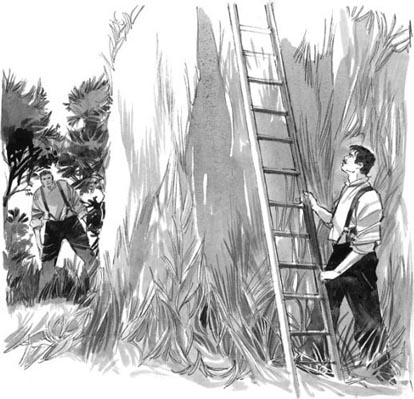
Caption: ______________________________
3 Use the clues to complete this crossword with words from the story (all the words go across). Then find two hidden words (four letters or more) in the crossword.
1) You sleep under this on a bed to keep warm.
2) Very, very cold.
3) To speak in a very soft, quiet voice.
4) Water that comes from the eyes when you cry.
5) Nice to look at.
6) Very sad or unhappy.
7) The feeling when you are very, very afraid.
8) You use this to climb to a high place.
9) They put this over the haystack, to keep the rain off.
10) A farm tool which is used to pick hay up.
The hidden words are _____ and _____.
4 Here are the two women in the story talking about their plans. Complete each passage with words from this list. Then say who is speaking, and who they are talking to.
baby, Canada, cheese, engaged, farm, Germany, hate, kind, leave, marry, miserable, sorry, spring, stay, true, trust, wants
1) 'We're _____ now, Maurice and I. So I'm not going back to _____ when I _____ here. I'm going to live at the Wookey _____ and learn to make _____. I won't be_____ to leave here. You and your wife _____ me. Isn't that _____?
2) He's a good, _____ man, and I think I can _____ him. I can't _____ him, but I've had a _____ life since the _____ died. So if he still _____ me to, I'll go to _____ with him in the _____. Can I _____ with you until then?
5 What do you think is important when you choose someone to spend your life with? Add two more ideas of your own to this list, then choose the five most important ideas and number them 1 to 5 (with 1 for the most important).
The right person is somebody who...
| · has a good job. | · is kind. |
| · is the same age as you. | · is clever. |
| · comes from a good family. | · works hard. |
| · laughs at the same things as you. | · is happy. |
| · thinks about other people. | · is loving. |
封底