扉页
版权页
京权图字:01-2013-7826
Published by arrangement with Oxford University Press for sale in the People's Republic of China only and not for export therefrom. This edition is for sale in the mainland of China only, excluding Hong Kong SAR, Macao SAR and Taiwan.
© Oxford University Press 2008
Oxford is a registered trademark of Oxford University Press
图书在版编目(CIP)数据
陷坑与钟摆:英汉对照/(美)坡(Poe, E. A.)著;(英)埃斯科特(Escott, J.)改写;(英)米勒(Miller, I.)绘;田娜译.—北京:外语教学与研究出版社,2014.2
(书虫·牛津英汉双语读物)
书名原文:The pit and the pendulum and other stories
ISBN 978-7-5135-4075-9
Ⅰ.①陷… Ⅱ.①坡…②埃…③米…④田… Ⅲ.①英语—汉语—对照读物②长篇小说—美国—近代 Ⅳ.①H319.4:I
中国版本图书馆CIP数据核字(2014)第029029号
出版人 蔡剑峰
责任编辑 金 辉
执行编辑 谷 丰
封面设计 蔡 颖
出版发行 外语教学与研究出版社
社 址 北京市西三环北路19号(100089)
网 址 http://www.fltrp.com
版 次 2014年3月第1版
书 号 ISBN 978-7-5135-4075-9
凡侵权、盗版书籍线索,请联系我社法律事务部
举报电话:(010)88817519 电子邮箱:banquan@fltrp.com
法律顾问:立方律师事务所 刘旭东律师
中咨律师事务所 殷 斌律师
内容简介
内容简介
一个人躺在托莱多的狱中。他心里害怕——不,不止害怕,他充满了恐惧,因为他知道宗教法庭的狱中有五花八门的“惊喜”。很快,他就会看到下方的陷坑……
这个人并不是书中唯一一个满怀恐惧的人。当福尔图纳托正高高兴兴地要去参加狂欢节聚会时,他遇到了老朋友蒙特雷索。蒙特雷索想要聊聊阿蒙提拉多酒的事情,于是福尔图纳托发现自己身处蒙特雷索家房子下面阴冷潮湿的地窖之中。恐惧很快随之袭来……
一个害怕被活埋的人永远无法摆脱恐惧;一对年轻恋人的密会使很多人陷入恐惧之中;画家年轻貌美的妻子端坐在那里,一直微笑着——然而她心中充满了恐惧。
死亡和恐惧,恐惧和死亡,两者在这些故事中总是牵手相伴。请你在白天,选一个洒满阳光的房间,并在朋友的陪伴下阅读这些故事吧!
THE PIT AND THE PENDULUM
and Other Stories
A man is lying in a prison in Toledo. He is afraid – no, he is more than afraid, he is full of terror, because he knows that the Inquisition has many surprises in its prisons. Very soon he will look down into the pit...
And he is not the only person in these stories to be full of terror. When Fortunato meets his old friend Montresor, he is a happy man, on his way to a carnival party. But Montresor wants to talk about some Amontillado, and Fortunato finds himself in the cold damp vaults below Montresor's house. Terror soon follows...
The man who fears burial alive is never free from terror; a meeting of young lovers brings terror to many people; and the beautiful young wife of a painter sits smiling, smiling, smiling – but with terror in her heart.
Death and Terror, Terror and Death, walk hand in hand through these stories. Read them by daylight, in a bright sunny room, with friends around you!
目录
The Pit and the Pendulum
The Pit and the Pendulum
I will not open my eyes. Not yet. I lie on my back, very still, and remember...
The black clothes of the judges... their voices, their words. You must die... I watched the judges' mouths – mouths speaking my name, ordering my death. You must die... Cold hands of terror closed round my heart. Then came a sweet thought – what wonderful rest there will be in the grave! After that, I fainted, and saw and heard nothing for a long while.
But I knew when they took me away from that room. They were tall men, moving silently. Down... down they carried me, down into darkness and terror.
I have not opened my eyes yet. I lie on my back, and put out my hand. It falls heavily on something wet and hard. Where am I? Am I still in the prisons at Toledo? Why am I still alive? The Spanish Inquisition kills by fire. Why have they not burnt me to death?
And now I remember other stories of the prisons at Toledo, stories of other kinds of death...
I am afraid to open my eyes. Not afraid of seeing something terrible, but afraid that there is nothing to see. And when at last I do open them, I am right. The blackness of the blackest night is around me. Am I already dead? No! A terrible thought comes to me. I am in a tomb – they have buried me alive in a tomb!
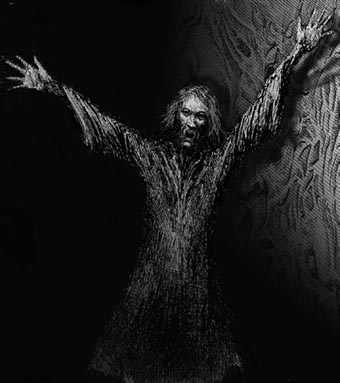
A terrible thought comes to me. I am in a tomb...
I jump up, moving my arms around me. I can feel and see nothing. This place is too big to be a tomb.
I walk on, slowly, until my fingers touch a wall. It is wet and cold. I begin to follow it round, but then stop. How big is my prison? I must know. I tear off a small piece of my long prison shirt and put it on the floor, next to the wall. I move on again, counting my steps.
Walking is not easy. My feet often slip on the wet floor, and suddenly I fall down. I lie there, with my eyes closed. I want to get up, but I am tired... so tired...
I sleep for some time. When I wake up, I put out my arm and find bread and a bottle of water next to me. I eat hungrily and drink from the bottle. After a time, I get up and follow the wall again, counting my steps.
When I find the piece of my shirt on the floor, I stop and think. My prison is about fifty steps around – so about thirty metres. Does it help me to know this? Perhaps not, but now I want to know more.
I start to move across the room, away from the wall. After six or seven steps, my feet slip on the wet floor again, and I fall heavily on my face.
And yet... there is nothing under my head. My body lies on the floor, but under my head there is... nothing. And I can feel on my face a little soft wind, bringing with it a smell, a warm wet smell – the smell of things that have been dead for a long time.
I put out my arm, and find that I am on the edge of a pit. How deep is it? I feel around the floor with my fingers and find a small stone. I drop it into the pit, and listen. After a long time, it falls into water.
At the same moment, a door opens and closes high above me. For a second there is light in my prison, and then it is gone again. But in that second I see I was just one step away from death in that terrible pit.
Shaking, I move slowly back to the wall. I have heard stories about the prison pits of the Inquisition, and they do not give you a quick, clean death.
Dear God, I am going to die in this prison – a slow and terrible death. Every second of every hour of every day I will wait for it, and the waiting will be as terrible as the death itself.
My fear keeps me from sleep for many long hours, but at last my eyes close. When I wake up, there is bread and water beside me again. So... they are watching me all the time, and come in while I am asleep.
I am very thirsty and I drink the water quickly. They have put something in it because at once I feel very sleepy, and I fall into a long, deep sleep. For how long, I do not know. But when I wake up, it is not so dark. A yellow light is coming from somewhere, and I can see my prison at last.
The room is square, and the walls are not made of stone but of metal. There are pictures on them, pictures of faces with wild-looking eyes – the eyes of devils. In the centre of the stone floor is the pit.
I cannot stand up! Why?
Now I see. I am lying on my back, and am tied to a low wooden bed, with many ropes around my body. I can move my head a little, and my right arm, and I can just get a hand to the plate of food on the floor next to me. But there is no bottle of water... and I am so thirsty. The food this time is meat, dry salty meat, which makes me even thirstier than I was before.
I look up at the metal ceiling above me. On one square of it there is a picture of old Father Time. He is holding a pendulum... No, wait! The pendulum is real – it is moving from side to side.
I watch it for a while, a little afraid. Then I hear a noise. Nine or ten large rats have come up from the pit. They can smell the meat, and are running to it across the floor. I make them go away again, but it is hard work.
Because of the rats it is about an hour before I look up at the ceiling again. The pendulum is still moving from side to side, but more strongly now, and... yes! It is getting lower! Then I go cold with terror. I see that the bottom of the pendulum is made of a great piece of metal, bright and sharp – sharper than the blade of any knife. It is right above my heart, and when it moves from side to side through the air, the blade makes a terrible hissing noise.
And with each move, it comes nearer and nearer.
I escaped death in the pit, but now I am staring at another death. I can do nothing, only watch in terror, and wait until that bright blade cuts into my body.
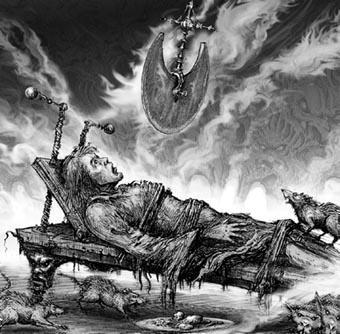
With each move of the pendulum, that bright blade comes nearer and nearer.

Hours, perhaps days, go past. I do not know how many, but the terror does not stop.
I have counted the moves of the pendulum... watched the blade come lower and lower... heard the hissing get louder and louder. Already I can smell the metal of the sharp blade, and I push my body up to it.
'Come! Cut me! Be quick, give me death!'
I sleep, wake, and sleep again. And still the pendulum moves from side to side above me, and the blade comes nearer and nearer. When it reaches me, it will cut across my body, into my heart.
I cannot stop watching it now. I cry out, I laugh, I scream, and still the blade comes nearer. So many long hours of terror. When will they end?
I am hungry, and put out my hand to take the last piece of meat from the plate on the floor. Wait!
A thought comes into my head.
Could I...?
It is only a small hope, but...
The rats are still with me, waiting around my bed, watching me with their red, hungry eyes. 'What food', I think, 'do they eat in that terrible pit?'
They can smell the piece of meat in my hand. I can see their eyes, watching. The meat is full of fat, and if I put the fat on the ropes around my body...
I do this. Then I lie still.
Yes! Some of the biggest rats have jumped up on me. Now there are more, coming from the pit. Suddenly there are hundreds of them running over me, over my body, over my face, touching my eyes, my mouth with their cold mouths. Aaagh!
In seconds the blade will begin to cut into me. I must lie still, I must lie still...
And yes! The rats are eating into the ropes – I can feel it! The blade of the pendulum begins to cut my shirt, and now my body, but the rats have done their work and the ropes fall away from me.
I push the rats off, move away from the pendulum, off the bed, onto the floor. There! I am free!
Free – but still a prisoner of the Inquisition.
The pendulum has stopped moving. It is going back up through the ceiling. So, they are still watching me. What new terror will they send me now?
I look around my metal prison. Already, something is different, something has changed. What is it? And this yellow light, where is it coming from? I look again at the metal walls – and now I can see the narrow gap along the bottom. The yellow light comes from there. I get down to look, but cannot see through the gap.
When I stand up again, I see at once what is different. Those faces on the walls... the colours are brighter, and those wild, devilish eyes burn with – with fire. Yes, real fire! The walls and ceiling are burning, and the smell of hot metal fills the prison. Already it is hard to breathe.
I move away from the wall to the pit in the centre of the room. The burning ceiling sends light deep into the pit, and looking down, I see...
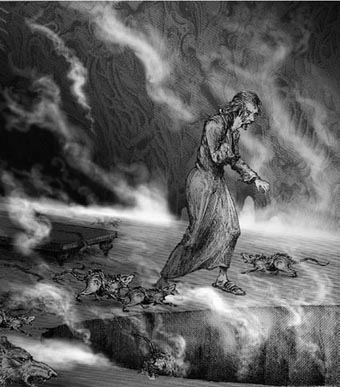
Looking down into the pit, I see...
No, no, I cannot – I cannot speak of it! Not this! No, no, not this! Oh, any terror, but not this!
I run from the edge and hide my face in my hands.
It is getting hotter, much hotter. Shaking, I take my hands away from my face and look up. What's this? The walls are moving. The room is changing, it is longer and narrower, the walls are closing in on me. So this is the new death – death by burning. Then come, Death! Any death is better than the pit!
But the burning walls push me nearer and nearer to the centre of the room – and the pit. Of course! That is what they want! The walls will push me until I fall into the pit! There will be no escape from this death.
So hot now, and getting hotter... the burning walls closing in... nowhere to stand... my back and arms are burnt... my feet are on the edge of the pit... I cannot hold... I give one last, long scream—
Voices! I can hear voices! Yes, and the sound of running feet, doors opening, men shouting. Now the burning walls are moving back. A hand catches my arm as I begin to fall, fainting, into the pit.
It is General Lasalle. The French army has arrived in the city of Toledo, and the Spanish Inquisition is at last in the hands of its enemies.
pit n. a large deep hole in the ground 陷坑
pendulum n. the part of a machine that swings from side to side 钟摆
terror n. very great fear 恐惧
grave n. a place where a dead person is buried 墓穴
faint v. to fall down suddenly because you are ill or afraid 晕厥
Inquisition n. a group of Roman Catholic churchmen from around the 12th through 18th centuries who punished people who did not agree with them 宗教法庭,异端裁判所
tomb n. a small stone building for a dead person 坟墓
step n. one movement of your feet when you walk (一)步
slip v. to almost fall 滑,滑跤
edge n. the part along the end or side of something 边缘
fear n. what you feel when you are afraid 恐惧,害怕
thirsty adj. needing to drink or feeling that you want a drink 口渴的
ceiling n. the part of a room that is over your head 屋顶,天花板
blade n. the part of a knife that cuts 刀锋,刀刃
hissing n. something sounds like "ssss" 咝咝声
fat n. an oily substance contained in certain foods 脂肪
gap n. a space between two things 缝隙
devilish adj. very bad, difficult or unpleasant 极坏的,恶毒的
陷坑与钟摆
我不想睁开眼睛。现在还不是时候。我仰面躺着,一动不动,回想着……
裁判官们黑色的袍服……他们的声音,他们的话语。你必须死……我看着裁判官们的嘴——那些嘴说出我的名字,宣判我的死刑。你必须死……冰冷的恐惧之手攥住了我的心。随即我的脑海里冒出了一个愉快的念头——长眠于坟墓里是多么惬意呀!之后,我便昏迷了过去,好长一段时间什么也看不到,什么也听不到。
可是当他们把我从那个房间拖走时,我是知道的。他们个子高大,轻手轻脚。向下……他们拖着我向下,向下进入到黑暗和恐惧之中。
我还没有睁开眼睛。我仰面躺着,伸出一只手。手重重地落在又湿又硬的东西上面。我在哪儿?我还在托莱多的监狱里吗?为什么我还活着?西班牙的宗教法庭通常采用火刑。他们为什么还没有烧死我?
此刻我记起了关于托莱多监狱的其他传闻,传闻中的其他死法……
我害怕睁开眼睛。不是害怕看到什么可怕的东西,而是害怕什么也看不到。而当我最终睁开眼时,我猜对了。无尽的黑暗包围着我。我已经死了吗?不!一个可怕的念头出现在我的脑海里。我在一个坟墓里——他们把我活埋在一个坟墓里了!
我跳了起来,伸出手臂四处摸索。我什么也摸不着,什么也看不到。这个地方太大,不可能是一个坟墓。
我慢慢地往前走,直到手指碰到了一面墙。墙壁又湿又冷。我开始顺着墙走,但很快就停了下来。我的牢房有多大?我必须知道。我从自己长长的牢服上撕下了一小条布,把它放在墙根处的地面上。我继续往前走,数着我的脚步。
走路并非易事。我的脚常常在潮湿的地面上打滑。突然,我摔倒了。我躺在地上,闭着眼睛。我想要站起来,可是我累了……已经筋疲力尽……
我睡了一段时间。醒来后,我伸出手臂,在身边摸到了面包和一瓶水。我狼吞虎咽地吃着面包,喝着瓶里的水。过了一会儿,我起身继续顺着墙壁走,边走边数我的脚步。
当我碰到地板上放着的那块牢服上撕下的布条时,我停下来思索。我的牢房绕一圈约五十步——这么说,大约是三十米。这个发现对我有用吗?或许没有,但是现在我想知道更多情况。
我开始横穿牢房,从墙边向中央走去。六七步之后,我的脚又在潮湿的地面上滑了一下,我脸朝下重重地摔倒了。
然而……我的头下面竟然什么都没有。我的身体趴在地面上,但我的头下面则是……空无一物。我的脸能感觉到一阵微风,随之飘来一种味道,一种温暖潮湿的味道——是什么东西死了很久之后散发出的味道。
我伸出手臂,发现自己趴在一个坑的边缘。这个坑有多深?我用手指在地面上四处摸索,找到了一块小石头。我把它扔进坑里,侧耳倾听。过了很久,它掉进了水里。
与此同时,上方远远的某处,一扇门打开后又关上了。有那么一瞬间,我的牢房里有了亮光,然后亮光又消失了。可就在那一瞬间,我看到我只差一步就要掉进那个可怕的坑里丧命。
我浑身颤抖,慢慢挪回到了墙边。我听说过关于宗教法庭监狱里的陷坑的传闻,而那绝不是一种干脆、痛快的死法。
天啊,我要死在这个监狱里了——缓慢而痛苦地死去。每天每时每刻,我都在等着死亡的降临,而等待过程之可怕绝不亚于死亡本身。
我的恐惧使我久久不能入睡,不过最终我的眼睛还是合上了。等我醒来的时候,我的身边又放着面包和水。这么说……他们一直在监视我,等我睡着时才进来。
我非常渴,于是迅速地喝着水。他们在水里放了什么东西,因为我马上就感觉到非常困倦,然后就陷入了长时间的沉睡之中。睡了多久,我不知道。可等我醒来时,四周已经不那么漆黑了。不知从哪里射来了黄色的光线,我终于能看清我的牢房了。
牢房是方形的,墙壁不是石头的,而是金属的。墙壁上有一些画,画的是一张张脸,脸上长着狰狞的眼睛——魔鬼的眼睛。石头地面的中央是那个陷坑。
我无法站起身来!为什么呢?
现在我知道了。我仰面躺着,被绑在一张低矮的木床上,身上缠了很多条绳索。我能稍稍动一下头,还能动我的右臂,只能伸出手够到我旁边地面上的餐盘。可是没有水……我渴极了。这次的食物是肉,又干又咸的肉,这令我比吃之前还要口渴。
我抬头看着我上方的金属天花板。有一块方形嵌板上是时间老人的画像。他拿着一个钟摆……不,等等!那个钟摆是真的——它正来回摆动呢。
我盯着它看了一会儿,有一点儿害怕。接着我听到一些动静。九或十只大老鼠从陷坑里爬了上来。它们闻到肉味,跑了过来。我把它们赶走了,但这可不是件易事。
因为要赶老鼠的缘故,大约一个小时之后我才又抬头看了看天花板。钟摆还在来回摆动,可是现在摆得更加有力了,而且……是的!它正在下降!我随即吓得浑身发冷。我看到钟摆的下端是由一大块金属制成的,明亮而锋利——比任何刀刃都要锋利。它就在我心脏的正上方,每当它在空中从一边摆到另一边,那利刃就发出可怕的咝咝声。
而且随着每一次的摆动,它离我越来越近。
我躲过了命丧陷坑,可现在却眼睁睁地看着死亡再次降临。我什么都做不了,只能满怀恐惧地看着,等待着,直到那个明晃晃的利刃劈入我的身体。
几个小时,也可能是几天过去了。虽然,我不知道过了多久,可是恐惧一刻都不曾停止。
我数着钟摆摆动的次数……看着那利刃越来越低……听着那咝咝声越来越响。我已经能闻到那利刃的金属味了,于是我挺起身迎向它。
“来啊!劈了我!快一点儿,让我死吧!”
我睡了醒,醒了又睡。钟摆依然在我上方摆来摆去,利刃越来越近。等它够到我,就会劈开我的身体,劈入我的心脏。
现在,我无法不去看它。我大喊,大笑,大叫,然而利刃依然逐渐逼近。那绵延无尽的恐惧,到底何时才会停止?
我饿了,伸出手去拿地上盘中的最后一块肉。等等!
我想到了一个主意。
我能不能……?
虽然希望渺茫,可是……
那些老鼠还待在我身边,围在我的床边等着,它们用饥饿的红眼睛瞪着我。我想,“它们在那个可怕的陷坑里吃什么?”
它们能闻到我手里那块肉的味道。我能看到它们的眼睛正盯着肉看。那肉肥得流油,如果我把油脂抹在捆绑我的绳子上面……
我那么做了。然后我静静地躺着。
太棒了!那些体型最大的老鼠中有一些跳到了我身上。现在有更多的老鼠从陷坑里爬了出来。顷刻之间,有数百只老鼠跑到了我的身上、脸上,用它们冰冷的嘴触碰着我的眼睛、我的嘴。啊!
再过几秒钟,那利刃就将劈入我的身体。我必须一动不动地躺着,我必须一动不动地躺着……
太棒了!老鼠们正在咬绳子——我能感觉到!钟摆的利刃开始切割我的牢服,现在已经要切到我的身体了,好在老鼠们已经完成了它们的工作,绳索从我身上掉了下去。
我驱开群鼠,逃离了钟摆,翻身下地。就这样!我自由了!
自由了——但还是宗教法庭的囚徒。
钟摆停止了摆动。它升回到天花板上。这么说,他们还在监视我。现在他们还要给我制造什么新的恐惧?
我环视这间金属牢房。有什么东西已经不一样了,某些东西发生了变化。是什么?这黄色的光线来自何处?我再次朝金属墙壁看去——现在我能看到墙根处狭窄的缝隙了。黄色的光线就是从那里照进来的。我蹲下查看,可是看不到缝隙的外面是什么。
等我再次站起来后,我马上看出了有什么不同。墙上的那些面孔……那些色彩更加明亮,那些狰狞、恶鬼般的眼中燃烧着——火焰。是的,真正的火焰!墙壁和天花板正在燃烧,炙热的金属散发出的味道充满了整个牢房。这里已经令人难以呼吸。
我从墙壁旁走到牢房中央的陷坑边上。燃烧的天花板发出的光芒照亮了陷坑的深处,我低头看去,看到了……
不,不,我不能——我说不出来!不要是这个!不,不,不要是这个!啊,随便什么可怕的东西都行,但不要是这个!
我从坑边跑开,用手捂住了脸。
牢房里越来越热,热得厉害。我颤抖着把手从脸上拿开,向上看去。这是怎么回事?墙壁正在移动。牢房正在发生变化,它变得更长更窄,墙壁正朝我逼近。原来这就是新的死法——被火烧死。那么来吧,死亡!任何死法都比死在陷坑里强!
可是燃烧的墙壁将我一步步推向牢房中央——还有那个陷坑。当然!那就是他们想要的!墙壁会一直逼迫我,直到我掉进陷坑为止!这种死法是无论如何也逃脱不了了。
现在这么炙热,而且越来越热……燃烧的墙壁逼迫过来……站立的地方都没有……我的后背和胳膊都烧伤了……我的脚就在陷坑的边缘……我坚持不住了……我发出了最后一声长长的尖叫——
声音!我能听到声音!是的,还有跑步的声音,开门的声音和人们的喊声。现在燃烧的墙壁正在往回移动。就在我要晕倒跌入陷坑之时,一只手抓住了我的胳膊。
是拉萨尔将军。法国军队攻入了托莱多城,而西班牙宗教法庭最终落入了它的敌人之手。
陷坑与钟摆
The Pit and the Pendulum
I will not open my eyes. Not yet. I lie on my back, very still, and remember...
The black clothes of the judges... their voices, their words. You must die... I watched the judges' mouths – mouths speaking my name, ordering my death. You must die... Cold hands of terror closed round my heart. Then came a sweet thought – what wonderful rest there will be in the grave! After that, I fainted, and saw and heard nothing for a long while.
But I knew when they took me away from that room. They were tall men, moving silently. Down... down they carried me, down into darkness and terror.
I have not opened my eyes yet. I lie on my back, and put out my hand. It falls heavily on something wet and hard. Where am I? Am I still in the prisons at Toledo? Why am I still alive? The Spanish Inquisition kills by fire. Why have they not burnt me to death?
And now I remember other stories of the prisons at Toledo, stories of other kinds of death...
I am afraid to open my eyes. Not afraid of seeing something terrible, but afraid that there is nothing to see. And when at last I do open them, I am right. The blackness of the blackest night is around me. Am I already dead? No! A terrible thought comes to me. I am in a tomb – they have buried me alive in a tomb!
A terrible thought comes to me. I am in a tomb...
I jump up, moving my arms around me. I can feel and see nothing. This place is too big to be a tomb.
I walk on, slowly, until my fingers touch a wall. It is wet and cold. I begin to follow it round, but then stop. How big is my prison? I must know. I tear off a small piece of my long prison shirt and put it on the floor, next to the wall. I move on again, counting my steps.
Walking is not easy. My feet often slip on the wet floor, and suddenly I fall down. I lie there, with my eyes closed. I want to get up, but I am tired... so tired...
I sleep for some time. When I wake up, I put out my arm and find bread and a bottle of water next to me. I eat hungrily and drink from the bottle. After a time, I get up and follow the wall again, counting my steps.
When I find the piece of my shirt on the floor, I stop and think. My prison is about fifty steps around – so about thirty metres. Does it help me to know this? Perhaps not, but now I want to know more.
I start to move across the room, away from the wall. After six or seven steps, my feet slip on the wet floor again, and I fall heavily on my face.
And yet... there is nothing under my head. My body lies on the floor, but under my head there is... nothing. And I can feel on my face a little soft wind, bringing with it a smell, a warm wet smell – the smell of things that have been dead for a long time.
I put out my arm, and find that I am on the edge of a pit. How deep is it? I feel around the floor with my fingers and find a small stone. I drop it into the pit, and listen. After a long time, it falls into water.
At the same moment, a door opens and closes high above me. For a second there is light in my prison, and then it is gone again. But in that second I see I was just one step away from death in that terrible pit.
Shaking, I move slowly back to the wall. I have heard stories about the prison pits of the Inquisition, and they do not give you a quick, clean death.
Dear God, I am going to die in this prison – a slow and terrible death. Every second of every hour of every day I will wait for it, and the waiting will be as terrible as the death itself.
My fear keeps me from sleep for many long hours, but at last my eyes close. When I wake up, there is bread and water beside me again. So... they are watching me all the time, and come in while I am asleep.
I am very thirsty and I drink the water quickly. They have put something in it because at once I feel very sleepy, and I fall into a long, deep sleep. For how long, I do not know. But when I wake up, it is not so dark. A yellow light is coming from somewhere, and I can see my prison at last.
The room is square, and the walls are not made of stone but of metal. There are pictures on them, pictures of faces with wild-looking eyes – the eyes of devils. In the centre of the stone floor is the pit.
I cannot stand up! Why?
Now I see. I am lying on my back, and am tied to a low wooden bed, with many ropes around my body. I can move my head a little, and my right arm, and I can just get a hand to the plate of food on the floor next to me. But there is no bottle of water... and I am so thirsty. The food this time is meat, dry salty meat, which makes me even thirstier than I was before.
I look up at the metal ceiling above me. On one square of it there is a picture of old Father Time. He is holding a pendulum... No, wait! The pendulum is real – it is moving from side to side.
I watch it for a while, a little afraid. Then I hear a noise. Nine or ten large rats have come up from the pit. They can smell the meat, and are running to it across the floor. I make them go away again, but it is hard work.
Because of the rats it is about an hour before I look up at the ceiling again. The pendulum is still moving from side to side, but more strongly now, and... yes! It is getting lower! Then I go cold with terror. I see that the bottom of the pendulum is made of a great piece of metal, bright and sharp – sharper than the blade of any knife. It is right above my heart, and when it moves from side to side through the air, the blade makes a terrible hissing noise.
And with each move, it comes nearer and nearer.
I escaped death in the pit, but now I am staring at another death. I can do nothing, only watch in terror, and wait until that bright blade cuts into my body.
With each move of the pendulum, that bright blade comes nearer and nearer.
Hours, perhaps days, go past. I do not know how many, but the terror does not stop.
I have counted the moves of the pendulum... watched the blade come lower and lower... heard the hissing get louder and louder. Already I can smell the metal of the sharp blade, and I push my body up to it.
'Come! Cut me! Be quick, give me death!'
I sleep, wake, and sleep again. And still the pendulum moves from side to side above me, and the blade comes nearer and nearer. When it reaches me, it will cut across my body, into my heart.
I cannot stop watching it now. I cry out, I laugh, I scream, and still the blade comes nearer. So many long hours of terror. When will they end?
I am hungry, and put out my hand to take the last piece of meat from the plate on the floor. Wait!
A thought comes into my head.
Could I...?
It is only a small hope, but...
The rats are still with me, waiting around my bed, watching me with their red, hungry eyes. 'What food', I think, 'do they eat in that terrible pit?'
They can smell the piece of meat in my hand. I can see their eyes, watching. The meat is full of fat, and if I put the fat on the ropes around my body...
I do this. Then I lie still.
Yes! Some of the biggest rats have jumped up on me. Now there are more, coming from the pit. Suddenly there are hundreds of them running over me, over my body, over my face, touching my eyes, my mouth with their cold mouths. Aaagh!
In seconds the blade will begin to cut into me. I must lie still, I must lie still...
And yes! The rats are eating into the ropes – I can feel it! The blade of the pendulum begins to cut my shirt, and now my body, but the rats have done their work and the ropes fall away from me.
I push the rats off, move away from the pendulum, off the bed, onto the floor. There! I am free!
Free – but still a prisoner of the Inquisition.
The pendulum has stopped moving. It is going back up through the ceiling. So, they are still watching me. What new terror will they send me now?
I look around my metal prison. Already, something is different, something has changed. What is it? And this yellow light, where is it coming from? I look again at the metal walls – and now I can see the narrow gap along the bottom. The yellow light comes from there. I get down to look, but cannot see through the gap.
When I stand up again, I see at once what is different. Those faces on the walls... the colours are brighter, and those wild, devilish eyes burn with – with fire. Yes, real fire! The walls and ceiling are burning, and the smell of hot metal fills the prison. Already it is hard to breathe.
I move away from the wall to the pit in the centre of the room. The burning ceiling sends light deep into the pit, and looking down, I see...
Looking down into the pit, I see...
No, no, I cannot – I cannot speak of it! Not this! No, no, not this! Oh, any terror, but not this!
I run from the edge and hide my face in my hands.
It is getting hotter, much hotter. Shaking, I take my hands away from my face and look up. What's this? The walls are moving. The room is changing, it is longer and narrower, the walls are closing in on me. So this is the new death – death by burning. Then come, Death! Any death is better than the pit!
But the burning walls push me nearer and nearer to the centre of the room – and the pit. Of course! That is what they want! The walls will push me until I fall into the pit! There will be no escape from this death.
So hot now, and getting hotter... the burning walls closing in... nowhere to stand... my back and arms are burnt... my feet are on the edge of the pit... I cannot hold... I give one last, long scream—
Voices! I can hear voices! Yes, and the sound of running feet, doors opening, men shouting. Now the burning walls are moving back. A hand catches my arm as I begin to fall, fainting, into the pit.
It is General Lasalle. The French army has arrived in the city of Toledo, and the Spanish Inquisition is at last in the hands of its enemies.
pit n. a large deep hole in the ground 陷坑
pendulum n. the part of a machine that swings from side to side 钟摆
terror n. very great fear 恐惧
grave n. a place where a dead person is buried 墓穴
faint v. to fall down suddenly because you are ill or afraid 晕厥
Inquisition n. a group of Roman Catholic churchmen from around the 12th through 18th centuries who punished people who did not agree with them 宗教法庭,异端裁判所
tomb n. a small stone building for a dead person 坟墓
step n. one movement of your feet when you walk (一)步
slip v. to almost fall 滑,滑跤
edge n. the part along the end or side of something 边缘
fear n. what you feel when you are afraid 恐惧,害怕
thirsty adj. needing to drink or feeling that you want a drink 口渴的
ceiling n. the part of a room that is over your head 屋顶,天花板
blade n. the part of a knife that cuts 刀锋,刀刃
hissing n. something sounds like "ssss" 咝咝声
fat n. an oily substance contained in certain foods 脂肪
gap n. a space between two things 缝隙
devilish adj. very bad, difficult or unpleasant 极坏的,恶毒的
陷坑与钟摆
我不想睁开眼睛。现在还不是时候。我仰面躺着,一动不动,回想着……
裁判官们黑色的袍服……他们的声音,他们的话语。你必须死……我看着裁判官们的嘴——那些嘴说出我的名字,宣判我的死刑。你必须死……冰冷的恐惧之手攥住了我的心。随即我的脑海里冒出了一个愉快的念头——长眠于坟墓里是多么惬意呀!之后,我便昏迷了过去,好长一段时间什么也看不到,什么也听不到。
可是当他们把我从那个房间拖走时,我是知道的。他们个子高大,轻手轻脚。向下……他们拖着我向下,向下进入到黑暗和恐惧之中。
我还没有睁开眼睛。我仰面躺着,伸出一只手。手重重地落在又湿又硬的东西上面。我在哪儿?我还在托莱多的监狱里吗?为什么我还活着?西班牙的宗教法庭通常采用火刑。他们为什么还没有烧死我?
此刻我记起了关于托莱多监狱的其他传闻,传闻中的其他死法……
我害怕睁开眼睛。不是害怕看到什么可怕的东西,而是害怕什么也看不到。而当我最终睁开眼时,我猜对了。无尽的黑暗包围着我。我已经死了吗?不!一个可怕的念头出现在我的脑海里。我在一个坟墓里——他们把我活埋在一个坟墓里了!
我跳了起来,伸出手臂四处摸索。我什么也摸不着,什么也看不到。这个地方太大,不可能是一个坟墓。
我慢慢地往前走,直到手指碰到了一面墙。墙壁又湿又冷。我开始顺着墙走,但很快就停了下来。我的牢房有多大?我必须知道。我从自己长长的牢服上撕下了一小条布,把它放在墙根处的地面上。我继续往前走,数着我的脚步。
走路并非易事。我的脚常常在潮湿的地面上打滑。突然,我摔倒了。我躺在地上,闭着眼睛。我想要站起来,可是我累了……已经筋疲力尽……
我睡了一段时间。醒来后,我伸出手臂,在身边摸到了面包和一瓶水。我狼吞虎咽地吃着面包,喝着瓶里的水。过了一会儿,我起身继续顺着墙壁走,边走边数我的脚步。
当我碰到地板上放着的那块牢服上撕下的布条时,我停下来思索。我的牢房绕一圈约五十步——这么说,大约是三十米。这个发现对我有用吗?或许没有,但是现在我想知道更多情况。
我开始横穿牢房,从墙边向中央走去。六七步之后,我的脚又在潮湿的地面上滑了一下,我脸朝下重重地摔倒了。
然而……我的头下面竟然什么都没有。我的身体趴在地面上,但我的头下面则是……空无一物。我的脸能感觉到一阵微风,随之飘来一种味道,一种温暖潮湿的味道——是什么东西死了很久之后散发出的味道。
我伸出手臂,发现自己趴在一个坑的边缘。这个坑有多深?我用手指在地面上四处摸索,找到了一块小石头。我把它扔进坑里,侧耳倾听。过了很久,它掉进了水里。
与此同时,上方远远的某处,一扇门打开后又关上了。有那么一瞬间,我的牢房里有了亮光,然后亮光又消失了。可就在那一瞬间,我看到我只差一步就要掉进那个可怕的坑里丧命。
我浑身颤抖,慢慢挪回到了墙边。我听说过关于宗教法庭监狱里的陷坑的传闻,而那绝不是一种干脆、痛快的死法。
天啊,我要死在这个监狱里了——缓慢而痛苦地死去。每天每时每刻,我都在等着死亡的降临,而等待过程之可怕绝不亚于死亡本身。
我的恐惧使我久久不能入睡,不过最终我的眼睛还是合上了。等我醒来的时候,我的身边又放着面包和水。这么说……他们一直在监视我,等我睡着时才进来。
我非常渴,于是迅速地喝着水。他们在水里放了什么东西,因为我马上就感觉到非常困倦,然后就陷入了长时间的沉睡之中。睡了多久,我不知道。可等我醒来时,四周已经不那么漆黑了。不知从哪里射来了黄色的光线,我终于能看清我的牢房了。
牢房是方形的,墙壁不是石头的,而是金属的。墙壁上有一些画,画的是一张张脸,脸上长着狰狞的眼睛——魔鬼的眼睛。石头地面的中央是那个陷坑。
我无法站起身来!为什么呢?
现在我知道了。我仰面躺着,被绑在一张低矮的木床上,身上缠了很多条绳索。我能稍稍动一下头,还能动我的右臂,只能伸出手够到我旁边地面上的餐盘。可是没有水……我渴极了。这次的食物是肉,又干又咸的肉,这令我比吃之前还要口渴。
我抬头看着我上方的金属天花板。有一块方形嵌板上是时间老人的画像。他拿着一个钟摆……不,等等!那个钟摆是真的——它正来回摆动呢。
我盯着它看了一会儿,有一点儿害怕。接着我听到一些动静。九或十只大老鼠从陷坑里爬了上来。它们闻到肉味,跑了过来。我把它们赶走了,但这可不是件易事。
因为要赶老鼠的缘故,大约一个小时之后我才又抬头看了看天花板。钟摆还在来回摆动,可是现在摆得更加有力了,而且……是的!它正在下降!我随即吓得浑身发冷。我看到钟摆的下端是由一大块金属制成的,明亮而锋利——比任何刀刃都要锋利。它就在我心脏的正上方,每当它在空中从一边摆到另一边,那利刃就发出可怕的咝咝声。
而且随着每一次的摆动,它离我越来越近。
我躲过了命丧陷坑,可现在却眼睁睁地看着死亡再次降临。我什么都做不了,只能满怀恐惧地看着,等待着,直到那个明晃晃的利刃劈入我的身体。
几个小时,也可能是几天过去了。虽然,我不知道过了多久,可是恐惧一刻都不曾停止。
我数着钟摆摆动的次数……看着那利刃越来越低……听着那咝咝声越来越响。我已经能闻到那利刃的金属味了,于是我挺起身迎向它。
“来啊!劈了我!快一点儿,让我死吧!”
我睡了醒,醒了又睡。钟摆依然在我上方摆来摆去,利刃越来越近。等它够到我,就会劈开我的身体,劈入我的心脏。
现在,我无法不去看它。我大喊,大笑,大叫,然而利刃依然逐渐逼近。那绵延无尽的恐惧,到底何时才会停止?
我饿了,伸出手去拿地上盘中的最后一块肉。等等!
我想到了一个主意。
我能不能……?
虽然希望渺茫,可是……
那些老鼠还待在我身边,围在我的床边等着,它们用饥饿的红眼睛瞪着我。我想,“它们在那个可怕的陷坑里吃什么?”
它们能闻到我手里那块肉的味道。我能看到它们的眼睛正盯着肉看。那肉肥得流油,如果我把油脂抹在捆绑我的绳子上面……
我那么做了。然后我静静地躺着。
太棒了!那些体型最大的老鼠中有一些跳到了我身上。现在有更多的老鼠从陷坑里爬了出来。顷刻之间,有数百只老鼠跑到了我的身上、脸上,用它们冰冷的嘴触碰着我的眼睛、我的嘴。啊!
再过几秒钟,那利刃就将劈入我的身体。我必须一动不动地躺着,我必须一动不动地躺着……
太棒了!老鼠们正在咬绳子——我能感觉到!钟摆的利刃开始切割我的牢服,现在已经要切到我的身体了,好在老鼠们已经完成了它们的工作,绳索从我身上掉了下去。
我驱开群鼠,逃离了钟摆,翻身下地。就这样!我自由了!
自由了——但还是宗教法庭的囚徒。
钟摆停止了摆动。它升回到天花板上。这么说,他们还在监视我。现在他们还要给我制造什么新的恐惧?
我环视这间金属牢房。有什么东西已经不一样了,某些东西发生了变化。是什么?这黄色的光线来自何处?我再次朝金属墙壁看去——现在我能看到墙根处狭窄的缝隙了。黄色的光线就是从那里照进来的。我蹲下查看,可是看不到缝隙的外面是什么。
等我再次站起来后,我马上看出了有什么不同。墙上的那些面孔……那些色彩更加明亮,那些狰狞、恶鬼般的眼中燃烧着——火焰。是的,真正的火焰!墙壁和天花板正在燃烧,炙热的金属散发出的味道充满了整个牢房。这里已经令人难以呼吸。
我从墙壁旁走到牢房中央的陷坑边上。燃烧的天花板发出的光芒照亮了陷坑的深处,我低头看去,看到了……
不,不,我不能——我说不出来!不要是这个!不,不,不要是这个!啊,随便什么可怕的东西都行,但不要是这个!
我从坑边跑开,用手捂住了脸。
牢房里越来越热,热得厉害。我颤抖着把手从脸上拿开,向上看去。这是怎么回事?墙壁正在移动。牢房正在发生变化,它变得更长更窄,墙壁正朝我逼近。原来这就是新的死法——被火烧死。那么来吧,死亡!任何死法都比死在陷坑里强!
可是燃烧的墙壁将我一步步推向牢房中央——还有那个陷坑。当然!那就是他们想要的!墙壁会一直逼迫我,直到我掉进陷坑为止!这种死法是无论如何也逃脱不了了。
现在这么炙热,而且越来越热……燃烧的墙壁逼迫过来……站立的地方都没有……我的后背和胳膊都烧伤了……我的脚就在陷坑的边缘……我坚持不住了……我发出了最后一声长长的尖叫——
声音!我能听到声音!是的,还有跑步的声音,开门的声音和人们的喊声。现在燃烧的墙壁正在往回移动。就在我要晕倒跌入陷坑之时,一只手抓住了我的胳膊。
是拉萨尔将军。法国军队攻入了托莱多城,而西班牙宗教法庭最终落入了它的敌人之手。
The Cask of Amontillado
The Cask of Amontillado
Fortunato did and said a thousand things to hurt me. But when he insulted me, I knew that it was time to punish him. 'But I must do it cleverly and secretly,' I thought. 'Only Fortunato himself must know that I am punishing him.'
I was as friendly to Fortunato as before, of course. I went on smiling at him, and he did not know that I was smiling at the thought of his death.
Both he and I liked and bought fine wine. Fortunato knew very little about other things, but he did know about wine and sherry wine. And so did I.
One evening, during the city's carnival, I met my friend in the street. He was dressed in carnival clothes and smelled strongly of wine.
'My dear Fortunato!' I said. 'What luck to meet you! I have bought a cask of Amontillado – but now, well, I'm not so sure that it is Amontillado.'
'Amontillado?' said Fortunato. 'No, no! Nobody sells the best sherry in the middle of carnival. No, no, no!'
'I was stupid,' I said. 'I paid the full Amontillado price, and did not ask you to try it first. But I couldn't find you, and I was afraid of losing it to another buyer. So, the cask is already in my vaults.'
'Amontillado!' he said.
'Perhaps,' I said. 'But I must be sure. I can see that you are on your way to a carnival party. I'll go and see Luchresi. He will tell me—'
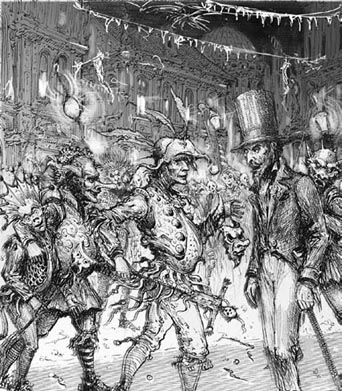
'I can see you are on your way to a carnival party.'
'Luchresi does not know the difference between Amontillado and any other sherry wine,' he said.
'Really? But some people say that he knows wine as well as you do.'
'Come, let's go,' he said.
'Where to?'
'To your vaults,' he said.
'My friend, no,' I said. 'I can hear that you have a bad cough, and my vaults are terribly cold and wet.'
'My cough is nothing,' Fortunato said. 'Let's go. Amontillado! Never! Your wine-seller is stealing your money. And as for Luchresi – what does he know about Amontillado?'
He took my arm, and we walked quickly to my house.
There was no one at home because my servants were out enjoying themselves at the carnival. I took Fortunato through the building and down the stairs into the vaults. Here were the tombs of the Montresors – my family.
'The Amontillado?' Fortunato said. He began to cough in the cold, damp air.
'It's further on,' I said. 'How long have you had that cough?'
He went on coughing for some time before he could answer me. 'It is nothing,' he said, at last.
My friend was full of wine, and found walking difficult. The little bells on his carnival suit made ringing noises when he moved. He began to cough again.
'We'll go back,' I said. 'You must not get ill. You have family, friends, you are loved, needed – you must take care of yourself. We'll go back. I can go to Luchresi—'
'Stop!' he said. 'The cough is nothing. It will not kill me. I shall not die from a cough.'
'That's true,' I said. 'But you must be careful. Take a drink from this bottle of Medoc. It is a good wine and will warm you. Here you are, drink this!'
I opened the bottle and gave it to him. 'I drink,' he said, 'to all the dead Montresors sleeping around us.' And he drank.
'And I drink to your long life,' I said.
Again he took my arm and we walked on.
'These vaults are very large,' he said.
'The Montresor family is a very old one. There have been a great many of us.'
I was warmed by the Medoc, and the wine was making Fortunato's eyes bright. We walked on, past casks and bottles of wine, deep into the vaults. I stopped again and held his arm.
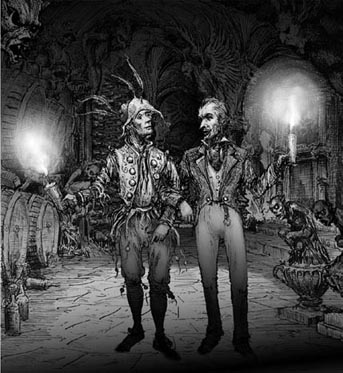
We walked on, deep into the vaults.
'We are under the river now,' I said. 'See how wet the walls are here. Come, we will go back before it is too late. Your cough—'
'It is nothing,' he said. 'Let's go on. But first, another drink to keep us warm.'
I took another bottle of wine and gave it to him. He drank it all without stopping. His eyes were even brighter, and he laughed.
'Now, let's go on to the Amontillado,' he said.
We went on, and down, and came into the deepest vault. Around three walls, from floor to ceiling, were the bones of the dead. Many more bones lay on the floor. Cut into the fourth wall was a smaller vault.
Fortunato held up his torch and looked into the blackness, but could see nothing.
'Go in,' I told him. 'You will find the Amontillado in there.'
He went inside and I followed him. In three steps he was at the back wall of the vault, and he stood there, looking stupid. On the wall were two metal rings and a chain with a lock. Before he could do anything, I put the chain around him and locked it to the rings.
'Put your hand on the wall, Fortunato,' I said. 'How wet it is! How very wet! Once more I ask, why don't you go back? No? Then I must leave you. But first I must try to make you comfortable.'
'The – the Amontillado!' my friend said. He did not understand.
'True,' I said. 'The Amontillado.'
Hidden under some of the bones on the floor were stones and other things for building a wall. I took them across to the small vault and began to work quickly.
Before the wall was half a metre high, Fortunato began to make soft crying noises. Then he was silent for some time. I worked on busily, building the wall higher and higher. Then I heard him again. He was pulling the chain and shaking it, but I knew the lock was strong.
The wall was now as high as my neck. I held my torch higher, to see his face. He began to scream, long high screams, filled with terror. I listened, worrying. No, we were too deep under the ground. No sounds would escape from this vault. I screamed back at Fortunato, longer and louder. Then he stopped.
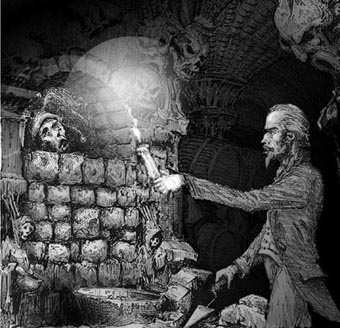
I held my torch higher, to see his face.
By midnight the wall was nearly finished. There was one last heavy stone. I had it almost in place when I heard a soft but terrible laugh.
Then Fortunato's sad voice said, 'Ha! Ha! Ha! A very good joke. We will laugh about it often when we are drinking our wine.'
'The Amontillado!' I said.
'Ha! Ha! Yes, the Amontillado. But it is getting late. My wife and friends are waiting for me. Let's go now, Montresor.'
'Yes,' I said. 'Let's go.'
'For the love of God, Montresor!'
'Yes,' I said. 'For the love of God.'
I waited for an answer. None came.
'Fortunato!' I called.
No answer. I called again.
'Fortunato!'
Still no answer. I pushed my torch through the gap in the wall and let it fall. Still nothing. I put the last stone in place, and then in front of the new wall I put the bones of the dead.
For fifty years, nobody has moved them.
Amontillado n. a kind of sherry wine 阿蒙提拉多酒(是雪利酒的一个知名品种)
insult v. to say something bad about somebody 侮辱
punish v. to make someone suffer because they have done something wrong 惩罚
sherry n. a pale or dark brown strong wine, originally from Spain 雪利酒(原产于西班牙的一种白色或深褐色的烈性酒)
carnival n. a party for everybody in the streets, with music, singing, and dancing 狂欢节
vault n. an underground room used to store things, such as wine or vegetables for the winter 地窖,地下室
damp adj. a little bit wet 潮湿的
suit n. a set of clothes used for a certain purpose (特定场合穿的)一套衣服
torch n. a long stick with burning material at one end that produces light 火把,火炬
escape v. if gas, liquid, light, heat etc escapes from somewhere, it comes out, especially when you do not want it to (气体、液体、光、热等)泄漏,逸出
一桶阿蒙提拉多酒
福尔图纳托用他的言行伤害过我千百次。但当他侮辱我的时候,我知道是时候惩罚他了。“不过我必须干得既巧妙又隐秘。”我想,“要只有福尔图纳托自己知道我在惩罚他。”
当然了,我对福尔图纳托像以前一样友好。我照旧向他微笑,而他并不知道我是想到了他的死才笑的。
他和我一样,既爱喝也爱买上好的葡萄酒。福尔图纳托对其他的事情知之甚少,但他确实了解葡萄酒和雪利酒。我也如此。
一天傍晚,适逢城里的狂欢节,我在街上遇到了我这位朋友。他穿着狂欢节的衣服,浑身都是浓烈的酒味。
“我亲爱的福尔图纳托!”我说,“这么巧遇到你!我买了一桶阿蒙提拉多酒——不过现在,呃,我有点拿不准它是不是阿蒙提拉多酒。”
“阿蒙提拉多酒?”福尔图纳托说,“不,不会的!没有人会在狂欢节的时候卖最好的雪利酒。不,不,不会的!”
“我真傻。”我说,“我按阿蒙提拉多酒的价格付了钱,却没有事先让你替我尝尝。可我找不到你,而且我怕被别的买家买走了。所以,那桶酒已经在我的地窖里了。”
“阿蒙提拉多酒!”他说。
“或许是。”我说,“不过我必须确认一下。我看得出来你正要去参加狂欢节聚会呢。我去找卢奇雷西吧。他会告诉我——”
“卢奇雷西不知道阿蒙提拉多酒与其他雪利酒的区别。”他说。
“是吗?可是有些人说他对葡萄酒的了解跟你一样深。”
“走,我们去吧。”他说。
“去哪儿?”
“去你的地窖。”他说。
“我的朋友,不行。”我说,“我听得出来,你咳嗽得很厉害,而我的地窖里非常阴冷潮湿。”
“我的咳嗽不算什么。”福尔图纳托说,“我们走吧。阿蒙提拉多酒!不可能!酒商是在骗你的钱。至于卢奇雷西——他对阿蒙提拉多酒知道个啥?”
他拽着我的手臂,快步向我家走去。
家里没人,因为我的仆人们都去狂欢节找乐子去了。我带着福尔图纳托穿过房屋,走下台阶,进了地窖。这里是蒙特雷索家族——我们家族——的墓穴。
“阿蒙提拉多酒呢?”福尔图纳托问。阴冷潮湿的空气使他开始咳嗽起来。
“还要往里走。”我说,“你咳嗽多久了?”
他又咳嗽了好一阵才能回答我。“没关系。”他终于能开口说话了。
我的朋友喝了很多酒,感到走路有些困难。他一动,那身狂欢节装束上的小铃铛就发出丁零丁零的响声。他又咳嗽了起来。
“我们回去吧。”我说,“可别把你弄病了。你有家人、有朋友,他们爱你、需要你——你必须照顾好自己。我们回去吧。我可以去找卢克雷西——”
“打住!”他说,“咳嗽不算什么,要不了我的命。我不会因为咳嗽而死掉。”
“那倒是。”我说,“可你一定要小心。喝一点这瓶梅多克葡萄酒吧。这可是好酒,会让你暖和起来。给,喝吧!”
我打开酒瓶,递给了他。“为,”他说,“我们周围所有长眠的蒙特雷索家的人而举杯。”然后他喝了下去。
“祝你长命百岁。”我说。
他又拉起我的手臂,我们继续往前走。
“这些窖室可真大。”他说。
“蒙特雷索是一个非常古老的家族。我们家族有很多人。”
喝完梅多克葡萄酒,我暖和了起来,这酒也让福尔图纳托的眼神明亮起来。我们继续走着,经过了一个个酒桶和一瓶瓶葡萄酒,进入了地窖的深处。我又停了下来,抓住他的手臂。
“我们现在在河的下面。”我说,“看看这儿的墙壁有多湿呀。算了,我们回去吧,不然就太迟了。你的咳嗽——”
“没关系。”他说,“我们继续走吧。不过先再喝一点儿酒取暖吧。”
我又拿了一瓶葡萄酒,递给了他。他一口气都喝了下去。他的眼神更加明亮了,然后他笑了起来。
“好了,我们去找阿蒙提拉多酒吧。”他说。
我们继续向前走,又向下走,进入了最深的一间窖室。房间的三面墙上架满了死人的骸骨,从地板直抵天花板。地上堆放着更多的骸骨。而在第四面墙后挖开了一间小一点的窖室。
福尔图纳托举起火把,向黑暗中看去,可是什么也没看见。
“进去吧。”我对他说,“你进去就能看到阿蒙提拉多酒了。”
他走了进去,我尾随而入。他只走了三步,就到了窖室尽头。他站在那里,露出一副呆滞的表情。墙上有两个金属圆环,还有一条带锁的链子。他还没反应过来,我就用链条捆住了他,把链条锁在了圆环上。
“把你的手放到墙上,福尔图纳托。”我说,“墙多潮湿呀!潮湿极了!我再问一遍,你为什么不回去?真不回去?那么我要离开你了。不过我必须先把你弄得舒舒服服的。”
“那——那桶阿蒙提拉多酒!”我的朋友说。他不明白这是怎么回事。
“是的。”我说,“阿蒙提拉多酒。”
堆在地上的骸骨下藏着砌墙用的石头和一些其他东西。我把它们搬到小窖室这边,麻利地干起活来。
墙快要砌到半米高的时候,福尔图纳托开始发出轻轻的哭声。然后他又安静了一会儿。我继续忙活着,把墙砌得越来越高。随后我又听到了他的动静。他拽着链条使劲扯,但我知道那把锁非常结实。
墙现在跟我的脖子一般高了。我把火把举高了一些,好看到他的脸。他开始尖叫,长时间的高声尖叫,充满了恐惧。我听着,有些惴惴不安。不,我们在地下很深的地方。没有声音能从这个窖室传出去。我也朝着福尔图纳托大叫起来,叫声比他还长还响亮。然后他便不作声了。
到了半夜,墙快要砌好了。还剩最后一块沉重的石头。就在我快要把它放好的时候,我听到了一阵轻微但却可怕的笑声。
接着,福尔图纳托悲怆的声音响了起来:“哈!哈!哈!真是个好玩笑。我们以后喝酒的时候会常拿这事来笑一笑。”
“阿蒙提拉多酒!”我说。
“哈!哈!是的,阿蒙提拉多酒。可是现在太晚了。我的妻子和朋友们都在等我呢。我们走吧,蒙特雷索。”
“好的。”我说,“我们走吧。”
“发发慈悲,蒙特雷索!”
“是的。”我说,“发慈悲。”
我等着他答话。可是没声音了。
“福尔图纳托!”我大声喊。
没有回音。我又喊了一声。
“福尔图纳托!”
还是没有回音。我把火把塞到墙缝中,让它从墙的另一头掉下去。还是没动静。我把最后一块石头砌好,然后在这面新墙前摆放好死人的骸骨。
五十年来都没有人动过这些骸骨。
一桶阿蒙提拉多酒
The Cask of Amontillado
Fortunato did and said a thousand things to hurt me. But when he insulted me, I knew that it was time to punish him. 'But I must do it cleverly and secretly,' I thought. 'Only Fortunato himself must know that I am punishing him.'
I was as friendly to Fortunato as before, of course. I went on smiling at him, and he did not know that I was smiling at the thought of his death.
Both he and I liked and bought fine wine. Fortunato knew very little about other things, but he did know about wine and sherry wine. And so did I.
One evening, during the city's carnival, I met my friend in the street. He was dressed in carnival clothes and smelled strongly of wine.
'My dear Fortunato!' I said. 'What luck to meet you! I have bought a cask of Amontillado – but now, well, I'm not so sure that it is Amontillado.'
'Amontillado?' said Fortunato. 'No, no! Nobody sells the best sherry in the middle of carnival. No, no, no!'
'I was stupid,' I said. 'I paid the full Amontillado price, and did not ask you to try it first. But I couldn't find you, and I was afraid of losing it to another buyer. So, the cask is already in my vaults.'
'Amontillado!' he said.
'Perhaps,' I said. 'But I must be sure. I can see that you are on your way to a carnival party. I'll go and see Luchresi. He will tell me—'
'I can see you are on your way to a carnival party.'
'Luchresi does not know the difference between Amontillado and any other sherry wine,' he said.
'Really? But some people say that he knows wine as well as you do.'
'Come, let's go,' he said.
'Where to?'
'To your vaults,' he said.
'My friend, no,' I said. 'I can hear that you have a bad cough, and my vaults are terribly cold and wet.'
'My cough is nothing,' Fortunato said. 'Let's go. Amontillado! Never! Your wine-seller is stealing your money. And as for Luchresi – what does he know about Amontillado?'
He took my arm, and we walked quickly to my house.
There was no one at home because my servants were out enjoying themselves at the carnival. I took Fortunato through the building and down the stairs into the vaults. Here were the tombs of the Montresors – my family.
'The Amontillado?' Fortunato said. He began to cough in the cold, damp air.
'It's further on,' I said. 'How long have you had that cough?'
He went on coughing for some time before he could answer me. 'It is nothing,' he said, at last.
My friend was full of wine, and found walking difficult. The little bells on his carnival suit made ringing noises when he moved. He began to cough again.
'We'll go back,' I said. 'You must not get ill. You have family, friends, you are loved, needed – you must take care of yourself. We'll go back. I can go to Luchresi—'
'Stop!' he said. 'The cough is nothing. It will not kill me. I shall not die from a cough.'
'That's true,' I said. 'But you must be careful. Take a drink from this bottle of Medoc. It is a good wine and will warm you. Here you are, drink this!'
I opened the bottle and gave it to him. 'I drink,' he said, 'to all the dead Montresors sleeping around us.' And he drank.
'And I drink to your long life,' I said.
Again he took my arm and we walked on.
'These vaults are very large,' he said.
'The Montresor family is a very old one. There have been a great many of us.'
I was warmed by the Medoc, and the wine was making Fortunato's eyes bright. We walked on, past casks and bottles of wine, deep into the vaults. I stopped again and held his arm.
We walked on, deep into the vaults.
'We are under the river now,' I said. 'See how wet the walls are here. Come, we will go back before it is too late. Your cough—'
'It is nothing,' he said. 'Let's go on. But first, another drink to keep us warm.'
I took another bottle of wine and gave it to him. He drank it all without stopping. His eyes were even brighter, and he laughed.
'Now, let's go on to the Amontillado,' he said.
We went on, and down, and came into the deepest vault. Around three walls, from floor to ceiling, were the bones of the dead. Many more bones lay on the floor. Cut into the fourth wall was a smaller vault.
Fortunato held up his torch and looked into the blackness, but could see nothing.
'Go in,' I told him. 'You will find the Amontillado in there.'
He went inside and I followed him. In three steps he was at the back wall of the vault, and he stood there, looking stupid. On the wall were two metal rings and a chain with a lock. Before he could do anything, I put the chain around him and locked it to the rings.
'Put your hand on the wall, Fortunato,' I said. 'How wet it is! How very wet! Once more I ask, why don't you go back? No? Then I must leave you. But first I must try to make you comfortable.'
'The – the Amontillado!' my friend said. He did not understand.
'True,' I said. 'The Amontillado.'
Hidden under some of the bones on the floor were stones and other things for building a wall. I took them across to the small vault and began to work quickly.
Before the wall was half a metre high, Fortunato began to make soft crying noises. Then he was silent for some time. I worked on busily, building the wall higher and higher. Then I heard him again. He was pulling the chain and shaking it, but I knew the lock was strong.
The wall was now as high as my neck. I held my torch higher, to see his face. He began to scream, long high screams, filled with terror. I listened, worrying. No, we were too deep under the ground. No sounds would escape from this vault. I screamed back at Fortunato, longer and louder. Then he stopped.
I held my torch higher, to see his face.
By midnight the wall was nearly finished. There was one last heavy stone. I had it almost in place when I heard a soft but terrible laugh.
Then Fortunato's sad voice said, 'Ha! Ha! Ha! A very good joke. We will laugh about it often when we are drinking our wine.'
'The Amontillado!' I said.
'Ha! Ha! Yes, the Amontillado. But it is getting late. My wife and friends are waiting for me. Let's go now, Montresor.'
'Yes,' I said. 'Let's go.'
'For the love of God, Montresor!'
'Yes,' I said. 'For the love of God.'
I waited for an answer. None came.
'Fortunato!' I called.
No answer. I called again.
'Fortunato!'
Still no answer. I pushed my torch through the gap in the wall and let it fall. Still nothing. I put the last stone in place, and then in front of the new wall I put the bones of the dead.
For fifty years, nobody has moved them.
Amontillado n. a kind of sherry wine 阿蒙提拉多酒(是雪利酒的一个知名品种)
insult v. to say something bad about somebody 侮辱
punish v. to make someone suffer because they have done something wrong 惩罚
sherry n. a pale or dark brown strong wine, originally from Spain 雪利酒(原产于西班牙的一种白色或深褐色的烈性酒)
carnival n. a party for everybody in the streets, with music, singing, and dancing 狂欢节
vault n. an underground room used to store things, such as wine or vegetables for the winter 地窖,地下室
damp adj. a little bit wet 潮湿的
suit n. a set of clothes used for a certain purpose (特定场合穿的)一套衣服
torch n. a long stick with burning material at one end that produces light 火把,火炬
escape v. if gas, liquid, light, heat etc escapes from somewhere, it comes out, especially when you do not want it to (气体、液体、光、热等)泄漏,逸出
一桶阿蒙提拉多酒
福尔图纳托用他的言行伤害过我千百次。但当他侮辱我的时候,我知道是时候惩罚他了。“不过我必须干得既巧妙又隐秘。”我想,“要只有福尔图纳托自己知道我在惩罚他。”
当然了,我对福尔图纳托像以前一样友好。我照旧向他微笑,而他并不知道我是想到了他的死才笑的。
他和我一样,既爱喝也爱买上好的葡萄酒。福尔图纳托对其他的事情知之甚少,但他确实了解葡萄酒和雪利酒。我也如此。
一天傍晚,适逢城里的狂欢节,我在街上遇到了我这位朋友。他穿着狂欢节的衣服,浑身都是浓烈的酒味。
“我亲爱的福尔图纳托!”我说,“这么巧遇到你!我买了一桶阿蒙提拉多酒——不过现在,呃,我有点拿不准它是不是阿蒙提拉多酒。”
“阿蒙提拉多酒?”福尔图纳托说,“不,不会的!没有人会在狂欢节的时候卖最好的雪利酒。不,不,不会的!”
“我真傻。”我说,“我按阿蒙提拉多酒的价格付了钱,却没有事先让你替我尝尝。可我找不到你,而且我怕被别的买家买走了。所以,那桶酒已经在我的地窖里了。”
“阿蒙提拉多酒!”他说。
“或许是。”我说,“不过我必须确认一下。我看得出来你正要去参加狂欢节聚会呢。我去找卢奇雷西吧。他会告诉我——”
“卢奇雷西不知道阿蒙提拉多酒与其他雪利酒的区别。”他说。
“是吗?可是有些人说他对葡萄酒的了解跟你一样深。”
“走,我们去吧。”他说。
“去哪儿?”
“去你的地窖。”他说。
“我的朋友,不行。”我说,“我听得出来,你咳嗽得很厉害,而我的地窖里非常阴冷潮湿。”
“我的咳嗽不算什么。”福尔图纳托说,“我们走吧。阿蒙提拉多酒!不可能!酒商是在骗你的钱。至于卢奇雷西——他对阿蒙提拉多酒知道个啥?”
他拽着我的手臂,快步向我家走去。
家里没人,因为我的仆人们都去狂欢节找乐子去了。我带着福尔图纳托穿过房屋,走下台阶,进了地窖。这里是蒙特雷索家族——我们家族——的墓穴。
“阿蒙提拉多酒呢?”福尔图纳托问。阴冷潮湿的空气使他开始咳嗽起来。
“还要往里走。”我说,“你咳嗽多久了?”
他又咳嗽了好一阵才能回答我。“没关系。”他终于能开口说话了。
我的朋友喝了很多酒,感到走路有些困难。他一动,那身狂欢节装束上的小铃铛就发出丁零丁零的响声。他又咳嗽了起来。
“我们回去吧。”我说,“可别把你弄病了。你有家人、有朋友,他们爱你、需要你——你必须照顾好自己。我们回去吧。我可以去找卢克雷西——”
“打住!”他说,“咳嗽不算什么,要不了我的命。我不会因为咳嗽而死掉。”
“那倒是。”我说,“可你一定要小心。喝一点这瓶梅多克葡萄酒吧。这可是好酒,会让你暖和起来。给,喝吧!”
我打开酒瓶,递给了他。“为,”他说,“我们周围所有长眠的蒙特雷索家的人而举杯。”然后他喝了下去。
“祝你长命百岁。”我说。
他又拉起我的手臂,我们继续往前走。
“这些窖室可真大。”他说。
“蒙特雷索是一个非常古老的家族。我们家族有很多人。”
喝完梅多克葡萄酒,我暖和了起来,这酒也让福尔图纳托的眼神明亮起来。我们继续走着,经过了一个个酒桶和一瓶瓶葡萄酒,进入了地窖的深处。我又停了下来,抓住他的手臂。
“我们现在在河的下面。”我说,“看看这儿的墙壁有多湿呀。算了,我们回去吧,不然就太迟了。你的咳嗽——”
“没关系。”他说,“我们继续走吧。不过先再喝一点儿酒取暖吧。”
我又拿了一瓶葡萄酒,递给了他。他一口气都喝了下去。他的眼神更加明亮了,然后他笑了起来。
“好了,我们去找阿蒙提拉多酒吧。”他说。
我们继续向前走,又向下走,进入了最深的一间窖室。房间的三面墙上架满了死人的骸骨,从地板直抵天花板。地上堆放着更多的骸骨。而在第四面墙后挖开了一间小一点的窖室。
福尔图纳托举起火把,向黑暗中看去,可是什么也没看见。
“进去吧。”我对他说,“你进去就能看到阿蒙提拉多酒了。”
他走了进去,我尾随而入。他只走了三步,就到了窖室尽头。他站在那里,露出一副呆滞的表情。墙上有两个金属圆环,还有一条带锁的链子。他还没反应过来,我就用链条捆住了他,把链条锁在了圆环上。
“把你的手放到墙上,福尔图纳托。”我说,“墙多潮湿呀!潮湿极了!我再问一遍,你为什么不回去?真不回去?那么我要离开你了。不过我必须先把你弄得舒舒服服的。”
“那——那桶阿蒙提拉多酒!”我的朋友说。他不明白这是怎么回事。
“是的。”我说,“阿蒙提拉多酒。”
堆在地上的骸骨下藏着砌墙用的石头和一些其他东西。我把它们搬到小窖室这边,麻利地干起活来。
墙快要砌到半米高的时候,福尔图纳托开始发出轻轻的哭声。然后他又安静了一会儿。我继续忙活着,把墙砌得越来越高。随后我又听到了他的动静。他拽着链条使劲扯,但我知道那把锁非常结实。
墙现在跟我的脖子一般高了。我把火把举高了一些,好看到他的脸。他开始尖叫,长时间的高声尖叫,充满了恐惧。我听着,有些惴惴不安。不,我们在地下很深的地方。没有声音能从这个窖室传出去。我也朝着福尔图纳托大叫起来,叫声比他还长还响亮。然后他便不作声了。
到了半夜,墙快要砌好了。还剩最后一块沉重的石头。就在我快要把它放好的时候,我听到了一阵轻微但却可怕的笑声。
接着,福尔图纳托悲怆的声音响了起来:“哈!哈!哈!真是个好玩笑。我们以后喝酒的时候会常拿这事来笑一笑。”
“阿蒙提拉多酒!”我说。
“哈!哈!是的,阿蒙提拉多酒。可是现在太晚了。我的妻子和朋友们都在等我呢。我们走吧,蒙特雷索。”
“好的。”我说,“我们走吧。”
“发发慈悲,蒙特雷索!”
“是的。”我说,“发慈悲。”
我等着他答话。可是没声音了。
“福尔图纳托!”我大声喊。
没有回音。我又喊了一声。
“福尔图纳托!”
还是没有回音。我把火把塞到墙缝中,让它从墙的另一头掉下去。还是没动静。我把最后一块石头砌好,然后在这面新墙前摆放好死人的骸骨。
五十年来都没有人动过这些骸骨。
The Premature Burial
The Premature Burial
What is the most horrible thing that can happen to a person? It is not death, but premature burial – burial before death, burial while you are still alive. It is everyone's worst fear.
Life and Death. When does one end, and the other begin? With some illnesses, we cannot be sure. The body is cold and still, the heart has stopped, breathing has stopped... but this is not always the end of a life.
So it is not difficult to understand why premature burials sometimes happen. People still remember the story of a Baltimore woman, not long ago. She went to her bed with a sudden illness, and died soon after.
Or so her husband and her doctors thought.
Her heart was silent, her face grey, her eyes unseeing, her body as cold as the grave. She lay like this for three days, and then they buried her in the family vault.
Three years later, they opened the vault again for another coffin. When her husband pulled back the doors, something fell noisily into his arms.
It was his wife's skeleton, in her white burial clothes.
Doctors thought that the woman 'came alive' again about two days after her burial. She fought wildly to get out of her coffin, they said, until it fell and broke open. She then used a piece of the broken coffin to hit the metal doors of the vault. But nobody heard her, or her screams for help. Then perhaps she fainted, or even died of terror. Her burial dress caught on some metalwork, which stopped her falling. And so she stayed, standing dead at the door, for three years.
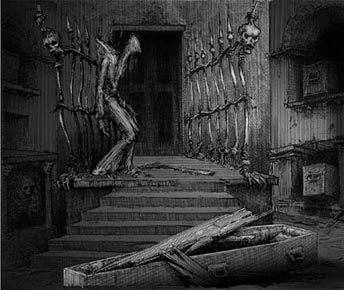
And so she stayed, standing dead at the door, for three years.
How often are people buried alive? Perhaps more often than we know. Think of the terror of it – the smell of the cold damp ground... the blackness of the night inside the narrow coffin... the long, long silence.
There are many true stories about premature burials. This is the one that happened to me.
For some years I had an illness called catalepsy. People who have catalepsy lie still and do not move for hours, or even days. They are still warm, and there is still some colour in their faces, but you have to listen hard to hear their heart or their breathing. Sometimes they can stay like this for weeks or months. And then it is difficult to find life in them.
When a cataleptic fit started, I always felt cold and ill, and then I fainted. After this, everything was black and silent. I always woke up very slowly – and I could never remember anything about the fit.
My body itself was well and strong, but I began to worry more and more. I talked all the time about coffins and graves. Day and night my thoughts were about premature burial. I was afraid of sleeping – and afraid of waking up in a grave. And when at last I did fall asleep, my dreams were about the terrors of death.
Once I dreamed that I was in a long cataleptic fit. A cold hand touched my face, and a voice in my ear said softly, 'Get up!'
I sat up. Everything was dark and I could not see the speaker. Where was I? The cold hand started to shake my arm, and the voice said, 'Get up! I said, get up!'
'Who are you?' I asked.
'I have no name in the place where I live,' said the voice. 'I was alive, but now I am dead, and a thing of darkness. I cannot sleep, cannot rest. How can you sleep so quietly? Get up! Come with me into the night, and I will show you the graves of the dead.'
And in my dream I looked into the open graves of every dead person in the world. I saw them, sleeping the long sleep of death in their burial clothes. But more terrible than the dead were the not-dead – those who were not sleeping, those who were fighting to get out of their coffins, those who died trying to escape.
While I stared, the voice spoke to me again. 'It is a most terrible thing to see, a most terrible thing...'
I remembered these dreams for a long time. I began to be afraid to leave my house. I did not want to be away from people who knew about my cataleptic fits. My friends, I thought, will never bury me alive by mistake. But then I began to worry about my friends...
So I made many changes in my family vault. Usually the doors opened from outside; now I could open them from inside. I made holes for air and light to come in, and places for food and water near the coffin. I bought a new coffin that was warm and comfortable. The top of the coffin was like a door, and I could open it from the inside. And on the ceiling of the vault I put a big bell, with a rope that came down to the coffin, and through a hole in the top, next to my hand.
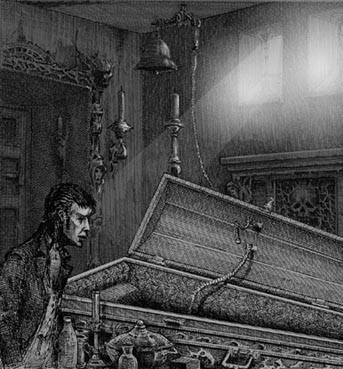
I made many changes in my family vault.
But I was still afraid...
And I was right to be afraid. One day I woke up slowly, eyes still closed, feeling strangely tired. Then a sudden terror hit me. I tried to think, to remember... and then I felt that I was waking up not from sleep, but from a cataleptic fit. And cold fear filled me at once, fear that never leaves me, day or night.
For some minutes I lay still, but at last I opened my eyes. It was dark – all dark – the darkness of a night that would never end. I felt that I lay on hard wood, and when I moved my arms, they hit wood on both sides of me, and above my face.
I was lying in a coffin.
Then hope came. I pushed hard to open the top of my special coffin; it would not move. I tried to find the bell-rope; it was not there. And now hope left me. This was a hard wooden coffin, not my soft, comfortable one. And there was a smell of wetness, a smell of cold damp ground! I was not in my vault...
'Oh, dear God!' I thought. 'I have had a cataleptic fit, and I'm away from my home and with people who don't know me. They think that I'm dead, and they have buried me like a dog, in a cheap wooden coffin. Deep, deep in a grave with no name on it! No, no!'
I screamed – a long, wild, terrible scream.
'Hello? Hello?' a man's voice answered.
'What's the matter?' said a second man's voice.
'What's going on?' said a third man's voice. 'Why are you screaming like that?'
Then the men began to shake me. They did not wake me, because I was already awake, but the shaking helped me, and at once I remembered everything.
I was near Richmond, in Virginia, on a walk with a friend beside the James River. When night came, there was a sudden storm. We saw an old sailing boat at the side of the river, and hurried along to it.
'We must get out of this storm,' I said to my friend. 'The boat is very small, but it will keep us dry.'
So we slept there that night. The beds were very narrow, and were not much better than long wooden boxes in the side of the boat. They were only half a metre across, and half a metre from top to bottom. It was difficult to get into a bed that was so small, but I slept well... and dreamt.
In my dream – and of course it was a dream – my narrow wooden bed became my coffin. The damp smell came from the river and the wet ground after the rain. And the men who shook me to wake me up were the workmen on the boat.
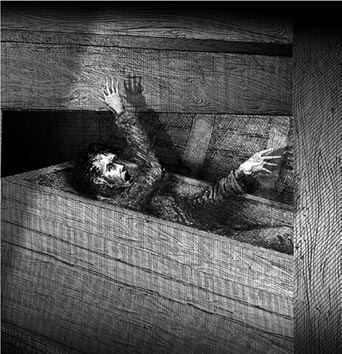
In my dream my narrow wooden bed became my coffin.
It was a dream, yes. But the terror was real, and terror can make people ill, or even kill them. But something good came from this terrible adventure. After that day I stopped thinking about death and burial. I went walking and riding, and breathed the free air. My fears went away, and my catalepsy went with them.
It is easy to understand the terror of a living burial, the terror of waking inside a closed coffin. But we must put away thoughts like these, and close the door on them, or fear and worry will send us to an early grave.
premature adj. happening earlier than expected 过早的,提前的
burial n. the act of burying a dead body 埋葬
unseeing adj. not noticing anything even though your eyes are open 视而不见的
coffin n. a long box in which a dead person is buried 棺材
skeleton n. the bones inside a person's body 骨骼
metalwork n. objects made by shaping metal 金属制品
catalepsy n. an illness where people stay asleep and do not move 强直性昏厥症
fit n. a time when you cannot control your behaviour 一阵发作
未亡先葬
一个人最怕的是什么事情?不是死亡,而是未亡先葬——死亡之前的葬礼,也就是在你还活着的时候就将你埋葬。这是所有人最害怕的事情。
生与死。一个何时结束,另一个又何时开始?在患有某些疾病的情况下,我们无法确知。身体冰冷僵硬,心脏停止跳动,呼吸也停止了……然而这并不总是意味着生命的结束。
所以,偶尔会出现未亡先葬的情况也就不难理解了。人们还记得,不久前那个巴尔的摩妇女的故事。她身染急病,卧床不起,很快就去世了。
至少她丈夫和医生们是这么认为的。
她的心脏静止了,脸色灰暗,眼神涣散,身体像坟墓一样冰冷。她像这样躺了三天,然后他们就把她埋进了家族的墓室中。
三年之后,他们打开墓室,准备放入另一具棺材。当她的丈夫拉开大门时,有什么东西哗啦啦地倒入他的怀中。
那是他妻子的骸骨,上面还套着白色的葬服。
医生们认为,那个妇女大约是在葬礼两天之后又“复活”的。他们说,她奋力挣扎想要从棺材里出来,直到棺材倒地摔了开来。然后她用一块棺木碎片敲打墓室的金属大门。可是,没有人听到她的敲打声或求救的尖叫声。后来,或许她晕了过去,甚至死于恐惧。她的葬服钩到了某个金属物品上,使她没有跌倒。于是,她就待在那里,保持着站姿死在了门口,整整三年。
人们被活埋的几率有多少?或许比我们知道的几率还要大些。想想那样有多么恐怖吧——阴冷潮湿的地面散发的味道……在狭窄的棺木中不见天日的黑暗……无比漫长的死寂。
关于未亡先葬的真实故事有很多。下面就是发生在我身上的故事。
多年来,我患有一种叫做强直性昏厥症的疾病。强直性昏厥症患者会静静地躺着,好几个小时甚至好几天一动不动。他们还有体温,脸上也依然有血色,但是你得特别努力听,才能听到他们的心跳和呼吸。有时候,他们会数周甚至数月保持这样的状态。这样一来,要发现他们还活着实在并非易事。
当强直性昏厥症刚开始发作时,我总是会感到浑身发冷,特别难受,然后我就晕倒了。在这之后,一切都变得黑暗和寂静。我总是苏醒得特别缓慢——我从来也不记得发作时到底发生了什么。
我原本体格强健,可我开始越来越担心。我的谈话总是离不开棺材和坟墓。我日日夜夜想着未亡先葬的事。我害怕睡觉——害怕在坟墓中醒来。而当最后我终于睡着时,我的梦中充斥着对死亡的恐惧。
一次,我梦见自己的强直性昏厥症发作了很长时间。一只冰冷的手摸着我的脸,一个声音在我耳边轻声说:“起来呀!”
我坐了起来。周围黑漆漆的,我看不到说话的人。我在哪里?那只冰冷的手开始摇晃我的胳膊,那个声音说:“起来呀!我说,起来呀!”
“你是谁?”我问。
“在我的世界里,我没有名字。”那个声音说,“我以前活着,而现在我已经死了,变成了一个黑暗的东西。我不能睡觉,也不能安歇。你怎么能这么安静地睡觉?起来呀!跟我一起进入黑夜,我将向你展示那些死人的坟墓。”
在梦中,我看到了世界上所有死人的坟墓打开时的样子。我看到他们穿着葬服,长眠于死亡之中。可是比死人更可怕的是还没死的人——那些没有长眠的人,那些正奋力挣扎想要爬出棺材的人,那些在试图逃生时死去的人。
正当我凝神细看时,那个声音又对我说:“最可怕的事莫过于看见这些,最可怕的事……”
我久久不能忘却这些梦境。我开始害怕离开我的房子。我不想离开那些知道我患有强直性昏厥症的人。我想,我的朋友们永远不会误将我活埋。可接下来,我又开始担心我的朋友们……
于是,我对我家族的墓室进行了多项改建。通常墓室的门是从外面打开的;现在我可以从里面把门打开。我凿了一些洞,好让空气和光亮能进来,还在棺材附近布置了一些放食物和水的地方。我买了一副既温暖又舒适的新棺材。棺材盖就像门一样,我能从里面把它打开。我在墓室的顶部安了一个大钟,钟上挂着一条绳子垂到棺材上,然后那绳子穿过棺材盖上的一个洞,刚好到我的手边。
可我还是害怕……
我害怕是有道理的。一天,我慢慢醒来,双眼还闭着,我感到异常疲倦。然后一阵突如其来的恐惧向我袭来。我试图思索、回忆……然后我感到我不是从睡梦中苏醒,而是在强直性昏厥症发作之后醒来的。我心中一下子充满了冰冷的恐惧感,这一恐惧从未离开过我,无论是白天还是黑夜。
我静静地躺了几分钟,不过最终我睁开了双眼。四周黑乎乎的——一片漆黑——绵延无尽的夜晚的黑暗。我感到自己躺在坚硬的木头上面,我一挪动双臂,便碰到了身体两侧和脸上方的木头。
我躺在一副棺材里。
然后希望降临了。我用力想要推开我那副特制棺材的盖子,可是推不动。我试着寻找那条连着大钟的绳索,可它不在那儿。现在希望离我而去。这是一副坚硬的木头棺材,不是我那副柔软舒适的棺材。而且这里有一种潮湿的味道,一种阴冷潮湿的泥土味!我不在我的墓室里……
“啊,天啊!”我想,“我的强直性昏厥症发作了,我不在家里,和一些不认识我的人在一起。他们以为我死了,于是把我像一条狗一样埋了,埋在一副廉价的木头棺材里,深深地埋在坟墓里,上面连名字都没有!啊,不!”
我尖叫起来——一声长长的、歇斯底里的、可怕的尖叫。
“喂?喂?”一个男人的声音回应。
“发生什么事了?”又一个男人的声音响了起来。
“怎么回事?”另一个男人说,“你为什么喊成这样?”
然后那些男人开始动手摇晃我。他们没有把我摇醒,因为我本来就已经醒了,可是那摇晃也帮了我的忙,我一下子想起了发生的所有事情。
我在弗吉尼亚州的里士满附近,和一个朋友在詹姆斯河边散步。夜幕降临时,突降暴雨。我们在河边看到一艘旧帆船,急忙沿着河岸跑了过去。
“我们得避避雨。”我对朋友说,“这艘船很小,不过它能让我们不被淋湿。”
于是当晚我们就睡在那里。床铺很狭窄,不比放在船侧的那些长长的木头箱子好多少。床铺仅有半米宽、半米长。要想钻进这样狭窄的一张床铺不是件易事,但我睡得很香……而且还做梦了。
在我的梦里——那当然是一个梦——狭窄的木床变成了我的棺材。那潮湿的味道其实是靠近河水和雨后潮湿的土地所带来的。而把我摇醒的男人其实是船上的工人。
那是一个梦,是的。然而那种恐惧却是真实的,恐惧能让人生病,甚至能置人于死地。然而这次恐怖的经历却有好的结局。那天之后,我不再想死亡和葬礼了。我出去散步、骑马,呼吸自由的空气。我的恐惧消失了,随之而去的还有我的强直性昏厥症。
不难理解为什么人们会恐惧被活埋以及在密闭的棺材中醒来。但我们必须把这些想法抛开,并将它们拒之门外,否则恐惧和担忧就会把我们早早送入坟墓。
未亡先葬
The Premature Burial
What is the most horrible thing that can happen to a person? It is not death, but premature burial – burial before death, burial while you are still alive. It is everyone's worst fear.
Life and Death. When does one end, and the other begin? With some illnesses, we cannot be sure. The body is cold and still, the heart has stopped, breathing has stopped... but this is not always the end of a life.
So it is not difficult to understand why premature burials sometimes happen. People still remember the story of a Baltimore woman, not long ago. She went to her bed with a sudden illness, and died soon after.
Or so her husband and her doctors thought.
Her heart was silent, her face grey, her eyes unseeing, her body as cold as the grave. She lay like this for three days, and then they buried her in the family vault.
Three years later, they opened the vault again for another coffin. When her husband pulled back the doors, something fell noisily into his arms.
It was his wife's skeleton, in her white burial clothes.
Doctors thought that the woman 'came alive' again about two days after her burial. She fought wildly to get out of her coffin, they said, until it fell and broke open. She then used a piece of the broken coffin to hit the metal doors of the vault. But nobody heard her, or her screams for help. Then perhaps she fainted, or even died of terror. Her burial dress caught on some metalwork, which stopped her falling. And so she stayed, standing dead at the door, for three years.
And so she stayed, standing dead at the door, for three years.
How often are people buried alive? Perhaps more often than we know. Think of the terror of it – the smell of the cold damp ground... the blackness of the night inside the narrow coffin... the long, long silence.
There are many true stories about premature burials. This is the one that happened to me.
For some years I had an illness called catalepsy. People who have catalepsy lie still and do not move for hours, or even days. They are still warm, and there is still some colour in their faces, but you have to listen hard to hear their heart or their breathing. Sometimes they can stay like this for weeks or months. And then it is difficult to find life in them.
When a cataleptic fit started, I always felt cold and ill, and then I fainted. After this, everything was black and silent. I always woke up very slowly – and I could never remember anything about the fit.
My body itself was well and strong, but I began to worry more and more. I talked all the time about coffins and graves. Day and night my thoughts were about premature burial. I was afraid of sleeping – and afraid of waking up in a grave. And when at last I did fall asleep, my dreams were about the terrors of death.
Once I dreamed that I was in a long cataleptic fit. A cold hand touched my face, and a voice in my ear said softly, 'Get up!'
I sat up. Everything was dark and I could not see the speaker. Where was I? The cold hand started to shake my arm, and the voice said, 'Get up! I said, get up!'
'Who are you?' I asked.
'I have no name in the place where I live,' said the voice. 'I was alive, but now I am dead, and a thing of darkness. I cannot sleep, cannot rest. How can you sleep so quietly? Get up! Come with me into the night, and I will show you the graves of the dead.'
And in my dream I looked into the open graves of every dead person in the world. I saw them, sleeping the long sleep of death in their burial clothes. But more terrible than the dead were the not-dead – those who were not sleeping, those who were fighting to get out of their coffins, those who died trying to escape.
While I stared, the voice spoke to me again. 'It is a most terrible thing to see, a most terrible thing...'
I remembered these dreams for a long time. I began to be afraid to leave my house. I did not want to be away from people who knew about my cataleptic fits. My friends, I thought, will never bury me alive by mistake. But then I began to worry about my friends...
So I made many changes in my family vault. Usually the doors opened from outside; now I could open them from inside. I made holes for air and light to come in, and places for food and water near the coffin. I bought a new coffin that was warm and comfortable. The top of the coffin was like a door, and I could open it from the inside. And on the ceiling of the vault I put a big bell, with a rope that came down to the coffin, and through a hole in the top, next to my hand.
I made many changes in my family vault.
But I was still afraid...
And I was right to be afraid. One day I woke up slowly, eyes still closed, feeling strangely tired. Then a sudden terror hit me. I tried to think, to remember... and then I felt that I was waking up not from sleep, but from a cataleptic fit. And cold fear filled me at once, fear that never leaves me, day or night.
For some minutes I lay still, but at last I opened my eyes. It was dark – all dark – the darkness of a night that would never end. I felt that I lay on hard wood, and when I moved my arms, they hit wood on both sides of me, and above my face.
I was lying in a coffin.
Then hope came. I pushed hard to open the top of my special coffin; it would not move. I tried to find the bell-rope; it was not there. And now hope left me. This was a hard wooden coffin, not my soft, comfortable one. And there was a smell of wetness, a smell of cold damp ground! I was not in my vault...
'Oh, dear God!' I thought. 'I have had a cataleptic fit, and I'm away from my home and with people who don't know me. They think that I'm dead, and they have buried me like a dog, in a cheap wooden coffin. Deep, deep in a grave with no name on it! No, no!'
I screamed – a long, wild, terrible scream.
'Hello? Hello?' a man's voice answered.
'What's the matter?' said a second man's voice.
'What's going on?' said a third man's voice. 'Why are you screaming like that?'
Then the men began to shake me. They did not wake me, because I was already awake, but the shaking helped me, and at once I remembered everything.
I was near Richmond, in Virginia, on a walk with a friend beside the James River. When night came, there was a sudden storm. We saw an old sailing boat at the side of the river, and hurried along to it.
'We must get out of this storm,' I said to my friend. 'The boat is very small, but it will keep us dry.'
So we slept there that night. The beds were very narrow, and were not much better than long wooden boxes in the side of the boat. They were only half a metre across, and half a metre from top to bottom. It was difficult to get into a bed that was so small, but I slept well... and dreamt.
In my dream – and of course it was a dream – my narrow wooden bed became my coffin. The damp smell came from the river and the wet ground after the rain. And the men who shook me to wake me up were the workmen on the boat.
In my dream my narrow wooden bed became my coffin.
It was a dream, yes. But the terror was real, and terror can make people ill, or even kill them. But something good came from this terrible adventure. After that day I stopped thinking about death and burial. I went walking and riding, and breathed the free air. My fears went away, and my catalepsy went with them.
It is easy to understand the terror of a living burial, the terror of waking inside a closed coffin. But we must put away thoughts like these, and close the door on them, or fear and worry will send us to an early grave.
premature adj. happening earlier than expected 过早的,提前的
burial n. the act of burying a dead body 埋葬
unseeing adj. not noticing anything even though your eyes are open 视而不见的
coffin n. a long box in which a dead person is buried 棺材
skeleton n. the bones inside a person's body 骨骼
metalwork n. objects made by shaping metal 金属制品
catalepsy n. an illness where people stay asleep and do not move 强直性昏厥症
fit n. a time when you cannot control your behaviour 一阵发作
未亡先葬
一个人最怕的是什么事情?不是死亡,而是未亡先葬——死亡之前的葬礼,也就是在你还活着的时候就将你埋葬。这是所有人最害怕的事情。
生与死。一个何时结束,另一个又何时开始?在患有某些疾病的情况下,我们无法确知。身体冰冷僵硬,心脏停止跳动,呼吸也停止了……然而这并不总是意味着生命的结束。
所以,偶尔会出现未亡先葬的情况也就不难理解了。人们还记得,不久前那个巴尔的摩妇女的故事。她身染急病,卧床不起,很快就去世了。
至少她丈夫和医生们是这么认为的。
她的心脏静止了,脸色灰暗,眼神涣散,身体像坟墓一样冰冷。她像这样躺了三天,然后他们就把她埋进了家族的墓室中。
三年之后,他们打开墓室,准备放入另一具棺材。当她的丈夫拉开大门时,有什么东西哗啦啦地倒入他的怀中。
那是他妻子的骸骨,上面还套着白色的葬服。
医生们认为,那个妇女大约是在葬礼两天之后又“复活”的。他们说,她奋力挣扎想要从棺材里出来,直到棺材倒地摔了开来。然后她用一块棺木碎片敲打墓室的金属大门。可是,没有人听到她的敲打声或求救的尖叫声。后来,或许她晕了过去,甚至死于恐惧。她的葬服钩到了某个金属物品上,使她没有跌倒。于是,她就待在那里,保持着站姿死在了门口,整整三年。
人们被活埋的几率有多少?或许比我们知道的几率还要大些。想想那样有多么恐怖吧——阴冷潮湿的地面散发的味道……在狭窄的棺木中不见天日的黑暗……无比漫长的死寂。
关于未亡先葬的真实故事有很多。下面就是发生在我身上的故事。
多年来,我患有一种叫做强直性昏厥症的疾病。强直性昏厥症患者会静静地躺着,好几个小时甚至好几天一动不动。他们还有体温,脸上也依然有血色,但是你得特别努力听,才能听到他们的心跳和呼吸。有时候,他们会数周甚至数月保持这样的状态。这样一来,要发现他们还活着实在并非易事。
当强直性昏厥症刚开始发作时,我总是会感到浑身发冷,特别难受,然后我就晕倒了。在这之后,一切都变得黑暗和寂静。我总是苏醒得特别缓慢——我从来也不记得发作时到底发生了什么。
我原本体格强健,可我开始越来越担心。我的谈话总是离不开棺材和坟墓。我日日夜夜想着未亡先葬的事。我害怕睡觉——害怕在坟墓中醒来。而当最后我终于睡着时,我的梦中充斥着对死亡的恐惧。
一次,我梦见自己的强直性昏厥症发作了很长时间。一只冰冷的手摸着我的脸,一个声音在我耳边轻声说:“起来呀!”
我坐了起来。周围黑漆漆的,我看不到说话的人。我在哪里?那只冰冷的手开始摇晃我的胳膊,那个声音说:“起来呀!我说,起来呀!”
“你是谁?”我问。
“在我的世界里,我没有名字。”那个声音说,“我以前活着,而现在我已经死了,变成了一个黑暗的东西。我不能睡觉,也不能安歇。你怎么能这么安静地睡觉?起来呀!跟我一起进入黑夜,我将向你展示那些死人的坟墓。”
在梦中,我看到了世界上所有死人的坟墓打开时的样子。我看到他们穿着葬服,长眠于死亡之中。可是比死人更可怕的是还没死的人——那些没有长眠的人,那些正奋力挣扎想要爬出棺材的人,那些在试图逃生时死去的人。
正当我凝神细看时,那个声音又对我说:“最可怕的事莫过于看见这些,最可怕的事……”
我久久不能忘却这些梦境。我开始害怕离开我的房子。我不想离开那些知道我患有强直性昏厥症的人。我想,我的朋友们永远不会误将我活埋。可接下来,我又开始担心我的朋友们……
于是,我对我家族的墓室进行了多项改建。通常墓室的门是从外面打开的;现在我可以从里面把门打开。我凿了一些洞,好让空气和光亮能进来,还在棺材附近布置了一些放食物和水的地方。我买了一副既温暖又舒适的新棺材。棺材盖就像门一样,我能从里面把它打开。我在墓室的顶部安了一个大钟,钟上挂着一条绳子垂到棺材上,然后那绳子穿过棺材盖上的一个洞,刚好到我的手边。
可我还是害怕……
我害怕是有道理的。一天,我慢慢醒来,双眼还闭着,我感到异常疲倦。然后一阵突如其来的恐惧向我袭来。我试图思索、回忆……然后我感到我不是从睡梦中苏醒,而是在强直性昏厥症发作之后醒来的。我心中一下子充满了冰冷的恐惧感,这一恐惧从未离开过我,无论是白天还是黑夜。
我静静地躺了几分钟,不过最终我睁开了双眼。四周黑乎乎的——一片漆黑——绵延无尽的夜晚的黑暗。我感到自己躺在坚硬的木头上面,我一挪动双臂,便碰到了身体两侧和脸上方的木头。
我躺在一副棺材里。
然后希望降临了。我用力想要推开我那副特制棺材的盖子,可是推不动。我试着寻找那条连着大钟的绳索,可它不在那儿。现在希望离我而去。这是一副坚硬的木头棺材,不是我那副柔软舒适的棺材。而且这里有一种潮湿的味道,一种阴冷潮湿的泥土味!我不在我的墓室里……
“啊,天啊!”我想,“我的强直性昏厥症发作了,我不在家里,和一些不认识我的人在一起。他们以为我死了,于是把我像一条狗一样埋了,埋在一副廉价的木头棺材里,深深地埋在坟墓里,上面连名字都没有!啊,不!”
我尖叫起来——一声长长的、歇斯底里的、可怕的尖叫。
“喂?喂?”一个男人的声音回应。
“发生什么事了?”又一个男人的声音响了起来。
“怎么回事?”另一个男人说,“你为什么喊成这样?”
然后那些男人开始动手摇晃我。他们没有把我摇醒,因为我本来就已经醒了,可是那摇晃也帮了我的忙,我一下子想起了发生的所有事情。
我在弗吉尼亚州的里士满附近,和一个朋友在詹姆斯河边散步。夜幕降临时,突降暴雨。我们在河边看到一艘旧帆船,急忙沿着河岸跑了过去。
“我们得避避雨。”我对朋友说,“这艘船很小,不过它能让我们不被淋湿。”
于是当晚我们就睡在那里。床铺很狭窄,不比放在船侧的那些长长的木头箱子好多少。床铺仅有半米宽、半米长。要想钻进这样狭窄的一张床铺不是件易事,但我睡得很香……而且还做梦了。
在我的梦里——那当然是一个梦——狭窄的木床变成了我的棺材。那潮湿的味道其实是靠近河水和雨后潮湿的土地所带来的。而把我摇醒的男人其实是船上的工人。
那是一个梦,是的。然而那种恐惧却是真实的,恐惧能让人生病,甚至能置人于死地。然而这次恐怖的经历却有好的结局。那天之后,我不再想死亡和葬礼了。我出去散步、骑马,呼吸自由的空气。我的恐惧消失了,随之而去的还有我的强直性昏厥症。
不难理解为什么人们会恐惧被活埋以及在密闭的棺材中醒来。但我们必须把这些想法抛开,并将它们拒之门外,否则恐惧和担忧就会把我们早早送入坟墓。
The Meeting
The Meeting
How well I remember that meeting! I was in Venice, that city of dark secrets and silent waters. It was midnight, and the midsummer air was hot and still, the canals silent and empty.
I was coming home in a gondola along the Grand Canal when I heard a sudden scream – a woman's scream. I jumped up, and the boatman turned my gondola to go under the Bridge of Sighs and past the great house of the Mentoni family. Lights were on in all the windows, and people were running down the steps to the water. The canal was suddenly as light as day.
'What has happened?' I called out.
'A child fell from its mother's arms,' came the answer. 'From a high window of the house.'
I stopped to watch, full of fear for the child. Already people were swimming in the water, calling, shouting, looking everywhere.
At the doorway to the palace stood the child's young mother, the Marchesa di Mentoni, the loveliest woman in all of Venice.
She stood alone. But she was not looking into the water for her lost child. She was staring across the canal at the building opposite. Why? I asked myself. What could she see there, in the dark corners of that old building? Or was she afraid to look into the canal, afraid to see the dead body of her child in the dark waters?
On the steps behind the Marchesa, higher up, stood her old husband, Mentoni himself, the head of the rich and famous Mentoni family. He gave orders to the servants who were looking for his child, but he looked bored, bored to death.
Then, from one of the dark corners outside the building opposite, a man stepped into the light and immediately jumped into the canal.
A minute later, he stood next to the Marchesa with the living, breathing child in his arms. The light from the windows fell on his face, and everyone could see him.
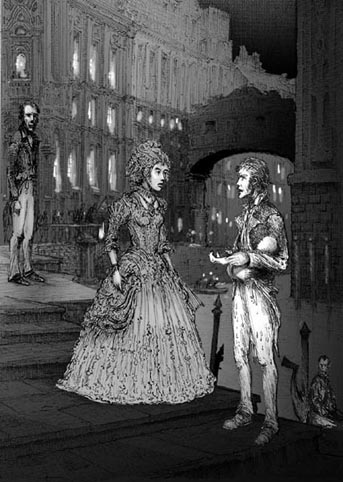
The young man stood next to the Marchesa with the child in his arms.
He was a very famous young man – as beautiful as a Greek god, with his black eyes, and his wild black hair. We were not close friends, but I knew him a little, from my time in Venice.
He did not speak. And to my great surprise the Marchesa did not take her child in her arms and hold him close. Other hands took the child and carried him away, into the house. And the Marchesa? Her eyes were wet with tears, and her hands were shaking.
Then old Mentoni turned and went into the house. The Marchesa took the young man's hand in both of hers, and stared into his face. Her eyes were dark with terror, and her face as white as the moonlight that danced on the waters of the canal.
She spoke softly, hurriedly, the tears running down that wild, white face. Below the steps, in my gondola, I heard every word.
'You have won,' she said, 'you have won... and you are right... there is only one answer... we cannot go on... we agreed the way, and now the time has come... we shall meet... one hour after sunrise...'
Everyone went away, lights went out, and my young friend now stood alone on the steps. He was white-faced and shaking. He looked around and saw me, and remembered me at once.
There were no other boats on the canal at that time, so I took him home in my gondola. We talked of unimportant things, and then he asked me to visit him the next morning.
'Come at sunrise,' he said. 'Yes, at sunrise! Not a minute later. Please!'
I thought his words were a little strange, but they were not the first strange words on that strange night.
I agreed to go, and arrived at sunrise. His apartment was in one of those very old buildings which look down on the Grand Canal, near the Rialto Bridge. The rooms were large, and full of beautiful things from Italy, Greece, Egypt... There were pictures, furniture, carpets, things made of black stone, and red stone, of glass, of gold, of silver... Soft music was playing somewhere, and the early morning sunlight danced in through the windows.
There was too much to look at, too much light, too many colours, too many beautiful things. I stared around in silent surprise, and my young friend laughed.
'Oh, I am sorry for laughing,' he said. 'But you look so surprised! And sometimes a man must laugh or die. How wonderful to die laughing, don't you agree?'
He half-fell into a low chair, still laughing in that strange way.
'I have other apartments,' he went on, 'but none like this one. You are one of the very few people who have seen it. Come – I have some famous pictures here. You must see them.'
He wanted to show me everything. He was tired, but also excited. And perhaps afraid too. I could not be sure. But something was worrying him. Sometimes he stopped speaking in the middle of a sentence and listened. To what? The sound of another visitor on the stairs? To words inside his head?
During one of these silent moments, I turned away and saw a book of Italian songs on a small table. The open page was wet with new tears. And on the opposite, empty page, written in English and in my young friend's handwriting, were these lines:
You were my sun, my moon, my stars,
My life I gave to you.
We danced by day, we sang by night,
A love so sweet and true.
Now all my days I spend in darkness,
The fire of life is cold,
I see no more your quick bright smile,
Your hand I cannot hold.
They took you from our English clouds
To a blue Italian sky,
To marry an old man, rich in gold,
And now my heart will die.
Under these lines were written a place and date. The place was London. This surprised me, because when I first met him in Venice, I asked him, 'When you were living in London, did you ever meet the Marchesa di Mentoni? She lived in that city for some years before she married.'
To this he replied, 'I have never been to London.'
For a rich young Englishman I thought this was strange, but I thought little of it at the time.
He did not see me with this book, and now turned to me again.
'One more picture to see,' he said. 'Come.'
He took me to a small room. There was just one picture in it – a portrait of the Marchesa di Mentoni.
She stood, smiling down at us, as beautiful as ever, her dark eyes full of life.
My young friend stood, staring at the portrait for a long time. Then, at last, he said, 'Come, let's drink!'
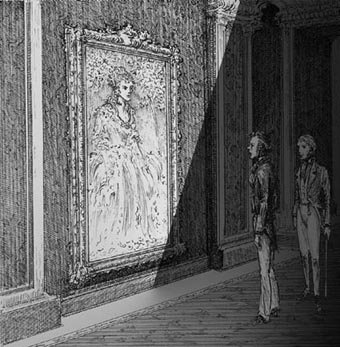
My young friend stood, staring at the portrait for a long time.
He went away to find wine, and I turned back to the book of Italian songs on the little table. Perhaps there were answers to these mysteries about my friend in this book. I turned the pages, and found, hidden at the back of the book, part of a letter. It was in a woman's handwriting.
... You say that you love me, more than the world, more than life itself. But how much is that? How can I be sure? Will you do this for me? Will you save from death my child –my child, by him?
If you do this, then I will know that your words are true. And I will take your hand for one last time... We shall go together through that last door...
I heard a sound, and closed the book hurriedly. My friend came back into the room, carrying two large silver goblets, full to the top with wine. He gave one to me.
'It is early, but let's drink,' he said again. At that moment a clock sounded the hour. 'One hour after sunrise,' he said softly. 'Yes, it is early. But what does it matter? Let us drink to the sun, yes, the sun!'
He drank his goblet of wine very quickly.
'To dreams,' he said. 'All my life I have dreamed. I have made myself a home of dreams, here in the heart of Venice. Where could be better?' He put his empty goblet down on the table. 'And now I am ready for the land of real dreams. Soon, I shall be there...'
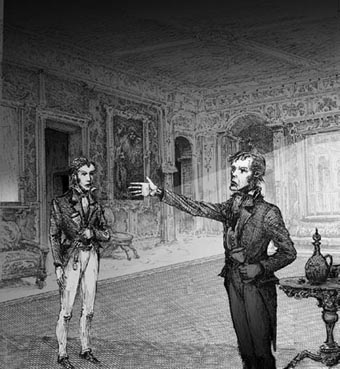
'All my life I have dreamed...'
He stopped and listened – but to what, I did not know. Then he lifted his head and said:
Wait for me there! I will be sure
To meet you at that last dark door.
On the last word he fell into a chair, and his eyes closed.
At the same moment there were feet on the stairs, and a loud knocking at the door. A young servant from the Mentoni house ran into the room.
'The Marchesa! I come from the Marchesa!' the boy cried.'Poison! She has taken poison! She is dead!'
I ran to the chair and tried to wake my young friend, to tell him this strange and terrible news.
But he did not move. His hand was cold to my touch, and his face white and still.
He, too, was dead.
I fell back against the table in terror, and my hand touched my friend's wine goblet, which stood there. It was now blackened inside, and from it came a sweet, sickly smell – the smell of poison.
And in a second I understood everything.
canal n. a river made by people for boats to travel on 运河
gondola n. a long narrow boat with a flat bottom and high points at each end, used on the canals in Venice in Italy (意大利威尼斯运河中的)凤尾船
doorway n. the space where a door opens into a room or building 出入口,门道
opposite adj. on the other side of the same area, often directly across from it 对面的
bored adj. tired and impatient because you do not think something is interesting, or because you have nothing to do 厌烦的,不感兴趣的
apartment n. a group of rooms in a building where you can live 一套住房,公寓套间
furniture n. tables, beds, chairs etc 家具
goblet n. a cup without handles for drinking wine 高脚酒杯
poison n. something that can kill you if you eat or drink it 毒药
密会
那次密会的情景仍然历历在目!我当时在威尼斯,一座充满黑暗秘密的城市,一座寂静河流密布的城市。那是个仲夏的午夜,天气闷热无风,运河中十分安静,没有任何船只。
我乘着一艘凤尾船回家,正沿着大运河航行时,突然听到一声尖叫——一个女人的尖叫。我跳了起来,船夫掉转船头从叹息桥下穿过,经过了门托尼家族的大房子。所有窗户里的灯都亮着,人们跑下台阶,来到水边。运河突然亮如白昼。
“发生了什么事?”我大声喊。
“一个孩子从他母亲的手中掉下去了。”有人回答,“是从房子高处的一扇窗户那里掉下去的。”
我停下来观望,心中满是对那个孩子的担忧。已经有人下水了。他们不断呼喊并四处寻找他。
在那座豪宅的门口站着那个孩子年轻的母亲,门托尼侯爵夫人。她是威尼斯最可爱的女人。
她独自一人站在那里。可她没有看着水面寻找她丢失的孩子。她的眼睛盯着运河对岸的建筑。为什么?我问自己。她能在那儿看到什么,在那古老建筑的黑暗角落里?还是她不敢看河道,害怕看到漆黑的河流里自己孩子的死尸?
侯爵夫人身后的台阶高处站着她年迈的丈夫门托尼——门托尼这个豪门望族的族长。他给寻找孩子的仆人们下达着命令,然而他看起来很厌烦,一副烦得要命的表情。
接着,一个男人从对岸建筑外的黑暗角落里走到了灯光下,然后迅速跳进了运河。
一分钟后,他抱着活生生的、还在喘气的孩子站在了侯爵夫人的身边。窗户里的灯光照到他的脸上,每个人都能看见他。
他是一个很出名的年轻人——他像希腊神一样英俊,有一双黑色的眼睛和一头桀骜不驯的黑发。虽然我们不是密友,但我在威尼斯期间对他略有了解。
他没有说话。让我十分吃惊的是,侯爵夫人没有把孩子抱入怀中紧紧搂住。其他人接过了孩子,把他抱进了房子里。而侯爵夫人呢?她眼眶湿润,双手颤抖。
然后老门托尼转身走进了房子里。侯爵夫人双手抓住了那个年轻男子的手,盯着他的脸庞。她幽暗的眼神充满了恐惧,她的脸苍白如同运河水上舞动的月光。
她匆忙地小声说着什么,泪珠从她那急切而苍白的脸上滚落下来。在台阶下面,在我的凤尾船里,我听得一字不落。
“你赢了,”她说,“你赢了……你是对的……只有一个答案……我们不能继续下去了……我们同意那个办法,现在时机到了……日出一小时后……我们再见……”
人们都离开了,灯也都熄灭了,只剩下我那位年轻的朋友独自站在台阶上。他脸色苍白,浑身颤抖。他四下张望,看到我,并立刻认出了我。
这会儿运河上已经没有别的船了,于是我让他坐我的凤尾船回家。我们聊着无关紧要的事情,而后他邀请我第二天早晨去拜访他。
“请日出的时候过来。”他说,“是的,日出的时候!一分钟也别晚。求你了!”
我觉得他的话有些奇怪,但在那个奇怪的晚上,那不是我听到的第一句奇怪的话。
我答应他,并在日出的时候到了他家。他的公寓位处里亚尔托桥附近的古老建筑楼群之中,那里俯瞰着大运河。房间很宽敞,摆满了意大利、希腊和埃及等地产的精美物品……有画作、家具、地毯,还有由黑色石头、红色石头、玻璃、黄金和白银制成的东西……不知哪儿演奏着轻柔的音乐,清晨的阳光透过窗户涌了进来。
这里让人目不睱接,太多的亮光,太多的色彩,太多美丽的事物了。我四下里细细观看,默默惊叹着,我年轻的朋友则哈哈大笑。
“呀,抱歉,我不该笑的。”他说,“可你看上去那么惊讶!有时候人必须笑,不然就得死掉。笑着死去是多美妙的事情啊,你不这么认为吗?”
他半跌入一把矮椅上,而他的笑容依旧那么诡异。
“我还有其他住房。”他接着说,“但是没有哪一套像这里一样。只有为数不多的人见过这里,你是其中之一。来——我这里有些名画。你一定得瞧瞧。”
他想向我展示这里的一切。他既疲惫又兴奋,或许还有些害怕。我说不准。然而一定有什么让他忧心的事。有时候他话说了一半就停了下来,侧耳倾听。听什么呢?楼梯上其他访者的脚步声?还是听他自己头脑里的话语?
在一次这样的静默时刻,我转身看到一张小桌子上摆着一本意大利歌曲书。翻开的书页不久前刚被泪水打湿过。在旁边的空白的书页上,有我这位年轻朋友的笔迹,他用英语写了几行诗句:
你是我的太阳,我的月亮,我的星辰,
我愿把我的生命献给你。
我们白天跳舞,我们夜晚歌唱,
爱情如此甜蜜而真实。
如今我的日子坠入黑暗,
生命之火冷却下来,
我再也见不到你常挂在脸上的灿烂笑容,
再也握不到你的手。
他们把你从我们英格兰的云朵下
带到了意大利蓝色的天空下。
让你嫁给一个金银满屋的老人,
而如今,我心将死。
在这些诗行下面写着地点和日期。地点是伦敦。这让我有些吃惊,因为我第一次在威尼斯遇见他时,我曾问他:“你住在伦敦时见过门托尼侯爵夫人吗?她出嫁前曾在那里住过几年。”
对这个问题,他回答:“我从没去过伦敦。”
他是个富有的年轻英国人,没去过伦敦让我觉得有些奇怪,但我当时没有多想。
他没注意到我在看这本书,这会儿又转向了我。
“再看一幅画。”他说,“来吧。”
他把我带进了一个小房间。房间里只有一幅画——门托尼侯爵夫人的肖像。
她站着,微笑着俯视我们,美丽一如往昔,她那黑色的双眸充满生机。
我那年轻的朋友站在那里,对着那幅肖像凝视了好长一段时间。最后,他终于开口说:“来,我们喝点酒!”
他离开去找葡萄酒,而我转身去看小桌子上那本意大利歌曲书。或许这本书中有我朋友一切秘密的答案。我翻着书,发现在书的后面藏着一封不完整的信。是一个女人的笔迹。
……你说你爱我,胜过爱这个世界,胜过生命本身。可那是有多爱呢?我怎么能确信呢?你会为我做这件事吗?你会从死神手中救出我的孩子吗——我和他的孩子?
如果你能做到这件事,那么我就知道你的话是真的。我将最后一次握住你的手……我们将一起跨过那最后一扇门……
我听到声响,赶忙把书合上。我的朋友返回了房间,端着两个银质的大高脚酒杯,里面盛满了葡萄酒。他递给了我一杯。
“时间还早,不过我们还是喝一杯吧。”他又说了一遍。就在那时,整点的钟声响了起来。“日出之后的一个小时。”他轻声说,“是的,时间还早。可那又有什么关系?让我们为太阳而干杯,是的,为太阳!”
他迅速地喝完了高脚杯里的酒。
“为梦想。”他说,“我这一生都在做梦。我为自己建造了一个梦的家园,在这里,威尼斯的中心。还有哪里能比这里更好呢?”他把空酒杯放在了桌上。“现在我准备好踏上真正的梦乡了。很快,我就要到那儿去了……”
他停下来,侧耳倾听——但我不知道他到底在听什么。然后他抬起头说:
“在那儿等我!我一定会
在最后的那扇黑暗之门与你相聚。”
说完最后一个词,他跌坐在一把椅子上,闭上了眼睛。
与此同时,台阶上传来脚步声,有人重重地敲响了门。门托尼家一个年轻的仆人跑进了房间里。
“侯爵夫人!我是侯爵夫人派来的!”那男孩叫着,“毒药!她喝了毒药!她死了!”
我跑到椅子旁边,想要把我年轻的朋友叫醒,告诉他这一不寻常而又可怕的消息。
可他一动不动。我感觉到他的手冰冷,看到他的脸色苍白,毫无表情。
他也死了。
我吓得往后退,撞到了桌子上,我的手碰到了朋友放在桌上的酒杯。现在酒杯里面已经变黑了,传出一股甜腻恶心的味道——毒药的味道。
我一下子明白了一切。
密会
The Meeting
How well I remember that meeting! I was in Venice, that city of dark secrets and silent waters. It was midnight, and the midsummer air was hot and still, the canals silent and empty.
I was coming home in a gondola along the Grand Canal when I heard a sudden scream – a woman's scream. I jumped up, and the boatman turned my gondola to go under the Bridge of Sighs and past the great house of the Mentoni family. Lights were on in all the windows, and people were running down the steps to the water. The canal was suddenly as light as day.
'What has happened?' I called out.
'A child fell from its mother's arms,' came the answer. 'From a high window of the house.'
I stopped to watch, full of fear for the child. Already people were swimming in the water, calling, shouting, looking everywhere.
At the doorway to the palace stood the child's young mother, the Marchesa di Mentoni, the loveliest woman in all of Venice.
She stood alone. But she was not looking into the water for her lost child. She was staring across the canal at the building opposite. Why? I asked myself. What could she see there, in the dark corners of that old building? Or was she afraid to look into the canal, afraid to see the dead body of her child in the dark waters?
On the steps behind the Marchesa, higher up, stood her old husband, Mentoni himself, the head of the rich and famous Mentoni family. He gave orders to the servants who were looking for his child, but he looked bored, bored to death.
Then, from one of the dark corners outside the building opposite, a man stepped into the light and immediately jumped into the canal.
A minute later, he stood next to the Marchesa with the living, breathing child in his arms. The light from the windows fell on his face, and everyone could see him.
The young man stood next to the Marchesa with the child in his arms.
He was a very famous young man – as beautiful as a Greek god, with his black eyes, and his wild black hair. We were not close friends, but I knew him a little, from my time in Venice.
He did not speak. And to my great surprise the Marchesa did not take her child in her arms and hold him close. Other hands took the child and carried him away, into the house. And the Marchesa? Her eyes were wet with tears, and her hands were shaking.
Then old Mentoni turned and went into the house. The Marchesa took the young man's hand in both of hers, and stared into his face. Her eyes were dark with terror, and her face as white as the moonlight that danced on the waters of the canal.
She spoke softly, hurriedly, the tears running down that wild, white face. Below the steps, in my gondola, I heard every word.
'You have won,' she said, 'you have won... and you are right... there is only one answer... we cannot go on... we agreed the way, and now the time has come... we shall meet... one hour after sunrise...'
Everyone went away, lights went out, and my young friend now stood alone on the steps. He was white-faced and shaking. He looked around and saw me, and remembered me at once.
There were no other boats on the canal at that time, so I took him home in my gondola. We talked of unimportant things, and then he asked me to visit him the next morning.
'Come at sunrise,' he said. 'Yes, at sunrise! Not a minute later. Please!'
I thought his words were a little strange, but they were not the first strange words on that strange night.
I agreed to go, and arrived at sunrise. His apartment was in one of those very old buildings which look down on the Grand Canal, near the Rialto Bridge. The rooms were large, and full of beautiful things from Italy, Greece, Egypt... There were pictures, furniture, carpets, things made of black stone, and red stone, of glass, of gold, of silver... Soft music was playing somewhere, and the early morning sunlight danced in through the windows.
There was too much to look at, too much light, too many colours, too many beautiful things. I stared around in silent surprise, and my young friend laughed.
'Oh, I am sorry for laughing,' he said. 'But you look so surprised! And sometimes a man must laugh or die. How wonderful to die laughing, don't you agree?'
He half-fell into a low chair, still laughing in that strange way.
'I have other apartments,' he went on, 'but none like this one. You are one of the very few people who have seen it. Come – I have some famous pictures here. You must see them.'
He wanted to show me everything. He was tired, but also excited. And perhaps afraid too. I could not be sure. But something was worrying him. Sometimes he stopped speaking in the middle of a sentence and listened. To what? The sound of another visitor on the stairs? To words inside his head?
During one of these silent moments, I turned away and saw a book of Italian songs on a small table. The open page was wet with new tears. And on the opposite, empty page, written in English and in my young friend's handwriting, were these lines:
You were my sun, my moon, my stars,
My life I gave to you.
We danced by day, we sang by night,
A love so sweet and true.
Now all my days I spend in darkness,
The fire of life is cold,
I see no more your quick bright smile,
Your hand I cannot hold.
They took you from our English clouds
To a blue Italian sky,
To marry an old man, rich in gold,
And now my heart will die.
Under these lines were written a place and date. The place was London. This surprised me, because when I first met him in Venice, I asked him, 'When you were living in London, did you ever meet the Marchesa di Mentoni? She lived in that city for some years before she married.'
To this he replied, 'I have never been to London.'
For a rich young Englishman I thought this was strange, but I thought little of it at the time.
He did not see me with this book, and now turned to me again.
'One more picture to see,' he said. 'Come.'
He took me to a small room. There was just one picture in it – a portrait of the Marchesa di Mentoni.
She stood, smiling down at us, as beautiful as ever, her dark eyes full of life.
My young friend stood, staring at the portrait for a long time. Then, at last, he said, 'Come, let's drink!'
My young friend stood, staring at the portrait for a long time.
He went away to find wine, and I turned back to the book of Italian songs on the little table. Perhaps there were answers to these mysteries about my friend in this book. I turned the pages, and found, hidden at the back of the book, part of a letter. It was in a woman's handwriting.
... You say that you love me, more than the world, more than life itself. But how much is that? How can I be sure? Will you do this for me? Will you save from death my child –my child, by him?
If you do this, then I will know that your words are true. And I will take your hand for one last time... We shall go together through that last door...
I heard a sound, and closed the book hurriedly. My friend came back into the room, carrying two large silver goblets, full to the top with wine. He gave one to me.
'It is early, but let's drink,' he said again. At that moment a clock sounded the hour. 'One hour after sunrise,' he said softly. 'Yes, it is early. But what does it matter? Let us drink to the sun, yes, the sun!'
He drank his goblet of wine very quickly.
'To dreams,' he said. 'All my life I have dreamed. I have made myself a home of dreams, here in the heart of Venice. Where could be better?' He put his empty goblet down on the table. 'And now I am ready for the land of real dreams. Soon, I shall be there...'
'All my life I have dreamed...'
He stopped and listened – but to what, I did not know. Then he lifted his head and said:
Wait for me there! I will be sure
To meet you at that last dark door.
On the last word he fell into a chair, and his eyes closed.
At the same moment there were feet on the stairs, and a loud knocking at the door. A young servant from the Mentoni house ran into the room.
'The Marchesa! I come from the Marchesa!' the boy cried.'Poison! She has taken poison! She is dead!'
I ran to the chair and tried to wake my young friend, to tell him this strange and terrible news.
But he did not move. His hand was cold to my touch, and his face white and still.
He, too, was dead.
I fell back against the table in terror, and my hand touched my friend's wine goblet, which stood there. It was now blackened inside, and from it came a sweet, sickly smell – the smell of poison.
And in a second I understood everything.
canal n. a river made by people for boats to travel on 运河
gondola n. a long narrow boat with a flat bottom and high points at each end, used on the canals in Venice in Italy (意大利威尼斯运河中的)凤尾船
doorway n. the space where a door opens into a room or building 出入口,门道
opposite adj. on the other side of the same area, often directly across from it 对面的
bored adj. tired and impatient because you do not think something is interesting, or because you have nothing to do 厌烦的,不感兴趣的
apartment n. a group of rooms in a building where you can live 一套住房,公寓套间
furniture n. tables, beds, chairs etc 家具
goblet n. a cup without handles for drinking wine 高脚酒杯
poison n. something that can kill you if you eat or drink it 毒药
密会
那次密会的情景仍然历历在目!我当时在威尼斯,一座充满黑暗秘密的城市,一座寂静河流密布的城市。那是个仲夏的午夜,天气闷热无风,运河中十分安静,没有任何船只。
我乘着一艘凤尾船回家,正沿着大运河航行时,突然听到一声尖叫——一个女人的尖叫。我跳了起来,船夫掉转船头从叹息桥下穿过,经过了门托尼家族的大房子。所有窗户里的灯都亮着,人们跑下台阶,来到水边。运河突然亮如白昼。
“发生了什么事?”我大声喊。
“一个孩子从他母亲的手中掉下去了。”有人回答,“是从房子高处的一扇窗户那里掉下去的。”
我停下来观望,心中满是对那个孩子的担忧。已经有人下水了。他们不断呼喊并四处寻找他。
在那座豪宅的门口站着那个孩子年轻的母亲,门托尼侯爵夫人。她是威尼斯最可爱的女人。
她独自一人站在那里。可她没有看着水面寻找她丢失的孩子。她的眼睛盯着运河对岸的建筑。为什么?我问自己。她能在那儿看到什么,在那古老建筑的黑暗角落里?还是她不敢看河道,害怕看到漆黑的河流里自己孩子的死尸?
侯爵夫人身后的台阶高处站着她年迈的丈夫门托尼——门托尼这个豪门望族的族长。他给寻找孩子的仆人们下达着命令,然而他看起来很厌烦,一副烦得要命的表情。
接着,一个男人从对岸建筑外的黑暗角落里走到了灯光下,然后迅速跳进了运河。
一分钟后,他抱着活生生的、还在喘气的孩子站在了侯爵夫人的身边。窗户里的灯光照到他的脸上,每个人都能看见他。
他是一个很出名的年轻人——他像希腊神一样英俊,有一双黑色的眼睛和一头桀骜不驯的黑发。虽然我们不是密友,但我在威尼斯期间对他略有了解。
他没有说话。让我十分吃惊的是,侯爵夫人没有把孩子抱入怀中紧紧搂住。其他人接过了孩子,把他抱进了房子里。而侯爵夫人呢?她眼眶湿润,双手颤抖。
然后老门托尼转身走进了房子里。侯爵夫人双手抓住了那个年轻男子的手,盯着他的脸庞。她幽暗的眼神充满了恐惧,她的脸苍白如同运河水上舞动的月光。
她匆忙地小声说着什么,泪珠从她那急切而苍白的脸上滚落下来。在台阶下面,在我的凤尾船里,我听得一字不落。
“你赢了,”她说,“你赢了……你是对的……只有一个答案……我们不能继续下去了……我们同意那个办法,现在时机到了……日出一小时后……我们再见……”
人们都离开了,灯也都熄灭了,只剩下我那位年轻的朋友独自站在台阶上。他脸色苍白,浑身颤抖。他四下张望,看到我,并立刻认出了我。
这会儿运河上已经没有别的船了,于是我让他坐我的凤尾船回家。我们聊着无关紧要的事情,而后他邀请我第二天早晨去拜访他。
“请日出的时候过来。”他说,“是的,日出的时候!一分钟也别晚。求你了!”
我觉得他的话有些奇怪,但在那个奇怪的晚上,那不是我听到的第一句奇怪的话。
我答应他,并在日出的时候到了他家。他的公寓位处里亚尔托桥附近的古老建筑楼群之中,那里俯瞰着大运河。房间很宽敞,摆满了意大利、希腊和埃及等地产的精美物品……有画作、家具、地毯,还有由黑色石头、红色石头、玻璃、黄金和白银制成的东西……不知哪儿演奏着轻柔的音乐,清晨的阳光透过窗户涌了进来。
这里让人目不睱接,太多的亮光,太多的色彩,太多美丽的事物了。我四下里细细观看,默默惊叹着,我年轻的朋友则哈哈大笑。
“呀,抱歉,我不该笑的。”他说,“可你看上去那么惊讶!有时候人必须笑,不然就得死掉。笑着死去是多美妙的事情啊,你不这么认为吗?”
他半跌入一把矮椅上,而他的笑容依旧那么诡异。
“我还有其他住房。”他接着说,“但是没有哪一套像这里一样。只有为数不多的人见过这里,你是其中之一。来——我这里有些名画。你一定得瞧瞧。”
他想向我展示这里的一切。他既疲惫又兴奋,或许还有些害怕。我说不准。然而一定有什么让他忧心的事。有时候他话说了一半就停了下来,侧耳倾听。听什么呢?楼梯上其他访者的脚步声?还是听他自己头脑里的话语?
在一次这样的静默时刻,我转身看到一张小桌子上摆着一本意大利歌曲书。翻开的书页不久前刚被泪水打湿过。在旁边的空白的书页上,有我这位年轻朋友的笔迹,他用英语写了几行诗句:
你是我的太阳,我的月亮,我的星辰,
我愿把我的生命献给你。
我们白天跳舞,我们夜晚歌唱,
爱情如此甜蜜而真实。
如今我的日子坠入黑暗,
生命之火冷却下来,
我再也见不到你常挂在脸上的灿烂笑容,
再也握不到你的手。
他们把你从我们英格兰的云朵下
带到了意大利蓝色的天空下。
让你嫁给一个金银满屋的老人,
而如今,我心将死。
在这些诗行下面写着地点和日期。地点是伦敦。这让我有些吃惊,因为我第一次在威尼斯遇见他时,我曾问他:“你住在伦敦时见过门托尼侯爵夫人吗?她出嫁前曾在那里住过几年。”
对这个问题,他回答:“我从没去过伦敦。”
他是个富有的年轻英国人,没去过伦敦让我觉得有些奇怪,但我当时没有多想。
他没注意到我在看这本书,这会儿又转向了我。
“再看一幅画。”他说,“来吧。”
他把我带进了一个小房间。房间里只有一幅画——门托尼侯爵夫人的肖像。
她站着,微笑着俯视我们,美丽一如往昔,她那黑色的双眸充满生机。
我那年轻的朋友站在那里,对着那幅肖像凝视了好长一段时间。最后,他终于开口说:“来,我们喝点酒!”
他离开去找葡萄酒,而我转身去看小桌子上那本意大利歌曲书。或许这本书中有我朋友一切秘密的答案。我翻着书,发现在书的后面藏着一封不完整的信。是一个女人的笔迹。
……你说你爱我,胜过爱这个世界,胜过生命本身。可那是有多爱呢?我怎么能确信呢?你会为我做这件事吗?你会从死神手中救出我的孩子吗——我和他的孩子?
如果你能做到这件事,那么我就知道你的话是真的。我将最后一次握住你的手……我们将一起跨过那最后一扇门……
我听到声响,赶忙把书合上。我的朋友返回了房间,端着两个银质的大高脚酒杯,里面盛满了葡萄酒。他递给了我一杯。
“时间还早,不过我们还是喝一杯吧。”他又说了一遍。就在那时,整点的钟声响了起来。“日出之后的一个小时。”他轻声说,“是的,时间还早。可那又有什么关系?让我们为太阳而干杯,是的,为太阳!”
他迅速地喝完了高脚杯里的酒。
“为梦想。”他说,“我这一生都在做梦。我为自己建造了一个梦的家园,在这里,威尼斯的中心。还有哪里能比这里更好呢?”他把空酒杯放在了桌上。“现在我准备好踏上真正的梦乡了。很快,我就要到那儿去了……”
他停下来,侧耳倾听——但我不知道他到底在听什么。然后他抬起头说:
“在那儿等我!我一定会
在最后的那扇黑暗之门与你相聚。”
说完最后一个词,他跌坐在一把椅子上,闭上了眼睛。
与此同时,台阶上传来脚步声,有人重重地敲响了门。门托尼家一个年轻的仆人跑进了房间里。
“侯爵夫人!我是侯爵夫人派来的!”那男孩叫着,“毒药!她喝了毒药!她死了!”
我跑到椅子旁边,想要把我年轻的朋友叫醒,告诉他这一不寻常而又可怕的消息。
可他一动不动。我感觉到他的手冰冷,看到他的脸色苍白,毫无表情。
他也死了。
我吓得往后退,撞到了桌子上,我的手碰到了朋友放在桌上的酒杯。现在酒杯里面已经变黑了,传出一股甜腻恶心的味道——毒药的味道。
我一下子明白了一切。
The Oval Portrait
The Oval Portrait
I was in the Italian mountains when I fell from my horse and hurt myself. I needed to rest but in that wild, lonely place there was only one house. It was a fine old building, very big, but dark and empty. My servant, Pedro, broke the lock on a door and helped me inside.
I looked around at the furniture, the carpets, the paintings.'The people who lived here,' I thought, 'left only a short time ago.'
We used one of the smaller rooms in a far corner of the building. There were a great many modern paintings on the walls, and more in the dark corners of the room. It was getting dark and Pedro lit the tall candles on the table by my bed. There was a book on the table, and I began reading it. It described and told the story of each of the pictures on the walls.
Midnight came and went, and I moved the candles closer to me, to give a better light for reading. But the light also fell on one of the darker corners of the room – and there I saw for the first time an oval portrait of a beautiful young woman, just her head and shoulders. It was a very fine painting, but there was also something different about it, something strange, something... I did not know what it was, but I could not take my eyes away from that portrait. For about an hour I sat in the bed, staring at it.
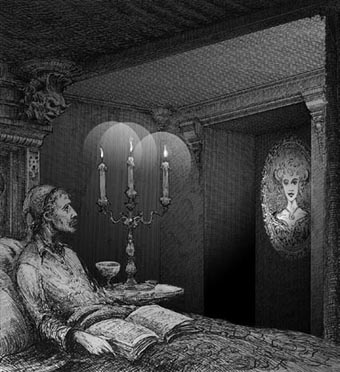
It was a very fine painting, but there was also something strange about it.
And at last I found its secret. It was in her face, in her eyes.'She could easily be... alive,' I thought. 'She looks alive. Those eyes...'
Suddenly I felt cold, and a great fear filled me. My hands began to shake, and I had to look away.
Carefully, I moved the candles again until the light no longer fell in that corner, and the portrait went back into darkness. I found the place in the book which told the story of the oval portrait, and began to read.
She was a young woman of great beauty, and even more beautiful when she was smiling and laughing.
It was a dark day when she saw, and loved, and married the painter. He was already famous for his art, and was always studying and working. The great love of his life was his work, his painting.
His beautiful young wife was playful, full of life and light and smiles, as happy and as loving as a child. But she learned to fear and then to hate everything about painting. Her husband's work was her enemy, because it kept him away from her, hour after hour.
So it was a terrible thing for her when he said he wanted to paint her portrait. But she agreed because she loved him and wanted to please him.
For many weeks she sat in a dark high room where the light from above fell onto the painting and onto her. Day after day, she sat still and silent, not moving, not speaking. But she went on smiling and smiling because she saw that the painter loved his work so much.
He painted hour after hour, not speaking a word, thinking only of his work. Those who saw the portrait looked and said softly, 'It is your finest work. Oh, you do love her dearly! We can see this in the portrait.'
And it was true. But he did not look at her now. He went on working, more and more wildly, thinking and dreaming only of the portrait and never of his wife. Day by day she looked more and more unhappy, but he did not see it. Her face and body were now thin, but he did not see it. He took the warm colour from her face, and painted it into the face in his portrait – but he could not, he would not see it.
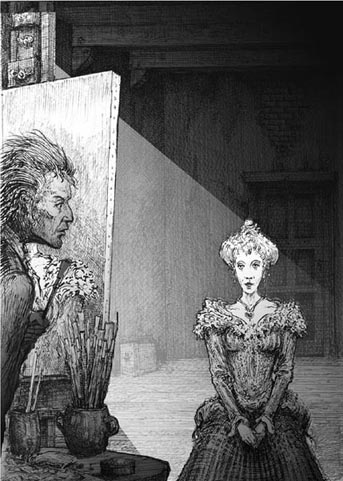
He painted hour after hour, not speaking a word, thinking only of his work.
After many weeks, he finished. One last touch of paint on the mouth, a last touch to the eye...
The painter stood back and looked at the portrait of his wife. How wonderful it was! But while he stared, he began to shake and his face went white. Then he cried out with a loud voice, 'This is LIFE itself! She LIVES in this portrait!' and he turned suddenly to look at the woman he loved. She was dead!
playful adj. very active, happy, and wanting to have fun 活泼的
touch n. a small detail that improves or completes something (画笔等的)轻触,一笔
椭圆形的画像
我身处意大利的群山之中,却从马上掉下来,受了伤。我需要休息,可是在那人迹罕至的蛮荒之地只有一座房子。那是一座颇为精美的老房子,房子很大,但是阴暗且空荡荡的。我的仆人佩德罗把门锁撬开,扶我走了进去。
我打量着四周的家具、地毯和画作。“住在这里的人,”我想,“是不久前才离开的。”
我们占用了房子偏远角落的一个小房间。墙上挂着很多现代画作,房间黑暗的角落里还有更多的画。天色渐暗,佩德罗点亮了我床边桌子上高高的蜡烛。桌上摆着一本书,我开始读了起来。书里描述的都是墙上一幅幅画作的故事。
午夜来而复去,我把蜡烛向自己这边挪了挪,好让光线更亮一些,便于读书。而烛光也落在了房间一个比较黑暗的角落里——在那儿,我初次看见了一幅年轻美人的椭圆形画像,画像上只有她的头部和肩膀。那幅画笔触精细,但与此同时也让人感觉有些不一样,有些奇怪,有些……我不知道是哪里不对劲,但我无法把目光从画像上移开。我坐在床上盯着画像,看了大概有一个小时。
最后我终于发现了它的秘密。秘密就在她的脸上,在她的眼睛里。“她简直就像……活的一样。”我想,“她看上去栩栩如生。那双眼睛……”
突然我感到浑身发冷,心里充满了巨大的恐惧。我的双手开始发抖,我赶紧把目光移开。
小心翼翼地,我再次挪动蜡烛,直到烛光再也照不到那个角落,那幅肖像又回到黑暗之中。我在书中翻到了讲述这幅椭圆形画像的故事之处,便开始读了起来。
她是位美若天仙的年轻女子,她一笑,那种美丽就更增添几分。
一个黑暗的日子里,她与一位画家相遇、相爱,并结为了夫妻。这位画家当时已因画作闻名,他总是在学习和作画。他生命中的至爱就是他的工作,他的画。
他年轻美丽的妻子天性活泼,充满朝气,开朗爱笑,像孩子一样快乐,对一切都充满了爱。可是她学会了害怕,学会了憎恨一切跟画画有关的事。她丈夫的工作是她的敌人,因为工作使他连续好几个小时不能与她在一起。
所以,那个提议——他说他想给她画幅肖像——对她来说实在是件可怕的事。但是她同意了,因为她爱他,想要让他高兴。
长达好几周的时间里,她坐在一个高顶的暗室里,灯光从顶上照射到画作和她的身上。日复一日,她静静地坐着,一动不动,一声不吭。但她一直微笑着,因为她看到画家是如此热爱他的工作。
他连续几个小时画着画,一句话也不说,心里想的只有他的画。那些看到肖像的人都边观赏边轻声说:“这是你最好的作品。噢,你是那么爱她!我们能从肖像上看出来。”
的确如此。可现在他不再看她了。他继续画着,越来越痴狂,心里想的、晚上梦的只有那幅肖像,没有他的妻子。日复一日,她看上去越来越不开心,可是他没有看出来。她的脸庞和身体变得瘦削,可是他没有看出来。他从她脸上取走了温暖的色彩,把它画到了肖像里的那张脸庞上——可是他没有看出来,也不想看出来。
数周之后,他完成了画作。最后给嘴唇点上一抹颜色,给眼睛涂上一抹颜色……
画家后退几步,看着他妻子的肖像。它是多么美妙呀!可就在他凝视肖像时,他开始浑身发抖,脸色也变得苍白。然后,他大声喊了起来:“这就是生命!她活在这幅肖像里!”然后,他突然转身去看他爱的那个女人。她已经死了!
椭圆形的画像
The Oval Portrait
I was in the Italian mountains when I fell from my horse and hurt myself. I needed to rest but in that wild, lonely place there was only one house. It was a fine old building, very big, but dark and empty. My servant, Pedro, broke the lock on a door and helped me inside.
I looked around at the furniture, the carpets, the paintings.'The people who lived here,' I thought, 'left only a short time ago.'
We used one of the smaller rooms in a far corner of the building. There were a great many modern paintings on the walls, and more in the dark corners of the room. It was getting dark and Pedro lit the tall candles on the table by my bed. There was a book on the table, and I began reading it. It described and told the story of each of the pictures on the walls.
Midnight came and went, and I moved the candles closer to me, to give a better light for reading. But the light also fell on one of the darker corners of the room – and there I saw for the first time an oval portrait of a beautiful young woman, just her head and shoulders. It was a very fine painting, but there was also something different about it, something strange, something... I did not know what it was, but I could not take my eyes away from that portrait. For about an hour I sat in the bed, staring at it.
It was a very fine painting, but there was also something strange about it.
And at last I found its secret. It was in her face, in her eyes.'She could easily be... alive,' I thought. 'She looks alive. Those eyes...'
Suddenly I felt cold, and a great fear filled me. My hands began to shake, and I had to look away.
Carefully, I moved the candles again until the light no longer fell in that corner, and the portrait went back into darkness. I found the place in the book which told the story of the oval portrait, and began to read.
She was a young woman of great beauty, and even more beautiful when she was smiling and laughing.
It was a dark day when she saw, and loved, and married the painter. He was already famous for his art, and was always studying and working. The great love of his life was his work, his painting.
His beautiful young wife was playful, full of life and light and smiles, as happy and as loving as a child. But she learned to fear and then to hate everything about painting. Her husband's work was her enemy, because it kept him away from her, hour after hour.
So it was a terrible thing for her when he said he wanted to paint her portrait. But she agreed because she loved him and wanted to please him.
For many weeks she sat in a dark high room where the light from above fell onto the painting and onto her. Day after day, she sat still and silent, not moving, not speaking. But she went on smiling and smiling because she saw that the painter loved his work so much.
He painted hour after hour, not speaking a word, thinking only of his work. Those who saw the portrait looked and said softly, 'It is your finest work. Oh, you do love her dearly! We can see this in the portrait.'
And it was true. But he did not look at her now. He went on working, more and more wildly, thinking and dreaming only of the portrait and never of his wife. Day by day she looked more and more unhappy, but he did not see it. Her face and body were now thin, but he did not see it. He took the warm colour from her face, and painted it into the face in his portrait – but he could not, he would not see it.
He painted hour after hour, not speaking a word, thinking only of his work.
After many weeks, he finished. One last touch of paint on the mouth, a last touch to the eye...
The painter stood back and looked at the portrait of his wife. How wonderful it was! But while he stared, he began to shake and his face went white. Then he cried out with a loud voice, 'This is LIFE itself! She LIVES in this portrait!' and he turned suddenly to look at the woman he loved. She was dead!
playful adj. very active, happy, and wanting to have fun 活泼的
touch n. a small detail that improves or completes something (画笔等的)轻触,一笔
椭圆形的画像
我身处意大利的群山之中,却从马上掉下来,受了伤。我需要休息,可是在那人迹罕至的蛮荒之地只有一座房子。那是一座颇为精美的老房子,房子很大,但是阴暗且空荡荡的。我的仆人佩德罗把门锁撬开,扶我走了进去。
我打量着四周的家具、地毯和画作。“住在这里的人,”我想,“是不久前才离开的。”
我们占用了房子偏远角落的一个小房间。墙上挂着很多现代画作,房间黑暗的角落里还有更多的画。天色渐暗,佩德罗点亮了我床边桌子上高高的蜡烛。桌上摆着一本书,我开始读了起来。书里描述的都是墙上一幅幅画作的故事。
午夜来而复去,我把蜡烛向自己这边挪了挪,好让光线更亮一些,便于读书。而烛光也落在了房间一个比较黑暗的角落里——在那儿,我初次看见了一幅年轻美人的椭圆形画像,画像上只有她的头部和肩膀。那幅画笔触精细,但与此同时也让人感觉有些不一样,有些奇怪,有些……我不知道是哪里不对劲,但我无法把目光从画像上移开。我坐在床上盯着画像,看了大概有一个小时。
最后我终于发现了它的秘密。秘密就在她的脸上,在她的眼睛里。“她简直就像……活的一样。”我想,“她看上去栩栩如生。那双眼睛……”
突然我感到浑身发冷,心里充满了巨大的恐惧。我的双手开始发抖,我赶紧把目光移开。
小心翼翼地,我再次挪动蜡烛,直到烛光再也照不到那个角落,那幅肖像又回到黑暗之中。我在书中翻到了讲述这幅椭圆形画像的故事之处,便开始读了起来。
她是位美若天仙的年轻女子,她一笑,那种美丽就更增添几分。
一个黑暗的日子里,她与一位画家相遇、相爱,并结为了夫妻。这位画家当时已因画作闻名,他总是在学习和作画。他生命中的至爱就是他的工作,他的画。
他年轻美丽的妻子天性活泼,充满朝气,开朗爱笑,像孩子一样快乐,对一切都充满了爱。可是她学会了害怕,学会了憎恨一切跟画画有关的事。她丈夫的工作是她的敌人,因为工作使他连续好几个小时不能与她在一起。
所以,那个提议——他说他想给她画幅肖像——对她来说实在是件可怕的事。但是她同意了,因为她爱他,想要让他高兴。
长达好几周的时间里,她坐在一个高顶的暗室里,灯光从顶上照射到画作和她的身上。日复一日,她静静地坐着,一动不动,一声不吭。但她一直微笑着,因为她看到画家是如此热爱他的工作。
他连续几个小时画着画,一句话也不说,心里想的只有他的画。那些看到肖像的人都边观赏边轻声说:“这是你最好的作品。噢,你是那么爱她!我们能从肖像上看出来。”
的确如此。可现在他不再看她了。他继续画着,越来越痴狂,心里想的、晚上梦的只有那幅肖像,没有他的妻子。日复一日,她看上去越来越不开心,可是他没有看出来。她的脸庞和身体变得瘦削,可是他没有看出来。他从她脸上取走了温暖的色彩,把它画到了肖像里的那张脸庞上——可是他没有看出来,也不想看出来。
数周之后,他完成了画作。最后给嘴唇点上一抹颜色,给眼睛涂上一抹颜色……
画家后退几步,看着他妻子的肖像。它是多么美妙呀!可就在他凝视肖像时,他开始浑身发抖,脸色也变得苍白。然后,他大声喊了起来:“这就是生命!她活在这幅肖像里!”然后,他突然转身去看他爱的那个女人。她已经死了!
ACTIVITIES: Before Reading
ACTIVITIES
Before Reading
1 Read the story introduction and the back cover. How much do you know now about the stories? Tick one box for each sentence.
1) These stories will make you smile.
YES □/NO □
2) The man in Toledo is in prison.
YES □/NO □
3) Montresor wants to go to a carnival party.
YES □/NO □
4) Fortunato finds terror under the ground.
YES □/NO □
5) One man is afraid that they will bury him before he is dead.
YES □/NO □
6) When the two lovers meet, it is a happy day.
YES □/NO □
7) The painter's wife is a happy person.
YES □/NO □
2 Here are the titles of the five stories. Which of the things in the list below belong to each story (two for each story)? Can you guess?
a book about paintings / a broken coffin / a chain / an empty house / a letter / an old sailing boat / a sharp blade /some bottles of wine / some rats / Venice
The Pit and the Pendulum __________ __________
The Cask of Amontillado __________ __________
The Premature Burial __________ __________
The Meeting __________ __________
The Oval Portrait __________ __________
3 Can you guess what will happen in the stories? Choose endings for each of these sentences.
1) The man in the prison...
a) will fall into the pit.
b) will die of terror.
c) will leave the prison alive.
2) After Fortunato and Montresor go to the vaults...
a) only Fortunato will leave alive.
b) only Montresor will leave alive.
c) nobody will leave alive.
3) The man who is afraid of burial alive...
a) will lose his fear.
b) will die of terror.
c) will go mad.
4) The two young lovers...
a) will both die.
b) will run away together.
c) will kill someone.
5) When the painter finishes his work...
a) he will die.
b) his wife will die.
c) he and his wife will die.
ACTIVITIES: After Reading
ACTIVITIES
After Reading
1 Perhaps this is what some of the characters in the stories are thinking. Complete each passage with the words from the list. Which characters are they, and what has just happened in the story?
black / cannot / child / enough / have / lose / must / or / will
1) 'There! I _____ done it! My _____ – my dearest son – is in the water, and I _____ turn back now. But _____ he come? Does he truly love me _____? The night is so _____, and the water is so cold. He _____ come soon – _____ I will _____ my child, my love, my hope...'
This is _____, and ________
behind / death / door / feel / him / moving / once / pit / rats / somebody
2) 'Are there any more prisoners here? What's _____ these walls? They _____ hot – and, yes, they're _____! Is that the_____? Quickly – we must open it at _____! Ugh! There are _____ everywhere, big and fat. And that smell – it's the smell of _____. But look – there's _____ in the middle, near the _____. Can I get to _____ in time?'
This is _____, and ________
anywhere / chain / doing / hand / here / perhaps / wet / understand
3) 'Why has he put this _____ around me? I don't _____. _____ it's a game. Ha ha! He's telling me to put my_____ on the wall – yes, it's very _____. But where's that Amontillado? He said the cask was in _____, but I can't see it _____. And what's he _____ now?'
This is _____, and ________
because / does / front / great / minute / nearer / soon / work / worse
4) 'Can't he see? It is happening in _____ of his eyes. Every day I feel _____ – I am getting _____ to death every _____. He looks at me all the time, but he _____ not see me. Now I know that his _____ love is not me – it is his _____. And _____ he loves his work more than me, I will _____ die...'
This is _____, and ________
boat / coffin / hands / remember / shaking / terrible / thank / wonderful
5) 'What's happening? Why are you _____ me? Take your_____ off me! Am I – no, I'm alive! _____ God! They haven't buried me. Now I _____ – we came onto this _____ yesterday. This is a wooden bed, not a _____. Oh, _____ day! Perhaps now this _____ fear will leave me...'
This is _____ who ________, and ________
2 What did the young Englishman say to the Marchesa before the story begins? Put their conversation in the right order, and write in the speakers' names. The Englishman speaks first (number 4).
1) _____ 'I will do anything in the world to show you how much I love you. Ask me anything – anything at all.'
2) _____ 'Yes. Then I will meet you at that last dark door.'
3) _____ 'I can never do that. If I leave him, my father will kill me.'
4) _____ 'Must you leave? Stay with me a little longer!'
5) _____ 'Ah yes, nothing can come between us then. But –how can I be sure of your love?'
6) _____ 'And then, when I have done what you ask, will you agree?'
7) _____ 'Then there is no hope for us. But if we cannot be together in life... there is another answer.'
8) _____ 'Very well, I will think of something. I will write to you – wait for my letter.'
9) _____ 'I love you more than life itself. And in death we will always be together.'
10) _____ 'No, I must go. You know that I want to be with you, but my husband...'
11) _____ 'Another answer? You mean... together in death? Do you really mean that? You love me so much?'
12) _____ 'Ah, your husband. Dearest, we cannot go on like this. Leave your husband! Come away with me!'
3 Use the clues to complete this crossword with words from the story (all the words go across). Then find two hidden words (four letters or more) in the crossword.
1) A little bit wet.
2) An alcoholic drink made from grapes.
3) A lot of metal rings joined together.
4) Water that comes from the eyes when you cry.
5) To take in air through your nose and mouth.
6) The part of a knife that cuts.
7) A party in the streets with music, singing, and dancing.
8) A place where a dead person is buried.
9) Like the shape of an egg.
10) The part of the body that pushes the blood around.
The hidden words are __________ and __________.
4 Here is a new illustration for one of the stories. Find the best place to put it, and answer these questions.
The picture goes in the story ________.
1) Where has the young boy come from?
2) What news does he bring?
3) What has the narrator just realised?
Now write a caption for the illustration.
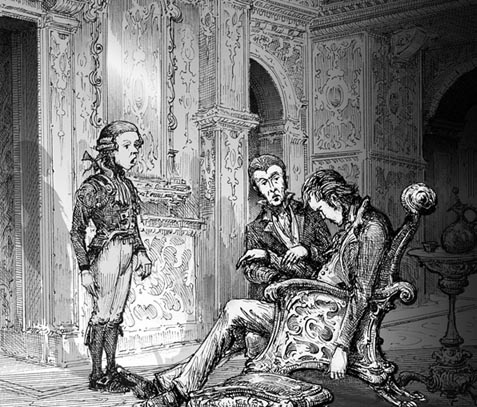
Caption:___________________________
5 Here are some new titles for the stories. Which titles go with which stories? Which titles do you prefer, and why? Now make up a title of your own for each story.
| Love and Death in Venice | The Bed and the Blade |
| Montresor's Joke | A Picture of Life |
| Fire and Fear | The Last Wall |
| Painted to Death | Together in Death |
| The Only Answer | The Not-Dead |
| To the Edge of Death | Beautiful Dead Eyes |
| Everyone's Worst Fear | Carnival Terror |
| A Dream of Coffins |
6 Which story did you find most frightening? Why? For you, which story was the most interesting, and which was the saddest? Why?
7 Look at the list below and imagine that you have to invite one of these characters to a party. Which one will you invite, and why?
| The prisoner in Toledo | Montresor |
| The man who is afraid of burial alive | Fortunato |
| The young Englishman | The Marchesa |
| The Painter | The Painter's Wife |
封底