扉页

版权页
京权图字01-2006-3286
Originally published by Oxford University Press, Great Clarendon Street, Oxford. © 2003 This edition is licensed for sale in the People's Republic of China only and not for export therefrom.
'Oxford' is a registered trademark of Oxford University Press.
图书在版编目(CIP)数据
三个陌生人 = The Three Strangers and Other Stories/(英)哈代(Hardy, T.)著;(英)韦斯特(West, C.)改写;田娜译.—北京:外语教学与研究出版社,2006.5(2014.10 重印)
(书虫·牛津英汉双语读物)
ISBN 978-7-5600-5528-2
Ⅰ.三… Ⅱ.①哈…②韦…③田… Ⅲ.①英语—汉语—对照读物②短篇小说—英国—现代 Ⅳ.H319.4:I
中国版本图书馆CIP数据核字(2007)第009934号
出版人: 蔡剑峰
责任编辑:曾 真
封面设计:孙莉明
封面插图:高 鹏
出版发行:外语教学与研究出版社
社 址:北京市西三环北路19号(100089)
网 址:http://www.fltrp.com
版 次:2006年6月第1版
书 号:ISBN 978-7-5600-5528-2
* * *
凡侵权、盗版书籍线索,请联系我社法律事务部
举报电话:(010)88817519
电子邮箱:banquan@fltrp.com
法律顾问:立方律师事务所 刘旭东律师
中咨律师事务所 殷 斌律师
内容简介
内容简介
托马斯·哈代最著名的小说莫过于《德伯家的苔丝》,但他也创作了大量的短篇故事。其中大多数取材于哈代在英格兰南部居住时,周围村庄的人们给他讲述的故事。
人有相似,无论他们生活在城镇还是乡村,在当代还是一百年前。
一个牧羊少年惊恐地睁大了双眼,从他的小棚屋中往外窥视一个女人和一个并非她丈夫的男人秘密约会。
一个年轻女教师原本要回家嫁给一个比自己大得多的男人,却因做了一时冲动的事而改变了自己的生活。
不过,还是让我们从一座孤零零的村舍的敲门声说起吧。屋内灯光明亮、气氛欢快,人们伴随着音乐翩翩起舞,玩得很开心。屋外大雨滂沱,顺着山间小路走来的陌生人凝视着灯火通明的窗户。他是该继续赶路,还是停下来歇歇、坐在温暖的炉火边吃点东西呢?
THE THREE STRANGERS and Other Stories
THE THREE STRANGERS
and Other Stories
Thomas Hardy is probably best known for his novels such as Tess of the d'Urbervilles, but he also wrote a great number of short stories. Many of them were based on stories told by people in the villages around where he lived in the south of England.
People are the same, whether they live in the town or the country, today or a hundred years ago.
From his hut a young shepherd boy watches, wide-eyed and afraid, a secret meeting between a woman and a man who is not her husband.
A young teacher, going home to marry a much older man, has a moment of madness that will change her life.
But we begin with a knock on the door at a lonely cottage. Inside, all is bright and cheerful, with music and dancing, and people enjoying themselves. Outside, the rain beats down, and the stranger following the footpath across the wild hills stares at the lighted windows. Should he go on, or can he stop for a while, to find rest and food and a seat by a warm fire?
目录
THE THREE STRANGERS 三个陌生人
The Three Strangers
and Other Stories
THE THREE STRANGERS
三个陌生人
1
The first stranger
In the south-west of England there are many long, low, grassy hills, which have not changed their appearance for centuries. Farmers still keep their sheep on them, and the only buildings are lonely cottages, where shepherds live.
Fifty years ago there was a shepherd's cottage on one of these hills. It was only three miles from the market town of Casterbridge, but it was unusual for travellers to pass this way. There was no road, just two footpaths which crossed in front of the cottage door. During the long winters, snow and rain fell heavily here, which made travelling difficult.
The night of March 28th, 1825, was one of the coldest and wettest that winter, but inside the cottage all was warm and cheerful. Shepherd Fennel had invited family and friends to drink to the health of his youngest child, a recent arrival in the family. Nineteen people were at the party: married women and single girls, shepherds and farm workers, young people talking of love, and old friends talking of the past.
Shepherd Fennel had chosen his wife well. She was a farmer's daughter from one of the valleys, and when she married, she brought fifty pounds with her in her pocket — and kept it there, for the needs of a coming family. She did not like to spend money unnecessarily, and had worried about the kind of party to give that evening. 'At a sit-still party,' she thought, 'the men'll get too comfortable and drink the house dry. But at a dancing-party people get hungry and then they'll eat all our food! We'll have both sitting and dancing — that's the best way.' And secretly she told the fiddler to play for no more than fifteen minutes at a time.
But when the dancing began, nobody wanted to stop. The fiddler refused to catch Mrs Fennel's eye, and played on. The music got louder and louder, and the excited dancers stepped faster and faster. Mrs Fennel could do nothing about it, so she sat helplessly in a corner, as the minutes became an hour.
While this was happening indoors, outside in the heavy rain and darkness a figure was climbing up the hill from Casterbridge. It was a tall, thin man, about forty years old, dressed all in black and wearing thick, heavy boots.
When he reached the shepherd's cottage, the rain came down harder than ever. The man left the footpath and went up to the door. He listened carefully, but the music inside had now stopped, and the man seemed unsure what to do. He looked around, but could see no one on the footpath behind him, and no other houses anywhere near.
At last he decided to knock on the door.
'Come in!' called Shepherd Fennel. All eyes turned towards the stranger, as he entered the warm room.
He kept his hat on, low over his face. 'The rain is heavy, friends,' he said in a rich, deep voice. 'May I come in and rest here for a while?'
'O' course, stranger,' replied the shepherd. 'You've chosen your moment well, because we're having a party tonight. There's a new baby in the family, you see.'
'I hope you and your fine wife'll have many more, shepherd,' the man answered, smiling politely at Mrs Fennel. He looked quickly round the room, and seemed happy with what he saw. He took his hat off, and shook the water from his shoulders.
'Will you have a drink with us, stranger?' asked Fennel. He passed a mug of his wife's home-made mead to the newcomer, who drank deeply from it and held it out for more.
'I'll take a seat in the chimney corner, if you don't mind,' said the man, 'to dry my clothes a bit.' He moved closer to the fire, and began to look very much at home.
'There's only one more thing that I need to make me happy,' he added, 'and that's a little tobacco.'
'I'll fill your pipe,' said the shepherd kindly.
'Can you lend me one?'
'You're a smoker, and you've no pipe?' said Fennel.
'I dropped it somewhere on the road.' The man lit the pipe that Fennel gave him, and seemed to want to talk no more.
appearance n. the way a person or thing looks to other people 外表;外观
cottage n. a small house, esp. in the country 小屋;村舍
market town n. a town where a regular market is held(定期举行集市贸易的)集镇
footpath n. a narrow path or track for people to walk on 人行小径
fiddler n. a person who plays a fiddle (a violin) 拉小提琴的人;小提琴手
rich adj. deep, strong, and beautiful sound (声音)深沉浑厚的
mug n. a round container for drinking 圆筒形有柄大杯
mead n. an alcoholic drink made from honey 蜂蜜酒
chimney corner n. a seat by the side of a large open fireplace 壁炉边的座位
tobacco n. the dried brown leaves that are smoked in cigarettes, pipes etc. 烟叶;烟草
pipe n. a thing used for smoking tobacco 烟斗
1.第一个陌生人
英格兰西南部绵亘着许多低矮而葱郁的山丘,它们的面貌千百年来未曾改变。农夫们依旧在山上放羊,山上唯一的一种建筑就是牧羊人居住的那些孤零零的小屋。
50年前,其中一座山上有一间牧羊人的小屋。尽管它距离卡斯特桥的集镇仅有3英里,却很少有行人从此经过。这里没有大路,仅有两条小径在小屋门前交会。在漫长的冬季里,这里雨雪很大,行走很困难。
1825年3月28日那晚是那年冬天最湿冷的一夜,不过小屋里却十分温暖,气氛欢快。牧羊人芬内尔邀请了亲朋好友来家里喝酒,祝福他最小的孩子——一个刚出生不久的家庭成员——身体健康。19个人参加了这次聚会:有已婚的妇人和单身的女孩,也有牧羊人和农场工人。年轻人谈论着爱情,老朋友们则追忆起往昔时光。
牧羊人芬内尔找了个好妻子。她是山谷里一个农夫的女儿,结婚的时候口袋里揣来了50英镑——并且一直没花,准备贡献给即将组成的家庭。她不喜欢乱花钱,还一直为那晚该举行哪种聚会而忧心忡忡。“在坐着不动的聚会中,”她盘算着,“男人们通常会舒服得过了头,把家里的酒喝个底朝天。可是在舞会中,人们又容易饥饿,会吃掉我们所有的食物!所以我们既要坐着又要跳舞——这是最好的办法。”她还偷偷告诉拉小提琴的人,一次最多只拉15分钟琴。
可是舞会开始后,就没有人想停下来了。拉小提琴的人不肯看芬内尔太太的眼色,只管继续拉琴。音乐声越来越大,而兴奋的人们也越跳越快。芬内尔太太对此束手无策,只能无助地坐在角落里;而原本打算举行十来分钟的舞会竟延长到了一个小时。
屋内的人们正兴高采烈地跳着舞;屋外暴雨滂沱,漆黑一片,一个身影正从卡斯特桥向山上艰难地攀爬着。这是一名四十岁左右的瘦高男人,一身黑衣,脚穿厚重的靴子。
到达牧羊人的小屋时,雨下得越发大了。男人走下小径,来到门前。他仔细聆听,但这时音乐已经停了,他似乎有些不知所措。他环顾四周,身后的小径上空无一人,而附近也没有其他房屋。
终于,他决定敲门。
“请进!”牧羊人芬内尔喊道。陌生人走进了温暖的房间,所有的目光都转到了他身上。
他没有摘下帽子,压低的帽沿挡住了他的脸。“这雨可真大呀,伙计们,”他的声音浑厚而低沉,“我能进来在这儿休息一会儿吗?”
“当然可以,陌生的朋友,”牧羊人答道,“你来得正是时候,我们今晚正好在举行聚会。你看,我家里添了个小孩子。”
“希望您和您的贤妻多生贵子,牧羊人。”男人答道,礼貌地对芬内尔太太微笑着。他迅速环视了一下房间,看样子对眼前的一切很满意。他摘下帽子,抖落了肩上的雨水。
“跟我们喝一杯好吗,陌生的朋友?”芬内尔问。他递给这位新来者一杯妻子自酿的蜂蜜酒。陌生人一饮而尽,伸过杯子要再来一杯。
“如果你们不介意的话,我想坐在壁炉边的座位上,”那人说,“这样可以把我的衣服烘一烘。”他又朝炉火凑了凑,开始变得随意起来,看着跟在自己家里差不多。
“再有一样东西我就心满意足了,”他又说,“那就是一点点烟叶。”
“我给你装烟斗。”牧羊人亲切地说。
“你能借给我一只烟斗吗?”
“你抽烟,却没有烟斗?”芬内尔问道。
“我在路上把它弄丢了。”那人点燃了芬内尔给他的烟斗,看样子不想再多说话了。
2
The second stranger
During this conversation the other visitors had not taken much notice of the stranger, because they were discussing what the fiddler should play next. They were just getting up to start another dance when there was a second knock at the door. At this sound, the stranger turned his back to the door, and seemed very busy trying to light his pipe.
'Come in!' called Shepherd Fennel a second time. In a moment another man entered. He too was a stranger.
This one was very different from the first. There was a more cheerful look about him. He was several years older, with greying hair and a full, reddish face. Under his long wet coat he was wearing a dark grey suit.
'I must ask to rest here for a few minutes, friends,' he said, 'or I shall be wet to the skin before I reach Casterbridge.'
'Make yourself at home, sir,' replied Fennel, a little less warmly than when welcoming the first stranger. The cottage was not large, there were not many chairs, and these newcomers brought cold, wet air into the room.
The second visitor took off his coat and hat, and sat down heavily at the table, which the dancers had pushed into the chimney corner. He found himself sitting next to the first stranger, who smiled politely at him and passed him the mug of mead. The second man took it, lifted it to his mouth, and drank without stopping, watched by Mrs Fennel, who was not pleased at this free drinking of her best mead.
At last the man in the grey suit put down the mug with a happy sigh. 'That's wonderful mead, shepherd!' he said. 'I haven't tasted anything as good as that for many years.'
'I'm pleased you enjoy it, sir!' replied Shepherd Fennel.
'It's goodish mead,' agreed his wife, a little coldly. 'Made from our own honey, o'course, and it is trouble enough to make, I can tell ye. But we may not make any more — honey sells well, and we don't need much mead for ourselves.'
'Oh, but you can't stop making this!' cried the man in grey. He took the mug again and drank the last drop. 'I love mead, as much as I love going to church on Sundays, or giving money to the poor!'
'Ha, ha, ha!' said the man by the fire, who seemed to enjoy the stranger's little joke.
The old mead of those days, made with the best honey and the freshest eggs, tasted very strong, but it did not taste as strong as it actually was. Before long, the stranger in grey became very cheerful and red in the face. He made himself comfortable in his chair, and continued the conversation.
'Well, as I say, I'm on my way to Casterbridge,' he said.
'You don't live there then?' said Shepherd Fennel.
'Not yet, although I plan to move there soon.'
'Going to start a business, perhaps?' asked the shepherd.
'No, no,' said his wife. 'It is easy to see that the gentleman is rich, and doesn't need to work at anything.'
'Rich is not the word for me, madam,' replied the man in grey. 'I have to work, and I do work. And even if I only get to Casterbridge by midnight tonight, I must begin work there at eight o'clock tomorrow morning. Yes, hot or cold, rain or snow, I must do my day's work tomorrow.'
'Poor man! So, although you look rich and comfortable, your life is harder than ours, is it?' said the shepherd's wife.
'Well, it's the work that I have to do, that's all. Now I must leave you, friends. But before I go, there's time for one more drink to your baby's health. Only, the mug is empty.'
'Here's some small mead, sir,' offered Mrs Fennel. 'We call it small, but it's still made from good honey.'
'No,' said the stranger. 'I prefer to remember the taste of your best mead, thank you.'
'Of course you do,' said Shepherd Fennel quickly. He went to the dark place under the stairs where the best mead was kept, and filled the mug. His wife followed him and spoke worriedly to him in a low voice.
'I don't like the look o' the man at all! He's drunk enough for ten men already! Don't give him any more o' the best!'
'But he's in our house, my love, and 'tis a miserable wet night. What's a mug of mead more or less?'
'Very well, just this time then,' she said, looking sadly at the mead. 'But who is he, and what kind of work does he do?'
'I don't know. I'll ask him again.'
While the man in grey drank his mead, Fennel asked him again about his work, but the man did not reply at once. Suddenly the first stranger spoke from his seat by the fire.
'Anybody may know what I do — I work with wheels.'
'And anybody may know what I do,' said the man in the grey suit, 'if they're clever enough to find it out.'
There was a short silence, which the shepherd's wife broke by calling for a song. The second mug of mead had made the stranger's face even redder and more cheerful than before, and he offered to sing the first song. This is what he sang:
My job is the strangest one,
Honest shepherds all—
Work that all the world can see;
My customers I tie, and I take them up so high,
And send 'em to a far country!
No one spoke, except the man near the fire, who joined in the last part, with a deep, musical voice:
And send 'em to a far country!
None of the people in the room understood what the singer meant, except the man near the fire; who continued smoking, and said calmly, 'Go on, stranger! Sing on!'
The man in grey drank again from his mug, and sang:
There isn't much I need,
Honest shepherds all—
To set the criminals free.
A little piece of rope, and a tall hanging post,
And that'll be enough for me!
Now it was clear to everybody in the room that the stranger was answering the shepherd's question in song. They all looked at him, their eyes and mouths wide open in horror.
'Oh, he's the hangman!' they whispered to each other. 'He's come to hang that poor clockmaker tomorrow in Casterbridge prison — the clockmaker who had no work, and whose children had no food, so he stole a sheep, and now he's going to hang for it!'
sigh n. breathing in and out, making a long sound 叹气;叹息
midnight n. 12 o'clock at night 半夜12点;午夜
miserable adj. making you feel very unhappy, uncomfortable 令人不愉快的;使人难受的
customer n. someone who buys goods or services from a shop, company etc 顾客;客户
criminal n. someone who is involved in illegal activities or has been proved guilty of a crime 罪犯
rope n. very strong, thick string 粗绳;绳索
hangman n. someone whose job is to kill criminals by hanging them 执行绞刑的刽子手
2.第二个陌生人
牧羊人和陌生人说话时,其他客人没怎么注意到这个陌生人,因为他们正讨论小提琴手接下来应该拉什么曲子。他们正准备起身再跳一支舞,门再次被敲响了。听到敲门声,陌生人转过身子背对着大门,似乎在忙着点他的烟斗。
“请进!”牧羊人芬内尔再次喊道。很快,另一个人走了进来。又是一个陌生人。
这人跟第一个人大不相同,神色要欢快一些。他比第一个人大几岁,头发灰白,红光满面,长长的湿外套下面是一身暗灰色的衣服。
“请让我在这儿休息几分钟吧,朋友们,”他说,“要不然我还没到卡斯特桥就会全身湿透了。”
“您请随便,先生。”芬内尔回答道,态度不像迎接第一个陌生人那么热情了。屋子不大,没多少椅子,况且这些陌生人还把湿冷的寒气带到了室内。
第二个陌生人脱下外套、摘下帽子,重重地坐在被跳舞的人们推到壁炉边的桌子旁。他发现自己坐在了第一个陌生人旁边。那人礼貌地朝他微笑着,把手里那杯蜂蜜酒递给了他。第二个陌生人接过杯子举到嘴边,一口气喝了下去。芬内尔太太看着他,对这种恣意喝自己最好的蜂蜜酒的行为感到很不高兴。
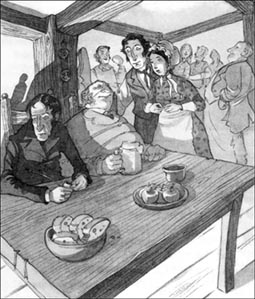
最后,灰衣人高兴地叹了口气,放下了杯子。“这酒太棒了,牧羊人!”他说,“我好多年没尝过这么好的东西了。”
“我很高兴你喜欢这酒,先生!”牧羊人芬内尔答道。
“这是上好的蜂蜜酒,”牧羊人的妻子有些冷淡地附和道,“当然,是用我们自己的蜂蜜做的,做起来可真是费劲啊,我跟你说。不过我们可能不会再酿了——蜂蜜卖得不错,而我们自己又不需要太多蜂蜜酒。”
“哦,你们可不能不酿了!”灰衣人叫道。他又端起杯子,喝掉了最后一滴酒。“我喜欢蜂蜜酒,就像喜欢星期天去教堂做礼拜、喜欢把钱施舍给穷人一样!”
“哈哈哈!”坐在壁炉边的男人笑了起来,似乎被这个陌生人的小笑话给逗乐了。
那时候的蜂蜜酒是用最好的蜂蜜和最新鲜的鸡蛋酿成的,酒味很冲,实际上的酒劲儿却还要大。没过多久,灰衣人就兴奋起来,变得面红耳赤。他在椅子上舒舒服服地坐好,接着往下说。
“呃,我说,我这是要去卡斯特桥。”他说。
“那么您不住在那儿啰?”牧羊人芬内尔问。
“现在还不是,不过我打算很快就搬过去。”
“您这是准备去做点买卖吗?”牧羊人问道。
“不,不,”他的妻子说,“一看就知道这位先生很有钱,什么都不用做。”
“有钱这个词不是用来形容我的,夫人,”灰衣人答道,“我必须工作,而且也的确在工作。即便今晚半夜才能到达卡斯特桥,我也必须在明早8点开始工作。是的,无论严寒酷暑、下雨下雪,我明天都得去做我一天的工作。”
“可怜的人!那就是说,虽然你看起来又有钱又自在,你的日子却比我们还要难过,是吧?”牧羊人的妻子说。
“呃,那工作是我必须做的,就这样。好了,我得走了,朋友们。不过,走之前我还有时间再喝一杯,为你家孩子的健康祝福。可是杯子已经空了。”
“这儿还有些低度蜂蜜酒,先生,”芬内尔太太主动说,“虽然我们叫它低度酒,但也是用优质蜂蜜酿成的。”
“那就不用了,”陌生人说道,“我更愿意铭记你们最好的蜂蜜酒的味道,谢谢。”
“您当然得喝点,”芬内尔赶紧说。他走到楼梯下存放最好的蜂蜜酒的黑暗角落里,把杯子装满。他的妻子跟了过去,焦虑地跟他低声说话。
“我一点都不喜欢那个人的样子!他足足喝了够十个人喝的酒!别再把最好的酒给他了!”
“可是他在我们家呀,亲爱的,而且今晚又那么潮湿阴冷。一杯蜂蜜酒又有什么呢?”
“那好吧,仅此一次,”她说道,难过地看着蜂蜜酒,“可他是谁?究竟是干什么的?”
“我不知道,等下再问问他。”
趁着灰衣人喝酒的工夫,芬内尔再次问起了他的工作,可他并没有马上回答。突然,坐在壁炉边座位上的第一个陌生人说话了。
“人人都可以知道我是干什么的——我是和轮子打交道的。”
“人人也都可以知道我是干什么的,”灰衣人说道,“如果他们足够聪明、能够发现的话。”
一阵短暂的沉默之后,牧羊人的妻子提议大家来唱首歌。第二杯蜂蜜酒使得陌生人脸色更加红润,神情也愈发兴奋了,于是他主动要求唱第一首歌。他唱道:
我的工作最最奇怪,
诚实的牧羊人们——
全世界的人都能看见;
我把顾客绑住,带往高处,
送他们到遥远的国度!
没有人吭声,除了那个坐在壁炉边的人。他用低沉悦耳的声音附和着歌曲的最后一部分:
送他们到遥远的国度!
屋里没有人明白唱歌的人是什么意思,除了坐在壁炉边的那个人。他继续抽着烟,平静地说:“继续,陌生人!继续唱!”
我不用太多东西,
诚实的牧羊人们——
就可以解放犯人。
一小截绳子,一个高高的绞架,
我就足够用了!
这下屋里所有的人都听明白了,这个陌生人是在用歌声回答牧羊人的问题。他们望着他,眼睛和嘴巴因恐惧而大张着。
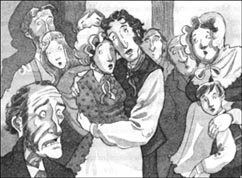
“哦,他就是那个刽子手!”人们轻声地交头接耳,“他来就是要在明天绞死卡斯特桥监狱里那个可怜的钟表匠——那个钟表匠没有活干,孩子们都没吃的,所以就偷了一头羊。就因为这个,他要被绞死了!”
3
The third stranger
Just then, there was another knock on the door. People seemed frightened, and Shepherd Fennel was slow to call out, for the third time, the welcoming words, 'Come in!'
The door was gently opened, and another stranger stood in the doorway. He was a little man, with fair hair, and was tidily dressed. 'Can you tell me the way to—?' he began, but stopped speaking when his eyes fell on the stranger in grey, who, at that moment, started singing again.
Tomorrow is my working day,
Honest shepherds all—
Working with the little piece of rope.
A sheep has lost its life, and the thief must pay the price.
He'll find some peace with God, we hope!
The man by the fire repeated cheerfully in his deep voice:
He'll find some peace with God, we hope!
All this time the third stranger had stood in the doorway, and now everyone turned to look at him. They saw to their surprise that his face was white, his hands were shaking, and his eyes were fixed in horror on the man in grey. A moment later he turned, and ran away into the darkness and the rain.
'Who can that be?' asked Shepherd Fennel.
No one answered. The room was silent, although there were more than twenty people in it, and nothing could be heard except the rain beating on the windows.
The stillness was broken by a bang. It was the sound of a gun, and it came from Casterbridge.
'What does that mean?' cried several people at once.
'A prisoner's escaped from Casterbridge prison—that's what it means,' replied the man in grey, jumping up from his chair. 'I wonder if it's my man?'
'It must be!' said the shepherd. 'And I think we've seen him! The little man who looked in at the door just now, and shook like a leaf when he saw ye and heard your song!'
'His face was as white as a sheet,' said the fiddler.
'His hands shook like an old man's,' said a farm worker.
'His heart seemed as heavy as a stone,' said Mrs Fennel.
'True,' said the man by the fire. 'His face was white, his hands shook, and he ran like the wind — it's all true.'
'We were all wondering what made him run off like that,' said one of the women, 'and now 'tis explained.'
'Is there a policeman here?' asked the hangman.
One of the men came slowly forward, pushed by his friends. 'I'm one o' the king's officers, sir,' he said.
'Then take some of these men at once, follow the criminal, and bring him back here. He hasn't gone far, I'm sure.'
'I will, sir, I will, when I've got my uniform. I'll go home and put it on, and come back here immediately!'
'Uniform! Never mind about your uniform! The man'll be far away by that time!'
'But I must have my uniform! There's the king's name on it in gold — I can't arrest a man without my uniform on.'
'I'm a king's man myself,' said the man in grey coldly, 'and I order you to find and arrest this man at once! Now then, all the men in the house must come with us. Are you ready?'
The men left the cottage to start their search, and the women ran upstairs to see the new baby, who had begun to cry loudly. But the living room did not stay empty for long. A few minutes later the first stranger came quietly back into the house. He cut himself a large piece of cake, and drank another mug of mead. He was still eating when another man came in just as quietly. It was the man in grey.
'Oh, you here?' said the hangman, smiling. 'I thought you had gone to help look for the prisoner.'
'And I thought you had gone too,' replied the other.
'Well, I felt that there were enough people without me,' said the man in grey, helping himself to the mead.
'I felt the same as you.'
'These shepherd-people can easily find the man because they know this hilly country. They'll have him ready for me by the morning, and it'll be no trouble to me at all.'
'Yes, they'll find him. We'll save ourselves all that trouble.'
'True, true. Well, I'm going to Casterbridge. Are you going the same way? We could walk together.'
'No, I'm sorry to say I'm going the other way.' And after finishing their mead, the two men shook hands warmly, said goodbye to each other, and went their different ways.
Out on the hills, the shepherd and his friends were getting cold and wet in their search for the prisoner. They had no luck at all until they reached the top of a hill, where a single tree stood. Suddenly they saw the man who they were looking for, standing next to the tree.
'Your money or your life!' cried the policeman loudly.
'No, no,' whispered the shepherd. 'That's what robbers say, not good, honest people like us!'
'Well, I must say something, mustn't I? Ye don't realize how difficult it is to remember what to say!'
The little man now seemed to notice them for the first time. 'Well, travellers, did I hear ye speak to me?' he asked.
'You did,' replied the policeman. 'We arrest ye for not waiting in Casterbridge prison for your hanging tomorrow!'
The little man did not seem at all afraid, and to everyone's surprise agreed with great politeness to go back to the shepherd's cottage. When they arrived there, they discovered that two officers from Casterbridge prison, and a judge who lived nearby, were waiting for them.
'Gentlemen,' said the policeman, 'I've brought back your prisoner — here he is!'
'But this is not our man!' cried one of the prison officers.
'What?' said the judge. 'Haven't you got the right man?'
'But then who can this man be?' asked the policeman.
'I don't know,' said the prison officer. 'But our prisoner is very different. He's tall and thin, with a deep, musical voice.'
'That was the stranger who sat by the fire!' cried Fennel.
The little man now spoke to the judge for the first time. 'Sir,' he said, 'I must explain. I've done nothing wrong — my only crime is that the prisoner is my brother. Today I was on my way to visit him in Casterbridge prison for the last time, when I got lost in the dark. I stopped here to ask the way, and when I opened the door, I saw my brother sitting by the fire. Right next to him was the hangman who'd come to take his life! My brother looked at me, and I knew he meant, "Don't tell them who I am, or I'll die!" I was too frightened to do anything except turn and run away.'
'And do you know where your brother is now?'
'No, sir. I haven't seen him since I left the cottage.'
'And what's his job?'
'He's a clockmaker, sir.'
'He said he worked with wheels,' said Shepherd Fennel. 'He meant the wheels of clocks and watches, I suppose.'
'Well, we must let this poor man go,' said the judge. 'Clearly, it's his brother who is the wanted man.'
And so the little man left the cottage with a sad, slow step.
The next morning, men were out on the hills again, searching for the clever thief. But the shepherds and farm workers did not look very carefully. They did not think the man should hang, just for stealing a sheep, and they liked the wonderful coolness that he showed, when sitting next to the hangman at the shepherd's party. So the prisoner was never found, and the man in grey never did his morning's work in Casterbridge, nor ever met again the friendly stranger who had sung the hangman's song with him by the shepherd's fire.
The grass has long been green on the graves of Shepherd Fennel and his wife, and the baby whose health was drunk that night is now an old lady. But the arrival of the three strangers at the shepherd's cottage, and all that happened afterwards, is a story as well known as ever in the hills and valleys around Casterbridge.
tidily adv. neat, orderly 整洁地;整齐地
stillness n. quietness, calmness, without any activity 宁静;安宁
uniform n. a particular type of clothing worn by all the members of a group or organization such as the police 制服
arrest v. (police) take somebody away because they think he/she has done something illegal 逮捕
in search for look for 寻找
whisper v. to speak or say something very quietly, using your breath rather than your voice 悄声说;耳语
wanted adj. someone who is wanted is being looked for by the police 被警方追捕的;被通缉的
coolness n. quality of being calm and not nervous 冷静
grave n. the place in the ground where a dead body is buried 坟墓
3.第三个陌生人
就在这时,又传来了一阵敲门声。人们有些恐慌,牧羊人芬内尔好半天才第三次说出了那句欢迎的话:“请进!”
门被轻轻推开了,又一位陌生人站在了门口。他身材矮小、头发金黄、衣着整洁。“能不能告诉我怎么去——?”他刚一开口,目光就落到了灰衣人身上,于是便闭上了嘴。灰衣人又开口唱了起来。
明天是我的工作日,
诚实的牧羊人们——
我的用具是那一小截绳子。
一头羊丧了命,窃贼必须付出代价。
但愿他在上帝那儿得到安宁!
壁炉边的那个男人用低沉的声音欢快地重复着:
但愿他在上帝那儿得到安宁!
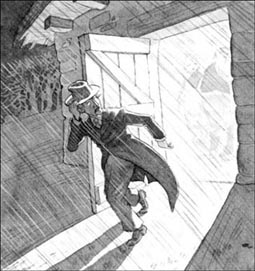
在此期间,第三个陌生人一直站在门口,直到此刻人们才转过来看着他。他们惊奇地发现,他脸色苍白、双手发抖,眼睛惊恐地盯着灰衣人。不一会儿,他转身跑进了大雨滂沱的黑夜。
“他会是谁呢?”牧羊人芬内尔问道。
没人回答。尽管屋子里有二十多个人,此刻却一片沉默,静得只能听到雨点打在窗户上的声音。
寂静被“砰”的一声巨响打破了。那是一声枪响,从卡斯特桥方向传来。
“怎么回事?”立刻就有几个人叫了起来。
“有犯人从卡斯特桥监狱逃出来了——就是这么回事,”灰衣人说着,从椅子上跳了起来,“我想知道是不是我要绞死的那个人?”
“一定是!”牧羊人说,“而且我想我们见过他!刚才那个从门口往屋里张望的小个子,他见到你唱歌时抖得像一片树叶!”
“他的脸白得像床单。”拉小提琴的人说。
“他的手抖得像个老头。”一个农场工人说。
“看样子,他的心情也沉重得像压着块石头。”芬内尔太太说。
“没错,”壁炉边的男人说,“他脸色煞白,手哆哆嗦嗦,像一阵风似的跑了——没错。”
“我们刚才还纳闷他干吗那样落荒而逃呢,”一个女人说,“现在真相大白了。”
“这里有警察吗?”刽子手问道。
其中一人被朋友们推着慢慢走上前来。“我是国王手下的军官,先生。”他答道。
“那就马上从这一屋子人中挑几个,追上那个犯人,把他带到这儿来。他还没跑多远,我敢肯定。”
“好的,先生,我穿上制服就去。我回家穿制服,马上就回来!”
“制服!别管你的制服啦!到那会儿犯人早跑远了!”
“可我必须穿上制服!那上面有国王的名字,金色的——我不穿制服就不能逮捕人。”
“我自己也是国王的下属,”灰衣人冷冷地说,“我命令你马上去追捕这个人!听着,屋里所有的男人都得跟我们去。你们准备好了吗?”
男人们离开了小屋开始搜寻,女人们则跑到楼上去照看开始放声大哭的婴儿。不过客厅并没有空下来多久。几分钟后,第一个陌生人悄悄回到了小屋里。他给自己切了一大块蛋糕,又喝了一杯蜂蜜酒。他还没吃完,另一个人也悄悄走了进来。是那个灰衣人。
“噢,你也在这儿吗?”刽子手微笑着说,“我还以为你帮忙找犯人去了呢。”
“我也以为你去了呢。”那人回答道。
“呃,我觉得人够多了,不差我一个。”灰衣人边说边给自己倒了点蜂蜜酒。
“我跟你想的一样。”
“这些牧羊人很容易就能找到那个人,因为他们对这山村很熟悉。他们会在天亮前抓住他的,我根本不用费劲。”
“是啊,他们会找到他的。我们用不着费劲。”
“没错,没错。呃,我要去卡斯特桥了。你也去那儿吗?咱们可以搭个伴走。”
“不,很不巧,我要去另一个方向。”喝完酒,两个男人热情地握手作别,分别朝不同的方向走去。
山上,牧羊人和他的朋友们为寻找犯人而弄得浑身又冷又湿。他们很不走运,直到来到一座山顶,那儿挺立着一棵孤零零的树。突然,他们看见要找的人就站在树的旁边。
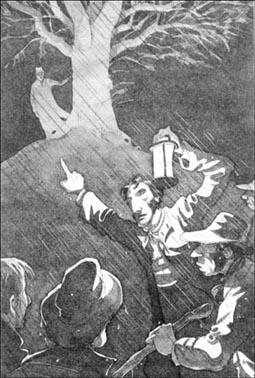
“不给钱就要你的命!”警察高声喊道。
“不对,不对,”牧羊人悄声说,“那是强盗们喊的话,不是我们这种诚实的好人该喊的!”
“呃,我总得说点什么,不是吗?你不知道要记住自己该说什么有多难!”
那个小个子男人似乎这才注意到他们。“哦,二位路人,你们刚才是在跟我说话吗?”他问道。
“没错,”警察回答道,“我们要逮捕你,因为你本该在卡斯特桥监狱等待明天的绞刑!”
小个子男人看起来一点都不害怕,更令大家惊讶的是,他很礼貌地同意回到牧羊人的小屋去。到了之后,他们发现卡斯特桥监狱的两名典狱官和一名住在附近的法官已经等在了那里。
“先生们,”警察说,“我把你们的犯人带回来了——就是他!”
“但这不是我们要抓的人!”其中一名典狱官叫道。
“什么?”法官说道,“你们没抓对人?”
“那这个人是谁?”警察问。
“我不认识,”典狱官说,“不过我们的犯人跟他很不一样。犯人又高又瘦,嗓音低沉悦耳。”
“就是那个坐在壁炉边的陌生人!”芬内尔叫道。
小个子男人终于开了口,冲着法官说话了。“先生,”他说,“我必须解释一下。我并没做什么坏事——我唯一的过错就是,那个犯人是我兄弟。我今天原本打算去卡斯特桥监狱见他最后一面,但却在黑暗中迷了路。我在这里停下来打算问路,推开门却看到我兄弟就坐在壁炉边,身旁就是来取他性命的刽子手!我兄弟看了我一眼,我就明白了他的意思:'别告诉他们我是谁,不然我就死定了!'我害怕极了,只好转身跑开了。”
“那你知道你兄弟现在在哪里吗?”
“不知道,先生。我离开小屋后就没再见过他。”
“他是干什么的?”
“他是钟表匠,先生。”
“他说过他是和轮子打交道的,”牧羊人芬内尔说,“我猜他指的是钟表的齿轮。”
“呃,我们得放这个可怜人走,”法官说,“很明显,他的兄弟才是我们要找的人。”
于是,小个子男人迈着忧伤的步子慢慢走出了小屋。
第二天早晨,人们再次来到山上寻找那个机敏的窃贼。不过,牧羊人和农场工人们并没有仔细寻找。他们觉得那个人仅仅是偷了一头羊,不应该被绞死。他们还很欣赏在牧羊人家的聚会上,他坐在刽子手旁边时所表现出的沉着冷静。因此,那个犯人一直也没被抓到,而灰衣人也一直没能完成他那天早上在卡斯特桥的工作。打那以后,他再没见过那个友善的陌生人,那个在牧羊人家壁炉边和他一起唱刽子手之歌的人。
牧羊人芬内尔夫妻俩的墓地上早已是绿草茵茵了,而那个婴儿——那天晚上,人们曾为她的健康祝福——如今也成了一位老妇人。然而,三个陌生人来到牧羊人小屋的事情以及此后发生的一切,却一直在卡斯特桥周围的山峦谷地中传诵不已。
1.The first stranger
The Three Strangers
and Other Stories
THE THREE STRANGERS
三个陌生人
1
The first stranger
In the south-west of England there are many long, low, grassy hills, which have not changed their appearance for centuries. Farmers still keep their sheep on them, and the only buildings are lonely cottages, where shepherds live.
Fifty years ago there was a shepherd's cottage on one of these hills. It was only three miles from the market town of Casterbridge, but it was unusual for travellers to pass this way. There was no road, just two footpaths which crossed in front of the cottage door. During the long winters, snow and rain fell heavily here, which made travelling difficult.
The night of March 28th, 1825, was one of the coldest and wettest that winter, but inside the cottage all was warm and cheerful. Shepherd Fennel had invited family and friends to drink to the health of his youngest child, a recent arrival in the family. Nineteen people were at the party: married women and single girls, shepherds and farm workers, young people talking of love, and old friends talking of the past.
Shepherd Fennel had chosen his wife well. She was a farmer's daughter from one of the valleys, and when she married, she brought fifty pounds with her in her pocket — and kept it there, for the needs of a coming family. She did not like to spend money unnecessarily, and had worried about the kind of party to give that evening. 'At a sit-still party,' she thought, 'the men'll get too comfortable and drink the house dry. But at a dancing-party people get hungry and then they'll eat all our food! We'll have both sitting and dancing — that's the best way.' And secretly she told the fiddler to play for no more than fifteen minutes at a time.
But when the dancing began, nobody wanted to stop. The fiddler refused to catch Mrs Fennel's eye, and played on. The music got louder and louder, and the excited dancers stepped faster and faster. Mrs Fennel could do nothing about it, so she sat helplessly in a corner, as the minutes became an hour.
While this was happening indoors, outside in the heavy rain and darkness a figure was climbing up the hill from Casterbridge. It was a tall, thin man, about forty years old, dressed all in black and wearing thick, heavy boots.
When he reached the shepherd's cottage, the rain came down harder than ever. The man left the footpath and went up to the door. He listened carefully, but the music inside had now stopped, and the man seemed unsure what to do. He looked around, but could see no one on the footpath behind him, and no other houses anywhere near.
At last he decided to knock on the door.
'Come in!' called Shepherd Fennel. All eyes turned towards the stranger, as he entered the warm room.
He kept his hat on, low over his face. 'The rain is heavy, friends,' he said in a rich, deep voice. 'May I come in and rest here for a while?'
'O' course, stranger,' replied the shepherd. 'You've chosen your moment well, because we're having a party tonight. There's a new baby in the family, you see.'
'I hope you and your fine wife'll have many more, shepherd,' the man answered, smiling politely at Mrs Fennel. He looked quickly round the room, and seemed happy with what he saw. He took his hat off, and shook the water from his shoulders.
'Will you have a drink with us, stranger?' asked Fennel. He passed a mug of his wife's home-made mead to the newcomer, who drank deeply from it and held it out for more.
'I'll take a seat in the chimney corner, if you don't mind,' said the man, 'to dry my clothes a bit.' He moved closer to the fire, and began to look very much at home.
'There's only one more thing that I need to make me happy,' he added, 'and that's a little tobacco.'
'I'll fill your pipe,' said the shepherd kindly.
'Can you lend me one?'
'You're a smoker, and you've no pipe?' said Fennel.
'I dropped it somewhere on the road.' The man lit the pipe that Fennel gave him, and seemed to want to talk no more.
appearance n. the way a person or thing looks to other people 外表;外观
cottage n. a small house, esp. in the country 小屋;村舍
market town n. a town where a regular market is held(定期举行集市贸易的)集镇
footpath n. a narrow path or track for people to walk on 人行小径
fiddler n. a person who plays a fiddle (a violin) 拉小提琴的人;小提琴手
rich adj. deep, strong, and beautiful sound (声音)深沉浑厚的
mug n. a round container for drinking 圆筒形有柄大杯
mead n. an alcoholic drink made from honey 蜂蜜酒
chimney corner n. a seat by the side of a large open fireplace 壁炉边的座位
tobacco n. the dried brown leaves that are smoked in cigarettes, pipes etc. 烟叶;烟草
pipe n. a thing used for smoking tobacco 烟斗
1.第一个陌生人
英格兰西南部绵亘着许多低矮而葱郁的山丘,它们的面貌千百年来未曾改变。农夫们依旧在山上放羊,山上唯一的一种建筑就是牧羊人居住的那些孤零零的小屋。
50年前,其中一座山上有一间牧羊人的小屋。尽管它距离卡斯特桥的集镇仅有3英里,却很少有行人从此经过。这里没有大路,仅有两条小径在小屋门前交会。在漫长的冬季里,这里雨雪很大,行走很困难。
1825年3月28日那晚是那年冬天最湿冷的一夜,不过小屋里却十分温暖,气氛欢快。牧羊人芬内尔邀请了亲朋好友来家里喝酒,祝福他最小的孩子——一个刚出生不久的家庭成员——身体健康。19个人参加了这次聚会:有已婚的妇人和单身的女孩,也有牧羊人和农场工人。年轻人谈论着爱情,老朋友们则追忆起往昔时光。
牧羊人芬内尔找了个好妻子。她是山谷里一个农夫的女儿,结婚的时候口袋里揣来了50英镑——并且一直没花,准备贡献给即将组成的家庭。她不喜欢乱花钱,还一直为那晚该举行哪种聚会而忧心忡忡。“在坐着不动的聚会中,”她盘算着,“男人们通常会舒服得过了头,把家里的酒喝个底朝天。可是在舞会中,人们又容易饥饿,会吃掉我们所有的食物!所以我们既要坐着又要跳舞——这是最好的办法。”她还偷偷告诉拉小提琴的人,一次最多只拉15分钟琴。
可是舞会开始后,就没有人想停下来了。拉小提琴的人不肯看芬内尔太太的眼色,只管继续拉琴。音乐声越来越大,而兴奋的人们也越跳越快。芬内尔太太对此束手无策,只能无助地坐在角落里;而原本打算举行十来分钟的舞会竟延长到了一个小时。
屋内的人们正兴高采烈地跳着舞;屋外暴雨滂沱,漆黑一片,一个身影正从卡斯特桥向山上艰难地攀爬着。这是一名四十岁左右的瘦高男人,一身黑衣,脚穿厚重的靴子。
到达牧羊人的小屋时,雨下得越发大了。男人走下小径,来到门前。他仔细聆听,但这时音乐已经停了,他似乎有些不知所措。他环顾四周,身后的小径上空无一人,而附近也没有其他房屋。
终于,他决定敲门。
“请进!”牧羊人芬内尔喊道。陌生人走进了温暖的房间,所有的目光都转到了他身上。
他没有摘下帽子,压低的帽沿挡住了他的脸。“这雨可真大呀,伙计们,”他的声音浑厚而低沉,“我能进来在这儿休息一会儿吗?”
“当然可以,陌生的朋友,”牧羊人答道,“你来得正是时候,我们今晚正好在举行聚会。你看,我家里添了个小孩子。”
“希望您和您的贤妻多生贵子,牧羊人。”男人答道,礼貌地对芬内尔太太微笑着。他迅速环视了一下房间,看样子对眼前的一切很满意。他摘下帽子,抖落了肩上的雨水。
“跟我们喝一杯好吗,陌生的朋友?”芬内尔问。他递给这位新来者一杯妻子自酿的蜂蜜酒。陌生人一饮而尽,伸过杯子要再来一杯。
“如果你们不介意的话,我想坐在壁炉边的座位上,”那人说,“这样可以把我的衣服烘一烘。”他又朝炉火凑了凑,开始变得随意起来,看着跟在自己家里差不多。
“再有一样东西我就心满意足了,”他又说,“那就是一点点烟叶。”
“我给你装烟斗。”牧羊人亲切地说。
“你能借给我一只烟斗吗?”
“你抽烟,却没有烟斗?”芬内尔问道。
“我在路上把它弄丢了。”那人点燃了芬内尔给他的烟斗,看样子不想再多说话了。
2
The second stranger
During this conversation the other visitors had not taken much notice of the stranger, because they were discussing what the fiddler should play next. They were just getting up to start another dance when there was a second knock at the door. At this sound, the stranger turned his back to the door, and seemed very busy trying to light his pipe.
'Come in!' called Shepherd Fennel a second time. In a moment another man entered. He too was a stranger.
This one was very different from the first. There was a more cheerful look about him. He was several years older, with greying hair and a full, reddish face. Under his long wet coat he was wearing a dark grey suit.
'I must ask to rest here for a few minutes, friends,' he said, 'or I shall be wet to the skin before I reach Casterbridge.'
'Make yourself at home, sir,' replied Fennel, a little less warmly than when welcoming the first stranger. The cottage was not large, there were not many chairs, and these newcomers brought cold, wet air into the room.
The second visitor took off his coat and hat, and sat down heavily at the table, which the dancers had pushed into the chimney corner. He found himself sitting next to the first stranger, who smiled politely at him and passed him the mug of mead. The second man took it, lifted it to his mouth, and drank without stopping, watched by Mrs Fennel, who was not pleased at this free drinking of her best mead.
At last the man in the grey suit put down the mug with a happy sigh. 'That's wonderful mead, shepherd!' he said. 'I haven't tasted anything as good as that for many years.'
'I'm pleased you enjoy it, sir!' replied Shepherd Fennel.
'It's goodish mead,' agreed his wife, a little coldly. 'Made from our own honey, o'course, and it is trouble enough to make, I can tell ye. But we may not make any more — honey sells well, and we don't need much mead for ourselves.'
'Oh, but you can't stop making this!' cried the man in grey. He took the mug again and drank the last drop. 'I love mead, as much as I love going to church on Sundays, or giving money to the poor!'
'Ha, ha, ha!' said the man by the fire, who seemed to enjoy the stranger's little joke.
The old mead of those days, made with the best honey and the freshest eggs, tasted very strong, but it did not taste as strong as it actually was. Before long, the stranger in grey became very cheerful and red in the face. He made himself comfortable in his chair, and continued the conversation.
'Well, as I say, I'm on my way to Casterbridge,' he said.
'You don't live there then?' said Shepherd Fennel.
'Not yet, although I plan to move there soon.'
'Going to start a business, perhaps?' asked the shepherd.
'No, no,' said his wife. 'It is easy to see that the gentleman is rich, and doesn't need to work at anything.'
'Rich is not the word for me, madam,' replied the man in grey. 'I have to work, and I do work. And even if I only get to Casterbridge by midnight tonight, I must begin work there at eight o'clock tomorrow morning. Yes, hot or cold, rain or snow, I must do my day's work tomorrow.'
'Poor man! So, although you look rich and comfortable, your life is harder than ours, is it?' said the shepherd's wife.
'Well, it's the work that I have to do, that's all. Now I must leave you, friends. But before I go, there's time for one more drink to your baby's health. Only, the mug is empty.'
'Here's some small mead, sir,' offered Mrs Fennel. 'We call it small, but it's still made from good honey.'
'No,' said the stranger. 'I prefer to remember the taste of your best mead, thank you.'
'Of course you do,' said Shepherd Fennel quickly. He went to the dark place under the stairs where the best mead was kept, and filled the mug. His wife followed him and spoke worriedly to him in a low voice.
'I don't like the look o' the man at all! He's drunk enough for ten men already! Don't give him any more o' the best!'
'But he's in our house, my love, and 'tis a miserable wet night. What's a mug of mead more or less?'
'Very well, just this time then,' she said, looking sadly at the mead. 'But who is he, and what kind of work does he do?'
'I don't know. I'll ask him again.'
While the man in grey drank his mead, Fennel asked him again about his work, but the man did not reply at once. Suddenly the first stranger spoke from his seat by the fire.
'Anybody may know what I do — I work with wheels.'
'And anybody may know what I do,' said the man in the grey suit, 'if they're clever enough to find it out.'
There was a short silence, which the shepherd's wife broke by calling for a song. The second mug of mead had made the stranger's face even redder and more cheerful than before, and he offered to sing the first song. This is what he sang:
My job is the strangest one,
Honest shepherds all—
Work that all the world can see;
My customers I tie, and I take them up so high,
And send 'em to a far country!
No one spoke, except the man near the fire, who joined in the last part, with a deep, musical voice:
And send 'em to a far country!
None of the people in the room understood what the singer meant, except the man near the fire; who continued smoking, and said calmly, 'Go on, stranger! Sing on!'
The man in grey drank again from his mug, and sang:
There isn't much I need,
Honest shepherds all—
To set the criminals free.
A little piece of rope, and a tall hanging post,
And that'll be enough for me!
Now it was clear to everybody in the room that the stranger was answering the shepherd's question in song. They all looked at him, their eyes and mouths wide open in horror.
'Oh, he's the hangman!' they whispered to each other. 'He's come to hang that poor clockmaker tomorrow in Casterbridge prison — the clockmaker who had no work, and whose children had no food, so he stole a sheep, and now he's going to hang for it!'
sigh n. breathing in and out, making a long sound 叹气;叹息
midnight n. 12 o'clock at night 半夜12点;午夜
miserable adj. making you feel very unhappy, uncomfortable 令人不愉快的;使人难受的
customer n. someone who buys goods or services from a shop, company etc 顾客;客户
criminal n. someone who is involved in illegal activities or has been proved guilty of a crime 罪犯
rope n. very strong, thick string 粗绳;绳索
hangman n. someone whose job is to kill criminals by hanging them 执行绞刑的刽子手
2.第二个陌生人
牧羊人和陌生人说话时,其他客人没怎么注意到这个陌生人,因为他们正讨论小提琴手接下来应该拉什么曲子。他们正准备起身再跳一支舞,门再次被敲响了。听到敲门声,陌生人转过身子背对着大门,似乎在忙着点他的烟斗。
“请进!”牧羊人芬内尔再次喊道。很快,另一个人走了进来。又是一个陌生人。
这人跟第一个人大不相同,神色要欢快一些。他比第一个人大几岁,头发灰白,红光满面,长长的湿外套下面是一身暗灰色的衣服。
“请让我在这儿休息几分钟吧,朋友们,”他说,“要不然我还没到卡斯特桥就会全身湿透了。”
“您请随便,先生。”芬内尔回答道,态度不像迎接第一个陌生人那么热情了。屋子不大,没多少椅子,况且这些陌生人还把湿冷的寒气带到了室内。
第二个陌生人脱下外套、摘下帽子,重重地坐在被跳舞的人们推到壁炉边的桌子旁。他发现自己坐在了第一个陌生人旁边。那人礼貌地朝他微笑着,把手里那杯蜂蜜酒递给了他。第二个陌生人接过杯子举到嘴边,一口气喝了下去。芬内尔太太看着他,对这种恣意喝自己最好的蜂蜜酒的行为感到很不高兴。
最后,灰衣人高兴地叹了口气,放下了杯子。“这酒太棒了,牧羊人!”他说,“我好多年没尝过这么好的东西了。”
“我很高兴你喜欢这酒,先生!”牧羊人芬内尔答道。
“这是上好的蜂蜜酒,”牧羊人的妻子有些冷淡地附和道,“当然,是用我们自己的蜂蜜做的,做起来可真是费劲啊,我跟你说。不过我们可能不会再酿了——蜂蜜卖得不错,而我们自己又不需要太多蜂蜜酒。”
“哦,你们可不能不酿了!”灰衣人叫道。他又端起杯子,喝掉了最后一滴酒。“我喜欢蜂蜜酒,就像喜欢星期天去教堂做礼拜、喜欢把钱施舍给穷人一样!”
“哈哈哈!”坐在壁炉边的男人笑了起来,似乎被这个陌生人的小笑话给逗乐了。
那时候的蜂蜜酒是用最好的蜂蜜和最新鲜的鸡蛋酿成的,酒味很冲,实际上的酒劲儿却还要大。没过多久,灰衣人就兴奋起来,变得面红耳赤。他在椅子上舒舒服服地坐好,接着往下说。
“呃,我说,我这是要去卡斯特桥。”他说。
“那么您不住在那儿啰?”牧羊人芬内尔问。
“现在还不是,不过我打算很快就搬过去。”
“您这是准备去做点买卖吗?”牧羊人问道。
“不,不,”他的妻子说,“一看就知道这位先生很有钱,什么都不用做。”
“有钱这个词不是用来形容我的,夫人,”灰衣人答道,“我必须工作,而且也的确在工作。即便今晚半夜才能到达卡斯特桥,我也必须在明早8点开始工作。是的,无论严寒酷暑、下雨下雪,我明天都得去做我一天的工作。”
“可怜的人!那就是说,虽然你看起来又有钱又自在,你的日子却比我们还要难过,是吧?”牧羊人的妻子说。
“呃,那工作是我必须做的,就这样。好了,我得走了,朋友们。不过,走之前我还有时间再喝一杯,为你家孩子的健康祝福。可是杯子已经空了。”
“这儿还有些低度蜂蜜酒,先生,”芬内尔太太主动说,“虽然我们叫它低度酒,但也是用优质蜂蜜酿成的。”
“那就不用了,”陌生人说道,“我更愿意铭记你们最好的蜂蜜酒的味道,谢谢。”
“您当然得喝点,”芬内尔赶紧说。他走到楼梯下存放最好的蜂蜜酒的黑暗角落里,把杯子装满。他的妻子跟了过去,焦虑地跟他低声说话。
“我一点都不喜欢那个人的样子!他足足喝了够十个人喝的酒!别再把最好的酒给他了!”
“可是他在我们家呀,亲爱的,而且今晚又那么潮湿阴冷。一杯蜂蜜酒又有什么呢?”
“那好吧,仅此一次,”她说道,难过地看着蜂蜜酒,“可他是谁?究竟是干什么的?”
“我不知道,等下再问问他。”
趁着灰衣人喝酒的工夫,芬内尔再次问起了他的工作,可他并没有马上回答。突然,坐在壁炉边座位上的第一个陌生人说话了。
“人人都可以知道我是干什么的——我是和轮子打交道的。”
“人人也都可以知道我是干什么的,”灰衣人说道,“如果他们足够聪明、能够发现的话。”
一阵短暂的沉默之后,牧羊人的妻子提议大家来唱首歌。第二杯蜂蜜酒使得陌生人脸色更加红润,神情也愈发兴奋了,于是他主动要求唱第一首歌。他唱道:
我的工作最最奇怪,
诚实的牧羊人们——
全世界的人都能看见;
我把顾客绑住,带往高处,
送他们到遥远的国度!
没有人吭声,除了那个坐在壁炉边的人。他用低沉悦耳的声音附和着歌曲的最后一部分:
送他们到遥远的国度!
屋里没有人明白唱歌的人是什么意思,除了坐在壁炉边的那个人。他继续抽着烟,平静地说:“继续,陌生人!继续唱!”
我不用太多东西,
诚实的牧羊人们——
就可以解放犯人。
一小截绳子,一个高高的绞架,
我就足够用了!
这下屋里所有的人都听明白了,这个陌生人是在用歌声回答牧羊人的问题。他们望着他,眼睛和嘴巴因恐惧而大张着。
“哦,他就是那个刽子手!”人们轻声地交头接耳,“他来就是要在明天绞死卡斯特桥监狱里那个可怜的钟表匠——那个钟表匠没有活干,孩子们都没吃的,所以就偷了一头羊。就因为这个,他要被绞死了!”
3
The third stranger
Just then, there was another knock on the door. People seemed frightened, and Shepherd Fennel was slow to call out, for the third time, the welcoming words, 'Come in!'
The door was gently opened, and another stranger stood in the doorway. He was a little man, with fair hair, and was tidily dressed. 'Can you tell me the way to—?' he began, but stopped speaking when his eyes fell on the stranger in grey, who, at that moment, started singing again.
Tomorrow is my working day,
Honest shepherds all—
Working with the little piece of rope.
A sheep has lost its life, and the thief must pay the price.
He'll find some peace with God, we hope!
The man by the fire repeated cheerfully in his deep voice:
He'll find some peace with God, we hope!
All this time the third stranger had stood in the doorway, and now everyone turned to look at him. They saw to their surprise that his face was white, his hands were shaking, and his eyes were fixed in horror on the man in grey. A moment later he turned, and ran away into the darkness and the rain.
'Who can that be?' asked Shepherd Fennel.
No one answered. The room was silent, although there were more than twenty people in it, and nothing could be heard except the rain beating on the windows.
The stillness was broken by a bang. It was the sound of a gun, and it came from Casterbridge.
'What does that mean?' cried several people at once.
'A prisoner's escaped from Casterbridge prison—that's what it means,' replied the man in grey, jumping up from his chair. 'I wonder if it's my man?'
'It must be!' said the shepherd. 'And I think we've seen him! The little man who looked in at the door just now, and shook like a leaf when he saw ye and heard your song!'
'His face was as white as a sheet,' said the fiddler.
'His hands shook like an old man's,' said a farm worker.
'His heart seemed as heavy as a stone,' said Mrs Fennel.
'True,' said the man by the fire. 'His face was white, his hands shook, and he ran like the wind — it's all true.'
'We were all wondering what made him run off like that,' said one of the women, 'and now 'tis explained.'
'Is there a policeman here?' asked the hangman.
One of the men came slowly forward, pushed by his friends. 'I'm one o' the king's officers, sir,' he said.
'Then take some of these men at once, follow the criminal, and bring him back here. He hasn't gone far, I'm sure.'
'I will, sir, I will, when I've got my uniform. I'll go home and put it on, and come back here immediately!'
'Uniform! Never mind about your uniform! The man'll be far away by that time!'
'But I must have my uniform! There's the king's name on it in gold — I can't arrest a man without my uniform on.'
'I'm a king's man myself,' said the man in grey coldly, 'and I order you to find and arrest this man at once! Now then, all the men in the house must come with us. Are you ready?'
The men left the cottage to start their search, and the women ran upstairs to see the new baby, who had begun to cry loudly. But the living room did not stay empty for long. A few minutes later the first stranger came quietly back into the house. He cut himself a large piece of cake, and drank another mug of mead. He was still eating when another man came in just as quietly. It was the man in grey.
'Oh, you here?' said the hangman, smiling. 'I thought you had gone to help look for the prisoner.'
'And I thought you had gone too,' replied the other.
'Well, I felt that there were enough people without me,' said the man in grey, helping himself to the mead.
'I felt the same as you.'
'These shepherd-people can easily find the man because they know this hilly country. They'll have him ready for me by the morning, and it'll be no trouble to me at all.'
'Yes, they'll find him. We'll save ourselves all that trouble.'
'True, true. Well, I'm going to Casterbridge. Are you going the same way? We could walk together.'
'No, I'm sorry to say I'm going the other way.' And after finishing their mead, the two men shook hands warmly, said goodbye to each other, and went their different ways.
Out on the hills, the shepherd and his friends were getting cold and wet in their search for the prisoner. They had no luck at all until they reached the top of a hill, where a single tree stood. Suddenly they saw the man who they were looking for, standing next to the tree.
'Your money or your life!' cried the policeman loudly.
'No, no,' whispered the shepherd. 'That's what robbers say, not good, honest people like us!'
'Well, I must say something, mustn't I? Ye don't realize how difficult it is to remember what to say!'
The little man now seemed to notice them for the first time. 'Well, travellers, did I hear ye speak to me?' he asked.
'You did,' replied the policeman. 'We arrest ye for not waiting in Casterbridge prison for your hanging tomorrow!'
The little man did not seem at all afraid, and to everyone's surprise agreed with great politeness to go back to the shepherd's cottage. When they arrived there, they discovered that two officers from Casterbridge prison, and a judge who lived nearby, were waiting for them.
'Gentlemen,' said the policeman, 'I've brought back your prisoner — here he is!'
'But this is not our man!' cried one of the prison officers.
'What?' said the judge. 'Haven't you got the right man?'
'But then who can this man be?' asked the policeman.
'I don't know,' said the prison officer. 'But our prisoner is very different. He's tall and thin, with a deep, musical voice.'
'That was the stranger who sat by the fire!' cried Fennel.
The little man now spoke to the judge for the first time. 'Sir,' he said, 'I must explain. I've done nothing wrong — my only crime is that the prisoner is my brother. Today I was on my way to visit him in Casterbridge prison for the last time, when I got lost in the dark. I stopped here to ask the way, and when I opened the door, I saw my brother sitting by the fire. Right next to him was the hangman who'd come to take his life! My brother looked at me, and I knew he meant, "Don't tell them who I am, or I'll die!" I was too frightened to do anything except turn and run away.'
'And do you know where your brother is now?'
'No, sir. I haven't seen him since I left the cottage.'
'And what's his job?'
'He's a clockmaker, sir.'
'He said he worked with wheels,' said Shepherd Fennel. 'He meant the wheels of clocks and watches, I suppose.'
'Well, we must let this poor man go,' said the judge. 'Clearly, it's his brother who is the wanted man.'
And so the little man left the cottage with a sad, slow step.
The next morning, men were out on the hills again, searching for the clever thief. But the shepherds and farm workers did not look very carefully. They did not think the man should hang, just for stealing a sheep, and they liked the wonderful coolness that he showed, when sitting next to the hangman at the shepherd's party. So the prisoner was never found, and the man in grey never did his morning's work in Casterbridge, nor ever met again the friendly stranger who had sung the hangman's song with him by the shepherd's fire.
The grass has long been green on the graves of Shepherd Fennel and his wife, and the baby whose health was drunk that night is now an old lady. But the arrival of the three strangers at the shepherd's cottage, and all that happened afterwards, is a story as well known as ever in the hills and valleys around Casterbridge.
tidily adv. neat, orderly 整洁地;整齐地
stillness n. quietness, calmness, without any activity 宁静;安宁
uniform n. a particular type of clothing worn by all the members of a group or organization such as the police 制服
arrest v. (police) take somebody away because they think he/she has done something illegal 逮捕
in search for look for 寻找
whisper v. to speak or say something very quietly, using your breath rather than your voice 悄声说;耳语
wanted adj. someone who is wanted is being looked for by the police 被警方追捕的;被通缉的
coolness n. quality of being calm and not nervous 冷静
grave n. the place in the ground where a dead body is buried 坟墓
3.第三个陌生人
就在这时,又传来了一阵敲门声。人们有些恐慌,牧羊人芬内尔好半天才第三次说出了那句欢迎的话:“请进!”
门被轻轻推开了,又一位陌生人站在了门口。他身材矮小、头发金黄、衣着整洁。“能不能告诉我怎么去——?”他刚一开口,目光就落到了灰衣人身上,于是便闭上了嘴。灰衣人又开口唱了起来。
明天是我的工作日,
诚实的牧羊人们——
我的用具是那一小截绳子。
一头羊丧了命,窃贼必须付出代价。
但愿他在上帝那儿得到安宁!
壁炉边的那个男人用低沉的声音欢快地重复着:
但愿他在上帝那儿得到安宁!
在此期间,第三个陌生人一直站在门口,直到此刻人们才转过来看着他。他们惊奇地发现,他脸色苍白、双手发抖,眼睛惊恐地盯着灰衣人。不一会儿,他转身跑进了大雨滂沱的黑夜。
“他会是谁呢?”牧羊人芬内尔问道。
没人回答。尽管屋子里有二十多个人,此刻却一片沉默,静得只能听到雨点打在窗户上的声音。
寂静被“砰”的一声巨响打破了。那是一声枪响,从卡斯特桥方向传来。
“怎么回事?”立刻就有几个人叫了起来。
“有犯人从卡斯特桥监狱逃出来了——就是这么回事,”灰衣人说着,从椅子上跳了起来,“我想知道是不是我要绞死的那个人?”
“一定是!”牧羊人说,“而且我想我们见过他!刚才那个从门口往屋里张望的小个子,他见到你唱歌时抖得像一片树叶!”
“他的脸白得像床单。”拉小提琴的人说。
“他的手抖得像个老头。”一个农场工人说。
“看样子,他的心情也沉重得像压着块石头。”芬内尔太太说。
“没错,”壁炉边的男人说,“他脸色煞白,手哆哆嗦嗦,像一阵风似的跑了——没错。”
“我们刚才还纳闷他干吗那样落荒而逃呢,”一个女人说,“现在真相大白了。”
“这里有警察吗?”刽子手问道。
其中一人被朋友们推着慢慢走上前来。“我是国王手下的军官,先生。”他答道。
“那就马上从这一屋子人中挑几个,追上那个犯人,把他带到这儿来。他还没跑多远,我敢肯定。”
“好的,先生,我穿上制服就去。我回家穿制服,马上就回来!”
“制服!别管你的制服啦!到那会儿犯人早跑远了!”
“可我必须穿上制服!那上面有国王的名字,金色的——我不穿制服就不能逮捕人。”
“我自己也是国王的下属,”灰衣人冷冷地说,“我命令你马上去追捕这个人!听着,屋里所有的男人都得跟我们去。你们准备好了吗?”
男人们离开了小屋开始搜寻,女人们则跑到楼上去照看开始放声大哭的婴儿。不过客厅并没有空下来多久。几分钟后,第一个陌生人悄悄回到了小屋里。他给自己切了一大块蛋糕,又喝了一杯蜂蜜酒。他还没吃完,另一个人也悄悄走了进来。是那个灰衣人。
“噢,你也在这儿吗?”刽子手微笑着说,“我还以为你帮忙找犯人去了呢。”
“我也以为你去了呢。”那人回答道。
“呃,我觉得人够多了,不差我一个。”灰衣人边说边给自己倒了点蜂蜜酒。
“我跟你想的一样。”
“这些牧羊人很容易就能找到那个人,因为他们对这山村很熟悉。他们会在天亮前抓住他的,我根本不用费劲。”
“是啊,他们会找到他的。我们用不着费劲。”
“没错,没错。呃,我要去卡斯特桥了。你也去那儿吗?咱们可以搭个伴走。”
“不,很不巧,我要去另一个方向。”喝完酒,两个男人热情地握手作别,分别朝不同的方向走去。
山上,牧羊人和他的朋友们为寻找犯人而弄得浑身又冷又湿。他们很不走运,直到来到一座山顶,那儿挺立着一棵孤零零的树。突然,他们看见要找的人就站在树的旁边。
“不给钱就要你的命!”警察高声喊道。
“不对,不对,”牧羊人悄声说,“那是强盗们喊的话,不是我们这种诚实的好人该喊的!”
“呃,我总得说点什么,不是吗?你不知道要记住自己该说什么有多难!”
那个小个子男人似乎这才注意到他们。“哦,二位路人,你们刚才是在跟我说话吗?”他问道。
“没错,”警察回答道,“我们要逮捕你,因为你本该在卡斯特桥监狱等待明天的绞刑!”
小个子男人看起来一点都不害怕,更令大家惊讶的是,他很礼貌地同意回到牧羊人的小屋去。到了之后,他们发现卡斯特桥监狱的两名典狱官和一名住在附近的法官已经等在了那里。
“先生们,”警察说,“我把你们的犯人带回来了——就是他!”
“但这不是我们要抓的人!”其中一名典狱官叫道。
“什么?”法官说道,“你们没抓对人?”
“那这个人是谁?”警察问。
“我不认识,”典狱官说,“不过我们的犯人跟他很不一样。犯人又高又瘦,嗓音低沉悦耳。”
“就是那个坐在壁炉边的陌生人!”芬内尔叫道。
小个子男人终于开了口,冲着法官说话了。“先生,”他说,“我必须解释一下。我并没做什么坏事——我唯一的过错就是,那个犯人是我兄弟。我今天原本打算去卡斯特桥监狱见他最后一面,但却在黑暗中迷了路。我在这里停下来打算问路,推开门却看到我兄弟就坐在壁炉边,身旁就是来取他性命的刽子手!我兄弟看了我一眼,我就明白了他的意思:'别告诉他们我是谁,不然我就死定了!'我害怕极了,只好转身跑开了。”
“那你知道你兄弟现在在哪里吗?”
“不知道,先生。我离开小屋后就没再见过他。”
“他是干什么的?”
“他是钟表匠,先生。”
“他说过他是和轮子打交道的,”牧羊人芬内尔说,“我猜他指的是钟表的齿轮。”
“呃,我们得放这个可怜人走,”法官说,“很明显,他的兄弟才是我们要找的人。”
于是,小个子男人迈着忧伤的步子慢慢走出了小屋。
第二天早晨,人们再次来到山上寻找那个机敏的窃贼。不过,牧羊人和农场工人们并没有仔细寻找。他们觉得那个人仅仅是偷了一头羊,不应该被绞死。他们还很欣赏在牧羊人家的聚会上,他坐在刽子手旁边时所表现出的沉着冷静。因此,那个犯人一直也没被抓到,而灰衣人也一直没能完成他那天早上在卡斯特桥的工作。打那以后,他再没见过那个友善的陌生人,那个在牧羊人家壁炉边和他一起唱刽子手之歌的人。
牧羊人芬内尔夫妻俩的墓地上早已是绿草茵茵了,而那个婴儿——那天晚上,人们曾为她的健康祝福——如今也成了一位老妇人。然而,三个陌生人来到牧羊人小屋的事情以及此后发生的一切,却一直在卡斯特桥周围的山峦谷地中传诵不已。
第一个陌生人
The Three Strangers
and Other Stories
THE THREE STRANGERS
三个陌生人
1
The first stranger
In the south-west of England there are many long, low, grassy hills, which have not changed their appearance for centuries. Farmers still keep their sheep on them, and the only buildings are lonely cottages, where shepherds live.
Fifty years ago there was a shepherd's cottage on one of these hills. It was only three miles from the market town of Casterbridge, but it was unusual for travellers to pass this way. There was no road, just two footpaths which crossed in front of the cottage door. During the long winters, snow and rain fell heavily here, which made travelling difficult.
The night of March 28th, 1825, was one of the coldest and wettest that winter, but inside the cottage all was warm and cheerful. Shepherd Fennel had invited family and friends to drink to the health of his youngest child, a recent arrival in the family. Nineteen people were at the party: married women and single girls, shepherds and farm workers, young people talking of love, and old friends talking of the past.
Shepherd Fennel had chosen his wife well. She was a farmer's daughter from one of the valleys, and when she married, she brought fifty pounds with her in her pocket — and kept it there, for the needs of a coming family. She did not like to spend money unnecessarily, and had worried about the kind of party to give that evening. 'At a sit-still party,' she thought, 'the men'll get too comfortable and drink the house dry. But at a dancing-party people get hungry and then they'll eat all our food! We'll have both sitting and dancing — that's the best way.' And secretly she told the fiddler to play for no more than fifteen minutes at a time.
But when the dancing began, nobody wanted to stop. The fiddler refused to catch Mrs Fennel's eye, and played on. The music got louder and louder, and the excited dancers stepped faster and faster. Mrs Fennel could do nothing about it, so she sat helplessly in a corner, as the minutes became an hour.
While this was happening indoors, outside in the heavy rain and darkness a figure was climbing up the hill from Casterbridge. It was a tall, thin man, about forty years old, dressed all in black and wearing thick, heavy boots.
When he reached the shepherd's cottage, the rain came down harder than ever. The man left the footpath and went up to the door. He listened carefully, but the music inside had now stopped, and the man seemed unsure what to do. He looked around, but could see no one on the footpath behind him, and no other houses anywhere near.
At last he decided to knock on the door.
'Come in!' called Shepherd Fennel. All eyes turned towards the stranger, as he entered the warm room.
He kept his hat on, low over his face. 'The rain is heavy, friends,' he said in a rich, deep voice. 'May I come in and rest here for a while?'
'O' course, stranger,' replied the shepherd. 'You've chosen your moment well, because we're having a party tonight. There's a new baby in the family, you see.'
'I hope you and your fine wife'll have many more, shepherd,' the man answered, smiling politely at Mrs Fennel. He looked quickly round the room, and seemed happy with what he saw. He took his hat off, and shook the water from his shoulders.
'Will you have a drink with us, stranger?' asked Fennel. He passed a mug of his wife's home-made mead to the newcomer, who drank deeply from it and held it out for more.
'I'll take a seat in the chimney corner, if you don't mind,' said the man, 'to dry my clothes a bit.' He moved closer to the fire, and began to look very much at home.
'There's only one more thing that I need to make me happy,' he added, 'and that's a little tobacco.'
'I'll fill your pipe,' said the shepherd kindly.
'Can you lend me one?'
'You're a smoker, and you've no pipe?' said Fennel.
'I dropped it somewhere on the road.' The man lit the pipe that Fennel gave him, and seemed to want to talk no more.
appearance n. the way a person or thing looks to other people 外表;外观
cottage n. a small house, esp. in the country 小屋;村舍
market town n. a town where a regular market is held(定期举行集市贸易的)集镇
footpath n. a narrow path or track for people to walk on 人行小径
fiddler n. a person who plays a fiddle (a violin) 拉小提琴的人;小提琴手
rich adj. deep, strong, and beautiful sound (声音)深沉浑厚的
mug n. a round container for drinking 圆筒形有柄大杯
mead n. an alcoholic drink made from honey 蜂蜜酒
chimney corner n. a seat by the side of a large open fireplace 壁炉边的座位
tobacco n. the dried brown leaves that are smoked in cigarettes, pipes etc. 烟叶;烟草
pipe n. a thing used for smoking tobacco 烟斗
1.第一个陌生人
英格兰西南部绵亘着许多低矮而葱郁的山丘,它们的面貌千百年来未曾改变。农夫们依旧在山上放羊,山上唯一的一种建筑就是牧羊人居住的那些孤零零的小屋。
50年前,其中一座山上有一间牧羊人的小屋。尽管它距离卡斯特桥的集镇仅有3英里,却很少有行人从此经过。这里没有大路,仅有两条小径在小屋门前交会。在漫长的冬季里,这里雨雪很大,行走很困难。
1825年3月28日那晚是那年冬天最湿冷的一夜,不过小屋里却十分温暖,气氛欢快。牧羊人芬内尔邀请了亲朋好友来家里喝酒,祝福他最小的孩子——一个刚出生不久的家庭成员——身体健康。19个人参加了这次聚会:有已婚的妇人和单身的女孩,也有牧羊人和农场工人。年轻人谈论着爱情,老朋友们则追忆起往昔时光。
牧羊人芬内尔找了个好妻子。她是山谷里一个农夫的女儿,结婚的时候口袋里揣来了50英镑——并且一直没花,准备贡献给即将组成的家庭。她不喜欢乱花钱,还一直为那晚该举行哪种聚会而忧心忡忡。“在坐着不动的聚会中,”她盘算着,“男人们通常会舒服得过了头,把家里的酒喝个底朝天。可是在舞会中,人们又容易饥饿,会吃掉我们所有的食物!所以我们既要坐着又要跳舞——这是最好的办法。”她还偷偷告诉拉小提琴的人,一次最多只拉15分钟琴。
可是舞会开始后,就没有人想停下来了。拉小提琴的人不肯看芬内尔太太的眼色,只管继续拉琴。音乐声越来越大,而兴奋的人们也越跳越快。芬内尔太太对此束手无策,只能无助地坐在角落里;而原本打算举行十来分钟的舞会竟延长到了一个小时。
屋内的人们正兴高采烈地跳着舞;屋外暴雨滂沱,漆黑一片,一个身影正从卡斯特桥向山上艰难地攀爬着。这是一名四十岁左右的瘦高男人,一身黑衣,脚穿厚重的靴子。
到达牧羊人的小屋时,雨下得越发大了。男人走下小径,来到门前。他仔细聆听,但这时音乐已经停了,他似乎有些不知所措。他环顾四周,身后的小径上空无一人,而附近也没有其他房屋。
终于,他决定敲门。
“请进!”牧羊人芬内尔喊道。陌生人走进了温暖的房间,所有的目光都转到了他身上。
他没有摘下帽子,压低的帽沿挡住了他的脸。“这雨可真大呀,伙计们,”他的声音浑厚而低沉,“我能进来在这儿休息一会儿吗?”
“当然可以,陌生的朋友,”牧羊人答道,“你来得正是时候,我们今晚正好在举行聚会。你看,我家里添了个小孩子。”
“希望您和您的贤妻多生贵子,牧羊人。”男人答道,礼貌地对芬内尔太太微笑着。他迅速环视了一下房间,看样子对眼前的一切很满意。他摘下帽子,抖落了肩上的雨水。
“跟我们喝一杯好吗,陌生的朋友?”芬内尔问。他递给这位新来者一杯妻子自酿的蜂蜜酒。陌生人一饮而尽,伸过杯子要再来一杯。
“如果你们不介意的话,我想坐在壁炉边的座位上,”那人说,“这样可以把我的衣服烘一烘。”他又朝炉火凑了凑,开始变得随意起来,看着跟在自己家里差不多。
“再有一样东西我就心满意足了,”他又说,“那就是一点点烟叶。”
“我给你装烟斗。”牧羊人亲切地说。
“你能借给我一只烟斗吗?”
“你抽烟,却没有烟斗?”芬内尔问道。
“我在路上把它弄丢了。”那人点燃了芬内尔给他的烟斗,看样子不想再多说话了。
2
The second stranger
During this conversation the other visitors had not taken much notice of the stranger, because they were discussing what the fiddler should play next. They were just getting up to start another dance when there was a second knock at the door. At this sound, the stranger turned his back to the door, and seemed very busy trying to light his pipe.
'Come in!' called Shepherd Fennel a second time. In a moment another man entered. He too was a stranger.
This one was very different from the first. There was a more cheerful look about him. He was several years older, with greying hair and a full, reddish face. Under his long wet coat he was wearing a dark grey suit.
'I must ask to rest here for a few minutes, friends,' he said, 'or I shall be wet to the skin before I reach Casterbridge.'
'Make yourself at home, sir,' replied Fennel, a little less warmly than when welcoming the first stranger. The cottage was not large, there were not many chairs, and these newcomers brought cold, wet air into the room.
The second visitor took off his coat and hat, and sat down heavily at the table, which the dancers had pushed into the chimney corner. He found himself sitting next to the first stranger, who smiled politely at him and passed him the mug of mead. The second man took it, lifted it to his mouth, and drank without stopping, watched by Mrs Fennel, who was not pleased at this free drinking of her best mead.
At last the man in the grey suit put down the mug with a happy sigh. 'That's wonderful mead, shepherd!' he said. 'I haven't tasted anything as good as that for many years.'
'I'm pleased you enjoy it, sir!' replied Shepherd Fennel.
'It's goodish mead,' agreed his wife, a little coldly. 'Made from our own honey, o'course, and it is trouble enough to make, I can tell ye. But we may not make any more — honey sells well, and we don't need much mead for ourselves.'
'Oh, but you can't stop making this!' cried the man in grey. He took the mug again and drank the last drop. 'I love mead, as much as I love going to church on Sundays, or giving money to the poor!'
'Ha, ha, ha!' said the man by the fire, who seemed to enjoy the stranger's little joke.
The old mead of those days, made with the best honey and the freshest eggs, tasted very strong, but it did not taste as strong as it actually was. Before long, the stranger in grey became very cheerful and red in the face. He made himself comfortable in his chair, and continued the conversation.
'Well, as I say, I'm on my way to Casterbridge,' he said.
'You don't live there then?' said Shepherd Fennel.
'Not yet, although I plan to move there soon.'
'Going to start a business, perhaps?' asked the shepherd.
'No, no,' said his wife. 'It is easy to see that the gentleman is rich, and doesn't need to work at anything.'
'Rich is not the word for me, madam,' replied the man in grey. 'I have to work, and I do work. And even if I only get to Casterbridge by midnight tonight, I must begin work there at eight o'clock tomorrow morning. Yes, hot or cold, rain or snow, I must do my day's work tomorrow.'
'Poor man! So, although you look rich and comfortable, your life is harder than ours, is it?' said the shepherd's wife.
'Well, it's the work that I have to do, that's all. Now I must leave you, friends. But before I go, there's time for one more drink to your baby's health. Only, the mug is empty.'
'Here's some small mead, sir,' offered Mrs Fennel. 'We call it small, but it's still made from good honey.'
'No,' said the stranger. 'I prefer to remember the taste of your best mead, thank you.'
'Of course you do,' said Shepherd Fennel quickly. He went to the dark place under the stairs where the best mead was kept, and filled the mug. His wife followed him and spoke worriedly to him in a low voice.
'I don't like the look o' the man at all! He's drunk enough for ten men already! Don't give him any more o' the best!'
'But he's in our house, my love, and 'tis a miserable wet night. What's a mug of mead more or less?'
'Very well, just this time then,' she said, looking sadly at the mead. 'But who is he, and what kind of work does he do?'
'I don't know. I'll ask him again.'
While the man in grey drank his mead, Fennel asked him again about his work, but the man did not reply at once. Suddenly the first stranger spoke from his seat by the fire.
'Anybody may know what I do — I work with wheels.'
'And anybody may know what I do,' said the man in the grey suit, 'if they're clever enough to find it out.'
There was a short silence, which the shepherd's wife broke by calling for a song. The second mug of mead had made the stranger's face even redder and more cheerful than before, and he offered to sing the first song. This is what he sang:
My job is the strangest one,
Honest shepherds all—
Work that all the world can see;
My customers I tie, and I take them up so high,
And send 'em to a far country!
No one spoke, except the man near the fire, who joined in the last part, with a deep, musical voice:
And send 'em to a far country!
None of the people in the room understood what the singer meant, except the man near the fire; who continued smoking, and said calmly, 'Go on, stranger! Sing on!'
The man in grey drank again from his mug, and sang:
There isn't much I need,
Honest shepherds all—
To set the criminals free.
A little piece of rope, and a tall hanging post,
And that'll be enough for me!
Now it was clear to everybody in the room that the stranger was answering the shepherd's question in song. They all looked at him, their eyes and mouths wide open in horror.
'Oh, he's the hangman!' they whispered to each other. 'He's come to hang that poor clockmaker tomorrow in Casterbridge prison — the clockmaker who had no work, and whose children had no food, so he stole a sheep, and now he's going to hang for it!'
sigh n. breathing in and out, making a long sound 叹气;叹息
midnight n. 12 o'clock at night 半夜12点;午夜
miserable adj. making you feel very unhappy, uncomfortable 令人不愉快的;使人难受的
customer n. someone who buys goods or services from a shop, company etc 顾客;客户
criminal n. someone who is involved in illegal activities or has been proved guilty of a crime 罪犯
rope n. very strong, thick string 粗绳;绳索
hangman n. someone whose job is to kill criminals by hanging them 执行绞刑的刽子手
2.第二个陌生人
牧羊人和陌生人说话时,其他客人没怎么注意到这个陌生人,因为他们正讨论小提琴手接下来应该拉什么曲子。他们正准备起身再跳一支舞,门再次被敲响了。听到敲门声,陌生人转过身子背对着大门,似乎在忙着点他的烟斗。
“请进!”牧羊人芬内尔再次喊道。很快,另一个人走了进来。又是一个陌生人。
这人跟第一个人大不相同,神色要欢快一些。他比第一个人大几岁,头发灰白,红光满面,长长的湿外套下面是一身暗灰色的衣服。
“请让我在这儿休息几分钟吧,朋友们,”他说,“要不然我还没到卡斯特桥就会全身湿透了。”
“您请随便,先生。”芬内尔回答道,态度不像迎接第一个陌生人那么热情了。屋子不大,没多少椅子,况且这些陌生人还把湿冷的寒气带到了室内。
第二个陌生人脱下外套、摘下帽子,重重地坐在被跳舞的人们推到壁炉边的桌子旁。他发现自己坐在了第一个陌生人旁边。那人礼貌地朝他微笑着,把手里那杯蜂蜜酒递给了他。第二个陌生人接过杯子举到嘴边,一口气喝了下去。芬内尔太太看着他,对这种恣意喝自己最好的蜂蜜酒的行为感到很不高兴。
最后,灰衣人高兴地叹了口气,放下了杯子。“这酒太棒了,牧羊人!”他说,“我好多年没尝过这么好的东西了。”
“我很高兴你喜欢这酒,先生!”牧羊人芬内尔答道。
“这是上好的蜂蜜酒,”牧羊人的妻子有些冷淡地附和道,“当然,是用我们自己的蜂蜜做的,做起来可真是费劲啊,我跟你说。不过我们可能不会再酿了——蜂蜜卖得不错,而我们自己又不需要太多蜂蜜酒。”
“哦,你们可不能不酿了!”灰衣人叫道。他又端起杯子,喝掉了最后一滴酒。“我喜欢蜂蜜酒,就像喜欢星期天去教堂做礼拜、喜欢把钱施舍给穷人一样!”
“哈哈哈!”坐在壁炉边的男人笑了起来,似乎被这个陌生人的小笑话给逗乐了。
那时候的蜂蜜酒是用最好的蜂蜜和最新鲜的鸡蛋酿成的,酒味很冲,实际上的酒劲儿却还要大。没过多久,灰衣人就兴奋起来,变得面红耳赤。他在椅子上舒舒服服地坐好,接着往下说。
“呃,我说,我这是要去卡斯特桥。”他说。
“那么您不住在那儿啰?”牧羊人芬内尔问。
“现在还不是,不过我打算很快就搬过去。”
“您这是准备去做点买卖吗?”牧羊人问道。
“不,不,”他的妻子说,“一看就知道这位先生很有钱,什么都不用做。”
“有钱这个词不是用来形容我的,夫人,”灰衣人答道,“我必须工作,而且也的确在工作。即便今晚半夜才能到达卡斯特桥,我也必须在明早8点开始工作。是的,无论严寒酷暑、下雨下雪,我明天都得去做我一天的工作。”
“可怜的人!那就是说,虽然你看起来又有钱又自在,你的日子却比我们还要难过,是吧?”牧羊人的妻子说。
“呃,那工作是我必须做的,就这样。好了,我得走了,朋友们。不过,走之前我还有时间再喝一杯,为你家孩子的健康祝福。可是杯子已经空了。”
“这儿还有些低度蜂蜜酒,先生,”芬内尔太太主动说,“虽然我们叫它低度酒,但也是用优质蜂蜜酿成的。”
“那就不用了,”陌生人说道,“我更愿意铭记你们最好的蜂蜜酒的味道,谢谢。”
“您当然得喝点,”芬内尔赶紧说。他走到楼梯下存放最好的蜂蜜酒的黑暗角落里,把杯子装满。他的妻子跟了过去,焦虑地跟他低声说话。
“我一点都不喜欢那个人的样子!他足足喝了够十个人喝的酒!别再把最好的酒给他了!”
“可是他在我们家呀,亲爱的,而且今晚又那么潮湿阴冷。一杯蜂蜜酒又有什么呢?”
“那好吧,仅此一次,”她说道,难过地看着蜂蜜酒,“可他是谁?究竟是干什么的?”
“我不知道,等下再问问他。”
趁着灰衣人喝酒的工夫,芬内尔再次问起了他的工作,可他并没有马上回答。突然,坐在壁炉边座位上的第一个陌生人说话了。
“人人都可以知道我是干什么的——我是和轮子打交道的。”
“人人也都可以知道我是干什么的,”灰衣人说道,“如果他们足够聪明、能够发现的话。”
一阵短暂的沉默之后,牧羊人的妻子提议大家来唱首歌。第二杯蜂蜜酒使得陌生人脸色更加红润,神情也愈发兴奋了,于是他主动要求唱第一首歌。他唱道:
我的工作最最奇怪,
诚实的牧羊人们——
全世界的人都能看见;
我把顾客绑住,带往高处,
送他们到遥远的国度!
没有人吭声,除了那个坐在壁炉边的人。他用低沉悦耳的声音附和着歌曲的最后一部分:
送他们到遥远的国度!
屋里没有人明白唱歌的人是什么意思,除了坐在壁炉边的那个人。他继续抽着烟,平静地说:“继续,陌生人!继续唱!”
我不用太多东西,
诚实的牧羊人们——
就可以解放犯人。
一小截绳子,一个高高的绞架,
我就足够用了!
这下屋里所有的人都听明白了,这个陌生人是在用歌声回答牧羊人的问题。他们望着他,眼睛和嘴巴因恐惧而大张着。
“哦,他就是那个刽子手!”人们轻声地交头接耳,“他来就是要在明天绞死卡斯特桥监狱里那个可怜的钟表匠——那个钟表匠没有活干,孩子们都没吃的,所以就偷了一头羊。就因为这个,他要被绞死了!”
3
The third stranger
Just then, there was another knock on the door. People seemed frightened, and Shepherd Fennel was slow to call out, for the third time, the welcoming words, 'Come in!'
The door was gently opened, and another stranger stood in the doorway. He was a little man, with fair hair, and was tidily dressed. 'Can you tell me the way to—?' he began, but stopped speaking when his eyes fell on the stranger in grey, who, at that moment, started singing again.
Tomorrow is my working day,
Honest shepherds all—
Working with the little piece of rope.
A sheep has lost its life, and the thief must pay the price.
He'll find some peace with God, we hope!
The man by the fire repeated cheerfully in his deep voice:
He'll find some peace with God, we hope!
All this time the third stranger had stood in the doorway, and now everyone turned to look at him. They saw to their surprise that his face was white, his hands were shaking, and his eyes were fixed in horror on the man in grey. A moment later he turned, and ran away into the darkness and the rain.
'Who can that be?' asked Shepherd Fennel.
No one answered. The room was silent, although there were more than twenty people in it, and nothing could be heard except the rain beating on the windows.
The stillness was broken by a bang. It was the sound of a gun, and it came from Casterbridge.
'What does that mean?' cried several people at once.
'A prisoner's escaped from Casterbridge prison—that's what it means,' replied the man in grey, jumping up from his chair. 'I wonder if it's my man?'
'It must be!' said the shepherd. 'And I think we've seen him! The little man who looked in at the door just now, and shook like a leaf when he saw ye and heard your song!'
'His face was as white as a sheet,' said the fiddler.
'His hands shook like an old man's,' said a farm worker.
'His heart seemed as heavy as a stone,' said Mrs Fennel.
'True,' said the man by the fire. 'His face was white, his hands shook, and he ran like the wind — it's all true.'
'We were all wondering what made him run off like that,' said one of the women, 'and now 'tis explained.'
'Is there a policeman here?' asked the hangman.
One of the men came slowly forward, pushed by his friends. 'I'm one o' the king's officers, sir,' he said.
'Then take some of these men at once, follow the criminal, and bring him back here. He hasn't gone far, I'm sure.'
'I will, sir, I will, when I've got my uniform. I'll go home and put it on, and come back here immediately!'
'Uniform! Never mind about your uniform! The man'll be far away by that time!'
'But I must have my uniform! There's the king's name on it in gold — I can't arrest a man without my uniform on.'
'I'm a king's man myself,' said the man in grey coldly, 'and I order you to find and arrest this man at once! Now then, all the men in the house must come with us. Are you ready?'
The men left the cottage to start their search, and the women ran upstairs to see the new baby, who had begun to cry loudly. But the living room did not stay empty for long. A few minutes later the first stranger came quietly back into the house. He cut himself a large piece of cake, and drank another mug of mead. He was still eating when another man came in just as quietly. It was the man in grey.
'Oh, you here?' said the hangman, smiling. 'I thought you had gone to help look for the prisoner.'
'And I thought you had gone too,' replied the other.
'Well, I felt that there were enough people without me,' said the man in grey, helping himself to the mead.
'I felt the same as you.'
'These shepherd-people can easily find the man because they know this hilly country. They'll have him ready for me by the morning, and it'll be no trouble to me at all.'
'Yes, they'll find him. We'll save ourselves all that trouble.'
'True, true. Well, I'm going to Casterbridge. Are you going the same way? We could walk together.'
'No, I'm sorry to say I'm going the other way.' And after finishing their mead, the two men shook hands warmly, said goodbye to each other, and went their different ways.
Out on the hills, the shepherd and his friends were getting cold and wet in their search for the prisoner. They had no luck at all until they reached the top of a hill, where a single tree stood. Suddenly they saw the man who they were looking for, standing next to the tree.
'Your money or your life!' cried the policeman loudly.
'No, no,' whispered the shepherd. 'That's what robbers say, not good, honest people like us!'
'Well, I must say something, mustn't I? Ye don't realize how difficult it is to remember what to say!'
The little man now seemed to notice them for the first time. 'Well, travellers, did I hear ye speak to me?' he asked.
'You did,' replied the policeman. 'We arrest ye for not waiting in Casterbridge prison for your hanging tomorrow!'
The little man did not seem at all afraid, and to everyone's surprise agreed with great politeness to go back to the shepherd's cottage. When they arrived there, they discovered that two officers from Casterbridge prison, and a judge who lived nearby, were waiting for them.
'Gentlemen,' said the policeman, 'I've brought back your prisoner — here he is!'
'But this is not our man!' cried one of the prison officers.
'What?' said the judge. 'Haven't you got the right man?'
'But then who can this man be?' asked the policeman.
'I don't know,' said the prison officer. 'But our prisoner is very different. He's tall and thin, with a deep, musical voice.'
'That was the stranger who sat by the fire!' cried Fennel.
The little man now spoke to the judge for the first time. 'Sir,' he said, 'I must explain. I've done nothing wrong — my only crime is that the prisoner is my brother. Today I was on my way to visit him in Casterbridge prison for the last time, when I got lost in the dark. I stopped here to ask the way, and when I opened the door, I saw my brother sitting by the fire. Right next to him was the hangman who'd come to take his life! My brother looked at me, and I knew he meant, "Don't tell them who I am, or I'll die!" I was too frightened to do anything except turn and run away.'
'And do you know where your brother is now?'
'No, sir. I haven't seen him since I left the cottage.'
'And what's his job?'
'He's a clockmaker, sir.'
'He said he worked with wheels,' said Shepherd Fennel. 'He meant the wheels of clocks and watches, I suppose.'
'Well, we must let this poor man go,' said the judge. 'Clearly, it's his brother who is the wanted man.'
And so the little man left the cottage with a sad, slow step.
The next morning, men were out on the hills again, searching for the clever thief. But the shepherds and farm workers did not look very carefully. They did not think the man should hang, just for stealing a sheep, and they liked the wonderful coolness that he showed, when sitting next to the hangman at the shepherd's party. So the prisoner was never found, and the man in grey never did his morning's work in Casterbridge, nor ever met again the friendly stranger who had sung the hangman's song with him by the shepherd's fire.
The grass has long been green on the graves of Shepherd Fennel and his wife, and the baby whose health was drunk that night is now an old lady. But the arrival of the three strangers at the shepherd's cottage, and all that happened afterwards, is a story as well known as ever in the hills and valleys around Casterbridge.
tidily adv. neat, orderly 整洁地;整齐地
stillness n. quietness, calmness, without any activity 宁静;安宁
uniform n. a particular type of clothing worn by all the members of a group or organization such as the police 制服
arrest v. (police) take somebody away because they think he/she has done something illegal 逮捕
in search for look for 寻找
whisper v. to speak or say something very quietly, using your breath rather than your voice 悄声说;耳语
wanted adj. someone who is wanted is being looked for by the police 被警方追捕的;被通缉的
coolness n. quality of being calm and not nervous 冷静
grave n. the place in the ground where a dead body is buried 坟墓
3.第三个陌生人
就在这时,又传来了一阵敲门声。人们有些恐慌,牧羊人芬内尔好半天才第三次说出了那句欢迎的话:“请进!”
门被轻轻推开了,又一位陌生人站在了门口。他身材矮小、头发金黄、衣着整洁。“能不能告诉我怎么去——?”他刚一开口,目光就落到了灰衣人身上,于是便闭上了嘴。灰衣人又开口唱了起来。
明天是我的工作日,
诚实的牧羊人们——
我的用具是那一小截绳子。
一头羊丧了命,窃贼必须付出代价。
但愿他在上帝那儿得到安宁!
壁炉边的那个男人用低沉的声音欢快地重复着:
但愿他在上帝那儿得到安宁!
在此期间,第三个陌生人一直站在门口,直到此刻人们才转过来看着他。他们惊奇地发现,他脸色苍白、双手发抖,眼睛惊恐地盯着灰衣人。不一会儿,他转身跑进了大雨滂沱的黑夜。
“他会是谁呢?”牧羊人芬内尔问道。
没人回答。尽管屋子里有二十多个人,此刻却一片沉默,静得只能听到雨点打在窗户上的声音。
寂静被“砰”的一声巨响打破了。那是一声枪响,从卡斯特桥方向传来。
“怎么回事?”立刻就有几个人叫了起来。
“有犯人从卡斯特桥监狱逃出来了——就是这么回事,”灰衣人说着,从椅子上跳了起来,“我想知道是不是我要绞死的那个人?”
“一定是!”牧羊人说,“而且我想我们见过他!刚才那个从门口往屋里张望的小个子,他见到你唱歌时抖得像一片树叶!”
“他的脸白得像床单。”拉小提琴的人说。
“他的手抖得像个老头。”一个农场工人说。
“看样子,他的心情也沉重得像压着块石头。”芬内尔太太说。
“没错,”壁炉边的男人说,“他脸色煞白,手哆哆嗦嗦,像一阵风似的跑了——没错。”
“我们刚才还纳闷他干吗那样落荒而逃呢,”一个女人说,“现在真相大白了。”
“这里有警察吗?”刽子手问道。
其中一人被朋友们推着慢慢走上前来。“我是国王手下的军官,先生。”他答道。
“那就马上从这一屋子人中挑几个,追上那个犯人,把他带到这儿来。他还没跑多远,我敢肯定。”
“好的,先生,我穿上制服就去。我回家穿制服,马上就回来!”
“制服!别管你的制服啦!到那会儿犯人早跑远了!”
“可我必须穿上制服!那上面有国王的名字,金色的——我不穿制服就不能逮捕人。”
“我自己也是国王的下属,”灰衣人冷冷地说,“我命令你马上去追捕这个人!听着,屋里所有的男人都得跟我们去。你们准备好了吗?”
男人们离开了小屋开始搜寻,女人们则跑到楼上去照看开始放声大哭的婴儿。不过客厅并没有空下来多久。几分钟后,第一个陌生人悄悄回到了小屋里。他给自己切了一大块蛋糕,又喝了一杯蜂蜜酒。他还没吃完,另一个人也悄悄走了进来。是那个灰衣人。
“噢,你也在这儿吗?”刽子手微笑着说,“我还以为你帮忙找犯人去了呢。”
“我也以为你去了呢。”那人回答道。
“呃,我觉得人够多了,不差我一个。”灰衣人边说边给自己倒了点蜂蜜酒。
“我跟你想的一样。”
“这些牧羊人很容易就能找到那个人,因为他们对这山村很熟悉。他们会在天亮前抓住他的,我根本不用费劲。”
“是啊,他们会找到他的。我们用不着费劲。”
“没错,没错。呃,我要去卡斯特桥了。你也去那儿吗?咱们可以搭个伴走。”
“不,很不巧,我要去另一个方向。”喝完酒,两个男人热情地握手作别,分别朝不同的方向走去。
山上,牧羊人和他的朋友们为寻找犯人而弄得浑身又冷又湿。他们很不走运,直到来到一座山顶,那儿挺立着一棵孤零零的树。突然,他们看见要找的人就站在树的旁边。
“不给钱就要你的命!”警察高声喊道。
“不对,不对,”牧羊人悄声说,“那是强盗们喊的话,不是我们这种诚实的好人该喊的!”
“呃,我总得说点什么,不是吗?你不知道要记住自己该说什么有多难!”
那个小个子男人似乎这才注意到他们。“哦,二位路人,你们刚才是在跟我说话吗?”他问道。
“没错,”警察回答道,“我们要逮捕你,因为你本该在卡斯特桥监狱等待明天的绞刑!”
小个子男人看起来一点都不害怕,更令大家惊讶的是,他很礼貌地同意回到牧羊人的小屋去。到了之后,他们发现卡斯特桥监狱的两名典狱官和一名住在附近的法官已经等在了那里。
“先生们,”警察说,“我把你们的犯人带回来了——就是他!”
“但这不是我们要抓的人!”其中一名典狱官叫道。
“什么?”法官说道,“你们没抓对人?”
“那这个人是谁?”警察问。
“我不认识,”典狱官说,“不过我们的犯人跟他很不一样。犯人又高又瘦,嗓音低沉悦耳。”
“就是那个坐在壁炉边的陌生人!”芬内尔叫道。
小个子男人终于开了口,冲着法官说话了。“先生,”他说,“我必须解释一下。我并没做什么坏事——我唯一的过错就是,那个犯人是我兄弟。我今天原本打算去卡斯特桥监狱见他最后一面,但却在黑暗中迷了路。我在这里停下来打算问路,推开门却看到我兄弟就坐在壁炉边,身旁就是来取他性命的刽子手!我兄弟看了我一眼,我就明白了他的意思:'别告诉他们我是谁,不然我就死定了!'我害怕极了,只好转身跑开了。”
“那你知道你兄弟现在在哪里吗?”
“不知道,先生。我离开小屋后就没再见过他。”
“他是干什么的?”
“他是钟表匠,先生。”
“他说过他是和轮子打交道的,”牧羊人芬内尔说,“我猜他指的是钟表的齿轮。”
“呃,我们得放这个可怜人走,”法官说,“很明显,他的兄弟才是我们要找的人。”
于是,小个子男人迈着忧伤的步子慢慢走出了小屋。
第二天早晨,人们再次来到山上寻找那个机敏的窃贼。不过,牧羊人和农场工人们并没有仔细寻找。他们觉得那个人仅仅是偷了一头羊,不应该被绞死。他们还很欣赏在牧羊人家的聚会上,他坐在刽子手旁边时所表现出的沉着冷静。因此,那个犯人一直也没被抓到,而灰衣人也一直没能完成他那天早上在卡斯特桥的工作。打那以后,他再没见过那个友善的陌生人,那个在牧羊人家壁炉边和他一起唱刽子手之歌的人。
牧羊人芬内尔夫妻俩的墓地上早已是绿草茵茵了,而那个婴儿——那天晚上,人们曾为她的健康祝福——如今也成了一位老妇人。然而,三个陌生人来到牧羊人小屋的事情以及此后发生的一切,却一直在卡斯特桥周围的山峦谷地中传诵不已。
2.The second stranger
The Three Strangers
and Other Stories
THE THREE STRANGERS
三个陌生人
1
The first stranger
In the south-west of England there are many long, low, grassy hills, which have not changed their appearance for centuries. Farmers still keep their sheep on them, and the only buildings are lonely cottages, where shepherds live.
Fifty years ago there was a shepherd's cottage on one of these hills. It was only three miles from the market town of Casterbridge, but it was unusual for travellers to pass this way. There was no road, just two footpaths which crossed in front of the cottage door. During the long winters, snow and rain fell heavily here, which made travelling difficult.
The night of March 28th, 1825, was one of the coldest and wettest that winter, but inside the cottage all was warm and cheerful. Shepherd Fennel had invited family and friends to drink to the health of his youngest child, a recent arrival in the family. Nineteen people were at the party: married women and single girls, shepherds and farm workers, young people talking of love, and old friends talking of the past.
Shepherd Fennel had chosen his wife well. She was a farmer's daughter from one of the valleys, and when she married, she brought fifty pounds with her in her pocket — and kept it there, for the needs of a coming family. She did not like to spend money unnecessarily, and had worried about the kind of party to give that evening. 'At a sit-still party,' she thought, 'the men'll get too comfortable and drink the house dry. But at a dancing-party people get hungry and then they'll eat all our food! We'll have both sitting and dancing — that's the best way.' And secretly she told the fiddler to play for no more than fifteen minutes at a time.
But when the dancing began, nobody wanted to stop. The fiddler refused to catch Mrs Fennel's eye, and played on. The music got louder and louder, and the excited dancers stepped faster and faster. Mrs Fennel could do nothing about it, so she sat helplessly in a corner, as the minutes became an hour.
While this was happening indoors, outside in the heavy rain and darkness a figure was climbing up the hill from Casterbridge. It was a tall, thin man, about forty years old, dressed all in black and wearing thick, heavy boots.
When he reached the shepherd's cottage, the rain came down harder than ever. The man left the footpath and went up to the door. He listened carefully, but the music inside had now stopped, and the man seemed unsure what to do. He looked around, but could see no one on the footpath behind him, and no other houses anywhere near.
At last he decided to knock on the door.
'Come in!' called Shepherd Fennel. All eyes turned towards the stranger, as he entered the warm room.
He kept his hat on, low over his face. 'The rain is heavy, friends,' he said in a rich, deep voice. 'May I come in and rest here for a while?'
'O' course, stranger,' replied the shepherd. 'You've chosen your moment well, because we're having a party tonight. There's a new baby in the family, you see.'
'I hope you and your fine wife'll have many more, shepherd,' the man answered, smiling politely at Mrs Fennel. He looked quickly round the room, and seemed happy with what he saw. He took his hat off, and shook the water from his shoulders.
'Will you have a drink with us, stranger?' asked Fennel. He passed a mug of his wife's home-made mead to the newcomer, who drank deeply from it and held it out for more.
'I'll take a seat in the chimney corner, if you don't mind,' said the man, 'to dry my clothes a bit.' He moved closer to the fire, and began to look very much at home.
'There's only one more thing that I need to make me happy,' he added, 'and that's a little tobacco.'
'I'll fill your pipe,' said the shepherd kindly.
'Can you lend me one?'
'You're a smoker, and you've no pipe?' said Fennel.
'I dropped it somewhere on the road.' The man lit the pipe that Fennel gave him, and seemed to want to talk no more.
appearance n. the way a person or thing looks to other people 外表;外观
cottage n. a small house, esp. in the country 小屋;村舍
market town n. a town where a regular market is held(定期举行集市贸易的)集镇
footpath n. a narrow path or track for people to walk on 人行小径
fiddler n. a person who plays a fiddle (a violin) 拉小提琴的人;小提琴手
rich adj. deep, strong, and beautiful sound (声音)深沉浑厚的
mug n. a round container for drinking 圆筒形有柄大杯
mead n. an alcoholic drink made from honey 蜂蜜酒
chimney corner n. a seat by the side of a large open fireplace 壁炉边的座位
tobacco n. the dried brown leaves that are smoked in cigarettes, pipes etc. 烟叶;烟草
pipe n. a thing used for smoking tobacco 烟斗
1.第一个陌生人
英格兰西南部绵亘着许多低矮而葱郁的山丘,它们的面貌千百年来未曾改变。农夫们依旧在山上放羊,山上唯一的一种建筑就是牧羊人居住的那些孤零零的小屋。
50年前,其中一座山上有一间牧羊人的小屋。尽管它距离卡斯特桥的集镇仅有3英里,却很少有行人从此经过。这里没有大路,仅有两条小径在小屋门前交会。在漫长的冬季里,这里雨雪很大,行走很困难。
1825年3月28日那晚是那年冬天最湿冷的一夜,不过小屋里却十分温暖,气氛欢快。牧羊人芬内尔邀请了亲朋好友来家里喝酒,祝福他最小的孩子——一个刚出生不久的家庭成员——身体健康。19个人参加了这次聚会:有已婚的妇人和单身的女孩,也有牧羊人和农场工人。年轻人谈论着爱情,老朋友们则追忆起往昔时光。
牧羊人芬内尔找了个好妻子。她是山谷里一个农夫的女儿,结婚的时候口袋里揣来了50英镑——并且一直没花,准备贡献给即将组成的家庭。她不喜欢乱花钱,还一直为那晚该举行哪种聚会而忧心忡忡。“在坐着不动的聚会中,”她盘算着,“男人们通常会舒服得过了头,把家里的酒喝个底朝天。可是在舞会中,人们又容易饥饿,会吃掉我们所有的食物!所以我们既要坐着又要跳舞——这是最好的办法。”她还偷偷告诉拉小提琴的人,一次最多只拉15分钟琴。
可是舞会开始后,就没有人想停下来了。拉小提琴的人不肯看芬内尔太太的眼色,只管继续拉琴。音乐声越来越大,而兴奋的人们也越跳越快。芬内尔太太对此束手无策,只能无助地坐在角落里;而原本打算举行十来分钟的舞会竟延长到了一个小时。
屋内的人们正兴高采烈地跳着舞;屋外暴雨滂沱,漆黑一片,一个身影正从卡斯特桥向山上艰难地攀爬着。这是一名四十岁左右的瘦高男人,一身黑衣,脚穿厚重的靴子。
到达牧羊人的小屋时,雨下得越发大了。男人走下小径,来到门前。他仔细聆听,但这时音乐已经停了,他似乎有些不知所措。他环顾四周,身后的小径上空无一人,而附近也没有其他房屋。
终于,他决定敲门。
“请进!”牧羊人芬内尔喊道。陌生人走进了温暖的房间,所有的目光都转到了他身上。
他没有摘下帽子,压低的帽沿挡住了他的脸。“这雨可真大呀,伙计们,”他的声音浑厚而低沉,“我能进来在这儿休息一会儿吗?”
“当然可以,陌生的朋友,”牧羊人答道,“你来得正是时候,我们今晚正好在举行聚会。你看,我家里添了个小孩子。”
“希望您和您的贤妻多生贵子,牧羊人。”男人答道,礼貌地对芬内尔太太微笑着。他迅速环视了一下房间,看样子对眼前的一切很满意。他摘下帽子,抖落了肩上的雨水。
“跟我们喝一杯好吗,陌生的朋友?”芬内尔问。他递给这位新来者一杯妻子自酿的蜂蜜酒。陌生人一饮而尽,伸过杯子要再来一杯。
“如果你们不介意的话,我想坐在壁炉边的座位上,”那人说,“这样可以把我的衣服烘一烘。”他又朝炉火凑了凑,开始变得随意起来,看着跟在自己家里差不多。
“再有一样东西我就心满意足了,”他又说,“那就是一点点烟叶。”
“我给你装烟斗。”牧羊人亲切地说。
“你能借给我一只烟斗吗?”
“你抽烟,却没有烟斗?”芬内尔问道。
“我在路上把它弄丢了。”那人点燃了芬内尔给他的烟斗,看样子不想再多说话了。
2
The second stranger
During this conversation the other visitors had not taken much notice of the stranger, because they were discussing what the fiddler should play next. They were just getting up to start another dance when there was a second knock at the door. At this sound, the stranger turned his back to the door, and seemed very busy trying to light his pipe.
'Come in!' called Shepherd Fennel a second time. In a moment another man entered. He too was a stranger.
This one was very different from the first. There was a more cheerful look about him. He was several years older, with greying hair and a full, reddish face. Under his long wet coat he was wearing a dark grey suit.
'I must ask to rest here for a few minutes, friends,' he said, 'or I shall be wet to the skin before I reach Casterbridge.'
'Make yourself at home, sir,' replied Fennel, a little less warmly than when welcoming the first stranger. The cottage was not large, there were not many chairs, and these newcomers brought cold, wet air into the room.
The second visitor took off his coat and hat, and sat down heavily at the table, which the dancers had pushed into the chimney corner. He found himself sitting next to the first stranger, who smiled politely at him and passed him the mug of mead. The second man took it, lifted it to his mouth, and drank without stopping, watched by Mrs Fennel, who was not pleased at this free drinking of her best mead.
At last the man in the grey suit put down the mug with a happy sigh. 'That's wonderful mead, shepherd!' he said. 'I haven't tasted anything as good as that for many years.'
'I'm pleased you enjoy it, sir!' replied Shepherd Fennel.
'It's goodish mead,' agreed his wife, a little coldly. 'Made from our own honey, o'course, and it is trouble enough to make, I can tell ye. But we may not make any more — honey sells well, and we don't need much mead for ourselves.'
'Oh, but you can't stop making this!' cried the man in grey. He took the mug again and drank the last drop. 'I love mead, as much as I love going to church on Sundays, or giving money to the poor!'
'Ha, ha, ha!' said the man by the fire, who seemed to enjoy the stranger's little joke.
The old mead of those days, made with the best honey and the freshest eggs, tasted very strong, but it did not taste as strong as it actually was. Before long, the stranger in grey became very cheerful and red in the face. He made himself comfortable in his chair, and continued the conversation.
'Well, as I say, I'm on my way to Casterbridge,' he said.
'You don't live there then?' said Shepherd Fennel.
'Not yet, although I plan to move there soon.'
'Going to start a business, perhaps?' asked the shepherd.
'No, no,' said his wife. 'It is easy to see that the gentleman is rich, and doesn't need to work at anything.'
'Rich is not the word for me, madam,' replied the man in grey. 'I have to work, and I do work. And even if I only get to Casterbridge by midnight tonight, I must begin work there at eight o'clock tomorrow morning. Yes, hot or cold, rain or snow, I must do my day's work tomorrow.'
'Poor man! So, although you look rich and comfortable, your life is harder than ours, is it?' said the shepherd's wife.
'Well, it's the work that I have to do, that's all. Now I must leave you, friends. But before I go, there's time for one more drink to your baby's health. Only, the mug is empty.'
'Here's some small mead, sir,' offered Mrs Fennel. 'We call it small, but it's still made from good honey.'
'No,' said the stranger. 'I prefer to remember the taste of your best mead, thank you.'
'Of course you do,' said Shepherd Fennel quickly. He went to the dark place under the stairs where the best mead was kept, and filled the mug. His wife followed him and spoke worriedly to him in a low voice.
'I don't like the look o' the man at all! He's drunk enough for ten men already! Don't give him any more o' the best!'
'But he's in our house, my love, and 'tis a miserable wet night. What's a mug of mead more or less?'
'Very well, just this time then,' she said, looking sadly at the mead. 'But who is he, and what kind of work does he do?'
'I don't know. I'll ask him again.'
While the man in grey drank his mead, Fennel asked him again about his work, but the man did not reply at once. Suddenly the first stranger spoke from his seat by the fire.
'Anybody may know what I do — I work with wheels.'
'And anybody may know what I do,' said the man in the grey suit, 'if they're clever enough to find it out.'
There was a short silence, which the shepherd's wife broke by calling for a song. The second mug of mead had made the stranger's face even redder and more cheerful than before, and he offered to sing the first song. This is what he sang:
My job is the strangest one,
Honest shepherds all—
Work that all the world can see;
My customers I tie, and I take them up so high,
And send 'em to a far country!
No one spoke, except the man near the fire, who joined in the last part, with a deep, musical voice:
And send 'em to a far country!
None of the people in the room understood what the singer meant, except the man near the fire; who continued smoking, and said calmly, 'Go on, stranger! Sing on!'
The man in grey drank again from his mug, and sang:
There isn't much I need,
Honest shepherds all—
To set the criminals free.
A little piece of rope, and a tall hanging post,
And that'll be enough for me!
Now it was clear to everybody in the room that the stranger was answering the shepherd's question in song. They all looked at him, their eyes and mouths wide open in horror.
'Oh, he's the hangman!' they whispered to each other. 'He's come to hang that poor clockmaker tomorrow in Casterbridge prison — the clockmaker who had no work, and whose children had no food, so he stole a sheep, and now he's going to hang for it!'
sigh n. breathing in and out, making a long sound 叹气;叹息
midnight n. 12 o'clock at night 半夜12点;午夜
miserable adj. making you feel very unhappy, uncomfortable 令人不愉快的;使人难受的
customer n. someone who buys goods or services from a shop, company etc 顾客;客户
criminal n. someone who is involved in illegal activities or has been proved guilty of a crime 罪犯
rope n. very strong, thick string 粗绳;绳索
hangman n. someone whose job is to kill criminals by hanging them 执行绞刑的刽子手
2.第二个陌生人
牧羊人和陌生人说话时,其他客人没怎么注意到这个陌生人,因为他们正讨论小提琴手接下来应该拉什么曲子。他们正准备起身再跳一支舞,门再次被敲响了。听到敲门声,陌生人转过身子背对着大门,似乎在忙着点他的烟斗。
“请进!”牧羊人芬内尔再次喊道。很快,另一个人走了进来。又是一个陌生人。
这人跟第一个人大不相同,神色要欢快一些。他比第一个人大几岁,头发灰白,红光满面,长长的湿外套下面是一身暗灰色的衣服。
“请让我在这儿休息几分钟吧,朋友们,”他说,“要不然我还没到卡斯特桥就会全身湿透了。”
“您请随便,先生。”芬内尔回答道,态度不像迎接第一个陌生人那么热情了。屋子不大,没多少椅子,况且这些陌生人还把湿冷的寒气带到了室内。
第二个陌生人脱下外套、摘下帽子,重重地坐在被跳舞的人们推到壁炉边的桌子旁。他发现自己坐在了第一个陌生人旁边。那人礼貌地朝他微笑着,把手里那杯蜂蜜酒递给了他。第二个陌生人接过杯子举到嘴边,一口气喝了下去。芬内尔太太看着他,对这种恣意喝自己最好的蜂蜜酒的行为感到很不高兴。
最后,灰衣人高兴地叹了口气,放下了杯子。“这酒太棒了,牧羊人!”他说,“我好多年没尝过这么好的东西了。”
“我很高兴你喜欢这酒,先生!”牧羊人芬内尔答道。
“这是上好的蜂蜜酒,”牧羊人的妻子有些冷淡地附和道,“当然,是用我们自己的蜂蜜做的,做起来可真是费劲啊,我跟你说。不过我们可能不会再酿了——蜂蜜卖得不错,而我们自己又不需要太多蜂蜜酒。”
“哦,你们可不能不酿了!”灰衣人叫道。他又端起杯子,喝掉了最后一滴酒。“我喜欢蜂蜜酒,就像喜欢星期天去教堂做礼拜、喜欢把钱施舍给穷人一样!”
“哈哈哈!”坐在壁炉边的男人笑了起来,似乎被这个陌生人的小笑话给逗乐了。
那时候的蜂蜜酒是用最好的蜂蜜和最新鲜的鸡蛋酿成的,酒味很冲,实际上的酒劲儿却还要大。没过多久,灰衣人就兴奋起来,变得面红耳赤。他在椅子上舒舒服服地坐好,接着往下说。
“呃,我说,我这是要去卡斯特桥。”他说。
“那么您不住在那儿啰?”牧羊人芬内尔问。
“现在还不是,不过我打算很快就搬过去。”
“您这是准备去做点买卖吗?”牧羊人问道。
“不,不,”他的妻子说,“一看就知道这位先生很有钱,什么都不用做。”
“有钱这个词不是用来形容我的,夫人,”灰衣人答道,“我必须工作,而且也的确在工作。即便今晚半夜才能到达卡斯特桥,我也必须在明早8点开始工作。是的,无论严寒酷暑、下雨下雪,我明天都得去做我一天的工作。”
“可怜的人!那就是说,虽然你看起来又有钱又自在,你的日子却比我们还要难过,是吧?”牧羊人的妻子说。
“呃,那工作是我必须做的,就这样。好了,我得走了,朋友们。不过,走之前我还有时间再喝一杯,为你家孩子的健康祝福。可是杯子已经空了。”
“这儿还有些低度蜂蜜酒,先生,”芬内尔太太主动说,“虽然我们叫它低度酒,但也是用优质蜂蜜酿成的。”
“那就不用了,”陌生人说道,“我更愿意铭记你们最好的蜂蜜酒的味道,谢谢。”
“您当然得喝点,”芬内尔赶紧说。他走到楼梯下存放最好的蜂蜜酒的黑暗角落里,把杯子装满。他的妻子跟了过去,焦虑地跟他低声说话。
“我一点都不喜欢那个人的样子!他足足喝了够十个人喝的酒!别再把最好的酒给他了!”
“可是他在我们家呀,亲爱的,而且今晚又那么潮湿阴冷。一杯蜂蜜酒又有什么呢?”
“那好吧,仅此一次,”她说道,难过地看着蜂蜜酒,“可他是谁?究竟是干什么的?”
“我不知道,等下再问问他。”
趁着灰衣人喝酒的工夫,芬内尔再次问起了他的工作,可他并没有马上回答。突然,坐在壁炉边座位上的第一个陌生人说话了。
“人人都可以知道我是干什么的——我是和轮子打交道的。”
“人人也都可以知道我是干什么的,”灰衣人说道,“如果他们足够聪明、能够发现的话。”
一阵短暂的沉默之后,牧羊人的妻子提议大家来唱首歌。第二杯蜂蜜酒使得陌生人脸色更加红润,神情也愈发兴奋了,于是他主动要求唱第一首歌。他唱道:
我的工作最最奇怪,
诚实的牧羊人们——
全世界的人都能看见;
我把顾客绑住,带往高处,
送他们到遥远的国度!
没有人吭声,除了那个坐在壁炉边的人。他用低沉悦耳的声音附和着歌曲的最后一部分:
送他们到遥远的国度!
屋里没有人明白唱歌的人是什么意思,除了坐在壁炉边的那个人。他继续抽着烟,平静地说:“继续,陌生人!继续唱!”
我不用太多东西,
诚实的牧羊人们——
就可以解放犯人。
一小截绳子,一个高高的绞架,
我就足够用了!
这下屋里所有的人都听明白了,这个陌生人是在用歌声回答牧羊人的问题。他们望着他,眼睛和嘴巴因恐惧而大张着。
“哦,他就是那个刽子手!”人们轻声地交头接耳,“他来就是要在明天绞死卡斯特桥监狱里那个可怜的钟表匠——那个钟表匠没有活干,孩子们都没吃的,所以就偷了一头羊。就因为这个,他要被绞死了!”
3
The third stranger
Just then, there was another knock on the door. People seemed frightened, and Shepherd Fennel was slow to call out, for the third time, the welcoming words, 'Come in!'
The door was gently opened, and another stranger stood in the doorway. He was a little man, with fair hair, and was tidily dressed. 'Can you tell me the way to—?' he began, but stopped speaking when his eyes fell on the stranger in grey, who, at that moment, started singing again.
Tomorrow is my working day,
Honest shepherds all—
Working with the little piece of rope.
A sheep has lost its life, and the thief must pay the price.
He'll find some peace with God, we hope!
The man by the fire repeated cheerfully in his deep voice:
He'll find some peace with God, we hope!
All this time the third stranger had stood in the doorway, and now everyone turned to look at him. They saw to their surprise that his face was white, his hands were shaking, and his eyes were fixed in horror on the man in grey. A moment later he turned, and ran away into the darkness and the rain.
'Who can that be?' asked Shepherd Fennel.
No one answered. The room was silent, although there were more than twenty people in it, and nothing could be heard except the rain beating on the windows.
The stillness was broken by a bang. It was the sound of a gun, and it came from Casterbridge.
'What does that mean?' cried several people at once.
'A prisoner's escaped from Casterbridge prison—that's what it means,' replied the man in grey, jumping up from his chair. 'I wonder if it's my man?'
'It must be!' said the shepherd. 'And I think we've seen him! The little man who looked in at the door just now, and shook like a leaf when he saw ye and heard your song!'
'His face was as white as a sheet,' said the fiddler.
'His hands shook like an old man's,' said a farm worker.
'His heart seemed as heavy as a stone,' said Mrs Fennel.
'True,' said the man by the fire. 'His face was white, his hands shook, and he ran like the wind — it's all true.'
'We were all wondering what made him run off like that,' said one of the women, 'and now 'tis explained.'
'Is there a policeman here?' asked the hangman.
One of the men came slowly forward, pushed by his friends. 'I'm one o' the king's officers, sir,' he said.
'Then take some of these men at once, follow the criminal, and bring him back here. He hasn't gone far, I'm sure.'
'I will, sir, I will, when I've got my uniform. I'll go home and put it on, and come back here immediately!'
'Uniform! Never mind about your uniform! The man'll be far away by that time!'
'But I must have my uniform! There's the king's name on it in gold — I can't arrest a man without my uniform on.'
'I'm a king's man myself,' said the man in grey coldly, 'and I order you to find and arrest this man at once! Now then, all the men in the house must come with us. Are you ready?'
The men left the cottage to start their search, and the women ran upstairs to see the new baby, who had begun to cry loudly. But the living room did not stay empty for long. A few minutes later the first stranger came quietly back into the house. He cut himself a large piece of cake, and drank another mug of mead. He was still eating when another man came in just as quietly. It was the man in grey.
'Oh, you here?' said the hangman, smiling. 'I thought you had gone to help look for the prisoner.'
'And I thought you had gone too,' replied the other.
'Well, I felt that there were enough people without me,' said the man in grey, helping himself to the mead.
'I felt the same as you.'
'These shepherd-people can easily find the man because they know this hilly country. They'll have him ready for me by the morning, and it'll be no trouble to me at all.'
'Yes, they'll find him. We'll save ourselves all that trouble.'
'True, true. Well, I'm going to Casterbridge. Are you going the same way? We could walk together.'
'No, I'm sorry to say I'm going the other way.' And after finishing their mead, the two men shook hands warmly, said goodbye to each other, and went their different ways.
Out on the hills, the shepherd and his friends were getting cold and wet in their search for the prisoner. They had no luck at all until they reached the top of a hill, where a single tree stood. Suddenly they saw the man who they were looking for, standing next to the tree.
'Your money or your life!' cried the policeman loudly.
'No, no,' whispered the shepherd. 'That's what robbers say, not good, honest people like us!'
'Well, I must say something, mustn't I? Ye don't realize how difficult it is to remember what to say!'
The little man now seemed to notice them for the first time. 'Well, travellers, did I hear ye speak to me?' he asked.
'You did,' replied the policeman. 'We arrest ye for not waiting in Casterbridge prison for your hanging tomorrow!'
The little man did not seem at all afraid, and to everyone's surprise agreed with great politeness to go back to the shepherd's cottage. When they arrived there, they discovered that two officers from Casterbridge prison, and a judge who lived nearby, were waiting for them.
'Gentlemen,' said the policeman, 'I've brought back your prisoner — here he is!'
'But this is not our man!' cried one of the prison officers.
'What?' said the judge. 'Haven't you got the right man?'
'But then who can this man be?' asked the policeman.
'I don't know,' said the prison officer. 'But our prisoner is very different. He's tall and thin, with a deep, musical voice.'
'That was the stranger who sat by the fire!' cried Fennel.
The little man now spoke to the judge for the first time. 'Sir,' he said, 'I must explain. I've done nothing wrong — my only crime is that the prisoner is my brother. Today I was on my way to visit him in Casterbridge prison for the last time, when I got lost in the dark. I stopped here to ask the way, and when I opened the door, I saw my brother sitting by the fire. Right next to him was the hangman who'd come to take his life! My brother looked at me, and I knew he meant, "Don't tell them who I am, or I'll die!" I was too frightened to do anything except turn and run away.'
'And do you know where your brother is now?'
'No, sir. I haven't seen him since I left the cottage.'
'And what's his job?'
'He's a clockmaker, sir.'
'He said he worked with wheels,' said Shepherd Fennel. 'He meant the wheels of clocks and watches, I suppose.'
'Well, we must let this poor man go,' said the judge. 'Clearly, it's his brother who is the wanted man.'
And so the little man left the cottage with a sad, slow step.
The next morning, men were out on the hills again, searching for the clever thief. But the shepherds and farm workers did not look very carefully. They did not think the man should hang, just for stealing a sheep, and they liked the wonderful coolness that he showed, when sitting next to the hangman at the shepherd's party. So the prisoner was never found, and the man in grey never did his morning's work in Casterbridge, nor ever met again the friendly stranger who had sung the hangman's song with him by the shepherd's fire.
The grass has long been green on the graves of Shepherd Fennel and his wife, and the baby whose health was drunk that night is now an old lady. But the arrival of the three strangers at the shepherd's cottage, and all that happened afterwards, is a story as well known as ever in the hills and valleys around Casterbridge.
tidily adv. neat, orderly 整洁地;整齐地
stillness n. quietness, calmness, without any activity 宁静;安宁
uniform n. a particular type of clothing worn by all the members of a group or organization such as the police 制服
arrest v. (police) take somebody away because they think he/she has done something illegal 逮捕
in search for look for 寻找
whisper v. to speak or say something very quietly, using your breath rather than your voice 悄声说;耳语
wanted adj. someone who is wanted is being looked for by the police 被警方追捕的;被通缉的
coolness n. quality of being calm and not nervous 冷静
grave n. the place in the ground where a dead body is buried 坟墓
3.第三个陌生人
就在这时,又传来了一阵敲门声。人们有些恐慌,牧羊人芬内尔好半天才第三次说出了那句欢迎的话:“请进!”
门被轻轻推开了,又一位陌生人站在了门口。他身材矮小、头发金黄、衣着整洁。“能不能告诉我怎么去——?”他刚一开口,目光就落到了灰衣人身上,于是便闭上了嘴。灰衣人又开口唱了起来。
明天是我的工作日,
诚实的牧羊人们——
我的用具是那一小截绳子。
一头羊丧了命,窃贼必须付出代价。
但愿他在上帝那儿得到安宁!
壁炉边的那个男人用低沉的声音欢快地重复着:
但愿他在上帝那儿得到安宁!
在此期间,第三个陌生人一直站在门口,直到此刻人们才转过来看着他。他们惊奇地发现,他脸色苍白、双手发抖,眼睛惊恐地盯着灰衣人。不一会儿,他转身跑进了大雨滂沱的黑夜。
“他会是谁呢?”牧羊人芬内尔问道。
没人回答。尽管屋子里有二十多个人,此刻却一片沉默,静得只能听到雨点打在窗户上的声音。
寂静被“砰”的一声巨响打破了。那是一声枪响,从卡斯特桥方向传来。
“怎么回事?”立刻就有几个人叫了起来。
“有犯人从卡斯特桥监狱逃出来了——就是这么回事,”灰衣人说着,从椅子上跳了起来,“我想知道是不是我要绞死的那个人?”
“一定是!”牧羊人说,“而且我想我们见过他!刚才那个从门口往屋里张望的小个子,他见到你唱歌时抖得像一片树叶!”
“他的脸白得像床单。”拉小提琴的人说。
“他的手抖得像个老头。”一个农场工人说。
“看样子,他的心情也沉重得像压着块石头。”芬内尔太太说。
“没错,”壁炉边的男人说,“他脸色煞白,手哆哆嗦嗦,像一阵风似的跑了——没错。”
“我们刚才还纳闷他干吗那样落荒而逃呢,”一个女人说,“现在真相大白了。”
“这里有警察吗?”刽子手问道。
其中一人被朋友们推着慢慢走上前来。“我是国王手下的军官,先生。”他答道。
“那就马上从这一屋子人中挑几个,追上那个犯人,把他带到这儿来。他还没跑多远,我敢肯定。”
“好的,先生,我穿上制服就去。我回家穿制服,马上就回来!”
“制服!别管你的制服啦!到那会儿犯人早跑远了!”
“可我必须穿上制服!那上面有国王的名字,金色的——我不穿制服就不能逮捕人。”
“我自己也是国王的下属,”灰衣人冷冷地说,“我命令你马上去追捕这个人!听着,屋里所有的男人都得跟我们去。你们准备好了吗?”
男人们离开了小屋开始搜寻,女人们则跑到楼上去照看开始放声大哭的婴儿。不过客厅并没有空下来多久。几分钟后,第一个陌生人悄悄回到了小屋里。他给自己切了一大块蛋糕,又喝了一杯蜂蜜酒。他还没吃完,另一个人也悄悄走了进来。是那个灰衣人。
“噢,你也在这儿吗?”刽子手微笑着说,“我还以为你帮忙找犯人去了呢。”
“我也以为你去了呢。”那人回答道。
“呃,我觉得人够多了,不差我一个。”灰衣人边说边给自己倒了点蜂蜜酒。
“我跟你想的一样。”
“这些牧羊人很容易就能找到那个人,因为他们对这山村很熟悉。他们会在天亮前抓住他的,我根本不用费劲。”
“是啊,他们会找到他的。我们用不着费劲。”
“没错,没错。呃,我要去卡斯特桥了。你也去那儿吗?咱们可以搭个伴走。”
“不,很不巧,我要去另一个方向。”喝完酒,两个男人热情地握手作别,分别朝不同的方向走去。
山上,牧羊人和他的朋友们为寻找犯人而弄得浑身又冷又湿。他们很不走运,直到来到一座山顶,那儿挺立着一棵孤零零的树。突然,他们看见要找的人就站在树的旁边。
“不给钱就要你的命!”警察高声喊道。
“不对,不对,”牧羊人悄声说,“那是强盗们喊的话,不是我们这种诚实的好人该喊的!”
“呃,我总得说点什么,不是吗?你不知道要记住自己该说什么有多难!”
那个小个子男人似乎这才注意到他们。“哦,二位路人,你们刚才是在跟我说话吗?”他问道。
“没错,”警察回答道,“我们要逮捕你,因为你本该在卡斯特桥监狱等待明天的绞刑!”
小个子男人看起来一点都不害怕,更令大家惊讶的是,他很礼貌地同意回到牧羊人的小屋去。到了之后,他们发现卡斯特桥监狱的两名典狱官和一名住在附近的法官已经等在了那里。
“先生们,”警察说,“我把你们的犯人带回来了——就是他!”
“但这不是我们要抓的人!”其中一名典狱官叫道。
“什么?”法官说道,“你们没抓对人?”
“那这个人是谁?”警察问。
“我不认识,”典狱官说,“不过我们的犯人跟他很不一样。犯人又高又瘦,嗓音低沉悦耳。”
“就是那个坐在壁炉边的陌生人!”芬内尔叫道。
小个子男人终于开了口,冲着法官说话了。“先生,”他说,“我必须解释一下。我并没做什么坏事——我唯一的过错就是,那个犯人是我兄弟。我今天原本打算去卡斯特桥监狱见他最后一面,但却在黑暗中迷了路。我在这里停下来打算问路,推开门却看到我兄弟就坐在壁炉边,身旁就是来取他性命的刽子手!我兄弟看了我一眼,我就明白了他的意思:'别告诉他们我是谁,不然我就死定了!'我害怕极了,只好转身跑开了。”
“那你知道你兄弟现在在哪里吗?”
“不知道,先生。我离开小屋后就没再见过他。”
“他是干什么的?”
“他是钟表匠,先生。”
“他说过他是和轮子打交道的,”牧羊人芬内尔说,“我猜他指的是钟表的齿轮。”
“呃,我们得放这个可怜人走,”法官说,“很明显,他的兄弟才是我们要找的人。”
于是,小个子男人迈着忧伤的步子慢慢走出了小屋。
第二天早晨,人们再次来到山上寻找那个机敏的窃贼。不过,牧羊人和农场工人们并没有仔细寻找。他们觉得那个人仅仅是偷了一头羊,不应该被绞死。他们还很欣赏在牧羊人家的聚会上,他坐在刽子手旁边时所表现出的沉着冷静。因此,那个犯人一直也没被抓到,而灰衣人也一直没能完成他那天早上在卡斯特桥的工作。打那以后,他再没见过那个友善的陌生人,那个在牧羊人家壁炉边和他一起唱刽子手之歌的人。
牧羊人芬内尔夫妻俩的墓地上早已是绿草茵茵了,而那个婴儿——那天晚上,人们曾为她的健康祝福——如今也成了一位老妇人。然而,三个陌生人来到牧羊人小屋的事情以及此后发生的一切,却一直在卡斯特桥周围的山峦谷地中传诵不已。
第二个陌生人
The Three Strangers
and Other Stories
THE THREE STRANGERS
三个陌生人
1
The first stranger
In the south-west of England there are many long, low, grassy hills, which have not changed their appearance for centuries. Farmers still keep their sheep on them, and the only buildings are lonely cottages, where shepherds live.
Fifty years ago there was a shepherd's cottage on one of these hills. It was only three miles from the market town of Casterbridge, but it was unusual for travellers to pass this way. There was no road, just two footpaths which crossed in front of the cottage door. During the long winters, snow and rain fell heavily here, which made travelling difficult.
The night of March 28th, 1825, was one of the coldest and wettest that winter, but inside the cottage all was warm and cheerful. Shepherd Fennel had invited family and friends to drink to the health of his youngest child, a recent arrival in the family. Nineteen people were at the party: married women and single girls, shepherds and farm workers, young people talking of love, and old friends talking of the past.
Shepherd Fennel had chosen his wife well. She was a farmer's daughter from one of the valleys, and when she married, she brought fifty pounds with her in her pocket — and kept it there, for the needs of a coming family. She did not like to spend money unnecessarily, and had worried about the kind of party to give that evening. 'At a sit-still party,' she thought, 'the men'll get too comfortable and drink the house dry. But at a dancing-party people get hungry and then they'll eat all our food! We'll have both sitting and dancing — that's the best way.' And secretly she told the fiddler to play for no more than fifteen minutes at a time.
But when the dancing began, nobody wanted to stop. The fiddler refused to catch Mrs Fennel's eye, and played on. The music got louder and louder, and the excited dancers stepped faster and faster. Mrs Fennel could do nothing about it, so she sat helplessly in a corner, as the minutes became an hour.
While this was happening indoors, outside in the heavy rain and darkness a figure was climbing up the hill from Casterbridge. It was a tall, thin man, about forty years old, dressed all in black and wearing thick, heavy boots.
When he reached the shepherd's cottage, the rain came down harder than ever. The man left the footpath and went up to the door. He listened carefully, but the music inside had now stopped, and the man seemed unsure what to do. He looked around, but could see no one on the footpath behind him, and no other houses anywhere near.
At last he decided to knock on the door.
'Come in!' called Shepherd Fennel. All eyes turned towards the stranger, as he entered the warm room.
He kept his hat on, low over his face. 'The rain is heavy, friends,' he said in a rich, deep voice. 'May I come in and rest here for a while?'
'O' course, stranger,' replied the shepherd. 'You've chosen your moment well, because we're having a party tonight. There's a new baby in the family, you see.'
'I hope you and your fine wife'll have many more, shepherd,' the man answered, smiling politely at Mrs Fennel. He looked quickly round the room, and seemed happy with what he saw. He took his hat off, and shook the water from his shoulders.
'Will you have a drink with us, stranger?' asked Fennel. He passed a mug of his wife's home-made mead to the newcomer, who drank deeply from it and held it out for more.
'I'll take a seat in the chimney corner, if you don't mind,' said the man, 'to dry my clothes a bit.' He moved closer to the fire, and began to look very much at home.
'There's only one more thing that I need to make me happy,' he added, 'and that's a little tobacco.'
'I'll fill your pipe,' said the shepherd kindly.
'Can you lend me one?'
'You're a smoker, and you've no pipe?' said Fennel.
'I dropped it somewhere on the road.' The man lit the pipe that Fennel gave him, and seemed to want to talk no more.
appearance n. the way a person or thing looks to other people 外表;外观
cottage n. a small house, esp. in the country 小屋;村舍
market town n. a town where a regular market is held(定期举行集市贸易的)集镇
footpath n. a narrow path or track for people to walk on 人行小径
fiddler n. a person who plays a fiddle (a violin) 拉小提琴的人;小提琴手
rich adj. deep, strong, and beautiful sound (声音)深沉浑厚的
mug n. a round container for drinking 圆筒形有柄大杯
mead n. an alcoholic drink made from honey 蜂蜜酒
chimney corner n. a seat by the side of a large open fireplace 壁炉边的座位
tobacco n. the dried brown leaves that are smoked in cigarettes, pipes etc. 烟叶;烟草
pipe n. a thing used for smoking tobacco 烟斗
1.第一个陌生人
英格兰西南部绵亘着许多低矮而葱郁的山丘,它们的面貌千百年来未曾改变。农夫们依旧在山上放羊,山上唯一的一种建筑就是牧羊人居住的那些孤零零的小屋。
50年前,其中一座山上有一间牧羊人的小屋。尽管它距离卡斯特桥的集镇仅有3英里,却很少有行人从此经过。这里没有大路,仅有两条小径在小屋门前交会。在漫长的冬季里,这里雨雪很大,行走很困难。
1825年3月28日那晚是那年冬天最湿冷的一夜,不过小屋里却十分温暖,气氛欢快。牧羊人芬内尔邀请了亲朋好友来家里喝酒,祝福他最小的孩子——一个刚出生不久的家庭成员——身体健康。19个人参加了这次聚会:有已婚的妇人和单身的女孩,也有牧羊人和农场工人。年轻人谈论着爱情,老朋友们则追忆起往昔时光。
牧羊人芬内尔找了个好妻子。她是山谷里一个农夫的女儿,结婚的时候口袋里揣来了50英镑——并且一直没花,准备贡献给即将组成的家庭。她不喜欢乱花钱,还一直为那晚该举行哪种聚会而忧心忡忡。“在坐着不动的聚会中,”她盘算着,“男人们通常会舒服得过了头,把家里的酒喝个底朝天。可是在舞会中,人们又容易饥饿,会吃掉我们所有的食物!所以我们既要坐着又要跳舞——这是最好的办法。”她还偷偷告诉拉小提琴的人,一次最多只拉15分钟琴。
可是舞会开始后,就没有人想停下来了。拉小提琴的人不肯看芬内尔太太的眼色,只管继续拉琴。音乐声越来越大,而兴奋的人们也越跳越快。芬内尔太太对此束手无策,只能无助地坐在角落里;而原本打算举行十来分钟的舞会竟延长到了一个小时。
屋内的人们正兴高采烈地跳着舞;屋外暴雨滂沱,漆黑一片,一个身影正从卡斯特桥向山上艰难地攀爬着。这是一名四十岁左右的瘦高男人,一身黑衣,脚穿厚重的靴子。
到达牧羊人的小屋时,雨下得越发大了。男人走下小径,来到门前。他仔细聆听,但这时音乐已经停了,他似乎有些不知所措。他环顾四周,身后的小径上空无一人,而附近也没有其他房屋。
终于,他决定敲门。
“请进!”牧羊人芬内尔喊道。陌生人走进了温暖的房间,所有的目光都转到了他身上。
他没有摘下帽子,压低的帽沿挡住了他的脸。“这雨可真大呀,伙计们,”他的声音浑厚而低沉,“我能进来在这儿休息一会儿吗?”
“当然可以,陌生的朋友,”牧羊人答道,“你来得正是时候,我们今晚正好在举行聚会。你看,我家里添了个小孩子。”
“希望您和您的贤妻多生贵子,牧羊人。”男人答道,礼貌地对芬内尔太太微笑着。他迅速环视了一下房间,看样子对眼前的一切很满意。他摘下帽子,抖落了肩上的雨水。
“跟我们喝一杯好吗,陌生的朋友?”芬内尔问。他递给这位新来者一杯妻子自酿的蜂蜜酒。陌生人一饮而尽,伸过杯子要再来一杯。
“如果你们不介意的话,我想坐在壁炉边的座位上,”那人说,“这样可以把我的衣服烘一烘。”他又朝炉火凑了凑,开始变得随意起来,看着跟在自己家里差不多。
“再有一样东西我就心满意足了,”他又说,“那就是一点点烟叶。”
“我给你装烟斗。”牧羊人亲切地说。
“你能借给我一只烟斗吗?”
“你抽烟,却没有烟斗?”芬内尔问道。
“我在路上把它弄丢了。”那人点燃了芬内尔给他的烟斗,看样子不想再多说话了。
2
The second stranger
During this conversation the other visitors had not taken much notice of the stranger, because they were discussing what the fiddler should play next. They were just getting up to start another dance when there was a second knock at the door. At this sound, the stranger turned his back to the door, and seemed very busy trying to light his pipe.
'Come in!' called Shepherd Fennel a second time. In a moment another man entered. He too was a stranger.
This one was very different from the first. There was a more cheerful look about him. He was several years older, with greying hair and a full, reddish face. Under his long wet coat he was wearing a dark grey suit.
'I must ask to rest here for a few minutes, friends,' he said, 'or I shall be wet to the skin before I reach Casterbridge.'
'Make yourself at home, sir,' replied Fennel, a little less warmly than when welcoming the first stranger. The cottage was not large, there were not many chairs, and these newcomers brought cold, wet air into the room.
The second visitor took off his coat and hat, and sat down heavily at the table, which the dancers had pushed into the chimney corner. He found himself sitting next to the first stranger, who smiled politely at him and passed him the mug of mead. The second man took it, lifted it to his mouth, and drank without stopping, watched by Mrs Fennel, who was not pleased at this free drinking of her best mead.
At last the man in the grey suit put down the mug with a happy sigh. 'That's wonderful mead, shepherd!' he said. 'I haven't tasted anything as good as that for many years.'
'I'm pleased you enjoy it, sir!' replied Shepherd Fennel.
'It's goodish mead,' agreed his wife, a little coldly. 'Made from our own honey, o'course, and it is trouble enough to make, I can tell ye. But we may not make any more — honey sells well, and we don't need much mead for ourselves.'
'Oh, but you can't stop making this!' cried the man in grey. He took the mug again and drank the last drop. 'I love mead, as much as I love going to church on Sundays, or giving money to the poor!'
'Ha, ha, ha!' said the man by the fire, who seemed to enjoy the stranger's little joke.
The old mead of those days, made with the best honey and the freshest eggs, tasted very strong, but it did not taste as strong as it actually was. Before long, the stranger in grey became very cheerful and red in the face. He made himself comfortable in his chair, and continued the conversation.
'Well, as I say, I'm on my way to Casterbridge,' he said.
'You don't live there then?' said Shepherd Fennel.
'Not yet, although I plan to move there soon.'
'Going to start a business, perhaps?' asked the shepherd.
'No, no,' said his wife. 'It is easy to see that the gentleman is rich, and doesn't need to work at anything.'
'Rich is not the word for me, madam,' replied the man in grey. 'I have to work, and I do work. And even if I only get to Casterbridge by midnight tonight, I must begin work there at eight o'clock tomorrow morning. Yes, hot or cold, rain or snow, I must do my day's work tomorrow.'
'Poor man! So, although you look rich and comfortable, your life is harder than ours, is it?' said the shepherd's wife.
'Well, it's the work that I have to do, that's all. Now I must leave you, friends. But before I go, there's time for one more drink to your baby's health. Only, the mug is empty.'
'Here's some small mead, sir,' offered Mrs Fennel. 'We call it small, but it's still made from good honey.'
'No,' said the stranger. 'I prefer to remember the taste of your best mead, thank you.'
'Of course you do,' said Shepherd Fennel quickly. He went to the dark place under the stairs where the best mead was kept, and filled the mug. His wife followed him and spoke worriedly to him in a low voice.
'I don't like the look o' the man at all! He's drunk enough for ten men already! Don't give him any more o' the best!'
'But he's in our house, my love, and 'tis a miserable wet night. What's a mug of mead more or less?'
'Very well, just this time then,' she said, looking sadly at the mead. 'But who is he, and what kind of work does he do?'
'I don't know. I'll ask him again.'
While the man in grey drank his mead, Fennel asked him again about his work, but the man did not reply at once. Suddenly the first stranger spoke from his seat by the fire.
'Anybody may know what I do — I work with wheels.'
'And anybody may know what I do,' said the man in the grey suit, 'if they're clever enough to find it out.'
There was a short silence, which the shepherd's wife broke by calling for a song. The second mug of mead had made the stranger's face even redder and more cheerful than before, and he offered to sing the first song. This is what he sang:
My job is the strangest one,
Honest shepherds all—
Work that all the world can see;
My customers I tie, and I take them up so high,
And send 'em to a far country!
No one spoke, except the man near the fire, who joined in the last part, with a deep, musical voice:
And send 'em to a far country!
None of the people in the room understood what the singer meant, except the man near the fire; who continued smoking, and said calmly, 'Go on, stranger! Sing on!'
The man in grey drank again from his mug, and sang:
There isn't much I need,
Honest shepherds all—
To set the criminals free.
A little piece of rope, and a tall hanging post,
And that'll be enough for me!
Now it was clear to everybody in the room that the stranger was answering the shepherd's question in song. They all looked at him, their eyes and mouths wide open in horror.
'Oh, he's the hangman!' they whispered to each other. 'He's come to hang that poor clockmaker tomorrow in Casterbridge prison — the clockmaker who had no work, and whose children had no food, so he stole a sheep, and now he's going to hang for it!'
sigh n. breathing in and out, making a long sound 叹气;叹息
midnight n. 12 o'clock at night 半夜12点;午夜
miserable adj. making you feel very unhappy, uncomfortable 令人不愉快的;使人难受的
customer n. someone who buys goods or services from a shop, company etc 顾客;客户
criminal n. someone who is involved in illegal activities or has been proved guilty of a crime 罪犯
rope n. very strong, thick string 粗绳;绳索
hangman n. someone whose job is to kill criminals by hanging them 执行绞刑的刽子手
2.第二个陌生人
牧羊人和陌生人说话时,其他客人没怎么注意到这个陌生人,因为他们正讨论小提琴手接下来应该拉什么曲子。他们正准备起身再跳一支舞,门再次被敲响了。听到敲门声,陌生人转过身子背对着大门,似乎在忙着点他的烟斗。
“请进!”牧羊人芬内尔再次喊道。很快,另一个人走了进来。又是一个陌生人。
这人跟第一个人大不相同,神色要欢快一些。他比第一个人大几岁,头发灰白,红光满面,长长的湿外套下面是一身暗灰色的衣服。
“请让我在这儿休息几分钟吧,朋友们,”他说,“要不然我还没到卡斯特桥就会全身湿透了。”
“您请随便,先生。”芬内尔回答道,态度不像迎接第一个陌生人那么热情了。屋子不大,没多少椅子,况且这些陌生人还把湿冷的寒气带到了室内。
第二个陌生人脱下外套、摘下帽子,重重地坐在被跳舞的人们推到壁炉边的桌子旁。他发现自己坐在了第一个陌生人旁边。那人礼貌地朝他微笑着,把手里那杯蜂蜜酒递给了他。第二个陌生人接过杯子举到嘴边,一口气喝了下去。芬内尔太太看着他,对这种恣意喝自己最好的蜂蜜酒的行为感到很不高兴。
最后,灰衣人高兴地叹了口气,放下了杯子。“这酒太棒了,牧羊人!”他说,“我好多年没尝过这么好的东西了。”
“我很高兴你喜欢这酒,先生!”牧羊人芬内尔答道。
“这是上好的蜂蜜酒,”牧羊人的妻子有些冷淡地附和道,“当然,是用我们自己的蜂蜜做的,做起来可真是费劲啊,我跟你说。不过我们可能不会再酿了——蜂蜜卖得不错,而我们自己又不需要太多蜂蜜酒。”
“哦,你们可不能不酿了!”灰衣人叫道。他又端起杯子,喝掉了最后一滴酒。“我喜欢蜂蜜酒,就像喜欢星期天去教堂做礼拜、喜欢把钱施舍给穷人一样!”
“哈哈哈!”坐在壁炉边的男人笑了起来,似乎被这个陌生人的小笑话给逗乐了。
那时候的蜂蜜酒是用最好的蜂蜜和最新鲜的鸡蛋酿成的,酒味很冲,实际上的酒劲儿却还要大。没过多久,灰衣人就兴奋起来,变得面红耳赤。他在椅子上舒舒服服地坐好,接着往下说。
“呃,我说,我这是要去卡斯特桥。”他说。
“那么您不住在那儿啰?”牧羊人芬内尔问。
“现在还不是,不过我打算很快就搬过去。”
“您这是准备去做点买卖吗?”牧羊人问道。
“不,不,”他的妻子说,“一看就知道这位先生很有钱,什么都不用做。”
“有钱这个词不是用来形容我的,夫人,”灰衣人答道,“我必须工作,而且也的确在工作。即便今晚半夜才能到达卡斯特桥,我也必须在明早8点开始工作。是的,无论严寒酷暑、下雨下雪,我明天都得去做我一天的工作。”
“可怜的人!那就是说,虽然你看起来又有钱又自在,你的日子却比我们还要难过,是吧?”牧羊人的妻子说。
“呃,那工作是我必须做的,就这样。好了,我得走了,朋友们。不过,走之前我还有时间再喝一杯,为你家孩子的健康祝福。可是杯子已经空了。”
“这儿还有些低度蜂蜜酒,先生,”芬内尔太太主动说,“虽然我们叫它低度酒,但也是用优质蜂蜜酿成的。”
“那就不用了,”陌生人说道,“我更愿意铭记你们最好的蜂蜜酒的味道,谢谢。”
“您当然得喝点,”芬内尔赶紧说。他走到楼梯下存放最好的蜂蜜酒的黑暗角落里,把杯子装满。他的妻子跟了过去,焦虑地跟他低声说话。
“我一点都不喜欢那个人的样子!他足足喝了够十个人喝的酒!别再把最好的酒给他了!”
“可是他在我们家呀,亲爱的,而且今晚又那么潮湿阴冷。一杯蜂蜜酒又有什么呢?”
“那好吧,仅此一次,”她说道,难过地看着蜂蜜酒,“可他是谁?究竟是干什么的?”
“我不知道,等下再问问他。”
趁着灰衣人喝酒的工夫,芬内尔再次问起了他的工作,可他并没有马上回答。突然,坐在壁炉边座位上的第一个陌生人说话了。
“人人都可以知道我是干什么的——我是和轮子打交道的。”
“人人也都可以知道我是干什么的,”灰衣人说道,“如果他们足够聪明、能够发现的话。”
一阵短暂的沉默之后,牧羊人的妻子提议大家来唱首歌。第二杯蜂蜜酒使得陌生人脸色更加红润,神情也愈发兴奋了,于是他主动要求唱第一首歌。他唱道:
我的工作最最奇怪,
诚实的牧羊人们——
全世界的人都能看见;
我把顾客绑住,带往高处,
送他们到遥远的国度!
没有人吭声,除了那个坐在壁炉边的人。他用低沉悦耳的声音附和着歌曲的最后一部分:
送他们到遥远的国度!
屋里没有人明白唱歌的人是什么意思,除了坐在壁炉边的那个人。他继续抽着烟,平静地说:“继续,陌生人!继续唱!”
我不用太多东西,
诚实的牧羊人们——
就可以解放犯人。
一小截绳子,一个高高的绞架,
我就足够用了!
这下屋里所有的人都听明白了,这个陌生人是在用歌声回答牧羊人的问题。他们望着他,眼睛和嘴巴因恐惧而大张着。
“哦,他就是那个刽子手!”人们轻声地交头接耳,“他来就是要在明天绞死卡斯特桥监狱里那个可怜的钟表匠——那个钟表匠没有活干,孩子们都没吃的,所以就偷了一头羊。就因为这个,他要被绞死了!”
3
The third stranger
Just then, there was another knock on the door. People seemed frightened, and Shepherd Fennel was slow to call out, for the third time, the welcoming words, 'Come in!'
The door was gently opened, and another stranger stood in the doorway. He was a little man, with fair hair, and was tidily dressed. 'Can you tell me the way to—?' he began, but stopped speaking when his eyes fell on the stranger in grey, who, at that moment, started singing again.
Tomorrow is my working day,
Honest shepherds all—
Working with the little piece of rope.
A sheep has lost its life, and the thief must pay the price.
He'll find some peace with God, we hope!
The man by the fire repeated cheerfully in his deep voice:
He'll find some peace with God, we hope!
All this time the third stranger had stood in the doorway, and now everyone turned to look at him. They saw to their surprise that his face was white, his hands were shaking, and his eyes were fixed in horror on the man in grey. A moment later he turned, and ran away into the darkness and the rain.
'Who can that be?' asked Shepherd Fennel.
No one answered. The room was silent, although there were more than twenty people in it, and nothing could be heard except the rain beating on the windows.
The stillness was broken by a bang. It was the sound of a gun, and it came from Casterbridge.
'What does that mean?' cried several people at once.
'A prisoner's escaped from Casterbridge prison—that's what it means,' replied the man in grey, jumping up from his chair. 'I wonder if it's my man?'
'It must be!' said the shepherd. 'And I think we've seen him! The little man who looked in at the door just now, and shook like a leaf when he saw ye and heard your song!'
'His face was as white as a sheet,' said the fiddler.
'His hands shook like an old man's,' said a farm worker.
'His heart seemed as heavy as a stone,' said Mrs Fennel.
'True,' said the man by the fire. 'His face was white, his hands shook, and he ran like the wind — it's all true.'
'We were all wondering what made him run off like that,' said one of the women, 'and now 'tis explained.'
'Is there a policeman here?' asked the hangman.
One of the men came slowly forward, pushed by his friends. 'I'm one o' the king's officers, sir,' he said.
'Then take some of these men at once, follow the criminal, and bring him back here. He hasn't gone far, I'm sure.'
'I will, sir, I will, when I've got my uniform. I'll go home and put it on, and come back here immediately!'
'Uniform! Never mind about your uniform! The man'll be far away by that time!'
'But I must have my uniform! There's the king's name on it in gold — I can't arrest a man without my uniform on.'
'I'm a king's man myself,' said the man in grey coldly, 'and I order you to find and arrest this man at once! Now then, all the men in the house must come with us. Are you ready?'
The men left the cottage to start their search, and the women ran upstairs to see the new baby, who had begun to cry loudly. But the living room did not stay empty for long. A few minutes later the first stranger came quietly back into the house. He cut himself a large piece of cake, and drank another mug of mead. He was still eating when another man came in just as quietly. It was the man in grey.
'Oh, you here?' said the hangman, smiling. 'I thought you had gone to help look for the prisoner.'
'And I thought you had gone too,' replied the other.
'Well, I felt that there were enough people without me,' said the man in grey, helping himself to the mead.
'I felt the same as you.'
'These shepherd-people can easily find the man because they know this hilly country. They'll have him ready for me by the morning, and it'll be no trouble to me at all.'
'Yes, they'll find him. We'll save ourselves all that trouble.'
'True, true. Well, I'm going to Casterbridge. Are you going the same way? We could walk together.'
'No, I'm sorry to say I'm going the other way.' And after finishing their mead, the two men shook hands warmly, said goodbye to each other, and went their different ways.
Out on the hills, the shepherd and his friends were getting cold and wet in their search for the prisoner. They had no luck at all until they reached the top of a hill, where a single tree stood. Suddenly they saw the man who they were looking for, standing next to the tree.
'Your money or your life!' cried the policeman loudly.
'No, no,' whispered the shepherd. 'That's what robbers say, not good, honest people like us!'
'Well, I must say something, mustn't I? Ye don't realize how difficult it is to remember what to say!'
The little man now seemed to notice them for the first time. 'Well, travellers, did I hear ye speak to me?' he asked.
'You did,' replied the policeman. 'We arrest ye for not waiting in Casterbridge prison for your hanging tomorrow!'
The little man did not seem at all afraid, and to everyone's surprise agreed with great politeness to go back to the shepherd's cottage. When they arrived there, they discovered that two officers from Casterbridge prison, and a judge who lived nearby, were waiting for them.
'Gentlemen,' said the policeman, 'I've brought back your prisoner — here he is!'
'But this is not our man!' cried one of the prison officers.
'What?' said the judge. 'Haven't you got the right man?'
'But then who can this man be?' asked the policeman.
'I don't know,' said the prison officer. 'But our prisoner is very different. He's tall and thin, with a deep, musical voice.'
'That was the stranger who sat by the fire!' cried Fennel.
The little man now spoke to the judge for the first time. 'Sir,' he said, 'I must explain. I've done nothing wrong — my only crime is that the prisoner is my brother. Today I was on my way to visit him in Casterbridge prison for the last time, when I got lost in the dark. I stopped here to ask the way, and when I opened the door, I saw my brother sitting by the fire. Right next to him was the hangman who'd come to take his life! My brother looked at me, and I knew he meant, "Don't tell them who I am, or I'll die!" I was too frightened to do anything except turn and run away.'
'And do you know where your brother is now?'
'No, sir. I haven't seen him since I left the cottage.'
'And what's his job?'
'He's a clockmaker, sir.'
'He said he worked with wheels,' said Shepherd Fennel. 'He meant the wheels of clocks and watches, I suppose.'
'Well, we must let this poor man go,' said the judge. 'Clearly, it's his brother who is the wanted man.'
And so the little man left the cottage with a sad, slow step.
The next morning, men were out on the hills again, searching for the clever thief. But the shepherds and farm workers did not look very carefully. They did not think the man should hang, just for stealing a sheep, and they liked the wonderful coolness that he showed, when sitting next to the hangman at the shepherd's party. So the prisoner was never found, and the man in grey never did his morning's work in Casterbridge, nor ever met again the friendly stranger who had sung the hangman's song with him by the shepherd's fire.
The grass has long been green on the graves of Shepherd Fennel and his wife, and the baby whose health was drunk that night is now an old lady. But the arrival of the three strangers at the shepherd's cottage, and all that happened afterwards, is a story as well known as ever in the hills and valleys around Casterbridge.
tidily adv. neat, orderly 整洁地;整齐地
stillness n. quietness, calmness, without any activity 宁静;安宁
uniform n. a particular type of clothing worn by all the members of a group or organization such as the police 制服
arrest v. (police) take somebody away because they think he/she has done something illegal 逮捕
in search for look for 寻找
whisper v. to speak or say something very quietly, using your breath rather than your voice 悄声说;耳语
wanted adj. someone who is wanted is being looked for by the police 被警方追捕的;被通缉的
coolness n. quality of being calm and not nervous 冷静
grave n. the place in the ground where a dead body is buried 坟墓
3.第三个陌生人
就在这时,又传来了一阵敲门声。人们有些恐慌,牧羊人芬内尔好半天才第三次说出了那句欢迎的话:“请进!”
门被轻轻推开了,又一位陌生人站在了门口。他身材矮小、头发金黄、衣着整洁。“能不能告诉我怎么去——?”他刚一开口,目光就落到了灰衣人身上,于是便闭上了嘴。灰衣人又开口唱了起来。
明天是我的工作日,
诚实的牧羊人们——
我的用具是那一小截绳子。
一头羊丧了命,窃贼必须付出代价。
但愿他在上帝那儿得到安宁!
壁炉边的那个男人用低沉的声音欢快地重复着:
但愿他在上帝那儿得到安宁!
在此期间,第三个陌生人一直站在门口,直到此刻人们才转过来看着他。他们惊奇地发现,他脸色苍白、双手发抖,眼睛惊恐地盯着灰衣人。不一会儿,他转身跑进了大雨滂沱的黑夜。
“他会是谁呢?”牧羊人芬内尔问道。
没人回答。尽管屋子里有二十多个人,此刻却一片沉默,静得只能听到雨点打在窗户上的声音。
寂静被“砰”的一声巨响打破了。那是一声枪响,从卡斯特桥方向传来。
“怎么回事?”立刻就有几个人叫了起来。
“有犯人从卡斯特桥监狱逃出来了——就是这么回事,”灰衣人说着,从椅子上跳了起来,“我想知道是不是我要绞死的那个人?”
“一定是!”牧羊人说,“而且我想我们见过他!刚才那个从门口往屋里张望的小个子,他见到你唱歌时抖得像一片树叶!”
“他的脸白得像床单。”拉小提琴的人说。
“他的手抖得像个老头。”一个农场工人说。
“看样子,他的心情也沉重得像压着块石头。”芬内尔太太说。
“没错,”壁炉边的男人说,“他脸色煞白,手哆哆嗦嗦,像一阵风似的跑了——没错。”
“我们刚才还纳闷他干吗那样落荒而逃呢,”一个女人说,“现在真相大白了。”
“这里有警察吗?”刽子手问道。
其中一人被朋友们推着慢慢走上前来。“我是国王手下的军官,先生。”他答道。
“那就马上从这一屋子人中挑几个,追上那个犯人,把他带到这儿来。他还没跑多远,我敢肯定。”
“好的,先生,我穿上制服就去。我回家穿制服,马上就回来!”
“制服!别管你的制服啦!到那会儿犯人早跑远了!”
“可我必须穿上制服!那上面有国王的名字,金色的——我不穿制服就不能逮捕人。”
“我自己也是国王的下属,”灰衣人冷冷地说,“我命令你马上去追捕这个人!听着,屋里所有的男人都得跟我们去。你们准备好了吗?”
男人们离开了小屋开始搜寻,女人们则跑到楼上去照看开始放声大哭的婴儿。不过客厅并没有空下来多久。几分钟后,第一个陌生人悄悄回到了小屋里。他给自己切了一大块蛋糕,又喝了一杯蜂蜜酒。他还没吃完,另一个人也悄悄走了进来。是那个灰衣人。
“噢,你也在这儿吗?”刽子手微笑着说,“我还以为你帮忙找犯人去了呢。”
“我也以为你去了呢。”那人回答道。
“呃,我觉得人够多了,不差我一个。”灰衣人边说边给自己倒了点蜂蜜酒。
“我跟你想的一样。”
“这些牧羊人很容易就能找到那个人,因为他们对这山村很熟悉。他们会在天亮前抓住他的,我根本不用费劲。”
“是啊,他们会找到他的。我们用不着费劲。”
“没错,没错。呃,我要去卡斯特桥了。你也去那儿吗?咱们可以搭个伴走。”
“不,很不巧,我要去另一个方向。”喝完酒,两个男人热情地握手作别,分别朝不同的方向走去。
山上,牧羊人和他的朋友们为寻找犯人而弄得浑身又冷又湿。他们很不走运,直到来到一座山顶,那儿挺立着一棵孤零零的树。突然,他们看见要找的人就站在树的旁边。
“不给钱就要你的命!”警察高声喊道。
“不对,不对,”牧羊人悄声说,“那是强盗们喊的话,不是我们这种诚实的好人该喊的!”
“呃,我总得说点什么,不是吗?你不知道要记住自己该说什么有多难!”
那个小个子男人似乎这才注意到他们。“哦,二位路人,你们刚才是在跟我说话吗?”他问道。
“没错,”警察回答道,“我们要逮捕你,因为你本该在卡斯特桥监狱等待明天的绞刑!”
小个子男人看起来一点都不害怕,更令大家惊讶的是,他很礼貌地同意回到牧羊人的小屋去。到了之后,他们发现卡斯特桥监狱的两名典狱官和一名住在附近的法官已经等在了那里。
“先生们,”警察说,“我把你们的犯人带回来了——就是他!”
“但这不是我们要抓的人!”其中一名典狱官叫道。
“什么?”法官说道,“你们没抓对人?”
“那这个人是谁?”警察问。
“我不认识,”典狱官说,“不过我们的犯人跟他很不一样。犯人又高又瘦,嗓音低沉悦耳。”
“就是那个坐在壁炉边的陌生人!”芬内尔叫道。
小个子男人终于开了口,冲着法官说话了。“先生,”他说,“我必须解释一下。我并没做什么坏事——我唯一的过错就是,那个犯人是我兄弟。我今天原本打算去卡斯特桥监狱见他最后一面,但却在黑暗中迷了路。我在这里停下来打算问路,推开门却看到我兄弟就坐在壁炉边,身旁就是来取他性命的刽子手!我兄弟看了我一眼,我就明白了他的意思:'别告诉他们我是谁,不然我就死定了!'我害怕极了,只好转身跑开了。”
“那你知道你兄弟现在在哪里吗?”
“不知道,先生。我离开小屋后就没再见过他。”
“他是干什么的?”
“他是钟表匠,先生。”
“他说过他是和轮子打交道的,”牧羊人芬内尔说,“我猜他指的是钟表的齿轮。”
“呃,我们得放这个可怜人走,”法官说,“很明显,他的兄弟才是我们要找的人。”
于是,小个子男人迈着忧伤的步子慢慢走出了小屋。
第二天早晨,人们再次来到山上寻找那个机敏的窃贼。不过,牧羊人和农场工人们并没有仔细寻找。他们觉得那个人仅仅是偷了一头羊,不应该被绞死。他们还很欣赏在牧羊人家的聚会上,他坐在刽子手旁边时所表现出的沉着冷静。因此,那个犯人一直也没被抓到,而灰衣人也一直没能完成他那天早上在卡斯特桥的工作。打那以后,他再没见过那个友善的陌生人,那个在牧羊人家壁炉边和他一起唱刽子手之歌的人。
牧羊人芬内尔夫妻俩的墓地上早已是绿草茵茵了,而那个婴儿——那天晚上,人们曾为她的健康祝福——如今也成了一位老妇人。然而,三个陌生人来到牧羊人小屋的事情以及此后发生的一切,却一直在卡斯特桥周围的山峦谷地中传诵不已。
3.The third stranger
The Three Strangers
and Other Stories
THE THREE STRANGERS
三个陌生人
1
The first stranger
In the south-west of England there are many long, low, grassy hills, which have not changed their appearance for centuries. Farmers still keep their sheep on them, and the only buildings are lonely cottages, where shepherds live.
Fifty years ago there was a shepherd's cottage on one of these hills. It was only three miles from the market town of Casterbridge, but it was unusual for travellers to pass this way. There was no road, just two footpaths which crossed in front of the cottage door. During the long winters, snow and rain fell heavily here, which made travelling difficult.
The night of March 28th, 1825, was one of the coldest and wettest that winter, but inside the cottage all was warm and cheerful. Shepherd Fennel had invited family and friends to drink to the health of his youngest child, a recent arrival in the family. Nineteen people were at the party: married women and single girls, shepherds and farm workers, young people talking of love, and old friends talking of the past.
Shepherd Fennel had chosen his wife well. She was a farmer's daughter from one of the valleys, and when she married, she brought fifty pounds with her in her pocket — and kept it there, for the needs of a coming family. She did not like to spend money unnecessarily, and had worried about the kind of party to give that evening. 'At a sit-still party,' she thought, 'the men'll get too comfortable and drink the house dry. But at a dancing-party people get hungry and then they'll eat all our food! We'll have both sitting and dancing — that's the best way.' And secretly she told the fiddler to play for no more than fifteen minutes at a time.
But when the dancing began, nobody wanted to stop. The fiddler refused to catch Mrs Fennel's eye, and played on. The music got louder and louder, and the excited dancers stepped faster and faster. Mrs Fennel could do nothing about it, so she sat helplessly in a corner, as the minutes became an hour.
While this was happening indoors, outside in the heavy rain and darkness a figure was climbing up the hill from Casterbridge. It was a tall, thin man, about forty years old, dressed all in black and wearing thick, heavy boots.
When he reached the shepherd's cottage, the rain came down harder than ever. The man left the footpath and went up to the door. He listened carefully, but the music inside had now stopped, and the man seemed unsure what to do. He looked around, but could see no one on the footpath behind him, and no other houses anywhere near.
At last he decided to knock on the door.
'Come in!' called Shepherd Fennel. All eyes turned towards the stranger, as he entered the warm room.
He kept his hat on, low over his face. 'The rain is heavy, friends,' he said in a rich, deep voice. 'May I come in and rest here for a while?'
'O' course, stranger,' replied the shepherd. 'You've chosen your moment well, because we're having a party tonight. There's a new baby in the family, you see.'
'I hope you and your fine wife'll have many more, shepherd,' the man answered, smiling politely at Mrs Fennel. He looked quickly round the room, and seemed happy with what he saw. He took his hat off, and shook the water from his shoulders.
'Will you have a drink with us, stranger?' asked Fennel. He passed a mug of his wife's home-made mead to the newcomer, who drank deeply from it and held it out for more.
'I'll take a seat in the chimney corner, if you don't mind,' said the man, 'to dry my clothes a bit.' He moved closer to the fire, and began to look very much at home.
'There's only one more thing that I need to make me happy,' he added, 'and that's a little tobacco.'
'I'll fill your pipe,' said the shepherd kindly.
'Can you lend me one?'
'You're a smoker, and you've no pipe?' said Fennel.
'I dropped it somewhere on the road.' The man lit the pipe that Fennel gave him, and seemed to want to talk no more.
appearance n. the way a person or thing looks to other people 外表;外观
cottage n. a small house, esp. in the country 小屋;村舍
market town n. a town where a regular market is held(定期举行集市贸易的)集镇
footpath n. a narrow path or track for people to walk on 人行小径
fiddler n. a person who plays a fiddle (a violin) 拉小提琴的人;小提琴手
rich adj. deep, strong, and beautiful sound (声音)深沉浑厚的
mug n. a round container for drinking 圆筒形有柄大杯
mead n. an alcoholic drink made from honey 蜂蜜酒
chimney corner n. a seat by the side of a large open fireplace 壁炉边的座位
tobacco n. the dried brown leaves that are smoked in cigarettes, pipes etc. 烟叶;烟草
pipe n. a thing used for smoking tobacco 烟斗
1.第一个陌生人
英格兰西南部绵亘着许多低矮而葱郁的山丘,它们的面貌千百年来未曾改变。农夫们依旧在山上放羊,山上唯一的一种建筑就是牧羊人居住的那些孤零零的小屋。
50年前,其中一座山上有一间牧羊人的小屋。尽管它距离卡斯特桥的集镇仅有3英里,却很少有行人从此经过。这里没有大路,仅有两条小径在小屋门前交会。在漫长的冬季里,这里雨雪很大,行走很困难。
1825年3月28日那晚是那年冬天最湿冷的一夜,不过小屋里却十分温暖,气氛欢快。牧羊人芬内尔邀请了亲朋好友来家里喝酒,祝福他最小的孩子——一个刚出生不久的家庭成员——身体健康。19个人参加了这次聚会:有已婚的妇人和单身的女孩,也有牧羊人和农场工人。年轻人谈论着爱情,老朋友们则追忆起往昔时光。
牧羊人芬内尔找了个好妻子。她是山谷里一个农夫的女儿,结婚的时候口袋里揣来了50英镑——并且一直没花,准备贡献给即将组成的家庭。她不喜欢乱花钱,还一直为那晚该举行哪种聚会而忧心忡忡。“在坐着不动的聚会中,”她盘算着,“男人们通常会舒服得过了头,把家里的酒喝个底朝天。可是在舞会中,人们又容易饥饿,会吃掉我们所有的食物!所以我们既要坐着又要跳舞——这是最好的办法。”她还偷偷告诉拉小提琴的人,一次最多只拉15分钟琴。
可是舞会开始后,就没有人想停下来了。拉小提琴的人不肯看芬内尔太太的眼色,只管继续拉琴。音乐声越来越大,而兴奋的人们也越跳越快。芬内尔太太对此束手无策,只能无助地坐在角落里;而原本打算举行十来分钟的舞会竟延长到了一个小时。
屋内的人们正兴高采烈地跳着舞;屋外暴雨滂沱,漆黑一片,一个身影正从卡斯特桥向山上艰难地攀爬着。这是一名四十岁左右的瘦高男人,一身黑衣,脚穿厚重的靴子。
到达牧羊人的小屋时,雨下得越发大了。男人走下小径,来到门前。他仔细聆听,但这时音乐已经停了,他似乎有些不知所措。他环顾四周,身后的小径上空无一人,而附近也没有其他房屋。
终于,他决定敲门。
“请进!”牧羊人芬内尔喊道。陌生人走进了温暖的房间,所有的目光都转到了他身上。
他没有摘下帽子,压低的帽沿挡住了他的脸。“这雨可真大呀,伙计们,”他的声音浑厚而低沉,“我能进来在这儿休息一会儿吗?”
“当然可以,陌生的朋友,”牧羊人答道,“你来得正是时候,我们今晚正好在举行聚会。你看,我家里添了个小孩子。”
“希望您和您的贤妻多生贵子,牧羊人。”男人答道,礼貌地对芬内尔太太微笑着。他迅速环视了一下房间,看样子对眼前的一切很满意。他摘下帽子,抖落了肩上的雨水。
“跟我们喝一杯好吗,陌生的朋友?”芬内尔问。他递给这位新来者一杯妻子自酿的蜂蜜酒。陌生人一饮而尽,伸过杯子要再来一杯。
“如果你们不介意的话,我想坐在壁炉边的座位上,”那人说,“这样可以把我的衣服烘一烘。”他又朝炉火凑了凑,开始变得随意起来,看着跟在自己家里差不多。
“再有一样东西我就心满意足了,”他又说,“那就是一点点烟叶。”
“我给你装烟斗。”牧羊人亲切地说。
“你能借给我一只烟斗吗?”
“你抽烟,却没有烟斗?”芬内尔问道。
“我在路上把它弄丢了。”那人点燃了芬内尔给他的烟斗,看样子不想再多说话了。
2
The second stranger
During this conversation the other visitors had not taken much notice of the stranger, because they were discussing what the fiddler should play next. They were just getting up to start another dance when there was a second knock at the door. At this sound, the stranger turned his back to the door, and seemed very busy trying to light his pipe.
'Come in!' called Shepherd Fennel a second time. In a moment another man entered. He too was a stranger.
This one was very different from the first. There was a more cheerful look about him. He was several years older, with greying hair and a full, reddish face. Under his long wet coat he was wearing a dark grey suit.
'I must ask to rest here for a few minutes, friends,' he said, 'or I shall be wet to the skin before I reach Casterbridge.'
'Make yourself at home, sir,' replied Fennel, a little less warmly than when welcoming the first stranger. The cottage was not large, there were not many chairs, and these newcomers brought cold, wet air into the room.
The second visitor took off his coat and hat, and sat down heavily at the table, which the dancers had pushed into the chimney corner. He found himself sitting next to the first stranger, who smiled politely at him and passed him the mug of mead. The second man took it, lifted it to his mouth, and drank without stopping, watched by Mrs Fennel, who was not pleased at this free drinking of her best mead.
At last the man in the grey suit put down the mug with a happy sigh. 'That's wonderful mead, shepherd!' he said. 'I haven't tasted anything as good as that for many years.'
'I'm pleased you enjoy it, sir!' replied Shepherd Fennel.
'It's goodish mead,' agreed his wife, a little coldly. 'Made from our own honey, o'course, and it is trouble enough to make, I can tell ye. But we may not make any more — honey sells well, and we don't need much mead for ourselves.'
'Oh, but you can't stop making this!' cried the man in grey. He took the mug again and drank the last drop. 'I love mead, as much as I love going to church on Sundays, or giving money to the poor!'
'Ha, ha, ha!' said the man by the fire, who seemed to enjoy the stranger's little joke.
The old mead of those days, made with the best honey and the freshest eggs, tasted very strong, but it did not taste as strong as it actually was. Before long, the stranger in grey became very cheerful and red in the face. He made himself comfortable in his chair, and continued the conversation.
'Well, as I say, I'm on my way to Casterbridge,' he said.
'You don't live there then?' said Shepherd Fennel.
'Not yet, although I plan to move there soon.'
'Going to start a business, perhaps?' asked the shepherd.
'No, no,' said his wife. 'It is easy to see that the gentleman is rich, and doesn't need to work at anything.'
'Rich is not the word for me, madam,' replied the man in grey. 'I have to work, and I do work. And even if I only get to Casterbridge by midnight tonight, I must begin work there at eight o'clock tomorrow morning. Yes, hot or cold, rain or snow, I must do my day's work tomorrow.'
'Poor man! So, although you look rich and comfortable, your life is harder than ours, is it?' said the shepherd's wife.
'Well, it's the work that I have to do, that's all. Now I must leave you, friends. But before I go, there's time for one more drink to your baby's health. Only, the mug is empty.'
'Here's some small mead, sir,' offered Mrs Fennel. 'We call it small, but it's still made from good honey.'
'No,' said the stranger. 'I prefer to remember the taste of your best mead, thank you.'
'Of course you do,' said Shepherd Fennel quickly. He went to the dark place under the stairs where the best mead was kept, and filled the mug. His wife followed him and spoke worriedly to him in a low voice.
'I don't like the look o' the man at all! He's drunk enough for ten men already! Don't give him any more o' the best!'
'But he's in our house, my love, and 'tis a miserable wet night. What's a mug of mead more or less?'
'Very well, just this time then,' she said, looking sadly at the mead. 'But who is he, and what kind of work does he do?'
'I don't know. I'll ask him again.'
While the man in grey drank his mead, Fennel asked him again about his work, but the man did not reply at once. Suddenly the first stranger spoke from his seat by the fire.
'Anybody may know what I do — I work with wheels.'
'And anybody may know what I do,' said the man in the grey suit, 'if they're clever enough to find it out.'
There was a short silence, which the shepherd's wife broke by calling for a song. The second mug of mead had made the stranger's face even redder and more cheerful than before, and he offered to sing the first song. This is what he sang:
My job is the strangest one,
Honest shepherds all—
Work that all the world can see;
My customers I tie, and I take them up so high,
And send 'em to a far country!
No one spoke, except the man near the fire, who joined in the last part, with a deep, musical voice:
And send 'em to a far country!
None of the people in the room understood what the singer meant, except the man near the fire; who continued smoking, and said calmly, 'Go on, stranger! Sing on!'
The man in grey drank again from his mug, and sang:
There isn't much I need,
Honest shepherds all—
To set the criminals free.
A little piece of rope, and a tall hanging post,
And that'll be enough for me!
Now it was clear to everybody in the room that the stranger was answering the shepherd's question in song. They all looked at him, their eyes and mouths wide open in horror.
'Oh, he's the hangman!' they whispered to each other. 'He's come to hang that poor clockmaker tomorrow in Casterbridge prison — the clockmaker who had no work, and whose children had no food, so he stole a sheep, and now he's going to hang for it!'
sigh n. breathing in and out, making a long sound 叹气;叹息
midnight n. 12 o'clock at night 半夜12点;午夜
miserable adj. making you feel very unhappy, uncomfortable 令人不愉快的;使人难受的
customer n. someone who buys goods or services from a shop, company etc 顾客;客户
criminal n. someone who is involved in illegal activities or has been proved guilty of a crime 罪犯
rope n. very strong, thick string 粗绳;绳索
hangman n. someone whose job is to kill criminals by hanging them 执行绞刑的刽子手
2.第二个陌生人
牧羊人和陌生人说话时,其他客人没怎么注意到这个陌生人,因为他们正讨论小提琴手接下来应该拉什么曲子。他们正准备起身再跳一支舞,门再次被敲响了。听到敲门声,陌生人转过身子背对着大门,似乎在忙着点他的烟斗。
“请进!”牧羊人芬内尔再次喊道。很快,另一个人走了进来。又是一个陌生人。
这人跟第一个人大不相同,神色要欢快一些。他比第一个人大几岁,头发灰白,红光满面,长长的湿外套下面是一身暗灰色的衣服。
“请让我在这儿休息几分钟吧,朋友们,”他说,“要不然我还没到卡斯特桥就会全身湿透了。”
“您请随便,先生。”芬内尔回答道,态度不像迎接第一个陌生人那么热情了。屋子不大,没多少椅子,况且这些陌生人还把湿冷的寒气带到了室内。
第二个陌生人脱下外套、摘下帽子,重重地坐在被跳舞的人们推到壁炉边的桌子旁。他发现自己坐在了第一个陌生人旁边。那人礼貌地朝他微笑着,把手里那杯蜂蜜酒递给了他。第二个陌生人接过杯子举到嘴边,一口气喝了下去。芬内尔太太看着他,对这种恣意喝自己最好的蜂蜜酒的行为感到很不高兴。
最后,灰衣人高兴地叹了口气,放下了杯子。“这酒太棒了,牧羊人!”他说,“我好多年没尝过这么好的东西了。”
“我很高兴你喜欢这酒,先生!”牧羊人芬内尔答道。
“这是上好的蜂蜜酒,”牧羊人的妻子有些冷淡地附和道,“当然,是用我们自己的蜂蜜做的,做起来可真是费劲啊,我跟你说。不过我们可能不会再酿了——蜂蜜卖得不错,而我们自己又不需要太多蜂蜜酒。”
“哦,你们可不能不酿了!”灰衣人叫道。他又端起杯子,喝掉了最后一滴酒。“我喜欢蜂蜜酒,就像喜欢星期天去教堂做礼拜、喜欢把钱施舍给穷人一样!”
“哈哈哈!”坐在壁炉边的男人笑了起来,似乎被这个陌生人的小笑话给逗乐了。
那时候的蜂蜜酒是用最好的蜂蜜和最新鲜的鸡蛋酿成的,酒味很冲,实际上的酒劲儿却还要大。没过多久,灰衣人就兴奋起来,变得面红耳赤。他在椅子上舒舒服服地坐好,接着往下说。
“呃,我说,我这是要去卡斯特桥。”他说。
“那么您不住在那儿啰?”牧羊人芬内尔问。
“现在还不是,不过我打算很快就搬过去。”
“您这是准备去做点买卖吗?”牧羊人问道。
“不,不,”他的妻子说,“一看就知道这位先生很有钱,什么都不用做。”
“有钱这个词不是用来形容我的,夫人,”灰衣人答道,“我必须工作,而且也的确在工作。即便今晚半夜才能到达卡斯特桥,我也必须在明早8点开始工作。是的,无论严寒酷暑、下雨下雪,我明天都得去做我一天的工作。”
“可怜的人!那就是说,虽然你看起来又有钱又自在,你的日子却比我们还要难过,是吧?”牧羊人的妻子说。
“呃,那工作是我必须做的,就这样。好了,我得走了,朋友们。不过,走之前我还有时间再喝一杯,为你家孩子的健康祝福。可是杯子已经空了。”
“这儿还有些低度蜂蜜酒,先生,”芬内尔太太主动说,“虽然我们叫它低度酒,但也是用优质蜂蜜酿成的。”
“那就不用了,”陌生人说道,“我更愿意铭记你们最好的蜂蜜酒的味道,谢谢。”
“您当然得喝点,”芬内尔赶紧说。他走到楼梯下存放最好的蜂蜜酒的黑暗角落里,把杯子装满。他的妻子跟了过去,焦虑地跟他低声说话。
“我一点都不喜欢那个人的样子!他足足喝了够十个人喝的酒!别再把最好的酒给他了!”
“可是他在我们家呀,亲爱的,而且今晚又那么潮湿阴冷。一杯蜂蜜酒又有什么呢?”
“那好吧,仅此一次,”她说道,难过地看着蜂蜜酒,“可他是谁?究竟是干什么的?”
“我不知道,等下再问问他。”
趁着灰衣人喝酒的工夫,芬内尔再次问起了他的工作,可他并没有马上回答。突然,坐在壁炉边座位上的第一个陌生人说话了。
“人人都可以知道我是干什么的——我是和轮子打交道的。”
“人人也都可以知道我是干什么的,”灰衣人说道,“如果他们足够聪明、能够发现的话。”
一阵短暂的沉默之后,牧羊人的妻子提议大家来唱首歌。第二杯蜂蜜酒使得陌生人脸色更加红润,神情也愈发兴奋了,于是他主动要求唱第一首歌。他唱道:
我的工作最最奇怪,
诚实的牧羊人们——
全世界的人都能看见;
我把顾客绑住,带往高处,
送他们到遥远的国度!
没有人吭声,除了那个坐在壁炉边的人。他用低沉悦耳的声音附和着歌曲的最后一部分:
送他们到遥远的国度!
屋里没有人明白唱歌的人是什么意思,除了坐在壁炉边的那个人。他继续抽着烟,平静地说:“继续,陌生人!继续唱!”
我不用太多东西,
诚实的牧羊人们——
就可以解放犯人。
一小截绳子,一个高高的绞架,
我就足够用了!
这下屋里所有的人都听明白了,这个陌生人是在用歌声回答牧羊人的问题。他们望着他,眼睛和嘴巴因恐惧而大张着。
“哦,他就是那个刽子手!”人们轻声地交头接耳,“他来就是要在明天绞死卡斯特桥监狱里那个可怜的钟表匠——那个钟表匠没有活干,孩子们都没吃的,所以就偷了一头羊。就因为这个,他要被绞死了!”
3
The third stranger
Just then, there was another knock on the door. People seemed frightened, and Shepherd Fennel was slow to call out, for the third time, the welcoming words, 'Come in!'
The door was gently opened, and another stranger stood in the doorway. He was a little man, with fair hair, and was tidily dressed. 'Can you tell me the way to—?' he began, but stopped speaking when his eyes fell on the stranger in grey, who, at that moment, started singing again.
Tomorrow is my working day,
Honest shepherds all—
Working with the little piece of rope.
A sheep has lost its life, and the thief must pay the price.
He'll find some peace with God, we hope!
The man by the fire repeated cheerfully in his deep voice:
He'll find some peace with God, we hope!
All this time the third stranger had stood in the doorway, and now everyone turned to look at him. They saw to their surprise that his face was white, his hands were shaking, and his eyes were fixed in horror on the man in grey. A moment later he turned, and ran away into the darkness and the rain.
'Who can that be?' asked Shepherd Fennel.
No one answered. The room was silent, although there were more than twenty people in it, and nothing could be heard except the rain beating on the windows.
The stillness was broken by a bang. It was the sound of a gun, and it came from Casterbridge.
'What does that mean?' cried several people at once.
'A prisoner's escaped from Casterbridge prison—that's what it means,' replied the man in grey, jumping up from his chair. 'I wonder if it's my man?'
'It must be!' said the shepherd. 'And I think we've seen him! The little man who looked in at the door just now, and shook like a leaf when he saw ye and heard your song!'
'His face was as white as a sheet,' said the fiddler.
'His hands shook like an old man's,' said a farm worker.
'His heart seemed as heavy as a stone,' said Mrs Fennel.
'True,' said the man by the fire. 'His face was white, his hands shook, and he ran like the wind — it's all true.'
'We were all wondering what made him run off like that,' said one of the women, 'and now 'tis explained.'
'Is there a policeman here?' asked the hangman.
One of the men came slowly forward, pushed by his friends. 'I'm one o' the king's officers, sir,' he said.
'Then take some of these men at once, follow the criminal, and bring him back here. He hasn't gone far, I'm sure.'
'I will, sir, I will, when I've got my uniform. I'll go home and put it on, and come back here immediately!'
'Uniform! Never mind about your uniform! The man'll be far away by that time!'
'But I must have my uniform! There's the king's name on it in gold — I can't arrest a man without my uniform on.'
'I'm a king's man myself,' said the man in grey coldly, 'and I order you to find and arrest this man at once! Now then, all the men in the house must come with us. Are you ready?'
The men left the cottage to start their search, and the women ran upstairs to see the new baby, who had begun to cry loudly. But the living room did not stay empty for long. A few minutes later the first stranger came quietly back into the house. He cut himself a large piece of cake, and drank another mug of mead. He was still eating when another man came in just as quietly. It was the man in grey.
'Oh, you here?' said the hangman, smiling. 'I thought you had gone to help look for the prisoner.'
'And I thought you had gone too,' replied the other.
'Well, I felt that there were enough people without me,' said the man in grey, helping himself to the mead.
'I felt the same as you.'
'These shepherd-people can easily find the man because they know this hilly country. They'll have him ready for me by the morning, and it'll be no trouble to me at all.'
'Yes, they'll find him. We'll save ourselves all that trouble.'
'True, true. Well, I'm going to Casterbridge. Are you going the same way? We could walk together.'
'No, I'm sorry to say I'm going the other way.' And after finishing their mead, the two men shook hands warmly, said goodbye to each other, and went their different ways.
Out on the hills, the shepherd and his friends were getting cold and wet in their search for the prisoner. They had no luck at all until they reached the top of a hill, where a single tree stood. Suddenly they saw the man who they were looking for, standing next to the tree.
'Your money or your life!' cried the policeman loudly.
'No, no,' whispered the shepherd. 'That's what robbers say, not good, honest people like us!'
'Well, I must say something, mustn't I? Ye don't realize how difficult it is to remember what to say!'
The little man now seemed to notice them for the first time. 'Well, travellers, did I hear ye speak to me?' he asked.
'You did,' replied the policeman. 'We arrest ye for not waiting in Casterbridge prison for your hanging tomorrow!'
The little man did not seem at all afraid, and to everyone's surprise agreed with great politeness to go back to the shepherd's cottage. When they arrived there, they discovered that two officers from Casterbridge prison, and a judge who lived nearby, were waiting for them.
'Gentlemen,' said the policeman, 'I've brought back your prisoner — here he is!'
'But this is not our man!' cried one of the prison officers.
'What?' said the judge. 'Haven't you got the right man?'
'But then who can this man be?' asked the policeman.
'I don't know,' said the prison officer. 'But our prisoner is very different. He's tall and thin, with a deep, musical voice.'
'That was the stranger who sat by the fire!' cried Fennel.
The little man now spoke to the judge for the first time. 'Sir,' he said, 'I must explain. I've done nothing wrong — my only crime is that the prisoner is my brother. Today I was on my way to visit him in Casterbridge prison for the last time, when I got lost in the dark. I stopped here to ask the way, and when I opened the door, I saw my brother sitting by the fire. Right next to him was the hangman who'd come to take his life! My brother looked at me, and I knew he meant, "Don't tell them who I am, or I'll die!" I was too frightened to do anything except turn and run away.'
'And do you know where your brother is now?'
'No, sir. I haven't seen him since I left the cottage.'
'And what's his job?'
'He's a clockmaker, sir.'
'He said he worked with wheels,' said Shepherd Fennel. 'He meant the wheels of clocks and watches, I suppose.'
'Well, we must let this poor man go,' said the judge. 'Clearly, it's his brother who is the wanted man.'
And so the little man left the cottage with a sad, slow step.
The next morning, men were out on the hills again, searching for the clever thief. But the shepherds and farm workers did not look very carefully. They did not think the man should hang, just for stealing a sheep, and they liked the wonderful coolness that he showed, when sitting next to the hangman at the shepherd's party. So the prisoner was never found, and the man in grey never did his morning's work in Casterbridge, nor ever met again the friendly stranger who had sung the hangman's song with him by the shepherd's fire.
The grass has long been green on the graves of Shepherd Fennel and his wife, and the baby whose health was drunk that night is now an old lady. But the arrival of the three strangers at the shepherd's cottage, and all that happened afterwards, is a story as well known as ever in the hills and valleys around Casterbridge.
tidily adv. neat, orderly 整洁地;整齐地
stillness n. quietness, calmness, without any activity 宁静;安宁
uniform n. a particular type of clothing worn by all the members of a group or organization such as the police 制服
arrest v. (police) take somebody away because they think he/she has done something illegal 逮捕
in search for look for 寻找
whisper v. to speak or say something very quietly, using your breath rather than your voice 悄声说;耳语
wanted adj. someone who is wanted is being looked for by the police 被警方追捕的;被通缉的
coolness n. quality of being calm and not nervous 冷静
grave n. the place in the ground where a dead body is buried 坟墓
3.第三个陌生人
就在这时,又传来了一阵敲门声。人们有些恐慌,牧羊人芬内尔好半天才第三次说出了那句欢迎的话:“请进!”
门被轻轻推开了,又一位陌生人站在了门口。他身材矮小、头发金黄、衣着整洁。“能不能告诉我怎么去——?”他刚一开口,目光就落到了灰衣人身上,于是便闭上了嘴。灰衣人又开口唱了起来。
明天是我的工作日,
诚实的牧羊人们——
我的用具是那一小截绳子。
一头羊丧了命,窃贼必须付出代价。
但愿他在上帝那儿得到安宁!
壁炉边的那个男人用低沉的声音欢快地重复着:
但愿他在上帝那儿得到安宁!
在此期间,第三个陌生人一直站在门口,直到此刻人们才转过来看着他。他们惊奇地发现,他脸色苍白、双手发抖,眼睛惊恐地盯着灰衣人。不一会儿,他转身跑进了大雨滂沱的黑夜。
“他会是谁呢?”牧羊人芬内尔问道。
没人回答。尽管屋子里有二十多个人,此刻却一片沉默,静得只能听到雨点打在窗户上的声音。
寂静被“砰”的一声巨响打破了。那是一声枪响,从卡斯特桥方向传来。
“怎么回事?”立刻就有几个人叫了起来。
“有犯人从卡斯特桥监狱逃出来了——就是这么回事,”灰衣人说着,从椅子上跳了起来,“我想知道是不是我要绞死的那个人?”
“一定是!”牧羊人说,“而且我想我们见过他!刚才那个从门口往屋里张望的小个子,他见到你唱歌时抖得像一片树叶!”
“他的脸白得像床单。”拉小提琴的人说。
“他的手抖得像个老头。”一个农场工人说。
“看样子,他的心情也沉重得像压着块石头。”芬内尔太太说。
“没错,”壁炉边的男人说,“他脸色煞白,手哆哆嗦嗦,像一阵风似的跑了——没错。”
“我们刚才还纳闷他干吗那样落荒而逃呢,”一个女人说,“现在真相大白了。”
“这里有警察吗?”刽子手问道。
其中一人被朋友们推着慢慢走上前来。“我是国王手下的军官,先生。”他答道。
“那就马上从这一屋子人中挑几个,追上那个犯人,把他带到这儿来。他还没跑多远,我敢肯定。”
“好的,先生,我穿上制服就去。我回家穿制服,马上就回来!”
“制服!别管你的制服啦!到那会儿犯人早跑远了!”
“可我必须穿上制服!那上面有国王的名字,金色的——我不穿制服就不能逮捕人。”
“我自己也是国王的下属,”灰衣人冷冷地说,“我命令你马上去追捕这个人!听着,屋里所有的男人都得跟我们去。你们准备好了吗?”
男人们离开了小屋开始搜寻,女人们则跑到楼上去照看开始放声大哭的婴儿。不过客厅并没有空下来多久。几分钟后,第一个陌生人悄悄回到了小屋里。他给自己切了一大块蛋糕,又喝了一杯蜂蜜酒。他还没吃完,另一个人也悄悄走了进来。是那个灰衣人。
“噢,你也在这儿吗?”刽子手微笑着说,“我还以为你帮忙找犯人去了呢。”
“我也以为你去了呢。”那人回答道。
“呃,我觉得人够多了,不差我一个。”灰衣人边说边给自己倒了点蜂蜜酒。
“我跟你想的一样。”
“这些牧羊人很容易就能找到那个人,因为他们对这山村很熟悉。他们会在天亮前抓住他的,我根本不用费劲。”
“是啊,他们会找到他的。我们用不着费劲。”
“没错,没错。呃,我要去卡斯特桥了。你也去那儿吗?咱们可以搭个伴走。”
“不,很不巧,我要去另一个方向。”喝完酒,两个男人热情地握手作别,分别朝不同的方向走去。
山上,牧羊人和他的朋友们为寻找犯人而弄得浑身又冷又湿。他们很不走运,直到来到一座山顶,那儿挺立着一棵孤零零的树。突然,他们看见要找的人就站在树的旁边。
“不给钱就要你的命!”警察高声喊道。
“不对,不对,”牧羊人悄声说,“那是强盗们喊的话,不是我们这种诚实的好人该喊的!”
“呃,我总得说点什么,不是吗?你不知道要记住自己该说什么有多难!”
那个小个子男人似乎这才注意到他们。“哦,二位路人,你们刚才是在跟我说话吗?”他问道。
“没错,”警察回答道,“我们要逮捕你,因为你本该在卡斯特桥监狱等待明天的绞刑!”
小个子男人看起来一点都不害怕,更令大家惊讶的是,他很礼貌地同意回到牧羊人的小屋去。到了之后,他们发现卡斯特桥监狱的两名典狱官和一名住在附近的法官已经等在了那里。
“先生们,”警察说,“我把你们的犯人带回来了——就是他!”
“但这不是我们要抓的人!”其中一名典狱官叫道。
“什么?”法官说道,“你们没抓对人?”
“那这个人是谁?”警察问。
“我不认识,”典狱官说,“不过我们的犯人跟他很不一样。犯人又高又瘦,嗓音低沉悦耳。”
“就是那个坐在壁炉边的陌生人!”芬内尔叫道。
小个子男人终于开了口,冲着法官说话了。“先生,”他说,“我必须解释一下。我并没做什么坏事——我唯一的过错就是,那个犯人是我兄弟。我今天原本打算去卡斯特桥监狱见他最后一面,但却在黑暗中迷了路。我在这里停下来打算问路,推开门却看到我兄弟就坐在壁炉边,身旁就是来取他性命的刽子手!我兄弟看了我一眼,我就明白了他的意思:'别告诉他们我是谁,不然我就死定了!'我害怕极了,只好转身跑开了。”
“那你知道你兄弟现在在哪里吗?”
“不知道,先生。我离开小屋后就没再见过他。”
“他是干什么的?”
“他是钟表匠,先生。”
“他说过他是和轮子打交道的,”牧羊人芬内尔说,“我猜他指的是钟表的齿轮。”
“呃,我们得放这个可怜人走,”法官说,“很明显,他的兄弟才是我们要找的人。”
于是,小个子男人迈着忧伤的步子慢慢走出了小屋。
第二天早晨,人们再次来到山上寻找那个机敏的窃贼。不过,牧羊人和农场工人们并没有仔细寻找。他们觉得那个人仅仅是偷了一头羊,不应该被绞死。他们还很欣赏在牧羊人家的聚会上,他坐在刽子手旁边时所表现出的沉着冷静。因此,那个犯人一直也没被抓到,而灰衣人也一直没能完成他那天早上在卡斯特桥的工作。打那以后,他再没见过那个友善的陌生人,那个在牧羊人家壁炉边和他一起唱刽子手之歌的人。
牧羊人芬内尔夫妻俩的墓地上早已是绿草茵茵了,而那个婴儿——那天晚上,人们曾为她的健康祝福——如今也成了一位老妇人。然而,三个陌生人来到牧羊人小屋的事情以及此后发生的一切,却一直在卡斯特桥周围的山峦谷地中传诵不已。
第三个陌生人
The Three Strangers
and Other Stories
THE THREE STRANGERS
三个陌生人
1
The first stranger
In the south-west of England there are many long, low, grassy hills, which have not changed their appearance for centuries. Farmers still keep their sheep on them, and the only buildings are lonely cottages, where shepherds live.
Fifty years ago there was a shepherd's cottage on one of these hills. It was only three miles from the market town of Casterbridge, but it was unusual for travellers to pass this way. There was no road, just two footpaths which crossed in front of the cottage door. During the long winters, snow and rain fell heavily here, which made travelling difficult.
The night of March 28th, 1825, was one of the coldest and wettest that winter, but inside the cottage all was warm and cheerful. Shepherd Fennel had invited family and friends to drink to the health of his youngest child, a recent arrival in the family. Nineteen people were at the party: married women and single girls, shepherds and farm workers, young people talking of love, and old friends talking of the past.
Shepherd Fennel had chosen his wife well. She was a farmer's daughter from one of the valleys, and when she married, she brought fifty pounds with her in her pocket — and kept it there, for the needs of a coming family. She did not like to spend money unnecessarily, and had worried about the kind of party to give that evening. 'At a sit-still party,' she thought, 'the men'll get too comfortable and drink the house dry. But at a dancing-party people get hungry and then they'll eat all our food! We'll have both sitting and dancing — that's the best way.' And secretly she told the fiddler to play for no more than fifteen minutes at a time.
But when the dancing began, nobody wanted to stop. The fiddler refused to catch Mrs Fennel's eye, and played on. The music got louder and louder, and the excited dancers stepped faster and faster. Mrs Fennel could do nothing about it, so she sat helplessly in a corner, as the minutes became an hour.
While this was happening indoors, outside in the heavy rain and darkness a figure was climbing up the hill from Casterbridge. It was a tall, thin man, about forty years old, dressed all in black and wearing thick, heavy boots.
When he reached the shepherd's cottage, the rain came down harder than ever. The man left the footpath and went up to the door. He listened carefully, but the music inside had now stopped, and the man seemed unsure what to do. He looked around, but could see no one on the footpath behind him, and no other houses anywhere near.
At last he decided to knock on the door.
'Come in!' called Shepherd Fennel. All eyes turned towards the stranger, as he entered the warm room.
He kept his hat on, low over his face. 'The rain is heavy, friends,' he said in a rich, deep voice. 'May I come in and rest here for a while?'
'O' course, stranger,' replied the shepherd. 'You've chosen your moment well, because we're having a party tonight. There's a new baby in the family, you see.'
'I hope you and your fine wife'll have many more, shepherd,' the man answered, smiling politely at Mrs Fennel. He looked quickly round the room, and seemed happy with what he saw. He took his hat off, and shook the water from his shoulders.
'Will you have a drink with us, stranger?' asked Fennel. He passed a mug of his wife's home-made mead to the newcomer, who drank deeply from it and held it out for more.
'I'll take a seat in the chimney corner, if you don't mind,' said the man, 'to dry my clothes a bit.' He moved closer to the fire, and began to look very much at home.
'There's only one more thing that I need to make me happy,' he added, 'and that's a little tobacco.'
'I'll fill your pipe,' said the shepherd kindly.
'Can you lend me one?'
'You're a smoker, and you've no pipe?' said Fennel.
'I dropped it somewhere on the road.' The man lit the pipe that Fennel gave him, and seemed to want to talk no more.
appearance n. the way a person or thing looks to other people 外表;外观
cottage n. a small house, esp. in the country 小屋;村舍
market town n. a town where a regular market is held(定期举行集市贸易的)集镇
footpath n. a narrow path or track for people to walk on 人行小径
fiddler n. a person who plays a fiddle (a violin) 拉小提琴的人;小提琴手
rich adj. deep, strong, and beautiful sound (声音)深沉浑厚的
mug n. a round container for drinking 圆筒形有柄大杯
mead n. an alcoholic drink made from honey 蜂蜜酒
chimney corner n. a seat by the side of a large open fireplace 壁炉边的座位
tobacco n. the dried brown leaves that are smoked in cigarettes, pipes etc. 烟叶;烟草
pipe n. a thing used for smoking tobacco 烟斗
1.第一个陌生人
英格兰西南部绵亘着许多低矮而葱郁的山丘,它们的面貌千百年来未曾改变。农夫们依旧在山上放羊,山上唯一的一种建筑就是牧羊人居住的那些孤零零的小屋。
50年前,其中一座山上有一间牧羊人的小屋。尽管它距离卡斯特桥的集镇仅有3英里,却很少有行人从此经过。这里没有大路,仅有两条小径在小屋门前交会。在漫长的冬季里,这里雨雪很大,行走很困难。
1825年3月28日那晚是那年冬天最湿冷的一夜,不过小屋里却十分温暖,气氛欢快。牧羊人芬内尔邀请了亲朋好友来家里喝酒,祝福他最小的孩子——一个刚出生不久的家庭成员——身体健康。19个人参加了这次聚会:有已婚的妇人和单身的女孩,也有牧羊人和农场工人。年轻人谈论着爱情,老朋友们则追忆起往昔时光。
牧羊人芬内尔找了个好妻子。她是山谷里一个农夫的女儿,结婚的时候口袋里揣来了50英镑——并且一直没花,准备贡献给即将组成的家庭。她不喜欢乱花钱,还一直为那晚该举行哪种聚会而忧心忡忡。“在坐着不动的聚会中,”她盘算着,“男人们通常会舒服得过了头,把家里的酒喝个底朝天。可是在舞会中,人们又容易饥饿,会吃掉我们所有的食物!所以我们既要坐着又要跳舞——这是最好的办法。”她还偷偷告诉拉小提琴的人,一次最多只拉15分钟琴。
可是舞会开始后,就没有人想停下来了。拉小提琴的人不肯看芬内尔太太的眼色,只管继续拉琴。音乐声越来越大,而兴奋的人们也越跳越快。芬内尔太太对此束手无策,只能无助地坐在角落里;而原本打算举行十来分钟的舞会竟延长到了一个小时。
屋内的人们正兴高采烈地跳着舞;屋外暴雨滂沱,漆黑一片,一个身影正从卡斯特桥向山上艰难地攀爬着。这是一名四十岁左右的瘦高男人,一身黑衣,脚穿厚重的靴子。
到达牧羊人的小屋时,雨下得越发大了。男人走下小径,来到门前。他仔细聆听,但这时音乐已经停了,他似乎有些不知所措。他环顾四周,身后的小径上空无一人,而附近也没有其他房屋。
终于,他决定敲门。
“请进!”牧羊人芬内尔喊道。陌生人走进了温暖的房间,所有的目光都转到了他身上。
他没有摘下帽子,压低的帽沿挡住了他的脸。“这雨可真大呀,伙计们,”他的声音浑厚而低沉,“我能进来在这儿休息一会儿吗?”
“当然可以,陌生的朋友,”牧羊人答道,“你来得正是时候,我们今晚正好在举行聚会。你看,我家里添了个小孩子。”
“希望您和您的贤妻多生贵子,牧羊人。”男人答道,礼貌地对芬内尔太太微笑着。他迅速环视了一下房间,看样子对眼前的一切很满意。他摘下帽子,抖落了肩上的雨水。
“跟我们喝一杯好吗,陌生的朋友?”芬内尔问。他递给这位新来者一杯妻子自酿的蜂蜜酒。陌生人一饮而尽,伸过杯子要再来一杯。
“如果你们不介意的话,我想坐在壁炉边的座位上,”那人说,“这样可以把我的衣服烘一烘。”他又朝炉火凑了凑,开始变得随意起来,看着跟在自己家里差不多。
“再有一样东西我就心满意足了,”他又说,“那就是一点点烟叶。”
“我给你装烟斗。”牧羊人亲切地说。
“你能借给我一只烟斗吗?”
“你抽烟,却没有烟斗?”芬内尔问道。
“我在路上把它弄丢了。”那人点燃了芬内尔给他的烟斗,看样子不想再多说话了。
2
The second stranger
During this conversation the other visitors had not taken much notice of the stranger, because they were discussing what the fiddler should play next. They were just getting up to start another dance when there was a second knock at the door. At this sound, the stranger turned his back to the door, and seemed very busy trying to light his pipe.
'Come in!' called Shepherd Fennel a second time. In a moment another man entered. He too was a stranger.
This one was very different from the first. There was a more cheerful look about him. He was several years older, with greying hair and a full, reddish face. Under his long wet coat he was wearing a dark grey suit.
'I must ask to rest here for a few minutes, friends,' he said, 'or I shall be wet to the skin before I reach Casterbridge.'
'Make yourself at home, sir,' replied Fennel, a little less warmly than when welcoming the first stranger. The cottage was not large, there were not many chairs, and these newcomers brought cold, wet air into the room.
The second visitor took off his coat and hat, and sat down heavily at the table, which the dancers had pushed into the chimney corner. He found himself sitting next to the first stranger, who smiled politely at him and passed him the mug of mead. The second man took it, lifted it to his mouth, and drank without stopping, watched by Mrs Fennel, who was not pleased at this free drinking of her best mead.
At last the man in the grey suit put down the mug with a happy sigh. 'That's wonderful mead, shepherd!' he said. 'I haven't tasted anything as good as that for many years.'
'I'm pleased you enjoy it, sir!' replied Shepherd Fennel.
'It's goodish mead,' agreed his wife, a little coldly. 'Made from our own honey, o'course, and it is trouble enough to make, I can tell ye. But we may not make any more — honey sells well, and we don't need much mead for ourselves.'
'Oh, but you can't stop making this!' cried the man in grey. He took the mug again and drank the last drop. 'I love mead, as much as I love going to church on Sundays, or giving money to the poor!'
'Ha, ha, ha!' said the man by the fire, who seemed to enjoy the stranger's little joke.
The old mead of those days, made with the best honey and the freshest eggs, tasted very strong, but it did not taste as strong as it actually was. Before long, the stranger in grey became very cheerful and red in the face. He made himself comfortable in his chair, and continued the conversation.
'Well, as I say, I'm on my way to Casterbridge,' he said.
'You don't live there then?' said Shepherd Fennel.
'Not yet, although I plan to move there soon.'
'Going to start a business, perhaps?' asked the shepherd.
'No, no,' said his wife. 'It is easy to see that the gentleman is rich, and doesn't need to work at anything.'
'Rich is not the word for me, madam,' replied the man in grey. 'I have to work, and I do work. And even if I only get to Casterbridge by midnight tonight, I must begin work there at eight o'clock tomorrow morning. Yes, hot or cold, rain or snow, I must do my day's work tomorrow.'
'Poor man! So, although you look rich and comfortable, your life is harder than ours, is it?' said the shepherd's wife.
'Well, it's the work that I have to do, that's all. Now I must leave you, friends. But before I go, there's time for one more drink to your baby's health. Only, the mug is empty.'
'Here's some small mead, sir,' offered Mrs Fennel. 'We call it small, but it's still made from good honey.'
'No,' said the stranger. 'I prefer to remember the taste of your best mead, thank you.'
'Of course you do,' said Shepherd Fennel quickly. He went to the dark place under the stairs where the best mead was kept, and filled the mug. His wife followed him and spoke worriedly to him in a low voice.
'I don't like the look o' the man at all! He's drunk enough for ten men already! Don't give him any more o' the best!'
'But he's in our house, my love, and 'tis a miserable wet night. What's a mug of mead more or less?'
'Very well, just this time then,' she said, looking sadly at the mead. 'But who is he, and what kind of work does he do?'
'I don't know. I'll ask him again.'
While the man in grey drank his mead, Fennel asked him again about his work, but the man did not reply at once. Suddenly the first stranger spoke from his seat by the fire.
'Anybody may know what I do — I work with wheels.'
'And anybody may know what I do,' said the man in the grey suit, 'if they're clever enough to find it out.'
There was a short silence, which the shepherd's wife broke by calling for a song. The second mug of mead had made the stranger's face even redder and more cheerful than before, and he offered to sing the first song. This is what he sang:
My job is the strangest one,
Honest shepherds all—
Work that all the world can see;
My customers I tie, and I take them up so high,
And send 'em to a far country!
No one spoke, except the man near the fire, who joined in the last part, with a deep, musical voice:
And send 'em to a far country!
None of the people in the room understood what the singer meant, except the man near the fire; who continued smoking, and said calmly, 'Go on, stranger! Sing on!'
The man in grey drank again from his mug, and sang:
There isn't much I need,
Honest shepherds all—
To set the criminals free.
A little piece of rope, and a tall hanging post,
And that'll be enough for me!
Now it was clear to everybody in the room that the stranger was answering the shepherd's question in song. They all looked at him, their eyes and mouths wide open in horror.
'Oh, he's the hangman!' they whispered to each other. 'He's come to hang that poor clockmaker tomorrow in Casterbridge prison — the clockmaker who had no work, and whose children had no food, so he stole a sheep, and now he's going to hang for it!'
sigh n. breathing in and out, making a long sound 叹气;叹息
midnight n. 12 o'clock at night 半夜12点;午夜
miserable adj. making you feel very unhappy, uncomfortable 令人不愉快的;使人难受的
customer n. someone who buys goods or services from a shop, company etc 顾客;客户
criminal n. someone who is involved in illegal activities or has been proved guilty of a crime 罪犯
rope n. very strong, thick string 粗绳;绳索
hangman n. someone whose job is to kill criminals by hanging them 执行绞刑的刽子手
2.第二个陌生人
牧羊人和陌生人说话时,其他客人没怎么注意到这个陌生人,因为他们正讨论小提琴手接下来应该拉什么曲子。他们正准备起身再跳一支舞,门再次被敲响了。听到敲门声,陌生人转过身子背对着大门,似乎在忙着点他的烟斗。
“请进!”牧羊人芬内尔再次喊道。很快,另一个人走了进来。又是一个陌生人。
这人跟第一个人大不相同,神色要欢快一些。他比第一个人大几岁,头发灰白,红光满面,长长的湿外套下面是一身暗灰色的衣服。
“请让我在这儿休息几分钟吧,朋友们,”他说,“要不然我还没到卡斯特桥就会全身湿透了。”
“您请随便,先生。”芬内尔回答道,态度不像迎接第一个陌生人那么热情了。屋子不大,没多少椅子,况且这些陌生人还把湿冷的寒气带到了室内。
第二个陌生人脱下外套、摘下帽子,重重地坐在被跳舞的人们推到壁炉边的桌子旁。他发现自己坐在了第一个陌生人旁边。那人礼貌地朝他微笑着,把手里那杯蜂蜜酒递给了他。第二个陌生人接过杯子举到嘴边,一口气喝了下去。芬内尔太太看着他,对这种恣意喝自己最好的蜂蜜酒的行为感到很不高兴。
最后,灰衣人高兴地叹了口气,放下了杯子。“这酒太棒了,牧羊人!”他说,“我好多年没尝过这么好的东西了。”
“我很高兴你喜欢这酒,先生!”牧羊人芬内尔答道。
“这是上好的蜂蜜酒,”牧羊人的妻子有些冷淡地附和道,“当然,是用我们自己的蜂蜜做的,做起来可真是费劲啊,我跟你说。不过我们可能不会再酿了——蜂蜜卖得不错,而我们自己又不需要太多蜂蜜酒。”
“哦,你们可不能不酿了!”灰衣人叫道。他又端起杯子,喝掉了最后一滴酒。“我喜欢蜂蜜酒,就像喜欢星期天去教堂做礼拜、喜欢把钱施舍给穷人一样!”
“哈哈哈!”坐在壁炉边的男人笑了起来,似乎被这个陌生人的小笑话给逗乐了。
那时候的蜂蜜酒是用最好的蜂蜜和最新鲜的鸡蛋酿成的,酒味很冲,实际上的酒劲儿却还要大。没过多久,灰衣人就兴奋起来,变得面红耳赤。他在椅子上舒舒服服地坐好,接着往下说。
“呃,我说,我这是要去卡斯特桥。”他说。
“那么您不住在那儿啰?”牧羊人芬内尔问。
“现在还不是,不过我打算很快就搬过去。”
“您这是准备去做点买卖吗?”牧羊人问道。
“不,不,”他的妻子说,“一看就知道这位先生很有钱,什么都不用做。”
“有钱这个词不是用来形容我的,夫人,”灰衣人答道,“我必须工作,而且也的确在工作。即便今晚半夜才能到达卡斯特桥,我也必须在明早8点开始工作。是的,无论严寒酷暑、下雨下雪,我明天都得去做我一天的工作。”
“可怜的人!那就是说,虽然你看起来又有钱又自在,你的日子却比我们还要难过,是吧?”牧羊人的妻子说。
“呃,那工作是我必须做的,就这样。好了,我得走了,朋友们。不过,走之前我还有时间再喝一杯,为你家孩子的健康祝福。可是杯子已经空了。”
“这儿还有些低度蜂蜜酒,先生,”芬内尔太太主动说,“虽然我们叫它低度酒,但也是用优质蜂蜜酿成的。”
“那就不用了,”陌生人说道,“我更愿意铭记你们最好的蜂蜜酒的味道,谢谢。”
“您当然得喝点,”芬内尔赶紧说。他走到楼梯下存放最好的蜂蜜酒的黑暗角落里,把杯子装满。他的妻子跟了过去,焦虑地跟他低声说话。
“我一点都不喜欢那个人的样子!他足足喝了够十个人喝的酒!别再把最好的酒给他了!”
“可是他在我们家呀,亲爱的,而且今晚又那么潮湿阴冷。一杯蜂蜜酒又有什么呢?”
“那好吧,仅此一次,”她说道,难过地看着蜂蜜酒,“可他是谁?究竟是干什么的?”
“我不知道,等下再问问他。”
趁着灰衣人喝酒的工夫,芬内尔再次问起了他的工作,可他并没有马上回答。突然,坐在壁炉边座位上的第一个陌生人说话了。
“人人都可以知道我是干什么的——我是和轮子打交道的。”
“人人也都可以知道我是干什么的,”灰衣人说道,“如果他们足够聪明、能够发现的话。”
一阵短暂的沉默之后,牧羊人的妻子提议大家来唱首歌。第二杯蜂蜜酒使得陌生人脸色更加红润,神情也愈发兴奋了,于是他主动要求唱第一首歌。他唱道:
我的工作最最奇怪,
诚实的牧羊人们——
全世界的人都能看见;
我把顾客绑住,带往高处,
送他们到遥远的国度!
没有人吭声,除了那个坐在壁炉边的人。他用低沉悦耳的声音附和着歌曲的最后一部分:
送他们到遥远的国度!
屋里没有人明白唱歌的人是什么意思,除了坐在壁炉边的那个人。他继续抽着烟,平静地说:“继续,陌生人!继续唱!”
我不用太多东西,
诚实的牧羊人们——
就可以解放犯人。
一小截绳子,一个高高的绞架,
我就足够用了!
这下屋里所有的人都听明白了,这个陌生人是在用歌声回答牧羊人的问题。他们望着他,眼睛和嘴巴因恐惧而大张着。
“哦,他就是那个刽子手!”人们轻声地交头接耳,“他来就是要在明天绞死卡斯特桥监狱里那个可怜的钟表匠——那个钟表匠没有活干,孩子们都没吃的,所以就偷了一头羊。就因为这个,他要被绞死了!”
3
The third stranger
Just then, there was another knock on the door. People seemed frightened, and Shepherd Fennel was slow to call out, for the third time, the welcoming words, 'Come in!'
The door was gently opened, and another stranger stood in the doorway. He was a little man, with fair hair, and was tidily dressed. 'Can you tell me the way to—?' he began, but stopped speaking when his eyes fell on the stranger in grey, who, at that moment, started singing again.
Tomorrow is my working day,
Honest shepherds all—
Working with the little piece of rope.
A sheep has lost its life, and the thief must pay the price.
He'll find some peace with God, we hope!
The man by the fire repeated cheerfully in his deep voice:
He'll find some peace with God, we hope!
All this time the third stranger had stood in the doorway, and now everyone turned to look at him. They saw to their surprise that his face was white, his hands were shaking, and his eyes were fixed in horror on the man in grey. A moment later he turned, and ran away into the darkness and the rain.
'Who can that be?' asked Shepherd Fennel.
No one answered. The room was silent, although there were more than twenty people in it, and nothing could be heard except the rain beating on the windows.
The stillness was broken by a bang. It was the sound of a gun, and it came from Casterbridge.
'What does that mean?' cried several people at once.
'A prisoner's escaped from Casterbridge prison—that's what it means,' replied the man in grey, jumping up from his chair. 'I wonder if it's my man?'
'It must be!' said the shepherd. 'And I think we've seen him! The little man who looked in at the door just now, and shook like a leaf when he saw ye and heard your song!'
'His face was as white as a sheet,' said the fiddler.
'His hands shook like an old man's,' said a farm worker.
'His heart seemed as heavy as a stone,' said Mrs Fennel.
'True,' said the man by the fire. 'His face was white, his hands shook, and he ran like the wind — it's all true.'
'We were all wondering what made him run off like that,' said one of the women, 'and now 'tis explained.'
'Is there a policeman here?' asked the hangman.
One of the men came slowly forward, pushed by his friends. 'I'm one o' the king's officers, sir,' he said.
'Then take some of these men at once, follow the criminal, and bring him back here. He hasn't gone far, I'm sure.'
'I will, sir, I will, when I've got my uniform. I'll go home and put it on, and come back here immediately!'
'Uniform! Never mind about your uniform! The man'll be far away by that time!'
'But I must have my uniform! There's the king's name on it in gold — I can't arrest a man without my uniform on.'
'I'm a king's man myself,' said the man in grey coldly, 'and I order you to find and arrest this man at once! Now then, all the men in the house must come with us. Are you ready?'
The men left the cottage to start their search, and the women ran upstairs to see the new baby, who had begun to cry loudly. But the living room did not stay empty for long. A few minutes later the first stranger came quietly back into the house. He cut himself a large piece of cake, and drank another mug of mead. He was still eating when another man came in just as quietly. It was the man in grey.
'Oh, you here?' said the hangman, smiling. 'I thought you had gone to help look for the prisoner.'
'And I thought you had gone too,' replied the other.
'Well, I felt that there were enough people without me,' said the man in grey, helping himself to the mead.
'I felt the same as you.'
'These shepherd-people can easily find the man because they know this hilly country. They'll have him ready for me by the morning, and it'll be no trouble to me at all.'
'Yes, they'll find him. We'll save ourselves all that trouble.'
'True, true. Well, I'm going to Casterbridge. Are you going the same way? We could walk together.'
'No, I'm sorry to say I'm going the other way.' And after finishing their mead, the two men shook hands warmly, said goodbye to each other, and went their different ways.
Out on the hills, the shepherd and his friends were getting cold and wet in their search for the prisoner. They had no luck at all until they reached the top of a hill, where a single tree stood. Suddenly they saw the man who they were looking for, standing next to the tree.
'Your money or your life!' cried the policeman loudly.
'No, no,' whispered the shepherd. 'That's what robbers say, not good, honest people like us!'
'Well, I must say something, mustn't I? Ye don't realize how difficult it is to remember what to say!'
The little man now seemed to notice them for the first time. 'Well, travellers, did I hear ye speak to me?' he asked.
'You did,' replied the policeman. 'We arrest ye for not waiting in Casterbridge prison for your hanging tomorrow!'
The little man did not seem at all afraid, and to everyone's surprise agreed with great politeness to go back to the shepherd's cottage. When they arrived there, they discovered that two officers from Casterbridge prison, and a judge who lived nearby, were waiting for them.
'Gentlemen,' said the policeman, 'I've brought back your prisoner — here he is!'
'But this is not our man!' cried one of the prison officers.
'What?' said the judge. 'Haven't you got the right man?'
'But then who can this man be?' asked the policeman.
'I don't know,' said the prison officer. 'But our prisoner is very different. He's tall and thin, with a deep, musical voice.'
'That was the stranger who sat by the fire!' cried Fennel.
The little man now spoke to the judge for the first time. 'Sir,' he said, 'I must explain. I've done nothing wrong — my only crime is that the prisoner is my brother. Today I was on my way to visit him in Casterbridge prison for the last time, when I got lost in the dark. I stopped here to ask the way, and when I opened the door, I saw my brother sitting by the fire. Right next to him was the hangman who'd come to take his life! My brother looked at me, and I knew he meant, "Don't tell them who I am, or I'll die!" I was too frightened to do anything except turn and run away.'
'And do you know where your brother is now?'
'No, sir. I haven't seen him since I left the cottage.'
'And what's his job?'
'He's a clockmaker, sir.'
'He said he worked with wheels,' said Shepherd Fennel. 'He meant the wheels of clocks and watches, I suppose.'
'Well, we must let this poor man go,' said the judge. 'Clearly, it's his brother who is the wanted man.'
And so the little man left the cottage with a sad, slow step.
The next morning, men were out on the hills again, searching for the clever thief. But the shepherds and farm workers did not look very carefully. They did not think the man should hang, just for stealing a sheep, and they liked the wonderful coolness that he showed, when sitting next to the hangman at the shepherd's party. So the prisoner was never found, and the man in grey never did his morning's work in Casterbridge, nor ever met again the friendly stranger who had sung the hangman's song with him by the shepherd's fire.
The grass has long been green on the graves of Shepherd Fennel and his wife, and the baby whose health was drunk that night is now an old lady. But the arrival of the three strangers at the shepherd's cottage, and all that happened afterwards, is a story as well known as ever in the hills and valleys around Casterbridge.
tidily adv. neat, orderly 整洁地;整齐地
stillness n. quietness, calmness, without any activity 宁静;安宁
uniform n. a particular type of clothing worn by all the members of a group or organization such as the police 制服
arrest v. (police) take somebody away because they think he/she has done something illegal 逮捕
in search for look for 寻找
whisper v. to speak or say something very quietly, using your breath rather than your voice 悄声说;耳语
wanted adj. someone who is wanted is being looked for by the police 被警方追捕的;被通缉的
coolness n. quality of being calm and not nervous 冷静
grave n. the place in the ground where a dead body is buried 坟墓
3.第三个陌生人
就在这时,又传来了一阵敲门声。人们有些恐慌,牧羊人芬内尔好半天才第三次说出了那句欢迎的话:“请进!”
门被轻轻推开了,又一位陌生人站在了门口。他身材矮小、头发金黄、衣着整洁。“能不能告诉我怎么去——?”他刚一开口,目光就落到了灰衣人身上,于是便闭上了嘴。灰衣人又开口唱了起来。
明天是我的工作日,
诚实的牧羊人们——
我的用具是那一小截绳子。
一头羊丧了命,窃贼必须付出代价。
但愿他在上帝那儿得到安宁!
壁炉边的那个男人用低沉的声音欢快地重复着:
但愿他在上帝那儿得到安宁!
在此期间,第三个陌生人一直站在门口,直到此刻人们才转过来看着他。他们惊奇地发现,他脸色苍白、双手发抖,眼睛惊恐地盯着灰衣人。不一会儿,他转身跑进了大雨滂沱的黑夜。
“他会是谁呢?”牧羊人芬内尔问道。
没人回答。尽管屋子里有二十多个人,此刻却一片沉默,静得只能听到雨点打在窗户上的声音。
寂静被“砰”的一声巨响打破了。那是一声枪响,从卡斯特桥方向传来。
“怎么回事?”立刻就有几个人叫了起来。
“有犯人从卡斯特桥监狱逃出来了——就是这么回事,”灰衣人说着,从椅子上跳了起来,“我想知道是不是我要绞死的那个人?”
“一定是!”牧羊人说,“而且我想我们见过他!刚才那个从门口往屋里张望的小个子,他见到你唱歌时抖得像一片树叶!”
“他的脸白得像床单。”拉小提琴的人说。
“他的手抖得像个老头。”一个农场工人说。
“看样子,他的心情也沉重得像压着块石头。”芬内尔太太说。
“没错,”壁炉边的男人说,“他脸色煞白,手哆哆嗦嗦,像一阵风似的跑了——没错。”
“我们刚才还纳闷他干吗那样落荒而逃呢,”一个女人说,“现在真相大白了。”
“这里有警察吗?”刽子手问道。
其中一人被朋友们推着慢慢走上前来。“我是国王手下的军官,先生。”他答道。
“那就马上从这一屋子人中挑几个,追上那个犯人,把他带到这儿来。他还没跑多远,我敢肯定。”
“好的,先生,我穿上制服就去。我回家穿制服,马上就回来!”
“制服!别管你的制服啦!到那会儿犯人早跑远了!”
“可我必须穿上制服!那上面有国王的名字,金色的——我不穿制服就不能逮捕人。”
“我自己也是国王的下属,”灰衣人冷冷地说,“我命令你马上去追捕这个人!听着,屋里所有的男人都得跟我们去。你们准备好了吗?”
男人们离开了小屋开始搜寻,女人们则跑到楼上去照看开始放声大哭的婴儿。不过客厅并没有空下来多久。几分钟后,第一个陌生人悄悄回到了小屋里。他给自己切了一大块蛋糕,又喝了一杯蜂蜜酒。他还没吃完,另一个人也悄悄走了进来。是那个灰衣人。
“噢,你也在这儿吗?”刽子手微笑着说,“我还以为你帮忙找犯人去了呢。”
“我也以为你去了呢。”那人回答道。
“呃,我觉得人够多了,不差我一个。”灰衣人边说边给自己倒了点蜂蜜酒。
“我跟你想的一样。”
“这些牧羊人很容易就能找到那个人,因为他们对这山村很熟悉。他们会在天亮前抓住他的,我根本不用费劲。”
“是啊,他们会找到他的。我们用不着费劲。”
“没错,没错。呃,我要去卡斯特桥了。你也去那儿吗?咱们可以搭个伴走。”
“不,很不巧,我要去另一个方向。”喝完酒,两个男人热情地握手作别,分别朝不同的方向走去。
山上,牧羊人和他的朋友们为寻找犯人而弄得浑身又冷又湿。他们很不走运,直到来到一座山顶,那儿挺立着一棵孤零零的树。突然,他们看见要找的人就站在树的旁边。
“不给钱就要你的命!”警察高声喊道。
“不对,不对,”牧羊人悄声说,“那是强盗们喊的话,不是我们这种诚实的好人该喊的!”
“呃,我总得说点什么,不是吗?你不知道要记住自己该说什么有多难!”
那个小个子男人似乎这才注意到他们。“哦,二位路人,你们刚才是在跟我说话吗?”他问道。
“没错,”警察回答道,“我们要逮捕你,因为你本该在卡斯特桥监狱等待明天的绞刑!”
小个子男人看起来一点都不害怕,更令大家惊讶的是,他很礼貌地同意回到牧羊人的小屋去。到了之后,他们发现卡斯特桥监狱的两名典狱官和一名住在附近的法官已经等在了那里。
“先生们,”警察说,“我把你们的犯人带回来了——就是他!”
“但这不是我们要抓的人!”其中一名典狱官叫道。
“什么?”法官说道,“你们没抓对人?”
“那这个人是谁?”警察问。
“我不认识,”典狱官说,“不过我们的犯人跟他很不一样。犯人又高又瘦,嗓音低沉悦耳。”
“就是那个坐在壁炉边的陌生人!”芬内尔叫道。
小个子男人终于开了口,冲着法官说话了。“先生,”他说,“我必须解释一下。我并没做什么坏事——我唯一的过错就是,那个犯人是我兄弟。我今天原本打算去卡斯特桥监狱见他最后一面,但却在黑暗中迷了路。我在这里停下来打算问路,推开门却看到我兄弟就坐在壁炉边,身旁就是来取他性命的刽子手!我兄弟看了我一眼,我就明白了他的意思:'别告诉他们我是谁,不然我就死定了!'我害怕极了,只好转身跑开了。”
“那你知道你兄弟现在在哪里吗?”
“不知道,先生。我离开小屋后就没再见过他。”
“他是干什么的?”
“他是钟表匠,先生。”
“他说过他是和轮子打交道的,”牧羊人芬内尔说,“我猜他指的是钟表的齿轮。”
“呃,我们得放这个可怜人走,”法官说,“很明显,他的兄弟才是我们要找的人。”
于是,小个子男人迈着忧伤的步子慢慢走出了小屋。
第二天早晨,人们再次来到山上寻找那个机敏的窃贼。不过,牧羊人和农场工人们并没有仔细寻找。他们觉得那个人仅仅是偷了一头羊,不应该被绞死。他们还很欣赏在牧羊人家的聚会上,他坐在刽子手旁边时所表现出的沉着冷静。因此,那个犯人一直也没被抓到,而灰衣人也一直没能完成他那天早上在卡斯特桥的工作。打那以后,他再没见过那个友善的陌生人,那个在牧羊人家壁炉边和他一起唱刽子手之歌的人。
牧羊人芬内尔夫妻俩的墓地上早已是绿草茵茵了,而那个婴儿——那天晚上,人们曾为她的健康祝福——如今也成了一位老妇人。然而,三个陌生人来到牧羊人小屋的事情以及此后发生的一切,却一直在卡斯特桥周围的山峦谷地中传诵不已。
WHAT THE SHEPHERD SAW 牧羊人所见
WHAT THE SHEPHERD SAW
A Story of Four Moonlight Nights
牧羊人所见
四个月明之夜的故事
1
First night
The Christmas moon was showing her cold face to the low hills called the Marlbury Downs, in the southwestern part of England known as Mid-Wessex. Here sheep were kept out on the hills all year round, and lambs were born as early as December. Shepherds needed to be on the hills day and night at this time of year, and often used small wheeled huts where they could rest and keep warm, while keeping a careful eye on the sheep.
On a high piece of land one of these huts stood inside a little circle of trees, which kept it out of the icy wind and also hidden from any passers-by. The hut was made of wood, and had a door and two windows. The north one looked out on the eight hundred sheep which were in the shepherd's care, and the south window gave a view of three ancient stones, built in the shape of a doorway. These great stones, which village people called the Devil's Door, had been there for over two thousand years. They were worn and weather-beaten, but tonight looked almost new in the silver light of the moon.
Inside the hut a young shepherd boy was waiting for his master, who entered at that moment.
'Are ye sleepy?' asked the old man crossly.
'N — no, master,' replied the boy, who was a little frightened of the shepherd and his heavy stick.
'The sheep should be all right until the morning now,' said the shepherd, 'but one of us must stay here, so I'll leave ye, do ye hear? I'll go home and sleep for a few hours. Run down to my cottage and fetch me if anything happens. Ye can have a bit of a sleep in the chair by the stove but only for a few minutes, mind! Make sure ye stay awake the rest of the time, and don't let that fire go out!'
The old man closed the door, and disappeared. The boy went out to check on the sheep and new-born lambs, then came back into the hut and sat down by the warm stove. Soon his eyes closed, his head dropped, and he was asleep.
When he woke up, he could hear down in the valley the clock at Shakeforest Towers striking eleven. The sound carried well in the cold night air. He looked out of the north window and saw the sheep, lying on the grass as quietly as before. He next looked out of the opposite window, towards the stones of the Devil's Door, white and ghostly in the moonlight. And in front of them stood a man.
It was clear that he was not a farm worker, because he was wearing a dark suit, and carried himself like a gentleman. The boy was still wondering, in great surprise, why the man was visiting the Devil's Door at this hour, when suddenly another figure appeared. This second figure was a woman, and when the stranger saw her, he hurried towards her. He met her near the trees, and took her into his arms.
'You have come, Harriet! Thank you!' he cried warmly.
'But not for this,' replied the lady, pulling away from him. She added more kindly, 'I have come, Fred, because you begged me! Why did you ask to see me?'
'Harriet, I have seen many lands and faces since I last walked these hills, but I have only thought of you.'
'Was it only to tell me this that you begged me to meet you, out here on the hills, so late at night?'
'Harriet, be honest with me! I have heard that the Duke is unkind to you.'
'He sometimes gets angry, but he is a good husband.'
'Harriet, dearest, is that really true? Doesn't everybody know that your life with him is a sad one? I have come to find out what I can do. You are a Duchess, and I'm only Fred Ogbourne, but it's still possible that I can help you. By God! The sweetness of your voice should keep him pleasant, especially when the sweetness of your face is added to it!'
'Captain Ogbourne!' she cried, half afraid, half playful. 'You're an old friend — how can you speak to me in this way? Remember I'm a married woman! I was wrong to come, I see that now.'
'You call me Captain Ogbourne,' he replied unhappily, 'but I was always Fred to you before. I think you no longer have any feeling for me. My love for you, Harriet, has not changed at all, but you are a different woman now. I must accept it. I can never see you again.'
'You needn't talk like that, you stupid man. You can see me again — why not? But of course, not like this. It was a mistake of mine to come tonight, and I only did it because the Duke is away at the moment.'
'When does he return?'
'The day after tomorrow, or the day after that.'
'Then meet me again tomorrow night.'
'No, Fred, I cannot.'
'If you cannot tomorrow night, you can the night after. Please let me have one more meeting before he returns, to say goodbye! Now, promise me!' He took the Duchess's hand.
'No, Fred, let go of my hand! It's not kind of you to make me feel sorry for you, and then to keep me here like this!'
'But see me once more! I have come two thousand miles to see you.'
'Oh, I must not! People will talk. Don't ask it of me!'
'Then confess two things to me: that you did love me once, and that your husband is unkind to you often enough to make you think of the time when you loved me.'
'Yes, I confess them both,' she answered quietly.
'Come once more!' He still held her hand, and had his arm around her waist.
'Very well, then,' she said finally. 'I agree. I'll meet you tomorrow night or the night after. Now let me go.'
He set her free, and watched her hurry down the hill towards her home, Shakeforest Towers. Then he turned and walked away. In a few minutes all was silent and empty again.
But only for a moment. Suddenly, a third figure appeared, from behind the stones. He was a man of heavier build than the Captain, and was wearing riding boots. It was clear that he had watched the meeting between the Captain and the Duchess. He had been too far away to hear their conversation and the lady's reluctant words, so to him they had the appearance of lovers. But several more years passed before the boy was old enough to understand this.
This third figure stood still for a moment, thinking. Then he went back into the trees, and came out again with his horse. He rode off, and the sound of the horse's feet on the hard ground was heard for several minutes, until it died away.
The boy stayed in the hut, his eyes still on the stones, but nobody else appeared there. Suddenly he felt a heavy hand on his shoulder, which made him jump.
'Now look here, young Bill Mills, ye've let the fire in the stove go out! Well, what's happened, ye bad boy?'
'Nothing, master.'
'Sheep and lambs all safe and well?'
'Yes, master.'
The old shepherd spoke angrily. 'Well, that's where ye're wrong. There are two new lambs out there, born just this minute, and one of the mothers is half dead! I told ye to stay awake, boy, and fetch me if I was needed! Well, what have you got to say for yourself?'
'You said that I could have a bit of a sleep! In the chair by the stove, you said!'
'Don't you speak to your elders and betters like that, young man, or you'll end up hanging from a rope at the prison! Well, ye can go home now, and come back again by breakfast time. I'm an old man, but there's no rest for me!'
The old shepherd then lay down inside the hut, and the boy went down the hill to his home in the village.
downs n. low round hills covered with grass 草木覆盖的低圆山丘
hut n. a small, simple building with only one or two rooms (简陋的)小屋;棚屋
keep an eye on to look after someone or something and make sure that they are safe 照看某人(某物)
passer-by n. someone who is walking past a place by chance 过路人
devil n. any evil spirit 魔鬼
weather-beaten adj. affected by exposure to the weather 饱经风霜的;风雨侵蚀的
crossly adv. angry or annoyed 生气地;恼怒地
go out to stop burning or shining 熄灭
ghostly adj. slightly frightening and seeming to be connected with ghosts or spirits 幽灵似的;诡异的
duke n. a man with the highest social rank outside the royal family 公爵
duchess n. the wife of a duke 公爵夫人
confess v. to admit something that you feel embarrassed about 承认
waist n. the narrow part in the middle of the human body 腰,腰部
build n. the shape and size of someone's body 体格;体形
reluctant adj. slow and unwilling 勉强的;不情愿的
1.第一夜
圣诞节的冷月照耀着一片叫做马尔博瑞丘陵的低矮山丘,这片山丘坐落在英格兰西南部的中维塞克斯。这里的山上一年四季都放牧着羊群,而这里的羊羔早在每年的12月便会出生。每年的这个时节,牧羊人们都必须夜以继日地待在山上。他们通常待在一种带轮子的小屋里,以便在照料羊群的同时能休息和取暖。
一片高地之上,有一间小屋掩映在一小圈树木中,由此既免受了刺骨寒风的侵袭,又躲避了过路人的视线。小屋用木头制成,有一扇门和两扇窗户。从北面的窗户望出去可以看到牧羊人看管的八百头羊,从南面的窗户望出去则是堆成门形的三块古老的石头。这些巨石被村民们称为“魔鬼之门”,已经在那里矗立了两千多年。它们斑驳残破、饱经风霜,但今夜在银色的月光照耀下,却宛若新生。
小木屋里,一名牧羊少年正等着他的主人。就在这个时候,主人走了进来。
“你就困了吗?”老人生气地问。
“不——没有,主人。”男孩回答道,他有些害怕牧羊人和他的粗棍子。
“羊群在天亮前应该没事了,”牧羊人说,“不过我们当中必须有人留在这儿,所以我得让你留下,你听到了吗?我要回家睡几个小时。如果发生了什么事,就跑下山到我家去找我。你可以在火炉旁的椅子上睡一小会儿,不过就几分钟,记住!别的时间你都得醒着。还有,别让火熄了!”
老人关上门走了。男孩出去查看了一下羊群和刚出生的羊羔,然后走回到小屋里,坐在温暖的炉火旁。很快,他就合上了眼皮,垂下头睡着了。
醒来时,他听见山谷里舍克弗洛斯特城堡的钟敲了11下。钟声在清冷的夜空中传得很远。他从北面的窗户望出去,看到羊群依然安静地卧在草地上。接着,他朝相反方向的窗户望出去,看到“魔鬼之门”的石头惨白而诡异地矗立在月光中。石门前站着一个人。
那人显然不是农场工人,因为他身穿深色西服,神态宛如一位绅士。男孩惊讶地猜度着这个人为什么会在这时候跑到“魔鬼之门”来。正在这时,另一个身影出现了。这回出现的是一个女人,那个陌生人一见到她就快步走上前去。他在树丛边迎上了她,将她拥入怀中。
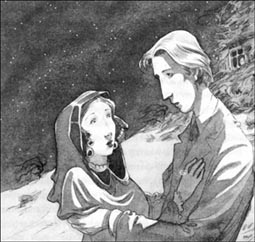
“你总算来了,哈丽雅特!谢谢你!”他热情地叫道。
“但不是为了这个。”那女子边说边将他推开。她更加温和地说:“弗雷德,我是因为你求我才来的!你为什么要见我?”
“哈丽雅特,自从上次走过这片山峰后,我看遍了千山万水、众生百态,但却只想着你一个人。”
“你求我这么晚到山上来见你,就只是为了告诉我这些?”
“哈丽雅特,跟我说实话!我听说公爵对你并不好。”
“虽然他有时会发火,却还是个好丈夫。”
“哈丽雅特,我最亲爱的,你说的是真的吗?你跟他的生活并不美满,这难道不是尽人皆知的吗?我来就是为了看看我能做什么。你是公爵夫人,而我只是弗雷德·奥格本,但我仍然有可能帮得上你。老天作证!你悦耳的嗓音应该令他开心,尤其再加上你甜美的容貌!”
“奥格本上尉!”她半是恐慌半是戏谑地叫道,“你可是我的老朋友——你怎么能这么对我说话呢?别忘了我是个结了婚的女人!我今天来是个错误,我现在算是明白了。”
“你居然叫我奥格本上尉,”他不高兴地回答道,“你以前一直叫我弗雷德。我想你对我已经没有任何感情了。哈丽雅特,我对你的爱从来没有改变过,而如今的你却已变成了另外一个女人。我必须接受这个现实。我再也不会见你了。”
“你用不着这么说,你这傻瓜。你可以再见我——为什么不行呢?不过,当然不是像现在这样。我今晚来这里是个错误,我来仅仅是因为公爵正好出门了。”
“他什么时候回来?”
“后天,或者大后天。”
“那明天晚上再来和我见面吧。”
“不,弗雷德,我不能。”
“如果你明晚不来,那就后天晚上来。请再给我一次机会,让我在他回来之前和你告别!好了,答应我!”他抓住了公爵夫人的手。
“不,弗雷德,放开我的手!让我对你感到愧疚已经很不好了,你还这样抓着我不放!”
“但是,请再见我一次吧!为了见你,我可是跑了两千英里的路程。”
“噢,我不能那样!人们会说闲话的。请不要对我提出这样的要求!”
“那你要对我承认两件事:一是你过去的确爱我,还有就是你的丈夫对你不好,常常会让你回想起当初爱着我的时光。”
“是的,这两件事情我都承认。”她静静地回答道。
“再来见我一次吧!”他仍旧握着她的手,另一只手臂环绕在她腰间。
“那好吧,”她终于说,“我答应你。我明天或者后天晚上来见你。现在请让我走吧。”
他放开了她,看着她急匆匆地朝山下的家——舍克弗洛斯特城堡跑去。接着,他也转身离去了。几分钟后,周围又恢复了平静和空旷。
但这只持续了一小会儿。突然,石头后面出现了第三个身影。他身材比上尉健壮些,脚蹬马靴。很显然,他看到了上尉和公爵夫人的会面过程。他离得太远,听不清他们的谈话和夫人勉强的言辞,因此在他看来,他们俨然是一对情侣。但直到几年后,年齿渐长的男孩才想明白了当时的情形。
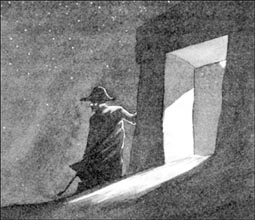
第三个身影沉思着呆立了片刻,返身回到树林中,然后又骑着马走了出来。他策马而去,马蹄在坚硬的土地上踏出的声音持续了好几分钟才渐渐消失。
男孩待在小屋里,眼睛仍旧盯着那些石头,却再没有人出现了。突然,他感到有一只沉重的手搭上了自己的肩头,吓得跳将起来。
“你看看,小比尔·米尔斯,你让炉子里的火熄掉了!呃,发生了什么事,你这个坏孩子?”
“没什么,主人。”
“羊群和羊羔都好好的吗?”
“是的,主人。”
老牧羊人生气地咆哮着说:“哼,这你就说错了。外面有两头母羊刚刚生了小羊羔,一头母羊都快死了!我告诉过你要保持清醒,小子,如果有必要就去叫我!好了,这你有什么说的?”
“你说过我可以睡一小会儿的!在火炉边的椅子上,你说过的!”
“不要这样跟有经验的长者讲话,年轻人,不然你的下场就是在监狱里被绞索吊死!好了,你现在可以回家了,早饭前再过来。我都老了,还一刻不得闲!”
接着,老牧羊人在小屋里躺了下来,男孩则下山朝村子里的家走去。
2
Second night
The next evening the old shepherd left the boy alone in the hut again, with repeated orders to keep a careful eye on the sheep. But young Bill was only interested in the view from the south window. He watched and waited, while the moonlight shone on the ancient stones, but neither Captain nor Duchess appeared.
When he heard the Shakeforest Towers clock strike eleven, he saw the third figure appear. As the man came towards the hut, the moonlight shone full on his face, and the boy realized in horror that it was the Duke. All the villagers lived in fear of the Duke. He owned every farm and every house for miles around, and anybody who made him angry could lose their home and their job in a moment. The boy closed the stove, and quickly hid himself in a corner of the hut.
The Duke came close to the place where his wife and the Captain had stood the night before. He looked around, perhaps for a hiding-place. When he discovered the hut among the trees, he entered, and stood at the south window, looking out at the Devil's Door.
Only a minute or two later the Captain arrived, to wait for the Duchess. But a terrible surprise was waiting for him tonight, as well as for the frightened boy hidden in the hut. At the Captain's appearance, the Duke became very angry. He opened the door of the hut and stepped out.
'You have dishonoured her, and for that you shall die!' he cried. In the hut, the boy left his hiding-place and ran to the window. He could not see the two men, but he heard something falling on the grass, and then silence.
Three minutes later he saw the Duke going up the hill towards the stones, pulling the Captain's body along the ground. The boy knew that behind the Devil's Door there was a deep hole, covered by long grass and other plants. The Duke made his way slowly to the shadows behind the stones, and when he came out, he was pulling nothing behind him.
'Now for the second!' the boy heard him say. This time the Duke waited outside the hut. It was clear that he expected his wife, the Duchess, to arrive next at the meeting-place.
Inside the hut young Bill shook with fear. 'What will he do if she comes?' he thought. 'Will he kill her too? He looks angry enough! And he can do what he likes — he's the Duke. Nobody can stop him!'
The jealous watcher waited for some time, but she never came. Sometimes he looked at his watch in surprise. He seemed almost disappointed that she did not appear. At half-past eleven he turned away to find his horse, and rode slowly down the hill.
The young boy thought of what lay in the hole behind the stones, and was too frightened to stay alone in the hut. He preferred to be with someone who was alive, even the Duke, than with someone who was dead, so he ran after the horseman. He followed the Duke all the way down into the valley, feeling more comfortable when the lonely hills were left behind him. Soon he could see the high walls and roofs of the Duke's home, Shakeforest Towers.
When the Duke got close to the great house, a small door in a side wall opened, and a woman came out. She ran into the moonlight to meet the Duke.
'Ah, my dear, is it you?' she said. 'I heard your horse's step on the road, and knew it must be you.'
'Happy to see me, are you?'
'How can you ask that?'
'Well, it is a lovely night for meetings.'
'Yes, it is a lovely night.'
The Duke got down from his horse and stood by her side. 'Why were you listening for me at this time of night?' he asked.
'There is a strange story, which I must tell you at once. But why did you come a night sooner than you said? I am sorry, I really am!' (shaking her head playfully), 'because I had ordered a special dinner for your arrival tomorrow, and now it won't be a surprise at all.'
The Duke did not look at his wife. 'What is this strange story that you wish to tell me?' he asked quietly.
'It is this. You know my cousin Fred Ogbourne? We used to play together when we were children, and he — well, he loved me, I think. I told you about it, you know.'
'You have never told me of it before.'
'Oh, then it was your sister — yes, I told her about it. Well, I haven't seen him for many years, and of course I'd forgotten all about his feeling for me. So I was surprised to receive a letter from him yesterday. I can remember what he wrote.
'My dear cousin Harriet, the letter said. If my life and future mean anything to you at all, I beg you to do what I ask. Meet me at eleven o'clock tonight by the ancient stones on Marlbury Downs. I cannot say more, except to beg you to come. I will explain everything when I see you. Come alone. You have all my happiness in your hands. Yours, Fred
'That was his letter. Now I realize that it was a mistake to go, but at the time I only thought he must be in trouble, and with not a friend in the world to help him. So I went to Marlbury Downs at eleven o'clock. Wasn't it brave of me?'
'Very,' replied the Duke coldly.
'When I got there, I saw he was no longer the boy that I remembered, but a full-grown man and an officer. I was sorry I had come. What he wanted, I don't know — perhaps just a meeting with me. He held me by the hand and waist, and refused to let me go until I promised to meet him again. And in the end I did, because he spoke very warmly to me and I was afraid of him in that lonely place. Then I escaped — I ran home — and that's all. Of course, I never meant to meet him there again. But this evening I thought, "Perhaps he'll come to the house when he realizes I'm not coming to meet him," and that's why I couldn't sleep. But you are so silent!'
'I have had a long journey.'
They moved on towards the front entrance of the house. 'I have thought of something, but perhaps you won't like it,' she said. 'I think he will wait there again tomorrow night. Shall we go to the hill tomorrow together — just to see if he is there? And tell him he must not try to meet me like this?'
'Why should we see if he is there?' asked her unsmiling husband.
'Because I think we should try to help him. Poor Fred! He will listen to you, if you talk to him. It is wrong of him to think of me in that way, but he is clearly very miserable.'
By this time they had reached the front entrance and rung the bell. A man came to take the horse away, and the Duke and Duchess entered the house.
dishonour v. to make your family, country, profession etc. lose the respect of other people 败坏名誉
jealous adj. someone who you feel belongs to you, is being admired too much by someone else 吃醋的;忌妒的
horseman n. someone who rides horses 骑马者
full-grown adj. a full-grown animal, plant, or person has developed to their full size and will not grow any bigger (植物、动物或人)完全长成的;成熟的
2.第二夜
第二天晚上,老牧羊人又把男孩独自留在了小屋里,反复嘱咐他好好照看羊群。但小比尔却只对南面窗外的情景感兴趣。月光照耀在古老的石头上,他一边观望一边等待,但上尉和公爵夫人都没有出现。
等听到舍克弗洛斯特城堡的钟敲11点时,他看见第三个身影出现了。那人朝小木屋的方向走来时,月光正好照亮了他的脸庞。男孩惊恐地发现那人竟然是公爵。所有的村民都对公爵十分惧怕。他拥有方圆数英里的每一块农田和每一座房屋,任何人若是惹恼了他,就会在顷刻间失去家园和工作。男孩封上火炉,迅速躲进了小屋里的一个角落。
公爵走近昨晚他妻子和上尉待过的地方,环顾四周,看样子是在寻找一个藏身之所。他发现了树林中的小木屋,随即走了进去,站在南面的窗户前朝“魔鬼之门”望去。
只过了一两分钟,上尉就来等候公爵夫人了。然而,今晚有一个可怕的意外正等待着他,也等待着藏在小屋里的这个吓坏了的孩子。上尉一出现,公爵立刻勃然大怒。他打开小屋的门走了出去。
“你败坏了她的清誉,为此该受一死!”他大叫道。小木屋里的男孩从藏身之处跑到了窗边。他看不见那两个人,但却听见了有东西摔落到草地上的声音,接下来是一片死寂。
3分钟后,他看见公爵拖着上尉的尸体朝山上的石头走去。男孩知道“魔鬼之门”背后有一个很深的洞,洞口覆盖着茂密的草和其他植物。公爵慢慢走进巨石后面的阴影,当他出来时,身后什么都没有了。
“现在该轮到第二个了!”男孩听见他在喃喃自语。这一次,公爵在木屋外等待着。他显然是在等他的妻子公爵夫人来到这个幽会的地方。
木屋里,小比尔吓得浑身颤抖。“如果她来了,他会怎么做?”他想,“他会把她也杀掉吗?他看样子快气炸了!而且他做事完全可以随心所欲——他是公爵,没有人能阻止他!”
这位妒火中烧的守望者等了一会儿,她却一直没有来。他不时惊诧地看看手表。看来她不曾露面倒让他几乎有些失望了。11点半时,他转过身找到自己的马,慢慢朝山下骑去。
小男孩想象着石头后面的山洞中可能躺着的东西,吓得不敢独自留在小屋中。他宁愿和任何一个活人在一起,哪怕是公爵也好,总强过和死人待在一起。于是他跟在骑马的公爵身后跑去。他一路跟着公爵下山,当孤寂的群山被远远甩在身后时,他感觉舒服多了。很快,他就看到了公爵的家——舍克弗洛斯特城堡那高高的围墙和屋顶。
公爵走近这座大房子时,边墙上的一扇小门打开了,有个女人走了出来。她跑到月光下迎接公爵。
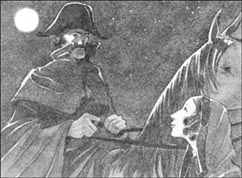
“啊,亲爱的,是你吗?”她说,“我听到你的马蹄声,就知道一定是你。”
“你很高兴见到我,对吧?”
“你怎么这么问?”
“嗯,这真是个适合幽会的可爱夜晚。”
“是啊,是个可爱的夜晚。”
公爵下马站到了她的身边。“你为什么这么晚了还在听我的动静?”他问。
“有件奇怪的事,我必须马上告诉你。可你为什么比原先说的早回来了一天呢?我很抱歉,真的很抱歉!”(她顽皮地摇晃着脑袋),“因为我让人准备了一顿特别的晚餐,明天好给你接风,可现在它一点都不会是惊喜了。”
公爵没拿正眼看他的妻子。“你想跟我说的怪事是什么?”他平静地问。
“是这样的,你认识我的表兄弗雷德·奥格本吧?我们小时候经常在一起玩,而且他——他爱我,我想是这样的。我曾经告诉过你,你知道的。”
“你以前从没跟我提过。”
“噢,那就是你妹妹——没错,我曾经跟她讲过。嗯,我已经好多年没见过他了,当然也已经忘记了他对我的感情。所以昨天收到他的信时,我非常惊讶。我还记得他都写了些什么。
“我亲爱的表妹哈丽雅特,信上说,如果我的生活和未来对你有半分意义的话,恳请你照我的请求去做。请于今晚11点在马尔博瑞丘陵那些古老的石头处与我会面。我不能多言,唯恳请你来此。见面时我自会跟你解释一切。请一个人来。我的快乐全掌握在你手中。你的弗雷德。
“这就是信的内容。现在我才意识到去那里是个错误,但我当时一心以为他遇到了麻烦,而且根本找不到朋友来帮忙。所以我就在11点去了马尔博瑞丘陵。我那样做是不是很勇敢?”
“非常勇敢。”公爵冷冷地回答道。
“当我到那儿的时候,发现他已不再是我印象中的那个男孩了。他已长大成人,当上了军官。我很后悔去见他。我不知道他想怎么样——也许只是想和我见一面吧。他抓住我的手、揽住我的腰,不肯让我离开,直到我答应了跟他再见一面。我最终答应了,因为他言辞非常激烈,而且那里荒郊野外的,我有点怕他。接着我就脱身了——我跑回了家——就是这样。当然,我也没打算真的再去那里见他。可是今天晚上,我想,'也许当他意识到我不会再去见他时,他会到家里来找我。’所以我睡不着。你怎么不说话呀!”
“我赶了很远的路。”
他们继续朝房子的前门走去。“我想起一件事,但可能你会不高兴,”她说,“我想他明天晚上还会去那里等。我们明天一起上山好吗——只是去看看他在不在那儿,顺便告诉他不要再试图那样和我见面了。”
“我们为什么要去看他是不是在那儿?”她的丈夫绷着脸问道。
“因为我想我们应该试着去帮助他。可怜的弗雷德!如果你跟他讲,他会听的。他那样看我的确不对,但他真的很痛苦。”
这时,他们已经走到前门,于是就按响了门铃。有人走过来把马牵走,公爵和公爵夫人走进了屋子。
3
Third night
The next night Bill Mills was left alone again to take care of the sheep. He tried bravely not to think of what lay behind the Devil's Door, but without much success. So he was almost pleased as well as surprised when the Duke and Duchess appeared near the hut at about eleven o'clock. He watched and listened through the little window in his hut.
'I tell you, he did not think it was worth coming again!' the Duke said, reluctant to walk further. 'He is not here, so turn round and come home.'
'He doesn't seem to be here, it's true. Perhaps something has happened to him? Oh poor Fred! I do hope he is all right!'
The Duke said quickly, 'Oh, he probably has some other meeting to go to.'
'I don't think so.'
'Or perhaps he has found it too far to come.'
'Nor is that probable.'
'Then perhaps he thought it was better not to come.'
'Yes, perhaps. Or he may be here all the time, hiding behind the Devil's Door. Let's go and see — and surprise him!'
'Oh, he's not there.'
'Perhaps he's lying very quietly in the grass there, because of you,' she said, smiling.
'Oh, no — not because of me!'
'Come, then. Dearest, you're as reluctant as a schoolboy tonight! I know you're jealous of poor Fred, but you have no reason to be!'
'I'll come! I'll come! Say no more, Harriet!' And together they crossed the grass towards the stones.
The boy came out of the hut to see what happened next, but the Duchess saw him moving in the darkness.
'Ah, I see him at last!' she said.
'See him!' cried the Duke. 'Where?'
'By the Devil's Door. Don't you see him?' She laughed. 'Ah, my poor lover-cousin, you'll be in trouble now!'
'It's not him!' said the Duke in horror. 'It can't be him!'
'No, it isn't. It's too small for him. It's a boy.'
'Ah, I thought so! Boy, come here.'
Fearfully, young Bill came closer.
'What are you doing here?' asked the Duke.
'Taking care of the sheep, your Grace.'
'Ah, you know me! Do you keep sheep here every night?'
'Most nights in winter, your Grace.'
'And what have you seen here tonight or last night?' asked the Duchess. 'Anyone waiting or walking about?'
The boy was silent.
'He has seen nothing,' said her husband quickly, staring angrily at the boy. 'Come, let us go. The air is cold.'
When they had gone, young Bill went back to the sheep. But he was not alone for long. Half an hour later the Duke's heavy steps were heard again. His wife was not with him.
'Listen, boy,' he said. 'The Duchess asked you a question, and I want you to answer it. Have you seen anything strange these nights, when you've been watching your sheep?'
'Your Grace, I'm just a poor, stupid boy, and what I see, I don't remember.'
'I ask you again,' said the Duke, holding the boy's shoulder with a strong hand and staring down into his frightened face. 'Did you see anything strange here last night?'
'Oh, your Grace, don't kill me!' cried the boy, falling to the ground. 'I've never seen you walking here, or riding here, or waiting for a man, or pulling a dead body along!'
'Ah!' said the Duke coldly. 'It is good to know that you have never seen those things. Now, which do you prefer — to see me do those things now, or to keep a secret all your life?'
'Keep a secret, your Grace!'
'You are sure you can do it?'
'Oh, try me, your Grace!'
'Very well. And now, do you like being a shepherd?'
'Not at all. 'Tis lonely work for a boy like me, who sees ghosts everywhere. And my master sometimes beats me.'
'I'll give you new clothes, and send you to school, and make a man of you. But you must never say you've been a shepherd boy. The moment that you forget yourself, and speak of what you've seen on the hills — this year, next year, or twenty years from now — I will stop helping you, and you'll come down to being a poor shepherd again.'
'I'll never speak of it, your Grace!'
'Come here.' The Duke took the boy to the Devil's Door. 'Now make a promise in front of these ancient stones. The ghosts that live in this place will find you and punish you if you ever speak of your life as a shepherd boy or what you saw then. Promise to keep this secret!'
His face as white as a sheet, the boy promised.
Then they went down into the valley, the Duke holding the boy's hand. That night the boy slept at Shakeforest Towers, and the next day he was sent away to school.
probable adj. likely to happen 很可能的
Your Grace used as a title for talking to or about a Duke, Duchess 阁下(对公爵、公爵夫人的尊称)
3.第三夜
接下来的那天晚上,比尔·米尔斯又被独自留下照看羊群。他勇敢地试图不去想“魔鬼之门”后面躺着什么东西,但不太管用。因此,当公爵和公爵夫人在11点左右出现在小屋附近时,他既高兴又惊讶。他在小屋里向小窗外望去,同时侧耳细听。
“我告诉你,他一定是认为不值得再来了!”公爵说着,不愿再往前走了,“他不在这儿,咱们掉头回家吧。”
“看样子他的确不在这儿,难道他出什么事了?哦,可怜的弗雷德!我真希望他没事!”
公爵赶紧说:“哦,也许他赴别的约去了。”
“我想不会。”
“那或许他觉得上这儿来太远了。”
“那也不太可能。”
“那就是他认为不来更好。”
“嗯,也许是吧。也有可能他一直都在这儿,就藏在'魔鬼之门’后面。咱们过去瞧瞧吧——吓他一跳!”
“哦,他不会在那儿的。”
“说不定他正悄悄躺在那边的草丛里呢,就因为看见了你。”她微笑着说。
“哦,不——不是因为我!”
“那就走吧。亲爱的,你今天晚上就像个小学生一样勉强!我知道你嫉妒可怜的弗雷德,不过你没理由嫉妒他呀!”
“我去!我去!别再说了,哈丽雅特!”他们一起穿过草丛朝石门走去。
男孩走出小屋,想看看接下来会发生什么事,却被公爵夫人看到他在黑暗中走动。
“啊,我终于看见他了!”她说。
“看见他了!”公爵大叫道,“在哪儿?”
“就在'魔鬼之门’旁边!你没看到他吗?”她笑道,“啊,我可怜的求爱者表哥,你现在有麻烦啦!”
“那不是他!”公爵惊恐地说,“不可能是他!”
“嗯,不是他。那身形太小了,是个男孩。”
“啊,我想也是!孩子,过来。”
小比尔胆怯地走上前去。
“你在这儿干什么?”公爵问。
“放羊,公爵阁下。”
“哦,你认识我!你每天晚上都在这儿放羊吗?”
“冬天里大多数晚上都在,公爵阁下。”
“你今晚或是昨晚看到什么了吗?”公爵夫人间,“有没有人在这里等或者在这附近走动?”
男孩默不作声。
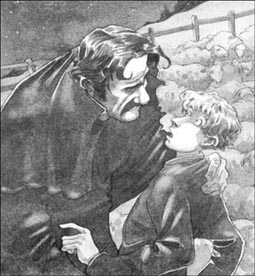
“他什么都没看到。”她丈夫赶紧说道,恼怒地瞪着男孩,“来,咱们走吧。天太冷了。”
他们走后,小比尔回到了羊群中。但他独自待着的情况并没持续多久。半小时后,他听见了公爵沉重的脚步声,这回他妻子没跟他在一起。
“听着,孩子,”他说,“公爵夫人刚才问了你一个问题,我希望你回答。这几天晚上放羊的时候,你有没有看到什么奇怪的事?”
“公爵阁下,我只是个又穷又笨的孩子,见过什么也都不记得了。”
“我再问你一次,”公爵用强壮有力的手抓住男孩的肩膀,低头盯着他惊恐的脸说,“你昨晚看到这里发生什么怪事了吗?”
“哦,公爵阁下,别杀我!”男孩哭喊着跌倒在地,“我从没见过您在附近走动、骑马、等人或是拖走一具死尸!”
“啊!”公爵冷冰冰地说,“我知道你没看到这些事,很好。好了,你想怎么样——是想看我现在做这些事呢,还是你终身保守这个秘密?”
“保守秘密,公爵阁下!”
“你确信能做到吗?”
“哦,您可以考验我,公爵阁下!”
“很好。好了,你喜欢当牧羊人吗?”
“一点都不喜欢。这份工作对我来说太寂寞了,因为我走到哪儿都能看见鬼。而且我的主人有时还打我。”
“我会给你新衣服穿、送你去学校,让你成为一个体面人。但你永远也不能说自己曾是个牧羊人。你一旦忘乎所以,说出在山上看到的情景——不管是今年、明年、还是二十年后——我都将不再资助你,任你重新沦落为穷苦的牧羊人。”
“我永远都不会说出去的,公爵阁下!”
“过来。”公爵把男孩带到“魔鬼之门”跟前,“你现在对着这些古老的石头发誓。假如你提及自己曾经是牧羊人或者说出那晚看到的事,这里的鬼魂就会找到你、惩罚你。快发誓,说你会保守秘密!”
男孩的脸像床单一样惨白。他发了誓。
然后,公爵抓着男孩的手走进了山谷。男孩当晚就睡在了舍克弗洛斯特城堡,第二天又被送进了学校。
4
Fourth night
On a winter evening many years later, a well-dressed man of business sat in his office at Shakeforest Towers. He had come a long way from the shepherd boy that he once was, but he did not seem happy with his comfortable life. He appeared older than his age, and he looked about him restlessly.
He stood up and left the office, and went to a room in another part of the house, where he knocked, and entered. The Duchess had been dead for some years, and the Duke was now a thin old man with white hair.
'Oh — Mills?' he said. 'Sit down. What is it?'
'Old times have come to life again, your Grace.'
'Which old times are they?'
'That Christmas week twenty-two years ago, when the Duchess's cousin asked her to meet him on Marlbury Downs. I saw the meeting, and I saw much more than that.'
'Do you remember a promise made by a shepherd boy?'
'I do. That boy has kept the promise all his life.'
'Then I wish to hear no more about it.'
'Very well. But the secret may soon come out. Not from me, because I'm grateful for what you've done for me. There was great excitement when Captain Ogbourne disappeared, but I spoke not a word, and his body was never found. For twenty-two years I've wondered what you did with him. Now I know. This afternoon I went up on the hill, and did some digging. I saw enough to know that something still lies there in a hole behind the stones.'
'Mills, do you think the Duchess guessed?'
'She never did, I'm sure, to the day of her death.'
'What made you think of going there this afternoon?'
'Something that happened today, your Grace. The oldest man in the village has died — the old shepherd.'
'Dead at last — how old was he?'
'Ninety-four.'
'And I'm only seventy. I have twenty-four more years!'
'He was my master when I was a shepherd boy, your Grace. And he was on the hill the second night. He was there all the time, but none of us knew that.'
'Ah!' said the Duke, looking fixedly at Mills. 'Go on!'
'When I heard he was dying, it made me think of the past, and that's why I went up on the hills. Now the villagers are saying that before he died, he confessed a secret to the vicar — a secret that he'd kept for your Grace, about a crime on Marlbury Downs more than twenty years ago.'
'That's enough, Mills. I'll see the vicar early tomorrow.'
'What will you do, your Grace?'
'Stop his tongue for twenty-four years, until I am dead at ninety-four, like the old shepherd. Go home now, Mills.'
Mills left the room and walked to his own house, where he lived a lonely, friendless life. But he could not sleep, and at midnight he looked out at the colourless moon, and decided to walk up to Marlbury Downs again. Once on the hill, he placed himself where the shepherd's hut had stood. No sheep or lambs were there that winter, but the Devil's Door stood high and white as ever, with dark shadows behind it.
Suddenly he realized he was not alone. A figure in white was moving silently towards the stones. It was the Duke himself, in his long nightshirt, walking in his sleep. He went straight to the covered hole, and dug with his hands like an animal. Then he got up, sighed, and went back down the hill. Mills followed him and saw him enter Shakeforest Towers.
The next morning, when Mills arrived at the great house, the housekeeper came to the door to meet him.
'Oh, sir,' she said, 'the Duke is dead! He left his room in the night and went walking around somewhere. And on his way back to his room, he fell downstairs and broke his neck.'
* * *
At last Mills was able to tell the secret that had lain so heavily on his heart for twenty-two years, and he died, at peace with himself, a few years later.
There are still fine sheep and lambs on the Marlbury Downs, but shepherds do not like spending the nights close to the Devil's Door. They say that during Christmas week ghostly white shapes are often seen there. Something made of bright metal shines in the moonlight, and there is the shadow of a man pulling something heavy across the grass. But no one can be sure that these things are true.
well-dressed adj. wearing attractive, fashionable, and usually expensive clothes 衣着考究的;穿着入时的
excitement n. the feeling of being excited 兴奋
vicar n. a priest in the Church of England who is in charge of a church in a particular area (英国国教的)教区牧师
4.第四夜
多年后的一个冬夜,一位衣着讲究的商人坐在舍克弗洛斯特城堡中自己的办公室里。他经历了漫长的过程才从当年那个牧羊少年成长到如今,但舒适的生活似乎并没有使他感到开心。他看起来比实际年龄要老,还心神不宁地四处张望。
他起身离开了办公室,走到城堡里的另一个房间,敲敲门走了进去。公爵夫人几年前已经去世,而公爵现在也已是形销骨立、白发苍苍的老人了。
“哦——米尔斯?”他说,“坐。有什么事吗?”
“过去的时光又回来了,公爵阁下。”
“哪一段过去的时光?”
“就是22年前,过圣诞节的那个星期,公爵夫人的表哥求她到马尔伯瑞丘陵与他见面的时候。我目睹了那次会面,而且我所见到的远远不止这一点。”
“你还记得那个牧羊少年的誓言吗?”
“记得。那个孩子终生信守着他的誓言。”
“那我不想再听到那件事了。”
“好吧。但秘密可能很快就会传开了。不是从我这里传出去,因为我很感激你为我所做的一切。当年奥格本上尉失踪的消息引起了不小的震动,而我却缄口不言,他的尸体也一直没被发现。22年来,我一直在猜测你究竟对他做了什么。现在我知道了。今天下午我上山去挖了挖,我所看见的已足够让我知道石头后面的洞里还躺着什么了。”
“米尔斯,你觉得公爵夫人猜到了吗?”
“直到去世的那一天,她也没猜到,我敢肯定。”
“为什么今天下午你会想起来去那里?”
“今天出了点事,公爵阁下。村子里最老的人去世了——那个老牧羊人。”
“终于死了——他多大年纪了?”
“94岁。”
“我才70岁,还有24年活头!”
“当我还是个牧羊少年的时候,他是我的主人,公爵阁下。那年的第二夜他在山上。他一直待在那儿,可我们全都不知道。”
“啊!”公爵叫道,怔怔地看着米尔斯,“继续说下去!”
“当我听说他快死的时候,就想起了过去的日子,于是我上了山。现在村民们都说,他在死之前对牧师坦白了一个秘密——一个为你保守的秘密,是你20多年前在马尔伯瑞丘陵犯下的罪行。”
“够了,米尔斯。我明天一早就去拜访牧师。”
“你打算怎么做,公爵阁下?”
“让他闭24年的嘴,直到我年届94岁,像那个老牧羊人一样死去。好了,回家去吧,米尔斯。”
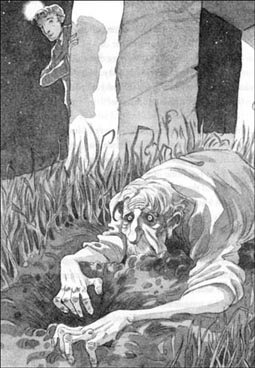
米尔斯离开房间,走回了自己的家。他一直过着孤孤单单、没有朋友的生活。但他无法入睡。午夜时分,他望着窗外苍白的月亮,决定再去马尔伯瑞丘陵一趟。上山以后,他站在了牧羊人小屋过去所在的地方。那年冬天,这里既没有羊也没有羊羔,但“魔鬼之门”依然高大苍白,背后是黑漆漆的影子。
突然,他意识到旁边还有别的人。一个身着白衣的影子悄无声息地朝着巨石走去。那正是公爵本人,穿着长长的睡衣在梦游。他径直来到被遮蔽的洞口前,像动物一样用双手刨了起来。接着,他站起身叹了口气,朝山下走去。米尔斯尾随其后,看着他走进了舍克弗洛斯特城堡。
第二天早晨,当米尔斯来到这所大房子时,管家到了门口来迎接他。
“哦,先生,”她说,“公爵去世了!他夜里离开了自己的房间到附近的某个地方去散步,在回房间的路上摔下楼,跌断了脖子。”
* * *
终于,米尔斯可以把在自己心头压了22年的沉重秘密说出来了。几年之后,他安详地去世了。
马尔伯瑞丘陵仍然盛产优质的绵羊和羊羔,但牧羊人们都不愿在“魔鬼之门”附近过夜。他们说,在圣诞节那周,那里经常能看到鬼魅般的白影。某种由闪亮金属制成的东西在月光下闪闪发光,一个男人的身影拖着重物穿过草丛。不过,没人敢肯定这些东西是真的。
1.First night
WHAT THE SHEPHERD SAW
A Story of Four Moonlight Nights
牧羊人所见
四个月明之夜的故事
1
First night
The Christmas moon was showing her cold face to the low hills called the Marlbury Downs, in the southwestern part of England known as Mid-Wessex. Here sheep were kept out on the hills all year round, and lambs were born as early as December. Shepherds needed to be on the hills day and night at this time of year, and often used small wheeled huts where they could rest and keep warm, while keeping a careful eye on the sheep.
On a high piece of land one of these huts stood inside a little circle of trees, which kept it out of the icy wind and also hidden from any passers-by. The hut was made of wood, and had a door and two windows. The north one looked out on the eight hundred sheep which were in the shepherd's care, and the south window gave a view of three ancient stones, built in the shape of a doorway. These great stones, which village people called the Devil's Door, had been there for over two thousand years. They were worn and weather-beaten, but tonight looked almost new in the silver light of the moon.
Inside the hut a young shepherd boy was waiting for his master, who entered at that moment.
'Are ye sleepy?' asked the old man crossly.
'N — no, master,' replied the boy, who was a little frightened of the shepherd and his heavy stick.
'The sheep should be all right until the morning now,' said the shepherd, 'but one of us must stay here, so I'll leave ye, do ye hear? I'll go home and sleep for a few hours. Run down to my cottage and fetch me if anything happens. Ye can have a bit of a sleep in the chair by the stove but only for a few minutes, mind! Make sure ye stay awake the rest of the time, and don't let that fire go out!'
The old man closed the door, and disappeared. The boy went out to check on the sheep and new-born lambs, then came back into the hut and sat down by the warm stove. Soon his eyes closed, his head dropped, and he was asleep.
When he woke up, he could hear down in the valley the clock at Shakeforest Towers striking eleven. The sound carried well in the cold night air. He looked out of the north window and saw the sheep, lying on the grass as quietly as before. He next looked out of the opposite window, towards the stones of the Devil's Door, white and ghostly in the moonlight. And in front of them stood a man.
It was clear that he was not a farm worker, because he was wearing a dark suit, and carried himself like a gentleman. The boy was still wondering, in great surprise, why the man was visiting the Devil's Door at this hour, when suddenly another figure appeared. This second figure was a woman, and when the stranger saw her, he hurried towards her. He met her near the trees, and took her into his arms.
'You have come, Harriet! Thank you!' he cried warmly.
'But not for this,' replied the lady, pulling away from him. She added more kindly, 'I have come, Fred, because you begged me! Why did you ask to see me?'
'Harriet, I have seen many lands and faces since I last walked these hills, but I have only thought of you.'
'Was it only to tell me this that you begged me to meet you, out here on the hills, so late at night?'
'Harriet, be honest with me! I have heard that the Duke is unkind to you.'
'He sometimes gets angry, but he is a good husband.'
'Harriet, dearest, is that really true? Doesn't everybody know that your life with him is a sad one? I have come to find out what I can do. You are a Duchess, and I'm only Fred Ogbourne, but it's still possible that I can help you. By God! The sweetness of your voice should keep him pleasant, especially when the sweetness of your face is added to it!'
'Captain Ogbourne!' she cried, half afraid, half playful. 'You're an old friend — how can you speak to me in this way? Remember I'm a married woman! I was wrong to come, I see that now.'
'You call me Captain Ogbourne,' he replied unhappily, 'but I was always Fred to you before. I think you no longer have any feeling for me. My love for you, Harriet, has not changed at all, but you are a different woman now. I must accept it. I can never see you again.'
'You needn't talk like that, you stupid man. You can see me again — why not? But of course, not like this. It was a mistake of mine to come tonight, and I only did it because the Duke is away at the moment.'
'When does he return?'
'The day after tomorrow, or the day after that.'
'Then meet me again tomorrow night.'
'No, Fred, I cannot.'
'If you cannot tomorrow night, you can the night after. Please let me have one more meeting before he returns, to say goodbye! Now, promise me!' He took the Duchess's hand.
'No, Fred, let go of my hand! It's not kind of you to make me feel sorry for you, and then to keep me here like this!'
'But see me once more! I have come two thousand miles to see you.'
'Oh, I must not! People will talk. Don't ask it of me!'
'Then confess two things to me: that you did love me once, and that your husband is unkind to you often enough to make you think of the time when you loved me.'
'Yes, I confess them both,' she answered quietly.
'Come once more!' He still held her hand, and had his arm around her waist.
'Very well, then,' she said finally. 'I agree. I'll meet you tomorrow night or the night after. Now let me go.'
He set her free, and watched her hurry down the hill towards her home, Shakeforest Towers. Then he turned and walked away. In a few minutes all was silent and empty again.
But only for a moment. Suddenly, a third figure appeared, from behind the stones. He was a man of heavier build than the Captain, and was wearing riding boots. It was clear that he had watched the meeting between the Captain and the Duchess. He had been too far away to hear their conversation and the lady's reluctant words, so to him they had the appearance of lovers. But several more years passed before the boy was old enough to understand this.
This third figure stood still for a moment, thinking. Then he went back into the trees, and came out again with his horse. He rode off, and the sound of the horse's feet on the hard ground was heard for several minutes, until it died away.
The boy stayed in the hut, his eyes still on the stones, but nobody else appeared there. Suddenly he felt a heavy hand on his shoulder, which made him jump.
'Now look here, young Bill Mills, ye've let the fire in the stove go out! Well, what's happened, ye bad boy?'
'Nothing, master.'
'Sheep and lambs all safe and well?'
'Yes, master.'
The old shepherd spoke angrily. 'Well, that's where ye're wrong. There are two new lambs out there, born just this minute, and one of the mothers is half dead! I told ye to stay awake, boy, and fetch me if I was needed! Well, what have you got to say for yourself?'
'You said that I could have a bit of a sleep! In the chair by the stove, you said!'
'Don't you speak to your elders and betters like that, young man, or you'll end up hanging from a rope at the prison! Well, ye can go home now, and come back again by breakfast time. I'm an old man, but there's no rest for me!'
The old shepherd then lay down inside the hut, and the boy went down the hill to his home in the village.
downs n. low round hills covered with grass 草木覆盖的低圆山丘
hut n. a small, simple building with only one or two rooms (简陋的)小屋;棚屋
keep an eye on to look after someone or something and make sure that they are safe 照看某人(某物)
passer-by n. someone who is walking past a place by chance 过路人
devil n. any evil spirit 魔鬼
weather-beaten adj. affected by exposure to the weather 饱经风霜的;风雨侵蚀的
crossly adv. angry or annoyed 生气地;恼怒地
go out to stop burning or shining 熄灭
ghostly adj. slightly frightening and seeming to be connected with ghosts or spirits 幽灵似的;诡异的
duke n. a man with the highest social rank outside the royal family 公爵
duchess n. the wife of a duke 公爵夫人
confess v. to admit something that you feel embarrassed about 承认
waist n. the narrow part in the middle of the human body 腰,腰部
build n. the shape and size of someone's body 体格;体形
reluctant adj. slow and unwilling 勉强的;不情愿的
1.第一夜
圣诞节的冷月照耀着一片叫做马尔博瑞丘陵的低矮山丘,这片山丘坐落在英格兰西南部的中维塞克斯。这里的山上一年四季都放牧着羊群,而这里的羊羔早在每年的12月便会出生。每年的这个时节,牧羊人们都必须夜以继日地待在山上。他们通常待在一种带轮子的小屋里,以便在照料羊群的同时能休息和取暖。
一片高地之上,有一间小屋掩映在一小圈树木中,由此既免受了刺骨寒风的侵袭,又躲避了过路人的视线。小屋用木头制成,有一扇门和两扇窗户。从北面的窗户望出去可以看到牧羊人看管的八百头羊,从南面的窗户望出去则是堆成门形的三块古老的石头。这些巨石被村民们称为“魔鬼之门”,已经在那里矗立了两千多年。它们斑驳残破、饱经风霜,但今夜在银色的月光照耀下,却宛若新生。
小木屋里,一名牧羊少年正等着他的主人。就在这个时候,主人走了进来。
“你就困了吗?”老人生气地问。
“不——没有,主人。”男孩回答道,他有些害怕牧羊人和他的粗棍子。
“羊群在天亮前应该没事了,”牧羊人说,“不过我们当中必须有人留在这儿,所以我得让你留下,你听到了吗?我要回家睡几个小时。如果发生了什么事,就跑下山到我家去找我。你可以在火炉旁的椅子上睡一小会儿,不过就几分钟,记住!别的时间你都得醒着。还有,别让火熄了!”
老人关上门走了。男孩出去查看了一下羊群和刚出生的羊羔,然后走回到小屋里,坐在温暖的炉火旁。很快,他就合上了眼皮,垂下头睡着了。
醒来时,他听见山谷里舍克弗洛斯特城堡的钟敲了11下。钟声在清冷的夜空中传得很远。他从北面的窗户望出去,看到羊群依然安静地卧在草地上。接着,他朝相反方向的窗户望出去,看到“魔鬼之门”的石头惨白而诡异地矗立在月光中。石门前站着一个人。
那人显然不是农场工人,因为他身穿深色西服,神态宛如一位绅士。男孩惊讶地猜度着这个人为什么会在这时候跑到“魔鬼之门”来。正在这时,另一个身影出现了。这回出现的是一个女人,那个陌生人一见到她就快步走上前去。他在树丛边迎上了她,将她拥入怀中。
“你总算来了,哈丽雅特!谢谢你!”他热情地叫道。
“但不是为了这个。”那女子边说边将他推开。她更加温和地说:“弗雷德,我是因为你求我才来的!你为什么要见我?”
“哈丽雅特,自从上次走过这片山峰后,我看遍了千山万水、众生百态,但却只想着你一个人。”
“你求我这么晚到山上来见你,就只是为了告诉我这些?”
“哈丽雅特,跟我说实话!我听说公爵对你并不好。”
“虽然他有时会发火,却还是个好丈夫。”
“哈丽雅特,我最亲爱的,你说的是真的吗?你跟他的生活并不美满,这难道不是尽人皆知的吗?我来就是为了看看我能做什么。你是公爵夫人,而我只是弗雷德·奥格本,但我仍然有可能帮得上你。老天作证!你悦耳的嗓音应该令他开心,尤其再加上你甜美的容貌!”
“奥格本上尉!”她半是恐慌半是戏谑地叫道,“你可是我的老朋友——你怎么能这么对我说话呢?别忘了我是个结了婚的女人!我今天来是个错误,我现在算是明白了。”
“你居然叫我奥格本上尉,”他不高兴地回答道,“你以前一直叫我弗雷德。我想你对我已经没有任何感情了。哈丽雅特,我对你的爱从来没有改变过,而如今的你却已变成了另外一个女人。我必须接受这个现实。我再也不会见你了。”
“你用不着这么说,你这傻瓜。你可以再见我——为什么不行呢?不过,当然不是像现在这样。我今晚来这里是个错误,我来仅仅是因为公爵正好出门了。”
“他什么时候回来?”
“后天,或者大后天。”
“那明天晚上再来和我见面吧。”
“不,弗雷德,我不能。”
“如果你明晚不来,那就后天晚上来。请再给我一次机会,让我在他回来之前和你告别!好了,答应我!”他抓住了公爵夫人的手。
“不,弗雷德,放开我的手!让我对你感到愧疚已经很不好了,你还这样抓着我不放!”
“但是,请再见我一次吧!为了见你,我可是跑了两千英里的路程。”
“噢,我不能那样!人们会说闲话的。请不要对我提出这样的要求!”
“那你要对我承认两件事:一是你过去的确爱我,还有就是你的丈夫对你不好,常常会让你回想起当初爱着我的时光。”
“是的,这两件事情我都承认。”她静静地回答道。
“再来见我一次吧!”他仍旧握着她的手,另一只手臂环绕在她腰间。
“那好吧,”她终于说,“我答应你。我明天或者后天晚上来见你。现在请让我走吧。”
他放开了她,看着她急匆匆地朝山下的家——舍克弗洛斯特城堡跑去。接着,他也转身离去了。几分钟后,周围又恢复了平静和空旷。
但这只持续了一小会儿。突然,石头后面出现了第三个身影。他身材比上尉健壮些,脚蹬马靴。很显然,他看到了上尉和公爵夫人的会面过程。他离得太远,听不清他们的谈话和夫人勉强的言辞,因此在他看来,他们俨然是一对情侣。但直到几年后,年齿渐长的男孩才想明白了当时的情形。
第三个身影沉思着呆立了片刻,返身回到树林中,然后又骑着马走了出来。他策马而去,马蹄在坚硬的土地上踏出的声音持续了好几分钟才渐渐消失。
男孩待在小屋里,眼睛仍旧盯着那些石头,却再没有人出现了。突然,他感到有一只沉重的手搭上了自己的肩头,吓得跳将起来。
“你看看,小比尔·米尔斯,你让炉子里的火熄掉了!呃,发生了什么事,你这个坏孩子?”
“没什么,主人。”
“羊群和羊羔都好好的吗?”
“是的,主人。”
老牧羊人生气地咆哮着说:“哼,这你就说错了。外面有两头母羊刚刚生了小羊羔,一头母羊都快死了!我告诉过你要保持清醒,小子,如果有必要就去叫我!好了,这你有什么说的?”
“你说过我可以睡一小会儿的!在火炉边的椅子上,你说过的!”
“不要这样跟有经验的长者讲话,年轻人,不然你的下场就是在监狱里被绞索吊死!好了,你现在可以回家了,早饭前再过来。我都老了,还一刻不得闲!”
接着,老牧羊人在小屋里躺了下来,男孩则下山朝村子里的家走去。
2
Second night
The next evening the old shepherd left the boy alone in the hut again, with repeated orders to keep a careful eye on the sheep. But young Bill was only interested in the view from the south window. He watched and waited, while the moonlight shone on the ancient stones, but neither Captain nor Duchess appeared.
When he heard the Shakeforest Towers clock strike eleven, he saw the third figure appear. As the man came towards the hut, the moonlight shone full on his face, and the boy realized in horror that it was the Duke. All the villagers lived in fear of the Duke. He owned every farm and every house for miles around, and anybody who made him angry could lose their home and their job in a moment. The boy closed the stove, and quickly hid himself in a corner of the hut.
The Duke came close to the place where his wife and the Captain had stood the night before. He looked around, perhaps for a hiding-place. When he discovered the hut among the trees, he entered, and stood at the south window, looking out at the Devil's Door.
Only a minute or two later the Captain arrived, to wait for the Duchess. But a terrible surprise was waiting for him tonight, as well as for the frightened boy hidden in the hut. At the Captain's appearance, the Duke became very angry. He opened the door of the hut and stepped out.
'You have dishonoured her, and for that you shall die!' he cried. In the hut, the boy left his hiding-place and ran to the window. He could not see the two men, but he heard something falling on the grass, and then silence.
Three minutes later he saw the Duke going up the hill towards the stones, pulling the Captain's body along the ground. The boy knew that behind the Devil's Door there was a deep hole, covered by long grass and other plants. The Duke made his way slowly to the shadows behind the stones, and when he came out, he was pulling nothing behind him.
'Now for the second!' the boy heard him say. This time the Duke waited outside the hut. It was clear that he expected his wife, the Duchess, to arrive next at the meeting-place.
Inside the hut young Bill shook with fear. 'What will he do if she comes?' he thought. 'Will he kill her too? He looks angry enough! And he can do what he likes — he's the Duke. Nobody can stop him!'
The jealous watcher waited for some time, but she never came. Sometimes he looked at his watch in surprise. He seemed almost disappointed that she did not appear. At half-past eleven he turned away to find his horse, and rode slowly down the hill.
The young boy thought of what lay in the hole behind the stones, and was too frightened to stay alone in the hut. He preferred to be with someone who was alive, even the Duke, than with someone who was dead, so he ran after the horseman. He followed the Duke all the way down into the valley, feeling more comfortable when the lonely hills were left behind him. Soon he could see the high walls and roofs of the Duke's home, Shakeforest Towers.
When the Duke got close to the great house, a small door in a side wall opened, and a woman came out. She ran into the moonlight to meet the Duke.
'Ah, my dear, is it you?' she said. 'I heard your horse's step on the road, and knew it must be you.'
'Happy to see me, are you?'
'How can you ask that?'
'Well, it is a lovely night for meetings.'
'Yes, it is a lovely night.'
The Duke got down from his horse and stood by her side. 'Why were you listening for me at this time of night?' he asked.
'There is a strange story, which I must tell you at once. But why did you come a night sooner than you said? I am sorry, I really am!' (shaking her head playfully), 'because I had ordered a special dinner for your arrival tomorrow, and now it won't be a surprise at all.'
The Duke did not look at his wife. 'What is this strange story that you wish to tell me?' he asked quietly.
'It is this. You know my cousin Fred Ogbourne? We used to play together when we were children, and he — well, he loved me, I think. I told you about it, you know.'
'You have never told me of it before.'
'Oh, then it was your sister — yes, I told her about it. Well, I haven't seen him for many years, and of course I'd forgotten all about his feeling for me. So I was surprised to receive a letter from him yesterday. I can remember what he wrote.
'My dear cousin Harriet, the letter said. If my life and future mean anything to you at all, I beg you to do what I ask. Meet me at eleven o'clock tonight by the ancient stones on Marlbury Downs. I cannot say more, except to beg you to come. I will explain everything when I see you. Come alone. You have all my happiness in your hands. Yours, Fred
'That was his letter. Now I realize that it was a mistake to go, but at the time I only thought he must be in trouble, and with not a friend in the world to help him. So I went to Marlbury Downs at eleven o'clock. Wasn't it brave of me?'
'Very,' replied the Duke coldly.
'When I got there, I saw he was no longer the boy that I remembered, but a full-grown man and an officer. I was sorry I had come. What he wanted, I don't know — perhaps just a meeting with me. He held me by the hand and waist, and refused to let me go until I promised to meet him again. And in the end I did, because he spoke very warmly to me and I was afraid of him in that lonely place. Then I escaped — I ran home — and that's all. Of course, I never meant to meet him there again. But this evening I thought, "Perhaps he'll come to the house when he realizes I'm not coming to meet him," and that's why I couldn't sleep. But you are so silent!'
'I have had a long journey.'
They moved on towards the front entrance of the house. 'I have thought of something, but perhaps you won't like it,' she said. 'I think he will wait there again tomorrow night. Shall we go to the hill tomorrow together — just to see if he is there? And tell him he must not try to meet me like this?'
'Why should we see if he is there?' asked her unsmiling husband.
'Because I think we should try to help him. Poor Fred! He will listen to you, if you talk to him. It is wrong of him to think of me in that way, but he is clearly very miserable.'
By this time they had reached the front entrance and rung the bell. A man came to take the horse away, and the Duke and Duchess entered the house.
dishonour v. to make your family, country, profession etc. lose the respect of other people 败坏名誉
jealous adj. someone who you feel belongs to you, is being admired too much by someone else 吃醋的;忌妒的
horseman n. someone who rides horses 骑马者
full-grown adj. a full-grown animal, plant, or person has developed to their full size and will not grow any bigger (植物、动物或人)完全长成的;成熟的
2.第二夜
第二天晚上,老牧羊人又把男孩独自留在了小屋里,反复嘱咐他好好照看羊群。但小比尔却只对南面窗外的情景感兴趣。月光照耀在古老的石头上,他一边观望一边等待,但上尉和公爵夫人都没有出现。
等听到舍克弗洛斯特城堡的钟敲11点时,他看见第三个身影出现了。那人朝小木屋的方向走来时,月光正好照亮了他的脸庞。男孩惊恐地发现那人竟然是公爵。所有的村民都对公爵十分惧怕。他拥有方圆数英里的每一块农田和每一座房屋,任何人若是惹恼了他,就会在顷刻间失去家园和工作。男孩封上火炉,迅速躲进了小屋里的一个角落。
公爵走近昨晚他妻子和上尉待过的地方,环顾四周,看样子是在寻找一个藏身之所。他发现了树林中的小木屋,随即走了进去,站在南面的窗户前朝“魔鬼之门”望去。
只过了一两分钟,上尉就来等候公爵夫人了。然而,今晚有一个可怕的意外正等待着他,也等待着藏在小屋里的这个吓坏了的孩子。上尉一出现,公爵立刻勃然大怒。他打开小屋的门走了出去。
“你败坏了她的清誉,为此该受一死!”他大叫道。小木屋里的男孩从藏身之处跑到了窗边。他看不见那两个人,但却听见了有东西摔落到草地上的声音,接下来是一片死寂。
3分钟后,他看见公爵拖着上尉的尸体朝山上的石头走去。男孩知道“魔鬼之门”背后有一个很深的洞,洞口覆盖着茂密的草和其他植物。公爵慢慢走进巨石后面的阴影,当他出来时,身后什么都没有了。
“现在该轮到第二个了!”男孩听见他在喃喃自语。这一次,公爵在木屋外等待着。他显然是在等他的妻子公爵夫人来到这个幽会的地方。
木屋里,小比尔吓得浑身颤抖。“如果她来了,他会怎么做?”他想,“他会把她也杀掉吗?他看样子快气炸了!而且他做事完全可以随心所欲——他是公爵,没有人能阻止他!”
这位妒火中烧的守望者等了一会儿,她却一直没有来。他不时惊诧地看看手表。看来她不曾露面倒让他几乎有些失望了。11点半时,他转过身找到自己的马,慢慢朝山下骑去。
小男孩想象着石头后面的山洞中可能躺着的东西,吓得不敢独自留在小屋中。他宁愿和任何一个活人在一起,哪怕是公爵也好,总强过和死人待在一起。于是他跟在骑马的公爵身后跑去。他一路跟着公爵下山,当孤寂的群山被远远甩在身后时,他感觉舒服多了。很快,他就看到了公爵的家——舍克弗洛斯特城堡那高高的围墙和屋顶。
公爵走近这座大房子时,边墙上的一扇小门打开了,有个女人走了出来。她跑到月光下迎接公爵。
“啊,亲爱的,是你吗?”她说,“我听到你的马蹄声,就知道一定是你。”
“你很高兴见到我,对吧?”
“你怎么这么问?”
“嗯,这真是个适合幽会的可爱夜晚。”
“是啊,是个可爱的夜晚。”
公爵下马站到了她的身边。“你为什么这么晚了还在听我的动静?”他问。
“有件奇怪的事,我必须马上告诉你。可你为什么比原先说的早回来了一天呢?我很抱歉,真的很抱歉!”(她顽皮地摇晃着脑袋),“因为我让人准备了一顿特别的晚餐,明天好给你接风,可现在它一点都不会是惊喜了。”
公爵没拿正眼看他的妻子。“你想跟我说的怪事是什么?”他平静地问。
“是这样的,你认识我的表兄弗雷德·奥格本吧?我们小时候经常在一起玩,而且他——他爱我,我想是这样的。我曾经告诉过你,你知道的。”
“你以前从没跟我提过。”
“噢,那就是你妹妹——没错,我曾经跟她讲过。嗯,我已经好多年没见过他了,当然也已经忘记了他对我的感情。所以昨天收到他的信时,我非常惊讶。我还记得他都写了些什么。
“我亲爱的表妹哈丽雅特,信上说,如果我的生活和未来对你有半分意义的话,恳请你照我的请求去做。请于今晚11点在马尔博瑞丘陵那些古老的石头处与我会面。我不能多言,唯恳请你来此。见面时我自会跟你解释一切。请一个人来。我的快乐全掌握在你手中。你的弗雷德。
“这就是信的内容。现在我才意识到去那里是个错误,但我当时一心以为他遇到了麻烦,而且根本找不到朋友来帮忙。所以我就在11点去了马尔博瑞丘陵。我那样做是不是很勇敢?”
“非常勇敢。”公爵冷冷地回答道。
“当我到那儿的时候,发现他已不再是我印象中的那个男孩了。他已长大成人,当上了军官。我很后悔去见他。我不知道他想怎么样——也许只是想和我见一面吧。他抓住我的手、揽住我的腰,不肯让我离开,直到我答应了跟他再见一面。我最终答应了,因为他言辞非常激烈,而且那里荒郊野外的,我有点怕他。接着我就脱身了——我跑回了家——就是这样。当然,我也没打算真的再去那里见他。可是今天晚上,我想,'也许当他意识到我不会再去见他时,他会到家里来找我。’所以我睡不着。你怎么不说话呀!”
“我赶了很远的路。”
他们继续朝房子的前门走去。“我想起一件事,但可能你会不高兴,”她说,“我想他明天晚上还会去那里等。我们明天一起上山好吗——只是去看看他在不在那儿,顺便告诉他不要再试图那样和我见面了。”
“我们为什么要去看他是不是在那儿?”她的丈夫绷着脸问道。
“因为我想我们应该试着去帮助他。可怜的弗雷德!如果你跟他讲,他会听的。他那样看我的确不对,但他真的很痛苦。”
这时,他们已经走到前门,于是就按响了门铃。有人走过来把马牵走,公爵和公爵夫人走进了屋子。
3
Third night
The next night Bill Mills was left alone again to take care of the sheep. He tried bravely not to think of what lay behind the Devil's Door, but without much success. So he was almost pleased as well as surprised when the Duke and Duchess appeared near the hut at about eleven o'clock. He watched and listened through the little window in his hut.
'I tell you, he did not think it was worth coming again!' the Duke said, reluctant to walk further. 'He is not here, so turn round and come home.'
'He doesn't seem to be here, it's true. Perhaps something has happened to him? Oh poor Fred! I do hope he is all right!'
The Duke said quickly, 'Oh, he probably has some other meeting to go to.'
'I don't think so.'
'Or perhaps he has found it too far to come.'
'Nor is that probable.'
'Then perhaps he thought it was better not to come.'
'Yes, perhaps. Or he may be here all the time, hiding behind the Devil's Door. Let's go and see — and surprise him!'
'Oh, he's not there.'
'Perhaps he's lying very quietly in the grass there, because of you,' she said, smiling.
'Oh, no — not because of me!'
'Come, then. Dearest, you're as reluctant as a schoolboy tonight! I know you're jealous of poor Fred, but you have no reason to be!'
'I'll come! I'll come! Say no more, Harriet!' And together they crossed the grass towards the stones.
The boy came out of the hut to see what happened next, but the Duchess saw him moving in the darkness.
'Ah, I see him at last!' she said.
'See him!' cried the Duke. 'Where?'
'By the Devil's Door. Don't you see him?' She laughed. 'Ah, my poor lover-cousin, you'll be in trouble now!'
'It's not him!' said the Duke in horror. 'It can't be him!'
'No, it isn't. It's too small for him. It's a boy.'
'Ah, I thought so! Boy, come here.'
Fearfully, young Bill came closer.
'What are you doing here?' asked the Duke.
'Taking care of the sheep, your Grace.'
'Ah, you know me! Do you keep sheep here every night?'
'Most nights in winter, your Grace.'
'And what have you seen here tonight or last night?' asked the Duchess. 'Anyone waiting or walking about?'
The boy was silent.
'He has seen nothing,' said her husband quickly, staring angrily at the boy. 'Come, let us go. The air is cold.'
When they had gone, young Bill went back to the sheep. But he was not alone for long. Half an hour later the Duke's heavy steps were heard again. His wife was not with him.
'Listen, boy,' he said. 'The Duchess asked you a question, and I want you to answer it. Have you seen anything strange these nights, when you've been watching your sheep?'
'Your Grace, I'm just a poor, stupid boy, and what I see, I don't remember.'
'I ask you again,' said the Duke, holding the boy's shoulder with a strong hand and staring down into his frightened face. 'Did you see anything strange here last night?'
'Oh, your Grace, don't kill me!' cried the boy, falling to the ground. 'I've never seen you walking here, or riding here, or waiting for a man, or pulling a dead body along!'
'Ah!' said the Duke coldly. 'It is good to know that you have never seen those things. Now, which do you prefer — to see me do those things now, or to keep a secret all your life?'
'Keep a secret, your Grace!'
'You are sure you can do it?'
'Oh, try me, your Grace!'
'Very well. And now, do you like being a shepherd?'
'Not at all. 'Tis lonely work for a boy like me, who sees ghosts everywhere. And my master sometimes beats me.'
'I'll give you new clothes, and send you to school, and make a man of you. But you must never say you've been a shepherd boy. The moment that you forget yourself, and speak of what you've seen on the hills — this year, next year, or twenty years from now — I will stop helping you, and you'll come down to being a poor shepherd again.'
'I'll never speak of it, your Grace!'
'Come here.' The Duke took the boy to the Devil's Door. 'Now make a promise in front of these ancient stones. The ghosts that live in this place will find you and punish you if you ever speak of your life as a shepherd boy or what you saw then. Promise to keep this secret!'
His face as white as a sheet, the boy promised.
Then they went down into the valley, the Duke holding the boy's hand. That night the boy slept at Shakeforest Towers, and the next day he was sent away to school.
probable adj. likely to happen 很可能的
Your Grace used as a title for talking to or about a Duke, Duchess 阁下(对公爵、公爵夫人的尊称)
3.第三夜
接下来的那天晚上,比尔·米尔斯又被独自留下照看羊群。他勇敢地试图不去想“魔鬼之门”后面躺着什么东西,但不太管用。因此,当公爵和公爵夫人在11点左右出现在小屋附近时,他既高兴又惊讶。他在小屋里向小窗外望去,同时侧耳细听。
“我告诉你,他一定是认为不值得再来了!”公爵说着,不愿再往前走了,“他不在这儿,咱们掉头回家吧。”
“看样子他的确不在这儿,难道他出什么事了?哦,可怜的弗雷德!我真希望他没事!”
公爵赶紧说:“哦,也许他赴别的约去了。”
“我想不会。”
“那或许他觉得上这儿来太远了。”
“那也不太可能。”
“那就是他认为不来更好。”
“嗯,也许是吧。也有可能他一直都在这儿,就藏在'魔鬼之门’后面。咱们过去瞧瞧吧——吓他一跳!”
“哦,他不会在那儿的。”
“说不定他正悄悄躺在那边的草丛里呢,就因为看见了你。”她微笑着说。
“哦,不——不是因为我!”
“那就走吧。亲爱的,你今天晚上就像个小学生一样勉强!我知道你嫉妒可怜的弗雷德,不过你没理由嫉妒他呀!”
“我去!我去!别再说了,哈丽雅特!”他们一起穿过草丛朝石门走去。
男孩走出小屋,想看看接下来会发生什么事,却被公爵夫人看到他在黑暗中走动。
“啊,我终于看见他了!”她说。
“看见他了!”公爵大叫道,“在哪儿?”
“就在'魔鬼之门’旁边!你没看到他吗?”她笑道,“啊,我可怜的求爱者表哥,你现在有麻烦啦!”
“那不是他!”公爵惊恐地说,“不可能是他!”
“嗯,不是他。那身形太小了,是个男孩。”
“啊,我想也是!孩子,过来。”
小比尔胆怯地走上前去。
“你在这儿干什么?”公爵问。
“放羊,公爵阁下。”
“哦,你认识我!你每天晚上都在这儿放羊吗?”
“冬天里大多数晚上都在,公爵阁下。”
“你今晚或是昨晚看到什么了吗?”公爵夫人间,“有没有人在这里等或者在这附近走动?”
男孩默不作声。
“他什么都没看到。”她丈夫赶紧说道,恼怒地瞪着男孩,“来,咱们走吧。天太冷了。”
他们走后,小比尔回到了羊群中。但他独自待着的情况并没持续多久。半小时后,他听见了公爵沉重的脚步声,这回他妻子没跟他在一起。
“听着,孩子,”他说,“公爵夫人刚才问了你一个问题,我希望你回答。这几天晚上放羊的时候,你有没有看到什么奇怪的事?”
“公爵阁下,我只是个又穷又笨的孩子,见过什么也都不记得了。”
“我再问你一次,”公爵用强壮有力的手抓住男孩的肩膀,低头盯着他惊恐的脸说,“你昨晚看到这里发生什么怪事了吗?”
“哦,公爵阁下,别杀我!”男孩哭喊着跌倒在地,“我从没见过您在附近走动、骑马、等人或是拖走一具死尸!”
“啊!”公爵冷冰冰地说,“我知道你没看到这些事,很好。好了,你想怎么样——是想看我现在做这些事呢,还是你终身保守这个秘密?”
“保守秘密,公爵阁下!”
“你确信能做到吗?”
“哦,您可以考验我,公爵阁下!”
“很好。好了,你喜欢当牧羊人吗?”
“一点都不喜欢。这份工作对我来说太寂寞了,因为我走到哪儿都能看见鬼。而且我的主人有时还打我。”
“我会给你新衣服穿、送你去学校,让你成为一个体面人。但你永远也不能说自己曾是个牧羊人。你一旦忘乎所以,说出在山上看到的情景——不管是今年、明年、还是二十年后——我都将不再资助你,任你重新沦落为穷苦的牧羊人。”
“我永远都不会说出去的,公爵阁下!”
“过来。”公爵把男孩带到“魔鬼之门”跟前,“你现在对着这些古老的石头发誓。假如你提及自己曾经是牧羊人或者说出那晚看到的事,这里的鬼魂就会找到你、惩罚你。快发誓,说你会保守秘密!”
男孩的脸像床单一样惨白。他发了誓。
然后,公爵抓着男孩的手走进了山谷。男孩当晚就睡在了舍克弗洛斯特城堡,第二天又被送进了学校。
4
Fourth night
On a winter evening many years later, a well-dressed man of business sat in his office at Shakeforest Towers. He had come a long way from the shepherd boy that he once was, but he did not seem happy with his comfortable life. He appeared older than his age, and he looked about him restlessly.
He stood up and left the office, and went to a room in another part of the house, where he knocked, and entered. The Duchess had been dead for some years, and the Duke was now a thin old man with white hair.
'Oh — Mills?' he said. 'Sit down. What is it?'
'Old times have come to life again, your Grace.'
'Which old times are they?'
'That Christmas week twenty-two years ago, when the Duchess's cousin asked her to meet him on Marlbury Downs. I saw the meeting, and I saw much more than that.'
'Do you remember a promise made by a shepherd boy?'
'I do. That boy has kept the promise all his life.'
'Then I wish to hear no more about it.'
'Very well. But the secret may soon come out. Not from me, because I'm grateful for what you've done for me. There was great excitement when Captain Ogbourne disappeared, but I spoke not a word, and his body was never found. For twenty-two years I've wondered what you did with him. Now I know. This afternoon I went up on the hill, and did some digging. I saw enough to know that something still lies there in a hole behind the stones.'
'Mills, do you think the Duchess guessed?'
'She never did, I'm sure, to the day of her death.'
'What made you think of going there this afternoon?'
'Something that happened today, your Grace. The oldest man in the village has died — the old shepherd.'
'Dead at last — how old was he?'
'Ninety-four.'
'And I'm only seventy. I have twenty-four more years!'
'He was my master when I was a shepherd boy, your Grace. And he was on the hill the second night. He was there all the time, but none of us knew that.'
'Ah!' said the Duke, looking fixedly at Mills. 'Go on!'
'When I heard he was dying, it made me think of the past, and that's why I went up on the hills. Now the villagers are saying that before he died, he confessed a secret to the vicar — a secret that he'd kept for your Grace, about a crime on Marlbury Downs more than twenty years ago.'
'That's enough, Mills. I'll see the vicar early tomorrow.'
'What will you do, your Grace?'
'Stop his tongue for twenty-four years, until I am dead at ninety-four, like the old shepherd. Go home now, Mills.'
Mills left the room and walked to his own house, where he lived a lonely, friendless life. But he could not sleep, and at midnight he looked out at the colourless moon, and decided to walk up to Marlbury Downs again. Once on the hill, he placed himself where the shepherd's hut had stood. No sheep or lambs were there that winter, but the Devil's Door stood high and white as ever, with dark shadows behind it.
Suddenly he realized he was not alone. A figure in white was moving silently towards the stones. It was the Duke himself, in his long nightshirt, walking in his sleep. He went straight to the covered hole, and dug with his hands like an animal. Then he got up, sighed, and went back down the hill. Mills followed him and saw him enter Shakeforest Towers.
The next morning, when Mills arrived at the great house, the housekeeper came to the door to meet him.
'Oh, sir,' she said, 'the Duke is dead! He left his room in the night and went walking around somewhere. And on his way back to his room, he fell downstairs and broke his neck.'
* * *
At last Mills was able to tell the secret that had lain so heavily on his heart for twenty-two years, and he died, at peace with himself, a few years later.
There are still fine sheep and lambs on the Marlbury Downs, but shepherds do not like spending the nights close to the Devil's Door. They say that during Christmas week ghostly white shapes are often seen there. Something made of bright metal shines in the moonlight, and there is the shadow of a man pulling something heavy across the grass. But no one can be sure that these things are true.
well-dressed adj. wearing attractive, fashionable, and usually expensive clothes 衣着考究的;穿着入时的
excitement n. the feeling of being excited 兴奋
vicar n. a priest in the Church of England who is in charge of a church in a particular area (英国国教的)教区牧师
4.第四夜
多年后的一个冬夜,一位衣着讲究的商人坐在舍克弗洛斯特城堡中自己的办公室里。他经历了漫长的过程才从当年那个牧羊少年成长到如今,但舒适的生活似乎并没有使他感到开心。他看起来比实际年龄要老,还心神不宁地四处张望。
他起身离开了办公室,走到城堡里的另一个房间,敲敲门走了进去。公爵夫人几年前已经去世,而公爵现在也已是形销骨立、白发苍苍的老人了。
“哦——米尔斯?”他说,“坐。有什么事吗?”
“过去的时光又回来了,公爵阁下。”
“哪一段过去的时光?”
“就是22年前,过圣诞节的那个星期,公爵夫人的表哥求她到马尔伯瑞丘陵与他见面的时候。我目睹了那次会面,而且我所见到的远远不止这一点。”
“你还记得那个牧羊少年的誓言吗?”
“记得。那个孩子终生信守着他的誓言。”
“那我不想再听到那件事了。”
“好吧。但秘密可能很快就会传开了。不是从我这里传出去,因为我很感激你为我所做的一切。当年奥格本上尉失踪的消息引起了不小的震动,而我却缄口不言,他的尸体也一直没被发现。22年来,我一直在猜测你究竟对他做了什么。现在我知道了。今天下午我上山去挖了挖,我所看见的已足够让我知道石头后面的洞里还躺着什么了。”
“米尔斯,你觉得公爵夫人猜到了吗?”
“直到去世的那一天,她也没猜到,我敢肯定。”
“为什么今天下午你会想起来去那里?”
“今天出了点事,公爵阁下。村子里最老的人去世了——那个老牧羊人。”
“终于死了——他多大年纪了?”
“94岁。”
“我才70岁,还有24年活头!”
“当我还是个牧羊少年的时候,他是我的主人,公爵阁下。那年的第二夜他在山上。他一直待在那儿,可我们全都不知道。”
“啊!”公爵叫道,怔怔地看着米尔斯,“继续说下去!”
“当我听说他快死的时候,就想起了过去的日子,于是我上了山。现在村民们都说,他在死之前对牧师坦白了一个秘密——一个为你保守的秘密,是你20多年前在马尔伯瑞丘陵犯下的罪行。”
“够了,米尔斯。我明天一早就去拜访牧师。”
“你打算怎么做,公爵阁下?”
“让他闭24年的嘴,直到我年届94岁,像那个老牧羊人一样死去。好了,回家去吧,米尔斯。”
米尔斯离开房间,走回了自己的家。他一直过着孤孤单单、没有朋友的生活。但他无法入睡。午夜时分,他望着窗外苍白的月亮,决定再去马尔伯瑞丘陵一趟。上山以后,他站在了牧羊人小屋过去所在的地方。那年冬天,这里既没有羊也没有羊羔,但“魔鬼之门”依然高大苍白,背后是黑漆漆的影子。
突然,他意识到旁边还有别的人。一个身着白衣的影子悄无声息地朝着巨石走去。那正是公爵本人,穿着长长的睡衣在梦游。他径直来到被遮蔽的洞口前,像动物一样用双手刨了起来。接着,他站起身叹了口气,朝山下走去。米尔斯尾随其后,看着他走进了舍克弗洛斯特城堡。
第二天早晨,当米尔斯来到这所大房子时,管家到了门口来迎接他。
“哦,先生,”她说,“公爵去世了!他夜里离开了自己的房间到附近的某个地方去散步,在回房间的路上摔下楼,跌断了脖子。”
* * *
终于,米尔斯可以把在自己心头压了22年的沉重秘密说出来了。几年之后,他安详地去世了。
马尔伯瑞丘陵仍然盛产优质的绵羊和羊羔,但牧羊人们都不愿在“魔鬼之门”附近过夜。他们说,在圣诞节那周,那里经常能看到鬼魅般的白影。某种由闪亮金属制成的东西在月光下闪闪发光,一个男人的身影拖着重物穿过草丛。不过,没人敢肯定这些东西是真的。
第一夜
WHAT THE SHEPHERD SAW
A Story of Four Moonlight Nights
牧羊人所见
四个月明之夜的故事
1
First night
The Christmas moon was showing her cold face to the low hills called the Marlbury Downs, in the southwestern part of England known as Mid-Wessex. Here sheep were kept out on the hills all year round, and lambs were born as early as December. Shepherds needed to be on the hills day and night at this time of year, and often used small wheeled huts where they could rest and keep warm, while keeping a careful eye on the sheep.
On a high piece of land one of these huts stood inside a little circle of trees, which kept it out of the icy wind and also hidden from any passers-by. The hut was made of wood, and had a door and two windows. The north one looked out on the eight hundred sheep which were in the shepherd's care, and the south window gave a view of three ancient stones, built in the shape of a doorway. These great stones, which village people called the Devil's Door, had been there for over two thousand years. They were worn and weather-beaten, but tonight looked almost new in the silver light of the moon.
Inside the hut a young shepherd boy was waiting for his master, who entered at that moment.
'Are ye sleepy?' asked the old man crossly.
'N — no, master,' replied the boy, who was a little frightened of the shepherd and his heavy stick.
'The sheep should be all right until the morning now,' said the shepherd, 'but one of us must stay here, so I'll leave ye, do ye hear? I'll go home and sleep for a few hours. Run down to my cottage and fetch me if anything happens. Ye can have a bit of a sleep in the chair by the stove but only for a few minutes, mind! Make sure ye stay awake the rest of the time, and don't let that fire go out!'
The old man closed the door, and disappeared. The boy went out to check on the sheep and new-born lambs, then came back into the hut and sat down by the warm stove. Soon his eyes closed, his head dropped, and he was asleep.
When he woke up, he could hear down in the valley the clock at Shakeforest Towers striking eleven. The sound carried well in the cold night air. He looked out of the north window and saw the sheep, lying on the grass as quietly as before. He next looked out of the opposite window, towards the stones of the Devil's Door, white and ghostly in the moonlight. And in front of them stood a man.
It was clear that he was not a farm worker, because he was wearing a dark suit, and carried himself like a gentleman. The boy was still wondering, in great surprise, why the man was visiting the Devil's Door at this hour, when suddenly another figure appeared. This second figure was a woman, and when the stranger saw her, he hurried towards her. He met her near the trees, and took her into his arms.
'You have come, Harriet! Thank you!' he cried warmly.
'But not for this,' replied the lady, pulling away from him. She added more kindly, 'I have come, Fred, because you begged me! Why did you ask to see me?'
'Harriet, I have seen many lands and faces since I last walked these hills, but I have only thought of you.'
'Was it only to tell me this that you begged me to meet you, out here on the hills, so late at night?'
'Harriet, be honest with me! I have heard that the Duke is unkind to you.'
'He sometimes gets angry, but he is a good husband.'
'Harriet, dearest, is that really true? Doesn't everybody know that your life with him is a sad one? I have come to find out what I can do. You are a Duchess, and I'm only Fred Ogbourne, but it's still possible that I can help you. By God! The sweetness of your voice should keep him pleasant, especially when the sweetness of your face is added to it!'
'Captain Ogbourne!' she cried, half afraid, half playful. 'You're an old friend — how can you speak to me in this way? Remember I'm a married woman! I was wrong to come, I see that now.'
'You call me Captain Ogbourne,' he replied unhappily, 'but I was always Fred to you before. I think you no longer have any feeling for me. My love for you, Harriet, has not changed at all, but you are a different woman now. I must accept it. I can never see you again.'
'You needn't talk like that, you stupid man. You can see me again — why not? But of course, not like this. It was a mistake of mine to come tonight, and I only did it because the Duke is away at the moment.'
'When does he return?'
'The day after tomorrow, or the day after that.'
'Then meet me again tomorrow night.'
'No, Fred, I cannot.'
'If you cannot tomorrow night, you can the night after. Please let me have one more meeting before he returns, to say goodbye! Now, promise me!' He took the Duchess's hand.
'No, Fred, let go of my hand! It's not kind of you to make me feel sorry for you, and then to keep me here like this!'
'But see me once more! I have come two thousand miles to see you.'
'Oh, I must not! People will talk. Don't ask it of me!'
'Then confess two things to me: that you did love me once, and that your husband is unkind to you often enough to make you think of the time when you loved me.'
'Yes, I confess them both,' she answered quietly.
'Come once more!' He still held her hand, and had his arm around her waist.
'Very well, then,' she said finally. 'I agree. I'll meet you tomorrow night or the night after. Now let me go.'
He set her free, and watched her hurry down the hill towards her home, Shakeforest Towers. Then he turned and walked away. In a few minutes all was silent and empty again.
But only for a moment. Suddenly, a third figure appeared, from behind the stones. He was a man of heavier build than the Captain, and was wearing riding boots. It was clear that he had watched the meeting between the Captain and the Duchess. He had been too far away to hear their conversation and the lady's reluctant words, so to him they had the appearance of lovers. But several more years passed before the boy was old enough to understand this.
This third figure stood still for a moment, thinking. Then he went back into the trees, and came out again with his horse. He rode off, and the sound of the horse's feet on the hard ground was heard for several minutes, until it died away.
The boy stayed in the hut, his eyes still on the stones, but nobody else appeared there. Suddenly he felt a heavy hand on his shoulder, which made him jump.
'Now look here, young Bill Mills, ye've let the fire in the stove go out! Well, what's happened, ye bad boy?'
'Nothing, master.'
'Sheep and lambs all safe and well?'
'Yes, master.'
The old shepherd spoke angrily. 'Well, that's where ye're wrong. There are two new lambs out there, born just this minute, and one of the mothers is half dead! I told ye to stay awake, boy, and fetch me if I was needed! Well, what have you got to say for yourself?'
'You said that I could have a bit of a sleep! In the chair by the stove, you said!'
'Don't you speak to your elders and betters like that, young man, or you'll end up hanging from a rope at the prison! Well, ye can go home now, and come back again by breakfast time. I'm an old man, but there's no rest for me!'
The old shepherd then lay down inside the hut, and the boy went down the hill to his home in the village.
downs n. low round hills covered with grass 草木覆盖的低圆山丘
hut n. a small, simple building with only one or two rooms (简陋的)小屋;棚屋
keep an eye on to look after someone or something and make sure that they are safe 照看某人(某物)
passer-by n. someone who is walking past a place by chance 过路人
devil n. any evil spirit 魔鬼
weather-beaten adj. affected by exposure to the weather 饱经风霜的;风雨侵蚀的
crossly adv. angry or annoyed 生气地;恼怒地
go out to stop burning or shining 熄灭
ghostly adj. slightly frightening and seeming to be connected with ghosts or spirits 幽灵似的;诡异的
duke n. a man with the highest social rank outside the royal family 公爵
duchess n. the wife of a duke 公爵夫人
confess v. to admit something that you feel embarrassed about 承认
waist n. the narrow part in the middle of the human body 腰,腰部
build n. the shape and size of someone's body 体格;体形
reluctant adj. slow and unwilling 勉强的;不情愿的
1.第一夜
圣诞节的冷月照耀着一片叫做马尔博瑞丘陵的低矮山丘,这片山丘坐落在英格兰西南部的中维塞克斯。这里的山上一年四季都放牧着羊群,而这里的羊羔早在每年的12月便会出生。每年的这个时节,牧羊人们都必须夜以继日地待在山上。他们通常待在一种带轮子的小屋里,以便在照料羊群的同时能休息和取暖。
一片高地之上,有一间小屋掩映在一小圈树木中,由此既免受了刺骨寒风的侵袭,又躲避了过路人的视线。小屋用木头制成,有一扇门和两扇窗户。从北面的窗户望出去可以看到牧羊人看管的八百头羊,从南面的窗户望出去则是堆成门形的三块古老的石头。这些巨石被村民们称为“魔鬼之门”,已经在那里矗立了两千多年。它们斑驳残破、饱经风霜,但今夜在银色的月光照耀下,却宛若新生。
小木屋里,一名牧羊少年正等着他的主人。就在这个时候,主人走了进来。
“你就困了吗?”老人生气地问。
“不——没有,主人。”男孩回答道,他有些害怕牧羊人和他的粗棍子。
“羊群在天亮前应该没事了,”牧羊人说,“不过我们当中必须有人留在这儿,所以我得让你留下,你听到了吗?我要回家睡几个小时。如果发生了什么事,就跑下山到我家去找我。你可以在火炉旁的椅子上睡一小会儿,不过就几分钟,记住!别的时间你都得醒着。还有,别让火熄了!”
老人关上门走了。男孩出去查看了一下羊群和刚出生的羊羔,然后走回到小屋里,坐在温暖的炉火旁。很快,他就合上了眼皮,垂下头睡着了。
醒来时,他听见山谷里舍克弗洛斯特城堡的钟敲了11下。钟声在清冷的夜空中传得很远。他从北面的窗户望出去,看到羊群依然安静地卧在草地上。接着,他朝相反方向的窗户望出去,看到“魔鬼之门”的石头惨白而诡异地矗立在月光中。石门前站着一个人。
那人显然不是农场工人,因为他身穿深色西服,神态宛如一位绅士。男孩惊讶地猜度着这个人为什么会在这时候跑到“魔鬼之门”来。正在这时,另一个身影出现了。这回出现的是一个女人,那个陌生人一见到她就快步走上前去。他在树丛边迎上了她,将她拥入怀中。
“你总算来了,哈丽雅特!谢谢你!”他热情地叫道。
“但不是为了这个。”那女子边说边将他推开。她更加温和地说:“弗雷德,我是因为你求我才来的!你为什么要见我?”
“哈丽雅特,自从上次走过这片山峰后,我看遍了千山万水、众生百态,但却只想着你一个人。”
“你求我这么晚到山上来见你,就只是为了告诉我这些?”
“哈丽雅特,跟我说实话!我听说公爵对你并不好。”
“虽然他有时会发火,却还是个好丈夫。”
“哈丽雅特,我最亲爱的,你说的是真的吗?你跟他的生活并不美满,这难道不是尽人皆知的吗?我来就是为了看看我能做什么。你是公爵夫人,而我只是弗雷德·奥格本,但我仍然有可能帮得上你。老天作证!你悦耳的嗓音应该令他开心,尤其再加上你甜美的容貌!”
“奥格本上尉!”她半是恐慌半是戏谑地叫道,“你可是我的老朋友——你怎么能这么对我说话呢?别忘了我是个结了婚的女人!我今天来是个错误,我现在算是明白了。”
“你居然叫我奥格本上尉,”他不高兴地回答道,“你以前一直叫我弗雷德。我想你对我已经没有任何感情了。哈丽雅特,我对你的爱从来没有改变过,而如今的你却已变成了另外一个女人。我必须接受这个现实。我再也不会见你了。”
“你用不着这么说,你这傻瓜。你可以再见我——为什么不行呢?不过,当然不是像现在这样。我今晚来这里是个错误,我来仅仅是因为公爵正好出门了。”
“他什么时候回来?”
“后天,或者大后天。”
“那明天晚上再来和我见面吧。”
“不,弗雷德,我不能。”
“如果你明晚不来,那就后天晚上来。请再给我一次机会,让我在他回来之前和你告别!好了,答应我!”他抓住了公爵夫人的手。
“不,弗雷德,放开我的手!让我对你感到愧疚已经很不好了,你还这样抓着我不放!”
“但是,请再见我一次吧!为了见你,我可是跑了两千英里的路程。”
“噢,我不能那样!人们会说闲话的。请不要对我提出这样的要求!”
“那你要对我承认两件事:一是你过去的确爱我,还有就是你的丈夫对你不好,常常会让你回想起当初爱着我的时光。”
“是的,这两件事情我都承认。”她静静地回答道。
“再来见我一次吧!”他仍旧握着她的手,另一只手臂环绕在她腰间。
“那好吧,”她终于说,“我答应你。我明天或者后天晚上来见你。现在请让我走吧。”
他放开了她,看着她急匆匆地朝山下的家——舍克弗洛斯特城堡跑去。接着,他也转身离去了。几分钟后,周围又恢复了平静和空旷。
但这只持续了一小会儿。突然,石头后面出现了第三个身影。他身材比上尉健壮些,脚蹬马靴。很显然,他看到了上尉和公爵夫人的会面过程。他离得太远,听不清他们的谈话和夫人勉强的言辞,因此在他看来,他们俨然是一对情侣。但直到几年后,年齿渐长的男孩才想明白了当时的情形。
第三个身影沉思着呆立了片刻,返身回到树林中,然后又骑着马走了出来。他策马而去,马蹄在坚硬的土地上踏出的声音持续了好几分钟才渐渐消失。
男孩待在小屋里,眼睛仍旧盯着那些石头,却再没有人出现了。突然,他感到有一只沉重的手搭上了自己的肩头,吓得跳将起来。
“你看看,小比尔·米尔斯,你让炉子里的火熄掉了!呃,发生了什么事,你这个坏孩子?”
“没什么,主人。”
“羊群和羊羔都好好的吗?”
“是的,主人。”
老牧羊人生气地咆哮着说:“哼,这你就说错了。外面有两头母羊刚刚生了小羊羔,一头母羊都快死了!我告诉过你要保持清醒,小子,如果有必要就去叫我!好了,这你有什么说的?”
“你说过我可以睡一小会儿的!在火炉边的椅子上,你说过的!”
“不要这样跟有经验的长者讲话,年轻人,不然你的下场就是在监狱里被绞索吊死!好了,你现在可以回家了,早饭前再过来。我都老了,还一刻不得闲!”
接着,老牧羊人在小屋里躺了下来,男孩则下山朝村子里的家走去。
2
Second night
The next evening the old shepherd left the boy alone in the hut again, with repeated orders to keep a careful eye on the sheep. But young Bill was only interested in the view from the south window. He watched and waited, while the moonlight shone on the ancient stones, but neither Captain nor Duchess appeared.
When he heard the Shakeforest Towers clock strike eleven, he saw the third figure appear. As the man came towards the hut, the moonlight shone full on his face, and the boy realized in horror that it was the Duke. All the villagers lived in fear of the Duke. He owned every farm and every house for miles around, and anybody who made him angry could lose their home and their job in a moment. The boy closed the stove, and quickly hid himself in a corner of the hut.
The Duke came close to the place where his wife and the Captain had stood the night before. He looked around, perhaps for a hiding-place. When he discovered the hut among the trees, he entered, and stood at the south window, looking out at the Devil's Door.
Only a minute or two later the Captain arrived, to wait for the Duchess. But a terrible surprise was waiting for him tonight, as well as for the frightened boy hidden in the hut. At the Captain's appearance, the Duke became very angry. He opened the door of the hut and stepped out.
'You have dishonoured her, and for that you shall die!' he cried. In the hut, the boy left his hiding-place and ran to the window. He could not see the two men, but he heard something falling on the grass, and then silence.
Three minutes later he saw the Duke going up the hill towards the stones, pulling the Captain's body along the ground. The boy knew that behind the Devil's Door there was a deep hole, covered by long grass and other plants. The Duke made his way slowly to the shadows behind the stones, and when he came out, he was pulling nothing behind him.
'Now for the second!' the boy heard him say. This time the Duke waited outside the hut. It was clear that he expected his wife, the Duchess, to arrive next at the meeting-place.
Inside the hut young Bill shook with fear. 'What will he do if she comes?' he thought. 'Will he kill her too? He looks angry enough! And he can do what he likes — he's the Duke. Nobody can stop him!'
The jealous watcher waited for some time, but she never came. Sometimes he looked at his watch in surprise. He seemed almost disappointed that she did not appear. At half-past eleven he turned away to find his horse, and rode slowly down the hill.
The young boy thought of what lay in the hole behind the stones, and was too frightened to stay alone in the hut. He preferred to be with someone who was alive, even the Duke, than with someone who was dead, so he ran after the horseman. He followed the Duke all the way down into the valley, feeling more comfortable when the lonely hills were left behind him. Soon he could see the high walls and roofs of the Duke's home, Shakeforest Towers.
When the Duke got close to the great house, a small door in a side wall opened, and a woman came out. She ran into the moonlight to meet the Duke.
'Ah, my dear, is it you?' she said. 'I heard your horse's step on the road, and knew it must be you.'
'Happy to see me, are you?'
'How can you ask that?'
'Well, it is a lovely night for meetings.'
'Yes, it is a lovely night.'
The Duke got down from his horse and stood by her side. 'Why were you listening for me at this time of night?' he asked.
'There is a strange story, which I must tell you at once. But why did you come a night sooner than you said? I am sorry, I really am!' (shaking her head playfully), 'because I had ordered a special dinner for your arrival tomorrow, and now it won't be a surprise at all.'
The Duke did not look at his wife. 'What is this strange story that you wish to tell me?' he asked quietly.
'It is this. You know my cousin Fred Ogbourne? We used to play together when we were children, and he — well, he loved me, I think. I told you about it, you know.'
'You have never told me of it before.'
'Oh, then it was your sister — yes, I told her about it. Well, I haven't seen him for many years, and of course I'd forgotten all about his feeling for me. So I was surprised to receive a letter from him yesterday. I can remember what he wrote.
'My dear cousin Harriet, the letter said. If my life and future mean anything to you at all, I beg you to do what I ask. Meet me at eleven o'clock tonight by the ancient stones on Marlbury Downs. I cannot say more, except to beg you to come. I will explain everything when I see you. Come alone. You have all my happiness in your hands. Yours, Fred
'That was his letter. Now I realize that it was a mistake to go, but at the time I only thought he must be in trouble, and with not a friend in the world to help him. So I went to Marlbury Downs at eleven o'clock. Wasn't it brave of me?'
'Very,' replied the Duke coldly.
'When I got there, I saw he was no longer the boy that I remembered, but a full-grown man and an officer. I was sorry I had come. What he wanted, I don't know — perhaps just a meeting with me. He held me by the hand and waist, and refused to let me go until I promised to meet him again. And in the end I did, because he spoke very warmly to me and I was afraid of him in that lonely place. Then I escaped — I ran home — and that's all. Of course, I never meant to meet him there again. But this evening I thought, "Perhaps he'll come to the house when he realizes I'm not coming to meet him," and that's why I couldn't sleep. But you are so silent!'
'I have had a long journey.'
They moved on towards the front entrance of the house. 'I have thought of something, but perhaps you won't like it,' she said. 'I think he will wait there again tomorrow night. Shall we go to the hill tomorrow together — just to see if he is there? And tell him he must not try to meet me like this?'
'Why should we see if he is there?' asked her unsmiling husband.
'Because I think we should try to help him. Poor Fred! He will listen to you, if you talk to him. It is wrong of him to think of me in that way, but he is clearly very miserable.'
By this time they had reached the front entrance and rung the bell. A man came to take the horse away, and the Duke and Duchess entered the house.
dishonour v. to make your family, country, profession etc. lose the respect of other people 败坏名誉
jealous adj. someone who you feel belongs to you, is being admired too much by someone else 吃醋的;忌妒的
horseman n. someone who rides horses 骑马者
full-grown adj. a full-grown animal, plant, or person has developed to their full size and will not grow any bigger (植物、动物或人)完全长成的;成熟的
2.第二夜
第二天晚上,老牧羊人又把男孩独自留在了小屋里,反复嘱咐他好好照看羊群。但小比尔却只对南面窗外的情景感兴趣。月光照耀在古老的石头上,他一边观望一边等待,但上尉和公爵夫人都没有出现。
等听到舍克弗洛斯特城堡的钟敲11点时,他看见第三个身影出现了。那人朝小木屋的方向走来时,月光正好照亮了他的脸庞。男孩惊恐地发现那人竟然是公爵。所有的村民都对公爵十分惧怕。他拥有方圆数英里的每一块农田和每一座房屋,任何人若是惹恼了他,就会在顷刻间失去家园和工作。男孩封上火炉,迅速躲进了小屋里的一个角落。
公爵走近昨晚他妻子和上尉待过的地方,环顾四周,看样子是在寻找一个藏身之所。他发现了树林中的小木屋,随即走了进去,站在南面的窗户前朝“魔鬼之门”望去。
只过了一两分钟,上尉就来等候公爵夫人了。然而,今晚有一个可怕的意外正等待着他,也等待着藏在小屋里的这个吓坏了的孩子。上尉一出现,公爵立刻勃然大怒。他打开小屋的门走了出去。
“你败坏了她的清誉,为此该受一死!”他大叫道。小木屋里的男孩从藏身之处跑到了窗边。他看不见那两个人,但却听见了有东西摔落到草地上的声音,接下来是一片死寂。
3分钟后,他看见公爵拖着上尉的尸体朝山上的石头走去。男孩知道“魔鬼之门”背后有一个很深的洞,洞口覆盖着茂密的草和其他植物。公爵慢慢走进巨石后面的阴影,当他出来时,身后什么都没有了。
“现在该轮到第二个了!”男孩听见他在喃喃自语。这一次,公爵在木屋外等待着。他显然是在等他的妻子公爵夫人来到这个幽会的地方。
木屋里,小比尔吓得浑身颤抖。“如果她来了,他会怎么做?”他想,“他会把她也杀掉吗?他看样子快气炸了!而且他做事完全可以随心所欲——他是公爵,没有人能阻止他!”
这位妒火中烧的守望者等了一会儿,她却一直没有来。他不时惊诧地看看手表。看来她不曾露面倒让他几乎有些失望了。11点半时,他转过身找到自己的马,慢慢朝山下骑去。
小男孩想象着石头后面的山洞中可能躺着的东西,吓得不敢独自留在小屋中。他宁愿和任何一个活人在一起,哪怕是公爵也好,总强过和死人待在一起。于是他跟在骑马的公爵身后跑去。他一路跟着公爵下山,当孤寂的群山被远远甩在身后时,他感觉舒服多了。很快,他就看到了公爵的家——舍克弗洛斯特城堡那高高的围墙和屋顶。
公爵走近这座大房子时,边墙上的一扇小门打开了,有个女人走了出来。她跑到月光下迎接公爵。
“啊,亲爱的,是你吗?”她说,“我听到你的马蹄声,就知道一定是你。”
“你很高兴见到我,对吧?”
“你怎么这么问?”
“嗯,这真是个适合幽会的可爱夜晚。”
“是啊,是个可爱的夜晚。”
公爵下马站到了她的身边。“你为什么这么晚了还在听我的动静?”他问。
“有件奇怪的事,我必须马上告诉你。可你为什么比原先说的早回来了一天呢?我很抱歉,真的很抱歉!”(她顽皮地摇晃着脑袋),“因为我让人准备了一顿特别的晚餐,明天好给你接风,可现在它一点都不会是惊喜了。”
公爵没拿正眼看他的妻子。“你想跟我说的怪事是什么?”他平静地问。
“是这样的,你认识我的表兄弗雷德·奥格本吧?我们小时候经常在一起玩,而且他——他爱我,我想是这样的。我曾经告诉过你,你知道的。”
“你以前从没跟我提过。”
“噢,那就是你妹妹——没错,我曾经跟她讲过。嗯,我已经好多年没见过他了,当然也已经忘记了他对我的感情。所以昨天收到他的信时,我非常惊讶。我还记得他都写了些什么。
“我亲爱的表妹哈丽雅特,信上说,如果我的生活和未来对你有半分意义的话,恳请你照我的请求去做。请于今晚11点在马尔博瑞丘陵那些古老的石头处与我会面。我不能多言,唯恳请你来此。见面时我自会跟你解释一切。请一个人来。我的快乐全掌握在你手中。你的弗雷德。
“这就是信的内容。现在我才意识到去那里是个错误,但我当时一心以为他遇到了麻烦,而且根本找不到朋友来帮忙。所以我就在11点去了马尔博瑞丘陵。我那样做是不是很勇敢?”
“非常勇敢。”公爵冷冷地回答道。
“当我到那儿的时候,发现他已不再是我印象中的那个男孩了。他已长大成人,当上了军官。我很后悔去见他。我不知道他想怎么样——也许只是想和我见一面吧。他抓住我的手、揽住我的腰,不肯让我离开,直到我答应了跟他再见一面。我最终答应了,因为他言辞非常激烈,而且那里荒郊野外的,我有点怕他。接着我就脱身了——我跑回了家——就是这样。当然,我也没打算真的再去那里见他。可是今天晚上,我想,'也许当他意识到我不会再去见他时,他会到家里来找我。’所以我睡不着。你怎么不说话呀!”
“我赶了很远的路。”
他们继续朝房子的前门走去。“我想起一件事,但可能你会不高兴,”她说,“我想他明天晚上还会去那里等。我们明天一起上山好吗——只是去看看他在不在那儿,顺便告诉他不要再试图那样和我见面了。”
“我们为什么要去看他是不是在那儿?”她的丈夫绷着脸问道。
“因为我想我们应该试着去帮助他。可怜的弗雷德!如果你跟他讲,他会听的。他那样看我的确不对,但他真的很痛苦。”
这时,他们已经走到前门,于是就按响了门铃。有人走过来把马牵走,公爵和公爵夫人走进了屋子。
3
Third night
The next night Bill Mills was left alone again to take care of the sheep. He tried bravely not to think of what lay behind the Devil's Door, but without much success. So he was almost pleased as well as surprised when the Duke and Duchess appeared near the hut at about eleven o'clock. He watched and listened through the little window in his hut.
'I tell you, he did not think it was worth coming again!' the Duke said, reluctant to walk further. 'He is not here, so turn round and come home.'
'He doesn't seem to be here, it's true. Perhaps something has happened to him? Oh poor Fred! I do hope he is all right!'
The Duke said quickly, 'Oh, he probably has some other meeting to go to.'
'I don't think so.'
'Or perhaps he has found it too far to come.'
'Nor is that probable.'
'Then perhaps he thought it was better not to come.'
'Yes, perhaps. Or he may be here all the time, hiding behind the Devil's Door. Let's go and see — and surprise him!'
'Oh, he's not there.'
'Perhaps he's lying very quietly in the grass there, because of you,' she said, smiling.
'Oh, no — not because of me!'
'Come, then. Dearest, you're as reluctant as a schoolboy tonight! I know you're jealous of poor Fred, but you have no reason to be!'
'I'll come! I'll come! Say no more, Harriet!' And together they crossed the grass towards the stones.
The boy came out of the hut to see what happened next, but the Duchess saw him moving in the darkness.
'Ah, I see him at last!' she said.
'See him!' cried the Duke. 'Where?'
'By the Devil's Door. Don't you see him?' She laughed. 'Ah, my poor lover-cousin, you'll be in trouble now!'
'It's not him!' said the Duke in horror. 'It can't be him!'
'No, it isn't. It's too small for him. It's a boy.'
'Ah, I thought so! Boy, come here.'
Fearfully, young Bill came closer.
'What are you doing here?' asked the Duke.
'Taking care of the sheep, your Grace.'
'Ah, you know me! Do you keep sheep here every night?'
'Most nights in winter, your Grace.'
'And what have you seen here tonight or last night?' asked the Duchess. 'Anyone waiting or walking about?'
The boy was silent.
'He has seen nothing,' said her husband quickly, staring angrily at the boy. 'Come, let us go. The air is cold.'
When they had gone, young Bill went back to the sheep. But he was not alone for long. Half an hour later the Duke's heavy steps were heard again. His wife was not with him.
'Listen, boy,' he said. 'The Duchess asked you a question, and I want you to answer it. Have you seen anything strange these nights, when you've been watching your sheep?'
'Your Grace, I'm just a poor, stupid boy, and what I see, I don't remember.'
'I ask you again,' said the Duke, holding the boy's shoulder with a strong hand and staring down into his frightened face. 'Did you see anything strange here last night?'
'Oh, your Grace, don't kill me!' cried the boy, falling to the ground. 'I've never seen you walking here, or riding here, or waiting for a man, or pulling a dead body along!'
'Ah!' said the Duke coldly. 'It is good to know that you have never seen those things. Now, which do you prefer — to see me do those things now, or to keep a secret all your life?'
'Keep a secret, your Grace!'
'You are sure you can do it?'
'Oh, try me, your Grace!'
'Very well. And now, do you like being a shepherd?'
'Not at all. 'Tis lonely work for a boy like me, who sees ghosts everywhere. And my master sometimes beats me.'
'I'll give you new clothes, and send you to school, and make a man of you. But you must never say you've been a shepherd boy. The moment that you forget yourself, and speak of what you've seen on the hills — this year, next year, or twenty years from now — I will stop helping you, and you'll come down to being a poor shepherd again.'
'I'll never speak of it, your Grace!'
'Come here.' The Duke took the boy to the Devil's Door. 'Now make a promise in front of these ancient stones. The ghosts that live in this place will find you and punish you if you ever speak of your life as a shepherd boy or what you saw then. Promise to keep this secret!'
His face as white as a sheet, the boy promised.
Then they went down into the valley, the Duke holding the boy's hand. That night the boy slept at Shakeforest Towers, and the next day he was sent away to school.
probable adj. likely to happen 很可能的
Your Grace used as a title for talking to or about a Duke, Duchess 阁下(对公爵、公爵夫人的尊称)
3.第三夜
接下来的那天晚上,比尔·米尔斯又被独自留下照看羊群。他勇敢地试图不去想“魔鬼之门”后面躺着什么东西,但不太管用。因此,当公爵和公爵夫人在11点左右出现在小屋附近时,他既高兴又惊讶。他在小屋里向小窗外望去,同时侧耳细听。
“我告诉你,他一定是认为不值得再来了!”公爵说着,不愿再往前走了,“他不在这儿,咱们掉头回家吧。”
“看样子他的确不在这儿,难道他出什么事了?哦,可怜的弗雷德!我真希望他没事!”
公爵赶紧说:“哦,也许他赴别的约去了。”
“我想不会。”
“那或许他觉得上这儿来太远了。”
“那也不太可能。”
“那就是他认为不来更好。”
“嗯,也许是吧。也有可能他一直都在这儿,就藏在'魔鬼之门’后面。咱们过去瞧瞧吧——吓他一跳!”
“哦,他不会在那儿的。”
“说不定他正悄悄躺在那边的草丛里呢,就因为看见了你。”她微笑着说。
“哦,不——不是因为我!”
“那就走吧。亲爱的,你今天晚上就像个小学生一样勉强!我知道你嫉妒可怜的弗雷德,不过你没理由嫉妒他呀!”
“我去!我去!别再说了,哈丽雅特!”他们一起穿过草丛朝石门走去。
男孩走出小屋,想看看接下来会发生什么事,却被公爵夫人看到他在黑暗中走动。
“啊,我终于看见他了!”她说。
“看见他了!”公爵大叫道,“在哪儿?”
“就在'魔鬼之门’旁边!你没看到他吗?”她笑道,“啊,我可怜的求爱者表哥,你现在有麻烦啦!”
“那不是他!”公爵惊恐地说,“不可能是他!”
“嗯,不是他。那身形太小了,是个男孩。”
“啊,我想也是!孩子,过来。”
小比尔胆怯地走上前去。
“你在这儿干什么?”公爵问。
“放羊,公爵阁下。”
“哦,你认识我!你每天晚上都在这儿放羊吗?”
“冬天里大多数晚上都在,公爵阁下。”
“你今晚或是昨晚看到什么了吗?”公爵夫人间,“有没有人在这里等或者在这附近走动?”
男孩默不作声。
“他什么都没看到。”她丈夫赶紧说道,恼怒地瞪着男孩,“来,咱们走吧。天太冷了。”
他们走后,小比尔回到了羊群中。但他独自待着的情况并没持续多久。半小时后,他听见了公爵沉重的脚步声,这回他妻子没跟他在一起。
“听着,孩子,”他说,“公爵夫人刚才问了你一个问题,我希望你回答。这几天晚上放羊的时候,你有没有看到什么奇怪的事?”
“公爵阁下,我只是个又穷又笨的孩子,见过什么也都不记得了。”
“我再问你一次,”公爵用强壮有力的手抓住男孩的肩膀,低头盯着他惊恐的脸说,“你昨晚看到这里发生什么怪事了吗?”
“哦,公爵阁下,别杀我!”男孩哭喊着跌倒在地,“我从没见过您在附近走动、骑马、等人或是拖走一具死尸!”
“啊!”公爵冷冰冰地说,“我知道你没看到这些事,很好。好了,你想怎么样——是想看我现在做这些事呢,还是你终身保守这个秘密?”
“保守秘密,公爵阁下!”
“你确信能做到吗?”
“哦,您可以考验我,公爵阁下!”
“很好。好了,你喜欢当牧羊人吗?”
“一点都不喜欢。这份工作对我来说太寂寞了,因为我走到哪儿都能看见鬼。而且我的主人有时还打我。”
“我会给你新衣服穿、送你去学校,让你成为一个体面人。但你永远也不能说自己曾是个牧羊人。你一旦忘乎所以,说出在山上看到的情景——不管是今年、明年、还是二十年后——我都将不再资助你,任你重新沦落为穷苦的牧羊人。”
“我永远都不会说出去的,公爵阁下!”
“过来。”公爵把男孩带到“魔鬼之门”跟前,“你现在对着这些古老的石头发誓。假如你提及自己曾经是牧羊人或者说出那晚看到的事,这里的鬼魂就会找到你、惩罚你。快发誓,说你会保守秘密!”
男孩的脸像床单一样惨白。他发了誓。
然后,公爵抓着男孩的手走进了山谷。男孩当晚就睡在了舍克弗洛斯特城堡,第二天又被送进了学校。
4
Fourth night
On a winter evening many years later, a well-dressed man of business sat in his office at Shakeforest Towers. He had come a long way from the shepherd boy that he once was, but he did not seem happy with his comfortable life. He appeared older than his age, and he looked about him restlessly.
He stood up and left the office, and went to a room in another part of the house, where he knocked, and entered. The Duchess had been dead for some years, and the Duke was now a thin old man with white hair.
'Oh — Mills?' he said. 'Sit down. What is it?'
'Old times have come to life again, your Grace.'
'Which old times are they?'
'That Christmas week twenty-two years ago, when the Duchess's cousin asked her to meet him on Marlbury Downs. I saw the meeting, and I saw much more than that.'
'Do you remember a promise made by a shepherd boy?'
'I do. That boy has kept the promise all his life.'
'Then I wish to hear no more about it.'
'Very well. But the secret may soon come out. Not from me, because I'm grateful for what you've done for me. There was great excitement when Captain Ogbourne disappeared, but I spoke not a word, and his body was never found. For twenty-two years I've wondered what you did with him. Now I know. This afternoon I went up on the hill, and did some digging. I saw enough to know that something still lies there in a hole behind the stones.'
'Mills, do you think the Duchess guessed?'
'She never did, I'm sure, to the day of her death.'
'What made you think of going there this afternoon?'
'Something that happened today, your Grace. The oldest man in the village has died — the old shepherd.'
'Dead at last — how old was he?'
'Ninety-four.'
'And I'm only seventy. I have twenty-four more years!'
'He was my master when I was a shepherd boy, your Grace. And he was on the hill the second night. He was there all the time, but none of us knew that.'
'Ah!' said the Duke, looking fixedly at Mills. 'Go on!'
'When I heard he was dying, it made me think of the past, and that's why I went up on the hills. Now the villagers are saying that before he died, he confessed a secret to the vicar — a secret that he'd kept for your Grace, about a crime on Marlbury Downs more than twenty years ago.'
'That's enough, Mills. I'll see the vicar early tomorrow.'
'What will you do, your Grace?'
'Stop his tongue for twenty-four years, until I am dead at ninety-four, like the old shepherd. Go home now, Mills.'
Mills left the room and walked to his own house, where he lived a lonely, friendless life. But he could not sleep, and at midnight he looked out at the colourless moon, and decided to walk up to Marlbury Downs again. Once on the hill, he placed himself where the shepherd's hut had stood. No sheep or lambs were there that winter, but the Devil's Door stood high and white as ever, with dark shadows behind it.
Suddenly he realized he was not alone. A figure in white was moving silently towards the stones. It was the Duke himself, in his long nightshirt, walking in his sleep. He went straight to the covered hole, and dug with his hands like an animal. Then he got up, sighed, and went back down the hill. Mills followed him and saw him enter Shakeforest Towers.
The next morning, when Mills arrived at the great house, the housekeeper came to the door to meet him.
'Oh, sir,' she said, 'the Duke is dead! He left his room in the night and went walking around somewhere. And on his way back to his room, he fell downstairs and broke his neck.'
* * *
At last Mills was able to tell the secret that had lain so heavily on his heart for twenty-two years, and he died, at peace with himself, a few years later.
There are still fine sheep and lambs on the Marlbury Downs, but shepherds do not like spending the nights close to the Devil's Door. They say that during Christmas week ghostly white shapes are often seen there. Something made of bright metal shines in the moonlight, and there is the shadow of a man pulling something heavy across the grass. But no one can be sure that these things are true.
well-dressed adj. wearing attractive, fashionable, and usually expensive clothes 衣着考究的;穿着入时的
excitement n. the feeling of being excited 兴奋
vicar n. a priest in the Church of England who is in charge of a church in a particular area (英国国教的)教区牧师
4.第四夜
多年后的一个冬夜,一位衣着讲究的商人坐在舍克弗洛斯特城堡中自己的办公室里。他经历了漫长的过程才从当年那个牧羊少年成长到如今,但舒适的生活似乎并没有使他感到开心。他看起来比实际年龄要老,还心神不宁地四处张望。
他起身离开了办公室,走到城堡里的另一个房间,敲敲门走了进去。公爵夫人几年前已经去世,而公爵现在也已是形销骨立、白发苍苍的老人了。
“哦——米尔斯?”他说,“坐。有什么事吗?”
“过去的时光又回来了,公爵阁下。”
“哪一段过去的时光?”
“就是22年前,过圣诞节的那个星期,公爵夫人的表哥求她到马尔伯瑞丘陵与他见面的时候。我目睹了那次会面,而且我所见到的远远不止这一点。”
“你还记得那个牧羊少年的誓言吗?”
“记得。那个孩子终生信守着他的誓言。”
“那我不想再听到那件事了。”
“好吧。但秘密可能很快就会传开了。不是从我这里传出去,因为我很感激你为我所做的一切。当年奥格本上尉失踪的消息引起了不小的震动,而我却缄口不言,他的尸体也一直没被发现。22年来,我一直在猜测你究竟对他做了什么。现在我知道了。今天下午我上山去挖了挖,我所看见的已足够让我知道石头后面的洞里还躺着什么了。”
“米尔斯,你觉得公爵夫人猜到了吗?”
“直到去世的那一天,她也没猜到,我敢肯定。”
“为什么今天下午你会想起来去那里?”
“今天出了点事,公爵阁下。村子里最老的人去世了——那个老牧羊人。”
“终于死了——他多大年纪了?”
“94岁。”
“我才70岁,还有24年活头!”
“当我还是个牧羊少年的时候,他是我的主人,公爵阁下。那年的第二夜他在山上。他一直待在那儿,可我们全都不知道。”
“啊!”公爵叫道,怔怔地看着米尔斯,“继续说下去!”
“当我听说他快死的时候,就想起了过去的日子,于是我上了山。现在村民们都说,他在死之前对牧师坦白了一个秘密——一个为你保守的秘密,是你20多年前在马尔伯瑞丘陵犯下的罪行。”
“够了,米尔斯。我明天一早就去拜访牧师。”
“你打算怎么做,公爵阁下?”
“让他闭24年的嘴,直到我年届94岁,像那个老牧羊人一样死去。好了,回家去吧,米尔斯。”
米尔斯离开房间,走回了自己的家。他一直过着孤孤单单、没有朋友的生活。但他无法入睡。午夜时分,他望着窗外苍白的月亮,决定再去马尔伯瑞丘陵一趟。上山以后,他站在了牧羊人小屋过去所在的地方。那年冬天,这里既没有羊也没有羊羔,但“魔鬼之门”依然高大苍白,背后是黑漆漆的影子。
突然,他意识到旁边还有别的人。一个身着白衣的影子悄无声息地朝着巨石走去。那正是公爵本人,穿着长长的睡衣在梦游。他径直来到被遮蔽的洞口前,像动物一样用双手刨了起来。接着,他站起身叹了口气,朝山下走去。米尔斯尾随其后,看着他走进了舍克弗洛斯特城堡。
第二天早晨,当米尔斯来到这所大房子时,管家到了门口来迎接他。
“哦,先生,”她说,“公爵去世了!他夜里离开了自己的房间到附近的某个地方去散步,在回房间的路上摔下楼,跌断了脖子。”
* * *
终于,米尔斯可以把在自己心头压了22年的沉重秘密说出来了。几年之后,他安详地去世了。
马尔伯瑞丘陵仍然盛产优质的绵羊和羊羔,但牧羊人们都不愿在“魔鬼之门”附近过夜。他们说,在圣诞节那周,那里经常能看到鬼魅般的白影。某种由闪亮金属制成的东西在月光下闪闪发光,一个男人的身影拖着重物穿过草丛。不过,没人敢肯定这些东西是真的。
2.Second night
WHAT THE SHEPHERD SAW
A Story of Four Moonlight Nights
牧羊人所见
四个月明之夜的故事
1
First night
The Christmas moon was showing her cold face to the low hills called the Marlbury Downs, in the southwestern part of England known as Mid-Wessex. Here sheep were kept out on the hills all year round, and lambs were born as early as December. Shepherds needed to be on the hills day and night at this time of year, and often used small wheeled huts where they could rest and keep warm, while keeping a careful eye on the sheep.
On a high piece of land one of these huts stood inside a little circle of trees, which kept it out of the icy wind and also hidden from any passers-by. The hut was made of wood, and had a door and two windows. The north one looked out on the eight hundred sheep which were in the shepherd's care, and the south window gave a view of three ancient stones, built in the shape of a doorway. These great stones, which village people called the Devil's Door, had been there for over two thousand years. They were worn and weather-beaten, but tonight looked almost new in the silver light of the moon.
Inside the hut a young shepherd boy was waiting for his master, who entered at that moment.
'Are ye sleepy?' asked the old man crossly.
'N — no, master,' replied the boy, who was a little frightened of the shepherd and his heavy stick.
'The sheep should be all right until the morning now,' said the shepherd, 'but one of us must stay here, so I'll leave ye, do ye hear? I'll go home and sleep for a few hours. Run down to my cottage and fetch me if anything happens. Ye can have a bit of a sleep in the chair by the stove but only for a few minutes, mind! Make sure ye stay awake the rest of the time, and don't let that fire go out!'
The old man closed the door, and disappeared. The boy went out to check on the sheep and new-born lambs, then came back into the hut and sat down by the warm stove. Soon his eyes closed, his head dropped, and he was asleep.
When he woke up, he could hear down in the valley the clock at Shakeforest Towers striking eleven. The sound carried well in the cold night air. He looked out of the north window and saw the sheep, lying on the grass as quietly as before. He next looked out of the opposite window, towards the stones of the Devil's Door, white and ghostly in the moonlight. And in front of them stood a man.
It was clear that he was not a farm worker, because he was wearing a dark suit, and carried himself like a gentleman. The boy was still wondering, in great surprise, why the man was visiting the Devil's Door at this hour, when suddenly another figure appeared. This second figure was a woman, and when the stranger saw her, he hurried towards her. He met her near the trees, and took her into his arms.
'You have come, Harriet! Thank you!' he cried warmly.
'But not for this,' replied the lady, pulling away from him. She added more kindly, 'I have come, Fred, because you begged me! Why did you ask to see me?'
'Harriet, I have seen many lands and faces since I last walked these hills, but I have only thought of you.'
'Was it only to tell me this that you begged me to meet you, out here on the hills, so late at night?'
'Harriet, be honest with me! I have heard that the Duke is unkind to you.'
'He sometimes gets angry, but he is a good husband.'
'Harriet, dearest, is that really true? Doesn't everybody know that your life with him is a sad one? I have come to find out what I can do. You are a Duchess, and I'm only Fred Ogbourne, but it's still possible that I can help you. By God! The sweetness of your voice should keep him pleasant, especially when the sweetness of your face is added to it!'
'Captain Ogbourne!' she cried, half afraid, half playful. 'You're an old friend — how can you speak to me in this way? Remember I'm a married woman! I was wrong to come, I see that now.'
'You call me Captain Ogbourne,' he replied unhappily, 'but I was always Fred to you before. I think you no longer have any feeling for me. My love for you, Harriet, has not changed at all, but you are a different woman now. I must accept it. I can never see you again.'
'You needn't talk like that, you stupid man. You can see me again — why not? But of course, not like this. It was a mistake of mine to come tonight, and I only did it because the Duke is away at the moment.'
'When does he return?'
'The day after tomorrow, or the day after that.'
'Then meet me again tomorrow night.'
'No, Fred, I cannot.'
'If you cannot tomorrow night, you can the night after. Please let me have one more meeting before he returns, to say goodbye! Now, promise me!' He took the Duchess's hand.
'No, Fred, let go of my hand! It's not kind of you to make me feel sorry for you, and then to keep me here like this!'
'But see me once more! I have come two thousand miles to see you.'
'Oh, I must not! People will talk. Don't ask it of me!'
'Then confess two things to me: that you did love me once, and that your husband is unkind to you often enough to make you think of the time when you loved me.'
'Yes, I confess them both,' she answered quietly.
'Come once more!' He still held her hand, and had his arm around her waist.
'Very well, then,' she said finally. 'I agree. I'll meet you tomorrow night or the night after. Now let me go.'
He set her free, and watched her hurry down the hill towards her home, Shakeforest Towers. Then he turned and walked away. In a few minutes all was silent and empty again.
But only for a moment. Suddenly, a third figure appeared, from behind the stones. He was a man of heavier build than the Captain, and was wearing riding boots. It was clear that he had watched the meeting between the Captain and the Duchess. He had been too far away to hear their conversation and the lady's reluctant words, so to him they had the appearance of lovers. But several more years passed before the boy was old enough to understand this.
This third figure stood still for a moment, thinking. Then he went back into the trees, and came out again with his horse. He rode off, and the sound of the horse's feet on the hard ground was heard for several minutes, until it died away.
The boy stayed in the hut, his eyes still on the stones, but nobody else appeared there. Suddenly he felt a heavy hand on his shoulder, which made him jump.
'Now look here, young Bill Mills, ye've let the fire in the stove go out! Well, what's happened, ye bad boy?'
'Nothing, master.'
'Sheep and lambs all safe and well?'
'Yes, master.'
The old shepherd spoke angrily. 'Well, that's where ye're wrong. There are two new lambs out there, born just this minute, and one of the mothers is half dead! I told ye to stay awake, boy, and fetch me if I was needed! Well, what have you got to say for yourself?'
'You said that I could have a bit of a sleep! In the chair by the stove, you said!'
'Don't you speak to your elders and betters like that, young man, or you'll end up hanging from a rope at the prison! Well, ye can go home now, and come back again by breakfast time. I'm an old man, but there's no rest for me!'
The old shepherd then lay down inside the hut, and the boy went down the hill to his home in the village.
downs n. low round hills covered with grass 草木覆盖的低圆山丘
hut n. a small, simple building with only one or two rooms (简陋的)小屋;棚屋
keep an eye on to look after someone or something and make sure that they are safe 照看某人(某物)
passer-by n. someone who is walking past a place by chance 过路人
devil n. any evil spirit 魔鬼
weather-beaten adj. affected by exposure to the weather 饱经风霜的;风雨侵蚀的
crossly adv. angry or annoyed 生气地;恼怒地
go out to stop burning or shining 熄灭
ghostly adj. slightly frightening and seeming to be connected with ghosts or spirits 幽灵似的;诡异的
duke n. a man with the highest social rank outside the royal family 公爵
duchess n. the wife of a duke 公爵夫人
confess v. to admit something that you feel embarrassed about 承认
waist n. the narrow part in the middle of the human body 腰,腰部
build n. the shape and size of someone's body 体格;体形
reluctant adj. slow and unwilling 勉强的;不情愿的
1.第一夜
圣诞节的冷月照耀着一片叫做马尔博瑞丘陵的低矮山丘,这片山丘坐落在英格兰西南部的中维塞克斯。这里的山上一年四季都放牧着羊群,而这里的羊羔早在每年的12月便会出生。每年的这个时节,牧羊人们都必须夜以继日地待在山上。他们通常待在一种带轮子的小屋里,以便在照料羊群的同时能休息和取暖。
一片高地之上,有一间小屋掩映在一小圈树木中,由此既免受了刺骨寒风的侵袭,又躲避了过路人的视线。小屋用木头制成,有一扇门和两扇窗户。从北面的窗户望出去可以看到牧羊人看管的八百头羊,从南面的窗户望出去则是堆成门形的三块古老的石头。这些巨石被村民们称为“魔鬼之门”,已经在那里矗立了两千多年。它们斑驳残破、饱经风霜,但今夜在银色的月光照耀下,却宛若新生。
小木屋里,一名牧羊少年正等着他的主人。就在这个时候,主人走了进来。
“你就困了吗?”老人生气地问。
“不——没有,主人。”男孩回答道,他有些害怕牧羊人和他的粗棍子。
“羊群在天亮前应该没事了,”牧羊人说,“不过我们当中必须有人留在这儿,所以我得让你留下,你听到了吗?我要回家睡几个小时。如果发生了什么事,就跑下山到我家去找我。你可以在火炉旁的椅子上睡一小会儿,不过就几分钟,记住!别的时间你都得醒着。还有,别让火熄了!”
老人关上门走了。男孩出去查看了一下羊群和刚出生的羊羔,然后走回到小屋里,坐在温暖的炉火旁。很快,他就合上了眼皮,垂下头睡着了。
醒来时,他听见山谷里舍克弗洛斯特城堡的钟敲了11下。钟声在清冷的夜空中传得很远。他从北面的窗户望出去,看到羊群依然安静地卧在草地上。接着,他朝相反方向的窗户望出去,看到“魔鬼之门”的石头惨白而诡异地矗立在月光中。石门前站着一个人。
那人显然不是农场工人,因为他身穿深色西服,神态宛如一位绅士。男孩惊讶地猜度着这个人为什么会在这时候跑到“魔鬼之门”来。正在这时,另一个身影出现了。这回出现的是一个女人,那个陌生人一见到她就快步走上前去。他在树丛边迎上了她,将她拥入怀中。
“你总算来了,哈丽雅特!谢谢你!”他热情地叫道。
“但不是为了这个。”那女子边说边将他推开。她更加温和地说:“弗雷德,我是因为你求我才来的!你为什么要见我?”
“哈丽雅特,自从上次走过这片山峰后,我看遍了千山万水、众生百态,但却只想着你一个人。”
“你求我这么晚到山上来见你,就只是为了告诉我这些?”
“哈丽雅特,跟我说实话!我听说公爵对你并不好。”
“虽然他有时会发火,却还是个好丈夫。”
“哈丽雅特,我最亲爱的,你说的是真的吗?你跟他的生活并不美满,这难道不是尽人皆知的吗?我来就是为了看看我能做什么。你是公爵夫人,而我只是弗雷德·奥格本,但我仍然有可能帮得上你。老天作证!你悦耳的嗓音应该令他开心,尤其再加上你甜美的容貌!”
“奥格本上尉!”她半是恐慌半是戏谑地叫道,“你可是我的老朋友——你怎么能这么对我说话呢?别忘了我是个结了婚的女人!我今天来是个错误,我现在算是明白了。”
“你居然叫我奥格本上尉,”他不高兴地回答道,“你以前一直叫我弗雷德。我想你对我已经没有任何感情了。哈丽雅特,我对你的爱从来没有改变过,而如今的你却已变成了另外一个女人。我必须接受这个现实。我再也不会见你了。”
“你用不着这么说,你这傻瓜。你可以再见我——为什么不行呢?不过,当然不是像现在这样。我今晚来这里是个错误,我来仅仅是因为公爵正好出门了。”
“他什么时候回来?”
“后天,或者大后天。”
“那明天晚上再来和我见面吧。”
“不,弗雷德,我不能。”
“如果你明晚不来,那就后天晚上来。请再给我一次机会,让我在他回来之前和你告别!好了,答应我!”他抓住了公爵夫人的手。
“不,弗雷德,放开我的手!让我对你感到愧疚已经很不好了,你还这样抓着我不放!”
“但是,请再见我一次吧!为了见你,我可是跑了两千英里的路程。”
“噢,我不能那样!人们会说闲话的。请不要对我提出这样的要求!”
“那你要对我承认两件事:一是你过去的确爱我,还有就是你的丈夫对你不好,常常会让你回想起当初爱着我的时光。”
“是的,这两件事情我都承认。”她静静地回答道。
“再来见我一次吧!”他仍旧握着她的手,另一只手臂环绕在她腰间。
“那好吧,”她终于说,“我答应你。我明天或者后天晚上来见你。现在请让我走吧。”
他放开了她,看着她急匆匆地朝山下的家——舍克弗洛斯特城堡跑去。接着,他也转身离去了。几分钟后,周围又恢复了平静和空旷。
但这只持续了一小会儿。突然,石头后面出现了第三个身影。他身材比上尉健壮些,脚蹬马靴。很显然,他看到了上尉和公爵夫人的会面过程。他离得太远,听不清他们的谈话和夫人勉强的言辞,因此在他看来,他们俨然是一对情侣。但直到几年后,年齿渐长的男孩才想明白了当时的情形。
第三个身影沉思着呆立了片刻,返身回到树林中,然后又骑着马走了出来。他策马而去,马蹄在坚硬的土地上踏出的声音持续了好几分钟才渐渐消失。
男孩待在小屋里,眼睛仍旧盯着那些石头,却再没有人出现了。突然,他感到有一只沉重的手搭上了自己的肩头,吓得跳将起来。
“你看看,小比尔·米尔斯,你让炉子里的火熄掉了!呃,发生了什么事,你这个坏孩子?”
“没什么,主人。”
“羊群和羊羔都好好的吗?”
“是的,主人。”
老牧羊人生气地咆哮着说:“哼,这你就说错了。外面有两头母羊刚刚生了小羊羔,一头母羊都快死了!我告诉过你要保持清醒,小子,如果有必要就去叫我!好了,这你有什么说的?”
“你说过我可以睡一小会儿的!在火炉边的椅子上,你说过的!”
“不要这样跟有经验的长者讲话,年轻人,不然你的下场就是在监狱里被绞索吊死!好了,你现在可以回家了,早饭前再过来。我都老了,还一刻不得闲!”
接着,老牧羊人在小屋里躺了下来,男孩则下山朝村子里的家走去。
2
Second night
The next evening the old shepherd left the boy alone in the hut again, with repeated orders to keep a careful eye on the sheep. But young Bill was only interested in the view from the south window. He watched and waited, while the moonlight shone on the ancient stones, but neither Captain nor Duchess appeared.
When he heard the Shakeforest Towers clock strike eleven, he saw the third figure appear. As the man came towards the hut, the moonlight shone full on his face, and the boy realized in horror that it was the Duke. All the villagers lived in fear of the Duke. He owned every farm and every house for miles around, and anybody who made him angry could lose their home and their job in a moment. The boy closed the stove, and quickly hid himself in a corner of the hut.
The Duke came close to the place where his wife and the Captain had stood the night before. He looked around, perhaps for a hiding-place. When he discovered the hut among the trees, he entered, and stood at the south window, looking out at the Devil's Door.
Only a minute or two later the Captain arrived, to wait for the Duchess. But a terrible surprise was waiting for him tonight, as well as for the frightened boy hidden in the hut. At the Captain's appearance, the Duke became very angry. He opened the door of the hut and stepped out.
'You have dishonoured her, and for that you shall die!' he cried. In the hut, the boy left his hiding-place and ran to the window. He could not see the two men, but he heard something falling on the grass, and then silence.
Three minutes later he saw the Duke going up the hill towards the stones, pulling the Captain's body along the ground. The boy knew that behind the Devil's Door there was a deep hole, covered by long grass and other plants. The Duke made his way slowly to the shadows behind the stones, and when he came out, he was pulling nothing behind him.
'Now for the second!' the boy heard him say. This time the Duke waited outside the hut. It was clear that he expected his wife, the Duchess, to arrive next at the meeting-place.
Inside the hut young Bill shook with fear. 'What will he do if she comes?' he thought. 'Will he kill her too? He looks angry enough! And he can do what he likes — he's the Duke. Nobody can stop him!'
The jealous watcher waited for some time, but she never came. Sometimes he looked at his watch in surprise. He seemed almost disappointed that she did not appear. At half-past eleven he turned away to find his horse, and rode slowly down the hill.
The young boy thought of what lay in the hole behind the stones, and was too frightened to stay alone in the hut. He preferred to be with someone who was alive, even the Duke, than with someone who was dead, so he ran after the horseman. He followed the Duke all the way down into the valley, feeling more comfortable when the lonely hills were left behind him. Soon he could see the high walls and roofs of the Duke's home, Shakeforest Towers.
When the Duke got close to the great house, a small door in a side wall opened, and a woman came out. She ran into the moonlight to meet the Duke.
'Ah, my dear, is it you?' she said. 'I heard your horse's step on the road, and knew it must be you.'
'Happy to see me, are you?'
'How can you ask that?'
'Well, it is a lovely night for meetings.'
'Yes, it is a lovely night.'
The Duke got down from his horse and stood by her side. 'Why were you listening for me at this time of night?' he asked.
'There is a strange story, which I must tell you at once. But why did you come a night sooner than you said? I am sorry, I really am!' (shaking her head playfully), 'because I had ordered a special dinner for your arrival tomorrow, and now it won't be a surprise at all.'
The Duke did not look at his wife. 'What is this strange story that you wish to tell me?' he asked quietly.
'It is this. You know my cousin Fred Ogbourne? We used to play together when we were children, and he — well, he loved me, I think. I told you about it, you know.'
'You have never told me of it before.'
'Oh, then it was your sister — yes, I told her about it. Well, I haven't seen him for many years, and of course I'd forgotten all about his feeling for me. So I was surprised to receive a letter from him yesterday. I can remember what he wrote.
'My dear cousin Harriet, the letter said. If my life and future mean anything to you at all, I beg you to do what I ask. Meet me at eleven o'clock tonight by the ancient stones on Marlbury Downs. I cannot say more, except to beg you to come. I will explain everything when I see you. Come alone. You have all my happiness in your hands. Yours, Fred
'That was his letter. Now I realize that it was a mistake to go, but at the time I only thought he must be in trouble, and with not a friend in the world to help him. So I went to Marlbury Downs at eleven o'clock. Wasn't it brave of me?'
'Very,' replied the Duke coldly.
'When I got there, I saw he was no longer the boy that I remembered, but a full-grown man and an officer. I was sorry I had come. What he wanted, I don't know — perhaps just a meeting with me. He held me by the hand and waist, and refused to let me go until I promised to meet him again. And in the end I did, because he spoke very warmly to me and I was afraid of him in that lonely place. Then I escaped — I ran home — and that's all. Of course, I never meant to meet him there again. But this evening I thought, "Perhaps he'll come to the house when he realizes I'm not coming to meet him," and that's why I couldn't sleep. But you are so silent!'
'I have had a long journey.'
They moved on towards the front entrance of the house. 'I have thought of something, but perhaps you won't like it,' she said. 'I think he will wait there again tomorrow night. Shall we go to the hill tomorrow together — just to see if he is there? And tell him he must not try to meet me like this?'
'Why should we see if he is there?' asked her unsmiling husband.
'Because I think we should try to help him. Poor Fred! He will listen to you, if you talk to him. It is wrong of him to think of me in that way, but he is clearly very miserable.'
By this time they had reached the front entrance and rung the bell. A man came to take the horse away, and the Duke and Duchess entered the house.
dishonour v. to make your family, country, profession etc. lose the respect of other people 败坏名誉
jealous adj. someone who you feel belongs to you, is being admired too much by someone else 吃醋的;忌妒的
horseman n. someone who rides horses 骑马者
full-grown adj. a full-grown animal, plant, or person has developed to their full size and will not grow any bigger (植物、动物或人)完全长成的;成熟的
2.第二夜
第二天晚上,老牧羊人又把男孩独自留在了小屋里,反复嘱咐他好好照看羊群。但小比尔却只对南面窗外的情景感兴趣。月光照耀在古老的石头上,他一边观望一边等待,但上尉和公爵夫人都没有出现。
等听到舍克弗洛斯特城堡的钟敲11点时,他看见第三个身影出现了。那人朝小木屋的方向走来时,月光正好照亮了他的脸庞。男孩惊恐地发现那人竟然是公爵。所有的村民都对公爵十分惧怕。他拥有方圆数英里的每一块农田和每一座房屋,任何人若是惹恼了他,就会在顷刻间失去家园和工作。男孩封上火炉,迅速躲进了小屋里的一个角落。
公爵走近昨晚他妻子和上尉待过的地方,环顾四周,看样子是在寻找一个藏身之所。他发现了树林中的小木屋,随即走了进去,站在南面的窗户前朝“魔鬼之门”望去。
只过了一两分钟,上尉就来等候公爵夫人了。然而,今晚有一个可怕的意外正等待着他,也等待着藏在小屋里的这个吓坏了的孩子。上尉一出现,公爵立刻勃然大怒。他打开小屋的门走了出去。
“你败坏了她的清誉,为此该受一死!”他大叫道。小木屋里的男孩从藏身之处跑到了窗边。他看不见那两个人,但却听见了有东西摔落到草地上的声音,接下来是一片死寂。
3分钟后,他看见公爵拖着上尉的尸体朝山上的石头走去。男孩知道“魔鬼之门”背后有一个很深的洞,洞口覆盖着茂密的草和其他植物。公爵慢慢走进巨石后面的阴影,当他出来时,身后什么都没有了。
“现在该轮到第二个了!”男孩听见他在喃喃自语。这一次,公爵在木屋外等待着。他显然是在等他的妻子公爵夫人来到这个幽会的地方。
木屋里,小比尔吓得浑身颤抖。“如果她来了,他会怎么做?”他想,“他会把她也杀掉吗?他看样子快气炸了!而且他做事完全可以随心所欲——他是公爵,没有人能阻止他!”
这位妒火中烧的守望者等了一会儿,她却一直没有来。他不时惊诧地看看手表。看来她不曾露面倒让他几乎有些失望了。11点半时,他转过身找到自己的马,慢慢朝山下骑去。
小男孩想象着石头后面的山洞中可能躺着的东西,吓得不敢独自留在小屋中。他宁愿和任何一个活人在一起,哪怕是公爵也好,总强过和死人待在一起。于是他跟在骑马的公爵身后跑去。他一路跟着公爵下山,当孤寂的群山被远远甩在身后时,他感觉舒服多了。很快,他就看到了公爵的家——舍克弗洛斯特城堡那高高的围墙和屋顶。
公爵走近这座大房子时,边墙上的一扇小门打开了,有个女人走了出来。她跑到月光下迎接公爵。
“啊,亲爱的,是你吗?”她说,“我听到你的马蹄声,就知道一定是你。”
“你很高兴见到我,对吧?”
“你怎么这么问?”
“嗯,这真是个适合幽会的可爱夜晚。”
“是啊,是个可爱的夜晚。”
公爵下马站到了她的身边。“你为什么这么晚了还在听我的动静?”他问。
“有件奇怪的事,我必须马上告诉你。可你为什么比原先说的早回来了一天呢?我很抱歉,真的很抱歉!”(她顽皮地摇晃着脑袋),“因为我让人准备了一顿特别的晚餐,明天好给你接风,可现在它一点都不会是惊喜了。”
公爵没拿正眼看他的妻子。“你想跟我说的怪事是什么?”他平静地问。
“是这样的,你认识我的表兄弗雷德·奥格本吧?我们小时候经常在一起玩,而且他——他爱我,我想是这样的。我曾经告诉过你,你知道的。”
“你以前从没跟我提过。”
“噢,那就是你妹妹——没错,我曾经跟她讲过。嗯,我已经好多年没见过他了,当然也已经忘记了他对我的感情。所以昨天收到他的信时,我非常惊讶。我还记得他都写了些什么。
“我亲爱的表妹哈丽雅特,信上说,如果我的生活和未来对你有半分意义的话,恳请你照我的请求去做。请于今晚11点在马尔博瑞丘陵那些古老的石头处与我会面。我不能多言,唯恳请你来此。见面时我自会跟你解释一切。请一个人来。我的快乐全掌握在你手中。你的弗雷德。
“这就是信的内容。现在我才意识到去那里是个错误,但我当时一心以为他遇到了麻烦,而且根本找不到朋友来帮忙。所以我就在11点去了马尔博瑞丘陵。我那样做是不是很勇敢?”
“非常勇敢。”公爵冷冷地回答道。
“当我到那儿的时候,发现他已不再是我印象中的那个男孩了。他已长大成人,当上了军官。我很后悔去见他。我不知道他想怎么样——也许只是想和我见一面吧。他抓住我的手、揽住我的腰,不肯让我离开,直到我答应了跟他再见一面。我最终答应了,因为他言辞非常激烈,而且那里荒郊野外的,我有点怕他。接着我就脱身了——我跑回了家——就是这样。当然,我也没打算真的再去那里见他。可是今天晚上,我想,'也许当他意识到我不会再去见他时,他会到家里来找我。’所以我睡不着。你怎么不说话呀!”
“我赶了很远的路。”
他们继续朝房子的前门走去。“我想起一件事,但可能你会不高兴,”她说,“我想他明天晚上还会去那里等。我们明天一起上山好吗——只是去看看他在不在那儿,顺便告诉他不要再试图那样和我见面了。”
“我们为什么要去看他是不是在那儿?”她的丈夫绷着脸问道。
“因为我想我们应该试着去帮助他。可怜的弗雷德!如果你跟他讲,他会听的。他那样看我的确不对,但他真的很痛苦。”
这时,他们已经走到前门,于是就按响了门铃。有人走过来把马牵走,公爵和公爵夫人走进了屋子。
3
Third night
The next night Bill Mills was left alone again to take care of the sheep. He tried bravely not to think of what lay behind the Devil's Door, but without much success. So he was almost pleased as well as surprised when the Duke and Duchess appeared near the hut at about eleven o'clock. He watched and listened through the little window in his hut.
'I tell you, he did not think it was worth coming again!' the Duke said, reluctant to walk further. 'He is not here, so turn round and come home.'
'He doesn't seem to be here, it's true. Perhaps something has happened to him? Oh poor Fred! I do hope he is all right!'
The Duke said quickly, 'Oh, he probably has some other meeting to go to.'
'I don't think so.'
'Or perhaps he has found it too far to come.'
'Nor is that probable.'
'Then perhaps he thought it was better not to come.'
'Yes, perhaps. Or he may be here all the time, hiding behind the Devil's Door. Let's go and see — and surprise him!'
'Oh, he's not there.'
'Perhaps he's lying very quietly in the grass there, because of you,' she said, smiling.
'Oh, no — not because of me!'
'Come, then. Dearest, you're as reluctant as a schoolboy tonight! I know you're jealous of poor Fred, but you have no reason to be!'
'I'll come! I'll come! Say no more, Harriet!' And together they crossed the grass towards the stones.
The boy came out of the hut to see what happened next, but the Duchess saw him moving in the darkness.
'Ah, I see him at last!' she said.
'See him!' cried the Duke. 'Where?'
'By the Devil's Door. Don't you see him?' She laughed. 'Ah, my poor lover-cousin, you'll be in trouble now!'
'It's not him!' said the Duke in horror. 'It can't be him!'
'No, it isn't. It's too small for him. It's a boy.'
'Ah, I thought so! Boy, come here.'
Fearfully, young Bill came closer.
'What are you doing here?' asked the Duke.
'Taking care of the sheep, your Grace.'
'Ah, you know me! Do you keep sheep here every night?'
'Most nights in winter, your Grace.'
'And what have you seen here tonight or last night?' asked the Duchess. 'Anyone waiting or walking about?'
The boy was silent.
'He has seen nothing,' said her husband quickly, staring angrily at the boy. 'Come, let us go. The air is cold.'
When they had gone, young Bill went back to the sheep. But he was not alone for long. Half an hour later the Duke's heavy steps were heard again. His wife was not with him.
'Listen, boy,' he said. 'The Duchess asked you a question, and I want you to answer it. Have you seen anything strange these nights, when you've been watching your sheep?'
'Your Grace, I'm just a poor, stupid boy, and what I see, I don't remember.'
'I ask you again,' said the Duke, holding the boy's shoulder with a strong hand and staring down into his frightened face. 'Did you see anything strange here last night?'
'Oh, your Grace, don't kill me!' cried the boy, falling to the ground. 'I've never seen you walking here, or riding here, or waiting for a man, or pulling a dead body along!'
'Ah!' said the Duke coldly. 'It is good to know that you have never seen those things. Now, which do you prefer — to see me do those things now, or to keep a secret all your life?'
'Keep a secret, your Grace!'
'You are sure you can do it?'
'Oh, try me, your Grace!'
'Very well. And now, do you like being a shepherd?'
'Not at all. 'Tis lonely work for a boy like me, who sees ghosts everywhere. And my master sometimes beats me.'
'I'll give you new clothes, and send you to school, and make a man of you. But you must never say you've been a shepherd boy. The moment that you forget yourself, and speak of what you've seen on the hills — this year, next year, or twenty years from now — I will stop helping you, and you'll come down to being a poor shepherd again.'
'I'll never speak of it, your Grace!'
'Come here.' The Duke took the boy to the Devil's Door. 'Now make a promise in front of these ancient stones. The ghosts that live in this place will find you and punish you if you ever speak of your life as a shepherd boy or what you saw then. Promise to keep this secret!'
His face as white as a sheet, the boy promised.
Then they went down into the valley, the Duke holding the boy's hand. That night the boy slept at Shakeforest Towers, and the next day he was sent away to school.
probable adj. likely to happen 很可能的
Your Grace used as a title for talking to or about a Duke, Duchess 阁下(对公爵、公爵夫人的尊称)
3.第三夜
接下来的那天晚上,比尔·米尔斯又被独自留下照看羊群。他勇敢地试图不去想“魔鬼之门”后面躺着什么东西,但不太管用。因此,当公爵和公爵夫人在11点左右出现在小屋附近时,他既高兴又惊讶。他在小屋里向小窗外望去,同时侧耳细听。
“我告诉你,他一定是认为不值得再来了!”公爵说着,不愿再往前走了,“他不在这儿,咱们掉头回家吧。”
“看样子他的确不在这儿,难道他出什么事了?哦,可怜的弗雷德!我真希望他没事!”
公爵赶紧说:“哦,也许他赴别的约去了。”
“我想不会。”
“那或许他觉得上这儿来太远了。”
“那也不太可能。”
“那就是他认为不来更好。”
“嗯,也许是吧。也有可能他一直都在这儿,就藏在'魔鬼之门’后面。咱们过去瞧瞧吧——吓他一跳!”
“哦,他不会在那儿的。”
“说不定他正悄悄躺在那边的草丛里呢,就因为看见了你。”她微笑着说。
“哦,不——不是因为我!”
“那就走吧。亲爱的,你今天晚上就像个小学生一样勉强!我知道你嫉妒可怜的弗雷德,不过你没理由嫉妒他呀!”
“我去!我去!别再说了,哈丽雅特!”他们一起穿过草丛朝石门走去。
男孩走出小屋,想看看接下来会发生什么事,却被公爵夫人看到他在黑暗中走动。
“啊,我终于看见他了!”她说。
“看见他了!”公爵大叫道,“在哪儿?”
“就在'魔鬼之门’旁边!你没看到他吗?”她笑道,“啊,我可怜的求爱者表哥,你现在有麻烦啦!”
“那不是他!”公爵惊恐地说,“不可能是他!”
“嗯,不是他。那身形太小了,是个男孩。”
“啊,我想也是!孩子,过来。”
小比尔胆怯地走上前去。
“你在这儿干什么?”公爵问。
“放羊,公爵阁下。”
“哦,你认识我!你每天晚上都在这儿放羊吗?”
“冬天里大多数晚上都在,公爵阁下。”
“你今晚或是昨晚看到什么了吗?”公爵夫人间,“有没有人在这里等或者在这附近走动?”
男孩默不作声。
“他什么都没看到。”她丈夫赶紧说道,恼怒地瞪着男孩,“来,咱们走吧。天太冷了。”
他们走后,小比尔回到了羊群中。但他独自待着的情况并没持续多久。半小时后,他听见了公爵沉重的脚步声,这回他妻子没跟他在一起。
“听着,孩子,”他说,“公爵夫人刚才问了你一个问题,我希望你回答。这几天晚上放羊的时候,你有没有看到什么奇怪的事?”
“公爵阁下,我只是个又穷又笨的孩子,见过什么也都不记得了。”
“我再问你一次,”公爵用强壮有力的手抓住男孩的肩膀,低头盯着他惊恐的脸说,“你昨晚看到这里发生什么怪事了吗?”
“哦,公爵阁下,别杀我!”男孩哭喊着跌倒在地,“我从没见过您在附近走动、骑马、等人或是拖走一具死尸!”
“啊!”公爵冷冰冰地说,“我知道你没看到这些事,很好。好了,你想怎么样——是想看我现在做这些事呢,还是你终身保守这个秘密?”
“保守秘密,公爵阁下!”
“你确信能做到吗?”
“哦,您可以考验我,公爵阁下!”
“很好。好了,你喜欢当牧羊人吗?”
“一点都不喜欢。这份工作对我来说太寂寞了,因为我走到哪儿都能看见鬼。而且我的主人有时还打我。”
“我会给你新衣服穿、送你去学校,让你成为一个体面人。但你永远也不能说自己曾是个牧羊人。你一旦忘乎所以,说出在山上看到的情景——不管是今年、明年、还是二十年后——我都将不再资助你,任你重新沦落为穷苦的牧羊人。”
“我永远都不会说出去的,公爵阁下!”
“过来。”公爵把男孩带到“魔鬼之门”跟前,“你现在对着这些古老的石头发誓。假如你提及自己曾经是牧羊人或者说出那晚看到的事,这里的鬼魂就会找到你、惩罚你。快发誓,说你会保守秘密!”
男孩的脸像床单一样惨白。他发了誓。
然后,公爵抓着男孩的手走进了山谷。男孩当晚就睡在了舍克弗洛斯特城堡,第二天又被送进了学校。
4
Fourth night
On a winter evening many years later, a well-dressed man of business sat in his office at Shakeforest Towers. He had come a long way from the shepherd boy that he once was, but he did not seem happy with his comfortable life. He appeared older than his age, and he looked about him restlessly.
He stood up and left the office, and went to a room in another part of the house, where he knocked, and entered. The Duchess had been dead for some years, and the Duke was now a thin old man with white hair.
'Oh — Mills?' he said. 'Sit down. What is it?'
'Old times have come to life again, your Grace.'
'Which old times are they?'
'That Christmas week twenty-two years ago, when the Duchess's cousin asked her to meet him on Marlbury Downs. I saw the meeting, and I saw much more than that.'
'Do you remember a promise made by a shepherd boy?'
'I do. That boy has kept the promise all his life.'
'Then I wish to hear no more about it.'
'Very well. But the secret may soon come out. Not from me, because I'm grateful for what you've done for me. There was great excitement when Captain Ogbourne disappeared, but I spoke not a word, and his body was never found. For twenty-two years I've wondered what you did with him. Now I know. This afternoon I went up on the hill, and did some digging. I saw enough to know that something still lies there in a hole behind the stones.'
'Mills, do you think the Duchess guessed?'
'She never did, I'm sure, to the day of her death.'
'What made you think of going there this afternoon?'
'Something that happened today, your Grace. The oldest man in the village has died — the old shepherd.'
'Dead at last — how old was he?'
'Ninety-four.'
'And I'm only seventy. I have twenty-four more years!'
'He was my master when I was a shepherd boy, your Grace. And he was on the hill the second night. He was there all the time, but none of us knew that.'
'Ah!' said the Duke, looking fixedly at Mills. 'Go on!'
'When I heard he was dying, it made me think of the past, and that's why I went up on the hills. Now the villagers are saying that before he died, he confessed a secret to the vicar — a secret that he'd kept for your Grace, about a crime on Marlbury Downs more than twenty years ago.'
'That's enough, Mills. I'll see the vicar early tomorrow.'
'What will you do, your Grace?'
'Stop his tongue for twenty-four years, until I am dead at ninety-four, like the old shepherd. Go home now, Mills.'
Mills left the room and walked to his own house, where he lived a lonely, friendless life. But he could not sleep, and at midnight he looked out at the colourless moon, and decided to walk up to Marlbury Downs again. Once on the hill, he placed himself where the shepherd's hut had stood. No sheep or lambs were there that winter, but the Devil's Door stood high and white as ever, with dark shadows behind it.
Suddenly he realized he was not alone. A figure in white was moving silently towards the stones. It was the Duke himself, in his long nightshirt, walking in his sleep. He went straight to the covered hole, and dug with his hands like an animal. Then he got up, sighed, and went back down the hill. Mills followed him and saw him enter Shakeforest Towers.
The next morning, when Mills arrived at the great house, the housekeeper came to the door to meet him.
'Oh, sir,' she said, 'the Duke is dead! He left his room in the night and went walking around somewhere. And on his way back to his room, he fell downstairs and broke his neck.'
* * *
At last Mills was able to tell the secret that had lain so heavily on his heart for twenty-two years, and he died, at peace with himself, a few years later.
There are still fine sheep and lambs on the Marlbury Downs, but shepherds do not like spending the nights close to the Devil's Door. They say that during Christmas week ghostly white shapes are often seen there. Something made of bright metal shines in the moonlight, and there is the shadow of a man pulling something heavy across the grass. But no one can be sure that these things are true.
well-dressed adj. wearing attractive, fashionable, and usually expensive clothes 衣着考究的;穿着入时的
excitement n. the feeling of being excited 兴奋
vicar n. a priest in the Church of England who is in charge of a church in a particular area (英国国教的)教区牧师
4.第四夜
多年后的一个冬夜,一位衣着讲究的商人坐在舍克弗洛斯特城堡中自己的办公室里。他经历了漫长的过程才从当年那个牧羊少年成长到如今,但舒适的生活似乎并没有使他感到开心。他看起来比实际年龄要老,还心神不宁地四处张望。
他起身离开了办公室,走到城堡里的另一个房间,敲敲门走了进去。公爵夫人几年前已经去世,而公爵现在也已是形销骨立、白发苍苍的老人了。
“哦——米尔斯?”他说,“坐。有什么事吗?”
“过去的时光又回来了,公爵阁下。”
“哪一段过去的时光?”
“就是22年前,过圣诞节的那个星期,公爵夫人的表哥求她到马尔伯瑞丘陵与他见面的时候。我目睹了那次会面,而且我所见到的远远不止这一点。”
“你还记得那个牧羊少年的誓言吗?”
“记得。那个孩子终生信守着他的誓言。”
“那我不想再听到那件事了。”
“好吧。但秘密可能很快就会传开了。不是从我这里传出去,因为我很感激你为我所做的一切。当年奥格本上尉失踪的消息引起了不小的震动,而我却缄口不言,他的尸体也一直没被发现。22年来,我一直在猜测你究竟对他做了什么。现在我知道了。今天下午我上山去挖了挖,我所看见的已足够让我知道石头后面的洞里还躺着什么了。”
“米尔斯,你觉得公爵夫人猜到了吗?”
“直到去世的那一天,她也没猜到,我敢肯定。”
“为什么今天下午你会想起来去那里?”
“今天出了点事,公爵阁下。村子里最老的人去世了——那个老牧羊人。”
“终于死了——他多大年纪了?”
“94岁。”
“我才70岁,还有24年活头!”
“当我还是个牧羊少年的时候,他是我的主人,公爵阁下。那年的第二夜他在山上。他一直待在那儿,可我们全都不知道。”
“啊!”公爵叫道,怔怔地看着米尔斯,“继续说下去!”
“当我听说他快死的时候,就想起了过去的日子,于是我上了山。现在村民们都说,他在死之前对牧师坦白了一个秘密——一个为你保守的秘密,是你20多年前在马尔伯瑞丘陵犯下的罪行。”
“够了,米尔斯。我明天一早就去拜访牧师。”
“你打算怎么做,公爵阁下?”
“让他闭24年的嘴,直到我年届94岁,像那个老牧羊人一样死去。好了,回家去吧,米尔斯。”
米尔斯离开房间,走回了自己的家。他一直过着孤孤单单、没有朋友的生活。但他无法入睡。午夜时分,他望着窗外苍白的月亮,决定再去马尔伯瑞丘陵一趟。上山以后,他站在了牧羊人小屋过去所在的地方。那年冬天,这里既没有羊也没有羊羔,但“魔鬼之门”依然高大苍白,背后是黑漆漆的影子。
突然,他意识到旁边还有别的人。一个身着白衣的影子悄无声息地朝着巨石走去。那正是公爵本人,穿着长长的睡衣在梦游。他径直来到被遮蔽的洞口前,像动物一样用双手刨了起来。接着,他站起身叹了口气,朝山下走去。米尔斯尾随其后,看着他走进了舍克弗洛斯特城堡。
第二天早晨,当米尔斯来到这所大房子时,管家到了门口来迎接他。
“哦,先生,”她说,“公爵去世了!他夜里离开了自己的房间到附近的某个地方去散步,在回房间的路上摔下楼,跌断了脖子。”
* * *
终于,米尔斯可以把在自己心头压了22年的沉重秘密说出来了。几年之后,他安详地去世了。
马尔伯瑞丘陵仍然盛产优质的绵羊和羊羔,但牧羊人们都不愿在“魔鬼之门”附近过夜。他们说,在圣诞节那周,那里经常能看到鬼魅般的白影。某种由闪亮金属制成的东西在月光下闪闪发光,一个男人的身影拖着重物穿过草丛。不过,没人敢肯定这些东西是真的。
第二夜
WHAT THE SHEPHERD SAW
A Story of Four Moonlight Nights
牧羊人所见
四个月明之夜的故事
1
First night
The Christmas moon was showing her cold face to the low hills called the Marlbury Downs, in the southwestern part of England known as Mid-Wessex. Here sheep were kept out on the hills all year round, and lambs were born as early as December. Shepherds needed to be on the hills day and night at this time of year, and often used small wheeled huts where they could rest and keep warm, while keeping a careful eye on the sheep.
On a high piece of land one of these huts stood inside a little circle of trees, which kept it out of the icy wind and also hidden from any passers-by. The hut was made of wood, and had a door and two windows. The north one looked out on the eight hundred sheep which were in the shepherd's care, and the south window gave a view of three ancient stones, built in the shape of a doorway. These great stones, which village people called the Devil's Door, had been there for over two thousand years. They were worn and weather-beaten, but tonight looked almost new in the silver light of the moon.
Inside the hut a young shepherd boy was waiting for his master, who entered at that moment.
'Are ye sleepy?' asked the old man crossly.
'N — no, master,' replied the boy, who was a little frightened of the shepherd and his heavy stick.
'The sheep should be all right until the morning now,' said the shepherd, 'but one of us must stay here, so I'll leave ye, do ye hear? I'll go home and sleep for a few hours. Run down to my cottage and fetch me if anything happens. Ye can have a bit of a sleep in the chair by the stove but only for a few minutes, mind! Make sure ye stay awake the rest of the time, and don't let that fire go out!'
The old man closed the door, and disappeared. The boy went out to check on the sheep and new-born lambs, then came back into the hut and sat down by the warm stove. Soon his eyes closed, his head dropped, and he was asleep.
When he woke up, he could hear down in the valley the clock at Shakeforest Towers striking eleven. The sound carried well in the cold night air. He looked out of the north window and saw the sheep, lying on the grass as quietly as before. He next looked out of the opposite window, towards the stones of the Devil's Door, white and ghostly in the moonlight. And in front of them stood a man.
It was clear that he was not a farm worker, because he was wearing a dark suit, and carried himself like a gentleman. The boy was still wondering, in great surprise, why the man was visiting the Devil's Door at this hour, when suddenly another figure appeared. This second figure was a woman, and when the stranger saw her, he hurried towards her. He met her near the trees, and took her into his arms.
'You have come, Harriet! Thank you!' he cried warmly.
'But not for this,' replied the lady, pulling away from him. She added more kindly, 'I have come, Fred, because you begged me! Why did you ask to see me?'
'Harriet, I have seen many lands and faces since I last walked these hills, but I have only thought of you.'
'Was it only to tell me this that you begged me to meet you, out here on the hills, so late at night?'
'Harriet, be honest with me! I have heard that the Duke is unkind to you.'
'He sometimes gets angry, but he is a good husband.'
'Harriet, dearest, is that really true? Doesn't everybody know that your life with him is a sad one? I have come to find out what I can do. You are a Duchess, and I'm only Fred Ogbourne, but it's still possible that I can help you. By God! The sweetness of your voice should keep him pleasant, especially when the sweetness of your face is added to it!'
'Captain Ogbourne!' she cried, half afraid, half playful. 'You're an old friend — how can you speak to me in this way? Remember I'm a married woman! I was wrong to come, I see that now.'
'You call me Captain Ogbourne,' he replied unhappily, 'but I was always Fred to you before. I think you no longer have any feeling for me. My love for you, Harriet, has not changed at all, but you are a different woman now. I must accept it. I can never see you again.'
'You needn't talk like that, you stupid man. You can see me again — why not? But of course, not like this. It was a mistake of mine to come tonight, and I only did it because the Duke is away at the moment.'
'When does he return?'
'The day after tomorrow, or the day after that.'
'Then meet me again tomorrow night.'
'No, Fred, I cannot.'
'If you cannot tomorrow night, you can the night after. Please let me have one more meeting before he returns, to say goodbye! Now, promise me!' He took the Duchess's hand.
'No, Fred, let go of my hand! It's not kind of you to make me feel sorry for you, and then to keep me here like this!'
'But see me once more! I have come two thousand miles to see you.'
'Oh, I must not! People will talk. Don't ask it of me!'
'Then confess two things to me: that you did love me once, and that your husband is unkind to you often enough to make you think of the time when you loved me.'
'Yes, I confess them both,' she answered quietly.
'Come once more!' He still held her hand, and had his arm around her waist.
'Very well, then,' she said finally. 'I agree. I'll meet you tomorrow night or the night after. Now let me go.'
He set her free, and watched her hurry down the hill towards her home, Shakeforest Towers. Then he turned and walked away. In a few minutes all was silent and empty again.
But only for a moment. Suddenly, a third figure appeared, from behind the stones. He was a man of heavier build than the Captain, and was wearing riding boots. It was clear that he had watched the meeting between the Captain and the Duchess. He had been too far away to hear their conversation and the lady's reluctant words, so to him they had the appearance of lovers. But several more years passed before the boy was old enough to understand this.
This third figure stood still for a moment, thinking. Then he went back into the trees, and came out again with his horse. He rode off, and the sound of the horse's feet on the hard ground was heard for several minutes, until it died away.
The boy stayed in the hut, his eyes still on the stones, but nobody else appeared there. Suddenly he felt a heavy hand on his shoulder, which made him jump.
'Now look here, young Bill Mills, ye've let the fire in the stove go out! Well, what's happened, ye bad boy?'
'Nothing, master.'
'Sheep and lambs all safe and well?'
'Yes, master.'
The old shepherd spoke angrily. 'Well, that's where ye're wrong. There are two new lambs out there, born just this minute, and one of the mothers is half dead! I told ye to stay awake, boy, and fetch me if I was needed! Well, what have you got to say for yourself?'
'You said that I could have a bit of a sleep! In the chair by the stove, you said!'
'Don't you speak to your elders and betters like that, young man, or you'll end up hanging from a rope at the prison! Well, ye can go home now, and come back again by breakfast time. I'm an old man, but there's no rest for me!'
The old shepherd then lay down inside the hut, and the boy went down the hill to his home in the village.
downs n. low round hills covered with grass 草木覆盖的低圆山丘
hut n. a small, simple building with only one or two rooms (简陋的)小屋;棚屋
keep an eye on to look after someone or something and make sure that they are safe 照看某人(某物)
passer-by n. someone who is walking past a place by chance 过路人
devil n. any evil spirit 魔鬼
weather-beaten adj. affected by exposure to the weather 饱经风霜的;风雨侵蚀的
crossly adv. angry or annoyed 生气地;恼怒地
go out to stop burning or shining 熄灭
ghostly adj. slightly frightening and seeming to be connected with ghosts or spirits 幽灵似的;诡异的
duke n. a man with the highest social rank outside the royal family 公爵
duchess n. the wife of a duke 公爵夫人
confess v. to admit something that you feel embarrassed about 承认
waist n. the narrow part in the middle of the human body 腰,腰部
build n. the shape and size of someone's body 体格;体形
reluctant adj. slow and unwilling 勉强的;不情愿的
1.第一夜
圣诞节的冷月照耀着一片叫做马尔博瑞丘陵的低矮山丘,这片山丘坐落在英格兰西南部的中维塞克斯。这里的山上一年四季都放牧着羊群,而这里的羊羔早在每年的12月便会出生。每年的这个时节,牧羊人们都必须夜以继日地待在山上。他们通常待在一种带轮子的小屋里,以便在照料羊群的同时能休息和取暖。
一片高地之上,有一间小屋掩映在一小圈树木中,由此既免受了刺骨寒风的侵袭,又躲避了过路人的视线。小屋用木头制成,有一扇门和两扇窗户。从北面的窗户望出去可以看到牧羊人看管的八百头羊,从南面的窗户望出去则是堆成门形的三块古老的石头。这些巨石被村民们称为“魔鬼之门”,已经在那里矗立了两千多年。它们斑驳残破、饱经风霜,但今夜在银色的月光照耀下,却宛若新生。
小木屋里,一名牧羊少年正等着他的主人。就在这个时候,主人走了进来。
“你就困了吗?”老人生气地问。
“不——没有,主人。”男孩回答道,他有些害怕牧羊人和他的粗棍子。
“羊群在天亮前应该没事了,”牧羊人说,“不过我们当中必须有人留在这儿,所以我得让你留下,你听到了吗?我要回家睡几个小时。如果发生了什么事,就跑下山到我家去找我。你可以在火炉旁的椅子上睡一小会儿,不过就几分钟,记住!别的时间你都得醒着。还有,别让火熄了!”
老人关上门走了。男孩出去查看了一下羊群和刚出生的羊羔,然后走回到小屋里,坐在温暖的炉火旁。很快,他就合上了眼皮,垂下头睡着了。
醒来时,他听见山谷里舍克弗洛斯特城堡的钟敲了11下。钟声在清冷的夜空中传得很远。他从北面的窗户望出去,看到羊群依然安静地卧在草地上。接着,他朝相反方向的窗户望出去,看到“魔鬼之门”的石头惨白而诡异地矗立在月光中。石门前站着一个人。
那人显然不是农场工人,因为他身穿深色西服,神态宛如一位绅士。男孩惊讶地猜度着这个人为什么会在这时候跑到“魔鬼之门”来。正在这时,另一个身影出现了。这回出现的是一个女人,那个陌生人一见到她就快步走上前去。他在树丛边迎上了她,将她拥入怀中。
“你总算来了,哈丽雅特!谢谢你!”他热情地叫道。
“但不是为了这个。”那女子边说边将他推开。她更加温和地说:“弗雷德,我是因为你求我才来的!你为什么要见我?”
“哈丽雅特,自从上次走过这片山峰后,我看遍了千山万水、众生百态,但却只想着你一个人。”
“你求我这么晚到山上来见你,就只是为了告诉我这些?”
“哈丽雅特,跟我说实话!我听说公爵对你并不好。”
“虽然他有时会发火,却还是个好丈夫。”
“哈丽雅特,我最亲爱的,你说的是真的吗?你跟他的生活并不美满,这难道不是尽人皆知的吗?我来就是为了看看我能做什么。你是公爵夫人,而我只是弗雷德·奥格本,但我仍然有可能帮得上你。老天作证!你悦耳的嗓音应该令他开心,尤其再加上你甜美的容貌!”
“奥格本上尉!”她半是恐慌半是戏谑地叫道,“你可是我的老朋友——你怎么能这么对我说话呢?别忘了我是个结了婚的女人!我今天来是个错误,我现在算是明白了。”
“你居然叫我奥格本上尉,”他不高兴地回答道,“你以前一直叫我弗雷德。我想你对我已经没有任何感情了。哈丽雅特,我对你的爱从来没有改变过,而如今的你却已变成了另外一个女人。我必须接受这个现实。我再也不会见你了。”
“你用不着这么说,你这傻瓜。你可以再见我——为什么不行呢?不过,当然不是像现在这样。我今晚来这里是个错误,我来仅仅是因为公爵正好出门了。”
“他什么时候回来?”
“后天,或者大后天。”
“那明天晚上再来和我见面吧。”
“不,弗雷德,我不能。”
“如果你明晚不来,那就后天晚上来。请再给我一次机会,让我在他回来之前和你告别!好了,答应我!”他抓住了公爵夫人的手。
“不,弗雷德,放开我的手!让我对你感到愧疚已经很不好了,你还这样抓着我不放!”
“但是,请再见我一次吧!为了见你,我可是跑了两千英里的路程。”
“噢,我不能那样!人们会说闲话的。请不要对我提出这样的要求!”
“那你要对我承认两件事:一是你过去的确爱我,还有就是你的丈夫对你不好,常常会让你回想起当初爱着我的时光。”
“是的,这两件事情我都承认。”她静静地回答道。
“再来见我一次吧!”他仍旧握着她的手,另一只手臂环绕在她腰间。
“那好吧,”她终于说,“我答应你。我明天或者后天晚上来见你。现在请让我走吧。”
他放开了她,看着她急匆匆地朝山下的家——舍克弗洛斯特城堡跑去。接着,他也转身离去了。几分钟后,周围又恢复了平静和空旷。
但这只持续了一小会儿。突然,石头后面出现了第三个身影。他身材比上尉健壮些,脚蹬马靴。很显然,他看到了上尉和公爵夫人的会面过程。他离得太远,听不清他们的谈话和夫人勉强的言辞,因此在他看来,他们俨然是一对情侣。但直到几年后,年齿渐长的男孩才想明白了当时的情形。
第三个身影沉思着呆立了片刻,返身回到树林中,然后又骑着马走了出来。他策马而去,马蹄在坚硬的土地上踏出的声音持续了好几分钟才渐渐消失。
男孩待在小屋里,眼睛仍旧盯着那些石头,却再没有人出现了。突然,他感到有一只沉重的手搭上了自己的肩头,吓得跳将起来。
“你看看,小比尔·米尔斯,你让炉子里的火熄掉了!呃,发生了什么事,你这个坏孩子?”
“没什么,主人。”
“羊群和羊羔都好好的吗?”
“是的,主人。”
老牧羊人生气地咆哮着说:“哼,这你就说错了。外面有两头母羊刚刚生了小羊羔,一头母羊都快死了!我告诉过你要保持清醒,小子,如果有必要就去叫我!好了,这你有什么说的?”
“你说过我可以睡一小会儿的!在火炉边的椅子上,你说过的!”
“不要这样跟有经验的长者讲话,年轻人,不然你的下场就是在监狱里被绞索吊死!好了,你现在可以回家了,早饭前再过来。我都老了,还一刻不得闲!”
接着,老牧羊人在小屋里躺了下来,男孩则下山朝村子里的家走去。
2
Second night
The next evening the old shepherd left the boy alone in the hut again, with repeated orders to keep a careful eye on the sheep. But young Bill was only interested in the view from the south window. He watched and waited, while the moonlight shone on the ancient stones, but neither Captain nor Duchess appeared.
When he heard the Shakeforest Towers clock strike eleven, he saw the third figure appear. As the man came towards the hut, the moonlight shone full on his face, and the boy realized in horror that it was the Duke. All the villagers lived in fear of the Duke. He owned every farm and every house for miles around, and anybody who made him angry could lose their home and their job in a moment. The boy closed the stove, and quickly hid himself in a corner of the hut.
The Duke came close to the place where his wife and the Captain had stood the night before. He looked around, perhaps for a hiding-place. When he discovered the hut among the trees, he entered, and stood at the south window, looking out at the Devil's Door.
Only a minute or two later the Captain arrived, to wait for the Duchess. But a terrible surprise was waiting for him tonight, as well as for the frightened boy hidden in the hut. At the Captain's appearance, the Duke became very angry. He opened the door of the hut and stepped out.
'You have dishonoured her, and for that you shall die!' he cried. In the hut, the boy left his hiding-place and ran to the window. He could not see the two men, but he heard something falling on the grass, and then silence.
Three minutes later he saw the Duke going up the hill towards the stones, pulling the Captain's body along the ground. The boy knew that behind the Devil's Door there was a deep hole, covered by long grass and other plants. The Duke made his way slowly to the shadows behind the stones, and when he came out, he was pulling nothing behind him.
'Now for the second!' the boy heard him say. This time the Duke waited outside the hut. It was clear that he expected his wife, the Duchess, to arrive next at the meeting-place.
Inside the hut young Bill shook with fear. 'What will he do if she comes?' he thought. 'Will he kill her too? He looks angry enough! And he can do what he likes — he's the Duke. Nobody can stop him!'
The jealous watcher waited for some time, but she never came. Sometimes he looked at his watch in surprise. He seemed almost disappointed that she did not appear. At half-past eleven he turned away to find his horse, and rode slowly down the hill.
The young boy thought of what lay in the hole behind the stones, and was too frightened to stay alone in the hut. He preferred to be with someone who was alive, even the Duke, than with someone who was dead, so he ran after the horseman. He followed the Duke all the way down into the valley, feeling more comfortable when the lonely hills were left behind him. Soon he could see the high walls and roofs of the Duke's home, Shakeforest Towers.
When the Duke got close to the great house, a small door in a side wall opened, and a woman came out. She ran into the moonlight to meet the Duke.
'Ah, my dear, is it you?' she said. 'I heard your horse's step on the road, and knew it must be you.'
'Happy to see me, are you?'
'How can you ask that?'
'Well, it is a lovely night for meetings.'
'Yes, it is a lovely night.'
The Duke got down from his horse and stood by her side. 'Why were you listening for me at this time of night?' he asked.
'There is a strange story, which I must tell you at once. But why did you come a night sooner than you said? I am sorry, I really am!' (shaking her head playfully), 'because I had ordered a special dinner for your arrival tomorrow, and now it won't be a surprise at all.'
The Duke did not look at his wife. 'What is this strange story that you wish to tell me?' he asked quietly.
'It is this. You know my cousin Fred Ogbourne? We used to play together when we were children, and he — well, he loved me, I think. I told you about it, you know.'
'You have never told me of it before.'
'Oh, then it was your sister — yes, I told her about it. Well, I haven't seen him for many years, and of course I'd forgotten all about his feeling for me. So I was surprised to receive a letter from him yesterday. I can remember what he wrote.
'My dear cousin Harriet, the letter said. If my life and future mean anything to you at all, I beg you to do what I ask. Meet me at eleven o'clock tonight by the ancient stones on Marlbury Downs. I cannot say more, except to beg you to come. I will explain everything when I see you. Come alone. You have all my happiness in your hands. Yours, Fred
'That was his letter. Now I realize that it was a mistake to go, but at the time I only thought he must be in trouble, and with not a friend in the world to help him. So I went to Marlbury Downs at eleven o'clock. Wasn't it brave of me?'
'Very,' replied the Duke coldly.
'When I got there, I saw he was no longer the boy that I remembered, but a full-grown man and an officer. I was sorry I had come. What he wanted, I don't know — perhaps just a meeting with me. He held me by the hand and waist, and refused to let me go until I promised to meet him again. And in the end I did, because he spoke very warmly to me and I was afraid of him in that lonely place. Then I escaped — I ran home — and that's all. Of course, I never meant to meet him there again. But this evening I thought, "Perhaps he'll come to the house when he realizes I'm not coming to meet him," and that's why I couldn't sleep. But you are so silent!'
'I have had a long journey.'
They moved on towards the front entrance of the house. 'I have thought of something, but perhaps you won't like it,' she said. 'I think he will wait there again tomorrow night. Shall we go to the hill tomorrow together — just to see if he is there? And tell him he must not try to meet me like this?'
'Why should we see if he is there?' asked her unsmiling husband.
'Because I think we should try to help him. Poor Fred! He will listen to you, if you talk to him. It is wrong of him to think of me in that way, but he is clearly very miserable.'
By this time they had reached the front entrance and rung the bell. A man came to take the horse away, and the Duke and Duchess entered the house.
dishonour v. to make your family, country, profession etc. lose the respect of other people 败坏名誉
jealous adj. someone who you feel belongs to you, is being admired too much by someone else 吃醋的;忌妒的
horseman n. someone who rides horses 骑马者
full-grown adj. a full-grown animal, plant, or person has developed to their full size and will not grow any bigger (植物、动物或人)完全长成的;成熟的
2.第二夜
第二天晚上,老牧羊人又把男孩独自留在了小屋里,反复嘱咐他好好照看羊群。但小比尔却只对南面窗外的情景感兴趣。月光照耀在古老的石头上,他一边观望一边等待,但上尉和公爵夫人都没有出现。
等听到舍克弗洛斯特城堡的钟敲11点时,他看见第三个身影出现了。那人朝小木屋的方向走来时,月光正好照亮了他的脸庞。男孩惊恐地发现那人竟然是公爵。所有的村民都对公爵十分惧怕。他拥有方圆数英里的每一块农田和每一座房屋,任何人若是惹恼了他,就会在顷刻间失去家园和工作。男孩封上火炉,迅速躲进了小屋里的一个角落。
公爵走近昨晚他妻子和上尉待过的地方,环顾四周,看样子是在寻找一个藏身之所。他发现了树林中的小木屋,随即走了进去,站在南面的窗户前朝“魔鬼之门”望去。
只过了一两分钟,上尉就来等候公爵夫人了。然而,今晚有一个可怕的意外正等待着他,也等待着藏在小屋里的这个吓坏了的孩子。上尉一出现,公爵立刻勃然大怒。他打开小屋的门走了出去。
“你败坏了她的清誉,为此该受一死!”他大叫道。小木屋里的男孩从藏身之处跑到了窗边。他看不见那两个人,但却听见了有东西摔落到草地上的声音,接下来是一片死寂。
3分钟后,他看见公爵拖着上尉的尸体朝山上的石头走去。男孩知道“魔鬼之门”背后有一个很深的洞,洞口覆盖着茂密的草和其他植物。公爵慢慢走进巨石后面的阴影,当他出来时,身后什么都没有了。
“现在该轮到第二个了!”男孩听见他在喃喃自语。这一次,公爵在木屋外等待着。他显然是在等他的妻子公爵夫人来到这个幽会的地方。
木屋里,小比尔吓得浑身颤抖。“如果她来了,他会怎么做?”他想,“他会把她也杀掉吗?他看样子快气炸了!而且他做事完全可以随心所欲——他是公爵,没有人能阻止他!”
这位妒火中烧的守望者等了一会儿,她却一直没有来。他不时惊诧地看看手表。看来她不曾露面倒让他几乎有些失望了。11点半时,他转过身找到自己的马,慢慢朝山下骑去。
小男孩想象着石头后面的山洞中可能躺着的东西,吓得不敢独自留在小屋中。他宁愿和任何一个活人在一起,哪怕是公爵也好,总强过和死人待在一起。于是他跟在骑马的公爵身后跑去。他一路跟着公爵下山,当孤寂的群山被远远甩在身后时,他感觉舒服多了。很快,他就看到了公爵的家——舍克弗洛斯特城堡那高高的围墙和屋顶。
公爵走近这座大房子时,边墙上的一扇小门打开了,有个女人走了出来。她跑到月光下迎接公爵。
“啊,亲爱的,是你吗?”她说,“我听到你的马蹄声,就知道一定是你。”
“你很高兴见到我,对吧?”
“你怎么这么问?”
“嗯,这真是个适合幽会的可爱夜晚。”
“是啊,是个可爱的夜晚。”
公爵下马站到了她的身边。“你为什么这么晚了还在听我的动静?”他问。
“有件奇怪的事,我必须马上告诉你。可你为什么比原先说的早回来了一天呢?我很抱歉,真的很抱歉!”(她顽皮地摇晃着脑袋),“因为我让人准备了一顿特别的晚餐,明天好给你接风,可现在它一点都不会是惊喜了。”
公爵没拿正眼看他的妻子。“你想跟我说的怪事是什么?”他平静地问。
“是这样的,你认识我的表兄弗雷德·奥格本吧?我们小时候经常在一起玩,而且他——他爱我,我想是这样的。我曾经告诉过你,你知道的。”
“你以前从没跟我提过。”
“噢,那就是你妹妹——没错,我曾经跟她讲过。嗯,我已经好多年没见过他了,当然也已经忘记了他对我的感情。所以昨天收到他的信时,我非常惊讶。我还记得他都写了些什么。
“我亲爱的表妹哈丽雅特,信上说,如果我的生活和未来对你有半分意义的话,恳请你照我的请求去做。请于今晚11点在马尔博瑞丘陵那些古老的石头处与我会面。我不能多言,唯恳请你来此。见面时我自会跟你解释一切。请一个人来。我的快乐全掌握在你手中。你的弗雷德。
“这就是信的内容。现在我才意识到去那里是个错误,但我当时一心以为他遇到了麻烦,而且根本找不到朋友来帮忙。所以我就在11点去了马尔博瑞丘陵。我那样做是不是很勇敢?”
“非常勇敢。”公爵冷冷地回答道。
“当我到那儿的时候,发现他已不再是我印象中的那个男孩了。他已长大成人,当上了军官。我很后悔去见他。我不知道他想怎么样——也许只是想和我见一面吧。他抓住我的手、揽住我的腰,不肯让我离开,直到我答应了跟他再见一面。我最终答应了,因为他言辞非常激烈,而且那里荒郊野外的,我有点怕他。接着我就脱身了——我跑回了家——就是这样。当然,我也没打算真的再去那里见他。可是今天晚上,我想,'也许当他意识到我不会再去见他时,他会到家里来找我。’所以我睡不着。你怎么不说话呀!”
“我赶了很远的路。”
他们继续朝房子的前门走去。“我想起一件事,但可能你会不高兴,”她说,“我想他明天晚上还会去那里等。我们明天一起上山好吗——只是去看看他在不在那儿,顺便告诉他不要再试图那样和我见面了。”
“我们为什么要去看他是不是在那儿?”她的丈夫绷着脸问道。
“因为我想我们应该试着去帮助他。可怜的弗雷德!如果你跟他讲,他会听的。他那样看我的确不对,但他真的很痛苦。”
这时,他们已经走到前门,于是就按响了门铃。有人走过来把马牵走,公爵和公爵夫人走进了屋子。
3
Third night
The next night Bill Mills was left alone again to take care of the sheep. He tried bravely not to think of what lay behind the Devil's Door, but without much success. So he was almost pleased as well as surprised when the Duke and Duchess appeared near the hut at about eleven o'clock. He watched and listened through the little window in his hut.
'I tell you, he did not think it was worth coming again!' the Duke said, reluctant to walk further. 'He is not here, so turn round and come home.'
'He doesn't seem to be here, it's true. Perhaps something has happened to him? Oh poor Fred! I do hope he is all right!'
The Duke said quickly, 'Oh, he probably has some other meeting to go to.'
'I don't think so.'
'Or perhaps he has found it too far to come.'
'Nor is that probable.'
'Then perhaps he thought it was better not to come.'
'Yes, perhaps. Or he may be here all the time, hiding behind the Devil's Door. Let's go and see — and surprise him!'
'Oh, he's not there.'
'Perhaps he's lying very quietly in the grass there, because of you,' she said, smiling.
'Oh, no — not because of me!'
'Come, then. Dearest, you're as reluctant as a schoolboy tonight! I know you're jealous of poor Fred, but you have no reason to be!'
'I'll come! I'll come! Say no more, Harriet!' And together they crossed the grass towards the stones.
The boy came out of the hut to see what happened next, but the Duchess saw him moving in the darkness.
'Ah, I see him at last!' she said.
'See him!' cried the Duke. 'Where?'
'By the Devil's Door. Don't you see him?' She laughed. 'Ah, my poor lover-cousin, you'll be in trouble now!'
'It's not him!' said the Duke in horror. 'It can't be him!'
'No, it isn't. It's too small for him. It's a boy.'
'Ah, I thought so! Boy, come here.'
Fearfully, young Bill came closer.
'What are you doing here?' asked the Duke.
'Taking care of the sheep, your Grace.'
'Ah, you know me! Do you keep sheep here every night?'
'Most nights in winter, your Grace.'
'And what have you seen here tonight or last night?' asked the Duchess. 'Anyone waiting or walking about?'
The boy was silent.
'He has seen nothing,' said her husband quickly, staring angrily at the boy. 'Come, let us go. The air is cold.'
When they had gone, young Bill went back to the sheep. But he was not alone for long. Half an hour later the Duke's heavy steps were heard again. His wife was not with him.
'Listen, boy,' he said. 'The Duchess asked you a question, and I want you to answer it. Have you seen anything strange these nights, when you've been watching your sheep?'
'Your Grace, I'm just a poor, stupid boy, and what I see, I don't remember.'
'I ask you again,' said the Duke, holding the boy's shoulder with a strong hand and staring down into his frightened face. 'Did you see anything strange here last night?'
'Oh, your Grace, don't kill me!' cried the boy, falling to the ground. 'I've never seen you walking here, or riding here, or waiting for a man, or pulling a dead body along!'
'Ah!' said the Duke coldly. 'It is good to know that you have never seen those things. Now, which do you prefer — to see me do those things now, or to keep a secret all your life?'
'Keep a secret, your Grace!'
'You are sure you can do it?'
'Oh, try me, your Grace!'
'Very well. And now, do you like being a shepherd?'
'Not at all. 'Tis lonely work for a boy like me, who sees ghosts everywhere. And my master sometimes beats me.'
'I'll give you new clothes, and send you to school, and make a man of you. But you must never say you've been a shepherd boy. The moment that you forget yourself, and speak of what you've seen on the hills — this year, next year, or twenty years from now — I will stop helping you, and you'll come down to being a poor shepherd again.'
'I'll never speak of it, your Grace!'
'Come here.' The Duke took the boy to the Devil's Door. 'Now make a promise in front of these ancient stones. The ghosts that live in this place will find you and punish you if you ever speak of your life as a shepherd boy or what you saw then. Promise to keep this secret!'
His face as white as a sheet, the boy promised.
Then they went down into the valley, the Duke holding the boy's hand. That night the boy slept at Shakeforest Towers, and the next day he was sent away to school.
probable adj. likely to happen 很可能的
Your Grace used as a title for talking to or about a Duke, Duchess 阁下(对公爵、公爵夫人的尊称)
3.第三夜
接下来的那天晚上,比尔·米尔斯又被独自留下照看羊群。他勇敢地试图不去想“魔鬼之门”后面躺着什么东西,但不太管用。因此,当公爵和公爵夫人在11点左右出现在小屋附近时,他既高兴又惊讶。他在小屋里向小窗外望去,同时侧耳细听。
“我告诉你,他一定是认为不值得再来了!”公爵说着,不愿再往前走了,“他不在这儿,咱们掉头回家吧。”
“看样子他的确不在这儿,难道他出什么事了?哦,可怜的弗雷德!我真希望他没事!”
公爵赶紧说:“哦,也许他赴别的约去了。”
“我想不会。”
“那或许他觉得上这儿来太远了。”
“那也不太可能。”
“那就是他认为不来更好。”
“嗯,也许是吧。也有可能他一直都在这儿,就藏在'魔鬼之门’后面。咱们过去瞧瞧吧——吓他一跳!”
“哦,他不会在那儿的。”
“说不定他正悄悄躺在那边的草丛里呢,就因为看见了你。”她微笑着说。
“哦,不——不是因为我!”
“那就走吧。亲爱的,你今天晚上就像个小学生一样勉强!我知道你嫉妒可怜的弗雷德,不过你没理由嫉妒他呀!”
“我去!我去!别再说了,哈丽雅特!”他们一起穿过草丛朝石门走去。
男孩走出小屋,想看看接下来会发生什么事,却被公爵夫人看到他在黑暗中走动。
“啊,我终于看见他了!”她说。
“看见他了!”公爵大叫道,“在哪儿?”
“就在'魔鬼之门’旁边!你没看到他吗?”她笑道,“啊,我可怜的求爱者表哥,你现在有麻烦啦!”
“那不是他!”公爵惊恐地说,“不可能是他!”
“嗯,不是他。那身形太小了,是个男孩。”
“啊,我想也是!孩子,过来。”
小比尔胆怯地走上前去。
“你在这儿干什么?”公爵问。
“放羊,公爵阁下。”
“哦,你认识我!你每天晚上都在这儿放羊吗?”
“冬天里大多数晚上都在,公爵阁下。”
“你今晚或是昨晚看到什么了吗?”公爵夫人间,“有没有人在这里等或者在这附近走动?”
男孩默不作声。
“他什么都没看到。”她丈夫赶紧说道,恼怒地瞪着男孩,“来,咱们走吧。天太冷了。”
他们走后,小比尔回到了羊群中。但他独自待着的情况并没持续多久。半小时后,他听见了公爵沉重的脚步声,这回他妻子没跟他在一起。
“听着,孩子,”他说,“公爵夫人刚才问了你一个问题,我希望你回答。这几天晚上放羊的时候,你有没有看到什么奇怪的事?”
“公爵阁下,我只是个又穷又笨的孩子,见过什么也都不记得了。”
“我再问你一次,”公爵用强壮有力的手抓住男孩的肩膀,低头盯着他惊恐的脸说,“你昨晚看到这里发生什么怪事了吗?”
“哦,公爵阁下,别杀我!”男孩哭喊着跌倒在地,“我从没见过您在附近走动、骑马、等人或是拖走一具死尸!”
“啊!”公爵冷冰冰地说,“我知道你没看到这些事,很好。好了,你想怎么样——是想看我现在做这些事呢,还是你终身保守这个秘密?”
“保守秘密,公爵阁下!”
“你确信能做到吗?”
“哦,您可以考验我,公爵阁下!”
“很好。好了,你喜欢当牧羊人吗?”
“一点都不喜欢。这份工作对我来说太寂寞了,因为我走到哪儿都能看见鬼。而且我的主人有时还打我。”
“我会给你新衣服穿、送你去学校,让你成为一个体面人。但你永远也不能说自己曾是个牧羊人。你一旦忘乎所以,说出在山上看到的情景——不管是今年、明年、还是二十年后——我都将不再资助你,任你重新沦落为穷苦的牧羊人。”
“我永远都不会说出去的,公爵阁下!”
“过来。”公爵把男孩带到“魔鬼之门”跟前,“你现在对着这些古老的石头发誓。假如你提及自己曾经是牧羊人或者说出那晚看到的事,这里的鬼魂就会找到你、惩罚你。快发誓,说你会保守秘密!”
男孩的脸像床单一样惨白。他发了誓。
然后,公爵抓着男孩的手走进了山谷。男孩当晚就睡在了舍克弗洛斯特城堡,第二天又被送进了学校。
4
Fourth night
On a winter evening many years later, a well-dressed man of business sat in his office at Shakeforest Towers. He had come a long way from the shepherd boy that he once was, but he did not seem happy with his comfortable life. He appeared older than his age, and he looked about him restlessly.
He stood up and left the office, and went to a room in another part of the house, where he knocked, and entered. The Duchess had been dead for some years, and the Duke was now a thin old man with white hair.
'Oh — Mills?' he said. 'Sit down. What is it?'
'Old times have come to life again, your Grace.'
'Which old times are they?'
'That Christmas week twenty-two years ago, when the Duchess's cousin asked her to meet him on Marlbury Downs. I saw the meeting, and I saw much more than that.'
'Do you remember a promise made by a shepherd boy?'
'I do. That boy has kept the promise all his life.'
'Then I wish to hear no more about it.'
'Very well. But the secret may soon come out. Not from me, because I'm grateful for what you've done for me. There was great excitement when Captain Ogbourne disappeared, but I spoke not a word, and his body was never found. For twenty-two years I've wondered what you did with him. Now I know. This afternoon I went up on the hill, and did some digging. I saw enough to know that something still lies there in a hole behind the stones.'
'Mills, do you think the Duchess guessed?'
'She never did, I'm sure, to the day of her death.'
'What made you think of going there this afternoon?'
'Something that happened today, your Grace. The oldest man in the village has died — the old shepherd.'
'Dead at last — how old was he?'
'Ninety-four.'
'And I'm only seventy. I have twenty-four more years!'
'He was my master when I was a shepherd boy, your Grace. And he was on the hill the second night. He was there all the time, but none of us knew that.'
'Ah!' said the Duke, looking fixedly at Mills. 'Go on!'
'When I heard he was dying, it made me think of the past, and that's why I went up on the hills. Now the villagers are saying that before he died, he confessed a secret to the vicar — a secret that he'd kept for your Grace, about a crime on Marlbury Downs more than twenty years ago.'
'That's enough, Mills. I'll see the vicar early tomorrow.'
'What will you do, your Grace?'
'Stop his tongue for twenty-four years, until I am dead at ninety-four, like the old shepherd. Go home now, Mills.'
Mills left the room and walked to his own house, where he lived a lonely, friendless life. But he could not sleep, and at midnight he looked out at the colourless moon, and decided to walk up to Marlbury Downs again. Once on the hill, he placed himself where the shepherd's hut had stood. No sheep or lambs were there that winter, but the Devil's Door stood high and white as ever, with dark shadows behind it.
Suddenly he realized he was not alone. A figure in white was moving silently towards the stones. It was the Duke himself, in his long nightshirt, walking in his sleep. He went straight to the covered hole, and dug with his hands like an animal. Then he got up, sighed, and went back down the hill. Mills followed him and saw him enter Shakeforest Towers.
The next morning, when Mills arrived at the great house, the housekeeper came to the door to meet him.
'Oh, sir,' she said, 'the Duke is dead! He left his room in the night and went walking around somewhere. And on his way back to his room, he fell downstairs and broke his neck.'
* * *
At last Mills was able to tell the secret that had lain so heavily on his heart for twenty-two years, and he died, at peace with himself, a few years later.
There are still fine sheep and lambs on the Marlbury Downs, but shepherds do not like spending the nights close to the Devil's Door. They say that during Christmas week ghostly white shapes are often seen there. Something made of bright metal shines in the moonlight, and there is the shadow of a man pulling something heavy across the grass. But no one can be sure that these things are true.
well-dressed adj. wearing attractive, fashionable, and usually expensive clothes 衣着考究的;穿着入时的
excitement n. the feeling of being excited 兴奋
vicar n. a priest in the Church of England who is in charge of a church in a particular area (英国国教的)教区牧师
4.第四夜
多年后的一个冬夜,一位衣着讲究的商人坐在舍克弗洛斯特城堡中自己的办公室里。他经历了漫长的过程才从当年那个牧羊少年成长到如今,但舒适的生活似乎并没有使他感到开心。他看起来比实际年龄要老,还心神不宁地四处张望。
他起身离开了办公室,走到城堡里的另一个房间,敲敲门走了进去。公爵夫人几年前已经去世,而公爵现在也已是形销骨立、白发苍苍的老人了。
“哦——米尔斯?”他说,“坐。有什么事吗?”
“过去的时光又回来了,公爵阁下。”
“哪一段过去的时光?”
“就是22年前,过圣诞节的那个星期,公爵夫人的表哥求她到马尔伯瑞丘陵与他见面的时候。我目睹了那次会面,而且我所见到的远远不止这一点。”
“你还记得那个牧羊少年的誓言吗?”
“记得。那个孩子终生信守着他的誓言。”
“那我不想再听到那件事了。”
“好吧。但秘密可能很快就会传开了。不是从我这里传出去,因为我很感激你为我所做的一切。当年奥格本上尉失踪的消息引起了不小的震动,而我却缄口不言,他的尸体也一直没被发现。22年来,我一直在猜测你究竟对他做了什么。现在我知道了。今天下午我上山去挖了挖,我所看见的已足够让我知道石头后面的洞里还躺着什么了。”
“米尔斯,你觉得公爵夫人猜到了吗?”
“直到去世的那一天,她也没猜到,我敢肯定。”
“为什么今天下午你会想起来去那里?”
“今天出了点事,公爵阁下。村子里最老的人去世了——那个老牧羊人。”
“终于死了——他多大年纪了?”
“94岁。”
“我才70岁,还有24年活头!”
“当我还是个牧羊少年的时候,他是我的主人,公爵阁下。那年的第二夜他在山上。他一直待在那儿,可我们全都不知道。”
“啊!”公爵叫道,怔怔地看着米尔斯,“继续说下去!”
“当我听说他快死的时候,就想起了过去的日子,于是我上了山。现在村民们都说,他在死之前对牧师坦白了一个秘密——一个为你保守的秘密,是你20多年前在马尔伯瑞丘陵犯下的罪行。”
“够了,米尔斯。我明天一早就去拜访牧师。”
“你打算怎么做,公爵阁下?”
“让他闭24年的嘴,直到我年届94岁,像那个老牧羊人一样死去。好了,回家去吧,米尔斯。”
米尔斯离开房间,走回了自己的家。他一直过着孤孤单单、没有朋友的生活。但他无法入睡。午夜时分,他望着窗外苍白的月亮,决定再去马尔伯瑞丘陵一趟。上山以后,他站在了牧羊人小屋过去所在的地方。那年冬天,这里既没有羊也没有羊羔,但“魔鬼之门”依然高大苍白,背后是黑漆漆的影子。
突然,他意识到旁边还有别的人。一个身着白衣的影子悄无声息地朝着巨石走去。那正是公爵本人,穿着长长的睡衣在梦游。他径直来到被遮蔽的洞口前,像动物一样用双手刨了起来。接着,他站起身叹了口气,朝山下走去。米尔斯尾随其后,看着他走进了舍克弗洛斯特城堡。
第二天早晨,当米尔斯来到这所大房子时,管家到了门口来迎接他。
“哦,先生,”她说,“公爵去世了!他夜里离开了自己的房间到附近的某个地方去散步,在回房间的路上摔下楼,跌断了脖子。”
* * *
终于,米尔斯可以把在自己心头压了22年的沉重秘密说出来了。几年之后,他安详地去世了。
马尔伯瑞丘陵仍然盛产优质的绵羊和羊羔,但牧羊人们都不愿在“魔鬼之门”附近过夜。他们说,在圣诞节那周,那里经常能看到鬼魅般的白影。某种由闪亮金属制成的东西在月光下闪闪发光,一个男人的身影拖着重物穿过草丛。不过,没人敢肯定这些东西是真的。
3.Third night
WHAT THE SHEPHERD SAW
A Story of Four Moonlight Nights
牧羊人所见
四个月明之夜的故事
1
First night
The Christmas moon was showing her cold face to the low hills called the Marlbury Downs, in the southwestern part of England known as Mid-Wessex. Here sheep were kept out on the hills all year round, and lambs were born as early as December. Shepherds needed to be on the hills day and night at this time of year, and often used small wheeled huts where they could rest and keep warm, while keeping a careful eye on the sheep.
On a high piece of land one of these huts stood inside a little circle of trees, which kept it out of the icy wind and also hidden from any passers-by. The hut was made of wood, and had a door and two windows. The north one looked out on the eight hundred sheep which were in the shepherd's care, and the south window gave a view of three ancient stones, built in the shape of a doorway. These great stones, which village people called the Devil's Door, had been there for over two thousand years. They were worn and weather-beaten, but tonight looked almost new in the silver light of the moon.
Inside the hut a young shepherd boy was waiting for his master, who entered at that moment.
'Are ye sleepy?' asked the old man crossly.
'N — no, master,' replied the boy, who was a little frightened of the shepherd and his heavy stick.
'The sheep should be all right until the morning now,' said the shepherd, 'but one of us must stay here, so I'll leave ye, do ye hear? I'll go home and sleep for a few hours. Run down to my cottage and fetch me if anything happens. Ye can have a bit of a sleep in the chair by the stove but only for a few minutes, mind! Make sure ye stay awake the rest of the time, and don't let that fire go out!'
The old man closed the door, and disappeared. The boy went out to check on the sheep and new-born lambs, then came back into the hut and sat down by the warm stove. Soon his eyes closed, his head dropped, and he was asleep.
When he woke up, he could hear down in the valley the clock at Shakeforest Towers striking eleven. The sound carried well in the cold night air. He looked out of the north window and saw the sheep, lying on the grass as quietly as before. He next looked out of the opposite window, towards the stones of the Devil's Door, white and ghostly in the moonlight. And in front of them stood a man.
It was clear that he was not a farm worker, because he was wearing a dark suit, and carried himself like a gentleman. The boy was still wondering, in great surprise, why the man was visiting the Devil's Door at this hour, when suddenly another figure appeared. This second figure was a woman, and when the stranger saw her, he hurried towards her. He met her near the trees, and took her into his arms.
'You have come, Harriet! Thank you!' he cried warmly.
'But not for this,' replied the lady, pulling away from him. She added more kindly, 'I have come, Fred, because you begged me! Why did you ask to see me?'
'Harriet, I have seen many lands and faces since I last walked these hills, but I have only thought of you.'
'Was it only to tell me this that you begged me to meet you, out here on the hills, so late at night?'
'Harriet, be honest with me! I have heard that the Duke is unkind to you.'
'He sometimes gets angry, but he is a good husband.'
'Harriet, dearest, is that really true? Doesn't everybody know that your life with him is a sad one? I have come to find out what I can do. You are a Duchess, and I'm only Fred Ogbourne, but it's still possible that I can help you. By God! The sweetness of your voice should keep him pleasant, especially when the sweetness of your face is added to it!'
'Captain Ogbourne!' she cried, half afraid, half playful. 'You're an old friend — how can you speak to me in this way? Remember I'm a married woman! I was wrong to come, I see that now.'
'You call me Captain Ogbourne,' he replied unhappily, 'but I was always Fred to you before. I think you no longer have any feeling for me. My love for you, Harriet, has not changed at all, but you are a different woman now. I must accept it. I can never see you again.'
'You needn't talk like that, you stupid man. You can see me again — why not? But of course, not like this. It was a mistake of mine to come tonight, and I only did it because the Duke is away at the moment.'
'When does he return?'
'The day after tomorrow, or the day after that.'
'Then meet me again tomorrow night.'
'No, Fred, I cannot.'
'If you cannot tomorrow night, you can the night after. Please let me have one more meeting before he returns, to say goodbye! Now, promise me!' He took the Duchess's hand.
'No, Fred, let go of my hand! It's not kind of you to make me feel sorry for you, and then to keep me here like this!'
'But see me once more! I have come two thousand miles to see you.'
'Oh, I must not! People will talk. Don't ask it of me!'
'Then confess two things to me: that you did love me once, and that your husband is unkind to you often enough to make you think of the time when you loved me.'
'Yes, I confess them both,' she answered quietly.
'Come once more!' He still held her hand, and had his arm around her waist.
'Very well, then,' she said finally. 'I agree. I'll meet you tomorrow night or the night after. Now let me go.'
He set her free, and watched her hurry down the hill towards her home, Shakeforest Towers. Then he turned and walked away. In a few minutes all was silent and empty again.
But only for a moment. Suddenly, a third figure appeared, from behind the stones. He was a man of heavier build than the Captain, and was wearing riding boots. It was clear that he had watched the meeting between the Captain and the Duchess. He had been too far away to hear their conversation and the lady's reluctant words, so to him they had the appearance of lovers. But several more years passed before the boy was old enough to understand this.
This third figure stood still for a moment, thinking. Then he went back into the trees, and came out again with his horse. He rode off, and the sound of the horse's feet on the hard ground was heard for several minutes, until it died away.
The boy stayed in the hut, his eyes still on the stones, but nobody else appeared there. Suddenly he felt a heavy hand on his shoulder, which made him jump.
'Now look here, young Bill Mills, ye've let the fire in the stove go out! Well, what's happened, ye bad boy?'
'Nothing, master.'
'Sheep and lambs all safe and well?'
'Yes, master.'
The old shepherd spoke angrily. 'Well, that's where ye're wrong. There are two new lambs out there, born just this minute, and one of the mothers is half dead! I told ye to stay awake, boy, and fetch me if I was needed! Well, what have you got to say for yourself?'
'You said that I could have a bit of a sleep! In the chair by the stove, you said!'
'Don't you speak to your elders and betters like that, young man, or you'll end up hanging from a rope at the prison! Well, ye can go home now, and come back again by breakfast time. I'm an old man, but there's no rest for me!'
The old shepherd then lay down inside the hut, and the boy went down the hill to his home in the village.
downs n. low round hills covered with grass 草木覆盖的低圆山丘
hut n. a small, simple building with only one or two rooms (简陋的)小屋;棚屋
keep an eye on to look after someone or something and make sure that they are safe 照看某人(某物)
passer-by n. someone who is walking past a place by chance 过路人
devil n. any evil spirit 魔鬼
weather-beaten adj. affected by exposure to the weather 饱经风霜的;风雨侵蚀的
crossly adv. angry or annoyed 生气地;恼怒地
go out to stop burning or shining 熄灭
ghostly adj. slightly frightening and seeming to be connected with ghosts or spirits 幽灵似的;诡异的
duke n. a man with the highest social rank outside the royal family 公爵
duchess n. the wife of a duke 公爵夫人
confess v. to admit something that you feel embarrassed about 承认
waist n. the narrow part in the middle of the human body 腰,腰部
build n. the shape and size of someone's body 体格;体形
reluctant adj. slow and unwilling 勉强的;不情愿的
1.第一夜
圣诞节的冷月照耀着一片叫做马尔博瑞丘陵的低矮山丘,这片山丘坐落在英格兰西南部的中维塞克斯。这里的山上一年四季都放牧着羊群,而这里的羊羔早在每年的12月便会出生。每年的这个时节,牧羊人们都必须夜以继日地待在山上。他们通常待在一种带轮子的小屋里,以便在照料羊群的同时能休息和取暖。
一片高地之上,有一间小屋掩映在一小圈树木中,由此既免受了刺骨寒风的侵袭,又躲避了过路人的视线。小屋用木头制成,有一扇门和两扇窗户。从北面的窗户望出去可以看到牧羊人看管的八百头羊,从南面的窗户望出去则是堆成门形的三块古老的石头。这些巨石被村民们称为“魔鬼之门”,已经在那里矗立了两千多年。它们斑驳残破、饱经风霜,但今夜在银色的月光照耀下,却宛若新生。
小木屋里,一名牧羊少年正等着他的主人。就在这个时候,主人走了进来。
“你就困了吗?”老人生气地问。
“不——没有,主人。”男孩回答道,他有些害怕牧羊人和他的粗棍子。
“羊群在天亮前应该没事了,”牧羊人说,“不过我们当中必须有人留在这儿,所以我得让你留下,你听到了吗?我要回家睡几个小时。如果发生了什么事,就跑下山到我家去找我。你可以在火炉旁的椅子上睡一小会儿,不过就几分钟,记住!别的时间你都得醒着。还有,别让火熄了!”
老人关上门走了。男孩出去查看了一下羊群和刚出生的羊羔,然后走回到小屋里,坐在温暖的炉火旁。很快,他就合上了眼皮,垂下头睡着了。
醒来时,他听见山谷里舍克弗洛斯特城堡的钟敲了11下。钟声在清冷的夜空中传得很远。他从北面的窗户望出去,看到羊群依然安静地卧在草地上。接着,他朝相反方向的窗户望出去,看到“魔鬼之门”的石头惨白而诡异地矗立在月光中。石门前站着一个人。
那人显然不是农场工人,因为他身穿深色西服,神态宛如一位绅士。男孩惊讶地猜度着这个人为什么会在这时候跑到“魔鬼之门”来。正在这时,另一个身影出现了。这回出现的是一个女人,那个陌生人一见到她就快步走上前去。他在树丛边迎上了她,将她拥入怀中。
“你总算来了,哈丽雅特!谢谢你!”他热情地叫道。
“但不是为了这个。”那女子边说边将他推开。她更加温和地说:“弗雷德,我是因为你求我才来的!你为什么要见我?”
“哈丽雅特,自从上次走过这片山峰后,我看遍了千山万水、众生百态,但却只想着你一个人。”
“你求我这么晚到山上来见你,就只是为了告诉我这些?”
“哈丽雅特,跟我说实话!我听说公爵对你并不好。”
“虽然他有时会发火,却还是个好丈夫。”
“哈丽雅特,我最亲爱的,你说的是真的吗?你跟他的生活并不美满,这难道不是尽人皆知的吗?我来就是为了看看我能做什么。你是公爵夫人,而我只是弗雷德·奥格本,但我仍然有可能帮得上你。老天作证!你悦耳的嗓音应该令他开心,尤其再加上你甜美的容貌!”
“奥格本上尉!”她半是恐慌半是戏谑地叫道,“你可是我的老朋友——你怎么能这么对我说话呢?别忘了我是个结了婚的女人!我今天来是个错误,我现在算是明白了。”
“你居然叫我奥格本上尉,”他不高兴地回答道,“你以前一直叫我弗雷德。我想你对我已经没有任何感情了。哈丽雅特,我对你的爱从来没有改变过,而如今的你却已变成了另外一个女人。我必须接受这个现实。我再也不会见你了。”
“你用不着这么说,你这傻瓜。你可以再见我——为什么不行呢?不过,当然不是像现在这样。我今晚来这里是个错误,我来仅仅是因为公爵正好出门了。”
“他什么时候回来?”
“后天,或者大后天。”
“那明天晚上再来和我见面吧。”
“不,弗雷德,我不能。”
“如果你明晚不来,那就后天晚上来。请再给我一次机会,让我在他回来之前和你告别!好了,答应我!”他抓住了公爵夫人的手。
“不,弗雷德,放开我的手!让我对你感到愧疚已经很不好了,你还这样抓着我不放!”
“但是,请再见我一次吧!为了见你,我可是跑了两千英里的路程。”
“噢,我不能那样!人们会说闲话的。请不要对我提出这样的要求!”
“那你要对我承认两件事:一是你过去的确爱我,还有就是你的丈夫对你不好,常常会让你回想起当初爱着我的时光。”
“是的,这两件事情我都承认。”她静静地回答道。
“再来见我一次吧!”他仍旧握着她的手,另一只手臂环绕在她腰间。
“那好吧,”她终于说,“我答应你。我明天或者后天晚上来见你。现在请让我走吧。”
他放开了她,看着她急匆匆地朝山下的家——舍克弗洛斯特城堡跑去。接着,他也转身离去了。几分钟后,周围又恢复了平静和空旷。
但这只持续了一小会儿。突然,石头后面出现了第三个身影。他身材比上尉健壮些,脚蹬马靴。很显然,他看到了上尉和公爵夫人的会面过程。他离得太远,听不清他们的谈话和夫人勉强的言辞,因此在他看来,他们俨然是一对情侣。但直到几年后,年齿渐长的男孩才想明白了当时的情形。
第三个身影沉思着呆立了片刻,返身回到树林中,然后又骑着马走了出来。他策马而去,马蹄在坚硬的土地上踏出的声音持续了好几分钟才渐渐消失。
男孩待在小屋里,眼睛仍旧盯着那些石头,却再没有人出现了。突然,他感到有一只沉重的手搭上了自己的肩头,吓得跳将起来。
“你看看,小比尔·米尔斯,你让炉子里的火熄掉了!呃,发生了什么事,你这个坏孩子?”
“没什么,主人。”
“羊群和羊羔都好好的吗?”
“是的,主人。”
老牧羊人生气地咆哮着说:“哼,这你就说错了。外面有两头母羊刚刚生了小羊羔,一头母羊都快死了!我告诉过你要保持清醒,小子,如果有必要就去叫我!好了,这你有什么说的?”
“你说过我可以睡一小会儿的!在火炉边的椅子上,你说过的!”
“不要这样跟有经验的长者讲话,年轻人,不然你的下场就是在监狱里被绞索吊死!好了,你现在可以回家了,早饭前再过来。我都老了,还一刻不得闲!”
接着,老牧羊人在小屋里躺了下来,男孩则下山朝村子里的家走去。
2
Second night
The next evening the old shepherd left the boy alone in the hut again, with repeated orders to keep a careful eye on the sheep. But young Bill was only interested in the view from the south window. He watched and waited, while the moonlight shone on the ancient stones, but neither Captain nor Duchess appeared.
When he heard the Shakeforest Towers clock strike eleven, he saw the third figure appear. As the man came towards the hut, the moonlight shone full on his face, and the boy realized in horror that it was the Duke. All the villagers lived in fear of the Duke. He owned every farm and every house for miles around, and anybody who made him angry could lose their home and their job in a moment. The boy closed the stove, and quickly hid himself in a corner of the hut.
The Duke came close to the place where his wife and the Captain had stood the night before. He looked around, perhaps for a hiding-place. When he discovered the hut among the trees, he entered, and stood at the south window, looking out at the Devil's Door.
Only a minute or two later the Captain arrived, to wait for the Duchess. But a terrible surprise was waiting for him tonight, as well as for the frightened boy hidden in the hut. At the Captain's appearance, the Duke became very angry. He opened the door of the hut and stepped out.
'You have dishonoured her, and for that you shall die!' he cried. In the hut, the boy left his hiding-place and ran to the window. He could not see the two men, but he heard something falling on the grass, and then silence.
Three minutes later he saw the Duke going up the hill towards the stones, pulling the Captain's body along the ground. The boy knew that behind the Devil's Door there was a deep hole, covered by long grass and other plants. The Duke made his way slowly to the shadows behind the stones, and when he came out, he was pulling nothing behind him.
'Now for the second!' the boy heard him say. This time the Duke waited outside the hut. It was clear that he expected his wife, the Duchess, to arrive next at the meeting-place.
Inside the hut young Bill shook with fear. 'What will he do if she comes?' he thought. 'Will he kill her too? He looks angry enough! And he can do what he likes — he's the Duke. Nobody can stop him!'
The jealous watcher waited for some time, but she never came. Sometimes he looked at his watch in surprise. He seemed almost disappointed that she did not appear. At half-past eleven he turned away to find his horse, and rode slowly down the hill.
The young boy thought of what lay in the hole behind the stones, and was too frightened to stay alone in the hut. He preferred to be with someone who was alive, even the Duke, than with someone who was dead, so he ran after the horseman. He followed the Duke all the way down into the valley, feeling more comfortable when the lonely hills were left behind him. Soon he could see the high walls and roofs of the Duke's home, Shakeforest Towers.
When the Duke got close to the great house, a small door in a side wall opened, and a woman came out. She ran into the moonlight to meet the Duke.
'Ah, my dear, is it you?' she said. 'I heard your horse's step on the road, and knew it must be you.'
'Happy to see me, are you?'
'How can you ask that?'
'Well, it is a lovely night for meetings.'
'Yes, it is a lovely night.'
The Duke got down from his horse and stood by her side. 'Why were you listening for me at this time of night?' he asked.
'There is a strange story, which I must tell you at once. But why did you come a night sooner than you said? I am sorry, I really am!' (shaking her head playfully), 'because I had ordered a special dinner for your arrival tomorrow, and now it won't be a surprise at all.'
The Duke did not look at his wife. 'What is this strange story that you wish to tell me?' he asked quietly.
'It is this. You know my cousin Fred Ogbourne? We used to play together when we were children, and he — well, he loved me, I think. I told you about it, you know.'
'You have never told me of it before.'
'Oh, then it was your sister — yes, I told her about it. Well, I haven't seen him for many years, and of course I'd forgotten all about his feeling for me. So I was surprised to receive a letter from him yesterday. I can remember what he wrote.
'My dear cousin Harriet, the letter said. If my life and future mean anything to you at all, I beg you to do what I ask. Meet me at eleven o'clock tonight by the ancient stones on Marlbury Downs. I cannot say more, except to beg you to come. I will explain everything when I see you. Come alone. You have all my happiness in your hands. Yours, Fred
'That was his letter. Now I realize that it was a mistake to go, but at the time I only thought he must be in trouble, and with not a friend in the world to help him. So I went to Marlbury Downs at eleven o'clock. Wasn't it brave of me?'
'Very,' replied the Duke coldly.
'When I got there, I saw he was no longer the boy that I remembered, but a full-grown man and an officer. I was sorry I had come. What he wanted, I don't know — perhaps just a meeting with me. He held me by the hand and waist, and refused to let me go until I promised to meet him again. And in the end I did, because he spoke very warmly to me and I was afraid of him in that lonely place. Then I escaped — I ran home — and that's all. Of course, I never meant to meet him there again. But this evening I thought, "Perhaps he'll come to the house when he realizes I'm not coming to meet him," and that's why I couldn't sleep. But you are so silent!'
'I have had a long journey.'
They moved on towards the front entrance of the house. 'I have thought of something, but perhaps you won't like it,' she said. 'I think he will wait there again tomorrow night. Shall we go to the hill tomorrow together — just to see if he is there? And tell him he must not try to meet me like this?'
'Why should we see if he is there?' asked her unsmiling husband.
'Because I think we should try to help him. Poor Fred! He will listen to you, if you talk to him. It is wrong of him to think of me in that way, but he is clearly very miserable.'
By this time they had reached the front entrance and rung the bell. A man came to take the horse away, and the Duke and Duchess entered the house.
dishonour v. to make your family, country, profession etc. lose the respect of other people 败坏名誉
jealous adj. someone who you feel belongs to you, is being admired too much by someone else 吃醋的;忌妒的
horseman n. someone who rides horses 骑马者
full-grown adj. a full-grown animal, plant, or person has developed to their full size and will not grow any bigger (植物、动物或人)完全长成的;成熟的
2.第二夜
第二天晚上,老牧羊人又把男孩独自留在了小屋里,反复嘱咐他好好照看羊群。但小比尔却只对南面窗外的情景感兴趣。月光照耀在古老的石头上,他一边观望一边等待,但上尉和公爵夫人都没有出现。
等听到舍克弗洛斯特城堡的钟敲11点时,他看见第三个身影出现了。那人朝小木屋的方向走来时,月光正好照亮了他的脸庞。男孩惊恐地发现那人竟然是公爵。所有的村民都对公爵十分惧怕。他拥有方圆数英里的每一块农田和每一座房屋,任何人若是惹恼了他,就会在顷刻间失去家园和工作。男孩封上火炉,迅速躲进了小屋里的一个角落。
公爵走近昨晚他妻子和上尉待过的地方,环顾四周,看样子是在寻找一个藏身之所。他发现了树林中的小木屋,随即走了进去,站在南面的窗户前朝“魔鬼之门”望去。
只过了一两分钟,上尉就来等候公爵夫人了。然而,今晚有一个可怕的意外正等待着他,也等待着藏在小屋里的这个吓坏了的孩子。上尉一出现,公爵立刻勃然大怒。他打开小屋的门走了出去。
“你败坏了她的清誉,为此该受一死!”他大叫道。小木屋里的男孩从藏身之处跑到了窗边。他看不见那两个人,但却听见了有东西摔落到草地上的声音,接下来是一片死寂。
3分钟后,他看见公爵拖着上尉的尸体朝山上的石头走去。男孩知道“魔鬼之门”背后有一个很深的洞,洞口覆盖着茂密的草和其他植物。公爵慢慢走进巨石后面的阴影,当他出来时,身后什么都没有了。
“现在该轮到第二个了!”男孩听见他在喃喃自语。这一次,公爵在木屋外等待着。他显然是在等他的妻子公爵夫人来到这个幽会的地方。
木屋里,小比尔吓得浑身颤抖。“如果她来了,他会怎么做?”他想,“他会把她也杀掉吗?他看样子快气炸了!而且他做事完全可以随心所欲——他是公爵,没有人能阻止他!”
这位妒火中烧的守望者等了一会儿,她却一直没有来。他不时惊诧地看看手表。看来她不曾露面倒让他几乎有些失望了。11点半时,他转过身找到自己的马,慢慢朝山下骑去。
小男孩想象着石头后面的山洞中可能躺着的东西,吓得不敢独自留在小屋中。他宁愿和任何一个活人在一起,哪怕是公爵也好,总强过和死人待在一起。于是他跟在骑马的公爵身后跑去。他一路跟着公爵下山,当孤寂的群山被远远甩在身后时,他感觉舒服多了。很快,他就看到了公爵的家——舍克弗洛斯特城堡那高高的围墙和屋顶。
公爵走近这座大房子时,边墙上的一扇小门打开了,有个女人走了出来。她跑到月光下迎接公爵。
“啊,亲爱的,是你吗?”她说,“我听到你的马蹄声,就知道一定是你。”
“你很高兴见到我,对吧?”
“你怎么这么问?”
“嗯,这真是个适合幽会的可爱夜晚。”
“是啊,是个可爱的夜晚。”
公爵下马站到了她的身边。“你为什么这么晚了还在听我的动静?”他问。
“有件奇怪的事,我必须马上告诉你。可你为什么比原先说的早回来了一天呢?我很抱歉,真的很抱歉!”(她顽皮地摇晃着脑袋),“因为我让人准备了一顿特别的晚餐,明天好给你接风,可现在它一点都不会是惊喜了。”
公爵没拿正眼看他的妻子。“你想跟我说的怪事是什么?”他平静地问。
“是这样的,你认识我的表兄弗雷德·奥格本吧?我们小时候经常在一起玩,而且他——他爱我,我想是这样的。我曾经告诉过你,你知道的。”
“你以前从没跟我提过。”
“噢,那就是你妹妹——没错,我曾经跟她讲过。嗯,我已经好多年没见过他了,当然也已经忘记了他对我的感情。所以昨天收到他的信时,我非常惊讶。我还记得他都写了些什么。
“我亲爱的表妹哈丽雅特,信上说,如果我的生活和未来对你有半分意义的话,恳请你照我的请求去做。请于今晚11点在马尔博瑞丘陵那些古老的石头处与我会面。我不能多言,唯恳请你来此。见面时我自会跟你解释一切。请一个人来。我的快乐全掌握在你手中。你的弗雷德。
“这就是信的内容。现在我才意识到去那里是个错误,但我当时一心以为他遇到了麻烦,而且根本找不到朋友来帮忙。所以我就在11点去了马尔博瑞丘陵。我那样做是不是很勇敢?”
“非常勇敢。”公爵冷冷地回答道。
“当我到那儿的时候,发现他已不再是我印象中的那个男孩了。他已长大成人,当上了军官。我很后悔去见他。我不知道他想怎么样——也许只是想和我见一面吧。他抓住我的手、揽住我的腰,不肯让我离开,直到我答应了跟他再见一面。我最终答应了,因为他言辞非常激烈,而且那里荒郊野外的,我有点怕他。接着我就脱身了——我跑回了家——就是这样。当然,我也没打算真的再去那里见他。可是今天晚上,我想,'也许当他意识到我不会再去见他时,他会到家里来找我。’所以我睡不着。你怎么不说话呀!”
“我赶了很远的路。”
他们继续朝房子的前门走去。“我想起一件事,但可能你会不高兴,”她说,“我想他明天晚上还会去那里等。我们明天一起上山好吗——只是去看看他在不在那儿,顺便告诉他不要再试图那样和我见面了。”
“我们为什么要去看他是不是在那儿?”她的丈夫绷着脸问道。
“因为我想我们应该试着去帮助他。可怜的弗雷德!如果你跟他讲,他会听的。他那样看我的确不对,但他真的很痛苦。”
这时,他们已经走到前门,于是就按响了门铃。有人走过来把马牵走,公爵和公爵夫人走进了屋子。
3
Third night
The next night Bill Mills was left alone again to take care of the sheep. He tried bravely not to think of what lay behind the Devil's Door, but without much success. So he was almost pleased as well as surprised when the Duke and Duchess appeared near the hut at about eleven o'clock. He watched and listened through the little window in his hut.
'I tell you, he did not think it was worth coming again!' the Duke said, reluctant to walk further. 'He is not here, so turn round and come home.'
'He doesn't seem to be here, it's true. Perhaps something has happened to him? Oh poor Fred! I do hope he is all right!'
The Duke said quickly, 'Oh, he probably has some other meeting to go to.'
'I don't think so.'
'Or perhaps he has found it too far to come.'
'Nor is that probable.'
'Then perhaps he thought it was better not to come.'
'Yes, perhaps. Or he may be here all the time, hiding behind the Devil's Door. Let's go and see — and surprise him!'
'Oh, he's not there.'
'Perhaps he's lying very quietly in the grass there, because of you,' she said, smiling.
'Oh, no — not because of me!'
'Come, then. Dearest, you're as reluctant as a schoolboy tonight! I know you're jealous of poor Fred, but you have no reason to be!'
'I'll come! I'll come! Say no more, Harriet!' And together they crossed the grass towards the stones.
The boy came out of the hut to see what happened next, but the Duchess saw him moving in the darkness.
'Ah, I see him at last!' she said.
'See him!' cried the Duke. 'Where?'
'By the Devil's Door. Don't you see him?' She laughed. 'Ah, my poor lover-cousin, you'll be in trouble now!'
'It's not him!' said the Duke in horror. 'It can't be him!'
'No, it isn't. It's too small for him. It's a boy.'
'Ah, I thought so! Boy, come here.'
Fearfully, young Bill came closer.
'What are you doing here?' asked the Duke.
'Taking care of the sheep, your Grace.'
'Ah, you know me! Do you keep sheep here every night?'
'Most nights in winter, your Grace.'
'And what have you seen here tonight or last night?' asked the Duchess. 'Anyone waiting or walking about?'
The boy was silent.
'He has seen nothing,' said her husband quickly, staring angrily at the boy. 'Come, let us go. The air is cold.'
When they had gone, young Bill went back to the sheep. But he was not alone for long. Half an hour later the Duke's heavy steps were heard again. His wife was not with him.
'Listen, boy,' he said. 'The Duchess asked you a question, and I want you to answer it. Have you seen anything strange these nights, when you've been watching your sheep?'
'Your Grace, I'm just a poor, stupid boy, and what I see, I don't remember.'
'I ask you again,' said the Duke, holding the boy's shoulder with a strong hand and staring down into his frightened face. 'Did you see anything strange here last night?'
'Oh, your Grace, don't kill me!' cried the boy, falling to the ground. 'I've never seen you walking here, or riding here, or waiting for a man, or pulling a dead body along!'
'Ah!' said the Duke coldly. 'It is good to know that you have never seen those things. Now, which do you prefer — to see me do those things now, or to keep a secret all your life?'
'Keep a secret, your Grace!'
'You are sure you can do it?'
'Oh, try me, your Grace!'
'Very well. And now, do you like being a shepherd?'
'Not at all. 'Tis lonely work for a boy like me, who sees ghosts everywhere. And my master sometimes beats me.'
'I'll give you new clothes, and send you to school, and make a man of you. But you must never say you've been a shepherd boy. The moment that you forget yourself, and speak of what you've seen on the hills — this year, next year, or twenty years from now — I will stop helping you, and you'll come down to being a poor shepherd again.'
'I'll never speak of it, your Grace!'
'Come here.' The Duke took the boy to the Devil's Door. 'Now make a promise in front of these ancient stones. The ghosts that live in this place will find you and punish you if you ever speak of your life as a shepherd boy or what you saw then. Promise to keep this secret!'
His face as white as a sheet, the boy promised.
Then they went down into the valley, the Duke holding the boy's hand. That night the boy slept at Shakeforest Towers, and the next day he was sent away to school.
probable adj. likely to happen 很可能的
Your Grace used as a title for talking to or about a Duke, Duchess 阁下(对公爵、公爵夫人的尊称)
3.第三夜
接下来的那天晚上,比尔·米尔斯又被独自留下照看羊群。他勇敢地试图不去想“魔鬼之门”后面躺着什么东西,但不太管用。因此,当公爵和公爵夫人在11点左右出现在小屋附近时,他既高兴又惊讶。他在小屋里向小窗外望去,同时侧耳细听。
“我告诉你,他一定是认为不值得再来了!”公爵说着,不愿再往前走了,“他不在这儿,咱们掉头回家吧。”
“看样子他的确不在这儿,难道他出什么事了?哦,可怜的弗雷德!我真希望他没事!”
公爵赶紧说:“哦,也许他赴别的约去了。”
“我想不会。”
“那或许他觉得上这儿来太远了。”
“那也不太可能。”
“那就是他认为不来更好。”
“嗯,也许是吧。也有可能他一直都在这儿,就藏在'魔鬼之门’后面。咱们过去瞧瞧吧——吓他一跳!”
“哦,他不会在那儿的。”
“说不定他正悄悄躺在那边的草丛里呢,就因为看见了你。”她微笑着说。
“哦,不——不是因为我!”
“那就走吧。亲爱的,你今天晚上就像个小学生一样勉强!我知道你嫉妒可怜的弗雷德,不过你没理由嫉妒他呀!”
“我去!我去!别再说了,哈丽雅特!”他们一起穿过草丛朝石门走去。
男孩走出小屋,想看看接下来会发生什么事,却被公爵夫人看到他在黑暗中走动。
“啊,我终于看见他了!”她说。
“看见他了!”公爵大叫道,“在哪儿?”
“就在'魔鬼之门’旁边!你没看到他吗?”她笑道,“啊,我可怜的求爱者表哥,你现在有麻烦啦!”
“那不是他!”公爵惊恐地说,“不可能是他!”
“嗯,不是他。那身形太小了,是个男孩。”
“啊,我想也是!孩子,过来。”
小比尔胆怯地走上前去。
“你在这儿干什么?”公爵问。
“放羊,公爵阁下。”
“哦,你认识我!你每天晚上都在这儿放羊吗?”
“冬天里大多数晚上都在,公爵阁下。”
“你今晚或是昨晚看到什么了吗?”公爵夫人间,“有没有人在这里等或者在这附近走动?”
男孩默不作声。
“他什么都没看到。”她丈夫赶紧说道,恼怒地瞪着男孩,“来,咱们走吧。天太冷了。”
他们走后,小比尔回到了羊群中。但他独自待着的情况并没持续多久。半小时后,他听见了公爵沉重的脚步声,这回他妻子没跟他在一起。
“听着,孩子,”他说,“公爵夫人刚才问了你一个问题,我希望你回答。这几天晚上放羊的时候,你有没有看到什么奇怪的事?”
“公爵阁下,我只是个又穷又笨的孩子,见过什么也都不记得了。”
“我再问你一次,”公爵用强壮有力的手抓住男孩的肩膀,低头盯着他惊恐的脸说,“你昨晚看到这里发生什么怪事了吗?”
“哦,公爵阁下,别杀我!”男孩哭喊着跌倒在地,“我从没见过您在附近走动、骑马、等人或是拖走一具死尸!”
“啊!”公爵冷冰冰地说,“我知道你没看到这些事,很好。好了,你想怎么样——是想看我现在做这些事呢,还是你终身保守这个秘密?”
“保守秘密,公爵阁下!”
“你确信能做到吗?”
“哦,您可以考验我,公爵阁下!”
“很好。好了,你喜欢当牧羊人吗?”
“一点都不喜欢。这份工作对我来说太寂寞了,因为我走到哪儿都能看见鬼。而且我的主人有时还打我。”
“我会给你新衣服穿、送你去学校,让你成为一个体面人。但你永远也不能说自己曾是个牧羊人。你一旦忘乎所以,说出在山上看到的情景——不管是今年、明年、还是二十年后——我都将不再资助你,任你重新沦落为穷苦的牧羊人。”
“我永远都不会说出去的,公爵阁下!”
“过来。”公爵把男孩带到“魔鬼之门”跟前,“你现在对着这些古老的石头发誓。假如你提及自己曾经是牧羊人或者说出那晚看到的事,这里的鬼魂就会找到你、惩罚你。快发誓,说你会保守秘密!”
男孩的脸像床单一样惨白。他发了誓。
然后,公爵抓着男孩的手走进了山谷。男孩当晚就睡在了舍克弗洛斯特城堡,第二天又被送进了学校。
4
Fourth night
On a winter evening many years later, a well-dressed man of business sat in his office at Shakeforest Towers. He had come a long way from the shepherd boy that he once was, but he did not seem happy with his comfortable life. He appeared older than his age, and he looked about him restlessly.
He stood up and left the office, and went to a room in another part of the house, where he knocked, and entered. The Duchess had been dead for some years, and the Duke was now a thin old man with white hair.
'Oh — Mills?' he said. 'Sit down. What is it?'
'Old times have come to life again, your Grace.'
'Which old times are they?'
'That Christmas week twenty-two years ago, when the Duchess's cousin asked her to meet him on Marlbury Downs. I saw the meeting, and I saw much more than that.'
'Do you remember a promise made by a shepherd boy?'
'I do. That boy has kept the promise all his life.'
'Then I wish to hear no more about it.'
'Very well. But the secret may soon come out. Not from me, because I'm grateful for what you've done for me. There was great excitement when Captain Ogbourne disappeared, but I spoke not a word, and his body was never found. For twenty-two years I've wondered what you did with him. Now I know. This afternoon I went up on the hill, and did some digging. I saw enough to know that something still lies there in a hole behind the stones.'
'Mills, do you think the Duchess guessed?'
'She never did, I'm sure, to the day of her death.'
'What made you think of going there this afternoon?'
'Something that happened today, your Grace. The oldest man in the village has died — the old shepherd.'
'Dead at last — how old was he?'
'Ninety-four.'
'And I'm only seventy. I have twenty-four more years!'
'He was my master when I was a shepherd boy, your Grace. And he was on the hill the second night. He was there all the time, but none of us knew that.'
'Ah!' said the Duke, looking fixedly at Mills. 'Go on!'
'When I heard he was dying, it made me think of the past, and that's why I went up on the hills. Now the villagers are saying that before he died, he confessed a secret to the vicar — a secret that he'd kept for your Grace, about a crime on Marlbury Downs more than twenty years ago.'
'That's enough, Mills. I'll see the vicar early tomorrow.'
'What will you do, your Grace?'
'Stop his tongue for twenty-four years, until I am dead at ninety-four, like the old shepherd. Go home now, Mills.'
Mills left the room and walked to his own house, where he lived a lonely, friendless life. But he could not sleep, and at midnight he looked out at the colourless moon, and decided to walk up to Marlbury Downs again. Once on the hill, he placed himself where the shepherd's hut had stood. No sheep or lambs were there that winter, but the Devil's Door stood high and white as ever, with dark shadows behind it.
Suddenly he realized he was not alone. A figure in white was moving silently towards the stones. It was the Duke himself, in his long nightshirt, walking in his sleep. He went straight to the covered hole, and dug with his hands like an animal. Then he got up, sighed, and went back down the hill. Mills followed him and saw him enter Shakeforest Towers.
The next morning, when Mills arrived at the great house, the housekeeper came to the door to meet him.
'Oh, sir,' she said, 'the Duke is dead! He left his room in the night and went walking around somewhere. And on his way back to his room, he fell downstairs and broke his neck.'
* * *
At last Mills was able to tell the secret that had lain so heavily on his heart for twenty-two years, and he died, at peace with himself, a few years later.
There are still fine sheep and lambs on the Marlbury Downs, but shepherds do not like spending the nights close to the Devil's Door. They say that during Christmas week ghostly white shapes are often seen there. Something made of bright metal shines in the moonlight, and there is the shadow of a man pulling something heavy across the grass. But no one can be sure that these things are true.
well-dressed adj. wearing attractive, fashionable, and usually expensive clothes 衣着考究的;穿着入时的
excitement n. the feeling of being excited 兴奋
vicar n. a priest in the Church of England who is in charge of a church in a particular area (英国国教的)教区牧师
4.第四夜
多年后的一个冬夜,一位衣着讲究的商人坐在舍克弗洛斯特城堡中自己的办公室里。他经历了漫长的过程才从当年那个牧羊少年成长到如今,但舒适的生活似乎并没有使他感到开心。他看起来比实际年龄要老,还心神不宁地四处张望。
他起身离开了办公室,走到城堡里的另一个房间,敲敲门走了进去。公爵夫人几年前已经去世,而公爵现在也已是形销骨立、白发苍苍的老人了。
“哦——米尔斯?”他说,“坐。有什么事吗?”
“过去的时光又回来了,公爵阁下。”
“哪一段过去的时光?”
“就是22年前,过圣诞节的那个星期,公爵夫人的表哥求她到马尔伯瑞丘陵与他见面的时候。我目睹了那次会面,而且我所见到的远远不止这一点。”
“你还记得那个牧羊少年的誓言吗?”
“记得。那个孩子终生信守着他的誓言。”
“那我不想再听到那件事了。”
“好吧。但秘密可能很快就会传开了。不是从我这里传出去,因为我很感激你为我所做的一切。当年奥格本上尉失踪的消息引起了不小的震动,而我却缄口不言,他的尸体也一直没被发现。22年来,我一直在猜测你究竟对他做了什么。现在我知道了。今天下午我上山去挖了挖,我所看见的已足够让我知道石头后面的洞里还躺着什么了。”
“米尔斯,你觉得公爵夫人猜到了吗?”
“直到去世的那一天,她也没猜到,我敢肯定。”
“为什么今天下午你会想起来去那里?”
“今天出了点事,公爵阁下。村子里最老的人去世了——那个老牧羊人。”
“终于死了——他多大年纪了?”
“94岁。”
“我才70岁,还有24年活头!”
“当我还是个牧羊少年的时候,他是我的主人,公爵阁下。那年的第二夜他在山上。他一直待在那儿,可我们全都不知道。”
“啊!”公爵叫道,怔怔地看着米尔斯,“继续说下去!”
“当我听说他快死的时候,就想起了过去的日子,于是我上了山。现在村民们都说,他在死之前对牧师坦白了一个秘密——一个为你保守的秘密,是你20多年前在马尔伯瑞丘陵犯下的罪行。”
“够了,米尔斯。我明天一早就去拜访牧师。”
“你打算怎么做,公爵阁下?”
“让他闭24年的嘴,直到我年届94岁,像那个老牧羊人一样死去。好了,回家去吧,米尔斯。”
米尔斯离开房间,走回了自己的家。他一直过着孤孤单单、没有朋友的生活。但他无法入睡。午夜时分,他望着窗外苍白的月亮,决定再去马尔伯瑞丘陵一趟。上山以后,他站在了牧羊人小屋过去所在的地方。那年冬天,这里既没有羊也没有羊羔,但“魔鬼之门”依然高大苍白,背后是黑漆漆的影子。
突然,他意识到旁边还有别的人。一个身着白衣的影子悄无声息地朝着巨石走去。那正是公爵本人,穿着长长的睡衣在梦游。他径直来到被遮蔽的洞口前,像动物一样用双手刨了起来。接着,他站起身叹了口气,朝山下走去。米尔斯尾随其后,看着他走进了舍克弗洛斯特城堡。
第二天早晨,当米尔斯来到这所大房子时,管家到了门口来迎接他。
“哦,先生,”她说,“公爵去世了!他夜里离开了自己的房间到附近的某个地方去散步,在回房间的路上摔下楼,跌断了脖子。”
* * *
终于,米尔斯可以把在自己心头压了22年的沉重秘密说出来了。几年之后,他安详地去世了。
马尔伯瑞丘陵仍然盛产优质的绵羊和羊羔,但牧羊人们都不愿在“魔鬼之门”附近过夜。他们说,在圣诞节那周,那里经常能看到鬼魅般的白影。某种由闪亮金属制成的东西在月光下闪闪发光,一个男人的身影拖着重物穿过草丛。不过,没人敢肯定这些东西是真的。
第三夜
WHAT THE SHEPHERD SAW
A Story of Four Moonlight Nights
牧羊人所见
四个月明之夜的故事
1
First night
The Christmas moon was showing her cold face to the low hills called the Marlbury Downs, in the southwestern part of England known as Mid-Wessex. Here sheep were kept out on the hills all year round, and lambs were born as early as December. Shepherds needed to be on the hills day and night at this time of year, and often used small wheeled huts where they could rest and keep warm, while keeping a careful eye on the sheep.
On a high piece of land one of these huts stood inside a little circle of trees, which kept it out of the icy wind and also hidden from any passers-by. The hut was made of wood, and had a door and two windows. The north one looked out on the eight hundred sheep which were in the shepherd's care, and the south window gave a view of three ancient stones, built in the shape of a doorway. These great stones, which village people called the Devil's Door, had been there for over two thousand years. They were worn and weather-beaten, but tonight looked almost new in the silver light of the moon.
Inside the hut a young shepherd boy was waiting for his master, who entered at that moment.
'Are ye sleepy?' asked the old man crossly.
'N — no, master,' replied the boy, who was a little frightened of the shepherd and his heavy stick.
'The sheep should be all right until the morning now,' said the shepherd, 'but one of us must stay here, so I'll leave ye, do ye hear? I'll go home and sleep for a few hours. Run down to my cottage and fetch me if anything happens. Ye can have a bit of a sleep in the chair by the stove but only for a few minutes, mind! Make sure ye stay awake the rest of the time, and don't let that fire go out!'
The old man closed the door, and disappeared. The boy went out to check on the sheep and new-born lambs, then came back into the hut and sat down by the warm stove. Soon his eyes closed, his head dropped, and he was asleep.
When he woke up, he could hear down in the valley the clock at Shakeforest Towers striking eleven. The sound carried well in the cold night air. He looked out of the north window and saw the sheep, lying on the grass as quietly as before. He next looked out of the opposite window, towards the stones of the Devil's Door, white and ghostly in the moonlight. And in front of them stood a man.
It was clear that he was not a farm worker, because he was wearing a dark suit, and carried himself like a gentleman. The boy was still wondering, in great surprise, why the man was visiting the Devil's Door at this hour, when suddenly another figure appeared. This second figure was a woman, and when the stranger saw her, he hurried towards her. He met her near the trees, and took her into his arms.
'You have come, Harriet! Thank you!' he cried warmly.
'But not for this,' replied the lady, pulling away from him. She added more kindly, 'I have come, Fred, because you begged me! Why did you ask to see me?'
'Harriet, I have seen many lands and faces since I last walked these hills, but I have only thought of you.'
'Was it only to tell me this that you begged me to meet you, out here on the hills, so late at night?'
'Harriet, be honest with me! I have heard that the Duke is unkind to you.'
'He sometimes gets angry, but he is a good husband.'
'Harriet, dearest, is that really true? Doesn't everybody know that your life with him is a sad one? I have come to find out what I can do. You are a Duchess, and I'm only Fred Ogbourne, but it's still possible that I can help you. By God! The sweetness of your voice should keep him pleasant, especially when the sweetness of your face is added to it!'
'Captain Ogbourne!' she cried, half afraid, half playful. 'You're an old friend — how can you speak to me in this way? Remember I'm a married woman! I was wrong to come, I see that now.'
'You call me Captain Ogbourne,' he replied unhappily, 'but I was always Fred to you before. I think you no longer have any feeling for me. My love for you, Harriet, has not changed at all, but you are a different woman now. I must accept it. I can never see you again.'
'You needn't talk like that, you stupid man. You can see me again — why not? But of course, not like this. It was a mistake of mine to come tonight, and I only did it because the Duke is away at the moment.'
'When does he return?'
'The day after tomorrow, or the day after that.'
'Then meet me again tomorrow night.'
'No, Fred, I cannot.'
'If you cannot tomorrow night, you can the night after. Please let me have one more meeting before he returns, to say goodbye! Now, promise me!' He took the Duchess's hand.
'No, Fred, let go of my hand! It's not kind of you to make me feel sorry for you, and then to keep me here like this!'
'But see me once more! I have come two thousand miles to see you.'
'Oh, I must not! People will talk. Don't ask it of me!'
'Then confess two things to me: that you did love me once, and that your husband is unkind to you often enough to make you think of the time when you loved me.'
'Yes, I confess them both,' she answered quietly.
'Come once more!' He still held her hand, and had his arm around her waist.
'Very well, then,' she said finally. 'I agree. I'll meet you tomorrow night or the night after. Now let me go.'
He set her free, and watched her hurry down the hill towards her home, Shakeforest Towers. Then he turned and walked away. In a few minutes all was silent and empty again.
But only for a moment. Suddenly, a third figure appeared, from behind the stones. He was a man of heavier build than the Captain, and was wearing riding boots. It was clear that he had watched the meeting between the Captain and the Duchess. He had been too far away to hear their conversation and the lady's reluctant words, so to him they had the appearance of lovers. But several more years passed before the boy was old enough to understand this.
This third figure stood still for a moment, thinking. Then he went back into the trees, and came out again with his horse. He rode off, and the sound of the horse's feet on the hard ground was heard for several minutes, until it died away.
The boy stayed in the hut, his eyes still on the stones, but nobody else appeared there. Suddenly he felt a heavy hand on his shoulder, which made him jump.
'Now look here, young Bill Mills, ye've let the fire in the stove go out! Well, what's happened, ye bad boy?'
'Nothing, master.'
'Sheep and lambs all safe and well?'
'Yes, master.'
The old shepherd spoke angrily. 'Well, that's where ye're wrong. There are two new lambs out there, born just this minute, and one of the mothers is half dead! I told ye to stay awake, boy, and fetch me if I was needed! Well, what have you got to say for yourself?'
'You said that I could have a bit of a sleep! In the chair by the stove, you said!'
'Don't you speak to your elders and betters like that, young man, or you'll end up hanging from a rope at the prison! Well, ye can go home now, and come back again by breakfast time. I'm an old man, but there's no rest for me!'
The old shepherd then lay down inside the hut, and the boy went down the hill to his home in the village.
downs n. low round hills covered with grass 草木覆盖的低圆山丘
hut n. a small, simple building with only one or two rooms (简陋的)小屋;棚屋
keep an eye on to look after someone or something and make sure that they are safe 照看某人(某物)
passer-by n. someone who is walking past a place by chance 过路人
devil n. any evil spirit 魔鬼
weather-beaten adj. affected by exposure to the weather 饱经风霜的;风雨侵蚀的
crossly adv. angry or annoyed 生气地;恼怒地
go out to stop burning or shining 熄灭
ghostly adj. slightly frightening and seeming to be connected with ghosts or spirits 幽灵似的;诡异的
duke n. a man with the highest social rank outside the royal family 公爵
duchess n. the wife of a duke 公爵夫人
confess v. to admit something that you feel embarrassed about 承认
waist n. the narrow part in the middle of the human body 腰,腰部
build n. the shape and size of someone's body 体格;体形
reluctant adj. slow and unwilling 勉强的;不情愿的
1.第一夜
圣诞节的冷月照耀着一片叫做马尔博瑞丘陵的低矮山丘,这片山丘坐落在英格兰西南部的中维塞克斯。这里的山上一年四季都放牧着羊群,而这里的羊羔早在每年的12月便会出生。每年的这个时节,牧羊人们都必须夜以继日地待在山上。他们通常待在一种带轮子的小屋里,以便在照料羊群的同时能休息和取暖。
一片高地之上,有一间小屋掩映在一小圈树木中,由此既免受了刺骨寒风的侵袭,又躲避了过路人的视线。小屋用木头制成,有一扇门和两扇窗户。从北面的窗户望出去可以看到牧羊人看管的八百头羊,从南面的窗户望出去则是堆成门形的三块古老的石头。这些巨石被村民们称为“魔鬼之门”,已经在那里矗立了两千多年。它们斑驳残破、饱经风霜,但今夜在银色的月光照耀下,却宛若新生。
小木屋里,一名牧羊少年正等着他的主人。就在这个时候,主人走了进来。
“你就困了吗?”老人生气地问。
“不——没有,主人。”男孩回答道,他有些害怕牧羊人和他的粗棍子。
“羊群在天亮前应该没事了,”牧羊人说,“不过我们当中必须有人留在这儿,所以我得让你留下,你听到了吗?我要回家睡几个小时。如果发生了什么事,就跑下山到我家去找我。你可以在火炉旁的椅子上睡一小会儿,不过就几分钟,记住!别的时间你都得醒着。还有,别让火熄了!”
老人关上门走了。男孩出去查看了一下羊群和刚出生的羊羔,然后走回到小屋里,坐在温暖的炉火旁。很快,他就合上了眼皮,垂下头睡着了。
醒来时,他听见山谷里舍克弗洛斯特城堡的钟敲了11下。钟声在清冷的夜空中传得很远。他从北面的窗户望出去,看到羊群依然安静地卧在草地上。接着,他朝相反方向的窗户望出去,看到“魔鬼之门”的石头惨白而诡异地矗立在月光中。石门前站着一个人。
那人显然不是农场工人,因为他身穿深色西服,神态宛如一位绅士。男孩惊讶地猜度着这个人为什么会在这时候跑到“魔鬼之门”来。正在这时,另一个身影出现了。这回出现的是一个女人,那个陌生人一见到她就快步走上前去。他在树丛边迎上了她,将她拥入怀中。
“你总算来了,哈丽雅特!谢谢你!”他热情地叫道。
“但不是为了这个。”那女子边说边将他推开。她更加温和地说:“弗雷德,我是因为你求我才来的!你为什么要见我?”
“哈丽雅特,自从上次走过这片山峰后,我看遍了千山万水、众生百态,但却只想着你一个人。”
“你求我这么晚到山上来见你,就只是为了告诉我这些?”
“哈丽雅特,跟我说实话!我听说公爵对你并不好。”
“虽然他有时会发火,却还是个好丈夫。”
“哈丽雅特,我最亲爱的,你说的是真的吗?你跟他的生活并不美满,这难道不是尽人皆知的吗?我来就是为了看看我能做什么。你是公爵夫人,而我只是弗雷德·奥格本,但我仍然有可能帮得上你。老天作证!你悦耳的嗓音应该令他开心,尤其再加上你甜美的容貌!”
“奥格本上尉!”她半是恐慌半是戏谑地叫道,“你可是我的老朋友——你怎么能这么对我说话呢?别忘了我是个结了婚的女人!我今天来是个错误,我现在算是明白了。”
“你居然叫我奥格本上尉,”他不高兴地回答道,“你以前一直叫我弗雷德。我想你对我已经没有任何感情了。哈丽雅特,我对你的爱从来没有改变过,而如今的你却已变成了另外一个女人。我必须接受这个现实。我再也不会见你了。”
“你用不着这么说,你这傻瓜。你可以再见我——为什么不行呢?不过,当然不是像现在这样。我今晚来这里是个错误,我来仅仅是因为公爵正好出门了。”
“他什么时候回来?”
“后天,或者大后天。”
“那明天晚上再来和我见面吧。”
“不,弗雷德,我不能。”
“如果你明晚不来,那就后天晚上来。请再给我一次机会,让我在他回来之前和你告别!好了,答应我!”他抓住了公爵夫人的手。
“不,弗雷德,放开我的手!让我对你感到愧疚已经很不好了,你还这样抓着我不放!”
“但是,请再见我一次吧!为了见你,我可是跑了两千英里的路程。”
“噢,我不能那样!人们会说闲话的。请不要对我提出这样的要求!”
“那你要对我承认两件事:一是你过去的确爱我,还有就是你的丈夫对你不好,常常会让你回想起当初爱着我的时光。”
“是的,这两件事情我都承认。”她静静地回答道。
“再来见我一次吧!”他仍旧握着她的手,另一只手臂环绕在她腰间。
“那好吧,”她终于说,“我答应你。我明天或者后天晚上来见你。现在请让我走吧。”
他放开了她,看着她急匆匆地朝山下的家——舍克弗洛斯特城堡跑去。接着,他也转身离去了。几分钟后,周围又恢复了平静和空旷。
但这只持续了一小会儿。突然,石头后面出现了第三个身影。他身材比上尉健壮些,脚蹬马靴。很显然,他看到了上尉和公爵夫人的会面过程。他离得太远,听不清他们的谈话和夫人勉强的言辞,因此在他看来,他们俨然是一对情侣。但直到几年后,年齿渐长的男孩才想明白了当时的情形。
第三个身影沉思着呆立了片刻,返身回到树林中,然后又骑着马走了出来。他策马而去,马蹄在坚硬的土地上踏出的声音持续了好几分钟才渐渐消失。
男孩待在小屋里,眼睛仍旧盯着那些石头,却再没有人出现了。突然,他感到有一只沉重的手搭上了自己的肩头,吓得跳将起来。
“你看看,小比尔·米尔斯,你让炉子里的火熄掉了!呃,发生了什么事,你这个坏孩子?”
“没什么,主人。”
“羊群和羊羔都好好的吗?”
“是的,主人。”
老牧羊人生气地咆哮着说:“哼,这你就说错了。外面有两头母羊刚刚生了小羊羔,一头母羊都快死了!我告诉过你要保持清醒,小子,如果有必要就去叫我!好了,这你有什么说的?”
“你说过我可以睡一小会儿的!在火炉边的椅子上,你说过的!”
“不要这样跟有经验的长者讲话,年轻人,不然你的下场就是在监狱里被绞索吊死!好了,你现在可以回家了,早饭前再过来。我都老了,还一刻不得闲!”
接着,老牧羊人在小屋里躺了下来,男孩则下山朝村子里的家走去。
2
Second night
The next evening the old shepherd left the boy alone in the hut again, with repeated orders to keep a careful eye on the sheep. But young Bill was only interested in the view from the south window. He watched and waited, while the moonlight shone on the ancient stones, but neither Captain nor Duchess appeared.
When he heard the Shakeforest Towers clock strike eleven, he saw the third figure appear. As the man came towards the hut, the moonlight shone full on his face, and the boy realized in horror that it was the Duke. All the villagers lived in fear of the Duke. He owned every farm and every house for miles around, and anybody who made him angry could lose their home and their job in a moment. The boy closed the stove, and quickly hid himself in a corner of the hut.
The Duke came close to the place where his wife and the Captain had stood the night before. He looked around, perhaps for a hiding-place. When he discovered the hut among the trees, he entered, and stood at the south window, looking out at the Devil's Door.
Only a minute or two later the Captain arrived, to wait for the Duchess. But a terrible surprise was waiting for him tonight, as well as for the frightened boy hidden in the hut. At the Captain's appearance, the Duke became very angry. He opened the door of the hut and stepped out.
'You have dishonoured her, and for that you shall die!' he cried. In the hut, the boy left his hiding-place and ran to the window. He could not see the two men, but he heard something falling on the grass, and then silence.
Three minutes later he saw the Duke going up the hill towards the stones, pulling the Captain's body along the ground. The boy knew that behind the Devil's Door there was a deep hole, covered by long grass and other plants. The Duke made his way slowly to the shadows behind the stones, and when he came out, he was pulling nothing behind him.
'Now for the second!' the boy heard him say. This time the Duke waited outside the hut. It was clear that he expected his wife, the Duchess, to arrive next at the meeting-place.
Inside the hut young Bill shook with fear. 'What will he do if she comes?' he thought. 'Will he kill her too? He looks angry enough! And he can do what he likes — he's the Duke. Nobody can stop him!'
The jealous watcher waited for some time, but she never came. Sometimes he looked at his watch in surprise. He seemed almost disappointed that she did not appear. At half-past eleven he turned away to find his horse, and rode slowly down the hill.
The young boy thought of what lay in the hole behind the stones, and was too frightened to stay alone in the hut. He preferred to be with someone who was alive, even the Duke, than with someone who was dead, so he ran after the horseman. He followed the Duke all the way down into the valley, feeling more comfortable when the lonely hills were left behind him. Soon he could see the high walls and roofs of the Duke's home, Shakeforest Towers.
When the Duke got close to the great house, a small door in a side wall opened, and a woman came out. She ran into the moonlight to meet the Duke.
'Ah, my dear, is it you?' she said. 'I heard your horse's step on the road, and knew it must be you.'
'Happy to see me, are you?'
'How can you ask that?'
'Well, it is a lovely night for meetings.'
'Yes, it is a lovely night.'
The Duke got down from his horse and stood by her side. 'Why were you listening for me at this time of night?' he asked.
'There is a strange story, which I must tell you at once. But why did you come a night sooner than you said? I am sorry, I really am!' (shaking her head playfully), 'because I had ordered a special dinner for your arrival tomorrow, and now it won't be a surprise at all.'
The Duke did not look at his wife. 'What is this strange story that you wish to tell me?' he asked quietly.
'It is this. You know my cousin Fred Ogbourne? We used to play together when we were children, and he — well, he loved me, I think. I told you about it, you know.'
'You have never told me of it before.'
'Oh, then it was your sister — yes, I told her about it. Well, I haven't seen him for many years, and of course I'd forgotten all about his feeling for me. So I was surprised to receive a letter from him yesterday. I can remember what he wrote.
'My dear cousin Harriet, the letter said. If my life and future mean anything to you at all, I beg you to do what I ask. Meet me at eleven o'clock tonight by the ancient stones on Marlbury Downs. I cannot say more, except to beg you to come. I will explain everything when I see you. Come alone. You have all my happiness in your hands. Yours, Fred
'That was his letter. Now I realize that it was a mistake to go, but at the time I only thought he must be in trouble, and with not a friend in the world to help him. So I went to Marlbury Downs at eleven o'clock. Wasn't it brave of me?'
'Very,' replied the Duke coldly.
'When I got there, I saw he was no longer the boy that I remembered, but a full-grown man and an officer. I was sorry I had come. What he wanted, I don't know — perhaps just a meeting with me. He held me by the hand and waist, and refused to let me go until I promised to meet him again. And in the end I did, because he spoke very warmly to me and I was afraid of him in that lonely place. Then I escaped — I ran home — and that's all. Of course, I never meant to meet him there again. But this evening I thought, "Perhaps he'll come to the house when he realizes I'm not coming to meet him," and that's why I couldn't sleep. But you are so silent!'
'I have had a long journey.'
They moved on towards the front entrance of the house. 'I have thought of something, but perhaps you won't like it,' she said. 'I think he will wait there again tomorrow night. Shall we go to the hill tomorrow together — just to see if he is there? And tell him he must not try to meet me like this?'
'Why should we see if he is there?' asked her unsmiling husband.
'Because I think we should try to help him. Poor Fred! He will listen to you, if you talk to him. It is wrong of him to think of me in that way, but he is clearly very miserable.'
By this time they had reached the front entrance and rung the bell. A man came to take the horse away, and the Duke and Duchess entered the house.
dishonour v. to make your family, country, profession etc. lose the respect of other people 败坏名誉
jealous adj. someone who you feel belongs to you, is being admired too much by someone else 吃醋的;忌妒的
horseman n. someone who rides horses 骑马者
full-grown adj. a full-grown animal, plant, or person has developed to their full size and will not grow any bigger (植物、动物或人)完全长成的;成熟的
2.第二夜
第二天晚上,老牧羊人又把男孩独自留在了小屋里,反复嘱咐他好好照看羊群。但小比尔却只对南面窗外的情景感兴趣。月光照耀在古老的石头上,他一边观望一边等待,但上尉和公爵夫人都没有出现。
等听到舍克弗洛斯特城堡的钟敲11点时,他看见第三个身影出现了。那人朝小木屋的方向走来时,月光正好照亮了他的脸庞。男孩惊恐地发现那人竟然是公爵。所有的村民都对公爵十分惧怕。他拥有方圆数英里的每一块农田和每一座房屋,任何人若是惹恼了他,就会在顷刻间失去家园和工作。男孩封上火炉,迅速躲进了小屋里的一个角落。
公爵走近昨晚他妻子和上尉待过的地方,环顾四周,看样子是在寻找一个藏身之所。他发现了树林中的小木屋,随即走了进去,站在南面的窗户前朝“魔鬼之门”望去。
只过了一两分钟,上尉就来等候公爵夫人了。然而,今晚有一个可怕的意外正等待着他,也等待着藏在小屋里的这个吓坏了的孩子。上尉一出现,公爵立刻勃然大怒。他打开小屋的门走了出去。
“你败坏了她的清誉,为此该受一死!”他大叫道。小木屋里的男孩从藏身之处跑到了窗边。他看不见那两个人,但却听见了有东西摔落到草地上的声音,接下来是一片死寂。
3分钟后,他看见公爵拖着上尉的尸体朝山上的石头走去。男孩知道“魔鬼之门”背后有一个很深的洞,洞口覆盖着茂密的草和其他植物。公爵慢慢走进巨石后面的阴影,当他出来时,身后什么都没有了。
“现在该轮到第二个了!”男孩听见他在喃喃自语。这一次,公爵在木屋外等待着。他显然是在等他的妻子公爵夫人来到这个幽会的地方。
木屋里,小比尔吓得浑身颤抖。“如果她来了,他会怎么做?”他想,“他会把她也杀掉吗?他看样子快气炸了!而且他做事完全可以随心所欲——他是公爵,没有人能阻止他!”
这位妒火中烧的守望者等了一会儿,她却一直没有来。他不时惊诧地看看手表。看来她不曾露面倒让他几乎有些失望了。11点半时,他转过身找到自己的马,慢慢朝山下骑去。
小男孩想象着石头后面的山洞中可能躺着的东西,吓得不敢独自留在小屋中。他宁愿和任何一个活人在一起,哪怕是公爵也好,总强过和死人待在一起。于是他跟在骑马的公爵身后跑去。他一路跟着公爵下山,当孤寂的群山被远远甩在身后时,他感觉舒服多了。很快,他就看到了公爵的家——舍克弗洛斯特城堡那高高的围墙和屋顶。
公爵走近这座大房子时,边墙上的一扇小门打开了,有个女人走了出来。她跑到月光下迎接公爵。
“啊,亲爱的,是你吗?”她说,“我听到你的马蹄声,就知道一定是你。”
“你很高兴见到我,对吧?”
“你怎么这么问?”
“嗯,这真是个适合幽会的可爱夜晚。”
“是啊,是个可爱的夜晚。”
公爵下马站到了她的身边。“你为什么这么晚了还在听我的动静?”他问。
“有件奇怪的事,我必须马上告诉你。可你为什么比原先说的早回来了一天呢?我很抱歉,真的很抱歉!”(她顽皮地摇晃着脑袋),“因为我让人准备了一顿特别的晚餐,明天好给你接风,可现在它一点都不会是惊喜了。”
公爵没拿正眼看他的妻子。“你想跟我说的怪事是什么?”他平静地问。
“是这样的,你认识我的表兄弗雷德·奥格本吧?我们小时候经常在一起玩,而且他——他爱我,我想是这样的。我曾经告诉过你,你知道的。”
“你以前从没跟我提过。”
“噢,那就是你妹妹——没错,我曾经跟她讲过。嗯,我已经好多年没见过他了,当然也已经忘记了他对我的感情。所以昨天收到他的信时,我非常惊讶。我还记得他都写了些什么。
“我亲爱的表妹哈丽雅特,信上说,如果我的生活和未来对你有半分意义的话,恳请你照我的请求去做。请于今晚11点在马尔博瑞丘陵那些古老的石头处与我会面。我不能多言,唯恳请你来此。见面时我自会跟你解释一切。请一个人来。我的快乐全掌握在你手中。你的弗雷德。
“这就是信的内容。现在我才意识到去那里是个错误,但我当时一心以为他遇到了麻烦,而且根本找不到朋友来帮忙。所以我就在11点去了马尔博瑞丘陵。我那样做是不是很勇敢?”
“非常勇敢。”公爵冷冷地回答道。
“当我到那儿的时候,发现他已不再是我印象中的那个男孩了。他已长大成人,当上了军官。我很后悔去见他。我不知道他想怎么样——也许只是想和我见一面吧。他抓住我的手、揽住我的腰,不肯让我离开,直到我答应了跟他再见一面。我最终答应了,因为他言辞非常激烈,而且那里荒郊野外的,我有点怕他。接着我就脱身了——我跑回了家——就是这样。当然,我也没打算真的再去那里见他。可是今天晚上,我想,'也许当他意识到我不会再去见他时,他会到家里来找我。’所以我睡不着。你怎么不说话呀!”
“我赶了很远的路。”
他们继续朝房子的前门走去。“我想起一件事,但可能你会不高兴,”她说,“我想他明天晚上还会去那里等。我们明天一起上山好吗——只是去看看他在不在那儿,顺便告诉他不要再试图那样和我见面了。”
“我们为什么要去看他是不是在那儿?”她的丈夫绷着脸问道。
“因为我想我们应该试着去帮助他。可怜的弗雷德!如果你跟他讲,他会听的。他那样看我的确不对,但他真的很痛苦。”
这时,他们已经走到前门,于是就按响了门铃。有人走过来把马牵走,公爵和公爵夫人走进了屋子。
3
Third night
The next night Bill Mills was left alone again to take care of the sheep. He tried bravely not to think of what lay behind the Devil's Door, but without much success. So he was almost pleased as well as surprised when the Duke and Duchess appeared near the hut at about eleven o'clock. He watched and listened through the little window in his hut.
'I tell you, he did not think it was worth coming again!' the Duke said, reluctant to walk further. 'He is not here, so turn round and come home.'
'He doesn't seem to be here, it's true. Perhaps something has happened to him? Oh poor Fred! I do hope he is all right!'
The Duke said quickly, 'Oh, he probably has some other meeting to go to.'
'I don't think so.'
'Or perhaps he has found it too far to come.'
'Nor is that probable.'
'Then perhaps he thought it was better not to come.'
'Yes, perhaps. Or he may be here all the time, hiding behind the Devil's Door. Let's go and see — and surprise him!'
'Oh, he's not there.'
'Perhaps he's lying very quietly in the grass there, because of you,' she said, smiling.
'Oh, no — not because of me!'
'Come, then. Dearest, you're as reluctant as a schoolboy tonight! I know you're jealous of poor Fred, but you have no reason to be!'
'I'll come! I'll come! Say no more, Harriet!' And together they crossed the grass towards the stones.
The boy came out of the hut to see what happened next, but the Duchess saw him moving in the darkness.
'Ah, I see him at last!' she said.
'See him!' cried the Duke. 'Where?'
'By the Devil's Door. Don't you see him?' She laughed. 'Ah, my poor lover-cousin, you'll be in trouble now!'
'It's not him!' said the Duke in horror. 'It can't be him!'
'No, it isn't. It's too small for him. It's a boy.'
'Ah, I thought so! Boy, come here.'
Fearfully, young Bill came closer.
'What are you doing here?' asked the Duke.
'Taking care of the sheep, your Grace.'
'Ah, you know me! Do you keep sheep here every night?'
'Most nights in winter, your Grace.'
'And what have you seen here tonight or last night?' asked the Duchess. 'Anyone waiting or walking about?'
The boy was silent.
'He has seen nothing,' said her husband quickly, staring angrily at the boy. 'Come, let us go. The air is cold.'
When they had gone, young Bill went back to the sheep. But he was not alone for long. Half an hour later the Duke's heavy steps were heard again. His wife was not with him.
'Listen, boy,' he said. 'The Duchess asked you a question, and I want you to answer it. Have you seen anything strange these nights, when you've been watching your sheep?'
'Your Grace, I'm just a poor, stupid boy, and what I see, I don't remember.'
'I ask you again,' said the Duke, holding the boy's shoulder with a strong hand and staring down into his frightened face. 'Did you see anything strange here last night?'
'Oh, your Grace, don't kill me!' cried the boy, falling to the ground. 'I've never seen you walking here, or riding here, or waiting for a man, or pulling a dead body along!'
'Ah!' said the Duke coldly. 'It is good to know that you have never seen those things. Now, which do you prefer — to see me do those things now, or to keep a secret all your life?'
'Keep a secret, your Grace!'
'You are sure you can do it?'
'Oh, try me, your Grace!'
'Very well. And now, do you like being a shepherd?'
'Not at all. 'Tis lonely work for a boy like me, who sees ghosts everywhere. And my master sometimes beats me.'
'I'll give you new clothes, and send you to school, and make a man of you. But you must never say you've been a shepherd boy. The moment that you forget yourself, and speak of what you've seen on the hills — this year, next year, or twenty years from now — I will stop helping you, and you'll come down to being a poor shepherd again.'
'I'll never speak of it, your Grace!'
'Come here.' The Duke took the boy to the Devil's Door. 'Now make a promise in front of these ancient stones. The ghosts that live in this place will find you and punish you if you ever speak of your life as a shepherd boy or what you saw then. Promise to keep this secret!'
His face as white as a sheet, the boy promised.
Then they went down into the valley, the Duke holding the boy's hand. That night the boy slept at Shakeforest Towers, and the next day he was sent away to school.
probable adj. likely to happen 很可能的
Your Grace used as a title for talking to or about a Duke, Duchess 阁下(对公爵、公爵夫人的尊称)
3.第三夜
接下来的那天晚上,比尔·米尔斯又被独自留下照看羊群。他勇敢地试图不去想“魔鬼之门”后面躺着什么东西,但不太管用。因此,当公爵和公爵夫人在11点左右出现在小屋附近时,他既高兴又惊讶。他在小屋里向小窗外望去,同时侧耳细听。
“我告诉你,他一定是认为不值得再来了!”公爵说着,不愿再往前走了,“他不在这儿,咱们掉头回家吧。”
“看样子他的确不在这儿,难道他出什么事了?哦,可怜的弗雷德!我真希望他没事!”
公爵赶紧说:“哦,也许他赴别的约去了。”
“我想不会。”
“那或许他觉得上这儿来太远了。”
“那也不太可能。”
“那就是他认为不来更好。”
“嗯,也许是吧。也有可能他一直都在这儿,就藏在'魔鬼之门’后面。咱们过去瞧瞧吧——吓他一跳!”
“哦,他不会在那儿的。”
“说不定他正悄悄躺在那边的草丛里呢,就因为看见了你。”她微笑着说。
“哦,不——不是因为我!”
“那就走吧。亲爱的,你今天晚上就像个小学生一样勉强!我知道你嫉妒可怜的弗雷德,不过你没理由嫉妒他呀!”
“我去!我去!别再说了,哈丽雅特!”他们一起穿过草丛朝石门走去。
男孩走出小屋,想看看接下来会发生什么事,却被公爵夫人看到他在黑暗中走动。
“啊,我终于看见他了!”她说。
“看见他了!”公爵大叫道,“在哪儿?”
“就在'魔鬼之门’旁边!你没看到他吗?”她笑道,“啊,我可怜的求爱者表哥,你现在有麻烦啦!”
“那不是他!”公爵惊恐地说,“不可能是他!”
“嗯,不是他。那身形太小了,是个男孩。”
“啊,我想也是!孩子,过来。”
小比尔胆怯地走上前去。
“你在这儿干什么?”公爵问。
“放羊,公爵阁下。”
“哦,你认识我!你每天晚上都在这儿放羊吗?”
“冬天里大多数晚上都在,公爵阁下。”
“你今晚或是昨晚看到什么了吗?”公爵夫人间,“有没有人在这里等或者在这附近走动?”
男孩默不作声。
“他什么都没看到。”她丈夫赶紧说道,恼怒地瞪着男孩,“来,咱们走吧。天太冷了。”
他们走后,小比尔回到了羊群中。但他独自待着的情况并没持续多久。半小时后,他听见了公爵沉重的脚步声,这回他妻子没跟他在一起。
“听着,孩子,”他说,“公爵夫人刚才问了你一个问题,我希望你回答。这几天晚上放羊的时候,你有没有看到什么奇怪的事?”
“公爵阁下,我只是个又穷又笨的孩子,见过什么也都不记得了。”
“我再问你一次,”公爵用强壮有力的手抓住男孩的肩膀,低头盯着他惊恐的脸说,“你昨晚看到这里发生什么怪事了吗?”
“哦,公爵阁下,别杀我!”男孩哭喊着跌倒在地,“我从没见过您在附近走动、骑马、等人或是拖走一具死尸!”
“啊!”公爵冷冰冰地说,“我知道你没看到这些事,很好。好了,你想怎么样——是想看我现在做这些事呢,还是你终身保守这个秘密?”
“保守秘密,公爵阁下!”
“你确信能做到吗?”
“哦,您可以考验我,公爵阁下!”
“很好。好了,你喜欢当牧羊人吗?”
“一点都不喜欢。这份工作对我来说太寂寞了,因为我走到哪儿都能看见鬼。而且我的主人有时还打我。”
“我会给你新衣服穿、送你去学校,让你成为一个体面人。但你永远也不能说自己曾是个牧羊人。你一旦忘乎所以,说出在山上看到的情景——不管是今年、明年、还是二十年后——我都将不再资助你,任你重新沦落为穷苦的牧羊人。”
“我永远都不会说出去的,公爵阁下!”
“过来。”公爵把男孩带到“魔鬼之门”跟前,“你现在对着这些古老的石头发誓。假如你提及自己曾经是牧羊人或者说出那晚看到的事,这里的鬼魂就会找到你、惩罚你。快发誓,说你会保守秘密!”
男孩的脸像床单一样惨白。他发了誓。
然后,公爵抓着男孩的手走进了山谷。男孩当晚就睡在了舍克弗洛斯特城堡,第二天又被送进了学校。
4
Fourth night
On a winter evening many years later, a well-dressed man of business sat in his office at Shakeforest Towers. He had come a long way from the shepherd boy that he once was, but he did not seem happy with his comfortable life. He appeared older than his age, and he looked about him restlessly.
He stood up and left the office, and went to a room in another part of the house, where he knocked, and entered. The Duchess had been dead for some years, and the Duke was now a thin old man with white hair.
'Oh — Mills?' he said. 'Sit down. What is it?'
'Old times have come to life again, your Grace.'
'Which old times are they?'
'That Christmas week twenty-two years ago, when the Duchess's cousin asked her to meet him on Marlbury Downs. I saw the meeting, and I saw much more than that.'
'Do you remember a promise made by a shepherd boy?'
'I do. That boy has kept the promise all his life.'
'Then I wish to hear no more about it.'
'Very well. But the secret may soon come out. Not from me, because I'm grateful for what you've done for me. There was great excitement when Captain Ogbourne disappeared, but I spoke not a word, and his body was never found. For twenty-two years I've wondered what you did with him. Now I know. This afternoon I went up on the hill, and did some digging. I saw enough to know that something still lies there in a hole behind the stones.'
'Mills, do you think the Duchess guessed?'
'She never did, I'm sure, to the day of her death.'
'What made you think of going there this afternoon?'
'Something that happened today, your Grace. The oldest man in the village has died — the old shepherd.'
'Dead at last — how old was he?'
'Ninety-four.'
'And I'm only seventy. I have twenty-four more years!'
'He was my master when I was a shepherd boy, your Grace. And he was on the hill the second night. He was there all the time, but none of us knew that.'
'Ah!' said the Duke, looking fixedly at Mills. 'Go on!'
'When I heard he was dying, it made me think of the past, and that's why I went up on the hills. Now the villagers are saying that before he died, he confessed a secret to the vicar — a secret that he'd kept for your Grace, about a crime on Marlbury Downs more than twenty years ago.'
'That's enough, Mills. I'll see the vicar early tomorrow.'
'What will you do, your Grace?'
'Stop his tongue for twenty-four years, until I am dead at ninety-four, like the old shepherd. Go home now, Mills.'
Mills left the room and walked to his own house, where he lived a lonely, friendless life. But he could not sleep, and at midnight he looked out at the colourless moon, and decided to walk up to Marlbury Downs again. Once on the hill, he placed himself where the shepherd's hut had stood. No sheep or lambs were there that winter, but the Devil's Door stood high and white as ever, with dark shadows behind it.
Suddenly he realized he was not alone. A figure in white was moving silently towards the stones. It was the Duke himself, in his long nightshirt, walking in his sleep. He went straight to the covered hole, and dug with his hands like an animal. Then he got up, sighed, and went back down the hill. Mills followed him and saw him enter Shakeforest Towers.
The next morning, when Mills arrived at the great house, the housekeeper came to the door to meet him.
'Oh, sir,' she said, 'the Duke is dead! He left his room in the night and went walking around somewhere. And on his way back to his room, he fell downstairs and broke his neck.'
* * *
At last Mills was able to tell the secret that had lain so heavily on his heart for twenty-two years, and he died, at peace with himself, a few years later.
There are still fine sheep and lambs on the Marlbury Downs, but shepherds do not like spending the nights close to the Devil's Door. They say that during Christmas week ghostly white shapes are often seen there. Something made of bright metal shines in the moonlight, and there is the shadow of a man pulling something heavy across the grass. But no one can be sure that these things are true.
well-dressed adj. wearing attractive, fashionable, and usually expensive clothes 衣着考究的;穿着入时的
excitement n. the feeling of being excited 兴奋
vicar n. a priest in the Church of England who is in charge of a church in a particular area (英国国教的)教区牧师
4.第四夜
多年后的一个冬夜,一位衣着讲究的商人坐在舍克弗洛斯特城堡中自己的办公室里。他经历了漫长的过程才从当年那个牧羊少年成长到如今,但舒适的生活似乎并没有使他感到开心。他看起来比实际年龄要老,还心神不宁地四处张望。
他起身离开了办公室,走到城堡里的另一个房间,敲敲门走了进去。公爵夫人几年前已经去世,而公爵现在也已是形销骨立、白发苍苍的老人了。
“哦——米尔斯?”他说,“坐。有什么事吗?”
“过去的时光又回来了,公爵阁下。”
“哪一段过去的时光?”
“就是22年前,过圣诞节的那个星期,公爵夫人的表哥求她到马尔伯瑞丘陵与他见面的时候。我目睹了那次会面,而且我所见到的远远不止这一点。”
“你还记得那个牧羊少年的誓言吗?”
“记得。那个孩子终生信守着他的誓言。”
“那我不想再听到那件事了。”
“好吧。但秘密可能很快就会传开了。不是从我这里传出去,因为我很感激你为我所做的一切。当年奥格本上尉失踪的消息引起了不小的震动,而我却缄口不言,他的尸体也一直没被发现。22年来,我一直在猜测你究竟对他做了什么。现在我知道了。今天下午我上山去挖了挖,我所看见的已足够让我知道石头后面的洞里还躺着什么了。”
“米尔斯,你觉得公爵夫人猜到了吗?”
“直到去世的那一天,她也没猜到,我敢肯定。”
“为什么今天下午你会想起来去那里?”
“今天出了点事,公爵阁下。村子里最老的人去世了——那个老牧羊人。”
“终于死了——他多大年纪了?”
“94岁。”
“我才70岁,还有24年活头!”
“当我还是个牧羊少年的时候,他是我的主人,公爵阁下。那年的第二夜他在山上。他一直待在那儿,可我们全都不知道。”
“啊!”公爵叫道,怔怔地看着米尔斯,“继续说下去!”
“当我听说他快死的时候,就想起了过去的日子,于是我上了山。现在村民们都说,他在死之前对牧师坦白了一个秘密——一个为你保守的秘密,是你20多年前在马尔伯瑞丘陵犯下的罪行。”
“够了,米尔斯。我明天一早就去拜访牧师。”
“你打算怎么做,公爵阁下?”
“让他闭24年的嘴,直到我年届94岁,像那个老牧羊人一样死去。好了,回家去吧,米尔斯。”
米尔斯离开房间,走回了自己的家。他一直过着孤孤单单、没有朋友的生活。但他无法入睡。午夜时分,他望着窗外苍白的月亮,决定再去马尔伯瑞丘陵一趟。上山以后,他站在了牧羊人小屋过去所在的地方。那年冬天,这里既没有羊也没有羊羔,但“魔鬼之门”依然高大苍白,背后是黑漆漆的影子。
突然,他意识到旁边还有别的人。一个身着白衣的影子悄无声息地朝着巨石走去。那正是公爵本人,穿着长长的睡衣在梦游。他径直来到被遮蔽的洞口前,像动物一样用双手刨了起来。接着,他站起身叹了口气,朝山下走去。米尔斯尾随其后,看着他走进了舍克弗洛斯特城堡。
第二天早晨,当米尔斯来到这所大房子时,管家到了门口来迎接他。
“哦,先生,”她说,“公爵去世了!他夜里离开了自己的房间到附近的某个地方去散步,在回房间的路上摔下楼,跌断了脖子。”
* * *
终于,米尔斯可以把在自己心头压了22年的沉重秘密说出来了。几年之后,他安详地去世了。
马尔伯瑞丘陵仍然盛产优质的绵羊和羊羔,但牧羊人们都不愿在“魔鬼之门”附近过夜。他们说,在圣诞节那周,那里经常能看到鬼魅般的白影。某种由闪亮金属制成的东西在月光下闪闪发光,一个男人的身影拖着重物穿过草丛。不过,没人敢肯定这些东西是真的。
4.Fourth night
WHAT THE SHEPHERD SAW
A Story of Four Moonlight Nights
牧羊人所见
四个月明之夜的故事
1
First night
The Christmas moon was showing her cold face to the low hills called the Marlbury Downs, in the southwestern part of England known as Mid-Wessex. Here sheep were kept out on the hills all year round, and lambs were born as early as December. Shepherds needed to be on the hills day and night at this time of year, and often used small wheeled huts where they could rest and keep warm, while keeping a careful eye on the sheep.
On a high piece of land one of these huts stood inside a little circle of trees, which kept it out of the icy wind and also hidden from any passers-by. The hut was made of wood, and had a door and two windows. The north one looked out on the eight hundred sheep which were in the shepherd's care, and the south window gave a view of three ancient stones, built in the shape of a doorway. These great stones, which village people called the Devil's Door, had been there for over two thousand years. They were worn and weather-beaten, but tonight looked almost new in the silver light of the moon.
Inside the hut a young shepherd boy was waiting for his master, who entered at that moment.
'Are ye sleepy?' asked the old man crossly.
'N — no, master,' replied the boy, who was a little frightened of the shepherd and his heavy stick.
'The sheep should be all right until the morning now,' said the shepherd, 'but one of us must stay here, so I'll leave ye, do ye hear? I'll go home and sleep for a few hours. Run down to my cottage and fetch me if anything happens. Ye can have a bit of a sleep in the chair by the stove but only for a few minutes, mind! Make sure ye stay awake the rest of the time, and don't let that fire go out!'
The old man closed the door, and disappeared. The boy went out to check on the sheep and new-born lambs, then came back into the hut and sat down by the warm stove. Soon his eyes closed, his head dropped, and he was asleep.
When he woke up, he could hear down in the valley the clock at Shakeforest Towers striking eleven. The sound carried well in the cold night air. He looked out of the north window and saw the sheep, lying on the grass as quietly as before. He next looked out of the opposite window, towards the stones of the Devil's Door, white and ghostly in the moonlight. And in front of them stood a man.
It was clear that he was not a farm worker, because he was wearing a dark suit, and carried himself like a gentleman. The boy was still wondering, in great surprise, why the man was visiting the Devil's Door at this hour, when suddenly another figure appeared. This second figure was a woman, and when the stranger saw her, he hurried towards her. He met her near the trees, and took her into his arms.
'You have come, Harriet! Thank you!' he cried warmly.
'But not for this,' replied the lady, pulling away from him. She added more kindly, 'I have come, Fred, because you begged me! Why did you ask to see me?'
'Harriet, I have seen many lands and faces since I last walked these hills, but I have only thought of you.'
'Was it only to tell me this that you begged me to meet you, out here on the hills, so late at night?'
'Harriet, be honest with me! I have heard that the Duke is unkind to you.'
'He sometimes gets angry, but he is a good husband.'
'Harriet, dearest, is that really true? Doesn't everybody know that your life with him is a sad one? I have come to find out what I can do. You are a Duchess, and I'm only Fred Ogbourne, but it's still possible that I can help you. By God! The sweetness of your voice should keep him pleasant, especially when the sweetness of your face is added to it!'
'Captain Ogbourne!' she cried, half afraid, half playful. 'You're an old friend — how can you speak to me in this way? Remember I'm a married woman! I was wrong to come, I see that now.'
'You call me Captain Ogbourne,' he replied unhappily, 'but I was always Fred to you before. I think you no longer have any feeling for me. My love for you, Harriet, has not changed at all, but you are a different woman now. I must accept it. I can never see you again.'
'You needn't talk like that, you stupid man. You can see me again — why not? But of course, not like this. It was a mistake of mine to come tonight, and I only did it because the Duke is away at the moment.'
'When does he return?'
'The day after tomorrow, or the day after that.'
'Then meet me again tomorrow night.'
'No, Fred, I cannot.'
'If you cannot tomorrow night, you can the night after. Please let me have one more meeting before he returns, to say goodbye! Now, promise me!' He took the Duchess's hand.
'No, Fred, let go of my hand! It's not kind of you to make me feel sorry for you, and then to keep me here like this!'
'But see me once more! I have come two thousand miles to see you.'
'Oh, I must not! People will talk. Don't ask it of me!'
'Then confess two things to me: that you did love me once, and that your husband is unkind to you often enough to make you think of the time when you loved me.'
'Yes, I confess them both,' she answered quietly.
'Come once more!' He still held her hand, and had his arm around her waist.
'Very well, then,' she said finally. 'I agree. I'll meet you tomorrow night or the night after. Now let me go.'
He set her free, and watched her hurry down the hill towards her home, Shakeforest Towers. Then he turned and walked away. In a few minutes all was silent and empty again.
But only for a moment. Suddenly, a third figure appeared, from behind the stones. He was a man of heavier build than the Captain, and was wearing riding boots. It was clear that he had watched the meeting between the Captain and the Duchess. He had been too far away to hear their conversation and the lady's reluctant words, so to him they had the appearance of lovers. But several more years passed before the boy was old enough to understand this.
This third figure stood still for a moment, thinking. Then he went back into the trees, and came out again with his horse. He rode off, and the sound of the horse's feet on the hard ground was heard for several minutes, until it died away.
The boy stayed in the hut, his eyes still on the stones, but nobody else appeared there. Suddenly he felt a heavy hand on his shoulder, which made him jump.
'Now look here, young Bill Mills, ye've let the fire in the stove go out! Well, what's happened, ye bad boy?'
'Nothing, master.'
'Sheep and lambs all safe and well?'
'Yes, master.'
The old shepherd spoke angrily. 'Well, that's where ye're wrong. There are two new lambs out there, born just this minute, and one of the mothers is half dead! I told ye to stay awake, boy, and fetch me if I was needed! Well, what have you got to say for yourself?'
'You said that I could have a bit of a sleep! In the chair by the stove, you said!'
'Don't you speak to your elders and betters like that, young man, or you'll end up hanging from a rope at the prison! Well, ye can go home now, and come back again by breakfast time. I'm an old man, but there's no rest for me!'
The old shepherd then lay down inside the hut, and the boy went down the hill to his home in the village.
downs n. low round hills covered with grass 草木覆盖的低圆山丘
hut n. a small, simple building with only one or two rooms (简陋的)小屋;棚屋
keep an eye on to look after someone or something and make sure that they are safe 照看某人(某物)
passer-by n. someone who is walking past a place by chance 过路人
devil n. any evil spirit 魔鬼
weather-beaten adj. affected by exposure to the weather 饱经风霜的;风雨侵蚀的
crossly adv. angry or annoyed 生气地;恼怒地
go out to stop burning or shining 熄灭
ghostly adj. slightly frightening and seeming to be connected with ghosts or spirits 幽灵似的;诡异的
duke n. a man with the highest social rank outside the royal family 公爵
duchess n. the wife of a duke 公爵夫人
confess v. to admit something that you feel embarrassed about 承认
waist n. the narrow part in the middle of the human body 腰,腰部
build n. the shape and size of someone's body 体格;体形
reluctant adj. slow and unwilling 勉强的;不情愿的
1.第一夜
圣诞节的冷月照耀着一片叫做马尔博瑞丘陵的低矮山丘,这片山丘坐落在英格兰西南部的中维塞克斯。这里的山上一年四季都放牧着羊群,而这里的羊羔早在每年的12月便会出生。每年的这个时节,牧羊人们都必须夜以继日地待在山上。他们通常待在一种带轮子的小屋里,以便在照料羊群的同时能休息和取暖。
一片高地之上,有一间小屋掩映在一小圈树木中,由此既免受了刺骨寒风的侵袭,又躲避了过路人的视线。小屋用木头制成,有一扇门和两扇窗户。从北面的窗户望出去可以看到牧羊人看管的八百头羊,从南面的窗户望出去则是堆成门形的三块古老的石头。这些巨石被村民们称为“魔鬼之门”,已经在那里矗立了两千多年。它们斑驳残破、饱经风霜,但今夜在银色的月光照耀下,却宛若新生。
小木屋里,一名牧羊少年正等着他的主人。就在这个时候,主人走了进来。
“你就困了吗?”老人生气地问。
“不——没有,主人。”男孩回答道,他有些害怕牧羊人和他的粗棍子。
“羊群在天亮前应该没事了,”牧羊人说,“不过我们当中必须有人留在这儿,所以我得让你留下,你听到了吗?我要回家睡几个小时。如果发生了什么事,就跑下山到我家去找我。你可以在火炉旁的椅子上睡一小会儿,不过就几分钟,记住!别的时间你都得醒着。还有,别让火熄了!”
老人关上门走了。男孩出去查看了一下羊群和刚出生的羊羔,然后走回到小屋里,坐在温暖的炉火旁。很快,他就合上了眼皮,垂下头睡着了。
醒来时,他听见山谷里舍克弗洛斯特城堡的钟敲了11下。钟声在清冷的夜空中传得很远。他从北面的窗户望出去,看到羊群依然安静地卧在草地上。接着,他朝相反方向的窗户望出去,看到“魔鬼之门”的石头惨白而诡异地矗立在月光中。石门前站着一个人。
那人显然不是农场工人,因为他身穿深色西服,神态宛如一位绅士。男孩惊讶地猜度着这个人为什么会在这时候跑到“魔鬼之门”来。正在这时,另一个身影出现了。这回出现的是一个女人,那个陌生人一见到她就快步走上前去。他在树丛边迎上了她,将她拥入怀中。
“你总算来了,哈丽雅特!谢谢你!”他热情地叫道。
“但不是为了这个。”那女子边说边将他推开。她更加温和地说:“弗雷德,我是因为你求我才来的!你为什么要见我?”
“哈丽雅特,自从上次走过这片山峰后,我看遍了千山万水、众生百态,但却只想着你一个人。”
“你求我这么晚到山上来见你,就只是为了告诉我这些?”
“哈丽雅特,跟我说实话!我听说公爵对你并不好。”
“虽然他有时会发火,却还是个好丈夫。”
“哈丽雅特,我最亲爱的,你说的是真的吗?你跟他的生活并不美满,这难道不是尽人皆知的吗?我来就是为了看看我能做什么。你是公爵夫人,而我只是弗雷德·奥格本,但我仍然有可能帮得上你。老天作证!你悦耳的嗓音应该令他开心,尤其再加上你甜美的容貌!”
“奥格本上尉!”她半是恐慌半是戏谑地叫道,“你可是我的老朋友——你怎么能这么对我说话呢?别忘了我是个结了婚的女人!我今天来是个错误,我现在算是明白了。”
“你居然叫我奥格本上尉,”他不高兴地回答道,“你以前一直叫我弗雷德。我想你对我已经没有任何感情了。哈丽雅特,我对你的爱从来没有改变过,而如今的你却已变成了另外一个女人。我必须接受这个现实。我再也不会见你了。”
“你用不着这么说,你这傻瓜。你可以再见我——为什么不行呢?不过,当然不是像现在这样。我今晚来这里是个错误,我来仅仅是因为公爵正好出门了。”
“他什么时候回来?”
“后天,或者大后天。”
“那明天晚上再来和我见面吧。”
“不,弗雷德,我不能。”
“如果你明晚不来,那就后天晚上来。请再给我一次机会,让我在他回来之前和你告别!好了,答应我!”他抓住了公爵夫人的手。
“不,弗雷德,放开我的手!让我对你感到愧疚已经很不好了,你还这样抓着我不放!”
“但是,请再见我一次吧!为了见你,我可是跑了两千英里的路程。”
“噢,我不能那样!人们会说闲话的。请不要对我提出这样的要求!”
“那你要对我承认两件事:一是你过去的确爱我,还有就是你的丈夫对你不好,常常会让你回想起当初爱着我的时光。”
“是的,这两件事情我都承认。”她静静地回答道。
“再来见我一次吧!”他仍旧握着她的手,另一只手臂环绕在她腰间。
“那好吧,”她终于说,“我答应你。我明天或者后天晚上来见你。现在请让我走吧。”
他放开了她,看着她急匆匆地朝山下的家——舍克弗洛斯特城堡跑去。接着,他也转身离去了。几分钟后,周围又恢复了平静和空旷。
但这只持续了一小会儿。突然,石头后面出现了第三个身影。他身材比上尉健壮些,脚蹬马靴。很显然,他看到了上尉和公爵夫人的会面过程。他离得太远,听不清他们的谈话和夫人勉强的言辞,因此在他看来,他们俨然是一对情侣。但直到几年后,年齿渐长的男孩才想明白了当时的情形。
第三个身影沉思着呆立了片刻,返身回到树林中,然后又骑着马走了出来。他策马而去,马蹄在坚硬的土地上踏出的声音持续了好几分钟才渐渐消失。
男孩待在小屋里,眼睛仍旧盯着那些石头,却再没有人出现了。突然,他感到有一只沉重的手搭上了自己的肩头,吓得跳将起来。
“你看看,小比尔·米尔斯,你让炉子里的火熄掉了!呃,发生了什么事,你这个坏孩子?”
“没什么,主人。”
“羊群和羊羔都好好的吗?”
“是的,主人。”
老牧羊人生气地咆哮着说:“哼,这你就说错了。外面有两头母羊刚刚生了小羊羔,一头母羊都快死了!我告诉过你要保持清醒,小子,如果有必要就去叫我!好了,这你有什么说的?”
“你说过我可以睡一小会儿的!在火炉边的椅子上,你说过的!”
“不要这样跟有经验的长者讲话,年轻人,不然你的下场就是在监狱里被绞索吊死!好了,你现在可以回家了,早饭前再过来。我都老了,还一刻不得闲!”
接着,老牧羊人在小屋里躺了下来,男孩则下山朝村子里的家走去。
2
Second night
The next evening the old shepherd left the boy alone in the hut again, with repeated orders to keep a careful eye on the sheep. But young Bill was only interested in the view from the south window. He watched and waited, while the moonlight shone on the ancient stones, but neither Captain nor Duchess appeared.
When he heard the Shakeforest Towers clock strike eleven, he saw the third figure appear. As the man came towards the hut, the moonlight shone full on his face, and the boy realized in horror that it was the Duke. All the villagers lived in fear of the Duke. He owned every farm and every house for miles around, and anybody who made him angry could lose their home and their job in a moment. The boy closed the stove, and quickly hid himself in a corner of the hut.
The Duke came close to the place where his wife and the Captain had stood the night before. He looked around, perhaps for a hiding-place. When he discovered the hut among the trees, he entered, and stood at the south window, looking out at the Devil's Door.
Only a minute or two later the Captain arrived, to wait for the Duchess. But a terrible surprise was waiting for him tonight, as well as for the frightened boy hidden in the hut. At the Captain's appearance, the Duke became very angry. He opened the door of the hut and stepped out.
'You have dishonoured her, and for that you shall die!' he cried. In the hut, the boy left his hiding-place and ran to the window. He could not see the two men, but he heard something falling on the grass, and then silence.
Three minutes later he saw the Duke going up the hill towards the stones, pulling the Captain's body along the ground. The boy knew that behind the Devil's Door there was a deep hole, covered by long grass and other plants. The Duke made his way slowly to the shadows behind the stones, and when he came out, he was pulling nothing behind him.
'Now for the second!' the boy heard him say. This time the Duke waited outside the hut. It was clear that he expected his wife, the Duchess, to arrive next at the meeting-place.
Inside the hut young Bill shook with fear. 'What will he do if she comes?' he thought. 'Will he kill her too? He looks angry enough! And he can do what he likes — he's the Duke. Nobody can stop him!'
The jealous watcher waited for some time, but she never came. Sometimes he looked at his watch in surprise. He seemed almost disappointed that she did not appear. At half-past eleven he turned away to find his horse, and rode slowly down the hill.
The young boy thought of what lay in the hole behind the stones, and was too frightened to stay alone in the hut. He preferred to be with someone who was alive, even the Duke, than with someone who was dead, so he ran after the horseman. He followed the Duke all the way down into the valley, feeling more comfortable when the lonely hills were left behind him. Soon he could see the high walls and roofs of the Duke's home, Shakeforest Towers.
When the Duke got close to the great house, a small door in a side wall opened, and a woman came out. She ran into the moonlight to meet the Duke.
'Ah, my dear, is it you?' she said. 'I heard your horse's step on the road, and knew it must be you.'
'Happy to see me, are you?'
'How can you ask that?'
'Well, it is a lovely night for meetings.'
'Yes, it is a lovely night.'
The Duke got down from his horse and stood by her side. 'Why were you listening for me at this time of night?' he asked.
'There is a strange story, which I must tell you at once. But why did you come a night sooner than you said? I am sorry, I really am!' (shaking her head playfully), 'because I had ordered a special dinner for your arrival tomorrow, and now it won't be a surprise at all.'
The Duke did not look at his wife. 'What is this strange story that you wish to tell me?' he asked quietly.
'It is this. You know my cousin Fred Ogbourne? We used to play together when we were children, and he — well, he loved me, I think. I told you about it, you know.'
'You have never told me of it before.'
'Oh, then it was your sister — yes, I told her about it. Well, I haven't seen him for many years, and of course I'd forgotten all about his feeling for me. So I was surprised to receive a letter from him yesterday. I can remember what he wrote.
'My dear cousin Harriet, the letter said. If my life and future mean anything to you at all, I beg you to do what I ask. Meet me at eleven o'clock tonight by the ancient stones on Marlbury Downs. I cannot say more, except to beg you to come. I will explain everything when I see you. Come alone. You have all my happiness in your hands. Yours, Fred
'That was his letter. Now I realize that it was a mistake to go, but at the time I only thought he must be in trouble, and with not a friend in the world to help him. So I went to Marlbury Downs at eleven o'clock. Wasn't it brave of me?'
'Very,' replied the Duke coldly.
'When I got there, I saw he was no longer the boy that I remembered, but a full-grown man and an officer. I was sorry I had come. What he wanted, I don't know — perhaps just a meeting with me. He held me by the hand and waist, and refused to let me go until I promised to meet him again. And in the end I did, because he spoke very warmly to me and I was afraid of him in that lonely place. Then I escaped — I ran home — and that's all. Of course, I never meant to meet him there again. But this evening I thought, "Perhaps he'll come to the house when he realizes I'm not coming to meet him," and that's why I couldn't sleep. But you are so silent!'
'I have had a long journey.'
They moved on towards the front entrance of the house. 'I have thought of something, but perhaps you won't like it,' she said. 'I think he will wait there again tomorrow night. Shall we go to the hill tomorrow together — just to see if he is there? And tell him he must not try to meet me like this?'
'Why should we see if he is there?' asked her unsmiling husband.
'Because I think we should try to help him. Poor Fred! He will listen to you, if you talk to him. It is wrong of him to think of me in that way, but he is clearly very miserable.'
By this time they had reached the front entrance and rung the bell. A man came to take the horse away, and the Duke and Duchess entered the house.
dishonour v. to make your family, country, profession etc. lose the respect of other people 败坏名誉
jealous adj. someone who you feel belongs to you, is being admired too much by someone else 吃醋的;忌妒的
horseman n. someone who rides horses 骑马者
full-grown adj. a full-grown animal, plant, or person has developed to their full size and will not grow any bigger (植物、动物或人)完全长成的;成熟的
2.第二夜
第二天晚上,老牧羊人又把男孩独自留在了小屋里,反复嘱咐他好好照看羊群。但小比尔却只对南面窗外的情景感兴趣。月光照耀在古老的石头上,他一边观望一边等待,但上尉和公爵夫人都没有出现。
等听到舍克弗洛斯特城堡的钟敲11点时,他看见第三个身影出现了。那人朝小木屋的方向走来时,月光正好照亮了他的脸庞。男孩惊恐地发现那人竟然是公爵。所有的村民都对公爵十分惧怕。他拥有方圆数英里的每一块农田和每一座房屋,任何人若是惹恼了他,就会在顷刻间失去家园和工作。男孩封上火炉,迅速躲进了小屋里的一个角落。
公爵走近昨晚他妻子和上尉待过的地方,环顾四周,看样子是在寻找一个藏身之所。他发现了树林中的小木屋,随即走了进去,站在南面的窗户前朝“魔鬼之门”望去。
只过了一两分钟,上尉就来等候公爵夫人了。然而,今晚有一个可怕的意外正等待着他,也等待着藏在小屋里的这个吓坏了的孩子。上尉一出现,公爵立刻勃然大怒。他打开小屋的门走了出去。
“你败坏了她的清誉,为此该受一死!”他大叫道。小木屋里的男孩从藏身之处跑到了窗边。他看不见那两个人,但却听见了有东西摔落到草地上的声音,接下来是一片死寂。
3分钟后,他看见公爵拖着上尉的尸体朝山上的石头走去。男孩知道“魔鬼之门”背后有一个很深的洞,洞口覆盖着茂密的草和其他植物。公爵慢慢走进巨石后面的阴影,当他出来时,身后什么都没有了。
“现在该轮到第二个了!”男孩听见他在喃喃自语。这一次,公爵在木屋外等待着。他显然是在等他的妻子公爵夫人来到这个幽会的地方。
木屋里,小比尔吓得浑身颤抖。“如果她来了,他会怎么做?”他想,“他会把她也杀掉吗?他看样子快气炸了!而且他做事完全可以随心所欲——他是公爵,没有人能阻止他!”
这位妒火中烧的守望者等了一会儿,她却一直没有来。他不时惊诧地看看手表。看来她不曾露面倒让他几乎有些失望了。11点半时,他转过身找到自己的马,慢慢朝山下骑去。
小男孩想象着石头后面的山洞中可能躺着的东西,吓得不敢独自留在小屋中。他宁愿和任何一个活人在一起,哪怕是公爵也好,总强过和死人待在一起。于是他跟在骑马的公爵身后跑去。他一路跟着公爵下山,当孤寂的群山被远远甩在身后时,他感觉舒服多了。很快,他就看到了公爵的家——舍克弗洛斯特城堡那高高的围墙和屋顶。
公爵走近这座大房子时,边墙上的一扇小门打开了,有个女人走了出来。她跑到月光下迎接公爵。
“啊,亲爱的,是你吗?”她说,“我听到你的马蹄声,就知道一定是你。”
“你很高兴见到我,对吧?”
“你怎么这么问?”
“嗯,这真是个适合幽会的可爱夜晚。”
“是啊,是个可爱的夜晚。”
公爵下马站到了她的身边。“你为什么这么晚了还在听我的动静?”他问。
“有件奇怪的事,我必须马上告诉你。可你为什么比原先说的早回来了一天呢?我很抱歉,真的很抱歉!”(她顽皮地摇晃着脑袋),“因为我让人准备了一顿特别的晚餐,明天好给你接风,可现在它一点都不会是惊喜了。”
公爵没拿正眼看他的妻子。“你想跟我说的怪事是什么?”他平静地问。
“是这样的,你认识我的表兄弗雷德·奥格本吧?我们小时候经常在一起玩,而且他——他爱我,我想是这样的。我曾经告诉过你,你知道的。”
“你以前从没跟我提过。”
“噢,那就是你妹妹——没错,我曾经跟她讲过。嗯,我已经好多年没见过他了,当然也已经忘记了他对我的感情。所以昨天收到他的信时,我非常惊讶。我还记得他都写了些什么。
“我亲爱的表妹哈丽雅特,信上说,如果我的生活和未来对你有半分意义的话,恳请你照我的请求去做。请于今晚11点在马尔博瑞丘陵那些古老的石头处与我会面。我不能多言,唯恳请你来此。见面时我自会跟你解释一切。请一个人来。我的快乐全掌握在你手中。你的弗雷德。
“这就是信的内容。现在我才意识到去那里是个错误,但我当时一心以为他遇到了麻烦,而且根本找不到朋友来帮忙。所以我就在11点去了马尔博瑞丘陵。我那样做是不是很勇敢?”
“非常勇敢。”公爵冷冷地回答道。
“当我到那儿的时候,发现他已不再是我印象中的那个男孩了。他已长大成人,当上了军官。我很后悔去见他。我不知道他想怎么样——也许只是想和我见一面吧。他抓住我的手、揽住我的腰,不肯让我离开,直到我答应了跟他再见一面。我最终答应了,因为他言辞非常激烈,而且那里荒郊野外的,我有点怕他。接着我就脱身了——我跑回了家——就是这样。当然,我也没打算真的再去那里见他。可是今天晚上,我想,'也许当他意识到我不会再去见他时,他会到家里来找我。’所以我睡不着。你怎么不说话呀!”
“我赶了很远的路。”
他们继续朝房子的前门走去。“我想起一件事,但可能你会不高兴,”她说,“我想他明天晚上还会去那里等。我们明天一起上山好吗——只是去看看他在不在那儿,顺便告诉他不要再试图那样和我见面了。”
“我们为什么要去看他是不是在那儿?”她的丈夫绷着脸问道。
“因为我想我们应该试着去帮助他。可怜的弗雷德!如果你跟他讲,他会听的。他那样看我的确不对,但他真的很痛苦。”
这时,他们已经走到前门,于是就按响了门铃。有人走过来把马牵走,公爵和公爵夫人走进了屋子。
3
Third night
The next night Bill Mills was left alone again to take care of the sheep. He tried bravely not to think of what lay behind the Devil's Door, but without much success. So he was almost pleased as well as surprised when the Duke and Duchess appeared near the hut at about eleven o'clock. He watched and listened through the little window in his hut.
'I tell you, he did not think it was worth coming again!' the Duke said, reluctant to walk further. 'He is not here, so turn round and come home.'
'He doesn't seem to be here, it's true. Perhaps something has happened to him? Oh poor Fred! I do hope he is all right!'
The Duke said quickly, 'Oh, he probably has some other meeting to go to.'
'I don't think so.'
'Or perhaps he has found it too far to come.'
'Nor is that probable.'
'Then perhaps he thought it was better not to come.'
'Yes, perhaps. Or he may be here all the time, hiding behind the Devil's Door. Let's go and see — and surprise him!'
'Oh, he's not there.'
'Perhaps he's lying very quietly in the grass there, because of you,' she said, smiling.
'Oh, no — not because of me!'
'Come, then. Dearest, you're as reluctant as a schoolboy tonight! I know you're jealous of poor Fred, but you have no reason to be!'
'I'll come! I'll come! Say no more, Harriet!' And together they crossed the grass towards the stones.
The boy came out of the hut to see what happened next, but the Duchess saw him moving in the darkness.
'Ah, I see him at last!' she said.
'See him!' cried the Duke. 'Where?'
'By the Devil's Door. Don't you see him?' She laughed. 'Ah, my poor lover-cousin, you'll be in trouble now!'
'It's not him!' said the Duke in horror. 'It can't be him!'
'No, it isn't. It's too small for him. It's a boy.'
'Ah, I thought so! Boy, come here.'
Fearfully, young Bill came closer.
'What are you doing here?' asked the Duke.
'Taking care of the sheep, your Grace.'
'Ah, you know me! Do you keep sheep here every night?'
'Most nights in winter, your Grace.'
'And what have you seen here tonight or last night?' asked the Duchess. 'Anyone waiting or walking about?'
The boy was silent.
'He has seen nothing,' said her husband quickly, staring angrily at the boy. 'Come, let us go. The air is cold.'
When they had gone, young Bill went back to the sheep. But he was not alone for long. Half an hour later the Duke's heavy steps were heard again. His wife was not with him.
'Listen, boy,' he said. 'The Duchess asked you a question, and I want you to answer it. Have you seen anything strange these nights, when you've been watching your sheep?'
'Your Grace, I'm just a poor, stupid boy, and what I see, I don't remember.'
'I ask you again,' said the Duke, holding the boy's shoulder with a strong hand and staring down into his frightened face. 'Did you see anything strange here last night?'
'Oh, your Grace, don't kill me!' cried the boy, falling to the ground. 'I've never seen you walking here, or riding here, or waiting for a man, or pulling a dead body along!'
'Ah!' said the Duke coldly. 'It is good to know that you have never seen those things. Now, which do you prefer — to see me do those things now, or to keep a secret all your life?'
'Keep a secret, your Grace!'
'You are sure you can do it?'
'Oh, try me, your Grace!'
'Very well. And now, do you like being a shepherd?'
'Not at all. 'Tis lonely work for a boy like me, who sees ghosts everywhere. And my master sometimes beats me.'
'I'll give you new clothes, and send you to school, and make a man of you. But you must never say you've been a shepherd boy. The moment that you forget yourself, and speak of what you've seen on the hills — this year, next year, or twenty years from now — I will stop helping you, and you'll come down to being a poor shepherd again.'
'I'll never speak of it, your Grace!'
'Come here.' The Duke took the boy to the Devil's Door. 'Now make a promise in front of these ancient stones. The ghosts that live in this place will find you and punish you if you ever speak of your life as a shepherd boy or what you saw then. Promise to keep this secret!'
His face as white as a sheet, the boy promised.
Then they went down into the valley, the Duke holding the boy's hand. That night the boy slept at Shakeforest Towers, and the next day he was sent away to school.
probable adj. likely to happen 很可能的
Your Grace used as a title for talking to or about a Duke, Duchess 阁下(对公爵、公爵夫人的尊称)
3.第三夜
接下来的那天晚上,比尔·米尔斯又被独自留下照看羊群。他勇敢地试图不去想“魔鬼之门”后面躺着什么东西,但不太管用。因此,当公爵和公爵夫人在11点左右出现在小屋附近时,他既高兴又惊讶。他在小屋里向小窗外望去,同时侧耳细听。
“我告诉你,他一定是认为不值得再来了!”公爵说着,不愿再往前走了,“他不在这儿,咱们掉头回家吧。”
“看样子他的确不在这儿,难道他出什么事了?哦,可怜的弗雷德!我真希望他没事!”
公爵赶紧说:“哦,也许他赴别的约去了。”
“我想不会。”
“那或许他觉得上这儿来太远了。”
“那也不太可能。”
“那就是他认为不来更好。”
“嗯,也许是吧。也有可能他一直都在这儿,就藏在'魔鬼之门’后面。咱们过去瞧瞧吧——吓他一跳!”
“哦,他不会在那儿的。”
“说不定他正悄悄躺在那边的草丛里呢,就因为看见了你。”她微笑着说。
“哦,不——不是因为我!”
“那就走吧。亲爱的,你今天晚上就像个小学生一样勉强!我知道你嫉妒可怜的弗雷德,不过你没理由嫉妒他呀!”
“我去!我去!别再说了,哈丽雅特!”他们一起穿过草丛朝石门走去。
男孩走出小屋,想看看接下来会发生什么事,却被公爵夫人看到他在黑暗中走动。
“啊,我终于看见他了!”她说。
“看见他了!”公爵大叫道,“在哪儿?”
“就在'魔鬼之门’旁边!你没看到他吗?”她笑道,“啊,我可怜的求爱者表哥,你现在有麻烦啦!”
“那不是他!”公爵惊恐地说,“不可能是他!”
“嗯,不是他。那身形太小了,是个男孩。”
“啊,我想也是!孩子,过来。”
小比尔胆怯地走上前去。
“你在这儿干什么?”公爵问。
“放羊,公爵阁下。”
“哦,你认识我!你每天晚上都在这儿放羊吗?”
“冬天里大多数晚上都在,公爵阁下。”
“你今晚或是昨晚看到什么了吗?”公爵夫人间,“有没有人在这里等或者在这附近走动?”
男孩默不作声。
“他什么都没看到。”她丈夫赶紧说道,恼怒地瞪着男孩,“来,咱们走吧。天太冷了。”
他们走后,小比尔回到了羊群中。但他独自待着的情况并没持续多久。半小时后,他听见了公爵沉重的脚步声,这回他妻子没跟他在一起。
“听着,孩子,”他说,“公爵夫人刚才问了你一个问题,我希望你回答。这几天晚上放羊的时候,你有没有看到什么奇怪的事?”
“公爵阁下,我只是个又穷又笨的孩子,见过什么也都不记得了。”
“我再问你一次,”公爵用强壮有力的手抓住男孩的肩膀,低头盯着他惊恐的脸说,“你昨晚看到这里发生什么怪事了吗?”
“哦,公爵阁下,别杀我!”男孩哭喊着跌倒在地,“我从没见过您在附近走动、骑马、等人或是拖走一具死尸!”
“啊!”公爵冷冰冰地说,“我知道你没看到这些事,很好。好了,你想怎么样——是想看我现在做这些事呢,还是你终身保守这个秘密?”
“保守秘密,公爵阁下!”
“你确信能做到吗?”
“哦,您可以考验我,公爵阁下!”
“很好。好了,你喜欢当牧羊人吗?”
“一点都不喜欢。这份工作对我来说太寂寞了,因为我走到哪儿都能看见鬼。而且我的主人有时还打我。”
“我会给你新衣服穿、送你去学校,让你成为一个体面人。但你永远也不能说自己曾是个牧羊人。你一旦忘乎所以,说出在山上看到的情景——不管是今年、明年、还是二十年后——我都将不再资助你,任你重新沦落为穷苦的牧羊人。”
“我永远都不会说出去的,公爵阁下!”
“过来。”公爵把男孩带到“魔鬼之门”跟前,“你现在对着这些古老的石头发誓。假如你提及自己曾经是牧羊人或者说出那晚看到的事,这里的鬼魂就会找到你、惩罚你。快发誓,说你会保守秘密!”
男孩的脸像床单一样惨白。他发了誓。
然后,公爵抓着男孩的手走进了山谷。男孩当晚就睡在了舍克弗洛斯特城堡,第二天又被送进了学校。
4
Fourth night
On a winter evening many years later, a well-dressed man of business sat in his office at Shakeforest Towers. He had come a long way from the shepherd boy that he once was, but he did not seem happy with his comfortable life. He appeared older than his age, and he looked about him restlessly.
He stood up and left the office, and went to a room in another part of the house, where he knocked, and entered. The Duchess had been dead for some years, and the Duke was now a thin old man with white hair.
'Oh — Mills?' he said. 'Sit down. What is it?'
'Old times have come to life again, your Grace.'
'Which old times are they?'
'That Christmas week twenty-two years ago, when the Duchess's cousin asked her to meet him on Marlbury Downs. I saw the meeting, and I saw much more than that.'
'Do you remember a promise made by a shepherd boy?'
'I do. That boy has kept the promise all his life.'
'Then I wish to hear no more about it.'
'Very well. But the secret may soon come out. Not from me, because I'm grateful for what you've done for me. There was great excitement when Captain Ogbourne disappeared, but I spoke not a word, and his body was never found. For twenty-two years I've wondered what you did with him. Now I know. This afternoon I went up on the hill, and did some digging. I saw enough to know that something still lies there in a hole behind the stones.'
'Mills, do you think the Duchess guessed?'
'She never did, I'm sure, to the day of her death.'
'What made you think of going there this afternoon?'
'Something that happened today, your Grace. The oldest man in the village has died — the old shepherd.'
'Dead at last — how old was he?'
'Ninety-four.'
'And I'm only seventy. I have twenty-four more years!'
'He was my master when I was a shepherd boy, your Grace. And he was on the hill the second night. He was there all the time, but none of us knew that.'
'Ah!' said the Duke, looking fixedly at Mills. 'Go on!'
'When I heard he was dying, it made me think of the past, and that's why I went up on the hills. Now the villagers are saying that before he died, he confessed a secret to the vicar — a secret that he'd kept for your Grace, about a crime on Marlbury Downs more than twenty years ago.'
'That's enough, Mills. I'll see the vicar early tomorrow.'
'What will you do, your Grace?'
'Stop his tongue for twenty-four years, until I am dead at ninety-four, like the old shepherd. Go home now, Mills.'
Mills left the room and walked to his own house, where he lived a lonely, friendless life. But he could not sleep, and at midnight he looked out at the colourless moon, and decided to walk up to Marlbury Downs again. Once on the hill, he placed himself where the shepherd's hut had stood. No sheep or lambs were there that winter, but the Devil's Door stood high and white as ever, with dark shadows behind it.
Suddenly he realized he was not alone. A figure in white was moving silently towards the stones. It was the Duke himself, in his long nightshirt, walking in his sleep. He went straight to the covered hole, and dug with his hands like an animal. Then he got up, sighed, and went back down the hill. Mills followed him and saw him enter Shakeforest Towers.
The next morning, when Mills arrived at the great house, the housekeeper came to the door to meet him.
'Oh, sir,' she said, 'the Duke is dead! He left his room in the night and went walking around somewhere. And on his way back to his room, he fell downstairs and broke his neck.'
* * *
At last Mills was able to tell the secret that had lain so heavily on his heart for twenty-two years, and he died, at peace with himself, a few years later.
There are still fine sheep and lambs on the Marlbury Downs, but shepherds do not like spending the nights close to the Devil's Door. They say that during Christmas week ghostly white shapes are often seen there. Something made of bright metal shines in the moonlight, and there is the shadow of a man pulling something heavy across the grass. But no one can be sure that these things are true.
well-dressed adj. wearing attractive, fashionable, and usually expensive clothes 衣着考究的;穿着入时的
excitement n. the feeling of being excited 兴奋
vicar n. a priest in the Church of England who is in charge of a church in a particular area (英国国教的)教区牧师
4.第四夜
多年后的一个冬夜,一位衣着讲究的商人坐在舍克弗洛斯特城堡中自己的办公室里。他经历了漫长的过程才从当年那个牧羊少年成长到如今,但舒适的生活似乎并没有使他感到开心。他看起来比实际年龄要老,还心神不宁地四处张望。
他起身离开了办公室,走到城堡里的另一个房间,敲敲门走了进去。公爵夫人几年前已经去世,而公爵现在也已是形销骨立、白发苍苍的老人了。
“哦——米尔斯?”他说,“坐。有什么事吗?”
“过去的时光又回来了,公爵阁下。”
“哪一段过去的时光?”
“就是22年前,过圣诞节的那个星期,公爵夫人的表哥求她到马尔伯瑞丘陵与他见面的时候。我目睹了那次会面,而且我所见到的远远不止这一点。”
“你还记得那个牧羊少年的誓言吗?”
“记得。那个孩子终生信守着他的誓言。”
“那我不想再听到那件事了。”
“好吧。但秘密可能很快就会传开了。不是从我这里传出去,因为我很感激你为我所做的一切。当年奥格本上尉失踪的消息引起了不小的震动,而我却缄口不言,他的尸体也一直没被发现。22年来,我一直在猜测你究竟对他做了什么。现在我知道了。今天下午我上山去挖了挖,我所看见的已足够让我知道石头后面的洞里还躺着什么了。”
“米尔斯,你觉得公爵夫人猜到了吗?”
“直到去世的那一天,她也没猜到,我敢肯定。”
“为什么今天下午你会想起来去那里?”
“今天出了点事,公爵阁下。村子里最老的人去世了——那个老牧羊人。”
“终于死了——他多大年纪了?”
“94岁。”
“我才70岁,还有24年活头!”
“当我还是个牧羊少年的时候,他是我的主人,公爵阁下。那年的第二夜他在山上。他一直待在那儿,可我们全都不知道。”
“啊!”公爵叫道,怔怔地看着米尔斯,“继续说下去!”
“当我听说他快死的时候,就想起了过去的日子,于是我上了山。现在村民们都说,他在死之前对牧师坦白了一个秘密——一个为你保守的秘密,是你20多年前在马尔伯瑞丘陵犯下的罪行。”
“够了,米尔斯。我明天一早就去拜访牧师。”
“你打算怎么做,公爵阁下?”
“让他闭24年的嘴,直到我年届94岁,像那个老牧羊人一样死去。好了,回家去吧,米尔斯。”
米尔斯离开房间,走回了自己的家。他一直过着孤孤单单、没有朋友的生活。但他无法入睡。午夜时分,他望着窗外苍白的月亮,决定再去马尔伯瑞丘陵一趟。上山以后,他站在了牧羊人小屋过去所在的地方。那年冬天,这里既没有羊也没有羊羔,但“魔鬼之门”依然高大苍白,背后是黑漆漆的影子。
突然,他意识到旁边还有别的人。一个身着白衣的影子悄无声息地朝着巨石走去。那正是公爵本人,穿着长长的睡衣在梦游。他径直来到被遮蔽的洞口前,像动物一样用双手刨了起来。接着,他站起身叹了口气,朝山下走去。米尔斯尾随其后,看着他走进了舍克弗洛斯特城堡。
第二天早晨,当米尔斯来到这所大房子时,管家到了门口来迎接他。
“哦,先生,”她说,“公爵去世了!他夜里离开了自己的房间到附近的某个地方去散步,在回房间的路上摔下楼,跌断了脖子。”
* * *
终于,米尔斯可以把在自己心头压了22年的沉重秘密说出来了。几年之后,他安详地去世了。
马尔伯瑞丘陵仍然盛产优质的绵羊和羊羔,但牧羊人们都不愿在“魔鬼之门”附近过夜。他们说,在圣诞节那周,那里经常能看到鬼魅般的白影。某种由闪亮金属制成的东西在月光下闪闪发光,一个男人的身影拖着重物穿过草丛。不过,没人敢肯定这些东西是真的。
第四夜
WHAT THE SHEPHERD SAW
A Story of Four Moonlight Nights
牧羊人所见
四个月明之夜的故事
1
First night
The Christmas moon was showing her cold face to the low hills called the Marlbury Downs, in the southwestern part of England known as Mid-Wessex. Here sheep were kept out on the hills all year round, and lambs were born as early as December. Shepherds needed to be on the hills day and night at this time of year, and often used small wheeled huts where they could rest and keep warm, while keeping a careful eye on the sheep.
On a high piece of land one of these huts stood inside a little circle of trees, which kept it out of the icy wind and also hidden from any passers-by. The hut was made of wood, and had a door and two windows. The north one looked out on the eight hundred sheep which were in the shepherd's care, and the south window gave a view of three ancient stones, built in the shape of a doorway. These great stones, which village people called the Devil's Door, had been there for over two thousand years. They were worn and weather-beaten, but tonight looked almost new in the silver light of the moon.
Inside the hut a young shepherd boy was waiting for his master, who entered at that moment.
'Are ye sleepy?' asked the old man crossly.
'N — no, master,' replied the boy, who was a little frightened of the shepherd and his heavy stick.
'The sheep should be all right until the morning now,' said the shepherd, 'but one of us must stay here, so I'll leave ye, do ye hear? I'll go home and sleep for a few hours. Run down to my cottage and fetch me if anything happens. Ye can have a bit of a sleep in the chair by the stove but only for a few minutes, mind! Make sure ye stay awake the rest of the time, and don't let that fire go out!'
The old man closed the door, and disappeared. The boy went out to check on the sheep and new-born lambs, then came back into the hut and sat down by the warm stove. Soon his eyes closed, his head dropped, and he was asleep.
When he woke up, he could hear down in the valley the clock at Shakeforest Towers striking eleven. The sound carried well in the cold night air. He looked out of the north window and saw the sheep, lying on the grass as quietly as before. He next looked out of the opposite window, towards the stones of the Devil's Door, white and ghostly in the moonlight. And in front of them stood a man.
It was clear that he was not a farm worker, because he was wearing a dark suit, and carried himself like a gentleman. The boy was still wondering, in great surprise, why the man was visiting the Devil's Door at this hour, when suddenly another figure appeared. This second figure was a woman, and when the stranger saw her, he hurried towards her. He met her near the trees, and took her into his arms.
'You have come, Harriet! Thank you!' he cried warmly.
'But not for this,' replied the lady, pulling away from him. She added more kindly, 'I have come, Fred, because you begged me! Why did you ask to see me?'
'Harriet, I have seen many lands and faces since I last walked these hills, but I have only thought of you.'
'Was it only to tell me this that you begged me to meet you, out here on the hills, so late at night?'
'Harriet, be honest with me! I have heard that the Duke is unkind to you.'
'He sometimes gets angry, but he is a good husband.'
'Harriet, dearest, is that really true? Doesn't everybody know that your life with him is a sad one? I have come to find out what I can do. You are a Duchess, and I'm only Fred Ogbourne, but it's still possible that I can help you. By God! The sweetness of your voice should keep him pleasant, especially when the sweetness of your face is added to it!'
'Captain Ogbourne!' she cried, half afraid, half playful. 'You're an old friend — how can you speak to me in this way? Remember I'm a married woman! I was wrong to come, I see that now.'
'You call me Captain Ogbourne,' he replied unhappily, 'but I was always Fred to you before. I think you no longer have any feeling for me. My love for you, Harriet, has not changed at all, but you are a different woman now. I must accept it. I can never see you again.'
'You needn't talk like that, you stupid man. You can see me again — why not? But of course, not like this. It was a mistake of mine to come tonight, and I only did it because the Duke is away at the moment.'
'When does he return?'
'The day after tomorrow, or the day after that.'
'Then meet me again tomorrow night.'
'No, Fred, I cannot.'
'If you cannot tomorrow night, you can the night after. Please let me have one more meeting before he returns, to say goodbye! Now, promise me!' He took the Duchess's hand.
'No, Fred, let go of my hand! It's not kind of you to make me feel sorry for you, and then to keep me here like this!'
'But see me once more! I have come two thousand miles to see you.'
'Oh, I must not! People will talk. Don't ask it of me!'
'Then confess two things to me: that you did love me once, and that your husband is unkind to you often enough to make you think of the time when you loved me.'
'Yes, I confess them both,' she answered quietly.
'Come once more!' He still held her hand, and had his arm around her waist.
'Very well, then,' she said finally. 'I agree. I'll meet you tomorrow night or the night after. Now let me go.'
He set her free, and watched her hurry down the hill towards her home, Shakeforest Towers. Then he turned and walked away. In a few minutes all was silent and empty again.
But only for a moment. Suddenly, a third figure appeared, from behind the stones. He was a man of heavier build than the Captain, and was wearing riding boots. It was clear that he had watched the meeting between the Captain and the Duchess. He had been too far away to hear their conversation and the lady's reluctant words, so to him they had the appearance of lovers. But several more years passed before the boy was old enough to understand this.
This third figure stood still for a moment, thinking. Then he went back into the trees, and came out again with his horse. He rode off, and the sound of the horse's feet on the hard ground was heard for several minutes, until it died away.
The boy stayed in the hut, his eyes still on the stones, but nobody else appeared there. Suddenly he felt a heavy hand on his shoulder, which made him jump.
'Now look here, young Bill Mills, ye've let the fire in the stove go out! Well, what's happened, ye bad boy?'
'Nothing, master.'
'Sheep and lambs all safe and well?'
'Yes, master.'
The old shepherd spoke angrily. 'Well, that's where ye're wrong. There are two new lambs out there, born just this minute, and one of the mothers is half dead! I told ye to stay awake, boy, and fetch me if I was needed! Well, what have you got to say for yourself?'
'You said that I could have a bit of a sleep! In the chair by the stove, you said!'
'Don't you speak to your elders and betters like that, young man, or you'll end up hanging from a rope at the prison! Well, ye can go home now, and come back again by breakfast time. I'm an old man, but there's no rest for me!'
The old shepherd then lay down inside the hut, and the boy went down the hill to his home in the village.
downs n. low round hills covered with grass 草木覆盖的低圆山丘
hut n. a small, simple building with only one or two rooms (简陋的)小屋;棚屋
keep an eye on to look after someone or something and make sure that they are safe 照看某人(某物)
passer-by n. someone who is walking past a place by chance 过路人
devil n. any evil spirit 魔鬼
weather-beaten adj. affected by exposure to the weather 饱经风霜的;风雨侵蚀的
crossly adv. angry or annoyed 生气地;恼怒地
go out to stop burning or shining 熄灭
ghostly adj. slightly frightening and seeming to be connected with ghosts or spirits 幽灵似的;诡异的
duke n. a man with the highest social rank outside the royal family 公爵
duchess n. the wife of a duke 公爵夫人
confess v. to admit something that you feel embarrassed about 承认
waist n. the narrow part in the middle of the human body 腰,腰部
build n. the shape and size of someone's body 体格;体形
reluctant adj. slow and unwilling 勉强的;不情愿的
1.第一夜
圣诞节的冷月照耀着一片叫做马尔博瑞丘陵的低矮山丘,这片山丘坐落在英格兰西南部的中维塞克斯。这里的山上一年四季都放牧着羊群,而这里的羊羔早在每年的12月便会出生。每年的这个时节,牧羊人们都必须夜以继日地待在山上。他们通常待在一种带轮子的小屋里,以便在照料羊群的同时能休息和取暖。
一片高地之上,有一间小屋掩映在一小圈树木中,由此既免受了刺骨寒风的侵袭,又躲避了过路人的视线。小屋用木头制成,有一扇门和两扇窗户。从北面的窗户望出去可以看到牧羊人看管的八百头羊,从南面的窗户望出去则是堆成门形的三块古老的石头。这些巨石被村民们称为“魔鬼之门”,已经在那里矗立了两千多年。它们斑驳残破、饱经风霜,但今夜在银色的月光照耀下,却宛若新生。
小木屋里,一名牧羊少年正等着他的主人。就在这个时候,主人走了进来。
“你就困了吗?”老人生气地问。
“不——没有,主人。”男孩回答道,他有些害怕牧羊人和他的粗棍子。
“羊群在天亮前应该没事了,”牧羊人说,“不过我们当中必须有人留在这儿,所以我得让你留下,你听到了吗?我要回家睡几个小时。如果发生了什么事,就跑下山到我家去找我。你可以在火炉旁的椅子上睡一小会儿,不过就几分钟,记住!别的时间你都得醒着。还有,别让火熄了!”
老人关上门走了。男孩出去查看了一下羊群和刚出生的羊羔,然后走回到小屋里,坐在温暖的炉火旁。很快,他就合上了眼皮,垂下头睡着了。
醒来时,他听见山谷里舍克弗洛斯特城堡的钟敲了11下。钟声在清冷的夜空中传得很远。他从北面的窗户望出去,看到羊群依然安静地卧在草地上。接着,他朝相反方向的窗户望出去,看到“魔鬼之门”的石头惨白而诡异地矗立在月光中。石门前站着一个人。
那人显然不是农场工人,因为他身穿深色西服,神态宛如一位绅士。男孩惊讶地猜度着这个人为什么会在这时候跑到“魔鬼之门”来。正在这时,另一个身影出现了。这回出现的是一个女人,那个陌生人一见到她就快步走上前去。他在树丛边迎上了她,将她拥入怀中。
“你总算来了,哈丽雅特!谢谢你!”他热情地叫道。
“但不是为了这个。”那女子边说边将他推开。她更加温和地说:“弗雷德,我是因为你求我才来的!你为什么要见我?”
“哈丽雅特,自从上次走过这片山峰后,我看遍了千山万水、众生百态,但却只想着你一个人。”
“你求我这么晚到山上来见你,就只是为了告诉我这些?”
“哈丽雅特,跟我说实话!我听说公爵对你并不好。”
“虽然他有时会发火,却还是个好丈夫。”
“哈丽雅特,我最亲爱的,你说的是真的吗?你跟他的生活并不美满,这难道不是尽人皆知的吗?我来就是为了看看我能做什么。你是公爵夫人,而我只是弗雷德·奥格本,但我仍然有可能帮得上你。老天作证!你悦耳的嗓音应该令他开心,尤其再加上你甜美的容貌!”
“奥格本上尉!”她半是恐慌半是戏谑地叫道,“你可是我的老朋友——你怎么能这么对我说话呢?别忘了我是个结了婚的女人!我今天来是个错误,我现在算是明白了。”
“你居然叫我奥格本上尉,”他不高兴地回答道,“你以前一直叫我弗雷德。我想你对我已经没有任何感情了。哈丽雅特,我对你的爱从来没有改变过,而如今的你却已变成了另外一个女人。我必须接受这个现实。我再也不会见你了。”
“你用不着这么说,你这傻瓜。你可以再见我——为什么不行呢?不过,当然不是像现在这样。我今晚来这里是个错误,我来仅仅是因为公爵正好出门了。”
“他什么时候回来?”
“后天,或者大后天。”
“那明天晚上再来和我见面吧。”
“不,弗雷德,我不能。”
“如果你明晚不来,那就后天晚上来。请再给我一次机会,让我在他回来之前和你告别!好了,答应我!”他抓住了公爵夫人的手。
“不,弗雷德,放开我的手!让我对你感到愧疚已经很不好了,你还这样抓着我不放!”
“但是,请再见我一次吧!为了见你,我可是跑了两千英里的路程。”
“噢,我不能那样!人们会说闲话的。请不要对我提出这样的要求!”
“那你要对我承认两件事:一是你过去的确爱我,还有就是你的丈夫对你不好,常常会让你回想起当初爱着我的时光。”
“是的,这两件事情我都承认。”她静静地回答道。
“再来见我一次吧!”他仍旧握着她的手,另一只手臂环绕在她腰间。
“那好吧,”她终于说,“我答应你。我明天或者后天晚上来见你。现在请让我走吧。”
他放开了她,看着她急匆匆地朝山下的家——舍克弗洛斯特城堡跑去。接着,他也转身离去了。几分钟后,周围又恢复了平静和空旷。
但这只持续了一小会儿。突然,石头后面出现了第三个身影。他身材比上尉健壮些,脚蹬马靴。很显然,他看到了上尉和公爵夫人的会面过程。他离得太远,听不清他们的谈话和夫人勉强的言辞,因此在他看来,他们俨然是一对情侣。但直到几年后,年齿渐长的男孩才想明白了当时的情形。
第三个身影沉思着呆立了片刻,返身回到树林中,然后又骑着马走了出来。他策马而去,马蹄在坚硬的土地上踏出的声音持续了好几分钟才渐渐消失。
男孩待在小屋里,眼睛仍旧盯着那些石头,却再没有人出现了。突然,他感到有一只沉重的手搭上了自己的肩头,吓得跳将起来。
“你看看,小比尔·米尔斯,你让炉子里的火熄掉了!呃,发生了什么事,你这个坏孩子?”
“没什么,主人。”
“羊群和羊羔都好好的吗?”
“是的,主人。”
老牧羊人生气地咆哮着说:“哼,这你就说错了。外面有两头母羊刚刚生了小羊羔,一头母羊都快死了!我告诉过你要保持清醒,小子,如果有必要就去叫我!好了,这你有什么说的?”
“你说过我可以睡一小会儿的!在火炉边的椅子上,你说过的!”
“不要这样跟有经验的长者讲话,年轻人,不然你的下场就是在监狱里被绞索吊死!好了,你现在可以回家了,早饭前再过来。我都老了,还一刻不得闲!”
接着,老牧羊人在小屋里躺了下来,男孩则下山朝村子里的家走去。
2
Second night
The next evening the old shepherd left the boy alone in the hut again, with repeated orders to keep a careful eye on the sheep. But young Bill was only interested in the view from the south window. He watched and waited, while the moonlight shone on the ancient stones, but neither Captain nor Duchess appeared.
When he heard the Shakeforest Towers clock strike eleven, he saw the third figure appear. As the man came towards the hut, the moonlight shone full on his face, and the boy realized in horror that it was the Duke. All the villagers lived in fear of the Duke. He owned every farm and every house for miles around, and anybody who made him angry could lose their home and their job in a moment. The boy closed the stove, and quickly hid himself in a corner of the hut.
The Duke came close to the place where his wife and the Captain had stood the night before. He looked around, perhaps for a hiding-place. When he discovered the hut among the trees, he entered, and stood at the south window, looking out at the Devil's Door.
Only a minute or two later the Captain arrived, to wait for the Duchess. But a terrible surprise was waiting for him tonight, as well as for the frightened boy hidden in the hut. At the Captain's appearance, the Duke became very angry. He opened the door of the hut and stepped out.
'You have dishonoured her, and for that you shall die!' he cried. In the hut, the boy left his hiding-place and ran to the window. He could not see the two men, but he heard something falling on the grass, and then silence.
Three minutes later he saw the Duke going up the hill towards the stones, pulling the Captain's body along the ground. The boy knew that behind the Devil's Door there was a deep hole, covered by long grass and other plants. The Duke made his way slowly to the shadows behind the stones, and when he came out, he was pulling nothing behind him.
'Now for the second!' the boy heard him say. This time the Duke waited outside the hut. It was clear that he expected his wife, the Duchess, to arrive next at the meeting-place.
Inside the hut young Bill shook with fear. 'What will he do if she comes?' he thought. 'Will he kill her too? He looks angry enough! And he can do what he likes — he's the Duke. Nobody can stop him!'
The jealous watcher waited for some time, but she never came. Sometimes he looked at his watch in surprise. He seemed almost disappointed that she did not appear. At half-past eleven he turned away to find his horse, and rode slowly down the hill.
The young boy thought of what lay in the hole behind the stones, and was too frightened to stay alone in the hut. He preferred to be with someone who was alive, even the Duke, than with someone who was dead, so he ran after the horseman. He followed the Duke all the way down into the valley, feeling more comfortable when the lonely hills were left behind him. Soon he could see the high walls and roofs of the Duke's home, Shakeforest Towers.
When the Duke got close to the great house, a small door in a side wall opened, and a woman came out. She ran into the moonlight to meet the Duke.
'Ah, my dear, is it you?' she said. 'I heard your horse's step on the road, and knew it must be you.'
'Happy to see me, are you?'
'How can you ask that?'
'Well, it is a lovely night for meetings.'
'Yes, it is a lovely night.'
The Duke got down from his horse and stood by her side. 'Why were you listening for me at this time of night?' he asked.
'There is a strange story, which I must tell you at once. But why did you come a night sooner than you said? I am sorry, I really am!' (shaking her head playfully), 'because I had ordered a special dinner for your arrival tomorrow, and now it won't be a surprise at all.'
The Duke did not look at his wife. 'What is this strange story that you wish to tell me?' he asked quietly.
'It is this. You know my cousin Fred Ogbourne? We used to play together when we were children, and he — well, he loved me, I think. I told you about it, you know.'
'You have never told me of it before.'
'Oh, then it was your sister — yes, I told her about it. Well, I haven't seen him for many years, and of course I'd forgotten all about his feeling for me. So I was surprised to receive a letter from him yesterday. I can remember what he wrote.
'My dear cousin Harriet, the letter said. If my life and future mean anything to you at all, I beg you to do what I ask. Meet me at eleven o'clock tonight by the ancient stones on Marlbury Downs. I cannot say more, except to beg you to come. I will explain everything when I see you. Come alone. You have all my happiness in your hands. Yours, Fred
'That was his letter. Now I realize that it was a mistake to go, but at the time I only thought he must be in trouble, and with not a friend in the world to help him. So I went to Marlbury Downs at eleven o'clock. Wasn't it brave of me?'
'Very,' replied the Duke coldly.
'When I got there, I saw he was no longer the boy that I remembered, but a full-grown man and an officer. I was sorry I had come. What he wanted, I don't know — perhaps just a meeting with me. He held me by the hand and waist, and refused to let me go until I promised to meet him again. And in the end I did, because he spoke very warmly to me and I was afraid of him in that lonely place. Then I escaped — I ran home — and that's all. Of course, I never meant to meet him there again. But this evening I thought, "Perhaps he'll come to the house when he realizes I'm not coming to meet him," and that's why I couldn't sleep. But you are so silent!'
'I have had a long journey.'
They moved on towards the front entrance of the house. 'I have thought of something, but perhaps you won't like it,' she said. 'I think he will wait there again tomorrow night. Shall we go to the hill tomorrow together — just to see if he is there? And tell him he must not try to meet me like this?'
'Why should we see if he is there?' asked her unsmiling husband.
'Because I think we should try to help him. Poor Fred! He will listen to you, if you talk to him. It is wrong of him to think of me in that way, but he is clearly very miserable.'
By this time they had reached the front entrance and rung the bell. A man came to take the horse away, and the Duke and Duchess entered the house.
dishonour v. to make your family, country, profession etc. lose the respect of other people 败坏名誉
jealous adj. someone who you feel belongs to you, is being admired too much by someone else 吃醋的;忌妒的
horseman n. someone who rides horses 骑马者
full-grown adj. a full-grown animal, plant, or person has developed to their full size and will not grow any bigger (植物、动物或人)完全长成的;成熟的
2.第二夜
第二天晚上,老牧羊人又把男孩独自留在了小屋里,反复嘱咐他好好照看羊群。但小比尔却只对南面窗外的情景感兴趣。月光照耀在古老的石头上,他一边观望一边等待,但上尉和公爵夫人都没有出现。
等听到舍克弗洛斯特城堡的钟敲11点时,他看见第三个身影出现了。那人朝小木屋的方向走来时,月光正好照亮了他的脸庞。男孩惊恐地发现那人竟然是公爵。所有的村民都对公爵十分惧怕。他拥有方圆数英里的每一块农田和每一座房屋,任何人若是惹恼了他,就会在顷刻间失去家园和工作。男孩封上火炉,迅速躲进了小屋里的一个角落。
公爵走近昨晚他妻子和上尉待过的地方,环顾四周,看样子是在寻找一个藏身之所。他发现了树林中的小木屋,随即走了进去,站在南面的窗户前朝“魔鬼之门”望去。
只过了一两分钟,上尉就来等候公爵夫人了。然而,今晚有一个可怕的意外正等待着他,也等待着藏在小屋里的这个吓坏了的孩子。上尉一出现,公爵立刻勃然大怒。他打开小屋的门走了出去。
“你败坏了她的清誉,为此该受一死!”他大叫道。小木屋里的男孩从藏身之处跑到了窗边。他看不见那两个人,但却听见了有东西摔落到草地上的声音,接下来是一片死寂。
3分钟后,他看见公爵拖着上尉的尸体朝山上的石头走去。男孩知道“魔鬼之门”背后有一个很深的洞,洞口覆盖着茂密的草和其他植物。公爵慢慢走进巨石后面的阴影,当他出来时,身后什么都没有了。
“现在该轮到第二个了!”男孩听见他在喃喃自语。这一次,公爵在木屋外等待着。他显然是在等他的妻子公爵夫人来到这个幽会的地方。
木屋里,小比尔吓得浑身颤抖。“如果她来了,他会怎么做?”他想,“他会把她也杀掉吗?他看样子快气炸了!而且他做事完全可以随心所欲——他是公爵,没有人能阻止他!”
这位妒火中烧的守望者等了一会儿,她却一直没有来。他不时惊诧地看看手表。看来她不曾露面倒让他几乎有些失望了。11点半时,他转过身找到自己的马,慢慢朝山下骑去。
小男孩想象着石头后面的山洞中可能躺着的东西,吓得不敢独自留在小屋中。他宁愿和任何一个活人在一起,哪怕是公爵也好,总强过和死人待在一起。于是他跟在骑马的公爵身后跑去。他一路跟着公爵下山,当孤寂的群山被远远甩在身后时,他感觉舒服多了。很快,他就看到了公爵的家——舍克弗洛斯特城堡那高高的围墙和屋顶。
公爵走近这座大房子时,边墙上的一扇小门打开了,有个女人走了出来。她跑到月光下迎接公爵。
“啊,亲爱的,是你吗?”她说,“我听到你的马蹄声,就知道一定是你。”
“你很高兴见到我,对吧?”
“你怎么这么问?”
“嗯,这真是个适合幽会的可爱夜晚。”
“是啊,是个可爱的夜晚。”
公爵下马站到了她的身边。“你为什么这么晚了还在听我的动静?”他问。
“有件奇怪的事,我必须马上告诉你。可你为什么比原先说的早回来了一天呢?我很抱歉,真的很抱歉!”(她顽皮地摇晃着脑袋),“因为我让人准备了一顿特别的晚餐,明天好给你接风,可现在它一点都不会是惊喜了。”
公爵没拿正眼看他的妻子。“你想跟我说的怪事是什么?”他平静地问。
“是这样的,你认识我的表兄弗雷德·奥格本吧?我们小时候经常在一起玩,而且他——他爱我,我想是这样的。我曾经告诉过你,你知道的。”
“你以前从没跟我提过。”
“噢,那就是你妹妹——没错,我曾经跟她讲过。嗯,我已经好多年没见过他了,当然也已经忘记了他对我的感情。所以昨天收到他的信时,我非常惊讶。我还记得他都写了些什么。
“我亲爱的表妹哈丽雅特,信上说,如果我的生活和未来对你有半分意义的话,恳请你照我的请求去做。请于今晚11点在马尔博瑞丘陵那些古老的石头处与我会面。我不能多言,唯恳请你来此。见面时我自会跟你解释一切。请一个人来。我的快乐全掌握在你手中。你的弗雷德。
“这就是信的内容。现在我才意识到去那里是个错误,但我当时一心以为他遇到了麻烦,而且根本找不到朋友来帮忙。所以我就在11点去了马尔博瑞丘陵。我那样做是不是很勇敢?”
“非常勇敢。”公爵冷冷地回答道。
“当我到那儿的时候,发现他已不再是我印象中的那个男孩了。他已长大成人,当上了军官。我很后悔去见他。我不知道他想怎么样——也许只是想和我见一面吧。他抓住我的手、揽住我的腰,不肯让我离开,直到我答应了跟他再见一面。我最终答应了,因为他言辞非常激烈,而且那里荒郊野外的,我有点怕他。接着我就脱身了——我跑回了家——就是这样。当然,我也没打算真的再去那里见他。可是今天晚上,我想,'也许当他意识到我不会再去见他时,他会到家里来找我。’所以我睡不着。你怎么不说话呀!”
“我赶了很远的路。”
他们继续朝房子的前门走去。“我想起一件事,但可能你会不高兴,”她说,“我想他明天晚上还会去那里等。我们明天一起上山好吗——只是去看看他在不在那儿,顺便告诉他不要再试图那样和我见面了。”
“我们为什么要去看他是不是在那儿?”她的丈夫绷着脸问道。
“因为我想我们应该试着去帮助他。可怜的弗雷德!如果你跟他讲,他会听的。他那样看我的确不对,但他真的很痛苦。”
这时,他们已经走到前门,于是就按响了门铃。有人走过来把马牵走,公爵和公爵夫人走进了屋子。
3
Third night
The next night Bill Mills was left alone again to take care of the sheep. He tried bravely not to think of what lay behind the Devil's Door, but without much success. So he was almost pleased as well as surprised when the Duke and Duchess appeared near the hut at about eleven o'clock. He watched and listened through the little window in his hut.
'I tell you, he did not think it was worth coming again!' the Duke said, reluctant to walk further. 'He is not here, so turn round and come home.'
'He doesn't seem to be here, it's true. Perhaps something has happened to him? Oh poor Fred! I do hope he is all right!'
The Duke said quickly, 'Oh, he probably has some other meeting to go to.'
'I don't think so.'
'Or perhaps he has found it too far to come.'
'Nor is that probable.'
'Then perhaps he thought it was better not to come.'
'Yes, perhaps. Or he may be here all the time, hiding behind the Devil's Door. Let's go and see — and surprise him!'
'Oh, he's not there.'
'Perhaps he's lying very quietly in the grass there, because of you,' she said, smiling.
'Oh, no — not because of me!'
'Come, then. Dearest, you're as reluctant as a schoolboy tonight! I know you're jealous of poor Fred, but you have no reason to be!'
'I'll come! I'll come! Say no more, Harriet!' And together they crossed the grass towards the stones.
The boy came out of the hut to see what happened next, but the Duchess saw him moving in the darkness.
'Ah, I see him at last!' she said.
'See him!' cried the Duke. 'Where?'
'By the Devil's Door. Don't you see him?' She laughed. 'Ah, my poor lover-cousin, you'll be in trouble now!'
'It's not him!' said the Duke in horror. 'It can't be him!'
'No, it isn't. It's too small for him. It's a boy.'
'Ah, I thought so! Boy, come here.'
Fearfully, young Bill came closer.
'What are you doing here?' asked the Duke.
'Taking care of the sheep, your Grace.'
'Ah, you know me! Do you keep sheep here every night?'
'Most nights in winter, your Grace.'
'And what have you seen here tonight or last night?' asked the Duchess. 'Anyone waiting or walking about?'
The boy was silent.
'He has seen nothing,' said her husband quickly, staring angrily at the boy. 'Come, let us go. The air is cold.'
When they had gone, young Bill went back to the sheep. But he was not alone for long. Half an hour later the Duke's heavy steps were heard again. His wife was not with him.
'Listen, boy,' he said. 'The Duchess asked you a question, and I want you to answer it. Have you seen anything strange these nights, when you've been watching your sheep?'
'Your Grace, I'm just a poor, stupid boy, and what I see, I don't remember.'
'I ask you again,' said the Duke, holding the boy's shoulder with a strong hand and staring down into his frightened face. 'Did you see anything strange here last night?'
'Oh, your Grace, don't kill me!' cried the boy, falling to the ground. 'I've never seen you walking here, or riding here, or waiting for a man, or pulling a dead body along!'
'Ah!' said the Duke coldly. 'It is good to know that you have never seen those things. Now, which do you prefer — to see me do those things now, or to keep a secret all your life?'
'Keep a secret, your Grace!'
'You are sure you can do it?'
'Oh, try me, your Grace!'
'Very well. And now, do you like being a shepherd?'
'Not at all. 'Tis lonely work for a boy like me, who sees ghosts everywhere. And my master sometimes beats me.'
'I'll give you new clothes, and send you to school, and make a man of you. But you must never say you've been a shepherd boy. The moment that you forget yourself, and speak of what you've seen on the hills — this year, next year, or twenty years from now — I will stop helping you, and you'll come down to being a poor shepherd again.'
'I'll never speak of it, your Grace!'
'Come here.' The Duke took the boy to the Devil's Door. 'Now make a promise in front of these ancient stones. The ghosts that live in this place will find you and punish you if you ever speak of your life as a shepherd boy or what you saw then. Promise to keep this secret!'
His face as white as a sheet, the boy promised.
Then they went down into the valley, the Duke holding the boy's hand. That night the boy slept at Shakeforest Towers, and the next day he was sent away to school.
probable adj. likely to happen 很可能的
Your Grace used as a title for talking to or about a Duke, Duchess 阁下(对公爵、公爵夫人的尊称)
3.第三夜
接下来的那天晚上,比尔·米尔斯又被独自留下照看羊群。他勇敢地试图不去想“魔鬼之门”后面躺着什么东西,但不太管用。因此,当公爵和公爵夫人在11点左右出现在小屋附近时,他既高兴又惊讶。他在小屋里向小窗外望去,同时侧耳细听。
“我告诉你,他一定是认为不值得再来了!”公爵说着,不愿再往前走了,“他不在这儿,咱们掉头回家吧。”
“看样子他的确不在这儿,难道他出什么事了?哦,可怜的弗雷德!我真希望他没事!”
公爵赶紧说:“哦,也许他赴别的约去了。”
“我想不会。”
“那或许他觉得上这儿来太远了。”
“那也不太可能。”
“那就是他认为不来更好。”
“嗯,也许是吧。也有可能他一直都在这儿,就藏在'魔鬼之门’后面。咱们过去瞧瞧吧——吓他一跳!”
“哦,他不会在那儿的。”
“说不定他正悄悄躺在那边的草丛里呢,就因为看见了你。”她微笑着说。
“哦,不——不是因为我!”
“那就走吧。亲爱的,你今天晚上就像个小学生一样勉强!我知道你嫉妒可怜的弗雷德,不过你没理由嫉妒他呀!”
“我去!我去!别再说了,哈丽雅特!”他们一起穿过草丛朝石门走去。
男孩走出小屋,想看看接下来会发生什么事,却被公爵夫人看到他在黑暗中走动。
“啊,我终于看见他了!”她说。
“看见他了!”公爵大叫道,“在哪儿?”
“就在'魔鬼之门’旁边!你没看到他吗?”她笑道,“啊,我可怜的求爱者表哥,你现在有麻烦啦!”
“那不是他!”公爵惊恐地说,“不可能是他!”
“嗯,不是他。那身形太小了,是个男孩。”
“啊,我想也是!孩子,过来。”
小比尔胆怯地走上前去。
“你在这儿干什么?”公爵问。
“放羊,公爵阁下。”
“哦,你认识我!你每天晚上都在这儿放羊吗?”
“冬天里大多数晚上都在,公爵阁下。”
“你今晚或是昨晚看到什么了吗?”公爵夫人间,“有没有人在这里等或者在这附近走动?”
男孩默不作声。
“他什么都没看到。”她丈夫赶紧说道,恼怒地瞪着男孩,“来,咱们走吧。天太冷了。”
他们走后,小比尔回到了羊群中。但他独自待着的情况并没持续多久。半小时后,他听见了公爵沉重的脚步声,这回他妻子没跟他在一起。
“听着,孩子,”他说,“公爵夫人刚才问了你一个问题,我希望你回答。这几天晚上放羊的时候,你有没有看到什么奇怪的事?”
“公爵阁下,我只是个又穷又笨的孩子,见过什么也都不记得了。”
“我再问你一次,”公爵用强壮有力的手抓住男孩的肩膀,低头盯着他惊恐的脸说,“你昨晚看到这里发生什么怪事了吗?”
“哦,公爵阁下,别杀我!”男孩哭喊着跌倒在地,“我从没见过您在附近走动、骑马、等人或是拖走一具死尸!”
“啊!”公爵冷冰冰地说,“我知道你没看到这些事,很好。好了,你想怎么样——是想看我现在做这些事呢,还是你终身保守这个秘密?”
“保守秘密,公爵阁下!”
“你确信能做到吗?”
“哦,您可以考验我,公爵阁下!”
“很好。好了,你喜欢当牧羊人吗?”
“一点都不喜欢。这份工作对我来说太寂寞了,因为我走到哪儿都能看见鬼。而且我的主人有时还打我。”
“我会给你新衣服穿、送你去学校,让你成为一个体面人。但你永远也不能说自己曾是个牧羊人。你一旦忘乎所以,说出在山上看到的情景——不管是今年、明年、还是二十年后——我都将不再资助你,任你重新沦落为穷苦的牧羊人。”
“我永远都不会说出去的,公爵阁下!”
“过来。”公爵把男孩带到“魔鬼之门”跟前,“你现在对着这些古老的石头发誓。假如你提及自己曾经是牧羊人或者说出那晚看到的事,这里的鬼魂就会找到你、惩罚你。快发誓,说你会保守秘密!”
男孩的脸像床单一样惨白。他发了誓。
然后,公爵抓着男孩的手走进了山谷。男孩当晚就睡在了舍克弗洛斯特城堡,第二天又被送进了学校。
4
Fourth night
On a winter evening many years later, a well-dressed man of business sat in his office at Shakeforest Towers. He had come a long way from the shepherd boy that he once was, but he did not seem happy with his comfortable life. He appeared older than his age, and he looked about him restlessly.
He stood up and left the office, and went to a room in another part of the house, where he knocked, and entered. The Duchess had been dead for some years, and the Duke was now a thin old man with white hair.
'Oh — Mills?' he said. 'Sit down. What is it?'
'Old times have come to life again, your Grace.'
'Which old times are they?'
'That Christmas week twenty-two years ago, when the Duchess's cousin asked her to meet him on Marlbury Downs. I saw the meeting, and I saw much more than that.'
'Do you remember a promise made by a shepherd boy?'
'I do. That boy has kept the promise all his life.'
'Then I wish to hear no more about it.'
'Very well. But the secret may soon come out. Not from me, because I'm grateful for what you've done for me. There was great excitement when Captain Ogbourne disappeared, but I spoke not a word, and his body was never found. For twenty-two years I've wondered what you did with him. Now I know. This afternoon I went up on the hill, and did some digging. I saw enough to know that something still lies there in a hole behind the stones.'
'Mills, do you think the Duchess guessed?'
'She never did, I'm sure, to the day of her death.'
'What made you think of going there this afternoon?'
'Something that happened today, your Grace. The oldest man in the village has died — the old shepherd.'
'Dead at last — how old was he?'
'Ninety-four.'
'And I'm only seventy. I have twenty-four more years!'
'He was my master when I was a shepherd boy, your Grace. And he was on the hill the second night. He was there all the time, but none of us knew that.'
'Ah!' said the Duke, looking fixedly at Mills. 'Go on!'
'When I heard he was dying, it made me think of the past, and that's why I went up on the hills. Now the villagers are saying that before he died, he confessed a secret to the vicar — a secret that he'd kept for your Grace, about a crime on Marlbury Downs more than twenty years ago.'
'That's enough, Mills. I'll see the vicar early tomorrow.'
'What will you do, your Grace?'
'Stop his tongue for twenty-four years, until I am dead at ninety-four, like the old shepherd. Go home now, Mills.'
Mills left the room and walked to his own house, where he lived a lonely, friendless life. But he could not sleep, and at midnight he looked out at the colourless moon, and decided to walk up to Marlbury Downs again. Once on the hill, he placed himself where the shepherd's hut had stood. No sheep or lambs were there that winter, but the Devil's Door stood high and white as ever, with dark shadows behind it.
Suddenly he realized he was not alone. A figure in white was moving silently towards the stones. It was the Duke himself, in his long nightshirt, walking in his sleep. He went straight to the covered hole, and dug with his hands like an animal. Then he got up, sighed, and went back down the hill. Mills followed him and saw him enter Shakeforest Towers.
The next morning, when Mills arrived at the great house, the housekeeper came to the door to meet him.
'Oh, sir,' she said, 'the Duke is dead! He left his room in the night and went walking around somewhere. And on his way back to his room, he fell downstairs and broke his neck.'
* * *
At last Mills was able to tell the secret that had lain so heavily on his heart for twenty-two years, and he died, at peace with himself, a few years later.
There are still fine sheep and lambs on the Marlbury Downs, but shepherds do not like spending the nights close to the Devil's Door. They say that during Christmas week ghostly white shapes are often seen there. Something made of bright metal shines in the moonlight, and there is the shadow of a man pulling something heavy across the grass. But no one can be sure that these things are true.
well-dressed adj. wearing attractive, fashionable, and usually expensive clothes 衣着考究的;穿着入时的
excitement n. the feeling of being excited 兴奋
vicar n. a priest in the Church of England who is in charge of a church in a particular area (英国国教的)教区牧师
4.第四夜
多年后的一个冬夜,一位衣着讲究的商人坐在舍克弗洛斯特城堡中自己的办公室里。他经历了漫长的过程才从当年那个牧羊少年成长到如今,但舒适的生活似乎并没有使他感到开心。他看起来比实际年龄要老,还心神不宁地四处张望。
他起身离开了办公室,走到城堡里的另一个房间,敲敲门走了进去。公爵夫人几年前已经去世,而公爵现在也已是形销骨立、白发苍苍的老人了。
“哦——米尔斯?”他说,“坐。有什么事吗?”
“过去的时光又回来了,公爵阁下。”
“哪一段过去的时光?”
“就是22年前,过圣诞节的那个星期,公爵夫人的表哥求她到马尔伯瑞丘陵与他见面的时候。我目睹了那次会面,而且我所见到的远远不止这一点。”
“你还记得那个牧羊少年的誓言吗?”
“记得。那个孩子终生信守着他的誓言。”
“那我不想再听到那件事了。”
“好吧。但秘密可能很快就会传开了。不是从我这里传出去,因为我很感激你为我所做的一切。当年奥格本上尉失踪的消息引起了不小的震动,而我却缄口不言,他的尸体也一直没被发现。22年来,我一直在猜测你究竟对他做了什么。现在我知道了。今天下午我上山去挖了挖,我所看见的已足够让我知道石头后面的洞里还躺着什么了。”
“米尔斯,你觉得公爵夫人猜到了吗?”
“直到去世的那一天,她也没猜到,我敢肯定。”
“为什么今天下午你会想起来去那里?”
“今天出了点事,公爵阁下。村子里最老的人去世了——那个老牧羊人。”
“终于死了——他多大年纪了?”
“94岁。”
“我才70岁,还有24年活头!”
“当我还是个牧羊少年的时候,他是我的主人,公爵阁下。那年的第二夜他在山上。他一直待在那儿,可我们全都不知道。”
“啊!”公爵叫道,怔怔地看着米尔斯,“继续说下去!”
“当我听说他快死的时候,就想起了过去的日子,于是我上了山。现在村民们都说,他在死之前对牧师坦白了一个秘密——一个为你保守的秘密,是你20多年前在马尔伯瑞丘陵犯下的罪行。”
“够了,米尔斯。我明天一早就去拜访牧师。”
“你打算怎么做,公爵阁下?”
“让他闭24年的嘴,直到我年届94岁,像那个老牧羊人一样死去。好了,回家去吧,米尔斯。”
米尔斯离开房间,走回了自己的家。他一直过着孤孤单单、没有朋友的生活。但他无法入睡。午夜时分,他望着窗外苍白的月亮,决定再去马尔伯瑞丘陵一趟。上山以后,他站在了牧羊人小屋过去所在的地方。那年冬天,这里既没有羊也没有羊羔,但“魔鬼之门”依然高大苍白,背后是黑漆漆的影子。
突然,他意识到旁边还有别的人。一个身着白衣的影子悄无声息地朝着巨石走去。那正是公爵本人,穿着长长的睡衣在梦游。他径直来到被遮蔽的洞口前,像动物一样用双手刨了起来。接着,他站起身叹了口气,朝山下走去。米尔斯尾随其后,看着他走进了舍克弗洛斯特城堡。
第二天早晨,当米尔斯来到这所大房子时,管家到了门口来迎接他。
“哦,先生,”她说,“公爵去世了!他夜里离开了自己的房间到附近的某个地方去散步,在回房间的路上摔下楼,跌断了脖子。”
* * *
终于,米尔斯可以把在自己心头压了22年的沉重秘密说出来了。几年之后,他安详地去世了。
马尔伯瑞丘陵仍然盛产优质的绵羊和羊羔,但牧羊人们都不愿在“魔鬼之门”附近过夜。他们说,在圣诞节那周,那里经常能看到鬼魅般的白影。某种由闪亮金属制成的东西在月光下闪闪发光,一个男人的身影拖着重物穿过草丛。不过,没人敢肯定这些东西是真的。
A MOMENT OF MADNESS 一时冲动
A MOMENT OF MADNESS
一时冲动
1
A wedding is arranged
Most people who knew Baptista Trewthen agreed that there was nothing in her to love, and nothing in her to hate. She did not seem to feel very strongly about anything. But still waters run deep, and nothing had yet happened to make her show what lay hidden inside her, like gold underground.
Since her birth she had lived on St Maria's, an island off the south-west coast of England. Her father, a farmer, had spent a lot of money on sending her to school on the mainland. At nineteen she studied at a training college for teachers, and at twenty-one she found a teaching job in a town called Tor-upon-Sea, on the mainland coast.
Baptista taught the children as well as she could, but after a year had passed she seemed worried about something. Mrs Wace, her landlady, noticed the change in the young woman and asked her what the matter was.
'It has nothing to do with the town, or you,' replied Miss Trewthen. She seemed reluctant to say more.
'Then is it the pay?'
'No, it isn't the pay.'
'Is it something that you've heard from home, my dear?'
Baptista was silent for a few moments. Then she said, 'It's Mr Heddegan — David Heddegan. He's an old neighbour of ours on St Maria's, with no wife or family at all. When I was a child, he used to say he wanted to marry me one day. Now I'm a woman, it's no longer a joke, and he really wishes to do it. And my parents say I can't do better than have him.'
'Has he a lot of money?'
'Yes, he's the richest man that we know.'
'How much older than you is he?'
'Twenty years, maybe more.'
'And is he, perhaps, an unpleasant man?'
'No, he's not unpleasant.'
'Well, child, all I can say is this — don't accept this engagement if it doesn't please you. You're comfortable here in my house, I hope, and I like having you here.'
'Thank you, Mrs Wace. You're very kind to me. But here comes my difficulty. I don't like teaching. Ah, you're surprised. That's because I've hidden it from everyone. Well, I really hate school. The children are awful little things, who make trouble all day long. But even they are not as bad as the inspector. For the three months before his visit I woke up several times every night, worrying about it. It's so difficult knowing what to teach and what to leave untaught! I think father and mother are right. They say I'll never be a good teacher if I don't like the work, so I should marry Mr Heddegan and then I won't need to work. I don't know what to do, Mrs Wace. I like him better than teaching, but I don't like him enough to marry him.'
These conversations were continued from day to day, until at last the landlady decided to agree with Baptista's parents.
'Life will be much easier for you, my dear,' she told her young friend, 'if you marry this rich neighbour.'
In April Baptista went home to St Maria's for a short holiday, and when she returned, she seemed calmer.
'I have agreed to have him as my husband, so that's the end of it,' she told Mrs Wace.
In the next few months letters passed between Baptista and Mr Heddegan, but the girl preferred not to discuss her engagement with Mrs Wace. Later, she told her that she was leaving her job at the end of July, and the wedding was arranged for the first Wednesday in August.
madness n. very stupid behaviour that could be dangerous 疯狂
arrange v. to organize or make plans for something such as a meeting, party, or trip 安排;策划
mainland n. the main area of land that forms a country, as compared to islands near it 大陆;本土
engagement n. an agreement to marry someone 订婚;婚约
awful adj. very bad or unpleasant 糟糕的;恶劣的
1.订婚
大多数认识巴普蒂丝塔·特鲁森的人都认为她这个人既不招人喜欢,也不讨人厌。她对一切似乎都没什么感觉。然而静水深流,她拥有如地底金矿般深藏的内心,只不过还没有机会展现而己。
自打出生起,她就一直居住在英格兰西南海滨一个名叫圣玛丽亚的小岛上。她的父亲是一名农夫,花了很多钱送她到大陆的学校学习。19岁时,她就读于一所师范学校;21岁时,她在大陆沿海一座名叫托阿庞西的小镇上找到了一份教书的工作。
巴普蒂丝塔竭尽所能教孩子们念书。但一年后,她似乎为什么事担起了心。她的房东韦斯太太注意到了这位年轻姑娘的变化,于是问她有什么烦心事。
“跟这个镇子没什么关系,跟您也没关系。”特鲁森小姐答道。她似乎不愿多说什么。
“那么是跟薪水有关喽?”
“不,不是薪水的问题。”
“是不是你从家乡收到了什么消息,我亲爱的?”
巴普蒂丝塔沉默了一小会儿,然后说:“是因为赫德根先生——戴维·赫德根。他是我们在圣玛丽亚岛的一位老邻居,既没有妻子,也没有家人。我小时候,他曾说过想有朝一日娶我为妻。现在我已经是个大姑娘了,这也就不再是玩笑话了,而他真的想娶我。我父母说,没有什么比嫁给他更好的了。”
“他很有钱吗?”
“是的,他是我们所认识的最有钱的人。”
“他比你大多少?”
“20岁吧,也许还不止。”
“那,也许他是个令人讨厌的人?”
“不,他并不令人讨厌。”
“好吧,孩子,我所能说的就是——如果这桩婚事让你不开心,就不要接受它。你在我家过得舒舒服服的,但愿我没说错,而我也很喜欢你住在这儿。”
“谢谢您,韦斯太太。您对我太好了。可我也有我的难处。我不喜欢教书。啊,让您吃惊了吧。那是因为我对所有人都隐瞒了这一点。唉,我真的很讨厌学校。孩子们真是可怕的小东西,他们整天制造麻烦。可他们再坏也坏不过巡检员。在他来检查之前的三个月里,我夜夜都会担心得醒过来好几次。要知道该教什么和不该教什么简直太难了!我想爸爸妈妈是对的。他们说,如果我不喜欢这份工作,就永远也不会成为一名好教师,所以我应该嫁给赫德根先生,那样就不用再工作了。我不知道该怎么办,韦斯太太。我喜欢他胜过喜欢教书,可又还没有喜欢到想嫁给他的地步。”
类似的谈话日复一日地持续下去,最后,房东太太决定赞同巴普蒂丝塔父母的话。
“如果跟这位富有的邻居结婚的话,”她告诉自己这位年轻的朋友,“生活对你来说将会容易得多,亲爱的。”
4月,巴普蒂丝塔回到圣玛丽亚岛的家中休了一个短暂的假期,回来后看起来平静多了。
“我同意让他做我的丈夫了,这事就这么定了。”她告诉韦斯太太。
在接下来的几个月里,巴普蒂丝塔和赫德根先生之间不时有书信往还。不过,这位姑娘不太愿意跟韦斯太太谈论她的婚约。不久,她告诉韦斯太太她准备在7月底离职,而婚礼就定在8月的第一个星期三。
2
A chance meeting
When the end of July arrived, Baptista was in no hurry to return home to the island. She was not planning to buy any special clothes for the wedding, and her parents were making all the other arrangements. So she did not leave Tor-upon-Sea until the Saturday before her wedding. She travelled by train to the town of Pen-zephyr, but when she arrived, she found that the boat to St Maria's had left early, and there was no other boat until Tuesday. 'I'll have to stay here until then,' she thought. 'It's too far to go back to Mrs Wace's.' She did not seem to mind this — in fact, she was almost happy to wait another three nights before seeing her future husband.
She found a room in a small hotel, took her luggage there, then went out for a walk round the town.
'Baptista? Yes, Baptista it is!'
The words came from behind her. Turning round, she gave a jump, and stared. 'Oh, is it really you, Charles?' she said.
With a half-smile the newcomer looked her up and down. He appeared almost angry with her, but he said nothing.
'I'm going home,' she continued, 'but I've missed the boat.'
He did not seem interested in this news. 'Still teaching?' he said. 'What a fine teacher you make, Baptista, I'm sure!'
She knew that was not his real meaning. 'I know I'm not very good at teaching, 'she replied.' That's why I've stopped.'
'Oh, you've stopped? You surprise me.'
'I hate teaching.'
'Perhaps that's because I'm a teacher.'
'Oh no, it isn't. It's because I'm starting a new life. Next week I'm going to marry Mr David Heddegan.'
At this unexpected reply, the young man took a step back. 'Who is Mr David Heddegan?' he said, trying to sound bored.
'He owns a number of shops on St Maria's, and he's my father's neighbour and oldest friend.'
'So, no longer a schoolteacher, just a shopkeeper's wife. I knew you would never succeed as a teacher. You're like a woman who thinks she can be a great actress just because she has a beautiful face, and forgets she has to be able to act. But you found out your mistake early, didn't you?'
'Don't be unpleasant to me, Charles,' Baptista said sadly.
'I'm not being unpleasant — I'm just saying what is true, in a friendly way — although I do have good reason to be unpleasant to you. What a hurry you've been in, Baptista! I do hate a woman in a hurry!'
'What do you mean?'
'Well — in a hurry to be somebody's wife. Any husband is better than no husband for you, it seems. You couldn't wait for me, oh no! Well, thank God, that's all in the past for me!'
'Wait for you? What does that mean, Charley? You never showed that you felt anything special for me.'
'Oh really, Baptista dear!'
'What I mean is, there was nothing that I could be sure of. I suppose you liked me a little, but I didn't think you meant to make an honest engagement of it.'
'That's just it! You girls expect a man to talk about marrying after the first look! But I did mean to get engaged to you, you know.'
'But you never said so, and a woman can't wait for ever!'
'Baptista, I promise you that I was planning to ask you to marry me in six months' time.'
She appeared very uncomfortable, and they walked along in silence. Soon he said, 'Did you want to marry me then?'
And she whispered sadly back, 'Yes!'
As they walked on, away from the town and into the fields, her shoulder and his were close together. He held her arm with a strong hand. This seemed to say, 'Now I hold you, and you must do what I want.'
'How strange that we should meet like this!' said the young man. 'You and I could be husband and wife, going on our honeymoon together. But instead of that, we'll say goodbye in half an hour, perhaps for ever. Yes, life is strange!'
She stopped walking. 'I must go back. This is too painful, Charley! You're not being kind today.'
'I don't want to hurt you — you know I don't,' he answered more gently. 'But it makes me angry — what you're going to do. I don't think you should marry him.'
'I must do it, now that I've agreed.'
'Why?' he asked, speaking more seriously now. 'It's never too late to stop a wedding if you're not happy with it. Now — you could marry me, instead of him, although you were in too much of a hurry to wait for me!'
'Oh, it isn't possible to think of that!' she cried, shaking her head. 'At home everything will be ready for the wedding!'
'If we marry, it must be at once. This evening you can come back with me to Trufal, the town where I live. We can get married there on Tuesday, and then no Mr David Heddegan, or anyone else, can take you away from me!'
'But I must go home on the Tuesday boat,' she said worriedly. 'What will they think if I don't arrive?'
'You can go home on that boat just the same. The only difference is that I'll go with you. You'll tell your parents that you've married a young man with a good job, someone that you met at the training college. When I meet them, they'll accept that we're married and it can't be changed. And you won't be miserable for ever as the wife of an awful old man. Now honestly, you do like me best, don't you, Baptista?'
'Yes,' she whispered.
'Then we will do what I say.'
chance adj. not planned 偶然的
arrangement n. the things that you must organize so that an event, meeting etc can happen 安排;准备
luggage n. the cases, bags etc carried by someone who is travelling. 行李
bored adj. tired and impatient because you do not think something is interesting 厌烦的;不感兴趣的
honeymoon n. a holiday taken by two people who have just got married 蜜月
2.偶遇
7月底到来的时候,巴普蒂丝塔并不着急回岛上的家里去。她不打算特地为婚礼买什么衣服,而其他一切则由她的父母来安排。所以,她直到婚礼前的那个星期六才离开托阿庞西。她乘火车前往彭泽弗小镇,到达之后却发现到圣玛丽亚岛的船已经提前开走了,而且直到下星期二才会有别的船。“我只能在这儿等下一班船了,”她想,“回韦斯太太那里太远了。”她看样子并不介意——事实上,她甚至很高兴要再多等三个晚上才见到自己未来的丈夫。
她在一家小旅馆找了个房间,把行李放好,然后到小镇上去逛逛。
“巴普蒂丝塔?没错,是巴普蒂丝塔!”
这话从她背后传来。她吓了一跳,转过身盯着对方。“哦,真的是你吗,查尔斯?”她说。
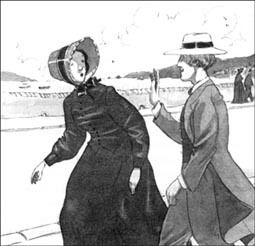
来者似笑非笑地上下打量了她一番。他好像对她有些气恼,但却一言不发。
“我正准备回家,”她接着说,“但却没赶上船。”
他似乎对此不感兴趣。“还在教书吗?”他说道,“你一定是个好老师吧,巴普蒂丝塔,我敢肯定!”
她知道这并非他的本意。“我知道我并不擅长教书,”她答道,“所以我辞职了。”
“哦,你辞职了?这太让人吃惊了。”
“我讨厌教书。”
“也许那是因为我是个老师。”
“哦,不,当然不是。因为我要开始新的生活。下周我就要嫁给戴维·赫德根先生了。”
听到这个出乎意料的回答,小伙子往后退了一步。“戴维·赫德根先生是谁?”他说着,试图让语气显得有些厌烦。
“他在圣玛丽亚岛拥有很多商店,而且是我父亲的邻居和老朋友。”
“也就是说,你不再是学校的老师,而只是一个店主的妻子了。我就知道你永远不会胜任教师这项工作的。你就像一个自以为有了漂亮脸蛋就能成为优秀演员的女人,却忘了自己还必须懂得如何表演。不过,你及时发现了自己的错误,不是吗?”
“别扫我的兴,查尔斯。”巴普蒂丝塔忧伤地说。
“我不是扫你的兴——我只是在用一种友好的方式说出真话——尽管我有足够的理由来扫你的兴。你太草率了,巴普蒂丝塔!我讨厌草率的女人!”
“你指的是什么?”
“嗯——草率地成为某人的妻子。看情形,你似乎觉得有丈夫总比没丈夫强。你等不了我了,哦,不!嗯,感谢上帝,对我而言,一切都过去了!”
“等你?这是什么意思,查理?你从没表现出对我有什么特别的感觉呀。”
“哦,是真的吗,亲爱的巴普蒂丝塔!”
“我是说,我不敢确定。我猜你是有一点喜欢我,可我并不认为你真的会正儿八经地跟我订婚。”
“这话算是说到点子上了!你们女孩子总希望男人看你们一眼就谈婚论嫁!可我的确曾经打算跟你订婚,知道吗?”
“但你从没说过这话,一个女人总不能永远等下去吧!”
“巴普蒂丝塔,我发誓我曾经打算在6个月之内向你求婚。”
她显得很不自在,两人默默地往前走。没过多久,他问:“那时你想嫁给我吗?”
她忧伤地低声回答道:“想!”
他们走着走着,走出了小镇,来到田野里,两人的肩并在一起。他用一只有力的手抓住了她的胳膊,就像是在说:“现在我抓住你了,我想让你做什么你就得做什么。”
“我们这样见面真是太奇怪了!”小伙子说,“你我原本可以结为夫妻、一起度蜜月的,可这一切却没有发生。我们半小时后就要说再见了,也许永远无法再见。是啊,人生是多么奇怪啊!”
她停下了脚步。“我得回去了。这太痛苦了,查理!你今天太不友善了。”
“我不想伤害你——你知道我不想,”他温柔地回答道,“但你将要做的事使我很生气。我觉得你不应该嫁给他。”
“既然我已经同意了,就必须那么做。”
“为什么?”他问道,语气更加严肃了,“取消一场你不情愿的婚礼永远都不算晚。喏——你可以跟我结婚,而不是跟他,尽管你等了我没多久!”
“哦,想想就知道那是不可能的!”她摇着头喊道,“家里肯定已经把婚礼的一切都准备停当了!”
“如果我们要结婚,那就必须马上结。今天晚上你可以跟我回到我居住的小镇特鲁福去。我们星期二就可以在那里结婚,那么无论是戴维·赫德根还是其他什么人,都不能把你从我身边带走了!”
“可我必须坐星期二的船回家,”她焦虑地说,“如果我没回家,他们会怎么想呢?”
“你一样可以坐那趟船回家。唯一不同的是我会跟你一起回去。你可以告诉你父母,你嫁给了一位有体面工作的年轻人,是在培训学院认识的。等见面以后,他们就会接受我们结婚这个事实,这是无法改变的。你就永远不会因为嫁给一个可怕的老头而痛苦了。好了,老实说,你最喜欢的的确是我,是不是,巴普蒂丝塔?”
“是的。”她轻声说道。
“那咱们就照我说的办。”
3
Baptista gets married
That same afternoon Charles Stow and Baptista Trewthen travelled by train to the town of Trufal. Charles was, surprisingly, very careful of appearances, and found a room for Baptista in a different house from where he was staying. On Sunday they went to church and then walked around the town, on Monday Charles made the arrangements, and by nine o'clock on Tuesday morning they were husband and wife.
For the first time in her life Baptista had gone against her parents' wishes. She went cold with fear when she thought of their first meeting with her new husband. But she felt she had to tell them as soon as possible, and now the most important thing was to get home to St Maria's. So, in a great hurry, they packed their bags and caught the train to Pen-zephyr.
They arrived two hours before the boat left, so to pass the time they decided to walk along the cliffs a little way. It was a hot summer day, and Charles wanted to have a swim in the sea. Baptista did not like the idea of sitting alone while he swam. 'But I'll only be a quarter of an hour,' Charles said, and Baptista passively accepted this.
She sat high up on the cliffs, and watched him go down a footpath, disappear, appear again, and run across the beach to the sea. She watched him for a moment, then stared out to sea, thinking about her family. They were probably not worried about her, because she had sometimes missed the boat before, but they were expecting her to arrive today and to marry David Heddegan tomorrow. 'How angry father will be!' she thought miserably. 'And mother will say I've made a terrible mistake! I almost wish I hadn't married Charles, in that moment of madness! Oh dear, what have I done!'
This made her think of her new husband, and she turned to look for him. He did not appear to be in the sea any more, and she could not see him on the beach. By this time she was frightened, and she climbed down the path as quickly as her shaking legs could manage. On the beach she called two men to help her, but they said they could see nothing at all in the water. Soon she found the place where Charles had left his clothes, but by now the sea had carried them away.
For a few minutes she stood there without moving. There was only one way to explain this sudden disappearance — her husband had drowned. And as she stood there, it began to seem like a terrible dream, and the last three days of her life with Charles seemed to disappear. She even had difficulty in remembering his face. 'How unexpected it was, meeting him that day!' she thought. 'And the wedding did I really agree to it? Are we really married? It all happened so fast!'
She began to cry, still standing there on the beach. She did not know what to do, or even what to think. Finally, she remembered the boat, and catching the boat home seemed the easiest thing to do. So she walked to the station, arranged for someone to carry her luggage, and went down to the boat. She did all this automatically, in a kind of dream.
Just before the boat left, she heard part of a conversation which made her sure that Charles was dead. One passenger said to another, 'A man drowned here earlier today, you know. He swam out too far, they say. A stranger, I think. Some people in a boat saw him, but they couldn't get to him in time.'
The boat was a long way out to sea before Baptista realized that Mr Heddegan was on the boat with her. She saw him walking towards her and quickly took the wedding ring off her left hand.
'I hope you're well, my dear?' he said. He was a healthy, red-faced man of fifty-five. 'I wanted to come across to meet you. What bad luck that you missed the boat on Saturday!'
And Baptista had to agree, and smile, and make conversation. Mr Heddegan had spoken to her before she was ready to say anything. Now the moment had passed.
When the boat arrived, her parents were there to meet her. Her father walked home beside Mr Heddegan, while her mother walked next to Baptista, talking all the time.
'I'm so happy, my child,' said Mrs Trewthen in her loud, cheerful voice, 'that you've kept your promise to marry Mr Heddegan. How busy we've been! But now things are all ready for the wedding, and a few friends and neighbours are coming in for supper this evening.' Again, the moment for confessing had passed, and Baptista stayed silent.
When they reached home, Mrs Trewthen said, 'Now, Baptista, hurry up to your room and take off your hat, then come downstairs. I must go to the kitchen.'
The young woman passively obeyed her mother's orders. The evening was a great success for all except Baptista. She had no chance to tell her parents the news, and it was already much more difficult than it had been at first. By the end of the evening, when all the neighbours had left, she found herself alone in her bedroom again. She had come home with much to say, and had said none of it. She now realized that she was not brave enough to tell her story. And as the clock struck midnight, she decided it should stay untold.
Morning came, and when she thought of Charles, it was more with fear than with love. Her mother called from downstairs, 'Baptista! Time to get up! Mr Heddegan will be at the church in three-quarters of an hour!'
Baptista got out of bed, looked out of the window, and took the easy way. She put her best clothes on, confessed nothing, and kept her promise to marry David Heddegan.
appearance n. the unexpected or sudden arrival of someone or something. (出其不意的)到来;出现
cliff n. a high rock with a very steep side, near the sea (海边的)悬崖
passively adv. tending to accept situations or things that other people do, without attempting to change or fight against them 被动地;顺从地
drown v. to die from being under water for too long 溺死
automatically adv. done without thinking 无意识地
3.结婚
当天下午,查尔斯·斯托和巴普蒂丝塔·特鲁森就坐火车去了小镇特鲁福。令人惊讶的是,查尔斯对他们二人的行踪十分谨慎。他在另一座房子里为巴普蒂丝塔找了个房间。星期日,他们去了教堂,然后绕着小镇散了散步。星期一,查尔斯安排好了一切,到星期二上午9点,他们就结为了夫妻。
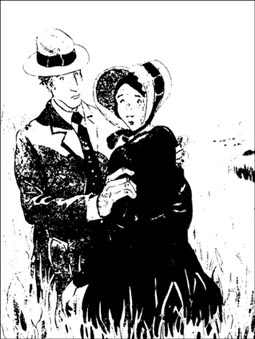
这是巴普蒂丝塔生平第一次违背父母的意愿。一想到父母与新婚丈夫第一次见面的情形,她就害怕得浑身发冷。但她还是觉得必须尽快把这事告诉他们,于是回圣玛丽亚岛上的家里去就成了最重要的事。因此,他们匆匆忙忙地收拾好行李,搭上了去往彭泽弗的火车。
他们在开船前两小时到了那里,于是决定沿着海崖散一小会儿步,借此打发时间。时值夏季,气候炎热,查尔斯很想到海里游个泳,巴普蒂丝塔却不太愿意在他游泳的时候独自坐着。“可我只游一刻钟。”查尔斯说道,巴普蒂丝塔顺从地答应了。
她坐在高高的海崖上,看着他从一条小路走下去,身影消失了一会儿,继而又出现在视野里,穿过海滩跑向大海。她看了他一会儿,将目光转向大海,想着她的家人。他们也许并不太担心她,因为之前她也误过几次船。不过他们一定在盼着她今天到家,明天好嫁给戴维·赫德根。“爸爸会多么生气啊,”她痛苦地想着,“而妈妈一定会说我犯了个可怕的错误!我甚至希望自己没有因为一时冲动而嫁给查尔斯!哦,天啊,我都干了些什么啊!”
这使她想起了新婚的丈夫,于是转而开始搜寻他的身影。看起来,他已经不在海里了,可她也没在海岸上看见他。她这下子可吓坏了,赶紧拖着颤抖的双腿用最快的速度冲下小路。到了海滩上,她找了两个人来帮忙,可他们说海里什么都看不到。很快,她找到了查尔斯放衣服的地方,此时海水早已把衣服冲走了。
她在原地呆立了好几分钟。只有一个理由能解释她丈夫的突然失踪——他溺水身亡了。她呆立在那儿,一切就像一场噩梦,而她和查尔斯共度的这三天就像凭空消失了一样。她甚至很难想起他的模样来。“那天和他的相遇是多么出其不意啊!”她想,“我真的同意举行婚礼了吗?我们真的结婚了吗?这一切发生得太快了!”
她站在海滩上哭了起来,不知道该做什么,甚至不知道该想什么。最后,她想起了船,看样子最简单的事就是坐船回家了。于是她走到码头,叫人帮忙提着行李上了船。她机械地做着这些事情,如同梦游一般。
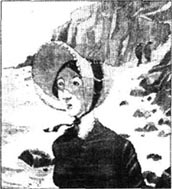
就在开船前,她听到了一小段对话,让她确信查尔斯真的死了。一名旅客对另一名旅客说:“今天早些时候有个男人在这里溺死了,知道吗。他们说他游得太远了。我猜他是个异乡人。有人在船上看见了他,但却没来得及赶过去。”
船在海上驶出了很远,巴普蒂丝塔才意识到赫德根先生跟她在同一条船上。她看到他朝自己走过来,于是飞快地将左手上的结婚戒指撸了下来。
“希望你一切都好,亲爱的。”他说。他55岁,身体健康,红光满面。“我想要过来接你。你星期六误了船,真是不走运啊!”
巴普蒂丝塔只得点头赞同,微笑着跟他交谈。赫德根先生还没等她开口就已经跟她聊了起来。而现在,坦言一切的时机已经过去了。
船靠岸时,她的父母已经在那儿迎接她了。父亲与赫德根先生并肩往家走,母亲则走在巴普蒂丝塔身旁,喋喋不休地边走边说。
“我很高兴,我的孩子,”特鲁森太太兴奋地大声说,“很高兴你能信守诺言嫁给赫德根先生。我们都快忙坏啦!不过,现在婚礼上的一切都准备好了,今天晚上就会有几个朋友和邻居来吃晚餐。”坦白一切的时机再一次错过了,巴普蒂丝塔一直保持着沉默。
到家后,特鲁森太太说:“巴普蒂丝塔,快回你的房间摘下帽子,然后下楼来。我得去厨房了。”
年轻的姑娘听从了母亲的吩咐。整个晚上,除了巴普蒂丝塔之外,人人都很开心。她没有机会跟父母坦白,而现在要说出来更是难上加难了。晚餐结束时,邻居们纷纷走了,她发现自己再一次独自待在了卧室里。她回家本来有满腹的话要说,但却什么都没说出来。她这才意识到自己没勇气说出自己的故事。钟敲12点的时候,她终于决定对此只字不提。
到了早上,她想起了查尔斯,心里更多的是恐怖而不是爱。母亲在楼下喊:“巴普蒂丝塔!该起床了!赫德根先生会在45分钟内到达教堂!”
巴普蒂丝塔从床上起身望着窗外,选择了一条平坦的道路。她穿上自己最好的衣裳,没露一点儿口风,信守诺言嫁给了戴维·赫德根。
4
The honeymoon
Mr Heddegan did not worry about his new wife's coldness towards him during and after the wedding. 'I know she was reluctant to marry me,' he thought, 'but that will pass. Things'll be different in a few months' time!'
During the wedding dinner, someone asked Heddegan about the honeymoon. To Baptista's horror, he answered, 'Oh, we're going to spend a few days in Pen-zephyr.'
'What!' cried Baptista. 'I know nothing of this!'
Because of her late arrival, Heddegan had not been able to ask where she would like to spend the honeymoon, so he had arranged a trip to the mainland. It was difficult to change these plans at the last minute, so she had to agree, and that evening she and her new husband arrived in Pen zephyr.
Their first problem was finding a hotel, because the fine weather had filled the town with tourists. They walked from place to place, Heddegan polite and friendly, Baptista cold and silent. Finally they found an excellent hotel, which to their surprise was empty. Kindly Mr Heddegan, who wanted to please his young wife, asked for the best room on the first floor, with a good view of the sea.
'I'm sorry,' said the landlady, 'there's a gentleman in that room.' Then, seeing Heddegan's disappointed face, and not wishing to lose a customer, she added quickly, 'But perhaps the gentleman will agree to move to another room, and then you can have the one that you want.'
'Well, if he doesn't want a view...' said Mr Heddegan.
'Oh no, I'm sure he doesn't. And if you don't mind going for a little walk, I'll have the room ready when you return.'
During their walk, Baptista was careful to choose different streets from those that she had walked down with Charles, and her white face showed how difficult this visit was for her. At last they returned to the hotel, and were shown into the best bedroom. They sat at the window, drinking tea. Although Heddegan had arranged for a sea view, to please Baptista, she did not look out of the window once, but kept her eyes on the floor and walls of the room.
Suddenly she noticed a hat on the back of the door. It was just like the hat that Charles had worn. She stared harder; yes, it was the actual hat! She fell back in her chair.
Her husband jumped up, saying worriedly, 'You're not well! What can I get ye?'
'Smelling salts!' she said quickly, her voice shaking a little. 'From the shop near the station!'
He ran out of the room. Baptista rang the bell, and when a young girl came, whispered to her, 'That hat! Whose is it?'
'Oh, I'm sorry, I'll take it away,' said the girl hurriedly. She took the hat off the door. 'It belongs to the other gentleman.'
'Where is — the other gentleman?' asked Baptista.
'He's in the next room, madam. He was in here.'
'But I can't hear him! I don't think he's there.'
'He makes no noise, but he's there,' replied the girl.
Suddenly Baptista understood what the girl meant, and a cold hand lay on her heart.
'Why is he so silent?' she whispered.
'If I tell you, please don't say anything to the landlady,' begged the girl, 'or I'll lose my job! It's because he's dead. He's the young teacher who drowned yesterday. They brought his body here, and that's why there's nobody staying in the hotel. People don't like a dead body in the house. But we've changed the sheets and cleaned the room, madam!'
Just then Heddegan arrived with the smelling salts, and the girl left the room. 'Any better?' he asked Baptista.
'I don't like the hotel!' she cried. 'We'll have to leave!'
For the first time Heddegan spoke crossly to his wife. 'Now that's enough, Baptista! First you want one thing, then another! It's cost me enough, in money and words, to get this fine room, and it's too much to expect me to find another hotel at this time of the evening. We'll stay quietly here tonight, do ye hear? And find another place tomorrow.'
The young woman said no more. Her mind was cold with horror. That night she lay between the two men who she had married, David Heddegan on one side, and, on the other side through the bedroom wall, Charles Stow.
tourist n. someone who is travelling or visiting a place for pleasure 游客;观光客
smelling salts n. a strong-smelling chemical that you hold under someone's nose to make them conscious again 嗅盐(一种苏醒剂)
4.蜜月
赫德根先生并不担心新婚妻子在婚礼上以及婚礼之后对自己的冷淡态度。“我知道她不愿意嫁给我,”他想,“但这会过去的。过几个月就不一样了!”
在婚宴上,有人问赫德根打算如何度蜜月。让巴普蒂丝塔惊恐的是,他回答道:“哦,我们打算到彭泽弗去待几天。”
“什么!”巴普蒂丝塔叫道,“这我怎么不知道!”
因为她的晚归,赫德根没来得及问她愿意去哪里度蜜月,于是便安排了一次大陆旅行。在最后一分钟改变计划很困难,她只得同意了,并在那天晚上同她的新婚丈夫一起到达了彭泽弗。
他们遇到的第一个麻烦就是找旅馆,因为好天气使得小镇的游客人满为患。他们到处奔走,赫德根礼貌而友好,巴普蒂丝塔则冷淡而沉默。最后,他们找到了一家不错的旅馆。令人惊奇的是,那里竟然没人入住。赫德根先生一心想讨好他的年轻妻子,于是就要了一间二层最好的房间,可以很好地观看大海。
“很抱歉,”老板娘说,“那间屋子里住着一位先生。”接着,她看到了赫德根失望的脸,不愿意因此失去一位顾客,于是赶紧补充道:“不过,或许那位先生会同意搬到另一个房间去,那你们就能住心仪的那一间了。”
“好吧,如果他不想看海景的话……”赫德根先生说。
“哦,不,我相信他不想看。如果你们不介意的话,请出去散一小会儿步。等你们回来的时候,我就已经把房间准备好了。”
散步的时候,巴普蒂丝塔很小心地选择了那些没有和查尔斯一起走过的街道。从她苍白的脸色上不难看出,这次观光对她来说有多难熬。最后,他们返回了旅馆,被领进了最好的卧室。他们在窗前坐下喝茶。尽管赫德根要了海景房间来取悦巴普蒂丝塔,她却不曾向窗外看过一眼,反倒将目光盯死在了地板和房间的墙壁上。
突然,她看到门背后有一顶帽子,像是查尔斯戴过的那顶。她睁大眼睛看了个仔细,没错,就是那顶帽子!她跌坐在椅子上。
她的丈夫跳将起来,担心地问:“你不舒服!要我帮你拿点什么吗?”
“嗅盐!”她赶紧答道,声音微微有些颤抖,“码头附近那家商店有卖的!”
他跑出了房间。巴普蒂丝塔摁响了铃,一个年轻女孩走了进来。她悄声问女孩:“那顶帽子!那是谁的?”
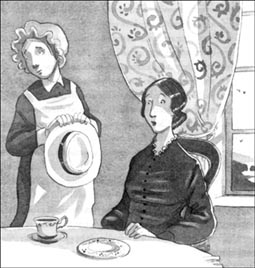
“哦,很抱歉。我把它拿走吧。”女孩赶紧说道,把帽子从门上取了下来。“这是另一位先生的。”
“另一位先生——他在哪儿?”巴普蒂丝塔问。
“他在隔壁房间,夫人。他原本住在这儿。”
“可我听不到他的动静!我想他不在隔壁。”
“他没有任何动静,可他确实在。”女孩答道。
突然,巴普蒂丝塔明白了女孩的意思,觉得仿佛有一只冰冷的手放在了自己心上。
“他为什么这么安静?”她低声问。
“如果我告诉你,请千万别跟老板娘说,”女孩恳求道,“要不我会丢掉工作的!那是因为他已经死了。他就是昨天溺死的年轻教师。他们把他的尸体搬到了这儿来,所以这家旅馆没人住。人们不喜欢屋子里有个死人。不过我们已经换过床单、打扫过房间了,夫人!”
就在这时,赫德根带着嗅盐回来了,女孩走出了房间。“好些了吗?”他问巴普蒂丝塔。
“我不喜欢这个旅馆!”她叫道,“我们必须离开这里!”
赫德根第一次冲妻子发了脾气:“够了,巴普蒂丝塔!你太得寸进尺了!我花了很多的钱和口舌才住进这个好房间,让我这大晚上的再另找一家旅馆简直是痴心妄想。我们今晚上就安安静静地待在这儿,听见了吗?明天再另外找地方。”
年轻的女人没再多说什么。她的思维因恐惧而僵住了。那晚,她躺在自己嫁过的两个男人之间,卧室墙的这边是戴维·赫德根,墙那边则是查尔斯·斯托。
5
Secrets discovered
Mr and Mrs Heddegan both felt the honeymoon was not a success. They were happy to return to the island and start married life together in David Heddegan's large house. Baptista soon became as calm and passive as she had been before. She even smiled when neighbours called her Mrs Heddegan, and she began to enjoy the comfortable life that a rich husband could offer her. She did nothing at all to stop people finding out about her first marriage to Charles Stow, although there was always a danger of that happening.
One evening in September, when she was standing in her garden, a workman walked past along the road. He seemed to recognize her, and spoke to her in friendly surprise.
'What! Don't you know me?' he asked.
'I'm afraid I don't,' said Baptista.
'I was your witness, madam. I was mending the church window when you and your young man came to get married. Don't you remember? The vicar called me, to be a witness.'
Baptista looked quickly around. Heddegan was at the other end of the garden but unluckily, just at that moment, he turned and walked towards the house. 'Are you coming in, my dear?' he called out to Baptista.
The workman stared at him. 'That's not your—' he began, then he saw Baptista's face and stopped. Baptista was unable to speak, and the workman began to realize that there was a little mystery here. 'I've been unlucky since then,' he continued, still staring at Baptista's white face. 'It's hard finding enough work to buy food for my wife and myself. Perhaps you could help me, because I once helped you?'
Baptista gave him some money, and hoped never to see him again. But he was cleverer than he looked. By asking questions on the island and the mainland, he soon realized that Baptista had married one man on Tuesday, and another man on Wednesday. He visited her again two days later.
'It was a mystery to me, madam!' he said, when she opened the door. 'But now I understand it all. I want to tell you, madam, that I'm not a man to make trouble between husband and wife. But I'm going back to the mainland again, and I need a little more money. If your old man finds out about your first husband, I'm sure he won't like it, will he?'
She knew he was right, and paid him what he wanted. A week later the workman sent his wife to ask for more money, and again Baptista paid. But when there was a fourth visit, she refused to pay, and shut the door in the man's surprised face.
She knew she had to tell her husband everything. She liked him better now than she had done at first, and did not want to lose him, but her secret was no longer safe. She went to find him, and said, 'David, I have something to tell you.'
'Yes, my dear,' he said with a sigh. In the last week he had been less cheerful and had seemed worried about something.
When they were both in the sitting room, she said, 'David, perhaps you will hate me for this, but I must confess something that I've hidden from you. It happened before we were married. And it's about a lover.'
'I don't mind. In fact, I was hoping it was more than that.'
'Well, it was. I met my old lover by chance, and he asked me, and — well, I married him. We were coming here to tell you, but he drowned, and I said nothing about him, and then I married you, David, for peace and quietness. Now you'll be angry with me, I know you will!'
She spoke wildly, and expected her husband to shout and scream. But instead, the old man jumped up and began to dance happily around the room.
'Oh, wonderful!' he cried. 'How lucky! My dear Baptista, I see a way out of my difficulty — ha-ha!'
'What do you mean?' she asked, afraid he had gone mad.
'Oh my dear, I've got something to confess too! You see, I was friendly with a woman in Pen-zephyr for many years — very friendly, you could say — and in the end I married her just before she died. I kept it secret, but people here are beginning to talk. And I've got four big girls to think of—'
'Oh David, four daughters!' she cried in horror.
'That's right, my dear. I'm sorry to say they haven't been to school at all. I'd like to bring them to live here with us, and I thought, by marrying a teacher, I could get someone to teach them, all for nothing. What do you think, Baptista?'
'Four grown girls, always around the house! And I hate teaching, it kills me! But I must do it, I can see that. I am punished for that moment of madness, I really am!'
Here the conversation ended. The next day Baptista had to welcome her husband's daughters into her home. They were not good-looking or intelligent or even well-dressed, and poor Baptista could only look forward to years of hard work with them. She went about, sighing miserably, with no hope for the future.
But when Heddegan asked her a month later, 'How do you like 'em now?' her answer was unexpected.
'Much better than at first,' she said. 'I may like them very much one day.'
And so began a more pleasant time for Baptista Heddegan. She had discovered what kind, gentle girls these unwelcome daughters were. At first she felt sorry for them, then grew to like them. And from liking, she grew to love them. In the end they brought her and her husband closer together, and so Baptista and David were able to put the past behind them and find unexpected happiness in their married life.
witness n. at a wedding, someone who writes their name in the church register to prove they saw the marriage happen 证婚人
mystery n. something that is impossible to understand or explain, or about which little is known 谜
punish v. to make someone suffer because they have done something wrong 惩罚
intelligent adj. good at understanding ideas and thinking quickly and clearly 聪明的;悟性强的
5.泄密
赫德根先生和太太都觉得蜜月过得不怎么样。他们很高兴能重返小岛,在戴维·赫德根的大房子里开始婚后生活。巴普蒂丝塔很快就变得和从前一样平静而顺从了。她开始享受一位富有的丈夫所能提供的安逸生活,听见邻居叫自己赫德根太太的时候甚至还会微笑。她没有刻意做什么来阻止人们揭发她跟查尔斯·斯托的第一次婚姻,尽管这种危险性随时存在。
9月的一天晚上,她站在花园里,一名工人从旁边的小路经过。他似乎认出了她,友好而惊讶地跟她打了个招呼。
“什么!难道您不认识我了吗?”他问道。
“恐怕是不认识。”巴普蒂丝塔说。
“我是您的证婚人,夫人。您和您年轻的丈夫结婚的时候,我正在修理教堂的窗户呢,您不记得了吗?牧师当时叫我当了证婚人。”
巴普蒂丝塔迅速环顾四周。赫德根在花园的另一头,他正巧在这一刻转身,朝着房子走去。“你进来吗,我亲爱的?”他对巴普蒂丝塔大声喊道。
工人瞪着他看。“那该不是你的——”他张口就说。接着,他看见了巴普蒂丝塔的脸,闭上了嘴。巴普蒂丝塔说不出话来,工人开始意识到这其中定有玄机。“从那以后我一直不走运,”他盯着巴普蒂丝塔苍白的脸,接着说,“我很难找到足够的工作来给自己和妻子糊口。你不妨帮帮我吧,因为我曾经帮过你。”
巴普蒂丝塔给了他一些钱,希望永远也不要再见到他。可他远比看上去聪明。在询问了一些岛上和大陆的人以后,他很快便意识到巴普蒂丝塔在星期二嫁给了一个男人,而星期三又嫁给了另一个男人。两天之后,他再次拜访了她。
“这对我来说曾是个谜,夫人!”她打开门时,他说道,“现在我全都明白了。我想告诉您,夫人,我不是那种在夫妻之间制造矛盾的人。但我打算再回到大陆上去,因此还需要一小笔钱。如果您老公发现您第一任丈夫的事,我敢保证他会不高兴的,对吧?”
她知道他说得没错,于是便如了他的愿。一个星期后,工人又派他的老婆来要更多的钱,巴普蒂丝塔又一次满足了她。但等到工人第四次上门来的时候,她拒绝付钱,当面把一脸惊诧的工人关在了门外。
她知道自己必须向丈夫坦白一切。她现在比起初更喜欢他了,而且也不想失去他,可她已无法再保守自己的秘密。她找到他,说:“戴维,我有些事情要告诉你。”
“好的,亲爱的。”他叹了口气说道。一个星期以来,他一直闷闷不乐,似乎在为什么事担心。
他们一同来到客厅,她说:“戴维,或许你会因此而恨我,但我必须向你坦白我曾对你隐瞒的一些事。那发生在我们结婚之前,是关于一个情人的。”
“我不介意。事实上,我觉得事情没这么简单。”
“呃,是的。我当时偶遇了旧情人,他向我求婚,并且——呃,我跟他结了婚。我们正准备回来告诉你,可他却淹死了,而我没向你提起过关于他的任何事。接着我嫁给了你,戴维,为了得到平和安静的生活。好了,你冲我发火吧,我知道你会的!”
她言辞激烈,希望丈夫对她大吼大叫。然而,老头子却蹦了起来,开始绕着房间欢快地跳舞。
“噢,太棒了!”他大叫道,“多走运啊!我亲爱的巴普蒂丝塔,我看到了走出困境的路——哈哈!”
“你在说什么?”她问道,担心他气疯了。
“噢,亲爱的,我也有些事要对你坦白!你知道,我和彭泽弗的一个女人保持了多年的友好关系——非常友好,可以这么说——最后,我在她死前娶了她。我对这事一直守口如瓶,可这里的人却开始谈论这事。而且我还得操心四个已经长大的女儿——”
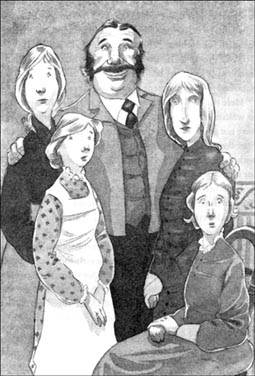
“噢,戴维,四个女儿!”她惊恐地叫道。
“没错,亲爱的。很抱歉告诉你,她们从没上过学。我想把她们带到这里和我们一起住。而且我想,娶一个老师就有人教她们了,一分钱都不用花。你觉得怎么样,巴普蒂丝塔?”
“四个长大成人的女孩,无时无刻不待在家里!而且我讨厌教书,那简直折磨死我了!但我明白我必须那么做。我要为那一时的冲动接受惩罚,我罪有应得!”
谈话就此结束。第二天,巴普蒂丝塔只得迎接丈夫的女儿们来到她家。她们既不漂亮又不聪慧,连衣着也毫不起眼。可怜的巴普蒂丝塔只能从她们身上看见未来数年的辛苦工作。她痛苦地叹着气开始工作,对未来不再抱半点希望。
但当赫德根在一个月后问她:“你现在觉得她们怎么样?”的时候,她的回答出人意料。
“比一开始好多了,”她说,“总有一天我会非常喜欢她们的。”
于是,巴普蒂丝塔·赫德根的日子就更好打发了。她发现这些不受欢迎的女儿们其实既善良又温柔。刚开始,她替她们感到悲哀,接着渐渐开始喜欢她们,后来又从喜欢转变为喜爱。最终,女儿们使得她和丈夫之间的关系比以前更加紧密了。就这样,巴普蒂丝塔和戴维终于放下往事,在婚后的生活中找到了意想不到的幸福。
1.A wedding is arranged
A MOMENT OF MADNESS
一时冲动
1
A wedding is arranged
Most people who knew Baptista Trewthen agreed that there was nothing in her to love, and nothing in her to hate. She did not seem to feel very strongly about anything. But still waters run deep, and nothing had yet happened to make her show what lay hidden inside her, like gold underground.
Since her birth she had lived on St Maria's, an island off the south-west coast of England. Her father, a farmer, had spent a lot of money on sending her to school on the mainland. At nineteen she studied at a training college for teachers, and at twenty-one she found a teaching job in a town called Tor-upon-Sea, on the mainland coast.
Baptista taught the children as well as she could, but after a year had passed she seemed worried about something. Mrs Wace, her landlady, noticed the change in the young woman and asked her what the matter was.
'It has nothing to do with the town, or you,' replied Miss Trewthen. She seemed reluctant to say more.
'Then is it the pay?'
'No, it isn't the pay.'
'Is it something that you've heard from home, my dear?'
Baptista was silent for a few moments. Then she said, 'It's Mr Heddegan — David Heddegan. He's an old neighbour of ours on St Maria's, with no wife or family at all. When I was a child, he used to say he wanted to marry me one day. Now I'm a woman, it's no longer a joke, and he really wishes to do it. And my parents say I can't do better than have him.'
'Has he a lot of money?'
'Yes, he's the richest man that we know.'
'How much older than you is he?'
'Twenty years, maybe more.'
'And is he, perhaps, an unpleasant man?'
'No, he's not unpleasant.'
'Well, child, all I can say is this — don't accept this engagement if it doesn't please you. You're comfortable here in my house, I hope, and I like having you here.'
'Thank you, Mrs Wace. You're very kind to me. But here comes my difficulty. I don't like teaching. Ah, you're surprised. That's because I've hidden it from everyone. Well, I really hate school. The children are awful little things, who make trouble all day long. But even they are not as bad as the inspector. For the three months before his visit I woke up several times every night, worrying about it. It's so difficult knowing what to teach and what to leave untaught! I think father and mother are right. They say I'll never be a good teacher if I don't like the work, so I should marry Mr Heddegan and then I won't need to work. I don't know what to do, Mrs Wace. I like him better than teaching, but I don't like him enough to marry him.'
These conversations were continued from day to day, until at last the landlady decided to agree with Baptista's parents.
'Life will be much easier for you, my dear,' she told her young friend, 'if you marry this rich neighbour.'
In April Baptista went home to St Maria's for a short holiday, and when she returned, she seemed calmer.
'I have agreed to have him as my husband, so that's the end of it,' she told Mrs Wace.
In the next few months letters passed between Baptista and Mr Heddegan, but the girl preferred not to discuss her engagement with Mrs Wace. Later, she told her that she was leaving her job at the end of July, and the wedding was arranged for the first Wednesday in August.
madness n. very stupid behaviour that could be dangerous 疯狂
arrange v. to organize or make plans for something such as a meeting, party, or trip 安排;策划
mainland n. the main area of land that forms a country, as compared to islands near it 大陆;本土
engagement n. an agreement to marry someone 订婚;婚约
awful adj. very bad or unpleasant 糟糕的;恶劣的
1.订婚
大多数认识巴普蒂丝塔·特鲁森的人都认为她这个人既不招人喜欢,也不讨人厌。她对一切似乎都没什么感觉。然而静水深流,她拥有如地底金矿般深藏的内心,只不过还没有机会展现而己。
自打出生起,她就一直居住在英格兰西南海滨一个名叫圣玛丽亚的小岛上。她的父亲是一名农夫,花了很多钱送她到大陆的学校学习。19岁时,她就读于一所师范学校;21岁时,她在大陆沿海一座名叫托阿庞西的小镇上找到了一份教书的工作。
巴普蒂丝塔竭尽所能教孩子们念书。但一年后,她似乎为什么事担起了心。她的房东韦斯太太注意到了这位年轻姑娘的变化,于是问她有什么烦心事。
“跟这个镇子没什么关系,跟您也没关系。”特鲁森小姐答道。她似乎不愿多说什么。
“那么是跟薪水有关喽?”
“不,不是薪水的问题。”
“是不是你从家乡收到了什么消息,我亲爱的?”
巴普蒂丝塔沉默了一小会儿,然后说:“是因为赫德根先生——戴维·赫德根。他是我们在圣玛丽亚岛的一位老邻居,既没有妻子,也没有家人。我小时候,他曾说过想有朝一日娶我为妻。现在我已经是个大姑娘了,这也就不再是玩笑话了,而他真的想娶我。我父母说,没有什么比嫁给他更好的了。”
“他很有钱吗?”
“是的,他是我们所认识的最有钱的人。”
“他比你大多少?”
“20岁吧,也许还不止。”
“那,也许他是个令人讨厌的人?”
“不,他并不令人讨厌。”
“好吧,孩子,我所能说的就是——如果这桩婚事让你不开心,就不要接受它。你在我家过得舒舒服服的,但愿我没说错,而我也很喜欢你住在这儿。”
“谢谢您,韦斯太太。您对我太好了。可我也有我的难处。我不喜欢教书。啊,让您吃惊了吧。那是因为我对所有人都隐瞒了这一点。唉,我真的很讨厌学校。孩子们真是可怕的小东西,他们整天制造麻烦。可他们再坏也坏不过巡检员。在他来检查之前的三个月里,我夜夜都会担心得醒过来好几次。要知道该教什么和不该教什么简直太难了!我想爸爸妈妈是对的。他们说,如果我不喜欢这份工作,就永远也不会成为一名好教师,所以我应该嫁给赫德根先生,那样就不用再工作了。我不知道该怎么办,韦斯太太。我喜欢他胜过喜欢教书,可又还没有喜欢到想嫁给他的地步。”
类似的谈话日复一日地持续下去,最后,房东太太决定赞同巴普蒂丝塔父母的话。
“如果跟这位富有的邻居结婚的话,”她告诉自己这位年轻的朋友,“生活对你来说将会容易得多,亲爱的。”
4月,巴普蒂丝塔回到圣玛丽亚岛的家中休了一个短暂的假期,回来后看起来平静多了。
“我同意让他做我的丈夫了,这事就这么定了。”她告诉韦斯太太。
在接下来的几个月里,巴普蒂丝塔和赫德根先生之间不时有书信往还。不过,这位姑娘不太愿意跟韦斯太太谈论她的婚约。不久,她告诉韦斯太太她准备在7月底离职,而婚礼就定在8月的第一个星期三。
2
A chance meeting
When the end of July arrived, Baptista was in no hurry to return home to the island. She was not planning to buy any special clothes for the wedding, and her parents were making all the other arrangements. So she did not leave Tor-upon-Sea until the Saturday before her wedding. She travelled by train to the town of Pen-zephyr, but when she arrived, she found that the boat to St Maria's had left early, and there was no other boat until Tuesday. 'I'll have to stay here until then,' she thought. 'It's too far to go back to Mrs Wace's.' She did not seem to mind this — in fact, she was almost happy to wait another three nights before seeing her future husband.
She found a room in a small hotel, took her luggage there, then went out for a walk round the town.
'Baptista? Yes, Baptista it is!'
The words came from behind her. Turning round, she gave a jump, and stared. 'Oh, is it really you, Charles?' she said.
With a half-smile the newcomer looked her up and down. He appeared almost angry with her, but he said nothing.
'I'm going home,' she continued, 'but I've missed the boat.'
He did not seem interested in this news. 'Still teaching?' he said. 'What a fine teacher you make, Baptista, I'm sure!'
She knew that was not his real meaning. 'I know I'm not very good at teaching, 'she replied.' That's why I've stopped.'
'Oh, you've stopped? You surprise me.'
'I hate teaching.'
'Perhaps that's because I'm a teacher.'
'Oh no, it isn't. It's because I'm starting a new life. Next week I'm going to marry Mr David Heddegan.'
At this unexpected reply, the young man took a step back. 'Who is Mr David Heddegan?' he said, trying to sound bored.
'He owns a number of shops on St Maria's, and he's my father's neighbour and oldest friend.'
'So, no longer a schoolteacher, just a shopkeeper's wife. I knew you would never succeed as a teacher. You're like a woman who thinks she can be a great actress just because she has a beautiful face, and forgets she has to be able to act. But you found out your mistake early, didn't you?'
'Don't be unpleasant to me, Charles,' Baptista said sadly.
'I'm not being unpleasant — I'm just saying what is true, in a friendly way — although I do have good reason to be unpleasant to you. What a hurry you've been in, Baptista! I do hate a woman in a hurry!'
'What do you mean?'
'Well — in a hurry to be somebody's wife. Any husband is better than no husband for you, it seems. You couldn't wait for me, oh no! Well, thank God, that's all in the past for me!'
'Wait for you? What does that mean, Charley? You never showed that you felt anything special for me.'
'Oh really, Baptista dear!'
'What I mean is, there was nothing that I could be sure of. I suppose you liked me a little, but I didn't think you meant to make an honest engagement of it.'
'That's just it! You girls expect a man to talk about marrying after the first look! But I did mean to get engaged to you, you know.'
'But you never said so, and a woman can't wait for ever!'
'Baptista, I promise you that I was planning to ask you to marry me in six months' time.'
She appeared very uncomfortable, and they walked along in silence. Soon he said, 'Did you want to marry me then?'
And she whispered sadly back, 'Yes!'
As they walked on, away from the town and into the fields, her shoulder and his were close together. He held her arm with a strong hand. This seemed to say, 'Now I hold you, and you must do what I want.'
'How strange that we should meet like this!' said the young man. 'You and I could be husband and wife, going on our honeymoon together. But instead of that, we'll say goodbye in half an hour, perhaps for ever. Yes, life is strange!'
She stopped walking. 'I must go back. This is too painful, Charley! You're not being kind today.'
'I don't want to hurt you — you know I don't,' he answered more gently. 'But it makes me angry — what you're going to do. I don't think you should marry him.'
'I must do it, now that I've agreed.'
'Why?' he asked, speaking more seriously now. 'It's never too late to stop a wedding if you're not happy with it. Now — you could marry me, instead of him, although you were in too much of a hurry to wait for me!'
'Oh, it isn't possible to think of that!' she cried, shaking her head. 'At home everything will be ready for the wedding!'
'If we marry, it must be at once. This evening you can come back with me to Trufal, the town where I live. We can get married there on Tuesday, and then no Mr David Heddegan, or anyone else, can take you away from me!'
'But I must go home on the Tuesday boat,' she said worriedly. 'What will they think if I don't arrive?'
'You can go home on that boat just the same. The only difference is that I'll go with you. You'll tell your parents that you've married a young man with a good job, someone that you met at the training college. When I meet them, they'll accept that we're married and it can't be changed. And you won't be miserable for ever as the wife of an awful old man. Now honestly, you do like me best, don't you, Baptista?'
'Yes,' she whispered.
'Then we will do what I say.'
chance adj. not planned 偶然的
arrangement n. the things that you must organize so that an event, meeting etc can happen 安排;准备
luggage n. the cases, bags etc carried by someone who is travelling. 行李
bored adj. tired and impatient because you do not think something is interesting 厌烦的;不感兴趣的
honeymoon n. a holiday taken by two people who have just got married 蜜月
2.偶遇
7月底到来的时候,巴普蒂丝塔并不着急回岛上的家里去。她不打算特地为婚礼买什么衣服,而其他一切则由她的父母来安排。所以,她直到婚礼前的那个星期六才离开托阿庞西。她乘火车前往彭泽弗小镇,到达之后却发现到圣玛丽亚岛的船已经提前开走了,而且直到下星期二才会有别的船。“我只能在这儿等下一班船了,”她想,“回韦斯太太那里太远了。”她看样子并不介意——事实上,她甚至很高兴要再多等三个晚上才见到自己未来的丈夫。
她在一家小旅馆找了个房间,把行李放好,然后到小镇上去逛逛。
“巴普蒂丝塔?没错,是巴普蒂丝塔!”
这话从她背后传来。她吓了一跳,转过身盯着对方。“哦,真的是你吗,查尔斯?”她说。
来者似笑非笑地上下打量了她一番。他好像对她有些气恼,但却一言不发。
“我正准备回家,”她接着说,“但却没赶上船。”
他似乎对此不感兴趣。“还在教书吗?”他说道,“你一定是个好老师吧,巴普蒂丝塔,我敢肯定!”
她知道这并非他的本意。“我知道我并不擅长教书,”她答道,“所以我辞职了。”
“哦,你辞职了?这太让人吃惊了。”
“我讨厌教书。”
“也许那是因为我是个老师。”
“哦,不,当然不是。因为我要开始新的生活。下周我就要嫁给戴维·赫德根先生了。”
听到这个出乎意料的回答,小伙子往后退了一步。“戴维·赫德根先生是谁?”他说着,试图让语气显得有些厌烦。
“他在圣玛丽亚岛拥有很多商店,而且是我父亲的邻居和老朋友。”
“也就是说,你不再是学校的老师,而只是一个店主的妻子了。我就知道你永远不会胜任教师这项工作的。你就像一个自以为有了漂亮脸蛋就能成为优秀演员的女人,却忘了自己还必须懂得如何表演。不过,你及时发现了自己的错误,不是吗?”
“别扫我的兴,查尔斯。”巴普蒂丝塔忧伤地说。
“我不是扫你的兴——我只是在用一种友好的方式说出真话——尽管我有足够的理由来扫你的兴。你太草率了,巴普蒂丝塔!我讨厌草率的女人!”
“你指的是什么?”
“嗯——草率地成为某人的妻子。看情形,你似乎觉得有丈夫总比没丈夫强。你等不了我了,哦,不!嗯,感谢上帝,对我而言,一切都过去了!”
“等你?这是什么意思,查理?你从没表现出对我有什么特别的感觉呀。”
“哦,是真的吗,亲爱的巴普蒂丝塔!”
“我是说,我不敢确定。我猜你是有一点喜欢我,可我并不认为你真的会正儿八经地跟我订婚。”
“这话算是说到点子上了!你们女孩子总希望男人看你们一眼就谈婚论嫁!可我的确曾经打算跟你订婚,知道吗?”
“但你从没说过这话,一个女人总不能永远等下去吧!”
“巴普蒂丝塔,我发誓我曾经打算在6个月之内向你求婚。”
她显得很不自在,两人默默地往前走。没过多久,他问:“那时你想嫁给我吗?”
她忧伤地低声回答道:“想!”
他们走着走着,走出了小镇,来到田野里,两人的肩并在一起。他用一只有力的手抓住了她的胳膊,就像是在说:“现在我抓住你了,我想让你做什么你就得做什么。”
“我们这样见面真是太奇怪了!”小伙子说,“你我原本可以结为夫妻、一起度蜜月的,可这一切却没有发生。我们半小时后就要说再见了,也许永远无法再见。是啊,人生是多么奇怪啊!”
她停下了脚步。“我得回去了。这太痛苦了,查理!你今天太不友善了。”
“我不想伤害你——你知道我不想,”他温柔地回答道,“但你将要做的事使我很生气。我觉得你不应该嫁给他。”
“既然我已经同意了,就必须那么做。”
“为什么?”他问道,语气更加严肃了,“取消一场你不情愿的婚礼永远都不算晚。喏——你可以跟我结婚,而不是跟他,尽管你等了我没多久!”
“哦,想想就知道那是不可能的!”她摇着头喊道,“家里肯定已经把婚礼的一切都准备停当了!”
“如果我们要结婚,那就必须马上结。今天晚上你可以跟我回到我居住的小镇特鲁福去。我们星期二就可以在那里结婚,那么无论是戴维·赫德根还是其他什么人,都不能把你从我身边带走了!”
“可我必须坐星期二的船回家,”她焦虑地说,“如果我没回家,他们会怎么想呢?”
“你一样可以坐那趟船回家。唯一不同的是我会跟你一起回去。你可以告诉你父母,你嫁给了一位有体面工作的年轻人,是在培训学院认识的。等见面以后,他们就会接受我们结婚这个事实,这是无法改变的。你就永远不会因为嫁给一个可怕的老头而痛苦了。好了,老实说,你最喜欢的的确是我,是不是,巴普蒂丝塔?”
“是的。”她轻声说道。
“那咱们就照我说的办。”
3
Baptista gets married
That same afternoon Charles Stow and Baptista Trewthen travelled by train to the town of Trufal. Charles was, surprisingly, very careful of appearances, and found a room for Baptista in a different house from where he was staying. On Sunday they went to church and then walked around the town, on Monday Charles made the arrangements, and by nine o'clock on Tuesday morning they were husband and wife.
For the first time in her life Baptista had gone against her parents' wishes. She went cold with fear when she thought of their first meeting with her new husband. But she felt she had to tell them as soon as possible, and now the most important thing was to get home to St Maria's. So, in a great hurry, they packed their bags and caught the train to Pen-zephyr.
They arrived two hours before the boat left, so to pass the time they decided to walk along the cliffs a little way. It was a hot summer day, and Charles wanted to have a swim in the sea. Baptista did not like the idea of sitting alone while he swam. 'But I'll only be a quarter of an hour,' Charles said, and Baptista passively accepted this.
She sat high up on the cliffs, and watched him go down a footpath, disappear, appear again, and run across the beach to the sea. She watched him for a moment, then stared out to sea, thinking about her family. They were probably not worried about her, because she had sometimes missed the boat before, but they were expecting her to arrive today and to marry David Heddegan tomorrow. 'How angry father will be!' she thought miserably. 'And mother will say I've made a terrible mistake! I almost wish I hadn't married Charles, in that moment of madness! Oh dear, what have I done!'
This made her think of her new husband, and she turned to look for him. He did not appear to be in the sea any more, and she could not see him on the beach. By this time she was frightened, and she climbed down the path as quickly as her shaking legs could manage. On the beach she called two men to help her, but they said they could see nothing at all in the water. Soon she found the place where Charles had left his clothes, but by now the sea had carried them away.
For a few minutes she stood there without moving. There was only one way to explain this sudden disappearance — her husband had drowned. And as she stood there, it began to seem like a terrible dream, and the last three days of her life with Charles seemed to disappear. She even had difficulty in remembering his face. 'How unexpected it was, meeting him that day!' she thought. 'And the wedding did I really agree to it? Are we really married? It all happened so fast!'
She began to cry, still standing there on the beach. She did not know what to do, or even what to think. Finally, she remembered the boat, and catching the boat home seemed the easiest thing to do. So she walked to the station, arranged for someone to carry her luggage, and went down to the boat. She did all this automatically, in a kind of dream.
Just before the boat left, she heard part of a conversation which made her sure that Charles was dead. One passenger said to another, 'A man drowned here earlier today, you know. He swam out too far, they say. A stranger, I think. Some people in a boat saw him, but they couldn't get to him in time.'
The boat was a long way out to sea before Baptista realized that Mr Heddegan was on the boat with her. She saw him walking towards her and quickly took the wedding ring off her left hand.
'I hope you're well, my dear?' he said. He was a healthy, red-faced man of fifty-five. 'I wanted to come across to meet you. What bad luck that you missed the boat on Saturday!'
And Baptista had to agree, and smile, and make conversation. Mr Heddegan had spoken to her before she was ready to say anything. Now the moment had passed.
When the boat arrived, her parents were there to meet her. Her father walked home beside Mr Heddegan, while her mother walked next to Baptista, talking all the time.
'I'm so happy, my child,' said Mrs Trewthen in her loud, cheerful voice, 'that you've kept your promise to marry Mr Heddegan. How busy we've been! But now things are all ready for the wedding, and a few friends and neighbours are coming in for supper this evening.' Again, the moment for confessing had passed, and Baptista stayed silent.
When they reached home, Mrs Trewthen said, 'Now, Baptista, hurry up to your room and take off your hat, then come downstairs. I must go to the kitchen.'
The young woman passively obeyed her mother's orders. The evening was a great success for all except Baptista. She had no chance to tell her parents the news, and it was already much more difficult than it had been at first. By the end of the evening, when all the neighbours had left, she found herself alone in her bedroom again. She had come home with much to say, and had said none of it. She now realized that she was not brave enough to tell her story. And as the clock struck midnight, she decided it should stay untold.
Morning came, and when she thought of Charles, it was more with fear than with love. Her mother called from downstairs, 'Baptista! Time to get up! Mr Heddegan will be at the church in three-quarters of an hour!'
Baptista got out of bed, looked out of the window, and took the easy way. She put her best clothes on, confessed nothing, and kept her promise to marry David Heddegan.
appearance n. the unexpected or sudden arrival of someone or something. (出其不意的)到来;出现
cliff n. a high rock with a very steep side, near the sea (海边的)悬崖
passively adv. tending to accept situations or things that other people do, without attempting to change or fight against them 被动地;顺从地
drown v. to die from being under water for too long 溺死
automatically adv. done without thinking 无意识地
3.结婚
当天下午,查尔斯·斯托和巴普蒂丝塔·特鲁森就坐火车去了小镇特鲁福。令人惊讶的是,查尔斯对他们二人的行踪十分谨慎。他在另一座房子里为巴普蒂丝塔找了个房间。星期日,他们去了教堂,然后绕着小镇散了散步。星期一,查尔斯安排好了一切,到星期二上午9点,他们就结为了夫妻。
这是巴普蒂丝塔生平第一次违背父母的意愿。一想到父母与新婚丈夫第一次见面的情形,她就害怕得浑身发冷。但她还是觉得必须尽快把这事告诉他们,于是回圣玛丽亚岛上的家里去就成了最重要的事。因此,他们匆匆忙忙地收拾好行李,搭上了去往彭泽弗的火车。
他们在开船前两小时到了那里,于是决定沿着海崖散一小会儿步,借此打发时间。时值夏季,气候炎热,查尔斯很想到海里游个泳,巴普蒂丝塔却不太愿意在他游泳的时候独自坐着。“可我只游一刻钟。”查尔斯说道,巴普蒂丝塔顺从地答应了。
她坐在高高的海崖上,看着他从一条小路走下去,身影消失了一会儿,继而又出现在视野里,穿过海滩跑向大海。她看了他一会儿,将目光转向大海,想着她的家人。他们也许并不太担心她,因为之前她也误过几次船。不过他们一定在盼着她今天到家,明天好嫁给戴维·赫德根。“爸爸会多么生气啊,”她痛苦地想着,“而妈妈一定会说我犯了个可怕的错误!我甚至希望自己没有因为一时冲动而嫁给查尔斯!哦,天啊,我都干了些什么啊!”
这使她想起了新婚的丈夫,于是转而开始搜寻他的身影。看起来,他已经不在海里了,可她也没在海岸上看见他。她这下子可吓坏了,赶紧拖着颤抖的双腿用最快的速度冲下小路。到了海滩上,她找了两个人来帮忙,可他们说海里什么都看不到。很快,她找到了查尔斯放衣服的地方,此时海水早已把衣服冲走了。
她在原地呆立了好几分钟。只有一个理由能解释她丈夫的突然失踪——他溺水身亡了。她呆立在那儿,一切就像一场噩梦,而她和查尔斯共度的这三天就像凭空消失了一样。她甚至很难想起他的模样来。“那天和他的相遇是多么出其不意啊!”她想,“我真的同意举行婚礼了吗?我们真的结婚了吗?这一切发生得太快了!”
她站在海滩上哭了起来,不知道该做什么,甚至不知道该想什么。最后,她想起了船,看样子最简单的事就是坐船回家了。于是她走到码头,叫人帮忙提着行李上了船。她机械地做着这些事情,如同梦游一般。
就在开船前,她听到了一小段对话,让她确信查尔斯真的死了。一名旅客对另一名旅客说:“今天早些时候有个男人在这里溺死了,知道吗。他们说他游得太远了。我猜他是个异乡人。有人在船上看见了他,但却没来得及赶过去。”
船在海上驶出了很远,巴普蒂丝塔才意识到赫德根先生跟她在同一条船上。她看到他朝自己走过来,于是飞快地将左手上的结婚戒指撸了下来。
“希望你一切都好,亲爱的。”他说。他55岁,身体健康,红光满面。“我想要过来接你。你星期六误了船,真是不走运啊!”
巴普蒂丝塔只得点头赞同,微笑着跟他交谈。赫德根先生还没等她开口就已经跟她聊了起来。而现在,坦言一切的时机已经过去了。
船靠岸时,她的父母已经在那儿迎接她了。父亲与赫德根先生并肩往家走,母亲则走在巴普蒂丝塔身旁,喋喋不休地边走边说。
“我很高兴,我的孩子,”特鲁森太太兴奋地大声说,“很高兴你能信守诺言嫁给赫德根先生。我们都快忙坏啦!不过,现在婚礼上的一切都准备好了,今天晚上就会有几个朋友和邻居来吃晚餐。”坦白一切的时机再一次错过了,巴普蒂丝塔一直保持着沉默。
到家后,特鲁森太太说:“巴普蒂丝塔,快回你的房间摘下帽子,然后下楼来。我得去厨房了。”
年轻的姑娘听从了母亲的吩咐。整个晚上,除了巴普蒂丝塔之外,人人都很开心。她没有机会跟父母坦白,而现在要说出来更是难上加难了。晚餐结束时,邻居们纷纷走了,她发现自己再一次独自待在了卧室里。她回家本来有满腹的话要说,但却什么都没说出来。她这才意识到自己没勇气说出自己的故事。钟敲12点的时候,她终于决定对此只字不提。
到了早上,她想起了查尔斯,心里更多的是恐怖而不是爱。母亲在楼下喊:“巴普蒂丝塔!该起床了!赫德根先生会在45分钟内到达教堂!”
巴普蒂丝塔从床上起身望着窗外,选择了一条平坦的道路。她穿上自己最好的衣裳,没露一点儿口风,信守诺言嫁给了戴维·赫德根。
4
The honeymoon
Mr Heddegan did not worry about his new wife's coldness towards him during and after the wedding. 'I know she was reluctant to marry me,' he thought, 'but that will pass. Things'll be different in a few months' time!'
During the wedding dinner, someone asked Heddegan about the honeymoon. To Baptista's horror, he answered, 'Oh, we're going to spend a few days in Pen-zephyr.'
'What!' cried Baptista. 'I know nothing of this!'
Because of her late arrival, Heddegan had not been able to ask where she would like to spend the honeymoon, so he had arranged a trip to the mainland. It was difficult to change these plans at the last minute, so she had to agree, and that evening she and her new husband arrived in Pen zephyr.
Their first problem was finding a hotel, because the fine weather had filled the town with tourists. They walked from place to place, Heddegan polite and friendly, Baptista cold and silent. Finally they found an excellent hotel, which to their surprise was empty. Kindly Mr Heddegan, who wanted to please his young wife, asked for the best room on the first floor, with a good view of the sea.
'I'm sorry,' said the landlady, 'there's a gentleman in that room.' Then, seeing Heddegan's disappointed face, and not wishing to lose a customer, she added quickly, 'But perhaps the gentleman will agree to move to another room, and then you can have the one that you want.'
'Well, if he doesn't want a view...' said Mr Heddegan.
'Oh no, I'm sure he doesn't. And if you don't mind going for a little walk, I'll have the room ready when you return.'
During their walk, Baptista was careful to choose different streets from those that she had walked down with Charles, and her white face showed how difficult this visit was for her. At last they returned to the hotel, and were shown into the best bedroom. They sat at the window, drinking tea. Although Heddegan had arranged for a sea view, to please Baptista, she did not look out of the window once, but kept her eyes on the floor and walls of the room.
Suddenly she noticed a hat on the back of the door. It was just like the hat that Charles had worn. She stared harder; yes, it was the actual hat! She fell back in her chair.
Her husband jumped up, saying worriedly, 'You're not well! What can I get ye?'
'Smelling salts!' she said quickly, her voice shaking a little. 'From the shop near the station!'
He ran out of the room. Baptista rang the bell, and when a young girl came, whispered to her, 'That hat! Whose is it?'
'Oh, I'm sorry, I'll take it away,' said the girl hurriedly. She took the hat off the door. 'It belongs to the other gentleman.'
'Where is — the other gentleman?' asked Baptista.
'He's in the next room, madam. He was in here.'
'But I can't hear him! I don't think he's there.'
'He makes no noise, but he's there,' replied the girl.
Suddenly Baptista understood what the girl meant, and a cold hand lay on her heart.
'Why is he so silent?' she whispered.
'If I tell you, please don't say anything to the landlady,' begged the girl, 'or I'll lose my job! It's because he's dead. He's the young teacher who drowned yesterday. They brought his body here, and that's why there's nobody staying in the hotel. People don't like a dead body in the house. But we've changed the sheets and cleaned the room, madam!'
Just then Heddegan arrived with the smelling salts, and the girl left the room. 'Any better?' he asked Baptista.
'I don't like the hotel!' she cried. 'We'll have to leave!'
For the first time Heddegan spoke crossly to his wife. 'Now that's enough, Baptista! First you want one thing, then another! It's cost me enough, in money and words, to get this fine room, and it's too much to expect me to find another hotel at this time of the evening. We'll stay quietly here tonight, do ye hear? And find another place tomorrow.'
The young woman said no more. Her mind was cold with horror. That night she lay between the two men who she had married, David Heddegan on one side, and, on the other side through the bedroom wall, Charles Stow.
tourist n. someone who is travelling or visiting a place for pleasure 游客;观光客
smelling salts n. a strong-smelling chemical that you hold under someone's nose to make them conscious again 嗅盐(一种苏醒剂)
4.蜜月
赫德根先生并不担心新婚妻子在婚礼上以及婚礼之后对自己的冷淡态度。“我知道她不愿意嫁给我,”他想,“但这会过去的。过几个月就不一样了!”
在婚宴上,有人问赫德根打算如何度蜜月。让巴普蒂丝塔惊恐的是,他回答道:“哦,我们打算到彭泽弗去待几天。”
“什么!”巴普蒂丝塔叫道,“这我怎么不知道!”
因为她的晚归,赫德根没来得及问她愿意去哪里度蜜月,于是便安排了一次大陆旅行。在最后一分钟改变计划很困难,她只得同意了,并在那天晚上同她的新婚丈夫一起到达了彭泽弗。
他们遇到的第一个麻烦就是找旅馆,因为好天气使得小镇的游客人满为患。他们到处奔走,赫德根礼貌而友好,巴普蒂丝塔则冷淡而沉默。最后,他们找到了一家不错的旅馆。令人惊奇的是,那里竟然没人入住。赫德根先生一心想讨好他的年轻妻子,于是就要了一间二层最好的房间,可以很好地观看大海。
“很抱歉,”老板娘说,“那间屋子里住着一位先生。”接着,她看到了赫德根失望的脸,不愿意因此失去一位顾客,于是赶紧补充道:“不过,或许那位先生会同意搬到另一个房间去,那你们就能住心仪的那一间了。”
“好吧,如果他不想看海景的话……”赫德根先生说。
“哦,不,我相信他不想看。如果你们不介意的话,请出去散一小会儿步。等你们回来的时候,我就已经把房间准备好了。”
散步的时候,巴普蒂丝塔很小心地选择了那些没有和查尔斯一起走过的街道。从她苍白的脸色上不难看出,这次观光对她来说有多难熬。最后,他们返回了旅馆,被领进了最好的卧室。他们在窗前坐下喝茶。尽管赫德根要了海景房间来取悦巴普蒂丝塔,她却不曾向窗外看过一眼,反倒将目光盯死在了地板和房间的墙壁上。
突然,她看到门背后有一顶帽子,像是查尔斯戴过的那顶。她睁大眼睛看了个仔细,没错,就是那顶帽子!她跌坐在椅子上。
她的丈夫跳将起来,担心地问:“你不舒服!要我帮你拿点什么吗?”
“嗅盐!”她赶紧答道,声音微微有些颤抖,“码头附近那家商店有卖的!”
他跑出了房间。巴普蒂丝塔摁响了铃,一个年轻女孩走了进来。她悄声问女孩:“那顶帽子!那是谁的?”
“哦,很抱歉。我把它拿走吧。”女孩赶紧说道,把帽子从门上取了下来。“这是另一位先生的。”
“另一位先生——他在哪儿?”巴普蒂丝塔问。
“他在隔壁房间,夫人。他原本住在这儿。”
“可我听不到他的动静!我想他不在隔壁。”
“他没有任何动静,可他确实在。”女孩答道。
突然,巴普蒂丝塔明白了女孩的意思,觉得仿佛有一只冰冷的手放在了自己心上。
“他为什么这么安静?”她低声问。
“如果我告诉你,请千万别跟老板娘说,”女孩恳求道,“要不我会丢掉工作的!那是因为他已经死了。他就是昨天溺死的年轻教师。他们把他的尸体搬到了这儿来,所以这家旅馆没人住。人们不喜欢屋子里有个死人。不过我们已经换过床单、打扫过房间了,夫人!”
就在这时,赫德根带着嗅盐回来了,女孩走出了房间。“好些了吗?”他问巴普蒂丝塔。
“我不喜欢这个旅馆!”她叫道,“我们必须离开这里!”
赫德根第一次冲妻子发了脾气:“够了,巴普蒂丝塔!你太得寸进尺了!我花了很多的钱和口舌才住进这个好房间,让我这大晚上的再另找一家旅馆简直是痴心妄想。我们今晚上就安安静静地待在这儿,听见了吗?明天再另外找地方。”
年轻的女人没再多说什么。她的思维因恐惧而僵住了。那晚,她躺在自己嫁过的两个男人之间,卧室墙的这边是戴维·赫德根,墙那边则是查尔斯·斯托。
5
Secrets discovered
Mr and Mrs Heddegan both felt the honeymoon was not a success. They were happy to return to the island and start married life together in David Heddegan's large house. Baptista soon became as calm and passive as she had been before. She even smiled when neighbours called her Mrs Heddegan, and she began to enjoy the comfortable life that a rich husband could offer her. She did nothing at all to stop people finding out about her first marriage to Charles Stow, although there was always a danger of that happening.
One evening in September, when she was standing in her garden, a workman walked past along the road. He seemed to recognize her, and spoke to her in friendly surprise.
'What! Don't you know me?' he asked.
'I'm afraid I don't,' said Baptista.
'I was your witness, madam. I was mending the church window when you and your young man came to get married. Don't you remember? The vicar called me, to be a witness.'
Baptista looked quickly around. Heddegan was at the other end of the garden but unluckily, just at that moment, he turned and walked towards the house. 'Are you coming in, my dear?' he called out to Baptista.
The workman stared at him. 'That's not your—' he began, then he saw Baptista's face and stopped. Baptista was unable to speak, and the workman began to realize that there was a little mystery here. 'I've been unlucky since then,' he continued, still staring at Baptista's white face. 'It's hard finding enough work to buy food for my wife and myself. Perhaps you could help me, because I once helped you?'
Baptista gave him some money, and hoped never to see him again. But he was cleverer than he looked. By asking questions on the island and the mainland, he soon realized that Baptista had married one man on Tuesday, and another man on Wednesday. He visited her again two days later.
'It was a mystery to me, madam!' he said, when she opened the door. 'But now I understand it all. I want to tell you, madam, that I'm not a man to make trouble between husband and wife. But I'm going back to the mainland again, and I need a little more money. If your old man finds out about your first husband, I'm sure he won't like it, will he?'
She knew he was right, and paid him what he wanted. A week later the workman sent his wife to ask for more money, and again Baptista paid. But when there was a fourth visit, she refused to pay, and shut the door in the man's surprised face.
She knew she had to tell her husband everything. She liked him better now than she had done at first, and did not want to lose him, but her secret was no longer safe. She went to find him, and said, 'David, I have something to tell you.'
'Yes, my dear,' he said with a sigh. In the last week he had been less cheerful and had seemed worried about something.
When they were both in the sitting room, she said, 'David, perhaps you will hate me for this, but I must confess something that I've hidden from you. It happened before we were married. And it's about a lover.'
'I don't mind. In fact, I was hoping it was more than that.'
'Well, it was. I met my old lover by chance, and he asked me, and — well, I married him. We were coming here to tell you, but he drowned, and I said nothing about him, and then I married you, David, for peace and quietness. Now you'll be angry with me, I know you will!'
She spoke wildly, and expected her husband to shout and scream. But instead, the old man jumped up and began to dance happily around the room.
'Oh, wonderful!' he cried. 'How lucky! My dear Baptista, I see a way out of my difficulty — ha-ha!'
'What do you mean?' she asked, afraid he had gone mad.
'Oh my dear, I've got something to confess too! You see, I was friendly with a woman in Pen-zephyr for many years — very friendly, you could say — and in the end I married her just before she died. I kept it secret, but people here are beginning to talk. And I've got four big girls to think of—'
'Oh David, four daughters!' she cried in horror.
'That's right, my dear. I'm sorry to say they haven't been to school at all. I'd like to bring them to live here with us, and I thought, by marrying a teacher, I could get someone to teach them, all for nothing. What do you think, Baptista?'
'Four grown girls, always around the house! And I hate teaching, it kills me! But I must do it, I can see that. I am punished for that moment of madness, I really am!'
Here the conversation ended. The next day Baptista had to welcome her husband's daughters into her home. They were not good-looking or intelligent or even well-dressed, and poor Baptista could only look forward to years of hard work with them. She went about, sighing miserably, with no hope for the future.
But when Heddegan asked her a month later, 'How do you like 'em now?' her answer was unexpected.
'Much better than at first,' she said. 'I may like them very much one day.'
And so began a more pleasant time for Baptista Heddegan. She had discovered what kind, gentle girls these unwelcome daughters were. At first she felt sorry for them, then grew to like them. And from liking, she grew to love them. In the end they brought her and her husband closer together, and so Baptista and David were able to put the past behind them and find unexpected happiness in their married life.
witness n. at a wedding, someone who writes their name in the church register to prove they saw the marriage happen 证婚人
mystery n. something that is impossible to understand or explain, or about which little is known 谜
punish v. to make someone suffer because they have done something wrong 惩罚
intelligent adj. good at understanding ideas and thinking quickly and clearly 聪明的;悟性强的
5.泄密
赫德根先生和太太都觉得蜜月过得不怎么样。他们很高兴能重返小岛,在戴维·赫德根的大房子里开始婚后生活。巴普蒂丝塔很快就变得和从前一样平静而顺从了。她开始享受一位富有的丈夫所能提供的安逸生活,听见邻居叫自己赫德根太太的时候甚至还会微笑。她没有刻意做什么来阻止人们揭发她跟查尔斯·斯托的第一次婚姻,尽管这种危险性随时存在。
9月的一天晚上,她站在花园里,一名工人从旁边的小路经过。他似乎认出了她,友好而惊讶地跟她打了个招呼。
“什么!难道您不认识我了吗?”他问道。
“恐怕是不认识。”巴普蒂丝塔说。
“我是您的证婚人,夫人。您和您年轻的丈夫结婚的时候,我正在修理教堂的窗户呢,您不记得了吗?牧师当时叫我当了证婚人。”
巴普蒂丝塔迅速环顾四周。赫德根在花园的另一头,他正巧在这一刻转身,朝着房子走去。“你进来吗,我亲爱的?”他对巴普蒂丝塔大声喊道。
工人瞪着他看。“那该不是你的——”他张口就说。接着,他看见了巴普蒂丝塔的脸,闭上了嘴。巴普蒂丝塔说不出话来,工人开始意识到这其中定有玄机。“从那以后我一直不走运,”他盯着巴普蒂丝塔苍白的脸,接着说,“我很难找到足够的工作来给自己和妻子糊口。你不妨帮帮我吧,因为我曾经帮过你。”
巴普蒂丝塔给了他一些钱,希望永远也不要再见到他。可他远比看上去聪明。在询问了一些岛上和大陆的人以后,他很快便意识到巴普蒂丝塔在星期二嫁给了一个男人,而星期三又嫁给了另一个男人。两天之后,他再次拜访了她。
“这对我来说曾是个谜,夫人!”她打开门时,他说道,“现在我全都明白了。我想告诉您,夫人,我不是那种在夫妻之间制造矛盾的人。但我打算再回到大陆上去,因此还需要一小笔钱。如果您老公发现您第一任丈夫的事,我敢保证他会不高兴的,对吧?”
她知道他说得没错,于是便如了他的愿。一个星期后,工人又派他的老婆来要更多的钱,巴普蒂丝塔又一次满足了她。但等到工人第四次上门来的时候,她拒绝付钱,当面把一脸惊诧的工人关在了门外。
她知道自己必须向丈夫坦白一切。她现在比起初更喜欢他了,而且也不想失去他,可她已无法再保守自己的秘密。她找到他,说:“戴维,我有些事情要告诉你。”
“好的,亲爱的。”他叹了口气说道。一个星期以来,他一直闷闷不乐,似乎在为什么事担心。
他们一同来到客厅,她说:“戴维,或许你会因此而恨我,但我必须向你坦白我曾对你隐瞒的一些事。那发生在我们结婚之前,是关于一个情人的。”
“我不介意。事实上,我觉得事情没这么简单。”
“呃,是的。我当时偶遇了旧情人,他向我求婚,并且——呃,我跟他结了婚。我们正准备回来告诉你,可他却淹死了,而我没向你提起过关于他的任何事。接着我嫁给了你,戴维,为了得到平和安静的生活。好了,你冲我发火吧,我知道你会的!”
她言辞激烈,希望丈夫对她大吼大叫。然而,老头子却蹦了起来,开始绕着房间欢快地跳舞。
“噢,太棒了!”他大叫道,“多走运啊!我亲爱的巴普蒂丝塔,我看到了走出困境的路——哈哈!”
“你在说什么?”她问道,担心他气疯了。
“噢,亲爱的,我也有些事要对你坦白!你知道,我和彭泽弗的一个女人保持了多年的友好关系——非常友好,可以这么说——最后,我在她死前娶了她。我对这事一直守口如瓶,可这里的人却开始谈论这事。而且我还得操心四个已经长大的女儿——”
“噢,戴维,四个女儿!”她惊恐地叫道。
“没错,亲爱的。很抱歉告诉你,她们从没上过学。我想把她们带到这里和我们一起住。而且我想,娶一个老师就有人教她们了,一分钱都不用花。你觉得怎么样,巴普蒂丝塔?”
“四个长大成人的女孩,无时无刻不待在家里!而且我讨厌教书,那简直折磨死我了!但我明白我必须那么做。我要为那一时的冲动接受惩罚,我罪有应得!”
谈话就此结束。第二天,巴普蒂丝塔只得迎接丈夫的女儿们来到她家。她们既不漂亮又不聪慧,连衣着也毫不起眼。可怜的巴普蒂丝塔只能从她们身上看见未来数年的辛苦工作。她痛苦地叹着气开始工作,对未来不再抱半点希望。
但当赫德根在一个月后问她:“你现在觉得她们怎么样?”的时候,她的回答出人意料。
“比一开始好多了,”她说,“总有一天我会非常喜欢她们的。”
于是,巴普蒂丝塔·赫德根的日子就更好打发了。她发现这些不受欢迎的女儿们其实既善良又温柔。刚开始,她替她们感到悲哀,接着渐渐开始喜欢她们,后来又从喜欢转变为喜爱。最终,女儿们使得她和丈夫之间的关系比以前更加紧密了。就这样,巴普蒂丝塔和戴维终于放下往事,在婚后的生活中找到了意想不到的幸福。
订婚
A MOMENT OF MADNESS
一时冲动
1
A wedding is arranged
Most people who knew Baptista Trewthen agreed that there was nothing in her to love, and nothing in her to hate. She did not seem to feel very strongly about anything. But still waters run deep, and nothing had yet happened to make her show what lay hidden inside her, like gold underground.
Since her birth she had lived on St Maria's, an island off the south-west coast of England. Her father, a farmer, had spent a lot of money on sending her to school on the mainland. At nineteen she studied at a training college for teachers, and at twenty-one she found a teaching job in a town called Tor-upon-Sea, on the mainland coast.
Baptista taught the children as well as she could, but after a year had passed she seemed worried about something. Mrs Wace, her landlady, noticed the change in the young woman and asked her what the matter was.
'It has nothing to do with the town, or you,' replied Miss Trewthen. She seemed reluctant to say more.
'Then is it the pay?'
'No, it isn't the pay.'
'Is it something that you've heard from home, my dear?'
Baptista was silent for a few moments. Then she said, 'It's Mr Heddegan — David Heddegan. He's an old neighbour of ours on St Maria's, with no wife or family at all. When I was a child, he used to say he wanted to marry me one day. Now I'm a woman, it's no longer a joke, and he really wishes to do it. And my parents say I can't do better than have him.'
'Has he a lot of money?'
'Yes, he's the richest man that we know.'
'How much older than you is he?'
'Twenty years, maybe more.'
'And is he, perhaps, an unpleasant man?'
'No, he's not unpleasant.'
'Well, child, all I can say is this — don't accept this engagement if it doesn't please you. You're comfortable here in my house, I hope, and I like having you here.'
'Thank you, Mrs Wace. You're very kind to me. But here comes my difficulty. I don't like teaching. Ah, you're surprised. That's because I've hidden it from everyone. Well, I really hate school. The children are awful little things, who make trouble all day long. But even they are not as bad as the inspector. For the three months before his visit I woke up several times every night, worrying about it. It's so difficult knowing what to teach and what to leave untaught! I think father and mother are right. They say I'll never be a good teacher if I don't like the work, so I should marry Mr Heddegan and then I won't need to work. I don't know what to do, Mrs Wace. I like him better than teaching, but I don't like him enough to marry him.'
These conversations were continued from day to day, until at last the landlady decided to agree with Baptista's parents.
'Life will be much easier for you, my dear,' she told her young friend, 'if you marry this rich neighbour.'
In April Baptista went home to St Maria's for a short holiday, and when she returned, she seemed calmer.
'I have agreed to have him as my husband, so that's the end of it,' she told Mrs Wace.
In the next few months letters passed between Baptista and Mr Heddegan, but the girl preferred not to discuss her engagement with Mrs Wace. Later, she told her that she was leaving her job at the end of July, and the wedding was arranged for the first Wednesday in August.
madness n. very stupid behaviour that could be dangerous 疯狂
arrange v. to organize or make plans for something such as a meeting, party, or trip 安排;策划
mainland n. the main area of land that forms a country, as compared to islands near it 大陆;本土
engagement n. an agreement to marry someone 订婚;婚约
awful adj. very bad or unpleasant 糟糕的;恶劣的
1.订婚
大多数认识巴普蒂丝塔·特鲁森的人都认为她这个人既不招人喜欢,也不讨人厌。她对一切似乎都没什么感觉。然而静水深流,她拥有如地底金矿般深藏的内心,只不过还没有机会展现而己。
自打出生起,她就一直居住在英格兰西南海滨一个名叫圣玛丽亚的小岛上。她的父亲是一名农夫,花了很多钱送她到大陆的学校学习。19岁时,她就读于一所师范学校;21岁时,她在大陆沿海一座名叫托阿庞西的小镇上找到了一份教书的工作。
巴普蒂丝塔竭尽所能教孩子们念书。但一年后,她似乎为什么事担起了心。她的房东韦斯太太注意到了这位年轻姑娘的变化,于是问她有什么烦心事。
“跟这个镇子没什么关系,跟您也没关系。”特鲁森小姐答道。她似乎不愿多说什么。
“那么是跟薪水有关喽?”
“不,不是薪水的问题。”
“是不是你从家乡收到了什么消息,我亲爱的?”
巴普蒂丝塔沉默了一小会儿,然后说:“是因为赫德根先生——戴维·赫德根。他是我们在圣玛丽亚岛的一位老邻居,既没有妻子,也没有家人。我小时候,他曾说过想有朝一日娶我为妻。现在我已经是个大姑娘了,这也就不再是玩笑话了,而他真的想娶我。我父母说,没有什么比嫁给他更好的了。”
“他很有钱吗?”
“是的,他是我们所认识的最有钱的人。”
“他比你大多少?”
“20岁吧,也许还不止。”
“那,也许他是个令人讨厌的人?”
“不,他并不令人讨厌。”
“好吧,孩子,我所能说的就是——如果这桩婚事让你不开心,就不要接受它。你在我家过得舒舒服服的,但愿我没说错,而我也很喜欢你住在这儿。”
“谢谢您,韦斯太太。您对我太好了。可我也有我的难处。我不喜欢教书。啊,让您吃惊了吧。那是因为我对所有人都隐瞒了这一点。唉,我真的很讨厌学校。孩子们真是可怕的小东西,他们整天制造麻烦。可他们再坏也坏不过巡检员。在他来检查之前的三个月里,我夜夜都会担心得醒过来好几次。要知道该教什么和不该教什么简直太难了!我想爸爸妈妈是对的。他们说,如果我不喜欢这份工作,就永远也不会成为一名好教师,所以我应该嫁给赫德根先生,那样就不用再工作了。我不知道该怎么办,韦斯太太。我喜欢他胜过喜欢教书,可又还没有喜欢到想嫁给他的地步。”
类似的谈话日复一日地持续下去,最后,房东太太决定赞同巴普蒂丝塔父母的话。
“如果跟这位富有的邻居结婚的话,”她告诉自己这位年轻的朋友,“生活对你来说将会容易得多,亲爱的。”
4月,巴普蒂丝塔回到圣玛丽亚岛的家中休了一个短暂的假期,回来后看起来平静多了。
“我同意让他做我的丈夫了,这事就这么定了。”她告诉韦斯太太。
在接下来的几个月里,巴普蒂丝塔和赫德根先生之间不时有书信往还。不过,这位姑娘不太愿意跟韦斯太太谈论她的婚约。不久,她告诉韦斯太太她准备在7月底离职,而婚礼就定在8月的第一个星期三。
2
A chance meeting
When the end of July arrived, Baptista was in no hurry to return home to the island. She was not planning to buy any special clothes for the wedding, and her parents were making all the other arrangements. So she did not leave Tor-upon-Sea until the Saturday before her wedding. She travelled by train to the town of Pen-zephyr, but when she arrived, she found that the boat to St Maria's had left early, and there was no other boat until Tuesday. 'I'll have to stay here until then,' she thought. 'It's too far to go back to Mrs Wace's.' She did not seem to mind this — in fact, she was almost happy to wait another three nights before seeing her future husband.
She found a room in a small hotel, took her luggage there, then went out for a walk round the town.
'Baptista? Yes, Baptista it is!'
The words came from behind her. Turning round, she gave a jump, and stared. 'Oh, is it really you, Charles?' she said.
With a half-smile the newcomer looked her up and down. He appeared almost angry with her, but he said nothing.
'I'm going home,' she continued, 'but I've missed the boat.'
He did not seem interested in this news. 'Still teaching?' he said. 'What a fine teacher you make, Baptista, I'm sure!'
She knew that was not his real meaning. 'I know I'm not very good at teaching, 'she replied.' That's why I've stopped.'
'Oh, you've stopped? You surprise me.'
'I hate teaching.'
'Perhaps that's because I'm a teacher.'
'Oh no, it isn't. It's because I'm starting a new life. Next week I'm going to marry Mr David Heddegan.'
At this unexpected reply, the young man took a step back. 'Who is Mr David Heddegan?' he said, trying to sound bored.
'He owns a number of shops on St Maria's, and he's my father's neighbour and oldest friend.'
'So, no longer a schoolteacher, just a shopkeeper's wife. I knew you would never succeed as a teacher. You're like a woman who thinks she can be a great actress just because she has a beautiful face, and forgets she has to be able to act. But you found out your mistake early, didn't you?'
'Don't be unpleasant to me, Charles,' Baptista said sadly.
'I'm not being unpleasant — I'm just saying what is true, in a friendly way — although I do have good reason to be unpleasant to you. What a hurry you've been in, Baptista! I do hate a woman in a hurry!'
'What do you mean?'
'Well — in a hurry to be somebody's wife. Any husband is better than no husband for you, it seems. You couldn't wait for me, oh no! Well, thank God, that's all in the past for me!'
'Wait for you? What does that mean, Charley? You never showed that you felt anything special for me.'
'Oh really, Baptista dear!'
'What I mean is, there was nothing that I could be sure of. I suppose you liked me a little, but I didn't think you meant to make an honest engagement of it.'
'That's just it! You girls expect a man to talk about marrying after the first look! But I did mean to get engaged to you, you know.'
'But you never said so, and a woman can't wait for ever!'
'Baptista, I promise you that I was planning to ask you to marry me in six months' time.'
She appeared very uncomfortable, and they walked along in silence. Soon he said, 'Did you want to marry me then?'
And she whispered sadly back, 'Yes!'
As they walked on, away from the town and into the fields, her shoulder and his were close together. He held her arm with a strong hand. This seemed to say, 'Now I hold you, and you must do what I want.'
'How strange that we should meet like this!' said the young man. 'You and I could be husband and wife, going on our honeymoon together. But instead of that, we'll say goodbye in half an hour, perhaps for ever. Yes, life is strange!'
She stopped walking. 'I must go back. This is too painful, Charley! You're not being kind today.'
'I don't want to hurt you — you know I don't,' he answered more gently. 'But it makes me angry — what you're going to do. I don't think you should marry him.'
'I must do it, now that I've agreed.'
'Why?' he asked, speaking more seriously now. 'It's never too late to stop a wedding if you're not happy with it. Now — you could marry me, instead of him, although you were in too much of a hurry to wait for me!'
'Oh, it isn't possible to think of that!' she cried, shaking her head. 'At home everything will be ready for the wedding!'
'If we marry, it must be at once. This evening you can come back with me to Trufal, the town where I live. We can get married there on Tuesday, and then no Mr David Heddegan, or anyone else, can take you away from me!'
'But I must go home on the Tuesday boat,' she said worriedly. 'What will they think if I don't arrive?'
'You can go home on that boat just the same. The only difference is that I'll go with you. You'll tell your parents that you've married a young man with a good job, someone that you met at the training college. When I meet them, they'll accept that we're married and it can't be changed. And you won't be miserable for ever as the wife of an awful old man. Now honestly, you do like me best, don't you, Baptista?'
'Yes,' she whispered.
'Then we will do what I say.'
chance adj. not planned 偶然的
arrangement n. the things that you must organize so that an event, meeting etc can happen 安排;准备
luggage n. the cases, bags etc carried by someone who is travelling. 行李
bored adj. tired and impatient because you do not think something is interesting 厌烦的;不感兴趣的
honeymoon n. a holiday taken by two people who have just got married 蜜月
2.偶遇
7月底到来的时候,巴普蒂丝塔并不着急回岛上的家里去。她不打算特地为婚礼买什么衣服,而其他一切则由她的父母来安排。所以,她直到婚礼前的那个星期六才离开托阿庞西。她乘火车前往彭泽弗小镇,到达之后却发现到圣玛丽亚岛的船已经提前开走了,而且直到下星期二才会有别的船。“我只能在这儿等下一班船了,”她想,“回韦斯太太那里太远了。”她看样子并不介意——事实上,她甚至很高兴要再多等三个晚上才见到自己未来的丈夫。
她在一家小旅馆找了个房间,把行李放好,然后到小镇上去逛逛。
“巴普蒂丝塔?没错,是巴普蒂丝塔!”
这话从她背后传来。她吓了一跳,转过身盯着对方。“哦,真的是你吗,查尔斯?”她说。
来者似笑非笑地上下打量了她一番。他好像对她有些气恼,但却一言不发。
“我正准备回家,”她接着说,“但却没赶上船。”
他似乎对此不感兴趣。“还在教书吗?”他说道,“你一定是个好老师吧,巴普蒂丝塔,我敢肯定!”
她知道这并非他的本意。“我知道我并不擅长教书,”她答道,“所以我辞职了。”
“哦,你辞职了?这太让人吃惊了。”
“我讨厌教书。”
“也许那是因为我是个老师。”
“哦,不,当然不是。因为我要开始新的生活。下周我就要嫁给戴维·赫德根先生了。”
听到这个出乎意料的回答,小伙子往后退了一步。“戴维·赫德根先生是谁?”他说着,试图让语气显得有些厌烦。
“他在圣玛丽亚岛拥有很多商店,而且是我父亲的邻居和老朋友。”
“也就是说,你不再是学校的老师,而只是一个店主的妻子了。我就知道你永远不会胜任教师这项工作的。你就像一个自以为有了漂亮脸蛋就能成为优秀演员的女人,却忘了自己还必须懂得如何表演。不过,你及时发现了自己的错误,不是吗?”
“别扫我的兴,查尔斯。”巴普蒂丝塔忧伤地说。
“我不是扫你的兴——我只是在用一种友好的方式说出真话——尽管我有足够的理由来扫你的兴。你太草率了,巴普蒂丝塔!我讨厌草率的女人!”
“你指的是什么?”
“嗯——草率地成为某人的妻子。看情形,你似乎觉得有丈夫总比没丈夫强。你等不了我了,哦,不!嗯,感谢上帝,对我而言,一切都过去了!”
“等你?这是什么意思,查理?你从没表现出对我有什么特别的感觉呀。”
“哦,是真的吗,亲爱的巴普蒂丝塔!”
“我是说,我不敢确定。我猜你是有一点喜欢我,可我并不认为你真的会正儿八经地跟我订婚。”
“这话算是说到点子上了!你们女孩子总希望男人看你们一眼就谈婚论嫁!可我的确曾经打算跟你订婚,知道吗?”
“但你从没说过这话,一个女人总不能永远等下去吧!”
“巴普蒂丝塔,我发誓我曾经打算在6个月之内向你求婚。”
她显得很不自在,两人默默地往前走。没过多久,他问:“那时你想嫁给我吗?”
她忧伤地低声回答道:“想!”
他们走着走着,走出了小镇,来到田野里,两人的肩并在一起。他用一只有力的手抓住了她的胳膊,就像是在说:“现在我抓住你了,我想让你做什么你就得做什么。”
“我们这样见面真是太奇怪了!”小伙子说,“你我原本可以结为夫妻、一起度蜜月的,可这一切却没有发生。我们半小时后就要说再见了,也许永远无法再见。是啊,人生是多么奇怪啊!”
她停下了脚步。“我得回去了。这太痛苦了,查理!你今天太不友善了。”
“我不想伤害你——你知道我不想,”他温柔地回答道,“但你将要做的事使我很生气。我觉得你不应该嫁给他。”
“既然我已经同意了,就必须那么做。”
“为什么?”他问道,语气更加严肃了,“取消一场你不情愿的婚礼永远都不算晚。喏——你可以跟我结婚,而不是跟他,尽管你等了我没多久!”
“哦,想想就知道那是不可能的!”她摇着头喊道,“家里肯定已经把婚礼的一切都准备停当了!”
“如果我们要结婚,那就必须马上结。今天晚上你可以跟我回到我居住的小镇特鲁福去。我们星期二就可以在那里结婚,那么无论是戴维·赫德根还是其他什么人,都不能把你从我身边带走了!”
“可我必须坐星期二的船回家,”她焦虑地说,“如果我没回家,他们会怎么想呢?”
“你一样可以坐那趟船回家。唯一不同的是我会跟你一起回去。你可以告诉你父母,你嫁给了一位有体面工作的年轻人,是在培训学院认识的。等见面以后,他们就会接受我们结婚这个事实,这是无法改变的。你就永远不会因为嫁给一个可怕的老头而痛苦了。好了,老实说,你最喜欢的的确是我,是不是,巴普蒂丝塔?”
“是的。”她轻声说道。
“那咱们就照我说的办。”
3
Baptista gets married
That same afternoon Charles Stow and Baptista Trewthen travelled by train to the town of Trufal. Charles was, surprisingly, very careful of appearances, and found a room for Baptista in a different house from where he was staying. On Sunday they went to church and then walked around the town, on Monday Charles made the arrangements, and by nine o'clock on Tuesday morning they were husband and wife.
For the first time in her life Baptista had gone against her parents' wishes. She went cold with fear when she thought of their first meeting with her new husband. But she felt she had to tell them as soon as possible, and now the most important thing was to get home to St Maria's. So, in a great hurry, they packed their bags and caught the train to Pen-zephyr.
They arrived two hours before the boat left, so to pass the time they decided to walk along the cliffs a little way. It was a hot summer day, and Charles wanted to have a swim in the sea. Baptista did not like the idea of sitting alone while he swam. 'But I'll only be a quarter of an hour,' Charles said, and Baptista passively accepted this.
She sat high up on the cliffs, and watched him go down a footpath, disappear, appear again, and run across the beach to the sea. She watched him for a moment, then stared out to sea, thinking about her family. They were probably not worried about her, because she had sometimes missed the boat before, but they were expecting her to arrive today and to marry David Heddegan tomorrow. 'How angry father will be!' she thought miserably. 'And mother will say I've made a terrible mistake! I almost wish I hadn't married Charles, in that moment of madness! Oh dear, what have I done!'
This made her think of her new husband, and she turned to look for him. He did not appear to be in the sea any more, and she could not see him on the beach. By this time she was frightened, and she climbed down the path as quickly as her shaking legs could manage. On the beach she called two men to help her, but they said they could see nothing at all in the water. Soon she found the place where Charles had left his clothes, but by now the sea had carried them away.
For a few minutes she stood there without moving. There was only one way to explain this sudden disappearance — her husband had drowned. And as she stood there, it began to seem like a terrible dream, and the last three days of her life with Charles seemed to disappear. She even had difficulty in remembering his face. 'How unexpected it was, meeting him that day!' she thought. 'And the wedding did I really agree to it? Are we really married? It all happened so fast!'
She began to cry, still standing there on the beach. She did not know what to do, or even what to think. Finally, she remembered the boat, and catching the boat home seemed the easiest thing to do. So she walked to the station, arranged for someone to carry her luggage, and went down to the boat. She did all this automatically, in a kind of dream.
Just before the boat left, she heard part of a conversation which made her sure that Charles was dead. One passenger said to another, 'A man drowned here earlier today, you know. He swam out too far, they say. A stranger, I think. Some people in a boat saw him, but they couldn't get to him in time.'
The boat was a long way out to sea before Baptista realized that Mr Heddegan was on the boat with her. She saw him walking towards her and quickly took the wedding ring off her left hand.
'I hope you're well, my dear?' he said. He was a healthy, red-faced man of fifty-five. 'I wanted to come across to meet you. What bad luck that you missed the boat on Saturday!'
And Baptista had to agree, and smile, and make conversation. Mr Heddegan had spoken to her before she was ready to say anything. Now the moment had passed.
When the boat arrived, her parents were there to meet her. Her father walked home beside Mr Heddegan, while her mother walked next to Baptista, talking all the time.
'I'm so happy, my child,' said Mrs Trewthen in her loud, cheerful voice, 'that you've kept your promise to marry Mr Heddegan. How busy we've been! But now things are all ready for the wedding, and a few friends and neighbours are coming in for supper this evening.' Again, the moment for confessing had passed, and Baptista stayed silent.
When they reached home, Mrs Trewthen said, 'Now, Baptista, hurry up to your room and take off your hat, then come downstairs. I must go to the kitchen.'
The young woman passively obeyed her mother's orders. The evening was a great success for all except Baptista. She had no chance to tell her parents the news, and it was already much more difficult than it had been at first. By the end of the evening, when all the neighbours had left, she found herself alone in her bedroom again. She had come home with much to say, and had said none of it. She now realized that she was not brave enough to tell her story. And as the clock struck midnight, she decided it should stay untold.
Morning came, and when she thought of Charles, it was more with fear than with love. Her mother called from downstairs, 'Baptista! Time to get up! Mr Heddegan will be at the church in three-quarters of an hour!'
Baptista got out of bed, looked out of the window, and took the easy way. She put her best clothes on, confessed nothing, and kept her promise to marry David Heddegan.
appearance n. the unexpected or sudden arrival of someone or something. (出其不意的)到来;出现
cliff n. a high rock with a very steep side, near the sea (海边的)悬崖
passively adv. tending to accept situations or things that other people do, without attempting to change or fight against them 被动地;顺从地
drown v. to die from being under water for too long 溺死
automatically adv. done without thinking 无意识地
3.结婚
当天下午,查尔斯·斯托和巴普蒂丝塔·特鲁森就坐火车去了小镇特鲁福。令人惊讶的是,查尔斯对他们二人的行踪十分谨慎。他在另一座房子里为巴普蒂丝塔找了个房间。星期日,他们去了教堂,然后绕着小镇散了散步。星期一,查尔斯安排好了一切,到星期二上午9点,他们就结为了夫妻。
这是巴普蒂丝塔生平第一次违背父母的意愿。一想到父母与新婚丈夫第一次见面的情形,她就害怕得浑身发冷。但她还是觉得必须尽快把这事告诉他们,于是回圣玛丽亚岛上的家里去就成了最重要的事。因此,他们匆匆忙忙地收拾好行李,搭上了去往彭泽弗的火车。
他们在开船前两小时到了那里,于是决定沿着海崖散一小会儿步,借此打发时间。时值夏季,气候炎热,查尔斯很想到海里游个泳,巴普蒂丝塔却不太愿意在他游泳的时候独自坐着。“可我只游一刻钟。”查尔斯说道,巴普蒂丝塔顺从地答应了。
她坐在高高的海崖上,看着他从一条小路走下去,身影消失了一会儿,继而又出现在视野里,穿过海滩跑向大海。她看了他一会儿,将目光转向大海,想着她的家人。他们也许并不太担心她,因为之前她也误过几次船。不过他们一定在盼着她今天到家,明天好嫁给戴维·赫德根。“爸爸会多么生气啊,”她痛苦地想着,“而妈妈一定会说我犯了个可怕的错误!我甚至希望自己没有因为一时冲动而嫁给查尔斯!哦,天啊,我都干了些什么啊!”
这使她想起了新婚的丈夫,于是转而开始搜寻他的身影。看起来,他已经不在海里了,可她也没在海岸上看见他。她这下子可吓坏了,赶紧拖着颤抖的双腿用最快的速度冲下小路。到了海滩上,她找了两个人来帮忙,可他们说海里什么都看不到。很快,她找到了查尔斯放衣服的地方,此时海水早已把衣服冲走了。
她在原地呆立了好几分钟。只有一个理由能解释她丈夫的突然失踪——他溺水身亡了。她呆立在那儿,一切就像一场噩梦,而她和查尔斯共度的这三天就像凭空消失了一样。她甚至很难想起他的模样来。“那天和他的相遇是多么出其不意啊!”她想,“我真的同意举行婚礼了吗?我们真的结婚了吗?这一切发生得太快了!”
她站在海滩上哭了起来,不知道该做什么,甚至不知道该想什么。最后,她想起了船,看样子最简单的事就是坐船回家了。于是她走到码头,叫人帮忙提着行李上了船。她机械地做着这些事情,如同梦游一般。
就在开船前,她听到了一小段对话,让她确信查尔斯真的死了。一名旅客对另一名旅客说:“今天早些时候有个男人在这里溺死了,知道吗。他们说他游得太远了。我猜他是个异乡人。有人在船上看见了他,但却没来得及赶过去。”
船在海上驶出了很远,巴普蒂丝塔才意识到赫德根先生跟她在同一条船上。她看到他朝自己走过来,于是飞快地将左手上的结婚戒指撸了下来。
“希望你一切都好,亲爱的。”他说。他55岁,身体健康,红光满面。“我想要过来接你。你星期六误了船,真是不走运啊!”
巴普蒂丝塔只得点头赞同,微笑着跟他交谈。赫德根先生还没等她开口就已经跟她聊了起来。而现在,坦言一切的时机已经过去了。
船靠岸时,她的父母已经在那儿迎接她了。父亲与赫德根先生并肩往家走,母亲则走在巴普蒂丝塔身旁,喋喋不休地边走边说。
“我很高兴,我的孩子,”特鲁森太太兴奋地大声说,“很高兴你能信守诺言嫁给赫德根先生。我们都快忙坏啦!不过,现在婚礼上的一切都准备好了,今天晚上就会有几个朋友和邻居来吃晚餐。”坦白一切的时机再一次错过了,巴普蒂丝塔一直保持着沉默。
到家后,特鲁森太太说:“巴普蒂丝塔,快回你的房间摘下帽子,然后下楼来。我得去厨房了。”
年轻的姑娘听从了母亲的吩咐。整个晚上,除了巴普蒂丝塔之外,人人都很开心。她没有机会跟父母坦白,而现在要说出来更是难上加难了。晚餐结束时,邻居们纷纷走了,她发现自己再一次独自待在了卧室里。她回家本来有满腹的话要说,但却什么都没说出来。她这才意识到自己没勇气说出自己的故事。钟敲12点的时候,她终于决定对此只字不提。
到了早上,她想起了查尔斯,心里更多的是恐怖而不是爱。母亲在楼下喊:“巴普蒂丝塔!该起床了!赫德根先生会在45分钟内到达教堂!”
巴普蒂丝塔从床上起身望着窗外,选择了一条平坦的道路。她穿上自己最好的衣裳,没露一点儿口风,信守诺言嫁给了戴维·赫德根。
4
The honeymoon
Mr Heddegan did not worry about his new wife's coldness towards him during and after the wedding. 'I know she was reluctant to marry me,' he thought, 'but that will pass. Things'll be different in a few months' time!'
During the wedding dinner, someone asked Heddegan about the honeymoon. To Baptista's horror, he answered, 'Oh, we're going to spend a few days in Pen-zephyr.'
'What!' cried Baptista. 'I know nothing of this!'
Because of her late arrival, Heddegan had not been able to ask where she would like to spend the honeymoon, so he had arranged a trip to the mainland. It was difficult to change these plans at the last minute, so she had to agree, and that evening she and her new husband arrived in Pen zephyr.
Their first problem was finding a hotel, because the fine weather had filled the town with tourists. They walked from place to place, Heddegan polite and friendly, Baptista cold and silent. Finally they found an excellent hotel, which to their surprise was empty. Kindly Mr Heddegan, who wanted to please his young wife, asked for the best room on the first floor, with a good view of the sea.
'I'm sorry,' said the landlady, 'there's a gentleman in that room.' Then, seeing Heddegan's disappointed face, and not wishing to lose a customer, she added quickly, 'But perhaps the gentleman will agree to move to another room, and then you can have the one that you want.'
'Well, if he doesn't want a view...' said Mr Heddegan.
'Oh no, I'm sure he doesn't. And if you don't mind going for a little walk, I'll have the room ready when you return.'
During their walk, Baptista was careful to choose different streets from those that she had walked down with Charles, and her white face showed how difficult this visit was for her. At last they returned to the hotel, and were shown into the best bedroom. They sat at the window, drinking tea. Although Heddegan had arranged for a sea view, to please Baptista, she did not look out of the window once, but kept her eyes on the floor and walls of the room.
Suddenly she noticed a hat on the back of the door. It was just like the hat that Charles had worn. She stared harder; yes, it was the actual hat! She fell back in her chair.
Her husband jumped up, saying worriedly, 'You're not well! What can I get ye?'
'Smelling salts!' she said quickly, her voice shaking a little. 'From the shop near the station!'
He ran out of the room. Baptista rang the bell, and when a young girl came, whispered to her, 'That hat! Whose is it?'
'Oh, I'm sorry, I'll take it away,' said the girl hurriedly. She took the hat off the door. 'It belongs to the other gentleman.'
'Where is — the other gentleman?' asked Baptista.
'He's in the next room, madam. He was in here.'
'But I can't hear him! I don't think he's there.'
'He makes no noise, but he's there,' replied the girl.
Suddenly Baptista understood what the girl meant, and a cold hand lay on her heart.
'Why is he so silent?' she whispered.
'If I tell you, please don't say anything to the landlady,' begged the girl, 'or I'll lose my job! It's because he's dead. He's the young teacher who drowned yesterday. They brought his body here, and that's why there's nobody staying in the hotel. People don't like a dead body in the house. But we've changed the sheets and cleaned the room, madam!'
Just then Heddegan arrived with the smelling salts, and the girl left the room. 'Any better?' he asked Baptista.
'I don't like the hotel!' she cried. 'We'll have to leave!'
For the first time Heddegan spoke crossly to his wife. 'Now that's enough, Baptista! First you want one thing, then another! It's cost me enough, in money and words, to get this fine room, and it's too much to expect me to find another hotel at this time of the evening. We'll stay quietly here tonight, do ye hear? And find another place tomorrow.'
The young woman said no more. Her mind was cold with horror. That night she lay between the two men who she had married, David Heddegan on one side, and, on the other side through the bedroom wall, Charles Stow.
tourist n. someone who is travelling or visiting a place for pleasure 游客;观光客
smelling salts n. a strong-smelling chemical that you hold under someone's nose to make them conscious again 嗅盐(一种苏醒剂)
4.蜜月
赫德根先生并不担心新婚妻子在婚礼上以及婚礼之后对自己的冷淡态度。“我知道她不愿意嫁给我,”他想,“但这会过去的。过几个月就不一样了!”
在婚宴上,有人问赫德根打算如何度蜜月。让巴普蒂丝塔惊恐的是,他回答道:“哦,我们打算到彭泽弗去待几天。”
“什么!”巴普蒂丝塔叫道,“这我怎么不知道!”
因为她的晚归,赫德根没来得及问她愿意去哪里度蜜月,于是便安排了一次大陆旅行。在最后一分钟改变计划很困难,她只得同意了,并在那天晚上同她的新婚丈夫一起到达了彭泽弗。
他们遇到的第一个麻烦就是找旅馆,因为好天气使得小镇的游客人满为患。他们到处奔走,赫德根礼貌而友好,巴普蒂丝塔则冷淡而沉默。最后,他们找到了一家不错的旅馆。令人惊奇的是,那里竟然没人入住。赫德根先生一心想讨好他的年轻妻子,于是就要了一间二层最好的房间,可以很好地观看大海。
“很抱歉,”老板娘说,“那间屋子里住着一位先生。”接着,她看到了赫德根失望的脸,不愿意因此失去一位顾客,于是赶紧补充道:“不过,或许那位先生会同意搬到另一个房间去,那你们就能住心仪的那一间了。”
“好吧,如果他不想看海景的话……”赫德根先生说。
“哦,不,我相信他不想看。如果你们不介意的话,请出去散一小会儿步。等你们回来的时候,我就已经把房间准备好了。”
散步的时候,巴普蒂丝塔很小心地选择了那些没有和查尔斯一起走过的街道。从她苍白的脸色上不难看出,这次观光对她来说有多难熬。最后,他们返回了旅馆,被领进了最好的卧室。他们在窗前坐下喝茶。尽管赫德根要了海景房间来取悦巴普蒂丝塔,她却不曾向窗外看过一眼,反倒将目光盯死在了地板和房间的墙壁上。
突然,她看到门背后有一顶帽子,像是查尔斯戴过的那顶。她睁大眼睛看了个仔细,没错,就是那顶帽子!她跌坐在椅子上。
她的丈夫跳将起来,担心地问:“你不舒服!要我帮你拿点什么吗?”
“嗅盐!”她赶紧答道,声音微微有些颤抖,“码头附近那家商店有卖的!”
他跑出了房间。巴普蒂丝塔摁响了铃,一个年轻女孩走了进来。她悄声问女孩:“那顶帽子!那是谁的?”
“哦,很抱歉。我把它拿走吧。”女孩赶紧说道,把帽子从门上取了下来。“这是另一位先生的。”
“另一位先生——他在哪儿?”巴普蒂丝塔问。
“他在隔壁房间,夫人。他原本住在这儿。”
“可我听不到他的动静!我想他不在隔壁。”
“他没有任何动静,可他确实在。”女孩答道。
突然,巴普蒂丝塔明白了女孩的意思,觉得仿佛有一只冰冷的手放在了自己心上。
“他为什么这么安静?”她低声问。
“如果我告诉你,请千万别跟老板娘说,”女孩恳求道,“要不我会丢掉工作的!那是因为他已经死了。他就是昨天溺死的年轻教师。他们把他的尸体搬到了这儿来,所以这家旅馆没人住。人们不喜欢屋子里有个死人。不过我们已经换过床单、打扫过房间了,夫人!”
就在这时,赫德根带着嗅盐回来了,女孩走出了房间。“好些了吗?”他问巴普蒂丝塔。
“我不喜欢这个旅馆!”她叫道,“我们必须离开这里!”
赫德根第一次冲妻子发了脾气:“够了,巴普蒂丝塔!你太得寸进尺了!我花了很多的钱和口舌才住进这个好房间,让我这大晚上的再另找一家旅馆简直是痴心妄想。我们今晚上就安安静静地待在这儿,听见了吗?明天再另外找地方。”
年轻的女人没再多说什么。她的思维因恐惧而僵住了。那晚,她躺在自己嫁过的两个男人之间,卧室墙的这边是戴维·赫德根,墙那边则是查尔斯·斯托。
5
Secrets discovered
Mr and Mrs Heddegan both felt the honeymoon was not a success. They were happy to return to the island and start married life together in David Heddegan's large house. Baptista soon became as calm and passive as she had been before. She even smiled when neighbours called her Mrs Heddegan, and she began to enjoy the comfortable life that a rich husband could offer her. She did nothing at all to stop people finding out about her first marriage to Charles Stow, although there was always a danger of that happening.
One evening in September, when she was standing in her garden, a workman walked past along the road. He seemed to recognize her, and spoke to her in friendly surprise.
'What! Don't you know me?' he asked.
'I'm afraid I don't,' said Baptista.
'I was your witness, madam. I was mending the church window when you and your young man came to get married. Don't you remember? The vicar called me, to be a witness.'
Baptista looked quickly around. Heddegan was at the other end of the garden but unluckily, just at that moment, he turned and walked towards the house. 'Are you coming in, my dear?' he called out to Baptista.
The workman stared at him. 'That's not your—' he began, then he saw Baptista's face and stopped. Baptista was unable to speak, and the workman began to realize that there was a little mystery here. 'I've been unlucky since then,' he continued, still staring at Baptista's white face. 'It's hard finding enough work to buy food for my wife and myself. Perhaps you could help me, because I once helped you?'
Baptista gave him some money, and hoped never to see him again. But he was cleverer than he looked. By asking questions on the island and the mainland, he soon realized that Baptista had married one man on Tuesday, and another man on Wednesday. He visited her again two days later.
'It was a mystery to me, madam!' he said, when she opened the door. 'But now I understand it all. I want to tell you, madam, that I'm not a man to make trouble between husband and wife. But I'm going back to the mainland again, and I need a little more money. If your old man finds out about your first husband, I'm sure he won't like it, will he?'
She knew he was right, and paid him what he wanted. A week later the workman sent his wife to ask for more money, and again Baptista paid. But when there was a fourth visit, she refused to pay, and shut the door in the man's surprised face.
She knew she had to tell her husband everything. She liked him better now than she had done at first, and did not want to lose him, but her secret was no longer safe. She went to find him, and said, 'David, I have something to tell you.'
'Yes, my dear,' he said with a sigh. In the last week he had been less cheerful and had seemed worried about something.
When they were both in the sitting room, she said, 'David, perhaps you will hate me for this, but I must confess something that I've hidden from you. It happened before we were married. And it's about a lover.'
'I don't mind. In fact, I was hoping it was more than that.'
'Well, it was. I met my old lover by chance, and he asked me, and — well, I married him. We were coming here to tell you, but he drowned, and I said nothing about him, and then I married you, David, for peace and quietness. Now you'll be angry with me, I know you will!'
She spoke wildly, and expected her husband to shout and scream. But instead, the old man jumped up and began to dance happily around the room.
'Oh, wonderful!' he cried. 'How lucky! My dear Baptista, I see a way out of my difficulty — ha-ha!'
'What do you mean?' she asked, afraid he had gone mad.
'Oh my dear, I've got something to confess too! You see, I was friendly with a woman in Pen-zephyr for many years — very friendly, you could say — and in the end I married her just before she died. I kept it secret, but people here are beginning to talk. And I've got four big girls to think of—'
'Oh David, four daughters!' she cried in horror.
'That's right, my dear. I'm sorry to say they haven't been to school at all. I'd like to bring them to live here with us, and I thought, by marrying a teacher, I could get someone to teach them, all for nothing. What do you think, Baptista?'
'Four grown girls, always around the house! And I hate teaching, it kills me! But I must do it, I can see that. I am punished for that moment of madness, I really am!'
Here the conversation ended. The next day Baptista had to welcome her husband's daughters into her home. They were not good-looking or intelligent or even well-dressed, and poor Baptista could only look forward to years of hard work with them. She went about, sighing miserably, with no hope for the future.
But when Heddegan asked her a month later, 'How do you like 'em now?' her answer was unexpected.
'Much better than at first,' she said. 'I may like them very much one day.'
And so began a more pleasant time for Baptista Heddegan. She had discovered what kind, gentle girls these unwelcome daughters were. At first she felt sorry for them, then grew to like them. And from liking, she grew to love them. In the end they brought her and her husband closer together, and so Baptista and David were able to put the past behind them and find unexpected happiness in their married life.
witness n. at a wedding, someone who writes their name in the church register to prove they saw the marriage happen 证婚人
mystery n. something that is impossible to understand or explain, or about which little is known 谜
punish v. to make someone suffer because they have done something wrong 惩罚
intelligent adj. good at understanding ideas and thinking quickly and clearly 聪明的;悟性强的
5.泄密
赫德根先生和太太都觉得蜜月过得不怎么样。他们很高兴能重返小岛,在戴维·赫德根的大房子里开始婚后生活。巴普蒂丝塔很快就变得和从前一样平静而顺从了。她开始享受一位富有的丈夫所能提供的安逸生活,听见邻居叫自己赫德根太太的时候甚至还会微笑。她没有刻意做什么来阻止人们揭发她跟查尔斯·斯托的第一次婚姻,尽管这种危险性随时存在。
9月的一天晚上,她站在花园里,一名工人从旁边的小路经过。他似乎认出了她,友好而惊讶地跟她打了个招呼。
“什么!难道您不认识我了吗?”他问道。
“恐怕是不认识。”巴普蒂丝塔说。
“我是您的证婚人,夫人。您和您年轻的丈夫结婚的时候,我正在修理教堂的窗户呢,您不记得了吗?牧师当时叫我当了证婚人。”
巴普蒂丝塔迅速环顾四周。赫德根在花园的另一头,他正巧在这一刻转身,朝着房子走去。“你进来吗,我亲爱的?”他对巴普蒂丝塔大声喊道。
工人瞪着他看。“那该不是你的——”他张口就说。接着,他看见了巴普蒂丝塔的脸,闭上了嘴。巴普蒂丝塔说不出话来,工人开始意识到这其中定有玄机。“从那以后我一直不走运,”他盯着巴普蒂丝塔苍白的脸,接着说,“我很难找到足够的工作来给自己和妻子糊口。你不妨帮帮我吧,因为我曾经帮过你。”
巴普蒂丝塔给了他一些钱,希望永远也不要再见到他。可他远比看上去聪明。在询问了一些岛上和大陆的人以后,他很快便意识到巴普蒂丝塔在星期二嫁给了一个男人,而星期三又嫁给了另一个男人。两天之后,他再次拜访了她。
“这对我来说曾是个谜,夫人!”她打开门时,他说道,“现在我全都明白了。我想告诉您,夫人,我不是那种在夫妻之间制造矛盾的人。但我打算再回到大陆上去,因此还需要一小笔钱。如果您老公发现您第一任丈夫的事,我敢保证他会不高兴的,对吧?”
她知道他说得没错,于是便如了他的愿。一个星期后,工人又派他的老婆来要更多的钱,巴普蒂丝塔又一次满足了她。但等到工人第四次上门来的时候,她拒绝付钱,当面把一脸惊诧的工人关在了门外。
她知道自己必须向丈夫坦白一切。她现在比起初更喜欢他了,而且也不想失去他,可她已无法再保守自己的秘密。她找到他,说:“戴维,我有些事情要告诉你。”
“好的,亲爱的。”他叹了口气说道。一个星期以来,他一直闷闷不乐,似乎在为什么事担心。
他们一同来到客厅,她说:“戴维,或许你会因此而恨我,但我必须向你坦白我曾对你隐瞒的一些事。那发生在我们结婚之前,是关于一个情人的。”
“我不介意。事实上,我觉得事情没这么简单。”
“呃,是的。我当时偶遇了旧情人,他向我求婚,并且——呃,我跟他结了婚。我们正准备回来告诉你,可他却淹死了,而我没向你提起过关于他的任何事。接着我嫁给了你,戴维,为了得到平和安静的生活。好了,你冲我发火吧,我知道你会的!”
她言辞激烈,希望丈夫对她大吼大叫。然而,老头子却蹦了起来,开始绕着房间欢快地跳舞。
“噢,太棒了!”他大叫道,“多走运啊!我亲爱的巴普蒂丝塔,我看到了走出困境的路——哈哈!”
“你在说什么?”她问道,担心他气疯了。
“噢,亲爱的,我也有些事要对你坦白!你知道,我和彭泽弗的一个女人保持了多年的友好关系——非常友好,可以这么说——最后,我在她死前娶了她。我对这事一直守口如瓶,可这里的人却开始谈论这事。而且我还得操心四个已经长大的女儿——”
“噢,戴维,四个女儿!”她惊恐地叫道。
“没错,亲爱的。很抱歉告诉你,她们从没上过学。我想把她们带到这里和我们一起住。而且我想,娶一个老师就有人教她们了,一分钱都不用花。你觉得怎么样,巴普蒂丝塔?”
“四个长大成人的女孩,无时无刻不待在家里!而且我讨厌教书,那简直折磨死我了!但我明白我必须那么做。我要为那一时的冲动接受惩罚,我罪有应得!”
谈话就此结束。第二天,巴普蒂丝塔只得迎接丈夫的女儿们来到她家。她们既不漂亮又不聪慧,连衣着也毫不起眼。可怜的巴普蒂丝塔只能从她们身上看见未来数年的辛苦工作。她痛苦地叹着气开始工作,对未来不再抱半点希望。
但当赫德根在一个月后问她:“你现在觉得她们怎么样?”的时候,她的回答出人意料。
“比一开始好多了,”她说,“总有一天我会非常喜欢她们的。”
于是,巴普蒂丝塔·赫德根的日子就更好打发了。她发现这些不受欢迎的女儿们其实既善良又温柔。刚开始,她替她们感到悲哀,接着渐渐开始喜欢她们,后来又从喜欢转变为喜爱。最终,女儿们使得她和丈夫之间的关系比以前更加紧密了。就这样,巴普蒂丝塔和戴维终于放下往事,在婚后的生活中找到了意想不到的幸福。
2.A chance meeting
A MOMENT OF MADNESS
一时冲动
1
A wedding is arranged
Most people who knew Baptista Trewthen agreed that there was nothing in her to love, and nothing in her to hate. She did not seem to feel very strongly about anything. But still waters run deep, and nothing had yet happened to make her show what lay hidden inside her, like gold underground.
Since her birth she had lived on St Maria's, an island off the south-west coast of England. Her father, a farmer, had spent a lot of money on sending her to school on the mainland. At nineteen she studied at a training college for teachers, and at twenty-one she found a teaching job in a town called Tor-upon-Sea, on the mainland coast.
Baptista taught the children as well as she could, but after a year had passed she seemed worried about something. Mrs Wace, her landlady, noticed the change in the young woman and asked her what the matter was.
'It has nothing to do with the town, or you,' replied Miss Trewthen. She seemed reluctant to say more.
'Then is it the pay?'
'No, it isn't the pay.'
'Is it something that you've heard from home, my dear?'
Baptista was silent for a few moments. Then she said, 'It's Mr Heddegan — David Heddegan. He's an old neighbour of ours on St Maria's, with no wife or family at all. When I was a child, he used to say he wanted to marry me one day. Now I'm a woman, it's no longer a joke, and he really wishes to do it. And my parents say I can't do better than have him.'
'Has he a lot of money?'
'Yes, he's the richest man that we know.'
'How much older than you is he?'
'Twenty years, maybe more.'
'And is he, perhaps, an unpleasant man?'
'No, he's not unpleasant.'
'Well, child, all I can say is this — don't accept this engagement if it doesn't please you. You're comfortable here in my house, I hope, and I like having you here.'
'Thank you, Mrs Wace. You're very kind to me. But here comes my difficulty. I don't like teaching. Ah, you're surprised. That's because I've hidden it from everyone. Well, I really hate school. The children are awful little things, who make trouble all day long. But even they are not as bad as the inspector. For the three months before his visit I woke up several times every night, worrying about it. It's so difficult knowing what to teach and what to leave untaught! I think father and mother are right. They say I'll never be a good teacher if I don't like the work, so I should marry Mr Heddegan and then I won't need to work. I don't know what to do, Mrs Wace. I like him better than teaching, but I don't like him enough to marry him.'
These conversations were continued from day to day, until at last the landlady decided to agree with Baptista's parents.
'Life will be much easier for you, my dear,' she told her young friend, 'if you marry this rich neighbour.'
In April Baptista went home to St Maria's for a short holiday, and when she returned, she seemed calmer.
'I have agreed to have him as my husband, so that's the end of it,' she told Mrs Wace.
In the next few months letters passed between Baptista and Mr Heddegan, but the girl preferred not to discuss her engagement with Mrs Wace. Later, she told her that she was leaving her job at the end of July, and the wedding was arranged for the first Wednesday in August.
madness n. very stupid behaviour that could be dangerous 疯狂
arrange v. to organize or make plans for something such as a meeting, party, or trip 安排;策划
mainland n. the main area of land that forms a country, as compared to islands near it 大陆;本土
engagement n. an agreement to marry someone 订婚;婚约
awful adj. very bad or unpleasant 糟糕的;恶劣的
1.订婚
大多数认识巴普蒂丝塔·特鲁森的人都认为她这个人既不招人喜欢,也不讨人厌。她对一切似乎都没什么感觉。然而静水深流,她拥有如地底金矿般深藏的内心,只不过还没有机会展现而己。
自打出生起,她就一直居住在英格兰西南海滨一个名叫圣玛丽亚的小岛上。她的父亲是一名农夫,花了很多钱送她到大陆的学校学习。19岁时,她就读于一所师范学校;21岁时,她在大陆沿海一座名叫托阿庞西的小镇上找到了一份教书的工作。
巴普蒂丝塔竭尽所能教孩子们念书。但一年后,她似乎为什么事担起了心。她的房东韦斯太太注意到了这位年轻姑娘的变化,于是问她有什么烦心事。
“跟这个镇子没什么关系,跟您也没关系。”特鲁森小姐答道。她似乎不愿多说什么。
“那么是跟薪水有关喽?”
“不,不是薪水的问题。”
“是不是你从家乡收到了什么消息,我亲爱的?”
巴普蒂丝塔沉默了一小会儿,然后说:“是因为赫德根先生——戴维·赫德根。他是我们在圣玛丽亚岛的一位老邻居,既没有妻子,也没有家人。我小时候,他曾说过想有朝一日娶我为妻。现在我已经是个大姑娘了,这也就不再是玩笑话了,而他真的想娶我。我父母说,没有什么比嫁给他更好的了。”
“他很有钱吗?”
“是的,他是我们所认识的最有钱的人。”
“他比你大多少?”
“20岁吧,也许还不止。”
“那,也许他是个令人讨厌的人?”
“不,他并不令人讨厌。”
“好吧,孩子,我所能说的就是——如果这桩婚事让你不开心,就不要接受它。你在我家过得舒舒服服的,但愿我没说错,而我也很喜欢你住在这儿。”
“谢谢您,韦斯太太。您对我太好了。可我也有我的难处。我不喜欢教书。啊,让您吃惊了吧。那是因为我对所有人都隐瞒了这一点。唉,我真的很讨厌学校。孩子们真是可怕的小东西,他们整天制造麻烦。可他们再坏也坏不过巡检员。在他来检查之前的三个月里,我夜夜都会担心得醒过来好几次。要知道该教什么和不该教什么简直太难了!我想爸爸妈妈是对的。他们说,如果我不喜欢这份工作,就永远也不会成为一名好教师,所以我应该嫁给赫德根先生,那样就不用再工作了。我不知道该怎么办,韦斯太太。我喜欢他胜过喜欢教书,可又还没有喜欢到想嫁给他的地步。”
类似的谈话日复一日地持续下去,最后,房东太太决定赞同巴普蒂丝塔父母的话。
“如果跟这位富有的邻居结婚的话,”她告诉自己这位年轻的朋友,“生活对你来说将会容易得多,亲爱的。”
4月,巴普蒂丝塔回到圣玛丽亚岛的家中休了一个短暂的假期,回来后看起来平静多了。
“我同意让他做我的丈夫了,这事就这么定了。”她告诉韦斯太太。
在接下来的几个月里,巴普蒂丝塔和赫德根先生之间不时有书信往还。不过,这位姑娘不太愿意跟韦斯太太谈论她的婚约。不久,她告诉韦斯太太她准备在7月底离职,而婚礼就定在8月的第一个星期三。
2
A chance meeting
When the end of July arrived, Baptista was in no hurry to return home to the island. She was not planning to buy any special clothes for the wedding, and her parents were making all the other arrangements. So she did not leave Tor-upon-Sea until the Saturday before her wedding. She travelled by train to the town of Pen-zephyr, but when she arrived, she found that the boat to St Maria's had left early, and there was no other boat until Tuesday. 'I'll have to stay here until then,' she thought. 'It's too far to go back to Mrs Wace's.' She did not seem to mind this — in fact, she was almost happy to wait another three nights before seeing her future husband.
She found a room in a small hotel, took her luggage there, then went out for a walk round the town.
'Baptista? Yes, Baptista it is!'
The words came from behind her. Turning round, she gave a jump, and stared. 'Oh, is it really you, Charles?' she said.
With a half-smile the newcomer looked her up and down. He appeared almost angry with her, but he said nothing.
'I'm going home,' she continued, 'but I've missed the boat.'
He did not seem interested in this news. 'Still teaching?' he said. 'What a fine teacher you make, Baptista, I'm sure!'
She knew that was not his real meaning. 'I know I'm not very good at teaching, 'she replied.' That's why I've stopped.'
'Oh, you've stopped? You surprise me.'
'I hate teaching.'
'Perhaps that's because I'm a teacher.'
'Oh no, it isn't. It's because I'm starting a new life. Next week I'm going to marry Mr David Heddegan.'
At this unexpected reply, the young man took a step back. 'Who is Mr David Heddegan?' he said, trying to sound bored.
'He owns a number of shops on St Maria's, and he's my father's neighbour and oldest friend.'
'So, no longer a schoolteacher, just a shopkeeper's wife. I knew you would never succeed as a teacher. You're like a woman who thinks she can be a great actress just because she has a beautiful face, and forgets she has to be able to act. But you found out your mistake early, didn't you?'
'Don't be unpleasant to me, Charles,' Baptista said sadly.
'I'm not being unpleasant — I'm just saying what is true, in a friendly way — although I do have good reason to be unpleasant to you. What a hurry you've been in, Baptista! I do hate a woman in a hurry!'
'What do you mean?'
'Well — in a hurry to be somebody's wife. Any husband is better than no husband for you, it seems. You couldn't wait for me, oh no! Well, thank God, that's all in the past for me!'
'Wait for you? What does that mean, Charley? You never showed that you felt anything special for me.'
'Oh really, Baptista dear!'
'What I mean is, there was nothing that I could be sure of. I suppose you liked me a little, but I didn't think you meant to make an honest engagement of it.'
'That's just it! You girls expect a man to talk about marrying after the first look! But I did mean to get engaged to you, you know.'
'But you never said so, and a woman can't wait for ever!'
'Baptista, I promise you that I was planning to ask you to marry me in six months' time.'
She appeared very uncomfortable, and they walked along in silence. Soon he said, 'Did you want to marry me then?'
And she whispered sadly back, 'Yes!'
As they walked on, away from the town and into the fields, her shoulder and his were close together. He held her arm with a strong hand. This seemed to say, 'Now I hold you, and you must do what I want.'
'How strange that we should meet like this!' said the young man. 'You and I could be husband and wife, going on our honeymoon together. But instead of that, we'll say goodbye in half an hour, perhaps for ever. Yes, life is strange!'
She stopped walking. 'I must go back. This is too painful, Charley! You're not being kind today.'
'I don't want to hurt you — you know I don't,' he answered more gently. 'But it makes me angry — what you're going to do. I don't think you should marry him.'
'I must do it, now that I've agreed.'
'Why?' he asked, speaking more seriously now. 'It's never too late to stop a wedding if you're not happy with it. Now — you could marry me, instead of him, although you were in too much of a hurry to wait for me!'
'Oh, it isn't possible to think of that!' she cried, shaking her head. 'At home everything will be ready for the wedding!'
'If we marry, it must be at once. This evening you can come back with me to Trufal, the town where I live. We can get married there on Tuesday, and then no Mr David Heddegan, or anyone else, can take you away from me!'
'But I must go home on the Tuesday boat,' she said worriedly. 'What will they think if I don't arrive?'
'You can go home on that boat just the same. The only difference is that I'll go with you. You'll tell your parents that you've married a young man with a good job, someone that you met at the training college. When I meet them, they'll accept that we're married and it can't be changed. And you won't be miserable for ever as the wife of an awful old man. Now honestly, you do like me best, don't you, Baptista?'
'Yes,' she whispered.
'Then we will do what I say.'
chance adj. not planned 偶然的
arrangement n. the things that you must organize so that an event, meeting etc can happen 安排;准备
luggage n. the cases, bags etc carried by someone who is travelling. 行李
bored adj. tired and impatient because you do not think something is interesting 厌烦的;不感兴趣的
honeymoon n. a holiday taken by two people who have just got married 蜜月
2.偶遇
7月底到来的时候,巴普蒂丝塔并不着急回岛上的家里去。她不打算特地为婚礼买什么衣服,而其他一切则由她的父母来安排。所以,她直到婚礼前的那个星期六才离开托阿庞西。她乘火车前往彭泽弗小镇,到达之后却发现到圣玛丽亚岛的船已经提前开走了,而且直到下星期二才会有别的船。“我只能在这儿等下一班船了,”她想,“回韦斯太太那里太远了。”她看样子并不介意——事实上,她甚至很高兴要再多等三个晚上才见到自己未来的丈夫。
她在一家小旅馆找了个房间,把行李放好,然后到小镇上去逛逛。
“巴普蒂丝塔?没错,是巴普蒂丝塔!”
这话从她背后传来。她吓了一跳,转过身盯着对方。“哦,真的是你吗,查尔斯?”她说。
来者似笑非笑地上下打量了她一番。他好像对她有些气恼,但却一言不发。
“我正准备回家,”她接着说,“但却没赶上船。”
他似乎对此不感兴趣。“还在教书吗?”他说道,“你一定是个好老师吧,巴普蒂丝塔,我敢肯定!”
她知道这并非他的本意。“我知道我并不擅长教书,”她答道,“所以我辞职了。”
“哦,你辞职了?这太让人吃惊了。”
“我讨厌教书。”
“也许那是因为我是个老师。”
“哦,不,当然不是。因为我要开始新的生活。下周我就要嫁给戴维·赫德根先生了。”
听到这个出乎意料的回答,小伙子往后退了一步。“戴维·赫德根先生是谁?”他说着,试图让语气显得有些厌烦。
“他在圣玛丽亚岛拥有很多商店,而且是我父亲的邻居和老朋友。”
“也就是说,你不再是学校的老师,而只是一个店主的妻子了。我就知道你永远不会胜任教师这项工作的。你就像一个自以为有了漂亮脸蛋就能成为优秀演员的女人,却忘了自己还必须懂得如何表演。不过,你及时发现了自己的错误,不是吗?”
“别扫我的兴,查尔斯。”巴普蒂丝塔忧伤地说。
“我不是扫你的兴——我只是在用一种友好的方式说出真话——尽管我有足够的理由来扫你的兴。你太草率了,巴普蒂丝塔!我讨厌草率的女人!”
“你指的是什么?”
“嗯——草率地成为某人的妻子。看情形,你似乎觉得有丈夫总比没丈夫强。你等不了我了,哦,不!嗯,感谢上帝,对我而言,一切都过去了!”
“等你?这是什么意思,查理?你从没表现出对我有什么特别的感觉呀。”
“哦,是真的吗,亲爱的巴普蒂丝塔!”
“我是说,我不敢确定。我猜你是有一点喜欢我,可我并不认为你真的会正儿八经地跟我订婚。”
“这话算是说到点子上了!你们女孩子总希望男人看你们一眼就谈婚论嫁!可我的确曾经打算跟你订婚,知道吗?”
“但你从没说过这话,一个女人总不能永远等下去吧!”
“巴普蒂丝塔,我发誓我曾经打算在6个月之内向你求婚。”
她显得很不自在,两人默默地往前走。没过多久,他问:“那时你想嫁给我吗?”
她忧伤地低声回答道:“想!”
他们走着走着,走出了小镇,来到田野里,两人的肩并在一起。他用一只有力的手抓住了她的胳膊,就像是在说:“现在我抓住你了,我想让你做什么你就得做什么。”
“我们这样见面真是太奇怪了!”小伙子说,“你我原本可以结为夫妻、一起度蜜月的,可这一切却没有发生。我们半小时后就要说再见了,也许永远无法再见。是啊,人生是多么奇怪啊!”
她停下了脚步。“我得回去了。这太痛苦了,查理!你今天太不友善了。”
“我不想伤害你——你知道我不想,”他温柔地回答道,“但你将要做的事使我很生气。我觉得你不应该嫁给他。”
“既然我已经同意了,就必须那么做。”
“为什么?”他问道,语气更加严肃了,“取消一场你不情愿的婚礼永远都不算晚。喏——你可以跟我结婚,而不是跟他,尽管你等了我没多久!”
“哦,想想就知道那是不可能的!”她摇着头喊道,“家里肯定已经把婚礼的一切都准备停当了!”
“如果我们要结婚,那就必须马上结。今天晚上你可以跟我回到我居住的小镇特鲁福去。我们星期二就可以在那里结婚,那么无论是戴维·赫德根还是其他什么人,都不能把你从我身边带走了!”
“可我必须坐星期二的船回家,”她焦虑地说,“如果我没回家,他们会怎么想呢?”
“你一样可以坐那趟船回家。唯一不同的是我会跟你一起回去。你可以告诉你父母,你嫁给了一位有体面工作的年轻人,是在培训学院认识的。等见面以后,他们就会接受我们结婚这个事实,这是无法改变的。你就永远不会因为嫁给一个可怕的老头而痛苦了。好了,老实说,你最喜欢的的确是我,是不是,巴普蒂丝塔?”
“是的。”她轻声说道。
“那咱们就照我说的办。”
3
Baptista gets married
That same afternoon Charles Stow and Baptista Trewthen travelled by train to the town of Trufal. Charles was, surprisingly, very careful of appearances, and found a room for Baptista in a different house from where he was staying. On Sunday they went to church and then walked around the town, on Monday Charles made the arrangements, and by nine o'clock on Tuesday morning they were husband and wife.
For the first time in her life Baptista had gone against her parents' wishes. She went cold with fear when she thought of their first meeting with her new husband. But she felt she had to tell them as soon as possible, and now the most important thing was to get home to St Maria's. So, in a great hurry, they packed their bags and caught the train to Pen-zephyr.
They arrived two hours before the boat left, so to pass the time they decided to walk along the cliffs a little way. It was a hot summer day, and Charles wanted to have a swim in the sea. Baptista did not like the idea of sitting alone while he swam. 'But I'll only be a quarter of an hour,' Charles said, and Baptista passively accepted this.
She sat high up on the cliffs, and watched him go down a footpath, disappear, appear again, and run across the beach to the sea. She watched him for a moment, then stared out to sea, thinking about her family. They were probably not worried about her, because she had sometimes missed the boat before, but they were expecting her to arrive today and to marry David Heddegan tomorrow. 'How angry father will be!' she thought miserably. 'And mother will say I've made a terrible mistake! I almost wish I hadn't married Charles, in that moment of madness! Oh dear, what have I done!'
This made her think of her new husband, and she turned to look for him. He did not appear to be in the sea any more, and she could not see him on the beach. By this time she was frightened, and she climbed down the path as quickly as her shaking legs could manage. On the beach she called two men to help her, but they said they could see nothing at all in the water. Soon she found the place where Charles had left his clothes, but by now the sea had carried them away.
For a few minutes she stood there without moving. There was only one way to explain this sudden disappearance — her husband had drowned. And as she stood there, it began to seem like a terrible dream, and the last three days of her life with Charles seemed to disappear. She even had difficulty in remembering his face. 'How unexpected it was, meeting him that day!' she thought. 'And the wedding did I really agree to it? Are we really married? It all happened so fast!'
She began to cry, still standing there on the beach. She did not know what to do, or even what to think. Finally, she remembered the boat, and catching the boat home seemed the easiest thing to do. So she walked to the station, arranged for someone to carry her luggage, and went down to the boat. She did all this automatically, in a kind of dream.
Just before the boat left, she heard part of a conversation which made her sure that Charles was dead. One passenger said to another, 'A man drowned here earlier today, you know. He swam out too far, they say. A stranger, I think. Some people in a boat saw him, but they couldn't get to him in time.'
The boat was a long way out to sea before Baptista realized that Mr Heddegan was on the boat with her. She saw him walking towards her and quickly took the wedding ring off her left hand.
'I hope you're well, my dear?' he said. He was a healthy, red-faced man of fifty-five. 'I wanted to come across to meet you. What bad luck that you missed the boat on Saturday!'
And Baptista had to agree, and smile, and make conversation. Mr Heddegan had spoken to her before she was ready to say anything. Now the moment had passed.
When the boat arrived, her parents were there to meet her. Her father walked home beside Mr Heddegan, while her mother walked next to Baptista, talking all the time.
'I'm so happy, my child,' said Mrs Trewthen in her loud, cheerful voice, 'that you've kept your promise to marry Mr Heddegan. How busy we've been! But now things are all ready for the wedding, and a few friends and neighbours are coming in for supper this evening.' Again, the moment for confessing had passed, and Baptista stayed silent.
When they reached home, Mrs Trewthen said, 'Now, Baptista, hurry up to your room and take off your hat, then come downstairs. I must go to the kitchen.'
The young woman passively obeyed her mother's orders. The evening was a great success for all except Baptista. She had no chance to tell her parents the news, and it was already much more difficult than it had been at first. By the end of the evening, when all the neighbours had left, she found herself alone in her bedroom again. She had come home with much to say, and had said none of it. She now realized that she was not brave enough to tell her story. And as the clock struck midnight, she decided it should stay untold.
Morning came, and when she thought of Charles, it was more with fear than with love. Her mother called from downstairs, 'Baptista! Time to get up! Mr Heddegan will be at the church in three-quarters of an hour!'
Baptista got out of bed, looked out of the window, and took the easy way. She put her best clothes on, confessed nothing, and kept her promise to marry David Heddegan.
appearance n. the unexpected or sudden arrival of someone or something. (出其不意的)到来;出现
cliff n. a high rock with a very steep side, near the sea (海边的)悬崖
passively adv. tending to accept situations or things that other people do, without attempting to change or fight against them 被动地;顺从地
drown v. to die from being under water for too long 溺死
automatically adv. done without thinking 无意识地
3.结婚
当天下午,查尔斯·斯托和巴普蒂丝塔·特鲁森就坐火车去了小镇特鲁福。令人惊讶的是,查尔斯对他们二人的行踪十分谨慎。他在另一座房子里为巴普蒂丝塔找了个房间。星期日,他们去了教堂,然后绕着小镇散了散步。星期一,查尔斯安排好了一切,到星期二上午9点,他们就结为了夫妻。
这是巴普蒂丝塔生平第一次违背父母的意愿。一想到父母与新婚丈夫第一次见面的情形,她就害怕得浑身发冷。但她还是觉得必须尽快把这事告诉他们,于是回圣玛丽亚岛上的家里去就成了最重要的事。因此,他们匆匆忙忙地收拾好行李,搭上了去往彭泽弗的火车。
他们在开船前两小时到了那里,于是决定沿着海崖散一小会儿步,借此打发时间。时值夏季,气候炎热,查尔斯很想到海里游个泳,巴普蒂丝塔却不太愿意在他游泳的时候独自坐着。“可我只游一刻钟。”查尔斯说道,巴普蒂丝塔顺从地答应了。
她坐在高高的海崖上,看着他从一条小路走下去,身影消失了一会儿,继而又出现在视野里,穿过海滩跑向大海。她看了他一会儿,将目光转向大海,想着她的家人。他们也许并不太担心她,因为之前她也误过几次船。不过他们一定在盼着她今天到家,明天好嫁给戴维·赫德根。“爸爸会多么生气啊,”她痛苦地想着,“而妈妈一定会说我犯了个可怕的错误!我甚至希望自己没有因为一时冲动而嫁给查尔斯!哦,天啊,我都干了些什么啊!”
这使她想起了新婚的丈夫,于是转而开始搜寻他的身影。看起来,他已经不在海里了,可她也没在海岸上看见他。她这下子可吓坏了,赶紧拖着颤抖的双腿用最快的速度冲下小路。到了海滩上,她找了两个人来帮忙,可他们说海里什么都看不到。很快,她找到了查尔斯放衣服的地方,此时海水早已把衣服冲走了。
她在原地呆立了好几分钟。只有一个理由能解释她丈夫的突然失踪——他溺水身亡了。她呆立在那儿,一切就像一场噩梦,而她和查尔斯共度的这三天就像凭空消失了一样。她甚至很难想起他的模样来。“那天和他的相遇是多么出其不意啊!”她想,“我真的同意举行婚礼了吗?我们真的结婚了吗?这一切发生得太快了!”
她站在海滩上哭了起来,不知道该做什么,甚至不知道该想什么。最后,她想起了船,看样子最简单的事就是坐船回家了。于是她走到码头,叫人帮忙提着行李上了船。她机械地做着这些事情,如同梦游一般。
就在开船前,她听到了一小段对话,让她确信查尔斯真的死了。一名旅客对另一名旅客说:“今天早些时候有个男人在这里溺死了,知道吗。他们说他游得太远了。我猜他是个异乡人。有人在船上看见了他,但却没来得及赶过去。”
船在海上驶出了很远,巴普蒂丝塔才意识到赫德根先生跟她在同一条船上。她看到他朝自己走过来,于是飞快地将左手上的结婚戒指撸了下来。
“希望你一切都好,亲爱的。”他说。他55岁,身体健康,红光满面。“我想要过来接你。你星期六误了船,真是不走运啊!”
巴普蒂丝塔只得点头赞同,微笑着跟他交谈。赫德根先生还没等她开口就已经跟她聊了起来。而现在,坦言一切的时机已经过去了。
船靠岸时,她的父母已经在那儿迎接她了。父亲与赫德根先生并肩往家走,母亲则走在巴普蒂丝塔身旁,喋喋不休地边走边说。
“我很高兴,我的孩子,”特鲁森太太兴奋地大声说,“很高兴你能信守诺言嫁给赫德根先生。我们都快忙坏啦!不过,现在婚礼上的一切都准备好了,今天晚上就会有几个朋友和邻居来吃晚餐。”坦白一切的时机再一次错过了,巴普蒂丝塔一直保持着沉默。
到家后,特鲁森太太说:“巴普蒂丝塔,快回你的房间摘下帽子,然后下楼来。我得去厨房了。”
年轻的姑娘听从了母亲的吩咐。整个晚上,除了巴普蒂丝塔之外,人人都很开心。她没有机会跟父母坦白,而现在要说出来更是难上加难了。晚餐结束时,邻居们纷纷走了,她发现自己再一次独自待在了卧室里。她回家本来有满腹的话要说,但却什么都没说出来。她这才意识到自己没勇气说出自己的故事。钟敲12点的时候,她终于决定对此只字不提。
到了早上,她想起了查尔斯,心里更多的是恐怖而不是爱。母亲在楼下喊:“巴普蒂丝塔!该起床了!赫德根先生会在45分钟内到达教堂!”
巴普蒂丝塔从床上起身望着窗外,选择了一条平坦的道路。她穿上自己最好的衣裳,没露一点儿口风,信守诺言嫁给了戴维·赫德根。
4
The honeymoon
Mr Heddegan did not worry about his new wife's coldness towards him during and after the wedding. 'I know she was reluctant to marry me,' he thought, 'but that will pass. Things'll be different in a few months' time!'
During the wedding dinner, someone asked Heddegan about the honeymoon. To Baptista's horror, he answered, 'Oh, we're going to spend a few days in Pen-zephyr.'
'What!' cried Baptista. 'I know nothing of this!'
Because of her late arrival, Heddegan had not been able to ask where she would like to spend the honeymoon, so he had arranged a trip to the mainland. It was difficult to change these plans at the last minute, so she had to agree, and that evening she and her new husband arrived in Pen zephyr.
Their first problem was finding a hotel, because the fine weather had filled the town with tourists. They walked from place to place, Heddegan polite and friendly, Baptista cold and silent. Finally they found an excellent hotel, which to their surprise was empty. Kindly Mr Heddegan, who wanted to please his young wife, asked for the best room on the first floor, with a good view of the sea.
'I'm sorry,' said the landlady, 'there's a gentleman in that room.' Then, seeing Heddegan's disappointed face, and not wishing to lose a customer, she added quickly, 'But perhaps the gentleman will agree to move to another room, and then you can have the one that you want.'
'Well, if he doesn't want a view...' said Mr Heddegan.
'Oh no, I'm sure he doesn't. And if you don't mind going for a little walk, I'll have the room ready when you return.'
During their walk, Baptista was careful to choose different streets from those that she had walked down with Charles, and her white face showed how difficult this visit was for her. At last they returned to the hotel, and were shown into the best bedroom. They sat at the window, drinking tea. Although Heddegan had arranged for a sea view, to please Baptista, she did not look out of the window once, but kept her eyes on the floor and walls of the room.
Suddenly she noticed a hat on the back of the door. It was just like the hat that Charles had worn. She stared harder; yes, it was the actual hat! She fell back in her chair.
Her husband jumped up, saying worriedly, 'You're not well! What can I get ye?'
'Smelling salts!' she said quickly, her voice shaking a little. 'From the shop near the station!'
He ran out of the room. Baptista rang the bell, and when a young girl came, whispered to her, 'That hat! Whose is it?'
'Oh, I'm sorry, I'll take it away,' said the girl hurriedly. She took the hat off the door. 'It belongs to the other gentleman.'
'Where is — the other gentleman?' asked Baptista.
'He's in the next room, madam. He was in here.'
'But I can't hear him! I don't think he's there.'
'He makes no noise, but he's there,' replied the girl.
Suddenly Baptista understood what the girl meant, and a cold hand lay on her heart.
'Why is he so silent?' she whispered.
'If I tell you, please don't say anything to the landlady,' begged the girl, 'or I'll lose my job! It's because he's dead. He's the young teacher who drowned yesterday. They brought his body here, and that's why there's nobody staying in the hotel. People don't like a dead body in the house. But we've changed the sheets and cleaned the room, madam!'
Just then Heddegan arrived with the smelling salts, and the girl left the room. 'Any better?' he asked Baptista.
'I don't like the hotel!' she cried. 'We'll have to leave!'
For the first time Heddegan spoke crossly to his wife. 'Now that's enough, Baptista! First you want one thing, then another! It's cost me enough, in money and words, to get this fine room, and it's too much to expect me to find another hotel at this time of the evening. We'll stay quietly here tonight, do ye hear? And find another place tomorrow.'
The young woman said no more. Her mind was cold with horror. That night she lay between the two men who she had married, David Heddegan on one side, and, on the other side through the bedroom wall, Charles Stow.
tourist n. someone who is travelling or visiting a place for pleasure 游客;观光客
smelling salts n. a strong-smelling chemical that you hold under someone's nose to make them conscious again 嗅盐(一种苏醒剂)
4.蜜月
赫德根先生并不担心新婚妻子在婚礼上以及婚礼之后对自己的冷淡态度。“我知道她不愿意嫁给我,”他想,“但这会过去的。过几个月就不一样了!”
在婚宴上,有人问赫德根打算如何度蜜月。让巴普蒂丝塔惊恐的是,他回答道:“哦,我们打算到彭泽弗去待几天。”
“什么!”巴普蒂丝塔叫道,“这我怎么不知道!”
因为她的晚归,赫德根没来得及问她愿意去哪里度蜜月,于是便安排了一次大陆旅行。在最后一分钟改变计划很困难,她只得同意了,并在那天晚上同她的新婚丈夫一起到达了彭泽弗。
他们遇到的第一个麻烦就是找旅馆,因为好天气使得小镇的游客人满为患。他们到处奔走,赫德根礼貌而友好,巴普蒂丝塔则冷淡而沉默。最后,他们找到了一家不错的旅馆。令人惊奇的是,那里竟然没人入住。赫德根先生一心想讨好他的年轻妻子,于是就要了一间二层最好的房间,可以很好地观看大海。
“很抱歉,”老板娘说,“那间屋子里住着一位先生。”接着,她看到了赫德根失望的脸,不愿意因此失去一位顾客,于是赶紧补充道:“不过,或许那位先生会同意搬到另一个房间去,那你们就能住心仪的那一间了。”
“好吧,如果他不想看海景的话……”赫德根先生说。
“哦,不,我相信他不想看。如果你们不介意的话,请出去散一小会儿步。等你们回来的时候,我就已经把房间准备好了。”
散步的时候,巴普蒂丝塔很小心地选择了那些没有和查尔斯一起走过的街道。从她苍白的脸色上不难看出,这次观光对她来说有多难熬。最后,他们返回了旅馆,被领进了最好的卧室。他们在窗前坐下喝茶。尽管赫德根要了海景房间来取悦巴普蒂丝塔,她却不曾向窗外看过一眼,反倒将目光盯死在了地板和房间的墙壁上。
突然,她看到门背后有一顶帽子,像是查尔斯戴过的那顶。她睁大眼睛看了个仔细,没错,就是那顶帽子!她跌坐在椅子上。
她的丈夫跳将起来,担心地问:“你不舒服!要我帮你拿点什么吗?”
“嗅盐!”她赶紧答道,声音微微有些颤抖,“码头附近那家商店有卖的!”
他跑出了房间。巴普蒂丝塔摁响了铃,一个年轻女孩走了进来。她悄声问女孩:“那顶帽子!那是谁的?”
“哦,很抱歉。我把它拿走吧。”女孩赶紧说道,把帽子从门上取了下来。“这是另一位先生的。”
“另一位先生——他在哪儿?”巴普蒂丝塔问。
“他在隔壁房间,夫人。他原本住在这儿。”
“可我听不到他的动静!我想他不在隔壁。”
“他没有任何动静,可他确实在。”女孩答道。
突然,巴普蒂丝塔明白了女孩的意思,觉得仿佛有一只冰冷的手放在了自己心上。
“他为什么这么安静?”她低声问。
“如果我告诉你,请千万别跟老板娘说,”女孩恳求道,“要不我会丢掉工作的!那是因为他已经死了。他就是昨天溺死的年轻教师。他们把他的尸体搬到了这儿来,所以这家旅馆没人住。人们不喜欢屋子里有个死人。不过我们已经换过床单、打扫过房间了,夫人!”
就在这时,赫德根带着嗅盐回来了,女孩走出了房间。“好些了吗?”他问巴普蒂丝塔。
“我不喜欢这个旅馆!”她叫道,“我们必须离开这里!”
赫德根第一次冲妻子发了脾气:“够了,巴普蒂丝塔!你太得寸进尺了!我花了很多的钱和口舌才住进这个好房间,让我这大晚上的再另找一家旅馆简直是痴心妄想。我们今晚上就安安静静地待在这儿,听见了吗?明天再另外找地方。”
年轻的女人没再多说什么。她的思维因恐惧而僵住了。那晚,她躺在自己嫁过的两个男人之间,卧室墙的这边是戴维·赫德根,墙那边则是查尔斯·斯托。
5
Secrets discovered
Mr and Mrs Heddegan both felt the honeymoon was not a success. They were happy to return to the island and start married life together in David Heddegan's large house. Baptista soon became as calm and passive as she had been before. She even smiled when neighbours called her Mrs Heddegan, and she began to enjoy the comfortable life that a rich husband could offer her. She did nothing at all to stop people finding out about her first marriage to Charles Stow, although there was always a danger of that happening.
One evening in September, when she was standing in her garden, a workman walked past along the road. He seemed to recognize her, and spoke to her in friendly surprise.
'What! Don't you know me?' he asked.
'I'm afraid I don't,' said Baptista.
'I was your witness, madam. I was mending the church window when you and your young man came to get married. Don't you remember? The vicar called me, to be a witness.'
Baptista looked quickly around. Heddegan was at the other end of the garden but unluckily, just at that moment, he turned and walked towards the house. 'Are you coming in, my dear?' he called out to Baptista.
The workman stared at him. 'That's not your—' he began, then he saw Baptista's face and stopped. Baptista was unable to speak, and the workman began to realize that there was a little mystery here. 'I've been unlucky since then,' he continued, still staring at Baptista's white face. 'It's hard finding enough work to buy food for my wife and myself. Perhaps you could help me, because I once helped you?'
Baptista gave him some money, and hoped never to see him again. But he was cleverer than he looked. By asking questions on the island and the mainland, he soon realized that Baptista had married one man on Tuesday, and another man on Wednesday. He visited her again two days later.
'It was a mystery to me, madam!' he said, when she opened the door. 'But now I understand it all. I want to tell you, madam, that I'm not a man to make trouble between husband and wife. But I'm going back to the mainland again, and I need a little more money. If your old man finds out about your first husband, I'm sure he won't like it, will he?'
She knew he was right, and paid him what he wanted. A week later the workman sent his wife to ask for more money, and again Baptista paid. But when there was a fourth visit, she refused to pay, and shut the door in the man's surprised face.
She knew she had to tell her husband everything. She liked him better now than she had done at first, and did not want to lose him, but her secret was no longer safe. She went to find him, and said, 'David, I have something to tell you.'
'Yes, my dear,' he said with a sigh. In the last week he had been less cheerful and had seemed worried about something.
When they were both in the sitting room, she said, 'David, perhaps you will hate me for this, but I must confess something that I've hidden from you. It happened before we were married. And it's about a lover.'
'I don't mind. In fact, I was hoping it was more than that.'
'Well, it was. I met my old lover by chance, and he asked me, and — well, I married him. We were coming here to tell you, but he drowned, and I said nothing about him, and then I married you, David, for peace and quietness. Now you'll be angry with me, I know you will!'
She spoke wildly, and expected her husband to shout and scream. But instead, the old man jumped up and began to dance happily around the room.
'Oh, wonderful!' he cried. 'How lucky! My dear Baptista, I see a way out of my difficulty — ha-ha!'
'What do you mean?' she asked, afraid he had gone mad.
'Oh my dear, I've got something to confess too! You see, I was friendly with a woman in Pen-zephyr for many years — very friendly, you could say — and in the end I married her just before she died. I kept it secret, but people here are beginning to talk. And I've got four big girls to think of—'
'Oh David, four daughters!' she cried in horror.
'That's right, my dear. I'm sorry to say they haven't been to school at all. I'd like to bring them to live here with us, and I thought, by marrying a teacher, I could get someone to teach them, all for nothing. What do you think, Baptista?'
'Four grown girls, always around the house! And I hate teaching, it kills me! But I must do it, I can see that. I am punished for that moment of madness, I really am!'
Here the conversation ended. The next day Baptista had to welcome her husband's daughters into her home. They were not good-looking or intelligent or even well-dressed, and poor Baptista could only look forward to years of hard work with them. She went about, sighing miserably, with no hope for the future.
But when Heddegan asked her a month later, 'How do you like 'em now?' her answer was unexpected.
'Much better than at first,' she said. 'I may like them very much one day.'
And so began a more pleasant time for Baptista Heddegan. She had discovered what kind, gentle girls these unwelcome daughters were. At first she felt sorry for them, then grew to like them. And from liking, she grew to love them. In the end they brought her and her husband closer together, and so Baptista and David were able to put the past behind them and find unexpected happiness in their married life.
witness n. at a wedding, someone who writes their name in the church register to prove they saw the marriage happen 证婚人
mystery n. something that is impossible to understand or explain, or about which little is known 谜
punish v. to make someone suffer because they have done something wrong 惩罚
intelligent adj. good at understanding ideas and thinking quickly and clearly 聪明的;悟性强的
5.泄密
赫德根先生和太太都觉得蜜月过得不怎么样。他们很高兴能重返小岛,在戴维·赫德根的大房子里开始婚后生活。巴普蒂丝塔很快就变得和从前一样平静而顺从了。她开始享受一位富有的丈夫所能提供的安逸生活,听见邻居叫自己赫德根太太的时候甚至还会微笑。她没有刻意做什么来阻止人们揭发她跟查尔斯·斯托的第一次婚姻,尽管这种危险性随时存在。
9月的一天晚上,她站在花园里,一名工人从旁边的小路经过。他似乎认出了她,友好而惊讶地跟她打了个招呼。
“什么!难道您不认识我了吗?”他问道。
“恐怕是不认识。”巴普蒂丝塔说。
“我是您的证婚人,夫人。您和您年轻的丈夫结婚的时候,我正在修理教堂的窗户呢,您不记得了吗?牧师当时叫我当了证婚人。”
巴普蒂丝塔迅速环顾四周。赫德根在花园的另一头,他正巧在这一刻转身,朝着房子走去。“你进来吗,我亲爱的?”他对巴普蒂丝塔大声喊道。
工人瞪着他看。“那该不是你的——”他张口就说。接着,他看见了巴普蒂丝塔的脸,闭上了嘴。巴普蒂丝塔说不出话来,工人开始意识到这其中定有玄机。“从那以后我一直不走运,”他盯着巴普蒂丝塔苍白的脸,接着说,“我很难找到足够的工作来给自己和妻子糊口。你不妨帮帮我吧,因为我曾经帮过你。”
巴普蒂丝塔给了他一些钱,希望永远也不要再见到他。可他远比看上去聪明。在询问了一些岛上和大陆的人以后,他很快便意识到巴普蒂丝塔在星期二嫁给了一个男人,而星期三又嫁给了另一个男人。两天之后,他再次拜访了她。
“这对我来说曾是个谜,夫人!”她打开门时,他说道,“现在我全都明白了。我想告诉您,夫人,我不是那种在夫妻之间制造矛盾的人。但我打算再回到大陆上去,因此还需要一小笔钱。如果您老公发现您第一任丈夫的事,我敢保证他会不高兴的,对吧?”
她知道他说得没错,于是便如了他的愿。一个星期后,工人又派他的老婆来要更多的钱,巴普蒂丝塔又一次满足了她。但等到工人第四次上门来的时候,她拒绝付钱,当面把一脸惊诧的工人关在了门外。
她知道自己必须向丈夫坦白一切。她现在比起初更喜欢他了,而且也不想失去他,可她已无法再保守自己的秘密。她找到他,说:“戴维,我有些事情要告诉你。”
“好的,亲爱的。”他叹了口气说道。一个星期以来,他一直闷闷不乐,似乎在为什么事担心。
他们一同来到客厅,她说:“戴维,或许你会因此而恨我,但我必须向你坦白我曾对你隐瞒的一些事。那发生在我们结婚之前,是关于一个情人的。”
“我不介意。事实上,我觉得事情没这么简单。”
“呃,是的。我当时偶遇了旧情人,他向我求婚,并且——呃,我跟他结了婚。我们正准备回来告诉你,可他却淹死了,而我没向你提起过关于他的任何事。接着我嫁给了你,戴维,为了得到平和安静的生活。好了,你冲我发火吧,我知道你会的!”
她言辞激烈,希望丈夫对她大吼大叫。然而,老头子却蹦了起来,开始绕着房间欢快地跳舞。
“噢,太棒了!”他大叫道,“多走运啊!我亲爱的巴普蒂丝塔,我看到了走出困境的路——哈哈!”
“你在说什么?”她问道,担心他气疯了。
“噢,亲爱的,我也有些事要对你坦白!你知道,我和彭泽弗的一个女人保持了多年的友好关系——非常友好,可以这么说——最后,我在她死前娶了她。我对这事一直守口如瓶,可这里的人却开始谈论这事。而且我还得操心四个已经长大的女儿——”
“噢,戴维,四个女儿!”她惊恐地叫道。
“没错,亲爱的。很抱歉告诉你,她们从没上过学。我想把她们带到这里和我们一起住。而且我想,娶一个老师就有人教她们了,一分钱都不用花。你觉得怎么样,巴普蒂丝塔?”
“四个长大成人的女孩,无时无刻不待在家里!而且我讨厌教书,那简直折磨死我了!但我明白我必须那么做。我要为那一时的冲动接受惩罚,我罪有应得!”
谈话就此结束。第二天,巴普蒂丝塔只得迎接丈夫的女儿们来到她家。她们既不漂亮又不聪慧,连衣着也毫不起眼。可怜的巴普蒂丝塔只能从她们身上看见未来数年的辛苦工作。她痛苦地叹着气开始工作,对未来不再抱半点希望。
但当赫德根在一个月后问她:“你现在觉得她们怎么样?”的时候,她的回答出人意料。
“比一开始好多了,”她说,“总有一天我会非常喜欢她们的。”
于是,巴普蒂丝塔·赫德根的日子就更好打发了。她发现这些不受欢迎的女儿们其实既善良又温柔。刚开始,她替她们感到悲哀,接着渐渐开始喜欢她们,后来又从喜欢转变为喜爱。最终,女儿们使得她和丈夫之间的关系比以前更加紧密了。就这样,巴普蒂丝塔和戴维终于放下往事,在婚后的生活中找到了意想不到的幸福。
偶遇
A MOMENT OF MADNESS
一时冲动
1
A wedding is arranged
Most people who knew Baptista Trewthen agreed that there was nothing in her to love, and nothing in her to hate. She did not seem to feel very strongly about anything. But still waters run deep, and nothing had yet happened to make her show what lay hidden inside her, like gold underground.
Since her birth she had lived on St Maria's, an island off the south-west coast of England. Her father, a farmer, had spent a lot of money on sending her to school on the mainland. At nineteen she studied at a training college for teachers, and at twenty-one she found a teaching job in a town called Tor-upon-Sea, on the mainland coast.
Baptista taught the children as well as she could, but after a year had passed she seemed worried about something. Mrs Wace, her landlady, noticed the change in the young woman and asked her what the matter was.
'It has nothing to do with the town, or you,' replied Miss Trewthen. She seemed reluctant to say more.
'Then is it the pay?'
'No, it isn't the pay.'
'Is it something that you've heard from home, my dear?'
Baptista was silent for a few moments. Then she said, 'It's Mr Heddegan — David Heddegan. He's an old neighbour of ours on St Maria's, with no wife or family at all. When I was a child, he used to say he wanted to marry me one day. Now I'm a woman, it's no longer a joke, and he really wishes to do it. And my parents say I can't do better than have him.'
'Has he a lot of money?'
'Yes, he's the richest man that we know.'
'How much older than you is he?'
'Twenty years, maybe more.'
'And is he, perhaps, an unpleasant man?'
'No, he's not unpleasant.'
'Well, child, all I can say is this — don't accept this engagement if it doesn't please you. You're comfortable here in my house, I hope, and I like having you here.'
'Thank you, Mrs Wace. You're very kind to me. But here comes my difficulty. I don't like teaching. Ah, you're surprised. That's because I've hidden it from everyone. Well, I really hate school. The children are awful little things, who make trouble all day long. But even they are not as bad as the inspector. For the three months before his visit I woke up several times every night, worrying about it. It's so difficult knowing what to teach and what to leave untaught! I think father and mother are right. They say I'll never be a good teacher if I don't like the work, so I should marry Mr Heddegan and then I won't need to work. I don't know what to do, Mrs Wace. I like him better than teaching, but I don't like him enough to marry him.'
These conversations were continued from day to day, until at last the landlady decided to agree with Baptista's parents.
'Life will be much easier for you, my dear,' she told her young friend, 'if you marry this rich neighbour.'
In April Baptista went home to St Maria's for a short holiday, and when she returned, she seemed calmer.
'I have agreed to have him as my husband, so that's the end of it,' she told Mrs Wace.
In the next few months letters passed between Baptista and Mr Heddegan, but the girl preferred not to discuss her engagement with Mrs Wace. Later, she told her that she was leaving her job at the end of July, and the wedding was arranged for the first Wednesday in August.
madness n. very stupid behaviour that could be dangerous 疯狂
arrange v. to organize or make plans for something such as a meeting, party, or trip 安排;策划
mainland n. the main area of land that forms a country, as compared to islands near it 大陆;本土
engagement n. an agreement to marry someone 订婚;婚约
awful adj. very bad or unpleasant 糟糕的;恶劣的
1.订婚
大多数认识巴普蒂丝塔·特鲁森的人都认为她这个人既不招人喜欢,也不讨人厌。她对一切似乎都没什么感觉。然而静水深流,她拥有如地底金矿般深藏的内心,只不过还没有机会展现而己。
自打出生起,她就一直居住在英格兰西南海滨一个名叫圣玛丽亚的小岛上。她的父亲是一名农夫,花了很多钱送她到大陆的学校学习。19岁时,她就读于一所师范学校;21岁时,她在大陆沿海一座名叫托阿庞西的小镇上找到了一份教书的工作。
巴普蒂丝塔竭尽所能教孩子们念书。但一年后,她似乎为什么事担起了心。她的房东韦斯太太注意到了这位年轻姑娘的变化,于是问她有什么烦心事。
“跟这个镇子没什么关系,跟您也没关系。”特鲁森小姐答道。她似乎不愿多说什么。
“那么是跟薪水有关喽?”
“不,不是薪水的问题。”
“是不是你从家乡收到了什么消息,我亲爱的?”
巴普蒂丝塔沉默了一小会儿,然后说:“是因为赫德根先生——戴维·赫德根。他是我们在圣玛丽亚岛的一位老邻居,既没有妻子,也没有家人。我小时候,他曾说过想有朝一日娶我为妻。现在我已经是个大姑娘了,这也就不再是玩笑话了,而他真的想娶我。我父母说,没有什么比嫁给他更好的了。”
“他很有钱吗?”
“是的,他是我们所认识的最有钱的人。”
“他比你大多少?”
“20岁吧,也许还不止。”
“那,也许他是个令人讨厌的人?”
“不,他并不令人讨厌。”
“好吧,孩子,我所能说的就是——如果这桩婚事让你不开心,就不要接受它。你在我家过得舒舒服服的,但愿我没说错,而我也很喜欢你住在这儿。”
“谢谢您,韦斯太太。您对我太好了。可我也有我的难处。我不喜欢教书。啊,让您吃惊了吧。那是因为我对所有人都隐瞒了这一点。唉,我真的很讨厌学校。孩子们真是可怕的小东西,他们整天制造麻烦。可他们再坏也坏不过巡检员。在他来检查之前的三个月里,我夜夜都会担心得醒过来好几次。要知道该教什么和不该教什么简直太难了!我想爸爸妈妈是对的。他们说,如果我不喜欢这份工作,就永远也不会成为一名好教师,所以我应该嫁给赫德根先生,那样就不用再工作了。我不知道该怎么办,韦斯太太。我喜欢他胜过喜欢教书,可又还没有喜欢到想嫁给他的地步。”
类似的谈话日复一日地持续下去,最后,房东太太决定赞同巴普蒂丝塔父母的话。
“如果跟这位富有的邻居结婚的话,”她告诉自己这位年轻的朋友,“生活对你来说将会容易得多,亲爱的。”
4月,巴普蒂丝塔回到圣玛丽亚岛的家中休了一个短暂的假期,回来后看起来平静多了。
“我同意让他做我的丈夫了,这事就这么定了。”她告诉韦斯太太。
在接下来的几个月里,巴普蒂丝塔和赫德根先生之间不时有书信往还。不过,这位姑娘不太愿意跟韦斯太太谈论她的婚约。不久,她告诉韦斯太太她准备在7月底离职,而婚礼就定在8月的第一个星期三。
2
A chance meeting
When the end of July arrived, Baptista was in no hurry to return home to the island. She was not planning to buy any special clothes for the wedding, and her parents were making all the other arrangements. So she did not leave Tor-upon-Sea until the Saturday before her wedding. She travelled by train to the town of Pen-zephyr, but when she arrived, she found that the boat to St Maria's had left early, and there was no other boat until Tuesday. 'I'll have to stay here until then,' she thought. 'It's too far to go back to Mrs Wace's.' She did not seem to mind this — in fact, she was almost happy to wait another three nights before seeing her future husband.
She found a room in a small hotel, took her luggage there, then went out for a walk round the town.
'Baptista? Yes, Baptista it is!'
The words came from behind her. Turning round, she gave a jump, and stared. 'Oh, is it really you, Charles?' she said.
With a half-smile the newcomer looked her up and down. He appeared almost angry with her, but he said nothing.
'I'm going home,' she continued, 'but I've missed the boat.'
He did not seem interested in this news. 'Still teaching?' he said. 'What a fine teacher you make, Baptista, I'm sure!'
She knew that was not his real meaning. 'I know I'm not very good at teaching, 'she replied.' That's why I've stopped.'
'Oh, you've stopped? You surprise me.'
'I hate teaching.'
'Perhaps that's because I'm a teacher.'
'Oh no, it isn't. It's because I'm starting a new life. Next week I'm going to marry Mr David Heddegan.'
At this unexpected reply, the young man took a step back. 'Who is Mr David Heddegan?' he said, trying to sound bored.
'He owns a number of shops on St Maria's, and he's my father's neighbour and oldest friend.'
'So, no longer a schoolteacher, just a shopkeeper's wife. I knew you would never succeed as a teacher. You're like a woman who thinks she can be a great actress just because she has a beautiful face, and forgets she has to be able to act. But you found out your mistake early, didn't you?'
'Don't be unpleasant to me, Charles,' Baptista said sadly.
'I'm not being unpleasant — I'm just saying what is true, in a friendly way — although I do have good reason to be unpleasant to you. What a hurry you've been in, Baptista! I do hate a woman in a hurry!'
'What do you mean?'
'Well — in a hurry to be somebody's wife. Any husband is better than no husband for you, it seems. You couldn't wait for me, oh no! Well, thank God, that's all in the past for me!'
'Wait for you? What does that mean, Charley? You never showed that you felt anything special for me.'
'Oh really, Baptista dear!'
'What I mean is, there was nothing that I could be sure of. I suppose you liked me a little, but I didn't think you meant to make an honest engagement of it.'
'That's just it! You girls expect a man to talk about marrying after the first look! But I did mean to get engaged to you, you know.'
'But you never said so, and a woman can't wait for ever!'
'Baptista, I promise you that I was planning to ask you to marry me in six months' time.'
She appeared very uncomfortable, and they walked along in silence. Soon he said, 'Did you want to marry me then?'
And she whispered sadly back, 'Yes!'
As they walked on, away from the town and into the fields, her shoulder and his were close together. He held her arm with a strong hand. This seemed to say, 'Now I hold you, and you must do what I want.'
'How strange that we should meet like this!' said the young man. 'You and I could be husband and wife, going on our honeymoon together. But instead of that, we'll say goodbye in half an hour, perhaps for ever. Yes, life is strange!'
She stopped walking. 'I must go back. This is too painful, Charley! You're not being kind today.'
'I don't want to hurt you — you know I don't,' he answered more gently. 'But it makes me angry — what you're going to do. I don't think you should marry him.'
'I must do it, now that I've agreed.'
'Why?' he asked, speaking more seriously now. 'It's never too late to stop a wedding if you're not happy with it. Now — you could marry me, instead of him, although you were in too much of a hurry to wait for me!'
'Oh, it isn't possible to think of that!' she cried, shaking her head. 'At home everything will be ready for the wedding!'
'If we marry, it must be at once. This evening you can come back with me to Trufal, the town where I live. We can get married there on Tuesday, and then no Mr David Heddegan, or anyone else, can take you away from me!'
'But I must go home on the Tuesday boat,' she said worriedly. 'What will they think if I don't arrive?'
'You can go home on that boat just the same. The only difference is that I'll go with you. You'll tell your parents that you've married a young man with a good job, someone that you met at the training college. When I meet them, they'll accept that we're married and it can't be changed. And you won't be miserable for ever as the wife of an awful old man. Now honestly, you do like me best, don't you, Baptista?'
'Yes,' she whispered.
'Then we will do what I say.'
chance adj. not planned 偶然的
arrangement n. the things that you must organize so that an event, meeting etc can happen 安排;准备
luggage n. the cases, bags etc carried by someone who is travelling. 行李
bored adj. tired and impatient because you do not think something is interesting 厌烦的;不感兴趣的
honeymoon n. a holiday taken by two people who have just got married 蜜月
2.偶遇
7月底到来的时候,巴普蒂丝塔并不着急回岛上的家里去。她不打算特地为婚礼买什么衣服,而其他一切则由她的父母来安排。所以,她直到婚礼前的那个星期六才离开托阿庞西。她乘火车前往彭泽弗小镇,到达之后却发现到圣玛丽亚岛的船已经提前开走了,而且直到下星期二才会有别的船。“我只能在这儿等下一班船了,”她想,“回韦斯太太那里太远了。”她看样子并不介意——事实上,她甚至很高兴要再多等三个晚上才见到自己未来的丈夫。
她在一家小旅馆找了个房间,把行李放好,然后到小镇上去逛逛。
“巴普蒂丝塔?没错,是巴普蒂丝塔!”
这话从她背后传来。她吓了一跳,转过身盯着对方。“哦,真的是你吗,查尔斯?”她说。
来者似笑非笑地上下打量了她一番。他好像对她有些气恼,但却一言不发。
“我正准备回家,”她接着说,“但却没赶上船。”
他似乎对此不感兴趣。“还在教书吗?”他说道,“你一定是个好老师吧,巴普蒂丝塔,我敢肯定!”
她知道这并非他的本意。“我知道我并不擅长教书,”她答道,“所以我辞职了。”
“哦,你辞职了?这太让人吃惊了。”
“我讨厌教书。”
“也许那是因为我是个老师。”
“哦,不,当然不是。因为我要开始新的生活。下周我就要嫁给戴维·赫德根先生了。”
听到这个出乎意料的回答,小伙子往后退了一步。“戴维·赫德根先生是谁?”他说着,试图让语气显得有些厌烦。
“他在圣玛丽亚岛拥有很多商店,而且是我父亲的邻居和老朋友。”
“也就是说,你不再是学校的老师,而只是一个店主的妻子了。我就知道你永远不会胜任教师这项工作的。你就像一个自以为有了漂亮脸蛋就能成为优秀演员的女人,却忘了自己还必须懂得如何表演。不过,你及时发现了自己的错误,不是吗?”
“别扫我的兴,查尔斯。”巴普蒂丝塔忧伤地说。
“我不是扫你的兴——我只是在用一种友好的方式说出真话——尽管我有足够的理由来扫你的兴。你太草率了,巴普蒂丝塔!我讨厌草率的女人!”
“你指的是什么?”
“嗯——草率地成为某人的妻子。看情形,你似乎觉得有丈夫总比没丈夫强。你等不了我了,哦,不!嗯,感谢上帝,对我而言,一切都过去了!”
“等你?这是什么意思,查理?你从没表现出对我有什么特别的感觉呀。”
“哦,是真的吗,亲爱的巴普蒂丝塔!”
“我是说,我不敢确定。我猜你是有一点喜欢我,可我并不认为你真的会正儿八经地跟我订婚。”
“这话算是说到点子上了!你们女孩子总希望男人看你们一眼就谈婚论嫁!可我的确曾经打算跟你订婚,知道吗?”
“但你从没说过这话,一个女人总不能永远等下去吧!”
“巴普蒂丝塔,我发誓我曾经打算在6个月之内向你求婚。”
她显得很不自在,两人默默地往前走。没过多久,他问:“那时你想嫁给我吗?”
她忧伤地低声回答道:“想!”
他们走着走着,走出了小镇,来到田野里,两人的肩并在一起。他用一只有力的手抓住了她的胳膊,就像是在说:“现在我抓住你了,我想让你做什么你就得做什么。”
“我们这样见面真是太奇怪了!”小伙子说,“你我原本可以结为夫妻、一起度蜜月的,可这一切却没有发生。我们半小时后就要说再见了,也许永远无法再见。是啊,人生是多么奇怪啊!”
她停下了脚步。“我得回去了。这太痛苦了,查理!你今天太不友善了。”
“我不想伤害你——你知道我不想,”他温柔地回答道,“但你将要做的事使我很生气。我觉得你不应该嫁给他。”
“既然我已经同意了,就必须那么做。”
“为什么?”他问道,语气更加严肃了,“取消一场你不情愿的婚礼永远都不算晚。喏——你可以跟我结婚,而不是跟他,尽管你等了我没多久!”
“哦,想想就知道那是不可能的!”她摇着头喊道,“家里肯定已经把婚礼的一切都准备停当了!”
“如果我们要结婚,那就必须马上结。今天晚上你可以跟我回到我居住的小镇特鲁福去。我们星期二就可以在那里结婚,那么无论是戴维·赫德根还是其他什么人,都不能把你从我身边带走了!”
“可我必须坐星期二的船回家,”她焦虑地说,“如果我没回家,他们会怎么想呢?”
“你一样可以坐那趟船回家。唯一不同的是我会跟你一起回去。你可以告诉你父母,你嫁给了一位有体面工作的年轻人,是在培训学院认识的。等见面以后,他们就会接受我们结婚这个事实,这是无法改变的。你就永远不会因为嫁给一个可怕的老头而痛苦了。好了,老实说,你最喜欢的的确是我,是不是,巴普蒂丝塔?”
“是的。”她轻声说道。
“那咱们就照我说的办。”
3
Baptista gets married
That same afternoon Charles Stow and Baptista Trewthen travelled by train to the town of Trufal. Charles was, surprisingly, very careful of appearances, and found a room for Baptista in a different house from where he was staying. On Sunday they went to church and then walked around the town, on Monday Charles made the arrangements, and by nine o'clock on Tuesday morning they were husband and wife.
For the first time in her life Baptista had gone against her parents' wishes. She went cold with fear when she thought of their first meeting with her new husband. But she felt she had to tell them as soon as possible, and now the most important thing was to get home to St Maria's. So, in a great hurry, they packed their bags and caught the train to Pen-zephyr.
They arrived two hours before the boat left, so to pass the time they decided to walk along the cliffs a little way. It was a hot summer day, and Charles wanted to have a swim in the sea. Baptista did not like the idea of sitting alone while he swam. 'But I'll only be a quarter of an hour,' Charles said, and Baptista passively accepted this.
She sat high up on the cliffs, and watched him go down a footpath, disappear, appear again, and run across the beach to the sea. She watched him for a moment, then stared out to sea, thinking about her family. They were probably not worried about her, because she had sometimes missed the boat before, but they were expecting her to arrive today and to marry David Heddegan tomorrow. 'How angry father will be!' she thought miserably. 'And mother will say I've made a terrible mistake! I almost wish I hadn't married Charles, in that moment of madness! Oh dear, what have I done!'
This made her think of her new husband, and she turned to look for him. He did not appear to be in the sea any more, and she could not see him on the beach. By this time she was frightened, and she climbed down the path as quickly as her shaking legs could manage. On the beach she called two men to help her, but they said they could see nothing at all in the water. Soon she found the place where Charles had left his clothes, but by now the sea had carried them away.
For a few minutes she stood there without moving. There was only one way to explain this sudden disappearance — her husband had drowned. And as she stood there, it began to seem like a terrible dream, and the last three days of her life with Charles seemed to disappear. She even had difficulty in remembering his face. 'How unexpected it was, meeting him that day!' she thought. 'And the wedding did I really agree to it? Are we really married? It all happened so fast!'
She began to cry, still standing there on the beach. She did not know what to do, or even what to think. Finally, she remembered the boat, and catching the boat home seemed the easiest thing to do. So she walked to the station, arranged for someone to carry her luggage, and went down to the boat. She did all this automatically, in a kind of dream.
Just before the boat left, she heard part of a conversation which made her sure that Charles was dead. One passenger said to another, 'A man drowned here earlier today, you know. He swam out too far, they say. A stranger, I think. Some people in a boat saw him, but they couldn't get to him in time.'
The boat was a long way out to sea before Baptista realized that Mr Heddegan was on the boat with her. She saw him walking towards her and quickly took the wedding ring off her left hand.
'I hope you're well, my dear?' he said. He was a healthy, red-faced man of fifty-five. 'I wanted to come across to meet you. What bad luck that you missed the boat on Saturday!'
And Baptista had to agree, and smile, and make conversation. Mr Heddegan had spoken to her before she was ready to say anything. Now the moment had passed.
When the boat arrived, her parents were there to meet her. Her father walked home beside Mr Heddegan, while her mother walked next to Baptista, talking all the time.
'I'm so happy, my child,' said Mrs Trewthen in her loud, cheerful voice, 'that you've kept your promise to marry Mr Heddegan. How busy we've been! But now things are all ready for the wedding, and a few friends and neighbours are coming in for supper this evening.' Again, the moment for confessing had passed, and Baptista stayed silent.
When they reached home, Mrs Trewthen said, 'Now, Baptista, hurry up to your room and take off your hat, then come downstairs. I must go to the kitchen.'
The young woman passively obeyed her mother's orders. The evening was a great success for all except Baptista. She had no chance to tell her parents the news, and it was already much more difficult than it had been at first. By the end of the evening, when all the neighbours had left, she found herself alone in her bedroom again. She had come home with much to say, and had said none of it. She now realized that she was not brave enough to tell her story. And as the clock struck midnight, she decided it should stay untold.
Morning came, and when she thought of Charles, it was more with fear than with love. Her mother called from downstairs, 'Baptista! Time to get up! Mr Heddegan will be at the church in three-quarters of an hour!'
Baptista got out of bed, looked out of the window, and took the easy way. She put her best clothes on, confessed nothing, and kept her promise to marry David Heddegan.
appearance n. the unexpected or sudden arrival of someone or something. (出其不意的)到来;出现
cliff n. a high rock with a very steep side, near the sea (海边的)悬崖
passively adv. tending to accept situations or things that other people do, without attempting to change or fight against them 被动地;顺从地
drown v. to die from being under water for too long 溺死
automatically adv. done without thinking 无意识地
3.结婚
当天下午,查尔斯·斯托和巴普蒂丝塔·特鲁森就坐火车去了小镇特鲁福。令人惊讶的是,查尔斯对他们二人的行踪十分谨慎。他在另一座房子里为巴普蒂丝塔找了个房间。星期日,他们去了教堂,然后绕着小镇散了散步。星期一,查尔斯安排好了一切,到星期二上午9点,他们就结为了夫妻。
这是巴普蒂丝塔生平第一次违背父母的意愿。一想到父母与新婚丈夫第一次见面的情形,她就害怕得浑身发冷。但她还是觉得必须尽快把这事告诉他们,于是回圣玛丽亚岛上的家里去就成了最重要的事。因此,他们匆匆忙忙地收拾好行李,搭上了去往彭泽弗的火车。
他们在开船前两小时到了那里,于是决定沿着海崖散一小会儿步,借此打发时间。时值夏季,气候炎热,查尔斯很想到海里游个泳,巴普蒂丝塔却不太愿意在他游泳的时候独自坐着。“可我只游一刻钟。”查尔斯说道,巴普蒂丝塔顺从地答应了。
她坐在高高的海崖上,看着他从一条小路走下去,身影消失了一会儿,继而又出现在视野里,穿过海滩跑向大海。她看了他一会儿,将目光转向大海,想着她的家人。他们也许并不太担心她,因为之前她也误过几次船。不过他们一定在盼着她今天到家,明天好嫁给戴维·赫德根。“爸爸会多么生气啊,”她痛苦地想着,“而妈妈一定会说我犯了个可怕的错误!我甚至希望自己没有因为一时冲动而嫁给查尔斯!哦,天啊,我都干了些什么啊!”
这使她想起了新婚的丈夫,于是转而开始搜寻他的身影。看起来,他已经不在海里了,可她也没在海岸上看见他。她这下子可吓坏了,赶紧拖着颤抖的双腿用最快的速度冲下小路。到了海滩上,她找了两个人来帮忙,可他们说海里什么都看不到。很快,她找到了查尔斯放衣服的地方,此时海水早已把衣服冲走了。
她在原地呆立了好几分钟。只有一个理由能解释她丈夫的突然失踪——他溺水身亡了。她呆立在那儿,一切就像一场噩梦,而她和查尔斯共度的这三天就像凭空消失了一样。她甚至很难想起他的模样来。“那天和他的相遇是多么出其不意啊!”她想,“我真的同意举行婚礼了吗?我们真的结婚了吗?这一切发生得太快了!”
她站在海滩上哭了起来,不知道该做什么,甚至不知道该想什么。最后,她想起了船,看样子最简单的事就是坐船回家了。于是她走到码头,叫人帮忙提着行李上了船。她机械地做着这些事情,如同梦游一般。
就在开船前,她听到了一小段对话,让她确信查尔斯真的死了。一名旅客对另一名旅客说:“今天早些时候有个男人在这里溺死了,知道吗。他们说他游得太远了。我猜他是个异乡人。有人在船上看见了他,但却没来得及赶过去。”
船在海上驶出了很远,巴普蒂丝塔才意识到赫德根先生跟她在同一条船上。她看到他朝自己走过来,于是飞快地将左手上的结婚戒指撸了下来。
“希望你一切都好,亲爱的。”他说。他55岁,身体健康,红光满面。“我想要过来接你。你星期六误了船,真是不走运啊!”
巴普蒂丝塔只得点头赞同,微笑着跟他交谈。赫德根先生还没等她开口就已经跟她聊了起来。而现在,坦言一切的时机已经过去了。
船靠岸时,她的父母已经在那儿迎接她了。父亲与赫德根先生并肩往家走,母亲则走在巴普蒂丝塔身旁,喋喋不休地边走边说。
“我很高兴,我的孩子,”特鲁森太太兴奋地大声说,“很高兴你能信守诺言嫁给赫德根先生。我们都快忙坏啦!不过,现在婚礼上的一切都准备好了,今天晚上就会有几个朋友和邻居来吃晚餐。”坦白一切的时机再一次错过了,巴普蒂丝塔一直保持着沉默。
到家后,特鲁森太太说:“巴普蒂丝塔,快回你的房间摘下帽子,然后下楼来。我得去厨房了。”
年轻的姑娘听从了母亲的吩咐。整个晚上,除了巴普蒂丝塔之外,人人都很开心。她没有机会跟父母坦白,而现在要说出来更是难上加难了。晚餐结束时,邻居们纷纷走了,她发现自己再一次独自待在了卧室里。她回家本来有满腹的话要说,但却什么都没说出来。她这才意识到自己没勇气说出自己的故事。钟敲12点的时候,她终于决定对此只字不提。
到了早上,她想起了查尔斯,心里更多的是恐怖而不是爱。母亲在楼下喊:“巴普蒂丝塔!该起床了!赫德根先生会在45分钟内到达教堂!”
巴普蒂丝塔从床上起身望着窗外,选择了一条平坦的道路。她穿上自己最好的衣裳,没露一点儿口风,信守诺言嫁给了戴维·赫德根。
4
The honeymoon
Mr Heddegan did not worry about his new wife's coldness towards him during and after the wedding. 'I know she was reluctant to marry me,' he thought, 'but that will pass. Things'll be different in a few months' time!'
During the wedding dinner, someone asked Heddegan about the honeymoon. To Baptista's horror, he answered, 'Oh, we're going to spend a few days in Pen-zephyr.'
'What!' cried Baptista. 'I know nothing of this!'
Because of her late arrival, Heddegan had not been able to ask where she would like to spend the honeymoon, so he had arranged a trip to the mainland. It was difficult to change these plans at the last minute, so she had to agree, and that evening she and her new husband arrived in Pen zephyr.
Their first problem was finding a hotel, because the fine weather had filled the town with tourists. They walked from place to place, Heddegan polite and friendly, Baptista cold and silent. Finally they found an excellent hotel, which to their surprise was empty. Kindly Mr Heddegan, who wanted to please his young wife, asked for the best room on the first floor, with a good view of the sea.
'I'm sorry,' said the landlady, 'there's a gentleman in that room.' Then, seeing Heddegan's disappointed face, and not wishing to lose a customer, she added quickly, 'But perhaps the gentleman will agree to move to another room, and then you can have the one that you want.'
'Well, if he doesn't want a view...' said Mr Heddegan.
'Oh no, I'm sure he doesn't. And if you don't mind going for a little walk, I'll have the room ready when you return.'
During their walk, Baptista was careful to choose different streets from those that she had walked down with Charles, and her white face showed how difficult this visit was for her. At last they returned to the hotel, and were shown into the best bedroom. They sat at the window, drinking tea. Although Heddegan had arranged for a sea view, to please Baptista, she did not look out of the window once, but kept her eyes on the floor and walls of the room.
Suddenly she noticed a hat on the back of the door. It was just like the hat that Charles had worn. She stared harder; yes, it was the actual hat! She fell back in her chair.
Her husband jumped up, saying worriedly, 'You're not well! What can I get ye?'
'Smelling salts!' she said quickly, her voice shaking a little. 'From the shop near the station!'
He ran out of the room. Baptista rang the bell, and when a young girl came, whispered to her, 'That hat! Whose is it?'
'Oh, I'm sorry, I'll take it away,' said the girl hurriedly. She took the hat off the door. 'It belongs to the other gentleman.'
'Where is — the other gentleman?' asked Baptista.
'He's in the next room, madam. He was in here.'
'But I can't hear him! I don't think he's there.'
'He makes no noise, but he's there,' replied the girl.
Suddenly Baptista understood what the girl meant, and a cold hand lay on her heart.
'Why is he so silent?' she whispered.
'If I tell you, please don't say anything to the landlady,' begged the girl, 'or I'll lose my job! It's because he's dead. He's the young teacher who drowned yesterday. They brought his body here, and that's why there's nobody staying in the hotel. People don't like a dead body in the house. But we've changed the sheets and cleaned the room, madam!'
Just then Heddegan arrived with the smelling salts, and the girl left the room. 'Any better?' he asked Baptista.
'I don't like the hotel!' she cried. 'We'll have to leave!'
For the first time Heddegan spoke crossly to his wife. 'Now that's enough, Baptista! First you want one thing, then another! It's cost me enough, in money and words, to get this fine room, and it's too much to expect me to find another hotel at this time of the evening. We'll stay quietly here tonight, do ye hear? And find another place tomorrow.'
The young woman said no more. Her mind was cold with horror. That night she lay between the two men who she had married, David Heddegan on one side, and, on the other side through the bedroom wall, Charles Stow.
tourist n. someone who is travelling or visiting a place for pleasure 游客;观光客
smelling salts n. a strong-smelling chemical that you hold under someone's nose to make them conscious again 嗅盐(一种苏醒剂)
4.蜜月
赫德根先生并不担心新婚妻子在婚礼上以及婚礼之后对自己的冷淡态度。“我知道她不愿意嫁给我,”他想,“但这会过去的。过几个月就不一样了!”
在婚宴上,有人问赫德根打算如何度蜜月。让巴普蒂丝塔惊恐的是,他回答道:“哦,我们打算到彭泽弗去待几天。”
“什么!”巴普蒂丝塔叫道,“这我怎么不知道!”
因为她的晚归,赫德根没来得及问她愿意去哪里度蜜月,于是便安排了一次大陆旅行。在最后一分钟改变计划很困难,她只得同意了,并在那天晚上同她的新婚丈夫一起到达了彭泽弗。
他们遇到的第一个麻烦就是找旅馆,因为好天气使得小镇的游客人满为患。他们到处奔走,赫德根礼貌而友好,巴普蒂丝塔则冷淡而沉默。最后,他们找到了一家不错的旅馆。令人惊奇的是,那里竟然没人入住。赫德根先生一心想讨好他的年轻妻子,于是就要了一间二层最好的房间,可以很好地观看大海。
“很抱歉,”老板娘说,“那间屋子里住着一位先生。”接着,她看到了赫德根失望的脸,不愿意因此失去一位顾客,于是赶紧补充道:“不过,或许那位先生会同意搬到另一个房间去,那你们就能住心仪的那一间了。”
“好吧,如果他不想看海景的话……”赫德根先生说。
“哦,不,我相信他不想看。如果你们不介意的话,请出去散一小会儿步。等你们回来的时候,我就已经把房间准备好了。”
散步的时候,巴普蒂丝塔很小心地选择了那些没有和查尔斯一起走过的街道。从她苍白的脸色上不难看出,这次观光对她来说有多难熬。最后,他们返回了旅馆,被领进了最好的卧室。他们在窗前坐下喝茶。尽管赫德根要了海景房间来取悦巴普蒂丝塔,她却不曾向窗外看过一眼,反倒将目光盯死在了地板和房间的墙壁上。
突然,她看到门背后有一顶帽子,像是查尔斯戴过的那顶。她睁大眼睛看了个仔细,没错,就是那顶帽子!她跌坐在椅子上。
她的丈夫跳将起来,担心地问:“你不舒服!要我帮你拿点什么吗?”
“嗅盐!”她赶紧答道,声音微微有些颤抖,“码头附近那家商店有卖的!”
他跑出了房间。巴普蒂丝塔摁响了铃,一个年轻女孩走了进来。她悄声问女孩:“那顶帽子!那是谁的?”
“哦,很抱歉。我把它拿走吧。”女孩赶紧说道,把帽子从门上取了下来。“这是另一位先生的。”
“另一位先生——他在哪儿?”巴普蒂丝塔问。
“他在隔壁房间,夫人。他原本住在这儿。”
“可我听不到他的动静!我想他不在隔壁。”
“他没有任何动静,可他确实在。”女孩答道。
突然,巴普蒂丝塔明白了女孩的意思,觉得仿佛有一只冰冷的手放在了自己心上。
“他为什么这么安静?”她低声问。
“如果我告诉你,请千万别跟老板娘说,”女孩恳求道,“要不我会丢掉工作的!那是因为他已经死了。他就是昨天溺死的年轻教师。他们把他的尸体搬到了这儿来,所以这家旅馆没人住。人们不喜欢屋子里有个死人。不过我们已经换过床单、打扫过房间了,夫人!”
就在这时,赫德根带着嗅盐回来了,女孩走出了房间。“好些了吗?”他问巴普蒂丝塔。
“我不喜欢这个旅馆!”她叫道,“我们必须离开这里!”
赫德根第一次冲妻子发了脾气:“够了,巴普蒂丝塔!你太得寸进尺了!我花了很多的钱和口舌才住进这个好房间,让我这大晚上的再另找一家旅馆简直是痴心妄想。我们今晚上就安安静静地待在这儿,听见了吗?明天再另外找地方。”
年轻的女人没再多说什么。她的思维因恐惧而僵住了。那晚,她躺在自己嫁过的两个男人之间,卧室墙的这边是戴维·赫德根,墙那边则是查尔斯·斯托。
5
Secrets discovered
Mr and Mrs Heddegan both felt the honeymoon was not a success. They were happy to return to the island and start married life together in David Heddegan's large house. Baptista soon became as calm and passive as she had been before. She even smiled when neighbours called her Mrs Heddegan, and she began to enjoy the comfortable life that a rich husband could offer her. She did nothing at all to stop people finding out about her first marriage to Charles Stow, although there was always a danger of that happening.
One evening in September, when she was standing in her garden, a workman walked past along the road. He seemed to recognize her, and spoke to her in friendly surprise.
'What! Don't you know me?' he asked.
'I'm afraid I don't,' said Baptista.
'I was your witness, madam. I was mending the church window when you and your young man came to get married. Don't you remember? The vicar called me, to be a witness.'
Baptista looked quickly around. Heddegan was at the other end of the garden but unluckily, just at that moment, he turned and walked towards the house. 'Are you coming in, my dear?' he called out to Baptista.
The workman stared at him. 'That's not your—' he began, then he saw Baptista's face and stopped. Baptista was unable to speak, and the workman began to realize that there was a little mystery here. 'I've been unlucky since then,' he continued, still staring at Baptista's white face. 'It's hard finding enough work to buy food for my wife and myself. Perhaps you could help me, because I once helped you?'
Baptista gave him some money, and hoped never to see him again. But he was cleverer than he looked. By asking questions on the island and the mainland, he soon realized that Baptista had married one man on Tuesday, and another man on Wednesday. He visited her again two days later.
'It was a mystery to me, madam!' he said, when she opened the door. 'But now I understand it all. I want to tell you, madam, that I'm not a man to make trouble between husband and wife. But I'm going back to the mainland again, and I need a little more money. If your old man finds out about your first husband, I'm sure he won't like it, will he?'
She knew he was right, and paid him what he wanted. A week later the workman sent his wife to ask for more money, and again Baptista paid. But when there was a fourth visit, she refused to pay, and shut the door in the man's surprised face.
She knew she had to tell her husband everything. She liked him better now than she had done at first, and did not want to lose him, but her secret was no longer safe. She went to find him, and said, 'David, I have something to tell you.'
'Yes, my dear,' he said with a sigh. In the last week he had been less cheerful and had seemed worried about something.
When they were both in the sitting room, she said, 'David, perhaps you will hate me for this, but I must confess something that I've hidden from you. It happened before we were married. And it's about a lover.'
'I don't mind. In fact, I was hoping it was more than that.'
'Well, it was. I met my old lover by chance, and he asked me, and — well, I married him. We were coming here to tell you, but he drowned, and I said nothing about him, and then I married you, David, for peace and quietness. Now you'll be angry with me, I know you will!'
She spoke wildly, and expected her husband to shout and scream. But instead, the old man jumped up and began to dance happily around the room.
'Oh, wonderful!' he cried. 'How lucky! My dear Baptista, I see a way out of my difficulty — ha-ha!'
'What do you mean?' she asked, afraid he had gone mad.
'Oh my dear, I've got something to confess too! You see, I was friendly with a woman in Pen-zephyr for many years — very friendly, you could say — and in the end I married her just before she died. I kept it secret, but people here are beginning to talk. And I've got four big girls to think of—'
'Oh David, four daughters!' she cried in horror.
'That's right, my dear. I'm sorry to say they haven't been to school at all. I'd like to bring them to live here with us, and I thought, by marrying a teacher, I could get someone to teach them, all for nothing. What do you think, Baptista?'
'Four grown girls, always around the house! And I hate teaching, it kills me! But I must do it, I can see that. I am punished for that moment of madness, I really am!'
Here the conversation ended. The next day Baptista had to welcome her husband's daughters into her home. They were not good-looking or intelligent or even well-dressed, and poor Baptista could only look forward to years of hard work with them. She went about, sighing miserably, with no hope for the future.
But when Heddegan asked her a month later, 'How do you like 'em now?' her answer was unexpected.
'Much better than at first,' she said. 'I may like them very much one day.'
And so began a more pleasant time for Baptista Heddegan. She had discovered what kind, gentle girls these unwelcome daughters were. At first she felt sorry for them, then grew to like them. And from liking, she grew to love them. In the end they brought her and her husband closer together, and so Baptista and David were able to put the past behind them and find unexpected happiness in their married life.
witness n. at a wedding, someone who writes their name in the church register to prove they saw the marriage happen 证婚人
mystery n. something that is impossible to understand or explain, or about which little is known 谜
punish v. to make someone suffer because they have done something wrong 惩罚
intelligent adj. good at understanding ideas and thinking quickly and clearly 聪明的;悟性强的
5.泄密
赫德根先生和太太都觉得蜜月过得不怎么样。他们很高兴能重返小岛,在戴维·赫德根的大房子里开始婚后生活。巴普蒂丝塔很快就变得和从前一样平静而顺从了。她开始享受一位富有的丈夫所能提供的安逸生活,听见邻居叫自己赫德根太太的时候甚至还会微笑。她没有刻意做什么来阻止人们揭发她跟查尔斯·斯托的第一次婚姻,尽管这种危险性随时存在。
9月的一天晚上,她站在花园里,一名工人从旁边的小路经过。他似乎认出了她,友好而惊讶地跟她打了个招呼。
“什么!难道您不认识我了吗?”他问道。
“恐怕是不认识。”巴普蒂丝塔说。
“我是您的证婚人,夫人。您和您年轻的丈夫结婚的时候,我正在修理教堂的窗户呢,您不记得了吗?牧师当时叫我当了证婚人。”
巴普蒂丝塔迅速环顾四周。赫德根在花园的另一头,他正巧在这一刻转身,朝着房子走去。“你进来吗,我亲爱的?”他对巴普蒂丝塔大声喊道。
工人瞪着他看。“那该不是你的——”他张口就说。接着,他看见了巴普蒂丝塔的脸,闭上了嘴。巴普蒂丝塔说不出话来,工人开始意识到这其中定有玄机。“从那以后我一直不走运,”他盯着巴普蒂丝塔苍白的脸,接着说,“我很难找到足够的工作来给自己和妻子糊口。你不妨帮帮我吧,因为我曾经帮过你。”
巴普蒂丝塔给了他一些钱,希望永远也不要再见到他。可他远比看上去聪明。在询问了一些岛上和大陆的人以后,他很快便意识到巴普蒂丝塔在星期二嫁给了一个男人,而星期三又嫁给了另一个男人。两天之后,他再次拜访了她。
“这对我来说曾是个谜,夫人!”她打开门时,他说道,“现在我全都明白了。我想告诉您,夫人,我不是那种在夫妻之间制造矛盾的人。但我打算再回到大陆上去,因此还需要一小笔钱。如果您老公发现您第一任丈夫的事,我敢保证他会不高兴的,对吧?”
她知道他说得没错,于是便如了他的愿。一个星期后,工人又派他的老婆来要更多的钱,巴普蒂丝塔又一次满足了她。但等到工人第四次上门来的时候,她拒绝付钱,当面把一脸惊诧的工人关在了门外。
她知道自己必须向丈夫坦白一切。她现在比起初更喜欢他了,而且也不想失去他,可她已无法再保守自己的秘密。她找到他,说:“戴维,我有些事情要告诉你。”
“好的,亲爱的。”他叹了口气说道。一个星期以来,他一直闷闷不乐,似乎在为什么事担心。
他们一同来到客厅,她说:“戴维,或许你会因此而恨我,但我必须向你坦白我曾对你隐瞒的一些事。那发生在我们结婚之前,是关于一个情人的。”
“我不介意。事实上,我觉得事情没这么简单。”
“呃,是的。我当时偶遇了旧情人,他向我求婚,并且——呃,我跟他结了婚。我们正准备回来告诉你,可他却淹死了,而我没向你提起过关于他的任何事。接着我嫁给了你,戴维,为了得到平和安静的生活。好了,你冲我发火吧,我知道你会的!”
她言辞激烈,希望丈夫对她大吼大叫。然而,老头子却蹦了起来,开始绕着房间欢快地跳舞。
“噢,太棒了!”他大叫道,“多走运啊!我亲爱的巴普蒂丝塔,我看到了走出困境的路——哈哈!”
“你在说什么?”她问道,担心他气疯了。
“噢,亲爱的,我也有些事要对你坦白!你知道,我和彭泽弗的一个女人保持了多年的友好关系——非常友好,可以这么说——最后,我在她死前娶了她。我对这事一直守口如瓶,可这里的人却开始谈论这事。而且我还得操心四个已经长大的女儿——”
“噢,戴维,四个女儿!”她惊恐地叫道。
“没错,亲爱的。很抱歉告诉你,她们从没上过学。我想把她们带到这里和我们一起住。而且我想,娶一个老师就有人教她们了,一分钱都不用花。你觉得怎么样,巴普蒂丝塔?”
“四个长大成人的女孩,无时无刻不待在家里!而且我讨厌教书,那简直折磨死我了!但我明白我必须那么做。我要为那一时的冲动接受惩罚,我罪有应得!”
谈话就此结束。第二天,巴普蒂丝塔只得迎接丈夫的女儿们来到她家。她们既不漂亮又不聪慧,连衣着也毫不起眼。可怜的巴普蒂丝塔只能从她们身上看见未来数年的辛苦工作。她痛苦地叹着气开始工作,对未来不再抱半点希望。
但当赫德根在一个月后问她:“你现在觉得她们怎么样?”的时候,她的回答出人意料。
“比一开始好多了,”她说,“总有一天我会非常喜欢她们的。”
于是,巴普蒂丝塔·赫德根的日子就更好打发了。她发现这些不受欢迎的女儿们其实既善良又温柔。刚开始,她替她们感到悲哀,接着渐渐开始喜欢她们,后来又从喜欢转变为喜爱。最终,女儿们使得她和丈夫之间的关系比以前更加紧密了。就这样,巴普蒂丝塔和戴维终于放下往事,在婚后的生活中找到了意想不到的幸福。
3.Baptista gets married
A MOMENT OF MADNESS
一时冲动
1
A wedding is arranged
Most people who knew Baptista Trewthen agreed that there was nothing in her to love, and nothing in her to hate. She did not seem to feel very strongly about anything. But still waters run deep, and nothing had yet happened to make her show what lay hidden inside her, like gold underground.
Since her birth she had lived on St Maria's, an island off the south-west coast of England. Her father, a farmer, had spent a lot of money on sending her to school on the mainland. At nineteen she studied at a training college for teachers, and at twenty-one she found a teaching job in a town called Tor-upon-Sea, on the mainland coast.
Baptista taught the children as well as she could, but after a year had passed she seemed worried about something. Mrs Wace, her landlady, noticed the change in the young woman and asked her what the matter was.
'It has nothing to do with the town, or you,' replied Miss Trewthen. She seemed reluctant to say more.
'Then is it the pay?'
'No, it isn't the pay.'
'Is it something that you've heard from home, my dear?'
Baptista was silent for a few moments. Then she said, 'It's Mr Heddegan — David Heddegan. He's an old neighbour of ours on St Maria's, with no wife or family at all. When I was a child, he used to say he wanted to marry me one day. Now I'm a woman, it's no longer a joke, and he really wishes to do it. And my parents say I can't do better than have him.'
'Has he a lot of money?'
'Yes, he's the richest man that we know.'
'How much older than you is he?'
'Twenty years, maybe more.'
'And is he, perhaps, an unpleasant man?'
'No, he's not unpleasant.'
'Well, child, all I can say is this — don't accept this engagement if it doesn't please you. You're comfortable here in my house, I hope, and I like having you here.'
'Thank you, Mrs Wace. You're very kind to me. But here comes my difficulty. I don't like teaching. Ah, you're surprised. That's because I've hidden it from everyone. Well, I really hate school. The children are awful little things, who make trouble all day long. But even they are not as bad as the inspector. For the three months before his visit I woke up several times every night, worrying about it. It's so difficult knowing what to teach and what to leave untaught! I think father and mother are right. They say I'll never be a good teacher if I don't like the work, so I should marry Mr Heddegan and then I won't need to work. I don't know what to do, Mrs Wace. I like him better than teaching, but I don't like him enough to marry him.'
These conversations were continued from day to day, until at last the landlady decided to agree with Baptista's parents.
'Life will be much easier for you, my dear,' she told her young friend, 'if you marry this rich neighbour.'
In April Baptista went home to St Maria's for a short holiday, and when she returned, she seemed calmer.
'I have agreed to have him as my husband, so that's the end of it,' she told Mrs Wace.
In the next few months letters passed between Baptista and Mr Heddegan, but the girl preferred not to discuss her engagement with Mrs Wace. Later, she told her that she was leaving her job at the end of July, and the wedding was arranged for the first Wednesday in August.
madness n. very stupid behaviour that could be dangerous 疯狂
arrange v. to organize or make plans for something such as a meeting, party, or trip 安排;策划
mainland n. the main area of land that forms a country, as compared to islands near it 大陆;本土
engagement n. an agreement to marry someone 订婚;婚约
awful adj. very bad or unpleasant 糟糕的;恶劣的
1.订婚
大多数认识巴普蒂丝塔·特鲁森的人都认为她这个人既不招人喜欢,也不讨人厌。她对一切似乎都没什么感觉。然而静水深流,她拥有如地底金矿般深藏的内心,只不过还没有机会展现而己。
自打出生起,她就一直居住在英格兰西南海滨一个名叫圣玛丽亚的小岛上。她的父亲是一名农夫,花了很多钱送她到大陆的学校学习。19岁时,她就读于一所师范学校;21岁时,她在大陆沿海一座名叫托阿庞西的小镇上找到了一份教书的工作。
巴普蒂丝塔竭尽所能教孩子们念书。但一年后,她似乎为什么事担起了心。她的房东韦斯太太注意到了这位年轻姑娘的变化,于是问她有什么烦心事。
“跟这个镇子没什么关系,跟您也没关系。”特鲁森小姐答道。她似乎不愿多说什么。
“那么是跟薪水有关喽?”
“不,不是薪水的问题。”
“是不是你从家乡收到了什么消息,我亲爱的?”
巴普蒂丝塔沉默了一小会儿,然后说:“是因为赫德根先生——戴维·赫德根。他是我们在圣玛丽亚岛的一位老邻居,既没有妻子,也没有家人。我小时候,他曾说过想有朝一日娶我为妻。现在我已经是个大姑娘了,这也就不再是玩笑话了,而他真的想娶我。我父母说,没有什么比嫁给他更好的了。”
“他很有钱吗?”
“是的,他是我们所认识的最有钱的人。”
“他比你大多少?”
“20岁吧,也许还不止。”
“那,也许他是个令人讨厌的人?”
“不,他并不令人讨厌。”
“好吧,孩子,我所能说的就是——如果这桩婚事让你不开心,就不要接受它。你在我家过得舒舒服服的,但愿我没说错,而我也很喜欢你住在这儿。”
“谢谢您,韦斯太太。您对我太好了。可我也有我的难处。我不喜欢教书。啊,让您吃惊了吧。那是因为我对所有人都隐瞒了这一点。唉,我真的很讨厌学校。孩子们真是可怕的小东西,他们整天制造麻烦。可他们再坏也坏不过巡检员。在他来检查之前的三个月里,我夜夜都会担心得醒过来好几次。要知道该教什么和不该教什么简直太难了!我想爸爸妈妈是对的。他们说,如果我不喜欢这份工作,就永远也不会成为一名好教师,所以我应该嫁给赫德根先生,那样就不用再工作了。我不知道该怎么办,韦斯太太。我喜欢他胜过喜欢教书,可又还没有喜欢到想嫁给他的地步。”
类似的谈话日复一日地持续下去,最后,房东太太决定赞同巴普蒂丝塔父母的话。
“如果跟这位富有的邻居结婚的话,”她告诉自己这位年轻的朋友,“生活对你来说将会容易得多,亲爱的。”
4月,巴普蒂丝塔回到圣玛丽亚岛的家中休了一个短暂的假期,回来后看起来平静多了。
“我同意让他做我的丈夫了,这事就这么定了。”她告诉韦斯太太。
在接下来的几个月里,巴普蒂丝塔和赫德根先生之间不时有书信往还。不过,这位姑娘不太愿意跟韦斯太太谈论她的婚约。不久,她告诉韦斯太太她准备在7月底离职,而婚礼就定在8月的第一个星期三。
2
A chance meeting
When the end of July arrived, Baptista was in no hurry to return home to the island. She was not planning to buy any special clothes for the wedding, and her parents were making all the other arrangements. So she did not leave Tor-upon-Sea until the Saturday before her wedding. She travelled by train to the town of Pen-zephyr, but when she arrived, she found that the boat to St Maria's had left early, and there was no other boat until Tuesday. 'I'll have to stay here until then,' she thought. 'It's too far to go back to Mrs Wace's.' She did not seem to mind this — in fact, she was almost happy to wait another three nights before seeing her future husband.
She found a room in a small hotel, took her luggage there, then went out for a walk round the town.
'Baptista? Yes, Baptista it is!'
The words came from behind her. Turning round, she gave a jump, and stared. 'Oh, is it really you, Charles?' she said.
With a half-smile the newcomer looked her up and down. He appeared almost angry with her, but he said nothing.
'I'm going home,' she continued, 'but I've missed the boat.'
He did not seem interested in this news. 'Still teaching?' he said. 'What a fine teacher you make, Baptista, I'm sure!'
She knew that was not his real meaning. 'I know I'm not very good at teaching, 'she replied.' That's why I've stopped.'
'Oh, you've stopped? You surprise me.'
'I hate teaching.'
'Perhaps that's because I'm a teacher.'
'Oh no, it isn't. It's because I'm starting a new life. Next week I'm going to marry Mr David Heddegan.'
At this unexpected reply, the young man took a step back. 'Who is Mr David Heddegan?' he said, trying to sound bored.
'He owns a number of shops on St Maria's, and he's my father's neighbour and oldest friend.'
'So, no longer a schoolteacher, just a shopkeeper's wife. I knew you would never succeed as a teacher. You're like a woman who thinks she can be a great actress just because she has a beautiful face, and forgets she has to be able to act. But you found out your mistake early, didn't you?'
'Don't be unpleasant to me, Charles,' Baptista said sadly.
'I'm not being unpleasant — I'm just saying what is true, in a friendly way — although I do have good reason to be unpleasant to you. What a hurry you've been in, Baptista! I do hate a woman in a hurry!'
'What do you mean?'
'Well — in a hurry to be somebody's wife. Any husband is better than no husband for you, it seems. You couldn't wait for me, oh no! Well, thank God, that's all in the past for me!'
'Wait for you? What does that mean, Charley? You never showed that you felt anything special for me.'
'Oh really, Baptista dear!'
'What I mean is, there was nothing that I could be sure of. I suppose you liked me a little, but I didn't think you meant to make an honest engagement of it.'
'That's just it! You girls expect a man to talk about marrying after the first look! But I did mean to get engaged to you, you know.'
'But you never said so, and a woman can't wait for ever!'
'Baptista, I promise you that I was planning to ask you to marry me in six months' time.'
She appeared very uncomfortable, and they walked along in silence. Soon he said, 'Did you want to marry me then?'
And she whispered sadly back, 'Yes!'
As they walked on, away from the town and into the fields, her shoulder and his were close together. He held her arm with a strong hand. This seemed to say, 'Now I hold you, and you must do what I want.'
'How strange that we should meet like this!' said the young man. 'You and I could be husband and wife, going on our honeymoon together. But instead of that, we'll say goodbye in half an hour, perhaps for ever. Yes, life is strange!'
She stopped walking. 'I must go back. This is too painful, Charley! You're not being kind today.'
'I don't want to hurt you — you know I don't,' he answered more gently. 'But it makes me angry — what you're going to do. I don't think you should marry him.'
'I must do it, now that I've agreed.'
'Why?' he asked, speaking more seriously now. 'It's never too late to stop a wedding if you're not happy with it. Now — you could marry me, instead of him, although you were in too much of a hurry to wait for me!'
'Oh, it isn't possible to think of that!' she cried, shaking her head. 'At home everything will be ready for the wedding!'
'If we marry, it must be at once. This evening you can come back with me to Trufal, the town where I live. We can get married there on Tuesday, and then no Mr David Heddegan, or anyone else, can take you away from me!'
'But I must go home on the Tuesday boat,' she said worriedly. 'What will they think if I don't arrive?'
'You can go home on that boat just the same. The only difference is that I'll go with you. You'll tell your parents that you've married a young man with a good job, someone that you met at the training college. When I meet them, they'll accept that we're married and it can't be changed. And you won't be miserable for ever as the wife of an awful old man. Now honestly, you do like me best, don't you, Baptista?'
'Yes,' she whispered.
'Then we will do what I say.'
chance adj. not planned 偶然的
arrangement n. the things that you must organize so that an event, meeting etc can happen 安排;准备
luggage n. the cases, bags etc carried by someone who is travelling. 行李
bored adj. tired and impatient because you do not think something is interesting 厌烦的;不感兴趣的
honeymoon n. a holiday taken by two people who have just got married 蜜月
2.偶遇
7月底到来的时候,巴普蒂丝塔并不着急回岛上的家里去。她不打算特地为婚礼买什么衣服,而其他一切则由她的父母来安排。所以,她直到婚礼前的那个星期六才离开托阿庞西。她乘火车前往彭泽弗小镇,到达之后却发现到圣玛丽亚岛的船已经提前开走了,而且直到下星期二才会有别的船。“我只能在这儿等下一班船了,”她想,“回韦斯太太那里太远了。”她看样子并不介意——事实上,她甚至很高兴要再多等三个晚上才见到自己未来的丈夫。
她在一家小旅馆找了个房间,把行李放好,然后到小镇上去逛逛。
“巴普蒂丝塔?没错,是巴普蒂丝塔!”
这话从她背后传来。她吓了一跳,转过身盯着对方。“哦,真的是你吗,查尔斯?”她说。
来者似笑非笑地上下打量了她一番。他好像对她有些气恼,但却一言不发。
“我正准备回家,”她接着说,“但却没赶上船。”
他似乎对此不感兴趣。“还在教书吗?”他说道,“你一定是个好老师吧,巴普蒂丝塔,我敢肯定!”
她知道这并非他的本意。“我知道我并不擅长教书,”她答道,“所以我辞职了。”
“哦,你辞职了?这太让人吃惊了。”
“我讨厌教书。”
“也许那是因为我是个老师。”
“哦,不,当然不是。因为我要开始新的生活。下周我就要嫁给戴维·赫德根先生了。”
听到这个出乎意料的回答,小伙子往后退了一步。“戴维·赫德根先生是谁?”他说着,试图让语气显得有些厌烦。
“他在圣玛丽亚岛拥有很多商店,而且是我父亲的邻居和老朋友。”
“也就是说,你不再是学校的老师,而只是一个店主的妻子了。我就知道你永远不会胜任教师这项工作的。你就像一个自以为有了漂亮脸蛋就能成为优秀演员的女人,却忘了自己还必须懂得如何表演。不过,你及时发现了自己的错误,不是吗?”
“别扫我的兴,查尔斯。”巴普蒂丝塔忧伤地说。
“我不是扫你的兴——我只是在用一种友好的方式说出真话——尽管我有足够的理由来扫你的兴。你太草率了,巴普蒂丝塔!我讨厌草率的女人!”
“你指的是什么?”
“嗯——草率地成为某人的妻子。看情形,你似乎觉得有丈夫总比没丈夫强。你等不了我了,哦,不!嗯,感谢上帝,对我而言,一切都过去了!”
“等你?这是什么意思,查理?你从没表现出对我有什么特别的感觉呀。”
“哦,是真的吗,亲爱的巴普蒂丝塔!”
“我是说,我不敢确定。我猜你是有一点喜欢我,可我并不认为你真的会正儿八经地跟我订婚。”
“这话算是说到点子上了!你们女孩子总希望男人看你们一眼就谈婚论嫁!可我的确曾经打算跟你订婚,知道吗?”
“但你从没说过这话,一个女人总不能永远等下去吧!”
“巴普蒂丝塔,我发誓我曾经打算在6个月之内向你求婚。”
她显得很不自在,两人默默地往前走。没过多久,他问:“那时你想嫁给我吗?”
她忧伤地低声回答道:“想!”
他们走着走着,走出了小镇,来到田野里,两人的肩并在一起。他用一只有力的手抓住了她的胳膊,就像是在说:“现在我抓住你了,我想让你做什么你就得做什么。”
“我们这样见面真是太奇怪了!”小伙子说,“你我原本可以结为夫妻、一起度蜜月的,可这一切却没有发生。我们半小时后就要说再见了,也许永远无法再见。是啊,人生是多么奇怪啊!”
她停下了脚步。“我得回去了。这太痛苦了,查理!你今天太不友善了。”
“我不想伤害你——你知道我不想,”他温柔地回答道,“但你将要做的事使我很生气。我觉得你不应该嫁给他。”
“既然我已经同意了,就必须那么做。”
“为什么?”他问道,语气更加严肃了,“取消一场你不情愿的婚礼永远都不算晚。喏——你可以跟我结婚,而不是跟他,尽管你等了我没多久!”
“哦,想想就知道那是不可能的!”她摇着头喊道,“家里肯定已经把婚礼的一切都准备停当了!”
“如果我们要结婚,那就必须马上结。今天晚上你可以跟我回到我居住的小镇特鲁福去。我们星期二就可以在那里结婚,那么无论是戴维·赫德根还是其他什么人,都不能把你从我身边带走了!”
“可我必须坐星期二的船回家,”她焦虑地说,“如果我没回家,他们会怎么想呢?”
“你一样可以坐那趟船回家。唯一不同的是我会跟你一起回去。你可以告诉你父母,你嫁给了一位有体面工作的年轻人,是在培训学院认识的。等见面以后,他们就会接受我们结婚这个事实,这是无法改变的。你就永远不会因为嫁给一个可怕的老头而痛苦了。好了,老实说,你最喜欢的的确是我,是不是,巴普蒂丝塔?”
“是的。”她轻声说道。
“那咱们就照我说的办。”
3
Baptista gets married
That same afternoon Charles Stow and Baptista Trewthen travelled by train to the town of Trufal. Charles was, surprisingly, very careful of appearances, and found a room for Baptista in a different house from where he was staying. On Sunday they went to church and then walked around the town, on Monday Charles made the arrangements, and by nine o'clock on Tuesday morning they were husband and wife.
For the first time in her life Baptista had gone against her parents' wishes. She went cold with fear when she thought of their first meeting with her new husband. But she felt she had to tell them as soon as possible, and now the most important thing was to get home to St Maria's. So, in a great hurry, they packed their bags and caught the train to Pen-zephyr.
They arrived two hours before the boat left, so to pass the time they decided to walk along the cliffs a little way. It was a hot summer day, and Charles wanted to have a swim in the sea. Baptista did not like the idea of sitting alone while he swam. 'But I'll only be a quarter of an hour,' Charles said, and Baptista passively accepted this.
She sat high up on the cliffs, and watched him go down a footpath, disappear, appear again, and run across the beach to the sea. She watched him for a moment, then stared out to sea, thinking about her family. They were probably not worried about her, because she had sometimes missed the boat before, but they were expecting her to arrive today and to marry David Heddegan tomorrow. 'How angry father will be!' she thought miserably. 'And mother will say I've made a terrible mistake! I almost wish I hadn't married Charles, in that moment of madness! Oh dear, what have I done!'
This made her think of her new husband, and she turned to look for him. He did not appear to be in the sea any more, and she could not see him on the beach. By this time she was frightened, and she climbed down the path as quickly as her shaking legs could manage. On the beach she called two men to help her, but they said they could see nothing at all in the water. Soon she found the place where Charles had left his clothes, but by now the sea had carried them away.
For a few minutes she stood there without moving. There was only one way to explain this sudden disappearance — her husband had drowned. And as she stood there, it began to seem like a terrible dream, and the last three days of her life with Charles seemed to disappear. She even had difficulty in remembering his face. 'How unexpected it was, meeting him that day!' she thought. 'And the wedding did I really agree to it? Are we really married? It all happened so fast!'
She began to cry, still standing there on the beach. She did not know what to do, or even what to think. Finally, she remembered the boat, and catching the boat home seemed the easiest thing to do. So she walked to the station, arranged for someone to carry her luggage, and went down to the boat. She did all this automatically, in a kind of dream.
Just before the boat left, she heard part of a conversation which made her sure that Charles was dead. One passenger said to another, 'A man drowned here earlier today, you know. He swam out too far, they say. A stranger, I think. Some people in a boat saw him, but they couldn't get to him in time.'
The boat was a long way out to sea before Baptista realized that Mr Heddegan was on the boat with her. She saw him walking towards her and quickly took the wedding ring off her left hand.
'I hope you're well, my dear?' he said. He was a healthy, red-faced man of fifty-five. 'I wanted to come across to meet you. What bad luck that you missed the boat on Saturday!'
And Baptista had to agree, and smile, and make conversation. Mr Heddegan had spoken to her before she was ready to say anything. Now the moment had passed.
When the boat arrived, her parents were there to meet her. Her father walked home beside Mr Heddegan, while her mother walked next to Baptista, talking all the time.
'I'm so happy, my child,' said Mrs Trewthen in her loud, cheerful voice, 'that you've kept your promise to marry Mr Heddegan. How busy we've been! But now things are all ready for the wedding, and a few friends and neighbours are coming in for supper this evening.' Again, the moment for confessing had passed, and Baptista stayed silent.
When they reached home, Mrs Trewthen said, 'Now, Baptista, hurry up to your room and take off your hat, then come downstairs. I must go to the kitchen.'
The young woman passively obeyed her mother's orders. The evening was a great success for all except Baptista. She had no chance to tell her parents the news, and it was already much more difficult than it had been at first. By the end of the evening, when all the neighbours had left, she found herself alone in her bedroom again. She had come home with much to say, and had said none of it. She now realized that she was not brave enough to tell her story. And as the clock struck midnight, she decided it should stay untold.
Morning came, and when she thought of Charles, it was more with fear than with love. Her mother called from downstairs, 'Baptista! Time to get up! Mr Heddegan will be at the church in three-quarters of an hour!'
Baptista got out of bed, looked out of the window, and took the easy way. She put her best clothes on, confessed nothing, and kept her promise to marry David Heddegan.
appearance n. the unexpected or sudden arrival of someone or something. (出其不意的)到来;出现
cliff n. a high rock with a very steep side, near the sea (海边的)悬崖
passively adv. tending to accept situations or things that other people do, without attempting to change or fight against them 被动地;顺从地
drown v. to die from being under water for too long 溺死
automatically adv. done without thinking 无意识地
3.结婚
当天下午,查尔斯·斯托和巴普蒂丝塔·特鲁森就坐火车去了小镇特鲁福。令人惊讶的是,查尔斯对他们二人的行踪十分谨慎。他在另一座房子里为巴普蒂丝塔找了个房间。星期日,他们去了教堂,然后绕着小镇散了散步。星期一,查尔斯安排好了一切,到星期二上午9点,他们就结为了夫妻。
这是巴普蒂丝塔生平第一次违背父母的意愿。一想到父母与新婚丈夫第一次见面的情形,她就害怕得浑身发冷。但她还是觉得必须尽快把这事告诉他们,于是回圣玛丽亚岛上的家里去就成了最重要的事。因此,他们匆匆忙忙地收拾好行李,搭上了去往彭泽弗的火车。
他们在开船前两小时到了那里,于是决定沿着海崖散一小会儿步,借此打发时间。时值夏季,气候炎热,查尔斯很想到海里游个泳,巴普蒂丝塔却不太愿意在他游泳的时候独自坐着。“可我只游一刻钟。”查尔斯说道,巴普蒂丝塔顺从地答应了。
她坐在高高的海崖上,看着他从一条小路走下去,身影消失了一会儿,继而又出现在视野里,穿过海滩跑向大海。她看了他一会儿,将目光转向大海,想着她的家人。他们也许并不太担心她,因为之前她也误过几次船。不过他们一定在盼着她今天到家,明天好嫁给戴维·赫德根。“爸爸会多么生气啊,”她痛苦地想着,“而妈妈一定会说我犯了个可怕的错误!我甚至希望自己没有因为一时冲动而嫁给查尔斯!哦,天啊,我都干了些什么啊!”
这使她想起了新婚的丈夫,于是转而开始搜寻他的身影。看起来,他已经不在海里了,可她也没在海岸上看见他。她这下子可吓坏了,赶紧拖着颤抖的双腿用最快的速度冲下小路。到了海滩上,她找了两个人来帮忙,可他们说海里什么都看不到。很快,她找到了查尔斯放衣服的地方,此时海水早已把衣服冲走了。
她在原地呆立了好几分钟。只有一个理由能解释她丈夫的突然失踪——他溺水身亡了。她呆立在那儿,一切就像一场噩梦,而她和查尔斯共度的这三天就像凭空消失了一样。她甚至很难想起他的模样来。“那天和他的相遇是多么出其不意啊!”她想,“我真的同意举行婚礼了吗?我们真的结婚了吗?这一切发生得太快了!”
她站在海滩上哭了起来,不知道该做什么,甚至不知道该想什么。最后,她想起了船,看样子最简单的事就是坐船回家了。于是她走到码头,叫人帮忙提着行李上了船。她机械地做着这些事情,如同梦游一般。
就在开船前,她听到了一小段对话,让她确信查尔斯真的死了。一名旅客对另一名旅客说:“今天早些时候有个男人在这里溺死了,知道吗。他们说他游得太远了。我猜他是个异乡人。有人在船上看见了他,但却没来得及赶过去。”
船在海上驶出了很远,巴普蒂丝塔才意识到赫德根先生跟她在同一条船上。她看到他朝自己走过来,于是飞快地将左手上的结婚戒指撸了下来。
“希望你一切都好,亲爱的。”他说。他55岁,身体健康,红光满面。“我想要过来接你。你星期六误了船,真是不走运啊!”
巴普蒂丝塔只得点头赞同,微笑着跟他交谈。赫德根先生还没等她开口就已经跟她聊了起来。而现在,坦言一切的时机已经过去了。
船靠岸时,她的父母已经在那儿迎接她了。父亲与赫德根先生并肩往家走,母亲则走在巴普蒂丝塔身旁,喋喋不休地边走边说。
“我很高兴,我的孩子,”特鲁森太太兴奋地大声说,“很高兴你能信守诺言嫁给赫德根先生。我们都快忙坏啦!不过,现在婚礼上的一切都准备好了,今天晚上就会有几个朋友和邻居来吃晚餐。”坦白一切的时机再一次错过了,巴普蒂丝塔一直保持着沉默。
到家后,特鲁森太太说:“巴普蒂丝塔,快回你的房间摘下帽子,然后下楼来。我得去厨房了。”
年轻的姑娘听从了母亲的吩咐。整个晚上,除了巴普蒂丝塔之外,人人都很开心。她没有机会跟父母坦白,而现在要说出来更是难上加难了。晚餐结束时,邻居们纷纷走了,她发现自己再一次独自待在了卧室里。她回家本来有满腹的话要说,但却什么都没说出来。她这才意识到自己没勇气说出自己的故事。钟敲12点的时候,她终于决定对此只字不提。
到了早上,她想起了查尔斯,心里更多的是恐怖而不是爱。母亲在楼下喊:“巴普蒂丝塔!该起床了!赫德根先生会在45分钟内到达教堂!”
巴普蒂丝塔从床上起身望着窗外,选择了一条平坦的道路。她穿上自己最好的衣裳,没露一点儿口风,信守诺言嫁给了戴维·赫德根。
4
The honeymoon
Mr Heddegan did not worry about his new wife's coldness towards him during and after the wedding. 'I know she was reluctant to marry me,' he thought, 'but that will pass. Things'll be different in a few months' time!'
During the wedding dinner, someone asked Heddegan about the honeymoon. To Baptista's horror, he answered, 'Oh, we're going to spend a few days in Pen-zephyr.'
'What!' cried Baptista. 'I know nothing of this!'
Because of her late arrival, Heddegan had not been able to ask where she would like to spend the honeymoon, so he had arranged a trip to the mainland. It was difficult to change these plans at the last minute, so she had to agree, and that evening she and her new husband arrived in Pen zephyr.
Their first problem was finding a hotel, because the fine weather had filled the town with tourists. They walked from place to place, Heddegan polite and friendly, Baptista cold and silent. Finally they found an excellent hotel, which to their surprise was empty. Kindly Mr Heddegan, who wanted to please his young wife, asked for the best room on the first floor, with a good view of the sea.
'I'm sorry,' said the landlady, 'there's a gentleman in that room.' Then, seeing Heddegan's disappointed face, and not wishing to lose a customer, she added quickly, 'But perhaps the gentleman will agree to move to another room, and then you can have the one that you want.'
'Well, if he doesn't want a view...' said Mr Heddegan.
'Oh no, I'm sure he doesn't. And if you don't mind going for a little walk, I'll have the room ready when you return.'
During their walk, Baptista was careful to choose different streets from those that she had walked down with Charles, and her white face showed how difficult this visit was for her. At last they returned to the hotel, and were shown into the best bedroom. They sat at the window, drinking tea. Although Heddegan had arranged for a sea view, to please Baptista, she did not look out of the window once, but kept her eyes on the floor and walls of the room.
Suddenly she noticed a hat on the back of the door. It was just like the hat that Charles had worn. She stared harder; yes, it was the actual hat! She fell back in her chair.
Her husband jumped up, saying worriedly, 'You're not well! What can I get ye?'
'Smelling salts!' she said quickly, her voice shaking a little. 'From the shop near the station!'
He ran out of the room. Baptista rang the bell, and when a young girl came, whispered to her, 'That hat! Whose is it?'
'Oh, I'm sorry, I'll take it away,' said the girl hurriedly. She took the hat off the door. 'It belongs to the other gentleman.'
'Where is — the other gentleman?' asked Baptista.
'He's in the next room, madam. He was in here.'
'But I can't hear him! I don't think he's there.'
'He makes no noise, but he's there,' replied the girl.
Suddenly Baptista understood what the girl meant, and a cold hand lay on her heart.
'Why is he so silent?' she whispered.
'If I tell you, please don't say anything to the landlady,' begged the girl, 'or I'll lose my job! It's because he's dead. He's the young teacher who drowned yesterday. They brought his body here, and that's why there's nobody staying in the hotel. People don't like a dead body in the house. But we've changed the sheets and cleaned the room, madam!'
Just then Heddegan arrived with the smelling salts, and the girl left the room. 'Any better?' he asked Baptista.
'I don't like the hotel!' she cried. 'We'll have to leave!'
For the first time Heddegan spoke crossly to his wife. 'Now that's enough, Baptista! First you want one thing, then another! It's cost me enough, in money and words, to get this fine room, and it's too much to expect me to find another hotel at this time of the evening. We'll stay quietly here tonight, do ye hear? And find another place tomorrow.'
The young woman said no more. Her mind was cold with horror. That night she lay between the two men who she had married, David Heddegan on one side, and, on the other side through the bedroom wall, Charles Stow.
tourist n. someone who is travelling or visiting a place for pleasure 游客;观光客
smelling salts n. a strong-smelling chemical that you hold under someone's nose to make them conscious again 嗅盐(一种苏醒剂)
4.蜜月
赫德根先生并不担心新婚妻子在婚礼上以及婚礼之后对自己的冷淡态度。“我知道她不愿意嫁给我,”他想,“但这会过去的。过几个月就不一样了!”
在婚宴上,有人问赫德根打算如何度蜜月。让巴普蒂丝塔惊恐的是,他回答道:“哦,我们打算到彭泽弗去待几天。”
“什么!”巴普蒂丝塔叫道,“这我怎么不知道!”
因为她的晚归,赫德根没来得及问她愿意去哪里度蜜月,于是便安排了一次大陆旅行。在最后一分钟改变计划很困难,她只得同意了,并在那天晚上同她的新婚丈夫一起到达了彭泽弗。
他们遇到的第一个麻烦就是找旅馆,因为好天气使得小镇的游客人满为患。他们到处奔走,赫德根礼貌而友好,巴普蒂丝塔则冷淡而沉默。最后,他们找到了一家不错的旅馆。令人惊奇的是,那里竟然没人入住。赫德根先生一心想讨好他的年轻妻子,于是就要了一间二层最好的房间,可以很好地观看大海。
“很抱歉,”老板娘说,“那间屋子里住着一位先生。”接着,她看到了赫德根失望的脸,不愿意因此失去一位顾客,于是赶紧补充道:“不过,或许那位先生会同意搬到另一个房间去,那你们就能住心仪的那一间了。”
“好吧,如果他不想看海景的话……”赫德根先生说。
“哦,不,我相信他不想看。如果你们不介意的话,请出去散一小会儿步。等你们回来的时候,我就已经把房间准备好了。”
散步的时候,巴普蒂丝塔很小心地选择了那些没有和查尔斯一起走过的街道。从她苍白的脸色上不难看出,这次观光对她来说有多难熬。最后,他们返回了旅馆,被领进了最好的卧室。他们在窗前坐下喝茶。尽管赫德根要了海景房间来取悦巴普蒂丝塔,她却不曾向窗外看过一眼,反倒将目光盯死在了地板和房间的墙壁上。
突然,她看到门背后有一顶帽子,像是查尔斯戴过的那顶。她睁大眼睛看了个仔细,没错,就是那顶帽子!她跌坐在椅子上。
她的丈夫跳将起来,担心地问:“你不舒服!要我帮你拿点什么吗?”
“嗅盐!”她赶紧答道,声音微微有些颤抖,“码头附近那家商店有卖的!”
他跑出了房间。巴普蒂丝塔摁响了铃,一个年轻女孩走了进来。她悄声问女孩:“那顶帽子!那是谁的?”
“哦,很抱歉。我把它拿走吧。”女孩赶紧说道,把帽子从门上取了下来。“这是另一位先生的。”
“另一位先生——他在哪儿?”巴普蒂丝塔问。
“他在隔壁房间,夫人。他原本住在这儿。”
“可我听不到他的动静!我想他不在隔壁。”
“他没有任何动静,可他确实在。”女孩答道。
突然,巴普蒂丝塔明白了女孩的意思,觉得仿佛有一只冰冷的手放在了自己心上。
“他为什么这么安静?”她低声问。
“如果我告诉你,请千万别跟老板娘说,”女孩恳求道,“要不我会丢掉工作的!那是因为他已经死了。他就是昨天溺死的年轻教师。他们把他的尸体搬到了这儿来,所以这家旅馆没人住。人们不喜欢屋子里有个死人。不过我们已经换过床单、打扫过房间了,夫人!”
就在这时,赫德根带着嗅盐回来了,女孩走出了房间。“好些了吗?”他问巴普蒂丝塔。
“我不喜欢这个旅馆!”她叫道,“我们必须离开这里!”
赫德根第一次冲妻子发了脾气:“够了,巴普蒂丝塔!你太得寸进尺了!我花了很多的钱和口舌才住进这个好房间,让我这大晚上的再另找一家旅馆简直是痴心妄想。我们今晚上就安安静静地待在这儿,听见了吗?明天再另外找地方。”
年轻的女人没再多说什么。她的思维因恐惧而僵住了。那晚,她躺在自己嫁过的两个男人之间,卧室墙的这边是戴维·赫德根,墙那边则是查尔斯·斯托。
5
Secrets discovered
Mr and Mrs Heddegan both felt the honeymoon was not a success. They were happy to return to the island and start married life together in David Heddegan's large house. Baptista soon became as calm and passive as she had been before. She even smiled when neighbours called her Mrs Heddegan, and she began to enjoy the comfortable life that a rich husband could offer her. She did nothing at all to stop people finding out about her first marriage to Charles Stow, although there was always a danger of that happening.
One evening in September, when she was standing in her garden, a workman walked past along the road. He seemed to recognize her, and spoke to her in friendly surprise.
'What! Don't you know me?' he asked.
'I'm afraid I don't,' said Baptista.
'I was your witness, madam. I was mending the church window when you and your young man came to get married. Don't you remember? The vicar called me, to be a witness.'
Baptista looked quickly around. Heddegan was at the other end of the garden but unluckily, just at that moment, he turned and walked towards the house. 'Are you coming in, my dear?' he called out to Baptista.
The workman stared at him. 'That's not your—' he began, then he saw Baptista's face and stopped. Baptista was unable to speak, and the workman began to realize that there was a little mystery here. 'I've been unlucky since then,' he continued, still staring at Baptista's white face. 'It's hard finding enough work to buy food for my wife and myself. Perhaps you could help me, because I once helped you?'
Baptista gave him some money, and hoped never to see him again. But he was cleverer than he looked. By asking questions on the island and the mainland, he soon realized that Baptista had married one man on Tuesday, and another man on Wednesday. He visited her again two days later.
'It was a mystery to me, madam!' he said, when she opened the door. 'But now I understand it all. I want to tell you, madam, that I'm not a man to make trouble between husband and wife. But I'm going back to the mainland again, and I need a little more money. If your old man finds out about your first husband, I'm sure he won't like it, will he?'
She knew he was right, and paid him what he wanted. A week later the workman sent his wife to ask for more money, and again Baptista paid. But when there was a fourth visit, she refused to pay, and shut the door in the man's surprised face.
She knew she had to tell her husband everything. She liked him better now than she had done at first, and did not want to lose him, but her secret was no longer safe. She went to find him, and said, 'David, I have something to tell you.'
'Yes, my dear,' he said with a sigh. In the last week he had been less cheerful and had seemed worried about something.
When they were both in the sitting room, she said, 'David, perhaps you will hate me for this, but I must confess something that I've hidden from you. It happened before we were married. And it's about a lover.'
'I don't mind. In fact, I was hoping it was more than that.'
'Well, it was. I met my old lover by chance, and he asked me, and — well, I married him. We were coming here to tell you, but he drowned, and I said nothing about him, and then I married you, David, for peace and quietness. Now you'll be angry with me, I know you will!'
She spoke wildly, and expected her husband to shout and scream. But instead, the old man jumped up and began to dance happily around the room.
'Oh, wonderful!' he cried. 'How lucky! My dear Baptista, I see a way out of my difficulty — ha-ha!'
'What do you mean?' she asked, afraid he had gone mad.
'Oh my dear, I've got something to confess too! You see, I was friendly with a woman in Pen-zephyr for many years — very friendly, you could say — and in the end I married her just before she died. I kept it secret, but people here are beginning to talk. And I've got four big girls to think of—'
'Oh David, four daughters!' she cried in horror.
'That's right, my dear. I'm sorry to say they haven't been to school at all. I'd like to bring them to live here with us, and I thought, by marrying a teacher, I could get someone to teach them, all for nothing. What do you think, Baptista?'
'Four grown girls, always around the house! And I hate teaching, it kills me! But I must do it, I can see that. I am punished for that moment of madness, I really am!'
Here the conversation ended. The next day Baptista had to welcome her husband's daughters into her home. They were not good-looking or intelligent or even well-dressed, and poor Baptista could only look forward to years of hard work with them. She went about, sighing miserably, with no hope for the future.
But when Heddegan asked her a month later, 'How do you like 'em now?' her answer was unexpected.
'Much better than at first,' she said. 'I may like them very much one day.'
And so began a more pleasant time for Baptista Heddegan. She had discovered what kind, gentle girls these unwelcome daughters were. At first she felt sorry for them, then grew to like them. And from liking, she grew to love them. In the end they brought her and her husband closer together, and so Baptista and David were able to put the past behind them and find unexpected happiness in their married life.
witness n. at a wedding, someone who writes their name in the church register to prove they saw the marriage happen 证婚人
mystery n. something that is impossible to understand or explain, or about which little is known 谜
punish v. to make someone suffer because they have done something wrong 惩罚
intelligent adj. good at understanding ideas and thinking quickly and clearly 聪明的;悟性强的
5.泄密
赫德根先生和太太都觉得蜜月过得不怎么样。他们很高兴能重返小岛,在戴维·赫德根的大房子里开始婚后生活。巴普蒂丝塔很快就变得和从前一样平静而顺从了。她开始享受一位富有的丈夫所能提供的安逸生活,听见邻居叫自己赫德根太太的时候甚至还会微笑。她没有刻意做什么来阻止人们揭发她跟查尔斯·斯托的第一次婚姻,尽管这种危险性随时存在。
9月的一天晚上,她站在花园里,一名工人从旁边的小路经过。他似乎认出了她,友好而惊讶地跟她打了个招呼。
“什么!难道您不认识我了吗?”他问道。
“恐怕是不认识。”巴普蒂丝塔说。
“我是您的证婚人,夫人。您和您年轻的丈夫结婚的时候,我正在修理教堂的窗户呢,您不记得了吗?牧师当时叫我当了证婚人。”
巴普蒂丝塔迅速环顾四周。赫德根在花园的另一头,他正巧在这一刻转身,朝着房子走去。“你进来吗,我亲爱的?”他对巴普蒂丝塔大声喊道。
工人瞪着他看。“那该不是你的——”他张口就说。接着,他看见了巴普蒂丝塔的脸,闭上了嘴。巴普蒂丝塔说不出话来,工人开始意识到这其中定有玄机。“从那以后我一直不走运,”他盯着巴普蒂丝塔苍白的脸,接着说,“我很难找到足够的工作来给自己和妻子糊口。你不妨帮帮我吧,因为我曾经帮过你。”
巴普蒂丝塔给了他一些钱,希望永远也不要再见到他。可他远比看上去聪明。在询问了一些岛上和大陆的人以后,他很快便意识到巴普蒂丝塔在星期二嫁给了一个男人,而星期三又嫁给了另一个男人。两天之后,他再次拜访了她。
“这对我来说曾是个谜,夫人!”她打开门时,他说道,“现在我全都明白了。我想告诉您,夫人,我不是那种在夫妻之间制造矛盾的人。但我打算再回到大陆上去,因此还需要一小笔钱。如果您老公发现您第一任丈夫的事,我敢保证他会不高兴的,对吧?”
她知道他说得没错,于是便如了他的愿。一个星期后,工人又派他的老婆来要更多的钱,巴普蒂丝塔又一次满足了她。但等到工人第四次上门来的时候,她拒绝付钱,当面把一脸惊诧的工人关在了门外。
她知道自己必须向丈夫坦白一切。她现在比起初更喜欢他了,而且也不想失去他,可她已无法再保守自己的秘密。她找到他,说:“戴维,我有些事情要告诉你。”
“好的,亲爱的。”他叹了口气说道。一个星期以来,他一直闷闷不乐,似乎在为什么事担心。
他们一同来到客厅,她说:“戴维,或许你会因此而恨我,但我必须向你坦白我曾对你隐瞒的一些事。那发生在我们结婚之前,是关于一个情人的。”
“我不介意。事实上,我觉得事情没这么简单。”
“呃,是的。我当时偶遇了旧情人,他向我求婚,并且——呃,我跟他结了婚。我们正准备回来告诉你,可他却淹死了,而我没向你提起过关于他的任何事。接着我嫁给了你,戴维,为了得到平和安静的生活。好了,你冲我发火吧,我知道你会的!”
她言辞激烈,希望丈夫对她大吼大叫。然而,老头子却蹦了起来,开始绕着房间欢快地跳舞。
“噢,太棒了!”他大叫道,“多走运啊!我亲爱的巴普蒂丝塔,我看到了走出困境的路——哈哈!”
“你在说什么?”她问道,担心他气疯了。
“噢,亲爱的,我也有些事要对你坦白!你知道,我和彭泽弗的一个女人保持了多年的友好关系——非常友好,可以这么说——最后,我在她死前娶了她。我对这事一直守口如瓶,可这里的人却开始谈论这事。而且我还得操心四个已经长大的女儿——”
“噢,戴维,四个女儿!”她惊恐地叫道。
“没错,亲爱的。很抱歉告诉你,她们从没上过学。我想把她们带到这里和我们一起住。而且我想,娶一个老师就有人教她们了,一分钱都不用花。你觉得怎么样,巴普蒂丝塔?”
“四个长大成人的女孩,无时无刻不待在家里!而且我讨厌教书,那简直折磨死我了!但我明白我必须那么做。我要为那一时的冲动接受惩罚,我罪有应得!”
谈话就此结束。第二天,巴普蒂丝塔只得迎接丈夫的女儿们来到她家。她们既不漂亮又不聪慧,连衣着也毫不起眼。可怜的巴普蒂丝塔只能从她们身上看见未来数年的辛苦工作。她痛苦地叹着气开始工作,对未来不再抱半点希望。
但当赫德根在一个月后问她:“你现在觉得她们怎么样?”的时候,她的回答出人意料。
“比一开始好多了,”她说,“总有一天我会非常喜欢她们的。”
于是,巴普蒂丝塔·赫德根的日子就更好打发了。她发现这些不受欢迎的女儿们其实既善良又温柔。刚开始,她替她们感到悲哀,接着渐渐开始喜欢她们,后来又从喜欢转变为喜爱。最终,女儿们使得她和丈夫之间的关系比以前更加紧密了。就这样,巴普蒂丝塔和戴维终于放下往事,在婚后的生活中找到了意想不到的幸福。
结婚
A MOMENT OF MADNESS
一时冲动
1
A wedding is arranged
Most people who knew Baptista Trewthen agreed that there was nothing in her to love, and nothing in her to hate. She did not seem to feel very strongly about anything. But still waters run deep, and nothing had yet happened to make her show what lay hidden inside her, like gold underground.
Since her birth she had lived on St Maria's, an island off the south-west coast of England. Her father, a farmer, had spent a lot of money on sending her to school on the mainland. At nineteen she studied at a training college for teachers, and at twenty-one she found a teaching job in a town called Tor-upon-Sea, on the mainland coast.
Baptista taught the children as well as she could, but after a year had passed she seemed worried about something. Mrs Wace, her landlady, noticed the change in the young woman and asked her what the matter was.
'It has nothing to do with the town, or you,' replied Miss Trewthen. She seemed reluctant to say more.
'Then is it the pay?'
'No, it isn't the pay.'
'Is it something that you've heard from home, my dear?'
Baptista was silent for a few moments. Then she said, 'It's Mr Heddegan — David Heddegan. He's an old neighbour of ours on St Maria's, with no wife or family at all. When I was a child, he used to say he wanted to marry me one day. Now I'm a woman, it's no longer a joke, and he really wishes to do it. And my parents say I can't do better than have him.'
'Has he a lot of money?'
'Yes, he's the richest man that we know.'
'How much older than you is he?'
'Twenty years, maybe more.'
'And is he, perhaps, an unpleasant man?'
'No, he's not unpleasant.'
'Well, child, all I can say is this — don't accept this engagement if it doesn't please you. You're comfortable here in my house, I hope, and I like having you here.'
'Thank you, Mrs Wace. You're very kind to me. But here comes my difficulty. I don't like teaching. Ah, you're surprised. That's because I've hidden it from everyone. Well, I really hate school. The children are awful little things, who make trouble all day long. But even they are not as bad as the inspector. For the three months before his visit I woke up several times every night, worrying about it. It's so difficult knowing what to teach and what to leave untaught! I think father and mother are right. They say I'll never be a good teacher if I don't like the work, so I should marry Mr Heddegan and then I won't need to work. I don't know what to do, Mrs Wace. I like him better than teaching, but I don't like him enough to marry him.'
These conversations were continued from day to day, until at last the landlady decided to agree with Baptista's parents.
'Life will be much easier for you, my dear,' she told her young friend, 'if you marry this rich neighbour.'
In April Baptista went home to St Maria's for a short holiday, and when she returned, she seemed calmer.
'I have agreed to have him as my husband, so that's the end of it,' she told Mrs Wace.
In the next few months letters passed between Baptista and Mr Heddegan, but the girl preferred not to discuss her engagement with Mrs Wace. Later, she told her that she was leaving her job at the end of July, and the wedding was arranged for the first Wednesday in August.
madness n. very stupid behaviour that could be dangerous 疯狂
arrange v. to organize or make plans for something such as a meeting, party, or trip 安排;策划
mainland n. the main area of land that forms a country, as compared to islands near it 大陆;本土
engagement n. an agreement to marry someone 订婚;婚约
awful adj. very bad or unpleasant 糟糕的;恶劣的
1.订婚
大多数认识巴普蒂丝塔·特鲁森的人都认为她这个人既不招人喜欢,也不讨人厌。她对一切似乎都没什么感觉。然而静水深流,她拥有如地底金矿般深藏的内心,只不过还没有机会展现而己。
自打出生起,她就一直居住在英格兰西南海滨一个名叫圣玛丽亚的小岛上。她的父亲是一名农夫,花了很多钱送她到大陆的学校学习。19岁时,她就读于一所师范学校;21岁时,她在大陆沿海一座名叫托阿庞西的小镇上找到了一份教书的工作。
巴普蒂丝塔竭尽所能教孩子们念书。但一年后,她似乎为什么事担起了心。她的房东韦斯太太注意到了这位年轻姑娘的变化,于是问她有什么烦心事。
“跟这个镇子没什么关系,跟您也没关系。”特鲁森小姐答道。她似乎不愿多说什么。
“那么是跟薪水有关喽?”
“不,不是薪水的问题。”
“是不是你从家乡收到了什么消息,我亲爱的?”
巴普蒂丝塔沉默了一小会儿,然后说:“是因为赫德根先生——戴维·赫德根。他是我们在圣玛丽亚岛的一位老邻居,既没有妻子,也没有家人。我小时候,他曾说过想有朝一日娶我为妻。现在我已经是个大姑娘了,这也就不再是玩笑话了,而他真的想娶我。我父母说,没有什么比嫁给他更好的了。”
“他很有钱吗?”
“是的,他是我们所认识的最有钱的人。”
“他比你大多少?”
“20岁吧,也许还不止。”
“那,也许他是个令人讨厌的人?”
“不,他并不令人讨厌。”
“好吧,孩子,我所能说的就是——如果这桩婚事让你不开心,就不要接受它。你在我家过得舒舒服服的,但愿我没说错,而我也很喜欢你住在这儿。”
“谢谢您,韦斯太太。您对我太好了。可我也有我的难处。我不喜欢教书。啊,让您吃惊了吧。那是因为我对所有人都隐瞒了这一点。唉,我真的很讨厌学校。孩子们真是可怕的小东西,他们整天制造麻烦。可他们再坏也坏不过巡检员。在他来检查之前的三个月里,我夜夜都会担心得醒过来好几次。要知道该教什么和不该教什么简直太难了!我想爸爸妈妈是对的。他们说,如果我不喜欢这份工作,就永远也不会成为一名好教师,所以我应该嫁给赫德根先生,那样就不用再工作了。我不知道该怎么办,韦斯太太。我喜欢他胜过喜欢教书,可又还没有喜欢到想嫁给他的地步。”
类似的谈话日复一日地持续下去,最后,房东太太决定赞同巴普蒂丝塔父母的话。
“如果跟这位富有的邻居结婚的话,”她告诉自己这位年轻的朋友,“生活对你来说将会容易得多,亲爱的。”
4月,巴普蒂丝塔回到圣玛丽亚岛的家中休了一个短暂的假期,回来后看起来平静多了。
“我同意让他做我的丈夫了,这事就这么定了。”她告诉韦斯太太。
在接下来的几个月里,巴普蒂丝塔和赫德根先生之间不时有书信往还。不过,这位姑娘不太愿意跟韦斯太太谈论她的婚约。不久,她告诉韦斯太太她准备在7月底离职,而婚礼就定在8月的第一个星期三。
2
A chance meeting
When the end of July arrived, Baptista was in no hurry to return home to the island. She was not planning to buy any special clothes for the wedding, and her parents were making all the other arrangements. So she did not leave Tor-upon-Sea until the Saturday before her wedding. She travelled by train to the town of Pen-zephyr, but when she arrived, she found that the boat to St Maria's had left early, and there was no other boat until Tuesday. 'I'll have to stay here until then,' she thought. 'It's too far to go back to Mrs Wace's.' She did not seem to mind this — in fact, she was almost happy to wait another three nights before seeing her future husband.
She found a room in a small hotel, took her luggage there, then went out for a walk round the town.
'Baptista? Yes, Baptista it is!'
The words came from behind her. Turning round, she gave a jump, and stared. 'Oh, is it really you, Charles?' she said.
With a half-smile the newcomer looked her up and down. He appeared almost angry with her, but he said nothing.
'I'm going home,' she continued, 'but I've missed the boat.'
He did not seem interested in this news. 'Still teaching?' he said. 'What a fine teacher you make, Baptista, I'm sure!'
She knew that was not his real meaning. 'I know I'm not very good at teaching, 'she replied.' That's why I've stopped.'
'Oh, you've stopped? You surprise me.'
'I hate teaching.'
'Perhaps that's because I'm a teacher.'
'Oh no, it isn't. It's because I'm starting a new life. Next week I'm going to marry Mr David Heddegan.'
At this unexpected reply, the young man took a step back. 'Who is Mr David Heddegan?' he said, trying to sound bored.
'He owns a number of shops on St Maria's, and he's my father's neighbour and oldest friend.'
'So, no longer a schoolteacher, just a shopkeeper's wife. I knew you would never succeed as a teacher. You're like a woman who thinks she can be a great actress just because she has a beautiful face, and forgets she has to be able to act. But you found out your mistake early, didn't you?'
'Don't be unpleasant to me, Charles,' Baptista said sadly.
'I'm not being unpleasant — I'm just saying what is true, in a friendly way — although I do have good reason to be unpleasant to you. What a hurry you've been in, Baptista! I do hate a woman in a hurry!'
'What do you mean?'
'Well — in a hurry to be somebody's wife. Any husband is better than no husband for you, it seems. You couldn't wait for me, oh no! Well, thank God, that's all in the past for me!'
'Wait for you? What does that mean, Charley? You never showed that you felt anything special for me.'
'Oh really, Baptista dear!'
'What I mean is, there was nothing that I could be sure of. I suppose you liked me a little, but I didn't think you meant to make an honest engagement of it.'
'That's just it! You girls expect a man to talk about marrying after the first look! But I did mean to get engaged to you, you know.'
'But you never said so, and a woman can't wait for ever!'
'Baptista, I promise you that I was planning to ask you to marry me in six months' time.'
She appeared very uncomfortable, and they walked along in silence. Soon he said, 'Did you want to marry me then?'
And she whispered sadly back, 'Yes!'
As they walked on, away from the town and into the fields, her shoulder and his were close together. He held her arm with a strong hand. This seemed to say, 'Now I hold you, and you must do what I want.'
'How strange that we should meet like this!' said the young man. 'You and I could be husband and wife, going on our honeymoon together. But instead of that, we'll say goodbye in half an hour, perhaps for ever. Yes, life is strange!'
She stopped walking. 'I must go back. This is too painful, Charley! You're not being kind today.'
'I don't want to hurt you — you know I don't,' he answered more gently. 'But it makes me angry — what you're going to do. I don't think you should marry him.'
'I must do it, now that I've agreed.'
'Why?' he asked, speaking more seriously now. 'It's never too late to stop a wedding if you're not happy with it. Now — you could marry me, instead of him, although you were in too much of a hurry to wait for me!'
'Oh, it isn't possible to think of that!' she cried, shaking her head. 'At home everything will be ready for the wedding!'
'If we marry, it must be at once. This evening you can come back with me to Trufal, the town where I live. We can get married there on Tuesday, and then no Mr David Heddegan, or anyone else, can take you away from me!'
'But I must go home on the Tuesday boat,' she said worriedly. 'What will they think if I don't arrive?'
'You can go home on that boat just the same. The only difference is that I'll go with you. You'll tell your parents that you've married a young man with a good job, someone that you met at the training college. When I meet them, they'll accept that we're married and it can't be changed. And you won't be miserable for ever as the wife of an awful old man. Now honestly, you do like me best, don't you, Baptista?'
'Yes,' she whispered.
'Then we will do what I say.'
chance adj. not planned 偶然的
arrangement n. the things that you must organize so that an event, meeting etc can happen 安排;准备
luggage n. the cases, bags etc carried by someone who is travelling. 行李
bored adj. tired and impatient because you do not think something is interesting 厌烦的;不感兴趣的
honeymoon n. a holiday taken by two people who have just got married 蜜月
2.偶遇
7月底到来的时候,巴普蒂丝塔并不着急回岛上的家里去。她不打算特地为婚礼买什么衣服,而其他一切则由她的父母来安排。所以,她直到婚礼前的那个星期六才离开托阿庞西。她乘火车前往彭泽弗小镇,到达之后却发现到圣玛丽亚岛的船已经提前开走了,而且直到下星期二才会有别的船。“我只能在这儿等下一班船了,”她想,“回韦斯太太那里太远了。”她看样子并不介意——事实上,她甚至很高兴要再多等三个晚上才见到自己未来的丈夫。
她在一家小旅馆找了个房间,把行李放好,然后到小镇上去逛逛。
“巴普蒂丝塔?没错,是巴普蒂丝塔!”
这话从她背后传来。她吓了一跳,转过身盯着对方。“哦,真的是你吗,查尔斯?”她说。
来者似笑非笑地上下打量了她一番。他好像对她有些气恼,但却一言不发。
“我正准备回家,”她接着说,“但却没赶上船。”
他似乎对此不感兴趣。“还在教书吗?”他说道,“你一定是个好老师吧,巴普蒂丝塔,我敢肯定!”
她知道这并非他的本意。“我知道我并不擅长教书,”她答道,“所以我辞职了。”
“哦,你辞职了?这太让人吃惊了。”
“我讨厌教书。”
“也许那是因为我是个老师。”
“哦,不,当然不是。因为我要开始新的生活。下周我就要嫁给戴维·赫德根先生了。”
听到这个出乎意料的回答,小伙子往后退了一步。“戴维·赫德根先生是谁?”他说着,试图让语气显得有些厌烦。
“他在圣玛丽亚岛拥有很多商店,而且是我父亲的邻居和老朋友。”
“也就是说,你不再是学校的老师,而只是一个店主的妻子了。我就知道你永远不会胜任教师这项工作的。你就像一个自以为有了漂亮脸蛋就能成为优秀演员的女人,却忘了自己还必须懂得如何表演。不过,你及时发现了自己的错误,不是吗?”
“别扫我的兴,查尔斯。”巴普蒂丝塔忧伤地说。
“我不是扫你的兴——我只是在用一种友好的方式说出真话——尽管我有足够的理由来扫你的兴。你太草率了,巴普蒂丝塔!我讨厌草率的女人!”
“你指的是什么?”
“嗯——草率地成为某人的妻子。看情形,你似乎觉得有丈夫总比没丈夫强。你等不了我了,哦,不!嗯,感谢上帝,对我而言,一切都过去了!”
“等你?这是什么意思,查理?你从没表现出对我有什么特别的感觉呀。”
“哦,是真的吗,亲爱的巴普蒂丝塔!”
“我是说,我不敢确定。我猜你是有一点喜欢我,可我并不认为你真的会正儿八经地跟我订婚。”
“这话算是说到点子上了!你们女孩子总希望男人看你们一眼就谈婚论嫁!可我的确曾经打算跟你订婚,知道吗?”
“但你从没说过这话,一个女人总不能永远等下去吧!”
“巴普蒂丝塔,我发誓我曾经打算在6个月之内向你求婚。”
她显得很不自在,两人默默地往前走。没过多久,他问:“那时你想嫁给我吗?”
她忧伤地低声回答道:“想!”
他们走着走着,走出了小镇,来到田野里,两人的肩并在一起。他用一只有力的手抓住了她的胳膊,就像是在说:“现在我抓住你了,我想让你做什么你就得做什么。”
“我们这样见面真是太奇怪了!”小伙子说,“你我原本可以结为夫妻、一起度蜜月的,可这一切却没有发生。我们半小时后就要说再见了,也许永远无法再见。是啊,人生是多么奇怪啊!”
她停下了脚步。“我得回去了。这太痛苦了,查理!你今天太不友善了。”
“我不想伤害你——你知道我不想,”他温柔地回答道,“但你将要做的事使我很生气。我觉得你不应该嫁给他。”
“既然我已经同意了,就必须那么做。”
“为什么?”他问道,语气更加严肃了,“取消一场你不情愿的婚礼永远都不算晚。喏——你可以跟我结婚,而不是跟他,尽管你等了我没多久!”
“哦,想想就知道那是不可能的!”她摇着头喊道,“家里肯定已经把婚礼的一切都准备停当了!”
“如果我们要结婚,那就必须马上结。今天晚上你可以跟我回到我居住的小镇特鲁福去。我们星期二就可以在那里结婚,那么无论是戴维·赫德根还是其他什么人,都不能把你从我身边带走了!”
“可我必须坐星期二的船回家,”她焦虑地说,“如果我没回家,他们会怎么想呢?”
“你一样可以坐那趟船回家。唯一不同的是我会跟你一起回去。你可以告诉你父母,你嫁给了一位有体面工作的年轻人,是在培训学院认识的。等见面以后,他们就会接受我们结婚这个事实,这是无法改变的。你就永远不会因为嫁给一个可怕的老头而痛苦了。好了,老实说,你最喜欢的的确是我,是不是,巴普蒂丝塔?”
“是的。”她轻声说道。
“那咱们就照我说的办。”
3
Baptista gets married
That same afternoon Charles Stow and Baptista Trewthen travelled by train to the town of Trufal. Charles was, surprisingly, very careful of appearances, and found a room for Baptista in a different house from where he was staying. On Sunday they went to church and then walked around the town, on Monday Charles made the arrangements, and by nine o'clock on Tuesday morning they were husband and wife.
For the first time in her life Baptista had gone against her parents' wishes. She went cold with fear when she thought of their first meeting with her new husband. But she felt she had to tell them as soon as possible, and now the most important thing was to get home to St Maria's. So, in a great hurry, they packed their bags and caught the train to Pen-zephyr.
They arrived two hours before the boat left, so to pass the time they decided to walk along the cliffs a little way. It was a hot summer day, and Charles wanted to have a swim in the sea. Baptista did not like the idea of sitting alone while he swam. 'But I'll only be a quarter of an hour,' Charles said, and Baptista passively accepted this.
She sat high up on the cliffs, and watched him go down a footpath, disappear, appear again, and run across the beach to the sea. She watched him for a moment, then stared out to sea, thinking about her family. They were probably not worried about her, because she had sometimes missed the boat before, but they were expecting her to arrive today and to marry David Heddegan tomorrow. 'How angry father will be!' she thought miserably. 'And mother will say I've made a terrible mistake! I almost wish I hadn't married Charles, in that moment of madness! Oh dear, what have I done!'
This made her think of her new husband, and she turned to look for him. He did not appear to be in the sea any more, and she could not see him on the beach. By this time she was frightened, and she climbed down the path as quickly as her shaking legs could manage. On the beach she called two men to help her, but they said they could see nothing at all in the water. Soon she found the place where Charles had left his clothes, but by now the sea had carried them away.
For a few minutes she stood there without moving. There was only one way to explain this sudden disappearance — her husband had drowned. And as she stood there, it began to seem like a terrible dream, and the last three days of her life with Charles seemed to disappear. She even had difficulty in remembering his face. 'How unexpected it was, meeting him that day!' she thought. 'And the wedding did I really agree to it? Are we really married? It all happened so fast!'
She began to cry, still standing there on the beach. She did not know what to do, or even what to think. Finally, she remembered the boat, and catching the boat home seemed the easiest thing to do. So she walked to the station, arranged for someone to carry her luggage, and went down to the boat. She did all this automatically, in a kind of dream.
Just before the boat left, she heard part of a conversation which made her sure that Charles was dead. One passenger said to another, 'A man drowned here earlier today, you know. He swam out too far, they say. A stranger, I think. Some people in a boat saw him, but they couldn't get to him in time.'
The boat was a long way out to sea before Baptista realized that Mr Heddegan was on the boat with her. She saw him walking towards her and quickly took the wedding ring off her left hand.
'I hope you're well, my dear?' he said. He was a healthy, red-faced man of fifty-five. 'I wanted to come across to meet you. What bad luck that you missed the boat on Saturday!'
And Baptista had to agree, and smile, and make conversation. Mr Heddegan had spoken to her before she was ready to say anything. Now the moment had passed.
When the boat arrived, her parents were there to meet her. Her father walked home beside Mr Heddegan, while her mother walked next to Baptista, talking all the time.
'I'm so happy, my child,' said Mrs Trewthen in her loud, cheerful voice, 'that you've kept your promise to marry Mr Heddegan. How busy we've been! But now things are all ready for the wedding, and a few friends and neighbours are coming in for supper this evening.' Again, the moment for confessing had passed, and Baptista stayed silent.
When they reached home, Mrs Trewthen said, 'Now, Baptista, hurry up to your room and take off your hat, then come downstairs. I must go to the kitchen.'
The young woman passively obeyed her mother's orders. The evening was a great success for all except Baptista. She had no chance to tell her parents the news, and it was already much more difficult than it had been at first. By the end of the evening, when all the neighbours had left, she found herself alone in her bedroom again. She had come home with much to say, and had said none of it. She now realized that she was not brave enough to tell her story. And as the clock struck midnight, she decided it should stay untold.
Morning came, and when she thought of Charles, it was more with fear than with love. Her mother called from downstairs, 'Baptista! Time to get up! Mr Heddegan will be at the church in three-quarters of an hour!'
Baptista got out of bed, looked out of the window, and took the easy way. She put her best clothes on, confessed nothing, and kept her promise to marry David Heddegan.
appearance n. the unexpected or sudden arrival of someone or something. (出其不意的)到来;出现
cliff n. a high rock with a very steep side, near the sea (海边的)悬崖
passively adv. tending to accept situations or things that other people do, without attempting to change or fight against them 被动地;顺从地
drown v. to die from being under water for too long 溺死
automatically adv. done without thinking 无意识地
3.结婚
当天下午,查尔斯·斯托和巴普蒂丝塔·特鲁森就坐火车去了小镇特鲁福。令人惊讶的是,查尔斯对他们二人的行踪十分谨慎。他在另一座房子里为巴普蒂丝塔找了个房间。星期日,他们去了教堂,然后绕着小镇散了散步。星期一,查尔斯安排好了一切,到星期二上午9点,他们就结为了夫妻。
这是巴普蒂丝塔生平第一次违背父母的意愿。一想到父母与新婚丈夫第一次见面的情形,她就害怕得浑身发冷。但她还是觉得必须尽快把这事告诉他们,于是回圣玛丽亚岛上的家里去就成了最重要的事。因此,他们匆匆忙忙地收拾好行李,搭上了去往彭泽弗的火车。
他们在开船前两小时到了那里,于是决定沿着海崖散一小会儿步,借此打发时间。时值夏季,气候炎热,查尔斯很想到海里游个泳,巴普蒂丝塔却不太愿意在他游泳的时候独自坐着。“可我只游一刻钟。”查尔斯说道,巴普蒂丝塔顺从地答应了。
她坐在高高的海崖上,看着他从一条小路走下去,身影消失了一会儿,继而又出现在视野里,穿过海滩跑向大海。她看了他一会儿,将目光转向大海,想着她的家人。他们也许并不太担心她,因为之前她也误过几次船。不过他们一定在盼着她今天到家,明天好嫁给戴维·赫德根。“爸爸会多么生气啊,”她痛苦地想着,“而妈妈一定会说我犯了个可怕的错误!我甚至希望自己没有因为一时冲动而嫁给查尔斯!哦,天啊,我都干了些什么啊!”
这使她想起了新婚的丈夫,于是转而开始搜寻他的身影。看起来,他已经不在海里了,可她也没在海岸上看见他。她这下子可吓坏了,赶紧拖着颤抖的双腿用最快的速度冲下小路。到了海滩上,她找了两个人来帮忙,可他们说海里什么都看不到。很快,她找到了查尔斯放衣服的地方,此时海水早已把衣服冲走了。
她在原地呆立了好几分钟。只有一个理由能解释她丈夫的突然失踪——他溺水身亡了。她呆立在那儿,一切就像一场噩梦,而她和查尔斯共度的这三天就像凭空消失了一样。她甚至很难想起他的模样来。“那天和他的相遇是多么出其不意啊!”她想,“我真的同意举行婚礼了吗?我们真的结婚了吗?这一切发生得太快了!”
她站在海滩上哭了起来,不知道该做什么,甚至不知道该想什么。最后,她想起了船,看样子最简单的事就是坐船回家了。于是她走到码头,叫人帮忙提着行李上了船。她机械地做着这些事情,如同梦游一般。
就在开船前,她听到了一小段对话,让她确信查尔斯真的死了。一名旅客对另一名旅客说:“今天早些时候有个男人在这里溺死了,知道吗。他们说他游得太远了。我猜他是个异乡人。有人在船上看见了他,但却没来得及赶过去。”
船在海上驶出了很远,巴普蒂丝塔才意识到赫德根先生跟她在同一条船上。她看到他朝自己走过来,于是飞快地将左手上的结婚戒指撸了下来。
“希望你一切都好,亲爱的。”他说。他55岁,身体健康,红光满面。“我想要过来接你。你星期六误了船,真是不走运啊!”
巴普蒂丝塔只得点头赞同,微笑着跟他交谈。赫德根先生还没等她开口就已经跟她聊了起来。而现在,坦言一切的时机已经过去了。
船靠岸时,她的父母已经在那儿迎接她了。父亲与赫德根先生并肩往家走,母亲则走在巴普蒂丝塔身旁,喋喋不休地边走边说。
“我很高兴,我的孩子,”特鲁森太太兴奋地大声说,“很高兴你能信守诺言嫁给赫德根先生。我们都快忙坏啦!不过,现在婚礼上的一切都准备好了,今天晚上就会有几个朋友和邻居来吃晚餐。”坦白一切的时机再一次错过了,巴普蒂丝塔一直保持着沉默。
到家后,特鲁森太太说:“巴普蒂丝塔,快回你的房间摘下帽子,然后下楼来。我得去厨房了。”
年轻的姑娘听从了母亲的吩咐。整个晚上,除了巴普蒂丝塔之外,人人都很开心。她没有机会跟父母坦白,而现在要说出来更是难上加难了。晚餐结束时,邻居们纷纷走了,她发现自己再一次独自待在了卧室里。她回家本来有满腹的话要说,但却什么都没说出来。她这才意识到自己没勇气说出自己的故事。钟敲12点的时候,她终于决定对此只字不提。
到了早上,她想起了查尔斯,心里更多的是恐怖而不是爱。母亲在楼下喊:“巴普蒂丝塔!该起床了!赫德根先生会在45分钟内到达教堂!”
巴普蒂丝塔从床上起身望着窗外,选择了一条平坦的道路。她穿上自己最好的衣裳,没露一点儿口风,信守诺言嫁给了戴维·赫德根。
4
The honeymoon
Mr Heddegan did not worry about his new wife's coldness towards him during and after the wedding. 'I know she was reluctant to marry me,' he thought, 'but that will pass. Things'll be different in a few months' time!'
During the wedding dinner, someone asked Heddegan about the honeymoon. To Baptista's horror, he answered, 'Oh, we're going to spend a few days in Pen-zephyr.'
'What!' cried Baptista. 'I know nothing of this!'
Because of her late arrival, Heddegan had not been able to ask where she would like to spend the honeymoon, so he had arranged a trip to the mainland. It was difficult to change these plans at the last minute, so she had to agree, and that evening she and her new husband arrived in Pen zephyr.
Their first problem was finding a hotel, because the fine weather had filled the town with tourists. They walked from place to place, Heddegan polite and friendly, Baptista cold and silent. Finally they found an excellent hotel, which to their surprise was empty. Kindly Mr Heddegan, who wanted to please his young wife, asked for the best room on the first floor, with a good view of the sea.
'I'm sorry,' said the landlady, 'there's a gentleman in that room.' Then, seeing Heddegan's disappointed face, and not wishing to lose a customer, she added quickly, 'But perhaps the gentleman will agree to move to another room, and then you can have the one that you want.'
'Well, if he doesn't want a view...' said Mr Heddegan.
'Oh no, I'm sure he doesn't. And if you don't mind going for a little walk, I'll have the room ready when you return.'
During their walk, Baptista was careful to choose different streets from those that she had walked down with Charles, and her white face showed how difficult this visit was for her. At last they returned to the hotel, and were shown into the best bedroom. They sat at the window, drinking tea. Although Heddegan had arranged for a sea view, to please Baptista, she did not look out of the window once, but kept her eyes on the floor and walls of the room.
Suddenly she noticed a hat on the back of the door. It was just like the hat that Charles had worn. She stared harder; yes, it was the actual hat! She fell back in her chair.
Her husband jumped up, saying worriedly, 'You're not well! What can I get ye?'
'Smelling salts!' she said quickly, her voice shaking a little. 'From the shop near the station!'
He ran out of the room. Baptista rang the bell, and when a young girl came, whispered to her, 'That hat! Whose is it?'
'Oh, I'm sorry, I'll take it away,' said the girl hurriedly. She took the hat off the door. 'It belongs to the other gentleman.'
'Where is — the other gentleman?' asked Baptista.
'He's in the next room, madam. He was in here.'
'But I can't hear him! I don't think he's there.'
'He makes no noise, but he's there,' replied the girl.
Suddenly Baptista understood what the girl meant, and a cold hand lay on her heart.
'Why is he so silent?' she whispered.
'If I tell you, please don't say anything to the landlady,' begged the girl, 'or I'll lose my job! It's because he's dead. He's the young teacher who drowned yesterday. They brought his body here, and that's why there's nobody staying in the hotel. People don't like a dead body in the house. But we've changed the sheets and cleaned the room, madam!'
Just then Heddegan arrived with the smelling salts, and the girl left the room. 'Any better?' he asked Baptista.
'I don't like the hotel!' she cried. 'We'll have to leave!'
For the first time Heddegan spoke crossly to his wife. 'Now that's enough, Baptista! First you want one thing, then another! It's cost me enough, in money and words, to get this fine room, and it's too much to expect me to find another hotel at this time of the evening. We'll stay quietly here tonight, do ye hear? And find another place tomorrow.'
The young woman said no more. Her mind was cold with horror. That night she lay between the two men who she had married, David Heddegan on one side, and, on the other side through the bedroom wall, Charles Stow.
tourist n. someone who is travelling or visiting a place for pleasure 游客;观光客
smelling salts n. a strong-smelling chemical that you hold under someone's nose to make them conscious again 嗅盐(一种苏醒剂)
4.蜜月
赫德根先生并不担心新婚妻子在婚礼上以及婚礼之后对自己的冷淡态度。“我知道她不愿意嫁给我,”他想,“但这会过去的。过几个月就不一样了!”
在婚宴上,有人问赫德根打算如何度蜜月。让巴普蒂丝塔惊恐的是,他回答道:“哦,我们打算到彭泽弗去待几天。”
“什么!”巴普蒂丝塔叫道,“这我怎么不知道!”
因为她的晚归,赫德根没来得及问她愿意去哪里度蜜月,于是便安排了一次大陆旅行。在最后一分钟改变计划很困难,她只得同意了,并在那天晚上同她的新婚丈夫一起到达了彭泽弗。
他们遇到的第一个麻烦就是找旅馆,因为好天气使得小镇的游客人满为患。他们到处奔走,赫德根礼貌而友好,巴普蒂丝塔则冷淡而沉默。最后,他们找到了一家不错的旅馆。令人惊奇的是,那里竟然没人入住。赫德根先生一心想讨好他的年轻妻子,于是就要了一间二层最好的房间,可以很好地观看大海。
“很抱歉,”老板娘说,“那间屋子里住着一位先生。”接着,她看到了赫德根失望的脸,不愿意因此失去一位顾客,于是赶紧补充道:“不过,或许那位先生会同意搬到另一个房间去,那你们就能住心仪的那一间了。”
“好吧,如果他不想看海景的话……”赫德根先生说。
“哦,不,我相信他不想看。如果你们不介意的话,请出去散一小会儿步。等你们回来的时候,我就已经把房间准备好了。”
散步的时候,巴普蒂丝塔很小心地选择了那些没有和查尔斯一起走过的街道。从她苍白的脸色上不难看出,这次观光对她来说有多难熬。最后,他们返回了旅馆,被领进了最好的卧室。他们在窗前坐下喝茶。尽管赫德根要了海景房间来取悦巴普蒂丝塔,她却不曾向窗外看过一眼,反倒将目光盯死在了地板和房间的墙壁上。
突然,她看到门背后有一顶帽子,像是查尔斯戴过的那顶。她睁大眼睛看了个仔细,没错,就是那顶帽子!她跌坐在椅子上。
她的丈夫跳将起来,担心地问:“你不舒服!要我帮你拿点什么吗?”
“嗅盐!”她赶紧答道,声音微微有些颤抖,“码头附近那家商店有卖的!”
他跑出了房间。巴普蒂丝塔摁响了铃,一个年轻女孩走了进来。她悄声问女孩:“那顶帽子!那是谁的?”
“哦,很抱歉。我把它拿走吧。”女孩赶紧说道,把帽子从门上取了下来。“这是另一位先生的。”
“另一位先生——他在哪儿?”巴普蒂丝塔问。
“他在隔壁房间,夫人。他原本住在这儿。”
“可我听不到他的动静!我想他不在隔壁。”
“他没有任何动静,可他确实在。”女孩答道。
突然,巴普蒂丝塔明白了女孩的意思,觉得仿佛有一只冰冷的手放在了自己心上。
“他为什么这么安静?”她低声问。
“如果我告诉你,请千万别跟老板娘说,”女孩恳求道,“要不我会丢掉工作的!那是因为他已经死了。他就是昨天溺死的年轻教师。他们把他的尸体搬到了这儿来,所以这家旅馆没人住。人们不喜欢屋子里有个死人。不过我们已经换过床单、打扫过房间了,夫人!”
就在这时,赫德根带着嗅盐回来了,女孩走出了房间。“好些了吗?”他问巴普蒂丝塔。
“我不喜欢这个旅馆!”她叫道,“我们必须离开这里!”
赫德根第一次冲妻子发了脾气:“够了,巴普蒂丝塔!你太得寸进尺了!我花了很多的钱和口舌才住进这个好房间,让我这大晚上的再另找一家旅馆简直是痴心妄想。我们今晚上就安安静静地待在这儿,听见了吗?明天再另外找地方。”
年轻的女人没再多说什么。她的思维因恐惧而僵住了。那晚,她躺在自己嫁过的两个男人之间,卧室墙的这边是戴维·赫德根,墙那边则是查尔斯·斯托。
5
Secrets discovered
Mr and Mrs Heddegan both felt the honeymoon was not a success. They were happy to return to the island and start married life together in David Heddegan's large house. Baptista soon became as calm and passive as she had been before. She even smiled when neighbours called her Mrs Heddegan, and she began to enjoy the comfortable life that a rich husband could offer her. She did nothing at all to stop people finding out about her first marriage to Charles Stow, although there was always a danger of that happening.
One evening in September, when she was standing in her garden, a workman walked past along the road. He seemed to recognize her, and spoke to her in friendly surprise.
'What! Don't you know me?' he asked.
'I'm afraid I don't,' said Baptista.
'I was your witness, madam. I was mending the church window when you and your young man came to get married. Don't you remember? The vicar called me, to be a witness.'
Baptista looked quickly around. Heddegan was at the other end of the garden but unluckily, just at that moment, he turned and walked towards the house. 'Are you coming in, my dear?' he called out to Baptista.
The workman stared at him. 'That's not your—' he began, then he saw Baptista's face and stopped. Baptista was unable to speak, and the workman began to realize that there was a little mystery here. 'I've been unlucky since then,' he continued, still staring at Baptista's white face. 'It's hard finding enough work to buy food for my wife and myself. Perhaps you could help me, because I once helped you?'
Baptista gave him some money, and hoped never to see him again. But he was cleverer than he looked. By asking questions on the island and the mainland, he soon realized that Baptista had married one man on Tuesday, and another man on Wednesday. He visited her again two days later.
'It was a mystery to me, madam!' he said, when she opened the door. 'But now I understand it all. I want to tell you, madam, that I'm not a man to make trouble between husband and wife. But I'm going back to the mainland again, and I need a little more money. If your old man finds out about your first husband, I'm sure he won't like it, will he?'
She knew he was right, and paid him what he wanted. A week later the workman sent his wife to ask for more money, and again Baptista paid. But when there was a fourth visit, she refused to pay, and shut the door in the man's surprised face.
She knew she had to tell her husband everything. She liked him better now than she had done at first, and did not want to lose him, but her secret was no longer safe. She went to find him, and said, 'David, I have something to tell you.'
'Yes, my dear,' he said with a sigh. In the last week he had been less cheerful and had seemed worried about something.
When they were both in the sitting room, she said, 'David, perhaps you will hate me for this, but I must confess something that I've hidden from you. It happened before we were married. And it's about a lover.'
'I don't mind. In fact, I was hoping it was more than that.'
'Well, it was. I met my old lover by chance, and he asked me, and — well, I married him. We were coming here to tell you, but he drowned, and I said nothing about him, and then I married you, David, for peace and quietness. Now you'll be angry with me, I know you will!'
She spoke wildly, and expected her husband to shout and scream. But instead, the old man jumped up and began to dance happily around the room.
'Oh, wonderful!' he cried. 'How lucky! My dear Baptista, I see a way out of my difficulty — ha-ha!'
'What do you mean?' she asked, afraid he had gone mad.
'Oh my dear, I've got something to confess too! You see, I was friendly with a woman in Pen-zephyr for many years — very friendly, you could say — and in the end I married her just before she died. I kept it secret, but people here are beginning to talk. And I've got four big girls to think of—'
'Oh David, four daughters!' she cried in horror.
'That's right, my dear. I'm sorry to say they haven't been to school at all. I'd like to bring them to live here with us, and I thought, by marrying a teacher, I could get someone to teach them, all for nothing. What do you think, Baptista?'
'Four grown girls, always around the house! And I hate teaching, it kills me! But I must do it, I can see that. I am punished for that moment of madness, I really am!'
Here the conversation ended. The next day Baptista had to welcome her husband's daughters into her home. They were not good-looking or intelligent or even well-dressed, and poor Baptista could only look forward to years of hard work with them. She went about, sighing miserably, with no hope for the future.
But when Heddegan asked her a month later, 'How do you like 'em now?' her answer was unexpected.
'Much better than at first,' she said. 'I may like them very much one day.'
And so began a more pleasant time for Baptista Heddegan. She had discovered what kind, gentle girls these unwelcome daughters were. At first she felt sorry for them, then grew to like them. And from liking, she grew to love them. In the end they brought her and her husband closer together, and so Baptista and David were able to put the past behind them and find unexpected happiness in their married life.
witness n. at a wedding, someone who writes their name in the church register to prove they saw the marriage happen 证婚人
mystery n. something that is impossible to understand or explain, or about which little is known 谜
punish v. to make someone suffer because they have done something wrong 惩罚
intelligent adj. good at understanding ideas and thinking quickly and clearly 聪明的;悟性强的
5.泄密
赫德根先生和太太都觉得蜜月过得不怎么样。他们很高兴能重返小岛,在戴维·赫德根的大房子里开始婚后生活。巴普蒂丝塔很快就变得和从前一样平静而顺从了。她开始享受一位富有的丈夫所能提供的安逸生活,听见邻居叫自己赫德根太太的时候甚至还会微笑。她没有刻意做什么来阻止人们揭发她跟查尔斯·斯托的第一次婚姻,尽管这种危险性随时存在。
9月的一天晚上,她站在花园里,一名工人从旁边的小路经过。他似乎认出了她,友好而惊讶地跟她打了个招呼。
“什么!难道您不认识我了吗?”他问道。
“恐怕是不认识。”巴普蒂丝塔说。
“我是您的证婚人,夫人。您和您年轻的丈夫结婚的时候,我正在修理教堂的窗户呢,您不记得了吗?牧师当时叫我当了证婚人。”
巴普蒂丝塔迅速环顾四周。赫德根在花园的另一头,他正巧在这一刻转身,朝着房子走去。“你进来吗,我亲爱的?”他对巴普蒂丝塔大声喊道。
工人瞪着他看。“那该不是你的——”他张口就说。接着,他看见了巴普蒂丝塔的脸,闭上了嘴。巴普蒂丝塔说不出话来,工人开始意识到这其中定有玄机。“从那以后我一直不走运,”他盯着巴普蒂丝塔苍白的脸,接着说,“我很难找到足够的工作来给自己和妻子糊口。你不妨帮帮我吧,因为我曾经帮过你。”
巴普蒂丝塔给了他一些钱,希望永远也不要再见到他。可他远比看上去聪明。在询问了一些岛上和大陆的人以后,他很快便意识到巴普蒂丝塔在星期二嫁给了一个男人,而星期三又嫁给了另一个男人。两天之后,他再次拜访了她。
“这对我来说曾是个谜,夫人!”她打开门时,他说道,“现在我全都明白了。我想告诉您,夫人,我不是那种在夫妻之间制造矛盾的人。但我打算再回到大陆上去,因此还需要一小笔钱。如果您老公发现您第一任丈夫的事,我敢保证他会不高兴的,对吧?”
她知道他说得没错,于是便如了他的愿。一个星期后,工人又派他的老婆来要更多的钱,巴普蒂丝塔又一次满足了她。但等到工人第四次上门来的时候,她拒绝付钱,当面把一脸惊诧的工人关在了门外。
她知道自己必须向丈夫坦白一切。她现在比起初更喜欢他了,而且也不想失去他,可她已无法再保守自己的秘密。她找到他,说:“戴维,我有些事情要告诉你。”
“好的,亲爱的。”他叹了口气说道。一个星期以来,他一直闷闷不乐,似乎在为什么事担心。
他们一同来到客厅,她说:“戴维,或许你会因此而恨我,但我必须向你坦白我曾对你隐瞒的一些事。那发生在我们结婚之前,是关于一个情人的。”
“我不介意。事实上,我觉得事情没这么简单。”
“呃,是的。我当时偶遇了旧情人,他向我求婚,并且——呃,我跟他结了婚。我们正准备回来告诉你,可他却淹死了,而我没向你提起过关于他的任何事。接着我嫁给了你,戴维,为了得到平和安静的生活。好了,你冲我发火吧,我知道你会的!”
她言辞激烈,希望丈夫对她大吼大叫。然而,老头子却蹦了起来,开始绕着房间欢快地跳舞。
“噢,太棒了!”他大叫道,“多走运啊!我亲爱的巴普蒂丝塔,我看到了走出困境的路——哈哈!”
“你在说什么?”她问道,担心他气疯了。
“噢,亲爱的,我也有些事要对你坦白!你知道,我和彭泽弗的一个女人保持了多年的友好关系——非常友好,可以这么说——最后,我在她死前娶了她。我对这事一直守口如瓶,可这里的人却开始谈论这事。而且我还得操心四个已经长大的女儿——”
“噢,戴维,四个女儿!”她惊恐地叫道。
“没错,亲爱的。很抱歉告诉你,她们从没上过学。我想把她们带到这里和我们一起住。而且我想,娶一个老师就有人教她们了,一分钱都不用花。你觉得怎么样,巴普蒂丝塔?”
“四个长大成人的女孩,无时无刻不待在家里!而且我讨厌教书,那简直折磨死我了!但我明白我必须那么做。我要为那一时的冲动接受惩罚,我罪有应得!”
谈话就此结束。第二天,巴普蒂丝塔只得迎接丈夫的女儿们来到她家。她们既不漂亮又不聪慧,连衣着也毫不起眼。可怜的巴普蒂丝塔只能从她们身上看见未来数年的辛苦工作。她痛苦地叹着气开始工作,对未来不再抱半点希望。
但当赫德根在一个月后问她:“你现在觉得她们怎么样?”的时候,她的回答出人意料。
“比一开始好多了,”她说,“总有一天我会非常喜欢她们的。”
于是,巴普蒂丝塔·赫德根的日子就更好打发了。她发现这些不受欢迎的女儿们其实既善良又温柔。刚开始,她替她们感到悲哀,接着渐渐开始喜欢她们,后来又从喜欢转变为喜爱。最终,女儿们使得她和丈夫之间的关系比以前更加紧密了。就这样,巴普蒂丝塔和戴维终于放下往事,在婚后的生活中找到了意想不到的幸福。
4.The honeymoon
A MOMENT OF MADNESS
一时冲动
1
A wedding is arranged
Most people who knew Baptista Trewthen agreed that there was nothing in her to love, and nothing in her to hate. She did not seem to feel very strongly about anything. But still waters run deep, and nothing had yet happened to make her show what lay hidden inside her, like gold underground.
Since her birth she had lived on St Maria's, an island off the south-west coast of England. Her father, a farmer, had spent a lot of money on sending her to school on the mainland. At nineteen she studied at a training college for teachers, and at twenty-one she found a teaching job in a town called Tor-upon-Sea, on the mainland coast.
Baptista taught the children as well as she could, but after a year had passed she seemed worried about something. Mrs Wace, her landlady, noticed the change in the young woman and asked her what the matter was.
'It has nothing to do with the town, or you,' replied Miss Trewthen. She seemed reluctant to say more.
'Then is it the pay?'
'No, it isn't the pay.'
'Is it something that you've heard from home, my dear?'
Baptista was silent for a few moments. Then she said, 'It's Mr Heddegan — David Heddegan. He's an old neighbour of ours on St Maria's, with no wife or family at all. When I was a child, he used to say he wanted to marry me one day. Now I'm a woman, it's no longer a joke, and he really wishes to do it. And my parents say I can't do better than have him.'
'Has he a lot of money?'
'Yes, he's the richest man that we know.'
'How much older than you is he?'
'Twenty years, maybe more.'
'And is he, perhaps, an unpleasant man?'
'No, he's not unpleasant.'
'Well, child, all I can say is this — don't accept this engagement if it doesn't please you. You're comfortable here in my house, I hope, and I like having you here.'
'Thank you, Mrs Wace. You're very kind to me. But here comes my difficulty. I don't like teaching. Ah, you're surprised. That's because I've hidden it from everyone. Well, I really hate school. The children are awful little things, who make trouble all day long. But even they are not as bad as the inspector. For the three months before his visit I woke up several times every night, worrying about it. It's so difficult knowing what to teach and what to leave untaught! I think father and mother are right. They say I'll never be a good teacher if I don't like the work, so I should marry Mr Heddegan and then I won't need to work. I don't know what to do, Mrs Wace. I like him better than teaching, but I don't like him enough to marry him.'
These conversations were continued from day to day, until at last the landlady decided to agree with Baptista's parents.
'Life will be much easier for you, my dear,' she told her young friend, 'if you marry this rich neighbour.'
In April Baptista went home to St Maria's for a short holiday, and when she returned, she seemed calmer.
'I have agreed to have him as my husband, so that's the end of it,' she told Mrs Wace.
In the next few months letters passed between Baptista and Mr Heddegan, but the girl preferred not to discuss her engagement with Mrs Wace. Later, she told her that she was leaving her job at the end of July, and the wedding was arranged for the first Wednesday in August.
madness n. very stupid behaviour that could be dangerous 疯狂
arrange v. to organize or make plans for something such as a meeting, party, or trip 安排;策划
mainland n. the main area of land that forms a country, as compared to islands near it 大陆;本土
engagement n. an agreement to marry someone 订婚;婚约
awful adj. very bad or unpleasant 糟糕的;恶劣的
1.订婚
大多数认识巴普蒂丝塔·特鲁森的人都认为她这个人既不招人喜欢,也不讨人厌。她对一切似乎都没什么感觉。然而静水深流,她拥有如地底金矿般深藏的内心,只不过还没有机会展现而己。
自打出生起,她就一直居住在英格兰西南海滨一个名叫圣玛丽亚的小岛上。她的父亲是一名农夫,花了很多钱送她到大陆的学校学习。19岁时,她就读于一所师范学校;21岁时,她在大陆沿海一座名叫托阿庞西的小镇上找到了一份教书的工作。
巴普蒂丝塔竭尽所能教孩子们念书。但一年后,她似乎为什么事担起了心。她的房东韦斯太太注意到了这位年轻姑娘的变化,于是问她有什么烦心事。
“跟这个镇子没什么关系,跟您也没关系。”特鲁森小姐答道。她似乎不愿多说什么。
“那么是跟薪水有关喽?”
“不,不是薪水的问题。”
“是不是你从家乡收到了什么消息,我亲爱的?”
巴普蒂丝塔沉默了一小会儿,然后说:“是因为赫德根先生——戴维·赫德根。他是我们在圣玛丽亚岛的一位老邻居,既没有妻子,也没有家人。我小时候,他曾说过想有朝一日娶我为妻。现在我已经是个大姑娘了,这也就不再是玩笑话了,而他真的想娶我。我父母说,没有什么比嫁给他更好的了。”
“他很有钱吗?”
“是的,他是我们所认识的最有钱的人。”
“他比你大多少?”
“20岁吧,也许还不止。”
“那,也许他是个令人讨厌的人?”
“不,他并不令人讨厌。”
“好吧,孩子,我所能说的就是——如果这桩婚事让你不开心,就不要接受它。你在我家过得舒舒服服的,但愿我没说错,而我也很喜欢你住在这儿。”
“谢谢您,韦斯太太。您对我太好了。可我也有我的难处。我不喜欢教书。啊,让您吃惊了吧。那是因为我对所有人都隐瞒了这一点。唉,我真的很讨厌学校。孩子们真是可怕的小东西,他们整天制造麻烦。可他们再坏也坏不过巡检员。在他来检查之前的三个月里,我夜夜都会担心得醒过来好几次。要知道该教什么和不该教什么简直太难了!我想爸爸妈妈是对的。他们说,如果我不喜欢这份工作,就永远也不会成为一名好教师,所以我应该嫁给赫德根先生,那样就不用再工作了。我不知道该怎么办,韦斯太太。我喜欢他胜过喜欢教书,可又还没有喜欢到想嫁给他的地步。”
类似的谈话日复一日地持续下去,最后,房东太太决定赞同巴普蒂丝塔父母的话。
“如果跟这位富有的邻居结婚的话,”她告诉自己这位年轻的朋友,“生活对你来说将会容易得多,亲爱的。”
4月,巴普蒂丝塔回到圣玛丽亚岛的家中休了一个短暂的假期,回来后看起来平静多了。
“我同意让他做我的丈夫了,这事就这么定了。”她告诉韦斯太太。
在接下来的几个月里,巴普蒂丝塔和赫德根先生之间不时有书信往还。不过,这位姑娘不太愿意跟韦斯太太谈论她的婚约。不久,她告诉韦斯太太她准备在7月底离职,而婚礼就定在8月的第一个星期三。
2
A chance meeting
When the end of July arrived, Baptista was in no hurry to return home to the island. She was not planning to buy any special clothes for the wedding, and her parents were making all the other arrangements. So she did not leave Tor-upon-Sea until the Saturday before her wedding. She travelled by train to the town of Pen-zephyr, but when she arrived, she found that the boat to St Maria's had left early, and there was no other boat until Tuesday. 'I'll have to stay here until then,' she thought. 'It's too far to go back to Mrs Wace's.' She did not seem to mind this — in fact, she was almost happy to wait another three nights before seeing her future husband.
She found a room in a small hotel, took her luggage there, then went out for a walk round the town.
'Baptista? Yes, Baptista it is!'
The words came from behind her. Turning round, she gave a jump, and stared. 'Oh, is it really you, Charles?' she said.
With a half-smile the newcomer looked her up and down. He appeared almost angry with her, but he said nothing.
'I'm going home,' she continued, 'but I've missed the boat.'
He did not seem interested in this news. 'Still teaching?' he said. 'What a fine teacher you make, Baptista, I'm sure!'
She knew that was not his real meaning. 'I know I'm not very good at teaching, 'she replied.' That's why I've stopped.'
'Oh, you've stopped? You surprise me.'
'I hate teaching.'
'Perhaps that's because I'm a teacher.'
'Oh no, it isn't. It's because I'm starting a new life. Next week I'm going to marry Mr David Heddegan.'
At this unexpected reply, the young man took a step back. 'Who is Mr David Heddegan?' he said, trying to sound bored.
'He owns a number of shops on St Maria's, and he's my father's neighbour and oldest friend.'
'So, no longer a schoolteacher, just a shopkeeper's wife. I knew you would never succeed as a teacher. You're like a woman who thinks she can be a great actress just because she has a beautiful face, and forgets she has to be able to act. But you found out your mistake early, didn't you?'
'Don't be unpleasant to me, Charles,' Baptista said sadly.
'I'm not being unpleasant — I'm just saying what is true, in a friendly way — although I do have good reason to be unpleasant to you. What a hurry you've been in, Baptista! I do hate a woman in a hurry!'
'What do you mean?'
'Well — in a hurry to be somebody's wife. Any husband is better than no husband for you, it seems. You couldn't wait for me, oh no! Well, thank God, that's all in the past for me!'
'Wait for you? What does that mean, Charley? You never showed that you felt anything special for me.'
'Oh really, Baptista dear!'
'What I mean is, there was nothing that I could be sure of. I suppose you liked me a little, but I didn't think you meant to make an honest engagement of it.'
'That's just it! You girls expect a man to talk about marrying after the first look! But I did mean to get engaged to you, you know.'
'But you never said so, and a woman can't wait for ever!'
'Baptista, I promise you that I was planning to ask you to marry me in six months' time.'
She appeared very uncomfortable, and they walked along in silence. Soon he said, 'Did you want to marry me then?'
And she whispered sadly back, 'Yes!'
As they walked on, away from the town and into the fields, her shoulder and his were close together. He held her arm with a strong hand. This seemed to say, 'Now I hold you, and you must do what I want.'
'How strange that we should meet like this!' said the young man. 'You and I could be husband and wife, going on our honeymoon together. But instead of that, we'll say goodbye in half an hour, perhaps for ever. Yes, life is strange!'
She stopped walking. 'I must go back. This is too painful, Charley! You're not being kind today.'
'I don't want to hurt you — you know I don't,' he answered more gently. 'But it makes me angry — what you're going to do. I don't think you should marry him.'
'I must do it, now that I've agreed.'
'Why?' he asked, speaking more seriously now. 'It's never too late to stop a wedding if you're not happy with it. Now — you could marry me, instead of him, although you were in too much of a hurry to wait for me!'
'Oh, it isn't possible to think of that!' she cried, shaking her head. 'At home everything will be ready for the wedding!'
'If we marry, it must be at once. This evening you can come back with me to Trufal, the town where I live. We can get married there on Tuesday, and then no Mr David Heddegan, or anyone else, can take you away from me!'
'But I must go home on the Tuesday boat,' she said worriedly. 'What will they think if I don't arrive?'
'You can go home on that boat just the same. The only difference is that I'll go with you. You'll tell your parents that you've married a young man with a good job, someone that you met at the training college. When I meet them, they'll accept that we're married and it can't be changed. And you won't be miserable for ever as the wife of an awful old man. Now honestly, you do like me best, don't you, Baptista?'
'Yes,' she whispered.
'Then we will do what I say.'
chance adj. not planned 偶然的
arrangement n. the things that you must organize so that an event, meeting etc can happen 安排;准备
luggage n. the cases, bags etc carried by someone who is travelling. 行李
bored adj. tired and impatient because you do not think something is interesting 厌烦的;不感兴趣的
honeymoon n. a holiday taken by two people who have just got married 蜜月
2.偶遇
7月底到来的时候,巴普蒂丝塔并不着急回岛上的家里去。她不打算特地为婚礼买什么衣服,而其他一切则由她的父母来安排。所以,她直到婚礼前的那个星期六才离开托阿庞西。她乘火车前往彭泽弗小镇,到达之后却发现到圣玛丽亚岛的船已经提前开走了,而且直到下星期二才会有别的船。“我只能在这儿等下一班船了,”她想,“回韦斯太太那里太远了。”她看样子并不介意——事实上,她甚至很高兴要再多等三个晚上才见到自己未来的丈夫。
她在一家小旅馆找了个房间,把行李放好,然后到小镇上去逛逛。
“巴普蒂丝塔?没错,是巴普蒂丝塔!”
这话从她背后传来。她吓了一跳,转过身盯着对方。“哦,真的是你吗,查尔斯?”她说。
来者似笑非笑地上下打量了她一番。他好像对她有些气恼,但却一言不发。
“我正准备回家,”她接着说,“但却没赶上船。”
他似乎对此不感兴趣。“还在教书吗?”他说道,“你一定是个好老师吧,巴普蒂丝塔,我敢肯定!”
她知道这并非他的本意。“我知道我并不擅长教书,”她答道,“所以我辞职了。”
“哦,你辞职了?这太让人吃惊了。”
“我讨厌教书。”
“也许那是因为我是个老师。”
“哦,不,当然不是。因为我要开始新的生活。下周我就要嫁给戴维·赫德根先生了。”
听到这个出乎意料的回答,小伙子往后退了一步。“戴维·赫德根先生是谁?”他说着,试图让语气显得有些厌烦。
“他在圣玛丽亚岛拥有很多商店,而且是我父亲的邻居和老朋友。”
“也就是说,你不再是学校的老师,而只是一个店主的妻子了。我就知道你永远不会胜任教师这项工作的。你就像一个自以为有了漂亮脸蛋就能成为优秀演员的女人,却忘了自己还必须懂得如何表演。不过,你及时发现了自己的错误,不是吗?”
“别扫我的兴,查尔斯。”巴普蒂丝塔忧伤地说。
“我不是扫你的兴——我只是在用一种友好的方式说出真话——尽管我有足够的理由来扫你的兴。你太草率了,巴普蒂丝塔!我讨厌草率的女人!”
“你指的是什么?”
“嗯——草率地成为某人的妻子。看情形,你似乎觉得有丈夫总比没丈夫强。你等不了我了,哦,不!嗯,感谢上帝,对我而言,一切都过去了!”
“等你?这是什么意思,查理?你从没表现出对我有什么特别的感觉呀。”
“哦,是真的吗,亲爱的巴普蒂丝塔!”
“我是说,我不敢确定。我猜你是有一点喜欢我,可我并不认为你真的会正儿八经地跟我订婚。”
“这话算是说到点子上了!你们女孩子总希望男人看你们一眼就谈婚论嫁!可我的确曾经打算跟你订婚,知道吗?”
“但你从没说过这话,一个女人总不能永远等下去吧!”
“巴普蒂丝塔,我发誓我曾经打算在6个月之内向你求婚。”
她显得很不自在,两人默默地往前走。没过多久,他问:“那时你想嫁给我吗?”
她忧伤地低声回答道:“想!”
他们走着走着,走出了小镇,来到田野里,两人的肩并在一起。他用一只有力的手抓住了她的胳膊,就像是在说:“现在我抓住你了,我想让你做什么你就得做什么。”
“我们这样见面真是太奇怪了!”小伙子说,“你我原本可以结为夫妻、一起度蜜月的,可这一切却没有发生。我们半小时后就要说再见了,也许永远无法再见。是啊,人生是多么奇怪啊!”
她停下了脚步。“我得回去了。这太痛苦了,查理!你今天太不友善了。”
“我不想伤害你——你知道我不想,”他温柔地回答道,“但你将要做的事使我很生气。我觉得你不应该嫁给他。”
“既然我已经同意了,就必须那么做。”
“为什么?”他问道,语气更加严肃了,“取消一场你不情愿的婚礼永远都不算晚。喏——你可以跟我结婚,而不是跟他,尽管你等了我没多久!”
“哦,想想就知道那是不可能的!”她摇着头喊道,“家里肯定已经把婚礼的一切都准备停当了!”
“如果我们要结婚,那就必须马上结。今天晚上你可以跟我回到我居住的小镇特鲁福去。我们星期二就可以在那里结婚,那么无论是戴维·赫德根还是其他什么人,都不能把你从我身边带走了!”
“可我必须坐星期二的船回家,”她焦虑地说,“如果我没回家,他们会怎么想呢?”
“你一样可以坐那趟船回家。唯一不同的是我会跟你一起回去。你可以告诉你父母,你嫁给了一位有体面工作的年轻人,是在培训学院认识的。等见面以后,他们就会接受我们结婚这个事实,这是无法改变的。你就永远不会因为嫁给一个可怕的老头而痛苦了。好了,老实说,你最喜欢的的确是我,是不是,巴普蒂丝塔?”
“是的。”她轻声说道。
“那咱们就照我说的办。”
3
Baptista gets married
That same afternoon Charles Stow and Baptista Trewthen travelled by train to the town of Trufal. Charles was, surprisingly, very careful of appearances, and found a room for Baptista in a different house from where he was staying. On Sunday they went to church and then walked around the town, on Monday Charles made the arrangements, and by nine o'clock on Tuesday morning they were husband and wife.
For the first time in her life Baptista had gone against her parents' wishes. She went cold with fear when she thought of their first meeting with her new husband. But she felt she had to tell them as soon as possible, and now the most important thing was to get home to St Maria's. So, in a great hurry, they packed their bags and caught the train to Pen-zephyr.
They arrived two hours before the boat left, so to pass the time they decided to walk along the cliffs a little way. It was a hot summer day, and Charles wanted to have a swim in the sea. Baptista did not like the idea of sitting alone while he swam. 'But I'll only be a quarter of an hour,' Charles said, and Baptista passively accepted this.
She sat high up on the cliffs, and watched him go down a footpath, disappear, appear again, and run across the beach to the sea. She watched him for a moment, then stared out to sea, thinking about her family. They were probably not worried about her, because she had sometimes missed the boat before, but they were expecting her to arrive today and to marry David Heddegan tomorrow. 'How angry father will be!' she thought miserably. 'And mother will say I've made a terrible mistake! I almost wish I hadn't married Charles, in that moment of madness! Oh dear, what have I done!'
This made her think of her new husband, and she turned to look for him. He did not appear to be in the sea any more, and she could not see him on the beach. By this time she was frightened, and she climbed down the path as quickly as her shaking legs could manage. On the beach she called two men to help her, but they said they could see nothing at all in the water. Soon she found the place where Charles had left his clothes, but by now the sea had carried them away.
For a few minutes she stood there without moving. There was only one way to explain this sudden disappearance — her husband had drowned. And as she stood there, it began to seem like a terrible dream, and the last three days of her life with Charles seemed to disappear. She even had difficulty in remembering his face. 'How unexpected it was, meeting him that day!' she thought. 'And the wedding did I really agree to it? Are we really married? It all happened so fast!'
She began to cry, still standing there on the beach. She did not know what to do, or even what to think. Finally, she remembered the boat, and catching the boat home seemed the easiest thing to do. So she walked to the station, arranged for someone to carry her luggage, and went down to the boat. She did all this automatically, in a kind of dream.
Just before the boat left, she heard part of a conversation which made her sure that Charles was dead. One passenger said to another, 'A man drowned here earlier today, you know. He swam out too far, they say. A stranger, I think. Some people in a boat saw him, but they couldn't get to him in time.'
The boat was a long way out to sea before Baptista realized that Mr Heddegan was on the boat with her. She saw him walking towards her and quickly took the wedding ring off her left hand.
'I hope you're well, my dear?' he said. He was a healthy, red-faced man of fifty-five. 'I wanted to come across to meet you. What bad luck that you missed the boat on Saturday!'
And Baptista had to agree, and smile, and make conversation. Mr Heddegan had spoken to her before she was ready to say anything. Now the moment had passed.
When the boat arrived, her parents were there to meet her. Her father walked home beside Mr Heddegan, while her mother walked next to Baptista, talking all the time.
'I'm so happy, my child,' said Mrs Trewthen in her loud, cheerful voice, 'that you've kept your promise to marry Mr Heddegan. How busy we've been! But now things are all ready for the wedding, and a few friends and neighbours are coming in for supper this evening.' Again, the moment for confessing had passed, and Baptista stayed silent.
When they reached home, Mrs Trewthen said, 'Now, Baptista, hurry up to your room and take off your hat, then come downstairs. I must go to the kitchen.'
The young woman passively obeyed her mother's orders. The evening was a great success for all except Baptista. She had no chance to tell her parents the news, and it was already much more difficult than it had been at first. By the end of the evening, when all the neighbours had left, she found herself alone in her bedroom again. She had come home with much to say, and had said none of it. She now realized that she was not brave enough to tell her story. And as the clock struck midnight, she decided it should stay untold.
Morning came, and when she thought of Charles, it was more with fear than with love. Her mother called from downstairs, 'Baptista! Time to get up! Mr Heddegan will be at the church in three-quarters of an hour!'
Baptista got out of bed, looked out of the window, and took the easy way. She put her best clothes on, confessed nothing, and kept her promise to marry David Heddegan.
appearance n. the unexpected or sudden arrival of someone or something. (出其不意的)到来;出现
cliff n. a high rock with a very steep side, near the sea (海边的)悬崖
passively adv. tending to accept situations or things that other people do, without attempting to change or fight against them 被动地;顺从地
drown v. to die from being under water for too long 溺死
automatically adv. done without thinking 无意识地
3.结婚
当天下午,查尔斯·斯托和巴普蒂丝塔·特鲁森就坐火车去了小镇特鲁福。令人惊讶的是,查尔斯对他们二人的行踪十分谨慎。他在另一座房子里为巴普蒂丝塔找了个房间。星期日,他们去了教堂,然后绕着小镇散了散步。星期一,查尔斯安排好了一切,到星期二上午9点,他们就结为了夫妻。
这是巴普蒂丝塔生平第一次违背父母的意愿。一想到父母与新婚丈夫第一次见面的情形,她就害怕得浑身发冷。但她还是觉得必须尽快把这事告诉他们,于是回圣玛丽亚岛上的家里去就成了最重要的事。因此,他们匆匆忙忙地收拾好行李,搭上了去往彭泽弗的火车。
他们在开船前两小时到了那里,于是决定沿着海崖散一小会儿步,借此打发时间。时值夏季,气候炎热,查尔斯很想到海里游个泳,巴普蒂丝塔却不太愿意在他游泳的时候独自坐着。“可我只游一刻钟。”查尔斯说道,巴普蒂丝塔顺从地答应了。
她坐在高高的海崖上,看着他从一条小路走下去,身影消失了一会儿,继而又出现在视野里,穿过海滩跑向大海。她看了他一会儿,将目光转向大海,想着她的家人。他们也许并不太担心她,因为之前她也误过几次船。不过他们一定在盼着她今天到家,明天好嫁给戴维·赫德根。“爸爸会多么生气啊,”她痛苦地想着,“而妈妈一定会说我犯了个可怕的错误!我甚至希望自己没有因为一时冲动而嫁给查尔斯!哦,天啊,我都干了些什么啊!”
这使她想起了新婚的丈夫,于是转而开始搜寻他的身影。看起来,他已经不在海里了,可她也没在海岸上看见他。她这下子可吓坏了,赶紧拖着颤抖的双腿用最快的速度冲下小路。到了海滩上,她找了两个人来帮忙,可他们说海里什么都看不到。很快,她找到了查尔斯放衣服的地方,此时海水早已把衣服冲走了。
她在原地呆立了好几分钟。只有一个理由能解释她丈夫的突然失踪——他溺水身亡了。她呆立在那儿,一切就像一场噩梦,而她和查尔斯共度的这三天就像凭空消失了一样。她甚至很难想起他的模样来。“那天和他的相遇是多么出其不意啊!”她想,“我真的同意举行婚礼了吗?我们真的结婚了吗?这一切发生得太快了!”
她站在海滩上哭了起来,不知道该做什么,甚至不知道该想什么。最后,她想起了船,看样子最简单的事就是坐船回家了。于是她走到码头,叫人帮忙提着行李上了船。她机械地做着这些事情,如同梦游一般。
就在开船前,她听到了一小段对话,让她确信查尔斯真的死了。一名旅客对另一名旅客说:“今天早些时候有个男人在这里溺死了,知道吗。他们说他游得太远了。我猜他是个异乡人。有人在船上看见了他,但却没来得及赶过去。”
船在海上驶出了很远,巴普蒂丝塔才意识到赫德根先生跟她在同一条船上。她看到他朝自己走过来,于是飞快地将左手上的结婚戒指撸了下来。
“希望你一切都好,亲爱的。”他说。他55岁,身体健康,红光满面。“我想要过来接你。你星期六误了船,真是不走运啊!”
巴普蒂丝塔只得点头赞同,微笑着跟他交谈。赫德根先生还没等她开口就已经跟她聊了起来。而现在,坦言一切的时机已经过去了。
船靠岸时,她的父母已经在那儿迎接她了。父亲与赫德根先生并肩往家走,母亲则走在巴普蒂丝塔身旁,喋喋不休地边走边说。
“我很高兴,我的孩子,”特鲁森太太兴奋地大声说,“很高兴你能信守诺言嫁给赫德根先生。我们都快忙坏啦!不过,现在婚礼上的一切都准备好了,今天晚上就会有几个朋友和邻居来吃晚餐。”坦白一切的时机再一次错过了,巴普蒂丝塔一直保持着沉默。
到家后,特鲁森太太说:“巴普蒂丝塔,快回你的房间摘下帽子,然后下楼来。我得去厨房了。”
年轻的姑娘听从了母亲的吩咐。整个晚上,除了巴普蒂丝塔之外,人人都很开心。她没有机会跟父母坦白,而现在要说出来更是难上加难了。晚餐结束时,邻居们纷纷走了,她发现自己再一次独自待在了卧室里。她回家本来有满腹的话要说,但却什么都没说出来。她这才意识到自己没勇气说出自己的故事。钟敲12点的时候,她终于决定对此只字不提。
到了早上,她想起了查尔斯,心里更多的是恐怖而不是爱。母亲在楼下喊:“巴普蒂丝塔!该起床了!赫德根先生会在45分钟内到达教堂!”
巴普蒂丝塔从床上起身望着窗外,选择了一条平坦的道路。她穿上自己最好的衣裳,没露一点儿口风,信守诺言嫁给了戴维·赫德根。
4
The honeymoon
Mr Heddegan did not worry about his new wife's coldness towards him during and after the wedding. 'I know she was reluctant to marry me,' he thought, 'but that will pass. Things'll be different in a few months' time!'
During the wedding dinner, someone asked Heddegan about the honeymoon. To Baptista's horror, he answered, 'Oh, we're going to spend a few days in Pen-zephyr.'
'What!' cried Baptista. 'I know nothing of this!'
Because of her late arrival, Heddegan had not been able to ask where she would like to spend the honeymoon, so he had arranged a trip to the mainland. It was difficult to change these plans at the last minute, so she had to agree, and that evening she and her new husband arrived in Pen zephyr.
Their first problem was finding a hotel, because the fine weather had filled the town with tourists. They walked from place to place, Heddegan polite and friendly, Baptista cold and silent. Finally they found an excellent hotel, which to their surprise was empty. Kindly Mr Heddegan, who wanted to please his young wife, asked for the best room on the first floor, with a good view of the sea.
'I'm sorry,' said the landlady, 'there's a gentleman in that room.' Then, seeing Heddegan's disappointed face, and not wishing to lose a customer, she added quickly, 'But perhaps the gentleman will agree to move to another room, and then you can have the one that you want.'
'Well, if he doesn't want a view...' said Mr Heddegan.
'Oh no, I'm sure he doesn't. And if you don't mind going for a little walk, I'll have the room ready when you return.'
During their walk, Baptista was careful to choose different streets from those that she had walked down with Charles, and her white face showed how difficult this visit was for her. At last they returned to the hotel, and were shown into the best bedroom. They sat at the window, drinking tea. Although Heddegan had arranged for a sea view, to please Baptista, she did not look out of the window once, but kept her eyes on the floor and walls of the room.
Suddenly she noticed a hat on the back of the door. It was just like the hat that Charles had worn. She stared harder; yes, it was the actual hat! She fell back in her chair.
Her husband jumped up, saying worriedly, 'You're not well! What can I get ye?'
'Smelling salts!' she said quickly, her voice shaking a little. 'From the shop near the station!'
He ran out of the room. Baptista rang the bell, and when a young girl came, whispered to her, 'That hat! Whose is it?'
'Oh, I'm sorry, I'll take it away,' said the girl hurriedly. She took the hat off the door. 'It belongs to the other gentleman.'
'Where is — the other gentleman?' asked Baptista.
'He's in the next room, madam. He was in here.'
'But I can't hear him! I don't think he's there.'
'He makes no noise, but he's there,' replied the girl.
Suddenly Baptista understood what the girl meant, and a cold hand lay on her heart.
'Why is he so silent?' she whispered.
'If I tell you, please don't say anything to the landlady,' begged the girl, 'or I'll lose my job! It's because he's dead. He's the young teacher who drowned yesterday. They brought his body here, and that's why there's nobody staying in the hotel. People don't like a dead body in the house. But we've changed the sheets and cleaned the room, madam!'
Just then Heddegan arrived with the smelling salts, and the girl left the room. 'Any better?' he asked Baptista.
'I don't like the hotel!' she cried. 'We'll have to leave!'
For the first time Heddegan spoke crossly to his wife. 'Now that's enough, Baptista! First you want one thing, then another! It's cost me enough, in money and words, to get this fine room, and it's too much to expect me to find another hotel at this time of the evening. We'll stay quietly here tonight, do ye hear? And find another place tomorrow.'
The young woman said no more. Her mind was cold with horror. That night she lay between the two men who she had married, David Heddegan on one side, and, on the other side through the bedroom wall, Charles Stow.
tourist n. someone who is travelling or visiting a place for pleasure 游客;观光客
smelling salts n. a strong-smelling chemical that you hold under someone's nose to make them conscious again 嗅盐(一种苏醒剂)
4.蜜月
赫德根先生并不担心新婚妻子在婚礼上以及婚礼之后对自己的冷淡态度。“我知道她不愿意嫁给我,”他想,“但这会过去的。过几个月就不一样了!”
在婚宴上,有人问赫德根打算如何度蜜月。让巴普蒂丝塔惊恐的是,他回答道:“哦,我们打算到彭泽弗去待几天。”
“什么!”巴普蒂丝塔叫道,“这我怎么不知道!”
因为她的晚归,赫德根没来得及问她愿意去哪里度蜜月,于是便安排了一次大陆旅行。在最后一分钟改变计划很困难,她只得同意了,并在那天晚上同她的新婚丈夫一起到达了彭泽弗。
他们遇到的第一个麻烦就是找旅馆,因为好天气使得小镇的游客人满为患。他们到处奔走,赫德根礼貌而友好,巴普蒂丝塔则冷淡而沉默。最后,他们找到了一家不错的旅馆。令人惊奇的是,那里竟然没人入住。赫德根先生一心想讨好他的年轻妻子,于是就要了一间二层最好的房间,可以很好地观看大海。
“很抱歉,”老板娘说,“那间屋子里住着一位先生。”接着,她看到了赫德根失望的脸,不愿意因此失去一位顾客,于是赶紧补充道:“不过,或许那位先生会同意搬到另一个房间去,那你们就能住心仪的那一间了。”
“好吧,如果他不想看海景的话……”赫德根先生说。
“哦,不,我相信他不想看。如果你们不介意的话,请出去散一小会儿步。等你们回来的时候,我就已经把房间准备好了。”
散步的时候,巴普蒂丝塔很小心地选择了那些没有和查尔斯一起走过的街道。从她苍白的脸色上不难看出,这次观光对她来说有多难熬。最后,他们返回了旅馆,被领进了最好的卧室。他们在窗前坐下喝茶。尽管赫德根要了海景房间来取悦巴普蒂丝塔,她却不曾向窗外看过一眼,反倒将目光盯死在了地板和房间的墙壁上。
突然,她看到门背后有一顶帽子,像是查尔斯戴过的那顶。她睁大眼睛看了个仔细,没错,就是那顶帽子!她跌坐在椅子上。
她的丈夫跳将起来,担心地问:“你不舒服!要我帮你拿点什么吗?”
“嗅盐!”她赶紧答道,声音微微有些颤抖,“码头附近那家商店有卖的!”
他跑出了房间。巴普蒂丝塔摁响了铃,一个年轻女孩走了进来。她悄声问女孩:“那顶帽子!那是谁的?”
“哦,很抱歉。我把它拿走吧。”女孩赶紧说道,把帽子从门上取了下来。“这是另一位先生的。”
“另一位先生——他在哪儿?”巴普蒂丝塔问。
“他在隔壁房间,夫人。他原本住在这儿。”
“可我听不到他的动静!我想他不在隔壁。”
“他没有任何动静,可他确实在。”女孩答道。
突然,巴普蒂丝塔明白了女孩的意思,觉得仿佛有一只冰冷的手放在了自己心上。
“他为什么这么安静?”她低声问。
“如果我告诉你,请千万别跟老板娘说,”女孩恳求道,“要不我会丢掉工作的!那是因为他已经死了。他就是昨天溺死的年轻教师。他们把他的尸体搬到了这儿来,所以这家旅馆没人住。人们不喜欢屋子里有个死人。不过我们已经换过床单、打扫过房间了,夫人!”
就在这时,赫德根带着嗅盐回来了,女孩走出了房间。“好些了吗?”他问巴普蒂丝塔。
“我不喜欢这个旅馆!”她叫道,“我们必须离开这里!”
赫德根第一次冲妻子发了脾气:“够了,巴普蒂丝塔!你太得寸进尺了!我花了很多的钱和口舌才住进这个好房间,让我这大晚上的再另找一家旅馆简直是痴心妄想。我们今晚上就安安静静地待在这儿,听见了吗?明天再另外找地方。”
年轻的女人没再多说什么。她的思维因恐惧而僵住了。那晚,她躺在自己嫁过的两个男人之间,卧室墙的这边是戴维·赫德根,墙那边则是查尔斯·斯托。
5
Secrets discovered
Mr and Mrs Heddegan both felt the honeymoon was not a success. They were happy to return to the island and start married life together in David Heddegan's large house. Baptista soon became as calm and passive as she had been before. She even smiled when neighbours called her Mrs Heddegan, and she began to enjoy the comfortable life that a rich husband could offer her. She did nothing at all to stop people finding out about her first marriage to Charles Stow, although there was always a danger of that happening.
One evening in September, when she was standing in her garden, a workman walked past along the road. He seemed to recognize her, and spoke to her in friendly surprise.
'What! Don't you know me?' he asked.
'I'm afraid I don't,' said Baptista.
'I was your witness, madam. I was mending the church window when you and your young man came to get married. Don't you remember? The vicar called me, to be a witness.'
Baptista looked quickly around. Heddegan was at the other end of the garden but unluckily, just at that moment, he turned and walked towards the house. 'Are you coming in, my dear?' he called out to Baptista.
The workman stared at him. 'That's not your—' he began, then he saw Baptista's face and stopped. Baptista was unable to speak, and the workman began to realize that there was a little mystery here. 'I've been unlucky since then,' he continued, still staring at Baptista's white face. 'It's hard finding enough work to buy food for my wife and myself. Perhaps you could help me, because I once helped you?'
Baptista gave him some money, and hoped never to see him again. But he was cleverer than he looked. By asking questions on the island and the mainland, he soon realized that Baptista had married one man on Tuesday, and another man on Wednesday. He visited her again two days later.
'It was a mystery to me, madam!' he said, when she opened the door. 'But now I understand it all. I want to tell you, madam, that I'm not a man to make trouble between husband and wife. But I'm going back to the mainland again, and I need a little more money. If your old man finds out about your first husband, I'm sure he won't like it, will he?'
She knew he was right, and paid him what he wanted. A week later the workman sent his wife to ask for more money, and again Baptista paid. But when there was a fourth visit, she refused to pay, and shut the door in the man's surprised face.
She knew she had to tell her husband everything. She liked him better now than she had done at first, and did not want to lose him, but her secret was no longer safe. She went to find him, and said, 'David, I have something to tell you.'
'Yes, my dear,' he said with a sigh. In the last week he had been less cheerful and had seemed worried about something.
When they were both in the sitting room, she said, 'David, perhaps you will hate me for this, but I must confess something that I've hidden from you. It happened before we were married. And it's about a lover.'
'I don't mind. In fact, I was hoping it was more than that.'
'Well, it was. I met my old lover by chance, and he asked me, and — well, I married him. We were coming here to tell you, but he drowned, and I said nothing about him, and then I married you, David, for peace and quietness. Now you'll be angry with me, I know you will!'
She spoke wildly, and expected her husband to shout and scream. But instead, the old man jumped up and began to dance happily around the room.
'Oh, wonderful!' he cried. 'How lucky! My dear Baptista, I see a way out of my difficulty — ha-ha!'
'What do you mean?' she asked, afraid he had gone mad.
'Oh my dear, I've got something to confess too! You see, I was friendly with a woman in Pen-zephyr for many years — very friendly, you could say — and in the end I married her just before she died. I kept it secret, but people here are beginning to talk. And I've got four big girls to think of—'
'Oh David, four daughters!' she cried in horror.
'That's right, my dear. I'm sorry to say they haven't been to school at all. I'd like to bring them to live here with us, and I thought, by marrying a teacher, I could get someone to teach them, all for nothing. What do you think, Baptista?'
'Four grown girls, always around the house! And I hate teaching, it kills me! But I must do it, I can see that. I am punished for that moment of madness, I really am!'
Here the conversation ended. The next day Baptista had to welcome her husband's daughters into her home. They were not good-looking or intelligent or even well-dressed, and poor Baptista could only look forward to years of hard work with them. She went about, sighing miserably, with no hope for the future.
But when Heddegan asked her a month later, 'How do you like 'em now?' her answer was unexpected.
'Much better than at first,' she said. 'I may like them very much one day.'
And so began a more pleasant time for Baptista Heddegan. She had discovered what kind, gentle girls these unwelcome daughters were. At first she felt sorry for them, then grew to like them. And from liking, she grew to love them. In the end they brought her and her husband closer together, and so Baptista and David were able to put the past behind them and find unexpected happiness in their married life.
witness n. at a wedding, someone who writes their name in the church register to prove they saw the marriage happen 证婚人
mystery n. something that is impossible to understand or explain, or about which little is known 谜
punish v. to make someone suffer because they have done something wrong 惩罚
intelligent adj. good at understanding ideas and thinking quickly and clearly 聪明的;悟性强的
5.泄密
赫德根先生和太太都觉得蜜月过得不怎么样。他们很高兴能重返小岛,在戴维·赫德根的大房子里开始婚后生活。巴普蒂丝塔很快就变得和从前一样平静而顺从了。她开始享受一位富有的丈夫所能提供的安逸生活,听见邻居叫自己赫德根太太的时候甚至还会微笑。她没有刻意做什么来阻止人们揭发她跟查尔斯·斯托的第一次婚姻,尽管这种危险性随时存在。
9月的一天晚上,她站在花园里,一名工人从旁边的小路经过。他似乎认出了她,友好而惊讶地跟她打了个招呼。
“什么!难道您不认识我了吗?”他问道。
“恐怕是不认识。”巴普蒂丝塔说。
“我是您的证婚人,夫人。您和您年轻的丈夫结婚的时候,我正在修理教堂的窗户呢,您不记得了吗?牧师当时叫我当了证婚人。”
巴普蒂丝塔迅速环顾四周。赫德根在花园的另一头,他正巧在这一刻转身,朝着房子走去。“你进来吗,我亲爱的?”他对巴普蒂丝塔大声喊道。
工人瞪着他看。“那该不是你的——”他张口就说。接着,他看见了巴普蒂丝塔的脸,闭上了嘴。巴普蒂丝塔说不出话来,工人开始意识到这其中定有玄机。“从那以后我一直不走运,”他盯着巴普蒂丝塔苍白的脸,接着说,“我很难找到足够的工作来给自己和妻子糊口。你不妨帮帮我吧,因为我曾经帮过你。”
巴普蒂丝塔给了他一些钱,希望永远也不要再见到他。可他远比看上去聪明。在询问了一些岛上和大陆的人以后,他很快便意识到巴普蒂丝塔在星期二嫁给了一个男人,而星期三又嫁给了另一个男人。两天之后,他再次拜访了她。
“这对我来说曾是个谜,夫人!”她打开门时,他说道,“现在我全都明白了。我想告诉您,夫人,我不是那种在夫妻之间制造矛盾的人。但我打算再回到大陆上去,因此还需要一小笔钱。如果您老公发现您第一任丈夫的事,我敢保证他会不高兴的,对吧?”
她知道他说得没错,于是便如了他的愿。一个星期后,工人又派他的老婆来要更多的钱,巴普蒂丝塔又一次满足了她。但等到工人第四次上门来的时候,她拒绝付钱,当面把一脸惊诧的工人关在了门外。
她知道自己必须向丈夫坦白一切。她现在比起初更喜欢他了,而且也不想失去他,可她已无法再保守自己的秘密。她找到他,说:“戴维,我有些事情要告诉你。”
“好的,亲爱的。”他叹了口气说道。一个星期以来,他一直闷闷不乐,似乎在为什么事担心。
他们一同来到客厅,她说:“戴维,或许你会因此而恨我,但我必须向你坦白我曾对你隐瞒的一些事。那发生在我们结婚之前,是关于一个情人的。”
“我不介意。事实上,我觉得事情没这么简单。”
“呃,是的。我当时偶遇了旧情人,他向我求婚,并且——呃,我跟他结了婚。我们正准备回来告诉你,可他却淹死了,而我没向你提起过关于他的任何事。接着我嫁给了你,戴维,为了得到平和安静的生活。好了,你冲我发火吧,我知道你会的!”
她言辞激烈,希望丈夫对她大吼大叫。然而,老头子却蹦了起来,开始绕着房间欢快地跳舞。
“噢,太棒了!”他大叫道,“多走运啊!我亲爱的巴普蒂丝塔,我看到了走出困境的路——哈哈!”
“你在说什么?”她问道,担心他气疯了。
“噢,亲爱的,我也有些事要对你坦白!你知道,我和彭泽弗的一个女人保持了多年的友好关系——非常友好,可以这么说——最后,我在她死前娶了她。我对这事一直守口如瓶,可这里的人却开始谈论这事。而且我还得操心四个已经长大的女儿——”
“噢,戴维,四个女儿!”她惊恐地叫道。
“没错,亲爱的。很抱歉告诉你,她们从没上过学。我想把她们带到这里和我们一起住。而且我想,娶一个老师就有人教她们了,一分钱都不用花。你觉得怎么样,巴普蒂丝塔?”
“四个长大成人的女孩,无时无刻不待在家里!而且我讨厌教书,那简直折磨死我了!但我明白我必须那么做。我要为那一时的冲动接受惩罚,我罪有应得!”
谈话就此结束。第二天,巴普蒂丝塔只得迎接丈夫的女儿们来到她家。她们既不漂亮又不聪慧,连衣着也毫不起眼。可怜的巴普蒂丝塔只能从她们身上看见未来数年的辛苦工作。她痛苦地叹着气开始工作,对未来不再抱半点希望。
但当赫德根在一个月后问她:“你现在觉得她们怎么样?”的时候,她的回答出人意料。
“比一开始好多了,”她说,“总有一天我会非常喜欢她们的。”
于是,巴普蒂丝塔·赫德根的日子就更好打发了。她发现这些不受欢迎的女儿们其实既善良又温柔。刚开始,她替她们感到悲哀,接着渐渐开始喜欢她们,后来又从喜欢转变为喜爱。最终,女儿们使得她和丈夫之间的关系比以前更加紧密了。就这样,巴普蒂丝塔和戴维终于放下往事,在婚后的生活中找到了意想不到的幸福。
蜜月
A MOMENT OF MADNESS
一时冲动
1
A wedding is arranged
Most people who knew Baptista Trewthen agreed that there was nothing in her to love, and nothing in her to hate. She did not seem to feel very strongly about anything. But still waters run deep, and nothing had yet happened to make her show what lay hidden inside her, like gold underground.
Since her birth she had lived on St Maria's, an island off the south-west coast of England. Her father, a farmer, had spent a lot of money on sending her to school on the mainland. At nineteen she studied at a training college for teachers, and at twenty-one she found a teaching job in a town called Tor-upon-Sea, on the mainland coast.
Baptista taught the children as well as she could, but after a year had passed she seemed worried about something. Mrs Wace, her landlady, noticed the change in the young woman and asked her what the matter was.
'It has nothing to do with the town, or you,' replied Miss Trewthen. She seemed reluctant to say more.
'Then is it the pay?'
'No, it isn't the pay.'
'Is it something that you've heard from home, my dear?'
Baptista was silent for a few moments. Then she said, 'It's Mr Heddegan — David Heddegan. He's an old neighbour of ours on St Maria's, with no wife or family at all. When I was a child, he used to say he wanted to marry me one day. Now I'm a woman, it's no longer a joke, and he really wishes to do it. And my parents say I can't do better than have him.'
'Has he a lot of money?'
'Yes, he's the richest man that we know.'
'How much older than you is he?'
'Twenty years, maybe more.'
'And is he, perhaps, an unpleasant man?'
'No, he's not unpleasant.'
'Well, child, all I can say is this — don't accept this engagement if it doesn't please you. You're comfortable here in my house, I hope, and I like having you here.'
'Thank you, Mrs Wace. You're very kind to me. But here comes my difficulty. I don't like teaching. Ah, you're surprised. That's because I've hidden it from everyone. Well, I really hate school. The children are awful little things, who make trouble all day long. But even they are not as bad as the inspector. For the three months before his visit I woke up several times every night, worrying about it. It's so difficult knowing what to teach and what to leave untaught! I think father and mother are right. They say I'll never be a good teacher if I don't like the work, so I should marry Mr Heddegan and then I won't need to work. I don't know what to do, Mrs Wace. I like him better than teaching, but I don't like him enough to marry him.'
These conversations were continued from day to day, until at last the landlady decided to agree with Baptista's parents.
'Life will be much easier for you, my dear,' she told her young friend, 'if you marry this rich neighbour.'
In April Baptista went home to St Maria's for a short holiday, and when she returned, she seemed calmer.
'I have agreed to have him as my husband, so that's the end of it,' she told Mrs Wace.
In the next few months letters passed between Baptista and Mr Heddegan, but the girl preferred not to discuss her engagement with Mrs Wace. Later, she told her that she was leaving her job at the end of July, and the wedding was arranged for the first Wednesday in August.
madness n. very stupid behaviour that could be dangerous 疯狂
arrange v. to organize or make plans for something such as a meeting, party, or trip 安排;策划
mainland n. the main area of land that forms a country, as compared to islands near it 大陆;本土
engagement n. an agreement to marry someone 订婚;婚约
awful adj. very bad or unpleasant 糟糕的;恶劣的
1.订婚
大多数认识巴普蒂丝塔·特鲁森的人都认为她这个人既不招人喜欢,也不讨人厌。她对一切似乎都没什么感觉。然而静水深流,她拥有如地底金矿般深藏的内心,只不过还没有机会展现而己。
自打出生起,她就一直居住在英格兰西南海滨一个名叫圣玛丽亚的小岛上。她的父亲是一名农夫,花了很多钱送她到大陆的学校学习。19岁时,她就读于一所师范学校;21岁时,她在大陆沿海一座名叫托阿庞西的小镇上找到了一份教书的工作。
巴普蒂丝塔竭尽所能教孩子们念书。但一年后,她似乎为什么事担起了心。她的房东韦斯太太注意到了这位年轻姑娘的变化,于是问她有什么烦心事。
“跟这个镇子没什么关系,跟您也没关系。”特鲁森小姐答道。她似乎不愿多说什么。
“那么是跟薪水有关喽?”
“不,不是薪水的问题。”
“是不是你从家乡收到了什么消息,我亲爱的?”
巴普蒂丝塔沉默了一小会儿,然后说:“是因为赫德根先生——戴维·赫德根。他是我们在圣玛丽亚岛的一位老邻居,既没有妻子,也没有家人。我小时候,他曾说过想有朝一日娶我为妻。现在我已经是个大姑娘了,这也就不再是玩笑话了,而他真的想娶我。我父母说,没有什么比嫁给他更好的了。”
“他很有钱吗?”
“是的,他是我们所认识的最有钱的人。”
“他比你大多少?”
“20岁吧,也许还不止。”
“那,也许他是个令人讨厌的人?”
“不,他并不令人讨厌。”
“好吧,孩子,我所能说的就是——如果这桩婚事让你不开心,就不要接受它。你在我家过得舒舒服服的,但愿我没说错,而我也很喜欢你住在这儿。”
“谢谢您,韦斯太太。您对我太好了。可我也有我的难处。我不喜欢教书。啊,让您吃惊了吧。那是因为我对所有人都隐瞒了这一点。唉,我真的很讨厌学校。孩子们真是可怕的小东西,他们整天制造麻烦。可他们再坏也坏不过巡检员。在他来检查之前的三个月里,我夜夜都会担心得醒过来好几次。要知道该教什么和不该教什么简直太难了!我想爸爸妈妈是对的。他们说,如果我不喜欢这份工作,就永远也不会成为一名好教师,所以我应该嫁给赫德根先生,那样就不用再工作了。我不知道该怎么办,韦斯太太。我喜欢他胜过喜欢教书,可又还没有喜欢到想嫁给他的地步。”
类似的谈话日复一日地持续下去,最后,房东太太决定赞同巴普蒂丝塔父母的话。
“如果跟这位富有的邻居结婚的话,”她告诉自己这位年轻的朋友,“生活对你来说将会容易得多,亲爱的。”
4月,巴普蒂丝塔回到圣玛丽亚岛的家中休了一个短暂的假期,回来后看起来平静多了。
“我同意让他做我的丈夫了,这事就这么定了。”她告诉韦斯太太。
在接下来的几个月里,巴普蒂丝塔和赫德根先生之间不时有书信往还。不过,这位姑娘不太愿意跟韦斯太太谈论她的婚约。不久,她告诉韦斯太太她准备在7月底离职,而婚礼就定在8月的第一个星期三。
2
A chance meeting
When the end of July arrived, Baptista was in no hurry to return home to the island. She was not planning to buy any special clothes for the wedding, and her parents were making all the other arrangements. So she did not leave Tor-upon-Sea until the Saturday before her wedding. She travelled by train to the town of Pen-zephyr, but when she arrived, she found that the boat to St Maria's had left early, and there was no other boat until Tuesday. 'I'll have to stay here until then,' she thought. 'It's too far to go back to Mrs Wace's.' She did not seem to mind this — in fact, she was almost happy to wait another three nights before seeing her future husband.
She found a room in a small hotel, took her luggage there, then went out for a walk round the town.
'Baptista? Yes, Baptista it is!'
The words came from behind her. Turning round, she gave a jump, and stared. 'Oh, is it really you, Charles?' she said.
With a half-smile the newcomer looked her up and down. He appeared almost angry with her, but he said nothing.
'I'm going home,' she continued, 'but I've missed the boat.'
He did not seem interested in this news. 'Still teaching?' he said. 'What a fine teacher you make, Baptista, I'm sure!'
She knew that was not his real meaning. 'I know I'm not very good at teaching, 'she replied.' That's why I've stopped.'
'Oh, you've stopped? You surprise me.'
'I hate teaching.'
'Perhaps that's because I'm a teacher.'
'Oh no, it isn't. It's because I'm starting a new life. Next week I'm going to marry Mr David Heddegan.'
At this unexpected reply, the young man took a step back. 'Who is Mr David Heddegan?' he said, trying to sound bored.
'He owns a number of shops on St Maria's, and he's my father's neighbour and oldest friend.'
'So, no longer a schoolteacher, just a shopkeeper's wife. I knew you would never succeed as a teacher. You're like a woman who thinks she can be a great actress just because she has a beautiful face, and forgets she has to be able to act. But you found out your mistake early, didn't you?'
'Don't be unpleasant to me, Charles,' Baptista said sadly.
'I'm not being unpleasant — I'm just saying what is true, in a friendly way — although I do have good reason to be unpleasant to you. What a hurry you've been in, Baptista! I do hate a woman in a hurry!'
'What do you mean?'
'Well — in a hurry to be somebody's wife. Any husband is better than no husband for you, it seems. You couldn't wait for me, oh no! Well, thank God, that's all in the past for me!'
'Wait for you? What does that mean, Charley? You never showed that you felt anything special for me.'
'Oh really, Baptista dear!'
'What I mean is, there was nothing that I could be sure of. I suppose you liked me a little, but I didn't think you meant to make an honest engagement of it.'
'That's just it! You girls expect a man to talk about marrying after the first look! But I did mean to get engaged to you, you know.'
'But you never said so, and a woman can't wait for ever!'
'Baptista, I promise you that I was planning to ask you to marry me in six months' time.'
She appeared very uncomfortable, and they walked along in silence. Soon he said, 'Did you want to marry me then?'
And she whispered sadly back, 'Yes!'
As they walked on, away from the town and into the fields, her shoulder and his were close together. He held her arm with a strong hand. This seemed to say, 'Now I hold you, and you must do what I want.'
'How strange that we should meet like this!' said the young man. 'You and I could be husband and wife, going on our honeymoon together. But instead of that, we'll say goodbye in half an hour, perhaps for ever. Yes, life is strange!'
She stopped walking. 'I must go back. This is too painful, Charley! You're not being kind today.'
'I don't want to hurt you — you know I don't,' he answered more gently. 'But it makes me angry — what you're going to do. I don't think you should marry him.'
'I must do it, now that I've agreed.'
'Why?' he asked, speaking more seriously now. 'It's never too late to stop a wedding if you're not happy with it. Now — you could marry me, instead of him, although you were in too much of a hurry to wait for me!'
'Oh, it isn't possible to think of that!' she cried, shaking her head. 'At home everything will be ready for the wedding!'
'If we marry, it must be at once. This evening you can come back with me to Trufal, the town where I live. We can get married there on Tuesday, and then no Mr David Heddegan, or anyone else, can take you away from me!'
'But I must go home on the Tuesday boat,' she said worriedly. 'What will they think if I don't arrive?'
'You can go home on that boat just the same. The only difference is that I'll go with you. You'll tell your parents that you've married a young man with a good job, someone that you met at the training college. When I meet them, they'll accept that we're married and it can't be changed. And you won't be miserable for ever as the wife of an awful old man. Now honestly, you do like me best, don't you, Baptista?'
'Yes,' she whispered.
'Then we will do what I say.'
chance adj. not planned 偶然的
arrangement n. the things that you must organize so that an event, meeting etc can happen 安排;准备
luggage n. the cases, bags etc carried by someone who is travelling. 行李
bored adj. tired and impatient because you do not think something is interesting 厌烦的;不感兴趣的
honeymoon n. a holiday taken by two people who have just got married 蜜月
2.偶遇
7月底到来的时候,巴普蒂丝塔并不着急回岛上的家里去。她不打算特地为婚礼买什么衣服,而其他一切则由她的父母来安排。所以,她直到婚礼前的那个星期六才离开托阿庞西。她乘火车前往彭泽弗小镇,到达之后却发现到圣玛丽亚岛的船已经提前开走了,而且直到下星期二才会有别的船。“我只能在这儿等下一班船了,”她想,“回韦斯太太那里太远了。”她看样子并不介意——事实上,她甚至很高兴要再多等三个晚上才见到自己未来的丈夫。
她在一家小旅馆找了个房间,把行李放好,然后到小镇上去逛逛。
“巴普蒂丝塔?没错,是巴普蒂丝塔!”
这话从她背后传来。她吓了一跳,转过身盯着对方。“哦,真的是你吗,查尔斯?”她说。
来者似笑非笑地上下打量了她一番。他好像对她有些气恼,但却一言不发。
“我正准备回家,”她接着说,“但却没赶上船。”
他似乎对此不感兴趣。“还在教书吗?”他说道,“你一定是个好老师吧,巴普蒂丝塔,我敢肯定!”
她知道这并非他的本意。“我知道我并不擅长教书,”她答道,“所以我辞职了。”
“哦,你辞职了?这太让人吃惊了。”
“我讨厌教书。”
“也许那是因为我是个老师。”
“哦,不,当然不是。因为我要开始新的生活。下周我就要嫁给戴维·赫德根先生了。”
听到这个出乎意料的回答,小伙子往后退了一步。“戴维·赫德根先生是谁?”他说着,试图让语气显得有些厌烦。
“他在圣玛丽亚岛拥有很多商店,而且是我父亲的邻居和老朋友。”
“也就是说,你不再是学校的老师,而只是一个店主的妻子了。我就知道你永远不会胜任教师这项工作的。你就像一个自以为有了漂亮脸蛋就能成为优秀演员的女人,却忘了自己还必须懂得如何表演。不过,你及时发现了自己的错误,不是吗?”
“别扫我的兴,查尔斯。”巴普蒂丝塔忧伤地说。
“我不是扫你的兴——我只是在用一种友好的方式说出真话——尽管我有足够的理由来扫你的兴。你太草率了,巴普蒂丝塔!我讨厌草率的女人!”
“你指的是什么?”
“嗯——草率地成为某人的妻子。看情形,你似乎觉得有丈夫总比没丈夫强。你等不了我了,哦,不!嗯,感谢上帝,对我而言,一切都过去了!”
“等你?这是什么意思,查理?你从没表现出对我有什么特别的感觉呀。”
“哦,是真的吗,亲爱的巴普蒂丝塔!”
“我是说,我不敢确定。我猜你是有一点喜欢我,可我并不认为你真的会正儿八经地跟我订婚。”
“这话算是说到点子上了!你们女孩子总希望男人看你们一眼就谈婚论嫁!可我的确曾经打算跟你订婚,知道吗?”
“但你从没说过这话,一个女人总不能永远等下去吧!”
“巴普蒂丝塔,我发誓我曾经打算在6个月之内向你求婚。”
她显得很不自在,两人默默地往前走。没过多久,他问:“那时你想嫁给我吗?”
她忧伤地低声回答道:“想!”
他们走着走着,走出了小镇,来到田野里,两人的肩并在一起。他用一只有力的手抓住了她的胳膊,就像是在说:“现在我抓住你了,我想让你做什么你就得做什么。”
“我们这样见面真是太奇怪了!”小伙子说,“你我原本可以结为夫妻、一起度蜜月的,可这一切却没有发生。我们半小时后就要说再见了,也许永远无法再见。是啊,人生是多么奇怪啊!”
她停下了脚步。“我得回去了。这太痛苦了,查理!你今天太不友善了。”
“我不想伤害你——你知道我不想,”他温柔地回答道,“但你将要做的事使我很生气。我觉得你不应该嫁给他。”
“既然我已经同意了,就必须那么做。”
“为什么?”他问道,语气更加严肃了,“取消一场你不情愿的婚礼永远都不算晚。喏——你可以跟我结婚,而不是跟他,尽管你等了我没多久!”
“哦,想想就知道那是不可能的!”她摇着头喊道,“家里肯定已经把婚礼的一切都准备停当了!”
“如果我们要结婚,那就必须马上结。今天晚上你可以跟我回到我居住的小镇特鲁福去。我们星期二就可以在那里结婚,那么无论是戴维·赫德根还是其他什么人,都不能把你从我身边带走了!”
“可我必须坐星期二的船回家,”她焦虑地说,“如果我没回家,他们会怎么想呢?”
“你一样可以坐那趟船回家。唯一不同的是我会跟你一起回去。你可以告诉你父母,你嫁给了一位有体面工作的年轻人,是在培训学院认识的。等见面以后,他们就会接受我们结婚这个事实,这是无法改变的。你就永远不会因为嫁给一个可怕的老头而痛苦了。好了,老实说,你最喜欢的的确是我,是不是,巴普蒂丝塔?”
“是的。”她轻声说道。
“那咱们就照我说的办。”
3
Baptista gets married
That same afternoon Charles Stow and Baptista Trewthen travelled by train to the town of Trufal. Charles was, surprisingly, very careful of appearances, and found a room for Baptista in a different house from where he was staying. On Sunday they went to church and then walked around the town, on Monday Charles made the arrangements, and by nine o'clock on Tuesday morning they were husband and wife.
For the first time in her life Baptista had gone against her parents' wishes. She went cold with fear when she thought of their first meeting with her new husband. But she felt she had to tell them as soon as possible, and now the most important thing was to get home to St Maria's. So, in a great hurry, they packed their bags and caught the train to Pen-zephyr.
They arrived two hours before the boat left, so to pass the time they decided to walk along the cliffs a little way. It was a hot summer day, and Charles wanted to have a swim in the sea. Baptista did not like the idea of sitting alone while he swam. 'But I'll only be a quarter of an hour,' Charles said, and Baptista passively accepted this.
She sat high up on the cliffs, and watched him go down a footpath, disappear, appear again, and run across the beach to the sea. She watched him for a moment, then stared out to sea, thinking about her family. They were probably not worried about her, because she had sometimes missed the boat before, but they were expecting her to arrive today and to marry David Heddegan tomorrow. 'How angry father will be!' she thought miserably. 'And mother will say I've made a terrible mistake! I almost wish I hadn't married Charles, in that moment of madness! Oh dear, what have I done!'
This made her think of her new husband, and she turned to look for him. He did not appear to be in the sea any more, and she could not see him on the beach. By this time she was frightened, and she climbed down the path as quickly as her shaking legs could manage. On the beach she called two men to help her, but they said they could see nothing at all in the water. Soon she found the place where Charles had left his clothes, but by now the sea had carried them away.
For a few minutes she stood there without moving. There was only one way to explain this sudden disappearance — her husband had drowned. And as she stood there, it began to seem like a terrible dream, and the last three days of her life with Charles seemed to disappear. She even had difficulty in remembering his face. 'How unexpected it was, meeting him that day!' she thought. 'And the wedding did I really agree to it? Are we really married? It all happened so fast!'
She began to cry, still standing there on the beach. She did not know what to do, or even what to think. Finally, she remembered the boat, and catching the boat home seemed the easiest thing to do. So she walked to the station, arranged for someone to carry her luggage, and went down to the boat. She did all this automatically, in a kind of dream.
Just before the boat left, she heard part of a conversation which made her sure that Charles was dead. One passenger said to another, 'A man drowned here earlier today, you know. He swam out too far, they say. A stranger, I think. Some people in a boat saw him, but they couldn't get to him in time.'
The boat was a long way out to sea before Baptista realized that Mr Heddegan was on the boat with her. She saw him walking towards her and quickly took the wedding ring off her left hand.
'I hope you're well, my dear?' he said. He was a healthy, red-faced man of fifty-five. 'I wanted to come across to meet you. What bad luck that you missed the boat on Saturday!'
And Baptista had to agree, and smile, and make conversation. Mr Heddegan had spoken to her before she was ready to say anything. Now the moment had passed.
When the boat arrived, her parents were there to meet her. Her father walked home beside Mr Heddegan, while her mother walked next to Baptista, talking all the time.
'I'm so happy, my child,' said Mrs Trewthen in her loud, cheerful voice, 'that you've kept your promise to marry Mr Heddegan. How busy we've been! But now things are all ready for the wedding, and a few friends and neighbours are coming in for supper this evening.' Again, the moment for confessing had passed, and Baptista stayed silent.
When they reached home, Mrs Trewthen said, 'Now, Baptista, hurry up to your room and take off your hat, then come downstairs. I must go to the kitchen.'
The young woman passively obeyed her mother's orders. The evening was a great success for all except Baptista. She had no chance to tell her parents the news, and it was already much more difficult than it had been at first. By the end of the evening, when all the neighbours had left, she found herself alone in her bedroom again. She had come home with much to say, and had said none of it. She now realized that she was not brave enough to tell her story. And as the clock struck midnight, she decided it should stay untold.
Morning came, and when she thought of Charles, it was more with fear than with love. Her mother called from downstairs, 'Baptista! Time to get up! Mr Heddegan will be at the church in three-quarters of an hour!'
Baptista got out of bed, looked out of the window, and took the easy way. She put her best clothes on, confessed nothing, and kept her promise to marry David Heddegan.
appearance n. the unexpected or sudden arrival of someone or something. (出其不意的)到来;出现
cliff n. a high rock with a very steep side, near the sea (海边的)悬崖
passively adv. tending to accept situations or things that other people do, without attempting to change or fight against them 被动地;顺从地
drown v. to die from being under water for too long 溺死
automatically adv. done without thinking 无意识地
3.结婚
当天下午,查尔斯·斯托和巴普蒂丝塔·特鲁森就坐火车去了小镇特鲁福。令人惊讶的是,查尔斯对他们二人的行踪十分谨慎。他在另一座房子里为巴普蒂丝塔找了个房间。星期日,他们去了教堂,然后绕着小镇散了散步。星期一,查尔斯安排好了一切,到星期二上午9点,他们就结为了夫妻。
这是巴普蒂丝塔生平第一次违背父母的意愿。一想到父母与新婚丈夫第一次见面的情形,她就害怕得浑身发冷。但她还是觉得必须尽快把这事告诉他们,于是回圣玛丽亚岛上的家里去就成了最重要的事。因此,他们匆匆忙忙地收拾好行李,搭上了去往彭泽弗的火车。
他们在开船前两小时到了那里,于是决定沿着海崖散一小会儿步,借此打发时间。时值夏季,气候炎热,查尔斯很想到海里游个泳,巴普蒂丝塔却不太愿意在他游泳的时候独自坐着。“可我只游一刻钟。”查尔斯说道,巴普蒂丝塔顺从地答应了。
她坐在高高的海崖上,看着他从一条小路走下去,身影消失了一会儿,继而又出现在视野里,穿过海滩跑向大海。她看了他一会儿,将目光转向大海,想着她的家人。他们也许并不太担心她,因为之前她也误过几次船。不过他们一定在盼着她今天到家,明天好嫁给戴维·赫德根。“爸爸会多么生气啊,”她痛苦地想着,“而妈妈一定会说我犯了个可怕的错误!我甚至希望自己没有因为一时冲动而嫁给查尔斯!哦,天啊,我都干了些什么啊!”
这使她想起了新婚的丈夫,于是转而开始搜寻他的身影。看起来,他已经不在海里了,可她也没在海岸上看见他。她这下子可吓坏了,赶紧拖着颤抖的双腿用最快的速度冲下小路。到了海滩上,她找了两个人来帮忙,可他们说海里什么都看不到。很快,她找到了查尔斯放衣服的地方,此时海水早已把衣服冲走了。
她在原地呆立了好几分钟。只有一个理由能解释她丈夫的突然失踪——他溺水身亡了。她呆立在那儿,一切就像一场噩梦,而她和查尔斯共度的这三天就像凭空消失了一样。她甚至很难想起他的模样来。“那天和他的相遇是多么出其不意啊!”她想,“我真的同意举行婚礼了吗?我们真的结婚了吗?这一切发生得太快了!”
她站在海滩上哭了起来,不知道该做什么,甚至不知道该想什么。最后,她想起了船,看样子最简单的事就是坐船回家了。于是她走到码头,叫人帮忙提着行李上了船。她机械地做着这些事情,如同梦游一般。
就在开船前,她听到了一小段对话,让她确信查尔斯真的死了。一名旅客对另一名旅客说:“今天早些时候有个男人在这里溺死了,知道吗。他们说他游得太远了。我猜他是个异乡人。有人在船上看见了他,但却没来得及赶过去。”
船在海上驶出了很远,巴普蒂丝塔才意识到赫德根先生跟她在同一条船上。她看到他朝自己走过来,于是飞快地将左手上的结婚戒指撸了下来。
“希望你一切都好,亲爱的。”他说。他55岁,身体健康,红光满面。“我想要过来接你。你星期六误了船,真是不走运啊!”
巴普蒂丝塔只得点头赞同,微笑着跟他交谈。赫德根先生还没等她开口就已经跟她聊了起来。而现在,坦言一切的时机已经过去了。
船靠岸时,她的父母已经在那儿迎接她了。父亲与赫德根先生并肩往家走,母亲则走在巴普蒂丝塔身旁,喋喋不休地边走边说。
“我很高兴,我的孩子,”特鲁森太太兴奋地大声说,“很高兴你能信守诺言嫁给赫德根先生。我们都快忙坏啦!不过,现在婚礼上的一切都准备好了,今天晚上就会有几个朋友和邻居来吃晚餐。”坦白一切的时机再一次错过了,巴普蒂丝塔一直保持着沉默。
到家后,特鲁森太太说:“巴普蒂丝塔,快回你的房间摘下帽子,然后下楼来。我得去厨房了。”
年轻的姑娘听从了母亲的吩咐。整个晚上,除了巴普蒂丝塔之外,人人都很开心。她没有机会跟父母坦白,而现在要说出来更是难上加难了。晚餐结束时,邻居们纷纷走了,她发现自己再一次独自待在了卧室里。她回家本来有满腹的话要说,但却什么都没说出来。她这才意识到自己没勇气说出自己的故事。钟敲12点的时候,她终于决定对此只字不提。
到了早上,她想起了查尔斯,心里更多的是恐怖而不是爱。母亲在楼下喊:“巴普蒂丝塔!该起床了!赫德根先生会在45分钟内到达教堂!”
巴普蒂丝塔从床上起身望着窗外,选择了一条平坦的道路。她穿上自己最好的衣裳,没露一点儿口风,信守诺言嫁给了戴维·赫德根。
4
The honeymoon
Mr Heddegan did not worry about his new wife's coldness towards him during and after the wedding. 'I know she was reluctant to marry me,' he thought, 'but that will pass. Things'll be different in a few months' time!'
During the wedding dinner, someone asked Heddegan about the honeymoon. To Baptista's horror, he answered, 'Oh, we're going to spend a few days in Pen-zephyr.'
'What!' cried Baptista. 'I know nothing of this!'
Because of her late arrival, Heddegan had not been able to ask where she would like to spend the honeymoon, so he had arranged a trip to the mainland. It was difficult to change these plans at the last minute, so she had to agree, and that evening she and her new husband arrived in Pen zephyr.
Their first problem was finding a hotel, because the fine weather had filled the town with tourists. They walked from place to place, Heddegan polite and friendly, Baptista cold and silent. Finally they found an excellent hotel, which to their surprise was empty. Kindly Mr Heddegan, who wanted to please his young wife, asked for the best room on the first floor, with a good view of the sea.
'I'm sorry,' said the landlady, 'there's a gentleman in that room.' Then, seeing Heddegan's disappointed face, and not wishing to lose a customer, she added quickly, 'But perhaps the gentleman will agree to move to another room, and then you can have the one that you want.'
'Well, if he doesn't want a view...' said Mr Heddegan.
'Oh no, I'm sure he doesn't. And if you don't mind going for a little walk, I'll have the room ready when you return.'
During their walk, Baptista was careful to choose different streets from those that she had walked down with Charles, and her white face showed how difficult this visit was for her. At last they returned to the hotel, and were shown into the best bedroom. They sat at the window, drinking tea. Although Heddegan had arranged for a sea view, to please Baptista, she did not look out of the window once, but kept her eyes on the floor and walls of the room.
Suddenly she noticed a hat on the back of the door. It was just like the hat that Charles had worn. She stared harder; yes, it was the actual hat! She fell back in her chair.
Her husband jumped up, saying worriedly, 'You're not well! What can I get ye?'
'Smelling salts!' she said quickly, her voice shaking a little. 'From the shop near the station!'
He ran out of the room. Baptista rang the bell, and when a young girl came, whispered to her, 'That hat! Whose is it?'
'Oh, I'm sorry, I'll take it away,' said the girl hurriedly. She took the hat off the door. 'It belongs to the other gentleman.'
'Where is — the other gentleman?' asked Baptista.
'He's in the next room, madam. He was in here.'
'But I can't hear him! I don't think he's there.'
'He makes no noise, but he's there,' replied the girl.
Suddenly Baptista understood what the girl meant, and a cold hand lay on her heart.
'Why is he so silent?' she whispered.
'If I tell you, please don't say anything to the landlady,' begged the girl, 'or I'll lose my job! It's because he's dead. He's the young teacher who drowned yesterday. They brought his body here, and that's why there's nobody staying in the hotel. People don't like a dead body in the house. But we've changed the sheets and cleaned the room, madam!'
Just then Heddegan arrived with the smelling salts, and the girl left the room. 'Any better?' he asked Baptista.
'I don't like the hotel!' she cried. 'We'll have to leave!'
For the first time Heddegan spoke crossly to his wife. 'Now that's enough, Baptista! First you want one thing, then another! It's cost me enough, in money and words, to get this fine room, and it's too much to expect me to find another hotel at this time of the evening. We'll stay quietly here tonight, do ye hear? And find another place tomorrow.'
The young woman said no more. Her mind was cold with horror. That night she lay between the two men who she had married, David Heddegan on one side, and, on the other side through the bedroom wall, Charles Stow.
tourist n. someone who is travelling or visiting a place for pleasure 游客;观光客
smelling salts n. a strong-smelling chemical that you hold under someone's nose to make them conscious again 嗅盐(一种苏醒剂)
4.蜜月
赫德根先生并不担心新婚妻子在婚礼上以及婚礼之后对自己的冷淡态度。“我知道她不愿意嫁给我,”他想,“但这会过去的。过几个月就不一样了!”
在婚宴上,有人问赫德根打算如何度蜜月。让巴普蒂丝塔惊恐的是,他回答道:“哦,我们打算到彭泽弗去待几天。”
“什么!”巴普蒂丝塔叫道,“这我怎么不知道!”
因为她的晚归,赫德根没来得及问她愿意去哪里度蜜月,于是便安排了一次大陆旅行。在最后一分钟改变计划很困难,她只得同意了,并在那天晚上同她的新婚丈夫一起到达了彭泽弗。
他们遇到的第一个麻烦就是找旅馆,因为好天气使得小镇的游客人满为患。他们到处奔走,赫德根礼貌而友好,巴普蒂丝塔则冷淡而沉默。最后,他们找到了一家不错的旅馆。令人惊奇的是,那里竟然没人入住。赫德根先生一心想讨好他的年轻妻子,于是就要了一间二层最好的房间,可以很好地观看大海。
“很抱歉,”老板娘说,“那间屋子里住着一位先生。”接着,她看到了赫德根失望的脸,不愿意因此失去一位顾客,于是赶紧补充道:“不过,或许那位先生会同意搬到另一个房间去,那你们就能住心仪的那一间了。”
“好吧,如果他不想看海景的话……”赫德根先生说。
“哦,不,我相信他不想看。如果你们不介意的话,请出去散一小会儿步。等你们回来的时候,我就已经把房间准备好了。”
散步的时候,巴普蒂丝塔很小心地选择了那些没有和查尔斯一起走过的街道。从她苍白的脸色上不难看出,这次观光对她来说有多难熬。最后,他们返回了旅馆,被领进了最好的卧室。他们在窗前坐下喝茶。尽管赫德根要了海景房间来取悦巴普蒂丝塔,她却不曾向窗外看过一眼,反倒将目光盯死在了地板和房间的墙壁上。
突然,她看到门背后有一顶帽子,像是查尔斯戴过的那顶。她睁大眼睛看了个仔细,没错,就是那顶帽子!她跌坐在椅子上。
她的丈夫跳将起来,担心地问:“你不舒服!要我帮你拿点什么吗?”
“嗅盐!”她赶紧答道,声音微微有些颤抖,“码头附近那家商店有卖的!”
他跑出了房间。巴普蒂丝塔摁响了铃,一个年轻女孩走了进来。她悄声问女孩:“那顶帽子!那是谁的?”
“哦,很抱歉。我把它拿走吧。”女孩赶紧说道,把帽子从门上取了下来。“这是另一位先生的。”
“另一位先生——他在哪儿?”巴普蒂丝塔问。
“他在隔壁房间,夫人。他原本住在这儿。”
“可我听不到他的动静!我想他不在隔壁。”
“他没有任何动静,可他确实在。”女孩答道。
突然,巴普蒂丝塔明白了女孩的意思,觉得仿佛有一只冰冷的手放在了自己心上。
“他为什么这么安静?”她低声问。
“如果我告诉你,请千万别跟老板娘说,”女孩恳求道,“要不我会丢掉工作的!那是因为他已经死了。他就是昨天溺死的年轻教师。他们把他的尸体搬到了这儿来,所以这家旅馆没人住。人们不喜欢屋子里有个死人。不过我们已经换过床单、打扫过房间了,夫人!”
就在这时,赫德根带着嗅盐回来了,女孩走出了房间。“好些了吗?”他问巴普蒂丝塔。
“我不喜欢这个旅馆!”她叫道,“我们必须离开这里!”
赫德根第一次冲妻子发了脾气:“够了,巴普蒂丝塔!你太得寸进尺了!我花了很多的钱和口舌才住进这个好房间,让我这大晚上的再另找一家旅馆简直是痴心妄想。我们今晚上就安安静静地待在这儿,听见了吗?明天再另外找地方。”
年轻的女人没再多说什么。她的思维因恐惧而僵住了。那晚,她躺在自己嫁过的两个男人之间,卧室墙的这边是戴维·赫德根,墙那边则是查尔斯·斯托。
5
Secrets discovered
Mr and Mrs Heddegan both felt the honeymoon was not a success. They were happy to return to the island and start married life together in David Heddegan's large house. Baptista soon became as calm and passive as she had been before. She even smiled when neighbours called her Mrs Heddegan, and she began to enjoy the comfortable life that a rich husband could offer her. She did nothing at all to stop people finding out about her first marriage to Charles Stow, although there was always a danger of that happening.
One evening in September, when she was standing in her garden, a workman walked past along the road. He seemed to recognize her, and spoke to her in friendly surprise.
'What! Don't you know me?' he asked.
'I'm afraid I don't,' said Baptista.
'I was your witness, madam. I was mending the church window when you and your young man came to get married. Don't you remember? The vicar called me, to be a witness.'
Baptista looked quickly around. Heddegan was at the other end of the garden but unluckily, just at that moment, he turned and walked towards the house. 'Are you coming in, my dear?' he called out to Baptista.
The workman stared at him. 'That's not your—' he began, then he saw Baptista's face and stopped. Baptista was unable to speak, and the workman began to realize that there was a little mystery here. 'I've been unlucky since then,' he continued, still staring at Baptista's white face. 'It's hard finding enough work to buy food for my wife and myself. Perhaps you could help me, because I once helped you?'
Baptista gave him some money, and hoped never to see him again. But he was cleverer than he looked. By asking questions on the island and the mainland, he soon realized that Baptista had married one man on Tuesday, and another man on Wednesday. He visited her again two days later.
'It was a mystery to me, madam!' he said, when she opened the door. 'But now I understand it all. I want to tell you, madam, that I'm not a man to make trouble between husband and wife. But I'm going back to the mainland again, and I need a little more money. If your old man finds out about your first husband, I'm sure he won't like it, will he?'
She knew he was right, and paid him what he wanted. A week later the workman sent his wife to ask for more money, and again Baptista paid. But when there was a fourth visit, she refused to pay, and shut the door in the man's surprised face.
She knew she had to tell her husband everything. She liked him better now than she had done at first, and did not want to lose him, but her secret was no longer safe. She went to find him, and said, 'David, I have something to tell you.'
'Yes, my dear,' he said with a sigh. In the last week he had been less cheerful and had seemed worried about something.
When they were both in the sitting room, she said, 'David, perhaps you will hate me for this, but I must confess something that I've hidden from you. It happened before we were married. And it's about a lover.'
'I don't mind. In fact, I was hoping it was more than that.'
'Well, it was. I met my old lover by chance, and he asked me, and — well, I married him. We were coming here to tell you, but he drowned, and I said nothing about him, and then I married you, David, for peace and quietness. Now you'll be angry with me, I know you will!'
She spoke wildly, and expected her husband to shout and scream. But instead, the old man jumped up and began to dance happily around the room.
'Oh, wonderful!' he cried. 'How lucky! My dear Baptista, I see a way out of my difficulty — ha-ha!'
'What do you mean?' she asked, afraid he had gone mad.
'Oh my dear, I've got something to confess too! You see, I was friendly with a woman in Pen-zephyr for many years — very friendly, you could say — and in the end I married her just before she died. I kept it secret, but people here are beginning to talk. And I've got four big girls to think of—'
'Oh David, four daughters!' she cried in horror.
'That's right, my dear. I'm sorry to say they haven't been to school at all. I'd like to bring them to live here with us, and I thought, by marrying a teacher, I could get someone to teach them, all for nothing. What do you think, Baptista?'
'Four grown girls, always around the house! And I hate teaching, it kills me! But I must do it, I can see that. I am punished for that moment of madness, I really am!'
Here the conversation ended. The next day Baptista had to welcome her husband's daughters into her home. They were not good-looking or intelligent or even well-dressed, and poor Baptista could only look forward to years of hard work with them. She went about, sighing miserably, with no hope for the future.
But when Heddegan asked her a month later, 'How do you like 'em now?' her answer was unexpected.
'Much better than at first,' she said. 'I may like them very much one day.'
And so began a more pleasant time for Baptista Heddegan. She had discovered what kind, gentle girls these unwelcome daughters were. At first she felt sorry for them, then grew to like them. And from liking, she grew to love them. In the end they brought her and her husband closer together, and so Baptista and David were able to put the past behind them and find unexpected happiness in their married life.
witness n. at a wedding, someone who writes their name in the church register to prove they saw the marriage happen 证婚人
mystery n. something that is impossible to understand or explain, or about which little is known 谜
punish v. to make someone suffer because they have done something wrong 惩罚
intelligent adj. good at understanding ideas and thinking quickly and clearly 聪明的;悟性强的
5.泄密
赫德根先生和太太都觉得蜜月过得不怎么样。他们很高兴能重返小岛,在戴维·赫德根的大房子里开始婚后生活。巴普蒂丝塔很快就变得和从前一样平静而顺从了。她开始享受一位富有的丈夫所能提供的安逸生活,听见邻居叫自己赫德根太太的时候甚至还会微笑。她没有刻意做什么来阻止人们揭发她跟查尔斯·斯托的第一次婚姻,尽管这种危险性随时存在。
9月的一天晚上,她站在花园里,一名工人从旁边的小路经过。他似乎认出了她,友好而惊讶地跟她打了个招呼。
“什么!难道您不认识我了吗?”他问道。
“恐怕是不认识。”巴普蒂丝塔说。
“我是您的证婚人,夫人。您和您年轻的丈夫结婚的时候,我正在修理教堂的窗户呢,您不记得了吗?牧师当时叫我当了证婚人。”
巴普蒂丝塔迅速环顾四周。赫德根在花园的另一头,他正巧在这一刻转身,朝着房子走去。“你进来吗,我亲爱的?”他对巴普蒂丝塔大声喊道。
工人瞪着他看。“那该不是你的——”他张口就说。接着,他看见了巴普蒂丝塔的脸,闭上了嘴。巴普蒂丝塔说不出话来,工人开始意识到这其中定有玄机。“从那以后我一直不走运,”他盯着巴普蒂丝塔苍白的脸,接着说,“我很难找到足够的工作来给自己和妻子糊口。你不妨帮帮我吧,因为我曾经帮过你。”
巴普蒂丝塔给了他一些钱,希望永远也不要再见到他。可他远比看上去聪明。在询问了一些岛上和大陆的人以后,他很快便意识到巴普蒂丝塔在星期二嫁给了一个男人,而星期三又嫁给了另一个男人。两天之后,他再次拜访了她。
“这对我来说曾是个谜,夫人!”她打开门时,他说道,“现在我全都明白了。我想告诉您,夫人,我不是那种在夫妻之间制造矛盾的人。但我打算再回到大陆上去,因此还需要一小笔钱。如果您老公发现您第一任丈夫的事,我敢保证他会不高兴的,对吧?”
她知道他说得没错,于是便如了他的愿。一个星期后,工人又派他的老婆来要更多的钱,巴普蒂丝塔又一次满足了她。但等到工人第四次上门来的时候,她拒绝付钱,当面把一脸惊诧的工人关在了门外。
她知道自己必须向丈夫坦白一切。她现在比起初更喜欢他了,而且也不想失去他,可她已无法再保守自己的秘密。她找到他,说:“戴维,我有些事情要告诉你。”
“好的,亲爱的。”他叹了口气说道。一个星期以来,他一直闷闷不乐,似乎在为什么事担心。
他们一同来到客厅,她说:“戴维,或许你会因此而恨我,但我必须向你坦白我曾对你隐瞒的一些事。那发生在我们结婚之前,是关于一个情人的。”
“我不介意。事实上,我觉得事情没这么简单。”
“呃,是的。我当时偶遇了旧情人,他向我求婚,并且——呃,我跟他结了婚。我们正准备回来告诉你,可他却淹死了,而我没向你提起过关于他的任何事。接着我嫁给了你,戴维,为了得到平和安静的生活。好了,你冲我发火吧,我知道你会的!”
她言辞激烈,希望丈夫对她大吼大叫。然而,老头子却蹦了起来,开始绕着房间欢快地跳舞。
“噢,太棒了!”他大叫道,“多走运啊!我亲爱的巴普蒂丝塔,我看到了走出困境的路——哈哈!”
“你在说什么?”她问道,担心他气疯了。
“噢,亲爱的,我也有些事要对你坦白!你知道,我和彭泽弗的一个女人保持了多年的友好关系——非常友好,可以这么说——最后,我在她死前娶了她。我对这事一直守口如瓶,可这里的人却开始谈论这事。而且我还得操心四个已经长大的女儿——”
“噢,戴维,四个女儿!”她惊恐地叫道。
“没错,亲爱的。很抱歉告诉你,她们从没上过学。我想把她们带到这里和我们一起住。而且我想,娶一个老师就有人教她们了,一分钱都不用花。你觉得怎么样,巴普蒂丝塔?”
“四个长大成人的女孩,无时无刻不待在家里!而且我讨厌教书,那简直折磨死我了!但我明白我必须那么做。我要为那一时的冲动接受惩罚,我罪有应得!”
谈话就此结束。第二天,巴普蒂丝塔只得迎接丈夫的女儿们来到她家。她们既不漂亮又不聪慧,连衣着也毫不起眼。可怜的巴普蒂丝塔只能从她们身上看见未来数年的辛苦工作。她痛苦地叹着气开始工作,对未来不再抱半点希望。
但当赫德根在一个月后问她:“你现在觉得她们怎么样?”的时候,她的回答出人意料。
“比一开始好多了,”她说,“总有一天我会非常喜欢她们的。”
于是,巴普蒂丝塔·赫德根的日子就更好打发了。她发现这些不受欢迎的女儿们其实既善良又温柔。刚开始,她替她们感到悲哀,接着渐渐开始喜欢她们,后来又从喜欢转变为喜爱。最终,女儿们使得她和丈夫之间的关系比以前更加紧密了。就这样,巴普蒂丝塔和戴维终于放下往事,在婚后的生活中找到了意想不到的幸福。
5.Secrets discovered
A MOMENT OF MADNESS
一时冲动
1
A wedding is arranged
Most people who knew Baptista Trewthen agreed that there was nothing in her to love, and nothing in her to hate. She did not seem to feel very strongly about anything. But still waters run deep, and nothing had yet happened to make her show what lay hidden inside her, like gold underground.
Since her birth she had lived on St Maria's, an island off the south-west coast of England. Her father, a farmer, had spent a lot of money on sending her to school on the mainland. At nineteen she studied at a training college for teachers, and at twenty-one she found a teaching job in a town called Tor-upon-Sea, on the mainland coast.
Baptista taught the children as well as she could, but after a year had passed she seemed worried about something. Mrs Wace, her landlady, noticed the change in the young woman and asked her what the matter was.
'It has nothing to do with the town, or you,' replied Miss Trewthen. She seemed reluctant to say more.
'Then is it the pay?'
'No, it isn't the pay.'
'Is it something that you've heard from home, my dear?'
Baptista was silent for a few moments. Then she said, 'It's Mr Heddegan — David Heddegan. He's an old neighbour of ours on St Maria's, with no wife or family at all. When I was a child, he used to say he wanted to marry me one day. Now I'm a woman, it's no longer a joke, and he really wishes to do it. And my parents say I can't do better than have him.'
'Has he a lot of money?'
'Yes, he's the richest man that we know.'
'How much older than you is he?'
'Twenty years, maybe more.'
'And is he, perhaps, an unpleasant man?'
'No, he's not unpleasant.'
'Well, child, all I can say is this — don't accept this engagement if it doesn't please you. You're comfortable here in my house, I hope, and I like having you here.'
'Thank you, Mrs Wace. You're very kind to me. But here comes my difficulty. I don't like teaching. Ah, you're surprised. That's because I've hidden it from everyone. Well, I really hate school. The children are awful little things, who make trouble all day long. But even they are not as bad as the inspector. For the three months before his visit I woke up several times every night, worrying about it. It's so difficult knowing what to teach and what to leave untaught! I think father and mother are right. They say I'll never be a good teacher if I don't like the work, so I should marry Mr Heddegan and then I won't need to work. I don't know what to do, Mrs Wace. I like him better than teaching, but I don't like him enough to marry him.'
These conversations were continued from day to day, until at last the landlady decided to agree with Baptista's parents.
'Life will be much easier for you, my dear,' she told her young friend, 'if you marry this rich neighbour.'
In April Baptista went home to St Maria's for a short holiday, and when she returned, she seemed calmer.
'I have agreed to have him as my husband, so that's the end of it,' she told Mrs Wace.
In the next few months letters passed between Baptista and Mr Heddegan, but the girl preferred not to discuss her engagement with Mrs Wace. Later, she told her that she was leaving her job at the end of July, and the wedding was arranged for the first Wednesday in August.
madness n. very stupid behaviour that could be dangerous 疯狂
arrange v. to organize or make plans for something such as a meeting, party, or trip 安排;策划
mainland n. the main area of land that forms a country, as compared to islands near it 大陆;本土
engagement n. an agreement to marry someone 订婚;婚约
awful adj. very bad or unpleasant 糟糕的;恶劣的
1.订婚
大多数认识巴普蒂丝塔·特鲁森的人都认为她这个人既不招人喜欢,也不讨人厌。她对一切似乎都没什么感觉。然而静水深流,她拥有如地底金矿般深藏的内心,只不过还没有机会展现而己。
自打出生起,她就一直居住在英格兰西南海滨一个名叫圣玛丽亚的小岛上。她的父亲是一名农夫,花了很多钱送她到大陆的学校学习。19岁时,她就读于一所师范学校;21岁时,她在大陆沿海一座名叫托阿庞西的小镇上找到了一份教书的工作。
巴普蒂丝塔竭尽所能教孩子们念书。但一年后,她似乎为什么事担起了心。她的房东韦斯太太注意到了这位年轻姑娘的变化,于是问她有什么烦心事。
“跟这个镇子没什么关系,跟您也没关系。”特鲁森小姐答道。她似乎不愿多说什么。
“那么是跟薪水有关喽?”
“不,不是薪水的问题。”
“是不是你从家乡收到了什么消息,我亲爱的?”
巴普蒂丝塔沉默了一小会儿,然后说:“是因为赫德根先生——戴维·赫德根。他是我们在圣玛丽亚岛的一位老邻居,既没有妻子,也没有家人。我小时候,他曾说过想有朝一日娶我为妻。现在我已经是个大姑娘了,这也就不再是玩笑话了,而他真的想娶我。我父母说,没有什么比嫁给他更好的了。”
“他很有钱吗?”
“是的,他是我们所认识的最有钱的人。”
“他比你大多少?”
“20岁吧,也许还不止。”
“那,也许他是个令人讨厌的人?”
“不,他并不令人讨厌。”
“好吧,孩子,我所能说的就是——如果这桩婚事让你不开心,就不要接受它。你在我家过得舒舒服服的,但愿我没说错,而我也很喜欢你住在这儿。”
“谢谢您,韦斯太太。您对我太好了。可我也有我的难处。我不喜欢教书。啊,让您吃惊了吧。那是因为我对所有人都隐瞒了这一点。唉,我真的很讨厌学校。孩子们真是可怕的小东西,他们整天制造麻烦。可他们再坏也坏不过巡检员。在他来检查之前的三个月里,我夜夜都会担心得醒过来好几次。要知道该教什么和不该教什么简直太难了!我想爸爸妈妈是对的。他们说,如果我不喜欢这份工作,就永远也不会成为一名好教师,所以我应该嫁给赫德根先生,那样就不用再工作了。我不知道该怎么办,韦斯太太。我喜欢他胜过喜欢教书,可又还没有喜欢到想嫁给他的地步。”
类似的谈话日复一日地持续下去,最后,房东太太决定赞同巴普蒂丝塔父母的话。
“如果跟这位富有的邻居结婚的话,”她告诉自己这位年轻的朋友,“生活对你来说将会容易得多,亲爱的。”
4月,巴普蒂丝塔回到圣玛丽亚岛的家中休了一个短暂的假期,回来后看起来平静多了。
“我同意让他做我的丈夫了,这事就这么定了。”她告诉韦斯太太。
在接下来的几个月里,巴普蒂丝塔和赫德根先生之间不时有书信往还。不过,这位姑娘不太愿意跟韦斯太太谈论她的婚约。不久,她告诉韦斯太太她准备在7月底离职,而婚礼就定在8月的第一个星期三。
2
A chance meeting
When the end of July arrived, Baptista was in no hurry to return home to the island. She was not planning to buy any special clothes for the wedding, and her parents were making all the other arrangements. So she did not leave Tor-upon-Sea until the Saturday before her wedding. She travelled by train to the town of Pen-zephyr, but when she arrived, she found that the boat to St Maria's had left early, and there was no other boat until Tuesday. 'I'll have to stay here until then,' she thought. 'It's too far to go back to Mrs Wace's.' She did not seem to mind this — in fact, she was almost happy to wait another three nights before seeing her future husband.
She found a room in a small hotel, took her luggage there, then went out for a walk round the town.
'Baptista? Yes, Baptista it is!'
The words came from behind her. Turning round, she gave a jump, and stared. 'Oh, is it really you, Charles?' she said.
With a half-smile the newcomer looked her up and down. He appeared almost angry with her, but he said nothing.
'I'm going home,' she continued, 'but I've missed the boat.'
He did not seem interested in this news. 'Still teaching?' he said. 'What a fine teacher you make, Baptista, I'm sure!'
She knew that was not his real meaning. 'I know I'm not very good at teaching, 'she replied.' That's why I've stopped.'
'Oh, you've stopped? You surprise me.'
'I hate teaching.'
'Perhaps that's because I'm a teacher.'
'Oh no, it isn't. It's because I'm starting a new life. Next week I'm going to marry Mr David Heddegan.'
At this unexpected reply, the young man took a step back. 'Who is Mr David Heddegan?' he said, trying to sound bored.
'He owns a number of shops on St Maria's, and he's my father's neighbour and oldest friend.'
'So, no longer a schoolteacher, just a shopkeeper's wife. I knew you would never succeed as a teacher. You're like a woman who thinks she can be a great actress just because she has a beautiful face, and forgets she has to be able to act. But you found out your mistake early, didn't you?'
'Don't be unpleasant to me, Charles,' Baptista said sadly.
'I'm not being unpleasant — I'm just saying what is true, in a friendly way — although I do have good reason to be unpleasant to you. What a hurry you've been in, Baptista! I do hate a woman in a hurry!'
'What do you mean?'
'Well — in a hurry to be somebody's wife. Any husband is better than no husband for you, it seems. You couldn't wait for me, oh no! Well, thank God, that's all in the past for me!'
'Wait for you? What does that mean, Charley? You never showed that you felt anything special for me.'
'Oh really, Baptista dear!'
'What I mean is, there was nothing that I could be sure of. I suppose you liked me a little, but I didn't think you meant to make an honest engagement of it.'
'That's just it! You girls expect a man to talk about marrying after the first look! But I did mean to get engaged to you, you know.'
'But you never said so, and a woman can't wait for ever!'
'Baptista, I promise you that I was planning to ask you to marry me in six months' time.'
She appeared very uncomfortable, and they walked along in silence. Soon he said, 'Did you want to marry me then?'
And she whispered sadly back, 'Yes!'
As they walked on, away from the town and into the fields, her shoulder and his were close together. He held her arm with a strong hand. This seemed to say, 'Now I hold you, and you must do what I want.'
'How strange that we should meet like this!' said the young man. 'You and I could be husband and wife, going on our honeymoon together. But instead of that, we'll say goodbye in half an hour, perhaps for ever. Yes, life is strange!'
She stopped walking. 'I must go back. This is too painful, Charley! You're not being kind today.'
'I don't want to hurt you — you know I don't,' he answered more gently. 'But it makes me angry — what you're going to do. I don't think you should marry him.'
'I must do it, now that I've agreed.'
'Why?' he asked, speaking more seriously now. 'It's never too late to stop a wedding if you're not happy with it. Now — you could marry me, instead of him, although you were in too much of a hurry to wait for me!'
'Oh, it isn't possible to think of that!' she cried, shaking her head. 'At home everything will be ready for the wedding!'
'If we marry, it must be at once. This evening you can come back with me to Trufal, the town where I live. We can get married there on Tuesday, and then no Mr David Heddegan, or anyone else, can take you away from me!'
'But I must go home on the Tuesday boat,' she said worriedly. 'What will they think if I don't arrive?'
'You can go home on that boat just the same. The only difference is that I'll go with you. You'll tell your parents that you've married a young man with a good job, someone that you met at the training college. When I meet them, they'll accept that we're married and it can't be changed. And you won't be miserable for ever as the wife of an awful old man. Now honestly, you do like me best, don't you, Baptista?'
'Yes,' she whispered.
'Then we will do what I say.'
chance adj. not planned 偶然的
arrangement n. the things that you must organize so that an event, meeting etc can happen 安排;准备
luggage n. the cases, bags etc carried by someone who is travelling. 行李
bored adj. tired and impatient because you do not think something is interesting 厌烦的;不感兴趣的
honeymoon n. a holiday taken by two people who have just got married 蜜月
2.偶遇
7月底到来的时候,巴普蒂丝塔并不着急回岛上的家里去。她不打算特地为婚礼买什么衣服,而其他一切则由她的父母来安排。所以,她直到婚礼前的那个星期六才离开托阿庞西。她乘火车前往彭泽弗小镇,到达之后却发现到圣玛丽亚岛的船已经提前开走了,而且直到下星期二才会有别的船。“我只能在这儿等下一班船了,”她想,“回韦斯太太那里太远了。”她看样子并不介意——事实上,她甚至很高兴要再多等三个晚上才见到自己未来的丈夫。
她在一家小旅馆找了个房间,把行李放好,然后到小镇上去逛逛。
“巴普蒂丝塔?没错,是巴普蒂丝塔!”
这话从她背后传来。她吓了一跳,转过身盯着对方。“哦,真的是你吗,查尔斯?”她说。
来者似笑非笑地上下打量了她一番。他好像对她有些气恼,但却一言不发。
“我正准备回家,”她接着说,“但却没赶上船。”
他似乎对此不感兴趣。“还在教书吗?”他说道,“你一定是个好老师吧,巴普蒂丝塔,我敢肯定!”
她知道这并非他的本意。“我知道我并不擅长教书,”她答道,“所以我辞职了。”
“哦,你辞职了?这太让人吃惊了。”
“我讨厌教书。”
“也许那是因为我是个老师。”
“哦,不,当然不是。因为我要开始新的生活。下周我就要嫁给戴维·赫德根先生了。”
听到这个出乎意料的回答,小伙子往后退了一步。“戴维·赫德根先生是谁?”他说着,试图让语气显得有些厌烦。
“他在圣玛丽亚岛拥有很多商店,而且是我父亲的邻居和老朋友。”
“也就是说,你不再是学校的老师,而只是一个店主的妻子了。我就知道你永远不会胜任教师这项工作的。你就像一个自以为有了漂亮脸蛋就能成为优秀演员的女人,却忘了自己还必须懂得如何表演。不过,你及时发现了自己的错误,不是吗?”
“别扫我的兴,查尔斯。”巴普蒂丝塔忧伤地说。
“我不是扫你的兴——我只是在用一种友好的方式说出真话——尽管我有足够的理由来扫你的兴。你太草率了,巴普蒂丝塔!我讨厌草率的女人!”
“你指的是什么?”
“嗯——草率地成为某人的妻子。看情形,你似乎觉得有丈夫总比没丈夫强。你等不了我了,哦,不!嗯,感谢上帝,对我而言,一切都过去了!”
“等你?这是什么意思,查理?你从没表现出对我有什么特别的感觉呀。”
“哦,是真的吗,亲爱的巴普蒂丝塔!”
“我是说,我不敢确定。我猜你是有一点喜欢我,可我并不认为你真的会正儿八经地跟我订婚。”
“这话算是说到点子上了!你们女孩子总希望男人看你们一眼就谈婚论嫁!可我的确曾经打算跟你订婚,知道吗?”
“但你从没说过这话,一个女人总不能永远等下去吧!”
“巴普蒂丝塔,我发誓我曾经打算在6个月之内向你求婚。”
她显得很不自在,两人默默地往前走。没过多久,他问:“那时你想嫁给我吗?”
她忧伤地低声回答道:“想!”
他们走着走着,走出了小镇,来到田野里,两人的肩并在一起。他用一只有力的手抓住了她的胳膊,就像是在说:“现在我抓住你了,我想让你做什么你就得做什么。”
“我们这样见面真是太奇怪了!”小伙子说,“你我原本可以结为夫妻、一起度蜜月的,可这一切却没有发生。我们半小时后就要说再见了,也许永远无法再见。是啊,人生是多么奇怪啊!”
她停下了脚步。“我得回去了。这太痛苦了,查理!你今天太不友善了。”
“我不想伤害你——你知道我不想,”他温柔地回答道,“但你将要做的事使我很生气。我觉得你不应该嫁给他。”
“既然我已经同意了,就必须那么做。”
“为什么?”他问道,语气更加严肃了,“取消一场你不情愿的婚礼永远都不算晚。喏——你可以跟我结婚,而不是跟他,尽管你等了我没多久!”
“哦,想想就知道那是不可能的!”她摇着头喊道,“家里肯定已经把婚礼的一切都准备停当了!”
“如果我们要结婚,那就必须马上结。今天晚上你可以跟我回到我居住的小镇特鲁福去。我们星期二就可以在那里结婚,那么无论是戴维·赫德根还是其他什么人,都不能把你从我身边带走了!”
“可我必须坐星期二的船回家,”她焦虑地说,“如果我没回家,他们会怎么想呢?”
“你一样可以坐那趟船回家。唯一不同的是我会跟你一起回去。你可以告诉你父母,你嫁给了一位有体面工作的年轻人,是在培训学院认识的。等见面以后,他们就会接受我们结婚这个事实,这是无法改变的。你就永远不会因为嫁给一个可怕的老头而痛苦了。好了,老实说,你最喜欢的的确是我,是不是,巴普蒂丝塔?”
“是的。”她轻声说道。
“那咱们就照我说的办。”
3
Baptista gets married
That same afternoon Charles Stow and Baptista Trewthen travelled by train to the town of Trufal. Charles was, surprisingly, very careful of appearances, and found a room for Baptista in a different house from where he was staying. On Sunday they went to church and then walked around the town, on Monday Charles made the arrangements, and by nine o'clock on Tuesday morning they were husband and wife.
For the first time in her life Baptista had gone against her parents' wishes. She went cold with fear when she thought of their first meeting with her new husband. But she felt she had to tell them as soon as possible, and now the most important thing was to get home to St Maria's. So, in a great hurry, they packed their bags and caught the train to Pen-zephyr.
They arrived two hours before the boat left, so to pass the time they decided to walk along the cliffs a little way. It was a hot summer day, and Charles wanted to have a swim in the sea. Baptista did not like the idea of sitting alone while he swam. 'But I'll only be a quarter of an hour,' Charles said, and Baptista passively accepted this.
She sat high up on the cliffs, and watched him go down a footpath, disappear, appear again, and run across the beach to the sea. She watched him for a moment, then stared out to sea, thinking about her family. They were probably not worried about her, because she had sometimes missed the boat before, but they were expecting her to arrive today and to marry David Heddegan tomorrow. 'How angry father will be!' she thought miserably. 'And mother will say I've made a terrible mistake! I almost wish I hadn't married Charles, in that moment of madness! Oh dear, what have I done!'
This made her think of her new husband, and she turned to look for him. He did not appear to be in the sea any more, and she could not see him on the beach. By this time she was frightened, and she climbed down the path as quickly as her shaking legs could manage. On the beach she called two men to help her, but they said they could see nothing at all in the water. Soon she found the place where Charles had left his clothes, but by now the sea had carried them away.
For a few minutes she stood there without moving. There was only one way to explain this sudden disappearance — her husband had drowned. And as she stood there, it began to seem like a terrible dream, and the last three days of her life with Charles seemed to disappear. She even had difficulty in remembering his face. 'How unexpected it was, meeting him that day!' she thought. 'And the wedding did I really agree to it? Are we really married? It all happened so fast!'
She began to cry, still standing there on the beach. She did not know what to do, or even what to think. Finally, she remembered the boat, and catching the boat home seemed the easiest thing to do. So she walked to the station, arranged for someone to carry her luggage, and went down to the boat. She did all this automatically, in a kind of dream.
Just before the boat left, she heard part of a conversation which made her sure that Charles was dead. One passenger said to another, 'A man drowned here earlier today, you know. He swam out too far, they say. A stranger, I think. Some people in a boat saw him, but they couldn't get to him in time.'
The boat was a long way out to sea before Baptista realized that Mr Heddegan was on the boat with her. She saw him walking towards her and quickly took the wedding ring off her left hand.
'I hope you're well, my dear?' he said. He was a healthy, red-faced man of fifty-five. 'I wanted to come across to meet you. What bad luck that you missed the boat on Saturday!'
And Baptista had to agree, and smile, and make conversation. Mr Heddegan had spoken to her before she was ready to say anything. Now the moment had passed.
When the boat arrived, her parents were there to meet her. Her father walked home beside Mr Heddegan, while her mother walked next to Baptista, talking all the time.
'I'm so happy, my child,' said Mrs Trewthen in her loud, cheerful voice, 'that you've kept your promise to marry Mr Heddegan. How busy we've been! But now things are all ready for the wedding, and a few friends and neighbours are coming in for supper this evening.' Again, the moment for confessing had passed, and Baptista stayed silent.
When they reached home, Mrs Trewthen said, 'Now, Baptista, hurry up to your room and take off your hat, then come downstairs. I must go to the kitchen.'
The young woman passively obeyed her mother's orders. The evening was a great success for all except Baptista. She had no chance to tell her parents the news, and it was already much more difficult than it had been at first. By the end of the evening, when all the neighbours had left, she found herself alone in her bedroom again. She had come home with much to say, and had said none of it. She now realized that she was not brave enough to tell her story. And as the clock struck midnight, she decided it should stay untold.
Morning came, and when she thought of Charles, it was more with fear than with love. Her mother called from downstairs, 'Baptista! Time to get up! Mr Heddegan will be at the church in three-quarters of an hour!'
Baptista got out of bed, looked out of the window, and took the easy way. She put her best clothes on, confessed nothing, and kept her promise to marry David Heddegan.
appearance n. the unexpected or sudden arrival of someone or something. (出其不意的)到来;出现
cliff n. a high rock with a very steep side, near the sea (海边的)悬崖
passively adv. tending to accept situations or things that other people do, without attempting to change or fight against them 被动地;顺从地
drown v. to die from being under water for too long 溺死
automatically adv. done without thinking 无意识地
3.结婚
当天下午,查尔斯·斯托和巴普蒂丝塔·特鲁森就坐火车去了小镇特鲁福。令人惊讶的是,查尔斯对他们二人的行踪十分谨慎。他在另一座房子里为巴普蒂丝塔找了个房间。星期日,他们去了教堂,然后绕着小镇散了散步。星期一,查尔斯安排好了一切,到星期二上午9点,他们就结为了夫妻。
这是巴普蒂丝塔生平第一次违背父母的意愿。一想到父母与新婚丈夫第一次见面的情形,她就害怕得浑身发冷。但她还是觉得必须尽快把这事告诉他们,于是回圣玛丽亚岛上的家里去就成了最重要的事。因此,他们匆匆忙忙地收拾好行李,搭上了去往彭泽弗的火车。
他们在开船前两小时到了那里,于是决定沿着海崖散一小会儿步,借此打发时间。时值夏季,气候炎热,查尔斯很想到海里游个泳,巴普蒂丝塔却不太愿意在他游泳的时候独自坐着。“可我只游一刻钟。”查尔斯说道,巴普蒂丝塔顺从地答应了。
她坐在高高的海崖上,看着他从一条小路走下去,身影消失了一会儿,继而又出现在视野里,穿过海滩跑向大海。她看了他一会儿,将目光转向大海,想着她的家人。他们也许并不太担心她,因为之前她也误过几次船。不过他们一定在盼着她今天到家,明天好嫁给戴维·赫德根。“爸爸会多么生气啊,”她痛苦地想着,“而妈妈一定会说我犯了个可怕的错误!我甚至希望自己没有因为一时冲动而嫁给查尔斯!哦,天啊,我都干了些什么啊!”
这使她想起了新婚的丈夫,于是转而开始搜寻他的身影。看起来,他已经不在海里了,可她也没在海岸上看见他。她这下子可吓坏了,赶紧拖着颤抖的双腿用最快的速度冲下小路。到了海滩上,她找了两个人来帮忙,可他们说海里什么都看不到。很快,她找到了查尔斯放衣服的地方,此时海水早已把衣服冲走了。
她在原地呆立了好几分钟。只有一个理由能解释她丈夫的突然失踪——他溺水身亡了。她呆立在那儿,一切就像一场噩梦,而她和查尔斯共度的这三天就像凭空消失了一样。她甚至很难想起他的模样来。“那天和他的相遇是多么出其不意啊!”她想,“我真的同意举行婚礼了吗?我们真的结婚了吗?这一切发生得太快了!”
她站在海滩上哭了起来,不知道该做什么,甚至不知道该想什么。最后,她想起了船,看样子最简单的事就是坐船回家了。于是她走到码头,叫人帮忙提着行李上了船。她机械地做着这些事情,如同梦游一般。
就在开船前,她听到了一小段对话,让她确信查尔斯真的死了。一名旅客对另一名旅客说:“今天早些时候有个男人在这里溺死了,知道吗。他们说他游得太远了。我猜他是个异乡人。有人在船上看见了他,但却没来得及赶过去。”
船在海上驶出了很远,巴普蒂丝塔才意识到赫德根先生跟她在同一条船上。她看到他朝自己走过来,于是飞快地将左手上的结婚戒指撸了下来。
“希望你一切都好,亲爱的。”他说。他55岁,身体健康,红光满面。“我想要过来接你。你星期六误了船,真是不走运啊!”
巴普蒂丝塔只得点头赞同,微笑着跟他交谈。赫德根先生还没等她开口就已经跟她聊了起来。而现在,坦言一切的时机已经过去了。
船靠岸时,她的父母已经在那儿迎接她了。父亲与赫德根先生并肩往家走,母亲则走在巴普蒂丝塔身旁,喋喋不休地边走边说。
“我很高兴,我的孩子,”特鲁森太太兴奋地大声说,“很高兴你能信守诺言嫁给赫德根先生。我们都快忙坏啦!不过,现在婚礼上的一切都准备好了,今天晚上就会有几个朋友和邻居来吃晚餐。”坦白一切的时机再一次错过了,巴普蒂丝塔一直保持着沉默。
到家后,特鲁森太太说:“巴普蒂丝塔,快回你的房间摘下帽子,然后下楼来。我得去厨房了。”
年轻的姑娘听从了母亲的吩咐。整个晚上,除了巴普蒂丝塔之外,人人都很开心。她没有机会跟父母坦白,而现在要说出来更是难上加难了。晚餐结束时,邻居们纷纷走了,她发现自己再一次独自待在了卧室里。她回家本来有满腹的话要说,但却什么都没说出来。她这才意识到自己没勇气说出自己的故事。钟敲12点的时候,她终于决定对此只字不提。
到了早上,她想起了查尔斯,心里更多的是恐怖而不是爱。母亲在楼下喊:“巴普蒂丝塔!该起床了!赫德根先生会在45分钟内到达教堂!”
巴普蒂丝塔从床上起身望着窗外,选择了一条平坦的道路。她穿上自己最好的衣裳,没露一点儿口风,信守诺言嫁给了戴维·赫德根。
4
The honeymoon
Mr Heddegan did not worry about his new wife's coldness towards him during and after the wedding. 'I know she was reluctant to marry me,' he thought, 'but that will pass. Things'll be different in a few months' time!'
During the wedding dinner, someone asked Heddegan about the honeymoon. To Baptista's horror, he answered, 'Oh, we're going to spend a few days in Pen-zephyr.'
'What!' cried Baptista. 'I know nothing of this!'
Because of her late arrival, Heddegan had not been able to ask where she would like to spend the honeymoon, so he had arranged a trip to the mainland. It was difficult to change these plans at the last minute, so she had to agree, and that evening she and her new husband arrived in Pen zephyr.
Their first problem was finding a hotel, because the fine weather had filled the town with tourists. They walked from place to place, Heddegan polite and friendly, Baptista cold and silent. Finally they found an excellent hotel, which to their surprise was empty. Kindly Mr Heddegan, who wanted to please his young wife, asked for the best room on the first floor, with a good view of the sea.
'I'm sorry,' said the landlady, 'there's a gentleman in that room.' Then, seeing Heddegan's disappointed face, and not wishing to lose a customer, she added quickly, 'But perhaps the gentleman will agree to move to another room, and then you can have the one that you want.'
'Well, if he doesn't want a view...' said Mr Heddegan.
'Oh no, I'm sure he doesn't. And if you don't mind going for a little walk, I'll have the room ready when you return.'
During their walk, Baptista was careful to choose different streets from those that she had walked down with Charles, and her white face showed how difficult this visit was for her. At last they returned to the hotel, and were shown into the best bedroom. They sat at the window, drinking tea. Although Heddegan had arranged for a sea view, to please Baptista, she did not look out of the window once, but kept her eyes on the floor and walls of the room.
Suddenly she noticed a hat on the back of the door. It was just like the hat that Charles had worn. She stared harder; yes, it was the actual hat! She fell back in her chair.
Her husband jumped up, saying worriedly, 'You're not well! What can I get ye?'
'Smelling salts!' she said quickly, her voice shaking a little. 'From the shop near the station!'
He ran out of the room. Baptista rang the bell, and when a young girl came, whispered to her, 'That hat! Whose is it?'
'Oh, I'm sorry, I'll take it away,' said the girl hurriedly. She took the hat off the door. 'It belongs to the other gentleman.'
'Where is — the other gentleman?' asked Baptista.
'He's in the next room, madam. He was in here.'
'But I can't hear him! I don't think he's there.'
'He makes no noise, but he's there,' replied the girl.
Suddenly Baptista understood what the girl meant, and a cold hand lay on her heart.
'Why is he so silent?' she whispered.
'If I tell you, please don't say anything to the landlady,' begged the girl, 'or I'll lose my job! It's because he's dead. He's the young teacher who drowned yesterday. They brought his body here, and that's why there's nobody staying in the hotel. People don't like a dead body in the house. But we've changed the sheets and cleaned the room, madam!'
Just then Heddegan arrived with the smelling salts, and the girl left the room. 'Any better?' he asked Baptista.
'I don't like the hotel!' she cried. 'We'll have to leave!'
For the first time Heddegan spoke crossly to his wife. 'Now that's enough, Baptista! First you want one thing, then another! It's cost me enough, in money and words, to get this fine room, and it's too much to expect me to find another hotel at this time of the evening. We'll stay quietly here tonight, do ye hear? And find another place tomorrow.'
The young woman said no more. Her mind was cold with horror. That night she lay between the two men who she had married, David Heddegan on one side, and, on the other side through the bedroom wall, Charles Stow.
tourist n. someone who is travelling or visiting a place for pleasure 游客;观光客
smelling salts n. a strong-smelling chemical that you hold under someone's nose to make them conscious again 嗅盐(一种苏醒剂)
4.蜜月
赫德根先生并不担心新婚妻子在婚礼上以及婚礼之后对自己的冷淡态度。“我知道她不愿意嫁给我,”他想,“但这会过去的。过几个月就不一样了!”
在婚宴上,有人问赫德根打算如何度蜜月。让巴普蒂丝塔惊恐的是,他回答道:“哦,我们打算到彭泽弗去待几天。”
“什么!”巴普蒂丝塔叫道,“这我怎么不知道!”
因为她的晚归,赫德根没来得及问她愿意去哪里度蜜月,于是便安排了一次大陆旅行。在最后一分钟改变计划很困难,她只得同意了,并在那天晚上同她的新婚丈夫一起到达了彭泽弗。
他们遇到的第一个麻烦就是找旅馆,因为好天气使得小镇的游客人满为患。他们到处奔走,赫德根礼貌而友好,巴普蒂丝塔则冷淡而沉默。最后,他们找到了一家不错的旅馆。令人惊奇的是,那里竟然没人入住。赫德根先生一心想讨好他的年轻妻子,于是就要了一间二层最好的房间,可以很好地观看大海。
“很抱歉,”老板娘说,“那间屋子里住着一位先生。”接着,她看到了赫德根失望的脸,不愿意因此失去一位顾客,于是赶紧补充道:“不过,或许那位先生会同意搬到另一个房间去,那你们就能住心仪的那一间了。”
“好吧,如果他不想看海景的话……”赫德根先生说。
“哦,不,我相信他不想看。如果你们不介意的话,请出去散一小会儿步。等你们回来的时候,我就已经把房间准备好了。”
散步的时候,巴普蒂丝塔很小心地选择了那些没有和查尔斯一起走过的街道。从她苍白的脸色上不难看出,这次观光对她来说有多难熬。最后,他们返回了旅馆,被领进了最好的卧室。他们在窗前坐下喝茶。尽管赫德根要了海景房间来取悦巴普蒂丝塔,她却不曾向窗外看过一眼,反倒将目光盯死在了地板和房间的墙壁上。
突然,她看到门背后有一顶帽子,像是查尔斯戴过的那顶。她睁大眼睛看了个仔细,没错,就是那顶帽子!她跌坐在椅子上。
她的丈夫跳将起来,担心地问:“你不舒服!要我帮你拿点什么吗?”
“嗅盐!”她赶紧答道,声音微微有些颤抖,“码头附近那家商店有卖的!”
他跑出了房间。巴普蒂丝塔摁响了铃,一个年轻女孩走了进来。她悄声问女孩:“那顶帽子!那是谁的?”
“哦,很抱歉。我把它拿走吧。”女孩赶紧说道,把帽子从门上取了下来。“这是另一位先生的。”
“另一位先生——他在哪儿?”巴普蒂丝塔问。
“他在隔壁房间,夫人。他原本住在这儿。”
“可我听不到他的动静!我想他不在隔壁。”
“他没有任何动静,可他确实在。”女孩答道。
突然,巴普蒂丝塔明白了女孩的意思,觉得仿佛有一只冰冷的手放在了自己心上。
“他为什么这么安静?”她低声问。
“如果我告诉你,请千万别跟老板娘说,”女孩恳求道,“要不我会丢掉工作的!那是因为他已经死了。他就是昨天溺死的年轻教师。他们把他的尸体搬到了这儿来,所以这家旅馆没人住。人们不喜欢屋子里有个死人。不过我们已经换过床单、打扫过房间了,夫人!”
就在这时,赫德根带着嗅盐回来了,女孩走出了房间。“好些了吗?”他问巴普蒂丝塔。
“我不喜欢这个旅馆!”她叫道,“我们必须离开这里!”
赫德根第一次冲妻子发了脾气:“够了,巴普蒂丝塔!你太得寸进尺了!我花了很多的钱和口舌才住进这个好房间,让我这大晚上的再另找一家旅馆简直是痴心妄想。我们今晚上就安安静静地待在这儿,听见了吗?明天再另外找地方。”
年轻的女人没再多说什么。她的思维因恐惧而僵住了。那晚,她躺在自己嫁过的两个男人之间,卧室墙的这边是戴维·赫德根,墙那边则是查尔斯·斯托。
5
Secrets discovered
Mr and Mrs Heddegan both felt the honeymoon was not a success. They were happy to return to the island and start married life together in David Heddegan's large house. Baptista soon became as calm and passive as she had been before. She even smiled when neighbours called her Mrs Heddegan, and she began to enjoy the comfortable life that a rich husband could offer her. She did nothing at all to stop people finding out about her first marriage to Charles Stow, although there was always a danger of that happening.
One evening in September, when she was standing in her garden, a workman walked past along the road. He seemed to recognize her, and spoke to her in friendly surprise.
'What! Don't you know me?' he asked.
'I'm afraid I don't,' said Baptista.
'I was your witness, madam. I was mending the church window when you and your young man came to get married. Don't you remember? The vicar called me, to be a witness.'
Baptista looked quickly around. Heddegan was at the other end of the garden but unluckily, just at that moment, he turned and walked towards the house. 'Are you coming in, my dear?' he called out to Baptista.
The workman stared at him. 'That's not your—' he began, then he saw Baptista's face and stopped. Baptista was unable to speak, and the workman began to realize that there was a little mystery here. 'I've been unlucky since then,' he continued, still staring at Baptista's white face. 'It's hard finding enough work to buy food for my wife and myself. Perhaps you could help me, because I once helped you?'
Baptista gave him some money, and hoped never to see him again. But he was cleverer than he looked. By asking questions on the island and the mainland, he soon realized that Baptista had married one man on Tuesday, and another man on Wednesday. He visited her again two days later.
'It was a mystery to me, madam!' he said, when she opened the door. 'But now I understand it all. I want to tell you, madam, that I'm not a man to make trouble between husband and wife. But I'm going back to the mainland again, and I need a little more money. If your old man finds out about your first husband, I'm sure he won't like it, will he?'
She knew he was right, and paid him what he wanted. A week later the workman sent his wife to ask for more money, and again Baptista paid. But when there was a fourth visit, she refused to pay, and shut the door in the man's surprised face.
She knew she had to tell her husband everything. She liked him better now than she had done at first, and did not want to lose him, but her secret was no longer safe. She went to find him, and said, 'David, I have something to tell you.'
'Yes, my dear,' he said with a sigh. In the last week he had been less cheerful and had seemed worried about something.
When they were both in the sitting room, she said, 'David, perhaps you will hate me for this, but I must confess something that I've hidden from you. It happened before we were married. And it's about a lover.'
'I don't mind. In fact, I was hoping it was more than that.'
'Well, it was. I met my old lover by chance, and he asked me, and — well, I married him. We were coming here to tell you, but he drowned, and I said nothing about him, and then I married you, David, for peace and quietness. Now you'll be angry with me, I know you will!'
She spoke wildly, and expected her husband to shout and scream. But instead, the old man jumped up and began to dance happily around the room.
'Oh, wonderful!' he cried. 'How lucky! My dear Baptista, I see a way out of my difficulty — ha-ha!'
'What do you mean?' she asked, afraid he had gone mad.
'Oh my dear, I've got something to confess too! You see, I was friendly with a woman in Pen-zephyr for many years — very friendly, you could say — and in the end I married her just before she died. I kept it secret, but people here are beginning to talk. And I've got four big girls to think of—'
'Oh David, four daughters!' she cried in horror.
'That's right, my dear. I'm sorry to say they haven't been to school at all. I'd like to bring them to live here with us, and I thought, by marrying a teacher, I could get someone to teach them, all for nothing. What do you think, Baptista?'
'Four grown girls, always around the house! And I hate teaching, it kills me! But I must do it, I can see that. I am punished for that moment of madness, I really am!'
Here the conversation ended. The next day Baptista had to welcome her husband's daughters into her home. They were not good-looking or intelligent or even well-dressed, and poor Baptista could only look forward to years of hard work with them. She went about, sighing miserably, with no hope for the future.
But when Heddegan asked her a month later, 'How do you like 'em now?' her answer was unexpected.
'Much better than at first,' she said. 'I may like them very much one day.'
And so began a more pleasant time for Baptista Heddegan. She had discovered what kind, gentle girls these unwelcome daughters were. At first she felt sorry for them, then grew to like them. And from liking, she grew to love them. In the end they brought her and her husband closer together, and so Baptista and David were able to put the past behind them and find unexpected happiness in their married life.
witness n. at a wedding, someone who writes their name in the church register to prove they saw the marriage happen 证婚人
mystery n. something that is impossible to understand or explain, or about which little is known 谜
punish v. to make someone suffer because they have done something wrong 惩罚
intelligent adj. good at understanding ideas and thinking quickly and clearly 聪明的;悟性强的
5.泄密
赫德根先生和太太都觉得蜜月过得不怎么样。他们很高兴能重返小岛,在戴维·赫德根的大房子里开始婚后生活。巴普蒂丝塔很快就变得和从前一样平静而顺从了。她开始享受一位富有的丈夫所能提供的安逸生活,听见邻居叫自己赫德根太太的时候甚至还会微笑。她没有刻意做什么来阻止人们揭发她跟查尔斯·斯托的第一次婚姻,尽管这种危险性随时存在。
9月的一天晚上,她站在花园里,一名工人从旁边的小路经过。他似乎认出了她,友好而惊讶地跟她打了个招呼。
“什么!难道您不认识我了吗?”他问道。
“恐怕是不认识。”巴普蒂丝塔说。
“我是您的证婚人,夫人。您和您年轻的丈夫结婚的时候,我正在修理教堂的窗户呢,您不记得了吗?牧师当时叫我当了证婚人。”
巴普蒂丝塔迅速环顾四周。赫德根在花园的另一头,他正巧在这一刻转身,朝着房子走去。“你进来吗,我亲爱的?”他对巴普蒂丝塔大声喊道。
工人瞪着他看。“那该不是你的——”他张口就说。接着,他看见了巴普蒂丝塔的脸,闭上了嘴。巴普蒂丝塔说不出话来,工人开始意识到这其中定有玄机。“从那以后我一直不走运,”他盯着巴普蒂丝塔苍白的脸,接着说,“我很难找到足够的工作来给自己和妻子糊口。你不妨帮帮我吧,因为我曾经帮过你。”
巴普蒂丝塔给了他一些钱,希望永远也不要再见到他。可他远比看上去聪明。在询问了一些岛上和大陆的人以后,他很快便意识到巴普蒂丝塔在星期二嫁给了一个男人,而星期三又嫁给了另一个男人。两天之后,他再次拜访了她。
“这对我来说曾是个谜,夫人!”她打开门时,他说道,“现在我全都明白了。我想告诉您,夫人,我不是那种在夫妻之间制造矛盾的人。但我打算再回到大陆上去,因此还需要一小笔钱。如果您老公发现您第一任丈夫的事,我敢保证他会不高兴的,对吧?”
她知道他说得没错,于是便如了他的愿。一个星期后,工人又派他的老婆来要更多的钱,巴普蒂丝塔又一次满足了她。但等到工人第四次上门来的时候,她拒绝付钱,当面把一脸惊诧的工人关在了门外。
她知道自己必须向丈夫坦白一切。她现在比起初更喜欢他了,而且也不想失去他,可她已无法再保守自己的秘密。她找到他,说:“戴维,我有些事情要告诉你。”
“好的,亲爱的。”他叹了口气说道。一个星期以来,他一直闷闷不乐,似乎在为什么事担心。
他们一同来到客厅,她说:“戴维,或许你会因此而恨我,但我必须向你坦白我曾对你隐瞒的一些事。那发生在我们结婚之前,是关于一个情人的。”
“我不介意。事实上,我觉得事情没这么简单。”
“呃,是的。我当时偶遇了旧情人,他向我求婚,并且——呃,我跟他结了婚。我们正准备回来告诉你,可他却淹死了,而我没向你提起过关于他的任何事。接着我嫁给了你,戴维,为了得到平和安静的生活。好了,你冲我发火吧,我知道你会的!”
她言辞激烈,希望丈夫对她大吼大叫。然而,老头子却蹦了起来,开始绕着房间欢快地跳舞。
“噢,太棒了!”他大叫道,“多走运啊!我亲爱的巴普蒂丝塔,我看到了走出困境的路——哈哈!”
“你在说什么?”她问道,担心他气疯了。
“噢,亲爱的,我也有些事要对你坦白!你知道,我和彭泽弗的一个女人保持了多年的友好关系——非常友好,可以这么说——最后,我在她死前娶了她。我对这事一直守口如瓶,可这里的人却开始谈论这事。而且我还得操心四个已经长大的女儿——”
“噢,戴维,四个女儿!”她惊恐地叫道。
“没错,亲爱的。很抱歉告诉你,她们从没上过学。我想把她们带到这里和我们一起住。而且我想,娶一个老师就有人教她们了,一分钱都不用花。你觉得怎么样,巴普蒂丝塔?”
“四个长大成人的女孩,无时无刻不待在家里!而且我讨厌教书,那简直折磨死我了!但我明白我必须那么做。我要为那一时的冲动接受惩罚,我罪有应得!”
谈话就此结束。第二天,巴普蒂丝塔只得迎接丈夫的女儿们来到她家。她们既不漂亮又不聪慧,连衣着也毫不起眼。可怜的巴普蒂丝塔只能从她们身上看见未来数年的辛苦工作。她痛苦地叹着气开始工作,对未来不再抱半点希望。
但当赫德根在一个月后问她:“你现在觉得她们怎么样?”的时候,她的回答出人意料。
“比一开始好多了,”她说,“总有一天我会非常喜欢她们的。”
于是,巴普蒂丝塔·赫德根的日子就更好打发了。她发现这些不受欢迎的女儿们其实既善良又温柔。刚开始,她替她们感到悲哀,接着渐渐开始喜欢她们,后来又从喜欢转变为喜爱。最终,女儿们使得她和丈夫之间的关系比以前更加紧密了。就这样,巴普蒂丝塔和戴维终于放下往事,在婚后的生活中找到了意想不到的幸福。
泄密
A MOMENT OF MADNESS
一时冲动
1
A wedding is arranged
Most people who knew Baptista Trewthen agreed that there was nothing in her to love, and nothing in her to hate. She did not seem to feel very strongly about anything. But still waters run deep, and nothing had yet happened to make her show what lay hidden inside her, like gold underground.
Since her birth she had lived on St Maria's, an island off the south-west coast of England. Her father, a farmer, had spent a lot of money on sending her to school on the mainland. At nineteen she studied at a training college for teachers, and at twenty-one she found a teaching job in a town called Tor-upon-Sea, on the mainland coast.
Baptista taught the children as well as she could, but after a year had passed she seemed worried about something. Mrs Wace, her landlady, noticed the change in the young woman and asked her what the matter was.
'It has nothing to do with the town, or you,' replied Miss Trewthen. She seemed reluctant to say more.
'Then is it the pay?'
'No, it isn't the pay.'
'Is it something that you've heard from home, my dear?'
Baptista was silent for a few moments. Then she said, 'It's Mr Heddegan — David Heddegan. He's an old neighbour of ours on St Maria's, with no wife or family at all. When I was a child, he used to say he wanted to marry me one day. Now I'm a woman, it's no longer a joke, and he really wishes to do it. And my parents say I can't do better than have him.'
'Has he a lot of money?'
'Yes, he's the richest man that we know.'
'How much older than you is he?'
'Twenty years, maybe more.'
'And is he, perhaps, an unpleasant man?'
'No, he's not unpleasant.'
'Well, child, all I can say is this — don't accept this engagement if it doesn't please you. You're comfortable here in my house, I hope, and I like having you here.'
'Thank you, Mrs Wace. You're very kind to me. But here comes my difficulty. I don't like teaching. Ah, you're surprised. That's because I've hidden it from everyone. Well, I really hate school. The children are awful little things, who make trouble all day long. But even they are not as bad as the inspector. For the three months before his visit I woke up several times every night, worrying about it. It's so difficult knowing what to teach and what to leave untaught! I think father and mother are right. They say I'll never be a good teacher if I don't like the work, so I should marry Mr Heddegan and then I won't need to work. I don't know what to do, Mrs Wace. I like him better than teaching, but I don't like him enough to marry him.'
These conversations were continued from day to day, until at last the landlady decided to agree with Baptista's parents.
'Life will be much easier for you, my dear,' she told her young friend, 'if you marry this rich neighbour.'
In April Baptista went home to St Maria's for a short holiday, and when she returned, she seemed calmer.
'I have agreed to have him as my husband, so that's the end of it,' she told Mrs Wace.
In the next few months letters passed between Baptista and Mr Heddegan, but the girl preferred not to discuss her engagement with Mrs Wace. Later, she told her that she was leaving her job at the end of July, and the wedding was arranged for the first Wednesday in August.
madness n. very stupid behaviour that could be dangerous 疯狂
arrange v. to organize or make plans for something such as a meeting, party, or trip 安排;策划
mainland n. the main area of land that forms a country, as compared to islands near it 大陆;本土
engagement n. an agreement to marry someone 订婚;婚约
awful adj. very bad or unpleasant 糟糕的;恶劣的
1.订婚
大多数认识巴普蒂丝塔·特鲁森的人都认为她这个人既不招人喜欢,也不讨人厌。她对一切似乎都没什么感觉。然而静水深流,她拥有如地底金矿般深藏的内心,只不过还没有机会展现而己。
自打出生起,她就一直居住在英格兰西南海滨一个名叫圣玛丽亚的小岛上。她的父亲是一名农夫,花了很多钱送她到大陆的学校学习。19岁时,她就读于一所师范学校;21岁时,她在大陆沿海一座名叫托阿庞西的小镇上找到了一份教书的工作。
巴普蒂丝塔竭尽所能教孩子们念书。但一年后,她似乎为什么事担起了心。她的房东韦斯太太注意到了这位年轻姑娘的变化,于是问她有什么烦心事。
“跟这个镇子没什么关系,跟您也没关系。”特鲁森小姐答道。她似乎不愿多说什么。
“那么是跟薪水有关喽?”
“不,不是薪水的问题。”
“是不是你从家乡收到了什么消息,我亲爱的?”
巴普蒂丝塔沉默了一小会儿,然后说:“是因为赫德根先生——戴维·赫德根。他是我们在圣玛丽亚岛的一位老邻居,既没有妻子,也没有家人。我小时候,他曾说过想有朝一日娶我为妻。现在我已经是个大姑娘了,这也就不再是玩笑话了,而他真的想娶我。我父母说,没有什么比嫁给他更好的了。”
“他很有钱吗?”
“是的,他是我们所认识的最有钱的人。”
“他比你大多少?”
“20岁吧,也许还不止。”
“那,也许他是个令人讨厌的人?”
“不,他并不令人讨厌。”
“好吧,孩子,我所能说的就是——如果这桩婚事让你不开心,就不要接受它。你在我家过得舒舒服服的,但愿我没说错,而我也很喜欢你住在这儿。”
“谢谢您,韦斯太太。您对我太好了。可我也有我的难处。我不喜欢教书。啊,让您吃惊了吧。那是因为我对所有人都隐瞒了这一点。唉,我真的很讨厌学校。孩子们真是可怕的小东西,他们整天制造麻烦。可他们再坏也坏不过巡检员。在他来检查之前的三个月里,我夜夜都会担心得醒过来好几次。要知道该教什么和不该教什么简直太难了!我想爸爸妈妈是对的。他们说,如果我不喜欢这份工作,就永远也不会成为一名好教师,所以我应该嫁给赫德根先生,那样就不用再工作了。我不知道该怎么办,韦斯太太。我喜欢他胜过喜欢教书,可又还没有喜欢到想嫁给他的地步。”
类似的谈话日复一日地持续下去,最后,房东太太决定赞同巴普蒂丝塔父母的话。
“如果跟这位富有的邻居结婚的话,”她告诉自己这位年轻的朋友,“生活对你来说将会容易得多,亲爱的。”
4月,巴普蒂丝塔回到圣玛丽亚岛的家中休了一个短暂的假期,回来后看起来平静多了。
“我同意让他做我的丈夫了,这事就这么定了。”她告诉韦斯太太。
在接下来的几个月里,巴普蒂丝塔和赫德根先生之间不时有书信往还。不过,这位姑娘不太愿意跟韦斯太太谈论她的婚约。不久,她告诉韦斯太太她准备在7月底离职,而婚礼就定在8月的第一个星期三。
2
A chance meeting
When the end of July arrived, Baptista was in no hurry to return home to the island. She was not planning to buy any special clothes for the wedding, and her parents were making all the other arrangements. So she did not leave Tor-upon-Sea until the Saturday before her wedding. She travelled by train to the town of Pen-zephyr, but when she arrived, she found that the boat to St Maria's had left early, and there was no other boat until Tuesday. 'I'll have to stay here until then,' she thought. 'It's too far to go back to Mrs Wace's.' She did not seem to mind this — in fact, she was almost happy to wait another three nights before seeing her future husband.
She found a room in a small hotel, took her luggage there, then went out for a walk round the town.
'Baptista? Yes, Baptista it is!'
The words came from behind her. Turning round, she gave a jump, and stared. 'Oh, is it really you, Charles?' she said.
With a half-smile the newcomer looked her up and down. He appeared almost angry with her, but he said nothing.
'I'm going home,' she continued, 'but I've missed the boat.'
He did not seem interested in this news. 'Still teaching?' he said. 'What a fine teacher you make, Baptista, I'm sure!'
She knew that was not his real meaning. 'I know I'm not very good at teaching, 'she replied.' That's why I've stopped.'
'Oh, you've stopped? You surprise me.'
'I hate teaching.'
'Perhaps that's because I'm a teacher.'
'Oh no, it isn't. It's because I'm starting a new life. Next week I'm going to marry Mr David Heddegan.'
At this unexpected reply, the young man took a step back. 'Who is Mr David Heddegan?' he said, trying to sound bored.
'He owns a number of shops on St Maria's, and he's my father's neighbour and oldest friend.'
'So, no longer a schoolteacher, just a shopkeeper's wife. I knew you would never succeed as a teacher. You're like a woman who thinks she can be a great actress just because she has a beautiful face, and forgets she has to be able to act. But you found out your mistake early, didn't you?'
'Don't be unpleasant to me, Charles,' Baptista said sadly.
'I'm not being unpleasant — I'm just saying what is true, in a friendly way — although I do have good reason to be unpleasant to you. What a hurry you've been in, Baptista! I do hate a woman in a hurry!'
'What do you mean?'
'Well — in a hurry to be somebody's wife. Any husband is better than no husband for you, it seems. You couldn't wait for me, oh no! Well, thank God, that's all in the past for me!'
'Wait for you? What does that mean, Charley? You never showed that you felt anything special for me.'
'Oh really, Baptista dear!'
'What I mean is, there was nothing that I could be sure of. I suppose you liked me a little, but I didn't think you meant to make an honest engagement of it.'
'That's just it! You girls expect a man to talk about marrying after the first look! But I did mean to get engaged to you, you know.'
'But you never said so, and a woman can't wait for ever!'
'Baptista, I promise you that I was planning to ask you to marry me in six months' time.'
She appeared very uncomfortable, and they walked along in silence. Soon he said, 'Did you want to marry me then?'
And she whispered sadly back, 'Yes!'
As they walked on, away from the town and into the fields, her shoulder and his were close together. He held her arm with a strong hand. This seemed to say, 'Now I hold you, and you must do what I want.'
'How strange that we should meet like this!' said the young man. 'You and I could be husband and wife, going on our honeymoon together. But instead of that, we'll say goodbye in half an hour, perhaps for ever. Yes, life is strange!'
She stopped walking. 'I must go back. This is too painful, Charley! You're not being kind today.'
'I don't want to hurt you — you know I don't,' he answered more gently. 'But it makes me angry — what you're going to do. I don't think you should marry him.'
'I must do it, now that I've agreed.'
'Why?' he asked, speaking more seriously now. 'It's never too late to stop a wedding if you're not happy with it. Now — you could marry me, instead of him, although you were in too much of a hurry to wait for me!'
'Oh, it isn't possible to think of that!' she cried, shaking her head. 'At home everything will be ready for the wedding!'
'If we marry, it must be at once. This evening you can come back with me to Trufal, the town where I live. We can get married there on Tuesday, and then no Mr David Heddegan, or anyone else, can take you away from me!'
'But I must go home on the Tuesday boat,' she said worriedly. 'What will they think if I don't arrive?'
'You can go home on that boat just the same. The only difference is that I'll go with you. You'll tell your parents that you've married a young man with a good job, someone that you met at the training college. When I meet them, they'll accept that we're married and it can't be changed. And you won't be miserable for ever as the wife of an awful old man. Now honestly, you do like me best, don't you, Baptista?'
'Yes,' she whispered.
'Then we will do what I say.'
chance adj. not planned 偶然的
arrangement n. the things that you must organize so that an event, meeting etc can happen 安排;准备
luggage n. the cases, bags etc carried by someone who is travelling. 行李
bored adj. tired and impatient because you do not think something is interesting 厌烦的;不感兴趣的
honeymoon n. a holiday taken by two people who have just got married 蜜月
2.偶遇
7月底到来的时候,巴普蒂丝塔并不着急回岛上的家里去。她不打算特地为婚礼买什么衣服,而其他一切则由她的父母来安排。所以,她直到婚礼前的那个星期六才离开托阿庞西。她乘火车前往彭泽弗小镇,到达之后却发现到圣玛丽亚岛的船已经提前开走了,而且直到下星期二才会有别的船。“我只能在这儿等下一班船了,”她想,“回韦斯太太那里太远了。”她看样子并不介意——事实上,她甚至很高兴要再多等三个晚上才见到自己未来的丈夫。
她在一家小旅馆找了个房间,把行李放好,然后到小镇上去逛逛。
“巴普蒂丝塔?没错,是巴普蒂丝塔!”
这话从她背后传来。她吓了一跳,转过身盯着对方。“哦,真的是你吗,查尔斯?”她说。
来者似笑非笑地上下打量了她一番。他好像对她有些气恼,但却一言不发。
“我正准备回家,”她接着说,“但却没赶上船。”
他似乎对此不感兴趣。“还在教书吗?”他说道,“你一定是个好老师吧,巴普蒂丝塔,我敢肯定!”
她知道这并非他的本意。“我知道我并不擅长教书,”她答道,“所以我辞职了。”
“哦,你辞职了?这太让人吃惊了。”
“我讨厌教书。”
“也许那是因为我是个老师。”
“哦,不,当然不是。因为我要开始新的生活。下周我就要嫁给戴维·赫德根先生了。”
听到这个出乎意料的回答,小伙子往后退了一步。“戴维·赫德根先生是谁?”他说着,试图让语气显得有些厌烦。
“他在圣玛丽亚岛拥有很多商店,而且是我父亲的邻居和老朋友。”
“也就是说,你不再是学校的老师,而只是一个店主的妻子了。我就知道你永远不会胜任教师这项工作的。你就像一个自以为有了漂亮脸蛋就能成为优秀演员的女人,却忘了自己还必须懂得如何表演。不过,你及时发现了自己的错误,不是吗?”
“别扫我的兴,查尔斯。”巴普蒂丝塔忧伤地说。
“我不是扫你的兴——我只是在用一种友好的方式说出真话——尽管我有足够的理由来扫你的兴。你太草率了,巴普蒂丝塔!我讨厌草率的女人!”
“你指的是什么?”
“嗯——草率地成为某人的妻子。看情形,你似乎觉得有丈夫总比没丈夫强。你等不了我了,哦,不!嗯,感谢上帝,对我而言,一切都过去了!”
“等你?这是什么意思,查理?你从没表现出对我有什么特别的感觉呀。”
“哦,是真的吗,亲爱的巴普蒂丝塔!”
“我是说,我不敢确定。我猜你是有一点喜欢我,可我并不认为你真的会正儿八经地跟我订婚。”
“这话算是说到点子上了!你们女孩子总希望男人看你们一眼就谈婚论嫁!可我的确曾经打算跟你订婚,知道吗?”
“但你从没说过这话,一个女人总不能永远等下去吧!”
“巴普蒂丝塔,我发誓我曾经打算在6个月之内向你求婚。”
她显得很不自在,两人默默地往前走。没过多久,他问:“那时你想嫁给我吗?”
她忧伤地低声回答道:“想!”
他们走着走着,走出了小镇,来到田野里,两人的肩并在一起。他用一只有力的手抓住了她的胳膊,就像是在说:“现在我抓住你了,我想让你做什么你就得做什么。”
“我们这样见面真是太奇怪了!”小伙子说,“你我原本可以结为夫妻、一起度蜜月的,可这一切却没有发生。我们半小时后就要说再见了,也许永远无法再见。是啊,人生是多么奇怪啊!”
她停下了脚步。“我得回去了。这太痛苦了,查理!你今天太不友善了。”
“我不想伤害你——你知道我不想,”他温柔地回答道,“但你将要做的事使我很生气。我觉得你不应该嫁给他。”
“既然我已经同意了,就必须那么做。”
“为什么?”他问道,语气更加严肃了,“取消一场你不情愿的婚礼永远都不算晚。喏——你可以跟我结婚,而不是跟他,尽管你等了我没多久!”
“哦,想想就知道那是不可能的!”她摇着头喊道,“家里肯定已经把婚礼的一切都准备停当了!”
“如果我们要结婚,那就必须马上结。今天晚上你可以跟我回到我居住的小镇特鲁福去。我们星期二就可以在那里结婚,那么无论是戴维·赫德根还是其他什么人,都不能把你从我身边带走了!”
“可我必须坐星期二的船回家,”她焦虑地说,“如果我没回家,他们会怎么想呢?”
“你一样可以坐那趟船回家。唯一不同的是我会跟你一起回去。你可以告诉你父母,你嫁给了一位有体面工作的年轻人,是在培训学院认识的。等见面以后,他们就会接受我们结婚这个事实,这是无法改变的。你就永远不会因为嫁给一个可怕的老头而痛苦了。好了,老实说,你最喜欢的的确是我,是不是,巴普蒂丝塔?”
“是的。”她轻声说道。
“那咱们就照我说的办。”
3
Baptista gets married
That same afternoon Charles Stow and Baptista Trewthen travelled by train to the town of Trufal. Charles was, surprisingly, very careful of appearances, and found a room for Baptista in a different house from where he was staying. On Sunday they went to church and then walked around the town, on Monday Charles made the arrangements, and by nine o'clock on Tuesday morning they were husband and wife.
For the first time in her life Baptista had gone against her parents' wishes. She went cold with fear when she thought of their first meeting with her new husband. But she felt she had to tell them as soon as possible, and now the most important thing was to get home to St Maria's. So, in a great hurry, they packed their bags and caught the train to Pen-zephyr.
They arrived two hours before the boat left, so to pass the time they decided to walk along the cliffs a little way. It was a hot summer day, and Charles wanted to have a swim in the sea. Baptista did not like the idea of sitting alone while he swam. 'But I'll only be a quarter of an hour,' Charles said, and Baptista passively accepted this.
She sat high up on the cliffs, and watched him go down a footpath, disappear, appear again, and run across the beach to the sea. She watched him for a moment, then stared out to sea, thinking about her family. They were probably not worried about her, because she had sometimes missed the boat before, but they were expecting her to arrive today and to marry David Heddegan tomorrow. 'How angry father will be!' she thought miserably. 'And mother will say I've made a terrible mistake! I almost wish I hadn't married Charles, in that moment of madness! Oh dear, what have I done!'
This made her think of her new husband, and she turned to look for him. He did not appear to be in the sea any more, and she could not see him on the beach. By this time she was frightened, and she climbed down the path as quickly as her shaking legs could manage. On the beach she called two men to help her, but they said they could see nothing at all in the water. Soon she found the place where Charles had left his clothes, but by now the sea had carried them away.
For a few minutes she stood there without moving. There was only one way to explain this sudden disappearance — her husband had drowned. And as she stood there, it began to seem like a terrible dream, and the last three days of her life with Charles seemed to disappear. She even had difficulty in remembering his face. 'How unexpected it was, meeting him that day!' she thought. 'And the wedding did I really agree to it? Are we really married? It all happened so fast!'
She began to cry, still standing there on the beach. She did not know what to do, or even what to think. Finally, she remembered the boat, and catching the boat home seemed the easiest thing to do. So she walked to the station, arranged for someone to carry her luggage, and went down to the boat. She did all this automatically, in a kind of dream.
Just before the boat left, she heard part of a conversation which made her sure that Charles was dead. One passenger said to another, 'A man drowned here earlier today, you know. He swam out too far, they say. A stranger, I think. Some people in a boat saw him, but they couldn't get to him in time.'
The boat was a long way out to sea before Baptista realized that Mr Heddegan was on the boat with her. She saw him walking towards her and quickly took the wedding ring off her left hand.
'I hope you're well, my dear?' he said. He was a healthy, red-faced man of fifty-five. 'I wanted to come across to meet you. What bad luck that you missed the boat on Saturday!'
And Baptista had to agree, and smile, and make conversation. Mr Heddegan had spoken to her before she was ready to say anything. Now the moment had passed.
When the boat arrived, her parents were there to meet her. Her father walked home beside Mr Heddegan, while her mother walked next to Baptista, talking all the time.
'I'm so happy, my child,' said Mrs Trewthen in her loud, cheerful voice, 'that you've kept your promise to marry Mr Heddegan. How busy we've been! But now things are all ready for the wedding, and a few friends and neighbours are coming in for supper this evening.' Again, the moment for confessing had passed, and Baptista stayed silent.
When they reached home, Mrs Trewthen said, 'Now, Baptista, hurry up to your room and take off your hat, then come downstairs. I must go to the kitchen.'
The young woman passively obeyed her mother's orders. The evening was a great success for all except Baptista. She had no chance to tell her parents the news, and it was already much more difficult than it had been at first. By the end of the evening, when all the neighbours had left, she found herself alone in her bedroom again. She had come home with much to say, and had said none of it. She now realized that she was not brave enough to tell her story. And as the clock struck midnight, she decided it should stay untold.
Morning came, and when she thought of Charles, it was more with fear than with love. Her mother called from downstairs, 'Baptista! Time to get up! Mr Heddegan will be at the church in three-quarters of an hour!'
Baptista got out of bed, looked out of the window, and took the easy way. She put her best clothes on, confessed nothing, and kept her promise to marry David Heddegan.
appearance n. the unexpected or sudden arrival of someone or something. (出其不意的)到来;出现
cliff n. a high rock with a very steep side, near the sea (海边的)悬崖
passively adv. tending to accept situations or things that other people do, without attempting to change or fight against them 被动地;顺从地
drown v. to die from being under water for too long 溺死
automatically adv. done without thinking 无意识地
3.结婚
当天下午,查尔斯·斯托和巴普蒂丝塔·特鲁森就坐火车去了小镇特鲁福。令人惊讶的是,查尔斯对他们二人的行踪十分谨慎。他在另一座房子里为巴普蒂丝塔找了个房间。星期日,他们去了教堂,然后绕着小镇散了散步。星期一,查尔斯安排好了一切,到星期二上午9点,他们就结为了夫妻。
这是巴普蒂丝塔生平第一次违背父母的意愿。一想到父母与新婚丈夫第一次见面的情形,她就害怕得浑身发冷。但她还是觉得必须尽快把这事告诉他们,于是回圣玛丽亚岛上的家里去就成了最重要的事。因此,他们匆匆忙忙地收拾好行李,搭上了去往彭泽弗的火车。
他们在开船前两小时到了那里,于是决定沿着海崖散一小会儿步,借此打发时间。时值夏季,气候炎热,查尔斯很想到海里游个泳,巴普蒂丝塔却不太愿意在他游泳的时候独自坐着。“可我只游一刻钟。”查尔斯说道,巴普蒂丝塔顺从地答应了。
她坐在高高的海崖上,看着他从一条小路走下去,身影消失了一会儿,继而又出现在视野里,穿过海滩跑向大海。她看了他一会儿,将目光转向大海,想着她的家人。他们也许并不太担心她,因为之前她也误过几次船。不过他们一定在盼着她今天到家,明天好嫁给戴维·赫德根。“爸爸会多么生气啊,”她痛苦地想着,“而妈妈一定会说我犯了个可怕的错误!我甚至希望自己没有因为一时冲动而嫁给查尔斯!哦,天啊,我都干了些什么啊!”
这使她想起了新婚的丈夫,于是转而开始搜寻他的身影。看起来,他已经不在海里了,可她也没在海岸上看见他。她这下子可吓坏了,赶紧拖着颤抖的双腿用最快的速度冲下小路。到了海滩上,她找了两个人来帮忙,可他们说海里什么都看不到。很快,她找到了查尔斯放衣服的地方,此时海水早已把衣服冲走了。
她在原地呆立了好几分钟。只有一个理由能解释她丈夫的突然失踪——他溺水身亡了。她呆立在那儿,一切就像一场噩梦,而她和查尔斯共度的这三天就像凭空消失了一样。她甚至很难想起他的模样来。“那天和他的相遇是多么出其不意啊!”她想,“我真的同意举行婚礼了吗?我们真的结婚了吗?这一切发生得太快了!”
她站在海滩上哭了起来,不知道该做什么,甚至不知道该想什么。最后,她想起了船,看样子最简单的事就是坐船回家了。于是她走到码头,叫人帮忙提着行李上了船。她机械地做着这些事情,如同梦游一般。
就在开船前,她听到了一小段对话,让她确信查尔斯真的死了。一名旅客对另一名旅客说:“今天早些时候有个男人在这里溺死了,知道吗。他们说他游得太远了。我猜他是个异乡人。有人在船上看见了他,但却没来得及赶过去。”
船在海上驶出了很远,巴普蒂丝塔才意识到赫德根先生跟她在同一条船上。她看到他朝自己走过来,于是飞快地将左手上的结婚戒指撸了下来。
“希望你一切都好,亲爱的。”他说。他55岁,身体健康,红光满面。“我想要过来接你。你星期六误了船,真是不走运啊!”
巴普蒂丝塔只得点头赞同,微笑着跟他交谈。赫德根先生还没等她开口就已经跟她聊了起来。而现在,坦言一切的时机已经过去了。
船靠岸时,她的父母已经在那儿迎接她了。父亲与赫德根先生并肩往家走,母亲则走在巴普蒂丝塔身旁,喋喋不休地边走边说。
“我很高兴,我的孩子,”特鲁森太太兴奋地大声说,“很高兴你能信守诺言嫁给赫德根先生。我们都快忙坏啦!不过,现在婚礼上的一切都准备好了,今天晚上就会有几个朋友和邻居来吃晚餐。”坦白一切的时机再一次错过了,巴普蒂丝塔一直保持着沉默。
到家后,特鲁森太太说:“巴普蒂丝塔,快回你的房间摘下帽子,然后下楼来。我得去厨房了。”
年轻的姑娘听从了母亲的吩咐。整个晚上,除了巴普蒂丝塔之外,人人都很开心。她没有机会跟父母坦白,而现在要说出来更是难上加难了。晚餐结束时,邻居们纷纷走了,她发现自己再一次独自待在了卧室里。她回家本来有满腹的话要说,但却什么都没说出来。她这才意识到自己没勇气说出自己的故事。钟敲12点的时候,她终于决定对此只字不提。
到了早上,她想起了查尔斯,心里更多的是恐怖而不是爱。母亲在楼下喊:“巴普蒂丝塔!该起床了!赫德根先生会在45分钟内到达教堂!”
巴普蒂丝塔从床上起身望着窗外,选择了一条平坦的道路。她穿上自己最好的衣裳,没露一点儿口风,信守诺言嫁给了戴维·赫德根。
4
The honeymoon
Mr Heddegan did not worry about his new wife's coldness towards him during and after the wedding. 'I know she was reluctant to marry me,' he thought, 'but that will pass. Things'll be different in a few months' time!'
During the wedding dinner, someone asked Heddegan about the honeymoon. To Baptista's horror, he answered, 'Oh, we're going to spend a few days in Pen-zephyr.'
'What!' cried Baptista. 'I know nothing of this!'
Because of her late arrival, Heddegan had not been able to ask where she would like to spend the honeymoon, so he had arranged a trip to the mainland. It was difficult to change these plans at the last minute, so she had to agree, and that evening she and her new husband arrived in Pen zephyr.
Their first problem was finding a hotel, because the fine weather had filled the town with tourists. They walked from place to place, Heddegan polite and friendly, Baptista cold and silent. Finally they found an excellent hotel, which to their surprise was empty. Kindly Mr Heddegan, who wanted to please his young wife, asked for the best room on the first floor, with a good view of the sea.
'I'm sorry,' said the landlady, 'there's a gentleman in that room.' Then, seeing Heddegan's disappointed face, and not wishing to lose a customer, she added quickly, 'But perhaps the gentleman will agree to move to another room, and then you can have the one that you want.'
'Well, if he doesn't want a view...' said Mr Heddegan.
'Oh no, I'm sure he doesn't. And if you don't mind going for a little walk, I'll have the room ready when you return.'
During their walk, Baptista was careful to choose different streets from those that she had walked down with Charles, and her white face showed how difficult this visit was for her. At last they returned to the hotel, and were shown into the best bedroom. They sat at the window, drinking tea. Although Heddegan had arranged for a sea view, to please Baptista, she did not look out of the window once, but kept her eyes on the floor and walls of the room.
Suddenly she noticed a hat on the back of the door. It was just like the hat that Charles had worn. She stared harder; yes, it was the actual hat! She fell back in her chair.
Her husband jumped up, saying worriedly, 'You're not well! What can I get ye?'
'Smelling salts!' she said quickly, her voice shaking a little. 'From the shop near the station!'
He ran out of the room. Baptista rang the bell, and when a young girl came, whispered to her, 'That hat! Whose is it?'
'Oh, I'm sorry, I'll take it away,' said the girl hurriedly. She took the hat off the door. 'It belongs to the other gentleman.'
'Where is — the other gentleman?' asked Baptista.
'He's in the next room, madam. He was in here.'
'But I can't hear him! I don't think he's there.'
'He makes no noise, but he's there,' replied the girl.
Suddenly Baptista understood what the girl meant, and a cold hand lay on her heart.
'Why is he so silent?' she whispered.
'If I tell you, please don't say anything to the landlady,' begged the girl, 'or I'll lose my job! It's because he's dead. He's the young teacher who drowned yesterday. They brought his body here, and that's why there's nobody staying in the hotel. People don't like a dead body in the house. But we've changed the sheets and cleaned the room, madam!'
Just then Heddegan arrived with the smelling salts, and the girl left the room. 'Any better?' he asked Baptista.
'I don't like the hotel!' she cried. 'We'll have to leave!'
For the first time Heddegan spoke crossly to his wife. 'Now that's enough, Baptista! First you want one thing, then another! It's cost me enough, in money and words, to get this fine room, and it's too much to expect me to find another hotel at this time of the evening. We'll stay quietly here tonight, do ye hear? And find another place tomorrow.'
The young woman said no more. Her mind was cold with horror. That night she lay between the two men who she had married, David Heddegan on one side, and, on the other side through the bedroom wall, Charles Stow.
tourist n. someone who is travelling or visiting a place for pleasure 游客;观光客
smelling salts n. a strong-smelling chemical that you hold under someone's nose to make them conscious again 嗅盐(一种苏醒剂)
4.蜜月
赫德根先生并不担心新婚妻子在婚礼上以及婚礼之后对自己的冷淡态度。“我知道她不愿意嫁给我,”他想,“但这会过去的。过几个月就不一样了!”
在婚宴上,有人问赫德根打算如何度蜜月。让巴普蒂丝塔惊恐的是,他回答道:“哦,我们打算到彭泽弗去待几天。”
“什么!”巴普蒂丝塔叫道,“这我怎么不知道!”
因为她的晚归,赫德根没来得及问她愿意去哪里度蜜月,于是便安排了一次大陆旅行。在最后一分钟改变计划很困难,她只得同意了,并在那天晚上同她的新婚丈夫一起到达了彭泽弗。
他们遇到的第一个麻烦就是找旅馆,因为好天气使得小镇的游客人满为患。他们到处奔走,赫德根礼貌而友好,巴普蒂丝塔则冷淡而沉默。最后,他们找到了一家不错的旅馆。令人惊奇的是,那里竟然没人入住。赫德根先生一心想讨好他的年轻妻子,于是就要了一间二层最好的房间,可以很好地观看大海。
“很抱歉,”老板娘说,“那间屋子里住着一位先生。”接着,她看到了赫德根失望的脸,不愿意因此失去一位顾客,于是赶紧补充道:“不过,或许那位先生会同意搬到另一个房间去,那你们就能住心仪的那一间了。”
“好吧,如果他不想看海景的话……”赫德根先生说。
“哦,不,我相信他不想看。如果你们不介意的话,请出去散一小会儿步。等你们回来的时候,我就已经把房间准备好了。”
散步的时候,巴普蒂丝塔很小心地选择了那些没有和查尔斯一起走过的街道。从她苍白的脸色上不难看出,这次观光对她来说有多难熬。最后,他们返回了旅馆,被领进了最好的卧室。他们在窗前坐下喝茶。尽管赫德根要了海景房间来取悦巴普蒂丝塔,她却不曾向窗外看过一眼,反倒将目光盯死在了地板和房间的墙壁上。
突然,她看到门背后有一顶帽子,像是查尔斯戴过的那顶。她睁大眼睛看了个仔细,没错,就是那顶帽子!她跌坐在椅子上。
她的丈夫跳将起来,担心地问:“你不舒服!要我帮你拿点什么吗?”
“嗅盐!”她赶紧答道,声音微微有些颤抖,“码头附近那家商店有卖的!”
他跑出了房间。巴普蒂丝塔摁响了铃,一个年轻女孩走了进来。她悄声问女孩:“那顶帽子!那是谁的?”
“哦,很抱歉。我把它拿走吧。”女孩赶紧说道,把帽子从门上取了下来。“这是另一位先生的。”
“另一位先生——他在哪儿?”巴普蒂丝塔问。
“他在隔壁房间,夫人。他原本住在这儿。”
“可我听不到他的动静!我想他不在隔壁。”
“他没有任何动静,可他确实在。”女孩答道。
突然,巴普蒂丝塔明白了女孩的意思,觉得仿佛有一只冰冷的手放在了自己心上。
“他为什么这么安静?”她低声问。
“如果我告诉你,请千万别跟老板娘说,”女孩恳求道,“要不我会丢掉工作的!那是因为他已经死了。他就是昨天溺死的年轻教师。他们把他的尸体搬到了这儿来,所以这家旅馆没人住。人们不喜欢屋子里有个死人。不过我们已经换过床单、打扫过房间了,夫人!”
就在这时,赫德根带着嗅盐回来了,女孩走出了房间。“好些了吗?”他问巴普蒂丝塔。
“我不喜欢这个旅馆!”她叫道,“我们必须离开这里!”
赫德根第一次冲妻子发了脾气:“够了,巴普蒂丝塔!你太得寸进尺了!我花了很多的钱和口舌才住进这个好房间,让我这大晚上的再另找一家旅馆简直是痴心妄想。我们今晚上就安安静静地待在这儿,听见了吗?明天再另外找地方。”
年轻的女人没再多说什么。她的思维因恐惧而僵住了。那晚,她躺在自己嫁过的两个男人之间,卧室墙的这边是戴维·赫德根,墙那边则是查尔斯·斯托。
5
Secrets discovered
Mr and Mrs Heddegan both felt the honeymoon was not a success. They were happy to return to the island and start married life together in David Heddegan's large house. Baptista soon became as calm and passive as she had been before. She even smiled when neighbours called her Mrs Heddegan, and she began to enjoy the comfortable life that a rich husband could offer her. She did nothing at all to stop people finding out about her first marriage to Charles Stow, although there was always a danger of that happening.
One evening in September, when she was standing in her garden, a workman walked past along the road. He seemed to recognize her, and spoke to her in friendly surprise.
'What! Don't you know me?' he asked.
'I'm afraid I don't,' said Baptista.
'I was your witness, madam. I was mending the church window when you and your young man came to get married. Don't you remember? The vicar called me, to be a witness.'
Baptista looked quickly around. Heddegan was at the other end of the garden but unluckily, just at that moment, he turned and walked towards the house. 'Are you coming in, my dear?' he called out to Baptista.
The workman stared at him. 'That's not your—' he began, then he saw Baptista's face and stopped. Baptista was unable to speak, and the workman began to realize that there was a little mystery here. 'I've been unlucky since then,' he continued, still staring at Baptista's white face. 'It's hard finding enough work to buy food for my wife and myself. Perhaps you could help me, because I once helped you?'
Baptista gave him some money, and hoped never to see him again. But he was cleverer than he looked. By asking questions on the island and the mainland, he soon realized that Baptista had married one man on Tuesday, and another man on Wednesday. He visited her again two days later.
'It was a mystery to me, madam!' he said, when she opened the door. 'But now I understand it all. I want to tell you, madam, that I'm not a man to make trouble between husband and wife. But I'm going back to the mainland again, and I need a little more money. If your old man finds out about your first husband, I'm sure he won't like it, will he?'
She knew he was right, and paid him what he wanted. A week later the workman sent his wife to ask for more money, and again Baptista paid. But when there was a fourth visit, she refused to pay, and shut the door in the man's surprised face.
She knew she had to tell her husband everything. She liked him better now than she had done at first, and did not want to lose him, but her secret was no longer safe. She went to find him, and said, 'David, I have something to tell you.'
'Yes, my dear,' he said with a sigh. In the last week he had been less cheerful and had seemed worried about something.
When they were both in the sitting room, she said, 'David, perhaps you will hate me for this, but I must confess something that I've hidden from you. It happened before we were married. And it's about a lover.'
'I don't mind. In fact, I was hoping it was more than that.'
'Well, it was. I met my old lover by chance, and he asked me, and — well, I married him. We were coming here to tell you, but he drowned, and I said nothing about him, and then I married you, David, for peace and quietness. Now you'll be angry with me, I know you will!'
She spoke wildly, and expected her husband to shout and scream. But instead, the old man jumped up and began to dance happily around the room.
'Oh, wonderful!' he cried. 'How lucky! My dear Baptista, I see a way out of my difficulty — ha-ha!'
'What do you mean?' she asked, afraid he had gone mad.
'Oh my dear, I've got something to confess too! You see, I was friendly with a woman in Pen-zephyr for many years — very friendly, you could say — and in the end I married her just before she died. I kept it secret, but people here are beginning to talk. And I've got four big girls to think of—'
'Oh David, four daughters!' she cried in horror.
'That's right, my dear. I'm sorry to say they haven't been to school at all. I'd like to bring them to live here with us, and I thought, by marrying a teacher, I could get someone to teach them, all for nothing. What do you think, Baptista?'
'Four grown girls, always around the house! And I hate teaching, it kills me! But I must do it, I can see that. I am punished for that moment of madness, I really am!'
Here the conversation ended. The next day Baptista had to welcome her husband's daughters into her home. They were not good-looking or intelligent or even well-dressed, and poor Baptista could only look forward to years of hard work with them. She went about, sighing miserably, with no hope for the future.
But when Heddegan asked her a month later, 'How do you like 'em now?' her answer was unexpected.
'Much better than at first,' she said. 'I may like them very much one day.'
And so began a more pleasant time for Baptista Heddegan. She had discovered what kind, gentle girls these unwelcome daughters were. At first she felt sorry for them, then grew to like them. And from liking, she grew to love them. In the end they brought her and her husband closer together, and so Baptista and David were able to put the past behind them and find unexpected happiness in their married life.
witness n. at a wedding, someone who writes their name in the church register to prove they saw the marriage happen 证婚人
mystery n. something that is impossible to understand or explain, or about which little is known 谜
punish v. to make someone suffer because they have done something wrong 惩罚
intelligent adj. good at understanding ideas and thinking quickly and clearly 聪明的;悟性强的
5.泄密
赫德根先生和太太都觉得蜜月过得不怎么样。他们很高兴能重返小岛,在戴维·赫德根的大房子里开始婚后生活。巴普蒂丝塔很快就变得和从前一样平静而顺从了。她开始享受一位富有的丈夫所能提供的安逸生活,听见邻居叫自己赫德根太太的时候甚至还会微笑。她没有刻意做什么来阻止人们揭发她跟查尔斯·斯托的第一次婚姻,尽管这种危险性随时存在。
9月的一天晚上,她站在花园里,一名工人从旁边的小路经过。他似乎认出了她,友好而惊讶地跟她打了个招呼。
“什么!难道您不认识我了吗?”他问道。
“恐怕是不认识。”巴普蒂丝塔说。
“我是您的证婚人,夫人。您和您年轻的丈夫结婚的时候,我正在修理教堂的窗户呢,您不记得了吗?牧师当时叫我当了证婚人。”
巴普蒂丝塔迅速环顾四周。赫德根在花园的另一头,他正巧在这一刻转身,朝着房子走去。“你进来吗,我亲爱的?”他对巴普蒂丝塔大声喊道。
工人瞪着他看。“那该不是你的——”他张口就说。接着,他看见了巴普蒂丝塔的脸,闭上了嘴。巴普蒂丝塔说不出话来,工人开始意识到这其中定有玄机。“从那以后我一直不走运,”他盯着巴普蒂丝塔苍白的脸,接着说,“我很难找到足够的工作来给自己和妻子糊口。你不妨帮帮我吧,因为我曾经帮过你。”
巴普蒂丝塔给了他一些钱,希望永远也不要再见到他。可他远比看上去聪明。在询问了一些岛上和大陆的人以后,他很快便意识到巴普蒂丝塔在星期二嫁给了一个男人,而星期三又嫁给了另一个男人。两天之后,他再次拜访了她。
“这对我来说曾是个谜,夫人!”她打开门时,他说道,“现在我全都明白了。我想告诉您,夫人,我不是那种在夫妻之间制造矛盾的人。但我打算再回到大陆上去,因此还需要一小笔钱。如果您老公发现您第一任丈夫的事,我敢保证他会不高兴的,对吧?”
她知道他说得没错,于是便如了他的愿。一个星期后,工人又派他的老婆来要更多的钱,巴普蒂丝塔又一次满足了她。但等到工人第四次上门来的时候,她拒绝付钱,当面把一脸惊诧的工人关在了门外。
她知道自己必须向丈夫坦白一切。她现在比起初更喜欢他了,而且也不想失去他,可她已无法再保守自己的秘密。她找到他,说:“戴维,我有些事情要告诉你。”
“好的,亲爱的。”他叹了口气说道。一个星期以来,他一直闷闷不乐,似乎在为什么事担心。
他们一同来到客厅,她说:“戴维,或许你会因此而恨我,但我必须向你坦白我曾对你隐瞒的一些事。那发生在我们结婚之前,是关于一个情人的。”
“我不介意。事实上,我觉得事情没这么简单。”
“呃,是的。我当时偶遇了旧情人,他向我求婚,并且——呃,我跟他结了婚。我们正准备回来告诉你,可他却淹死了,而我没向你提起过关于他的任何事。接着我嫁给了你,戴维,为了得到平和安静的生活。好了,你冲我发火吧,我知道你会的!”
她言辞激烈,希望丈夫对她大吼大叫。然而,老头子却蹦了起来,开始绕着房间欢快地跳舞。
“噢,太棒了!”他大叫道,“多走运啊!我亲爱的巴普蒂丝塔,我看到了走出困境的路——哈哈!”
“你在说什么?”她问道,担心他气疯了。
“噢,亲爱的,我也有些事要对你坦白!你知道,我和彭泽弗的一个女人保持了多年的友好关系——非常友好,可以这么说——最后,我在她死前娶了她。我对这事一直守口如瓶,可这里的人却开始谈论这事。而且我还得操心四个已经长大的女儿——”
“噢,戴维,四个女儿!”她惊恐地叫道。
“没错,亲爱的。很抱歉告诉你,她们从没上过学。我想把她们带到这里和我们一起住。而且我想,娶一个老师就有人教她们了,一分钱都不用花。你觉得怎么样,巴普蒂丝塔?”
“四个长大成人的女孩,无时无刻不待在家里!而且我讨厌教书,那简直折磨死我了!但我明白我必须那么做。我要为那一时的冲动接受惩罚,我罪有应得!”
谈话就此结束。第二天,巴普蒂丝塔只得迎接丈夫的女儿们来到她家。她们既不漂亮又不聪慧,连衣着也毫不起眼。可怜的巴普蒂丝塔只能从她们身上看见未来数年的辛苦工作。她痛苦地叹着气开始工作,对未来不再抱半点希望。
但当赫德根在一个月后问她:“你现在觉得她们怎么样?”的时候,她的回答出人意料。
“比一开始好多了,”她说,“总有一天我会非常喜欢她们的。”
于是,巴普蒂丝塔·赫德根的日子就更好打发了。她发现这些不受欢迎的女儿们其实既善良又温柔。刚开始,她替她们感到悲哀,接着渐渐开始喜欢她们,后来又从喜欢转变为喜爱。最终,女儿们使得她和丈夫之间的关系比以前更加紧密了。就这样,巴普蒂丝塔和戴维终于放下往事,在婚后的生活中找到了意想不到的幸福。
ACTIVITIES: Before Reading
ACTIVITIES
Before Reading
1.Read the introduction of the book. Who or what do you think you will find in these stories? Look at the story titles and choose from these lists.
The Three Strangers
What the Shepherd Saw
A Moment of Madness
| a duke | a school | sheep |
| a ghost | a party | horses |
| a pilot | a honeymoon | secret meetings |
| a jealous husband | a car chase | emails |
| a prisoner | a death | chickens |
| a mad person | a murder | lambs |
2.What can you guess about these stories? Choose endings for these sentences. (You can choose more than one if you like.)
The Three Strangers
1) The first stranger comes to the cottage because...
(a) he is running away from something.
(b) he wants to dry his clothes.
(c) he is looking for somebody.
2) The second stranger comes to the cottage because...
(a) he is running away from something.
(b) he wants to dry his clothes.
(c) he is looking for somebody.
What the Shepherd Saw
3) The young shepherd boy sees a secret meeting between...
(a) a woman and her brother.
(b) a woman and her lover.
(c) a woman and her cousin.
4) The next night there is a meeting between...
(a) the same woman and the same man.
(b) the same man and the woman's husband.
(c) the same woman and her husband.
A Moment of Madness
5) The teacher is going to marry an older man...
(a) to please her parents.
(b) to please herself.
(c) to escape from her job as a teacher.
6) At the end of this story the teacher...
(a) is married to a different man.
(b) is married to the older man.
(c) is married to her second husband.
3.Before you read the first story, The Three Strangers, what do you think is going to happen? Answer each question with Y (yes), N (no) or P (perhaps).
1) Will the first stranger leave the cottage in a hurry when the second stranger arrives? Y / N / P
2) Will someone die before the end of the story? Y / N / P
3) Will the story end happily? Y / N / P
ACTIVITIES: While Reading
ACTIVITIES
While Reading
1.Read The Three Strangers, to the middle of Chapter 3 The third stranger. Who said this, and to whom? Who or what were they talking about?
1) 'There's only one more thing that I need to make me happy.'
2) 'Oh, but you can't stop making this!'
3) 'He hasn't gone far, I'm sure.'
4) 'We'll save ourselves all that trouble.'
2.Before you finish reading The Three Strangers, can you guess the answers to these questions? Choose from these ideas (you can choose more than one).
1) Who is the third stranger?
(a) The escaped prisoner.
(b) A madman.
(c) A clockmaker.
(d) The prisoner's brother.
(e) A man with a terrible secret.
(f) A man who has seen a ghost.
2) What do you think will happen at the end of the story?
(a) The prison officers will catch the escaped prisoner.
(b) The hangman will do his work at the prison tomorrow.
(c) The shepherd and his friends will go to prison because they let the clockmaker escape.
(d) The clockmaker will escape, and no one will ever see him again.
3.Read What the Shepherd Saw, to the end of Chapter 3 Third night. Before you finish the story, can you guess what happens? Choose T (true) or F (false) for each of these ideas.
1) Bill Mills keeps his promise, and while the Duke is alive, he never tells anyone about Fred Ogbourne's murder. T / F
2) The Duke kills the boy, to stop him telling the truth. T/F
3) The Duchess discovers the murder, and leaves the Duke. T/ F
4) The Duke confesses, and is sent to prison. T / F
5) Another person who saw the murder talks about it. T/F
6) Mills has a happy life at Shakeforest Towers. T / F
7) The true story only comes out after the Duke's death. T/F
4.Read A Moment of Madness, to the middle of Chapter 5 Secrets discovered. Before you finish the story, can you guess what happens next? Choose some of these ideas.
Baptista...
1) tells her husband everything.
2) does nothing, hoping that the workman will lose interest.
3) arranges to pay the workman some money every month.
4) asks her mother what she should do.
If David Heddegan learns the truth, he will...
5) be angry, and send Baptista back to her family.
6) be happy, because he has a secret of his own to confess.
7) be disappointed with Baptista, because she was not honest with him.
8) do something which Baptista feels is a punishment.
ACTIVITIES: After Reading
ACTIVITIES
After Reading
1.Perhaps this is what some of the characters in the stories were thinking. Which characters are they (two from each story), and what has just happened in the story?
1) 'Is that really her walking down the street? The farmer's daughter who seemed so sure she'd be a good teacher! She's prettier than ever — I wonder if she still likes me?'
2) 'Now, I'll go up to the hut very quietly through the trees and see if that boy o' mine is asleep inside. Wait — who's this? The Duke! What's he doing up here? Oh no, no!'
3) 'What am I going to do? There's Jeb, and the man next to him is saying he's the hangman! I mustn't show that I recognize Jeb... I'll have to run away — now!'
4) 'That's his horse on the road, I know it is. He's come home a day early. I'll run down at once and tell him about Fred. Then he can't be jealous if Fred comes to the house.'
5) 'Well, here's a mystery! What happened to the young man she married when I was a witness? Perhaps I can make some money out of this. I'll be back, lady, I'll be back!'
6) 'I'11 walk all night now, after that cake and mead. My poor brother — his face was so white! Good thing he ran away — they'll be busy chasing him for a while, and I can get away.'
2.A prison officer is talking to the hangman, the day after the strangers visited the cottage. Put their conversation in the right order, and write in who the speakers are. The officer speaks first (number 2).
1) ______ 'But that's my man, surely!'
2) ______ 'I'm sorry, you'll have no work to do this morning.'
3) ______ 'Yes, you have! You were sitting next to him!'
4) ______ 'Yes. The man in the chimney corner drinking mead with you and smoking his pipe — he was our prisoner!'
5) ______ 'Why's that then? Didn't the men at the cottage catch the escaped prisoner last night?'
6) ______ 'No, he's the prisoner's brother. He was on his way to make his last visit to him in Casterbridge prison.'
7) ______ 'What! You don't mean to say —'
8) ______ 'No, they only caught a little man with fair hair.'
9) ______ 'So where's the prisoner himself then? Hasn't anybody seen him since he escaped?'
3.Here are some different titles for the stories. Which ones are suitable for which stories? Explain why. Which titles do you prefer? Can you think of any more?
| · The Hangman's Visit | · The Devil's Door |
| · An Honest Wife | · A Wanted Man |
| · Death by Drowning | · The Wedding Witness |
| · Mead and Mystery | · Meetings by Moonlight |
| · Honeymoon of Horror | · A Hidden Grave |
| · Footpath to Freedom | · The Two Husbands |
4.Here is Baptista telling her mother about David Heddegan's secret. Complete Baptista's part of the conversation.
MOTHER: You look worried, dear. Is anything the matter?
BAPTISTA: __________.
MOTHER: Really? What kind of secret?
BAPTISTA: _________.
MOTHER: He married her? Well, she's dead now, dear, and at least there are no children to worry about!
BAPTISTA: __________.
MOTHER: What! Four daughters! And what's he going to do with them?
BAPTISTA: __________.
MOTHER: Oh no! He can't do this to you, Baptista, and we must stop him!
5.At the end of the conversation above, there are two ways that Baptista could reply to her mother. She could confess her own secret, or she could say nothing about it and pretend she doesn't mind. Write the two different replies below.
1) Baptista: We can't stop him, because ______.
2) Baptista: No, don't say anything. Perhaps _____.
6.What did you think about the secrets in this story? Do you agree or disagree with these statements? Explain why.
1) David's secret was much worse than Baptista's.
2) It is always better to tell the truth.
3) There are times when the truth is not necessary.
7.After the Duke died, Bill Mills was able to talk about his secret at last. Complete what he says with the linking words below. (Use each one once.)
after / although / and / and / because / but / but / if / so / that / to / until / what / what / when / where / who
It all happened up at the Devil's Door. Captain Ogbourne, ______ was the Duchess's cousin, came to meet her there. I was looking out of the window of the hut, ______ I could see everything. He had come ______ tell her he loved her, and, ______ she didn't say she still loved him, she agreed to meet him the next night. ______ they'd gone, the Duke appeared from behind the stones. I realize now ______ he thought they were lovers, ______ he was too far away to hear ______ they were saying. The next night he arrived early, ______ waited in the hut ______ I was hiding. ______ the Captain arrived, the Duke went out and killed him. ______ you look in that hole behind the Devil's Door, you'll find ______'s left of his dead body. I know it was wrong to keep it a secret all these years, ______I was only a boy then. The Duke made me promise to stay silent ______ I kept that promise ______ he died, ______, like everybody else, I've always been afraid of him.
8.Which of these characters did you like, or dislike? Which did you feel sorry for? Give your reasons.
· The clockmaker / His brother / The hangman
· Bill Mills / The Duke / The Duchess / Fred Ogbourne
· Baptista / Charles Stow / David Heddegan
封底