扉页

版权页
京权图字:01-2013-7835
Published by arrangement with Oxford University Press for sale in the People's Republic of China only and not for export therefrom. This edition is for sale in the mainland of China only, excluding Hong Kong SAR, Macao SAR and Taiwan.
© Oxford University Press 2008
Oxford is a registered trademark of Oxford University Press
图书在版编目(CIP)数据
巴彻斯特教堂尖塔:英汉对照/(英)特洛勒普(Trollope, A.)著;(英)韦斯特(West, C.)改写;曾真译.—北京:外语教学与研究出版社,2014.5
(书虫·牛津英汉双语读物)
书名原文:Barchester towers
ISBN 978-7-5135-4444-3
Ⅰ.①巴… Ⅱ.①特… ②韦… ③曾… Ⅲ.①英语-汉语-对照读物 ②长篇小说-英国-近代 Ⅳ.①H319.4:I
中国版本图书馆CIP数据核字(2014)第094402号
出版人 蔡剑峰
责任编辑 金 辉
执行编辑 刘 姣
封面设计 蔡 颖
出版发行 外语教学与研究出版社
社 址 北京市西三环北路19号(100089)
网 址 http://www.fltrp.com
书 号 ISBN 978-7-5135-4444-3
凡侵权、盗版书籍线索,请联系我社法律事务部
举报电话:(010)88817519
电子邮箱:banquan@fltrp.com
法律顾问:立方律师事务所 刘旭东律师
中咨律师事务所 殷 斌律师
内容简介
内容简介
在英格兰的大教堂城市,教会和政治的关系密不可分。政府任命这些城市教会的首领——主教,主教之下还有执事长、教士长、代牧、堂区牧师以及特遣牧师——级别、重要性、影响力和收入都不尽相同的各类神职人员。
这一切已经够复杂的了,然而,普劳蒂博士被委任为巴彻斯特新主教一事,颠覆了这座宁静城市的既定等级,权力斗争由此而起,反抗对象是新任主教的妻子——令人生畏的普劳蒂太太。再加上新任主教的特遣牧师奥巴代亚·斯洛普,一个油滑的野心家,战争的要素就算齐备了。
除了教会内部的权力斗争,爱情的游戏也因参与者的不同,按照各自迥异的规则进行。埃莉诺·博尔德太太是一位年轻漂亮的寡妇,真诚、实在是她与人交往的信条,但她免不了被男人的欺骗行径迷惑。相反,马德琳·内罗尼太太对男人了如指掌,她的美貌、智慧和魅力让男人为她神魂颠倒,如同飞蝇投网一般……
BARCHESTER TOWERS
BARCHESTER TOWERS
In the great cathedral cities of England, the church and politics go hand in hand. The government appoints the bishop, who is the head of the church in that city, and below him come archdeacons, deans, vicars, parsons, chaplains – all kinds of clergymen, of differing degrees of rank, importance, influence, and income.
All this is complicated enough, but the appointment of Dr Proudie as the new Bishop of Barchester overturns the old established order in that peaceful city, and a struggle for power begins against the new bishop's wife, the fearsome Mrs Proudie. And when you also add to the mixture the new bishop's chaplain, the oily and ambitious Obadiah Slope, you have a recipe for war.
And as well as the struggle for power in the church, there is also the game of love, which is played by very different rules, according to the player. Mrs Eleanor Bold, a pretty young widow, believes in honest and truthful ways of dealing with people, but she does not always understand the deceitful ways of men. The Signora Madeline Neroni, on the other hand, understands men only too well, and her beauty and her wit and her charm draw men to her, like flies into a spider's web...
目录
PEOPLE IN THIS STORY
PEOPLE IN THIS STORY
IN BARCHESTER
Dr Proudie, Bishop of Barchester
Mrs Proudie, the bishop's wife
Olivia Proudie, the bishop's eldest daughter
Mr Obadiah Slope, the bishop's chaplain
Dr Trefoil, Dean of Barchester
Mr Septimus Harding, once warden of Hiram's Hospital
Eleanor Bold, Mr Harding's younger daughter and a widow
Johnny Bold, Eleanor's baby son
Mary Bold, Eleanor's sister-in-law
Dr Vesey Stanhope, a clergyman
Bertie Stanhope, Dr Stanhope's son
Charlotte Stanhope, Dr Stanhope's elder daughter
Madeline Stanhope, also called Signora Neroni, Dr Stanhope's younger daughter
AT PLUMSTEAD
Dr Grantly, the archdeacon
Susan Grantly, Mr Harding's elder daughter and the archdeacon's wife
Mr Francis Arabin, an Oxford clergyman
AT PUDDINGDALE
Mr Quiverful, a poor country vicar
Mrs Quiverful, his wife
AT ULLATHORNE
Mr Thorne, the squire of Ullathorne
Miss Thorne, the squire's sister
Lady de Courcy, a titled neighbour of the Thornes
人物表
人物表
巴彻斯特
普劳蒂博士——巴彻斯特主教
普劳蒂太太——主教的妻子
奥利维娅·普劳蒂——主教的长女
奥巴代亚·斯洛普先生——主教的特遣牧师
特雷弗尔博士——巴彻斯特教士长
塞普蒂默斯·哈丁先生——曾任海勒姆养老院院长
埃莉诺·博尔德——哈丁先生的次女,寡妇
约翰尼·博尔德——埃莉诺的幼子
玛丽·博尔德——埃莉诺的大姑子
维西·斯坦诺普博士——神职人员
伯蒂·斯坦诺普——斯坦诺普博士的儿子
夏洛特·斯坦诺普——斯坦诺普博士的长女
马德琳·斯坦诺普——也称内罗尼太太,斯坦诺普博士的次女
普拉姆斯特德
格兰特利博士——执事长
苏珊·格兰特利——哈丁先生的长女,执事长的妻子
弗朗西斯·阿拉宾先生——来自牛津的神职人员
帕丁戴尔
奎沃夫先生——贫穷的乡村代牧
奎沃夫太太——奎沃夫先生的妻子
乌拉索恩
索恩先生——乌拉索恩的乡绅
索恩小姐——乡绅索恩的姐姐
德·库西夫人——索恩家的邻居,拥有爵位
Part One: War in Barchester 第一部:巴彻斯特的战争
PART ONE: WAR IN BARCHESTER
第一部:巴彻斯特的战争
1
The new bishop
During the last ten days of July in the year 1852, in the ancient cathedral city of Barchester, a most important question was asked every hour and answered every hour in different ways – 'Who is to be the new bishop?'
Old Dr Grantly, who had for many years occupied the bishop's chair, was dying, just as the government of the country was about to change. The bishop's son, Archdeacon Grantly, had recently taken on many of his father's duties, and it was fairly well understood that the present prime minister would choose him as the new bishop. It was a difficult time for the archdeacon. The prime minister had never promised him the post in so many words, but those who know anything of government will be well aware that encouragement is often given by a whisper from a great man or one of his friends. The archdeacon had heard such a whisper, and allowed himself to hope.
A month ago, the doctors had said the old man would live just four more weeks. Only yesterday they had examined him again, expressed their surprise, and given him another two weeks. Now the son was sitting by his father's bedside, calculating his chances. The government would fall within five days, that much was certain; his father would die within – no, he refused to think that. He tried to keep his mind on other matters, but the race was so very close, and the prize so very great. He looked at the dying man's calm face. As far as he and the doctors could judge, life might yet hang there for weeks to come. The old bishop slept for twenty of the twenty-four hours, but during his waking moments he was able to recognize both his son and his dear old friend, Mr Harding, the archdeacon's father-in-law. Now he lay sleeping like a baby. Nothing could be easier than the old man's passing from this world to the next.
But by no means easy were the emotions of the man who sat there watching. He knew it must be now or never. He was already over fifty, and there was little chance that the next prime minister would think as kindly of him as the present one did. He thought long and sadly, in deep silence, and then at last dared to ask himself whether he really desired his father's death.
The question was answered in a moment. The proud man sank on his knees by the bedside, and, taking the bishop's hand in his own, prayed eagerly that his sins would be forgiven.
Just then the door opened and Mr Harding entered. Dr Grantly rose quickly, and as he did so, Mr Harding took both his hands and pressed them warmly. There was a stronger feeling between them than there had ever been before.
'God bless you, my dears,' said the bishop in a weak voice as he woke. 'God bless you!' and so he died.
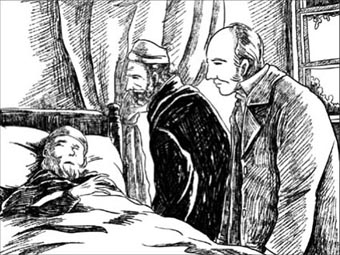
'God bless you, my dears,' said the bishop in a weak voice as he woke.
At first neither the archdeacon nor his father-in-law knew that life was gone, but after a little while Mr Harding said gently, 'I believe it's all over. Our dear bishop is no more – dear, good, excellent old man! Well, it's a great relief, archdeacon. May all our last moments be as peaceful as his!'
In his mind Dr Grantly was already travelling from the darkened room of death to the prime minister's study. He had brought himself to pray for his father's life, but now that life was over, every minute counted. However, he did not want to appear unfeeling, so he allowed Mr Harding to lead him downstairs to the sitting room. Then, when a few more moments had passed, he said, 'We should arrange for a telegraph message to be sent to the prime minister immediately.'
'Do you think it necessary?' asked Mr Harding, a little surprised. He did not know how high the archdeacon's hopes of being appointed bishop were.
'I do,' replied Dr Grantly. 'Anything might happen if we delay. Will you send it?'
'I? Oh, certainly. Only I don't know exactly what to say.'
Dr Grantly sat down and wrote out this message:
By electric telegraph, for the Prime Minister at 10 Downing Street, London. The Bishop of Barchester is dead. Message sent by Mr Septimus Harding.
'There,' he said, 'just take it to the telegraph office. Here's the money,' and he pulled a coin out of his pocket.
Mr Harding felt very much like a messenger, but he accepted the piece of paper and the coin. 'But you've put my name at the bottom, archdeacon,' he said.
Dr Grantly hesitated. How could he sign such a note himself? 'Well, yes,' he said, 'there should be the name of some clergyman, and who is more suitable than an old friend like yourself? But I beg you, my dear Mr Harding, not to lose any time.'
Mr Harding got as far as the door of the room, when he suddenly remembered the news which he had come to tell his son-in-law, and which the bishop's death had driven from his mind. 'But archdeacon,' he said, turning back, 'I forgot to tell you – the government has fallen!'
'Fallen!' repeated the archdeacon, in a voice which clearly expressed his anxiety. After a moment's thought he said, 'We had better send the message anyway. Do it at once, my dear friend – a few minutes' time is of the greatest importance.'
Mr Harding went out and sent the message. Within thirty minutes of leaving Barchester, it arrived on the prime minister's desk in London. The great man read it, then sent it on to the man who was to take his place. In this way our unfortunate friend the archdeacon lost his chance of becoming a bishop.
There was much discussion in the newspapers about who would take old Dr Grantly's place. The Jupiter, that well-regarded daily paper which is known for the accuracy of its information, was silent for a while, but at last spoke out, saying that Dr Proudie would be chosen.
And so it was. Just a month after the old bishop's death, Dr Proudie became Bishop of Barchester.

There was a home for elderly men in Barchester, called Hiram's Hospital. Previously Mr Harding had been warden of the home, and he had greatly enjoyed his duties there. But when there were accusations in the newspapers, including The Jupiter, that the large income he received could more usefully be spent on the old men themselves, he had given up the post, and become vicar of a small church in the city. Modest man that he was, his one desire was to do what was right, and to avoid any publicity.
However, his family and friends were very angry that he had been unjustly accused, and public discussion of the wardenship became so heated that the government had to take action. Consequently a law was passed, stating that the warden's income should be £450 a year, and that it was the bishop's duty to appoint the warden; Mr Harding's name was not mentioned.
Mr Harding had two daughters. The elder, Susan, was married to the archdeacon, and Mr Harding spent much of his time with his younger daughter, Eleanor. She had fallen in love with and married a young man called John Bold, but only two years after their marriage, he had become ill and died. For weeks after he was gone, the idea of future happiness in this world was hateful to the young widow; tears and sleep were her only relief. But when she realized she was pregnant, she regained her interest in life, and when her son was born, eight months after his father's death, her joy was inexpressible.
The baby, young Johnny, was all that could be desired. 'Is he not delightful?' Eleanor would say to Mr Harding, looking up from her knees in front of her child, her beautiful eyes wet with soft tears, and naturally he would agree with her.
The baby really was delightful: he took his food eagerly, waved his toes joyfully in the air whenever his legs were uncovered, and did not scream. These are supposed to be the strongest points of baby perfection, and in all these our baby was excellent.
It should not be thought that Eleanor ever forgot her dead husband; she kept his memory fresh in her heart. But yet she was happy with her baby. It was wonderful to feel that a human being existed who owed everything to her, whose needs could all be satisfied by her, whose little heart would first love her and her only, and whose childish tongue would make its first effort in calling her by the sweetest name a woman can hear. And so her feelings became calmer, and she began a mother's duties eagerly and gratefully.
John Bold had left his widow everything that he possessed, and, with an income of a thousand pounds a year, Eleanor felt comparatively rich. John's sister, Mary, came to live with Eleanor, to help take care of baby Johnny. Eleanor had hoped her father, Mr Harding, would also come to live in her house, but he refused, saying that he was quite happy in his modest rooms over a shop in Barchester High Street.
The new bishop, Dr Proudie, was a man who was well aware of his own importance. He considered he was born to move in high circles, and circumstances certainly supported his opinion so far. For some years he had lived in London, where he had been chaplain to the Queen's officers. This high connection and his own natural gifts recommended him to persons in power. Liberal ideas were beginning to take hold of the country as a whole, and as a liberal clergyman, Dr Proudie was involved in various changes in religious matters. His name began to appear in the newspapers, and he became known as a useful and rising churchman. Although he was not a man of great intelligence, and did not even have much business sense, he added a certain weight to the meetings he attended, and his presence at them was generally appreciated.
During this period, he had never doubted his own powers, but always looked forward patiently to the day when he himself would give the orders, while lesser people obeyed. Now his reward and his time had come. He was an ambitious man, and, with his fashionably open-minded views, was not prepared to bury himself at Barchester as the old bishop had done. No! London would still be his ground, for some of the year, at least. How else could he keep himself in the public eye, how else give the government, in all religious matters, the full benefit of his wise advice?
In person Dr Proudie was a good-looking man, smartly dressed, but perhaps a little below medium height. People may have thought him fortunate in becoming Bishop of Barchester, but he still had his cares. He had a large family, of whom the three eldest were grown-up daughters, and he had a wife. No one dared breathe a word against Mrs Proudie, but she did not appear to add much to her husband's happiness. The truth was that in all domestic matters she ruled over her husband. But she was not satisfied with making the decisions at home, and tried to stretch her power over all his movements, even involving herself in spiritual matters. In other words, the bishop was henpecked.
Mrs Grantly, the archdeacon's wife, in her happy home at Plumstead, knew how to give orders, but in a pleasant and lady-like way. She never brought shame to her husband; her voice was never loud or her looks sharp. Doubtless she valued power, but she understood the limits of a woman's influence.
Not so Mrs Proudie. It was this lady's habit to give the sharpest of orders to everybody, including her husband, even in public. Successful as he had been in the eyes of the world, it seemed that in the eyes of his wife he was never right. All hope of defending himself had long passed; indeed, he was aware that instant obedience produced the closest to peace which his home could ever achieve.
Mrs Proudie was in her own way a religious woman, and one of her strongest beliefs was the need to keep Sunday completely separate from the other days of the week. During the week her daughters were permitted to wear low-cut dresses and attend evening parties, always accompanied by their mother. But on Sunday they had to pay for these sins, by going to church three times and listening to lengthy evening prayers read by herself. Unfortunately for those under her roof who had no such weekday pleasures as low-cut dresses and evening parties to pay for, namely her servants and her husband, strict observance of Sunday duties included everybody.
In these religious matters Mrs Proudie allowed herself to be guided by a young clergyman, Mr Slope. So, because Dr Proudie was guided by his wife, Mr Slope had, through Mrs Proudie, gained a good deal of control over Dr Proudie's religious thinking. When Dr Proudie was appointed Bishop of Barchester, Mr Slope was happy to give up his post as vicar in a poor part of London, to become chaplain to the bishop.
Obadiah Slope and Mrs Proudie shared similar religious beliefs; their relationship was close and their conversations confidential. Mr Slope had regularly visited the Proudies' London home and knew the Misses Proudie well. It was no more than natural that his heart should discover some softer feeling than friendship for Mrs Proudie's eldest daughter, Olivia, and he made a declaration of affection to her. However, after finding how little money her father would give her on marrying, he withdrew his offer. As soon as it was known that Dr Proudie would become bishop, Mr Slope regretted his earlier caution, and began to look more kindly on Miss Proudie again. But he had lost his chance; Olivia was too proud to look at him a second time, and, besides, she had another lover showing interest in her. So Mr Slope sighed his lover's sighs without reward, and the two of them soon found it convenient to develop a hatred for each other.
It may seem strange that Mrs Proudie's friendship for the young vicar should remain firm in such circumstances, but to tell the truth, she had known nothing of his relationship with Olivia. Although very fond of him herself, she expected her daughters to make much more impressive marriages.
Mr Slope soon comforted himself with the thought that, as chaplain to the bishop, he might become richer and more powerful than if he had married the bishop's daughter. As he sat in the train, facing Dr and Mrs Proudie as they started their first journey to Barchester, he began to make a plan for his future life. He understood, correctly, that public life would suit the new bishop better than the small details of cathedral business. Therefore, he, Slope, would in effect be Bishop of Barchester. He knew he would have a hard battle to fight, because power would be equally desired by another great mind – Mrs Proudie would also choose to be Bishop of Barchester. He felt confident, however, that he would win in the end.
In appearance he was tall, with large hands and feet, but on the whole his figure was good. His face, however, was the colour of bad-quality beef, and his hair, which was long, straight, and a dull reddish colour, was kept plentifully oiled. His mouth was large, but his lips were thin and bloodless. It was not a pleasant experience to shake his hand, as there was always a cold dampness to his skin. His face usually wore a frown, as if he thought most of the world far too wicked for his care.
A man of courage and above average intelligence, he firmly believed, like Dr Proudie, in simplifying church ceremony, and like Mrs Proudie, in enforcing total respect for Sunday churchgoing. He had excellent powers of self-expression, which were appreciated more by women than by men. A frequent guest in many London homes, he had been admired by the ladies and unwillingly accepted by the men, but he had an oily, unpleasant way with him which did not seem likely to make him popular in Barchester society.
bishop n. a priest who is the head of all the churches and priests in a large area 主教
archdeacon n. a priest of a high rank who works under a bishop 执事长
pray v. to speak to God in order to ask for help or give thanks 祈祷,祷告
relief n. a feeling of comfort when something bad has ended or has not happened 宽心,轻松
telegraph n. an old-fashioned method of sending messages using radio or electrical signals 电报
10 Downing Street the headquarters of the government of Great Britain 唐宁街十号(英国政府所在地)
accusation n. a statement saying that someone is guilty of a crime or of doing something wrong 控告;指责
vicar n. a priest in charge of a church in a particular area 代牧
consequently adv. as a result 结果,因此
mention v. to talk about something or someone in a conversation, piece of writing, etc, especially without saying very much or giving details 提及,说起
inexpressible adj. a feeling that is too strong to be expressed in words 难以言传的
owe something to somebody to have something or achieve something because of what someone else has done 因某人的作为而得到某物
possess v. to have or to own something 拥有,持有
comparatively adv. as judged better or worse than something else or a previous state 相对地,比较地
chaplain n. a priest responsible for the religious needs of a club, the army, a hospital, etc (社团、军队、医院等的)特遣牧师
recommend v. to say that something or someone is good, or suggest them for a particular purpose or job 推荐,介绍
liberal adj. allowing people or organizations a lot of political or economic freedom (政治或经济上)开明的,自由的
appreciate v. to understand how good or useful someone or something is 欣赏,赏识
henpecked adj. (a man) who is always being told what to do by his wife, and is afraid to disagree with her (男人)怕老婆的,惧内的
obedience n. the state of doing what they are told to do, or what a law, rule, etc says they should do 顺从,遵从
lengthy adj. continuing for a long time, often too long 长时间的;过长的
low-cut adj. (a dress) shaped to show a woman's neck and the top of her chest(衣裙)低胸的,低领的
confidential adj. spoken or written in secret and intended to be kept secret 机密的
withdraw v. to take back an offer, request, etc so that you no longer will do what you said 收回(请求等)
caution n. the quality of being very careful to avoid danger or risks 小心,谨慎
on the whole used to say that something is generally true 总的来说,总体而言
wicked adj. behaving in a way that is morally wrong 邪恶的
1
新任主教
一八五二年七月下旬,在古老的大教堂城市巴彻斯特,有一个很重要的问题人们时刻都在问,而回答也是五花八门。这个问题就是:“谁将成为新任主教?”
多年来,稳坐主教宝座的一直是老格兰特利博士,如今他大限将至,正是国内政权即将更迭之时。执事长格兰特利是主教的儿子,最近刚刚接手了父亲的不少职责。普遍认为,现任首相会选他为新主教。对于执事长而言,这段日子很难挨。首相从未对他作出太多言语上的承诺。不过,对政府多少有些了解的人都很清楚,大人物或首相的朋友往往吹吹耳风,就能怂恿他做决定。执事长听说有人为他吹了耳风,就抱了希望。
一个月前,医生就说过老主教只能再撑一个月。可就在昨天,他们又给他检查了一遍,在惊讶之余预测他可以再活两个星期。此刻,做儿子的坐在父亲床边,盘算着自己的机会。本届政府会在五天之内垮台,这一点是肯定的;父亲的大限将在——不,他不愿去想这个。他努力去想别的,但这场权力之争甚是激烈,战利品又如此丰厚。他看了看这个垂死老人平静的脸。根据他和医生们的判断,父亲可能还会勉强撑上几个星期。老主教一天要睡二十个小时,但在清醒的时候,他还能认出自己的儿子和亲爱的老朋友哈丁先生——执事长的岳父。此刻,老主教睡得像一个婴儿。看样子,这位老人去往另一个世界的过程将会无比轻松。
但坐在一旁凝望的这个人心里一点儿也不轻松。他明白机不可失,时不再来。他已经年过半百,而下一任首相十之八九不会像现任首相这么器重他。他陷入了深深的沉默之中,哀伤地想了很久,才终于鼓起勇气问自己,是不是巴望着父亲死。
很快,问题就有了答案。这个心高气傲的人跪倒在床边,握住主教的一只手,热切地祈祷自己的罪恶能被原宥。
就在这时,门开了,哈丁先生走了进来。格兰特利博士一骨碌站起身时,哈丁先生紧紧地握住他的双手。此时此刻,两个人之间产生了从未如此深挚的情谊。
“上帝保佑你们,亲爱的。”主教醒了,用虚弱的声音说,“上帝保佑你们!”他就这样咽了气。
执事长和他岳父一开始还不知道主教已经辞世,但过了一小会儿,哈丁先生轻声说:“我想一切都已经结束了。我们亲爱的主教已经不在人世——一位亲切和蔼、品德高尚的老人家!好了,这是极大的解脱,执事长。愿我们所有人都能像他一样,走得如此平静!”
格兰特利博士的思绪已经从这个充满死亡阴影的房间神游到了首相的书房。他曾经为父亲的生命祈祷,但既然生命已逝,就该争分夺秒了。不过,他不想表现出一副没心肝的样子,于是任由哈丁先生把他领进楼下的会客厅。接下来,他又等了一会儿才说:“我们应该立刻派人去给首相发个电报。”
“你觉得有必要吗?”哈丁先生有些诧异地问。他并不知道,执事长有多么希望获得主教的职位。
“有啊。”格兰特利博士回答,“夜长梦多。要不您跑一趟?”
“我?哦,当然可以。只是我不知道究竟该怎么措辞。”
格兰特利博士坐下来,写了这么一张纸条:
发一封电报给首相,地址是伦敦唐宁街十号。内容是:巴彻斯特主教逝世。发信人:塞普蒂默斯·哈丁先生。
“好了,”他说,“把这个送到电报局就行了。给您钱。”说着,他从口袋里掏出一枚硬币。
哈丁先生觉得自己像个送信的,但还是接过了纸条和硬币。“可你在底下落的是我的名字,执事长。”他说。
格兰特利博士犹豫了。这样的电报,他怎么能签自己的名字呢?“哦,是啊,”他说,“是应该落一个神职人员的名字。可除了您这样的老朋友以外,还有更合适的人选吗?我求求您,亲爱的哈丁先生,别再浪费时间了。”
哈丁先生走到房门口,才突然想起自己来是要告诉女婿一个消息,主教的死让他一时忘了这事。“可是,执事长,”他转身说,“我刚才忘记跟你说了——本届政府已经倒台!”
“倒台!”执事长重复道,声音明显透着焦虑。片刻思索之后,他说:“咱们最好还是把消息发过去。赶紧去办吧,我亲爱的朋友——几分钟的时间也至关重要啊。”
哈丁先生出门去发电报。电报从巴彻斯特发出后不到三十分钟,就到了伦敦首相的办公桌上。这位大人物看完就把它转交给自己的继任者。就这样,执事长——我们这位不幸的朋友,失去了成为主教的机会。
关于谁将接替老格兰特利博士成为主教这个问题,报纸上议论纷纷。《朱庇特报》是一份颇受尊重的日报,以信息准确著称。在这件事情上,该报沉默了一阵才发声,认为普劳蒂博士将被选中。
的确如此。老主教过世才一个月,普劳蒂博士就成了巴彻斯特的主教。
******
巴彻斯特有一家老人院,名叫海勒姆养老院。哈丁先生曾经担任这里的院长,也非常乐于承担他应负的职责。但后来包括《朱庇特报》在内的各家报纸发起抨击,说他丰厚的薪水用在养院里的老人身上更有意义。于是他辞去这份工作,成为了市里一座小教堂的代牧。他为人谦逊,一心向善,行事低调不张扬。
然而,媒体对他的不公正指责让他的亲友十分愤慨。公众对院长一职如此热烈地议论,政府不得不有所行动。结果,政府通过了一条法令,规定院长的年薪为四百五十英镑,且该职位由主教任命。哈丁先生的名字未被提及。
哈丁先生有两个女儿。长女苏珊嫁给了执事长,哈丁先生多数时间都跟次女埃莉诺待在一起。埃莉诺曾爱上一个名叫约翰·博尔德的年轻人并嫁给了他。但结婚不过两年,博尔德就病死了。他去世后的几个星期里,这位年轻的寡妇根本不愿去想未来的幸福,泪水和睡眠是她唯一的解脱。然而,发现自己已经怀孕的时候,她重拾了对生活的热情。丈夫过世八个月之后,儿子出生,埃莉诺的喜悦之情无法言表。
婴儿小约翰尼让人无可挑剔。“他太讨人喜欢了,不是吗?”埃莉诺常常对哈丁先生说,同时把目光从膝前的孩子身上移开,抬头望着他,温情的泪水润湿她美丽的双眸。哈丁先生自然点头称是。
那孩子的确讨人喜欢:他吃东西很有胃口,腿没盖住的时候会在空中快乐地晃动脚指头,也从不大声尖叫。这些是一个完美宝宝应该具备的最重要的特质,而我们的宝贝在这些方面都很出色。
我们可不能认为埃莉诺把死去的丈夫忘得一干二净;他永远活在她的心里。只不过,孩子的陪伴让她很幸福。这个孩子一切都得仰赖她,她可以满足他所有的需求,他幼小的心灵爱上的第一个且唯一一个人就是她,他牙牙学语,头一声叫的就是她,用的是女人能听到的最动听的称呼——这种感觉非常美妙。于是,她的情感渐渐趋于平静,开始急切而满怀感激地履行做母亲的职责。
约翰·博尔德把所有财产都留给了自己的遗孀,加上一年一千英镑的收入,埃莉诺觉得经济上比较宽裕。约翰的姐姐玛丽搬来跟她同住,帮忙照顾小约翰尼。埃莉诺原本希望父亲哈丁先生也搬来一起住,但他没答应,说一个人住挺好。他住在巴彻斯特主街一家商铺楼上几间简朴的房子里。
******
新任主教普劳蒂博士自视颇高,认为自己生来就是要活跃于上流社会。到目前为止,境遇显然也证实了他的想法。他在伦敦住了一些年头,担任特遣牧师服务于女王手下的公务员。高层人脉再加上自身的天赋,使他得到了权贵的青睐。那时候自由主义正开始席卷整个国家,作为一名信奉自由主义的神职人员,普劳蒂博士参与了宗教事务的诸多变革。他的名字开始见诸报端,被称作有益社会的教坛新星。他算不上绝顶聪明,甚至没什么生意头脑,但他还是为自己出席的各种会议增添了一定的分量,而他的出席也往往受到欢迎。
在那段时间里,他从未质疑自己的权力,一直在耐心等待有那么一天——他本人可以发号施令,手下人唯命是从。如今,他终于等来回报,时机成熟。他野心勃勃,思想时髦开放,不打算像老主教那样,把自己一辈子都埋葬在巴彻斯特。不!伦敦仍然会是他的阵地,至少这一年有一段时间是如此。要不然,他怎么能够继续留在公众的视野里,又怎么能够在各种宗教事务中让政府充分听取自己的真知灼见呢?
就外表而言,普劳蒂博士是个相貌英俊、衣着光鲜的男人,只是身高可能略低于平均水平。人们也许会觉得他很走运,能当上巴彻斯特的主教,但他也有自己的烦恼。他家里人口不少,最大的三个女儿已经长大成人,他还有个妻子。没人敢说普劳蒂太太的坏话,但她似乎没给自己的丈夫增添多少快乐。事实上,家里所有的事都由她说了算。然而,她并不满足于在家里做主,还想控制丈夫的一举一动,甚至想参与宗教事务。换句话说,主教是个“妻管严”。
在普拉姆斯特德,执事长的妻子格兰特利太太家庭幸福,她知道如何用一种令人愉悦且不失淑女风范的方式来发号施令。她从不让丈夫丧失颜面,也从不大声说话,或是给人脸色看。她无疑很看重权力,却也明白女人的影响力要适可而止。
普劳蒂太太跟她不一样。这位太太习惯对所有的人呼来喝去,对自己的丈夫也不例外,哪怕是在公众场合。普劳蒂先生在世人眼里是个成功人士,然而他在妻子眼里似乎一无是处。他早已死心,不为自己做任何辩解。事实上他很清楚,只有立马就范,才能使家里尽可能地安宁。
普劳蒂太太有她自己的方式表达宗教信仰,她最坚定的信仰,就是必须把星期天跟一周当中的其他几天截然分开。平时,她允许女儿们穿低胸连衣裙参加晚会,自己也往往陪伴在侧。到了星期天,女儿们就得一天跑三趟教堂,还得听她亲自诵读冗长的夜祷,以此偿清平日里积下的罪孽。不幸的是,她家屋檐下的所有人都必须严格履行星期天的职责,尽管其中一些人,即她的仆人和丈夫,不用为穿低胸衣裙和参加晚会赎罪。
在这些宗教问题上,普劳蒂太太心甘情愿地听命于一位年轻的神职人员——斯洛普先生。这样一来,由于普劳蒂博士对妻子唯命是从,斯洛普先生就通过普劳蒂太太,有力地控制了普劳蒂博士的宗教思想。普劳蒂博士被任命为巴彻斯特主教之后,斯洛普先生高高兴兴地放弃了伦敦某个贫民区的代牧一职,当了主教的特遣牧师。
奥巴代亚·斯洛普和普劳蒂太太有相似的宗教信仰,两人关系密切,谈话推心置腹。以前在伦敦时,斯洛普先生就总是定期登门拜访普劳蒂一家,跟几位普劳蒂小姐混得很熟。自然而然,他心里对普劳蒂太太的长女奥利维娅产生了超出友谊的柔情,并且曾向她表白。然而,当他发现奥利维娅的父亲给不了几个钱的嫁妆,就收回了他的话。普劳蒂博士即将当上主教的消息一传开,斯洛普先生立刻对当初的谨慎追悔莫及,开始重新对普劳蒂小姐表示好感。可他已经没机会了。奥利维娅自尊心太强,不愿给他第二次机会,更何况眼下有另一位追求者在向她示爱。于是,斯洛普先生只得为爱情空叹一声,两人也很快发现相互怀恨非常合宜。
在这种情况下,普劳蒂太太竟然还能牢牢维系与这个年轻代牧的友情,看起来也许有点奇怪。但事实上,对于斯洛普先生和奥利维娅之间的关系,她一无所知。她对斯洛普先生很有好感,却还是希望女儿们能嫁得更好。
很快,斯洛普先生就有了聊以自慰的想法:如今他当上了主教的特遣牧师,可能会比娶主教的女儿还有钱有势。等到他跟普劳蒂博士夫妇面对面地坐在火车上,第一次前往巴彻斯特的时候,他已经开始为将来的生活打算了。他有一种合情合理的认识:相对于教堂事务的繁文缛节,公共生活更适合新任主教。这样一来,他斯洛普就成了巴彻斯特事实上的主教。他明白自己还得打一场硬仗,因为另一个有头脑的人也在觊觎权力——普劳蒂太太也想成为巴彻斯特主教。不过他信心十足,认为自己会是最后的赢家。
从外形上看,斯洛普先生个头高,手脚大,但整体来说身材不错。然而,他的脸是劣质牛肉的颜色,暗红色头发又长又直,总是擦着很多的头油。他嘴形宽阔,嘴唇却单薄无血色。跟他握手可不是一件舒服的事,因为他的皮肤总是又冷又潮。他总是眉头紧锁,似乎是觉得世上的大多数事物过于罪恶,他不屑一顾。
他有胆量和过人的智慧,像普劳蒂博士那样坚决拥护教堂礼节的简化,又像普劳蒂太太那样,坚信星期天做礼拜要无条件遵从。他很擅长自我表达,这一点女人比男人更为赞赏。在伦敦,他是不少人家中的常客,受到众女士的青睐,也让男人们被迫接受了他的存在。不过,他有一种令人讨厌的油滑做派,似乎不太可能受到巴彻斯特社交圈的欢迎。
2
Battle begins
It was known that Dr Proudie would have to appoint a warden for Hiram's Hospital, as the new law stated. No one imagined that he had any choice – no one thought for a moment that he could appoint any other man than Mr Harding. Mr Harding himself, without giving the matter much thought, considered it certain that he would return to the warden's pleasant house and garden.
Mr Harding, therefore, had no personal interest in the appointment of Dr Proudie as bishop, and was quite prepared to welcome him to Barchester. After the Proudies' arrival, he and Dr Grantly went to the bishop's palace to introduce themselves.
His lordship was at home, and the visitors were shown into the well-known room, where the good old bishop used to sit. Every piece of furniture was as familiar to them as their own, but they felt like strangers at once. They found Dr Proudie sitting in the old bishop's chair; they found Mr Slope standing where the archdeacon used to stand, but on the sofa they found Mrs Proudie – and to find a lady invading the bishop's study was shocking indeed!
There she was, however, and they could only make the best of it. They greeted his lordship, who introduced them to his lady wife. Then Mr Slope presented himself, offering a damp hand to his new enemy, Dr Grantly, who bowed, looked stiff, and wiped his hand with a pocket handkerchief. Mr Slope then descended to the level of the lower clergy, by speaking a few words to Mr Harding, before rejoining the conversation among the higher powers. There were four people in this group, each of whom considered himself or herself the most important person in Barchester; with such a difference of opinion they were not likely to get on pleasantly together.
'Dr Grantly,' said Mrs Proudie with her sweetest smile, 'you live at Plumstead, I believe, a little way out of Barchester. I do hope the distance is not too great for country visiting. I shall be glad to call on Mrs Grantly, as soon as our horses arrive here. At present they are in London, as the bishop still has meetings to attend there – I fear the government cannot do without him! But when the horses do come down, I shall take the earliest opportunity of visiting Mrs Grantly.'
Dr Grantly bowed, and said nothing. He could have bought everything the Proudies owned and returned it to them as a gift, without much feeling the loss; he had provided a pair of horses for his wife's personal use since the day of his marriage.
'Are there arrangements for Sunday schools in the villages around Barchester, Dr Grantly?' asked Mr Slope.
'Oh!' replied the archdeacon casually. 'Whether there is one or not depends on the local vicar's wife and daughters.'
Mr Slope opened his eyes very wide, but was not prepared to give up his darling project. 'I fear there is a great deal of Sunday travelling here. I see from the timetable that there are three trains in and three out every Sunday. Don't you think, Dr Grantly, that a little energy on your part might get rid of this evil?'
'If you can withdraw the passengers, then I imagine the company will withdraw the trains,' replied the archdeacon.
'But surely, Dr Grantly,' said the lady, 'surely, in our position, we should do all we can to stop such wickedness. Don't you think so, Mr Harding?' And she looked meaningfully at him.
Poor Mr Harding was not sure what he thought, and Dr Grantly, determined not to be told what he should do by a bishop's wife, turned his back on the sofa and asked the bishop if he found the palace comfortable. Dr Proudie himself seemed to have nothing to complain of, but Mr Slope gave a long list of repairs that needed to be done, and Mrs Proudie was not slow to add her voice to his. Finally and with great relief Dr Grantly and Mr Harding were able to bring their visit to an end.
'Good heavens!' cried the archdeacon furiously, once they were in the fresh air. Smoke seemed to be coming from under his hat, like an angry cloud.
'I don't think I shall ever like Mr Slope,' said Mr Harding.
'Like him!' shouted the archdeacon. 'How could any living thing like Mr Slope!'
'Nor Mrs Proudie either,' said Mr Harding.
Then the archdeacon forgot himself, and used some very shocking expressions about the lady.
'The bishop seems a quiet enough man,' suggested Mr Harding mildly.
'He's a fool!' cried Dr Grantly. 'He has no real power or intelligence! No, it's that Mr Slope whom we have to deal with. Did you ever see anyone less like a gentleman? Did you hear him telling us what to think and what to do? How dare he!'
And as the two men walked away from the palace, the archdeacon had war in his heart. He was trying to think how Mr Slope could be driven out of Barchester, before his influence over the bishop could do any lasting damage.
The new residents of the bishop's palace felt as much hatred for Dr Grantly as he did for them, and they were also aware there was a battle to be fought.
Mr Slope, however, was better prepared for the attack than the archdeacon. Dr Proudie had told the Barchester clergy that Mr Slope would give the sermon at the cathedral service the next Sunday. On this occasion the bishop took his seat in the cathedral for the first time, and the good people of Barchester crowded into the great building, eager to see their new bishop and hear his chaplain's words of spiritual guidance. All the clergy attended the service too, even the archdeacon.
The service was very well performed. The prayers were respectfully said, and the music was beautifully sung by the best voices in Barchester, carefully trained by Mr Harding himself. Mr Slope rose to speak to his audience. He was listened to with breathless attention and considerable surprise.
Cleverly giving the impression that he was speaking on behalf of the bishop, Mr Slope made it very clear what would be expected from the Barchester clergy from now on. All the habits and customs which were dear to their hearts were held up to scorn. In particular, he explained how unnecessary church music was, and how much more meaningful the words of the church service were, if spoken rather than sung!
The archdeacon and the rest of the clergy could not believe their ears. All their lives they had conducted services in the way they had considered most excellent, and now this young nobody dared to say they had been wrong! But at last Mr Slope sat down. The bishop, who had been the most surprised of them all, and whose hair almost stood on end with terror, gave the final blessing in a shaking voice, and the service was at an end.
Over the next few days there was heated discussion of Mr Slope and his sermon. Against him were the archdeacon and almost all the clergy, who were so furious they decided he should never be allowed to give a sermon in the cathedral again. Poor Mr Harding began to have doubts about the value of church music; he had always been so proud of the singing in the cathedral, but he wondered if that was another thing he would have to give up, like the wardenship of Hiram's Hospital.
On Mr Slope's side, however, were one or two clergymen who thought it sensible to congratulate the chaplain on his sermon. They included Mr Quiverful, the vicar of Puddingdale, whose wife presented him every year with a fresh proof of her love, increasing his cares and, it is to be hoped, his happiness equally. Who can wonder that a vicar with fourteen living children and only £400 a year should wish to be polite to a Mr Slope? There were also a number of Barchester citizens who thought Mr Slope might be right. For too long the clergy had gone on in their old-fashioned ways; perhaps it was time to introduce some of the religious changes which were shaking up the outside world. This group consisted mostly of ladies; no gentleman could possibly be attracted by Mr Slope.
However, Eleanor Bold and her sister-in-law Mary Bold were not to be counted among these ladies. It was natural for Mr Harding's daughter to be proud of the cathedral's musical tradition, and angry with Mr Slope for criticizing it. And in such matters the widow Bold and her sister-in-law were in perfect agreement.
But Mr Slope himself persuaded them to think better of him. To their great surprise and no little fear, he came to call on them two weeks after his sermon. The great enemy of all that was good in Barchester entered their own sitting room, and they had no strong arm at hand for their protection. The widow held her baby tightly in her arms, and Mary Bold stood up ready to die in that baby's defence, if such a sacrifice might become necessary.
This is how Mr Slope was received. But when he left, he was allowed to bless the baby, to take each lady's hand and to depart like a trusted friend. How had he turned dislike into friendship and made his peace with these ladies so quickly?
Mr Slope knew how to flatter and say a soft word in the proper place. If he had understood how to charm men as well as he charmed women, he might have risen to a high position.
The day after this visit Eleanor told her father of it, and expressed an opinion that Mr Slope was not quite as black as he had been painted. Mr Harding said little; he did not approve of the visit, but it was not his custom to speak evil of anyone. Instead he turned the conversation to the wardenship of Hiram's Hospital; he told Eleanor he expected the bishop to offer it to him, although at a reduced salary. It was annoying to have to accept the post as a gift from the bishop, especially if it came from the hands of the hated Slope, but he would certainly accept it. Eleanor was delighted at the thought of seeing her dear father happy in his old place at Hiram's Hospital again.
Three months passed, and several changes were made in Barchester. Among other things, absentee clergymen had been recalled to their duties. One of these was Dr Vesey Stanhope, who was quite a stranger in the city. Twelve years ago he had gone to Italy to cure a sore throat, and that sore throat, although it never developed into anything serious, had enabled him to live there in comfortable idleness, while he paid junior clergymen to do his work at home. But when he received an almost threatening letter from Mr Slope, Dr Stanhope realized he would have to spend the summer months, at least, in his house in Barchester, otherwise his income from the Church might be discontinued.
So he and his charming but heartless family took up residence again in Barchester. His wife was still a handsome woman, even at fifty-five. She never appeared until between three and four in the afternoon, but when she did appear, she appeared at her best. Her dress was always perfect, but she had no other purpose in life than to dress well. Her elder daughter Charlotte, at thirty-five, was a fine young woman, who had taken all the cares of running the house off her mother's shoulders. She and she alone could persuade her father to consider worldly matters. She and she alone could control the foolishness of her brother and sister. She and she alone prevented the whole family from losing their good name and falling into beggary.
Dr Stanhope's younger daughter, Madeline, was a great beauty. She had spent her youth in Italy, where she had destroyed the hearts of many young men without once losing her own, although her reputation had suffered slightly as a result of these adventures. Why she had decided to marry Paulo Neroni, a man of no birth and no fortune, a man of evil temper and oily manners, was a mystery, but perhaps when the moment came, she had no choice. Six months after her marriage, however, she arrived at her father's house in Milan, a cripple and a mother.
She had fallen, she said, and injured her knee, so that she was unable to walk normally. She had therefore made up her mind, once and for ever, that she would never attempt to move herself again. Soon people were saying that she owed her accident to her husband's violence, but she spoke little of Paulo Neroni, except to make it clear he was to be seen and heard of no more. The Stanhopes welcomed the unfortunate beauty and her small daughter into the family home.
Although forced to give up all movement in the world, Signora Neroni had no intention of giving up the world itself. She made arrangements to be carried to the theatres and parties she wished to attend. There, lying on a sofa, she would soon draw every interesting young man to her side by the power of her beauty. Her admirers were too blindly in love to see the cruelty, sharp intelligence and desire for power in her lovely eyes.
Her brother, Bertie, had received an excellent education, but was too idle to take up a profession. He was extremely handsome, with a long silky beard and clear blue eyes, and was continually declaring his love to ladies who pleased him, but, like Madeline, he appeared to have no heart to lose himself.
The Stanhopes made their first public appearance at the Proudies' evening reception. This was an impressive event organized by Mr Slope, who invited all the gentlemen and ladies of Barchester and the surrounding villages. Hundreds of guests were expected at the party, and costly preparations were made, in spite of Mrs Proudie's frequent objections to the expense.
On the evening in question, Mrs Proudie welcomed her guests to the palace's fine rooms, and Mr Slope rushed here and there, giving orders to the servants. The bishop kept tripping over a sofa that had been placed near the top of the stairs. One of his daughters told him it was for a lady with no legs, and he was dying of curiosity to see this strange lady.
Soon Madeline's carriage arrived, and she was carried upstairs to the sofa. There she took up her position, lying on a red silk sheet and wearing a close-fitting white dress, with diamond bracelets on her beautiful arms. She was immediately the centre of attention, as she had intended to be.
Bertie Stanhope, who was talking to the bishop, had the idea of moving Madeline's sofa slightly, to give everyone a little more room – he gave it a push and it rushed halfway across the room. Mrs Proudie was standing with Mr Slope in front of Madeline, trying to be sociable, but she was not in the best of tempers; she found that whenever she spoke to the signora, that lady replied by speaking to Mr Slope. Mrs Proudie was just beginning to feel offended, when one of the sofa legs caught itself in her dress and carried part of the skirt away with an unpleasant tearing sound.
Such destruction to a dress would cause passionate anger in any lady, and Mrs Proudie's expression, as she looked at Bertie Stanhope, was hardly human. Bertie, when he saw what he had done, threw himself on one knee before the lady.
'Forgive me, madam, forgive me!' he cried wildly, trying to separate Mrs Proudie's dress from the sofa leg.
'Unhand it, sir!' said Mrs Proudie scornfully.
'It's not me, it's the sofa,' said Bertie, still on his knees.
'Unhand it, sir!' Mrs Proudie almost screamed.
Just then the signora laughed, just loud enough to be heard. Mrs Proudie turned furiously upon her.
'Madam!' she said, her eyes flashing fire.
Madeline stared her full in the face for a moment, and then said to her brother, 'Bertie, you fool, get up.'
By now Mrs Proudie's daughters had arrived, and very soon they accompanied her out of the room to repair the damage to the dress. Meanwhile, Madeline took the opportunity to fascinate and charm Mr Slope. And when Mrs Proudie returned to the reception, she saw him carrying a selection of the most delicate dishes towards the signora's sofa.
'You are not leaving our guests, Mr Slope,' she said.
'Signora Neroni needs her supper, madam,' answered Mr Slope with a bow and a false smile.
'Let her brother take it to her, Mr Slope,' replied Mrs Proudie. Her anger increased when she realized a few minutes later that he had disobeyed her order. 'Such manners I never saw,' she said furiously to herself. 'I cannot and will not permit it.' And she pushed her way through the crowd, following Mr Slope.
When she reached the sofa, she found the guilty pair alone together. The signora was sitting very comfortably, eating her supper, while Mr Slope was leaning over her, making sure she had everything she wanted. Mrs Proudie walked stiffly up to them, stared at them for a moment, and said, 'Mr Slope, his lordship desires your presence in the dining room; you will join him there, if you please.' She moved away like a ship in full sail.
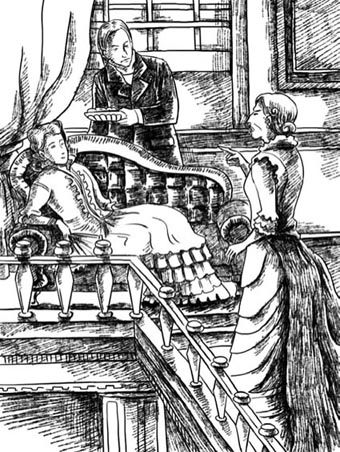
'Mr Slope, his lordship desires your presence in the dining room; you will join him there, if you please.'
Mr Slope knew the bishop had not asked for him, but he prepared to leave the room, all the same.
'Is she always like this?' the signora asked him.
'Yes, always the same, madam,' said Mrs Proudie, returning. 'Always equally against improper behaviour of any description,' and she marched back through the room again.
The signora could not follow her, but she laughed a long scornful laugh, sending the sound of it ringing after Mrs Proudie. She could not have thought of a better revenge.
Mrs Proudie could not fight back, because she had her guests to attend to. The reception was coming to an end, and the bishop's wife forced a smile as people said their goodbyes, but she was too angry to make it look convincing. And as Madeline Stanhope was carried out by her servants, Mrs Proudie watched her departing figure as if to say, 'If ever you find yourself within these walls again, I'll teach you a lesson you will never forget.'
furniture n. large movable objects like chairs, tables and beds that you use in a room 家具
familiar adj. easy to recognize because you have seen or heard them many times before 熟悉的
stiff adj. unfriendly or very formal, so that people feel uncomfortable 不友好的,生硬的
call on to visit for a short time 短暂拜访
Sunday school a place where children are taught about Christianity on Sundays 主日学校(星期日对儿童进行基督教教育的场所)
furiously adv. extremely angrily 狂怒地,暴怒地
mildly adv. in a gentle way without being angry or using strong words 温和地,婉转地
sermon n. a talk given as part of a church service, usually on a religious or moral subject 布道,讲道
scorn n. the feeling that someone or something is stupid or does not deserve respect 鄙视,蔑视
sensible adj. reasonable, practical and able to judge things well 明智的,理智的
sacrifice n. something valuable that you decide not to have, in order to get something else that is more important 牺牲
proper adj. right, suitable, or correct 正确的;合适的,适当的
reputation n. the opinion that people have about a particular person or thing because of what has happened in the past 名誉,名望
cripple n. someone who is physically unable to use arms or legs properly (手臂或腿脚)伤残者
intention n. a plan or desire to do something 意图,打算
signora n. a title used to address an Italian-speaking woman, especially a married one (对讲意大利语的已婚女士的称呼)太太,夫人
profession n. a job that needs a high level of education and training 职业,行业
reception n. a large formal party to celebrate an event or to welcome someone 招待会;欢迎会
passionate adj. showing or involving very strong feelings 强烈的,充满激情的
fascinate v. to attract and hold attention by a unique power 迷住,吸引
march v. to walk somewhere quickly and with determination, often because you are angry (因生气而毅然地)快步走
attend to to deal with business or personal matters 处理,料理
2
战争打响
众所周知,根据新颁布的法令,普劳蒂博士需要为海勒姆养老院指派一位院长。人人都觉得他别无选择,没人认为除了哈丁先生,他还有别的人选。哈丁先生自己也并未多虑,确信自己会重返养老院怡人的住宅和花园。
因此,对于普劳蒂博士获任主教一事,哈丁先生个人并不关心,也做好了充分的准备,欢迎他来巴彻斯特。普劳蒂一家到了之后,他和格兰特利博士便到主教的宅邸自我引见。
主教大人在家,仆人把两位客人领进一间房——善良的老主教常常在那儿安坐,现在已成名室。他们原是主人,对屋里的每一件家具都了如指掌,这一瞬间却感觉十分陌生。他们看见普劳蒂博士坐在老主教的椅子上,斯洛普先生站在执事长以前站的地方,沙发上还坐着普劳蒂太太——一位女士擅闯主教的书房,真是令人震惊!
但既然她已经在那儿,他们也只能尽力周旋。他们问候主教大人,主教向他们介绍自己的太太。接着,斯洛普先生自报家门,向他的新敌人格兰特利博士伸出一只潮乎乎的手。格兰特利博士不自然地鞠了一躬,用手帕擦了擦手。然后,斯洛普先生纡尊降贵,以低等神职人员的身份,跟哈丁先生说了几句话,才重新加入上层人物的谈话。上层人物共有四位,不论男女,每一位都认为自己是巴彻斯特最重要的人物。由于此种分歧,他们要想愉快相处恐怕不太可能。
“格兰特利博士,”普劳蒂太太说,脸上挂着她最甜美的笑容,“据我所知,您住在普拉姆斯特德,离巴彻斯特还有一段路。但愿这段距离不是太远,还适合乡间拜访。等我们的马一到,我很乐意去拜望一下格兰特利太太。现在,马都还在伦敦呢,因为主教还得在那边开会——要我看,政府离了他可不成!不过,等马到了,我会第一时间去看望格兰特利太太的。”
格兰特利博士鞠了一躬,一言不发。他完全有本事买下普劳蒂夫妇的全部家当,然后再回赠给他们,也不会觉得有多心疼。自从结婚那天起,他就买了两匹马给妻子,供她一人使唤。
“巴彻斯特周边的村子里有没有成立主日学校的安排,格兰特利博士?”斯洛普先生问。
“哦!”执事长漫不经心地回答,“有没有得看当地代牧的女眷。”
斯洛普先生瞪大了双眼,但不打算就此放弃自己的大计。“我只是担心,这儿的人星期天总是来来回回到处跑。我看了时刻表,每个星期天都有三列火车出入巴彻斯特。格兰特利博士,您难道不觉得,您稍微花一点儿力气就有可能除掉这种罪恶吗?”
“如果您拦得住旅客的话,那我觉得铁路公司会取消火车班次。”执事长回答。
“但是不消说,格兰特利博士,”普劳蒂太太说,“不消说,处在我们这个位置上,我们应该尽全力阻止这样的罪恶。您难道不这么认为吗,哈丁先生?”说到这里,她意味深长地看着哈丁先生。
可怜的哈丁先生不知所措,格兰特利博士则打定主意不听主教太太的差遣,于是转身背对沙发,问主教觉得住所是否舒适。普劳蒂博士本人似乎没什么可抱怨的,斯洛普先生倒是列出了一长串需要修缮的地方,普劳蒂太太也不失时机地在一旁插话。最后,格兰特利博士和哈丁先生终于结束了这次造访,总算是松了一口气。
“天哪!”刚一呼吸到新鲜空气,执事长就怒气冲冲地嚷道。他帽子底下似乎在冒烟,有如一朵愤怒的云。
“我想我永远都不会喜欢斯洛普先生。”哈丁先生说。
“喜欢他!”执事长喊道,“世间哪个活物都不会喜欢斯洛普先生!”
“也不会喜欢普劳蒂太太。”哈丁先生说。
执事长愤怒忘形,就这位女士发表了一些令人咋舌的言辞。
“主教似乎寡言少语。”哈丁先生委婉地说。
“他就是个蠢货!”格兰特利博士喊道,“既没有实权也没有脑子!没错,我们要对付的是那个斯洛普先生。您见过比他还没有绅士风度的人吗?您刚才听见了吗,他还教我们怎么想、怎么做呢!竟敢如此放肆!”
两人离开主教宅邸时,执事长心中腾起了开战的欲望。他开始盘算如何尽早把斯洛普先生逐出巴彻斯特,以免这家伙利用自己对主教的影响力造成永久性的破坏。
同样,主教宅邸的新住户同样厌恶格兰特利博士,也已经意识到战争在即。
对于这场战争,斯洛普先生的准备倒是比执事长充分。此前,普劳蒂博士已经通知巴彻斯特的神职人员,下个星期天的教堂礼拜将由斯洛普先生布道。到了那一天,主教第一次在大教堂里坐上了自己的宝座,巴彻斯特的善男信女也纷纷涌进了这座宏伟的建筑,迫不及待地想看看新任主教,听听他那个特遣牧师的精神指引。全体神职人员都出席了这场仪式,连执事长也不例外。
礼拜仪式进行得非常不错。祷告诵读得十分庄重,曲子也唱得曼妙悦耳,歌者们拥有巴彻斯特最好的嗓子,全都经过哈丁先生本人的悉心栽培。这之后,斯洛普先生站起来,开始向教众讲话。众人凝神屏息,脸上露出十分惊讶的表情。
斯洛普先生通过巧妙的方式让教众觉得,他是在代表主教发言,还明确指出,巴彻斯特的神职人员今后该如何如何。他们原本珍视的种种习俗,全部都遭到了嘲笑。他还特地说明,教堂音乐是如何没有必要,教堂礼拜的语言又是多么富含深意,只要这样的语言是用来布道而不是歌唱!
执事长和其他神职人员简直不敢相信自己的耳朵。他们这一辈子都在以自认为最合乎理想的方式做礼拜,眼前这个无名毛头小子真是大胆,居然敢说他们一直以来的做法是错的!不过,斯洛普先生最终还是坐了下来。所有人之中,主教最为惊恐,几乎是毛发直立。他声音颤抖着念完最后一段祝祷,礼拜仪式就此结束。
接下来几天,人们就斯洛普先生和他的布道展开了激烈的争论。反方包括执事长和几乎所有神职人员,他们怒火冲天,决定再也不允许他在大教堂里布道。可怜的哈丁先生则开始质疑教堂音乐的价值。一直以来,大教堂里的歌声都让他引以为豪,如今他却觉得,这又是他不得不放弃的,就像当初放弃海勒姆养老院院长职位一样。
不过,也有那么一两名神职人员站在了斯洛普先生那边,他们认为明智的做法是祝贺特遣牧师很好地完成了布道,这当中包括帕丁戴尔的代牧奎沃夫先生。他的妻子每年都向他呈献一个爱的结晶,增添了他的烦恼,但愿也能让他更快乐。这位代牧要抚养十四名子女,年薪却只有区区四百英镑,他想向斯洛普先生这样的人示好,又有谁会觉得奇怪呢?此外,有一些巴彻斯特的居民也觉得,斯洛普先生也许说得对。长久以来,这里的神职人员因循守旧,而宗教改革正在颠覆外面的世界,说不定,引入此类变革的时候已经到了。有这样想法的居民大多是女士,绅士是不可能对斯洛普先生感兴趣的。
然而,埃莉诺·博尔德和她的大姑子玛丽·博尔德并不那么认为。身为哈丁先生的女儿,埃莉诺自然会以教堂的音乐传统为荣,为斯洛普先生的抨击感到愤怒。而在这样的事情上,寡妇博尔德和她的大姑子意见绝对一致。
不过,斯洛普先生说服她们改善了对自己的印象。那次布道的两个星期之后,他来拜访她们,让她们大为惊恐。巴彻斯特一切美好事物的死敌走进了她们的会客厅,她们身边却没有保护她们的强壮臂膀。寡妇把她的婴儿紧紧抱在怀里,玛丽·博尔德则站起身来,准备在必要时牺牲自己拼死保护孩子。
这就是斯洛普先生上门时受到的礼遇。然而,等到出门的时候,他竟然获准为婴儿祈福,还握了握两位女士的手,告别时宛如一位值得信任的朋友。这么短的时间,他是如何化干戈为玉帛,跟两位女士言归于好的呢?
斯洛普先生懂得如何恰到好处地曲意奉承,说几句温言软语。他要是知道如何像获得女人芳心那样去迷住男人,也许早已经升官进爵。
他来访后的第二天,埃莉诺就把这件事告诉了父亲,并且表示,自己并不觉得斯洛普先生像大家说的那么不堪。哈丁先生没说什么。他不满斯洛普先生踏入他家,但也不习惯说人长短。于是,他岔开话题,说起了海勒姆养老院院长一职。他对埃莉诺说,希望主教能让他担任这个职务,工资比以前少也无所谓。像接受馈赠一样从主教手里得到这个职位的确叫人生气,更何况,可能会由可恶的斯洛普授予他这一职位。但他肯定还是会接受。想到自己可以看到亲爱的父亲重返海勒姆养老院,在老地方开开心心地生活,埃莉诺很高兴。
******
三个月过去了,巴彻斯特发生了一些变化。其中一个变化就是,那些在外的神职人员被重新召回了岗位。维西·斯坦诺普博士就在此列,城中认识他的人寥寥无几。十二年前,他前往意大利治疗喉咙痛的毛病,尽管这个毛病并没有恶化,他却借此在那里过上了悠闲自在的日子,自己在家乡的工作则是花钱雇了一些年轻的神职人员替他做。但当斯坦诺普博士收到一封来自斯洛普先生的信,几乎是威胁他回去时,他意识到自己不得不回巴彻斯特的老家,至少要在那里过完夏天这几个月,否则教堂支付的薪水有可能就此中断。
于是,他和他那些魅力十足却不近人情的家人一起,又住回了巴彻斯特。他的妻子已经五十五岁,却依然健康美丽。不到下午三点到四点之间,她是绝对不会露面的。不过,只要一露面,她总会以最佳状态示人。她向来穿得无可挑剔,可是除了穿着考究,她对生活别无追求。她的长女夏洛特三十五岁,是个不错的年轻姑娘,已经从母亲那里接过了操持家务的担子。只有她能够说服父亲考虑世间俗事,只有她能够管住弟弟妹妹的愚蠢行为,也只有她能够保住全家人的名声,以免他们沦为乞丐。
斯坦诺普博士的次女马德琳是个大美人。她年轻时在意大利生活,让很多小伙子肝肠寸断,自己却不曾伤过心,尽管这些经历最终让她的名声多少有些受损。马德琳当初嫁的是保罗·内罗尼,这个人出身卑微,不名一文,脾气暴躁,油头滑脑。马德琳为什么嫁给他真让人猜不透。不过,这很有可能是因为当时她别无选择。然而,结婚不过六个月,她就回到了父亲在米兰的家,成了个跛子,还做了母亲。
她说自己摔了一跤,伤了膝盖,所以没法正常走路。因此她下定了决心,从此再也不下地走动。很快,人们就风传她这次意外是丈夫施暴所致,但她绝口不提保罗·内罗尼,除了向人表明,自己再也不想看见他,再也不想听到他的消息。斯坦诺普一家把这位不幸的美人和她年幼的女儿迎进了家门。
尽管被迫全盘放弃在世间走动,内罗尼太太却无意与世隔绝。但凡想去的剧院和晚会,她都会安排人带她去。到了那些地方,她躺在沙发上,很快就能靠美貌把自己感兴趣的年轻小伙全都吸引到身边来。倾慕她的人都被爱情蒙蔽了眼睛,看不到那双动人的眼睛里隐藏着的残忍和精明,还有对权力的渴求。
她的弟弟伯蒂接受过一流的教育,但因为太懒散而不去工作。他相貌十分英俊,蓄着光滑的长须,一双蓝眼睛清澈明亮,总是不停地向那些看上眼的女士表达爱意。不过,跟马德琳一样,他似乎也没心没肺,不会受伤。
******
在普劳蒂夫妇举办的招待晚宴上,斯坦诺普一家首次公开亮相。这场盛大的宴会由斯洛普先生操办,他邀请了巴彻斯特和周边村落的所有绅士淑女。宴会预计有好几百人出席,尽管普劳蒂太太几次三番反对庞大的开销,所费不赀的筹备工作照常进行。
宴会当晚,普劳蒂太太把客人迎进了宅邸里一个个精美的房间,斯洛普先生则东跑西颠地给仆人们下达各种指令。靠近楼梯顶部放了一张沙发,主教在那儿绊倒了好几次。他的一个女儿告诉他,那是给一位断了腿的女士准备的。他十分好奇,想亲眼见见这位古怪的女士。
没过多久,马德琳的马车就到了,她被人抬到了楼梯顶部的沙发上。她身穿一条紧身白裙,漂亮的胳膊上戴着钻石手链,躺在一块红色绸布上,摆好姿势。不一会儿,她便如愿以偿成为了众人关注的焦点。
伯蒂·斯坦诺普正在跟主教说话,想把马德琳的沙发稍微挪动一下,好给每个人多点走动的空间。于是他推了一把,沙发一下子冲向了房子中间。普劳蒂太太正跟斯洛普先生一起站在马德琳面前,努力想表现出擅长交际的样子,可她当时心情欠佳。她发现自己无论什么时候跟这位太太说话,对方的反应都是转而跟斯洛普先生说话。普劳蒂太太的火气刚上来,一条沙发腿就绞进了她的裙子。伴随着一阵难听的撕裂声,普劳蒂太太裙子下摆的一角给扯下来了。
裙子被毁成这样,任何一位女士都会大发雷霆。普劳蒂太太瞪着伯蒂·斯坦诺普,脸上简直是非人的狰狞表情。看到自己闯下的祸,伯蒂立刻单膝跪在了普劳蒂太太面前。
“请原谅我,太太,请原谅我!”他一边发疯似地喊,一边试着把普劳蒂太太的裙子从沙发腿上解下来。
“把手拿开,先生!”普劳蒂太太轻蔑地说。
“不怪我,都怪那张沙发。”伯蒂说,依旧跪在地上。
“把手拿开,先生!”普劳蒂太太几乎是在尖叫了。
就在这时,内罗尼太太笑了起来,声音不大不小,刚够让人听见。普劳蒂太太怒冲冲地转向她。
“太太!”她说,眼中燃着怒火。
马德琳直视着普劳蒂太太,过了一会儿才对弟弟说:“伯蒂,你这个傻瓜,站起来吧。”
普劳蒂太太的女儿们已经赶了过来,赶紧陪母亲走出房间,缝补裙子去了。趁此机会,马德琳大展魅力,要迷住斯洛普先生。普劳蒂太太回来的时候,看见斯洛普挑了一些最为精致的菜品,正端着朝内罗尼太太的沙发走去。
“你可不能扔下咱们的客人不管,斯洛普先生。”她说。
“内罗尼太太得吃晚饭了,太太。”斯洛普先生鞠了一躬,脸上挂着假惺惺的笑容。
“让她弟弟给她拿,斯洛普先生。”普劳蒂太太回答。几分钟后,她发现他违背了自己的指令,不由得火冒三丈。“这样子的礼数我还没见过呢。”她忿忿地自言自语道,“我忍不了,也不会忍。”于是她从人群里挤开一条道,跟着斯洛普先生走了过去。
走到沙发跟前的时候,她发现那两个罪人单独待在一起。内罗尼太太舒舒服服地坐在那儿吃晚餐,斯洛普先生则斜倚在一旁,确保她的一切要求都能得到满足。普劳蒂太太身体绷直着,朝他们走去,盯着他们看了一会儿,然后才说:“斯洛普先生,主教大人想让你去一下餐厅。麻烦你去那儿找他吧。”说完之后,她像张满风帆的船一样飞快地走开了。
斯洛普先生知道主教并没有找他,但还是打算离开这个房间。
“她一向都是这副德性吗?”内罗尼太太问斯洛普先生。
“是的,一贯如此,太太。”普劳蒂太太又走回来说了这么一句,“任何不得体的行为,我全都一样反对。”说完再次快步穿过了房间。
内罗尼太太没法跟过去,却发出了一长串轻蔑的笑声,在普劳蒂太太身后余音不绝。在她看来,这是最好的报复方法。
普劳蒂太太没法还击,因为她还得招呼客人。招待会即将结束的时候,主教太太对着纷纷告辞的人们强颜欢笑,熊熊怒火却让她的笑容显得有些虚伪。仆人们把马德琳抬出门的时候,普劳蒂太太注视着她离去的身影,仿佛是在说:“你要是再敢踏进我家大门一步,我就好好教训你一顿,让你永生永世都忘不了。”
3
A rich widow
Two days later Mr Harding was called to the palace to discuss the wardenship of Hiram's Hospital with Mr Slope. The chaplain kept the old man waiting for half an hour, and when he did arrive, he behaved just as if he were an important man of business and Mr Harding a young man applying for a job.
'Now, concerning this post of warden,' he began, 'of course you know the income would be very much reduced. In addition, you would be expected to have the house painted inside every seven years and outside every three years. And the duties – well, I believe, if I am correctly informed, there were hardly any duties to speak of in the past.' He gave a scornful laugh. 'Things are a great deal changed, not only in Barchester, Mr Harding, but also in the wider world. Work is now required from every man who receives wages, and new men are needed in the Church, as in other professions. For example, the bishop is anxious to have a Sunday school attached to the Hospital, for the children of the poor, and the teachers would be under your control and care.'
Mr Harding was now getting very angry, which was what Mr Slope wanted. 'And if I disagree with his lordship's views?' the old man asked, as calmly as he could.
'I hope you do not, but if you do, I assume you would feel unable to accept the post.' Mr Slope intended Mr Harding to refuse the appointment, which would then be vacant for a person of his own choosing.
'I shall consult my friends, but you may tell the bishop, Mr Slope, that I shall not accept the wardenship if I find the conditions that you mention are attached to it,' and Mr Harding left the room.
Mr Slope was delighted. He considered he could take Mr Harding's last speech as an absolute refusal of the appointment, and that is what he told the bishop and Mrs Proudie.
The bishop was sorry to hear it, but Mrs Proudie said firmly, 'There is no cause for sorrow. Mr Quiverful is more in need of it, and, as warden, will be much more useful to us.'
'I suppose I had better see Quiverful?' said the chaplain.
'I suppose you had,' said the bishop.
Meanwhile poor Mr Harding was feeling very miserable. He had lost the wardenship a second time, and been insulted by a man young enough to be his son, but that he could put up with. What really made him unhappy was the thought that he belonged to the past, that his efforts were no longer needed or appreciated, that everything he had done might be worthless.
He went first to Eleanor's house, to tell her his troubles, but found that Mr Slope had visited her the day before. The chaplain had made a very different speech to her from the one he had made to her father, full of flattery and heartfelt hopes that Mr Harding would take the wardenship. So she was surprised and disappointed to see her father looking so unhappy, and could not really sympathize with or understand his dislike of Mr Slope.
Mr Harding's next move was to discuss the matter with the archdeacon, so he drove to Plumstead in a hired carriage. Dr Grantly was out, so, while waiting for him, Mr Harding took the opportunity to discuss recent events with his daughter Susan.
'How can Eleanor bear that Mr Slope?' she asked.
'He's a very clever man,' said her father. 'He has made her think he is a good and honest clergyman.'
'Good and honest indeed!' said Susan scornfully. 'I only hope he won't be clever enough to make her forget her position.'
'Good heavens! Do you mean marry him?'
'What is so improbable about it? Of course that would be his plan if he thought he had any chance of success. Eleanor has a thousand pounds a year of her own.'
'But you can't think she likes him, Susan?'
'Why not? She has no one to look after her.'
'But don't we look after her?'
'Oh father, how innocent you are! It is to be expected that she will marry again, but she should wait the proper time, and then at least marry a gentleman.'
Now Mr Harding had something else to worry about. To have as a son-in-law, the husband of his favourite child, the only man in the world whom he really disliked, would be a misfortune he felt he could not bear. In fact, if the truth were known, Eleanor had no more idea of marrying Mr Slope than of marrying the bishop. But it was true she had forgiven him his sermon, his pride, and even his shiny face and oily manners, so in time might she not accept him as an admirer? Strangely enough, Mr Slope was innocent of the crime he was being accused of. This man whose eyes were generally so wide open to everything around him had not yet discovered that the young widow was rich as well as beautiful. It was an error which he was soon to correct.
Dr Grantly did not arrive until dinnertime. He was in an excellent mood and explained why, as they sat down to eat.
'It's all agreed,' he said, rubbing his hands joyfully. 'Arabin has accepted! If anyone can get rid of Slope, Arabin can.'
Francis Arabin was an old Oxford friend of Dr Grantly's, a clergyman of the highest reputation, and also a gentleman. He and Mr Slope had been carrying on a long battle on spiritual matters in the letters pages of The Jupiter for some months now, and Dr Grantly thought his friend's intelligence and deep religious knowledge would be extremely useful in the fight against the Proudies. Mr Arabin had therefore been offered, and had accepted, the post of vicar of a small church near Plumstead. Dr Grantly was delighted that Arabin would be so near at hand, for advice and support, and amused that Mr Slope would come face to face with his spiritual enemy very soon.
At the end of the meal Mr Harding finally managed to speak of what was worrying him. The archdeacon's response was firm.
'The bishop has no power to appoint a new man as warden, or indeed to make the warden a Sunday school teacher! All of Barchester expects you to return to Hiram's Hospital, and that's what you will do. I tell you what, my friend, I shall see the bishop when he has neither his wife nor his chaplain beside him, and I think you'll find the matter will end with you becoming warden without any conditions whatever. Leave it to me.'
And so the matter was arranged between them. Dr Grantly's good humour continued till bedtime, when, in the privacy of their room, Mrs Grantly gave him her opinion of what Eleanor might do. His face looked stern, and he said, 'If she does, I'll never speak to her again. I won't be connected to such dirt as that,' and he gave a shudder which shook the whole room.
Mr Slope lost no time in visiting Mr Quiverful to ask if he would like to be warden of the Hospital. Mr Quiverful, in giving his enthusiastic reply, happened to mention that Mr Harding might not need the post because his daughter Eleanor had an income of a thousand a year. This unexpected information caused Mr Slope to cut short his visit, and he rode home, thinking hard. Why should he not marry the widow, and make the thousand pounds a year his own? And then it struck him that perhaps it would be easier to gain her approval, if he did all in his power to help her father become warden, instead of Quiverful.
He was confident he could manage this, although it would involve a complete change of direction, but he knew he must step cautiously. If he quarrelled with the Proudies and was then refused by the widow, he would have lost all his influence and power. He also remembered that Mrs Bold's brother-in-law was his enemy, the archdeacon, and swore he would never bow the knee to that man, not even for a thousand pounds a year.
Another circumstance influenced him. The vision of the signora was continually before his eyes. It would be too much to say Mr Slope was lost in love, but yet he thought he had never seen so beautiful a woman. He had never been so tempted before, and now it was difficult to resist the temptation – it was hard to consider any plan which would require him to give up his special friendship with this lady.
He decided he urgently needed to find out the truth about Mrs Bold's fortune, so he started making enquiries at once. He was not a man who ever let much grass grow under his feet.
About the time that Mr Slope was visiting Mr Quiverful, a discussion took place at Dr Stanhope's house between Charlotte and Bertie about his unwillingness to earn any kind of income. Finally Charlotte said, in her sensible way, 'Well, Bertie, if you won't work, will you marry a wife with money?'
'I won't marry one without any,' he replied. 'But wives with money aren't easy to find nowadays – the vicars pick them all up.'
'And a vicar will pick up Mrs Bold too, if you don't hurry.'
'Whew!' whistled Bertie. 'A widow! With a son!'
'A baby that will very likely die. The lady is very beautiful, and she has a thousand pounds a year.'
'Well, no one can call me unreasonable, and if you'll arrange it all for me, I'll marry the widow.'
Charlotte was just explaining to him that he must court the lady himself, and was praising her beauty, when Madeline was carried into the room by her servants.
'Madeline, I'm going to be married,' Bertie began as soon as the servants had left.
'There's no other foolish thing left that you haven't done,' said Madeline, 'so you are quite right to try that.'
'Well, that's Charlotte's advice to me. But your opinion ought to be the best; you have experience to guide you.'
'Yes, I have,' said Madeline in a hard voice. But she looked very sad, and Bertie was sorry that his words had hurt her.
'Charlotte wants me to marry Mrs Bold,' he said. 'She has a thousand a year and a fine baby son.'
'If it's true she has a thousand a year and has ladylike manners, I advise you to marry her,' said Madeline. 'Even you aren't fool enough to marry for love. Marriage is a poor bargain for husband or wife. A man should not sacrifice his freedom unless he gets something in return, but a woman generally has no choice – she has no other way of living.'
'But Bertie has no other way of living!' said Charlotte.
'Then for heaven's sake let him marry Mrs Bold,' said Madeline, and so it was decided.
Mr Slope's enquiries about the widow's income had determined him to try his hand at courting her. He had therefore attempted to persuade the bishop that the post of warden should be offered to Mr Harding, but matters were more complicated than he had imagined. Mrs Proudie, anxious for her power to be as visible as possible, had already made it clear to Mrs Quiverful that her husband would be appointed warden.
'Ah, my lord,' said Mr Slope, half laughing, 'we shall all be in trouble if the ladies interfere. I only speak, my lord, in your own best interests. As far as personal feelings go, Mrs Proudie is the best friend I have. But still, in my present position, my first duty is to your lordship.' He smiled his most flattering smile.
'I am quite sure of that, Mr Slope,' said the bishop gratefully. 'Do you really think Mr Harding should be the warden?'
'I do, my lord. What has passed between Mrs Proudie and Mrs Quiverful may be a little inconvenient, but I really do not think that should count in a matter of so much importance.'
He left the poor bishop dreadfully undecided, but on the whole almost determined to oppose Mrs Proudie's wishes, which was exactly what Mr Slope was hoping for.
The chaplain then went on to call on Eleanor Bold, who was playing with baby Johnny in her sitting room. When Mr Slope was announced, Eleanor quickly pushed back her long dark hair, which the baby had pulled down from her widow's cap. Mr Slope stopped for a moment in the doorway, realizing at once how lovely she was, and thinking that, even if she had no fortune at all, she would bring comfort and joy to any man's home.
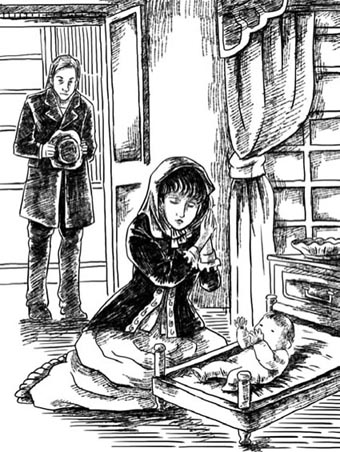
When Mr Slope was announced, Eleanor quickly pushed back her long dark hair, which the baby had pulled down from her widow's cap.
He sat down close to Eleanor and said confidentially, 'May I ask you a simple question, Mrs Bold?'
'Certainly,' she smiled, 'and I shall give you an honest answer.'
'My question is this: is your father really anxious to go back to Hiram's Hospital as warden?'
'Why do you ask me? Why not ask him yourself?'
'My dear Mrs Bold, there are wheels within wheels, which I fear I have little time to explain to you. No one respects your father more than I do, but I doubt if he respects me.' (He certainly did not.) 'I am afraid there is a feeling in Barchester, I will not call it a prejudice, which runs against me, and your father shares this feeling. Can you deny it?'
Eleanor made no answer, and Mr Slope, in the eagerness of his speech, moved his chair a little nearer to hers. 'That is why I cannot ask him this question as I can ask it of you. But you, my dear Mrs Bold, since I came to Barchester, you have allowed me to regard you as a friend.' Eleanor moved her head slightly; it looked more like a shake than a nod, but Mr Slope took no notice of it. 'To you I can speak openly, and express the feelings of my heart. When I spoke to your father about the post of warden, he gave me the impression he would refuse it, and so the bishop, perhaps mistakenly, has offered it to Mr Quiverful.'
'Then, Mr Slope, there is an end of it!' and tears came to Eleanor's lovely eyes and rolled down her face.
Mr Slope would have given much to be allowed to dry those tears, but he knew his moment had not yet come. Instead he promised to do all he could to persuade the bishop to change his mind, his stated purpose being to protect the interests of Mr Harding, whom he so sincerely admired, and to bring greater happiness to Mrs Bold, whom he dared to call his friend. It was indeed a clever and convincing performance.
At the bishop's palace, revolution was stirring. Since his recent conversation with Mr Slope, the bishop knew it was time to be firm with his wife. If he could only defeat her once, he would be a man indeed! So with great daring he went to her private sitting room to speak to her. He found her at her desk, adding up the bills and frowning over all the expense of a bishop's family.
'Excuse me, my dear,' he began. 'If you are free, I wish to speak to you.' Mrs Proudie looked sourly up at him, and his courage failed him. 'But I see you are busy – another time –'
'What is it, bishop?' asked the lady reluctantly.
'It is about the Quiverfuls, my dear. But as you are busy –'
'What about the Quiverfuls? It is perfectly understood that they are to have the hospital. There is no doubt, is there?'
This was the moment when the bishop needed to show his bravery, in order to win the battle. He said, very gently, 'Well, my dear, I just wanted to mention that Mr Slope seems to think Mr Harding should have the post.'
'Mr Slope seems to think!' she said scornfully. 'I hope, my lord, you will not allow yourself to be governed by a chaplain.'
'Certainly not, my dear. Nothing is less probable. But –'
'Nonsense,' said Mrs Proudie rudely. 'Mr Quiverful will be the warden, not Mr Harding. And that's the end of it.'
'I believe you are right, my dear,' said the bishop, creeping back to the safety of his study.
That evening Mr Slope heard from the bishop that Mrs Proudie's orders concerning the wardenship were to be obeyed. He also received a visit, in his room, from the lady of the house herself. She had something very particular to say to him.
'Mr Slope, I must tell you, I did not at all approve of your behaviour with that Italian woman at my reception. Anyone would have thought you were her lover.'
'Good heavens, my dear madam,' said Mr Slope with a look of horror. 'Why, she is a married woman!'
'That is what she calls herself, certainly. Since then you have visited her and sat with her alone. I consider it my duty to warn you, Mr Slope, that that woman is not a suitable companion for an unmarried young clergyman like you.' How Mr Slope hated her at this moment! But she had not finished. 'There is another thing, Mr Slope. You are far too ready to interfere. Kindly do not give the bishop any more guidance at all. If his lordship wants advice, he knows where to look for it.' And she sailed out.
Mr Slope now knew there certainly was not room in Barchester for the energies of both himself and Mrs Proudie; victory over her had become a matter of urgency.
Meanwhile Eleanor had been made aware of her family's concerns about her apparent liking for Mr Slope. When she had innocently mentioned Mr Slope's offer to help her father, Dr Grantly had accused her of betraying the family's interests in making such an unreliable friend, and Eleanor had felt angry that her brother-in-law, and even her dear father, did not respect her judgement. She was all the more annoyed, because she was not quite sure how far she herself trusted Mr Slope.
Perhaps this disagreement with Dr Grantly made her feel a little isolated, and perhaps that feeling of isolation made her more eager than she would normally have been to accept Charlotte's invitation to spend the evening at the Stanhopes' house.
Indeed, when she arrived there, and discovered Mr Slope was also one of the guests, she almost decided to leave at once. But clever Charlotte made her feel at home immediately; Eleanor was introduced to kind old Dr Stanhope, and was smiled on by Madeline. She had no suspicion that Mr Slope was planning to court her; nor did she notice how much time he spent at the signora's side, or even the guilty looks he sent in her direction. For most of the evening she was left alone with Bertie, and the time simply flew by. Bertie did not flatter her, or sigh like a lover, but he was amusing and friendly, yet at the same time respectful. And when he left Eleanor at her own door at one o'clock in the morning, after a delightful walk in the moonlight, she thought he was one of the most charming men she had ever met.
apply v. to make a formal, usually written request for something such as a job, or permission to do something 申请
assume v. to think that something is true, although you have no proof of it 假定,假设
vacant adj. not being occupied at present and available for someone to start doing 空缺的
refusal n. an act of saying or showing that you will not do something that someone has asked you to do 拒绝
put up with to accept an unpleasant situation or person without complaining 忍受,忍耐
innocent adj. not having much experience of the bad things in the world, so that you are easily deceived 天真的,阅世不深的
privacy n. the state of being free from public attention 隐私
stern adj. severe, serious or strict 严厉的
shudder n. a shaking movement 战栗,发抖
strike v. to suddenly come into your mind 突然意识到,突然想到
tempt v. to make someone want to have or do something, even though they know they really should not 诱惑,引诱
enquiry n. a question you ask in order to get information 询问,打听
whew interj. used when you are surprised, very hot, or feeling glad that something bad does not happen 哟,哎呀(表示惊讶、感到炎热或因坏事没发生而感到高兴)
court v. (old-fashioned) to have a romantic relationship and may get married with [旧用法]追求(女子)
for someone's sake in order to help, improve, or please someone 为了某人的缘故
complicated adj. difficult to understand or deal with, because many parts or details are involved 难懂的;难处理的
interfere v. to deliberately get involved in a situation that does not concern you, and try to influence what happens in a way that annoys people 介入,干涉
dreadfully adv. extremely or very much 非常,极其
doorway n. the space where a door opens into a room or building 门口,门道,出入口
wheels within wheels used to say that a situation is complicated and difficult to understand because it involves things that you know nothing about 复杂的形势
deny v. to say that something is not true, or that you do not believe something 否认,否定
prejudice n. an unreasonable dislike and distrust of people who are different from you in some way 偏见,歧视
daring n. courage that makes you willing to take risks 勇气,胆量
sourly adv. in an unfriendly or bad-tempered way 不快地
why interj. used to show that you are surprised or annoyed 哎呀,嗨(表示惊讶或生气)
companion n. someone you spend a lot of time with, especially a friend 伴侣,同伴
sail v. to move forward gracefully and confidently 优雅而自信地走
innocently adv. done or said without intending to harm or offend someone 不带恶意地
betray v. to be disloyal to someone who trusts you so that they are harmed or upset 背叛,出卖
unreliable adj. unable to be trusted or depended on 不可信赖的,不可靠的
amusing adj. funny and entertaining 好笑的,有趣的
3
富孀
两天后,哈丁先生奉命来到主教宅邸,跟斯洛普先生协商海勒姆养老院院长人选。特遣牧师让老人干等了半个钟头才到,到了以后又表现得像一个有头有脸的商人,把哈丁先生当成了一个前来求职的年轻小伙。
“好了,说到院长这个职位嘛,”他开口道,“当然你也知道,薪水会降低很多。另外,您得每七年粉刷一次内墙,每三年粉刷一次外墙。至于职责嘛——其实,据我看,如果我得到的消息没错的话,过去也几乎谈不上有什么职责。”他轻蔑地笑了一声,“世道已经变啦,不仅仅在巴彻斯特是如此,哈丁先生,外面的世界也一样。如今,但凡领薪水的人都得干活,教会也需要补充新人,跟其他行当一样。比如说,主教很想赶紧给医院建一所主日学校,用来教导穷人的孩子们,学校的老师将由您来管理和操心。”
哈丁先生此时已经十分气恼,这正是斯洛普先生想要的效果。“要是我跟主教大人意见相左呢?”老人尽可能平静地问。
“我希望您别那样,不过,您要是真那样的话,我想您会觉得自己无法接受这个职位。”斯洛普先生的打算是迫使哈丁先生拒绝这一职位,那样的话他就可以自己找人来填补空缺。
“我得跟朋友们商量一下。不过,斯洛普先生,您可以转告主教,要是我发现当院长要附带您说的那些条件,那么我是不会接受的。”哈丁先生说完走出了房间。
斯洛普先生心中窃喜。在他看来,哈丁先生最后说的那段话可以理解为彻底拒绝了这个职位,于是就这么转告了主教和普劳蒂太太。
听到这样的结果,主教深表遗憾,普劳蒂太太却坚决地说:“没必要难过。奎沃夫先生更需要这个职位,还有,他当院长对我们来说更有利。”
“那我最好跟奎沃夫见个面?”特遣牧师问。
“要我说,确实如此。”主教说。
此时此刻,可怜的哈丁先生陷入了痛苦之中。他再次失去了院长一职,还被一个年龄足以当他儿子的家伙羞辱了一番,不过,这些也不是不能忍受。真正让他难过的是,他觉得自己属于过去,如今的社会不再需要他卖力,也不再欣赏他的贡献,他所做的一切也许都没有什么价值。
他先去了埃莉诺的家,想跟她倒苦水,结果却发现,斯洛普先生前一天刚刚来过。特遣牧师对埃莉诺说的那一套,跟对她父亲说的不一样,不光是满嘴奉承,还说自己真心希望哈丁先生能够担任院长。因此,看到父亲一脸不高兴,埃莉诺又是惊讶又是失望,无法真正感受和理解父亲对斯洛普先生的憎恶。
下一步,哈丁先生想跟执事长聊聊这件事,于是乘着雇来的马车前往普拉姆斯特德。格兰特利博士出门去了,哈丁先生一边等他,一边趁这个机会跟女儿苏珊聊了聊近况。
“埃莉诺怎么受得了那个斯洛普先生呢?”她问。
“他很精明,”她的父亲回答,“已经给她留下了一个善良诚实的神职人员形象。”
“他可真是既善良又诚实!”苏珊轻蔑地说,“我只是希望,他不会精明得让她忘记了自己的身份。”
“天哪!你是说嫁给他吗?”
“这有什么不可能的呢?只要觉得自己有一线成功的机会,他肯定会这么打算。埃莉诺自己就有每年一千镑的收入。”
“可是,你该不会认为她喜欢他吧,苏珊?”
“为什么不?她身边又没人照顾。”
“不是我们在照顾她吗?”
“哦,父亲,您可太天真了!可想而知,她还会再婚,可她应该等待合适的时机,怎么也得嫁个绅士才行。”
这下子,哈丁先生又添了一桩烦心事。世上唯一一个讨他嫌的人居然会成为他的女婿,成为他最心爱的孩子的丈夫,他觉得这样的不幸根本无法忍受。而事实上,埃莉诺根本没想过要嫁给斯洛普先生,就跟没想过要嫁给主教一样。不过,她的确原谅了他布道时说的那些话,他目中无人的态度,甚至还有他那张油腻得发光的脸和他油腔滑调的作风。这样一来,假以时日,她不是也有可能接受他这个追求者吗?奇怪的是,对于扣在自己头上的这项罪名,斯洛普先生的确很无辜。这个通常是眼观六路的人暂时还没发现,这位年轻的寡妇不仅貌美如花,而且身家富厚。这个失误很快就会被他纠正过来。
直到晚饭时间,格兰特利博士才回到家里,一副兴高采烈的模样。大家坐下来吃饭的时候,他解释了这当中的缘故。
“已经达成协议了,”他一边说,一边高兴地搓着双手,“阿拉宾同意了!要说这世上有人能除掉斯洛普的话,那就只能是阿拉宾了。”
弗朗西斯·阿拉宾是格兰特利博士在牛津的老朋友——一位德高望重的神职人员,也是一位绅士。他和斯洛普先生就宗教问题展开了拉锯战,到现在两人已经在《朱庇特报》的读者来信专栏斗了好几个月。格兰特利博士觉得,对付普劳蒂夫妇,自己这个朋友的智慧和渊博的宗教知识能助他一臂之力。所以,他请阿拉宾先生来担任普拉姆斯特德附近一座小教堂的代牧,对方也答应了他。格兰特利博士很高兴,因为阿拉宾如今近在咫尺,可以给他提供建议和支持。一想到要不了多久,斯洛普先生就会跟他的宗教敌人当面对抗,他就忍不住发笑。
晚饭快吃完的时候,哈丁先生终于说出了心中的困扰。执事长的回答十分坚决。
“主教没有权力另行指派院长,更没有权力让院长去当主日学校的老师!巴彻斯特所有的人都等着您重返海勒姆养老院,您也确实应该回去。我跟您说,我的朋友,等主教的妻子和特遣牧师都不在他身边的时候,我就去见他。依我看,您会发现结果就是您当上了院长,没有任何附加条件。这事儿就交给我吧。”
这件事就这样说定了。格兰特利博士一直保持着好心情,直到该上床睡觉的时候,到了没有外人的卧室里,格兰特利太太告诉他,她认为埃莉诺可能会有什么样的打算。博士沉下脸说:“她要是真那样,我就再也不跟她说话了。我可不会跟那种卑鄙小人结亲。”他打了个颤抖,整个房间似乎都跟着晃了一晃。
斯洛普先生一刻也没耽搁,就去拜访了奎沃夫先生,问他愿不愿意担任养老院院长。奎沃夫先生给出了热情的回答,还顺口提了一句,哈丁先生可能不需要这个职位,因为他女儿埃莉诺每年有一千英镑的收入。这始料未及的信息让斯洛普先生提早告辞。骑马回家的路上,他冥思苦想。自己干吗不娶了这个寡妇,把那一千英镑的年收入据为己有呢?他突然想到,如果自己竭尽所能帮助她父亲而不是奎沃夫当上院长,可能会更容易赢得她的芳心。
尽管需要彻底扭转事态的发展方向,他还是相信自己能把这件事情办妥,但他清楚自己必须谨慎行事。要是这边跟普劳蒂夫妇起了争执,那边又遭到寡妇拒绝,他的影响力和权势会荡然无存。他还想了起来,博尔德太太那个当执事长的姐夫是他的敌人,于是暗自发誓,哪怕是为了一千英镑的年收入也绝不向此人屈膝。
左右他的还有一个因素。内罗尼太太的身影一刻不停地在他眼前晃。要说斯洛普先生已经坠入爱河,未免太过夸张,可他觉得,自己还从没见过如此美貌的女子。他从未受过如此诱惑,也很难抵挡这种诱惑——如果要他放弃跟这位女士的特殊友情,什么样的计划他都很难予以考虑。
他认为当务之急是核实博尔德太太的财产,于是立刻开始着手调查。他从来都不是那种干等着脚下长草的人。
******
大概就在斯洛普先生拜访奎沃夫先生的时候,在斯坦诺普博士的家里,夏洛特和伯蒂在讨论伯蒂不愿挣钱的事。最后,夏洛特用一副洞达世情的派头说:“好吧,伯蒂,你要是不愿意工作,那你愿不愿意娶一个有钱的妻子呢?”
“没钱的我可不愿意娶。”他回答,“可是,有钱的妻子眼下可不好找啊——都让代牧们给挑走啦。”
“你要是不抓紧的话,博尔德太太也要让代牧给挑走啦。”
“哟!”伯蒂打了个呼哨,“一个寡妇!还带着个儿子!”
“一个很可能会夭折的孩子。那位女士很漂亮,每年还有一千镑的收入。”
“好吧,让谁来说,我也不是一个不明理的人。如果你能为我打点好一切,那么我就娶那个寡妇好了。”
夏洛特正在解释为什么他必须自己去追求那位女士,正对她的美貌赞不绝口时,仆人们把马德琳抬进了房间。
“马德琳,我要结婚啦。”仆人一走,伯蒂就说。
“这世上就没有你没干过的蠢事,”马德琳说,“所以啊,你去结婚试试看也没什么错。”
“哦,这是夏洛特给我出的主意。不过,你的意见应该是最好的,毕竟你是凭经验行事。”
“没错,我确实是过来人。”马德琳说,口气非常生硬。可她看起来很难过,伯蒂也觉得过意不去,因为自己的话伤到了她。
“夏洛特想让我娶博尔德太太。”他说,“她年收入有一千镑,还有个可爱的小男孩。”
“如果她真的一年有一千镑收入,举止又像个淑女,那我建议你娶她。”马德琳说,“就算是你,也不会蠢到为爱情结婚的地步。无论男女,婚姻都是一桩赔本买卖。男人不该为此牺牲自由,除非另有回报。女人呢,一般都是别无选择——因为她们没有别的活法。”
“可伯蒂没有别的活法!”夏洛特说。
“那就看在上帝的份上,让他去娶博尔德太太吧。”马德琳说。事情就这么说定了。
******
斯洛普先生查明寡妇的收入后,下定了决心要去追她。于是他努力说服主教将院长一职委任给哈丁先生。然而,事情比他想象的复杂。普劳蒂太太急着彰显自己的势力,已经向奎沃夫太太明确表示,她丈夫将会被任命为院长。
“哦,我的大人,”斯洛普先生似笑非笑地说,“如果女士们插手,我们会有麻烦的。我的大人,我这都是在为您着想。就个人感情而言,普劳蒂太太是我最好的朋友。尽管如此,就我目前的身份而言,我的首要职责是为您效力。”说到这里,他露出了自己最谄媚的笑容。
“这一点我完全相信,斯洛普先生。”主教满怀感激地说,“你真觉得应该让哈丁先生来当院长吗?”
“是的,大人。普劳蒂太太跟奎沃夫太太说过了那些话,可能会有点儿麻烦。可我觉得,在这么要紧的一件事情上,那么点儿麻烦并不是什么大事。”
他这番话使可怜的主教犹疑不决。不过,总体上讲,主教几乎已经决心要跟自己的太太唱反调了,这正是斯洛普先生想达成的目的。
接下来,特遣牧师去拜访埃莉诺·博尔德,她正在会客厅里陪小约翰尼玩。仆人通报斯洛普先生来访时,埃莉诺赶紧把乌黑的长发塞回了寡妇帽里,那是孩子给拽出来的。斯洛普先生在门口站了一小会儿,立刻意识到她是多么可爱,并且觉得,就算她不名一文,也能给任何一个男人的家带来抚慰和欢乐。
他坐到埃莉诺身边,神神秘秘地说:“我可以问您一个简单的问题吗,博尔德太太?”
“当然可以,”她微笑着说,“我会诚实地回答你。”
“我的问题就是,您父亲真的很想回海勒姆养老院去当院长吗?”
“您干吗问我呢?干吗不自己问他呢?”
“亲爱的博尔德太太,情况错综复杂,我怕是没时间跟您一一解释了。没有人比我更尊重您的父亲,但我觉得他不一定瞧得起我。”(他当然瞧不起斯洛普先生。)“我担心的是,巴彻斯特目前存在一种针对我的态度,我不会称之为歧视,而您父亲也有这种态度。这一点您不否认吧?”
埃莉诺未置可否。斯洛普先生说得激动不已,于是把椅子朝她那边挪了挪。“就是因为这个,这个问题我可以问您,却不可以问他。但是您,我亲爱的博尔德太太,自从我来到巴彻斯特,您一直都允许我把您当朋友对待。”埃莉诺的脑袋轻轻动了一下,看上去更像是摇头而不是点头,斯洛普先生却没有留意。“在您面前,我可以开诚布公,倾诉衷肠。之前我跟您父亲聊的时候,他给我的印象是他打算拒绝这个职位,所以主教做了个兴许错误的决定,把这个位子给了奎沃夫先生。”
“既然如此,斯洛普先生,这事情就没希望了!”泪水涌进埃莉诺美丽的双眸,从她脸上滑落下来。
如能为埃莉诺擦泪,再大的代价斯洛普先生也在所不惜,不过他很清楚,时机尚未成熟。因此他只是信誓旦旦地说,自己会尽力说服主教改变想法,说这么做是为了维护哈丁先生的利益,同时让博尔德太太过得更开心,因为哈丁先生是他真心景仰的人,博尔德太太则是他冒昧称为朋友的人。千真万确,这是一番高明而有说服力的表演。
******
在主教的宅邸里,造反的情绪正在酝酿。最近跟斯洛普先生聊过以后,主教已经明白,是时候对自己的妻子采取强硬态度了。只要能击败她一次,他就可以成为真正的男人!于是他鼓足勇气去了她的私人会客厅,打算跟她谈谈。进房之后,他看见妻子坐在桌边算账,因为家里大大小小的花销眉头紧锁。
“打扰一下,亲爱的。”他开腔道,“你要是有时间的话,我想跟你聊聊。”普劳蒂太太抬起头,脸色阴沉地看着他,他顿时泄了气。“不过,我看你挺忙的——下次吧——”
“你有什么事,主教?”普劳蒂太太不情不愿地问。
“奎沃夫家的事,亲爱的。不过,既然你还在忙——”
“奎沃夫家的什么事?大家都清楚明白地知道,养老院会归他们管。这一点毫无疑问,对吧?”
需要主教拿出勇气斗赢他妻子的时刻到了。于是他轻声细语地说:“是这样,亲爱的,我只是想说,斯洛普先生似乎觉得,这个职位应该给哈丁先生。”
“斯洛普先生似乎觉得!”她不屑地说,“我希望,我的大人,希望你不会听凭一个特遣牧师的摆布。”
“当然不会,亲爱的。这绝不可能。可是——”
“胡说八道。”普劳蒂太太毫不客气地说,“院长得让奎沃夫先生来当,而不是哈丁先生。这件事到此为止。”
“我看你说得对,亲爱的。”说完之后,主教溜回了书房这安全地带。
当天晚上,斯洛普先生从主教口中得知,关于院长职位一事,他必须听从夫人的命令。斯洛普还在自己的住所接待了一位访客——主教宅邸的女主人。她有一些特别的话要跟斯洛普先生讲。
“斯洛普先生,我不得不告诉你,对于你和那个意大利女人在我家招待会上的行为,我很有意见。谁都会认为你是她的情人。”
“天哪,我亲爱的太太,”斯洛普先生一脸惊恐地说,“嗨,她可是个有夫之妇啊!”
“她自己是这么说的,没错。打那以后,你还去看过她,跟她单独相处。我觉得我有责任警告你,斯洛普先生,对于你这样的未婚青年神职人员来说,那个女人可不是个合适的伴侣。”这一刻,斯洛普先生对普劳蒂太太恨之入骨!可她还没打住。“还有一件事,斯洛普先生,你太喜欢指手画脚了。麻烦你不要再给主教提什么建议。主教大人如果需要建议,自然知道该上哪儿去问。”说完扬长而去。
事到如今,斯洛普先生已经明白,巴彻斯特一山不能容二虎,即他与普劳蒂太太。打败她已经成了当务之急。
******
与此同时,家里人已经让埃莉诺意识到,她对斯洛普先生表现出的好感让他们很担心。在此之前,她无意之中提了一句,斯洛普先生主动要求帮助她的父亲。格兰特利博士指责她不该结交这么一个不可靠的朋友,背叛家庭的利益。看到姐夫乃至亲爱的父亲都不尊重自己的判断,埃莉诺感到十分气恼。更让她生气的是,连她自己都不清楚自己对斯洛普先生有多信任。
或许是因为跟格兰特利博士的分歧让她感觉有些孤立无援,又或许是因为这种孤立感让她比平常乐意接受夏洛特的邀请,这天傍晚去斯坦诺普家做客。
说真的,到那儿以后,发现斯洛普先生也是座上宾,她差点决定转身就走。不过,机敏的夏洛特立刻让她感到很自在。她把埃莉诺介绍给和蔼的老斯坦诺普博士,马德琳也冲她微笑。埃莉诺一点儿都没意识到,斯洛普先生正打算追求自己,也没注意到他在内罗尼太太身边待了多长时间,甚至没注意到他朝自己投过来的歉疚目光。当晚大多数时间,她都被安排跟伯蒂独处,时间过得飞快。伯蒂并没有讨好她,也没有像情人那样叹息,可他风趣友好,又恭敬有礼。他陪着埃莉诺在月光下愉快地散步之后,凌晨一点才在她家门口跟她道别。埃莉诺觉得,这是她平生见过的最具魅力的男士之一。
1.The new bishop
PART ONE: WAR IN BARCHESTER
第一部:巴彻斯特的战争
1
The new bishop
During the last ten days of July in the year 1852, in the ancient cathedral city of Barchester, a most important question was asked every hour and answered every hour in different ways – 'Who is to be the new bishop?'
Old Dr Grantly, who had for many years occupied the bishop's chair, was dying, just as the government of the country was about to change. The bishop's son, Archdeacon Grantly, had recently taken on many of his father's duties, and it was fairly well understood that the present prime minister would choose him as the new bishop. It was a difficult time for the archdeacon. The prime minister had never promised him the post in so many words, but those who know anything of government will be well aware that encouragement is often given by a whisper from a great man or one of his friends. The archdeacon had heard such a whisper, and allowed himself to hope.
A month ago, the doctors had said the old man would live just four more weeks. Only yesterday they had examined him again, expressed their surprise, and given him another two weeks. Now the son was sitting by his father's bedside, calculating his chances. The government would fall within five days, that much was certain; his father would die within – no, he refused to think that. He tried to keep his mind on other matters, but the race was so very close, and the prize so very great. He looked at the dying man's calm face. As far as he and the doctors could judge, life might yet hang there for weeks to come. The old bishop slept for twenty of the twenty-four hours, but during his waking moments he was able to recognize both his son and his dear old friend, Mr Harding, the archdeacon's father-in-law. Now he lay sleeping like a baby. Nothing could be easier than the old man's passing from this world to the next.
But by no means easy were the emotions of the man who sat there watching. He knew it must be now or never. He was already over fifty, and there was little chance that the next prime minister would think as kindly of him as the present one did. He thought long and sadly, in deep silence, and then at last dared to ask himself whether he really desired his father's death.
The question was answered in a moment. The proud man sank on his knees by the bedside, and, taking the bishop's hand in his own, prayed eagerly that his sins would be forgiven.
Just then the door opened and Mr Harding entered. Dr Grantly rose quickly, and as he did so, Mr Harding took both his hands and pressed them warmly. There was a stronger feeling between them than there had ever been before.
'God bless you, my dears,' said the bishop in a weak voice as he woke. 'God bless you!' and so he died.
'God bless you, my dears,' said the bishop in a weak voice as he woke.
At first neither the archdeacon nor his father-in-law knew that life was gone, but after a little while Mr Harding said gently, 'I believe it's all over. Our dear bishop is no more – dear, good, excellent old man! Well, it's a great relief, archdeacon. May all our last moments be as peaceful as his!'
In his mind Dr Grantly was already travelling from the darkened room of death to the prime minister's study. He had brought himself to pray for his father's life, but now that life was over, every minute counted. However, he did not want to appear unfeeling, so he allowed Mr Harding to lead him downstairs to the sitting room. Then, when a few more moments had passed, he said, 'We should arrange for a telegraph message to be sent to the prime minister immediately.'
'Do you think it necessary?' asked Mr Harding, a little surprised. He did not know how high the archdeacon's hopes of being appointed bishop were.
'I do,' replied Dr Grantly. 'Anything might happen if we delay. Will you send it?'
'I? Oh, certainly. Only I don't know exactly what to say.'
Dr Grantly sat down and wrote out this message:
By electric telegraph, for the Prime Minister at 10 Downing Street, London. The Bishop of Barchester is dead. Message sent by Mr Septimus Harding.
'There,' he said, 'just take it to the telegraph office. Here's the money,' and he pulled a coin out of his pocket.
Mr Harding felt very much like a messenger, but he accepted the piece of paper and the coin. 'But you've put my name at the bottom, archdeacon,' he said.
Dr Grantly hesitated. How could he sign such a note himself? 'Well, yes,' he said, 'there should be the name of some clergyman, and who is more suitable than an old friend like yourself? But I beg you, my dear Mr Harding, not to lose any time.'
Mr Harding got as far as the door of the room, when he suddenly remembered the news which he had come to tell his son-in-law, and which the bishop's death had driven from his mind. 'But archdeacon,' he said, turning back, 'I forgot to tell you – the government has fallen!'
'Fallen!' repeated the archdeacon, in a voice which clearly expressed his anxiety. After a moment's thought he said, 'We had better send the message anyway. Do it at once, my dear friend – a few minutes' time is of the greatest importance.'
Mr Harding went out and sent the message. Within thirty minutes of leaving Barchester, it arrived on the prime minister's desk in London. The great man read it, then sent it on to the man who was to take his place. In this way our unfortunate friend the archdeacon lost his chance of becoming a bishop.
There was much discussion in the newspapers about who would take old Dr Grantly's place. The Jupiter, that well-regarded daily paper which is known for the accuracy of its information, was silent for a while, but at last spoke out, saying that Dr Proudie would be chosen.
And so it was. Just a month after the old bishop's death, Dr Proudie became Bishop of Barchester.
There was a home for elderly men in Barchester, called Hiram's Hospital. Previously Mr Harding had been warden of the home, and he had greatly enjoyed his duties there. But when there were accusations in the newspapers, including The Jupiter, that the large income he received could more usefully be spent on the old men themselves, he had given up the post, and become vicar of a small church in the city. Modest man that he was, his one desire was to do what was right, and to avoid any publicity.
However, his family and friends were very angry that he had been unjustly accused, and public discussion of the wardenship became so heated that the government had to take action. Consequently a law was passed, stating that the warden's income should be £450 a year, and that it was the bishop's duty to appoint the warden; Mr Harding's name was not mentioned.
Mr Harding had two daughters. The elder, Susan, was married to the archdeacon, and Mr Harding spent much of his time with his younger daughter, Eleanor. She had fallen in love with and married a young man called John Bold, but only two years after their marriage, he had become ill and died. For weeks after he was gone, the idea of future happiness in this world was hateful to the young widow; tears and sleep were her only relief. But when she realized she was pregnant, she regained her interest in life, and when her son was born, eight months after his father's death, her joy was inexpressible.
The baby, young Johnny, was all that could be desired. 'Is he not delightful?' Eleanor would say to Mr Harding, looking up from her knees in front of her child, her beautiful eyes wet with soft tears, and naturally he would agree with her.
The baby really was delightful: he took his food eagerly, waved his toes joyfully in the air whenever his legs were uncovered, and did not scream. These are supposed to be the strongest points of baby perfection, and in all these our baby was excellent.
It should not be thought that Eleanor ever forgot her dead husband; she kept his memory fresh in her heart. But yet she was happy with her baby. It was wonderful to feel that a human being existed who owed everything to her, whose needs could all be satisfied by her, whose little heart would first love her and her only, and whose childish tongue would make its first effort in calling her by the sweetest name a woman can hear. And so her feelings became calmer, and she began a mother's duties eagerly and gratefully.
John Bold had left his widow everything that he possessed, and, with an income of a thousand pounds a year, Eleanor felt comparatively rich. John's sister, Mary, came to live with Eleanor, to help take care of baby Johnny. Eleanor had hoped her father, Mr Harding, would also come to live in her house, but he refused, saying that he was quite happy in his modest rooms over a shop in Barchester High Street.
The new bishop, Dr Proudie, was a man who was well aware of his own importance. He considered he was born to move in high circles, and circumstances certainly supported his opinion so far. For some years he had lived in London, where he had been chaplain to the Queen's officers. This high connection and his own natural gifts recommended him to persons in power. Liberal ideas were beginning to take hold of the country as a whole, and as a liberal clergyman, Dr Proudie was involved in various changes in religious matters. His name began to appear in the newspapers, and he became known as a useful and rising churchman. Although he was not a man of great intelligence, and did not even have much business sense, he added a certain weight to the meetings he attended, and his presence at them was generally appreciated.
During this period, he had never doubted his own powers, but always looked forward patiently to the day when he himself would give the orders, while lesser people obeyed. Now his reward and his time had come. He was an ambitious man, and, with his fashionably open-minded views, was not prepared to bury himself at Barchester as the old bishop had done. No! London would still be his ground, for some of the year, at least. How else could he keep himself in the public eye, how else give the government, in all religious matters, the full benefit of his wise advice?
In person Dr Proudie was a good-looking man, smartly dressed, but perhaps a little below medium height. People may have thought him fortunate in becoming Bishop of Barchester, but he still had his cares. He had a large family, of whom the three eldest were grown-up daughters, and he had a wife. No one dared breathe a word against Mrs Proudie, but she did not appear to add much to her husband's happiness. The truth was that in all domestic matters she ruled over her husband. But she was not satisfied with making the decisions at home, and tried to stretch her power over all his movements, even involving herself in spiritual matters. In other words, the bishop was henpecked.
Mrs Grantly, the archdeacon's wife, in her happy home at Plumstead, knew how to give orders, but in a pleasant and lady-like way. She never brought shame to her husband; her voice was never loud or her looks sharp. Doubtless she valued power, but she understood the limits of a woman's influence.
Not so Mrs Proudie. It was this lady's habit to give the sharpest of orders to everybody, including her husband, even in public. Successful as he had been in the eyes of the world, it seemed that in the eyes of his wife he was never right. All hope of defending himself had long passed; indeed, he was aware that instant obedience produced the closest to peace which his home could ever achieve.
Mrs Proudie was in her own way a religious woman, and one of her strongest beliefs was the need to keep Sunday completely separate from the other days of the week. During the week her daughters were permitted to wear low-cut dresses and attend evening parties, always accompanied by their mother. But on Sunday they had to pay for these sins, by going to church three times and listening to lengthy evening prayers read by herself. Unfortunately for those under her roof who had no such weekday pleasures as low-cut dresses and evening parties to pay for, namely her servants and her husband, strict observance of Sunday duties included everybody.
In these religious matters Mrs Proudie allowed herself to be guided by a young clergyman, Mr Slope. So, because Dr Proudie was guided by his wife, Mr Slope had, through Mrs Proudie, gained a good deal of control over Dr Proudie's religious thinking. When Dr Proudie was appointed Bishop of Barchester, Mr Slope was happy to give up his post as vicar in a poor part of London, to become chaplain to the bishop.
Obadiah Slope and Mrs Proudie shared similar religious beliefs; their relationship was close and their conversations confidential. Mr Slope had regularly visited the Proudies' London home and knew the Misses Proudie well. It was no more than natural that his heart should discover some softer feeling than friendship for Mrs Proudie's eldest daughter, Olivia, and he made a declaration of affection to her. However, after finding how little money her father would give her on marrying, he withdrew his offer. As soon as it was known that Dr Proudie would become bishop, Mr Slope regretted his earlier caution, and began to look more kindly on Miss Proudie again. But he had lost his chance; Olivia was too proud to look at him a second time, and, besides, she had another lover showing interest in her. So Mr Slope sighed his lover's sighs without reward, and the two of them soon found it convenient to develop a hatred for each other.
It may seem strange that Mrs Proudie's friendship for the young vicar should remain firm in such circumstances, but to tell the truth, she had known nothing of his relationship with Olivia. Although very fond of him herself, she expected her daughters to make much more impressive marriages.
Mr Slope soon comforted himself with the thought that, as chaplain to the bishop, he might become richer and more powerful than if he had married the bishop's daughter. As he sat in the train, facing Dr and Mrs Proudie as they started their first journey to Barchester, he began to make a plan for his future life. He understood, correctly, that public life would suit the new bishop better than the small details of cathedral business. Therefore, he, Slope, would in effect be Bishop of Barchester. He knew he would have a hard battle to fight, because power would be equally desired by another great mind – Mrs Proudie would also choose to be Bishop of Barchester. He felt confident, however, that he would win in the end.
In appearance he was tall, with large hands and feet, but on the whole his figure was good. His face, however, was the colour of bad-quality beef, and his hair, which was long, straight, and a dull reddish colour, was kept plentifully oiled. His mouth was large, but his lips were thin and bloodless. It was not a pleasant experience to shake his hand, as there was always a cold dampness to his skin. His face usually wore a frown, as if he thought most of the world far too wicked for his care.
A man of courage and above average intelligence, he firmly believed, like Dr Proudie, in simplifying church ceremony, and like Mrs Proudie, in enforcing total respect for Sunday churchgoing. He had excellent powers of self-expression, which were appreciated more by women than by men. A frequent guest in many London homes, he had been admired by the ladies and unwillingly accepted by the men, but he had an oily, unpleasant way with him which did not seem likely to make him popular in Barchester society.
bishop n. a priest who is the head of all the churches and priests in a large area 主教
archdeacon n. a priest of a high rank who works under a bishop 执事长
pray v. to speak to God in order to ask for help or give thanks 祈祷,祷告
relief n. a feeling of comfort when something bad has ended or has not happened 宽心,轻松
telegraph n. an old-fashioned method of sending messages using radio or electrical signals 电报
10 Downing Street the headquarters of the government of Great Britain 唐宁街十号(英国政府所在地)
accusation n. a statement saying that someone is guilty of a crime or of doing something wrong 控告;指责
vicar n. a priest in charge of a church in a particular area 代牧
consequently adv. as a result 结果,因此
mention v. to talk about something or someone in a conversation, piece of writing, etc, especially without saying very much or giving details 提及,说起
inexpressible adj. a feeling that is too strong to be expressed in words 难以言传的
owe something to somebody to have something or achieve something because of what someone else has done 因某人的作为而得到某物
possess v. to have or to own something 拥有,持有
comparatively adv. as judged better or worse than something else or a previous state 相对地,比较地
chaplain n. a priest responsible for the religious needs of a club, the army, a hospital, etc (社团、军队、医院等的)特遣牧师
recommend v. to say that something or someone is good, or suggest them for a particular purpose or job 推荐,介绍
liberal adj. allowing people or organizations a lot of political or economic freedom (政治或经济上)开明的,自由的
appreciate v. to understand how good or useful someone or something is 欣赏,赏识
henpecked adj. (a man) who is always being told what to do by his wife, and is afraid to disagree with her (男人)怕老婆的,惧内的
obedience n. the state of doing what they are told to do, or what a law, rule, etc says they should do 顺从,遵从
lengthy adj. continuing for a long time, often too long 长时间的;过长的
low-cut adj. (a dress) shaped to show a woman's neck and the top of her chest(衣裙)低胸的,低领的
confidential adj. spoken or written in secret and intended to be kept secret 机密的
withdraw v. to take back an offer, request, etc so that you no longer will do what you said 收回(请求等)
caution n. the quality of being very careful to avoid danger or risks 小心,谨慎
on the whole used to say that something is generally true 总的来说,总体而言
wicked adj. behaving in a way that is morally wrong 邪恶的
1
新任主教
一八五二年七月下旬,在古老的大教堂城市巴彻斯特,有一个很重要的问题人们时刻都在问,而回答也是五花八门。这个问题就是:“谁将成为新任主教?”
多年来,稳坐主教宝座的一直是老格兰特利博士,如今他大限将至,正是国内政权即将更迭之时。执事长格兰特利是主教的儿子,最近刚刚接手了父亲的不少职责。普遍认为,现任首相会选他为新主教。对于执事长而言,这段日子很难挨。首相从未对他作出太多言语上的承诺。不过,对政府多少有些了解的人都很清楚,大人物或首相的朋友往往吹吹耳风,就能怂恿他做决定。执事长听说有人为他吹了耳风,就抱了希望。
一个月前,医生就说过老主教只能再撑一个月。可就在昨天,他们又给他检查了一遍,在惊讶之余预测他可以再活两个星期。此刻,做儿子的坐在父亲床边,盘算着自己的机会。本届政府会在五天之内垮台,这一点是肯定的;父亲的大限将在——不,他不愿去想这个。他努力去想别的,但这场权力之争甚是激烈,战利品又如此丰厚。他看了看这个垂死老人平静的脸。根据他和医生们的判断,父亲可能还会勉强撑上几个星期。老主教一天要睡二十个小时,但在清醒的时候,他还能认出自己的儿子和亲爱的老朋友哈丁先生——执事长的岳父。此刻,老主教睡得像一个婴儿。看样子,这位老人去往另一个世界的过程将会无比轻松。
但坐在一旁凝望的这个人心里一点儿也不轻松。他明白机不可失,时不再来。他已经年过半百,而下一任首相十之八九不会像现任首相这么器重他。他陷入了深深的沉默之中,哀伤地想了很久,才终于鼓起勇气问自己,是不是巴望着父亲死。
很快,问题就有了答案。这个心高气傲的人跪倒在床边,握住主教的一只手,热切地祈祷自己的罪恶能被原宥。
就在这时,门开了,哈丁先生走了进来。格兰特利博士一骨碌站起身时,哈丁先生紧紧地握住他的双手。此时此刻,两个人之间产生了从未如此深挚的情谊。
“上帝保佑你们,亲爱的。”主教醒了,用虚弱的声音说,“上帝保佑你们!”他就这样咽了气。
执事长和他岳父一开始还不知道主教已经辞世,但过了一小会儿,哈丁先生轻声说:“我想一切都已经结束了。我们亲爱的主教已经不在人世——一位亲切和蔼、品德高尚的老人家!好了,这是极大的解脱,执事长。愿我们所有人都能像他一样,走得如此平静!”
格兰特利博士的思绪已经从这个充满死亡阴影的房间神游到了首相的书房。他曾经为父亲的生命祈祷,但既然生命已逝,就该争分夺秒了。不过,他不想表现出一副没心肝的样子,于是任由哈丁先生把他领进楼下的会客厅。接下来,他又等了一会儿才说:“我们应该立刻派人去给首相发个电报。”
“你觉得有必要吗?”哈丁先生有些诧异地问。他并不知道,执事长有多么希望获得主教的职位。
“有啊。”格兰特利博士回答,“夜长梦多。要不您跑一趟?”
“我?哦,当然可以。只是我不知道究竟该怎么措辞。”
格兰特利博士坐下来,写了这么一张纸条:
发一封电报给首相,地址是伦敦唐宁街十号。内容是:巴彻斯特主教逝世。发信人:塞普蒂默斯·哈丁先生。
“好了,”他说,“把这个送到电报局就行了。给您钱。”说着,他从口袋里掏出一枚硬币。
哈丁先生觉得自己像个送信的,但还是接过了纸条和硬币。“可你在底下落的是我的名字,执事长。”他说。
格兰特利博士犹豫了。这样的电报,他怎么能签自己的名字呢?“哦,是啊,”他说,“是应该落一个神职人员的名字。可除了您这样的老朋友以外,还有更合适的人选吗?我求求您,亲爱的哈丁先生,别再浪费时间了。”
哈丁先生走到房门口,才突然想起自己来是要告诉女婿一个消息,主教的死让他一时忘了这事。“可是,执事长,”他转身说,“我刚才忘记跟你说了——本届政府已经倒台!”
“倒台!”执事长重复道,声音明显透着焦虑。片刻思索之后,他说:“咱们最好还是把消息发过去。赶紧去办吧,我亲爱的朋友——几分钟的时间也至关重要啊。”
哈丁先生出门去发电报。电报从巴彻斯特发出后不到三十分钟,就到了伦敦首相的办公桌上。这位大人物看完就把它转交给自己的继任者。就这样,执事长——我们这位不幸的朋友,失去了成为主教的机会。
关于谁将接替老格兰特利博士成为主教这个问题,报纸上议论纷纷。《朱庇特报》是一份颇受尊重的日报,以信息准确著称。在这件事情上,该报沉默了一阵才发声,认为普劳蒂博士将被选中。
的确如此。老主教过世才一个月,普劳蒂博士就成了巴彻斯特的主教。
******
巴彻斯特有一家老人院,名叫海勒姆养老院。哈丁先生曾经担任这里的院长,也非常乐于承担他应负的职责。但后来包括《朱庇特报》在内的各家报纸发起抨击,说他丰厚的薪水用在养院里的老人身上更有意义。于是他辞去这份工作,成为了市里一座小教堂的代牧。他为人谦逊,一心向善,行事低调不张扬。
然而,媒体对他的不公正指责让他的亲友十分愤慨。公众对院长一职如此热烈地议论,政府不得不有所行动。结果,政府通过了一条法令,规定院长的年薪为四百五十英镑,且该职位由主教任命。哈丁先生的名字未被提及。
哈丁先生有两个女儿。长女苏珊嫁给了执事长,哈丁先生多数时间都跟次女埃莉诺待在一起。埃莉诺曾爱上一个名叫约翰·博尔德的年轻人并嫁给了他。但结婚不过两年,博尔德就病死了。他去世后的几个星期里,这位年轻的寡妇根本不愿去想未来的幸福,泪水和睡眠是她唯一的解脱。然而,发现自己已经怀孕的时候,她重拾了对生活的热情。丈夫过世八个月之后,儿子出生,埃莉诺的喜悦之情无法言表。
婴儿小约翰尼让人无可挑剔。“他太讨人喜欢了,不是吗?”埃莉诺常常对哈丁先生说,同时把目光从膝前的孩子身上移开,抬头望着他,温情的泪水润湿她美丽的双眸。哈丁先生自然点头称是。
那孩子的确讨人喜欢:他吃东西很有胃口,腿没盖住的时候会在空中快乐地晃动脚指头,也从不大声尖叫。这些是一个完美宝宝应该具备的最重要的特质,而我们的宝贝在这些方面都很出色。
我们可不能认为埃莉诺把死去的丈夫忘得一干二净;他永远活在她的心里。只不过,孩子的陪伴让她很幸福。这个孩子一切都得仰赖她,她可以满足他所有的需求,他幼小的心灵爱上的第一个且唯一一个人就是她,他牙牙学语,头一声叫的就是她,用的是女人能听到的最动听的称呼——这种感觉非常美妙。于是,她的情感渐渐趋于平静,开始急切而满怀感激地履行做母亲的职责。
约翰·博尔德把所有财产都留给了自己的遗孀,加上一年一千英镑的收入,埃莉诺觉得经济上比较宽裕。约翰的姐姐玛丽搬来跟她同住,帮忙照顾小约翰尼。埃莉诺原本希望父亲哈丁先生也搬来一起住,但他没答应,说一个人住挺好。他住在巴彻斯特主街一家商铺楼上几间简朴的房子里。
******
新任主教普劳蒂博士自视颇高,认为自己生来就是要活跃于上流社会。到目前为止,境遇显然也证实了他的想法。他在伦敦住了一些年头,担任特遣牧师服务于女王手下的公务员。高层人脉再加上自身的天赋,使他得到了权贵的青睐。那时候自由主义正开始席卷整个国家,作为一名信奉自由主义的神职人员,普劳蒂博士参与了宗教事务的诸多变革。他的名字开始见诸报端,被称作有益社会的教坛新星。他算不上绝顶聪明,甚至没什么生意头脑,但他还是为自己出席的各种会议增添了一定的分量,而他的出席也往往受到欢迎。
在那段时间里,他从未质疑自己的权力,一直在耐心等待有那么一天——他本人可以发号施令,手下人唯命是从。如今,他终于等来回报,时机成熟。他野心勃勃,思想时髦开放,不打算像老主教那样,把自己一辈子都埋葬在巴彻斯特。不!伦敦仍然会是他的阵地,至少这一年有一段时间是如此。要不然,他怎么能够继续留在公众的视野里,又怎么能够在各种宗教事务中让政府充分听取自己的真知灼见呢?
就外表而言,普劳蒂博士是个相貌英俊、衣着光鲜的男人,只是身高可能略低于平均水平。人们也许会觉得他很走运,能当上巴彻斯特的主教,但他也有自己的烦恼。他家里人口不少,最大的三个女儿已经长大成人,他还有个妻子。没人敢说普劳蒂太太的坏话,但她似乎没给自己的丈夫增添多少快乐。事实上,家里所有的事都由她说了算。然而,她并不满足于在家里做主,还想控制丈夫的一举一动,甚至想参与宗教事务。换句话说,主教是个“妻管严”。
在普拉姆斯特德,执事长的妻子格兰特利太太家庭幸福,她知道如何用一种令人愉悦且不失淑女风范的方式来发号施令。她从不让丈夫丧失颜面,也从不大声说话,或是给人脸色看。她无疑很看重权力,却也明白女人的影响力要适可而止。
普劳蒂太太跟她不一样。这位太太习惯对所有的人呼来喝去,对自己的丈夫也不例外,哪怕是在公众场合。普劳蒂先生在世人眼里是个成功人士,然而他在妻子眼里似乎一无是处。他早已死心,不为自己做任何辩解。事实上他很清楚,只有立马就范,才能使家里尽可能地安宁。
普劳蒂太太有她自己的方式表达宗教信仰,她最坚定的信仰,就是必须把星期天跟一周当中的其他几天截然分开。平时,她允许女儿们穿低胸连衣裙参加晚会,自己也往往陪伴在侧。到了星期天,女儿们就得一天跑三趟教堂,还得听她亲自诵读冗长的夜祷,以此偿清平日里积下的罪孽。不幸的是,她家屋檐下的所有人都必须严格履行星期天的职责,尽管其中一些人,即她的仆人和丈夫,不用为穿低胸衣裙和参加晚会赎罪。
在这些宗教问题上,普劳蒂太太心甘情愿地听命于一位年轻的神职人员——斯洛普先生。这样一来,由于普劳蒂博士对妻子唯命是从,斯洛普先生就通过普劳蒂太太,有力地控制了普劳蒂博士的宗教思想。普劳蒂博士被任命为巴彻斯特主教之后,斯洛普先生高高兴兴地放弃了伦敦某个贫民区的代牧一职,当了主教的特遣牧师。
奥巴代亚·斯洛普和普劳蒂太太有相似的宗教信仰,两人关系密切,谈话推心置腹。以前在伦敦时,斯洛普先生就总是定期登门拜访普劳蒂一家,跟几位普劳蒂小姐混得很熟。自然而然,他心里对普劳蒂太太的长女奥利维娅产生了超出友谊的柔情,并且曾向她表白。然而,当他发现奥利维娅的父亲给不了几个钱的嫁妆,就收回了他的话。普劳蒂博士即将当上主教的消息一传开,斯洛普先生立刻对当初的谨慎追悔莫及,开始重新对普劳蒂小姐表示好感。可他已经没机会了。奥利维娅自尊心太强,不愿给他第二次机会,更何况眼下有另一位追求者在向她示爱。于是,斯洛普先生只得为爱情空叹一声,两人也很快发现相互怀恨非常合宜。
在这种情况下,普劳蒂太太竟然还能牢牢维系与这个年轻代牧的友情,看起来也许有点奇怪。但事实上,对于斯洛普先生和奥利维娅之间的关系,她一无所知。她对斯洛普先生很有好感,却还是希望女儿们能嫁得更好。
很快,斯洛普先生就有了聊以自慰的想法:如今他当上了主教的特遣牧师,可能会比娶主教的女儿还有钱有势。等到他跟普劳蒂博士夫妇面对面地坐在火车上,第一次前往巴彻斯特的时候,他已经开始为将来的生活打算了。他有一种合情合理的认识:相对于教堂事务的繁文缛节,公共生活更适合新任主教。这样一来,他斯洛普就成了巴彻斯特事实上的主教。他明白自己还得打一场硬仗,因为另一个有头脑的人也在觊觎权力——普劳蒂太太也想成为巴彻斯特主教。不过他信心十足,认为自己会是最后的赢家。
从外形上看,斯洛普先生个头高,手脚大,但整体来说身材不错。然而,他的脸是劣质牛肉的颜色,暗红色头发又长又直,总是擦着很多的头油。他嘴形宽阔,嘴唇却单薄无血色。跟他握手可不是一件舒服的事,因为他的皮肤总是又冷又潮。他总是眉头紧锁,似乎是觉得世上的大多数事物过于罪恶,他不屑一顾。
他有胆量和过人的智慧,像普劳蒂博士那样坚决拥护教堂礼节的简化,又像普劳蒂太太那样,坚信星期天做礼拜要无条件遵从。他很擅长自我表达,这一点女人比男人更为赞赏。在伦敦,他是不少人家中的常客,受到众女士的青睐,也让男人们被迫接受了他的存在。不过,他有一种令人讨厌的油滑做派,似乎不太可能受到巴彻斯特社交圈的欢迎。
2
Battle begins
It was known that Dr Proudie would have to appoint a warden for Hiram's Hospital, as the new law stated. No one imagined that he had any choice – no one thought for a moment that he could appoint any other man than Mr Harding. Mr Harding himself, without giving the matter much thought, considered it certain that he would return to the warden's pleasant house and garden.
Mr Harding, therefore, had no personal interest in the appointment of Dr Proudie as bishop, and was quite prepared to welcome him to Barchester. After the Proudies' arrival, he and Dr Grantly went to the bishop's palace to introduce themselves.
His lordship was at home, and the visitors were shown into the well-known room, where the good old bishop used to sit. Every piece of furniture was as familiar to them as their own, but they felt like strangers at once. They found Dr Proudie sitting in the old bishop's chair; they found Mr Slope standing where the archdeacon used to stand, but on the sofa they found Mrs Proudie – and to find a lady invading the bishop's study was shocking indeed!
There she was, however, and they could only make the best of it. They greeted his lordship, who introduced them to his lady wife. Then Mr Slope presented himself, offering a damp hand to his new enemy, Dr Grantly, who bowed, looked stiff, and wiped his hand with a pocket handkerchief. Mr Slope then descended to the level of the lower clergy, by speaking a few words to Mr Harding, before rejoining the conversation among the higher powers. There were four people in this group, each of whom considered himself or herself the most important person in Barchester; with such a difference of opinion they were not likely to get on pleasantly together.
'Dr Grantly,' said Mrs Proudie with her sweetest smile, 'you live at Plumstead, I believe, a little way out of Barchester. I do hope the distance is not too great for country visiting. I shall be glad to call on Mrs Grantly, as soon as our horses arrive here. At present they are in London, as the bishop still has meetings to attend there – I fear the government cannot do without him! But when the horses do come down, I shall take the earliest opportunity of visiting Mrs Grantly.'
Dr Grantly bowed, and said nothing. He could have bought everything the Proudies owned and returned it to them as a gift, without much feeling the loss; he had provided a pair of horses for his wife's personal use since the day of his marriage.
'Are there arrangements for Sunday schools in the villages around Barchester, Dr Grantly?' asked Mr Slope.
'Oh!' replied the archdeacon casually. 'Whether there is one or not depends on the local vicar's wife and daughters.'
Mr Slope opened his eyes very wide, but was not prepared to give up his darling project. 'I fear there is a great deal of Sunday travelling here. I see from the timetable that there are three trains in and three out every Sunday. Don't you think, Dr Grantly, that a little energy on your part might get rid of this evil?'
'If you can withdraw the passengers, then I imagine the company will withdraw the trains,' replied the archdeacon.
'But surely, Dr Grantly,' said the lady, 'surely, in our position, we should do all we can to stop such wickedness. Don't you think so, Mr Harding?' And she looked meaningfully at him.
Poor Mr Harding was not sure what he thought, and Dr Grantly, determined not to be told what he should do by a bishop's wife, turned his back on the sofa and asked the bishop if he found the palace comfortable. Dr Proudie himself seemed to have nothing to complain of, but Mr Slope gave a long list of repairs that needed to be done, and Mrs Proudie was not slow to add her voice to his. Finally and with great relief Dr Grantly and Mr Harding were able to bring their visit to an end.
'Good heavens!' cried the archdeacon furiously, once they were in the fresh air. Smoke seemed to be coming from under his hat, like an angry cloud.
'I don't think I shall ever like Mr Slope,' said Mr Harding.
'Like him!' shouted the archdeacon. 'How could any living thing like Mr Slope!'
'Nor Mrs Proudie either,' said Mr Harding.
Then the archdeacon forgot himself, and used some very shocking expressions about the lady.
'The bishop seems a quiet enough man,' suggested Mr Harding mildly.
'He's a fool!' cried Dr Grantly. 'He has no real power or intelligence! No, it's that Mr Slope whom we have to deal with. Did you ever see anyone less like a gentleman? Did you hear him telling us what to think and what to do? How dare he!'
And as the two men walked away from the palace, the archdeacon had war in his heart. He was trying to think how Mr Slope could be driven out of Barchester, before his influence over the bishop could do any lasting damage.
The new residents of the bishop's palace felt as much hatred for Dr Grantly as he did for them, and they were also aware there was a battle to be fought.
Mr Slope, however, was better prepared for the attack than the archdeacon. Dr Proudie had told the Barchester clergy that Mr Slope would give the sermon at the cathedral service the next Sunday. On this occasion the bishop took his seat in the cathedral for the first time, and the good people of Barchester crowded into the great building, eager to see their new bishop and hear his chaplain's words of spiritual guidance. All the clergy attended the service too, even the archdeacon.
The service was very well performed. The prayers were respectfully said, and the music was beautifully sung by the best voices in Barchester, carefully trained by Mr Harding himself. Mr Slope rose to speak to his audience. He was listened to with breathless attention and considerable surprise.
Cleverly giving the impression that he was speaking on behalf of the bishop, Mr Slope made it very clear what would be expected from the Barchester clergy from now on. All the habits and customs which were dear to their hearts were held up to scorn. In particular, he explained how unnecessary church music was, and how much more meaningful the words of the church service were, if spoken rather than sung!
The archdeacon and the rest of the clergy could not believe their ears. All their lives they had conducted services in the way they had considered most excellent, and now this young nobody dared to say they had been wrong! But at last Mr Slope sat down. The bishop, who had been the most surprised of them all, and whose hair almost stood on end with terror, gave the final blessing in a shaking voice, and the service was at an end.
Over the next few days there was heated discussion of Mr Slope and his sermon. Against him were the archdeacon and almost all the clergy, who were so furious they decided he should never be allowed to give a sermon in the cathedral again. Poor Mr Harding began to have doubts about the value of church music; he had always been so proud of the singing in the cathedral, but he wondered if that was another thing he would have to give up, like the wardenship of Hiram's Hospital.
On Mr Slope's side, however, were one or two clergymen who thought it sensible to congratulate the chaplain on his sermon. They included Mr Quiverful, the vicar of Puddingdale, whose wife presented him every year with a fresh proof of her love, increasing his cares and, it is to be hoped, his happiness equally. Who can wonder that a vicar with fourteen living children and only £400 a year should wish to be polite to a Mr Slope? There were also a number of Barchester citizens who thought Mr Slope might be right. For too long the clergy had gone on in their old-fashioned ways; perhaps it was time to introduce some of the religious changes which were shaking up the outside world. This group consisted mostly of ladies; no gentleman could possibly be attracted by Mr Slope.
However, Eleanor Bold and her sister-in-law Mary Bold were not to be counted among these ladies. It was natural for Mr Harding's daughter to be proud of the cathedral's musical tradition, and angry with Mr Slope for criticizing it. And in such matters the widow Bold and her sister-in-law were in perfect agreement.
But Mr Slope himself persuaded them to think better of him. To their great surprise and no little fear, he came to call on them two weeks after his sermon. The great enemy of all that was good in Barchester entered their own sitting room, and they had no strong arm at hand for their protection. The widow held her baby tightly in her arms, and Mary Bold stood up ready to die in that baby's defence, if such a sacrifice might become necessary.
This is how Mr Slope was received. But when he left, he was allowed to bless the baby, to take each lady's hand and to depart like a trusted friend. How had he turned dislike into friendship and made his peace with these ladies so quickly?
Mr Slope knew how to flatter and say a soft word in the proper place. If he had understood how to charm men as well as he charmed women, he might have risen to a high position.
The day after this visit Eleanor told her father of it, and expressed an opinion that Mr Slope was not quite as black as he had been painted. Mr Harding said little; he did not approve of the visit, but it was not his custom to speak evil of anyone. Instead he turned the conversation to the wardenship of Hiram's Hospital; he told Eleanor he expected the bishop to offer it to him, although at a reduced salary. It was annoying to have to accept the post as a gift from the bishop, especially if it came from the hands of the hated Slope, but he would certainly accept it. Eleanor was delighted at the thought of seeing her dear father happy in his old place at Hiram's Hospital again.
Three months passed, and several changes were made in Barchester. Among other things, absentee clergymen had been recalled to their duties. One of these was Dr Vesey Stanhope, who was quite a stranger in the city. Twelve years ago he had gone to Italy to cure a sore throat, and that sore throat, although it never developed into anything serious, had enabled him to live there in comfortable idleness, while he paid junior clergymen to do his work at home. But when he received an almost threatening letter from Mr Slope, Dr Stanhope realized he would have to spend the summer months, at least, in his house in Barchester, otherwise his income from the Church might be discontinued.
So he and his charming but heartless family took up residence again in Barchester. His wife was still a handsome woman, even at fifty-five. She never appeared until between three and four in the afternoon, but when she did appear, she appeared at her best. Her dress was always perfect, but she had no other purpose in life than to dress well. Her elder daughter Charlotte, at thirty-five, was a fine young woman, who had taken all the cares of running the house off her mother's shoulders. She and she alone could persuade her father to consider worldly matters. She and she alone could control the foolishness of her brother and sister. She and she alone prevented the whole family from losing their good name and falling into beggary.
Dr Stanhope's younger daughter, Madeline, was a great beauty. She had spent her youth in Italy, where she had destroyed the hearts of many young men without once losing her own, although her reputation had suffered slightly as a result of these adventures. Why she had decided to marry Paulo Neroni, a man of no birth and no fortune, a man of evil temper and oily manners, was a mystery, but perhaps when the moment came, she had no choice. Six months after her marriage, however, she arrived at her father's house in Milan, a cripple and a mother.
She had fallen, she said, and injured her knee, so that she was unable to walk normally. She had therefore made up her mind, once and for ever, that she would never attempt to move herself again. Soon people were saying that she owed her accident to her husband's violence, but she spoke little of Paulo Neroni, except to make it clear he was to be seen and heard of no more. The Stanhopes welcomed the unfortunate beauty and her small daughter into the family home.
Although forced to give up all movement in the world, Signora Neroni had no intention of giving up the world itself. She made arrangements to be carried to the theatres and parties she wished to attend. There, lying on a sofa, she would soon draw every interesting young man to her side by the power of her beauty. Her admirers were too blindly in love to see the cruelty, sharp intelligence and desire for power in her lovely eyes.
Her brother, Bertie, had received an excellent education, but was too idle to take up a profession. He was extremely handsome, with a long silky beard and clear blue eyes, and was continually declaring his love to ladies who pleased him, but, like Madeline, he appeared to have no heart to lose himself.
The Stanhopes made their first public appearance at the Proudies' evening reception. This was an impressive event organized by Mr Slope, who invited all the gentlemen and ladies of Barchester and the surrounding villages. Hundreds of guests were expected at the party, and costly preparations were made, in spite of Mrs Proudie's frequent objections to the expense.
On the evening in question, Mrs Proudie welcomed her guests to the palace's fine rooms, and Mr Slope rushed here and there, giving orders to the servants. The bishop kept tripping over a sofa that had been placed near the top of the stairs. One of his daughters told him it was for a lady with no legs, and he was dying of curiosity to see this strange lady.
Soon Madeline's carriage arrived, and she was carried upstairs to the sofa. There she took up her position, lying on a red silk sheet and wearing a close-fitting white dress, with diamond bracelets on her beautiful arms. She was immediately the centre of attention, as she had intended to be.
Bertie Stanhope, who was talking to the bishop, had the idea of moving Madeline's sofa slightly, to give everyone a little more room – he gave it a push and it rushed halfway across the room. Mrs Proudie was standing with Mr Slope in front of Madeline, trying to be sociable, but she was not in the best of tempers; she found that whenever she spoke to the signora, that lady replied by speaking to Mr Slope. Mrs Proudie was just beginning to feel offended, when one of the sofa legs caught itself in her dress and carried part of the skirt away with an unpleasant tearing sound.
Such destruction to a dress would cause passionate anger in any lady, and Mrs Proudie's expression, as she looked at Bertie Stanhope, was hardly human. Bertie, when he saw what he had done, threw himself on one knee before the lady.
'Forgive me, madam, forgive me!' he cried wildly, trying to separate Mrs Proudie's dress from the sofa leg.
'Unhand it, sir!' said Mrs Proudie scornfully.
'It's not me, it's the sofa,' said Bertie, still on his knees.
'Unhand it, sir!' Mrs Proudie almost screamed.
Just then the signora laughed, just loud enough to be heard. Mrs Proudie turned furiously upon her.
'Madam!' she said, her eyes flashing fire.
Madeline stared her full in the face for a moment, and then said to her brother, 'Bertie, you fool, get up.'
By now Mrs Proudie's daughters had arrived, and very soon they accompanied her out of the room to repair the damage to the dress. Meanwhile, Madeline took the opportunity to fascinate and charm Mr Slope. And when Mrs Proudie returned to the reception, she saw him carrying a selection of the most delicate dishes towards the signora's sofa.
'You are not leaving our guests, Mr Slope,' she said.
'Signora Neroni needs her supper, madam,' answered Mr Slope with a bow and a false smile.
'Let her brother take it to her, Mr Slope,' replied Mrs Proudie. Her anger increased when she realized a few minutes later that he had disobeyed her order. 'Such manners I never saw,' she said furiously to herself. 'I cannot and will not permit it.' And she pushed her way through the crowd, following Mr Slope.
When she reached the sofa, she found the guilty pair alone together. The signora was sitting very comfortably, eating her supper, while Mr Slope was leaning over her, making sure she had everything she wanted. Mrs Proudie walked stiffly up to them, stared at them for a moment, and said, 'Mr Slope, his lordship desires your presence in the dining room; you will join him there, if you please.' She moved away like a ship in full sail.
'Mr Slope, his lordship desires your presence in the dining room; you will join him there, if you please.'
Mr Slope knew the bishop had not asked for him, but he prepared to leave the room, all the same.
'Is she always like this?' the signora asked him.
'Yes, always the same, madam,' said Mrs Proudie, returning. 'Always equally against improper behaviour of any description,' and she marched back through the room again.
The signora could not follow her, but she laughed a long scornful laugh, sending the sound of it ringing after Mrs Proudie. She could not have thought of a better revenge.
Mrs Proudie could not fight back, because she had her guests to attend to. The reception was coming to an end, and the bishop's wife forced a smile as people said their goodbyes, but she was too angry to make it look convincing. And as Madeline Stanhope was carried out by her servants, Mrs Proudie watched her departing figure as if to say, 'If ever you find yourself within these walls again, I'll teach you a lesson you will never forget.'
furniture n. large movable objects like chairs, tables and beds that you use in a room 家具
familiar adj. easy to recognize because you have seen or heard them many times before 熟悉的
stiff adj. unfriendly or very formal, so that people feel uncomfortable 不友好的,生硬的
call on to visit for a short time 短暂拜访
Sunday school a place where children are taught about Christianity on Sundays 主日学校(星期日对儿童进行基督教教育的场所)
furiously adv. extremely angrily 狂怒地,暴怒地
mildly adv. in a gentle way without being angry or using strong words 温和地,婉转地
sermon n. a talk given as part of a church service, usually on a religious or moral subject 布道,讲道
scorn n. the feeling that someone or something is stupid or does not deserve respect 鄙视,蔑视
sensible adj. reasonable, practical and able to judge things well 明智的,理智的
sacrifice n. something valuable that you decide not to have, in order to get something else that is more important 牺牲
proper adj. right, suitable, or correct 正确的;合适的,适当的
reputation n. the opinion that people have about a particular person or thing because of what has happened in the past 名誉,名望
cripple n. someone who is physically unable to use arms or legs properly (手臂或腿脚)伤残者
intention n. a plan or desire to do something 意图,打算
signora n. a title used to address an Italian-speaking woman, especially a married one (对讲意大利语的已婚女士的称呼)太太,夫人
profession n. a job that needs a high level of education and training 职业,行业
reception n. a large formal party to celebrate an event or to welcome someone 招待会;欢迎会
passionate adj. showing or involving very strong feelings 强烈的,充满激情的
fascinate v. to attract and hold attention by a unique power 迷住,吸引
march v. to walk somewhere quickly and with determination, often because you are angry (因生气而毅然地)快步走
attend to to deal with business or personal matters 处理,料理
2
战争打响
众所周知,根据新颁布的法令,普劳蒂博士需要为海勒姆养老院指派一位院长。人人都觉得他别无选择,没人认为除了哈丁先生,他还有别的人选。哈丁先生自己也并未多虑,确信自己会重返养老院怡人的住宅和花园。
因此,对于普劳蒂博士获任主教一事,哈丁先生个人并不关心,也做好了充分的准备,欢迎他来巴彻斯特。普劳蒂一家到了之后,他和格兰特利博士便到主教的宅邸自我引见。
主教大人在家,仆人把两位客人领进一间房——善良的老主教常常在那儿安坐,现在已成名室。他们原是主人,对屋里的每一件家具都了如指掌,这一瞬间却感觉十分陌生。他们看见普劳蒂博士坐在老主教的椅子上,斯洛普先生站在执事长以前站的地方,沙发上还坐着普劳蒂太太——一位女士擅闯主教的书房,真是令人震惊!
但既然她已经在那儿,他们也只能尽力周旋。他们问候主教大人,主教向他们介绍自己的太太。接着,斯洛普先生自报家门,向他的新敌人格兰特利博士伸出一只潮乎乎的手。格兰特利博士不自然地鞠了一躬,用手帕擦了擦手。然后,斯洛普先生纡尊降贵,以低等神职人员的身份,跟哈丁先生说了几句话,才重新加入上层人物的谈话。上层人物共有四位,不论男女,每一位都认为自己是巴彻斯特最重要的人物。由于此种分歧,他们要想愉快相处恐怕不太可能。
“格兰特利博士,”普劳蒂太太说,脸上挂着她最甜美的笑容,“据我所知,您住在普拉姆斯特德,离巴彻斯特还有一段路。但愿这段距离不是太远,还适合乡间拜访。等我们的马一到,我很乐意去拜望一下格兰特利太太。现在,马都还在伦敦呢,因为主教还得在那边开会——要我看,政府离了他可不成!不过,等马到了,我会第一时间去看望格兰特利太太的。”
格兰特利博士鞠了一躬,一言不发。他完全有本事买下普劳蒂夫妇的全部家当,然后再回赠给他们,也不会觉得有多心疼。自从结婚那天起,他就买了两匹马给妻子,供她一人使唤。
“巴彻斯特周边的村子里有没有成立主日学校的安排,格兰特利博士?”斯洛普先生问。
“哦!”执事长漫不经心地回答,“有没有得看当地代牧的女眷。”
斯洛普先生瞪大了双眼,但不打算就此放弃自己的大计。“我只是担心,这儿的人星期天总是来来回回到处跑。我看了时刻表,每个星期天都有三列火车出入巴彻斯特。格兰特利博士,您难道不觉得,您稍微花一点儿力气就有可能除掉这种罪恶吗?”
“如果您拦得住旅客的话,那我觉得铁路公司会取消火车班次。”执事长回答。
“但是不消说,格兰特利博士,”普劳蒂太太说,“不消说,处在我们这个位置上,我们应该尽全力阻止这样的罪恶。您难道不这么认为吗,哈丁先生?”说到这里,她意味深长地看着哈丁先生。
可怜的哈丁先生不知所措,格兰特利博士则打定主意不听主教太太的差遣,于是转身背对沙发,问主教觉得住所是否舒适。普劳蒂博士本人似乎没什么可抱怨的,斯洛普先生倒是列出了一长串需要修缮的地方,普劳蒂太太也不失时机地在一旁插话。最后,格兰特利博士和哈丁先生终于结束了这次造访,总算是松了一口气。
“天哪!”刚一呼吸到新鲜空气,执事长就怒气冲冲地嚷道。他帽子底下似乎在冒烟,有如一朵愤怒的云。
“我想我永远都不会喜欢斯洛普先生。”哈丁先生说。
“喜欢他!”执事长喊道,“世间哪个活物都不会喜欢斯洛普先生!”
“也不会喜欢普劳蒂太太。”哈丁先生说。
执事长愤怒忘形,就这位女士发表了一些令人咋舌的言辞。
“主教似乎寡言少语。”哈丁先生委婉地说。
“他就是个蠢货!”格兰特利博士喊道,“既没有实权也没有脑子!没错,我们要对付的是那个斯洛普先生。您见过比他还没有绅士风度的人吗?您刚才听见了吗,他还教我们怎么想、怎么做呢!竟敢如此放肆!”
两人离开主教宅邸时,执事长心中腾起了开战的欲望。他开始盘算如何尽早把斯洛普先生逐出巴彻斯特,以免这家伙利用自己对主教的影响力造成永久性的破坏。
同样,主教宅邸的新住户同样厌恶格兰特利博士,也已经意识到战争在即。
对于这场战争,斯洛普先生的准备倒是比执事长充分。此前,普劳蒂博士已经通知巴彻斯特的神职人员,下个星期天的教堂礼拜将由斯洛普先生布道。到了那一天,主教第一次在大教堂里坐上了自己的宝座,巴彻斯特的善男信女也纷纷涌进了这座宏伟的建筑,迫不及待地想看看新任主教,听听他那个特遣牧师的精神指引。全体神职人员都出席了这场仪式,连执事长也不例外。
礼拜仪式进行得非常不错。祷告诵读得十分庄重,曲子也唱得曼妙悦耳,歌者们拥有巴彻斯特最好的嗓子,全都经过哈丁先生本人的悉心栽培。这之后,斯洛普先生站起来,开始向教众讲话。众人凝神屏息,脸上露出十分惊讶的表情。
斯洛普先生通过巧妙的方式让教众觉得,他是在代表主教发言,还明确指出,巴彻斯特的神职人员今后该如何如何。他们原本珍视的种种习俗,全部都遭到了嘲笑。他还特地说明,教堂音乐是如何没有必要,教堂礼拜的语言又是多么富含深意,只要这样的语言是用来布道而不是歌唱!
执事长和其他神职人员简直不敢相信自己的耳朵。他们这一辈子都在以自认为最合乎理想的方式做礼拜,眼前这个无名毛头小子真是大胆,居然敢说他们一直以来的做法是错的!不过,斯洛普先生最终还是坐了下来。所有人之中,主教最为惊恐,几乎是毛发直立。他声音颤抖着念完最后一段祝祷,礼拜仪式就此结束。
接下来几天,人们就斯洛普先生和他的布道展开了激烈的争论。反方包括执事长和几乎所有神职人员,他们怒火冲天,决定再也不允许他在大教堂里布道。可怜的哈丁先生则开始质疑教堂音乐的价值。一直以来,大教堂里的歌声都让他引以为豪,如今他却觉得,这又是他不得不放弃的,就像当初放弃海勒姆养老院院长职位一样。
不过,也有那么一两名神职人员站在了斯洛普先生那边,他们认为明智的做法是祝贺特遣牧师很好地完成了布道,这当中包括帕丁戴尔的代牧奎沃夫先生。他的妻子每年都向他呈献一个爱的结晶,增添了他的烦恼,但愿也能让他更快乐。这位代牧要抚养十四名子女,年薪却只有区区四百英镑,他想向斯洛普先生这样的人示好,又有谁会觉得奇怪呢?此外,有一些巴彻斯特的居民也觉得,斯洛普先生也许说得对。长久以来,这里的神职人员因循守旧,而宗教改革正在颠覆外面的世界,说不定,引入此类变革的时候已经到了。有这样想法的居民大多是女士,绅士是不可能对斯洛普先生感兴趣的。
然而,埃莉诺·博尔德和她的大姑子玛丽·博尔德并不那么认为。身为哈丁先生的女儿,埃莉诺自然会以教堂的音乐传统为荣,为斯洛普先生的抨击感到愤怒。而在这样的事情上,寡妇博尔德和她的大姑子意见绝对一致。
不过,斯洛普先生说服她们改善了对自己的印象。那次布道的两个星期之后,他来拜访她们,让她们大为惊恐。巴彻斯特一切美好事物的死敌走进了她们的会客厅,她们身边却没有保护她们的强壮臂膀。寡妇把她的婴儿紧紧抱在怀里,玛丽·博尔德则站起身来,准备在必要时牺牲自己拼死保护孩子。
这就是斯洛普先生上门时受到的礼遇。然而,等到出门的时候,他竟然获准为婴儿祈福,还握了握两位女士的手,告别时宛如一位值得信任的朋友。这么短的时间,他是如何化干戈为玉帛,跟两位女士言归于好的呢?
斯洛普先生懂得如何恰到好处地曲意奉承,说几句温言软语。他要是知道如何像获得女人芳心那样去迷住男人,也许早已经升官进爵。
他来访后的第二天,埃莉诺就把这件事告诉了父亲,并且表示,自己并不觉得斯洛普先生像大家说的那么不堪。哈丁先生没说什么。他不满斯洛普先生踏入他家,但也不习惯说人长短。于是,他岔开话题,说起了海勒姆养老院院长一职。他对埃莉诺说,希望主教能让他担任这个职务,工资比以前少也无所谓。像接受馈赠一样从主教手里得到这个职位的确叫人生气,更何况,可能会由可恶的斯洛普授予他这一职位。但他肯定还是会接受。想到自己可以看到亲爱的父亲重返海勒姆养老院,在老地方开开心心地生活,埃莉诺很高兴。
******
三个月过去了,巴彻斯特发生了一些变化。其中一个变化就是,那些在外的神职人员被重新召回了岗位。维西·斯坦诺普博士就在此列,城中认识他的人寥寥无几。十二年前,他前往意大利治疗喉咙痛的毛病,尽管这个毛病并没有恶化,他却借此在那里过上了悠闲自在的日子,自己在家乡的工作则是花钱雇了一些年轻的神职人员替他做。但当斯坦诺普博士收到一封来自斯洛普先生的信,几乎是威胁他回去时,他意识到自己不得不回巴彻斯特的老家,至少要在那里过完夏天这几个月,否则教堂支付的薪水有可能就此中断。
于是,他和他那些魅力十足却不近人情的家人一起,又住回了巴彻斯特。他的妻子已经五十五岁,却依然健康美丽。不到下午三点到四点之间,她是绝对不会露面的。不过,只要一露面,她总会以最佳状态示人。她向来穿得无可挑剔,可是除了穿着考究,她对生活别无追求。她的长女夏洛特三十五岁,是个不错的年轻姑娘,已经从母亲那里接过了操持家务的担子。只有她能够说服父亲考虑世间俗事,只有她能够管住弟弟妹妹的愚蠢行为,也只有她能够保住全家人的名声,以免他们沦为乞丐。
斯坦诺普博士的次女马德琳是个大美人。她年轻时在意大利生活,让很多小伙子肝肠寸断,自己却不曾伤过心,尽管这些经历最终让她的名声多少有些受损。马德琳当初嫁的是保罗·内罗尼,这个人出身卑微,不名一文,脾气暴躁,油头滑脑。马德琳为什么嫁给他真让人猜不透。不过,这很有可能是因为当时她别无选择。然而,结婚不过六个月,她就回到了父亲在米兰的家,成了个跛子,还做了母亲。
她说自己摔了一跤,伤了膝盖,所以没法正常走路。因此她下定了决心,从此再也不下地走动。很快,人们就风传她这次意外是丈夫施暴所致,但她绝口不提保罗·内罗尼,除了向人表明,自己再也不想看见他,再也不想听到他的消息。斯坦诺普一家把这位不幸的美人和她年幼的女儿迎进了家门。
尽管被迫全盘放弃在世间走动,内罗尼太太却无意与世隔绝。但凡想去的剧院和晚会,她都会安排人带她去。到了那些地方,她躺在沙发上,很快就能靠美貌把自己感兴趣的年轻小伙全都吸引到身边来。倾慕她的人都被爱情蒙蔽了眼睛,看不到那双动人的眼睛里隐藏着的残忍和精明,还有对权力的渴求。
她的弟弟伯蒂接受过一流的教育,但因为太懒散而不去工作。他相貌十分英俊,蓄着光滑的长须,一双蓝眼睛清澈明亮,总是不停地向那些看上眼的女士表达爱意。不过,跟马德琳一样,他似乎也没心没肺,不会受伤。
******
在普劳蒂夫妇举办的招待晚宴上,斯坦诺普一家首次公开亮相。这场盛大的宴会由斯洛普先生操办,他邀请了巴彻斯特和周边村落的所有绅士淑女。宴会预计有好几百人出席,尽管普劳蒂太太几次三番反对庞大的开销,所费不赀的筹备工作照常进行。
宴会当晚,普劳蒂太太把客人迎进了宅邸里一个个精美的房间,斯洛普先生则东跑西颠地给仆人们下达各种指令。靠近楼梯顶部放了一张沙发,主教在那儿绊倒了好几次。他的一个女儿告诉他,那是给一位断了腿的女士准备的。他十分好奇,想亲眼见见这位古怪的女士。
没过多久,马德琳的马车就到了,她被人抬到了楼梯顶部的沙发上。她身穿一条紧身白裙,漂亮的胳膊上戴着钻石手链,躺在一块红色绸布上,摆好姿势。不一会儿,她便如愿以偿成为了众人关注的焦点。
伯蒂·斯坦诺普正在跟主教说话,想把马德琳的沙发稍微挪动一下,好给每个人多点走动的空间。于是他推了一把,沙发一下子冲向了房子中间。普劳蒂太太正跟斯洛普先生一起站在马德琳面前,努力想表现出擅长交际的样子,可她当时心情欠佳。她发现自己无论什么时候跟这位太太说话,对方的反应都是转而跟斯洛普先生说话。普劳蒂太太的火气刚上来,一条沙发腿就绞进了她的裙子。伴随着一阵难听的撕裂声,普劳蒂太太裙子下摆的一角给扯下来了。
裙子被毁成这样,任何一位女士都会大发雷霆。普劳蒂太太瞪着伯蒂·斯坦诺普,脸上简直是非人的狰狞表情。看到自己闯下的祸,伯蒂立刻单膝跪在了普劳蒂太太面前。
“请原谅我,太太,请原谅我!”他一边发疯似地喊,一边试着把普劳蒂太太的裙子从沙发腿上解下来。
“把手拿开,先生!”普劳蒂太太轻蔑地说。
“不怪我,都怪那张沙发。”伯蒂说,依旧跪在地上。
“把手拿开,先生!”普劳蒂太太几乎是在尖叫了。
就在这时,内罗尼太太笑了起来,声音不大不小,刚够让人听见。普劳蒂太太怒冲冲地转向她。
“太太!”她说,眼中燃着怒火。
马德琳直视着普劳蒂太太,过了一会儿才对弟弟说:“伯蒂,你这个傻瓜,站起来吧。”
普劳蒂太太的女儿们已经赶了过来,赶紧陪母亲走出房间,缝补裙子去了。趁此机会,马德琳大展魅力,要迷住斯洛普先生。普劳蒂太太回来的时候,看见斯洛普挑了一些最为精致的菜品,正端着朝内罗尼太太的沙发走去。
“你可不能扔下咱们的客人不管,斯洛普先生。”她说。
“内罗尼太太得吃晚饭了,太太。”斯洛普先生鞠了一躬,脸上挂着假惺惺的笑容。
“让她弟弟给她拿,斯洛普先生。”普劳蒂太太回答。几分钟后,她发现他违背了自己的指令,不由得火冒三丈。“这样子的礼数我还没见过呢。”她忿忿地自言自语道,“我忍不了,也不会忍。”于是她从人群里挤开一条道,跟着斯洛普先生走了过去。
走到沙发跟前的时候,她发现那两个罪人单独待在一起。内罗尼太太舒舒服服地坐在那儿吃晚餐,斯洛普先生则斜倚在一旁,确保她的一切要求都能得到满足。普劳蒂太太身体绷直着,朝他们走去,盯着他们看了一会儿,然后才说:“斯洛普先生,主教大人想让你去一下餐厅。麻烦你去那儿找他吧。”说完之后,她像张满风帆的船一样飞快地走开了。
斯洛普先生知道主教并没有找他,但还是打算离开这个房间。
“她一向都是这副德性吗?”内罗尼太太问斯洛普先生。
“是的,一贯如此,太太。”普劳蒂太太又走回来说了这么一句,“任何不得体的行为,我全都一样反对。”说完再次快步穿过了房间。
内罗尼太太没法跟过去,却发出了一长串轻蔑的笑声,在普劳蒂太太身后余音不绝。在她看来,这是最好的报复方法。
普劳蒂太太没法还击,因为她还得招呼客人。招待会即将结束的时候,主教太太对着纷纷告辞的人们强颜欢笑,熊熊怒火却让她的笑容显得有些虚伪。仆人们把马德琳抬出门的时候,普劳蒂太太注视着她离去的身影,仿佛是在说:“你要是再敢踏进我家大门一步,我就好好教训你一顿,让你永生永世都忘不了。”
3
A rich widow
Two days later Mr Harding was called to the palace to discuss the wardenship of Hiram's Hospital with Mr Slope. The chaplain kept the old man waiting for half an hour, and when he did arrive, he behaved just as if he were an important man of business and Mr Harding a young man applying for a job.
'Now, concerning this post of warden,' he began, 'of course you know the income would be very much reduced. In addition, you would be expected to have the house painted inside every seven years and outside every three years. And the duties – well, I believe, if I am correctly informed, there were hardly any duties to speak of in the past.' He gave a scornful laugh. 'Things are a great deal changed, not only in Barchester, Mr Harding, but also in the wider world. Work is now required from every man who receives wages, and new men are needed in the Church, as in other professions. For example, the bishop is anxious to have a Sunday school attached to the Hospital, for the children of the poor, and the teachers would be under your control and care.'
Mr Harding was now getting very angry, which was what Mr Slope wanted. 'And if I disagree with his lordship's views?' the old man asked, as calmly as he could.
'I hope you do not, but if you do, I assume you would feel unable to accept the post.' Mr Slope intended Mr Harding to refuse the appointment, which would then be vacant for a person of his own choosing.
'I shall consult my friends, but you may tell the bishop, Mr Slope, that I shall not accept the wardenship if I find the conditions that you mention are attached to it,' and Mr Harding left the room.
Mr Slope was delighted. He considered he could take Mr Harding's last speech as an absolute refusal of the appointment, and that is what he told the bishop and Mrs Proudie.
The bishop was sorry to hear it, but Mrs Proudie said firmly, 'There is no cause for sorrow. Mr Quiverful is more in need of it, and, as warden, will be much more useful to us.'
'I suppose I had better see Quiverful?' said the chaplain.
'I suppose you had,' said the bishop.
Meanwhile poor Mr Harding was feeling very miserable. He had lost the wardenship a second time, and been insulted by a man young enough to be his son, but that he could put up with. What really made him unhappy was the thought that he belonged to the past, that his efforts were no longer needed or appreciated, that everything he had done might be worthless.
He went first to Eleanor's house, to tell her his troubles, but found that Mr Slope had visited her the day before. The chaplain had made a very different speech to her from the one he had made to her father, full of flattery and heartfelt hopes that Mr Harding would take the wardenship. So she was surprised and disappointed to see her father looking so unhappy, and could not really sympathize with or understand his dislike of Mr Slope.
Mr Harding's next move was to discuss the matter with the archdeacon, so he drove to Plumstead in a hired carriage. Dr Grantly was out, so, while waiting for him, Mr Harding took the opportunity to discuss recent events with his daughter Susan.
'How can Eleanor bear that Mr Slope?' she asked.
'He's a very clever man,' said her father. 'He has made her think he is a good and honest clergyman.'
'Good and honest indeed!' said Susan scornfully. 'I only hope he won't be clever enough to make her forget her position.'
'Good heavens! Do you mean marry him?'
'What is so improbable about it? Of course that would be his plan if he thought he had any chance of success. Eleanor has a thousand pounds a year of her own.'
'But you can't think she likes him, Susan?'
'Why not? She has no one to look after her.'
'But don't we look after her?'
'Oh father, how innocent you are! It is to be expected that she will marry again, but she should wait the proper time, and then at least marry a gentleman.'
Now Mr Harding had something else to worry about. To have as a son-in-law, the husband of his favourite child, the only man in the world whom he really disliked, would be a misfortune he felt he could not bear. In fact, if the truth were known, Eleanor had no more idea of marrying Mr Slope than of marrying the bishop. But it was true she had forgiven him his sermon, his pride, and even his shiny face and oily manners, so in time might she not accept him as an admirer? Strangely enough, Mr Slope was innocent of the crime he was being accused of. This man whose eyes were generally so wide open to everything around him had not yet discovered that the young widow was rich as well as beautiful. It was an error which he was soon to correct.
Dr Grantly did not arrive until dinnertime. He was in an excellent mood and explained why, as they sat down to eat.
'It's all agreed,' he said, rubbing his hands joyfully. 'Arabin has accepted! If anyone can get rid of Slope, Arabin can.'
Francis Arabin was an old Oxford friend of Dr Grantly's, a clergyman of the highest reputation, and also a gentleman. He and Mr Slope had been carrying on a long battle on spiritual matters in the letters pages of The Jupiter for some months now, and Dr Grantly thought his friend's intelligence and deep religious knowledge would be extremely useful in the fight against the Proudies. Mr Arabin had therefore been offered, and had accepted, the post of vicar of a small church near Plumstead. Dr Grantly was delighted that Arabin would be so near at hand, for advice and support, and amused that Mr Slope would come face to face with his spiritual enemy very soon.
At the end of the meal Mr Harding finally managed to speak of what was worrying him. The archdeacon's response was firm.
'The bishop has no power to appoint a new man as warden, or indeed to make the warden a Sunday school teacher! All of Barchester expects you to return to Hiram's Hospital, and that's what you will do. I tell you what, my friend, I shall see the bishop when he has neither his wife nor his chaplain beside him, and I think you'll find the matter will end with you becoming warden without any conditions whatever. Leave it to me.'
And so the matter was arranged between them. Dr Grantly's good humour continued till bedtime, when, in the privacy of their room, Mrs Grantly gave him her opinion of what Eleanor might do. His face looked stern, and he said, 'If she does, I'll never speak to her again. I won't be connected to such dirt as that,' and he gave a shudder which shook the whole room.
Mr Slope lost no time in visiting Mr Quiverful to ask if he would like to be warden of the Hospital. Mr Quiverful, in giving his enthusiastic reply, happened to mention that Mr Harding might not need the post because his daughter Eleanor had an income of a thousand a year. This unexpected information caused Mr Slope to cut short his visit, and he rode home, thinking hard. Why should he not marry the widow, and make the thousand pounds a year his own? And then it struck him that perhaps it would be easier to gain her approval, if he did all in his power to help her father become warden, instead of Quiverful.
He was confident he could manage this, although it would involve a complete change of direction, but he knew he must step cautiously. If he quarrelled with the Proudies and was then refused by the widow, he would have lost all his influence and power. He also remembered that Mrs Bold's brother-in-law was his enemy, the archdeacon, and swore he would never bow the knee to that man, not even for a thousand pounds a year.
Another circumstance influenced him. The vision of the signora was continually before his eyes. It would be too much to say Mr Slope was lost in love, but yet he thought he had never seen so beautiful a woman. He had never been so tempted before, and now it was difficult to resist the temptation – it was hard to consider any plan which would require him to give up his special friendship with this lady.
He decided he urgently needed to find out the truth about Mrs Bold's fortune, so he started making enquiries at once. He was not a man who ever let much grass grow under his feet.
About the time that Mr Slope was visiting Mr Quiverful, a discussion took place at Dr Stanhope's house between Charlotte and Bertie about his unwillingness to earn any kind of income. Finally Charlotte said, in her sensible way, 'Well, Bertie, if you won't work, will you marry a wife with money?'
'I won't marry one without any,' he replied. 'But wives with money aren't easy to find nowadays – the vicars pick them all up.'
'And a vicar will pick up Mrs Bold too, if you don't hurry.'
'Whew!' whistled Bertie. 'A widow! With a son!'
'A baby that will very likely die. The lady is very beautiful, and she has a thousand pounds a year.'
'Well, no one can call me unreasonable, and if you'll arrange it all for me, I'll marry the widow.'
Charlotte was just explaining to him that he must court the lady himself, and was praising her beauty, when Madeline was carried into the room by her servants.
'Madeline, I'm going to be married,' Bertie began as soon as the servants had left.
'There's no other foolish thing left that you haven't done,' said Madeline, 'so you are quite right to try that.'
'Well, that's Charlotte's advice to me. But your opinion ought to be the best; you have experience to guide you.'
'Yes, I have,' said Madeline in a hard voice. But she looked very sad, and Bertie was sorry that his words had hurt her.
'Charlotte wants me to marry Mrs Bold,' he said. 'She has a thousand a year and a fine baby son.'
'If it's true she has a thousand a year and has ladylike manners, I advise you to marry her,' said Madeline. 'Even you aren't fool enough to marry for love. Marriage is a poor bargain for husband or wife. A man should not sacrifice his freedom unless he gets something in return, but a woman generally has no choice – she has no other way of living.'
'But Bertie has no other way of living!' said Charlotte.
'Then for heaven's sake let him marry Mrs Bold,' said Madeline, and so it was decided.
Mr Slope's enquiries about the widow's income had determined him to try his hand at courting her. He had therefore attempted to persuade the bishop that the post of warden should be offered to Mr Harding, but matters were more complicated than he had imagined. Mrs Proudie, anxious for her power to be as visible as possible, had already made it clear to Mrs Quiverful that her husband would be appointed warden.
'Ah, my lord,' said Mr Slope, half laughing, 'we shall all be in trouble if the ladies interfere. I only speak, my lord, in your own best interests. As far as personal feelings go, Mrs Proudie is the best friend I have. But still, in my present position, my first duty is to your lordship.' He smiled his most flattering smile.
'I am quite sure of that, Mr Slope,' said the bishop gratefully. 'Do you really think Mr Harding should be the warden?'
'I do, my lord. What has passed between Mrs Proudie and Mrs Quiverful may be a little inconvenient, but I really do not think that should count in a matter of so much importance.'
He left the poor bishop dreadfully undecided, but on the whole almost determined to oppose Mrs Proudie's wishes, which was exactly what Mr Slope was hoping for.
The chaplain then went on to call on Eleanor Bold, who was playing with baby Johnny in her sitting room. When Mr Slope was announced, Eleanor quickly pushed back her long dark hair, which the baby had pulled down from her widow's cap. Mr Slope stopped for a moment in the doorway, realizing at once how lovely she was, and thinking that, even if she had no fortune at all, she would bring comfort and joy to any man's home.
When Mr Slope was announced, Eleanor quickly pushed back her long dark hair, which the baby had pulled down from her widow's cap.
He sat down close to Eleanor and said confidentially, 'May I ask you a simple question, Mrs Bold?'
'Certainly,' she smiled, 'and I shall give you an honest answer.'
'My question is this: is your father really anxious to go back to Hiram's Hospital as warden?'
'Why do you ask me? Why not ask him yourself?'
'My dear Mrs Bold, there are wheels within wheels, which I fear I have little time to explain to you. No one respects your father more than I do, but I doubt if he respects me.' (He certainly did not.) 'I am afraid there is a feeling in Barchester, I will not call it a prejudice, which runs against me, and your father shares this feeling. Can you deny it?'
Eleanor made no answer, and Mr Slope, in the eagerness of his speech, moved his chair a little nearer to hers. 'That is why I cannot ask him this question as I can ask it of you. But you, my dear Mrs Bold, since I came to Barchester, you have allowed me to regard you as a friend.' Eleanor moved her head slightly; it looked more like a shake than a nod, but Mr Slope took no notice of it. 'To you I can speak openly, and express the feelings of my heart. When I spoke to your father about the post of warden, he gave me the impression he would refuse it, and so the bishop, perhaps mistakenly, has offered it to Mr Quiverful.'
'Then, Mr Slope, there is an end of it!' and tears came to Eleanor's lovely eyes and rolled down her face.
Mr Slope would have given much to be allowed to dry those tears, but he knew his moment had not yet come. Instead he promised to do all he could to persuade the bishop to change his mind, his stated purpose being to protect the interests of Mr Harding, whom he so sincerely admired, and to bring greater happiness to Mrs Bold, whom he dared to call his friend. It was indeed a clever and convincing performance.
At the bishop's palace, revolution was stirring. Since his recent conversation with Mr Slope, the bishop knew it was time to be firm with his wife. If he could only defeat her once, he would be a man indeed! So with great daring he went to her private sitting room to speak to her. He found her at her desk, adding up the bills and frowning over all the expense of a bishop's family.
'Excuse me, my dear,' he began. 'If you are free, I wish to speak to you.' Mrs Proudie looked sourly up at him, and his courage failed him. 'But I see you are busy – another time –'
'What is it, bishop?' asked the lady reluctantly.
'It is about the Quiverfuls, my dear. But as you are busy –'
'What about the Quiverfuls? It is perfectly understood that they are to have the hospital. There is no doubt, is there?'
This was the moment when the bishop needed to show his bravery, in order to win the battle. He said, very gently, 'Well, my dear, I just wanted to mention that Mr Slope seems to think Mr Harding should have the post.'
'Mr Slope seems to think!' she said scornfully. 'I hope, my lord, you will not allow yourself to be governed by a chaplain.'
'Certainly not, my dear. Nothing is less probable. But –'
'Nonsense,' said Mrs Proudie rudely. 'Mr Quiverful will be the warden, not Mr Harding. And that's the end of it.'
'I believe you are right, my dear,' said the bishop, creeping back to the safety of his study.
That evening Mr Slope heard from the bishop that Mrs Proudie's orders concerning the wardenship were to be obeyed. He also received a visit, in his room, from the lady of the house herself. She had something very particular to say to him.
'Mr Slope, I must tell you, I did not at all approve of your behaviour with that Italian woman at my reception. Anyone would have thought you were her lover.'
'Good heavens, my dear madam,' said Mr Slope with a look of horror. 'Why, she is a married woman!'
'That is what she calls herself, certainly. Since then you have visited her and sat with her alone. I consider it my duty to warn you, Mr Slope, that that woman is not a suitable companion for an unmarried young clergyman like you.' How Mr Slope hated her at this moment! But she had not finished. 'There is another thing, Mr Slope. You are far too ready to interfere. Kindly do not give the bishop any more guidance at all. If his lordship wants advice, he knows where to look for it.' And she sailed out.
Mr Slope now knew there certainly was not room in Barchester for the energies of both himself and Mrs Proudie; victory over her had become a matter of urgency.
Meanwhile Eleanor had been made aware of her family's concerns about her apparent liking for Mr Slope. When she had innocently mentioned Mr Slope's offer to help her father, Dr Grantly had accused her of betraying the family's interests in making such an unreliable friend, and Eleanor had felt angry that her brother-in-law, and even her dear father, did not respect her judgement. She was all the more annoyed, because she was not quite sure how far she herself trusted Mr Slope.
Perhaps this disagreement with Dr Grantly made her feel a little isolated, and perhaps that feeling of isolation made her more eager than she would normally have been to accept Charlotte's invitation to spend the evening at the Stanhopes' house.
Indeed, when she arrived there, and discovered Mr Slope was also one of the guests, she almost decided to leave at once. But clever Charlotte made her feel at home immediately; Eleanor was introduced to kind old Dr Stanhope, and was smiled on by Madeline. She had no suspicion that Mr Slope was planning to court her; nor did she notice how much time he spent at the signora's side, or even the guilty looks he sent in her direction. For most of the evening she was left alone with Bertie, and the time simply flew by. Bertie did not flatter her, or sigh like a lover, but he was amusing and friendly, yet at the same time respectful. And when he left Eleanor at her own door at one o'clock in the morning, after a delightful walk in the moonlight, she thought he was one of the most charming men she had ever met.
apply v. to make a formal, usually written request for something such as a job, or permission to do something 申请
assume v. to think that something is true, although you have no proof of it 假定,假设
vacant adj. not being occupied at present and available for someone to start doing 空缺的
refusal n. an act of saying or showing that you will not do something that someone has asked you to do 拒绝
put up with to accept an unpleasant situation or person without complaining 忍受,忍耐
innocent adj. not having much experience of the bad things in the world, so that you are easily deceived 天真的,阅世不深的
privacy n. the state of being free from public attention 隐私
stern adj. severe, serious or strict 严厉的
shudder n. a shaking movement 战栗,发抖
strike v. to suddenly come into your mind 突然意识到,突然想到
tempt v. to make someone want to have or do something, even though they know they really should not 诱惑,引诱
enquiry n. a question you ask in order to get information 询问,打听
whew interj. used when you are surprised, very hot, or feeling glad that something bad does not happen 哟,哎呀(表示惊讶、感到炎热或因坏事没发生而感到高兴)
court v. (old-fashioned) to have a romantic relationship and may get married with [旧用法]追求(女子)
for someone's sake in order to help, improve, or please someone 为了某人的缘故
complicated adj. difficult to understand or deal with, because many parts or details are involved 难懂的;难处理的
interfere v. to deliberately get involved in a situation that does not concern you, and try to influence what happens in a way that annoys people 介入,干涉
dreadfully adv. extremely or very much 非常,极其
doorway n. the space where a door opens into a room or building 门口,门道,出入口
wheels within wheels used to say that a situation is complicated and difficult to understand because it involves things that you know nothing about 复杂的形势
deny v. to say that something is not true, or that you do not believe something 否认,否定
prejudice n. an unreasonable dislike and distrust of people who are different from you in some way 偏见,歧视
daring n. courage that makes you willing to take risks 勇气,胆量
sourly adv. in an unfriendly or bad-tempered way 不快地
why interj. used to show that you are surprised or annoyed 哎呀,嗨(表示惊讶或生气)
companion n. someone you spend a lot of time with, especially a friend 伴侣,同伴
sail v. to move forward gracefully and confidently 优雅而自信地走
innocently adv. done or said without intending to harm or offend someone 不带恶意地
betray v. to be disloyal to someone who trusts you so that they are harmed or upset 背叛,出卖
unreliable adj. unable to be trusted or depended on 不可信赖的,不可靠的
amusing adj. funny and entertaining 好笑的,有趣的
3
富孀
两天后,哈丁先生奉命来到主教宅邸,跟斯洛普先生协商海勒姆养老院院长人选。特遣牧师让老人干等了半个钟头才到,到了以后又表现得像一个有头有脸的商人,把哈丁先生当成了一个前来求职的年轻小伙。
“好了,说到院长这个职位嘛,”他开口道,“当然你也知道,薪水会降低很多。另外,您得每七年粉刷一次内墙,每三年粉刷一次外墙。至于职责嘛——其实,据我看,如果我得到的消息没错的话,过去也几乎谈不上有什么职责。”他轻蔑地笑了一声,“世道已经变啦,不仅仅在巴彻斯特是如此,哈丁先生,外面的世界也一样。如今,但凡领薪水的人都得干活,教会也需要补充新人,跟其他行当一样。比如说,主教很想赶紧给医院建一所主日学校,用来教导穷人的孩子们,学校的老师将由您来管理和操心。”
哈丁先生此时已经十分气恼,这正是斯洛普先生想要的效果。“要是我跟主教大人意见相左呢?”老人尽可能平静地问。
“我希望您别那样,不过,您要是真那样的话,我想您会觉得自己无法接受这个职位。”斯洛普先生的打算是迫使哈丁先生拒绝这一职位,那样的话他就可以自己找人来填补空缺。
“我得跟朋友们商量一下。不过,斯洛普先生,您可以转告主教,要是我发现当院长要附带您说的那些条件,那么我是不会接受的。”哈丁先生说完走出了房间。
斯洛普先生心中窃喜。在他看来,哈丁先生最后说的那段话可以理解为彻底拒绝了这个职位,于是就这么转告了主教和普劳蒂太太。
听到这样的结果,主教深表遗憾,普劳蒂太太却坚决地说:“没必要难过。奎沃夫先生更需要这个职位,还有,他当院长对我们来说更有利。”
“那我最好跟奎沃夫见个面?”特遣牧师问。
“要我说,确实如此。”主教说。
此时此刻,可怜的哈丁先生陷入了痛苦之中。他再次失去了院长一职,还被一个年龄足以当他儿子的家伙羞辱了一番,不过,这些也不是不能忍受。真正让他难过的是,他觉得自己属于过去,如今的社会不再需要他卖力,也不再欣赏他的贡献,他所做的一切也许都没有什么价值。
他先去了埃莉诺的家,想跟她倒苦水,结果却发现,斯洛普先生前一天刚刚来过。特遣牧师对埃莉诺说的那一套,跟对她父亲说的不一样,不光是满嘴奉承,还说自己真心希望哈丁先生能够担任院长。因此,看到父亲一脸不高兴,埃莉诺又是惊讶又是失望,无法真正感受和理解父亲对斯洛普先生的憎恶。
下一步,哈丁先生想跟执事长聊聊这件事,于是乘着雇来的马车前往普拉姆斯特德。格兰特利博士出门去了,哈丁先生一边等他,一边趁这个机会跟女儿苏珊聊了聊近况。
“埃莉诺怎么受得了那个斯洛普先生呢?”她问。
“他很精明,”她的父亲回答,“已经给她留下了一个善良诚实的神职人员形象。”
“他可真是既善良又诚实!”苏珊轻蔑地说,“我只是希望,他不会精明得让她忘记了自己的身份。”
“天哪!你是说嫁给他吗?”
“这有什么不可能的呢?只要觉得自己有一线成功的机会,他肯定会这么打算。埃莉诺自己就有每年一千镑的收入。”
“可是,你该不会认为她喜欢他吧,苏珊?”
“为什么不?她身边又没人照顾。”
“不是我们在照顾她吗?”
“哦,父亲,您可太天真了!可想而知,她还会再婚,可她应该等待合适的时机,怎么也得嫁个绅士才行。”
这下子,哈丁先生又添了一桩烦心事。世上唯一一个讨他嫌的人居然会成为他的女婿,成为他最心爱的孩子的丈夫,他觉得这样的不幸根本无法忍受。而事实上,埃莉诺根本没想过要嫁给斯洛普先生,就跟没想过要嫁给主教一样。不过,她的确原谅了他布道时说的那些话,他目中无人的态度,甚至还有他那张油腻得发光的脸和他油腔滑调的作风。这样一来,假以时日,她不是也有可能接受他这个追求者吗?奇怪的是,对于扣在自己头上的这项罪名,斯洛普先生的确很无辜。这个通常是眼观六路的人暂时还没发现,这位年轻的寡妇不仅貌美如花,而且身家富厚。这个失误很快就会被他纠正过来。
直到晚饭时间,格兰特利博士才回到家里,一副兴高采烈的模样。大家坐下来吃饭的时候,他解释了这当中的缘故。
“已经达成协议了,”他一边说,一边高兴地搓着双手,“阿拉宾同意了!要说这世上有人能除掉斯洛普的话,那就只能是阿拉宾了。”
弗朗西斯·阿拉宾是格兰特利博士在牛津的老朋友——一位德高望重的神职人员,也是一位绅士。他和斯洛普先生就宗教问题展开了拉锯战,到现在两人已经在《朱庇特报》的读者来信专栏斗了好几个月。格兰特利博士觉得,对付普劳蒂夫妇,自己这个朋友的智慧和渊博的宗教知识能助他一臂之力。所以,他请阿拉宾先生来担任普拉姆斯特德附近一座小教堂的代牧,对方也答应了他。格兰特利博士很高兴,因为阿拉宾如今近在咫尺,可以给他提供建议和支持。一想到要不了多久,斯洛普先生就会跟他的宗教敌人当面对抗,他就忍不住发笑。
晚饭快吃完的时候,哈丁先生终于说出了心中的困扰。执事长的回答十分坚决。
“主教没有权力另行指派院长,更没有权力让院长去当主日学校的老师!巴彻斯特所有的人都等着您重返海勒姆养老院,您也确实应该回去。我跟您说,我的朋友,等主教的妻子和特遣牧师都不在他身边的时候,我就去见他。依我看,您会发现结果就是您当上了院长,没有任何附加条件。这事儿就交给我吧。”
这件事就这样说定了。格兰特利博士一直保持着好心情,直到该上床睡觉的时候,到了没有外人的卧室里,格兰特利太太告诉他,她认为埃莉诺可能会有什么样的打算。博士沉下脸说:“她要是真那样,我就再也不跟她说话了。我可不会跟那种卑鄙小人结亲。”他打了个颤抖,整个房间似乎都跟着晃了一晃。
斯洛普先生一刻也没耽搁,就去拜访了奎沃夫先生,问他愿不愿意担任养老院院长。奎沃夫先生给出了热情的回答,还顺口提了一句,哈丁先生可能不需要这个职位,因为他女儿埃莉诺每年有一千英镑的收入。这始料未及的信息让斯洛普先生提早告辞。骑马回家的路上,他冥思苦想。自己干吗不娶了这个寡妇,把那一千英镑的年收入据为己有呢?他突然想到,如果自己竭尽所能帮助她父亲而不是奎沃夫当上院长,可能会更容易赢得她的芳心。
尽管需要彻底扭转事态的发展方向,他还是相信自己能把这件事情办妥,但他清楚自己必须谨慎行事。要是这边跟普劳蒂夫妇起了争执,那边又遭到寡妇拒绝,他的影响力和权势会荡然无存。他还想了起来,博尔德太太那个当执事长的姐夫是他的敌人,于是暗自发誓,哪怕是为了一千英镑的年收入也绝不向此人屈膝。
左右他的还有一个因素。内罗尼太太的身影一刻不停地在他眼前晃。要说斯洛普先生已经坠入爱河,未免太过夸张,可他觉得,自己还从没见过如此美貌的女子。他从未受过如此诱惑,也很难抵挡这种诱惑——如果要他放弃跟这位女士的特殊友情,什么样的计划他都很难予以考虑。
他认为当务之急是核实博尔德太太的财产,于是立刻开始着手调查。他从来都不是那种干等着脚下长草的人。
******
大概就在斯洛普先生拜访奎沃夫先生的时候,在斯坦诺普博士的家里,夏洛特和伯蒂在讨论伯蒂不愿挣钱的事。最后,夏洛特用一副洞达世情的派头说:“好吧,伯蒂,你要是不愿意工作,那你愿不愿意娶一个有钱的妻子呢?”
“没钱的我可不愿意娶。”他回答,“可是,有钱的妻子眼下可不好找啊——都让代牧们给挑走啦。”
“你要是不抓紧的话,博尔德太太也要让代牧给挑走啦。”
“哟!”伯蒂打了个呼哨,“一个寡妇!还带着个儿子!”
“一个很可能会夭折的孩子。那位女士很漂亮,每年还有一千镑的收入。”
“好吧,让谁来说,我也不是一个不明理的人。如果你能为我打点好一切,那么我就娶那个寡妇好了。”
夏洛特正在解释为什么他必须自己去追求那位女士,正对她的美貌赞不绝口时,仆人们把马德琳抬进了房间。
“马德琳,我要结婚啦。”仆人一走,伯蒂就说。
“这世上就没有你没干过的蠢事,”马德琳说,“所以啊,你去结婚试试看也没什么错。”
“哦,这是夏洛特给我出的主意。不过,你的意见应该是最好的,毕竟你是凭经验行事。”
“没错,我确实是过来人。”马德琳说,口气非常生硬。可她看起来很难过,伯蒂也觉得过意不去,因为自己的话伤到了她。
“夏洛特想让我娶博尔德太太。”他说,“她年收入有一千镑,还有个可爱的小男孩。”
“如果她真的一年有一千镑收入,举止又像个淑女,那我建议你娶她。”马德琳说,“就算是你,也不会蠢到为爱情结婚的地步。无论男女,婚姻都是一桩赔本买卖。男人不该为此牺牲自由,除非另有回报。女人呢,一般都是别无选择——因为她们没有别的活法。”
“可伯蒂没有别的活法!”夏洛特说。
“那就看在上帝的份上,让他去娶博尔德太太吧。”马德琳说。事情就这么说定了。
******
斯洛普先生查明寡妇的收入后,下定了决心要去追她。于是他努力说服主教将院长一职委任给哈丁先生。然而,事情比他想象的复杂。普劳蒂太太急着彰显自己的势力,已经向奎沃夫太太明确表示,她丈夫将会被任命为院长。
“哦,我的大人,”斯洛普先生似笑非笑地说,“如果女士们插手,我们会有麻烦的。我的大人,我这都是在为您着想。就个人感情而言,普劳蒂太太是我最好的朋友。尽管如此,就我目前的身份而言,我的首要职责是为您效力。”说到这里,他露出了自己最谄媚的笑容。
“这一点我完全相信,斯洛普先生。”主教满怀感激地说,“你真觉得应该让哈丁先生来当院长吗?”
“是的,大人。普劳蒂太太跟奎沃夫太太说过了那些话,可能会有点儿麻烦。可我觉得,在这么要紧的一件事情上,那么点儿麻烦并不是什么大事。”
他这番话使可怜的主教犹疑不决。不过,总体上讲,主教几乎已经决心要跟自己的太太唱反调了,这正是斯洛普先生想达成的目的。
接下来,特遣牧师去拜访埃莉诺·博尔德,她正在会客厅里陪小约翰尼玩。仆人通报斯洛普先生来访时,埃莉诺赶紧把乌黑的长发塞回了寡妇帽里,那是孩子给拽出来的。斯洛普先生在门口站了一小会儿,立刻意识到她是多么可爱,并且觉得,就算她不名一文,也能给任何一个男人的家带来抚慰和欢乐。
他坐到埃莉诺身边,神神秘秘地说:“我可以问您一个简单的问题吗,博尔德太太?”
“当然可以,”她微笑着说,“我会诚实地回答你。”
“我的问题就是,您父亲真的很想回海勒姆养老院去当院长吗?”
“您干吗问我呢?干吗不自己问他呢?”
“亲爱的博尔德太太,情况错综复杂,我怕是没时间跟您一一解释了。没有人比我更尊重您的父亲,但我觉得他不一定瞧得起我。”(他当然瞧不起斯洛普先生。)“我担心的是,巴彻斯特目前存在一种针对我的态度,我不会称之为歧视,而您父亲也有这种态度。这一点您不否认吧?”
埃莉诺未置可否。斯洛普先生说得激动不已,于是把椅子朝她那边挪了挪。“就是因为这个,这个问题我可以问您,却不可以问他。但是您,我亲爱的博尔德太太,自从我来到巴彻斯特,您一直都允许我把您当朋友对待。”埃莉诺的脑袋轻轻动了一下,看上去更像是摇头而不是点头,斯洛普先生却没有留意。“在您面前,我可以开诚布公,倾诉衷肠。之前我跟您父亲聊的时候,他给我的印象是他打算拒绝这个职位,所以主教做了个兴许错误的决定,把这个位子给了奎沃夫先生。”
“既然如此,斯洛普先生,这事情就没希望了!”泪水涌进埃莉诺美丽的双眸,从她脸上滑落下来。
如能为埃莉诺擦泪,再大的代价斯洛普先生也在所不惜,不过他很清楚,时机尚未成熟。因此他只是信誓旦旦地说,自己会尽力说服主教改变想法,说这么做是为了维护哈丁先生的利益,同时让博尔德太太过得更开心,因为哈丁先生是他真心景仰的人,博尔德太太则是他冒昧称为朋友的人。千真万确,这是一番高明而有说服力的表演。
******
在主教的宅邸里,造反的情绪正在酝酿。最近跟斯洛普先生聊过以后,主教已经明白,是时候对自己的妻子采取强硬态度了。只要能击败她一次,他就可以成为真正的男人!于是他鼓足勇气去了她的私人会客厅,打算跟她谈谈。进房之后,他看见妻子坐在桌边算账,因为家里大大小小的花销眉头紧锁。
“打扰一下,亲爱的。”他开腔道,“你要是有时间的话,我想跟你聊聊。”普劳蒂太太抬起头,脸色阴沉地看着他,他顿时泄了气。“不过,我看你挺忙的——下次吧——”
“你有什么事,主教?”普劳蒂太太不情不愿地问。
“奎沃夫家的事,亲爱的。不过,既然你还在忙——”
“奎沃夫家的什么事?大家都清楚明白地知道,养老院会归他们管。这一点毫无疑问,对吧?”
需要主教拿出勇气斗赢他妻子的时刻到了。于是他轻声细语地说:“是这样,亲爱的,我只是想说,斯洛普先生似乎觉得,这个职位应该给哈丁先生。”
“斯洛普先生似乎觉得!”她不屑地说,“我希望,我的大人,希望你不会听凭一个特遣牧师的摆布。”
“当然不会,亲爱的。这绝不可能。可是——”
“胡说八道。”普劳蒂太太毫不客气地说,“院长得让奎沃夫先生来当,而不是哈丁先生。这件事到此为止。”
“我看你说得对,亲爱的。”说完之后,主教溜回了书房这安全地带。
当天晚上,斯洛普先生从主教口中得知,关于院长职位一事,他必须听从夫人的命令。斯洛普还在自己的住所接待了一位访客——主教宅邸的女主人。她有一些特别的话要跟斯洛普先生讲。
“斯洛普先生,我不得不告诉你,对于你和那个意大利女人在我家招待会上的行为,我很有意见。谁都会认为你是她的情人。”
“天哪,我亲爱的太太,”斯洛普先生一脸惊恐地说,“嗨,她可是个有夫之妇啊!”
“她自己是这么说的,没错。打那以后,你还去看过她,跟她单独相处。我觉得我有责任警告你,斯洛普先生,对于你这样的未婚青年神职人员来说,那个女人可不是个合适的伴侣。”这一刻,斯洛普先生对普劳蒂太太恨之入骨!可她还没打住。“还有一件事,斯洛普先生,你太喜欢指手画脚了。麻烦你不要再给主教提什么建议。主教大人如果需要建议,自然知道该上哪儿去问。”说完扬长而去。
事到如今,斯洛普先生已经明白,巴彻斯特一山不能容二虎,即他与普劳蒂太太。打败她已经成了当务之急。
******
与此同时,家里人已经让埃莉诺意识到,她对斯洛普先生表现出的好感让他们很担心。在此之前,她无意之中提了一句,斯洛普先生主动要求帮助她的父亲。格兰特利博士指责她不该结交这么一个不可靠的朋友,背叛家庭的利益。看到姐夫乃至亲爱的父亲都不尊重自己的判断,埃莉诺感到十分气恼。更让她生气的是,连她自己都不清楚自己对斯洛普先生有多信任。
或许是因为跟格兰特利博士的分歧让她感觉有些孤立无援,又或许是因为这种孤立感让她比平常乐意接受夏洛特的邀请,这天傍晚去斯坦诺普家做客。
说真的,到那儿以后,发现斯洛普先生也是座上宾,她差点决定转身就走。不过,机敏的夏洛特立刻让她感到很自在。她把埃莉诺介绍给和蔼的老斯坦诺普博士,马德琳也冲她微笑。埃莉诺一点儿都没意识到,斯洛普先生正打算追求自己,也没注意到他在内罗尼太太身边待了多长时间,甚至没注意到他朝自己投过来的歉疚目光。当晚大多数时间,她都被安排跟伯蒂独处,时间过得飞快。伯蒂并没有讨好她,也没有像情人那样叹息,可他风趣友好,又恭敬有礼。他陪着埃莉诺在月光下愉快地散步之后,凌晨一点才在她家门口跟她道别。埃莉诺觉得,这是她平生见过的最具魅力的男士之一。
新任主教
PART ONE: WAR IN BARCHESTER
第一部:巴彻斯特的战争
1
The new bishop
During the last ten days of July in the year 1852, in the ancient cathedral city of Barchester, a most important question was asked every hour and answered every hour in different ways – 'Who is to be the new bishop?'
Old Dr Grantly, who had for many years occupied the bishop's chair, was dying, just as the government of the country was about to change. The bishop's son, Archdeacon Grantly, had recently taken on many of his father's duties, and it was fairly well understood that the present prime minister would choose him as the new bishop. It was a difficult time for the archdeacon. The prime minister had never promised him the post in so many words, but those who know anything of government will be well aware that encouragement is often given by a whisper from a great man or one of his friends. The archdeacon had heard such a whisper, and allowed himself to hope.
A month ago, the doctors had said the old man would live just four more weeks. Only yesterday they had examined him again, expressed their surprise, and given him another two weeks. Now the son was sitting by his father's bedside, calculating his chances. The government would fall within five days, that much was certain; his father would die within – no, he refused to think that. He tried to keep his mind on other matters, but the race was so very close, and the prize so very great. He looked at the dying man's calm face. As far as he and the doctors could judge, life might yet hang there for weeks to come. The old bishop slept for twenty of the twenty-four hours, but during his waking moments he was able to recognize both his son and his dear old friend, Mr Harding, the archdeacon's father-in-law. Now he lay sleeping like a baby. Nothing could be easier than the old man's passing from this world to the next.
But by no means easy were the emotions of the man who sat there watching. He knew it must be now or never. He was already over fifty, and there was little chance that the next prime minister would think as kindly of him as the present one did. He thought long and sadly, in deep silence, and then at last dared to ask himself whether he really desired his father's death.
The question was answered in a moment. The proud man sank on his knees by the bedside, and, taking the bishop's hand in his own, prayed eagerly that his sins would be forgiven.
Just then the door opened and Mr Harding entered. Dr Grantly rose quickly, and as he did so, Mr Harding took both his hands and pressed them warmly. There was a stronger feeling between them than there had ever been before.
'God bless you, my dears,' said the bishop in a weak voice as he woke. 'God bless you!' and so he died.
'God bless you, my dears,' said the bishop in a weak voice as he woke.
At first neither the archdeacon nor his father-in-law knew that life was gone, but after a little while Mr Harding said gently, 'I believe it's all over. Our dear bishop is no more – dear, good, excellent old man! Well, it's a great relief, archdeacon. May all our last moments be as peaceful as his!'
In his mind Dr Grantly was already travelling from the darkened room of death to the prime minister's study. He had brought himself to pray for his father's life, but now that life was over, every minute counted. However, he did not want to appear unfeeling, so he allowed Mr Harding to lead him downstairs to the sitting room. Then, when a few more moments had passed, he said, 'We should arrange for a telegraph message to be sent to the prime minister immediately.'
'Do you think it necessary?' asked Mr Harding, a little surprised. He did not know how high the archdeacon's hopes of being appointed bishop were.
'I do,' replied Dr Grantly. 'Anything might happen if we delay. Will you send it?'
'I? Oh, certainly. Only I don't know exactly what to say.'
Dr Grantly sat down and wrote out this message:
By electric telegraph, for the Prime Minister at 10 Downing Street, London. The Bishop of Barchester is dead. Message sent by Mr Septimus Harding.
'There,' he said, 'just take it to the telegraph office. Here's the money,' and he pulled a coin out of his pocket.
Mr Harding felt very much like a messenger, but he accepted the piece of paper and the coin. 'But you've put my name at the bottom, archdeacon,' he said.
Dr Grantly hesitated. How could he sign such a note himself? 'Well, yes,' he said, 'there should be the name of some clergyman, and who is more suitable than an old friend like yourself? But I beg you, my dear Mr Harding, not to lose any time.'
Mr Harding got as far as the door of the room, when he suddenly remembered the news which he had come to tell his son-in-law, and which the bishop's death had driven from his mind. 'But archdeacon,' he said, turning back, 'I forgot to tell you – the government has fallen!'
'Fallen!' repeated the archdeacon, in a voice which clearly expressed his anxiety. After a moment's thought he said, 'We had better send the message anyway. Do it at once, my dear friend – a few minutes' time is of the greatest importance.'
Mr Harding went out and sent the message. Within thirty minutes of leaving Barchester, it arrived on the prime minister's desk in London. The great man read it, then sent it on to the man who was to take his place. In this way our unfortunate friend the archdeacon lost his chance of becoming a bishop.
There was much discussion in the newspapers about who would take old Dr Grantly's place. The Jupiter, that well-regarded daily paper which is known for the accuracy of its information, was silent for a while, but at last spoke out, saying that Dr Proudie would be chosen.
And so it was. Just a month after the old bishop's death, Dr Proudie became Bishop of Barchester.
There was a home for elderly men in Barchester, called Hiram's Hospital. Previously Mr Harding had been warden of the home, and he had greatly enjoyed his duties there. But when there were accusations in the newspapers, including The Jupiter, that the large income he received could more usefully be spent on the old men themselves, he had given up the post, and become vicar of a small church in the city. Modest man that he was, his one desire was to do what was right, and to avoid any publicity.
However, his family and friends were very angry that he had been unjustly accused, and public discussion of the wardenship became so heated that the government had to take action. Consequently a law was passed, stating that the warden's income should be £450 a year, and that it was the bishop's duty to appoint the warden; Mr Harding's name was not mentioned.
Mr Harding had two daughters. The elder, Susan, was married to the archdeacon, and Mr Harding spent much of his time with his younger daughter, Eleanor. She had fallen in love with and married a young man called John Bold, but only two years after their marriage, he had become ill and died. For weeks after he was gone, the idea of future happiness in this world was hateful to the young widow; tears and sleep were her only relief. But when she realized she was pregnant, she regained her interest in life, and when her son was born, eight months after his father's death, her joy was inexpressible.
The baby, young Johnny, was all that could be desired. 'Is he not delightful?' Eleanor would say to Mr Harding, looking up from her knees in front of her child, her beautiful eyes wet with soft tears, and naturally he would agree with her.
The baby really was delightful: he took his food eagerly, waved his toes joyfully in the air whenever his legs were uncovered, and did not scream. These are supposed to be the strongest points of baby perfection, and in all these our baby was excellent.
It should not be thought that Eleanor ever forgot her dead husband; she kept his memory fresh in her heart. But yet she was happy with her baby. It was wonderful to feel that a human being existed who owed everything to her, whose needs could all be satisfied by her, whose little heart would first love her and her only, and whose childish tongue would make its first effort in calling her by the sweetest name a woman can hear. And so her feelings became calmer, and she began a mother's duties eagerly and gratefully.
John Bold had left his widow everything that he possessed, and, with an income of a thousand pounds a year, Eleanor felt comparatively rich. John's sister, Mary, came to live with Eleanor, to help take care of baby Johnny. Eleanor had hoped her father, Mr Harding, would also come to live in her house, but he refused, saying that he was quite happy in his modest rooms over a shop in Barchester High Street.
The new bishop, Dr Proudie, was a man who was well aware of his own importance. He considered he was born to move in high circles, and circumstances certainly supported his opinion so far. For some years he had lived in London, where he had been chaplain to the Queen's officers. This high connection and his own natural gifts recommended him to persons in power. Liberal ideas were beginning to take hold of the country as a whole, and as a liberal clergyman, Dr Proudie was involved in various changes in religious matters. His name began to appear in the newspapers, and he became known as a useful and rising churchman. Although he was not a man of great intelligence, and did not even have much business sense, he added a certain weight to the meetings he attended, and his presence at them was generally appreciated.
During this period, he had never doubted his own powers, but always looked forward patiently to the day when he himself would give the orders, while lesser people obeyed. Now his reward and his time had come. He was an ambitious man, and, with his fashionably open-minded views, was not prepared to bury himself at Barchester as the old bishop had done. No! London would still be his ground, for some of the year, at least. How else could he keep himself in the public eye, how else give the government, in all religious matters, the full benefit of his wise advice?
In person Dr Proudie was a good-looking man, smartly dressed, but perhaps a little below medium height. People may have thought him fortunate in becoming Bishop of Barchester, but he still had his cares. He had a large family, of whom the three eldest were grown-up daughters, and he had a wife. No one dared breathe a word against Mrs Proudie, but she did not appear to add much to her husband's happiness. The truth was that in all domestic matters she ruled over her husband. But she was not satisfied with making the decisions at home, and tried to stretch her power over all his movements, even involving herself in spiritual matters. In other words, the bishop was henpecked.
Mrs Grantly, the archdeacon's wife, in her happy home at Plumstead, knew how to give orders, but in a pleasant and lady-like way. She never brought shame to her husband; her voice was never loud or her looks sharp. Doubtless she valued power, but she understood the limits of a woman's influence.
Not so Mrs Proudie. It was this lady's habit to give the sharpest of orders to everybody, including her husband, even in public. Successful as he had been in the eyes of the world, it seemed that in the eyes of his wife he was never right. All hope of defending himself had long passed; indeed, he was aware that instant obedience produced the closest to peace which his home could ever achieve.
Mrs Proudie was in her own way a religious woman, and one of her strongest beliefs was the need to keep Sunday completely separate from the other days of the week. During the week her daughters were permitted to wear low-cut dresses and attend evening parties, always accompanied by their mother. But on Sunday they had to pay for these sins, by going to church three times and listening to lengthy evening prayers read by herself. Unfortunately for those under her roof who had no such weekday pleasures as low-cut dresses and evening parties to pay for, namely her servants and her husband, strict observance of Sunday duties included everybody.
In these religious matters Mrs Proudie allowed herself to be guided by a young clergyman, Mr Slope. So, because Dr Proudie was guided by his wife, Mr Slope had, through Mrs Proudie, gained a good deal of control over Dr Proudie's religious thinking. When Dr Proudie was appointed Bishop of Barchester, Mr Slope was happy to give up his post as vicar in a poor part of London, to become chaplain to the bishop.
Obadiah Slope and Mrs Proudie shared similar religious beliefs; their relationship was close and their conversations confidential. Mr Slope had regularly visited the Proudies' London home and knew the Misses Proudie well. It was no more than natural that his heart should discover some softer feeling than friendship for Mrs Proudie's eldest daughter, Olivia, and he made a declaration of affection to her. However, after finding how little money her father would give her on marrying, he withdrew his offer. As soon as it was known that Dr Proudie would become bishop, Mr Slope regretted his earlier caution, and began to look more kindly on Miss Proudie again. But he had lost his chance; Olivia was too proud to look at him a second time, and, besides, she had another lover showing interest in her. So Mr Slope sighed his lover's sighs without reward, and the two of them soon found it convenient to develop a hatred for each other.
It may seem strange that Mrs Proudie's friendship for the young vicar should remain firm in such circumstances, but to tell the truth, she had known nothing of his relationship with Olivia. Although very fond of him herself, she expected her daughters to make much more impressive marriages.
Mr Slope soon comforted himself with the thought that, as chaplain to the bishop, he might become richer and more powerful than if he had married the bishop's daughter. As he sat in the train, facing Dr and Mrs Proudie as they started their first journey to Barchester, he began to make a plan for his future life. He understood, correctly, that public life would suit the new bishop better than the small details of cathedral business. Therefore, he, Slope, would in effect be Bishop of Barchester. He knew he would have a hard battle to fight, because power would be equally desired by another great mind – Mrs Proudie would also choose to be Bishop of Barchester. He felt confident, however, that he would win in the end.
In appearance he was tall, with large hands and feet, but on the whole his figure was good. His face, however, was the colour of bad-quality beef, and his hair, which was long, straight, and a dull reddish colour, was kept plentifully oiled. His mouth was large, but his lips were thin and bloodless. It was not a pleasant experience to shake his hand, as there was always a cold dampness to his skin. His face usually wore a frown, as if he thought most of the world far too wicked for his care.
A man of courage and above average intelligence, he firmly believed, like Dr Proudie, in simplifying church ceremony, and like Mrs Proudie, in enforcing total respect for Sunday churchgoing. He had excellent powers of self-expression, which were appreciated more by women than by men. A frequent guest in many London homes, he had been admired by the ladies and unwillingly accepted by the men, but he had an oily, unpleasant way with him which did not seem likely to make him popular in Barchester society.
bishop n. a priest who is the head of all the churches and priests in a large area 主教
archdeacon n. a priest of a high rank who works under a bishop 执事长
pray v. to speak to God in order to ask for help or give thanks 祈祷,祷告
relief n. a feeling of comfort when something bad has ended or has not happened 宽心,轻松
telegraph n. an old-fashioned method of sending messages using radio or electrical signals 电报
10 Downing Street the headquarters of the government of Great Britain 唐宁街十号(英国政府所在地)
accusation n. a statement saying that someone is guilty of a crime or of doing something wrong 控告;指责
vicar n. a priest in charge of a church in a particular area 代牧
consequently adv. as a result 结果,因此
mention v. to talk about something or someone in a conversation, piece of writing, etc, especially without saying very much or giving details 提及,说起
inexpressible adj. a feeling that is too strong to be expressed in words 难以言传的
owe something to somebody to have something or achieve something because of what someone else has done 因某人的作为而得到某物
possess v. to have or to own something 拥有,持有
comparatively adv. as judged better or worse than something else or a previous state 相对地,比较地
chaplain n. a priest responsible for the religious needs of a club, the army, a hospital, etc (社团、军队、医院等的)特遣牧师
recommend v. to say that something or someone is good, or suggest them for a particular purpose or job 推荐,介绍
liberal adj. allowing people or organizations a lot of political or economic freedom (政治或经济上)开明的,自由的
appreciate v. to understand how good or useful someone or something is 欣赏,赏识
henpecked adj. (a man) who is always being told what to do by his wife, and is afraid to disagree with her (男人)怕老婆的,惧内的
obedience n. the state of doing what they are told to do, or what a law, rule, etc says they should do 顺从,遵从
lengthy adj. continuing for a long time, often too long 长时间的;过长的
low-cut adj. (a dress) shaped to show a woman's neck and the top of her chest(衣裙)低胸的,低领的
confidential adj. spoken or written in secret and intended to be kept secret 机密的
withdraw v. to take back an offer, request, etc so that you no longer will do what you said 收回(请求等)
caution n. the quality of being very careful to avoid danger or risks 小心,谨慎
on the whole used to say that something is generally true 总的来说,总体而言
wicked adj. behaving in a way that is morally wrong 邪恶的
1
新任主教
一八五二年七月下旬,在古老的大教堂城市巴彻斯特,有一个很重要的问题人们时刻都在问,而回答也是五花八门。这个问题就是:“谁将成为新任主教?”
多年来,稳坐主教宝座的一直是老格兰特利博士,如今他大限将至,正是国内政权即将更迭之时。执事长格兰特利是主教的儿子,最近刚刚接手了父亲的不少职责。普遍认为,现任首相会选他为新主教。对于执事长而言,这段日子很难挨。首相从未对他作出太多言语上的承诺。不过,对政府多少有些了解的人都很清楚,大人物或首相的朋友往往吹吹耳风,就能怂恿他做决定。执事长听说有人为他吹了耳风,就抱了希望。
一个月前,医生就说过老主教只能再撑一个月。可就在昨天,他们又给他检查了一遍,在惊讶之余预测他可以再活两个星期。此刻,做儿子的坐在父亲床边,盘算着自己的机会。本届政府会在五天之内垮台,这一点是肯定的;父亲的大限将在——不,他不愿去想这个。他努力去想别的,但这场权力之争甚是激烈,战利品又如此丰厚。他看了看这个垂死老人平静的脸。根据他和医生们的判断,父亲可能还会勉强撑上几个星期。老主教一天要睡二十个小时,但在清醒的时候,他还能认出自己的儿子和亲爱的老朋友哈丁先生——执事长的岳父。此刻,老主教睡得像一个婴儿。看样子,这位老人去往另一个世界的过程将会无比轻松。
但坐在一旁凝望的这个人心里一点儿也不轻松。他明白机不可失,时不再来。他已经年过半百,而下一任首相十之八九不会像现任首相这么器重他。他陷入了深深的沉默之中,哀伤地想了很久,才终于鼓起勇气问自己,是不是巴望着父亲死。
很快,问题就有了答案。这个心高气傲的人跪倒在床边,握住主教的一只手,热切地祈祷自己的罪恶能被原宥。
就在这时,门开了,哈丁先生走了进来。格兰特利博士一骨碌站起身时,哈丁先生紧紧地握住他的双手。此时此刻,两个人之间产生了从未如此深挚的情谊。
“上帝保佑你们,亲爱的。”主教醒了,用虚弱的声音说,“上帝保佑你们!”他就这样咽了气。
执事长和他岳父一开始还不知道主教已经辞世,但过了一小会儿,哈丁先生轻声说:“我想一切都已经结束了。我们亲爱的主教已经不在人世——一位亲切和蔼、品德高尚的老人家!好了,这是极大的解脱,执事长。愿我们所有人都能像他一样,走得如此平静!”
格兰特利博士的思绪已经从这个充满死亡阴影的房间神游到了首相的书房。他曾经为父亲的生命祈祷,但既然生命已逝,就该争分夺秒了。不过,他不想表现出一副没心肝的样子,于是任由哈丁先生把他领进楼下的会客厅。接下来,他又等了一会儿才说:“我们应该立刻派人去给首相发个电报。”
“你觉得有必要吗?”哈丁先生有些诧异地问。他并不知道,执事长有多么希望获得主教的职位。
“有啊。”格兰特利博士回答,“夜长梦多。要不您跑一趟?”
“我?哦,当然可以。只是我不知道究竟该怎么措辞。”
格兰特利博士坐下来,写了这么一张纸条:
发一封电报给首相,地址是伦敦唐宁街十号。内容是:巴彻斯特主教逝世。发信人:塞普蒂默斯·哈丁先生。
“好了,”他说,“把这个送到电报局就行了。给您钱。”说着,他从口袋里掏出一枚硬币。
哈丁先生觉得自己像个送信的,但还是接过了纸条和硬币。“可你在底下落的是我的名字,执事长。”他说。
格兰特利博士犹豫了。这样的电报,他怎么能签自己的名字呢?“哦,是啊,”他说,“是应该落一个神职人员的名字。可除了您这样的老朋友以外,还有更合适的人选吗?我求求您,亲爱的哈丁先生,别再浪费时间了。”
哈丁先生走到房门口,才突然想起自己来是要告诉女婿一个消息,主教的死让他一时忘了这事。“可是,执事长,”他转身说,“我刚才忘记跟你说了——本届政府已经倒台!”
“倒台!”执事长重复道,声音明显透着焦虑。片刻思索之后,他说:“咱们最好还是把消息发过去。赶紧去办吧,我亲爱的朋友——几分钟的时间也至关重要啊。”
哈丁先生出门去发电报。电报从巴彻斯特发出后不到三十分钟,就到了伦敦首相的办公桌上。这位大人物看完就把它转交给自己的继任者。就这样,执事长——我们这位不幸的朋友,失去了成为主教的机会。
关于谁将接替老格兰特利博士成为主教这个问题,报纸上议论纷纷。《朱庇特报》是一份颇受尊重的日报,以信息准确著称。在这件事情上,该报沉默了一阵才发声,认为普劳蒂博士将被选中。
的确如此。老主教过世才一个月,普劳蒂博士就成了巴彻斯特的主教。
******
巴彻斯特有一家老人院,名叫海勒姆养老院。哈丁先生曾经担任这里的院长,也非常乐于承担他应负的职责。但后来包括《朱庇特报》在内的各家报纸发起抨击,说他丰厚的薪水用在养院里的老人身上更有意义。于是他辞去这份工作,成为了市里一座小教堂的代牧。他为人谦逊,一心向善,行事低调不张扬。
然而,媒体对他的不公正指责让他的亲友十分愤慨。公众对院长一职如此热烈地议论,政府不得不有所行动。结果,政府通过了一条法令,规定院长的年薪为四百五十英镑,且该职位由主教任命。哈丁先生的名字未被提及。
哈丁先生有两个女儿。长女苏珊嫁给了执事长,哈丁先生多数时间都跟次女埃莉诺待在一起。埃莉诺曾爱上一个名叫约翰·博尔德的年轻人并嫁给了他。但结婚不过两年,博尔德就病死了。他去世后的几个星期里,这位年轻的寡妇根本不愿去想未来的幸福,泪水和睡眠是她唯一的解脱。然而,发现自己已经怀孕的时候,她重拾了对生活的热情。丈夫过世八个月之后,儿子出生,埃莉诺的喜悦之情无法言表。
婴儿小约翰尼让人无可挑剔。“他太讨人喜欢了,不是吗?”埃莉诺常常对哈丁先生说,同时把目光从膝前的孩子身上移开,抬头望着他,温情的泪水润湿她美丽的双眸。哈丁先生自然点头称是。
那孩子的确讨人喜欢:他吃东西很有胃口,腿没盖住的时候会在空中快乐地晃动脚指头,也从不大声尖叫。这些是一个完美宝宝应该具备的最重要的特质,而我们的宝贝在这些方面都很出色。
我们可不能认为埃莉诺把死去的丈夫忘得一干二净;他永远活在她的心里。只不过,孩子的陪伴让她很幸福。这个孩子一切都得仰赖她,她可以满足他所有的需求,他幼小的心灵爱上的第一个且唯一一个人就是她,他牙牙学语,头一声叫的就是她,用的是女人能听到的最动听的称呼——这种感觉非常美妙。于是,她的情感渐渐趋于平静,开始急切而满怀感激地履行做母亲的职责。
约翰·博尔德把所有财产都留给了自己的遗孀,加上一年一千英镑的收入,埃莉诺觉得经济上比较宽裕。约翰的姐姐玛丽搬来跟她同住,帮忙照顾小约翰尼。埃莉诺原本希望父亲哈丁先生也搬来一起住,但他没答应,说一个人住挺好。他住在巴彻斯特主街一家商铺楼上几间简朴的房子里。
******
新任主教普劳蒂博士自视颇高,认为自己生来就是要活跃于上流社会。到目前为止,境遇显然也证实了他的想法。他在伦敦住了一些年头,担任特遣牧师服务于女王手下的公务员。高层人脉再加上自身的天赋,使他得到了权贵的青睐。那时候自由主义正开始席卷整个国家,作为一名信奉自由主义的神职人员,普劳蒂博士参与了宗教事务的诸多变革。他的名字开始见诸报端,被称作有益社会的教坛新星。他算不上绝顶聪明,甚至没什么生意头脑,但他还是为自己出席的各种会议增添了一定的分量,而他的出席也往往受到欢迎。
在那段时间里,他从未质疑自己的权力,一直在耐心等待有那么一天——他本人可以发号施令,手下人唯命是从。如今,他终于等来回报,时机成熟。他野心勃勃,思想时髦开放,不打算像老主教那样,把自己一辈子都埋葬在巴彻斯特。不!伦敦仍然会是他的阵地,至少这一年有一段时间是如此。要不然,他怎么能够继续留在公众的视野里,又怎么能够在各种宗教事务中让政府充分听取自己的真知灼见呢?
就外表而言,普劳蒂博士是个相貌英俊、衣着光鲜的男人,只是身高可能略低于平均水平。人们也许会觉得他很走运,能当上巴彻斯特的主教,但他也有自己的烦恼。他家里人口不少,最大的三个女儿已经长大成人,他还有个妻子。没人敢说普劳蒂太太的坏话,但她似乎没给自己的丈夫增添多少快乐。事实上,家里所有的事都由她说了算。然而,她并不满足于在家里做主,还想控制丈夫的一举一动,甚至想参与宗教事务。换句话说,主教是个“妻管严”。
在普拉姆斯特德,执事长的妻子格兰特利太太家庭幸福,她知道如何用一种令人愉悦且不失淑女风范的方式来发号施令。她从不让丈夫丧失颜面,也从不大声说话,或是给人脸色看。她无疑很看重权力,却也明白女人的影响力要适可而止。
普劳蒂太太跟她不一样。这位太太习惯对所有的人呼来喝去,对自己的丈夫也不例外,哪怕是在公众场合。普劳蒂先生在世人眼里是个成功人士,然而他在妻子眼里似乎一无是处。他早已死心,不为自己做任何辩解。事实上他很清楚,只有立马就范,才能使家里尽可能地安宁。
普劳蒂太太有她自己的方式表达宗教信仰,她最坚定的信仰,就是必须把星期天跟一周当中的其他几天截然分开。平时,她允许女儿们穿低胸连衣裙参加晚会,自己也往往陪伴在侧。到了星期天,女儿们就得一天跑三趟教堂,还得听她亲自诵读冗长的夜祷,以此偿清平日里积下的罪孽。不幸的是,她家屋檐下的所有人都必须严格履行星期天的职责,尽管其中一些人,即她的仆人和丈夫,不用为穿低胸衣裙和参加晚会赎罪。
在这些宗教问题上,普劳蒂太太心甘情愿地听命于一位年轻的神职人员——斯洛普先生。这样一来,由于普劳蒂博士对妻子唯命是从,斯洛普先生就通过普劳蒂太太,有力地控制了普劳蒂博士的宗教思想。普劳蒂博士被任命为巴彻斯特主教之后,斯洛普先生高高兴兴地放弃了伦敦某个贫民区的代牧一职,当了主教的特遣牧师。
奥巴代亚·斯洛普和普劳蒂太太有相似的宗教信仰,两人关系密切,谈话推心置腹。以前在伦敦时,斯洛普先生就总是定期登门拜访普劳蒂一家,跟几位普劳蒂小姐混得很熟。自然而然,他心里对普劳蒂太太的长女奥利维娅产生了超出友谊的柔情,并且曾向她表白。然而,当他发现奥利维娅的父亲给不了几个钱的嫁妆,就收回了他的话。普劳蒂博士即将当上主教的消息一传开,斯洛普先生立刻对当初的谨慎追悔莫及,开始重新对普劳蒂小姐表示好感。可他已经没机会了。奥利维娅自尊心太强,不愿给他第二次机会,更何况眼下有另一位追求者在向她示爱。于是,斯洛普先生只得为爱情空叹一声,两人也很快发现相互怀恨非常合宜。
在这种情况下,普劳蒂太太竟然还能牢牢维系与这个年轻代牧的友情,看起来也许有点奇怪。但事实上,对于斯洛普先生和奥利维娅之间的关系,她一无所知。她对斯洛普先生很有好感,却还是希望女儿们能嫁得更好。
很快,斯洛普先生就有了聊以自慰的想法:如今他当上了主教的特遣牧师,可能会比娶主教的女儿还有钱有势。等到他跟普劳蒂博士夫妇面对面地坐在火车上,第一次前往巴彻斯特的时候,他已经开始为将来的生活打算了。他有一种合情合理的认识:相对于教堂事务的繁文缛节,公共生活更适合新任主教。这样一来,他斯洛普就成了巴彻斯特事实上的主教。他明白自己还得打一场硬仗,因为另一个有头脑的人也在觊觎权力——普劳蒂太太也想成为巴彻斯特主教。不过他信心十足,认为自己会是最后的赢家。
从外形上看,斯洛普先生个头高,手脚大,但整体来说身材不错。然而,他的脸是劣质牛肉的颜色,暗红色头发又长又直,总是擦着很多的头油。他嘴形宽阔,嘴唇却单薄无血色。跟他握手可不是一件舒服的事,因为他的皮肤总是又冷又潮。他总是眉头紧锁,似乎是觉得世上的大多数事物过于罪恶,他不屑一顾。
他有胆量和过人的智慧,像普劳蒂博士那样坚决拥护教堂礼节的简化,又像普劳蒂太太那样,坚信星期天做礼拜要无条件遵从。他很擅长自我表达,这一点女人比男人更为赞赏。在伦敦,他是不少人家中的常客,受到众女士的青睐,也让男人们被迫接受了他的存在。不过,他有一种令人讨厌的油滑做派,似乎不太可能受到巴彻斯特社交圈的欢迎。
2
Battle begins
It was known that Dr Proudie would have to appoint a warden for Hiram's Hospital, as the new law stated. No one imagined that he had any choice – no one thought for a moment that he could appoint any other man than Mr Harding. Mr Harding himself, without giving the matter much thought, considered it certain that he would return to the warden's pleasant house and garden.
Mr Harding, therefore, had no personal interest in the appointment of Dr Proudie as bishop, and was quite prepared to welcome him to Barchester. After the Proudies' arrival, he and Dr Grantly went to the bishop's palace to introduce themselves.
His lordship was at home, and the visitors were shown into the well-known room, where the good old bishop used to sit. Every piece of furniture was as familiar to them as their own, but they felt like strangers at once. They found Dr Proudie sitting in the old bishop's chair; they found Mr Slope standing where the archdeacon used to stand, but on the sofa they found Mrs Proudie – and to find a lady invading the bishop's study was shocking indeed!
There she was, however, and they could only make the best of it. They greeted his lordship, who introduced them to his lady wife. Then Mr Slope presented himself, offering a damp hand to his new enemy, Dr Grantly, who bowed, looked stiff, and wiped his hand with a pocket handkerchief. Mr Slope then descended to the level of the lower clergy, by speaking a few words to Mr Harding, before rejoining the conversation among the higher powers. There were four people in this group, each of whom considered himself or herself the most important person in Barchester; with such a difference of opinion they were not likely to get on pleasantly together.
'Dr Grantly,' said Mrs Proudie with her sweetest smile, 'you live at Plumstead, I believe, a little way out of Barchester. I do hope the distance is not too great for country visiting. I shall be glad to call on Mrs Grantly, as soon as our horses arrive here. At present they are in London, as the bishop still has meetings to attend there – I fear the government cannot do without him! But when the horses do come down, I shall take the earliest opportunity of visiting Mrs Grantly.'
Dr Grantly bowed, and said nothing. He could have bought everything the Proudies owned and returned it to them as a gift, without much feeling the loss; he had provided a pair of horses for his wife's personal use since the day of his marriage.
'Are there arrangements for Sunday schools in the villages around Barchester, Dr Grantly?' asked Mr Slope.
'Oh!' replied the archdeacon casually. 'Whether there is one or not depends on the local vicar's wife and daughters.'
Mr Slope opened his eyes very wide, but was not prepared to give up his darling project. 'I fear there is a great deal of Sunday travelling here. I see from the timetable that there are three trains in and three out every Sunday. Don't you think, Dr Grantly, that a little energy on your part might get rid of this evil?'
'If you can withdraw the passengers, then I imagine the company will withdraw the trains,' replied the archdeacon.
'But surely, Dr Grantly,' said the lady, 'surely, in our position, we should do all we can to stop such wickedness. Don't you think so, Mr Harding?' And she looked meaningfully at him.
Poor Mr Harding was not sure what he thought, and Dr Grantly, determined not to be told what he should do by a bishop's wife, turned his back on the sofa and asked the bishop if he found the palace comfortable. Dr Proudie himself seemed to have nothing to complain of, but Mr Slope gave a long list of repairs that needed to be done, and Mrs Proudie was not slow to add her voice to his. Finally and with great relief Dr Grantly and Mr Harding were able to bring their visit to an end.
'Good heavens!' cried the archdeacon furiously, once they were in the fresh air. Smoke seemed to be coming from under his hat, like an angry cloud.
'I don't think I shall ever like Mr Slope,' said Mr Harding.
'Like him!' shouted the archdeacon. 'How could any living thing like Mr Slope!'
'Nor Mrs Proudie either,' said Mr Harding.
Then the archdeacon forgot himself, and used some very shocking expressions about the lady.
'The bishop seems a quiet enough man,' suggested Mr Harding mildly.
'He's a fool!' cried Dr Grantly. 'He has no real power or intelligence! No, it's that Mr Slope whom we have to deal with. Did you ever see anyone less like a gentleman? Did you hear him telling us what to think and what to do? How dare he!'
And as the two men walked away from the palace, the archdeacon had war in his heart. He was trying to think how Mr Slope could be driven out of Barchester, before his influence over the bishop could do any lasting damage.
The new residents of the bishop's palace felt as much hatred for Dr Grantly as he did for them, and they were also aware there was a battle to be fought.
Mr Slope, however, was better prepared for the attack than the archdeacon. Dr Proudie had told the Barchester clergy that Mr Slope would give the sermon at the cathedral service the next Sunday. On this occasion the bishop took his seat in the cathedral for the first time, and the good people of Barchester crowded into the great building, eager to see their new bishop and hear his chaplain's words of spiritual guidance. All the clergy attended the service too, even the archdeacon.
The service was very well performed. The prayers were respectfully said, and the music was beautifully sung by the best voices in Barchester, carefully trained by Mr Harding himself. Mr Slope rose to speak to his audience. He was listened to with breathless attention and considerable surprise.
Cleverly giving the impression that he was speaking on behalf of the bishop, Mr Slope made it very clear what would be expected from the Barchester clergy from now on. All the habits and customs which were dear to their hearts were held up to scorn. In particular, he explained how unnecessary church music was, and how much more meaningful the words of the church service were, if spoken rather than sung!
The archdeacon and the rest of the clergy could not believe their ears. All their lives they had conducted services in the way they had considered most excellent, and now this young nobody dared to say they had been wrong! But at last Mr Slope sat down. The bishop, who had been the most surprised of them all, and whose hair almost stood on end with terror, gave the final blessing in a shaking voice, and the service was at an end.
Over the next few days there was heated discussion of Mr Slope and his sermon. Against him were the archdeacon and almost all the clergy, who were so furious they decided he should never be allowed to give a sermon in the cathedral again. Poor Mr Harding began to have doubts about the value of church music; he had always been so proud of the singing in the cathedral, but he wondered if that was another thing he would have to give up, like the wardenship of Hiram's Hospital.
On Mr Slope's side, however, were one or two clergymen who thought it sensible to congratulate the chaplain on his sermon. They included Mr Quiverful, the vicar of Puddingdale, whose wife presented him every year with a fresh proof of her love, increasing his cares and, it is to be hoped, his happiness equally. Who can wonder that a vicar with fourteen living children and only £400 a year should wish to be polite to a Mr Slope? There were also a number of Barchester citizens who thought Mr Slope might be right. For too long the clergy had gone on in their old-fashioned ways; perhaps it was time to introduce some of the religious changes which were shaking up the outside world. This group consisted mostly of ladies; no gentleman could possibly be attracted by Mr Slope.
However, Eleanor Bold and her sister-in-law Mary Bold were not to be counted among these ladies. It was natural for Mr Harding's daughter to be proud of the cathedral's musical tradition, and angry with Mr Slope for criticizing it. And in such matters the widow Bold and her sister-in-law were in perfect agreement.
But Mr Slope himself persuaded them to think better of him. To their great surprise and no little fear, he came to call on them two weeks after his sermon. The great enemy of all that was good in Barchester entered their own sitting room, and they had no strong arm at hand for their protection. The widow held her baby tightly in her arms, and Mary Bold stood up ready to die in that baby's defence, if such a sacrifice might become necessary.
This is how Mr Slope was received. But when he left, he was allowed to bless the baby, to take each lady's hand and to depart like a trusted friend. How had he turned dislike into friendship and made his peace with these ladies so quickly?
Mr Slope knew how to flatter and say a soft word in the proper place. If he had understood how to charm men as well as he charmed women, he might have risen to a high position.
The day after this visit Eleanor told her father of it, and expressed an opinion that Mr Slope was not quite as black as he had been painted. Mr Harding said little; he did not approve of the visit, but it was not his custom to speak evil of anyone. Instead he turned the conversation to the wardenship of Hiram's Hospital; he told Eleanor he expected the bishop to offer it to him, although at a reduced salary. It was annoying to have to accept the post as a gift from the bishop, especially if it came from the hands of the hated Slope, but he would certainly accept it. Eleanor was delighted at the thought of seeing her dear father happy in his old place at Hiram's Hospital again.
Three months passed, and several changes were made in Barchester. Among other things, absentee clergymen had been recalled to their duties. One of these was Dr Vesey Stanhope, who was quite a stranger in the city. Twelve years ago he had gone to Italy to cure a sore throat, and that sore throat, although it never developed into anything serious, had enabled him to live there in comfortable idleness, while he paid junior clergymen to do his work at home. But when he received an almost threatening letter from Mr Slope, Dr Stanhope realized he would have to spend the summer months, at least, in his house in Barchester, otherwise his income from the Church might be discontinued.
So he and his charming but heartless family took up residence again in Barchester. His wife was still a handsome woman, even at fifty-five. She never appeared until between three and four in the afternoon, but when she did appear, she appeared at her best. Her dress was always perfect, but she had no other purpose in life than to dress well. Her elder daughter Charlotte, at thirty-five, was a fine young woman, who had taken all the cares of running the house off her mother's shoulders. She and she alone could persuade her father to consider worldly matters. She and she alone could control the foolishness of her brother and sister. She and she alone prevented the whole family from losing their good name and falling into beggary.
Dr Stanhope's younger daughter, Madeline, was a great beauty. She had spent her youth in Italy, where she had destroyed the hearts of many young men without once losing her own, although her reputation had suffered slightly as a result of these adventures. Why she had decided to marry Paulo Neroni, a man of no birth and no fortune, a man of evil temper and oily manners, was a mystery, but perhaps when the moment came, she had no choice. Six months after her marriage, however, she arrived at her father's house in Milan, a cripple and a mother.
She had fallen, she said, and injured her knee, so that she was unable to walk normally. She had therefore made up her mind, once and for ever, that she would never attempt to move herself again. Soon people were saying that she owed her accident to her husband's violence, but she spoke little of Paulo Neroni, except to make it clear he was to be seen and heard of no more. The Stanhopes welcomed the unfortunate beauty and her small daughter into the family home.
Although forced to give up all movement in the world, Signora Neroni had no intention of giving up the world itself. She made arrangements to be carried to the theatres and parties she wished to attend. There, lying on a sofa, she would soon draw every interesting young man to her side by the power of her beauty. Her admirers were too blindly in love to see the cruelty, sharp intelligence and desire for power in her lovely eyes.
Her brother, Bertie, had received an excellent education, but was too idle to take up a profession. He was extremely handsome, with a long silky beard and clear blue eyes, and was continually declaring his love to ladies who pleased him, but, like Madeline, he appeared to have no heart to lose himself.
The Stanhopes made their first public appearance at the Proudies' evening reception. This was an impressive event organized by Mr Slope, who invited all the gentlemen and ladies of Barchester and the surrounding villages. Hundreds of guests were expected at the party, and costly preparations were made, in spite of Mrs Proudie's frequent objections to the expense.
On the evening in question, Mrs Proudie welcomed her guests to the palace's fine rooms, and Mr Slope rushed here and there, giving orders to the servants. The bishop kept tripping over a sofa that had been placed near the top of the stairs. One of his daughters told him it was for a lady with no legs, and he was dying of curiosity to see this strange lady.
Soon Madeline's carriage arrived, and she was carried upstairs to the sofa. There she took up her position, lying on a red silk sheet and wearing a close-fitting white dress, with diamond bracelets on her beautiful arms. She was immediately the centre of attention, as she had intended to be.
Bertie Stanhope, who was talking to the bishop, had the idea of moving Madeline's sofa slightly, to give everyone a little more room – he gave it a push and it rushed halfway across the room. Mrs Proudie was standing with Mr Slope in front of Madeline, trying to be sociable, but she was not in the best of tempers; she found that whenever she spoke to the signora, that lady replied by speaking to Mr Slope. Mrs Proudie was just beginning to feel offended, when one of the sofa legs caught itself in her dress and carried part of the skirt away with an unpleasant tearing sound.
Such destruction to a dress would cause passionate anger in any lady, and Mrs Proudie's expression, as she looked at Bertie Stanhope, was hardly human. Bertie, when he saw what he had done, threw himself on one knee before the lady.
'Forgive me, madam, forgive me!' he cried wildly, trying to separate Mrs Proudie's dress from the sofa leg.
'Unhand it, sir!' said Mrs Proudie scornfully.
'It's not me, it's the sofa,' said Bertie, still on his knees.
'Unhand it, sir!' Mrs Proudie almost screamed.
Just then the signora laughed, just loud enough to be heard. Mrs Proudie turned furiously upon her.
'Madam!' she said, her eyes flashing fire.
Madeline stared her full in the face for a moment, and then said to her brother, 'Bertie, you fool, get up.'
By now Mrs Proudie's daughters had arrived, and very soon they accompanied her out of the room to repair the damage to the dress. Meanwhile, Madeline took the opportunity to fascinate and charm Mr Slope. And when Mrs Proudie returned to the reception, she saw him carrying a selection of the most delicate dishes towards the signora's sofa.
'You are not leaving our guests, Mr Slope,' she said.
'Signora Neroni needs her supper, madam,' answered Mr Slope with a bow and a false smile.
'Let her brother take it to her, Mr Slope,' replied Mrs Proudie. Her anger increased when she realized a few minutes later that he had disobeyed her order. 'Such manners I never saw,' she said furiously to herself. 'I cannot and will not permit it.' And she pushed her way through the crowd, following Mr Slope.
When she reached the sofa, she found the guilty pair alone together. The signora was sitting very comfortably, eating her supper, while Mr Slope was leaning over her, making sure she had everything she wanted. Mrs Proudie walked stiffly up to them, stared at them for a moment, and said, 'Mr Slope, his lordship desires your presence in the dining room; you will join him there, if you please.' She moved away like a ship in full sail.
'Mr Slope, his lordship desires your presence in the dining room; you will join him there, if you please.'
Mr Slope knew the bishop had not asked for him, but he prepared to leave the room, all the same.
'Is she always like this?' the signora asked him.
'Yes, always the same, madam,' said Mrs Proudie, returning. 'Always equally against improper behaviour of any description,' and she marched back through the room again.
The signora could not follow her, but she laughed a long scornful laugh, sending the sound of it ringing after Mrs Proudie. She could not have thought of a better revenge.
Mrs Proudie could not fight back, because she had her guests to attend to. The reception was coming to an end, and the bishop's wife forced a smile as people said their goodbyes, but she was too angry to make it look convincing. And as Madeline Stanhope was carried out by her servants, Mrs Proudie watched her departing figure as if to say, 'If ever you find yourself within these walls again, I'll teach you a lesson you will never forget.'
furniture n. large movable objects like chairs, tables and beds that you use in a room 家具
familiar adj. easy to recognize because you have seen or heard them many times before 熟悉的
stiff adj. unfriendly or very formal, so that people feel uncomfortable 不友好的,生硬的
call on to visit for a short time 短暂拜访
Sunday school a place where children are taught about Christianity on Sundays 主日学校(星期日对儿童进行基督教教育的场所)
furiously adv. extremely angrily 狂怒地,暴怒地
mildly adv. in a gentle way without being angry or using strong words 温和地,婉转地
sermon n. a talk given as part of a church service, usually on a religious or moral subject 布道,讲道
scorn n. the feeling that someone or something is stupid or does not deserve respect 鄙视,蔑视
sensible adj. reasonable, practical and able to judge things well 明智的,理智的
sacrifice n. something valuable that you decide not to have, in order to get something else that is more important 牺牲
proper adj. right, suitable, or correct 正确的;合适的,适当的
reputation n. the opinion that people have about a particular person or thing because of what has happened in the past 名誉,名望
cripple n. someone who is physically unable to use arms or legs properly (手臂或腿脚)伤残者
intention n. a plan or desire to do something 意图,打算
signora n. a title used to address an Italian-speaking woman, especially a married one (对讲意大利语的已婚女士的称呼)太太,夫人
profession n. a job that needs a high level of education and training 职业,行业
reception n. a large formal party to celebrate an event or to welcome someone 招待会;欢迎会
passionate adj. showing or involving very strong feelings 强烈的,充满激情的
fascinate v. to attract and hold attention by a unique power 迷住,吸引
march v. to walk somewhere quickly and with determination, often because you are angry (因生气而毅然地)快步走
attend to to deal with business or personal matters 处理,料理
2
战争打响
众所周知,根据新颁布的法令,普劳蒂博士需要为海勒姆养老院指派一位院长。人人都觉得他别无选择,没人认为除了哈丁先生,他还有别的人选。哈丁先生自己也并未多虑,确信自己会重返养老院怡人的住宅和花园。
因此,对于普劳蒂博士获任主教一事,哈丁先生个人并不关心,也做好了充分的准备,欢迎他来巴彻斯特。普劳蒂一家到了之后,他和格兰特利博士便到主教的宅邸自我引见。
主教大人在家,仆人把两位客人领进一间房——善良的老主教常常在那儿安坐,现在已成名室。他们原是主人,对屋里的每一件家具都了如指掌,这一瞬间却感觉十分陌生。他们看见普劳蒂博士坐在老主教的椅子上,斯洛普先生站在执事长以前站的地方,沙发上还坐着普劳蒂太太——一位女士擅闯主教的书房,真是令人震惊!
但既然她已经在那儿,他们也只能尽力周旋。他们问候主教大人,主教向他们介绍自己的太太。接着,斯洛普先生自报家门,向他的新敌人格兰特利博士伸出一只潮乎乎的手。格兰特利博士不自然地鞠了一躬,用手帕擦了擦手。然后,斯洛普先生纡尊降贵,以低等神职人员的身份,跟哈丁先生说了几句话,才重新加入上层人物的谈话。上层人物共有四位,不论男女,每一位都认为自己是巴彻斯特最重要的人物。由于此种分歧,他们要想愉快相处恐怕不太可能。
“格兰特利博士,”普劳蒂太太说,脸上挂着她最甜美的笑容,“据我所知,您住在普拉姆斯特德,离巴彻斯特还有一段路。但愿这段距离不是太远,还适合乡间拜访。等我们的马一到,我很乐意去拜望一下格兰特利太太。现在,马都还在伦敦呢,因为主教还得在那边开会——要我看,政府离了他可不成!不过,等马到了,我会第一时间去看望格兰特利太太的。”
格兰特利博士鞠了一躬,一言不发。他完全有本事买下普劳蒂夫妇的全部家当,然后再回赠给他们,也不会觉得有多心疼。自从结婚那天起,他就买了两匹马给妻子,供她一人使唤。
“巴彻斯特周边的村子里有没有成立主日学校的安排,格兰特利博士?”斯洛普先生问。
“哦!”执事长漫不经心地回答,“有没有得看当地代牧的女眷。”
斯洛普先生瞪大了双眼,但不打算就此放弃自己的大计。“我只是担心,这儿的人星期天总是来来回回到处跑。我看了时刻表,每个星期天都有三列火车出入巴彻斯特。格兰特利博士,您难道不觉得,您稍微花一点儿力气就有可能除掉这种罪恶吗?”
“如果您拦得住旅客的话,那我觉得铁路公司会取消火车班次。”执事长回答。
“但是不消说,格兰特利博士,”普劳蒂太太说,“不消说,处在我们这个位置上,我们应该尽全力阻止这样的罪恶。您难道不这么认为吗,哈丁先生?”说到这里,她意味深长地看着哈丁先生。
可怜的哈丁先生不知所措,格兰特利博士则打定主意不听主教太太的差遣,于是转身背对沙发,问主教觉得住所是否舒适。普劳蒂博士本人似乎没什么可抱怨的,斯洛普先生倒是列出了一长串需要修缮的地方,普劳蒂太太也不失时机地在一旁插话。最后,格兰特利博士和哈丁先生终于结束了这次造访,总算是松了一口气。
“天哪!”刚一呼吸到新鲜空气,执事长就怒气冲冲地嚷道。他帽子底下似乎在冒烟,有如一朵愤怒的云。
“我想我永远都不会喜欢斯洛普先生。”哈丁先生说。
“喜欢他!”执事长喊道,“世间哪个活物都不会喜欢斯洛普先生!”
“也不会喜欢普劳蒂太太。”哈丁先生说。
执事长愤怒忘形,就这位女士发表了一些令人咋舌的言辞。
“主教似乎寡言少语。”哈丁先生委婉地说。
“他就是个蠢货!”格兰特利博士喊道,“既没有实权也没有脑子!没错,我们要对付的是那个斯洛普先生。您见过比他还没有绅士风度的人吗?您刚才听见了吗,他还教我们怎么想、怎么做呢!竟敢如此放肆!”
两人离开主教宅邸时,执事长心中腾起了开战的欲望。他开始盘算如何尽早把斯洛普先生逐出巴彻斯特,以免这家伙利用自己对主教的影响力造成永久性的破坏。
同样,主教宅邸的新住户同样厌恶格兰特利博士,也已经意识到战争在即。
对于这场战争,斯洛普先生的准备倒是比执事长充分。此前,普劳蒂博士已经通知巴彻斯特的神职人员,下个星期天的教堂礼拜将由斯洛普先生布道。到了那一天,主教第一次在大教堂里坐上了自己的宝座,巴彻斯特的善男信女也纷纷涌进了这座宏伟的建筑,迫不及待地想看看新任主教,听听他那个特遣牧师的精神指引。全体神职人员都出席了这场仪式,连执事长也不例外。
礼拜仪式进行得非常不错。祷告诵读得十分庄重,曲子也唱得曼妙悦耳,歌者们拥有巴彻斯特最好的嗓子,全都经过哈丁先生本人的悉心栽培。这之后,斯洛普先生站起来,开始向教众讲话。众人凝神屏息,脸上露出十分惊讶的表情。
斯洛普先生通过巧妙的方式让教众觉得,他是在代表主教发言,还明确指出,巴彻斯特的神职人员今后该如何如何。他们原本珍视的种种习俗,全部都遭到了嘲笑。他还特地说明,教堂音乐是如何没有必要,教堂礼拜的语言又是多么富含深意,只要这样的语言是用来布道而不是歌唱!
执事长和其他神职人员简直不敢相信自己的耳朵。他们这一辈子都在以自认为最合乎理想的方式做礼拜,眼前这个无名毛头小子真是大胆,居然敢说他们一直以来的做法是错的!不过,斯洛普先生最终还是坐了下来。所有人之中,主教最为惊恐,几乎是毛发直立。他声音颤抖着念完最后一段祝祷,礼拜仪式就此结束。
接下来几天,人们就斯洛普先生和他的布道展开了激烈的争论。反方包括执事长和几乎所有神职人员,他们怒火冲天,决定再也不允许他在大教堂里布道。可怜的哈丁先生则开始质疑教堂音乐的价值。一直以来,大教堂里的歌声都让他引以为豪,如今他却觉得,这又是他不得不放弃的,就像当初放弃海勒姆养老院院长职位一样。
不过,也有那么一两名神职人员站在了斯洛普先生那边,他们认为明智的做法是祝贺特遣牧师很好地完成了布道,这当中包括帕丁戴尔的代牧奎沃夫先生。他的妻子每年都向他呈献一个爱的结晶,增添了他的烦恼,但愿也能让他更快乐。这位代牧要抚养十四名子女,年薪却只有区区四百英镑,他想向斯洛普先生这样的人示好,又有谁会觉得奇怪呢?此外,有一些巴彻斯特的居民也觉得,斯洛普先生也许说得对。长久以来,这里的神职人员因循守旧,而宗教改革正在颠覆外面的世界,说不定,引入此类变革的时候已经到了。有这样想法的居民大多是女士,绅士是不可能对斯洛普先生感兴趣的。
然而,埃莉诺·博尔德和她的大姑子玛丽·博尔德并不那么认为。身为哈丁先生的女儿,埃莉诺自然会以教堂的音乐传统为荣,为斯洛普先生的抨击感到愤怒。而在这样的事情上,寡妇博尔德和她的大姑子意见绝对一致。
不过,斯洛普先生说服她们改善了对自己的印象。那次布道的两个星期之后,他来拜访她们,让她们大为惊恐。巴彻斯特一切美好事物的死敌走进了她们的会客厅,她们身边却没有保护她们的强壮臂膀。寡妇把她的婴儿紧紧抱在怀里,玛丽·博尔德则站起身来,准备在必要时牺牲自己拼死保护孩子。
这就是斯洛普先生上门时受到的礼遇。然而,等到出门的时候,他竟然获准为婴儿祈福,还握了握两位女士的手,告别时宛如一位值得信任的朋友。这么短的时间,他是如何化干戈为玉帛,跟两位女士言归于好的呢?
斯洛普先生懂得如何恰到好处地曲意奉承,说几句温言软语。他要是知道如何像获得女人芳心那样去迷住男人,也许早已经升官进爵。
他来访后的第二天,埃莉诺就把这件事告诉了父亲,并且表示,自己并不觉得斯洛普先生像大家说的那么不堪。哈丁先生没说什么。他不满斯洛普先生踏入他家,但也不习惯说人长短。于是,他岔开话题,说起了海勒姆养老院院长一职。他对埃莉诺说,希望主教能让他担任这个职务,工资比以前少也无所谓。像接受馈赠一样从主教手里得到这个职位的确叫人生气,更何况,可能会由可恶的斯洛普授予他这一职位。但他肯定还是会接受。想到自己可以看到亲爱的父亲重返海勒姆养老院,在老地方开开心心地生活,埃莉诺很高兴。
******
三个月过去了,巴彻斯特发生了一些变化。其中一个变化就是,那些在外的神职人员被重新召回了岗位。维西·斯坦诺普博士就在此列,城中认识他的人寥寥无几。十二年前,他前往意大利治疗喉咙痛的毛病,尽管这个毛病并没有恶化,他却借此在那里过上了悠闲自在的日子,自己在家乡的工作则是花钱雇了一些年轻的神职人员替他做。但当斯坦诺普博士收到一封来自斯洛普先生的信,几乎是威胁他回去时,他意识到自己不得不回巴彻斯特的老家,至少要在那里过完夏天这几个月,否则教堂支付的薪水有可能就此中断。
于是,他和他那些魅力十足却不近人情的家人一起,又住回了巴彻斯特。他的妻子已经五十五岁,却依然健康美丽。不到下午三点到四点之间,她是绝对不会露面的。不过,只要一露面,她总会以最佳状态示人。她向来穿得无可挑剔,可是除了穿着考究,她对生活别无追求。她的长女夏洛特三十五岁,是个不错的年轻姑娘,已经从母亲那里接过了操持家务的担子。只有她能够说服父亲考虑世间俗事,只有她能够管住弟弟妹妹的愚蠢行为,也只有她能够保住全家人的名声,以免他们沦为乞丐。
斯坦诺普博士的次女马德琳是个大美人。她年轻时在意大利生活,让很多小伙子肝肠寸断,自己却不曾伤过心,尽管这些经历最终让她的名声多少有些受损。马德琳当初嫁的是保罗·内罗尼,这个人出身卑微,不名一文,脾气暴躁,油头滑脑。马德琳为什么嫁给他真让人猜不透。不过,这很有可能是因为当时她别无选择。然而,结婚不过六个月,她就回到了父亲在米兰的家,成了个跛子,还做了母亲。
她说自己摔了一跤,伤了膝盖,所以没法正常走路。因此她下定了决心,从此再也不下地走动。很快,人们就风传她这次意外是丈夫施暴所致,但她绝口不提保罗·内罗尼,除了向人表明,自己再也不想看见他,再也不想听到他的消息。斯坦诺普一家把这位不幸的美人和她年幼的女儿迎进了家门。
尽管被迫全盘放弃在世间走动,内罗尼太太却无意与世隔绝。但凡想去的剧院和晚会,她都会安排人带她去。到了那些地方,她躺在沙发上,很快就能靠美貌把自己感兴趣的年轻小伙全都吸引到身边来。倾慕她的人都被爱情蒙蔽了眼睛,看不到那双动人的眼睛里隐藏着的残忍和精明,还有对权力的渴求。
她的弟弟伯蒂接受过一流的教育,但因为太懒散而不去工作。他相貌十分英俊,蓄着光滑的长须,一双蓝眼睛清澈明亮,总是不停地向那些看上眼的女士表达爱意。不过,跟马德琳一样,他似乎也没心没肺,不会受伤。
******
在普劳蒂夫妇举办的招待晚宴上,斯坦诺普一家首次公开亮相。这场盛大的宴会由斯洛普先生操办,他邀请了巴彻斯特和周边村落的所有绅士淑女。宴会预计有好几百人出席,尽管普劳蒂太太几次三番反对庞大的开销,所费不赀的筹备工作照常进行。
宴会当晚,普劳蒂太太把客人迎进了宅邸里一个个精美的房间,斯洛普先生则东跑西颠地给仆人们下达各种指令。靠近楼梯顶部放了一张沙发,主教在那儿绊倒了好几次。他的一个女儿告诉他,那是给一位断了腿的女士准备的。他十分好奇,想亲眼见见这位古怪的女士。
没过多久,马德琳的马车就到了,她被人抬到了楼梯顶部的沙发上。她身穿一条紧身白裙,漂亮的胳膊上戴着钻石手链,躺在一块红色绸布上,摆好姿势。不一会儿,她便如愿以偿成为了众人关注的焦点。
伯蒂·斯坦诺普正在跟主教说话,想把马德琳的沙发稍微挪动一下,好给每个人多点走动的空间。于是他推了一把,沙发一下子冲向了房子中间。普劳蒂太太正跟斯洛普先生一起站在马德琳面前,努力想表现出擅长交际的样子,可她当时心情欠佳。她发现自己无论什么时候跟这位太太说话,对方的反应都是转而跟斯洛普先生说话。普劳蒂太太的火气刚上来,一条沙发腿就绞进了她的裙子。伴随着一阵难听的撕裂声,普劳蒂太太裙子下摆的一角给扯下来了。
裙子被毁成这样,任何一位女士都会大发雷霆。普劳蒂太太瞪着伯蒂·斯坦诺普,脸上简直是非人的狰狞表情。看到自己闯下的祸,伯蒂立刻单膝跪在了普劳蒂太太面前。
“请原谅我,太太,请原谅我!”他一边发疯似地喊,一边试着把普劳蒂太太的裙子从沙发腿上解下来。
“把手拿开,先生!”普劳蒂太太轻蔑地说。
“不怪我,都怪那张沙发。”伯蒂说,依旧跪在地上。
“把手拿开,先生!”普劳蒂太太几乎是在尖叫了。
就在这时,内罗尼太太笑了起来,声音不大不小,刚够让人听见。普劳蒂太太怒冲冲地转向她。
“太太!”她说,眼中燃着怒火。
马德琳直视着普劳蒂太太,过了一会儿才对弟弟说:“伯蒂,你这个傻瓜,站起来吧。”
普劳蒂太太的女儿们已经赶了过来,赶紧陪母亲走出房间,缝补裙子去了。趁此机会,马德琳大展魅力,要迷住斯洛普先生。普劳蒂太太回来的时候,看见斯洛普挑了一些最为精致的菜品,正端着朝内罗尼太太的沙发走去。
“你可不能扔下咱们的客人不管,斯洛普先生。”她说。
“内罗尼太太得吃晚饭了,太太。”斯洛普先生鞠了一躬,脸上挂着假惺惺的笑容。
“让她弟弟给她拿,斯洛普先生。”普劳蒂太太回答。几分钟后,她发现他违背了自己的指令,不由得火冒三丈。“这样子的礼数我还没见过呢。”她忿忿地自言自语道,“我忍不了,也不会忍。”于是她从人群里挤开一条道,跟着斯洛普先生走了过去。
走到沙发跟前的时候,她发现那两个罪人单独待在一起。内罗尼太太舒舒服服地坐在那儿吃晚餐,斯洛普先生则斜倚在一旁,确保她的一切要求都能得到满足。普劳蒂太太身体绷直着,朝他们走去,盯着他们看了一会儿,然后才说:“斯洛普先生,主教大人想让你去一下餐厅。麻烦你去那儿找他吧。”说完之后,她像张满风帆的船一样飞快地走开了。
斯洛普先生知道主教并没有找他,但还是打算离开这个房间。
“她一向都是这副德性吗?”内罗尼太太问斯洛普先生。
“是的,一贯如此,太太。”普劳蒂太太又走回来说了这么一句,“任何不得体的行为,我全都一样反对。”说完再次快步穿过了房间。
内罗尼太太没法跟过去,却发出了一长串轻蔑的笑声,在普劳蒂太太身后余音不绝。在她看来,这是最好的报复方法。
普劳蒂太太没法还击,因为她还得招呼客人。招待会即将结束的时候,主教太太对着纷纷告辞的人们强颜欢笑,熊熊怒火却让她的笑容显得有些虚伪。仆人们把马德琳抬出门的时候,普劳蒂太太注视着她离去的身影,仿佛是在说:“你要是再敢踏进我家大门一步,我就好好教训你一顿,让你永生永世都忘不了。”
3
A rich widow
Two days later Mr Harding was called to the palace to discuss the wardenship of Hiram's Hospital with Mr Slope. The chaplain kept the old man waiting for half an hour, and when he did arrive, he behaved just as if he were an important man of business and Mr Harding a young man applying for a job.
'Now, concerning this post of warden,' he began, 'of course you know the income would be very much reduced. In addition, you would be expected to have the house painted inside every seven years and outside every three years. And the duties – well, I believe, if I am correctly informed, there were hardly any duties to speak of in the past.' He gave a scornful laugh. 'Things are a great deal changed, not only in Barchester, Mr Harding, but also in the wider world. Work is now required from every man who receives wages, and new men are needed in the Church, as in other professions. For example, the bishop is anxious to have a Sunday school attached to the Hospital, for the children of the poor, and the teachers would be under your control and care.'
Mr Harding was now getting very angry, which was what Mr Slope wanted. 'And if I disagree with his lordship's views?' the old man asked, as calmly as he could.
'I hope you do not, but if you do, I assume you would feel unable to accept the post.' Mr Slope intended Mr Harding to refuse the appointment, which would then be vacant for a person of his own choosing.
'I shall consult my friends, but you may tell the bishop, Mr Slope, that I shall not accept the wardenship if I find the conditions that you mention are attached to it,' and Mr Harding left the room.
Mr Slope was delighted. He considered he could take Mr Harding's last speech as an absolute refusal of the appointment, and that is what he told the bishop and Mrs Proudie.
The bishop was sorry to hear it, but Mrs Proudie said firmly, 'There is no cause for sorrow. Mr Quiverful is more in need of it, and, as warden, will be much more useful to us.'
'I suppose I had better see Quiverful?' said the chaplain.
'I suppose you had,' said the bishop.
Meanwhile poor Mr Harding was feeling very miserable. He had lost the wardenship a second time, and been insulted by a man young enough to be his son, but that he could put up with. What really made him unhappy was the thought that he belonged to the past, that his efforts were no longer needed or appreciated, that everything he had done might be worthless.
He went first to Eleanor's house, to tell her his troubles, but found that Mr Slope had visited her the day before. The chaplain had made a very different speech to her from the one he had made to her father, full of flattery and heartfelt hopes that Mr Harding would take the wardenship. So she was surprised and disappointed to see her father looking so unhappy, and could not really sympathize with or understand his dislike of Mr Slope.
Mr Harding's next move was to discuss the matter with the archdeacon, so he drove to Plumstead in a hired carriage. Dr Grantly was out, so, while waiting for him, Mr Harding took the opportunity to discuss recent events with his daughter Susan.
'How can Eleanor bear that Mr Slope?' she asked.
'He's a very clever man,' said her father. 'He has made her think he is a good and honest clergyman.'
'Good and honest indeed!' said Susan scornfully. 'I only hope he won't be clever enough to make her forget her position.'
'Good heavens! Do you mean marry him?'
'What is so improbable about it? Of course that would be his plan if he thought he had any chance of success. Eleanor has a thousand pounds a year of her own.'
'But you can't think she likes him, Susan?'
'Why not? She has no one to look after her.'
'But don't we look after her?'
'Oh father, how innocent you are! It is to be expected that she will marry again, but she should wait the proper time, and then at least marry a gentleman.'
Now Mr Harding had something else to worry about. To have as a son-in-law, the husband of his favourite child, the only man in the world whom he really disliked, would be a misfortune he felt he could not bear. In fact, if the truth were known, Eleanor had no more idea of marrying Mr Slope than of marrying the bishop. But it was true she had forgiven him his sermon, his pride, and even his shiny face and oily manners, so in time might she not accept him as an admirer? Strangely enough, Mr Slope was innocent of the crime he was being accused of. This man whose eyes were generally so wide open to everything around him had not yet discovered that the young widow was rich as well as beautiful. It was an error which he was soon to correct.
Dr Grantly did not arrive until dinnertime. He was in an excellent mood and explained why, as they sat down to eat.
'It's all agreed,' he said, rubbing his hands joyfully. 'Arabin has accepted! If anyone can get rid of Slope, Arabin can.'
Francis Arabin was an old Oxford friend of Dr Grantly's, a clergyman of the highest reputation, and also a gentleman. He and Mr Slope had been carrying on a long battle on spiritual matters in the letters pages of The Jupiter for some months now, and Dr Grantly thought his friend's intelligence and deep religious knowledge would be extremely useful in the fight against the Proudies. Mr Arabin had therefore been offered, and had accepted, the post of vicar of a small church near Plumstead. Dr Grantly was delighted that Arabin would be so near at hand, for advice and support, and amused that Mr Slope would come face to face with his spiritual enemy very soon.
At the end of the meal Mr Harding finally managed to speak of what was worrying him. The archdeacon's response was firm.
'The bishop has no power to appoint a new man as warden, or indeed to make the warden a Sunday school teacher! All of Barchester expects you to return to Hiram's Hospital, and that's what you will do. I tell you what, my friend, I shall see the bishop when he has neither his wife nor his chaplain beside him, and I think you'll find the matter will end with you becoming warden without any conditions whatever. Leave it to me.'
And so the matter was arranged between them. Dr Grantly's good humour continued till bedtime, when, in the privacy of their room, Mrs Grantly gave him her opinion of what Eleanor might do. His face looked stern, and he said, 'If she does, I'll never speak to her again. I won't be connected to such dirt as that,' and he gave a shudder which shook the whole room.
Mr Slope lost no time in visiting Mr Quiverful to ask if he would like to be warden of the Hospital. Mr Quiverful, in giving his enthusiastic reply, happened to mention that Mr Harding might not need the post because his daughter Eleanor had an income of a thousand a year. This unexpected information caused Mr Slope to cut short his visit, and he rode home, thinking hard. Why should he not marry the widow, and make the thousand pounds a year his own? And then it struck him that perhaps it would be easier to gain her approval, if he did all in his power to help her father become warden, instead of Quiverful.
He was confident he could manage this, although it would involve a complete change of direction, but he knew he must step cautiously. If he quarrelled with the Proudies and was then refused by the widow, he would have lost all his influence and power. He also remembered that Mrs Bold's brother-in-law was his enemy, the archdeacon, and swore he would never bow the knee to that man, not even for a thousand pounds a year.
Another circumstance influenced him. The vision of the signora was continually before his eyes. It would be too much to say Mr Slope was lost in love, but yet he thought he had never seen so beautiful a woman. He had never been so tempted before, and now it was difficult to resist the temptation – it was hard to consider any plan which would require him to give up his special friendship with this lady.
He decided he urgently needed to find out the truth about Mrs Bold's fortune, so he started making enquiries at once. He was not a man who ever let much grass grow under his feet.
About the time that Mr Slope was visiting Mr Quiverful, a discussion took place at Dr Stanhope's house between Charlotte and Bertie about his unwillingness to earn any kind of income. Finally Charlotte said, in her sensible way, 'Well, Bertie, if you won't work, will you marry a wife with money?'
'I won't marry one without any,' he replied. 'But wives with money aren't easy to find nowadays – the vicars pick them all up.'
'And a vicar will pick up Mrs Bold too, if you don't hurry.'
'Whew!' whistled Bertie. 'A widow! With a son!'
'A baby that will very likely die. The lady is very beautiful, and she has a thousand pounds a year.'
'Well, no one can call me unreasonable, and if you'll arrange it all for me, I'll marry the widow.'
Charlotte was just explaining to him that he must court the lady himself, and was praising her beauty, when Madeline was carried into the room by her servants.
'Madeline, I'm going to be married,' Bertie began as soon as the servants had left.
'There's no other foolish thing left that you haven't done,' said Madeline, 'so you are quite right to try that.'
'Well, that's Charlotte's advice to me. But your opinion ought to be the best; you have experience to guide you.'
'Yes, I have,' said Madeline in a hard voice. But she looked very sad, and Bertie was sorry that his words had hurt her.
'Charlotte wants me to marry Mrs Bold,' he said. 'She has a thousand a year and a fine baby son.'
'If it's true she has a thousand a year and has ladylike manners, I advise you to marry her,' said Madeline. 'Even you aren't fool enough to marry for love. Marriage is a poor bargain for husband or wife. A man should not sacrifice his freedom unless he gets something in return, but a woman generally has no choice – she has no other way of living.'
'But Bertie has no other way of living!' said Charlotte.
'Then for heaven's sake let him marry Mrs Bold,' said Madeline, and so it was decided.
Mr Slope's enquiries about the widow's income had determined him to try his hand at courting her. He had therefore attempted to persuade the bishop that the post of warden should be offered to Mr Harding, but matters were more complicated than he had imagined. Mrs Proudie, anxious for her power to be as visible as possible, had already made it clear to Mrs Quiverful that her husband would be appointed warden.
'Ah, my lord,' said Mr Slope, half laughing, 'we shall all be in trouble if the ladies interfere. I only speak, my lord, in your own best interests. As far as personal feelings go, Mrs Proudie is the best friend I have. But still, in my present position, my first duty is to your lordship.' He smiled his most flattering smile.
'I am quite sure of that, Mr Slope,' said the bishop gratefully. 'Do you really think Mr Harding should be the warden?'
'I do, my lord. What has passed between Mrs Proudie and Mrs Quiverful may be a little inconvenient, but I really do not think that should count in a matter of so much importance.'
He left the poor bishop dreadfully undecided, but on the whole almost determined to oppose Mrs Proudie's wishes, which was exactly what Mr Slope was hoping for.
The chaplain then went on to call on Eleanor Bold, who was playing with baby Johnny in her sitting room. When Mr Slope was announced, Eleanor quickly pushed back her long dark hair, which the baby had pulled down from her widow's cap. Mr Slope stopped for a moment in the doorway, realizing at once how lovely she was, and thinking that, even if she had no fortune at all, she would bring comfort and joy to any man's home.
When Mr Slope was announced, Eleanor quickly pushed back her long dark hair, which the baby had pulled down from her widow's cap.
He sat down close to Eleanor and said confidentially, 'May I ask you a simple question, Mrs Bold?'
'Certainly,' she smiled, 'and I shall give you an honest answer.'
'My question is this: is your father really anxious to go back to Hiram's Hospital as warden?'
'Why do you ask me? Why not ask him yourself?'
'My dear Mrs Bold, there are wheels within wheels, which I fear I have little time to explain to you. No one respects your father more than I do, but I doubt if he respects me.' (He certainly did not.) 'I am afraid there is a feeling in Barchester, I will not call it a prejudice, which runs against me, and your father shares this feeling. Can you deny it?'
Eleanor made no answer, and Mr Slope, in the eagerness of his speech, moved his chair a little nearer to hers. 'That is why I cannot ask him this question as I can ask it of you. But you, my dear Mrs Bold, since I came to Barchester, you have allowed me to regard you as a friend.' Eleanor moved her head slightly; it looked more like a shake than a nod, but Mr Slope took no notice of it. 'To you I can speak openly, and express the feelings of my heart. When I spoke to your father about the post of warden, he gave me the impression he would refuse it, and so the bishop, perhaps mistakenly, has offered it to Mr Quiverful.'
'Then, Mr Slope, there is an end of it!' and tears came to Eleanor's lovely eyes and rolled down her face.
Mr Slope would have given much to be allowed to dry those tears, but he knew his moment had not yet come. Instead he promised to do all he could to persuade the bishop to change his mind, his stated purpose being to protect the interests of Mr Harding, whom he so sincerely admired, and to bring greater happiness to Mrs Bold, whom he dared to call his friend. It was indeed a clever and convincing performance.
At the bishop's palace, revolution was stirring. Since his recent conversation with Mr Slope, the bishop knew it was time to be firm with his wife. If he could only defeat her once, he would be a man indeed! So with great daring he went to her private sitting room to speak to her. He found her at her desk, adding up the bills and frowning over all the expense of a bishop's family.
'Excuse me, my dear,' he began. 'If you are free, I wish to speak to you.' Mrs Proudie looked sourly up at him, and his courage failed him. 'But I see you are busy – another time –'
'What is it, bishop?' asked the lady reluctantly.
'It is about the Quiverfuls, my dear. But as you are busy –'
'What about the Quiverfuls? It is perfectly understood that they are to have the hospital. There is no doubt, is there?'
This was the moment when the bishop needed to show his bravery, in order to win the battle. He said, very gently, 'Well, my dear, I just wanted to mention that Mr Slope seems to think Mr Harding should have the post.'
'Mr Slope seems to think!' she said scornfully. 'I hope, my lord, you will not allow yourself to be governed by a chaplain.'
'Certainly not, my dear. Nothing is less probable. But –'
'Nonsense,' said Mrs Proudie rudely. 'Mr Quiverful will be the warden, not Mr Harding. And that's the end of it.'
'I believe you are right, my dear,' said the bishop, creeping back to the safety of his study.
That evening Mr Slope heard from the bishop that Mrs Proudie's orders concerning the wardenship were to be obeyed. He also received a visit, in his room, from the lady of the house herself. She had something very particular to say to him.
'Mr Slope, I must tell you, I did not at all approve of your behaviour with that Italian woman at my reception. Anyone would have thought you were her lover.'
'Good heavens, my dear madam,' said Mr Slope with a look of horror. 'Why, she is a married woman!'
'That is what she calls herself, certainly. Since then you have visited her and sat with her alone. I consider it my duty to warn you, Mr Slope, that that woman is not a suitable companion for an unmarried young clergyman like you.' How Mr Slope hated her at this moment! But she had not finished. 'There is another thing, Mr Slope. You are far too ready to interfere. Kindly do not give the bishop any more guidance at all. If his lordship wants advice, he knows where to look for it.' And she sailed out.
Mr Slope now knew there certainly was not room in Barchester for the energies of both himself and Mrs Proudie; victory over her had become a matter of urgency.
Meanwhile Eleanor had been made aware of her family's concerns about her apparent liking for Mr Slope. When she had innocently mentioned Mr Slope's offer to help her father, Dr Grantly had accused her of betraying the family's interests in making such an unreliable friend, and Eleanor had felt angry that her brother-in-law, and even her dear father, did not respect her judgement. She was all the more annoyed, because she was not quite sure how far she herself trusted Mr Slope.
Perhaps this disagreement with Dr Grantly made her feel a little isolated, and perhaps that feeling of isolation made her more eager than she would normally have been to accept Charlotte's invitation to spend the evening at the Stanhopes' house.
Indeed, when she arrived there, and discovered Mr Slope was also one of the guests, she almost decided to leave at once. But clever Charlotte made her feel at home immediately; Eleanor was introduced to kind old Dr Stanhope, and was smiled on by Madeline. She had no suspicion that Mr Slope was planning to court her; nor did she notice how much time he spent at the signora's side, or even the guilty looks he sent in her direction. For most of the evening she was left alone with Bertie, and the time simply flew by. Bertie did not flatter her, or sigh like a lover, but he was amusing and friendly, yet at the same time respectful. And when he left Eleanor at her own door at one o'clock in the morning, after a delightful walk in the moonlight, she thought he was one of the most charming men she had ever met.
apply v. to make a formal, usually written request for something such as a job, or permission to do something 申请
assume v. to think that something is true, although you have no proof of it 假定,假设
vacant adj. not being occupied at present and available for someone to start doing 空缺的
refusal n. an act of saying or showing that you will not do something that someone has asked you to do 拒绝
put up with to accept an unpleasant situation or person without complaining 忍受,忍耐
innocent adj. not having much experience of the bad things in the world, so that you are easily deceived 天真的,阅世不深的
privacy n. the state of being free from public attention 隐私
stern adj. severe, serious or strict 严厉的
shudder n. a shaking movement 战栗,发抖
strike v. to suddenly come into your mind 突然意识到,突然想到
tempt v. to make someone want to have or do something, even though they know they really should not 诱惑,引诱
enquiry n. a question you ask in order to get information 询问,打听
whew interj. used when you are surprised, very hot, or feeling glad that something bad does not happen 哟,哎呀(表示惊讶、感到炎热或因坏事没发生而感到高兴)
court v. (old-fashioned) to have a romantic relationship and may get married with [旧用法]追求(女子)
for someone's sake in order to help, improve, or please someone 为了某人的缘故
complicated adj. difficult to understand or deal with, because many parts or details are involved 难懂的;难处理的
interfere v. to deliberately get involved in a situation that does not concern you, and try to influence what happens in a way that annoys people 介入,干涉
dreadfully adv. extremely or very much 非常,极其
doorway n. the space where a door opens into a room or building 门口,门道,出入口
wheels within wheels used to say that a situation is complicated and difficult to understand because it involves things that you know nothing about 复杂的形势
deny v. to say that something is not true, or that you do not believe something 否认,否定
prejudice n. an unreasonable dislike and distrust of people who are different from you in some way 偏见,歧视
daring n. courage that makes you willing to take risks 勇气,胆量
sourly adv. in an unfriendly or bad-tempered way 不快地
why interj. used to show that you are surprised or annoyed 哎呀,嗨(表示惊讶或生气)
companion n. someone you spend a lot of time with, especially a friend 伴侣,同伴
sail v. to move forward gracefully and confidently 优雅而自信地走
innocently adv. done or said without intending to harm or offend someone 不带恶意地
betray v. to be disloyal to someone who trusts you so that they are harmed or upset 背叛,出卖
unreliable adj. unable to be trusted or depended on 不可信赖的,不可靠的
amusing adj. funny and entertaining 好笑的,有趣的
3
富孀
两天后,哈丁先生奉命来到主教宅邸,跟斯洛普先生协商海勒姆养老院院长人选。特遣牧师让老人干等了半个钟头才到,到了以后又表现得像一个有头有脸的商人,把哈丁先生当成了一个前来求职的年轻小伙。
“好了,说到院长这个职位嘛,”他开口道,“当然你也知道,薪水会降低很多。另外,您得每七年粉刷一次内墙,每三年粉刷一次外墙。至于职责嘛——其实,据我看,如果我得到的消息没错的话,过去也几乎谈不上有什么职责。”他轻蔑地笑了一声,“世道已经变啦,不仅仅在巴彻斯特是如此,哈丁先生,外面的世界也一样。如今,但凡领薪水的人都得干活,教会也需要补充新人,跟其他行当一样。比如说,主教很想赶紧给医院建一所主日学校,用来教导穷人的孩子们,学校的老师将由您来管理和操心。”
哈丁先生此时已经十分气恼,这正是斯洛普先生想要的效果。“要是我跟主教大人意见相左呢?”老人尽可能平静地问。
“我希望您别那样,不过,您要是真那样的话,我想您会觉得自己无法接受这个职位。”斯洛普先生的打算是迫使哈丁先生拒绝这一职位,那样的话他就可以自己找人来填补空缺。
“我得跟朋友们商量一下。不过,斯洛普先生,您可以转告主教,要是我发现当院长要附带您说的那些条件,那么我是不会接受的。”哈丁先生说完走出了房间。
斯洛普先生心中窃喜。在他看来,哈丁先生最后说的那段话可以理解为彻底拒绝了这个职位,于是就这么转告了主教和普劳蒂太太。
听到这样的结果,主教深表遗憾,普劳蒂太太却坚决地说:“没必要难过。奎沃夫先生更需要这个职位,还有,他当院长对我们来说更有利。”
“那我最好跟奎沃夫见个面?”特遣牧师问。
“要我说,确实如此。”主教说。
此时此刻,可怜的哈丁先生陷入了痛苦之中。他再次失去了院长一职,还被一个年龄足以当他儿子的家伙羞辱了一番,不过,这些也不是不能忍受。真正让他难过的是,他觉得自己属于过去,如今的社会不再需要他卖力,也不再欣赏他的贡献,他所做的一切也许都没有什么价值。
他先去了埃莉诺的家,想跟她倒苦水,结果却发现,斯洛普先生前一天刚刚来过。特遣牧师对埃莉诺说的那一套,跟对她父亲说的不一样,不光是满嘴奉承,还说自己真心希望哈丁先生能够担任院长。因此,看到父亲一脸不高兴,埃莉诺又是惊讶又是失望,无法真正感受和理解父亲对斯洛普先生的憎恶。
下一步,哈丁先生想跟执事长聊聊这件事,于是乘着雇来的马车前往普拉姆斯特德。格兰特利博士出门去了,哈丁先生一边等他,一边趁这个机会跟女儿苏珊聊了聊近况。
“埃莉诺怎么受得了那个斯洛普先生呢?”她问。
“他很精明,”她的父亲回答,“已经给她留下了一个善良诚实的神职人员形象。”
“他可真是既善良又诚实!”苏珊轻蔑地说,“我只是希望,他不会精明得让她忘记了自己的身份。”
“天哪!你是说嫁给他吗?”
“这有什么不可能的呢?只要觉得自己有一线成功的机会,他肯定会这么打算。埃莉诺自己就有每年一千镑的收入。”
“可是,你该不会认为她喜欢他吧,苏珊?”
“为什么不?她身边又没人照顾。”
“不是我们在照顾她吗?”
“哦,父亲,您可太天真了!可想而知,她还会再婚,可她应该等待合适的时机,怎么也得嫁个绅士才行。”
这下子,哈丁先生又添了一桩烦心事。世上唯一一个讨他嫌的人居然会成为他的女婿,成为他最心爱的孩子的丈夫,他觉得这样的不幸根本无法忍受。而事实上,埃莉诺根本没想过要嫁给斯洛普先生,就跟没想过要嫁给主教一样。不过,她的确原谅了他布道时说的那些话,他目中无人的态度,甚至还有他那张油腻得发光的脸和他油腔滑调的作风。这样一来,假以时日,她不是也有可能接受他这个追求者吗?奇怪的是,对于扣在自己头上的这项罪名,斯洛普先生的确很无辜。这个通常是眼观六路的人暂时还没发现,这位年轻的寡妇不仅貌美如花,而且身家富厚。这个失误很快就会被他纠正过来。
直到晚饭时间,格兰特利博士才回到家里,一副兴高采烈的模样。大家坐下来吃饭的时候,他解释了这当中的缘故。
“已经达成协议了,”他一边说,一边高兴地搓着双手,“阿拉宾同意了!要说这世上有人能除掉斯洛普的话,那就只能是阿拉宾了。”
弗朗西斯·阿拉宾是格兰特利博士在牛津的老朋友——一位德高望重的神职人员,也是一位绅士。他和斯洛普先生就宗教问题展开了拉锯战,到现在两人已经在《朱庇特报》的读者来信专栏斗了好几个月。格兰特利博士觉得,对付普劳蒂夫妇,自己这个朋友的智慧和渊博的宗教知识能助他一臂之力。所以,他请阿拉宾先生来担任普拉姆斯特德附近一座小教堂的代牧,对方也答应了他。格兰特利博士很高兴,因为阿拉宾如今近在咫尺,可以给他提供建议和支持。一想到要不了多久,斯洛普先生就会跟他的宗教敌人当面对抗,他就忍不住发笑。
晚饭快吃完的时候,哈丁先生终于说出了心中的困扰。执事长的回答十分坚决。
“主教没有权力另行指派院长,更没有权力让院长去当主日学校的老师!巴彻斯特所有的人都等着您重返海勒姆养老院,您也确实应该回去。我跟您说,我的朋友,等主教的妻子和特遣牧师都不在他身边的时候,我就去见他。依我看,您会发现结果就是您当上了院长,没有任何附加条件。这事儿就交给我吧。”
这件事就这样说定了。格兰特利博士一直保持着好心情,直到该上床睡觉的时候,到了没有外人的卧室里,格兰特利太太告诉他,她认为埃莉诺可能会有什么样的打算。博士沉下脸说:“她要是真那样,我就再也不跟她说话了。我可不会跟那种卑鄙小人结亲。”他打了个颤抖,整个房间似乎都跟着晃了一晃。
斯洛普先生一刻也没耽搁,就去拜访了奎沃夫先生,问他愿不愿意担任养老院院长。奎沃夫先生给出了热情的回答,还顺口提了一句,哈丁先生可能不需要这个职位,因为他女儿埃莉诺每年有一千英镑的收入。这始料未及的信息让斯洛普先生提早告辞。骑马回家的路上,他冥思苦想。自己干吗不娶了这个寡妇,把那一千英镑的年收入据为己有呢?他突然想到,如果自己竭尽所能帮助她父亲而不是奎沃夫当上院长,可能会更容易赢得她的芳心。
尽管需要彻底扭转事态的发展方向,他还是相信自己能把这件事情办妥,但他清楚自己必须谨慎行事。要是这边跟普劳蒂夫妇起了争执,那边又遭到寡妇拒绝,他的影响力和权势会荡然无存。他还想了起来,博尔德太太那个当执事长的姐夫是他的敌人,于是暗自发誓,哪怕是为了一千英镑的年收入也绝不向此人屈膝。
左右他的还有一个因素。内罗尼太太的身影一刻不停地在他眼前晃。要说斯洛普先生已经坠入爱河,未免太过夸张,可他觉得,自己还从没见过如此美貌的女子。他从未受过如此诱惑,也很难抵挡这种诱惑——如果要他放弃跟这位女士的特殊友情,什么样的计划他都很难予以考虑。
他认为当务之急是核实博尔德太太的财产,于是立刻开始着手调查。他从来都不是那种干等着脚下长草的人。
******
大概就在斯洛普先生拜访奎沃夫先生的时候,在斯坦诺普博士的家里,夏洛特和伯蒂在讨论伯蒂不愿挣钱的事。最后,夏洛特用一副洞达世情的派头说:“好吧,伯蒂,你要是不愿意工作,那你愿不愿意娶一个有钱的妻子呢?”
“没钱的我可不愿意娶。”他回答,“可是,有钱的妻子眼下可不好找啊——都让代牧们给挑走啦。”
“你要是不抓紧的话,博尔德太太也要让代牧给挑走啦。”
“哟!”伯蒂打了个呼哨,“一个寡妇!还带着个儿子!”
“一个很可能会夭折的孩子。那位女士很漂亮,每年还有一千镑的收入。”
“好吧,让谁来说,我也不是一个不明理的人。如果你能为我打点好一切,那么我就娶那个寡妇好了。”
夏洛特正在解释为什么他必须自己去追求那位女士,正对她的美貌赞不绝口时,仆人们把马德琳抬进了房间。
“马德琳,我要结婚啦。”仆人一走,伯蒂就说。
“这世上就没有你没干过的蠢事,”马德琳说,“所以啊,你去结婚试试看也没什么错。”
“哦,这是夏洛特给我出的主意。不过,你的意见应该是最好的,毕竟你是凭经验行事。”
“没错,我确实是过来人。”马德琳说,口气非常生硬。可她看起来很难过,伯蒂也觉得过意不去,因为自己的话伤到了她。
“夏洛特想让我娶博尔德太太。”他说,“她年收入有一千镑,还有个可爱的小男孩。”
“如果她真的一年有一千镑收入,举止又像个淑女,那我建议你娶她。”马德琳说,“就算是你,也不会蠢到为爱情结婚的地步。无论男女,婚姻都是一桩赔本买卖。男人不该为此牺牲自由,除非另有回报。女人呢,一般都是别无选择——因为她们没有别的活法。”
“可伯蒂没有别的活法!”夏洛特说。
“那就看在上帝的份上,让他去娶博尔德太太吧。”马德琳说。事情就这么说定了。
******
斯洛普先生查明寡妇的收入后,下定了决心要去追她。于是他努力说服主教将院长一职委任给哈丁先生。然而,事情比他想象的复杂。普劳蒂太太急着彰显自己的势力,已经向奎沃夫太太明确表示,她丈夫将会被任命为院长。
“哦,我的大人,”斯洛普先生似笑非笑地说,“如果女士们插手,我们会有麻烦的。我的大人,我这都是在为您着想。就个人感情而言,普劳蒂太太是我最好的朋友。尽管如此,就我目前的身份而言,我的首要职责是为您效力。”说到这里,他露出了自己最谄媚的笑容。
“这一点我完全相信,斯洛普先生。”主教满怀感激地说,“你真觉得应该让哈丁先生来当院长吗?”
“是的,大人。普劳蒂太太跟奎沃夫太太说过了那些话,可能会有点儿麻烦。可我觉得,在这么要紧的一件事情上,那么点儿麻烦并不是什么大事。”
他这番话使可怜的主教犹疑不决。不过,总体上讲,主教几乎已经决心要跟自己的太太唱反调了,这正是斯洛普先生想达成的目的。
接下来,特遣牧师去拜访埃莉诺·博尔德,她正在会客厅里陪小约翰尼玩。仆人通报斯洛普先生来访时,埃莉诺赶紧把乌黑的长发塞回了寡妇帽里,那是孩子给拽出来的。斯洛普先生在门口站了一小会儿,立刻意识到她是多么可爱,并且觉得,就算她不名一文,也能给任何一个男人的家带来抚慰和欢乐。
他坐到埃莉诺身边,神神秘秘地说:“我可以问您一个简单的问题吗,博尔德太太?”
“当然可以,”她微笑着说,“我会诚实地回答你。”
“我的问题就是,您父亲真的很想回海勒姆养老院去当院长吗?”
“您干吗问我呢?干吗不自己问他呢?”
“亲爱的博尔德太太,情况错综复杂,我怕是没时间跟您一一解释了。没有人比我更尊重您的父亲,但我觉得他不一定瞧得起我。”(他当然瞧不起斯洛普先生。)“我担心的是,巴彻斯特目前存在一种针对我的态度,我不会称之为歧视,而您父亲也有这种态度。这一点您不否认吧?”
埃莉诺未置可否。斯洛普先生说得激动不已,于是把椅子朝她那边挪了挪。“就是因为这个,这个问题我可以问您,却不可以问他。但是您,我亲爱的博尔德太太,自从我来到巴彻斯特,您一直都允许我把您当朋友对待。”埃莉诺的脑袋轻轻动了一下,看上去更像是摇头而不是点头,斯洛普先生却没有留意。“在您面前,我可以开诚布公,倾诉衷肠。之前我跟您父亲聊的时候,他给我的印象是他打算拒绝这个职位,所以主教做了个兴许错误的决定,把这个位子给了奎沃夫先生。”
“既然如此,斯洛普先生,这事情就没希望了!”泪水涌进埃莉诺美丽的双眸,从她脸上滑落下来。
如能为埃莉诺擦泪,再大的代价斯洛普先生也在所不惜,不过他很清楚,时机尚未成熟。因此他只是信誓旦旦地说,自己会尽力说服主教改变想法,说这么做是为了维护哈丁先生的利益,同时让博尔德太太过得更开心,因为哈丁先生是他真心景仰的人,博尔德太太则是他冒昧称为朋友的人。千真万确,这是一番高明而有说服力的表演。
******
在主教的宅邸里,造反的情绪正在酝酿。最近跟斯洛普先生聊过以后,主教已经明白,是时候对自己的妻子采取强硬态度了。只要能击败她一次,他就可以成为真正的男人!于是他鼓足勇气去了她的私人会客厅,打算跟她谈谈。进房之后,他看见妻子坐在桌边算账,因为家里大大小小的花销眉头紧锁。
“打扰一下,亲爱的。”他开腔道,“你要是有时间的话,我想跟你聊聊。”普劳蒂太太抬起头,脸色阴沉地看着他,他顿时泄了气。“不过,我看你挺忙的——下次吧——”
“你有什么事,主教?”普劳蒂太太不情不愿地问。
“奎沃夫家的事,亲爱的。不过,既然你还在忙——”
“奎沃夫家的什么事?大家都清楚明白地知道,养老院会归他们管。这一点毫无疑问,对吧?”
需要主教拿出勇气斗赢他妻子的时刻到了。于是他轻声细语地说:“是这样,亲爱的,我只是想说,斯洛普先生似乎觉得,这个职位应该给哈丁先生。”
“斯洛普先生似乎觉得!”她不屑地说,“我希望,我的大人,希望你不会听凭一个特遣牧师的摆布。”
“当然不会,亲爱的。这绝不可能。可是——”
“胡说八道。”普劳蒂太太毫不客气地说,“院长得让奎沃夫先生来当,而不是哈丁先生。这件事到此为止。”
“我看你说得对,亲爱的。”说完之后,主教溜回了书房这安全地带。
当天晚上,斯洛普先生从主教口中得知,关于院长职位一事,他必须听从夫人的命令。斯洛普还在自己的住所接待了一位访客——主教宅邸的女主人。她有一些特别的话要跟斯洛普先生讲。
“斯洛普先生,我不得不告诉你,对于你和那个意大利女人在我家招待会上的行为,我很有意见。谁都会认为你是她的情人。”
“天哪,我亲爱的太太,”斯洛普先生一脸惊恐地说,“嗨,她可是个有夫之妇啊!”
“她自己是这么说的,没错。打那以后,你还去看过她,跟她单独相处。我觉得我有责任警告你,斯洛普先生,对于你这样的未婚青年神职人员来说,那个女人可不是个合适的伴侣。”这一刻,斯洛普先生对普劳蒂太太恨之入骨!可她还没打住。“还有一件事,斯洛普先生,你太喜欢指手画脚了。麻烦你不要再给主教提什么建议。主教大人如果需要建议,自然知道该上哪儿去问。”说完扬长而去。
事到如今,斯洛普先生已经明白,巴彻斯特一山不能容二虎,即他与普劳蒂太太。打败她已经成了当务之急。
******
与此同时,家里人已经让埃莉诺意识到,她对斯洛普先生表现出的好感让他们很担心。在此之前,她无意之中提了一句,斯洛普先生主动要求帮助她的父亲。格兰特利博士指责她不该结交这么一个不可靠的朋友,背叛家庭的利益。看到姐夫乃至亲爱的父亲都不尊重自己的判断,埃莉诺感到十分气恼。更让她生气的是,连她自己都不清楚自己对斯洛普先生有多信任。
或许是因为跟格兰特利博士的分歧让她感觉有些孤立无援,又或许是因为这种孤立感让她比平常乐意接受夏洛特的邀请,这天傍晚去斯坦诺普家做客。
说真的,到那儿以后,发现斯洛普先生也是座上宾,她差点决定转身就走。不过,机敏的夏洛特立刻让她感到很自在。她把埃莉诺介绍给和蔼的老斯坦诺普博士,马德琳也冲她微笑。埃莉诺一点儿都没意识到,斯洛普先生正打算追求自己,也没注意到他在内罗尼太太身边待了多长时间,甚至没注意到他朝自己投过来的歉疚目光。当晚大多数时间,她都被安排跟伯蒂独处,时间过得飞快。伯蒂并没有讨好她,也没有像情人那样叹息,可他风趣友好,又恭敬有礼。他陪着埃莉诺在月光下愉快地散步之后,凌晨一点才在她家门口跟她道别。埃莉诺觉得,这是她平生见过的最具魅力的男士之一。
2.Battle begins
PART ONE: WAR IN BARCHESTER
第一部:巴彻斯特的战争
1
The new bishop
During the last ten days of July in the year 1852, in the ancient cathedral city of Barchester, a most important question was asked every hour and answered every hour in different ways – 'Who is to be the new bishop?'
Old Dr Grantly, who had for many years occupied the bishop's chair, was dying, just as the government of the country was about to change. The bishop's son, Archdeacon Grantly, had recently taken on many of his father's duties, and it was fairly well understood that the present prime minister would choose him as the new bishop. It was a difficult time for the archdeacon. The prime minister had never promised him the post in so many words, but those who know anything of government will be well aware that encouragement is often given by a whisper from a great man or one of his friends. The archdeacon had heard such a whisper, and allowed himself to hope.
A month ago, the doctors had said the old man would live just four more weeks. Only yesterday they had examined him again, expressed their surprise, and given him another two weeks. Now the son was sitting by his father's bedside, calculating his chances. The government would fall within five days, that much was certain; his father would die within – no, he refused to think that. He tried to keep his mind on other matters, but the race was so very close, and the prize so very great. He looked at the dying man's calm face. As far as he and the doctors could judge, life might yet hang there for weeks to come. The old bishop slept for twenty of the twenty-four hours, but during his waking moments he was able to recognize both his son and his dear old friend, Mr Harding, the archdeacon's father-in-law. Now he lay sleeping like a baby. Nothing could be easier than the old man's passing from this world to the next.
But by no means easy were the emotions of the man who sat there watching. He knew it must be now or never. He was already over fifty, and there was little chance that the next prime minister would think as kindly of him as the present one did. He thought long and sadly, in deep silence, and then at last dared to ask himself whether he really desired his father's death.
The question was answered in a moment. The proud man sank on his knees by the bedside, and, taking the bishop's hand in his own, prayed eagerly that his sins would be forgiven.
Just then the door opened and Mr Harding entered. Dr Grantly rose quickly, and as he did so, Mr Harding took both his hands and pressed them warmly. There was a stronger feeling between them than there had ever been before.
'God bless you, my dears,' said the bishop in a weak voice as he woke. 'God bless you!' and so he died.
'God bless you, my dears,' said the bishop in a weak voice as he woke.
At first neither the archdeacon nor his father-in-law knew that life was gone, but after a little while Mr Harding said gently, 'I believe it's all over. Our dear bishop is no more – dear, good, excellent old man! Well, it's a great relief, archdeacon. May all our last moments be as peaceful as his!'
In his mind Dr Grantly was already travelling from the darkened room of death to the prime minister's study. He had brought himself to pray for his father's life, but now that life was over, every minute counted. However, he did not want to appear unfeeling, so he allowed Mr Harding to lead him downstairs to the sitting room. Then, when a few more moments had passed, he said, 'We should arrange for a telegraph message to be sent to the prime minister immediately.'
'Do you think it necessary?' asked Mr Harding, a little surprised. He did not know how high the archdeacon's hopes of being appointed bishop were.
'I do,' replied Dr Grantly. 'Anything might happen if we delay. Will you send it?'
'I? Oh, certainly. Only I don't know exactly what to say.'
Dr Grantly sat down and wrote out this message:
By electric telegraph, for the Prime Minister at 10 Downing Street, London. The Bishop of Barchester is dead. Message sent by Mr Septimus Harding.
'There,' he said, 'just take it to the telegraph office. Here's the money,' and he pulled a coin out of his pocket.
Mr Harding felt very much like a messenger, but he accepted the piece of paper and the coin. 'But you've put my name at the bottom, archdeacon,' he said.
Dr Grantly hesitated. How could he sign such a note himself? 'Well, yes,' he said, 'there should be the name of some clergyman, and who is more suitable than an old friend like yourself? But I beg you, my dear Mr Harding, not to lose any time.'
Mr Harding got as far as the door of the room, when he suddenly remembered the news which he had come to tell his son-in-law, and which the bishop's death had driven from his mind. 'But archdeacon,' he said, turning back, 'I forgot to tell you – the government has fallen!'
'Fallen!' repeated the archdeacon, in a voice which clearly expressed his anxiety. After a moment's thought he said, 'We had better send the message anyway. Do it at once, my dear friend – a few minutes' time is of the greatest importance.'
Mr Harding went out and sent the message. Within thirty minutes of leaving Barchester, it arrived on the prime minister's desk in London. The great man read it, then sent it on to the man who was to take his place. In this way our unfortunate friend the archdeacon lost his chance of becoming a bishop.
There was much discussion in the newspapers about who would take old Dr Grantly's place. The Jupiter, that well-regarded daily paper which is known for the accuracy of its information, was silent for a while, but at last spoke out, saying that Dr Proudie would be chosen.
And so it was. Just a month after the old bishop's death, Dr Proudie became Bishop of Barchester.
There was a home for elderly men in Barchester, called Hiram's Hospital. Previously Mr Harding had been warden of the home, and he had greatly enjoyed his duties there. But when there were accusations in the newspapers, including The Jupiter, that the large income he received could more usefully be spent on the old men themselves, he had given up the post, and become vicar of a small church in the city. Modest man that he was, his one desire was to do what was right, and to avoid any publicity.
However, his family and friends were very angry that he had been unjustly accused, and public discussion of the wardenship became so heated that the government had to take action. Consequently a law was passed, stating that the warden's income should be £450 a year, and that it was the bishop's duty to appoint the warden; Mr Harding's name was not mentioned.
Mr Harding had two daughters. The elder, Susan, was married to the archdeacon, and Mr Harding spent much of his time with his younger daughter, Eleanor. She had fallen in love with and married a young man called John Bold, but only two years after their marriage, he had become ill and died. For weeks after he was gone, the idea of future happiness in this world was hateful to the young widow; tears and sleep were her only relief. But when she realized she was pregnant, she regained her interest in life, and when her son was born, eight months after his father's death, her joy was inexpressible.
The baby, young Johnny, was all that could be desired. 'Is he not delightful?' Eleanor would say to Mr Harding, looking up from her knees in front of her child, her beautiful eyes wet with soft tears, and naturally he would agree with her.
The baby really was delightful: he took his food eagerly, waved his toes joyfully in the air whenever his legs were uncovered, and did not scream. These are supposed to be the strongest points of baby perfection, and in all these our baby was excellent.
It should not be thought that Eleanor ever forgot her dead husband; she kept his memory fresh in her heart. But yet she was happy with her baby. It was wonderful to feel that a human being existed who owed everything to her, whose needs could all be satisfied by her, whose little heart would first love her and her only, and whose childish tongue would make its first effort in calling her by the sweetest name a woman can hear. And so her feelings became calmer, and she began a mother's duties eagerly and gratefully.
John Bold had left his widow everything that he possessed, and, with an income of a thousand pounds a year, Eleanor felt comparatively rich. John's sister, Mary, came to live with Eleanor, to help take care of baby Johnny. Eleanor had hoped her father, Mr Harding, would also come to live in her house, but he refused, saying that he was quite happy in his modest rooms over a shop in Barchester High Street.
The new bishop, Dr Proudie, was a man who was well aware of his own importance. He considered he was born to move in high circles, and circumstances certainly supported his opinion so far. For some years he had lived in London, where he had been chaplain to the Queen's officers. This high connection and his own natural gifts recommended him to persons in power. Liberal ideas were beginning to take hold of the country as a whole, and as a liberal clergyman, Dr Proudie was involved in various changes in religious matters. His name began to appear in the newspapers, and he became known as a useful and rising churchman. Although he was not a man of great intelligence, and did not even have much business sense, he added a certain weight to the meetings he attended, and his presence at them was generally appreciated.
During this period, he had never doubted his own powers, but always looked forward patiently to the day when he himself would give the orders, while lesser people obeyed. Now his reward and his time had come. He was an ambitious man, and, with his fashionably open-minded views, was not prepared to bury himself at Barchester as the old bishop had done. No! London would still be his ground, for some of the year, at least. How else could he keep himself in the public eye, how else give the government, in all religious matters, the full benefit of his wise advice?
In person Dr Proudie was a good-looking man, smartly dressed, but perhaps a little below medium height. People may have thought him fortunate in becoming Bishop of Barchester, but he still had his cares. He had a large family, of whom the three eldest were grown-up daughters, and he had a wife. No one dared breathe a word against Mrs Proudie, but she did not appear to add much to her husband's happiness. The truth was that in all domestic matters she ruled over her husband. But she was not satisfied with making the decisions at home, and tried to stretch her power over all his movements, even involving herself in spiritual matters. In other words, the bishop was henpecked.
Mrs Grantly, the archdeacon's wife, in her happy home at Plumstead, knew how to give orders, but in a pleasant and lady-like way. She never brought shame to her husband; her voice was never loud or her looks sharp. Doubtless she valued power, but she understood the limits of a woman's influence.
Not so Mrs Proudie. It was this lady's habit to give the sharpest of orders to everybody, including her husband, even in public. Successful as he had been in the eyes of the world, it seemed that in the eyes of his wife he was never right. All hope of defending himself had long passed; indeed, he was aware that instant obedience produced the closest to peace which his home could ever achieve.
Mrs Proudie was in her own way a religious woman, and one of her strongest beliefs was the need to keep Sunday completely separate from the other days of the week. During the week her daughters were permitted to wear low-cut dresses and attend evening parties, always accompanied by their mother. But on Sunday they had to pay for these sins, by going to church three times and listening to lengthy evening prayers read by herself. Unfortunately for those under her roof who had no such weekday pleasures as low-cut dresses and evening parties to pay for, namely her servants and her husband, strict observance of Sunday duties included everybody.
In these religious matters Mrs Proudie allowed herself to be guided by a young clergyman, Mr Slope. So, because Dr Proudie was guided by his wife, Mr Slope had, through Mrs Proudie, gained a good deal of control over Dr Proudie's religious thinking. When Dr Proudie was appointed Bishop of Barchester, Mr Slope was happy to give up his post as vicar in a poor part of London, to become chaplain to the bishop.
Obadiah Slope and Mrs Proudie shared similar religious beliefs; their relationship was close and their conversations confidential. Mr Slope had regularly visited the Proudies' London home and knew the Misses Proudie well. It was no more than natural that his heart should discover some softer feeling than friendship for Mrs Proudie's eldest daughter, Olivia, and he made a declaration of affection to her. However, after finding how little money her father would give her on marrying, he withdrew his offer. As soon as it was known that Dr Proudie would become bishop, Mr Slope regretted his earlier caution, and began to look more kindly on Miss Proudie again. But he had lost his chance; Olivia was too proud to look at him a second time, and, besides, she had another lover showing interest in her. So Mr Slope sighed his lover's sighs without reward, and the two of them soon found it convenient to develop a hatred for each other.
It may seem strange that Mrs Proudie's friendship for the young vicar should remain firm in such circumstances, but to tell the truth, she had known nothing of his relationship with Olivia. Although very fond of him herself, she expected her daughters to make much more impressive marriages.
Mr Slope soon comforted himself with the thought that, as chaplain to the bishop, he might become richer and more powerful than if he had married the bishop's daughter. As he sat in the train, facing Dr and Mrs Proudie as they started their first journey to Barchester, he began to make a plan for his future life. He understood, correctly, that public life would suit the new bishop better than the small details of cathedral business. Therefore, he, Slope, would in effect be Bishop of Barchester. He knew he would have a hard battle to fight, because power would be equally desired by another great mind – Mrs Proudie would also choose to be Bishop of Barchester. He felt confident, however, that he would win in the end.
In appearance he was tall, with large hands and feet, but on the whole his figure was good. His face, however, was the colour of bad-quality beef, and his hair, which was long, straight, and a dull reddish colour, was kept plentifully oiled. His mouth was large, but his lips were thin and bloodless. It was not a pleasant experience to shake his hand, as there was always a cold dampness to his skin. His face usually wore a frown, as if he thought most of the world far too wicked for his care.
A man of courage and above average intelligence, he firmly believed, like Dr Proudie, in simplifying church ceremony, and like Mrs Proudie, in enforcing total respect for Sunday churchgoing. He had excellent powers of self-expression, which were appreciated more by women than by men. A frequent guest in many London homes, he had been admired by the ladies and unwillingly accepted by the men, but he had an oily, unpleasant way with him which did not seem likely to make him popular in Barchester society.
bishop n. a priest who is the head of all the churches and priests in a large area 主教
archdeacon n. a priest of a high rank who works under a bishop 执事长
pray v. to speak to God in order to ask for help or give thanks 祈祷,祷告
relief n. a feeling of comfort when something bad has ended or has not happened 宽心,轻松
telegraph n. an old-fashioned method of sending messages using radio or electrical signals 电报
10 Downing Street the headquarters of the government of Great Britain 唐宁街十号(英国政府所在地)
accusation n. a statement saying that someone is guilty of a crime or of doing something wrong 控告;指责
vicar n. a priest in charge of a church in a particular area 代牧
consequently adv. as a result 结果,因此
mention v. to talk about something or someone in a conversation, piece of writing, etc, especially without saying very much or giving details 提及,说起
inexpressible adj. a feeling that is too strong to be expressed in words 难以言传的
owe something to somebody to have something or achieve something because of what someone else has done 因某人的作为而得到某物
possess v. to have or to own something 拥有,持有
comparatively adv. as judged better or worse than something else or a previous state 相对地,比较地
chaplain n. a priest responsible for the religious needs of a club, the army, a hospital, etc (社团、军队、医院等的)特遣牧师
recommend v. to say that something or someone is good, or suggest them for a particular purpose or job 推荐,介绍
liberal adj. allowing people or organizations a lot of political or economic freedom (政治或经济上)开明的,自由的
appreciate v. to understand how good or useful someone or something is 欣赏,赏识
henpecked adj. (a man) who is always being told what to do by his wife, and is afraid to disagree with her (男人)怕老婆的,惧内的
obedience n. the state of doing what they are told to do, or what a law, rule, etc says they should do 顺从,遵从
lengthy adj. continuing for a long time, often too long 长时间的;过长的
low-cut adj. (a dress) shaped to show a woman's neck and the top of her chest(衣裙)低胸的,低领的
confidential adj. spoken or written in secret and intended to be kept secret 机密的
withdraw v. to take back an offer, request, etc so that you no longer will do what you said 收回(请求等)
caution n. the quality of being very careful to avoid danger or risks 小心,谨慎
on the whole used to say that something is generally true 总的来说,总体而言
wicked adj. behaving in a way that is morally wrong 邪恶的
1
新任主教
一八五二年七月下旬,在古老的大教堂城市巴彻斯特,有一个很重要的问题人们时刻都在问,而回答也是五花八门。这个问题就是:“谁将成为新任主教?”
多年来,稳坐主教宝座的一直是老格兰特利博士,如今他大限将至,正是国内政权即将更迭之时。执事长格兰特利是主教的儿子,最近刚刚接手了父亲的不少职责。普遍认为,现任首相会选他为新主教。对于执事长而言,这段日子很难挨。首相从未对他作出太多言语上的承诺。不过,对政府多少有些了解的人都很清楚,大人物或首相的朋友往往吹吹耳风,就能怂恿他做决定。执事长听说有人为他吹了耳风,就抱了希望。
一个月前,医生就说过老主教只能再撑一个月。可就在昨天,他们又给他检查了一遍,在惊讶之余预测他可以再活两个星期。此刻,做儿子的坐在父亲床边,盘算着自己的机会。本届政府会在五天之内垮台,这一点是肯定的;父亲的大限将在——不,他不愿去想这个。他努力去想别的,但这场权力之争甚是激烈,战利品又如此丰厚。他看了看这个垂死老人平静的脸。根据他和医生们的判断,父亲可能还会勉强撑上几个星期。老主教一天要睡二十个小时,但在清醒的时候,他还能认出自己的儿子和亲爱的老朋友哈丁先生——执事长的岳父。此刻,老主教睡得像一个婴儿。看样子,这位老人去往另一个世界的过程将会无比轻松。
但坐在一旁凝望的这个人心里一点儿也不轻松。他明白机不可失,时不再来。他已经年过半百,而下一任首相十之八九不会像现任首相这么器重他。他陷入了深深的沉默之中,哀伤地想了很久,才终于鼓起勇气问自己,是不是巴望着父亲死。
很快,问题就有了答案。这个心高气傲的人跪倒在床边,握住主教的一只手,热切地祈祷自己的罪恶能被原宥。
就在这时,门开了,哈丁先生走了进来。格兰特利博士一骨碌站起身时,哈丁先生紧紧地握住他的双手。此时此刻,两个人之间产生了从未如此深挚的情谊。
“上帝保佑你们,亲爱的。”主教醒了,用虚弱的声音说,“上帝保佑你们!”他就这样咽了气。
执事长和他岳父一开始还不知道主教已经辞世,但过了一小会儿,哈丁先生轻声说:“我想一切都已经结束了。我们亲爱的主教已经不在人世——一位亲切和蔼、品德高尚的老人家!好了,这是极大的解脱,执事长。愿我们所有人都能像他一样,走得如此平静!”
格兰特利博士的思绪已经从这个充满死亡阴影的房间神游到了首相的书房。他曾经为父亲的生命祈祷,但既然生命已逝,就该争分夺秒了。不过,他不想表现出一副没心肝的样子,于是任由哈丁先生把他领进楼下的会客厅。接下来,他又等了一会儿才说:“我们应该立刻派人去给首相发个电报。”
“你觉得有必要吗?”哈丁先生有些诧异地问。他并不知道,执事长有多么希望获得主教的职位。
“有啊。”格兰特利博士回答,“夜长梦多。要不您跑一趟?”
“我?哦,当然可以。只是我不知道究竟该怎么措辞。”
格兰特利博士坐下来,写了这么一张纸条:
发一封电报给首相,地址是伦敦唐宁街十号。内容是:巴彻斯特主教逝世。发信人:塞普蒂默斯·哈丁先生。
“好了,”他说,“把这个送到电报局就行了。给您钱。”说着,他从口袋里掏出一枚硬币。
哈丁先生觉得自己像个送信的,但还是接过了纸条和硬币。“可你在底下落的是我的名字,执事长。”他说。
格兰特利博士犹豫了。这样的电报,他怎么能签自己的名字呢?“哦,是啊,”他说,“是应该落一个神职人员的名字。可除了您这样的老朋友以外,还有更合适的人选吗?我求求您,亲爱的哈丁先生,别再浪费时间了。”
哈丁先生走到房门口,才突然想起自己来是要告诉女婿一个消息,主教的死让他一时忘了这事。“可是,执事长,”他转身说,“我刚才忘记跟你说了——本届政府已经倒台!”
“倒台!”执事长重复道,声音明显透着焦虑。片刻思索之后,他说:“咱们最好还是把消息发过去。赶紧去办吧,我亲爱的朋友——几分钟的时间也至关重要啊。”
哈丁先生出门去发电报。电报从巴彻斯特发出后不到三十分钟,就到了伦敦首相的办公桌上。这位大人物看完就把它转交给自己的继任者。就这样,执事长——我们这位不幸的朋友,失去了成为主教的机会。
关于谁将接替老格兰特利博士成为主教这个问题,报纸上议论纷纷。《朱庇特报》是一份颇受尊重的日报,以信息准确著称。在这件事情上,该报沉默了一阵才发声,认为普劳蒂博士将被选中。
的确如此。老主教过世才一个月,普劳蒂博士就成了巴彻斯特的主教。
******
巴彻斯特有一家老人院,名叫海勒姆养老院。哈丁先生曾经担任这里的院长,也非常乐于承担他应负的职责。但后来包括《朱庇特报》在内的各家报纸发起抨击,说他丰厚的薪水用在养院里的老人身上更有意义。于是他辞去这份工作,成为了市里一座小教堂的代牧。他为人谦逊,一心向善,行事低调不张扬。
然而,媒体对他的不公正指责让他的亲友十分愤慨。公众对院长一职如此热烈地议论,政府不得不有所行动。结果,政府通过了一条法令,规定院长的年薪为四百五十英镑,且该职位由主教任命。哈丁先生的名字未被提及。
哈丁先生有两个女儿。长女苏珊嫁给了执事长,哈丁先生多数时间都跟次女埃莉诺待在一起。埃莉诺曾爱上一个名叫约翰·博尔德的年轻人并嫁给了他。但结婚不过两年,博尔德就病死了。他去世后的几个星期里,这位年轻的寡妇根本不愿去想未来的幸福,泪水和睡眠是她唯一的解脱。然而,发现自己已经怀孕的时候,她重拾了对生活的热情。丈夫过世八个月之后,儿子出生,埃莉诺的喜悦之情无法言表。
婴儿小约翰尼让人无可挑剔。“他太讨人喜欢了,不是吗?”埃莉诺常常对哈丁先生说,同时把目光从膝前的孩子身上移开,抬头望着他,温情的泪水润湿她美丽的双眸。哈丁先生自然点头称是。
那孩子的确讨人喜欢:他吃东西很有胃口,腿没盖住的时候会在空中快乐地晃动脚指头,也从不大声尖叫。这些是一个完美宝宝应该具备的最重要的特质,而我们的宝贝在这些方面都很出色。
我们可不能认为埃莉诺把死去的丈夫忘得一干二净;他永远活在她的心里。只不过,孩子的陪伴让她很幸福。这个孩子一切都得仰赖她,她可以满足他所有的需求,他幼小的心灵爱上的第一个且唯一一个人就是她,他牙牙学语,头一声叫的就是她,用的是女人能听到的最动听的称呼——这种感觉非常美妙。于是,她的情感渐渐趋于平静,开始急切而满怀感激地履行做母亲的职责。
约翰·博尔德把所有财产都留给了自己的遗孀,加上一年一千英镑的收入,埃莉诺觉得经济上比较宽裕。约翰的姐姐玛丽搬来跟她同住,帮忙照顾小约翰尼。埃莉诺原本希望父亲哈丁先生也搬来一起住,但他没答应,说一个人住挺好。他住在巴彻斯特主街一家商铺楼上几间简朴的房子里。
******
新任主教普劳蒂博士自视颇高,认为自己生来就是要活跃于上流社会。到目前为止,境遇显然也证实了他的想法。他在伦敦住了一些年头,担任特遣牧师服务于女王手下的公务员。高层人脉再加上自身的天赋,使他得到了权贵的青睐。那时候自由主义正开始席卷整个国家,作为一名信奉自由主义的神职人员,普劳蒂博士参与了宗教事务的诸多变革。他的名字开始见诸报端,被称作有益社会的教坛新星。他算不上绝顶聪明,甚至没什么生意头脑,但他还是为自己出席的各种会议增添了一定的分量,而他的出席也往往受到欢迎。
在那段时间里,他从未质疑自己的权力,一直在耐心等待有那么一天——他本人可以发号施令,手下人唯命是从。如今,他终于等来回报,时机成熟。他野心勃勃,思想时髦开放,不打算像老主教那样,把自己一辈子都埋葬在巴彻斯特。不!伦敦仍然会是他的阵地,至少这一年有一段时间是如此。要不然,他怎么能够继续留在公众的视野里,又怎么能够在各种宗教事务中让政府充分听取自己的真知灼见呢?
就外表而言,普劳蒂博士是个相貌英俊、衣着光鲜的男人,只是身高可能略低于平均水平。人们也许会觉得他很走运,能当上巴彻斯特的主教,但他也有自己的烦恼。他家里人口不少,最大的三个女儿已经长大成人,他还有个妻子。没人敢说普劳蒂太太的坏话,但她似乎没给自己的丈夫增添多少快乐。事实上,家里所有的事都由她说了算。然而,她并不满足于在家里做主,还想控制丈夫的一举一动,甚至想参与宗教事务。换句话说,主教是个“妻管严”。
在普拉姆斯特德,执事长的妻子格兰特利太太家庭幸福,她知道如何用一种令人愉悦且不失淑女风范的方式来发号施令。她从不让丈夫丧失颜面,也从不大声说话,或是给人脸色看。她无疑很看重权力,却也明白女人的影响力要适可而止。
普劳蒂太太跟她不一样。这位太太习惯对所有的人呼来喝去,对自己的丈夫也不例外,哪怕是在公众场合。普劳蒂先生在世人眼里是个成功人士,然而他在妻子眼里似乎一无是处。他早已死心,不为自己做任何辩解。事实上他很清楚,只有立马就范,才能使家里尽可能地安宁。
普劳蒂太太有她自己的方式表达宗教信仰,她最坚定的信仰,就是必须把星期天跟一周当中的其他几天截然分开。平时,她允许女儿们穿低胸连衣裙参加晚会,自己也往往陪伴在侧。到了星期天,女儿们就得一天跑三趟教堂,还得听她亲自诵读冗长的夜祷,以此偿清平日里积下的罪孽。不幸的是,她家屋檐下的所有人都必须严格履行星期天的职责,尽管其中一些人,即她的仆人和丈夫,不用为穿低胸衣裙和参加晚会赎罪。
在这些宗教问题上,普劳蒂太太心甘情愿地听命于一位年轻的神职人员——斯洛普先生。这样一来,由于普劳蒂博士对妻子唯命是从,斯洛普先生就通过普劳蒂太太,有力地控制了普劳蒂博士的宗教思想。普劳蒂博士被任命为巴彻斯特主教之后,斯洛普先生高高兴兴地放弃了伦敦某个贫民区的代牧一职,当了主教的特遣牧师。
奥巴代亚·斯洛普和普劳蒂太太有相似的宗教信仰,两人关系密切,谈话推心置腹。以前在伦敦时,斯洛普先生就总是定期登门拜访普劳蒂一家,跟几位普劳蒂小姐混得很熟。自然而然,他心里对普劳蒂太太的长女奥利维娅产生了超出友谊的柔情,并且曾向她表白。然而,当他发现奥利维娅的父亲给不了几个钱的嫁妆,就收回了他的话。普劳蒂博士即将当上主教的消息一传开,斯洛普先生立刻对当初的谨慎追悔莫及,开始重新对普劳蒂小姐表示好感。可他已经没机会了。奥利维娅自尊心太强,不愿给他第二次机会,更何况眼下有另一位追求者在向她示爱。于是,斯洛普先生只得为爱情空叹一声,两人也很快发现相互怀恨非常合宜。
在这种情况下,普劳蒂太太竟然还能牢牢维系与这个年轻代牧的友情,看起来也许有点奇怪。但事实上,对于斯洛普先生和奥利维娅之间的关系,她一无所知。她对斯洛普先生很有好感,却还是希望女儿们能嫁得更好。
很快,斯洛普先生就有了聊以自慰的想法:如今他当上了主教的特遣牧师,可能会比娶主教的女儿还有钱有势。等到他跟普劳蒂博士夫妇面对面地坐在火车上,第一次前往巴彻斯特的时候,他已经开始为将来的生活打算了。他有一种合情合理的认识:相对于教堂事务的繁文缛节,公共生活更适合新任主教。这样一来,他斯洛普就成了巴彻斯特事实上的主教。他明白自己还得打一场硬仗,因为另一个有头脑的人也在觊觎权力——普劳蒂太太也想成为巴彻斯特主教。不过他信心十足,认为自己会是最后的赢家。
从外形上看,斯洛普先生个头高,手脚大,但整体来说身材不错。然而,他的脸是劣质牛肉的颜色,暗红色头发又长又直,总是擦着很多的头油。他嘴形宽阔,嘴唇却单薄无血色。跟他握手可不是一件舒服的事,因为他的皮肤总是又冷又潮。他总是眉头紧锁,似乎是觉得世上的大多数事物过于罪恶,他不屑一顾。
他有胆量和过人的智慧,像普劳蒂博士那样坚决拥护教堂礼节的简化,又像普劳蒂太太那样,坚信星期天做礼拜要无条件遵从。他很擅长自我表达,这一点女人比男人更为赞赏。在伦敦,他是不少人家中的常客,受到众女士的青睐,也让男人们被迫接受了他的存在。不过,他有一种令人讨厌的油滑做派,似乎不太可能受到巴彻斯特社交圈的欢迎。
2
Battle begins
It was known that Dr Proudie would have to appoint a warden for Hiram's Hospital, as the new law stated. No one imagined that he had any choice – no one thought for a moment that he could appoint any other man than Mr Harding. Mr Harding himself, without giving the matter much thought, considered it certain that he would return to the warden's pleasant house and garden.
Mr Harding, therefore, had no personal interest in the appointment of Dr Proudie as bishop, and was quite prepared to welcome him to Barchester. After the Proudies' arrival, he and Dr Grantly went to the bishop's palace to introduce themselves.
His lordship was at home, and the visitors were shown into the well-known room, where the good old bishop used to sit. Every piece of furniture was as familiar to them as their own, but they felt like strangers at once. They found Dr Proudie sitting in the old bishop's chair; they found Mr Slope standing where the archdeacon used to stand, but on the sofa they found Mrs Proudie – and to find a lady invading the bishop's study was shocking indeed!
There she was, however, and they could only make the best of it. They greeted his lordship, who introduced them to his lady wife. Then Mr Slope presented himself, offering a damp hand to his new enemy, Dr Grantly, who bowed, looked stiff, and wiped his hand with a pocket handkerchief. Mr Slope then descended to the level of the lower clergy, by speaking a few words to Mr Harding, before rejoining the conversation among the higher powers. There were four people in this group, each of whom considered himself or herself the most important person in Barchester; with such a difference of opinion they were not likely to get on pleasantly together.
'Dr Grantly,' said Mrs Proudie with her sweetest smile, 'you live at Plumstead, I believe, a little way out of Barchester. I do hope the distance is not too great for country visiting. I shall be glad to call on Mrs Grantly, as soon as our horses arrive here. At present they are in London, as the bishop still has meetings to attend there – I fear the government cannot do without him! But when the horses do come down, I shall take the earliest opportunity of visiting Mrs Grantly.'
Dr Grantly bowed, and said nothing. He could have bought everything the Proudies owned and returned it to them as a gift, without much feeling the loss; he had provided a pair of horses for his wife's personal use since the day of his marriage.
'Are there arrangements for Sunday schools in the villages around Barchester, Dr Grantly?' asked Mr Slope.
'Oh!' replied the archdeacon casually. 'Whether there is one or not depends on the local vicar's wife and daughters.'
Mr Slope opened his eyes very wide, but was not prepared to give up his darling project. 'I fear there is a great deal of Sunday travelling here. I see from the timetable that there are three trains in and three out every Sunday. Don't you think, Dr Grantly, that a little energy on your part might get rid of this evil?'
'If you can withdraw the passengers, then I imagine the company will withdraw the trains,' replied the archdeacon.
'But surely, Dr Grantly,' said the lady, 'surely, in our position, we should do all we can to stop such wickedness. Don't you think so, Mr Harding?' And she looked meaningfully at him.
Poor Mr Harding was not sure what he thought, and Dr Grantly, determined not to be told what he should do by a bishop's wife, turned his back on the sofa and asked the bishop if he found the palace comfortable. Dr Proudie himself seemed to have nothing to complain of, but Mr Slope gave a long list of repairs that needed to be done, and Mrs Proudie was not slow to add her voice to his. Finally and with great relief Dr Grantly and Mr Harding were able to bring their visit to an end.
'Good heavens!' cried the archdeacon furiously, once they were in the fresh air. Smoke seemed to be coming from under his hat, like an angry cloud.
'I don't think I shall ever like Mr Slope,' said Mr Harding.
'Like him!' shouted the archdeacon. 'How could any living thing like Mr Slope!'
'Nor Mrs Proudie either,' said Mr Harding.
Then the archdeacon forgot himself, and used some very shocking expressions about the lady.
'The bishop seems a quiet enough man,' suggested Mr Harding mildly.
'He's a fool!' cried Dr Grantly. 'He has no real power or intelligence! No, it's that Mr Slope whom we have to deal with. Did you ever see anyone less like a gentleman? Did you hear him telling us what to think and what to do? How dare he!'
And as the two men walked away from the palace, the archdeacon had war in his heart. He was trying to think how Mr Slope could be driven out of Barchester, before his influence over the bishop could do any lasting damage.
The new residents of the bishop's palace felt as much hatred for Dr Grantly as he did for them, and they were also aware there was a battle to be fought.
Mr Slope, however, was better prepared for the attack than the archdeacon. Dr Proudie had told the Barchester clergy that Mr Slope would give the sermon at the cathedral service the next Sunday. On this occasion the bishop took his seat in the cathedral for the first time, and the good people of Barchester crowded into the great building, eager to see their new bishop and hear his chaplain's words of spiritual guidance. All the clergy attended the service too, even the archdeacon.
The service was very well performed. The prayers were respectfully said, and the music was beautifully sung by the best voices in Barchester, carefully trained by Mr Harding himself. Mr Slope rose to speak to his audience. He was listened to with breathless attention and considerable surprise.
Cleverly giving the impression that he was speaking on behalf of the bishop, Mr Slope made it very clear what would be expected from the Barchester clergy from now on. All the habits and customs which were dear to their hearts were held up to scorn. In particular, he explained how unnecessary church music was, and how much more meaningful the words of the church service were, if spoken rather than sung!
The archdeacon and the rest of the clergy could not believe their ears. All their lives they had conducted services in the way they had considered most excellent, and now this young nobody dared to say they had been wrong! But at last Mr Slope sat down. The bishop, who had been the most surprised of them all, and whose hair almost stood on end with terror, gave the final blessing in a shaking voice, and the service was at an end.
Over the next few days there was heated discussion of Mr Slope and his sermon. Against him were the archdeacon and almost all the clergy, who were so furious they decided he should never be allowed to give a sermon in the cathedral again. Poor Mr Harding began to have doubts about the value of church music; he had always been so proud of the singing in the cathedral, but he wondered if that was another thing he would have to give up, like the wardenship of Hiram's Hospital.
On Mr Slope's side, however, were one or two clergymen who thought it sensible to congratulate the chaplain on his sermon. They included Mr Quiverful, the vicar of Puddingdale, whose wife presented him every year with a fresh proof of her love, increasing his cares and, it is to be hoped, his happiness equally. Who can wonder that a vicar with fourteen living children and only £400 a year should wish to be polite to a Mr Slope? There were also a number of Barchester citizens who thought Mr Slope might be right. For too long the clergy had gone on in their old-fashioned ways; perhaps it was time to introduce some of the religious changes which were shaking up the outside world. This group consisted mostly of ladies; no gentleman could possibly be attracted by Mr Slope.
However, Eleanor Bold and her sister-in-law Mary Bold were not to be counted among these ladies. It was natural for Mr Harding's daughter to be proud of the cathedral's musical tradition, and angry with Mr Slope for criticizing it. And in such matters the widow Bold and her sister-in-law were in perfect agreement.
But Mr Slope himself persuaded them to think better of him. To their great surprise and no little fear, he came to call on them two weeks after his sermon. The great enemy of all that was good in Barchester entered their own sitting room, and they had no strong arm at hand for their protection. The widow held her baby tightly in her arms, and Mary Bold stood up ready to die in that baby's defence, if such a sacrifice might become necessary.
This is how Mr Slope was received. But when he left, he was allowed to bless the baby, to take each lady's hand and to depart like a trusted friend. How had he turned dislike into friendship and made his peace with these ladies so quickly?
Mr Slope knew how to flatter and say a soft word in the proper place. If he had understood how to charm men as well as he charmed women, he might have risen to a high position.
The day after this visit Eleanor told her father of it, and expressed an opinion that Mr Slope was not quite as black as he had been painted. Mr Harding said little; he did not approve of the visit, but it was not his custom to speak evil of anyone. Instead he turned the conversation to the wardenship of Hiram's Hospital; he told Eleanor he expected the bishop to offer it to him, although at a reduced salary. It was annoying to have to accept the post as a gift from the bishop, especially if it came from the hands of the hated Slope, but he would certainly accept it. Eleanor was delighted at the thought of seeing her dear father happy in his old place at Hiram's Hospital again.
Three months passed, and several changes were made in Barchester. Among other things, absentee clergymen had been recalled to their duties. One of these was Dr Vesey Stanhope, who was quite a stranger in the city. Twelve years ago he had gone to Italy to cure a sore throat, and that sore throat, although it never developed into anything serious, had enabled him to live there in comfortable idleness, while he paid junior clergymen to do his work at home. But when he received an almost threatening letter from Mr Slope, Dr Stanhope realized he would have to spend the summer months, at least, in his house in Barchester, otherwise his income from the Church might be discontinued.
So he and his charming but heartless family took up residence again in Barchester. His wife was still a handsome woman, even at fifty-five. She never appeared until between three and four in the afternoon, but when she did appear, she appeared at her best. Her dress was always perfect, but she had no other purpose in life than to dress well. Her elder daughter Charlotte, at thirty-five, was a fine young woman, who had taken all the cares of running the house off her mother's shoulders. She and she alone could persuade her father to consider worldly matters. She and she alone could control the foolishness of her brother and sister. She and she alone prevented the whole family from losing their good name and falling into beggary.
Dr Stanhope's younger daughter, Madeline, was a great beauty. She had spent her youth in Italy, where she had destroyed the hearts of many young men without once losing her own, although her reputation had suffered slightly as a result of these adventures. Why she had decided to marry Paulo Neroni, a man of no birth and no fortune, a man of evil temper and oily manners, was a mystery, but perhaps when the moment came, she had no choice. Six months after her marriage, however, she arrived at her father's house in Milan, a cripple and a mother.
She had fallen, she said, and injured her knee, so that she was unable to walk normally. She had therefore made up her mind, once and for ever, that she would never attempt to move herself again. Soon people were saying that she owed her accident to her husband's violence, but she spoke little of Paulo Neroni, except to make it clear he was to be seen and heard of no more. The Stanhopes welcomed the unfortunate beauty and her small daughter into the family home.
Although forced to give up all movement in the world, Signora Neroni had no intention of giving up the world itself. She made arrangements to be carried to the theatres and parties she wished to attend. There, lying on a sofa, she would soon draw every interesting young man to her side by the power of her beauty. Her admirers were too blindly in love to see the cruelty, sharp intelligence and desire for power in her lovely eyes.
Her brother, Bertie, had received an excellent education, but was too idle to take up a profession. He was extremely handsome, with a long silky beard and clear blue eyes, and was continually declaring his love to ladies who pleased him, but, like Madeline, he appeared to have no heart to lose himself.
The Stanhopes made their first public appearance at the Proudies' evening reception. This was an impressive event organized by Mr Slope, who invited all the gentlemen and ladies of Barchester and the surrounding villages. Hundreds of guests were expected at the party, and costly preparations were made, in spite of Mrs Proudie's frequent objections to the expense.
On the evening in question, Mrs Proudie welcomed her guests to the palace's fine rooms, and Mr Slope rushed here and there, giving orders to the servants. The bishop kept tripping over a sofa that had been placed near the top of the stairs. One of his daughters told him it was for a lady with no legs, and he was dying of curiosity to see this strange lady.
Soon Madeline's carriage arrived, and she was carried upstairs to the sofa. There she took up her position, lying on a red silk sheet and wearing a close-fitting white dress, with diamond bracelets on her beautiful arms. She was immediately the centre of attention, as she had intended to be.
Bertie Stanhope, who was talking to the bishop, had the idea of moving Madeline's sofa slightly, to give everyone a little more room – he gave it a push and it rushed halfway across the room. Mrs Proudie was standing with Mr Slope in front of Madeline, trying to be sociable, but she was not in the best of tempers; she found that whenever she spoke to the signora, that lady replied by speaking to Mr Slope. Mrs Proudie was just beginning to feel offended, when one of the sofa legs caught itself in her dress and carried part of the skirt away with an unpleasant tearing sound.
Such destruction to a dress would cause passionate anger in any lady, and Mrs Proudie's expression, as she looked at Bertie Stanhope, was hardly human. Bertie, when he saw what he had done, threw himself on one knee before the lady.
'Forgive me, madam, forgive me!' he cried wildly, trying to separate Mrs Proudie's dress from the sofa leg.
'Unhand it, sir!' said Mrs Proudie scornfully.
'It's not me, it's the sofa,' said Bertie, still on his knees.
'Unhand it, sir!' Mrs Proudie almost screamed.
Just then the signora laughed, just loud enough to be heard. Mrs Proudie turned furiously upon her.
'Madam!' she said, her eyes flashing fire.
Madeline stared her full in the face for a moment, and then said to her brother, 'Bertie, you fool, get up.'
By now Mrs Proudie's daughters had arrived, and very soon they accompanied her out of the room to repair the damage to the dress. Meanwhile, Madeline took the opportunity to fascinate and charm Mr Slope. And when Mrs Proudie returned to the reception, she saw him carrying a selection of the most delicate dishes towards the signora's sofa.
'You are not leaving our guests, Mr Slope,' she said.
'Signora Neroni needs her supper, madam,' answered Mr Slope with a bow and a false smile.
'Let her brother take it to her, Mr Slope,' replied Mrs Proudie. Her anger increased when she realized a few minutes later that he had disobeyed her order. 'Such manners I never saw,' she said furiously to herself. 'I cannot and will not permit it.' And she pushed her way through the crowd, following Mr Slope.
When she reached the sofa, she found the guilty pair alone together. The signora was sitting very comfortably, eating her supper, while Mr Slope was leaning over her, making sure she had everything she wanted. Mrs Proudie walked stiffly up to them, stared at them for a moment, and said, 'Mr Slope, his lordship desires your presence in the dining room; you will join him there, if you please.' She moved away like a ship in full sail.
'Mr Slope, his lordship desires your presence in the dining room; you will join him there, if you please.'
Mr Slope knew the bishop had not asked for him, but he prepared to leave the room, all the same.
'Is she always like this?' the signora asked him.
'Yes, always the same, madam,' said Mrs Proudie, returning. 'Always equally against improper behaviour of any description,' and she marched back through the room again.
The signora could not follow her, but she laughed a long scornful laugh, sending the sound of it ringing after Mrs Proudie. She could not have thought of a better revenge.
Mrs Proudie could not fight back, because she had her guests to attend to. The reception was coming to an end, and the bishop's wife forced a smile as people said their goodbyes, but she was too angry to make it look convincing. And as Madeline Stanhope was carried out by her servants, Mrs Proudie watched her departing figure as if to say, 'If ever you find yourself within these walls again, I'll teach you a lesson you will never forget.'
furniture n. large movable objects like chairs, tables and beds that you use in a room 家具
familiar adj. easy to recognize because you have seen or heard them many times before 熟悉的
stiff adj. unfriendly or very formal, so that people feel uncomfortable 不友好的,生硬的
call on to visit for a short time 短暂拜访
Sunday school a place where children are taught about Christianity on Sundays 主日学校(星期日对儿童进行基督教教育的场所)
furiously adv. extremely angrily 狂怒地,暴怒地
mildly adv. in a gentle way without being angry or using strong words 温和地,婉转地
sermon n. a talk given as part of a church service, usually on a religious or moral subject 布道,讲道
scorn n. the feeling that someone or something is stupid or does not deserve respect 鄙视,蔑视
sensible adj. reasonable, practical and able to judge things well 明智的,理智的
sacrifice n. something valuable that you decide not to have, in order to get something else that is more important 牺牲
proper adj. right, suitable, or correct 正确的;合适的,适当的
reputation n. the opinion that people have about a particular person or thing because of what has happened in the past 名誉,名望
cripple n. someone who is physically unable to use arms or legs properly (手臂或腿脚)伤残者
intention n. a plan or desire to do something 意图,打算
signora n. a title used to address an Italian-speaking woman, especially a married one (对讲意大利语的已婚女士的称呼)太太,夫人
profession n. a job that needs a high level of education and training 职业,行业
reception n. a large formal party to celebrate an event or to welcome someone 招待会;欢迎会
passionate adj. showing or involving very strong feelings 强烈的,充满激情的
fascinate v. to attract and hold attention by a unique power 迷住,吸引
march v. to walk somewhere quickly and with determination, often because you are angry (因生气而毅然地)快步走
attend to to deal with business or personal matters 处理,料理
2
战争打响
众所周知,根据新颁布的法令,普劳蒂博士需要为海勒姆养老院指派一位院长。人人都觉得他别无选择,没人认为除了哈丁先生,他还有别的人选。哈丁先生自己也并未多虑,确信自己会重返养老院怡人的住宅和花园。
因此,对于普劳蒂博士获任主教一事,哈丁先生个人并不关心,也做好了充分的准备,欢迎他来巴彻斯特。普劳蒂一家到了之后,他和格兰特利博士便到主教的宅邸自我引见。
主教大人在家,仆人把两位客人领进一间房——善良的老主教常常在那儿安坐,现在已成名室。他们原是主人,对屋里的每一件家具都了如指掌,这一瞬间却感觉十分陌生。他们看见普劳蒂博士坐在老主教的椅子上,斯洛普先生站在执事长以前站的地方,沙发上还坐着普劳蒂太太——一位女士擅闯主教的书房,真是令人震惊!
但既然她已经在那儿,他们也只能尽力周旋。他们问候主教大人,主教向他们介绍自己的太太。接着,斯洛普先生自报家门,向他的新敌人格兰特利博士伸出一只潮乎乎的手。格兰特利博士不自然地鞠了一躬,用手帕擦了擦手。然后,斯洛普先生纡尊降贵,以低等神职人员的身份,跟哈丁先生说了几句话,才重新加入上层人物的谈话。上层人物共有四位,不论男女,每一位都认为自己是巴彻斯特最重要的人物。由于此种分歧,他们要想愉快相处恐怕不太可能。
“格兰特利博士,”普劳蒂太太说,脸上挂着她最甜美的笑容,“据我所知,您住在普拉姆斯特德,离巴彻斯特还有一段路。但愿这段距离不是太远,还适合乡间拜访。等我们的马一到,我很乐意去拜望一下格兰特利太太。现在,马都还在伦敦呢,因为主教还得在那边开会——要我看,政府离了他可不成!不过,等马到了,我会第一时间去看望格兰特利太太的。”
格兰特利博士鞠了一躬,一言不发。他完全有本事买下普劳蒂夫妇的全部家当,然后再回赠给他们,也不会觉得有多心疼。自从结婚那天起,他就买了两匹马给妻子,供她一人使唤。
“巴彻斯特周边的村子里有没有成立主日学校的安排,格兰特利博士?”斯洛普先生问。
“哦!”执事长漫不经心地回答,“有没有得看当地代牧的女眷。”
斯洛普先生瞪大了双眼,但不打算就此放弃自己的大计。“我只是担心,这儿的人星期天总是来来回回到处跑。我看了时刻表,每个星期天都有三列火车出入巴彻斯特。格兰特利博士,您难道不觉得,您稍微花一点儿力气就有可能除掉这种罪恶吗?”
“如果您拦得住旅客的话,那我觉得铁路公司会取消火车班次。”执事长回答。
“但是不消说,格兰特利博士,”普劳蒂太太说,“不消说,处在我们这个位置上,我们应该尽全力阻止这样的罪恶。您难道不这么认为吗,哈丁先生?”说到这里,她意味深长地看着哈丁先生。
可怜的哈丁先生不知所措,格兰特利博士则打定主意不听主教太太的差遣,于是转身背对沙发,问主教觉得住所是否舒适。普劳蒂博士本人似乎没什么可抱怨的,斯洛普先生倒是列出了一长串需要修缮的地方,普劳蒂太太也不失时机地在一旁插话。最后,格兰特利博士和哈丁先生终于结束了这次造访,总算是松了一口气。
“天哪!”刚一呼吸到新鲜空气,执事长就怒气冲冲地嚷道。他帽子底下似乎在冒烟,有如一朵愤怒的云。
“我想我永远都不会喜欢斯洛普先生。”哈丁先生说。
“喜欢他!”执事长喊道,“世间哪个活物都不会喜欢斯洛普先生!”
“也不会喜欢普劳蒂太太。”哈丁先生说。
执事长愤怒忘形,就这位女士发表了一些令人咋舌的言辞。
“主教似乎寡言少语。”哈丁先生委婉地说。
“他就是个蠢货!”格兰特利博士喊道,“既没有实权也没有脑子!没错,我们要对付的是那个斯洛普先生。您见过比他还没有绅士风度的人吗?您刚才听见了吗,他还教我们怎么想、怎么做呢!竟敢如此放肆!”
两人离开主教宅邸时,执事长心中腾起了开战的欲望。他开始盘算如何尽早把斯洛普先生逐出巴彻斯特,以免这家伙利用自己对主教的影响力造成永久性的破坏。
同样,主教宅邸的新住户同样厌恶格兰特利博士,也已经意识到战争在即。
对于这场战争,斯洛普先生的准备倒是比执事长充分。此前,普劳蒂博士已经通知巴彻斯特的神职人员,下个星期天的教堂礼拜将由斯洛普先生布道。到了那一天,主教第一次在大教堂里坐上了自己的宝座,巴彻斯特的善男信女也纷纷涌进了这座宏伟的建筑,迫不及待地想看看新任主教,听听他那个特遣牧师的精神指引。全体神职人员都出席了这场仪式,连执事长也不例外。
礼拜仪式进行得非常不错。祷告诵读得十分庄重,曲子也唱得曼妙悦耳,歌者们拥有巴彻斯特最好的嗓子,全都经过哈丁先生本人的悉心栽培。这之后,斯洛普先生站起来,开始向教众讲话。众人凝神屏息,脸上露出十分惊讶的表情。
斯洛普先生通过巧妙的方式让教众觉得,他是在代表主教发言,还明确指出,巴彻斯特的神职人员今后该如何如何。他们原本珍视的种种习俗,全部都遭到了嘲笑。他还特地说明,教堂音乐是如何没有必要,教堂礼拜的语言又是多么富含深意,只要这样的语言是用来布道而不是歌唱!
执事长和其他神职人员简直不敢相信自己的耳朵。他们这一辈子都在以自认为最合乎理想的方式做礼拜,眼前这个无名毛头小子真是大胆,居然敢说他们一直以来的做法是错的!不过,斯洛普先生最终还是坐了下来。所有人之中,主教最为惊恐,几乎是毛发直立。他声音颤抖着念完最后一段祝祷,礼拜仪式就此结束。
接下来几天,人们就斯洛普先生和他的布道展开了激烈的争论。反方包括执事长和几乎所有神职人员,他们怒火冲天,决定再也不允许他在大教堂里布道。可怜的哈丁先生则开始质疑教堂音乐的价值。一直以来,大教堂里的歌声都让他引以为豪,如今他却觉得,这又是他不得不放弃的,就像当初放弃海勒姆养老院院长职位一样。
不过,也有那么一两名神职人员站在了斯洛普先生那边,他们认为明智的做法是祝贺特遣牧师很好地完成了布道,这当中包括帕丁戴尔的代牧奎沃夫先生。他的妻子每年都向他呈献一个爱的结晶,增添了他的烦恼,但愿也能让他更快乐。这位代牧要抚养十四名子女,年薪却只有区区四百英镑,他想向斯洛普先生这样的人示好,又有谁会觉得奇怪呢?此外,有一些巴彻斯特的居民也觉得,斯洛普先生也许说得对。长久以来,这里的神职人员因循守旧,而宗教改革正在颠覆外面的世界,说不定,引入此类变革的时候已经到了。有这样想法的居民大多是女士,绅士是不可能对斯洛普先生感兴趣的。
然而,埃莉诺·博尔德和她的大姑子玛丽·博尔德并不那么认为。身为哈丁先生的女儿,埃莉诺自然会以教堂的音乐传统为荣,为斯洛普先生的抨击感到愤怒。而在这样的事情上,寡妇博尔德和她的大姑子意见绝对一致。
不过,斯洛普先生说服她们改善了对自己的印象。那次布道的两个星期之后,他来拜访她们,让她们大为惊恐。巴彻斯特一切美好事物的死敌走进了她们的会客厅,她们身边却没有保护她们的强壮臂膀。寡妇把她的婴儿紧紧抱在怀里,玛丽·博尔德则站起身来,准备在必要时牺牲自己拼死保护孩子。
这就是斯洛普先生上门时受到的礼遇。然而,等到出门的时候,他竟然获准为婴儿祈福,还握了握两位女士的手,告别时宛如一位值得信任的朋友。这么短的时间,他是如何化干戈为玉帛,跟两位女士言归于好的呢?
斯洛普先生懂得如何恰到好处地曲意奉承,说几句温言软语。他要是知道如何像获得女人芳心那样去迷住男人,也许早已经升官进爵。
他来访后的第二天,埃莉诺就把这件事告诉了父亲,并且表示,自己并不觉得斯洛普先生像大家说的那么不堪。哈丁先生没说什么。他不满斯洛普先生踏入他家,但也不习惯说人长短。于是,他岔开话题,说起了海勒姆养老院院长一职。他对埃莉诺说,希望主教能让他担任这个职务,工资比以前少也无所谓。像接受馈赠一样从主教手里得到这个职位的确叫人生气,更何况,可能会由可恶的斯洛普授予他这一职位。但他肯定还是会接受。想到自己可以看到亲爱的父亲重返海勒姆养老院,在老地方开开心心地生活,埃莉诺很高兴。
******
三个月过去了,巴彻斯特发生了一些变化。其中一个变化就是,那些在外的神职人员被重新召回了岗位。维西·斯坦诺普博士就在此列,城中认识他的人寥寥无几。十二年前,他前往意大利治疗喉咙痛的毛病,尽管这个毛病并没有恶化,他却借此在那里过上了悠闲自在的日子,自己在家乡的工作则是花钱雇了一些年轻的神职人员替他做。但当斯坦诺普博士收到一封来自斯洛普先生的信,几乎是威胁他回去时,他意识到自己不得不回巴彻斯特的老家,至少要在那里过完夏天这几个月,否则教堂支付的薪水有可能就此中断。
于是,他和他那些魅力十足却不近人情的家人一起,又住回了巴彻斯特。他的妻子已经五十五岁,却依然健康美丽。不到下午三点到四点之间,她是绝对不会露面的。不过,只要一露面,她总会以最佳状态示人。她向来穿得无可挑剔,可是除了穿着考究,她对生活别无追求。她的长女夏洛特三十五岁,是个不错的年轻姑娘,已经从母亲那里接过了操持家务的担子。只有她能够说服父亲考虑世间俗事,只有她能够管住弟弟妹妹的愚蠢行为,也只有她能够保住全家人的名声,以免他们沦为乞丐。
斯坦诺普博士的次女马德琳是个大美人。她年轻时在意大利生活,让很多小伙子肝肠寸断,自己却不曾伤过心,尽管这些经历最终让她的名声多少有些受损。马德琳当初嫁的是保罗·内罗尼,这个人出身卑微,不名一文,脾气暴躁,油头滑脑。马德琳为什么嫁给他真让人猜不透。不过,这很有可能是因为当时她别无选择。然而,结婚不过六个月,她就回到了父亲在米兰的家,成了个跛子,还做了母亲。
她说自己摔了一跤,伤了膝盖,所以没法正常走路。因此她下定了决心,从此再也不下地走动。很快,人们就风传她这次意外是丈夫施暴所致,但她绝口不提保罗·内罗尼,除了向人表明,自己再也不想看见他,再也不想听到他的消息。斯坦诺普一家把这位不幸的美人和她年幼的女儿迎进了家门。
尽管被迫全盘放弃在世间走动,内罗尼太太却无意与世隔绝。但凡想去的剧院和晚会,她都会安排人带她去。到了那些地方,她躺在沙发上,很快就能靠美貌把自己感兴趣的年轻小伙全都吸引到身边来。倾慕她的人都被爱情蒙蔽了眼睛,看不到那双动人的眼睛里隐藏着的残忍和精明,还有对权力的渴求。
她的弟弟伯蒂接受过一流的教育,但因为太懒散而不去工作。他相貌十分英俊,蓄着光滑的长须,一双蓝眼睛清澈明亮,总是不停地向那些看上眼的女士表达爱意。不过,跟马德琳一样,他似乎也没心没肺,不会受伤。
******
在普劳蒂夫妇举办的招待晚宴上,斯坦诺普一家首次公开亮相。这场盛大的宴会由斯洛普先生操办,他邀请了巴彻斯特和周边村落的所有绅士淑女。宴会预计有好几百人出席,尽管普劳蒂太太几次三番反对庞大的开销,所费不赀的筹备工作照常进行。
宴会当晚,普劳蒂太太把客人迎进了宅邸里一个个精美的房间,斯洛普先生则东跑西颠地给仆人们下达各种指令。靠近楼梯顶部放了一张沙发,主教在那儿绊倒了好几次。他的一个女儿告诉他,那是给一位断了腿的女士准备的。他十分好奇,想亲眼见见这位古怪的女士。
没过多久,马德琳的马车就到了,她被人抬到了楼梯顶部的沙发上。她身穿一条紧身白裙,漂亮的胳膊上戴着钻石手链,躺在一块红色绸布上,摆好姿势。不一会儿,她便如愿以偿成为了众人关注的焦点。
伯蒂·斯坦诺普正在跟主教说话,想把马德琳的沙发稍微挪动一下,好给每个人多点走动的空间。于是他推了一把,沙发一下子冲向了房子中间。普劳蒂太太正跟斯洛普先生一起站在马德琳面前,努力想表现出擅长交际的样子,可她当时心情欠佳。她发现自己无论什么时候跟这位太太说话,对方的反应都是转而跟斯洛普先生说话。普劳蒂太太的火气刚上来,一条沙发腿就绞进了她的裙子。伴随着一阵难听的撕裂声,普劳蒂太太裙子下摆的一角给扯下来了。
裙子被毁成这样,任何一位女士都会大发雷霆。普劳蒂太太瞪着伯蒂·斯坦诺普,脸上简直是非人的狰狞表情。看到自己闯下的祸,伯蒂立刻单膝跪在了普劳蒂太太面前。
“请原谅我,太太,请原谅我!”他一边发疯似地喊,一边试着把普劳蒂太太的裙子从沙发腿上解下来。
“把手拿开,先生!”普劳蒂太太轻蔑地说。
“不怪我,都怪那张沙发。”伯蒂说,依旧跪在地上。
“把手拿开,先生!”普劳蒂太太几乎是在尖叫了。
就在这时,内罗尼太太笑了起来,声音不大不小,刚够让人听见。普劳蒂太太怒冲冲地转向她。
“太太!”她说,眼中燃着怒火。
马德琳直视着普劳蒂太太,过了一会儿才对弟弟说:“伯蒂,你这个傻瓜,站起来吧。”
普劳蒂太太的女儿们已经赶了过来,赶紧陪母亲走出房间,缝补裙子去了。趁此机会,马德琳大展魅力,要迷住斯洛普先生。普劳蒂太太回来的时候,看见斯洛普挑了一些最为精致的菜品,正端着朝内罗尼太太的沙发走去。
“你可不能扔下咱们的客人不管,斯洛普先生。”她说。
“内罗尼太太得吃晚饭了,太太。”斯洛普先生鞠了一躬,脸上挂着假惺惺的笑容。
“让她弟弟给她拿,斯洛普先生。”普劳蒂太太回答。几分钟后,她发现他违背了自己的指令,不由得火冒三丈。“这样子的礼数我还没见过呢。”她忿忿地自言自语道,“我忍不了,也不会忍。”于是她从人群里挤开一条道,跟着斯洛普先生走了过去。
走到沙发跟前的时候,她发现那两个罪人单独待在一起。内罗尼太太舒舒服服地坐在那儿吃晚餐,斯洛普先生则斜倚在一旁,确保她的一切要求都能得到满足。普劳蒂太太身体绷直着,朝他们走去,盯着他们看了一会儿,然后才说:“斯洛普先生,主教大人想让你去一下餐厅。麻烦你去那儿找他吧。”说完之后,她像张满风帆的船一样飞快地走开了。
斯洛普先生知道主教并没有找他,但还是打算离开这个房间。
“她一向都是这副德性吗?”内罗尼太太问斯洛普先生。
“是的,一贯如此,太太。”普劳蒂太太又走回来说了这么一句,“任何不得体的行为,我全都一样反对。”说完再次快步穿过了房间。
内罗尼太太没法跟过去,却发出了一长串轻蔑的笑声,在普劳蒂太太身后余音不绝。在她看来,这是最好的报复方法。
普劳蒂太太没法还击,因为她还得招呼客人。招待会即将结束的时候,主教太太对着纷纷告辞的人们强颜欢笑,熊熊怒火却让她的笑容显得有些虚伪。仆人们把马德琳抬出门的时候,普劳蒂太太注视着她离去的身影,仿佛是在说:“你要是再敢踏进我家大门一步,我就好好教训你一顿,让你永生永世都忘不了。”
3
A rich widow
Two days later Mr Harding was called to the palace to discuss the wardenship of Hiram's Hospital with Mr Slope. The chaplain kept the old man waiting for half an hour, and when he did arrive, he behaved just as if he were an important man of business and Mr Harding a young man applying for a job.
'Now, concerning this post of warden,' he began, 'of course you know the income would be very much reduced. In addition, you would be expected to have the house painted inside every seven years and outside every three years. And the duties – well, I believe, if I am correctly informed, there were hardly any duties to speak of in the past.' He gave a scornful laugh. 'Things are a great deal changed, not only in Barchester, Mr Harding, but also in the wider world. Work is now required from every man who receives wages, and new men are needed in the Church, as in other professions. For example, the bishop is anxious to have a Sunday school attached to the Hospital, for the children of the poor, and the teachers would be under your control and care.'
Mr Harding was now getting very angry, which was what Mr Slope wanted. 'And if I disagree with his lordship's views?' the old man asked, as calmly as he could.
'I hope you do not, but if you do, I assume you would feel unable to accept the post.' Mr Slope intended Mr Harding to refuse the appointment, which would then be vacant for a person of his own choosing.
'I shall consult my friends, but you may tell the bishop, Mr Slope, that I shall not accept the wardenship if I find the conditions that you mention are attached to it,' and Mr Harding left the room.
Mr Slope was delighted. He considered he could take Mr Harding's last speech as an absolute refusal of the appointment, and that is what he told the bishop and Mrs Proudie.
The bishop was sorry to hear it, but Mrs Proudie said firmly, 'There is no cause for sorrow. Mr Quiverful is more in need of it, and, as warden, will be much more useful to us.'
'I suppose I had better see Quiverful?' said the chaplain.
'I suppose you had,' said the bishop.
Meanwhile poor Mr Harding was feeling very miserable. He had lost the wardenship a second time, and been insulted by a man young enough to be his son, but that he could put up with. What really made him unhappy was the thought that he belonged to the past, that his efforts were no longer needed or appreciated, that everything he had done might be worthless.
He went first to Eleanor's house, to tell her his troubles, but found that Mr Slope had visited her the day before. The chaplain had made a very different speech to her from the one he had made to her father, full of flattery and heartfelt hopes that Mr Harding would take the wardenship. So she was surprised and disappointed to see her father looking so unhappy, and could not really sympathize with or understand his dislike of Mr Slope.
Mr Harding's next move was to discuss the matter with the archdeacon, so he drove to Plumstead in a hired carriage. Dr Grantly was out, so, while waiting for him, Mr Harding took the opportunity to discuss recent events with his daughter Susan.
'How can Eleanor bear that Mr Slope?' she asked.
'He's a very clever man,' said her father. 'He has made her think he is a good and honest clergyman.'
'Good and honest indeed!' said Susan scornfully. 'I only hope he won't be clever enough to make her forget her position.'
'Good heavens! Do you mean marry him?'
'What is so improbable about it? Of course that would be his plan if he thought he had any chance of success. Eleanor has a thousand pounds a year of her own.'
'But you can't think she likes him, Susan?'
'Why not? She has no one to look after her.'
'But don't we look after her?'
'Oh father, how innocent you are! It is to be expected that she will marry again, but she should wait the proper time, and then at least marry a gentleman.'
Now Mr Harding had something else to worry about. To have as a son-in-law, the husband of his favourite child, the only man in the world whom he really disliked, would be a misfortune he felt he could not bear. In fact, if the truth were known, Eleanor had no more idea of marrying Mr Slope than of marrying the bishop. But it was true she had forgiven him his sermon, his pride, and even his shiny face and oily manners, so in time might she not accept him as an admirer? Strangely enough, Mr Slope was innocent of the crime he was being accused of. This man whose eyes were generally so wide open to everything around him had not yet discovered that the young widow was rich as well as beautiful. It was an error which he was soon to correct.
Dr Grantly did not arrive until dinnertime. He was in an excellent mood and explained why, as they sat down to eat.
'It's all agreed,' he said, rubbing his hands joyfully. 'Arabin has accepted! If anyone can get rid of Slope, Arabin can.'
Francis Arabin was an old Oxford friend of Dr Grantly's, a clergyman of the highest reputation, and also a gentleman. He and Mr Slope had been carrying on a long battle on spiritual matters in the letters pages of The Jupiter for some months now, and Dr Grantly thought his friend's intelligence and deep religious knowledge would be extremely useful in the fight against the Proudies. Mr Arabin had therefore been offered, and had accepted, the post of vicar of a small church near Plumstead. Dr Grantly was delighted that Arabin would be so near at hand, for advice and support, and amused that Mr Slope would come face to face with his spiritual enemy very soon.
At the end of the meal Mr Harding finally managed to speak of what was worrying him. The archdeacon's response was firm.
'The bishop has no power to appoint a new man as warden, or indeed to make the warden a Sunday school teacher! All of Barchester expects you to return to Hiram's Hospital, and that's what you will do. I tell you what, my friend, I shall see the bishop when he has neither his wife nor his chaplain beside him, and I think you'll find the matter will end with you becoming warden without any conditions whatever. Leave it to me.'
And so the matter was arranged between them. Dr Grantly's good humour continued till bedtime, when, in the privacy of their room, Mrs Grantly gave him her opinion of what Eleanor might do. His face looked stern, and he said, 'If she does, I'll never speak to her again. I won't be connected to such dirt as that,' and he gave a shudder which shook the whole room.
Mr Slope lost no time in visiting Mr Quiverful to ask if he would like to be warden of the Hospital. Mr Quiverful, in giving his enthusiastic reply, happened to mention that Mr Harding might not need the post because his daughter Eleanor had an income of a thousand a year. This unexpected information caused Mr Slope to cut short his visit, and he rode home, thinking hard. Why should he not marry the widow, and make the thousand pounds a year his own? And then it struck him that perhaps it would be easier to gain her approval, if he did all in his power to help her father become warden, instead of Quiverful.
He was confident he could manage this, although it would involve a complete change of direction, but he knew he must step cautiously. If he quarrelled with the Proudies and was then refused by the widow, he would have lost all his influence and power. He also remembered that Mrs Bold's brother-in-law was his enemy, the archdeacon, and swore he would never bow the knee to that man, not even for a thousand pounds a year.
Another circumstance influenced him. The vision of the signora was continually before his eyes. It would be too much to say Mr Slope was lost in love, but yet he thought he had never seen so beautiful a woman. He had never been so tempted before, and now it was difficult to resist the temptation – it was hard to consider any plan which would require him to give up his special friendship with this lady.
He decided he urgently needed to find out the truth about Mrs Bold's fortune, so he started making enquiries at once. He was not a man who ever let much grass grow under his feet.
About the time that Mr Slope was visiting Mr Quiverful, a discussion took place at Dr Stanhope's house between Charlotte and Bertie about his unwillingness to earn any kind of income. Finally Charlotte said, in her sensible way, 'Well, Bertie, if you won't work, will you marry a wife with money?'
'I won't marry one without any,' he replied. 'But wives with money aren't easy to find nowadays – the vicars pick them all up.'
'And a vicar will pick up Mrs Bold too, if you don't hurry.'
'Whew!' whistled Bertie. 'A widow! With a son!'
'A baby that will very likely die. The lady is very beautiful, and she has a thousand pounds a year.'
'Well, no one can call me unreasonable, and if you'll arrange it all for me, I'll marry the widow.'
Charlotte was just explaining to him that he must court the lady himself, and was praising her beauty, when Madeline was carried into the room by her servants.
'Madeline, I'm going to be married,' Bertie began as soon as the servants had left.
'There's no other foolish thing left that you haven't done,' said Madeline, 'so you are quite right to try that.'
'Well, that's Charlotte's advice to me. But your opinion ought to be the best; you have experience to guide you.'
'Yes, I have,' said Madeline in a hard voice. But she looked very sad, and Bertie was sorry that his words had hurt her.
'Charlotte wants me to marry Mrs Bold,' he said. 'She has a thousand a year and a fine baby son.'
'If it's true she has a thousand a year and has ladylike manners, I advise you to marry her,' said Madeline. 'Even you aren't fool enough to marry for love. Marriage is a poor bargain for husband or wife. A man should not sacrifice his freedom unless he gets something in return, but a woman generally has no choice – she has no other way of living.'
'But Bertie has no other way of living!' said Charlotte.
'Then for heaven's sake let him marry Mrs Bold,' said Madeline, and so it was decided.
Mr Slope's enquiries about the widow's income had determined him to try his hand at courting her. He had therefore attempted to persuade the bishop that the post of warden should be offered to Mr Harding, but matters were more complicated than he had imagined. Mrs Proudie, anxious for her power to be as visible as possible, had already made it clear to Mrs Quiverful that her husband would be appointed warden.
'Ah, my lord,' said Mr Slope, half laughing, 'we shall all be in trouble if the ladies interfere. I only speak, my lord, in your own best interests. As far as personal feelings go, Mrs Proudie is the best friend I have. But still, in my present position, my first duty is to your lordship.' He smiled his most flattering smile.
'I am quite sure of that, Mr Slope,' said the bishop gratefully. 'Do you really think Mr Harding should be the warden?'
'I do, my lord. What has passed between Mrs Proudie and Mrs Quiverful may be a little inconvenient, but I really do not think that should count in a matter of so much importance.'
He left the poor bishop dreadfully undecided, but on the whole almost determined to oppose Mrs Proudie's wishes, which was exactly what Mr Slope was hoping for.
The chaplain then went on to call on Eleanor Bold, who was playing with baby Johnny in her sitting room. When Mr Slope was announced, Eleanor quickly pushed back her long dark hair, which the baby had pulled down from her widow's cap. Mr Slope stopped for a moment in the doorway, realizing at once how lovely she was, and thinking that, even if she had no fortune at all, she would bring comfort and joy to any man's home.
When Mr Slope was announced, Eleanor quickly pushed back her long dark hair, which the baby had pulled down from her widow's cap.
He sat down close to Eleanor and said confidentially, 'May I ask you a simple question, Mrs Bold?'
'Certainly,' she smiled, 'and I shall give you an honest answer.'
'My question is this: is your father really anxious to go back to Hiram's Hospital as warden?'
'Why do you ask me? Why not ask him yourself?'
'My dear Mrs Bold, there are wheels within wheels, which I fear I have little time to explain to you. No one respects your father more than I do, but I doubt if he respects me.' (He certainly did not.) 'I am afraid there is a feeling in Barchester, I will not call it a prejudice, which runs against me, and your father shares this feeling. Can you deny it?'
Eleanor made no answer, and Mr Slope, in the eagerness of his speech, moved his chair a little nearer to hers. 'That is why I cannot ask him this question as I can ask it of you. But you, my dear Mrs Bold, since I came to Barchester, you have allowed me to regard you as a friend.' Eleanor moved her head slightly; it looked more like a shake than a nod, but Mr Slope took no notice of it. 'To you I can speak openly, and express the feelings of my heart. When I spoke to your father about the post of warden, he gave me the impression he would refuse it, and so the bishop, perhaps mistakenly, has offered it to Mr Quiverful.'
'Then, Mr Slope, there is an end of it!' and tears came to Eleanor's lovely eyes and rolled down her face.
Mr Slope would have given much to be allowed to dry those tears, but he knew his moment had not yet come. Instead he promised to do all he could to persuade the bishop to change his mind, his stated purpose being to protect the interests of Mr Harding, whom he so sincerely admired, and to bring greater happiness to Mrs Bold, whom he dared to call his friend. It was indeed a clever and convincing performance.
At the bishop's palace, revolution was stirring. Since his recent conversation with Mr Slope, the bishop knew it was time to be firm with his wife. If he could only defeat her once, he would be a man indeed! So with great daring he went to her private sitting room to speak to her. He found her at her desk, adding up the bills and frowning over all the expense of a bishop's family.
'Excuse me, my dear,' he began. 'If you are free, I wish to speak to you.' Mrs Proudie looked sourly up at him, and his courage failed him. 'But I see you are busy – another time –'
'What is it, bishop?' asked the lady reluctantly.
'It is about the Quiverfuls, my dear. But as you are busy –'
'What about the Quiverfuls? It is perfectly understood that they are to have the hospital. There is no doubt, is there?'
This was the moment when the bishop needed to show his bravery, in order to win the battle. He said, very gently, 'Well, my dear, I just wanted to mention that Mr Slope seems to think Mr Harding should have the post.'
'Mr Slope seems to think!' she said scornfully. 'I hope, my lord, you will not allow yourself to be governed by a chaplain.'
'Certainly not, my dear. Nothing is less probable. But –'
'Nonsense,' said Mrs Proudie rudely. 'Mr Quiverful will be the warden, not Mr Harding. And that's the end of it.'
'I believe you are right, my dear,' said the bishop, creeping back to the safety of his study.
That evening Mr Slope heard from the bishop that Mrs Proudie's orders concerning the wardenship were to be obeyed. He also received a visit, in his room, from the lady of the house herself. She had something very particular to say to him.
'Mr Slope, I must tell you, I did not at all approve of your behaviour with that Italian woman at my reception. Anyone would have thought you were her lover.'
'Good heavens, my dear madam,' said Mr Slope with a look of horror. 'Why, she is a married woman!'
'That is what she calls herself, certainly. Since then you have visited her and sat with her alone. I consider it my duty to warn you, Mr Slope, that that woman is not a suitable companion for an unmarried young clergyman like you.' How Mr Slope hated her at this moment! But she had not finished. 'There is another thing, Mr Slope. You are far too ready to interfere. Kindly do not give the bishop any more guidance at all. If his lordship wants advice, he knows where to look for it.' And she sailed out.
Mr Slope now knew there certainly was not room in Barchester for the energies of both himself and Mrs Proudie; victory over her had become a matter of urgency.
Meanwhile Eleanor had been made aware of her family's concerns about her apparent liking for Mr Slope. When she had innocently mentioned Mr Slope's offer to help her father, Dr Grantly had accused her of betraying the family's interests in making such an unreliable friend, and Eleanor had felt angry that her brother-in-law, and even her dear father, did not respect her judgement. She was all the more annoyed, because she was not quite sure how far she herself trusted Mr Slope.
Perhaps this disagreement with Dr Grantly made her feel a little isolated, and perhaps that feeling of isolation made her more eager than she would normally have been to accept Charlotte's invitation to spend the evening at the Stanhopes' house.
Indeed, when she arrived there, and discovered Mr Slope was also one of the guests, she almost decided to leave at once. But clever Charlotte made her feel at home immediately; Eleanor was introduced to kind old Dr Stanhope, and was smiled on by Madeline. She had no suspicion that Mr Slope was planning to court her; nor did she notice how much time he spent at the signora's side, or even the guilty looks he sent in her direction. For most of the evening she was left alone with Bertie, and the time simply flew by. Bertie did not flatter her, or sigh like a lover, but he was amusing and friendly, yet at the same time respectful. And when he left Eleanor at her own door at one o'clock in the morning, after a delightful walk in the moonlight, she thought he was one of the most charming men she had ever met.
apply v. to make a formal, usually written request for something such as a job, or permission to do something 申请
assume v. to think that something is true, although you have no proof of it 假定,假设
vacant adj. not being occupied at present and available for someone to start doing 空缺的
refusal n. an act of saying or showing that you will not do something that someone has asked you to do 拒绝
put up with to accept an unpleasant situation or person without complaining 忍受,忍耐
innocent adj. not having much experience of the bad things in the world, so that you are easily deceived 天真的,阅世不深的
privacy n. the state of being free from public attention 隐私
stern adj. severe, serious or strict 严厉的
shudder n. a shaking movement 战栗,发抖
strike v. to suddenly come into your mind 突然意识到,突然想到
tempt v. to make someone want to have or do something, even though they know they really should not 诱惑,引诱
enquiry n. a question you ask in order to get information 询问,打听
whew interj. used when you are surprised, very hot, or feeling glad that something bad does not happen 哟,哎呀(表示惊讶、感到炎热或因坏事没发生而感到高兴)
court v. (old-fashioned) to have a romantic relationship and may get married with [旧用法]追求(女子)
for someone's sake in order to help, improve, or please someone 为了某人的缘故
complicated adj. difficult to understand or deal with, because many parts or details are involved 难懂的;难处理的
interfere v. to deliberately get involved in a situation that does not concern you, and try to influence what happens in a way that annoys people 介入,干涉
dreadfully adv. extremely or very much 非常,极其
doorway n. the space where a door opens into a room or building 门口,门道,出入口
wheels within wheels used to say that a situation is complicated and difficult to understand because it involves things that you know nothing about 复杂的形势
deny v. to say that something is not true, or that you do not believe something 否认,否定
prejudice n. an unreasonable dislike and distrust of people who are different from you in some way 偏见,歧视
daring n. courage that makes you willing to take risks 勇气,胆量
sourly adv. in an unfriendly or bad-tempered way 不快地
why interj. used to show that you are surprised or annoyed 哎呀,嗨(表示惊讶或生气)
companion n. someone you spend a lot of time with, especially a friend 伴侣,同伴
sail v. to move forward gracefully and confidently 优雅而自信地走
innocently adv. done or said without intending to harm or offend someone 不带恶意地
betray v. to be disloyal to someone who trusts you so that they are harmed or upset 背叛,出卖
unreliable adj. unable to be trusted or depended on 不可信赖的,不可靠的
amusing adj. funny and entertaining 好笑的,有趣的
3
富孀
两天后,哈丁先生奉命来到主教宅邸,跟斯洛普先生协商海勒姆养老院院长人选。特遣牧师让老人干等了半个钟头才到,到了以后又表现得像一个有头有脸的商人,把哈丁先生当成了一个前来求职的年轻小伙。
“好了,说到院长这个职位嘛,”他开口道,“当然你也知道,薪水会降低很多。另外,您得每七年粉刷一次内墙,每三年粉刷一次外墙。至于职责嘛——其实,据我看,如果我得到的消息没错的话,过去也几乎谈不上有什么职责。”他轻蔑地笑了一声,“世道已经变啦,不仅仅在巴彻斯特是如此,哈丁先生,外面的世界也一样。如今,但凡领薪水的人都得干活,教会也需要补充新人,跟其他行当一样。比如说,主教很想赶紧给医院建一所主日学校,用来教导穷人的孩子们,学校的老师将由您来管理和操心。”
哈丁先生此时已经十分气恼,这正是斯洛普先生想要的效果。“要是我跟主教大人意见相左呢?”老人尽可能平静地问。
“我希望您别那样,不过,您要是真那样的话,我想您会觉得自己无法接受这个职位。”斯洛普先生的打算是迫使哈丁先生拒绝这一职位,那样的话他就可以自己找人来填补空缺。
“我得跟朋友们商量一下。不过,斯洛普先生,您可以转告主教,要是我发现当院长要附带您说的那些条件,那么我是不会接受的。”哈丁先生说完走出了房间。
斯洛普先生心中窃喜。在他看来,哈丁先生最后说的那段话可以理解为彻底拒绝了这个职位,于是就这么转告了主教和普劳蒂太太。
听到这样的结果,主教深表遗憾,普劳蒂太太却坚决地说:“没必要难过。奎沃夫先生更需要这个职位,还有,他当院长对我们来说更有利。”
“那我最好跟奎沃夫见个面?”特遣牧师问。
“要我说,确实如此。”主教说。
此时此刻,可怜的哈丁先生陷入了痛苦之中。他再次失去了院长一职,还被一个年龄足以当他儿子的家伙羞辱了一番,不过,这些也不是不能忍受。真正让他难过的是,他觉得自己属于过去,如今的社会不再需要他卖力,也不再欣赏他的贡献,他所做的一切也许都没有什么价值。
他先去了埃莉诺的家,想跟她倒苦水,结果却发现,斯洛普先生前一天刚刚来过。特遣牧师对埃莉诺说的那一套,跟对她父亲说的不一样,不光是满嘴奉承,还说自己真心希望哈丁先生能够担任院长。因此,看到父亲一脸不高兴,埃莉诺又是惊讶又是失望,无法真正感受和理解父亲对斯洛普先生的憎恶。
下一步,哈丁先生想跟执事长聊聊这件事,于是乘着雇来的马车前往普拉姆斯特德。格兰特利博士出门去了,哈丁先生一边等他,一边趁这个机会跟女儿苏珊聊了聊近况。
“埃莉诺怎么受得了那个斯洛普先生呢?”她问。
“他很精明,”她的父亲回答,“已经给她留下了一个善良诚实的神职人员形象。”
“他可真是既善良又诚实!”苏珊轻蔑地说,“我只是希望,他不会精明得让她忘记了自己的身份。”
“天哪!你是说嫁给他吗?”
“这有什么不可能的呢?只要觉得自己有一线成功的机会,他肯定会这么打算。埃莉诺自己就有每年一千镑的收入。”
“可是,你该不会认为她喜欢他吧,苏珊?”
“为什么不?她身边又没人照顾。”
“不是我们在照顾她吗?”
“哦,父亲,您可太天真了!可想而知,她还会再婚,可她应该等待合适的时机,怎么也得嫁个绅士才行。”
这下子,哈丁先生又添了一桩烦心事。世上唯一一个讨他嫌的人居然会成为他的女婿,成为他最心爱的孩子的丈夫,他觉得这样的不幸根本无法忍受。而事实上,埃莉诺根本没想过要嫁给斯洛普先生,就跟没想过要嫁给主教一样。不过,她的确原谅了他布道时说的那些话,他目中无人的态度,甚至还有他那张油腻得发光的脸和他油腔滑调的作风。这样一来,假以时日,她不是也有可能接受他这个追求者吗?奇怪的是,对于扣在自己头上的这项罪名,斯洛普先生的确很无辜。这个通常是眼观六路的人暂时还没发现,这位年轻的寡妇不仅貌美如花,而且身家富厚。这个失误很快就会被他纠正过来。
直到晚饭时间,格兰特利博士才回到家里,一副兴高采烈的模样。大家坐下来吃饭的时候,他解释了这当中的缘故。
“已经达成协议了,”他一边说,一边高兴地搓着双手,“阿拉宾同意了!要说这世上有人能除掉斯洛普的话,那就只能是阿拉宾了。”
弗朗西斯·阿拉宾是格兰特利博士在牛津的老朋友——一位德高望重的神职人员,也是一位绅士。他和斯洛普先生就宗教问题展开了拉锯战,到现在两人已经在《朱庇特报》的读者来信专栏斗了好几个月。格兰特利博士觉得,对付普劳蒂夫妇,自己这个朋友的智慧和渊博的宗教知识能助他一臂之力。所以,他请阿拉宾先生来担任普拉姆斯特德附近一座小教堂的代牧,对方也答应了他。格兰特利博士很高兴,因为阿拉宾如今近在咫尺,可以给他提供建议和支持。一想到要不了多久,斯洛普先生就会跟他的宗教敌人当面对抗,他就忍不住发笑。
晚饭快吃完的时候,哈丁先生终于说出了心中的困扰。执事长的回答十分坚决。
“主教没有权力另行指派院长,更没有权力让院长去当主日学校的老师!巴彻斯特所有的人都等着您重返海勒姆养老院,您也确实应该回去。我跟您说,我的朋友,等主教的妻子和特遣牧师都不在他身边的时候,我就去见他。依我看,您会发现结果就是您当上了院长,没有任何附加条件。这事儿就交给我吧。”
这件事就这样说定了。格兰特利博士一直保持着好心情,直到该上床睡觉的时候,到了没有外人的卧室里,格兰特利太太告诉他,她认为埃莉诺可能会有什么样的打算。博士沉下脸说:“她要是真那样,我就再也不跟她说话了。我可不会跟那种卑鄙小人结亲。”他打了个颤抖,整个房间似乎都跟着晃了一晃。
斯洛普先生一刻也没耽搁,就去拜访了奎沃夫先生,问他愿不愿意担任养老院院长。奎沃夫先生给出了热情的回答,还顺口提了一句,哈丁先生可能不需要这个职位,因为他女儿埃莉诺每年有一千英镑的收入。这始料未及的信息让斯洛普先生提早告辞。骑马回家的路上,他冥思苦想。自己干吗不娶了这个寡妇,把那一千英镑的年收入据为己有呢?他突然想到,如果自己竭尽所能帮助她父亲而不是奎沃夫当上院长,可能会更容易赢得她的芳心。
尽管需要彻底扭转事态的发展方向,他还是相信自己能把这件事情办妥,但他清楚自己必须谨慎行事。要是这边跟普劳蒂夫妇起了争执,那边又遭到寡妇拒绝,他的影响力和权势会荡然无存。他还想了起来,博尔德太太那个当执事长的姐夫是他的敌人,于是暗自发誓,哪怕是为了一千英镑的年收入也绝不向此人屈膝。
左右他的还有一个因素。内罗尼太太的身影一刻不停地在他眼前晃。要说斯洛普先生已经坠入爱河,未免太过夸张,可他觉得,自己还从没见过如此美貌的女子。他从未受过如此诱惑,也很难抵挡这种诱惑——如果要他放弃跟这位女士的特殊友情,什么样的计划他都很难予以考虑。
他认为当务之急是核实博尔德太太的财产,于是立刻开始着手调查。他从来都不是那种干等着脚下长草的人。
******
大概就在斯洛普先生拜访奎沃夫先生的时候,在斯坦诺普博士的家里,夏洛特和伯蒂在讨论伯蒂不愿挣钱的事。最后,夏洛特用一副洞达世情的派头说:“好吧,伯蒂,你要是不愿意工作,那你愿不愿意娶一个有钱的妻子呢?”
“没钱的我可不愿意娶。”他回答,“可是,有钱的妻子眼下可不好找啊——都让代牧们给挑走啦。”
“你要是不抓紧的话,博尔德太太也要让代牧给挑走啦。”
“哟!”伯蒂打了个呼哨,“一个寡妇!还带着个儿子!”
“一个很可能会夭折的孩子。那位女士很漂亮,每年还有一千镑的收入。”
“好吧,让谁来说,我也不是一个不明理的人。如果你能为我打点好一切,那么我就娶那个寡妇好了。”
夏洛特正在解释为什么他必须自己去追求那位女士,正对她的美貌赞不绝口时,仆人们把马德琳抬进了房间。
“马德琳,我要结婚啦。”仆人一走,伯蒂就说。
“这世上就没有你没干过的蠢事,”马德琳说,“所以啊,你去结婚试试看也没什么错。”
“哦,这是夏洛特给我出的主意。不过,你的意见应该是最好的,毕竟你是凭经验行事。”
“没错,我确实是过来人。”马德琳说,口气非常生硬。可她看起来很难过,伯蒂也觉得过意不去,因为自己的话伤到了她。
“夏洛特想让我娶博尔德太太。”他说,“她年收入有一千镑,还有个可爱的小男孩。”
“如果她真的一年有一千镑收入,举止又像个淑女,那我建议你娶她。”马德琳说,“就算是你,也不会蠢到为爱情结婚的地步。无论男女,婚姻都是一桩赔本买卖。男人不该为此牺牲自由,除非另有回报。女人呢,一般都是别无选择——因为她们没有别的活法。”
“可伯蒂没有别的活法!”夏洛特说。
“那就看在上帝的份上,让他去娶博尔德太太吧。”马德琳说。事情就这么说定了。
******
斯洛普先生查明寡妇的收入后,下定了决心要去追她。于是他努力说服主教将院长一职委任给哈丁先生。然而,事情比他想象的复杂。普劳蒂太太急着彰显自己的势力,已经向奎沃夫太太明确表示,她丈夫将会被任命为院长。
“哦,我的大人,”斯洛普先生似笑非笑地说,“如果女士们插手,我们会有麻烦的。我的大人,我这都是在为您着想。就个人感情而言,普劳蒂太太是我最好的朋友。尽管如此,就我目前的身份而言,我的首要职责是为您效力。”说到这里,他露出了自己最谄媚的笑容。
“这一点我完全相信,斯洛普先生。”主教满怀感激地说,“你真觉得应该让哈丁先生来当院长吗?”
“是的,大人。普劳蒂太太跟奎沃夫太太说过了那些话,可能会有点儿麻烦。可我觉得,在这么要紧的一件事情上,那么点儿麻烦并不是什么大事。”
他这番话使可怜的主教犹疑不决。不过,总体上讲,主教几乎已经决心要跟自己的太太唱反调了,这正是斯洛普先生想达成的目的。
接下来,特遣牧师去拜访埃莉诺·博尔德,她正在会客厅里陪小约翰尼玩。仆人通报斯洛普先生来访时,埃莉诺赶紧把乌黑的长发塞回了寡妇帽里,那是孩子给拽出来的。斯洛普先生在门口站了一小会儿,立刻意识到她是多么可爱,并且觉得,就算她不名一文,也能给任何一个男人的家带来抚慰和欢乐。
他坐到埃莉诺身边,神神秘秘地说:“我可以问您一个简单的问题吗,博尔德太太?”
“当然可以,”她微笑着说,“我会诚实地回答你。”
“我的问题就是,您父亲真的很想回海勒姆养老院去当院长吗?”
“您干吗问我呢?干吗不自己问他呢?”
“亲爱的博尔德太太,情况错综复杂,我怕是没时间跟您一一解释了。没有人比我更尊重您的父亲,但我觉得他不一定瞧得起我。”(他当然瞧不起斯洛普先生。)“我担心的是,巴彻斯特目前存在一种针对我的态度,我不会称之为歧视,而您父亲也有这种态度。这一点您不否认吧?”
埃莉诺未置可否。斯洛普先生说得激动不已,于是把椅子朝她那边挪了挪。“就是因为这个,这个问题我可以问您,却不可以问他。但是您,我亲爱的博尔德太太,自从我来到巴彻斯特,您一直都允许我把您当朋友对待。”埃莉诺的脑袋轻轻动了一下,看上去更像是摇头而不是点头,斯洛普先生却没有留意。“在您面前,我可以开诚布公,倾诉衷肠。之前我跟您父亲聊的时候,他给我的印象是他打算拒绝这个职位,所以主教做了个兴许错误的决定,把这个位子给了奎沃夫先生。”
“既然如此,斯洛普先生,这事情就没希望了!”泪水涌进埃莉诺美丽的双眸,从她脸上滑落下来。
如能为埃莉诺擦泪,再大的代价斯洛普先生也在所不惜,不过他很清楚,时机尚未成熟。因此他只是信誓旦旦地说,自己会尽力说服主教改变想法,说这么做是为了维护哈丁先生的利益,同时让博尔德太太过得更开心,因为哈丁先生是他真心景仰的人,博尔德太太则是他冒昧称为朋友的人。千真万确,这是一番高明而有说服力的表演。
******
在主教的宅邸里,造反的情绪正在酝酿。最近跟斯洛普先生聊过以后,主教已经明白,是时候对自己的妻子采取强硬态度了。只要能击败她一次,他就可以成为真正的男人!于是他鼓足勇气去了她的私人会客厅,打算跟她谈谈。进房之后,他看见妻子坐在桌边算账,因为家里大大小小的花销眉头紧锁。
“打扰一下,亲爱的。”他开腔道,“你要是有时间的话,我想跟你聊聊。”普劳蒂太太抬起头,脸色阴沉地看着他,他顿时泄了气。“不过,我看你挺忙的——下次吧——”
“你有什么事,主教?”普劳蒂太太不情不愿地问。
“奎沃夫家的事,亲爱的。不过,既然你还在忙——”
“奎沃夫家的什么事?大家都清楚明白地知道,养老院会归他们管。这一点毫无疑问,对吧?”
需要主教拿出勇气斗赢他妻子的时刻到了。于是他轻声细语地说:“是这样,亲爱的,我只是想说,斯洛普先生似乎觉得,这个职位应该给哈丁先生。”
“斯洛普先生似乎觉得!”她不屑地说,“我希望,我的大人,希望你不会听凭一个特遣牧师的摆布。”
“当然不会,亲爱的。这绝不可能。可是——”
“胡说八道。”普劳蒂太太毫不客气地说,“院长得让奎沃夫先生来当,而不是哈丁先生。这件事到此为止。”
“我看你说得对,亲爱的。”说完之后,主教溜回了书房这安全地带。
当天晚上,斯洛普先生从主教口中得知,关于院长职位一事,他必须听从夫人的命令。斯洛普还在自己的住所接待了一位访客——主教宅邸的女主人。她有一些特别的话要跟斯洛普先生讲。
“斯洛普先生,我不得不告诉你,对于你和那个意大利女人在我家招待会上的行为,我很有意见。谁都会认为你是她的情人。”
“天哪,我亲爱的太太,”斯洛普先生一脸惊恐地说,“嗨,她可是个有夫之妇啊!”
“她自己是这么说的,没错。打那以后,你还去看过她,跟她单独相处。我觉得我有责任警告你,斯洛普先生,对于你这样的未婚青年神职人员来说,那个女人可不是个合适的伴侣。”这一刻,斯洛普先生对普劳蒂太太恨之入骨!可她还没打住。“还有一件事,斯洛普先生,你太喜欢指手画脚了。麻烦你不要再给主教提什么建议。主教大人如果需要建议,自然知道该上哪儿去问。”说完扬长而去。
事到如今,斯洛普先生已经明白,巴彻斯特一山不能容二虎,即他与普劳蒂太太。打败她已经成了当务之急。
******
与此同时,家里人已经让埃莉诺意识到,她对斯洛普先生表现出的好感让他们很担心。在此之前,她无意之中提了一句,斯洛普先生主动要求帮助她的父亲。格兰特利博士指责她不该结交这么一个不可靠的朋友,背叛家庭的利益。看到姐夫乃至亲爱的父亲都不尊重自己的判断,埃莉诺感到十分气恼。更让她生气的是,连她自己都不清楚自己对斯洛普先生有多信任。
或许是因为跟格兰特利博士的分歧让她感觉有些孤立无援,又或许是因为这种孤立感让她比平常乐意接受夏洛特的邀请,这天傍晚去斯坦诺普家做客。
说真的,到那儿以后,发现斯洛普先生也是座上宾,她差点决定转身就走。不过,机敏的夏洛特立刻让她感到很自在。她把埃莉诺介绍给和蔼的老斯坦诺普博士,马德琳也冲她微笑。埃莉诺一点儿都没意识到,斯洛普先生正打算追求自己,也没注意到他在内罗尼太太身边待了多长时间,甚至没注意到他朝自己投过来的歉疚目光。当晚大多数时间,她都被安排跟伯蒂独处,时间过得飞快。伯蒂并没有讨好她,也没有像情人那样叹息,可他风趣友好,又恭敬有礼。他陪着埃莉诺在月光下愉快地散步之后,凌晨一点才在她家门口跟她道别。埃莉诺觉得,这是她平生见过的最具魅力的男士之一。
战争打响
PART ONE: WAR IN BARCHESTER
第一部:巴彻斯特的战争
1
The new bishop
During the last ten days of July in the year 1852, in the ancient cathedral city of Barchester, a most important question was asked every hour and answered every hour in different ways – 'Who is to be the new bishop?'
Old Dr Grantly, who had for many years occupied the bishop's chair, was dying, just as the government of the country was about to change. The bishop's son, Archdeacon Grantly, had recently taken on many of his father's duties, and it was fairly well understood that the present prime minister would choose him as the new bishop. It was a difficult time for the archdeacon. The prime minister had never promised him the post in so many words, but those who know anything of government will be well aware that encouragement is often given by a whisper from a great man or one of his friends. The archdeacon had heard such a whisper, and allowed himself to hope.
A month ago, the doctors had said the old man would live just four more weeks. Only yesterday they had examined him again, expressed their surprise, and given him another two weeks. Now the son was sitting by his father's bedside, calculating his chances. The government would fall within five days, that much was certain; his father would die within – no, he refused to think that. He tried to keep his mind on other matters, but the race was so very close, and the prize so very great. He looked at the dying man's calm face. As far as he and the doctors could judge, life might yet hang there for weeks to come. The old bishop slept for twenty of the twenty-four hours, but during his waking moments he was able to recognize both his son and his dear old friend, Mr Harding, the archdeacon's father-in-law. Now he lay sleeping like a baby. Nothing could be easier than the old man's passing from this world to the next.
But by no means easy were the emotions of the man who sat there watching. He knew it must be now or never. He was already over fifty, and there was little chance that the next prime minister would think as kindly of him as the present one did. He thought long and sadly, in deep silence, and then at last dared to ask himself whether he really desired his father's death.
The question was answered in a moment. The proud man sank on his knees by the bedside, and, taking the bishop's hand in his own, prayed eagerly that his sins would be forgiven.
Just then the door opened and Mr Harding entered. Dr Grantly rose quickly, and as he did so, Mr Harding took both his hands and pressed them warmly. There was a stronger feeling between them than there had ever been before.
'God bless you, my dears,' said the bishop in a weak voice as he woke. 'God bless you!' and so he died.
'God bless you, my dears,' said the bishop in a weak voice as he woke.
At first neither the archdeacon nor his father-in-law knew that life was gone, but after a little while Mr Harding said gently, 'I believe it's all over. Our dear bishop is no more – dear, good, excellent old man! Well, it's a great relief, archdeacon. May all our last moments be as peaceful as his!'
In his mind Dr Grantly was already travelling from the darkened room of death to the prime minister's study. He had brought himself to pray for his father's life, but now that life was over, every minute counted. However, he did not want to appear unfeeling, so he allowed Mr Harding to lead him downstairs to the sitting room. Then, when a few more moments had passed, he said, 'We should arrange for a telegraph message to be sent to the prime minister immediately.'
'Do you think it necessary?' asked Mr Harding, a little surprised. He did not know how high the archdeacon's hopes of being appointed bishop were.
'I do,' replied Dr Grantly. 'Anything might happen if we delay. Will you send it?'
'I? Oh, certainly. Only I don't know exactly what to say.'
Dr Grantly sat down and wrote out this message:
By electric telegraph, for the Prime Minister at 10 Downing Street, London. The Bishop of Barchester is dead. Message sent by Mr Septimus Harding.
'There,' he said, 'just take it to the telegraph office. Here's the money,' and he pulled a coin out of his pocket.
Mr Harding felt very much like a messenger, but he accepted the piece of paper and the coin. 'But you've put my name at the bottom, archdeacon,' he said.
Dr Grantly hesitated. How could he sign such a note himself? 'Well, yes,' he said, 'there should be the name of some clergyman, and who is more suitable than an old friend like yourself? But I beg you, my dear Mr Harding, not to lose any time.'
Mr Harding got as far as the door of the room, when he suddenly remembered the news which he had come to tell his son-in-law, and which the bishop's death had driven from his mind. 'But archdeacon,' he said, turning back, 'I forgot to tell you – the government has fallen!'
'Fallen!' repeated the archdeacon, in a voice which clearly expressed his anxiety. After a moment's thought he said, 'We had better send the message anyway. Do it at once, my dear friend – a few minutes' time is of the greatest importance.'
Mr Harding went out and sent the message. Within thirty minutes of leaving Barchester, it arrived on the prime minister's desk in London. The great man read it, then sent it on to the man who was to take his place. In this way our unfortunate friend the archdeacon lost his chance of becoming a bishop.
There was much discussion in the newspapers about who would take old Dr Grantly's place. The Jupiter, that well-regarded daily paper which is known for the accuracy of its information, was silent for a while, but at last spoke out, saying that Dr Proudie would be chosen.
And so it was. Just a month after the old bishop's death, Dr Proudie became Bishop of Barchester.
There was a home for elderly men in Barchester, called Hiram's Hospital. Previously Mr Harding had been warden of the home, and he had greatly enjoyed his duties there. But when there were accusations in the newspapers, including The Jupiter, that the large income he received could more usefully be spent on the old men themselves, he had given up the post, and become vicar of a small church in the city. Modest man that he was, his one desire was to do what was right, and to avoid any publicity.
However, his family and friends were very angry that he had been unjustly accused, and public discussion of the wardenship became so heated that the government had to take action. Consequently a law was passed, stating that the warden's income should be £450 a year, and that it was the bishop's duty to appoint the warden; Mr Harding's name was not mentioned.
Mr Harding had two daughters. The elder, Susan, was married to the archdeacon, and Mr Harding spent much of his time with his younger daughter, Eleanor. She had fallen in love with and married a young man called John Bold, but only two years after their marriage, he had become ill and died. For weeks after he was gone, the idea of future happiness in this world was hateful to the young widow; tears and sleep were her only relief. But when she realized she was pregnant, she regained her interest in life, and when her son was born, eight months after his father's death, her joy was inexpressible.
The baby, young Johnny, was all that could be desired. 'Is he not delightful?' Eleanor would say to Mr Harding, looking up from her knees in front of her child, her beautiful eyes wet with soft tears, and naturally he would agree with her.
The baby really was delightful: he took his food eagerly, waved his toes joyfully in the air whenever his legs were uncovered, and did not scream. These are supposed to be the strongest points of baby perfection, and in all these our baby was excellent.
It should not be thought that Eleanor ever forgot her dead husband; she kept his memory fresh in her heart. But yet she was happy with her baby. It was wonderful to feel that a human being existed who owed everything to her, whose needs could all be satisfied by her, whose little heart would first love her and her only, and whose childish tongue would make its first effort in calling her by the sweetest name a woman can hear. And so her feelings became calmer, and she began a mother's duties eagerly and gratefully.
John Bold had left his widow everything that he possessed, and, with an income of a thousand pounds a year, Eleanor felt comparatively rich. John's sister, Mary, came to live with Eleanor, to help take care of baby Johnny. Eleanor had hoped her father, Mr Harding, would also come to live in her house, but he refused, saying that he was quite happy in his modest rooms over a shop in Barchester High Street.
The new bishop, Dr Proudie, was a man who was well aware of his own importance. He considered he was born to move in high circles, and circumstances certainly supported his opinion so far. For some years he had lived in London, where he had been chaplain to the Queen's officers. This high connection and his own natural gifts recommended him to persons in power. Liberal ideas were beginning to take hold of the country as a whole, and as a liberal clergyman, Dr Proudie was involved in various changes in religious matters. His name began to appear in the newspapers, and he became known as a useful and rising churchman. Although he was not a man of great intelligence, and did not even have much business sense, he added a certain weight to the meetings he attended, and his presence at them was generally appreciated.
During this period, he had never doubted his own powers, but always looked forward patiently to the day when he himself would give the orders, while lesser people obeyed. Now his reward and his time had come. He was an ambitious man, and, with his fashionably open-minded views, was not prepared to bury himself at Barchester as the old bishop had done. No! London would still be his ground, for some of the year, at least. How else could he keep himself in the public eye, how else give the government, in all religious matters, the full benefit of his wise advice?
In person Dr Proudie was a good-looking man, smartly dressed, but perhaps a little below medium height. People may have thought him fortunate in becoming Bishop of Barchester, but he still had his cares. He had a large family, of whom the three eldest were grown-up daughters, and he had a wife. No one dared breathe a word against Mrs Proudie, but she did not appear to add much to her husband's happiness. The truth was that in all domestic matters she ruled over her husband. But she was not satisfied with making the decisions at home, and tried to stretch her power over all his movements, even involving herself in spiritual matters. In other words, the bishop was henpecked.
Mrs Grantly, the archdeacon's wife, in her happy home at Plumstead, knew how to give orders, but in a pleasant and lady-like way. She never brought shame to her husband; her voice was never loud or her looks sharp. Doubtless she valued power, but she understood the limits of a woman's influence.
Not so Mrs Proudie. It was this lady's habit to give the sharpest of orders to everybody, including her husband, even in public. Successful as he had been in the eyes of the world, it seemed that in the eyes of his wife he was never right. All hope of defending himself had long passed; indeed, he was aware that instant obedience produced the closest to peace which his home could ever achieve.
Mrs Proudie was in her own way a religious woman, and one of her strongest beliefs was the need to keep Sunday completely separate from the other days of the week. During the week her daughters were permitted to wear low-cut dresses and attend evening parties, always accompanied by their mother. But on Sunday they had to pay for these sins, by going to church three times and listening to lengthy evening prayers read by herself. Unfortunately for those under her roof who had no such weekday pleasures as low-cut dresses and evening parties to pay for, namely her servants and her husband, strict observance of Sunday duties included everybody.
In these religious matters Mrs Proudie allowed herself to be guided by a young clergyman, Mr Slope. So, because Dr Proudie was guided by his wife, Mr Slope had, through Mrs Proudie, gained a good deal of control over Dr Proudie's religious thinking. When Dr Proudie was appointed Bishop of Barchester, Mr Slope was happy to give up his post as vicar in a poor part of London, to become chaplain to the bishop.
Obadiah Slope and Mrs Proudie shared similar religious beliefs; their relationship was close and their conversations confidential. Mr Slope had regularly visited the Proudies' London home and knew the Misses Proudie well. It was no more than natural that his heart should discover some softer feeling than friendship for Mrs Proudie's eldest daughter, Olivia, and he made a declaration of affection to her. However, after finding how little money her father would give her on marrying, he withdrew his offer. As soon as it was known that Dr Proudie would become bishop, Mr Slope regretted his earlier caution, and began to look more kindly on Miss Proudie again. But he had lost his chance; Olivia was too proud to look at him a second time, and, besides, she had another lover showing interest in her. So Mr Slope sighed his lover's sighs without reward, and the two of them soon found it convenient to develop a hatred for each other.
It may seem strange that Mrs Proudie's friendship for the young vicar should remain firm in such circumstances, but to tell the truth, she had known nothing of his relationship with Olivia. Although very fond of him herself, she expected her daughters to make much more impressive marriages.
Mr Slope soon comforted himself with the thought that, as chaplain to the bishop, he might become richer and more powerful than if he had married the bishop's daughter. As he sat in the train, facing Dr and Mrs Proudie as they started their first journey to Barchester, he began to make a plan for his future life. He understood, correctly, that public life would suit the new bishop better than the small details of cathedral business. Therefore, he, Slope, would in effect be Bishop of Barchester. He knew he would have a hard battle to fight, because power would be equally desired by another great mind – Mrs Proudie would also choose to be Bishop of Barchester. He felt confident, however, that he would win in the end.
In appearance he was tall, with large hands and feet, but on the whole his figure was good. His face, however, was the colour of bad-quality beef, and his hair, which was long, straight, and a dull reddish colour, was kept plentifully oiled. His mouth was large, but his lips were thin and bloodless. It was not a pleasant experience to shake his hand, as there was always a cold dampness to his skin. His face usually wore a frown, as if he thought most of the world far too wicked for his care.
A man of courage and above average intelligence, he firmly believed, like Dr Proudie, in simplifying church ceremony, and like Mrs Proudie, in enforcing total respect for Sunday churchgoing. He had excellent powers of self-expression, which were appreciated more by women than by men. A frequent guest in many London homes, he had been admired by the ladies and unwillingly accepted by the men, but he had an oily, unpleasant way with him which did not seem likely to make him popular in Barchester society.
bishop n. a priest who is the head of all the churches and priests in a large area 主教
archdeacon n. a priest of a high rank who works under a bishop 执事长
pray v. to speak to God in order to ask for help or give thanks 祈祷,祷告
relief n. a feeling of comfort when something bad has ended or has not happened 宽心,轻松
telegraph n. an old-fashioned method of sending messages using radio or electrical signals 电报
10 Downing Street the headquarters of the government of Great Britain 唐宁街十号(英国政府所在地)
accusation n. a statement saying that someone is guilty of a crime or of doing something wrong 控告;指责
vicar n. a priest in charge of a church in a particular area 代牧
consequently adv. as a result 结果,因此
mention v. to talk about something or someone in a conversation, piece of writing, etc, especially without saying very much or giving details 提及,说起
inexpressible adj. a feeling that is too strong to be expressed in words 难以言传的
owe something to somebody to have something or achieve something because of what someone else has done 因某人的作为而得到某物
possess v. to have or to own something 拥有,持有
comparatively adv. as judged better or worse than something else or a previous state 相对地,比较地
chaplain n. a priest responsible for the religious needs of a club, the army, a hospital, etc (社团、军队、医院等的)特遣牧师
recommend v. to say that something or someone is good, or suggest them for a particular purpose or job 推荐,介绍
liberal adj. allowing people or organizations a lot of political or economic freedom (政治或经济上)开明的,自由的
appreciate v. to understand how good or useful someone or something is 欣赏,赏识
henpecked adj. (a man) who is always being told what to do by his wife, and is afraid to disagree with her (男人)怕老婆的,惧内的
obedience n. the state of doing what they are told to do, or what a law, rule, etc says they should do 顺从,遵从
lengthy adj. continuing for a long time, often too long 长时间的;过长的
low-cut adj. (a dress) shaped to show a woman's neck and the top of her chest(衣裙)低胸的,低领的
confidential adj. spoken or written in secret and intended to be kept secret 机密的
withdraw v. to take back an offer, request, etc so that you no longer will do what you said 收回(请求等)
caution n. the quality of being very careful to avoid danger or risks 小心,谨慎
on the whole used to say that something is generally true 总的来说,总体而言
wicked adj. behaving in a way that is morally wrong 邪恶的
1
新任主教
一八五二年七月下旬,在古老的大教堂城市巴彻斯特,有一个很重要的问题人们时刻都在问,而回答也是五花八门。这个问题就是:“谁将成为新任主教?”
多年来,稳坐主教宝座的一直是老格兰特利博士,如今他大限将至,正是国内政权即将更迭之时。执事长格兰特利是主教的儿子,最近刚刚接手了父亲的不少职责。普遍认为,现任首相会选他为新主教。对于执事长而言,这段日子很难挨。首相从未对他作出太多言语上的承诺。不过,对政府多少有些了解的人都很清楚,大人物或首相的朋友往往吹吹耳风,就能怂恿他做决定。执事长听说有人为他吹了耳风,就抱了希望。
一个月前,医生就说过老主教只能再撑一个月。可就在昨天,他们又给他检查了一遍,在惊讶之余预测他可以再活两个星期。此刻,做儿子的坐在父亲床边,盘算着自己的机会。本届政府会在五天之内垮台,这一点是肯定的;父亲的大限将在——不,他不愿去想这个。他努力去想别的,但这场权力之争甚是激烈,战利品又如此丰厚。他看了看这个垂死老人平静的脸。根据他和医生们的判断,父亲可能还会勉强撑上几个星期。老主教一天要睡二十个小时,但在清醒的时候,他还能认出自己的儿子和亲爱的老朋友哈丁先生——执事长的岳父。此刻,老主教睡得像一个婴儿。看样子,这位老人去往另一个世界的过程将会无比轻松。
但坐在一旁凝望的这个人心里一点儿也不轻松。他明白机不可失,时不再来。他已经年过半百,而下一任首相十之八九不会像现任首相这么器重他。他陷入了深深的沉默之中,哀伤地想了很久,才终于鼓起勇气问自己,是不是巴望着父亲死。
很快,问题就有了答案。这个心高气傲的人跪倒在床边,握住主教的一只手,热切地祈祷自己的罪恶能被原宥。
就在这时,门开了,哈丁先生走了进来。格兰特利博士一骨碌站起身时,哈丁先生紧紧地握住他的双手。此时此刻,两个人之间产生了从未如此深挚的情谊。
“上帝保佑你们,亲爱的。”主教醒了,用虚弱的声音说,“上帝保佑你们!”他就这样咽了气。
执事长和他岳父一开始还不知道主教已经辞世,但过了一小会儿,哈丁先生轻声说:“我想一切都已经结束了。我们亲爱的主教已经不在人世——一位亲切和蔼、品德高尚的老人家!好了,这是极大的解脱,执事长。愿我们所有人都能像他一样,走得如此平静!”
格兰特利博士的思绪已经从这个充满死亡阴影的房间神游到了首相的书房。他曾经为父亲的生命祈祷,但既然生命已逝,就该争分夺秒了。不过,他不想表现出一副没心肝的样子,于是任由哈丁先生把他领进楼下的会客厅。接下来,他又等了一会儿才说:“我们应该立刻派人去给首相发个电报。”
“你觉得有必要吗?”哈丁先生有些诧异地问。他并不知道,执事长有多么希望获得主教的职位。
“有啊。”格兰特利博士回答,“夜长梦多。要不您跑一趟?”
“我?哦,当然可以。只是我不知道究竟该怎么措辞。”
格兰特利博士坐下来,写了这么一张纸条:
发一封电报给首相,地址是伦敦唐宁街十号。内容是:巴彻斯特主教逝世。发信人:塞普蒂默斯·哈丁先生。
“好了,”他说,“把这个送到电报局就行了。给您钱。”说着,他从口袋里掏出一枚硬币。
哈丁先生觉得自己像个送信的,但还是接过了纸条和硬币。“可你在底下落的是我的名字,执事长。”他说。
格兰特利博士犹豫了。这样的电报,他怎么能签自己的名字呢?“哦,是啊,”他说,“是应该落一个神职人员的名字。可除了您这样的老朋友以外,还有更合适的人选吗?我求求您,亲爱的哈丁先生,别再浪费时间了。”
哈丁先生走到房门口,才突然想起自己来是要告诉女婿一个消息,主教的死让他一时忘了这事。“可是,执事长,”他转身说,“我刚才忘记跟你说了——本届政府已经倒台!”
“倒台!”执事长重复道,声音明显透着焦虑。片刻思索之后,他说:“咱们最好还是把消息发过去。赶紧去办吧,我亲爱的朋友——几分钟的时间也至关重要啊。”
哈丁先生出门去发电报。电报从巴彻斯特发出后不到三十分钟,就到了伦敦首相的办公桌上。这位大人物看完就把它转交给自己的继任者。就这样,执事长——我们这位不幸的朋友,失去了成为主教的机会。
关于谁将接替老格兰特利博士成为主教这个问题,报纸上议论纷纷。《朱庇特报》是一份颇受尊重的日报,以信息准确著称。在这件事情上,该报沉默了一阵才发声,认为普劳蒂博士将被选中。
的确如此。老主教过世才一个月,普劳蒂博士就成了巴彻斯特的主教。
******
巴彻斯特有一家老人院,名叫海勒姆养老院。哈丁先生曾经担任这里的院长,也非常乐于承担他应负的职责。但后来包括《朱庇特报》在内的各家报纸发起抨击,说他丰厚的薪水用在养院里的老人身上更有意义。于是他辞去这份工作,成为了市里一座小教堂的代牧。他为人谦逊,一心向善,行事低调不张扬。
然而,媒体对他的不公正指责让他的亲友十分愤慨。公众对院长一职如此热烈地议论,政府不得不有所行动。结果,政府通过了一条法令,规定院长的年薪为四百五十英镑,且该职位由主教任命。哈丁先生的名字未被提及。
哈丁先生有两个女儿。长女苏珊嫁给了执事长,哈丁先生多数时间都跟次女埃莉诺待在一起。埃莉诺曾爱上一个名叫约翰·博尔德的年轻人并嫁给了他。但结婚不过两年,博尔德就病死了。他去世后的几个星期里,这位年轻的寡妇根本不愿去想未来的幸福,泪水和睡眠是她唯一的解脱。然而,发现自己已经怀孕的时候,她重拾了对生活的热情。丈夫过世八个月之后,儿子出生,埃莉诺的喜悦之情无法言表。
婴儿小约翰尼让人无可挑剔。“他太讨人喜欢了,不是吗?”埃莉诺常常对哈丁先生说,同时把目光从膝前的孩子身上移开,抬头望着他,温情的泪水润湿她美丽的双眸。哈丁先生自然点头称是。
那孩子的确讨人喜欢:他吃东西很有胃口,腿没盖住的时候会在空中快乐地晃动脚指头,也从不大声尖叫。这些是一个完美宝宝应该具备的最重要的特质,而我们的宝贝在这些方面都很出色。
我们可不能认为埃莉诺把死去的丈夫忘得一干二净;他永远活在她的心里。只不过,孩子的陪伴让她很幸福。这个孩子一切都得仰赖她,她可以满足他所有的需求,他幼小的心灵爱上的第一个且唯一一个人就是她,他牙牙学语,头一声叫的就是她,用的是女人能听到的最动听的称呼——这种感觉非常美妙。于是,她的情感渐渐趋于平静,开始急切而满怀感激地履行做母亲的职责。
约翰·博尔德把所有财产都留给了自己的遗孀,加上一年一千英镑的收入,埃莉诺觉得经济上比较宽裕。约翰的姐姐玛丽搬来跟她同住,帮忙照顾小约翰尼。埃莉诺原本希望父亲哈丁先生也搬来一起住,但他没答应,说一个人住挺好。他住在巴彻斯特主街一家商铺楼上几间简朴的房子里。
******
新任主教普劳蒂博士自视颇高,认为自己生来就是要活跃于上流社会。到目前为止,境遇显然也证实了他的想法。他在伦敦住了一些年头,担任特遣牧师服务于女王手下的公务员。高层人脉再加上自身的天赋,使他得到了权贵的青睐。那时候自由主义正开始席卷整个国家,作为一名信奉自由主义的神职人员,普劳蒂博士参与了宗教事务的诸多变革。他的名字开始见诸报端,被称作有益社会的教坛新星。他算不上绝顶聪明,甚至没什么生意头脑,但他还是为自己出席的各种会议增添了一定的分量,而他的出席也往往受到欢迎。
在那段时间里,他从未质疑自己的权力,一直在耐心等待有那么一天——他本人可以发号施令,手下人唯命是从。如今,他终于等来回报,时机成熟。他野心勃勃,思想时髦开放,不打算像老主教那样,把自己一辈子都埋葬在巴彻斯特。不!伦敦仍然会是他的阵地,至少这一年有一段时间是如此。要不然,他怎么能够继续留在公众的视野里,又怎么能够在各种宗教事务中让政府充分听取自己的真知灼见呢?
就外表而言,普劳蒂博士是个相貌英俊、衣着光鲜的男人,只是身高可能略低于平均水平。人们也许会觉得他很走运,能当上巴彻斯特的主教,但他也有自己的烦恼。他家里人口不少,最大的三个女儿已经长大成人,他还有个妻子。没人敢说普劳蒂太太的坏话,但她似乎没给自己的丈夫增添多少快乐。事实上,家里所有的事都由她说了算。然而,她并不满足于在家里做主,还想控制丈夫的一举一动,甚至想参与宗教事务。换句话说,主教是个“妻管严”。
在普拉姆斯特德,执事长的妻子格兰特利太太家庭幸福,她知道如何用一种令人愉悦且不失淑女风范的方式来发号施令。她从不让丈夫丧失颜面,也从不大声说话,或是给人脸色看。她无疑很看重权力,却也明白女人的影响力要适可而止。
普劳蒂太太跟她不一样。这位太太习惯对所有的人呼来喝去,对自己的丈夫也不例外,哪怕是在公众场合。普劳蒂先生在世人眼里是个成功人士,然而他在妻子眼里似乎一无是处。他早已死心,不为自己做任何辩解。事实上他很清楚,只有立马就范,才能使家里尽可能地安宁。
普劳蒂太太有她自己的方式表达宗教信仰,她最坚定的信仰,就是必须把星期天跟一周当中的其他几天截然分开。平时,她允许女儿们穿低胸连衣裙参加晚会,自己也往往陪伴在侧。到了星期天,女儿们就得一天跑三趟教堂,还得听她亲自诵读冗长的夜祷,以此偿清平日里积下的罪孽。不幸的是,她家屋檐下的所有人都必须严格履行星期天的职责,尽管其中一些人,即她的仆人和丈夫,不用为穿低胸衣裙和参加晚会赎罪。
在这些宗教问题上,普劳蒂太太心甘情愿地听命于一位年轻的神职人员——斯洛普先生。这样一来,由于普劳蒂博士对妻子唯命是从,斯洛普先生就通过普劳蒂太太,有力地控制了普劳蒂博士的宗教思想。普劳蒂博士被任命为巴彻斯特主教之后,斯洛普先生高高兴兴地放弃了伦敦某个贫民区的代牧一职,当了主教的特遣牧师。
奥巴代亚·斯洛普和普劳蒂太太有相似的宗教信仰,两人关系密切,谈话推心置腹。以前在伦敦时,斯洛普先生就总是定期登门拜访普劳蒂一家,跟几位普劳蒂小姐混得很熟。自然而然,他心里对普劳蒂太太的长女奥利维娅产生了超出友谊的柔情,并且曾向她表白。然而,当他发现奥利维娅的父亲给不了几个钱的嫁妆,就收回了他的话。普劳蒂博士即将当上主教的消息一传开,斯洛普先生立刻对当初的谨慎追悔莫及,开始重新对普劳蒂小姐表示好感。可他已经没机会了。奥利维娅自尊心太强,不愿给他第二次机会,更何况眼下有另一位追求者在向她示爱。于是,斯洛普先生只得为爱情空叹一声,两人也很快发现相互怀恨非常合宜。
在这种情况下,普劳蒂太太竟然还能牢牢维系与这个年轻代牧的友情,看起来也许有点奇怪。但事实上,对于斯洛普先生和奥利维娅之间的关系,她一无所知。她对斯洛普先生很有好感,却还是希望女儿们能嫁得更好。
很快,斯洛普先生就有了聊以自慰的想法:如今他当上了主教的特遣牧师,可能会比娶主教的女儿还有钱有势。等到他跟普劳蒂博士夫妇面对面地坐在火车上,第一次前往巴彻斯特的时候,他已经开始为将来的生活打算了。他有一种合情合理的认识:相对于教堂事务的繁文缛节,公共生活更适合新任主教。这样一来,他斯洛普就成了巴彻斯特事实上的主教。他明白自己还得打一场硬仗,因为另一个有头脑的人也在觊觎权力——普劳蒂太太也想成为巴彻斯特主教。不过他信心十足,认为自己会是最后的赢家。
从外形上看,斯洛普先生个头高,手脚大,但整体来说身材不错。然而,他的脸是劣质牛肉的颜色,暗红色头发又长又直,总是擦着很多的头油。他嘴形宽阔,嘴唇却单薄无血色。跟他握手可不是一件舒服的事,因为他的皮肤总是又冷又潮。他总是眉头紧锁,似乎是觉得世上的大多数事物过于罪恶,他不屑一顾。
他有胆量和过人的智慧,像普劳蒂博士那样坚决拥护教堂礼节的简化,又像普劳蒂太太那样,坚信星期天做礼拜要无条件遵从。他很擅长自我表达,这一点女人比男人更为赞赏。在伦敦,他是不少人家中的常客,受到众女士的青睐,也让男人们被迫接受了他的存在。不过,他有一种令人讨厌的油滑做派,似乎不太可能受到巴彻斯特社交圈的欢迎。
2
Battle begins
It was known that Dr Proudie would have to appoint a warden for Hiram's Hospital, as the new law stated. No one imagined that he had any choice – no one thought for a moment that he could appoint any other man than Mr Harding. Mr Harding himself, without giving the matter much thought, considered it certain that he would return to the warden's pleasant house and garden.
Mr Harding, therefore, had no personal interest in the appointment of Dr Proudie as bishop, and was quite prepared to welcome him to Barchester. After the Proudies' arrival, he and Dr Grantly went to the bishop's palace to introduce themselves.
His lordship was at home, and the visitors were shown into the well-known room, where the good old bishop used to sit. Every piece of furniture was as familiar to them as their own, but they felt like strangers at once. They found Dr Proudie sitting in the old bishop's chair; they found Mr Slope standing where the archdeacon used to stand, but on the sofa they found Mrs Proudie – and to find a lady invading the bishop's study was shocking indeed!
There she was, however, and they could only make the best of it. They greeted his lordship, who introduced them to his lady wife. Then Mr Slope presented himself, offering a damp hand to his new enemy, Dr Grantly, who bowed, looked stiff, and wiped his hand with a pocket handkerchief. Mr Slope then descended to the level of the lower clergy, by speaking a few words to Mr Harding, before rejoining the conversation among the higher powers. There were four people in this group, each of whom considered himself or herself the most important person in Barchester; with such a difference of opinion they were not likely to get on pleasantly together.
'Dr Grantly,' said Mrs Proudie with her sweetest smile, 'you live at Plumstead, I believe, a little way out of Barchester. I do hope the distance is not too great for country visiting. I shall be glad to call on Mrs Grantly, as soon as our horses arrive here. At present they are in London, as the bishop still has meetings to attend there – I fear the government cannot do without him! But when the horses do come down, I shall take the earliest opportunity of visiting Mrs Grantly.'
Dr Grantly bowed, and said nothing. He could have bought everything the Proudies owned and returned it to them as a gift, without much feeling the loss; he had provided a pair of horses for his wife's personal use since the day of his marriage.
'Are there arrangements for Sunday schools in the villages around Barchester, Dr Grantly?' asked Mr Slope.
'Oh!' replied the archdeacon casually. 'Whether there is one or not depends on the local vicar's wife and daughters.'
Mr Slope opened his eyes very wide, but was not prepared to give up his darling project. 'I fear there is a great deal of Sunday travelling here. I see from the timetable that there are three trains in and three out every Sunday. Don't you think, Dr Grantly, that a little energy on your part might get rid of this evil?'
'If you can withdraw the passengers, then I imagine the company will withdraw the trains,' replied the archdeacon.
'But surely, Dr Grantly,' said the lady, 'surely, in our position, we should do all we can to stop such wickedness. Don't you think so, Mr Harding?' And she looked meaningfully at him.
Poor Mr Harding was not sure what he thought, and Dr Grantly, determined not to be told what he should do by a bishop's wife, turned his back on the sofa and asked the bishop if he found the palace comfortable. Dr Proudie himself seemed to have nothing to complain of, but Mr Slope gave a long list of repairs that needed to be done, and Mrs Proudie was not slow to add her voice to his. Finally and with great relief Dr Grantly and Mr Harding were able to bring their visit to an end.
'Good heavens!' cried the archdeacon furiously, once they were in the fresh air. Smoke seemed to be coming from under his hat, like an angry cloud.
'I don't think I shall ever like Mr Slope,' said Mr Harding.
'Like him!' shouted the archdeacon. 'How could any living thing like Mr Slope!'
'Nor Mrs Proudie either,' said Mr Harding.
Then the archdeacon forgot himself, and used some very shocking expressions about the lady.
'The bishop seems a quiet enough man,' suggested Mr Harding mildly.
'He's a fool!' cried Dr Grantly. 'He has no real power or intelligence! No, it's that Mr Slope whom we have to deal with. Did you ever see anyone less like a gentleman? Did you hear him telling us what to think and what to do? How dare he!'
And as the two men walked away from the palace, the archdeacon had war in his heart. He was trying to think how Mr Slope could be driven out of Barchester, before his influence over the bishop could do any lasting damage.
The new residents of the bishop's palace felt as much hatred for Dr Grantly as he did for them, and they were also aware there was a battle to be fought.
Mr Slope, however, was better prepared for the attack than the archdeacon. Dr Proudie had told the Barchester clergy that Mr Slope would give the sermon at the cathedral service the next Sunday. On this occasion the bishop took his seat in the cathedral for the first time, and the good people of Barchester crowded into the great building, eager to see their new bishop and hear his chaplain's words of spiritual guidance. All the clergy attended the service too, even the archdeacon.
The service was very well performed. The prayers were respectfully said, and the music was beautifully sung by the best voices in Barchester, carefully trained by Mr Harding himself. Mr Slope rose to speak to his audience. He was listened to with breathless attention and considerable surprise.
Cleverly giving the impression that he was speaking on behalf of the bishop, Mr Slope made it very clear what would be expected from the Barchester clergy from now on. All the habits and customs which were dear to their hearts were held up to scorn. In particular, he explained how unnecessary church music was, and how much more meaningful the words of the church service were, if spoken rather than sung!
The archdeacon and the rest of the clergy could not believe their ears. All their lives they had conducted services in the way they had considered most excellent, and now this young nobody dared to say they had been wrong! But at last Mr Slope sat down. The bishop, who had been the most surprised of them all, and whose hair almost stood on end with terror, gave the final blessing in a shaking voice, and the service was at an end.
Over the next few days there was heated discussion of Mr Slope and his sermon. Against him were the archdeacon and almost all the clergy, who were so furious they decided he should never be allowed to give a sermon in the cathedral again. Poor Mr Harding began to have doubts about the value of church music; he had always been so proud of the singing in the cathedral, but he wondered if that was another thing he would have to give up, like the wardenship of Hiram's Hospital.
On Mr Slope's side, however, were one or two clergymen who thought it sensible to congratulate the chaplain on his sermon. They included Mr Quiverful, the vicar of Puddingdale, whose wife presented him every year with a fresh proof of her love, increasing his cares and, it is to be hoped, his happiness equally. Who can wonder that a vicar with fourteen living children and only £400 a year should wish to be polite to a Mr Slope? There were also a number of Barchester citizens who thought Mr Slope might be right. For too long the clergy had gone on in their old-fashioned ways; perhaps it was time to introduce some of the religious changes which were shaking up the outside world. This group consisted mostly of ladies; no gentleman could possibly be attracted by Mr Slope.
However, Eleanor Bold and her sister-in-law Mary Bold were not to be counted among these ladies. It was natural for Mr Harding's daughter to be proud of the cathedral's musical tradition, and angry with Mr Slope for criticizing it. And in such matters the widow Bold and her sister-in-law were in perfect agreement.
But Mr Slope himself persuaded them to think better of him. To their great surprise and no little fear, he came to call on them two weeks after his sermon. The great enemy of all that was good in Barchester entered their own sitting room, and they had no strong arm at hand for their protection. The widow held her baby tightly in her arms, and Mary Bold stood up ready to die in that baby's defence, if such a sacrifice might become necessary.
This is how Mr Slope was received. But when he left, he was allowed to bless the baby, to take each lady's hand and to depart like a trusted friend. How had he turned dislike into friendship and made his peace with these ladies so quickly?
Mr Slope knew how to flatter and say a soft word in the proper place. If he had understood how to charm men as well as he charmed women, he might have risen to a high position.
The day after this visit Eleanor told her father of it, and expressed an opinion that Mr Slope was not quite as black as he had been painted. Mr Harding said little; he did not approve of the visit, but it was not his custom to speak evil of anyone. Instead he turned the conversation to the wardenship of Hiram's Hospital; he told Eleanor he expected the bishop to offer it to him, although at a reduced salary. It was annoying to have to accept the post as a gift from the bishop, especially if it came from the hands of the hated Slope, but he would certainly accept it. Eleanor was delighted at the thought of seeing her dear father happy in his old place at Hiram's Hospital again.
Three months passed, and several changes were made in Barchester. Among other things, absentee clergymen had been recalled to their duties. One of these was Dr Vesey Stanhope, who was quite a stranger in the city. Twelve years ago he had gone to Italy to cure a sore throat, and that sore throat, although it never developed into anything serious, had enabled him to live there in comfortable idleness, while he paid junior clergymen to do his work at home. But when he received an almost threatening letter from Mr Slope, Dr Stanhope realized he would have to spend the summer months, at least, in his house in Barchester, otherwise his income from the Church might be discontinued.
So he and his charming but heartless family took up residence again in Barchester. His wife was still a handsome woman, even at fifty-five. She never appeared until between three and four in the afternoon, but when she did appear, she appeared at her best. Her dress was always perfect, but she had no other purpose in life than to dress well. Her elder daughter Charlotte, at thirty-five, was a fine young woman, who had taken all the cares of running the house off her mother's shoulders. She and she alone could persuade her father to consider worldly matters. She and she alone could control the foolishness of her brother and sister. She and she alone prevented the whole family from losing their good name and falling into beggary.
Dr Stanhope's younger daughter, Madeline, was a great beauty. She had spent her youth in Italy, where she had destroyed the hearts of many young men without once losing her own, although her reputation had suffered slightly as a result of these adventures. Why she had decided to marry Paulo Neroni, a man of no birth and no fortune, a man of evil temper and oily manners, was a mystery, but perhaps when the moment came, she had no choice. Six months after her marriage, however, she arrived at her father's house in Milan, a cripple and a mother.
She had fallen, she said, and injured her knee, so that she was unable to walk normally. She had therefore made up her mind, once and for ever, that she would never attempt to move herself again. Soon people were saying that she owed her accident to her husband's violence, but she spoke little of Paulo Neroni, except to make it clear he was to be seen and heard of no more. The Stanhopes welcomed the unfortunate beauty and her small daughter into the family home.
Although forced to give up all movement in the world, Signora Neroni had no intention of giving up the world itself. She made arrangements to be carried to the theatres and parties she wished to attend. There, lying on a sofa, she would soon draw every interesting young man to her side by the power of her beauty. Her admirers were too blindly in love to see the cruelty, sharp intelligence and desire for power in her lovely eyes.
Her brother, Bertie, had received an excellent education, but was too idle to take up a profession. He was extremely handsome, with a long silky beard and clear blue eyes, and was continually declaring his love to ladies who pleased him, but, like Madeline, he appeared to have no heart to lose himself.
The Stanhopes made their first public appearance at the Proudies' evening reception. This was an impressive event organized by Mr Slope, who invited all the gentlemen and ladies of Barchester and the surrounding villages. Hundreds of guests were expected at the party, and costly preparations were made, in spite of Mrs Proudie's frequent objections to the expense.
On the evening in question, Mrs Proudie welcomed her guests to the palace's fine rooms, and Mr Slope rushed here and there, giving orders to the servants. The bishop kept tripping over a sofa that had been placed near the top of the stairs. One of his daughters told him it was for a lady with no legs, and he was dying of curiosity to see this strange lady.
Soon Madeline's carriage arrived, and she was carried upstairs to the sofa. There she took up her position, lying on a red silk sheet and wearing a close-fitting white dress, with diamond bracelets on her beautiful arms. She was immediately the centre of attention, as she had intended to be.
Bertie Stanhope, who was talking to the bishop, had the idea of moving Madeline's sofa slightly, to give everyone a little more room – he gave it a push and it rushed halfway across the room. Mrs Proudie was standing with Mr Slope in front of Madeline, trying to be sociable, but she was not in the best of tempers; she found that whenever she spoke to the signora, that lady replied by speaking to Mr Slope. Mrs Proudie was just beginning to feel offended, when one of the sofa legs caught itself in her dress and carried part of the skirt away with an unpleasant tearing sound.
Such destruction to a dress would cause passionate anger in any lady, and Mrs Proudie's expression, as she looked at Bertie Stanhope, was hardly human. Bertie, when he saw what he had done, threw himself on one knee before the lady.
'Forgive me, madam, forgive me!' he cried wildly, trying to separate Mrs Proudie's dress from the sofa leg.
'Unhand it, sir!' said Mrs Proudie scornfully.
'It's not me, it's the sofa,' said Bertie, still on his knees.
'Unhand it, sir!' Mrs Proudie almost screamed.
Just then the signora laughed, just loud enough to be heard. Mrs Proudie turned furiously upon her.
'Madam!' she said, her eyes flashing fire.
Madeline stared her full in the face for a moment, and then said to her brother, 'Bertie, you fool, get up.'
By now Mrs Proudie's daughters had arrived, and very soon they accompanied her out of the room to repair the damage to the dress. Meanwhile, Madeline took the opportunity to fascinate and charm Mr Slope. And when Mrs Proudie returned to the reception, she saw him carrying a selection of the most delicate dishes towards the signora's sofa.
'You are not leaving our guests, Mr Slope,' she said.
'Signora Neroni needs her supper, madam,' answered Mr Slope with a bow and a false smile.
'Let her brother take it to her, Mr Slope,' replied Mrs Proudie. Her anger increased when she realized a few minutes later that he had disobeyed her order. 'Such manners I never saw,' she said furiously to herself. 'I cannot and will not permit it.' And she pushed her way through the crowd, following Mr Slope.
When she reached the sofa, she found the guilty pair alone together. The signora was sitting very comfortably, eating her supper, while Mr Slope was leaning over her, making sure she had everything she wanted. Mrs Proudie walked stiffly up to them, stared at them for a moment, and said, 'Mr Slope, his lordship desires your presence in the dining room; you will join him there, if you please.' She moved away like a ship in full sail.
'Mr Slope, his lordship desires your presence in the dining room; you will join him there, if you please.'
Mr Slope knew the bishop had not asked for him, but he prepared to leave the room, all the same.
'Is she always like this?' the signora asked him.
'Yes, always the same, madam,' said Mrs Proudie, returning. 'Always equally against improper behaviour of any description,' and she marched back through the room again.
The signora could not follow her, but she laughed a long scornful laugh, sending the sound of it ringing after Mrs Proudie. She could not have thought of a better revenge.
Mrs Proudie could not fight back, because she had her guests to attend to. The reception was coming to an end, and the bishop's wife forced a smile as people said their goodbyes, but she was too angry to make it look convincing. And as Madeline Stanhope was carried out by her servants, Mrs Proudie watched her departing figure as if to say, 'If ever you find yourself within these walls again, I'll teach you a lesson you will never forget.'
furniture n. large movable objects like chairs, tables and beds that you use in a room 家具
familiar adj. easy to recognize because you have seen or heard them many times before 熟悉的
stiff adj. unfriendly or very formal, so that people feel uncomfortable 不友好的,生硬的
call on to visit for a short time 短暂拜访
Sunday school a place where children are taught about Christianity on Sundays 主日学校(星期日对儿童进行基督教教育的场所)
furiously adv. extremely angrily 狂怒地,暴怒地
mildly adv. in a gentle way without being angry or using strong words 温和地,婉转地
sermon n. a talk given as part of a church service, usually on a religious or moral subject 布道,讲道
scorn n. the feeling that someone or something is stupid or does not deserve respect 鄙视,蔑视
sensible adj. reasonable, practical and able to judge things well 明智的,理智的
sacrifice n. something valuable that you decide not to have, in order to get something else that is more important 牺牲
proper adj. right, suitable, or correct 正确的;合适的,适当的
reputation n. the opinion that people have about a particular person or thing because of what has happened in the past 名誉,名望
cripple n. someone who is physically unable to use arms or legs properly (手臂或腿脚)伤残者
intention n. a plan or desire to do something 意图,打算
signora n. a title used to address an Italian-speaking woman, especially a married one (对讲意大利语的已婚女士的称呼)太太,夫人
profession n. a job that needs a high level of education and training 职业,行业
reception n. a large formal party to celebrate an event or to welcome someone 招待会;欢迎会
passionate adj. showing or involving very strong feelings 强烈的,充满激情的
fascinate v. to attract and hold attention by a unique power 迷住,吸引
march v. to walk somewhere quickly and with determination, often because you are angry (因生气而毅然地)快步走
attend to to deal with business or personal matters 处理,料理
2
战争打响
众所周知,根据新颁布的法令,普劳蒂博士需要为海勒姆养老院指派一位院长。人人都觉得他别无选择,没人认为除了哈丁先生,他还有别的人选。哈丁先生自己也并未多虑,确信自己会重返养老院怡人的住宅和花园。
因此,对于普劳蒂博士获任主教一事,哈丁先生个人并不关心,也做好了充分的准备,欢迎他来巴彻斯特。普劳蒂一家到了之后,他和格兰特利博士便到主教的宅邸自我引见。
主教大人在家,仆人把两位客人领进一间房——善良的老主教常常在那儿安坐,现在已成名室。他们原是主人,对屋里的每一件家具都了如指掌,这一瞬间却感觉十分陌生。他们看见普劳蒂博士坐在老主教的椅子上,斯洛普先生站在执事长以前站的地方,沙发上还坐着普劳蒂太太——一位女士擅闯主教的书房,真是令人震惊!
但既然她已经在那儿,他们也只能尽力周旋。他们问候主教大人,主教向他们介绍自己的太太。接着,斯洛普先生自报家门,向他的新敌人格兰特利博士伸出一只潮乎乎的手。格兰特利博士不自然地鞠了一躬,用手帕擦了擦手。然后,斯洛普先生纡尊降贵,以低等神职人员的身份,跟哈丁先生说了几句话,才重新加入上层人物的谈话。上层人物共有四位,不论男女,每一位都认为自己是巴彻斯特最重要的人物。由于此种分歧,他们要想愉快相处恐怕不太可能。
“格兰特利博士,”普劳蒂太太说,脸上挂着她最甜美的笑容,“据我所知,您住在普拉姆斯特德,离巴彻斯特还有一段路。但愿这段距离不是太远,还适合乡间拜访。等我们的马一到,我很乐意去拜望一下格兰特利太太。现在,马都还在伦敦呢,因为主教还得在那边开会——要我看,政府离了他可不成!不过,等马到了,我会第一时间去看望格兰特利太太的。”
格兰特利博士鞠了一躬,一言不发。他完全有本事买下普劳蒂夫妇的全部家当,然后再回赠给他们,也不会觉得有多心疼。自从结婚那天起,他就买了两匹马给妻子,供她一人使唤。
“巴彻斯特周边的村子里有没有成立主日学校的安排,格兰特利博士?”斯洛普先生问。
“哦!”执事长漫不经心地回答,“有没有得看当地代牧的女眷。”
斯洛普先生瞪大了双眼,但不打算就此放弃自己的大计。“我只是担心,这儿的人星期天总是来来回回到处跑。我看了时刻表,每个星期天都有三列火车出入巴彻斯特。格兰特利博士,您难道不觉得,您稍微花一点儿力气就有可能除掉这种罪恶吗?”
“如果您拦得住旅客的话,那我觉得铁路公司会取消火车班次。”执事长回答。
“但是不消说,格兰特利博士,”普劳蒂太太说,“不消说,处在我们这个位置上,我们应该尽全力阻止这样的罪恶。您难道不这么认为吗,哈丁先生?”说到这里,她意味深长地看着哈丁先生。
可怜的哈丁先生不知所措,格兰特利博士则打定主意不听主教太太的差遣,于是转身背对沙发,问主教觉得住所是否舒适。普劳蒂博士本人似乎没什么可抱怨的,斯洛普先生倒是列出了一长串需要修缮的地方,普劳蒂太太也不失时机地在一旁插话。最后,格兰特利博士和哈丁先生终于结束了这次造访,总算是松了一口气。
“天哪!”刚一呼吸到新鲜空气,执事长就怒气冲冲地嚷道。他帽子底下似乎在冒烟,有如一朵愤怒的云。
“我想我永远都不会喜欢斯洛普先生。”哈丁先生说。
“喜欢他!”执事长喊道,“世间哪个活物都不会喜欢斯洛普先生!”
“也不会喜欢普劳蒂太太。”哈丁先生说。
执事长愤怒忘形,就这位女士发表了一些令人咋舌的言辞。
“主教似乎寡言少语。”哈丁先生委婉地说。
“他就是个蠢货!”格兰特利博士喊道,“既没有实权也没有脑子!没错,我们要对付的是那个斯洛普先生。您见过比他还没有绅士风度的人吗?您刚才听见了吗,他还教我们怎么想、怎么做呢!竟敢如此放肆!”
两人离开主教宅邸时,执事长心中腾起了开战的欲望。他开始盘算如何尽早把斯洛普先生逐出巴彻斯特,以免这家伙利用自己对主教的影响力造成永久性的破坏。
同样,主教宅邸的新住户同样厌恶格兰特利博士,也已经意识到战争在即。
对于这场战争,斯洛普先生的准备倒是比执事长充分。此前,普劳蒂博士已经通知巴彻斯特的神职人员,下个星期天的教堂礼拜将由斯洛普先生布道。到了那一天,主教第一次在大教堂里坐上了自己的宝座,巴彻斯特的善男信女也纷纷涌进了这座宏伟的建筑,迫不及待地想看看新任主教,听听他那个特遣牧师的精神指引。全体神职人员都出席了这场仪式,连执事长也不例外。
礼拜仪式进行得非常不错。祷告诵读得十分庄重,曲子也唱得曼妙悦耳,歌者们拥有巴彻斯特最好的嗓子,全都经过哈丁先生本人的悉心栽培。这之后,斯洛普先生站起来,开始向教众讲话。众人凝神屏息,脸上露出十分惊讶的表情。
斯洛普先生通过巧妙的方式让教众觉得,他是在代表主教发言,还明确指出,巴彻斯特的神职人员今后该如何如何。他们原本珍视的种种习俗,全部都遭到了嘲笑。他还特地说明,教堂音乐是如何没有必要,教堂礼拜的语言又是多么富含深意,只要这样的语言是用来布道而不是歌唱!
执事长和其他神职人员简直不敢相信自己的耳朵。他们这一辈子都在以自认为最合乎理想的方式做礼拜,眼前这个无名毛头小子真是大胆,居然敢说他们一直以来的做法是错的!不过,斯洛普先生最终还是坐了下来。所有人之中,主教最为惊恐,几乎是毛发直立。他声音颤抖着念完最后一段祝祷,礼拜仪式就此结束。
接下来几天,人们就斯洛普先生和他的布道展开了激烈的争论。反方包括执事长和几乎所有神职人员,他们怒火冲天,决定再也不允许他在大教堂里布道。可怜的哈丁先生则开始质疑教堂音乐的价值。一直以来,大教堂里的歌声都让他引以为豪,如今他却觉得,这又是他不得不放弃的,就像当初放弃海勒姆养老院院长职位一样。
不过,也有那么一两名神职人员站在了斯洛普先生那边,他们认为明智的做法是祝贺特遣牧师很好地完成了布道,这当中包括帕丁戴尔的代牧奎沃夫先生。他的妻子每年都向他呈献一个爱的结晶,增添了他的烦恼,但愿也能让他更快乐。这位代牧要抚养十四名子女,年薪却只有区区四百英镑,他想向斯洛普先生这样的人示好,又有谁会觉得奇怪呢?此外,有一些巴彻斯特的居民也觉得,斯洛普先生也许说得对。长久以来,这里的神职人员因循守旧,而宗教改革正在颠覆外面的世界,说不定,引入此类变革的时候已经到了。有这样想法的居民大多是女士,绅士是不可能对斯洛普先生感兴趣的。
然而,埃莉诺·博尔德和她的大姑子玛丽·博尔德并不那么认为。身为哈丁先生的女儿,埃莉诺自然会以教堂的音乐传统为荣,为斯洛普先生的抨击感到愤怒。而在这样的事情上,寡妇博尔德和她的大姑子意见绝对一致。
不过,斯洛普先生说服她们改善了对自己的印象。那次布道的两个星期之后,他来拜访她们,让她们大为惊恐。巴彻斯特一切美好事物的死敌走进了她们的会客厅,她们身边却没有保护她们的强壮臂膀。寡妇把她的婴儿紧紧抱在怀里,玛丽·博尔德则站起身来,准备在必要时牺牲自己拼死保护孩子。
这就是斯洛普先生上门时受到的礼遇。然而,等到出门的时候,他竟然获准为婴儿祈福,还握了握两位女士的手,告别时宛如一位值得信任的朋友。这么短的时间,他是如何化干戈为玉帛,跟两位女士言归于好的呢?
斯洛普先生懂得如何恰到好处地曲意奉承,说几句温言软语。他要是知道如何像获得女人芳心那样去迷住男人,也许早已经升官进爵。
他来访后的第二天,埃莉诺就把这件事告诉了父亲,并且表示,自己并不觉得斯洛普先生像大家说的那么不堪。哈丁先生没说什么。他不满斯洛普先生踏入他家,但也不习惯说人长短。于是,他岔开话题,说起了海勒姆养老院院长一职。他对埃莉诺说,希望主教能让他担任这个职务,工资比以前少也无所谓。像接受馈赠一样从主教手里得到这个职位的确叫人生气,更何况,可能会由可恶的斯洛普授予他这一职位。但他肯定还是会接受。想到自己可以看到亲爱的父亲重返海勒姆养老院,在老地方开开心心地生活,埃莉诺很高兴。
******
三个月过去了,巴彻斯特发生了一些变化。其中一个变化就是,那些在外的神职人员被重新召回了岗位。维西·斯坦诺普博士就在此列,城中认识他的人寥寥无几。十二年前,他前往意大利治疗喉咙痛的毛病,尽管这个毛病并没有恶化,他却借此在那里过上了悠闲自在的日子,自己在家乡的工作则是花钱雇了一些年轻的神职人员替他做。但当斯坦诺普博士收到一封来自斯洛普先生的信,几乎是威胁他回去时,他意识到自己不得不回巴彻斯特的老家,至少要在那里过完夏天这几个月,否则教堂支付的薪水有可能就此中断。
于是,他和他那些魅力十足却不近人情的家人一起,又住回了巴彻斯特。他的妻子已经五十五岁,却依然健康美丽。不到下午三点到四点之间,她是绝对不会露面的。不过,只要一露面,她总会以最佳状态示人。她向来穿得无可挑剔,可是除了穿着考究,她对生活别无追求。她的长女夏洛特三十五岁,是个不错的年轻姑娘,已经从母亲那里接过了操持家务的担子。只有她能够说服父亲考虑世间俗事,只有她能够管住弟弟妹妹的愚蠢行为,也只有她能够保住全家人的名声,以免他们沦为乞丐。
斯坦诺普博士的次女马德琳是个大美人。她年轻时在意大利生活,让很多小伙子肝肠寸断,自己却不曾伤过心,尽管这些经历最终让她的名声多少有些受损。马德琳当初嫁的是保罗·内罗尼,这个人出身卑微,不名一文,脾气暴躁,油头滑脑。马德琳为什么嫁给他真让人猜不透。不过,这很有可能是因为当时她别无选择。然而,结婚不过六个月,她就回到了父亲在米兰的家,成了个跛子,还做了母亲。
她说自己摔了一跤,伤了膝盖,所以没法正常走路。因此她下定了决心,从此再也不下地走动。很快,人们就风传她这次意外是丈夫施暴所致,但她绝口不提保罗·内罗尼,除了向人表明,自己再也不想看见他,再也不想听到他的消息。斯坦诺普一家把这位不幸的美人和她年幼的女儿迎进了家门。
尽管被迫全盘放弃在世间走动,内罗尼太太却无意与世隔绝。但凡想去的剧院和晚会,她都会安排人带她去。到了那些地方,她躺在沙发上,很快就能靠美貌把自己感兴趣的年轻小伙全都吸引到身边来。倾慕她的人都被爱情蒙蔽了眼睛,看不到那双动人的眼睛里隐藏着的残忍和精明,还有对权力的渴求。
她的弟弟伯蒂接受过一流的教育,但因为太懒散而不去工作。他相貌十分英俊,蓄着光滑的长须,一双蓝眼睛清澈明亮,总是不停地向那些看上眼的女士表达爱意。不过,跟马德琳一样,他似乎也没心没肺,不会受伤。
******
在普劳蒂夫妇举办的招待晚宴上,斯坦诺普一家首次公开亮相。这场盛大的宴会由斯洛普先生操办,他邀请了巴彻斯特和周边村落的所有绅士淑女。宴会预计有好几百人出席,尽管普劳蒂太太几次三番反对庞大的开销,所费不赀的筹备工作照常进行。
宴会当晚,普劳蒂太太把客人迎进了宅邸里一个个精美的房间,斯洛普先生则东跑西颠地给仆人们下达各种指令。靠近楼梯顶部放了一张沙发,主教在那儿绊倒了好几次。他的一个女儿告诉他,那是给一位断了腿的女士准备的。他十分好奇,想亲眼见见这位古怪的女士。
没过多久,马德琳的马车就到了,她被人抬到了楼梯顶部的沙发上。她身穿一条紧身白裙,漂亮的胳膊上戴着钻石手链,躺在一块红色绸布上,摆好姿势。不一会儿,她便如愿以偿成为了众人关注的焦点。
伯蒂·斯坦诺普正在跟主教说话,想把马德琳的沙发稍微挪动一下,好给每个人多点走动的空间。于是他推了一把,沙发一下子冲向了房子中间。普劳蒂太太正跟斯洛普先生一起站在马德琳面前,努力想表现出擅长交际的样子,可她当时心情欠佳。她发现自己无论什么时候跟这位太太说话,对方的反应都是转而跟斯洛普先生说话。普劳蒂太太的火气刚上来,一条沙发腿就绞进了她的裙子。伴随着一阵难听的撕裂声,普劳蒂太太裙子下摆的一角给扯下来了。
裙子被毁成这样,任何一位女士都会大发雷霆。普劳蒂太太瞪着伯蒂·斯坦诺普,脸上简直是非人的狰狞表情。看到自己闯下的祸,伯蒂立刻单膝跪在了普劳蒂太太面前。
“请原谅我,太太,请原谅我!”他一边发疯似地喊,一边试着把普劳蒂太太的裙子从沙发腿上解下来。
“把手拿开,先生!”普劳蒂太太轻蔑地说。
“不怪我,都怪那张沙发。”伯蒂说,依旧跪在地上。
“把手拿开,先生!”普劳蒂太太几乎是在尖叫了。
就在这时,内罗尼太太笑了起来,声音不大不小,刚够让人听见。普劳蒂太太怒冲冲地转向她。
“太太!”她说,眼中燃着怒火。
马德琳直视着普劳蒂太太,过了一会儿才对弟弟说:“伯蒂,你这个傻瓜,站起来吧。”
普劳蒂太太的女儿们已经赶了过来,赶紧陪母亲走出房间,缝补裙子去了。趁此机会,马德琳大展魅力,要迷住斯洛普先生。普劳蒂太太回来的时候,看见斯洛普挑了一些最为精致的菜品,正端着朝内罗尼太太的沙发走去。
“你可不能扔下咱们的客人不管,斯洛普先生。”她说。
“内罗尼太太得吃晚饭了,太太。”斯洛普先生鞠了一躬,脸上挂着假惺惺的笑容。
“让她弟弟给她拿,斯洛普先生。”普劳蒂太太回答。几分钟后,她发现他违背了自己的指令,不由得火冒三丈。“这样子的礼数我还没见过呢。”她忿忿地自言自语道,“我忍不了,也不会忍。”于是她从人群里挤开一条道,跟着斯洛普先生走了过去。
走到沙发跟前的时候,她发现那两个罪人单独待在一起。内罗尼太太舒舒服服地坐在那儿吃晚餐,斯洛普先生则斜倚在一旁,确保她的一切要求都能得到满足。普劳蒂太太身体绷直着,朝他们走去,盯着他们看了一会儿,然后才说:“斯洛普先生,主教大人想让你去一下餐厅。麻烦你去那儿找他吧。”说完之后,她像张满风帆的船一样飞快地走开了。
斯洛普先生知道主教并没有找他,但还是打算离开这个房间。
“她一向都是这副德性吗?”内罗尼太太问斯洛普先生。
“是的,一贯如此,太太。”普劳蒂太太又走回来说了这么一句,“任何不得体的行为,我全都一样反对。”说完再次快步穿过了房间。
内罗尼太太没法跟过去,却发出了一长串轻蔑的笑声,在普劳蒂太太身后余音不绝。在她看来,这是最好的报复方法。
普劳蒂太太没法还击,因为她还得招呼客人。招待会即将结束的时候,主教太太对着纷纷告辞的人们强颜欢笑,熊熊怒火却让她的笑容显得有些虚伪。仆人们把马德琳抬出门的时候,普劳蒂太太注视着她离去的身影,仿佛是在说:“你要是再敢踏进我家大门一步,我就好好教训你一顿,让你永生永世都忘不了。”
3
A rich widow
Two days later Mr Harding was called to the palace to discuss the wardenship of Hiram's Hospital with Mr Slope. The chaplain kept the old man waiting for half an hour, and when he did arrive, he behaved just as if he were an important man of business and Mr Harding a young man applying for a job.
'Now, concerning this post of warden,' he began, 'of course you know the income would be very much reduced. In addition, you would be expected to have the house painted inside every seven years and outside every three years. And the duties – well, I believe, if I am correctly informed, there were hardly any duties to speak of in the past.' He gave a scornful laugh. 'Things are a great deal changed, not only in Barchester, Mr Harding, but also in the wider world. Work is now required from every man who receives wages, and new men are needed in the Church, as in other professions. For example, the bishop is anxious to have a Sunday school attached to the Hospital, for the children of the poor, and the teachers would be under your control and care.'
Mr Harding was now getting very angry, which was what Mr Slope wanted. 'And if I disagree with his lordship's views?' the old man asked, as calmly as he could.
'I hope you do not, but if you do, I assume you would feel unable to accept the post.' Mr Slope intended Mr Harding to refuse the appointment, which would then be vacant for a person of his own choosing.
'I shall consult my friends, but you may tell the bishop, Mr Slope, that I shall not accept the wardenship if I find the conditions that you mention are attached to it,' and Mr Harding left the room.
Mr Slope was delighted. He considered he could take Mr Harding's last speech as an absolute refusal of the appointment, and that is what he told the bishop and Mrs Proudie.
The bishop was sorry to hear it, but Mrs Proudie said firmly, 'There is no cause for sorrow. Mr Quiverful is more in need of it, and, as warden, will be much more useful to us.'
'I suppose I had better see Quiverful?' said the chaplain.
'I suppose you had,' said the bishop.
Meanwhile poor Mr Harding was feeling very miserable. He had lost the wardenship a second time, and been insulted by a man young enough to be his son, but that he could put up with. What really made him unhappy was the thought that he belonged to the past, that his efforts were no longer needed or appreciated, that everything he had done might be worthless.
He went first to Eleanor's house, to tell her his troubles, but found that Mr Slope had visited her the day before. The chaplain had made a very different speech to her from the one he had made to her father, full of flattery and heartfelt hopes that Mr Harding would take the wardenship. So she was surprised and disappointed to see her father looking so unhappy, and could not really sympathize with or understand his dislike of Mr Slope.
Mr Harding's next move was to discuss the matter with the archdeacon, so he drove to Plumstead in a hired carriage. Dr Grantly was out, so, while waiting for him, Mr Harding took the opportunity to discuss recent events with his daughter Susan.
'How can Eleanor bear that Mr Slope?' she asked.
'He's a very clever man,' said her father. 'He has made her think he is a good and honest clergyman.'
'Good and honest indeed!' said Susan scornfully. 'I only hope he won't be clever enough to make her forget her position.'
'Good heavens! Do you mean marry him?'
'What is so improbable about it? Of course that would be his plan if he thought he had any chance of success. Eleanor has a thousand pounds a year of her own.'
'But you can't think she likes him, Susan?'
'Why not? She has no one to look after her.'
'But don't we look after her?'
'Oh father, how innocent you are! It is to be expected that she will marry again, but she should wait the proper time, and then at least marry a gentleman.'
Now Mr Harding had something else to worry about. To have as a son-in-law, the husband of his favourite child, the only man in the world whom he really disliked, would be a misfortune he felt he could not bear. In fact, if the truth were known, Eleanor had no more idea of marrying Mr Slope than of marrying the bishop. But it was true she had forgiven him his sermon, his pride, and even his shiny face and oily manners, so in time might she not accept him as an admirer? Strangely enough, Mr Slope was innocent of the crime he was being accused of. This man whose eyes were generally so wide open to everything around him had not yet discovered that the young widow was rich as well as beautiful. It was an error which he was soon to correct.
Dr Grantly did not arrive until dinnertime. He was in an excellent mood and explained why, as they sat down to eat.
'It's all agreed,' he said, rubbing his hands joyfully. 'Arabin has accepted! If anyone can get rid of Slope, Arabin can.'
Francis Arabin was an old Oxford friend of Dr Grantly's, a clergyman of the highest reputation, and also a gentleman. He and Mr Slope had been carrying on a long battle on spiritual matters in the letters pages of The Jupiter for some months now, and Dr Grantly thought his friend's intelligence and deep religious knowledge would be extremely useful in the fight against the Proudies. Mr Arabin had therefore been offered, and had accepted, the post of vicar of a small church near Plumstead. Dr Grantly was delighted that Arabin would be so near at hand, for advice and support, and amused that Mr Slope would come face to face with his spiritual enemy very soon.
At the end of the meal Mr Harding finally managed to speak of what was worrying him. The archdeacon's response was firm.
'The bishop has no power to appoint a new man as warden, or indeed to make the warden a Sunday school teacher! All of Barchester expects you to return to Hiram's Hospital, and that's what you will do. I tell you what, my friend, I shall see the bishop when he has neither his wife nor his chaplain beside him, and I think you'll find the matter will end with you becoming warden without any conditions whatever. Leave it to me.'
And so the matter was arranged between them. Dr Grantly's good humour continued till bedtime, when, in the privacy of their room, Mrs Grantly gave him her opinion of what Eleanor might do. His face looked stern, and he said, 'If she does, I'll never speak to her again. I won't be connected to such dirt as that,' and he gave a shudder which shook the whole room.
Mr Slope lost no time in visiting Mr Quiverful to ask if he would like to be warden of the Hospital. Mr Quiverful, in giving his enthusiastic reply, happened to mention that Mr Harding might not need the post because his daughter Eleanor had an income of a thousand a year. This unexpected information caused Mr Slope to cut short his visit, and he rode home, thinking hard. Why should he not marry the widow, and make the thousand pounds a year his own? And then it struck him that perhaps it would be easier to gain her approval, if he did all in his power to help her father become warden, instead of Quiverful.
He was confident he could manage this, although it would involve a complete change of direction, but he knew he must step cautiously. If he quarrelled with the Proudies and was then refused by the widow, he would have lost all his influence and power. He also remembered that Mrs Bold's brother-in-law was his enemy, the archdeacon, and swore he would never bow the knee to that man, not even for a thousand pounds a year.
Another circumstance influenced him. The vision of the signora was continually before his eyes. It would be too much to say Mr Slope was lost in love, but yet he thought he had never seen so beautiful a woman. He had never been so tempted before, and now it was difficult to resist the temptation – it was hard to consider any plan which would require him to give up his special friendship with this lady.
He decided he urgently needed to find out the truth about Mrs Bold's fortune, so he started making enquiries at once. He was not a man who ever let much grass grow under his feet.
About the time that Mr Slope was visiting Mr Quiverful, a discussion took place at Dr Stanhope's house between Charlotte and Bertie about his unwillingness to earn any kind of income. Finally Charlotte said, in her sensible way, 'Well, Bertie, if you won't work, will you marry a wife with money?'
'I won't marry one without any,' he replied. 'But wives with money aren't easy to find nowadays – the vicars pick them all up.'
'And a vicar will pick up Mrs Bold too, if you don't hurry.'
'Whew!' whistled Bertie. 'A widow! With a son!'
'A baby that will very likely die. The lady is very beautiful, and she has a thousand pounds a year.'
'Well, no one can call me unreasonable, and if you'll arrange it all for me, I'll marry the widow.'
Charlotte was just explaining to him that he must court the lady himself, and was praising her beauty, when Madeline was carried into the room by her servants.
'Madeline, I'm going to be married,' Bertie began as soon as the servants had left.
'There's no other foolish thing left that you haven't done,' said Madeline, 'so you are quite right to try that.'
'Well, that's Charlotte's advice to me. But your opinion ought to be the best; you have experience to guide you.'
'Yes, I have,' said Madeline in a hard voice. But she looked very sad, and Bertie was sorry that his words had hurt her.
'Charlotte wants me to marry Mrs Bold,' he said. 'She has a thousand a year and a fine baby son.'
'If it's true she has a thousand a year and has ladylike manners, I advise you to marry her,' said Madeline. 'Even you aren't fool enough to marry for love. Marriage is a poor bargain for husband or wife. A man should not sacrifice his freedom unless he gets something in return, but a woman generally has no choice – she has no other way of living.'
'But Bertie has no other way of living!' said Charlotte.
'Then for heaven's sake let him marry Mrs Bold,' said Madeline, and so it was decided.
Mr Slope's enquiries about the widow's income had determined him to try his hand at courting her. He had therefore attempted to persuade the bishop that the post of warden should be offered to Mr Harding, but matters were more complicated than he had imagined. Mrs Proudie, anxious for her power to be as visible as possible, had already made it clear to Mrs Quiverful that her husband would be appointed warden.
'Ah, my lord,' said Mr Slope, half laughing, 'we shall all be in trouble if the ladies interfere. I only speak, my lord, in your own best interests. As far as personal feelings go, Mrs Proudie is the best friend I have. But still, in my present position, my first duty is to your lordship.' He smiled his most flattering smile.
'I am quite sure of that, Mr Slope,' said the bishop gratefully. 'Do you really think Mr Harding should be the warden?'
'I do, my lord. What has passed between Mrs Proudie and Mrs Quiverful may be a little inconvenient, but I really do not think that should count in a matter of so much importance.'
He left the poor bishop dreadfully undecided, but on the whole almost determined to oppose Mrs Proudie's wishes, which was exactly what Mr Slope was hoping for.
The chaplain then went on to call on Eleanor Bold, who was playing with baby Johnny in her sitting room. When Mr Slope was announced, Eleanor quickly pushed back her long dark hair, which the baby had pulled down from her widow's cap. Mr Slope stopped for a moment in the doorway, realizing at once how lovely she was, and thinking that, even if she had no fortune at all, she would bring comfort and joy to any man's home.
When Mr Slope was announced, Eleanor quickly pushed back her long dark hair, which the baby had pulled down from her widow's cap.
He sat down close to Eleanor and said confidentially, 'May I ask you a simple question, Mrs Bold?'
'Certainly,' she smiled, 'and I shall give you an honest answer.'
'My question is this: is your father really anxious to go back to Hiram's Hospital as warden?'
'Why do you ask me? Why not ask him yourself?'
'My dear Mrs Bold, there are wheels within wheels, which I fear I have little time to explain to you. No one respects your father more than I do, but I doubt if he respects me.' (He certainly did not.) 'I am afraid there is a feeling in Barchester, I will not call it a prejudice, which runs against me, and your father shares this feeling. Can you deny it?'
Eleanor made no answer, and Mr Slope, in the eagerness of his speech, moved his chair a little nearer to hers. 'That is why I cannot ask him this question as I can ask it of you. But you, my dear Mrs Bold, since I came to Barchester, you have allowed me to regard you as a friend.' Eleanor moved her head slightly; it looked more like a shake than a nod, but Mr Slope took no notice of it. 'To you I can speak openly, and express the feelings of my heart. When I spoke to your father about the post of warden, he gave me the impression he would refuse it, and so the bishop, perhaps mistakenly, has offered it to Mr Quiverful.'
'Then, Mr Slope, there is an end of it!' and tears came to Eleanor's lovely eyes and rolled down her face.
Mr Slope would have given much to be allowed to dry those tears, but he knew his moment had not yet come. Instead he promised to do all he could to persuade the bishop to change his mind, his stated purpose being to protect the interests of Mr Harding, whom he so sincerely admired, and to bring greater happiness to Mrs Bold, whom he dared to call his friend. It was indeed a clever and convincing performance.
At the bishop's palace, revolution was stirring. Since his recent conversation with Mr Slope, the bishop knew it was time to be firm with his wife. If he could only defeat her once, he would be a man indeed! So with great daring he went to her private sitting room to speak to her. He found her at her desk, adding up the bills and frowning over all the expense of a bishop's family.
'Excuse me, my dear,' he began. 'If you are free, I wish to speak to you.' Mrs Proudie looked sourly up at him, and his courage failed him. 'But I see you are busy – another time –'
'What is it, bishop?' asked the lady reluctantly.
'It is about the Quiverfuls, my dear. But as you are busy –'
'What about the Quiverfuls? It is perfectly understood that they are to have the hospital. There is no doubt, is there?'
This was the moment when the bishop needed to show his bravery, in order to win the battle. He said, very gently, 'Well, my dear, I just wanted to mention that Mr Slope seems to think Mr Harding should have the post.'
'Mr Slope seems to think!' she said scornfully. 'I hope, my lord, you will not allow yourself to be governed by a chaplain.'
'Certainly not, my dear. Nothing is less probable. But –'
'Nonsense,' said Mrs Proudie rudely. 'Mr Quiverful will be the warden, not Mr Harding. And that's the end of it.'
'I believe you are right, my dear,' said the bishop, creeping back to the safety of his study.
That evening Mr Slope heard from the bishop that Mrs Proudie's orders concerning the wardenship were to be obeyed. He also received a visit, in his room, from the lady of the house herself. She had something very particular to say to him.
'Mr Slope, I must tell you, I did not at all approve of your behaviour with that Italian woman at my reception. Anyone would have thought you were her lover.'
'Good heavens, my dear madam,' said Mr Slope with a look of horror. 'Why, she is a married woman!'
'That is what she calls herself, certainly. Since then you have visited her and sat with her alone. I consider it my duty to warn you, Mr Slope, that that woman is not a suitable companion for an unmarried young clergyman like you.' How Mr Slope hated her at this moment! But she had not finished. 'There is another thing, Mr Slope. You are far too ready to interfere. Kindly do not give the bishop any more guidance at all. If his lordship wants advice, he knows where to look for it.' And she sailed out.
Mr Slope now knew there certainly was not room in Barchester for the energies of both himself and Mrs Proudie; victory over her had become a matter of urgency.
Meanwhile Eleanor had been made aware of her family's concerns about her apparent liking for Mr Slope. When she had innocently mentioned Mr Slope's offer to help her father, Dr Grantly had accused her of betraying the family's interests in making such an unreliable friend, and Eleanor had felt angry that her brother-in-law, and even her dear father, did not respect her judgement. She was all the more annoyed, because she was not quite sure how far she herself trusted Mr Slope.
Perhaps this disagreement with Dr Grantly made her feel a little isolated, and perhaps that feeling of isolation made her more eager than she would normally have been to accept Charlotte's invitation to spend the evening at the Stanhopes' house.
Indeed, when she arrived there, and discovered Mr Slope was also one of the guests, she almost decided to leave at once. But clever Charlotte made her feel at home immediately; Eleanor was introduced to kind old Dr Stanhope, and was smiled on by Madeline. She had no suspicion that Mr Slope was planning to court her; nor did she notice how much time he spent at the signora's side, or even the guilty looks he sent in her direction. For most of the evening she was left alone with Bertie, and the time simply flew by. Bertie did not flatter her, or sigh like a lover, but he was amusing and friendly, yet at the same time respectful. And when he left Eleanor at her own door at one o'clock in the morning, after a delightful walk in the moonlight, she thought he was one of the most charming men she had ever met.
apply v. to make a formal, usually written request for something such as a job, or permission to do something 申请
assume v. to think that something is true, although you have no proof of it 假定,假设
vacant adj. not being occupied at present and available for someone to start doing 空缺的
refusal n. an act of saying or showing that you will not do something that someone has asked you to do 拒绝
put up with to accept an unpleasant situation or person without complaining 忍受,忍耐
innocent adj. not having much experience of the bad things in the world, so that you are easily deceived 天真的,阅世不深的
privacy n. the state of being free from public attention 隐私
stern adj. severe, serious or strict 严厉的
shudder n. a shaking movement 战栗,发抖
strike v. to suddenly come into your mind 突然意识到,突然想到
tempt v. to make someone want to have or do something, even though they know they really should not 诱惑,引诱
enquiry n. a question you ask in order to get information 询问,打听
whew interj. used when you are surprised, very hot, or feeling glad that something bad does not happen 哟,哎呀(表示惊讶、感到炎热或因坏事没发生而感到高兴)
court v. (old-fashioned) to have a romantic relationship and may get married with [旧用法]追求(女子)
for someone's sake in order to help, improve, or please someone 为了某人的缘故
complicated adj. difficult to understand or deal with, because many parts or details are involved 难懂的;难处理的
interfere v. to deliberately get involved in a situation that does not concern you, and try to influence what happens in a way that annoys people 介入,干涉
dreadfully adv. extremely or very much 非常,极其
doorway n. the space where a door opens into a room or building 门口,门道,出入口
wheels within wheels used to say that a situation is complicated and difficult to understand because it involves things that you know nothing about 复杂的形势
deny v. to say that something is not true, or that you do not believe something 否认,否定
prejudice n. an unreasonable dislike and distrust of people who are different from you in some way 偏见,歧视
daring n. courage that makes you willing to take risks 勇气,胆量
sourly adv. in an unfriendly or bad-tempered way 不快地
why interj. used to show that you are surprised or annoyed 哎呀,嗨(表示惊讶或生气)
companion n. someone you spend a lot of time with, especially a friend 伴侣,同伴
sail v. to move forward gracefully and confidently 优雅而自信地走
innocently adv. done or said without intending to harm or offend someone 不带恶意地
betray v. to be disloyal to someone who trusts you so that they are harmed or upset 背叛,出卖
unreliable adj. unable to be trusted or depended on 不可信赖的,不可靠的
amusing adj. funny and entertaining 好笑的,有趣的
3
富孀
两天后,哈丁先生奉命来到主教宅邸,跟斯洛普先生协商海勒姆养老院院长人选。特遣牧师让老人干等了半个钟头才到,到了以后又表现得像一个有头有脸的商人,把哈丁先生当成了一个前来求职的年轻小伙。
“好了,说到院长这个职位嘛,”他开口道,“当然你也知道,薪水会降低很多。另外,您得每七年粉刷一次内墙,每三年粉刷一次外墙。至于职责嘛——其实,据我看,如果我得到的消息没错的话,过去也几乎谈不上有什么职责。”他轻蔑地笑了一声,“世道已经变啦,不仅仅在巴彻斯特是如此,哈丁先生,外面的世界也一样。如今,但凡领薪水的人都得干活,教会也需要补充新人,跟其他行当一样。比如说,主教很想赶紧给医院建一所主日学校,用来教导穷人的孩子们,学校的老师将由您来管理和操心。”
哈丁先生此时已经十分气恼,这正是斯洛普先生想要的效果。“要是我跟主教大人意见相左呢?”老人尽可能平静地问。
“我希望您别那样,不过,您要是真那样的话,我想您会觉得自己无法接受这个职位。”斯洛普先生的打算是迫使哈丁先生拒绝这一职位,那样的话他就可以自己找人来填补空缺。
“我得跟朋友们商量一下。不过,斯洛普先生,您可以转告主教,要是我发现当院长要附带您说的那些条件,那么我是不会接受的。”哈丁先生说完走出了房间。
斯洛普先生心中窃喜。在他看来,哈丁先生最后说的那段话可以理解为彻底拒绝了这个职位,于是就这么转告了主教和普劳蒂太太。
听到这样的结果,主教深表遗憾,普劳蒂太太却坚决地说:“没必要难过。奎沃夫先生更需要这个职位,还有,他当院长对我们来说更有利。”
“那我最好跟奎沃夫见个面?”特遣牧师问。
“要我说,确实如此。”主教说。
此时此刻,可怜的哈丁先生陷入了痛苦之中。他再次失去了院长一职,还被一个年龄足以当他儿子的家伙羞辱了一番,不过,这些也不是不能忍受。真正让他难过的是,他觉得自己属于过去,如今的社会不再需要他卖力,也不再欣赏他的贡献,他所做的一切也许都没有什么价值。
他先去了埃莉诺的家,想跟她倒苦水,结果却发现,斯洛普先生前一天刚刚来过。特遣牧师对埃莉诺说的那一套,跟对她父亲说的不一样,不光是满嘴奉承,还说自己真心希望哈丁先生能够担任院长。因此,看到父亲一脸不高兴,埃莉诺又是惊讶又是失望,无法真正感受和理解父亲对斯洛普先生的憎恶。
下一步,哈丁先生想跟执事长聊聊这件事,于是乘着雇来的马车前往普拉姆斯特德。格兰特利博士出门去了,哈丁先生一边等他,一边趁这个机会跟女儿苏珊聊了聊近况。
“埃莉诺怎么受得了那个斯洛普先生呢?”她问。
“他很精明,”她的父亲回答,“已经给她留下了一个善良诚实的神职人员形象。”
“他可真是既善良又诚实!”苏珊轻蔑地说,“我只是希望,他不会精明得让她忘记了自己的身份。”
“天哪!你是说嫁给他吗?”
“这有什么不可能的呢?只要觉得自己有一线成功的机会,他肯定会这么打算。埃莉诺自己就有每年一千镑的收入。”
“可是,你该不会认为她喜欢他吧,苏珊?”
“为什么不?她身边又没人照顾。”
“不是我们在照顾她吗?”
“哦,父亲,您可太天真了!可想而知,她还会再婚,可她应该等待合适的时机,怎么也得嫁个绅士才行。”
这下子,哈丁先生又添了一桩烦心事。世上唯一一个讨他嫌的人居然会成为他的女婿,成为他最心爱的孩子的丈夫,他觉得这样的不幸根本无法忍受。而事实上,埃莉诺根本没想过要嫁给斯洛普先生,就跟没想过要嫁给主教一样。不过,她的确原谅了他布道时说的那些话,他目中无人的态度,甚至还有他那张油腻得发光的脸和他油腔滑调的作风。这样一来,假以时日,她不是也有可能接受他这个追求者吗?奇怪的是,对于扣在自己头上的这项罪名,斯洛普先生的确很无辜。这个通常是眼观六路的人暂时还没发现,这位年轻的寡妇不仅貌美如花,而且身家富厚。这个失误很快就会被他纠正过来。
直到晚饭时间,格兰特利博士才回到家里,一副兴高采烈的模样。大家坐下来吃饭的时候,他解释了这当中的缘故。
“已经达成协议了,”他一边说,一边高兴地搓着双手,“阿拉宾同意了!要说这世上有人能除掉斯洛普的话,那就只能是阿拉宾了。”
弗朗西斯·阿拉宾是格兰特利博士在牛津的老朋友——一位德高望重的神职人员,也是一位绅士。他和斯洛普先生就宗教问题展开了拉锯战,到现在两人已经在《朱庇特报》的读者来信专栏斗了好几个月。格兰特利博士觉得,对付普劳蒂夫妇,自己这个朋友的智慧和渊博的宗教知识能助他一臂之力。所以,他请阿拉宾先生来担任普拉姆斯特德附近一座小教堂的代牧,对方也答应了他。格兰特利博士很高兴,因为阿拉宾如今近在咫尺,可以给他提供建议和支持。一想到要不了多久,斯洛普先生就会跟他的宗教敌人当面对抗,他就忍不住发笑。
晚饭快吃完的时候,哈丁先生终于说出了心中的困扰。执事长的回答十分坚决。
“主教没有权力另行指派院长,更没有权力让院长去当主日学校的老师!巴彻斯特所有的人都等着您重返海勒姆养老院,您也确实应该回去。我跟您说,我的朋友,等主教的妻子和特遣牧师都不在他身边的时候,我就去见他。依我看,您会发现结果就是您当上了院长,没有任何附加条件。这事儿就交给我吧。”
这件事就这样说定了。格兰特利博士一直保持着好心情,直到该上床睡觉的时候,到了没有外人的卧室里,格兰特利太太告诉他,她认为埃莉诺可能会有什么样的打算。博士沉下脸说:“她要是真那样,我就再也不跟她说话了。我可不会跟那种卑鄙小人结亲。”他打了个颤抖,整个房间似乎都跟着晃了一晃。
斯洛普先生一刻也没耽搁,就去拜访了奎沃夫先生,问他愿不愿意担任养老院院长。奎沃夫先生给出了热情的回答,还顺口提了一句,哈丁先生可能不需要这个职位,因为他女儿埃莉诺每年有一千英镑的收入。这始料未及的信息让斯洛普先生提早告辞。骑马回家的路上,他冥思苦想。自己干吗不娶了这个寡妇,把那一千英镑的年收入据为己有呢?他突然想到,如果自己竭尽所能帮助她父亲而不是奎沃夫当上院长,可能会更容易赢得她的芳心。
尽管需要彻底扭转事态的发展方向,他还是相信自己能把这件事情办妥,但他清楚自己必须谨慎行事。要是这边跟普劳蒂夫妇起了争执,那边又遭到寡妇拒绝,他的影响力和权势会荡然无存。他还想了起来,博尔德太太那个当执事长的姐夫是他的敌人,于是暗自发誓,哪怕是为了一千英镑的年收入也绝不向此人屈膝。
左右他的还有一个因素。内罗尼太太的身影一刻不停地在他眼前晃。要说斯洛普先生已经坠入爱河,未免太过夸张,可他觉得,自己还从没见过如此美貌的女子。他从未受过如此诱惑,也很难抵挡这种诱惑——如果要他放弃跟这位女士的特殊友情,什么样的计划他都很难予以考虑。
他认为当务之急是核实博尔德太太的财产,于是立刻开始着手调查。他从来都不是那种干等着脚下长草的人。
******
大概就在斯洛普先生拜访奎沃夫先生的时候,在斯坦诺普博士的家里,夏洛特和伯蒂在讨论伯蒂不愿挣钱的事。最后,夏洛特用一副洞达世情的派头说:“好吧,伯蒂,你要是不愿意工作,那你愿不愿意娶一个有钱的妻子呢?”
“没钱的我可不愿意娶。”他回答,“可是,有钱的妻子眼下可不好找啊——都让代牧们给挑走啦。”
“你要是不抓紧的话,博尔德太太也要让代牧给挑走啦。”
“哟!”伯蒂打了个呼哨,“一个寡妇!还带着个儿子!”
“一个很可能会夭折的孩子。那位女士很漂亮,每年还有一千镑的收入。”
“好吧,让谁来说,我也不是一个不明理的人。如果你能为我打点好一切,那么我就娶那个寡妇好了。”
夏洛特正在解释为什么他必须自己去追求那位女士,正对她的美貌赞不绝口时,仆人们把马德琳抬进了房间。
“马德琳,我要结婚啦。”仆人一走,伯蒂就说。
“这世上就没有你没干过的蠢事,”马德琳说,“所以啊,你去结婚试试看也没什么错。”
“哦,这是夏洛特给我出的主意。不过,你的意见应该是最好的,毕竟你是凭经验行事。”
“没错,我确实是过来人。”马德琳说,口气非常生硬。可她看起来很难过,伯蒂也觉得过意不去,因为自己的话伤到了她。
“夏洛特想让我娶博尔德太太。”他说,“她年收入有一千镑,还有个可爱的小男孩。”
“如果她真的一年有一千镑收入,举止又像个淑女,那我建议你娶她。”马德琳说,“就算是你,也不会蠢到为爱情结婚的地步。无论男女,婚姻都是一桩赔本买卖。男人不该为此牺牲自由,除非另有回报。女人呢,一般都是别无选择——因为她们没有别的活法。”
“可伯蒂没有别的活法!”夏洛特说。
“那就看在上帝的份上,让他去娶博尔德太太吧。”马德琳说。事情就这么说定了。
******
斯洛普先生查明寡妇的收入后,下定了决心要去追她。于是他努力说服主教将院长一职委任给哈丁先生。然而,事情比他想象的复杂。普劳蒂太太急着彰显自己的势力,已经向奎沃夫太太明确表示,她丈夫将会被任命为院长。
“哦,我的大人,”斯洛普先生似笑非笑地说,“如果女士们插手,我们会有麻烦的。我的大人,我这都是在为您着想。就个人感情而言,普劳蒂太太是我最好的朋友。尽管如此,就我目前的身份而言,我的首要职责是为您效力。”说到这里,他露出了自己最谄媚的笑容。
“这一点我完全相信,斯洛普先生。”主教满怀感激地说,“你真觉得应该让哈丁先生来当院长吗?”
“是的,大人。普劳蒂太太跟奎沃夫太太说过了那些话,可能会有点儿麻烦。可我觉得,在这么要紧的一件事情上,那么点儿麻烦并不是什么大事。”
他这番话使可怜的主教犹疑不决。不过,总体上讲,主教几乎已经决心要跟自己的太太唱反调了,这正是斯洛普先生想达成的目的。
接下来,特遣牧师去拜访埃莉诺·博尔德,她正在会客厅里陪小约翰尼玩。仆人通报斯洛普先生来访时,埃莉诺赶紧把乌黑的长发塞回了寡妇帽里,那是孩子给拽出来的。斯洛普先生在门口站了一小会儿,立刻意识到她是多么可爱,并且觉得,就算她不名一文,也能给任何一个男人的家带来抚慰和欢乐。
他坐到埃莉诺身边,神神秘秘地说:“我可以问您一个简单的问题吗,博尔德太太?”
“当然可以,”她微笑着说,“我会诚实地回答你。”
“我的问题就是,您父亲真的很想回海勒姆养老院去当院长吗?”
“您干吗问我呢?干吗不自己问他呢?”
“亲爱的博尔德太太,情况错综复杂,我怕是没时间跟您一一解释了。没有人比我更尊重您的父亲,但我觉得他不一定瞧得起我。”(他当然瞧不起斯洛普先生。)“我担心的是,巴彻斯特目前存在一种针对我的态度,我不会称之为歧视,而您父亲也有这种态度。这一点您不否认吧?”
埃莉诺未置可否。斯洛普先生说得激动不已,于是把椅子朝她那边挪了挪。“就是因为这个,这个问题我可以问您,却不可以问他。但是您,我亲爱的博尔德太太,自从我来到巴彻斯特,您一直都允许我把您当朋友对待。”埃莉诺的脑袋轻轻动了一下,看上去更像是摇头而不是点头,斯洛普先生却没有留意。“在您面前,我可以开诚布公,倾诉衷肠。之前我跟您父亲聊的时候,他给我的印象是他打算拒绝这个职位,所以主教做了个兴许错误的决定,把这个位子给了奎沃夫先生。”
“既然如此,斯洛普先生,这事情就没希望了!”泪水涌进埃莉诺美丽的双眸,从她脸上滑落下来。
如能为埃莉诺擦泪,再大的代价斯洛普先生也在所不惜,不过他很清楚,时机尚未成熟。因此他只是信誓旦旦地说,自己会尽力说服主教改变想法,说这么做是为了维护哈丁先生的利益,同时让博尔德太太过得更开心,因为哈丁先生是他真心景仰的人,博尔德太太则是他冒昧称为朋友的人。千真万确,这是一番高明而有说服力的表演。
******
在主教的宅邸里,造反的情绪正在酝酿。最近跟斯洛普先生聊过以后,主教已经明白,是时候对自己的妻子采取强硬态度了。只要能击败她一次,他就可以成为真正的男人!于是他鼓足勇气去了她的私人会客厅,打算跟她谈谈。进房之后,他看见妻子坐在桌边算账,因为家里大大小小的花销眉头紧锁。
“打扰一下,亲爱的。”他开腔道,“你要是有时间的话,我想跟你聊聊。”普劳蒂太太抬起头,脸色阴沉地看着他,他顿时泄了气。“不过,我看你挺忙的——下次吧——”
“你有什么事,主教?”普劳蒂太太不情不愿地问。
“奎沃夫家的事,亲爱的。不过,既然你还在忙——”
“奎沃夫家的什么事?大家都清楚明白地知道,养老院会归他们管。这一点毫无疑问,对吧?”
需要主教拿出勇气斗赢他妻子的时刻到了。于是他轻声细语地说:“是这样,亲爱的,我只是想说,斯洛普先生似乎觉得,这个职位应该给哈丁先生。”
“斯洛普先生似乎觉得!”她不屑地说,“我希望,我的大人,希望你不会听凭一个特遣牧师的摆布。”
“当然不会,亲爱的。这绝不可能。可是——”
“胡说八道。”普劳蒂太太毫不客气地说,“院长得让奎沃夫先生来当,而不是哈丁先生。这件事到此为止。”
“我看你说得对,亲爱的。”说完之后,主教溜回了书房这安全地带。
当天晚上,斯洛普先生从主教口中得知,关于院长职位一事,他必须听从夫人的命令。斯洛普还在自己的住所接待了一位访客——主教宅邸的女主人。她有一些特别的话要跟斯洛普先生讲。
“斯洛普先生,我不得不告诉你,对于你和那个意大利女人在我家招待会上的行为,我很有意见。谁都会认为你是她的情人。”
“天哪,我亲爱的太太,”斯洛普先生一脸惊恐地说,“嗨,她可是个有夫之妇啊!”
“她自己是这么说的,没错。打那以后,你还去看过她,跟她单独相处。我觉得我有责任警告你,斯洛普先生,对于你这样的未婚青年神职人员来说,那个女人可不是个合适的伴侣。”这一刻,斯洛普先生对普劳蒂太太恨之入骨!可她还没打住。“还有一件事,斯洛普先生,你太喜欢指手画脚了。麻烦你不要再给主教提什么建议。主教大人如果需要建议,自然知道该上哪儿去问。”说完扬长而去。
事到如今,斯洛普先生已经明白,巴彻斯特一山不能容二虎,即他与普劳蒂太太。打败她已经成了当务之急。
******
与此同时,家里人已经让埃莉诺意识到,她对斯洛普先生表现出的好感让他们很担心。在此之前,她无意之中提了一句,斯洛普先生主动要求帮助她的父亲。格兰特利博士指责她不该结交这么一个不可靠的朋友,背叛家庭的利益。看到姐夫乃至亲爱的父亲都不尊重自己的判断,埃莉诺感到十分气恼。更让她生气的是,连她自己都不清楚自己对斯洛普先生有多信任。
或许是因为跟格兰特利博士的分歧让她感觉有些孤立无援,又或许是因为这种孤立感让她比平常乐意接受夏洛特的邀请,这天傍晚去斯坦诺普家做客。
说真的,到那儿以后,发现斯洛普先生也是座上宾,她差点决定转身就走。不过,机敏的夏洛特立刻让她感到很自在。她把埃莉诺介绍给和蔼的老斯坦诺普博士,马德琳也冲她微笑。埃莉诺一点儿都没意识到,斯洛普先生正打算追求自己,也没注意到他在内罗尼太太身边待了多长时间,甚至没注意到他朝自己投过来的歉疚目光。当晚大多数时间,她都被安排跟伯蒂独处,时间过得飞快。伯蒂并没有讨好她,也没有像情人那样叹息,可他风趣友好,又恭敬有礼。他陪着埃莉诺在月光下愉快地散步之后,凌晨一点才在她家门口跟她道别。埃莉诺觉得,这是她平生见过的最具魅力的男士之一。
3.A rich widow
PART ONE: WAR IN BARCHESTER
第一部:巴彻斯特的战争
1
The new bishop
During the last ten days of July in the year 1852, in the ancient cathedral city of Barchester, a most important question was asked every hour and answered every hour in different ways – 'Who is to be the new bishop?'
Old Dr Grantly, who had for many years occupied the bishop's chair, was dying, just as the government of the country was about to change. The bishop's son, Archdeacon Grantly, had recently taken on many of his father's duties, and it was fairly well understood that the present prime minister would choose him as the new bishop. It was a difficult time for the archdeacon. The prime minister had never promised him the post in so many words, but those who know anything of government will be well aware that encouragement is often given by a whisper from a great man or one of his friends. The archdeacon had heard such a whisper, and allowed himself to hope.
A month ago, the doctors had said the old man would live just four more weeks. Only yesterday they had examined him again, expressed their surprise, and given him another two weeks. Now the son was sitting by his father's bedside, calculating his chances. The government would fall within five days, that much was certain; his father would die within – no, he refused to think that. He tried to keep his mind on other matters, but the race was so very close, and the prize so very great. He looked at the dying man's calm face. As far as he and the doctors could judge, life might yet hang there for weeks to come. The old bishop slept for twenty of the twenty-four hours, but during his waking moments he was able to recognize both his son and his dear old friend, Mr Harding, the archdeacon's father-in-law. Now he lay sleeping like a baby. Nothing could be easier than the old man's passing from this world to the next.
But by no means easy were the emotions of the man who sat there watching. He knew it must be now or never. He was already over fifty, and there was little chance that the next prime minister would think as kindly of him as the present one did. He thought long and sadly, in deep silence, and then at last dared to ask himself whether he really desired his father's death.
The question was answered in a moment. The proud man sank on his knees by the bedside, and, taking the bishop's hand in his own, prayed eagerly that his sins would be forgiven.
Just then the door opened and Mr Harding entered. Dr Grantly rose quickly, and as he did so, Mr Harding took both his hands and pressed them warmly. There was a stronger feeling between them than there had ever been before.
'God bless you, my dears,' said the bishop in a weak voice as he woke. 'God bless you!' and so he died.
'God bless you, my dears,' said the bishop in a weak voice as he woke.
At first neither the archdeacon nor his father-in-law knew that life was gone, but after a little while Mr Harding said gently, 'I believe it's all over. Our dear bishop is no more – dear, good, excellent old man! Well, it's a great relief, archdeacon. May all our last moments be as peaceful as his!'
In his mind Dr Grantly was already travelling from the darkened room of death to the prime minister's study. He had brought himself to pray for his father's life, but now that life was over, every minute counted. However, he did not want to appear unfeeling, so he allowed Mr Harding to lead him downstairs to the sitting room. Then, when a few more moments had passed, he said, 'We should arrange for a telegraph message to be sent to the prime minister immediately.'
'Do you think it necessary?' asked Mr Harding, a little surprised. He did not know how high the archdeacon's hopes of being appointed bishop were.
'I do,' replied Dr Grantly. 'Anything might happen if we delay. Will you send it?'
'I? Oh, certainly. Only I don't know exactly what to say.'
Dr Grantly sat down and wrote out this message:
By electric telegraph, for the Prime Minister at 10 Downing Street, London. The Bishop of Barchester is dead. Message sent by Mr Septimus Harding.
'There,' he said, 'just take it to the telegraph office. Here's the money,' and he pulled a coin out of his pocket.
Mr Harding felt very much like a messenger, but he accepted the piece of paper and the coin. 'But you've put my name at the bottom, archdeacon,' he said.
Dr Grantly hesitated. How could he sign such a note himself? 'Well, yes,' he said, 'there should be the name of some clergyman, and who is more suitable than an old friend like yourself? But I beg you, my dear Mr Harding, not to lose any time.'
Mr Harding got as far as the door of the room, when he suddenly remembered the news which he had come to tell his son-in-law, and which the bishop's death had driven from his mind. 'But archdeacon,' he said, turning back, 'I forgot to tell you – the government has fallen!'
'Fallen!' repeated the archdeacon, in a voice which clearly expressed his anxiety. After a moment's thought he said, 'We had better send the message anyway. Do it at once, my dear friend – a few minutes' time is of the greatest importance.'
Mr Harding went out and sent the message. Within thirty minutes of leaving Barchester, it arrived on the prime minister's desk in London. The great man read it, then sent it on to the man who was to take his place. In this way our unfortunate friend the archdeacon lost his chance of becoming a bishop.
There was much discussion in the newspapers about who would take old Dr Grantly's place. The Jupiter, that well-regarded daily paper which is known for the accuracy of its information, was silent for a while, but at last spoke out, saying that Dr Proudie would be chosen.
And so it was. Just a month after the old bishop's death, Dr Proudie became Bishop of Barchester.
There was a home for elderly men in Barchester, called Hiram's Hospital. Previously Mr Harding had been warden of the home, and he had greatly enjoyed his duties there. But when there were accusations in the newspapers, including The Jupiter, that the large income he received could more usefully be spent on the old men themselves, he had given up the post, and become vicar of a small church in the city. Modest man that he was, his one desire was to do what was right, and to avoid any publicity.
However, his family and friends were very angry that he had been unjustly accused, and public discussion of the wardenship became so heated that the government had to take action. Consequently a law was passed, stating that the warden's income should be £450 a year, and that it was the bishop's duty to appoint the warden; Mr Harding's name was not mentioned.
Mr Harding had two daughters. The elder, Susan, was married to the archdeacon, and Mr Harding spent much of his time with his younger daughter, Eleanor. She had fallen in love with and married a young man called John Bold, but only two years after their marriage, he had become ill and died. For weeks after he was gone, the idea of future happiness in this world was hateful to the young widow; tears and sleep were her only relief. But when she realized she was pregnant, she regained her interest in life, and when her son was born, eight months after his father's death, her joy was inexpressible.
The baby, young Johnny, was all that could be desired. 'Is he not delightful?' Eleanor would say to Mr Harding, looking up from her knees in front of her child, her beautiful eyes wet with soft tears, and naturally he would agree with her.
The baby really was delightful: he took his food eagerly, waved his toes joyfully in the air whenever his legs were uncovered, and did not scream. These are supposed to be the strongest points of baby perfection, and in all these our baby was excellent.
It should not be thought that Eleanor ever forgot her dead husband; she kept his memory fresh in her heart. But yet she was happy with her baby. It was wonderful to feel that a human being existed who owed everything to her, whose needs could all be satisfied by her, whose little heart would first love her and her only, and whose childish tongue would make its first effort in calling her by the sweetest name a woman can hear. And so her feelings became calmer, and she began a mother's duties eagerly and gratefully.
John Bold had left his widow everything that he possessed, and, with an income of a thousand pounds a year, Eleanor felt comparatively rich. John's sister, Mary, came to live with Eleanor, to help take care of baby Johnny. Eleanor had hoped her father, Mr Harding, would also come to live in her house, but he refused, saying that he was quite happy in his modest rooms over a shop in Barchester High Street.
The new bishop, Dr Proudie, was a man who was well aware of his own importance. He considered he was born to move in high circles, and circumstances certainly supported his opinion so far. For some years he had lived in London, where he had been chaplain to the Queen's officers. This high connection and his own natural gifts recommended him to persons in power. Liberal ideas were beginning to take hold of the country as a whole, and as a liberal clergyman, Dr Proudie was involved in various changes in religious matters. His name began to appear in the newspapers, and he became known as a useful and rising churchman. Although he was not a man of great intelligence, and did not even have much business sense, he added a certain weight to the meetings he attended, and his presence at them was generally appreciated.
During this period, he had never doubted his own powers, but always looked forward patiently to the day when he himself would give the orders, while lesser people obeyed. Now his reward and his time had come. He was an ambitious man, and, with his fashionably open-minded views, was not prepared to bury himself at Barchester as the old bishop had done. No! London would still be his ground, for some of the year, at least. How else could he keep himself in the public eye, how else give the government, in all religious matters, the full benefit of his wise advice?
In person Dr Proudie was a good-looking man, smartly dressed, but perhaps a little below medium height. People may have thought him fortunate in becoming Bishop of Barchester, but he still had his cares. He had a large family, of whom the three eldest were grown-up daughters, and he had a wife. No one dared breathe a word against Mrs Proudie, but she did not appear to add much to her husband's happiness. The truth was that in all domestic matters she ruled over her husband. But she was not satisfied with making the decisions at home, and tried to stretch her power over all his movements, even involving herself in spiritual matters. In other words, the bishop was henpecked.
Mrs Grantly, the archdeacon's wife, in her happy home at Plumstead, knew how to give orders, but in a pleasant and lady-like way. She never brought shame to her husband; her voice was never loud or her looks sharp. Doubtless she valued power, but she understood the limits of a woman's influence.
Not so Mrs Proudie. It was this lady's habit to give the sharpest of orders to everybody, including her husband, even in public. Successful as he had been in the eyes of the world, it seemed that in the eyes of his wife he was never right. All hope of defending himself had long passed; indeed, he was aware that instant obedience produced the closest to peace which his home could ever achieve.
Mrs Proudie was in her own way a religious woman, and one of her strongest beliefs was the need to keep Sunday completely separate from the other days of the week. During the week her daughters were permitted to wear low-cut dresses and attend evening parties, always accompanied by their mother. But on Sunday they had to pay for these sins, by going to church three times and listening to lengthy evening prayers read by herself. Unfortunately for those under her roof who had no such weekday pleasures as low-cut dresses and evening parties to pay for, namely her servants and her husband, strict observance of Sunday duties included everybody.
In these religious matters Mrs Proudie allowed herself to be guided by a young clergyman, Mr Slope. So, because Dr Proudie was guided by his wife, Mr Slope had, through Mrs Proudie, gained a good deal of control over Dr Proudie's religious thinking. When Dr Proudie was appointed Bishop of Barchester, Mr Slope was happy to give up his post as vicar in a poor part of London, to become chaplain to the bishop.
Obadiah Slope and Mrs Proudie shared similar religious beliefs; their relationship was close and their conversations confidential. Mr Slope had regularly visited the Proudies' London home and knew the Misses Proudie well. It was no more than natural that his heart should discover some softer feeling than friendship for Mrs Proudie's eldest daughter, Olivia, and he made a declaration of affection to her. However, after finding how little money her father would give her on marrying, he withdrew his offer. As soon as it was known that Dr Proudie would become bishop, Mr Slope regretted his earlier caution, and began to look more kindly on Miss Proudie again. But he had lost his chance; Olivia was too proud to look at him a second time, and, besides, she had another lover showing interest in her. So Mr Slope sighed his lover's sighs without reward, and the two of them soon found it convenient to develop a hatred for each other.
It may seem strange that Mrs Proudie's friendship for the young vicar should remain firm in such circumstances, but to tell the truth, she had known nothing of his relationship with Olivia. Although very fond of him herself, she expected her daughters to make much more impressive marriages.
Mr Slope soon comforted himself with the thought that, as chaplain to the bishop, he might become richer and more powerful than if he had married the bishop's daughter. As he sat in the train, facing Dr and Mrs Proudie as they started their first journey to Barchester, he began to make a plan for his future life. He understood, correctly, that public life would suit the new bishop better than the small details of cathedral business. Therefore, he, Slope, would in effect be Bishop of Barchester. He knew he would have a hard battle to fight, because power would be equally desired by another great mind – Mrs Proudie would also choose to be Bishop of Barchester. He felt confident, however, that he would win in the end.
In appearance he was tall, with large hands and feet, but on the whole his figure was good. His face, however, was the colour of bad-quality beef, and his hair, which was long, straight, and a dull reddish colour, was kept plentifully oiled. His mouth was large, but his lips were thin and bloodless. It was not a pleasant experience to shake his hand, as there was always a cold dampness to his skin. His face usually wore a frown, as if he thought most of the world far too wicked for his care.
A man of courage and above average intelligence, he firmly believed, like Dr Proudie, in simplifying church ceremony, and like Mrs Proudie, in enforcing total respect for Sunday churchgoing. He had excellent powers of self-expression, which were appreciated more by women than by men. A frequent guest in many London homes, he had been admired by the ladies and unwillingly accepted by the men, but he had an oily, unpleasant way with him which did not seem likely to make him popular in Barchester society.
bishop n. a priest who is the head of all the churches and priests in a large area 主教
archdeacon n. a priest of a high rank who works under a bishop 执事长
pray v. to speak to God in order to ask for help or give thanks 祈祷,祷告
relief n. a feeling of comfort when something bad has ended or has not happened 宽心,轻松
telegraph n. an old-fashioned method of sending messages using radio or electrical signals 电报
10 Downing Street the headquarters of the government of Great Britain 唐宁街十号(英国政府所在地)
accusation n. a statement saying that someone is guilty of a crime or of doing something wrong 控告;指责
vicar n. a priest in charge of a church in a particular area 代牧
consequently adv. as a result 结果,因此
mention v. to talk about something or someone in a conversation, piece of writing, etc, especially without saying very much or giving details 提及,说起
inexpressible adj. a feeling that is too strong to be expressed in words 难以言传的
owe something to somebody to have something or achieve something because of what someone else has done 因某人的作为而得到某物
possess v. to have or to own something 拥有,持有
comparatively adv. as judged better or worse than something else or a previous state 相对地,比较地
chaplain n. a priest responsible for the religious needs of a club, the army, a hospital, etc (社团、军队、医院等的)特遣牧师
recommend v. to say that something or someone is good, or suggest them for a particular purpose or job 推荐,介绍
liberal adj. allowing people or organizations a lot of political or economic freedom (政治或经济上)开明的,自由的
appreciate v. to understand how good or useful someone or something is 欣赏,赏识
henpecked adj. (a man) who is always being told what to do by his wife, and is afraid to disagree with her (男人)怕老婆的,惧内的
obedience n. the state of doing what they are told to do, or what a law, rule, etc says they should do 顺从,遵从
lengthy adj. continuing for a long time, often too long 长时间的;过长的
low-cut adj. (a dress) shaped to show a woman's neck and the top of her chest(衣裙)低胸的,低领的
confidential adj. spoken or written in secret and intended to be kept secret 机密的
withdraw v. to take back an offer, request, etc so that you no longer will do what you said 收回(请求等)
caution n. the quality of being very careful to avoid danger or risks 小心,谨慎
on the whole used to say that something is generally true 总的来说,总体而言
wicked adj. behaving in a way that is morally wrong 邪恶的
1
新任主教
一八五二年七月下旬,在古老的大教堂城市巴彻斯特,有一个很重要的问题人们时刻都在问,而回答也是五花八门。这个问题就是:“谁将成为新任主教?”
多年来,稳坐主教宝座的一直是老格兰特利博士,如今他大限将至,正是国内政权即将更迭之时。执事长格兰特利是主教的儿子,最近刚刚接手了父亲的不少职责。普遍认为,现任首相会选他为新主教。对于执事长而言,这段日子很难挨。首相从未对他作出太多言语上的承诺。不过,对政府多少有些了解的人都很清楚,大人物或首相的朋友往往吹吹耳风,就能怂恿他做决定。执事长听说有人为他吹了耳风,就抱了希望。
一个月前,医生就说过老主教只能再撑一个月。可就在昨天,他们又给他检查了一遍,在惊讶之余预测他可以再活两个星期。此刻,做儿子的坐在父亲床边,盘算着自己的机会。本届政府会在五天之内垮台,这一点是肯定的;父亲的大限将在——不,他不愿去想这个。他努力去想别的,但这场权力之争甚是激烈,战利品又如此丰厚。他看了看这个垂死老人平静的脸。根据他和医生们的判断,父亲可能还会勉强撑上几个星期。老主教一天要睡二十个小时,但在清醒的时候,他还能认出自己的儿子和亲爱的老朋友哈丁先生——执事长的岳父。此刻,老主教睡得像一个婴儿。看样子,这位老人去往另一个世界的过程将会无比轻松。
但坐在一旁凝望的这个人心里一点儿也不轻松。他明白机不可失,时不再来。他已经年过半百,而下一任首相十之八九不会像现任首相这么器重他。他陷入了深深的沉默之中,哀伤地想了很久,才终于鼓起勇气问自己,是不是巴望着父亲死。
很快,问题就有了答案。这个心高气傲的人跪倒在床边,握住主教的一只手,热切地祈祷自己的罪恶能被原宥。
就在这时,门开了,哈丁先生走了进来。格兰特利博士一骨碌站起身时,哈丁先生紧紧地握住他的双手。此时此刻,两个人之间产生了从未如此深挚的情谊。
“上帝保佑你们,亲爱的。”主教醒了,用虚弱的声音说,“上帝保佑你们!”他就这样咽了气。
执事长和他岳父一开始还不知道主教已经辞世,但过了一小会儿,哈丁先生轻声说:“我想一切都已经结束了。我们亲爱的主教已经不在人世——一位亲切和蔼、品德高尚的老人家!好了,这是极大的解脱,执事长。愿我们所有人都能像他一样,走得如此平静!”
格兰特利博士的思绪已经从这个充满死亡阴影的房间神游到了首相的书房。他曾经为父亲的生命祈祷,但既然生命已逝,就该争分夺秒了。不过,他不想表现出一副没心肝的样子,于是任由哈丁先生把他领进楼下的会客厅。接下来,他又等了一会儿才说:“我们应该立刻派人去给首相发个电报。”
“你觉得有必要吗?”哈丁先生有些诧异地问。他并不知道,执事长有多么希望获得主教的职位。
“有啊。”格兰特利博士回答,“夜长梦多。要不您跑一趟?”
“我?哦,当然可以。只是我不知道究竟该怎么措辞。”
格兰特利博士坐下来,写了这么一张纸条:
发一封电报给首相,地址是伦敦唐宁街十号。内容是:巴彻斯特主教逝世。发信人:塞普蒂默斯·哈丁先生。
“好了,”他说,“把这个送到电报局就行了。给您钱。”说着,他从口袋里掏出一枚硬币。
哈丁先生觉得自己像个送信的,但还是接过了纸条和硬币。“可你在底下落的是我的名字,执事长。”他说。
格兰特利博士犹豫了。这样的电报,他怎么能签自己的名字呢?“哦,是啊,”他说,“是应该落一个神职人员的名字。可除了您这样的老朋友以外,还有更合适的人选吗?我求求您,亲爱的哈丁先生,别再浪费时间了。”
哈丁先生走到房门口,才突然想起自己来是要告诉女婿一个消息,主教的死让他一时忘了这事。“可是,执事长,”他转身说,“我刚才忘记跟你说了——本届政府已经倒台!”
“倒台!”执事长重复道,声音明显透着焦虑。片刻思索之后,他说:“咱们最好还是把消息发过去。赶紧去办吧,我亲爱的朋友——几分钟的时间也至关重要啊。”
哈丁先生出门去发电报。电报从巴彻斯特发出后不到三十分钟,就到了伦敦首相的办公桌上。这位大人物看完就把它转交给自己的继任者。就这样,执事长——我们这位不幸的朋友,失去了成为主教的机会。
关于谁将接替老格兰特利博士成为主教这个问题,报纸上议论纷纷。《朱庇特报》是一份颇受尊重的日报,以信息准确著称。在这件事情上,该报沉默了一阵才发声,认为普劳蒂博士将被选中。
的确如此。老主教过世才一个月,普劳蒂博士就成了巴彻斯特的主教。
******
巴彻斯特有一家老人院,名叫海勒姆养老院。哈丁先生曾经担任这里的院长,也非常乐于承担他应负的职责。但后来包括《朱庇特报》在内的各家报纸发起抨击,说他丰厚的薪水用在养院里的老人身上更有意义。于是他辞去这份工作,成为了市里一座小教堂的代牧。他为人谦逊,一心向善,行事低调不张扬。
然而,媒体对他的不公正指责让他的亲友十分愤慨。公众对院长一职如此热烈地议论,政府不得不有所行动。结果,政府通过了一条法令,规定院长的年薪为四百五十英镑,且该职位由主教任命。哈丁先生的名字未被提及。
哈丁先生有两个女儿。长女苏珊嫁给了执事长,哈丁先生多数时间都跟次女埃莉诺待在一起。埃莉诺曾爱上一个名叫约翰·博尔德的年轻人并嫁给了他。但结婚不过两年,博尔德就病死了。他去世后的几个星期里,这位年轻的寡妇根本不愿去想未来的幸福,泪水和睡眠是她唯一的解脱。然而,发现自己已经怀孕的时候,她重拾了对生活的热情。丈夫过世八个月之后,儿子出生,埃莉诺的喜悦之情无法言表。
婴儿小约翰尼让人无可挑剔。“他太讨人喜欢了,不是吗?”埃莉诺常常对哈丁先生说,同时把目光从膝前的孩子身上移开,抬头望着他,温情的泪水润湿她美丽的双眸。哈丁先生自然点头称是。
那孩子的确讨人喜欢:他吃东西很有胃口,腿没盖住的时候会在空中快乐地晃动脚指头,也从不大声尖叫。这些是一个完美宝宝应该具备的最重要的特质,而我们的宝贝在这些方面都很出色。
我们可不能认为埃莉诺把死去的丈夫忘得一干二净;他永远活在她的心里。只不过,孩子的陪伴让她很幸福。这个孩子一切都得仰赖她,她可以满足他所有的需求,他幼小的心灵爱上的第一个且唯一一个人就是她,他牙牙学语,头一声叫的就是她,用的是女人能听到的最动听的称呼——这种感觉非常美妙。于是,她的情感渐渐趋于平静,开始急切而满怀感激地履行做母亲的职责。
约翰·博尔德把所有财产都留给了自己的遗孀,加上一年一千英镑的收入,埃莉诺觉得经济上比较宽裕。约翰的姐姐玛丽搬来跟她同住,帮忙照顾小约翰尼。埃莉诺原本希望父亲哈丁先生也搬来一起住,但他没答应,说一个人住挺好。他住在巴彻斯特主街一家商铺楼上几间简朴的房子里。
******
新任主教普劳蒂博士自视颇高,认为自己生来就是要活跃于上流社会。到目前为止,境遇显然也证实了他的想法。他在伦敦住了一些年头,担任特遣牧师服务于女王手下的公务员。高层人脉再加上自身的天赋,使他得到了权贵的青睐。那时候自由主义正开始席卷整个国家,作为一名信奉自由主义的神职人员,普劳蒂博士参与了宗教事务的诸多变革。他的名字开始见诸报端,被称作有益社会的教坛新星。他算不上绝顶聪明,甚至没什么生意头脑,但他还是为自己出席的各种会议增添了一定的分量,而他的出席也往往受到欢迎。
在那段时间里,他从未质疑自己的权力,一直在耐心等待有那么一天——他本人可以发号施令,手下人唯命是从。如今,他终于等来回报,时机成熟。他野心勃勃,思想时髦开放,不打算像老主教那样,把自己一辈子都埋葬在巴彻斯特。不!伦敦仍然会是他的阵地,至少这一年有一段时间是如此。要不然,他怎么能够继续留在公众的视野里,又怎么能够在各种宗教事务中让政府充分听取自己的真知灼见呢?
就外表而言,普劳蒂博士是个相貌英俊、衣着光鲜的男人,只是身高可能略低于平均水平。人们也许会觉得他很走运,能当上巴彻斯特的主教,但他也有自己的烦恼。他家里人口不少,最大的三个女儿已经长大成人,他还有个妻子。没人敢说普劳蒂太太的坏话,但她似乎没给自己的丈夫增添多少快乐。事实上,家里所有的事都由她说了算。然而,她并不满足于在家里做主,还想控制丈夫的一举一动,甚至想参与宗教事务。换句话说,主教是个“妻管严”。
在普拉姆斯特德,执事长的妻子格兰特利太太家庭幸福,她知道如何用一种令人愉悦且不失淑女风范的方式来发号施令。她从不让丈夫丧失颜面,也从不大声说话,或是给人脸色看。她无疑很看重权力,却也明白女人的影响力要适可而止。
普劳蒂太太跟她不一样。这位太太习惯对所有的人呼来喝去,对自己的丈夫也不例外,哪怕是在公众场合。普劳蒂先生在世人眼里是个成功人士,然而他在妻子眼里似乎一无是处。他早已死心,不为自己做任何辩解。事实上他很清楚,只有立马就范,才能使家里尽可能地安宁。
普劳蒂太太有她自己的方式表达宗教信仰,她最坚定的信仰,就是必须把星期天跟一周当中的其他几天截然分开。平时,她允许女儿们穿低胸连衣裙参加晚会,自己也往往陪伴在侧。到了星期天,女儿们就得一天跑三趟教堂,还得听她亲自诵读冗长的夜祷,以此偿清平日里积下的罪孽。不幸的是,她家屋檐下的所有人都必须严格履行星期天的职责,尽管其中一些人,即她的仆人和丈夫,不用为穿低胸衣裙和参加晚会赎罪。
在这些宗教问题上,普劳蒂太太心甘情愿地听命于一位年轻的神职人员——斯洛普先生。这样一来,由于普劳蒂博士对妻子唯命是从,斯洛普先生就通过普劳蒂太太,有力地控制了普劳蒂博士的宗教思想。普劳蒂博士被任命为巴彻斯特主教之后,斯洛普先生高高兴兴地放弃了伦敦某个贫民区的代牧一职,当了主教的特遣牧师。
奥巴代亚·斯洛普和普劳蒂太太有相似的宗教信仰,两人关系密切,谈话推心置腹。以前在伦敦时,斯洛普先生就总是定期登门拜访普劳蒂一家,跟几位普劳蒂小姐混得很熟。自然而然,他心里对普劳蒂太太的长女奥利维娅产生了超出友谊的柔情,并且曾向她表白。然而,当他发现奥利维娅的父亲给不了几个钱的嫁妆,就收回了他的话。普劳蒂博士即将当上主教的消息一传开,斯洛普先生立刻对当初的谨慎追悔莫及,开始重新对普劳蒂小姐表示好感。可他已经没机会了。奥利维娅自尊心太强,不愿给他第二次机会,更何况眼下有另一位追求者在向她示爱。于是,斯洛普先生只得为爱情空叹一声,两人也很快发现相互怀恨非常合宜。
在这种情况下,普劳蒂太太竟然还能牢牢维系与这个年轻代牧的友情,看起来也许有点奇怪。但事实上,对于斯洛普先生和奥利维娅之间的关系,她一无所知。她对斯洛普先生很有好感,却还是希望女儿们能嫁得更好。
很快,斯洛普先生就有了聊以自慰的想法:如今他当上了主教的特遣牧师,可能会比娶主教的女儿还有钱有势。等到他跟普劳蒂博士夫妇面对面地坐在火车上,第一次前往巴彻斯特的时候,他已经开始为将来的生活打算了。他有一种合情合理的认识:相对于教堂事务的繁文缛节,公共生活更适合新任主教。这样一来,他斯洛普就成了巴彻斯特事实上的主教。他明白自己还得打一场硬仗,因为另一个有头脑的人也在觊觎权力——普劳蒂太太也想成为巴彻斯特主教。不过他信心十足,认为自己会是最后的赢家。
从外形上看,斯洛普先生个头高,手脚大,但整体来说身材不错。然而,他的脸是劣质牛肉的颜色,暗红色头发又长又直,总是擦着很多的头油。他嘴形宽阔,嘴唇却单薄无血色。跟他握手可不是一件舒服的事,因为他的皮肤总是又冷又潮。他总是眉头紧锁,似乎是觉得世上的大多数事物过于罪恶,他不屑一顾。
他有胆量和过人的智慧,像普劳蒂博士那样坚决拥护教堂礼节的简化,又像普劳蒂太太那样,坚信星期天做礼拜要无条件遵从。他很擅长自我表达,这一点女人比男人更为赞赏。在伦敦,他是不少人家中的常客,受到众女士的青睐,也让男人们被迫接受了他的存在。不过,他有一种令人讨厌的油滑做派,似乎不太可能受到巴彻斯特社交圈的欢迎。
2
Battle begins
It was known that Dr Proudie would have to appoint a warden for Hiram's Hospital, as the new law stated. No one imagined that he had any choice – no one thought for a moment that he could appoint any other man than Mr Harding. Mr Harding himself, without giving the matter much thought, considered it certain that he would return to the warden's pleasant house and garden.
Mr Harding, therefore, had no personal interest in the appointment of Dr Proudie as bishop, and was quite prepared to welcome him to Barchester. After the Proudies' arrival, he and Dr Grantly went to the bishop's palace to introduce themselves.
His lordship was at home, and the visitors were shown into the well-known room, where the good old bishop used to sit. Every piece of furniture was as familiar to them as their own, but they felt like strangers at once. They found Dr Proudie sitting in the old bishop's chair; they found Mr Slope standing where the archdeacon used to stand, but on the sofa they found Mrs Proudie – and to find a lady invading the bishop's study was shocking indeed!
There she was, however, and they could only make the best of it. They greeted his lordship, who introduced them to his lady wife. Then Mr Slope presented himself, offering a damp hand to his new enemy, Dr Grantly, who bowed, looked stiff, and wiped his hand with a pocket handkerchief. Mr Slope then descended to the level of the lower clergy, by speaking a few words to Mr Harding, before rejoining the conversation among the higher powers. There were four people in this group, each of whom considered himself or herself the most important person in Barchester; with such a difference of opinion they were not likely to get on pleasantly together.
'Dr Grantly,' said Mrs Proudie with her sweetest smile, 'you live at Plumstead, I believe, a little way out of Barchester. I do hope the distance is not too great for country visiting. I shall be glad to call on Mrs Grantly, as soon as our horses arrive here. At present they are in London, as the bishop still has meetings to attend there – I fear the government cannot do without him! But when the horses do come down, I shall take the earliest opportunity of visiting Mrs Grantly.'
Dr Grantly bowed, and said nothing. He could have bought everything the Proudies owned and returned it to them as a gift, without much feeling the loss; he had provided a pair of horses for his wife's personal use since the day of his marriage.
'Are there arrangements for Sunday schools in the villages around Barchester, Dr Grantly?' asked Mr Slope.
'Oh!' replied the archdeacon casually. 'Whether there is one or not depends on the local vicar's wife and daughters.'
Mr Slope opened his eyes very wide, but was not prepared to give up his darling project. 'I fear there is a great deal of Sunday travelling here. I see from the timetable that there are three trains in and three out every Sunday. Don't you think, Dr Grantly, that a little energy on your part might get rid of this evil?'
'If you can withdraw the passengers, then I imagine the company will withdraw the trains,' replied the archdeacon.
'But surely, Dr Grantly,' said the lady, 'surely, in our position, we should do all we can to stop such wickedness. Don't you think so, Mr Harding?' And she looked meaningfully at him.
Poor Mr Harding was not sure what he thought, and Dr Grantly, determined not to be told what he should do by a bishop's wife, turned his back on the sofa and asked the bishop if he found the palace comfortable. Dr Proudie himself seemed to have nothing to complain of, but Mr Slope gave a long list of repairs that needed to be done, and Mrs Proudie was not slow to add her voice to his. Finally and with great relief Dr Grantly and Mr Harding were able to bring their visit to an end.
'Good heavens!' cried the archdeacon furiously, once they were in the fresh air. Smoke seemed to be coming from under his hat, like an angry cloud.
'I don't think I shall ever like Mr Slope,' said Mr Harding.
'Like him!' shouted the archdeacon. 'How could any living thing like Mr Slope!'
'Nor Mrs Proudie either,' said Mr Harding.
Then the archdeacon forgot himself, and used some very shocking expressions about the lady.
'The bishop seems a quiet enough man,' suggested Mr Harding mildly.
'He's a fool!' cried Dr Grantly. 'He has no real power or intelligence! No, it's that Mr Slope whom we have to deal with. Did you ever see anyone less like a gentleman? Did you hear him telling us what to think and what to do? How dare he!'
And as the two men walked away from the palace, the archdeacon had war in his heart. He was trying to think how Mr Slope could be driven out of Barchester, before his influence over the bishop could do any lasting damage.
The new residents of the bishop's palace felt as much hatred for Dr Grantly as he did for them, and they were also aware there was a battle to be fought.
Mr Slope, however, was better prepared for the attack than the archdeacon. Dr Proudie had told the Barchester clergy that Mr Slope would give the sermon at the cathedral service the next Sunday. On this occasion the bishop took his seat in the cathedral for the first time, and the good people of Barchester crowded into the great building, eager to see their new bishop and hear his chaplain's words of spiritual guidance. All the clergy attended the service too, even the archdeacon.
The service was very well performed. The prayers were respectfully said, and the music was beautifully sung by the best voices in Barchester, carefully trained by Mr Harding himself. Mr Slope rose to speak to his audience. He was listened to with breathless attention and considerable surprise.
Cleverly giving the impression that he was speaking on behalf of the bishop, Mr Slope made it very clear what would be expected from the Barchester clergy from now on. All the habits and customs which were dear to their hearts were held up to scorn. In particular, he explained how unnecessary church music was, and how much more meaningful the words of the church service were, if spoken rather than sung!
The archdeacon and the rest of the clergy could not believe their ears. All their lives they had conducted services in the way they had considered most excellent, and now this young nobody dared to say they had been wrong! But at last Mr Slope sat down. The bishop, who had been the most surprised of them all, and whose hair almost stood on end with terror, gave the final blessing in a shaking voice, and the service was at an end.
Over the next few days there was heated discussion of Mr Slope and his sermon. Against him were the archdeacon and almost all the clergy, who were so furious they decided he should never be allowed to give a sermon in the cathedral again. Poor Mr Harding began to have doubts about the value of church music; he had always been so proud of the singing in the cathedral, but he wondered if that was another thing he would have to give up, like the wardenship of Hiram's Hospital.
On Mr Slope's side, however, were one or two clergymen who thought it sensible to congratulate the chaplain on his sermon. They included Mr Quiverful, the vicar of Puddingdale, whose wife presented him every year with a fresh proof of her love, increasing his cares and, it is to be hoped, his happiness equally. Who can wonder that a vicar with fourteen living children and only £400 a year should wish to be polite to a Mr Slope? There were also a number of Barchester citizens who thought Mr Slope might be right. For too long the clergy had gone on in their old-fashioned ways; perhaps it was time to introduce some of the religious changes which were shaking up the outside world. This group consisted mostly of ladies; no gentleman could possibly be attracted by Mr Slope.
However, Eleanor Bold and her sister-in-law Mary Bold were not to be counted among these ladies. It was natural for Mr Harding's daughter to be proud of the cathedral's musical tradition, and angry with Mr Slope for criticizing it. And in such matters the widow Bold and her sister-in-law were in perfect agreement.
But Mr Slope himself persuaded them to think better of him. To their great surprise and no little fear, he came to call on them two weeks after his sermon. The great enemy of all that was good in Barchester entered their own sitting room, and they had no strong arm at hand for their protection. The widow held her baby tightly in her arms, and Mary Bold stood up ready to die in that baby's defence, if such a sacrifice might become necessary.
This is how Mr Slope was received. But when he left, he was allowed to bless the baby, to take each lady's hand and to depart like a trusted friend. How had he turned dislike into friendship and made his peace with these ladies so quickly?
Mr Slope knew how to flatter and say a soft word in the proper place. If he had understood how to charm men as well as he charmed women, he might have risen to a high position.
The day after this visit Eleanor told her father of it, and expressed an opinion that Mr Slope was not quite as black as he had been painted. Mr Harding said little; he did not approve of the visit, but it was not his custom to speak evil of anyone. Instead he turned the conversation to the wardenship of Hiram's Hospital; he told Eleanor he expected the bishop to offer it to him, although at a reduced salary. It was annoying to have to accept the post as a gift from the bishop, especially if it came from the hands of the hated Slope, but he would certainly accept it. Eleanor was delighted at the thought of seeing her dear father happy in his old place at Hiram's Hospital again.
Three months passed, and several changes were made in Barchester. Among other things, absentee clergymen had been recalled to their duties. One of these was Dr Vesey Stanhope, who was quite a stranger in the city. Twelve years ago he had gone to Italy to cure a sore throat, and that sore throat, although it never developed into anything serious, had enabled him to live there in comfortable idleness, while he paid junior clergymen to do his work at home. But when he received an almost threatening letter from Mr Slope, Dr Stanhope realized he would have to spend the summer months, at least, in his house in Barchester, otherwise his income from the Church might be discontinued.
So he and his charming but heartless family took up residence again in Barchester. His wife was still a handsome woman, even at fifty-five. She never appeared until between three and four in the afternoon, but when she did appear, she appeared at her best. Her dress was always perfect, but she had no other purpose in life than to dress well. Her elder daughter Charlotte, at thirty-five, was a fine young woman, who had taken all the cares of running the house off her mother's shoulders. She and she alone could persuade her father to consider worldly matters. She and she alone could control the foolishness of her brother and sister. She and she alone prevented the whole family from losing their good name and falling into beggary.
Dr Stanhope's younger daughter, Madeline, was a great beauty. She had spent her youth in Italy, where she had destroyed the hearts of many young men without once losing her own, although her reputation had suffered slightly as a result of these adventures. Why she had decided to marry Paulo Neroni, a man of no birth and no fortune, a man of evil temper and oily manners, was a mystery, but perhaps when the moment came, she had no choice. Six months after her marriage, however, she arrived at her father's house in Milan, a cripple and a mother.
She had fallen, she said, and injured her knee, so that she was unable to walk normally. She had therefore made up her mind, once and for ever, that she would never attempt to move herself again. Soon people were saying that she owed her accident to her husband's violence, but she spoke little of Paulo Neroni, except to make it clear he was to be seen and heard of no more. The Stanhopes welcomed the unfortunate beauty and her small daughter into the family home.
Although forced to give up all movement in the world, Signora Neroni had no intention of giving up the world itself. She made arrangements to be carried to the theatres and parties she wished to attend. There, lying on a sofa, she would soon draw every interesting young man to her side by the power of her beauty. Her admirers were too blindly in love to see the cruelty, sharp intelligence and desire for power in her lovely eyes.
Her brother, Bertie, had received an excellent education, but was too idle to take up a profession. He was extremely handsome, with a long silky beard and clear blue eyes, and was continually declaring his love to ladies who pleased him, but, like Madeline, he appeared to have no heart to lose himself.
The Stanhopes made their first public appearance at the Proudies' evening reception. This was an impressive event organized by Mr Slope, who invited all the gentlemen and ladies of Barchester and the surrounding villages. Hundreds of guests were expected at the party, and costly preparations were made, in spite of Mrs Proudie's frequent objections to the expense.
On the evening in question, Mrs Proudie welcomed her guests to the palace's fine rooms, and Mr Slope rushed here and there, giving orders to the servants. The bishop kept tripping over a sofa that had been placed near the top of the stairs. One of his daughters told him it was for a lady with no legs, and he was dying of curiosity to see this strange lady.
Soon Madeline's carriage arrived, and she was carried upstairs to the sofa. There she took up her position, lying on a red silk sheet and wearing a close-fitting white dress, with diamond bracelets on her beautiful arms. She was immediately the centre of attention, as she had intended to be.
Bertie Stanhope, who was talking to the bishop, had the idea of moving Madeline's sofa slightly, to give everyone a little more room – he gave it a push and it rushed halfway across the room. Mrs Proudie was standing with Mr Slope in front of Madeline, trying to be sociable, but she was not in the best of tempers; she found that whenever she spoke to the signora, that lady replied by speaking to Mr Slope. Mrs Proudie was just beginning to feel offended, when one of the sofa legs caught itself in her dress and carried part of the skirt away with an unpleasant tearing sound.
Such destruction to a dress would cause passionate anger in any lady, and Mrs Proudie's expression, as she looked at Bertie Stanhope, was hardly human. Bertie, when he saw what he had done, threw himself on one knee before the lady.
'Forgive me, madam, forgive me!' he cried wildly, trying to separate Mrs Proudie's dress from the sofa leg.
'Unhand it, sir!' said Mrs Proudie scornfully.
'It's not me, it's the sofa,' said Bertie, still on his knees.
'Unhand it, sir!' Mrs Proudie almost screamed.
Just then the signora laughed, just loud enough to be heard. Mrs Proudie turned furiously upon her.
'Madam!' she said, her eyes flashing fire.
Madeline stared her full in the face for a moment, and then said to her brother, 'Bertie, you fool, get up.'
By now Mrs Proudie's daughters had arrived, and very soon they accompanied her out of the room to repair the damage to the dress. Meanwhile, Madeline took the opportunity to fascinate and charm Mr Slope. And when Mrs Proudie returned to the reception, she saw him carrying a selection of the most delicate dishes towards the signora's sofa.
'You are not leaving our guests, Mr Slope,' she said.
'Signora Neroni needs her supper, madam,' answered Mr Slope with a bow and a false smile.
'Let her brother take it to her, Mr Slope,' replied Mrs Proudie. Her anger increased when she realized a few minutes later that he had disobeyed her order. 'Such manners I never saw,' she said furiously to herself. 'I cannot and will not permit it.' And she pushed her way through the crowd, following Mr Slope.
When she reached the sofa, she found the guilty pair alone together. The signora was sitting very comfortably, eating her supper, while Mr Slope was leaning over her, making sure she had everything she wanted. Mrs Proudie walked stiffly up to them, stared at them for a moment, and said, 'Mr Slope, his lordship desires your presence in the dining room; you will join him there, if you please.' She moved away like a ship in full sail.
'Mr Slope, his lordship desires your presence in the dining room; you will join him there, if you please.'
Mr Slope knew the bishop had not asked for him, but he prepared to leave the room, all the same.
'Is she always like this?' the signora asked him.
'Yes, always the same, madam,' said Mrs Proudie, returning. 'Always equally against improper behaviour of any description,' and she marched back through the room again.
The signora could not follow her, but she laughed a long scornful laugh, sending the sound of it ringing after Mrs Proudie. She could not have thought of a better revenge.
Mrs Proudie could not fight back, because she had her guests to attend to. The reception was coming to an end, and the bishop's wife forced a smile as people said their goodbyes, but she was too angry to make it look convincing. And as Madeline Stanhope was carried out by her servants, Mrs Proudie watched her departing figure as if to say, 'If ever you find yourself within these walls again, I'll teach you a lesson you will never forget.'
furniture n. large movable objects like chairs, tables and beds that you use in a room 家具
familiar adj. easy to recognize because you have seen or heard them many times before 熟悉的
stiff adj. unfriendly or very formal, so that people feel uncomfortable 不友好的,生硬的
call on to visit for a short time 短暂拜访
Sunday school a place where children are taught about Christianity on Sundays 主日学校(星期日对儿童进行基督教教育的场所)
furiously adv. extremely angrily 狂怒地,暴怒地
mildly adv. in a gentle way without being angry or using strong words 温和地,婉转地
sermon n. a talk given as part of a church service, usually on a religious or moral subject 布道,讲道
scorn n. the feeling that someone or something is stupid or does not deserve respect 鄙视,蔑视
sensible adj. reasonable, practical and able to judge things well 明智的,理智的
sacrifice n. something valuable that you decide not to have, in order to get something else that is more important 牺牲
proper adj. right, suitable, or correct 正确的;合适的,适当的
reputation n. the opinion that people have about a particular person or thing because of what has happened in the past 名誉,名望
cripple n. someone who is physically unable to use arms or legs properly (手臂或腿脚)伤残者
intention n. a plan or desire to do something 意图,打算
signora n. a title used to address an Italian-speaking woman, especially a married one (对讲意大利语的已婚女士的称呼)太太,夫人
profession n. a job that needs a high level of education and training 职业,行业
reception n. a large formal party to celebrate an event or to welcome someone 招待会;欢迎会
passionate adj. showing or involving very strong feelings 强烈的,充满激情的
fascinate v. to attract and hold attention by a unique power 迷住,吸引
march v. to walk somewhere quickly and with determination, often because you are angry (因生气而毅然地)快步走
attend to to deal with business or personal matters 处理,料理
2
战争打响
众所周知,根据新颁布的法令,普劳蒂博士需要为海勒姆养老院指派一位院长。人人都觉得他别无选择,没人认为除了哈丁先生,他还有别的人选。哈丁先生自己也并未多虑,确信自己会重返养老院怡人的住宅和花园。
因此,对于普劳蒂博士获任主教一事,哈丁先生个人并不关心,也做好了充分的准备,欢迎他来巴彻斯特。普劳蒂一家到了之后,他和格兰特利博士便到主教的宅邸自我引见。
主教大人在家,仆人把两位客人领进一间房——善良的老主教常常在那儿安坐,现在已成名室。他们原是主人,对屋里的每一件家具都了如指掌,这一瞬间却感觉十分陌生。他们看见普劳蒂博士坐在老主教的椅子上,斯洛普先生站在执事长以前站的地方,沙发上还坐着普劳蒂太太——一位女士擅闯主教的书房,真是令人震惊!
但既然她已经在那儿,他们也只能尽力周旋。他们问候主教大人,主教向他们介绍自己的太太。接着,斯洛普先生自报家门,向他的新敌人格兰特利博士伸出一只潮乎乎的手。格兰特利博士不自然地鞠了一躬,用手帕擦了擦手。然后,斯洛普先生纡尊降贵,以低等神职人员的身份,跟哈丁先生说了几句话,才重新加入上层人物的谈话。上层人物共有四位,不论男女,每一位都认为自己是巴彻斯特最重要的人物。由于此种分歧,他们要想愉快相处恐怕不太可能。
“格兰特利博士,”普劳蒂太太说,脸上挂着她最甜美的笑容,“据我所知,您住在普拉姆斯特德,离巴彻斯特还有一段路。但愿这段距离不是太远,还适合乡间拜访。等我们的马一到,我很乐意去拜望一下格兰特利太太。现在,马都还在伦敦呢,因为主教还得在那边开会——要我看,政府离了他可不成!不过,等马到了,我会第一时间去看望格兰特利太太的。”
格兰特利博士鞠了一躬,一言不发。他完全有本事买下普劳蒂夫妇的全部家当,然后再回赠给他们,也不会觉得有多心疼。自从结婚那天起,他就买了两匹马给妻子,供她一人使唤。
“巴彻斯特周边的村子里有没有成立主日学校的安排,格兰特利博士?”斯洛普先生问。
“哦!”执事长漫不经心地回答,“有没有得看当地代牧的女眷。”
斯洛普先生瞪大了双眼,但不打算就此放弃自己的大计。“我只是担心,这儿的人星期天总是来来回回到处跑。我看了时刻表,每个星期天都有三列火车出入巴彻斯特。格兰特利博士,您难道不觉得,您稍微花一点儿力气就有可能除掉这种罪恶吗?”
“如果您拦得住旅客的话,那我觉得铁路公司会取消火车班次。”执事长回答。
“但是不消说,格兰特利博士,”普劳蒂太太说,“不消说,处在我们这个位置上,我们应该尽全力阻止这样的罪恶。您难道不这么认为吗,哈丁先生?”说到这里,她意味深长地看着哈丁先生。
可怜的哈丁先生不知所措,格兰特利博士则打定主意不听主教太太的差遣,于是转身背对沙发,问主教觉得住所是否舒适。普劳蒂博士本人似乎没什么可抱怨的,斯洛普先生倒是列出了一长串需要修缮的地方,普劳蒂太太也不失时机地在一旁插话。最后,格兰特利博士和哈丁先生终于结束了这次造访,总算是松了一口气。
“天哪!”刚一呼吸到新鲜空气,执事长就怒气冲冲地嚷道。他帽子底下似乎在冒烟,有如一朵愤怒的云。
“我想我永远都不会喜欢斯洛普先生。”哈丁先生说。
“喜欢他!”执事长喊道,“世间哪个活物都不会喜欢斯洛普先生!”
“也不会喜欢普劳蒂太太。”哈丁先生说。
执事长愤怒忘形,就这位女士发表了一些令人咋舌的言辞。
“主教似乎寡言少语。”哈丁先生委婉地说。
“他就是个蠢货!”格兰特利博士喊道,“既没有实权也没有脑子!没错,我们要对付的是那个斯洛普先生。您见过比他还没有绅士风度的人吗?您刚才听见了吗,他还教我们怎么想、怎么做呢!竟敢如此放肆!”
两人离开主教宅邸时,执事长心中腾起了开战的欲望。他开始盘算如何尽早把斯洛普先生逐出巴彻斯特,以免这家伙利用自己对主教的影响力造成永久性的破坏。
同样,主教宅邸的新住户同样厌恶格兰特利博士,也已经意识到战争在即。
对于这场战争,斯洛普先生的准备倒是比执事长充分。此前,普劳蒂博士已经通知巴彻斯特的神职人员,下个星期天的教堂礼拜将由斯洛普先生布道。到了那一天,主教第一次在大教堂里坐上了自己的宝座,巴彻斯特的善男信女也纷纷涌进了这座宏伟的建筑,迫不及待地想看看新任主教,听听他那个特遣牧师的精神指引。全体神职人员都出席了这场仪式,连执事长也不例外。
礼拜仪式进行得非常不错。祷告诵读得十分庄重,曲子也唱得曼妙悦耳,歌者们拥有巴彻斯特最好的嗓子,全都经过哈丁先生本人的悉心栽培。这之后,斯洛普先生站起来,开始向教众讲话。众人凝神屏息,脸上露出十分惊讶的表情。
斯洛普先生通过巧妙的方式让教众觉得,他是在代表主教发言,还明确指出,巴彻斯特的神职人员今后该如何如何。他们原本珍视的种种习俗,全部都遭到了嘲笑。他还特地说明,教堂音乐是如何没有必要,教堂礼拜的语言又是多么富含深意,只要这样的语言是用来布道而不是歌唱!
执事长和其他神职人员简直不敢相信自己的耳朵。他们这一辈子都在以自认为最合乎理想的方式做礼拜,眼前这个无名毛头小子真是大胆,居然敢说他们一直以来的做法是错的!不过,斯洛普先生最终还是坐了下来。所有人之中,主教最为惊恐,几乎是毛发直立。他声音颤抖着念完最后一段祝祷,礼拜仪式就此结束。
接下来几天,人们就斯洛普先生和他的布道展开了激烈的争论。反方包括执事长和几乎所有神职人员,他们怒火冲天,决定再也不允许他在大教堂里布道。可怜的哈丁先生则开始质疑教堂音乐的价值。一直以来,大教堂里的歌声都让他引以为豪,如今他却觉得,这又是他不得不放弃的,就像当初放弃海勒姆养老院院长职位一样。
不过,也有那么一两名神职人员站在了斯洛普先生那边,他们认为明智的做法是祝贺特遣牧师很好地完成了布道,这当中包括帕丁戴尔的代牧奎沃夫先生。他的妻子每年都向他呈献一个爱的结晶,增添了他的烦恼,但愿也能让他更快乐。这位代牧要抚养十四名子女,年薪却只有区区四百英镑,他想向斯洛普先生这样的人示好,又有谁会觉得奇怪呢?此外,有一些巴彻斯特的居民也觉得,斯洛普先生也许说得对。长久以来,这里的神职人员因循守旧,而宗教改革正在颠覆外面的世界,说不定,引入此类变革的时候已经到了。有这样想法的居民大多是女士,绅士是不可能对斯洛普先生感兴趣的。
然而,埃莉诺·博尔德和她的大姑子玛丽·博尔德并不那么认为。身为哈丁先生的女儿,埃莉诺自然会以教堂的音乐传统为荣,为斯洛普先生的抨击感到愤怒。而在这样的事情上,寡妇博尔德和她的大姑子意见绝对一致。
不过,斯洛普先生说服她们改善了对自己的印象。那次布道的两个星期之后,他来拜访她们,让她们大为惊恐。巴彻斯特一切美好事物的死敌走进了她们的会客厅,她们身边却没有保护她们的强壮臂膀。寡妇把她的婴儿紧紧抱在怀里,玛丽·博尔德则站起身来,准备在必要时牺牲自己拼死保护孩子。
这就是斯洛普先生上门时受到的礼遇。然而,等到出门的时候,他竟然获准为婴儿祈福,还握了握两位女士的手,告别时宛如一位值得信任的朋友。这么短的时间,他是如何化干戈为玉帛,跟两位女士言归于好的呢?
斯洛普先生懂得如何恰到好处地曲意奉承,说几句温言软语。他要是知道如何像获得女人芳心那样去迷住男人,也许早已经升官进爵。
他来访后的第二天,埃莉诺就把这件事告诉了父亲,并且表示,自己并不觉得斯洛普先生像大家说的那么不堪。哈丁先生没说什么。他不满斯洛普先生踏入他家,但也不习惯说人长短。于是,他岔开话题,说起了海勒姆养老院院长一职。他对埃莉诺说,希望主教能让他担任这个职务,工资比以前少也无所谓。像接受馈赠一样从主教手里得到这个职位的确叫人生气,更何况,可能会由可恶的斯洛普授予他这一职位。但他肯定还是会接受。想到自己可以看到亲爱的父亲重返海勒姆养老院,在老地方开开心心地生活,埃莉诺很高兴。
******
三个月过去了,巴彻斯特发生了一些变化。其中一个变化就是,那些在外的神职人员被重新召回了岗位。维西·斯坦诺普博士就在此列,城中认识他的人寥寥无几。十二年前,他前往意大利治疗喉咙痛的毛病,尽管这个毛病并没有恶化,他却借此在那里过上了悠闲自在的日子,自己在家乡的工作则是花钱雇了一些年轻的神职人员替他做。但当斯坦诺普博士收到一封来自斯洛普先生的信,几乎是威胁他回去时,他意识到自己不得不回巴彻斯特的老家,至少要在那里过完夏天这几个月,否则教堂支付的薪水有可能就此中断。
于是,他和他那些魅力十足却不近人情的家人一起,又住回了巴彻斯特。他的妻子已经五十五岁,却依然健康美丽。不到下午三点到四点之间,她是绝对不会露面的。不过,只要一露面,她总会以最佳状态示人。她向来穿得无可挑剔,可是除了穿着考究,她对生活别无追求。她的长女夏洛特三十五岁,是个不错的年轻姑娘,已经从母亲那里接过了操持家务的担子。只有她能够说服父亲考虑世间俗事,只有她能够管住弟弟妹妹的愚蠢行为,也只有她能够保住全家人的名声,以免他们沦为乞丐。
斯坦诺普博士的次女马德琳是个大美人。她年轻时在意大利生活,让很多小伙子肝肠寸断,自己却不曾伤过心,尽管这些经历最终让她的名声多少有些受损。马德琳当初嫁的是保罗·内罗尼,这个人出身卑微,不名一文,脾气暴躁,油头滑脑。马德琳为什么嫁给他真让人猜不透。不过,这很有可能是因为当时她别无选择。然而,结婚不过六个月,她就回到了父亲在米兰的家,成了个跛子,还做了母亲。
她说自己摔了一跤,伤了膝盖,所以没法正常走路。因此她下定了决心,从此再也不下地走动。很快,人们就风传她这次意外是丈夫施暴所致,但她绝口不提保罗·内罗尼,除了向人表明,自己再也不想看见他,再也不想听到他的消息。斯坦诺普一家把这位不幸的美人和她年幼的女儿迎进了家门。
尽管被迫全盘放弃在世间走动,内罗尼太太却无意与世隔绝。但凡想去的剧院和晚会,她都会安排人带她去。到了那些地方,她躺在沙发上,很快就能靠美貌把自己感兴趣的年轻小伙全都吸引到身边来。倾慕她的人都被爱情蒙蔽了眼睛,看不到那双动人的眼睛里隐藏着的残忍和精明,还有对权力的渴求。
她的弟弟伯蒂接受过一流的教育,但因为太懒散而不去工作。他相貌十分英俊,蓄着光滑的长须,一双蓝眼睛清澈明亮,总是不停地向那些看上眼的女士表达爱意。不过,跟马德琳一样,他似乎也没心没肺,不会受伤。
******
在普劳蒂夫妇举办的招待晚宴上,斯坦诺普一家首次公开亮相。这场盛大的宴会由斯洛普先生操办,他邀请了巴彻斯特和周边村落的所有绅士淑女。宴会预计有好几百人出席,尽管普劳蒂太太几次三番反对庞大的开销,所费不赀的筹备工作照常进行。
宴会当晚,普劳蒂太太把客人迎进了宅邸里一个个精美的房间,斯洛普先生则东跑西颠地给仆人们下达各种指令。靠近楼梯顶部放了一张沙发,主教在那儿绊倒了好几次。他的一个女儿告诉他,那是给一位断了腿的女士准备的。他十分好奇,想亲眼见见这位古怪的女士。
没过多久,马德琳的马车就到了,她被人抬到了楼梯顶部的沙发上。她身穿一条紧身白裙,漂亮的胳膊上戴着钻石手链,躺在一块红色绸布上,摆好姿势。不一会儿,她便如愿以偿成为了众人关注的焦点。
伯蒂·斯坦诺普正在跟主教说话,想把马德琳的沙发稍微挪动一下,好给每个人多点走动的空间。于是他推了一把,沙发一下子冲向了房子中间。普劳蒂太太正跟斯洛普先生一起站在马德琳面前,努力想表现出擅长交际的样子,可她当时心情欠佳。她发现自己无论什么时候跟这位太太说话,对方的反应都是转而跟斯洛普先生说话。普劳蒂太太的火气刚上来,一条沙发腿就绞进了她的裙子。伴随着一阵难听的撕裂声,普劳蒂太太裙子下摆的一角给扯下来了。
裙子被毁成这样,任何一位女士都会大发雷霆。普劳蒂太太瞪着伯蒂·斯坦诺普,脸上简直是非人的狰狞表情。看到自己闯下的祸,伯蒂立刻单膝跪在了普劳蒂太太面前。
“请原谅我,太太,请原谅我!”他一边发疯似地喊,一边试着把普劳蒂太太的裙子从沙发腿上解下来。
“把手拿开,先生!”普劳蒂太太轻蔑地说。
“不怪我,都怪那张沙发。”伯蒂说,依旧跪在地上。
“把手拿开,先生!”普劳蒂太太几乎是在尖叫了。
就在这时,内罗尼太太笑了起来,声音不大不小,刚够让人听见。普劳蒂太太怒冲冲地转向她。
“太太!”她说,眼中燃着怒火。
马德琳直视着普劳蒂太太,过了一会儿才对弟弟说:“伯蒂,你这个傻瓜,站起来吧。”
普劳蒂太太的女儿们已经赶了过来,赶紧陪母亲走出房间,缝补裙子去了。趁此机会,马德琳大展魅力,要迷住斯洛普先生。普劳蒂太太回来的时候,看见斯洛普挑了一些最为精致的菜品,正端着朝内罗尼太太的沙发走去。
“你可不能扔下咱们的客人不管,斯洛普先生。”她说。
“内罗尼太太得吃晚饭了,太太。”斯洛普先生鞠了一躬,脸上挂着假惺惺的笑容。
“让她弟弟给她拿,斯洛普先生。”普劳蒂太太回答。几分钟后,她发现他违背了自己的指令,不由得火冒三丈。“这样子的礼数我还没见过呢。”她忿忿地自言自语道,“我忍不了,也不会忍。”于是她从人群里挤开一条道,跟着斯洛普先生走了过去。
走到沙发跟前的时候,她发现那两个罪人单独待在一起。内罗尼太太舒舒服服地坐在那儿吃晚餐,斯洛普先生则斜倚在一旁,确保她的一切要求都能得到满足。普劳蒂太太身体绷直着,朝他们走去,盯着他们看了一会儿,然后才说:“斯洛普先生,主教大人想让你去一下餐厅。麻烦你去那儿找他吧。”说完之后,她像张满风帆的船一样飞快地走开了。
斯洛普先生知道主教并没有找他,但还是打算离开这个房间。
“她一向都是这副德性吗?”内罗尼太太问斯洛普先生。
“是的,一贯如此,太太。”普劳蒂太太又走回来说了这么一句,“任何不得体的行为,我全都一样反对。”说完再次快步穿过了房间。
内罗尼太太没法跟过去,却发出了一长串轻蔑的笑声,在普劳蒂太太身后余音不绝。在她看来,这是最好的报复方法。
普劳蒂太太没法还击,因为她还得招呼客人。招待会即将结束的时候,主教太太对着纷纷告辞的人们强颜欢笑,熊熊怒火却让她的笑容显得有些虚伪。仆人们把马德琳抬出门的时候,普劳蒂太太注视着她离去的身影,仿佛是在说:“你要是再敢踏进我家大门一步,我就好好教训你一顿,让你永生永世都忘不了。”
3
A rich widow
Two days later Mr Harding was called to the palace to discuss the wardenship of Hiram's Hospital with Mr Slope. The chaplain kept the old man waiting for half an hour, and when he did arrive, he behaved just as if he were an important man of business and Mr Harding a young man applying for a job.
'Now, concerning this post of warden,' he began, 'of course you know the income would be very much reduced. In addition, you would be expected to have the house painted inside every seven years and outside every three years. And the duties – well, I believe, if I am correctly informed, there were hardly any duties to speak of in the past.' He gave a scornful laugh. 'Things are a great deal changed, not only in Barchester, Mr Harding, but also in the wider world. Work is now required from every man who receives wages, and new men are needed in the Church, as in other professions. For example, the bishop is anxious to have a Sunday school attached to the Hospital, for the children of the poor, and the teachers would be under your control and care.'
Mr Harding was now getting very angry, which was what Mr Slope wanted. 'And if I disagree with his lordship's views?' the old man asked, as calmly as he could.
'I hope you do not, but if you do, I assume you would feel unable to accept the post.' Mr Slope intended Mr Harding to refuse the appointment, which would then be vacant for a person of his own choosing.
'I shall consult my friends, but you may tell the bishop, Mr Slope, that I shall not accept the wardenship if I find the conditions that you mention are attached to it,' and Mr Harding left the room.
Mr Slope was delighted. He considered he could take Mr Harding's last speech as an absolute refusal of the appointment, and that is what he told the bishop and Mrs Proudie.
The bishop was sorry to hear it, but Mrs Proudie said firmly, 'There is no cause for sorrow. Mr Quiverful is more in need of it, and, as warden, will be much more useful to us.'
'I suppose I had better see Quiverful?' said the chaplain.
'I suppose you had,' said the bishop.
Meanwhile poor Mr Harding was feeling very miserable. He had lost the wardenship a second time, and been insulted by a man young enough to be his son, but that he could put up with. What really made him unhappy was the thought that he belonged to the past, that his efforts were no longer needed or appreciated, that everything he had done might be worthless.
He went first to Eleanor's house, to tell her his troubles, but found that Mr Slope had visited her the day before. The chaplain had made a very different speech to her from the one he had made to her father, full of flattery and heartfelt hopes that Mr Harding would take the wardenship. So she was surprised and disappointed to see her father looking so unhappy, and could not really sympathize with or understand his dislike of Mr Slope.
Mr Harding's next move was to discuss the matter with the archdeacon, so he drove to Plumstead in a hired carriage. Dr Grantly was out, so, while waiting for him, Mr Harding took the opportunity to discuss recent events with his daughter Susan.
'How can Eleanor bear that Mr Slope?' she asked.
'He's a very clever man,' said her father. 'He has made her think he is a good and honest clergyman.'
'Good and honest indeed!' said Susan scornfully. 'I only hope he won't be clever enough to make her forget her position.'
'Good heavens! Do you mean marry him?'
'What is so improbable about it? Of course that would be his plan if he thought he had any chance of success. Eleanor has a thousand pounds a year of her own.'
'But you can't think she likes him, Susan?'
'Why not? She has no one to look after her.'
'But don't we look after her?'
'Oh father, how innocent you are! It is to be expected that she will marry again, but she should wait the proper time, and then at least marry a gentleman.'
Now Mr Harding had something else to worry about. To have as a son-in-law, the husband of his favourite child, the only man in the world whom he really disliked, would be a misfortune he felt he could not bear. In fact, if the truth were known, Eleanor had no more idea of marrying Mr Slope than of marrying the bishop. But it was true she had forgiven him his sermon, his pride, and even his shiny face and oily manners, so in time might she not accept him as an admirer? Strangely enough, Mr Slope was innocent of the crime he was being accused of. This man whose eyes were generally so wide open to everything around him had not yet discovered that the young widow was rich as well as beautiful. It was an error which he was soon to correct.
Dr Grantly did not arrive until dinnertime. He was in an excellent mood and explained why, as they sat down to eat.
'It's all agreed,' he said, rubbing his hands joyfully. 'Arabin has accepted! If anyone can get rid of Slope, Arabin can.'
Francis Arabin was an old Oxford friend of Dr Grantly's, a clergyman of the highest reputation, and also a gentleman. He and Mr Slope had been carrying on a long battle on spiritual matters in the letters pages of The Jupiter for some months now, and Dr Grantly thought his friend's intelligence and deep religious knowledge would be extremely useful in the fight against the Proudies. Mr Arabin had therefore been offered, and had accepted, the post of vicar of a small church near Plumstead. Dr Grantly was delighted that Arabin would be so near at hand, for advice and support, and amused that Mr Slope would come face to face with his spiritual enemy very soon.
At the end of the meal Mr Harding finally managed to speak of what was worrying him. The archdeacon's response was firm.
'The bishop has no power to appoint a new man as warden, or indeed to make the warden a Sunday school teacher! All of Barchester expects you to return to Hiram's Hospital, and that's what you will do. I tell you what, my friend, I shall see the bishop when he has neither his wife nor his chaplain beside him, and I think you'll find the matter will end with you becoming warden without any conditions whatever. Leave it to me.'
And so the matter was arranged between them. Dr Grantly's good humour continued till bedtime, when, in the privacy of their room, Mrs Grantly gave him her opinion of what Eleanor might do. His face looked stern, and he said, 'If she does, I'll never speak to her again. I won't be connected to such dirt as that,' and he gave a shudder which shook the whole room.
Mr Slope lost no time in visiting Mr Quiverful to ask if he would like to be warden of the Hospital. Mr Quiverful, in giving his enthusiastic reply, happened to mention that Mr Harding might not need the post because his daughter Eleanor had an income of a thousand a year. This unexpected information caused Mr Slope to cut short his visit, and he rode home, thinking hard. Why should he not marry the widow, and make the thousand pounds a year his own? And then it struck him that perhaps it would be easier to gain her approval, if he did all in his power to help her father become warden, instead of Quiverful.
He was confident he could manage this, although it would involve a complete change of direction, but he knew he must step cautiously. If he quarrelled with the Proudies and was then refused by the widow, he would have lost all his influence and power. He also remembered that Mrs Bold's brother-in-law was his enemy, the archdeacon, and swore he would never bow the knee to that man, not even for a thousand pounds a year.
Another circumstance influenced him. The vision of the signora was continually before his eyes. It would be too much to say Mr Slope was lost in love, but yet he thought he had never seen so beautiful a woman. He had never been so tempted before, and now it was difficult to resist the temptation – it was hard to consider any plan which would require him to give up his special friendship with this lady.
He decided he urgently needed to find out the truth about Mrs Bold's fortune, so he started making enquiries at once. He was not a man who ever let much grass grow under his feet.
About the time that Mr Slope was visiting Mr Quiverful, a discussion took place at Dr Stanhope's house between Charlotte and Bertie about his unwillingness to earn any kind of income. Finally Charlotte said, in her sensible way, 'Well, Bertie, if you won't work, will you marry a wife with money?'
'I won't marry one without any,' he replied. 'But wives with money aren't easy to find nowadays – the vicars pick them all up.'
'And a vicar will pick up Mrs Bold too, if you don't hurry.'
'Whew!' whistled Bertie. 'A widow! With a son!'
'A baby that will very likely die. The lady is very beautiful, and she has a thousand pounds a year.'
'Well, no one can call me unreasonable, and if you'll arrange it all for me, I'll marry the widow.'
Charlotte was just explaining to him that he must court the lady himself, and was praising her beauty, when Madeline was carried into the room by her servants.
'Madeline, I'm going to be married,' Bertie began as soon as the servants had left.
'There's no other foolish thing left that you haven't done,' said Madeline, 'so you are quite right to try that.'
'Well, that's Charlotte's advice to me. But your opinion ought to be the best; you have experience to guide you.'
'Yes, I have,' said Madeline in a hard voice. But she looked very sad, and Bertie was sorry that his words had hurt her.
'Charlotte wants me to marry Mrs Bold,' he said. 'She has a thousand a year and a fine baby son.'
'If it's true she has a thousand a year and has ladylike manners, I advise you to marry her,' said Madeline. 'Even you aren't fool enough to marry for love. Marriage is a poor bargain for husband or wife. A man should not sacrifice his freedom unless he gets something in return, but a woman generally has no choice – she has no other way of living.'
'But Bertie has no other way of living!' said Charlotte.
'Then for heaven's sake let him marry Mrs Bold,' said Madeline, and so it was decided.
Mr Slope's enquiries about the widow's income had determined him to try his hand at courting her. He had therefore attempted to persuade the bishop that the post of warden should be offered to Mr Harding, but matters were more complicated than he had imagined. Mrs Proudie, anxious for her power to be as visible as possible, had already made it clear to Mrs Quiverful that her husband would be appointed warden.
'Ah, my lord,' said Mr Slope, half laughing, 'we shall all be in trouble if the ladies interfere. I only speak, my lord, in your own best interests. As far as personal feelings go, Mrs Proudie is the best friend I have. But still, in my present position, my first duty is to your lordship.' He smiled his most flattering smile.
'I am quite sure of that, Mr Slope,' said the bishop gratefully. 'Do you really think Mr Harding should be the warden?'
'I do, my lord. What has passed between Mrs Proudie and Mrs Quiverful may be a little inconvenient, but I really do not think that should count in a matter of so much importance.'
He left the poor bishop dreadfully undecided, but on the whole almost determined to oppose Mrs Proudie's wishes, which was exactly what Mr Slope was hoping for.
The chaplain then went on to call on Eleanor Bold, who was playing with baby Johnny in her sitting room. When Mr Slope was announced, Eleanor quickly pushed back her long dark hair, which the baby had pulled down from her widow's cap. Mr Slope stopped for a moment in the doorway, realizing at once how lovely she was, and thinking that, even if she had no fortune at all, she would bring comfort and joy to any man's home.
When Mr Slope was announced, Eleanor quickly pushed back her long dark hair, which the baby had pulled down from her widow's cap.
He sat down close to Eleanor and said confidentially, 'May I ask you a simple question, Mrs Bold?'
'Certainly,' she smiled, 'and I shall give you an honest answer.'
'My question is this: is your father really anxious to go back to Hiram's Hospital as warden?'
'Why do you ask me? Why not ask him yourself?'
'My dear Mrs Bold, there are wheels within wheels, which I fear I have little time to explain to you. No one respects your father more than I do, but I doubt if he respects me.' (He certainly did not.) 'I am afraid there is a feeling in Barchester, I will not call it a prejudice, which runs against me, and your father shares this feeling. Can you deny it?'
Eleanor made no answer, and Mr Slope, in the eagerness of his speech, moved his chair a little nearer to hers. 'That is why I cannot ask him this question as I can ask it of you. But you, my dear Mrs Bold, since I came to Barchester, you have allowed me to regard you as a friend.' Eleanor moved her head slightly; it looked more like a shake than a nod, but Mr Slope took no notice of it. 'To you I can speak openly, and express the feelings of my heart. When I spoke to your father about the post of warden, he gave me the impression he would refuse it, and so the bishop, perhaps mistakenly, has offered it to Mr Quiverful.'
'Then, Mr Slope, there is an end of it!' and tears came to Eleanor's lovely eyes and rolled down her face.
Mr Slope would have given much to be allowed to dry those tears, but he knew his moment had not yet come. Instead he promised to do all he could to persuade the bishop to change his mind, his stated purpose being to protect the interests of Mr Harding, whom he so sincerely admired, and to bring greater happiness to Mrs Bold, whom he dared to call his friend. It was indeed a clever and convincing performance.
At the bishop's palace, revolution was stirring. Since his recent conversation with Mr Slope, the bishop knew it was time to be firm with his wife. If he could only defeat her once, he would be a man indeed! So with great daring he went to her private sitting room to speak to her. He found her at her desk, adding up the bills and frowning over all the expense of a bishop's family.
'Excuse me, my dear,' he began. 'If you are free, I wish to speak to you.' Mrs Proudie looked sourly up at him, and his courage failed him. 'But I see you are busy – another time –'
'What is it, bishop?' asked the lady reluctantly.
'It is about the Quiverfuls, my dear. But as you are busy –'
'What about the Quiverfuls? It is perfectly understood that they are to have the hospital. There is no doubt, is there?'
This was the moment when the bishop needed to show his bravery, in order to win the battle. He said, very gently, 'Well, my dear, I just wanted to mention that Mr Slope seems to think Mr Harding should have the post.'
'Mr Slope seems to think!' she said scornfully. 'I hope, my lord, you will not allow yourself to be governed by a chaplain.'
'Certainly not, my dear. Nothing is less probable. But –'
'Nonsense,' said Mrs Proudie rudely. 'Mr Quiverful will be the warden, not Mr Harding. And that's the end of it.'
'I believe you are right, my dear,' said the bishop, creeping back to the safety of his study.
That evening Mr Slope heard from the bishop that Mrs Proudie's orders concerning the wardenship were to be obeyed. He also received a visit, in his room, from the lady of the house herself. She had something very particular to say to him.
'Mr Slope, I must tell you, I did not at all approve of your behaviour with that Italian woman at my reception. Anyone would have thought you were her lover.'
'Good heavens, my dear madam,' said Mr Slope with a look of horror. 'Why, she is a married woman!'
'That is what she calls herself, certainly. Since then you have visited her and sat with her alone. I consider it my duty to warn you, Mr Slope, that that woman is not a suitable companion for an unmarried young clergyman like you.' How Mr Slope hated her at this moment! But she had not finished. 'There is another thing, Mr Slope. You are far too ready to interfere. Kindly do not give the bishop any more guidance at all. If his lordship wants advice, he knows where to look for it.' And she sailed out.
Mr Slope now knew there certainly was not room in Barchester for the energies of both himself and Mrs Proudie; victory over her had become a matter of urgency.
Meanwhile Eleanor had been made aware of her family's concerns about her apparent liking for Mr Slope. When she had innocently mentioned Mr Slope's offer to help her father, Dr Grantly had accused her of betraying the family's interests in making such an unreliable friend, and Eleanor had felt angry that her brother-in-law, and even her dear father, did not respect her judgement. She was all the more annoyed, because she was not quite sure how far she herself trusted Mr Slope.
Perhaps this disagreement with Dr Grantly made her feel a little isolated, and perhaps that feeling of isolation made her more eager than she would normally have been to accept Charlotte's invitation to spend the evening at the Stanhopes' house.
Indeed, when she arrived there, and discovered Mr Slope was also one of the guests, she almost decided to leave at once. But clever Charlotte made her feel at home immediately; Eleanor was introduced to kind old Dr Stanhope, and was smiled on by Madeline. She had no suspicion that Mr Slope was planning to court her; nor did she notice how much time he spent at the signora's side, or even the guilty looks he sent in her direction. For most of the evening she was left alone with Bertie, and the time simply flew by. Bertie did not flatter her, or sigh like a lover, but he was amusing and friendly, yet at the same time respectful. And when he left Eleanor at her own door at one o'clock in the morning, after a delightful walk in the moonlight, she thought he was one of the most charming men she had ever met.
apply v. to make a formal, usually written request for something such as a job, or permission to do something 申请
assume v. to think that something is true, although you have no proof of it 假定,假设
vacant adj. not being occupied at present and available for someone to start doing 空缺的
refusal n. an act of saying or showing that you will not do something that someone has asked you to do 拒绝
put up with to accept an unpleasant situation or person without complaining 忍受,忍耐
innocent adj. not having much experience of the bad things in the world, so that you are easily deceived 天真的,阅世不深的
privacy n. the state of being free from public attention 隐私
stern adj. severe, serious or strict 严厉的
shudder n. a shaking movement 战栗,发抖
strike v. to suddenly come into your mind 突然意识到,突然想到
tempt v. to make someone want to have or do something, even though they know they really should not 诱惑,引诱
enquiry n. a question you ask in order to get information 询问,打听
whew interj. used when you are surprised, very hot, or feeling glad that something bad does not happen 哟,哎呀(表示惊讶、感到炎热或因坏事没发生而感到高兴)
court v. (old-fashioned) to have a romantic relationship and may get married with [旧用法]追求(女子)
for someone's sake in order to help, improve, or please someone 为了某人的缘故
complicated adj. difficult to understand or deal with, because many parts or details are involved 难懂的;难处理的
interfere v. to deliberately get involved in a situation that does not concern you, and try to influence what happens in a way that annoys people 介入,干涉
dreadfully adv. extremely or very much 非常,极其
doorway n. the space where a door opens into a room or building 门口,门道,出入口
wheels within wheels used to say that a situation is complicated and difficult to understand because it involves things that you know nothing about 复杂的形势
deny v. to say that something is not true, or that you do not believe something 否认,否定
prejudice n. an unreasonable dislike and distrust of people who are different from you in some way 偏见,歧视
daring n. courage that makes you willing to take risks 勇气,胆量
sourly adv. in an unfriendly or bad-tempered way 不快地
why interj. used to show that you are surprised or annoyed 哎呀,嗨(表示惊讶或生气)
companion n. someone you spend a lot of time with, especially a friend 伴侣,同伴
sail v. to move forward gracefully and confidently 优雅而自信地走
innocently adv. done or said without intending to harm or offend someone 不带恶意地
betray v. to be disloyal to someone who trusts you so that they are harmed or upset 背叛,出卖
unreliable adj. unable to be trusted or depended on 不可信赖的,不可靠的
amusing adj. funny and entertaining 好笑的,有趣的
3
富孀
两天后,哈丁先生奉命来到主教宅邸,跟斯洛普先生协商海勒姆养老院院长人选。特遣牧师让老人干等了半个钟头才到,到了以后又表现得像一个有头有脸的商人,把哈丁先生当成了一个前来求职的年轻小伙。
“好了,说到院长这个职位嘛,”他开口道,“当然你也知道,薪水会降低很多。另外,您得每七年粉刷一次内墙,每三年粉刷一次外墙。至于职责嘛——其实,据我看,如果我得到的消息没错的话,过去也几乎谈不上有什么职责。”他轻蔑地笑了一声,“世道已经变啦,不仅仅在巴彻斯特是如此,哈丁先生,外面的世界也一样。如今,但凡领薪水的人都得干活,教会也需要补充新人,跟其他行当一样。比如说,主教很想赶紧给医院建一所主日学校,用来教导穷人的孩子们,学校的老师将由您来管理和操心。”
哈丁先生此时已经十分气恼,这正是斯洛普先生想要的效果。“要是我跟主教大人意见相左呢?”老人尽可能平静地问。
“我希望您别那样,不过,您要是真那样的话,我想您会觉得自己无法接受这个职位。”斯洛普先生的打算是迫使哈丁先生拒绝这一职位,那样的话他就可以自己找人来填补空缺。
“我得跟朋友们商量一下。不过,斯洛普先生,您可以转告主教,要是我发现当院长要附带您说的那些条件,那么我是不会接受的。”哈丁先生说完走出了房间。
斯洛普先生心中窃喜。在他看来,哈丁先生最后说的那段话可以理解为彻底拒绝了这个职位,于是就这么转告了主教和普劳蒂太太。
听到这样的结果,主教深表遗憾,普劳蒂太太却坚决地说:“没必要难过。奎沃夫先生更需要这个职位,还有,他当院长对我们来说更有利。”
“那我最好跟奎沃夫见个面?”特遣牧师问。
“要我说,确实如此。”主教说。
此时此刻,可怜的哈丁先生陷入了痛苦之中。他再次失去了院长一职,还被一个年龄足以当他儿子的家伙羞辱了一番,不过,这些也不是不能忍受。真正让他难过的是,他觉得自己属于过去,如今的社会不再需要他卖力,也不再欣赏他的贡献,他所做的一切也许都没有什么价值。
他先去了埃莉诺的家,想跟她倒苦水,结果却发现,斯洛普先生前一天刚刚来过。特遣牧师对埃莉诺说的那一套,跟对她父亲说的不一样,不光是满嘴奉承,还说自己真心希望哈丁先生能够担任院长。因此,看到父亲一脸不高兴,埃莉诺又是惊讶又是失望,无法真正感受和理解父亲对斯洛普先生的憎恶。
下一步,哈丁先生想跟执事长聊聊这件事,于是乘着雇来的马车前往普拉姆斯特德。格兰特利博士出门去了,哈丁先生一边等他,一边趁这个机会跟女儿苏珊聊了聊近况。
“埃莉诺怎么受得了那个斯洛普先生呢?”她问。
“他很精明,”她的父亲回答,“已经给她留下了一个善良诚实的神职人员形象。”
“他可真是既善良又诚实!”苏珊轻蔑地说,“我只是希望,他不会精明得让她忘记了自己的身份。”
“天哪!你是说嫁给他吗?”
“这有什么不可能的呢?只要觉得自己有一线成功的机会,他肯定会这么打算。埃莉诺自己就有每年一千镑的收入。”
“可是,你该不会认为她喜欢他吧,苏珊?”
“为什么不?她身边又没人照顾。”
“不是我们在照顾她吗?”
“哦,父亲,您可太天真了!可想而知,她还会再婚,可她应该等待合适的时机,怎么也得嫁个绅士才行。”
这下子,哈丁先生又添了一桩烦心事。世上唯一一个讨他嫌的人居然会成为他的女婿,成为他最心爱的孩子的丈夫,他觉得这样的不幸根本无法忍受。而事实上,埃莉诺根本没想过要嫁给斯洛普先生,就跟没想过要嫁给主教一样。不过,她的确原谅了他布道时说的那些话,他目中无人的态度,甚至还有他那张油腻得发光的脸和他油腔滑调的作风。这样一来,假以时日,她不是也有可能接受他这个追求者吗?奇怪的是,对于扣在自己头上的这项罪名,斯洛普先生的确很无辜。这个通常是眼观六路的人暂时还没发现,这位年轻的寡妇不仅貌美如花,而且身家富厚。这个失误很快就会被他纠正过来。
直到晚饭时间,格兰特利博士才回到家里,一副兴高采烈的模样。大家坐下来吃饭的时候,他解释了这当中的缘故。
“已经达成协议了,”他一边说,一边高兴地搓着双手,“阿拉宾同意了!要说这世上有人能除掉斯洛普的话,那就只能是阿拉宾了。”
弗朗西斯·阿拉宾是格兰特利博士在牛津的老朋友——一位德高望重的神职人员,也是一位绅士。他和斯洛普先生就宗教问题展开了拉锯战,到现在两人已经在《朱庇特报》的读者来信专栏斗了好几个月。格兰特利博士觉得,对付普劳蒂夫妇,自己这个朋友的智慧和渊博的宗教知识能助他一臂之力。所以,他请阿拉宾先生来担任普拉姆斯特德附近一座小教堂的代牧,对方也答应了他。格兰特利博士很高兴,因为阿拉宾如今近在咫尺,可以给他提供建议和支持。一想到要不了多久,斯洛普先生就会跟他的宗教敌人当面对抗,他就忍不住发笑。
晚饭快吃完的时候,哈丁先生终于说出了心中的困扰。执事长的回答十分坚决。
“主教没有权力另行指派院长,更没有权力让院长去当主日学校的老师!巴彻斯特所有的人都等着您重返海勒姆养老院,您也确实应该回去。我跟您说,我的朋友,等主教的妻子和特遣牧师都不在他身边的时候,我就去见他。依我看,您会发现结果就是您当上了院长,没有任何附加条件。这事儿就交给我吧。”
这件事就这样说定了。格兰特利博士一直保持着好心情,直到该上床睡觉的时候,到了没有外人的卧室里,格兰特利太太告诉他,她认为埃莉诺可能会有什么样的打算。博士沉下脸说:“她要是真那样,我就再也不跟她说话了。我可不会跟那种卑鄙小人结亲。”他打了个颤抖,整个房间似乎都跟着晃了一晃。
斯洛普先生一刻也没耽搁,就去拜访了奎沃夫先生,问他愿不愿意担任养老院院长。奎沃夫先生给出了热情的回答,还顺口提了一句,哈丁先生可能不需要这个职位,因为他女儿埃莉诺每年有一千英镑的收入。这始料未及的信息让斯洛普先生提早告辞。骑马回家的路上,他冥思苦想。自己干吗不娶了这个寡妇,把那一千英镑的年收入据为己有呢?他突然想到,如果自己竭尽所能帮助她父亲而不是奎沃夫当上院长,可能会更容易赢得她的芳心。
尽管需要彻底扭转事态的发展方向,他还是相信自己能把这件事情办妥,但他清楚自己必须谨慎行事。要是这边跟普劳蒂夫妇起了争执,那边又遭到寡妇拒绝,他的影响力和权势会荡然无存。他还想了起来,博尔德太太那个当执事长的姐夫是他的敌人,于是暗自发誓,哪怕是为了一千英镑的年收入也绝不向此人屈膝。
左右他的还有一个因素。内罗尼太太的身影一刻不停地在他眼前晃。要说斯洛普先生已经坠入爱河,未免太过夸张,可他觉得,自己还从没见过如此美貌的女子。他从未受过如此诱惑,也很难抵挡这种诱惑——如果要他放弃跟这位女士的特殊友情,什么样的计划他都很难予以考虑。
他认为当务之急是核实博尔德太太的财产,于是立刻开始着手调查。他从来都不是那种干等着脚下长草的人。
******
大概就在斯洛普先生拜访奎沃夫先生的时候,在斯坦诺普博士的家里,夏洛特和伯蒂在讨论伯蒂不愿挣钱的事。最后,夏洛特用一副洞达世情的派头说:“好吧,伯蒂,你要是不愿意工作,那你愿不愿意娶一个有钱的妻子呢?”
“没钱的我可不愿意娶。”他回答,“可是,有钱的妻子眼下可不好找啊——都让代牧们给挑走啦。”
“你要是不抓紧的话,博尔德太太也要让代牧给挑走啦。”
“哟!”伯蒂打了个呼哨,“一个寡妇!还带着个儿子!”
“一个很可能会夭折的孩子。那位女士很漂亮,每年还有一千镑的收入。”
“好吧,让谁来说,我也不是一个不明理的人。如果你能为我打点好一切,那么我就娶那个寡妇好了。”
夏洛特正在解释为什么他必须自己去追求那位女士,正对她的美貌赞不绝口时,仆人们把马德琳抬进了房间。
“马德琳,我要结婚啦。”仆人一走,伯蒂就说。
“这世上就没有你没干过的蠢事,”马德琳说,“所以啊,你去结婚试试看也没什么错。”
“哦,这是夏洛特给我出的主意。不过,你的意见应该是最好的,毕竟你是凭经验行事。”
“没错,我确实是过来人。”马德琳说,口气非常生硬。可她看起来很难过,伯蒂也觉得过意不去,因为自己的话伤到了她。
“夏洛特想让我娶博尔德太太。”他说,“她年收入有一千镑,还有个可爱的小男孩。”
“如果她真的一年有一千镑收入,举止又像个淑女,那我建议你娶她。”马德琳说,“就算是你,也不会蠢到为爱情结婚的地步。无论男女,婚姻都是一桩赔本买卖。男人不该为此牺牲自由,除非另有回报。女人呢,一般都是别无选择——因为她们没有别的活法。”
“可伯蒂没有别的活法!”夏洛特说。
“那就看在上帝的份上,让他去娶博尔德太太吧。”马德琳说。事情就这么说定了。
******
斯洛普先生查明寡妇的收入后,下定了决心要去追她。于是他努力说服主教将院长一职委任给哈丁先生。然而,事情比他想象的复杂。普劳蒂太太急着彰显自己的势力,已经向奎沃夫太太明确表示,她丈夫将会被任命为院长。
“哦,我的大人,”斯洛普先生似笑非笑地说,“如果女士们插手,我们会有麻烦的。我的大人,我这都是在为您着想。就个人感情而言,普劳蒂太太是我最好的朋友。尽管如此,就我目前的身份而言,我的首要职责是为您效力。”说到这里,他露出了自己最谄媚的笑容。
“这一点我完全相信,斯洛普先生。”主教满怀感激地说,“你真觉得应该让哈丁先生来当院长吗?”
“是的,大人。普劳蒂太太跟奎沃夫太太说过了那些话,可能会有点儿麻烦。可我觉得,在这么要紧的一件事情上,那么点儿麻烦并不是什么大事。”
他这番话使可怜的主教犹疑不决。不过,总体上讲,主教几乎已经决心要跟自己的太太唱反调了,这正是斯洛普先生想达成的目的。
接下来,特遣牧师去拜访埃莉诺·博尔德,她正在会客厅里陪小约翰尼玩。仆人通报斯洛普先生来访时,埃莉诺赶紧把乌黑的长发塞回了寡妇帽里,那是孩子给拽出来的。斯洛普先生在门口站了一小会儿,立刻意识到她是多么可爱,并且觉得,就算她不名一文,也能给任何一个男人的家带来抚慰和欢乐。
他坐到埃莉诺身边,神神秘秘地说:“我可以问您一个简单的问题吗,博尔德太太?”
“当然可以,”她微笑着说,“我会诚实地回答你。”
“我的问题就是,您父亲真的很想回海勒姆养老院去当院长吗?”
“您干吗问我呢?干吗不自己问他呢?”
“亲爱的博尔德太太,情况错综复杂,我怕是没时间跟您一一解释了。没有人比我更尊重您的父亲,但我觉得他不一定瞧得起我。”(他当然瞧不起斯洛普先生。)“我担心的是,巴彻斯特目前存在一种针对我的态度,我不会称之为歧视,而您父亲也有这种态度。这一点您不否认吧?”
埃莉诺未置可否。斯洛普先生说得激动不已,于是把椅子朝她那边挪了挪。“就是因为这个,这个问题我可以问您,却不可以问他。但是您,我亲爱的博尔德太太,自从我来到巴彻斯特,您一直都允许我把您当朋友对待。”埃莉诺的脑袋轻轻动了一下,看上去更像是摇头而不是点头,斯洛普先生却没有留意。“在您面前,我可以开诚布公,倾诉衷肠。之前我跟您父亲聊的时候,他给我的印象是他打算拒绝这个职位,所以主教做了个兴许错误的决定,把这个位子给了奎沃夫先生。”
“既然如此,斯洛普先生,这事情就没希望了!”泪水涌进埃莉诺美丽的双眸,从她脸上滑落下来。
如能为埃莉诺擦泪,再大的代价斯洛普先生也在所不惜,不过他很清楚,时机尚未成熟。因此他只是信誓旦旦地说,自己会尽力说服主教改变想法,说这么做是为了维护哈丁先生的利益,同时让博尔德太太过得更开心,因为哈丁先生是他真心景仰的人,博尔德太太则是他冒昧称为朋友的人。千真万确,这是一番高明而有说服力的表演。
******
在主教的宅邸里,造反的情绪正在酝酿。最近跟斯洛普先生聊过以后,主教已经明白,是时候对自己的妻子采取强硬态度了。只要能击败她一次,他就可以成为真正的男人!于是他鼓足勇气去了她的私人会客厅,打算跟她谈谈。进房之后,他看见妻子坐在桌边算账,因为家里大大小小的花销眉头紧锁。
“打扰一下,亲爱的。”他开腔道,“你要是有时间的话,我想跟你聊聊。”普劳蒂太太抬起头,脸色阴沉地看着他,他顿时泄了气。“不过,我看你挺忙的——下次吧——”
“你有什么事,主教?”普劳蒂太太不情不愿地问。
“奎沃夫家的事,亲爱的。不过,既然你还在忙——”
“奎沃夫家的什么事?大家都清楚明白地知道,养老院会归他们管。这一点毫无疑问,对吧?”
需要主教拿出勇气斗赢他妻子的时刻到了。于是他轻声细语地说:“是这样,亲爱的,我只是想说,斯洛普先生似乎觉得,这个职位应该给哈丁先生。”
“斯洛普先生似乎觉得!”她不屑地说,“我希望,我的大人,希望你不会听凭一个特遣牧师的摆布。”
“当然不会,亲爱的。这绝不可能。可是——”
“胡说八道。”普劳蒂太太毫不客气地说,“院长得让奎沃夫先生来当,而不是哈丁先生。这件事到此为止。”
“我看你说得对,亲爱的。”说完之后,主教溜回了书房这安全地带。
当天晚上,斯洛普先生从主教口中得知,关于院长职位一事,他必须听从夫人的命令。斯洛普还在自己的住所接待了一位访客——主教宅邸的女主人。她有一些特别的话要跟斯洛普先生讲。
“斯洛普先生,我不得不告诉你,对于你和那个意大利女人在我家招待会上的行为,我很有意见。谁都会认为你是她的情人。”
“天哪,我亲爱的太太,”斯洛普先生一脸惊恐地说,“嗨,她可是个有夫之妇啊!”
“她自己是这么说的,没错。打那以后,你还去看过她,跟她单独相处。我觉得我有责任警告你,斯洛普先生,对于你这样的未婚青年神职人员来说,那个女人可不是个合适的伴侣。”这一刻,斯洛普先生对普劳蒂太太恨之入骨!可她还没打住。“还有一件事,斯洛普先生,你太喜欢指手画脚了。麻烦你不要再给主教提什么建议。主教大人如果需要建议,自然知道该上哪儿去问。”说完扬长而去。
事到如今,斯洛普先生已经明白,巴彻斯特一山不能容二虎,即他与普劳蒂太太。打败她已经成了当务之急。
******
与此同时,家里人已经让埃莉诺意识到,她对斯洛普先生表现出的好感让他们很担心。在此之前,她无意之中提了一句,斯洛普先生主动要求帮助她的父亲。格兰特利博士指责她不该结交这么一个不可靠的朋友,背叛家庭的利益。看到姐夫乃至亲爱的父亲都不尊重自己的判断,埃莉诺感到十分气恼。更让她生气的是,连她自己都不清楚自己对斯洛普先生有多信任。
或许是因为跟格兰特利博士的分歧让她感觉有些孤立无援,又或许是因为这种孤立感让她比平常乐意接受夏洛特的邀请,这天傍晚去斯坦诺普家做客。
说真的,到那儿以后,发现斯洛普先生也是座上宾,她差点决定转身就走。不过,机敏的夏洛特立刻让她感到很自在。她把埃莉诺介绍给和蔼的老斯坦诺普博士,马德琳也冲她微笑。埃莉诺一点儿都没意识到,斯洛普先生正打算追求自己,也没注意到他在内罗尼太太身边待了多长时间,甚至没注意到他朝自己投过来的歉疚目光。当晚大多数时间,她都被安排跟伯蒂独处,时间过得飞快。伯蒂并没有讨好她,也没有像情人那样叹息,可他风趣友好,又恭敬有礼。他陪着埃莉诺在月光下愉快地散步之后,凌晨一点才在她家门口跟她道别。埃莉诺觉得,这是她平生见过的最具魅力的男士之一。
富孀
PART ONE: WAR IN BARCHESTER
第一部:巴彻斯特的战争
1
The new bishop
During the last ten days of July in the year 1852, in the ancient cathedral city of Barchester, a most important question was asked every hour and answered every hour in different ways – 'Who is to be the new bishop?'
Old Dr Grantly, who had for many years occupied the bishop's chair, was dying, just as the government of the country was about to change. The bishop's son, Archdeacon Grantly, had recently taken on many of his father's duties, and it was fairly well understood that the present prime minister would choose him as the new bishop. It was a difficult time for the archdeacon. The prime minister had never promised him the post in so many words, but those who know anything of government will be well aware that encouragement is often given by a whisper from a great man or one of his friends. The archdeacon had heard such a whisper, and allowed himself to hope.
A month ago, the doctors had said the old man would live just four more weeks. Only yesterday they had examined him again, expressed their surprise, and given him another two weeks. Now the son was sitting by his father's bedside, calculating his chances. The government would fall within five days, that much was certain; his father would die within – no, he refused to think that. He tried to keep his mind on other matters, but the race was so very close, and the prize so very great. He looked at the dying man's calm face. As far as he and the doctors could judge, life might yet hang there for weeks to come. The old bishop slept for twenty of the twenty-four hours, but during his waking moments he was able to recognize both his son and his dear old friend, Mr Harding, the archdeacon's father-in-law. Now he lay sleeping like a baby. Nothing could be easier than the old man's passing from this world to the next.
But by no means easy were the emotions of the man who sat there watching. He knew it must be now or never. He was already over fifty, and there was little chance that the next prime minister would think as kindly of him as the present one did. He thought long and sadly, in deep silence, and then at last dared to ask himself whether he really desired his father's death.
The question was answered in a moment. The proud man sank on his knees by the bedside, and, taking the bishop's hand in his own, prayed eagerly that his sins would be forgiven.
Just then the door opened and Mr Harding entered. Dr Grantly rose quickly, and as he did so, Mr Harding took both his hands and pressed them warmly. There was a stronger feeling between them than there had ever been before.
'God bless you, my dears,' said the bishop in a weak voice as he woke. 'God bless you!' and so he died.
'God bless you, my dears,' said the bishop in a weak voice as he woke.
At first neither the archdeacon nor his father-in-law knew that life was gone, but after a little while Mr Harding said gently, 'I believe it's all over. Our dear bishop is no more – dear, good, excellent old man! Well, it's a great relief, archdeacon. May all our last moments be as peaceful as his!'
In his mind Dr Grantly was already travelling from the darkened room of death to the prime minister's study. He had brought himself to pray for his father's life, but now that life was over, every minute counted. However, he did not want to appear unfeeling, so he allowed Mr Harding to lead him downstairs to the sitting room. Then, when a few more moments had passed, he said, 'We should arrange for a telegraph message to be sent to the prime minister immediately.'
'Do you think it necessary?' asked Mr Harding, a little surprised. He did not know how high the archdeacon's hopes of being appointed bishop were.
'I do,' replied Dr Grantly. 'Anything might happen if we delay. Will you send it?'
'I? Oh, certainly. Only I don't know exactly what to say.'
Dr Grantly sat down and wrote out this message:
By electric telegraph, for the Prime Minister at 10 Downing Street, London. The Bishop of Barchester is dead. Message sent by Mr Septimus Harding.
'There,' he said, 'just take it to the telegraph office. Here's the money,' and he pulled a coin out of his pocket.
Mr Harding felt very much like a messenger, but he accepted the piece of paper and the coin. 'But you've put my name at the bottom, archdeacon,' he said.
Dr Grantly hesitated. How could he sign such a note himself? 'Well, yes,' he said, 'there should be the name of some clergyman, and who is more suitable than an old friend like yourself? But I beg you, my dear Mr Harding, not to lose any time.'
Mr Harding got as far as the door of the room, when he suddenly remembered the news which he had come to tell his son-in-law, and which the bishop's death had driven from his mind. 'But archdeacon,' he said, turning back, 'I forgot to tell you – the government has fallen!'
'Fallen!' repeated the archdeacon, in a voice which clearly expressed his anxiety. After a moment's thought he said, 'We had better send the message anyway. Do it at once, my dear friend – a few minutes' time is of the greatest importance.'
Mr Harding went out and sent the message. Within thirty minutes of leaving Barchester, it arrived on the prime minister's desk in London. The great man read it, then sent it on to the man who was to take his place. In this way our unfortunate friend the archdeacon lost his chance of becoming a bishop.
There was much discussion in the newspapers about who would take old Dr Grantly's place. The Jupiter, that well-regarded daily paper which is known for the accuracy of its information, was silent for a while, but at last spoke out, saying that Dr Proudie would be chosen.
And so it was. Just a month after the old bishop's death, Dr Proudie became Bishop of Barchester.
There was a home for elderly men in Barchester, called Hiram's Hospital. Previously Mr Harding had been warden of the home, and he had greatly enjoyed his duties there. But when there were accusations in the newspapers, including The Jupiter, that the large income he received could more usefully be spent on the old men themselves, he had given up the post, and become vicar of a small church in the city. Modest man that he was, his one desire was to do what was right, and to avoid any publicity.
However, his family and friends were very angry that he had been unjustly accused, and public discussion of the wardenship became so heated that the government had to take action. Consequently a law was passed, stating that the warden's income should be £450 a year, and that it was the bishop's duty to appoint the warden; Mr Harding's name was not mentioned.
Mr Harding had two daughters. The elder, Susan, was married to the archdeacon, and Mr Harding spent much of his time with his younger daughter, Eleanor. She had fallen in love with and married a young man called John Bold, but only two years after their marriage, he had become ill and died. For weeks after he was gone, the idea of future happiness in this world was hateful to the young widow; tears and sleep were her only relief. But when she realized she was pregnant, she regained her interest in life, and when her son was born, eight months after his father's death, her joy was inexpressible.
The baby, young Johnny, was all that could be desired. 'Is he not delightful?' Eleanor would say to Mr Harding, looking up from her knees in front of her child, her beautiful eyes wet with soft tears, and naturally he would agree with her.
The baby really was delightful: he took his food eagerly, waved his toes joyfully in the air whenever his legs were uncovered, and did not scream. These are supposed to be the strongest points of baby perfection, and in all these our baby was excellent.
It should not be thought that Eleanor ever forgot her dead husband; she kept his memory fresh in her heart. But yet she was happy with her baby. It was wonderful to feel that a human being existed who owed everything to her, whose needs could all be satisfied by her, whose little heart would first love her and her only, and whose childish tongue would make its first effort in calling her by the sweetest name a woman can hear. And so her feelings became calmer, and she began a mother's duties eagerly and gratefully.
John Bold had left his widow everything that he possessed, and, with an income of a thousand pounds a year, Eleanor felt comparatively rich. John's sister, Mary, came to live with Eleanor, to help take care of baby Johnny. Eleanor had hoped her father, Mr Harding, would also come to live in her house, but he refused, saying that he was quite happy in his modest rooms over a shop in Barchester High Street.
The new bishop, Dr Proudie, was a man who was well aware of his own importance. He considered he was born to move in high circles, and circumstances certainly supported his opinion so far. For some years he had lived in London, where he had been chaplain to the Queen's officers. This high connection and his own natural gifts recommended him to persons in power. Liberal ideas were beginning to take hold of the country as a whole, and as a liberal clergyman, Dr Proudie was involved in various changes in religious matters. His name began to appear in the newspapers, and he became known as a useful and rising churchman. Although he was not a man of great intelligence, and did not even have much business sense, he added a certain weight to the meetings he attended, and his presence at them was generally appreciated.
During this period, he had never doubted his own powers, but always looked forward patiently to the day when he himself would give the orders, while lesser people obeyed. Now his reward and his time had come. He was an ambitious man, and, with his fashionably open-minded views, was not prepared to bury himself at Barchester as the old bishop had done. No! London would still be his ground, for some of the year, at least. How else could he keep himself in the public eye, how else give the government, in all religious matters, the full benefit of his wise advice?
In person Dr Proudie was a good-looking man, smartly dressed, but perhaps a little below medium height. People may have thought him fortunate in becoming Bishop of Barchester, but he still had his cares. He had a large family, of whom the three eldest were grown-up daughters, and he had a wife. No one dared breathe a word against Mrs Proudie, but she did not appear to add much to her husband's happiness. The truth was that in all domestic matters she ruled over her husband. But she was not satisfied with making the decisions at home, and tried to stretch her power over all his movements, even involving herself in spiritual matters. In other words, the bishop was henpecked.
Mrs Grantly, the archdeacon's wife, in her happy home at Plumstead, knew how to give orders, but in a pleasant and lady-like way. She never brought shame to her husband; her voice was never loud or her looks sharp. Doubtless she valued power, but she understood the limits of a woman's influence.
Not so Mrs Proudie. It was this lady's habit to give the sharpest of orders to everybody, including her husband, even in public. Successful as he had been in the eyes of the world, it seemed that in the eyes of his wife he was never right. All hope of defending himself had long passed; indeed, he was aware that instant obedience produced the closest to peace which his home could ever achieve.
Mrs Proudie was in her own way a religious woman, and one of her strongest beliefs was the need to keep Sunday completely separate from the other days of the week. During the week her daughters were permitted to wear low-cut dresses and attend evening parties, always accompanied by their mother. But on Sunday they had to pay for these sins, by going to church three times and listening to lengthy evening prayers read by herself. Unfortunately for those under her roof who had no such weekday pleasures as low-cut dresses and evening parties to pay for, namely her servants and her husband, strict observance of Sunday duties included everybody.
In these religious matters Mrs Proudie allowed herself to be guided by a young clergyman, Mr Slope. So, because Dr Proudie was guided by his wife, Mr Slope had, through Mrs Proudie, gained a good deal of control over Dr Proudie's religious thinking. When Dr Proudie was appointed Bishop of Barchester, Mr Slope was happy to give up his post as vicar in a poor part of London, to become chaplain to the bishop.
Obadiah Slope and Mrs Proudie shared similar religious beliefs; their relationship was close and their conversations confidential. Mr Slope had regularly visited the Proudies' London home and knew the Misses Proudie well. It was no more than natural that his heart should discover some softer feeling than friendship for Mrs Proudie's eldest daughter, Olivia, and he made a declaration of affection to her. However, after finding how little money her father would give her on marrying, he withdrew his offer. As soon as it was known that Dr Proudie would become bishop, Mr Slope regretted his earlier caution, and began to look more kindly on Miss Proudie again. But he had lost his chance; Olivia was too proud to look at him a second time, and, besides, she had another lover showing interest in her. So Mr Slope sighed his lover's sighs without reward, and the two of them soon found it convenient to develop a hatred for each other.
It may seem strange that Mrs Proudie's friendship for the young vicar should remain firm in such circumstances, but to tell the truth, she had known nothing of his relationship with Olivia. Although very fond of him herself, she expected her daughters to make much more impressive marriages.
Mr Slope soon comforted himself with the thought that, as chaplain to the bishop, he might become richer and more powerful than if he had married the bishop's daughter. As he sat in the train, facing Dr and Mrs Proudie as they started their first journey to Barchester, he began to make a plan for his future life. He understood, correctly, that public life would suit the new bishop better than the small details of cathedral business. Therefore, he, Slope, would in effect be Bishop of Barchester. He knew he would have a hard battle to fight, because power would be equally desired by another great mind – Mrs Proudie would also choose to be Bishop of Barchester. He felt confident, however, that he would win in the end.
In appearance he was tall, with large hands and feet, but on the whole his figure was good. His face, however, was the colour of bad-quality beef, and his hair, which was long, straight, and a dull reddish colour, was kept plentifully oiled. His mouth was large, but his lips were thin and bloodless. It was not a pleasant experience to shake his hand, as there was always a cold dampness to his skin. His face usually wore a frown, as if he thought most of the world far too wicked for his care.
A man of courage and above average intelligence, he firmly believed, like Dr Proudie, in simplifying church ceremony, and like Mrs Proudie, in enforcing total respect for Sunday churchgoing. He had excellent powers of self-expression, which were appreciated more by women than by men. A frequent guest in many London homes, he had been admired by the ladies and unwillingly accepted by the men, but he had an oily, unpleasant way with him which did not seem likely to make him popular in Barchester society.
bishop n. a priest who is the head of all the churches and priests in a large area 主教
archdeacon n. a priest of a high rank who works under a bishop 执事长
pray v. to speak to God in order to ask for help or give thanks 祈祷,祷告
relief n. a feeling of comfort when something bad has ended or has not happened 宽心,轻松
telegraph n. an old-fashioned method of sending messages using radio or electrical signals 电报
10 Downing Street the headquarters of the government of Great Britain 唐宁街十号(英国政府所在地)
accusation n. a statement saying that someone is guilty of a crime or of doing something wrong 控告;指责
vicar n. a priest in charge of a church in a particular area 代牧
consequently adv. as a result 结果,因此
mention v. to talk about something or someone in a conversation, piece of writing, etc, especially without saying very much or giving details 提及,说起
inexpressible adj. a feeling that is too strong to be expressed in words 难以言传的
owe something to somebody to have something or achieve something because of what someone else has done 因某人的作为而得到某物
possess v. to have or to own something 拥有,持有
comparatively adv. as judged better or worse than something else or a previous state 相对地,比较地
chaplain n. a priest responsible for the religious needs of a club, the army, a hospital, etc (社团、军队、医院等的)特遣牧师
recommend v. to say that something or someone is good, or suggest them for a particular purpose or job 推荐,介绍
liberal adj. allowing people or organizations a lot of political or economic freedom (政治或经济上)开明的,自由的
appreciate v. to understand how good or useful someone or something is 欣赏,赏识
henpecked adj. (a man) who is always being told what to do by his wife, and is afraid to disagree with her (男人)怕老婆的,惧内的
obedience n. the state of doing what they are told to do, or what a law, rule, etc says they should do 顺从,遵从
lengthy adj. continuing for a long time, often too long 长时间的;过长的
low-cut adj. (a dress) shaped to show a woman's neck and the top of her chest(衣裙)低胸的,低领的
confidential adj. spoken or written in secret and intended to be kept secret 机密的
withdraw v. to take back an offer, request, etc so that you no longer will do what you said 收回(请求等)
caution n. the quality of being very careful to avoid danger or risks 小心,谨慎
on the whole used to say that something is generally true 总的来说,总体而言
wicked adj. behaving in a way that is morally wrong 邪恶的
1
新任主教
一八五二年七月下旬,在古老的大教堂城市巴彻斯特,有一个很重要的问题人们时刻都在问,而回答也是五花八门。这个问题就是:“谁将成为新任主教?”
多年来,稳坐主教宝座的一直是老格兰特利博士,如今他大限将至,正是国内政权即将更迭之时。执事长格兰特利是主教的儿子,最近刚刚接手了父亲的不少职责。普遍认为,现任首相会选他为新主教。对于执事长而言,这段日子很难挨。首相从未对他作出太多言语上的承诺。不过,对政府多少有些了解的人都很清楚,大人物或首相的朋友往往吹吹耳风,就能怂恿他做决定。执事长听说有人为他吹了耳风,就抱了希望。
一个月前,医生就说过老主教只能再撑一个月。可就在昨天,他们又给他检查了一遍,在惊讶之余预测他可以再活两个星期。此刻,做儿子的坐在父亲床边,盘算着自己的机会。本届政府会在五天之内垮台,这一点是肯定的;父亲的大限将在——不,他不愿去想这个。他努力去想别的,但这场权力之争甚是激烈,战利品又如此丰厚。他看了看这个垂死老人平静的脸。根据他和医生们的判断,父亲可能还会勉强撑上几个星期。老主教一天要睡二十个小时,但在清醒的时候,他还能认出自己的儿子和亲爱的老朋友哈丁先生——执事长的岳父。此刻,老主教睡得像一个婴儿。看样子,这位老人去往另一个世界的过程将会无比轻松。
但坐在一旁凝望的这个人心里一点儿也不轻松。他明白机不可失,时不再来。他已经年过半百,而下一任首相十之八九不会像现任首相这么器重他。他陷入了深深的沉默之中,哀伤地想了很久,才终于鼓起勇气问自己,是不是巴望着父亲死。
很快,问题就有了答案。这个心高气傲的人跪倒在床边,握住主教的一只手,热切地祈祷自己的罪恶能被原宥。
就在这时,门开了,哈丁先生走了进来。格兰特利博士一骨碌站起身时,哈丁先生紧紧地握住他的双手。此时此刻,两个人之间产生了从未如此深挚的情谊。
“上帝保佑你们,亲爱的。”主教醒了,用虚弱的声音说,“上帝保佑你们!”他就这样咽了气。
执事长和他岳父一开始还不知道主教已经辞世,但过了一小会儿,哈丁先生轻声说:“我想一切都已经结束了。我们亲爱的主教已经不在人世——一位亲切和蔼、品德高尚的老人家!好了,这是极大的解脱,执事长。愿我们所有人都能像他一样,走得如此平静!”
格兰特利博士的思绪已经从这个充满死亡阴影的房间神游到了首相的书房。他曾经为父亲的生命祈祷,但既然生命已逝,就该争分夺秒了。不过,他不想表现出一副没心肝的样子,于是任由哈丁先生把他领进楼下的会客厅。接下来,他又等了一会儿才说:“我们应该立刻派人去给首相发个电报。”
“你觉得有必要吗?”哈丁先生有些诧异地问。他并不知道,执事长有多么希望获得主教的职位。
“有啊。”格兰特利博士回答,“夜长梦多。要不您跑一趟?”
“我?哦,当然可以。只是我不知道究竟该怎么措辞。”
格兰特利博士坐下来,写了这么一张纸条:
发一封电报给首相,地址是伦敦唐宁街十号。内容是:巴彻斯特主教逝世。发信人:塞普蒂默斯·哈丁先生。
“好了,”他说,“把这个送到电报局就行了。给您钱。”说着,他从口袋里掏出一枚硬币。
哈丁先生觉得自己像个送信的,但还是接过了纸条和硬币。“可你在底下落的是我的名字,执事长。”他说。
格兰特利博士犹豫了。这样的电报,他怎么能签自己的名字呢?“哦,是啊,”他说,“是应该落一个神职人员的名字。可除了您这样的老朋友以外,还有更合适的人选吗?我求求您,亲爱的哈丁先生,别再浪费时间了。”
哈丁先生走到房门口,才突然想起自己来是要告诉女婿一个消息,主教的死让他一时忘了这事。“可是,执事长,”他转身说,“我刚才忘记跟你说了——本届政府已经倒台!”
“倒台!”执事长重复道,声音明显透着焦虑。片刻思索之后,他说:“咱们最好还是把消息发过去。赶紧去办吧,我亲爱的朋友——几分钟的时间也至关重要啊。”
哈丁先生出门去发电报。电报从巴彻斯特发出后不到三十分钟,就到了伦敦首相的办公桌上。这位大人物看完就把它转交给自己的继任者。就这样,执事长——我们这位不幸的朋友,失去了成为主教的机会。
关于谁将接替老格兰特利博士成为主教这个问题,报纸上议论纷纷。《朱庇特报》是一份颇受尊重的日报,以信息准确著称。在这件事情上,该报沉默了一阵才发声,认为普劳蒂博士将被选中。
的确如此。老主教过世才一个月,普劳蒂博士就成了巴彻斯特的主教。
******
巴彻斯特有一家老人院,名叫海勒姆养老院。哈丁先生曾经担任这里的院长,也非常乐于承担他应负的职责。但后来包括《朱庇特报》在内的各家报纸发起抨击,说他丰厚的薪水用在养院里的老人身上更有意义。于是他辞去这份工作,成为了市里一座小教堂的代牧。他为人谦逊,一心向善,行事低调不张扬。
然而,媒体对他的不公正指责让他的亲友十分愤慨。公众对院长一职如此热烈地议论,政府不得不有所行动。结果,政府通过了一条法令,规定院长的年薪为四百五十英镑,且该职位由主教任命。哈丁先生的名字未被提及。
哈丁先生有两个女儿。长女苏珊嫁给了执事长,哈丁先生多数时间都跟次女埃莉诺待在一起。埃莉诺曾爱上一个名叫约翰·博尔德的年轻人并嫁给了他。但结婚不过两年,博尔德就病死了。他去世后的几个星期里,这位年轻的寡妇根本不愿去想未来的幸福,泪水和睡眠是她唯一的解脱。然而,发现自己已经怀孕的时候,她重拾了对生活的热情。丈夫过世八个月之后,儿子出生,埃莉诺的喜悦之情无法言表。
婴儿小约翰尼让人无可挑剔。“他太讨人喜欢了,不是吗?”埃莉诺常常对哈丁先生说,同时把目光从膝前的孩子身上移开,抬头望着他,温情的泪水润湿她美丽的双眸。哈丁先生自然点头称是。
那孩子的确讨人喜欢:他吃东西很有胃口,腿没盖住的时候会在空中快乐地晃动脚指头,也从不大声尖叫。这些是一个完美宝宝应该具备的最重要的特质,而我们的宝贝在这些方面都很出色。
我们可不能认为埃莉诺把死去的丈夫忘得一干二净;他永远活在她的心里。只不过,孩子的陪伴让她很幸福。这个孩子一切都得仰赖她,她可以满足他所有的需求,他幼小的心灵爱上的第一个且唯一一个人就是她,他牙牙学语,头一声叫的就是她,用的是女人能听到的最动听的称呼——这种感觉非常美妙。于是,她的情感渐渐趋于平静,开始急切而满怀感激地履行做母亲的职责。
约翰·博尔德把所有财产都留给了自己的遗孀,加上一年一千英镑的收入,埃莉诺觉得经济上比较宽裕。约翰的姐姐玛丽搬来跟她同住,帮忙照顾小约翰尼。埃莉诺原本希望父亲哈丁先生也搬来一起住,但他没答应,说一个人住挺好。他住在巴彻斯特主街一家商铺楼上几间简朴的房子里。
******
新任主教普劳蒂博士自视颇高,认为自己生来就是要活跃于上流社会。到目前为止,境遇显然也证实了他的想法。他在伦敦住了一些年头,担任特遣牧师服务于女王手下的公务员。高层人脉再加上自身的天赋,使他得到了权贵的青睐。那时候自由主义正开始席卷整个国家,作为一名信奉自由主义的神职人员,普劳蒂博士参与了宗教事务的诸多变革。他的名字开始见诸报端,被称作有益社会的教坛新星。他算不上绝顶聪明,甚至没什么生意头脑,但他还是为自己出席的各种会议增添了一定的分量,而他的出席也往往受到欢迎。
在那段时间里,他从未质疑自己的权力,一直在耐心等待有那么一天——他本人可以发号施令,手下人唯命是从。如今,他终于等来回报,时机成熟。他野心勃勃,思想时髦开放,不打算像老主教那样,把自己一辈子都埋葬在巴彻斯特。不!伦敦仍然会是他的阵地,至少这一年有一段时间是如此。要不然,他怎么能够继续留在公众的视野里,又怎么能够在各种宗教事务中让政府充分听取自己的真知灼见呢?
就外表而言,普劳蒂博士是个相貌英俊、衣着光鲜的男人,只是身高可能略低于平均水平。人们也许会觉得他很走运,能当上巴彻斯特的主教,但他也有自己的烦恼。他家里人口不少,最大的三个女儿已经长大成人,他还有个妻子。没人敢说普劳蒂太太的坏话,但她似乎没给自己的丈夫增添多少快乐。事实上,家里所有的事都由她说了算。然而,她并不满足于在家里做主,还想控制丈夫的一举一动,甚至想参与宗教事务。换句话说,主教是个“妻管严”。
在普拉姆斯特德,执事长的妻子格兰特利太太家庭幸福,她知道如何用一种令人愉悦且不失淑女风范的方式来发号施令。她从不让丈夫丧失颜面,也从不大声说话,或是给人脸色看。她无疑很看重权力,却也明白女人的影响力要适可而止。
普劳蒂太太跟她不一样。这位太太习惯对所有的人呼来喝去,对自己的丈夫也不例外,哪怕是在公众场合。普劳蒂先生在世人眼里是个成功人士,然而他在妻子眼里似乎一无是处。他早已死心,不为自己做任何辩解。事实上他很清楚,只有立马就范,才能使家里尽可能地安宁。
普劳蒂太太有她自己的方式表达宗教信仰,她最坚定的信仰,就是必须把星期天跟一周当中的其他几天截然分开。平时,她允许女儿们穿低胸连衣裙参加晚会,自己也往往陪伴在侧。到了星期天,女儿们就得一天跑三趟教堂,还得听她亲自诵读冗长的夜祷,以此偿清平日里积下的罪孽。不幸的是,她家屋檐下的所有人都必须严格履行星期天的职责,尽管其中一些人,即她的仆人和丈夫,不用为穿低胸衣裙和参加晚会赎罪。
在这些宗教问题上,普劳蒂太太心甘情愿地听命于一位年轻的神职人员——斯洛普先生。这样一来,由于普劳蒂博士对妻子唯命是从,斯洛普先生就通过普劳蒂太太,有力地控制了普劳蒂博士的宗教思想。普劳蒂博士被任命为巴彻斯特主教之后,斯洛普先生高高兴兴地放弃了伦敦某个贫民区的代牧一职,当了主教的特遣牧师。
奥巴代亚·斯洛普和普劳蒂太太有相似的宗教信仰,两人关系密切,谈话推心置腹。以前在伦敦时,斯洛普先生就总是定期登门拜访普劳蒂一家,跟几位普劳蒂小姐混得很熟。自然而然,他心里对普劳蒂太太的长女奥利维娅产生了超出友谊的柔情,并且曾向她表白。然而,当他发现奥利维娅的父亲给不了几个钱的嫁妆,就收回了他的话。普劳蒂博士即将当上主教的消息一传开,斯洛普先生立刻对当初的谨慎追悔莫及,开始重新对普劳蒂小姐表示好感。可他已经没机会了。奥利维娅自尊心太强,不愿给他第二次机会,更何况眼下有另一位追求者在向她示爱。于是,斯洛普先生只得为爱情空叹一声,两人也很快发现相互怀恨非常合宜。
在这种情况下,普劳蒂太太竟然还能牢牢维系与这个年轻代牧的友情,看起来也许有点奇怪。但事实上,对于斯洛普先生和奥利维娅之间的关系,她一无所知。她对斯洛普先生很有好感,却还是希望女儿们能嫁得更好。
很快,斯洛普先生就有了聊以自慰的想法:如今他当上了主教的特遣牧师,可能会比娶主教的女儿还有钱有势。等到他跟普劳蒂博士夫妇面对面地坐在火车上,第一次前往巴彻斯特的时候,他已经开始为将来的生活打算了。他有一种合情合理的认识:相对于教堂事务的繁文缛节,公共生活更适合新任主教。这样一来,他斯洛普就成了巴彻斯特事实上的主教。他明白自己还得打一场硬仗,因为另一个有头脑的人也在觊觎权力——普劳蒂太太也想成为巴彻斯特主教。不过他信心十足,认为自己会是最后的赢家。
从外形上看,斯洛普先生个头高,手脚大,但整体来说身材不错。然而,他的脸是劣质牛肉的颜色,暗红色头发又长又直,总是擦着很多的头油。他嘴形宽阔,嘴唇却单薄无血色。跟他握手可不是一件舒服的事,因为他的皮肤总是又冷又潮。他总是眉头紧锁,似乎是觉得世上的大多数事物过于罪恶,他不屑一顾。
他有胆量和过人的智慧,像普劳蒂博士那样坚决拥护教堂礼节的简化,又像普劳蒂太太那样,坚信星期天做礼拜要无条件遵从。他很擅长自我表达,这一点女人比男人更为赞赏。在伦敦,他是不少人家中的常客,受到众女士的青睐,也让男人们被迫接受了他的存在。不过,他有一种令人讨厌的油滑做派,似乎不太可能受到巴彻斯特社交圈的欢迎。
2
Battle begins
It was known that Dr Proudie would have to appoint a warden for Hiram's Hospital, as the new law stated. No one imagined that he had any choice – no one thought for a moment that he could appoint any other man than Mr Harding. Mr Harding himself, without giving the matter much thought, considered it certain that he would return to the warden's pleasant house and garden.
Mr Harding, therefore, had no personal interest in the appointment of Dr Proudie as bishop, and was quite prepared to welcome him to Barchester. After the Proudies' arrival, he and Dr Grantly went to the bishop's palace to introduce themselves.
His lordship was at home, and the visitors were shown into the well-known room, where the good old bishop used to sit. Every piece of furniture was as familiar to them as their own, but they felt like strangers at once. They found Dr Proudie sitting in the old bishop's chair; they found Mr Slope standing where the archdeacon used to stand, but on the sofa they found Mrs Proudie – and to find a lady invading the bishop's study was shocking indeed!
There she was, however, and they could only make the best of it. They greeted his lordship, who introduced them to his lady wife. Then Mr Slope presented himself, offering a damp hand to his new enemy, Dr Grantly, who bowed, looked stiff, and wiped his hand with a pocket handkerchief. Mr Slope then descended to the level of the lower clergy, by speaking a few words to Mr Harding, before rejoining the conversation among the higher powers. There were four people in this group, each of whom considered himself or herself the most important person in Barchester; with such a difference of opinion they were not likely to get on pleasantly together.
'Dr Grantly,' said Mrs Proudie with her sweetest smile, 'you live at Plumstead, I believe, a little way out of Barchester. I do hope the distance is not too great for country visiting. I shall be glad to call on Mrs Grantly, as soon as our horses arrive here. At present they are in London, as the bishop still has meetings to attend there – I fear the government cannot do without him! But when the horses do come down, I shall take the earliest opportunity of visiting Mrs Grantly.'
Dr Grantly bowed, and said nothing. He could have bought everything the Proudies owned and returned it to them as a gift, without much feeling the loss; he had provided a pair of horses for his wife's personal use since the day of his marriage.
'Are there arrangements for Sunday schools in the villages around Barchester, Dr Grantly?' asked Mr Slope.
'Oh!' replied the archdeacon casually. 'Whether there is one or not depends on the local vicar's wife and daughters.'
Mr Slope opened his eyes very wide, but was not prepared to give up his darling project. 'I fear there is a great deal of Sunday travelling here. I see from the timetable that there are three trains in and three out every Sunday. Don't you think, Dr Grantly, that a little energy on your part might get rid of this evil?'
'If you can withdraw the passengers, then I imagine the company will withdraw the trains,' replied the archdeacon.
'But surely, Dr Grantly,' said the lady, 'surely, in our position, we should do all we can to stop such wickedness. Don't you think so, Mr Harding?' And she looked meaningfully at him.
Poor Mr Harding was not sure what he thought, and Dr Grantly, determined not to be told what he should do by a bishop's wife, turned his back on the sofa and asked the bishop if he found the palace comfortable. Dr Proudie himself seemed to have nothing to complain of, but Mr Slope gave a long list of repairs that needed to be done, and Mrs Proudie was not slow to add her voice to his. Finally and with great relief Dr Grantly and Mr Harding were able to bring their visit to an end.
'Good heavens!' cried the archdeacon furiously, once they were in the fresh air. Smoke seemed to be coming from under his hat, like an angry cloud.
'I don't think I shall ever like Mr Slope,' said Mr Harding.
'Like him!' shouted the archdeacon. 'How could any living thing like Mr Slope!'
'Nor Mrs Proudie either,' said Mr Harding.
Then the archdeacon forgot himself, and used some very shocking expressions about the lady.
'The bishop seems a quiet enough man,' suggested Mr Harding mildly.
'He's a fool!' cried Dr Grantly. 'He has no real power or intelligence! No, it's that Mr Slope whom we have to deal with. Did you ever see anyone less like a gentleman? Did you hear him telling us what to think and what to do? How dare he!'
And as the two men walked away from the palace, the archdeacon had war in his heart. He was trying to think how Mr Slope could be driven out of Barchester, before his influence over the bishop could do any lasting damage.
The new residents of the bishop's palace felt as much hatred for Dr Grantly as he did for them, and they were also aware there was a battle to be fought.
Mr Slope, however, was better prepared for the attack than the archdeacon. Dr Proudie had told the Barchester clergy that Mr Slope would give the sermon at the cathedral service the next Sunday. On this occasion the bishop took his seat in the cathedral for the first time, and the good people of Barchester crowded into the great building, eager to see their new bishop and hear his chaplain's words of spiritual guidance. All the clergy attended the service too, even the archdeacon.
The service was very well performed. The prayers were respectfully said, and the music was beautifully sung by the best voices in Barchester, carefully trained by Mr Harding himself. Mr Slope rose to speak to his audience. He was listened to with breathless attention and considerable surprise.
Cleverly giving the impression that he was speaking on behalf of the bishop, Mr Slope made it very clear what would be expected from the Barchester clergy from now on. All the habits and customs which were dear to their hearts were held up to scorn. In particular, he explained how unnecessary church music was, and how much more meaningful the words of the church service were, if spoken rather than sung!
The archdeacon and the rest of the clergy could not believe their ears. All their lives they had conducted services in the way they had considered most excellent, and now this young nobody dared to say they had been wrong! But at last Mr Slope sat down. The bishop, who had been the most surprised of them all, and whose hair almost stood on end with terror, gave the final blessing in a shaking voice, and the service was at an end.
Over the next few days there was heated discussion of Mr Slope and his sermon. Against him were the archdeacon and almost all the clergy, who were so furious they decided he should never be allowed to give a sermon in the cathedral again. Poor Mr Harding began to have doubts about the value of church music; he had always been so proud of the singing in the cathedral, but he wondered if that was another thing he would have to give up, like the wardenship of Hiram's Hospital.
On Mr Slope's side, however, were one or two clergymen who thought it sensible to congratulate the chaplain on his sermon. They included Mr Quiverful, the vicar of Puddingdale, whose wife presented him every year with a fresh proof of her love, increasing his cares and, it is to be hoped, his happiness equally. Who can wonder that a vicar with fourteen living children and only £400 a year should wish to be polite to a Mr Slope? There were also a number of Barchester citizens who thought Mr Slope might be right. For too long the clergy had gone on in their old-fashioned ways; perhaps it was time to introduce some of the religious changes which were shaking up the outside world. This group consisted mostly of ladies; no gentleman could possibly be attracted by Mr Slope.
However, Eleanor Bold and her sister-in-law Mary Bold were not to be counted among these ladies. It was natural for Mr Harding's daughter to be proud of the cathedral's musical tradition, and angry with Mr Slope for criticizing it. And in such matters the widow Bold and her sister-in-law were in perfect agreement.
But Mr Slope himself persuaded them to think better of him. To their great surprise and no little fear, he came to call on them two weeks after his sermon. The great enemy of all that was good in Barchester entered their own sitting room, and they had no strong arm at hand for their protection. The widow held her baby tightly in her arms, and Mary Bold stood up ready to die in that baby's defence, if such a sacrifice might become necessary.
This is how Mr Slope was received. But when he left, he was allowed to bless the baby, to take each lady's hand and to depart like a trusted friend. How had he turned dislike into friendship and made his peace with these ladies so quickly?
Mr Slope knew how to flatter and say a soft word in the proper place. If he had understood how to charm men as well as he charmed women, he might have risen to a high position.
The day after this visit Eleanor told her father of it, and expressed an opinion that Mr Slope was not quite as black as he had been painted. Mr Harding said little; he did not approve of the visit, but it was not his custom to speak evil of anyone. Instead he turned the conversation to the wardenship of Hiram's Hospital; he told Eleanor he expected the bishop to offer it to him, although at a reduced salary. It was annoying to have to accept the post as a gift from the bishop, especially if it came from the hands of the hated Slope, but he would certainly accept it. Eleanor was delighted at the thought of seeing her dear father happy in his old place at Hiram's Hospital again.
Three months passed, and several changes were made in Barchester. Among other things, absentee clergymen had been recalled to their duties. One of these was Dr Vesey Stanhope, who was quite a stranger in the city. Twelve years ago he had gone to Italy to cure a sore throat, and that sore throat, although it never developed into anything serious, had enabled him to live there in comfortable idleness, while he paid junior clergymen to do his work at home. But when he received an almost threatening letter from Mr Slope, Dr Stanhope realized he would have to spend the summer months, at least, in his house in Barchester, otherwise his income from the Church might be discontinued.
So he and his charming but heartless family took up residence again in Barchester. His wife was still a handsome woman, even at fifty-five. She never appeared until between three and four in the afternoon, but when she did appear, she appeared at her best. Her dress was always perfect, but she had no other purpose in life than to dress well. Her elder daughter Charlotte, at thirty-five, was a fine young woman, who had taken all the cares of running the house off her mother's shoulders. She and she alone could persuade her father to consider worldly matters. She and she alone could control the foolishness of her brother and sister. She and she alone prevented the whole family from losing their good name and falling into beggary.
Dr Stanhope's younger daughter, Madeline, was a great beauty. She had spent her youth in Italy, where she had destroyed the hearts of many young men without once losing her own, although her reputation had suffered slightly as a result of these adventures. Why she had decided to marry Paulo Neroni, a man of no birth and no fortune, a man of evil temper and oily manners, was a mystery, but perhaps when the moment came, she had no choice. Six months after her marriage, however, she arrived at her father's house in Milan, a cripple and a mother.
She had fallen, she said, and injured her knee, so that she was unable to walk normally. She had therefore made up her mind, once and for ever, that she would never attempt to move herself again. Soon people were saying that she owed her accident to her husband's violence, but she spoke little of Paulo Neroni, except to make it clear he was to be seen and heard of no more. The Stanhopes welcomed the unfortunate beauty and her small daughter into the family home.
Although forced to give up all movement in the world, Signora Neroni had no intention of giving up the world itself. She made arrangements to be carried to the theatres and parties she wished to attend. There, lying on a sofa, she would soon draw every interesting young man to her side by the power of her beauty. Her admirers were too blindly in love to see the cruelty, sharp intelligence and desire for power in her lovely eyes.
Her brother, Bertie, had received an excellent education, but was too idle to take up a profession. He was extremely handsome, with a long silky beard and clear blue eyes, and was continually declaring his love to ladies who pleased him, but, like Madeline, he appeared to have no heart to lose himself.
The Stanhopes made their first public appearance at the Proudies' evening reception. This was an impressive event organized by Mr Slope, who invited all the gentlemen and ladies of Barchester and the surrounding villages. Hundreds of guests were expected at the party, and costly preparations were made, in spite of Mrs Proudie's frequent objections to the expense.
On the evening in question, Mrs Proudie welcomed her guests to the palace's fine rooms, and Mr Slope rushed here and there, giving orders to the servants. The bishop kept tripping over a sofa that had been placed near the top of the stairs. One of his daughters told him it was for a lady with no legs, and he was dying of curiosity to see this strange lady.
Soon Madeline's carriage arrived, and she was carried upstairs to the sofa. There she took up her position, lying on a red silk sheet and wearing a close-fitting white dress, with diamond bracelets on her beautiful arms. She was immediately the centre of attention, as she had intended to be.
Bertie Stanhope, who was talking to the bishop, had the idea of moving Madeline's sofa slightly, to give everyone a little more room – he gave it a push and it rushed halfway across the room. Mrs Proudie was standing with Mr Slope in front of Madeline, trying to be sociable, but she was not in the best of tempers; she found that whenever she spoke to the signora, that lady replied by speaking to Mr Slope. Mrs Proudie was just beginning to feel offended, when one of the sofa legs caught itself in her dress and carried part of the skirt away with an unpleasant tearing sound.
Such destruction to a dress would cause passionate anger in any lady, and Mrs Proudie's expression, as she looked at Bertie Stanhope, was hardly human. Bertie, when he saw what he had done, threw himself on one knee before the lady.
'Forgive me, madam, forgive me!' he cried wildly, trying to separate Mrs Proudie's dress from the sofa leg.
'Unhand it, sir!' said Mrs Proudie scornfully.
'It's not me, it's the sofa,' said Bertie, still on his knees.
'Unhand it, sir!' Mrs Proudie almost screamed.
Just then the signora laughed, just loud enough to be heard. Mrs Proudie turned furiously upon her.
'Madam!' she said, her eyes flashing fire.
Madeline stared her full in the face for a moment, and then said to her brother, 'Bertie, you fool, get up.'
By now Mrs Proudie's daughters had arrived, and very soon they accompanied her out of the room to repair the damage to the dress. Meanwhile, Madeline took the opportunity to fascinate and charm Mr Slope. And when Mrs Proudie returned to the reception, she saw him carrying a selection of the most delicate dishes towards the signora's sofa.
'You are not leaving our guests, Mr Slope,' she said.
'Signora Neroni needs her supper, madam,' answered Mr Slope with a bow and a false smile.
'Let her brother take it to her, Mr Slope,' replied Mrs Proudie. Her anger increased when she realized a few minutes later that he had disobeyed her order. 'Such manners I never saw,' she said furiously to herself. 'I cannot and will not permit it.' And she pushed her way through the crowd, following Mr Slope.
When she reached the sofa, she found the guilty pair alone together. The signora was sitting very comfortably, eating her supper, while Mr Slope was leaning over her, making sure she had everything she wanted. Mrs Proudie walked stiffly up to them, stared at them for a moment, and said, 'Mr Slope, his lordship desires your presence in the dining room; you will join him there, if you please.' She moved away like a ship in full sail.
'Mr Slope, his lordship desires your presence in the dining room; you will join him there, if you please.'
Mr Slope knew the bishop had not asked for him, but he prepared to leave the room, all the same.
'Is she always like this?' the signora asked him.
'Yes, always the same, madam,' said Mrs Proudie, returning. 'Always equally against improper behaviour of any description,' and she marched back through the room again.
The signora could not follow her, but she laughed a long scornful laugh, sending the sound of it ringing after Mrs Proudie. She could not have thought of a better revenge.
Mrs Proudie could not fight back, because she had her guests to attend to. The reception was coming to an end, and the bishop's wife forced a smile as people said their goodbyes, but she was too angry to make it look convincing. And as Madeline Stanhope was carried out by her servants, Mrs Proudie watched her departing figure as if to say, 'If ever you find yourself within these walls again, I'll teach you a lesson you will never forget.'
furniture n. large movable objects like chairs, tables and beds that you use in a room 家具
familiar adj. easy to recognize because you have seen or heard them many times before 熟悉的
stiff adj. unfriendly or very formal, so that people feel uncomfortable 不友好的,生硬的
call on to visit for a short time 短暂拜访
Sunday school a place where children are taught about Christianity on Sundays 主日学校(星期日对儿童进行基督教教育的场所)
furiously adv. extremely angrily 狂怒地,暴怒地
mildly adv. in a gentle way without being angry or using strong words 温和地,婉转地
sermon n. a talk given as part of a church service, usually on a religious or moral subject 布道,讲道
scorn n. the feeling that someone or something is stupid or does not deserve respect 鄙视,蔑视
sensible adj. reasonable, practical and able to judge things well 明智的,理智的
sacrifice n. something valuable that you decide not to have, in order to get something else that is more important 牺牲
proper adj. right, suitable, or correct 正确的;合适的,适当的
reputation n. the opinion that people have about a particular person or thing because of what has happened in the past 名誉,名望
cripple n. someone who is physically unable to use arms or legs properly (手臂或腿脚)伤残者
intention n. a plan or desire to do something 意图,打算
signora n. a title used to address an Italian-speaking woman, especially a married one (对讲意大利语的已婚女士的称呼)太太,夫人
profession n. a job that needs a high level of education and training 职业,行业
reception n. a large formal party to celebrate an event or to welcome someone 招待会;欢迎会
passionate adj. showing or involving very strong feelings 强烈的,充满激情的
fascinate v. to attract and hold attention by a unique power 迷住,吸引
march v. to walk somewhere quickly and with determination, often because you are angry (因生气而毅然地)快步走
attend to to deal with business or personal matters 处理,料理
2
战争打响
众所周知,根据新颁布的法令,普劳蒂博士需要为海勒姆养老院指派一位院长。人人都觉得他别无选择,没人认为除了哈丁先生,他还有别的人选。哈丁先生自己也并未多虑,确信自己会重返养老院怡人的住宅和花园。
因此,对于普劳蒂博士获任主教一事,哈丁先生个人并不关心,也做好了充分的准备,欢迎他来巴彻斯特。普劳蒂一家到了之后,他和格兰特利博士便到主教的宅邸自我引见。
主教大人在家,仆人把两位客人领进一间房——善良的老主教常常在那儿安坐,现在已成名室。他们原是主人,对屋里的每一件家具都了如指掌,这一瞬间却感觉十分陌生。他们看见普劳蒂博士坐在老主教的椅子上,斯洛普先生站在执事长以前站的地方,沙发上还坐着普劳蒂太太——一位女士擅闯主教的书房,真是令人震惊!
但既然她已经在那儿,他们也只能尽力周旋。他们问候主教大人,主教向他们介绍自己的太太。接着,斯洛普先生自报家门,向他的新敌人格兰特利博士伸出一只潮乎乎的手。格兰特利博士不自然地鞠了一躬,用手帕擦了擦手。然后,斯洛普先生纡尊降贵,以低等神职人员的身份,跟哈丁先生说了几句话,才重新加入上层人物的谈话。上层人物共有四位,不论男女,每一位都认为自己是巴彻斯特最重要的人物。由于此种分歧,他们要想愉快相处恐怕不太可能。
“格兰特利博士,”普劳蒂太太说,脸上挂着她最甜美的笑容,“据我所知,您住在普拉姆斯特德,离巴彻斯特还有一段路。但愿这段距离不是太远,还适合乡间拜访。等我们的马一到,我很乐意去拜望一下格兰特利太太。现在,马都还在伦敦呢,因为主教还得在那边开会——要我看,政府离了他可不成!不过,等马到了,我会第一时间去看望格兰特利太太的。”
格兰特利博士鞠了一躬,一言不发。他完全有本事买下普劳蒂夫妇的全部家当,然后再回赠给他们,也不会觉得有多心疼。自从结婚那天起,他就买了两匹马给妻子,供她一人使唤。
“巴彻斯特周边的村子里有没有成立主日学校的安排,格兰特利博士?”斯洛普先生问。
“哦!”执事长漫不经心地回答,“有没有得看当地代牧的女眷。”
斯洛普先生瞪大了双眼,但不打算就此放弃自己的大计。“我只是担心,这儿的人星期天总是来来回回到处跑。我看了时刻表,每个星期天都有三列火车出入巴彻斯特。格兰特利博士,您难道不觉得,您稍微花一点儿力气就有可能除掉这种罪恶吗?”
“如果您拦得住旅客的话,那我觉得铁路公司会取消火车班次。”执事长回答。
“但是不消说,格兰特利博士,”普劳蒂太太说,“不消说,处在我们这个位置上,我们应该尽全力阻止这样的罪恶。您难道不这么认为吗,哈丁先生?”说到这里,她意味深长地看着哈丁先生。
可怜的哈丁先生不知所措,格兰特利博士则打定主意不听主教太太的差遣,于是转身背对沙发,问主教觉得住所是否舒适。普劳蒂博士本人似乎没什么可抱怨的,斯洛普先生倒是列出了一长串需要修缮的地方,普劳蒂太太也不失时机地在一旁插话。最后,格兰特利博士和哈丁先生终于结束了这次造访,总算是松了一口气。
“天哪!”刚一呼吸到新鲜空气,执事长就怒气冲冲地嚷道。他帽子底下似乎在冒烟,有如一朵愤怒的云。
“我想我永远都不会喜欢斯洛普先生。”哈丁先生说。
“喜欢他!”执事长喊道,“世间哪个活物都不会喜欢斯洛普先生!”
“也不会喜欢普劳蒂太太。”哈丁先生说。
执事长愤怒忘形,就这位女士发表了一些令人咋舌的言辞。
“主教似乎寡言少语。”哈丁先生委婉地说。
“他就是个蠢货!”格兰特利博士喊道,“既没有实权也没有脑子!没错,我们要对付的是那个斯洛普先生。您见过比他还没有绅士风度的人吗?您刚才听见了吗,他还教我们怎么想、怎么做呢!竟敢如此放肆!”
两人离开主教宅邸时,执事长心中腾起了开战的欲望。他开始盘算如何尽早把斯洛普先生逐出巴彻斯特,以免这家伙利用自己对主教的影响力造成永久性的破坏。
同样,主教宅邸的新住户同样厌恶格兰特利博士,也已经意识到战争在即。
对于这场战争,斯洛普先生的准备倒是比执事长充分。此前,普劳蒂博士已经通知巴彻斯特的神职人员,下个星期天的教堂礼拜将由斯洛普先生布道。到了那一天,主教第一次在大教堂里坐上了自己的宝座,巴彻斯特的善男信女也纷纷涌进了这座宏伟的建筑,迫不及待地想看看新任主教,听听他那个特遣牧师的精神指引。全体神职人员都出席了这场仪式,连执事长也不例外。
礼拜仪式进行得非常不错。祷告诵读得十分庄重,曲子也唱得曼妙悦耳,歌者们拥有巴彻斯特最好的嗓子,全都经过哈丁先生本人的悉心栽培。这之后,斯洛普先生站起来,开始向教众讲话。众人凝神屏息,脸上露出十分惊讶的表情。
斯洛普先生通过巧妙的方式让教众觉得,他是在代表主教发言,还明确指出,巴彻斯特的神职人员今后该如何如何。他们原本珍视的种种习俗,全部都遭到了嘲笑。他还特地说明,教堂音乐是如何没有必要,教堂礼拜的语言又是多么富含深意,只要这样的语言是用来布道而不是歌唱!
执事长和其他神职人员简直不敢相信自己的耳朵。他们这一辈子都在以自认为最合乎理想的方式做礼拜,眼前这个无名毛头小子真是大胆,居然敢说他们一直以来的做法是错的!不过,斯洛普先生最终还是坐了下来。所有人之中,主教最为惊恐,几乎是毛发直立。他声音颤抖着念完最后一段祝祷,礼拜仪式就此结束。
接下来几天,人们就斯洛普先生和他的布道展开了激烈的争论。反方包括执事长和几乎所有神职人员,他们怒火冲天,决定再也不允许他在大教堂里布道。可怜的哈丁先生则开始质疑教堂音乐的价值。一直以来,大教堂里的歌声都让他引以为豪,如今他却觉得,这又是他不得不放弃的,就像当初放弃海勒姆养老院院长职位一样。
不过,也有那么一两名神职人员站在了斯洛普先生那边,他们认为明智的做法是祝贺特遣牧师很好地完成了布道,这当中包括帕丁戴尔的代牧奎沃夫先生。他的妻子每年都向他呈献一个爱的结晶,增添了他的烦恼,但愿也能让他更快乐。这位代牧要抚养十四名子女,年薪却只有区区四百英镑,他想向斯洛普先生这样的人示好,又有谁会觉得奇怪呢?此外,有一些巴彻斯特的居民也觉得,斯洛普先生也许说得对。长久以来,这里的神职人员因循守旧,而宗教改革正在颠覆外面的世界,说不定,引入此类变革的时候已经到了。有这样想法的居民大多是女士,绅士是不可能对斯洛普先生感兴趣的。
然而,埃莉诺·博尔德和她的大姑子玛丽·博尔德并不那么认为。身为哈丁先生的女儿,埃莉诺自然会以教堂的音乐传统为荣,为斯洛普先生的抨击感到愤怒。而在这样的事情上,寡妇博尔德和她的大姑子意见绝对一致。
不过,斯洛普先生说服她们改善了对自己的印象。那次布道的两个星期之后,他来拜访她们,让她们大为惊恐。巴彻斯特一切美好事物的死敌走进了她们的会客厅,她们身边却没有保护她们的强壮臂膀。寡妇把她的婴儿紧紧抱在怀里,玛丽·博尔德则站起身来,准备在必要时牺牲自己拼死保护孩子。
这就是斯洛普先生上门时受到的礼遇。然而,等到出门的时候,他竟然获准为婴儿祈福,还握了握两位女士的手,告别时宛如一位值得信任的朋友。这么短的时间,他是如何化干戈为玉帛,跟两位女士言归于好的呢?
斯洛普先生懂得如何恰到好处地曲意奉承,说几句温言软语。他要是知道如何像获得女人芳心那样去迷住男人,也许早已经升官进爵。
他来访后的第二天,埃莉诺就把这件事告诉了父亲,并且表示,自己并不觉得斯洛普先生像大家说的那么不堪。哈丁先生没说什么。他不满斯洛普先生踏入他家,但也不习惯说人长短。于是,他岔开话题,说起了海勒姆养老院院长一职。他对埃莉诺说,希望主教能让他担任这个职务,工资比以前少也无所谓。像接受馈赠一样从主教手里得到这个职位的确叫人生气,更何况,可能会由可恶的斯洛普授予他这一职位。但他肯定还是会接受。想到自己可以看到亲爱的父亲重返海勒姆养老院,在老地方开开心心地生活,埃莉诺很高兴。
******
三个月过去了,巴彻斯特发生了一些变化。其中一个变化就是,那些在外的神职人员被重新召回了岗位。维西·斯坦诺普博士就在此列,城中认识他的人寥寥无几。十二年前,他前往意大利治疗喉咙痛的毛病,尽管这个毛病并没有恶化,他却借此在那里过上了悠闲自在的日子,自己在家乡的工作则是花钱雇了一些年轻的神职人员替他做。但当斯坦诺普博士收到一封来自斯洛普先生的信,几乎是威胁他回去时,他意识到自己不得不回巴彻斯特的老家,至少要在那里过完夏天这几个月,否则教堂支付的薪水有可能就此中断。
于是,他和他那些魅力十足却不近人情的家人一起,又住回了巴彻斯特。他的妻子已经五十五岁,却依然健康美丽。不到下午三点到四点之间,她是绝对不会露面的。不过,只要一露面,她总会以最佳状态示人。她向来穿得无可挑剔,可是除了穿着考究,她对生活别无追求。她的长女夏洛特三十五岁,是个不错的年轻姑娘,已经从母亲那里接过了操持家务的担子。只有她能够说服父亲考虑世间俗事,只有她能够管住弟弟妹妹的愚蠢行为,也只有她能够保住全家人的名声,以免他们沦为乞丐。
斯坦诺普博士的次女马德琳是个大美人。她年轻时在意大利生活,让很多小伙子肝肠寸断,自己却不曾伤过心,尽管这些经历最终让她的名声多少有些受损。马德琳当初嫁的是保罗·内罗尼,这个人出身卑微,不名一文,脾气暴躁,油头滑脑。马德琳为什么嫁给他真让人猜不透。不过,这很有可能是因为当时她别无选择。然而,结婚不过六个月,她就回到了父亲在米兰的家,成了个跛子,还做了母亲。
她说自己摔了一跤,伤了膝盖,所以没法正常走路。因此她下定了决心,从此再也不下地走动。很快,人们就风传她这次意外是丈夫施暴所致,但她绝口不提保罗·内罗尼,除了向人表明,自己再也不想看见他,再也不想听到他的消息。斯坦诺普一家把这位不幸的美人和她年幼的女儿迎进了家门。
尽管被迫全盘放弃在世间走动,内罗尼太太却无意与世隔绝。但凡想去的剧院和晚会,她都会安排人带她去。到了那些地方,她躺在沙发上,很快就能靠美貌把自己感兴趣的年轻小伙全都吸引到身边来。倾慕她的人都被爱情蒙蔽了眼睛,看不到那双动人的眼睛里隐藏着的残忍和精明,还有对权力的渴求。
她的弟弟伯蒂接受过一流的教育,但因为太懒散而不去工作。他相貌十分英俊,蓄着光滑的长须,一双蓝眼睛清澈明亮,总是不停地向那些看上眼的女士表达爱意。不过,跟马德琳一样,他似乎也没心没肺,不会受伤。
******
在普劳蒂夫妇举办的招待晚宴上,斯坦诺普一家首次公开亮相。这场盛大的宴会由斯洛普先生操办,他邀请了巴彻斯特和周边村落的所有绅士淑女。宴会预计有好几百人出席,尽管普劳蒂太太几次三番反对庞大的开销,所费不赀的筹备工作照常进行。
宴会当晚,普劳蒂太太把客人迎进了宅邸里一个个精美的房间,斯洛普先生则东跑西颠地给仆人们下达各种指令。靠近楼梯顶部放了一张沙发,主教在那儿绊倒了好几次。他的一个女儿告诉他,那是给一位断了腿的女士准备的。他十分好奇,想亲眼见见这位古怪的女士。
没过多久,马德琳的马车就到了,她被人抬到了楼梯顶部的沙发上。她身穿一条紧身白裙,漂亮的胳膊上戴着钻石手链,躺在一块红色绸布上,摆好姿势。不一会儿,她便如愿以偿成为了众人关注的焦点。
伯蒂·斯坦诺普正在跟主教说话,想把马德琳的沙发稍微挪动一下,好给每个人多点走动的空间。于是他推了一把,沙发一下子冲向了房子中间。普劳蒂太太正跟斯洛普先生一起站在马德琳面前,努力想表现出擅长交际的样子,可她当时心情欠佳。她发现自己无论什么时候跟这位太太说话,对方的反应都是转而跟斯洛普先生说话。普劳蒂太太的火气刚上来,一条沙发腿就绞进了她的裙子。伴随着一阵难听的撕裂声,普劳蒂太太裙子下摆的一角给扯下来了。
裙子被毁成这样,任何一位女士都会大发雷霆。普劳蒂太太瞪着伯蒂·斯坦诺普,脸上简直是非人的狰狞表情。看到自己闯下的祸,伯蒂立刻单膝跪在了普劳蒂太太面前。
“请原谅我,太太,请原谅我!”他一边发疯似地喊,一边试着把普劳蒂太太的裙子从沙发腿上解下来。
“把手拿开,先生!”普劳蒂太太轻蔑地说。
“不怪我,都怪那张沙发。”伯蒂说,依旧跪在地上。
“把手拿开,先生!”普劳蒂太太几乎是在尖叫了。
就在这时,内罗尼太太笑了起来,声音不大不小,刚够让人听见。普劳蒂太太怒冲冲地转向她。
“太太!”她说,眼中燃着怒火。
马德琳直视着普劳蒂太太,过了一会儿才对弟弟说:“伯蒂,你这个傻瓜,站起来吧。”
普劳蒂太太的女儿们已经赶了过来,赶紧陪母亲走出房间,缝补裙子去了。趁此机会,马德琳大展魅力,要迷住斯洛普先生。普劳蒂太太回来的时候,看见斯洛普挑了一些最为精致的菜品,正端着朝内罗尼太太的沙发走去。
“你可不能扔下咱们的客人不管,斯洛普先生。”她说。
“内罗尼太太得吃晚饭了,太太。”斯洛普先生鞠了一躬,脸上挂着假惺惺的笑容。
“让她弟弟给她拿,斯洛普先生。”普劳蒂太太回答。几分钟后,她发现他违背了自己的指令,不由得火冒三丈。“这样子的礼数我还没见过呢。”她忿忿地自言自语道,“我忍不了,也不会忍。”于是她从人群里挤开一条道,跟着斯洛普先生走了过去。
走到沙发跟前的时候,她发现那两个罪人单独待在一起。内罗尼太太舒舒服服地坐在那儿吃晚餐,斯洛普先生则斜倚在一旁,确保她的一切要求都能得到满足。普劳蒂太太身体绷直着,朝他们走去,盯着他们看了一会儿,然后才说:“斯洛普先生,主教大人想让你去一下餐厅。麻烦你去那儿找他吧。”说完之后,她像张满风帆的船一样飞快地走开了。
斯洛普先生知道主教并没有找他,但还是打算离开这个房间。
“她一向都是这副德性吗?”内罗尼太太问斯洛普先生。
“是的,一贯如此,太太。”普劳蒂太太又走回来说了这么一句,“任何不得体的行为,我全都一样反对。”说完再次快步穿过了房间。
内罗尼太太没法跟过去,却发出了一长串轻蔑的笑声,在普劳蒂太太身后余音不绝。在她看来,这是最好的报复方法。
普劳蒂太太没法还击,因为她还得招呼客人。招待会即将结束的时候,主教太太对着纷纷告辞的人们强颜欢笑,熊熊怒火却让她的笑容显得有些虚伪。仆人们把马德琳抬出门的时候,普劳蒂太太注视着她离去的身影,仿佛是在说:“你要是再敢踏进我家大门一步,我就好好教训你一顿,让你永生永世都忘不了。”
3
A rich widow
Two days later Mr Harding was called to the palace to discuss the wardenship of Hiram's Hospital with Mr Slope. The chaplain kept the old man waiting for half an hour, and when he did arrive, he behaved just as if he were an important man of business and Mr Harding a young man applying for a job.
'Now, concerning this post of warden,' he began, 'of course you know the income would be very much reduced. In addition, you would be expected to have the house painted inside every seven years and outside every three years. And the duties – well, I believe, if I am correctly informed, there were hardly any duties to speak of in the past.' He gave a scornful laugh. 'Things are a great deal changed, not only in Barchester, Mr Harding, but also in the wider world. Work is now required from every man who receives wages, and new men are needed in the Church, as in other professions. For example, the bishop is anxious to have a Sunday school attached to the Hospital, for the children of the poor, and the teachers would be under your control and care.'
Mr Harding was now getting very angry, which was what Mr Slope wanted. 'And if I disagree with his lordship's views?' the old man asked, as calmly as he could.
'I hope you do not, but if you do, I assume you would feel unable to accept the post.' Mr Slope intended Mr Harding to refuse the appointment, which would then be vacant for a person of his own choosing.
'I shall consult my friends, but you may tell the bishop, Mr Slope, that I shall not accept the wardenship if I find the conditions that you mention are attached to it,' and Mr Harding left the room.
Mr Slope was delighted. He considered he could take Mr Harding's last speech as an absolute refusal of the appointment, and that is what he told the bishop and Mrs Proudie.
The bishop was sorry to hear it, but Mrs Proudie said firmly, 'There is no cause for sorrow. Mr Quiverful is more in need of it, and, as warden, will be much more useful to us.'
'I suppose I had better see Quiverful?' said the chaplain.
'I suppose you had,' said the bishop.
Meanwhile poor Mr Harding was feeling very miserable. He had lost the wardenship a second time, and been insulted by a man young enough to be his son, but that he could put up with. What really made him unhappy was the thought that he belonged to the past, that his efforts were no longer needed or appreciated, that everything he had done might be worthless.
He went first to Eleanor's house, to tell her his troubles, but found that Mr Slope had visited her the day before. The chaplain had made a very different speech to her from the one he had made to her father, full of flattery and heartfelt hopes that Mr Harding would take the wardenship. So she was surprised and disappointed to see her father looking so unhappy, and could not really sympathize with or understand his dislike of Mr Slope.
Mr Harding's next move was to discuss the matter with the archdeacon, so he drove to Plumstead in a hired carriage. Dr Grantly was out, so, while waiting for him, Mr Harding took the opportunity to discuss recent events with his daughter Susan.
'How can Eleanor bear that Mr Slope?' she asked.
'He's a very clever man,' said her father. 'He has made her think he is a good and honest clergyman.'
'Good and honest indeed!' said Susan scornfully. 'I only hope he won't be clever enough to make her forget her position.'
'Good heavens! Do you mean marry him?'
'What is so improbable about it? Of course that would be his plan if he thought he had any chance of success. Eleanor has a thousand pounds a year of her own.'
'But you can't think she likes him, Susan?'
'Why not? She has no one to look after her.'
'But don't we look after her?'
'Oh father, how innocent you are! It is to be expected that she will marry again, but she should wait the proper time, and then at least marry a gentleman.'
Now Mr Harding had something else to worry about. To have as a son-in-law, the husband of his favourite child, the only man in the world whom he really disliked, would be a misfortune he felt he could not bear. In fact, if the truth were known, Eleanor had no more idea of marrying Mr Slope than of marrying the bishop. But it was true she had forgiven him his sermon, his pride, and even his shiny face and oily manners, so in time might she not accept him as an admirer? Strangely enough, Mr Slope was innocent of the crime he was being accused of. This man whose eyes were generally so wide open to everything around him had not yet discovered that the young widow was rich as well as beautiful. It was an error which he was soon to correct.
Dr Grantly did not arrive until dinnertime. He was in an excellent mood and explained why, as they sat down to eat.
'It's all agreed,' he said, rubbing his hands joyfully. 'Arabin has accepted! If anyone can get rid of Slope, Arabin can.'
Francis Arabin was an old Oxford friend of Dr Grantly's, a clergyman of the highest reputation, and also a gentleman. He and Mr Slope had been carrying on a long battle on spiritual matters in the letters pages of The Jupiter for some months now, and Dr Grantly thought his friend's intelligence and deep religious knowledge would be extremely useful in the fight against the Proudies. Mr Arabin had therefore been offered, and had accepted, the post of vicar of a small church near Plumstead. Dr Grantly was delighted that Arabin would be so near at hand, for advice and support, and amused that Mr Slope would come face to face with his spiritual enemy very soon.
At the end of the meal Mr Harding finally managed to speak of what was worrying him. The archdeacon's response was firm.
'The bishop has no power to appoint a new man as warden, or indeed to make the warden a Sunday school teacher! All of Barchester expects you to return to Hiram's Hospital, and that's what you will do. I tell you what, my friend, I shall see the bishop when he has neither his wife nor his chaplain beside him, and I think you'll find the matter will end with you becoming warden without any conditions whatever. Leave it to me.'
And so the matter was arranged between them. Dr Grantly's good humour continued till bedtime, when, in the privacy of their room, Mrs Grantly gave him her opinion of what Eleanor might do. His face looked stern, and he said, 'If she does, I'll never speak to her again. I won't be connected to such dirt as that,' and he gave a shudder which shook the whole room.
Mr Slope lost no time in visiting Mr Quiverful to ask if he would like to be warden of the Hospital. Mr Quiverful, in giving his enthusiastic reply, happened to mention that Mr Harding might not need the post because his daughter Eleanor had an income of a thousand a year. This unexpected information caused Mr Slope to cut short his visit, and he rode home, thinking hard. Why should he not marry the widow, and make the thousand pounds a year his own? And then it struck him that perhaps it would be easier to gain her approval, if he did all in his power to help her father become warden, instead of Quiverful.
He was confident he could manage this, although it would involve a complete change of direction, but he knew he must step cautiously. If he quarrelled with the Proudies and was then refused by the widow, he would have lost all his influence and power. He also remembered that Mrs Bold's brother-in-law was his enemy, the archdeacon, and swore he would never bow the knee to that man, not even for a thousand pounds a year.
Another circumstance influenced him. The vision of the signora was continually before his eyes. It would be too much to say Mr Slope was lost in love, but yet he thought he had never seen so beautiful a woman. He had never been so tempted before, and now it was difficult to resist the temptation – it was hard to consider any plan which would require him to give up his special friendship with this lady.
He decided he urgently needed to find out the truth about Mrs Bold's fortune, so he started making enquiries at once. He was not a man who ever let much grass grow under his feet.
About the time that Mr Slope was visiting Mr Quiverful, a discussion took place at Dr Stanhope's house between Charlotte and Bertie about his unwillingness to earn any kind of income. Finally Charlotte said, in her sensible way, 'Well, Bertie, if you won't work, will you marry a wife with money?'
'I won't marry one without any,' he replied. 'But wives with money aren't easy to find nowadays – the vicars pick them all up.'
'And a vicar will pick up Mrs Bold too, if you don't hurry.'
'Whew!' whistled Bertie. 'A widow! With a son!'
'A baby that will very likely die. The lady is very beautiful, and she has a thousand pounds a year.'
'Well, no one can call me unreasonable, and if you'll arrange it all for me, I'll marry the widow.'
Charlotte was just explaining to him that he must court the lady himself, and was praising her beauty, when Madeline was carried into the room by her servants.
'Madeline, I'm going to be married,' Bertie began as soon as the servants had left.
'There's no other foolish thing left that you haven't done,' said Madeline, 'so you are quite right to try that.'
'Well, that's Charlotte's advice to me. But your opinion ought to be the best; you have experience to guide you.'
'Yes, I have,' said Madeline in a hard voice. But she looked very sad, and Bertie was sorry that his words had hurt her.
'Charlotte wants me to marry Mrs Bold,' he said. 'She has a thousand a year and a fine baby son.'
'If it's true she has a thousand a year and has ladylike manners, I advise you to marry her,' said Madeline. 'Even you aren't fool enough to marry for love. Marriage is a poor bargain for husband or wife. A man should not sacrifice his freedom unless he gets something in return, but a woman generally has no choice – she has no other way of living.'
'But Bertie has no other way of living!' said Charlotte.
'Then for heaven's sake let him marry Mrs Bold,' said Madeline, and so it was decided.
Mr Slope's enquiries about the widow's income had determined him to try his hand at courting her. He had therefore attempted to persuade the bishop that the post of warden should be offered to Mr Harding, but matters were more complicated than he had imagined. Mrs Proudie, anxious for her power to be as visible as possible, had already made it clear to Mrs Quiverful that her husband would be appointed warden.
'Ah, my lord,' said Mr Slope, half laughing, 'we shall all be in trouble if the ladies interfere. I only speak, my lord, in your own best interests. As far as personal feelings go, Mrs Proudie is the best friend I have. But still, in my present position, my first duty is to your lordship.' He smiled his most flattering smile.
'I am quite sure of that, Mr Slope,' said the bishop gratefully. 'Do you really think Mr Harding should be the warden?'
'I do, my lord. What has passed between Mrs Proudie and Mrs Quiverful may be a little inconvenient, but I really do not think that should count in a matter of so much importance.'
He left the poor bishop dreadfully undecided, but on the whole almost determined to oppose Mrs Proudie's wishes, which was exactly what Mr Slope was hoping for.
The chaplain then went on to call on Eleanor Bold, who was playing with baby Johnny in her sitting room. When Mr Slope was announced, Eleanor quickly pushed back her long dark hair, which the baby had pulled down from her widow's cap. Mr Slope stopped for a moment in the doorway, realizing at once how lovely she was, and thinking that, even if she had no fortune at all, she would bring comfort and joy to any man's home.
When Mr Slope was announced, Eleanor quickly pushed back her long dark hair, which the baby had pulled down from her widow's cap.
He sat down close to Eleanor and said confidentially, 'May I ask you a simple question, Mrs Bold?'
'Certainly,' she smiled, 'and I shall give you an honest answer.'
'My question is this: is your father really anxious to go back to Hiram's Hospital as warden?'
'Why do you ask me? Why not ask him yourself?'
'My dear Mrs Bold, there are wheels within wheels, which I fear I have little time to explain to you. No one respects your father more than I do, but I doubt if he respects me.' (He certainly did not.) 'I am afraid there is a feeling in Barchester, I will not call it a prejudice, which runs against me, and your father shares this feeling. Can you deny it?'
Eleanor made no answer, and Mr Slope, in the eagerness of his speech, moved his chair a little nearer to hers. 'That is why I cannot ask him this question as I can ask it of you. But you, my dear Mrs Bold, since I came to Barchester, you have allowed me to regard you as a friend.' Eleanor moved her head slightly; it looked more like a shake than a nod, but Mr Slope took no notice of it. 'To you I can speak openly, and express the feelings of my heart. When I spoke to your father about the post of warden, he gave me the impression he would refuse it, and so the bishop, perhaps mistakenly, has offered it to Mr Quiverful.'
'Then, Mr Slope, there is an end of it!' and tears came to Eleanor's lovely eyes and rolled down her face.
Mr Slope would have given much to be allowed to dry those tears, but he knew his moment had not yet come. Instead he promised to do all he could to persuade the bishop to change his mind, his stated purpose being to protect the interests of Mr Harding, whom he so sincerely admired, and to bring greater happiness to Mrs Bold, whom he dared to call his friend. It was indeed a clever and convincing performance.
At the bishop's palace, revolution was stirring. Since his recent conversation with Mr Slope, the bishop knew it was time to be firm with his wife. If he could only defeat her once, he would be a man indeed! So with great daring he went to her private sitting room to speak to her. He found her at her desk, adding up the bills and frowning over all the expense of a bishop's family.
'Excuse me, my dear,' he began. 'If you are free, I wish to speak to you.' Mrs Proudie looked sourly up at him, and his courage failed him. 'But I see you are busy – another time –'
'What is it, bishop?' asked the lady reluctantly.
'It is about the Quiverfuls, my dear. But as you are busy –'
'What about the Quiverfuls? It is perfectly understood that they are to have the hospital. There is no doubt, is there?'
This was the moment when the bishop needed to show his bravery, in order to win the battle. He said, very gently, 'Well, my dear, I just wanted to mention that Mr Slope seems to think Mr Harding should have the post.'
'Mr Slope seems to think!' she said scornfully. 'I hope, my lord, you will not allow yourself to be governed by a chaplain.'
'Certainly not, my dear. Nothing is less probable. But –'
'Nonsense,' said Mrs Proudie rudely. 'Mr Quiverful will be the warden, not Mr Harding. And that's the end of it.'
'I believe you are right, my dear,' said the bishop, creeping back to the safety of his study.
That evening Mr Slope heard from the bishop that Mrs Proudie's orders concerning the wardenship were to be obeyed. He also received a visit, in his room, from the lady of the house herself. She had something very particular to say to him.
'Mr Slope, I must tell you, I did not at all approve of your behaviour with that Italian woman at my reception. Anyone would have thought you were her lover.'
'Good heavens, my dear madam,' said Mr Slope with a look of horror. 'Why, she is a married woman!'
'That is what she calls herself, certainly. Since then you have visited her and sat with her alone. I consider it my duty to warn you, Mr Slope, that that woman is not a suitable companion for an unmarried young clergyman like you.' How Mr Slope hated her at this moment! But she had not finished. 'There is another thing, Mr Slope. You are far too ready to interfere. Kindly do not give the bishop any more guidance at all. If his lordship wants advice, he knows where to look for it.' And she sailed out.
Mr Slope now knew there certainly was not room in Barchester for the energies of both himself and Mrs Proudie; victory over her had become a matter of urgency.
Meanwhile Eleanor had been made aware of her family's concerns about her apparent liking for Mr Slope. When she had innocently mentioned Mr Slope's offer to help her father, Dr Grantly had accused her of betraying the family's interests in making such an unreliable friend, and Eleanor had felt angry that her brother-in-law, and even her dear father, did not respect her judgement. She was all the more annoyed, because she was not quite sure how far she herself trusted Mr Slope.
Perhaps this disagreement with Dr Grantly made her feel a little isolated, and perhaps that feeling of isolation made her more eager than she would normally have been to accept Charlotte's invitation to spend the evening at the Stanhopes' house.
Indeed, when she arrived there, and discovered Mr Slope was also one of the guests, she almost decided to leave at once. But clever Charlotte made her feel at home immediately; Eleanor was introduced to kind old Dr Stanhope, and was smiled on by Madeline. She had no suspicion that Mr Slope was planning to court her; nor did she notice how much time he spent at the signora's side, or even the guilty looks he sent in her direction. For most of the evening she was left alone with Bertie, and the time simply flew by. Bertie did not flatter her, or sigh like a lover, but he was amusing and friendly, yet at the same time respectful. And when he left Eleanor at her own door at one o'clock in the morning, after a delightful walk in the moonlight, she thought he was one of the most charming men she had ever met.
apply v. to make a formal, usually written request for something such as a job, or permission to do something 申请
assume v. to think that something is true, although you have no proof of it 假定,假设
vacant adj. not being occupied at present and available for someone to start doing 空缺的
refusal n. an act of saying or showing that you will not do something that someone has asked you to do 拒绝
put up with to accept an unpleasant situation or person without complaining 忍受,忍耐
innocent adj. not having much experience of the bad things in the world, so that you are easily deceived 天真的,阅世不深的
privacy n. the state of being free from public attention 隐私
stern adj. severe, serious or strict 严厉的
shudder n. a shaking movement 战栗,发抖
strike v. to suddenly come into your mind 突然意识到,突然想到
tempt v. to make someone want to have or do something, even though they know they really should not 诱惑,引诱
enquiry n. a question you ask in order to get information 询问,打听
whew interj. used when you are surprised, very hot, or feeling glad that something bad does not happen 哟,哎呀(表示惊讶、感到炎热或因坏事没发生而感到高兴)
court v. (old-fashioned) to have a romantic relationship and may get married with [旧用法]追求(女子)
for someone's sake in order to help, improve, or please someone 为了某人的缘故
complicated adj. difficult to understand or deal with, because many parts or details are involved 难懂的;难处理的
interfere v. to deliberately get involved in a situation that does not concern you, and try to influence what happens in a way that annoys people 介入,干涉
dreadfully adv. extremely or very much 非常,极其
doorway n. the space where a door opens into a room or building 门口,门道,出入口
wheels within wheels used to say that a situation is complicated and difficult to understand because it involves things that you know nothing about 复杂的形势
deny v. to say that something is not true, or that you do not believe something 否认,否定
prejudice n. an unreasonable dislike and distrust of people who are different from you in some way 偏见,歧视
daring n. courage that makes you willing to take risks 勇气,胆量
sourly adv. in an unfriendly or bad-tempered way 不快地
why interj. used to show that you are surprised or annoyed 哎呀,嗨(表示惊讶或生气)
companion n. someone you spend a lot of time with, especially a friend 伴侣,同伴
sail v. to move forward gracefully and confidently 优雅而自信地走
innocently adv. done or said without intending to harm or offend someone 不带恶意地
betray v. to be disloyal to someone who trusts you so that they are harmed or upset 背叛,出卖
unreliable adj. unable to be trusted or depended on 不可信赖的,不可靠的
amusing adj. funny and entertaining 好笑的,有趣的
3
富孀
两天后,哈丁先生奉命来到主教宅邸,跟斯洛普先生协商海勒姆养老院院长人选。特遣牧师让老人干等了半个钟头才到,到了以后又表现得像一个有头有脸的商人,把哈丁先生当成了一个前来求职的年轻小伙。
“好了,说到院长这个职位嘛,”他开口道,“当然你也知道,薪水会降低很多。另外,您得每七年粉刷一次内墙,每三年粉刷一次外墙。至于职责嘛——其实,据我看,如果我得到的消息没错的话,过去也几乎谈不上有什么职责。”他轻蔑地笑了一声,“世道已经变啦,不仅仅在巴彻斯特是如此,哈丁先生,外面的世界也一样。如今,但凡领薪水的人都得干活,教会也需要补充新人,跟其他行当一样。比如说,主教很想赶紧给医院建一所主日学校,用来教导穷人的孩子们,学校的老师将由您来管理和操心。”
哈丁先生此时已经十分气恼,这正是斯洛普先生想要的效果。“要是我跟主教大人意见相左呢?”老人尽可能平静地问。
“我希望您别那样,不过,您要是真那样的话,我想您会觉得自己无法接受这个职位。”斯洛普先生的打算是迫使哈丁先生拒绝这一职位,那样的话他就可以自己找人来填补空缺。
“我得跟朋友们商量一下。不过,斯洛普先生,您可以转告主教,要是我发现当院长要附带您说的那些条件,那么我是不会接受的。”哈丁先生说完走出了房间。
斯洛普先生心中窃喜。在他看来,哈丁先生最后说的那段话可以理解为彻底拒绝了这个职位,于是就这么转告了主教和普劳蒂太太。
听到这样的结果,主教深表遗憾,普劳蒂太太却坚决地说:“没必要难过。奎沃夫先生更需要这个职位,还有,他当院长对我们来说更有利。”
“那我最好跟奎沃夫见个面?”特遣牧师问。
“要我说,确实如此。”主教说。
此时此刻,可怜的哈丁先生陷入了痛苦之中。他再次失去了院长一职,还被一个年龄足以当他儿子的家伙羞辱了一番,不过,这些也不是不能忍受。真正让他难过的是,他觉得自己属于过去,如今的社会不再需要他卖力,也不再欣赏他的贡献,他所做的一切也许都没有什么价值。
他先去了埃莉诺的家,想跟她倒苦水,结果却发现,斯洛普先生前一天刚刚来过。特遣牧师对埃莉诺说的那一套,跟对她父亲说的不一样,不光是满嘴奉承,还说自己真心希望哈丁先生能够担任院长。因此,看到父亲一脸不高兴,埃莉诺又是惊讶又是失望,无法真正感受和理解父亲对斯洛普先生的憎恶。
下一步,哈丁先生想跟执事长聊聊这件事,于是乘着雇来的马车前往普拉姆斯特德。格兰特利博士出门去了,哈丁先生一边等他,一边趁这个机会跟女儿苏珊聊了聊近况。
“埃莉诺怎么受得了那个斯洛普先生呢?”她问。
“他很精明,”她的父亲回答,“已经给她留下了一个善良诚实的神职人员形象。”
“他可真是既善良又诚实!”苏珊轻蔑地说,“我只是希望,他不会精明得让她忘记了自己的身份。”
“天哪!你是说嫁给他吗?”
“这有什么不可能的呢?只要觉得自己有一线成功的机会,他肯定会这么打算。埃莉诺自己就有每年一千镑的收入。”
“可是,你该不会认为她喜欢他吧,苏珊?”
“为什么不?她身边又没人照顾。”
“不是我们在照顾她吗?”
“哦,父亲,您可太天真了!可想而知,她还会再婚,可她应该等待合适的时机,怎么也得嫁个绅士才行。”
这下子,哈丁先生又添了一桩烦心事。世上唯一一个讨他嫌的人居然会成为他的女婿,成为他最心爱的孩子的丈夫,他觉得这样的不幸根本无法忍受。而事实上,埃莉诺根本没想过要嫁给斯洛普先生,就跟没想过要嫁给主教一样。不过,她的确原谅了他布道时说的那些话,他目中无人的态度,甚至还有他那张油腻得发光的脸和他油腔滑调的作风。这样一来,假以时日,她不是也有可能接受他这个追求者吗?奇怪的是,对于扣在自己头上的这项罪名,斯洛普先生的确很无辜。这个通常是眼观六路的人暂时还没发现,这位年轻的寡妇不仅貌美如花,而且身家富厚。这个失误很快就会被他纠正过来。
直到晚饭时间,格兰特利博士才回到家里,一副兴高采烈的模样。大家坐下来吃饭的时候,他解释了这当中的缘故。
“已经达成协议了,”他一边说,一边高兴地搓着双手,“阿拉宾同意了!要说这世上有人能除掉斯洛普的话,那就只能是阿拉宾了。”
弗朗西斯·阿拉宾是格兰特利博士在牛津的老朋友——一位德高望重的神职人员,也是一位绅士。他和斯洛普先生就宗教问题展开了拉锯战,到现在两人已经在《朱庇特报》的读者来信专栏斗了好几个月。格兰特利博士觉得,对付普劳蒂夫妇,自己这个朋友的智慧和渊博的宗教知识能助他一臂之力。所以,他请阿拉宾先生来担任普拉姆斯特德附近一座小教堂的代牧,对方也答应了他。格兰特利博士很高兴,因为阿拉宾如今近在咫尺,可以给他提供建议和支持。一想到要不了多久,斯洛普先生就会跟他的宗教敌人当面对抗,他就忍不住发笑。
晚饭快吃完的时候,哈丁先生终于说出了心中的困扰。执事长的回答十分坚决。
“主教没有权力另行指派院长,更没有权力让院长去当主日学校的老师!巴彻斯特所有的人都等着您重返海勒姆养老院,您也确实应该回去。我跟您说,我的朋友,等主教的妻子和特遣牧师都不在他身边的时候,我就去见他。依我看,您会发现结果就是您当上了院长,没有任何附加条件。这事儿就交给我吧。”
这件事就这样说定了。格兰特利博士一直保持着好心情,直到该上床睡觉的时候,到了没有外人的卧室里,格兰特利太太告诉他,她认为埃莉诺可能会有什么样的打算。博士沉下脸说:“她要是真那样,我就再也不跟她说话了。我可不会跟那种卑鄙小人结亲。”他打了个颤抖,整个房间似乎都跟着晃了一晃。
斯洛普先生一刻也没耽搁,就去拜访了奎沃夫先生,问他愿不愿意担任养老院院长。奎沃夫先生给出了热情的回答,还顺口提了一句,哈丁先生可能不需要这个职位,因为他女儿埃莉诺每年有一千英镑的收入。这始料未及的信息让斯洛普先生提早告辞。骑马回家的路上,他冥思苦想。自己干吗不娶了这个寡妇,把那一千英镑的年收入据为己有呢?他突然想到,如果自己竭尽所能帮助她父亲而不是奎沃夫当上院长,可能会更容易赢得她的芳心。
尽管需要彻底扭转事态的发展方向,他还是相信自己能把这件事情办妥,但他清楚自己必须谨慎行事。要是这边跟普劳蒂夫妇起了争执,那边又遭到寡妇拒绝,他的影响力和权势会荡然无存。他还想了起来,博尔德太太那个当执事长的姐夫是他的敌人,于是暗自发誓,哪怕是为了一千英镑的年收入也绝不向此人屈膝。
左右他的还有一个因素。内罗尼太太的身影一刻不停地在他眼前晃。要说斯洛普先生已经坠入爱河,未免太过夸张,可他觉得,自己还从没见过如此美貌的女子。他从未受过如此诱惑,也很难抵挡这种诱惑——如果要他放弃跟这位女士的特殊友情,什么样的计划他都很难予以考虑。
他认为当务之急是核实博尔德太太的财产,于是立刻开始着手调查。他从来都不是那种干等着脚下长草的人。
******
大概就在斯洛普先生拜访奎沃夫先生的时候,在斯坦诺普博士的家里,夏洛特和伯蒂在讨论伯蒂不愿挣钱的事。最后,夏洛特用一副洞达世情的派头说:“好吧,伯蒂,你要是不愿意工作,那你愿不愿意娶一个有钱的妻子呢?”
“没钱的我可不愿意娶。”他回答,“可是,有钱的妻子眼下可不好找啊——都让代牧们给挑走啦。”
“你要是不抓紧的话,博尔德太太也要让代牧给挑走啦。”
“哟!”伯蒂打了个呼哨,“一个寡妇!还带着个儿子!”
“一个很可能会夭折的孩子。那位女士很漂亮,每年还有一千镑的收入。”
“好吧,让谁来说,我也不是一个不明理的人。如果你能为我打点好一切,那么我就娶那个寡妇好了。”
夏洛特正在解释为什么他必须自己去追求那位女士,正对她的美貌赞不绝口时,仆人们把马德琳抬进了房间。
“马德琳,我要结婚啦。”仆人一走,伯蒂就说。
“这世上就没有你没干过的蠢事,”马德琳说,“所以啊,你去结婚试试看也没什么错。”
“哦,这是夏洛特给我出的主意。不过,你的意见应该是最好的,毕竟你是凭经验行事。”
“没错,我确实是过来人。”马德琳说,口气非常生硬。可她看起来很难过,伯蒂也觉得过意不去,因为自己的话伤到了她。
“夏洛特想让我娶博尔德太太。”他说,“她年收入有一千镑,还有个可爱的小男孩。”
“如果她真的一年有一千镑收入,举止又像个淑女,那我建议你娶她。”马德琳说,“就算是你,也不会蠢到为爱情结婚的地步。无论男女,婚姻都是一桩赔本买卖。男人不该为此牺牲自由,除非另有回报。女人呢,一般都是别无选择——因为她们没有别的活法。”
“可伯蒂没有别的活法!”夏洛特说。
“那就看在上帝的份上,让他去娶博尔德太太吧。”马德琳说。事情就这么说定了。
******
斯洛普先生查明寡妇的收入后,下定了决心要去追她。于是他努力说服主教将院长一职委任给哈丁先生。然而,事情比他想象的复杂。普劳蒂太太急着彰显自己的势力,已经向奎沃夫太太明确表示,她丈夫将会被任命为院长。
“哦,我的大人,”斯洛普先生似笑非笑地说,“如果女士们插手,我们会有麻烦的。我的大人,我这都是在为您着想。就个人感情而言,普劳蒂太太是我最好的朋友。尽管如此,就我目前的身份而言,我的首要职责是为您效力。”说到这里,他露出了自己最谄媚的笑容。
“这一点我完全相信,斯洛普先生。”主教满怀感激地说,“你真觉得应该让哈丁先生来当院长吗?”
“是的,大人。普劳蒂太太跟奎沃夫太太说过了那些话,可能会有点儿麻烦。可我觉得,在这么要紧的一件事情上,那么点儿麻烦并不是什么大事。”
他这番话使可怜的主教犹疑不决。不过,总体上讲,主教几乎已经决心要跟自己的太太唱反调了,这正是斯洛普先生想达成的目的。
接下来,特遣牧师去拜访埃莉诺·博尔德,她正在会客厅里陪小约翰尼玩。仆人通报斯洛普先生来访时,埃莉诺赶紧把乌黑的长发塞回了寡妇帽里,那是孩子给拽出来的。斯洛普先生在门口站了一小会儿,立刻意识到她是多么可爱,并且觉得,就算她不名一文,也能给任何一个男人的家带来抚慰和欢乐。
他坐到埃莉诺身边,神神秘秘地说:“我可以问您一个简单的问题吗,博尔德太太?”
“当然可以,”她微笑着说,“我会诚实地回答你。”
“我的问题就是,您父亲真的很想回海勒姆养老院去当院长吗?”
“您干吗问我呢?干吗不自己问他呢?”
“亲爱的博尔德太太,情况错综复杂,我怕是没时间跟您一一解释了。没有人比我更尊重您的父亲,但我觉得他不一定瞧得起我。”(他当然瞧不起斯洛普先生。)“我担心的是,巴彻斯特目前存在一种针对我的态度,我不会称之为歧视,而您父亲也有这种态度。这一点您不否认吧?”
埃莉诺未置可否。斯洛普先生说得激动不已,于是把椅子朝她那边挪了挪。“就是因为这个,这个问题我可以问您,却不可以问他。但是您,我亲爱的博尔德太太,自从我来到巴彻斯特,您一直都允许我把您当朋友对待。”埃莉诺的脑袋轻轻动了一下,看上去更像是摇头而不是点头,斯洛普先生却没有留意。“在您面前,我可以开诚布公,倾诉衷肠。之前我跟您父亲聊的时候,他给我的印象是他打算拒绝这个职位,所以主教做了个兴许错误的决定,把这个位子给了奎沃夫先生。”
“既然如此,斯洛普先生,这事情就没希望了!”泪水涌进埃莉诺美丽的双眸,从她脸上滑落下来。
如能为埃莉诺擦泪,再大的代价斯洛普先生也在所不惜,不过他很清楚,时机尚未成熟。因此他只是信誓旦旦地说,自己会尽力说服主教改变想法,说这么做是为了维护哈丁先生的利益,同时让博尔德太太过得更开心,因为哈丁先生是他真心景仰的人,博尔德太太则是他冒昧称为朋友的人。千真万确,这是一番高明而有说服力的表演。
******
在主教的宅邸里,造反的情绪正在酝酿。最近跟斯洛普先生聊过以后,主教已经明白,是时候对自己的妻子采取强硬态度了。只要能击败她一次,他就可以成为真正的男人!于是他鼓足勇气去了她的私人会客厅,打算跟她谈谈。进房之后,他看见妻子坐在桌边算账,因为家里大大小小的花销眉头紧锁。
“打扰一下,亲爱的。”他开腔道,“你要是有时间的话,我想跟你聊聊。”普劳蒂太太抬起头,脸色阴沉地看着他,他顿时泄了气。“不过,我看你挺忙的——下次吧——”
“你有什么事,主教?”普劳蒂太太不情不愿地问。
“奎沃夫家的事,亲爱的。不过,既然你还在忙——”
“奎沃夫家的什么事?大家都清楚明白地知道,养老院会归他们管。这一点毫无疑问,对吧?”
需要主教拿出勇气斗赢他妻子的时刻到了。于是他轻声细语地说:“是这样,亲爱的,我只是想说,斯洛普先生似乎觉得,这个职位应该给哈丁先生。”
“斯洛普先生似乎觉得!”她不屑地说,“我希望,我的大人,希望你不会听凭一个特遣牧师的摆布。”
“当然不会,亲爱的。这绝不可能。可是——”
“胡说八道。”普劳蒂太太毫不客气地说,“院长得让奎沃夫先生来当,而不是哈丁先生。这件事到此为止。”
“我看你说得对,亲爱的。”说完之后,主教溜回了书房这安全地带。
当天晚上,斯洛普先生从主教口中得知,关于院长职位一事,他必须听从夫人的命令。斯洛普还在自己的住所接待了一位访客——主教宅邸的女主人。她有一些特别的话要跟斯洛普先生讲。
“斯洛普先生,我不得不告诉你,对于你和那个意大利女人在我家招待会上的行为,我很有意见。谁都会认为你是她的情人。”
“天哪,我亲爱的太太,”斯洛普先生一脸惊恐地说,“嗨,她可是个有夫之妇啊!”
“她自己是这么说的,没错。打那以后,你还去看过她,跟她单独相处。我觉得我有责任警告你,斯洛普先生,对于你这样的未婚青年神职人员来说,那个女人可不是个合适的伴侣。”这一刻,斯洛普先生对普劳蒂太太恨之入骨!可她还没打住。“还有一件事,斯洛普先生,你太喜欢指手画脚了。麻烦你不要再给主教提什么建议。主教大人如果需要建议,自然知道该上哪儿去问。”说完扬长而去。
事到如今,斯洛普先生已经明白,巴彻斯特一山不能容二虎,即他与普劳蒂太太。打败她已经成了当务之急。
******
与此同时,家里人已经让埃莉诺意识到,她对斯洛普先生表现出的好感让他们很担心。在此之前,她无意之中提了一句,斯洛普先生主动要求帮助她的父亲。格兰特利博士指责她不该结交这么一个不可靠的朋友,背叛家庭的利益。看到姐夫乃至亲爱的父亲都不尊重自己的判断,埃莉诺感到十分气恼。更让她生气的是,连她自己都不清楚自己对斯洛普先生有多信任。
或许是因为跟格兰特利博士的分歧让她感觉有些孤立无援,又或许是因为这种孤立感让她比平常乐意接受夏洛特的邀请,这天傍晚去斯坦诺普家做客。
说真的,到那儿以后,发现斯洛普先生也是座上宾,她差点决定转身就走。不过,机敏的夏洛特立刻让她感到很自在。她把埃莉诺介绍给和蔼的老斯坦诺普博士,马德琳也冲她微笑。埃莉诺一点儿都没意识到,斯洛普先生正打算追求自己,也没注意到他在内罗尼太太身边待了多长时间,甚至没注意到他朝自己投过来的歉疚目光。当晚大多数时间,她都被安排跟伯蒂独处,时间过得飞快。伯蒂并没有讨好她,也没有像情人那样叹息,可他风趣友好,又恭敬有礼。他陪着埃莉诺在月光下愉快地散步之后,凌晨一点才在她家门口跟她道别。埃莉诺觉得,这是她平生见过的最具魅力的男士之一。
Part Two: Counter-attack 第二部:反击
PART TWO: COUNTER-ATTACK
第二部:反击
4
A newcomer to Barchester
Francis Arabin was the younger son of a country gentleman from the north of England. He was educated at an excellent school, and then studied at Oxford University. Here he developed his skill in debating, and became known as an intelligent, humorous, and successful speaker. He was almost always able to make the arguments of the opposing team sound unbelievable, and he aimed to win every debate by using both humour and reason.
But his main interest was in religion, and he gave himself completely to the Church. For it he wrote poems, speeches, and sermons, for it he ate and drank and dressed and breathed. Soon he was ordained as a clergyman, and remained in Oxford as a professor of poetry at one of the university colleges.
Now came the moment of his greatest danger. After much thought, Mr Newman, a well-known Oxford clergyman, left the Church of England to join the Church of Rome, and Mr Arabin was strongly tempted to follow him. In order to consider what he should do, Arabin left Oxford for a while and stayed in a quiet little village by the sea, far from the complications of civilized life.
Everything seemed to point to his choosing the Church of Rome. He loved and admired Mr Newman, and was eager to follow in his footsteps. He approved of Rome's strictness. 'How much simpler it would be,' he thought, 'to live under religious laws which are certain, how much easier to recognize sin and therefore avoid it!' And he wanted so much to show God that he believed in Him; what better proof could there be than making the great sacrifice of the religion in which he had been brought up, and which was supposed to provide his income?
At the time, Mr Arabin was a very young man, too confident in his own powers, and with too little respect for the common sense of ordinary people. But it was an ordinary country vicar, in that small village, who made him see that all true religious guidance comes from within the person, and not from laws made by priests. Arabin also realized that by looking for safety and comfort in the Church of Rome, he was running away from the difficult choice between good and evil. He returned to Oxford a humbler, but a better and a happier man.
When he became vicar of St Ewold's, the church near Plumstead, he was about forty and unmarried. He was above medium height, with slightly greying dark hair. He was not handsome, but his face was pleasant to look at, and there was a humorous look in his eyes. He was popular with women, but living in an Oxford college had meant that he could not marry, so he thought of women as pretty, amusing creatures, nothing more.
He came to stay for a month with the Grantlys, because the vicar's house at St Ewold's needed some repairs. After dinner with the archdeacon, his wife, and their daughters, Mr Arabin went up to his bedroom, and sat at the open window looking out at his church, which he could just see in the moonlight beyond the archdeacon's garden. It was a lovely evening, but Francis Arabin felt sad. It had struck him suddenly, when he saw Dr Grantly's charming wife and children and their comfortable house and garden, how alone in the world he was. He had given his whole life to the Church, and now he thought that had been a mistake. He knew he could have had a high position and great wealth, and probably a family to bring him joy, but now it was too late. He was the vicar of a small country church, and that was all.
The following morning Mr Harding and Eleanor arrived at Plumstead to stay there for a few days. Dr Grantly and Mr Arabin were at St Ewold's, and Mr Harding wanted to walk round the garden, so the two sisters naturally fell into conversation. They had never told each other all their secrets, as Mrs Grantly was ten years older than Eleanor, and they did not see each other often. Mrs Grantly did not, therefore, expect Eleanor to talk to her of love, but she was still very anxious to find out whether her sister had any liking for Mr Slope.
It was very easy to turn the conversation to Mr Slope, and Mrs Grantly was soon criticizing him, which she did with her whole heart, and Mrs Bold was defending him almost as eagerly. Eleanor actually disliked the man; she had almost a fear of him, and would have been delighted never to see him again, but somehow she constantly found herself protecting him against what she considered the injustice of his enemies' attacks.
The conversation moved on to the Stanhopes, and Mrs Grantly heard about Eleanor's recent evening with them. Suddenly she realized Mr Slope had also been there.
'What!' she cried in horror. 'Why, Eleanor, he must be very fond of you. He seems to follow you everywhere!'
Even this did not open Eleanor's eyes. She just laughed, and said she thought he found someone else to attract him at the Stanhopes'. And so the sisters parted. Mrs Grantly felt quite convinced that the hated marriage would take place, and Mrs Bold was just as convinced that the unfortunate chaplain was yet again being unjustly criticized.
The archdeacon was furious when his wife told him, in private, how she feared Eleanor's relationship with Mr Slope was developing. 'I am sorry, my dear,' he said, 'but if she marries that man, I shall not allow either of them within my doors.'
Susan Grantly sighed. 'Well, perhaps it will never happen. I hope, now that Eleanor is here, she will forget her fatal passion.'
Poor Eleanor, who felt no fatal passion for any man, spent a rather dull evening. Mr Arabin did not seem to notice her much, and he and the Grantlys spent all the time after dinner discussing the various local clergymen. Eleanor began to think, on reaching her bedroom that night, that she was getting tired of clergymen and their respectable, boring way of life, and that she would have had a much pleasanter evening with the Stanhopes.
Mr Arabin, on the other hand, had enjoyed his evening; he appreciated not only the well-informed conversation of the Grantlys, but also the sight of Eleanor's very pretty face under her widow's cap. He began to look forward to the rest of his stay at Plumstead, because she would be there for some of the time.
The next day the whole party drove in the archdeacon's carriage to visit the vicar's house at St Ewold's. In the carriage Eleanor found herself opposite Mr Arabin, and was surprised to discover how easy he was to talk to.
Mr Harding told them an old story he had heard from local people that, a long time ago, a priestess had lived at St Ewold's; she was famous for curing the villagers of all kinds of diseases. Mr Arabin declared he would not want the villagers to rely on a priestess these days, but Mrs Grantly disagreed. 'Every church should have its priestess as well as its priest,' she said, smiling.
'I suppose,' suggested Eleanor, 'that in the past the priestess had all the power. Perhaps Mr Arabin thinks that might happen again if St Ewold's had a modern priestess.'
'I think it is safer not to run the risk of it,' laughed Mr Arabin.
'Such accidents do happen,' said Mrs Grantly. 'They say there is a priestess in Barchester who gives the orders in spiritual matters. Perhaps the fear of that is before your eyes, Mr Arabin.'
This amusing conversation came to an end when they arrived at St Ewold's. Soon the archdeacon and his wife were walking all round the house, telling Mr Arabin what repairs and improvements he needed to make, in order to live comfortably. But while the Grantlys were in the dining room, making plans for a larger fireplace, Eleanor and Mr Arabin found themselves in a small upstairs sitting room.
'There is a beautiful view from here,' said Eleanor, looking out at the cathedral, the bishop's palace, and the trees surrounding Hiram's Hospital. 'This will be your study, I imagine?'
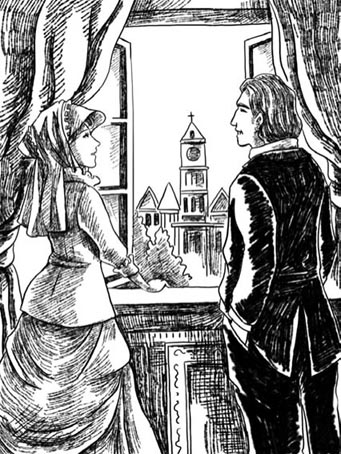
'There is a beautiful view from here,' said Eleanor.
'Yes,' he said, joining her at the window, 'I shall have a perfect view of my enemies. I can fire at them very conveniently from here.'
'You clergymen are always thinking of fighting each other!' said Eleanor, half laughing.
'But are we not here to fight? If we have differences of opinion, should we not go into battle? There is no easy path in religion – I have looked for one and did not find it.' He was silent for a moment, thinking of the time when he had so nearly sacrificed his freedom and his intelligence for that easy path.
Eleanor was impressed by his quiet seriousness. She was used to religious discussion, but she realized, with a certain pleasurable excitement, that this newcomer among them was different from the other churchmen she knew. Instead of arguing bitterly about details, he was only interested in the truth, and was searching humbly for it.
They were interrupted by the archdeacon's shouts of 'Arabin! Arabin!' and went to join the Grantlys in the dining room. Dr Grantly suggested the whole room should be enlarged, which Mr Arabin considered would be far too expensive.
'But,' said Mrs Grantly with a smile, 'what if the priestess, who will surely arrive here one day, insists on it?'
'Then she must do it herself,' replied Mr Arabin lightly.
And, having done their work, the party returned home to Plumstead, well satisfied with their visit.
The following Sunday Mr Arabin was to give his first sermon at St Ewold's. He, the archdeacon, and Eleanor were to go there for the morning service, have lunch with the local squire, and return to Plumstead after attending the afternoon service.
The squire of Ullathorne, the area of farmland, villages and churches which included St Ewold's, was a gentleman called William Thorne. He was about fifty, single, and more than a little proud of his appearance. But he was prouder still of his family name. He had a great respect for long, unbroken bloodlines, and his own family line stretched back to the eighth or ninth century. He believed firmly that all traditions and customs should be kept exactly as they always had been.
Mr Thorne did not live alone at Ullathorne House. He had a sister, who was ten years older than him, and an even greater believer in tradition. Once when her brother suggested making a small alteration to the front door of their house, she took to her bed and was ill for a week; she would not come downstairs until she received his promise that it would not be changed in her lifetime. She would not have a modern magazine in her sitting room, and she refused to read poems or novels by living writers. She had thought her brother dangerously liberal-minded when he was younger, and was pleased that the passing of the years had shown him the importance of traditional values. Looking back over five or six centuries of English history, as Miss Thorne liked to do, she often found reason to sigh deeply. She imagined that an innocence and a goodness had existed in the past, which were not to be found in her own time. However wrong she was, no one would deny her the sweetness of her soft regrets!
Mr Arabin, Dr Grantly, and Eleanor met Mr and Miss Thorne at the gates of Ullathorne House, and walked to church together. Large numbers of villagers had gathered there, to see their new vicar. In spite of his long experience of public speaking, Mr Arabin felt a little nervous, knowing that he was being compared with the previous vicar. But fortunately most people in the church considered that Arabin did his work well enough, especially as his sermon was only twenty minutes long.
Then came the lunch at Ullathorne House. Miss Thorne took special care of Eleanor, piling cold meat on her plate and filling her glass with wine. 'It's your duty, you know, to support yourself,' she whispered in the young mother's ear. 'There's more than yourself depending on it.'
And then Miss Thorne was very knowledgeable about teeth. Little Johnny Bold had been troubled for the last few days with his first tooth, and Miss Thorne was shocked to find that Eleanor was giving him some dreadfully modern medicine, recommended by one of the local doctors.
'Take care, my dear,' she said, looking very serious, 'that that man doesn't harm your little boy. But then,' speaking more in pity than in anger, 'I don't know which doctor you can trust now. Poor dear old Dr Bumpwell, of course –'
'Why, Miss Thorne, he died when I was a little girl.'
'Indeed, my dear, and a sad day it was for Barchester.'
The archdeacon was enjoying his lunch. He talked to his host Mr Thorne about farming; while Mr Thorne, thinking it only polite to pay attention to a stranger, tried to talk to Mr Arabin about religious matters. The two conversations ran on together.
'What are you putting on your fields now, Thorne? Is it guano?' asked Dr Grantly.
'Yes, archdeacon, I get it from Bristol. You'll find a lot of Barchester people, Mr Arabin, who come to services at St Ewold's in the summer, if it isn't too hot for them to walk.'
'I'm glad they stayed away today,' said Mr Arabin, smiling, 'as it was my first sermon.'
'Who do you buy it from in Bristol, Thorne?'
'I drove there myself this year, and bought it straight off the ship. I'm afraid, Mr Arabin, that as the evenings get darker, you'll find it difficult to read in the church. I shall send a man to cut off some branches of the trees outside the south window.'
'The morning light is perfect, at least,' said Mr Arabin. And then he and Eleanor took a walk round the garden, while Miss Thorne cut some flowers, and the archdeacon and the squire finished their discussion about the Bristol guano.
At three o'clock they all went to church again. This time the archdeacon gave the sermon, and half an hour later he, Mr Arabin, and Eleanor shook hands with their Ullathorne friends and drove back to Plumstead.
ordain v. to officially make someone a priest or religious leader 授任(某人)神职
humble adj. not considering yourself or your ideas to be as important as other people's 谦虚的,谦卑的
fall into to start doing something by chance 碰巧开始做某事
injustice n. a situation in which people are treated very unfairly and not given their rights 不公正,非正义
open someone's eyes to to make someone realize something that they have not realized before 使某人认清
unjustly adv. not fairly or reasonably 不公正地;不合理地
fireplace n. a special place in the wall of a room, where you can make a fire 壁炉
bitterly adv. in a way that produces or shows feelings of great sadness or anger 痛苦地;愤恨地
squire n. the man who in the past owned most of the land around a country village in England (从前英格兰乡村的)大地主,乡绅
take to one's bed to get into bed and stay there because you are ill 因病卧床
previous adj. coming immediately before the one you are talking about now 先前的
guano n. solid waste from sea birds, put on soil to help plants grow 海鸟粪
4
巴彻斯特的新面孔
弗朗西斯·阿拉宾是英格兰北部一位乡间绅士的次子,上过一所非常不错的学校,然后又去了牛津大学念书。他在牛津培养了辩论口才,成为一名小有名气的机智幽默的成功演说家。他几乎总是能让对手的论据显得荒诞无稽,力争用幽默和道理来赢得每一场辩论。
不过,他最感兴趣的还是宗教,并且全身心地投入了教会工作。他为教会撰写诗歌、演说词和布道词,甚至吃喝打扮和呼吸都是为了教会。他很快就获得了圣职,留在牛津一个学院担任诗歌教授。
接下来他遇上了人生中最大的危机。经过一番深思熟虑,鼎鼎大名的牛津神职人员纽曼先生离开了英格兰教会,加入了罗马教廷。阿拉宾先生受到了很大的诱惑,要追随他去。为了想清楚该怎么做,阿拉宾暂别牛津,远离文明社会的纷扰,在一个宁静的海滨小村生活了一段时间。
一切迹象似乎都表明他应该选择罗马教廷。他对纽曼先生充满爱戴和崇敬之情,很想追随他的足迹,同时十分赞赏罗马的严谨作风。“有了明白无误的宗教戒条,一切就简单多了。”他想,“认清罪孽和避免犯错又会变得何等容易!”此外,他很想向上帝表明自己对他的信仰。要证明这一点,有什么能比得上牺牲自己伟大的宗教呢?而这宗教是自己从小耳濡目染的,如今又是他的衣食来源。
那时候,阿拉宾先生还很年轻,对自身的能力过于自信,对普通人的常识也缺乏尊重。多亏了那个小村庄里一个普普通通的乡下代牧,他才认识到真正的宗教指引全都来自内心,而不是牧师制定的戒律。他还意识到,在罗马教廷寻求安逸,就等于远离善恶之间的艰难抉择。于是他回到牛津,人变得更加谦逊,却也比以前更加高尚、更加快乐。
到普拉姆斯特德附近的圣埃沃兹教堂当代牧的时候,他已经年近四十,尚未婚娶。他高于中等身材,黑头发略微有些花白。相貌算不上英俊,但脸长得还讨人喜欢,眼里有幽默的神情。他很受女士们欢迎,然而,他既然在牛津学院里生活,就意味着不得婚娶。因此,他只把女人当作美丽而有趣的生物,仅此而已。
圣埃沃兹教堂的代牧住所需要稍加修缮,他便搬到格兰特利家暂住一个月。一天,跟执事长夫妇和他们的几个女儿吃完晚饭之后,阿拉宾先生回到了楼上的卧室里,坐在敞开的窗边眺望自己的教堂。借着月光,他也只能勉强看见执事长花园那头的圣埃沃兹教堂。这是一个美好的夜晚,弗朗西斯·阿拉宾却觉得有些难过。看到格兰特利博士可爱的妻儿,看到他们舒适的住所和花园,他突然意识到,自己在这个世上是多么孤单。他把一生献给了教会,如今却觉得这是个错误。他心里明白,自己原本可以身居高位,家财万贯,可能还会有一个带给他欢乐的家庭,只可惜事到如今,一切都为时已晚。他只是一座乡村小教堂的代牧,仅此而已。
第二天早上,哈丁先生和埃莉诺来到了普拉姆斯特德,打算在这里住上几天。格兰特利博士和阿拉宾先生都去了圣埃沃兹,哈丁先生则想在花园里到处走走,埃莉诺和苏珊这姐妹俩便自然而然地聊了起来。格兰特利太太比埃莉诺大十岁,两人从来不曾对彼此掏心掏肺,也并不经常见面。因此,格兰特利太太并不指望埃莉诺会跟她谈论爱情,不过,她还是很想知道自己的妹妹究竟喜不喜欢斯洛普先生。
要把话题转到斯洛普先生身上很容易。格兰特利太太很快就开始不遗余力地指责他,博尔德太太则几乎同样热切地替他辩护。她其实并不喜欢这个人。她甚至有点儿怕他,巴不得再也不跟他见面,但不知怎的,她发现自己总是在帮他抵挡来自他敌人的、她认为不公正的攻击。
话锋转移到了斯坦诺普一家,格兰特利太太听说埃莉诺最近跟他们共度了一晚。突然,她意识到当时在场的还有斯洛普先生。
“什么!”她惊恐地大叫一声,“哎呀,埃莉诺,他肯定很喜欢你。你去哪儿他好像都跟着你呢!”
就连这种话埃莉诺也听不进去。她只是哈哈大笑了一通,说她觉得斯洛普先生在斯坦诺普家看上了别人。说到这儿,姐妹俩就此分别。格兰特利太太确信这桩让人憎恨的婚姻将会成为现实,博尔德太太也同样确信,不幸的特遣牧师再次遭受了不公正的抨击。
当妻子私下告诉执事长,她担心埃莉诺跟斯洛普先生的关系正在发展,执事长勃然大怒。“很抱歉,亲爱的,”他说,“不过,她要是嫁给了那个男人,他俩谁也不许再踏入我的家门。”
苏珊·格兰特利叹了口气。“唉,或许也发展不到那种地步。我希望,既然埃莉诺在这儿,她能够忘掉她那要命的激情。”
可怜的埃莉诺并没有对任何男人产生要命的激情。这一晚,她过得十分无聊。阿拉宾先生似乎并没有怎么留意她。晚饭之后,他一直在跟格兰特利夫妇谈论当地的各类神职人员。当晚进卧房的时候,埃莉诺开始觉得,自己渐渐厌倦了神职人员,厌倦了他们那种令人尊敬却寡然无味的生活方式。要是跟斯坦诺普一家在一起,这个夜晚肯定会愉快得多。
另一边,阿拉宾先生倒是度过了一个开心的夜晚。他不仅喜欢与格兰特利夫妇那些增广见闻的谈话,还喜欢看埃莉诺寡妇帽下那张美丽的脸庞。他开始对自己在普拉姆斯特德余下的日子充满期待,因为她也会在那儿待上一阵。
第二天,大家一起坐执事长的马车去参观圣埃沃兹的代牧住所。上了马车之后,埃莉诺发现自己刚好坐在了阿拉宾先生的对面,并且惊讶地发现,跟他聊天十分轻松。
哈丁先生给他们讲了一个从本地人那儿听来的古老的故事:很久以前,圣埃沃兹住着一位女牧师;女牧师非常出名,因为她能治愈村民们的各种病症。阿拉宾先生说,他不希望如今的村民依赖一位女牧师,格兰特利太太却不赞同他的看法。“每一座教堂都应该既有男牧师,又有女牧师。”她笑盈盈地说。
“要我说,”埃莉诺发言了,“在过去,所有的权力都集中在女牧师的手里。阿拉宾先生兴许是觉得,要是圣埃沃兹有了一位新式女牧师,这样的事还会再发生。”
“我觉得,还是别冒这种险为好。”阿拉宾先生哈哈大笑。
“确实会发生这样的意外。”格兰特利太太说,“听人说,巴彻斯特就有一位女牧师在对宗教事务指手画脚。这样的忧虑没准儿就在眼前呢,阿拉宾先生。”
他们到了圣埃沃兹,这段有趣的交谈即告结束。执事长夫妇马上开始在房子里四下走动,告诉阿拉宾先生哪儿该修、哪儿该补,好住起来舒服。不过,等格兰特利夫妇在餐厅里盘算该怎么扩建壁炉的时候,埃莉诺和阿拉宾先生却不知不觉走到了楼上的小会客厅里。
“从这儿看出去,景色还不错。”埃莉诺一边说,一边眺望窗外的大教堂、主教宅邸和海勒姆养老院周边的树林,“我估计您会把这儿用作书房,对吧?”
“没错,”他一边说,一边走到窗前,和她站在一起,“在这儿,我可以把敌人看个一清二楚,朝他们开火也很方便。”
“你们这些神职人员,总想着你争我夺!”埃莉诺似笑非笑地说。
“可是,我们到世上来,不就是为了斗争吗?如果大家观点不同,难道不该争个高下吗?宗教里没有捷径——我一直都在追寻,但一无所获。”他沉默片刻,想起那次自己差点儿就为那样的捷径牺牲了自由和智慧。
他沉静严肃的态度给埃莉诺留下了深刻的印象。她对宗教讨论已经习以为常,此时却有点愉悦又有点兴奋地发现,这位初来乍到的牧师跟她认识的其他神职人员并不一样。他不会为了细枝末节苦苦争辩,只是执着于真理而谦逊地追求着。
这时,执事长的高声大喊打断了他们的谈话:“阿拉宾!阿拉宾!”于是他们来到餐厅,跟格兰特利夫妇会合。格兰特利博士建议对整个房间进行扩建,阿拉宾先生却觉得那样未免花费太大。
“可是,”格兰特利太太微笑着说,“女牧师总有一天会大驾光临的,万一她坚持要扩建呢?”
“那她只能亲自动手了。”阿拉宾先生轻描淡写地回答。
参观完毕,一行人打道回府,赶往普拉姆斯特德,大家都对此行非常满意。
接下来的那个星期天,阿拉宾先生要在圣埃沃兹首次布道。他、执事长和埃莉诺打算一起去参加早上的仪式,与当地的乡绅共进午餐,等参加完下午的仪式再返回普拉姆斯特德。
乌拉索恩地区涵盖了农田、村落和大小教堂,其中包括圣埃沃兹。当地的乡绅名叫威廉·索恩,年约五十,尚未婚娶,对自己的外貌颇感自豪。不过,更让他引以为豪的是他的家族姓氏。他对承袭已久、绵延不绝的血脉充满敬意,他自己的家族就可以追溯到公元八九世纪。他坚信,所有的风俗习惯都应该原汁原味地保留下来。
索恩先生并不是独自一人住在索恩宅邸。他有个姐姐,比他大十岁,笃信传统的程度比他更甚。有一次,她弟弟提议对宅子的大门稍加改动,她因此而卧病在床,躺了足足一个星期。直到弟弟保证不在她有生之年改动大门,她才答应下楼。她绝不在自己的会客厅里放现代杂志,也拒绝阅读在世作家的诗歌和小说。弟弟年轻的时候,她觉得他的思想开放得过了头。等到岁月的流逝让弟弟明白了传统价值的重要性,她才称心满意。索恩小姐喜欢追溯五六百年前的英格兰历史,这么做的时候,她总是找得到唉声叹气的理由。她觉得纯真和美好在以前是有的,如今却已经难寻踪影。无论她错得有多离谱,谁也不能否认,她温柔的惋惜如此动人!
阿拉宾先生、格兰特利博士和埃莉诺在乌拉索恩宅邸的大门口跟索恩先生和索恩小姐碰面,一起步行去教堂。很多村民都已经聚在那里,来看他们的新任代牧。尽管拥有多年的公共演讲经验,阿拉宾先生还是觉得有点紧张,因为他知道大家在拿他跟之前的代牧作对比。还好,教堂里的大多数人都觉得阿拉宾的表现令人满意,尤其是他的布道只持续了二十分钟。
接下来的活动是在乌拉索恩宅邸吃午餐。索恩小姐对埃莉诺特别照顾,在她的盘子里堆了不少冷餐肉,还帮她倒酒。“你知道的,养活自己是你的责任。”她在这位年轻的母亲耳边轻声说,“不光是你自己指着你养活自己。”
索恩小姐在牙齿方面的知识也十分广博。这几天小约翰尼在长乳牙,很难受。索恩小姐惊讶地发现,埃莉诺竟然听了当地一位医生的推荐,给他吃了些摩登得骇人的药。
“当心啊,亲爱的,”她一脸严肃地说,“别让那个人伤害你的小宝贝。不过,”她的口气与其说是愤怒,不如说是惋惜,“到现在,我也不知道你还能信任哪位医生。可亲又可怜的老邦普威尔医生,当然——”
“唉,索恩小姐,我还是小姑娘的时候,他就已经过世了。”
“是啊,亲爱的,对于巴彻斯特来说,那一天可真是让人难过。”
执事长在享用午餐,还跟主人索恩先生聊起稼穑之事。而索恩先生觉得要多照顾生客才算礼貌,于是尽量跟阿拉宾先生谈论宗教事务。两场谈话同时进行。
“你现在往地里撒的是什么呢,索恩?是海鸟粪吗?”格兰特利博士问。
“没错,执事长,我从布里斯托买来的。夏天的时候,阿拉宾先生,您会发现巴彻斯特有很多人来圣埃沃兹做礼拜,只要天气没热到让他们无法步行。”
“我倒是庆幸他们今天没来,”阿拉宾先生微笑着说,“因为这是我第一次布道。”
“你是从布里斯托哪个人手里买的呢,索恩?”
“今年我自己驾车去了一趟,直接从船上买的。阿拉宾先生,等到晚上越来越黑,您恐怕会发现,在教堂里很难看清书上的字。我会派人去把南窗外面的树枝砍掉一些的。”
“至少,早晨的光线还是很好的。”阿拉宾先生说。之后,他和埃莉诺在花园里转了一圈儿,索恩小姐去剪了几枝花,执事长和乡绅则接着聊完了布里斯托海鸟粪这个话题。
三点钟,他们又一起去了教堂。这一次布道的是执事长。半个钟头之后,他、阿拉宾先生和埃莉诺跟乌拉索恩的朋友们握手告别,坐车回到了普拉姆斯特德。
5
Mr Slope on the attack
The next two weeks passed very pleasantly at Plumstead. Eleanor was a delightful house-guest, and Dr and Mrs Grantly seemed to have forgotten her wicked feelings for Mr Slope. Mr Harding walked in the garden and played the piano, and little Johnny had no more trouble with his teeth. And although Mr Arabin was busy with his new duties at St Ewold's, he made sure he spent every evening at Plumstead.
There had also been a dinner party at the Stanhopes', to which Mrs Bold and Mr Arabin were invited. He, like every other man before him, could not resist the charming signora, and spent the whole evening beside her sofa.
'I have never met so much suffering, joined to such perfect beauty and such a clever mind,' he told Eleanor as they drove home in the archdeacon's carriage.
Eleanor by no means liked to hear this praise. It was, however, extremely unjust of her to be angry with Mr Arabin, as she had herself spent a very pleasant evening with Bertie Stanhope, who had not left her side for one moment. She was not in love with Mr Arabin, although she had spent three weeks in the same house as him and they had enjoyed lengthy conversations together. But a woman does not need to be in love to be irritated when a friend or companion appears to find another woman more attractive. 'I thought he had more wisdom than that,' she told herself, as she sat watching her sleeping child, after they had arrived home. 'After all, I believe Mr Stanhope is the pleasanter man of the two.'
Mr Arabin was not in love, either. Nor was Bertie Stanhope, although he was ready to say so. Only the widow's cap which Eleanor still wore prevented him, in case it was thought too soon for a widow to be receiving another proposal of marriage.
Fortunately, Eleanor's annoyance with Mr Arabin did not last long, and soon they were good friends again. They could have been more, if he had respected her intelligence enough to discuss serious matters with her, as he had done in their first real conversation together. With her he was always gently playful. If he had allowed her to share his deepest thoughts and concerns, she might have learnt to love him.
So things went on at Plumstead. However, the matter of the wardenship was still not decided. Following his promise to Mr Harding, the archdeacon had tried to speak privately to the bishop about it, but had not been able to see him.
Luckily, Mr Harding had another friend fighting his battle for him, a friend even more powerful than the archdeacon, and this was Mr Slope. The chaplain thought he had more and more evidence every day to make him believe the widow would accept his marriage proposal. He felt that giving Mr Harding the wardenship would make him, Slope, more likely to be welcomed as a son-in-law. And he had an even stronger reason for his actions. He wanted a wife, and he wanted money, but he wanted power more than either. He had realized he must fight Mrs Proudie, otherwise he would never be able to rise to a higher position. The wardenship was an excellent reason for war.
The bishop, following his wife's orders, had declared Mr Quiverful should be the new warden. So Mr Slope decided to ride over to Puddingdale and interview the vicar at once.
Mr Quiverful was, on the whole, a good, honest, hardworking man, but the difficulties of his daily life had had a bad effect on his spirit and his sense of honour. He was attempting to bring up fourteen children as ladies and gentlemen, on an income which was hardly enough to provide them with food and clothes. He was anxious for bread and meat and anxious to pay his bills, but not as anxious as a richer man might be, to be well respected by all around him. He could not afford such a luxury. Recently he had felt that his brother clergymen, men he had known for twenty years, looked coldly on him since he had shown himself willing to sit at the feet of Mr Slope. He had seen their looks grow colder still, when it was said he was to become the new warden. This was painful to him, but when he thought of his poor wife and children, and the happy, comfortable life they would all have in the warden's house in Barchester, he felt he had no choice.
Mrs Quiverful cared nothing for the frowns of the clergy. In her heart she had no other ambition than that of seeing her husband and children properly fed and dressed – life for her had no other purpose. So she had no patience with her husband when he had spoken of not wishing to accept the post until he was sure Mr Harding had refused it. Fortunately, they had now received a full promise that the post was theirs, not only from Mr Slope, but also from Mrs Proudie. But what if all had been lost? Mrs Quiverful was a happy woman at present, but it took her breath away when she thought of the danger they had been in.
So when she saw the great Mr Slope arrive, she hurried into the kitchen with an anxious, beating heart, and left the two men alone in the sitting room.
It was easy for a man as experienced as Mr Slope to achieve his purpose. By choosing his words carefully, he was able to withdraw the promise he had made to Quiverful, who, although horrified at the thought of losing the post, could do nothing but express his disappointment. Soon Mr Slope was riding back to Barchester, confident that he could now persuade the bishop to give the post to Mr Harding.
As soon as the front door closed behind the visitor, Mrs Quiverful rushed eagerly back to her husband.
'Well, my dear, we are not to have it,' he said, turning a pale, miserable face towards her.
'What!' she cried, with all the anger and deep despair of a mother who has lost a child. 'What! Who says so?'
She sat as silent as death while he told his story. 'And so you have resigned your post?' said she, at last.
'I had no opportunity of accepting it,' he replied sadly. 'I must wait for another post, that's all.'
'Wait! Shall we feed the children by waiting?'
'It's all we can do, my dear. I feel the disappointment more for your sake than my own.'
Mrs Quiverful saw a small hot tear appear in her husband's eye and roll down his tired face. This was too much for her woman's heart. She ran to him and seized him in her arms.
'You are too soft!' she sobbed. 'But you must go at once and see the bishop! He knows nothing of this! Doesn't all the world know that Mrs Proudie is Bishop of Barchester, and Mr Slope is her slave? For some reason that woman sent him here today – to break her promise to us!'
But she could not persuade her husband to take any action at all, and soon she realized she must do something herself. 'What if, after all, Mrs Proudie knows nothing of Mr Slope's visit?' she thought. She decided to call on the bishop's wife immediately.
Normally, a visit to the bishop's palace would make her very nervous – she was only a country vicar's wife – but this time, strengthened by her family's needs, she felt confident. She arranged for a local farmer to drive her into Barchester and wait for her, to bring her back. Finally, she took her last half-crown coin from the box where she kept her savings; she would need it to bribe the servants to let her see the lady of the house.
She arrived at the palace door, and was told Mrs Proudie was not at home. 'I must see her,' said Mrs Quiverful firmly, and pressed her half-crown into the servant's hand. In two minutes she was in Mrs Proudie's sitting room, telling her sad story.
Mrs Proudie was in an excellent mood, having just triumphed in another battle. The bishop had received an invitation to spend a couple of days with the archbishop, and greatly desired to accept it. However, not a word in the invitation mentioned Mrs Proudie, so if the bishop went at all, he must go alone. This presented an enormous difficulty. He could not order his bags to be packed, and then simply set off with a servant, casually telling the lady of his heart that he would be back on Saturday. There are men – probably very wicked men – who do such things, and there are women – more like slaves – who put up with them. But Dr and Mrs Proudie were not among them.
So the bishop had spoken to his wife, but it was a short discussion. Those who are married will understand very well how the battle was lost and won; those who are single will never understand it until they learn the lesson which experience alone can give. Mrs Proudie made sure that before she left her lord, she had seen the answer to the invitation written and sealed.
Now, therefore, she was all smiles as she greeted Mrs Quiverful. But her expression became cold and stern when she heard what Mr Slope had done. Asking Mrs Quiverful to wait for her, she marched out of the room. She was extremely angry with her husband, who, as she thought, had broken the promise he had so clearly given her about the hospital, and she was determined to win the battle against him all over again.
Without knocking at the door, she walked quickly into the bishop's study. She found him seated there, with Mr Slope opposite him. Between Dr Proudie's fingers was the very note which he had written to the archbishop in her presence – and it was open! Yes, he had dared to break open the seal which she herself had approved. It was only too clear that the two guilty men were discussing the invitation, even after the matter had already been decided by her! Mr Slope rose from his chair and bowed slightly. He and Mrs Proudie looked each other full in the face, and knew each was face to face with an enemy.
'What is this, bishop, about Mr Quiverful?' said she.
Mr Slope did not allow the bishop to answer, but replied himself. 'I saw Mr Quiverful at Puddingdale this morning, madam. He has abandoned his claim to the hospital, so I have strongly advised his lordship to appoint Mr Harding.'
'Mr Quiverful has not abandoned anything,' said the lady scornfully. 'His lordship has given his word.'
The bishop remained silent. He was eager to win the battle over his old enemy, and yet his courage failed him.
'Perhaps I ought not to interfere,' said Mr Slope, 'but –'
'Certainly you ought not,' said the lady angrily.
'But,' continued Mr Slope smoothly, 'I considered it my duty to advise the bishop that he will not be popular in Barchester if he fails to appoint Mr Harding. And of course the bishop wishes to reward such an honourable man and such a good clergyman as Mr Harding. It is clear that, in the interview I had with Mr Harding, I misunderstood him –'
'And it is equally clear that you have misunderstood Mr Quiverful,' said she, now at the height of her anger. 'What business have you at all with these interviews? Who desired you to go to Puddingdale this morning? Will you answer me, sir?'
There was dead silence in the room. Mr Slope was standing with his hand on the back of a chair, looking very serious and very threatening. Mrs Proudie was standing at the end of the table, and as she spoke she struck her hand on it with an almost manly strength. The bishop was sitting in his armchair, turning his eyes now to his wife, and now to his chaplain, as each went on the attack in turn. How comfortable it would be if they could fight it out between them, so that one should destroy the other, and then he, the bishop, would know whom to obey!
'Will you answer me, sir?' she repeated. 'Who instructed you to call on Mr Quiverful this morning?'
'I think, Mrs Proudie,' said Mr Slope in a low, calm voice, 'that, under all the circumstances, it would be better for me not to answer such a question.'
'Did anyone send you, sir?'
'Mrs Proudie,' said Mr Slope, 'I am aware how much I owe to your kindness, but my duty in this matter is to his lordship, and I can accept no questioning except from him. He has approved of what I have done, and you will excuse me if I say I need no other person's approval.'
What dreadful words these were to Mrs Proudie's ears! It was evident that the bishop was rebelling against her, and she must move speedily to regain control.
'Mr Slope,' she said, slowly and deliberately, 'I will trouble you, if you please, to leave the room. I wish to speak to my lord alone.'
Mr Slope also felt that everything depended on the present interview. If the bishop lost this battle, he would remain a slave for ever. Now was the moment for victory or defeat!
'His lordship asked me here to discuss important cathedral business,' he replied, hoping for support from Dr Proudie. 'My leaving him at the moment is, I fear, impossible.'
'Ungrateful man!' cried Mrs Proudie. 'My lord, will you kindly beg Mr Slope to leave the room?'
My lord scratched his head, but said nothing. This was as much support as Mr Slope had expected.
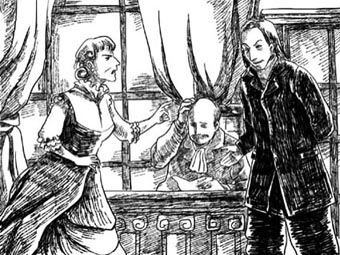
The bishop scratched his head, but said nothing.
'My lord,' said the lady, 'is Mr Slope to leave this room, or am I?' Here Mrs Proudie made a false step. She should not have mentioned the possibility of withdrawing from the battlefield. In answer to such a question, the bishop naturally said to himself that, as it was necessary for one of them to leave the room, perhaps it might as well be Mrs Proudie. But he still said nothing.
Mrs Proudie's anger was boiling over. She could not keep her temper as her enemy did, and so she was defeated.
'My lord,' said she, 'am I to receive an answer or not?'
At last he broke his deep silence and declared himself a member of the Slope party. 'Why, my dear,' said he, 'Mr Slope and I are very busy.'
That was all. No more was necessary. He had gone into battle, put up with the heat and dust of the day, met his enemy, and won the victory. How easy success can be!
Mr Slope saw at once how much he had gained, and turned a triumphant look on the lady. Here he was wrong. He should have looked humbly at her, and remembered that this victory would not last long. He could not arrange to divorce the bishop from his wife, he could not be present every moment of the day, he could not interfere in the privacy of the bedroom, when the wife wished 'to speak to my lord alone'.
But for the moment his triumph was complete, and Mrs Proudie left the room. Now the chaplain told the bishop, in plain words, that he must not let his wife interfere in future, and Dr Proudie, after some hesitation, agreed. Like a good child, the bishop received an immediate reward – he was instructed to write another note to the archbishop, this time accepting the invitation. Mr Slope, more careful than the lady, put the note safely in his pocket. He also persuaded the bishop to see Mr Harding, with the intention of offering him the wardenship. And so Mr Slope, far from disappointed with his achievements, left the palace and posted the note with his own hands.
Mrs Proudie returned unwillingly to her sitting room, where Mrs Quiverful was waiting anxiously for her.
'Your husband has been most weak and foolish,' Mrs Proudie said sternly. 'I find I can do little for him in this matter.'
'Oh, Mrs Proudie! Think of my fourteen children!' Not a word did Mrs Quiverful say about herself, but the tears fell fast.
Mrs Proudie was surprised to find that her hard heart was touched, and she promised to do everything in her power to insist on Mr Quiverful's appointment as warden. Mrs Quiverful returned to Puddingdale, not very hopeful, but satisfied that she had done her best.
house-guest n. a friend or relative who is staying in your house for a short time 暂住客人
irritate v. to make someone feel annoyed or impatient 激怒
proposal of marriage a formal suggestion made when you ask someone to marry you 求婚
luxury n. very great comfort and pleasure 奢华,奢侈
resign v. to officially announce that you have decided to leave your job or an organization 辞(职),放弃(职位)
crown n. an old British coin, a quarter of a pound (英国旧币的)四分之一英镑硬币,克朗
bribe v. to pay money to someone to persuade them to help you or to do something dishonest 贿赂
archbishop n. a priest of the highest rank, who is in charge of all the churches in a particular area 大主教
enormous adj. very big in size or in amount (尺寸、数量)巨大的,庞大的
abandon v. to stop doing something because there are too many problems and it is impossible to continue 放弃,中止
fight out to argue or fight until a disagreement is settled (通过争论或斗争)解决(不和)
question v. to have or express doubts about something, especially about a crime 质问,盘问
deliberately adv. done or said in a slow, careful way (做事、说话)不慌不忙、谨慎地
scratch v. to rub your skin with your nails because it feels uncomfortable (用指甲)挠
triumphant adj. showing pleasure and pride because of a victory or a success 得意扬扬的,耀武扬威的
5
斯洛普先生发动袭击
接下来两个星期,在普拉姆斯特德的日子过得十分愉快。埃莉诺是个讨人喜欢的客人,格兰特利博士夫妇则似乎已经忘记了她对斯洛普先生的孽情。哈丁先生在花园里散步,弹钢琴,小约翰尼的牙也不疼了。阿拉宾先生在圣埃沃兹履新后,公务缠身,却也总会抽出时间,每晚都在普拉姆斯特德度过。
接下来,斯坦诺普家也办了一场晚宴,邀请了博尔德太太和阿拉宾先生。跟之前的那些男人一样,阿拉宾先生也无法抗拒内罗尼太太的魅力,整晚都守在她的沙发旁。
“我从没受过这么大的折磨,跟这样一个美若天仙、冰雪聪明的人相处。”坐执事长的马车回家的时候,他对埃莉诺说。
埃莉诺绝不想听到这样的赞美之词。不过,她要是为此生阿拉宾先生的气就太不公平,因为她自己也和伯蒂·斯坦诺普度过了十分愉快的一个夜晚,伯蒂对她寸步不离。她并没有爱上阿拉宾先生,尽管他俩在同一个屋檐下生活了三个星期,还曾多次愉快地长谈。可是,如果哪个女人的朋友或同伴似乎觉得别的女人更有魅力,这个女人自然会气恼,不一定非要爱上了这个朋友或同伴。“我还以为他不至于那么肤浅呢。”回到家后,她坐下来看自己熟睡的孩子,心里说,“说到底,还是斯坦诺普先生比阿拉宾先生更招人喜欢。”
阿拉宾先生也没有爱上谁。伯蒂·斯坦诺普也是,尽管他打算示爱。只不过,埃莉诺头上戴的寡妇帽子让他打了退堂鼓,他怕别人认为,一个寡妇这么快就又接受一次求婚。
还好,埃莉诺对阿拉宾先生没有生太久闷气,没多久他俩又成了好朋友。要是他足够尊重她的头脑,能像两人第一次真正交谈的时候那样,跟她讨论严肃的问题,那他俩的关系还会更进一步。跟她在一起的时候,他总是既温和又风趣。要是他跟她分享内心最深处的想法和担忧,那她倒有可能爱上他。
普拉姆斯特德的生活还在继续。然而,院长职位的问题仍然没有定论。执事长遵守对哈丁先生的诺言,一直在找机会跟主教私下聊聊这件事,只是还没能见到他。
幸运的是,还有一位朋友在帮哈丁先生争取,而且是一位权力比执事长还大的朋友——斯洛普先生。这位特遣牧师认为,相关的证据与日俱增,足以让他相信寡妇会接受他的求婚。他觉得,如果把院长一职给哈丁先生,他斯洛普就更有可能以女婿的身份得到认可。除此以外,他这么做还有一个更有力的理由。他想娶妻室,也想要滚滚钱财,可他更渴望权力。他已经意识到,自己必须对付普劳蒂太太,否则永远无法平步青云。院长职位便是一个绝佳的开战理由。
主教遵从妻命,已经公开宣称新任院长由奎沃夫先生担任。于是,斯洛普先生决定立即骑马前往帕丁戴尔,跟这位代牧当面谈谈。
总体上说,奎沃夫先生是个好心、善良、兢兢业业的人,然而,生活的艰辛侵蚀了他的精神和荣誉感。他正在努力把十四个孩子培养成绅士淑女,可收入几乎供不上他们吃饭穿衣。他急于填饱一家人的肚子,急于付清账单,但不像富人那样,急于得到身边所有人的尊重。那样的奢侈他消费不起。近些日子他有一种感觉,自从他表示愿意追随斯洛普先生之后,相识二十年的兄弟神职人员开始对他冷眼相看。等到传言说他将担任新任院长,他还看到了更加冰冷的目光。他痛苦不堪,可是,想到自己可怜的妻儿,想到一家子都能在巴彻斯特的院长住所享受快乐舒坦的日子,他觉得自己别无选择。
对于神职人员的横眉冷对,奎沃夫太太毫不在意。她一心所想,就是丈夫和孩子们衣食无忧——对她来说,生活的目的仅此而已。因此,她对自己的丈夫很不满意,因为丈夫说,除非他确信哈丁先生已拒绝担任院长,否则不会接受这个职位。幸运的是,如今他们已经得到了百分之百的保证,这个职位会花落他家,而且说这话的不光是斯洛普先生,还有普劳蒂太太。然而,要是这一切都落了空呢?就眼下来说,奎沃夫太太很快乐,可是,一想到家人所处的险境,她就觉得喘不过气来。
因此,看到了不起的斯洛普先生大驾光临,她便揣着一颗怦怦乱跳的心匆匆躲进厨房,把两个男人单独留在会客厅里。
斯洛普先生经验如此老到,自然可以轻而易举地达到目的。他字斟句酌,成功地收回了先前对奎沃夫的承诺。想到职位不保,奎沃夫心中十分恐惧,可他也只能表达自己的失望之情而已。没过多久,斯洛普先生就骑马回巴彻斯特了。他相信他现在能够说服主教,把这个职位授予哈丁先生。
客人一走,前门一关,奎沃夫太太就迫不及待地冲到丈夫身边。
“唉,亲爱的,我们得不到那个职位了。”奎沃夫先生转头对她说,面容苍白,表情痛苦。
“什么!”她大喊一声,声音里充满了愤怒和深深的绝望,就像是一个失去孩子的母亲。“什么!谁说的?”
他说话时她坐在那里,像死人一样,一声不吭。“这么说,你已经放弃你的职位了?”她终于开口了。
“我根本没机会接受这个职位。”他难过地回答,“我只能等着别的职位,就这么简单。”
“等着!我们等着能喂饱孩子们吗?”
“我们别无他法,亲爱的。我失望更多是为了你,并不是为我自己。”
奎沃夫太太看见一滴小小的热泪涌出丈夫的眼眶,沿着他疲惫的脸庞滚落。她那副柔软的女人心肠可受不了这个,她跑到他身边,把他抱在怀里。
“你太软弱了!”她抽泣道,“不过你得赶紧跑一趟,去见见主教!他还蒙在鼓里呢!普劳蒂太太才是巴彻斯特的主教,斯洛普先生是她的奴才,这不是尽人皆知吗?不知道是什么原因,那个女人今天把他给派来了——为的就是把她说出口的承诺收回去!”
然而她没法说服丈夫采取任何行动,她很快就意识到自己必须亲自出马。她心里想:“说到底,万一普劳蒂太太根本不知道斯洛普先生来这儿的事情呢?”她决定马上去拜见主教的妻子。
换作平时,去主教的宅邸会让她万分紧张——毕竟她不过是一个乡下代牧的妻子——然而这一次,她因为家里不得已的缘故,斗志昂扬,满怀自信。她安排一个当地的农夫赶车送她去巴彻斯特,然后再等着送她回来。最后,她把仅存的一枚半克朗硬币从平时存钱的盒子里拿了出来。她得拿这个买通那些仆人,让他们放她进去见宅邸的女主人。
她来到宅邸门口,被告知普劳蒂太太不在家。“我一定要见她。”奎沃夫太太坚决地说,把那块半克朗硬币塞到了仆人手里。两分钟之后,她已经进了普劳蒂太太的会客厅,开始给太太讲自己的伤心事了。
普劳蒂太太心情不错,因为她刚刚在另一场斗争中大获全胜。这之前,主教收到了一封请柬,请他去大主教那里盘桓几日,而他也很想接受邀约。然而,请柬当中只字未提普劳蒂太太,主教要去的话,就只能一个人去。这就造成了极大的困难。他没法叫人替他备好行李,然后只带上一个仆人出发,漫不经心地告诉心爱的太太,自己星期六回来。世上倒真有些男人——多半是坏透了的男人——会这么做,也真有些女人——像奴隶一样的女人——会容忍他们。不过,普劳蒂博士可不是这样的男人,普劳蒂太太也不是这样的女人。
因此,尽管主教跟妻子提了这事,却只是简单说了几句。结了婚的人都容易理解,这样的斗争是如何拼出了输赢。没结过婚的人只有亲身经历才能理解。以防万一,普劳蒂太太亲眼看着写好的回信装进了信封,才离开她的主教大人。
所以,此刻她满脸堆笑地问候奎沃夫太太。不过,一听说斯洛普先生的所作所为,她的表情立刻变得既冰冷又严厉。她让奎沃夫太太等着她,然后大步流星地走出了房间。她对丈夫火冒三丈,因为照她的理解,丈夫已经明明白白地答应了她养老院的事,现在却赖了账。她打定了主意,要再斗赢他一次。
她连门都没敲,就快步走进了主教的书房。她看见主教坐在书房里,对面坐着斯洛普先生。普劳蒂博士手上拿着他当着她的面写给大主教的那封信——信已经拆了封!没错,他居然胆大包天地拆开了她亲自批准的封印。很显然,这两个罪人正在商量请柬的事情,哪怕这事情已经由她拍了板!斯洛普先生站起身来,向她微微鞠了一躬。他和普劳蒂太太四目相对,两人心里都明白自己面对着一个敌人。
“主教,奎沃夫先生那边是怎么回事?”她问。
没容主教回答,斯洛普先生就说:“今天早上,我在帕丁戴尔见到了奎沃夫先生,太太。他已经放弃了养老院院长一职,所以我强烈建议主教大人,任命哈丁先生为院长。”
“奎沃夫先生什么也没放弃。”太太不屑地说,“主教大人答应过他的。”
主教一言不发。他很想在这场斗争中打败自己的宿敌,但没那个勇气。
“兴许我不该插手,”斯洛普先生说,“但是——”
“你确实不该插手。”太太气冲冲地说。
“但是,”斯洛普先生心平气和地继续说,“我觉得我有责任提醒主教,不让哈丁先生当院长,他将不得民心。当然,哈丁先生为人如此高尚,又是如此出色的一位神职人员,主教肯定愿意予以嘉奖。很明显,上次跟哈丁先生会面的时候,我对他有误会——”
“同样明显的是,你也误会了奎沃夫先生。”她说,已经快要气炸了,“你去见他们到底有何居心?谁让你今天早上去帕丁戴尔的?你能回答我吗,先生?”
屋子里一片死寂。斯洛普先生站着,一只手扶着椅背,一脸严肃,还带着浓重的威胁意味。普劳蒂太太站在桌子的一头,一边说话,一边像男人那样用力拍桌子。主教坐在扶手椅上,随着交锋双方轮流上阵,一会儿看看妻子,一会儿又看看自己的特遣牧师。要是他俩能决出胜负,一方能彻底摧垮另一方,好让他这个主教,知道该听命于谁,那有多舒心啊!
“你能回答我吗,先生?”她重复了一遍,“谁让你今天早上去见奎沃夫先生的?”
“在我看来,普劳蒂太太,”斯洛普先生用低沉而平静的语气说,“无论如何,这样的问题我都是不答为妙。”
“是有人派你去的吗,先生?”
“普劳蒂太太,”斯洛普先生说,“我知道自己欠了您多大的恩情,但是,在这件事情上我只能对主教大人负责。除了他以外,恕我无法接受其他人的质问。他已经对我的行动表示了赞同,如果我说我不需要其他人的批准,请谅解。”
在普劳蒂太太听来,这样的话多么刺耳!显而易见,主教这是在跟她造反,因此她必须迅速行动,重新控制局面。
“斯洛普先生,”她慢悠悠、不慌不忙地说,“麻烦你,请你离开这个房间。我想跟我的主教大人单独谈谈。”
斯洛普先生也已经意识到,一切都取决于眼前这场谈话。如果主教输了,自己就永远摆脱不了奴仆的地位。决定胜负的关键时刻到了!
“主教大人叫我到这儿来跟他商议教堂里的要事。”他回答,希望普劳蒂博士能给他点支持。“要我在这个时候离开,恐怕我做不到。”
“忘恩负义!”普劳蒂太太喊道,“我的主教大人,请您让斯洛普先生离开这个房间,可以吗?”
主教大人挠了挠头,却什么也没说。不过,斯洛普先生本来也没指望更大的支持。
“我的主教大人,”太太说,“是斯洛普先生离开这个房间呢,还是我走?”这步棋她算是走错了,因为她不该主动提出撤离战场这个可能性。面对这样的一个问题,主教自然开始在心里琢磨,既然这两个人当中总得有一个走,或许还是自己的太太离开为好。不过,他还是一声不吭。
普劳蒂太太气得七窍生烟。她没有对手那种控制情绪的本事,于是败下阵来。
“我的主教大人,”她说,“您要不要给我个答复?”
终于,主教打破了他深深的沉默,宣布自己属于斯洛普的阵营。“咳,亲爱的,”他说,“我跟斯洛普先生还忙得很呢。”
这一句就够了,用不着再说什么。他投入了战斗,顶住了战场上的热浪和尘土,直面了敌人,取得了胜利。成功原来可以如此简单!
斯洛普先生立刻看到了自己的战果,还得意扬扬地看了普劳蒂太太一眼。他不该这么做。他应该谦逊地看她一眼,还应该明白这场胜利维持不了多久。他既不可能安排主教跟妻子离婚,也不可能成天守在这里,更不可能在主教太太在卧房里想“跟我的主教大人单独谈谈”的时候破门而入。
不过,他暂时算是大获全胜,普劳蒂太太走出了房间。现在,特遣牧师不再耍花腔,告诉主教,从今往后,再不能让他的妻子指手画脚。稍作迟疑之后,普劳蒂博士表示了同意。跟表现好的孩子一样,主教立刻得到了奖赏——在特遣牧师的指导下,他重新给大主教写了一封信,这一次是接受邀约。斯洛普先生比普劳蒂太太还要小心,把回信稳妥地装进了自己的口袋。他还劝服主教去见见哈丁先生,把院长一职委任于他。这之后,斯洛普先生志得意满地离开了主教的宅邸,亲手把回信寄了出去。
普劳蒂太太不情不愿地回到了自己的会客厅,奎沃夫太太还在那里焦急地等她。
“你丈夫真是太软弱,太愚蠢。”普劳蒂太太厉声说,“我发现,这件事情我是帮不了他了。”
“哦,普劳蒂太太!想想我那十四个孩子吧!”奎沃夫太太对自己只字不提,眼泪却止不住地往下掉。
普劳蒂太太惊讶地发现,自己的铁石心肠居然被打动了。于是她承诺,一定会竭力为奎沃夫先生争取院长一职。奎沃夫太太返回了帕丁戴尔,虽说不是满怀希望,心里却不无欣慰,因为自己已经尽了力。
6
Two men in love
Still feeling triumphant over his defeat of Mrs Proudie, Mr Slope made the next move in the game, by writing the following letter to Mrs Bold. It was the beginning of what he hoped would be a long and tender correspondence.
My dear Mrs Bold,
You will understand that I cannot at present write to your father. I hope the day will soon come when he may trust and respect me as I admire and respect him. But I cannot deny myself the pleasure of informing you that Mr Q. has today, in my presence, resigned any claim he had to the warden's post, which the bishop now intends to offer your father.
Will you kindly ask Mr Harding to call on the bishop on Wednesday or Thursday between ten and one? Perhaps I should say no more – but still I wish you could make your father understand that no conditions will be attached to the post. I, for one, am persuaded that no man could perform his duty more satisfactorily than he did, or than he will do again.
You will see at once that this letter is confidential. But equally, of course, it is for your father's eyes as well, if you wish to show it to him.
I hope my darling little friend Johnny is as strong as ever – dear little boy! Does he still continue to pull down those beautiful long silken curls of yours?
Your friends in Barchester miss you badly, and envy you your stay among the flowers and fields in this unpleasantly hot weather.
Believe me, my dear Mrs Bold, I am yours most sincerely,
Obadiah Slope
This would not have been a bad letter, except for one thing. Gentlemen do not write to ladies about their silken curls, unless they know them very well, but Mr Slope could not be expected to know this. Having finished his letter, he took it to Mrs Bold's house, and left instructions for it to be sent on to Plumstead.
Then he went to visit Signora Neroni. This was, he knew, extremely unwise. Not only was her husband living, so he, Slope, could not court her honestly, but in addition, she had nothing to recommend her as a clergyman's wife; she had no fortune and she was a helpless, hopeless cripple. He knew that by visiting her he might ruin his reputation and his chances with Mrs Bold, but he could not help himself. Passion, for the first time in his life, was too strong for him.
The signora, on the other hand, cared no more for Mr Slope than for the twenty others who had admired her before him. She was like a female spider, who could not live without catching flies – this exercise of power was the one excitement of her life – and Mr Slope was the finest fly that Barchester could offer.
Mr Slope was shown into the sitting room, where she lay in all her beauty on the sofa. He rushed to her side and took her small delicate hand in his large red one, to kiss it tenderly.
'Signora, you are lovelier than the heroines of ancient times!' he cried, with what he thought was his most winning smile.
'That is not very flattering, Mr Slope,' said she. 'Most of them were rather foolish, and gave up all for love. Remember, Mr Slope, whatever you do, never mix love and business.'
Mr Slope was speechless. Had she guessed his intention to court Mrs Bold, and would she now punish him for it?
'Which is it to be, Mr Slope?' she asked sternly. 'Love or money? Take my advice – never mind love. There's no long-lasting happiness in it. But in wealth, houses, land, yes, in them there is something to be kept and enjoyed for many years.'
'Oh, no,' said Mr Slope, feeling he must protest, 'this world's wealth will make no one happy. We must hope for happiness in heaven, signora!'
'Nonsense! You don't believe that!' And she watched in fascination as her fly struggled to escape.
Mr Slope had no idea how to answer her, but he did his best. 'You like to shock, signora, but your heart is true.'
'My heart! I do not have one. But that does not matter to you, because the courtship you are planning will result in something more solid than such a ghostly love as mine –'
'Your love would satisfy the dreams of a king,' said he, not quite sure what his words meant.
'You mean an archbishop.' Poor man! She was very cruel to him. 'Now, am I to understand you say you love me?'
He had never said so, but he could not possibly deny his love, so down he went on his knees and swore he loved her, and would love her until the end of time.
'And now another question – when are you to be married to my dear friend, Eleanor Bold?'
There was nothing he could say, except, 'Oh signora, how can you insult my feelings for you? My heart is all your own!'
And so the game went on. Mr Slope knew he was insulted, scorned, laughed at, yet he could not tear himself away. He had looked for joy in loving this lovely creature, and found only bitterness. He loved furiously, madly, and passionately, but he had never played the game of love. The signora did not love at all, but she knew every move in the game.
Finally, she offered him her hand again, and he covered it with kisses. 'Come, forgive me, Mr Slope,' she said with her sweetest smile. 'Shall we be friends again?'
'Oh Madeline, tell me that you love me – do you love me?'
But at that moment Mrs Stanhope entered the room, and soon afterwards Mr Slope said goodbye and left the house, his heart full of confused emotions.
That afternoon the archdeacon and Mr Harding, who were in Barchester on business, collected Eleanor's post from her house, to take back to her. As soon as Dr Grantly saw Mr Slope's letter, he recognized his enemy's handwriting on the envelope. He was very angry indeed, and handed it to Mr Harding with the tips of his fingers, as if it contained poison. The poor father had to give it to Eleanor when they arrived at Plumstead.
Eleanor opened the letter as she was getting dressed for dinner. She was so delighted to find that her father could now become warden again that she did not realize the information should not have come to her from an unmarried young clergyman. As she read on, she was offended by her boy being called Mr Slope's darling, and when she came to the mention of her silken curls, she gave a shudder of disgust. But on the whole she was grateful to Mr Slope for wishing to help her father.
At dinner, however, the whole party looked stern and silent. Dr Grantly had betrayed his sister-in-law by whispering into Mr Arabin's ear before the meal, 'I very much fear Eleanor is to marry Mr Slope!' Mr Arabin had been horrified to hear it, and was now as sorrowful and unsociable as the Grantlys. Eleanor, unaware that Mr Slope's letter had already been much discussed, felt that she had been judged guilty of something, but had no idea what.
After dinner, the ladies went into the sitting room, while the gentlemen stayed at table with their final glass of wine. Dr Grantly had asked his wife to speak to Eleanor about her correspondence with Mr Slope, and so, rather unwillingly, Susan asked her younger sister about the letter. Eleanor, feeling she was being treated like a child, refused to tell Susan what the letter was about, or to show it to her; she became angrier and angrier at her sister's continual questioning. Finally Susan said, with great formality, 'Well, Eleanor, it is my duty to tell you that the archdeacon thinks such a correspondence is disgraceful, and that he cannot allow it to go on in his house.'
Eleanor's eyes flashed fire as she jumped up from her seat. 'You may tell the archdeacon that wherever I am, I shall receive letters from whom I please. If Dr Grantly has used the word "disgraceful", I think he has been ungentlemanly and inhospitable. I shall show the letter to Father, but to no one else.' And she ran upstairs to her bedroom and her baby.
Half an hour later Mr Harding crept up to her room and knocked at the door. Eleanor welcomed him in, and kissed him, and told him she could not put up with the archdeacon's pride and unkindness any longer. She showed him Mr Slope's letter, thinking her father would see immediately what an innocent, well-meaning letter it was. But poor Mr Harding could only see the 'darling little friend' and the 'silken curls', and felt sure Dr Grantly's suspicions were correct. It was almost a love-letter, and it meant that Eleanor must be planning to marry the hated Slope. The foolish, weak, loving father did not say one word to her. If he had, Eleanor would have expressed her disgust at the idea of marriage to the chaplain, Mr Harding would have been delighted, the Grantlys would have apologized, and Mr Arabin – Mr Arabin would have dreamt of Eleanor and woken next morning with ideas of love and plans for marriage.
But all this was not to be. Mr Harding folded the letter, gave it back to her, kissed her, said, 'God bless you, my child!' and crept slowly away to his own room.
Immediately there was another knock at Eleanor's door, and a servant brought a message from the archdeacon, asking if Mrs Bold would mind coming to Dr Grantly's study for two minutes. Eleanor did mind; she was tired and unhappy, but she was not a coward. So she tied on her cap and went downstairs with a beating heart.
The archdeacon started his speech to Eleanor by explaining that he wanted to give her some brotherly advice. She replied coldly that if she needed any advice, she had her father to ask. This made Dr Grantly hesitate, but he went on to ask about Mr Slope's letter. He was quite surprised when Eleanor held it out for him to look at. After reading it, he felt convinced, like Mr Harding, that Eleanor would soon be married to Mr Slope.
'Do you think, Eleanor, this is a suitable letter for you to receive from Mr Slope?'
'I do,' said she angrily, perhaps forgetting the unpleasant matter of the silken curls. 'You think he is a messenger from the devil, just because you disagree with him! I think he is doing a great deal for my father and I am grateful to him.'
This was too much for the archdeacon, who burst out, 'Eleanor, is it worthwhile to break away from all those who love you, for the sake of Mr Slope?'
'I don't intend to break away from anybody, Dr Grantly.'
'Eleanor, I must speak out! Mr Slope is altogether beneath you. I beg you, think of this before it is too late!'
'Too late! What do you mean? I don't understand.'
'Ask Susan, or your father, or Mr Arabin –'
'You haven't spoken to Mr Arabin about this!'
'Certainly I have, and he agrees with me and Susan that it is impossible you should be received at Plumstead as Mrs Slope.'
Dr Grantly would never forget the look on Eleanor's face as he said that name. For a moment she could find no words to express her anger and disgust.
'How dare you!' she said at last, and hurried out of the room. When she reached her bedroom, she threw herself on her bed and sobbed as if her heart would break.
She decided to leave Plumstead the following day. She could not stay under the archdeacon's roof a moment longer than necessary, and it was arranged that the carriage would take her back to Barchester after lunch.
Meanwhile Mr Arabin's every waking thought was of Eleanor. As soon as he had heard that another man was carrying off this sweet prize, he began to be very fond of her himself. In fact, he was in love with her, although he did not know it yet, and he rode back from St Ewold's to Plumstead just before lunch, hoping for an opportunity to see her before she left.
He found her alone in the sitting room. She had spent a sleepless night and a miserable morning, and was not at all pleased to see Mr Arabin, whom she blamed for supporting the archdeacon in his unjust attacks on Mr Slope.
'I am sorry our pleasant time together is over so soon, Mrs Bold –' he began nervously.
'It is a pity, certainly, that people do so much to destroy the pleasantness of their days,' she said, interrupting him. 'You should practise what the Church teaches us, Mr Arabin.'
'Undoubtedly I should. Have you any special reason for telling me this, Mrs Bold?'
'You advised Dr Grantly concerning my – friendship – with Mr Slope,' she replied in a terribly calm voice. 'Just because I have treated that gentleman with politeness, you and Dr Grantly assume I am to marry him – something no reasonable person would consider possible. Your accusation is simply designed to make me hate this enemy of yours, that's all.'
She turned her back on him and walked out into the garden. Mr Arabin was left in the room, counting the squares in the pattern of the carpet. He was dreadfully unhappy at the hard words he had received, and yet happy, wonderfully happy, at the thought that, after all, the woman whom he so much admired was not to become the wife of the man whom he so much disliked. At last he was aware that he was in love. Forty years had passed over his head, and so far woman's beauty had never given him an uneasy moment. His present moment was very uneasy.
But only a few minutes later he went out into the garden to court her as well as he could. He found her under a large tree.
'I hope we are not to part as enemies?' said he.
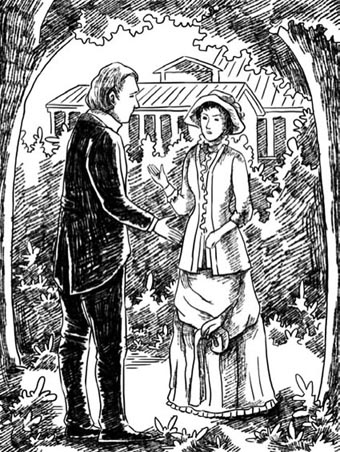
'I hope we are not to part as enemies?' said Mr Arabin.
'I try not to have enemies,' said Eleanor, 'but people must be respected if they are to be friends.' She was very angry with him for considering her judgement to be so poor and her character to be so weak that she could possibly marry Mr Slope.
'And am I not respected?'
'You did not respect me if you spoke of me as that man's future wife. I was deceived; I believed you thought well of me.'
'Thought well of you!' he cried. 'I must use stronger words than those. I respect and admire you, as I have never respected or admired any woman.'
And he walked beside her, struggling to express his feelings. Eleanor was determined to give him no assistance. Poor Mr Arabin! The words in his heart were, 'Since you do not love that other man, and are not to be his wife, can you love me, will you be my wife?' But with all his experience of public speaking in colleges, churches, and cathedrals, now, when he most needed to speak persuasively, the words would not come.
And yet Eleanor understood him as completely as if he had declared his passion like a practised lover. She felt a sort of joy in knowing that his heart belonged to her, but he had offended her deeply and she could not bring herself to abandon revenge just yet. She was flattered, but not ready to accept his courtship.
'Answer me this one question,' said Mr Arabin suddenly, stepping forward and turning to face his companion. 'You do not love Mr Slope? You do not intend to be his wife?'
This made Eleanor angry all over again, just at the moment when she had been feeling softer towards him. 'I shall answer no such question,' she said sharply, 'and what's more, I must tell you that you have no right to ask it. Good morning!'
And she walked proudly away from him, back into the house, where she had lunch with her father and sister. Half an hour later she was in the carriage, leaving Plumstead without seeing Mr Arabin again.
His walk was long and sad, among the dark trees at the end of the garden. To his ears, her last words meant the end of their friendship. He knew so little of women! He could not understand that Eleanor might be furious with him and yet love him.
correspondence n. the letters that someone sends and receives, especially official or business letters 信件,函件
heroine n. a woman you admire very much for her intelligence, skill, etc 受崇拜的女人
winning adj. very pleasant and attractive in a way that makes everyone like you 可爱的;迷人的
disgust n. a very strong feeling of dislike that almost makes you sick, caused by something unpleasant 嫌恶,厌恶
disgraceful adj. extremely bad or unacceptable 丢脸的,可耻的
inhospitable adj. unfriendly to a visitor, especially by not welcoming them, offering them food, etc 慢待客人的
burst out to suddenly say something in a forceful way 突然说出,脱口而出
speak out to publicly speak in protest about something, especially when protesting could be dangerous 公开反对
uneasy adj. not comfortable, peaceful or relaxed 不踏实的,不安的
deceive v. to make someone believe something that is not true 欺骗
6
两个恋爱中的男人
带着击败普劳蒂太太的得意心情,斯洛普先生走了下一步棋,给博尔德太太写了下面这封信。他希望,这封信将会开启一段漫长而充满柔情的书信往来。
亲爱的博尔德太太:
您应该可以理解,目前我无法直接给令尊写信。我希望,要不了多久,他就可以信任我、尊重我,就像我仰慕他、尊重他一样。然而,有个消息让我无法压抑喜悦之情:奎沃夫先生今天当着我的面放弃了院长一职,主教现在有意将这个职位授予令尊。
麻烦请哈丁先生在星期三或星期四十点到一点之间拜见主教。也许我不该多言——但我还是希望您能转告令尊,这个职位不会有任何附加条件。我本人完全相信,没有人比他更胜任院长一职,过去如此,将来亦然。
您一眼便知,这封信的内容是保密的。不过,如您愿意,当然也可让令尊过目。
我希望我亲爱的小朋友约翰尼跟往常一样健壮——可爱的小家伙!他还在继续拉扯您美丽的、如丝绸般的长卷发吗?
巴彻斯特的朋友们对您十分挂念,也羡慕您能在这样宜人的夏日安处花丛田野之间。
相信我,亲爱的博尔德太太,我是您最忠诚的朋友,
奥巴代亚·斯洛普
这封信原本写得不错,只可惜美中不足。绅士给女士写信的时候,不该提到她们如丝绸般的卷发,除非双方十分熟稔。只可惜,斯洛普先生是不可能知道这一点的。写完之后,他把信送到了博尔德太太家,还吩咐仆人把它送往普拉姆斯特德。
他接着就去拜访内罗尼太太。他知道,这样做是极不明智的。这不仅仅是因为她丈夫尚在人世,他斯洛普无法正大光明地追求她,还因为她根本不具备成为神职人员妻子的潜质。她并不富有,还是个无助无望的跛子。他也清楚,去看她可能会导致自己名誉受损,丧失赢得博尔德太太芳心的机会,可他情难自禁。一生之中,他的激情头一回强烈到了失控的地步。
另一方面,内罗尼太太也不喜欢斯洛普先生,待他跟他之前的那二十个仰慕者没什么两样。她就像一只母蜘蛛,靠捕苍蝇为生——如此这般地施展魅力是她的生活唯一乐趣所在——而斯洛普先生是巴彻斯特范围之内最可口的苍蝇。
仆人把斯洛普先生领进了会客厅,内罗尼太太躺在沙发上,光彩照人。他冲到她的身边,用红通通的大手抓起她纤细的小手,献上温柔的亲吻。
“太太,您比古代的美人还要可爱!”他高声说,展露出自认为最迷人的笑容。
“这话我听着可不太受用,斯洛普先生。”她说,“那些美人大多数都挺蠢,还为爱情放弃了一切。记住,斯洛普先生,无论做什么,都不要把爱情和买卖混为一谈。”
斯洛普先生哑口无言。难道她猜出了自己追求博尔德太太的意图,现在是打算惩罚他吗?
“您怎么选呢,斯洛普先生?”她不依不饶地追问,“要爱情,还是要金钱?听我的劝吧——千万别把爱情当回事。爱情里没有持久的快乐。但在财富、房子和土地里,没错,才有可以拥有和享用很久的东西。”
“哦,不是的,”斯洛普先生觉得自己必须表示反对。“尘世的财富是不会让人快乐的。我们只能祈求天堂里的快乐,太太!”
“瞎说!您自己都不相信!”她饶有兴致地看着自己的苍蝇挣扎逃命。
斯洛普先生全然不知如何应答,却还是尽力周旋。“您总喜欢耸人听闻,太太,可您的心是真挚的。”
“我的心!我根本就没有心。不过,这对您来说也没关系,因为您盘算的求爱会让您收获一些更实在的东西,强过我能给的虚幻的爱情——”
“您的爱可以成就一个国王的梦想。”他说,自己也不太明白这话是什么意思。
“您是想说一个大主教吧。”可怜的男人!她对他真是残忍。“好了,我可不可以这么理解,您这是在说您爱我吗?”
他从来没这么说过,却又不可能否认自己的爱,于是他双膝跪地,发誓说他爱她,爱她到海枯石烂。
“那好,我还有一个问题——您打算什么时候娶我亲爱的朋友埃莉诺·博尔德呢?”
他一时语塞,只能这么说:“哦,太太,您怎么能侮辱我对您的感情呢?我整个心都是您的啊!”
游戏就这样接着往下进行。斯洛普先生知道自己受到了羞辱、讥讽和嘲笑,却还是舍不得抽身离开。他本想在对这个美人的爱中寻求快乐,找到的却只有苦楚。他爱得激烈,爱得疯狂,爱得激情四溢,却从来没玩过爱情的游戏。内罗尼太太根本不爱他,却清楚游戏当中的每一步。
最后,她再次把手伸到他面前,让他吻了个遍。“好了,原谅我吧,斯洛普先生。”她说,脸上挂着最甜美的笑容,“咱们还能做朋友吗?”
“哦,马德琳,跟我说你爱我吧——你爱我吗?”
但这时斯坦诺普太太走了进来。没过多久,斯洛普先生告辞离开,心乱如麻。
******
当天下午,执事长和哈丁先生到巴彻斯特办事,顺便去埃莉诺家取了信,好给她带回去。看到斯洛普先生的信,格兰特利博士立刻认出了信封上敌人的笔迹。他十分气恼,用指尖捻起信递给哈丁先生,就好像信上有毒似的。回到普拉姆斯特德以后,可怜的父亲只好把信交给了埃莉诺。
换衣服吃晚饭的时候,埃莉诺拆开了那封信。她知道父亲可以再次当上院长,不由得万分欢喜,并没有意识到,这个消息不该来自一个未婚的年轻神职人员。她接着往下看,看到自己的儿子被称作斯洛普先生的“亲爱的”,觉得很不舒服。再看到信中提及自己的“如丝绸般的卷发”,厌恶至极,不由打了个哆嗦。不过,总的来说,她还是很感激斯洛普先生帮父亲的好意。
然而,吃晚饭的时候,所有人都是一脸严肃、一声不吭。格兰特利博士泄露了自己小姨子的秘密,饭前对阿拉宾先生耳语了一句:“我很担心埃莉诺会嫁给斯洛普先生!”闻听此言,阿拉宾先生吓了一跳,此刻就和格兰特利夫妇一样,心里不痛快,沉默寡言。埃莉诺不知道大家已经就斯洛普先生的来信进行过深入的讨论,只觉得大家是认定自己犯了错,具体是什么错则不得而知。
晚饭后,女士们去了会客厅,男士们还坐在桌边喝最后一杯酒。格兰特利博士此前要妻子去跟埃莉诺聊聊,看斯洛普先生写信给她做什么,到这会儿,苏珊便很不情愿地向妹妹问起了那封信的内容。埃莉诺觉得自己被当成小孩子对待,于是不肯告诉苏珊,也不肯把信拿给她看。姐姐不断盘问,使她越来越气恼。到最后,苏珊郑重其事地说:“好了,埃莉诺,我有责任告诉你,执事长认为这样的信件往来是不光彩的,还有,他不能允许这种事继续在自己家里发生。”
埃莉诺从座椅上跳起来,眼睛里怒火熊熊。“你可以告诉执事长,不管是在哪里,我爱收谁的信就收谁的信。如果格兰特利博士真的说了‘不光彩的’这个词,那我就觉得他没有绅士风度,也很刻薄。我会把信拿给父亲看,其他人就算了吧。”说完她飞快地跑进楼上的卧室,回到孩子身边。
半小时过后,哈丁先生慢吞吞地走到她的卧室门口,敲了敲门。埃莉诺把他迎了进去,亲了亲他,然后告诉他,自己再也无法忍受执事长的自大和刻薄。她把斯洛普先生的信拿给父亲看,觉得父亲肯定会立刻看出这封信是多么单纯、一片好心。然而,可怜的哈丁先生只看见了“亲爱的小朋友”和“如丝绸般的卷发”,由此确信格兰特利博士的怀疑是正确的。这封信简直与情书无异,意味着埃莉诺一定是有了打算,准备嫁给可恨的斯洛普。这位愚钝、软弱而慈爱的父亲什么也没对女儿说。如果他说了,埃莉诺会告诉他,嫁给那位特遣牧师她想想就觉得厌恶,哈丁先生就会笑逐颜开,格兰特利夫妇就会赔礼道歉,阿拉宾先生呢——阿拉宾先生就会梦见埃莉诺,第二天早上醒来的时候,脑子里满是恋爱的念头和结婚的计划。
但这一切并没有发生。哈丁先生把信叠好还给她,亲了她一下,说了句“上帝保佑你,我的孩子!”就慢腾腾地走回了自己的房间。
紧接着,又有人敲响了埃莉诺的房门。仆人捎来了执事长的口信,问博尔德太太愿不愿意到格兰特利博士的书房去聊两分钟。埃莉诺并不愿意,因为她既疲惫又难过。不过她并不懦弱,于是就系好帽子下了楼,一颗心怦怦直跳。
执事长开口向埃莉诺解释,自己只是想像兄长那样给她一些建议。她冷冰冰地回答,如果需要什么建议,她自然会去问她父亲。这话让格兰特利博士有些犹疑,但他还是接着问起了斯洛普先生的来信。埃莉诺直接把信递给他看时,他惊讶不已。看完信之后,他也跟哈丁先生一样,确信埃莉诺很快就会嫁给斯洛普先生。
“埃莉诺,斯洛普先生写这样的信给你,你觉得合适吗?”
“合适。”埃莉诺气冲冲地说,也许已经忘记了“如丝绸般的卷发”带来的不快。“你觉得他是魔鬼的信差,仅仅是因为你跟他意见不合!我倒觉得他帮了我父亲不少忙,而且很感激他。”
执事长觉得她的话太过分,于是脱口而出:“埃莉诺,你为了斯洛普先生跟所有爱你的人决裂,这么做值得吗?”
“我没打算跟任何人决裂,格兰特利博士。”
“埃莉诺,我不得不直说了!斯洛普先生完全配不上你。我恳求你,趁现在还不算太晚,好好想想!”
“太晚!你这是什么意思?我没听明白。”
“去问苏珊,或者问你父亲,或者阿拉宾先生——”
“你不会把这事跟阿拉宾先生也说了吧!”
“当然说了,他的意见跟我和苏珊一样,觉得你要是当了斯洛普太太,普拉姆斯特德就容不下你了。”
格兰特利博士永远也不会忘记埃莉诺听到这个称呼时的表情。一时之间,她找不到话来表达自己的愤怒和憎恶。
“你怎么敢这么说!”到最后,她撂了这么一句,急匆匆地走出了房间。回到自己的卧室之后,她扑倒在床上,哭得心都要碎了。
她决定第二天就离开普拉姆斯特德。除非不得已,她再也不想在执事长家里多留片刻。她让人安排了一辆马车,午饭后送她回巴彻斯特。
与此同时,阿拉宾先生时时刻刻都在想着埃莉诺。一听说另一个男人即将带走这个可人儿,他对她的喜爱之情立刻变得强烈。事实上,他已经爱上了她,只是他自己还不知道。赶在午饭前,他从圣埃沃兹骑马回到了普拉姆斯特德,希望在她离开前还有机会见一面。
他找到她的时候,她独自待在会客厅里。她一夜未曾合眼,早上也过得很不愉快。见到阿拉宾先生,她一点儿也不高兴,因为她怪他帮着执事长对斯洛普先生进行了不公正的抨击。
“很遗憾,我们一起度过的美好时光这么快就结束了,博尔德太太——”他紧张地开口道。
“有人不遗余力地糟蹋自己的好日子,真让人遗憾。”她没等他说完就说,“您应该践行教会的教导,阿拉宾先生。”
“那是当然。您跟我说这个,有什么特殊的用意吗,博尔德太太?”
“关于我——和斯洛普先生——的友谊,您向格兰特利博士提了些建议。”她用平静得可怕的声音说,“仅仅因为我礼貌地对待了那位绅士,您和格兰特利博士就认为我会嫁给他——但凡有点儿理性的人都会觉得,这是不可能的事。你们这么指责我,无非是为了让我恨你们这个对手,就这么简单。”
她转过身去,走进了花园。阿拉宾先生被撇在房间里,数着地毯图案上的格子。听到这些刺耳的话,他特别难受。然而,想到自己如此倾慕的女人毕竟不会嫁给自己如此讨厌的男人,他又非常开心,简直是心花怒放。他终于意识到,自己已经坠入爱河。他年过四十,目前为止,女人的美貌还不曾让他坐立不安。然而,此时此刻,他已经方寸大乱。
不过,几分钟之后,他还是走进花园,打算竭尽全力讨她的欢心。他在一棵大树下找到了她。
“我希望,咱们该不会像敌人那样道别吧?”他说。
“我不想跟任何人为敌,”埃莉诺说,“但是,要跟人做朋友,那就得受人尊重。”她很生他的气,因为他认为,她的判断力如此之差,性格也如此软弱,乃至于可能嫁给斯洛普先生。
“可我并不受人尊重,是吗?”
“如果您说我是那个男人未来的妻子,那就是您没有尊重我。我上了当。我原来还以为,您对我印象不错呢。”
“印象不错!”他大声说,“我要用的词儿可不只是这个意思。我对您既尊重又倾慕,对别的女人我从来没有这样过。”
他走在埃莉诺身边,绞尽脑汁想要表达自己的感情。埃莉诺铁了心,不愿施以援手。可怜的阿拉宾先生!他心里想说的是:“既然你不爱另外那个男人,也不会做他的妻子,那你能不能爱我,做我的妻子呢?”然而,尽管在大学和大大小小的教堂里有这么多公共演讲经验,到了这个最需要说服他人的时刻,他却张口结舌。
然而,埃莉诺已经彻底明白了他的意思,就好像他已经像恋爱老手那样表明了心迹。知道他的心属于自己,她心里一阵欣喜,只是他之前冒犯不浅,她暂时还无法放弃报复的念头。她受宠若惊,却没准备好接受他的求爱。
“我就有一个问题。”阿拉宾先生走上前去,转向自己的同伴,突然对她说,“您没有爱上斯洛普先生吧?您不打算嫁给他吧?”
埃莉诺刚刚对他有些心软,这话却让她重新燃起了怒火。“我不会回答这样的问题。”她尖刻地说,“还有,我得告诉您,您根本没有权利问这个问题。早安!”
她骄傲地从他身边走开,回到屋子里,跟父亲和姐姐一起吃了午饭。半个钟头以后,她坐着马车离开了普拉姆斯特德,没有再跟阿拉宾先生见面。
在花园尽头阴暗的树林里,阿拉宾先生满腹愁肠地走了很久。在他听来,埃莉诺最后的话意味着他俩之间的友情到此为止。他真是不了解女人!他想象不到,埃莉诺对他也许是又恨又爱。
7
Victory for Mrs Proudie
When Eleanor arrived at her house in Barchester, she was met by her sister-in-law, who ran out to greet her, saying, 'Oh Eleanor, have you heard what has happened? The poor dean, Dr Trefoil, is very ill – I fear he is dying!'
The news spread fast all round the city, and most of the clergy were gathering in the cathedral library. This was a large room which was attached to the dean's house – a convenient place to wait for information about his state of health. It appeared that the old man had suddenly fallen ill, and was close to death. The great London doctor, Sir Omicron Pie, had been sent for, but meanwhile the Barchester doctors were doing their best.
In the library the clergy spoke in low, respectful voices.
'He was an excellent, sweet-tempered man,' said a vicar.
'It will be hard to replace him,' said another. 'Archdeacon, I hope the government will not appoint a stranger to the post.'
'We will not talk of a new dean,' said Dr Grantly, 'while there is yet hope that Dr Trefoil may live.'
'Oh no, of course not. Still, there is no one who has more influence with the present government than Mr Slope –'
'Mr Slope!' said two or three voices together. 'Mr Slope – Dean of Barchester! Impossible!'
The archdeacon had turned pale. What if Mr Slope should become Dean of Barchester? There was no reason for it at all, but the man seemed to have power over Dr Proudie, and Dr Proudie had won the prime minister's approval.
'I imagine such a thing is out of the question,' he said, 'but at the moment I am thinking more of our poor friend than of Mr Slope.'
'Of course, of course,' said the first vicar, 'so are we all. Poor Dr Trefoil, the best of men, but –'
'It's the most comfortable dean's residence in the country,' said another.
'And two thousand pounds a year,' said a third.
'No, it was cut down to twelve hundred,' said the first.
'I think you'll find it's fifteen hundred,' said a fourth.
'What do you say, Grantly?' asked the first speaker.
'Twelve,' replied the archdeacon firmly, putting a stop to all discussion of the dean's income.
The bishop was sitting in his study at the palace when he heard the news of the dean's illness. Dr Proudie was not feeling well himself. It was only yesterday that he had won his first battle against Mrs Proudie, and had thought his slavery might be at an end. He had spent a happy evening with Mr Slope, planning many things in his new-found freedom, but as the bed-time hour approached, his heart sank within him. Could he trust himself to come down to breakfast a free man? Unwillingly he climbed upstairs, an hour later than usual, to the room he shared with his lady wife. What passed between them that night cannot be easily described. It is enough to say that he came down the following morning a sad and thoughtful man, looking thinner, older and greyer than before. All ambition was now dead within him.
When Mr Slope heard the news, it occurred to him that he himself might be the new dean. He too wondered if the income would be twelve hundred, fifteen hundred, or two thousand, but in any case it would be a great step forward for him – he would have more power than the archdeacon.
He began to make his plans. First, he was sure he could rely on the bishop's support – the prime minister might ask Dr Proudie's advice on who should fill the vacancy. Secondly, he knew a gentleman, Sir Nicholas Fitzwhiggin, who was an inspector of schools, and who had many friends in the government – he hoped Sir Nicholas would use his personal contacts to help him. And finally, he flattered himself that he had a useful friend in Mr Towers, a journalist on The Jupiter, who would be able to put forward the name of Slope in the newspaper's columns.
The dean was still alive, but Mr Slope did not want to waste any time. So he went straight to the bishop's study, knowing that Dr Proudie was to set out the next day for the archbishop's palace. The bishop was sitting in his chair, doing nothing and thinking of nothing, as Mr Slope entered.
'Well, Slope?' said the bishop somewhat impatiently. He was not anxious to have much conversation with Mr Slope.
'Your lordship will be sorry to hear that the poor dean's health has not improved at all.'
'Oh – ah – hasn't it? Poor man! Poor man!'
'It will naturally be important to your lordship to have, as the new dean, a man who shares your views. If I might be allowed to advise, I would suggest you discuss this with the archbishop tomorrow. I have no doubt that your wishes, supported by the archbishop, would carry much weight with the prime minister.'
'The prime minister has always been kind to me, very kind. But I am unwilling to interfere in such matters, unless asked. And indeed, if asked, I don't know whom I should recommend.'
This was a slight shock to Mr Slope, who, however, recovered quickly. His difficulty was how to make his speech sound modest enough. 'Perhaps I can help you there, my lord. I have been considering the matter for some time, and if poor Dr Trefoil must go, I do not see why, with your lordship's assistance, I should not hold the post myself.'
'You!' cried the bishop, in a far from flattering manner.
The ice was now broken, and Mr Slope began to speak smoothly and persuasively. He talked of his achievements so far, his work for the Church, his friends in high places, and his great respect and admiration for Dr Proudie. He described the ways he, as dean, could add to Dr Proudie's comfort in Barchester and influence over the clergy. Then, without pausing, he produced another seven or eight reasons why no one on earth could make such a good Dean of Barchester as himself.
The bishop sat there, speechless. He would never have imagined Mr Slope as Dean of Barchester, but little by little he began to see there would be advantages for himself in this promotion. He could well do without Mr Slope, who was no longer useful to him in his war against Mrs Proudie; in this war the bishop had now admitted defeat. If, indeed, he could have slept in his chaplain's bedroom instead of his wife's, there might have been some reason to keep Mr Slope.
So, in the end, the bishop approved of Mr Slope's suggestion, and it was decided that he would mention it to the archbishop as soon as the occasion presented itself. But Dr Proudie wanted something from his chaplain in return. 'About Hiram's Hospital,' he said. 'I think, on the whole, it will be better to let Mr Quiverful have it. He has a large family, and is very poor.'
'But, my lord,' said Mr Slope, not wanting to let Mrs Proudie gain a victory, 'I am really much afraid –'
'Remember, Mr Slope,' said the bishop, 'I cannot promise you the post of dean. I will speak to the archbishop, as you wish, but I cannot be sure –'
'Well, my lord,' said Mr Slope, fully understanding the bishop, 'perhaps you are right about Mr Quiverful. I can easily manage matters with Mr Harding. Leave him to me.'
'Yes, Slope, that will be best, and you may be sure that I will do anything I can to put forward your name.'
And so they parted. Mr Slope now had much business on his hands. He had to make his daily visit to the signora. It would have been wiser not to do this, but passion had made him blind. He decided he would take tea at the Stanhopes' just this once, and then go there no more. He also had to arrange matters with Mrs Bold. She would make as charming a dean's wife as a chaplain's, and her fortune would be a useful addition if the dean's income was found to be only twelve hundred.
Mr Slope, along with many others, thought that all was fair in love and war. So he had not considered it dishonourable to bribe and flatter Eleanor's young maid, in order to get information from her about the widow. In this way he had heard about the arrival of his letter at Plumstead and the arguments which had followed; to his delight, the maid thought she had heard Mrs Bold declare that she 'wouldn't give up Mr Slope for anybody'. This made the chaplain feel quite certain that the beautiful widow would now, in all probability, accept his offer. He must, therefore, make his declaration very soon, before it was known that Mr Quiverful, not Mr Harding, was to have the wardenship.
In addition, he had to gain the support of Sir Nicholas and Mr Towers, in order to become dean, so he sat down at once to write to each gentleman. Once he had posted the letters, he was free to sit by the lovely signora's sofa for the rest of the evening.
During the next week, Mrs Bold spent a great deal of time with the Stanhopes, of whom she became fonder and fonder. If asked, she would have said Charlotte was her special friend, but she liked Bertie nearly as much. She allowed him a kind of familiarity which she had never known with anyone else, and which she did not realize could be dangerous. In all this she was perfectly innocent, having no idea of him as a lover. But every familiarity into which Eleanor was trapped was deliberately planned by Charlotte. The sister knew well how to play her game, and played it without mercy; she knew her brother's character, and yet she would have handed over to him the young widow, and the young widow's money, without pity or regret. In order to do this Charlotte made her family and her father's house very welcoming to Mrs Bold. There was a lack of formality about them all which Eleanor found refreshing, after the priestly pride and stiffness she had recently had to put up with.
But Eleanor by no means forgot Mr Arabin. She had parted from him in anger, and she was still angry with him, but she sincerely wanted to meet him again, and forgive him for his sins towards her. The words he had spoken still sounded in her ears. She knew that they meant he loved her, and if he ever did make a declaration of love, she thought she might receive it kindly. But first he would have to confess that he had misjudged her.
She would see him again at Miss Thorne's garden party in a week's time. This was a grand event with lunch and all kinds of entertainment – sports and games, music and dancing. Everyone for miles around was looking forward to it.
The Grantlys had, of course, been invited to the party, and Eleanor had originally intended to go to Ullathorne with her sister. But because of her quarrel with the archdeacon, she had decided to go with the Stanhopes. However, she was alarmed to find that Mr Slope would be accompanying the Stanhopes, and annoyed to discover that she would be sharing a carriage with him. She hated the thought of Mr Arabin seeing her get out of the same carriage as Mr Slope, but could think of no way of avoiding the situation.
The bishop returned from his stay with the archbishop the day before the garden party. On his arrival he crept into his palace with beating heart; he had stayed three days longer than planned, and feared he would be punished for it. Nothing, however, could be more welcoming than the greeting he received; his daughters kissed him, and Mrs Proudie held him in her arms, calling him her dear, darling, good little bishop. This was a very pleasant surprise.
Mrs Proudie had changed her behaviour towards her lord. She wanted to show him that if he obeyed her, he would get his reward. Mr Slope had no chance of winning against her; not only could she half kill the poor bishop with her midnight anger, but she could comfort and cheer him with good dinners, warm fires, and an easy life.
She sat down with him in his study. The bishop felt delightfully relaxed, in his favourite armchair in front of the fire.
'I hope you enjoyed yourself at the archbishop's,' she began, with her best attempt at a loving smile.
'Oh yes, my dear. The archbishop was quite polite to me.'
'I'm delighted to hear it.' She changed the conversation. 'Well, the poor dean is still alive. Was it discussed at the palace?'
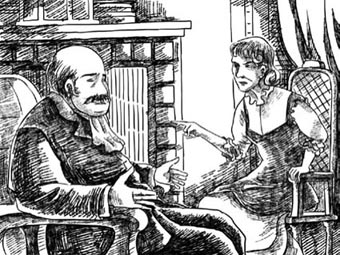
'Well, the poor dean is still alive. Was it discussed at the palace?' asked Mrs Slope.
'Was what discussed?' asked the bishop.
'Replacing the dean,' said Mrs Proudie. As she spoke, her eyes flashed in their old familiar way, and the bishop felt a little less comfortable than before.
'Hardly at all, my dear. It was just mentioned.'
'And what did you say about it, bishop?'
'I? Oh, I just said – I thought – that is, if the dean –' As he searched for the right words, he saw his wife looking sternly at him, and he began to wonder. Why should he suffer so much to assist a man like Slope? Why fight a losing battle for a chaplain? From that moment he decided to give up his support for Slope, and try to gain his wife's approval in everything he did.
'I am told,' said Mrs Proudie, speaking very slowly, 'that Mr Slope hopes to be the new dean.'
'Yes – certainly, I believe he does.'
'I hope, bishop, that you did not do anything so foolish as to mention his name to the archbishop.'
'Well, my dear, I may have done –'
'What were you thinking of, bishop? A man who hardly knows who his own father was! A man I found without bread to eat or a coat on his back! Dean of Barchester, indeed! I'll dean him!'
'But my dear, I thought you were beginning to dislike Mr Slope, and therefore, it seemed to me that if he got this post, and stopped being my chaplain, you might be pleased.'
Mrs Proudie laughed a loud, scornful laugh. 'Of course he'll stop being your chaplain! I couldn't for a moment think of living in the same house as such a man. But he won't become dean, oh no! I have my eye on him. It wasn't enough for him to interfere in cathedral business, to get you, my dear, into trouble and cause quarrelling among the clergy, no, that wasn't enough for him! He is now behaving in a most disgraceful way with that Italian woman. I shall show Mr Slope to the world for what he is – a false, mean, wicked man. Dean, indeed! The man has gone mad!'
The bishop said nothing further to excuse himself or his chaplain, and he and his wife went in to dinner. That evening was the pleasantest he had spent in his own house for a long time. And in the morning, when he was dressing for the Ullathorne party, he promised himself he would never again go into battle against a fighter so skilled and so deadly as Mrs Proudie.
dean n. a priest of high rank, who is in charge of several priests or churches 教士长,主任牧师
replace v. to start doing something instead of another person, or being used instead of another thing 取代,接替
approach v. to move towards or nearer to someone or something 走近,靠近
occur to to suddenly come into your mind 突然想到
inspector n. an official whose job is to check that something is satisfactory and that rules are being obeyed 督察官,检查员
column n. an article on a particular subject or by a particular writer that appears regularly in a newspaper or magazine 专栏文章
break the ice to make people feel more friendly and willing to talk to each other 打破沉默,破冰
promotion n. a move to a more important job or position in a company or organization 擢升,提升
welcoming adj. done or organized in a pleasant and relaxing way 令人愉快的
refreshing adj. pleasantly different from what is familiar and boring 令人耳目一新的
misjudge v. to form a wrong or unfair opinion about a person or a situation 错误判断
alarmed adj. worried or frightened 担忧的,恐惧的
accompany v. to go somewhere with someone 陪同,陪伴
mean adj. unkind or nasty 刻薄的;卑鄙的
deadly adj. likely to cause death 致命的
7
普劳蒂太太的胜利
当埃莉诺回到巴彻斯特的家,她大姑子跑出来迎接她,说:“哦,埃莉诺,你听说发生什么事了吗?可怜的教士长,特雷弗尔博士,病得非常厉害——恐怕是撑不了多久啦!”
消息很快传遍了全城,大多数神职人员都聚集到了大教堂的图书馆里。图书馆是一间面积很大的房间,跟教士长的宅邸连在一起,大家在这里等有关教士长身体状况的消息很方便。看样子,这位老人家是突然之间病倒的,眼下已在弥留之际。有人已经去请伦敦名医奥米克荣·皮耶爵士,与此同时,巴彻斯特的医生们也在尽力抢救。
图书馆里,神职人员在用充满敬重的语气低声交谈。
“他这个人非常优秀,脾气又好。”一名代牧说。
“很难找到合适的人来接替他。”另一名代牧说,“执事长,我希望政府不会任命一个外人。”
“只要特雷弗尔博士还有挺过来的希望,”格兰特利博士说,“咱们就不该讨论新教士长的事情。”
“哦,是的,那是当然。不过,说到对本届政府的影响力,没人比得上斯洛普先生吧——”
“斯洛普先生!”两三个声音同时说,“斯洛普先生——巴彻斯特教士长!不可能!”
执事长脸色发白。要是斯洛普先生真的当上了巴彻斯特的教士长呢?这毫无道理,但斯洛普先生似乎可以左右普劳蒂博士,普劳蒂博士又已经赢得了首相的赞许。
“我觉得这种事情绝无可能。”他说,“不过,现在我更担心的是咱们这位可怜的朋友,而不是斯洛普先生。”
“当然,当然。”第一个说话的代牧说,“我们也都跟您一样。可怜的特雷弗尔博士,大好人啊,可惜——”
“这儿可是全国最舒适的教士长宅邸。”又一个代牧说。
“还有两千镑的年薪呢。”第三个代牧说。
“不对,已经减到了一千两百镑。”第一个代牧又说。
“我觉得应该是一千五百镑。”第四个代牧说。
“你说呢,格兰特利?”第一个代牧说。
“一千二。”执事长语气坚定地回答,结束了关于教士长收入的全部讨论。
听说教士长病重的时候,主教正坐在宅邸的书房里。他自己也觉得不太舒服。昨天他刚刚打赢了与自己夫人的第一仗,满以为自己也许会从此摆脱奴仆地位。他跟斯洛普先生共度了一个愉快的夜晚,享受着自己刚刚获得的自由,做了不少计划。然而,随着就寝时间的到来,他的心也沉了下去。他敢担保自己下楼吃早饭的时候还是个自由身吗?他比平常拖延了一个小时,这才不情不愿地爬上楼,走进与妻子共用的房间。当夜夫妻之间发生了什么很难说。但第二天早上下楼的时候,主教愁眉苦脸、心事重重,看上去比之前瘦了一些,老了一些,头发也白了一些,这就足以说明一切。此时此刻,他心中的一切宏图大志都已经化成了灰。
听说教士长病重的时候,斯洛普先生突然想到,自己也许可以成为新任教士长。他也想知道,教士长的年薪究竟是一千二、一千五还是两千,不过无论如何,这对他来说都是往前迈了一大步——他的权力将超过执事长。
于是他开始制订计划。首先,他肯定自己能够得到主教的支持——在该由谁来填补空缺这个问题上,首相可能会征询普劳蒂博士的意见。其次,他认识尼古拉斯·菲茨维金爵士,他是督学,在政府里有很多朋友——他希望尼古拉斯爵士会动用自己的人脉来帮他。最后,他自以为《朱庇特报》的记者——托尔斯先生——是他能派上用场的朋友,能把斯洛普的名字写进这份报纸的专栏。
教士长还活着,但斯洛普先生不想浪费一分一秒。于是他径直去了主教的书房,知道普劳蒂博士第二天就要启程前往大主教的宅邸。斯洛普先生走进去的时候,主教坐在椅子上,无所事事,什么都不想。
“什么事,斯洛普?”主教的口气有些不耐烦。他并不急于跟斯洛普先生多谈。
“大人,有一条让您难过的消息,可怜的教士长没有一丝好转的迹象。”
“哦——啊——没好吗?可怜的人!可怜的人!”
“对于大人您来说,重要的事情自然是有一个跟您看法一致的新教士长。如果允许我说两句的话,我建议您明天就跟大主教谈谈。我敢肯定,有了大主教的支持,首相会很看重您的想法的。”
“首相待我一直不错,非常不错。但我并不想插手这样的事情,除非他要我这么做。还有,说真的,就算问到我,我也不知道该推荐谁。”
这句话让斯洛普先生小小地吃了一惊,但他很快就缓过神来。眼下他的困难就是如何让自己的话显得足够谦逊。“这我兴许能帮到您,大人。这件事我已经考虑了一段时间,要是可怜的特雷弗尔博士一定会离我们而去,据我看,有了大人您的支持,我本人没理由不能接掌这个职位。”
“你!”主教大喊一声,语气绝无半点恭维。
既然话已说破,斯洛普先生便开始滔滔不绝地劝说主教。他谈到了自己目前的成就、为教会所做的工作、几个身居高位的朋友以及他对普劳蒂博士的高度尊重和景仰。他还说,当上教士长之后,他就可以让普劳蒂博士在巴彻斯特过得更舒适,提高博士在神职人员中的影响力。紧接着,他一口气又列出了七八条理由,说明为什么巴彻斯特教士长一职非他莫属。
主教坐在那儿,一言不发。他做梦也想不到斯洛普先生会是巴彻斯特的教士长,却还是慢慢意识到,这样的提拔对他自己也不无裨益。他离了斯洛普先生也好好的。在反抗普劳蒂太太的斗争中,斯洛普先生对他已经不再有什么用处,因为他已经认输。说真的,要是能睡在自己的特遣牧师的卧室里,而不是妻子的卧室,那他或许还有点理由来留住斯洛普先生。
于是,主教最终同意了斯洛普先生的建议,决定一有机会就跟大主教提这件事情。不过,普劳蒂博士也想从自己的特遣牧师那里得到一点回报。“至于海勒姆养老院,”他说,“我觉得,总体上讲,还是交给奎沃夫先生比较好。他家里人口多,又很穷。”
“可是,我的大人,”斯洛普先生不想让普劳蒂太太得逞。“我真的很担心——”
“你要记住,斯洛普先生,”主教说,“我没法保证让你当上教士长。我会照你的期望去跟大主教讲,可我不敢肯定——”
“好吧,我的大人,”斯洛普先生说,完全明白了主教的意思,“关于奎沃夫先生,兴许您说得对。我可以轻而易举地解决哈丁先生那边的问题。把他交给我吧。”
“是的,斯洛普,那样就再好不过。你尽管放心,我会竭尽全力举荐你的。”
他俩就此作别。斯洛普先生手上的事情一下子多了起来。他每天都得去拜访内罗尼太太。其实不去更为明智,但激情已经蒙蔽了他的双眼。他决定再去斯坦诺普家喝一次茶,就这一次,以后就再也不去了。除此之外,他还得料理博尔德太太那边的事情。做特遣牧师的妻子也好,教士长的妻子也罢,她都会十分迷人。更何况,要是最后发现教士长的年薪只有一千二的话,她的财富将是有益的补充。
跟许多人一样,斯洛普先生也认为,在爱情和战争中,一切手段都是光明正大的。既然如此,他收买和讨好埃莉诺的年轻女仆,以便打探这位寡妇的消息,心里也不会觉得有什么不光彩。就是通过这种方法,他知道自己的信送到了普拉姆斯特德,也听说了之后的争执。让他高兴的是,女仆觉得自己听见了博尔德太太宣称,她“不会为了任何人而放弃斯洛普先生”。这位特遣牧师由此十分肯定,这个美貌的寡妇如今很有可能接受他的求婚。所以,在大家知道新任院长是奎沃夫先生而不是哈丁先生之前,他必须马上表明心迹。
此外,为了当上教士长,他还得争取尼古拉斯爵士和托尔斯先生的支持,因此他立刻坐了下来,给这两位绅士写信。信寄出去之后,他得了空闲,于是就坐到可爱的内罗尼太太的沙发旁边,度过了当晚剩余的时间。
******
接下来那一周,博尔德太太跟斯坦诺普一家待了不少时间,心里也越来越喜欢这家人。如果有人问起来,她会说夏洛特是她特别的朋友,但她也同样喜欢伯蒂。她让伯蒂跟自己亲密到与别人从未有过的程度,并没有意识到这样可能会很危险。在整件事上,她的想法十分单纯,从没把他当作恋人。但埃莉诺身陷其中的熟稔关系全都是出自夏洛特的刻意安排。这个做姐姐的很清楚该如何玩这场游戏,玩起来也毫不手软。她了解弟弟的品性,却仍然打算把这个年轻寡妇连人带钱全部交给他,心里没有一丝怜悯和懊悔。为了达到目的,夏洛特让家人友好对待博尔德太太,也使博尔德太太在她父亲家里有宾至如归之感。刚刚忍受了神职人员的高傲和刻板,埃莉诺发现,这家人的不拘小节让她耳目一新。
不过,埃莉诺绝对没有忘记阿拉宾先生。她确实是气冲冲地跟他告了别,也确实还在生他的气,可她真心实意地想再次跟他见面,想原谅他对自己犯下的过错。他说过的话还在她耳边回响。她知道那些话的意思是他爱她,要是他再度向她表白,她觉得自己可能会温柔应允。不过,首先他得承认自己冤枉了她才行。
一个星期之后,她就会在索恩小姐的园会上再次见到他。园会是一桩盛事,有午餐和各种娱乐活动——体育运动、游戏比赛、音乐以及舞会。方圆数英里之内的所有人都很期待。
格兰特利一家自然也接到了园会的邀请。埃莉诺原本打算跟姐姐一起前往乌拉索恩,不过,由于跟执事长吵了那一架,她决定跟斯坦诺普一家同行。然而,她不无恐慌地发现,斯洛普先生也会跟斯坦诺普一家同行。更让她烦心的是,她发现自己会跟他同乘一辆马车。她很不愿意让阿拉宾先生看到她走下和斯洛普先生共同乘坐的马车,但想不出避开这种局面的办法。
******
园会的前一天,主教才从大主教家回到巴彻斯特。到了之后,他心惊胆战地溜进了自己的宅邸,因为他比原计划多待了三天,很害怕因此受罚。然而,他受到的欢迎简直是再热烈不过。女儿们亲他,太太伸开双臂拥抱他,管他叫她的心肝宝贝、亲爱的、乖乖的小主教。这可真叫人喜出望外。
普劳蒂太太改变了对待主教大人的方式。她想让他知道,只要他对自己言听计从,就能得到回报。斯洛普先生根本没有机会斗过她。她不单可以用夜半狂怒把可怜的主教吓个半死,还能用丰盛的晚餐、温暖的炉火和安逸的生活来安抚他,让他高兴起来。
她跟他一起在他的书房里坐下来。主教坐在炉边他最喜爱的那把扶手椅上,既轻松又惬意。
“希望你在大主教那边过得还开心。”她说,尽力堆出充满柔情蜜意的笑容。
“哦,是啊,亲爱的。大主教对我挺客气。”
“听你这么说,我真高兴。”接下来,她话锋一转,“对了,可怜的教士长还活着呢。在大主教宅邸的时候,你们讨论过这件事情吗?”
“讨论什么事情?”主教问。
“找人接替教士长。”普劳蒂太太说。说这话的时候,她的眼睛里闪出从前那种熟悉的光芒,主教开始有点坐立不安。
“基本上没怎么讨论,亲爱的。只是提了提。”
“那你说了些什么呢,主教?”
“我?哦,我只是说——我觉得——我是说,要是教士长——”他搜肠刮肚寻找合适的话时,看见妻子恶狠狠地盯着自己,心里就犯了嘀咕。他为什么要吃苦受罪地帮斯洛普这样的人呢?为什么要为了一个特遣牧师打一场必败无疑的仗呢?就从这一刻起,他决定不再支持斯洛普,以后不管做什么事,都要尽量让妻子满意。
“有人告诉我,”普劳蒂太太慢吞吞地说,“斯洛普先生想成为新任教士长。”
“是的——没错,我觉得他确实有这个想法。”
“我希望,主教,你没有傻到在大主教跟前举荐他的地步。”
“呃,亲爱的,我可能已经那么了——”
“你当时是怎么想的啊,主教?一个连自己的亲爹是谁都不知道的人!我发现他的时候,他连吃的和穿的都还没有着落呢!巴彻斯特教士长,还真是!我让他当教士长去!”
“可是,亲爱的,我以为你已经开始讨厌斯洛普先生,所以就觉得,如果他走马上任,不再是我的特遣牧师,没准儿会让你高兴呢。”
普劳蒂太太放声大笑,笑声中充满了不屑。“他当然不再会是你的特遣牧师!跟这样一个人住在同一个屋檐下,这种事儿我连一秒钟都不能想。不过,他可不能当教士长,哦,不!我一直盯着他呢。他插手大教堂的事务,给你,给我亲爱的惹麻烦,又让神职人员吵成一团,这样他还嫌不够。不够,这样他还嫌不够!眼下他又跟那个意大利女人混在一起,真是无耻。我要向全世界揭露斯洛普先生的真面目——一个既虚伪又卑鄙的恶棍。教士长,还真是!这家伙简直是疯了!”
主教没有再为自己或是自己的特遣牧师开脱,和妻子进餐厅吃晚饭去了。那天晚上是他好久以来在自己家度过的最美好的夜晚。第二天早晨,他一边为乌拉索恩的园会穿衣打扮,一边暗自发誓,绝不再跟自家太太这样一位技巧纯熟、手法致命的斗士交战。
4.A newcomer to Barchester
PART TWO: COUNTER-ATTACK
第二部:反击
4
A newcomer to Barchester
Francis Arabin was the younger son of a country gentleman from the north of England. He was educated at an excellent school, and then studied at Oxford University. Here he developed his skill in debating, and became known as an intelligent, humorous, and successful speaker. He was almost always able to make the arguments of the opposing team sound unbelievable, and he aimed to win every debate by using both humour and reason.
But his main interest was in religion, and he gave himself completely to the Church. For it he wrote poems, speeches, and sermons, for it he ate and drank and dressed and breathed. Soon he was ordained as a clergyman, and remained in Oxford as a professor of poetry at one of the university colleges.
Now came the moment of his greatest danger. After much thought, Mr Newman, a well-known Oxford clergyman, left the Church of England to join the Church of Rome, and Mr Arabin was strongly tempted to follow him. In order to consider what he should do, Arabin left Oxford for a while and stayed in a quiet little village by the sea, far from the complications of civilized life.
Everything seemed to point to his choosing the Church of Rome. He loved and admired Mr Newman, and was eager to follow in his footsteps. He approved of Rome's strictness. 'How much simpler it would be,' he thought, 'to live under religious laws which are certain, how much easier to recognize sin and therefore avoid it!' And he wanted so much to show God that he believed in Him; what better proof could there be than making the great sacrifice of the religion in which he had been brought up, and which was supposed to provide his income?
At the time, Mr Arabin was a very young man, too confident in his own powers, and with too little respect for the common sense of ordinary people. But it was an ordinary country vicar, in that small village, who made him see that all true religious guidance comes from within the person, and not from laws made by priests. Arabin also realized that by looking for safety and comfort in the Church of Rome, he was running away from the difficult choice between good and evil. He returned to Oxford a humbler, but a better and a happier man.
When he became vicar of St Ewold's, the church near Plumstead, he was about forty and unmarried. He was above medium height, with slightly greying dark hair. He was not handsome, but his face was pleasant to look at, and there was a humorous look in his eyes. He was popular with women, but living in an Oxford college had meant that he could not marry, so he thought of women as pretty, amusing creatures, nothing more.
He came to stay for a month with the Grantlys, because the vicar's house at St Ewold's needed some repairs. After dinner with the archdeacon, his wife, and their daughters, Mr Arabin went up to his bedroom, and sat at the open window looking out at his church, which he could just see in the moonlight beyond the archdeacon's garden. It was a lovely evening, but Francis Arabin felt sad. It had struck him suddenly, when he saw Dr Grantly's charming wife and children and their comfortable house and garden, how alone in the world he was. He had given his whole life to the Church, and now he thought that had been a mistake. He knew he could have had a high position and great wealth, and probably a family to bring him joy, but now it was too late. He was the vicar of a small country church, and that was all.
The following morning Mr Harding and Eleanor arrived at Plumstead to stay there for a few days. Dr Grantly and Mr Arabin were at St Ewold's, and Mr Harding wanted to walk round the garden, so the two sisters naturally fell into conversation. They had never told each other all their secrets, as Mrs Grantly was ten years older than Eleanor, and they did not see each other often. Mrs Grantly did not, therefore, expect Eleanor to talk to her of love, but she was still very anxious to find out whether her sister had any liking for Mr Slope.
It was very easy to turn the conversation to Mr Slope, and Mrs Grantly was soon criticizing him, which she did with her whole heart, and Mrs Bold was defending him almost as eagerly. Eleanor actually disliked the man; she had almost a fear of him, and would have been delighted never to see him again, but somehow she constantly found herself protecting him against what she considered the injustice of his enemies' attacks.
The conversation moved on to the Stanhopes, and Mrs Grantly heard about Eleanor's recent evening with them. Suddenly she realized Mr Slope had also been there.
'What!' she cried in horror. 'Why, Eleanor, he must be very fond of you. He seems to follow you everywhere!'
Even this did not open Eleanor's eyes. She just laughed, and said she thought he found someone else to attract him at the Stanhopes'. And so the sisters parted. Mrs Grantly felt quite convinced that the hated marriage would take place, and Mrs Bold was just as convinced that the unfortunate chaplain was yet again being unjustly criticized.
The archdeacon was furious when his wife told him, in private, how she feared Eleanor's relationship with Mr Slope was developing. 'I am sorry, my dear,' he said, 'but if she marries that man, I shall not allow either of them within my doors.'
Susan Grantly sighed. 'Well, perhaps it will never happen. I hope, now that Eleanor is here, she will forget her fatal passion.'
Poor Eleanor, who felt no fatal passion for any man, spent a rather dull evening. Mr Arabin did not seem to notice her much, and he and the Grantlys spent all the time after dinner discussing the various local clergymen. Eleanor began to think, on reaching her bedroom that night, that she was getting tired of clergymen and their respectable, boring way of life, and that she would have had a much pleasanter evening with the Stanhopes.
Mr Arabin, on the other hand, had enjoyed his evening; he appreciated not only the well-informed conversation of the Grantlys, but also the sight of Eleanor's very pretty face under her widow's cap. He began to look forward to the rest of his stay at Plumstead, because she would be there for some of the time.
The next day the whole party drove in the archdeacon's carriage to visit the vicar's house at St Ewold's. In the carriage Eleanor found herself opposite Mr Arabin, and was surprised to discover how easy he was to talk to.
Mr Harding told them an old story he had heard from local people that, a long time ago, a priestess had lived at St Ewold's; she was famous for curing the villagers of all kinds of diseases. Mr Arabin declared he would not want the villagers to rely on a priestess these days, but Mrs Grantly disagreed. 'Every church should have its priestess as well as its priest,' she said, smiling.
'I suppose,' suggested Eleanor, 'that in the past the priestess had all the power. Perhaps Mr Arabin thinks that might happen again if St Ewold's had a modern priestess.'
'I think it is safer not to run the risk of it,' laughed Mr Arabin.
'Such accidents do happen,' said Mrs Grantly. 'They say there is a priestess in Barchester who gives the orders in spiritual matters. Perhaps the fear of that is before your eyes, Mr Arabin.'
This amusing conversation came to an end when they arrived at St Ewold's. Soon the archdeacon and his wife were walking all round the house, telling Mr Arabin what repairs and improvements he needed to make, in order to live comfortably. But while the Grantlys were in the dining room, making plans for a larger fireplace, Eleanor and Mr Arabin found themselves in a small upstairs sitting room.
'There is a beautiful view from here,' said Eleanor, looking out at the cathedral, the bishop's palace, and the trees surrounding Hiram's Hospital. 'This will be your study, I imagine?'
'There is a beautiful view from here,' said Eleanor.
'Yes,' he said, joining her at the window, 'I shall have a perfect view of my enemies. I can fire at them very conveniently from here.'
'You clergymen are always thinking of fighting each other!' said Eleanor, half laughing.
'But are we not here to fight? If we have differences of opinion, should we not go into battle? There is no easy path in religion – I have looked for one and did not find it.' He was silent for a moment, thinking of the time when he had so nearly sacrificed his freedom and his intelligence for that easy path.
Eleanor was impressed by his quiet seriousness. She was used to religious discussion, but she realized, with a certain pleasurable excitement, that this newcomer among them was different from the other churchmen she knew. Instead of arguing bitterly about details, he was only interested in the truth, and was searching humbly for it.
They were interrupted by the archdeacon's shouts of 'Arabin! Arabin!' and went to join the Grantlys in the dining room. Dr Grantly suggested the whole room should be enlarged, which Mr Arabin considered would be far too expensive.
'But,' said Mrs Grantly with a smile, 'what if the priestess, who will surely arrive here one day, insists on it?'
'Then she must do it herself,' replied Mr Arabin lightly.
And, having done their work, the party returned home to Plumstead, well satisfied with their visit.
The following Sunday Mr Arabin was to give his first sermon at St Ewold's. He, the archdeacon, and Eleanor were to go there for the morning service, have lunch with the local squire, and return to Plumstead after attending the afternoon service.
The squire of Ullathorne, the area of farmland, villages and churches which included St Ewold's, was a gentleman called William Thorne. He was about fifty, single, and more than a little proud of his appearance. But he was prouder still of his family name. He had a great respect for long, unbroken bloodlines, and his own family line stretched back to the eighth or ninth century. He believed firmly that all traditions and customs should be kept exactly as they always had been.
Mr Thorne did not live alone at Ullathorne House. He had a sister, who was ten years older than him, and an even greater believer in tradition. Once when her brother suggested making a small alteration to the front door of their house, she took to her bed and was ill for a week; she would not come downstairs until she received his promise that it would not be changed in her lifetime. She would not have a modern magazine in her sitting room, and she refused to read poems or novels by living writers. She had thought her brother dangerously liberal-minded when he was younger, and was pleased that the passing of the years had shown him the importance of traditional values. Looking back over five or six centuries of English history, as Miss Thorne liked to do, she often found reason to sigh deeply. She imagined that an innocence and a goodness had existed in the past, which were not to be found in her own time. However wrong she was, no one would deny her the sweetness of her soft regrets!
Mr Arabin, Dr Grantly, and Eleanor met Mr and Miss Thorne at the gates of Ullathorne House, and walked to church together. Large numbers of villagers had gathered there, to see their new vicar. In spite of his long experience of public speaking, Mr Arabin felt a little nervous, knowing that he was being compared with the previous vicar. But fortunately most people in the church considered that Arabin did his work well enough, especially as his sermon was only twenty minutes long.
Then came the lunch at Ullathorne House. Miss Thorne took special care of Eleanor, piling cold meat on her plate and filling her glass with wine. 'It's your duty, you know, to support yourself,' she whispered in the young mother's ear. 'There's more than yourself depending on it.'
And then Miss Thorne was very knowledgeable about teeth. Little Johnny Bold had been troubled for the last few days with his first tooth, and Miss Thorne was shocked to find that Eleanor was giving him some dreadfully modern medicine, recommended by one of the local doctors.
'Take care, my dear,' she said, looking very serious, 'that that man doesn't harm your little boy. But then,' speaking more in pity than in anger, 'I don't know which doctor you can trust now. Poor dear old Dr Bumpwell, of course –'
'Why, Miss Thorne, he died when I was a little girl.'
'Indeed, my dear, and a sad day it was for Barchester.'
The archdeacon was enjoying his lunch. He talked to his host Mr Thorne about farming; while Mr Thorne, thinking it only polite to pay attention to a stranger, tried to talk to Mr Arabin about religious matters. The two conversations ran on together.
'What are you putting on your fields now, Thorne? Is it guano?' asked Dr Grantly.
'Yes, archdeacon, I get it from Bristol. You'll find a lot of Barchester people, Mr Arabin, who come to services at St Ewold's in the summer, if it isn't too hot for them to walk.'
'I'm glad they stayed away today,' said Mr Arabin, smiling, 'as it was my first sermon.'
'Who do you buy it from in Bristol, Thorne?'
'I drove there myself this year, and bought it straight off the ship. I'm afraid, Mr Arabin, that as the evenings get darker, you'll find it difficult to read in the church. I shall send a man to cut off some branches of the trees outside the south window.'
'The morning light is perfect, at least,' said Mr Arabin. And then he and Eleanor took a walk round the garden, while Miss Thorne cut some flowers, and the archdeacon and the squire finished their discussion about the Bristol guano.
At three o'clock they all went to church again. This time the archdeacon gave the sermon, and half an hour later he, Mr Arabin, and Eleanor shook hands with their Ullathorne friends and drove back to Plumstead.
ordain v. to officially make someone a priest or religious leader 授任(某人)神职
humble adj. not considering yourself or your ideas to be as important as other people's 谦虚的,谦卑的
fall into to start doing something by chance 碰巧开始做某事
injustice n. a situation in which people are treated very unfairly and not given their rights 不公正,非正义
open someone's eyes to to make someone realize something that they have not realized before 使某人认清
unjustly adv. not fairly or reasonably 不公正地;不合理地
fireplace n. a special place in the wall of a room, where you can make a fire 壁炉
bitterly adv. in a way that produces or shows feelings of great sadness or anger 痛苦地;愤恨地
squire n. the man who in the past owned most of the land around a country village in England (从前英格兰乡村的)大地主,乡绅
take to one's bed to get into bed and stay there because you are ill 因病卧床
previous adj. coming immediately before the one you are talking about now 先前的
guano n. solid waste from sea birds, put on soil to help plants grow 海鸟粪
4
巴彻斯特的新面孔
弗朗西斯·阿拉宾是英格兰北部一位乡间绅士的次子,上过一所非常不错的学校,然后又去了牛津大学念书。他在牛津培养了辩论口才,成为一名小有名气的机智幽默的成功演说家。他几乎总是能让对手的论据显得荒诞无稽,力争用幽默和道理来赢得每一场辩论。
不过,他最感兴趣的还是宗教,并且全身心地投入了教会工作。他为教会撰写诗歌、演说词和布道词,甚至吃喝打扮和呼吸都是为了教会。他很快就获得了圣职,留在牛津一个学院担任诗歌教授。
接下来他遇上了人生中最大的危机。经过一番深思熟虑,鼎鼎大名的牛津神职人员纽曼先生离开了英格兰教会,加入了罗马教廷。阿拉宾先生受到了很大的诱惑,要追随他去。为了想清楚该怎么做,阿拉宾暂别牛津,远离文明社会的纷扰,在一个宁静的海滨小村生活了一段时间。
一切迹象似乎都表明他应该选择罗马教廷。他对纽曼先生充满爱戴和崇敬之情,很想追随他的足迹,同时十分赞赏罗马的严谨作风。“有了明白无误的宗教戒条,一切就简单多了。”他想,“认清罪孽和避免犯错又会变得何等容易!”此外,他很想向上帝表明自己对他的信仰。要证明这一点,有什么能比得上牺牲自己伟大的宗教呢?而这宗教是自己从小耳濡目染的,如今又是他的衣食来源。
那时候,阿拉宾先生还很年轻,对自身的能力过于自信,对普通人的常识也缺乏尊重。多亏了那个小村庄里一个普普通通的乡下代牧,他才认识到真正的宗教指引全都来自内心,而不是牧师制定的戒律。他还意识到,在罗马教廷寻求安逸,就等于远离善恶之间的艰难抉择。于是他回到牛津,人变得更加谦逊,却也比以前更加高尚、更加快乐。
到普拉姆斯特德附近的圣埃沃兹教堂当代牧的时候,他已经年近四十,尚未婚娶。他高于中等身材,黑头发略微有些花白。相貌算不上英俊,但脸长得还讨人喜欢,眼里有幽默的神情。他很受女士们欢迎,然而,他既然在牛津学院里生活,就意味着不得婚娶。因此,他只把女人当作美丽而有趣的生物,仅此而已。
圣埃沃兹教堂的代牧住所需要稍加修缮,他便搬到格兰特利家暂住一个月。一天,跟执事长夫妇和他们的几个女儿吃完晚饭之后,阿拉宾先生回到了楼上的卧室里,坐在敞开的窗边眺望自己的教堂。借着月光,他也只能勉强看见执事长花园那头的圣埃沃兹教堂。这是一个美好的夜晚,弗朗西斯·阿拉宾却觉得有些难过。看到格兰特利博士可爱的妻儿,看到他们舒适的住所和花园,他突然意识到,自己在这个世上是多么孤单。他把一生献给了教会,如今却觉得这是个错误。他心里明白,自己原本可以身居高位,家财万贯,可能还会有一个带给他欢乐的家庭,只可惜事到如今,一切都为时已晚。他只是一座乡村小教堂的代牧,仅此而已。
第二天早上,哈丁先生和埃莉诺来到了普拉姆斯特德,打算在这里住上几天。格兰特利博士和阿拉宾先生都去了圣埃沃兹,哈丁先生则想在花园里到处走走,埃莉诺和苏珊这姐妹俩便自然而然地聊了起来。格兰特利太太比埃莉诺大十岁,两人从来不曾对彼此掏心掏肺,也并不经常见面。因此,格兰特利太太并不指望埃莉诺会跟她谈论爱情,不过,她还是很想知道自己的妹妹究竟喜不喜欢斯洛普先生。
要把话题转到斯洛普先生身上很容易。格兰特利太太很快就开始不遗余力地指责他,博尔德太太则几乎同样热切地替他辩护。她其实并不喜欢这个人。她甚至有点儿怕他,巴不得再也不跟他见面,但不知怎的,她发现自己总是在帮他抵挡来自他敌人的、她认为不公正的攻击。
话锋转移到了斯坦诺普一家,格兰特利太太听说埃莉诺最近跟他们共度了一晚。突然,她意识到当时在场的还有斯洛普先生。
“什么!”她惊恐地大叫一声,“哎呀,埃莉诺,他肯定很喜欢你。你去哪儿他好像都跟着你呢!”
就连这种话埃莉诺也听不进去。她只是哈哈大笑了一通,说她觉得斯洛普先生在斯坦诺普家看上了别人。说到这儿,姐妹俩就此分别。格兰特利太太确信这桩让人憎恨的婚姻将会成为现实,博尔德太太也同样确信,不幸的特遣牧师再次遭受了不公正的抨击。
当妻子私下告诉执事长,她担心埃莉诺跟斯洛普先生的关系正在发展,执事长勃然大怒。“很抱歉,亲爱的,”他说,“不过,她要是嫁给了那个男人,他俩谁也不许再踏入我的家门。”
苏珊·格兰特利叹了口气。“唉,或许也发展不到那种地步。我希望,既然埃莉诺在这儿,她能够忘掉她那要命的激情。”
可怜的埃莉诺并没有对任何男人产生要命的激情。这一晚,她过得十分无聊。阿拉宾先生似乎并没有怎么留意她。晚饭之后,他一直在跟格兰特利夫妇谈论当地的各类神职人员。当晚进卧房的时候,埃莉诺开始觉得,自己渐渐厌倦了神职人员,厌倦了他们那种令人尊敬却寡然无味的生活方式。要是跟斯坦诺普一家在一起,这个夜晚肯定会愉快得多。
另一边,阿拉宾先生倒是度过了一个开心的夜晚。他不仅喜欢与格兰特利夫妇那些增广见闻的谈话,还喜欢看埃莉诺寡妇帽下那张美丽的脸庞。他开始对自己在普拉姆斯特德余下的日子充满期待,因为她也会在那儿待上一阵。
第二天,大家一起坐执事长的马车去参观圣埃沃兹的代牧住所。上了马车之后,埃莉诺发现自己刚好坐在了阿拉宾先生的对面,并且惊讶地发现,跟他聊天十分轻松。
哈丁先生给他们讲了一个从本地人那儿听来的古老的故事:很久以前,圣埃沃兹住着一位女牧师;女牧师非常出名,因为她能治愈村民们的各种病症。阿拉宾先生说,他不希望如今的村民依赖一位女牧师,格兰特利太太却不赞同他的看法。“每一座教堂都应该既有男牧师,又有女牧师。”她笑盈盈地说。
“要我说,”埃莉诺发言了,“在过去,所有的权力都集中在女牧师的手里。阿拉宾先生兴许是觉得,要是圣埃沃兹有了一位新式女牧师,这样的事还会再发生。”
“我觉得,还是别冒这种险为好。”阿拉宾先生哈哈大笑。
“确实会发生这样的意外。”格兰特利太太说,“听人说,巴彻斯特就有一位女牧师在对宗教事务指手画脚。这样的忧虑没准儿就在眼前呢,阿拉宾先生。”
他们到了圣埃沃兹,这段有趣的交谈即告结束。执事长夫妇马上开始在房子里四下走动,告诉阿拉宾先生哪儿该修、哪儿该补,好住起来舒服。不过,等格兰特利夫妇在餐厅里盘算该怎么扩建壁炉的时候,埃莉诺和阿拉宾先生却不知不觉走到了楼上的小会客厅里。
“从这儿看出去,景色还不错。”埃莉诺一边说,一边眺望窗外的大教堂、主教宅邸和海勒姆养老院周边的树林,“我估计您会把这儿用作书房,对吧?”
“没错,”他一边说,一边走到窗前,和她站在一起,“在这儿,我可以把敌人看个一清二楚,朝他们开火也很方便。”
“你们这些神职人员,总想着你争我夺!”埃莉诺似笑非笑地说。
“可是,我们到世上来,不就是为了斗争吗?如果大家观点不同,难道不该争个高下吗?宗教里没有捷径——我一直都在追寻,但一无所获。”他沉默片刻,想起那次自己差点儿就为那样的捷径牺牲了自由和智慧。
他沉静严肃的态度给埃莉诺留下了深刻的印象。她对宗教讨论已经习以为常,此时却有点愉悦又有点兴奋地发现,这位初来乍到的牧师跟她认识的其他神职人员并不一样。他不会为了细枝末节苦苦争辩,只是执着于真理而谦逊地追求着。
这时,执事长的高声大喊打断了他们的谈话:“阿拉宾!阿拉宾!”于是他们来到餐厅,跟格兰特利夫妇会合。格兰特利博士建议对整个房间进行扩建,阿拉宾先生却觉得那样未免花费太大。
“可是,”格兰特利太太微笑着说,“女牧师总有一天会大驾光临的,万一她坚持要扩建呢?”
“那她只能亲自动手了。”阿拉宾先生轻描淡写地回答。
参观完毕,一行人打道回府,赶往普拉姆斯特德,大家都对此行非常满意。
接下来的那个星期天,阿拉宾先生要在圣埃沃兹首次布道。他、执事长和埃莉诺打算一起去参加早上的仪式,与当地的乡绅共进午餐,等参加完下午的仪式再返回普拉姆斯特德。
乌拉索恩地区涵盖了农田、村落和大小教堂,其中包括圣埃沃兹。当地的乡绅名叫威廉·索恩,年约五十,尚未婚娶,对自己的外貌颇感自豪。不过,更让他引以为豪的是他的家族姓氏。他对承袭已久、绵延不绝的血脉充满敬意,他自己的家族就可以追溯到公元八九世纪。他坚信,所有的风俗习惯都应该原汁原味地保留下来。
索恩先生并不是独自一人住在索恩宅邸。他有个姐姐,比他大十岁,笃信传统的程度比他更甚。有一次,她弟弟提议对宅子的大门稍加改动,她因此而卧病在床,躺了足足一个星期。直到弟弟保证不在她有生之年改动大门,她才答应下楼。她绝不在自己的会客厅里放现代杂志,也拒绝阅读在世作家的诗歌和小说。弟弟年轻的时候,她觉得他的思想开放得过了头。等到岁月的流逝让弟弟明白了传统价值的重要性,她才称心满意。索恩小姐喜欢追溯五六百年前的英格兰历史,这么做的时候,她总是找得到唉声叹气的理由。她觉得纯真和美好在以前是有的,如今却已经难寻踪影。无论她错得有多离谱,谁也不能否认,她温柔的惋惜如此动人!
阿拉宾先生、格兰特利博士和埃莉诺在乌拉索恩宅邸的大门口跟索恩先生和索恩小姐碰面,一起步行去教堂。很多村民都已经聚在那里,来看他们的新任代牧。尽管拥有多年的公共演讲经验,阿拉宾先生还是觉得有点紧张,因为他知道大家在拿他跟之前的代牧作对比。还好,教堂里的大多数人都觉得阿拉宾的表现令人满意,尤其是他的布道只持续了二十分钟。
接下来的活动是在乌拉索恩宅邸吃午餐。索恩小姐对埃莉诺特别照顾,在她的盘子里堆了不少冷餐肉,还帮她倒酒。“你知道的,养活自己是你的责任。”她在这位年轻的母亲耳边轻声说,“不光是你自己指着你养活自己。”
索恩小姐在牙齿方面的知识也十分广博。这几天小约翰尼在长乳牙,很难受。索恩小姐惊讶地发现,埃莉诺竟然听了当地一位医生的推荐,给他吃了些摩登得骇人的药。
“当心啊,亲爱的,”她一脸严肃地说,“别让那个人伤害你的小宝贝。不过,”她的口气与其说是愤怒,不如说是惋惜,“到现在,我也不知道你还能信任哪位医生。可亲又可怜的老邦普威尔医生,当然——”
“唉,索恩小姐,我还是小姑娘的时候,他就已经过世了。”
“是啊,亲爱的,对于巴彻斯特来说,那一天可真是让人难过。”
执事长在享用午餐,还跟主人索恩先生聊起稼穑之事。而索恩先生觉得要多照顾生客才算礼貌,于是尽量跟阿拉宾先生谈论宗教事务。两场谈话同时进行。
“你现在往地里撒的是什么呢,索恩?是海鸟粪吗?”格兰特利博士问。
“没错,执事长,我从布里斯托买来的。夏天的时候,阿拉宾先生,您会发现巴彻斯特有很多人来圣埃沃兹做礼拜,只要天气没热到让他们无法步行。”
“我倒是庆幸他们今天没来,”阿拉宾先生微笑着说,“因为这是我第一次布道。”
“你是从布里斯托哪个人手里买的呢,索恩?”
“今年我自己驾车去了一趟,直接从船上买的。阿拉宾先生,等到晚上越来越黑,您恐怕会发现,在教堂里很难看清书上的字。我会派人去把南窗外面的树枝砍掉一些的。”
“至少,早晨的光线还是很好的。”阿拉宾先生说。之后,他和埃莉诺在花园里转了一圈儿,索恩小姐去剪了几枝花,执事长和乡绅则接着聊完了布里斯托海鸟粪这个话题。
三点钟,他们又一起去了教堂。这一次布道的是执事长。半个钟头之后,他、阿拉宾先生和埃莉诺跟乌拉索恩的朋友们握手告别,坐车回到了普拉姆斯特德。
5
Mr Slope on the attack
The next two weeks passed very pleasantly at Plumstead. Eleanor was a delightful house-guest, and Dr and Mrs Grantly seemed to have forgotten her wicked feelings for Mr Slope. Mr Harding walked in the garden and played the piano, and little Johnny had no more trouble with his teeth. And although Mr Arabin was busy with his new duties at St Ewold's, he made sure he spent every evening at Plumstead.
There had also been a dinner party at the Stanhopes', to which Mrs Bold and Mr Arabin were invited. He, like every other man before him, could not resist the charming signora, and spent the whole evening beside her sofa.
'I have never met so much suffering, joined to such perfect beauty and such a clever mind,' he told Eleanor as they drove home in the archdeacon's carriage.
Eleanor by no means liked to hear this praise. It was, however, extremely unjust of her to be angry with Mr Arabin, as she had herself spent a very pleasant evening with Bertie Stanhope, who had not left her side for one moment. She was not in love with Mr Arabin, although she had spent three weeks in the same house as him and they had enjoyed lengthy conversations together. But a woman does not need to be in love to be irritated when a friend or companion appears to find another woman more attractive. 'I thought he had more wisdom than that,' she told herself, as she sat watching her sleeping child, after they had arrived home. 'After all, I believe Mr Stanhope is the pleasanter man of the two.'
Mr Arabin was not in love, either. Nor was Bertie Stanhope, although he was ready to say so. Only the widow's cap which Eleanor still wore prevented him, in case it was thought too soon for a widow to be receiving another proposal of marriage.
Fortunately, Eleanor's annoyance with Mr Arabin did not last long, and soon they were good friends again. They could have been more, if he had respected her intelligence enough to discuss serious matters with her, as he had done in their first real conversation together. With her he was always gently playful. If he had allowed her to share his deepest thoughts and concerns, she might have learnt to love him.
So things went on at Plumstead. However, the matter of the wardenship was still not decided. Following his promise to Mr Harding, the archdeacon had tried to speak privately to the bishop about it, but had not been able to see him.
Luckily, Mr Harding had another friend fighting his battle for him, a friend even more powerful than the archdeacon, and this was Mr Slope. The chaplain thought he had more and more evidence every day to make him believe the widow would accept his marriage proposal. He felt that giving Mr Harding the wardenship would make him, Slope, more likely to be welcomed as a son-in-law. And he had an even stronger reason for his actions. He wanted a wife, and he wanted money, but he wanted power more than either. He had realized he must fight Mrs Proudie, otherwise he would never be able to rise to a higher position. The wardenship was an excellent reason for war.
The bishop, following his wife's orders, had declared Mr Quiverful should be the new warden. So Mr Slope decided to ride over to Puddingdale and interview the vicar at once.
Mr Quiverful was, on the whole, a good, honest, hardworking man, but the difficulties of his daily life had had a bad effect on his spirit and his sense of honour. He was attempting to bring up fourteen children as ladies and gentlemen, on an income which was hardly enough to provide them with food and clothes. He was anxious for bread and meat and anxious to pay his bills, but not as anxious as a richer man might be, to be well respected by all around him. He could not afford such a luxury. Recently he had felt that his brother clergymen, men he had known for twenty years, looked coldly on him since he had shown himself willing to sit at the feet of Mr Slope. He had seen their looks grow colder still, when it was said he was to become the new warden. This was painful to him, but when he thought of his poor wife and children, and the happy, comfortable life they would all have in the warden's house in Barchester, he felt he had no choice.
Mrs Quiverful cared nothing for the frowns of the clergy. In her heart she had no other ambition than that of seeing her husband and children properly fed and dressed – life for her had no other purpose. So she had no patience with her husband when he had spoken of not wishing to accept the post until he was sure Mr Harding had refused it. Fortunately, they had now received a full promise that the post was theirs, not only from Mr Slope, but also from Mrs Proudie. But what if all had been lost? Mrs Quiverful was a happy woman at present, but it took her breath away when she thought of the danger they had been in.
So when she saw the great Mr Slope arrive, she hurried into the kitchen with an anxious, beating heart, and left the two men alone in the sitting room.
It was easy for a man as experienced as Mr Slope to achieve his purpose. By choosing his words carefully, he was able to withdraw the promise he had made to Quiverful, who, although horrified at the thought of losing the post, could do nothing but express his disappointment. Soon Mr Slope was riding back to Barchester, confident that he could now persuade the bishop to give the post to Mr Harding.
As soon as the front door closed behind the visitor, Mrs Quiverful rushed eagerly back to her husband.
'Well, my dear, we are not to have it,' he said, turning a pale, miserable face towards her.
'What!' she cried, with all the anger and deep despair of a mother who has lost a child. 'What! Who says so?'
She sat as silent as death while he told his story. 'And so you have resigned your post?' said she, at last.
'I had no opportunity of accepting it,' he replied sadly. 'I must wait for another post, that's all.'
'Wait! Shall we feed the children by waiting?'
'It's all we can do, my dear. I feel the disappointment more for your sake than my own.'
Mrs Quiverful saw a small hot tear appear in her husband's eye and roll down his tired face. This was too much for her woman's heart. She ran to him and seized him in her arms.
'You are too soft!' she sobbed. 'But you must go at once and see the bishop! He knows nothing of this! Doesn't all the world know that Mrs Proudie is Bishop of Barchester, and Mr Slope is her slave? For some reason that woman sent him here today – to break her promise to us!'
But she could not persuade her husband to take any action at all, and soon she realized she must do something herself. 'What if, after all, Mrs Proudie knows nothing of Mr Slope's visit?' she thought. She decided to call on the bishop's wife immediately.
Normally, a visit to the bishop's palace would make her very nervous – she was only a country vicar's wife – but this time, strengthened by her family's needs, she felt confident. She arranged for a local farmer to drive her into Barchester and wait for her, to bring her back. Finally, she took her last half-crown coin from the box where she kept her savings; she would need it to bribe the servants to let her see the lady of the house.
She arrived at the palace door, and was told Mrs Proudie was not at home. 'I must see her,' said Mrs Quiverful firmly, and pressed her half-crown into the servant's hand. In two minutes she was in Mrs Proudie's sitting room, telling her sad story.
Mrs Proudie was in an excellent mood, having just triumphed in another battle. The bishop had received an invitation to spend a couple of days with the archbishop, and greatly desired to accept it. However, not a word in the invitation mentioned Mrs Proudie, so if the bishop went at all, he must go alone. This presented an enormous difficulty. He could not order his bags to be packed, and then simply set off with a servant, casually telling the lady of his heart that he would be back on Saturday. There are men – probably very wicked men – who do such things, and there are women – more like slaves – who put up with them. But Dr and Mrs Proudie were not among them.
So the bishop had spoken to his wife, but it was a short discussion. Those who are married will understand very well how the battle was lost and won; those who are single will never understand it until they learn the lesson which experience alone can give. Mrs Proudie made sure that before she left her lord, she had seen the answer to the invitation written and sealed.
Now, therefore, she was all smiles as she greeted Mrs Quiverful. But her expression became cold and stern when she heard what Mr Slope had done. Asking Mrs Quiverful to wait for her, she marched out of the room. She was extremely angry with her husband, who, as she thought, had broken the promise he had so clearly given her about the hospital, and she was determined to win the battle against him all over again.
Without knocking at the door, she walked quickly into the bishop's study. She found him seated there, with Mr Slope opposite him. Between Dr Proudie's fingers was the very note which he had written to the archbishop in her presence – and it was open! Yes, he had dared to break open the seal which she herself had approved. It was only too clear that the two guilty men were discussing the invitation, even after the matter had already been decided by her! Mr Slope rose from his chair and bowed slightly. He and Mrs Proudie looked each other full in the face, and knew each was face to face with an enemy.
'What is this, bishop, about Mr Quiverful?' said she.
Mr Slope did not allow the bishop to answer, but replied himself. 'I saw Mr Quiverful at Puddingdale this morning, madam. He has abandoned his claim to the hospital, so I have strongly advised his lordship to appoint Mr Harding.'
'Mr Quiverful has not abandoned anything,' said the lady scornfully. 'His lordship has given his word.'
The bishop remained silent. He was eager to win the battle over his old enemy, and yet his courage failed him.
'Perhaps I ought not to interfere,' said Mr Slope, 'but –'
'Certainly you ought not,' said the lady angrily.
'But,' continued Mr Slope smoothly, 'I considered it my duty to advise the bishop that he will not be popular in Barchester if he fails to appoint Mr Harding. And of course the bishop wishes to reward such an honourable man and such a good clergyman as Mr Harding. It is clear that, in the interview I had with Mr Harding, I misunderstood him –'
'And it is equally clear that you have misunderstood Mr Quiverful,' said she, now at the height of her anger. 'What business have you at all with these interviews? Who desired you to go to Puddingdale this morning? Will you answer me, sir?'
There was dead silence in the room. Mr Slope was standing with his hand on the back of a chair, looking very serious and very threatening. Mrs Proudie was standing at the end of the table, and as she spoke she struck her hand on it with an almost manly strength. The bishop was sitting in his armchair, turning his eyes now to his wife, and now to his chaplain, as each went on the attack in turn. How comfortable it would be if they could fight it out between them, so that one should destroy the other, and then he, the bishop, would know whom to obey!
'Will you answer me, sir?' she repeated. 'Who instructed you to call on Mr Quiverful this morning?'
'I think, Mrs Proudie,' said Mr Slope in a low, calm voice, 'that, under all the circumstances, it would be better for me not to answer such a question.'
'Did anyone send you, sir?'
'Mrs Proudie,' said Mr Slope, 'I am aware how much I owe to your kindness, but my duty in this matter is to his lordship, and I can accept no questioning except from him. He has approved of what I have done, and you will excuse me if I say I need no other person's approval.'
What dreadful words these were to Mrs Proudie's ears! It was evident that the bishop was rebelling against her, and she must move speedily to regain control.
'Mr Slope,' she said, slowly and deliberately, 'I will trouble you, if you please, to leave the room. I wish to speak to my lord alone.'
Mr Slope also felt that everything depended on the present interview. If the bishop lost this battle, he would remain a slave for ever. Now was the moment for victory or defeat!
'His lordship asked me here to discuss important cathedral business,' he replied, hoping for support from Dr Proudie. 'My leaving him at the moment is, I fear, impossible.'
'Ungrateful man!' cried Mrs Proudie. 'My lord, will you kindly beg Mr Slope to leave the room?'
My lord scratched his head, but said nothing. This was as much support as Mr Slope had expected.
The bishop scratched his head, but said nothing.
'My lord,' said the lady, 'is Mr Slope to leave this room, or am I?' Here Mrs Proudie made a false step. She should not have mentioned the possibility of withdrawing from the battlefield. In answer to such a question, the bishop naturally said to himself that, as it was necessary for one of them to leave the room, perhaps it might as well be Mrs Proudie. But he still said nothing.
Mrs Proudie's anger was boiling over. She could not keep her temper as her enemy did, and so she was defeated.
'My lord,' said she, 'am I to receive an answer or not?'
At last he broke his deep silence and declared himself a member of the Slope party. 'Why, my dear,' said he, 'Mr Slope and I are very busy.'
That was all. No more was necessary. He had gone into battle, put up with the heat and dust of the day, met his enemy, and won the victory. How easy success can be!
Mr Slope saw at once how much he had gained, and turned a triumphant look on the lady. Here he was wrong. He should have looked humbly at her, and remembered that this victory would not last long. He could not arrange to divorce the bishop from his wife, he could not be present every moment of the day, he could not interfere in the privacy of the bedroom, when the wife wished 'to speak to my lord alone'.
But for the moment his triumph was complete, and Mrs Proudie left the room. Now the chaplain told the bishop, in plain words, that he must not let his wife interfere in future, and Dr Proudie, after some hesitation, agreed. Like a good child, the bishop received an immediate reward – he was instructed to write another note to the archbishop, this time accepting the invitation. Mr Slope, more careful than the lady, put the note safely in his pocket. He also persuaded the bishop to see Mr Harding, with the intention of offering him the wardenship. And so Mr Slope, far from disappointed with his achievements, left the palace and posted the note with his own hands.
Mrs Proudie returned unwillingly to her sitting room, where Mrs Quiverful was waiting anxiously for her.
'Your husband has been most weak and foolish,' Mrs Proudie said sternly. 'I find I can do little for him in this matter.'
'Oh, Mrs Proudie! Think of my fourteen children!' Not a word did Mrs Quiverful say about herself, but the tears fell fast.
Mrs Proudie was surprised to find that her hard heart was touched, and she promised to do everything in her power to insist on Mr Quiverful's appointment as warden. Mrs Quiverful returned to Puddingdale, not very hopeful, but satisfied that she had done her best.
house-guest n. a friend or relative who is staying in your house for a short time 暂住客人
irritate v. to make someone feel annoyed or impatient 激怒
proposal of marriage a formal suggestion made when you ask someone to marry you 求婚
luxury n. very great comfort and pleasure 奢华,奢侈
resign v. to officially announce that you have decided to leave your job or an organization 辞(职),放弃(职位)
crown n. an old British coin, a quarter of a pound (英国旧币的)四分之一英镑硬币,克朗
bribe v. to pay money to someone to persuade them to help you or to do something dishonest 贿赂
archbishop n. a priest of the highest rank, who is in charge of all the churches in a particular area 大主教
enormous adj. very big in size or in amount (尺寸、数量)巨大的,庞大的
abandon v. to stop doing something because there are too many problems and it is impossible to continue 放弃,中止
fight out to argue or fight until a disagreement is settled (通过争论或斗争)解决(不和)
question v. to have or express doubts about something, especially about a crime 质问,盘问
deliberately adv. done or said in a slow, careful way (做事、说话)不慌不忙、谨慎地
scratch v. to rub your skin with your nails because it feels uncomfortable (用指甲)挠
triumphant adj. showing pleasure and pride because of a victory or a success 得意扬扬的,耀武扬威的
5
斯洛普先生发动袭击
接下来两个星期,在普拉姆斯特德的日子过得十分愉快。埃莉诺是个讨人喜欢的客人,格兰特利博士夫妇则似乎已经忘记了她对斯洛普先生的孽情。哈丁先生在花园里散步,弹钢琴,小约翰尼的牙也不疼了。阿拉宾先生在圣埃沃兹履新后,公务缠身,却也总会抽出时间,每晚都在普拉姆斯特德度过。
接下来,斯坦诺普家也办了一场晚宴,邀请了博尔德太太和阿拉宾先生。跟之前的那些男人一样,阿拉宾先生也无法抗拒内罗尼太太的魅力,整晚都守在她的沙发旁。
“我从没受过这么大的折磨,跟这样一个美若天仙、冰雪聪明的人相处。”坐执事长的马车回家的时候,他对埃莉诺说。
埃莉诺绝不想听到这样的赞美之词。不过,她要是为此生阿拉宾先生的气就太不公平,因为她自己也和伯蒂·斯坦诺普度过了十分愉快的一个夜晚,伯蒂对她寸步不离。她并没有爱上阿拉宾先生,尽管他俩在同一个屋檐下生活了三个星期,还曾多次愉快地长谈。可是,如果哪个女人的朋友或同伴似乎觉得别的女人更有魅力,这个女人自然会气恼,不一定非要爱上了这个朋友或同伴。“我还以为他不至于那么肤浅呢。”回到家后,她坐下来看自己熟睡的孩子,心里说,“说到底,还是斯坦诺普先生比阿拉宾先生更招人喜欢。”
阿拉宾先生也没有爱上谁。伯蒂·斯坦诺普也是,尽管他打算示爱。只不过,埃莉诺头上戴的寡妇帽子让他打了退堂鼓,他怕别人认为,一个寡妇这么快就又接受一次求婚。
还好,埃莉诺对阿拉宾先生没有生太久闷气,没多久他俩又成了好朋友。要是他足够尊重她的头脑,能像两人第一次真正交谈的时候那样,跟她讨论严肃的问题,那他俩的关系还会更进一步。跟她在一起的时候,他总是既温和又风趣。要是他跟她分享内心最深处的想法和担忧,那她倒有可能爱上他。
普拉姆斯特德的生活还在继续。然而,院长职位的问题仍然没有定论。执事长遵守对哈丁先生的诺言,一直在找机会跟主教私下聊聊这件事,只是还没能见到他。
幸运的是,还有一位朋友在帮哈丁先生争取,而且是一位权力比执事长还大的朋友——斯洛普先生。这位特遣牧师认为,相关的证据与日俱增,足以让他相信寡妇会接受他的求婚。他觉得,如果把院长一职给哈丁先生,他斯洛普就更有可能以女婿的身份得到认可。除此以外,他这么做还有一个更有力的理由。他想娶妻室,也想要滚滚钱财,可他更渴望权力。他已经意识到,自己必须对付普劳蒂太太,否则永远无法平步青云。院长职位便是一个绝佳的开战理由。
主教遵从妻命,已经公开宣称新任院长由奎沃夫先生担任。于是,斯洛普先生决定立即骑马前往帕丁戴尔,跟这位代牧当面谈谈。
总体上说,奎沃夫先生是个好心、善良、兢兢业业的人,然而,生活的艰辛侵蚀了他的精神和荣誉感。他正在努力把十四个孩子培养成绅士淑女,可收入几乎供不上他们吃饭穿衣。他急于填饱一家人的肚子,急于付清账单,但不像富人那样,急于得到身边所有人的尊重。那样的奢侈他消费不起。近些日子他有一种感觉,自从他表示愿意追随斯洛普先生之后,相识二十年的兄弟神职人员开始对他冷眼相看。等到传言说他将担任新任院长,他还看到了更加冰冷的目光。他痛苦不堪,可是,想到自己可怜的妻儿,想到一家子都能在巴彻斯特的院长住所享受快乐舒坦的日子,他觉得自己别无选择。
对于神职人员的横眉冷对,奎沃夫太太毫不在意。她一心所想,就是丈夫和孩子们衣食无忧——对她来说,生活的目的仅此而已。因此,她对自己的丈夫很不满意,因为丈夫说,除非他确信哈丁先生已拒绝担任院长,否则不会接受这个职位。幸运的是,如今他们已经得到了百分之百的保证,这个职位会花落他家,而且说这话的不光是斯洛普先生,还有普劳蒂太太。然而,要是这一切都落了空呢?就眼下来说,奎沃夫太太很快乐,可是,一想到家人所处的险境,她就觉得喘不过气来。
因此,看到了不起的斯洛普先生大驾光临,她便揣着一颗怦怦乱跳的心匆匆躲进厨房,把两个男人单独留在会客厅里。
斯洛普先生经验如此老到,自然可以轻而易举地达到目的。他字斟句酌,成功地收回了先前对奎沃夫的承诺。想到职位不保,奎沃夫心中十分恐惧,可他也只能表达自己的失望之情而已。没过多久,斯洛普先生就骑马回巴彻斯特了。他相信他现在能够说服主教,把这个职位授予哈丁先生。
客人一走,前门一关,奎沃夫太太就迫不及待地冲到丈夫身边。
“唉,亲爱的,我们得不到那个职位了。”奎沃夫先生转头对她说,面容苍白,表情痛苦。
“什么!”她大喊一声,声音里充满了愤怒和深深的绝望,就像是一个失去孩子的母亲。“什么!谁说的?”
他说话时她坐在那里,像死人一样,一声不吭。“这么说,你已经放弃你的职位了?”她终于开口了。
“我根本没机会接受这个职位。”他难过地回答,“我只能等着别的职位,就这么简单。”
“等着!我们等着能喂饱孩子们吗?”
“我们别无他法,亲爱的。我失望更多是为了你,并不是为我自己。”
奎沃夫太太看见一滴小小的热泪涌出丈夫的眼眶,沿着他疲惫的脸庞滚落。她那副柔软的女人心肠可受不了这个,她跑到他身边,把他抱在怀里。
“你太软弱了!”她抽泣道,“不过你得赶紧跑一趟,去见见主教!他还蒙在鼓里呢!普劳蒂太太才是巴彻斯特的主教,斯洛普先生是她的奴才,这不是尽人皆知吗?不知道是什么原因,那个女人今天把他给派来了——为的就是把她说出口的承诺收回去!”
然而她没法说服丈夫采取任何行动,她很快就意识到自己必须亲自出马。她心里想:“说到底,万一普劳蒂太太根本不知道斯洛普先生来这儿的事情呢?”她决定马上去拜见主教的妻子。
换作平时,去主教的宅邸会让她万分紧张——毕竟她不过是一个乡下代牧的妻子——然而这一次,她因为家里不得已的缘故,斗志昂扬,满怀自信。她安排一个当地的农夫赶车送她去巴彻斯特,然后再等着送她回来。最后,她把仅存的一枚半克朗硬币从平时存钱的盒子里拿了出来。她得拿这个买通那些仆人,让他们放她进去见宅邸的女主人。
她来到宅邸门口,被告知普劳蒂太太不在家。“我一定要见她。”奎沃夫太太坚决地说,把那块半克朗硬币塞到了仆人手里。两分钟之后,她已经进了普劳蒂太太的会客厅,开始给太太讲自己的伤心事了。
普劳蒂太太心情不错,因为她刚刚在另一场斗争中大获全胜。这之前,主教收到了一封请柬,请他去大主教那里盘桓几日,而他也很想接受邀约。然而,请柬当中只字未提普劳蒂太太,主教要去的话,就只能一个人去。这就造成了极大的困难。他没法叫人替他备好行李,然后只带上一个仆人出发,漫不经心地告诉心爱的太太,自己星期六回来。世上倒真有些男人——多半是坏透了的男人——会这么做,也真有些女人——像奴隶一样的女人——会容忍他们。不过,普劳蒂博士可不是这样的男人,普劳蒂太太也不是这样的女人。
因此,尽管主教跟妻子提了这事,却只是简单说了几句。结了婚的人都容易理解,这样的斗争是如何拼出了输赢。没结过婚的人只有亲身经历才能理解。以防万一,普劳蒂太太亲眼看着写好的回信装进了信封,才离开她的主教大人。
所以,此刻她满脸堆笑地问候奎沃夫太太。不过,一听说斯洛普先生的所作所为,她的表情立刻变得既冰冷又严厉。她让奎沃夫太太等着她,然后大步流星地走出了房间。她对丈夫火冒三丈,因为照她的理解,丈夫已经明明白白地答应了她养老院的事,现在却赖了账。她打定了主意,要再斗赢他一次。
她连门都没敲,就快步走进了主教的书房。她看见主教坐在书房里,对面坐着斯洛普先生。普劳蒂博士手上拿着他当着她的面写给大主教的那封信——信已经拆了封!没错,他居然胆大包天地拆开了她亲自批准的封印。很显然,这两个罪人正在商量请柬的事情,哪怕这事情已经由她拍了板!斯洛普先生站起身来,向她微微鞠了一躬。他和普劳蒂太太四目相对,两人心里都明白自己面对着一个敌人。
“主教,奎沃夫先生那边是怎么回事?”她问。
没容主教回答,斯洛普先生就说:“今天早上,我在帕丁戴尔见到了奎沃夫先生,太太。他已经放弃了养老院院长一职,所以我强烈建议主教大人,任命哈丁先生为院长。”
“奎沃夫先生什么也没放弃。”太太不屑地说,“主教大人答应过他的。”
主教一言不发。他很想在这场斗争中打败自己的宿敌,但没那个勇气。
“兴许我不该插手,”斯洛普先生说,“但是——”
“你确实不该插手。”太太气冲冲地说。
“但是,”斯洛普先生心平气和地继续说,“我觉得我有责任提醒主教,不让哈丁先生当院长,他将不得民心。当然,哈丁先生为人如此高尚,又是如此出色的一位神职人员,主教肯定愿意予以嘉奖。很明显,上次跟哈丁先生会面的时候,我对他有误会——”
“同样明显的是,你也误会了奎沃夫先生。”她说,已经快要气炸了,“你去见他们到底有何居心?谁让你今天早上去帕丁戴尔的?你能回答我吗,先生?”
屋子里一片死寂。斯洛普先生站着,一只手扶着椅背,一脸严肃,还带着浓重的威胁意味。普劳蒂太太站在桌子的一头,一边说话,一边像男人那样用力拍桌子。主教坐在扶手椅上,随着交锋双方轮流上阵,一会儿看看妻子,一会儿又看看自己的特遣牧师。要是他俩能决出胜负,一方能彻底摧垮另一方,好让他这个主教,知道该听命于谁,那有多舒心啊!
“你能回答我吗,先生?”她重复了一遍,“谁让你今天早上去见奎沃夫先生的?”
“在我看来,普劳蒂太太,”斯洛普先生用低沉而平静的语气说,“无论如何,这样的问题我都是不答为妙。”
“是有人派你去的吗,先生?”
“普劳蒂太太,”斯洛普先生说,“我知道自己欠了您多大的恩情,但是,在这件事情上我只能对主教大人负责。除了他以外,恕我无法接受其他人的质问。他已经对我的行动表示了赞同,如果我说我不需要其他人的批准,请谅解。”
在普劳蒂太太听来,这样的话多么刺耳!显而易见,主教这是在跟她造反,因此她必须迅速行动,重新控制局面。
“斯洛普先生,”她慢悠悠、不慌不忙地说,“麻烦你,请你离开这个房间。我想跟我的主教大人单独谈谈。”
斯洛普先生也已经意识到,一切都取决于眼前这场谈话。如果主教输了,自己就永远摆脱不了奴仆的地位。决定胜负的关键时刻到了!
“主教大人叫我到这儿来跟他商议教堂里的要事。”他回答,希望普劳蒂博士能给他点支持。“要我在这个时候离开,恐怕我做不到。”
“忘恩负义!”普劳蒂太太喊道,“我的主教大人,请您让斯洛普先生离开这个房间,可以吗?”
主教大人挠了挠头,却什么也没说。不过,斯洛普先生本来也没指望更大的支持。
“我的主教大人,”太太说,“是斯洛普先生离开这个房间呢,还是我走?”这步棋她算是走错了,因为她不该主动提出撤离战场这个可能性。面对这样的一个问题,主教自然开始在心里琢磨,既然这两个人当中总得有一个走,或许还是自己的太太离开为好。不过,他还是一声不吭。
普劳蒂太太气得七窍生烟。她没有对手那种控制情绪的本事,于是败下阵来。
“我的主教大人,”她说,“您要不要给我个答复?”
终于,主教打破了他深深的沉默,宣布自己属于斯洛普的阵营。“咳,亲爱的,”他说,“我跟斯洛普先生还忙得很呢。”
这一句就够了,用不着再说什么。他投入了战斗,顶住了战场上的热浪和尘土,直面了敌人,取得了胜利。成功原来可以如此简单!
斯洛普先生立刻看到了自己的战果,还得意扬扬地看了普劳蒂太太一眼。他不该这么做。他应该谦逊地看她一眼,还应该明白这场胜利维持不了多久。他既不可能安排主教跟妻子离婚,也不可能成天守在这里,更不可能在主教太太在卧房里想“跟我的主教大人单独谈谈”的时候破门而入。
不过,他暂时算是大获全胜,普劳蒂太太走出了房间。现在,特遣牧师不再耍花腔,告诉主教,从今往后,再不能让他的妻子指手画脚。稍作迟疑之后,普劳蒂博士表示了同意。跟表现好的孩子一样,主教立刻得到了奖赏——在特遣牧师的指导下,他重新给大主教写了一封信,这一次是接受邀约。斯洛普先生比普劳蒂太太还要小心,把回信稳妥地装进了自己的口袋。他还劝服主教去见见哈丁先生,把院长一职委任于他。这之后,斯洛普先生志得意满地离开了主教的宅邸,亲手把回信寄了出去。
普劳蒂太太不情不愿地回到了自己的会客厅,奎沃夫太太还在那里焦急地等她。
“你丈夫真是太软弱,太愚蠢。”普劳蒂太太厉声说,“我发现,这件事情我是帮不了他了。”
“哦,普劳蒂太太!想想我那十四个孩子吧!”奎沃夫太太对自己只字不提,眼泪却止不住地往下掉。
普劳蒂太太惊讶地发现,自己的铁石心肠居然被打动了。于是她承诺,一定会竭力为奎沃夫先生争取院长一职。奎沃夫太太返回了帕丁戴尔,虽说不是满怀希望,心里却不无欣慰,因为自己已经尽了力。
6
Two men in love
Still feeling triumphant over his defeat of Mrs Proudie, Mr Slope made the next move in the game, by writing the following letter to Mrs Bold. It was the beginning of what he hoped would be a long and tender correspondence.
My dear Mrs Bold,
You will understand that I cannot at present write to your father. I hope the day will soon come when he may trust and respect me as I admire and respect him. But I cannot deny myself the pleasure of informing you that Mr Q. has today, in my presence, resigned any claim he had to the warden's post, which the bishop now intends to offer your father.
Will you kindly ask Mr Harding to call on the bishop on Wednesday or Thursday between ten and one? Perhaps I should say no more – but still I wish you could make your father understand that no conditions will be attached to the post. I, for one, am persuaded that no man could perform his duty more satisfactorily than he did, or than he will do again.
You will see at once that this letter is confidential. But equally, of course, it is for your father's eyes as well, if you wish to show it to him.
I hope my darling little friend Johnny is as strong as ever – dear little boy! Does he still continue to pull down those beautiful long silken curls of yours?
Your friends in Barchester miss you badly, and envy you your stay among the flowers and fields in this unpleasantly hot weather.
Believe me, my dear Mrs Bold, I am yours most sincerely,
Obadiah Slope
This would not have been a bad letter, except for one thing. Gentlemen do not write to ladies about their silken curls, unless they know them very well, but Mr Slope could not be expected to know this. Having finished his letter, he took it to Mrs Bold's house, and left instructions for it to be sent on to Plumstead.
Then he went to visit Signora Neroni. This was, he knew, extremely unwise. Not only was her husband living, so he, Slope, could not court her honestly, but in addition, she had nothing to recommend her as a clergyman's wife; she had no fortune and she was a helpless, hopeless cripple. He knew that by visiting her he might ruin his reputation and his chances with Mrs Bold, but he could not help himself. Passion, for the first time in his life, was too strong for him.
The signora, on the other hand, cared no more for Mr Slope than for the twenty others who had admired her before him. She was like a female spider, who could not live without catching flies – this exercise of power was the one excitement of her life – and Mr Slope was the finest fly that Barchester could offer.
Mr Slope was shown into the sitting room, where she lay in all her beauty on the sofa. He rushed to her side and took her small delicate hand in his large red one, to kiss it tenderly.
'Signora, you are lovelier than the heroines of ancient times!' he cried, with what he thought was his most winning smile.
'That is not very flattering, Mr Slope,' said she. 'Most of them were rather foolish, and gave up all for love. Remember, Mr Slope, whatever you do, never mix love and business.'
Mr Slope was speechless. Had she guessed his intention to court Mrs Bold, and would she now punish him for it?
'Which is it to be, Mr Slope?' she asked sternly. 'Love or money? Take my advice – never mind love. There's no long-lasting happiness in it. But in wealth, houses, land, yes, in them there is something to be kept and enjoyed for many years.'
'Oh, no,' said Mr Slope, feeling he must protest, 'this world's wealth will make no one happy. We must hope for happiness in heaven, signora!'
'Nonsense! You don't believe that!' And she watched in fascination as her fly struggled to escape.
Mr Slope had no idea how to answer her, but he did his best. 'You like to shock, signora, but your heart is true.'
'My heart! I do not have one. But that does not matter to you, because the courtship you are planning will result in something more solid than such a ghostly love as mine –'
'Your love would satisfy the dreams of a king,' said he, not quite sure what his words meant.
'You mean an archbishop.' Poor man! She was very cruel to him. 'Now, am I to understand you say you love me?'
He had never said so, but he could not possibly deny his love, so down he went on his knees and swore he loved her, and would love her until the end of time.
'And now another question – when are you to be married to my dear friend, Eleanor Bold?'
There was nothing he could say, except, 'Oh signora, how can you insult my feelings for you? My heart is all your own!'
And so the game went on. Mr Slope knew he was insulted, scorned, laughed at, yet he could not tear himself away. He had looked for joy in loving this lovely creature, and found only bitterness. He loved furiously, madly, and passionately, but he had never played the game of love. The signora did not love at all, but she knew every move in the game.
Finally, she offered him her hand again, and he covered it with kisses. 'Come, forgive me, Mr Slope,' she said with her sweetest smile. 'Shall we be friends again?'
'Oh Madeline, tell me that you love me – do you love me?'
But at that moment Mrs Stanhope entered the room, and soon afterwards Mr Slope said goodbye and left the house, his heart full of confused emotions.
That afternoon the archdeacon and Mr Harding, who were in Barchester on business, collected Eleanor's post from her house, to take back to her. As soon as Dr Grantly saw Mr Slope's letter, he recognized his enemy's handwriting on the envelope. He was very angry indeed, and handed it to Mr Harding with the tips of his fingers, as if it contained poison. The poor father had to give it to Eleanor when they arrived at Plumstead.
Eleanor opened the letter as she was getting dressed for dinner. She was so delighted to find that her father could now become warden again that she did not realize the information should not have come to her from an unmarried young clergyman. As she read on, she was offended by her boy being called Mr Slope's darling, and when she came to the mention of her silken curls, she gave a shudder of disgust. But on the whole she was grateful to Mr Slope for wishing to help her father.
At dinner, however, the whole party looked stern and silent. Dr Grantly had betrayed his sister-in-law by whispering into Mr Arabin's ear before the meal, 'I very much fear Eleanor is to marry Mr Slope!' Mr Arabin had been horrified to hear it, and was now as sorrowful and unsociable as the Grantlys. Eleanor, unaware that Mr Slope's letter had already been much discussed, felt that she had been judged guilty of something, but had no idea what.
After dinner, the ladies went into the sitting room, while the gentlemen stayed at table with their final glass of wine. Dr Grantly had asked his wife to speak to Eleanor about her correspondence with Mr Slope, and so, rather unwillingly, Susan asked her younger sister about the letter. Eleanor, feeling she was being treated like a child, refused to tell Susan what the letter was about, or to show it to her; she became angrier and angrier at her sister's continual questioning. Finally Susan said, with great formality, 'Well, Eleanor, it is my duty to tell you that the archdeacon thinks such a correspondence is disgraceful, and that he cannot allow it to go on in his house.'
Eleanor's eyes flashed fire as she jumped up from her seat. 'You may tell the archdeacon that wherever I am, I shall receive letters from whom I please. If Dr Grantly has used the word "disgraceful", I think he has been ungentlemanly and inhospitable. I shall show the letter to Father, but to no one else.' And she ran upstairs to her bedroom and her baby.
Half an hour later Mr Harding crept up to her room and knocked at the door. Eleanor welcomed him in, and kissed him, and told him she could not put up with the archdeacon's pride and unkindness any longer. She showed him Mr Slope's letter, thinking her father would see immediately what an innocent, well-meaning letter it was. But poor Mr Harding could only see the 'darling little friend' and the 'silken curls', and felt sure Dr Grantly's suspicions were correct. It was almost a love-letter, and it meant that Eleanor must be planning to marry the hated Slope. The foolish, weak, loving father did not say one word to her. If he had, Eleanor would have expressed her disgust at the idea of marriage to the chaplain, Mr Harding would have been delighted, the Grantlys would have apologized, and Mr Arabin – Mr Arabin would have dreamt of Eleanor and woken next morning with ideas of love and plans for marriage.
But all this was not to be. Mr Harding folded the letter, gave it back to her, kissed her, said, 'God bless you, my child!' and crept slowly away to his own room.
Immediately there was another knock at Eleanor's door, and a servant brought a message from the archdeacon, asking if Mrs Bold would mind coming to Dr Grantly's study for two minutes. Eleanor did mind; she was tired and unhappy, but she was not a coward. So she tied on her cap and went downstairs with a beating heart.
The archdeacon started his speech to Eleanor by explaining that he wanted to give her some brotherly advice. She replied coldly that if she needed any advice, she had her father to ask. This made Dr Grantly hesitate, but he went on to ask about Mr Slope's letter. He was quite surprised when Eleanor held it out for him to look at. After reading it, he felt convinced, like Mr Harding, that Eleanor would soon be married to Mr Slope.
'Do you think, Eleanor, this is a suitable letter for you to receive from Mr Slope?'
'I do,' said she angrily, perhaps forgetting the unpleasant matter of the silken curls. 'You think he is a messenger from the devil, just because you disagree with him! I think he is doing a great deal for my father and I am grateful to him.'
This was too much for the archdeacon, who burst out, 'Eleanor, is it worthwhile to break away from all those who love you, for the sake of Mr Slope?'
'I don't intend to break away from anybody, Dr Grantly.'
'Eleanor, I must speak out! Mr Slope is altogether beneath you. I beg you, think of this before it is too late!'
'Too late! What do you mean? I don't understand.'
'Ask Susan, or your father, or Mr Arabin –'
'You haven't spoken to Mr Arabin about this!'
'Certainly I have, and he agrees with me and Susan that it is impossible you should be received at Plumstead as Mrs Slope.'
Dr Grantly would never forget the look on Eleanor's face as he said that name. For a moment she could find no words to express her anger and disgust.
'How dare you!' she said at last, and hurried out of the room. When she reached her bedroom, she threw herself on her bed and sobbed as if her heart would break.
She decided to leave Plumstead the following day. She could not stay under the archdeacon's roof a moment longer than necessary, and it was arranged that the carriage would take her back to Barchester after lunch.
Meanwhile Mr Arabin's every waking thought was of Eleanor. As soon as he had heard that another man was carrying off this sweet prize, he began to be very fond of her himself. In fact, he was in love with her, although he did not know it yet, and he rode back from St Ewold's to Plumstead just before lunch, hoping for an opportunity to see her before she left.
He found her alone in the sitting room. She had spent a sleepless night and a miserable morning, and was not at all pleased to see Mr Arabin, whom she blamed for supporting the archdeacon in his unjust attacks on Mr Slope.
'I am sorry our pleasant time together is over so soon, Mrs Bold –' he began nervously.
'It is a pity, certainly, that people do so much to destroy the pleasantness of their days,' she said, interrupting him. 'You should practise what the Church teaches us, Mr Arabin.'
'Undoubtedly I should. Have you any special reason for telling me this, Mrs Bold?'
'You advised Dr Grantly concerning my – friendship – with Mr Slope,' she replied in a terribly calm voice. 'Just because I have treated that gentleman with politeness, you and Dr Grantly assume I am to marry him – something no reasonable person would consider possible. Your accusation is simply designed to make me hate this enemy of yours, that's all.'
She turned her back on him and walked out into the garden. Mr Arabin was left in the room, counting the squares in the pattern of the carpet. He was dreadfully unhappy at the hard words he had received, and yet happy, wonderfully happy, at the thought that, after all, the woman whom he so much admired was not to become the wife of the man whom he so much disliked. At last he was aware that he was in love. Forty years had passed over his head, and so far woman's beauty had never given him an uneasy moment. His present moment was very uneasy.
But only a few minutes later he went out into the garden to court her as well as he could. He found her under a large tree.
'I hope we are not to part as enemies?' said he.
'I hope we are not to part as enemies?' said Mr Arabin.
'I try not to have enemies,' said Eleanor, 'but people must be respected if they are to be friends.' She was very angry with him for considering her judgement to be so poor and her character to be so weak that she could possibly marry Mr Slope.
'And am I not respected?'
'You did not respect me if you spoke of me as that man's future wife. I was deceived; I believed you thought well of me.'
'Thought well of you!' he cried. 'I must use stronger words than those. I respect and admire you, as I have never respected or admired any woman.'
And he walked beside her, struggling to express his feelings. Eleanor was determined to give him no assistance. Poor Mr Arabin! The words in his heart were, 'Since you do not love that other man, and are not to be his wife, can you love me, will you be my wife?' But with all his experience of public speaking in colleges, churches, and cathedrals, now, when he most needed to speak persuasively, the words would not come.
And yet Eleanor understood him as completely as if he had declared his passion like a practised lover. She felt a sort of joy in knowing that his heart belonged to her, but he had offended her deeply and she could not bring herself to abandon revenge just yet. She was flattered, but not ready to accept his courtship.
'Answer me this one question,' said Mr Arabin suddenly, stepping forward and turning to face his companion. 'You do not love Mr Slope? You do not intend to be his wife?'
This made Eleanor angry all over again, just at the moment when she had been feeling softer towards him. 'I shall answer no such question,' she said sharply, 'and what's more, I must tell you that you have no right to ask it. Good morning!'
And she walked proudly away from him, back into the house, where she had lunch with her father and sister. Half an hour later she was in the carriage, leaving Plumstead without seeing Mr Arabin again.
His walk was long and sad, among the dark trees at the end of the garden. To his ears, her last words meant the end of their friendship. He knew so little of women! He could not understand that Eleanor might be furious with him and yet love him.
correspondence n. the letters that someone sends and receives, especially official or business letters 信件,函件
heroine n. a woman you admire very much for her intelligence, skill, etc 受崇拜的女人
winning adj. very pleasant and attractive in a way that makes everyone like you 可爱的;迷人的
disgust n. a very strong feeling of dislike that almost makes you sick, caused by something unpleasant 嫌恶,厌恶
disgraceful adj. extremely bad or unacceptable 丢脸的,可耻的
inhospitable adj. unfriendly to a visitor, especially by not welcoming them, offering them food, etc 慢待客人的
burst out to suddenly say something in a forceful way 突然说出,脱口而出
speak out to publicly speak in protest about something, especially when protesting could be dangerous 公开反对
uneasy adj. not comfortable, peaceful or relaxed 不踏实的,不安的
deceive v. to make someone believe something that is not true 欺骗
6
两个恋爱中的男人
带着击败普劳蒂太太的得意心情,斯洛普先生走了下一步棋,给博尔德太太写了下面这封信。他希望,这封信将会开启一段漫长而充满柔情的书信往来。
亲爱的博尔德太太:
您应该可以理解,目前我无法直接给令尊写信。我希望,要不了多久,他就可以信任我、尊重我,就像我仰慕他、尊重他一样。然而,有个消息让我无法压抑喜悦之情:奎沃夫先生今天当着我的面放弃了院长一职,主教现在有意将这个职位授予令尊。
麻烦请哈丁先生在星期三或星期四十点到一点之间拜见主教。也许我不该多言——但我还是希望您能转告令尊,这个职位不会有任何附加条件。我本人完全相信,没有人比他更胜任院长一职,过去如此,将来亦然。
您一眼便知,这封信的内容是保密的。不过,如您愿意,当然也可让令尊过目。
我希望我亲爱的小朋友约翰尼跟往常一样健壮——可爱的小家伙!他还在继续拉扯您美丽的、如丝绸般的长卷发吗?
巴彻斯特的朋友们对您十分挂念,也羡慕您能在这样宜人的夏日安处花丛田野之间。
相信我,亲爱的博尔德太太,我是您最忠诚的朋友,
奥巴代亚·斯洛普
这封信原本写得不错,只可惜美中不足。绅士给女士写信的时候,不该提到她们如丝绸般的卷发,除非双方十分熟稔。只可惜,斯洛普先生是不可能知道这一点的。写完之后,他把信送到了博尔德太太家,还吩咐仆人把它送往普拉姆斯特德。
他接着就去拜访内罗尼太太。他知道,这样做是极不明智的。这不仅仅是因为她丈夫尚在人世,他斯洛普无法正大光明地追求她,还因为她根本不具备成为神职人员妻子的潜质。她并不富有,还是个无助无望的跛子。他也清楚,去看她可能会导致自己名誉受损,丧失赢得博尔德太太芳心的机会,可他情难自禁。一生之中,他的激情头一回强烈到了失控的地步。
另一方面,内罗尼太太也不喜欢斯洛普先生,待他跟他之前的那二十个仰慕者没什么两样。她就像一只母蜘蛛,靠捕苍蝇为生——如此这般地施展魅力是她的生活唯一乐趣所在——而斯洛普先生是巴彻斯特范围之内最可口的苍蝇。
仆人把斯洛普先生领进了会客厅,内罗尼太太躺在沙发上,光彩照人。他冲到她的身边,用红通通的大手抓起她纤细的小手,献上温柔的亲吻。
“太太,您比古代的美人还要可爱!”他高声说,展露出自认为最迷人的笑容。
“这话我听着可不太受用,斯洛普先生。”她说,“那些美人大多数都挺蠢,还为爱情放弃了一切。记住,斯洛普先生,无论做什么,都不要把爱情和买卖混为一谈。”
斯洛普先生哑口无言。难道她猜出了自己追求博尔德太太的意图,现在是打算惩罚他吗?
“您怎么选呢,斯洛普先生?”她不依不饶地追问,“要爱情,还是要金钱?听我的劝吧——千万别把爱情当回事。爱情里没有持久的快乐。但在财富、房子和土地里,没错,才有可以拥有和享用很久的东西。”
“哦,不是的,”斯洛普先生觉得自己必须表示反对。“尘世的财富是不会让人快乐的。我们只能祈求天堂里的快乐,太太!”
“瞎说!您自己都不相信!”她饶有兴致地看着自己的苍蝇挣扎逃命。
斯洛普先生全然不知如何应答,却还是尽力周旋。“您总喜欢耸人听闻,太太,可您的心是真挚的。”
“我的心!我根本就没有心。不过,这对您来说也没关系,因为您盘算的求爱会让您收获一些更实在的东西,强过我能给的虚幻的爱情——”
“您的爱可以成就一个国王的梦想。”他说,自己也不太明白这话是什么意思。
“您是想说一个大主教吧。”可怜的男人!她对他真是残忍。“好了,我可不可以这么理解,您这是在说您爱我吗?”
他从来没这么说过,却又不可能否认自己的爱,于是他双膝跪地,发誓说他爱她,爱她到海枯石烂。
“那好,我还有一个问题——您打算什么时候娶我亲爱的朋友埃莉诺·博尔德呢?”
他一时语塞,只能这么说:“哦,太太,您怎么能侮辱我对您的感情呢?我整个心都是您的啊!”
游戏就这样接着往下进行。斯洛普先生知道自己受到了羞辱、讥讽和嘲笑,却还是舍不得抽身离开。他本想在对这个美人的爱中寻求快乐,找到的却只有苦楚。他爱得激烈,爱得疯狂,爱得激情四溢,却从来没玩过爱情的游戏。内罗尼太太根本不爱他,却清楚游戏当中的每一步。
最后,她再次把手伸到他面前,让他吻了个遍。“好了,原谅我吧,斯洛普先生。”她说,脸上挂着最甜美的笑容,“咱们还能做朋友吗?”
“哦,马德琳,跟我说你爱我吧——你爱我吗?”
但这时斯坦诺普太太走了进来。没过多久,斯洛普先生告辞离开,心乱如麻。
******
当天下午,执事长和哈丁先生到巴彻斯特办事,顺便去埃莉诺家取了信,好给她带回去。看到斯洛普先生的信,格兰特利博士立刻认出了信封上敌人的笔迹。他十分气恼,用指尖捻起信递给哈丁先生,就好像信上有毒似的。回到普拉姆斯特德以后,可怜的父亲只好把信交给了埃莉诺。
换衣服吃晚饭的时候,埃莉诺拆开了那封信。她知道父亲可以再次当上院长,不由得万分欢喜,并没有意识到,这个消息不该来自一个未婚的年轻神职人员。她接着往下看,看到自己的儿子被称作斯洛普先生的“亲爱的”,觉得很不舒服。再看到信中提及自己的“如丝绸般的卷发”,厌恶至极,不由打了个哆嗦。不过,总的来说,她还是很感激斯洛普先生帮父亲的好意。
然而,吃晚饭的时候,所有人都是一脸严肃、一声不吭。格兰特利博士泄露了自己小姨子的秘密,饭前对阿拉宾先生耳语了一句:“我很担心埃莉诺会嫁给斯洛普先生!”闻听此言,阿拉宾先生吓了一跳,此刻就和格兰特利夫妇一样,心里不痛快,沉默寡言。埃莉诺不知道大家已经就斯洛普先生的来信进行过深入的讨论,只觉得大家是认定自己犯了错,具体是什么错则不得而知。
晚饭后,女士们去了会客厅,男士们还坐在桌边喝最后一杯酒。格兰特利博士此前要妻子去跟埃莉诺聊聊,看斯洛普先生写信给她做什么,到这会儿,苏珊便很不情愿地向妹妹问起了那封信的内容。埃莉诺觉得自己被当成小孩子对待,于是不肯告诉苏珊,也不肯把信拿给她看。姐姐不断盘问,使她越来越气恼。到最后,苏珊郑重其事地说:“好了,埃莉诺,我有责任告诉你,执事长认为这样的信件往来是不光彩的,还有,他不能允许这种事继续在自己家里发生。”
埃莉诺从座椅上跳起来,眼睛里怒火熊熊。“你可以告诉执事长,不管是在哪里,我爱收谁的信就收谁的信。如果格兰特利博士真的说了‘不光彩的’这个词,那我就觉得他没有绅士风度,也很刻薄。我会把信拿给父亲看,其他人就算了吧。”说完她飞快地跑进楼上的卧室,回到孩子身边。
半小时过后,哈丁先生慢吞吞地走到她的卧室门口,敲了敲门。埃莉诺把他迎了进去,亲了亲他,然后告诉他,自己再也无法忍受执事长的自大和刻薄。她把斯洛普先生的信拿给父亲看,觉得父亲肯定会立刻看出这封信是多么单纯、一片好心。然而,可怜的哈丁先生只看见了“亲爱的小朋友”和“如丝绸般的卷发”,由此确信格兰特利博士的怀疑是正确的。这封信简直与情书无异,意味着埃莉诺一定是有了打算,准备嫁给可恨的斯洛普。这位愚钝、软弱而慈爱的父亲什么也没对女儿说。如果他说了,埃莉诺会告诉他,嫁给那位特遣牧师她想想就觉得厌恶,哈丁先生就会笑逐颜开,格兰特利夫妇就会赔礼道歉,阿拉宾先生呢——阿拉宾先生就会梦见埃莉诺,第二天早上醒来的时候,脑子里满是恋爱的念头和结婚的计划。
但这一切并没有发生。哈丁先生把信叠好还给她,亲了她一下,说了句“上帝保佑你,我的孩子!”就慢腾腾地走回了自己的房间。
紧接着,又有人敲响了埃莉诺的房门。仆人捎来了执事长的口信,问博尔德太太愿不愿意到格兰特利博士的书房去聊两分钟。埃莉诺并不愿意,因为她既疲惫又难过。不过她并不懦弱,于是就系好帽子下了楼,一颗心怦怦直跳。
执事长开口向埃莉诺解释,自己只是想像兄长那样给她一些建议。她冷冰冰地回答,如果需要什么建议,她自然会去问她父亲。这话让格兰特利博士有些犹疑,但他还是接着问起了斯洛普先生的来信。埃莉诺直接把信递给他看时,他惊讶不已。看完信之后,他也跟哈丁先生一样,确信埃莉诺很快就会嫁给斯洛普先生。
“埃莉诺,斯洛普先生写这样的信给你,你觉得合适吗?”
“合适。”埃莉诺气冲冲地说,也许已经忘记了“如丝绸般的卷发”带来的不快。“你觉得他是魔鬼的信差,仅仅是因为你跟他意见不合!我倒觉得他帮了我父亲不少忙,而且很感激他。”
执事长觉得她的话太过分,于是脱口而出:“埃莉诺,你为了斯洛普先生跟所有爱你的人决裂,这么做值得吗?”
“我没打算跟任何人决裂,格兰特利博士。”
“埃莉诺,我不得不直说了!斯洛普先生完全配不上你。我恳求你,趁现在还不算太晚,好好想想!”
“太晚!你这是什么意思?我没听明白。”
“去问苏珊,或者问你父亲,或者阿拉宾先生——”
“你不会把这事跟阿拉宾先生也说了吧!”
“当然说了,他的意见跟我和苏珊一样,觉得你要是当了斯洛普太太,普拉姆斯特德就容不下你了。”
格兰特利博士永远也不会忘记埃莉诺听到这个称呼时的表情。一时之间,她找不到话来表达自己的愤怒和憎恶。
“你怎么敢这么说!”到最后,她撂了这么一句,急匆匆地走出了房间。回到自己的卧室之后,她扑倒在床上,哭得心都要碎了。
她决定第二天就离开普拉姆斯特德。除非不得已,她再也不想在执事长家里多留片刻。她让人安排了一辆马车,午饭后送她回巴彻斯特。
与此同时,阿拉宾先生时时刻刻都在想着埃莉诺。一听说另一个男人即将带走这个可人儿,他对她的喜爱之情立刻变得强烈。事实上,他已经爱上了她,只是他自己还不知道。赶在午饭前,他从圣埃沃兹骑马回到了普拉姆斯特德,希望在她离开前还有机会见一面。
他找到她的时候,她独自待在会客厅里。她一夜未曾合眼,早上也过得很不愉快。见到阿拉宾先生,她一点儿也不高兴,因为她怪他帮着执事长对斯洛普先生进行了不公正的抨击。
“很遗憾,我们一起度过的美好时光这么快就结束了,博尔德太太——”他紧张地开口道。
“有人不遗余力地糟蹋自己的好日子,真让人遗憾。”她没等他说完就说,“您应该践行教会的教导,阿拉宾先生。”
“那是当然。您跟我说这个,有什么特殊的用意吗,博尔德太太?”
“关于我——和斯洛普先生——的友谊,您向格兰特利博士提了些建议。”她用平静得可怕的声音说,“仅仅因为我礼貌地对待了那位绅士,您和格兰特利博士就认为我会嫁给他——但凡有点儿理性的人都会觉得,这是不可能的事。你们这么指责我,无非是为了让我恨你们这个对手,就这么简单。”
她转过身去,走进了花园。阿拉宾先生被撇在房间里,数着地毯图案上的格子。听到这些刺耳的话,他特别难受。然而,想到自己如此倾慕的女人毕竟不会嫁给自己如此讨厌的男人,他又非常开心,简直是心花怒放。他终于意识到,自己已经坠入爱河。他年过四十,目前为止,女人的美貌还不曾让他坐立不安。然而,此时此刻,他已经方寸大乱。
不过,几分钟之后,他还是走进花园,打算竭尽全力讨她的欢心。他在一棵大树下找到了她。
“我希望,咱们该不会像敌人那样道别吧?”他说。
“我不想跟任何人为敌,”埃莉诺说,“但是,要跟人做朋友,那就得受人尊重。”她很生他的气,因为他认为,她的判断力如此之差,性格也如此软弱,乃至于可能嫁给斯洛普先生。
“可我并不受人尊重,是吗?”
“如果您说我是那个男人未来的妻子,那就是您没有尊重我。我上了当。我原来还以为,您对我印象不错呢。”
“印象不错!”他大声说,“我要用的词儿可不只是这个意思。我对您既尊重又倾慕,对别的女人我从来没有这样过。”
他走在埃莉诺身边,绞尽脑汁想要表达自己的感情。埃莉诺铁了心,不愿施以援手。可怜的阿拉宾先生!他心里想说的是:“既然你不爱另外那个男人,也不会做他的妻子,那你能不能爱我,做我的妻子呢?”然而,尽管在大学和大大小小的教堂里有这么多公共演讲经验,到了这个最需要说服他人的时刻,他却张口结舌。
然而,埃莉诺已经彻底明白了他的意思,就好像他已经像恋爱老手那样表明了心迹。知道他的心属于自己,她心里一阵欣喜,只是他之前冒犯不浅,她暂时还无法放弃报复的念头。她受宠若惊,却没准备好接受他的求爱。
“我就有一个问题。”阿拉宾先生走上前去,转向自己的同伴,突然对她说,“您没有爱上斯洛普先生吧?您不打算嫁给他吧?”
埃莉诺刚刚对他有些心软,这话却让她重新燃起了怒火。“我不会回答这样的问题。”她尖刻地说,“还有,我得告诉您,您根本没有权利问这个问题。早安!”
她骄傲地从他身边走开,回到屋子里,跟父亲和姐姐一起吃了午饭。半个钟头以后,她坐着马车离开了普拉姆斯特德,没有再跟阿拉宾先生见面。
在花园尽头阴暗的树林里,阿拉宾先生满腹愁肠地走了很久。在他听来,埃莉诺最后的话意味着他俩之间的友情到此为止。他真是不了解女人!他想象不到,埃莉诺对他也许是又恨又爱。
7
Victory for Mrs Proudie
When Eleanor arrived at her house in Barchester, she was met by her sister-in-law, who ran out to greet her, saying, 'Oh Eleanor, have you heard what has happened? The poor dean, Dr Trefoil, is very ill – I fear he is dying!'
The news spread fast all round the city, and most of the clergy were gathering in the cathedral library. This was a large room which was attached to the dean's house – a convenient place to wait for information about his state of health. It appeared that the old man had suddenly fallen ill, and was close to death. The great London doctor, Sir Omicron Pie, had been sent for, but meanwhile the Barchester doctors were doing their best.
In the library the clergy spoke in low, respectful voices.
'He was an excellent, sweet-tempered man,' said a vicar.
'It will be hard to replace him,' said another. 'Archdeacon, I hope the government will not appoint a stranger to the post.'
'We will not talk of a new dean,' said Dr Grantly, 'while there is yet hope that Dr Trefoil may live.'
'Oh no, of course not. Still, there is no one who has more influence with the present government than Mr Slope –'
'Mr Slope!' said two or three voices together. 'Mr Slope – Dean of Barchester! Impossible!'
The archdeacon had turned pale. What if Mr Slope should become Dean of Barchester? There was no reason for it at all, but the man seemed to have power over Dr Proudie, and Dr Proudie had won the prime minister's approval.
'I imagine such a thing is out of the question,' he said, 'but at the moment I am thinking more of our poor friend than of Mr Slope.'
'Of course, of course,' said the first vicar, 'so are we all. Poor Dr Trefoil, the best of men, but –'
'It's the most comfortable dean's residence in the country,' said another.
'And two thousand pounds a year,' said a third.
'No, it was cut down to twelve hundred,' said the first.
'I think you'll find it's fifteen hundred,' said a fourth.
'What do you say, Grantly?' asked the first speaker.
'Twelve,' replied the archdeacon firmly, putting a stop to all discussion of the dean's income.
The bishop was sitting in his study at the palace when he heard the news of the dean's illness. Dr Proudie was not feeling well himself. It was only yesterday that he had won his first battle against Mrs Proudie, and had thought his slavery might be at an end. He had spent a happy evening with Mr Slope, planning many things in his new-found freedom, but as the bed-time hour approached, his heart sank within him. Could he trust himself to come down to breakfast a free man? Unwillingly he climbed upstairs, an hour later than usual, to the room he shared with his lady wife. What passed between them that night cannot be easily described. It is enough to say that he came down the following morning a sad and thoughtful man, looking thinner, older and greyer than before. All ambition was now dead within him.
When Mr Slope heard the news, it occurred to him that he himself might be the new dean. He too wondered if the income would be twelve hundred, fifteen hundred, or two thousand, but in any case it would be a great step forward for him – he would have more power than the archdeacon.
He began to make his plans. First, he was sure he could rely on the bishop's support – the prime minister might ask Dr Proudie's advice on who should fill the vacancy. Secondly, he knew a gentleman, Sir Nicholas Fitzwhiggin, who was an inspector of schools, and who had many friends in the government – he hoped Sir Nicholas would use his personal contacts to help him. And finally, he flattered himself that he had a useful friend in Mr Towers, a journalist on The Jupiter, who would be able to put forward the name of Slope in the newspaper's columns.
The dean was still alive, but Mr Slope did not want to waste any time. So he went straight to the bishop's study, knowing that Dr Proudie was to set out the next day for the archbishop's palace. The bishop was sitting in his chair, doing nothing and thinking of nothing, as Mr Slope entered.
'Well, Slope?' said the bishop somewhat impatiently. He was not anxious to have much conversation with Mr Slope.
'Your lordship will be sorry to hear that the poor dean's health has not improved at all.'
'Oh – ah – hasn't it? Poor man! Poor man!'
'It will naturally be important to your lordship to have, as the new dean, a man who shares your views. If I might be allowed to advise, I would suggest you discuss this with the archbishop tomorrow. I have no doubt that your wishes, supported by the archbishop, would carry much weight with the prime minister.'
'The prime minister has always been kind to me, very kind. But I am unwilling to interfere in such matters, unless asked. And indeed, if asked, I don't know whom I should recommend.'
This was a slight shock to Mr Slope, who, however, recovered quickly. His difficulty was how to make his speech sound modest enough. 'Perhaps I can help you there, my lord. I have been considering the matter for some time, and if poor Dr Trefoil must go, I do not see why, with your lordship's assistance, I should not hold the post myself.'
'You!' cried the bishop, in a far from flattering manner.
The ice was now broken, and Mr Slope began to speak smoothly and persuasively. He talked of his achievements so far, his work for the Church, his friends in high places, and his great respect and admiration for Dr Proudie. He described the ways he, as dean, could add to Dr Proudie's comfort in Barchester and influence over the clergy. Then, without pausing, he produced another seven or eight reasons why no one on earth could make such a good Dean of Barchester as himself.
The bishop sat there, speechless. He would never have imagined Mr Slope as Dean of Barchester, but little by little he began to see there would be advantages for himself in this promotion. He could well do without Mr Slope, who was no longer useful to him in his war against Mrs Proudie; in this war the bishop had now admitted defeat. If, indeed, he could have slept in his chaplain's bedroom instead of his wife's, there might have been some reason to keep Mr Slope.
So, in the end, the bishop approved of Mr Slope's suggestion, and it was decided that he would mention it to the archbishop as soon as the occasion presented itself. But Dr Proudie wanted something from his chaplain in return. 'About Hiram's Hospital,' he said. 'I think, on the whole, it will be better to let Mr Quiverful have it. He has a large family, and is very poor.'
'But, my lord,' said Mr Slope, not wanting to let Mrs Proudie gain a victory, 'I am really much afraid –'
'Remember, Mr Slope,' said the bishop, 'I cannot promise you the post of dean. I will speak to the archbishop, as you wish, but I cannot be sure –'
'Well, my lord,' said Mr Slope, fully understanding the bishop, 'perhaps you are right about Mr Quiverful. I can easily manage matters with Mr Harding. Leave him to me.'
'Yes, Slope, that will be best, and you may be sure that I will do anything I can to put forward your name.'
And so they parted. Mr Slope now had much business on his hands. He had to make his daily visit to the signora. It would have been wiser not to do this, but passion had made him blind. He decided he would take tea at the Stanhopes' just this once, and then go there no more. He also had to arrange matters with Mrs Bold. She would make as charming a dean's wife as a chaplain's, and her fortune would be a useful addition if the dean's income was found to be only twelve hundred.
Mr Slope, along with many others, thought that all was fair in love and war. So he had not considered it dishonourable to bribe and flatter Eleanor's young maid, in order to get information from her about the widow. In this way he had heard about the arrival of his letter at Plumstead and the arguments which had followed; to his delight, the maid thought she had heard Mrs Bold declare that she 'wouldn't give up Mr Slope for anybody'. This made the chaplain feel quite certain that the beautiful widow would now, in all probability, accept his offer. He must, therefore, make his declaration very soon, before it was known that Mr Quiverful, not Mr Harding, was to have the wardenship.
In addition, he had to gain the support of Sir Nicholas and Mr Towers, in order to become dean, so he sat down at once to write to each gentleman. Once he had posted the letters, he was free to sit by the lovely signora's sofa for the rest of the evening.
During the next week, Mrs Bold spent a great deal of time with the Stanhopes, of whom she became fonder and fonder. If asked, she would have said Charlotte was her special friend, but she liked Bertie nearly as much. She allowed him a kind of familiarity which she had never known with anyone else, and which she did not realize could be dangerous. In all this she was perfectly innocent, having no idea of him as a lover. But every familiarity into which Eleanor was trapped was deliberately planned by Charlotte. The sister knew well how to play her game, and played it without mercy; she knew her brother's character, and yet she would have handed over to him the young widow, and the young widow's money, without pity or regret. In order to do this Charlotte made her family and her father's house very welcoming to Mrs Bold. There was a lack of formality about them all which Eleanor found refreshing, after the priestly pride and stiffness she had recently had to put up with.
But Eleanor by no means forgot Mr Arabin. She had parted from him in anger, and she was still angry with him, but she sincerely wanted to meet him again, and forgive him for his sins towards her. The words he had spoken still sounded in her ears. She knew that they meant he loved her, and if he ever did make a declaration of love, she thought she might receive it kindly. But first he would have to confess that he had misjudged her.
She would see him again at Miss Thorne's garden party in a week's time. This was a grand event with lunch and all kinds of entertainment – sports and games, music and dancing. Everyone for miles around was looking forward to it.
The Grantlys had, of course, been invited to the party, and Eleanor had originally intended to go to Ullathorne with her sister. But because of her quarrel with the archdeacon, she had decided to go with the Stanhopes. However, she was alarmed to find that Mr Slope would be accompanying the Stanhopes, and annoyed to discover that she would be sharing a carriage with him. She hated the thought of Mr Arabin seeing her get out of the same carriage as Mr Slope, but could think of no way of avoiding the situation.
The bishop returned from his stay with the archbishop the day before the garden party. On his arrival he crept into his palace with beating heart; he had stayed three days longer than planned, and feared he would be punished for it. Nothing, however, could be more welcoming than the greeting he received; his daughters kissed him, and Mrs Proudie held him in her arms, calling him her dear, darling, good little bishop. This was a very pleasant surprise.
Mrs Proudie had changed her behaviour towards her lord. She wanted to show him that if he obeyed her, he would get his reward. Mr Slope had no chance of winning against her; not only could she half kill the poor bishop with her midnight anger, but she could comfort and cheer him with good dinners, warm fires, and an easy life.
She sat down with him in his study. The bishop felt delightfully relaxed, in his favourite armchair in front of the fire.
'I hope you enjoyed yourself at the archbishop's,' she began, with her best attempt at a loving smile.
'Oh yes, my dear. The archbishop was quite polite to me.'
'I'm delighted to hear it.' She changed the conversation. 'Well, the poor dean is still alive. Was it discussed at the palace?'
'Well, the poor dean is still alive. Was it discussed at the palace?' asked Mrs Slope.
'Was what discussed?' asked the bishop.
'Replacing the dean,' said Mrs Proudie. As she spoke, her eyes flashed in their old familiar way, and the bishop felt a little less comfortable than before.
'Hardly at all, my dear. It was just mentioned.'
'And what did you say about it, bishop?'
'I? Oh, I just said – I thought – that is, if the dean –' As he searched for the right words, he saw his wife looking sternly at him, and he began to wonder. Why should he suffer so much to assist a man like Slope? Why fight a losing battle for a chaplain? From that moment he decided to give up his support for Slope, and try to gain his wife's approval in everything he did.
'I am told,' said Mrs Proudie, speaking very slowly, 'that Mr Slope hopes to be the new dean.'
'Yes – certainly, I believe he does.'
'I hope, bishop, that you did not do anything so foolish as to mention his name to the archbishop.'
'Well, my dear, I may have done –'
'What were you thinking of, bishop? A man who hardly knows who his own father was! A man I found without bread to eat or a coat on his back! Dean of Barchester, indeed! I'll dean him!'
'But my dear, I thought you were beginning to dislike Mr Slope, and therefore, it seemed to me that if he got this post, and stopped being my chaplain, you might be pleased.'
Mrs Proudie laughed a loud, scornful laugh. 'Of course he'll stop being your chaplain! I couldn't for a moment think of living in the same house as such a man. But he won't become dean, oh no! I have my eye on him. It wasn't enough for him to interfere in cathedral business, to get you, my dear, into trouble and cause quarrelling among the clergy, no, that wasn't enough for him! He is now behaving in a most disgraceful way with that Italian woman. I shall show Mr Slope to the world for what he is – a false, mean, wicked man. Dean, indeed! The man has gone mad!'
The bishop said nothing further to excuse himself or his chaplain, and he and his wife went in to dinner. That evening was the pleasantest he had spent in his own house for a long time. And in the morning, when he was dressing for the Ullathorne party, he promised himself he would never again go into battle against a fighter so skilled and so deadly as Mrs Proudie.
dean n. a priest of high rank, who is in charge of several priests or churches 教士长,主任牧师
replace v. to start doing something instead of another person, or being used instead of another thing 取代,接替
approach v. to move towards or nearer to someone or something 走近,靠近
occur to to suddenly come into your mind 突然想到
inspector n. an official whose job is to check that something is satisfactory and that rules are being obeyed 督察官,检查员
column n. an article on a particular subject or by a particular writer that appears regularly in a newspaper or magazine 专栏文章
break the ice to make people feel more friendly and willing to talk to each other 打破沉默,破冰
promotion n. a move to a more important job or position in a company or organization 擢升,提升
welcoming adj. done or organized in a pleasant and relaxing way 令人愉快的
refreshing adj. pleasantly different from what is familiar and boring 令人耳目一新的
misjudge v. to form a wrong or unfair opinion about a person or a situation 错误判断
alarmed adj. worried or frightened 担忧的,恐惧的
accompany v. to go somewhere with someone 陪同,陪伴
mean adj. unkind or nasty 刻薄的;卑鄙的
deadly adj. likely to cause death 致命的
7
普劳蒂太太的胜利
当埃莉诺回到巴彻斯特的家,她大姑子跑出来迎接她,说:“哦,埃莉诺,你听说发生什么事了吗?可怜的教士长,特雷弗尔博士,病得非常厉害——恐怕是撑不了多久啦!”
消息很快传遍了全城,大多数神职人员都聚集到了大教堂的图书馆里。图书馆是一间面积很大的房间,跟教士长的宅邸连在一起,大家在这里等有关教士长身体状况的消息很方便。看样子,这位老人家是突然之间病倒的,眼下已在弥留之际。有人已经去请伦敦名医奥米克荣·皮耶爵士,与此同时,巴彻斯特的医生们也在尽力抢救。
图书馆里,神职人员在用充满敬重的语气低声交谈。
“他这个人非常优秀,脾气又好。”一名代牧说。
“很难找到合适的人来接替他。”另一名代牧说,“执事长,我希望政府不会任命一个外人。”
“只要特雷弗尔博士还有挺过来的希望,”格兰特利博士说,“咱们就不该讨论新教士长的事情。”
“哦,是的,那是当然。不过,说到对本届政府的影响力,没人比得上斯洛普先生吧——”
“斯洛普先生!”两三个声音同时说,“斯洛普先生——巴彻斯特教士长!不可能!”
执事长脸色发白。要是斯洛普先生真的当上了巴彻斯特的教士长呢?这毫无道理,但斯洛普先生似乎可以左右普劳蒂博士,普劳蒂博士又已经赢得了首相的赞许。
“我觉得这种事情绝无可能。”他说,“不过,现在我更担心的是咱们这位可怜的朋友,而不是斯洛普先生。”
“当然,当然。”第一个说话的代牧说,“我们也都跟您一样。可怜的特雷弗尔博士,大好人啊,可惜——”
“这儿可是全国最舒适的教士长宅邸。”又一个代牧说。
“还有两千镑的年薪呢。”第三个代牧说。
“不对,已经减到了一千两百镑。”第一个代牧又说。
“我觉得应该是一千五百镑。”第四个代牧说。
“你说呢,格兰特利?”第一个代牧说。
“一千二。”执事长语气坚定地回答,结束了关于教士长收入的全部讨论。
听说教士长病重的时候,主教正坐在宅邸的书房里。他自己也觉得不太舒服。昨天他刚刚打赢了与自己夫人的第一仗,满以为自己也许会从此摆脱奴仆地位。他跟斯洛普先生共度了一个愉快的夜晚,享受着自己刚刚获得的自由,做了不少计划。然而,随着就寝时间的到来,他的心也沉了下去。他敢担保自己下楼吃早饭的时候还是个自由身吗?他比平常拖延了一个小时,这才不情不愿地爬上楼,走进与妻子共用的房间。当夜夫妻之间发生了什么很难说。但第二天早上下楼的时候,主教愁眉苦脸、心事重重,看上去比之前瘦了一些,老了一些,头发也白了一些,这就足以说明一切。此时此刻,他心中的一切宏图大志都已经化成了灰。
听说教士长病重的时候,斯洛普先生突然想到,自己也许可以成为新任教士长。他也想知道,教士长的年薪究竟是一千二、一千五还是两千,不过无论如何,这对他来说都是往前迈了一大步——他的权力将超过执事长。
于是他开始制订计划。首先,他肯定自己能够得到主教的支持——在该由谁来填补空缺这个问题上,首相可能会征询普劳蒂博士的意见。其次,他认识尼古拉斯·菲茨维金爵士,他是督学,在政府里有很多朋友——他希望尼古拉斯爵士会动用自己的人脉来帮他。最后,他自以为《朱庇特报》的记者——托尔斯先生——是他能派上用场的朋友,能把斯洛普的名字写进这份报纸的专栏。
教士长还活着,但斯洛普先生不想浪费一分一秒。于是他径直去了主教的书房,知道普劳蒂博士第二天就要启程前往大主教的宅邸。斯洛普先生走进去的时候,主教坐在椅子上,无所事事,什么都不想。
“什么事,斯洛普?”主教的口气有些不耐烦。他并不急于跟斯洛普先生多谈。
“大人,有一条让您难过的消息,可怜的教士长没有一丝好转的迹象。”
“哦——啊——没好吗?可怜的人!可怜的人!”
“对于大人您来说,重要的事情自然是有一个跟您看法一致的新教士长。如果允许我说两句的话,我建议您明天就跟大主教谈谈。我敢肯定,有了大主教的支持,首相会很看重您的想法的。”
“首相待我一直不错,非常不错。但我并不想插手这样的事情,除非他要我这么做。还有,说真的,就算问到我,我也不知道该推荐谁。”
这句话让斯洛普先生小小地吃了一惊,但他很快就缓过神来。眼下他的困难就是如何让自己的话显得足够谦逊。“这我兴许能帮到您,大人。这件事我已经考虑了一段时间,要是可怜的特雷弗尔博士一定会离我们而去,据我看,有了大人您的支持,我本人没理由不能接掌这个职位。”
“你!”主教大喊一声,语气绝无半点恭维。
既然话已说破,斯洛普先生便开始滔滔不绝地劝说主教。他谈到了自己目前的成就、为教会所做的工作、几个身居高位的朋友以及他对普劳蒂博士的高度尊重和景仰。他还说,当上教士长之后,他就可以让普劳蒂博士在巴彻斯特过得更舒适,提高博士在神职人员中的影响力。紧接着,他一口气又列出了七八条理由,说明为什么巴彻斯特教士长一职非他莫属。
主教坐在那儿,一言不发。他做梦也想不到斯洛普先生会是巴彻斯特的教士长,却还是慢慢意识到,这样的提拔对他自己也不无裨益。他离了斯洛普先生也好好的。在反抗普劳蒂太太的斗争中,斯洛普先生对他已经不再有什么用处,因为他已经认输。说真的,要是能睡在自己的特遣牧师的卧室里,而不是妻子的卧室,那他或许还有点理由来留住斯洛普先生。
于是,主教最终同意了斯洛普先生的建议,决定一有机会就跟大主教提这件事情。不过,普劳蒂博士也想从自己的特遣牧师那里得到一点回报。“至于海勒姆养老院,”他说,“我觉得,总体上讲,还是交给奎沃夫先生比较好。他家里人口多,又很穷。”
“可是,我的大人,”斯洛普先生不想让普劳蒂太太得逞。“我真的很担心——”
“你要记住,斯洛普先生,”主教说,“我没法保证让你当上教士长。我会照你的期望去跟大主教讲,可我不敢肯定——”
“好吧,我的大人,”斯洛普先生说,完全明白了主教的意思,“关于奎沃夫先生,兴许您说得对。我可以轻而易举地解决哈丁先生那边的问题。把他交给我吧。”
“是的,斯洛普,那样就再好不过。你尽管放心,我会竭尽全力举荐你的。”
他俩就此作别。斯洛普先生手上的事情一下子多了起来。他每天都得去拜访内罗尼太太。其实不去更为明智,但激情已经蒙蔽了他的双眼。他决定再去斯坦诺普家喝一次茶,就这一次,以后就再也不去了。除此之外,他还得料理博尔德太太那边的事情。做特遣牧师的妻子也好,教士长的妻子也罢,她都会十分迷人。更何况,要是最后发现教士长的年薪只有一千二的话,她的财富将是有益的补充。
跟许多人一样,斯洛普先生也认为,在爱情和战争中,一切手段都是光明正大的。既然如此,他收买和讨好埃莉诺的年轻女仆,以便打探这位寡妇的消息,心里也不会觉得有什么不光彩。就是通过这种方法,他知道自己的信送到了普拉姆斯特德,也听说了之后的争执。让他高兴的是,女仆觉得自己听见了博尔德太太宣称,她“不会为了任何人而放弃斯洛普先生”。这位特遣牧师由此十分肯定,这个美貌的寡妇如今很有可能接受他的求婚。所以,在大家知道新任院长是奎沃夫先生而不是哈丁先生之前,他必须马上表明心迹。
此外,为了当上教士长,他还得争取尼古拉斯爵士和托尔斯先生的支持,因此他立刻坐了下来,给这两位绅士写信。信寄出去之后,他得了空闲,于是就坐到可爱的内罗尼太太的沙发旁边,度过了当晚剩余的时间。
******
接下来那一周,博尔德太太跟斯坦诺普一家待了不少时间,心里也越来越喜欢这家人。如果有人问起来,她会说夏洛特是她特别的朋友,但她也同样喜欢伯蒂。她让伯蒂跟自己亲密到与别人从未有过的程度,并没有意识到这样可能会很危险。在整件事上,她的想法十分单纯,从没把他当作恋人。但埃莉诺身陷其中的熟稔关系全都是出自夏洛特的刻意安排。这个做姐姐的很清楚该如何玩这场游戏,玩起来也毫不手软。她了解弟弟的品性,却仍然打算把这个年轻寡妇连人带钱全部交给他,心里没有一丝怜悯和懊悔。为了达到目的,夏洛特让家人友好对待博尔德太太,也使博尔德太太在她父亲家里有宾至如归之感。刚刚忍受了神职人员的高傲和刻板,埃莉诺发现,这家人的不拘小节让她耳目一新。
不过,埃莉诺绝对没有忘记阿拉宾先生。她确实是气冲冲地跟他告了别,也确实还在生他的气,可她真心实意地想再次跟他见面,想原谅他对自己犯下的过错。他说过的话还在她耳边回响。她知道那些话的意思是他爱她,要是他再度向她表白,她觉得自己可能会温柔应允。不过,首先他得承认自己冤枉了她才行。
一个星期之后,她就会在索恩小姐的园会上再次见到他。园会是一桩盛事,有午餐和各种娱乐活动——体育运动、游戏比赛、音乐以及舞会。方圆数英里之内的所有人都很期待。
格兰特利一家自然也接到了园会的邀请。埃莉诺原本打算跟姐姐一起前往乌拉索恩,不过,由于跟执事长吵了那一架,她决定跟斯坦诺普一家同行。然而,她不无恐慌地发现,斯洛普先生也会跟斯坦诺普一家同行。更让她烦心的是,她发现自己会跟他同乘一辆马车。她很不愿意让阿拉宾先生看到她走下和斯洛普先生共同乘坐的马车,但想不出避开这种局面的办法。
******
园会的前一天,主教才从大主教家回到巴彻斯特。到了之后,他心惊胆战地溜进了自己的宅邸,因为他比原计划多待了三天,很害怕因此受罚。然而,他受到的欢迎简直是再热烈不过。女儿们亲他,太太伸开双臂拥抱他,管他叫她的心肝宝贝、亲爱的、乖乖的小主教。这可真叫人喜出望外。
普劳蒂太太改变了对待主教大人的方式。她想让他知道,只要他对自己言听计从,就能得到回报。斯洛普先生根本没有机会斗过她。她不单可以用夜半狂怒把可怜的主教吓个半死,还能用丰盛的晚餐、温暖的炉火和安逸的生活来安抚他,让他高兴起来。
她跟他一起在他的书房里坐下来。主教坐在炉边他最喜爱的那把扶手椅上,既轻松又惬意。
“希望你在大主教那边过得还开心。”她说,尽力堆出充满柔情蜜意的笑容。
“哦,是啊,亲爱的。大主教对我挺客气。”
“听你这么说,我真高兴。”接下来,她话锋一转,“对了,可怜的教士长还活着呢。在大主教宅邸的时候,你们讨论过这件事情吗?”
“讨论什么事情?”主教问。
“找人接替教士长。”普劳蒂太太说。说这话的时候,她的眼睛里闪出从前那种熟悉的光芒,主教开始有点坐立不安。
“基本上没怎么讨论,亲爱的。只是提了提。”
“那你说了些什么呢,主教?”
“我?哦,我只是说——我觉得——我是说,要是教士长——”他搜肠刮肚寻找合适的话时,看见妻子恶狠狠地盯着自己,心里就犯了嘀咕。他为什么要吃苦受罪地帮斯洛普这样的人呢?为什么要为了一个特遣牧师打一场必败无疑的仗呢?就从这一刻起,他决定不再支持斯洛普,以后不管做什么事,都要尽量让妻子满意。
“有人告诉我,”普劳蒂太太慢吞吞地说,“斯洛普先生想成为新任教士长。”
“是的——没错,我觉得他确实有这个想法。”
“我希望,主教,你没有傻到在大主教跟前举荐他的地步。”
“呃,亲爱的,我可能已经那么了——”
“你当时是怎么想的啊,主教?一个连自己的亲爹是谁都不知道的人!我发现他的时候,他连吃的和穿的都还没有着落呢!巴彻斯特教士长,还真是!我让他当教士长去!”
“可是,亲爱的,我以为你已经开始讨厌斯洛普先生,所以就觉得,如果他走马上任,不再是我的特遣牧师,没准儿会让你高兴呢。”
普劳蒂太太放声大笑,笑声中充满了不屑。“他当然不再会是你的特遣牧师!跟这样一个人住在同一个屋檐下,这种事儿我连一秒钟都不能想。不过,他可不能当教士长,哦,不!我一直盯着他呢。他插手大教堂的事务,给你,给我亲爱的惹麻烦,又让神职人员吵成一团,这样他还嫌不够。不够,这样他还嫌不够!眼下他又跟那个意大利女人混在一起,真是无耻。我要向全世界揭露斯洛普先生的真面目——一个既虚伪又卑鄙的恶棍。教士长,还真是!这家伙简直是疯了!”
主教没有再为自己或是自己的特遣牧师开脱,和妻子进餐厅吃晚饭去了。那天晚上是他好久以来在自己家度过的最美好的夜晚。第二天早晨,他一边为乌拉索恩的园会穿衣打扮,一边暗自发誓,绝不再跟自家太太这样一位技巧纯熟、手法致命的斗士交战。
巴彻斯特的新面孔
PART TWO: COUNTER-ATTACK
第二部:反击
4
A newcomer to Barchester
Francis Arabin was the younger son of a country gentleman from the north of England. He was educated at an excellent school, and then studied at Oxford University. Here he developed his skill in debating, and became known as an intelligent, humorous, and successful speaker. He was almost always able to make the arguments of the opposing team sound unbelievable, and he aimed to win every debate by using both humour and reason.
But his main interest was in religion, and he gave himself completely to the Church. For it he wrote poems, speeches, and sermons, for it he ate and drank and dressed and breathed. Soon he was ordained as a clergyman, and remained in Oxford as a professor of poetry at one of the university colleges.
Now came the moment of his greatest danger. After much thought, Mr Newman, a well-known Oxford clergyman, left the Church of England to join the Church of Rome, and Mr Arabin was strongly tempted to follow him. In order to consider what he should do, Arabin left Oxford for a while and stayed in a quiet little village by the sea, far from the complications of civilized life.
Everything seemed to point to his choosing the Church of Rome. He loved and admired Mr Newman, and was eager to follow in his footsteps. He approved of Rome's strictness. 'How much simpler it would be,' he thought, 'to live under religious laws which are certain, how much easier to recognize sin and therefore avoid it!' And he wanted so much to show God that he believed in Him; what better proof could there be than making the great sacrifice of the religion in which he had been brought up, and which was supposed to provide his income?
At the time, Mr Arabin was a very young man, too confident in his own powers, and with too little respect for the common sense of ordinary people. But it was an ordinary country vicar, in that small village, who made him see that all true religious guidance comes from within the person, and not from laws made by priests. Arabin also realized that by looking for safety and comfort in the Church of Rome, he was running away from the difficult choice between good and evil. He returned to Oxford a humbler, but a better and a happier man.
When he became vicar of St Ewold's, the church near Plumstead, he was about forty and unmarried. He was above medium height, with slightly greying dark hair. He was not handsome, but his face was pleasant to look at, and there was a humorous look in his eyes. He was popular with women, but living in an Oxford college had meant that he could not marry, so he thought of women as pretty, amusing creatures, nothing more.
He came to stay for a month with the Grantlys, because the vicar's house at St Ewold's needed some repairs. After dinner with the archdeacon, his wife, and their daughters, Mr Arabin went up to his bedroom, and sat at the open window looking out at his church, which he could just see in the moonlight beyond the archdeacon's garden. It was a lovely evening, but Francis Arabin felt sad. It had struck him suddenly, when he saw Dr Grantly's charming wife and children and their comfortable house and garden, how alone in the world he was. He had given his whole life to the Church, and now he thought that had been a mistake. He knew he could have had a high position and great wealth, and probably a family to bring him joy, but now it was too late. He was the vicar of a small country church, and that was all.
The following morning Mr Harding and Eleanor arrived at Plumstead to stay there for a few days. Dr Grantly and Mr Arabin were at St Ewold's, and Mr Harding wanted to walk round the garden, so the two sisters naturally fell into conversation. They had never told each other all their secrets, as Mrs Grantly was ten years older than Eleanor, and they did not see each other often. Mrs Grantly did not, therefore, expect Eleanor to talk to her of love, but she was still very anxious to find out whether her sister had any liking for Mr Slope.
It was very easy to turn the conversation to Mr Slope, and Mrs Grantly was soon criticizing him, which she did with her whole heart, and Mrs Bold was defending him almost as eagerly. Eleanor actually disliked the man; she had almost a fear of him, and would have been delighted never to see him again, but somehow she constantly found herself protecting him against what she considered the injustice of his enemies' attacks.
The conversation moved on to the Stanhopes, and Mrs Grantly heard about Eleanor's recent evening with them. Suddenly she realized Mr Slope had also been there.
'What!' she cried in horror. 'Why, Eleanor, he must be very fond of you. He seems to follow you everywhere!'
Even this did not open Eleanor's eyes. She just laughed, and said she thought he found someone else to attract him at the Stanhopes'. And so the sisters parted. Mrs Grantly felt quite convinced that the hated marriage would take place, and Mrs Bold was just as convinced that the unfortunate chaplain was yet again being unjustly criticized.
The archdeacon was furious when his wife told him, in private, how she feared Eleanor's relationship with Mr Slope was developing. 'I am sorry, my dear,' he said, 'but if she marries that man, I shall not allow either of them within my doors.'
Susan Grantly sighed. 'Well, perhaps it will never happen. I hope, now that Eleanor is here, she will forget her fatal passion.'
Poor Eleanor, who felt no fatal passion for any man, spent a rather dull evening. Mr Arabin did not seem to notice her much, and he and the Grantlys spent all the time after dinner discussing the various local clergymen. Eleanor began to think, on reaching her bedroom that night, that she was getting tired of clergymen and their respectable, boring way of life, and that she would have had a much pleasanter evening with the Stanhopes.
Mr Arabin, on the other hand, had enjoyed his evening; he appreciated not only the well-informed conversation of the Grantlys, but also the sight of Eleanor's very pretty face under her widow's cap. He began to look forward to the rest of his stay at Plumstead, because she would be there for some of the time.
The next day the whole party drove in the archdeacon's carriage to visit the vicar's house at St Ewold's. In the carriage Eleanor found herself opposite Mr Arabin, and was surprised to discover how easy he was to talk to.
Mr Harding told them an old story he had heard from local people that, a long time ago, a priestess had lived at St Ewold's; she was famous for curing the villagers of all kinds of diseases. Mr Arabin declared he would not want the villagers to rely on a priestess these days, but Mrs Grantly disagreed. 'Every church should have its priestess as well as its priest,' she said, smiling.
'I suppose,' suggested Eleanor, 'that in the past the priestess had all the power. Perhaps Mr Arabin thinks that might happen again if St Ewold's had a modern priestess.'
'I think it is safer not to run the risk of it,' laughed Mr Arabin.
'Such accidents do happen,' said Mrs Grantly. 'They say there is a priestess in Barchester who gives the orders in spiritual matters. Perhaps the fear of that is before your eyes, Mr Arabin.'
This amusing conversation came to an end when they arrived at St Ewold's. Soon the archdeacon and his wife were walking all round the house, telling Mr Arabin what repairs and improvements he needed to make, in order to live comfortably. But while the Grantlys were in the dining room, making plans for a larger fireplace, Eleanor and Mr Arabin found themselves in a small upstairs sitting room.
'There is a beautiful view from here,' said Eleanor, looking out at the cathedral, the bishop's palace, and the trees surrounding Hiram's Hospital. 'This will be your study, I imagine?'
'There is a beautiful view from here,' said Eleanor.
'Yes,' he said, joining her at the window, 'I shall have a perfect view of my enemies. I can fire at them very conveniently from here.'
'You clergymen are always thinking of fighting each other!' said Eleanor, half laughing.
'But are we not here to fight? If we have differences of opinion, should we not go into battle? There is no easy path in religion – I have looked for one and did not find it.' He was silent for a moment, thinking of the time when he had so nearly sacrificed his freedom and his intelligence for that easy path.
Eleanor was impressed by his quiet seriousness. She was used to religious discussion, but she realized, with a certain pleasurable excitement, that this newcomer among them was different from the other churchmen she knew. Instead of arguing bitterly about details, he was only interested in the truth, and was searching humbly for it.
They were interrupted by the archdeacon's shouts of 'Arabin! Arabin!' and went to join the Grantlys in the dining room. Dr Grantly suggested the whole room should be enlarged, which Mr Arabin considered would be far too expensive.
'But,' said Mrs Grantly with a smile, 'what if the priestess, who will surely arrive here one day, insists on it?'
'Then she must do it herself,' replied Mr Arabin lightly.
And, having done their work, the party returned home to Plumstead, well satisfied with their visit.
The following Sunday Mr Arabin was to give his first sermon at St Ewold's. He, the archdeacon, and Eleanor were to go there for the morning service, have lunch with the local squire, and return to Plumstead after attending the afternoon service.
The squire of Ullathorne, the area of farmland, villages and churches which included St Ewold's, was a gentleman called William Thorne. He was about fifty, single, and more than a little proud of his appearance. But he was prouder still of his family name. He had a great respect for long, unbroken bloodlines, and his own family line stretched back to the eighth or ninth century. He believed firmly that all traditions and customs should be kept exactly as they always had been.
Mr Thorne did not live alone at Ullathorne House. He had a sister, who was ten years older than him, and an even greater believer in tradition. Once when her brother suggested making a small alteration to the front door of their house, she took to her bed and was ill for a week; she would not come downstairs until she received his promise that it would not be changed in her lifetime. She would not have a modern magazine in her sitting room, and she refused to read poems or novels by living writers. She had thought her brother dangerously liberal-minded when he was younger, and was pleased that the passing of the years had shown him the importance of traditional values. Looking back over five or six centuries of English history, as Miss Thorne liked to do, she often found reason to sigh deeply. She imagined that an innocence and a goodness had existed in the past, which were not to be found in her own time. However wrong she was, no one would deny her the sweetness of her soft regrets!
Mr Arabin, Dr Grantly, and Eleanor met Mr and Miss Thorne at the gates of Ullathorne House, and walked to church together. Large numbers of villagers had gathered there, to see their new vicar. In spite of his long experience of public speaking, Mr Arabin felt a little nervous, knowing that he was being compared with the previous vicar. But fortunately most people in the church considered that Arabin did his work well enough, especially as his sermon was only twenty minutes long.
Then came the lunch at Ullathorne House. Miss Thorne took special care of Eleanor, piling cold meat on her plate and filling her glass with wine. 'It's your duty, you know, to support yourself,' she whispered in the young mother's ear. 'There's more than yourself depending on it.'
And then Miss Thorne was very knowledgeable about teeth. Little Johnny Bold had been troubled for the last few days with his first tooth, and Miss Thorne was shocked to find that Eleanor was giving him some dreadfully modern medicine, recommended by one of the local doctors.
'Take care, my dear,' she said, looking very serious, 'that that man doesn't harm your little boy. But then,' speaking more in pity than in anger, 'I don't know which doctor you can trust now. Poor dear old Dr Bumpwell, of course –'
'Why, Miss Thorne, he died when I was a little girl.'
'Indeed, my dear, and a sad day it was for Barchester.'
The archdeacon was enjoying his lunch. He talked to his host Mr Thorne about farming; while Mr Thorne, thinking it only polite to pay attention to a stranger, tried to talk to Mr Arabin about religious matters. The two conversations ran on together.
'What are you putting on your fields now, Thorne? Is it guano?' asked Dr Grantly.
'Yes, archdeacon, I get it from Bristol. You'll find a lot of Barchester people, Mr Arabin, who come to services at St Ewold's in the summer, if it isn't too hot for them to walk.'
'I'm glad they stayed away today,' said Mr Arabin, smiling, 'as it was my first sermon.'
'Who do you buy it from in Bristol, Thorne?'
'I drove there myself this year, and bought it straight off the ship. I'm afraid, Mr Arabin, that as the evenings get darker, you'll find it difficult to read in the church. I shall send a man to cut off some branches of the trees outside the south window.'
'The morning light is perfect, at least,' said Mr Arabin. And then he and Eleanor took a walk round the garden, while Miss Thorne cut some flowers, and the archdeacon and the squire finished their discussion about the Bristol guano.
At three o'clock they all went to church again. This time the archdeacon gave the sermon, and half an hour later he, Mr Arabin, and Eleanor shook hands with their Ullathorne friends and drove back to Plumstead.
ordain v. to officially make someone a priest or religious leader 授任(某人)神职
humble adj. not considering yourself or your ideas to be as important as other people's 谦虚的,谦卑的
fall into to start doing something by chance 碰巧开始做某事
injustice n. a situation in which people are treated very unfairly and not given their rights 不公正,非正义
open someone's eyes to to make someone realize something that they have not realized before 使某人认清
unjustly adv. not fairly or reasonably 不公正地;不合理地
fireplace n. a special place in the wall of a room, where you can make a fire 壁炉
bitterly adv. in a way that produces or shows feelings of great sadness or anger 痛苦地;愤恨地
squire n. the man who in the past owned most of the land around a country village in England (从前英格兰乡村的)大地主,乡绅
take to one's bed to get into bed and stay there because you are ill 因病卧床
previous adj. coming immediately before the one you are talking about now 先前的
guano n. solid waste from sea birds, put on soil to help plants grow 海鸟粪
4
巴彻斯特的新面孔
弗朗西斯·阿拉宾是英格兰北部一位乡间绅士的次子,上过一所非常不错的学校,然后又去了牛津大学念书。他在牛津培养了辩论口才,成为一名小有名气的机智幽默的成功演说家。他几乎总是能让对手的论据显得荒诞无稽,力争用幽默和道理来赢得每一场辩论。
不过,他最感兴趣的还是宗教,并且全身心地投入了教会工作。他为教会撰写诗歌、演说词和布道词,甚至吃喝打扮和呼吸都是为了教会。他很快就获得了圣职,留在牛津一个学院担任诗歌教授。
接下来他遇上了人生中最大的危机。经过一番深思熟虑,鼎鼎大名的牛津神职人员纽曼先生离开了英格兰教会,加入了罗马教廷。阿拉宾先生受到了很大的诱惑,要追随他去。为了想清楚该怎么做,阿拉宾暂别牛津,远离文明社会的纷扰,在一个宁静的海滨小村生活了一段时间。
一切迹象似乎都表明他应该选择罗马教廷。他对纽曼先生充满爱戴和崇敬之情,很想追随他的足迹,同时十分赞赏罗马的严谨作风。“有了明白无误的宗教戒条,一切就简单多了。”他想,“认清罪孽和避免犯错又会变得何等容易!”此外,他很想向上帝表明自己对他的信仰。要证明这一点,有什么能比得上牺牲自己伟大的宗教呢?而这宗教是自己从小耳濡目染的,如今又是他的衣食来源。
那时候,阿拉宾先生还很年轻,对自身的能力过于自信,对普通人的常识也缺乏尊重。多亏了那个小村庄里一个普普通通的乡下代牧,他才认识到真正的宗教指引全都来自内心,而不是牧师制定的戒律。他还意识到,在罗马教廷寻求安逸,就等于远离善恶之间的艰难抉择。于是他回到牛津,人变得更加谦逊,却也比以前更加高尚、更加快乐。
到普拉姆斯特德附近的圣埃沃兹教堂当代牧的时候,他已经年近四十,尚未婚娶。他高于中等身材,黑头发略微有些花白。相貌算不上英俊,但脸长得还讨人喜欢,眼里有幽默的神情。他很受女士们欢迎,然而,他既然在牛津学院里生活,就意味着不得婚娶。因此,他只把女人当作美丽而有趣的生物,仅此而已。
圣埃沃兹教堂的代牧住所需要稍加修缮,他便搬到格兰特利家暂住一个月。一天,跟执事长夫妇和他们的几个女儿吃完晚饭之后,阿拉宾先生回到了楼上的卧室里,坐在敞开的窗边眺望自己的教堂。借着月光,他也只能勉强看见执事长花园那头的圣埃沃兹教堂。这是一个美好的夜晚,弗朗西斯·阿拉宾却觉得有些难过。看到格兰特利博士可爱的妻儿,看到他们舒适的住所和花园,他突然意识到,自己在这个世上是多么孤单。他把一生献给了教会,如今却觉得这是个错误。他心里明白,自己原本可以身居高位,家财万贯,可能还会有一个带给他欢乐的家庭,只可惜事到如今,一切都为时已晚。他只是一座乡村小教堂的代牧,仅此而已。
第二天早上,哈丁先生和埃莉诺来到了普拉姆斯特德,打算在这里住上几天。格兰特利博士和阿拉宾先生都去了圣埃沃兹,哈丁先生则想在花园里到处走走,埃莉诺和苏珊这姐妹俩便自然而然地聊了起来。格兰特利太太比埃莉诺大十岁,两人从来不曾对彼此掏心掏肺,也并不经常见面。因此,格兰特利太太并不指望埃莉诺会跟她谈论爱情,不过,她还是很想知道自己的妹妹究竟喜不喜欢斯洛普先生。
要把话题转到斯洛普先生身上很容易。格兰特利太太很快就开始不遗余力地指责他,博尔德太太则几乎同样热切地替他辩护。她其实并不喜欢这个人。她甚至有点儿怕他,巴不得再也不跟他见面,但不知怎的,她发现自己总是在帮他抵挡来自他敌人的、她认为不公正的攻击。
话锋转移到了斯坦诺普一家,格兰特利太太听说埃莉诺最近跟他们共度了一晚。突然,她意识到当时在场的还有斯洛普先生。
“什么!”她惊恐地大叫一声,“哎呀,埃莉诺,他肯定很喜欢你。你去哪儿他好像都跟着你呢!”
就连这种话埃莉诺也听不进去。她只是哈哈大笑了一通,说她觉得斯洛普先生在斯坦诺普家看上了别人。说到这儿,姐妹俩就此分别。格兰特利太太确信这桩让人憎恨的婚姻将会成为现实,博尔德太太也同样确信,不幸的特遣牧师再次遭受了不公正的抨击。
当妻子私下告诉执事长,她担心埃莉诺跟斯洛普先生的关系正在发展,执事长勃然大怒。“很抱歉,亲爱的,”他说,“不过,她要是嫁给了那个男人,他俩谁也不许再踏入我的家门。”
苏珊·格兰特利叹了口气。“唉,或许也发展不到那种地步。我希望,既然埃莉诺在这儿,她能够忘掉她那要命的激情。”
可怜的埃莉诺并没有对任何男人产生要命的激情。这一晚,她过得十分无聊。阿拉宾先生似乎并没有怎么留意她。晚饭之后,他一直在跟格兰特利夫妇谈论当地的各类神职人员。当晚进卧房的时候,埃莉诺开始觉得,自己渐渐厌倦了神职人员,厌倦了他们那种令人尊敬却寡然无味的生活方式。要是跟斯坦诺普一家在一起,这个夜晚肯定会愉快得多。
另一边,阿拉宾先生倒是度过了一个开心的夜晚。他不仅喜欢与格兰特利夫妇那些增广见闻的谈话,还喜欢看埃莉诺寡妇帽下那张美丽的脸庞。他开始对自己在普拉姆斯特德余下的日子充满期待,因为她也会在那儿待上一阵。
第二天,大家一起坐执事长的马车去参观圣埃沃兹的代牧住所。上了马车之后,埃莉诺发现自己刚好坐在了阿拉宾先生的对面,并且惊讶地发现,跟他聊天十分轻松。
哈丁先生给他们讲了一个从本地人那儿听来的古老的故事:很久以前,圣埃沃兹住着一位女牧师;女牧师非常出名,因为她能治愈村民们的各种病症。阿拉宾先生说,他不希望如今的村民依赖一位女牧师,格兰特利太太却不赞同他的看法。“每一座教堂都应该既有男牧师,又有女牧师。”她笑盈盈地说。
“要我说,”埃莉诺发言了,“在过去,所有的权力都集中在女牧师的手里。阿拉宾先生兴许是觉得,要是圣埃沃兹有了一位新式女牧师,这样的事还会再发生。”
“我觉得,还是别冒这种险为好。”阿拉宾先生哈哈大笑。
“确实会发生这样的意外。”格兰特利太太说,“听人说,巴彻斯特就有一位女牧师在对宗教事务指手画脚。这样的忧虑没准儿就在眼前呢,阿拉宾先生。”
他们到了圣埃沃兹,这段有趣的交谈即告结束。执事长夫妇马上开始在房子里四下走动,告诉阿拉宾先生哪儿该修、哪儿该补,好住起来舒服。不过,等格兰特利夫妇在餐厅里盘算该怎么扩建壁炉的时候,埃莉诺和阿拉宾先生却不知不觉走到了楼上的小会客厅里。
“从这儿看出去,景色还不错。”埃莉诺一边说,一边眺望窗外的大教堂、主教宅邸和海勒姆养老院周边的树林,“我估计您会把这儿用作书房,对吧?”
“没错,”他一边说,一边走到窗前,和她站在一起,“在这儿,我可以把敌人看个一清二楚,朝他们开火也很方便。”
“你们这些神职人员,总想着你争我夺!”埃莉诺似笑非笑地说。
“可是,我们到世上来,不就是为了斗争吗?如果大家观点不同,难道不该争个高下吗?宗教里没有捷径——我一直都在追寻,但一无所获。”他沉默片刻,想起那次自己差点儿就为那样的捷径牺牲了自由和智慧。
他沉静严肃的态度给埃莉诺留下了深刻的印象。她对宗教讨论已经习以为常,此时却有点愉悦又有点兴奋地发现,这位初来乍到的牧师跟她认识的其他神职人员并不一样。他不会为了细枝末节苦苦争辩,只是执着于真理而谦逊地追求着。
这时,执事长的高声大喊打断了他们的谈话:“阿拉宾!阿拉宾!”于是他们来到餐厅,跟格兰特利夫妇会合。格兰特利博士建议对整个房间进行扩建,阿拉宾先生却觉得那样未免花费太大。
“可是,”格兰特利太太微笑着说,“女牧师总有一天会大驾光临的,万一她坚持要扩建呢?”
“那她只能亲自动手了。”阿拉宾先生轻描淡写地回答。
参观完毕,一行人打道回府,赶往普拉姆斯特德,大家都对此行非常满意。
接下来的那个星期天,阿拉宾先生要在圣埃沃兹首次布道。他、执事长和埃莉诺打算一起去参加早上的仪式,与当地的乡绅共进午餐,等参加完下午的仪式再返回普拉姆斯特德。
乌拉索恩地区涵盖了农田、村落和大小教堂,其中包括圣埃沃兹。当地的乡绅名叫威廉·索恩,年约五十,尚未婚娶,对自己的外貌颇感自豪。不过,更让他引以为豪的是他的家族姓氏。他对承袭已久、绵延不绝的血脉充满敬意,他自己的家族就可以追溯到公元八九世纪。他坚信,所有的风俗习惯都应该原汁原味地保留下来。
索恩先生并不是独自一人住在索恩宅邸。他有个姐姐,比他大十岁,笃信传统的程度比他更甚。有一次,她弟弟提议对宅子的大门稍加改动,她因此而卧病在床,躺了足足一个星期。直到弟弟保证不在她有生之年改动大门,她才答应下楼。她绝不在自己的会客厅里放现代杂志,也拒绝阅读在世作家的诗歌和小说。弟弟年轻的时候,她觉得他的思想开放得过了头。等到岁月的流逝让弟弟明白了传统价值的重要性,她才称心满意。索恩小姐喜欢追溯五六百年前的英格兰历史,这么做的时候,她总是找得到唉声叹气的理由。她觉得纯真和美好在以前是有的,如今却已经难寻踪影。无论她错得有多离谱,谁也不能否认,她温柔的惋惜如此动人!
阿拉宾先生、格兰特利博士和埃莉诺在乌拉索恩宅邸的大门口跟索恩先生和索恩小姐碰面,一起步行去教堂。很多村民都已经聚在那里,来看他们的新任代牧。尽管拥有多年的公共演讲经验,阿拉宾先生还是觉得有点紧张,因为他知道大家在拿他跟之前的代牧作对比。还好,教堂里的大多数人都觉得阿拉宾的表现令人满意,尤其是他的布道只持续了二十分钟。
接下来的活动是在乌拉索恩宅邸吃午餐。索恩小姐对埃莉诺特别照顾,在她的盘子里堆了不少冷餐肉,还帮她倒酒。“你知道的,养活自己是你的责任。”她在这位年轻的母亲耳边轻声说,“不光是你自己指着你养活自己。”
索恩小姐在牙齿方面的知识也十分广博。这几天小约翰尼在长乳牙,很难受。索恩小姐惊讶地发现,埃莉诺竟然听了当地一位医生的推荐,给他吃了些摩登得骇人的药。
“当心啊,亲爱的,”她一脸严肃地说,“别让那个人伤害你的小宝贝。不过,”她的口气与其说是愤怒,不如说是惋惜,“到现在,我也不知道你还能信任哪位医生。可亲又可怜的老邦普威尔医生,当然——”
“唉,索恩小姐,我还是小姑娘的时候,他就已经过世了。”
“是啊,亲爱的,对于巴彻斯特来说,那一天可真是让人难过。”
执事长在享用午餐,还跟主人索恩先生聊起稼穑之事。而索恩先生觉得要多照顾生客才算礼貌,于是尽量跟阿拉宾先生谈论宗教事务。两场谈话同时进行。
“你现在往地里撒的是什么呢,索恩?是海鸟粪吗?”格兰特利博士问。
“没错,执事长,我从布里斯托买来的。夏天的时候,阿拉宾先生,您会发现巴彻斯特有很多人来圣埃沃兹做礼拜,只要天气没热到让他们无法步行。”
“我倒是庆幸他们今天没来,”阿拉宾先生微笑着说,“因为这是我第一次布道。”
“你是从布里斯托哪个人手里买的呢,索恩?”
“今年我自己驾车去了一趟,直接从船上买的。阿拉宾先生,等到晚上越来越黑,您恐怕会发现,在教堂里很难看清书上的字。我会派人去把南窗外面的树枝砍掉一些的。”
“至少,早晨的光线还是很好的。”阿拉宾先生说。之后,他和埃莉诺在花园里转了一圈儿,索恩小姐去剪了几枝花,执事长和乡绅则接着聊完了布里斯托海鸟粪这个话题。
三点钟,他们又一起去了教堂。这一次布道的是执事长。半个钟头之后,他、阿拉宾先生和埃莉诺跟乌拉索恩的朋友们握手告别,坐车回到了普拉姆斯特德。
5
Mr Slope on the attack
The next two weeks passed very pleasantly at Plumstead. Eleanor was a delightful house-guest, and Dr and Mrs Grantly seemed to have forgotten her wicked feelings for Mr Slope. Mr Harding walked in the garden and played the piano, and little Johnny had no more trouble with his teeth. And although Mr Arabin was busy with his new duties at St Ewold's, he made sure he spent every evening at Plumstead.
There had also been a dinner party at the Stanhopes', to which Mrs Bold and Mr Arabin were invited. He, like every other man before him, could not resist the charming signora, and spent the whole evening beside her sofa.
'I have never met so much suffering, joined to such perfect beauty and such a clever mind,' he told Eleanor as they drove home in the archdeacon's carriage.
Eleanor by no means liked to hear this praise. It was, however, extremely unjust of her to be angry with Mr Arabin, as she had herself spent a very pleasant evening with Bertie Stanhope, who had not left her side for one moment. She was not in love with Mr Arabin, although she had spent three weeks in the same house as him and they had enjoyed lengthy conversations together. But a woman does not need to be in love to be irritated when a friend or companion appears to find another woman more attractive. 'I thought he had more wisdom than that,' she told herself, as she sat watching her sleeping child, after they had arrived home. 'After all, I believe Mr Stanhope is the pleasanter man of the two.'
Mr Arabin was not in love, either. Nor was Bertie Stanhope, although he was ready to say so. Only the widow's cap which Eleanor still wore prevented him, in case it was thought too soon for a widow to be receiving another proposal of marriage.
Fortunately, Eleanor's annoyance with Mr Arabin did not last long, and soon they were good friends again. They could have been more, if he had respected her intelligence enough to discuss serious matters with her, as he had done in their first real conversation together. With her he was always gently playful. If he had allowed her to share his deepest thoughts and concerns, she might have learnt to love him.
So things went on at Plumstead. However, the matter of the wardenship was still not decided. Following his promise to Mr Harding, the archdeacon had tried to speak privately to the bishop about it, but had not been able to see him.
Luckily, Mr Harding had another friend fighting his battle for him, a friend even more powerful than the archdeacon, and this was Mr Slope. The chaplain thought he had more and more evidence every day to make him believe the widow would accept his marriage proposal. He felt that giving Mr Harding the wardenship would make him, Slope, more likely to be welcomed as a son-in-law. And he had an even stronger reason for his actions. He wanted a wife, and he wanted money, but he wanted power more than either. He had realized he must fight Mrs Proudie, otherwise he would never be able to rise to a higher position. The wardenship was an excellent reason for war.
The bishop, following his wife's orders, had declared Mr Quiverful should be the new warden. So Mr Slope decided to ride over to Puddingdale and interview the vicar at once.
Mr Quiverful was, on the whole, a good, honest, hardworking man, but the difficulties of his daily life had had a bad effect on his spirit and his sense of honour. He was attempting to bring up fourteen children as ladies and gentlemen, on an income which was hardly enough to provide them with food and clothes. He was anxious for bread and meat and anxious to pay his bills, but not as anxious as a richer man might be, to be well respected by all around him. He could not afford such a luxury. Recently he had felt that his brother clergymen, men he had known for twenty years, looked coldly on him since he had shown himself willing to sit at the feet of Mr Slope. He had seen their looks grow colder still, when it was said he was to become the new warden. This was painful to him, but when he thought of his poor wife and children, and the happy, comfortable life they would all have in the warden's house in Barchester, he felt he had no choice.
Mrs Quiverful cared nothing for the frowns of the clergy. In her heart she had no other ambition than that of seeing her husband and children properly fed and dressed – life for her had no other purpose. So she had no patience with her husband when he had spoken of not wishing to accept the post until he was sure Mr Harding had refused it. Fortunately, they had now received a full promise that the post was theirs, not only from Mr Slope, but also from Mrs Proudie. But what if all had been lost? Mrs Quiverful was a happy woman at present, but it took her breath away when she thought of the danger they had been in.
So when she saw the great Mr Slope arrive, she hurried into the kitchen with an anxious, beating heart, and left the two men alone in the sitting room.
It was easy for a man as experienced as Mr Slope to achieve his purpose. By choosing his words carefully, he was able to withdraw the promise he had made to Quiverful, who, although horrified at the thought of losing the post, could do nothing but express his disappointment. Soon Mr Slope was riding back to Barchester, confident that he could now persuade the bishop to give the post to Mr Harding.
As soon as the front door closed behind the visitor, Mrs Quiverful rushed eagerly back to her husband.
'Well, my dear, we are not to have it,' he said, turning a pale, miserable face towards her.
'What!' she cried, with all the anger and deep despair of a mother who has lost a child. 'What! Who says so?'
She sat as silent as death while he told his story. 'And so you have resigned your post?' said she, at last.
'I had no opportunity of accepting it,' he replied sadly. 'I must wait for another post, that's all.'
'Wait! Shall we feed the children by waiting?'
'It's all we can do, my dear. I feel the disappointment more for your sake than my own.'
Mrs Quiverful saw a small hot tear appear in her husband's eye and roll down his tired face. This was too much for her woman's heart. She ran to him and seized him in her arms.
'You are too soft!' she sobbed. 'But you must go at once and see the bishop! He knows nothing of this! Doesn't all the world know that Mrs Proudie is Bishop of Barchester, and Mr Slope is her slave? For some reason that woman sent him here today – to break her promise to us!'
But she could not persuade her husband to take any action at all, and soon she realized she must do something herself. 'What if, after all, Mrs Proudie knows nothing of Mr Slope's visit?' she thought. She decided to call on the bishop's wife immediately.
Normally, a visit to the bishop's palace would make her very nervous – she was only a country vicar's wife – but this time, strengthened by her family's needs, she felt confident. She arranged for a local farmer to drive her into Barchester and wait for her, to bring her back. Finally, she took her last half-crown coin from the box where she kept her savings; she would need it to bribe the servants to let her see the lady of the house.
She arrived at the palace door, and was told Mrs Proudie was not at home. 'I must see her,' said Mrs Quiverful firmly, and pressed her half-crown into the servant's hand. In two minutes she was in Mrs Proudie's sitting room, telling her sad story.
Mrs Proudie was in an excellent mood, having just triumphed in another battle. The bishop had received an invitation to spend a couple of days with the archbishop, and greatly desired to accept it. However, not a word in the invitation mentioned Mrs Proudie, so if the bishop went at all, he must go alone. This presented an enormous difficulty. He could not order his bags to be packed, and then simply set off with a servant, casually telling the lady of his heart that he would be back on Saturday. There are men – probably very wicked men – who do such things, and there are women – more like slaves – who put up with them. But Dr and Mrs Proudie were not among them.
So the bishop had spoken to his wife, but it was a short discussion. Those who are married will understand very well how the battle was lost and won; those who are single will never understand it until they learn the lesson which experience alone can give. Mrs Proudie made sure that before she left her lord, she had seen the answer to the invitation written and sealed.
Now, therefore, she was all smiles as she greeted Mrs Quiverful. But her expression became cold and stern when she heard what Mr Slope had done. Asking Mrs Quiverful to wait for her, she marched out of the room. She was extremely angry with her husband, who, as she thought, had broken the promise he had so clearly given her about the hospital, and she was determined to win the battle against him all over again.
Without knocking at the door, she walked quickly into the bishop's study. She found him seated there, with Mr Slope opposite him. Between Dr Proudie's fingers was the very note which he had written to the archbishop in her presence – and it was open! Yes, he had dared to break open the seal which she herself had approved. It was only too clear that the two guilty men were discussing the invitation, even after the matter had already been decided by her! Mr Slope rose from his chair and bowed slightly. He and Mrs Proudie looked each other full in the face, and knew each was face to face with an enemy.
'What is this, bishop, about Mr Quiverful?' said she.
Mr Slope did not allow the bishop to answer, but replied himself. 'I saw Mr Quiverful at Puddingdale this morning, madam. He has abandoned his claim to the hospital, so I have strongly advised his lordship to appoint Mr Harding.'
'Mr Quiverful has not abandoned anything,' said the lady scornfully. 'His lordship has given his word.'
The bishop remained silent. He was eager to win the battle over his old enemy, and yet his courage failed him.
'Perhaps I ought not to interfere,' said Mr Slope, 'but –'
'Certainly you ought not,' said the lady angrily.
'But,' continued Mr Slope smoothly, 'I considered it my duty to advise the bishop that he will not be popular in Barchester if he fails to appoint Mr Harding. And of course the bishop wishes to reward such an honourable man and such a good clergyman as Mr Harding. It is clear that, in the interview I had with Mr Harding, I misunderstood him –'
'And it is equally clear that you have misunderstood Mr Quiverful,' said she, now at the height of her anger. 'What business have you at all with these interviews? Who desired you to go to Puddingdale this morning? Will you answer me, sir?'
There was dead silence in the room. Mr Slope was standing with his hand on the back of a chair, looking very serious and very threatening. Mrs Proudie was standing at the end of the table, and as she spoke she struck her hand on it with an almost manly strength. The bishop was sitting in his armchair, turning his eyes now to his wife, and now to his chaplain, as each went on the attack in turn. How comfortable it would be if they could fight it out between them, so that one should destroy the other, and then he, the bishop, would know whom to obey!
'Will you answer me, sir?' she repeated. 'Who instructed you to call on Mr Quiverful this morning?'
'I think, Mrs Proudie,' said Mr Slope in a low, calm voice, 'that, under all the circumstances, it would be better for me not to answer such a question.'
'Did anyone send you, sir?'
'Mrs Proudie,' said Mr Slope, 'I am aware how much I owe to your kindness, but my duty in this matter is to his lordship, and I can accept no questioning except from him. He has approved of what I have done, and you will excuse me if I say I need no other person's approval.'
What dreadful words these were to Mrs Proudie's ears! It was evident that the bishop was rebelling against her, and she must move speedily to regain control.
'Mr Slope,' she said, slowly and deliberately, 'I will trouble you, if you please, to leave the room. I wish to speak to my lord alone.'
Mr Slope also felt that everything depended on the present interview. If the bishop lost this battle, he would remain a slave for ever. Now was the moment for victory or defeat!
'His lordship asked me here to discuss important cathedral business,' he replied, hoping for support from Dr Proudie. 'My leaving him at the moment is, I fear, impossible.'
'Ungrateful man!' cried Mrs Proudie. 'My lord, will you kindly beg Mr Slope to leave the room?'
My lord scratched his head, but said nothing. This was as much support as Mr Slope had expected.
The bishop scratched his head, but said nothing.
'My lord,' said the lady, 'is Mr Slope to leave this room, or am I?' Here Mrs Proudie made a false step. She should not have mentioned the possibility of withdrawing from the battlefield. In answer to such a question, the bishop naturally said to himself that, as it was necessary for one of them to leave the room, perhaps it might as well be Mrs Proudie. But he still said nothing.
Mrs Proudie's anger was boiling over. She could not keep her temper as her enemy did, and so she was defeated.
'My lord,' said she, 'am I to receive an answer or not?'
At last he broke his deep silence and declared himself a member of the Slope party. 'Why, my dear,' said he, 'Mr Slope and I are very busy.'
That was all. No more was necessary. He had gone into battle, put up with the heat and dust of the day, met his enemy, and won the victory. How easy success can be!
Mr Slope saw at once how much he had gained, and turned a triumphant look on the lady. Here he was wrong. He should have looked humbly at her, and remembered that this victory would not last long. He could not arrange to divorce the bishop from his wife, he could not be present every moment of the day, he could not interfere in the privacy of the bedroom, when the wife wished 'to speak to my lord alone'.
But for the moment his triumph was complete, and Mrs Proudie left the room. Now the chaplain told the bishop, in plain words, that he must not let his wife interfere in future, and Dr Proudie, after some hesitation, agreed. Like a good child, the bishop received an immediate reward – he was instructed to write another note to the archbishop, this time accepting the invitation. Mr Slope, more careful than the lady, put the note safely in his pocket. He also persuaded the bishop to see Mr Harding, with the intention of offering him the wardenship. And so Mr Slope, far from disappointed with his achievements, left the palace and posted the note with his own hands.
Mrs Proudie returned unwillingly to her sitting room, where Mrs Quiverful was waiting anxiously for her.
'Your husband has been most weak and foolish,' Mrs Proudie said sternly. 'I find I can do little for him in this matter.'
'Oh, Mrs Proudie! Think of my fourteen children!' Not a word did Mrs Quiverful say about herself, but the tears fell fast.
Mrs Proudie was surprised to find that her hard heart was touched, and she promised to do everything in her power to insist on Mr Quiverful's appointment as warden. Mrs Quiverful returned to Puddingdale, not very hopeful, but satisfied that she had done her best.
house-guest n. a friend or relative who is staying in your house for a short time 暂住客人
irritate v. to make someone feel annoyed or impatient 激怒
proposal of marriage a formal suggestion made when you ask someone to marry you 求婚
luxury n. very great comfort and pleasure 奢华,奢侈
resign v. to officially announce that you have decided to leave your job or an organization 辞(职),放弃(职位)
crown n. an old British coin, a quarter of a pound (英国旧币的)四分之一英镑硬币,克朗
bribe v. to pay money to someone to persuade them to help you or to do something dishonest 贿赂
archbishop n. a priest of the highest rank, who is in charge of all the churches in a particular area 大主教
enormous adj. very big in size or in amount (尺寸、数量)巨大的,庞大的
abandon v. to stop doing something because there are too many problems and it is impossible to continue 放弃,中止
fight out to argue or fight until a disagreement is settled (通过争论或斗争)解决(不和)
question v. to have or express doubts about something, especially about a crime 质问,盘问
deliberately adv. done or said in a slow, careful way (做事、说话)不慌不忙、谨慎地
scratch v. to rub your skin with your nails because it feels uncomfortable (用指甲)挠
triumphant adj. showing pleasure and pride because of a victory or a success 得意扬扬的,耀武扬威的
5
斯洛普先生发动袭击
接下来两个星期,在普拉姆斯特德的日子过得十分愉快。埃莉诺是个讨人喜欢的客人,格兰特利博士夫妇则似乎已经忘记了她对斯洛普先生的孽情。哈丁先生在花园里散步,弹钢琴,小约翰尼的牙也不疼了。阿拉宾先生在圣埃沃兹履新后,公务缠身,却也总会抽出时间,每晚都在普拉姆斯特德度过。
接下来,斯坦诺普家也办了一场晚宴,邀请了博尔德太太和阿拉宾先生。跟之前的那些男人一样,阿拉宾先生也无法抗拒内罗尼太太的魅力,整晚都守在她的沙发旁。
“我从没受过这么大的折磨,跟这样一个美若天仙、冰雪聪明的人相处。”坐执事长的马车回家的时候,他对埃莉诺说。
埃莉诺绝不想听到这样的赞美之词。不过,她要是为此生阿拉宾先生的气就太不公平,因为她自己也和伯蒂·斯坦诺普度过了十分愉快的一个夜晚,伯蒂对她寸步不离。她并没有爱上阿拉宾先生,尽管他俩在同一个屋檐下生活了三个星期,还曾多次愉快地长谈。可是,如果哪个女人的朋友或同伴似乎觉得别的女人更有魅力,这个女人自然会气恼,不一定非要爱上了这个朋友或同伴。“我还以为他不至于那么肤浅呢。”回到家后,她坐下来看自己熟睡的孩子,心里说,“说到底,还是斯坦诺普先生比阿拉宾先生更招人喜欢。”
阿拉宾先生也没有爱上谁。伯蒂·斯坦诺普也是,尽管他打算示爱。只不过,埃莉诺头上戴的寡妇帽子让他打了退堂鼓,他怕别人认为,一个寡妇这么快就又接受一次求婚。
还好,埃莉诺对阿拉宾先生没有生太久闷气,没多久他俩又成了好朋友。要是他足够尊重她的头脑,能像两人第一次真正交谈的时候那样,跟她讨论严肃的问题,那他俩的关系还会更进一步。跟她在一起的时候,他总是既温和又风趣。要是他跟她分享内心最深处的想法和担忧,那她倒有可能爱上他。
普拉姆斯特德的生活还在继续。然而,院长职位的问题仍然没有定论。执事长遵守对哈丁先生的诺言,一直在找机会跟主教私下聊聊这件事,只是还没能见到他。
幸运的是,还有一位朋友在帮哈丁先生争取,而且是一位权力比执事长还大的朋友——斯洛普先生。这位特遣牧师认为,相关的证据与日俱增,足以让他相信寡妇会接受他的求婚。他觉得,如果把院长一职给哈丁先生,他斯洛普就更有可能以女婿的身份得到认可。除此以外,他这么做还有一个更有力的理由。他想娶妻室,也想要滚滚钱财,可他更渴望权力。他已经意识到,自己必须对付普劳蒂太太,否则永远无法平步青云。院长职位便是一个绝佳的开战理由。
主教遵从妻命,已经公开宣称新任院长由奎沃夫先生担任。于是,斯洛普先生决定立即骑马前往帕丁戴尔,跟这位代牧当面谈谈。
总体上说,奎沃夫先生是个好心、善良、兢兢业业的人,然而,生活的艰辛侵蚀了他的精神和荣誉感。他正在努力把十四个孩子培养成绅士淑女,可收入几乎供不上他们吃饭穿衣。他急于填饱一家人的肚子,急于付清账单,但不像富人那样,急于得到身边所有人的尊重。那样的奢侈他消费不起。近些日子他有一种感觉,自从他表示愿意追随斯洛普先生之后,相识二十年的兄弟神职人员开始对他冷眼相看。等到传言说他将担任新任院长,他还看到了更加冰冷的目光。他痛苦不堪,可是,想到自己可怜的妻儿,想到一家子都能在巴彻斯特的院长住所享受快乐舒坦的日子,他觉得自己别无选择。
对于神职人员的横眉冷对,奎沃夫太太毫不在意。她一心所想,就是丈夫和孩子们衣食无忧——对她来说,生活的目的仅此而已。因此,她对自己的丈夫很不满意,因为丈夫说,除非他确信哈丁先生已拒绝担任院长,否则不会接受这个职位。幸运的是,如今他们已经得到了百分之百的保证,这个职位会花落他家,而且说这话的不光是斯洛普先生,还有普劳蒂太太。然而,要是这一切都落了空呢?就眼下来说,奎沃夫太太很快乐,可是,一想到家人所处的险境,她就觉得喘不过气来。
因此,看到了不起的斯洛普先生大驾光临,她便揣着一颗怦怦乱跳的心匆匆躲进厨房,把两个男人单独留在会客厅里。
斯洛普先生经验如此老到,自然可以轻而易举地达到目的。他字斟句酌,成功地收回了先前对奎沃夫的承诺。想到职位不保,奎沃夫心中十分恐惧,可他也只能表达自己的失望之情而已。没过多久,斯洛普先生就骑马回巴彻斯特了。他相信他现在能够说服主教,把这个职位授予哈丁先生。
客人一走,前门一关,奎沃夫太太就迫不及待地冲到丈夫身边。
“唉,亲爱的,我们得不到那个职位了。”奎沃夫先生转头对她说,面容苍白,表情痛苦。
“什么!”她大喊一声,声音里充满了愤怒和深深的绝望,就像是一个失去孩子的母亲。“什么!谁说的?”
他说话时她坐在那里,像死人一样,一声不吭。“这么说,你已经放弃你的职位了?”她终于开口了。
“我根本没机会接受这个职位。”他难过地回答,“我只能等着别的职位,就这么简单。”
“等着!我们等着能喂饱孩子们吗?”
“我们别无他法,亲爱的。我失望更多是为了你,并不是为我自己。”
奎沃夫太太看见一滴小小的热泪涌出丈夫的眼眶,沿着他疲惫的脸庞滚落。她那副柔软的女人心肠可受不了这个,她跑到他身边,把他抱在怀里。
“你太软弱了!”她抽泣道,“不过你得赶紧跑一趟,去见见主教!他还蒙在鼓里呢!普劳蒂太太才是巴彻斯特的主教,斯洛普先生是她的奴才,这不是尽人皆知吗?不知道是什么原因,那个女人今天把他给派来了——为的就是把她说出口的承诺收回去!”
然而她没法说服丈夫采取任何行动,她很快就意识到自己必须亲自出马。她心里想:“说到底,万一普劳蒂太太根本不知道斯洛普先生来这儿的事情呢?”她决定马上去拜见主教的妻子。
换作平时,去主教的宅邸会让她万分紧张——毕竟她不过是一个乡下代牧的妻子——然而这一次,她因为家里不得已的缘故,斗志昂扬,满怀自信。她安排一个当地的农夫赶车送她去巴彻斯特,然后再等着送她回来。最后,她把仅存的一枚半克朗硬币从平时存钱的盒子里拿了出来。她得拿这个买通那些仆人,让他们放她进去见宅邸的女主人。
她来到宅邸门口,被告知普劳蒂太太不在家。“我一定要见她。”奎沃夫太太坚决地说,把那块半克朗硬币塞到了仆人手里。两分钟之后,她已经进了普劳蒂太太的会客厅,开始给太太讲自己的伤心事了。
普劳蒂太太心情不错,因为她刚刚在另一场斗争中大获全胜。这之前,主教收到了一封请柬,请他去大主教那里盘桓几日,而他也很想接受邀约。然而,请柬当中只字未提普劳蒂太太,主教要去的话,就只能一个人去。这就造成了极大的困难。他没法叫人替他备好行李,然后只带上一个仆人出发,漫不经心地告诉心爱的太太,自己星期六回来。世上倒真有些男人——多半是坏透了的男人——会这么做,也真有些女人——像奴隶一样的女人——会容忍他们。不过,普劳蒂博士可不是这样的男人,普劳蒂太太也不是这样的女人。
因此,尽管主教跟妻子提了这事,却只是简单说了几句。结了婚的人都容易理解,这样的斗争是如何拼出了输赢。没结过婚的人只有亲身经历才能理解。以防万一,普劳蒂太太亲眼看着写好的回信装进了信封,才离开她的主教大人。
所以,此刻她满脸堆笑地问候奎沃夫太太。不过,一听说斯洛普先生的所作所为,她的表情立刻变得既冰冷又严厉。她让奎沃夫太太等着她,然后大步流星地走出了房间。她对丈夫火冒三丈,因为照她的理解,丈夫已经明明白白地答应了她养老院的事,现在却赖了账。她打定了主意,要再斗赢他一次。
她连门都没敲,就快步走进了主教的书房。她看见主教坐在书房里,对面坐着斯洛普先生。普劳蒂博士手上拿着他当着她的面写给大主教的那封信——信已经拆了封!没错,他居然胆大包天地拆开了她亲自批准的封印。很显然,这两个罪人正在商量请柬的事情,哪怕这事情已经由她拍了板!斯洛普先生站起身来,向她微微鞠了一躬。他和普劳蒂太太四目相对,两人心里都明白自己面对着一个敌人。
“主教,奎沃夫先生那边是怎么回事?”她问。
没容主教回答,斯洛普先生就说:“今天早上,我在帕丁戴尔见到了奎沃夫先生,太太。他已经放弃了养老院院长一职,所以我强烈建议主教大人,任命哈丁先生为院长。”
“奎沃夫先生什么也没放弃。”太太不屑地说,“主教大人答应过他的。”
主教一言不发。他很想在这场斗争中打败自己的宿敌,但没那个勇气。
“兴许我不该插手,”斯洛普先生说,“但是——”
“你确实不该插手。”太太气冲冲地说。
“但是,”斯洛普先生心平气和地继续说,“我觉得我有责任提醒主教,不让哈丁先生当院长,他将不得民心。当然,哈丁先生为人如此高尚,又是如此出色的一位神职人员,主教肯定愿意予以嘉奖。很明显,上次跟哈丁先生会面的时候,我对他有误会——”
“同样明显的是,你也误会了奎沃夫先生。”她说,已经快要气炸了,“你去见他们到底有何居心?谁让你今天早上去帕丁戴尔的?你能回答我吗,先生?”
屋子里一片死寂。斯洛普先生站着,一只手扶着椅背,一脸严肃,还带着浓重的威胁意味。普劳蒂太太站在桌子的一头,一边说话,一边像男人那样用力拍桌子。主教坐在扶手椅上,随着交锋双方轮流上阵,一会儿看看妻子,一会儿又看看自己的特遣牧师。要是他俩能决出胜负,一方能彻底摧垮另一方,好让他这个主教,知道该听命于谁,那有多舒心啊!
“你能回答我吗,先生?”她重复了一遍,“谁让你今天早上去见奎沃夫先生的?”
“在我看来,普劳蒂太太,”斯洛普先生用低沉而平静的语气说,“无论如何,这样的问题我都是不答为妙。”
“是有人派你去的吗,先生?”
“普劳蒂太太,”斯洛普先生说,“我知道自己欠了您多大的恩情,但是,在这件事情上我只能对主教大人负责。除了他以外,恕我无法接受其他人的质问。他已经对我的行动表示了赞同,如果我说我不需要其他人的批准,请谅解。”
在普劳蒂太太听来,这样的话多么刺耳!显而易见,主教这是在跟她造反,因此她必须迅速行动,重新控制局面。
“斯洛普先生,”她慢悠悠、不慌不忙地说,“麻烦你,请你离开这个房间。我想跟我的主教大人单独谈谈。”
斯洛普先生也已经意识到,一切都取决于眼前这场谈话。如果主教输了,自己就永远摆脱不了奴仆的地位。决定胜负的关键时刻到了!
“主教大人叫我到这儿来跟他商议教堂里的要事。”他回答,希望普劳蒂博士能给他点支持。“要我在这个时候离开,恐怕我做不到。”
“忘恩负义!”普劳蒂太太喊道,“我的主教大人,请您让斯洛普先生离开这个房间,可以吗?”
主教大人挠了挠头,却什么也没说。不过,斯洛普先生本来也没指望更大的支持。
“我的主教大人,”太太说,“是斯洛普先生离开这个房间呢,还是我走?”这步棋她算是走错了,因为她不该主动提出撤离战场这个可能性。面对这样的一个问题,主教自然开始在心里琢磨,既然这两个人当中总得有一个走,或许还是自己的太太离开为好。不过,他还是一声不吭。
普劳蒂太太气得七窍生烟。她没有对手那种控制情绪的本事,于是败下阵来。
“我的主教大人,”她说,“您要不要给我个答复?”
终于,主教打破了他深深的沉默,宣布自己属于斯洛普的阵营。“咳,亲爱的,”他说,“我跟斯洛普先生还忙得很呢。”
这一句就够了,用不着再说什么。他投入了战斗,顶住了战场上的热浪和尘土,直面了敌人,取得了胜利。成功原来可以如此简单!
斯洛普先生立刻看到了自己的战果,还得意扬扬地看了普劳蒂太太一眼。他不该这么做。他应该谦逊地看她一眼,还应该明白这场胜利维持不了多久。他既不可能安排主教跟妻子离婚,也不可能成天守在这里,更不可能在主教太太在卧房里想“跟我的主教大人单独谈谈”的时候破门而入。
不过,他暂时算是大获全胜,普劳蒂太太走出了房间。现在,特遣牧师不再耍花腔,告诉主教,从今往后,再不能让他的妻子指手画脚。稍作迟疑之后,普劳蒂博士表示了同意。跟表现好的孩子一样,主教立刻得到了奖赏——在特遣牧师的指导下,他重新给大主教写了一封信,这一次是接受邀约。斯洛普先生比普劳蒂太太还要小心,把回信稳妥地装进了自己的口袋。他还劝服主教去见见哈丁先生,把院长一职委任于他。这之后,斯洛普先生志得意满地离开了主教的宅邸,亲手把回信寄了出去。
普劳蒂太太不情不愿地回到了自己的会客厅,奎沃夫太太还在那里焦急地等她。
“你丈夫真是太软弱,太愚蠢。”普劳蒂太太厉声说,“我发现,这件事情我是帮不了他了。”
“哦,普劳蒂太太!想想我那十四个孩子吧!”奎沃夫太太对自己只字不提,眼泪却止不住地往下掉。
普劳蒂太太惊讶地发现,自己的铁石心肠居然被打动了。于是她承诺,一定会竭力为奎沃夫先生争取院长一职。奎沃夫太太返回了帕丁戴尔,虽说不是满怀希望,心里却不无欣慰,因为自己已经尽了力。
6
Two men in love
Still feeling triumphant over his defeat of Mrs Proudie, Mr Slope made the next move in the game, by writing the following letter to Mrs Bold. It was the beginning of what he hoped would be a long and tender correspondence.
My dear Mrs Bold,
You will understand that I cannot at present write to your father. I hope the day will soon come when he may trust and respect me as I admire and respect him. But I cannot deny myself the pleasure of informing you that Mr Q. has today, in my presence, resigned any claim he had to the warden's post, which the bishop now intends to offer your father.
Will you kindly ask Mr Harding to call on the bishop on Wednesday or Thursday between ten and one? Perhaps I should say no more – but still I wish you could make your father understand that no conditions will be attached to the post. I, for one, am persuaded that no man could perform his duty more satisfactorily than he did, or than he will do again.
You will see at once that this letter is confidential. But equally, of course, it is for your father's eyes as well, if you wish to show it to him.
I hope my darling little friend Johnny is as strong as ever – dear little boy! Does he still continue to pull down those beautiful long silken curls of yours?
Your friends in Barchester miss you badly, and envy you your stay among the flowers and fields in this unpleasantly hot weather.
Believe me, my dear Mrs Bold, I am yours most sincerely,
Obadiah Slope
This would not have been a bad letter, except for one thing. Gentlemen do not write to ladies about their silken curls, unless they know them very well, but Mr Slope could not be expected to know this. Having finished his letter, he took it to Mrs Bold's house, and left instructions for it to be sent on to Plumstead.
Then he went to visit Signora Neroni. This was, he knew, extremely unwise. Not only was her husband living, so he, Slope, could not court her honestly, but in addition, she had nothing to recommend her as a clergyman's wife; she had no fortune and she was a helpless, hopeless cripple. He knew that by visiting her he might ruin his reputation and his chances with Mrs Bold, but he could not help himself. Passion, for the first time in his life, was too strong for him.
The signora, on the other hand, cared no more for Mr Slope than for the twenty others who had admired her before him. She was like a female spider, who could not live without catching flies – this exercise of power was the one excitement of her life – and Mr Slope was the finest fly that Barchester could offer.
Mr Slope was shown into the sitting room, where she lay in all her beauty on the sofa. He rushed to her side and took her small delicate hand in his large red one, to kiss it tenderly.
'Signora, you are lovelier than the heroines of ancient times!' he cried, with what he thought was his most winning smile.
'That is not very flattering, Mr Slope,' said she. 'Most of them were rather foolish, and gave up all for love. Remember, Mr Slope, whatever you do, never mix love and business.'
Mr Slope was speechless. Had she guessed his intention to court Mrs Bold, and would she now punish him for it?
'Which is it to be, Mr Slope?' she asked sternly. 'Love or money? Take my advice – never mind love. There's no long-lasting happiness in it. But in wealth, houses, land, yes, in them there is something to be kept and enjoyed for many years.'
'Oh, no,' said Mr Slope, feeling he must protest, 'this world's wealth will make no one happy. We must hope for happiness in heaven, signora!'
'Nonsense! You don't believe that!' And she watched in fascination as her fly struggled to escape.
Mr Slope had no idea how to answer her, but he did his best. 'You like to shock, signora, but your heart is true.'
'My heart! I do not have one. But that does not matter to you, because the courtship you are planning will result in something more solid than such a ghostly love as mine –'
'Your love would satisfy the dreams of a king,' said he, not quite sure what his words meant.
'You mean an archbishop.' Poor man! She was very cruel to him. 'Now, am I to understand you say you love me?'
He had never said so, but he could not possibly deny his love, so down he went on his knees and swore he loved her, and would love her until the end of time.
'And now another question – when are you to be married to my dear friend, Eleanor Bold?'
There was nothing he could say, except, 'Oh signora, how can you insult my feelings for you? My heart is all your own!'
And so the game went on. Mr Slope knew he was insulted, scorned, laughed at, yet he could not tear himself away. He had looked for joy in loving this lovely creature, and found only bitterness. He loved furiously, madly, and passionately, but he had never played the game of love. The signora did not love at all, but she knew every move in the game.
Finally, she offered him her hand again, and he covered it with kisses. 'Come, forgive me, Mr Slope,' she said with her sweetest smile. 'Shall we be friends again?'
'Oh Madeline, tell me that you love me – do you love me?'
But at that moment Mrs Stanhope entered the room, and soon afterwards Mr Slope said goodbye and left the house, his heart full of confused emotions.
That afternoon the archdeacon and Mr Harding, who were in Barchester on business, collected Eleanor's post from her house, to take back to her. As soon as Dr Grantly saw Mr Slope's letter, he recognized his enemy's handwriting on the envelope. He was very angry indeed, and handed it to Mr Harding with the tips of his fingers, as if it contained poison. The poor father had to give it to Eleanor when they arrived at Plumstead.
Eleanor opened the letter as she was getting dressed for dinner. She was so delighted to find that her father could now become warden again that she did not realize the information should not have come to her from an unmarried young clergyman. As she read on, she was offended by her boy being called Mr Slope's darling, and when she came to the mention of her silken curls, she gave a shudder of disgust. But on the whole she was grateful to Mr Slope for wishing to help her father.
At dinner, however, the whole party looked stern and silent. Dr Grantly had betrayed his sister-in-law by whispering into Mr Arabin's ear before the meal, 'I very much fear Eleanor is to marry Mr Slope!' Mr Arabin had been horrified to hear it, and was now as sorrowful and unsociable as the Grantlys. Eleanor, unaware that Mr Slope's letter had already been much discussed, felt that she had been judged guilty of something, but had no idea what.
After dinner, the ladies went into the sitting room, while the gentlemen stayed at table with their final glass of wine. Dr Grantly had asked his wife to speak to Eleanor about her correspondence with Mr Slope, and so, rather unwillingly, Susan asked her younger sister about the letter. Eleanor, feeling she was being treated like a child, refused to tell Susan what the letter was about, or to show it to her; she became angrier and angrier at her sister's continual questioning. Finally Susan said, with great formality, 'Well, Eleanor, it is my duty to tell you that the archdeacon thinks such a correspondence is disgraceful, and that he cannot allow it to go on in his house.'
Eleanor's eyes flashed fire as she jumped up from her seat. 'You may tell the archdeacon that wherever I am, I shall receive letters from whom I please. If Dr Grantly has used the word "disgraceful", I think he has been ungentlemanly and inhospitable. I shall show the letter to Father, but to no one else.' And she ran upstairs to her bedroom and her baby.
Half an hour later Mr Harding crept up to her room and knocked at the door. Eleanor welcomed him in, and kissed him, and told him she could not put up with the archdeacon's pride and unkindness any longer. She showed him Mr Slope's letter, thinking her father would see immediately what an innocent, well-meaning letter it was. But poor Mr Harding could only see the 'darling little friend' and the 'silken curls', and felt sure Dr Grantly's suspicions were correct. It was almost a love-letter, and it meant that Eleanor must be planning to marry the hated Slope. The foolish, weak, loving father did not say one word to her. If he had, Eleanor would have expressed her disgust at the idea of marriage to the chaplain, Mr Harding would have been delighted, the Grantlys would have apologized, and Mr Arabin – Mr Arabin would have dreamt of Eleanor and woken next morning with ideas of love and plans for marriage.
But all this was not to be. Mr Harding folded the letter, gave it back to her, kissed her, said, 'God bless you, my child!' and crept slowly away to his own room.
Immediately there was another knock at Eleanor's door, and a servant brought a message from the archdeacon, asking if Mrs Bold would mind coming to Dr Grantly's study for two minutes. Eleanor did mind; she was tired and unhappy, but she was not a coward. So she tied on her cap and went downstairs with a beating heart.
The archdeacon started his speech to Eleanor by explaining that he wanted to give her some brotherly advice. She replied coldly that if she needed any advice, she had her father to ask. This made Dr Grantly hesitate, but he went on to ask about Mr Slope's letter. He was quite surprised when Eleanor held it out for him to look at. After reading it, he felt convinced, like Mr Harding, that Eleanor would soon be married to Mr Slope.
'Do you think, Eleanor, this is a suitable letter for you to receive from Mr Slope?'
'I do,' said she angrily, perhaps forgetting the unpleasant matter of the silken curls. 'You think he is a messenger from the devil, just because you disagree with him! I think he is doing a great deal for my father and I am grateful to him.'
This was too much for the archdeacon, who burst out, 'Eleanor, is it worthwhile to break away from all those who love you, for the sake of Mr Slope?'
'I don't intend to break away from anybody, Dr Grantly.'
'Eleanor, I must speak out! Mr Slope is altogether beneath you. I beg you, think of this before it is too late!'
'Too late! What do you mean? I don't understand.'
'Ask Susan, or your father, or Mr Arabin –'
'You haven't spoken to Mr Arabin about this!'
'Certainly I have, and he agrees with me and Susan that it is impossible you should be received at Plumstead as Mrs Slope.'
Dr Grantly would never forget the look on Eleanor's face as he said that name. For a moment she could find no words to express her anger and disgust.
'How dare you!' she said at last, and hurried out of the room. When she reached her bedroom, she threw herself on her bed and sobbed as if her heart would break.
She decided to leave Plumstead the following day. She could not stay under the archdeacon's roof a moment longer than necessary, and it was arranged that the carriage would take her back to Barchester after lunch.
Meanwhile Mr Arabin's every waking thought was of Eleanor. As soon as he had heard that another man was carrying off this sweet prize, he began to be very fond of her himself. In fact, he was in love with her, although he did not know it yet, and he rode back from St Ewold's to Plumstead just before lunch, hoping for an opportunity to see her before she left.
He found her alone in the sitting room. She had spent a sleepless night and a miserable morning, and was not at all pleased to see Mr Arabin, whom she blamed for supporting the archdeacon in his unjust attacks on Mr Slope.
'I am sorry our pleasant time together is over so soon, Mrs Bold –' he began nervously.
'It is a pity, certainly, that people do so much to destroy the pleasantness of their days,' she said, interrupting him. 'You should practise what the Church teaches us, Mr Arabin.'
'Undoubtedly I should. Have you any special reason for telling me this, Mrs Bold?'
'You advised Dr Grantly concerning my – friendship – with Mr Slope,' she replied in a terribly calm voice. 'Just because I have treated that gentleman with politeness, you and Dr Grantly assume I am to marry him – something no reasonable person would consider possible. Your accusation is simply designed to make me hate this enemy of yours, that's all.'
She turned her back on him and walked out into the garden. Mr Arabin was left in the room, counting the squares in the pattern of the carpet. He was dreadfully unhappy at the hard words he had received, and yet happy, wonderfully happy, at the thought that, after all, the woman whom he so much admired was not to become the wife of the man whom he so much disliked. At last he was aware that he was in love. Forty years had passed over his head, and so far woman's beauty had never given him an uneasy moment. His present moment was very uneasy.
But only a few minutes later he went out into the garden to court her as well as he could. He found her under a large tree.
'I hope we are not to part as enemies?' said he.
'I hope we are not to part as enemies?' said Mr Arabin.
'I try not to have enemies,' said Eleanor, 'but people must be respected if they are to be friends.' She was very angry with him for considering her judgement to be so poor and her character to be so weak that she could possibly marry Mr Slope.
'And am I not respected?'
'You did not respect me if you spoke of me as that man's future wife. I was deceived; I believed you thought well of me.'
'Thought well of you!' he cried. 'I must use stronger words than those. I respect and admire you, as I have never respected or admired any woman.'
And he walked beside her, struggling to express his feelings. Eleanor was determined to give him no assistance. Poor Mr Arabin! The words in his heart were, 'Since you do not love that other man, and are not to be his wife, can you love me, will you be my wife?' But with all his experience of public speaking in colleges, churches, and cathedrals, now, when he most needed to speak persuasively, the words would not come.
And yet Eleanor understood him as completely as if he had declared his passion like a practised lover. She felt a sort of joy in knowing that his heart belonged to her, but he had offended her deeply and she could not bring herself to abandon revenge just yet. She was flattered, but not ready to accept his courtship.
'Answer me this one question,' said Mr Arabin suddenly, stepping forward and turning to face his companion. 'You do not love Mr Slope? You do not intend to be his wife?'
This made Eleanor angry all over again, just at the moment when she had been feeling softer towards him. 'I shall answer no such question,' she said sharply, 'and what's more, I must tell you that you have no right to ask it. Good morning!'
And she walked proudly away from him, back into the house, where she had lunch with her father and sister. Half an hour later she was in the carriage, leaving Plumstead without seeing Mr Arabin again.
His walk was long and sad, among the dark trees at the end of the garden. To his ears, her last words meant the end of their friendship. He knew so little of women! He could not understand that Eleanor might be furious with him and yet love him.
correspondence n. the letters that someone sends and receives, especially official or business letters 信件,函件
heroine n. a woman you admire very much for her intelligence, skill, etc 受崇拜的女人
winning adj. very pleasant and attractive in a way that makes everyone like you 可爱的;迷人的
disgust n. a very strong feeling of dislike that almost makes you sick, caused by something unpleasant 嫌恶,厌恶
disgraceful adj. extremely bad or unacceptable 丢脸的,可耻的
inhospitable adj. unfriendly to a visitor, especially by not welcoming them, offering them food, etc 慢待客人的
burst out to suddenly say something in a forceful way 突然说出,脱口而出
speak out to publicly speak in protest about something, especially when protesting could be dangerous 公开反对
uneasy adj. not comfortable, peaceful or relaxed 不踏实的,不安的
deceive v. to make someone believe something that is not true 欺骗
6
两个恋爱中的男人
带着击败普劳蒂太太的得意心情,斯洛普先生走了下一步棋,给博尔德太太写了下面这封信。他希望,这封信将会开启一段漫长而充满柔情的书信往来。
亲爱的博尔德太太:
您应该可以理解,目前我无法直接给令尊写信。我希望,要不了多久,他就可以信任我、尊重我,就像我仰慕他、尊重他一样。然而,有个消息让我无法压抑喜悦之情:奎沃夫先生今天当着我的面放弃了院长一职,主教现在有意将这个职位授予令尊。
麻烦请哈丁先生在星期三或星期四十点到一点之间拜见主教。也许我不该多言——但我还是希望您能转告令尊,这个职位不会有任何附加条件。我本人完全相信,没有人比他更胜任院长一职,过去如此,将来亦然。
您一眼便知,这封信的内容是保密的。不过,如您愿意,当然也可让令尊过目。
我希望我亲爱的小朋友约翰尼跟往常一样健壮——可爱的小家伙!他还在继续拉扯您美丽的、如丝绸般的长卷发吗?
巴彻斯特的朋友们对您十分挂念,也羡慕您能在这样宜人的夏日安处花丛田野之间。
相信我,亲爱的博尔德太太,我是您最忠诚的朋友,
奥巴代亚·斯洛普
这封信原本写得不错,只可惜美中不足。绅士给女士写信的时候,不该提到她们如丝绸般的卷发,除非双方十分熟稔。只可惜,斯洛普先生是不可能知道这一点的。写完之后,他把信送到了博尔德太太家,还吩咐仆人把它送往普拉姆斯特德。
他接着就去拜访内罗尼太太。他知道,这样做是极不明智的。这不仅仅是因为她丈夫尚在人世,他斯洛普无法正大光明地追求她,还因为她根本不具备成为神职人员妻子的潜质。她并不富有,还是个无助无望的跛子。他也清楚,去看她可能会导致自己名誉受损,丧失赢得博尔德太太芳心的机会,可他情难自禁。一生之中,他的激情头一回强烈到了失控的地步。
另一方面,内罗尼太太也不喜欢斯洛普先生,待他跟他之前的那二十个仰慕者没什么两样。她就像一只母蜘蛛,靠捕苍蝇为生——如此这般地施展魅力是她的生活唯一乐趣所在——而斯洛普先生是巴彻斯特范围之内最可口的苍蝇。
仆人把斯洛普先生领进了会客厅,内罗尼太太躺在沙发上,光彩照人。他冲到她的身边,用红通通的大手抓起她纤细的小手,献上温柔的亲吻。
“太太,您比古代的美人还要可爱!”他高声说,展露出自认为最迷人的笑容。
“这话我听着可不太受用,斯洛普先生。”她说,“那些美人大多数都挺蠢,还为爱情放弃了一切。记住,斯洛普先生,无论做什么,都不要把爱情和买卖混为一谈。”
斯洛普先生哑口无言。难道她猜出了自己追求博尔德太太的意图,现在是打算惩罚他吗?
“您怎么选呢,斯洛普先生?”她不依不饶地追问,“要爱情,还是要金钱?听我的劝吧——千万别把爱情当回事。爱情里没有持久的快乐。但在财富、房子和土地里,没错,才有可以拥有和享用很久的东西。”
“哦,不是的,”斯洛普先生觉得自己必须表示反对。“尘世的财富是不会让人快乐的。我们只能祈求天堂里的快乐,太太!”
“瞎说!您自己都不相信!”她饶有兴致地看着自己的苍蝇挣扎逃命。
斯洛普先生全然不知如何应答,却还是尽力周旋。“您总喜欢耸人听闻,太太,可您的心是真挚的。”
“我的心!我根本就没有心。不过,这对您来说也没关系,因为您盘算的求爱会让您收获一些更实在的东西,强过我能给的虚幻的爱情——”
“您的爱可以成就一个国王的梦想。”他说,自己也不太明白这话是什么意思。
“您是想说一个大主教吧。”可怜的男人!她对他真是残忍。“好了,我可不可以这么理解,您这是在说您爱我吗?”
他从来没这么说过,却又不可能否认自己的爱,于是他双膝跪地,发誓说他爱她,爱她到海枯石烂。
“那好,我还有一个问题——您打算什么时候娶我亲爱的朋友埃莉诺·博尔德呢?”
他一时语塞,只能这么说:“哦,太太,您怎么能侮辱我对您的感情呢?我整个心都是您的啊!”
游戏就这样接着往下进行。斯洛普先生知道自己受到了羞辱、讥讽和嘲笑,却还是舍不得抽身离开。他本想在对这个美人的爱中寻求快乐,找到的却只有苦楚。他爱得激烈,爱得疯狂,爱得激情四溢,却从来没玩过爱情的游戏。内罗尼太太根本不爱他,却清楚游戏当中的每一步。
最后,她再次把手伸到他面前,让他吻了个遍。“好了,原谅我吧,斯洛普先生。”她说,脸上挂着最甜美的笑容,“咱们还能做朋友吗?”
“哦,马德琳,跟我说你爱我吧——你爱我吗?”
但这时斯坦诺普太太走了进来。没过多久,斯洛普先生告辞离开,心乱如麻。
******
当天下午,执事长和哈丁先生到巴彻斯特办事,顺便去埃莉诺家取了信,好给她带回去。看到斯洛普先生的信,格兰特利博士立刻认出了信封上敌人的笔迹。他十分气恼,用指尖捻起信递给哈丁先生,就好像信上有毒似的。回到普拉姆斯特德以后,可怜的父亲只好把信交给了埃莉诺。
换衣服吃晚饭的时候,埃莉诺拆开了那封信。她知道父亲可以再次当上院长,不由得万分欢喜,并没有意识到,这个消息不该来自一个未婚的年轻神职人员。她接着往下看,看到自己的儿子被称作斯洛普先生的“亲爱的”,觉得很不舒服。再看到信中提及自己的“如丝绸般的卷发”,厌恶至极,不由打了个哆嗦。不过,总的来说,她还是很感激斯洛普先生帮父亲的好意。
然而,吃晚饭的时候,所有人都是一脸严肃、一声不吭。格兰特利博士泄露了自己小姨子的秘密,饭前对阿拉宾先生耳语了一句:“我很担心埃莉诺会嫁给斯洛普先生!”闻听此言,阿拉宾先生吓了一跳,此刻就和格兰特利夫妇一样,心里不痛快,沉默寡言。埃莉诺不知道大家已经就斯洛普先生的来信进行过深入的讨论,只觉得大家是认定自己犯了错,具体是什么错则不得而知。
晚饭后,女士们去了会客厅,男士们还坐在桌边喝最后一杯酒。格兰特利博士此前要妻子去跟埃莉诺聊聊,看斯洛普先生写信给她做什么,到这会儿,苏珊便很不情愿地向妹妹问起了那封信的内容。埃莉诺觉得自己被当成小孩子对待,于是不肯告诉苏珊,也不肯把信拿给她看。姐姐不断盘问,使她越来越气恼。到最后,苏珊郑重其事地说:“好了,埃莉诺,我有责任告诉你,执事长认为这样的信件往来是不光彩的,还有,他不能允许这种事继续在自己家里发生。”
埃莉诺从座椅上跳起来,眼睛里怒火熊熊。“你可以告诉执事长,不管是在哪里,我爱收谁的信就收谁的信。如果格兰特利博士真的说了‘不光彩的’这个词,那我就觉得他没有绅士风度,也很刻薄。我会把信拿给父亲看,其他人就算了吧。”说完她飞快地跑进楼上的卧室,回到孩子身边。
半小时过后,哈丁先生慢吞吞地走到她的卧室门口,敲了敲门。埃莉诺把他迎了进去,亲了亲他,然后告诉他,自己再也无法忍受执事长的自大和刻薄。她把斯洛普先生的信拿给父亲看,觉得父亲肯定会立刻看出这封信是多么单纯、一片好心。然而,可怜的哈丁先生只看见了“亲爱的小朋友”和“如丝绸般的卷发”,由此确信格兰特利博士的怀疑是正确的。这封信简直与情书无异,意味着埃莉诺一定是有了打算,准备嫁给可恨的斯洛普。这位愚钝、软弱而慈爱的父亲什么也没对女儿说。如果他说了,埃莉诺会告诉他,嫁给那位特遣牧师她想想就觉得厌恶,哈丁先生就会笑逐颜开,格兰特利夫妇就会赔礼道歉,阿拉宾先生呢——阿拉宾先生就会梦见埃莉诺,第二天早上醒来的时候,脑子里满是恋爱的念头和结婚的计划。
但这一切并没有发生。哈丁先生把信叠好还给她,亲了她一下,说了句“上帝保佑你,我的孩子!”就慢腾腾地走回了自己的房间。
紧接着,又有人敲响了埃莉诺的房门。仆人捎来了执事长的口信,问博尔德太太愿不愿意到格兰特利博士的书房去聊两分钟。埃莉诺并不愿意,因为她既疲惫又难过。不过她并不懦弱,于是就系好帽子下了楼,一颗心怦怦直跳。
执事长开口向埃莉诺解释,自己只是想像兄长那样给她一些建议。她冷冰冰地回答,如果需要什么建议,她自然会去问她父亲。这话让格兰特利博士有些犹疑,但他还是接着问起了斯洛普先生的来信。埃莉诺直接把信递给他看时,他惊讶不已。看完信之后,他也跟哈丁先生一样,确信埃莉诺很快就会嫁给斯洛普先生。
“埃莉诺,斯洛普先生写这样的信给你,你觉得合适吗?”
“合适。”埃莉诺气冲冲地说,也许已经忘记了“如丝绸般的卷发”带来的不快。“你觉得他是魔鬼的信差,仅仅是因为你跟他意见不合!我倒觉得他帮了我父亲不少忙,而且很感激他。”
执事长觉得她的话太过分,于是脱口而出:“埃莉诺,你为了斯洛普先生跟所有爱你的人决裂,这么做值得吗?”
“我没打算跟任何人决裂,格兰特利博士。”
“埃莉诺,我不得不直说了!斯洛普先生完全配不上你。我恳求你,趁现在还不算太晚,好好想想!”
“太晚!你这是什么意思?我没听明白。”
“去问苏珊,或者问你父亲,或者阿拉宾先生——”
“你不会把这事跟阿拉宾先生也说了吧!”
“当然说了,他的意见跟我和苏珊一样,觉得你要是当了斯洛普太太,普拉姆斯特德就容不下你了。”
格兰特利博士永远也不会忘记埃莉诺听到这个称呼时的表情。一时之间,她找不到话来表达自己的愤怒和憎恶。
“你怎么敢这么说!”到最后,她撂了这么一句,急匆匆地走出了房间。回到自己的卧室之后,她扑倒在床上,哭得心都要碎了。
她决定第二天就离开普拉姆斯特德。除非不得已,她再也不想在执事长家里多留片刻。她让人安排了一辆马车,午饭后送她回巴彻斯特。
与此同时,阿拉宾先生时时刻刻都在想着埃莉诺。一听说另一个男人即将带走这个可人儿,他对她的喜爱之情立刻变得强烈。事实上,他已经爱上了她,只是他自己还不知道。赶在午饭前,他从圣埃沃兹骑马回到了普拉姆斯特德,希望在她离开前还有机会见一面。
他找到她的时候,她独自待在会客厅里。她一夜未曾合眼,早上也过得很不愉快。见到阿拉宾先生,她一点儿也不高兴,因为她怪他帮着执事长对斯洛普先生进行了不公正的抨击。
“很遗憾,我们一起度过的美好时光这么快就结束了,博尔德太太——”他紧张地开口道。
“有人不遗余力地糟蹋自己的好日子,真让人遗憾。”她没等他说完就说,“您应该践行教会的教导,阿拉宾先生。”
“那是当然。您跟我说这个,有什么特殊的用意吗,博尔德太太?”
“关于我——和斯洛普先生——的友谊,您向格兰特利博士提了些建议。”她用平静得可怕的声音说,“仅仅因为我礼貌地对待了那位绅士,您和格兰特利博士就认为我会嫁给他——但凡有点儿理性的人都会觉得,这是不可能的事。你们这么指责我,无非是为了让我恨你们这个对手,就这么简单。”
她转过身去,走进了花园。阿拉宾先生被撇在房间里,数着地毯图案上的格子。听到这些刺耳的话,他特别难受。然而,想到自己如此倾慕的女人毕竟不会嫁给自己如此讨厌的男人,他又非常开心,简直是心花怒放。他终于意识到,自己已经坠入爱河。他年过四十,目前为止,女人的美貌还不曾让他坐立不安。然而,此时此刻,他已经方寸大乱。
不过,几分钟之后,他还是走进花园,打算竭尽全力讨她的欢心。他在一棵大树下找到了她。
“我希望,咱们该不会像敌人那样道别吧?”他说。
“我不想跟任何人为敌,”埃莉诺说,“但是,要跟人做朋友,那就得受人尊重。”她很生他的气,因为他认为,她的判断力如此之差,性格也如此软弱,乃至于可能嫁给斯洛普先生。
“可我并不受人尊重,是吗?”
“如果您说我是那个男人未来的妻子,那就是您没有尊重我。我上了当。我原来还以为,您对我印象不错呢。”
“印象不错!”他大声说,“我要用的词儿可不只是这个意思。我对您既尊重又倾慕,对别的女人我从来没有这样过。”
他走在埃莉诺身边,绞尽脑汁想要表达自己的感情。埃莉诺铁了心,不愿施以援手。可怜的阿拉宾先生!他心里想说的是:“既然你不爱另外那个男人,也不会做他的妻子,那你能不能爱我,做我的妻子呢?”然而,尽管在大学和大大小小的教堂里有这么多公共演讲经验,到了这个最需要说服他人的时刻,他却张口结舌。
然而,埃莉诺已经彻底明白了他的意思,就好像他已经像恋爱老手那样表明了心迹。知道他的心属于自己,她心里一阵欣喜,只是他之前冒犯不浅,她暂时还无法放弃报复的念头。她受宠若惊,却没准备好接受他的求爱。
“我就有一个问题。”阿拉宾先生走上前去,转向自己的同伴,突然对她说,“您没有爱上斯洛普先生吧?您不打算嫁给他吧?”
埃莉诺刚刚对他有些心软,这话却让她重新燃起了怒火。“我不会回答这样的问题。”她尖刻地说,“还有,我得告诉您,您根本没有权利问这个问题。早安!”
她骄傲地从他身边走开,回到屋子里,跟父亲和姐姐一起吃了午饭。半个钟头以后,她坐着马车离开了普拉姆斯特德,没有再跟阿拉宾先生见面。
在花园尽头阴暗的树林里,阿拉宾先生满腹愁肠地走了很久。在他听来,埃莉诺最后的话意味着他俩之间的友情到此为止。他真是不了解女人!他想象不到,埃莉诺对他也许是又恨又爱。
7
Victory for Mrs Proudie
When Eleanor arrived at her house in Barchester, she was met by her sister-in-law, who ran out to greet her, saying, 'Oh Eleanor, have you heard what has happened? The poor dean, Dr Trefoil, is very ill – I fear he is dying!'
The news spread fast all round the city, and most of the clergy were gathering in the cathedral library. This was a large room which was attached to the dean's house – a convenient place to wait for information about his state of health. It appeared that the old man had suddenly fallen ill, and was close to death. The great London doctor, Sir Omicron Pie, had been sent for, but meanwhile the Barchester doctors were doing their best.
In the library the clergy spoke in low, respectful voices.
'He was an excellent, sweet-tempered man,' said a vicar.
'It will be hard to replace him,' said another. 'Archdeacon, I hope the government will not appoint a stranger to the post.'
'We will not talk of a new dean,' said Dr Grantly, 'while there is yet hope that Dr Trefoil may live.'
'Oh no, of course not. Still, there is no one who has more influence with the present government than Mr Slope –'
'Mr Slope!' said two or three voices together. 'Mr Slope – Dean of Barchester! Impossible!'
The archdeacon had turned pale. What if Mr Slope should become Dean of Barchester? There was no reason for it at all, but the man seemed to have power over Dr Proudie, and Dr Proudie had won the prime minister's approval.
'I imagine such a thing is out of the question,' he said, 'but at the moment I am thinking more of our poor friend than of Mr Slope.'
'Of course, of course,' said the first vicar, 'so are we all. Poor Dr Trefoil, the best of men, but –'
'It's the most comfortable dean's residence in the country,' said another.
'And two thousand pounds a year,' said a third.
'No, it was cut down to twelve hundred,' said the first.
'I think you'll find it's fifteen hundred,' said a fourth.
'What do you say, Grantly?' asked the first speaker.
'Twelve,' replied the archdeacon firmly, putting a stop to all discussion of the dean's income.
The bishop was sitting in his study at the palace when he heard the news of the dean's illness. Dr Proudie was not feeling well himself. It was only yesterday that he had won his first battle against Mrs Proudie, and had thought his slavery might be at an end. He had spent a happy evening with Mr Slope, planning many things in his new-found freedom, but as the bed-time hour approached, his heart sank within him. Could he trust himself to come down to breakfast a free man? Unwillingly he climbed upstairs, an hour later than usual, to the room he shared with his lady wife. What passed between them that night cannot be easily described. It is enough to say that he came down the following morning a sad and thoughtful man, looking thinner, older and greyer than before. All ambition was now dead within him.
When Mr Slope heard the news, it occurred to him that he himself might be the new dean. He too wondered if the income would be twelve hundred, fifteen hundred, or two thousand, but in any case it would be a great step forward for him – he would have more power than the archdeacon.
He began to make his plans. First, he was sure he could rely on the bishop's support – the prime minister might ask Dr Proudie's advice on who should fill the vacancy. Secondly, he knew a gentleman, Sir Nicholas Fitzwhiggin, who was an inspector of schools, and who had many friends in the government – he hoped Sir Nicholas would use his personal contacts to help him. And finally, he flattered himself that he had a useful friend in Mr Towers, a journalist on The Jupiter, who would be able to put forward the name of Slope in the newspaper's columns.
The dean was still alive, but Mr Slope did not want to waste any time. So he went straight to the bishop's study, knowing that Dr Proudie was to set out the next day for the archbishop's palace. The bishop was sitting in his chair, doing nothing and thinking of nothing, as Mr Slope entered.
'Well, Slope?' said the bishop somewhat impatiently. He was not anxious to have much conversation with Mr Slope.
'Your lordship will be sorry to hear that the poor dean's health has not improved at all.'
'Oh – ah – hasn't it? Poor man! Poor man!'
'It will naturally be important to your lordship to have, as the new dean, a man who shares your views. If I might be allowed to advise, I would suggest you discuss this with the archbishop tomorrow. I have no doubt that your wishes, supported by the archbishop, would carry much weight with the prime minister.'
'The prime minister has always been kind to me, very kind. But I am unwilling to interfere in such matters, unless asked. And indeed, if asked, I don't know whom I should recommend.'
This was a slight shock to Mr Slope, who, however, recovered quickly. His difficulty was how to make his speech sound modest enough. 'Perhaps I can help you there, my lord. I have been considering the matter for some time, and if poor Dr Trefoil must go, I do not see why, with your lordship's assistance, I should not hold the post myself.'
'You!' cried the bishop, in a far from flattering manner.
The ice was now broken, and Mr Slope began to speak smoothly and persuasively. He talked of his achievements so far, his work for the Church, his friends in high places, and his great respect and admiration for Dr Proudie. He described the ways he, as dean, could add to Dr Proudie's comfort in Barchester and influence over the clergy. Then, without pausing, he produced another seven or eight reasons why no one on earth could make such a good Dean of Barchester as himself.
The bishop sat there, speechless. He would never have imagined Mr Slope as Dean of Barchester, but little by little he began to see there would be advantages for himself in this promotion. He could well do without Mr Slope, who was no longer useful to him in his war against Mrs Proudie; in this war the bishop had now admitted defeat. If, indeed, he could have slept in his chaplain's bedroom instead of his wife's, there might have been some reason to keep Mr Slope.
So, in the end, the bishop approved of Mr Slope's suggestion, and it was decided that he would mention it to the archbishop as soon as the occasion presented itself. But Dr Proudie wanted something from his chaplain in return. 'About Hiram's Hospital,' he said. 'I think, on the whole, it will be better to let Mr Quiverful have it. He has a large family, and is very poor.'
'But, my lord,' said Mr Slope, not wanting to let Mrs Proudie gain a victory, 'I am really much afraid –'
'Remember, Mr Slope,' said the bishop, 'I cannot promise you the post of dean. I will speak to the archbishop, as you wish, but I cannot be sure –'
'Well, my lord,' said Mr Slope, fully understanding the bishop, 'perhaps you are right about Mr Quiverful. I can easily manage matters with Mr Harding. Leave him to me.'
'Yes, Slope, that will be best, and you may be sure that I will do anything I can to put forward your name.'
And so they parted. Mr Slope now had much business on his hands. He had to make his daily visit to the signora. It would have been wiser not to do this, but passion had made him blind. He decided he would take tea at the Stanhopes' just this once, and then go there no more. He also had to arrange matters with Mrs Bold. She would make as charming a dean's wife as a chaplain's, and her fortune would be a useful addition if the dean's income was found to be only twelve hundred.
Mr Slope, along with many others, thought that all was fair in love and war. So he had not considered it dishonourable to bribe and flatter Eleanor's young maid, in order to get information from her about the widow. In this way he had heard about the arrival of his letter at Plumstead and the arguments which had followed; to his delight, the maid thought she had heard Mrs Bold declare that she 'wouldn't give up Mr Slope for anybody'. This made the chaplain feel quite certain that the beautiful widow would now, in all probability, accept his offer. He must, therefore, make his declaration very soon, before it was known that Mr Quiverful, not Mr Harding, was to have the wardenship.
In addition, he had to gain the support of Sir Nicholas and Mr Towers, in order to become dean, so he sat down at once to write to each gentleman. Once he had posted the letters, he was free to sit by the lovely signora's sofa for the rest of the evening.
During the next week, Mrs Bold spent a great deal of time with the Stanhopes, of whom she became fonder and fonder. If asked, she would have said Charlotte was her special friend, but she liked Bertie nearly as much. She allowed him a kind of familiarity which she had never known with anyone else, and which she did not realize could be dangerous. In all this she was perfectly innocent, having no idea of him as a lover. But every familiarity into which Eleanor was trapped was deliberately planned by Charlotte. The sister knew well how to play her game, and played it without mercy; she knew her brother's character, and yet she would have handed over to him the young widow, and the young widow's money, without pity or regret. In order to do this Charlotte made her family and her father's house very welcoming to Mrs Bold. There was a lack of formality about them all which Eleanor found refreshing, after the priestly pride and stiffness she had recently had to put up with.
But Eleanor by no means forgot Mr Arabin. She had parted from him in anger, and she was still angry with him, but she sincerely wanted to meet him again, and forgive him for his sins towards her. The words he had spoken still sounded in her ears. She knew that they meant he loved her, and if he ever did make a declaration of love, she thought she might receive it kindly. But first he would have to confess that he had misjudged her.
She would see him again at Miss Thorne's garden party in a week's time. This was a grand event with lunch and all kinds of entertainment – sports and games, music and dancing. Everyone for miles around was looking forward to it.
The Grantlys had, of course, been invited to the party, and Eleanor had originally intended to go to Ullathorne with her sister. But because of her quarrel with the archdeacon, she had decided to go with the Stanhopes. However, she was alarmed to find that Mr Slope would be accompanying the Stanhopes, and annoyed to discover that she would be sharing a carriage with him. She hated the thought of Mr Arabin seeing her get out of the same carriage as Mr Slope, but could think of no way of avoiding the situation.
The bishop returned from his stay with the archbishop the day before the garden party. On his arrival he crept into his palace with beating heart; he had stayed three days longer than planned, and feared he would be punished for it. Nothing, however, could be more welcoming than the greeting he received; his daughters kissed him, and Mrs Proudie held him in her arms, calling him her dear, darling, good little bishop. This was a very pleasant surprise.
Mrs Proudie had changed her behaviour towards her lord. She wanted to show him that if he obeyed her, he would get his reward. Mr Slope had no chance of winning against her; not only could she half kill the poor bishop with her midnight anger, but she could comfort and cheer him with good dinners, warm fires, and an easy life.
She sat down with him in his study. The bishop felt delightfully relaxed, in his favourite armchair in front of the fire.
'I hope you enjoyed yourself at the archbishop's,' she began, with her best attempt at a loving smile.
'Oh yes, my dear. The archbishop was quite polite to me.'
'I'm delighted to hear it.' She changed the conversation. 'Well, the poor dean is still alive. Was it discussed at the palace?'
'Well, the poor dean is still alive. Was it discussed at the palace?' asked Mrs Slope.
'Was what discussed?' asked the bishop.
'Replacing the dean,' said Mrs Proudie. As she spoke, her eyes flashed in their old familiar way, and the bishop felt a little less comfortable than before.
'Hardly at all, my dear. It was just mentioned.'
'And what did you say about it, bishop?'
'I? Oh, I just said – I thought – that is, if the dean –' As he searched for the right words, he saw his wife looking sternly at him, and he began to wonder. Why should he suffer so much to assist a man like Slope? Why fight a losing battle for a chaplain? From that moment he decided to give up his support for Slope, and try to gain his wife's approval in everything he did.
'I am told,' said Mrs Proudie, speaking very slowly, 'that Mr Slope hopes to be the new dean.'
'Yes – certainly, I believe he does.'
'I hope, bishop, that you did not do anything so foolish as to mention his name to the archbishop.'
'Well, my dear, I may have done –'
'What were you thinking of, bishop? A man who hardly knows who his own father was! A man I found without bread to eat or a coat on his back! Dean of Barchester, indeed! I'll dean him!'
'But my dear, I thought you were beginning to dislike Mr Slope, and therefore, it seemed to me that if he got this post, and stopped being my chaplain, you might be pleased.'
Mrs Proudie laughed a loud, scornful laugh. 'Of course he'll stop being your chaplain! I couldn't for a moment think of living in the same house as such a man. But he won't become dean, oh no! I have my eye on him. It wasn't enough for him to interfere in cathedral business, to get you, my dear, into trouble and cause quarrelling among the clergy, no, that wasn't enough for him! He is now behaving in a most disgraceful way with that Italian woman. I shall show Mr Slope to the world for what he is – a false, mean, wicked man. Dean, indeed! The man has gone mad!'
The bishop said nothing further to excuse himself or his chaplain, and he and his wife went in to dinner. That evening was the pleasantest he had spent in his own house for a long time. And in the morning, when he was dressing for the Ullathorne party, he promised himself he would never again go into battle against a fighter so skilled and so deadly as Mrs Proudie.
dean n. a priest of high rank, who is in charge of several priests or churches 教士长,主任牧师
replace v. to start doing something instead of another person, or being used instead of another thing 取代,接替
approach v. to move towards or nearer to someone or something 走近,靠近
occur to to suddenly come into your mind 突然想到
inspector n. an official whose job is to check that something is satisfactory and that rules are being obeyed 督察官,检查员
column n. an article on a particular subject or by a particular writer that appears regularly in a newspaper or magazine 专栏文章
break the ice to make people feel more friendly and willing to talk to each other 打破沉默,破冰
promotion n. a move to a more important job or position in a company or organization 擢升,提升
welcoming adj. done or organized in a pleasant and relaxing way 令人愉快的
refreshing adj. pleasantly different from what is familiar and boring 令人耳目一新的
misjudge v. to form a wrong or unfair opinion about a person or a situation 错误判断
alarmed adj. worried or frightened 担忧的,恐惧的
accompany v. to go somewhere with someone 陪同,陪伴
mean adj. unkind or nasty 刻薄的;卑鄙的
deadly adj. likely to cause death 致命的
7
普劳蒂太太的胜利
当埃莉诺回到巴彻斯特的家,她大姑子跑出来迎接她,说:“哦,埃莉诺,你听说发生什么事了吗?可怜的教士长,特雷弗尔博士,病得非常厉害——恐怕是撑不了多久啦!”
消息很快传遍了全城,大多数神职人员都聚集到了大教堂的图书馆里。图书馆是一间面积很大的房间,跟教士长的宅邸连在一起,大家在这里等有关教士长身体状况的消息很方便。看样子,这位老人家是突然之间病倒的,眼下已在弥留之际。有人已经去请伦敦名医奥米克荣·皮耶爵士,与此同时,巴彻斯特的医生们也在尽力抢救。
图书馆里,神职人员在用充满敬重的语气低声交谈。
“他这个人非常优秀,脾气又好。”一名代牧说。
“很难找到合适的人来接替他。”另一名代牧说,“执事长,我希望政府不会任命一个外人。”
“只要特雷弗尔博士还有挺过来的希望,”格兰特利博士说,“咱们就不该讨论新教士长的事情。”
“哦,是的,那是当然。不过,说到对本届政府的影响力,没人比得上斯洛普先生吧——”
“斯洛普先生!”两三个声音同时说,“斯洛普先生——巴彻斯特教士长!不可能!”
执事长脸色发白。要是斯洛普先生真的当上了巴彻斯特的教士长呢?这毫无道理,但斯洛普先生似乎可以左右普劳蒂博士,普劳蒂博士又已经赢得了首相的赞许。
“我觉得这种事情绝无可能。”他说,“不过,现在我更担心的是咱们这位可怜的朋友,而不是斯洛普先生。”
“当然,当然。”第一个说话的代牧说,“我们也都跟您一样。可怜的特雷弗尔博士,大好人啊,可惜——”
“这儿可是全国最舒适的教士长宅邸。”又一个代牧说。
“还有两千镑的年薪呢。”第三个代牧说。
“不对,已经减到了一千两百镑。”第一个代牧又说。
“我觉得应该是一千五百镑。”第四个代牧说。
“你说呢,格兰特利?”第一个代牧说。
“一千二。”执事长语气坚定地回答,结束了关于教士长收入的全部讨论。
听说教士长病重的时候,主教正坐在宅邸的书房里。他自己也觉得不太舒服。昨天他刚刚打赢了与自己夫人的第一仗,满以为自己也许会从此摆脱奴仆地位。他跟斯洛普先生共度了一个愉快的夜晚,享受着自己刚刚获得的自由,做了不少计划。然而,随着就寝时间的到来,他的心也沉了下去。他敢担保自己下楼吃早饭的时候还是个自由身吗?他比平常拖延了一个小时,这才不情不愿地爬上楼,走进与妻子共用的房间。当夜夫妻之间发生了什么很难说。但第二天早上下楼的时候,主教愁眉苦脸、心事重重,看上去比之前瘦了一些,老了一些,头发也白了一些,这就足以说明一切。此时此刻,他心中的一切宏图大志都已经化成了灰。
听说教士长病重的时候,斯洛普先生突然想到,自己也许可以成为新任教士长。他也想知道,教士长的年薪究竟是一千二、一千五还是两千,不过无论如何,这对他来说都是往前迈了一大步——他的权力将超过执事长。
于是他开始制订计划。首先,他肯定自己能够得到主教的支持——在该由谁来填补空缺这个问题上,首相可能会征询普劳蒂博士的意见。其次,他认识尼古拉斯·菲茨维金爵士,他是督学,在政府里有很多朋友——他希望尼古拉斯爵士会动用自己的人脉来帮他。最后,他自以为《朱庇特报》的记者——托尔斯先生——是他能派上用场的朋友,能把斯洛普的名字写进这份报纸的专栏。
教士长还活着,但斯洛普先生不想浪费一分一秒。于是他径直去了主教的书房,知道普劳蒂博士第二天就要启程前往大主教的宅邸。斯洛普先生走进去的时候,主教坐在椅子上,无所事事,什么都不想。
“什么事,斯洛普?”主教的口气有些不耐烦。他并不急于跟斯洛普先生多谈。
“大人,有一条让您难过的消息,可怜的教士长没有一丝好转的迹象。”
“哦——啊——没好吗?可怜的人!可怜的人!”
“对于大人您来说,重要的事情自然是有一个跟您看法一致的新教士长。如果允许我说两句的话,我建议您明天就跟大主教谈谈。我敢肯定,有了大主教的支持,首相会很看重您的想法的。”
“首相待我一直不错,非常不错。但我并不想插手这样的事情,除非他要我这么做。还有,说真的,就算问到我,我也不知道该推荐谁。”
这句话让斯洛普先生小小地吃了一惊,但他很快就缓过神来。眼下他的困难就是如何让自己的话显得足够谦逊。“这我兴许能帮到您,大人。这件事我已经考虑了一段时间,要是可怜的特雷弗尔博士一定会离我们而去,据我看,有了大人您的支持,我本人没理由不能接掌这个职位。”
“你!”主教大喊一声,语气绝无半点恭维。
既然话已说破,斯洛普先生便开始滔滔不绝地劝说主教。他谈到了自己目前的成就、为教会所做的工作、几个身居高位的朋友以及他对普劳蒂博士的高度尊重和景仰。他还说,当上教士长之后,他就可以让普劳蒂博士在巴彻斯特过得更舒适,提高博士在神职人员中的影响力。紧接着,他一口气又列出了七八条理由,说明为什么巴彻斯特教士长一职非他莫属。
主教坐在那儿,一言不发。他做梦也想不到斯洛普先生会是巴彻斯特的教士长,却还是慢慢意识到,这样的提拔对他自己也不无裨益。他离了斯洛普先生也好好的。在反抗普劳蒂太太的斗争中,斯洛普先生对他已经不再有什么用处,因为他已经认输。说真的,要是能睡在自己的特遣牧师的卧室里,而不是妻子的卧室,那他或许还有点理由来留住斯洛普先生。
于是,主教最终同意了斯洛普先生的建议,决定一有机会就跟大主教提这件事情。不过,普劳蒂博士也想从自己的特遣牧师那里得到一点回报。“至于海勒姆养老院,”他说,“我觉得,总体上讲,还是交给奎沃夫先生比较好。他家里人口多,又很穷。”
“可是,我的大人,”斯洛普先生不想让普劳蒂太太得逞。“我真的很担心——”
“你要记住,斯洛普先生,”主教说,“我没法保证让你当上教士长。我会照你的期望去跟大主教讲,可我不敢肯定——”
“好吧,我的大人,”斯洛普先生说,完全明白了主教的意思,“关于奎沃夫先生,兴许您说得对。我可以轻而易举地解决哈丁先生那边的问题。把他交给我吧。”
“是的,斯洛普,那样就再好不过。你尽管放心,我会竭尽全力举荐你的。”
他俩就此作别。斯洛普先生手上的事情一下子多了起来。他每天都得去拜访内罗尼太太。其实不去更为明智,但激情已经蒙蔽了他的双眼。他决定再去斯坦诺普家喝一次茶,就这一次,以后就再也不去了。除此之外,他还得料理博尔德太太那边的事情。做特遣牧师的妻子也好,教士长的妻子也罢,她都会十分迷人。更何况,要是最后发现教士长的年薪只有一千二的话,她的财富将是有益的补充。
跟许多人一样,斯洛普先生也认为,在爱情和战争中,一切手段都是光明正大的。既然如此,他收买和讨好埃莉诺的年轻女仆,以便打探这位寡妇的消息,心里也不会觉得有什么不光彩。就是通过这种方法,他知道自己的信送到了普拉姆斯特德,也听说了之后的争执。让他高兴的是,女仆觉得自己听见了博尔德太太宣称,她“不会为了任何人而放弃斯洛普先生”。这位特遣牧师由此十分肯定,这个美貌的寡妇如今很有可能接受他的求婚。所以,在大家知道新任院长是奎沃夫先生而不是哈丁先生之前,他必须马上表明心迹。
此外,为了当上教士长,他还得争取尼古拉斯爵士和托尔斯先生的支持,因此他立刻坐了下来,给这两位绅士写信。信寄出去之后,他得了空闲,于是就坐到可爱的内罗尼太太的沙发旁边,度过了当晚剩余的时间。
******
接下来那一周,博尔德太太跟斯坦诺普一家待了不少时间,心里也越来越喜欢这家人。如果有人问起来,她会说夏洛特是她特别的朋友,但她也同样喜欢伯蒂。她让伯蒂跟自己亲密到与别人从未有过的程度,并没有意识到这样可能会很危险。在整件事上,她的想法十分单纯,从没把他当作恋人。但埃莉诺身陷其中的熟稔关系全都是出自夏洛特的刻意安排。这个做姐姐的很清楚该如何玩这场游戏,玩起来也毫不手软。她了解弟弟的品性,却仍然打算把这个年轻寡妇连人带钱全部交给他,心里没有一丝怜悯和懊悔。为了达到目的,夏洛特让家人友好对待博尔德太太,也使博尔德太太在她父亲家里有宾至如归之感。刚刚忍受了神职人员的高傲和刻板,埃莉诺发现,这家人的不拘小节让她耳目一新。
不过,埃莉诺绝对没有忘记阿拉宾先生。她确实是气冲冲地跟他告了别,也确实还在生他的气,可她真心实意地想再次跟他见面,想原谅他对自己犯下的过错。他说过的话还在她耳边回响。她知道那些话的意思是他爱她,要是他再度向她表白,她觉得自己可能会温柔应允。不过,首先他得承认自己冤枉了她才行。
一个星期之后,她就会在索恩小姐的园会上再次见到他。园会是一桩盛事,有午餐和各种娱乐活动——体育运动、游戏比赛、音乐以及舞会。方圆数英里之内的所有人都很期待。
格兰特利一家自然也接到了园会的邀请。埃莉诺原本打算跟姐姐一起前往乌拉索恩,不过,由于跟执事长吵了那一架,她决定跟斯坦诺普一家同行。然而,她不无恐慌地发现,斯洛普先生也会跟斯坦诺普一家同行。更让她烦心的是,她发现自己会跟他同乘一辆马车。她很不愿意让阿拉宾先生看到她走下和斯洛普先生共同乘坐的马车,但想不出避开这种局面的办法。
******
园会的前一天,主教才从大主教家回到巴彻斯特。到了之后,他心惊胆战地溜进了自己的宅邸,因为他比原计划多待了三天,很害怕因此受罚。然而,他受到的欢迎简直是再热烈不过。女儿们亲他,太太伸开双臂拥抱他,管他叫她的心肝宝贝、亲爱的、乖乖的小主教。这可真叫人喜出望外。
普劳蒂太太改变了对待主教大人的方式。她想让他知道,只要他对自己言听计从,就能得到回报。斯洛普先生根本没有机会斗过她。她不单可以用夜半狂怒把可怜的主教吓个半死,还能用丰盛的晚餐、温暖的炉火和安逸的生活来安抚他,让他高兴起来。
她跟他一起在他的书房里坐下来。主教坐在炉边他最喜爱的那把扶手椅上,既轻松又惬意。
“希望你在大主教那边过得还开心。”她说,尽力堆出充满柔情蜜意的笑容。
“哦,是啊,亲爱的。大主教对我挺客气。”
“听你这么说,我真高兴。”接下来,她话锋一转,“对了,可怜的教士长还活着呢。在大主教宅邸的时候,你们讨论过这件事情吗?”
“讨论什么事情?”主教问。
“找人接替教士长。”普劳蒂太太说。说这话的时候,她的眼睛里闪出从前那种熟悉的光芒,主教开始有点坐立不安。
“基本上没怎么讨论,亲爱的。只是提了提。”
“那你说了些什么呢,主教?”
“我?哦,我只是说——我觉得——我是说,要是教士长——”他搜肠刮肚寻找合适的话时,看见妻子恶狠狠地盯着自己,心里就犯了嘀咕。他为什么要吃苦受罪地帮斯洛普这样的人呢?为什么要为了一个特遣牧师打一场必败无疑的仗呢?就从这一刻起,他决定不再支持斯洛普,以后不管做什么事,都要尽量让妻子满意。
“有人告诉我,”普劳蒂太太慢吞吞地说,“斯洛普先生想成为新任教士长。”
“是的——没错,我觉得他确实有这个想法。”
“我希望,主教,你没有傻到在大主教跟前举荐他的地步。”
“呃,亲爱的,我可能已经那么了——”
“你当时是怎么想的啊,主教?一个连自己的亲爹是谁都不知道的人!我发现他的时候,他连吃的和穿的都还没有着落呢!巴彻斯特教士长,还真是!我让他当教士长去!”
“可是,亲爱的,我以为你已经开始讨厌斯洛普先生,所以就觉得,如果他走马上任,不再是我的特遣牧师,没准儿会让你高兴呢。”
普劳蒂太太放声大笑,笑声中充满了不屑。“他当然不再会是你的特遣牧师!跟这样一个人住在同一个屋檐下,这种事儿我连一秒钟都不能想。不过,他可不能当教士长,哦,不!我一直盯着他呢。他插手大教堂的事务,给你,给我亲爱的惹麻烦,又让神职人员吵成一团,这样他还嫌不够。不够,这样他还嫌不够!眼下他又跟那个意大利女人混在一起,真是无耻。我要向全世界揭露斯洛普先生的真面目——一个既虚伪又卑鄙的恶棍。教士长,还真是!这家伙简直是疯了!”
主教没有再为自己或是自己的特遣牧师开脱,和妻子进餐厅吃晚饭去了。那天晚上是他好久以来在自己家度过的最美好的夜晚。第二天早晨,他一边为乌拉索恩的园会穿衣打扮,一边暗自发誓,绝不再跟自家太太这样一位技巧纯熟、手法致命的斗士交战。
5.Mr Slope on the attack
PART TWO: COUNTER-ATTACK
第二部:反击
4
A newcomer to Barchester
Francis Arabin was the younger son of a country gentleman from the north of England. He was educated at an excellent school, and then studied at Oxford University. Here he developed his skill in debating, and became known as an intelligent, humorous, and successful speaker. He was almost always able to make the arguments of the opposing team sound unbelievable, and he aimed to win every debate by using both humour and reason.
But his main interest was in religion, and he gave himself completely to the Church. For it he wrote poems, speeches, and sermons, for it he ate and drank and dressed and breathed. Soon he was ordained as a clergyman, and remained in Oxford as a professor of poetry at one of the university colleges.
Now came the moment of his greatest danger. After much thought, Mr Newman, a well-known Oxford clergyman, left the Church of England to join the Church of Rome, and Mr Arabin was strongly tempted to follow him. In order to consider what he should do, Arabin left Oxford for a while and stayed in a quiet little village by the sea, far from the complications of civilized life.
Everything seemed to point to his choosing the Church of Rome. He loved and admired Mr Newman, and was eager to follow in his footsteps. He approved of Rome's strictness. 'How much simpler it would be,' he thought, 'to live under religious laws which are certain, how much easier to recognize sin and therefore avoid it!' And he wanted so much to show God that he believed in Him; what better proof could there be than making the great sacrifice of the religion in which he had been brought up, and which was supposed to provide his income?
At the time, Mr Arabin was a very young man, too confident in his own powers, and with too little respect for the common sense of ordinary people. But it was an ordinary country vicar, in that small village, who made him see that all true religious guidance comes from within the person, and not from laws made by priests. Arabin also realized that by looking for safety and comfort in the Church of Rome, he was running away from the difficult choice between good and evil. He returned to Oxford a humbler, but a better and a happier man.
When he became vicar of St Ewold's, the church near Plumstead, he was about forty and unmarried. He was above medium height, with slightly greying dark hair. He was not handsome, but his face was pleasant to look at, and there was a humorous look in his eyes. He was popular with women, but living in an Oxford college had meant that he could not marry, so he thought of women as pretty, amusing creatures, nothing more.
He came to stay for a month with the Grantlys, because the vicar's house at St Ewold's needed some repairs. After dinner with the archdeacon, his wife, and their daughters, Mr Arabin went up to his bedroom, and sat at the open window looking out at his church, which he could just see in the moonlight beyond the archdeacon's garden. It was a lovely evening, but Francis Arabin felt sad. It had struck him suddenly, when he saw Dr Grantly's charming wife and children and their comfortable house and garden, how alone in the world he was. He had given his whole life to the Church, and now he thought that had been a mistake. He knew he could have had a high position and great wealth, and probably a family to bring him joy, but now it was too late. He was the vicar of a small country church, and that was all.
The following morning Mr Harding and Eleanor arrived at Plumstead to stay there for a few days. Dr Grantly and Mr Arabin were at St Ewold's, and Mr Harding wanted to walk round the garden, so the two sisters naturally fell into conversation. They had never told each other all their secrets, as Mrs Grantly was ten years older than Eleanor, and they did not see each other often. Mrs Grantly did not, therefore, expect Eleanor to talk to her of love, but she was still very anxious to find out whether her sister had any liking for Mr Slope.
It was very easy to turn the conversation to Mr Slope, and Mrs Grantly was soon criticizing him, which she did with her whole heart, and Mrs Bold was defending him almost as eagerly. Eleanor actually disliked the man; she had almost a fear of him, and would have been delighted never to see him again, but somehow she constantly found herself protecting him against what she considered the injustice of his enemies' attacks.
The conversation moved on to the Stanhopes, and Mrs Grantly heard about Eleanor's recent evening with them. Suddenly she realized Mr Slope had also been there.
'What!' she cried in horror. 'Why, Eleanor, he must be very fond of you. He seems to follow you everywhere!'
Even this did not open Eleanor's eyes. She just laughed, and said she thought he found someone else to attract him at the Stanhopes'. And so the sisters parted. Mrs Grantly felt quite convinced that the hated marriage would take place, and Mrs Bold was just as convinced that the unfortunate chaplain was yet again being unjustly criticized.
The archdeacon was furious when his wife told him, in private, how she feared Eleanor's relationship with Mr Slope was developing. 'I am sorry, my dear,' he said, 'but if she marries that man, I shall not allow either of them within my doors.'
Susan Grantly sighed. 'Well, perhaps it will never happen. I hope, now that Eleanor is here, she will forget her fatal passion.'
Poor Eleanor, who felt no fatal passion for any man, spent a rather dull evening. Mr Arabin did not seem to notice her much, and he and the Grantlys spent all the time after dinner discussing the various local clergymen. Eleanor began to think, on reaching her bedroom that night, that she was getting tired of clergymen and their respectable, boring way of life, and that she would have had a much pleasanter evening with the Stanhopes.
Mr Arabin, on the other hand, had enjoyed his evening; he appreciated not only the well-informed conversation of the Grantlys, but also the sight of Eleanor's very pretty face under her widow's cap. He began to look forward to the rest of his stay at Plumstead, because she would be there for some of the time.
The next day the whole party drove in the archdeacon's carriage to visit the vicar's house at St Ewold's. In the carriage Eleanor found herself opposite Mr Arabin, and was surprised to discover how easy he was to talk to.
Mr Harding told them an old story he had heard from local people that, a long time ago, a priestess had lived at St Ewold's; she was famous for curing the villagers of all kinds of diseases. Mr Arabin declared he would not want the villagers to rely on a priestess these days, but Mrs Grantly disagreed. 'Every church should have its priestess as well as its priest,' she said, smiling.
'I suppose,' suggested Eleanor, 'that in the past the priestess had all the power. Perhaps Mr Arabin thinks that might happen again if St Ewold's had a modern priestess.'
'I think it is safer not to run the risk of it,' laughed Mr Arabin.
'Such accidents do happen,' said Mrs Grantly. 'They say there is a priestess in Barchester who gives the orders in spiritual matters. Perhaps the fear of that is before your eyes, Mr Arabin.'
This amusing conversation came to an end when they arrived at St Ewold's. Soon the archdeacon and his wife were walking all round the house, telling Mr Arabin what repairs and improvements he needed to make, in order to live comfortably. But while the Grantlys were in the dining room, making plans for a larger fireplace, Eleanor and Mr Arabin found themselves in a small upstairs sitting room.
'There is a beautiful view from here,' said Eleanor, looking out at the cathedral, the bishop's palace, and the trees surrounding Hiram's Hospital. 'This will be your study, I imagine?'
'There is a beautiful view from here,' said Eleanor.
'Yes,' he said, joining her at the window, 'I shall have a perfect view of my enemies. I can fire at them very conveniently from here.'
'You clergymen are always thinking of fighting each other!' said Eleanor, half laughing.
'But are we not here to fight? If we have differences of opinion, should we not go into battle? There is no easy path in religion – I have looked for one and did not find it.' He was silent for a moment, thinking of the time when he had so nearly sacrificed his freedom and his intelligence for that easy path.
Eleanor was impressed by his quiet seriousness. She was used to religious discussion, but she realized, with a certain pleasurable excitement, that this newcomer among them was different from the other churchmen she knew. Instead of arguing bitterly about details, he was only interested in the truth, and was searching humbly for it.
They were interrupted by the archdeacon's shouts of 'Arabin! Arabin!' and went to join the Grantlys in the dining room. Dr Grantly suggested the whole room should be enlarged, which Mr Arabin considered would be far too expensive.
'But,' said Mrs Grantly with a smile, 'what if the priestess, who will surely arrive here one day, insists on it?'
'Then she must do it herself,' replied Mr Arabin lightly.
And, having done their work, the party returned home to Plumstead, well satisfied with their visit.
The following Sunday Mr Arabin was to give his first sermon at St Ewold's. He, the archdeacon, and Eleanor were to go there for the morning service, have lunch with the local squire, and return to Plumstead after attending the afternoon service.
The squire of Ullathorne, the area of farmland, villages and churches which included St Ewold's, was a gentleman called William Thorne. He was about fifty, single, and more than a little proud of his appearance. But he was prouder still of his family name. He had a great respect for long, unbroken bloodlines, and his own family line stretched back to the eighth or ninth century. He believed firmly that all traditions and customs should be kept exactly as they always had been.
Mr Thorne did not live alone at Ullathorne House. He had a sister, who was ten years older than him, and an even greater believer in tradition. Once when her brother suggested making a small alteration to the front door of their house, she took to her bed and was ill for a week; she would not come downstairs until she received his promise that it would not be changed in her lifetime. She would not have a modern magazine in her sitting room, and she refused to read poems or novels by living writers. She had thought her brother dangerously liberal-minded when he was younger, and was pleased that the passing of the years had shown him the importance of traditional values. Looking back over five or six centuries of English history, as Miss Thorne liked to do, she often found reason to sigh deeply. She imagined that an innocence and a goodness had existed in the past, which were not to be found in her own time. However wrong she was, no one would deny her the sweetness of her soft regrets!
Mr Arabin, Dr Grantly, and Eleanor met Mr and Miss Thorne at the gates of Ullathorne House, and walked to church together. Large numbers of villagers had gathered there, to see their new vicar. In spite of his long experience of public speaking, Mr Arabin felt a little nervous, knowing that he was being compared with the previous vicar. But fortunately most people in the church considered that Arabin did his work well enough, especially as his sermon was only twenty minutes long.
Then came the lunch at Ullathorne House. Miss Thorne took special care of Eleanor, piling cold meat on her plate and filling her glass with wine. 'It's your duty, you know, to support yourself,' she whispered in the young mother's ear. 'There's more than yourself depending on it.'
And then Miss Thorne was very knowledgeable about teeth. Little Johnny Bold had been troubled for the last few days with his first tooth, and Miss Thorne was shocked to find that Eleanor was giving him some dreadfully modern medicine, recommended by one of the local doctors.
'Take care, my dear,' she said, looking very serious, 'that that man doesn't harm your little boy. But then,' speaking more in pity than in anger, 'I don't know which doctor you can trust now. Poor dear old Dr Bumpwell, of course –'
'Why, Miss Thorne, he died when I was a little girl.'
'Indeed, my dear, and a sad day it was for Barchester.'
The archdeacon was enjoying his lunch. He talked to his host Mr Thorne about farming; while Mr Thorne, thinking it only polite to pay attention to a stranger, tried to talk to Mr Arabin about religious matters. The two conversations ran on together.
'What are you putting on your fields now, Thorne? Is it guano?' asked Dr Grantly.
'Yes, archdeacon, I get it from Bristol. You'll find a lot of Barchester people, Mr Arabin, who come to services at St Ewold's in the summer, if it isn't too hot for them to walk.'
'I'm glad they stayed away today,' said Mr Arabin, smiling, 'as it was my first sermon.'
'Who do you buy it from in Bristol, Thorne?'
'I drove there myself this year, and bought it straight off the ship. I'm afraid, Mr Arabin, that as the evenings get darker, you'll find it difficult to read in the church. I shall send a man to cut off some branches of the trees outside the south window.'
'The morning light is perfect, at least,' said Mr Arabin. And then he and Eleanor took a walk round the garden, while Miss Thorne cut some flowers, and the archdeacon and the squire finished their discussion about the Bristol guano.
At three o'clock they all went to church again. This time the archdeacon gave the sermon, and half an hour later he, Mr Arabin, and Eleanor shook hands with their Ullathorne friends and drove back to Plumstead.
ordain v. to officially make someone a priest or religious leader 授任(某人)神职
humble adj. not considering yourself or your ideas to be as important as other people's 谦虚的,谦卑的
fall into to start doing something by chance 碰巧开始做某事
injustice n. a situation in which people are treated very unfairly and not given their rights 不公正,非正义
open someone's eyes to to make someone realize something that they have not realized before 使某人认清
unjustly adv. not fairly or reasonably 不公正地;不合理地
fireplace n. a special place in the wall of a room, where you can make a fire 壁炉
bitterly adv. in a way that produces or shows feelings of great sadness or anger 痛苦地;愤恨地
squire n. the man who in the past owned most of the land around a country village in England (从前英格兰乡村的)大地主,乡绅
take to one's bed to get into bed and stay there because you are ill 因病卧床
previous adj. coming immediately before the one you are talking about now 先前的
guano n. solid waste from sea birds, put on soil to help plants grow 海鸟粪
4
巴彻斯特的新面孔
弗朗西斯·阿拉宾是英格兰北部一位乡间绅士的次子,上过一所非常不错的学校,然后又去了牛津大学念书。他在牛津培养了辩论口才,成为一名小有名气的机智幽默的成功演说家。他几乎总是能让对手的论据显得荒诞无稽,力争用幽默和道理来赢得每一场辩论。
不过,他最感兴趣的还是宗教,并且全身心地投入了教会工作。他为教会撰写诗歌、演说词和布道词,甚至吃喝打扮和呼吸都是为了教会。他很快就获得了圣职,留在牛津一个学院担任诗歌教授。
接下来他遇上了人生中最大的危机。经过一番深思熟虑,鼎鼎大名的牛津神职人员纽曼先生离开了英格兰教会,加入了罗马教廷。阿拉宾先生受到了很大的诱惑,要追随他去。为了想清楚该怎么做,阿拉宾暂别牛津,远离文明社会的纷扰,在一个宁静的海滨小村生活了一段时间。
一切迹象似乎都表明他应该选择罗马教廷。他对纽曼先生充满爱戴和崇敬之情,很想追随他的足迹,同时十分赞赏罗马的严谨作风。“有了明白无误的宗教戒条,一切就简单多了。”他想,“认清罪孽和避免犯错又会变得何等容易!”此外,他很想向上帝表明自己对他的信仰。要证明这一点,有什么能比得上牺牲自己伟大的宗教呢?而这宗教是自己从小耳濡目染的,如今又是他的衣食来源。
那时候,阿拉宾先生还很年轻,对自身的能力过于自信,对普通人的常识也缺乏尊重。多亏了那个小村庄里一个普普通通的乡下代牧,他才认识到真正的宗教指引全都来自内心,而不是牧师制定的戒律。他还意识到,在罗马教廷寻求安逸,就等于远离善恶之间的艰难抉择。于是他回到牛津,人变得更加谦逊,却也比以前更加高尚、更加快乐。
到普拉姆斯特德附近的圣埃沃兹教堂当代牧的时候,他已经年近四十,尚未婚娶。他高于中等身材,黑头发略微有些花白。相貌算不上英俊,但脸长得还讨人喜欢,眼里有幽默的神情。他很受女士们欢迎,然而,他既然在牛津学院里生活,就意味着不得婚娶。因此,他只把女人当作美丽而有趣的生物,仅此而已。
圣埃沃兹教堂的代牧住所需要稍加修缮,他便搬到格兰特利家暂住一个月。一天,跟执事长夫妇和他们的几个女儿吃完晚饭之后,阿拉宾先生回到了楼上的卧室里,坐在敞开的窗边眺望自己的教堂。借着月光,他也只能勉强看见执事长花园那头的圣埃沃兹教堂。这是一个美好的夜晚,弗朗西斯·阿拉宾却觉得有些难过。看到格兰特利博士可爱的妻儿,看到他们舒适的住所和花园,他突然意识到,自己在这个世上是多么孤单。他把一生献给了教会,如今却觉得这是个错误。他心里明白,自己原本可以身居高位,家财万贯,可能还会有一个带给他欢乐的家庭,只可惜事到如今,一切都为时已晚。他只是一座乡村小教堂的代牧,仅此而已。
第二天早上,哈丁先生和埃莉诺来到了普拉姆斯特德,打算在这里住上几天。格兰特利博士和阿拉宾先生都去了圣埃沃兹,哈丁先生则想在花园里到处走走,埃莉诺和苏珊这姐妹俩便自然而然地聊了起来。格兰特利太太比埃莉诺大十岁,两人从来不曾对彼此掏心掏肺,也并不经常见面。因此,格兰特利太太并不指望埃莉诺会跟她谈论爱情,不过,她还是很想知道自己的妹妹究竟喜不喜欢斯洛普先生。
要把话题转到斯洛普先生身上很容易。格兰特利太太很快就开始不遗余力地指责他,博尔德太太则几乎同样热切地替他辩护。她其实并不喜欢这个人。她甚至有点儿怕他,巴不得再也不跟他见面,但不知怎的,她发现自己总是在帮他抵挡来自他敌人的、她认为不公正的攻击。
话锋转移到了斯坦诺普一家,格兰特利太太听说埃莉诺最近跟他们共度了一晚。突然,她意识到当时在场的还有斯洛普先生。
“什么!”她惊恐地大叫一声,“哎呀,埃莉诺,他肯定很喜欢你。你去哪儿他好像都跟着你呢!”
就连这种话埃莉诺也听不进去。她只是哈哈大笑了一通,说她觉得斯洛普先生在斯坦诺普家看上了别人。说到这儿,姐妹俩就此分别。格兰特利太太确信这桩让人憎恨的婚姻将会成为现实,博尔德太太也同样确信,不幸的特遣牧师再次遭受了不公正的抨击。
当妻子私下告诉执事长,她担心埃莉诺跟斯洛普先生的关系正在发展,执事长勃然大怒。“很抱歉,亲爱的,”他说,“不过,她要是嫁给了那个男人,他俩谁也不许再踏入我的家门。”
苏珊·格兰特利叹了口气。“唉,或许也发展不到那种地步。我希望,既然埃莉诺在这儿,她能够忘掉她那要命的激情。”
可怜的埃莉诺并没有对任何男人产生要命的激情。这一晚,她过得十分无聊。阿拉宾先生似乎并没有怎么留意她。晚饭之后,他一直在跟格兰特利夫妇谈论当地的各类神职人员。当晚进卧房的时候,埃莉诺开始觉得,自己渐渐厌倦了神职人员,厌倦了他们那种令人尊敬却寡然无味的生活方式。要是跟斯坦诺普一家在一起,这个夜晚肯定会愉快得多。
另一边,阿拉宾先生倒是度过了一个开心的夜晚。他不仅喜欢与格兰特利夫妇那些增广见闻的谈话,还喜欢看埃莉诺寡妇帽下那张美丽的脸庞。他开始对自己在普拉姆斯特德余下的日子充满期待,因为她也会在那儿待上一阵。
第二天,大家一起坐执事长的马车去参观圣埃沃兹的代牧住所。上了马车之后,埃莉诺发现自己刚好坐在了阿拉宾先生的对面,并且惊讶地发现,跟他聊天十分轻松。
哈丁先生给他们讲了一个从本地人那儿听来的古老的故事:很久以前,圣埃沃兹住着一位女牧师;女牧师非常出名,因为她能治愈村民们的各种病症。阿拉宾先生说,他不希望如今的村民依赖一位女牧师,格兰特利太太却不赞同他的看法。“每一座教堂都应该既有男牧师,又有女牧师。”她笑盈盈地说。
“要我说,”埃莉诺发言了,“在过去,所有的权力都集中在女牧师的手里。阿拉宾先生兴许是觉得,要是圣埃沃兹有了一位新式女牧师,这样的事还会再发生。”
“我觉得,还是别冒这种险为好。”阿拉宾先生哈哈大笑。
“确实会发生这样的意外。”格兰特利太太说,“听人说,巴彻斯特就有一位女牧师在对宗教事务指手画脚。这样的忧虑没准儿就在眼前呢,阿拉宾先生。”
他们到了圣埃沃兹,这段有趣的交谈即告结束。执事长夫妇马上开始在房子里四下走动,告诉阿拉宾先生哪儿该修、哪儿该补,好住起来舒服。不过,等格兰特利夫妇在餐厅里盘算该怎么扩建壁炉的时候,埃莉诺和阿拉宾先生却不知不觉走到了楼上的小会客厅里。
“从这儿看出去,景色还不错。”埃莉诺一边说,一边眺望窗外的大教堂、主教宅邸和海勒姆养老院周边的树林,“我估计您会把这儿用作书房,对吧?”
“没错,”他一边说,一边走到窗前,和她站在一起,“在这儿,我可以把敌人看个一清二楚,朝他们开火也很方便。”
“你们这些神职人员,总想着你争我夺!”埃莉诺似笑非笑地说。
“可是,我们到世上来,不就是为了斗争吗?如果大家观点不同,难道不该争个高下吗?宗教里没有捷径——我一直都在追寻,但一无所获。”他沉默片刻,想起那次自己差点儿就为那样的捷径牺牲了自由和智慧。
他沉静严肃的态度给埃莉诺留下了深刻的印象。她对宗教讨论已经习以为常,此时却有点愉悦又有点兴奋地发现,这位初来乍到的牧师跟她认识的其他神职人员并不一样。他不会为了细枝末节苦苦争辩,只是执着于真理而谦逊地追求着。
这时,执事长的高声大喊打断了他们的谈话:“阿拉宾!阿拉宾!”于是他们来到餐厅,跟格兰特利夫妇会合。格兰特利博士建议对整个房间进行扩建,阿拉宾先生却觉得那样未免花费太大。
“可是,”格兰特利太太微笑着说,“女牧师总有一天会大驾光临的,万一她坚持要扩建呢?”
“那她只能亲自动手了。”阿拉宾先生轻描淡写地回答。
参观完毕,一行人打道回府,赶往普拉姆斯特德,大家都对此行非常满意。
接下来的那个星期天,阿拉宾先生要在圣埃沃兹首次布道。他、执事长和埃莉诺打算一起去参加早上的仪式,与当地的乡绅共进午餐,等参加完下午的仪式再返回普拉姆斯特德。
乌拉索恩地区涵盖了农田、村落和大小教堂,其中包括圣埃沃兹。当地的乡绅名叫威廉·索恩,年约五十,尚未婚娶,对自己的外貌颇感自豪。不过,更让他引以为豪的是他的家族姓氏。他对承袭已久、绵延不绝的血脉充满敬意,他自己的家族就可以追溯到公元八九世纪。他坚信,所有的风俗习惯都应该原汁原味地保留下来。
索恩先生并不是独自一人住在索恩宅邸。他有个姐姐,比他大十岁,笃信传统的程度比他更甚。有一次,她弟弟提议对宅子的大门稍加改动,她因此而卧病在床,躺了足足一个星期。直到弟弟保证不在她有生之年改动大门,她才答应下楼。她绝不在自己的会客厅里放现代杂志,也拒绝阅读在世作家的诗歌和小说。弟弟年轻的时候,她觉得他的思想开放得过了头。等到岁月的流逝让弟弟明白了传统价值的重要性,她才称心满意。索恩小姐喜欢追溯五六百年前的英格兰历史,这么做的时候,她总是找得到唉声叹气的理由。她觉得纯真和美好在以前是有的,如今却已经难寻踪影。无论她错得有多离谱,谁也不能否认,她温柔的惋惜如此动人!
阿拉宾先生、格兰特利博士和埃莉诺在乌拉索恩宅邸的大门口跟索恩先生和索恩小姐碰面,一起步行去教堂。很多村民都已经聚在那里,来看他们的新任代牧。尽管拥有多年的公共演讲经验,阿拉宾先生还是觉得有点紧张,因为他知道大家在拿他跟之前的代牧作对比。还好,教堂里的大多数人都觉得阿拉宾的表现令人满意,尤其是他的布道只持续了二十分钟。
接下来的活动是在乌拉索恩宅邸吃午餐。索恩小姐对埃莉诺特别照顾,在她的盘子里堆了不少冷餐肉,还帮她倒酒。“你知道的,养活自己是你的责任。”她在这位年轻的母亲耳边轻声说,“不光是你自己指着你养活自己。”
索恩小姐在牙齿方面的知识也十分广博。这几天小约翰尼在长乳牙,很难受。索恩小姐惊讶地发现,埃莉诺竟然听了当地一位医生的推荐,给他吃了些摩登得骇人的药。
“当心啊,亲爱的,”她一脸严肃地说,“别让那个人伤害你的小宝贝。不过,”她的口气与其说是愤怒,不如说是惋惜,“到现在,我也不知道你还能信任哪位医生。可亲又可怜的老邦普威尔医生,当然——”
“唉,索恩小姐,我还是小姑娘的时候,他就已经过世了。”
“是啊,亲爱的,对于巴彻斯特来说,那一天可真是让人难过。”
执事长在享用午餐,还跟主人索恩先生聊起稼穑之事。而索恩先生觉得要多照顾生客才算礼貌,于是尽量跟阿拉宾先生谈论宗教事务。两场谈话同时进行。
“你现在往地里撒的是什么呢,索恩?是海鸟粪吗?”格兰特利博士问。
“没错,执事长,我从布里斯托买来的。夏天的时候,阿拉宾先生,您会发现巴彻斯特有很多人来圣埃沃兹做礼拜,只要天气没热到让他们无法步行。”
“我倒是庆幸他们今天没来,”阿拉宾先生微笑着说,“因为这是我第一次布道。”
“你是从布里斯托哪个人手里买的呢,索恩?”
“今年我自己驾车去了一趟,直接从船上买的。阿拉宾先生,等到晚上越来越黑,您恐怕会发现,在教堂里很难看清书上的字。我会派人去把南窗外面的树枝砍掉一些的。”
“至少,早晨的光线还是很好的。”阿拉宾先生说。之后,他和埃莉诺在花园里转了一圈儿,索恩小姐去剪了几枝花,执事长和乡绅则接着聊完了布里斯托海鸟粪这个话题。
三点钟,他们又一起去了教堂。这一次布道的是执事长。半个钟头之后,他、阿拉宾先生和埃莉诺跟乌拉索恩的朋友们握手告别,坐车回到了普拉姆斯特德。
5
Mr Slope on the attack
The next two weeks passed very pleasantly at Plumstead. Eleanor was a delightful house-guest, and Dr and Mrs Grantly seemed to have forgotten her wicked feelings for Mr Slope. Mr Harding walked in the garden and played the piano, and little Johnny had no more trouble with his teeth. And although Mr Arabin was busy with his new duties at St Ewold's, he made sure he spent every evening at Plumstead.
There had also been a dinner party at the Stanhopes', to which Mrs Bold and Mr Arabin were invited. He, like every other man before him, could not resist the charming signora, and spent the whole evening beside her sofa.
'I have never met so much suffering, joined to such perfect beauty and such a clever mind,' he told Eleanor as they drove home in the archdeacon's carriage.
Eleanor by no means liked to hear this praise. It was, however, extremely unjust of her to be angry with Mr Arabin, as she had herself spent a very pleasant evening with Bertie Stanhope, who had not left her side for one moment. She was not in love with Mr Arabin, although she had spent three weeks in the same house as him and they had enjoyed lengthy conversations together. But a woman does not need to be in love to be irritated when a friend or companion appears to find another woman more attractive. 'I thought he had more wisdom than that,' she told herself, as she sat watching her sleeping child, after they had arrived home. 'After all, I believe Mr Stanhope is the pleasanter man of the two.'
Mr Arabin was not in love, either. Nor was Bertie Stanhope, although he was ready to say so. Only the widow's cap which Eleanor still wore prevented him, in case it was thought too soon for a widow to be receiving another proposal of marriage.
Fortunately, Eleanor's annoyance with Mr Arabin did not last long, and soon they were good friends again. They could have been more, if he had respected her intelligence enough to discuss serious matters with her, as he had done in their first real conversation together. With her he was always gently playful. If he had allowed her to share his deepest thoughts and concerns, she might have learnt to love him.
So things went on at Plumstead. However, the matter of the wardenship was still not decided. Following his promise to Mr Harding, the archdeacon had tried to speak privately to the bishop about it, but had not been able to see him.
Luckily, Mr Harding had another friend fighting his battle for him, a friend even more powerful than the archdeacon, and this was Mr Slope. The chaplain thought he had more and more evidence every day to make him believe the widow would accept his marriage proposal. He felt that giving Mr Harding the wardenship would make him, Slope, more likely to be welcomed as a son-in-law. And he had an even stronger reason for his actions. He wanted a wife, and he wanted money, but he wanted power more than either. He had realized he must fight Mrs Proudie, otherwise he would never be able to rise to a higher position. The wardenship was an excellent reason for war.
The bishop, following his wife's orders, had declared Mr Quiverful should be the new warden. So Mr Slope decided to ride over to Puddingdale and interview the vicar at once.
Mr Quiverful was, on the whole, a good, honest, hardworking man, but the difficulties of his daily life had had a bad effect on his spirit and his sense of honour. He was attempting to bring up fourteen children as ladies and gentlemen, on an income which was hardly enough to provide them with food and clothes. He was anxious for bread and meat and anxious to pay his bills, but not as anxious as a richer man might be, to be well respected by all around him. He could not afford such a luxury. Recently he had felt that his brother clergymen, men he had known for twenty years, looked coldly on him since he had shown himself willing to sit at the feet of Mr Slope. He had seen their looks grow colder still, when it was said he was to become the new warden. This was painful to him, but when he thought of his poor wife and children, and the happy, comfortable life they would all have in the warden's house in Barchester, he felt he had no choice.
Mrs Quiverful cared nothing for the frowns of the clergy. In her heart she had no other ambition than that of seeing her husband and children properly fed and dressed – life for her had no other purpose. So she had no patience with her husband when he had spoken of not wishing to accept the post until he was sure Mr Harding had refused it. Fortunately, they had now received a full promise that the post was theirs, not only from Mr Slope, but also from Mrs Proudie. But what if all had been lost? Mrs Quiverful was a happy woman at present, but it took her breath away when she thought of the danger they had been in.
So when she saw the great Mr Slope arrive, she hurried into the kitchen with an anxious, beating heart, and left the two men alone in the sitting room.
It was easy for a man as experienced as Mr Slope to achieve his purpose. By choosing his words carefully, he was able to withdraw the promise he had made to Quiverful, who, although horrified at the thought of losing the post, could do nothing but express his disappointment. Soon Mr Slope was riding back to Barchester, confident that he could now persuade the bishop to give the post to Mr Harding.
As soon as the front door closed behind the visitor, Mrs Quiverful rushed eagerly back to her husband.
'Well, my dear, we are not to have it,' he said, turning a pale, miserable face towards her.
'What!' she cried, with all the anger and deep despair of a mother who has lost a child. 'What! Who says so?'
She sat as silent as death while he told his story. 'And so you have resigned your post?' said she, at last.
'I had no opportunity of accepting it,' he replied sadly. 'I must wait for another post, that's all.'
'Wait! Shall we feed the children by waiting?'
'It's all we can do, my dear. I feel the disappointment more for your sake than my own.'
Mrs Quiverful saw a small hot tear appear in her husband's eye and roll down his tired face. This was too much for her woman's heart. She ran to him and seized him in her arms.
'You are too soft!' she sobbed. 'But you must go at once and see the bishop! He knows nothing of this! Doesn't all the world know that Mrs Proudie is Bishop of Barchester, and Mr Slope is her slave? For some reason that woman sent him here today – to break her promise to us!'
But she could not persuade her husband to take any action at all, and soon she realized she must do something herself. 'What if, after all, Mrs Proudie knows nothing of Mr Slope's visit?' she thought. She decided to call on the bishop's wife immediately.
Normally, a visit to the bishop's palace would make her very nervous – she was only a country vicar's wife – but this time, strengthened by her family's needs, she felt confident. She arranged for a local farmer to drive her into Barchester and wait for her, to bring her back. Finally, she took her last half-crown coin from the box where she kept her savings; she would need it to bribe the servants to let her see the lady of the house.
She arrived at the palace door, and was told Mrs Proudie was not at home. 'I must see her,' said Mrs Quiverful firmly, and pressed her half-crown into the servant's hand. In two minutes she was in Mrs Proudie's sitting room, telling her sad story.
Mrs Proudie was in an excellent mood, having just triumphed in another battle. The bishop had received an invitation to spend a couple of days with the archbishop, and greatly desired to accept it. However, not a word in the invitation mentioned Mrs Proudie, so if the bishop went at all, he must go alone. This presented an enormous difficulty. He could not order his bags to be packed, and then simply set off with a servant, casually telling the lady of his heart that he would be back on Saturday. There are men – probably very wicked men – who do such things, and there are women – more like slaves – who put up with them. But Dr and Mrs Proudie were not among them.
So the bishop had spoken to his wife, but it was a short discussion. Those who are married will understand very well how the battle was lost and won; those who are single will never understand it until they learn the lesson which experience alone can give. Mrs Proudie made sure that before she left her lord, she had seen the answer to the invitation written and sealed.
Now, therefore, she was all smiles as she greeted Mrs Quiverful. But her expression became cold and stern when she heard what Mr Slope had done. Asking Mrs Quiverful to wait for her, she marched out of the room. She was extremely angry with her husband, who, as she thought, had broken the promise he had so clearly given her about the hospital, and she was determined to win the battle against him all over again.
Without knocking at the door, she walked quickly into the bishop's study. She found him seated there, with Mr Slope opposite him. Between Dr Proudie's fingers was the very note which he had written to the archbishop in her presence – and it was open! Yes, he had dared to break open the seal which she herself had approved. It was only too clear that the two guilty men were discussing the invitation, even after the matter had already been decided by her! Mr Slope rose from his chair and bowed slightly. He and Mrs Proudie looked each other full in the face, and knew each was face to face with an enemy.
'What is this, bishop, about Mr Quiverful?' said she.
Mr Slope did not allow the bishop to answer, but replied himself. 'I saw Mr Quiverful at Puddingdale this morning, madam. He has abandoned his claim to the hospital, so I have strongly advised his lordship to appoint Mr Harding.'
'Mr Quiverful has not abandoned anything,' said the lady scornfully. 'His lordship has given his word.'
The bishop remained silent. He was eager to win the battle over his old enemy, and yet his courage failed him.
'Perhaps I ought not to interfere,' said Mr Slope, 'but –'
'Certainly you ought not,' said the lady angrily.
'But,' continued Mr Slope smoothly, 'I considered it my duty to advise the bishop that he will not be popular in Barchester if he fails to appoint Mr Harding. And of course the bishop wishes to reward such an honourable man and such a good clergyman as Mr Harding. It is clear that, in the interview I had with Mr Harding, I misunderstood him –'
'And it is equally clear that you have misunderstood Mr Quiverful,' said she, now at the height of her anger. 'What business have you at all with these interviews? Who desired you to go to Puddingdale this morning? Will you answer me, sir?'
There was dead silence in the room. Mr Slope was standing with his hand on the back of a chair, looking very serious and very threatening. Mrs Proudie was standing at the end of the table, and as she spoke she struck her hand on it with an almost manly strength. The bishop was sitting in his armchair, turning his eyes now to his wife, and now to his chaplain, as each went on the attack in turn. How comfortable it would be if they could fight it out between them, so that one should destroy the other, and then he, the bishop, would know whom to obey!
'Will you answer me, sir?' she repeated. 'Who instructed you to call on Mr Quiverful this morning?'
'I think, Mrs Proudie,' said Mr Slope in a low, calm voice, 'that, under all the circumstances, it would be better for me not to answer such a question.'
'Did anyone send you, sir?'
'Mrs Proudie,' said Mr Slope, 'I am aware how much I owe to your kindness, but my duty in this matter is to his lordship, and I can accept no questioning except from him. He has approved of what I have done, and you will excuse me if I say I need no other person's approval.'
What dreadful words these were to Mrs Proudie's ears! It was evident that the bishop was rebelling against her, and she must move speedily to regain control.
'Mr Slope,' she said, slowly and deliberately, 'I will trouble you, if you please, to leave the room. I wish to speak to my lord alone.'
Mr Slope also felt that everything depended on the present interview. If the bishop lost this battle, he would remain a slave for ever. Now was the moment for victory or defeat!
'His lordship asked me here to discuss important cathedral business,' he replied, hoping for support from Dr Proudie. 'My leaving him at the moment is, I fear, impossible.'
'Ungrateful man!' cried Mrs Proudie. 'My lord, will you kindly beg Mr Slope to leave the room?'
My lord scratched his head, but said nothing. This was as much support as Mr Slope had expected.
The bishop scratched his head, but said nothing.
'My lord,' said the lady, 'is Mr Slope to leave this room, or am I?' Here Mrs Proudie made a false step. She should not have mentioned the possibility of withdrawing from the battlefield. In answer to such a question, the bishop naturally said to himself that, as it was necessary for one of them to leave the room, perhaps it might as well be Mrs Proudie. But he still said nothing.
Mrs Proudie's anger was boiling over. She could not keep her temper as her enemy did, and so she was defeated.
'My lord,' said she, 'am I to receive an answer or not?'
At last he broke his deep silence and declared himself a member of the Slope party. 'Why, my dear,' said he, 'Mr Slope and I are very busy.'
That was all. No more was necessary. He had gone into battle, put up with the heat and dust of the day, met his enemy, and won the victory. How easy success can be!
Mr Slope saw at once how much he had gained, and turned a triumphant look on the lady. Here he was wrong. He should have looked humbly at her, and remembered that this victory would not last long. He could not arrange to divorce the bishop from his wife, he could not be present every moment of the day, he could not interfere in the privacy of the bedroom, when the wife wished 'to speak to my lord alone'.
But for the moment his triumph was complete, and Mrs Proudie left the room. Now the chaplain told the bishop, in plain words, that he must not let his wife interfere in future, and Dr Proudie, after some hesitation, agreed. Like a good child, the bishop received an immediate reward – he was instructed to write another note to the archbishop, this time accepting the invitation. Mr Slope, more careful than the lady, put the note safely in his pocket. He also persuaded the bishop to see Mr Harding, with the intention of offering him the wardenship. And so Mr Slope, far from disappointed with his achievements, left the palace and posted the note with his own hands.
Mrs Proudie returned unwillingly to her sitting room, where Mrs Quiverful was waiting anxiously for her.
'Your husband has been most weak and foolish,' Mrs Proudie said sternly. 'I find I can do little for him in this matter.'
'Oh, Mrs Proudie! Think of my fourteen children!' Not a word did Mrs Quiverful say about herself, but the tears fell fast.
Mrs Proudie was surprised to find that her hard heart was touched, and she promised to do everything in her power to insist on Mr Quiverful's appointment as warden. Mrs Quiverful returned to Puddingdale, not very hopeful, but satisfied that she had done her best.
house-guest n. a friend or relative who is staying in your house for a short time 暂住客人
irritate v. to make someone feel annoyed or impatient 激怒
proposal of marriage a formal suggestion made when you ask someone to marry you 求婚
luxury n. very great comfort and pleasure 奢华,奢侈
resign v. to officially announce that you have decided to leave your job or an organization 辞(职),放弃(职位)
crown n. an old British coin, a quarter of a pound (英国旧币的)四分之一英镑硬币,克朗
bribe v. to pay money to someone to persuade them to help you or to do something dishonest 贿赂
archbishop n. a priest of the highest rank, who is in charge of all the churches in a particular area 大主教
enormous adj. very big in size or in amount (尺寸、数量)巨大的,庞大的
abandon v. to stop doing something because there are too many problems and it is impossible to continue 放弃,中止
fight out to argue or fight until a disagreement is settled (通过争论或斗争)解决(不和)
question v. to have or express doubts about something, especially about a crime 质问,盘问
deliberately adv. done or said in a slow, careful way (做事、说话)不慌不忙、谨慎地
scratch v. to rub your skin with your nails because it feels uncomfortable (用指甲)挠
triumphant adj. showing pleasure and pride because of a victory or a success 得意扬扬的,耀武扬威的
5
斯洛普先生发动袭击
接下来两个星期,在普拉姆斯特德的日子过得十分愉快。埃莉诺是个讨人喜欢的客人,格兰特利博士夫妇则似乎已经忘记了她对斯洛普先生的孽情。哈丁先生在花园里散步,弹钢琴,小约翰尼的牙也不疼了。阿拉宾先生在圣埃沃兹履新后,公务缠身,却也总会抽出时间,每晚都在普拉姆斯特德度过。
接下来,斯坦诺普家也办了一场晚宴,邀请了博尔德太太和阿拉宾先生。跟之前的那些男人一样,阿拉宾先生也无法抗拒内罗尼太太的魅力,整晚都守在她的沙发旁。
“我从没受过这么大的折磨,跟这样一个美若天仙、冰雪聪明的人相处。”坐执事长的马车回家的时候,他对埃莉诺说。
埃莉诺绝不想听到这样的赞美之词。不过,她要是为此生阿拉宾先生的气就太不公平,因为她自己也和伯蒂·斯坦诺普度过了十分愉快的一个夜晚,伯蒂对她寸步不离。她并没有爱上阿拉宾先生,尽管他俩在同一个屋檐下生活了三个星期,还曾多次愉快地长谈。可是,如果哪个女人的朋友或同伴似乎觉得别的女人更有魅力,这个女人自然会气恼,不一定非要爱上了这个朋友或同伴。“我还以为他不至于那么肤浅呢。”回到家后,她坐下来看自己熟睡的孩子,心里说,“说到底,还是斯坦诺普先生比阿拉宾先生更招人喜欢。”
阿拉宾先生也没有爱上谁。伯蒂·斯坦诺普也是,尽管他打算示爱。只不过,埃莉诺头上戴的寡妇帽子让他打了退堂鼓,他怕别人认为,一个寡妇这么快就又接受一次求婚。
还好,埃莉诺对阿拉宾先生没有生太久闷气,没多久他俩又成了好朋友。要是他足够尊重她的头脑,能像两人第一次真正交谈的时候那样,跟她讨论严肃的问题,那他俩的关系还会更进一步。跟她在一起的时候,他总是既温和又风趣。要是他跟她分享内心最深处的想法和担忧,那她倒有可能爱上他。
普拉姆斯特德的生活还在继续。然而,院长职位的问题仍然没有定论。执事长遵守对哈丁先生的诺言,一直在找机会跟主教私下聊聊这件事,只是还没能见到他。
幸运的是,还有一位朋友在帮哈丁先生争取,而且是一位权力比执事长还大的朋友——斯洛普先生。这位特遣牧师认为,相关的证据与日俱增,足以让他相信寡妇会接受他的求婚。他觉得,如果把院长一职给哈丁先生,他斯洛普就更有可能以女婿的身份得到认可。除此以外,他这么做还有一个更有力的理由。他想娶妻室,也想要滚滚钱财,可他更渴望权力。他已经意识到,自己必须对付普劳蒂太太,否则永远无法平步青云。院长职位便是一个绝佳的开战理由。
主教遵从妻命,已经公开宣称新任院长由奎沃夫先生担任。于是,斯洛普先生决定立即骑马前往帕丁戴尔,跟这位代牧当面谈谈。
总体上说,奎沃夫先生是个好心、善良、兢兢业业的人,然而,生活的艰辛侵蚀了他的精神和荣誉感。他正在努力把十四个孩子培养成绅士淑女,可收入几乎供不上他们吃饭穿衣。他急于填饱一家人的肚子,急于付清账单,但不像富人那样,急于得到身边所有人的尊重。那样的奢侈他消费不起。近些日子他有一种感觉,自从他表示愿意追随斯洛普先生之后,相识二十年的兄弟神职人员开始对他冷眼相看。等到传言说他将担任新任院长,他还看到了更加冰冷的目光。他痛苦不堪,可是,想到自己可怜的妻儿,想到一家子都能在巴彻斯特的院长住所享受快乐舒坦的日子,他觉得自己别无选择。
对于神职人员的横眉冷对,奎沃夫太太毫不在意。她一心所想,就是丈夫和孩子们衣食无忧——对她来说,生活的目的仅此而已。因此,她对自己的丈夫很不满意,因为丈夫说,除非他确信哈丁先生已拒绝担任院长,否则不会接受这个职位。幸运的是,如今他们已经得到了百分之百的保证,这个职位会花落他家,而且说这话的不光是斯洛普先生,还有普劳蒂太太。然而,要是这一切都落了空呢?就眼下来说,奎沃夫太太很快乐,可是,一想到家人所处的险境,她就觉得喘不过气来。
因此,看到了不起的斯洛普先生大驾光临,她便揣着一颗怦怦乱跳的心匆匆躲进厨房,把两个男人单独留在会客厅里。
斯洛普先生经验如此老到,自然可以轻而易举地达到目的。他字斟句酌,成功地收回了先前对奎沃夫的承诺。想到职位不保,奎沃夫心中十分恐惧,可他也只能表达自己的失望之情而已。没过多久,斯洛普先生就骑马回巴彻斯特了。他相信他现在能够说服主教,把这个职位授予哈丁先生。
客人一走,前门一关,奎沃夫太太就迫不及待地冲到丈夫身边。
“唉,亲爱的,我们得不到那个职位了。”奎沃夫先生转头对她说,面容苍白,表情痛苦。
“什么!”她大喊一声,声音里充满了愤怒和深深的绝望,就像是一个失去孩子的母亲。“什么!谁说的?”
他说话时她坐在那里,像死人一样,一声不吭。“这么说,你已经放弃你的职位了?”她终于开口了。
“我根本没机会接受这个职位。”他难过地回答,“我只能等着别的职位,就这么简单。”
“等着!我们等着能喂饱孩子们吗?”
“我们别无他法,亲爱的。我失望更多是为了你,并不是为我自己。”
奎沃夫太太看见一滴小小的热泪涌出丈夫的眼眶,沿着他疲惫的脸庞滚落。她那副柔软的女人心肠可受不了这个,她跑到他身边,把他抱在怀里。
“你太软弱了!”她抽泣道,“不过你得赶紧跑一趟,去见见主教!他还蒙在鼓里呢!普劳蒂太太才是巴彻斯特的主教,斯洛普先生是她的奴才,这不是尽人皆知吗?不知道是什么原因,那个女人今天把他给派来了——为的就是把她说出口的承诺收回去!”
然而她没法说服丈夫采取任何行动,她很快就意识到自己必须亲自出马。她心里想:“说到底,万一普劳蒂太太根本不知道斯洛普先生来这儿的事情呢?”她决定马上去拜见主教的妻子。
换作平时,去主教的宅邸会让她万分紧张——毕竟她不过是一个乡下代牧的妻子——然而这一次,她因为家里不得已的缘故,斗志昂扬,满怀自信。她安排一个当地的农夫赶车送她去巴彻斯特,然后再等着送她回来。最后,她把仅存的一枚半克朗硬币从平时存钱的盒子里拿了出来。她得拿这个买通那些仆人,让他们放她进去见宅邸的女主人。
她来到宅邸门口,被告知普劳蒂太太不在家。“我一定要见她。”奎沃夫太太坚决地说,把那块半克朗硬币塞到了仆人手里。两分钟之后,她已经进了普劳蒂太太的会客厅,开始给太太讲自己的伤心事了。
普劳蒂太太心情不错,因为她刚刚在另一场斗争中大获全胜。这之前,主教收到了一封请柬,请他去大主教那里盘桓几日,而他也很想接受邀约。然而,请柬当中只字未提普劳蒂太太,主教要去的话,就只能一个人去。这就造成了极大的困难。他没法叫人替他备好行李,然后只带上一个仆人出发,漫不经心地告诉心爱的太太,自己星期六回来。世上倒真有些男人——多半是坏透了的男人——会这么做,也真有些女人——像奴隶一样的女人——会容忍他们。不过,普劳蒂博士可不是这样的男人,普劳蒂太太也不是这样的女人。
因此,尽管主教跟妻子提了这事,却只是简单说了几句。结了婚的人都容易理解,这样的斗争是如何拼出了输赢。没结过婚的人只有亲身经历才能理解。以防万一,普劳蒂太太亲眼看着写好的回信装进了信封,才离开她的主教大人。
所以,此刻她满脸堆笑地问候奎沃夫太太。不过,一听说斯洛普先生的所作所为,她的表情立刻变得既冰冷又严厉。她让奎沃夫太太等着她,然后大步流星地走出了房间。她对丈夫火冒三丈,因为照她的理解,丈夫已经明明白白地答应了她养老院的事,现在却赖了账。她打定了主意,要再斗赢他一次。
她连门都没敲,就快步走进了主教的书房。她看见主教坐在书房里,对面坐着斯洛普先生。普劳蒂博士手上拿着他当着她的面写给大主教的那封信——信已经拆了封!没错,他居然胆大包天地拆开了她亲自批准的封印。很显然,这两个罪人正在商量请柬的事情,哪怕这事情已经由她拍了板!斯洛普先生站起身来,向她微微鞠了一躬。他和普劳蒂太太四目相对,两人心里都明白自己面对着一个敌人。
“主教,奎沃夫先生那边是怎么回事?”她问。
没容主教回答,斯洛普先生就说:“今天早上,我在帕丁戴尔见到了奎沃夫先生,太太。他已经放弃了养老院院长一职,所以我强烈建议主教大人,任命哈丁先生为院长。”
“奎沃夫先生什么也没放弃。”太太不屑地说,“主教大人答应过他的。”
主教一言不发。他很想在这场斗争中打败自己的宿敌,但没那个勇气。
“兴许我不该插手,”斯洛普先生说,“但是——”
“你确实不该插手。”太太气冲冲地说。
“但是,”斯洛普先生心平气和地继续说,“我觉得我有责任提醒主教,不让哈丁先生当院长,他将不得民心。当然,哈丁先生为人如此高尚,又是如此出色的一位神职人员,主教肯定愿意予以嘉奖。很明显,上次跟哈丁先生会面的时候,我对他有误会——”
“同样明显的是,你也误会了奎沃夫先生。”她说,已经快要气炸了,“你去见他们到底有何居心?谁让你今天早上去帕丁戴尔的?你能回答我吗,先生?”
屋子里一片死寂。斯洛普先生站着,一只手扶着椅背,一脸严肃,还带着浓重的威胁意味。普劳蒂太太站在桌子的一头,一边说话,一边像男人那样用力拍桌子。主教坐在扶手椅上,随着交锋双方轮流上阵,一会儿看看妻子,一会儿又看看自己的特遣牧师。要是他俩能决出胜负,一方能彻底摧垮另一方,好让他这个主教,知道该听命于谁,那有多舒心啊!
“你能回答我吗,先生?”她重复了一遍,“谁让你今天早上去见奎沃夫先生的?”
“在我看来,普劳蒂太太,”斯洛普先生用低沉而平静的语气说,“无论如何,这样的问题我都是不答为妙。”
“是有人派你去的吗,先生?”
“普劳蒂太太,”斯洛普先生说,“我知道自己欠了您多大的恩情,但是,在这件事情上我只能对主教大人负责。除了他以外,恕我无法接受其他人的质问。他已经对我的行动表示了赞同,如果我说我不需要其他人的批准,请谅解。”
在普劳蒂太太听来,这样的话多么刺耳!显而易见,主教这是在跟她造反,因此她必须迅速行动,重新控制局面。
“斯洛普先生,”她慢悠悠、不慌不忙地说,“麻烦你,请你离开这个房间。我想跟我的主教大人单独谈谈。”
斯洛普先生也已经意识到,一切都取决于眼前这场谈话。如果主教输了,自己就永远摆脱不了奴仆的地位。决定胜负的关键时刻到了!
“主教大人叫我到这儿来跟他商议教堂里的要事。”他回答,希望普劳蒂博士能给他点支持。“要我在这个时候离开,恐怕我做不到。”
“忘恩负义!”普劳蒂太太喊道,“我的主教大人,请您让斯洛普先生离开这个房间,可以吗?”
主教大人挠了挠头,却什么也没说。不过,斯洛普先生本来也没指望更大的支持。
“我的主教大人,”太太说,“是斯洛普先生离开这个房间呢,还是我走?”这步棋她算是走错了,因为她不该主动提出撤离战场这个可能性。面对这样的一个问题,主教自然开始在心里琢磨,既然这两个人当中总得有一个走,或许还是自己的太太离开为好。不过,他还是一声不吭。
普劳蒂太太气得七窍生烟。她没有对手那种控制情绪的本事,于是败下阵来。
“我的主教大人,”她说,“您要不要给我个答复?”
终于,主教打破了他深深的沉默,宣布自己属于斯洛普的阵营。“咳,亲爱的,”他说,“我跟斯洛普先生还忙得很呢。”
这一句就够了,用不着再说什么。他投入了战斗,顶住了战场上的热浪和尘土,直面了敌人,取得了胜利。成功原来可以如此简单!
斯洛普先生立刻看到了自己的战果,还得意扬扬地看了普劳蒂太太一眼。他不该这么做。他应该谦逊地看她一眼,还应该明白这场胜利维持不了多久。他既不可能安排主教跟妻子离婚,也不可能成天守在这里,更不可能在主教太太在卧房里想“跟我的主教大人单独谈谈”的时候破门而入。
不过,他暂时算是大获全胜,普劳蒂太太走出了房间。现在,特遣牧师不再耍花腔,告诉主教,从今往后,再不能让他的妻子指手画脚。稍作迟疑之后,普劳蒂博士表示了同意。跟表现好的孩子一样,主教立刻得到了奖赏——在特遣牧师的指导下,他重新给大主教写了一封信,这一次是接受邀约。斯洛普先生比普劳蒂太太还要小心,把回信稳妥地装进了自己的口袋。他还劝服主教去见见哈丁先生,把院长一职委任于他。这之后,斯洛普先生志得意满地离开了主教的宅邸,亲手把回信寄了出去。
普劳蒂太太不情不愿地回到了自己的会客厅,奎沃夫太太还在那里焦急地等她。
“你丈夫真是太软弱,太愚蠢。”普劳蒂太太厉声说,“我发现,这件事情我是帮不了他了。”
“哦,普劳蒂太太!想想我那十四个孩子吧!”奎沃夫太太对自己只字不提,眼泪却止不住地往下掉。
普劳蒂太太惊讶地发现,自己的铁石心肠居然被打动了。于是她承诺,一定会竭力为奎沃夫先生争取院长一职。奎沃夫太太返回了帕丁戴尔,虽说不是满怀希望,心里却不无欣慰,因为自己已经尽了力。
6
Two men in love
Still feeling triumphant over his defeat of Mrs Proudie, Mr Slope made the next move in the game, by writing the following letter to Mrs Bold. It was the beginning of what he hoped would be a long and tender correspondence.
My dear Mrs Bold,
You will understand that I cannot at present write to your father. I hope the day will soon come when he may trust and respect me as I admire and respect him. But I cannot deny myself the pleasure of informing you that Mr Q. has today, in my presence, resigned any claim he had to the warden's post, which the bishop now intends to offer your father.
Will you kindly ask Mr Harding to call on the bishop on Wednesday or Thursday between ten and one? Perhaps I should say no more – but still I wish you could make your father understand that no conditions will be attached to the post. I, for one, am persuaded that no man could perform his duty more satisfactorily than he did, or than he will do again.
You will see at once that this letter is confidential. But equally, of course, it is for your father's eyes as well, if you wish to show it to him.
I hope my darling little friend Johnny is as strong as ever – dear little boy! Does he still continue to pull down those beautiful long silken curls of yours?
Your friends in Barchester miss you badly, and envy you your stay among the flowers and fields in this unpleasantly hot weather.
Believe me, my dear Mrs Bold, I am yours most sincerely,
Obadiah Slope
This would not have been a bad letter, except for one thing. Gentlemen do not write to ladies about their silken curls, unless they know them very well, but Mr Slope could not be expected to know this. Having finished his letter, he took it to Mrs Bold's house, and left instructions for it to be sent on to Plumstead.
Then he went to visit Signora Neroni. This was, he knew, extremely unwise. Not only was her husband living, so he, Slope, could not court her honestly, but in addition, she had nothing to recommend her as a clergyman's wife; she had no fortune and she was a helpless, hopeless cripple. He knew that by visiting her he might ruin his reputation and his chances with Mrs Bold, but he could not help himself. Passion, for the first time in his life, was too strong for him.
The signora, on the other hand, cared no more for Mr Slope than for the twenty others who had admired her before him. She was like a female spider, who could not live without catching flies – this exercise of power was the one excitement of her life – and Mr Slope was the finest fly that Barchester could offer.
Mr Slope was shown into the sitting room, where she lay in all her beauty on the sofa. He rushed to her side and took her small delicate hand in his large red one, to kiss it tenderly.
'Signora, you are lovelier than the heroines of ancient times!' he cried, with what he thought was his most winning smile.
'That is not very flattering, Mr Slope,' said she. 'Most of them were rather foolish, and gave up all for love. Remember, Mr Slope, whatever you do, never mix love and business.'
Mr Slope was speechless. Had she guessed his intention to court Mrs Bold, and would she now punish him for it?
'Which is it to be, Mr Slope?' she asked sternly. 'Love or money? Take my advice – never mind love. There's no long-lasting happiness in it. But in wealth, houses, land, yes, in them there is something to be kept and enjoyed for many years.'
'Oh, no,' said Mr Slope, feeling he must protest, 'this world's wealth will make no one happy. We must hope for happiness in heaven, signora!'
'Nonsense! You don't believe that!' And she watched in fascination as her fly struggled to escape.
Mr Slope had no idea how to answer her, but he did his best. 'You like to shock, signora, but your heart is true.'
'My heart! I do not have one. But that does not matter to you, because the courtship you are planning will result in something more solid than such a ghostly love as mine –'
'Your love would satisfy the dreams of a king,' said he, not quite sure what his words meant.
'You mean an archbishop.' Poor man! She was very cruel to him. 'Now, am I to understand you say you love me?'
He had never said so, but he could not possibly deny his love, so down he went on his knees and swore he loved her, and would love her until the end of time.
'And now another question – when are you to be married to my dear friend, Eleanor Bold?'
There was nothing he could say, except, 'Oh signora, how can you insult my feelings for you? My heart is all your own!'
And so the game went on. Mr Slope knew he was insulted, scorned, laughed at, yet he could not tear himself away. He had looked for joy in loving this lovely creature, and found only bitterness. He loved furiously, madly, and passionately, but he had never played the game of love. The signora did not love at all, but she knew every move in the game.
Finally, she offered him her hand again, and he covered it with kisses. 'Come, forgive me, Mr Slope,' she said with her sweetest smile. 'Shall we be friends again?'
'Oh Madeline, tell me that you love me – do you love me?'
But at that moment Mrs Stanhope entered the room, and soon afterwards Mr Slope said goodbye and left the house, his heart full of confused emotions.
That afternoon the archdeacon and Mr Harding, who were in Barchester on business, collected Eleanor's post from her house, to take back to her. As soon as Dr Grantly saw Mr Slope's letter, he recognized his enemy's handwriting on the envelope. He was very angry indeed, and handed it to Mr Harding with the tips of his fingers, as if it contained poison. The poor father had to give it to Eleanor when they arrived at Plumstead.
Eleanor opened the letter as she was getting dressed for dinner. She was so delighted to find that her father could now become warden again that she did not realize the information should not have come to her from an unmarried young clergyman. As she read on, she was offended by her boy being called Mr Slope's darling, and when she came to the mention of her silken curls, she gave a shudder of disgust. But on the whole she was grateful to Mr Slope for wishing to help her father.
At dinner, however, the whole party looked stern and silent. Dr Grantly had betrayed his sister-in-law by whispering into Mr Arabin's ear before the meal, 'I very much fear Eleanor is to marry Mr Slope!' Mr Arabin had been horrified to hear it, and was now as sorrowful and unsociable as the Grantlys. Eleanor, unaware that Mr Slope's letter had already been much discussed, felt that she had been judged guilty of something, but had no idea what.
After dinner, the ladies went into the sitting room, while the gentlemen stayed at table with their final glass of wine. Dr Grantly had asked his wife to speak to Eleanor about her correspondence with Mr Slope, and so, rather unwillingly, Susan asked her younger sister about the letter. Eleanor, feeling she was being treated like a child, refused to tell Susan what the letter was about, or to show it to her; she became angrier and angrier at her sister's continual questioning. Finally Susan said, with great formality, 'Well, Eleanor, it is my duty to tell you that the archdeacon thinks such a correspondence is disgraceful, and that he cannot allow it to go on in his house.'
Eleanor's eyes flashed fire as she jumped up from her seat. 'You may tell the archdeacon that wherever I am, I shall receive letters from whom I please. If Dr Grantly has used the word "disgraceful", I think he has been ungentlemanly and inhospitable. I shall show the letter to Father, but to no one else.' And she ran upstairs to her bedroom and her baby.
Half an hour later Mr Harding crept up to her room and knocked at the door. Eleanor welcomed him in, and kissed him, and told him she could not put up with the archdeacon's pride and unkindness any longer. She showed him Mr Slope's letter, thinking her father would see immediately what an innocent, well-meaning letter it was. But poor Mr Harding could only see the 'darling little friend' and the 'silken curls', and felt sure Dr Grantly's suspicions were correct. It was almost a love-letter, and it meant that Eleanor must be planning to marry the hated Slope. The foolish, weak, loving father did not say one word to her. If he had, Eleanor would have expressed her disgust at the idea of marriage to the chaplain, Mr Harding would have been delighted, the Grantlys would have apologized, and Mr Arabin – Mr Arabin would have dreamt of Eleanor and woken next morning with ideas of love and plans for marriage.
But all this was not to be. Mr Harding folded the letter, gave it back to her, kissed her, said, 'God bless you, my child!' and crept slowly away to his own room.
Immediately there was another knock at Eleanor's door, and a servant brought a message from the archdeacon, asking if Mrs Bold would mind coming to Dr Grantly's study for two minutes. Eleanor did mind; she was tired and unhappy, but she was not a coward. So she tied on her cap and went downstairs with a beating heart.
The archdeacon started his speech to Eleanor by explaining that he wanted to give her some brotherly advice. She replied coldly that if she needed any advice, she had her father to ask. This made Dr Grantly hesitate, but he went on to ask about Mr Slope's letter. He was quite surprised when Eleanor held it out for him to look at. After reading it, he felt convinced, like Mr Harding, that Eleanor would soon be married to Mr Slope.
'Do you think, Eleanor, this is a suitable letter for you to receive from Mr Slope?'
'I do,' said she angrily, perhaps forgetting the unpleasant matter of the silken curls. 'You think he is a messenger from the devil, just because you disagree with him! I think he is doing a great deal for my father and I am grateful to him.'
This was too much for the archdeacon, who burst out, 'Eleanor, is it worthwhile to break away from all those who love you, for the sake of Mr Slope?'
'I don't intend to break away from anybody, Dr Grantly.'
'Eleanor, I must speak out! Mr Slope is altogether beneath you. I beg you, think of this before it is too late!'
'Too late! What do you mean? I don't understand.'
'Ask Susan, or your father, or Mr Arabin –'
'You haven't spoken to Mr Arabin about this!'
'Certainly I have, and he agrees with me and Susan that it is impossible you should be received at Plumstead as Mrs Slope.'
Dr Grantly would never forget the look on Eleanor's face as he said that name. For a moment she could find no words to express her anger and disgust.
'How dare you!' she said at last, and hurried out of the room. When she reached her bedroom, she threw herself on her bed and sobbed as if her heart would break.
She decided to leave Plumstead the following day. She could not stay under the archdeacon's roof a moment longer than necessary, and it was arranged that the carriage would take her back to Barchester after lunch.
Meanwhile Mr Arabin's every waking thought was of Eleanor. As soon as he had heard that another man was carrying off this sweet prize, he began to be very fond of her himself. In fact, he was in love with her, although he did not know it yet, and he rode back from St Ewold's to Plumstead just before lunch, hoping for an opportunity to see her before she left.
He found her alone in the sitting room. She had spent a sleepless night and a miserable morning, and was not at all pleased to see Mr Arabin, whom she blamed for supporting the archdeacon in his unjust attacks on Mr Slope.
'I am sorry our pleasant time together is over so soon, Mrs Bold –' he began nervously.
'It is a pity, certainly, that people do so much to destroy the pleasantness of their days,' she said, interrupting him. 'You should practise what the Church teaches us, Mr Arabin.'
'Undoubtedly I should. Have you any special reason for telling me this, Mrs Bold?'
'You advised Dr Grantly concerning my – friendship – with Mr Slope,' she replied in a terribly calm voice. 'Just because I have treated that gentleman with politeness, you and Dr Grantly assume I am to marry him – something no reasonable person would consider possible. Your accusation is simply designed to make me hate this enemy of yours, that's all.'
She turned her back on him and walked out into the garden. Mr Arabin was left in the room, counting the squares in the pattern of the carpet. He was dreadfully unhappy at the hard words he had received, and yet happy, wonderfully happy, at the thought that, after all, the woman whom he so much admired was not to become the wife of the man whom he so much disliked. At last he was aware that he was in love. Forty years had passed over his head, and so far woman's beauty had never given him an uneasy moment. His present moment was very uneasy.
But only a few minutes later he went out into the garden to court her as well as he could. He found her under a large tree.
'I hope we are not to part as enemies?' said he.
'I hope we are not to part as enemies?' said Mr Arabin.
'I try not to have enemies,' said Eleanor, 'but people must be respected if they are to be friends.' She was very angry with him for considering her judgement to be so poor and her character to be so weak that she could possibly marry Mr Slope.
'And am I not respected?'
'You did not respect me if you spoke of me as that man's future wife. I was deceived; I believed you thought well of me.'
'Thought well of you!' he cried. 'I must use stronger words than those. I respect and admire you, as I have never respected or admired any woman.'
And he walked beside her, struggling to express his feelings. Eleanor was determined to give him no assistance. Poor Mr Arabin! The words in his heart were, 'Since you do not love that other man, and are not to be his wife, can you love me, will you be my wife?' But with all his experience of public speaking in colleges, churches, and cathedrals, now, when he most needed to speak persuasively, the words would not come.
And yet Eleanor understood him as completely as if he had declared his passion like a practised lover. She felt a sort of joy in knowing that his heart belonged to her, but he had offended her deeply and she could not bring herself to abandon revenge just yet. She was flattered, but not ready to accept his courtship.
'Answer me this one question,' said Mr Arabin suddenly, stepping forward and turning to face his companion. 'You do not love Mr Slope? You do not intend to be his wife?'
This made Eleanor angry all over again, just at the moment when she had been feeling softer towards him. 'I shall answer no such question,' she said sharply, 'and what's more, I must tell you that you have no right to ask it. Good morning!'
And she walked proudly away from him, back into the house, where she had lunch with her father and sister. Half an hour later she was in the carriage, leaving Plumstead without seeing Mr Arabin again.
His walk was long and sad, among the dark trees at the end of the garden. To his ears, her last words meant the end of their friendship. He knew so little of women! He could not understand that Eleanor might be furious with him and yet love him.
correspondence n. the letters that someone sends and receives, especially official or business letters 信件,函件
heroine n. a woman you admire very much for her intelligence, skill, etc 受崇拜的女人
winning adj. very pleasant and attractive in a way that makes everyone like you 可爱的;迷人的
disgust n. a very strong feeling of dislike that almost makes you sick, caused by something unpleasant 嫌恶,厌恶
disgraceful adj. extremely bad or unacceptable 丢脸的,可耻的
inhospitable adj. unfriendly to a visitor, especially by not welcoming them, offering them food, etc 慢待客人的
burst out to suddenly say something in a forceful way 突然说出,脱口而出
speak out to publicly speak in protest about something, especially when protesting could be dangerous 公开反对
uneasy adj. not comfortable, peaceful or relaxed 不踏实的,不安的
deceive v. to make someone believe something that is not true 欺骗
6
两个恋爱中的男人
带着击败普劳蒂太太的得意心情,斯洛普先生走了下一步棋,给博尔德太太写了下面这封信。他希望,这封信将会开启一段漫长而充满柔情的书信往来。
亲爱的博尔德太太:
您应该可以理解,目前我无法直接给令尊写信。我希望,要不了多久,他就可以信任我、尊重我,就像我仰慕他、尊重他一样。然而,有个消息让我无法压抑喜悦之情:奎沃夫先生今天当着我的面放弃了院长一职,主教现在有意将这个职位授予令尊。
麻烦请哈丁先生在星期三或星期四十点到一点之间拜见主教。也许我不该多言——但我还是希望您能转告令尊,这个职位不会有任何附加条件。我本人完全相信,没有人比他更胜任院长一职,过去如此,将来亦然。
您一眼便知,这封信的内容是保密的。不过,如您愿意,当然也可让令尊过目。
我希望我亲爱的小朋友约翰尼跟往常一样健壮——可爱的小家伙!他还在继续拉扯您美丽的、如丝绸般的长卷发吗?
巴彻斯特的朋友们对您十分挂念,也羡慕您能在这样宜人的夏日安处花丛田野之间。
相信我,亲爱的博尔德太太,我是您最忠诚的朋友,
奥巴代亚·斯洛普
这封信原本写得不错,只可惜美中不足。绅士给女士写信的时候,不该提到她们如丝绸般的卷发,除非双方十分熟稔。只可惜,斯洛普先生是不可能知道这一点的。写完之后,他把信送到了博尔德太太家,还吩咐仆人把它送往普拉姆斯特德。
他接着就去拜访内罗尼太太。他知道,这样做是极不明智的。这不仅仅是因为她丈夫尚在人世,他斯洛普无法正大光明地追求她,还因为她根本不具备成为神职人员妻子的潜质。她并不富有,还是个无助无望的跛子。他也清楚,去看她可能会导致自己名誉受损,丧失赢得博尔德太太芳心的机会,可他情难自禁。一生之中,他的激情头一回强烈到了失控的地步。
另一方面,内罗尼太太也不喜欢斯洛普先生,待他跟他之前的那二十个仰慕者没什么两样。她就像一只母蜘蛛,靠捕苍蝇为生——如此这般地施展魅力是她的生活唯一乐趣所在——而斯洛普先生是巴彻斯特范围之内最可口的苍蝇。
仆人把斯洛普先生领进了会客厅,内罗尼太太躺在沙发上,光彩照人。他冲到她的身边,用红通通的大手抓起她纤细的小手,献上温柔的亲吻。
“太太,您比古代的美人还要可爱!”他高声说,展露出自认为最迷人的笑容。
“这话我听着可不太受用,斯洛普先生。”她说,“那些美人大多数都挺蠢,还为爱情放弃了一切。记住,斯洛普先生,无论做什么,都不要把爱情和买卖混为一谈。”
斯洛普先生哑口无言。难道她猜出了自己追求博尔德太太的意图,现在是打算惩罚他吗?
“您怎么选呢,斯洛普先生?”她不依不饶地追问,“要爱情,还是要金钱?听我的劝吧——千万别把爱情当回事。爱情里没有持久的快乐。但在财富、房子和土地里,没错,才有可以拥有和享用很久的东西。”
“哦,不是的,”斯洛普先生觉得自己必须表示反对。“尘世的财富是不会让人快乐的。我们只能祈求天堂里的快乐,太太!”
“瞎说!您自己都不相信!”她饶有兴致地看着自己的苍蝇挣扎逃命。
斯洛普先生全然不知如何应答,却还是尽力周旋。“您总喜欢耸人听闻,太太,可您的心是真挚的。”
“我的心!我根本就没有心。不过,这对您来说也没关系,因为您盘算的求爱会让您收获一些更实在的东西,强过我能给的虚幻的爱情——”
“您的爱可以成就一个国王的梦想。”他说,自己也不太明白这话是什么意思。
“您是想说一个大主教吧。”可怜的男人!她对他真是残忍。“好了,我可不可以这么理解,您这是在说您爱我吗?”
他从来没这么说过,却又不可能否认自己的爱,于是他双膝跪地,发誓说他爱她,爱她到海枯石烂。
“那好,我还有一个问题——您打算什么时候娶我亲爱的朋友埃莉诺·博尔德呢?”
他一时语塞,只能这么说:“哦,太太,您怎么能侮辱我对您的感情呢?我整个心都是您的啊!”
游戏就这样接着往下进行。斯洛普先生知道自己受到了羞辱、讥讽和嘲笑,却还是舍不得抽身离开。他本想在对这个美人的爱中寻求快乐,找到的却只有苦楚。他爱得激烈,爱得疯狂,爱得激情四溢,却从来没玩过爱情的游戏。内罗尼太太根本不爱他,却清楚游戏当中的每一步。
最后,她再次把手伸到他面前,让他吻了个遍。“好了,原谅我吧,斯洛普先生。”她说,脸上挂着最甜美的笑容,“咱们还能做朋友吗?”
“哦,马德琳,跟我说你爱我吧——你爱我吗?”
但这时斯坦诺普太太走了进来。没过多久,斯洛普先生告辞离开,心乱如麻。
******
当天下午,执事长和哈丁先生到巴彻斯特办事,顺便去埃莉诺家取了信,好给她带回去。看到斯洛普先生的信,格兰特利博士立刻认出了信封上敌人的笔迹。他十分气恼,用指尖捻起信递给哈丁先生,就好像信上有毒似的。回到普拉姆斯特德以后,可怜的父亲只好把信交给了埃莉诺。
换衣服吃晚饭的时候,埃莉诺拆开了那封信。她知道父亲可以再次当上院长,不由得万分欢喜,并没有意识到,这个消息不该来自一个未婚的年轻神职人员。她接着往下看,看到自己的儿子被称作斯洛普先生的“亲爱的”,觉得很不舒服。再看到信中提及自己的“如丝绸般的卷发”,厌恶至极,不由打了个哆嗦。不过,总的来说,她还是很感激斯洛普先生帮父亲的好意。
然而,吃晚饭的时候,所有人都是一脸严肃、一声不吭。格兰特利博士泄露了自己小姨子的秘密,饭前对阿拉宾先生耳语了一句:“我很担心埃莉诺会嫁给斯洛普先生!”闻听此言,阿拉宾先生吓了一跳,此刻就和格兰特利夫妇一样,心里不痛快,沉默寡言。埃莉诺不知道大家已经就斯洛普先生的来信进行过深入的讨论,只觉得大家是认定自己犯了错,具体是什么错则不得而知。
晚饭后,女士们去了会客厅,男士们还坐在桌边喝最后一杯酒。格兰特利博士此前要妻子去跟埃莉诺聊聊,看斯洛普先生写信给她做什么,到这会儿,苏珊便很不情愿地向妹妹问起了那封信的内容。埃莉诺觉得自己被当成小孩子对待,于是不肯告诉苏珊,也不肯把信拿给她看。姐姐不断盘问,使她越来越气恼。到最后,苏珊郑重其事地说:“好了,埃莉诺,我有责任告诉你,执事长认为这样的信件往来是不光彩的,还有,他不能允许这种事继续在自己家里发生。”
埃莉诺从座椅上跳起来,眼睛里怒火熊熊。“你可以告诉执事长,不管是在哪里,我爱收谁的信就收谁的信。如果格兰特利博士真的说了‘不光彩的’这个词,那我就觉得他没有绅士风度,也很刻薄。我会把信拿给父亲看,其他人就算了吧。”说完她飞快地跑进楼上的卧室,回到孩子身边。
半小时过后,哈丁先生慢吞吞地走到她的卧室门口,敲了敲门。埃莉诺把他迎了进去,亲了亲他,然后告诉他,自己再也无法忍受执事长的自大和刻薄。她把斯洛普先生的信拿给父亲看,觉得父亲肯定会立刻看出这封信是多么单纯、一片好心。然而,可怜的哈丁先生只看见了“亲爱的小朋友”和“如丝绸般的卷发”,由此确信格兰特利博士的怀疑是正确的。这封信简直与情书无异,意味着埃莉诺一定是有了打算,准备嫁给可恨的斯洛普。这位愚钝、软弱而慈爱的父亲什么也没对女儿说。如果他说了,埃莉诺会告诉他,嫁给那位特遣牧师她想想就觉得厌恶,哈丁先生就会笑逐颜开,格兰特利夫妇就会赔礼道歉,阿拉宾先生呢——阿拉宾先生就会梦见埃莉诺,第二天早上醒来的时候,脑子里满是恋爱的念头和结婚的计划。
但这一切并没有发生。哈丁先生把信叠好还给她,亲了她一下,说了句“上帝保佑你,我的孩子!”就慢腾腾地走回了自己的房间。
紧接着,又有人敲响了埃莉诺的房门。仆人捎来了执事长的口信,问博尔德太太愿不愿意到格兰特利博士的书房去聊两分钟。埃莉诺并不愿意,因为她既疲惫又难过。不过她并不懦弱,于是就系好帽子下了楼,一颗心怦怦直跳。
执事长开口向埃莉诺解释,自己只是想像兄长那样给她一些建议。她冷冰冰地回答,如果需要什么建议,她自然会去问她父亲。这话让格兰特利博士有些犹疑,但他还是接着问起了斯洛普先生的来信。埃莉诺直接把信递给他看时,他惊讶不已。看完信之后,他也跟哈丁先生一样,确信埃莉诺很快就会嫁给斯洛普先生。
“埃莉诺,斯洛普先生写这样的信给你,你觉得合适吗?”
“合适。”埃莉诺气冲冲地说,也许已经忘记了“如丝绸般的卷发”带来的不快。“你觉得他是魔鬼的信差,仅仅是因为你跟他意见不合!我倒觉得他帮了我父亲不少忙,而且很感激他。”
执事长觉得她的话太过分,于是脱口而出:“埃莉诺,你为了斯洛普先生跟所有爱你的人决裂,这么做值得吗?”
“我没打算跟任何人决裂,格兰特利博士。”
“埃莉诺,我不得不直说了!斯洛普先生完全配不上你。我恳求你,趁现在还不算太晚,好好想想!”
“太晚!你这是什么意思?我没听明白。”
“去问苏珊,或者问你父亲,或者阿拉宾先生——”
“你不会把这事跟阿拉宾先生也说了吧!”
“当然说了,他的意见跟我和苏珊一样,觉得你要是当了斯洛普太太,普拉姆斯特德就容不下你了。”
格兰特利博士永远也不会忘记埃莉诺听到这个称呼时的表情。一时之间,她找不到话来表达自己的愤怒和憎恶。
“你怎么敢这么说!”到最后,她撂了这么一句,急匆匆地走出了房间。回到自己的卧室之后,她扑倒在床上,哭得心都要碎了。
她决定第二天就离开普拉姆斯特德。除非不得已,她再也不想在执事长家里多留片刻。她让人安排了一辆马车,午饭后送她回巴彻斯特。
与此同时,阿拉宾先生时时刻刻都在想着埃莉诺。一听说另一个男人即将带走这个可人儿,他对她的喜爱之情立刻变得强烈。事实上,他已经爱上了她,只是他自己还不知道。赶在午饭前,他从圣埃沃兹骑马回到了普拉姆斯特德,希望在她离开前还有机会见一面。
他找到她的时候,她独自待在会客厅里。她一夜未曾合眼,早上也过得很不愉快。见到阿拉宾先生,她一点儿也不高兴,因为她怪他帮着执事长对斯洛普先生进行了不公正的抨击。
“很遗憾,我们一起度过的美好时光这么快就结束了,博尔德太太——”他紧张地开口道。
“有人不遗余力地糟蹋自己的好日子,真让人遗憾。”她没等他说完就说,“您应该践行教会的教导,阿拉宾先生。”
“那是当然。您跟我说这个,有什么特殊的用意吗,博尔德太太?”
“关于我——和斯洛普先生——的友谊,您向格兰特利博士提了些建议。”她用平静得可怕的声音说,“仅仅因为我礼貌地对待了那位绅士,您和格兰特利博士就认为我会嫁给他——但凡有点儿理性的人都会觉得,这是不可能的事。你们这么指责我,无非是为了让我恨你们这个对手,就这么简单。”
她转过身去,走进了花园。阿拉宾先生被撇在房间里,数着地毯图案上的格子。听到这些刺耳的话,他特别难受。然而,想到自己如此倾慕的女人毕竟不会嫁给自己如此讨厌的男人,他又非常开心,简直是心花怒放。他终于意识到,自己已经坠入爱河。他年过四十,目前为止,女人的美貌还不曾让他坐立不安。然而,此时此刻,他已经方寸大乱。
不过,几分钟之后,他还是走进花园,打算竭尽全力讨她的欢心。他在一棵大树下找到了她。
“我希望,咱们该不会像敌人那样道别吧?”他说。
“我不想跟任何人为敌,”埃莉诺说,“但是,要跟人做朋友,那就得受人尊重。”她很生他的气,因为他认为,她的判断力如此之差,性格也如此软弱,乃至于可能嫁给斯洛普先生。
“可我并不受人尊重,是吗?”
“如果您说我是那个男人未来的妻子,那就是您没有尊重我。我上了当。我原来还以为,您对我印象不错呢。”
“印象不错!”他大声说,“我要用的词儿可不只是这个意思。我对您既尊重又倾慕,对别的女人我从来没有这样过。”
他走在埃莉诺身边,绞尽脑汁想要表达自己的感情。埃莉诺铁了心,不愿施以援手。可怜的阿拉宾先生!他心里想说的是:“既然你不爱另外那个男人,也不会做他的妻子,那你能不能爱我,做我的妻子呢?”然而,尽管在大学和大大小小的教堂里有这么多公共演讲经验,到了这个最需要说服他人的时刻,他却张口结舌。
然而,埃莉诺已经彻底明白了他的意思,就好像他已经像恋爱老手那样表明了心迹。知道他的心属于自己,她心里一阵欣喜,只是他之前冒犯不浅,她暂时还无法放弃报复的念头。她受宠若惊,却没准备好接受他的求爱。
“我就有一个问题。”阿拉宾先生走上前去,转向自己的同伴,突然对她说,“您没有爱上斯洛普先生吧?您不打算嫁给他吧?”
埃莉诺刚刚对他有些心软,这话却让她重新燃起了怒火。“我不会回答这样的问题。”她尖刻地说,“还有,我得告诉您,您根本没有权利问这个问题。早安!”
她骄傲地从他身边走开,回到屋子里,跟父亲和姐姐一起吃了午饭。半个钟头以后,她坐着马车离开了普拉姆斯特德,没有再跟阿拉宾先生见面。
在花园尽头阴暗的树林里,阿拉宾先生满腹愁肠地走了很久。在他听来,埃莉诺最后的话意味着他俩之间的友情到此为止。他真是不了解女人!他想象不到,埃莉诺对他也许是又恨又爱。
7
Victory for Mrs Proudie
When Eleanor arrived at her house in Barchester, she was met by her sister-in-law, who ran out to greet her, saying, 'Oh Eleanor, have you heard what has happened? The poor dean, Dr Trefoil, is very ill – I fear he is dying!'
The news spread fast all round the city, and most of the clergy were gathering in the cathedral library. This was a large room which was attached to the dean's house – a convenient place to wait for information about his state of health. It appeared that the old man had suddenly fallen ill, and was close to death. The great London doctor, Sir Omicron Pie, had been sent for, but meanwhile the Barchester doctors were doing their best.
In the library the clergy spoke in low, respectful voices.
'He was an excellent, sweet-tempered man,' said a vicar.
'It will be hard to replace him,' said another. 'Archdeacon, I hope the government will not appoint a stranger to the post.'
'We will not talk of a new dean,' said Dr Grantly, 'while there is yet hope that Dr Trefoil may live.'
'Oh no, of course not. Still, there is no one who has more influence with the present government than Mr Slope –'
'Mr Slope!' said two or three voices together. 'Mr Slope – Dean of Barchester! Impossible!'
The archdeacon had turned pale. What if Mr Slope should become Dean of Barchester? There was no reason for it at all, but the man seemed to have power over Dr Proudie, and Dr Proudie had won the prime minister's approval.
'I imagine such a thing is out of the question,' he said, 'but at the moment I am thinking more of our poor friend than of Mr Slope.'
'Of course, of course,' said the first vicar, 'so are we all. Poor Dr Trefoil, the best of men, but –'
'It's the most comfortable dean's residence in the country,' said another.
'And two thousand pounds a year,' said a third.
'No, it was cut down to twelve hundred,' said the first.
'I think you'll find it's fifteen hundred,' said a fourth.
'What do you say, Grantly?' asked the first speaker.
'Twelve,' replied the archdeacon firmly, putting a stop to all discussion of the dean's income.
The bishop was sitting in his study at the palace when he heard the news of the dean's illness. Dr Proudie was not feeling well himself. It was only yesterday that he had won his first battle against Mrs Proudie, and had thought his slavery might be at an end. He had spent a happy evening with Mr Slope, planning many things in his new-found freedom, but as the bed-time hour approached, his heart sank within him. Could he trust himself to come down to breakfast a free man? Unwillingly he climbed upstairs, an hour later than usual, to the room he shared with his lady wife. What passed between them that night cannot be easily described. It is enough to say that he came down the following morning a sad and thoughtful man, looking thinner, older and greyer than before. All ambition was now dead within him.
When Mr Slope heard the news, it occurred to him that he himself might be the new dean. He too wondered if the income would be twelve hundred, fifteen hundred, or two thousand, but in any case it would be a great step forward for him – he would have more power than the archdeacon.
He began to make his plans. First, he was sure he could rely on the bishop's support – the prime minister might ask Dr Proudie's advice on who should fill the vacancy. Secondly, he knew a gentleman, Sir Nicholas Fitzwhiggin, who was an inspector of schools, and who had many friends in the government – he hoped Sir Nicholas would use his personal contacts to help him. And finally, he flattered himself that he had a useful friend in Mr Towers, a journalist on The Jupiter, who would be able to put forward the name of Slope in the newspaper's columns.
The dean was still alive, but Mr Slope did not want to waste any time. So he went straight to the bishop's study, knowing that Dr Proudie was to set out the next day for the archbishop's palace. The bishop was sitting in his chair, doing nothing and thinking of nothing, as Mr Slope entered.
'Well, Slope?' said the bishop somewhat impatiently. He was not anxious to have much conversation with Mr Slope.
'Your lordship will be sorry to hear that the poor dean's health has not improved at all.'
'Oh – ah – hasn't it? Poor man! Poor man!'
'It will naturally be important to your lordship to have, as the new dean, a man who shares your views. If I might be allowed to advise, I would suggest you discuss this with the archbishop tomorrow. I have no doubt that your wishes, supported by the archbishop, would carry much weight with the prime minister.'
'The prime minister has always been kind to me, very kind. But I am unwilling to interfere in such matters, unless asked. And indeed, if asked, I don't know whom I should recommend.'
This was a slight shock to Mr Slope, who, however, recovered quickly. His difficulty was how to make his speech sound modest enough. 'Perhaps I can help you there, my lord. I have been considering the matter for some time, and if poor Dr Trefoil must go, I do not see why, with your lordship's assistance, I should not hold the post myself.'
'You!' cried the bishop, in a far from flattering manner.
The ice was now broken, and Mr Slope began to speak smoothly and persuasively. He talked of his achievements so far, his work for the Church, his friends in high places, and his great respect and admiration for Dr Proudie. He described the ways he, as dean, could add to Dr Proudie's comfort in Barchester and influence over the clergy. Then, without pausing, he produced another seven or eight reasons why no one on earth could make such a good Dean of Barchester as himself.
The bishop sat there, speechless. He would never have imagined Mr Slope as Dean of Barchester, but little by little he began to see there would be advantages for himself in this promotion. He could well do without Mr Slope, who was no longer useful to him in his war against Mrs Proudie; in this war the bishop had now admitted defeat. If, indeed, he could have slept in his chaplain's bedroom instead of his wife's, there might have been some reason to keep Mr Slope.
So, in the end, the bishop approved of Mr Slope's suggestion, and it was decided that he would mention it to the archbishop as soon as the occasion presented itself. But Dr Proudie wanted something from his chaplain in return. 'About Hiram's Hospital,' he said. 'I think, on the whole, it will be better to let Mr Quiverful have it. He has a large family, and is very poor.'
'But, my lord,' said Mr Slope, not wanting to let Mrs Proudie gain a victory, 'I am really much afraid –'
'Remember, Mr Slope,' said the bishop, 'I cannot promise you the post of dean. I will speak to the archbishop, as you wish, but I cannot be sure –'
'Well, my lord,' said Mr Slope, fully understanding the bishop, 'perhaps you are right about Mr Quiverful. I can easily manage matters with Mr Harding. Leave him to me.'
'Yes, Slope, that will be best, and you may be sure that I will do anything I can to put forward your name.'
And so they parted. Mr Slope now had much business on his hands. He had to make his daily visit to the signora. It would have been wiser not to do this, but passion had made him blind. He decided he would take tea at the Stanhopes' just this once, and then go there no more. He also had to arrange matters with Mrs Bold. She would make as charming a dean's wife as a chaplain's, and her fortune would be a useful addition if the dean's income was found to be only twelve hundred.
Mr Slope, along with many others, thought that all was fair in love and war. So he had not considered it dishonourable to bribe and flatter Eleanor's young maid, in order to get information from her about the widow. In this way he had heard about the arrival of his letter at Plumstead and the arguments which had followed; to his delight, the maid thought she had heard Mrs Bold declare that she 'wouldn't give up Mr Slope for anybody'. This made the chaplain feel quite certain that the beautiful widow would now, in all probability, accept his offer. He must, therefore, make his declaration very soon, before it was known that Mr Quiverful, not Mr Harding, was to have the wardenship.
In addition, he had to gain the support of Sir Nicholas and Mr Towers, in order to become dean, so he sat down at once to write to each gentleman. Once he had posted the letters, he was free to sit by the lovely signora's sofa for the rest of the evening.
During the next week, Mrs Bold spent a great deal of time with the Stanhopes, of whom she became fonder and fonder. If asked, she would have said Charlotte was her special friend, but she liked Bertie nearly as much. She allowed him a kind of familiarity which she had never known with anyone else, and which she did not realize could be dangerous. In all this she was perfectly innocent, having no idea of him as a lover. But every familiarity into which Eleanor was trapped was deliberately planned by Charlotte. The sister knew well how to play her game, and played it without mercy; she knew her brother's character, and yet she would have handed over to him the young widow, and the young widow's money, without pity or regret. In order to do this Charlotte made her family and her father's house very welcoming to Mrs Bold. There was a lack of formality about them all which Eleanor found refreshing, after the priestly pride and stiffness she had recently had to put up with.
But Eleanor by no means forgot Mr Arabin. She had parted from him in anger, and she was still angry with him, but she sincerely wanted to meet him again, and forgive him for his sins towards her. The words he had spoken still sounded in her ears. She knew that they meant he loved her, and if he ever did make a declaration of love, she thought she might receive it kindly. But first he would have to confess that he had misjudged her.
She would see him again at Miss Thorne's garden party in a week's time. This was a grand event with lunch and all kinds of entertainment – sports and games, music and dancing. Everyone for miles around was looking forward to it.
The Grantlys had, of course, been invited to the party, and Eleanor had originally intended to go to Ullathorne with her sister. But because of her quarrel with the archdeacon, she had decided to go with the Stanhopes. However, she was alarmed to find that Mr Slope would be accompanying the Stanhopes, and annoyed to discover that she would be sharing a carriage with him. She hated the thought of Mr Arabin seeing her get out of the same carriage as Mr Slope, but could think of no way of avoiding the situation.
The bishop returned from his stay with the archbishop the day before the garden party. On his arrival he crept into his palace with beating heart; he had stayed three days longer than planned, and feared he would be punished for it. Nothing, however, could be more welcoming than the greeting he received; his daughters kissed him, and Mrs Proudie held him in her arms, calling him her dear, darling, good little bishop. This was a very pleasant surprise.
Mrs Proudie had changed her behaviour towards her lord. She wanted to show him that if he obeyed her, he would get his reward. Mr Slope had no chance of winning against her; not only could she half kill the poor bishop with her midnight anger, but she could comfort and cheer him with good dinners, warm fires, and an easy life.
She sat down with him in his study. The bishop felt delightfully relaxed, in his favourite armchair in front of the fire.
'I hope you enjoyed yourself at the archbishop's,' she began, with her best attempt at a loving smile.
'Oh yes, my dear. The archbishop was quite polite to me.'
'I'm delighted to hear it.' She changed the conversation. 'Well, the poor dean is still alive. Was it discussed at the palace?'
'Well, the poor dean is still alive. Was it discussed at the palace?' asked Mrs Slope.
'Was what discussed?' asked the bishop.
'Replacing the dean,' said Mrs Proudie. As she spoke, her eyes flashed in their old familiar way, and the bishop felt a little less comfortable than before.
'Hardly at all, my dear. It was just mentioned.'
'And what did you say about it, bishop?'
'I? Oh, I just said – I thought – that is, if the dean –' As he searched for the right words, he saw his wife looking sternly at him, and he began to wonder. Why should he suffer so much to assist a man like Slope? Why fight a losing battle for a chaplain? From that moment he decided to give up his support for Slope, and try to gain his wife's approval in everything he did.
'I am told,' said Mrs Proudie, speaking very slowly, 'that Mr Slope hopes to be the new dean.'
'Yes – certainly, I believe he does.'
'I hope, bishop, that you did not do anything so foolish as to mention his name to the archbishop.'
'Well, my dear, I may have done –'
'What were you thinking of, bishop? A man who hardly knows who his own father was! A man I found without bread to eat or a coat on his back! Dean of Barchester, indeed! I'll dean him!'
'But my dear, I thought you were beginning to dislike Mr Slope, and therefore, it seemed to me that if he got this post, and stopped being my chaplain, you might be pleased.'
Mrs Proudie laughed a loud, scornful laugh. 'Of course he'll stop being your chaplain! I couldn't for a moment think of living in the same house as such a man. But he won't become dean, oh no! I have my eye on him. It wasn't enough for him to interfere in cathedral business, to get you, my dear, into trouble and cause quarrelling among the clergy, no, that wasn't enough for him! He is now behaving in a most disgraceful way with that Italian woman. I shall show Mr Slope to the world for what he is – a false, mean, wicked man. Dean, indeed! The man has gone mad!'
The bishop said nothing further to excuse himself or his chaplain, and he and his wife went in to dinner. That evening was the pleasantest he had spent in his own house for a long time. And in the morning, when he was dressing for the Ullathorne party, he promised himself he would never again go into battle against a fighter so skilled and so deadly as Mrs Proudie.
dean n. a priest of high rank, who is in charge of several priests or churches 教士长,主任牧师
replace v. to start doing something instead of another person, or being used instead of another thing 取代,接替
approach v. to move towards or nearer to someone or something 走近,靠近
occur to to suddenly come into your mind 突然想到
inspector n. an official whose job is to check that something is satisfactory and that rules are being obeyed 督察官,检查员
column n. an article on a particular subject or by a particular writer that appears regularly in a newspaper or magazine 专栏文章
break the ice to make people feel more friendly and willing to talk to each other 打破沉默,破冰
promotion n. a move to a more important job or position in a company or organization 擢升,提升
welcoming adj. done or organized in a pleasant and relaxing way 令人愉快的
refreshing adj. pleasantly different from what is familiar and boring 令人耳目一新的
misjudge v. to form a wrong or unfair opinion about a person or a situation 错误判断
alarmed adj. worried or frightened 担忧的,恐惧的
accompany v. to go somewhere with someone 陪同,陪伴
mean adj. unkind or nasty 刻薄的;卑鄙的
deadly adj. likely to cause death 致命的
7
普劳蒂太太的胜利
当埃莉诺回到巴彻斯特的家,她大姑子跑出来迎接她,说:“哦,埃莉诺,你听说发生什么事了吗?可怜的教士长,特雷弗尔博士,病得非常厉害——恐怕是撑不了多久啦!”
消息很快传遍了全城,大多数神职人员都聚集到了大教堂的图书馆里。图书馆是一间面积很大的房间,跟教士长的宅邸连在一起,大家在这里等有关教士长身体状况的消息很方便。看样子,这位老人家是突然之间病倒的,眼下已在弥留之际。有人已经去请伦敦名医奥米克荣·皮耶爵士,与此同时,巴彻斯特的医生们也在尽力抢救。
图书馆里,神职人员在用充满敬重的语气低声交谈。
“他这个人非常优秀,脾气又好。”一名代牧说。
“很难找到合适的人来接替他。”另一名代牧说,“执事长,我希望政府不会任命一个外人。”
“只要特雷弗尔博士还有挺过来的希望,”格兰特利博士说,“咱们就不该讨论新教士长的事情。”
“哦,是的,那是当然。不过,说到对本届政府的影响力,没人比得上斯洛普先生吧——”
“斯洛普先生!”两三个声音同时说,“斯洛普先生——巴彻斯特教士长!不可能!”
执事长脸色发白。要是斯洛普先生真的当上了巴彻斯特的教士长呢?这毫无道理,但斯洛普先生似乎可以左右普劳蒂博士,普劳蒂博士又已经赢得了首相的赞许。
“我觉得这种事情绝无可能。”他说,“不过,现在我更担心的是咱们这位可怜的朋友,而不是斯洛普先生。”
“当然,当然。”第一个说话的代牧说,“我们也都跟您一样。可怜的特雷弗尔博士,大好人啊,可惜——”
“这儿可是全国最舒适的教士长宅邸。”又一个代牧说。
“还有两千镑的年薪呢。”第三个代牧说。
“不对,已经减到了一千两百镑。”第一个代牧又说。
“我觉得应该是一千五百镑。”第四个代牧说。
“你说呢,格兰特利?”第一个代牧说。
“一千二。”执事长语气坚定地回答,结束了关于教士长收入的全部讨论。
听说教士长病重的时候,主教正坐在宅邸的书房里。他自己也觉得不太舒服。昨天他刚刚打赢了与自己夫人的第一仗,满以为自己也许会从此摆脱奴仆地位。他跟斯洛普先生共度了一个愉快的夜晚,享受着自己刚刚获得的自由,做了不少计划。然而,随着就寝时间的到来,他的心也沉了下去。他敢担保自己下楼吃早饭的时候还是个自由身吗?他比平常拖延了一个小时,这才不情不愿地爬上楼,走进与妻子共用的房间。当夜夫妻之间发生了什么很难说。但第二天早上下楼的时候,主教愁眉苦脸、心事重重,看上去比之前瘦了一些,老了一些,头发也白了一些,这就足以说明一切。此时此刻,他心中的一切宏图大志都已经化成了灰。
听说教士长病重的时候,斯洛普先生突然想到,自己也许可以成为新任教士长。他也想知道,教士长的年薪究竟是一千二、一千五还是两千,不过无论如何,这对他来说都是往前迈了一大步——他的权力将超过执事长。
于是他开始制订计划。首先,他肯定自己能够得到主教的支持——在该由谁来填补空缺这个问题上,首相可能会征询普劳蒂博士的意见。其次,他认识尼古拉斯·菲茨维金爵士,他是督学,在政府里有很多朋友——他希望尼古拉斯爵士会动用自己的人脉来帮他。最后,他自以为《朱庇特报》的记者——托尔斯先生——是他能派上用场的朋友,能把斯洛普的名字写进这份报纸的专栏。
教士长还活着,但斯洛普先生不想浪费一分一秒。于是他径直去了主教的书房,知道普劳蒂博士第二天就要启程前往大主教的宅邸。斯洛普先生走进去的时候,主教坐在椅子上,无所事事,什么都不想。
“什么事,斯洛普?”主教的口气有些不耐烦。他并不急于跟斯洛普先生多谈。
“大人,有一条让您难过的消息,可怜的教士长没有一丝好转的迹象。”
“哦——啊——没好吗?可怜的人!可怜的人!”
“对于大人您来说,重要的事情自然是有一个跟您看法一致的新教士长。如果允许我说两句的话,我建议您明天就跟大主教谈谈。我敢肯定,有了大主教的支持,首相会很看重您的想法的。”
“首相待我一直不错,非常不错。但我并不想插手这样的事情,除非他要我这么做。还有,说真的,就算问到我,我也不知道该推荐谁。”
这句话让斯洛普先生小小地吃了一惊,但他很快就缓过神来。眼下他的困难就是如何让自己的话显得足够谦逊。“这我兴许能帮到您,大人。这件事我已经考虑了一段时间,要是可怜的特雷弗尔博士一定会离我们而去,据我看,有了大人您的支持,我本人没理由不能接掌这个职位。”
“你!”主教大喊一声,语气绝无半点恭维。
既然话已说破,斯洛普先生便开始滔滔不绝地劝说主教。他谈到了自己目前的成就、为教会所做的工作、几个身居高位的朋友以及他对普劳蒂博士的高度尊重和景仰。他还说,当上教士长之后,他就可以让普劳蒂博士在巴彻斯特过得更舒适,提高博士在神职人员中的影响力。紧接着,他一口气又列出了七八条理由,说明为什么巴彻斯特教士长一职非他莫属。
主教坐在那儿,一言不发。他做梦也想不到斯洛普先生会是巴彻斯特的教士长,却还是慢慢意识到,这样的提拔对他自己也不无裨益。他离了斯洛普先生也好好的。在反抗普劳蒂太太的斗争中,斯洛普先生对他已经不再有什么用处,因为他已经认输。说真的,要是能睡在自己的特遣牧师的卧室里,而不是妻子的卧室,那他或许还有点理由来留住斯洛普先生。
于是,主教最终同意了斯洛普先生的建议,决定一有机会就跟大主教提这件事情。不过,普劳蒂博士也想从自己的特遣牧师那里得到一点回报。“至于海勒姆养老院,”他说,“我觉得,总体上讲,还是交给奎沃夫先生比较好。他家里人口多,又很穷。”
“可是,我的大人,”斯洛普先生不想让普劳蒂太太得逞。“我真的很担心——”
“你要记住,斯洛普先生,”主教说,“我没法保证让你当上教士长。我会照你的期望去跟大主教讲,可我不敢肯定——”
“好吧,我的大人,”斯洛普先生说,完全明白了主教的意思,“关于奎沃夫先生,兴许您说得对。我可以轻而易举地解决哈丁先生那边的问题。把他交给我吧。”
“是的,斯洛普,那样就再好不过。你尽管放心,我会竭尽全力举荐你的。”
他俩就此作别。斯洛普先生手上的事情一下子多了起来。他每天都得去拜访内罗尼太太。其实不去更为明智,但激情已经蒙蔽了他的双眼。他决定再去斯坦诺普家喝一次茶,就这一次,以后就再也不去了。除此之外,他还得料理博尔德太太那边的事情。做特遣牧师的妻子也好,教士长的妻子也罢,她都会十分迷人。更何况,要是最后发现教士长的年薪只有一千二的话,她的财富将是有益的补充。
跟许多人一样,斯洛普先生也认为,在爱情和战争中,一切手段都是光明正大的。既然如此,他收买和讨好埃莉诺的年轻女仆,以便打探这位寡妇的消息,心里也不会觉得有什么不光彩。就是通过这种方法,他知道自己的信送到了普拉姆斯特德,也听说了之后的争执。让他高兴的是,女仆觉得自己听见了博尔德太太宣称,她“不会为了任何人而放弃斯洛普先生”。这位特遣牧师由此十分肯定,这个美貌的寡妇如今很有可能接受他的求婚。所以,在大家知道新任院长是奎沃夫先生而不是哈丁先生之前,他必须马上表明心迹。
此外,为了当上教士长,他还得争取尼古拉斯爵士和托尔斯先生的支持,因此他立刻坐了下来,给这两位绅士写信。信寄出去之后,他得了空闲,于是就坐到可爱的内罗尼太太的沙发旁边,度过了当晚剩余的时间。
******
接下来那一周,博尔德太太跟斯坦诺普一家待了不少时间,心里也越来越喜欢这家人。如果有人问起来,她会说夏洛特是她特别的朋友,但她也同样喜欢伯蒂。她让伯蒂跟自己亲密到与别人从未有过的程度,并没有意识到这样可能会很危险。在整件事上,她的想法十分单纯,从没把他当作恋人。但埃莉诺身陷其中的熟稔关系全都是出自夏洛特的刻意安排。这个做姐姐的很清楚该如何玩这场游戏,玩起来也毫不手软。她了解弟弟的品性,却仍然打算把这个年轻寡妇连人带钱全部交给他,心里没有一丝怜悯和懊悔。为了达到目的,夏洛特让家人友好对待博尔德太太,也使博尔德太太在她父亲家里有宾至如归之感。刚刚忍受了神职人员的高傲和刻板,埃莉诺发现,这家人的不拘小节让她耳目一新。
不过,埃莉诺绝对没有忘记阿拉宾先生。她确实是气冲冲地跟他告了别,也确实还在生他的气,可她真心实意地想再次跟他见面,想原谅他对自己犯下的过错。他说过的话还在她耳边回响。她知道那些话的意思是他爱她,要是他再度向她表白,她觉得自己可能会温柔应允。不过,首先他得承认自己冤枉了她才行。
一个星期之后,她就会在索恩小姐的园会上再次见到他。园会是一桩盛事,有午餐和各种娱乐活动——体育运动、游戏比赛、音乐以及舞会。方圆数英里之内的所有人都很期待。
格兰特利一家自然也接到了园会的邀请。埃莉诺原本打算跟姐姐一起前往乌拉索恩,不过,由于跟执事长吵了那一架,她决定跟斯坦诺普一家同行。然而,她不无恐慌地发现,斯洛普先生也会跟斯坦诺普一家同行。更让她烦心的是,她发现自己会跟他同乘一辆马车。她很不愿意让阿拉宾先生看到她走下和斯洛普先生共同乘坐的马车,但想不出避开这种局面的办法。
******
园会的前一天,主教才从大主教家回到巴彻斯特。到了之后,他心惊胆战地溜进了自己的宅邸,因为他比原计划多待了三天,很害怕因此受罚。然而,他受到的欢迎简直是再热烈不过。女儿们亲他,太太伸开双臂拥抱他,管他叫她的心肝宝贝、亲爱的、乖乖的小主教。这可真叫人喜出望外。
普劳蒂太太改变了对待主教大人的方式。她想让他知道,只要他对自己言听计从,就能得到回报。斯洛普先生根本没有机会斗过她。她不单可以用夜半狂怒把可怜的主教吓个半死,还能用丰盛的晚餐、温暖的炉火和安逸的生活来安抚他,让他高兴起来。
她跟他一起在他的书房里坐下来。主教坐在炉边他最喜爱的那把扶手椅上,既轻松又惬意。
“希望你在大主教那边过得还开心。”她说,尽力堆出充满柔情蜜意的笑容。
“哦,是啊,亲爱的。大主教对我挺客气。”
“听你这么说,我真高兴。”接下来,她话锋一转,“对了,可怜的教士长还活着呢。在大主教宅邸的时候,你们讨论过这件事情吗?”
“讨论什么事情?”主教问。
“找人接替教士长。”普劳蒂太太说。说这话的时候,她的眼睛里闪出从前那种熟悉的光芒,主教开始有点坐立不安。
“基本上没怎么讨论,亲爱的。只是提了提。”
“那你说了些什么呢,主教?”
“我?哦,我只是说——我觉得——我是说,要是教士长——”他搜肠刮肚寻找合适的话时,看见妻子恶狠狠地盯着自己,心里就犯了嘀咕。他为什么要吃苦受罪地帮斯洛普这样的人呢?为什么要为了一个特遣牧师打一场必败无疑的仗呢?就从这一刻起,他决定不再支持斯洛普,以后不管做什么事,都要尽量让妻子满意。
“有人告诉我,”普劳蒂太太慢吞吞地说,“斯洛普先生想成为新任教士长。”
“是的——没错,我觉得他确实有这个想法。”
“我希望,主教,你没有傻到在大主教跟前举荐他的地步。”
“呃,亲爱的,我可能已经那么了——”
“你当时是怎么想的啊,主教?一个连自己的亲爹是谁都不知道的人!我发现他的时候,他连吃的和穿的都还没有着落呢!巴彻斯特教士长,还真是!我让他当教士长去!”
“可是,亲爱的,我以为你已经开始讨厌斯洛普先生,所以就觉得,如果他走马上任,不再是我的特遣牧师,没准儿会让你高兴呢。”
普劳蒂太太放声大笑,笑声中充满了不屑。“他当然不再会是你的特遣牧师!跟这样一个人住在同一个屋檐下,这种事儿我连一秒钟都不能想。不过,他可不能当教士长,哦,不!我一直盯着他呢。他插手大教堂的事务,给你,给我亲爱的惹麻烦,又让神职人员吵成一团,这样他还嫌不够。不够,这样他还嫌不够!眼下他又跟那个意大利女人混在一起,真是无耻。我要向全世界揭露斯洛普先生的真面目——一个既虚伪又卑鄙的恶棍。教士长,还真是!这家伙简直是疯了!”
主教没有再为自己或是自己的特遣牧师开脱,和妻子进餐厅吃晚饭去了。那天晚上是他好久以来在自己家度过的最美好的夜晚。第二天早晨,他一边为乌拉索恩的园会穿衣打扮,一边暗自发誓,绝不再跟自家太太这样一位技巧纯熟、手法致命的斗士交战。
斯洛普先生发动袭击
PART TWO: COUNTER-ATTACK
第二部:反击
4
A newcomer to Barchester
Francis Arabin was the younger son of a country gentleman from the north of England. He was educated at an excellent school, and then studied at Oxford University. Here he developed his skill in debating, and became known as an intelligent, humorous, and successful speaker. He was almost always able to make the arguments of the opposing team sound unbelievable, and he aimed to win every debate by using both humour and reason.
But his main interest was in religion, and he gave himself completely to the Church. For it he wrote poems, speeches, and sermons, for it he ate and drank and dressed and breathed. Soon he was ordained as a clergyman, and remained in Oxford as a professor of poetry at one of the university colleges.
Now came the moment of his greatest danger. After much thought, Mr Newman, a well-known Oxford clergyman, left the Church of England to join the Church of Rome, and Mr Arabin was strongly tempted to follow him. In order to consider what he should do, Arabin left Oxford for a while and stayed in a quiet little village by the sea, far from the complications of civilized life.
Everything seemed to point to his choosing the Church of Rome. He loved and admired Mr Newman, and was eager to follow in his footsteps. He approved of Rome's strictness. 'How much simpler it would be,' he thought, 'to live under religious laws which are certain, how much easier to recognize sin and therefore avoid it!' And he wanted so much to show God that he believed in Him; what better proof could there be than making the great sacrifice of the religion in which he had been brought up, and which was supposed to provide his income?
At the time, Mr Arabin was a very young man, too confident in his own powers, and with too little respect for the common sense of ordinary people. But it was an ordinary country vicar, in that small village, who made him see that all true religious guidance comes from within the person, and not from laws made by priests. Arabin also realized that by looking for safety and comfort in the Church of Rome, he was running away from the difficult choice between good and evil. He returned to Oxford a humbler, but a better and a happier man.
When he became vicar of St Ewold's, the church near Plumstead, he was about forty and unmarried. He was above medium height, with slightly greying dark hair. He was not handsome, but his face was pleasant to look at, and there was a humorous look in his eyes. He was popular with women, but living in an Oxford college had meant that he could not marry, so he thought of women as pretty, amusing creatures, nothing more.
He came to stay for a month with the Grantlys, because the vicar's house at St Ewold's needed some repairs. After dinner with the archdeacon, his wife, and their daughters, Mr Arabin went up to his bedroom, and sat at the open window looking out at his church, which he could just see in the moonlight beyond the archdeacon's garden. It was a lovely evening, but Francis Arabin felt sad. It had struck him suddenly, when he saw Dr Grantly's charming wife and children and their comfortable house and garden, how alone in the world he was. He had given his whole life to the Church, and now he thought that had been a mistake. He knew he could have had a high position and great wealth, and probably a family to bring him joy, but now it was too late. He was the vicar of a small country church, and that was all.
The following morning Mr Harding and Eleanor arrived at Plumstead to stay there for a few days. Dr Grantly and Mr Arabin were at St Ewold's, and Mr Harding wanted to walk round the garden, so the two sisters naturally fell into conversation. They had never told each other all their secrets, as Mrs Grantly was ten years older than Eleanor, and they did not see each other often. Mrs Grantly did not, therefore, expect Eleanor to talk to her of love, but she was still very anxious to find out whether her sister had any liking for Mr Slope.
It was very easy to turn the conversation to Mr Slope, and Mrs Grantly was soon criticizing him, which she did with her whole heart, and Mrs Bold was defending him almost as eagerly. Eleanor actually disliked the man; she had almost a fear of him, and would have been delighted never to see him again, but somehow she constantly found herself protecting him against what she considered the injustice of his enemies' attacks.
The conversation moved on to the Stanhopes, and Mrs Grantly heard about Eleanor's recent evening with them. Suddenly she realized Mr Slope had also been there.
'What!' she cried in horror. 'Why, Eleanor, he must be very fond of you. He seems to follow you everywhere!'
Even this did not open Eleanor's eyes. She just laughed, and said she thought he found someone else to attract him at the Stanhopes'. And so the sisters parted. Mrs Grantly felt quite convinced that the hated marriage would take place, and Mrs Bold was just as convinced that the unfortunate chaplain was yet again being unjustly criticized.
The archdeacon was furious when his wife told him, in private, how she feared Eleanor's relationship with Mr Slope was developing. 'I am sorry, my dear,' he said, 'but if she marries that man, I shall not allow either of them within my doors.'
Susan Grantly sighed. 'Well, perhaps it will never happen. I hope, now that Eleanor is here, she will forget her fatal passion.'
Poor Eleanor, who felt no fatal passion for any man, spent a rather dull evening. Mr Arabin did not seem to notice her much, and he and the Grantlys spent all the time after dinner discussing the various local clergymen. Eleanor began to think, on reaching her bedroom that night, that she was getting tired of clergymen and their respectable, boring way of life, and that she would have had a much pleasanter evening with the Stanhopes.
Mr Arabin, on the other hand, had enjoyed his evening; he appreciated not only the well-informed conversation of the Grantlys, but also the sight of Eleanor's very pretty face under her widow's cap. He began to look forward to the rest of his stay at Plumstead, because she would be there for some of the time.
The next day the whole party drove in the archdeacon's carriage to visit the vicar's house at St Ewold's. In the carriage Eleanor found herself opposite Mr Arabin, and was surprised to discover how easy he was to talk to.
Mr Harding told them an old story he had heard from local people that, a long time ago, a priestess had lived at St Ewold's; she was famous for curing the villagers of all kinds of diseases. Mr Arabin declared he would not want the villagers to rely on a priestess these days, but Mrs Grantly disagreed. 'Every church should have its priestess as well as its priest,' she said, smiling.
'I suppose,' suggested Eleanor, 'that in the past the priestess had all the power. Perhaps Mr Arabin thinks that might happen again if St Ewold's had a modern priestess.'
'I think it is safer not to run the risk of it,' laughed Mr Arabin.
'Such accidents do happen,' said Mrs Grantly. 'They say there is a priestess in Barchester who gives the orders in spiritual matters. Perhaps the fear of that is before your eyes, Mr Arabin.'
This amusing conversation came to an end when they arrived at St Ewold's. Soon the archdeacon and his wife were walking all round the house, telling Mr Arabin what repairs and improvements he needed to make, in order to live comfortably. But while the Grantlys were in the dining room, making plans for a larger fireplace, Eleanor and Mr Arabin found themselves in a small upstairs sitting room.
'There is a beautiful view from here,' said Eleanor, looking out at the cathedral, the bishop's palace, and the trees surrounding Hiram's Hospital. 'This will be your study, I imagine?'
'There is a beautiful view from here,' said Eleanor.
'Yes,' he said, joining her at the window, 'I shall have a perfect view of my enemies. I can fire at them very conveniently from here.'
'You clergymen are always thinking of fighting each other!' said Eleanor, half laughing.
'But are we not here to fight? If we have differences of opinion, should we not go into battle? There is no easy path in religion – I have looked for one and did not find it.' He was silent for a moment, thinking of the time when he had so nearly sacrificed his freedom and his intelligence for that easy path.
Eleanor was impressed by his quiet seriousness. She was used to religious discussion, but she realized, with a certain pleasurable excitement, that this newcomer among them was different from the other churchmen she knew. Instead of arguing bitterly about details, he was only interested in the truth, and was searching humbly for it.
They were interrupted by the archdeacon's shouts of 'Arabin! Arabin!' and went to join the Grantlys in the dining room. Dr Grantly suggested the whole room should be enlarged, which Mr Arabin considered would be far too expensive.
'But,' said Mrs Grantly with a smile, 'what if the priestess, who will surely arrive here one day, insists on it?'
'Then she must do it herself,' replied Mr Arabin lightly.
And, having done their work, the party returned home to Plumstead, well satisfied with their visit.
The following Sunday Mr Arabin was to give his first sermon at St Ewold's. He, the archdeacon, and Eleanor were to go there for the morning service, have lunch with the local squire, and return to Plumstead after attending the afternoon service.
The squire of Ullathorne, the area of farmland, villages and churches which included St Ewold's, was a gentleman called William Thorne. He was about fifty, single, and more than a little proud of his appearance. But he was prouder still of his family name. He had a great respect for long, unbroken bloodlines, and his own family line stretched back to the eighth or ninth century. He believed firmly that all traditions and customs should be kept exactly as they always had been.
Mr Thorne did not live alone at Ullathorne House. He had a sister, who was ten years older than him, and an even greater believer in tradition. Once when her brother suggested making a small alteration to the front door of their house, she took to her bed and was ill for a week; she would not come downstairs until she received his promise that it would not be changed in her lifetime. She would not have a modern magazine in her sitting room, and she refused to read poems or novels by living writers. She had thought her brother dangerously liberal-minded when he was younger, and was pleased that the passing of the years had shown him the importance of traditional values. Looking back over five or six centuries of English history, as Miss Thorne liked to do, she often found reason to sigh deeply. She imagined that an innocence and a goodness had existed in the past, which were not to be found in her own time. However wrong she was, no one would deny her the sweetness of her soft regrets!
Mr Arabin, Dr Grantly, and Eleanor met Mr and Miss Thorne at the gates of Ullathorne House, and walked to church together. Large numbers of villagers had gathered there, to see their new vicar. In spite of his long experience of public speaking, Mr Arabin felt a little nervous, knowing that he was being compared with the previous vicar. But fortunately most people in the church considered that Arabin did his work well enough, especially as his sermon was only twenty minutes long.
Then came the lunch at Ullathorne House. Miss Thorne took special care of Eleanor, piling cold meat on her plate and filling her glass with wine. 'It's your duty, you know, to support yourself,' she whispered in the young mother's ear. 'There's more than yourself depending on it.'
And then Miss Thorne was very knowledgeable about teeth. Little Johnny Bold had been troubled for the last few days with his first tooth, and Miss Thorne was shocked to find that Eleanor was giving him some dreadfully modern medicine, recommended by one of the local doctors.
'Take care, my dear,' she said, looking very serious, 'that that man doesn't harm your little boy. But then,' speaking more in pity than in anger, 'I don't know which doctor you can trust now. Poor dear old Dr Bumpwell, of course –'
'Why, Miss Thorne, he died when I was a little girl.'
'Indeed, my dear, and a sad day it was for Barchester.'
The archdeacon was enjoying his lunch. He talked to his host Mr Thorne about farming; while Mr Thorne, thinking it only polite to pay attention to a stranger, tried to talk to Mr Arabin about religious matters. The two conversations ran on together.
'What are you putting on your fields now, Thorne? Is it guano?' asked Dr Grantly.
'Yes, archdeacon, I get it from Bristol. You'll find a lot of Barchester people, Mr Arabin, who come to services at St Ewold's in the summer, if it isn't too hot for them to walk.'
'I'm glad they stayed away today,' said Mr Arabin, smiling, 'as it was my first sermon.'
'Who do you buy it from in Bristol, Thorne?'
'I drove there myself this year, and bought it straight off the ship. I'm afraid, Mr Arabin, that as the evenings get darker, you'll find it difficult to read in the church. I shall send a man to cut off some branches of the trees outside the south window.'
'The morning light is perfect, at least,' said Mr Arabin. And then he and Eleanor took a walk round the garden, while Miss Thorne cut some flowers, and the archdeacon and the squire finished their discussion about the Bristol guano.
At three o'clock they all went to church again. This time the archdeacon gave the sermon, and half an hour later he, Mr Arabin, and Eleanor shook hands with their Ullathorne friends and drove back to Plumstead.
ordain v. to officially make someone a priest or religious leader 授任(某人)神职
humble adj. not considering yourself or your ideas to be as important as other people's 谦虚的,谦卑的
fall into to start doing something by chance 碰巧开始做某事
injustice n. a situation in which people are treated very unfairly and not given their rights 不公正,非正义
open someone's eyes to to make someone realize something that they have not realized before 使某人认清
unjustly adv. not fairly or reasonably 不公正地;不合理地
fireplace n. a special place in the wall of a room, where you can make a fire 壁炉
bitterly adv. in a way that produces or shows feelings of great sadness or anger 痛苦地;愤恨地
squire n. the man who in the past owned most of the land around a country village in England (从前英格兰乡村的)大地主,乡绅
take to one's bed to get into bed and stay there because you are ill 因病卧床
previous adj. coming immediately before the one you are talking about now 先前的
guano n. solid waste from sea birds, put on soil to help plants grow 海鸟粪
4
巴彻斯特的新面孔
弗朗西斯·阿拉宾是英格兰北部一位乡间绅士的次子,上过一所非常不错的学校,然后又去了牛津大学念书。他在牛津培养了辩论口才,成为一名小有名气的机智幽默的成功演说家。他几乎总是能让对手的论据显得荒诞无稽,力争用幽默和道理来赢得每一场辩论。
不过,他最感兴趣的还是宗教,并且全身心地投入了教会工作。他为教会撰写诗歌、演说词和布道词,甚至吃喝打扮和呼吸都是为了教会。他很快就获得了圣职,留在牛津一个学院担任诗歌教授。
接下来他遇上了人生中最大的危机。经过一番深思熟虑,鼎鼎大名的牛津神职人员纽曼先生离开了英格兰教会,加入了罗马教廷。阿拉宾先生受到了很大的诱惑,要追随他去。为了想清楚该怎么做,阿拉宾暂别牛津,远离文明社会的纷扰,在一个宁静的海滨小村生活了一段时间。
一切迹象似乎都表明他应该选择罗马教廷。他对纽曼先生充满爱戴和崇敬之情,很想追随他的足迹,同时十分赞赏罗马的严谨作风。“有了明白无误的宗教戒条,一切就简单多了。”他想,“认清罪孽和避免犯错又会变得何等容易!”此外,他很想向上帝表明自己对他的信仰。要证明这一点,有什么能比得上牺牲自己伟大的宗教呢?而这宗教是自己从小耳濡目染的,如今又是他的衣食来源。
那时候,阿拉宾先生还很年轻,对自身的能力过于自信,对普通人的常识也缺乏尊重。多亏了那个小村庄里一个普普通通的乡下代牧,他才认识到真正的宗教指引全都来自内心,而不是牧师制定的戒律。他还意识到,在罗马教廷寻求安逸,就等于远离善恶之间的艰难抉择。于是他回到牛津,人变得更加谦逊,却也比以前更加高尚、更加快乐。
到普拉姆斯特德附近的圣埃沃兹教堂当代牧的时候,他已经年近四十,尚未婚娶。他高于中等身材,黑头发略微有些花白。相貌算不上英俊,但脸长得还讨人喜欢,眼里有幽默的神情。他很受女士们欢迎,然而,他既然在牛津学院里生活,就意味着不得婚娶。因此,他只把女人当作美丽而有趣的生物,仅此而已。
圣埃沃兹教堂的代牧住所需要稍加修缮,他便搬到格兰特利家暂住一个月。一天,跟执事长夫妇和他们的几个女儿吃完晚饭之后,阿拉宾先生回到了楼上的卧室里,坐在敞开的窗边眺望自己的教堂。借着月光,他也只能勉强看见执事长花园那头的圣埃沃兹教堂。这是一个美好的夜晚,弗朗西斯·阿拉宾却觉得有些难过。看到格兰特利博士可爱的妻儿,看到他们舒适的住所和花园,他突然意识到,自己在这个世上是多么孤单。他把一生献给了教会,如今却觉得这是个错误。他心里明白,自己原本可以身居高位,家财万贯,可能还会有一个带给他欢乐的家庭,只可惜事到如今,一切都为时已晚。他只是一座乡村小教堂的代牧,仅此而已。
第二天早上,哈丁先生和埃莉诺来到了普拉姆斯特德,打算在这里住上几天。格兰特利博士和阿拉宾先生都去了圣埃沃兹,哈丁先生则想在花园里到处走走,埃莉诺和苏珊这姐妹俩便自然而然地聊了起来。格兰特利太太比埃莉诺大十岁,两人从来不曾对彼此掏心掏肺,也并不经常见面。因此,格兰特利太太并不指望埃莉诺会跟她谈论爱情,不过,她还是很想知道自己的妹妹究竟喜不喜欢斯洛普先生。
要把话题转到斯洛普先生身上很容易。格兰特利太太很快就开始不遗余力地指责他,博尔德太太则几乎同样热切地替他辩护。她其实并不喜欢这个人。她甚至有点儿怕他,巴不得再也不跟他见面,但不知怎的,她发现自己总是在帮他抵挡来自他敌人的、她认为不公正的攻击。
话锋转移到了斯坦诺普一家,格兰特利太太听说埃莉诺最近跟他们共度了一晚。突然,她意识到当时在场的还有斯洛普先生。
“什么!”她惊恐地大叫一声,“哎呀,埃莉诺,他肯定很喜欢你。你去哪儿他好像都跟着你呢!”
就连这种话埃莉诺也听不进去。她只是哈哈大笑了一通,说她觉得斯洛普先生在斯坦诺普家看上了别人。说到这儿,姐妹俩就此分别。格兰特利太太确信这桩让人憎恨的婚姻将会成为现实,博尔德太太也同样确信,不幸的特遣牧师再次遭受了不公正的抨击。
当妻子私下告诉执事长,她担心埃莉诺跟斯洛普先生的关系正在发展,执事长勃然大怒。“很抱歉,亲爱的,”他说,“不过,她要是嫁给了那个男人,他俩谁也不许再踏入我的家门。”
苏珊·格兰特利叹了口气。“唉,或许也发展不到那种地步。我希望,既然埃莉诺在这儿,她能够忘掉她那要命的激情。”
可怜的埃莉诺并没有对任何男人产生要命的激情。这一晚,她过得十分无聊。阿拉宾先生似乎并没有怎么留意她。晚饭之后,他一直在跟格兰特利夫妇谈论当地的各类神职人员。当晚进卧房的时候,埃莉诺开始觉得,自己渐渐厌倦了神职人员,厌倦了他们那种令人尊敬却寡然无味的生活方式。要是跟斯坦诺普一家在一起,这个夜晚肯定会愉快得多。
另一边,阿拉宾先生倒是度过了一个开心的夜晚。他不仅喜欢与格兰特利夫妇那些增广见闻的谈话,还喜欢看埃莉诺寡妇帽下那张美丽的脸庞。他开始对自己在普拉姆斯特德余下的日子充满期待,因为她也会在那儿待上一阵。
第二天,大家一起坐执事长的马车去参观圣埃沃兹的代牧住所。上了马车之后,埃莉诺发现自己刚好坐在了阿拉宾先生的对面,并且惊讶地发现,跟他聊天十分轻松。
哈丁先生给他们讲了一个从本地人那儿听来的古老的故事:很久以前,圣埃沃兹住着一位女牧师;女牧师非常出名,因为她能治愈村民们的各种病症。阿拉宾先生说,他不希望如今的村民依赖一位女牧师,格兰特利太太却不赞同他的看法。“每一座教堂都应该既有男牧师,又有女牧师。”她笑盈盈地说。
“要我说,”埃莉诺发言了,“在过去,所有的权力都集中在女牧师的手里。阿拉宾先生兴许是觉得,要是圣埃沃兹有了一位新式女牧师,这样的事还会再发生。”
“我觉得,还是别冒这种险为好。”阿拉宾先生哈哈大笑。
“确实会发生这样的意外。”格兰特利太太说,“听人说,巴彻斯特就有一位女牧师在对宗教事务指手画脚。这样的忧虑没准儿就在眼前呢,阿拉宾先生。”
他们到了圣埃沃兹,这段有趣的交谈即告结束。执事长夫妇马上开始在房子里四下走动,告诉阿拉宾先生哪儿该修、哪儿该补,好住起来舒服。不过,等格兰特利夫妇在餐厅里盘算该怎么扩建壁炉的时候,埃莉诺和阿拉宾先生却不知不觉走到了楼上的小会客厅里。
“从这儿看出去,景色还不错。”埃莉诺一边说,一边眺望窗外的大教堂、主教宅邸和海勒姆养老院周边的树林,“我估计您会把这儿用作书房,对吧?”
“没错,”他一边说,一边走到窗前,和她站在一起,“在这儿,我可以把敌人看个一清二楚,朝他们开火也很方便。”
“你们这些神职人员,总想着你争我夺!”埃莉诺似笑非笑地说。
“可是,我们到世上来,不就是为了斗争吗?如果大家观点不同,难道不该争个高下吗?宗教里没有捷径——我一直都在追寻,但一无所获。”他沉默片刻,想起那次自己差点儿就为那样的捷径牺牲了自由和智慧。
他沉静严肃的态度给埃莉诺留下了深刻的印象。她对宗教讨论已经习以为常,此时却有点愉悦又有点兴奋地发现,这位初来乍到的牧师跟她认识的其他神职人员并不一样。他不会为了细枝末节苦苦争辩,只是执着于真理而谦逊地追求着。
这时,执事长的高声大喊打断了他们的谈话:“阿拉宾!阿拉宾!”于是他们来到餐厅,跟格兰特利夫妇会合。格兰特利博士建议对整个房间进行扩建,阿拉宾先生却觉得那样未免花费太大。
“可是,”格兰特利太太微笑着说,“女牧师总有一天会大驾光临的,万一她坚持要扩建呢?”
“那她只能亲自动手了。”阿拉宾先生轻描淡写地回答。
参观完毕,一行人打道回府,赶往普拉姆斯特德,大家都对此行非常满意。
接下来的那个星期天,阿拉宾先生要在圣埃沃兹首次布道。他、执事长和埃莉诺打算一起去参加早上的仪式,与当地的乡绅共进午餐,等参加完下午的仪式再返回普拉姆斯特德。
乌拉索恩地区涵盖了农田、村落和大小教堂,其中包括圣埃沃兹。当地的乡绅名叫威廉·索恩,年约五十,尚未婚娶,对自己的外貌颇感自豪。不过,更让他引以为豪的是他的家族姓氏。他对承袭已久、绵延不绝的血脉充满敬意,他自己的家族就可以追溯到公元八九世纪。他坚信,所有的风俗习惯都应该原汁原味地保留下来。
索恩先生并不是独自一人住在索恩宅邸。他有个姐姐,比他大十岁,笃信传统的程度比他更甚。有一次,她弟弟提议对宅子的大门稍加改动,她因此而卧病在床,躺了足足一个星期。直到弟弟保证不在她有生之年改动大门,她才答应下楼。她绝不在自己的会客厅里放现代杂志,也拒绝阅读在世作家的诗歌和小说。弟弟年轻的时候,她觉得他的思想开放得过了头。等到岁月的流逝让弟弟明白了传统价值的重要性,她才称心满意。索恩小姐喜欢追溯五六百年前的英格兰历史,这么做的时候,她总是找得到唉声叹气的理由。她觉得纯真和美好在以前是有的,如今却已经难寻踪影。无论她错得有多离谱,谁也不能否认,她温柔的惋惜如此动人!
阿拉宾先生、格兰特利博士和埃莉诺在乌拉索恩宅邸的大门口跟索恩先生和索恩小姐碰面,一起步行去教堂。很多村民都已经聚在那里,来看他们的新任代牧。尽管拥有多年的公共演讲经验,阿拉宾先生还是觉得有点紧张,因为他知道大家在拿他跟之前的代牧作对比。还好,教堂里的大多数人都觉得阿拉宾的表现令人满意,尤其是他的布道只持续了二十分钟。
接下来的活动是在乌拉索恩宅邸吃午餐。索恩小姐对埃莉诺特别照顾,在她的盘子里堆了不少冷餐肉,还帮她倒酒。“你知道的,养活自己是你的责任。”她在这位年轻的母亲耳边轻声说,“不光是你自己指着你养活自己。”
索恩小姐在牙齿方面的知识也十分广博。这几天小约翰尼在长乳牙,很难受。索恩小姐惊讶地发现,埃莉诺竟然听了当地一位医生的推荐,给他吃了些摩登得骇人的药。
“当心啊,亲爱的,”她一脸严肃地说,“别让那个人伤害你的小宝贝。不过,”她的口气与其说是愤怒,不如说是惋惜,“到现在,我也不知道你还能信任哪位医生。可亲又可怜的老邦普威尔医生,当然——”
“唉,索恩小姐,我还是小姑娘的时候,他就已经过世了。”
“是啊,亲爱的,对于巴彻斯特来说,那一天可真是让人难过。”
执事长在享用午餐,还跟主人索恩先生聊起稼穑之事。而索恩先生觉得要多照顾生客才算礼貌,于是尽量跟阿拉宾先生谈论宗教事务。两场谈话同时进行。
“你现在往地里撒的是什么呢,索恩?是海鸟粪吗?”格兰特利博士问。
“没错,执事长,我从布里斯托买来的。夏天的时候,阿拉宾先生,您会发现巴彻斯特有很多人来圣埃沃兹做礼拜,只要天气没热到让他们无法步行。”
“我倒是庆幸他们今天没来,”阿拉宾先生微笑着说,“因为这是我第一次布道。”
“你是从布里斯托哪个人手里买的呢,索恩?”
“今年我自己驾车去了一趟,直接从船上买的。阿拉宾先生,等到晚上越来越黑,您恐怕会发现,在教堂里很难看清书上的字。我会派人去把南窗外面的树枝砍掉一些的。”
“至少,早晨的光线还是很好的。”阿拉宾先生说。之后,他和埃莉诺在花园里转了一圈儿,索恩小姐去剪了几枝花,执事长和乡绅则接着聊完了布里斯托海鸟粪这个话题。
三点钟,他们又一起去了教堂。这一次布道的是执事长。半个钟头之后,他、阿拉宾先生和埃莉诺跟乌拉索恩的朋友们握手告别,坐车回到了普拉姆斯特德。
5
Mr Slope on the attack
The next two weeks passed very pleasantly at Plumstead. Eleanor was a delightful house-guest, and Dr and Mrs Grantly seemed to have forgotten her wicked feelings for Mr Slope. Mr Harding walked in the garden and played the piano, and little Johnny had no more trouble with his teeth. And although Mr Arabin was busy with his new duties at St Ewold's, he made sure he spent every evening at Plumstead.
There had also been a dinner party at the Stanhopes', to which Mrs Bold and Mr Arabin were invited. He, like every other man before him, could not resist the charming signora, and spent the whole evening beside her sofa.
'I have never met so much suffering, joined to such perfect beauty and such a clever mind,' he told Eleanor as they drove home in the archdeacon's carriage.
Eleanor by no means liked to hear this praise. It was, however, extremely unjust of her to be angry with Mr Arabin, as she had herself spent a very pleasant evening with Bertie Stanhope, who had not left her side for one moment. She was not in love with Mr Arabin, although she had spent three weeks in the same house as him and they had enjoyed lengthy conversations together. But a woman does not need to be in love to be irritated when a friend or companion appears to find another woman more attractive. 'I thought he had more wisdom than that,' she told herself, as she sat watching her sleeping child, after they had arrived home. 'After all, I believe Mr Stanhope is the pleasanter man of the two.'
Mr Arabin was not in love, either. Nor was Bertie Stanhope, although he was ready to say so. Only the widow's cap which Eleanor still wore prevented him, in case it was thought too soon for a widow to be receiving another proposal of marriage.
Fortunately, Eleanor's annoyance with Mr Arabin did not last long, and soon they were good friends again. They could have been more, if he had respected her intelligence enough to discuss serious matters with her, as he had done in their first real conversation together. With her he was always gently playful. If he had allowed her to share his deepest thoughts and concerns, she might have learnt to love him.
So things went on at Plumstead. However, the matter of the wardenship was still not decided. Following his promise to Mr Harding, the archdeacon had tried to speak privately to the bishop about it, but had not been able to see him.
Luckily, Mr Harding had another friend fighting his battle for him, a friend even more powerful than the archdeacon, and this was Mr Slope. The chaplain thought he had more and more evidence every day to make him believe the widow would accept his marriage proposal. He felt that giving Mr Harding the wardenship would make him, Slope, more likely to be welcomed as a son-in-law. And he had an even stronger reason for his actions. He wanted a wife, and he wanted money, but he wanted power more than either. He had realized he must fight Mrs Proudie, otherwise he would never be able to rise to a higher position. The wardenship was an excellent reason for war.
The bishop, following his wife's orders, had declared Mr Quiverful should be the new warden. So Mr Slope decided to ride over to Puddingdale and interview the vicar at once.
Mr Quiverful was, on the whole, a good, honest, hardworking man, but the difficulties of his daily life had had a bad effect on his spirit and his sense of honour. He was attempting to bring up fourteen children as ladies and gentlemen, on an income which was hardly enough to provide them with food and clothes. He was anxious for bread and meat and anxious to pay his bills, but not as anxious as a richer man might be, to be well respected by all around him. He could not afford such a luxury. Recently he had felt that his brother clergymen, men he had known for twenty years, looked coldly on him since he had shown himself willing to sit at the feet of Mr Slope. He had seen their looks grow colder still, when it was said he was to become the new warden. This was painful to him, but when he thought of his poor wife and children, and the happy, comfortable life they would all have in the warden's house in Barchester, he felt he had no choice.
Mrs Quiverful cared nothing for the frowns of the clergy. In her heart she had no other ambition than that of seeing her husband and children properly fed and dressed – life for her had no other purpose. So she had no patience with her husband when he had spoken of not wishing to accept the post until he was sure Mr Harding had refused it. Fortunately, they had now received a full promise that the post was theirs, not only from Mr Slope, but also from Mrs Proudie. But what if all had been lost? Mrs Quiverful was a happy woman at present, but it took her breath away when she thought of the danger they had been in.
So when she saw the great Mr Slope arrive, she hurried into the kitchen with an anxious, beating heart, and left the two men alone in the sitting room.
It was easy for a man as experienced as Mr Slope to achieve his purpose. By choosing his words carefully, he was able to withdraw the promise he had made to Quiverful, who, although horrified at the thought of losing the post, could do nothing but express his disappointment. Soon Mr Slope was riding back to Barchester, confident that he could now persuade the bishop to give the post to Mr Harding.
As soon as the front door closed behind the visitor, Mrs Quiverful rushed eagerly back to her husband.
'Well, my dear, we are not to have it,' he said, turning a pale, miserable face towards her.
'What!' she cried, with all the anger and deep despair of a mother who has lost a child. 'What! Who says so?'
She sat as silent as death while he told his story. 'And so you have resigned your post?' said she, at last.
'I had no opportunity of accepting it,' he replied sadly. 'I must wait for another post, that's all.'
'Wait! Shall we feed the children by waiting?'
'It's all we can do, my dear. I feel the disappointment more for your sake than my own.'
Mrs Quiverful saw a small hot tear appear in her husband's eye and roll down his tired face. This was too much for her woman's heart. She ran to him and seized him in her arms.
'You are too soft!' she sobbed. 'But you must go at once and see the bishop! He knows nothing of this! Doesn't all the world know that Mrs Proudie is Bishop of Barchester, and Mr Slope is her slave? For some reason that woman sent him here today – to break her promise to us!'
But she could not persuade her husband to take any action at all, and soon she realized she must do something herself. 'What if, after all, Mrs Proudie knows nothing of Mr Slope's visit?' she thought. She decided to call on the bishop's wife immediately.
Normally, a visit to the bishop's palace would make her very nervous – she was only a country vicar's wife – but this time, strengthened by her family's needs, she felt confident. She arranged for a local farmer to drive her into Barchester and wait for her, to bring her back. Finally, she took her last half-crown coin from the box where she kept her savings; she would need it to bribe the servants to let her see the lady of the house.
She arrived at the palace door, and was told Mrs Proudie was not at home. 'I must see her,' said Mrs Quiverful firmly, and pressed her half-crown into the servant's hand. In two minutes she was in Mrs Proudie's sitting room, telling her sad story.
Mrs Proudie was in an excellent mood, having just triumphed in another battle. The bishop had received an invitation to spend a couple of days with the archbishop, and greatly desired to accept it. However, not a word in the invitation mentioned Mrs Proudie, so if the bishop went at all, he must go alone. This presented an enormous difficulty. He could not order his bags to be packed, and then simply set off with a servant, casually telling the lady of his heart that he would be back on Saturday. There are men – probably very wicked men – who do such things, and there are women – more like slaves – who put up with them. But Dr and Mrs Proudie were not among them.
So the bishop had spoken to his wife, but it was a short discussion. Those who are married will understand very well how the battle was lost and won; those who are single will never understand it until they learn the lesson which experience alone can give. Mrs Proudie made sure that before she left her lord, she had seen the answer to the invitation written and sealed.
Now, therefore, she was all smiles as she greeted Mrs Quiverful. But her expression became cold and stern when she heard what Mr Slope had done. Asking Mrs Quiverful to wait for her, she marched out of the room. She was extremely angry with her husband, who, as she thought, had broken the promise he had so clearly given her about the hospital, and she was determined to win the battle against him all over again.
Without knocking at the door, she walked quickly into the bishop's study. She found him seated there, with Mr Slope opposite him. Between Dr Proudie's fingers was the very note which he had written to the archbishop in her presence – and it was open! Yes, he had dared to break open the seal which she herself had approved. It was only too clear that the two guilty men were discussing the invitation, even after the matter had already been decided by her! Mr Slope rose from his chair and bowed slightly. He and Mrs Proudie looked each other full in the face, and knew each was face to face with an enemy.
'What is this, bishop, about Mr Quiverful?' said she.
Mr Slope did not allow the bishop to answer, but replied himself. 'I saw Mr Quiverful at Puddingdale this morning, madam. He has abandoned his claim to the hospital, so I have strongly advised his lordship to appoint Mr Harding.'
'Mr Quiverful has not abandoned anything,' said the lady scornfully. 'His lordship has given his word.'
The bishop remained silent. He was eager to win the battle over his old enemy, and yet his courage failed him.
'Perhaps I ought not to interfere,' said Mr Slope, 'but –'
'Certainly you ought not,' said the lady angrily.
'But,' continued Mr Slope smoothly, 'I considered it my duty to advise the bishop that he will not be popular in Barchester if he fails to appoint Mr Harding. And of course the bishop wishes to reward such an honourable man and such a good clergyman as Mr Harding. It is clear that, in the interview I had with Mr Harding, I misunderstood him –'
'And it is equally clear that you have misunderstood Mr Quiverful,' said she, now at the height of her anger. 'What business have you at all with these interviews? Who desired you to go to Puddingdale this morning? Will you answer me, sir?'
There was dead silence in the room. Mr Slope was standing with his hand on the back of a chair, looking very serious and very threatening. Mrs Proudie was standing at the end of the table, and as she spoke she struck her hand on it with an almost manly strength. The bishop was sitting in his armchair, turning his eyes now to his wife, and now to his chaplain, as each went on the attack in turn. How comfortable it would be if they could fight it out between them, so that one should destroy the other, and then he, the bishop, would know whom to obey!
'Will you answer me, sir?' she repeated. 'Who instructed you to call on Mr Quiverful this morning?'
'I think, Mrs Proudie,' said Mr Slope in a low, calm voice, 'that, under all the circumstances, it would be better for me not to answer such a question.'
'Did anyone send you, sir?'
'Mrs Proudie,' said Mr Slope, 'I am aware how much I owe to your kindness, but my duty in this matter is to his lordship, and I can accept no questioning except from him. He has approved of what I have done, and you will excuse me if I say I need no other person's approval.'
What dreadful words these were to Mrs Proudie's ears! It was evident that the bishop was rebelling against her, and she must move speedily to regain control.
'Mr Slope,' she said, slowly and deliberately, 'I will trouble you, if you please, to leave the room. I wish to speak to my lord alone.'
Mr Slope also felt that everything depended on the present interview. If the bishop lost this battle, he would remain a slave for ever. Now was the moment for victory or defeat!
'His lordship asked me here to discuss important cathedral business,' he replied, hoping for support from Dr Proudie. 'My leaving him at the moment is, I fear, impossible.'
'Ungrateful man!' cried Mrs Proudie. 'My lord, will you kindly beg Mr Slope to leave the room?'
My lord scratched his head, but said nothing. This was as much support as Mr Slope had expected.
The bishop scratched his head, but said nothing.
'My lord,' said the lady, 'is Mr Slope to leave this room, or am I?' Here Mrs Proudie made a false step. She should not have mentioned the possibility of withdrawing from the battlefield. In answer to such a question, the bishop naturally said to himself that, as it was necessary for one of them to leave the room, perhaps it might as well be Mrs Proudie. But he still said nothing.
Mrs Proudie's anger was boiling over. She could not keep her temper as her enemy did, and so she was defeated.
'My lord,' said she, 'am I to receive an answer or not?'
At last he broke his deep silence and declared himself a member of the Slope party. 'Why, my dear,' said he, 'Mr Slope and I are very busy.'
That was all. No more was necessary. He had gone into battle, put up with the heat and dust of the day, met his enemy, and won the victory. How easy success can be!
Mr Slope saw at once how much he had gained, and turned a triumphant look on the lady. Here he was wrong. He should have looked humbly at her, and remembered that this victory would not last long. He could not arrange to divorce the bishop from his wife, he could not be present every moment of the day, he could not interfere in the privacy of the bedroom, when the wife wished 'to speak to my lord alone'.
But for the moment his triumph was complete, and Mrs Proudie left the room. Now the chaplain told the bishop, in plain words, that he must not let his wife interfere in future, and Dr Proudie, after some hesitation, agreed. Like a good child, the bishop received an immediate reward – he was instructed to write another note to the archbishop, this time accepting the invitation. Mr Slope, more careful than the lady, put the note safely in his pocket. He also persuaded the bishop to see Mr Harding, with the intention of offering him the wardenship. And so Mr Slope, far from disappointed with his achievements, left the palace and posted the note with his own hands.
Mrs Proudie returned unwillingly to her sitting room, where Mrs Quiverful was waiting anxiously for her.
'Your husband has been most weak and foolish,' Mrs Proudie said sternly. 'I find I can do little for him in this matter.'
'Oh, Mrs Proudie! Think of my fourteen children!' Not a word did Mrs Quiverful say about herself, but the tears fell fast.
Mrs Proudie was surprised to find that her hard heart was touched, and she promised to do everything in her power to insist on Mr Quiverful's appointment as warden. Mrs Quiverful returned to Puddingdale, not very hopeful, but satisfied that she had done her best.
house-guest n. a friend or relative who is staying in your house for a short time 暂住客人
irritate v. to make someone feel annoyed or impatient 激怒
proposal of marriage a formal suggestion made when you ask someone to marry you 求婚
luxury n. very great comfort and pleasure 奢华,奢侈
resign v. to officially announce that you have decided to leave your job or an organization 辞(职),放弃(职位)
crown n. an old British coin, a quarter of a pound (英国旧币的)四分之一英镑硬币,克朗
bribe v. to pay money to someone to persuade them to help you or to do something dishonest 贿赂
archbishop n. a priest of the highest rank, who is in charge of all the churches in a particular area 大主教
enormous adj. very big in size or in amount (尺寸、数量)巨大的,庞大的
abandon v. to stop doing something because there are too many problems and it is impossible to continue 放弃,中止
fight out to argue or fight until a disagreement is settled (通过争论或斗争)解决(不和)
question v. to have or express doubts about something, especially about a crime 质问,盘问
deliberately adv. done or said in a slow, careful way (做事、说话)不慌不忙、谨慎地
scratch v. to rub your skin with your nails because it feels uncomfortable (用指甲)挠
triumphant adj. showing pleasure and pride because of a victory or a success 得意扬扬的,耀武扬威的
5
斯洛普先生发动袭击
接下来两个星期,在普拉姆斯特德的日子过得十分愉快。埃莉诺是个讨人喜欢的客人,格兰特利博士夫妇则似乎已经忘记了她对斯洛普先生的孽情。哈丁先生在花园里散步,弹钢琴,小约翰尼的牙也不疼了。阿拉宾先生在圣埃沃兹履新后,公务缠身,却也总会抽出时间,每晚都在普拉姆斯特德度过。
接下来,斯坦诺普家也办了一场晚宴,邀请了博尔德太太和阿拉宾先生。跟之前的那些男人一样,阿拉宾先生也无法抗拒内罗尼太太的魅力,整晚都守在她的沙发旁。
“我从没受过这么大的折磨,跟这样一个美若天仙、冰雪聪明的人相处。”坐执事长的马车回家的时候,他对埃莉诺说。
埃莉诺绝不想听到这样的赞美之词。不过,她要是为此生阿拉宾先生的气就太不公平,因为她自己也和伯蒂·斯坦诺普度过了十分愉快的一个夜晚,伯蒂对她寸步不离。她并没有爱上阿拉宾先生,尽管他俩在同一个屋檐下生活了三个星期,还曾多次愉快地长谈。可是,如果哪个女人的朋友或同伴似乎觉得别的女人更有魅力,这个女人自然会气恼,不一定非要爱上了这个朋友或同伴。“我还以为他不至于那么肤浅呢。”回到家后,她坐下来看自己熟睡的孩子,心里说,“说到底,还是斯坦诺普先生比阿拉宾先生更招人喜欢。”
阿拉宾先生也没有爱上谁。伯蒂·斯坦诺普也是,尽管他打算示爱。只不过,埃莉诺头上戴的寡妇帽子让他打了退堂鼓,他怕别人认为,一个寡妇这么快就又接受一次求婚。
还好,埃莉诺对阿拉宾先生没有生太久闷气,没多久他俩又成了好朋友。要是他足够尊重她的头脑,能像两人第一次真正交谈的时候那样,跟她讨论严肃的问题,那他俩的关系还会更进一步。跟她在一起的时候,他总是既温和又风趣。要是他跟她分享内心最深处的想法和担忧,那她倒有可能爱上他。
普拉姆斯特德的生活还在继续。然而,院长职位的问题仍然没有定论。执事长遵守对哈丁先生的诺言,一直在找机会跟主教私下聊聊这件事,只是还没能见到他。
幸运的是,还有一位朋友在帮哈丁先生争取,而且是一位权力比执事长还大的朋友——斯洛普先生。这位特遣牧师认为,相关的证据与日俱增,足以让他相信寡妇会接受他的求婚。他觉得,如果把院长一职给哈丁先生,他斯洛普就更有可能以女婿的身份得到认可。除此以外,他这么做还有一个更有力的理由。他想娶妻室,也想要滚滚钱财,可他更渴望权力。他已经意识到,自己必须对付普劳蒂太太,否则永远无法平步青云。院长职位便是一个绝佳的开战理由。
主教遵从妻命,已经公开宣称新任院长由奎沃夫先生担任。于是,斯洛普先生决定立即骑马前往帕丁戴尔,跟这位代牧当面谈谈。
总体上说,奎沃夫先生是个好心、善良、兢兢业业的人,然而,生活的艰辛侵蚀了他的精神和荣誉感。他正在努力把十四个孩子培养成绅士淑女,可收入几乎供不上他们吃饭穿衣。他急于填饱一家人的肚子,急于付清账单,但不像富人那样,急于得到身边所有人的尊重。那样的奢侈他消费不起。近些日子他有一种感觉,自从他表示愿意追随斯洛普先生之后,相识二十年的兄弟神职人员开始对他冷眼相看。等到传言说他将担任新任院长,他还看到了更加冰冷的目光。他痛苦不堪,可是,想到自己可怜的妻儿,想到一家子都能在巴彻斯特的院长住所享受快乐舒坦的日子,他觉得自己别无选择。
对于神职人员的横眉冷对,奎沃夫太太毫不在意。她一心所想,就是丈夫和孩子们衣食无忧——对她来说,生活的目的仅此而已。因此,她对自己的丈夫很不满意,因为丈夫说,除非他确信哈丁先生已拒绝担任院长,否则不会接受这个职位。幸运的是,如今他们已经得到了百分之百的保证,这个职位会花落他家,而且说这话的不光是斯洛普先生,还有普劳蒂太太。然而,要是这一切都落了空呢?就眼下来说,奎沃夫太太很快乐,可是,一想到家人所处的险境,她就觉得喘不过气来。
因此,看到了不起的斯洛普先生大驾光临,她便揣着一颗怦怦乱跳的心匆匆躲进厨房,把两个男人单独留在会客厅里。
斯洛普先生经验如此老到,自然可以轻而易举地达到目的。他字斟句酌,成功地收回了先前对奎沃夫的承诺。想到职位不保,奎沃夫心中十分恐惧,可他也只能表达自己的失望之情而已。没过多久,斯洛普先生就骑马回巴彻斯特了。他相信他现在能够说服主教,把这个职位授予哈丁先生。
客人一走,前门一关,奎沃夫太太就迫不及待地冲到丈夫身边。
“唉,亲爱的,我们得不到那个职位了。”奎沃夫先生转头对她说,面容苍白,表情痛苦。
“什么!”她大喊一声,声音里充满了愤怒和深深的绝望,就像是一个失去孩子的母亲。“什么!谁说的?”
他说话时她坐在那里,像死人一样,一声不吭。“这么说,你已经放弃你的职位了?”她终于开口了。
“我根本没机会接受这个职位。”他难过地回答,“我只能等着别的职位,就这么简单。”
“等着!我们等着能喂饱孩子们吗?”
“我们别无他法,亲爱的。我失望更多是为了你,并不是为我自己。”
奎沃夫太太看见一滴小小的热泪涌出丈夫的眼眶,沿着他疲惫的脸庞滚落。她那副柔软的女人心肠可受不了这个,她跑到他身边,把他抱在怀里。
“你太软弱了!”她抽泣道,“不过你得赶紧跑一趟,去见见主教!他还蒙在鼓里呢!普劳蒂太太才是巴彻斯特的主教,斯洛普先生是她的奴才,这不是尽人皆知吗?不知道是什么原因,那个女人今天把他给派来了——为的就是把她说出口的承诺收回去!”
然而她没法说服丈夫采取任何行动,她很快就意识到自己必须亲自出马。她心里想:“说到底,万一普劳蒂太太根本不知道斯洛普先生来这儿的事情呢?”她决定马上去拜见主教的妻子。
换作平时,去主教的宅邸会让她万分紧张——毕竟她不过是一个乡下代牧的妻子——然而这一次,她因为家里不得已的缘故,斗志昂扬,满怀自信。她安排一个当地的农夫赶车送她去巴彻斯特,然后再等着送她回来。最后,她把仅存的一枚半克朗硬币从平时存钱的盒子里拿了出来。她得拿这个买通那些仆人,让他们放她进去见宅邸的女主人。
她来到宅邸门口,被告知普劳蒂太太不在家。“我一定要见她。”奎沃夫太太坚决地说,把那块半克朗硬币塞到了仆人手里。两分钟之后,她已经进了普劳蒂太太的会客厅,开始给太太讲自己的伤心事了。
普劳蒂太太心情不错,因为她刚刚在另一场斗争中大获全胜。这之前,主教收到了一封请柬,请他去大主教那里盘桓几日,而他也很想接受邀约。然而,请柬当中只字未提普劳蒂太太,主教要去的话,就只能一个人去。这就造成了极大的困难。他没法叫人替他备好行李,然后只带上一个仆人出发,漫不经心地告诉心爱的太太,自己星期六回来。世上倒真有些男人——多半是坏透了的男人——会这么做,也真有些女人——像奴隶一样的女人——会容忍他们。不过,普劳蒂博士可不是这样的男人,普劳蒂太太也不是这样的女人。
因此,尽管主教跟妻子提了这事,却只是简单说了几句。结了婚的人都容易理解,这样的斗争是如何拼出了输赢。没结过婚的人只有亲身经历才能理解。以防万一,普劳蒂太太亲眼看着写好的回信装进了信封,才离开她的主教大人。
所以,此刻她满脸堆笑地问候奎沃夫太太。不过,一听说斯洛普先生的所作所为,她的表情立刻变得既冰冷又严厉。她让奎沃夫太太等着她,然后大步流星地走出了房间。她对丈夫火冒三丈,因为照她的理解,丈夫已经明明白白地答应了她养老院的事,现在却赖了账。她打定了主意,要再斗赢他一次。
她连门都没敲,就快步走进了主教的书房。她看见主教坐在书房里,对面坐着斯洛普先生。普劳蒂博士手上拿着他当着她的面写给大主教的那封信——信已经拆了封!没错,他居然胆大包天地拆开了她亲自批准的封印。很显然,这两个罪人正在商量请柬的事情,哪怕这事情已经由她拍了板!斯洛普先生站起身来,向她微微鞠了一躬。他和普劳蒂太太四目相对,两人心里都明白自己面对着一个敌人。
“主教,奎沃夫先生那边是怎么回事?”她问。
没容主教回答,斯洛普先生就说:“今天早上,我在帕丁戴尔见到了奎沃夫先生,太太。他已经放弃了养老院院长一职,所以我强烈建议主教大人,任命哈丁先生为院长。”
“奎沃夫先生什么也没放弃。”太太不屑地说,“主教大人答应过他的。”
主教一言不发。他很想在这场斗争中打败自己的宿敌,但没那个勇气。
“兴许我不该插手,”斯洛普先生说,“但是——”
“你确实不该插手。”太太气冲冲地说。
“但是,”斯洛普先生心平气和地继续说,“我觉得我有责任提醒主教,不让哈丁先生当院长,他将不得民心。当然,哈丁先生为人如此高尚,又是如此出色的一位神职人员,主教肯定愿意予以嘉奖。很明显,上次跟哈丁先生会面的时候,我对他有误会——”
“同样明显的是,你也误会了奎沃夫先生。”她说,已经快要气炸了,“你去见他们到底有何居心?谁让你今天早上去帕丁戴尔的?你能回答我吗,先生?”
屋子里一片死寂。斯洛普先生站着,一只手扶着椅背,一脸严肃,还带着浓重的威胁意味。普劳蒂太太站在桌子的一头,一边说话,一边像男人那样用力拍桌子。主教坐在扶手椅上,随着交锋双方轮流上阵,一会儿看看妻子,一会儿又看看自己的特遣牧师。要是他俩能决出胜负,一方能彻底摧垮另一方,好让他这个主教,知道该听命于谁,那有多舒心啊!
“你能回答我吗,先生?”她重复了一遍,“谁让你今天早上去见奎沃夫先生的?”
“在我看来,普劳蒂太太,”斯洛普先生用低沉而平静的语气说,“无论如何,这样的问题我都是不答为妙。”
“是有人派你去的吗,先生?”
“普劳蒂太太,”斯洛普先生说,“我知道自己欠了您多大的恩情,但是,在这件事情上我只能对主教大人负责。除了他以外,恕我无法接受其他人的质问。他已经对我的行动表示了赞同,如果我说我不需要其他人的批准,请谅解。”
在普劳蒂太太听来,这样的话多么刺耳!显而易见,主教这是在跟她造反,因此她必须迅速行动,重新控制局面。
“斯洛普先生,”她慢悠悠、不慌不忙地说,“麻烦你,请你离开这个房间。我想跟我的主教大人单独谈谈。”
斯洛普先生也已经意识到,一切都取决于眼前这场谈话。如果主教输了,自己就永远摆脱不了奴仆的地位。决定胜负的关键时刻到了!
“主教大人叫我到这儿来跟他商议教堂里的要事。”他回答,希望普劳蒂博士能给他点支持。“要我在这个时候离开,恐怕我做不到。”
“忘恩负义!”普劳蒂太太喊道,“我的主教大人,请您让斯洛普先生离开这个房间,可以吗?”
主教大人挠了挠头,却什么也没说。不过,斯洛普先生本来也没指望更大的支持。
“我的主教大人,”太太说,“是斯洛普先生离开这个房间呢,还是我走?”这步棋她算是走错了,因为她不该主动提出撤离战场这个可能性。面对这样的一个问题,主教自然开始在心里琢磨,既然这两个人当中总得有一个走,或许还是自己的太太离开为好。不过,他还是一声不吭。
普劳蒂太太气得七窍生烟。她没有对手那种控制情绪的本事,于是败下阵来。
“我的主教大人,”她说,“您要不要给我个答复?”
终于,主教打破了他深深的沉默,宣布自己属于斯洛普的阵营。“咳,亲爱的,”他说,“我跟斯洛普先生还忙得很呢。”
这一句就够了,用不着再说什么。他投入了战斗,顶住了战场上的热浪和尘土,直面了敌人,取得了胜利。成功原来可以如此简单!
斯洛普先生立刻看到了自己的战果,还得意扬扬地看了普劳蒂太太一眼。他不该这么做。他应该谦逊地看她一眼,还应该明白这场胜利维持不了多久。他既不可能安排主教跟妻子离婚,也不可能成天守在这里,更不可能在主教太太在卧房里想“跟我的主教大人单独谈谈”的时候破门而入。
不过,他暂时算是大获全胜,普劳蒂太太走出了房间。现在,特遣牧师不再耍花腔,告诉主教,从今往后,再不能让他的妻子指手画脚。稍作迟疑之后,普劳蒂博士表示了同意。跟表现好的孩子一样,主教立刻得到了奖赏——在特遣牧师的指导下,他重新给大主教写了一封信,这一次是接受邀约。斯洛普先生比普劳蒂太太还要小心,把回信稳妥地装进了自己的口袋。他还劝服主教去见见哈丁先生,把院长一职委任于他。这之后,斯洛普先生志得意满地离开了主教的宅邸,亲手把回信寄了出去。
普劳蒂太太不情不愿地回到了自己的会客厅,奎沃夫太太还在那里焦急地等她。
“你丈夫真是太软弱,太愚蠢。”普劳蒂太太厉声说,“我发现,这件事情我是帮不了他了。”
“哦,普劳蒂太太!想想我那十四个孩子吧!”奎沃夫太太对自己只字不提,眼泪却止不住地往下掉。
普劳蒂太太惊讶地发现,自己的铁石心肠居然被打动了。于是她承诺,一定会竭力为奎沃夫先生争取院长一职。奎沃夫太太返回了帕丁戴尔,虽说不是满怀希望,心里却不无欣慰,因为自己已经尽了力。
6
Two men in love
Still feeling triumphant over his defeat of Mrs Proudie, Mr Slope made the next move in the game, by writing the following letter to Mrs Bold. It was the beginning of what he hoped would be a long and tender correspondence.
My dear Mrs Bold,
You will understand that I cannot at present write to your father. I hope the day will soon come when he may trust and respect me as I admire and respect him. But I cannot deny myself the pleasure of informing you that Mr Q. has today, in my presence, resigned any claim he had to the warden's post, which the bishop now intends to offer your father.
Will you kindly ask Mr Harding to call on the bishop on Wednesday or Thursday between ten and one? Perhaps I should say no more – but still I wish you could make your father understand that no conditions will be attached to the post. I, for one, am persuaded that no man could perform his duty more satisfactorily than he did, or than he will do again.
You will see at once that this letter is confidential. But equally, of course, it is for your father's eyes as well, if you wish to show it to him.
I hope my darling little friend Johnny is as strong as ever – dear little boy! Does he still continue to pull down those beautiful long silken curls of yours?
Your friends in Barchester miss you badly, and envy you your stay among the flowers and fields in this unpleasantly hot weather.
Believe me, my dear Mrs Bold, I am yours most sincerely,
Obadiah Slope
This would not have been a bad letter, except for one thing. Gentlemen do not write to ladies about their silken curls, unless they know them very well, but Mr Slope could not be expected to know this. Having finished his letter, he took it to Mrs Bold's house, and left instructions for it to be sent on to Plumstead.
Then he went to visit Signora Neroni. This was, he knew, extremely unwise. Not only was her husband living, so he, Slope, could not court her honestly, but in addition, she had nothing to recommend her as a clergyman's wife; she had no fortune and she was a helpless, hopeless cripple. He knew that by visiting her he might ruin his reputation and his chances with Mrs Bold, but he could not help himself. Passion, for the first time in his life, was too strong for him.
The signora, on the other hand, cared no more for Mr Slope than for the twenty others who had admired her before him. She was like a female spider, who could not live without catching flies – this exercise of power was the one excitement of her life – and Mr Slope was the finest fly that Barchester could offer.
Mr Slope was shown into the sitting room, where she lay in all her beauty on the sofa. He rushed to her side and took her small delicate hand in his large red one, to kiss it tenderly.
'Signora, you are lovelier than the heroines of ancient times!' he cried, with what he thought was his most winning smile.
'That is not very flattering, Mr Slope,' said she. 'Most of them were rather foolish, and gave up all for love. Remember, Mr Slope, whatever you do, never mix love and business.'
Mr Slope was speechless. Had she guessed his intention to court Mrs Bold, and would she now punish him for it?
'Which is it to be, Mr Slope?' she asked sternly. 'Love or money? Take my advice – never mind love. There's no long-lasting happiness in it. But in wealth, houses, land, yes, in them there is something to be kept and enjoyed for many years.'
'Oh, no,' said Mr Slope, feeling he must protest, 'this world's wealth will make no one happy. We must hope for happiness in heaven, signora!'
'Nonsense! You don't believe that!' And she watched in fascination as her fly struggled to escape.
Mr Slope had no idea how to answer her, but he did his best. 'You like to shock, signora, but your heart is true.'
'My heart! I do not have one. But that does not matter to you, because the courtship you are planning will result in something more solid than such a ghostly love as mine –'
'Your love would satisfy the dreams of a king,' said he, not quite sure what his words meant.
'You mean an archbishop.' Poor man! She was very cruel to him. 'Now, am I to understand you say you love me?'
He had never said so, but he could not possibly deny his love, so down he went on his knees and swore he loved her, and would love her until the end of time.
'And now another question – when are you to be married to my dear friend, Eleanor Bold?'
There was nothing he could say, except, 'Oh signora, how can you insult my feelings for you? My heart is all your own!'
And so the game went on. Mr Slope knew he was insulted, scorned, laughed at, yet he could not tear himself away. He had looked for joy in loving this lovely creature, and found only bitterness. He loved furiously, madly, and passionately, but he had never played the game of love. The signora did not love at all, but she knew every move in the game.
Finally, she offered him her hand again, and he covered it with kisses. 'Come, forgive me, Mr Slope,' she said with her sweetest smile. 'Shall we be friends again?'
'Oh Madeline, tell me that you love me – do you love me?'
But at that moment Mrs Stanhope entered the room, and soon afterwards Mr Slope said goodbye and left the house, his heart full of confused emotions.
That afternoon the archdeacon and Mr Harding, who were in Barchester on business, collected Eleanor's post from her house, to take back to her. As soon as Dr Grantly saw Mr Slope's letter, he recognized his enemy's handwriting on the envelope. He was very angry indeed, and handed it to Mr Harding with the tips of his fingers, as if it contained poison. The poor father had to give it to Eleanor when they arrived at Plumstead.
Eleanor opened the letter as she was getting dressed for dinner. She was so delighted to find that her father could now become warden again that she did not realize the information should not have come to her from an unmarried young clergyman. As she read on, she was offended by her boy being called Mr Slope's darling, and when she came to the mention of her silken curls, she gave a shudder of disgust. But on the whole she was grateful to Mr Slope for wishing to help her father.
At dinner, however, the whole party looked stern and silent. Dr Grantly had betrayed his sister-in-law by whispering into Mr Arabin's ear before the meal, 'I very much fear Eleanor is to marry Mr Slope!' Mr Arabin had been horrified to hear it, and was now as sorrowful and unsociable as the Grantlys. Eleanor, unaware that Mr Slope's letter had already been much discussed, felt that she had been judged guilty of something, but had no idea what.
After dinner, the ladies went into the sitting room, while the gentlemen stayed at table with their final glass of wine. Dr Grantly had asked his wife to speak to Eleanor about her correspondence with Mr Slope, and so, rather unwillingly, Susan asked her younger sister about the letter. Eleanor, feeling she was being treated like a child, refused to tell Susan what the letter was about, or to show it to her; she became angrier and angrier at her sister's continual questioning. Finally Susan said, with great formality, 'Well, Eleanor, it is my duty to tell you that the archdeacon thinks such a correspondence is disgraceful, and that he cannot allow it to go on in his house.'
Eleanor's eyes flashed fire as she jumped up from her seat. 'You may tell the archdeacon that wherever I am, I shall receive letters from whom I please. If Dr Grantly has used the word "disgraceful", I think he has been ungentlemanly and inhospitable. I shall show the letter to Father, but to no one else.' And she ran upstairs to her bedroom and her baby.
Half an hour later Mr Harding crept up to her room and knocked at the door. Eleanor welcomed him in, and kissed him, and told him she could not put up with the archdeacon's pride and unkindness any longer. She showed him Mr Slope's letter, thinking her father would see immediately what an innocent, well-meaning letter it was. But poor Mr Harding could only see the 'darling little friend' and the 'silken curls', and felt sure Dr Grantly's suspicions were correct. It was almost a love-letter, and it meant that Eleanor must be planning to marry the hated Slope. The foolish, weak, loving father did not say one word to her. If he had, Eleanor would have expressed her disgust at the idea of marriage to the chaplain, Mr Harding would have been delighted, the Grantlys would have apologized, and Mr Arabin – Mr Arabin would have dreamt of Eleanor and woken next morning with ideas of love and plans for marriage.
But all this was not to be. Mr Harding folded the letter, gave it back to her, kissed her, said, 'God bless you, my child!' and crept slowly away to his own room.
Immediately there was another knock at Eleanor's door, and a servant brought a message from the archdeacon, asking if Mrs Bold would mind coming to Dr Grantly's study for two minutes. Eleanor did mind; she was tired and unhappy, but she was not a coward. So she tied on her cap and went downstairs with a beating heart.
The archdeacon started his speech to Eleanor by explaining that he wanted to give her some brotherly advice. She replied coldly that if she needed any advice, she had her father to ask. This made Dr Grantly hesitate, but he went on to ask about Mr Slope's letter. He was quite surprised when Eleanor held it out for him to look at. After reading it, he felt convinced, like Mr Harding, that Eleanor would soon be married to Mr Slope.
'Do you think, Eleanor, this is a suitable letter for you to receive from Mr Slope?'
'I do,' said she angrily, perhaps forgetting the unpleasant matter of the silken curls. 'You think he is a messenger from the devil, just because you disagree with him! I think he is doing a great deal for my father and I am grateful to him.'
This was too much for the archdeacon, who burst out, 'Eleanor, is it worthwhile to break away from all those who love you, for the sake of Mr Slope?'
'I don't intend to break away from anybody, Dr Grantly.'
'Eleanor, I must speak out! Mr Slope is altogether beneath you. I beg you, think of this before it is too late!'
'Too late! What do you mean? I don't understand.'
'Ask Susan, or your father, or Mr Arabin –'
'You haven't spoken to Mr Arabin about this!'
'Certainly I have, and he agrees with me and Susan that it is impossible you should be received at Plumstead as Mrs Slope.'
Dr Grantly would never forget the look on Eleanor's face as he said that name. For a moment she could find no words to express her anger and disgust.
'How dare you!' she said at last, and hurried out of the room. When she reached her bedroom, she threw herself on her bed and sobbed as if her heart would break.
She decided to leave Plumstead the following day. She could not stay under the archdeacon's roof a moment longer than necessary, and it was arranged that the carriage would take her back to Barchester after lunch.
Meanwhile Mr Arabin's every waking thought was of Eleanor. As soon as he had heard that another man was carrying off this sweet prize, he began to be very fond of her himself. In fact, he was in love with her, although he did not know it yet, and he rode back from St Ewold's to Plumstead just before lunch, hoping for an opportunity to see her before she left.
He found her alone in the sitting room. She had spent a sleepless night and a miserable morning, and was not at all pleased to see Mr Arabin, whom she blamed for supporting the archdeacon in his unjust attacks on Mr Slope.
'I am sorry our pleasant time together is over so soon, Mrs Bold –' he began nervously.
'It is a pity, certainly, that people do so much to destroy the pleasantness of their days,' she said, interrupting him. 'You should practise what the Church teaches us, Mr Arabin.'
'Undoubtedly I should. Have you any special reason for telling me this, Mrs Bold?'
'You advised Dr Grantly concerning my – friendship – with Mr Slope,' she replied in a terribly calm voice. 'Just because I have treated that gentleman with politeness, you and Dr Grantly assume I am to marry him – something no reasonable person would consider possible. Your accusation is simply designed to make me hate this enemy of yours, that's all.'
She turned her back on him and walked out into the garden. Mr Arabin was left in the room, counting the squares in the pattern of the carpet. He was dreadfully unhappy at the hard words he had received, and yet happy, wonderfully happy, at the thought that, after all, the woman whom he so much admired was not to become the wife of the man whom he so much disliked. At last he was aware that he was in love. Forty years had passed over his head, and so far woman's beauty had never given him an uneasy moment. His present moment was very uneasy.
But only a few minutes later he went out into the garden to court her as well as he could. He found her under a large tree.
'I hope we are not to part as enemies?' said he.
'I hope we are not to part as enemies?' said Mr Arabin.
'I try not to have enemies,' said Eleanor, 'but people must be respected if they are to be friends.' She was very angry with him for considering her judgement to be so poor and her character to be so weak that she could possibly marry Mr Slope.
'And am I not respected?'
'You did not respect me if you spoke of me as that man's future wife. I was deceived; I believed you thought well of me.'
'Thought well of you!' he cried. 'I must use stronger words than those. I respect and admire you, as I have never respected or admired any woman.'
And he walked beside her, struggling to express his feelings. Eleanor was determined to give him no assistance. Poor Mr Arabin! The words in his heart were, 'Since you do not love that other man, and are not to be his wife, can you love me, will you be my wife?' But with all his experience of public speaking in colleges, churches, and cathedrals, now, when he most needed to speak persuasively, the words would not come.
And yet Eleanor understood him as completely as if he had declared his passion like a practised lover. She felt a sort of joy in knowing that his heart belonged to her, but he had offended her deeply and she could not bring herself to abandon revenge just yet. She was flattered, but not ready to accept his courtship.
'Answer me this one question,' said Mr Arabin suddenly, stepping forward and turning to face his companion. 'You do not love Mr Slope? You do not intend to be his wife?'
This made Eleanor angry all over again, just at the moment when she had been feeling softer towards him. 'I shall answer no such question,' she said sharply, 'and what's more, I must tell you that you have no right to ask it. Good morning!'
And she walked proudly away from him, back into the house, where she had lunch with her father and sister. Half an hour later she was in the carriage, leaving Plumstead without seeing Mr Arabin again.
His walk was long and sad, among the dark trees at the end of the garden. To his ears, her last words meant the end of their friendship. He knew so little of women! He could not understand that Eleanor might be furious with him and yet love him.
correspondence n. the letters that someone sends and receives, especially official or business letters 信件,函件
heroine n. a woman you admire very much for her intelligence, skill, etc 受崇拜的女人
winning adj. very pleasant and attractive in a way that makes everyone like you 可爱的;迷人的
disgust n. a very strong feeling of dislike that almost makes you sick, caused by something unpleasant 嫌恶,厌恶
disgraceful adj. extremely bad or unacceptable 丢脸的,可耻的
inhospitable adj. unfriendly to a visitor, especially by not welcoming them, offering them food, etc 慢待客人的
burst out to suddenly say something in a forceful way 突然说出,脱口而出
speak out to publicly speak in protest about something, especially when protesting could be dangerous 公开反对
uneasy adj. not comfortable, peaceful or relaxed 不踏实的,不安的
deceive v. to make someone believe something that is not true 欺骗
6
两个恋爱中的男人
带着击败普劳蒂太太的得意心情,斯洛普先生走了下一步棋,给博尔德太太写了下面这封信。他希望,这封信将会开启一段漫长而充满柔情的书信往来。
亲爱的博尔德太太:
您应该可以理解,目前我无法直接给令尊写信。我希望,要不了多久,他就可以信任我、尊重我,就像我仰慕他、尊重他一样。然而,有个消息让我无法压抑喜悦之情:奎沃夫先生今天当着我的面放弃了院长一职,主教现在有意将这个职位授予令尊。
麻烦请哈丁先生在星期三或星期四十点到一点之间拜见主教。也许我不该多言——但我还是希望您能转告令尊,这个职位不会有任何附加条件。我本人完全相信,没有人比他更胜任院长一职,过去如此,将来亦然。
您一眼便知,这封信的内容是保密的。不过,如您愿意,当然也可让令尊过目。
我希望我亲爱的小朋友约翰尼跟往常一样健壮——可爱的小家伙!他还在继续拉扯您美丽的、如丝绸般的长卷发吗?
巴彻斯特的朋友们对您十分挂念,也羡慕您能在这样宜人的夏日安处花丛田野之间。
相信我,亲爱的博尔德太太,我是您最忠诚的朋友,
奥巴代亚·斯洛普
这封信原本写得不错,只可惜美中不足。绅士给女士写信的时候,不该提到她们如丝绸般的卷发,除非双方十分熟稔。只可惜,斯洛普先生是不可能知道这一点的。写完之后,他把信送到了博尔德太太家,还吩咐仆人把它送往普拉姆斯特德。
他接着就去拜访内罗尼太太。他知道,这样做是极不明智的。这不仅仅是因为她丈夫尚在人世,他斯洛普无法正大光明地追求她,还因为她根本不具备成为神职人员妻子的潜质。她并不富有,还是个无助无望的跛子。他也清楚,去看她可能会导致自己名誉受损,丧失赢得博尔德太太芳心的机会,可他情难自禁。一生之中,他的激情头一回强烈到了失控的地步。
另一方面,内罗尼太太也不喜欢斯洛普先生,待他跟他之前的那二十个仰慕者没什么两样。她就像一只母蜘蛛,靠捕苍蝇为生——如此这般地施展魅力是她的生活唯一乐趣所在——而斯洛普先生是巴彻斯特范围之内最可口的苍蝇。
仆人把斯洛普先生领进了会客厅,内罗尼太太躺在沙发上,光彩照人。他冲到她的身边,用红通通的大手抓起她纤细的小手,献上温柔的亲吻。
“太太,您比古代的美人还要可爱!”他高声说,展露出自认为最迷人的笑容。
“这话我听着可不太受用,斯洛普先生。”她说,“那些美人大多数都挺蠢,还为爱情放弃了一切。记住,斯洛普先生,无论做什么,都不要把爱情和买卖混为一谈。”
斯洛普先生哑口无言。难道她猜出了自己追求博尔德太太的意图,现在是打算惩罚他吗?
“您怎么选呢,斯洛普先生?”她不依不饶地追问,“要爱情,还是要金钱?听我的劝吧——千万别把爱情当回事。爱情里没有持久的快乐。但在财富、房子和土地里,没错,才有可以拥有和享用很久的东西。”
“哦,不是的,”斯洛普先生觉得自己必须表示反对。“尘世的财富是不会让人快乐的。我们只能祈求天堂里的快乐,太太!”
“瞎说!您自己都不相信!”她饶有兴致地看着自己的苍蝇挣扎逃命。
斯洛普先生全然不知如何应答,却还是尽力周旋。“您总喜欢耸人听闻,太太,可您的心是真挚的。”
“我的心!我根本就没有心。不过,这对您来说也没关系,因为您盘算的求爱会让您收获一些更实在的东西,强过我能给的虚幻的爱情——”
“您的爱可以成就一个国王的梦想。”他说,自己也不太明白这话是什么意思。
“您是想说一个大主教吧。”可怜的男人!她对他真是残忍。“好了,我可不可以这么理解,您这是在说您爱我吗?”
他从来没这么说过,却又不可能否认自己的爱,于是他双膝跪地,发誓说他爱她,爱她到海枯石烂。
“那好,我还有一个问题——您打算什么时候娶我亲爱的朋友埃莉诺·博尔德呢?”
他一时语塞,只能这么说:“哦,太太,您怎么能侮辱我对您的感情呢?我整个心都是您的啊!”
游戏就这样接着往下进行。斯洛普先生知道自己受到了羞辱、讥讽和嘲笑,却还是舍不得抽身离开。他本想在对这个美人的爱中寻求快乐,找到的却只有苦楚。他爱得激烈,爱得疯狂,爱得激情四溢,却从来没玩过爱情的游戏。内罗尼太太根本不爱他,却清楚游戏当中的每一步。
最后,她再次把手伸到他面前,让他吻了个遍。“好了,原谅我吧,斯洛普先生。”她说,脸上挂着最甜美的笑容,“咱们还能做朋友吗?”
“哦,马德琳,跟我说你爱我吧——你爱我吗?”
但这时斯坦诺普太太走了进来。没过多久,斯洛普先生告辞离开,心乱如麻。
******
当天下午,执事长和哈丁先生到巴彻斯特办事,顺便去埃莉诺家取了信,好给她带回去。看到斯洛普先生的信,格兰特利博士立刻认出了信封上敌人的笔迹。他十分气恼,用指尖捻起信递给哈丁先生,就好像信上有毒似的。回到普拉姆斯特德以后,可怜的父亲只好把信交给了埃莉诺。
换衣服吃晚饭的时候,埃莉诺拆开了那封信。她知道父亲可以再次当上院长,不由得万分欢喜,并没有意识到,这个消息不该来自一个未婚的年轻神职人员。她接着往下看,看到自己的儿子被称作斯洛普先生的“亲爱的”,觉得很不舒服。再看到信中提及自己的“如丝绸般的卷发”,厌恶至极,不由打了个哆嗦。不过,总的来说,她还是很感激斯洛普先生帮父亲的好意。
然而,吃晚饭的时候,所有人都是一脸严肃、一声不吭。格兰特利博士泄露了自己小姨子的秘密,饭前对阿拉宾先生耳语了一句:“我很担心埃莉诺会嫁给斯洛普先生!”闻听此言,阿拉宾先生吓了一跳,此刻就和格兰特利夫妇一样,心里不痛快,沉默寡言。埃莉诺不知道大家已经就斯洛普先生的来信进行过深入的讨论,只觉得大家是认定自己犯了错,具体是什么错则不得而知。
晚饭后,女士们去了会客厅,男士们还坐在桌边喝最后一杯酒。格兰特利博士此前要妻子去跟埃莉诺聊聊,看斯洛普先生写信给她做什么,到这会儿,苏珊便很不情愿地向妹妹问起了那封信的内容。埃莉诺觉得自己被当成小孩子对待,于是不肯告诉苏珊,也不肯把信拿给她看。姐姐不断盘问,使她越来越气恼。到最后,苏珊郑重其事地说:“好了,埃莉诺,我有责任告诉你,执事长认为这样的信件往来是不光彩的,还有,他不能允许这种事继续在自己家里发生。”
埃莉诺从座椅上跳起来,眼睛里怒火熊熊。“你可以告诉执事长,不管是在哪里,我爱收谁的信就收谁的信。如果格兰特利博士真的说了‘不光彩的’这个词,那我就觉得他没有绅士风度,也很刻薄。我会把信拿给父亲看,其他人就算了吧。”说完她飞快地跑进楼上的卧室,回到孩子身边。
半小时过后,哈丁先生慢吞吞地走到她的卧室门口,敲了敲门。埃莉诺把他迎了进去,亲了亲他,然后告诉他,自己再也无法忍受执事长的自大和刻薄。她把斯洛普先生的信拿给父亲看,觉得父亲肯定会立刻看出这封信是多么单纯、一片好心。然而,可怜的哈丁先生只看见了“亲爱的小朋友”和“如丝绸般的卷发”,由此确信格兰特利博士的怀疑是正确的。这封信简直与情书无异,意味着埃莉诺一定是有了打算,准备嫁给可恨的斯洛普。这位愚钝、软弱而慈爱的父亲什么也没对女儿说。如果他说了,埃莉诺会告诉他,嫁给那位特遣牧师她想想就觉得厌恶,哈丁先生就会笑逐颜开,格兰特利夫妇就会赔礼道歉,阿拉宾先生呢——阿拉宾先生就会梦见埃莉诺,第二天早上醒来的时候,脑子里满是恋爱的念头和结婚的计划。
但这一切并没有发生。哈丁先生把信叠好还给她,亲了她一下,说了句“上帝保佑你,我的孩子!”就慢腾腾地走回了自己的房间。
紧接着,又有人敲响了埃莉诺的房门。仆人捎来了执事长的口信,问博尔德太太愿不愿意到格兰特利博士的书房去聊两分钟。埃莉诺并不愿意,因为她既疲惫又难过。不过她并不懦弱,于是就系好帽子下了楼,一颗心怦怦直跳。
执事长开口向埃莉诺解释,自己只是想像兄长那样给她一些建议。她冷冰冰地回答,如果需要什么建议,她自然会去问她父亲。这话让格兰特利博士有些犹疑,但他还是接着问起了斯洛普先生的来信。埃莉诺直接把信递给他看时,他惊讶不已。看完信之后,他也跟哈丁先生一样,确信埃莉诺很快就会嫁给斯洛普先生。
“埃莉诺,斯洛普先生写这样的信给你,你觉得合适吗?”
“合适。”埃莉诺气冲冲地说,也许已经忘记了“如丝绸般的卷发”带来的不快。“你觉得他是魔鬼的信差,仅仅是因为你跟他意见不合!我倒觉得他帮了我父亲不少忙,而且很感激他。”
执事长觉得她的话太过分,于是脱口而出:“埃莉诺,你为了斯洛普先生跟所有爱你的人决裂,这么做值得吗?”
“我没打算跟任何人决裂,格兰特利博士。”
“埃莉诺,我不得不直说了!斯洛普先生完全配不上你。我恳求你,趁现在还不算太晚,好好想想!”
“太晚!你这是什么意思?我没听明白。”
“去问苏珊,或者问你父亲,或者阿拉宾先生——”
“你不会把这事跟阿拉宾先生也说了吧!”
“当然说了,他的意见跟我和苏珊一样,觉得你要是当了斯洛普太太,普拉姆斯特德就容不下你了。”
格兰特利博士永远也不会忘记埃莉诺听到这个称呼时的表情。一时之间,她找不到话来表达自己的愤怒和憎恶。
“你怎么敢这么说!”到最后,她撂了这么一句,急匆匆地走出了房间。回到自己的卧室之后,她扑倒在床上,哭得心都要碎了。
她决定第二天就离开普拉姆斯特德。除非不得已,她再也不想在执事长家里多留片刻。她让人安排了一辆马车,午饭后送她回巴彻斯特。
与此同时,阿拉宾先生时时刻刻都在想着埃莉诺。一听说另一个男人即将带走这个可人儿,他对她的喜爱之情立刻变得强烈。事实上,他已经爱上了她,只是他自己还不知道。赶在午饭前,他从圣埃沃兹骑马回到了普拉姆斯特德,希望在她离开前还有机会见一面。
他找到她的时候,她独自待在会客厅里。她一夜未曾合眼,早上也过得很不愉快。见到阿拉宾先生,她一点儿也不高兴,因为她怪他帮着执事长对斯洛普先生进行了不公正的抨击。
“很遗憾,我们一起度过的美好时光这么快就结束了,博尔德太太——”他紧张地开口道。
“有人不遗余力地糟蹋自己的好日子,真让人遗憾。”她没等他说完就说,“您应该践行教会的教导,阿拉宾先生。”
“那是当然。您跟我说这个,有什么特殊的用意吗,博尔德太太?”
“关于我——和斯洛普先生——的友谊,您向格兰特利博士提了些建议。”她用平静得可怕的声音说,“仅仅因为我礼貌地对待了那位绅士,您和格兰特利博士就认为我会嫁给他——但凡有点儿理性的人都会觉得,这是不可能的事。你们这么指责我,无非是为了让我恨你们这个对手,就这么简单。”
她转过身去,走进了花园。阿拉宾先生被撇在房间里,数着地毯图案上的格子。听到这些刺耳的话,他特别难受。然而,想到自己如此倾慕的女人毕竟不会嫁给自己如此讨厌的男人,他又非常开心,简直是心花怒放。他终于意识到,自己已经坠入爱河。他年过四十,目前为止,女人的美貌还不曾让他坐立不安。然而,此时此刻,他已经方寸大乱。
不过,几分钟之后,他还是走进花园,打算竭尽全力讨她的欢心。他在一棵大树下找到了她。
“我希望,咱们该不会像敌人那样道别吧?”他说。
“我不想跟任何人为敌,”埃莉诺说,“但是,要跟人做朋友,那就得受人尊重。”她很生他的气,因为他认为,她的判断力如此之差,性格也如此软弱,乃至于可能嫁给斯洛普先生。
“可我并不受人尊重,是吗?”
“如果您说我是那个男人未来的妻子,那就是您没有尊重我。我上了当。我原来还以为,您对我印象不错呢。”
“印象不错!”他大声说,“我要用的词儿可不只是这个意思。我对您既尊重又倾慕,对别的女人我从来没有这样过。”
他走在埃莉诺身边,绞尽脑汁想要表达自己的感情。埃莉诺铁了心,不愿施以援手。可怜的阿拉宾先生!他心里想说的是:“既然你不爱另外那个男人,也不会做他的妻子,那你能不能爱我,做我的妻子呢?”然而,尽管在大学和大大小小的教堂里有这么多公共演讲经验,到了这个最需要说服他人的时刻,他却张口结舌。
然而,埃莉诺已经彻底明白了他的意思,就好像他已经像恋爱老手那样表明了心迹。知道他的心属于自己,她心里一阵欣喜,只是他之前冒犯不浅,她暂时还无法放弃报复的念头。她受宠若惊,却没准备好接受他的求爱。
“我就有一个问题。”阿拉宾先生走上前去,转向自己的同伴,突然对她说,“您没有爱上斯洛普先生吧?您不打算嫁给他吧?”
埃莉诺刚刚对他有些心软,这话却让她重新燃起了怒火。“我不会回答这样的问题。”她尖刻地说,“还有,我得告诉您,您根本没有权利问这个问题。早安!”
她骄傲地从他身边走开,回到屋子里,跟父亲和姐姐一起吃了午饭。半个钟头以后,她坐着马车离开了普拉姆斯特德,没有再跟阿拉宾先生见面。
在花园尽头阴暗的树林里,阿拉宾先生满腹愁肠地走了很久。在他听来,埃莉诺最后的话意味着他俩之间的友情到此为止。他真是不了解女人!他想象不到,埃莉诺对他也许是又恨又爱。
7
Victory for Mrs Proudie
When Eleanor arrived at her house in Barchester, she was met by her sister-in-law, who ran out to greet her, saying, 'Oh Eleanor, have you heard what has happened? The poor dean, Dr Trefoil, is very ill – I fear he is dying!'
The news spread fast all round the city, and most of the clergy were gathering in the cathedral library. This was a large room which was attached to the dean's house – a convenient place to wait for information about his state of health. It appeared that the old man had suddenly fallen ill, and was close to death. The great London doctor, Sir Omicron Pie, had been sent for, but meanwhile the Barchester doctors were doing their best.
In the library the clergy spoke in low, respectful voices.
'He was an excellent, sweet-tempered man,' said a vicar.
'It will be hard to replace him,' said another. 'Archdeacon, I hope the government will not appoint a stranger to the post.'
'We will not talk of a new dean,' said Dr Grantly, 'while there is yet hope that Dr Trefoil may live.'
'Oh no, of course not. Still, there is no one who has more influence with the present government than Mr Slope –'
'Mr Slope!' said two or three voices together. 'Mr Slope – Dean of Barchester! Impossible!'
The archdeacon had turned pale. What if Mr Slope should become Dean of Barchester? There was no reason for it at all, but the man seemed to have power over Dr Proudie, and Dr Proudie had won the prime minister's approval.
'I imagine such a thing is out of the question,' he said, 'but at the moment I am thinking more of our poor friend than of Mr Slope.'
'Of course, of course,' said the first vicar, 'so are we all. Poor Dr Trefoil, the best of men, but –'
'It's the most comfortable dean's residence in the country,' said another.
'And two thousand pounds a year,' said a third.
'No, it was cut down to twelve hundred,' said the first.
'I think you'll find it's fifteen hundred,' said a fourth.
'What do you say, Grantly?' asked the first speaker.
'Twelve,' replied the archdeacon firmly, putting a stop to all discussion of the dean's income.
The bishop was sitting in his study at the palace when he heard the news of the dean's illness. Dr Proudie was not feeling well himself. It was only yesterday that he had won his first battle against Mrs Proudie, and had thought his slavery might be at an end. He had spent a happy evening with Mr Slope, planning many things in his new-found freedom, but as the bed-time hour approached, his heart sank within him. Could he trust himself to come down to breakfast a free man? Unwillingly he climbed upstairs, an hour later than usual, to the room he shared with his lady wife. What passed between them that night cannot be easily described. It is enough to say that he came down the following morning a sad and thoughtful man, looking thinner, older and greyer than before. All ambition was now dead within him.
When Mr Slope heard the news, it occurred to him that he himself might be the new dean. He too wondered if the income would be twelve hundred, fifteen hundred, or two thousand, but in any case it would be a great step forward for him – he would have more power than the archdeacon.
He began to make his plans. First, he was sure he could rely on the bishop's support – the prime minister might ask Dr Proudie's advice on who should fill the vacancy. Secondly, he knew a gentleman, Sir Nicholas Fitzwhiggin, who was an inspector of schools, and who had many friends in the government – he hoped Sir Nicholas would use his personal contacts to help him. And finally, he flattered himself that he had a useful friend in Mr Towers, a journalist on The Jupiter, who would be able to put forward the name of Slope in the newspaper's columns.
The dean was still alive, but Mr Slope did not want to waste any time. So he went straight to the bishop's study, knowing that Dr Proudie was to set out the next day for the archbishop's palace. The bishop was sitting in his chair, doing nothing and thinking of nothing, as Mr Slope entered.
'Well, Slope?' said the bishop somewhat impatiently. He was not anxious to have much conversation with Mr Slope.
'Your lordship will be sorry to hear that the poor dean's health has not improved at all.'
'Oh – ah – hasn't it? Poor man! Poor man!'
'It will naturally be important to your lordship to have, as the new dean, a man who shares your views. If I might be allowed to advise, I would suggest you discuss this with the archbishop tomorrow. I have no doubt that your wishes, supported by the archbishop, would carry much weight with the prime minister.'
'The prime minister has always been kind to me, very kind. But I am unwilling to interfere in such matters, unless asked. And indeed, if asked, I don't know whom I should recommend.'
This was a slight shock to Mr Slope, who, however, recovered quickly. His difficulty was how to make his speech sound modest enough. 'Perhaps I can help you there, my lord. I have been considering the matter for some time, and if poor Dr Trefoil must go, I do not see why, with your lordship's assistance, I should not hold the post myself.'
'You!' cried the bishop, in a far from flattering manner.
The ice was now broken, and Mr Slope began to speak smoothly and persuasively. He talked of his achievements so far, his work for the Church, his friends in high places, and his great respect and admiration for Dr Proudie. He described the ways he, as dean, could add to Dr Proudie's comfort in Barchester and influence over the clergy. Then, without pausing, he produced another seven or eight reasons why no one on earth could make such a good Dean of Barchester as himself.
The bishop sat there, speechless. He would never have imagined Mr Slope as Dean of Barchester, but little by little he began to see there would be advantages for himself in this promotion. He could well do without Mr Slope, who was no longer useful to him in his war against Mrs Proudie; in this war the bishop had now admitted defeat. If, indeed, he could have slept in his chaplain's bedroom instead of his wife's, there might have been some reason to keep Mr Slope.
So, in the end, the bishop approved of Mr Slope's suggestion, and it was decided that he would mention it to the archbishop as soon as the occasion presented itself. But Dr Proudie wanted something from his chaplain in return. 'About Hiram's Hospital,' he said. 'I think, on the whole, it will be better to let Mr Quiverful have it. He has a large family, and is very poor.'
'But, my lord,' said Mr Slope, not wanting to let Mrs Proudie gain a victory, 'I am really much afraid –'
'Remember, Mr Slope,' said the bishop, 'I cannot promise you the post of dean. I will speak to the archbishop, as you wish, but I cannot be sure –'
'Well, my lord,' said Mr Slope, fully understanding the bishop, 'perhaps you are right about Mr Quiverful. I can easily manage matters with Mr Harding. Leave him to me.'
'Yes, Slope, that will be best, and you may be sure that I will do anything I can to put forward your name.'
And so they parted. Mr Slope now had much business on his hands. He had to make his daily visit to the signora. It would have been wiser not to do this, but passion had made him blind. He decided he would take tea at the Stanhopes' just this once, and then go there no more. He also had to arrange matters with Mrs Bold. She would make as charming a dean's wife as a chaplain's, and her fortune would be a useful addition if the dean's income was found to be only twelve hundred.
Mr Slope, along with many others, thought that all was fair in love and war. So he had not considered it dishonourable to bribe and flatter Eleanor's young maid, in order to get information from her about the widow. In this way he had heard about the arrival of his letter at Plumstead and the arguments which had followed; to his delight, the maid thought she had heard Mrs Bold declare that she 'wouldn't give up Mr Slope for anybody'. This made the chaplain feel quite certain that the beautiful widow would now, in all probability, accept his offer. He must, therefore, make his declaration very soon, before it was known that Mr Quiverful, not Mr Harding, was to have the wardenship.
In addition, he had to gain the support of Sir Nicholas and Mr Towers, in order to become dean, so he sat down at once to write to each gentleman. Once he had posted the letters, he was free to sit by the lovely signora's sofa for the rest of the evening.
During the next week, Mrs Bold spent a great deal of time with the Stanhopes, of whom she became fonder and fonder. If asked, she would have said Charlotte was her special friend, but she liked Bertie nearly as much. She allowed him a kind of familiarity which she had never known with anyone else, and which she did not realize could be dangerous. In all this she was perfectly innocent, having no idea of him as a lover. But every familiarity into which Eleanor was trapped was deliberately planned by Charlotte. The sister knew well how to play her game, and played it without mercy; she knew her brother's character, and yet she would have handed over to him the young widow, and the young widow's money, without pity or regret. In order to do this Charlotte made her family and her father's house very welcoming to Mrs Bold. There was a lack of formality about them all which Eleanor found refreshing, after the priestly pride and stiffness she had recently had to put up with.
But Eleanor by no means forgot Mr Arabin. She had parted from him in anger, and she was still angry with him, but she sincerely wanted to meet him again, and forgive him for his sins towards her. The words he had spoken still sounded in her ears. She knew that they meant he loved her, and if he ever did make a declaration of love, she thought she might receive it kindly. But first he would have to confess that he had misjudged her.
She would see him again at Miss Thorne's garden party in a week's time. This was a grand event with lunch and all kinds of entertainment – sports and games, music and dancing. Everyone for miles around was looking forward to it.
The Grantlys had, of course, been invited to the party, and Eleanor had originally intended to go to Ullathorne with her sister. But because of her quarrel with the archdeacon, she had decided to go with the Stanhopes. However, she was alarmed to find that Mr Slope would be accompanying the Stanhopes, and annoyed to discover that she would be sharing a carriage with him. She hated the thought of Mr Arabin seeing her get out of the same carriage as Mr Slope, but could think of no way of avoiding the situation.
The bishop returned from his stay with the archbishop the day before the garden party. On his arrival he crept into his palace with beating heart; he had stayed three days longer than planned, and feared he would be punished for it. Nothing, however, could be more welcoming than the greeting he received; his daughters kissed him, and Mrs Proudie held him in her arms, calling him her dear, darling, good little bishop. This was a very pleasant surprise.
Mrs Proudie had changed her behaviour towards her lord. She wanted to show him that if he obeyed her, he would get his reward. Mr Slope had no chance of winning against her; not only could she half kill the poor bishop with her midnight anger, but she could comfort and cheer him with good dinners, warm fires, and an easy life.
She sat down with him in his study. The bishop felt delightfully relaxed, in his favourite armchair in front of the fire.
'I hope you enjoyed yourself at the archbishop's,' she began, with her best attempt at a loving smile.
'Oh yes, my dear. The archbishop was quite polite to me.'
'I'm delighted to hear it.' She changed the conversation. 'Well, the poor dean is still alive. Was it discussed at the palace?'
'Well, the poor dean is still alive. Was it discussed at the palace?' asked Mrs Slope.
'Was what discussed?' asked the bishop.
'Replacing the dean,' said Mrs Proudie. As she spoke, her eyes flashed in their old familiar way, and the bishop felt a little less comfortable than before.
'Hardly at all, my dear. It was just mentioned.'
'And what did you say about it, bishop?'
'I? Oh, I just said – I thought – that is, if the dean –' As he searched for the right words, he saw his wife looking sternly at him, and he began to wonder. Why should he suffer so much to assist a man like Slope? Why fight a losing battle for a chaplain? From that moment he decided to give up his support for Slope, and try to gain his wife's approval in everything he did.
'I am told,' said Mrs Proudie, speaking very slowly, 'that Mr Slope hopes to be the new dean.'
'Yes – certainly, I believe he does.'
'I hope, bishop, that you did not do anything so foolish as to mention his name to the archbishop.'
'Well, my dear, I may have done –'
'What were you thinking of, bishop? A man who hardly knows who his own father was! A man I found without bread to eat or a coat on his back! Dean of Barchester, indeed! I'll dean him!'
'But my dear, I thought you were beginning to dislike Mr Slope, and therefore, it seemed to me that if he got this post, and stopped being my chaplain, you might be pleased.'
Mrs Proudie laughed a loud, scornful laugh. 'Of course he'll stop being your chaplain! I couldn't for a moment think of living in the same house as such a man. But he won't become dean, oh no! I have my eye on him. It wasn't enough for him to interfere in cathedral business, to get you, my dear, into trouble and cause quarrelling among the clergy, no, that wasn't enough for him! He is now behaving in a most disgraceful way with that Italian woman. I shall show Mr Slope to the world for what he is – a false, mean, wicked man. Dean, indeed! The man has gone mad!'
The bishop said nothing further to excuse himself or his chaplain, and he and his wife went in to dinner. That evening was the pleasantest he had spent in his own house for a long time. And in the morning, when he was dressing for the Ullathorne party, he promised himself he would never again go into battle against a fighter so skilled and so deadly as Mrs Proudie.
dean n. a priest of high rank, who is in charge of several priests or churches 教士长,主任牧师
replace v. to start doing something instead of another person, or being used instead of another thing 取代,接替
approach v. to move towards or nearer to someone or something 走近,靠近
occur to to suddenly come into your mind 突然想到
inspector n. an official whose job is to check that something is satisfactory and that rules are being obeyed 督察官,检查员
column n. an article on a particular subject or by a particular writer that appears regularly in a newspaper or magazine 专栏文章
break the ice to make people feel more friendly and willing to talk to each other 打破沉默,破冰
promotion n. a move to a more important job or position in a company or organization 擢升,提升
welcoming adj. done or organized in a pleasant and relaxing way 令人愉快的
refreshing adj. pleasantly different from what is familiar and boring 令人耳目一新的
misjudge v. to form a wrong or unfair opinion about a person or a situation 错误判断
alarmed adj. worried or frightened 担忧的,恐惧的
accompany v. to go somewhere with someone 陪同,陪伴
mean adj. unkind or nasty 刻薄的;卑鄙的
deadly adj. likely to cause death 致命的
7
普劳蒂太太的胜利
当埃莉诺回到巴彻斯特的家,她大姑子跑出来迎接她,说:“哦,埃莉诺,你听说发生什么事了吗?可怜的教士长,特雷弗尔博士,病得非常厉害——恐怕是撑不了多久啦!”
消息很快传遍了全城,大多数神职人员都聚集到了大教堂的图书馆里。图书馆是一间面积很大的房间,跟教士长的宅邸连在一起,大家在这里等有关教士长身体状况的消息很方便。看样子,这位老人家是突然之间病倒的,眼下已在弥留之际。有人已经去请伦敦名医奥米克荣·皮耶爵士,与此同时,巴彻斯特的医生们也在尽力抢救。
图书馆里,神职人员在用充满敬重的语气低声交谈。
“他这个人非常优秀,脾气又好。”一名代牧说。
“很难找到合适的人来接替他。”另一名代牧说,“执事长,我希望政府不会任命一个外人。”
“只要特雷弗尔博士还有挺过来的希望,”格兰特利博士说,“咱们就不该讨论新教士长的事情。”
“哦,是的,那是当然。不过,说到对本届政府的影响力,没人比得上斯洛普先生吧——”
“斯洛普先生!”两三个声音同时说,“斯洛普先生——巴彻斯特教士长!不可能!”
执事长脸色发白。要是斯洛普先生真的当上了巴彻斯特的教士长呢?这毫无道理,但斯洛普先生似乎可以左右普劳蒂博士,普劳蒂博士又已经赢得了首相的赞许。
“我觉得这种事情绝无可能。”他说,“不过,现在我更担心的是咱们这位可怜的朋友,而不是斯洛普先生。”
“当然,当然。”第一个说话的代牧说,“我们也都跟您一样。可怜的特雷弗尔博士,大好人啊,可惜——”
“这儿可是全国最舒适的教士长宅邸。”又一个代牧说。
“还有两千镑的年薪呢。”第三个代牧说。
“不对,已经减到了一千两百镑。”第一个代牧又说。
“我觉得应该是一千五百镑。”第四个代牧说。
“你说呢,格兰特利?”第一个代牧说。
“一千二。”执事长语气坚定地回答,结束了关于教士长收入的全部讨论。
听说教士长病重的时候,主教正坐在宅邸的书房里。他自己也觉得不太舒服。昨天他刚刚打赢了与自己夫人的第一仗,满以为自己也许会从此摆脱奴仆地位。他跟斯洛普先生共度了一个愉快的夜晚,享受着自己刚刚获得的自由,做了不少计划。然而,随着就寝时间的到来,他的心也沉了下去。他敢担保自己下楼吃早饭的时候还是个自由身吗?他比平常拖延了一个小时,这才不情不愿地爬上楼,走进与妻子共用的房间。当夜夫妻之间发生了什么很难说。但第二天早上下楼的时候,主教愁眉苦脸、心事重重,看上去比之前瘦了一些,老了一些,头发也白了一些,这就足以说明一切。此时此刻,他心中的一切宏图大志都已经化成了灰。
听说教士长病重的时候,斯洛普先生突然想到,自己也许可以成为新任教士长。他也想知道,教士长的年薪究竟是一千二、一千五还是两千,不过无论如何,这对他来说都是往前迈了一大步——他的权力将超过执事长。
于是他开始制订计划。首先,他肯定自己能够得到主教的支持——在该由谁来填补空缺这个问题上,首相可能会征询普劳蒂博士的意见。其次,他认识尼古拉斯·菲茨维金爵士,他是督学,在政府里有很多朋友——他希望尼古拉斯爵士会动用自己的人脉来帮他。最后,他自以为《朱庇特报》的记者——托尔斯先生——是他能派上用场的朋友,能把斯洛普的名字写进这份报纸的专栏。
教士长还活着,但斯洛普先生不想浪费一分一秒。于是他径直去了主教的书房,知道普劳蒂博士第二天就要启程前往大主教的宅邸。斯洛普先生走进去的时候,主教坐在椅子上,无所事事,什么都不想。
“什么事,斯洛普?”主教的口气有些不耐烦。他并不急于跟斯洛普先生多谈。
“大人,有一条让您难过的消息,可怜的教士长没有一丝好转的迹象。”
“哦——啊——没好吗?可怜的人!可怜的人!”
“对于大人您来说,重要的事情自然是有一个跟您看法一致的新教士长。如果允许我说两句的话,我建议您明天就跟大主教谈谈。我敢肯定,有了大主教的支持,首相会很看重您的想法的。”
“首相待我一直不错,非常不错。但我并不想插手这样的事情,除非他要我这么做。还有,说真的,就算问到我,我也不知道该推荐谁。”
这句话让斯洛普先生小小地吃了一惊,但他很快就缓过神来。眼下他的困难就是如何让自己的话显得足够谦逊。“这我兴许能帮到您,大人。这件事我已经考虑了一段时间,要是可怜的特雷弗尔博士一定会离我们而去,据我看,有了大人您的支持,我本人没理由不能接掌这个职位。”
“你!”主教大喊一声,语气绝无半点恭维。
既然话已说破,斯洛普先生便开始滔滔不绝地劝说主教。他谈到了自己目前的成就、为教会所做的工作、几个身居高位的朋友以及他对普劳蒂博士的高度尊重和景仰。他还说,当上教士长之后,他就可以让普劳蒂博士在巴彻斯特过得更舒适,提高博士在神职人员中的影响力。紧接着,他一口气又列出了七八条理由,说明为什么巴彻斯特教士长一职非他莫属。
主教坐在那儿,一言不发。他做梦也想不到斯洛普先生会是巴彻斯特的教士长,却还是慢慢意识到,这样的提拔对他自己也不无裨益。他离了斯洛普先生也好好的。在反抗普劳蒂太太的斗争中,斯洛普先生对他已经不再有什么用处,因为他已经认输。说真的,要是能睡在自己的特遣牧师的卧室里,而不是妻子的卧室,那他或许还有点理由来留住斯洛普先生。
于是,主教最终同意了斯洛普先生的建议,决定一有机会就跟大主教提这件事情。不过,普劳蒂博士也想从自己的特遣牧师那里得到一点回报。“至于海勒姆养老院,”他说,“我觉得,总体上讲,还是交给奎沃夫先生比较好。他家里人口多,又很穷。”
“可是,我的大人,”斯洛普先生不想让普劳蒂太太得逞。“我真的很担心——”
“你要记住,斯洛普先生,”主教说,“我没法保证让你当上教士长。我会照你的期望去跟大主教讲,可我不敢肯定——”
“好吧,我的大人,”斯洛普先生说,完全明白了主教的意思,“关于奎沃夫先生,兴许您说得对。我可以轻而易举地解决哈丁先生那边的问题。把他交给我吧。”
“是的,斯洛普,那样就再好不过。你尽管放心,我会竭尽全力举荐你的。”
他俩就此作别。斯洛普先生手上的事情一下子多了起来。他每天都得去拜访内罗尼太太。其实不去更为明智,但激情已经蒙蔽了他的双眼。他决定再去斯坦诺普家喝一次茶,就这一次,以后就再也不去了。除此之外,他还得料理博尔德太太那边的事情。做特遣牧师的妻子也好,教士长的妻子也罢,她都会十分迷人。更何况,要是最后发现教士长的年薪只有一千二的话,她的财富将是有益的补充。
跟许多人一样,斯洛普先生也认为,在爱情和战争中,一切手段都是光明正大的。既然如此,他收买和讨好埃莉诺的年轻女仆,以便打探这位寡妇的消息,心里也不会觉得有什么不光彩。就是通过这种方法,他知道自己的信送到了普拉姆斯特德,也听说了之后的争执。让他高兴的是,女仆觉得自己听见了博尔德太太宣称,她“不会为了任何人而放弃斯洛普先生”。这位特遣牧师由此十分肯定,这个美貌的寡妇如今很有可能接受他的求婚。所以,在大家知道新任院长是奎沃夫先生而不是哈丁先生之前,他必须马上表明心迹。
此外,为了当上教士长,他还得争取尼古拉斯爵士和托尔斯先生的支持,因此他立刻坐了下来,给这两位绅士写信。信寄出去之后,他得了空闲,于是就坐到可爱的内罗尼太太的沙发旁边,度过了当晚剩余的时间。
******
接下来那一周,博尔德太太跟斯坦诺普一家待了不少时间,心里也越来越喜欢这家人。如果有人问起来,她会说夏洛特是她特别的朋友,但她也同样喜欢伯蒂。她让伯蒂跟自己亲密到与别人从未有过的程度,并没有意识到这样可能会很危险。在整件事上,她的想法十分单纯,从没把他当作恋人。但埃莉诺身陷其中的熟稔关系全都是出自夏洛特的刻意安排。这个做姐姐的很清楚该如何玩这场游戏,玩起来也毫不手软。她了解弟弟的品性,却仍然打算把这个年轻寡妇连人带钱全部交给他,心里没有一丝怜悯和懊悔。为了达到目的,夏洛特让家人友好对待博尔德太太,也使博尔德太太在她父亲家里有宾至如归之感。刚刚忍受了神职人员的高傲和刻板,埃莉诺发现,这家人的不拘小节让她耳目一新。
不过,埃莉诺绝对没有忘记阿拉宾先生。她确实是气冲冲地跟他告了别,也确实还在生他的气,可她真心实意地想再次跟他见面,想原谅他对自己犯下的过错。他说过的话还在她耳边回响。她知道那些话的意思是他爱她,要是他再度向她表白,她觉得自己可能会温柔应允。不过,首先他得承认自己冤枉了她才行。
一个星期之后,她就会在索恩小姐的园会上再次见到他。园会是一桩盛事,有午餐和各种娱乐活动——体育运动、游戏比赛、音乐以及舞会。方圆数英里之内的所有人都很期待。
格兰特利一家自然也接到了园会的邀请。埃莉诺原本打算跟姐姐一起前往乌拉索恩,不过,由于跟执事长吵了那一架,她决定跟斯坦诺普一家同行。然而,她不无恐慌地发现,斯洛普先生也会跟斯坦诺普一家同行。更让她烦心的是,她发现自己会跟他同乘一辆马车。她很不愿意让阿拉宾先生看到她走下和斯洛普先生共同乘坐的马车,但想不出避开这种局面的办法。
******
园会的前一天,主教才从大主教家回到巴彻斯特。到了之后,他心惊胆战地溜进了自己的宅邸,因为他比原计划多待了三天,很害怕因此受罚。然而,他受到的欢迎简直是再热烈不过。女儿们亲他,太太伸开双臂拥抱他,管他叫她的心肝宝贝、亲爱的、乖乖的小主教。这可真叫人喜出望外。
普劳蒂太太改变了对待主教大人的方式。她想让他知道,只要他对自己言听计从,就能得到回报。斯洛普先生根本没有机会斗过她。她不单可以用夜半狂怒把可怜的主教吓个半死,还能用丰盛的晚餐、温暖的炉火和安逸的生活来安抚他,让他高兴起来。
她跟他一起在他的书房里坐下来。主教坐在炉边他最喜爱的那把扶手椅上,既轻松又惬意。
“希望你在大主教那边过得还开心。”她说,尽力堆出充满柔情蜜意的笑容。
“哦,是啊,亲爱的。大主教对我挺客气。”
“听你这么说,我真高兴。”接下来,她话锋一转,“对了,可怜的教士长还活着呢。在大主教宅邸的时候,你们讨论过这件事情吗?”
“讨论什么事情?”主教问。
“找人接替教士长。”普劳蒂太太说。说这话的时候,她的眼睛里闪出从前那种熟悉的光芒,主教开始有点坐立不安。
“基本上没怎么讨论,亲爱的。只是提了提。”
“那你说了些什么呢,主教?”
“我?哦,我只是说——我觉得——我是说,要是教士长——”他搜肠刮肚寻找合适的话时,看见妻子恶狠狠地盯着自己,心里就犯了嘀咕。他为什么要吃苦受罪地帮斯洛普这样的人呢?为什么要为了一个特遣牧师打一场必败无疑的仗呢?就从这一刻起,他决定不再支持斯洛普,以后不管做什么事,都要尽量让妻子满意。
“有人告诉我,”普劳蒂太太慢吞吞地说,“斯洛普先生想成为新任教士长。”
“是的——没错,我觉得他确实有这个想法。”
“我希望,主教,你没有傻到在大主教跟前举荐他的地步。”
“呃,亲爱的,我可能已经那么了——”
“你当时是怎么想的啊,主教?一个连自己的亲爹是谁都不知道的人!我发现他的时候,他连吃的和穿的都还没有着落呢!巴彻斯特教士长,还真是!我让他当教士长去!”
“可是,亲爱的,我以为你已经开始讨厌斯洛普先生,所以就觉得,如果他走马上任,不再是我的特遣牧师,没准儿会让你高兴呢。”
普劳蒂太太放声大笑,笑声中充满了不屑。“他当然不再会是你的特遣牧师!跟这样一个人住在同一个屋檐下,这种事儿我连一秒钟都不能想。不过,他可不能当教士长,哦,不!我一直盯着他呢。他插手大教堂的事务,给你,给我亲爱的惹麻烦,又让神职人员吵成一团,这样他还嫌不够。不够,这样他还嫌不够!眼下他又跟那个意大利女人混在一起,真是无耻。我要向全世界揭露斯洛普先生的真面目——一个既虚伪又卑鄙的恶棍。教士长,还真是!这家伙简直是疯了!”
主教没有再为自己或是自己的特遣牧师开脱,和妻子进餐厅吃晚饭去了。那天晚上是他好久以来在自己家度过的最美好的夜晚。第二天早晨,他一边为乌拉索恩的园会穿衣打扮,一边暗自发誓,绝不再跟自家太太这样一位技巧纯熟、手法致命的斗士交战。
6.Two men in love
PART TWO: COUNTER-ATTACK
第二部:反击
4
A newcomer to Barchester
Francis Arabin was the younger son of a country gentleman from the north of England. He was educated at an excellent school, and then studied at Oxford University. Here he developed his skill in debating, and became known as an intelligent, humorous, and successful speaker. He was almost always able to make the arguments of the opposing team sound unbelievable, and he aimed to win every debate by using both humour and reason.
But his main interest was in religion, and he gave himself completely to the Church. For it he wrote poems, speeches, and sermons, for it he ate and drank and dressed and breathed. Soon he was ordained as a clergyman, and remained in Oxford as a professor of poetry at one of the university colleges.
Now came the moment of his greatest danger. After much thought, Mr Newman, a well-known Oxford clergyman, left the Church of England to join the Church of Rome, and Mr Arabin was strongly tempted to follow him. In order to consider what he should do, Arabin left Oxford for a while and stayed in a quiet little village by the sea, far from the complications of civilized life.
Everything seemed to point to his choosing the Church of Rome. He loved and admired Mr Newman, and was eager to follow in his footsteps. He approved of Rome's strictness. 'How much simpler it would be,' he thought, 'to live under religious laws which are certain, how much easier to recognize sin and therefore avoid it!' And he wanted so much to show God that he believed in Him; what better proof could there be than making the great sacrifice of the religion in which he had been brought up, and which was supposed to provide his income?
At the time, Mr Arabin was a very young man, too confident in his own powers, and with too little respect for the common sense of ordinary people. But it was an ordinary country vicar, in that small village, who made him see that all true religious guidance comes from within the person, and not from laws made by priests. Arabin also realized that by looking for safety and comfort in the Church of Rome, he was running away from the difficult choice between good and evil. He returned to Oxford a humbler, but a better and a happier man.
When he became vicar of St Ewold's, the church near Plumstead, he was about forty and unmarried. He was above medium height, with slightly greying dark hair. He was not handsome, but his face was pleasant to look at, and there was a humorous look in his eyes. He was popular with women, but living in an Oxford college had meant that he could not marry, so he thought of women as pretty, amusing creatures, nothing more.
He came to stay for a month with the Grantlys, because the vicar's house at St Ewold's needed some repairs. After dinner with the archdeacon, his wife, and their daughters, Mr Arabin went up to his bedroom, and sat at the open window looking out at his church, which he could just see in the moonlight beyond the archdeacon's garden. It was a lovely evening, but Francis Arabin felt sad. It had struck him suddenly, when he saw Dr Grantly's charming wife and children and their comfortable house and garden, how alone in the world he was. He had given his whole life to the Church, and now he thought that had been a mistake. He knew he could have had a high position and great wealth, and probably a family to bring him joy, but now it was too late. He was the vicar of a small country church, and that was all.
The following morning Mr Harding and Eleanor arrived at Plumstead to stay there for a few days. Dr Grantly and Mr Arabin were at St Ewold's, and Mr Harding wanted to walk round the garden, so the two sisters naturally fell into conversation. They had never told each other all their secrets, as Mrs Grantly was ten years older than Eleanor, and they did not see each other often. Mrs Grantly did not, therefore, expect Eleanor to talk to her of love, but she was still very anxious to find out whether her sister had any liking for Mr Slope.
It was very easy to turn the conversation to Mr Slope, and Mrs Grantly was soon criticizing him, which she did with her whole heart, and Mrs Bold was defending him almost as eagerly. Eleanor actually disliked the man; she had almost a fear of him, and would have been delighted never to see him again, but somehow she constantly found herself protecting him against what she considered the injustice of his enemies' attacks.
The conversation moved on to the Stanhopes, and Mrs Grantly heard about Eleanor's recent evening with them. Suddenly she realized Mr Slope had also been there.
'What!' she cried in horror. 'Why, Eleanor, he must be very fond of you. He seems to follow you everywhere!'
Even this did not open Eleanor's eyes. She just laughed, and said she thought he found someone else to attract him at the Stanhopes'. And so the sisters parted. Mrs Grantly felt quite convinced that the hated marriage would take place, and Mrs Bold was just as convinced that the unfortunate chaplain was yet again being unjustly criticized.
The archdeacon was furious when his wife told him, in private, how she feared Eleanor's relationship with Mr Slope was developing. 'I am sorry, my dear,' he said, 'but if she marries that man, I shall not allow either of them within my doors.'
Susan Grantly sighed. 'Well, perhaps it will never happen. I hope, now that Eleanor is here, she will forget her fatal passion.'
Poor Eleanor, who felt no fatal passion for any man, spent a rather dull evening. Mr Arabin did not seem to notice her much, and he and the Grantlys spent all the time after dinner discussing the various local clergymen. Eleanor began to think, on reaching her bedroom that night, that she was getting tired of clergymen and their respectable, boring way of life, and that she would have had a much pleasanter evening with the Stanhopes.
Mr Arabin, on the other hand, had enjoyed his evening; he appreciated not only the well-informed conversation of the Grantlys, but also the sight of Eleanor's very pretty face under her widow's cap. He began to look forward to the rest of his stay at Plumstead, because she would be there for some of the time.
The next day the whole party drove in the archdeacon's carriage to visit the vicar's house at St Ewold's. In the carriage Eleanor found herself opposite Mr Arabin, and was surprised to discover how easy he was to talk to.
Mr Harding told them an old story he had heard from local people that, a long time ago, a priestess had lived at St Ewold's; she was famous for curing the villagers of all kinds of diseases. Mr Arabin declared he would not want the villagers to rely on a priestess these days, but Mrs Grantly disagreed. 'Every church should have its priestess as well as its priest,' she said, smiling.
'I suppose,' suggested Eleanor, 'that in the past the priestess had all the power. Perhaps Mr Arabin thinks that might happen again if St Ewold's had a modern priestess.'
'I think it is safer not to run the risk of it,' laughed Mr Arabin.
'Such accidents do happen,' said Mrs Grantly. 'They say there is a priestess in Barchester who gives the orders in spiritual matters. Perhaps the fear of that is before your eyes, Mr Arabin.'
This amusing conversation came to an end when they arrived at St Ewold's. Soon the archdeacon and his wife were walking all round the house, telling Mr Arabin what repairs and improvements he needed to make, in order to live comfortably. But while the Grantlys were in the dining room, making plans for a larger fireplace, Eleanor and Mr Arabin found themselves in a small upstairs sitting room.
'There is a beautiful view from here,' said Eleanor, looking out at the cathedral, the bishop's palace, and the trees surrounding Hiram's Hospital. 'This will be your study, I imagine?'
'There is a beautiful view from here,' said Eleanor.
'Yes,' he said, joining her at the window, 'I shall have a perfect view of my enemies. I can fire at them very conveniently from here.'
'You clergymen are always thinking of fighting each other!' said Eleanor, half laughing.
'But are we not here to fight? If we have differences of opinion, should we not go into battle? There is no easy path in religion – I have looked for one and did not find it.' He was silent for a moment, thinking of the time when he had so nearly sacrificed his freedom and his intelligence for that easy path.
Eleanor was impressed by his quiet seriousness. She was used to religious discussion, but she realized, with a certain pleasurable excitement, that this newcomer among them was different from the other churchmen she knew. Instead of arguing bitterly about details, he was only interested in the truth, and was searching humbly for it.
They were interrupted by the archdeacon's shouts of 'Arabin! Arabin!' and went to join the Grantlys in the dining room. Dr Grantly suggested the whole room should be enlarged, which Mr Arabin considered would be far too expensive.
'But,' said Mrs Grantly with a smile, 'what if the priestess, who will surely arrive here one day, insists on it?'
'Then she must do it herself,' replied Mr Arabin lightly.
And, having done their work, the party returned home to Plumstead, well satisfied with their visit.
The following Sunday Mr Arabin was to give his first sermon at St Ewold's. He, the archdeacon, and Eleanor were to go there for the morning service, have lunch with the local squire, and return to Plumstead after attending the afternoon service.
The squire of Ullathorne, the area of farmland, villages and churches which included St Ewold's, was a gentleman called William Thorne. He was about fifty, single, and more than a little proud of his appearance. But he was prouder still of his family name. He had a great respect for long, unbroken bloodlines, and his own family line stretched back to the eighth or ninth century. He believed firmly that all traditions and customs should be kept exactly as they always had been.
Mr Thorne did not live alone at Ullathorne House. He had a sister, who was ten years older than him, and an even greater believer in tradition. Once when her brother suggested making a small alteration to the front door of their house, she took to her bed and was ill for a week; she would not come downstairs until she received his promise that it would not be changed in her lifetime. She would not have a modern magazine in her sitting room, and she refused to read poems or novels by living writers. She had thought her brother dangerously liberal-minded when he was younger, and was pleased that the passing of the years had shown him the importance of traditional values. Looking back over five or six centuries of English history, as Miss Thorne liked to do, she often found reason to sigh deeply. She imagined that an innocence and a goodness had existed in the past, which were not to be found in her own time. However wrong she was, no one would deny her the sweetness of her soft regrets!
Mr Arabin, Dr Grantly, and Eleanor met Mr and Miss Thorne at the gates of Ullathorne House, and walked to church together. Large numbers of villagers had gathered there, to see their new vicar. In spite of his long experience of public speaking, Mr Arabin felt a little nervous, knowing that he was being compared with the previous vicar. But fortunately most people in the church considered that Arabin did his work well enough, especially as his sermon was only twenty minutes long.
Then came the lunch at Ullathorne House. Miss Thorne took special care of Eleanor, piling cold meat on her plate and filling her glass with wine. 'It's your duty, you know, to support yourself,' she whispered in the young mother's ear. 'There's more than yourself depending on it.'
And then Miss Thorne was very knowledgeable about teeth. Little Johnny Bold had been troubled for the last few days with his first tooth, and Miss Thorne was shocked to find that Eleanor was giving him some dreadfully modern medicine, recommended by one of the local doctors.
'Take care, my dear,' she said, looking very serious, 'that that man doesn't harm your little boy. But then,' speaking more in pity than in anger, 'I don't know which doctor you can trust now. Poor dear old Dr Bumpwell, of course –'
'Why, Miss Thorne, he died when I was a little girl.'
'Indeed, my dear, and a sad day it was for Barchester.'
The archdeacon was enjoying his lunch. He talked to his host Mr Thorne about farming; while Mr Thorne, thinking it only polite to pay attention to a stranger, tried to talk to Mr Arabin about religious matters. The two conversations ran on together.
'What are you putting on your fields now, Thorne? Is it guano?' asked Dr Grantly.
'Yes, archdeacon, I get it from Bristol. You'll find a lot of Barchester people, Mr Arabin, who come to services at St Ewold's in the summer, if it isn't too hot for them to walk.'
'I'm glad they stayed away today,' said Mr Arabin, smiling, 'as it was my first sermon.'
'Who do you buy it from in Bristol, Thorne?'
'I drove there myself this year, and bought it straight off the ship. I'm afraid, Mr Arabin, that as the evenings get darker, you'll find it difficult to read in the church. I shall send a man to cut off some branches of the trees outside the south window.'
'The morning light is perfect, at least,' said Mr Arabin. And then he and Eleanor took a walk round the garden, while Miss Thorne cut some flowers, and the archdeacon and the squire finished their discussion about the Bristol guano.
At three o'clock they all went to church again. This time the archdeacon gave the sermon, and half an hour later he, Mr Arabin, and Eleanor shook hands with their Ullathorne friends and drove back to Plumstead.
ordain v. to officially make someone a priest or religious leader 授任(某人)神职
humble adj. not considering yourself or your ideas to be as important as other people's 谦虚的,谦卑的
fall into to start doing something by chance 碰巧开始做某事
injustice n. a situation in which people are treated very unfairly and not given their rights 不公正,非正义
open someone's eyes to to make someone realize something that they have not realized before 使某人认清
unjustly adv. not fairly or reasonably 不公正地;不合理地
fireplace n. a special place in the wall of a room, where you can make a fire 壁炉
bitterly adv. in a way that produces or shows feelings of great sadness or anger 痛苦地;愤恨地
squire n. the man who in the past owned most of the land around a country village in England (从前英格兰乡村的)大地主,乡绅
take to one's bed to get into bed and stay there because you are ill 因病卧床
previous adj. coming immediately before the one you are talking about now 先前的
guano n. solid waste from sea birds, put on soil to help plants grow 海鸟粪
4
巴彻斯特的新面孔
弗朗西斯·阿拉宾是英格兰北部一位乡间绅士的次子,上过一所非常不错的学校,然后又去了牛津大学念书。他在牛津培养了辩论口才,成为一名小有名气的机智幽默的成功演说家。他几乎总是能让对手的论据显得荒诞无稽,力争用幽默和道理来赢得每一场辩论。
不过,他最感兴趣的还是宗教,并且全身心地投入了教会工作。他为教会撰写诗歌、演说词和布道词,甚至吃喝打扮和呼吸都是为了教会。他很快就获得了圣职,留在牛津一个学院担任诗歌教授。
接下来他遇上了人生中最大的危机。经过一番深思熟虑,鼎鼎大名的牛津神职人员纽曼先生离开了英格兰教会,加入了罗马教廷。阿拉宾先生受到了很大的诱惑,要追随他去。为了想清楚该怎么做,阿拉宾暂别牛津,远离文明社会的纷扰,在一个宁静的海滨小村生活了一段时间。
一切迹象似乎都表明他应该选择罗马教廷。他对纽曼先生充满爱戴和崇敬之情,很想追随他的足迹,同时十分赞赏罗马的严谨作风。“有了明白无误的宗教戒条,一切就简单多了。”他想,“认清罪孽和避免犯错又会变得何等容易!”此外,他很想向上帝表明自己对他的信仰。要证明这一点,有什么能比得上牺牲自己伟大的宗教呢?而这宗教是自己从小耳濡目染的,如今又是他的衣食来源。
那时候,阿拉宾先生还很年轻,对自身的能力过于自信,对普通人的常识也缺乏尊重。多亏了那个小村庄里一个普普通通的乡下代牧,他才认识到真正的宗教指引全都来自内心,而不是牧师制定的戒律。他还意识到,在罗马教廷寻求安逸,就等于远离善恶之间的艰难抉择。于是他回到牛津,人变得更加谦逊,却也比以前更加高尚、更加快乐。
到普拉姆斯特德附近的圣埃沃兹教堂当代牧的时候,他已经年近四十,尚未婚娶。他高于中等身材,黑头发略微有些花白。相貌算不上英俊,但脸长得还讨人喜欢,眼里有幽默的神情。他很受女士们欢迎,然而,他既然在牛津学院里生活,就意味着不得婚娶。因此,他只把女人当作美丽而有趣的生物,仅此而已。
圣埃沃兹教堂的代牧住所需要稍加修缮,他便搬到格兰特利家暂住一个月。一天,跟执事长夫妇和他们的几个女儿吃完晚饭之后,阿拉宾先生回到了楼上的卧室里,坐在敞开的窗边眺望自己的教堂。借着月光,他也只能勉强看见执事长花园那头的圣埃沃兹教堂。这是一个美好的夜晚,弗朗西斯·阿拉宾却觉得有些难过。看到格兰特利博士可爱的妻儿,看到他们舒适的住所和花园,他突然意识到,自己在这个世上是多么孤单。他把一生献给了教会,如今却觉得这是个错误。他心里明白,自己原本可以身居高位,家财万贯,可能还会有一个带给他欢乐的家庭,只可惜事到如今,一切都为时已晚。他只是一座乡村小教堂的代牧,仅此而已。
第二天早上,哈丁先生和埃莉诺来到了普拉姆斯特德,打算在这里住上几天。格兰特利博士和阿拉宾先生都去了圣埃沃兹,哈丁先生则想在花园里到处走走,埃莉诺和苏珊这姐妹俩便自然而然地聊了起来。格兰特利太太比埃莉诺大十岁,两人从来不曾对彼此掏心掏肺,也并不经常见面。因此,格兰特利太太并不指望埃莉诺会跟她谈论爱情,不过,她还是很想知道自己的妹妹究竟喜不喜欢斯洛普先生。
要把话题转到斯洛普先生身上很容易。格兰特利太太很快就开始不遗余力地指责他,博尔德太太则几乎同样热切地替他辩护。她其实并不喜欢这个人。她甚至有点儿怕他,巴不得再也不跟他见面,但不知怎的,她发现自己总是在帮他抵挡来自他敌人的、她认为不公正的攻击。
话锋转移到了斯坦诺普一家,格兰特利太太听说埃莉诺最近跟他们共度了一晚。突然,她意识到当时在场的还有斯洛普先生。
“什么!”她惊恐地大叫一声,“哎呀,埃莉诺,他肯定很喜欢你。你去哪儿他好像都跟着你呢!”
就连这种话埃莉诺也听不进去。她只是哈哈大笑了一通,说她觉得斯洛普先生在斯坦诺普家看上了别人。说到这儿,姐妹俩就此分别。格兰特利太太确信这桩让人憎恨的婚姻将会成为现实,博尔德太太也同样确信,不幸的特遣牧师再次遭受了不公正的抨击。
当妻子私下告诉执事长,她担心埃莉诺跟斯洛普先生的关系正在发展,执事长勃然大怒。“很抱歉,亲爱的,”他说,“不过,她要是嫁给了那个男人,他俩谁也不许再踏入我的家门。”
苏珊·格兰特利叹了口气。“唉,或许也发展不到那种地步。我希望,既然埃莉诺在这儿,她能够忘掉她那要命的激情。”
可怜的埃莉诺并没有对任何男人产生要命的激情。这一晚,她过得十分无聊。阿拉宾先生似乎并没有怎么留意她。晚饭之后,他一直在跟格兰特利夫妇谈论当地的各类神职人员。当晚进卧房的时候,埃莉诺开始觉得,自己渐渐厌倦了神职人员,厌倦了他们那种令人尊敬却寡然无味的生活方式。要是跟斯坦诺普一家在一起,这个夜晚肯定会愉快得多。
另一边,阿拉宾先生倒是度过了一个开心的夜晚。他不仅喜欢与格兰特利夫妇那些增广见闻的谈话,还喜欢看埃莉诺寡妇帽下那张美丽的脸庞。他开始对自己在普拉姆斯特德余下的日子充满期待,因为她也会在那儿待上一阵。
第二天,大家一起坐执事长的马车去参观圣埃沃兹的代牧住所。上了马车之后,埃莉诺发现自己刚好坐在了阿拉宾先生的对面,并且惊讶地发现,跟他聊天十分轻松。
哈丁先生给他们讲了一个从本地人那儿听来的古老的故事:很久以前,圣埃沃兹住着一位女牧师;女牧师非常出名,因为她能治愈村民们的各种病症。阿拉宾先生说,他不希望如今的村民依赖一位女牧师,格兰特利太太却不赞同他的看法。“每一座教堂都应该既有男牧师,又有女牧师。”她笑盈盈地说。
“要我说,”埃莉诺发言了,“在过去,所有的权力都集中在女牧师的手里。阿拉宾先生兴许是觉得,要是圣埃沃兹有了一位新式女牧师,这样的事还会再发生。”
“我觉得,还是别冒这种险为好。”阿拉宾先生哈哈大笑。
“确实会发生这样的意外。”格兰特利太太说,“听人说,巴彻斯特就有一位女牧师在对宗教事务指手画脚。这样的忧虑没准儿就在眼前呢,阿拉宾先生。”
他们到了圣埃沃兹,这段有趣的交谈即告结束。执事长夫妇马上开始在房子里四下走动,告诉阿拉宾先生哪儿该修、哪儿该补,好住起来舒服。不过,等格兰特利夫妇在餐厅里盘算该怎么扩建壁炉的时候,埃莉诺和阿拉宾先生却不知不觉走到了楼上的小会客厅里。
“从这儿看出去,景色还不错。”埃莉诺一边说,一边眺望窗外的大教堂、主教宅邸和海勒姆养老院周边的树林,“我估计您会把这儿用作书房,对吧?”
“没错,”他一边说,一边走到窗前,和她站在一起,“在这儿,我可以把敌人看个一清二楚,朝他们开火也很方便。”
“你们这些神职人员,总想着你争我夺!”埃莉诺似笑非笑地说。
“可是,我们到世上来,不就是为了斗争吗?如果大家观点不同,难道不该争个高下吗?宗教里没有捷径——我一直都在追寻,但一无所获。”他沉默片刻,想起那次自己差点儿就为那样的捷径牺牲了自由和智慧。
他沉静严肃的态度给埃莉诺留下了深刻的印象。她对宗教讨论已经习以为常,此时却有点愉悦又有点兴奋地发现,这位初来乍到的牧师跟她认识的其他神职人员并不一样。他不会为了细枝末节苦苦争辩,只是执着于真理而谦逊地追求着。
这时,执事长的高声大喊打断了他们的谈话:“阿拉宾!阿拉宾!”于是他们来到餐厅,跟格兰特利夫妇会合。格兰特利博士建议对整个房间进行扩建,阿拉宾先生却觉得那样未免花费太大。
“可是,”格兰特利太太微笑着说,“女牧师总有一天会大驾光临的,万一她坚持要扩建呢?”
“那她只能亲自动手了。”阿拉宾先生轻描淡写地回答。
参观完毕,一行人打道回府,赶往普拉姆斯特德,大家都对此行非常满意。
接下来的那个星期天,阿拉宾先生要在圣埃沃兹首次布道。他、执事长和埃莉诺打算一起去参加早上的仪式,与当地的乡绅共进午餐,等参加完下午的仪式再返回普拉姆斯特德。
乌拉索恩地区涵盖了农田、村落和大小教堂,其中包括圣埃沃兹。当地的乡绅名叫威廉·索恩,年约五十,尚未婚娶,对自己的外貌颇感自豪。不过,更让他引以为豪的是他的家族姓氏。他对承袭已久、绵延不绝的血脉充满敬意,他自己的家族就可以追溯到公元八九世纪。他坚信,所有的风俗习惯都应该原汁原味地保留下来。
索恩先生并不是独自一人住在索恩宅邸。他有个姐姐,比他大十岁,笃信传统的程度比他更甚。有一次,她弟弟提议对宅子的大门稍加改动,她因此而卧病在床,躺了足足一个星期。直到弟弟保证不在她有生之年改动大门,她才答应下楼。她绝不在自己的会客厅里放现代杂志,也拒绝阅读在世作家的诗歌和小说。弟弟年轻的时候,她觉得他的思想开放得过了头。等到岁月的流逝让弟弟明白了传统价值的重要性,她才称心满意。索恩小姐喜欢追溯五六百年前的英格兰历史,这么做的时候,她总是找得到唉声叹气的理由。她觉得纯真和美好在以前是有的,如今却已经难寻踪影。无论她错得有多离谱,谁也不能否认,她温柔的惋惜如此动人!
阿拉宾先生、格兰特利博士和埃莉诺在乌拉索恩宅邸的大门口跟索恩先生和索恩小姐碰面,一起步行去教堂。很多村民都已经聚在那里,来看他们的新任代牧。尽管拥有多年的公共演讲经验,阿拉宾先生还是觉得有点紧张,因为他知道大家在拿他跟之前的代牧作对比。还好,教堂里的大多数人都觉得阿拉宾的表现令人满意,尤其是他的布道只持续了二十分钟。
接下来的活动是在乌拉索恩宅邸吃午餐。索恩小姐对埃莉诺特别照顾,在她的盘子里堆了不少冷餐肉,还帮她倒酒。“你知道的,养活自己是你的责任。”她在这位年轻的母亲耳边轻声说,“不光是你自己指着你养活自己。”
索恩小姐在牙齿方面的知识也十分广博。这几天小约翰尼在长乳牙,很难受。索恩小姐惊讶地发现,埃莉诺竟然听了当地一位医生的推荐,给他吃了些摩登得骇人的药。
“当心啊,亲爱的,”她一脸严肃地说,“别让那个人伤害你的小宝贝。不过,”她的口气与其说是愤怒,不如说是惋惜,“到现在,我也不知道你还能信任哪位医生。可亲又可怜的老邦普威尔医生,当然——”
“唉,索恩小姐,我还是小姑娘的时候,他就已经过世了。”
“是啊,亲爱的,对于巴彻斯特来说,那一天可真是让人难过。”
执事长在享用午餐,还跟主人索恩先生聊起稼穑之事。而索恩先生觉得要多照顾生客才算礼貌,于是尽量跟阿拉宾先生谈论宗教事务。两场谈话同时进行。
“你现在往地里撒的是什么呢,索恩?是海鸟粪吗?”格兰特利博士问。
“没错,执事长,我从布里斯托买来的。夏天的时候,阿拉宾先生,您会发现巴彻斯特有很多人来圣埃沃兹做礼拜,只要天气没热到让他们无法步行。”
“我倒是庆幸他们今天没来,”阿拉宾先生微笑着说,“因为这是我第一次布道。”
“你是从布里斯托哪个人手里买的呢,索恩?”
“今年我自己驾车去了一趟,直接从船上买的。阿拉宾先生,等到晚上越来越黑,您恐怕会发现,在教堂里很难看清书上的字。我会派人去把南窗外面的树枝砍掉一些的。”
“至少,早晨的光线还是很好的。”阿拉宾先生说。之后,他和埃莉诺在花园里转了一圈儿,索恩小姐去剪了几枝花,执事长和乡绅则接着聊完了布里斯托海鸟粪这个话题。
三点钟,他们又一起去了教堂。这一次布道的是执事长。半个钟头之后,他、阿拉宾先生和埃莉诺跟乌拉索恩的朋友们握手告别,坐车回到了普拉姆斯特德。
5
Mr Slope on the attack
The next two weeks passed very pleasantly at Plumstead. Eleanor was a delightful house-guest, and Dr and Mrs Grantly seemed to have forgotten her wicked feelings for Mr Slope. Mr Harding walked in the garden and played the piano, and little Johnny had no more trouble with his teeth. And although Mr Arabin was busy with his new duties at St Ewold's, he made sure he spent every evening at Plumstead.
There had also been a dinner party at the Stanhopes', to which Mrs Bold and Mr Arabin were invited. He, like every other man before him, could not resist the charming signora, and spent the whole evening beside her sofa.
'I have never met so much suffering, joined to such perfect beauty and such a clever mind,' he told Eleanor as they drove home in the archdeacon's carriage.
Eleanor by no means liked to hear this praise. It was, however, extremely unjust of her to be angry with Mr Arabin, as she had herself spent a very pleasant evening with Bertie Stanhope, who had not left her side for one moment. She was not in love with Mr Arabin, although she had spent three weeks in the same house as him and they had enjoyed lengthy conversations together. But a woman does not need to be in love to be irritated when a friend or companion appears to find another woman more attractive. 'I thought he had more wisdom than that,' she told herself, as she sat watching her sleeping child, after they had arrived home. 'After all, I believe Mr Stanhope is the pleasanter man of the two.'
Mr Arabin was not in love, either. Nor was Bertie Stanhope, although he was ready to say so. Only the widow's cap which Eleanor still wore prevented him, in case it was thought too soon for a widow to be receiving another proposal of marriage.
Fortunately, Eleanor's annoyance with Mr Arabin did not last long, and soon they were good friends again. They could have been more, if he had respected her intelligence enough to discuss serious matters with her, as he had done in their first real conversation together. With her he was always gently playful. If he had allowed her to share his deepest thoughts and concerns, she might have learnt to love him.
So things went on at Plumstead. However, the matter of the wardenship was still not decided. Following his promise to Mr Harding, the archdeacon had tried to speak privately to the bishop about it, but had not been able to see him.
Luckily, Mr Harding had another friend fighting his battle for him, a friend even more powerful than the archdeacon, and this was Mr Slope. The chaplain thought he had more and more evidence every day to make him believe the widow would accept his marriage proposal. He felt that giving Mr Harding the wardenship would make him, Slope, more likely to be welcomed as a son-in-law. And he had an even stronger reason for his actions. He wanted a wife, and he wanted money, but he wanted power more than either. He had realized he must fight Mrs Proudie, otherwise he would never be able to rise to a higher position. The wardenship was an excellent reason for war.
The bishop, following his wife's orders, had declared Mr Quiverful should be the new warden. So Mr Slope decided to ride over to Puddingdale and interview the vicar at once.
Mr Quiverful was, on the whole, a good, honest, hardworking man, but the difficulties of his daily life had had a bad effect on his spirit and his sense of honour. He was attempting to bring up fourteen children as ladies and gentlemen, on an income which was hardly enough to provide them with food and clothes. He was anxious for bread and meat and anxious to pay his bills, but not as anxious as a richer man might be, to be well respected by all around him. He could not afford such a luxury. Recently he had felt that his brother clergymen, men he had known for twenty years, looked coldly on him since he had shown himself willing to sit at the feet of Mr Slope. He had seen their looks grow colder still, when it was said he was to become the new warden. This was painful to him, but when he thought of his poor wife and children, and the happy, comfortable life they would all have in the warden's house in Barchester, he felt he had no choice.
Mrs Quiverful cared nothing for the frowns of the clergy. In her heart she had no other ambition than that of seeing her husband and children properly fed and dressed – life for her had no other purpose. So she had no patience with her husband when he had spoken of not wishing to accept the post until he was sure Mr Harding had refused it. Fortunately, they had now received a full promise that the post was theirs, not only from Mr Slope, but also from Mrs Proudie. But what if all had been lost? Mrs Quiverful was a happy woman at present, but it took her breath away when she thought of the danger they had been in.
So when she saw the great Mr Slope arrive, she hurried into the kitchen with an anxious, beating heart, and left the two men alone in the sitting room.
It was easy for a man as experienced as Mr Slope to achieve his purpose. By choosing his words carefully, he was able to withdraw the promise he had made to Quiverful, who, although horrified at the thought of losing the post, could do nothing but express his disappointment. Soon Mr Slope was riding back to Barchester, confident that he could now persuade the bishop to give the post to Mr Harding.
As soon as the front door closed behind the visitor, Mrs Quiverful rushed eagerly back to her husband.
'Well, my dear, we are not to have it,' he said, turning a pale, miserable face towards her.
'What!' she cried, with all the anger and deep despair of a mother who has lost a child. 'What! Who says so?'
She sat as silent as death while he told his story. 'And so you have resigned your post?' said she, at last.
'I had no opportunity of accepting it,' he replied sadly. 'I must wait for another post, that's all.'
'Wait! Shall we feed the children by waiting?'
'It's all we can do, my dear. I feel the disappointment more for your sake than my own.'
Mrs Quiverful saw a small hot tear appear in her husband's eye and roll down his tired face. This was too much for her woman's heart. She ran to him and seized him in her arms.
'You are too soft!' she sobbed. 'But you must go at once and see the bishop! He knows nothing of this! Doesn't all the world know that Mrs Proudie is Bishop of Barchester, and Mr Slope is her slave? For some reason that woman sent him here today – to break her promise to us!'
But she could not persuade her husband to take any action at all, and soon she realized she must do something herself. 'What if, after all, Mrs Proudie knows nothing of Mr Slope's visit?' she thought. She decided to call on the bishop's wife immediately.
Normally, a visit to the bishop's palace would make her very nervous – she was only a country vicar's wife – but this time, strengthened by her family's needs, she felt confident. She arranged for a local farmer to drive her into Barchester and wait for her, to bring her back. Finally, she took her last half-crown coin from the box where she kept her savings; she would need it to bribe the servants to let her see the lady of the house.
She arrived at the palace door, and was told Mrs Proudie was not at home. 'I must see her,' said Mrs Quiverful firmly, and pressed her half-crown into the servant's hand. In two minutes she was in Mrs Proudie's sitting room, telling her sad story.
Mrs Proudie was in an excellent mood, having just triumphed in another battle. The bishop had received an invitation to spend a couple of days with the archbishop, and greatly desired to accept it. However, not a word in the invitation mentioned Mrs Proudie, so if the bishop went at all, he must go alone. This presented an enormous difficulty. He could not order his bags to be packed, and then simply set off with a servant, casually telling the lady of his heart that he would be back on Saturday. There are men – probably very wicked men – who do such things, and there are women – more like slaves – who put up with them. But Dr and Mrs Proudie were not among them.
So the bishop had spoken to his wife, but it was a short discussion. Those who are married will understand very well how the battle was lost and won; those who are single will never understand it until they learn the lesson which experience alone can give. Mrs Proudie made sure that before she left her lord, she had seen the answer to the invitation written and sealed.
Now, therefore, she was all smiles as she greeted Mrs Quiverful. But her expression became cold and stern when she heard what Mr Slope had done. Asking Mrs Quiverful to wait for her, she marched out of the room. She was extremely angry with her husband, who, as she thought, had broken the promise he had so clearly given her about the hospital, and she was determined to win the battle against him all over again.
Without knocking at the door, she walked quickly into the bishop's study. She found him seated there, with Mr Slope opposite him. Between Dr Proudie's fingers was the very note which he had written to the archbishop in her presence – and it was open! Yes, he had dared to break open the seal which she herself had approved. It was only too clear that the two guilty men were discussing the invitation, even after the matter had already been decided by her! Mr Slope rose from his chair and bowed slightly. He and Mrs Proudie looked each other full in the face, and knew each was face to face with an enemy.
'What is this, bishop, about Mr Quiverful?' said she.
Mr Slope did not allow the bishop to answer, but replied himself. 'I saw Mr Quiverful at Puddingdale this morning, madam. He has abandoned his claim to the hospital, so I have strongly advised his lordship to appoint Mr Harding.'
'Mr Quiverful has not abandoned anything,' said the lady scornfully. 'His lordship has given his word.'
The bishop remained silent. He was eager to win the battle over his old enemy, and yet his courage failed him.
'Perhaps I ought not to interfere,' said Mr Slope, 'but –'
'Certainly you ought not,' said the lady angrily.
'But,' continued Mr Slope smoothly, 'I considered it my duty to advise the bishop that he will not be popular in Barchester if he fails to appoint Mr Harding. And of course the bishop wishes to reward such an honourable man and such a good clergyman as Mr Harding. It is clear that, in the interview I had with Mr Harding, I misunderstood him –'
'And it is equally clear that you have misunderstood Mr Quiverful,' said she, now at the height of her anger. 'What business have you at all with these interviews? Who desired you to go to Puddingdale this morning? Will you answer me, sir?'
There was dead silence in the room. Mr Slope was standing with his hand on the back of a chair, looking very serious and very threatening. Mrs Proudie was standing at the end of the table, and as she spoke she struck her hand on it with an almost manly strength. The bishop was sitting in his armchair, turning his eyes now to his wife, and now to his chaplain, as each went on the attack in turn. How comfortable it would be if they could fight it out between them, so that one should destroy the other, and then he, the bishop, would know whom to obey!
'Will you answer me, sir?' she repeated. 'Who instructed you to call on Mr Quiverful this morning?'
'I think, Mrs Proudie,' said Mr Slope in a low, calm voice, 'that, under all the circumstances, it would be better for me not to answer such a question.'
'Did anyone send you, sir?'
'Mrs Proudie,' said Mr Slope, 'I am aware how much I owe to your kindness, but my duty in this matter is to his lordship, and I can accept no questioning except from him. He has approved of what I have done, and you will excuse me if I say I need no other person's approval.'
What dreadful words these were to Mrs Proudie's ears! It was evident that the bishop was rebelling against her, and she must move speedily to regain control.
'Mr Slope,' she said, slowly and deliberately, 'I will trouble you, if you please, to leave the room. I wish to speak to my lord alone.'
Mr Slope also felt that everything depended on the present interview. If the bishop lost this battle, he would remain a slave for ever. Now was the moment for victory or defeat!
'His lordship asked me here to discuss important cathedral business,' he replied, hoping for support from Dr Proudie. 'My leaving him at the moment is, I fear, impossible.'
'Ungrateful man!' cried Mrs Proudie. 'My lord, will you kindly beg Mr Slope to leave the room?'
My lord scratched his head, but said nothing. This was as much support as Mr Slope had expected.
The bishop scratched his head, but said nothing.
'My lord,' said the lady, 'is Mr Slope to leave this room, or am I?' Here Mrs Proudie made a false step. She should not have mentioned the possibility of withdrawing from the battlefield. In answer to such a question, the bishop naturally said to himself that, as it was necessary for one of them to leave the room, perhaps it might as well be Mrs Proudie. But he still said nothing.
Mrs Proudie's anger was boiling over. She could not keep her temper as her enemy did, and so she was defeated.
'My lord,' said she, 'am I to receive an answer or not?'
At last he broke his deep silence and declared himself a member of the Slope party. 'Why, my dear,' said he, 'Mr Slope and I are very busy.'
That was all. No more was necessary. He had gone into battle, put up with the heat and dust of the day, met his enemy, and won the victory. How easy success can be!
Mr Slope saw at once how much he had gained, and turned a triumphant look on the lady. Here he was wrong. He should have looked humbly at her, and remembered that this victory would not last long. He could not arrange to divorce the bishop from his wife, he could not be present every moment of the day, he could not interfere in the privacy of the bedroom, when the wife wished 'to speak to my lord alone'.
But for the moment his triumph was complete, and Mrs Proudie left the room. Now the chaplain told the bishop, in plain words, that he must not let his wife interfere in future, and Dr Proudie, after some hesitation, agreed. Like a good child, the bishop received an immediate reward – he was instructed to write another note to the archbishop, this time accepting the invitation. Mr Slope, more careful than the lady, put the note safely in his pocket. He also persuaded the bishop to see Mr Harding, with the intention of offering him the wardenship. And so Mr Slope, far from disappointed with his achievements, left the palace and posted the note with his own hands.
Mrs Proudie returned unwillingly to her sitting room, where Mrs Quiverful was waiting anxiously for her.
'Your husband has been most weak and foolish,' Mrs Proudie said sternly. 'I find I can do little for him in this matter.'
'Oh, Mrs Proudie! Think of my fourteen children!' Not a word did Mrs Quiverful say about herself, but the tears fell fast.
Mrs Proudie was surprised to find that her hard heart was touched, and she promised to do everything in her power to insist on Mr Quiverful's appointment as warden. Mrs Quiverful returned to Puddingdale, not very hopeful, but satisfied that she had done her best.
house-guest n. a friend or relative who is staying in your house for a short time 暂住客人
irritate v. to make someone feel annoyed or impatient 激怒
proposal of marriage a formal suggestion made when you ask someone to marry you 求婚
luxury n. very great comfort and pleasure 奢华,奢侈
resign v. to officially announce that you have decided to leave your job or an organization 辞(职),放弃(职位)
crown n. an old British coin, a quarter of a pound (英国旧币的)四分之一英镑硬币,克朗
bribe v. to pay money to someone to persuade them to help you or to do something dishonest 贿赂
archbishop n. a priest of the highest rank, who is in charge of all the churches in a particular area 大主教
enormous adj. very big in size or in amount (尺寸、数量)巨大的,庞大的
abandon v. to stop doing something because there are too many problems and it is impossible to continue 放弃,中止
fight out to argue or fight until a disagreement is settled (通过争论或斗争)解决(不和)
question v. to have or express doubts about something, especially about a crime 质问,盘问
deliberately adv. done or said in a slow, careful way (做事、说话)不慌不忙、谨慎地
scratch v. to rub your skin with your nails because it feels uncomfortable (用指甲)挠
triumphant adj. showing pleasure and pride because of a victory or a success 得意扬扬的,耀武扬威的
5
斯洛普先生发动袭击
接下来两个星期,在普拉姆斯特德的日子过得十分愉快。埃莉诺是个讨人喜欢的客人,格兰特利博士夫妇则似乎已经忘记了她对斯洛普先生的孽情。哈丁先生在花园里散步,弹钢琴,小约翰尼的牙也不疼了。阿拉宾先生在圣埃沃兹履新后,公务缠身,却也总会抽出时间,每晚都在普拉姆斯特德度过。
接下来,斯坦诺普家也办了一场晚宴,邀请了博尔德太太和阿拉宾先生。跟之前的那些男人一样,阿拉宾先生也无法抗拒内罗尼太太的魅力,整晚都守在她的沙发旁。
“我从没受过这么大的折磨,跟这样一个美若天仙、冰雪聪明的人相处。”坐执事长的马车回家的时候,他对埃莉诺说。
埃莉诺绝不想听到这样的赞美之词。不过,她要是为此生阿拉宾先生的气就太不公平,因为她自己也和伯蒂·斯坦诺普度过了十分愉快的一个夜晚,伯蒂对她寸步不离。她并没有爱上阿拉宾先生,尽管他俩在同一个屋檐下生活了三个星期,还曾多次愉快地长谈。可是,如果哪个女人的朋友或同伴似乎觉得别的女人更有魅力,这个女人自然会气恼,不一定非要爱上了这个朋友或同伴。“我还以为他不至于那么肤浅呢。”回到家后,她坐下来看自己熟睡的孩子,心里说,“说到底,还是斯坦诺普先生比阿拉宾先生更招人喜欢。”
阿拉宾先生也没有爱上谁。伯蒂·斯坦诺普也是,尽管他打算示爱。只不过,埃莉诺头上戴的寡妇帽子让他打了退堂鼓,他怕别人认为,一个寡妇这么快就又接受一次求婚。
还好,埃莉诺对阿拉宾先生没有生太久闷气,没多久他俩又成了好朋友。要是他足够尊重她的头脑,能像两人第一次真正交谈的时候那样,跟她讨论严肃的问题,那他俩的关系还会更进一步。跟她在一起的时候,他总是既温和又风趣。要是他跟她分享内心最深处的想法和担忧,那她倒有可能爱上他。
普拉姆斯特德的生活还在继续。然而,院长职位的问题仍然没有定论。执事长遵守对哈丁先生的诺言,一直在找机会跟主教私下聊聊这件事,只是还没能见到他。
幸运的是,还有一位朋友在帮哈丁先生争取,而且是一位权力比执事长还大的朋友——斯洛普先生。这位特遣牧师认为,相关的证据与日俱增,足以让他相信寡妇会接受他的求婚。他觉得,如果把院长一职给哈丁先生,他斯洛普就更有可能以女婿的身份得到认可。除此以外,他这么做还有一个更有力的理由。他想娶妻室,也想要滚滚钱财,可他更渴望权力。他已经意识到,自己必须对付普劳蒂太太,否则永远无法平步青云。院长职位便是一个绝佳的开战理由。
主教遵从妻命,已经公开宣称新任院长由奎沃夫先生担任。于是,斯洛普先生决定立即骑马前往帕丁戴尔,跟这位代牧当面谈谈。
总体上说,奎沃夫先生是个好心、善良、兢兢业业的人,然而,生活的艰辛侵蚀了他的精神和荣誉感。他正在努力把十四个孩子培养成绅士淑女,可收入几乎供不上他们吃饭穿衣。他急于填饱一家人的肚子,急于付清账单,但不像富人那样,急于得到身边所有人的尊重。那样的奢侈他消费不起。近些日子他有一种感觉,自从他表示愿意追随斯洛普先生之后,相识二十年的兄弟神职人员开始对他冷眼相看。等到传言说他将担任新任院长,他还看到了更加冰冷的目光。他痛苦不堪,可是,想到自己可怜的妻儿,想到一家子都能在巴彻斯特的院长住所享受快乐舒坦的日子,他觉得自己别无选择。
对于神职人员的横眉冷对,奎沃夫太太毫不在意。她一心所想,就是丈夫和孩子们衣食无忧——对她来说,生活的目的仅此而已。因此,她对自己的丈夫很不满意,因为丈夫说,除非他确信哈丁先生已拒绝担任院长,否则不会接受这个职位。幸运的是,如今他们已经得到了百分之百的保证,这个职位会花落他家,而且说这话的不光是斯洛普先生,还有普劳蒂太太。然而,要是这一切都落了空呢?就眼下来说,奎沃夫太太很快乐,可是,一想到家人所处的险境,她就觉得喘不过气来。
因此,看到了不起的斯洛普先生大驾光临,她便揣着一颗怦怦乱跳的心匆匆躲进厨房,把两个男人单独留在会客厅里。
斯洛普先生经验如此老到,自然可以轻而易举地达到目的。他字斟句酌,成功地收回了先前对奎沃夫的承诺。想到职位不保,奎沃夫心中十分恐惧,可他也只能表达自己的失望之情而已。没过多久,斯洛普先生就骑马回巴彻斯特了。他相信他现在能够说服主教,把这个职位授予哈丁先生。
客人一走,前门一关,奎沃夫太太就迫不及待地冲到丈夫身边。
“唉,亲爱的,我们得不到那个职位了。”奎沃夫先生转头对她说,面容苍白,表情痛苦。
“什么!”她大喊一声,声音里充满了愤怒和深深的绝望,就像是一个失去孩子的母亲。“什么!谁说的?”
他说话时她坐在那里,像死人一样,一声不吭。“这么说,你已经放弃你的职位了?”她终于开口了。
“我根本没机会接受这个职位。”他难过地回答,“我只能等着别的职位,就这么简单。”
“等着!我们等着能喂饱孩子们吗?”
“我们别无他法,亲爱的。我失望更多是为了你,并不是为我自己。”
奎沃夫太太看见一滴小小的热泪涌出丈夫的眼眶,沿着他疲惫的脸庞滚落。她那副柔软的女人心肠可受不了这个,她跑到他身边,把他抱在怀里。
“你太软弱了!”她抽泣道,“不过你得赶紧跑一趟,去见见主教!他还蒙在鼓里呢!普劳蒂太太才是巴彻斯特的主教,斯洛普先生是她的奴才,这不是尽人皆知吗?不知道是什么原因,那个女人今天把他给派来了——为的就是把她说出口的承诺收回去!”
然而她没法说服丈夫采取任何行动,她很快就意识到自己必须亲自出马。她心里想:“说到底,万一普劳蒂太太根本不知道斯洛普先生来这儿的事情呢?”她决定马上去拜见主教的妻子。
换作平时,去主教的宅邸会让她万分紧张——毕竟她不过是一个乡下代牧的妻子——然而这一次,她因为家里不得已的缘故,斗志昂扬,满怀自信。她安排一个当地的农夫赶车送她去巴彻斯特,然后再等着送她回来。最后,她把仅存的一枚半克朗硬币从平时存钱的盒子里拿了出来。她得拿这个买通那些仆人,让他们放她进去见宅邸的女主人。
她来到宅邸门口,被告知普劳蒂太太不在家。“我一定要见她。”奎沃夫太太坚决地说,把那块半克朗硬币塞到了仆人手里。两分钟之后,她已经进了普劳蒂太太的会客厅,开始给太太讲自己的伤心事了。
普劳蒂太太心情不错,因为她刚刚在另一场斗争中大获全胜。这之前,主教收到了一封请柬,请他去大主教那里盘桓几日,而他也很想接受邀约。然而,请柬当中只字未提普劳蒂太太,主教要去的话,就只能一个人去。这就造成了极大的困难。他没法叫人替他备好行李,然后只带上一个仆人出发,漫不经心地告诉心爱的太太,自己星期六回来。世上倒真有些男人——多半是坏透了的男人——会这么做,也真有些女人——像奴隶一样的女人——会容忍他们。不过,普劳蒂博士可不是这样的男人,普劳蒂太太也不是这样的女人。
因此,尽管主教跟妻子提了这事,却只是简单说了几句。结了婚的人都容易理解,这样的斗争是如何拼出了输赢。没结过婚的人只有亲身经历才能理解。以防万一,普劳蒂太太亲眼看着写好的回信装进了信封,才离开她的主教大人。
所以,此刻她满脸堆笑地问候奎沃夫太太。不过,一听说斯洛普先生的所作所为,她的表情立刻变得既冰冷又严厉。她让奎沃夫太太等着她,然后大步流星地走出了房间。她对丈夫火冒三丈,因为照她的理解,丈夫已经明明白白地答应了她养老院的事,现在却赖了账。她打定了主意,要再斗赢他一次。
她连门都没敲,就快步走进了主教的书房。她看见主教坐在书房里,对面坐着斯洛普先生。普劳蒂博士手上拿着他当着她的面写给大主教的那封信——信已经拆了封!没错,他居然胆大包天地拆开了她亲自批准的封印。很显然,这两个罪人正在商量请柬的事情,哪怕这事情已经由她拍了板!斯洛普先生站起身来,向她微微鞠了一躬。他和普劳蒂太太四目相对,两人心里都明白自己面对着一个敌人。
“主教,奎沃夫先生那边是怎么回事?”她问。
没容主教回答,斯洛普先生就说:“今天早上,我在帕丁戴尔见到了奎沃夫先生,太太。他已经放弃了养老院院长一职,所以我强烈建议主教大人,任命哈丁先生为院长。”
“奎沃夫先生什么也没放弃。”太太不屑地说,“主教大人答应过他的。”
主教一言不发。他很想在这场斗争中打败自己的宿敌,但没那个勇气。
“兴许我不该插手,”斯洛普先生说,“但是——”
“你确实不该插手。”太太气冲冲地说。
“但是,”斯洛普先生心平气和地继续说,“我觉得我有责任提醒主教,不让哈丁先生当院长,他将不得民心。当然,哈丁先生为人如此高尚,又是如此出色的一位神职人员,主教肯定愿意予以嘉奖。很明显,上次跟哈丁先生会面的时候,我对他有误会——”
“同样明显的是,你也误会了奎沃夫先生。”她说,已经快要气炸了,“你去见他们到底有何居心?谁让你今天早上去帕丁戴尔的?你能回答我吗,先生?”
屋子里一片死寂。斯洛普先生站着,一只手扶着椅背,一脸严肃,还带着浓重的威胁意味。普劳蒂太太站在桌子的一头,一边说话,一边像男人那样用力拍桌子。主教坐在扶手椅上,随着交锋双方轮流上阵,一会儿看看妻子,一会儿又看看自己的特遣牧师。要是他俩能决出胜负,一方能彻底摧垮另一方,好让他这个主教,知道该听命于谁,那有多舒心啊!
“你能回答我吗,先生?”她重复了一遍,“谁让你今天早上去见奎沃夫先生的?”
“在我看来,普劳蒂太太,”斯洛普先生用低沉而平静的语气说,“无论如何,这样的问题我都是不答为妙。”
“是有人派你去的吗,先生?”
“普劳蒂太太,”斯洛普先生说,“我知道自己欠了您多大的恩情,但是,在这件事情上我只能对主教大人负责。除了他以外,恕我无法接受其他人的质问。他已经对我的行动表示了赞同,如果我说我不需要其他人的批准,请谅解。”
在普劳蒂太太听来,这样的话多么刺耳!显而易见,主教这是在跟她造反,因此她必须迅速行动,重新控制局面。
“斯洛普先生,”她慢悠悠、不慌不忙地说,“麻烦你,请你离开这个房间。我想跟我的主教大人单独谈谈。”
斯洛普先生也已经意识到,一切都取决于眼前这场谈话。如果主教输了,自己就永远摆脱不了奴仆的地位。决定胜负的关键时刻到了!
“主教大人叫我到这儿来跟他商议教堂里的要事。”他回答,希望普劳蒂博士能给他点支持。“要我在这个时候离开,恐怕我做不到。”
“忘恩负义!”普劳蒂太太喊道,“我的主教大人,请您让斯洛普先生离开这个房间,可以吗?”
主教大人挠了挠头,却什么也没说。不过,斯洛普先生本来也没指望更大的支持。
“我的主教大人,”太太说,“是斯洛普先生离开这个房间呢,还是我走?”这步棋她算是走错了,因为她不该主动提出撤离战场这个可能性。面对这样的一个问题,主教自然开始在心里琢磨,既然这两个人当中总得有一个走,或许还是自己的太太离开为好。不过,他还是一声不吭。
普劳蒂太太气得七窍生烟。她没有对手那种控制情绪的本事,于是败下阵来。
“我的主教大人,”她说,“您要不要给我个答复?”
终于,主教打破了他深深的沉默,宣布自己属于斯洛普的阵营。“咳,亲爱的,”他说,“我跟斯洛普先生还忙得很呢。”
这一句就够了,用不着再说什么。他投入了战斗,顶住了战场上的热浪和尘土,直面了敌人,取得了胜利。成功原来可以如此简单!
斯洛普先生立刻看到了自己的战果,还得意扬扬地看了普劳蒂太太一眼。他不该这么做。他应该谦逊地看她一眼,还应该明白这场胜利维持不了多久。他既不可能安排主教跟妻子离婚,也不可能成天守在这里,更不可能在主教太太在卧房里想“跟我的主教大人单独谈谈”的时候破门而入。
不过,他暂时算是大获全胜,普劳蒂太太走出了房间。现在,特遣牧师不再耍花腔,告诉主教,从今往后,再不能让他的妻子指手画脚。稍作迟疑之后,普劳蒂博士表示了同意。跟表现好的孩子一样,主教立刻得到了奖赏——在特遣牧师的指导下,他重新给大主教写了一封信,这一次是接受邀约。斯洛普先生比普劳蒂太太还要小心,把回信稳妥地装进了自己的口袋。他还劝服主教去见见哈丁先生,把院长一职委任于他。这之后,斯洛普先生志得意满地离开了主教的宅邸,亲手把回信寄了出去。
普劳蒂太太不情不愿地回到了自己的会客厅,奎沃夫太太还在那里焦急地等她。
“你丈夫真是太软弱,太愚蠢。”普劳蒂太太厉声说,“我发现,这件事情我是帮不了他了。”
“哦,普劳蒂太太!想想我那十四个孩子吧!”奎沃夫太太对自己只字不提,眼泪却止不住地往下掉。
普劳蒂太太惊讶地发现,自己的铁石心肠居然被打动了。于是她承诺,一定会竭力为奎沃夫先生争取院长一职。奎沃夫太太返回了帕丁戴尔,虽说不是满怀希望,心里却不无欣慰,因为自己已经尽了力。
6
Two men in love
Still feeling triumphant over his defeat of Mrs Proudie, Mr Slope made the next move in the game, by writing the following letter to Mrs Bold. It was the beginning of what he hoped would be a long and tender correspondence.
My dear Mrs Bold,
You will understand that I cannot at present write to your father. I hope the day will soon come when he may trust and respect me as I admire and respect him. But I cannot deny myself the pleasure of informing you that Mr Q. has today, in my presence, resigned any claim he had to the warden's post, which the bishop now intends to offer your father.
Will you kindly ask Mr Harding to call on the bishop on Wednesday or Thursday between ten and one? Perhaps I should say no more – but still I wish you could make your father understand that no conditions will be attached to the post. I, for one, am persuaded that no man could perform his duty more satisfactorily than he did, or than he will do again.
You will see at once that this letter is confidential. But equally, of course, it is for your father's eyes as well, if you wish to show it to him.
I hope my darling little friend Johnny is as strong as ever – dear little boy! Does he still continue to pull down those beautiful long silken curls of yours?
Your friends in Barchester miss you badly, and envy you your stay among the flowers and fields in this unpleasantly hot weather.
Believe me, my dear Mrs Bold, I am yours most sincerely,
Obadiah Slope
This would not have been a bad letter, except for one thing. Gentlemen do not write to ladies about their silken curls, unless they know them very well, but Mr Slope could not be expected to know this. Having finished his letter, he took it to Mrs Bold's house, and left instructions for it to be sent on to Plumstead.
Then he went to visit Signora Neroni. This was, he knew, extremely unwise. Not only was her husband living, so he, Slope, could not court her honestly, but in addition, she had nothing to recommend her as a clergyman's wife; she had no fortune and she was a helpless, hopeless cripple. He knew that by visiting her he might ruin his reputation and his chances with Mrs Bold, but he could not help himself. Passion, for the first time in his life, was too strong for him.
The signora, on the other hand, cared no more for Mr Slope than for the twenty others who had admired her before him. She was like a female spider, who could not live without catching flies – this exercise of power was the one excitement of her life – and Mr Slope was the finest fly that Barchester could offer.
Mr Slope was shown into the sitting room, where she lay in all her beauty on the sofa. He rushed to her side and took her small delicate hand in his large red one, to kiss it tenderly.
'Signora, you are lovelier than the heroines of ancient times!' he cried, with what he thought was his most winning smile.
'That is not very flattering, Mr Slope,' said she. 'Most of them were rather foolish, and gave up all for love. Remember, Mr Slope, whatever you do, never mix love and business.'
Mr Slope was speechless. Had she guessed his intention to court Mrs Bold, and would she now punish him for it?
'Which is it to be, Mr Slope?' she asked sternly. 'Love or money? Take my advice – never mind love. There's no long-lasting happiness in it. But in wealth, houses, land, yes, in them there is something to be kept and enjoyed for many years.'
'Oh, no,' said Mr Slope, feeling he must protest, 'this world's wealth will make no one happy. We must hope for happiness in heaven, signora!'
'Nonsense! You don't believe that!' And she watched in fascination as her fly struggled to escape.
Mr Slope had no idea how to answer her, but he did his best. 'You like to shock, signora, but your heart is true.'
'My heart! I do not have one. But that does not matter to you, because the courtship you are planning will result in something more solid than such a ghostly love as mine –'
'Your love would satisfy the dreams of a king,' said he, not quite sure what his words meant.
'You mean an archbishop.' Poor man! She was very cruel to him. 'Now, am I to understand you say you love me?'
He had never said so, but he could not possibly deny his love, so down he went on his knees and swore he loved her, and would love her until the end of time.
'And now another question – when are you to be married to my dear friend, Eleanor Bold?'
There was nothing he could say, except, 'Oh signora, how can you insult my feelings for you? My heart is all your own!'
And so the game went on. Mr Slope knew he was insulted, scorned, laughed at, yet he could not tear himself away. He had looked for joy in loving this lovely creature, and found only bitterness. He loved furiously, madly, and passionately, but he had never played the game of love. The signora did not love at all, but she knew every move in the game.
Finally, she offered him her hand again, and he covered it with kisses. 'Come, forgive me, Mr Slope,' she said with her sweetest smile. 'Shall we be friends again?'
'Oh Madeline, tell me that you love me – do you love me?'
But at that moment Mrs Stanhope entered the room, and soon afterwards Mr Slope said goodbye and left the house, his heart full of confused emotions.
That afternoon the archdeacon and Mr Harding, who were in Barchester on business, collected Eleanor's post from her house, to take back to her. As soon as Dr Grantly saw Mr Slope's letter, he recognized his enemy's handwriting on the envelope. He was very angry indeed, and handed it to Mr Harding with the tips of his fingers, as if it contained poison. The poor father had to give it to Eleanor when they arrived at Plumstead.
Eleanor opened the letter as she was getting dressed for dinner. She was so delighted to find that her father could now become warden again that she did not realize the information should not have come to her from an unmarried young clergyman. As she read on, she was offended by her boy being called Mr Slope's darling, and when she came to the mention of her silken curls, she gave a shudder of disgust. But on the whole she was grateful to Mr Slope for wishing to help her father.
At dinner, however, the whole party looked stern and silent. Dr Grantly had betrayed his sister-in-law by whispering into Mr Arabin's ear before the meal, 'I very much fear Eleanor is to marry Mr Slope!' Mr Arabin had been horrified to hear it, and was now as sorrowful and unsociable as the Grantlys. Eleanor, unaware that Mr Slope's letter had already been much discussed, felt that she had been judged guilty of something, but had no idea what.
After dinner, the ladies went into the sitting room, while the gentlemen stayed at table with their final glass of wine. Dr Grantly had asked his wife to speak to Eleanor about her correspondence with Mr Slope, and so, rather unwillingly, Susan asked her younger sister about the letter. Eleanor, feeling she was being treated like a child, refused to tell Susan what the letter was about, or to show it to her; she became angrier and angrier at her sister's continual questioning. Finally Susan said, with great formality, 'Well, Eleanor, it is my duty to tell you that the archdeacon thinks such a correspondence is disgraceful, and that he cannot allow it to go on in his house.'
Eleanor's eyes flashed fire as she jumped up from her seat. 'You may tell the archdeacon that wherever I am, I shall receive letters from whom I please. If Dr Grantly has used the word "disgraceful", I think he has been ungentlemanly and inhospitable. I shall show the letter to Father, but to no one else.' And she ran upstairs to her bedroom and her baby.
Half an hour later Mr Harding crept up to her room and knocked at the door. Eleanor welcomed him in, and kissed him, and told him she could not put up with the archdeacon's pride and unkindness any longer. She showed him Mr Slope's letter, thinking her father would see immediately what an innocent, well-meaning letter it was. But poor Mr Harding could only see the 'darling little friend' and the 'silken curls', and felt sure Dr Grantly's suspicions were correct. It was almost a love-letter, and it meant that Eleanor must be planning to marry the hated Slope. The foolish, weak, loving father did not say one word to her. If he had, Eleanor would have expressed her disgust at the idea of marriage to the chaplain, Mr Harding would have been delighted, the Grantlys would have apologized, and Mr Arabin – Mr Arabin would have dreamt of Eleanor and woken next morning with ideas of love and plans for marriage.
But all this was not to be. Mr Harding folded the letter, gave it back to her, kissed her, said, 'God bless you, my child!' and crept slowly away to his own room.
Immediately there was another knock at Eleanor's door, and a servant brought a message from the archdeacon, asking if Mrs Bold would mind coming to Dr Grantly's study for two minutes. Eleanor did mind; she was tired and unhappy, but she was not a coward. So she tied on her cap and went downstairs with a beating heart.
The archdeacon started his speech to Eleanor by explaining that he wanted to give her some brotherly advice. She replied coldly that if she needed any advice, she had her father to ask. This made Dr Grantly hesitate, but he went on to ask about Mr Slope's letter. He was quite surprised when Eleanor held it out for him to look at. After reading it, he felt convinced, like Mr Harding, that Eleanor would soon be married to Mr Slope.
'Do you think, Eleanor, this is a suitable letter for you to receive from Mr Slope?'
'I do,' said she angrily, perhaps forgetting the unpleasant matter of the silken curls. 'You think he is a messenger from the devil, just because you disagree with him! I think he is doing a great deal for my father and I am grateful to him.'
This was too much for the archdeacon, who burst out, 'Eleanor, is it worthwhile to break away from all those who love you, for the sake of Mr Slope?'
'I don't intend to break away from anybody, Dr Grantly.'
'Eleanor, I must speak out! Mr Slope is altogether beneath you. I beg you, think of this before it is too late!'
'Too late! What do you mean? I don't understand.'
'Ask Susan, or your father, or Mr Arabin –'
'You haven't spoken to Mr Arabin about this!'
'Certainly I have, and he agrees with me and Susan that it is impossible you should be received at Plumstead as Mrs Slope.'
Dr Grantly would never forget the look on Eleanor's face as he said that name. For a moment she could find no words to express her anger and disgust.
'How dare you!' she said at last, and hurried out of the room. When she reached her bedroom, she threw herself on her bed and sobbed as if her heart would break.
She decided to leave Plumstead the following day. She could not stay under the archdeacon's roof a moment longer than necessary, and it was arranged that the carriage would take her back to Barchester after lunch.
Meanwhile Mr Arabin's every waking thought was of Eleanor. As soon as he had heard that another man was carrying off this sweet prize, he began to be very fond of her himself. In fact, he was in love with her, although he did not know it yet, and he rode back from St Ewold's to Plumstead just before lunch, hoping for an opportunity to see her before she left.
He found her alone in the sitting room. She had spent a sleepless night and a miserable morning, and was not at all pleased to see Mr Arabin, whom she blamed for supporting the archdeacon in his unjust attacks on Mr Slope.
'I am sorry our pleasant time together is over so soon, Mrs Bold –' he began nervously.
'It is a pity, certainly, that people do so much to destroy the pleasantness of their days,' she said, interrupting him. 'You should practise what the Church teaches us, Mr Arabin.'
'Undoubtedly I should. Have you any special reason for telling me this, Mrs Bold?'
'You advised Dr Grantly concerning my – friendship – with Mr Slope,' she replied in a terribly calm voice. 'Just because I have treated that gentleman with politeness, you and Dr Grantly assume I am to marry him – something no reasonable person would consider possible. Your accusation is simply designed to make me hate this enemy of yours, that's all.'
She turned her back on him and walked out into the garden. Mr Arabin was left in the room, counting the squares in the pattern of the carpet. He was dreadfully unhappy at the hard words he had received, and yet happy, wonderfully happy, at the thought that, after all, the woman whom he so much admired was not to become the wife of the man whom he so much disliked. At last he was aware that he was in love. Forty years had passed over his head, and so far woman's beauty had never given him an uneasy moment. His present moment was very uneasy.
But only a few minutes later he went out into the garden to court her as well as he could. He found her under a large tree.
'I hope we are not to part as enemies?' said he.
'I hope we are not to part as enemies?' said Mr Arabin.
'I try not to have enemies,' said Eleanor, 'but people must be respected if they are to be friends.' She was very angry with him for considering her judgement to be so poor and her character to be so weak that she could possibly marry Mr Slope.
'And am I not respected?'
'You did not respect me if you spoke of me as that man's future wife. I was deceived; I believed you thought well of me.'
'Thought well of you!' he cried. 'I must use stronger words than those. I respect and admire you, as I have never respected or admired any woman.'
And he walked beside her, struggling to express his feelings. Eleanor was determined to give him no assistance. Poor Mr Arabin! The words in his heart were, 'Since you do not love that other man, and are not to be his wife, can you love me, will you be my wife?' But with all his experience of public speaking in colleges, churches, and cathedrals, now, when he most needed to speak persuasively, the words would not come.
And yet Eleanor understood him as completely as if he had declared his passion like a practised lover. She felt a sort of joy in knowing that his heart belonged to her, but he had offended her deeply and she could not bring herself to abandon revenge just yet. She was flattered, but not ready to accept his courtship.
'Answer me this one question,' said Mr Arabin suddenly, stepping forward and turning to face his companion. 'You do not love Mr Slope? You do not intend to be his wife?'
This made Eleanor angry all over again, just at the moment when she had been feeling softer towards him. 'I shall answer no such question,' she said sharply, 'and what's more, I must tell you that you have no right to ask it. Good morning!'
And she walked proudly away from him, back into the house, where she had lunch with her father and sister. Half an hour later she was in the carriage, leaving Plumstead without seeing Mr Arabin again.
His walk was long and sad, among the dark trees at the end of the garden. To his ears, her last words meant the end of their friendship. He knew so little of women! He could not understand that Eleanor might be furious with him and yet love him.
correspondence n. the letters that someone sends and receives, especially official or business letters 信件,函件
heroine n. a woman you admire very much for her intelligence, skill, etc 受崇拜的女人
winning adj. very pleasant and attractive in a way that makes everyone like you 可爱的;迷人的
disgust n. a very strong feeling of dislike that almost makes you sick, caused by something unpleasant 嫌恶,厌恶
disgraceful adj. extremely bad or unacceptable 丢脸的,可耻的
inhospitable adj. unfriendly to a visitor, especially by not welcoming them, offering them food, etc 慢待客人的
burst out to suddenly say something in a forceful way 突然说出,脱口而出
speak out to publicly speak in protest about something, especially when protesting could be dangerous 公开反对
uneasy adj. not comfortable, peaceful or relaxed 不踏实的,不安的
deceive v. to make someone believe something that is not true 欺骗
6
两个恋爱中的男人
带着击败普劳蒂太太的得意心情,斯洛普先生走了下一步棋,给博尔德太太写了下面这封信。他希望,这封信将会开启一段漫长而充满柔情的书信往来。
亲爱的博尔德太太:
您应该可以理解,目前我无法直接给令尊写信。我希望,要不了多久,他就可以信任我、尊重我,就像我仰慕他、尊重他一样。然而,有个消息让我无法压抑喜悦之情:奎沃夫先生今天当着我的面放弃了院长一职,主教现在有意将这个职位授予令尊。
麻烦请哈丁先生在星期三或星期四十点到一点之间拜见主教。也许我不该多言——但我还是希望您能转告令尊,这个职位不会有任何附加条件。我本人完全相信,没有人比他更胜任院长一职,过去如此,将来亦然。
您一眼便知,这封信的内容是保密的。不过,如您愿意,当然也可让令尊过目。
我希望我亲爱的小朋友约翰尼跟往常一样健壮——可爱的小家伙!他还在继续拉扯您美丽的、如丝绸般的长卷发吗?
巴彻斯特的朋友们对您十分挂念,也羡慕您能在这样宜人的夏日安处花丛田野之间。
相信我,亲爱的博尔德太太,我是您最忠诚的朋友,
奥巴代亚·斯洛普
这封信原本写得不错,只可惜美中不足。绅士给女士写信的时候,不该提到她们如丝绸般的卷发,除非双方十分熟稔。只可惜,斯洛普先生是不可能知道这一点的。写完之后,他把信送到了博尔德太太家,还吩咐仆人把它送往普拉姆斯特德。
他接着就去拜访内罗尼太太。他知道,这样做是极不明智的。这不仅仅是因为她丈夫尚在人世,他斯洛普无法正大光明地追求她,还因为她根本不具备成为神职人员妻子的潜质。她并不富有,还是个无助无望的跛子。他也清楚,去看她可能会导致自己名誉受损,丧失赢得博尔德太太芳心的机会,可他情难自禁。一生之中,他的激情头一回强烈到了失控的地步。
另一方面,内罗尼太太也不喜欢斯洛普先生,待他跟他之前的那二十个仰慕者没什么两样。她就像一只母蜘蛛,靠捕苍蝇为生——如此这般地施展魅力是她的生活唯一乐趣所在——而斯洛普先生是巴彻斯特范围之内最可口的苍蝇。
仆人把斯洛普先生领进了会客厅,内罗尼太太躺在沙发上,光彩照人。他冲到她的身边,用红通通的大手抓起她纤细的小手,献上温柔的亲吻。
“太太,您比古代的美人还要可爱!”他高声说,展露出自认为最迷人的笑容。
“这话我听着可不太受用,斯洛普先生。”她说,“那些美人大多数都挺蠢,还为爱情放弃了一切。记住,斯洛普先生,无论做什么,都不要把爱情和买卖混为一谈。”
斯洛普先生哑口无言。难道她猜出了自己追求博尔德太太的意图,现在是打算惩罚他吗?
“您怎么选呢,斯洛普先生?”她不依不饶地追问,“要爱情,还是要金钱?听我的劝吧——千万别把爱情当回事。爱情里没有持久的快乐。但在财富、房子和土地里,没错,才有可以拥有和享用很久的东西。”
“哦,不是的,”斯洛普先生觉得自己必须表示反对。“尘世的财富是不会让人快乐的。我们只能祈求天堂里的快乐,太太!”
“瞎说!您自己都不相信!”她饶有兴致地看着自己的苍蝇挣扎逃命。
斯洛普先生全然不知如何应答,却还是尽力周旋。“您总喜欢耸人听闻,太太,可您的心是真挚的。”
“我的心!我根本就没有心。不过,这对您来说也没关系,因为您盘算的求爱会让您收获一些更实在的东西,强过我能给的虚幻的爱情——”
“您的爱可以成就一个国王的梦想。”他说,自己也不太明白这话是什么意思。
“您是想说一个大主教吧。”可怜的男人!她对他真是残忍。“好了,我可不可以这么理解,您这是在说您爱我吗?”
他从来没这么说过,却又不可能否认自己的爱,于是他双膝跪地,发誓说他爱她,爱她到海枯石烂。
“那好,我还有一个问题——您打算什么时候娶我亲爱的朋友埃莉诺·博尔德呢?”
他一时语塞,只能这么说:“哦,太太,您怎么能侮辱我对您的感情呢?我整个心都是您的啊!”
游戏就这样接着往下进行。斯洛普先生知道自己受到了羞辱、讥讽和嘲笑,却还是舍不得抽身离开。他本想在对这个美人的爱中寻求快乐,找到的却只有苦楚。他爱得激烈,爱得疯狂,爱得激情四溢,却从来没玩过爱情的游戏。内罗尼太太根本不爱他,却清楚游戏当中的每一步。
最后,她再次把手伸到他面前,让他吻了个遍。“好了,原谅我吧,斯洛普先生。”她说,脸上挂着最甜美的笑容,“咱们还能做朋友吗?”
“哦,马德琳,跟我说你爱我吧——你爱我吗?”
但这时斯坦诺普太太走了进来。没过多久,斯洛普先生告辞离开,心乱如麻。
******
当天下午,执事长和哈丁先生到巴彻斯特办事,顺便去埃莉诺家取了信,好给她带回去。看到斯洛普先生的信,格兰特利博士立刻认出了信封上敌人的笔迹。他十分气恼,用指尖捻起信递给哈丁先生,就好像信上有毒似的。回到普拉姆斯特德以后,可怜的父亲只好把信交给了埃莉诺。
换衣服吃晚饭的时候,埃莉诺拆开了那封信。她知道父亲可以再次当上院长,不由得万分欢喜,并没有意识到,这个消息不该来自一个未婚的年轻神职人员。她接着往下看,看到自己的儿子被称作斯洛普先生的“亲爱的”,觉得很不舒服。再看到信中提及自己的“如丝绸般的卷发”,厌恶至极,不由打了个哆嗦。不过,总的来说,她还是很感激斯洛普先生帮父亲的好意。
然而,吃晚饭的时候,所有人都是一脸严肃、一声不吭。格兰特利博士泄露了自己小姨子的秘密,饭前对阿拉宾先生耳语了一句:“我很担心埃莉诺会嫁给斯洛普先生!”闻听此言,阿拉宾先生吓了一跳,此刻就和格兰特利夫妇一样,心里不痛快,沉默寡言。埃莉诺不知道大家已经就斯洛普先生的来信进行过深入的讨论,只觉得大家是认定自己犯了错,具体是什么错则不得而知。
晚饭后,女士们去了会客厅,男士们还坐在桌边喝最后一杯酒。格兰特利博士此前要妻子去跟埃莉诺聊聊,看斯洛普先生写信给她做什么,到这会儿,苏珊便很不情愿地向妹妹问起了那封信的内容。埃莉诺觉得自己被当成小孩子对待,于是不肯告诉苏珊,也不肯把信拿给她看。姐姐不断盘问,使她越来越气恼。到最后,苏珊郑重其事地说:“好了,埃莉诺,我有责任告诉你,执事长认为这样的信件往来是不光彩的,还有,他不能允许这种事继续在自己家里发生。”
埃莉诺从座椅上跳起来,眼睛里怒火熊熊。“你可以告诉执事长,不管是在哪里,我爱收谁的信就收谁的信。如果格兰特利博士真的说了‘不光彩的’这个词,那我就觉得他没有绅士风度,也很刻薄。我会把信拿给父亲看,其他人就算了吧。”说完她飞快地跑进楼上的卧室,回到孩子身边。
半小时过后,哈丁先生慢吞吞地走到她的卧室门口,敲了敲门。埃莉诺把他迎了进去,亲了亲他,然后告诉他,自己再也无法忍受执事长的自大和刻薄。她把斯洛普先生的信拿给父亲看,觉得父亲肯定会立刻看出这封信是多么单纯、一片好心。然而,可怜的哈丁先生只看见了“亲爱的小朋友”和“如丝绸般的卷发”,由此确信格兰特利博士的怀疑是正确的。这封信简直与情书无异,意味着埃莉诺一定是有了打算,准备嫁给可恨的斯洛普。这位愚钝、软弱而慈爱的父亲什么也没对女儿说。如果他说了,埃莉诺会告诉他,嫁给那位特遣牧师她想想就觉得厌恶,哈丁先生就会笑逐颜开,格兰特利夫妇就会赔礼道歉,阿拉宾先生呢——阿拉宾先生就会梦见埃莉诺,第二天早上醒来的时候,脑子里满是恋爱的念头和结婚的计划。
但这一切并没有发生。哈丁先生把信叠好还给她,亲了她一下,说了句“上帝保佑你,我的孩子!”就慢腾腾地走回了自己的房间。
紧接着,又有人敲响了埃莉诺的房门。仆人捎来了执事长的口信,问博尔德太太愿不愿意到格兰特利博士的书房去聊两分钟。埃莉诺并不愿意,因为她既疲惫又难过。不过她并不懦弱,于是就系好帽子下了楼,一颗心怦怦直跳。
执事长开口向埃莉诺解释,自己只是想像兄长那样给她一些建议。她冷冰冰地回答,如果需要什么建议,她自然会去问她父亲。这话让格兰特利博士有些犹疑,但他还是接着问起了斯洛普先生的来信。埃莉诺直接把信递给他看时,他惊讶不已。看完信之后,他也跟哈丁先生一样,确信埃莉诺很快就会嫁给斯洛普先生。
“埃莉诺,斯洛普先生写这样的信给你,你觉得合适吗?”
“合适。”埃莉诺气冲冲地说,也许已经忘记了“如丝绸般的卷发”带来的不快。“你觉得他是魔鬼的信差,仅仅是因为你跟他意见不合!我倒觉得他帮了我父亲不少忙,而且很感激他。”
执事长觉得她的话太过分,于是脱口而出:“埃莉诺,你为了斯洛普先生跟所有爱你的人决裂,这么做值得吗?”
“我没打算跟任何人决裂,格兰特利博士。”
“埃莉诺,我不得不直说了!斯洛普先生完全配不上你。我恳求你,趁现在还不算太晚,好好想想!”
“太晚!你这是什么意思?我没听明白。”
“去问苏珊,或者问你父亲,或者阿拉宾先生——”
“你不会把这事跟阿拉宾先生也说了吧!”
“当然说了,他的意见跟我和苏珊一样,觉得你要是当了斯洛普太太,普拉姆斯特德就容不下你了。”
格兰特利博士永远也不会忘记埃莉诺听到这个称呼时的表情。一时之间,她找不到话来表达自己的愤怒和憎恶。
“你怎么敢这么说!”到最后,她撂了这么一句,急匆匆地走出了房间。回到自己的卧室之后,她扑倒在床上,哭得心都要碎了。
她决定第二天就离开普拉姆斯特德。除非不得已,她再也不想在执事长家里多留片刻。她让人安排了一辆马车,午饭后送她回巴彻斯特。
与此同时,阿拉宾先生时时刻刻都在想着埃莉诺。一听说另一个男人即将带走这个可人儿,他对她的喜爱之情立刻变得强烈。事实上,他已经爱上了她,只是他自己还不知道。赶在午饭前,他从圣埃沃兹骑马回到了普拉姆斯特德,希望在她离开前还有机会见一面。
他找到她的时候,她独自待在会客厅里。她一夜未曾合眼,早上也过得很不愉快。见到阿拉宾先生,她一点儿也不高兴,因为她怪他帮着执事长对斯洛普先生进行了不公正的抨击。
“很遗憾,我们一起度过的美好时光这么快就结束了,博尔德太太——”他紧张地开口道。
“有人不遗余力地糟蹋自己的好日子,真让人遗憾。”她没等他说完就说,“您应该践行教会的教导,阿拉宾先生。”
“那是当然。您跟我说这个,有什么特殊的用意吗,博尔德太太?”
“关于我——和斯洛普先生——的友谊,您向格兰特利博士提了些建议。”她用平静得可怕的声音说,“仅仅因为我礼貌地对待了那位绅士,您和格兰特利博士就认为我会嫁给他——但凡有点儿理性的人都会觉得,这是不可能的事。你们这么指责我,无非是为了让我恨你们这个对手,就这么简单。”
她转过身去,走进了花园。阿拉宾先生被撇在房间里,数着地毯图案上的格子。听到这些刺耳的话,他特别难受。然而,想到自己如此倾慕的女人毕竟不会嫁给自己如此讨厌的男人,他又非常开心,简直是心花怒放。他终于意识到,自己已经坠入爱河。他年过四十,目前为止,女人的美貌还不曾让他坐立不安。然而,此时此刻,他已经方寸大乱。
不过,几分钟之后,他还是走进花园,打算竭尽全力讨她的欢心。他在一棵大树下找到了她。
“我希望,咱们该不会像敌人那样道别吧?”他说。
“我不想跟任何人为敌,”埃莉诺说,“但是,要跟人做朋友,那就得受人尊重。”她很生他的气,因为他认为,她的判断力如此之差,性格也如此软弱,乃至于可能嫁给斯洛普先生。
“可我并不受人尊重,是吗?”
“如果您说我是那个男人未来的妻子,那就是您没有尊重我。我上了当。我原来还以为,您对我印象不错呢。”
“印象不错!”他大声说,“我要用的词儿可不只是这个意思。我对您既尊重又倾慕,对别的女人我从来没有这样过。”
他走在埃莉诺身边,绞尽脑汁想要表达自己的感情。埃莉诺铁了心,不愿施以援手。可怜的阿拉宾先生!他心里想说的是:“既然你不爱另外那个男人,也不会做他的妻子,那你能不能爱我,做我的妻子呢?”然而,尽管在大学和大大小小的教堂里有这么多公共演讲经验,到了这个最需要说服他人的时刻,他却张口结舌。
然而,埃莉诺已经彻底明白了他的意思,就好像他已经像恋爱老手那样表明了心迹。知道他的心属于自己,她心里一阵欣喜,只是他之前冒犯不浅,她暂时还无法放弃报复的念头。她受宠若惊,却没准备好接受他的求爱。
“我就有一个问题。”阿拉宾先生走上前去,转向自己的同伴,突然对她说,“您没有爱上斯洛普先生吧?您不打算嫁给他吧?”
埃莉诺刚刚对他有些心软,这话却让她重新燃起了怒火。“我不会回答这样的问题。”她尖刻地说,“还有,我得告诉您,您根本没有权利问这个问题。早安!”
她骄傲地从他身边走开,回到屋子里,跟父亲和姐姐一起吃了午饭。半个钟头以后,她坐着马车离开了普拉姆斯特德,没有再跟阿拉宾先生见面。
在花园尽头阴暗的树林里,阿拉宾先生满腹愁肠地走了很久。在他听来,埃莉诺最后的话意味着他俩之间的友情到此为止。他真是不了解女人!他想象不到,埃莉诺对他也许是又恨又爱。
7
Victory for Mrs Proudie
When Eleanor arrived at her house in Barchester, she was met by her sister-in-law, who ran out to greet her, saying, 'Oh Eleanor, have you heard what has happened? The poor dean, Dr Trefoil, is very ill – I fear he is dying!'
The news spread fast all round the city, and most of the clergy were gathering in the cathedral library. This was a large room which was attached to the dean's house – a convenient place to wait for information about his state of health. It appeared that the old man had suddenly fallen ill, and was close to death. The great London doctor, Sir Omicron Pie, had been sent for, but meanwhile the Barchester doctors were doing their best.
In the library the clergy spoke in low, respectful voices.
'He was an excellent, sweet-tempered man,' said a vicar.
'It will be hard to replace him,' said another. 'Archdeacon, I hope the government will not appoint a stranger to the post.'
'We will not talk of a new dean,' said Dr Grantly, 'while there is yet hope that Dr Trefoil may live.'
'Oh no, of course not. Still, there is no one who has more influence with the present government than Mr Slope –'
'Mr Slope!' said two or three voices together. 'Mr Slope – Dean of Barchester! Impossible!'
The archdeacon had turned pale. What if Mr Slope should become Dean of Barchester? There was no reason for it at all, but the man seemed to have power over Dr Proudie, and Dr Proudie had won the prime minister's approval.
'I imagine such a thing is out of the question,' he said, 'but at the moment I am thinking more of our poor friend than of Mr Slope.'
'Of course, of course,' said the first vicar, 'so are we all. Poor Dr Trefoil, the best of men, but –'
'It's the most comfortable dean's residence in the country,' said another.
'And two thousand pounds a year,' said a third.
'No, it was cut down to twelve hundred,' said the first.
'I think you'll find it's fifteen hundred,' said a fourth.
'What do you say, Grantly?' asked the first speaker.
'Twelve,' replied the archdeacon firmly, putting a stop to all discussion of the dean's income.
The bishop was sitting in his study at the palace when he heard the news of the dean's illness. Dr Proudie was not feeling well himself. It was only yesterday that he had won his first battle against Mrs Proudie, and had thought his slavery might be at an end. He had spent a happy evening with Mr Slope, planning many things in his new-found freedom, but as the bed-time hour approached, his heart sank within him. Could he trust himself to come down to breakfast a free man? Unwillingly he climbed upstairs, an hour later than usual, to the room he shared with his lady wife. What passed between them that night cannot be easily described. It is enough to say that he came down the following morning a sad and thoughtful man, looking thinner, older and greyer than before. All ambition was now dead within him.
When Mr Slope heard the news, it occurred to him that he himself might be the new dean. He too wondered if the income would be twelve hundred, fifteen hundred, or two thousand, but in any case it would be a great step forward for him – he would have more power than the archdeacon.
He began to make his plans. First, he was sure he could rely on the bishop's support – the prime minister might ask Dr Proudie's advice on who should fill the vacancy. Secondly, he knew a gentleman, Sir Nicholas Fitzwhiggin, who was an inspector of schools, and who had many friends in the government – he hoped Sir Nicholas would use his personal contacts to help him. And finally, he flattered himself that he had a useful friend in Mr Towers, a journalist on The Jupiter, who would be able to put forward the name of Slope in the newspaper's columns.
The dean was still alive, but Mr Slope did not want to waste any time. So he went straight to the bishop's study, knowing that Dr Proudie was to set out the next day for the archbishop's palace. The bishop was sitting in his chair, doing nothing and thinking of nothing, as Mr Slope entered.
'Well, Slope?' said the bishop somewhat impatiently. He was not anxious to have much conversation with Mr Slope.
'Your lordship will be sorry to hear that the poor dean's health has not improved at all.'
'Oh – ah – hasn't it? Poor man! Poor man!'
'It will naturally be important to your lordship to have, as the new dean, a man who shares your views. If I might be allowed to advise, I would suggest you discuss this with the archbishop tomorrow. I have no doubt that your wishes, supported by the archbishop, would carry much weight with the prime minister.'
'The prime minister has always been kind to me, very kind. But I am unwilling to interfere in such matters, unless asked. And indeed, if asked, I don't know whom I should recommend.'
This was a slight shock to Mr Slope, who, however, recovered quickly. His difficulty was how to make his speech sound modest enough. 'Perhaps I can help you there, my lord. I have been considering the matter for some time, and if poor Dr Trefoil must go, I do not see why, with your lordship's assistance, I should not hold the post myself.'
'You!' cried the bishop, in a far from flattering manner.
The ice was now broken, and Mr Slope began to speak smoothly and persuasively. He talked of his achievements so far, his work for the Church, his friends in high places, and his great respect and admiration for Dr Proudie. He described the ways he, as dean, could add to Dr Proudie's comfort in Barchester and influence over the clergy. Then, without pausing, he produced another seven or eight reasons why no one on earth could make such a good Dean of Barchester as himself.
The bishop sat there, speechless. He would never have imagined Mr Slope as Dean of Barchester, but little by little he began to see there would be advantages for himself in this promotion. He could well do without Mr Slope, who was no longer useful to him in his war against Mrs Proudie; in this war the bishop had now admitted defeat. If, indeed, he could have slept in his chaplain's bedroom instead of his wife's, there might have been some reason to keep Mr Slope.
So, in the end, the bishop approved of Mr Slope's suggestion, and it was decided that he would mention it to the archbishop as soon as the occasion presented itself. But Dr Proudie wanted something from his chaplain in return. 'About Hiram's Hospital,' he said. 'I think, on the whole, it will be better to let Mr Quiverful have it. He has a large family, and is very poor.'
'But, my lord,' said Mr Slope, not wanting to let Mrs Proudie gain a victory, 'I am really much afraid –'
'Remember, Mr Slope,' said the bishop, 'I cannot promise you the post of dean. I will speak to the archbishop, as you wish, but I cannot be sure –'
'Well, my lord,' said Mr Slope, fully understanding the bishop, 'perhaps you are right about Mr Quiverful. I can easily manage matters with Mr Harding. Leave him to me.'
'Yes, Slope, that will be best, and you may be sure that I will do anything I can to put forward your name.'
And so they parted. Mr Slope now had much business on his hands. He had to make his daily visit to the signora. It would have been wiser not to do this, but passion had made him blind. He decided he would take tea at the Stanhopes' just this once, and then go there no more. He also had to arrange matters with Mrs Bold. She would make as charming a dean's wife as a chaplain's, and her fortune would be a useful addition if the dean's income was found to be only twelve hundred.
Mr Slope, along with many others, thought that all was fair in love and war. So he had not considered it dishonourable to bribe and flatter Eleanor's young maid, in order to get information from her about the widow. In this way he had heard about the arrival of his letter at Plumstead and the arguments which had followed; to his delight, the maid thought she had heard Mrs Bold declare that she 'wouldn't give up Mr Slope for anybody'. This made the chaplain feel quite certain that the beautiful widow would now, in all probability, accept his offer. He must, therefore, make his declaration very soon, before it was known that Mr Quiverful, not Mr Harding, was to have the wardenship.
In addition, he had to gain the support of Sir Nicholas and Mr Towers, in order to become dean, so he sat down at once to write to each gentleman. Once he had posted the letters, he was free to sit by the lovely signora's sofa for the rest of the evening.
During the next week, Mrs Bold spent a great deal of time with the Stanhopes, of whom she became fonder and fonder. If asked, she would have said Charlotte was her special friend, but she liked Bertie nearly as much. She allowed him a kind of familiarity which she had never known with anyone else, and which she did not realize could be dangerous. In all this she was perfectly innocent, having no idea of him as a lover. But every familiarity into which Eleanor was trapped was deliberately planned by Charlotte. The sister knew well how to play her game, and played it without mercy; she knew her brother's character, and yet she would have handed over to him the young widow, and the young widow's money, without pity or regret. In order to do this Charlotte made her family and her father's house very welcoming to Mrs Bold. There was a lack of formality about them all which Eleanor found refreshing, after the priestly pride and stiffness she had recently had to put up with.
But Eleanor by no means forgot Mr Arabin. She had parted from him in anger, and she was still angry with him, but she sincerely wanted to meet him again, and forgive him for his sins towards her. The words he had spoken still sounded in her ears. She knew that they meant he loved her, and if he ever did make a declaration of love, she thought she might receive it kindly. But first he would have to confess that he had misjudged her.
She would see him again at Miss Thorne's garden party in a week's time. This was a grand event with lunch and all kinds of entertainment – sports and games, music and dancing. Everyone for miles around was looking forward to it.
The Grantlys had, of course, been invited to the party, and Eleanor had originally intended to go to Ullathorne with her sister. But because of her quarrel with the archdeacon, she had decided to go with the Stanhopes. However, she was alarmed to find that Mr Slope would be accompanying the Stanhopes, and annoyed to discover that she would be sharing a carriage with him. She hated the thought of Mr Arabin seeing her get out of the same carriage as Mr Slope, but could think of no way of avoiding the situation.
The bishop returned from his stay with the archbishop the day before the garden party. On his arrival he crept into his palace with beating heart; he had stayed three days longer than planned, and feared he would be punished for it. Nothing, however, could be more welcoming than the greeting he received; his daughters kissed him, and Mrs Proudie held him in her arms, calling him her dear, darling, good little bishop. This was a very pleasant surprise.
Mrs Proudie had changed her behaviour towards her lord. She wanted to show him that if he obeyed her, he would get his reward. Mr Slope had no chance of winning against her; not only could she half kill the poor bishop with her midnight anger, but she could comfort and cheer him with good dinners, warm fires, and an easy life.
She sat down with him in his study. The bishop felt delightfully relaxed, in his favourite armchair in front of the fire.
'I hope you enjoyed yourself at the archbishop's,' she began, with her best attempt at a loving smile.
'Oh yes, my dear. The archbishop was quite polite to me.'
'I'm delighted to hear it.' She changed the conversation. 'Well, the poor dean is still alive. Was it discussed at the palace?'
'Well, the poor dean is still alive. Was it discussed at the palace?' asked Mrs Slope.
'Was what discussed?' asked the bishop.
'Replacing the dean,' said Mrs Proudie. As she spoke, her eyes flashed in their old familiar way, and the bishop felt a little less comfortable than before.
'Hardly at all, my dear. It was just mentioned.'
'And what did you say about it, bishop?'
'I? Oh, I just said – I thought – that is, if the dean –' As he searched for the right words, he saw his wife looking sternly at him, and he began to wonder. Why should he suffer so much to assist a man like Slope? Why fight a losing battle for a chaplain? From that moment he decided to give up his support for Slope, and try to gain his wife's approval in everything he did.
'I am told,' said Mrs Proudie, speaking very slowly, 'that Mr Slope hopes to be the new dean.'
'Yes – certainly, I believe he does.'
'I hope, bishop, that you did not do anything so foolish as to mention his name to the archbishop.'
'Well, my dear, I may have done –'
'What were you thinking of, bishop? A man who hardly knows who his own father was! A man I found without bread to eat or a coat on his back! Dean of Barchester, indeed! I'll dean him!'
'But my dear, I thought you were beginning to dislike Mr Slope, and therefore, it seemed to me that if he got this post, and stopped being my chaplain, you might be pleased.'
Mrs Proudie laughed a loud, scornful laugh. 'Of course he'll stop being your chaplain! I couldn't for a moment think of living in the same house as such a man. But he won't become dean, oh no! I have my eye on him. It wasn't enough for him to interfere in cathedral business, to get you, my dear, into trouble and cause quarrelling among the clergy, no, that wasn't enough for him! He is now behaving in a most disgraceful way with that Italian woman. I shall show Mr Slope to the world for what he is – a false, mean, wicked man. Dean, indeed! The man has gone mad!'
The bishop said nothing further to excuse himself or his chaplain, and he and his wife went in to dinner. That evening was the pleasantest he had spent in his own house for a long time. And in the morning, when he was dressing for the Ullathorne party, he promised himself he would never again go into battle against a fighter so skilled and so deadly as Mrs Proudie.
dean n. a priest of high rank, who is in charge of several priests or churches 教士长,主任牧师
replace v. to start doing something instead of another person, or being used instead of another thing 取代,接替
approach v. to move towards or nearer to someone or something 走近,靠近
occur to to suddenly come into your mind 突然想到
inspector n. an official whose job is to check that something is satisfactory and that rules are being obeyed 督察官,检查员
column n. an article on a particular subject or by a particular writer that appears regularly in a newspaper or magazine 专栏文章
break the ice to make people feel more friendly and willing to talk to each other 打破沉默,破冰
promotion n. a move to a more important job or position in a company or organization 擢升,提升
welcoming adj. done or organized in a pleasant and relaxing way 令人愉快的
refreshing adj. pleasantly different from what is familiar and boring 令人耳目一新的
misjudge v. to form a wrong or unfair opinion about a person or a situation 错误判断
alarmed adj. worried or frightened 担忧的,恐惧的
accompany v. to go somewhere with someone 陪同,陪伴
mean adj. unkind or nasty 刻薄的;卑鄙的
deadly adj. likely to cause death 致命的
7
普劳蒂太太的胜利
当埃莉诺回到巴彻斯特的家,她大姑子跑出来迎接她,说:“哦,埃莉诺,你听说发生什么事了吗?可怜的教士长,特雷弗尔博士,病得非常厉害——恐怕是撑不了多久啦!”
消息很快传遍了全城,大多数神职人员都聚集到了大教堂的图书馆里。图书馆是一间面积很大的房间,跟教士长的宅邸连在一起,大家在这里等有关教士长身体状况的消息很方便。看样子,这位老人家是突然之间病倒的,眼下已在弥留之际。有人已经去请伦敦名医奥米克荣·皮耶爵士,与此同时,巴彻斯特的医生们也在尽力抢救。
图书馆里,神职人员在用充满敬重的语气低声交谈。
“他这个人非常优秀,脾气又好。”一名代牧说。
“很难找到合适的人来接替他。”另一名代牧说,“执事长,我希望政府不会任命一个外人。”
“只要特雷弗尔博士还有挺过来的希望,”格兰特利博士说,“咱们就不该讨论新教士长的事情。”
“哦,是的,那是当然。不过,说到对本届政府的影响力,没人比得上斯洛普先生吧——”
“斯洛普先生!”两三个声音同时说,“斯洛普先生——巴彻斯特教士长!不可能!”
执事长脸色发白。要是斯洛普先生真的当上了巴彻斯特的教士长呢?这毫无道理,但斯洛普先生似乎可以左右普劳蒂博士,普劳蒂博士又已经赢得了首相的赞许。
“我觉得这种事情绝无可能。”他说,“不过,现在我更担心的是咱们这位可怜的朋友,而不是斯洛普先生。”
“当然,当然。”第一个说话的代牧说,“我们也都跟您一样。可怜的特雷弗尔博士,大好人啊,可惜——”
“这儿可是全国最舒适的教士长宅邸。”又一个代牧说。
“还有两千镑的年薪呢。”第三个代牧说。
“不对,已经减到了一千两百镑。”第一个代牧又说。
“我觉得应该是一千五百镑。”第四个代牧说。
“你说呢,格兰特利?”第一个代牧说。
“一千二。”执事长语气坚定地回答,结束了关于教士长收入的全部讨论。
听说教士长病重的时候,主教正坐在宅邸的书房里。他自己也觉得不太舒服。昨天他刚刚打赢了与自己夫人的第一仗,满以为自己也许会从此摆脱奴仆地位。他跟斯洛普先生共度了一个愉快的夜晚,享受着自己刚刚获得的自由,做了不少计划。然而,随着就寝时间的到来,他的心也沉了下去。他敢担保自己下楼吃早饭的时候还是个自由身吗?他比平常拖延了一个小时,这才不情不愿地爬上楼,走进与妻子共用的房间。当夜夫妻之间发生了什么很难说。但第二天早上下楼的时候,主教愁眉苦脸、心事重重,看上去比之前瘦了一些,老了一些,头发也白了一些,这就足以说明一切。此时此刻,他心中的一切宏图大志都已经化成了灰。
听说教士长病重的时候,斯洛普先生突然想到,自己也许可以成为新任教士长。他也想知道,教士长的年薪究竟是一千二、一千五还是两千,不过无论如何,这对他来说都是往前迈了一大步——他的权力将超过执事长。
于是他开始制订计划。首先,他肯定自己能够得到主教的支持——在该由谁来填补空缺这个问题上,首相可能会征询普劳蒂博士的意见。其次,他认识尼古拉斯·菲茨维金爵士,他是督学,在政府里有很多朋友——他希望尼古拉斯爵士会动用自己的人脉来帮他。最后,他自以为《朱庇特报》的记者——托尔斯先生——是他能派上用场的朋友,能把斯洛普的名字写进这份报纸的专栏。
教士长还活着,但斯洛普先生不想浪费一分一秒。于是他径直去了主教的书房,知道普劳蒂博士第二天就要启程前往大主教的宅邸。斯洛普先生走进去的时候,主教坐在椅子上,无所事事,什么都不想。
“什么事,斯洛普?”主教的口气有些不耐烦。他并不急于跟斯洛普先生多谈。
“大人,有一条让您难过的消息,可怜的教士长没有一丝好转的迹象。”
“哦——啊——没好吗?可怜的人!可怜的人!”
“对于大人您来说,重要的事情自然是有一个跟您看法一致的新教士长。如果允许我说两句的话,我建议您明天就跟大主教谈谈。我敢肯定,有了大主教的支持,首相会很看重您的想法的。”
“首相待我一直不错,非常不错。但我并不想插手这样的事情,除非他要我这么做。还有,说真的,就算问到我,我也不知道该推荐谁。”
这句话让斯洛普先生小小地吃了一惊,但他很快就缓过神来。眼下他的困难就是如何让自己的话显得足够谦逊。“这我兴许能帮到您,大人。这件事我已经考虑了一段时间,要是可怜的特雷弗尔博士一定会离我们而去,据我看,有了大人您的支持,我本人没理由不能接掌这个职位。”
“你!”主教大喊一声,语气绝无半点恭维。
既然话已说破,斯洛普先生便开始滔滔不绝地劝说主教。他谈到了自己目前的成就、为教会所做的工作、几个身居高位的朋友以及他对普劳蒂博士的高度尊重和景仰。他还说,当上教士长之后,他就可以让普劳蒂博士在巴彻斯特过得更舒适,提高博士在神职人员中的影响力。紧接着,他一口气又列出了七八条理由,说明为什么巴彻斯特教士长一职非他莫属。
主教坐在那儿,一言不发。他做梦也想不到斯洛普先生会是巴彻斯特的教士长,却还是慢慢意识到,这样的提拔对他自己也不无裨益。他离了斯洛普先生也好好的。在反抗普劳蒂太太的斗争中,斯洛普先生对他已经不再有什么用处,因为他已经认输。说真的,要是能睡在自己的特遣牧师的卧室里,而不是妻子的卧室,那他或许还有点理由来留住斯洛普先生。
于是,主教最终同意了斯洛普先生的建议,决定一有机会就跟大主教提这件事情。不过,普劳蒂博士也想从自己的特遣牧师那里得到一点回报。“至于海勒姆养老院,”他说,“我觉得,总体上讲,还是交给奎沃夫先生比较好。他家里人口多,又很穷。”
“可是,我的大人,”斯洛普先生不想让普劳蒂太太得逞。“我真的很担心——”
“你要记住,斯洛普先生,”主教说,“我没法保证让你当上教士长。我会照你的期望去跟大主教讲,可我不敢肯定——”
“好吧,我的大人,”斯洛普先生说,完全明白了主教的意思,“关于奎沃夫先生,兴许您说得对。我可以轻而易举地解决哈丁先生那边的问题。把他交给我吧。”
“是的,斯洛普,那样就再好不过。你尽管放心,我会竭尽全力举荐你的。”
他俩就此作别。斯洛普先生手上的事情一下子多了起来。他每天都得去拜访内罗尼太太。其实不去更为明智,但激情已经蒙蔽了他的双眼。他决定再去斯坦诺普家喝一次茶,就这一次,以后就再也不去了。除此之外,他还得料理博尔德太太那边的事情。做特遣牧师的妻子也好,教士长的妻子也罢,她都会十分迷人。更何况,要是最后发现教士长的年薪只有一千二的话,她的财富将是有益的补充。
跟许多人一样,斯洛普先生也认为,在爱情和战争中,一切手段都是光明正大的。既然如此,他收买和讨好埃莉诺的年轻女仆,以便打探这位寡妇的消息,心里也不会觉得有什么不光彩。就是通过这种方法,他知道自己的信送到了普拉姆斯特德,也听说了之后的争执。让他高兴的是,女仆觉得自己听见了博尔德太太宣称,她“不会为了任何人而放弃斯洛普先生”。这位特遣牧师由此十分肯定,这个美貌的寡妇如今很有可能接受他的求婚。所以,在大家知道新任院长是奎沃夫先生而不是哈丁先生之前,他必须马上表明心迹。
此外,为了当上教士长,他还得争取尼古拉斯爵士和托尔斯先生的支持,因此他立刻坐了下来,给这两位绅士写信。信寄出去之后,他得了空闲,于是就坐到可爱的内罗尼太太的沙发旁边,度过了当晚剩余的时间。
******
接下来那一周,博尔德太太跟斯坦诺普一家待了不少时间,心里也越来越喜欢这家人。如果有人问起来,她会说夏洛特是她特别的朋友,但她也同样喜欢伯蒂。她让伯蒂跟自己亲密到与别人从未有过的程度,并没有意识到这样可能会很危险。在整件事上,她的想法十分单纯,从没把他当作恋人。但埃莉诺身陷其中的熟稔关系全都是出自夏洛特的刻意安排。这个做姐姐的很清楚该如何玩这场游戏,玩起来也毫不手软。她了解弟弟的品性,却仍然打算把这个年轻寡妇连人带钱全部交给他,心里没有一丝怜悯和懊悔。为了达到目的,夏洛特让家人友好对待博尔德太太,也使博尔德太太在她父亲家里有宾至如归之感。刚刚忍受了神职人员的高傲和刻板,埃莉诺发现,这家人的不拘小节让她耳目一新。
不过,埃莉诺绝对没有忘记阿拉宾先生。她确实是气冲冲地跟他告了别,也确实还在生他的气,可她真心实意地想再次跟他见面,想原谅他对自己犯下的过错。他说过的话还在她耳边回响。她知道那些话的意思是他爱她,要是他再度向她表白,她觉得自己可能会温柔应允。不过,首先他得承认自己冤枉了她才行。
一个星期之后,她就会在索恩小姐的园会上再次见到他。园会是一桩盛事,有午餐和各种娱乐活动——体育运动、游戏比赛、音乐以及舞会。方圆数英里之内的所有人都很期待。
格兰特利一家自然也接到了园会的邀请。埃莉诺原本打算跟姐姐一起前往乌拉索恩,不过,由于跟执事长吵了那一架,她决定跟斯坦诺普一家同行。然而,她不无恐慌地发现,斯洛普先生也会跟斯坦诺普一家同行。更让她烦心的是,她发现自己会跟他同乘一辆马车。她很不愿意让阿拉宾先生看到她走下和斯洛普先生共同乘坐的马车,但想不出避开这种局面的办法。
******
园会的前一天,主教才从大主教家回到巴彻斯特。到了之后,他心惊胆战地溜进了自己的宅邸,因为他比原计划多待了三天,很害怕因此受罚。然而,他受到的欢迎简直是再热烈不过。女儿们亲他,太太伸开双臂拥抱他,管他叫她的心肝宝贝、亲爱的、乖乖的小主教。这可真叫人喜出望外。
普劳蒂太太改变了对待主教大人的方式。她想让他知道,只要他对自己言听计从,就能得到回报。斯洛普先生根本没有机会斗过她。她不单可以用夜半狂怒把可怜的主教吓个半死,还能用丰盛的晚餐、温暖的炉火和安逸的生活来安抚他,让他高兴起来。
她跟他一起在他的书房里坐下来。主教坐在炉边他最喜爱的那把扶手椅上,既轻松又惬意。
“希望你在大主教那边过得还开心。”她说,尽力堆出充满柔情蜜意的笑容。
“哦,是啊,亲爱的。大主教对我挺客气。”
“听你这么说,我真高兴。”接下来,她话锋一转,“对了,可怜的教士长还活着呢。在大主教宅邸的时候,你们讨论过这件事情吗?”
“讨论什么事情?”主教问。
“找人接替教士长。”普劳蒂太太说。说这话的时候,她的眼睛里闪出从前那种熟悉的光芒,主教开始有点坐立不安。
“基本上没怎么讨论,亲爱的。只是提了提。”
“那你说了些什么呢,主教?”
“我?哦,我只是说——我觉得——我是说,要是教士长——”他搜肠刮肚寻找合适的话时,看见妻子恶狠狠地盯着自己,心里就犯了嘀咕。他为什么要吃苦受罪地帮斯洛普这样的人呢?为什么要为了一个特遣牧师打一场必败无疑的仗呢?就从这一刻起,他决定不再支持斯洛普,以后不管做什么事,都要尽量让妻子满意。
“有人告诉我,”普劳蒂太太慢吞吞地说,“斯洛普先生想成为新任教士长。”
“是的——没错,我觉得他确实有这个想法。”
“我希望,主教,你没有傻到在大主教跟前举荐他的地步。”
“呃,亲爱的,我可能已经那么了——”
“你当时是怎么想的啊,主教?一个连自己的亲爹是谁都不知道的人!我发现他的时候,他连吃的和穿的都还没有着落呢!巴彻斯特教士长,还真是!我让他当教士长去!”
“可是,亲爱的,我以为你已经开始讨厌斯洛普先生,所以就觉得,如果他走马上任,不再是我的特遣牧师,没准儿会让你高兴呢。”
普劳蒂太太放声大笑,笑声中充满了不屑。“他当然不再会是你的特遣牧师!跟这样一个人住在同一个屋檐下,这种事儿我连一秒钟都不能想。不过,他可不能当教士长,哦,不!我一直盯着他呢。他插手大教堂的事务,给你,给我亲爱的惹麻烦,又让神职人员吵成一团,这样他还嫌不够。不够,这样他还嫌不够!眼下他又跟那个意大利女人混在一起,真是无耻。我要向全世界揭露斯洛普先生的真面目——一个既虚伪又卑鄙的恶棍。教士长,还真是!这家伙简直是疯了!”
主教没有再为自己或是自己的特遣牧师开脱,和妻子进餐厅吃晚饭去了。那天晚上是他好久以来在自己家度过的最美好的夜晚。第二天早晨,他一边为乌拉索恩的园会穿衣打扮,一边暗自发誓,绝不再跟自家太太这样一位技巧纯熟、手法致命的斗士交战。
两个恋爱中的男人
PART TWO: COUNTER-ATTACK
第二部:反击
4
A newcomer to Barchester
Francis Arabin was the younger son of a country gentleman from the north of England. He was educated at an excellent school, and then studied at Oxford University. Here he developed his skill in debating, and became known as an intelligent, humorous, and successful speaker. He was almost always able to make the arguments of the opposing team sound unbelievable, and he aimed to win every debate by using both humour and reason.
But his main interest was in religion, and he gave himself completely to the Church. For it he wrote poems, speeches, and sermons, for it he ate and drank and dressed and breathed. Soon he was ordained as a clergyman, and remained in Oxford as a professor of poetry at one of the university colleges.
Now came the moment of his greatest danger. After much thought, Mr Newman, a well-known Oxford clergyman, left the Church of England to join the Church of Rome, and Mr Arabin was strongly tempted to follow him. In order to consider what he should do, Arabin left Oxford for a while and stayed in a quiet little village by the sea, far from the complications of civilized life.
Everything seemed to point to his choosing the Church of Rome. He loved and admired Mr Newman, and was eager to follow in his footsteps. He approved of Rome's strictness. 'How much simpler it would be,' he thought, 'to live under religious laws which are certain, how much easier to recognize sin and therefore avoid it!' And he wanted so much to show God that he believed in Him; what better proof could there be than making the great sacrifice of the religion in which he had been brought up, and which was supposed to provide his income?
At the time, Mr Arabin was a very young man, too confident in his own powers, and with too little respect for the common sense of ordinary people. But it was an ordinary country vicar, in that small village, who made him see that all true religious guidance comes from within the person, and not from laws made by priests. Arabin also realized that by looking for safety and comfort in the Church of Rome, he was running away from the difficult choice between good and evil. He returned to Oxford a humbler, but a better and a happier man.
When he became vicar of St Ewold's, the church near Plumstead, he was about forty and unmarried. He was above medium height, with slightly greying dark hair. He was not handsome, but his face was pleasant to look at, and there was a humorous look in his eyes. He was popular with women, but living in an Oxford college had meant that he could not marry, so he thought of women as pretty, amusing creatures, nothing more.
He came to stay for a month with the Grantlys, because the vicar's house at St Ewold's needed some repairs. After dinner with the archdeacon, his wife, and their daughters, Mr Arabin went up to his bedroom, and sat at the open window looking out at his church, which he could just see in the moonlight beyond the archdeacon's garden. It was a lovely evening, but Francis Arabin felt sad. It had struck him suddenly, when he saw Dr Grantly's charming wife and children and their comfortable house and garden, how alone in the world he was. He had given his whole life to the Church, and now he thought that had been a mistake. He knew he could have had a high position and great wealth, and probably a family to bring him joy, but now it was too late. He was the vicar of a small country church, and that was all.
The following morning Mr Harding and Eleanor arrived at Plumstead to stay there for a few days. Dr Grantly and Mr Arabin were at St Ewold's, and Mr Harding wanted to walk round the garden, so the two sisters naturally fell into conversation. They had never told each other all their secrets, as Mrs Grantly was ten years older than Eleanor, and they did not see each other often. Mrs Grantly did not, therefore, expect Eleanor to talk to her of love, but she was still very anxious to find out whether her sister had any liking for Mr Slope.
It was very easy to turn the conversation to Mr Slope, and Mrs Grantly was soon criticizing him, which she did with her whole heart, and Mrs Bold was defending him almost as eagerly. Eleanor actually disliked the man; she had almost a fear of him, and would have been delighted never to see him again, but somehow she constantly found herself protecting him against what she considered the injustice of his enemies' attacks.
The conversation moved on to the Stanhopes, and Mrs Grantly heard about Eleanor's recent evening with them. Suddenly she realized Mr Slope had also been there.
'What!' she cried in horror. 'Why, Eleanor, he must be very fond of you. He seems to follow you everywhere!'
Even this did not open Eleanor's eyes. She just laughed, and said she thought he found someone else to attract him at the Stanhopes'. And so the sisters parted. Mrs Grantly felt quite convinced that the hated marriage would take place, and Mrs Bold was just as convinced that the unfortunate chaplain was yet again being unjustly criticized.
The archdeacon was furious when his wife told him, in private, how she feared Eleanor's relationship with Mr Slope was developing. 'I am sorry, my dear,' he said, 'but if she marries that man, I shall not allow either of them within my doors.'
Susan Grantly sighed. 'Well, perhaps it will never happen. I hope, now that Eleanor is here, she will forget her fatal passion.'
Poor Eleanor, who felt no fatal passion for any man, spent a rather dull evening. Mr Arabin did not seem to notice her much, and he and the Grantlys spent all the time after dinner discussing the various local clergymen. Eleanor began to think, on reaching her bedroom that night, that she was getting tired of clergymen and their respectable, boring way of life, and that she would have had a much pleasanter evening with the Stanhopes.
Mr Arabin, on the other hand, had enjoyed his evening; he appreciated not only the well-informed conversation of the Grantlys, but also the sight of Eleanor's very pretty face under her widow's cap. He began to look forward to the rest of his stay at Plumstead, because she would be there for some of the time.
The next day the whole party drove in the archdeacon's carriage to visit the vicar's house at St Ewold's. In the carriage Eleanor found herself opposite Mr Arabin, and was surprised to discover how easy he was to talk to.
Mr Harding told them an old story he had heard from local people that, a long time ago, a priestess had lived at St Ewold's; she was famous for curing the villagers of all kinds of diseases. Mr Arabin declared he would not want the villagers to rely on a priestess these days, but Mrs Grantly disagreed. 'Every church should have its priestess as well as its priest,' she said, smiling.
'I suppose,' suggested Eleanor, 'that in the past the priestess had all the power. Perhaps Mr Arabin thinks that might happen again if St Ewold's had a modern priestess.'
'I think it is safer not to run the risk of it,' laughed Mr Arabin.
'Such accidents do happen,' said Mrs Grantly. 'They say there is a priestess in Barchester who gives the orders in spiritual matters. Perhaps the fear of that is before your eyes, Mr Arabin.'
This amusing conversation came to an end when they arrived at St Ewold's. Soon the archdeacon and his wife were walking all round the house, telling Mr Arabin what repairs and improvements he needed to make, in order to live comfortably. But while the Grantlys were in the dining room, making plans for a larger fireplace, Eleanor and Mr Arabin found themselves in a small upstairs sitting room.
'There is a beautiful view from here,' said Eleanor, looking out at the cathedral, the bishop's palace, and the trees surrounding Hiram's Hospital. 'This will be your study, I imagine?'
'There is a beautiful view from here,' said Eleanor.
'Yes,' he said, joining her at the window, 'I shall have a perfect view of my enemies. I can fire at them very conveniently from here.'
'You clergymen are always thinking of fighting each other!' said Eleanor, half laughing.
'But are we not here to fight? If we have differences of opinion, should we not go into battle? There is no easy path in religion – I have looked for one and did not find it.' He was silent for a moment, thinking of the time when he had so nearly sacrificed his freedom and his intelligence for that easy path.
Eleanor was impressed by his quiet seriousness. She was used to religious discussion, but she realized, with a certain pleasurable excitement, that this newcomer among them was different from the other churchmen she knew. Instead of arguing bitterly about details, he was only interested in the truth, and was searching humbly for it.
They were interrupted by the archdeacon's shouts of 'Arabin! Arabin!' and went to join the Grantlys in the dining room. Dr Grantly suggested the whole room should be enlarged, which Mr Arabin considered would be far too expensive.
'But,' said Mrs Grantly with a smile, 'what if the priestess, who will surely arrive here one day, insists on it?'
'Then she must do it herself,' replied Mr Arabin lightly.
And, having done their work, the party returned home to Plumstead, well satisfied with their visit.
The following Sunday Mr Arabin was to give his first sermon at St Ewold's. He, the archdeacon, and Eleanor were to go there for the morning service, have lunch with the local squire, and return to Plumstead after attending the afternoon service.
The squire of Ullathorne, the area of farmland, villages and churches which included St Ewold's, was a gentleman called William Thorne. He was about fifty, single, and more than a little proud of his appearance. But he was prouder still of his family name. He had a great respect for long, unbroken bloodlines, and his own family line stretched back to the eighth or ninth century. He believed firmly that all traditions and customs should be kept exactly as they always had been.
Mr Thorne did not live alone at Ullathorne House. He had a sister, who was ten years older than him, and an even greater believer in tradition. Once when her brother suggested making a small alteration to the front door of their house, she took to her bed and was ill for a week; she would not come downstairs until she received his promise that it would not be changed in her lifetime. She would not have a modern magazine in her sitting room, and she refused to read poems or novels by living writers. She had thought her brother dangerously liberal-minded when he was younger, and was pleased that the passing of the years had shown him the importance of traditional values. Looking back over five or six centuries of English history, as Miss Thorne liked to do, she often found reason to sigh deeply. She imagined that an innocence and a goodness had existed in the past, which were not to be found in her own time. However wrong she was, no one would deny her the sweetness of her soft regrets!
Mr Arabin, Dr Grantly, and Eleanor met Mr and Miss Thorne at the gates of Ullathorne House, and walked to church together. Large numbers of villagers had gathered there, to see their new vicar. In spite of his long experience of public speaking, Mr Arabin felt a little nervous, knowing that he was being compared with the previous vicar. But fortunately most people in the church considered that Arabin did his work well enough, especially as his sermon was only twenty minutes long.
Then came the lunch at Ullathorne House. Miss Thorne took special care of Eleanor, piling cold meat on her plate and filling her glass with wine. 'It's your duty, you know, to support yourself,' she whispered in the young mother's ear. 'There's more than yourself depending on it.'
And then Miss Thorne was very knowledgeable about teeth. Little Johnny Bold had been troubled for the last few days with his first tooth, and Miss Thorne was shocked to find that Eleanor was giving him some dreadfully modern medicine, recommended by one of the local doctors.
'Take care, my dear,' she said, looking very serious, 'that that man doesn't harm your little boy. But then,' speaking more in pity than in anger, 'I don't know which doctor you can trust now. Poor dear old Dr Bumpwell, of course –'
'Why, Miss Thorne, he died when I was a little girl.'
'Indeed, my dear, and a sad day it was for Barchester.'
The archdeacon was enjoying his lunch. He talked to his host Mr Thorne about farming; while Mr Thorne, thinking it only polite to pay attention to a stranger, tried to talk to Mr Arabin about religious matters. The two conversations ran on together.
'What are you putting on your fields now, Thorne? Is it guano?' asked Dr Grantly.
'Yes, archdeacon, I get it from Bristol. You'll find a lot of Barchester people, Mr Arabin, who come to services at St Ewold's in the summer, if it isn't too hot for them to walk.'
'I'm glad they stayed away today,' said Mr Arabin, smiling, 'as it was my first sermon.'
'Who do you buy it from in Bristol, Thorne?'
'I drove there myself this year, and bought it straight off the ship. I'm afraid, Mr Arabin, that as the evenings get darker, you'll find it difficult to read in the church. I shall send a man to cut off some branches of the trees outside the south window.'
'The morning light is perfect, at least,' said Mr Arabin. And then he and Eleanor took a walk round the garden, while Miss Thorne cut some flowers, and the archdeacon and the squire finished their discussion about the Bristol guano.
At three o'clock they all went to church again. This time the archdeacon gave the sermon, and half an hour later he, Mr Arabin, and Eleanor shook hands with their Ullathorne friends and drove back to Plumstead.
ordain v. to officially make someone a priest or religious leader 授任(某人)神职
humble adj. not considering yourself or your ideas to be as important as other people's 谦虚的,谦卑的
fall into to start doing something by chance 碰巧开始做某事
injustice n. a situation in which people are treated very unfairly and not given their rights 不公正,非正义
open someone's eyes to to make someone realize something that they have not realized before 使某人认清
unjustly adv. not fairly or reasonably 不公正地;不合理地
fireplace n. a special place in the wall of a room, where you can make a fire 壁炉
bitterly adv. in a way that produces or shows feelings of great sadness or anger 痛苦地;愤恨地
squire n. the man who in the past owned most of the land around a country village in England (从前英格兰乡村的)大地主,乡绅
take to one's bed to get into bed and stay there because you are ill 因病卧床
previous adj. coming immediately before the one you are talking about now 先前的
guano n. solid waste from sea birds, put on soil to help plants grow 海鸟粪
4
巴彻斯特的新面孔
弗朗西斯·阿拉宾是英格兰北部一位乡间绅士的次子,上过一所非常不错的学校,然后又去了牛津大学念书。他在牛津培养了辩论口才,成为一名小有名气的机智幽默的成功演说家。他几乎总是能让对手的论据显得荒诞无稽,力争用幽默和道理来赢得每一场辩论。
不过,他最感兴趣的还是宗教,并且全身心地投入了教会工作。他为教会撰写诗歌、演说词和布道词,甚至吃喝打扮和呼吸都是为了教会。他很快就获得了圣职,留在牛津一个学院担任诗歌教授。
接下来他遇上了人生中最大的危机。经过一番深思熟虑,鼎鼎大名的牛津神职人员纽曼先生离开了英格兰教会,加入了罗马教廷。阿拉宾先生受到了很大的诱惑,要追随他去。为了想清楚该怎么做,阿拉宾暂别牛津,远离文明社会的纷扰,在一个宁静的海滨小村生活了一段时间。
一切迹象似乎都表明他应该选择罗马教廷。他对纽曼先生充满爱戴和崇敬之情,很想追随他的足迹,同时十分赞赏罗马的严谨作风。“有了明白无误的宗教戒条,一切就简单多了。”他想,“认清罪孽和避免犯错又会变得何等容易!”此外,他很想向上帝表明自己对他的信仰。要证明这一点,有什么能比得上牺牲自己伟大的宗教呢?而这宗教是自己从小耳濡目染的,如今又是他的衣食来源。
那时候,阿拉宾先生还很年轻,对自身的能力过于自信,对普通人的常识也缺乏尊重。多亏了那个小村庄里一个普普通通的乡下代牧,他才认识到真正的宗教指引全都来自内心,而不是牧师制定的戒律。他还意识到,在罗马教廷寻求安逸,就等于远离善恶之间的艰难抉择。于是他回到牛津,人变得更加谦逊,却也比以前更加高尚、更加快乐。
到普拉姆斯特德附近的圣埃沃兹教堂当代牧的时候,他已经年近四十,尚未婚娶。他高于中等身材,黑头发略微有些花白。相貌算不上英俊,但脸长得还讨人喜欢,眼里有幽默的神情。他很受女士们欢迎,然而,他既然在牛津学院里生活,就意味着不得婚娶。因此,他只把女人当作美丽而有趣的生物,仅此而已。
圣埃沃兹教堂的代牧住所需要稍加修缮,他便搬到格兰特利家暂住一个月。一天,跟执事长夫妇和他们的几个女儿吃完晚饭之后,阿拉宾先生回到了楼上的卧室里,坐在敞开的窗边眺望自己的教堂。借着月光,他也只能勉强看见执事长花园那头的圣埃沃兹教堂。这是一个美好的夜晚,弗朗西斯·阿拉宾却觉得有些难过。看到格兰特利博士可爱的妻儿,看到他们舒适的住所和花园,他突然意识到,自己在这个世上是多么孤单。他把一生献给了教会,如今却觉得这是个错误。他心里明白,自己原本可以身居高位,家财万贯,可能还会有一个带给他欢乐的家庭,只可惜事到如今,一切都为时已晚。他只是一座乡村小教堂的代牧,仅此而已。
第二天早上,哈丁先生和埃莉诺来到了普拉姆斯特德,打算在这里住上几天。格兰特利博士和阿拉宾先生都去了圣埃沃兹,哈丁先生则想在花园里到处走走,埃莉诺和苏珊这姐妹俩便自然而然地聊了起来。格兰特利太太比埃莉诺大十岁,两人从来不曾对彼此掏心掏肺,也并不经常见面。因此,格兰特利太太并不指望埃莉诺会跟她谈论爱情,不过,她还是很想知道自己的妹妹究竟喜不喜欢斯洛普先生。
要把话题转到斯洛普先生身上很容易。格兰特利太太很快就开始不遗余力地指责他,博尔德太太则几乎同样热切地替他辩护。她其实并不喜欢这个人。她甚至有点儿怕他,巴不得再也不跟他见面,但不知怎的,她发现自己总是在帮他抵挡来自他敌人的、她认为不公正的攻击。
话锋转移到了斯坦诺普一家,格兰特利太太听说埃莉诺最近跟他们共度了一晚。突然,她意识到当时在场的还有斯洛普先生。
“什么!”她惊恐地大叫一声,“哎呀,埃莉诺,他肯定很喜欢你。你去哪儿他好像都跟着你呢!”
就连这种话埃莉诺也听不进去。她只是哈哈大笑了一通,说她觉得斯洛普先生在斯坦诺普家看上了别人。说到这儿,姐妹俩就此分别。格兰特利太太确信这桩让人憎恨的婚姻将会成为现实,博尔德太太也同样确信,不幸的特遣牧师再次遭受了不公正的抨击。
当妻子私下告诉执事长,她担心埃莉诺跟斯洛普先生的关系正在发展,执事长勃然大怒。“很抱歉,亲爱的,”他说,“不过,她要是嫁给了那个男人,他俩谁也不许再踏入我的家门。”
苏珊·格兰特利叹了口气。“唉,或许也发展不到那种地步。我希望,既然埃莉诺在这儿,她能够忘掉她那要命的激情。”
可怜的埃莉诺并没有对任何男人产生要命的激情。这一晚,她过得十分无聊。阿拉宾先生似乎并没有怎么留意她。晚饭之后,他一直在跟格兰特利夫妇谈论当地的各类神职人员。当晚进卧房的时候,埃莉诺开始觉得,自己渐渐厌倦了神职人员,厌倦了他们那种令人尊敬却寡然无味的生活方式。要是跟斯坦诺普一家在一起,这个夜晚肯定会愉快得多。
另一边,阿拉宾先生倒是度过了一个开心的夜晚。他不仅喜欢与格兰特利夫妇那些增广见闻的谈话,还喜欢看埃莉诺寡妇帽下那张美丽的脸庞。他开始对自己在普拉姆斯特德余下的日子充满期待,因为她也会在那儿待上一阵。
第二天,大家一起坐执事长的马车去参观圣埃沃兹的代牧住所。上了马车之后,埃莉诺发现自己刚好坐在了阿拉宾先生的对面,并且惊讶地发现,跟他聊天十分轻松。
哈丁先生给他们讲了一个从本地人那儿听来的古老的故事:很久以前,圣埃沃兹住着一位女牧师;女牧师非常出名,因为她能治愈村民们的各种病症。阿拉宾先生说,他不希望如今的村民依赖一位女牧师,格兰特利太太却不赞同他的看法。“每一座教堂都应该既有男牧师,又有女牧师。”她笑盈盈地说。
“要我说,”埃莉诺发言了,“在过去,所有的权力都集中在女牧师的手里。阿拉宾先生兴许是觉得,要是圣埃沃兹有了一位新式女牧师,这样的事还会再发生。”
“我觉得,还是别冒这种险为好。”阿拉宾先生哈哈大笑。
“确实会发生这样的意外。”格兰特利太太说,“听人说,巴彻斯特就有一位女牧师在对宗教事务指手画脚。这样的忧虑没准儿就在眼前呢,阿拉宾先生。”
他们到了圣埃沃兹,这段有趣的交谈即告结束。执事长夫妇马上开始在房子里四下走动,告诉阿拉宾先生哪儿该修、哪儿该补,好住起来舒服。不过,等格兰特利夫妇在餐厅里盘算该怎么扩建壁炉的时候,埃莉诺和阿拉宾先生却不知不觉走到了楼上的小会客厅里。
“从这儿看出去,景色还不错。”埃莉诺一边说,一边眺望窗外的大教堂、主教宅邸和海勒姆养老院周边的树林,“我估计您会把这儿用作书房,对吧?”
“没错,”他一边说,一边走到窗前,和她站在一起,“在这儿,我可以把敌人看个一清二楚,朝他们开火也很方便。”
“你们这些神职人员,总想着你争我夺!”埃莉诺似笑非笑地说。
“可是,我们到世上来,不就是为了斗争吗?如果大家观点不同,难道不该争个高下吗?宗教里没有捷径——我一直都在追寻,但一无所获。”他沉默片刻,想起那次自己差点儿就为那样的捷径牺牲了自由和智慧。
他沉静严肃的态度给埃莉诺留下了深刻的印象。她对宗教讨论已经习以为常,此时却有点愉悦又有点兴奋地发现,这位初来乍到的牧师跟她认识的其他神职人员并不一样。他不会为了细枝末节苦苦争辩,只是执着于真理而谦逊地追求着。
这时,执事长的高声大喊打断了他们的谈话:“阿拉宾!阿拉宾!”于是他们来到餐厅,跟格兰特利夫妇会合。格兰特利博士建议对整个房间进行扩建,阿拉宾先生却觉得那样未免花费太大。
“可是,”格兰特利太太微笑着说,“女牧师总有一天会大驾光临的,万一她坚持要扩建呢?”
“那她只能亲自动手了。”阿拉宾先生轻描淡写地回答。
参观完毕,一行人打道回府,赶往普拉姆斯特德,大家都对此行非常满意。
接下来的那个星期天,阿拉宾先生要在圣埃沃兹首次布道。他、执事长和埃莉诺打算一起去参加早上的仪式,与当地的乡绅共进午餐,等参加完下午的仪式再返回普拉姆斯特德。
乌拉索恩地区涵盖了农田、村落和大小教堂,其中包括圣埃沃兹。当地的乡绅名叫威廉·索恩,年约五十,尚未婚娶,对自己的外貌颇感自豪。不过,更让他引以为豪的是他的家族姓氏。他对承袭已久、绵延不绝的血脉充满敬意,他自己的家族就可以追溯到公元八九世纪。他坚信,所有的风俗习惯都应该原汁原味地保留下来。
索恩先生并不是独自一人住在索恩宅邸。他有个姐姐,比他大十岁,笃信传统的程度比他更甚。有一次,她弟弟提议对宅子的大门稍加改动,她因此而卧病在床,躺了足足一个星期。直到弟弟保证不在她有生之年改动大门,她才答应下楼。她绝不在自己的会客厅里放现代杂志,也拒绝阅读在世作家的诗歌和小说。弟弟年轻的时候,她觉得他的思想开放得过了头。等到岁月的流逝让弟弟明白了传统价值的重要性,她才称心满意。索恩小姐喜欢追溯五六百年前的英格兰历史,这么做的时候,她总是找得到唉声叹气的理由。她觉得纯真和美好在以前是有的,如今却已经难寻踪影。无论她错得有多离谱,谁也不能否认,她温柔的惋惜如此动人!
阿拉宾先生、格兰特利博士和埃莉诺在乌拉索恩宅邸的大门口跟索恩先生和索恩小姐碰面,一起步行去教堂。很多村民都已经聚在那里,来看他们的新任代牧。尽管拥有多年的公共演讲经验,阿拉宾先生还是觉得有点紧张,因为他知道大家在拿他跟之前的代牧作对比。还好,教堂里的大多数人都觉得阿拉宾的表现令人满意,尤其是他的布道只持续了二十分钟。
接下来的活动是在乌拉索恩宅邸吃午餐。索恩小姐对埃莉诺特别照顾,在她的盘子里堆了不少冷餐肉,还帮她倒酒。“你知道的,养活自己是你的责任。”她在这位年轻的母亲耳边轻声说,“不光是你自己指着你养活自己。”
索恩小姐在牙齿方面的知识也十分广博。这几天小约翰尼在长乳牙,很难受。索恩小姐惊讶地发现,埃莉诺竟然听了当地一位医生的推荐,给他吃了些摩登得骇人的药。
“当心啊,亲爱的,”她一脸严肃地说,“别让那个人伤害你的小宝贝。不过,”她的口气与其说是愤怒,不如说是惋惜,“到现在,我也不知道你还能信任哪位医生。可亲又可怜的老邦普威尔医生,当然——”
“唉,索恩小姐,我还是小姑娘的时候,他就已经过世了。”
“是啊,亲爱的,对于巴彻斯特来说,那一天可真是让人难过。”
执事长在享用午餐,还跟主人索恩先生聊起稼穑之事。而索恩先生觉得要多照顾生客才算礼貌,于是尽量跟阿拉宾先生谈论宗教事务。两场谈话同时进行。
“你现在往地里撒的是什么呢,索恩?是海鸟粪吗?”格兰特利博士问。
“没错,执事长,我从布里斯托买来的。夏天的时候,阿拉宾先生,您会发现巴彻斯特有很多人来圣埃沃兹做礼拜,只要天气没热到让他们无法步行。”
“我倒是庆幸他们今天没来,”阿拉宾先生微笑着说,“因为这是我第一次布道。”
“你是从布里斯托哪个人手里买的呢,索恩?”
“今年我自己驾车去了一趟,直接从船上买的。阿拉宾先生,等到晚上越来越黑,您恐怕会发现,在教堂里很难看清书上的字。我会派人去把南窗外面的树枝砍掉一些的。”
“至少,早晨的光线还是很好的。”阿拉宾先生说。之后,他和埃莉诺在花园里转了一圈儿,索恩小姐去剪了几枝花,执事长和乡绅则接着聊完了布里斯托海鸟粪这个话题。
三点钟,他们又一起去了教堂。这一次布道的是执事长。半个钟头之后,他、阿拉宾先生和埃莉诺跟乌拉索恩的朋友们握手告别,坐车回到了普拉姆斯特德。
5
Mr Slope on the attack
The next two weeks passed very pleasantly at Plumstead. Eleanor was a delightful house-guest, and Dr and Mrs Grantly seemed to have forgotten her wicked feelings for Mr Slope. Mr Harding walked in the garden and played the piano, and little Johnny had no more trouble with his teeth. And although Mr Arabin was busy with his new duties at St Ewold's, he made sure he spent every evening at Plumstead.
There had also been a dinner party at the Stanhopes', to which Mrs Bold and Mr Arabin were invited. He, like every other man before him, could not resist the charming signora, and spent the whole evening beside her sofa.
'I have never met so much suffering, joined to such perfect beauty and such a clever mind,' he told Eleanor as they drove home in the archdeacon's carriage.
Eleanor by no means liked to hear this praise. It was, however, extremely unjust of her to be angry with Mr Arabin, as she had herself spent a very pleasant evening with Bertie Stanhope, who had not left her side for one moment. She was not in love with Mr Arabin, although she had spent three weeks in the same house as him and they had enjoyed lengthy conversations together. But a woman does not need to be in love to be irritated when a friend or companion appears to find another woman more attractive. 'I thought he had more wisdom than that,' she told herself, as she sat watching her sleeping child, after they had arrived home. 'After all, I believe Mr Stanhope is the pleasanter man of the two.'
Mr Arabin was not in love, either. Nor was Bertie Stanhope, although he was ready to say so. Only the widow's cap which Eleanor still wore prevented him, in case it was thought too soon for a widow to be receiving another proposal of marriage.
Fortunately, Eleanor's annoyance with Mr Arabin did not last long, and soon they were good friends again. They could have been more, if he had respected her intelligence enough to discuss serious matters with her, as he had done in their first real conversation together. With her he was always gently playful. If he had allowed her to share his deepest thoughts and concerns, she might have learnt to love him.
So things went on at Plumstead. However, the matter of the wardenship was still not decided. Following his promise to Mr Harding, the archdeacon had tried to speak privately to the bishop about it, but had not been able to see him.
Luckily, Mr Harding had another friend fighting his battle for him, a friend even more powerful than the archdeacon, and this was Mr Slope. The chaplain thought he had more and more evidence every day to make him believe the widow would accept his marriage proposal. He felt that giving Mr Harding the wardenship would make him, Slope, more likely to be welcomed as a son-in-law. And he had an even stronger reason for his actions. He wanted a wife, and he wanted money, but he wanted power more than either. He had realized he must fight Mrs Proudie, otherwise he would never be able to rise to a higher position. The wardenship was an excellent reason for war.
The bishop, following his wife's orders, had declared Mr Quiverful should be the new warden. So Mr Slope decided to ride over to Puddingdale and interview the vicar at once.
Mr Quiverful was, on the whole, a good, honest, hardworking man, but the difficulties of his daily life had had a bad effect on his spirit and his sense of honour. He was attempting to bring up fourteen children as ladies and gentlemen, on an income which was hardly enough to provide them with food and clothes. He was anxious for bread and meat and anxious to pay his bills, but not as anxious as a richer man might be, to be well respected by all around him. He could not afford such a luxury. Recently he had felt that his brother clergymen, men he had known for twenty years, looked coldly on him since he had shown himself willing to sit at the feet of Mr Slope. He had seen their looks grow colder still, when it was said he was to become the new warden. This was painful to him, but when he thought of his poor wife and children, and the happy, comfortable life they would all have in the warden's house in Barchester, he felt he had no choice.
Mrs Quiverful cared nothing for the frowns of the clergy. In her heart she had no other ambition than that of seeing her husband and children properly fed and dressed – life for her had no other purpose. So she had no patience with her husband when he had spoken of not wishing to accept the post until he was sure Mr Harding had refused it. Fortunately, they had now received a full promise that the post was theirs, not only from Mr Slope, but also from Mrs Proudie. But what if all had been lost? Mrs Quiverful was a happy woman at present, but it took her breath away when she thought of the danger they had been in.
So when she saw the great Mr Slope arrive, she hurried into the kitchen with an anxious, beating heart, and left the two men alone in the sitting room.
It was easy for a man as experienced as Mr Slope to achieve his purpose. By choosing his words carefully, he was able to withdraw the promise he had made to Quiverful, who, although horrified at the thought of losing the post, could do nothing but express his disappointment. Soon Mr Slope was riding back to Barchester, confident that he could now persuade the bishop to give the post to Mr Harding.
As soon as the front door closed behind the visitor, Mrs Quiverful rushed eagerly back to her husband.
'Well, my dear, we are not to have it,' he said, turning a pale, miserable face towards her.
'What!' she cried, with all the anger and deep despair of a mother who has lost a child. 'What! Who says so?'
She sat as silent as death while he told his story. 'And so you have resigned your post?' said she, at last.
'I had no opportunity of accepting it,' he replied sadly. 'I must wait for another post, that's all.'
'Wait! Shall we feed the children by waiting?'
'It's all we can do, my dear. I feel the disappointment more for your sake than my own.'
Mrs Quiverful saw a small hot tear appear in her husband's eye and roll down his tired face. This was too much for her woman's heart. She ran to him and seized him in her arms.
'You are too soft!' she sobbed. 'But you must go at once and see the bishop! He knows nothing of this! Doesn't all the world know that Mrs Proudie is Bishop of Barchester, and Mr Slope is her slave? For some reason that woman sent him here today – to break her promise to us!'
But she could not persuade her husband to take any action at all, and soon she realized she must do something herself. 'What if, after all, Mrs Proudie knows nothing of Mr Slope's visit?' she thought. She decided to call on the bishop's wife immediately.
Normally, a visit to the bishop's palace would make her very nervous – she was only a country vicar's wife – but this time, strengthened by her family's needs, she felt confident. She arranged for a local farmer to drive her into Barchester and wait for her, to bring her back. Finally, she took her last half-crown coin from the box where she kept her savings; she would need it to bribe the servants to let her see the lady of the house.
She arrived at the palace door, and was told Mrs Proudie was not at home. 'I must see her,' said Mrs Quiverful firmly, and pressed her half-crown into the servant's hand. In two minutes she was in Mrs Proudie's sitting room, telling her sad story.
Mrs Proudie was in an excellent mood, having just triumphed in another battle. The bishop had received an invitation to spend a couple of days with the archbishop, and greatly desired to accept it. However, not a word in the invitation mentioned Mrs Proudie, so if the bishop went at all, he must go alone. This presented an enormous difficulty. He could not order his bags to be packed, and then simply set off with a servant, casually telling the lady of his heart that he would be back on Saturday. There are men – probably very wicked men – who do such things, and there are women – more like slaves – who put up with them. But Dr and Mrs Proudie were not among them.
So the bishop had spoken to his wife, but it was a short discussion. Those who are married will understand very well how the battle was lost and won; those who are single will never understand it until they learn the lesson which experience alone can give. Mrs Proudie made sure that before she left her lord, she had seen the answer to the invitation written and sealed.
Now, therefore, she was all smiles as she greeted Mrs Quiverful. But her expression became cold and stern when she heard what Mr Slope had done. Asking Mrs Quiverful to wait for her, she marched out of the room. She was extremely angry with her husband, who, as she thought, had broken the promise he had so clearly given her about the hospital, and she was determined to win the battle against him all over again.
Without knocking at the door, she walked quickly into the bishop's study. She found him seated there, with Mr Slope opposite him. Between Dr Proudie's fingers was the very note which he had written to the archbishop in her presence – and it was open! Yes, he had dared to break open the seal which she herself had approved. It was only too clear that the two guilty men were discussing the invitation, even after the matter had already been decided by her! Mr Slope rose from his chair and bowed slightly. He and Mrs Proudie looked each other full in the face, and knew each was face to face with an enemy.
'What is this, bishop, about Mr Quiverful?' said she.
Mr Slope did not allow the bishop to answer, but replied himself. 'I saw Mr Quiverful at Puddingdale this morning, madam. He has abandoned his claim to the hospital, so I have strongly advised his lordship to appoint Mr Harding.'
'Mr Quiverful has not abandoned anything,' said the lady scornfully. 'His lordship has given his word.'
The bishop remained silent. He was eager to win the battle over his old enemy, and yet his courage failed him.
'Perhaps I ought not to interfere,' said Mr Slope, 'but –'
'Certainly you ought not,' said the lady angrily.
'But,' continued Mr Slope smoothly, 'I considered it my duty to advise the bishop that he will not be popular in Barchester if he fails to appoint Mr Harding. And of course the bishop wishes to reward such an honourable man and such a good clergyman as Mr Harding. It is clear that, in the interview I had with Mr Harding, I misunderstood him –'
'And it is equally clear that you have misunderstood Mr Quiverful,' said she, now at the height of her anger. 'What business have you at all with these interviews? Who desired you to go to Puddingdale this morning? Will you answer me, sir?'
There was dead silence in the room. Mr Slope was standing with his hand on the back of a chair, looking very serious and very threatening. Mrs Proudie was standing at the end of the table, and as she spoke she struck her hand on it with an almost manly strength. The bishop was sitting in his armchair, turning his eyes now to his wife, and now to his chaplain, as each went on the attack in turn. How comfortable it would be if they could fight it out between them, so that one should destroy the other, and then he, the bishop, would know whom to obey!
'Will you answer me, sir?' she repeated. 'Who instructed you to call on Mr Quiverful this morning?'
'I think, Mrs Proudie,' said Mr Slope in a low, calm voice, 'that, under all the circumstances, it would be better for me not to answer such a question.'
'Did anyone send you, sir?'
'Mrs Proudie,' said Mr Slope, 'I am aware how much I owe to your kindness, but my duty in this matter is to his lordship, and I can accept no questioning except from him. He has approved of what I have done, and you will excuse me if I say I need no other person's approval.'
What dreadful words these were to Mrs Proudie's ears! It was evident that the bishop was rebelling against her, and she must move speedily to regain control.
'Mr Slope,' she said, slowly and deliberately, 'I will trouble you, if you please, to leave the room. I wish to speak to my lord alone.'
Mr Slope also felt that everything depended on the present interview. If the bishop lost this battle, he would remain a slave for ever. Now was the moment for victory or defeat!
'His lordship asked me here to discuss important cathedral business,' he replied, hoping for support from Dr Proudie. 'My leaving him at the moment is, I fear, impossible.'
'Ungrateful man!' cried Mrs Proudie. 'My lord, will you kindly beg Mr Slope to leave the room?'
My lord scratched his head, but said nothing. This was as much support as Mr Slope had expected.
The bishop scratched his head, but said nothing.
'My lord,' said the lady, 'is Mr Slope to leave this room, or am I?' Here Mrs Proudie made a false step. She should not have mentioned the possibility of withdrawing from the battlefield. In answer to such a question, the bishop naturally said to himself that, as it was necessary for one of them to leave the room, perhaps it might as well be Mrs Proudie. But he still said nothing.
Mrs Proudie's anger was boiling over. She could not keep her temper as her enemy did, and so she was defeated.
'My lord,' said she, 'am I to receive an answer or not?'
At last he broke his deep silence and declared himself a member of the Slope party. 'Why, my dear,' said he, 'Mr Slope and I are very busy.'
That was all. No more was necessary. He had gone into battle, put up with the heat and dust of the day, met his enemy, and won the victory. How easy success can be!
Mr Slope saw at once how much he had gained, and turned a triumphant look on the lady. Here he was wrong. He should have looked humbly at her, and remembered that this victory would not last long. He could not arrange to divorce the bishop from his wife, he could not be present every moment of the day, he could not interfere in the privacy of the bedroom, when the wife wished 'to speak to my lord alone'.
But for the moment his triumph was complete, and Mrs Proudie left the room. Now the chaplain told the bishop, in plain words, that he must not let his wife interfere in future, and Dr Proudie, after some hesitation, agreed. Like a good child, the bishop received an immediate reward – he was instructed to write another note to the archbishop, this time accepting the invitation. Mr Slope, more careful than the lady, put the note safely in his pocket. He also persuaded the bishop to see Mr Harding, with the intention of offering him the wardenship. And so Mr Slope, far from disappointed with his achievements, left the palace and posted the note with his own hands.
Mrs Proudie returned unwillingly to her sitting room, where Mrs Quiverful was waiting anxiously for her.
'Your husband has been most weak and foolish,' Mrs Proudie said sternly. 'I find I can do little for him in this matter.'
'Oh, Mrs Proudie! Think of my fourteen children!' Not a word did Mrs Quiverful say about herself, but the tears fell fast.
Mrs Proudie was surprised to find that her hard heart was touched, and she promised to do everything in her power to insist on Mr Quiverful's appointment as warden. Mrs Quiverful returned to Puddingdale, not very hopeful, but satisfied that she had done her best.
house-guest n. a friend or relative who is staying in your house for a short time 暂住客人
irritate v. to make someone feel annoyed or impatient 激怒
proposal of marriage a formal suggestion made when you ask someone to marry you 求婚
luxury n. very great comfort and pleasure 奢华,奢侈
resign v. to officially announce that you have decided to leave your job or an organization 辞(职),放弃(职位)
crown n. an old British coin, a quarter of a pound (英国旧币的)四分之一英镑硬币,克朗
bribe v. to pay money to someone to persuade them to help you or to do something dishonest 贿赂
archbishop n. a priest of the highest rank, who is in charge of all the churches in a particular area 大主教
enormous adj. very big in size or in amount (尺寸、数量)巨大的,庞大的
abandon v. to stop doing something because there are too many problems and it is impossible to continue 放弃,中止
fight out to argue or fight until a disagreement is settled (通过争论或斗争)解决(不和)
question v. to have or express doubts about something, especially about a crime 质问,盘问
deliberately adv. done or said in a slow, careful way (做事、说话)不慌不忙、谨慎地
scratch v. to rub your skin with your nails because it feels uncomfortable (用指甲)挠
triumphant adj. showing pleasure and pride because of a victory or a success 得意扬扬的,耀武扬威的
5
斯洛普先生发动袭击
接下来两个星期,在普拉姆斯特德的日子过得十分愉快。埃莉诺是个讨人喜欢的客人,格兰特利博士夫妇则似乎已经忘记了她对斯洛普先生的孽情。哈丁先生在花园里散步,弹钢琴,小约翰尼的牙也不疼了。阿拉宾先生在圣埃沃兹履新后,公务缠身,却也总会抽出时间,每晚都在普拉姆斯特德度过。
接下来,斯坦诺普家也办了一场晚宴,邀请了博尔德太太和阿拉宾先生。跟之前的那些男人一样,阿拉宾先生也无法抗拒内罗尼太太的魅力,整晚都守在她的沙发旁。
“我从没受过这么大的折磨,跟这样一个美若天仙、冰雪聪明的人相处。”坐执事长的马车回家的时候,他对埃莉诺说。
埃莉诺绝不想听到这样的赞美之词。不过,她要是为此生阿拉宾先生的气就太不公平,因为她自己也和伯蒂·斯坦诺普度过了十分愉快的一个夜晚,伯蒂对她寸步不离。她并没有爱上阿拉宾先生,尽管他俩在同一个屋檐下生活了三个星期,还曾多次愉快地长谈。可是,如果哪个女人的朋友或同伴似乎觉得别的女人更有魅力,这个女人自然会气恼,不一定非要爱上了这个朋友或同伴。“我还以为他不至于那么肤浅呢。”回到家后,她坐下来看自己熟睡的孩子,心里说,“说到底,还是斯坦诺普先生比阿拉宾先生更招人喜欢。”
阿拉宾先生也没有爱上谁。伯蒂·斯坦诺普也是,尽管他打算示爱。只不过,埃莉诺头上戴的寡妇帽子让他打了退堂鼓,他怕别人认为,一个寡妇这么快就又接受一次求婚。
还好,埃莉诺对阿拉宾先生没有生太久闷气,没多久他俩又成了好朋友。要是他足够尊重她的头脑,能像两人第一次真正交谈的时候那样,跟她讨论严肃的问题,那他俩的关系还会更进一步。跟她在一起的时候,他总是既温和又风趣。要是他跟她分享内心最深处的想法和担忧,那她倒有可能爱上他。
普拉姆斯特德的生活还在继续。然而,院长职位的问题仍然没有定论。执事长遵守对哈丁先生的诺言,一直在找机会跟主教私下聊聊这件事,只是还没能见到他。
幸运的是,还有一位朋友在帮哈丁先生争取,而且是一位权力比执事长还大的朋友——斯洛普先生。这位特遣牧师认为,相关的证据与日俱增,足以让他相信寡妇会接受他的求婚。他觉得,如果把院长一职给哈丁先生,他斯洛普就更有可能以女婿的身份得到认可。除此以外,他这么做还有一个更有力的理由。他想娶妻室,也想要滚滚钱财,可他更渴望权力。他已经意识到,自己必须对付普劳蒂太太,否则永远无法平步青云。院长职位便是一个绝佳的开战理由。
主教遵从妻命,已经公开宣称新任院长由奎沃夫先生担任。于是,斯洛普先生决定立即骑马前往帕丁戴尔,跟这位代牧当面谈谈。
总体上说,奎沃夫先生是个好心、善良、兢兢业业的人,然而,生活的艰辛侵蚀了他的精神和荣誉感。他正在努力把十四个孩子培养成绅士淑女,可收入几乎供不上他们吃饭穿衣。他急于填饱一家人的肚子,急于付清账单,但不像富人那样,急于得到身边所有人的尊重。那样的奢侈他消费不起。近些日子他有一种感觉,自从他表示愿意追随斯洛普先生之后,相识二十年的兄弟神职人员开始对他冷眼相看。等到传言说他将担任新任院长,他还看到了更加冰冷的目光。他痛苦不堪,可是,想到自己可怜的妻儿,想到一家子都能在巴彻斯特的院长住所享受快乐舒坦的日子,他觉得自己别无选择。
对于神职人员的横眉冷对,奎沃夫太太毫不在意。她一心所想,就是丈夫和孩子们衣食无忧——对她来说,生活的目的仅此而已。因此,她对自己的丈夫很不满意,因为丈夫说,除非他确信哈丁先生已拒绝担任院长,否则不会接受这个职位。幸运的是,如今他们已经得到了百分之百的保证,这个职位会花落他家,而且说这话的不光是斯洛普先生,还有普劳蒂太太。然而,要是这一切都落了空呢?就眼下来说,奎沃夫太太很快乐,可是,一想到家人所处的险境,她就觉得喘不过气来。
因此,看到了不起的斯洛普先生大驾光临,她便揣着一颗怦怦乱跳的心匆匆躲进厨房,把两个男人单独留在会客厅里。
斯洛普先生经验如此老到,自然可以轻而易举地达到目的。他字斟句酌,成功地收回了先前对奎沃夫的承诺。想到职位不保,奎沃夫心中十分恐惧,可他也只能表达自己的失望之情而已。没过多久,斯洛普先生就骑马回巴彻斯特了。他相信他现在能够说服主教,把这个职位授予哈丁先生。
客人一走,前门一关,奎沃夫太太就迫不及待地冲到丈夫身边。
“唉,亲爱的,我们得不到那个职位了。”奎沃夫先生转头对她说,面容苍白,表情痛苦。
“什么!”她大喊一声,声音里充满了愤怒和深深的绝望,就像是一个失去孩子的母亲。“什么!谁说的?”
他说话时她坐在那里,像死人一样,一声不吭。“这么说,你已经放弃你的职位了?”她终于开口了。
“我根本没机会接受这个职位。”他难过地回答,“我只能等着别的职位,就这么简单。”
“等着!我们等着能喂饱孩子们吗?”
“我们别无他法,亲爱的。我失望更多是为了你,并不是为我自己。”
奎沃夫太太看见一滴小小的热泪涌出丈夫的眼眶,沿着他疲惫的脸庞滚落。她那副柔软的女人心肠可受不了这个,她跑到他身边,把他抱在怀里。
“你太软弱了!”她抽泣道,“不过你得赶紧跑一趟,去见见主教!他还蒙在鼓里呢!普劳蒂太太才是巴彻斯特的主教,斯洛普先生是她的奴才,这不是尽人皆知吗?不知道是什么原因,那个女人今天把他给派来了——为的就是把她说出口的承诺收回去!”
然而她没法说服丈夫采取任何行动,她很快就意识到自己必须亲自出马。她心里想:“说到底,万一普劳蒂太太根本不知道斯洛普先生来这儿的事情呢?”她决定马上去拜见主教的妻子。
换作平时,去主教的宅邸会让她万分紧张——毕竟她不过是一个乡下代牧的妻子——然而这一次,她因为家里不得已的缘故,斗志昂扬,满怀自信。她安排一个当地的农夫赶车送她去巴彻斯特,然后再等着送她回来。最后,她把仅存的一枚半克朗硬币从平时存钱的盒子里拿了出来。她得拿这个买通那些仆人,让他们放她进去见宅邸的女主人。
她来到宅邸门口,被告知普劳蒂太太不在家。“我一定要见她。”奎沃夫太太坚决地说,把那块半克朗硬币塞到了仆人手里。两分钟之后,她已经进了普劳蒂太太的会客厅,开始给太太讲自己的伤心事了。
普劳蒂太太心情不错,因为她刚刚在另一场斗争中大获全胜。这之前,主教收到了一封请柬,请他去大主教那里盘桓几日,而他也很想接受邀约。然而,请柬当中只字未提普劳蒂太太,主教要去的话,就只能一个人去。这就造成了极大的困难。他没法叫人替他备好行李,然后只带上一个仆人出发,漫不经心地告诉心爱的太太,自己星期六回来。世上倒真有些男人——多半是坏透了的男人——会这么做,也真有些女人——像奴隶一样的女人——会容忍他们。不过,普劳蒂博士可不是这样的男人,普劳蒂太太也不是这样的女人。
因此,尽管主教跟妻子提了这事,却只是简单说了几句。结了婚的人都容易理解,这样的斗争是如何拼出了输赢。没结过婚的人只有亲身经历才能理解。以防万一,普劳蒂太太亲眼看着写好的回信装进了信封,才离开她的主教大人。
所以,此刻她满脸堆笑地问候奎沃夫太太。不过,一听说斯洛普先生的所作所为,她的表情立刻变得既冰冷又严厉。她让奎沃夫太太等着她,然后大步流星地走出了房间。她对丈夫火冒三丈,因为照她的理解,丈夫已经明明白白地答应了她养老院的事,现在却赖了账。她打定了主意,要再斗赢他一次。
她连门都没敲,就快步走进了主教的书房。她看见主教坐在书房里,对面坐着斯洛普先生。普劳蒂博士手上拿着他当着她的面写给大主教的那封信——信已经拆了封!没错,他居然胆大包天地拆开了她亲自批准的封印。很显然,这两个罪人正在商量请柬的事情,哪怕这事情已经由她拍了板!斯洛普先生站起身来,向她微微鞠了一躬。他和普劳蒂太太四目相对,两人心里都明白自己面对着一个敌人。
“主教,奎沃夫先生那边是怎么回事?”她问。
没容主教回答,斯洛普先生就说:“今天早上,我在帕丁戴尔见到了奎沃夫先生,太太。他已经放弃了养老院院长一职,所以我强烈建议主教大人,任命哈丁先生为院长。”
“奎沃夫先生什么也没放弃。”太太不屑地说,“主教大人答应过他的。”
主教一言不发。他很想在这场斗争中打败自己的宿敌,但没那个勇气。
“兴许我不该插手,”斯洛普先生说,“但是——”
“你确实不该插手。”太太气冲冲地说。
“但是,”斯洛普先生心平气和地继续说,“我觉得我有责任提醒主教,不让哈丁先生当院长,他将不得民心。当然,哈丁先生为人如此高尚,又是如此出色的一位神职人员,主教肯定愿意予以嘉奖。很明显,上次跟哈丁先生会面的时候,我对他有误会——”
“同样明显的是,你也误会了奎沃夫先生。”她说,已经快要气炸了,“你去见他们到底有何居心?谁让你今天早上去帕丁戴尔的?你能回答我吗,先生?”
屋子里一片死寂。斯洛普先生站着,一只手扶着椅背,一脸严肃,还带着浓重的威胁意味。普劳蒂太太站在桌子的一头,一边说话,一边像男人那样用力拍桌子。主教坐在扶手椅上,随着交锋双方轮流上阵,一会儿看看妻子,一会儿又看看自己的特遣牧师。要是他俩能决出胜负,一方能彻底摧垮另一方,好让他这个主教,知道该听命于谁,那有多舒心啊!
“你能回答我吗,先生?”她重复了一遍,“谁让你今天早上去见奎沃夫先生的?”
“在我看来,普劳蒂太太,”斯洛普先生用低沉而平静的语气说,“无论如何,这样的问题我都是不答为妙。”
“是有人派你去的吗,先生?”
“普劳蒂太太,”斯洛普先生说,“我知道自己欠了您多大的恩情,但是,在这件事情上我只能对主教大人负责。除了他以外,恕我无法接受其他人的质问。他已经对我的行动表示了赞同,如果我说我不需要其他人的批准,请谅解。”
在普劳蒂太太听来,这样的话多么刺耳!显而易见,主教这是在跟她造反,因此她必须迅速行动,重新控制局面。
“斯洛普先生,”她慢悠悠、不慌不忙地说,“麻烦你,请你离开这个房间。我想跟我的主教大人单独谈谈。”
斯洛普先生也已经意识到,一切都取决于眼前这场谈话。如果主教输了,自己就永远摆脱不了奴仆的地位。决定胜负的关键时刻到了!
“主教大人叫我到这儿来跟他商议教堂里的要事。”他回答,希望普劳蒂博士能给他点支持。“要我在这个时候离开,恐怕我做不到。”
“忘恩负义!”普劳蒂太太喊道,“我的主教大人,请您让斯洛普先生离开这个房间,可以吗?”
主教大人挠了挠头,却什么也没说。不过,斯洛普先生本来也没指望更大的支持。
“我的主教大人,”太太说,“是斯洛普先生离开这个房间呢,还是我走?”这步棋她算是走错了,因为她不该主动提出撤离战场这个可能性。面对这样的一个问题,主教自然开始在心里琢磨,既然这两个人当中总得有一个走,或许还是自己的太太离开为好。不过,他还是一声不吭。
普劳蒂太太气得七窍生烟。她没有对手那种控制情绪的本事,于是败下阵来。
“我的主教大人,”她说,“您要不要给我个答复?”
终于,主教打破了他深深的沉默,宣布自己属于斯洛普的阵营。“咳,亲爱的,”他说,“我跟斯洛普先生还忙得很呢。”
这一句就够了,用不着再说什么。他投入了战斗,顶住了战场上的热浪和尘土,直面了敌人,取得了胜利。成功原来可以如此简单!
斯洛普先生立刻看到了自己的战果,还得意扬扬地看了普劳蒂太太一眼。他不该这么做。他应该谦逊地看她一眼,还应该明白这场胜利维持不了多久。他既不可能安排主教跟妻子离婚,也不可能成天守在这里,更不可能在主教太太在卧房里想“跟我的主教大人单独谈谈”的时候破门而入。
不过,他暂时算是大获全胜,普劳蒂太太走出了房间。现在,特遣牧师不再耍花腔,告诉主教,从今往后,再不能让他的妻子指手画脚。稍作迟疑之后,普劳蒂博士表示了同意。跟表现好的孩子一样,主教立刻得到了奖赏——在特遣牧师的指导下,他重新给大主教写了一封信,这一次是接受邀约。斯洛普先生比普劳蒂太太还要小心,把回信稳妥地装进了自己的口袋。他还劝服主教去见见哈丁先生,把院长一职委任于他。这之后,斯洛普先生志得意满地离开了主教的宅邸,亲手把回信寄了出去。
普劳蒂太太不情不愿地回到了自己的会客厅,奎沃夫太太还在那里焦急地等她。
“你丈夫真是太软弱,太愚蠢。”普劳蒂太太厉声说,“我发现,这件事情我是帮不了他了。”
“哦,普劳蒂太太!想想我那十四个孩子吧!”奎沃夫太太对自己只字不提,眼泪却止不住地往下掉。
普劳蒂太太惊讶地发现,自己的铁石心肠居然被打动了。于是她承诺,一定会竭力为奎沃夫先生争取院长一职。奎沃夫太太返回了帕丁戴尔,虽说不是满怀希望,心里却不无欣慰,因为自己已经尽了力。
6
Two men in love
Still feeling triumphant over his defeat of Mrs Proudie, Mr Slope made the next move in the game, by writing the following letter to Mrs Bold. It was the beginning of what he hoped would be a long and tender correspondence.
My dear Mrs Bold,
You will understand that I cannot at present write to your father. I hope the day will soon come when he may trust and respect me as I admire and respect him. But I cannot deny myself the pleasure of informing you that Mr Q. has today, in my presence, resigned any claim he had to the warden's post, which the bishop now intends to offer your father.
Will you kindly ask Mr Harding to call on the bishop on Wednesday or Thursday between ten and one? Perhaps I should say no more – but still I wish you could make your father understand that no conditions will be attached to the post. I, for one, am persuaded that no man could perform his duty more satisfactorily than he did, or than he will do again.
You will see at once that this letter is confidential. But equally, of course, it is for your father's eyes as well, if you wish to show it to him.
I hope my darling little friend Johnny is as strong as ever – dear little boy! Does he still continue to pull down those beautiful long silken curls of yours?
Your friends in Barchester miss you badly, and envy you your stay among the flowers and fields in this unpleasantly hot weather.
Believe me, my dear Mrs Bold, I am yours most sincerely,
Obadiah Slope
This would not have been a bad letter, except for one thing. Gentlemen do not write to ladies about their silken curls, unless they know them very well, but Mr Slope could not be expected to know this. Having finished his letter, he took it to Mrs Bold's house, and left instructions for it to be sent on to Plumstead.
Then he went to visit Signora Neroni. This was, he knew, extremely unwise. Not only was her husband living, so he, Slope, could not court her honestly, but in addition, she had nothing to recommend her as a clergyman's wife; she had no fortune and she was a helpless, hopeless cripple. He knew that by visiting her he might ruin his reputation and his chances with Mrs Bold, but he could not help himself. Passion, for the first time in his life, was too strong for him.
The signora, on the other hand, cared no more for Mr Slope than for the twenty others who had admired her before him. She was like a female spider, who could not live without catching flies – this exercise of power was the one excitement of her life – and Mr Slope was the finest fly that Barchester could offer.
Mr Slope was shown into the sitting room, where she lay in all her beauty on the sofa. He rushed to her side and took her small delicate hand in his large red one, to kiss it tenderly.
'Signora, you are lovelier than the heroines of ancient times!' he cried, with what he thought was his most winning smile.
'That is not very flattering, Mr Slope,' said she. 'Most of them were rather foolish, and gave up all for love. Remember, Mr Slope, whatever you do, never mix love and business.'
Mr Slope was speechless. Had she guessed his intention to court Mrs Bold, and would she now punish him for it?
'Which is it to be, Mr Slope?' she asked sternly. 'Love or money? Take my advice – never mind love. There's no long-lasting happiness in it. But in wealth, houses, land, yes, in them there is something to be kept and enjoyed for many years.'
'Oh, no,' said Mr Slope, feeling he must protest, 'this world's wealth will make no one happy. We must hope for happiness in heaven, signora!'
'Nonsense! You don't believe that!' And she watched in fascination as her fly struggled to escape.
Mr Slope had no idea how to answer her, but he did his best. 'You like to shock, signora, but your heart is true.'
'My heart! I do not have one. But that does not matter to you, because the courtship you are planning will result in something more solid than such a ghostly love as mine –'
'Your love would satisfy the dreams of a king,' said he, not quite sure what his words meant.
'You mean an archbishop.' Poor man! She was very cruel to him. 'Now, am I to understand you say you love me?'
He had never said so, but he could not possibly deny his love, so down he went on his knees and swore he loved her, and would love her until the end of time.
'And now another question – when are you to be married to my dear friend, Eleanor Bold?'
There was nothing he could say, except, 'Oh signora, how can you insult my feelings for you? My heart is all your own!'
And so the game went on. Mr Slope knew he was insulted, scorned, laughed at, yet he could not tear himself away. He had looked for joy in loving this lovely creature, and found only bitterness. He loved furiously, madly, and passionately, but he had never played the game of love. The signora did not love at all, but she knew every move in the game.
Finally, she offered him her hand again, and he covered it with kisses. 'Come, forgive me, Mr Slope,' she said with her sweetest smile. 'Shall we be friends again?'
'Oh Madeline, tell me that you love me – do you love me?'
But at that moment Mrs Stanhope entered the room, and soon afterwards Mr Slope said goodbye and left the house, his heart full of confused emotions.
That afternoon the archdeacon and Mr Harding, who were in Barchester on business, collected Eleanor's post from her house, to take back to her. As soon as Dr Grantly saw Mr Slope's letter, he recognized his enemy's handwriting on the envelope. He was very angry indeed, and handed it to Mr Harding with the tips of his fingers, as if it contained poison. The poor father had to give it to Eleanor when they arrived at Plumstead.
Eleanor opened the letter as she was getting dressed for dinner. She was so delighted to find that her father could now become warden again that she did not realize the information should not have come to her from an unmarried young clergyman. As she read on, she was offended by her boy being called Mr Slope's darling, and when she came to the mention of her silken curls, she gave a shudder of disgust. But on the whole she was grateful to Mr Slope for wishing to help her father.
At dinner, however, the whole party looked stern and silent. Dr Grantly had betrayed his sister-in-law by whispering into Mr Arabin's ear before the meal, 'I very much fear Eleanor is to marry Mr Slope!' Mr Arabin had been horrified to hear it, and was now as sorrowful and unsociable as the Grantlys. Eleanor, unaware that Mr Slope's letter had already been much discussed, felt that she had been judged guilty of something, but had no idea what.
After dinner, the ladies went into the sitting room, while the gentlemen stayed at table with their final glass of wine. Dr Grantly had asked his wife to speak to Eleanor about her correspondence with Mr Slope, and so, rather unwillingly, Susan asked her younger sister about the letter. Eleanor, feeling she was being treated like a child, refused to tell Susan what the letter was about, or to show it to her; she became angrier and angrier at her sister's continual questioning. Finally Susan said, with great formality, 'Well, Eleanor, it is my duty to tell you that the archdeacon thinks such a correspondence is disgraceful, and that he cannot allow it to go on in his house.'
Eleanor's eyes flashed fire as she jumped up from her seat. 'You may tell the archdeacon that wherever I am, I shall receive letters from whom I please. If Dr Grantly has used the word "disgraceful", I think he has been ungentlemanly and inhospitable. I shall show the letter to Father, but to no one else.' And she ran upstairs to her bedroom and her baby.
Half an hour later Mr Harding crept up to her room and knocked at the door. Eleanor welcomed him in, and kissed him, and told him she could not put up with the archdeacon's pride and unkindness any longer. She showed him Mr Slope's letter, thinking her father would see immediately what an innocent, well-meaning letter it was. But poor Mr Harding could only see the 'darling little friend' and the 'silken curls', and felt sure Dr Grantly's suspicions were correct. It was almost a love-letter, and it meant that Eleanor must be planning to marry the hated Slope. The foolish, weak, loving father did not say one word to her. If he had, Eleanor would have expressed her disgust at the idea of marriage to the chaplain, Mr Harding would have been delighted, the Grantlys would have apologized, and Mr Arabin – Mr Arabin would have dreamt of Eleanor and woken next morning with ideas of love and plans for marriage.
But all this was not to be. Mr Harding folded the letter, gave it back to her, kissed her, said, 'God bless you, my child!' and crept slowly away to his own room.
Immediately there was another knock at Eleanor's door, and a servant brought a message from the archdeacon, asking if Mrs Bold would mind coming to Dr Grantly's study for two minutes. Eleanor did mind; she was tired and unhappy, but she was not a coward. So she tied on her cap and went downstairs with a beating heart.
The archdeacon started his speech to Eleanor by explaining that he wanted to give her some brotherly advice. She replied coldly that if she needed any advice, she had her father to ask. This made Dr Grantly hesitate, but he went on to ask about Mr Slope's letter. He was quite surprised when Eleanor held it out for him to look at. After reading it, he felt convinced, like Mr Harding, that Eleanor would soon be married to Mr Slope.
'Do you think, Eleanor, this is a suitable letter for you to receive from Mr Slope?'
'I do,' said she angrily, perhaps forgetting the unpleasant matter of the silken curls. 'You think he is a messenger from the devil, just because you disagree with him! I think he is doing a great deal for my father and I am grateful to him.'
This was too much for the archdeacon, who burst out, 'Eleanor, is it worthwhile to break away from all those who love you, for the sake of Mr Slope?'
'I don't intend to break away from anybody, Dr Grantly.'
'Eleanor, I must speak out! Mr Slope is altogether beneath you. I beg you, think of this before it is too late!'
'Too late! What do you mean? I don't understand.'
'Ask Susan, or your father, or Mr Arabin –'
'You haven't spoken to Mr Arabin about this!'
'Certainly I have, and he agrees with me and Susan that it is impossible you should be received at Plumstead as Mrs Slope.'
Dr Grantly would never forget the look on Eleanor's face as he said that name. For a moment she could find no words to express her anger and disgust.
'How dare you!' she said at last, and hurried out of the room. When she reached her bedroom, she threw herself on her bed and sobbed as if her heart would break.
She decided to leave Plumstead the following day. She could not stay under the archdeacon's roof a moment longer than necessary, and it was arranged that the carriage would take her back to Barchester after lunch.
Meanwhile Mr Arabin's every waking thought was of Eleanor. As soon as he had heard that another man was carrying off this sweet prize, he began to be very fond of her himself. In fact, he was in love with her, although he did not know it yet, and he rode back from St Ewold's to Plumstead just before lunch, hoping for an opportunity to see her before she left.
He found her alone in the sitting room. She had spent a sleepless night and a miserable morning, and was not at all pleased to see Mr Arabin, whom she blamed for supporting the archdeacon in his unjust attacks on Mr Slope.
'I am sorry our pleasant time together is over so soon, Mrs Bold –' he began nervously.
'It is a pity, certainly, that people do so much to destroy the pleasantness of their days,' she said, interrupting him. 'You should practise what the Church teaches us, Mr Arabin.'
'Undoubtedly I should. Have you any special reason for telling me this, Mrs Bold?'
'You advised Dr Grantly concerning my – friendship – with Mr Slope,' she replied in a terribly calm voice. 'Just because I have treated that gentleman with politeness, you and Dr Grantly assume I am to marry him – something no reasonable person would consider possible. Your accusation is simply designed to make me hate this enemy of yours, that's all.'
She turned her back on him and walked out into the garden. Mr Arabin was left in the room, counting the squares in the pattern of the carpet. He was dreadfully unhappy at the hard words he had received, and yet happy, wonderfully happy, at the thought that, after all, the woman whom he so much admired was not to become the wife of the man whom he so much disliked. At last he was aware that he was in love. Forty years had passed over his head, and so far woman's beauty had never given him an uneasy moment. His present moment was very uneasy.
But only a few minutes later he went out into the garden to court her as well as he could. He found her under a large tree.
'I hope we are not to part as enemies?' said he.
'I hope we are not to part as enemies?' said Mr Arabin.
'I try not to have enemies,' said Eleanor, 'but people must be respected if they are to be friends.' She was very angry with him for considering her judgement to be so poor and her character to be so weak that she could possibly marry Mr Slope.
'And am I not respected?'
'You did not respect me if you spoke of me as that man's future wife. I was deceived; I believed you thought well of me.'
'Thought well of you!' he cried. 'I must use stronger words than those. I respect and admire you, as I have never respected or admired any woman.'
And he walked beside her, struggling to express his feelings. Eleanor was determined to give him no assistance. Poor Mr Arabin! The words in his heart were, 'Since you do not love that other man, and are not to be his wife, can you love me, will you be my wife?' But with all his experience of public speaking in colleges, churches, and cathedrals, now, when he most needed to speak persuasively, the words would not come.
And yet Eleanor understood him as completely as if he had declared his passion like a practised lover. She felt a sort of joy in knowing that his heart belonged to her, but he had offended her deeply and she could not bring herself to abandon revenge just yet. She was flattered, but not ready to accept his courtship.
'Answer me this one question,' said Mr Arabin suddenly, stepping forward and turning to face his companion. 'You do not love Mr Slope? You do not intend to be his wife?'
This made Eleanor angry all over again, just at the moment when she had been feeling softer towards him. 'I shall answer no such question,' she said sharply, 'and what's more, I must tell you that you have no right to ask it. Good morning!'
And she walked proudly away from him, back into the house, where she had lunch with her father and sister. Half an hour later she was in the carriage, leaving Plumstead without seeing Mr Arabin again.
His walk was long and sad, among the dark trees at the end of the garden. To his ears, her last words meant the end of their friendship. He knew so little of women! He could not understand that Eleanor might be furious with him and yet love him.
correspondence n. the letters that someone sends and receives, especially official or business letters 信件,函件
heroine n. a woman you admire very much for her intelligence, skill, etc 受崇拜的女人
winning adj. very pleasant and attractive in a way that makes everyone like you 可爱的;迷人的
disgust n. a very strong feeling of dislike that almost makes you sick, caused by something unpleasant 嫌恶,厌恶
disgraceful adj. extremely bad or unacceptable 丢脸的,可耻的
inhospitable adj. unfriendly to a visitor, especially by not welcoming them, offering them food, etc 慢待客人的
burst out to suddenly say something in a forceful way 突然说出,脱口而出
speak out to publicly speak in protest about something, especially when protesting could be dangerous 公开反对
uneasy adj. not comfortable, peaceful or relaxed 不踏实的,不安的
deceive v. to make someone believe something that is not true 欺骗
6
两个恋爱中的男人
带着击败普劳蒂太太的得意心情,斯洛普先生走了下一步棋,给博尔德太太写了下面这封信。他希望,这封信将会开启一段漫长而充满柔情的书信往来。
亲爱的博尔德太太:
您应该可以理解,目前我无法直接给令尊写信。我希望,要不了多久,他就可以信任我、尊重我,就像我仰慕他、尊重他一样。然而,有个消息让我无法压抑喜悦之情:奎沃夫先生今天当着我的面放弃了院长一职,主教现在有意将这个职位授予令尊。
麻烦请哈丁先生在星期三或星期四十点到一点之间拜见主教。也许我不该多言——但我还是希望您能转告令尊,这个职位不会有任何附加条件。我本人完全相信,没有人比他更胜任院长一职,过去如此,将来亦然。
您一眼便知,这封信的内容是保密的。不过,如您愿意,当然也可让令尊过目。
我希望我亲爱的小朋友约翰尼跟往常一样健壮——可爱的小家伙!他还在继续拉扯您美丽的、如丝绸般的长卷发吗?
巴彻斯特的朋友们对您十分挂念,也羡慕您能在这样宜人的夏日安处花丛田野之间。
相信我,亲爱的博尔德太太,我是您最忠诚的朋友,
奥巴代亚·斯洛普
这封信原本写得不错,只可惜美中不足。绅士给女士写信的时候,不该提到她们如丝绸般的卷发,除非双方十分熟稔。只可惜,斯洛普先生是不可能知道这一点的。写完之后,他把信送到了博尔德太太家,还吩咐仆人把它送往普拉姆斯特德。
他接着就去拜访内罗尼太太。他知道,这样做是极不明智的。这不仅仅是因为她丈夫尚在人世,他斯洛普无法正大光明地追求她,还因为她根本不具备成为神职人员妻子的潜质。她并不富有,还是个无助无望的跛子。他也清楚,去看她可能会导致自己名誉受损,丧失赢得博尔德太太芳心的机会,可他情难自禁。一生之中,他的激情头一回强烈到了失控的地步。
另一方面,内罗尼太太也不喜欢斯洛普先生,待他跟他之前的那二十个仰慕者没什么两样。她就像一只母蜘蛛,靠捕苍蝇为生——如此这般地施展魅力是她的生活唯一乐趣所在——而斯洛普先生是巴彻斯特范围之内最可口的苍蝇。
仆人把斯洛普先生领进了会客厅,内罗尼太太躺在沙发上,光彩照人。他冲到她的身边,用红通通的大手抓起她纤细的小手,献上温柔的亲吻。
“太太,您比古代的美人还要可爱!”他高声说,展露出自认为最迷人的笑容。
“这话我听着可不太受用,斯洛普先生。”她说,“那些美人大多数都挺蠢,还为爱情放弃了一切。记住,斯洛普先生,无论做什么,都不要把爱情和买卖混为一谈。”
斯洛普先生哑口无言。难道她猜出了自己追求博尔德太太的意图,现在是打算惩罚他吗?
“您怎么选呢,斯洛普先生?”她不依不饶地追问,“要爱情,还是要金钱?听我的劝吧——千万别把爱情当回事。爱情里没有持久的快乐。但在财富、房子和土地里,没错,才有可以拥有和享用很久的东西。”
“哦,不是的,”斯洛普先生觉得自己必须表示反对。“尘世的财富是不会让人快乐的。我们只能祈求天堂里的快乐,太太!”
“瞎说!您自己都不相信!”她饶有兴致地看着自己的苍蝇挣扎逃命。
斯洛普先生全然不知如何应答,却还是尽力周旋。“您总喜欢耸人听闻,太太,可您的心是真挚的。”
“我的心!我根本就没有心。不过,这对您来说也没关系,因为您盘算的求爱会让您收获一些更实在的东西,强过我能给的虚幻的爱情——”
“您的爱可以成就一个国王的梦想。”他说,自己也不太明白这话是什么意思。
“您是想说一个大主教吧。”可怜的男人!她对他真是残忍。“好了,我可不可以这么理解,您这是在说您爱我吗?”
他从来没这么说过,却又不可能否认自己的爱,于是他双膝跪地,发誓说他爱她,爱她到海枯石烂。
“那好,我还有一个问题——您打算什么时候娶我亲爱的朋友埃莉诺·博尔德呢?”
他一时语塞,只能这么说:“哦,太太,您怎么能侮辱我对您的感情呢?我整个心都是您的啊!”
游戏就这样接着往下进行。斯洛普先生知道自己受到了羞辱、讥讽和嘲笑,却还是舍不得抽身离开。他本想在对这个美人的爱中寻求快乐,找到的却只有苦楚。他爱得激烈,爱得疯狂,爱得激情四溢,却从来没玩过爱情的游戏。内罗尼太太根本不爱他,却清楚游戏当中的每一步。
最后,她再次把手伸到他面前,让他吻了个遍。“好了,原谅我吧,斯洛普先生。”她说,脸上挂着最甜美的笑容,“咱们还能做朋友吗?”
“哦,马德琳,跟我说你爱我吧——你爱我吗?”
但这时斯坦诺普太太走了进来。没过多久,斯洛普先生告辞离开,心乱如麻。
******
当天下午,执事长和哈丁先生到巴彻斯特办事,顺便去埃莉诺家取了信,好给她带回去。看到斯洛普先生的信,格兰特利博士立刻认出了信封上敌人的笔迹。他十分气恼,用指尖捻起信递给哈丁先生,就好像信上有毒似的。回到普拉姆斯特德以后,可怜的父亲只好把信交给了埃莉诺。
换衣服吃晚饭的时候,埃莉诺拆开了那封信。她知道父亲可以再次当上院长,不由得万分欢喜,并没有意识到,这个消息不该来自一个未婚的年轻神职人员。她接着往下看,看到自己的儿子被称作斯洛普先生的“亲爱的”,觉得很不舒服。再看到信中提及自己的“如丝绸般的卷发”,厌恶至极,不由打了个哆嗦。不过,总的来说,她还是很感激斯洛普先生帮父亲的好意。
然而,吃晚饭的时候,所有人都是一脸严肃、一声不吭。格兰特利博士泄露了自己小姨子的秘密,饭前对阿拉宾先生耳语了一句:“我很担心埃莉诺会嫁给斯洛普先生!”闻听此言,阿拉宾先生吓了一跳,此刻就和格兰特利夫妇一样,心里不痛快,沉默寡言。埃莉诺不知道大家已经就斯洛普先生的来信进行过深入的讨论,只觉得大家是认定自己犯了错,具体是什么错则不得而知。
晚饭后,女士们去了会客厅,男士们还坐在桌边喝最后一杯酒。格兰特利博士此前要妻子去跟埃莉诺聊聊,看斯洛普先生写信给她做什么,到这会儿,苏珊便很不情愿地向妹妹问起了那封信的内容。埃莉诺觉得自己被当成小孩子对待,于是不肯告诉苏珊,也不肯把信拿给她看。姐姐不断盘问,使她越来越气恼。到最后,苏珊郑重其事地说:“好了,埃莉诺,我有责任告诉你,执事长认为这样的信件往来是不光彩的,还有,他不能允许这种事继续在自己家里发生。”
埃莉诺从座椅上跳起来,眼睛里怒火熊熊。“你可以告诉执事长,不管是在哪里,我爱收谁的信就收谁的信。如果格兰特利博士真的说了‘不光彩的’这个词,那我就觉得他没有绅士风度,也很刻薄。我会把信拿给父亲看,其他人就算了吧。”说完她飞快地跑进楼上的卧室,回到孩子身边。
半小时过后,哈丁先生慢吞吞地走到她的卧室门口,敲了敲门。埃莉诺把他迎了进去,亲了亲他,然后告诉他,自己再也无法忍受执事长的自大和刻薄。她把斯洛普先生的信拿给父亲看,觉得父亲肯定会立刻看出这封信是多么单纯、一片好心。然而,可怜的哈丁先生只看见了“亲爱的小朋友”和“如丝绸般的卷发”,由此确信格兰特利博士的怀疑是正确的。这封信简直与情书无异,意味着埃莉诺一定是有了打算,准备嫁给可恨的斯洛普。这位愚钝、软弱而慈爱的父亲什么也没对女儿说。如果他说了,埃莉诺会告诉他,嫁给那位特遣牧师她想想就觉得厌恶,哈丁先生就会笑逐颜开,格兰特利夫妇就会赔礼道歉,阿拉宾先生呢——阿拉宾先生就会梦见埃莉诺,第二天早上醒来的时候,脑子里满是恋爱的念头和结婚的计划。
但这一切并没有发生。哈丁先生把信叠好还给她,亲了她一下,说了句“上帝保佑你,我的孩子!”就慢腾腾地走回了自己的房间。
紧接着,又有人敲响了埃莉诺的房门。仆人捎来了执事长的口信,问博尔德太太愿不愿意到格兰特利博士的书房去聊两分钟。埃莉诺并不愿意,因为她既疲惫又难过。不过她并不懦弱,于是就系好帽子下了楼,一颗心怦怦直跳。
执事长开口向埃莉诺解释,自己只是想像兄长那样给她一些建议。她冷冰冰地回答,如果需要什么建议,她自然会去问她父亲。这话让格兰特利博士有些犹疑,但他还是接着问起了斯洛普先生的来信。埃莉诺直接把信递给他看时,他惊讶不已。看完信之后,他也跟哈丁先生一样,确信埃莉诺很快就会嫁给斯洛普先生。
“埃莉诺,斯洛普先生写这样的信给你,你觉得合适吗?”
“合适。”埃莉诺气冲冲地说,也许已经忘记了“如丝绸般的卷发”带来的不快。“你觉得他是魔鬼的信差,仅仅是因为你跟他意见不合!我倒觉得他帮了我父亲不少忙,而且很感激他。”
执事长觉得她的话太过分,于是脱口而出:“埃莉诺,你为了斯洛普先生跟所有爱你的人决裂,这么做值得吗?”
“我没打算跟任何人决裂,格兰特利博士。”
“埃莉诺,我不得不直说了!斯洛普先生完全配不上你。我恳求你,趁现在还不算太晚,好好想想!”
“太晚!你这是什么意思?我没听明白。”
“去问苏珊,或者问你父亲,或者阿拉宾先生——”
“你不会把这事跟阿拉宾先生也说了吧!”
“当然说了,他的意见跟我和苏珊一样,觉得你要是当了斯洛普太太,普拉姆斯特德就容不下你了。”
格兰特利博士永远也不会忘记埃莉诺听到这个称呼时的表情。一时之间,她找不到话来表达自己的愤怒和憎恶。
“你怎么敢这么说!”到最后,她撂了这么一句,急匆匆地走出了房间。回到自己的卧室之后,她扑倒在床上,哭得心都要碎了。
她决定第二天就离开普拉姆斯特德。除非不得已,她再也不想在执事长家里多留片刻。她让人安排了一辆马车,午饭后送她回巴彻斯特。
与此同时,阿拉宾先生时时刻刻都在想着埃莉诺。一听说另一个男人即将带走这个可人儿,他对她的喜爱之情立刻变得强烈。事实上,他已经爱上了她,只是他自己还不知道。赶在午饭前,他从圣埃沃兹骑马回到了普拉姆斯特德,希望在她离开前还有机会见一面。
他找到她的时候,她独自待在会客厅里。她一夜未曾合眼,早上也过得很不愉快。见到阿拉宾先生,她一点儿也不高兴,因为她怪他帮着执事长对斯洛普先生进行了不公正的抨击。
“很遗憾,我们一起度过的美好时光这么快就结束了,博尔德太太——”他紧张地开口道。
“有人不遗余力地糟蹋自己的好日子,真让人遗憾。”她没等他说完就说,“您应该践行教会的教导,阿拉宾先生。”
“那是当然。您跟我说这个,有什么特殊的用意吗,博尔德太太?”
“关于我——和斯洛普先生——的友谊,您向格兰特利博士提了些建议。”她用平静得可怕的声音说,“仅仅因为我礼貌地对待了那位绅士,您和格兰特利博士就认为我会嫁给他——但凡有点儿理性的人都会觉得,这是不可能的事。你们这么指责我,无非是为了让我恨你们这个对手,就这么简单。”
她转过身去,走进了花园。阿拉宾先生被撇在房间里,数着地毯图案上的格子。听到这些刺耳的话,他特别难受。然而,想到自己如此倾慕的女人毕竟不会嫁给自己如此讨厌的男人,他又非常开心,简直是心花怒放。他终于意识到,自己已经坠入爱河。他年过四十,目前为止,女人的美貌还不曾让他坐立不安。然而,此时此刻,他已经方寸大乱。
不过,几分钟之后,他还是走进花园,打算竭尽全力讨她的欢心。他在一棵大树下找到了她。
“我希望,咱们该不会像敌人那样道别吧?”他说。
“我不想跟任何人为敌,”埃莉诺说,“但是,要跟人做朋友,那就得受人尊重。”她很生他的气,因为他认为,她的判断力如此之差,性格也如此软弱,乃至于可能嫁给斯洛普先生。
“可我并不受人尊重,是吗?”
“如果您说我是那个男人未来的妻子,那就是您没有尊重我。我上了当。我原来还以为,您对我印象不错呢。”
“印象不错!”他大声说,“我要用的词儿可不只是这个意思。我对您既尊重又倾慕,对别的女人我从来没有这样过。”
他走在埃莉诺身边,绞尽脑汁想要表达自己的感情。埃莉诺铁了心,不愿施以援手。可怜的阿拉宾先生!他心里想说的是:“既然你不爱另外那个男人,也不会做他的妻子,那你能不能爱我,做我的妻子呢?”然而,尽管在大学和大大小小的教堂里有这么多公共演讲经验,到了这个最需要说服他人的时刻,他却张口结舌。
然而,埃莉诺已经彻底明白了他的意思,就好像他已经像恋爱老手那样表明了心迹。知道他的心属于自己,她心里一阵欣喜,只是他之前冒犯不浅,她暂时还无法放弃报复的念头。她受宠若惊,却没准备好接受他的求爱。
“我就有一个问题。”阿拉宾先生走上前去,转向自己的同伴,突然对她说,“您没有爱上斯洛普先生吧?您不打算嫁给他吧?”
埃莉诺刚刚对他有些心软,这话却让她重新燃起了怒火。“我不会回答这样的问题。”她尖刻地说,“还有,我得告诉您,您根本没有权利问这个问题。早安!”
她骄傲地从他身边走开,回到屋子里,跟父亲和姐姐一起吃了午饭。半个钟头以后,她坐着马车离开了普拉姆斯特德,没有再跟阿拉宾先生见面。
在花园尽头阴暗的树林里,阿拉宾先生满腹愁肠地走了很久。在他听来,埃莉诺最后的话意味着他俩之间的友情到此为止。他真是不了解女人!他想象不到,埃莉诺对他也许是又恨又爱。
7
Victory for Mrs Proudie
When Eleanor arrived at her house in Barchester, she was met by her sister-in-law, who ran out to greet her, saying, 'Oh Eleanor, have you heard what has happened? The poor dean, Dr Trefoil, is very ill – I fear he is dying!'
The news spread fast all round the city, and most of the clergy were gathering in the cathedral library. This was a large room which was attached to the dean's house – a convenient place to wait for information about his state of health. It appeared that the old man had suddenly fallen ill, and was close to death. The great London doctor, Sir Omicron Pie, had been sent for, but meanwhile the Barchester doctors were doing their best.
In the library the clergy spoke in low, respectful voices.
'He was an excellent, sweet-tempered man,' said a vicar.
'It will be hard to replace him,' said another. 'Archdeacon, I hope the government will not appoint a stranger to the post.'
'We will not talk of a new dean,' said Dr Grantly, 'while there is yet hope that Dr Trefoil may live.'
'Oh no, of course not. Still, there is no one who has more influence with the present government than Mr Slope –'
'Mr Slope!' said two or three voices together. 'Mr Slope – Dean of Barchester! Impossible!'
The archdeacon had turned pale. What if Mr Slope should become Dean of Barchester? There was no reason for it at all, but the man seemed to have power over Dr Proudie, and Dr Proudie had won the prime minister's approval.
'I imagine such a thing is out of the question,' he said, 'but at the moment I am thinking more of our poor friend than of Mr Slope.'
'Of course, of course,' said the first vicar, 'so are we all. Poor Dr Trefoil, the best of men, but –'
'It's the most comfortable dean's residence in the country,' said another.
'And two thousand pounds a year,' said a third.
'No, it was cut down to twelve hundred,' said the first.
'I think you'll find it's fifteen hundred,' said a fourth.
'What do you say, Grantly?' asked the first speaker.
'Twelve,' replied the archdeacon firmly, putting a stop to all discussion of the dean's income.
The bishop was sitting in his study at the palace when he heard the news of the dean's illness. Dr Proudie was not feeling well himself. It was only yesterday that he had won his first battle against Mrs Proudie, and had thought his slavery might be at an end. He had spent a happy evening with Mr Slope, planning many things in his new-found freedom, but as the bed-time hour approached, his heart sank within him. Could he trust himself to come down to breakfast a free man? Unwillingly he climbed upstairs, an hour later than usual, to the room he shared with his lady wife. What passed between them that night cannot be easily described. It is enough to say that he came down the following morning a sad and thoughtful man, looking thinner, older and greyer than before. All ambition was now dead within him.
When Mr Slope heard the news, it occurred to him that he himself might be the new dean. He too wondered if the income would be twelve hundred, fifteen hundred, or two thousand, but in any case it would be a great step forward for him – he would have more power than the archdeacon.
He began to make his plans. First, he was sure he could rely on the bishop's support – the prime minister might ask Dr Proudie's advice on who should fill the vacancy. Secondly, he knew a gentleman, Sir Nicholas Fitzwhiggin, who was an inspector of schools, and who had many friends in the government – he hoped Sir Nicholas would use his personal contacts to help him. And finally, he flattered himself that he had a useful friend in Mr Towers, a journalist on The Jupiter, who would be able to put forward the name of Slope in the newspaper's columns.
The dean was still alive, but Mr Slope did not want to waste any time. So he went straight to the bishop's study, knowing that Dr Proudie was to set out the next day for the archbishop's palace. The bishop was sitting in his chair, doing nothing and thinking of nothing, as Mr Slope entered.
'Well, Slope?' said the bishop somewhat impatiently. He was not anxious to have much conversation with Mr Slope.
'Your lordship will be sorry to hear that the poor dean's health has not improved at all.'
'Oh – ah – hasn't it? Poor man! Poor man!'
'It will naturally be important to your lordship to have, as the new dean, a man who shares your views. If I might be allowed to advise, I would suggest you discuss this with the archbishop tomorrow. I have no doubt that your wishes, supported by the archbishop, would carry much weight with the prime minister.'
'The prime minister has always been kind to me, very kind. But I am unwilling to interfere in such matters, unless asked. And indeed, if asked, I don't know whom I should recommend.'
This was a slight shock to Mr Slope, who, however, recovered quickly. His difficulty was how to make his speech sound modest enough. 'Perhaps I can help you there, my lord. I have been considering the matter for some time, and if poor Dr Trefoil must go, I do not see why, with your lordship's assistance, I should not hold the post myself.'
'You!' cried the bishop, in a far from flattering manner.
The ice was now broken, and Mr Slope began to speak smoothly and persuasively. He talked of his achievements so far, his work for the Church, his friends in high places, and his great respect and admiration for Dr Proudie. He described the ways he, as dean, could add to Dr Proudie's comfort in Barchester and influence over the clergy. Then, without pausing, he produced another seven or eight reasons why no one on earth could make such a good Dean of Barchester as himself.
The bishop sat there, speechless. He would never have imagined Mr Slope as Dean of Barchester, but little by little he began to see there would be advantages for himself in this promotion. He could well do without Mr Slope, who was no longer useful to him in his war against Mrs Proudie; in this war the bishop had now admitted defeat. If, indeed, he could have slept in his chaplain's bedroom instead of his wife's, there might have been some reason to keep Mr Slope.
So, in the end, the bishop approved of Mr Slope's suggestion, and it was decided that he would mention it to the archbishop as soon as the occasion presented itself. But Dr Proudie wanted something from his chaplain in return. 'About Hiram's Hospital,' he said. 'I think, on the whole, it will be better to let Mr Quiverful have it. He has a large family, and is very poor.'
'But, my lord,' said Mr Slope, not wanting to let Mrs Proudie gain a victory, 'I am really much afraid –'
'Remember, Mr Slope,' said the bishop, 'I cannot promise you the post of dean. I will speak to the archbishop, as you wish, but I cannot be sure –'
'Well, my lord,' said Mr Slope, fully understanding the bishop, 'perhaps you are right about Mr Quiverful. I can easily manage matters with Mr Harding. Leave him to me.'
'Yes, Slope, that will be best, and you may be sure that I will do anything I can to put forward your name.'
And so they parted. Mr Slope now had much business on his hands. He had to make his daily visit to the signora. It would have been wiser not to do this, but passion had made him blind. He decided he would take tea at the Stanhopes' just this once, and then go there no more. He also had to arrange matters with Mrs Bold. She would make as charming a dean's wife as a chaplain's, and her fortune would be a useful addition if the dean's income was found to be only twelve hundred.
Mr Slope, along with many others, thought that all was fair in love and war. So he had not considered it dishonourable to bribe and flatter Eleanor's young maid, in order to get information from her about the widow. In this way he had heard about the arrival of his letter at Plumstead and the arguments which had followed; to his delight, the maid thought she had heard Mrs Bold declare that she 'wouldn't give up Mr Slope for anybody'. This made the chaplain feel quite certain that the beautiful widow would now, in all probability, accept his offer. He must, therefore, make his declaration very soon, before it was known that Mr Quiverful, not Mr Harding, was to have the wardenship.
In addition, he had to gain the support of Sir Nicholas and Mr Towers, in order to become dean, so he sat down at once to write to each gentleman. Once he had posted the letters, he was free to sit by the lovely signora's sofa for the rest of the evening.
During the next week, Mrs Bold spent a great deal of time with the Stanhopes, of whom she became fonder and fonder. If asked, she would have said Charlotte was her special friend, but she liked Bertie nearly as much. She allowed him a kind of familiarity which she had never known with anyone else, and which she did not realize could be dangerous. In all this she was perfectly innocent, having no idea of him as a lover. But every familiarity into which Eleanor was trapped was deliberately planned by Charlotte. The sister knew well how to play her game, and played it without mercy; she knew her brother's character, and yet she would have handed over to him the young widow, and the young widow's money, without pity or regret. In order to do this Charlotte made her family and her father's house very welcoming to Mrs Bold. There was a lack of formality about them all which Eleanor found refreshing, after the priestly pride and stiffness she had recently had to put up with.
But Eleanor by no means forgot Mr Arabin. She had parted from him in anger, and she was still angry with him, but she sincerely wanted to meet him again, and forgive him for his sins towards her. The words he had spoken still sounded in her ears. She knew that they meant he loved her, and if he ever did make a declaration of love, she thought she might receive it kindly. But first he would have to confess that he had misjudged her.
She would see him again at Miss Thorne's garden party in a week's time. This was a grand event with lunch and all kinds of entertainment – sports and games, music and dancing. Everyone for miles around was looking forward to it.
The Grantlys had, of course, been invited to the party, and Eleanor had originally intended to go to Ullathorne with her sister. But because of her quarrel with the archdeacon, she had decided to go with the Stanhopes. However, she was alarmed to find that Mr Slope would be accompanying the Stanhopes, and annoyed to discover that she would be sharing a carriage with him. She hated the thought of Mr Arabin seeing her get out of the same carriage as Mr Slope, but could think of no way of avoiding the situation.
The bishop returned from his stay with the archbishop the day before the garden party. On his arrival he crept into his palace with beating heart; he had stayed three days longer than planned, and feared he would be punished for it. Nothing, however, could be more welcoming than the greeting he received; his daughters kissed him, and Mrs Proudie held him in her arms, calling him her dear, darling, good little bishop. This was a very pleasant surprise.
Mrs Proudie had changed her behaviour towards her lord. She wanted to show him that if he obeyed her, he would get his reward. Mr Slope had no chance of winning against her; not only could she half kill the poor bishop with her midnight anger, but she could comfort and cheer him with good dinners, warm fires, and an easy life.
She sat down with him in his study. The bishop felt delightfully relaxed, in his favourite armchair in front of the fire.
'I hope you enjoyed yourself at the archbishop's,' she began, with her best attempt at a loving smile.
'Oh yes, my dear. The archbishop was quite polite to me.'
'I'm delighted to hear it.' She changed the conversation. 'Well, the poor dean is still alive. Was it discussed at the palace?'
'Well, the poor dean is still alive. Was it discussed at the palace?' asked Mrs Slope.
'Was what discussed?' asked the bishop.
'Replacing the dean,' said Mrs Proudie. As she spoke, her eyes flashed in their old familiar way, and the bishop felt a little less comfortable than before.
'Hardly at all, my dear. It was just mentioned.'
'And what did you say about it, bishop?'
'I? Oh, I just said – I thought – that is, if the dean –' As he searched for the right words, he saw his wife looking sternly at him, and he began to wonder. Why should he suffer so much to assist a man like Slope? Why fight a losing battle for a chaplain? From that moment he decided to give up his support for Slope, and try to gain his wife's approval in everything he did.
'I am told,' said Mrs Proudie, speaking very slowly, 'that Mr Slope hopes to be the new dean.'
'Yes – certainly, I believe he does.'
'I hope, bishop, that you did not do anything so foolish as to mention his name to the archbishop.'
'Well, my dear, I may have done –'
'What were you thinking of, bishop? A man who hardly knows who his own father was! A man I found without bread to eat or a coat on his back! Dean of Barchester, indeed! I'll dean him!'
'But my dear, I thought you were beginning to dislike Mr Slope, and therefore, it seemed to me that if he got this post, and stopped being my chaplain, you might be pleased.'
Mrs Proudie laughed a loud, scornful laugh. 'Of course he'll stop being your chaplain! I couldn't for a moment think of living in the same house as such a man. But he won't become dean, oh no! I have my eye on him. It wasn't enough for him to interfere in cathedral business, to get you, my dear, into trouble and cause quarrelling among the clergy, no, that wasn't enough for him! He is now behaving in a most disgraceful way with that Italian woman. I shall show Mr Slope to the world for what he is – a false, mean, wicked man. Dean, indeed! The man has gone mad!'
The bishop said nothing further to excuse himself or his chaplain, and he and his wife went in to dinner. That evening was the pleasantest he had spent in his own house for a long time. And in the morning, when he was dressing for the Ullathorne party, he promised himself he would never again go into battle against a fighter so skilled and so deadly as Mrs Proudie.
dean n. a priest of high rank, who is in charge of several priests or churches 教士长,主任牧师
replace v. to start doing something instead of another person, or being used instead of another thing 取代,接替
approach v. to move towards or nearer to someone or something 走近,靠近
occur to to suddenly come into your mind 突然想到
inspector n. an official whose job is to check that something is satisfactory and that rules are being obeyed 督察官,检查员
column n. an article on a particular subject or by a particular writer that appears regularly in a newspaper or magazine 专栏文章
break the ice to make people feel more friendly and willing to talk to each other 打破沉默,破冰
promotion n. a move to a more important job or position in a company or organization 擢升,提升
welcoming adj. done or organized in a pleasant and relaxing way 令人愉快的
refreshing adj. pleasantly different from what is familiar and boring 令人耳目一新的
misjudge v. to form a wrong or unfair opinion about a person or a situation 错误判断
alarmed adj. worried or frightened 担忧的,恐惧的
accompany v. to go somewhere with someone 陪同,陪伴
mean adj. unkind or nasty 刻薄的;卑鄙的
deadly adj. likely to cause death 致命的
7
普劳蒂太太的胜利
当埃莉诺回到巴彻斯特的家,她大姑子跑出来迎接她,说:“哦,埃莉诺,你听说发生什么事了吗?可怜的教士长,特雷弗尔博士,病得非常厉害——恐怕是撑不了多久啦!”
消息很快传遍了全城,大多数神职人员都聚集到了大教堂的图书馆里。图书馆是一间面积很大的房间,跟教士长的宅邸连在一起,大家在这里等有关教士长身体状况的消息很方便。看样子,这位老人家是突然之间病倒的,眼下已在弥留之际。有人已经去请伦敦名医奥米克荣·皮耶爵士,与此同时,巴彻斯特的医生们也在尽力抢救。
图书馆里,神职人员在用充满敬重的语气低声交谈。
“他这个人非常优秀,脾气又好。”一名代牧说。
“很难找到合适的人来接替他。”另一名代牧说,“执事长,我希望政府不会任命一个外人。”
“只要特雷弗尔博士还有挺过来的希望,”格兰特利博士说,“咱们就不该讨论新教士长的事情。”
“哦,是的,那是当然。不过,说到对本届政府的影响力,没人比得上斯洛普先生吧——”
“斯洛普先生!”两三个声音同时说,“斯洛普先生——巴彻斯特教士长!不可能!”
执事长脸色发白。要是斯洛普先生真的当上了巴彻斯特的教士长呢?这毫无道理,但斯洛普先生似乎可以左右普劳蒂博士,普劳蒂博士又已经赢得了首相的赞许。
“我觉得这种事情绝无可能。”他说,“不过,现在我更担心的是咱们这位可怜的朋友,而不是斯洛普先生。”
“当然,当然。”第一个说话的代牧说,“我们也都跟您一样。可怜的特雷弗尔博士,大好人啊,可惜——”
“这儿可是全国最舒适的教士长宅邸。”又一个代牧说。
“还有两千镑的年薪呢。”第三个代牧说。
“不对,已经减到了一千两百镑。”第一个代牧又说。
“我觉得应该是一千五百镑。”第四个代牧说。
“你说呢,格兰特利?”第一个代牧说。
“一千二。”执事长语气坚定地回答,结束了关于教士长收入的全部讨论。
听说教士长病重的时候,主教正坐在宅邸的书房里。他自己也觉得不太舒服。昨天他刚刚打赢了与自己夫人的第一仗,满以为自己也许会从此摆脱奴仆地位。他跟斯洛普先生共度了一个愉快的夜晚,享受着自己刚刚获得的自由,做了不少计划。然而,随着就寝时间的到来,他的心也沉了下去。他敢担保自己下楼吃早饭的时候还是个自由身吗?他比平常拖延了一个小时,这才不情不愿地爬上楼,走进与妻子共用的房间。当夜夫妻之间发生了什么很难说。但第二天早上下楼的时候,主教愁眉苦脸、心事重重,看上去比之前瘦了一些,老了一些,头发也白了一些,这就足以说明一切。此时此刻,他心中的一切宏图大志都已经化成了灰。
听说教士长病重的时候,斯洛普先生突然想到,自己也许可以成为新任教士长。他也想知道,教士长的年薪究竟是一千二、一千五还是两千,不过无论如何,这对他来说都是往前迈了一大步——他的权力将超过执事长。
于是他开始制订计划。首先,他肯定自己能够得到主教的支持——在该由谁来填补空缺这个问题上,首相可能会征询普劳蒂博士的意见。其次,他认识尼古拉斯·菲茨维金爵士,他是督学,在政府里有很多朋友——他希望尼古拉斯爵士会动用自己的人脉来帮他。最后,他自以为《朱庇特报》的记者——托尔斯先生——是他能派上用场的朋友,能把斯洛普的名字写进这份报纸的专栏。
教士长还活着,但斯洛普先生不想浪费一分一秒。于是他径直去了主教的书房,知道普劳蒂博士第二天就要启程前往大主教的宅邸。斯洛普先生走进去的时候,主教坐在椅子上,无所事事,什么都不想。
“什么事,斯洛普?”主教的口气有些不耐烦。他并不急于跟斯洛普先生多谈。
“大人,有一条让您难过的消息,可怜的教士长没有一丝好转的迹象。”
“哦——啊——没好吗?可怜的人!可怜的人!”
“对于大人您来说,重要的事情自然是有一个跟您看法一致的新教士长。如果允许我说两句的话,我建议您明天就跟大主教谈谈。我敢肯定,有了大主教的支持,首相会很看重您的想法的。”
“首相待我一直不错,非常不错。但我并不想插手这样的事情,除非他要我这么做。还有,说真的,就算问到我,我也不知道该推荐谁。”
这句话让斯洛普先生小小地吃了一惊,但他很快就缓过神来。眼下他的困难就是如何让自己的话显得足够谦逊。“这我兴许能帮到您,大人。这件事我已经考虑了一段时间,要是可怜的特雷弗尔博士一定会离我们而去,据我看,有了大人您的支持,我本人没理由不能接掌这个职位。”
“你!”主教大喊一声,语气绝无半点恭维。
既然话已说破,斯洛普先生便开始滔滔不绝地劝说主教。他谈到了自己目前的成就、为教会所做的工作、几个身居高位的朋友以及他对普劳蒂博士的高度尊重和景仰。他还说,当上教士长之后,他就可以让普劳蒂博士在巴彻斯特过得更舒适,提高博士在神职人员中的影响力。紧接着,他一口气又列出了七八条理由,说明为什么巴彻斯特教士长一职非他莫属。
主教坐在那儿,一言不发。他做梦也想不到斯洛普先生会是巴彻斯特的教士长,却还是慢慢意识到,这样的提拔对他自己也不无裨益。他离了斯洛普先生也好好的。在反抗普劳蒂太太的斗争中,斯洛普先生对他已经不再有什么用处,因为他已经认输。说真的,要是能睡在自己的特遣牧师的卧室里,而不是妻子的卧室,那他或许还有点理由来留住斯洛普先生。
于是,主教最终同意了斯洛普先生的建议,决定一有机会就跟大主教提这件事情。不过,普劳蒂博士也想从自己的特遣牧师那里得到一点回报。“至于海勒姆养老院,”他说,“我觉得,总体上讲,还是交给奎沃夫先生比较好。他家里人口多,又很穷。”
“可是,我的大人,”斯洛普先生不想让普劳蒂太太得逞。“我真的很担心——”
“你要记住,斯洛普先生,”主教说,“我没法保证让你当上教士长。我会照你的期望去跟大主教讲,可我不敢肯定——”
“好吧,我的大人,”斯洛普先生说,完全明白了主教的意思,“关于奎沃夫先生,兴许您说得对。我可以轻而易举地解决哈丁先生那边的问题。把他交给我吧。”
“是的,斯洛普,那样就再好不过。你尽管放心,我会竭尽全力举荐你的。”
他俩就此作别。斯洛普先生手上的事情一下子多了起来。他每天都得去拜访内罗尼太太。其实不去更为明智,但激情已经蒙蔽了他的双眼。他决定再去斯坦诺普家喝一次茶,就这一次,以后就再也不去了。除此之外,他还得料理博尔德太太那边的事情。做特遣牧师的妻子也好,教士长的妻子也罢,她都会十分迷人。更何况,要是最后发现教士长的年薪只有一千二的话,她的财富将是有益的补充。
跟许多人一样,斯洛普先生也认为,在爱情和战争中,一切手段都是光明正大的。既然如此,他收买和讨好埃莉诺的年轻女仆,以便打探这位寡妇的消息,心里也不会觉得有什么不光彩。就是通过这种方法,他知道自己的信送到了普拉姆斯特德,也听说了之后的争执。让他高兴的是,女仆觉得自己听见了博尔德太太宣称,她“不会为了任何人而放弃斯洛普先生”。这位特遣牧师由此十分肯定,这个美貌的寡妇如今很有可能接受他的求婚。所以,在大家知道新任院长是奎沃夫先生而不是哈丁先生之前,他必须马上表明心迹。
此外,为了当上教士长,他还得争取尼古拉斯爵士和托尔斯先生的支持,因此他立刻坐了下来,给这两位绅士写信。信寄出去之后,他得了空闲,于是就坐到可爱的内罗尼太太的沙发旁边,度过了当晚剩余的时间。
******
接下来那一周,博尔德太太跟斯坦诺普一家待了不少时间,心里也越来越喜欢这家人。如果有人问起来,她会说夏洛特是她特别的朋友,但她也同样喜欢伯蒂。她让伯蒂跟自己亲密到与别人从未有过的程度,并没有意识到这样可能会很危险。在整件事上,她的想法十分单纯,从没把他当作恋人。但埃莉诺身陷其中的熟稔关系全都是出自夏洛特的刻意安排。这个做姐姐的很清楚该如何玩这场游戏,玩起来也毫不手软。她了解弟弟的品性,却仍然打算把这个年轻寡妇连人带钱全部交给他,心里没有一丝怜悯和懊悔。为了达到目的,夏洛特让家人友好对待博尔德太太,也使博尔德太太在她父亲家里有宾至如归之感。刚刚忍受了神职人员的高傲和刻板,埃莉诺发现,这家人的不拘小节让她耳目一新。
不过,埃莉诺绝对没有忘记阿拉宾先生。她确实是气冲冲地跟他告了别,也确实还在生他的气,可她真心实意地想再次跟他见面,想原谅他对自己犯下的过错。他说过的话还在她耳边回响。她知道那些话的意思是他爱她,要是他再度向她表白,她觉得自己可能会温柔应允。不过,首先他得承认自己冤枉了她才行。
一个星期之后,她就会在索恩小姐的园会上再次见到他。园会是一桩盛事,有午餐和各种娱乐活动——体育运动、游戏比赛、音乐以及舞会。方圆数英里之内的所有人都很期待。
格兰特利一家自然也接到了园会的邀请。埃莉诺原本打算跟姐姐一起前往乌拉索恩,不过,由于跟执事长吵了那一架,她决定跟斯坦诺普一家同行。然而,她不无恐慌地发现,斯洛普先生也会跟斯坦诺普一家同行。更让她烦心的是,她发现自己会跟他同乘一辆马车。她很不愿意让阿拉宾先生看到她走下和斯洛普先生共同乘坐的马车,但想不出避开这种局面的办法。
******
园会的前一天,主教才从大主教家回到巴彻斯特。到了之后,他心惊胆战地溜进了自己的宅邸,因为他比原计划多待了三天,很害怕因此受罚。然而,他受到的欢迎简直是再热烈不过。女儿们亲他,太太伸开双臂拥抱他,管他叫她的心肝宝贝、亲爱的、乖乖的小主教。这可真叫人喜出望外。
普劳蒂太太改变了对待主教大人的方式。她想让他知道,只要他对自己言听计从,就能得到回报。斯洛普先生根本没有机会斗过她。她不单可以用夜半狂怒把可怜的主教吓个半死,还能用丰盛的晚餐、温暖的炉火和安逸的生活来安抚他,让他高兴起来。
她跟他一起在他的书房里坐下来。主教坐在炉边他最喜爱的那把扶手椅上,既轻松又惬意。
“希望你在大主教那边过得还开心。”她说,尽力堆出充满柔情蜜意的笑容。
“哦,是啊,亲爱的。大主教对我挺客气。”
“听你这么说,我真高兴。”接下来,她话锋一转,“对了,可怜的教士长还活着呢。在大主教宅邸的时候,你们讨论过这件事情吗?”
“讨论什么事情?”主教问。
“找人接替教士长。”普劳蒂太太说。说这话的时候,她的眼睛里闪出从前那种熟悉的光芒,主教开始有点坐立不安。
“基本上没怎么讨论,亲爱的。只是提了提。”
“那你说了些什么呢,主教?”
“我?哦,我只是说——我觉得——我是说,要是教士长——”他搜肠刮肚寻找合适的话时,看见妻子恶狠狠地盯着自己,心里就犯了嘀咕。他为什么要吃苦受罪地帮斯洛普这样的人呢?为什么要为了一个特遣牧师打一场必败无疑的仗呢?就从这一刻起,他决定不再支持斯洛普,以后不管做什么事,都要尽量让妻子满意。
“有人告诉我,”普劳蒂太太慢吞吞地说,“斯洛普先生想成为新任教士长。”
“是的——没错,我觉得他确实有这个想法。”
“我希望,主教,你没有傻到在大主教跟前举荐他的地步。”
“呃,亲爱的,我可能已经那么了——”
“你当时是怎么想的啊,主教?一个连自己的亲爹是谁都不知道的人!我发现他的时候,他连吃的和穿的都还没有着落呢!巴彻斯特教士长,还真是!我让他当教士长去!”
“可是,亲爱的,我以为你已经开始讨厌斯洛普先生,所以就觉得,如果他走马上任,不再是我的特遣牧师,没准儿会让你高兴呢。”
普劳蒂太太放声大笑,笑声中充满了不屑。“他当然不再会是你的特遣牧师!跟这样一个人住在同一个屋檐下,这种事儿我连一秒钟都不能想。不过,他可不能当教士长,哦,不!我一直盯着他呢。他插手大教堂的事务,给你,给我亲爱的惹麻烦,又让神职人员吵成一团,这样他还嫌不够。不够,这样他还嫌不够!眼下他又跟那个意大利女人混在一起,真是无耻。我要向全世界揭露斯洛普先生的真面目——一个既虚伪又卑鄙的恶棍。教士长,还真是!这家伙简直是疯了!”
主教没有再为自己或是自己的特遣牧师开脱,和妻子进餐厅吃晚饭去了。那天晚上是他好久以来在自己家度过的最美好的夜晚。第二天早晨,他一边为乌拉索恩的园会穿衣打扮,一边暗自发誓,绝不再跟自家太太这样一位技巧纯熟、手法致命的斗士交战。
7.Victory for Mrs Proudie
PART TWO: COUNTER-ATTACK
第二部:反击
4
A newcomer to Barchester
Francis Arabin was the younger son of a country gentleman from the north of England. He was educated at an excellent school, and then studied at Oxford University. Here he developed his skill in debating, and became known as an intelligent, humorous, and successful speaker. He was almost always able to make the arguments of the opposing team sound unbelievable, and he aimed to win every debate by using both humour and reason.
But his main interest was in religion, and he gave himself completely to the Church. For it he wrote poems, speeches, and sermons, for it he ate and drank and dressed and breathed. Soon he was ordained as a clergyman, and remained in Oxford as a professor of poetry at one of the university colleges.
Now came the moment of his greatest danger. After much thought, Mr Newman, a well-known Oxford clergyman, left the Church of England to join the Church of Rome, and Mr Arabin was strongly tempted to follow him. In order to consider what he should do, Arabin left Oxford for a while and stayed in a quiet little village by the sea, far from the complications of civilized life.
Everything seemed to point to his choosing the Church of Rome. He loved and admired Mr Newman, and was eager to follow in his footsteps. He approved of Rome's strictness. 'How much simpler it would be,' he thought, 'to live under religious laws which are certain, how much easier to recognize sin and therefore avoid it!' And he wanted so much to show God that he believed in Him; what better proof could there be than making the great sacrifice of the religion in which he had been brought up, and which was supposed to provide his income?
At the time, Mr Arabin was a very young man, too confident in his own powers, and with too little respect for the common sense of ordinary people. But it was an ordinary country vicar, in that small village, who made him see that all true religious guidance comes from within the person, and not from laws made by priests. Arabin also realized that by looking for safety and comfort in the Church of Rome, he was running away from the difficult choice between good and evil. He returned to Oxford a humbler, but a better and a happier man.
When he became vicar of St Ewold's, the church near Plumstead, he was about forty and unmarried. He was above medium height, with slightly greying dark hair. He was not handsome, but his face was pleasant to look at, and there was a humorous look in his eyes. He was popular with women, but living in an Oxford college had meant that he could not marry, so he thought of women as pretty, amusing creatures, nothing more.
He came to stay for a month with the Grantlys, because the vicar's house at St Ewold's needed some repairs. After dinner with the archdeacon, his wife, and their daughters, Mr Arabin went up to his bedroom, and sat at the open window looking out at his church, which he could just see in the moonlight beyond the archdeacon's garden. It was a lovely evening, but Francis Arabin felt sad. It had struck him suddenly, when he saw Dr Grantly's charming wife and children and their comfortable house and garden, how alone in the world he was. He had given his whole life to the Church, and now he thought that had been a mistake. He knew he could have had a high position and great wealth, and probably a family to bring him joy, but now it was too late. He was the vicar of a small country church, and that was all.
The following morning Mr Harding and Eleanor arrived at Plumstead to stay there for a few days. Dr Grantly and Mr Arabin were at St Ewold's, and Mr Harding wanted to walk round the garden, so the two sisters naturally fell into conversation. They had never told each other all their secrets, as Mrs Grantly was ten years older than Eleanor, and they did not see each other often. Mrs Grantly did not, therefore, expect Eleanor to talk to her of love, but she was still very anxious to find out whether her sister had any liking for Mr Slope.
It was very easy to turn the conversation to Mr Slope, and Mrs Grantly was soon criticizing him, which she did with her whole heart, and Mrs Bold was defending him almost as eagerly. Eleanor actually disliked the man; she had almost a fear of him, and would have been delighted never to see him again, but somehow she constantly found herself protecting him against what she considered the injustice of his enemies' attacks.
The conversation moved on to the Stanhopes, and Mrs Grantly heard about Eleanor's recent evening with them. Suddenly she realized Mr Slope had also been there.
'What!' she cried in horror. 'Why, Eleanor, he must be very fond of you. He seems to follow you everywhere!'
Even this did not open Eleanor's eyes. She just laughed, and said she thought he found someone else to attract him at the Stanhopes'. And so the sisters parted. Mrs Grantly felt quite convinced that the hated marriage would take place, and Mrs Bold was just as convinced that the unfortunate chaplain was yet again being unjustly criticized.
The archdeacon was furious when his wife told him, in private, how she feared Eleanor's relationship with Mr Slope was developing. 'I am sorry, my dear,' he said, 'but if she marries that man, I shall not allow either of them within my doors.'
Susan Grantly sighed. 'Well, perhaps it will never happen. I hope, now that Eleanor is here, she will forget her fatal passion.'
Poor Eleanor, who felt no fatal passion for any man, spent a rather dull evening. Mr Arabin did not seem to notice her much, and he and the Grantlys spent all the time after dinner discussing the various local clergymen. Eleanor began to think, on reaching her bedroom that night, that she was getting tired of clergymen and their respectable, boring way of life, and that she would have had a much pleasanter evening with the Stanhopes.
Mr Arabin, on the other hand, had enjoyed his evening; he appreciated not only the well-informed conversation of the Grantlys, but also the sight of Eleanor's very pretty face under her widow's cap. He began to look forward to the rest of his stay at Plumstead, because she would be there for some of the time.
The next day the whole party drove in the archdeacon's carriage to visit the vicar's house at St Ewold's. In the carriage Eleanor found herself opposite Mr Arabin, and was surprised to discover how easy he was to talk to.
Mr Harding told them an old story he had heard from local people that, a long time ago, a priestess had lived at St Ewold's; she was famous for curing the villagers of all kinds of diseases. Mr Arabin declared he would not want the villagers to rely on a priestess these days, but Mrs Grantly disagreed. 'Every church should have its priestess as well as its priest,' she said, smiling.
'I suppose,' suggested Eleanor, 'that in the past the priestess had all the power. Perhaps Mr Arabin thinks that might happen again if St Ewold's had a modern priestess.'
'I think it is safer not to run the risk of it,' laughed Mr Arabin.
'Such accidents do happen,' said Mrs Grantly. 'They say there is a priestess in Barchester who gives the orders in spiritual matters. Perhaps the fear of that is before your eyes, Mr Arabin.'
This amusing conversation came to an end when they arrived at St Ewold's. Soon the archdeacon and his wife were walking all round the house, telling Mr Arabin what repairs and improvements he needed to make, in order to live comfortably. But while the Grantlys were in the dining room, making plans for a larger fireplace, Eleanor and Mr Arabin found themselves in a small upstairs sitting room.
'There is a beautiful view from here,' said Eleanor, looking out at the cathedral, the bishop's palace, and the trees surrounding Hiram's Hospital. 'This will be your study, I imagine?'
'There is a beautiful view from here,' said Eleanor.
'Yes,' he said, joining her at the window, 'I shall have a perfect view of my enemies. I can fire at them very conveniently from here.'
'You clergymen are always thinking of fighting each other!' said Eleanor, half laughing.
'But are we not here to fight? If we have differences of opinion, should we not go into battle? There is no easy path in religion – I have looked for one and did not find it.' He was silent for a moment, thinking of the time when he had so nearly sacrificed his freedom and his intelligence for that easy path.
Eleanor was impressed by his quiet seriousness. She was used to religious discussion, but she realized, with a certain pleasurable excitement, that this newcomer among them was different from the other churchmen she knew. Instead of arguing bitterly about details, he was only interested in the truth, and was searching humbly for it.
They were interrupted by the archdeacon's shouts of 'Arabin! Arabin!' and went to join the Grantlys in the dining room. Dr Grantly suggested the whole room should be enlarged, which Mr Arabin considered would be far too expensive.
'But,' said Mrs Grantly with a smile, 'what if the priestess, who will surely arrive here one day, insists on it?'
'Then she must do it herself,' replied Mr Arabin lightly.
And, having done their work, the party returned home to Plumstead, well satisfied with their visit.
The following Sunday Mr Arabin was to give his first sermon at St Ewold's. He, the archdeacon, and Eleanor were to go there for the morning service, have lunch with the local squire, and return to Plumstead after attending the afternoon service.
The squire of Ullathorne, the area of farmland, villages and churches which included St Ewold's, was a gentleman called William Thorne. He was about fifty, single, and more than a little proud of his appearance. But he was prouder still of his family name. He had a great respect for long, unbroken bloodlines, and his own family line stretched back to the eighth or ninth century. He believed firmly that all traditions and customs should be kept exactly as they always had been.
Mr Thorne did not live alone at Ullathorne House. He had a sister, who was ten years older than him, and an even greater believer in tradition. Once when her brother suggested making a small alteration to the front door of their house, she took to her bed and was ill for a week; she would not come downstairs until she received his promise that it would not be changed in her lifetime. She would not have a modern magazine in her sitting room, and she refused to read poems or novels by living writers. She had thought her brother dangerously liberal-minded when he was younger, and was pleased that the passing of the years had shown him the importance of traditional values. Looking back over five or six centuries of English history, as Miss Thorne liked to do, she often found reason to sigh deeply. She imagined that an innocence and a goodness had existed in the past, which were not to be found in her own time. However wrong she was, no one would deny her the sweetness of her soft regrets!
Mr Arabin, Dr Grantly, and Eleanor met Mr and Miss Thorne at the gates of Ullathorne House, and walked to church together. Large numbers of villagers had gathered there, to see their new vicar. In spite of his long experience of public speaking, Mr Arabin felt a little nervous, knowing that he was being compared with the previous vicar. But fortunately most people in the church considered that Arabin did his work well enough, especially as his sermon was only twenty minutes long.
Then came the lunch at Ullathorne House. Miss Thorne took special care of Eleanor, piling cold meat on her plate and filling her glass with wine. 'It's your duty, you know, to support yourself,' she whispered in the young mother's ear. 'There's more than yourself depending on it.'
And then Miss Thorne was very knowledgeable about teeth. Little Johnny Bold had been troubled for the last few days with his first tooth, and Miss Thorne was shocked to find that Eleanor was giving him some dreadfully modern medicine, recommended by one of the local doctors.
'Take care, my dear,' she said, looking very serious, 'that that man doesn't harm your little boy. But then,' speaking more in pity than in anger, 'I don't know which doctor you can trust now. Poor dear old Dr Bumpwell, of course –'
'Why, Miss Thorne, he died when I was a little girl.'
'Indeed, my dear, and a sad day it was for Barchester.'
The archdeacon was enjoying his lunch. He talked to his host Mr Thorne about farming; while Mr Thorne, thinking it only polite to pay attention to a stranger, tried to talk to Mr Arabin about religious matters. The two conversations ran on together.
'What are you putting on your fields now, Thorne? Is it guano?' asked Dr Grantly.
'Yes, archdeacon, I get it from Bristol. You'll find a lot of Barchester people, Mr Arabin, who come to services at St Ewold's in the summer, if it isn't too hot for them to walk.'
'I'm glad they stayed away today,' said Mr Arabin, smiling, 'as it was my first sermon.'
'Who do you buy it from in Bristol, Thorne?'
'I drove there myself this year, and bought it straight off the ship. I'm afraid, Mr Arabin, that as the evenings get darker, you'll find it difficult to read in the church. I shall send a man to cut off some branches of the trees outside the south window.'
'The morning light is perfect, at least,' said Mr Arabin. And then he and Eleanor took a walk round the garden, while Miss Thorne cut some flowers, and the archdeacon and the squire finished their discussion about the Bristol guano.
At three o'clock they all went to church again. This time the archdeacon gave the sermon, and half an hour later he, Mr Arabin, and Eleanor shook hands with their Ullathorne friends and drove back to Plumstead.
ordain v. to officially make someone a priest or religious leader 授任(某人)神职
humble adj. not considering yourself or your ideas to be as important as other people's 谦虚的,谦卑的
fall into to start doing something by chance 碰巧开始做某事
injustice n. a situation in which people are treated very unfairly and not given their rights 不公正,非正义
open someone's eyes to to make someone realize something that they have not realized before 使某人认清
unjustly adv. not fairly or reasonably 不公正地;不合理地
fireplace n. a special place in the wall of a room, where you can make a fire 壁炉
bitterly adv. in a way that produces or shows feelings of great sadness or anger 痛苦地;愤恨地
squire n. the man who in the past owned most of the land around a country village in England (从前英格兰乡村的)大地主,乡绅
take to one's bed to get into bed and stay there because you are ill 因病卧床
previous adj. coming immediately before the one you are talking about now 先前的
guano n. solid waste from sea birds, put on soil to help plants grow 海鸟粪
4
巴彻斯特的新面孔
弗朗西斯·阿拉宾是英格兰北部一位乡间绅士的次子,上过一所非常不错的学校,然后又去了牛津大学念书。他在牛津培养了辩论口才,成为一名小有名气的机智幽默的成功演说家。他几乎总是能让对手的论据显得荒诞无稽,力争用幽默和道理来赢得每一场辩论。
不过,他最感兴趣的还是宗教,并且全身心地投入了教会工作。他为教会撰写诗歌、演说词和布道词,甚至吃喝打扮和呼吸都是为了教会。他很快就获得了圣职,留在牛津一个学院担任诗歌教授。
接下来他遇上了人生中最大的危机。经过一番深思熟虑,鼎鼎大名的牛津神职人员纽曼先生离开了英格兰教会,加入了罗马教廷。阿拉宾先生受到了很大的诱惑,要追随他去。为了想清楚该怎么做,阿拉宾暂别牛津,远离文明社会的纷扰,在一个宁静的海滨小村生活了一段时间。
一切迹象似乎都表明他应该选择罗马教廷。他对纽曼先生充满爱戴和崇敬之情,很想追随他的足迹,同时十分赞赏罗马的严谨作风。“有了明白无误的宗教戒条,一切就简单多了。”他想,“认清罪孽和避免犯错又会变得何等容易!”此外,他很想向上帝表明自己对他的信仰。要证明这一点,有什么能比得上牺牲自己伟大的宗教呢?而这宗教是自己从小耳濡目染的,如今又是他的衣食来源。
那时候,阿拉宾先生还很年轻,对自身的能力过于自信,对普通人的常识也缺乏尊重。多亏了那个小村庄里一个普普通通的乡下代牧,他才认识到真正的宗教指引全都来自内心,而不是牧师制定的戒律。他还意识到,在罗马教廷寻求安逸,就等于远离善恶之间的艰难抉择。于是他回到牛津,人变得更加谦逊,却也比以前更加高尚、更加快乐。
到普拉姆斯特德附近的圣埃沃兹教堂当代牧的时候,他已经年近四十,尚未婚娶。他高于中等身材,黑头发略微有些花白。相貌算不上英俊,但脸长得还讨人喜欢,眼里有幽默的神情。他很受女士们欢迎,然而,他既然在牛津学院里生活,就意味着不得婚娶。因此,他只把女人当作美丽而有趣的生物,仅此而已。
圣埃沃兹教堂的代牧住所需要稍加修缮,他便搬到格兰特利家暂住一个月。一天,跟执事长夫妇和他们的几个女儿吃完晚饭之后,阿拉宾先生回到了楼上的卧室里,坐在敞开的窗边眺望自己的教堂。借着月光,他也只能勉强看见执事长花园那头的圣埃沃兹教堂。这是一个美好的夜晚,弗朗西斯·阿拉宾却觉得有些难过。看到格兰特利博士可爱的妻儿,看到他们舒适的住所和花园,他突然意识到,自己在这个世上是多么孤单。他把一生献给了教会,如今却觉得这是个错误。他心里明白,自己原本可以身居高位,家财万贯,可能还会有一个带给他欢乐的家庭,只可惜事到如今,一切都为时已晚。他只是一座乡村小教堂的代牧,仅此而已。
第二天早上,哈丁先生和埃莉诺来到了普拉姆斯特德,打算在这里住上几天。格兰特利博士和阿拉宾先生都去了圣埃沃兹,哈丁先生则想在花园里到处走走,埃莉诺和苏珊这姐妹俩便自然而然地聊了起来。格兰特利太太比埃莉诺大十岁,两人从来不曾对彼此掏心掏肺,也并不经常见面。因此,格兰特利太太并不指望埃莉诺会跟她谈论爱情,不过,她还是很想知道自己的妹妹究竟喜不喜欢斯洛普先生。
要把话题转到斯洛普先生身上很容易。格兰特利太太很快就开始不遗余力地指责他,博尔德太太则几乎同样热切地替他辩护。她其实并不喜欢这个人。她甚至有点儿怕他,巴不得再也不跟他见面,但不知怎的,她发现自己总是在帮他抵挡来自他敌人的、她认为不公正的攻击。
话锋转移到了斯坦诺普一家,格兰特利太太听说埃莉诺最近跟他们共度了一晚。突然,她意识到当时在场的还有斯洛普先生。
“什么!”她惊恐地大叫一声,“哎呀,埃莉诺,他肯定很喜欢你。你去哪儿他好像都跟着你呢!”
就连这种话埃莉诺也听不进去。她只是哈哈大笑了一通,说她觉得斯洛普先生在斯坦诺普家看上了别人。说到这儿,姐妹俩就此分别。格兰特利太太确信这桩让人憎恨的婚姻将会成为现实,博尔德太太也同样确信,不幸的特遣牧师再次遭受了不公正的抨击。
当妻子私下告诉执事长,她担心埃莉诺跟斯洛普先生的关系正在发展,执事长勃然大怒。“很抱歉,亲爱的,”他说,“不过,她要是嫁给了那个男人,他俩谁也不许再踏入我的家门。”
苏珊·格兰特利叹了口气。“唉,或许也发展不到那种地步。我希望,既然埃莉诺在这儿,她能够忘掉她那要命的激情。”
可怜的埃莉诺并没有对任何男人产生要命的激情。这一晚,她过得十分无聊。阿拉宾先生似乎并没有怎么留意她。晚饭之后,他一直在跟格兰特利夫妇谈论当地的各类神职人员。当晚进卧房的时候,埃莉诺开始觉得,自己渐渐厌倦了神职人员,厌倦了他们那种令人尊敬却寡然无味的生活方式。要是跟斯坦诺普一家在一起,这个夜晚肯定会愉快得多。
另一边,阿拉宾先生倒是度过了一个开心的夜晚。他不仅喜欢与格兰特利夫妇那些增广见闻的谈话,还喜欢看埃莉诺寡妇帽下那张美丽的脸庞。他开始对自己在普拉姆斯特德余下的日子充满期待,因为她也会在那儿待上一阵。
第二天,大家一起坐执事长的马车去参观圣埃沃兹的代牧住所。上了马车之后,埃莉诺发现自己刚好坐在了阿拉宾先生的对面,并且惊讶地发现,跟他聊天十分轻松。
哈丁先生给他们讲了一个从本地人那儿听来的古老的故事:很久以前,圣埃沃兹住着一位女牧师;女牧师非常出名,因为她能治愈村民们的各种病症。阿拉宾先生说,他不希望如今的村民依赖一位女牧师,格兰特利太太却不赞同他的看法。“每一座教堂都应该既有男牧师,又有女牧师。”她笑盈盈地说。
“要我说,”埃莉诺发言了,“在过去,所有的权力都集中在女牧师的手里。阿拉宾先生兴许是觉得,要是圣埃沃兹有了一位新式女牧师,这样的事还会再发生。”
“我觉得,还是别冒这种险为好。”阿拉宾先生哈哈大笑。
“确实会发生这样的意外。”格兰特利太太说,“听人说,巴彻斯特就有一位女牧师在对宗教事务指手画脚。这样的忧虑没准儿就在眼前呢,阿拉宾先生。”
他们到了圣埃沃兹,这段有趣的交谈即告结束。执事长夫妇马上开始在房子里四下走动,告诉阿拉宾先生哪儿该修、哪儿该补,好住起来舒服。不过,等格兰特利夫妇在餐厅里盘算该怎么扩建壁炉的时候,埃莉诺和阿拉宾先生却不知不觉走到了楼上的小会客厅里。
“从这儿看出去,景色还不错。”埃莉诺一边说,一边眺望窗外的大教堂、主教宅邸和海勒姆养老院周边的树林,“我估计您会把这儿用作书房,对吧?”
“没错,”他一边说,一边走到窗前,和她站在一起,“在这儿,我可以把敌人看个一清二楚,朝他们开火也很方便。”
“你们这些神职人员,总想着你争我夺!”埃莉诺似笑非笑地说。
“可是,我们到世上来,不就是为了斗争吗?如果大家观点不同,难道不该争个高下吗?宗教里没有捷径——我一直都在追寻,但一无所获。”他沉默片刻,想起那次自己差点儿就为那样的捷径牺牲了自由和智慧。
他沉静严肃的态度给埃莉诺留下了深刻的印象。她对宗教讨论已经习以为常,此时却有点愉悦又有点兴奋地发现,这位初来乍到的牧师跟她认识的其他神职人员并不一样。他不会为了细枝末节苦苦争辩,只是执着于真理而谦逊地追求着。
这时,执事长的高声大喊打断了他们的谈话:“阿拉宾!阿拉宾!”于是他们来到餐厅,跟格兰特利夫妇会合。格兰特利博士建议对整个房间进行扩建,阿拉宾先生却觉得那样未免花费太大。
“可是,”格兰特利太太微笑着说,“女牧师总有一天会大驾光临的,万一她坚持要扩建呢?”
“那她只能亲自动手了。”阿拉宾先生轻描淡写地回答。
参观完毕,一行人打道回府,赶往普拉姆斯特德,大家都对此行非常满意。
接下来的那个星期天,阿拉宾先生要在圣埃沃兹首次布道。他、执事长和埃莉诺打算一起去参加早上的仪式,与当地的乡绅共进午餐,等参加完下午的仪式再返回普拉姆斯特德。
乌拉索恩地区涵盖了农田、村落和大小教堂,其中包括圣埃沃兹。当地的乡绅名叫威廉·索恩,年约五十,尚未婚娶,对自己的外貌颇感自豪。不过,更让他引以为豪的是他的家族姓氏。他对承袭已久、绵延不绝的血脉充满敬意,他自己的家族就可以追溯到公元八九世纪。他坚信,所有的风俗习惯都应该原汁原味地保留下来。
索恩先生并不是独自一人住在索恩宅邸。他有个姐姐,比他大十岁,笃信传统的程度比他更甚。有一次,她弟弟提议对宅子的大门稍加改动,她因此而卧病在床,躺了足足一个星期。直到弟弟保证不在她有生之年改动大门,她才答应下楼。她绝不在自己的会客厅里放现代杂志,也拒绝阅读在世作家的诗歌和小说。弟弟年轻的时候,她觉得他的思想开放得过了头。等到岁月的流逝让弟弟明白了传统价值的重要性,她才称心满意。索恩小姐喜欢追溯五六百年前的英格兰历史,这么做的时候,她总是找得到唉声叹气的理由。她觉得纯真和美好在以前是有的,如今却已经难寻踪影。无论她错得有多离谱,谁也不能否认,她温柔的惋惜如此动人!
阿拉宾先生、格兰特利博士和埃莉诺在乌拉索恩宅邸的大门口跟索恩先生和索恩小姐碰面,一起步行去教堂。很多村民都已经聚在那里,来看他们的新任代牧。尽管拥有多年的公共演讲经验,阿拉宾先生还是觉得有点紧张,因为他知道大家在拿他跟之前的代牧作对比。还好,教堂里的大多数人都觉得阿拉宾的表现令人满意,尤其是他的布道只持续了二十分钟。
接下来的活动是在乌拉索恩宅邸吃午餐。索恩小姐对埃莉诺特别照顾,在她的盘子里堆了不少冷餐肉,还帮她倒酒。“你知道的,养活自己是你的责任。”她在这位年轻的母亲耳边轻声说,“不光是你自己指着你养活自己。”
索恩小姐在牙齿方面的知识也十分广博。这几天小约翰尼在长乳牙,很难受。索恩小姐惊讶地发现,埃莉诺竟然听了当地一位医生的推荐,给他吃了些摩登得骇人的药。
“当心啊,亲爱的,”她一脸严肃地说,“别让那个人伤害你的小宝贝。不过,”她的口气与其说是愤怒,不如说是惋惜,“到现在,我也不知道你还能信任哪位医生。可亲又可怜的老邦普威尔医生,当然——”
“唉,索恩小姐,我还是小姑娘的时候,他就已经过世了。”
“是啊,亲爱的,对于巴彻斯特来说,那一天可真是让人难过。”
执事长在享用午餐,还跟主人索恩先生聊起稼穑之事。而索恩先生觉得要多照顾生客才算礼貌,于是尽量跟阿拉宾先生谈论宗教事务。两场谈话同时进行。
“你现在往地里撒的是什么呢,索恩?是海鸟粪吗?”格兰特利博士问。
“没错,执事长,我从布里斯托买来的。夏天的时候,阿拉宾先生,您会发现巴彻斯特有很多人来圣埃沃兹做礼拜,只要天气没热到让他们无法步行。”
“我倒是庆幸他们今天没来,”阿拉宾先生微笑着说,“因为这是我第一次布道。”
“你是从布里斯托哪个人手里买的呢,索恩?”
“今年我自己驾车去了一趟,直接从船上买的。阿拉宾先生,等到晚上越来越黑,您恐怕会发现,在教堂里很难看清书上的字。我会派人去把南窗外面的树枝砍掉一些的。”
“至少,早晨的光线还是很好的。”阿拉宾先生说。之后,他和埃莉诺在花园里转了一圈儿,索恩小姐去剪了几枝花,执事长和乡绅则接着聊完了布里斯托海鸟粪这个话题。
三点钟,他们又一起去了教堂。这一次布道的是执事长。半个钟头之后,他、阿拉宾先生和埃莉诺跟乌拉索恩的朋友们握手告别,坐车回到了普拉姆斯特德。
5
Mr Slope on the attack
The next two weeks passed very pleasantly at Plumstead. Eleanor was a delightful house-guest, and Dr and Mrs Grantly seemed to have forgotten her wicked feelings for Mr Slope. Mr Harding walked in the garden and played the piano, and little Johnny had no more trouble with his teeth. And although Mr Arabin was busy with his new duties at St Ewold's, he made sure he spent every evening at Plumstead.
There had also been a dinner party at the Stanhopes', to which Mrs Bold and Mr Arabin were invited. He, like every other man before him, could not resist the charming signora, and spent the whole evening beside her sofa.
'I have never met so much suffering, joined to such perfect beauty and such a clever mind,' he told Eleanor as they drove home in the archdeacon's carriage.
Eleanor by no means liked to hear this praise. It was, however, extremely unjust of her to be angry with Mr Arabin, as she had herself spent a very pleasant evening with Bertie Stanhope, who had not left her side for one moment. She was not in love with Mr Arabin, although she had spent three weeks in the same house as him and they had enjoyed lengthy conversations together. But a woman does not need to be in love to be irritated when a friend or companion appears to find another woman more attractive. 'I thought he had more wisdom than that,' she told herself, as she sat watching her sleeping child, after they had arrived home. 'After all, I believe Mr Stanhope is the pleasanter man of the two.'
Mr Arabin was not in love, either. Nor was Bertie Stanhope, although he was ready to say so. Only the widow's cap which Eleanor still wore prevented him, in case it was thought too soon for a widow to be receiving another proposal of marriage.
Fortunately, Eleanor's annoyance with Mr Arabin did not last long, and soon they were good friends again. They could have been more, if he had respected her intelligence enough to discuss serious matters with her, as he had done in their first real conversation together. With her he was always gently playful. If he had allowed her to share his deepest thoughts and concerns, she might have learnt to love him.
So things went on at Plumstead. However, the matter of the wardenship was still not decided. Following his promise to Mr Harding, the archdeacon had tried to speak privately to the bishop about it, but had not been able to see him.
Luckily, Mr Harding had another friend fighting his battle for him, a friend even more powerful than the archdeacon, and this was Mr Slope. The chaplain thought he had more and more evidence every day to make him believe the widow would accept his marriage proposal. He felt that giving Mr Harding the wardenship would make him, Slope, more likely to be welcomed as a son-in-law. And he had an even stronger reason for his actions. He wanted a wife, and he wanted money, but he wanted power more than either. He had realized he must fight Mrs Proudie, otherwise he would never be able to rise to a higher position. The wardenship was an excellent reason for war.
The bishop, following his wife's orders, had declared Mr Quiverful should be the new warden. So Mr Slope decided to ride over to Puddingdale and interview the vicar at once.
Mr Quiverful was, on the whole, a good, honest, hardworking man, but the difficulties of his daily life had had a bad effect on his spirit and his sense of honour. He was attempting to bring up fourteen children as ladies and gentlemen, on an income which was hardly enough to provide them with food and clothes. He was anxious for bread and meat and anxious to pay his bills, but not as anxious as a richer man might be, to be well respected by all around him. He could not afford such a luxury. Recently he had felt that his brother clergymen, men he had known for twenty years, looked coldly on him since he had shown himself willing to sit at the feet of Mr Slope. He had seen their looks grow colder still, when it was said he was to become the new warden. This was painful to him, but when he thought of his poor wife and children, and the happy, comfortable life they would all have in the warden's house in Barchester, he felt he had no choice.
Mrs Quiverful cared nothing for the frowns of the clergy. In her heart she had no other ambition than that of seeing her husband and children properly fed and dressed – life for her had no other purpose. So she had no patience with her husband when he had spoken of not wishing to accept the post until he was sure Mr Harding had refused it. Fortunately, they had now received a full promise that the post was theirs, not only from Mr Slope, but also from Mrs Proudie. But what if all had been lost? Mrs Quiverful was a happy woman at present, but it took her breath away when she thought of the danger they had been in.
So when she saw the great Mr Slope arrive, she hurried into the kitchen with an anxious, beating heart, and left the two men alone in the sitting room.
It was easy for a man as experienced as Mr Slope to achieve his purpose. By choosing his words carefully, he was able to withdraw the promise he had made to Quiverful, who, although horrified at the thought of losing the post, could do nothing but express his disappointment. Soon Mr Slope was riding back to Barchester, confident that he could now persuade the bishop to give the post to Mr Harding.
As soon as the front door closed behind the visitor, Mrs Quiverful rushed eagerly back to her husband.
'Well, my dear, we are not to have it,' he said, turning a pale, miserable face towards her.
'What!' she cried, with all the anger and deep despair of a mother who has lost a child. 'What! Who says so?'
She sat as silent as death while he told his story. 'And so you have resigned your post?' said she, at last.
'I had no opportunity of accepting it,' he replied sadly. 'I must wait for another post, that's all.'
'Wait! Shall we feed the children by waiting?'
'It's all we can do, my dear. I feel the disappointment more for your sake than my own.'
Mrs Quiverful saw a small hot tear appear in her husband's eye and roll down his tired face. This was too much for her woman's heart. She ran to him and seized him in her arms.
'You are too soft!' she sobbed. 'But you must go at once and see the bishop! He knows nothing of this! Doesn't all the world know that Mrs Proudie is Bishop of Barchester, and Mr Slope is her slave? For some reason that woman sent him here today – to break her promise to us!'
But she could not persuade her husband to take any action at all, and soon she realized she must do something herself. 'What if, after all, Mrs Proudie knows nothing of Mr Slope's visit?' she thought. She decided to call on the bishop's wife immediately.
Normally, a visit to the bishop's palace would make her very nervous – she was only a country vicar's wife – but this time, strengthened by her family's needs, she felt confident. She arranged for a local farmer to drive her into Barchester and wait for her, to bring her back. Finally, she took her last half-crown coin from the box where she kept her savings; she would need it to bribe the servants to let her see the lady of the house.
She arrived at the palace door, and was told Mrs Proudie was not at home. 'I must see her,' said Mrs Quiverful firmly, and pressed her half-crown into the servant's hand. In two minutes she was in Mrs Proudie's sitting room, telling her sad story.
Mrs Proudie was in an excellent mood, having just triumphed in another battle. The bishop had received an invitation to spend a couple of days with the archbishop, and greatly desired to accept it. However, not a word in the invitation mentioned Mrs Proudie, so if the bishop went at all, he must go alone. This presented an enormous difficulty. He could not order his bags to be packed, and then simply set off with a servant, casually telling the lady of his heart that he would be back on Saturday. There are men – probably very wicked men – who do such things, and there are women – more like slaves – who put up with them. But Dr and Mrs Proudie were not among them.
So the bishop had spoken to his wife, but it was a short discussion. Those who are married will understand very well how the battle was lost and won; those who are single will never understand it until they learn the lesson which experience alone can give. Mrs Proudie made sure that before she left her lord, she had seen the answer to the invitation written and sealed.
Now, therefore, she was all smiles as she greeted Mrs Quiverful. But her expression became cold and stern when she heard what Mr Slope had done. Asking Mrs Quiverful to wait for her, she marched out of the room. She was extremely angry with her husband, who, as she thought, had broken the promise he had so clearly given her about the hospital, and she was determined to win the battle against him all over again.
Without knocking at the door, she walked quickly into the bishop's study. She found him seated there, with Mr Slope opposite him. Between Dr Proudie's fingers was the very note which he had written to the archbishop in her presence – and it was open! Yes, he had dared to break open the seal which she herself had approved. It was only too clear that the two guilty men were discussing the invitation, even after the matter had already been decided by her! Mr Slope rose from his chair and bowed slightly. He and Mrs Proudie looked each other full in the face, and knew each was face to face with an enemy.
'What is this, bishop, about Mr Quiverful?' said she.
Mr Slope did not allow the bishop to answer, but replied himself. 'I saw Mr Quiverful at Puddingdale this morning, madam. He has abandoned his claim to the hospital, so I have strongly advised his lordship to appoint Mr Harding.'
'Mr Quiverful has not abandoned anything,' said the lady scornfully. 'His lordship has given his word.'
The bishop remained silent. He was eager to win the battle over his old enemy, and yet his courage failed him.
'Perhaps I ought not to interfere,' said Mr Slope, 'but –'
'Certainly you ought not,' said the lady angrily.
'But,' continued Mr Slope smoothly, 'I considered it my duty to advise the bishop that he will not be popular in Barchester if he fails to appoint Mr Harding. And of course the bishop wishes to reward such an honourable man and such a good clergyman as Mr Harding. It is clear that, in the interview I had with Mr Harding, I misunderstood him –'
'And it is equally clear that you have misunderstood Mr Quiverful,' said she, now at the height of her anger. 'What business have you at all with these interviews? Who desired you to go to Puddingdale this morning? Will you answer me, sir?'
There was dead silence in the room. Mr Slope was standing with his hand on the back of a chair, looking very serious and very threatening. Mrs Proudie was standing at the end of the table, and as she spoke she struck her hand on it with an almost manly strength. The bishop was sitting in his armchair, turning his eyes now to his wife, and now to his chaplain, as each went on the attack in turn. How comfortable it would be if they could fight it out between them, so that one should destroy the other, and then he, the bishop, would know whom to obey!
'Will you answer me, sir?' she repeated. 'Who instructed you to call on Mr Quiverful this morning?'
'I think, Mrs Proudie,' said Mr Slope in a low, calm voice, 'that, under all the circumstances, it would be better for me not to answer such a question.'
'Did anyone send you, sir?'
'Mrs Proudie,' said Mr Slope, 'I am aware how much I owe to your kindness, but my duty in this matter is to his lordship, and I can accept no questioning except from him. He has approved of what I have done, and you will excuse me if I say I need no other person's approval.'
What dreadful words these were to Mrs Proudie's ears! It was evident that the bishop was rebelling against her, and she must move speedily to regain control.
'Mr Slope,' she said, slowly and deliberately, 'I will trouble you, if you please, to leave the room. I wish to speak to my lord alone.'
Mr Slope also felt that everything depended on the present interview. If the bishop lost this battle, he would remain a slave for ever. Now was the moment for victory or defeat!
'His lordship asked me here to discuss important cathedral business,' he replied, hoping for support from Dr Proudie. 'My leaving him at the moment is, I fear, impossible.'
'Ungrateful man!' cried Mrs Proudie. 'My lord, will you kindly beg Mr Slope to leave the room?'
My lord scratched his head, but said nothing. This was as much support as Mr Slope had expected.
The bishop scratched his head, but said nothing.
'My lord,' said the lady, 'is Mr Slope to leave this room, or am I?' Here Mrs Proudie made a false step. She should not have mentioned the possibility of withdrawing from the battlefield. In answer to such a question, the bishop naturally said to himself that, as it was necessary for one of them to leave the room, perhaps it might as well be Mrs Proudie. But he still said nothing.
Mrs Proudie's anger was boiling over. She could not keep her temper as her enemy did, and so she was defeated.
'My lord,' said she, 'am I to receive an answer or not?'
At last he broke his deep silence and declared himself a member of the Slope party. 'Why, my dear,' said he, 'Mr Slope and I are very busy.'
That was all. No more was necessary. He had gone into battle, put up with the heat and dust of the day, met his enemy, and won the victory. How easy success can be!
Mr Slope saw at once how much he had gained, and turned a triumphant look on the lady. Here he was wrong. He should have looked humbly at her, and remembered that this victory would not last long. He could not arrange to divorce the bishop from his wife, he could not be present every moment of the day, he could not interfere in the privacy of the bedroom, when the wife wished 'to speak to my lord alone'.
But for the moment his triumph was complete, and Mrs Proudie left the room. Now the chaplain told the bishop, in plain words, that he must not let his wife interfere in future, and Dr Proudie, after some hesitation, agreed. Like a good child, the bishop received an immediate reward – he was instructed to write another note to the archbishop, this time accepting the invitation. Mr Slope, more careful than the lady, put the note safely in his pocket. He also persuaded the bishop to see Mr Harding, with the intention of offering him the wardenship. And so Mr Slope, far from disappointed with his achievements, left the palace and posted the note with his own hands.
Mrs Proudie returned unwillingly to her sitting room, where Mrs Quiverful was waiting anxiously for her.
'Your husband has been most weak and foolish,' Mrs Proudie said sternly. 'I find I can do little for him in this matter.'
'Oh, Mrs Proudie! Think of my fourteen children!' Not a word did Mrs Quiverful say about herself, but the tears fell fast.
Mrs Proudie was surprised to find that her hard heart was touched, and she promised to do everything in her power to insist on Mr Quiverful's appointment as warden. Mrs Quiverful returned to Puddingdale, not very hopeful, but satisfied that she had done her best.
house-guest n. a friend or relative who is staying in your house for a short time 暂住客人
irritate v. to make someone feel annoyed or impatient 激怒
proposal of marriage a formal suggestion made when you ask someone to marry you 求婚
luxury n. very great comfort and pleasure 奢华,奢侈
resign v. to officially announce that you have decided to leave your job or an organization 辞(职),放弃(职位)
crown n. an old British coin, a quarter of a pound (英国旧币的)四分之一英镑硬币,克朗
bribe v. to pay money to someone to persuade them to help you or to do something dishonest 贿赂
archbishop n. a priest of the highest rank, who is in charge of all the churches in a particular area 大主教
enormous adj. very big in size or in amount (尺寸、数量)巨大的,庞大的
abandon v. to stop doing something because there are too many problems and it is impossible to continue 放弃,中止
fight out to argue or fight until a disagreement is settled (通过争论或斗争)解决(不和)
question v. to have or express doubts about something, especially about a crime 质问,盘问
deliberately adv. done or said in a slow, careful way (做事、说话)不慌不忙、谨慎地
scratch v. to rub your skin with your nails because it feels uncomfortable (用指甲)挠
triumphant adj. showing pleasure and pride because of a victory or a success 得意扬扬的,耀武扬威的
5
斯洛普先生发动袭击
接下来两个星期,在普拉姆斯特德的日子过得十分愉快。埃莉诺是个讨人喜欢的客人,格兰特利博士夫妇则似乎已经忘记了她对斯洛普先生的孽情。哈丁先生在花园里散步,弹钢琴,小约翰尼的牙也不疼了。阿拉宾先生在圣埃沃兹履新后,公务缠身,却也总会抽出时间,每晚都在普拉姆斯特德度过。
接下来,斯坦诺普家也办了一场晚宴,邀请了博尔德太太和阿拉宾先生。跟之前的那些男人一样,阿拉宾先生也无法抗拒内罗尼太太的魅力,整晚都守在她的沙发旁。
“我从没受过这么大的折磨,跟这样一个美若天仙、冰雪聪明的人相处。”坐执事长的马车回家的时候,他对埃莉诺说。
埃莉诺绝不想听到这样的赞美之词。不过,她要是为此生阿拉宾先生的气就太不公平,因为她自己也和伯蒂·斯坦诺普度过了十分愉快的一个夜晚,伯蒂对她寸步不离。她并没有爱上阿拉宾先生,尽管他俩在同一个屋檐下生活了三个星期,还曾多次愉快地长谈。可是,如果哪个女人的朋友或同伴似乎觉得别的女人更有魅力,这个女人自然会气恼,不一定非要爱上了这个朋友或同伴。“我还以为他不至于那么肤浅呢。”回到家后,她坐下来看自己熟睡的孩子,心里说,“说到底,还是斯坦诺普先生比阿拉宾先生更招人喜欢。”
阿拉宾先生也没有爱上谁。伯蒂·斯坦诺普也是,尽管他打算示爱。只不过,埃莉诺头上戴的寡妇帽子让他打了退堂鼓,他怕别人认为,一个寡妇这么快就又接受一次求婚。
还好,埃莉诺对阿拉宾先生没有生太久闷气,没多久他俩又成了好朋友。要是他足够尊重她的头脑,能像两人第一次真正交谈的时候那样,跟她讨论严肃的问题,那他俩的关系还会更进一步。跟她在一起的时候,他总是既温和又风趣。要是他跟她分享内心最深处的想法和担忧,那她倒有可能爱上他。
普拉姆斯特德的生活还在继续。然而,院长职位的问题仍然没有定论。执事长遵守对哈丁先生的诺言,一直在找机会跟主教私下聊聊这件事,只是还没能见到他。
幸运的是,还有一位朋友在帮哈丁先生争取,而且是一位权力比执事长还大的朋友——斯洛普先生。这位特遣牧师认为,相关的证据与日俱增,足以让他相信寡妇会接受他的求婚。他觉得,如果把院长一职给哈丁先生,他斯洛普就更有可能以女婿的身份得到认可。除此以外,他这么做还有一个更有力的理由。他想娶妻室,也想要滚滚钱财,可他更渴望权力。他已经意识到,自己必须对付普劳蒂太太,否则永远无法平步青云。院长职位便是一个绝佳的开战理由。
主教遵从妻命,已经公开宣称新任院长由奎沃夫先生担任。于是,斯洛普先生决定立即骑马前往帕丁戴尔,跟这位代牧当面谈谈。
总体上说,奎沃夫先生是个好心、善良、兢兢业业的人,然而,生活的艰辛侵蚀了他的精神和荣誉感。他正在努力把十四个孩子培养成绅士淑女,可收入几乎供不上他们吃饭穿衣。他急于填饱一家人的肚子,急于付清账单,但不像富人那样,急于得到身边所有人的尊重。那样的奢侈他消费不起。近些日子他有一种感觉,自从他表示愿意追随斯洛普先生之后,相识二十年的兄弟神职人员开始对他冷眼相看。等到传言说他将担任新任院长,他还看到了更加冰冷的目光。他痛苦不堪,可是,想到自己可怜的妻儿,想到一家子都能在巴彻斯特的院长住所享受快乐舒坦的日子,他觉得自己别无选择。
对于神职人员的横眉冷对,奎沃夫太太毫不在意。她一心所想,就是丈夫和孩子们衣食无忧——对她来说,生活的目的仅此而已。因此,她对自己的丈夫很不满意,因为丈夫说,除非他确信哈丁先生已拒绝担任院长,否则不会接受这个职位。幸运的是,如今他们已经得到了百分之百的保证,这个职位会花落他家,而且说这话的不光是斯洛普先生,还有普劳蒂太太。然而,要是这一切都落了空呢?就眼下来说,奎沃夫太太很快乐,可是,一想到家人所处的险境,她就觉得喘不过气来。
因此,看到了不起的斯洛普先生大驾光临,她便揣着一颗怦怦乱跳的心匆匆躲进厨房,把两个男人单独留在会客厅里。
斯洛普先生经验如此老到,自然可以轻而易举地达到目的。他字斟句酌,成功地收回了先前对奎沃夫的承诺。想到职位不保,奎沃夫心中十分恐惧,可他也只能表达自己的失望之情而已。没过多久,斯洛普先生就骑马回巴彻斯特了。他相信他现在能够说服主教,把这个职位授予哈丁先生。
客人一走,前门一关,奎沃夫太太就迫不及待地冲到丈夫身边。
“唉,亲爱的,我们得不到那个职位了。”奎沃夫先生转头对她说,面容苍白,表情痛苦。
“什么!”她大喊一声,声音里充满了愤怒和深深的绝望,就像是一个失去孩子的母亲。“什么!谁说的?”
他说话时她坐在那里,像死人一样,一声不吭。“这么说,你已经放弃你的职位了?”她终于开口了。
“我根本没机会接受这个职位。”他难过地回答,“我只能等着别的职位,就这么简单。”
“等着!我们等着能喂饱孩子们吗?”
“我们别无他法,亲爱的。我失望更多是为了你,并不是为我自己。”
奎沃夫太太看见一滴小小的热泪涌出丈夫的眼眶,沿着他疲惫的脸庞滚落。她那副柔软的女人心肠可受不了这个,她跑到他身边,把他抱在怀里。
“你太软弱了!”她抽泣道,“不过你得赶紧跑一趟,去见见主教!他还蒙在鼓里呢!普劳蒂太太才是巴彻斯特的主教,斯洛普先生是她的奴才,这不是尽人皆知吗?不知道是什么原因,那个女人今天把他给派来了——为的就是把她说出口的承诺收回去!”
然而她没法说服丈夫采取任何行动,她很快就意识到自己必须亲自出马。她心里想:“说到底,万一普劳蒂太太根本不知道斯洛普先生来这儿的事情呢?”她决定马上去拜见主教的妻子。
换作平时,去主教的宅邸会让她万分紧张——毕竟她不过是一个乡下代牧的妻子——然而这一次,她因为家里不得已的缘故,斗志昂扬,满怀自信。她安排一个当地的农夫赶车送她去巴彻斯特,然后再等着送她回来。最后,她把仅存的一枚半克朗硬币从平时存钱的盒子里拿了出来。她得拿这个买通那些仆人,让他们放她进去见宅邸的女主人。
她来到宅邸门口,被告知普劳蒂太太不在家。“我一定要见她。”奎沃夫太太坚决地说,把那块半克朗硬币塞到了仆人手里。两分钟之后,她已经进了普劳蒂太太的会客厅,开始给太太讲自己的伤心事了。
普劳蒂太太心情不错,因为她刚刚在另一场斗争中大获全胜。这之前,主教收到了一封请柬,请他去大主教那里盘桓几日,而他也很想接受邀约。然而,请柬当中只字未提普劳蒂太太,主教要去的话,就只能一个人去。这就造成了极大的困难。他没法叫人替他备好行李,然后只带上一个仆人出发,漫不经心地告诉心爱的太太,自己星期六回来。世上倒真有些男人——多半是坏透了的男人——会这么做,也真有些女人——像奴隶一样的女人——会容忍他们。不过,普劳蒂博士可不是这样的男人,普劳蒂太太也不是这样的女人。
因此,尽管主教跟妻子提了这事,却只是简单说了几句。结了婚的人都容易理解,这样的斗争是如何拼出了输赢。没结过婚的人只有亲身经历才能理解。以防万一,普劳蒂太太亲眼看着写好的回信装进了信封,才离开她的主教大人。
所以,此刻她满脸堆笑地问候奎沃夫太太。不过,一听说斯洛普先生的所作所为,她的表情立刻变得既冰冷又严厉。她让奎沃夫太太等着她,然后大步流星地走出了房间。她对丈夫火冒三丈,因为照她的理解,丈夫已经明明白白地答应了她养老院的事,现在却赖了账。她打定了主意,要再斗赢他一次。
她连门都没敲,就快步走进了主教的书房。她看见主教坐在书房里,对面坐着斯洛普先生。普劳蒂博士手上拿着他当着她的面写给大主教的那封信——信已经拆了封!没错,他居然胆大包天地拆开了她亲自批准的封印。很显然,这两个罪人正在商量请柬的事情,哪怕这事情已经由她拍了板!斯洛普先生站起身来,向她微微鞠了一躬。他和普劳蒂太太四目相对,两人心里都明白自己面对着一个敌人。
“主教,奎沃夫先生那边是怎么回事?”她问。
没容主教回答,斯洛普先生就说:“今天早上,我在帕丁戴尔见到了奎沃夫先生,太太。他已经放弃了养老院院长一职,所以我强烈建议主教大人,任命哈丁先生为院长。”
“奎沃夫先生什么也没放弃。”太太不屑地说,“主教大人答应过他的。”
主教一言不发。他很想在这场斗争中打败自己的宿敌,但没那个勇气。
“兴许我不该插手,”斯洛普先生说,“但是——”
“你确实不该插手。”太太气冲冲地说。
“但是,”斯洛普先生心平气和地继续说,“我觉得我有责任提醒主教,不让哈丁先生当院长,他将不得民心。当然,哈丁先生为人如此高尚,又是如此出色的一位神职人员,主教肯定愿意予以嘉奖。很明显,上次跟哈丁先生会面的时候,我对他有误会——”
“同样明显的是,你也误会了奎沃夫先生。”她说,已经快要气炸了,“你去见他们到底有何居心?谁让你今天早上去帕丁戴尔的?你能回答我吗,先生?”
屋子里一片死寂。斯洛普先生站着,一只手扶着椅背,一脸严肃,还带着浓重的威胁意味。普劳蒂太太站在桌子的一头,一边说话,一边像男人那样用力拍桌子。主教坐在扶手椅上,随着交锋双方轮流上阵,一会儿看看妻子,一会儿又看看自己的特遣牧师。要是他俩能决出胜负,一方能彻底摧垮另一方,好让他这个主教,知道该听命于谁,那有多舒心啊!
“你能回答我吗,先生?”她重复了一遍,“谁让你今天早上去见奎沃夫先生的?”
“在我看来,普劳蒂太太,”斯洛普先生用低沉而平静的语气说,“无论如何,这样的问题我都是不答为妙。”
“是有人派你去的吗,先生?”
“普劳蒂太太,”斯洛普先生说,“我知道自己欠了您多大的恩情,但是,在这件事情上我只能对主教大人负责。除了他以外,恕我无法接受其他人的质问。他已经对我的行动表示了赞同,如果我说我不需要其他人的批准,请谅解。”
在普劳蒂太太听来,这样的话多么刺耳!显而易见,主教这是在跟她造反,因此她必须迅速行动,重新控制局面。
“斯洛普先生,”她慢悠悠、不慌不忙地说,“麻烦你,请你离开这个房间。我想跟我的主教大人单独谈谈。”
斯洛普先生也已经意识到,一切都取决于眼前这场谈话。如果主教输了,自己就永远摆脱不了奴仆的地位。决定胜负的关键时刻到了!
“主教大人叫我到这儿来跟他商议教堂里的要事。”他回答,希望普劳蒂博士能给他点支持。“要我在这个时候离开,恐怕我做不到。”
“忘恩负义!”普劳蒂太太喊道,“我的主教大人,请您让斯洛普先生离开这个房间,可以吗?”
主教大人挠了挠头,却什么也没说。不过,斯洛普先生本来也没指望更大的支持。
“我的主教大人,”太太说,“是斯洛普先生离开这个房间呢,还是我走?”这步棋她算是走错了,因为她不该主动提出撤离战场这个可能性。面对这样的一个问题,主教自然开始在心里琢磨,既然这两个人当中总得有一个走,或许还是自己的太太离开为好。不过,他还是一声不吭。
普劳蒂太太气得七窍生烟。她没有对手那种控制情绪的本事,于是败下阵来。
“我的主教大人,”她说,“您要不要给我个答复?”
终于,主教打破了他深深的沉默,宣布自己属于斯洛普的阵营。“咳,亲爱的,”他说,“我跟斯洛普先生还忙得很呢。”
这一句就够了,用不着再说什么。他投入了战斗,顶住了战场上的热浪和尘土,直面了敌人,取得了胜利。成功原来可以如此简单!
斯洛普先生立刻看到了自己的战果,还得意扬扬地看了普劳蒂太太一眼。他不该这么做。他应该谦逊地看她一眼,还应该明白这场胜利维持不了多久。他既不可能安排主教跟妻子离婚,也不可能成天守在这里,更不可能在主教太太在卧房里想“跟我的主教大人单独谈谈”的时候破门而入。
不过,他暂时算是大获全胜,普劳蒂太太走出了房间。现在,特遣牧师不再耍花腔,告诉主教,从今往后,再不能让他的妻子指手画脚。稍作迟疑之后,普劳蒂博士表示了同意。跟表现好的孩子一样,主教立刻得到了奖赏——在特遣牧师的指导下,他重新给大主教写了一封信,这一次是接受邀约。斯洛普先生比普劳蒂太太还要小心,把回信稳妥地装进了自己的口袋。他还劝服主教去见见哈丁先生,把院长一职委任于他。这之后,斯洛普先生志得意满地离开了主教的宅邸,亲手把回信寄了出去。
普劳蒂太太不情不愿地回到了自己的会客厅,奎沃夫太太还在那里焦急地等她。
“你丈夫真是太软弱,太愚蠢。”普劳蒂太太厉声说,“我发现,这件事情我是帮不了他了。”
“哦,普劳蒂太太!想想我那十四个孩子吧!”奎沃夫太太对自己只字不提,眼泪却止不住地往下掉。
普劳蒂太太惊讶地发现,自己的铁石心肠居然被打动了。于是她承诺,一定会竭力为奎沃夫先生争取院长一职。奎沃夫太太返回了帕丁戴尔,虽说不是满怀希望,心里却不无欣慰,因为自己已经尽了力。
6
Two men in love
Still feeling triumphant over his defeat of Mrs Proudie, Mr Slope made the next move in the game, by writing the following letter to Mrs Bold. It was the beginning of what he hoped would be a long and tender correspondence.
My dear Mrs Bold,
You will understand that I cannot at present write to your father. I hope the day will soon come when he may trust and respect me as I admire and respect him. But I cannot deny myself the pleasure of informing you that Mr Q. has today, in my presence, resigned any claim he had to the warden's post, which the bishop now intends to offer your father.
Will you kindly ask Mr Harding to call on the bishop on Wednesday or Thursday between ten and one? Perhaps I should say no more – but still I wish you could make your father understand that no conditions will be attached to the post. I, for one, am persuaded that no man could perform his duty more satisfactorily than he did, or than he will do again.
You will see at once that this letter is confidential. But equally, of course, it is for your father's eyes as well, if you wish to show it to him.
I hope my darling little friend Johnny is as strong as ever – dear little boy! Does he still continue to pull down those beautiful long silken curls of yours?
Your friends in Barchester miss you badly, and envy you your stay among the flowers and fields in this unpleasantly hot weather.
Believe me, my dear Mrs Bold, I am yours most sincerely,
Obadiah Slope
This would not have been a bad letter, except for one thing. Gentlemen do not write to ladies about their silken curls, unless they know them very well, but Mr Slope could not be expected to know this. Having finished his letter, he took it to Mrs Bold's house, and left instructions for it to be sent on to Plumstead.
Then he went to visit Signora Neroni. This was, he knew, extremely unwise. Not only was her husband living, so he, Slope, could not court her honestly, but in addition, she had nothing to recommend her as a clergyman's wife; she had no fortune and she was a helpless, hopeless cripple. He knew that by visiting her he might ruin his reputation and his chances with Mrs Bold, but he could not help himself. Passion, for the first time in his life, was too strong for him.
The signora, on the other hand, cared no more for Mr Slope than for the twenty others who had admired her before him. She was like a female spider, who could not live without catching flies – this exercise of power was the one excitement of her life – and Mr Slope was the finest fly that Barchester could offer.
Mr Slope was shown into the sitting room, where she lay in all her beauty on the sofa. He rushed to her side and took her small delicate hand in his large red one, to kiss it tenderly.
'Signora, you are lovelier than the heroines of ancient times!' he cried, with what he thought was his most winning smile.
'That is not very flattering, Mr Slope,' said she. 'Most of them were rather foolish, and gave up all for love. Remember, Mr Slope, whatever you do, never mix love and business.'
Mr Slope was speechless. Had she guessed his intention to court Mrs Bold, and would she now punish him for it?
'Which is it to be, Mr Slope?' she asked sternly. 'Love or money? Take my advice – never mind love. There's no long-lasting happiness in it. But in wealth, houses, land, yes, in them there is something to be kept and enjoyed for many years.'
'Oh, no,' said Mr Slope, feeling he must protest, 'this world's wealth will make no one happy. We must hope for happiness in heaven, signora!'
'Nonsense! You don't believe that!' And she watched in fascination as her fly struggled to escape.
Mr Slope had no idea how to answer her, but he did his best. 'You like to shock, signora, but your heart is true.'
'My heart! I do not have one. But that does not matter to you, because the courtship you are planning will result in something more solid than such a ghostly love as mine –'
'Your love would satisfy the dreams of a king,' said he, not quite sure what his words meant.
'You mean an archbishop.' Poor man! She was very cruel to him. 'Now, am I to understand you say you love me?'
He had never said so, but he could not possibly deny his love, so down he went on his knees and swore he loved her, and would love her until the end of time.
'And now another question – when are you to be married to my dear friend, Eleanor Bold?'
There was nothing he could say, except, 'Oh signora, how can you insult my feelings for you? My heart is all your own!'
And so the game went on. Mr Slope knew he was insulted, scorned, laughed at, yet he could not tear himself away. He had looked for joy in loving this lovely creature, and found only bitterness. He loved furiously, madly, and passionately, but he had never played the game of love. The signora did not love at all, but she knew every move in the game.
Finally, she offered him her hand again, and he covered it with kisses. 'Come, forgive me, Mr Slope,' she said with her sweetest smile. 'Shall we be friends again?'
'Oh Madeline, tell me that you love me – do you love me?'
But at that moment Mrs Stanhope entered the room, and soon afterwards Mr Slope said goodbye and left the house, his heart full of confused emotions.
That afternoon the archdeacon and Mr Harding, who were in Barchester on business, collected Eleanor's post from her house, to take back to her. As soon as Dr Grantly saw Mr Slope's letter, he recognized his enemy's handwriting on the envelope. He was very angry indeed, and handed it to Mr Harding with the tips of his fingers, as if it contained poison. The poor father had to give it to Eleanor when they arrived at Plumstead.
Eleanor opened the letter as she was getting dressed for dinner. She was so delighted to find that her father could now become warden again that she did not realize the information should not have come to her from an unmarried young clergyman. As she read on, she was offended by her boy being called Mr Slope's darling, and when she came to the mention of her silken curls, she gave a shudder of disgust. But on the whole she was grateful to Mr Slope for wishing to help her father.
At dinner, however, the whole party looked stern and silent. Dr Grantly had betrayed his sister-in-law by whispering into Mr Arabin's ear before the meal, 'I very much fear Eleanor is to marry Mr Slope!' Mr Arabin had been horrified to hear it, and was now as sorrowful and unsociable as the Grantlys. Eleanor, unaware that Mr Slope's letter had already been much discussed, felt that she had been judged guilty of something, but had no idea what.
After dinner, the ladies went into the sitting room, while the gentlemen stayed at table with their final glass of wine. Dr Grantly had asked his wife to speak to Eleanor about her correspondence with Mr Slope, and so, rather unwillingly, Susan asked her younger sister about the letter. Eleanor, feeling she was being treated like a child, refused to tell Susan what the letter was about, or to show it to her; she became angrier and angrier at her sister's continual questioning. Finally Susan said, with great formality, 'Well, Eleanor, it is my duty to tell you that the archdeacon thinks such a correspondence is disgraceful, and that he cannot allow it to go on in his house.'
Eleanor's eyes flashed fire as she jumped up from her seat. 'You may tell the archdeacon that wherever I am, I shall receive letters from whom I please. If Dr Grantly has used the word "disgraceful", I think he has been ungentlemanly and inhospitable. I shall show the letter to Father, but to no one else.' And she ran upstairs to her bedroom and her baby.
Half an hour later Mr Harding crept up to her room and knocked at the door. Eleanor welcomed him in, and kissed him, and told him she could not put up with the archdeacon's pride and unkindness any longer. She showed him Mr Slope's letter, thinking her father would see immediately what an innocent, well-meaning letter it was. But poor Mr Harding could only see the 'darling little friend' and the 'silken curls', and felt sure Dr Grantly's suspicions were correct. It was almost a love-letter, and it meant that Eleanor must be planning to marry the hated Slope. The foolish, weak, loving father did not say one word to her. If he had, Eleanor would have expressed her disgust at the idea of marriage to the chaplain, Mr Harding would have been delighted, the Grantlys would have apologized, and Mr Arabin – Mr Arabin would have dreamt of Eleanor and woken next morning with ideas of love and plans for marriage.
But all this was not to be. Mr Harding folded the letter, gave it back to her, kissed her, said, 'God bless you, my child!' and crept slowly away to his own room.
Immediately there was another knock at Eleanor's door, and a servant brought a message from the archdeacon, asking if Mrs Bold would mind coming to Dr Grantly's study for two minutes. Eleanor did mind; she was tired and unhappy, but she was not a coward. So she tied on her cap and went downstairs with a beating heart.
The archdeacon started his speech to Eleanor by explaining that he wanted to give her some brotherly advice. She replied coldly that if she needed any advice, she had her father to ask. This made Dr Grantly hesitate, but he went on to ask about Mr Slope's letter. He was quite surprised when Eleanor held it out for him to look at. After reading it, he felt convinced, like Mr Harding, that Eleanor would soon be married to Mr Slope.
'Do you think, Eleanor, this is a suitable letter for you to receive from Mr Slope?'
'I do,' said she angrily, perhaps forgetting the unpleasant matter of the silken curls. 'You think he is a messenger from the devil, just because you disagree with him! I think he is doing a great deal for my father and I am grateful to him.'
This was too much for the archdeacon, who burst out, 'Eleanor, is it worthwhile to break away from all those who love you, for the sake of Mr Slope?'
'I don't intend to break away from anybody, Dr Grantly.'
'Eleanor, I must speak out! Mr Slope is altogether beneath you. I beg you, think of this before it is too late!'
'Too late! What do you mean? I don't understand.'
'Ask Susan, or your father, or Mr Arabin –'
'You haven't spoken to Mr Arabin about this!'
'Certainly I have, and he agrees with me and Susan that it is impossible you should be received at Plumstead as Mrs Slope.'
Dr Grantly would never forget the look on Eleanor's face as he said that name. For a moment she could find no words to express her anger and disgust.
'How dare you!' she said at last, and hurried out of the room. When she reached her bedroom, she threw herself on her bed and sobbed as if her heart would break.
She decided to leave Plumstead the following day. She could not stay under the archdeacon's roof a moment longer than necessary, and it was arranged that the carriage would take her back to Barchester after lunch.
Meanwhile Mr Arabin's every waking thought was of Eleanor. As soon as he had heard that another man was carrying off this sweet prize, he began to be very fond of her himself. In fact, he was in love with her, although he did not know it yet, and he rode back from St Ewold's to Plumstead just before lunch, hoping for an opportunity to see her before she left.
He found her alone in the sitting room. She had spent a sleepless night and a miserable morning, and was not at all pleased to see Mr Arabin, whom she blamed for supporting the archdeacon in his unjust attacks on Mr Slope.
'I am sorry our pleasant time together is over so soon, Mrs Bold –' he began nervously.
'It is a pity, certainly, that people do so much to destroy the pleasantness of their days,' she said, interrupting him. 'You should practise what the Church teaches us, Mr Arabin.'
'Undoubtedly I should. Have you any special reason for telling me this, Mrs Bold?'
'You advised Dr Grantly concerning my – friendship – with Mr Slope,' she replied in a terribly calm voice. 'Just because I have treated that gentleman with politeness, you and Dr Grantly assume I am to marry him – something no reasonable person would consider possible. Your accusation is simply designed to make me hate this enemy of yours, that's all.'
She turned her back on him and walked out into the garden. Mr Arabin was left in the room, counting the squares in the pattern of the carpet. He was dreadfully unhappy at the hard words he had received, and yet happy, wonderfully happy, at the thought that, after all, the woman whom he so much admired was not to become the wife of the man whom he so much disliked. At last he was aware that he was in love. Forty years had passed over his head, and so far woman's beauty had never given him an uneasy moment. His present moment was very uneasy.
But only a few minutes later he went out into the garden to court her as well as he could. He found her under a large tree.
'I hope we are not to part as enemies?' said he.
'I hope we are not to part as enemies?' said Mr Arabin.
'I try not to have enemies,' said Eleanor, 'but people must be respected if they are to be friends.' She was very angry with him for considering her judgement to be so poor and her character to be so weak that she could possibly marry Mr Slope.
'And am I not respected?'
'You did not respect me if you spoke of me as that man's future wife. I was deceived; I believed you thought well of me.'
'Thought well of you!' he cried. 'I must use stronger words than those. I respect and admire you, as I have never respected or admired any woman.'
And he walked beside her, struggling to express his feelings. Eleanor was determined to give him no assistance. Poor Mr Arabin! The words in his heart were, 'Since you do not love that other man, and are not to be his wife, can you love me, will you be my wife?' But with all his experience of public speaking in colleges, churches, and cathedrals, now, when he most needed to speak persuasively, the words would not come.
And yet Eleanor understood him as completely as if he had declared his passion like a practised lover. She felt a sort of joy in knowing that his heart belonged to her, but he had offended her deeply and she could not bring herself to abandon revenge just yet. She was flattered, but not ready to accept his courtship.
'Answer me this one question,' said Mr Arabin suddenly, stepping forward and turning to face his companion. 'You do not love Mr Slope? You do not intend to be his wife?'
This made Eleanor angry all over again, just at the moment when she had been feeling softer towards him. 'I shall answer no such question,' she said sharply, 'and what's more, I must tell you that you have no right to ask it. Good morning!'
And she walked proudly away from him, back into the house, where she had lunch with her father and sister. Half an hour later she was in the carriage, leaving Plumstead without seeing Mr Arabin again.
His walk was long and sad, among the dark trees at the end of the garden. To his ears, her last words meant the end of their friendship. He knew so little of women! He could not understand that Eleanor might be furious with him and yet love him.
correspondence n. the letters that someone sends and receives, especially official or business letters 信件,函件
heroine n. a woman you admire very much for her intelligence, skill, etc 受崇拜的女人
winning adj. very pleasant and attractive in a way that makes everyone like you 可爱的;迷人的
disgust n. a very strong feeling of dislike that almost makes you sick, caused by something unpleasant 嫌恶,厌恶
disgraceful adj. extremely bad or unacceptable 丢脸的,可耻的
inhospitable adj. unfriendly to a visitor, especially by not welcoming them, offering them food, etc 慢待客人的
burst out to suddenly say something in a forceful way 突然说出,脱口而出
speak out to publicly speak in protest about something, especially when protesting could be dangerous 公开反对
uneasy adj. not comfortable, peaceful or relaxed 不踏实的,不安的
deceive v. to make someone believe something that is not true 欺骗
6
两个恋爱中的男人
带着击败普劳蒂太太的得意心情,斯洛普先生走了下一步棋,给博尔德太太写了下面这封信。他希望,这封信将会开启一段漫长而充满柔情的书信往来。
亲爱的博尔德太太:
您应该可以理解,目前我无法直接给令尊写信。我希望,要不了多久,他就可以信任我、尊重我,就像我仰慕他、尊重他一样。然而,有个消息让我无法压抑喜悦之情:奎沃夫先生今天当着我的面放弃了院长一职,主教现在有意将这个职位授予令尊。
麻烦请哈丁先生在星期三或星期四十点到一点之间拜见主教。也许我不该多言——但我还是希望您能转告令尊,这个职位不会有任何附加条件。我本人完全相信,没有人比他更胜任院长一职,过去如此,将来亦然。
您一眼便知,这封信的内容是保密的。不过,如您愿意,当然也可让令尊过目。
我希望我亲爱的小朋友约翰尼跟往常一样健壮——可爱的小家伙!他还在继续拉扯您美丽的、如丝绸般的长卷发吗?
巴彻斯特的朋友们对您十分挂念,也羡慕您能在这样宜人的夏日安处花丛田野之间。
相信我,亲爱的博尔德太太,我是您最忠诚的朋友,
奥巴代亚·斯洛普
这封信原本写得不错,只可惜美中不足。绅士给女士写信的时候,不该提到她们如丝绸般的卷发,除非双方十分熟稔。只可惜,斯洛普先生是不可能知道这一点的。写完之后,他把信送到了博尔德太太家,还吩咐仆人把它送往普拉姆斯特德。
他接着就去拜访内罗尼太太。他知道,这样做是极不明智的。这不仅仅是因为她丈夫尚在人世,他斯洛普无法正大光明地追求她,还因为她根本不具备成为神职人员妻子的潜质。她并不富有,还是个无助无望的跛子。他也清楚,去看她可能会导致自己名誉受损,丧失赢得博尔德太太芳心的机会,可他情难自禁。一生之中,他的激情头一回强烈到了失控的地步。
另一方面,内罗尼太太也不喜欢斯洛普先生,待他跟他之前的那二十个仰慕者没什么两样。她就像一只母蜘蛛,靠捕苍蝇为生——如此这般地施展魅力是她的生活唯一乐趣所在——而斯洛普先生是巴彻斯特范围之内最可口的苍蝇。
仆人把斯洛普先生领进了会客厅,内罗尼太太躺在沙发上,光彩照人。他冲到她的身边,用红通通的大手抓起她纤细的小手,献上温柔的亲吻。
“太太,您比古代的美人还要可爱!”他高声说,展露出自认为最迷人的笑容。
“这话我听着可不太受用,斯洛普先生。”她说,“那些美人大多数都挺蠢,还为爱情放弃了一切。记住,斯洛普先生,无论做什么,都不要把爱情和买卖混为一谈。”
斯洛普先生哑口无言。难道她猜出了自己追求博尔德太太的意图,现在是打算惩罚他吗?
“您怎么选呢,斯洛普先生?”她不依不饶地追问,“要爱情,还是要金钱?听我的劝吧——千万别把爱情当回事。爱情里没有持久的快乐。但在财富、房子和土地里,没错,才有可以拥有和享用很久的东西。”
“哦,不是的,”斯洛普先生觉得自己必须表示反对。“尘世的财富是不会让人快乐的。我们只能祈求天堂里的快乐,太太!”
“瞎说!您自己都不相信!”她饶有兴致地看着自己的苍蝇挣扎逃命。
斯洛普先生全然不知如何应答,却还是尽力周旋。“您总喜欢耸人听闻,太太,可您的心是真挚的。”
“我的心!我根本就没有心。不过,这对您来说也没关系,因为您盘算的求爱会让您收获一些更实在的东西,强过我能给的虚幻的爱情——”
“您的爱可以成就一个国王的梦想。”他说,自己也不太明白这话是什么意思。
“您是想说一个大主教吧。”可怜的男人!她对他真是残忍。“好了,我可不可以这么理解,您这是在说您爱我吗?”
他从来没这么说过,却又不可能否认自己的爱,于是他双膝跪地,发誓说他爱她,爱她到海枯石烂。
“那好,我还有一个问题——您打算什么时候娶我亲爱的朋友埃莉诺·博尔德呢?”
他一时语塞,只能这么说:“哦,太太,您怎么能侮辱我对您的感情呢?我整个心都是您的啊!”
游戏就这样接着往下进行。斯洛普先生知道自己受到了羞辱、讥讽和嘲笑,却还是舍不得抽身离开。他本想在对这个美人的爱中寻求快乐,找到的却只有苦楚。他爱得激烈,爱得疯狂,爱得激情四溢,却从来没玩过爱情的游戏。内罗尼太太根本不爱他,却清楚游戏当中的每一步。
最后,她再次把手伸到他面前,让他吻了个遍。“好了,原谅我吧,斯洛普先生。”她说,脸上挂着最甜美的笑容,“咱们还能做朋友吗?”
“哦,马德琳,跟我说你爱我吧——你爱我吗?”
但这时斯坦诺普太太走了进来。没过多久,斯洛普先生告辞离开,心乱如麻。
******
当天下午,执事长和哈丁先生到巴彻斯特办事,顺便去埃莉诺家取了信,好给她带回去。看到斯洛普先生的信,格兰特利博士立刻认出了信封上敌人的笔迹。他十分气恼,用指尖捻起信递给哈丁先生,就好像信上有毒似的。回到普拉姆斯特德以后,可怜的父亲只好把信交给了埃莉诺。
换衣服吃晚饭的时候,埃莉诺拆开了那封信。她知道父亲可以再次当上院长,不由得万分欢喜,并没有意识到,这个消息不该来自一个未婚的年轻神职人员。她接着往下看,看到自己的儿子被称作斯洛普先生的“亲爱的”,觉得很不舒服。再看到信中提及自己的“如丝绸般的卷发”,厌恶至极,不由打了个哆嗦。不过,总的来说,她还是很感激斯洛普先生帮父亲的好意。
然而,吃晚饭的时候,所有人都是一脸严肃、一声不吭。格兰特利博士泄露了自己小姨子的秘密,饭前对阿拉宾先生耳语了一句:“我很担心埃莉诺会嫁给斯洛普先生!”闻听此言,阿拉宾先生吓了一跳,此刻就和格兰特利夫妇一样,心里不痛快,沉默寡言。埃莉诺不知道大家已经就斯洛普先生的来信进行过深入的讨论,只觉得大家是认定自己犯了错,具体是什么错则不得而知。
晚饭后,女士们去了会客厅,男士们还坐在桌边喝最后一杯酒。格兰特利博士此前要妻子去跟埃莉诺聊聊,看斯洛普先生写信给她做什么,到这会儿,苏珊便很不情愿地向妹妹问起了那封信的内容。埃莉诺觉得自己被当成小孩子对待,于是不肯告诉苏珊,也不肯把信拿给她看。姐姐不断盘问,使她越来越气恼。到最后,苏珊郑重其事地说:“好了,埃莉诺,我有责任告诉你,执事长认为这样的信件往来是不光彩的,还有,他不能允许这种事继续在自己家里发生。”
埃莉诺从座椅上跳起来,眼睛里怒火熊熊。“你可以告诉执事长,不管是在哪里,我爱收谁的信就收谁的信。如果格兰特利博士真的说了‘不光彩的’这个词,那我就觉得他没有绅士风度,也很刻薄。我会把信拿给父亲看,其他人就算了吧。”说完她飞快地跑进楼上的卧室,回到孩子身边。
半小时过后,哈丁先生慢吞吞地走到她的卧室门口,敲了敲门。埃莉诺把他迎了进去,亲了亲他,然后告诉他,自己再也无法忍受执事长的自大和刻薄。她把斯洛普先生的信拿给父亲看,觉得父亲肯定会立刻看出这封信是多么单纯、一片好心。然而,可怜的哈丁先生只看见了“亲爱的小朋友”和“如丝绸般的卷发”,由此确信格兰特利博士的怀疑是正确的。这封信简直与情书无异,意味着埃莉诺一定是有了打算,准备嫁给可恨的斯洛普。这位愚钝、软弱而慈爱的父亲什么也没对女儿说。如果他说了,埃莉诺会告诉他,嫁给那位特遣牧师她想想就觉得厌恶,哈丁先生就会笑逐颜开,格兰特利夫妇就会赔礼道歉,阿拉宾先生呢——阿拉宾先生就会梦见埃莉诺,第二天早上醒来的时候,脑子里满是恋爱的念头和结婚的计划。
但这一切并没有发生。哈丁先生把信叠好还给她,亲了她一下,说了句“上帝保佑你,我的孩子!”就慢腾腾地走回了自己的房间。
紧接着,又有人敲响了埃莉诺的房门。仆人捎来了执事长的口信,问博尔德太太愿不愿意到格兰特利博士的书房去聊两分钟。埃莉诺并不愿意,因为她既疲惫又难过。不过她并不懦弱,于是就系好帽子下了楼,一颗心怦怦直跳。
执事长开口向埃莉诺解释,自己只是想像兄长那样给她一些建议。她冷冰冰地回答,如果需要什么建议,她自然会去问她父亲。这话让格兰特利博士有些犹疑,但他还是接着问起了斯洛普先生的来信。埃莉诺直接把信递给他看时,他惊讶不已。看完信之后,他也跟哈丁先生一样,确信埃莉诺很快就会嫁给斯洛普先生。
“埃莉诺,斯洛普先生写这样的信给你,你觉得合适吗?”
“合适。”埃莉诺气冲冲地说,也许已经忘记了“如丝绸般的卷发”带来的不快。“你觉得他是魔鬼的信差,仅仅是因为你跟他意见不合!我倒觉得他帮了我父亲不少忙,而且很感激他。”
执事长觉得她的话太过分,于是脱口而出:“埃莉诺,你为了斯洛普先生跟所有爱你的人决裂,这么做值得吗?”
“我没打算跟任何人决裂,格兰特利博士。”
“埃莉诺,我不得不直说了!斯洛普先生完全配不上你。我恳求你,趁现在还不算太晚,好好想想!”
“太晚!你这是什么意思?我没听明白。”
“去问苏珊,或者问你父亲,或者阿拉宾先生——”
“你不会把这事跟阿拉宾先生也说了吧!”
“当然说了,他的意见跟我和苏珊一样,觉得你要是当了斯洛普太太,普拉姆斯特德就容不下你了。”
格兰特利博士永远也不会忘记埃莉诺听到这个称呼时的表情。一时之间,她找不到话来表达自己的愤怒和憎恶。
“你怎么敢这么说!”到最后,她撂了这么一句,急匆匆地走出了房间。回到自己的卧室之后,她扑倒在床上,哭得心都要碎了。
她决定第二天就离开普拉姆斯特德。除非不得已,她再也不想在执事长家里多留片刻。她让人安排了一辆马车,午饭后送她回巴彻斯特。
与此同时,阿拉宾先生时时刻刻都在想着埃莉诺。一听说另一个男人即将带走这个可人儿,他对她的喜爱之情立刻变得强烈。事实上,他已经爱上了她,只是他自己还不知道。赶在午饭前,他从圣埃沃兹骑马回到了普拉姆斯特德,希望在她离开前还有机会见一面。
他找到她的时候,她独自待在会客厅里。她一夜未曾合眼,早上也过得很不愉快。见到阿拉宾先生,她一点儿也不高兴,因为她怪他帮着执事长对斯洛普先生进行了不公正的抨击。
“很遗憾,我们一起度过的美好时光这么快就结束了,博尔德太太——”他紧张地开口道。
“有人不遗余力地糟蹋自己的好日子,真让人遗憾。”她没等他说完就说,“您应该践行教会的教导,阿拉宾先生。”
“那是当然。您跟我说这个,有什么特殊的用意吗,博尔德太太?”
“关于我——和斯洛普先生——的友谊,您向格兰特利博士提了些建议。”她用平静得可怕的声音说,“仅仅因为我礼貌地对待了那位绅士,您和格兰特利博士就认为我会嫁给他——但凡有点儿理性的人都会觉得,这是不可能的事。你们这么指责我,无非是为了让我恨你们这个对手,就这么简单。”
她转过身去,走进了花园。阿拉宾先生被撇在房间里,数着地毯图案上的格子。听到这些刺耳的话,他特别难受。然而,想到自己如此倾慕的女人毕竟不会嫁给自己如此讨厌的男人,他又非常开心,简直是心花怒放。他终于意识到,自己已经坠入爱河。他年过四十,目前为止,女人的美貌还不曾让他坐立不安。然而,此时此刻,他已经方寸大乱。
不过,几分钟之后,他还是走进花园,打算竭尽全力讨她的欢心。他在一棵大树下找到了她。
“我希望,咱们该不会像敌人那样道别吧?”他说。
“我不想跟任何人为敌,”埃莉诺说,“但是,要跟人做朋友,那就得受人尊重。”她很生他的气,因为他认为,她的判断力如此之差,性格也如此软弱,乃至于可能嫁给斯洛普先生。
“可我并不受人尊重,是吗?”
“如果您说我是那个男人未来的妻子,那就是您没有尊重我。我上了当。我原来还以为,您对我印象不错呢。”
“印象不错!”他大声说,“我要用的词儿可不只是这个意思。我对您既尊重又倾慕,对别的女人我从来没有这样过。”
他走在埃莉诺身边,绞尽脑汁想要表达自己的感情。埃莉诺铁了心,不愿施以援手。可怜的阿拉宾先生!他心里想说的是:“既然你不爱另外那个男人,也不会做他的妻子,那你能不能爱我,做我的妻子呢?”然而,尽管在大学和大大小小的教堂里有这么多公共演讲经验,到了这个最需要说服他人的时刻,他却张口结舌。
然而,埃莉诺已经彻底明白了他的意思,就好像他已经像恋爱老手那样表明了心迹。知道他的心属于自己,她心里一阵欣喜,只是他之前冒犯不浅,她暂时还无法放弃报复的念头。她受宠若惊,却没准备好接受他的求爱。
“我就有一个问题。”阿拉宾先生走上前去,转向自己的同伴,突然对她说,“您没有爱上斯洛普先生吧?您不打算嫁给他吧?”
埃莉诺刚刚对他有些心软,这话却让她重新燃起了怒火。“我不会回答这样的问题。”她尖刻地说,“还有,我得告诉您,您根本没有权利问这个问题。早安!”
她骄傲地从他身边走开,回到屋子里,跟父亲和姐姐一起吃了午饭。半个钟头以后,她坐着马车离开了普拉姆斯特德,没有再跟阿拉宾先生见面。
在花园尽头阴暗的树林里,阿拉宾先生满腹愁肠地走了很久。在他听来,埃莉诺最后的话意味着他俩之间的友情到此为止。他真是不了解女人!他想象不到,埃莉诺对他也许是又恨又爱。
7
Victory for Mrs Proudie
When Eleanor arrived at her house in Barchester, she was met by her sister-in-law, who ran out to greet her, saying, 'Oh Eleanor, have you heard what has happened? The poor dean, Dr Trefoil, is very ill – I fear he is dying!'
The news spread fast all round the city, and most of the clergy were gathering in the cathedral library. This was a large room which was attached to the dean's house – a convenient place to wait for information about his state of health. It appeared that the old man had suddenly fallen ill, and was close to death. The great London doctor, Sir Omicron Pie, had been sent for, but meanwhile the Barchester doctors were doing their best.
In the library the clergy spoke in low, respectful voices.
'He was an excellent, sweet-tempered man,' said a vicar.
'It will be hard to replace him,' said another. 'Archdeacon, I hope the government will not appoint a stranger to the post.'
'We will not talk of a new dean,' said Dr Grantly, 'while there is yet hope that Dr Trefoil may live.'
'Oh no, of course not. Still, there is no one who has more influence with the present government than Mr Slope –'
'Mr Slope!' said two or three voices together. 'Mr Slope – Dean of Barchester! Impossible!'
The archdeacon had turned pale. What if Mr Slope should become Dean of Barchester? There was no reason for it at all, but the man seemed to have power over Dr Proudie, and Dr Proudie had won the prime minister's approval.
'I imagine such a thing is out of the question,' he said, 'but at the moment I am thinking more of our poor friend than of Mr Slope.'
'Of course, of course,' said the first vicar, 'so are we all. Poor Dr Trefoil, the best of men, but –'
'It's the most comfortable dean's residence in the country,' said another.
'And two thousand pounds a year,' said a third.
'No, it was cut down to twelve hundred,' said the first.
'I think you'll find it's fifteen hundred,' said a fourth.
'What do you say, Grantly?' asked the first speaker.
'Twelve,' replied the archdeacon firmly, putting a stop to all discussion of the dean's income.
The bishop was sitting in his study at the palace when he heard the news of the dean's illness. Dr Proudie was not feeling well himself. It was only yesterday that he had won his first battle against Mrs Proudie, and had thought his slavery might be at an end. He had spent a happy evening with Mr Slope, planning many things in his new-found freedom, but as the bed-time hour approached, his heart sank within him. Could he trust himself to come down to breakfast a free man? Unwillingly he climbed upstairs, an hour later than usual, to the room he shared with his lady wife. What passed between them that night cannot be easily described. It is enough to say that he came down the following morning a sad and thoughtful man, looking thinner, older and greyer than before. All ambition was now dead within him.
When Mr Slope heard the news, it occurred to him that he himself might be the new dean. He too wondered if the income would be twelve hundred, fifteen hundred, or two thousand, but in any case it would be a great step forward for him – he would have more power than the archdeacon.
He began to make his plans. First, he was sure he could rely on the bishop's support – the prime minister might ask Dr Proudie's advice on who should fill the vacancy. Secondly, he knew a gentleman, Sir Nicholas Fitzwhiggin, who was an inspector of schools, and who had many friends in the government – he hoped Sir Nicholas would use his personal contacts to help him. And finally, he flattered himself that he had a useful friend in Mr Towers, a journalist on The Jupiter, who would be able to put forward the name of Slope in the newspaper's columns.
The dean was still alive, but Mr Slope did not want to waste any time. So he went straight to the bishop's study, knowing that Dr Proudie was to set out the next day for the archbishop's palace. The bishop was sitting in his chair, doing nothing and thinking of nothing, as Mr Slope entered.
'Well, Slope?' said the bishop somewhat impatiently. He was not anxious to have much conversation with Mr Slope.
'Your lordship will be sorry to hear that the poor dean's health has not improved at all.'
'Oh – ah – hasn't it? Poor man! Poor man!'
'It will naturally be important to your lordship to have, as the new dean, a man who shares your views. If I might be allowed to advise, I would suggest you discuss this with the archbishop tomorrow. I have no doubt that your wishes, supported by the archbishop, would carry much weight with the prime minister.'
'The prime minister has always been kind to me, very kind. But I am unwilling to interfere in such matters, unless asked. And indeed, if asked, I don't know whom I should recommend.'
This was a slight shock to Mr Slope, who, however, recovered quickly. His difficulty was how to make his speech sound modest enough. 'Perhaps I can help you there, my lord. I have been considering the matter for some time, and if poor Dr Trefoil must go, I do not see why, with your lordship's assistance, I should not hold the post myself.'
'You!' cried the bishop, in a far from flattering manner.
The ice was now broken, and Mr Slope began to speak smoothly and persuasively. He talked of his achievements so far, his work for the Church, his friends in high places, and his great respect and admiration for Dr Proudie. He described the ways he, as dean, could add to Dr Proudie's comfort in Barchester and influence over the clergy. Then, without pausing, he produced another seven or eight reasons why no one on earth could make such a good Dean of Barchester as himself.
The bishop sat there, speechless. He would never have imagined Mr Slope as Dean of Barchester, but little by little he began to see there would be advantages for himself in this promotion. He could well do without Mr Slope, who was no longer useful to him in his war against Mrs Proudie; in this war the bishop had now admitted defeat. If, indeed, he could have slept in his chaplain's bedroom instead of his wife's, there might have been some reason to keep Mr Slope.
So, in the end, the bishop approved of Mr Slope's suggestion, and it was decided that he would mention it to the archbishop as soon as the occasion presented itself. But Dr Proudie wanted something from his chaplain in return. 'About Hiram's Hospital,' he said. 'I think, on the whole, it will be better to let Mr Quiverful have it. He has a large family, and is very poor.'
'But, my lord,' said Mr Slope, not wanting to let Mrs Proudie gain a victory, 'I am really much afraid –'
'Remember, Mr Slope,' said the bishop, 'I cannot promise you the post of dean. I will speak to the archbishop, as you wish, but I cannot be sure –'
'Well, my lord,' said Mr Slope, fully understanding the bishop, 'perhaps you are right about Mr Quiverful. I can easily manage matters with Mr Harding. Leave him to me.'
'Yes, Slope, that will be best, and you may be sure that I will do anything I can to put forward your name.'
And so they parted. Mr Slope now had much business on his hands. He had to make his daily visit to the signora. It would have been wiser not to do this, but passion had made him blind. He decided he would take tea at the Stanhopes' just this once, and then go there no more. He also had to arrange matters with Mrs Bold. She would make as charming a dean's wife as a chaplain's, and her fortune would be a useful addition if the dean's income was found to be only twelve hundred.
Mr Slope, along with many others, thought that all was fair in love and war. So he had not considered it dishonourable to bribe and flatter Eleanor's young maid, in order to get information from her about the widow. In this way he had heard about the arrival of his letter at Plumstead and the arguments which had followed; to his delight, the maid thought she had heard Mrs Bold declare that she 'wouldn't give up Mr Slope for anybody'. This made the chaplain feel quite certain that the beautiful widow would now, in all probability, accept his offer. He must, therefore, make his declaration very soon, before it was known that Mr Quiverful, not Mr Harding, was to have the wardenship.
In addition, he had to gain the support of Sir Nicholas and Mr Towers, in order to become dean, so he sat down at once to write to each gentleman. Once he had posted the letters, he was free to sit by the lovely signora's sofa for the rest of the evening.
During the next week, Mrs Bold spent a great deal of time with the Stanhopes, of whom she became fonder and fonder. If asked, she would have said Charlotte was her special friend, but she liked Bertie nearly as much. She allowed him a kind of familiarity which she had never known with anyone else, and which she did not realize could be dangerous. In all this she was perfectly innocent, having no idea of him as a lover. But every familiarity into which Eleanor was trapped was deliberately planned by Charlotte. The sister knew well how to play her game, and played it without mercy; she knew her brother's character, and yet she would have handed over to him the young widow, and the young widow's money, without pity or regret. In order to do this Charlotte made her family and her father's house very welcoming to Mrs Bold. There was a lack of formality about them all which Eleanor found refreshing, after the priestly pride and stiffness she had recently had to put up with.
But Eleanor by no means forgot Mr Arabin. She had parted from him in anger, and she was still angry with him, but she sincerely wanted to meet him again, and forgive him for his sins towards her. The words he had spoken still sounded in her ears. She knew that they meant he loved her, and if he ever did make a declaration of love, she thought she might receive it kindly. But first he would have to confess that he had misjudged her.
She would see him again at Miss Thorne's garden party in a week's time. This was a grand event with lunch and all kinds of entertainment – sports and games, music and dancing. Everyone for miles around was looking forward to it.
The Grantlys had, of course, been invited to the party, and Eleanor had originally intended to go to Ullathorne with her sister. But because of her quarrel with the archdeacon, she had decided to go with the Stanhopes. However, she was alarmed to find that Mr Slope would be accompanying the Stanhopes, and annoyed to discover that she would be sharing a carriage with him. She hated the thought of Mr Arabin seeing her get out of the same carriage as Mr Slope, but could think of no way of avoiding the situation.
The bishop returned from his stay with the archbishop the day before the garden party. On his arrival he crept into his palace with beating heart; he had stayed three days longer than planned, and feared he would be punished for it. Nothing, however, could be more welcoming than the greeting he received; his daughters kissed him, and Mrs Proudie held him in her arms, calling him her dear, darling, good little bishop. This was a very pleasant surprise.
Mrs Proudie had changed her behaviour towards her lord. She wanted to show him that if he obeyed her, he would get his reward. Mr Slope had no chance of winning against her; not only could she half kill the poor bishop with her midnight anger, but she could comfort and cheer him with good dinners, warm fires, and an easy life.
She sat down with him in his study. The bishop felt delightfully relaxed, in his favourite armchair in front of the fire.
'I hope you enjoyed yourself at the archbishop's,' she began, with her best attempt at a loving smile.
'Oh yes, my dear. The archbishop was quite polite to me.'
'I'm delighted to hear it.' She changed the conversation. 'Well, the poor dean is still alive. Was it discussed at the palace?'
'Well, the poor dean is still alive. Was it discussed at the palace?' asked Mrs Slope.
'Was what discussed?' asked the bishop.
'Replacing the dean,' said Mrs Proudie. As she spoke, her eyes flashed in their old familiar way, and the bishop felt a little less comfortable than before.
'Hardly at all, my dear. It was just mentioned.'
'And what did you say about it, bishop?'
'I? Oh, I just said – I thought – that is, if the dean –' As he searched for the right words, he saw his wife looking sternly at him, and he began to wonder. Why should he suffer so much to assist a man like Slope? Why fight a losing battle for a chaplain? From that moment he decided to give up his support for Slope, and try to gain his wife's approval in everything he did.
'I am told,' said Mrs Proudie, speaking very slowly, 'that Mr Slope hopes to be the new dean.'
'Yes – certainly, I believe he does.'
'I hope, bishop, that you did not do anything so foolish as to mention his name to the archbishop.'
'Well, my dear, I may have done –'
'What were you thinking of, bishop? A man who hardly knows who his own father was! A man I found without bread to eat or a coat on his back! Dean of Barchester, indeed! I'll dean him!'
'But my dear, I thought you were beginning to dislike Mr Slope, and therefore, it seemed to me that if he got this post, and stopped being my chaplain, you might be pleased.'
Mrs Proudie laughed a loud, scornful laugh. 'Of course he'll stop being your chaplain! I couldn't for a moment think of living in the same house as such a man. But he won't become dean, oh no! I have my eye on him. It wasn't enough for him to interfere in cathedral business, to get you, my dear, into trouble and cause quarrelling among the clergy, no, that wasn't enough for him! He is now behaving in a most disgraceful way with that Italian woman. I shall show Mr Slope to the world for what he is – a false, mean, wicked man. Dean, indeed! The man has gone mad!'
The bishop said nothing further to excuse himself or his chaplain, and he and his wife went in to dinner. That evening was the pleasantest he had spent in his own house for a long time. And in the morning, when he was dressing for the Ullathorne party, he promised himself he would never again go into battle against a fighter so skilled and so deadly as Mrs Proudie.
dean n. a priest of high rank, who is in charge of several priests or churches 教士长,主任牧师
replace v. to start doing something instead of another person, or being used instead of another thing 取代,接替
approach v. to move towards or nearer to someone or something 走近,靠近
occur to to suddenly come into your mind 突然想到
inspector n. an official whose job is to check that something is satisfactory and that rules are being obeyed 督察官,检查员
column n. an article on a particular subject or by a particular writer that appears regularly in a newspaper or magazine 专栏文章
break the ice to make people feel more friendly and willing to talk to each other 打破沉默,破冰
promotion n. a move to a more important job or position in a company or organization 擢升,提升
welcoming adj. done or organized in a pleasant and relaxing way 令人愉快的
refreshing adj. pleasantly different from what is familiar and boring 令人耳目一新的
misjudge v. to form a wrong or unfair opinion about a person or a situation 错误判断
alarmed adj. worried or frightened 担忧的,恐惧的
accompany v. to go somewhere with someone 陪同,陪伴
mean adj. unkind or nasty 刻薄的;卑鄙的
deadly adj. likely to cause death 致命的
7
普劳蒂太太的胜利
当埃莉诺回到巴彻斯特的家,她大姑子跑出来迎接她,说:“哦,埃莉诺,你听说发生什么事了吗?可怜的教士长,特雷弗尔博士,病得非常厉害——恐怕是撑不了多久啦!”
消息很快传遍了全城,大多数神职人员都聚集到了大教堂的图书馆里。图书馆是一间面积很大的房间,跟教士长的宅邸连在一起,大家在这里等有关教士长身体状况的消息很方便。看样子,这位老人家是突然之间病倒的,眼下已在弥留之际。有人已经去请伦敦名医奥米克荣·皮耶爵士,与此同时,巴彻斯特的医生们也在尽力抢救。
图书馆里,神职人员在用充满敬重的语气低声交谈。
“他这个人非常优秀,脾气又好。”一名代牧说。
“很难找到合适的人来接替他。”另一名代牧说,“执事长,我希望政府不会任命一个外人。”
“只要特雷弗尔博士还有挺过来的希望,”格兰特利博士说,“咱们就不该讨论新教士长的事情。”
“哦,是的,那是当然。不过,说到对本届政府的影响力,没人比得上斯洛普先生吧——”
“斯洛普先生!”两三个声音同时说,“斯洛普先生——巴彻斯特教士长!不可能!”
执事长脸色发白。要是斯洛普先生真的当上了巴彻斯特的教士长呢?这毫无道理,但斯洛普先生似乎可以左右普劳蒂博士,普劳蒂博士又已经赢得了首相的赞许。
“我觉得这种事情绝无可能。”他说,“不过,现在我更担心的是咱们这位可怜的朋友,而不是斯洛普先生。”
“当然,当然。”第一个说话的代牧说,“我们也都跟您一样。可怜的特雷弗尔博士,大好人啊,可惜——”
“这儿可是全国最舒适的教士长宅邸。”又一个代牧说。
“还有两千镑的年薪呢。”第三个代牧说。
“不对,已经减到了一千两百镑。”第一个代牧又说。
“我觉得应该是一千五百镑。”第四个代牧说。
“你说呢,格兰特利?”第一个代牧说。
“一千二。”执事长语气坚定地回答,结束了关于教士长收入的全部讨论。
听说教士长病重的时候,主教正坐在宅邸的书房里。他自己也觉得不太舒服。昨天他刚刚打赢了与自己夫人的第一仗,满以为自己也许会从此摆脱奴仆地位。他跟斯洛普先生共度了一个愉快的夜晚,享受着自己刚刚获得的自由,做了不少计划。然而,随着就寝时间的到来,他的心也沉了下去。他敢担保自己下楼吃早饭的时候还是个自由身吗?他比平常拖延了一个小时,这才不情不愿地爬上楼,走进与妻子共用的房间。当夜夫妻之间发生了什么很难说。但第二天早上下楼的时候,主教愁眉苦脸、心事重重,看上去比之前瘦了一些,老了一些,头发也白了一些,这就足以说明一切。此时此刻,他心中的一切宏图大志都已经化成了灰。
听说教士长病重的时候,斯洛普先生突然想到,自己也许可以成为新任教士长。他也想知道,教士长的年薪究竟是一千二、一千五还是两千,不过无论如何,这对他来说都是往前迈了一大步——他的权力将超过执事长。
于是他开始制订计划。首先,他肯定自己能够得到主教的支持——在该由谁来填补空缺这个问题上,首相可能会征询普劳蒂博士的意见。其次,他认识尼古拉斯·菲茨维金爵士,他是督学,在政府里有很多朋友——他希望尼古拉斯爵士会动用自己的人脉来帮他。最后,他自以为《朱庇特报》的记者——托尔斯先生——是他能派上用场的朋友,能把斯洛普的名字写进这份报纸的专栏。
教士长还活着,但斯洛普先生不想浪费一分一秒。于是他径直去了主教的书房,知道普劳蒂博士第二天就要启程前往大主教的宅邸。斯洛普先生走进去的时候,主教坐在椅子上,无所事事,什么都不想。
“什么事,斯洛普?”主教的口气有些不耐烦。他并不急于跟斯洛普先生多谈。
“大人,有一条让您难过的消息,可怜的教士长没有一丝好转的迹象。”
“哦——啊——没好吗?可怜的人!可怜的人!”
“对于大人您来说,重要的事情自然是有一个跟您看法一致的新教士长。如果允许我说两句的话,我建议您明天就跟大主教谈谈。我敢肯定,有了大主教的支持,首相会很看重您的想法的。”
“首相待我一直不错,非常不错。但我并不想插手这样的事情,除非他要我这么做。还有,说真的,就算问到我,我也不知道该推荐谁。”
这句话让斯洛普先生小小地吃了一惊,但他很快就缓过神来。眼下他的困难就是如何让自己的话显得足够谦逊。“这我兴许能帮到您,大人。这件事我已经考虑了一段时间,要是可怜的特雷弗尔博士一定会离我们而去,据我看,有了大人您的支持,我本人没理由不能接掌这个职位。”
“你!”主教大喊一声,语气绝无半点恭维。
既然话已说破,斯洛普先生便开始滔滔不绝地劝说主教。他谈到了自己目前的成就、为教会所做的工作、几个身居高位的朋友以及他对普劳蒂博士的高度尊重和景仰。他还说,当上教士长之后,他就可以让普劳蒂博士在巴彻斯特过得更舒适,提高博士在神职人员中的影响力。紧接着,他一口气又列出了七八条理由,说明为什么巴彻斯特教士长一职非他莫属。
主教坐在那儿,一言不发。他做梦也想不到斯洛普先生会是巴彻斯特的教士长,却还是慢慢意识到,这样的提拔对他自己也不无裨益。他离了斯洛普先生也好好的。在反抗普劳蒂太太的斗争中,斯洛普先生对他已经不再有什么用处,因为他已经认输。说真的,要是能睡在自己的特遣牧师的卧室里,而不是妻子的卧室,那他或许还有点理由来留住斯洛普先生。
于是,主教最终同意了斯洛普先生的建议,决定一有机会就跟大主教提这件事情。不过,普劳蒂博士也想从自己的特遣牧师那里得到一点回报。“至于海勒姆养老院,”他说,“我觉得,总体上讲,还是交给奎沃夫先生比较好。他家里人口多,又很穷。”
“可是,我的大人,”斯洛普先生不想让普劳蒂太太得逞。“我真的很担心——”
“你要记住,斯洛普先生,”主教说,“我没法保证让你当上教士长。我会照你的期望去跟大主教讲,可我不敢肯定——”
“好吧,我的大人,”斯洛普先生说,完全明白了主教的意思,“关于奎沃夫先生,兴许您说得对。我可以轻而易举地解决哈丁先生那边的问题。把他交给我吧。”
“是的,斯洛普,那样就再好不过。你尽管放心,我会竭尽全力举荐你的。”
他俩就此作别。斯洛普先生手上的事情一下子多了起来。他每天都得去拜访内罗尼太太。其实不去更为明智,但激情已经蒙蔽了他的双眼。他决定再去斯坦诺普家喝一次茶,就这一次,以后就再也不去了。除此之外,他还得料理博尔德太太那边的事情。做特遣牧师的妻子也好,教士长的妻子也罢,她都会十分迷人。更何况,要是最后发现教士长的年薪只有一千二的话,她的财富将是有益的补充。
跟许多人一样,斯洛普先生也认为,在爱情和战争中,一切手段都是光明正大的。既然如此,他收买和讨好埃莉诺的年轻女仆,以便打探这位寡妇的消息,心里也不会觉得有什么不光彩。就是通过这种方法,他知道自己的信送到了普拉姆斯特德,也听说了之后的争执。让他高兴的是,女仆觉得自己听见了博尔德太太宣称,她“不会为了任何人而放弃斯洛普先生”。这位特遣牧师由此十分肯定,这个美貌的寡妇如今很有可能接受他的求婚。所以,在大家知道新任院长是奎沃夫先生而不是哈丁先生之前,他必须马上表明心迹。
此外,为了当上教士长,他还得争取尼古拉斯爵士和托尔斯先生的支持,因此他立刻坐了下来,给这两位绅士写信。信寄出去之后,他得了空闲,于是就坐到可爱的内罗尼太太的沙发旁边,度过了当晚剩余的时间。
******
接下来那一周,博尔德太太跟斯坦诺普一家待了不少时间,心里也越来越喜欢这家人。如果有人问起来,她会说夏洛特是她特别的朋友,但她也同样喜欢伯蒂。她让伯蒂跟自己亲密到与别人从未有过的程度,并没有意识到这样可能会很危险。在整件事上,她的想法十分单纯,从没把他当作恋人。但埃莉诺身陷其中的熟稔关系全都是出自夏洛特的刻意安排。这个做姐姐的很清楚该如何玩这场游戏,玩起来也毫不手软。她了解弟弟的品性,却仍然打算把这个年轻寡妇连人带钱全部交给他,心里没有一丝怜悯和懊悔。为了达到目的,夏洛特让家人友好对待博尔德太太,也使博尔德太太在她父亲家里有宾至如归之感。刚刚忍受了神职人员的高傲和刻板,埃莉诺发现,这家人的不拘小节让她耳目一新。
不过,埃莉诺绝对没有忘记阿拉宾先生。她确实是气冲冲地跟他告了别,也确实还在生他的气,可她真心实意地想再次跟他见面,想原谅他对自己犯下的过错。他说过的话还在她耳边回响。她知道那些话的意思是他爱她,要是他再度向她表白,她觉得自己可能会温柔应允。不过,首先他得承认自己冤枉了她才行。
一个星期之后,她就会在索恩小姐的园会上再次见到他。园会是一桩盛事,有午餐和各种娱乐活动——体育运动、游戏比赛、音乐以及舞会。方圆数英里之内的所有人都很期待。
格兰特利一家自然也接到了园会的邀请。埃莉诺原本打算跟姐姐一起前往乌拉索恩,不过,由于跟执事长吵了那一架,她决定跟斯坦诺普一家同行。然而,她不无恐慌地发现,斯洛普先生也会跟斯坦诺普一家同行。更让她烦心的是,她发现自己会跟他同乘一辆马车。她很不愿意让阿拉宾先生看到她走下和斯洛普先生共同乘坐的马车,但想不出避开这种局面的办法。
******
园会的前一天,主教才从大主教家回到巴彻斯特。到了之后,他心惊胆战地溜进了自己的宅邸,因为他比原计划多待了三天,很害怕因此受罚。然而,他受到的欢迎简直是再热烈不过。女儿们亲他,太太伸开双臂拥抱他,管他叫她的心肝宝贝、亲爱的、乖乖的小主教。这可真叫人喜出望外。
普劳蒂太太改变了对待主教大人的方式。她想让他知道,只要他对自己言听计从,就能得到回报。斯洛普先生根本没有机会斗过她。她不单可以用夜半狂怒把可怜的主教吓个半死,还能用丰盛的晚餐、温暖的炉火和安逸的生活来安抚他,让他高兴起来。
她跟他一起在他的书房里坐下来。主教坐在炉边他最喜爱的那把扶手椅上,既轻松又惬意。
“希望你在大主教那边过得还开心。”她说,尽力堆出充满柔情蜜意的笑容。
“哦,是啊,亲爱的。大主教对我挺客气。”
“听你这么说,我真高兴。”接下来,她话锋一转,“对了,可怜的教士长还活着呢。在大主教宅邸的时候,你们讨论过这件事情吗?”
“讨论什么事情?”主教问。
“找人接替教士长。”普劳蒂太太说。说这话的时候,她的眼睛里闪出从前那种熟悉的光芒,主教开始有点坐立不安。
“基本上没怎么讨论,亲爱的。只是提了提。”
“那你说了些什么呢,主教?”
“我?哦,我只是说——我觉得——我是说,要是教士长——”他搜肠刮肚寻找合适的话时,看见妻子恶狠狠地盯着自己,心里就犯了嘀咕。他为什么要吃苦受罪地帮斯洛普这样的人呢?为什么要为了一个特遣牧师打一场必败无疑的仗呢?就从这一刻起,他决定不再支持斯洛普,以后不管做什么事,都要尽量让妻子满意。
“有人告诉我,”普劳蒂太太慢吞吞地说,“斯洛普先生想成为新任教士长。”
“是的——没错,我觉得他确实有这个想法。”
“我希望,主教,你没有傻到在大主教跟前举荐他的地步。”
“呃,亲爱的,我可能已经那么了——”
“你当时是怎么想的啊,主教?一个连自己的亲爹是谁都不知道的人!我发现他的时候,他连吃的和穿的都还没有着落呢!巴彻斯特教士长,还真是!我让他当教士长去!”
“可是,亲爱的,我以为你已经开始讨厌斯洛普先生,所以就觉得,如果他走马上任,不再是我的特遣牧师,没准儿会让你高兴呢。”
普劳蒂太太放声大笑,笑声中充满了不屑。“他当然不再会是你的特遣牧师!跟这样一个人住在同一个屋檐下,这种事儿我连一秒钟都不能想。不过,他可不能当教士长,哦,不!我一直盯着他呢。他插手大教堂的事务,给你,给我亲爱的惹麻烦,又让神职人员吵成一团,这样他还嫌不够。不够,这样他还嫌不够!眼下他又跟那个意大利女人混在一起,真是无耻。我要向全世界揭露斯洛普先生的真面目——一个既虚伪又卑鄙的恶棍。教士长,还真是!这家伙简直是疯了!”
主教没有再为自己或是自己的特遣牧师开脱,和妻子进餐厅吃晚饭去了。那天晚上是他好久以来在自己家度过的最美好的夜晚。第二天早晨,他一边为乌拉索恩的园会穿衣打扮,一边暗自发誓,绝不再跟自家太太这样一位技巧纯熟、手法致命的斗士交战。
普劳蒂太太的胜利
PART TWO: COUNTER-ATTACK
第二部:反击
4
A newcomer to Barchester
Francis Arabin was the younger son of a country gentleman from the north of England. He was educated at an excellent school, and then studied at Oxford University. Here he developed his skill in debating, and became known as an intelligent, humorous, and successful speaker. He was almost always able to make the arguments of the opposing team sound unbelievable, and he aimed to win every debate by using both humour and reason.
But his main interest was in religion, and he gave himself completely to the Church. For it he wrote poems, speeches, and sermons, for it he ate and drank and dressed and breathed. Soon he was ordained as a clergyman, and remained in Oxford as a professor of poetry at one of the university colleges.
Now came the moment of his greatest danger. After much thought, Mr Newman, a well-known Oxford clergyman, left the Church of England to join the Church of Rome, and Mr Arabin was strongly tempted to follow him. In order to consider what he should do, Arabin left Oxford for a while and stayed in a quiet little village by the sea, far from the complications of civilized life.
Everything seemed to point to his choosing the Church of Rome. He loved and admired Mr Newman, and was eager to follow in his footsteps. He approved of Rome's strictness. 'How much simpler it would be,' he thought, 'to live under religious laws which are certain, how much easier to recognize sin and therefore avoid it!' And he wanted so much to show God that he believed in Him; what better proof could there be than making the great sacrifice of the religion in which he had been brought up, and which was supposed to provide his income?
At the time, Mr Arabin was a very young man, too confident in his own powers, and with too little respect for the common sense of ordinary people. But it was an ordinary country vicar, in that small village, who made him see that all true religious guidance comes from within the person, and not from laws made by priests. Arabin also realized that by looking for safety and comfort in the Church of Rome, he was running away from the difficult choice between good and evil. He returned to Oxford a humbler, but a better and a happier man.
When he became vicar of St Ewold's, the church near Plumstead, he was about forty and unmarried. He was above medium height, with slightly greying dark hair. He was not handsome, but his face was pleasant to look at, and there was a humorous look in his eyes. He was popular with women, but living in an Oxford college had meant that he could not marry, so he thought of women as pretty, amusing creatures, nothing more.
He came to stay for a month with the Grantlys, because the vicar's house at St Ewold's needed some repairs. After dinner with the archdeacon, his wife, and their daughters, Mr Arabin went up to his bedroom, and sat at the open window looking out at his church, which he could just see in the moonlight beyond the archdeacon's garden. It was a lovely evening, but Francis Arabin felt sad. It had struck him suddenly, when he saw Dr Grantly's charming wife and children and their comfortable house and garden, how alone in the world he was. He had given his whole life to the Church, and now he thought that had been a mistake. He knew he could have had a high position and great wealth, and probably a family to bring him joy, but now it was too late. He was the vicar of a small country church, and that was all.
The following morning Mr Harding and Eleanor arrived at Plumstead to stay there for a few days. Dr Grantly and Mr Arabin were at St Ewold's, and Mr Harding wanted to walk round the garden, so the two sisters naturally fell into conversation. They had never told each other all their secrets, as Mrs Grantly was ten years older than Eleanor, and they did not see each other often. Mrs Grantly did not, therefore, expect Eleanor to talk to her of love, but she was still very anxious to find out whether her sister had any liking for Mr Slope.
It was very easy to turn the conversation to Mr Slope, and Mrs Grantly was soon criticizing him, which she did with her whole heart, and Mrs Bold was defending him almost as eagerly. Eleanor actually disliked the man; she had almost a fear of him, and would have been delighted never to see him again, but somehow she constantly found herself protecting him against what she considered the injustice of his enemies' attacks.
The conversation moved on to the Stanhopes, and Mrs Grantly heard about Eleanor's recent evening with them. Suddenly she realized Mr Slope had also been there.
'What!' she cried in horror. 'Why, Eleanor, he must be very fond of you. He seems to follow you everywhere!'
Even this did not open Eleanor's eyes. She just laughed, and said she thought he found someone else to attract him at the Stanhopes'. And so the sisters parted. Mrs Grantly felt quite convinced that the hated marriage would take place, and Mrs Bold was just as convinced that the unfortunate chaplain was yet again being unjustly criticized.
The archdeacon was furious when his wife told him, in private, how she feared Eleanor's relationship with Mr Slope was developing. 'I am sorry, my dear,' he said, 'but if she marries that man, I shall not allow either of them within my doors.'
Susan Grantly sighed. 'Well, perhaps it will never happen. I hope, now that Eleanor is here, she will forget her fatal passion.'
Poor Eleanor, who felt no fatal passion for any man, spent a rather dull evening. Mr Arabin did not seem to notice her much, and he and the Grantlys spent all the time after dinner discussing the various local clergymen. Eleanor began to think, on reaching her bedroom that night, that she was getting tired of clergymen and their respectable, boring way of life, and that she would have had a much pleasanter evening with the Stanhopes.
Mr Arabin, on the other hand, had enjoyed his evening; he appreciated not only the well-informed conversation of the Grantlys, but also the sight of Eleanor's very pretty face under her widow's cap. He began to look forward to the rest of his stay at Plumstead, because she would be there for some of the time.
The next day the whole party drove in the archdeacon's carriage to visit the vicar's house at St Ewold's. In the carriage Eleanor found herself opposite Mr Arabin, and was surprised to discover how easy he was to talk to.
Mr Harding told them an old story he had heard from local people that, a long time ago, a priestess had lived at St Ewold's; she was famous for curing the villagers of all kinds of diseases. Mr Arabin declared he would not want the villagers to rely on a priestess these days, but Mrs Grantly disagreed. 'Every church should have its priestess as well as its priest,' she said, smiling.
'I suppose,' suggested Eleanor, 'that in the past the priestess had all the power. Perhaps Mr Arabin thinks that might happen again if St Ewold's had a modern priestess.'
'I think it is safer not to run the risk of it,' laughed Mr Arabin.
'Such accidents do happen,' said Mrs Grantly. 'They say there is a priestess in Barchester who gives the orders in spiritual matters. Perhaps the fear of that is before your eyes, Mr Arabin.'
This amusing conversation came to an end when they arrived at St Ewold's. Soon the archdeacon and his wife were walking all round the house, telling Mr Arabin what repairs and improvements he needed to make, in order to live comfortably. But while the Grantlys were in the dining room, making plans for a larger fireplace, Eleanor and Mr Arabin found themselves in a small upstairs sitting room.
'There is a beautiful view from here,' said Eleanor, looking out at the cathedral, the bishop's palace, and the trees surrounding Hiram's Hospital. 'This will be your study, I imagine?'
'There is a beautiful view from here,' said Eleanor.
'Yes,' he said, joining her at the window, 'I shall have a perfect view of my enemies. I can fire at them very conveniently from here.'
'You clergymen are always thinking of fighting each other!' said Eleanor, half laughing.
'But are we not here to fight? If we have differences of opinion, should we not go into battle? There is no easy path in religion – I have looked for one and did not find it.' He was silent for a moment, thinking of the time when he had so nearly sacrificed his freedom and his intelligence for that easy path.
Eleanor was impressed by his quiet seriousness. She was used to religious discussion, but she realized, with a certain pleasurable excitement, that this newcomer among them was different from the other churchmen she knew. Instead of arguing bitterly about details, he was only interested in the truth, and was searching humbly for it.
They were interrupted by the archdeacon's shouts of 'Arabin! Arabin!' and went to join the Grantlys in the dining room. Dr Grantly suggested the whole room should be enlarged, which Mr Arabin considered would be far too expensive.
'But,' said Mrs Grantly with a smile, 'what if the priestess, who will surely arrive here one day, insists on it?'
'Then she must do it herself,' replied Mr Arabin lightly.
And, having done their work, the party returned home to Plumstead, well satisfied with their visit.
The following Sunday Mr Arabin was to give his first sermon at St Ewold's. He, the archdeacon, and Eleanor were to go there for the morning service, have lunch with the local squire, and return to Plumstead after attending the afternoon service.
The squire of Ullathorne, the area of farmland, villages and churches which included St Ewold's, was a gentleman called William Thorne. He was about fifty, single, and more than a little proud of his appearance. But he was prouder still of his family name. He had a great respect for long, unbroken bloodlines, and his own family line stretched back to the eighth or ninth century. He believed firmly that all traditions and customs should be kept exactly as they always had been.
Mr Thorne did not live alone at Ullathorne House. He had a sister, who was ten years older than him, and an even greater believer in tradition. Once when her brother suggested making a small alteration to the front door of their house, she took to her bed and was ill for a week; she would not come downstairs until she received his promise that it would not be changed in her lifetime. She would not have a modern magazine in her sitting room, and she refused to read poems or novels by living writers. She had thought her brother dangerously liberal-minded when he was younger, and was pleased that the passing of the years had shown him the importance of traditional values. Looking back over five or six centuries of English history, as Miss Thorne liked to do, she often found reason to sigh deeply. She imagined that an innocence and a goodness had existed in the past, which were not to be found in her own time. However wrong she was, no one would deny her the sweetness of her soft regrets!
Mr Arabin, Dr Grantly, and Eleanor met Mr and Miss Thorne at the gates of Ullathorne House, and walked to church together. Large numbers of villagers had gathered there, to see their new vicar. In spite of his long experience of public speaking, Mr Arabin felt a little nervous, knowing that he was being compared with the previous vicar. But fortunately most people in the church considered that Arabin did his work well enough, especially as his sermon was only twenty minutes long.
Then came the lunch at Ullathorne House. Miss Thorne took special care of Eleanor, piling cold meat on her plate and filling her glass with wine. 'It's your duty, you know, to support yourself,' she whispered in the young mother's ear. 'There's more than yourself depending on it.'
And then Miss Thorne was very knowledgeable about teeth. Little Johnny Bold had been troubled for the last few days with his first tooth, and Miss Thorne was shocked to find that Eleanor was giving him some dreadfully modern medicine, recommended by one of the local doctors.
'Take care, my dear,' she said, looking very serious, 'that that man doesn't harm your little boy. But then,' speaking more in pity than in anger, 'I don't know which doctor you can trust now. Poor dear old Dr Bumpwell, of course –'
'Why, Miss Thorne, he died when I was a little girl.'
'Indeed, my dear, and a sad day it was for Barchester.'
The archdeacon was enjoying his lunch. He talked to his host Mr Thorne about farming; while Mr Thorne, thinking it only polite to pay attention to a stranger, tried to talk to Mr Arabin about religious matters. The two conversations ran on together.
'What are you putting on your fields now, Thorne? Is it guano?' asked Dr Grantly.
'Yes, archdeacon, I get it from Bristol. You'll find a lot of Barchester people, Mr Arabin, who come to services at St Ewold's in the summer, if it isn't too hot for them to walk.'
'I'm glad they stayed away today,' said Mr Arabin, smiling, 'as it was my first sermon.'
'Who do you buy it from in Bristol, Thorne?'
'I drove there myself this year, and bought it straight off the ship. I'm afraid, Mr Arabin, that as the evenings get darker, you'll find it difficult to read in the church. I shall send a man to cut off some branches of the trees outside the south window.'
'The morning light is perfect, at least,' said Mr Arabin. And then he and Eleanor took a walk round the garden, while Miss Thorne cut some flowers, and the archdeacon and the squire finished their discussion about the Bristol guano.
At three o'clock they all went to church again. This time the archdeacon gave the sermon, and half an hour later he, Mr Arabin, and Eleanor shook hands with their Ullathorne friends and drove back to Plumstead.
ordain v. to officially make someone a priest or religious leader 授任(某人)神职
humble adj. not considering yourself or your ideas to be as important as other people's 谦虚的,谦卑的
fall into to start doing something by chance 碰巧开始做某事
injustice n. a situation in which people are treated very unfairly and not given their rights 不公正,非正义
open someone's eyes to to make someone realize something that they have not realized before 使某人认清
unjustly adv. not fairly or reasonably 不公正地;不合理地
fireplace n. a special place in the wall of a room, where you can make a fire 壁炉
bitterly adv. in a way that produces or shows feelings of great sadness or anger 痛苦地;愤恨地
squire n. the man who in the past owned most of the land around a country village in England (从前英格兰乡村的)大地主,乡绅
take to one's bed to get into bed and stay there because you are ill 因病卧床
previous adj. coming immediately before the one you are talking about now 先前的
guano n. solid waste from sea birds, put on soil to help plants grow 海鸟粪
4
巴彻斯特的新面孔
弗朗西斯·阿拉宾是英格兰北部一位乡间绅士的次子,上过一所非常不错的学校,然后又去了牛津大学念书。他在牛津培养了辩论口才,成为一名小有名气的机智幽默的成功演说家。他几乎总是能让对手的论据显得荒诞无稽,力争用幽默和道理来赢得每一场辩论。
不过,他最感兴趣的还是宗教,并且全身心地投入了教会工作。他为教会撰写诗歌、演说词和布道词,甚至吃喝打扮和呼吸都是为了教会。他很快就获得了圣职,留在牛津一个学院担任诗歌教授。
接下来他遇上了人生中最大的危机。经过一番深思熟虑,鼎鼎大名的牛津神职人员纽曼先生离开了英格兰教会,加入了罗马教廷。阿拉宾先生受到了很大的诱惑,要追随他去。为了想清楚该怎么做,阿拉宾暂别牛津,远离文明社会的纷扰,在一个宁静的海滨小村生活了一段时间。
一切迹象似乎都表明他应该选择罗马教廷。他对纽曼先生充满爱戴和崇敬之情,很想追随他的足迹,同时十分赞赏罗马的严谨作风。“有了明白无误的宗教戒条,一切就简单多了。”他想,“认清罪孽和避免犯错又会变得何等容易!”此外,他很想向上帝表明自己对他的信仰。要证明这一点,有什么能比得上牺牲自己伟大的宗教呢?而这宗教是自己从小耳濡目染的,如今又是他的衣食来源。
那时候,阿拉宾先生还很年轻,对自身的能力过于自信,对普通人的常识也缺乏尊重。多亏了那个小村庄里一个普普通通的乡下代牧,他才认识到真正的宗教指引全都来自内心,而不是牧师制定的戒律。他还意识到,在罗马教廷寻求安逸,就等于远离善恶之间的艰难抉择。于是他回到牛津,人变得更加谦逊,却也比以前更加高尚、更加快乐。
到普拉姆斯特德附近的圣埃沃兹教堂当代牧的时候,他已经年近四十,尚未婚娶。他高于中等身材,黑头发略微有些花白。相貌算不上英俊,但脸长得还讨人喜欢,眼里有幽默的神情。他很受女士们欢迎,然而,他既然在牛津学院里生活,就意味着不得婚娶。因此,他只把女人当作美丽而有趣的生物,仅此而已。
圣埃沃兹教堂的代牧住所需要稍加修缮,他便搬到格兰特利家暂住一个月。一天,跟执事长夫妇和他们的几个女儿吃完晚饭之后,阿拉宾先生回到了楼上的卧室里,坐在敞开的窗边眺望自己的教堂。借着月光,他也只能勉强看见执事长花园那头的圣埃沃兹教堂。这是一个美好的夜晚,弗朗西斯·阿拉宾却觉得有些难过。看到格兰特利博士可爱的妻儿,看到他们舒适的住所和花园,他突然意识到,自己在这个世上是多么孤单。他把一生献给了教会,如今却觉得这是个错误。他心里明白,自己原本可以身居高位,家财万贯,可能还会有一个带给他欢乐的家庭,只可惜事到如今,一切都为时已晚。他只是一座乡村小教堂的代牧,仅此而已。
第二天早上,哈丁先生和埃莉诺来到了普拉姆斯特德,打算在这里住上几天。格兰特利博士和阿拉宾先生都去了圣埃沃兹,哈丁先生则想在花园里到处走走,埃莉诺和苏珊这姐妹俩便自然而然地聊了起来。格兰特利太太比埃莉诺大十岁,两人从来不曾对彼此掏心掏肺,也并不经常见面。因此,格兰特利太太并不指望埃莉诺会跟她谈论爱情,不过,她还是很想知道自己的妹妹究竟喜不喜欢斯洛普先生。
要把话题转到斯洛普先生身上很容易。格兰特利太太很快就开始不遗余力地指责他,博尔德太太则几乎同样热切地替他辩护。她其实并不喜欢这个人。她甚至有点儿怕他,巴不得再也不跟他见面,但不知怎的,她发现自己总是在帮他抵挡来自他敌人的、她认为不公正的攻击。
话锋转移到了斯坦诺普一家,格兰特利太太听说埃莉诺最近跟他们共度了一晚。突然,她意识到当时在场的还有斯洛普先生。
“什么!”她惊恐地大叫一声,“哎呀,埃莉诺,他肯定很喜欢你。你去哪儿他好像都跟着你呢!”
就连这种话埃莉诺也听不进去。她只是哈哈大笑了一通,说她觉得斯洛普先生在斯坦诺普家看上了别人。说到这儿,姐妹俩就此分别。格兰特利太太确信这桩让人憎恨的婚姻将会成为现实,博尔德太太也同样确信,不幸的特遣牧师再次遭受了不公正的抨击。
当妻子私下告诉执事长,她担心埃莉诺跟斯洛普先生的关系正在发展,执事长勃然大怒。“很抱歉,亲爱的,”他说,“不过,她要是嫁给了那个男人,他俩谁也不许再踏入我的家门。”
苏珊·格兰特利叹了口气。“唉,或许也发展不到那种地步。我希望,既然埃莉诺在这儿,她能够忘掉她那要命的激情。”
可怜的埃莉诺并没有对任何男人产生要命的激情。这一晚,她过得十分无聊。阿拉宾先生似乎并没有怎么留意她。晚饭之后,他一直在跟格兰特利夫妇谈论当地的各类神职人员。当晚进卧房的时候,埃莉诺开始觉得,自己渐渐厌倦了神职人员,厌倦了他们那种令人尊敬却寡然无味的生活方式。要是跟斯坦诺普一家在一起,这个夜晚肯定会愉快得多。
另一边,阿拉宾先生倒是度过了一个开心的夜晚。他不仅喜欢与格兰特利夫妇那些增广见闻的谈话,还喜欢看埃莉诺寡妇帽下那张美丽的脸庞。他开始对自己在普拉姆斯特德余下的日子充满期待,因为她也会在那儿待上一阵。
第二天,大家一起坐执事长的马车去参观圣埃沃兹的代牧住所。上了马车之后,埃莉诺发现自己刚好坐在了阿拉宾先生的对面,并且惊讶地发现,跟他聊天十分轻松。
哈丁先生给他们讲了一个从本地人那儿听来的古老的故事:很久以前,圣埃沃兹住着一位女牧师;女牧师非常出名,因为她能治愈村民们的各种病症。阿拉宾先生说,他不希望如今的村民依赖一位女牧师,格兰特利太太却不赞同他的看法。“每一座教堂都应该既有男牧师,又有女牧师。”她笑盈盈地说。
“要我说,”埃莉诺发言了,“在过去,所有的权力都集中在女牧师的手里。阿拉宾先生兴许是觉得,要是圣埃沃兹有了一位新式女牧师,这样的事还会再发生。”
“我觉得,还是别冒这种险为好。”阿拉宾先生哈哈大笑。
“确实会发生这样的意外。”格兰特利太太说,“听人说,巴彻斯特就有一位女牧师在对宗教事务指手画脚。这样的忧虑没准儿就在眼前呢,阿拉宾先生。”
他们到了圣埃沃兹,这段有趣的交谈即告结束。执事长夫妇马上开始在房子里四下走动,告诉阿拉宾先生哪儿该修、哪儿该补,好住起来舒服。不过,等格兰特利夫妇在餐厅里盘算该怎么扩建壁炉的时候,埃莉诺和阿拉宾先生却不知不觉走到了楼上的小会客厅里。
“从这儿看出去,景色还不错。”埃莉诺一边说,一边眺望窗外的大教堂、主教宅邸和海勒姆养老院周边的树林,“我估计您会把这儿用作书房,对吧?”
“没错,”他一边说,一边走到窗前,和她站在一起,“在这儿,我可以把敌人看个一清二楚,朝他们开火也很方便。”
“你们这些神职人员,总想着你争我夺!”埃莉诺似笑非笑地说。
“可是,我们到世上来,不就是为了斗争吗?如果大家观点不同,难道不该争个高下吗?宗教里没有捷径——我一直都在追寻,但一无所获。”他沉默片刻,想起那次自己差点儿就为那样的捷径牺牲了自由和智慧。
他沉静严肃的态度给埃莉诺留下了深刻的印象。她对宗教讨论已经习以为常,此时却有点愉悦又有点兴奋地发现,这位初来乍到的牧师跟她认识的其他神职人员并不一样。他不会为了细枝末节苦苦争辩,只是执着于真理而谦逊地追求着。
这时,执事长的高声大喊打断了他们的谈话:“阿拉宾!阿拉宾!”于是他们来到餐厅,跟格兰特利夫妇会合。格兰特利博士建议对整个房间进行扩建,阿拉宾先生却觉得那样未免花费太大。
“可是,”格兰特利太太微笑着说,“女牧师总有一天会大驾光临的,万一她坚持要扩建呢?”
“那她只能亲自动手了。”阿拉宾先生轻描淡写地回答。
参观完毕,一行人打道回府,赶往普拉姆斯特德,大家都对此行非常满意。
接下来的那个星期天,阿拉宾先生要在圣埃沃兹首次布道。他、执事长和埃莉诺打算一起去参加早上的仪式,与当地的乡绅共进午餐,等参加完下午的仪式再返回普拉姆斯特德。
乌拉索恩地区涵盖了农田、村落和大小教堂,其中包括圣埃沃兹。当地的乡绅名叫威廉·索恩,年约五十,尚未婚娶,对自己的外貌颇感自豪。不过,更让他引以为豪的是他的家族姓氏。他对承袭已久、绵延不绝的血脉充满敬意,他自己的家族就可以追溯到公元八九世纪。他坚信,所有的风俗习惯都应该原汁原味地保留下来。
索恩先生并不是独自一人住在索恩宅邸。他有个姐姐,比他大十岁,笃信传统的程度比他更甚。有一次,她弟弟提议对宅子的大门稍加改动,她因此而卧病在床,躺了足足一个星期。直到弟弟保证不在她有生之年改动大门,她才答应下楼。她绝不在自己的会客厅里放现代杂志,也拒绝阅读在世作家的诗歌和小说。弟弟年轻的时候,她觉得他的思想开放得过了头。等到岁月的流逝让弟弟明白了传统价值的重要性,她才称心满意。索恩小姐喜欢追溯五六百年前的英格兰历史,这么做的时候,她总是找得到唉声叹气的理由。她觉得纯真和美好在以前是有的,如今却已经难寻踪影。无论她错得有多离谱,谁也不能否认,她温柔的惋惜如此动人!
阿拉宾先生、格兰特利博士和埃莉诺在乌拉索恩宅邸的大门口跟索恩先生和索恩小姐碰面,一起步行去教堂。很多村民都已经聚在那里,来看他们的新任代牧。尽管拥有多年的公共演讲经验,阿拉宾先生还是觉得有点紧张,因为他知道大家在拿他跟之前的代牧作对比。还好,教堂里的大多数人都觉得阿拉宾的表现令人满意,尤其是他的布道只持续了二十分钟。
接下来的活动是在乌拉索恩宅邸吃午餐。索恩小姐对埃莉诺特别照顾,在她的盘子里堆了不少冷餐肉,还帮她倒酒。“你知道的,养活自己是你的责任。”她在这位年轻的母亲耳边轻声说,“不光是你自己指着你养活自己。”
索恩小姐在牙齿方面的知识也十分广博。这几天小约翰尼在长乳牙,很难受。索恩小姐惊讶地发现,埃莉诺竟然听了当地一位医生的推荐,给他吃了些摩登得骇人的药。
“当心啊,亲爱的,”她一脸严肃地说,“别让那个人伤害你的小宝贝。不过,”她的口气与其说是愤怒,不如说是惋惜,“到现在,我也不知道你还能信任哪位医生。可亲又可怜的老邦普威尔医生,当然——”
“唉,索恩小姐,我还是小姑娘的时候,他就已经过世了。”
“是啊,亲爱的,对于巴彻斯特来说,那一天可真是让人难过。”
执事长在享用午餐,还跟主人索恩先生聊起稼穑之事。而索恩先生觉得要多照顾生客才算礼貌,于是尽量跟阿拉宾先生谈论宗教事务。两场谈话同时进行。
“你现在往地里撒的是什么呢,索恩?是海鸟粪吗?”格兰特利博士问。
“没错,执事长,我从布里斯托买来的。夏天的时候,阿拉宾先生,您会发现巴彻斯特有很多人来圣埃沃兹做礼拜,只要天气没热到让他们无法步行。”
“我倒是庆幸他们今天没来,”阿拉宾先生微笑着说,“因为这是我第一次布道。”
“你是从布里斯托哪个人手里买的呢,索恩?”
“今年我自己驾车去了一趟,直接从船上买的。阿拉宾先生,等到晚上越来越黑,您恐怕会发现,在教堂里很难看清书上的字。我会派人去把南窗外面的树枝砍掉一些的。”
“至少,早晨的光线还是很好的。”阿拉宾先生说。之后,他和埃莉诺在花园里转了一圈儿,索恩小姐去剪了几枝花,执事长和乡绅则接着聊完了布里斯托海鸟粪这个话题。
三点钟,他们又一起去了教堂。这一次布道的是执事长。半个钟头之后,他、阿拉宾先生和埃莉诺跟乌拉索恩的朋友们握手告别,坐车回到了普拉姆斯特德。
5
Mr Slope on the attack
The next two weeks passed very pleasantly at Plumstead. Eleanor was a delightful house-guest, and Dr and Mrs Grantly seemed to have forgotten her wicked feelings for Mr Slope. Mr Harding walked in the garden and played the piano, and little Johnny had no more trouble with his teeth. And although Mr Arabin was busy with his new duties at St Ewold's, he made sure he spent every evening at Plumstead.
There had also been a dinner party at the Stanhopes', to which Mrs Bold and Mr Arabin were invited. He, like every other man before him, could not resist the charming signora, and spent the whole evening beside her sofa.
'I have never met so much suffering, joined to such perfect beauty and such a clever mind,' he told Eleanor as they drove home in the archdeacon's carriage.
Eleanor by no means liked to hear this praise. It was, however, extremely unjust of her to be angry with Mr Arabin, as she had herself spent a very pleasant evening with Bertie Stanhope, who had not left her side for one moment. She was not in love with Mr Arabin, although she had spent three weeks in the same house as him and they had enjoyed lengthy conversations together. But a woman does not need to be in love to be irritated when a friend or companion appears to find another woman more attractive. 'I thought he had more wisdom than that,' she told herself, as she sat watching her sleeping child, after they had arrived home. 'After all, I believe Mr Stanhope is the pleasanter man of the two.'
Mr Arabin was not in love, either. Nor was Bertie Stanhope, although he was ready to say so. Only the widow's cap which Eleanor still wore prevented him, in case it was thought too soon for a widow to be receiving another proposal of marriage.
Fortunately, Eleanor's annoyance with Mr Arabin did not last long, and soon they were good friends again. They could have been more, if he had respected her intelligence enough to discuss serious matters with her, as he had done in their first real conversation together. With her he was always gently playful. If he had allowed her to share his deepest thoughts and concerns, she might have learnt to love him.
So things went on at Plumstead. However, the matter of the wardenship was still not decided. Following his promise to Mr Harding, the archdeacon had tried to speak privately to the bishop about it, but had not been able to see him.
Luckily, Mr Harding had another friend fighting his battle for him, a friend even more powerful than the archdeacon, and this was Mr Slope. The chaplain thought he had more and more evidence every day to make him believe the widow would accept his marriage proposal. He felt that giving Mr Harding the wardenship would make him, Slope, more likely to be welcomed as a son-in-law. And he had an even stronger reason for his actions. He wanted a wife, and he wanted money, but he wanted power more than either. He had realized he must fight Mrs Proudie, otherwise he would never be able to rise to a higher position. The wardenship was an excellent reason for war.
The bishop, following his wife's orders, had declared Mr Quiverful should be the new warden. So Mr Slope decided to ride over to Puddingdale and interview the vicar at once.
Mr Quiverful was, on the whole, a good, honest, hardworking man, but the difficulties of his daily life had had a bad effect on his spirit and his sense of honour. He was attempting to bring up fourteen children as ladies and gentlemen, on an income which was hardly enough to provide them with food and clothes. He was anxious for bread and meat and anxious to pay his bills, but not as anxious as a richer man might be, to be well respected by all around him. He could not afford such a luxury. Recently he had felt that his brother clergymen, men he had known for twenty years, looked coldly on him since he had shown himself willing to sit at the feet of Mr Slope. He had seen their looks grow colder still, when it was said he was to become the new warden. This was painful to him, but when he thought of his poor wife and children, and the happy, comfortable life they would all have in the warden's house in Barchester, he felt he had no choice.
Mrs Quiverful cared nothing for the frowns of the clergy. In her heart she had no other ambition than that of seeing her husband and children properly fed and dressed – life for her had no other purpose. So she had no patience with her husband when he had spoken of not wishing to accept the post until he was sure Mr Harding had refused it. Fortunately, they had now received a full promise that the post was theirs, not only from Mr Slope, but also from Mrs Proudie. But what if all had been lost? Mrs Quiverful was a happy woman at present, but it took her breath away when she thought of the danger they had been in.
So when she saw the great Mr Slope arrive, she hurried into the kitchen with an anxious, beating heart, and left the two men alone in the sitting room.
It was easy for a man as experienced as Mr Slope to achieve his purpose. By choosing his words carefully, he was able to withdraw the promise he had made to Quiverful, who, although horrified at the thought of losing the post, could do nothing but express his disappointment. Soon Mr Slope was riding back to Barchester, confident that he could now persuade the bishop to give the post to Mr Harding.
As soon as the front door closed behind the visitor, Mrs Quiverful rushed eagerly back to her husband.
'Well, my dear, we are not to have it,' he said, turning a pale, miserable face towards her.
'What!' she cried, with all the anger and deep despair of a mother who has lost a child. 'What! Who says so?'
She sat as silent as death while he told his story. 'And so you have resigned your post?' said she, at last.
'I had no opportunity of accepting it,' he replied sadly. 'I must wait for another post, that's all.'
'Wait! Shall we feed the children by waiting?'
'It's all we can do, my dear. I feel the disappointment more for your sake than my own.'
Mrs Quiverful saw a small hot tear appear in her husband's eye and roll down his tired face. This was too much for her woman's heart. She ran to him and seized him in her arms.
'You are too soft!' she sobbed. 'But you must go at once and see the bishop! He knows nothing of this! Doesn't all the world know that Mrs Proudie is Bishop of Barchester, and Mr Slope is her slave? For some reason that woman sent him here today – to break her promise to us!'
But she could not persuade her husband to take any action at all, and soon she realized she must do something herself. 'What if, after all, Mrs Proudie knows nothing of Mr Slope's visit?' she thought. She decided to call on the bishop's wife immediately.
Normally, a visit to the bishop's palace would make her very nervous – she was only a country vicar's wife – but this time, strengthened by her family's needs, she felt confident. She arranged for a local farmer to drive her into Barchester and wait for her, to bring her back. Finally, she took her last half-crown coin from the box where she kept her savings; she would need it to bribe the servants to let her see the lady of the house.
She arrived at the palace door, and was told Mrs Proudie was not at home. 'I must see her,' said Mrs Quiverful firmly, and pressed her half-crown into the servant's hand. In two minutes she was in Mrs Proudie's sitting room, telling her sad story.
Mrs Proudie was in an excellent mood, having just triumphed in another battle. The bishop had received an invitation to spend a couple of days with the archbishop, and greatly desired to accept it. However, not a word in the invitation mentioned Mrs Proudie, so if the bishop went at all, he must go alone. This presented an enormous difficulty. He could not order his bags to be packed, and then simply set off with a servant, casually telling the lady of his heart that he would be back on Saturday. There are men – probably very wicked men – who do such things, and there are women – more like slaves – who put up with them. But Dr and Mrs Proudie were not among them.
So the bishop had spoken to his wife, but it was a short discussion. Those who are married will understand very well how the battle was lost and won; those who are single will never understand it until they learn the lesson which experience alone can give. Mrs Proudie made sure that before she left her lord, she had seen the answer to the invitation written and sealed.
Now, therefore, she was all smiles as she greeted Mrs Quiverful. But her expression became cold and stern when she heard what Mr Slope had done. Asking Mrs Quiverful to wait for her, she marched out of the room. She was extremely angry with her husband, who, as she thought, had broken the promise he had so clearly given her about the hospital, and she was determined to win the battle against him all over again.
Without knocking at the door, she walked quickly into the bishop's study. She found him seated there, with Mr Slope opposite him. Between Dr Proudie's fingers was the very note which he had written to the archbishop in her presence – and it was open! Yes, he had dared to break open the seal which she herself had approved. It was only too clear that the two guilty men were discussing the invitation, even after the matter had already been decided by her! Mr Slope rose from his chair and bowed slightly. He and Mrs Proudie looked each other full in the face, and knew each was face to face with an enemy.
'What is this, bishop, about Mr Quiverful?' said she.
Mr Slope did not allow the bishop to answer, but replied himself. 'I saw Mr Quiverful at Puddingdale this morning, madam. He has abandoned his claim to the hospital, so I have strongly advised his lordship to appoint Mr Harding.'
'Mr Quiverful has not abandoned anything,' said the lady scornfully. 'His lordship has given his word.'
The bishop remained silent. He was eager to win the battle over his old enemy, and yet his courage failed him.
'Perhaps I ought not to interfere,' said Mr Slope, 'but –'
'Certainly you ought not,' said the lady angrily.
'But,' continued Mr Slope smoothly, 'I considered it my duty to advise the bishop that he will not be popular in Barchester if he fails to appoint Mr Harding. And of course the bishop wishes to reward such an honourable man and such a good clergyman as Mr Harding. It is clear that, in the interview I had with Mr Harding, I misunderstood him –'
'And it is equally clear that you have misunderstood Mr Quiverful,' said she, now at the height of her anger. 'What business have you at all with these interviews? Who desired you to go to Puddingdale this morning? Will you answer me, sir?'
There was dead silence in the room. Mr Slope was standing with his hand on the back of a chair, looking very serious and very threatening. Mrs Proudie was standing at the end of the table, and as she spoke she struck her hand on it with an almost manly strength. The bishop was sitting in his armchair, turning his eyes now to his wife, and now to his chaplain, as each went on the attack in turn. How comfortable it would be if they could fight it out between them, so that one should destroy the other, and then he, the bishop, would know whom to obey!
'Will you answer me, sir?' she repeated. 'Who instructed you to call on Mr Quiverful this morning?'
'I think, Mrs Proudie,' said Mr Slope in a low, calm voice, 'that, under all the circumstances, it would be better for me not to answer such a question.'
'Did anyone send you, sir?'
'Mrs Proudie,' said Mr Slope, 'I am aware how much I owe to your kindness, but my duty in this matter is to his lordship, and I can accept no questioning except from him. He has approved of what I have done, and you will excuse me if I say I need no other person's approval.'
What dreadful words these were to Mrs Proudie's ears! It was evident that the bishop was rebelling against her, and she must move speedily to regain control.
'Mr Slope,' she said, slowly and deliberately, 'I will trouble you, if you please, to leave the room. I wish to speak to my lord alone.'
Mr Slope also felt that everything depended on the present interview. If the bishop lost this battle, he would remain a slave for ever. Now was the moment for victory or defeat!
'His lordship asked me here to discuss important cathedral business,' he replied, hoping for support from Dr Proudie. 'My leaving him at the moment is, I fear, impossible.'
'Ungrateful man!' cried Mrs Proudie. 'My lord, will you kindly beg Mr Slope to leave the room?'
My lord scratched his head, but said nothing. This was as much support as Mr Slope had expected.
The bishop scratched his head, but said nothing.
'My lord,' said the lady, 'is Mr Slope to leave this room, or am I?' Here Mrs Proudie made a false step. She should not have mentioned the possibility of withdrawing from the battlefield. In answer to such a question, the bishop naturally said to himself that, as it was necessary for one of them to leave the room, perhaps it might as well be Mrs Proudie. But he still said nothing.
Mrs Proudie's anger was boiling over. She could not keep her temper as her enemy did, and so she was defeated.
'My lord,' said she, 'am I to receive an answer or not?'
At last he broke his deep silence and declared himself a member of the Slope party. 'Why, my dear,' said he, 'Mr Slope and I are very busy.'
That was all. No more was necessary. He had gone into battle, put up with the heat and dust of the day, met his enemy, and won the victory. How easy success can be!
Mr Slope saw at once how much he had gained, and turned a triumphant look on the lady. Here he was wrong. He should have looked humbly at her, and remembered that this victory would not last long. He could not arrange to divorce the bishop from his wife, he could not be present every moment of the day, he could not interfere in the privacy of the bedroom, when the wife wished 'to speak to my lord alone'.
But for the moment his triumph was complete, and Mrs Proudie left the room. Now the chaplain told the bishop, in plain words, that he must not let his wife interfere in future, and Dr Proudie, after some hesitation, agreed. Like a good child, the bishop received an immediate reward – he was instructed to write another note to the archbishop, this time accepting the invitation. Mr Slope, more careful than the lady, put the note safely in his pocket. He also persuaded the bishop to see Mr Harding, with the intention of offering him the wardenship. And so Mr Slope, far from disappointed with his achievements, left the palace and posted the note with his own hands.
Mrs Proudie returned unwillingly to her sitting room, where Mrs Quiverful was waiting anxiously for her.
'Your husband has been most weak and foolish,' Mrs Proudie said sternly. 'I find I can do little for him in this matter.'
'Oh, Mrs Proudie! Think of my fourteen children!' Not a word did Mrs Quiverful say about herself, but the tears fell fast.
Mrs Proudie was surprised to find that her hard heart was touched, and she promised to do everything in her power to insist on Mr Quiverful's appointment as warden. Mrs Quiverful returned to Puddingdale, not very hopeful, but satisfied that she had done her best.
house-guest n. a friend or relative who is staying in your house for a short time 暂住客人
irritate v. to make someone feel annoyed or impatient 激怒
proposal of marriage a formal suggestion made when you ask someone to marry you 求婚
luxury n. very great comfort and pleasure 奢华,奢侈
resign v. to officially announce that you have decided to leave your job or an organization 辞(职),放弃(职位)
crown n. an old British coin, a quarter of a pound (英国旧币的)四分之一英镑硬币,克朗
bribe v. to pay money to someone to persuade them to help you or to do something dishonest 贿赂
archbishop n. a priest of the highest rank, who is in charge of all the churches in a particular area 大主教
enormous adj. very big in size or in amount (尺寸、数量)巨大的,庞大的
abandon v. to stop doing something because there are too many problems and it is impossible to continue 放弃,中止
fight out to argue or fight until a disagreement is settled (通过争论或斗争)解决(不和)
question v. to have or express doubts about something, especially about a crime 质问,盘问
deliberately adv. done or said in a slow, careful way (做事、说话)不慌不忙、谨慎地
scratch v. to rub your skin with your nails because it feels uncomfortable (用指甲)挠
triumphant adj. showing pleasure and pride because of a victory or a success 得意扬扬的,耀武扬威的
5
斯洛普先生发动袭击
接下来两个星期,在普拉姆斯特德的日子过得十分愉快。埃莉诺是个讨人喜欢的客人,格兰特利博士夫妇则似乎已经忘记了她对斯洛普先生的孽情。哈丁先生在花园里散步,弹钢琴,小约翰尼的牙也不疼了。阿拉宾先生在圣埃沃兹履新后,公务缠身,却也总会抽出时间,每晚都在普拉姆斯特德度过。
接下来,斯坦诺普家也办了一场晚宴,邀请了博尔德太太和阿拉宾先生。跟之前的那些男人一样,阿拉宾先生也无法抗拒内罗尼太太的魅力,整晚都守在她的沙发旁。
“我从没受过这么大的折磨,跟这样一个美若天仙、冰雪聪明的人相处。”坐执事长的马车回家的时候,他对埃莉诺说。
埃莉诺绝不想听到这样的赞美之词。不过,她要是为此生阿拉宾先生的气就太不公平,因为她自己也和伯蒂·斯坦诺普度过了十分愉快的一个夜晚,伯蒂对她寸步不离。她并没有爱上阿拉宾先生,尽管他俩在同一个屋檐下生活了三个星期,还曾多次愉快地长谈。可是,如果哪个女人的朋友或同伴似乎觉得别的女人更有魅力,这个女人自然会气恼,不一定非要爱上了这个朋友或同伴。“我还以为他不至于那么肤浅呢。”回到家后,她坐下来看自己熟睡的孩子,心里说,“说到底,还是斯坦诺普先生比阿拉宾先生更招人喜欢。”
阿拉宾先生也没有爱上谁。伯蒂·斯坦诺普也是,尽管他打算示爱。只不过,埃莉诺头上戴的寡妇帽子让他打了退堂鼓,他怕别人认为,一个寡妇这么快就又接受一次求婚。
还好,埃莉诺对阿拉宾先生没有生太久闷气,没多久他俩又成了好朋友。要是他足够尊重她的头脑,能像两人第一次真正交谈的时候那样,跟她讨论严肃的问题,那他俩的关系还会更进一步。跟她在一起的时候,他总是既温和又风趣。要是他跟她分享内心最深处的想法和担忧,那她倒有可能爱上他。
普拉姆斯特德的生活还在继续。然而,院长职位的问题仍然没有定论。执事长遵守对哈丁先生的诺言,一直在找机会跟主教私下聊聊这件事,只是还没能见到他。
幸运的是,还有一位朋友在帮哈丁先生争取,而且是一位权力比执事长还大的朋友——斯洛普先生。这位特遣牧师认为,相关的证据与日俱增,足以让他相信寡妇会接受他的求婚。他觉得,如果把院长一职给哈丁先生,他斯洛普就更有可能以女婿的身份得到认可。除此以外,他这么做还有一个更有力的理由。他想娶妻室,也想要滚滚钱财,可他更渴望权力。他已经意识到,自己必须对付普劳蒂太太,否则永远无法平步青云。院长职位便是一个绝佳的开战理由。
主教遵从妻命,已经公开宣称新任院长由奎沃夫先生担任。于是,斯洛普先生决定立即骑马前往帕丁戴尔,跟这位代牧当面谈谈。
总体上说,奎沃夫先生是个好心、善良、兢兢业业的人,然而,生活的艰辛侵蚀了他的精神和荣誉感。他正在努力把十四个孩子培养成绅士淑女,可收入几乎供不上他们吃饭穿衣。他急于填饱一家人的肚子,急于付清账单,但不像富人那样,急于得到身边所有人的尊重。那样的奢侈他消费不起。近些日子他有一种感觉,自从他表示愿意追随斯洛普先生之后,相识二十年的兄弟神职人员开始对他冷眼相看。等到传言说他将担任新任院长,他还看到了更加冰冷的目光。他痛苦不堪,可是,想到自己可怜的妻儿,想到一家子都能在巴彻斯特的院长住所享受快乐舒坦的日子,他觉得自己别无选择。
对于神职人员的横眉冷对,奎沃夫太太毫不在意。她一心所想,就是丈夫和孩子们衣食无忧——对她来说,生活的目的仅此而已。因此,她对自己的丈夫很不满意,因为丈夫说,除非他确信哈丁先生已拒绝担任院长,否则不会接受这个职位。幸运的是,如今他们已经得到了百分之百的保证,这个职位会花落他家,而且说这话的不光是斯洛普先生,还有普劳蒂太太。然而,要是这一切都落了空呢?就眼下来说,奎沃夫太太很快乐,可是,一想到家人所处的险境,她就觉得喘不过气来。
因此,看到了不起的斯洛普先生大驾光临,她便揣着一颗怦怦乱跳的心匆匆躲进厨房,把两个男人单独留在会客厅里。
斯洛普先生经验如此老到,自然可以轻而易举地达到目的。他字斟句酌,成功地收回了先前对奎沃夫的承诺。想到职位不保,奎沃夫心中十分恐惧,可他也只能表达自己的失望之情而已。没过多久,斯洛普先生就骑马回巴彻斯特了。他相信他现在能够说服主教,把这个职位授予哈丁先生。
客人一走,前门一关,奎沃夫太太就迫不及待地冲到丈夫身边。
“唉,亲爱的,我们得不到那个职位了。”奎沃夫先生转头对她说,面容苍白,表情痛苦。
“什么!”她大喊一声,声音里充满了愤怒和深深的绝望,就像是一个失去孩子的母亲。“什么!谁说的?”
他说话时她坐在那里,像死人一样,一声不吭。“这么说,你已经放弃你的职位了?”她终于开口了。
“我根本没机会接受这个职位。”他难过地回答,“我只能等着别的职位,就这么简单。”
“等着!我们等着能喂饱孩子们吗?”
“我们别无他法,亲爱的。我失望更多是为了你,并不是为我自己。”
奎沃夫太太看见一滴小小的热泪涌出丈夫的眼眶,沿着他疲惫的脸庞滚落。她那副柔软的女人心肠可受不了这个,她跑到他身边,把他抱在怀里。
“你太软弱了!”她抽泣道,“不过你得赶紧跑一趟,去见见主教!他还蒙在鼓里呢!普劳蒂太太才是巴彻斯特的主教,斯洛普先生是她的奴才,这不是尽人皆知吗?不知道是什么原因,那个女人今天把他给派来了——为的就是把她说出口的承诺收回去!”
然而她没法说服丈夫采取任何行动,她很快就意识到自己必须亲自出马。她心里想:“说到底,万一普劳蒂太太根本不知道斯洛普先生来这儿的事情呢?”她决定马上去拜见主教的妻子。
换作平时,去主教的宅邸会让她万分紧张——毕竟她不过是一个乡下代牧的妻子——然而这一次,她因为家里不得已的缘故,斗志昂扬,满怀自信。她安排一个当地的农夫赶车送她去巴彻斯特,然后再等着送她回来。最后,她把仅存的一枚半克朗硬币从平时存钱的盒子里拿了出来。她得拿这个买通那些仆人,让他们放她进去见宅邸的女主人。
她来到宅邸门口,被告知普劳蒂太太不在家。“我一定要见她。”奎沃夫太太坚决地说,把那块半克朗硬币塞到了仆人手里。两分钟之后,她已经进了普劳蒂太太的会客厅,开始给太太讲自己的伤心事了。
普劳蒂太太心情不错,因为她刚刚在另一场斗争中大获全胜。这之前,主教收到了一封请柬,请他去大主教那里盘桓几日,而他也很想接受邀约。然而,请柬当中只字未提普劳蒂太太,主教要去的话,就只能一个人去。这就造成了极大的困难。他没法叫人替他备好行李,然后只带上一个仆人出发,漫不经心地告诉心爱的太太,自己星期六回来。世上倒真有些男人——多半是坏透了的男人——会这么做,也真有些女人——像奴隶一样的女人——会容忍他们。不过,普劳蒂博士可不是这样的男人,普劳蒂太太也不是这样的女人。
因此,尽管主教跟妻子提了这事,却只是简单说了几句。结了婚的人都容易理解,这样的斗争是如何拼出了输赢。没结过婚的人只有亲身经历才能理解。以防万一,普劳蒂太太亲眼看着写好的回信装进了信封,才离开她的主教大人。
所以,此刻她满脸堆笑地问候奎沃夫太太。不过,一听说斯洛普先生的所作所为,她的表情立刻变得既冰冷又严厉。她让奎沃夫太太等着她,然后大步流星地走出了房间。她对丈夫火冒三丈,因为照她的理解,丈夫已经明明白白地答应了她养老院的事,现在却赖了账。她打定了主意,要再斗赢他一次。
她连门都没敲,就快步走进了主教的书房。她看见主教坐在书房里,对面坐着斯洛普先生。普劳蒂博士手上拿着他当着她的面写给大主教的那封信——信已经拆了封!没错,他居然胆大包天地拆开了她亲自批准的封印。很显然,这两个罪人正在商量请柬的事情,哪怕这事情已经由她拍了板!斯洛普先生站起身来,向她微微鞠了一躬。他和普劳蒂太太四目相对,两人心里都明白自己面对着一个敌人。
“主教,奎沃夫先生那边是怎么回事?”她问。
没容主教回答,斯洛普先生就说:“今天早上,我在帕丁戴尔见到了奎沃夫先生,太太。他已经放弃了养老院院长一职,所以我强烈建议主教大人,任命哈丁先生为院长。”
“奎沃夫先生什么也没放弃。”太太不屑地说,“主教大人答应过他的。”
主教一言不发。他很想在这场斗争中打败自己的宿敌,但没那个勇气。
“兴许我不该插手,”斯洛普先生说,“但是——”
“你确实不该插手。”太太气冲冲地说。
“但是,”斯洛普先生心平气和地继续说,“我觉得我有责任提醒主教,不让哈丁先生当院长,他将不得民心。当然,哈丁先生为人如此高尚,又是如此出色的一位神职人员,主教肯定愿意予以嘉奖。很明显,上次跟哈丁先生会面的时候,我对他有误会——”
“同样明显的是,你也误会了奎沃夫先生。”她说,已经快要气炸了,“你去见他们到底有何居心?谁让你今天早上去帕丁戴尔的?你能回答我吗,先生?”
屋子里一片死寂。斯洛普先生站着,一只手扶着椅背,一脸严肃,还带着浓重的威胁意味。普劳蒂太太站在桌子的一头,一边说话,一边像男人那样用力拍桌子。主教坐在扶手椅上,随着交锋双方轮流上阵,一会儿看看妻子,一会儿又看看自己的特遣牧师。要是他俩能决出胜负,一方能彻底摧垮另一方,好让他这个主教,知道该听命于谁,那有多舒心啊!
“你能回答我吗,先生?”她重复了一遍,“谁让你今天早上去见奎沃夫先生的?”
“在我看来,普劳蒂太太,”斯洛普先生用低沉而平静的语气说,“无论如何,这样的问题我都是不答为妙。”
“是有人派你去的吗,先生?”
“普劳蒂太太,”斯洛普先生说,“我知道自己欠了您多大的恩情,但是,在这件事情上我只能对主教大人负责。除了他以外,恕我无法接受其他人的质问。他已经对我的行动表示了赞同,如果我说我不需要其他人的批准,请谅解。”
在普劳蒂太太听来,这样的话多么刺耳!显而易见,主教这是在跟她造反,因此她必须迅速行动,重新控制局面。
“斯洛普先生,”她慢悠悠、不慌不忙地说,“麻烦你,请你离开这个房间。我想跟我的主教大人单独谈谈。”
斯洛普先生也已经意识到,一切都取决于眼前这场谈话。如果主教输了,自己就永远摆脱不了奴仆的地位。决定胜负的关键时刻到了!
“主教大人叫我到这儿来跟他商议教堂里的要事。”他回答,希望普劳蒂博士能给他点支持。“要我在这个时候离开,恐怕我做不到。”
“忘恩负义!”普劳蒂太太喊道,“我的主教大人,请您让斯洛普先生离开这个房间,可以吗?”
主教大人挠了挠头,却什么也没说。不过,斯洛普先生本来也没指望更大的支持。
“我的主教大人,”太太说,“是斯洛普先生离开这个房间呢,还是我走?”这步棋她算是走错了,因为她不该主动提出撤离战场这个可能性。面对这样的一个问题,主教自然开始在心里琢磨,既然这两个人当中总得有一个走,或许还是自己的太太离开为好。不过,他还是一声不吭。
普劳蒂太太气得七窍生烟。她没有对手那种控制情绪的本事,于是败下阵来。
“我的主教大人,”她说,“您要不要给我个答复?”
终于,主教打破了他深深的沉默,宣布自己属于斯洛普的阵营。“咳,亲爱的,”他说,“我跟斯洛普先生还忙得很呢。”
这一句就够了,用不着再说什么。他投入了战斗,顶住了战场上的热浪和尘土,直面了敌人,取得了胜利。成功原来可以如此简单!
斯洛普先生立刻看到了自己的战果,还得意扬扬地看了普劳蒂太太一眼。他不该这么做。他应该谦逊地看她一眼,还应该明白这场胜利维持不了多久。他既不可能安排主教跟妻子离婚,也不可能成天守在这里,更不可能在主教太太在卧房里想“跟我的主教大人单独谈谈”的时候破门而入。
不过,他暂时算是大获全胜,普劳蒂太太走出了房间。现在,特遣牧师不再耍花腔,告诉主教,从今往后,再不能让他的妻子指手画脚。稍作迟疑之后,普劳蒂博士表示了同意。跟表现好的孩子一样,主教立刻得到了奖赏——在特遣牧师的指导下,他重新给大主教写了一封信,这一次是接受邀约。斯洛普先生比普劳蒂太太还要小心,把回信稳妥地装进了自己的口袋。他还劝服主教去见见哈丁先生,把院长一职委任于他。这之后,斯洛普先生志得意满地离开了主教的宅邸,亲手把回信寄了出去。
普劳蒂太太不情不愿地回到了自己的会客厅,奎沃夫太太还在那里焦急地等她。
“你丈夫真是太软弱,太愚蠢。”普劳蒂太太厉声说,“我发现,这件事情我是帮不了他了。”
“哦,普劳蒂太太!想想我那十四个孩子吧!”奎沃夫太太对自己只字不提,眼泪却止不住地往下掉。
普劳蒂太太惊讶地发现,自己的铁石心肠居然被打动了。于是她承诺,一定会竭力为奎沃夫先生争取院长一职。奎沃夫太太返回了帕丁戴尔,虽说不是满怀希望,心里却不无欣慰,因为自己已经尽了力。
6
Two men in love
Still feeling triumphant over his defeat of Mrs Proudie, Mr Slope made the next move in the game, by writing the following letter to Mrs Bold. It was the beginning of what he hoped would be a long and tender correspondence.
My dear Mrs Bold,
You will understand that I cannot at present write to your father. I hope the day will soon come when he may trust and respect me as I admire and respect him. But I cannot deny myself the pleasure of informing you that Mr Q. has today, in my presence, resigned any claim he had to the warden's post, which the bishop now intends to offer your father.
Will you kindly ask Mr Harding to call on the bishop on Wednesday or Thursday between ten and one? Perhaps I should say no more – but still I wish you could make your father understand that no conditions will be attached to the post. I, for one, am persuaded that no man could perform his duty more satisfactorily than he did, or than he will do again.
You will see at once that this letter is confidential. But equally, of course, it is for your father's eyes as well, if you wish to show it to him.
I hope my darling little friend Johnny is as strong as ever – dear little boy! Does he still continue to pull down those beautiful long silken curls of yours?
Your friends in Barchester miss you badly, and envy you your stay among the flowers and fields in this unpleasantly hot weather.
Believe me, my dear Mrs Bold, I am yours most sincerely,
Obadiah Slope
This would not have been a bad letter, except for one thing. Gentlemen do not write to ladies about their silken curls, unless they know them very well, but Mr Slope could not be expected to know this. Having finished his letter, he took it to Mrs Bold's house, and left instructions for it to be sent on to Plumstead.
Then he went to visit Signora Neroni. This was, he knew, extremely unwise. Not only was her husband living, so he, Slope, could not court her honestly, but in addition, she had nothing to recommend her as a clergyman's wife; she had no fortune and she was a helpless, hopeless cripple. He knew that by visiting her he might ruin his reputation and his chances with Mrs Bold, but he could not help himself. Passion, for the first time in his life, was too strong for him.
The signora, on the other hand, cared no more for Mr Slope than for the twenty others who had admired her before him. She was like a female spider, who could not live without catching flies – this exercise of power was the one excitement of her life – and Mr Slope was the finest fly that Barchester could offer.
Mr Slope was shown into the sitting room, where she lay in all her beauty on the sofa. He rushed to her side and took her small delicate hand in his large red one, to kiss it tenderly.
'Signora, you are lovelier than the heroines of ancient times!' he cried, with what he thought was his most winning smile.
'That is not very flattering, Mr Slope,' said she. 'Most of them were rather foolish, and gave up all for love. Remember, Mr Slope, whatever you do, never mix love and business.'
Mr Slope was speechless. Had she guessed his intention to court Mrs Bold, and would she now punish him for it?
'Which is it to be, Mr Slope?' she asked sternly. 'Love or money? Take my advice – never mind love. There's no long-lasting happiness in it. But in wealth, houses, land, yes, in them there is something to be kept and enjoyed for many years.'
'Oh, no,' said Mr Slope, feeling he must protest, 'this world's wealth will make no one happy. We must hope for happiness in heaven, signora!'
'Nonsense! You don't believe that!' And she watched in fascination as her fly struggled to escape.
Mr Slope had no idea how to answer her, but he did his best. 'You like to shock, signora, but your heart is true.'
'My heart! I do not have one. But that does not matter to you, because the courtship you are planning will result in something more solid than such a ghostly love as mine –'
'Your love would satisfy the dreams of a king,' said he, not quite sure what his words meant.
'You mean an archbishop.' Poor man! She was very cruel to him. 'Now, am I to understand you say you love me?'
He had never said so, but he could not possibly deny his love, so down he went on his knees and swore he loved her, and would love her until the end of time.
'And now another question – when are you to be married to my dear friend, Eleanor Bold?'
There was nothing he could say, except, 'Oh signora, how can you insult my feelings for you? My heart is all your own!'
And so the game went on. Mr Slope knew he was insulted, scorned, laughed at, yet he could not tear himself away. He had looked for joy in loving this lovely creature, and found only bitterness. He loved furiously, madly, and passionately, but he had never played the game of love. The signora did not love at all, but she knew every move in the game.
Finally, she offered him her hand again, and he covered it with kisses. 'Come, forgive me, Mr Slope,' she said with her sweetest smile. 'Shall we be friends again?'
'Oh Madeline, tell me that you love me – do you love me?'
But at that moment Mrs Stanhope entered the room, and soon afterwards Mr Slope said goodbye and left the house, his heart full of confused emotions.
That afternoon the archdeacon and Mr Harding, who were in Barchester on business, collected Eleanor's post from her house, to take back to her. As soon as Dr Grantly saw Mr Slope's letter, he recognized his enemy's handwriting on the envelope. He was very angry indeed, and handed it to Mr Harding with the tips of his fingers, as if it contained poison. The poor father had to give it to Eleanor when they arrived at Plumstead.
Eleanor opened the letter as she was getting dressed for dinner. She was so delighted to find that her father could now become warden again that she did not realize the information should not have come to her from an unmarried young clergyman. As she read on, she was offended by her boy being called Mr Slope's darling, and when she came to the mention of her silken curls, she gave a shudder of disgust. But on the whole she was grateful to Mr Slope for wishing to help her father.
At dinner, however, the whole party looked stern and silent. Dr Grantly had betrayed his sister-in-law by whispering into Mr Arabin's ear before the meal, 'I very much fear Eleanor is to marry Mr Slope!' Mr Arabin had been horrified to hear it, and was now as sorrowful and unsociable as the Grantlys. Eleanor, unaware that Mr Slope's letter had already been much discussed, felt that she had been judged guilty of something, but had no idea what.
After dinner, the ladies went into the sitting room, while the gentlemen stayed at table with their final glass of wine. Dr Grantly had asked his wife to speak to Eleanor about her correspondence with Mr Slope, and so, rather unwillingly, Susan asked her younger sister about the letter. Eleanor, feeling she was being treated like a child, refused to tell Susan what the letter was about, or to show it to her; she became angrier and angrier at her sister's continual questioning. Finally Susan said, with great formality, 'Well, Eleanor, it is my duty to tell you that the archdeacon thinks such a correspondence is disgraceful, and that he cannot allow it to go on in his house.'
Eleanor's eyes flashed fire as she jumped up from her seat. 'You may tell the archdeacon that wherever I am, I shall receive letters from whom I please. If Dr Grantly has used the word "disgraceful", I think he has been ungentlemanly and inhospitable. I shall show the letter to Father, but to no one else.' And she ran upstairs to her bedroom and her baby.
Half an hour later Mr Harding crept up to her room and knocked at the door. Eleanor welcomed him in, and kissed him, and told him she could not put up with the archdeacon's pride and unkindness any longer. She showed him Mr Slope's letter, thinking her father would see immediately what an innocent, well-meaning letter it was. But poor Mr Harding could only see the 'darling little friend' and the 'silken curls', and felt sure Dr Grantly's suspicions were correct. It was almost a love-letter, and it meant that Eleanor must be planning to marry the hated Slope. The foolish, weak, loving father did not say one word to her. If he had, Eleanor would have expressed her disgust at the idea of marriage to the chaplain, Mr Harding would have been delighted, the Grantlys would have apologized, and Mr Arabin – Mr Arabin would have dreamt of Eleanor and woken next morning with ideas of love and plans for marriage.
But all this was not to be. Mr Harding folded the letter, gave it back to her, kissed her, said, 'God bless you, my child!' and crept slowly away to his own room.
Immediately there was another knock at Eleanor's door, and a servant brought a message from the archdeacon, asking if Mrs Bold would mind coming to Dr Grantly's study for two minutes. Eleanor did mind; she was tired and unhappy, but she was not a coward. So she tied on her cap and went downstairs with a beating heart.
The archdeacon started his speech to Eleanor by explaining that he wanted to give her some brotherly advice. She replied coldly that if she needed any advice, she had her father to ask. This made Dr Grantly hesitate, but he went on to ask about Mr Slope's letter. He was quite surprised when Eleanor held it out for him to look at. After reading it, he felt convinced, like Mr Harding, that Eleanor would soon be married to Mr Slope.
'Do you think, Eleanor, this is a suitable letter for you to receive from Mr Slope?'
'I do,' said she angrily, perhaps forgetting the unpleasant matter of the silken curls. 'You think he is a messenger from the devil, just because you disagree with him! I think he is doing a great deal for my father and I am grateful to him.'
This was too much for the archdeacon, who burst out, 'Eleanor, is it worthwhile to break away from all those who love you, for the sake of Mr Slope?'
'I don't intend to break away from anybody, Dr Grantly.'
'Eleanor, I must speak out! Mr Slope is altogether beneath you. I beg you, think of this before it is too late!'
'Too late! What do you mean? I don't understand.'
'Ask Susan, or your father, or Mr Arabin –'
'You haven't spoken to Mr Arabin about this!'
'Certainly I have, and he agrees with me and Susan that it is impossible you should be received at Plumstead as Mrs Slope.'
Dr Grantly would never forget the look on Eleanor's face as he said that name. For a moment she could find no words to express her anger and disgust.
'How dare you!' she said at last, and hurried out of the room. When she reached her bedroom, she threw herself on her bed and sobbed as if her heart would break.
She decided to leave Plumstead the following day. She could not stay under the archdeacon's roof a moment longer than necessary, and it was arranged that the carriage would take her back to Barchester after lunch.
Meanwhile Mr Arabin's every waking thought was of Eleanor. As soon as he had heard that another man was carrying off this sweet prize, he began to be very fond of her himself. In fact, he was in love with her, although he did not know it yet, and he rode back from St Ewold's to Plumstead just before lunch, hoping for an opportunity to see her before she left.
He found her alone in the sitting room. She had spent a sleepless night and a miserable morning, and was not at all pleased to see Mr Arabin, whom she blamed for supporting the archdeacon in his unjust attacks on Mr Slope.
'I am sorry our pleasant time together is over so soon, Mrs Bold –' he began nervously.
'It is a pity, certainly, that people do so much to destroy the pleasantness of their days,' she said, interrupting him. 'You should practise what the Church teaches us, Mr Arabin.'
'Undoubtedly I should. Have you any special reason for telling me this, Mrs Bold?'
'You advised Dr Grantly concerning my – friendship – with Mr Slope,' she replied in a terribly calm voice. 'Just because I have treated that gentleman with politeness, you and Dr Grantly assume I am to marry him – something no reasonable person would consider possible. Your accusation is simply designed to make me hate this enemy of yours, that's all.'
She turned her back on him and walked out into the garden. Mr Arabin was left in the room, counting the squares in the pattern of the carpet. He was dreadfully unhappy at the hard words he had received, and yet happy, wonderfully happy, at the thought that, after all, the woman whom he so much admired was not to become the wife of the man whom he so much disliked. At last he was aware that he was in love. Forty years had passed over his head, and so far woman's beauty had never given him an uneasy moment. His present moment was very uneasy.
But only a few minutes later he went out into the garden to court her as well as he could. He found her under a large tree.
'I hope we are not to part as enemies?' said he.
'I hope we are not to part as enemies?' said Mr Arabin.
'I try not to have enemies,' said Eleanor, 'but people must be respected if they are to be friends.' She was very angry with him for considering her judgement to be so poor and her character to be so weak that she could possibly marry Mr Slope.
'And am I not respected?'
'You did not respect me if you spoke of me as that man's future wife. I was deceived; I believed you thought well of me.'
'Thought well of you!' he cried. 'I must use stronger words than those. I respect and admire you, as I have never respected or admired any woman.'
And he walked beside her, struggling to express his feelings. Eleanor was determined to give him no assistance. Poor Mr Arabin! The words in his heart were, 'Since you do not love that other man, and are not to be his wife, can you love me, will you be my wife?' But with all his experience of public speaking in colleges, churches, and cathedrals, now, when he most needed to speak persuasively, the words would not come.
And yet Eleanor understood him as completely as if he had declared his passion like a practised lover. She felt a sort of joy in knowing that his heart belonged to her, but he had offended her deeply and she could not bring herself to abandon revenge just yet. She was flattered, but not ready to accept his courtship.
'Answer me this one question,' said Mr Arabin suddenly, stepping forward and turning to face his companion. 'You do not love Mr Slope? You do not intend to be his wife?'
This made Eleanor angry all over again, just at the moment when she had been feeling softer towards him. 'I shall answer no such question,' she said sharply, 'and what's more, I must tell you that you have no right to ask it. Good morning!'
And she walked proudly away from him, back into the house, where she had lunch with her father and sister. Half an hour later she was in the carriage, leaving Plumstead without seeing Mr Arabin again.
His walk was long and sad, among the dark trees at the end of the garden. To his ears, her last words meant the end of their friendship. He knew so little of women! He could not understand that Eleanor might be furious with him and yet love him.
correspondence n. the letters that someone sends and receives, especially official or business letters 信件,函件
heroine n. a woman you admire very much for her intelligence, skill, etc 受崇拜的女人
winning adj. very pleasant and attractive in a way that makes everyone like you 可爱的;迷人的
disgust n. a very strong feeling of dislike that almost makes you sick, caused by something unpleasant 嫌恶,厌恶
disgraceful adj. extremely bad or unacceptable 丢脸的,可耻的
inhospitable adj. unfriendly to a visitor, especially by not welcoming them, offering them food, etc 慢待客人的
burst out to suddenly say something in a forceful way 突然说出,脱口而出
speak out to publicly speak in protest about something, especially when protesting could be dangerous 公开反对
uneasy adj. not comfortable, peaceful or relaxed 不踏实的,不安的
deceive v. to make someone believe something that is not true 欺骗
6
两个恋爱中的男人
带着击败普劳蒂太太的得意心情,斯洛普先生走了下一步棋,给博尔德太太写了下面这封信。他希望,这封信将会开启一段漫长而充满柔情的书信往来。
亲爱的博尔德太太:
您应该可以理解,目前我无法直接给令尊写信。我希望,要不了多久,他就可以信任我、尊重我,就像我仰慕他、尊重他一样。然而,有个消息让我无法压抑喜悦之情:奎沃夫先生今天当着我的面放弃了院长一职,主教现在有意将这个职位授予令尊。
麻烦请哈丁先生在星期三或星期四十点到一点之间拜见主教。也许我不该多言——但我还是希望您能转告令尊,这个职位不会有任何附加条件。我本人完全相信,没有人比他更胜任院长一职,过去如此,将来亦然。
您一眼便知,这封信的内容是保密的。不过,如您愿意,当然也可让令尊过目。
我希望我亲爱的小朋友约翰尼跟往常一样健壮——可爱的小家伙!他还在继续拉扯您美丽的、如丝绸般的长卷发吗?
巴彻斯特的朋友们对您十分挂念,也羡慕您能在这样宜人的夏日安处花丛田野之间。
相信我,亲爱的博尔德太太,我是您最忠诚的朋友,
奥巴代亚·斯洛普
这封信原本写得不错,只可惜美中不足。绅士给女士写信的时候,不该提到她们如丝绸般的卷发,除非双方十分熟稔。只可惜,斯洛普先生是不可能知道这一点的。写完之后,他把信送到了博尔德太太家,还吩咐仆人把它送往普拉姆斯特德。
他接着就去拜访内罗尼太太。他知道,这样做是极不明智的。这不仅仅是因为她丈夫尚在人世,他斯洛普无法正大光明地追求她,还因为她根本不具备成为神职人员妻子的潜质。她并不富有,还是个无助无望的跛子。他也清楚,去看她可能会导致自己名誉受损,丧失赢得博尔德太太芳心的机会,可他情难自禁。一生之中,他的激情头一回强烈到了失控的地步。
另一方面,内罗尼太太也不喜欢斯洛普先生,待他跟他之前的那二十个仰慕者没什么两样。她就像一只母蜘蛛,靠捕苍蝇为生——如此这般地施展魅力是她的生活唯一乐趣所在——而斯洛普先生是巴彻斯特范围之内最可口的苍蝇。
仆人把斯洛普先生领进了会客厅,内罗尼太太躺在沙发上,光彩照人。他冲到她的身边,用红通通的大手抓起她纤细的小手,献上温柔的亲吻。
“太太,您比古代的美人还要可爱!”他高声说,展露出自认为最迷人的笑容。
“这话我听着可不太受用,斯洛普先生。”她说,“那些美人大多数都挺蠢,还为爱情放弃了一切。记住,斯洛普先生,无论做什么,都不要把爱情和买卖混为一谈。”
斯洛普先生哑口无言。难道她猜出了自己追求博尔德太太的意图,现在是打算惩罚他吗?
“您怎么选呢,斯洛普先生?”她不依不饶地追问,“要爱情,还是要金钱?听我的劝吧——千万别把爱情当回事。爱情里没有持久的快乐。但在财富、房子和土地里,没错,才有可以拥有和享用很久的东西。”
“哦,不是的,”斯洛普先生觉得自己必须表示反对。“尘世的财富是不会让人快乐的。我们只能祈求天堂里的快乐,太太!”
“瞎说!您自己都不相信!”她饶有兴致地看着自己的苍蝇挣扎逃命。
斯洛普先生全然不知如何应答,却还是尽力周旋。“您总喜欢耸人听闻,太太,可您的心是真挚的。”
“我的心!我根本就没有心。不过,这对您来说也没关系,因为您盘算的求爱会让您收获一些更实在的东西,强过我能给的虚幻的爱情——”
“您的爱可以成就一个国王的梦想。”他说,自己也不太明白这话是什么意思。
“您是想说一个大主教吧。”可怜的男人!她对他真是残忍。“好了,我可不可以这么理解,您这是在说您爱我吗?”
他从来没这么说过,却又不可能否认自己的爱,于是他双膝跪地,发誓说他爱她,爱她到海枯石烂。
“那好,我还有一个问题——您打算什么时候娶我亲爱的朋友埃莉诺·博尔德呢?”
他一时语塞,只能这么说:“哦,太太,您怎么能侮辱我对您的感情呢?我整个心都是您的啊!”
游戏就这样接着往下进行。斯洛普先生知道自己受到了羞辱、讥讽和嘲笑,却还是舍不得抽身离开。他本想在对这个美人的爱中寻求快乐,找到的却只有苦楚。他爱得激烈,爱得疯狂,爱得激情四溢,却从来没玩过爱情的游戏。内罗尼太太根本不爱他,却清楚游戏当中的每一步。
最后,她再次把手伸到他面前,让他吻了个遍。“好了,原谅我吧,斯洛普先生。”她说,脸上挂着最甜美的笑容,“咱们还能做朋友吗?”
“哦,马德琳,跟我说你爱我吧——你爱我吗?”
但这时斯坦诺普太太走了进来。没过多久,斯洛普先生告辞离开,心乱如麻。
******
当天下午,执事长和哈丁先生到巴彻斯特办事,顺便去埃莉诺家取了信,好给她带回去。看到斯洛普先生的信,格兰特利博士立刻认出了信封上敌人的笔迹。他十分气恼,用指尖捻起信递给哈丁先生,就好像信上有毒似的。回到普拉姆斯特德以后,可怜的父亲只好把信交给了埃莉诺。
换衣服吃晚饭的时候,埃莉诺拆开了那封信。她知道父亲可以再次当上院长,不由得万分欢喜,并没有意识到,这个消息不该来自一个未婚的年轻神职人员。她接着往下看,看到自己的儿子被称作斯洛普先生的“亲爱的”,觉得很不舒服。再看到信中提及自己的“如丝绸般的卷发”,厌恶至极,不由打了个哆嗦。不过,总的来说,她还是很感激斯洛普先生帮父亲的好意。
然而,吃晚饭的时候,所有人都是一脸严肃、一声不吭。格兰特利博士泄露了自己小姨子的秘密,饭前对阿拉宾先生耳语了一句:“我很担心埃莉诺会嫁给斯洛普先生!”闻听此言,阿拉宾先生吓了一跳,此刻就和格兰特利夫妇一样,心里不痛快,沉默寡言。埃莉诺不知道大家已经就斯洛普先生的来信进行过深入的讨论,只觉得大家是认定自己犯了错,具体是什么错则不得而知。
晚饭后,女士们去了会客厅,男士们还坐在桌边喝最后一杯酒。格兰特利博士此前要妻子去跟埃莉诺聊聊,看斯洛普先生写信给她做什么,到这会儿,苏珊便很不情愿地向妹妹问起了那封信的内容。埃莉诺觉得自己被当成小孩子对待,于是不肯告诉苏珊,也不肯把信拿给她看。姐姐不断盘问,使她越来越气恼。到最后,苏珊郑重其事地说:“好了,埃莉诺,我有责任告诉你,执事长认为这样的信件往来是不光彩的,还有,他不能允许这种事继续在自己家里发生。”
埃莉诺从座椅上跳起来,眼睛里怒火熊熊。“你可以告诉执事长,不管是在哪里,我爱收谁的信就收谁的信。如果格兰特利博士真的说了‘不光彩的’这个词,那我就觉得他没有绅士风度,也很刻薄。我会把信拿给父亲看,其他人就算了吧。”说完她飞快地跑进楼上的卧室,回到孩子身边。
半小时过后,哈丁先生慢吞吞地走到她的卧室门口,敲了敲门。埃莉诺把他迎了进去,亲了亲他,然后告诉他,自己再也无法忍受执事长的自大和刻薄。她把斯洛普先生的信拿给父亲看,觉得父亲肯定会立刻看出这封信是多么单纯、一片好心。然而,可怜的哈丁先生只看见了“亲爱的小朋友”和“如丝绸般的卷发”,由此确信格兰特利博士的怀疑是正确的。这封信简直与情书无异,意味着埃莉诺一定是有了打算,准备嫁给可恨的斯洛普。这位愚钝、软弱而慈爱的父亲什么也没对女儿说。如果他说了,埃莉诺会告诉他,嫁给那位特遣牧师她想想就觉得厌恶,哈丁先生就会笑逐颜开,格兰特利夫妇就会赔礼道歉,阿拉宾先生呢——阿拉宾先生就会梦见埃莉诺,第二天早上醒来的时候,脑子里满是恋爱的念头和结婚的计划。
但这一切并没有发生。哈丁先生把信叠好还给她,亲了她一下,说了句“上帝保佑你,我的孩子!”就慢腾腾地走回了自己的房间。
紧接着,又有人敲响了埃莉诺的房门。仆人捎来了执事长的口信,问博尔德太太愿不愿意到格兰特利博士的书房去聊两分钟。埃莉诺并不愿意,因为她既疲惫又难过。不过她并不懦弱,于是就系好帽子下了楼,一颗心怦怦直跳。
执事长开口向埃莉诺解释,自己只是想像兄长那样给她一些建议。她冷冰冰地回答,如果需要什么建议,她自然会去问她父亲。这话让格兰特利博士有些犹疑,但他还是接着问起了斯洛普先生的来信。埃莉诺直接把信递给他看时,他惊讶不已。看完信之后,他也跟哈丁先生一样,确信埃莉诺很快就会嫁给斯洛普先生。
“埃莉诺,斯洛普先生写这样的信给你,你觉得合适吗?”
“合适。”埃莉诺气冲冲地说,也许已经忘记了“如丝绸般的卷发”带来的不快。“你觉得他是魔鬼的信差,仅仅是因为你跟他意见不合!我倒觉得他帮了我父亲不少忙,而且很感激他。”
执事长觉得她的话太过分,于是脱口而出:“埃莉诺,你为了斯洛普先生跟所有爱你的人决裂,这么做值得吗?”
“我没打算跟任何人决裂,格兰特利博士。”
“埃莉诺,我不得不直说了!斯洛普先生完全配不上你。我恳求你,趁现在还不算太晚,好好想想!”
“太晚!你这是什么意思?我没听明白。”
“去问苏珊,或者问你父亲,或者阿拉宾先生——”
“你不会把这事跟阿拉宾先生也说了吧!”
“当然说了,他的意见跟我和苏珊一样,觉得你要是当了斯洛普太太,普拉姆斯特德就容不下你了。”
格兰特利博士永远也不会忘记埃莉诺听到这个称呼时的表情。一时之间,她找不到话来表达自己的愤怒和憎恶。
“你怎么敢这么说!”到最后,她撂了这么一句,急匆匆地走出了房间。回到自己的卧室之后,她扑倒在床上,哭得心都要碎了。
她决定第二天就离开普拉姆斯特德。除非不得已,她再也不想在执事长家里多留片刻。她让人安排了一辆马车,午饭后送她回巴彻斯特。
与此同时,阿拉宾先生时时刻刻都在想着埃莉诺。一听说另一个男人即将带走这个可人儿,他对她的喜爱之情立刻变得强烈。事实上,他已经爱上了她,只是他自己还不知道。赶在午饭前,他从圣埃沃兹骑马回到了普拉姆斯特德,希望在她离开前还有机会见一面。
他找到她的时候,她独自待在会客厅里。她一夜未曾合眼,早上也过得很不愉快。见到阿拉宾先生,她一点儿也不高兴,因为她怪他帮着执事长对斯洛普先生进行了不公正的抨击。
“很遗憾,我们一起度过的美好时光这么快就结束了,博尔德太太——”他紧张地开口道。
“有人不遗余力地糟蹋自己的好日子,真让人遗憾。”她没等他说完就说,“您应该践行教会的教导,阿拉宾先生。”
“那是当然。您跟我说这个,有什么特殊的用意吗,博尔德太太?”
“关于我——和斯洛普先生——的友谊,您向格兰特利博士提了些建议。”她用平静得可怕的声音说,“仅仅因为我礼貌地对待了那位绅士,您和格兰特利博士就认为我会嫁给他——但凡有点儿理性的人都会觉得,这是不可能的事。你们这么指责我,无非是为了让我恨你们这个对手,就这么简单。”
她转过身去,走进了花园。阿拉宾先生被撇在房间里,数着地毯图案上的格子。听到这些刺耳的话,他特别难受。然而,想到自己如此倾慕的女人毕竟不会嫁给自己如此讨厌的男人,他又非常开心,简直是心花怒放。他终于意识到,自己已经坠入爱河。他年过四十,目前为止,女人的美貌还不曾让他坐立不安。然而,此时此刻,他已经方寸大乱。
不过,几分钟之后,他还是走进花园,打算竭尽全力讨她的欢心。他在一棵大树下找到了她。
“我希望,咱们该不会像敌人那样道别吧?”他说。
“我不想跟任何人为敌,”埃莉诺说,“但是,要跟人做朋友,那就得受人尊重。”她很生他的气,因为他认为,她的判断力如此之差,性格也如此软弱,乃至于可能嫁给斯洛普先生。
“可我并不受人尊重,是吗?”
“如果您说我是那个男人未来的妻子,那就是您没有尊重我。我上了当。我原来还以为,您对我印象不错呢。”
“印象不错!”他大声说,“我要用的词儿可不只是这个意思。我对您既尊重又倾慕,对别的女人我从来没有这样过。”
他走在埃莉诺身边,绞尽脑汁想要表达自己的感情。埃莉诺铁了心,不愿施以援手。可怜的阿拉宾先生!他心里想说的是:“既然你不爱另外那个男人,也不会做他的妻子,那你能不能爱我,做我的妻子呢?”然而,尽管在大学和大大小小的教堂里有这么多公共演讲经验,到了这个最需要说服他人的时刻,他却张口结舌。
然而,埃莉诺已经彻底明白了他的意思,就好像他已经像恋爱老手那样表明了心迹。知道他的心属于自己,她心里一阵欣喜,只是他之前冒犯不浅,她暂时还无法放弃报复的念头。她受宠若惊,却没准备好接受他的求爱。
“我就有一个问题。”阿拉宾先生走上前去,转向自己的同伴,突然对她说,“您没有爱上斯洛普先生吧?您不打算嫁给他吧?”
埃莉诺刚刚对他有些心软,这话却让她重新燃起了怒火。“我不会回答这样的问题。”她尖刻地说,“还有,我得告诉您,您根本没有权利问这个问题。早安!”
她骄傲地从他身边走开,回到屋子里,跟父亲和姐姐一起吃了午饭。半个钟头以后,她坐着马车离开了普拉姆斯特德,没有再跟阿拉宾先生见面。
在花园尽头阴暗的树林里,阿拉宾先生满腹愁肠地走了很久。在他听来,埃莉诺最后的话意味着他俩之间的友情到此为止。他真是不了解女人!他想象不到,埃莉诺对他也许是又恨又爱。
7
Victory for Mrs Proudie
When Eleanor arrived at her house in Barchester, she was met by her sister-in-law, who ran out to greet her, saying, 'Oh Eleanor, have you heard what has happened? The poor dean, Dr Trefoil, is very ill – I fear he is dying!'
The news spread fast all round the city, and most of the clergy were gathering in the cathedral library. This was a large room which was attached to the dean's house – a convenient place to wait for information about his state of health. It appeared that the old man had suddenly fallen ill, and was close to death. The great London doctor, Sir Omicron Pie, had been sent for, but meanwhile the Barchester doctors were doing their best.
In the library the clergy spoke in low, respectful voices.
'He was an excellent, sweet-tempered man,' said a vicar.
'It will be hard to replace him,' said another. 'Archdeacon, I hope the government will not appoint a stranger to the post.'
'We will not talk of a new dean,' said Dr Grantly, 'while there is yet hope that Dr Trefoil may live.'
'Oh no, of course not. Still, there is no one who has more influence with the present government than Mr Slope –'
'Mr Slope!' said two or three voices together. 'Mr Slope – Dean of Barchester! Impossible!'
The archdeacon had turned pale. What if Mr Slope should become Dean of Barchester? There was no reason for it at all, but the man seemed to have power over Dr Proudie, and Dr Proudie had won the prime minister's approval.
'I imagine such a thing is out of the question,' he said, 'but at the moment I am thinking more of our poor friend than of Mr Slope.'
'Of course, of course,' said the first vicar, 'so are we all. Poor Dr Trefoil, the best of men, but –'
'It's the most comfortable dean's residence in the country,' said another.
'And two thousand pounds a year,' said a third.
'No, it was cut down to twelve hundred,' said the first.
'I think you'll find it's fifteen hundred,' said a fourth.
'What do you say, Grantly?' asked the first speaker.
'Twelve,' replied the archdeacon firmly, putting a stop to all discussion of the dean's income.
The bishop was sitting in his study at the palace when he heard the news of the dean's illness. Dr Proudie was not feeling well himself. It was only yesterday that he had won his first battle against Mrs Proudie, and had thought his slavery might be at an end. He had spent a happy evening with Mr Slope, planning many things in his new-found freedom, but as the bed-time hour approached, his heart sank within him. Could he trust himself to come down to breakfast a free man? Unwillingly he climbed upstairs, an hour later than usual, to the room he shared with his lady wife. What passed between them that night cannot be easily described. It is enough to say that he came down the following morning a sad and thoughtful man, looking thinner, older and greyer than before. All ambition was now dead within him.
When Mr Slope heard the news, it occurred to him that he himself might be the new dean. He too wondered if the income would be twelve hundred, fifteen hundred, or two thousand, but in any case it would be a great step forward for him – he would have more power than the archdeacon.
He began to make his plans. First, he was sure he could rely on the bishop's support – the prime minister might ask Dr Proudie's advice on who should fill the vacancy. Secondly, he knew a gentleman, Sir Nicholas Fitzwhiggin, who was an inspector of schools, and who had many friends in the government – he hoped Sir Nicholas would use his personal contacts to help him. And finally, he flattered himself that he had a useful friend in Mr Towers, a journalist on The Jupiter, who would be able to put forward the name of Slope in the newspaper's columns.
The dean was still alive, but Mr Slope did not want to waste any time. So he went straight to the bishop's study, knowing that Dr Proudie was to set out the next day for the archbishop's palace. The bishop was sitting in his chair, doing nothing and thinking of nothing, as Mr Slope entered.
'Well, Slope?' said the bishop somewhat impatiently. He was not anxious to have much conversation with Mr Slope.
'Your lordship will be sorry to hear that the poor dean's health has not improved at all.'
'Oh – ah – hasn't it? Poor man! Poor man!'
'It will naturally be important to your lordship to have, as the new dean, a man who shares your views. If I might be allowed to advise, I would suggest you discuss this with the archbishop tomorrow. I have no doubt that your wishes, supported by the archbishop, would carry much weight with the prime minister.'
'The prime minister has always been kind to me, very kind. But I am unwilling to interfere in such matters, unless asked. And indeed, if asked, I don't know whom I should recommend.'
This was a slight shock to Mr Slope, who, however, recovered quickly. His difficulty was how to make his speech sound modest enough. 'Perhaps I can help you there, my lord. I have been considering the matter for some time, and if poor Dr Trefoil must go, I do not see why, with your lordship's assistance, I should not hold the post myself.'
'You!' cried the bishop, in a far from flattering manner.
The ice was now broken, and Mr Slope began to speak smoothly and persuasively. He talked of his achievements so far, his work for the Church, his friends in high places, and his great respect and admiration for Dr Proudie. He described the ways he, as dean, could add to Dr Proudie's comfort in Barchester and influence over the clergy. Then, without pausing, he produced another seven or eight reasons why no one on earth could make such a good Dean of Barchester as himself.
The bishop sat there, speechless. He would never have imagined Mr Slope as Dean of Barchester, but little by little he began to see there would be advantages for himself in this promotion. He could well do without Mr Slope, who was no longer useful to him in his war against Mrs Proudie; in this war the bishop had now admitted defeat. If, indeed, he could have slept in his chaplain's bedroom instead of his wife's, there might have been some reason to keep Mr Slope.
So, in the end, the bishop approved of Mr Slope's suggestion, and it was decided that he would mention it to the archbishop as soon as the occasion presented itself. But Dr Proudie wanted something from his chaplain in return. 'About Hiram's Hospital,' he said. 'I think, on the whole, it will be better to let Mr Quiverful have it. He has a large family, and is very poor.'
'But, my lord,' said Mr Slope, not wanting to let Mrs Proudie gain a victory, 'I am really much afraid –'
'Remember, Mr Slope,' said the bishop, 'I cannot promise you the post of dean. I will speak to the archbishop, as you wish, but I cannot be sure –'
'Well, my lord,' said Mr Slope, fully understanding the bishop, 'perhaps you are right about Mr Quiverful. I can easily manage matters with Mr Harding. Leave him to me.'
'Yes, Slope, that will be best, and you may be sure that I will do anything I can to put forward your name.'
And so they parted. Mr Slope now had much business on his hands. He had to make his daily visit to the signora. It would have been wiser not to do this, but passion had made him blind. He decided he would take tea at the Stanhopes' just this once, and then go there no more. He also had to arrange matters with Mrs Bold. She would make as charming a dean's wife as a chaplain's, and her fortune would be a useful addition if the dean's income was found to be only twelve hundred.
Mr Slope, along with many others, thought that all was fair in love and war. So he had not considered it dishonourable to bribe and flatter Eleanor's young maid, in order to get information from her about the widow. In this way he had heard about the arrival of his letter at Plumstead and the arguments which had followed; to his delight, the maid thought she had heard Mrs Bold declare that she 'wouldn't give up Mr Slope for anybody'. This made the chaplain feel quite certain that the beautiful widow would now, in all probability, accept his offer. He must, therefore, make his declaration very soon, before it was known that Mr Quiverful, not Mr Harding, was to have the wardenship.
In addition, he had to gain the support of Sir Nicholas and Mr Towers, in order to become dean, so he sat down at once to write to each gentleman. Once he had posted the letters, he was free to sit by the lovely signora's sofa for the rest of the evening.
During the next week, Mrs Bold spent a great deal of time with the Stanhopes, of whom she became fonder and fonder. If asked, she would have said Charlotte was her special friend, but she liked Bertie nearly as much. She allowed him a kind of familiarity which she had never known with anyone else, and which she did not realize could be dangerous. In all this she was perfectly innocent, having no idea of him as a lover. But every familiarity into which Eleanor was trapped was deliberately planned by Charlotte. The sister knew well how to play her game, and played it without mercy; she knew her brother's character, and yet she would have handed over to him the young widow, and the young widow's money, without pity or regret. In order to do this Charlotte made her family and her father's house very welcoming to Mrs Bold. There was a lack of formality about them all which Eleanor found refreshing, after the priestly pride and stiffness she had recently had to put up with.
But Eleanor by no means forgot Mr Arabin. She had parted from him in anger, and she was still angry with him, but she sincerely wanted to meet him again, and forgive him for his sins towards her. The words he had spoken still sounded in her ears. She knew that they meant he loved her, and if he ever did make a declaration of love, she thought she might receive it kindly. But first he would have to confess that he had misjudged her.
She would see him again at Miss Thorne's garden party in a week's time. This was a grand event with lunch and all kinds of entertainment – sports and games, music and dancing. Everyone for miles around was looking forward to it.
The Grantlys had, of course, been invited to the party, and Eleanor had originally intended to go to Ullathorne with her sister. But because of her quarrel with the archdeacon, she had decided to go with the Stanhopes. However, she was alarmed to find that Mr Slope would be accompanying the Stanhopes, and annoyed to discover that she would be sharing a carriage with him. She hated the thought of Mr Arabin seeing her get out of the same carriage as Mr Slope, but could think of no way of avoiding the situation.
The bishop returned from his stay with the archbishop the day before the garden party. On his arrival he crept into his palace with beating heart; he had stayed three days longer than planned, and feared he would be punished for it. Nothing, however, could be more welcoming than the greeting he received; his daughters kissed him, and Mrs Proudie held him in her arms, calling him her dear, darling, good little bishop. This was a very pleasant surprise.
Mrs Proudie had changed her behaviour towards her lord. She wanted to show him that if he obeyed her, he would get his reward. Mr Slope had no chance of winning against her; not only could she half kill the poor bishop with her midnight anger, but she could comfort and cheer him with good dinners, warm fires, and an easy life.
She sat down with him in his study. The bishop felt delightfully relaxed, in his favourite armchair in front of the fire.
'I hope you enjoyed yourself at the archbishop's,' she began, with her best attempt at a loving smile.
'Oh yes, my dear. The archbishop was quite polite to me.'
'I'm delighted to hear it.' She changed the conversation. 'Well, the poor dean is still alive. Was it discussed at the palace?'
'Well, the poor dean is still alive. Was it discussed at the palace?' asked Mrs Slope.
'Was what discussed?' asked the bishop.
'Replacing the dean,' said Mrs Proudie. As she spoke, her eyes flashed in their old familiar way, and the bishop felt a little less comfortable than before.
'Hardly at all, my dear. It was just mentioned.'
'And what did you say about it, bishop?'
'I? Oh, I just said – I thought – that is, if the dean –' As he searched for the right words, he saw his wife looking sternly at him, and he began to wonder. Why should he suffer so much to assist a man like Slope? Why fight a losing battle for a chaplain? From that moment he decided to give up his support for Slope, and try to gain his wife's approval in everything he did.
'I am told,' said Mrs Proudie, speaking very slowly, 'that Mr Slope hopes to be the new dean.'
'Yes – certainly, I believe he does.'
'I hope, bishop, that you did not do anything so foolish as to mention his name to the archbishop.'
'Well, my dear, I may have done –'
'What were you thinking of, bishop? A man who hardly knows who his own father was! A man I found without bread to eat or a coat on his back! Dean of Barchester, indeed! I'll dean him!'
'But my dear, I thought you were beginning to dislike Mr Slope, and therefore, it seemed to me that if he got this post, and stopped being my chaplain, you might be pleased.'
Mrs Proudie laughed a loud, scornful laugh. 'Of course he'll stop being your chaplain! I couldn't for a moment think of living in the same house as such a man. But he won't become dean, oh no! I have my eye on him. It wasn't enough for him to interfere in cathedral business, to get you, my dear, into trouble and cause quarrelling among the clergy, no, that wasn't enough for him! He is now behaving in a most disgraceful way with that Italian woman. I shall show Mr Slope to the world for what he is – a false, mean, wicked man. Dean, indeed! The man has gone mad!'
The bishop said nothing further to excuse himself or his chaplain, and he and his wife went in to dinner. That evening was the pleasantest he had spent in his own house for a long time. And in the morning, when he was dressing for the Ullathorne party, he promised himself he would never again go into battle against a fighter so skilled and so deadly as Mrs Proudie.
dean n. a priest of high rank, who is in charge of several priests or churches 教士长,主任牧师
replace v. to start doing something instead of another person, or being used instead of another thing 取代,接替
approach v. to move towards or nearer to someone or something 走近,靠近
occur to to suddenly come into your mind 突然想到
inspector n. an official whose job is to check that something is satisfactory and that rules are being obeyed 督察官,检查员
column n. an article on a particular subject or by a particular writer that appears regularly in a newspaper or magazine 专栏文章
break the ice to make people feel more friendly and willing to talk to each other 打破沉默,破冰
promotion n. a move to a more important job or position in a company or organization 擢升,提升
welcoming adj. done or organized in a pleasant and relaxing way 令人愉快的
refreshing adj. pleasantly different from what is familiar and boring 令人耳目一新的
misjudge v. to form a wrong or unfair opinion about a person or a situation 错误判断
alarmed adj. worried or frightened 担忧的,恐惧的
accompany v. to go somewhere with someone 陪同,陪伴
mean adj. unkind or nasty 刻薄的;卑鄙的
deadly adj. likely to cause death 致命的
7
普劳蒂太太的胜利
当埃莉诺回到巴彻斯特的家,她大姑子跑出来迎接她,说:“哦,埃莉诺,你听说发生什么事了吗?可怜的教士长,特雷弗尔博士,病得非常厉害——恐怕是撑不了多久啦!”
消息很快传遍了全城,大多数神职人员都聚集到了大教堂的图书馆里。图书馆是一间面积很大的房间,跟教士长的宅邸连在一起,大家在这里等有关教士长身体状况的消息很方便。看样子,这位老人家是突然之间病倒的,眼下已在弥留之际。有人已经去请伦敦名医奥米克荣·皮耶爵士,与此同时,巴彻斯特的医生们也在尽力抢救。
图书馆里,神职人员在用充满敬重的语气低声交谈。
“他这个人非常优秀,脾气又好。”一名代牧说。
“很难找到合适的人来接替他。”另一名代牧说,“执事长,我希望政府不会任命一个外人。”
“只要特雷弗尔博士还有挺过来的希望,”格兰特利博士说,“咱们就不该讨论新教士长的事情。”
“哦,是的,那是当然。不过,说到对本届政府的影响力,没人比得上斯洛普先生吧——”
“斯洛普先生!”两三个声音同时说,“斯洛普先生——巴彻斯特教士长!不可能!”
执事长脸色发白。要是斯洛普先生真的当上了巴彻斯特的教士长呢?这毫无道理,但斯洛普先生似乎可以左右普劳蒂博士,普劳蒂博士又已经赢得了首相的赞许。
“我觉得这种事情绝无可能。”他说,“不过,现在我更担心的是咱们这位可怜的朋友,而不是斯洛普先生。”
“当然,当然。”第一个说话的代牧说,“我们也都跟您一样。可怜的特雷弗尔博士,大好人啊,可惜——”
“这儿可是全国最舒适的教士长宅邸。”又一个代牧说。
“还有两千镑的年薪呢。”第三个代牧说。
“不对,已经减到了一千两百镑。”第一个代牧又说。
“我觉得应该是一千五百镑。”第四个代牧说。
“你说呢,格兰特利?”第一个代牧说。
“一千二。”执事长语气坚定地回答,结束了关于教士长收入的全部讨论。
听说教士长病重的时候,主教正坐在宅邸的书房里。他自己也觉得不太舒服。昨天他刚刚打赢了与自己夫人的第一仗,满以为自己也许会从此摆脱奴仆地位。他跟斯洛普先生共度了一个愉快的夜晚,享受着自己刚刚获得的自由,做了不少计划。然而,随着就寝时间的到来,他的心也沉了下去。他敢担保自己下楼吃早饭的时候还是个自由身吗?他比平常拖延了一个小时,这才不情不愿地爬上楼,走进与妻子共用的房间。当夜夫妻之间发生了什么很难说。但第二天早上下楼的时候,主教愁眉苦脸、心事重重,看上去比之前瘦了一些,老了一些,头发也白了一些,这就足以说明一切。此时此刻,他心中的一切宏图大志都已经化成了灰。
听说教士长病重的时候,斯洛普先生突然想到,自己也许可以成为新任教士长。他也想知道,教士长的年薪究竟是一千二、一千五还是两千,不过无论如何,这对他来说都是往前迈了一大步——他的权力将超过执事长。
于是他开始制订计划。首先,他肯定自己能够得到主教的支持——在该由谁来填补空缺这个问题上,首相可能会征询普劳蒂博士的意见。其次,他认识尼古拉斯·菲茨维金爵士,他是督学,在政府里有很多朋友——他希望尼古拉斯爵士会动用自己的人脉来帮他。最后,他自以为《朱庇特报》的记者——托尔斯先生——是他能派上用场的朋友,能把斯洛普的名字写进这份报纸的专栏。
教士长还活着,但斯洛普先生不想浪费一分一秒。于是他径直去了主教的书房,知道普劳蒂博士第二天就要启程前往大主教的宅邸。斯洛普先生走进去的时候,主教坐在椅子上,无所事事,什么都不想。
“什么事,斯洛普?”主教的口气有些不耐烦。他并不急于跟斯洛普先生多谈。
“大人,有一条让您难过的消息,可怜的教士长没有一丝好转的迹象。”
“哦——啊——没好吗?可怜的人!可怜的人!”
“对于大人您来说,重要的事情自然是有一个跟您看法一致的新教士长。如果允许我说两句的话,我建议您明天就跟大主教谈谈。我敢肯定,有了大主教的支持,首相会很看重您的想法的。”
“首相待我一直不错,非常不错。但我并不想插手这样的事情,除非他要我这么做。还有,说真的,就算问到我,我也不知道该推荐谁。”
这句话让斯洛普先生小小地吃了一惊,但他很快就缓过神来。眼下他的困难就是如何让自己的话显得足够谦逊。“这我兴许能帮到您,大人。这件事我已经考虑了一段时间,要是可怜的特雷弗尔博士一定会离我们而去,据我看,有了大人您的支持,我本人没理由不能接掌这个职位。”
“你!”主教大喊一声,语气绝无半点恭维。
既然话已说破,斯洛普先生便开始滔滔不绝地劝说主教。他谈到了自己目前的成就、为教会所做的工作、几个身居高位的朋友以及他对普劳蒂博士的高度尊重和景仰。他还说,当上教士长之后,他就可以让普劳蒂博士在巴彻斯特过得更舒适,提高博士在神职人员中的影响力。紧接着,他一口气又列出了七八条理由,说明为什么巴彻斯特教士长一职非他莫属。
主教坐在那儿,一言不发。他做梦也想不到斯洛普先生会是巴彻斯特的教士长,却还是慢慢意识到,这样的提拔对他自己也不无裨益。他离了斯洛普先生也好好的。在反抗普劳蒂太太的斗争中,斯洛普先生对他已经不再有什么用处,因为他已经认输。说真的,要是能睡在自己的特遣牧师的卧室里,而不是妻子的卧室,那他或许还有点理由来留住斯洛普先生。
于是,主教最终同意了斯洛普先生的建议,决定一有机会就跟大主教提这件事情。不过,普劳蒂博士也想从自己的特遣牧师那里得到一点回报。“至于海勒姆养老院,”他说,“我觉得,总体上讲,还是交给奎沃夫先生比较好。他家里人口多,又很穷。”
“可是,我的大人,”斯洛普先生不想让普劳蒂太太得逞。“我真的很担心——”
“你要记住,斯洛普先生,”主教说,“我没法保证让你当上教士长。我会照你的期望去跟大主教讲,可我不敢肯定——”
“好吧,我的大人,”斯洛普先生说,完全明白了主教的意思,“关于奎沃夫先生,兴许您说得对。我可以轻而易举地解决哈丁先生那边的问题。把他交给我吧。”
“是的,斯洛普,那样就再好不过。你尽管放心,我会竭尽全力举荐你的。”
他俩就此作别。斯洛普先生手上的事情一下子多了起来。他每天都得去拜访内罗尼太太。其实不去更为明智,但激情已经蒙蔽了他的双眼。他决定再去斯坦诺普家喝一次茶,就这一次,以后就再也不去了。除此之外,他还得料理博尔德太太那边的事情。做特遣牧师的妻子也好,教士长的妻子也罢,她都会十分迷人。更何况,要是最后发现教士长的年薪只有一千二的话,她的财富将是有益的补充。
跟许多人一样,斯洛普先生也认为,在爱情和战争中,一切手段都是光明正大的。既然如此,他收买和讨好埃莉诺的年轻女仆,以便打探这位寡妇的消息,心里也不会觉得有什么不光彩。就是通过这种方法,他知道自己的信送到了普拉姆斯特德,也听说了之后的争执。让他高兴的是,女仆觉得自己听见了博尔德太太宣称,她“不会为了任何人而放弃斯洛普先生”。这位特遣牧师由此十分肯定,这个美貌的寡妇如今很有可能接受他的求婚。所以,在大家知道新任院长是奎沃夫先生而不是哈丁先生之前,他必须马上表明心迹。
此外,为了当上教士长,他还得争取尼古拉斯爵士和托尔斯先生的支持,因此他立刻坐了下来,给这两位绅士写信。信寄出去之后,他得了空闲,于是就坐到可爱的内罗尼太太的沙发旁边,度过了当晚剩余的时间。
******
接下来那一周,博尔德太太跟斯坦诺普一家待了不少时间,心里也越来越喜欢这家人。如果有人问起来,她会说夏洛特是她特别的朋友,但她也同样喜欢伯蒂。她让伯蒂跟自己亲密到与别人从未有过的程度,并没有意识到这样可能会很危险。在整件事上,她的想法十分单纯,从没把他当作恋人。但埃莉诺身陷其中的熟稔关系全都是出自夏洛特的刻意安排。这个做姐姐的很清楚该如何玩这场游戏,玩起来也毫不手软。她了解弟弟的品性,却仍然打算把这个年轻寡妇连人带钱全部交给他,心里没有一丝怜悯和懊悔。为了达到目的,夏洛特让家人友好对待博尔德太太,也使博尔德太太在她父亲家里有宾至如归之感。刚刚忍受了神职人员的高傲和刻板,埃莉诺发现,这家人的不拘小节让她耳目一新。
不过,埃莉诺绝对没有忘记阿拉宾先生。她确实是气冲冲地跟他告了别,也确实还在生他的气,可她真心实意地想再次跟他见面,想原谅他对自己犯下的过错。他说过的话还在她耳边回响。她知道那些话的意思是他爱她,要是他再度向她表白,她觉得自己可能会温柔应允。不过,首先他得承认自己冤枉了她才行。
一个星期之后,她就会在索恩小姐的园会上再次见到他。园会是一桩盛事,有午餐和各种娱乐活动——体育运动、游戏比赛、音乐以及舞会。方圆数英里之内的所有人都很期待。
格兰特利一家自然也接到了园会的邀请。埃莉诺原本打算跟姐姐一起前往乌拉索恩,不过,由于跟执事长吵了那一架,她决定跟斯坦诺普一家同行。然而,她不无恐慌地发现,斯洛普先生也会跟斯坦诺普一家同行。更让她烦心的是,她发现自己会跟他同乘一辆马车。她很不愿意让阿拉宾先生看到她走下和斯洛普先生共同乘坐的马车,但想不出避开这种局面的办法。
******
园会的前一天,主教才从大主教家回到巴彻斯特。到了之后,他心惊胆战地溜进了自己的宅邸,因为他比原计划多待了三天,很害怕因此受罚。然而,他受到的欢迎简直是再热烈不过。女儿们亲他,太太伸开双臂拥抱他,管他叫她的心肝宝贝、亲爱的、乖乖的小主教。这可真叫人喜出望外。
普劳蒂太太改变了对待主教大人的方式。她想让他知道,只要他对自己言听计从,就能得到回报。斯洛普先生根本没有机会斗过她。她不单可以用夜半狂怒把可怜的主教吓个半死,还能用丰盛的晚餐、温暖的炉火和安逸的生活来安抚他,让他高兴起来。
她跟他一起在他的书房里坐下来。主教坐在炉边他最喜爱的那把扶手椅上,既轻松又惬意。
“希望你在大主教那边过得还开心。”她说,尽力堆出充满柔情蜜意的笑容。
“哦,是啊,亲爱的。大主教对我挺客气。”
“听你这么说,我真高兴。”接下来,她话锋一转,“对了,可怜的教士长还活着呢。在大主教宅邸的时候,你们讨论过这件事情吗?”
“讨论什么事情?”主教问。
“找人接替教士长。”普劳蒂太太说。说这话的时候,她的眼睛里闪出从前那种熟悉的光芒,主教开始有点坐立不安。
“基本上没怎么讨论,亲爱的。只是提了提。”
“那你说了些什么呢,主教?”
“我?哦,我只是说——我觉得——我是说,要是教士长——”他搜肠刮肚寻找合适的话时,看见妻子恶狠狠地盯着自己,心里就犯了嘀咕。他为什么要吃苦受罪地帮斯洛普这样的人呢?为什么要为了一个特遣牧师打一场必败无疑的仗呢?就从这一刻起,他决定不再支持斯洛普,以后不管做什么事,都要尽量让妻子满意。
“有人告诉我,”普劳蒂太太慢吞吞地说,“斯洛普先生想成为新任教士长。”
“是的——没错,我觉得他确实有这个想法。”
“我希望,主教,你没有傻到在大主教跟前举荐他的地步。”
“呃,亲爱的,我可能已经那么了——”
“你当时是怎么想的啊,主教?一个连自己的亲爹是谁都不知道的人!我发现他的时候,他连吃的和穿的都还没有着落呢!巴彻斯特教士长,还真是!我让他当教士长去!”
“可是,亲爱的,我以为你已经开始讨厌斯洛普先生,所以就觉得,如果他走马上任,不再是我的特遣牧师,没准儿会让你高兴呢。”
普劳蒂太太放声大笑,笑声中充满了不屑。“他当然不再会是你的特遣牧师!跟这样一个人住在同一个屋檐下,这种事儿我连一秒钟都不能想。不过,他可不能当教士长,哦,不!我一直盯着他呢。他插手大教堂的事务,给你,给我亲爱的惹麻烦,又让神职人员吵成一团,这样他还嫌不够。不够,这样他还嫌不够!眼下他又跟那个意大利女人混在一起,真是无耻。我要向全世界揭露斯洛普先生的真面目——一个既虚伪又卑鄙的恶棍。教士长,还真是!这家伙简直是疯了!”
主教没有再为自己或是自己的特遣牧师开脱,和妻子进餐厅吃晚饭去了。那天晚上是他好久以来在自己家度过的最美好的夜晚。第二天早晨,他一边为乌拉索恩的园会穿衣打扮,一边暗自发誓,绝不再跟自家太太这样一位技巧纯熟、手法致命的斗士交战。
Part Three: Peace returns 第三部:重归宁静
PART THREE: PEACE RETURNS
第三部:重归宁静
8
The garden party
The day of the Ullathorne party arrived, and Miss Thorne was in great anxiety about the preparations. Mr Thorne also had a great deal to do. But the most hard-working, the most anxious and the most effective person at Ullathorne House was the steward, Mr Plomacy. In his youth he had lived through dangerous times, and had once been sent over to Paris with secret letters, hidden in his boot, for the King of France. He had been lucky enough to return safely, and since then had stayed quietly at home, but the adventure had gained him a reputation for political cleverness and complete reliability. Now he had been steward of Ullathorne for more than fifty years, and it had been a very easy life. Who could require much work from a man who had carried documents which, if discovered, would have cost him his head?
But on occasions such as this, Mr Plomacy proved his real worth. He had the honour of the family at heart, and he appreciated the duties of hospitality for such an ancient house. Therefore he always took the arrangements for such events into his own hands, and very well he managed them, too.
The day had been planned as follows: the guests would gather in the house and garden; sports would be played in the field; a generous meal would be served. Two enormous tents had been set up, one in the main part of the garden, near the house, and the other in the sports field, separated from the garden by a stream. High society – the lords, ladies, clergy, and gentlemen of the surrounding area – would have their lunch in the garden tent, while low society – the farmers, shopkeepers, and other ordinary working people – would eat in the field tent.
A difficult question presented itself immediately. Who, exactly, was to be fed in the garden and who in the field? It was easy to see that Bishop Proudie would belong in the garden, and Farmer Greenacre, with his red face and plain country manners, in the field. But what about Mrs Lookaloft, whose husband was only a farmer, but whose daughters attended a fashionable private school, and who had a piano in her sitting room? She would not be happy talking about butter and chickens to her neighbour Mrs Greenacre, and yet she was no fit companion for the Thornes and Grantlys. People like her would certainly want to leave the field and cross the stream to join high society in the garden tent, if they could. All Miss Thorne and Mr Plomacy could do was to make their arrangements and hope for the best.
It was a beautiful sunny day, and soon the farm workers and townspeople began to pour in through the gates. Mr Plomacy wanted to turn away all those who had no invitation, but Miss Thorne insisted on offering her hospitality to everybody.
Some ladies and gentlemen arrived, and were shown into the main sitting room in the house. Then, as Miss Thorne had feared, Mrs Lookaloft and her adult daughters marched confidently into the room. Miss Thorne's servants knew the Lookalofts had no right to be there, but did not like to prevent them entering. Miss Thorne herself, although shuddering slightly at the sight of their unsuitably low-cut dresses, greeted them politely, if a little coldly.
Mr Arabin had also arrived, just in time to see the Stanhopes' carriage stop in front of the house. He watched in disgust as Mr Slope handed Mrs Bold out of the carriage. The next to arrive were the Proudies, followed by all the important Barchester families, and soon the house and gardens were full of noise and movement.
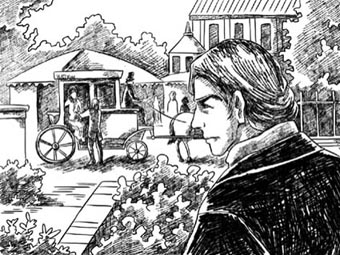
Mr Arabin watched in disgust as Mr Slope handed Mrs Bold out of the carriage.
Eleanor left the Stanhopes as soon as possible, and went to look for her father. She was pleased to find him with Mr Arabin. There was something particular she wanted them both to hear.
'I came with the Stanhopes, father,' she said. She saw Mr Arabin looking at her sternly. She knew his accusation was: 'You came with them in order to be accompanied by Mr Slope.'
She continued rather breathlessly, 'In our carriage were Dr Stanhope, Charlotte, myself, and Mr Slope.' As she spoke the last name, Mr Arabin turned and walked slowly away. 'Father,' she said desperately, 'I couldn't help coming with Mr Slope!'
'Why would you wish to help it, my dear?'
'Father, you must know all the things they said at Plumstead. How unjust the archdeacon was, and Mr Arabin too! He's a hateful man, but –'
'Who's a hateful man, my dear? Mr Arabin?'
'No, father, you know I mean Mr Slope. He's the most hateful man I ever met in my life. But how could I help coming in the same carriage as him?'
A great weight began to roll off Mr Harding's mind. So, after all, the Grantlys, with all their wisdom, were wrong! His Eleanor, the daughter of whom he was so proud, was not to become Mr Slope's wife! 'My darling girl, I am so delighted!'
'But surely, father, you didn't suspect –'
'I don't know what you mean by "suspect", Eleanor. There would be nothing disgraceful in such a marriage.'
And Mr Harding would have explained that Mr Slope was a very good sort of man and a very suitable second husband for a young widow, if he had not been interrupted by Eleanor's greater energy.
'It would be disgraceful! It would be wrong! It would be horrible! I don't wonder at Dr Grantly and Susan, but father, I do wonder at you. How could you believe it of me?' And Eleanor, unable to hold back her tears, sobbed bitterly.
But she could not be angry for long with her father, who confessed his misjudgement of her character and promised never to make the same mistake again. He helped her dry her tears, and, arm in arm, in perfect happiness, they walked towards the house.
Miss Thorne was at her front door, welcoming latecomers. The signora, looking as beautiful and fascinating as ever, was carried inside and placed carefully on a sofa, where, as usual, she was the centre of male attention. But soon all eyes turned to the door again, and Lady de Courcy made her entrance.
Lady de Courcy had chosen to show that she was socially above everyone else by arriving three hours late, then complaining loudly of the poor quality of the country roads. But she found a companion to her liking in the bishop's wife, and soon the two ladies discovered they thought alike on many matters.
'Charming person, Miss Thorne!' said Mrs Proudie.
'Charming, indeed! And isn't her dress delightful?'
'Quite delightful. I wonder if she paints – there's something about the colour that makes me think –'
'I have no doubt she does. But tell me, Mrs Proudie, who is that woman on the sofa by the window?' And Lady de Courcy looked meaningfully over at the signora.
'She's the dreadful Italian woman, Lady de Courcy. You must have heard of her.'
'What Italian woman? Tell me more, I beg you!'
'She's not absolutely Italian. She calls herself Signora Neroni, but in fact she's Dr Stanhope's younger daughter.'
'Ah-h-h-h! I've heard my son George mention her. He heard a lot of stories about her in Rome.'
'She made her way into my house once, before I knew anything about her, and I cannot tell you how disgraceful her behaviour was – it was quite wicked!'
'Was it?' said Lady de Courcy delightedly. 'But why does she lie on a sofa?'
'She has only one leg. I believe her husband beat her, and somehow her leg was injured, so she lost the use of it.'
'Unfortunate creature!' Lady de Courcy herself knew something of the difficulties of married life.
'Yes, one would pity her, if she only had better manners. But she stares so rudely! And she behaves so badly with men!'
'Oh dear!' said Lady de Courcy.
'You see that clergyman with red hair, standing near her? Through my efforts he became the bishop's chaplain, but that woman has absolutely ruined him. I shall be forced to require him to leave the palace, and he may even have to leave the Church!'
'What a fool the man must be!'
But this enjoyable conversation was interrupted by the squire, who came to take Lady de Courcy to her seat in the garden tent, and another gentleman, who was to accompany Mrs Proudie.
As the meal started, Eleanor found herself sitting between Bertie Stanhope and Mr Slope. From her seat near the entrance to the tent, she could see, through the open door of the sitting room, Mr Arabin hanging over the signora's sofa.
Mr Arabin had passed the previous night alone in the vicar's house at St Ewold's. It was his first night there, and a dull evening it had been. Mrs Grantly had been right in saying that a priestess was needed there. He had sat there alone, with his glass in front of him, and then his teapot, thinking about Eleanor Bold. He did little but blame her – blame her for liking Mr Slope, blame her for not liking him, blame her for being independent and passionate. And yet the more he thought of her, the more he loved her. Then he was annoyed with her again. Why had she refused to answer a plain question, and put an end to his misery? Mr Arabin slept little that night.
When he arrived next morning at Ullathorne, he was in a state of confused uncertainty and hope, until the moment when he saw Mr Slope hand Eleanor out of her carriage. At once he assumed that she had invited him to accompany her, and that news of their engagement would follow, as night follows day. Soon afterwards he heard from Eleanor's own lips that she had come with Mr Slope; Mr Arabin's agony of suffering prevented him from understanding that she and Mr Slope had both been guests of the Stanhopes.
He wandered aimlessly into the house, avoiding conversation with anyone. And when the signora was carried in, he was feeling too weak to resist the temptation of her beauty, so, hardly knowing what he was doing, he went to sit beside her.
It is impossible to discover how she gained this knowledge, but the signora knew Mr Arabin was in love with Mrs Bold. It was therefore quite natural for her to wish to trap him, to prove to herself that her charms were greater than the widow's. She had had almost enough of Mr Slope, although it was fun to drive a very self-important chaplain to madness by a desperate and ruinous passion. But Mr Arabin was a bigger and better fly; unlike Mr Slope, he was a highly intelligent, well-educated gentleman.
'What is the matter, Mr Arabin?' she asked playfully. 'Your friend Mr Slope was here a moment ago, full of good humour. Why don't you rival him?'
Mr Arabin shuddered visibly, and Madeline knew at once he was jealous of Mr Slope. 'You and he are complete opposites,' she continued. 'He loves to be praised, you foolishly do not. He is proud and confident; he will allow nothing to stop him achieving his ambitions. You are modest and self-doubting; you are too easily persuaded to give up your dearest hopes and dreams.'
Mr Arabin was very surprised. How did this woman he hardly knew understand the secrets of his heart?
'Mr Slope is born to be successful,' Madeline went on. 'When you see him raised to a high position, with wealth, a charming wife and family, you will begin to envy him and wish you had done the same.'
'Perhaps that is true,' Mr Arabin admitted honestly.
'Remember, Mr Arabin, the good things of this world are always worth winning. That includes beautiful women. But you must fight for them! I can see Mrs Bold looking at you from the garden tent. What do you think of her as a companion for life?'
Mr Arabin glanced towards the garden and caught Eleanor looking at him. She looked quickly away. 'I am afraid Mrs Bold is engaged to another,' he said. 'She is a very beautiful, intelligent woman. It is impossible to know her without admiring her.'
'And you dare to tell me this, when you know I claim to be a beauty myself!' The signora pretended to be angry.
'You are more beautiful, perhaps more clever. But –'
'Thank you, Mr Arabin. I knew we would be friends.'
'But Mrs Bold is the one who –'
'I won't hear another word. As long as she is in second place to me, I am happy. Now Mr Arabin, I am dying of hunger. Just fetch me a plate of food and a glass of wine, and then go to have your own lunch.'
In a sort of dream, Mr Arabin did as he was told. And as she watched him go into the garden tent, Madeline knew she had read his heart, and was amazed at his honesty. He was the first man who had not tried to court or flatter her, and whose words she felt she could trust. This endeared him to her. And as it seemed unlikely that Eleanor would agree to marry Bertie, Madeline decided to do good for once in her life, and give up Mr Arabin to the woman whom he loved. Not only that, she would do everything in her power to assist his courtship.
effective adj. successful, and working in the way that is intended 有效的
steward n. a man whose job is to manage a large property, such as a farm 看管人,管家
turn away to refuse to let someone enter a place 不让某人进入某个地方
make one's entrance to enter a room, especially in a way that makes everyone notice you (尤指以引人注目的方式)走进房间
agony n. very severe pain 极大的痛苦
ruinous adj. causing a lot of damage or problems 破坏性的,毁灭性的
rival v. to be as good or important as someone or something else 与……匹敌
endear v. to make popular and liked 使受欢迎,使被喜欢
8
园会
乌拉索恩园会的日子到了,索恩小姐为准备工作操碎了心。索恩先生要做的事情也不少。不过,乌拉索恩家里最勤恳、最操心、最有效率的人是管家普洛玛西先生。年轻的时候,他经历过危险的时代,曾经奉命前往巴黎,把藏在靴子里的密信交给法国国王。他运气够好,平安归来,从此便安安静静地待在家里。不过,这段冒险经历为他赢得了敏于政治、笃实可靠的名声。到现在,他已经在乌拉索恩当了五十多年的管家,生活一直过得十分安逸。他既然当过那种一暴露就要掉脑袋的信差,谁还能要求他干多少活儿呢?
不过,赶上像眼下这样的场合,普洛玛西先生总是能证明自己真正的价值。他心里装着这个家族的荣耀,也意识到这样一座古宅好客的责任。因此,他总是会亲手安排这样的盛会,而且做得非常出色。
这一天的安排是这样的:宾客们在宅子和花园里会合,体育运动安排在草地上,此外还有一顿丰盛的宴席。两顶巨大的帐篷搭起来了,一顶在花园的核心位置,靠近房子,另一顶在用来开展体育运动的草地上,跟花园隔着一条小溪。上流社会——包括周边地区的各位贵族、女士、神职人员和绅士——将在花园的帐篷里享用午餐,下层社会——包括农夫、商店店主和其他普通劳动阶层——则在草地上的帐篷里用餐。
马上就有一个难题。究竟谁该在花园里用餐,谁又该在草地上用餐呢?不用说,普劳蒂主教肯定要安排在花园里,举止一看就是乡下人的红脸膛农夫格里纳克肯定要安排在草地上。可是,卢克罗夫特太太该怎么安排才好呢?她丈夫只是一名农夫,可女儿们上的却都是时髦的私立学校,而且她的会客厅里还摆着一台钢琴。要是让她跟邻居格里纳克太太谈论黄油和小鸡,她肯定会不高兴,但她又不适合跟索恩家和格兰特利家的人作伴。只要有可能,像她这样的人自然想离开草地,到小溪那边加入花园帐篷里的上流社会。索恩小姐和普洛玛西先生只能做好安排,祈祷一切顺利。
这一天阳光明媚,农场工人和小镇上的人很快就开始从各扇门涌进来。普洛玛西先生想把那些不请自来的人全部拒之门外,索恩小姐却坚持不管来者何人,她都要热情款待。
一些女士和绅士已经到了,仆人把他们领进了宅子里的主会客厅。接下来,正如索恩小姐之前担心的那样,卢克罗夫特太太和她已经成年的女儿们自信十足、大步流星地走了进来。索恩小姐的仆人们知道卢克罗夫特一家无权进那个房间,却不想阻止她们进门。卢克罗夫特家的几个女儿那不得体的低胸裙虽然让索恩小姐稍稍打了个哆嗦,她招呼她们的态度仍然彬彬有礼,只不过可能稍显冷淡。
阿拉宾先生也来了,来的时候刚巧看到斯坦诺普家的马车在宅子前停了下来。他看着斯洛普先生把博尔德太太搀出马车,感到十分厌恶。接着上门的是普劳蒂夫妇,后面跟着巴彻斯特所有显赫的家庭。不一会儿,宅子和花园里已经处处喧哗,人来人往。
埃莉诺尽早离开了斯坦诺普一家,去找自己的父亲。她欣喜地发现父亲跟阿拉宾先生在一起。有一件特别的事情,她想说给他俩听。
“我是跟斯坦诺普一家来的,父亲。”她说。她看见阿拉宾先生严厉地看着她,知道他在指责她:“你跟他们一起来,为的是有斯洛普先生作伴。”
她接着往下说,简直有点儿喘不过气来。“我们的车里有斯坦诺普博士、夏洛特、我和斯洛普先生。”她说到最后一个名字的时候,阿拉宾先生转过身,慢慢地走开了。“父亲,”她绝望地说,“我没法避免跟斯洛普先生一起来!”
“你干吗想要避免呢,亲爱的?”
“父亲,您肯定知道他们在普拉姆斯特德说的那些话。执事长真是太不公平了,阿拉宾先生也一样!他是个很讨厌的人,但是——”
“谁很讨厌啊,亲爱的?阿拉宾先生吗?”
“不是的,父亲,您知道我指的是斯洛普先生。他是我这辈子见过的最讨厌的人。可是,我怎么能避免跟他坐同一辆马车来呢?”
哈丁先生心里的一块大石头落地了。这么说,格兰特利夫妇虽然精明,到头来还是弄错了!他的埃莉诺,他为之骄傲的女儿,不会成为斯洛普先生的妻子!“我亲爱的女儿,我真是太高兴啦!”
“可是,父亲,您没有怀疑——”
“我不知道你说的‘怀疑’是什么意思,埃莉诺。其实,那样的一桩婚姻也没有什么不光彩的。”
要不是情绪激动的埃莉诺打断了他的话,哈丁先生还会接着解释,说斯洛普先生这种人非常不错,可以做一个年轻寡妇再嫁的如意郎君。
“那会是不光彩的!那样不对!那样很可怕!格兰特利博士和苏珊那样想,我不觉得奇怪,但是父亲,您那样想我就觉得奇怪了。您怎么能以为我会那样做呢?”埃莉诺控制不住自己的泪水,伤心地抽泣起来。
不过,她没法对父亲生太久的气,父亲承认自己对她的性格判断有误,答应再也不犯同样的错误。他帮她擦干了眼泪,两个人手挽着手、高高兴兴地朝宅子走去。
索恩小姐站在正门口,迎接迟来的宾客。内罗尼太太仍是那么美丽动人,仆人把她抬进屋里,小心翼翼地放在一张沙发上。跟平常一样,她立刻成为了男人们关注的焦点。不过,所有的目光很快就再次转向门口,德·库西夫人大驾光临了。
为了显示自己的社会地位高于其他所有人,德·库西夫人特意晚来了三个小时,来了就高声抱怨乡间道路不好走。不过,她发现主教妻子是个让她喜欢的伴儿,不一会儿,两位女士就发现她俩在很多事情上所见略同。
“真是个可人儿啊,索恩小姐!”普劳蒂太太说。
“可人儿,没错!她的裙子也很好看,不是吗?”
“特别好看。我猜她是不是会画画——她裙子的颜色让我觉得——”
“我敢肯定她会。可你跟我说说,普劳蒂太太,窗边那个躺在沙发上的女人是谁呢?”说到这里,德·库西夫人意味深长地望向内罗尼太太。
“她就是那个意大利坏女人啊,德·库西夫人。您肯定听说过她。”
“什么意大利女人?说来听听,我求你了!”
“她绝对不是意大利人。她自称内罗尼太太,实际上却是斯坦诺普博士的小女儿。”
“啊——啊!我听我儿子乔治提起过她。他听说了她在罗马的很多故事呢。”
“她去过我家一次,那时候我对她还一无所知。我简直没法跟您形容,当时她的举止有多么丢人——简直是非常恶劣!”
“是吗?”德·库西夫人乐不可支地说,“可她为什么要躺在沙发上呢?”
“她只有一条腿。我看是她丈夫打了她,不知怎么弄伤了她的腿,那条腿就这样残废了。”
“可怜的东西!”德·库西夫人自己也知道婚姻生活的一些难处。
“没错。只要她的行为举止庄重一点儿,大家就会同情她。可她总是很不礼貌地盯着别人!还有啊,她跟男人在一起的时候很不检点!”
“哦,天哪!”德·库西夫人说。
“站在她身边的那个红头发牧师,您看见了吗?我费心费力地让他当上了主教的特遣牧师,那个女人却彻底地毁掉了他。迫于无奈我肯定得要求他离开主教宅邸,搞不好他甚至还得被迫退出教会呢!”
“那个人一定是个傻瓜!”
不过,她俩这段愉快的交谈被打断了,乡绅走过来把德·库西夫人领到花园帐篷里她的座位上,另有一位绅士前来陪普劳蒂太太过去。
午餐开始的时候,埃莉诺发现自己坐在了伯蒂·斯坦诺普和斯洛普先生中间。她的座位离帐篷门口不远,透过会客厅敞开的房门,她看见阿拉宾先生在内罗尼太太的沙发旁流连。
前一天晚上,阿拉宾先生独自一人在圣埃沃兹的代牧住所里过夜。这是他第一次在那边过夜,非常乏味。格兰特利太太之前说得对,那里需要一位牧师太太。他一个人坐着,心里想着埃莉诺·博尔德,面前摆的是酒杯,后来又换成了茶壶。他只是在一味地责怪她——怪她喜欢斯洛普先生,怪她不喜欢自己,怪她太过独立、感情用事。然而,他越是想她,就越是爱她。接着他又生起她的气来。她干吗要拒绝回答一个简单的问题,不肯结束他的痛苦呢?阿拉宾先生一夜难眠。
第二天早晨到达乌拉索恩的时候,他怀着一种迷迷糊糊、忐忑与希望交加的心情,直到看见斯洛普先生把埃莉诺搀下马车。他立刻认定埃莉诺是邀请了斯洛普作伴,要不了多久就铁定要传出他俩订婚的消息了。过了一会儿,他便听见埃莉诺亲口说,她是跟斯洛普先生一起来的。在极度痛苦中,阿拉宾先生没能想到,埃莉诺和斯洛普先生都是斯坦诺普家的客人。
他不想跟任何人说话,漫无目的地走进了宅子。等到内罗尼太太被人抬到屋里的时候,他觉得自己内心极度软弱,抗拒不了她的美丽。所以,他走过去坐在她身旁,都不知道自己究竟在做什么。
无从知道内罗尼太太是从哪儿得来的消息,总之她知道阿拉宾先生爱上了博尔德太太。这一来,她自然而然地产生了俘虏他的念头,以便证明自己比那个寡妇更有魅力。特遣牧师斯洛普先生极其自大,而她让他产生了一种毁灭性的绝望的情欲,逼得他发疯,这虽然有意思,可她还是几乎厌倦了他。但阿拉宾先生这只苍蝇更大也更好。他跟斯洛普先生不一样,是一位极聪明、受过良好教育的绅士。
“您这是怎么啦,阿拉宾先生?”她开玩笑地说,“您的朋友斯洛普先生刚刚也在这儿,心情可好得很呢。您干吗不跟他比个高下?”
阿拉宾先生打了个哆嗦,被马德琳看见了,她马上觉察到他对斯洛普先生的嫉妒之情。“您跟他完全是两个极端。”她接着说,“他喜欢听人奉承,可您却傻乎乎地不喜欢听。他骄傲自大,不允许任何东西阻碍他实现自己的野心,可您却谦逊自省,特别容易听信人言而放弃自己最宝贵的希望和梦想。”
阿拉宾先生大吃一惊。这个他几乎不了解的女人怎么会知道他内心深处的秘密呢?
“斯洛普先生生来就注定会成功。”马德琳接着说,“看到他升官发财,有一个迷人的妻子和家庭的时候,您就会开始嫉妒他,希望自己也有同样的成就。”
“没准儿您说得对。”阿拉宾先生老老实实地承认。
“记住,阿拉宾先生,这世上的美好事物始终是值得追求的,包括美丽的女子。不过,您必须得尽力争取才行!我看得见,博尔德太太在花园的帐篷里瞅您呢。依您看,她作为终身伴侣怎么样呢?”
阿拉宾先生往花园里瞅了一眼,发现埃莉诺也在看他。她忙不迭地移开了目光。“博尔德太太恐怕已经跟别人订了终身。”他说,“她是个非常漂亮、聪明的女人。认识她的人都免不了要倾慕她。”
“您明知道我自认是个漂亮女人,还敢跟我这么说!”这位内罗尼太太佯装生气。
“您比她漂亮,兴许还比她聪明。可是——”
“谢谢您,阿拉宾先生。我知道我们会成为朋友。”
“不过,博尔德太太才是——”
“我不想再听下去了。只要知道她不如我,我也就心满意足了。好了,阿拉宾先生,我都快饿死啦。帮我拿一盘吃的和一杯酒,然后您就自己吃午饭去吧。”
阿拉宾先生神思恍惚,照吩咐端来了吃的和酒。马德琳看着他走进花园里的帐篷,知道自己读懂了他的心,并且吃惊于他的诚实。他是第一个没有去追求她、奉承她的人,他说的话也让她觉得可信。这让她对他产生了好感。既然埃莉诺看样子不会答应嫁给伯蒂,马德琳便决定,这辈子好歹也做一回好事,把阿拉宾先生让给他爱的女人。不仅如此,她还决定竭尽全力来帮他追求埃莉诺。
9
A declaration of love
In the garden tent, the meal was coming to an end. Mr Slope decided that it was the right time to make his declaration to the widow. He had not hesitated to drink his share of wine, in order to give himself the necessary courage. And now he followed Eleanor as she left the tent and walked quickly out into the gardens, which were almost as deserted as he could wish.
As soon as she realized she was being pursued, Eleanor turned on Mr Slope. 'Please don't let me take you from the party,' said she, with all the stiffness she knew how to use. 'I beg you, Mr Slope, to go back.'
But Mr Slope would not allow himself to be dismissed like that. He saw she was angry with him. Poor lady! She was probably unhappy that, while people had been talking of her possible marriage to him, she had been unable to announce it to the world. 'You must permit me to accompany you,' he said. 'I could not think of allowing you to walk alone.'
'Indeed you must, Mr Slope,' said Eleanor, still very stiffly. 'It is my special wish to be alone.'
Mr Slope saw that it must be now or never. 'Do not ask me to leave you, Mrs Bold,' he said with a tender yet passionate look, 'until I have spoken the words with which my heart is full.'
Eleanor now understood what she was about to go through, and the knowledge of it made her very miserable. She could refuse Mr Slope, but the fact of his making her an offer would prove the archdeacon right and herself wrong.
'I don't know what you can have to say to me, Mr Slope, that you could not say to me over lunch,' she replied, looking at him in a way that ought to have frozen him.
But gentlemen are not easily frozen when they are full of wine, and at no time would it have been easy to freeze Mr Slope. 'There are things, Mrs Bold, which a man cannot well say before a crowd,' he whispered. He repeated his tender, passionate look.
Eleanor had not wanted to stand still in front of the garden tent and receive his offer in full view of Miss Thorne's guests. So she had walked on, and Mr Slope offered her his arm.
'Thank you, Mr Slope, but for the very short time I shall remain with you, I prefer to walk alone.'
'And must it be so short?' said he, 'Must it be –'
'Yes,' said Eleanor, interrupting him, 'as short as possible, if you please, sir.'
'I had hoped, Mrs Bold – I had hoped –'
'Kindly hope for nothing from me, Mr Slope. Our friendship is very slight and will probably remain that way.'
Mr Slope was still determined to be very tender, but he was also feeling rather angry. The widow seemed to have no idea of the honour she was about to receive. 'That is cruel,' said he. 'The Church allows the worst of us to hope, at least!' There was a pause. 'Beautiful woman!' he cried at last. 'Beautiful woman, you cannot pretend to be unaware that I love you! Yes, Eleanor, yes, I love you. Next to my hopes of heaven are my hopes of possessing you!' (Mr Slope's memory was faulty here, or he would have mentioned the post of dean.) 'Say, Eleanor, dearest Eleanor, shall we walk that sweet path to heaven together?'
Eleanor had no intention of ever walking together with Mr Slope on any path in future, but felt she ought to allow him to finish his speech before she answered him.
'Ah! Eleanor, will it not be sweet to travel hand in hand through the valley of life? Ah! Eleanor –'
'My name, Mr Slope, is Mrs Bold,' said Eleanor, her disgust at this familiarity overcoming her desire to be polite.
'Sweetest angel, be not so cold,' said he, and as he said it, the wine he had drunk encouraged him to put an arm round her waist, as a proof of his feelings for her.
She jumped away from him as if he were a snake, and then, quick as a flash, she raised her little hand and smacked him hard on the ear. The sound rang among the trees like a clap of thunder.
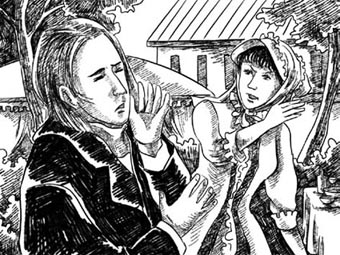
Eleanor raised her little hand and smacked Mr Slope hard on the ear.
The moment she had done it, she regretted it, as an unladylike thing to do. She was tempted to beg his pardon, but fortunately thought better of it. 'I will never, never speak another word to you!' she said breathlessly, and ran quickly back along the path to the house.
Being hit by a woman was as much an insult to Mr Slope as being hit by a man. His face was sore and his pride was badly injured. He was extremely angry with the widow, and bitter thoughts of revenge filled his head. But after a while he recovered his calmness, and walked slowly back to the garden tent, taking a different direction from Eleanor. Here he heard that the dean had just died, and so he wasted no more time at Ullathorne, but returned to Barchester as speedily as possible.
As Eleanor approached the house, she saw Charlotte Stanhope and ran across the grass to join her friend.
'Oh Charlotte!' she sobbed. 'I'm glad I've found you!'
'Why, what's the matter?' said Miss Stanhope, seeing that there were tears on Eleanor's face and her hands were trembling. 'What can I do to help? Can Bertie do anything?'
'Oh no, no, no,' said Eleanor. 'Only, that hateful man –'
'What hateful man?' asked Charlotte, interested.
'Mr Slope. He's a disgusting, wicked man, and it would teach him a lesson if I told the bishop all about it!'
'Believe me, if you want to cause trouble for him, you had far better tell Mrs Proudie. But what did he do?'
'Why did he think he could court me? I never gave him any encouragement, only defended him when others criticized him.'
'That's just it, my dear. He heard about that, and therefore imagined that you were in love with him.'
Eleanor knew Charlotte was right about Mr Slope, as her family had been. She sincerely regretted her defence of him, and promised herself she would never fight against injustice again.
'But what did he do?' asked Charlotte again.
'He – he talked such dreadful nonsense about religion and heaven and love. And then – he took hold of me!'
'By the waist?'
'Yes,' said Eleanor, shuddering. 'Then I got away from him and smacked his face and ran along the path until I saw you!'
'Ha, ha, ha!' Charlotte laughed heartily at the thought of Mr Slope's embarrassment. But her aim was to endear herself to Mrs Bold, so she was quick to stop laughing and offer sympathy.
She was eager for her brother to propose and be accepted as soon as possible. Bertie's debts, and Dr Stanhope's disapproval of his son, were so great that Bertie would have to leave England at once, unless he could be sure of the widow's fortune. Luckily, it was clear that Mr Slope was no longer a rival, and now was the perfect opportunity for Bertie to make his declaration, and win the lady.
So Charlotte played what she hoped would be the final move of the game. She persuaded Eleanor to let her arrange their departure from Ullathorne. Madeline, Charlotte, and the servants would leave first in the Stanhopes' carriage, which would then return to take Dr Stanhope, Bertie, and Eleanor home. Mr Slope would be asked to make his own way back. (He had already done this, but they were unaware of the fact.)
In order to gain the signora's approval of these arrangements, Charlotte took Eleanor into the sitting room, where they found Mr Arabin sitting beside Madeline's sofa. He got up when he saw Eleanor, and they had a short, awkward conversation while the two sisters were talking to each other.
'It has been a very pleasant party,' said Mr Arabin.
'Very,' agreed Eleanor, who had never in her life passed a more unpleasant day.
'I hope Mr Harding has enjoyed himself.'
'Oh yes, very much,' said Eleanor, who had not seen her father since soon after her arrival.
'I hope Mrs Grantly is quite well.'
'She seemed to be quite well. She is here, unless, that is, she has already left.'
'Oh yes. I was talking to her just now. Looking very well indeed.' And then Mr Arabin, finding it impossible to say any more, stood silent until Charlotte finished her conversation, and Mrs Bold stood equally silent, occupied in arranging her rings.
Finally Charlotte and Eleanor set off in search of Bertie. They found him sitting comfortably on the grass, smoking a cigarette and telling a young man he had just met about Italy.
'Bertie, I've been looking for you everywhere,' said Charlotte. 'Come here at once.'
Bertie looked up and saw them. From the first moment of meeting her, he had liked Eleanor Bold. If she had had no fortune, and he had not been obeying Charlotte's orders, he would have fallen violently in love with her. But now he regarded her, not as a beautiful woman, but as a way of making money. This new profession, called marriage, did not attract him at all.
However, he threw away his cigarette and joined the ladies, giving his arm to Eleanor. Charlotte told him the whole story of Mr Slope's misbehaviour, and put Eleanor under her brother's protection. She then hurried away, leaving Bertie to walk with the widow alone.
Bertie Stanhope was idle, but he was not wicked. He was beginning to feel that this plan of Charlotte's, which involved his catching Mrs Bold and living on her money instead of his father's, was too deliberate and cold-blooded for him. And indeed, if he were successful with Eleanor, what would be his reward? A quiet life in Barchester by the widow's fireside; his highest excitement would be the occasional dinner at Plumstead, if, of course, the archdeacon ever agreed to receive him there. He wondered if he could find a way of obeying Charlotte and at the same time saving the widow from marriage to him.
'Mrs Bold,' he began very seriously, 'I may have to leave Barchester. I must take up a profession of some kind.'
'I think you could take an interest in some sort of work, Mr Stanhope,' said Eleanor, who felt a friendly fondness for him.
'In this matter I am determined to be guided completely by you.' And Bertie turned to face her on the path. In their walk they had come to the exact place where Eleanor had raised her hand to Mr Slope's face. Was she to receive another proposal here, so soon after the chaplain's? 'We have been very good friends, Mrs Bold, have we not?' Bertie continued.
'Yes, I think we have.'
'Please don't be angry with me, Mrs Bold. I must confess it all to you. My dear sister Charlotte only thinks of my happiness, and – wants me to marry you!'
Suddenly Eleanor realized why Charlotte had always been so charming and hospitable towards her – it had all been a plan to get hold of her income for Bertie's benefit! She was horrified.
'I must tell you,' continued Bertie in embarrassment, 'that my sister's hopes for me are higher than my own.'
'But if you do not yourself wish to marry me, then why are you telling me this?' asked Eleanor, angry at such an insulting pretence of a proposal.
'Because I must not anger her. And, as I understand, there is no chance of my persuading you to marry me. I would very much like you to tell her that I did propose to you, but that you simply turned me down.'
This was beyond everything! Eleanor was furious, and deeply offended; she certainly would not lie, to prevent his sister being angry with him. 'I regret to say it, Mr Stanhope, but after what has passed, I believe that all communication between your family and myself had better come to an end at once.'
But now her self-control broke down, and she started sobbing passionately. 'How could you? I thought you were a friend! Oh, I wish I were at home!'
Poor Bertie was greatly moved. 'Don't worry, I shall not annoy you any more. I'll take you to the carriage immediately. You shall share it with my father, and I'll walk home or somewhere – it doesn't much matter what I do.'
He gently handed her a handkerchief to dry her tears, and accompanied her to the house. After she had said goodbye to the Thornes, he helped her into the waiting carriage. Eleanor, looking out of the window as the carriage drove off, saw him with his hat in his hand, bowing with his usual cheerful smile. It was many a long year before she saw him again.
dismiss v. to tell someone that they are allowed to go, or they are no longer needed 让……离开
overcome v. to fight and win against something 打败
smack v. to hit someone with your open hand in order to punish them 用巴掌打,掴
think better of not to do something that you have planned to do, because you realize that it is not a good idea 认为还是不要做某事为好
heartily adv. with energy and enjoyment 开怀地
awkward adj. making you feel embarrassed so that you are not sure what to do or say 令人尴尬的
misbehaviour n. bad conduct that is not acceptable to other people 不良行为
fireside n. the area close to or around a small fire, especially in a home (尤指家里的)炉边
occasional adj. happening sometimes but not often or regularly 偶尔的,不经常的
pretence n. a way of behaving which is intended to make people believe something that is not true 假装
turn down to refuse an offer, request or invitation 拒绝(建议、要求或邀请)
break down to fail or stop working in a successful way 失败,崩溃
9
爱的告白
花园帐篷里的午餐即将结束。斯洛普先生觉得,向寡妇告白的时机已经到了。这之前,他一直在痛痛快快地喝酒,好给自己壮胆。这会儿,埃莉诺出了帐篷,快步走进了花园,园子里也如他所愿没什么人,于是他跟了上去。
刚一意识到有人跟踪,埃莉诺就转身面对斯洛普先生。“请不要为了我中途离席。”埃莉诺以尽量生硬的语气说,“我求您,斯洛普先生,回去吧。”
但是,斯洛普先生是不会让自己就这么被打发走的。他看得出她很生自己的气。可怜的女士!她这么不高兴,很可能是因为大家都在说她有可能会嫁给他,可她却没法公开宣布。“您一定得允许我陪伴您。”他说,“让您一个人走,我连想都不敢想。”
“说真的,您必须要走,斯洛普先生。”埃莉诺仍然态度十分生硬地说,“我特别希望一个人静一静。”
斯洛普先生明白,现在不说以后就永远没机会了。“别赶我走,博尔德太太,”他说,目光既温柔又炽烈,“要走也得等我说出我满腔的心里话之后。”
埃莉诺立刻明白自己即将要经历的一切,觉得十分难受。她可以拒绝斯洛普先生,然而,单是他向自己求婚的事实就足以证明执事长说得对,她自己是错了。
“我不知道,您有什么话非得跟我说,又不能在刚才吃午饭的时候说,斯洛普先生。”她一边说,一边用冰冷得可以把他吓呆的表情看着他。
不过,灌了一肚子酒的绅士可没那么容易被吓呆,斯洛普先生更是如此。“有些事情,博尔德太太,男人是没法当众表达清楚的。”他悄声说,再次流露出那种既温柔又炽烈的目光。
埃莉诺不想一动不动地站在花园帐篷跟前,在索恩小姐宾客的众目睽睽之下听他表白。于是她继续往前走,斯洛普则向她伸出了胳膊。
“谢谢您,斯洛普先生,我会跟您待一小会儿,然后我更想一个人走走。”
“只能是一小会儿吗?”他说,“只能——”
“是的,”没等他说完,埃莉诺就说,“越短越好,如果您愿意的话,先生。”
“我原本希望,博尔德太太——我原本希望——”
“请您别对我抱任何希望,斯洛普先生。我们的交情很浅,很可能也会一直保持这个状态。”
斯洛普先生仍然决意保持十分温柔的态度,同时也已经火冒三丈。看样子,这个寡妇对她自己即将得到的荣耀一无所知。“太残忍了,”他说,“就连我们当中最没出息的人,教会至少也会允许他们抱有希望!”说到这里,他顿了一下。“美丽的女人哪!”他终于喊道,“美丽的女人哪,你可不能假装不知道我爱你!是的,埃莉诺,是的,我爱你。除了进天堂以外,我最大的希望就是拥有你!”(斯洛普先生的记性在这儿出了点问题,要不他就该提到教士长的职位。)“这么说好了,埃莉诺,最亲爱的埃莉诺,我们一起踏上那条通往天堂的甜蜜道路吧,可以吗?”
埃莉诺压根儿没打算在将来跟斯洛普先生一起踏上任何一条道路,可她还是觉得,作出回答之前应该允许他把这番话说完。
“啊!埃莉诺,我们手牵着手穿越生命的山谷,难道不是一桩美事吗?啊!埃莉诺——”
“斯洛普先生,我的名字是博尔德太太。”埃莉诺说。他使用的亲昵称呼让她厌恶不已,再也装不出礼貌的样子。
“最甜美的天使,别这么冷冰冰的嘛。”他一边说,一边在酒精的驱使下伸出一只胳膊环住她的腰,以此证明自己对她的感情。
她一下子从他身边跳开,仿佛他是一条蛇似的,接着就以闪电般的速度扬起一只小手,狠狠打了他一耳光。那声音就像一记惊雷在树丛中回响。
刚打下去,她就开始后悔,因为这么做有失淑女风范。她忍不住想乞求他的原谅,幸而又改变了主意。“我绝对,绝对不会再跟您说一句话!”她气咻咻地说,沿着小路飞快地跑回宅子。
对于斯洛普先生而言,挨女人打的侮辱不亚于挨男人打。他的脸被打疼了,自尊心也受到了严重的伤害。他对寡妇忿恨不已,脑子里装满了强烈的报复念头。但他一会儿就恢复了平静,从与埃莉诺不同的方向慢慢走回了花园的帐篷。进了帐篷之后,他听说教士长刚刚去世,于是不再耽搁片刻,以最快的速度从乌拉索恩赶回了巴彻斯特。
走近宅子的时候,埃莉诺看见了夏洛特·斯坦诺普,于是就跑过草坪,跟她的朋友会合。
“哦,夏洛特!”她抽抽搭搭地说,“碰上你可太好啦!”
“怎么啦,出什么事了?”看到埃莉诺脸上泪水涟涟,双手颤抖,斯坦诺普小姐问,“我能帮上什么忙吗?需要伯蒂帮忙吗?”
“哦,不,不,不,”埃莉诺说,“没什么,只是那个可恨的家伙——”
“哪个可恨的家伙啊?”夏洛特好奇地问。
“斯洛普先生。他是个既恶心又卑鄙的家伙,我要是把全部的事情告诉主教的话,他肯定得受一顿教训!”
“相信我,你要是想找他的麻烦,那倒不如告诉普劳蒂太太。可他究竟干了什么呢?”
“他凭什么觉得他可以追求我呢?我从来没给过他任何暗示,只是在别人抨击他的时候替他说了话而已。”
“那就是啦,亲爱的。你的话传到了他的耳朵里,所以他以为你爱上了他。”
埃莉诺心里明白,夏洛特对斯洛普先生的判断是正确的,跟她的家人一样。她打心眼里后悔为他辩护,并且暗自决定绝不再为任何不公正的事情出头。
“可他究竟干了什么呢?”夏洛特又问了一遍。
“他——他说了一大堆让人讨厌的废话,宗教啦,天堂啦,爱情什么的。然后——他搂住了我!”
“搂你的腰吗?”
“是啊。”埃莉诺说,打了个哆嗦,“接着我就从他身边跑开了,给了他一个耳光,一路跑过来,看见你才停下!”
“哈,哈,哈!”想到斯洛普先生的尴尬境地,夏洛特开怀大笑。不过,她的目的只是拉近跟博尔德太太的关系,于是便迅速止住笑声,向她表示同情。
她急切地盼着弟弟尽快向埃莉诺求婚,尽快得到埃莉诺的同意。伯蒂已经债台高筑,斯坦诺普博士对儿子的不满之情也已经十分强烈,因此伯蒂可能得立刻离开英格兰,除非他确定可以得到寡妇的财产。幸运的是,斯洛普先生显然已经不再是伯蒂的情敌,眼下正是他表白并赢得这位女士芳心的绝佳机会。
于是,夏洛特走出了下一步棋,并且希望这是最后一步棋。她说动了埃莉诺,由她来安排离开乌拉索恩的行程。马德琳、夏洛特和仆人们会坐斯坦诺普家的马车先行离开,然后马车会折回来接斯坦诺普博士、伯蒂和埃莉诺回家。至于斯洛普先生,她只能请他自己另想办法回去。(他已经回去了,只是他们还不知道而已。)
为了征得内罗尼太太对这番安排的认可,夏洛特把埃莉诺领进了会客厅。进去之后,她们看见阿拉宾先生在马德琳的沙发旁坐着。看到埃莉诺,他立刻站了起来。夏洛特姐妹俩交谈的时候,他尴尬地跟埃莉诺聊了几句。
“这场园会真让人愉快。”阿拉宾先生说。
“非常愉快。”埃莉诺附和着,虽然她这辈子就数今天最不开心。
“希望哈丁先生玩得开心。”
“哦,是的,很开心。”埃莉诺说。除了刚来不久的那会儿,她再没看见自己的父亲。
“希望格兰特利太太身体安好。”
“她看起来很好。她还在这儿呢,除非,我是说,除非她已经走了。”
“哦,是的。我刚刚还跟她说话,她看上去确实气色很好。”接下来,阿拉宾先生发现自己已经无话可说,只好默默地站着等夏洛特说完,博尔德太太也是一声不吭地站在那儿,忙着摆弄自己手上的几枚戒指。
最后,夏洛特和埃莉诺出发去找伯蒂。她们发现他舒舒服服地坐在草地上,一边抽烟,一边跟一个刚认识的小伙子讲意大利的事。
“伯蒂,我还在到处找你呢。”夏洛特说,“赶紧过来。”
伯蒂抬起头,看见了她们。自从第一次遇见埃莉诺·博尔德,他就喜欢上了她。如果她一贫如洗,如果他追她不是为了遵从夏洛特的命令,他早已疯狂地爱上了她。然而,眼下她在他心目中并不是一个美丽的女人,而是一条赚钱的途径。对他来说,这种名叫婚姻的新行当完全没有吸引力。
然而,他还是扔掉香烟,过来和女士们在一起,还把胳膊伸给埃莉诺。夏洛特把斯洛普先生的恶劣行为全部告诉了他,并让弟弟保护埃莉诺。接着,她急匆匆地走开了,留下伯蒂跟这位寡妇一起散步。
伯蒂·斯坦诺普虽然懒散,人品却并不低劣。夏洛特打算让他俘获博尔德太太的心,靠她的钱而不是父亲的钱过日子。如今他开始觉得,这样的盘算对他来说太精明、太无情了。而且,说实在的,就算他娶到了埃莉诺,又能得到什么回报呢?无非是在巴彻斯特寡妇家的壁炉旁安安静静地过完一辈子,最兴奋的事不过是偶尔到普拉姆斯特德去吃一顿晚饭,当然还得是在执事长乐意接待他的时候。他暗自盘算有没有什么办法,既可以不违背夏洛特的命令,又可以不让寡妇嫁给他。
“博尔德太太,”他十分严肃地开口道,“我可能得离开巴彻斯特了。我必须得有个什么工作。”
“照我看,您可以对什么工作提起兴趣,斯坦诺普先生。”埃莉诺说。她对他有一种朋友之间的好感。
“在这件事情上,我决定完全听从您的指引。”伯蒂说,在路上转过头来看着她。到这会儿,他们已经走到了埃莉诺扬手给斯洛普先生一记耳光的地方。特遣牧师刚刚才在这里求过婚,她这么快就要在同一个地方面对另一个人的求婚吗?“我们一直都是很要好的朋友,博尔德太太,对吧?”伯蒂接着说。
“是啊,我想是的。”
“千万别生我的气,博尔德太太,我得把全部实情告诉您。我亲爱的姐姐夏洛特一心想着我的幸福,就——就希望我娶您!”
埃莉诺恍然大悟,怪不得一直以来,夏洛特总是那么讨她喜欢,对她那么殷勤——这全都是个阴谋,为的是得到她的收入,让伯蒂捞好处!她吓坏了。
“我得让您知道,”伯蒂尴尬不已地接着说,“我姐姐对我的期望比我自己还高。”
“可是,既然您自己并不想娶我,跟我说这些干什么呢?”埃莉诺问,这样一场伤人颜面的假求婚让她很是恼火。
“因为我不能惹她发火。还有啊,照我看,我是不可能说服您嫁给我的。我希望您能告诉她,我已经向您求了婚,只是您拒绝了我。”
这可比什么都过分!埃莉诺怒气冲天,觉得自己受了很大的冒犯。她当然不会去撒谎,就为了让伯蒂的姐姐不对他发怒。“抱歉告诉您,斯坦诺普先生,事已至此,我看我跟您家所有的来往最好立刻结束。”
但说到这里,她突然失去了自制力,剧烈地抽泣起来。“您怎么能这样?我还当您是朋友呢!哦,真希望我这会儿是在家里!”
可怜的伯蒂深受感动。“别担心,我不会再惹您生气了。我这就带您上马车。您跟我父亲一起走,我走路回去,或者去别的什么地方——我怎么着都行。”
他温柔地递给她一条手帕,让她擦干泪水,然后陪着她朝宅子走去。等她跟索恩一家告别之后,他又把她扶上了等在一旁的马车。马车驶离的时候,埃莉诺望向窗外,看见伯蒂手拿帽子鞠了一躬,脸上挂着一贯的快乐笑容。多年之后,他俩才再次相见。
10
A woman's friendship
Before setting off for the garden party at Ullathorne, Mrs Proudie had spoken to her lord, once and for all, about the post of warden. She was determined that Mr Quiverful should have it.
'Bishop,' she had said to him immediately after breakfast, 'have you signed the appointment yet?'
'No, my dear, it is not exactly signed yet.'
'Then do it,' said the lady.
The bishop did it. Mrs Proudie herself wrote to Mr and Mrs Quiverful, asking them to come to the palace at eleven o'clock the next morning. Then the Proudies drove to Ullathorne, where the bishop spent a very pleasant day. And in the evening he was given a glass of wine in his wife's sitting room, and allowed to read his newspaper comfortably by the fire. What great comfort there is for husbands who obey their wives!
Mr and Mrs Quiverful's hopes were raised again when they received Mrs Proudie's letter, but this time they were not disappointed. When they presented themselves at the bishop's palace as requested, they were told the good news at once. That evening there was great joy at Puddingdale, with so much kissing and crying and laughing that they almost forgot to eat.
On that same day Mr Slope was delighted to find that his journalist friend, Mr Towers, had written a most flattering article about him in The Jupiter. It said:
It is now five years since we called our readers' attention to Hiram's Hospital in the quiet city of Barchester. There is now another matter in Barchester that we wish to comment on. Dr Trefoil, the dean, died yesterday. His only fault was his great age, which is something we all hope to be guilty of. But we consider that this post should now be filled by a much younger man, who has the energy and strength to work for the good of the Church. Mr Obadiah Slope's name has been mentioned to us. He is at present the bishop's chaplain. A better man could hardly be found. He is young, enthusiastic, knowledgeable and, we believe, a truly good man. Such a choice would go far to raise public confidence in the present system of Church appointments, and would show people that, from now on, our Church will not offer easy, well-paid work to elderly, worn-out clergymen.
Mr Slope read this article with considerable satisfaction. Sixty thousand copies of The Jupiter, distributed around the country, were, in his eyes, the most powerful way of influencing public opinion. He was very grateful to Mr Towers, and looked forward to the day when he, as dean, would entertain his friend to an excellent dinner.
But his feelings were not all of triumph. He was still angry with the widow, for the way in which she had refused his proposal. And he would have liked to hate the signora, but he was passionately attracted to her and could not resist her charms.
Poor Mrs Bold was very unhappy when she got home from Ullathorne, and also quite exhausted. She found her sister-in-law, Mary, in the sitting room, playing with little Johnny.
'Oh Mary, I'm so glad you didn't go!' cried Eleanor. 'It was an awful party!'
'I have nothing to regret, then,' said Mary cheerfully.
'You have nothing to regret, but oh! Mary, I have – so much!' and Eleanor began wildly kissing her boy, while tears ran down her face.
'Good heavens, Eleanor, what is the matter?' asked Mary, concerned. 'Let me make you some tea. You are tired.'
At first Eleanor was unwilling to tell Mary what had happened, because Mary had never approved of the friendship with Mr Slope. But Mary was so kind and so comforting that Eleanor soon told her the whole story, and felt much better for it. There was not the slightest touch of triumph about Mary; she never said, 'I told you so,' but sympathized strongly with Eleanor.
'I know I was wrong,' said Eleanor, 'to hit Mr Slope, but I had to protect myself.'
'He certainly deserved it!' said Mary firmly.
'If I'd stabbed him with a knife, he would have deserved it! But what will they say about it at Plumstead?'
'I don't think I would tell them, if I were you,' said Mary. And Eleanor began to think she would not.
The next day Eleanor stayed at home, but she heard the news that the dean had died, and that Mr Quiverful had been appointed warden. In the evening her father came to visit her, and she had to repeat the story, or as much of it as she could bring herself to tell him. He did not seem surprised at Mr Slope's declaration of love. So she asked him if he had expected it.
'I do not think it at all strange that anyone should admire my Eleanor,' he replied fondly.
'But I did not give him the slightest encouragement!'
Mr Harding thought it safer not to reply to this, but simply said, 'You'll tell the archdeacon? Or Susan? You'll tell them they were wrong about you wanting to marry that man?'
'I shall never willingly mention Mr Slope's name to either of them,' said Eleanor, a little stiffly. 'But father, is it true you are not going to be warden, after all?'
'Yes, my dear, quite true. And I am delighted for Mr Quiverful and his large family. I am getting old now, and my main wish is for peace and quiet, not for constant arguments with the bishop, his chaplain, and the archdeacon. I shall never starve, you know,' he added laughing, 'as long as you are here.'
'But will you come and live with me here, father? It would make me so very happy if you did!'
'No, thank you, my dear. I'm quite satisfied with my rooms in the High Street. But I will have dinner with you tonight!'
Later that evening, Eleanor and Mary were singing while he was playing the piano, when a maid entered the room. She brought a very small note in a beautiful pink envelope; it quite filled the room with perfume as it lay on the silver dish.
'The servant is waiting for an answer, madam,' said the maid.
Eleanor blushed as she took the note. She guessed it came from the signora. The note said:
Thursday evening
My dear Mrs Bold,
May I ask you, if you would be so kind, to call on me tomorrow. Please say what time would best suit you. I need hardly say that if I could call on you, I would not ask you to come to me. I partly know what happened the other day, and I promise that you shall meet with no annoyance if you come. My brother leaves us for London today, and from there he goes to Italy. I have something of considerable importance to say to you. Please excuse me, therefore, for writing to you, even if you do not agree to my request.
Believe me, I am, very sincerely, yours,
Madeline Neroni
The three of them read this letter together, and decided, after some discussion, that Eleanor should send a reply, saying she would see the signora at twelve o'clock the next day.
When Charlotte had arrived home from the Ullathorne party the previous day, she had waited eagerly for the carriage to return with Bertie, and, she hoped, the news of his engagement to Mrs Bold. But it was only her father's step that she heard in the hall, and she realized her brother's attempt at courting the widow must have failed. This was disappointing, but not completely unexpected.
She was called to her father's room, and when she entered, found him angrier than she had ever seen him before.
'Tell me where your brother is, and what his plans for the future are now!' ordered the old man. 'I'm glad that charming Mrs Bold is not going to be sacrificed to such an idle, heartless young man as my son! Marriage, indeed! Who would marry him? It was just a foolish idea of yours!'
'Father, it's no use scolding me. I've done my best for him and you.'
Her father sighed deeply. 'He'll ruin me, with his debts! I've made up my mind, Charlotte. He shall eat and drink no more in this house! He must leave. I don't care where he goes.'
'Very well. Then I suppose he must go back to Italy. Life is cheaper there.' And Charlotte, by using all her powers of persuasion, managed to get her father to agree to make his son one last payment, as long as Bertie left England the next day.
Dr Stanhope was angry with Madeline too, for expecting him to pay all her bills, and for behaving so badly with all the unmarried men in Barchester. He was even angry with Charlotte, for defending her brother and sister. He felt that his children had damaged his reputation in the city, and Charlotte realized that the whole family, not just Bertie, would have to return to Italy soon.
But two days later, when Eleanor arrived at the Stanhopes' house, Bertie had already left for Italy, and the house was peaceful. She was shown up to the signora's private sitting room, without seeing any of the family, which was a great relief to her.
'This is very kind of you, Mrs Bold, very kind, after what has happened,' said the signora, with her sweetest smile.
'Your letter almost obliged me to come.'
'That is true. But how cold you are to me! I know you have good reason to be displeased with us all. But I did not send for you to talk about that. Please come closer to me, Mrs Bold.'
Eleanor obeyed, bringing her chair closer to the sofa.
'And now I am going to tell you something, Mrs Bold, which you may think is too personal. But I know I am right to do so. I believe you know Mr Arabin?'
Eleanor would have given the world not to blush, but her blood was not at her own command. She did blush, right up to her hair, and the signora, who had asked her to come closer in order to observe her face, saw it.
'If you know Mr Arabin, I'm sure you must like him,' continued Madeline. 'Everyone who knows him must like him.'
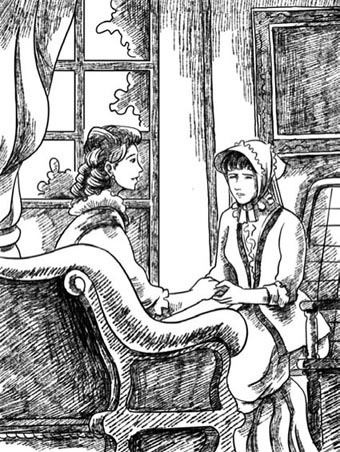
'If you know Mr Arabin, I'm sure you must like him,' continued Madeline.
Mrs Bold could not speak. She felt hot and faint.
'How stiff you are with me,' said Madeline. 'And yet I'm doing for you all that one woman can do to serve another.'
The widow began to think that perhaps the signora's friendship was real. Then another thought came to her – Mr Arabin was too precious to lose. Even if she felt scorn for the signora and her way of life, perhaps Madeline could help her.
'I don't want to be stiff,' she said, trying to excuse herself, 'but this conversation is so very strange!'
'Well, then, it may become stranger still,' said Madeline, turning her own face full on her companion's. 'Do you love him, love him with all your heart and soul? Because I can tell you, he loves you, thinks of you and nothing else, is thinking of you now as he attempts to write his sermon for next Sunday's service. What would I not give to be loved in such a way by such a man!'
Mrs Bold stood up, speechless, and took the signora's hand. Madeline went on, 'What I tell you is God's own truth, and it is for you to use it for your own happiness. But you must not betray me. You know his secret now, and I advise you to use the knowledge. And remember, he is not like other men. You mustn't expect him to come to you with pretty presents, to kneel at your feet and to flatter you. There are plenty of men who do that, but he is not one of them. With him, yes means yes, and no means no. Even if his heart should break, the woman who refuses him once will have refused him for ever. And now, Mrs Bold, I will not keep you. If ever you are a happy wife in that man's house, I and my family will be far away. But I shall expect you to write me one line to say you have forgiven the sins of the Stanhope family.'
Eleanor half whispered that she would, and then crept out of the room, down the stairs and out into the open air. The fact that this woman, whom she could never like, knew so much about her and the man she loved, was damaging to her pride. But soon this feeling was swept away in the wild joy that filled her heart – he loved her! She was fully determined to follow Madeline's advice; if he ever proposed to her, her 'yes' would certainly be 'yes'.
On the following day the signora was in her brightest morning dress, and had a whole group of men around her sofa. The first to come and the last to leave was Mr Arabin, to whom the signora was unusually kind and gentle. Mr Thorne was there too, in his best suit; even a respectable, fifty-year-old gentleman could fall into the signora's trap. There were also a number of eager young clergymen, smaller flies who could not keep away from such a powerful, beautiful spider.
And then came Mr Slope. All the world knew that he was generally considered likely to become dean. He therefore held his head high and walked in a self-important way, as a dean might.
The signora had been looking forward to his visit. 'Mr Slope,' said she, 'I hear you are triumphing on all sides.'
'What do you mean?' he asked, smiling. He did not dislike people connecting his name with the post of dean.
'You are the winner, both in love and war,' she replied.
Mr Slope did not look quite so satisfied now.
'Mr Arabin,' she continued, 'don't you think Mr Slope is a very lucky man?'
'Not more than he deserves, I'm sure,' said Mr Arabin.
'He is to be our new dean, you know, Mr Thorne,' she said to the squire, who was trying to follow the conversation.
'Really, signora?' asked Mr Thorne doubtfully.
'Yes, indeed. And not only that, he is to have a wife too. A wife with a large fortune. When will it be, Mr Slope?'
'When will what be?' said Mr Slope, pretending to smile.
'Your marriage, Mr Slope. Now do tell us, we're all dying to know, when is the widow to be made Mrs Dean?'
To Mr Arabin this conversation was peculiarly painful, but he could not stop listening.
'Come, come, Mr Slope,' continued the signora. 'We all know you proposed to her the other day at Ullathorne. How did she accept you? With a simple "yes", or with the two "no's" which make a "yes"? Or some other way? Tell us, do!'
Mr Slope had never in his life felt so embarrassed. Everybody in the room was looking at him, ready to laugh at his discomfort, except for Mr Arabin, who was staring miserably at him. This was the moment to think of a sharp reply to the signora, but nothing came to mind; he had not a word to say.
The signora had no pity; she knew nothing of mercy, now that she had Mr Slope in her power. 'No answer, Mr Slope? It can't possibly be that the woman was fool enough to refuse you! Perhaps she wasn't satisfied with a dean, but is waiting for a bishop to come along! Now here is a piece of advice for you, Mr Slope. Listen carefully,' and she started singing,
It's good to be happy and wise, Mr Slope,
It's good to be honest and true,
It's good to be off with the old love, Mr Slope,
Before you are on with the new!
'Ha, ha, ha!' And the signora, throwing herself back on her sofa, laughed heartily. She had taken her revenge on him, for courting herself and Mrs Bold at the same time.
How Mr Slope got out of that room, he never knew. Possibly he was given some assistance. But when he reached the fresh air of the street, he realized that at last his love for the signora was cured. Whenever he thought of her in his dreams from now on, she did not appear as a beautiful angel, but as a hateful devil.
once and for all used to emphasize your impatience when you ask or say something that you have asked or said many times before 最后一次(强调不耐烦)
worn-out adj. too old or damaged to be used 老旧的;不能再用的
distribute v. to share things among a group of people, especially in a planned way (尤指有计划地)分发,派发
perfume n. a sweet or pleasant smell 香味
blush v. to become red in the face, especially when you are embarassed 脸红
scold v. to angrily criticize someone about something they have done 责骂,斥责
oblige v. to force or compel 使某人非做……不可
someone would give the world to do something used today to mean that someone would like to do something very much 某人迫切地想做某事
morning dress n. formal clothes worn at daytime ceremonies (在白日庆典场合穿的)常礼服
be dying to do something to want to do something very much 很想做某事
10
女人的友情
前往乌拉索恩参加园会之前,普劳蒂太太跟她的主教大人谈起了院长职位的事情,这一次是彻底了结这事。她决意要让奎沃夫先生得到这个职位。
“主教,”早餐刚刚吃完,她立刻对他说,“任命书你签了吗?”
“没有,亲爱的,这不是没签嘛。”
“那就签了吧。”太太说。
主教签了。普劳蒂太太亲自给奎沃夫夫妇写信,让他们第二天上午十一点到宅邸来。接下来,普劳蒂夫妇坐车去了乌拉索恩,主教在那里度过了十分愉快的一天。晚上,妻子在自己的会客厅给他喝了一杯酒,允许他在壁炉边上舒舒服服地看报纸。听妻子话的丈夫会过得多舒坦!
收到普劳蒂太太的来信,奎沃夫夫妇再次燃起了希望,但这一次他们没有失望。他们遵命来到主教的宅邸,立刻得知了这个好消息。那天晚上,帕丁戴尔的气氛非常欢乐,奎沃夫一家子不停地亲吻、哭泣、大笑,几乎乐之忘食。
******
也是在这一天,斯洛普先生欣喜地发现,他的记者朋友托尔斯先生在《朱庇特报》上发表了一篇吹捧他的文章。文章中说:
我们曾经让读者注意到巴彻斯特这个宁静城市里的海勒姆养老院,那已经是五年前的事了。现在,我们想评论的是巴彻斯特的另一件事情。教士长特雷弗尔博士已于昨日去世,平生唯一的过错就是年事太高,这是我们每一个人都希望犯下的过错。不过,我们认为这一职位如今应该由一个年轻得多的人来担任,这样的人才有精力和体力来为教会利益服务。有人向我们推荐了奥巴代亚·斯洛普先生。他目前是主教的特遣牧师,比他还合适的人选几乎无处寻觅。他年轻、热忱、学识渊博,我们也相信他是一个真正高尚的人。这样的人选可以大大提高公众对教会现有人事制度的信心,还可以让公众看到,从现在起,我们的教会不会再把轻松的高薪工作托付给年迈体衰的神职人员。
斯洛普先生十分满意地读完了这篇文章。《朱庇特报》在全国的发行量有六万份,在他看来,这是最能左右公众舆论的一件利器。他对托尔斯先生感恩戴德,期待有那么一天,他能以教士长的身份请这位朋友享用一顿丰盛的晚餐。
不过,他心里并不全是得意之情。他对寡妇仍然心存怒气,因为她竟然用那样的方式拒绝了他的求婚。他还想恨内罗尼太太,但他被她迷得神魂颠倒,抵挡不住她的魅力。
******
从乌拉索恩回到家里的时候,可怜的博尔德太太很不开心,而且精疲力竭。她走进会客厅,看见自己的大姑子玛丽正在跟小约翰尼玩耍。
“哦,玛丽,真高兴你没去!”埃莉诺大声说,“这场园会简直糟透了!”
“那我就没什么可后悔的啦。”玛丽高高兴兴地说。
“你是没什么可后悔的,可是,哦!玛丽,我后悔——后悔极了!”说到这里,埃莉诺开始狂吻自己的儿子,眼泪顺着脸往下流。
“天哪,埃莉诺,出了什么事?”玛丽关心地问,“我去给你沏点儿茶。你累了。”
一开始,埃莉诺并不愿意把发生的事情告诉玛丽,因为玛丽从没赞成过她跟斯洛普先生交往。但玛丽那么和善,那么会宽慰人,埃莉诺很快便全盘托出,自己也感觉舒服多了。玛丽没有流露出丝毫得意的神情,没有说“我告诉你了吧”,而是对埃莉诺表示了强烈的同情。
“我知道我不该打斯洛普先生,”埃莉诺说,“可我得保护自己啊。”
“这当然是他自找的!”玛丽坚决地说。
“哪怕我拿刀子捅了他,也是他自找的!可是,普拉姆斯特德的那些人会怎么说呢?”
“我要是你,就不会告诉他们。”玛丽说。埃莉诺开始觉得,自己还是不说为好。
第二天,埃莉诺待在家里,却还是听说了教士长过世的消息,也知道奎沃夫先生获得了养老院院长的任命。晚上,父亲过来看她,她只好把整件事情又讲了一遍,至少是把她有勇气讲的部分讲了一遍。斯洛普先生的表白似乎并没有让父亲感到惊讶。所以,埃莉诺问父亲是不是早已料到了这样的事情。
“有人爱慕我的埃莉诺,我一点儿也不觉得奇怪。”他慈爱地回答。
“可是,我从来没给过他半点儿暗示啊!”
哈丁先生觉得,这个问题还是不回答为妙,但只是说:“你会把这件事情告诉执事长或者苏珊吗?他俩都说你想嫁给那个人,你会告诉他们是他们错了吗?”
“我永远也不会跟他俩当中的任何一个提起斯洛普先生的名字。”埃莉诺语气有点儿生硬地说,“不过,父亲,您终究还是当不上院长了,这是真的吗?”
“是啊,亲爱的,千真万确。而且我为奎沃夫先生和他那一大家子感到高兴。我已经老啦,只想平平静静地过日子,不想一天到晚跟主教、他的特遣牧师和执事长吵来吵去。我又饿不死,你知道的,”他笑着补充了一句,“只要有你在。”
“可是,您会搬过来跟我一起住吗,父亲?如果您来了,我不知道有多开心!”
“不了,谢谢你,亲爱的。我对我主街上的住处很满意。不过,今晚我打算留下来跟你一起吃饭!”
当晚晚些时候,埃莉诺和玛丽唱着歌,哈丁先生弹着钢琴时,一名女仆走了进来。她拿来了一个装有一张小便条的漂亮的粉色信封。信封放在银托盘上,屋子里顿时充满了香味。
“送信的仆人还等着回话呢,太太。”女仆说。
埃莉诺红着脸拿起了便条,因为她猜到便条是内罗尼太太写的。上面写着:
星期四晚
亲爱的博尔德太太:
如果您肯赏脸,能否请您明天来我这儿一趟。请告知您最方便的时间。不用说,如果能去拜访您,我是不会麻烦您过来的。那天的事情我略有耳闻,在此向您保证,如果您来,绝不会碰上任何不愉快的事。我弟弟今天就会离开我们去伦敦,然后从那里赴意大利。我有要紧的事情要告诉您。所以,即便您不答应我的请求,也请您原谅我冒昧致信。
请相信,我是您十分诚挚的朋友,
马德琳·内罗尼
三个人一起看完了这封信。一番讨论之后,大家认为埃莉诺应该回个话,说自己会在第二天十二点去见内罗尼太太。
******
前一天,从乌拉索恩的园会回家之后,夏洛特一直急切地盼着马车载着伯蒂回来,盼着听到他跟博尔德太太订婚的消息。然而,她听见大厅里只传来了父亲的脚步声,意识到弟弟一定是没能赢得寡妇的芳心。这个消息让人失望,却也并非完全出乎意料。
她被叫到父亲的房间,刚一进屋就发现父亲从来没有如此愤怒过。
“告诉我你弟弟在哪儿,将来他打算怎么办!”老人家喝令道,“幸好迷人的博尔德太太没打算把自己毁在我儿子身上,毁在这么个游手好闲、没心没肺的小子身上!结婚,真想得出来!哪个人愿意嫁给他?这完全是你的蠢主意!”
“父亲,骂我没用。我为你俩尽力了。”
她父亲重重地叹了一口气。“他会毁了我的,瞧他那一身债!我已经拿定了主意,夏洛特。他再也别想在这个家里混吃混喝了!他必须离开这里。去哪儿我不管。”
“好吧。既然这样,我想他只能回意大利。那里吃穿住行比较便宜。”接下来,夏洛特使出浑身解数,说服父亲同意给儿子最后一笔钱,前提是儿子第二天就离开英格兰。
斯坦诺普博士也生了马德琳的气,因为她指望他付清她所有的账单,还因为她跟巴彻斯特所有的未婚男人在一起时,行为不检点。就连夏洛特也让他来气,因为她帮着自己的弟弟妹妹说话。他觉得自己的几个孩子已经坏了他在这座城市里的名声,而夏洛特也意识到,必须尽快回意大利的并不是伯蒂一个人,而是全家所有人。
******
但两天之后,埃莉诺来到斯坦诺普家的时候,伯蒂已经出发去了意大利,他们家也恢复了太平。仆人把她领进了内罗尼太太的私人会客厅,她没有碰见斯坦诺普家的任何人,倒是松了一大口气。
“发生了那样的事,您还肯赏光,您真好,博尔德太太,您真好。”内罗尼太太说,脸上挂着她最甜美的笑容。
“您的信简直让我不得不来。”
“那倒是。不过,您对我可真是冷漠!我知道您有充足的理由怨我们家所有人。不过,我请您来可不是为了说这个。请您坐过来一点儿,博尔德太太。”
埃莉诺听话地把椅子往沙发那边挪了挪。
“好了,我现在要跟您说点儿事,博尔德太太,可能会让您觉得我冒犯了您的隐私。不过,我知道我这么做是对的。我相信您应该认识阿拉宾先生吧?”
埃莉诺打死也不愿脸红,但血液不受她的控制。她确实红了脸,还一直红到发际线。内罗尼太太让她坐过来一点儿,为的就是察言观色,这会儿也看到了她的反应。
“如果您认识阿拉宾先生,我肯定您不可能不喜欢他,”马德琳接着说,“认识他的人都不可能不喜欢他。”
博尔德太太说不出话来。她感觉浑身发热,几欲晕倒。
“您对我的态度可真是生硬,”马德琳说,“可我还在帮您呢,女人帮女人,顶多也只能帮成我这样了。”
寡妇开始觉得,这位内罗尼太太也许是真心实意。接着她又产生了另一个念头——阿拉宾先生是个不可多得的佳偶,绝不能错过。就算她鄙视内罗尼太太和她的生活方式,说不定她还是可以给她帮助。
“我也不想这么生硬,”她说,想替自己开脱。“可是,这样的对话实在是太奇怪了!”
“好吧,接下来还可能更怪呢。”马德琳说,直视着自己的谈话对象,“您爱他吗,全心全意地爱他吗?因为我可以告诉您,他爱您,心里只有您一个人,这会儿他在写下个星期天的布道词,心里想的还是您。要是有这样的男人这样爱我,付出什么代价我也愿意!”
博尔德太太说不出话来,起身握住了内罗尼太太的手。马德琳接着说:“我跟您说的是上帝的真理,您可以拿它来争取自己的幸福。不过,您一定不能出卖我。您现在知道了他的秘密,我建议您善加利用。还有,记住,他跟别的男人不一样。您千万别指望他带着漂亮的礼物来到您的身旁,卑躬屈膝地讨好您。这样做的男人多得很,但他不会。对他来说,愿意就是愿意,不行就是不行。女人拒绝过他一次,他就会理解为永远地拒绝了他,哪怕他会心碎。好了,博尔德太太,我就不留您了。如果您真的成为了那个男人家里幸福的妻子,那时候我和我的家人也已经远在他乡啦。只不过,希望您到时候能给我捎个信儿,说您已经原谅了斯坦诺普一家的罪过。”
埃莉诺轻轻应了一声,就溜出了房间,下了楼梯,走出门去。这个她从来都喜欢不起来的女人,却那么清楚她和她爱的男人的事,这伤到了她的自尊。不过,这种感觉很快就烟消云散,她心里充满狂喜——他爱她!她决意听从马德琳的建议。要是他向她求婚,那她的“愿意”就是明白无误的“愿意”。
第二天,内罗尼太太穿上了自己最亮丽的常礼服,一大群男人环绕在她的沙发旁。第一个来和最后一个走的都是阿拉宾先生,内罗尼太太对他格外地亲切温和。索恩先生也在那里,穿着他最考究的衣服。就连这位受人尊重的年届五十的绅士也难免掉进内罗尼太太的陷阱。此外还有一批跃跃欲试的年轻神职人员,这些小苍蝇舍不得离开这样一只强大而美丽的蜘蛛。
然后,斯洛普先生来了。全世界都知道,大家普遍认为他很可能会当上教士长。因此,他高昂着头,趾高气扬地走了进来,架势俨然一位教士长。
内罗尼太太等的就是他。“斯洛普先生,”她说,“我听说您现在是处处凯歌啊。”
“您这是什么意思呢?”他微笑着问。他并不讨厌大家把他的名字跟教士长一职联系在一起。
“您是个赢家啊,情场如此,战场也如此。”她回答。
这下子,斯洛普先生的神色没那么得意了。
“阿拉宾先生,”她接着说,“您不觉得斯洛普先生是个特别幸运的男人吗?”
“幸运也是他应得的,我肯定。”阿拉宾先生说。
“他就要成为我们的新任教士长了,您知道的,索恩先生。”她对乡绅说,乡绅正在努力跟上他们的对话。
“真的吗,内罗尼太太?”索恩先生怀疑地问。
“是啊,千真万确。这还不算完呢,他就要娶妻了,一个身家富厚的妻子。什么时候举行呀,斯洛普先生?”
“什么时候举行什么呢?”斯洛普先生强装笑颜。
“您的婚礼啊,斯洛普先生。好啦,告诉我们吧,我们都好奇得不行,那位寡妇什么时候会成为教士长太太呢?”
对于阿拉宾先生而言,这番对话莫名地伤人,可他还是忍不住要听下去。
“说吧,说吧,斯洛普先生,”内罗尼太太接着说,“我们都知道,在乌拉索恩那天,您向她求了婚。她是怎么接受您的呢?只是简单地回答了一句‘愿意’,还是连说两个‘不行’来表示‘愿意’呢?或者,她是用别的什么方式?告诉我们吧,别推辞!”
斯洛普先生这一辈子从来没感到这么难堪过。屋子里的每一个人都在看他,准备拿他的尴尬寻开心,只有阿拉宾先生是在用悽惨的目光盯着他。这一刻,他本该想出一句尖刻的话来回应内罗尼太太,却什么也想不出来。他无话可说。
内罗尼太太全无怜悯之心。既然斯洛普先生已经被她玩弄于股掌之间,她决定赶尽杀绝。“答不上来吗,斯洛普先生?那个女人该不会蠢到拒绝您的地步吧!也没准儿,她不满足于一个教士长,还等着有个主教来呢!喏,给您提个建议,斯洛普先生。您听好了。”接着,她唱了起来:
快乐聪明才算好,斯洛普先生,
诚恳真挚才算好,
先断旧爱才算好,斯洛普先生,
然后再把新欢找!
“哈,哈,哈!”内罗尼太太往沙发上一倒,开怀大笑。她完成了对他的报复,因为他同时对自己和博尔德太太展开了追求。
斯洛普先生是怎么走出那个房间的,连他自己也不知道。也许是有人扶了他一把。不过,呼吸到街上的新鲜空气之后,他意识到,自己终于不再着魔般地爱内罗尼太太了。从今往后,他每次梦见她,她都不再是一个美丽的天使,而是一个可憎的魔鬼。
11
The new dean
At Plumstead, the archdeacon was in a state of misery. Not only had Mr Quiverful, rather than Mr Harding, been appointed warden of Hiram's Hospital, it also seemed quite possible that Mr Slope would become dean, and marry Eleanor Bold. There was yet another reason for anxiety. Dr Grantly's excellent and respected friend, Francis Arabin, of whose qualities he had boasted so loudly, was misbehaving himself. People were now beginning to talk of his repeated visits to the signora. This was not at all what was expected of the vicar of St Ewold's.
Just as the archdeacon and his wife were discussing these matters, they heard a carriage drive up to the door at high speed.
'Whoever can it be, Susan?' said Dr Grantly, as he opened the sitting room door into the hall. 'Why, it's your father!'
It was indeed Mr Harding, bursting to tell his news.
'We're very glad to see you, father,' said his daughter. 'I'll go and get your room ready at once.'
'Don't go just yet, Susan,' said Mr Harding. 'I have something to tell you. Or shall I wait till after dinner?'
'If you have anything important to tell us,' said the archdeacon, 'I beg you, let us hear it at once. Has Eleanor gone off with Slope?'
'No, she has not,' said Mr Harding, looking displeased.
'Has Slope been made dean?'
'No, he has not, but –'
'But what?' said the archdeacon impatiently.
'They have offered it to me,' said Mr Harding modestly.
'Good heavens!' cried the archdeacon.
'My dear, dear father!' cried Mrs Grantly and threw her arms round her father's neck.
And after they had both congratulated Mr Harding, they all sat down to dinner. The archdeacon's joy was uncontrollable. It was not until they had finished eating and the servants had left, that Mr Harding found the opportunity to say, rather nervously, 'It's very kind of the prime minister, and I'm most grateful for the offer, but I'm afraid I can't accept it.'
The archdeacon was so shocked that he almost dropped his glass. Why would a vicar earning less than £200 a year not wish to gain one of the most desirable positions in the Church, at an income of £1200? But Mr Harding explained to him and Susan, over and over again, that he would be incapable of doing the job properly, and that at his age he did not want any sort of promotion. In spite of their protests, he remained firm.
This was another disappointment for the archdeacon. Nothing would have suited him better than to have his father-in-law as dean, but it was impossible to change Mr Harding's mind.
At Ullathorne, the squire's sister had also heard the stories about Mr Arabin and the signora. Miss Thorne was of the opinion that all vicars should be married, in order to avoid this kind of unpleasantness, and with her usual good-hearted energy she set to work to find a wife for Mr Arabin. In looking through the list of her unmarried friends who might possibly want a husband, and who had the right qualities to be a vicar's wife, she could think of no one more suitable than Mrs Bold. So, losing no time, she invited Mrs Bold and her small son to come and stay for a month or two at Ullathorne. 'We'll have Mr Arabin too,' said Miss Thorne to herself, 'and in twelve or eighteen months' time, if all goes well, Mrs Bold will take up residence at St Ewold's. 'And the kind-hearted lady praised herself for her matchmaking.
Eleanor was a little surprised at the invitation, but accepted it, and arrived at Ullathorne the day before her father was offered the post of dean. Since her interview with Madeline, she had done little else but think about Mr Arabin, and she was hoping to see him at Ullathorne. If only they could meet, and speak to each other!
And they did meet there. Mr Arabin, Eleanor discovered, was also staying with the Thornes. He arrived during the morning and found the two ladies sewing in the sitting room. Miss Thorne had no idea that her immediate absence would be a blessing, and remained talking to her guests until lunch-time. After lunch Mr Arabin returned to his church duties, and Eleanor and Miss Thorne took a walk together.
When they returned, Eleanor was left alone in the sitting room, and just as it was getting dark, Mr Arabin came in. It was a beautiful autumn afternoon, and Eleanor was sitting near the window to get the last of the daylight for her reading. Mr Arabin stood with his back to the fire and his hands in his pockets, making a few ordinary remarks about the weather.
'The sky does look lovely,' said Eleanor.
He could not see the sky from where he was standing, so he had to go close to her. 'Very lovely,' said he, modestly keeping at a distance to avoid touching her dress. Then he seemed to have nothing further to say, so he returned to the fire.
Eleanor could not think what to say, and, moreover, found she could not prevent herself from crying. She hoped he would not notice. He was not looking at her, so it did not seem likely.
'Do you like Ullathorne?' he asked, from his safely distant position. 'I don't mean Mr and Miss Thorne, I mean the house. There is something about old-fashioned houses and gardens that especially pleases me.'
'I like everything old-fashioned,' said Eleanor. 'Old-fashioned things are so much more honest.'
'I hardly know whether to agree with you or not.'
'I think the world grows more ambitious and selfish every day,' said Eleanor.
'That is because you see more of it than when you were younger. But we should not judge by what we see – we see so very, very little.' There was an uncomfortable pause while Mr Arabin turned over the coins in his pockets. Then he started walking uneasily up and down the room.
Eleanor sat silently with her face bent over her book. She was afraid her tears would overcome her, and was preparing to escape from the room, when suddenly Mr Arabin stopped walking and turned to face her.
'Mrs Bold,' said he, 'I owe you a humble apology for asking you that extremely personal question, about – about a certain gentleman. I had no right to do it.'
Eleanor was most anxious to say something polite and encouraging, but did not want to betray her feelings.
'Indeed, I was not offended, Mr Arabin.'
'Oh, but you were! Quite rightly! I have not forgiven myself, but I hope to hear that you forgive me.'
She could no longer speak calmly, although she still continued to hide her tears. Mr Arabin, after waiting a moment for her reply, was walking towards the door. Rising from her seat, she gently touched his arm and said, 'Oh, Mr Arabin, do not go till I speak to you! I do forgive you. You know that I forgive you.'
He took her hand, and then looked into her face, to read his whole future there, as if written in a book. The eagerness and sadness of his expression moved Eleanor so much that she could not look back at him. She dropped her eyes to the ground, let her tears roll unchecked down her face, and left her hand within his.
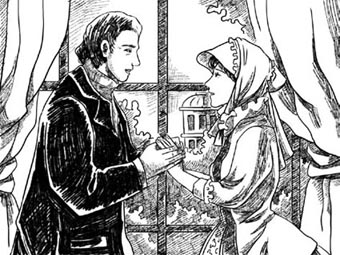
Mr Arabin took Eleanor's hand, and then looked into her face.
It was only for a minute that they stood like that, but it was a minute that they would remember for ever. Eleanor was sure now that she was loved. But why did he not speak to her? Could it be that he looked to her to make the first sign? And he, although he knew very little of women, even he knew that he was loved. He had only to ask, and it would all be his own, this inexpressible loveliness, this bright and loving nature which had so attracted him from the first. She must love him! Otherwise she would never allow her hand to remain so long within his own. He had only to ask. Ah, but that was the difficulty!
'Mrs Bold...' he said at last, and stopped. 'Eleanor!' he then said, very softly, still lacking a lover's courage, and fearful of giving offence. She looked gently up into his face. 'Eleanor!' he said again, and in a moment he had her in his arms. How this happened, neither of them knew, but there was now a sympathy between them that hardly allowed them to be individuals – they were one and the same – one body, one soul, one life.
'Eleanor, my own Eleanor, my own, my wife!' As she shyly looked up at him through her tears, he pressed his lips to her forehead. For the first time in his life, he kissed a woman.
'Oh, let me go now,' said she. 'I am too happy to remain – I must be alone.' He let her go, and she rushed out of the room.
Once in the privacy of her bedroom, she was able to sob and cry and laugh, as the hopes and fears and miseries of the last few weeks passed through her mind. What happiness she could now look forward to!
After dinner that evening she told Miss Thorne, in a voice trembling with joy, that she was engaged to Mr Arabin.
Poor Miss Thorne was a little shocked at the speed with which her plan had succeeded. They were not young lovers, but a forty-year-old vicar and a respectable widow, and only a day had been long enough for them to arrange matters, where Miss Thorne had allowed twelve to eighteen months! She was almost disappointed, and, shaking her head regretfully, thought it must be the modern way of doing things. But on the whole she was pleased that her matchmaking had been so successful, and wished Eleanor much happiness.
The next morning Eleanor returned to Barchester, and very soon received a visit from her father. How much each of them had to tell the other! Mr Harding told his daughter about being invited to become dean, and Eleanor told her father about her engagement to Francis Arabin. Mr Harding was quite delighted to hear who his new son-in-law was to be, and was happy to spend most of the morning discussing Mr Arabin's good qualities with Eleanor. However, he refused to say any more about the post of dean, because a new idea had entered his head – why should Mr Arabin not be the new dean?
They were still talking when Eleanor saw the archdeacon's carriage through the window.
'Oh my dear,' said her father, 'Dr Grantly said he would come and see you, but I forgot to mention it.'
Eleanor could not, in the first hours of her joy, bring herself to hear the archdeacon's lengthy apologies and congratulations, so she hurried out.
The archdeacon, therefore, found Mr Harding alone when he entered the room.
'Is anything the matter with Eleanor?' asked Dr Grantly, thinking that perhaps the truth about Mr Slope had come out.
'Well, something is the matter. I wonder if you will be surprised at it. What do you think Mr Arabin has just done?'
'Nothing to do with that daughter of Stanhope's, surely?'
'No, not that woman,' said Mr Harding, enjoying his little joke and trying not to smile.
'Not that woman! Is he going to do anything about any woman? Why can't you speak out if you have anything to say? There's nothing I hate so much as mysteries.'
'This must remain confidential at present, archdeacon. You can tell Susan, but no one else.'
'Nonsense!' cried the archdeacon angrily. 'You can't have any secret about Arabin that I don't know!'
'Only this – he and Eleanor are engaged.'
'Arabin! It's impossible! She must be mistaken!'
It took quite a long speech from Mr Harding to convince Dr Grantly that it was not only possible, but true. At first the archdeacon was simply amazed. Then he was disgusted at his own misjudgement of the situation. But finally he began to smile, and expressed great satisfaction with the news. 'Well, well!' said he. 'Good heavens, good heavens!'
And then slowly, gradually and cleverly Mr Harding proposed his own new plan. Why should Mr Arabin not be the new dean? Slowly, gradually and thoughtfully Dr Grantly was persuaded to accept the idea. It would be the perfect solution to their difficulties with the bishop, and, with Arabin as dean, the archdeacon's influence in Barchester would be far greater.
So it was arranged between them that they would travel to London together the following morning, to try to persuade the prime minister to appoint Mr Arabin, instead of Mr Harding.
Mr Slope was in his room at the bishop's palace, when he received a note from his friend Sir Nicholas, informing him that he would not be offered the post of dean. He did not give way to despair, however, but sat down quietly to make a new plan for his future. He counted up his money, and then he wrote a letter to a rich factory-owner's wife in London, who, as he well knew, had entertained and encouraged serious young clergymen in the past.
A few moments later a servant appeared, to ask him to go to the bishop's study at once. Mr Slope waited ten minutes to prove his independence, and then went to the bishop's room. As he had expected, Mrs Proudie was there with her husband.
'Mr Slope,' said the bishop, 'I must speak to you about an urgent matter, concerning yourself.'
'My lord, if I may express a wish, I would prefer no discussion to take place in the presence of a third person.'
'Don't alarm yourself, Mr Slope,' said the lady. 'No discussion is at all necessary. The bishop will only express his own wishes, that is all.'
'I will only express my own wishes, that is all,' the bishop repeated. 'No discussion is at all necessary.'
'May I ask if I have done anything wrong, my lord?' enquired Mr Slope, looking innocent.
'Do you dare to ask the bishop that?' cried Mrs Proudie.
'Mrs Proudie, I will not have words with you.'
'Ah sir, but you will have words! Why have you had so many words with that Signora Neroni? Disgraceful behaviour! You are no longer wanted by the bishop, sir. Kindly leave his employment and this house as soon as possible!'
'My lord,' said Mr Slope, turning his back completely on the lady,' may I have from your own lips any decision you have come to on this matter?'
'Certainly, Slope, certainly. Well, you hear what Mrs Proudie says. That is the decision I have come to on the matter.'
'If you wish to remain in Barchester,' added Mrs Proudie, 'and will promise never to see that woman again, the bishop will mention your name to Mr Quiverful, who now needs an assistant at Puddingdale. There is an income of £50 a year, I believe.'
'God forgive you, madam, for the way in which you have treated me,' said Mr Slope. 'As to the bishop, I pity him.' And he left the room to pack his bags, leaving Mrs Proudie victorious.
It is well known, however, that the Slopes of this world fall on their feet like cats. On his return to London he discovered that the factory-owner had died, and the widow needed comforting. Mr Slope was able to comfort her, and soon found himself living in her pleasantly large house, with her fortune at his command.
By using every influential contact they had, Dr Grantly and Mr Harding managed to persuade the prime minister's advisers that Francis Arabin should be dean. It was a happy moment for them both when, on their return to Barchester, they were able to present the prime minister's letter to their friend, appointing him Dean of Barchester. How grateful Eleanor was to her father, for giving up his chance of promotion to his future son-in-law!
A few months later, Mr Arabin married Mrs Bold. The wedding dress, the carriages, the flowers, the reception – everything was paid for by the archdeacon, who could not do enough to show how sorry he was to have doubted Eleanor, and how happy he was to have triumphed over Slope.
Now Eleanor and her husband live in the dean's house in perfect happiness. Mr Harding has gone to live with them there, and spends much of his time teaching little Johnny to sing and play the piano. Another child is expected soon, and Susan Grantly is looking forward to helping her sister with the new baby. Now that Eleanor is also a clergyman's wife, she and Susan get on much better than in the past.
The Stanhopes are living in Italy again. Not long after their return there, the signora received a pretty, but short letter from Mrs Arabin. This was answered by a bright, charming and amusing note, as the signora's letters always were. Here ended the friendship between Eleanor and the Stanhopes.
Dr Proudie is still bishop, but has never attempted to disobey his wife again. He prefers being henpecked to having an uncomfortable domestic life. And Mrs Proudie, now that she is certain of her power, interferes hardly at all in spiritual matters. Dr Grantly and Mr Arabin, whose views on religion are so similar, work together on all church business. So priestly arguments are a thing of the past, now that war is over, and peace has returned to that ancient cathedral city of Barchester.
boast v. to talk proudly about one's abilities, achievements, or possessions 夸口,夸耀
be of the opinion (that) to think that something is true 认为,主张
matchmaking n. the act of finding a suitable partner for someone else to marry 做媒
remark n. something that you say when you express an opinion or say that you have noticed 意见,评论
unchecked adj. not controlled or stopped 未受抑制的
sympathy n. a feeling that you understand someone because you are similar to them 同感,共鸣
give way to to be replaced by 被……取代
have words with to quarrel with someone 和某人吵架
employment n. the condition of having a paid job 工作,职业
turn one's back on someone to refuse to help, support, or be involved with someone 对某人置之不理
fall on one's feet to get into a good situation because you are lucky, especially after being in a difficult situation 逢凶化吉
be expected (a baby) to be born soon (婴儿)即将出世
11
新任教士长
在普拉姆斯特德,执事长痛苦不堪。不仅哈丁先生在海勒姆养老院的院长职位归了奎沃夫先生,斯洛普先生似乎还很有可能成为教士长,娶埃莉诺·博尔德为妻。除此之外,格兰特利博士还有一件烦心事。他那位优秀的、受人尊重的朋友弗朗西斯·阿拉宾行为不端,而他一直大肆吹捧阿拉宾如何品德高尚。如今,人们开始议论阿拉宾对内罗尼太太的频繁拜访。这完全不符合大家对圣埃沃兹代牧的期望。
执事长和妻子正在谈论这些问题时,听见一辆马车飞驰到了门口。
“这会是谁呢,苏珊?”格兰特利博士一边问,一边推开了会客厅通往大厅的门。“哦,是你父亲!”
来人正是哈丁先生,他迫不及待地想要告诉他们一个消息。
“真高兴见到您,父亲。”他女儿说,“我这就去把您的房间收拾好。”
“先别走,苏珊。”哈丁先生说,“我有事要跟你们讲。要不,等吃完晚饭再说?”
“如果您有要紧事跟我们说,”执事长说,“那我求您了,现在就告诉我们吧。莫非是埃莉诺跟斯洛普私奔了?”
“不,她没有。”哈丁先生说,面露不悦之色。
“莫非是斯洛普当上了教士长?”
“不,他没有,不过——”
“不过什么?”执事长不耐烦地问。
“他们要把这个职位给我。”哈丁先生谦逊地说。
“天哪!”执事长大叫一声。
“我亲爱的,亲爱的父亲!”格兰特利太太喊道,伸出双臂搂住了父亲的脖子。
他俩祝贺了哈丁先生,然后大家一起坐下来吃晚餐。执事长喜不自胜。直到晚饭吃完,仆人们全部离开之后,哈丁先生才找到机会,紧张不已地说:“首相真是太好心了,我非常感激他的提议,但我恐怕我不能接受。”
执事长大惊失色,手里的杯子差一点儿就掉在了地上。一个年薪不到两百英镑的代牧为什么不愿意接受教会里最让人眼馋的职位,不愿意接受一千两百英镑的年薪?但是,哈丁先生翻来覆去地向他和苏珊解释,说自己胜任不了这份工作,他这把年纪也不想升什么职了。尽管夫妻俩一再反对,他的态度还是很坚决。
执事长又一次大失所望。对他来说,最合他心意的莫过于自己的岳父当上教士长,然而,要让哈丁先生改变主意是不可能的。
******
在乌拉索恩,乡绅的姐姐也听说了阿拉宾先生和内罗尼太太之间的事。索恩小姐认为,所有的代牧都应该成家,为的就是避免这一类不愉快的事件。于是她使出平常乐于助人的劲头,开始想办法为阿拉宾先生物色一个妻子。她挨个查了一遍自己认识的单身女子,看看哪些人有可能想找个丈夫,自身的资质又适合做一名代牧的妻子。她想不出还有谁比博尔德太太更加合适。因此,她片刻都没耽搁,立刻邀请博尔德太太和她年幼的儿子来乌拉索恩住上一两个月。“我们得把阿拉宾先生也请来。”索恩小姐暗自思量,“一切顺利的话,再过上一年或一年半的时间,博尔德太太就会在圣埃沃兹定居了。”这位古道热肠的女士对自己这番牵线搭桥颇为自许。
这个邀请让埃莉诺有些惊讶,但她还是应邀前往,并在她父亲得到教士长提名的前一天来到了乌拉索恩。自从跟马德琳见过面之后,她就一心只想着阿拉宾先生,也希望能在乌拉索恩见到他。要是他俩能碰上面,说上话,那就好了!
他俩还真的见了面。埃莉诺发现,阿拉宾先生也在索恩家里暂住。早上过来的时候,他发现两位女士正在会客厅里做针线活。索恩小姐没意识到自己最好赶紧消失,而是一直跟客人们聊到了午饭时间。午饭后,阿拉宾先生去处理教堂事务,埃莉诺则和索恩小姐一起散了会儿步。
散步回来以后,埃莉诺一个人待在会客厅里。暮色刚刚降临时,阿拉宾先生走了进来。那是一个美丽的秋日黄昏,埃莉诺坐在窗边,借着最后一抹天光看书。阿拉宾先生背对着炉火,双手插在口袋里,说了几句关于天气的家常话。
“天色真的很美。”埃莉诺说。
他站的位置看不到天空,所以他只好走近她。“非常美。”他说,谦恭地保持着距离,以免碰到她的裙子。接下来,他似乎已经无话可说,只好走回炉火前。
埃莉诺也想不出有什么可说的,还发现自己忍不住要哭了。她希望他没有留意。此刻他并没有看着她,所以似乎不可能注意到。
“您喜欢乌拉索恩吗?”他站在安全距离之外问。“我不是说索恩先生和索恩小姐,说的是这座宅子。老式的房屋和花园总有一种韵味,让我特别喜欢。”
“我喜欢一切老式的东西。”埃莉诺说,“老物件要实在得多。”
“我真不知道该不该赞同您的观点。”
“在我看来,这个世界一天比一天野心大,一天比一天自私。”埃莉诺说。
“那是因为您对这个世界的见识比年少时多了。不过,我们不该根据自己的见识来下判断——我们的见识实在是太少太少了。”阿拉宾先生拨弄着口袋里的硬币,两人很不自在地沉默了一阵。接着,他开始心神不宁地在屋子里走来走去。
埃莉诺默默地坐着,低头看书。她担心自己会控制不住泪水,便打算逃出这间屋子。就在这时,阿拉宾先生突然停下脚步,转过身面对着她。
“博尔德太太,”他说,“我欠您一个恭恭敬敬的道歉,我不该问您那个非常隐私的问题,关于——关于某位绅士的问题。我没有权利那么问。”
埃莉诺急于说一些客气和鼓励他的话,但又不想暴露自己的感情。
“说真的,当时我没有生气,阿拉宾先生。”
“哦,可您确实生了气!生气也是应该的!我还没有原谅我自己,可我希望听您讲您原谅了我。”
虽然还在把泪水往肚里咽,埃莉诺却再也无法心平气和地说话了。阿拉宾先生等了一会儿,没听到她的回答,便开始朝门口走去。埃莉诺从座椅上站起身来,轻轻碰了碰他的胳膊,说:“哦,阿拉宾先生,先别走,听我说完!我真的原谅了您。您知道我原谅了您。”
他抓住她的手,注视着她的脸,在她脸上读自己的整个未来,似乎未来清清楚楚地写在她脸上。他的脸上充满渴望与悲伤,让埃莉诺深受感动,不忍直视他。她垂下眼睛看着地板,任由泪水滑落脸庞,任由他握着自己的手。
他俩只这样站了一分钟,这一分钟却让两人永生难忘。此时此刻,埃莉诺相信自己得到了对方的爱。可他为什么一言不发呢?难道他指望她来走第一步吗?而他,虽然对女人知之甚少,却也知道对方爱上了自己。他只需要开口,一切就都是他的了,这难以言传的动人的美丽,这一开始就深深吸引他的既聪颖又富深情的天性。她肯定是爱他的!要不然,她绝不会让自己的手一直停留在他的掌心。他只需要开口就行。唉,难就难在这里!
“博尔德太太……”他终于开了口,又戛然而止。“埃莉诺!”接下来,他唤了一声,声音十分轻柔,仍然缺乏恋人该有的勇气,还担心会冒犯对方。她抬起头,温柔地注视着他的脸。“埃莉诺!”他又唤了一声,片刻之间,他已经把她揽入怀中。这一切是怎么发生的,他俩都不知道。然而,两个人之间已经有了共鸣,几乎使他们水乳交融——他们合二为一——身体、灵魂和生命都是如此。
“埃莉诺,我的埃莉诺,我的,我的妻子!”她羞怯地抬起头,泪眼婆娑地望着他时,他把嘴唇贴在了她的额上。有生以来,他第一次吻了一个女人。
“哦,快放开我吧。”她说,“我太幸福了,不能再留在这里——我得一个人待会儿。”他松开手,她冲出了房间。
一回到没有外人的卧室之后,她就能尽情地哭泣、大笑,过去几个星期的希望、恐惧和痛苦一股脑地涌上了心头。如今,她可以期待的是怎样的幸福啊!
当天晚饭之后,她用快乐得发颤的声音告诉索恩小姐,自己跟阿拉宾先生订了婚。
看到自己的计划见效如此神速,可怜的索恩小姐感到有点儿震惊。他俩并不是年轻情侣,而是一位四十岁的代牧和一位受人尊重的寡妇,可他俩只用了一天的时间就把一切安排妥当,索恩小姐却打算给他们一年到一年半的时间!她几乎是失望了,遗憾地摇摇头,心想这一定是现代人的作风。不过,总的来说,她很高兴自己这个媒人当得如此成功,并且祝愿埃莉诺生活幸福。
第二天早上,埃莉诺回到了巴彻斯特。没过多久,父亲就过来看她。他俩都有一肚子话想跟对方说!哈丁先生告诉女儿自己已被邀请当教士长,埃莉诺则告诉父亲自己跟弗朗西斯·阿拉宾订了婚。听到自己的新女婿会是谁之后,哈丁先生喜出望外,高兴地跟埃莉诺聊阿拉宾先生出色的人品,聊了大半个上午。不过,他不肯再谈教士长职位的事情,因为他有了一个新想法——干吗不能让阿拉宾先生来当新教士长呢?
说着说着,埃莉诺从窗户看见了执事长的马车。
“哦,亲爱的,”她父亲说,“格兰特利博士说了要来看你,可我忘记跟你说了。”
埃莉诺还沉浸在刚刚到来的喜悦之中,没有兴致听执事长喋喋不休地道歉道喜,于是急匆匆地走了出去。
因此,进屋的时候,执事长只看见了哈丁先生一个人。
“埃莉诺没什么事吧?”格兰特利博士问,心里想的是关于斯洛普先生的真相也许已经传了出去。
“嗯,确实有点儿事。我在想你知道以后会不会很惊讶。你猜猜阿拉宾先生刚刚做了什么?”
“肯定不会跟斯坦诺普家的那个女儿有什么关系吧?”
“不,不是那个女人。”哈丁先生说,很得意自己开的这个小玩笑,尽量忍住不笑。
“不是那个女人!他难道打算做什么跟女人有关的事情吗?您如果有话要说,干吗不直接说出来呢?我最讨厌这么神神秘秘了。”
“这件事情目前必须保密,执事长。你可以告诉苏珊,别告诉别人。”
“胡扯!”执事长生气地嚷道,“阿拉宾不可能有什么您知道我不知道的秘密!”
“只有一个——他和埃莉诺订婚了。”
“阿拉宾!不可能!她肯定是弄错了!”
哈丁先生费了不少口舌,才让格兰特利博士相信这不仅可能,而且确有其事。刚开始,执事长只是觉得惊讶。接下来,他又恨自己先前误判了情况。不过,最后他还是笑了起来,表示自己听到这个消息十分满意。“好吧,好吧!”他说,“天哪,天哪!”
然后,哈丁先生慢慢地、一步一步地、巧妙地提出了自己的新想法。为什么不让阿拉宾先生来担任新任教士长呢?格兰特利博士则陷入了沉思,慢慢地、一步一步地被他说服,接受了这个想法。他们和主教之间的难题由此可以得到完美的解决。此外,阿拉宾当上教士长之后,执事长在巴彻斯特的影响力会大幅提升。
于是,他俩商定第二天早上一起前往伦敦,努力说服首相任命阿拉宾先生为教士长,而非哈丁先生。
******
斯洛普先生在主教宅邸自己的房间里,接到了朋友尼古拉斯爵士写来的信,得知自己不会被任命为教士长。可他不甘绝望,而是默默地坐下来,重新为将来打算。他统计了自己的财产,然后给伦敦一位富有的工厂主夫人写了一封信,因为他清楚地知道,这位夫人曾经款待一些作风严肃的年轻神职人员,还挑逗过他们。
过了一会儿,仆人走进房间,请他立刻上主教的书房去。斯洛普先生拖了十分钟,以此证明自己的独立地位,才去主教的书房。如他所料,普劳蒂太太也在那里,跟她丈夫在一起。
“斯洛普先生,”主教说,“我有急事相告,是跟你有关的。”
“我的大人,如果允许我表达自己的想法,我希望讨论此事的时候没有第三者在场。”
“别慌,斯洛普先生。”普劳蒂太太说,“根本就不需要讨论。主教只是要表达他自己的意愿,仅此而已。”
“我只是要表达我自己的意愿,仅此而已。”主教重复了一遍,“根本就不需要讨论。”
“我能不能问一问,我是不是做错了什么,我的大人?”斯洛普先生一脸无辜地问。
“你居然敢问主教这种问题?”普劳蒂太太喊道。
“普劳蒂太太,我不想跟您吵什么。”
“啊,先生,你会有什么话要说的!跟那个内罗尼太太,你为什么有那么多话说呢?真是丢人!主教不再需要你了,先生。烦请尽快离职,尽快搬走!”
“我的大人,”斯洛普先生说,完全不再理会普劳蒂太太,“您在这件事情上的任何决定,我能不能听您亲口说说?”
“当然可以,斯洛普,当然可以。呃,你也听见了普劳蒂太太的话,那就是我在这件事情上的决定。”
“如果你愿意留在巴彻斯特,”普劳蒂太太补充道,“并且答应再也不见那个女人,主教就会向奎沃夫先生推荐你,眼下他在帕丁戴尔那边缺一名助手。年薪是五十镑,我相信。”
“愿上帝宽恕您如此对我,太太。”斯洛普先生说,“至于主教,我对他深表同情。”说完之后,他走出房间收拾行李,使普劳蒂太太得意不已。
然而,众所周知,这个世上的斯洛普们都像猫一样幸运,总能逢凶化吉。回到伦敦的时候,他发现那位工厂主已经过世,他留下的寡妇很需要安慰。斯洛普先生能安慰她,很快就住进了她那座舒适的大房子,支配起她的财富来。
******
格兰特利博士和哈丁先生动用了所有能说上话的人脉,成功说服了首相的各位顾问,让他们相信弗朗西斯·阿拉宾是教士长的合适人选。回到巴彻斯特的时候,他俩可以把首相的信交给他们的朋友,那封信是授予阿拉宾巴彻斯特教士长一职的任命书。那一刻,他俩都十分高兴。埃莉诺对父亲感激不已,因为他把自己升职的机会让给了未来的女婿!
几个月后,阿拉宾先生娶了博尔德太太。结婚礼服、马车、鲜花和婚宴——一切费用都由执事长支付。他觉得,不管做多少,都不足以表达他当初怀疑埃莉诺的歉疚心情,也无法表达他斗赢斯洛普的快乐。
******
如今,埃莉诺跟丈夫一起住在教士长宅邸里,生活无比幸福。哈丁先生也搬来跟他们同住,花很多时间教小约翰尼唱歌、弹钢琴。另一个孩子很快就要出世,苏珊·格兰特利正盼着帮妹妹照顾新生的宝宝。因为埃莉诺也成了神职人员的妻子,她和苏珊之间的关系也就比过去融洽得多了。
斯坦诺普一家如今又住在意大利。回意大利没多久,内罗尼太太就收到了阿拉宾太太寄来的一封亲切简短的信。内罗尼太太用机灵可爱的玩笑话作答,这是她一贯写信的风格。埃莉诺跟斯坦诺普一家的友情到此为止。
普劳蒂博士仍然担任主教一职,但再也不试图违背妻子的意愿。他宁愿受妻子的欺压也不愿家无宁日。普劳蒂太太因为对自己的权力有了十足的把握,也就几乎不再干预宗教事务。格兰特利博士和阿拉宾先生在宗教问题上所见略同,两人协力管理着所有的教会事务。就这样,硝烟既已消散,教会争执也就一去不返,宁静复归巴彻斯特这座古老的大教堂城市。
8.The garden party
PART THREE: PEACE RETURNS
第三部:重归宁静
8
The garden party
The day of the Ullathorne party arrived, and Miss Thorne was in great anxiety about the preparations. Mr Thorne also had a great deal to do. But the most hard-working, the most anxious and the most effective person at Ullathorne House was the steward, Mr Plomacy. In his youth he had lived through dangerous times, and had once been sent over to Paris with secret letters, hidden in his boot, for the King of France. He had been lucky enough to return safely, and since then had stayed quietly at home, but the adventure had gained him a reputation for political cleverness and complete reliability. Now he had been steward of Ullathorne for more than fifty years, and it had been a very easy life. Who could require much work from a man who had carried documents which, if discovered, would have cost him his head?
But on occasions such as this, Mr Plomacy proved his real worth. He had the honour of the family at heart, and he appreciated the duties of hospitality for such an ancient house. Therefore he always took the arrangements for such events into his own hands, and very well he managed them, too.
The day had been planned as follows: the guests would gather in the house and garden; sports would be played in the field; a generous meal would be served. Two enormous tents had been set up, one in the main part of the garden, near the house, and the other in the sports field, separated from the garden by a stream. High society – the lords, ladies, clergy, and gentlemen of the surrounding area – would have their lunch in the garden tent, while low society – the farmers, shopkeepers, and other ordinary working people – would eat in the field tent.
A difficult question presented itself immediately. Who, exactly, was to be fed in the garden and who in the field? It was easy to see that Bishop Proudie would belong in the garden, and Farmer Greenacre, with his red face and plain country manners, in the field. But what about Mrs Lookaloft, whose husband was only a farmer, but whose daughters attended a fashionable private school, and who had a piano in her sitting room? She would not be happy talking about butter and chickens to her neighbour Mrs Greenacre, and yet she was no fit companion for the Thornes and Grantlys. People like her would certainly want to leave the field and cross the stream to join high society in the garden tent, if they could. All Miss Thorne and Mr Plomacy could do was to make their arrangements and hope for the best.
It was a beautiful sunny day, and soon the farm workers and townspeople began to pour in through the gates. Mr Plomacy wanted to turn away all those who had no invitation, but Miss Thorne insisted on offering her hospitality to everybody.
Some ladies and gentlemen arrived, and were shown into the main sitting room in the house. Then, as Miss Thorne had feared, Mrs Lookaloft and her adult daughters marched confidently into the room. Miss Thorne's servants knew the Lookalofts had no right to be there, but did not like to prevent them entering. Miss Thorne herself, although shuddering slightly at the sight of their unsuitably low-cut dresses, greeted them politely, if a little coldly.
Mr Arabin had also arrived, just in time to see the Stanhopes' carriage stop in front of the house. He watched in disgust as Mr Slope handed Mrs Bold out of the carriage. The next to arrive were the Proudies, followed by all the important Barchester families, and soon the house and gardens were full of noise and movement.
Mr Arabin watched in disgust as Mr Slope handed Mrs Bold out of the carriage.
Eleanor left the Stanhopes as soon as possible, and went to look for her father. She was pleased to find him with Mr Arabin. There was something particular she wanted them both to hear.
'I came with the Stanhopes, father,' she said. She saw Mr Arabin looking at her sternly. She knew his accusation was: 'You came with them in order to be accompanied by Mr Slope.'
She continued rather breathlessly, 'In our carriage were Dr Stanhope, Charlotte, myself, and Mr Slope.' As she spoke the last name, Mr Arabin turned and walked slowly away. 'Father,' she said desperately, 'I couldn't help coming with Mr Slope!'
'Why would you wish to help it, my dear?'
'Father, you must know all the things they said at Plumstead. How unjust the archdeacon was, and Mr Arabin too! He's a hateful man, but –'
'Who's a hateful man, my dear? Mr Arabin?'
'No, father, you know I mean Mr Slope. He's the most hateful man I ever met in my life. But how could I help coming in the same carriage as him?'
A great weight began to roll off Mr Harding's mind. So, after all, the Grantlys, with all their wisdom, were wrong! His Eleanor, the daughter of whom he was so proud, was not to become Mr Slope's wife! 'My darling girl, I am so delighted!'
'But surely, father, you didn't suspect –'
'I don't know what you mean by "suspect", Eleanor. There would be nothing disgraceful in such a marriage.'
And Mr Harding would have explained that Mr Slope was a very good sort of man and a very suitable second husband for a young widow, if he had not been interrupted by Eleanor's greater energy.
'It would be disgraceful! It would be wrong! It would be horrible! I don't wonder at Dr Grantly and Susan, but father, I do wonder at you. How could you believe it of me?' And Eleanor, unable to hold back her tears, sobbed bitterly.
But she could not be angry for long with her father, who confessed his misjudgement of her character and promised never to make the same mistake again. He helped her dry her tears, and, arm in arm, in perfect happiness, they walked towards the house.
Miss Thorne was at her front door, welcoming latecomers. The signora, looking as beautiful and fascinating as ever, was carried inside and placed carefully on a sofa, where, as usual, she was the centre of male attention. But soon all eyes turned to the door again, and Lady de Courcy made her entrance.
Lady de Courcy had chosen to show that she was socially above everyone else by arriving three hours late, then complaining loudly of the poor quality of the country roads. But she found a companion to her liking in the bishop's wife, and soon the two ladies discovered they thought alike on many matters.
'Charming person, Miss Thorne!' said Mrs Proudie.
'Charming, indeed! And isn't her dress delightful?'
'Quite delightful. I wonder if she paints – there's something about the colour that makes me think –'
'I have no doubt she does. But tell me, Mrs Proudie, who is that woman on the sofa by the window?' And Lady de Courcy looked meaningfully over at the signora.
'She's the dreadful Italian woman, Lady de Courcy. You must have heard of her.'
'What Italian woman? Tell me more, I beg you!'
'She's not absolutely Italian. She calls herself Signora Neroni, but in fact she's Dr Stanhope's younger daughter.'
'Ah-h-h-h! I've heard my son George mention her. He heard a lot of stories about her in Rome.'
'She made her way into my house once, before I knew anything about her, and I cannot tell you how disgraceful her behaviour was – it was quite wicked!'
'Was it?' said Lady de Courcy delightedly. 'But why does she lie on a sofa?'
'She has only one leg. I believe her husband beat her, and somehow her leg was injured, so she lost the use of it.'
'Unfortunate creature!' Lady de Courcy herself knew something of the difficulties of married life.
'Yes, one would pity her, if she only had better manners. But she stares so rudely! And she behaves so badly with men!'
'Oh dear!' said Lady de Courcy.
'You see that clergyman with red hair, standing near her? Through my efforts he became the bishop's chaplain, but that woman has absolutely ruined him. I shall be forced to require him to leave the palace, and he may even have to leave the Church!'
'What a fool the man must be!'
But this enjoyable conversation was interrupted by the squire, who came to take Lady de Courcy to her seat in the garden tent, and another gentleman, who was to accompany Mrs Proudie.
As the meal started, Eleanor found herself sitting between Bertie Stanhope and Mr Slope. From her seat near the entrance to the tent, she could see, through the open door of the sitting room, Mr Arabin hanging over the signora's sofa.
Mr Arabin had passed the previous night alone in the vicar's house at St Ewold's. It was his first night there, and a dull evening it had been. Mrs Grantly had been right in saying that a priestess was needed there. He had sat there alone, with his glass in front of him, and then his teapot, thinking about Eleanor Bold. He did little but blame her – blame her for liking Mr Slope, blame her for not liking him, blame her for being independent and passionate. And yet the more he thought of her, the more he loved her. Then he was annoyed with her again. Why had she refused to answer a plain question, and put an end to his misery? Mr Arabin slept little that night.
When he arrived next morning at Ullathorne, he was in a state of confused uncertainty and hope, until the moment when he saw Mr Slope hand Eleanor out of her carriage. At once he assumed that she had invited him to accompany her, and that news of their engagement would follow, as night follows day. Soon afterwards he heard from Eleanor's own lips that she had come with Mr Slope; Mr Arabin's agony of suffering prevented him from understanding that she and Mr Slope had both been guests of the Stanhopes.
He wandered aimlessly into the house, avoiding conversation with anyone. And when the signora was carried in, he was feeling too weak to resist the temptation of her beauty, so, hardly knowing what he was doing, he went to sit beside her.
It is impossible to discover how she gained this knowledge, but the signora knew Mr Arabin was in love with Mrs Bold. It was therefore quite natural for her to wish to trap him, to prove to herself that her charms were greater than the widow's. She had had almost enough of Mr Slope, although it was fun to drive a very self-important chaplain to madness by a desperate and ruinous passion. But Mr Arabin was a bigger and better fly; unlike Mr Slope, he was a highly intelligent, well-educated gentleman.
'What is the matter, Mr Arabin?' she asked playfully. 'Your friend Mr Slope was here a moment ago, full of good humour. Why don't you rival him?'
Mr Arabin shuddered visibly, and Madeline knew at once he was jealous of Mr Slope. 'You and he are complete opposites,' she continued. 'He loves to be praised, you foolishly do not. He is proud and confident; he will allow nothing to stop him achieving his ambitions. You are modest and self-doubting; you are too easily persuaded to give up your dearest hopes and dreams.'
Mr Arabin was very surprised. How did this woman he hardly knew understand the secrets of his heart?
'Mr Slope is born to be successful,' Madeline went on. 'When you see him raised to a high position, with wealth, a charming wife and family, you will begin to envy him and wish you had done the same.'
'Perhaps that is true,' Mr Arabin admitted honestly.
'Remember, Mr Arabin, the good things of this world are always worth winning. That includes beautiful women. But you must fight for them! I can see Mrs Bold looking at you from the garden tent. What do you think of her as a companion for life?'
Mr Arabin glanced towards the garden and caught Eleanor looking at him. She looked quickly away. 'I am afraid Mrs Bold is engaged to another,' he said. 'She is a very beautiful, intelligent woman. It is impossible to know her without admiring her.'
'And you dare to tell me this, when you know I claim to be a beauty myself!' The signora pretended to be angry.
'You are more beautiful, perhaps more clever. But –'
'Thank you, Mr Arabin. I knew we would be friends.'
'But Mrs Bold is the one who –'
'I won't hear another word. As long as she is in second place to me, I am happy. Now Mr Arabin, I am dying of hunger. Just fetch me a plate of food and a glass of wine, and then go to have your own lunch.'
In a sort of dream, Mr Arabin did as he was told. And as she watched him go into the garden tent, Madeline knew she had read his heart, and was amazed at his honesty. He was the first man who had not tried to court or flatter her, and whose words she felt she could trust. This endeared him to her. And as it seemed unlikely that Eleanor would agree to marry Bertie, Madeline decided to do good for once in her life, and give up Mr Arabin to the woman whom he loved. Not only that, she would do everything in her power to assist his courtship.
effective adj. successful, and working in the way that is intended 有效的
steward n. a man whose job is to manage a large property, such as a farm 看管人,管家
turn away to refuse to let someone enter a place 不让某人进入某个地方
make one's entrance to enter a room, especially in a way that makes everyone notice you (尤指以引人注目的方式)走进房间
agony n. very severe pain 极大的痛苦
ruinous adj. causing a lot of damage or problems 破坏性的,毁灭性的
rival v. to be as good or important as someone or something else 与……匹敌
endear v. to make popular and liked 使受欢迎,使被喜欢
8
园会
乌拉索恩园会的日子到了,索恩小姐为准备工作操碎了心。索恩先生要做的事情也不少。不过,乌拉索恩家里最勤恳、最操心、最有效率的人是管家普洛玛西先生。年轻的时候,他经历过危险的时代,曾经奉命前往巴黎,把藏在靴子里的密信交给法国国王。他运气够好,平安归来,从此便安安静静地待在家里。不过,这段冒险经历为他赢得了敏于政治、笃实可靠的名声。到现在,他已经在乌拉索恩当了五十多年的管家,生活一直过得十分安逸。他既然当过那种一暴露就要掉脑袋的信差,谁还能要求他干多少活儿呢?
不过,赶上像眼下这样的场合,普洛玛西先生总是能证明自己真正的价值。他心里装着这个家族的荣耀,也意识到这样一座古宅好客的责任。因此,他总是会亲手安排这样的盛会,而且做得非常出色。
这一天的安排是这样的:宾客们在宅子和花园里会合,体育运动安排在草地上,此外还有一顿丰盛的宴席。两顶巨大的帐篷搭起来了,一顶在花园的核心位置,靠近房子,另一顶在用来开展体育运动的草地上,跟花园隔着一条小溪。上流社会——包括周边地区的各位贵族、女士、神职人员和绅士——将在花园的帐篷里享用午餐,下层社会——包括农夫、商店店主和其他普通劳动阶层——则在草地上的帐篷里用餐。
马上就有一个难题。究竟谁该在花园里用餐,谁又该在草地上用餐呢?不用说,普劳蒂主教肯定要安排在花园里,举止一看就是乡下人的红脸膛农夫格里纳克肯定要安排在草地上。可是,卢克罗夫特太太该怎么安排才好呢?她丈夫只是一名农夫,可女儿们上的却都是时髦的私立学校,而且她的会客厅里还摆着一台钢琴。要是让她跟邻居格里纳克太太谈论黄油和小鸡,她肯定会不高兴,但她又不适合跟索恩家和格兰特利家的人作伴。只要有可能,像她这样的人自然想离开草地,到小溪那边加入花园帐篷里的上流社会。索恩小姐和普洛玛西先生只能做好安排,祈祷一切顺利。
这一天阳光明媚,农场工人和小镇上的人很快就开始从各扇门涌进来。普洛玛西先生想把那些不请自来的人全部拒之门外,索恩小姐却坚持不管来者何人,她都要热情款待。
一些女士和绅士已经到了,仆人把他们领进了宅子里的主会客厅。接下来,正如索恩小姐之前担心的那样,卢克罗夫特太太和她已经成年的女儿们自信十足、大步流星地走了进来。索恩小姐的仆人们知道卢克罗夫特一家无权进那个房间,却不想阻止她们进门。卢克罗夫特家的几个女儿那不得体的低胸裙虽然让索恩小姐稍稍打了个哆嗦,她招呼她们的态度仍然彬彬有礼,只不过可能稍显冷淡。
阿拉宾先生也来了,来的时候刚巧看到斯坦诺普家的马车在宅子前停了下来。他看着斯洛普先生把博尔德太太搀出马车,感到十分厌恶。接着上门的是普劳蒂夫妇,后面跟着巴彻斯特所有显赫的家庭。不一会儿,宅子和花园里已经处处喧哗,人来人往。
埃莉诺尽早离开了斯坦诺普一家,去找自己的父亲。她欣喜地发现父亲跟阿拉宾先生在一起。有一件特别的事情,她想说给他俩听。
“我是跟斯坦诺普一家来的,父亲。”她说。她看见阿拉宾先生严厉地看着她,知道他在指责她:“你跟他们一起来,为的是有斯洛普先生作伴。”
她接着往下说,简直有点儿喘不过气来。“我们的车里有斯坦诺普博士、夏洛特、我和斯洛普先生。”她说到最后一个名字的时候,阿拉宾先生转过身,慢慢地走开了。“父亲,”她绝望地说,“我没法避免跟斯洛普先生一起来!”
“你干吗想要避免呢,亲爱的?”
“父亲,您肯定知道他们在普拉姆斯特德说的那些话。执事长真是太不公平了,阿拉宾先生也一样!他是个很讨厌的人,但是——”
“谁很讨厌啊,亲爱的?阿拉宾先生吗?”
“不是的,父亲,您知道我指的是斯洛普先生。他是我这辈子见过的最讨厌的人。可是,我怎么能避免跟他坐同一辆马车来呢?”
哈丁先生心里的一块大石头落地了。这么说,格兰特利夫妇虽然精明,到头来还是弄错了!他的埃莉诺,他为之骄傲的女儿,不会成为斯洛普先生的妻子!“我亲爱的女儿,我真是太高兴啦!”
“可是,父亲,您没有怀疑——”
“我不知道你说的‘怀疑’是什么意思,埃莉诺。其实,那样的一桩婚姻也没有什么不光彩的。”
要不是情绪激动的埃莉诺打断了他的话,哈丁先生还会接着解释,说斯洛普先生这种人非常不错,可以做一个年轻寡妇再嫁的如意郎君。
“那会是不光彩的!那样不对!那样很可怕!格兰特利博士和苏珊那样想,我不觉得奇怪,但是父亲,您那样想我就觉得奇怪了。您怎么能以为我会那样做呢?”埃莉诺控制不住自己的泪水,伤心地抽泣起来。
不过,她没法对父亲生太久的气,父亲承认自己对她的性格判断有误,答应再也不犯同样的错误。他帮她擦干了眼泪,两个人手挽着手、高高兴兴地朝宅子走去。
索恩小姐站在正门口,迎接迟来的宾客。内罗尼太太仍是那么美丽动人,仆人把她抬进屋里,小心翼翼地放在一张沙发上。跟平常一样,她立刻成为了男人们关注的焦点。不过,所有的目光很快就再次转向门口,德·库西夫人大驾光临了。
为了显示自己的社会地位高于其他所有人,德·库西夫人特意晚来了三个小时,来了就高声抱怨乡间道路不好走。不过,她发现主教妻子是个让她喜欢的伴儿,不一会儿,两位女士就发现她俩在很多事情上所见略同。
“真是个可人儿啊,索恩小姐!”普劳蒂太太说。
“可人儿,没错!她的裙子也很好看,不是吗?”
“特别好看。我猜她是不是会画画——她裙子的颜色让我觉得——”
“我敢肯定她会。可你跟我说说,普劳蒂太太,窗边那个躺在沙发上的女人是谁呢?”说到这里,德·库西夫人意味深长地望向内罗尼太太。
“她就是那个意大利坏女人啊,德·库西夫人。您肯定听说过她。”
“什么意大利女人?说来听听,我求你了!”
“她绝对不是意大利人。她自称内罗尼太太,实际上却是斯坦诺普博士的小女儿。”
“啊——啊!我听我儿子乔治提起过她。他听说了她在罗马的很多故事呢。”
“她去过我家一次,那时候我对她还一无所知。我简直没法跟您形容,当时她的举止有多么丢人——简直是非常恶劣!”
“是吗?”德·库西夫人乐不可支地说,“可她为什么要躺在沙发上呢?”
“她只有一条腿。我看是她丈夫打了她,不知怎么弄伤了她的腿,那条腿就这样残废了。”
“可怜的东西!”德·库西夫人自己也知道婚姻生活的一些难处。
“没错。只要她的行为举止庄重一点儿,大家就会同情她。可她总是很不礼貌地盯着别人!还有啊,她跟男人在一起的时候很不检点!”
“哦,天哪!”德·库西夫人说。
“站在她身边的那个红头发牧师,您看见了吗?我费心费力地让他当上了主教的特遣牧师,那个女人却彻底地毁掉了他。迫于无奈我肯定得要求他离开主教宅邸,搞不好他甚至还得被迫退出教会呢!”
“那个人一定是个傻瓜!”
不过,她俩这段愉快的交谈被打断了,乡绅走过来把德·库西夫人领到花园帐篷里她的座位上,另有一位绅士前来陪普劳蒂太太过去。
午餐开始的时候,埃莉诺发现自己坐在了伯蒂·斯坦诺普和斯洛普先生中间。她的座位离帐篷门口不远,透过会客厅敞开的房门,她看见阿拉宾先生在内罗尼太太的沙发旁流连。
前一天晚上,阿拉宾先生独自一人在圣埃沃兹的代牧住所里过夜。这是他第一次在那边过夜,非常乏味。格兰特利太太之前说得对,那里需要一位牧师太太。他一个人坐着,心里想着埃莉诺·博尔德,面前摆的是酒杯,后来又换成了茶壶。他只是在一味地责怪她——怪她喜欢斯洛普先生,怪她不喜欢自己,怪她太过独立、感情用事。然而,他越是想她,就越是爱她。接着他又生起她的气来。她干吗要拒绝回答一个简单的问题,不肯结束他的痛苦呢?阿拉宾先生一夜难眠。
第二天早晨到达乌拉索恩的时候,他怀着一种迷迷糊糊、忐忑与希望交加的心情,直到看见斯洛普先生把埃莉诺搀下马车。他立刻认定埃莉诺是邀请了斯洛普作伴,要不了多久就铁定要传出他俩订婚的消息了。过了一会儿,他便听见埃莉诺亲口说,她是跟斯洛普先生一起来的。在极度痛苦中,阿拉宾先生没能想到,埃莉诺和斯洛普先生都是斯坦诺普家的客人。
他不想跟任何人说话,漫无目的地走进了宅子。等到内罗尼太太被人抬到屋里的时候,他觉得自己内心极度软弱,抗拒不了她的美丽。所以,他走过去坐在她身旁,都不知道自己究竟在做什么。
无从知道内罗尼太太是从哪儿得来的消息,总之她知道阿拉宾先生爱上了博尔德太太。这一来,她自然而然地产生了俘虏他的念头,以便证明自己比那个寡妇更有魅力。特遣牧师斯洛普先生极其自大,而她让他产生了一种毁灭性的绝望的情欲,逼得他发疯,这虽然有意思,可她还是几乎厌倦了他。但阿拉宾先生这只苍蝇更大也更好。他跟斯洛普先生不一样,是一位极聪明、受过良好教育的绅士。
“您这是怎么啦,阿拉宾先生?”她开玩笑地说,“您的朋友斯洛普先生刚刚也在这儿,心情可好得很呢。您干吗不跟他比个高下?”
阿拉宾先生打了个哆嗦,被马德琳看见了,她马上觉察到他对斯洛普先生的嫉妒之情。“您跟他完全是两个极端。”她接着说,“他喜欢听人奉承,可您却傻乎乎地不喜欢听。他骄傲自大,不允许任何东西阻碍他实现自己的野心,可您却谦逊自省,特别容易听信人言而放弃自己最宝贵的希望和梦想。”
阿拉宾先生大吃一惊。这个他几乎不了解的女人怎么会知道他内心深处的秘密呢?
“斯洛普先生生来就注定会成功。”马德琳接着说,“看到他升官发财,有一个迷人的妻子和家庭的时候,您就会开始嫉妒他,希望自己也有同样的成就。”
“没准儿您说得对。”阿拉宾先生老老实实地承认。
“记住,阿拉宾先生,这世上的美好事物始终是值得追求的,包括美丽的女子。不过,您必须得尽力争取才行!我看得见,博尔德太太在花园的帐篷里瞅您呢。依您看,她作为终身伴侣怎么样呢?”
阿拉宾先生往花园里瞅了一眼,发现埃莉诺也在看他。她忙不迭地移开了目光。“博尔德太太恐怕已经跟别人订了终身。”他说,“她是个非常漂亮、聪明的女人。认识她的人都免不了要倾慕她。”
“您明知道我自认是个漂亮女人,还敢跟我这么说!”这位内罗尼太太佯装生气。
“您比她漂亮,兴许还比她聪明。可是——”
“谢谢您,阿拉宾先生。我知道我们会成为朋友。”
“不过,博尔德太太才是——”
“我不想再听下去了。只要知道她不如我,我也就心满意足了。好了,阿拉宾先生,我都快饿死啦。帮我拿一盘吃的和一杯酒,然后您就自己吃午饭去吧。”
阿拉宾先生神思恍惚,照吩咐端来了吃的和酒。马德琳看着他走进花园里的帐篷,知道自己读懂了他的心,并且吃惊于他的诚实。他是第一个没有去追求她、奉承她的人,他说的话也让她觉得可信。这让她对他产生了好感。既然埃莉诺看样子不会答应嫁给伯蒂,马德琳便决定,这辈子好歹也做一回好事,把阿拉宾先生让给他爱的女人。不仅如此,她还决定竭尽全力来帮他追求埃莉诺。
9
A declaration of love
In the garden tent, the meal was coming to an end. Mr Slope decided that it was the right time to make his declaration to the widow. He had not hesitated to drink his share of wine, in order to give himself the necessary courage. And now he followed Eleanor as she left the tent and walked quickly out into the gardens, which were almost as deserted as he could wish.
As soon as she realized she was being pursued, Eleanor turned on Mr Slope. 'Please don't let me take you from the party,' said she, with all the stiffness she knew how to use. 'I beg you, Mr Slope, to go back.'
But Mr Slope would not allow himself to be dismissed like that. He saw she was angry with him. Poor lady! She was probably unhappy that, while people had been talking of her possible marriage to him, she had been unable to announce it to the world. 'You must permit me to accompany you,' he said. 'I could not think of allowing you to walk alone.'
'Indeed you must, Mr Slope,' said Eleanor, still very stiffly. 'It is my special wish to be alone.'
Mr Slope saw that it must be now or never. 'Do not ask me to leave you, Mrs Bold,' he said with a tender yet passionate look, 'until I have spoken the words with which my heart is full.'
Eleanor now understood what she was about to go through, and the knowledge of it made her very miserable. She could refuse Mr Slope, but the fact of his making her an offer would prove the archdeacon right and herself wrong.
'I don't know what you can have to say to me, Mr Slope, that you could not say to me over lunch,' she replied, looking at him in a way that ought to have frozen him.
But gentlemen are not easily frozen when they are full of wine, and at no time would it have been easy to freeze Mr Slope. 'There are things, Mrs Bold, which a man cannot well say before a crowd,' he whispered. He repeated his tender, passionate look.
Eleanor had not wanted to stand still in front of the garden tent and receive his offer in full view of Miss Thorne's guests. So she had walked on, and Mr Slope offered her his arm.
'Thank you, Mr Slope, but for the very short time I shall remain with you, I prefer to walk alone.'
'And must it be so short?' said he, 'Must it be –'
'Yes,' said Eleanor, interrupting him, 'as short as possible, if you please, sir.'
'I had hoped, Mrs Bold – I had hoped –'
'Kindly hope for nothing from me, Mr Slope. Our friendship is very slight and will probably remain that way.'
Mr Slope was still determined to be very tender, but he was also feeling rather angry. The widow seemed to have no idea of the honour she was about to receive. 'That is cruel,' said he. 'The Church allows the worst of us to hope, at least!' There was a pause. 'Beautiful woman!' he cried at last. 'Beautiful woman, you cannot pretend to be unaware that I love you! Yes, Eleanor, yes, I love you. Next to my hopes of heaven are my hopes of possessing you!' (Mr Slope's memory was faulty here, or he would have mentioned the post of dean.) 'Say, Eleanor, dearest Eleanor, shall we walk that sweet path to heaven together?'
Eleanor had no intention of ever walking together with Mr Slope on any path in future, but felt she ought to allow him to finish his speech before she answered him.
'Ah! Eleanor, will it not be sweet to travel hand in hand through the valley of life? Ah! Eleanor –'
'My name, Mr Slope, is Mrs Bold,' said Eleanor, her disgust at this familiarity overcoming her desire to be polite.
'Sweetest angel, be not so cold,' said he, and as he said it, the wine he had drunk encouraged him to put an arm round her waist, as a proof of his feelings for her.
She jumped away from him as if he were a snake, and then, quick as a flash, she raised her little hand and smacked him hard on the ear. The sound rang among the trees like a clap of thunder.
Eleanor raised her little hand and smacked Mr Slope hard on the ear.
The moment she had done it, she regretted it, as an unladylike thing to do. She was tempted to beg his pardon, but fortunately thought better of it. 'I will never, never speak another word to you!' she said breathlessly, and ran quickly back along the path to the house.
Being hit by a woman was as much an insult to Mr Slope as being hit by a man. His face was sore and his pride was badly injured. He was extremely angry with the widow, and bitter thoughts of revenge filled his head. But after a while he recovered his calmness, and walked slowly back to the garden tent, taking a different direction from Eleanor. Here he heard that the dean had just died, and so he wasted no more time at Ullathorne, but returned to Barchester as speedily as possible.
As Eleanor approached the house, she saw Charlotte Stanhope and ran across the grass to join her friend.
'Oh Charlotte!' she sobbed. 'I'm glad I've found you!'
'Why, what's the matter?' said Miss Stanhope, seeing that there were tears on Eleanor's face and her hands were trembling. 'What can I do to help? Can Bertie do anything?'
'Oh no, no, no,' said Eleanor. 'Only, that hateful man –'
'What hateful man?' asked Charlotte, interested.
'Mr Slope. He's a disgusting, wicked man, and it would teach him a lesson if I told the bishop all about it!'
'Believe me, if you want to cause trouble for him, you had far better tell Mrs Proudie. But what did he do?'
'Why did he think he could court me? I never gave him any encouragement, only defended him when others criticized him.'
'That's just it, my dear. He heard about that, and therefore imagined that you were in love with him.'
Eleanor knew Charlotte was right about Mr Slope, as her family had been. She sincerely regretted her defence of him, and promised herself she would never fight against injustice again.
'But what did he do?' asked Charlotte again.
'He – he talked such dreadful nonsense about religion and heaven and love. And then – he took hold of me!'
'By the waist?'
'Yes,' said Eleanor, shuddering. 'Then I got away from him and smacked his face and ran along the path until I saw you!'
'Ha, ha, ha!' Charlotte laughed heartily at the thought of Mr Slope's embarrassment. But her aim was to endear herself to Mrs Bold, so she was quick to stop laughing and offer sympathy.
She was eager for her brother to propose and be accepted as soon as possible. Bertie's debts, and Dr Stanhope's disapproval of his son, were so great that Bertie would have to leave England at once, unless he could be sure of the widow's fortune. Luckily, it was clear that Mr Slope was no longer a rival, and now was the perfect opportunity for Bertie to make his declaration, and win the lady.
So Charlotte played what she hoped would be the final move of the game. She persuaded Eleanor to let her arrange their departure from Ullathorne. Madeline, Charlotte, and the servants would leave first in the Stanhopes' carriage, which would then return to take Dr Stanhope, Bertie, and Eleanor home. Mr Slope would be asked to make his own way back. (He had already done this, but they were unaware of the fact.)
In order to gain the signora's approval of these arrangements, Charlotte took Eleanor into the sitting room, where they found Mr Arabin sitting beside Madeline's sofa. He got up when he saw Eleanor, and they had a short, awkward conversation while the two sisters were talking to each other.
'It has been a very pleasant party,' said Mr Arabin.
'Very,' agreed Eleanor, who had never in her life passed a more unpleasant day.
'I hope Mr Harding has enjoyed himself.'
'Oh yes, very much,' said Eleanor, who had not seen her father since soon after her arrival.
'I hope Mrs Grantly is quite well.'
'She seemed to be quite well. She is here, unless, that is, she has already left.'
'Oh yes. I was talking to her just now. Looking very well indeed.' And then Mr Arabin, finding it impossible to say any more, stood silent until Charlotte finished her conversation, and Mrs Bold stood equally silent, occupied in arranging her rings.
Finally Charlotte and Eleanor set off in search of Bertie. They found him sitting comfortably on the grass, smoking a cigarette and telling a young man he had just met about Italy.
'Bertie, I've been looking for you everywhere,' said Charlotte. 'Come here at once.'
Bertie looked up and saw them. From the first moment of meeting her, he had liked Eleanor Bold. If she had had no fortune, and he had not been obeying Charlotte's orders, he would have fallen violently in love with her. But now he regarded her, not as a beautiful woman, but as a way of making money. This new profession, called marriage, did not attract him at all.
However, he threw away his cigarette and joined the ladies, giving his arm to Eleanor. Charlotte told him the whole story of Mr Slope's misbehaviour, and put Eleanor under her brother's protection. She then hurried away, leaving Bertie to walk with the widow alone.
Bertie Stanhope was idle, but he was not wicked. He was beginning to feel that this plan of Charlotte's, which involved his catching Mrs Bold and living on her money instead of his father's, was too deliberate and cold-blooded for him. And indeed, if he were successful with Eleanor, what would be his reward? A quiet life in Barchester by the widow's fireside; his highest excitement would be the occasional dinner at Plumstead, if, of course, the archdeacon ever agreed to receive him there. He wondered if he could find a way of obeying Charlotte and at the same time saving the widow from marriage to him.
'Mrs Bold,' he began very seriously, 'I may have to leave Barchester. I must take up a profession of some kind.'
'I think you could take an interest in some sort of work, Mr Stanhope,' said Eleanor, who felt a friendly fondness for him.
'In this matter I am determined to be guided completely by you.' And Bertie turned to face her on the path. In their walk they had come to the exact place where Eleanor had raised her hand to Mr Slope's face. Was she to receive another proposal here, so soon after the chaplain's? 'We have been very good friends, Mrs Bold, have we not?' Bertie continued.
'Yes, I think we have.'
'Please don't be angry with me, Mrs Bold. I must confess it all to you. My dear sister Charlotte only thinks of my happiness, and – wants me to marry you!'
Suddenly Eleanor realized why Charlotte had always been so charming and hospitable towards her – it had all been a plan to get hold of her income for Bertie's benefit! She was horrified.
'I must tell you,' continued Bertie in embarrassment, 'that my sister's hopes for me are higher than my own.'
'But if you do not yourself wish to marry me, then why are you telling me this?' asked Eleanor, angry at such an insulting pretence of a proposal.
'Because I must not anger her. And, as I understand, there is no chance of my persuading you to marry me. I would very much like you to tell her that I did propose to you, but that you simply turned me down.'
This was beyond everything! Eleanor was furious, and deeply offended; she certainly would not lie, to prevent his sister being angry with him. 'I regret to say it, Mr Stanhope, but after what has passed, I believe that all communication between your family and myself had better come to an end at once.'
But now her self-control broke down, and she started sobbing passionately. 'How could you? I thought you were a friend! Oh, I wish I were at home!'
Poor Bertie was greatly moved. 'Don't worry, I shall not annoy you any more. I'll take you to the carriage immediately. You shall share it with my father, and I'll walk home or somewhere – it doesn't much matter what I do.'
He gently handed her a handkerchief to dry her tears, and accompanied her to the house. After she had said goodbye to the Thornes, he helped her into the waiting carriage. Eleanor, looking out of the window as the carriage drove off, saw him with his hat in his hand, bowing with his usual cheerful smile. It was many a long year before she saw him again.
dismiss v. to tell someone that they are allowed to go, or they are no longer needed 让……离开
overcome v. to fight and win against something 打败
smack v. to hit someone with your open hand in order to punish them 用巴掌打,掴
think better of not to do something that you have planned to do, because you realize that it is not a good idea 认为还是不要做某事为好
heartily adv. with energy and enjoyment 开怀地
awkward adj. making you feel embarrassed so that you are not sure what to do or say 令人尴尬的
misbehaviour n. bad conduct that is not acceptable to other people 不良行为
fireside n. the area close to or around a small fire, especially in a home (尤指家里的)炉边
occasional adj. happening sometimes but not often or regularly 偶尔的,不经常的
pretence n. a way of behaving which is intended to make people believe something that is not true 假装
turn down to refuse an offer, request or invitation 拒绝(建议、要求或邀请)
break down to fail or stop working in a successful way 失败,崩溃
9
爱的告白
花园帐篷里的午餐即将结束。斯洛普先生觉得,向寡妇告白的时机已经到了。这之前,他一直在痛痛快快地喝酒,好给自己壮胆。这会儿,埃莉诺出了帐篷,快步走进了花园,园子里也如他所愿没什么人,于是他跟了上去。
刚一意识到有人跟踪,埃莉诺就转身面对斯洛普先生。“请不要为了我中途离席。”埃莉诺以尽量生硬的语气说,“我求您,斯洛普先生,回去吧。”
但是,斯洛普先生是不会让自己就这么被打发走的。他看得出她很生自己的气。可怜的女士!她这么不高兴,很可能是因为大家都在说她有可能会嫁给他,可她却没法公开宣布。“您一定得允许我陪伴您。”他说,“让您一个人走,我连想都不敢想。”
“说真的,您必须要走,斯洛普先生。”埃莉诺仍然态度十分生硬地说,“我特别希望一个人静一静。”
斯洛普先生明白,现在不说以后就永远没机会了。“别赶我走,博尔德太太,”他说,目光既温柔又炽烈,“要走也得等我说出我满腔的心里话之后。”
埃莉诺立刻明白自己即将要经历的一切,觉得十分难受。她可以拒绝斯洛普先生,然而,单是他向自己求婚的事实就足以证明执事长说得对,她自己是错了。
“我不知道,您有什么话非得跟我说,又不能在刚才吃午饭的时候说,斯洛普先生。”她一边说,一边用冰冷得可以把他吓呆的表情看着他。
不过,灌了一肚子酒的绅士可没那么容易被吓呆,斯洛普先生更是如此。“有些事情,博尔德太太,男人是没法当众表达清楚的。”他悄声说,再次流露出那种既温柔又炽烈的目光。
埃莉诺不想一动不动地站在花园帐篷跟前,在索恩小姐宾客的众目睽睽之下听他表白。于是她继续往前走,斯洛普则向她伸出了胳膊。
“谢谢您,斯洛普先生,我会跟您待一小会儿,然后我更想一个人走走。”
“只能是一小会儿吗?”他说,“只能——”
“是的,”没等他说完,埃莉诺就说,“越短越好,如果您愿意的话,先生。”
“我原本希望,博尔德太太——我原本希望——”
“请您别对我抱任何希望,斯洛普先生。我们的交情很浅,很可能也会一直保持这个状态。”
斯洛普先生仍然决意保持十分温柔的态度,同时也已经火冒三丈。看样子,这个寡妇对她自己即将得到的荣耀一无所知。“太残忍了,”他说,“就连我们当中最没出息的人,教会至少也会允许他们抱有希望!”说到这里,他顿了一下。“美丽的女人哪!”他终于喊道,“美丽的女人哪,你可不能假装不知道我爱你!是的,埃莉诺,是的,我爱你。除了进天堂以外,我最大的希望就是拥有你!”(斯洛普先生的记性在这儿出了点问题,要不他就该提到教士长的职位。)“这么说好了,埃莉诺,最亲爱的埃莉诺,我们一起踏上那条通往天堂的甜蜜道路吧,可以吗?”
埃莉诺压根儿没打算在将来跟斯洛普先生一起踏上任何一条道路,可她还是觉得,作出回答之前应该允许他把这番话说完。
“啊!埃莉诺,我们手牵着手穿越生命的山谷,难道不是一桩美事吗?啊!埃莉诺——”
“斯洛普先生,我的名字是博尔德太太。”埃莉诺说。他使用的亲昵称呼让她厌恶不已,再也装不出礼貌的样子。
“最甜美的天使,别这么冷冰冰的嘛。”他一边说,一边在酒精的驱使下伸出一只胳膊环住她的腰,以此证明自己对她的感情。
她一下子从他身边跳开,仿佛他是一条蛇似的,接着就以闪电般的速度扬起一只小手,狠狠打了他一耳光。那声音就像一记惊雷在树丛中回响。
刚打下去,她就开始后悔,因为这么做有失淑女风范。她忍不住想乞求他的原谅,幸而又改变了主意。“我绝对,绝对不会再跟您说一句话!”她气咻咻地说,沿着小路飞快地跑回宅子。
对于斯洛普先生而言,挨女人打的侮辱不亚于挨男人打。他的脸被打疼了,自尊心也受到了严重的伤害。他对寡妇忿恨不已,脑子里装满了强烈的报复念头。但他一会儿就恢复了平静,从与埃莉诺不同的方向慢慢走回了花园的帐篷。进了帐篷之后,他听说教士长刚刚去世,于是不再耽搁片刻,以最快的速度从乌拉索恩赶回了巴彻斯特。
走近宅子的时候,埃莉诺看见了夏洛特·斯坦诺普,于是就跑过草坪,跟她的朋友会合。
“哦,夏洛特!”她抽抽搭搭地说,“碰上你可太好啦!”
“怎么啦,出什么事了?”看到埃莉诺脸上泪水涟涟,双手颤抖,斯坦诺普小姐问,“我能帮上什么忙吗?需要伯蒂帮忙吗?”
“哦,不,不,不,”埃莉诺说,“没什么,只是那个可恨的家伙——”
“哪个可恨的家伙啊?”夏洛特好奇地问。
“斯洛普先生。他是个既恶心又卑鄙的家伙,我要是把全部的事情告诉主教的话,他肯定得受一顿教训!”
“相信我,你要是想找他的麻烦,那倒不如告诉普劳蒂太太。可他究竟干了什么呢?”
“他凭什么觉得他可以追求我呢?我从来没给过他任何暗示,只是在别人抨击他的时候替他说了话而已。”
“那就是啦,亲爱的。你的话传到了他的耳朵里,所以他以为你爱上了他。”
埃莉诺心里明白,夏洛特对斯洛普先生的判断是正确的,跟她的家人一样。她打心眼里后悔为他辩护,并且暗自决定绝不再为任何不公正的事情出头。
“可他究竟干了什么呢?”夏洛特又问了一遍。
“他——他说了一大堆让人讨厌的废话,宗教啦,天堂啦,爱情什么的。然后——他搂住了我!”
“搂你的腰吗?”
“是啊。”埃莉诺说,打了个哆嗦,“接着我就从他身边跑开了,给了他一个耳光,一路跑过来,看见你才停下!”
“哈,哈,哈!”想到斯洛普先生的尴尬境地,夏洛特开怀大笑。不过,她的目的只是拉近跟博尔德太太的关系,于是便迅速止住笑声,向她表示同情。
她急切地盼着弟弟尽快向埃莉诺求婚,尽快得到埃莉诺的同意。伯蒂已经债台高筑,斯坦诺普博士对儿子的不满之情也已经十分强烈,因此伯蒂可能得立刻离开英格兰,除非他确定可以得到寡妇的财产。幸运的是,斯洛普先生显然已经不再是伯蒂的情敌,眼下正是他表白并赢得这位女士芳心的绝佳机会。
于是,夏洛特走出了下一步棋,并且希望这是最后一步棋。她说动了埃莉诺,由她来安排离开乌拉索恩的行程。马德琳、夏洛特和仆人们会坐斯坦诺普家的马车先行离开,然后马车会折回来接斯坦诺普博士、伯蒂和埃莉诺回家。至于斯洛普先生,她只能请他自己另想办法回去。(他已经回去了,只是他们还不知道而已。)
为了征得内罗尼太太对这番安排的认可,夏洛特把埃莉诺领进了会客厅。进去之后,她们看见阿拉宾先生在马德琳的沙发旁坐着。看到埃莉诺,他立刻站了起来。夏洛特姐妹俩交谈的时候,他尴尬地跟埃莉诺聊了几句。
“这场园会真让人愉快。”阿拉宾先生说。
“非常愉快。”埃莉诺附和着,虽然她这辈子就数今天最不开心。
“希望哈丁先生玩得开心。”
“哦,是的,很开心。”埃莉诺说。除了刚来不久的那会儿,她再没看见自己的父亲。
“希望格兰特利太太身体安好。”
“她看起来很好。她还在这儿呢,除非,我是说,除非她已经走了。”
“哦,是的。我刚刚还跟她说话,她看上去确实气色很好。”接下来,阿拉宾先生发现自己已经无话可说,只好默默地站着等夏洛特说完,博尔德太太也是一声不吭地站在那儿,忙着摆弄自己手上的几枚戒指。
最后,夏洛特和埃莉诺出发去找伯蒂。她们发现他舒舒服服地坐在草地上,一边抽烟,一边跟一个刚认识的小伙子讲意大利的事。
“伯蒂,我还在到处找你呢。”夏洛特说,“赶紧过来。”
伯蒂抬起头,看见了她们。自从第一次遇见埃莉诺·博尔德,他就喜欢上了她。如果她一贫如洗,如果他追她不是为了遵从夏洛特的命令,他早已疯狂地爱上了她。然而,眼下她在他心目中并不是一个美丽的女人,而是一条赚钱的途径。对他来说,这种名叫婚姻的新行当完全没有吸引力。
然而,他还是扔掉香烟,过来和女士们在一起,还把胳膊伸给埃莉诺。夏洛特把斯洛普先生的恶劣行为全部告诉了他,并让弟弟保护埃莉诺。接着,她急匆匆地走开了,留下伯蒂跟这位寡妇一起散步。
伯蒂·斯坦诺普虽然懒散,人品却并不低劣。夏洛特打算让他俘获博尔德太太的心,靠她的钱而不是父亲的钱过日子。如今他开始觉得,这样的盘算对他来说太精明、太无情了。而且,说实在的,就算他娶到了埃莉诺,又能得到什么回报呢?无非是在巴彻斯特寡妇家的壁炉旁安安静静地过完一辈子,最兴奋的事不过是偶尔到普拉姆斯特德去吃一顿晚饭,当然还得是在执事长乐意接待他的时候。他暗自盘算有没有什么办法,既可以不违背夏洛特的命令,又可以不让寡妇嫁给他。
“博尔德太太,”他十分严肃地开口道,“我可能得离开巴彻斯特了。我必须得有个什么工作。”
“照我看,您可以对什么工作提起兴趣,斯坦诺普先生。”埃莉诺说。她对他有一种朋友之间的好感。
“在这件事情上,我决定完全听从您的指引。”伯蒂说,在路上转过头来看着她。到这会儿,他们已经走到了埃莉诺扬手给斯洛普先生一记耳光的地方。特遣牧师刚刚才在这里求过婚,她这么快就要在同一个地方面对另一个人的求婚吗?“我们一直都是很要好的朋友,博尔德太太,对吧?”伯蒂接着说。
“是啊,我想是的。”
“千万别生我的气,博尔德太太,我得把全部实情告诉您。我亲爱的姐姐夏洛特一心想着我的幸福,就——就希望我娶您!”
埃莉诺恍然大悟,怪不得一直以来,夏洛特总是那么讨她喜欢,对她那么殷勤——这全都是个阴谋,为的是得到她的收入,让伯蒂捞好处!她吓坏了。
“我得让您知道,”伯蒂尴尬不已地接着说,“我姐姐对我的期望比我自己还高。”
“可是,既然您自己并不想娶我,跟我说这些干什么呢?”埃莉诺问,这样一场伤人颜面的假求婚让她很是恼火。
“因为我不能惹她发火。还有啊,照我看,我是不可能说服您嫁给我的。我希望您能告诉她,我已经向您求了婚,只是您拒绝了我。”
这可比什么都过分!埃莉诺怒气冲天,觉得自己受了很大的冒犯。她当然不会去撒谎,就为了让伯蒂的姐姐不对他发怒。“抱歉告诉您,斯坦诺普先生,事已至此,我看我跟您家所有的来往最好立刻结束。”
但说到这里,她突然失去了自制力,剧烈地抽泣起来。“您怎么能这样?我还当您是朋友呢!哦,真希望我这会儿是在家里!”
可怜的伯蒂深受感动。“别担心,我不会再惹您生气了。我这就带您上马车。您跟我父亲一起走,我走路回去,或者去别的什么地方——我怎么着都行。”
他温柔地递给她一条手帕,让她擦干泪水,然后陪着她朝宅子走去。等她跟索恩一家告别之后,他又把她扶上了等在一旁的马车。马车驶离的时候,埃莉诺望向窗外,看见伯蒂手拿帽子鞠了一躬,脸上挂着一贯的快乐笑容。多年之后,他俩才再次相见。
10
A woman's friendship
Before setting off for the garden party at Ullathorne, Mrs Proudie had spoken to her lord, once and for all, about the post of warden. She was determined that Mr Quiverful should have it.
'Bishop,' she had said to him immediately after breakfast, 'have you signed the appointment yet?'
'No, my dear, it is not exactly signed yet.'
'Then do it,' said the lady.
The bishop did it. Mrs Proudie herself wrote to Mr and Mrs Quiverful, asking them to come to the palace at eleven o'clock the next morning. Then the Proudies drove to Ullathorne, where the bishop spent a very pleasant day. And in the evening he was given a glass of wine in his wife's sitting room, and allowed to read his newspaper comfortably by the fire. What great comfort there is for husbands who obey their wives!
Mr and Mrs Quiverful's hopes were raised again when they received Mrs Proudie's letter, but this time they were not disappointed. When they presented themselves at the bishop's palace as requested, they were told the good news at once. That evening there was great joy at Puddingdale, with so much kissing and crying and laughing that they almost forgot to eat.
On that same day Mr Slope was delighted to find that his journalist friend, Mr Towers, had written a most flattering article about him in The Jupiter. It said:
It is now five years since we called our readers' attention to Hiram's Hospital in the quiet city of Barchester. There is now another matter in Barchester that we wish to comment on. Dr Trefoil, the dean, died yesterday. His only fault was his great age, which is something we all hope to be guilty of. But we consider that this post should now be filled by a much younger man, who has the energy and strength to work for the good of the Church. Mr Obadiah Slope's name has been mentioned to us. He is at present the bishop's chaplain. A better man could hardly be found. He is young, enthusiastic, knowledgeable and, we believe, a truly good man. Such a choice would go far to raise public confidence in the present system of Church appointments, and would show people that, from now on, our Church will not offer easy, well-paid work to elderly, worn-out clergymen.
Mr Slope read this article with considerable satisfaction. Sixty thousand copies of The Jupiter, distributed around the country, were, in his eyes, the most powerful way of influencing public opinion. He was very grateful to Mr Towers, and looked forward to the day when he, as dean, would entertain his friend to an excellent dinner.
But his feelings were not all of triumph. He was still angry with the widow, for the way in which she had refused his proposal. And he would have liked to hate the signora, but he was passionately attracted to her and could not resist her charms.
Poor Mrs Bold was very unhappy when she got home from Ullathorne, and also quite exhausted. She found her sister-in-law, Mary, in the sitting room, playing with little Johnny.
'Oh Mary, I'm so glad you didn't go!' cried Eleanor. 'It was an awful party!'
'I have nothing to regret, then,' said Mary cheerfully.
'You have nothing to regret, but oh! Mary, I have – so much!' and Eleanor began wildly kissing her boy, while tears ran down her face.
'Good heavens, Eleanor, what is the matter?' asked Mary, concerned. 'Let me make you some tea. You are tired.'
At first Eleanor was unwilling to tell Mary what had happened, because Mary had never approved of the friendship with Mr Slope. But Mary was so kind and so comforting that Eleanor soon told her the whole story, and felt much better for it. There was not the slightest touch of triumph about Mary; she never said, 'I told you so,' but sympathized strongly with Eleanor.
'I know I was wrong,' said Eleanor, 'to hit Mr Slope, but I had to protect myself.'
'He certainly deserved it!' said Mary firmly.
'If I'd stabbed him with a knife, he would have deserved it! But what will they say about it at Plumstead?'
'I don't think I would tell them, if I were you,' said Mary. And Eleanor began to think she would not.
The next day Eleanor stayed at home, but she heard the news that the dean had died, and that Mr Quiverful had been appointed warden. In the evening her father came to visit her, and she had to repeat the story, or as much of it as she could bring herself to tell him. He did not seem surprised at Mr Slope's declaration of love. So she asked him if he had expected it.
'I do not think it at all strange that anyone should admire my Eleanor,' he replied fondly.
'But I did not give him the slightest encouragement!'
Mr Harding thought it safer not to reply to this, but simply said, 'You'll tell the archdeacon? Or Susan? You'll tell them they were wrong about you wanting to marry that man?'
'I shall never willingly mention Mr Slope's name to either of them,' said Eleanor, a little stiffly. 'But father, is it true you are not going to be warden, after all?'
'Yes, my dear, quite true. And I am delighted for Mr Quiverful and his large family. I am getting old now, and my main wish is for peace and quiet, not for constant arguments with the bishop, his chaplain, and the archdeacon. I shall never starve, you know,' he added laughing, 'as long as you are here.'
'But will you come and live with me here, father? It would make me so very happy if you did!'
'No, thank you, my dear. I'm quite satisfied with my rooms in the High Street. But I will have dinner with you tonight!'
Later that evening, Eleanor and Mary were singing while he was playing the piano, when a maid entered the room. She brought a very small note in a beautiful pink envelope; it quite filled the room with perfume as it lay on the silver dish.
'The servant is waiting for an answer, madam,' said the maid.
Eleanor blushed as she took the note. She guessed it came from the signora. The note said:
Thursday evening
My dear Mrs Bold,
May I ask you, if you would be so kind, to call on me tomorrow. Please say what time would best suit you. I need hardly say that if I could call on you, I would not ask you to come to me. I partly know what happened the other day, and I promise that you shall meet with no annoyance if you come. My brother leaves us for London today, and from there he goes to Italy. I have something of considerable importance to say to you. Please excuse me, therefore, for writing to you, even if you do not agree to my request.
Believe me, I am, very sincerely, yours,
Madeline Neroni
The three of them read this letter together, and decided, after some discussion, that Eleanor should send a reply, saying she would see the signora at twelve o'clock the next day.
When Charlotte had arrived home from the Ullathorne party the previous day, she had waited eagerly for the carriage to return with Bertie, and, she hoped, the news of his engagement to Mrs Bold. But it was only her father's step that she heard in the hall, and she realized her brother's attempt at courting the widow must have failed. This was disappointing, but not completely unexpected.
She was called to her father's room, and when she entered, found him angrier than she had ever seen him before.
'Tell me where your brother is, and what his plans for the future are now!' ordered the old man. 'I'm glad that charming Mrs Bold is not going to be sacrificed to such an idle, heartless young man as my son! Marriage, indeed! Who would marry him? It was just a foolish idea of yours!'
'Father, it's no use scolding me. I've done my best for him and you.'
Her father sighed deeply. 'He'll ruin me, with his debts! I've made up my mind, Charlotte. He shall eat and drink no more in this house! He must leave. I don't care where he goes.'
'Very well. Then I suppose he must go back to Italy. Life is cheaper there.' And Charlotte, by using all her powers of persuasion, managed to get her father to agree to make his son one last payment, as long as Bertie left England the next day.
Dr Stanhope was angry with Madeline too, for expecting him to pay all her bills, and for behaving so badly with all the unmarried men in Barchester. He was even angry with Charlotte, for defending her brother and sister. He felt that his children had damaged his reputation in the city, and Charlotte realized that the whole family, not just Bertie, would have to return to Italy soon.
But two days later, when Eleanor arrived at the Stanhopes' house, Bertie had already left for Italy, and the house was peaceful. She was shown up to the signora's private sitting room, without seeing any of the family, which was a great relief to her.
'This is very kind of you, Mrs Bold, very kind, after what has happened,' said the signora, with her sweetest smile.
'Your letter almost obliged me to come.'
'That is true. But how cold you are to me! I know you have good reason to be displeased with us all. But I did not send for you to talk about that. Please come closer to me, Mrs Bold.'
Eleanor obeyed, bringing her chair closer to the sofa.
'And now I am going to tell you something, Mrs Bold, which you may think is too personal. But I know I am right to do so. I believe you know Mr Arabin?'
Eleanor would have given the world not to blush, but her blood was not at her own command. She did blush, right up to her hair, and the signora, who had asked her to come closer in order to observe her face, saw it.
'If you know Mr Arabin, I'm sure you must like him,' continued Madeline. 'Everyone who knows him must like him.'
'If you know Mr Arabin, I'm sure you must like him,' continued Madeline.
Mrs Bold could not speak. She felt hot and faint.
'How stiff you are with me,' said Madeline. 'And yet I'm doing for you all that one woman can do to serve another.'
The widow began to think that perhaps the signora's friendship was real. Then another thought came to her – Mr Arabin was too precious to lose. Even if she felt scorn for the signora and her way of life, perhaps Madeline could help her.
'I don't want to be stiff,' she said, trying to excuse herself, 'but this conversation is so very strange!'
'Well, then, it may become stranger still,' said Madeline, turning her own face full on her companion's. 'Do you love him, love him with all your heart and soul? Because I can tell you, he loves you, thinks of you and nothing else, is thinking of you now as he attempts to write his sermon for next Sunday's service. What would I not give to be loved in such a way by such a man!'
Mrs Bold stood up, speechless, and took the signora's hand. Madeline went on, 'What I tell you is God's own truth, and it is for you to use it for your own happiness. But you must not betray me. You know his secret now, and I advise you to use the knowledge. And remember, he is not like other men. You mustn't expect him to come to you with pretty presents, to kneel at your feet and to flatter you. There are plenty of men who do that, but he is not one of them. With him, yes means yes, and no means no. Even if his heart should break, the woman who refuses him once will have refused him for ever. And now, Mrs Bold, I will not keep you. If ever you are a happy wife in that man's house, I and my family will be far away. But I shall expect you to write me one line to say you have forgiven the sins of the Stanhope family.'
Eleanor half whispered that she would, and then crept out of the room, down the stairs and out into the open air. The fact that this woman, whom she could never like, knew so much about her and the man she loved, was damaging to her pride. But soon this feeling was swept away in the wild joy that filled her heart – he loved her! She was fully determined to follow Madeline's advice; if he ever proposed to her, her 'yes' would certainly be 'yes'.
On the following day the signora was in her brightest morning dress, and had a whole group of men around her sofa. The first to come and the last to leave was Mr Arabin, to whom the signora was unusually kind and gentle. Mr Thorne was there too, in his best suit; even a respectable, fifty-year-old gentleman could fall into the signora's trap. There were also a number of eager young clergymen, smaller flies who could not keep away from such a powerful, beautiful spider.
And then came Mr Slope. All the world knew that he was generally considered likely to become dean. He therefore held his head high and walked in a self-important way, as a dean might.
The signora had been looking forward to his visit. 'Mr Slope,' said she, 'I hear you are triumphing on all sides.'
'What do you mean?' he asked, smiling. He did not dislike people connecting his name with the post of dean.
'You are the winner, both in love and war,' she replied.
Mr Slope did not look quite so satisfied now.
'Mr Arabin,' she continued, 'don't you think Mr Slope is a very lucky man?'
'Not more than he deserves, I'm sure,' said Mr Arabin.
'He is to be our new dean, you know, Mr Thorne,' she said to the squire, who was trying to follow the conversation.
'Really, signora?' asked Mr Thorne doubtfully.
'Yes, indeed. And not only that, he is to have a wife too. A wife with a large fortune. When will it be, Mr Slope?'
'When will what be?' said Mr Slope, pretending to smile.
'Your marriage, Mr Slope. Now do tell us, we're all dying to know, when is the widow to be made Mrs Dean?'
To Mr Arabin this conversation was peculiarly painful, but he could not stop listening.
'Come, come, Mr Slope,' continued the signora. 'We all know you proposed to her the other day at Ullathorne. How did she accept you? With a simple "yes", or with the two "no's" which make a "yes"? Or some other way? Tell us, do!'
Mr Slope had never in his life felt so embarrassed. Everybody in the room was looking at him, ready to laugh at his discomfort, except for Mr Arabin, who was staring miserably at him. This was the moment to think of a sharp reply to the signora, but nothing came to mind; he had not a word to say.
The signora had no pity; she knew nothing of mercy, now that she had Mr Slope in her power. 'No answer, Mr Slope? It can't possibly be that the woman was fool enough to refuse you! Perhaps she wasn't satisfied with a dean, but is waiting for a bishop to come along! Now here is a piece of advice for you, Mr Slope. Listen carefully,' and she started singing,
It's good to be happy and wise, Mr Slope,
It's good to be honest and true,
It's good to be off with the old love, Mr Slope,
Before you are on with the new!
'Ha, ha, ha!' And the signora, throwing herself back on her sofa, laughed heartily. She had taken her revenge on him, for courting herself and Mrs Bold at the same time.
How Mr Slope got out of that room, he never knew. Possibly he was given some assistance. But when he reached the fresh air of the street, he realized that at last his love for the signora was cured. Whenever he thought of her in his dreams from now on, she did not appear as a beautiful angel, but as a hateful devil.
once and for all used to emphasize your impatience when you ask or say something that you have asked or said many times before 最后一次(强调不耐烦)
worn-out adj. too old or damaged to be used 老旧的;不能再用的
distribute v. to share things among a group of people, especially in a planned way (尤指有计划地)分发,派发
perfume n. a sweet or pleasant smell 香味
blush v. to become red in the face, especially when you are embarassed 脸红
scold v. to angrily criticize someone about something they have done 责骂,斥责
oblige v. to force or compel 使某人非做……不可
someone would give the world to do something used today to mean that someone would like to do something very much 某人迫切地想做某事
morning dress n. formal clothes worn at daytime ceremonies (在白日庆典场合穿的)常礼服
be dying to do something to want to do something very much 很想做某事
10
女人的友情
前往乌拉索恩参加园会之前,普劳蒂太太跟她的主教大人谈起了院长职位的事情,这一次是彻底了结这事。她决意要让奎沃夫先生得到这个职位。
“主教,”早餐刚刚吃完,她立刻对他说,“任命书你签了吗?”
“没有,亲爱的,这不是没签嘛。”
“那就签了吧。”太太说。
主教签了。普劳蒂太太亲自给奎沃夫夫妇写信,让他们第二天上午十一点到宅邸来。接下来,普劳蒂夫妇坐车去了乌拉索恩,主教在那里度过了十分愉快的一天。晚上,妻子在自己的会客厅给他喝了一杯酒,允许他在壁炉边上舒舒服服地看报纸。听妻子话的丈夫会过得多舒坦!
收到普劳蒂太太的来信,奎沃夫夫妇再次燃起了希望,但这一次他们没有失望。他们遵命来到主教的宅邸,立刻得知了这个好消息。那天晚上,帕丁戴尔的气氛非常欢乐,奎沃夫一家子不停地亲吻、哭泣、大笑,几乎乐之忘食。
******
也是在这一天,斯洛普先生欣喜地发现,他的记者朋友托尔斯先生在《朱庇特报》上发表了一篇吹捧他的文章。文章中说:
我们曾经让读者注意到巴彻斯特这个宁静城市里的海勒姆养老院,那已经是五年前的事了。现在,我们想评论的是巴彻斯特的另一件事情。教士长特雷弗尔博士已于昨日去世,平生唯一的过错就是年事太高,这是我们每一个人都希望犯下的过错。不过,我们认为这一职位如今应该由一个年轻得多的人来担任,这样的人才有精力和体力来为教会利益服务。有人向我们推荐了奥巴代亚·斯洛普先生。他目前是主教的特遣牧师,比他还合适的人选几乎无处寻觅。他年轻、热忱、学识渊博,我们也相信他是一个真正高尚的人。这样的人选可以大大提高公众对教会现有人事制度的信心,还可以让公众看到,从现在起,我们的教会不会再把轻松的高薪工作托付给年迈体衰的神职人员。
斯洛普先生十分满意地读完了这篇文章。《朱庇特报》在全国的发行量有六万份,在他看来,这是最能左右公众舆论的一件利器。他对托尔斯先生感恩戴德,期待有那么一天,他能以教士长的身份请这位朋友享用一顿丰盛的晚餐。
不过,他心里并不全是得意之情。他对寡妇仍然心存怒气,因为她竟然用那样的方式拒绝了他的求婚。他还想恨内罗尼太太,但他被她迷得神魂颠倒,抵挡不住她的魅力。
******
从乌拉索恩回到家里的时候,可怜的博尔德太太很不开心,而且精疲力竭。她走进会客厅,看见自己的大姑子玛丽正在跟小约翰尼玩耍。
“哦,玛丽,真高兴你没去!”埃莉诺大声说,“这场园会简直糟透了!”
“那我就没什么可后悔的啦。”玛丽高高兴兴地说。
“你是没什么可后悔的,可是,哦!玛丽,我后悔——后悔极了!”说到这里,埃莉诺开始狂吻自己的儿子,眼泪顺着脸往下流。
“天哪,埃莉诺,出了什么事?”玛丽关心地问,“我去给你沏点儿茶。你累了。”
一开始,埃莉诺并不愿意把发生的事情告诉玛丽,因为玛丽从没赞成过她跟斯洛普先生交往。但玛丽那么和善,那么会宽慰人,埃莉诺很快便全盘托出,自己也感觉舒服多了。玛丽没有流露出丝毫得意的神情,没有说“我告诉你了吧”,而是对埃莉诺表示了强烈的同情。
“我知道我不该打斯洛普先生,”埃莉诺说,“可我得保护自己啊。”
“这当然是他自找的!”玛丽坚决地说。
“哪怕我拿刀子捅了他,也是他自找的!可是,普拉姆斯特德的那些人会怎么说呢?”
“我要是你,就不会告诉他们。”玛丽说。埃莉诺开始觉得,自己还是不说为好。
第二天,埃莉诺待在家里,却还是听说了教士长过世的消息,也知道奎沃夫先生获得了养老院院长的任命。晚上,父亲过来看她,她只好把整件事情又讲了一遍,至少是把她有勇气讲的部分讲了一遍。斯洛普先生的表白似乎并没有让父亲感到惊讶。所以,埃莉诺问父亲是不是早已料到了这样的事情。
“有人爱慕我的埃莉诺,我一点儿也不觉得奇怪。”他慈爱地回答。
“可是,我从来没给过他半点儿暗示啊!”
哈丁先生觉得,这个问题还是不回答为妙,但只是说:“你会把这件事情告诉执事长或者苏珊吗?他俩都说你想嫁给那个人,你会告诉他们是他们错了吗?”
“我永远也不会跟他俩当中的任何一个提起斯洛普先生的名字。”埃莉诺语气有点儿生硬地说,“不过,父亲,您终究还是当不上院长了,这是真的吗?”
“是啊,亲爱的,千真万确。而且我为奎沃夫先生和他那一大家子感到高兴。我已经老啦,只想平平静静地过日子,不想一天到晚跟主教、他的特遣牧师和执事长吵来吵去。我又饿不死,你知道的,”他笑着补充了一句,“只要有你在。”
“可是,您会搬过来跟我一起住吗,父亲?如果您来了,我不知道有多开心!”
“不了,谢谢你,亲爱的。我对我主街上的住处很满意。不过,今晚我打算留下来跟你一起吃饭!”
当晚晚些时候,埃莉诺和玛丽唱着歌,哈丁先生弹着钢琴时,一名女仆走了进来。她拿来了一个装有一张小便条的漂亮的粉色信封。信封放在银托盘上,屋子里顿时充满了香味。
“送信的仆人还等着回话呢,太太。”女仆说。
埃莉诺红着脸拿起了便条,因为她猜到便条是内罗尼太太写的。上面写着:
星期四晚
亲爱的博尔德太太:
如果您肯赏脸,能否请您明天来我这儿一趟。请告知您最方便的时间。不用说,如果能去拜访您,我是不会麻烦您过来的。那天的事情我略有耳闻,在此向您保证,如果您来,绝不会碰上任何不愉快的事。我弟弟今天就会离开我们去伦敦,然后从那里赴意大利。我有要紧的事情要告诉您。所以,即便您不答应我的请求,也请您原谅我冒昧致信。
请相信,我是您十分诚挚的朋友,
马德琳·内罗尼
三个人一起看完了这封信。一番讨论之后,大家认为埃莉诺应该回个话,说自己会在第二天十二点去见内罗尼太太。
******
前一天,从乌拉索恩的园会回家之后,夏洛特一直急切地盼着马车载着伯蒂回来,盼着听到他跟博尔德太太订婚的消息。然而,她听见大厅里只传来了父亲的脚步声,意识到弟弟一定是没能赢得寡妇的芳心。这个消息让人失望,却也并非完全出乎意料。
她被叫到父亲的房间,刚一进屋就发现父亲从来没有如此愤怒过。
“告诉我你弟弟在哪儿,将来他打算怎么办!”老人家喝令道,“幸好迷人的博尔德太太没打算把自己毁在我儿子身上,毁在这么个游手好闲、没心没肺的小子身上!结婚,真想得出来!哪个人愿意嫁给他?这完全是你的蠢主意!”
“父亲,骂我没用。我为你俩尽力了。”
她父亲重重地叹了一口气。“他会毁了我的,瞧他那一身债!我已经拿定了主意,夏洛特。他再也别想在这个家里混吃混喝了!他必须离开这里。去哪儿我不管。”
“好吧。既然这样,我想他只能回意大利。那里吃穿住行比较便宜。”接下来,夏洛特使出浑身解数,说服父亲同意给儿子最后一笔钱,前提是儿子第二天就离开英格兰。
斯坦诺普博士也生了马德琳的气,因为她指望他付清她所有的账单,还因为她跟巴彻斯特所有的未婚男人在一起时,行为不检点。就连夏洛特也让他来气,因为她帮着自己的弟弟妹妹说话。他觉得自己的几个孩子已经坏了他在这座城市里的名声,而夏洛特也意识到,必须尽快回意大利的并不是伯蒂一个人,而是全家所有人。
******
但两天之后,埃莉诺来到斯坦诺普家的时候,伯蒂已经出发去了意大利,他们家也恢复了太平。仆人把她领进了内罗尼太太的私人会客厅,她没有碰见斯坦诺普家的任何人,倒是松了一大口气。
“发生了那样的事,您还肯赏光,您真好,博尔德太太,您真好。”内罗尼太太说,脸上挂着她最甜美的笑容。
“您的信简直让我不得不来。”
“那倒是。不过,您对我可真是冷漠!我知道您有充足的理由怨我们家所有人。不过,我请您来可不是为了说这个。请您坐过来一点儿,博尔德太太。”
埃莉诺听话地把椅子往沙发那边挪了挪。
“好了,我现在要跟您说点儿事,博尔德太太,可能会让您觉得我冒犯了您的隐私。不过,我知道我这么做是对的。我相信您应该认识阿拉宾先生吧?”
埃莉诺打死也不愿脸红,但血液不受她的控制。她确实红了脸,还一直红到发际线。内罗尼太太让她坐过来一点儿,为的就是察言观色,这会儿也看到了她的反应。
“如果您认识阿拉宾先生,我肯定您不可能不喜欢他,”马德琳接着说,“认识他的人都不可能不喜欢他。”
博尔德太太说不出话来。她感觉浑身发热,几欲晕倒。
“您对我的态度可真是生硬,”马德琳说,“可我还在帮您呢,女人帮女人,顶多也只能帮成我这样了。”
寡妇开始觉得,这位内罗尼太太也许是真心实意。接着她又产生了另一个念头——阿拉宾先生是个不可多得的佳偶,绝不能错过。就算她鄙视内罗尼太太和她的生活方式,说不定她还是可以给她帮助。
“我也不想这么生硬,”她说,想替自己开脱。“可是,这样的对话实在是太奇怪了!”
“好吧,接下来还可能更怪呢。”马德琳说,直视着自己的谈话对象,“您爱他吗,全心全意地爱他吗?因为我可以告诉您,他爱您,心里只有您一个人,这会儿他在写下个星期天的布道词,心里想的还是您。要是有这样的男人这样爱我,付出什么代价我也愿意!”
博尔德太太说不出话来,起身握住了内罗尼太太的手。马德琳接着说:“我跟您说的是上帝的真理,您可以拿它来争取自己的幸福。不过,您一定不能出卖我。您现在知道了他的秘密,我建议您善加利用。还有,记住,他跟别的男人不一样。您千万别指望他带着漂亮的礼物来到您的身旁,卑躬屈膝地讨好您。这样做的男人多得很,但他不会。对他来说,愿意就是愿意,不行就是不行。女人拒绝过他一次,他就会理解为永远地拒绝了他,哪怕他会心碎。好了,博尔德太太,我就不留您了。如果您真的成为了那个男人家里幸福的妻子,那时候我和我的家人也已经远在他乡啦。只不过,希望您到时候能给我捎个信儿,说您已经原谅了斯坦诺普一家的罪过。”
埃莉诺轻轻应了一声,就溜出了房间,下了楼梯,走出门去。这个她从来都喜欢不起来的女人,却那么清楚她和她爱的男人的事,这伤到了她的自尊。不过,这种感觉很快就烟消云散,她心里充满狂喜——他爱她!她决意听从马德琳的建议。要是他向她求婚,那她的“愿意”就是明白无误的“愿意”。
第二天,内罗尼太太穿上了自己最亮丽的常礼服,一大群男人环绕在她的沙发旁。第一个来和最后一个走的都是阿拉宾先生,内罗尼太太对他格外地亲切温和。索恩先生也在那里,穿着他最考究的衣服。就连这位受人尊重的年届五十的绅士也难免掉进内罗尼太太的陷阱。此外还有一批跃跃欲试的年轻神职人员,这些小苍蝇舍不得离开这样一只强大而美丽的蜘蛛。
然后,斯洛普先生来了。全世界都知道,大家普遍认为他很可能会当上教士长。因此,他高昂着头,趾高气扬地走了进来,架势俨然一位教士长。
内罗尼太太等的就是他。“斯洛普先生,”她说,“我听说您现在是处处凯歌啊。”
“您这是什么意思呢?”他微笑着问。他并不讨厌大家把他的名字跟教士长一职联系在一起。
“您是个赢家啊,情场如此,战场也如此。”她回答。
这下子,斯洛普先生的神色没那么得意了。
“阿拉宾先生,”她接着说,“您不觉得斯洛普先生是个特别幸运的男人吗?”
“幸运也是他应得的,我肯定。”阿拉宾先生说。
“他就要成为我们的新任教士长了,您知道的,索恩先生。”她对乡绅说,乡绅正在努力跟上他们的对话。
“真的吗,内罗尼太太?”索恩先生怀疑地问。
“是啊,千真万确。这还不算完呢,他就要娶妻了,一个身家富厚的妻子。什么时候举行呀,斯洛普先生?”
“什么时候举行什么呢?”斯洛普先生强装笑颜。
“您的婚礼啊,斯洛普先生。好啦,告诉我们吧,我们都好奇得不行,那位寡妇什么时候会成为教士长太太呢?”
对于阿拉宾先生而言,这番对话莫名地伤人,可他还是忍不住要听下去。
“说吧,说吧,斯洛普先生,”内罗尼太太接着说,“我们都知道,在乌拉索恩那天,您向她求了婚。她是怎么接受您的呢?只是简单地回答了一句‘愿意’,还是连说两个‘不行’来表示‘愿意’呢?或者,她是用别的什么方式?告诉我们吧,别推辞!”
斯洛普先生这一辈子从来没感到这么难堪过。屋子里的每一个人都在看他,准备拿他的尴尬寻开心,只有阿拉宾先生是在用悽惨的目光盯着他。这一刻,他本该想出一句尖刻的话来回应内罗尼太太,却什么也想不出来。他无话可说。
内罗尼太太全无怜悯之心。既然斯洛普先生已经被她玩弄于股掌之间,她决定赶尽杀绝。“答不上来吗,斯洛普先生?那个女人该不会蠢到拒绝您的地步吧!也没准儿,她不满足于一个教士长,还等着有个主教来呢!喏,给您提个建议,斯洛普先生。您听好了。”接着,她唱了起来:
快乐聪明才算好,斯洛普先生,
诚恳真挚才算好,
先断旧爱才算好,斯洛普先生,
然后再把新欢找!
“哈,哈,哈!”内罗尼太太往沙发上一倒,开怀大笑。她完成了对他的报复,因为他同时对自己和博尔德太太展开了追求。
斯洛普先生是怎么走出那个房间的,连他自己也不知道。也许是有人扶了他一把。不过,呼吸到街上的新鲜空气之后,他意识到,自己终于不再着魔般地爱内罗尼太太了。从今往后,他每次梦见她,她都不再是一个美丽的天使,而是一个可憎的魔鬼。
11
The new dean
At Plumstead, the archdeacon was in a state of misery. Not only had Mr Quiverful, rather than Mr Harding, been appointed warden of Hiram's Hospital, it also seemed quite possible that Mr Slope would become dean, and marry Eleanor Bold. There was yet another reason for anxiety. Dr Grantly's excellent and respected friend, Francis Arabin, of whose qualities he had boasted so loudly, was misbehaving himself. People were now beginning to talk of his repeated visits to the signora. This was not at all what was expected of the vicar of St Ewold's.
Just as the archdeacon and his wife were discussing these matters, they heard a carriage drive up to the door at high speed.
'Whoever can it be, Susan?' said Dr Grantly, as he opened the sitting room door into the hall. 'Why, it's your father!'
It was indeed Mr Harding, bursting to tell his news.
'We're very glad to see you, father,' said his daughter. 'I'll go and get your room ready at once.'
'Don't go just yet, Susan,' said Mr Harding. 'I have something to tell you. Or shall I wait till after dinner?'
'If you have anything important to tell us,' said the archdeacon, 'I beg you, let us hear it at once. Has Eleanor gone off with Slope?'
'No, she has not,' said Mr Harding, looking displeased.
'Has Slope been made dean?'
'No, he has not, but –'
'But what?' said the archdeacon impatiently.
'They have offered it to me,' said Mr Harding modestly.
'Good heavens!' cried the archdeacon.
'My dear, dear father!' cried Mrs Grantly and threw her arms round her father's neck.
And after they had both congratulated Mr Harding, they all sat down to dinner. The archdeacon's joy was uncontrollable. It was not until they had finished eating and the servants had left, that Mr Harding found the opportunity to say, rather nervously, 'It's very kind of the prime minister, and I'm most grateful for the offer, but I'm afraid I can't accept it.'
The archdeacon was so shocked that he almost dropped his glass. Why would a vicar earning less than £200 a year not wish to gain one of the most desirable positions in the Church, at an income of £1200? But Mr Harding explained to him and Susan, over and over again, that he would be incapable of doing the job properly, and that at his age he did not want any sort of promotion. In spite of their protests, he remained firm.
This was another disappointment for the archdeacon. Nothing would have suited him better than to have his father-in-law as dean, but it was impossible to change Mr Harding's mind.
At Ullathorne, the squire's sister had also heard the stories about Mr Arabin and the signora. Miss Thorne was of the opinion that all vicars should be married, in order to avoid this kind of unpleasantness, and with her usual good-hearted energy she set to work to find a wife for Mr Arabin. In looking through the list of her unmarried friends who might possibly want a husband, and who had the right qualities to be a vicar's wife, she could think of no one more suitable than Mrs Bold. So, losing no time, she invited Mrs Bold and her small son to come and stay for a month or two at Ullathorne. 'We'll have Mr Arabin too,' said Miss Thorne to herself, 'and in twelve or eighteen months' time, if all goes well, Mrs Bold will take up residence at St Ewold's. 'And the kind-hearted lady praised herself for her matchmaking.
Eleanor was a little surprised at the invitation, but accepted it, and arrived at Ullathorne the day before her father was offered the post of dean. Since her interview with Madeline, she had done little else but think about Mr Arabin, and she was hoping to see him at Ullathorne. If only they could meet, and speak to each other!
And they did meet there. Mr Arabin, Eleanor discovered, was also staying with the Thornes. He arrived during the morning and found the two ladies sewing in the sitting room. Miss Thorne had no idea that her immediate absence would be a blessing, and remained talking to her guests until lunch-time. After lunch Mr Arabin returned to his church duties, and Eleanor and Miss Thorne took a walk together.
When they returned, Eleanor was left alone in the sitting room, and just as it was getting dark, Mr Arabin came in. It was a beautiful autumn afternoon, and Eleanor was sitting near the window to get the last of the daylight for her reading. Mr Arabin stood with his back to the fire and his hands in his pockets, making a few ordinary remarks about the weather.
'The sky does look lovely,' said Eleanor.
He could not see the sky from where he was standing, so he had to go close to her. 'Very lovely,' said he, modestly keeping at a distance to avoid touching her dress. Then he seemed to have nothing further to say, so he returned to the fire.
Eleanor could not think what to say, and, moreover, found she could not prevent herself from crying. She hoped he would not notice. He was not looking at her, so it did not seem likely.
'Do you like Ullathorne?' he asked, from his safely distant position. 'I don't mean Mr and Miss Thorne, I mean the house. There is something about old-fashioned houses and gardens that especially pleases me.'
'I like everything old-fashioned,' said Eleanor. 'Old-fashioned things are so much more honest.'
'I hardly know whether to agree with you or not.'
'I think the world grows more ambitious and selfish every day,' said Eleanor.
'That is because you see more of it than when you were younger. But we should not judge by what we see – we see so very, very little.' There was an uncomfortable pause while Mr Arabin turned over the coins in his pockets. Then he started walking uneasily up and down the room.
Eleanor sat silently with her face bent over her book. She was afraid her tears would overcome her, and was preparing to escape from the room, when suddenly Mr Arabin stopped walking and turned to face her.
'Mrs Bold,' said he, 'I owe you a humble apology for asking you that extremely personal question, about – about a certain gentleman. I had no right to do it.'
Eleanor was most anxious to say something polite and encouraging, but did not want to betray her feelings.
'Indeed, I was not offended, Mr Arabin.'
'Oh, but you were! Quite rightly! I have not forgiven myself, but I hope to hear that you forgive me.'
She could no longer speak calmly, although she still continued to hide her tears. Mr Arabin, after waiting a moment for her reply, was walking towards the door. Rising from her seat, she gently touched his arm and said, 'Oh, Mr Arabin, do not go till I speak to you! I do forgive you. You know that I forgive you.'
He took her hand, and then looked into her face, to read his whole future there, as if written in a book. The eagerness and sadness of his expression moved Eleanor so much that she could not look back at him. She dropped her eyes to the ground, let her tears roll unchecked down her face, and left her hand within his.
Mr Arabin took Eleanor's hand, and then looked into her face.
It was only for a minute that they stood like that, but it was a minute that they would remember for ever. Eleanor was sure now that she was loved. But why did he not speak to her? Could it be that he looked to her to make the first sign? And he, although he knew very little of women, even he knew that he was loved. He had only to ask, and it would all be his own, this inexpressible loveliness, this bright and loving nature which had so attracted him from the first. She must love him! Otherwise she would never allow her hand to remain so long within his own. He had only to ask. Ah, but that was the difficulty!
'Mrs Bold...' he said at last, and stopped. 'Eleanor!' he then said, very softly, still lacking a lover's courage, and fearful of giving offence. She looked gently up into his face. 'Eleanor!' he said again, and in a moment he had her in his arms. How this happened, neither of them knew, but there was now a sympathy between them that hardly allowed them to be individuals – they were one and the same – one body, one soul, one life.
'Eleanor, my own Eleanor, my own, my wife!' As she shyly looked up at him through her tears, he pressed his lips to her forehead. For the first time in his life, he kissed a woman.
'Oh, let me go now,' said she. 'I am too happy to remain – I must be alone.' He let her go, and she rushed out of the room.
Once in the privacy of her bedroom, she was able to sob and cry and laugh, as the hopes and fears and miseries of the last few weeks passed through her mind. What happiness she could now look forward to!
After dinner that evening she told Miss Thorne, in a voice trembling with joy, that she was engaged to Mr Arabin.
Poor Miss Thorne was a little shocked at the speed with which her plan had succeeded. They were not young lovers, but a forty-year-old vicar and a respectable widow, and only a day had been long enough for them to arrange matters, where Miss Thorne had allowed twelve to eighteen months! She was almost disappointed, and, shaking her head regretfully, thought it must be the modern way of doing things. But on the whole she was pleased that her matchmaking had been so successful, and wished Eleanor much happiness.
The next morning Eleanor returned to Barchester, and very soon received a visit from her father. How much each of them had to tell the other! Mr Harding told his daughter about being invited to become dean, and Eleanor told her father about her engagement to Francis Arabin. Mr Harding was quite delighted to hear who his new son-in-law was to be, and was happy to spend most of the morning discussing Mr Arabin's good qualities with Eleanor. However, he refused to say any more about the post of dean, because a new idea had entered his head – why should Mr Arabin not be the new dean?
They were still talking when Eleanor saw the archdeacon's carriage through the window.
'Oh my dear,' said her father, 'Dr Grantly said he would come and see you, but I forgot to mention it.'
Eleanor could not, in the first hours of her joy, bring herself to hear the archdeacon's lengthy apologies and congratulations, so she hurried out.
The archdeacon, therefore, found Mr Harding alone when he entered the room.
'Is anything the matter with Eleanor?' asked Dr Grantly, thinking that perhaps the truth about Mr Slope had come out.
'Well, something is the matter. I wonder if you will be surprised at it. What do you think Mr Arabin has just done?'
'Nothing to do with that daughter of Stanhope's, surely?'
'No, not that woman,' said Mr Harding, enjoying his little joke and trying not to smile.
'Not that woman! Is he going to do anything about any woman? Why can't you speak out if you have anything to say? There's nothing I hate so much as mysteries.'
'This must remain confidential at present, archdeacon. You can tell Susan, but no one else.'
'Nonsense!' cried the archdeacon angrily. 'You can't have any secret about Arabin that I don't know!'
'Only this – he and Eleanor are engaged.'
'Arabin! It's impossible! She must be mistaken!'
It took quite a long speech from Mr Harding to convince Dr Grantly that it was not only possible, but true. At first the archdeacon was simply amazed. Then he was disgusted at his own misjudgement of the situation. But finally he began to smile, and expressed great satisfaction with the news. 'Well, well!' said he. 'Good heavens, good heavens!'
And then slowly, gradually and cleverly Mr Harding proposed his own new plan. Why should Mr Arabin not be the new dean? Slowly, gradually and thoughtfully Dr Grantly was persuaded to accept the idea. It would be the perfect solution to their difficulties with the bishop, and, with Arabin as dean, the archdeacon's influence in Barchester would be far greater.
So it was arranged between them that they would travel to London together the following morning, to try to persuade the prime minister to appoint Mr Arabin, instead of Mr Harding.
Mr Slope was in his room at the bishop's palace, when he received a note from his friend Sir Nicholas, informing him that he would not be offered the post of dean. He did not give way to despair, however, but sat down quietly to make a new plan for his future. He counted up his money, and then he wrote a letter to a rich factory-owner's wife in London, who, as he well knew, had entertained and encouraged serious young clergymen in the past.
A few moments later a servant appeared, to ask him to go to the bishop's study at once. Mr Slope waited ten minutes to prove his independence, and then went to the bishop's room. As he had expected, Mrs Proudie was there with her husband.
'Mr Slope,' said the bishop, 'I must speak to you about an urgent matter, concerning yourself.'
'My lord, if I may express a wish, I would prefer no discussion to take place in the presence of a third person.'
'Don't alarm yourself, Mr Slope,' said the lady. 'No discussion is at all necessary. The bishop will only express his own wishes, that is all.'
'I will only express my own wishes, that is all,' the bishop repeated. 'No discussion is at all necessary.'
'May I ask if I have done anything wrong, my lord?' enquired Mr Slope, looking innocent.
'Do you dare to ask the bishop that?' cried Mrs Proudie.
'Mrs Proudie, I will not have words with you.'
'Ah sir, but you will have words! Why have you had so many words with that Signora Neroni? Disgraceful behaviour! You are no longer wanted by the bishop, sir. Kindly leave his employment and this house as soon as possible!'
'My lord,' said Mr Slope, turning his back completely on the lady,' may I have from your own lips any decision you have come to on this matter?'
'Certainly, Slope, certainly. Well, you hear what Mrs Proudie says. That is the decision I have come to on the matter.'
'If you wish to remain in Barchester,' added Mrs Proudie, 'and will promise never to see that woman again, the bishop will mention your name to Mr Quiverful, who now needs an assistant at Puddingdale. There is an income of £50 a year, I believe.'
'God forgive you, madam, for the way in which you have treated me,' said Mr Slope. 'As to the bishop, I pity him.' And he left the room to pack his bags, leaving Mrs Proudie victorious.
It is well known, however, that the Slopes of this world fall on their feet like cats. On his return to London he discovered that the factory-owner had died, and the widow needed comforting. Mr Slope was able to comfort her, and soon found himself living in her pleasantly large house, with her fortune at his command.
By using every influential contact they had, Dr Grantly and Mr Harding managed to persuade the prime minister's advisers that Francis Arabin should be dean. It was a happy moment for them both when, on their return to Barchester, they were able to present the prime minister's letter to their friend, appointing him Dean of Barchester. How grateful Eleanor was to her father, for giving up his chance of promotion to his future son-in-law!
A few months later, Mr Arabin married Mrs Bold. The wedding dress, the carriages, the flowers, the reception – everything was paid for by the archdeacon, who could not do enough to show how sorry he was to have doubted Eleanor, and how happy he was to have triumphed over Slope.
Now Eleanor and her husband live in the dean's house in perfect happiness. Mr Harding has gone to live with them there, and spends much of his time teaching little Johnny to sing and play the piano. Another child is expected soon, and Susan Grantly is looking forward to helping her sister with the new baby. Now that Eleanor is also a clergyman's wife, she and Susan get on much better than in the past.
The Stanhopes are living in Italy again. Not long after their return there, the signora received a pretty, but short letter from Mrs Arabin. This was answered by a bright, charming and amusing note, as the signora's letters always were. Here ended the friendship between Eleanor and the Stanhopes.
Dr Proudie is still bishop, but has never attempted to disobey his wife again. He prefers being henpecked to having an uncomfortable domestic life. And Mrs Proudie, now that she is certain of her power, interferes hardly at all in spiritual matters. Dr Grantly and Mr Arabin, whose views on religion are so similar, work together on all church business. So priestly arguments are a thing of the past, now that war is over, and peace has returned to that ancient cathedral city of Barchester.
boast v. to talk proudly about one's abilities, achievements, or possessions 夸口,夸耀
be of the opinion (that) to think that something is true 认为,主张
matchmaking n. the act of finding a suitable partner for someone else to marry 做媒
remark n. something that you say when you express an opinion or say that you have noticed 意见,评论
unchecked adj. not controlled or stopped 未受抑制的
sympathy n. a feeling that you understand someone because you are similar to them 同感,共鸣
give way to to be replaced by 被……取代
have words with to quarrel with someone 和某人吵架
employment n. the condition of having a paid job 工作,职业
turn one's back on someone to refuse to help, support, or be involved with someone 对某人置之不理
fall on one's feet to get into a good situation because you are lucky, especially after being in a difficult situation 逢凶化吉
be expected (a baby) to be born soon (婴儿)即将出世
11
新任教士长
在普拉姆斯特德,执事长痛苦不堪。不仅哈丁先生在海勒姆养老院的院长职位归了奎沃夫先生,斯洛普先生似乎还很有可能成为教士长,娶埃莉诺·博尔德为妻。除此之外,格兰特利博士还有一件烦心事。他那位优秀的、受人尊重的朋友弗朗西斯·阿拉宾行为不端,而他一直大肆吹捧阿拉宾如何品德高尚。如今,人们开始议论阿拉宾对内罗尼太太的频繁拜访。这完全不符合大家对圣埃沃兹代牧的期望。
执事长和妻子正在谈论这些问题时,听见一辆马车飞驰到了门口。
“这会是谁呢,苏珊?”格兰特利博士一边问,一边推开了会客厅通往大厅的门。“哦,是你父亲!”
来人正是哈丁先生,他迫不及待地想要告诉他们一个消息。
“真高兴见到您,父亲。”他女儿说,“我这就去把您的房间收拾好。”
“先别走,苏珊。”哈丁先生说,“我有事要跟你们讲。要不,等吃完晚饭再说?”
“如果您有要紧事跟我们说,”执事长说,“那我求您了,现在就告诉我们吧。莫非是埃莉诺跟斯洛普私奔了?”
“不,她没有。”哈丁先生说,面露不悦之色。
“莫非是斯洛普当上了教士长?”
“不,他没有,不过——”
“不过什么?”执事长不耐烦地问。
“他们要把这个职位给我。”哈丁先生谦逊地说。
“天哪!”执事长大叫一声。
“我亲爱的,亲爱的父亲!”格兰特利太太喊道,伸出双臂搂住了父亲的脖子。
他俩祝贺了哈丁先生,然后大家一起坐下来吃晚餐。执事长喜不自胜。直到晚饭吃完,仆人们全部离开之后,哈丁先生才找到机会,紧张不已地说:“首相真是太好心了,我非常感激他的提议,但我恐怕我不能接受。”
执事长大惊失色,手里的杯子差一点儿就掉在了地上。一个年薪不到两百英镑的代牧为什么不愿意接受教会里最让人眼馋的职位,不愿意接受一千两百英镑的年薪?但是,哈丁先生翻来覆去地向他和苏珊解释,说自己胜任不了这份工作,他这把年纪也不想升什么职了。尽管夫妻俩一再反对,他的态度还是很坚决。
执事长又一次大失所望。对他来说,最合他心意的莫过于自己的岳父当上教士长,然而,要让哈丁先生改变主意是不可能的。
******
在乌拉索恩,乡绅的姐姐也听说了阿拉宾先生和内罗尼太太之间的事。索恩小姐认为,所有的代牧都应该成家,为的就是避免这一类不愉快的事件。于是她使出平常乐于助人的劲头,开始想办法为阿拉宾先生物色一个妻子。她挨个查了一遍自己认识的单身女子,看看哪些人有可能想找个丈夫,自身的资质又适合做一名代牧的妻子。她想不出还有谁比博尔德太太更加合适。因此,她片刻都没耽搁,立刻邀请博尔德太太和她年幼的儿子来乌拉索恩住上一两个月。“我们得把阿拉宾先生也请来。”索恩小姐暗自思量,“一切顺利的话,再过上一年或一年半的时间,博尔德太太就会在圣埃沃兹定居了。”这位古道热肠的女士对自己这番牵线搭桥颇为自许。
这个邀请让埃莉诺有些惊讶,但她还是应邀前往,并在她父亲得到教士长提名的前一天来到了乌拉索恩。自从跟马德琳见过面之后,她就一心只想着阿拉宾先生,也希望能在乌拉索恩见到他。要是他俩能碰上面,说上话,那就好了!
他俩还真的见了面。埃莉诺发现,阿拉宾先生也在索恩家里暂住。早上过来的时候,他发现两位女士正在会客厅里做针线活。索恩小姐没意识到自己最好赶紧消失,而是一直跟客人们聊到了午饭时间。午饭后,阿拉宾先生去处理教堂事务,埃莉诺则和索恩小姐一起散了会儿步。
散步回来以后,埃莉诺一个人待在会客厅里。暮色刚刚降临时,阿拉宾先生走了进来。那是一个美丽的秋日黄昏,埃莉诺坐在窗边,借着最后一抹天光看书。阿拉宾先生背对着炉火,双手插在口袋里,说了几句关于天气的家常话。
“天色真的很美。”埃莉诺说。
他站的位置看不到天空,所以他只好走近她。“非常美。”他说,谦恭地保持着距离,以免碰到她的裙子。接下来,他似乎已经无话可说,只好走回炉火前。
埃莉诺也想不出有什么可说的,还发现自己忍不住要哭了。她希望他没有留意。此刻他并没有看着她,所以似乎不可能注意到。
“您喜欢乌拉索恩吗?”他站在安全距离之外问。“我不是说索恩先生和索恩小姐,说的是这座宅子。老式的房屋和花园总有一种韵味,让我特别喜欢。”
“我喜欢一切老式的东西。”埃莉诺说,“老物件要实在得多。”
“我真不知道该不该赞同您的观点。”
“在我看来,这个世界一天比一天野心大,一天比一天自私。”埃莉诺说。
“那是因为您对这个世界的见识比年少时多了。不过,我们不该根据自己的见识来下判断——我们的见识实在是太少太少了。”阿拉宾先生拨弄着口袋里的硬币,两人很不自在地沉默了一阵。接着,他开始心神不宁地在屋子里走来走去。
埃莉诺默默地坐着,低头看书。她担心自己会控制不住泪水,便打算逃出这间屋子。就在这时,阿拉宾先生突然停下脚步,转过身面对着她。
“博尔德太太,”他说,“我欠您一个恭恭敬敬的道歉,我不该问您那个非常隐私的问题,关于——关于某位绅士的问题。我没有权利那么问。”
埃莉诺急于说一些客气和鼓励他的话,但又不想暴露自己的感情。
“说真的,当时我没有生气,阿拉宾先生。”
“哦,可您确实生了气!生气也是应该的!我还没有原谅我自己,可我希望听您讲您原谅了我。”
虽然还在把泪水往肚里咽,埃莉诺却再也无法心平气和地说话了。阿拉宾先生等了一会儿,没听到她的回答,便开始朝门口走去。埃莉诺从座椅上站起身来,轻轻碰了碰他的胳膊,说:“哦,阿拉宾先生,先别走,听我说完!我真的原谅了您。您知道我原谅了您。”
他抓住她的手,注视着她的脸,在她脸上读自己的整个未来,似乎未来清清楚楚地写在她脸上。他的脸上充满渴望与悲伤,让埃莉诺深受感动,不忍直视他。她垂下眼睛看着地板,任由泪水滑落脸庞,任由他握着自己的手。
他俩只这样站了一分钟,这一分钟却让两人永生难忘。此时此刻,埃莉诺相信自己得到了对方的爱。可他为什么一言不发呢?难道他指望她来走第一步吗?而他,虽然对女人知之甚少,却也知道对方爱上了自己。他只需要开口,一切就都是他的了,这难以言传的动人的美丽,这一开始就深深吸引他的既聪颖又富深情的天性。她肯定是爱他的!要不然,她绝不会让自己的手一直停留在他的掌心。他只需要开口就行。唉,难就难在这里!
“博尔德太太……”他终于开了口,又戛然而止。“埃莉诺!”接下来,他唤了一声,声音十分轻柔,仍然缺乏恋人该有的勇气,还担心会冒犯对方。她抬起头,温柔地注视着他的脸。“埃莉诺!”他又唤了一声,片刻之间,他已经把她揽入怀中。这一切是怎么发生的,他俩都不知道。然而,两个人之间已经有了共鸣,几乎使他们水乳交融——他们合二为一——身体、灵魂和生命都是如此。
“埃莉诺,我的埃莉诺,我的,我的妻子!”她羞怯地抬起头,泪眼婆娑地望着他时,他把嘴唇贴在了她的额上。有生以来,他第一次吻了一个女人。
“哦,快放开我吧。”她说,“我太幸福了,不能再留在这里——我得一个人待会儿。”他松开手,她冲出了房间。
一回到没有外人的卧室之后,她就能尽情地哭泣、大笑,过去几个星期的希望、恐惧和痛苦一股脑地涌上了心头。如今,她可以期待的是怎样的幸福啊!
当天晚饭之后,她用快乐得发颤的声音告诉索恩小姐,自己跟阿拉宾先生订了婚。
看到自己的计划见效如此神速,可怜的索恩小姐感到有点儿震惊。他俩并不是年轻情侣,而是一位四十岁的代牧和一位受人尊重的寡妇,可他俩只用了一天的时间就把一切安排妥当,索恩小姐却打算给他们一年到一年半的时间!她几乎是失望了,遗憾地摇摇头,心想这一定是现代人的作风。不过,总的来说,她很高兴自己这个媒人当得如此成功,并且祝愿埃莉诺生活幸福。
第二天早上,埃莉诺回到了巴彻斯特。没过多久,父亲就过来看她。他俩都有一肚子话想跟对方说!哈丁先生告诉女儿自己已被邀请当教士长,埃莉诺则告诉父亲自己跟弗朗西斯·阿拉宾订了婚。听到自己的新女婿会是谁之后,哈丁先生喜出望外,高兴地跟埃莉诺聊阿拉宾先生出色的人品,聊了大半个上午。不过,他不肯再谈教士长职位的事情,因为他有了一个新想法——干吗不能让阿拉宾先生来当新教士长呢?
说着说着,埃莉诺从窗户看见了执事长的马车。
“哦,亲爱的,”她父亲说,“格兰特利博士说了要来看你,可我忘记跟你说了。”
埃莉诺还沉浸在刚刚到来的喜悦之中,没有兴致听执事长喋喋不休地道歉道喜,于是急匆匆地走了出去。
因此,进屋的时候,执事长只看见了哈丁先生一个人。
“埃莉诺没什么事吧?”格兰特利博士问,心里想的是关于斯洛普先生的真相也许已经传了出去。
“嗯,确实有点儿事。我在想你知道以后会不会很惊讶。你猜猜阿拉宾先生刚刚做了什么?”
“肯定不会跟斯坦诺普家的那个女儿有什么关系吧?”
“不,不是那个女人。”哈丁先生说,很得意自己开的这个小玩笑,尽量忍住不笑。
“不是那个女人!他难道打算做什么跟女人有关的事情吗?您如果有话要说,干吗不直接说出来呢?我最讨厌这么神神秘秘了。”
“这件事情目前必须保密,执事长。你可以告诉苏珊,别告诉别人。”
“胡扯!”执事长生气地嚷道,“阿拉宾不可能有什么您知道我不知道的秘密!”
“只有一个——他和埃莉诺订婚了。”
“阿拉宾!不可能!她肯定是弄错了!”
哈丁先生费了不少口舌,才让格兰特利博士相信这不仅可能,而且确有其事。刚开始,执事长只是觉得惊讶。接下来,他又恨自己先前误判了情况。不过,最后他还是笑了起来,表示自己听到这个消息十分满意。“好吧,好吧!”他说,“天哪,天哪!”
然后,哈丁先生慢慢地、一步一步地、巧妙地提出了自己的新想法。为什么不让阿拉宾先生来担任新任教士长呢?格兰特利博士则陷入了沉思,慢慢地、一步一步地被他说服,接受了这个想法。他们和主教之间的难题由此可以得到完美的解决。此外,阿拉宾当上教士长之后,执事长在巴彻斯特的影响力会大幅提升。
于是,他俩商定第二天早上一起前往伦敦,努力说服首相任命阿拉宾先生为教士长,而非哈丁先生。
******
斯洛普先生在主教宅邸自己的房间里,接到了朋友尼古拉斯爵士写来的信,得知自己不会被任命为教士长。可他不甘绝望,而是默默地坐下来,重新为将来打算。他统计了自己的财产,然后给伦敦一位富有的工厂主夫人写了一封信,因为他清楚地知道,这位夫人曾经款待一些作风严肃的年轻神职人员,还挑逗过他们。
过了一会儿,仆人走进房间,请他立刻上主教的书房去。斯洛普先生拖了十分钟,以此证明自己的独立地位,才去主教的书房。如他所料,普劳蒂太太也在那里,跟她丈夫在一起。
“斯洛普先生,”主教说,“我有急事相告,是跟你有关的。”
“我的大人,如果允许我表达自己的想法,我希望讨论此事的时候没有第三者在场。”
“别慌,斯洛普先生。”普劳蒂太太说,“根本就不需要讨论。主教只是要表达他自己的意愿,仅此而已。”
“我只是要表达我自己的意愿,仅此而已。”主教重复了一遍,“根本就不需要讨论。”
“我能不能问一问,我是不是做错了什么,我的大人?”斯洛普先生一脸无辜地问。
“你居然敢问主教这种问题?”普劳蒂太太喊道。
“普劳蒂太太,我不想跟您吵什么。”
“啊,先生,你会有什么话要说的!跟那个内罗尼太太,你为什么有那么多话说呢?真是丢人!主教不再需要你了,先生。烦请尽快离职,尽快搬走!”
“我的大人,”斯洛普先生说,完全不再理会普劳蒂太太,“您在这件事情上的任何决定,我能不能听您亲口说说?”
“当然可以,斯洛普,当然可以。呃,你也听见了普劳蒂太太的话,那就是我在这件事情上的决定。”
“如果你愿意留在巴彻斯特,”普劳蒂太太补充道,“并且答应再也不见那个女人,主教就会向奎沃夫先生推荐你,眼下他在帕丁戴尔那边缺一名助手。年薪是五十镑,我相信。”
“愿上帝宽恕您如此对我,太太。”斯洛普先生说,“至于主教,我对他深表同情。”说完之后,他走出房间收拾行李,使普劳蒂太太得意不已。
然而,众所周知,这个世上的斯洛普们都像猫一样幸运,总能逢凶化吉。回到伦敦的时候,他发现那位工厂主已经过世,他留下的寡妇很需要安慰。斯洛普先生能安慰她,很快就住进了她那座舒适的大房子,支配起她的财富来。
******
格兰特利博士和哈丁先生动用了所有能说上话的人脉,成功说服了首相的各位顾问,让他们相信弗朗西斯·阿拉宾是教士长的合适人选。回到巴彻斯特的时候,他俩可以把首相的信交给他们的朋友,那封信是授予阿拉宾巴彻斯特教士长一职的任命书。那一刻,他俩都十分高兴。埃莉诺对父亲感激不已,因为他把自己升职的机会让给了未来的女婿!
几个月后,阿拉宾先生娶了博尔德太太。结婚礼服、马车、鲜花和婚宴——一切费用都由执事长支付。他觉得,不管做多少,都不足以表达他当初怀疑埃莉诺的歉疚心情,也无法表达他斗赢斯洛普的快乐。
******
如今,埃莉诺跟丈夫一起住在教士长宅邸里,生活无比幸福。哈丁先生也搬来跟他们同住,花很多时间教小约翰尼唱歌、弹钢琴。另一个孩子很快就要出世,苏珊·格兰特利正盼着帮妹妹照顾新生的宝宝。因为埃莉诺也成了神职人员的妻子,她和苏珊之间的关系也就比过去融洽得多了。
斯坦诺普一家如今又住在意大利。回意大利没多久,内罗尼太太就收到了阿拉宾太太寄来的一封亲切简短的信。内罗尼太太用机灵可爱的玩笑话作答,这是她一贯写信的风格。埃莉诺跟斯坦诺普一家的友情到此为止。
普劳蒂博士仍然担任主教一职,但再也不试图违背妻子的意愿。他宁愿受妻子的欺压也不愿家无宁日。普劳蒂太太因为对自己的权力有了十足的把握,也就几乎不再干预宗教事务。格兰特利博士和阿拉宾先生在宗教问题上所见略同,两人协力管理着所有的教会事务。就这样,硝烟既已消散,教会争执也就一去不返,宁静复归巴彻斯特这座古老的大教堂城市。
园会
PART THREE: PEACE RETURNS
第三部:重归宁静
8
The garden party
The day of the Ullathorne party arrived, and Miss Thorne was in great anxiety about the preparations. Mr Thorne also had a great deal to do. But the most hard-working, the most anxious and the most effective person at Ullathorne House was the steward, Mr Plomacy. In his youth he had lived through dangerous times, and had once been sent over to Paris with secret letters, hidden in his boot, for the King of France. He had been lucky enough to return safely, and since then had stayed quietly at home, but the adventure had gained him a reputation for political cleverness and complete reliability. Now he had been steward of Ullathorne for more than fifty years, and it had been a very easy life. Who could require much work from a man who had carried documents which, if discovered, would have cost him his head?
But on occasions such as this, Mr Plomacy proved his real worth. He had the honour of the family at heart, and he appreciated the duties of hospitality for such an ancient house. Therefore he always took the arrangements for such events into his own hands, and very well he managed them, too.
The day had been planned as follows: the guests would gather in the house and garden; sports would be played in the field; a generous meal would be served. Two enormous tents had been set up, one in the main part of the garden, near the house, and the other in the sports field, separated from the garden by a stream. High society – the lords, ladies, clergy, and gentlemen of the surrounding area – would have their lunch in the garden tent, while low society – the farmers, shopkeepers, and other ordinary working people – would eat in the field tent.
A difficult question presented itself immediately. Who, exactly, was to be fed in the garden and who in the field? It was easy to see that Bishop Proudie would belong in the garden, and Farmer Greenacre, with his red face and plain country manners, in the field. But what about Mrs Lookaloft, whose husband was only a farmer, but whose daughters attended a fashionable private school, and who had a piano in her sitting room? She would not be happy talking about butter and chickens to her neighbour Mrs Greenacre, and yet she was no fit companion for the Thornes and Grantlys. People like her would certainly want to leave the field and cross the stream to join high society in the garden tent, if they could. All Miss Thorne and Mr Plomacy could do was to make their arrangements and hope for the best.
It was a beautiful sunny day, and soon the farm workers and townspeople began to pour in through the gates. Mr Plomacy wanted to turn away all those who had no invitation, but Miss Thorne insisted on offering her hospitality to everybody.
Some ladies and gentlemen arrived, and were shown into the main sitting room in the house. Then, as Miss Thorne had feared, Mrs Lookaloft and her adult daughters marched confidently into the room. Miss Thorne's servants knew the Lookalofts had no right to be there, but did not like to prevent them entering. Miss Thorne herself, although shuddering slightly at the sight of their unsuitably low-cut dresses, greeted them politely, if a little coldly.
Mr Arabin had also arrived, just in time to see the Stanhopes' carriage stop in front of the house. He watched in disgust as Mr Slope handed Mrs Bold out of the carriage. The next to arrive were the Proudies, followed by all the important Barchester families, and soon the house and gardens were full of noise and movement.
Mr Arabin watched in disgust as Mr Slope handed Mrs Bold out of the carriage.
Eleanor left the Stanhopes as soon as possible, and went to look for her father. She was pleased to find him with Mr Arabin. There was something particular she wanted them both to hear.
'I came with the Stanhopes, father,' she said. She saw Mr Arabin looking at her sternly. She knew his accusation was: 'You came with them in order to be accompanied by Mr Slope.'
She continued rather breathlessly, 'In our carriage were Dr Stanhope, Charlotte, myself, and Mr Slope.' As she spoke the last name, Mr Arabin turned and walked slowly away. 'Father,' she said desperately, 'I couldn't help coming with Mr Slope!'
'Why would you wish to help it, my dear?'
'Father, you must know all the things they said at Plumstead. How unjust the archdeacon was, and Mr Arabin too! He's a hateful man, but –'
'Who's a hateful man, my dear? Mr Arabin?'
'No, father, you know I mean Mr Slope. He's the most hateful man I ever met in my life. But how could I help coming in the same carriage as him?'
A great weight began to roll off Mr Harding's mind. So, after all, the Grantlys, with all their wisdom, were wrong! His Eleanor, the daughter of whom he was so proud, was not to become Mr Slope's wife! 'My darling girl, I am so delighted!'
'But surely, father, you didn't suspect –'
'I don't know what you mean by "suspect", Eleanor. There would be nothing disgraceful in such a marriage.'
And Mr Harding would have explained that Mr Slope was a very good sort of man and a very suitable second husband for a young widow, if he had not been interrupted by Eleanor's greater energy.
'It would be disgraceful! It would be wrong! It would be horrible! I don't wonder at Dr Grantly and Susan, but father, I do wonder at you. How could you believe it of me?' And Eleanor, unable to hold back her tears, sobbed bitterly.
But she could not be angry for long with her father, who confessed his misjudgement of her character and promised never to make the same mistake again. He helped her dry her tears, and, arm in arm, in perfect happiness, they walked towards the house.
Miss Thorne was at her front door, welcoming latecomers. The signora, looking as beautiful and fascinating as ever, was carried inside and placed carefully on a sofa, where, as usual, she was the centre of male attention. But soon all eyes turned to the door again, and Lady de Courcy made her entrance.
Lady de Courcy had chosen to show that she was socially above everyone else by arriving three hours late, then complaining loudly of the poor quality of the country roads. But she found a companion to her liking in the bishop's wife, and soon the two ladies discovered they thought alike on many matters.
'Charming person, Miss Thorne!' said Mrs Proudie.
'Charming, indeed! And isn't her dress delightful?'
'Quite delightful. I wonder if she paints – there's something about the colour that makes me think –'
'I have no doubt she does. But tell me, Mrs Proudie, who is that woman on the sofa by the window?' And Lady de Courcy looked meaningfully over at the signora.
'She's the dreadful Italian woman, Lady de Courcy. You must have heard of her.'
'What Italian woman? Tell me more, I beg you!'
'She's not absolutely Italian. She calls herself Signora Neroni, but in fact she's Dr Stanhope's younger daughter.'
'Ah-h-h-h! I've heard my son George mention her. He heard a lot of stories about her in Rome.'
'She made her way into my house once, before I knew anything about her, and I cannot tell you how disgraceful her behaviour was – it was quite wicked!'
'Was it?' said Lady de Courcy delightedly. 'But why does she lie on a sofa?'
'She has only one leg. I believe her husband beat her, and somehow her leg was injured, so she lost the use of it.'
'Unfortunate creature!' Lady de Courcy herself knew something of the difficulties of married life.
'Yes, one would pity her, if she only had better manners. But she stares so rudely! And she behaves so badly with men!'
'Oh dear!' said Lady de Courcy.
'You see that clergyman with red hair, standing near her? Through my efforts he became the bishop's chaplain, but that woman has absolutely ruined him. I shall be forced to require him to leave the palace, and he may even have to leave the Church!'
'What a fool the man must be!'
But this enjoyable conversation was interrupted by the squire, who came to take Lady de Courcy to her seat in the garden tent, and another gentleman, who was to accompany Mrs Proudie.
As the meal started, Eleanor found herself sitting between Bertie Stanhope and Mr Slope. From her seat near the entrance to the tent, she could see, through the open door of the sitting room, Mr Arabin hanging over the signora's sofa.
Mr Arabin had passed the previous night alone in the vicar's house at St Ewold's. It was his first night there, and a dull evening it had been. Mrs Grantly had been right in saying that a priestess was needed there. He had sat there alone, with his glass in front of him, and then his teapot, thinking about Eleanor Bold. He did little but blame her – blame her for liking Mr Slope, blame her for not liking him, blame her for being independent and passionate. And yet the more he thought of her, the more he loved her. Then he was annoyed with her again. Why had she refused to answer a plain question, and put an end to his misery? Mr Arabin slept little that night.
When he arrived next morning at Ullathorne, he was in a state of confused uncertainty and hope, until the moment when he saw Mr Slope hand Eleanor out of her carriage. At once he assumed that she had invited him to accompany her, and that news of their engagement would follow, as night follows day. Soon afterwards he heard from Eleanor's own lips that she had come with Mr Slope; Mr Arabin's agony of suffering prevented him from understanding that she and Mr Slope had both been guests of the Stanhopes.
He wandered aimlessly into the house, avoiding conversation with anyone. And when the signora was carried in, he was feeling too weak to resist the temptation of her beauty, so, hardly knowing what he was doing, he went to sit beside her.
It is impossible to discover how she gained this knowledge, but the signora knew Mr Arabin was in love with Mrs Bold. It was therefore quite natural for her to wish to trap him, to prove to herself that her charms were greater than the widow's. She had had almost enough of Mr Slope, although it was fun to drive a very self-important chaplain to madness by a desperate and ruinous passion. But Mr Arabin was a bigger and better fly; unlike Mr Slope, he was a highly intelligent, well-educated gentleman.
'What is the matter, Mr Arabin?' she asked playfully. 'Your friend Mr Slope was here a moment ago, full of good humour. Why don't you rival him?'
Mr Arabin shuddered visibly, and Madeline knew at once he was jealous of Mr Slope. 'You and he are complete opposites,' she continued. 'He loves to be praised, you foolishly do not. He is proud and confident; he will allow nothing to stop him achieving his ambitions. You are modest and self-doubting; you are too easily persuaded to give up your dearest hopes and dreams.'
Mr Arabin was very surprised. How did this woman he hardly knew understand the secrets of his heart?
'Mr Slope is born to be successful,' Madeline went on. 'When you see him raised to a high position, with wealth, a charming wife and family, you will begin to envy him and wish you had done the same.'
'Perhaps that is true,' Mr Arabin admitted honestly.
'Remember, Mr Arabin, the good things of this world are always worth winning. That includes beautiful women. But you must fight for them! I can see Mrs Bold looking at you from the garden tent. What do you think of her as a companion for life?'
Mr Arabin glanced towards the garden and caught Eleanor looking at him. She looked quickly away. 'I am afraid Mrs Bold is engaged to another,' he said. 'She is a very beautiful, intelligent woman. It is impossible to know her without admiring her.'
'And you dare to tell me this, when you know I claim to be a beauty myself!' The signora pretended to be angry.
'You are more beautiful, perhaps more clever. But –'
'Thank you, Mr Arabin. I knew we would be friends.'
'But Mrs Bold is the one who –'
'I won't hear another word. As long as she is in second place to me, I am happy. Now Mr Arabin, I am dying of hunger. Just fetch me a plate of food and a glass of wine, and then go to have your own lunch.'
In a sort of dream, Mr Arabin did as he was told. And as she watched him go into the garden tent, Madeline knew she had read his heart, and was amazed at his honesty. He was the first man who had not tried to court or flatter her, and whose words she felt she could trust. This endeared him to her. And as it seemed unlikely that Eleanor would agree to marry Bertie, Madeline decided to do good for once in her life, and give up Mr Arabin to the woman whom he loved. Not only that, she would do everything in her power to assist his courtship.
effective adj. successful, and working in the way that is intended 有效的
steward n. a man whose job is to manage a large property, such as a farm 看管人,管家
turn away to refuse to let someone enter a place 不让某人进入某个地方
make one's entrance to enter a room, especially in a way that makes everyone notice you (尤指以引人注目的方式)走进房间
agony n. very severe pain 极大的痛苦
ruinous adj. causing a lot of damage or problems 破坏性的,毁灭性的
rival v. to be as good or important as someone or something else 与……匹敌
endear v. to make popular and liked 使受欢迎,使被喜欢
8
园会
乌拉索恩园会的日子到了,索恩小姐为准备工作操碎了心。索恩先生要做的事情也不少。不过,乌拉索恩家里最勤恳、最操心、最有效率的人是管家普洛玛西先生。年轻的时候,他经历过危险的时代,曾经奉命前往巴黎,把藏在靴子里的密信交给法国国王。他运气够好,平安归来,从此便安安静静地待在家里。不过,这段冒险经历为他赢得了敏于政治、笃实可靠的名声。到现在,他已经在乌拉索恩当了五十多年的管家,生活一直过得十分安逸。他既然当过那种一暴露就要掉脑袋的信差,谁还能要求他干多少活儿呢?
不过,赶上像眼下这样的场合,普洛玛西先生总是能证明自己真正的价值。他心里装着这个家族的荣耀,也意识到这样一座古宅好客的责任。因此,他总是会亲手安排这样的盛会,而且做得非常出色。
这一天的安排是这样的:宾客们在宅子和花园里会合,体育运动安排在草地上,此外还有一顿丰盛的宴席。两顶巨大的帐篷搭起来了,一顶在花园的核心位置,靠近房子,另一顶在用来开展体育运动的草地上,跟花园隔着一条小溪。上流社会——包括周边地区的各位贵族、女士、神职人员和绅士——将在花园的帐篷里享用午餐,下层社会——包括农夫、商店店主和其他普通劳动阶层——则在草地上的帐篷里用餐。
马上就有一个难题。究竟谁该在花园里用餐,谁又该在草地上用餐呢?不用说,普劳蒂主教肯定要安排在花园里,举止一看就是乡下人的红脸膛农夫格里纳克肯定要安排在草地上。可是,卢克罗夫特太太该怎么安排才好呢?她丈夫只是一名农夫,可女儿们上的却都是时髦的私立学校,而且她的会客厅里还摆着一台钢琴。要是让她跟邻居格里纳克太太谈论黄油和小鸡,她肯定会不高兴,但她又不适合跟索恩家和格兰特利家的人作伴。只要有可能,像她这样的人自然想离开草地,到小溪那边加入花园帐篷里的上流社会。索恩小姐和普洛玛西先生只能做好安排,祈祷一切顺利。
这一天阳光明媚,农场工人和小镇上的人很快就开始从各扇门涌进来。普洛玛西先生想把那些不请自来的人全部拒之门外,索恩小姐却坚持不管来者何人,她都要热情款待。
一些女士和绅士已经到了,仆人把他们领进了宅子里的主会客厅。接下来,正如索恩小姐之前担心的那样,卢克罗夫特太太和她已经成年的女儿们自信十足、大步流星地走了进来。索恩小姐的仆人们知道卢克罗夫特一家无权进那个房间,却不想阻止她们进门。卢克罗夫特家的几个女儿那不得体的低胸裙虽然让索恩小姐稍稍打了个哆嗦,她招呼她们的态度仍然彬彬有礼,只不过可能稍显冷淡。
阿拉宾先生也来了,来的时候刚巧看到斯坦诺普家的马车在宅子前停了下来。他看着斯洛普先生把博尔德太太搀出马车,感到十分厌恶。接着上门的是普劳蒂夫妇,后面跟着巴彻斯特所有显赫的家庭。不一会儿,宅子和花园里已经处处喧哗,人来人往。
埃莉诺尽早离开了斯坦诺普一家,去找自己的父亲。她欣喜地发现父亲跟阿拉宾先生在一起。有一件特别的事情,她想说给他俩听。
“我是跟斯坦诺普一家来的,父亲。”她说。她看见阿拉宾先生严厉地看着她,知道他在指责她:“你跟他们一起来,为的是有斯洛普先生作伴。”
她接着往下说,简直有点儿喘不过气来。“我们的车里有斯坦诺普博士、夏洛特、我和斯洛普先生。”她说到最后一个名字的时候,阿拉宾先生转过身,慢慢地走开了。“父亲,”她绝望地说,“我没法避免跟斯洛普先生一起来!”
“你干吗想要避免呢,亲爱的?”
“父亲,您肯定知道他们在普拉姆斯特德说的那些话。执事长真是太不公平了,阿拉宾先生也一样!他是个很讨厌的人,但是——”
“谁很讨厌啊,亲爱的?阿拉宾先生吗?”
“不是的,父亲,您知道我指的是斯洛普先生。他是我这辈子见过的最讨厌的人。可是,我怎么能避免跟他坐同一辆马车来呢?”
哈丁先生心里的一块大石头落地了。这么说,格兰特利夫妇虽然精明,到头来还是弄错了!他的埃莉诺,他为之骄傲的女儿,不会成为斯洛普先生的妻子!“我亲爱的女儿,我真是太高兴啦!”
“可是,父亲,您没有怀疑——”
“我不知道你说的‘怀疑’是什么意思,埃莉诺。其实,那样的一桩婚姻也没有什么不光彩的。”
要不是情绪激动的埃莉诺打断了他的话,哈丁先生还会接着解释,说斯洛普先生这种人非常不错,可以做一个年轻寡妇再嫁的如意郎君。
“那会是不光彩的!那样不对!那样很可怕!格兰特利博士和苏珊那样想,我不觉得奇怪,但是父亲,您那样想我就觉得奇怪了。您怎么能以为我会那样做呢?”埃莉诺控制不住自己的泪水,伤心地抽泣起来。
不过,她没法对父亲生太久的气,父亲承认自己对她的性格判断有误,答应再也不犯同样的错误。他帮她擦干了眼泪,两个人手挽着手、高高兴兴地朝宅子走去。
索恩小姐站在正门口,迎接迟来的宾客。内罗尼太太仍是那么美丽动人,仆人把她抬进屋里,小心翼翼地放在一张沙发上。跟平常一样,她立刻成为了男人们关注的焦点。不过,所有的目光很快就再次转向门口,德·库西夫人大驾光临了。
为了显示自己的社会地位高于其他所有人,德·库西夫人特意晚来了三个小时,来了就高声抱怨乡间道路不好走。不过,她发现主教妻子是个让她喜欢的伴儿,不一会儿,两位女士就发现她俩在很多事情上所见略同。
“真是个可人儿啊,索恩小姐!”普劳蒂太太说。
“可人儿,没错!她的裙子也很好看,不是吗?”
“特别好看。我猜她是不是会画画——她裙子的颜色让我觉得——”
“我敢肯定她会。可你跟我说说,普劳蒂太太,窗边那个躺在沙发上的女人是谁呢?”说到这里,德·库西夫人意味深长地望向内罗尼太太。
“她就是那个意大利坏女人啊,德·库西夫人。您肯定听说过她。”
“什么意大利女人?说来听听,我求你了!”
“她绝对不是意大利人。她自称内罗尼太太,实际上却是斯坦诺普博士的小女儿。”
“啊——啊!我听我儿子乔治提起过她。他听说了她在罗马的很多故事呢。”
“她去过我家一次,那时候我对她还一无所知。我简直没法跟您形容,当时她的举止有多么丢人——简直是非常恶劣!”
“是吗?”德·库西夫人乐不可支地说,“可她为什么要躺在沙发上呢?”
“她只有一条腿。我看是她丈夫打了她,不知怎么弄伤了她的腿,那条腿就这样残废了。”
“可怜的东西!”德·库西夫人自己也知道婚姻生活的一些难处。
“没错。只要她的行为举止庄重一点儿,大家就会同情她。可她总是很不礼貌地盯着别人!还有啊,她跟男人在一起的时候很不检点!”
“哦,天哪!”德·库西夫人说。
“站在她身边的那个红头发牧师,您看见了吗?我费心费力地让他当上了主教的特遣牧师,那个女人却彻底地毁掉了他。迫于无奈我肯定得要求他离开主教宅邸,搞不好他甚至还得被迫退出教会呢!”
“那个人一定是个傻瓜!”
不过,她俩这段愉快的交谈被打断了,乡绅走过来把德·库西夫人领到花园帐篷里她的座位上,另有一位绅士前来陪普劳蒂太太过去。
午餐开始的时候,埃莉诺发现自己坐在了伯蒂·斯坦诺普和斯洛普先生中间。她的座位离帐篷门口不远,透过会客厅敞开的房门,她看见阿拉宾先生在内罗尼太太的沙发旁流连。
前一天晚上,阿拉宾先生独自一人在圣埃沃兹的代牧住所里过夜。这是他第一次在那边过夜,非常乏味。格兰特利太太之前说得对,那里需要一位牧师太太。他一个人坐着,心里想着埃莉诺·博尔德,面前摆的是酒杯,后来又换成了茶壶。他只是在一味地责怪她——怪她喜欢斯洛普先生,怪她不喜欢自己,怪她太过独立、感情用事。然而,他越是想她,就越是爱她。接着他又生起她的气来。她干吗要拒绝回答一个简单的问题,不肯结束他的痛苦呢?阿拉宾先生一夜难眠。
第二天早晨到达乌拉索恩的时候,他怀着一种迷迷糊糊、忐忑与希望交加的心情,直到看见斯洛普先生把埃莉诺搀下马车。他立刻认定埃莉诺是邀请了斯洛普作伴,要不了多久就铁定要传出他俩订婚的消息了。过了一会儿,他便听见埃莉诺亲口说,她是跟斯洛普先生一起来的。在极度痛苦中,阿拉宾先生没能想到,埃莉诺和斯洛普先生都是斯坦诺普家的客人。
他不想跟任何人说话,漫无目的地走进了宅子。等到内罗尼太太被人抬到屋里的时候,他觉得自己内心极度软弱,抗拒不了她的美丽。所以,他走过去坐在她身旁,都不知道自己究竟在做什么。
无从知道内罗尼太太是从哪儿得来的消息,总之她知道阿拉宾先生爱上了博尔德太太。这一来,她自然而然地产生了俘虏他的念头,以便证明自己比那个寡妇更有魅力。特遣牧师斯洛普先生极其自大,而她让他产生了一种毁灭性的绝望的情欲,逼得他发疯,这虽然有意思,可她还是几乎厌倦了他。但阿拉宾先生这只苍蝇更大也更好。他跟斯洛普先生不一样,是一位极聪明、受过良好教育的绅士。
“您这是怎么啦,阿拉宾先生?”她开玩笑地说,“您的朋友斯洛普先生刚刚也在这儿,心情可好得很呢。您干吗不跟他比个高下?”
阿拉宾先生打了个哆嗦,被马德琳看见了,她马上觉察到他对斯洛普先生的嫉妒之情。“您跟他完全是两个极端。”她接着说,“他喜欢听人奉承,可您却傻乎乎地不喜欢听。他骄傲自大,不允许任何东西阻碍他实现自己的野心,可您却谦逊自省,特别容易听信人言而放弃自己最宝贵的希望和梦想。”
阿拉宾先生大吃一惊。这个他几乎不了解的女人怎么会知道他内心深处的秘密呢?
“斯洛普先生生来就注定会成功。”马德琳接着说,“看到他升官发财,有一个迷人的妻子和家庭的时候,您就会开始嫉妒他,希望自己也有同样的成就。”
“没准儿您说得对。”阿拉宾先生老老实实地承认。
“记住,阿拉宾先生,这世上的美好事物始终是值得追求的,包括美丽的女子。不过,您必须得尽力争取才行!我看得见,博尔德太太在花园的帐篷里瞅您呢。依您看,她作为终身伴侣怎么样呢?”
阿拉宾先生往花园里瞅了一眼,发现埃莉诺也在看他。她忙不迭地移开了目光。“博尔德太太恐怕已经跟别人订了终身。”他说,“她是个非常漂亮、聪明的女人。认识她的人都免不了要倾慕她。”
“您明知道我自认是个漂亮女人,还敢跟我这么说!”这位内罗尼太太佯装生气。
“您比她漂亮,兴许还比她聪明。可是——”
“谢谢您,阿拉宾先生。我知道我们会成为朋友。”
“不过,博尔德太太才是——”
“我不想再听下去了。只要知道她不如我,我也就心满意足了。好了,阿拉宾先生,我都快饿死啦。帮我拿一盘吃的和一杯酒,然后您就自己吃午饭去吧。”
阿拉宾先生神思恍惚,照吩咐端来了吃的和酒。马德琳看着他走进花园里的帐篷,知道自己读懂了他的心,并且吃惊于他的诚实。他是第一个没有去追求她、奉承她的人,他说的话也让她觉得可信。这让她对他产生了好感。既然埃莉诺看样子不会答应嫁给伯蒂,马德琳便决定,这辈子好歹也做一回好事,把阿拉宾先生让给他爱的女人。不仅如此,她还决定竭尽全力来帮他追求埃莉诺。
9
A declaration of love
In the garden tent, the meal was coming to an end. Mr Slope decided that it was the right time to make his declaration to the widow. He had not hesitated to drink his share of wine, in order to give himself the necessary courage. And now he followed Eleanor as she left the tent and walked quickly out into the gardens, which were almost as deserted as he could wish.
As soon as she realized she was being pursued, Eleanor turned on Mr Slope. 'Please don't let me take you from the party,' said she, with all the stiffness she knew how to use. 'I beg you, Mr Slope, to go back.'
But Mr Slope would not allow himself to be dismissed like that. He saw she was angry with him. Poor lady! She was probably unhappy that, while people had been talking of her possible marriage to him, she had been unable to announce it to the world. 'You must permit me to accompany you,' he said. 'I could not think of allowing you to walk alone.'
'Indeed you must, Mr Slope,' said Eleanor, still very stiffly. 'It is my special wish to be alone.'
Mr Slope saw that it must be now or never. 'Do not ask me to leave you, Mrs Bold,' he said with a tender yet passionate look, 'until I have spoken the words with which my heart is full.'
Eleanor now understood what she was about to go through, and the knowledge of it made her very miserable. She could refuse Mr Slope, but the fact of his making her an offer would prove the archdeacon right and herself wrong.
'I don't know what you can have to say to me, Mr Slope, that you could not say to me over lunch,' she replied, looking at him in a way that ought to have frozen him.
But gentlemen are not easily frozen when they are full of wine, and at no time would it have been easy to freeze Mr Slope. 'There are things, Mrs Bold, which a man cannot well say before a crowd,' he whispered. He repeated his tender, passionate look.
Eleanor had not wanted to stand still in front of the garden tent and receive his offer in full view of Miss Thorne's guests. So she had walked on, and Mr Slope offered her his arm.
'Thank you, Mr Slope, but for the very short time I shall remain with you, I prefer to walk alone.'
'And must it be so short?' said he, 'Must it be –'
'Yes,' said Eleanor, interrupting him, 'as short as possible, if you please, sir.'
'I had hoped, Mrs Bold – I had hoped –'
'Kindly hope for nothing from me, Mr Slope. Our friendship is very slight and will probably remain that way.'
Mr Slope was still determined to be very tender, but he was also feeling rather angry. The widow seemed to have no idea of the honour she was about to receive. 'That is cruel,' said he. 'The Church allows the worst of us to hope, at least!' There was a pause. 'Beautiful woman!' he cried at last. 'Beautiful woman, you cannot pretend to be unaware that I love you! Yes, Eleanor, yes, I love you. Next to my hopes of heaven are my hopes of possessing you!' (Mr Slope's memory was faulty here, or he would have mentioned the post of dean.) 'Say, Eleanor, dearest Eleanor, shall we walk that sweet path to heaven together?'
Eleanor had no intention of ever walking together with Mr Slope on any path in future, but felt she ought to allow him to finish his speech before she answered him.
'Ah! Eleanor, will it not be sweet to travel hand in hand through the valley of life? Ah! Eleanor –'
'My name, Mr Slope, is Mrs Bold,' said Eleanor, her disgust at this familiarity overcoming her desire to be polite.
'Sweetest angel, be not so cold,' said he, and as he said it, the wine he had drunk encouraged him to put an arm round her waist, as a proof of his feelings for her.
She jumped away from him as if he were a snake, and then, quick as a flash, she raised her little hand and smacked him hard on the ear. The sound rang among the trees like a clap of thunder.
Eleanor raised her little hand and smacked Mr Slope hard on the ear.
The moment she had done it, she regretted it, as an unladylike thing to do. She was tempted to beg his pardon, but fortunately thought better of it. 'I will never, never speak another word to you!' she said breathlessly, and ran quickly back along the path to the house.
Being hit by a woman was as much an insult to Mr Slope as being hit by a man. His face was sore and his pride was badly injured. He was extremely angry with the widow, and bitter thoughts of revenge filled his head. But after a while he recovered his calmness, and walked slowly back to the garden tent, taking a different direction from Eleanor. Here he heard that the dean had just died, and so he wasted no more time at Ullathorne, but returned to Barchester as speedily as possible.
As Eleanor approached the house, she saw Charlotte Stanhope and ran across the grass to join her friend.
'Oh Charlotte!' she sobbed. 'I'm glad I've found you!'
'Why, what's the matter?' said Miss Stanhope, seeing that there were tears on Eleanor's face and her hands were trembling. 'What can I do to help? Can Bertie do anything?'
'Oh no, no, no,' said Eleanor. 'Only, that hateful man –'
'What hateful man?' asked Charlotte, interested.
'Mr Slope. He's a disgusting, wicked man, and it would teach him a lesson if I told the bishop all about it!'
'Believe me, if you want to cause trouble for him, you had far better tell Mrs Proudie. But what did he do?'
'Why did he think he could court me? I never gave him any encouragement, only defended him when others criticized him.'
'That's just it, my dear. He heard about that, and therefore imagined that you were in love with him.'
Eleanor knew Charlotte was right about Mr Slope, as her family had been. She sincerely regretted her defence of him, and promised herself she would never fight against injustice again.
'But what did he do?' asked Charlotte again.
'He – he talked such dreadful nonsense about religion and heaven and love. And then – he took hold of me!'
'By the waist?'
'Yes,' said Eleanor, shuddering. 'Then I got away from him and smacked his face and ran along the path until I saw you!'
'Ha, ha, ha!' Charlotte laughed heartily at the thought of Mr Slope's embarrassment. But her aim was to endear herself to Mrs Bold, so she was quick to stop laughing and offer sympathy.
She was eager for her brother to propose and be accepted as soon as possible. Bertie's debts, and Dr Stanhope's disapproval of his son, were so great that Bertie would have to leave England at once, unless he could be sure of the widow's fortune. Luckily, it was clear that Mr Slope was no longer a rival, and now was the perfect opportunity for Bertie to make his declaration, and win the lady.
So Charlotte played what she hoped would be the final move of the game. She persuaded Eleanor to let her arrange their departure from Ullathorne. Madeline, Charlotte, and the servants would leave first in the Stanhopes' carriage, which would then return to take Dr Stanhope, Bertie, and Eleanor home. Mr Slope would be asked to make his own way back. (He had already done this, but they were unaware of the fact.)
In order to gain the signora's approval of these arrangements, Charlotte took Eleanor into the sitting room, where they found Mr Arabin sitting beside Madeline's sofa. He got up when he saw Eleanor, and they had a short, awkward conversation while the two sisters were talking to each other.
'It has been a very pleasant party,' said Mr Arabin.
'Very,' agreed Eleanor, who had never in her life passed a more unpleasant day.
'I hope Mr Harding has enjoyed himself.'
'Oh yes, very much,' said Eleanor, who had not seen her father since soon after her arrival.
'I hope Mrs Grantly is quite well.'
'She seemed to be quite well. She is here, unless, that is, she has already left.'
'Oh yes. I was talking to her just now. Looking very well indeed.' And then Mr Arabin, finding it impossible to say any more, stood silent until Charlotte finished her conversation, and Mrs Bold stood equally silent, occupied in arranging her rings.
Finally Charlotte and Eleanor set off in search of Bertie. They found him sitting comfortably on the grass, smoking a cigarette and telling a young man he had just met about Italy.
'Bertie, I've been looking for you everywhere,' said Charlotte. 'Come here at once.'
Bertie looked up and saw them. From the first moment of meeting her, he had liked Eleanor Bold. If she had had no fortune, and he had not been obeying Charlotte's orders, he would have fallen violently in love with her. But now he regarded her, not as a beautiful woman, but as a way of making money. This new profession, called marriage, did not attract him at all.
However, he threw away his cigarette and joined the ladies, giving his arm to Eleanor. Charlotte told him the whole story of Mr Slope's misbehaviour, and put Eleanor under her brother's protection. She then hurried away, leaving Bertie to walk with the widow alone.
Bertie Stanhope was idle, but he was not wicked. He was beginning to feel that this plan of Charlotte's, which involved his catching Mrs Bold and living on her money instead of his father's, was too deliberate and cold-blooded for him. And indeed, if he were successful with Eleanor, what would be his reward? A quiet life in Barchester by the widow's fireside; his highest excitement would be the occasional dinner at Plumstead, if, of course, the archdeacon ever agreed to receive him there. He wondered if he could find a way of obeying Charlotte and at the same time saving the widow from marriage to him.
'Mrs Bold,' he began very seriously, 'I may have to leave Barchester. I must take up a profession of some kind.'
'I think you could take an interest in some sort of work, Mr Stanhope,' said Eleanor, who felt a friendly fondness for him.
'In this matter I am determined to be guided completely by you.' And Bertie turned to face her on the path. In their walk they had come to the exact place where Eleanor had raised her hand to Mr Slope's face. Was she to receive another proposal here, so soon after the chaplain's? 'We have been very good friends, Mrs Bold, have we not?' Bertie continued.
'Yes, I think we have.'
'Please don't be angry with me, Mrs Bold. I must confess it all to you. My dear sister Charlotte only thinks of my happiness, and – wants me to marry you!'
Suddenly Eleanor realized why Charlotte had always been so charming and hospitable towards her – it had all been a plan to get hold of her income for Bertie's benefit! She was horrified.
'I must tell you,' continued Bertie in embarrassment, 'that my sister's hopes for me are higher than my own.'
'But if you do not yourself wish to marry me, then why are you telling me this?' asked Eleanor, angry at such an insulting pretence of a proposal.
'Because I must not anger her. And, as I understand, there is no chance of my persuading you to marry me. I would very much like you to tell her that I did propose to you, but that you simply turned me down.'
This was beyond everything! Eleanor was furious, and deeply offended; she certainly would not lie, to prevent his sister being angry with him. 'I regret to say it, Mr Stanhope, but after what has passed, I believe that all communication between your family and myself had better come to an end at once.'
But now her self-control broke down, and she started sobbing passionately. 'How could you? I thought you were a friend! Oh, I wish I were at home!'
Poor Bertie was greatly moved. 'Don't worry, I shall not annoy you any more. I'll take you to the carriage immediately. You shall share it with my father, and I'll walk home or somewhere – it doesn't much matter what I do.'
He gently handed her a handkerchief to dry her tears, and accompanied her to the house. After she had said goodbye to the Thornes, he helped her into the waiting carriage. Eleanor, looking out of the window as the carriage drove off, saw him with his hat in his hand, bowing with his usual cheerful smile. It was many a long year before she saw him again.
dismiss v. to tell someone that they are allowed to go, or they are no longer needed 让……离开
overcome v. to fight and win against something 打败
smack v. to hit someone with your open hand in order to punish them 用巴掌打,掴
think better of not to do something that you have planned to do, because you realize that it is not a good idea 认为还是不要做某事为好
heartily adv. with energy and enjoyment 开怀地
awkward adj. making you feel embarrassed so that you are not sure what to do or say 令人尴尬的
misbehaviour n. bad conduct that is not acceptable to other people 不良行为
fireside n. the area close to or around a small fire, especially in a home (尤指家里的)炉边
occasional adj. happening sometimes but not often or regularly 偶尔的,不经常的
pretence n. a way of behaving which is intended to make people believe something that is not true 假装
turn down to refuse an offer, request or invitation 拒绝(建议、要求或邀请)
break down to fail or stop working in a successful way 失败,崩溃
9
爱的告白
花园帐篷里的午餐即将结束。斯洛普先生觉得,向寡妇告白的时机已经到了。这之前,他一直在痛痛快快地喝酒,好给自己壮胆。这会儿,埃莉诺出了帐篷,快步走进了花园,园子里也如他所愿没什么人,于是他跟了上去。
刚一意识到有人跟踪,埃莉诺就转身面对斯洛普先生。“请不要为了我中途离席。”埃莉诺以尽量生硬的语气说,“我求您,斯洛普先生,回去吧。”
但是,斯洛普先生是不会让自己就这么被打发走的。他看得出她很生自己的气。可怜的女士!她这么不高兴,很可能是因为大家都在说她有可能会嫁给他,可她却没法公开宣布。“您一定得允许我陪伴您。”他说,“让您一个人走,我连想都不敢想。”
“说真的,您必须要走,斯洛普先生。”埃莉诺仍然态度十分生硬地说,“我特别希望一个人静一静。”
斯洛普先生明白,现在不说以后就永远没机会了。“别赶我走,博尔德太太,”他说,目光既温柔又炽烈,“要走也得等我说出我满腔的心里话之后。”
埃莉诺立刻明白自己即将要经历的一切,觉得十分难受。她可以拒绝斯洛普先生,然而,单是他向自己求婚的事实就足以证明执事长说得对,她自己是错了。
“我不知道,您有什么话非得跟我说,又不能在刚才吃午饭的时候说,斯洛普先生。”她一边说,一边用冰冷得可以把他吓呆的表情看着他。
不过,灌了一肚子酒的绅士可没那么容易被吓呆,斯洛普先生更是如此。“有些事情,博尔德太太,男人是没法当众表达清楚的。”他悄声说,再次流露出那种既温柔又炽烈的目光。
埃莉诺不想一动不动地站在花园帐篷跟前,在索恩小姐宾客的众目睽睽之下听他表白。于是她继续往前走,斯洛普则向她伸出了胳膊。
“谢谢您,斯洛普先生,我会跟您待一小会儿,然后我更想一个人走走。”
“只能是一小会儿吗?”他说,“只能——”
“是的,”没等他说完,埃莉诺就说,“越短越好,如果您愿意的话,先生。”
“我原本希望,博尔德太太——我原本希望——”
“请您别对我抱任何希望,斯洛普先生。我们的交情很浅,很可能也会一直保持这个状态。”
斯洛普先生仍然决意保持十分温柔的态度,同时也已经火冒三丈。看样子,这个寡妇对她自己即将得到的荣耀一无所知。“太残忍了,”他说,“就连我们当中最没出息的人,教会至少也会允许他们抱有希望!”说到这里,他顿了一下。“美丽的女人哪!”他终于喊道,“美丽的女人哪,你可不能假装不知道我爱你!是的,埃莉诺,是的,我爱你。除了进天堂以外,我最大的希望就是拥有你!”(斯洛普先生的记性在这儿出了点问题,要不他就该提到教士长的职位。)“这么说好了,埃莉诺,最亲爱的埃莉诺,我们一起踏上那条通往天堂的甜蜜道路吧,可以吗?”
埃莉诺压根儿没打算在将来跟斯洛普先生一起踏上任何一条道路,可她还是觉得,作出回答之前应该允许他把这番话说完。
“啊!埃莉诺,我们手牵着手穿越生命的山谷,难道不是一桩美事吗?啊!埃莉诺——”
“斯洛普先生,我的名字是博尔德太太。”埃莉诺说。他使用的亲昵称呼让她厌恶不已,再也装不出礼貌的样子。
“最甜美的天使,别这么冷冰冰的嘛。”他一边说,一边在酒精的驱使下伸出一只胳膊环住她的腰,以此证明自己对她的感情。
她一下子从他身边跳开,仿佛他是一条蛇似的,接着就以闪电般的速度扬起一只小手,狠狠打了他一耳光。那声音就像一记惊雷在树丛中回响。
刚打下去,她就开始后悔,因为这么做有失淑女风范。她忍不住想乞求他的原谅,幸而又改变了主意。“我绝对,绝对不会再跟您说一句话!”她气咻咻地说,沿着小路飞快地跑回宅子。
对于斯洛普先生而言,挨女人打的侮辱不亚于挨男人打。他的脸被打疼了,自尊心也受到了严重的伤害。他对寡妇忿恨不已,脑子里装满了强烈的报复念头。但他一会儿就恢复了平静,从与埃莉诺不同的方向慢慢走回了花园的帐篷。进了帐篷之后,他听说教士长刚刚去世,于是不再耽搁片刻,以最快的速度从乌拉索恩赶回了巴彻斯特。
走近宅子的时候,埃莉诺看见了夏洛特·斯坦诺普,于是就跑过草坪,跟她的朋友会合。
“哦,夏洛特!”她抽抽搭搭地说,“碰上你可太好啦!”
“怎么啦,出什么事了?”看到埃莉诺脸上泪水涟涟,双手颤抖,斯坦诺普小姐问,“我能帮上什么忙吗?需要伯蒂帮忙吗?”
“哦,不,不,不,”埃莉诺说,“没什么,只是那个可恨的家伙——”
“哪个可恨的家伙啊?”夏洛特好奇地问。
“斯洛普先生。他是个既恶心又卑鄙的家伙,我要是把全部的事情告诉主教的话,他肯定得受一顿教训!”
“相信我,你要是想找他的麻烦,那倒不如告诉普劳蒂太太。可他究竟干了什么呢?”
“他凭什么觉得他可以追求我呢?我从来没给过他任何暗示,只是在别人抨击他的时候替他说了话而已。”
“那就是啦,亲爱的。你的话传到了他的耳朵里,所以他以为你爱上了他。”
埃莉诺心里明白,夏洛特对斯洛普先生的判断是正确的,跟她的家人一样。她打心眼里后悔为他辩护,并且暗自决定绝不再为任何不公正的事情出头。
“可他究竟干了什么呢?”夏洛特又问了一遍。
“他——他说了一大堆让人讨厌的废话,宗教啦,天堂啦,爱情什么的。然后——他搂住了我!”
“搂你的腰吗?”
“是啊。”埃莉诺说,打了个哆嗦,“接着我就从他身边跑开了,给了他一个耳光,一路跑过来,看见你才停下!”
“哈,哈,哈!”想到斯洛普先生的尴尬境地,夏洛特开怀大笑。不过,她的目的只是拉近跟博尔德太太的关系,于是便迅速止住笑声,向她表示同情。
她急切地盼着弟弟尽快向埃莉诺求婚,尽快得到埃莉诺的同意。伯蒂已经债台高筑,斯坦诺普博士对儿子的不满之情也已经十分强烈,因此伯蒂可能得立刻离开英格兰,除非他确定可以得到寡妇的财产。幸运的是,斯洛普先生显然已经不再是伯蒂的情敌,眼下正是他表白并赢得这位女士芳心的绝佳机会。
于是,夏洛特走出了下一步棋,并且希望这是最后一步棋。她说动了埃莉诺,由她来安排离开乌拉索恩的行程。马德琳、夏洛特和仆人们会坐斯坦诺普家的马车先行离开,然后马车会折回来接斯坦诺普博士、伯蒂和埃莉诺回家。至于斯洛普先生,她只能请他自己另想办法回去。(他已经回去了,只是他们还不知道而已。)
为了征得内罗尼太太对这番安排的认可,夏洛特把埃莉诺领进了会客厅。进去之后,她们看见阿拉宾先生在马德琳的沙发旁坐着。看到埃莉诺,他立刻站了起来。夏洛特姐妹俩交谈的时候,他尴尬地跟埃莉诺聊了几句。
“这场园会真让人愉快。”阿拉宾先生说。
“非常愉快。”埃莉诺附和着,虽然她这辈子就数今天最不开心。
“希望哈丁先生玩得开心。”
“哦,是的,很开心。”埃莉诺说。除了刚来不久的那会儿,她再没看见自己的父亲。
“希望格兰特利太太身体安好。”
“她看起来很好。她还在这儿呢,除非,我是说,除非她已经走了。”
“哦,是的。我刚刚还跟她说话,她看上去确实气色很好。”接下来,阿拉宾先生发现自己已经无话可说,只好默默地站着等夏洛特说完,博尔德太太也是一声不吭地站在那儿,忙着摆弄自己手上的几枚戒指。
最后,夏洛特和埃莉诺出发去找伯蒂。她们发现他舒舒服服地坐在草地上,一边抽烟,一边跟一个刚认识的小伙子讲意大利的事。
“伯蒂,我还在到处找你呢。”夏洛特说,“赶紧过来。”
伯蒂抬起头,看见了她们。自从第一次遇见埃莉诺·博尔德,他就喜欢上了她。如果她一贫如洗,如果他追她不是为了遵从夏洛特的命令,他早已疯狂地爱上了她。然而,眼下她在他心目中并不是一个美丽的女人,而是一条赚钱的途径。对他来说,这种名叫婚姻的新行当完全没有吸引力。
然而,他还是扔掉香烟,过来和女士们在一起,还把胳膊伸给埃莉诺。夏洛特把斯洛普先生的恶劣行为全部告诉了他,并让弟弟保护埃莉诺。接着,她急匆匆地走开了,留下伯蒂跟这位寡妇一起散步。
伯蒂·斯坦诺普虽然懒散,人品却并不低劣。夏洛特打算让他俘获博尔德太太的心,靠她的钱而不是父亲的钱过日子。如今他开始觉得,这样的盘算对他来说太精明、太无情了。而且,说实在的,就算他娶到了埃莉诺,又能得到什么回报呢?无非是在巴彻斯特寡妇家的壁炉旁安安静静地过完一辈子,最兴奋的事不过是偶尔到普拉姆斯特德去吃一顿晚饭,当然还得是在执事长乐意接待他的时候。他暗自盘算有没有什么办法,既可以不违背夏洛特的命令,又可以不让寡妇嫁给他。
“博尔德太太,”他十分严肃地开口道,“我可能得离开巴彻斯特了。我必须得有个什么工作。”
“照我看,您可以对什么工作提起兴趣,斯坦诺普先生。”埃莉诺说。她对他有一种朋友之间的好感。
“在这件事情上,我决定完全听从您的指引。”伯蒂说,在路上转过头来看着她。到这会儿,他们已经走到了埃莉诺扬手给斯洛普先生一记耳光的地方。特遣牧师刚刚才在这里求过婚,她这么快就要在同一个地方面对另一个人的求婚吗?“我们一直都是很要好的朋友,博尔德太太,对吧?”伯蒂接着说。
“是啊,我想是的。”
“千万别生我的气,博尔德太太,我得把全部实情告诉您。我亲爱的姐姐夏洛特一心想着我的幸福,就——就希望我娶您!”
埃莉诺恍然大悟,怪不得一直以来,夏洛特总是那么讨她喜欢,对她那么殷勤——这全都是个阴谋,为的是得到她的收入,让伯蒂捞好处!她吓坏了。
“我得让您知道,”伯蒂尴尬不已地接着说,“我姐姐对我的期望比我自己还高。”
“可是,既然您自己并不想娶我,跟我说这些干什么呢?”埃莉诺问,这样一场伤人颜面的假求婚让她很是恼火。
“因为我不能惹她发火。还有啊,照我看,我是不可能说服您嫁给我的。我希望您能告诉她,我已经向您求了婚,只是您拒绝了我。”
这可比什么都过分!埃莉诺怒气冲天,觉得自己受了很大的冒犯。她当然不会去撒谎,就为了让伯蒂的姐姐不对他发怒。“抱歉告诉您,斯坦诺普先生,事已至此,我看我跟您家所有的来往最好立刻结束。”
但说到这里,她突然失去了自制力,剧烈地抽泣起来。“您怎么能这样?我还当您是朋友呢!哦,真希望我这会儿是在家里!”
可怜的伯蒂深受感动。“别担心,我不会再惹您生气了。我这就带您上马车。您跟我父亲一起走,我走路回去,或者去别的什么地方——我怎么着都行。”
他温柔地递给她一条手帕,让她擦干泪水,然后陪着她朝宅子走去。等她跟索恩一家告别之后,他又把她扶上了等在一旁的马车。马车驶离的时候,埃莉诺望向窗外,看见伯蒂手拿帽子鞠了一躬,脸上挂着一贯的快乐笑容。多年之后,他俩才再次相见。
10
A woman's friendship
Before setting off for the garden party at Ullathorne, Mrs Proudie had spoken to her lord, once and for all, about the post of warden. She was determined that Mr Quiverful should have it.
'Bishop,' she had said to him immediately after breakfast, 'have you signed the appointment yet?'
'No, my dear, it is not exactly signed yet.'
'Then do it,' said the lady.
The bishop did it. Mrs Proudie herself wrote to Mr and Mrs Quiverful, asking them to come to the palace at eleven o'clock the next morning. Then the Proudies drove to Ullathorne, where the bishop spent a very pleasant day. And in the evening he was given a glass of wine in his wife's sitting room, and allowed to read his newspaper comfortably by the fire. What great comfort there is for husbands who obey their wives!
Mr and Mrs Quiverful's hopes were raised again when they received Mrs Proudie's letter, but this time they were not disappointed. When they presented themselves at the bishop's palace as requested, they were told the good news at once. That evening there was great joy at Puddingdale, with so much kissing and crying and laughing that they almost forgot to eat.
On that same day Mr Slope was delighted to find that his journalist friend, Mr Towers, had written a most flattering article about him in The Jupiter. It said:
It is now five years since we called our readers' attention to Hiram's Hospital in the quiet city of Barchester. There is now another matter in Barchester that we wish to comment on. Dr Trefoil, the dean, died yesterday. His only fault was his great age, which is something we all hope to be guilty of. But we consider that this post should now be filled by a much younger man, who has the energy and strength to work for the good of the Church. Mr Obadiah Slope's name has been mentioned to us. He is at present the bishop's chaplain. A better man could hardly be found. He is young, enthusiastic, knowledgeable and, we believe, a truly good man. Such a choice would go far to raise public confidence in the present system of Church appointments, and would show people that, from now on, our Church will not offer easy, well-paid work to elderly, worn-out clergymen.
Mr Slope read this article with considerable satisfaction. Sixty thousand copies of The Jupiter, distributed around the country, were, in his eyes, the most powerful way of influencing public opinion. He was very grateful to Mr Towers, and looked forward to the day when he, as dean, would entertain his friend to an excellent dinner.
But his feelings were not all of triumph. He was still angry with the widow, for the way in which she had refused his proposal. And he would have liked to hate the signora, but he was passionately attracted to her and could not resist her charms.
Poor Mrs Bold was very unhappy when she got home from Ullathorne, and also quite exhausted. She found her sister-in-law, Mary, in the sitting room, playing with little Johnny.
'Oh Mary, I'm so glad you didn't go!' cried Eleanor. 'It was an awful party!'
'I have nothing to regret, then,' said Mary cheerfully.
'You have nothing to regret, but oh! Mary, I have – so much!' and Eleanor began wildly kissing her boy, while tears ran down her face.
'Good heavens, Eleanor, what is the matter?' asked Mary, concerned. 'Let me make you some tea. You are tired.'
At first Eleanor was unwilling to tell Mary what had happened, because Mary had never approved of the friendship with Mr Slope. But Mary was so kind and so comforting that Eleanor soon told her the whole story, and felt much better for it. There was not the slightest touch of triumph about Mary; she never said, 'I told you so,' but sympathized strongly with Eleanor.
'I know I was wrong,' said Eleanor, 'to hit Mr Slope, but I had to protect myself.'
'He certainly deserved it!' said Mary firmly.
'If I'd stabbed him with a knife, he would have deserved it! But what will they say about it at Plumstead?'
'I don't think I would tell them, if I were you,' said Mary. And Eleanor began to think she would not.
The next day Eleanor stayed at home, but she heard the news that the dean had died, and that Mr Quiverful had been appointed warden. In the evening her father came to visit her, and she had to repeat the story, or as much of it as she could bring herself to tell him. He did not seem surprised at Mr Slope's declaration of love. So she asked him if he had expected it.
'I do not think it at all strange that anyone should admire my Eleanor,' he replied fondly.
'But I did not give him the slightest encouragement!'
Mr Harding thought it safer not to reply to this, but simply said, 'You'll tell the archdeacon? Or Susan? You'll tell them they were wrong about you wanting to marry that man?'
'I shall never willingly mention Mr Slope's name to either of them,' said Eleanor, a little stiffly. 'But father, is it true you are not going to be warden, after all?'
'Yes, my dear, quite true. And I am delighted for Mr Quiverful and his large family. I am getting old now, and my main wish is for peace and quiet, not for constant arguments with the bishop, his chaplain, and the archdeacon. I shall never starve, you know,' he added laughing, 'as long as you are here.'
'But will you come and live with me here, father? It would make me so very happy if you did!'
'No, thank you, my dear. I'm quite satisfied with my rooms in the High Street. But I will have dinner with you tonight!'
Later that evening, Eleanor and Mary were singing while he was playing the piano, when a maid entered the room. She brought a very small note in a beautiful pink envelope; it quite filled the room with perfume as it lay on the silver dish.
'The servant is waiting for an answer, madam,' said the maid.
Eleanor blushed as she took the note. She guessed it came from the signora. The note said:
Thursday evening
My dear Mrs Bold,
May I ask you, if you would be so kind, to call on me tomorrow. Please say what time would best suit you. I need hardly say that if I could call on you, I would not ask you to come to me. I partly know what happened the other day, and I promise that you shall meet with no annoyance if you come. My brother leaves us for London today, and from there he goes to Italy. I have something of considerable importance to say to you. Please excuse me, therefore, for writing to you, even if you do not agree to my request.
Believe me, I am, very sincerely, yours,
Madeline Neroni
The three of them read this letter together, and decided, after some discussion, that Eleanor should send a reply, saying she would see the signora at twelve o'clock the next day.
When Charlotte had arrived home from the Ullathorne party the previous day, she had waited eagerly for the carriage to return with Bertie, and, she hoped, the news of his engagement to Mrs Bold. But it was only her father's step that she heard in the hall, and she realized her brother's attempt at courting the widow must have failed. This was disappointing, but not completely unexpected.
She was called to her father's room, and when she entered, found him angrier than she had ever seen him before.
'Tell me where your brother is, and what his plans for the future are now!' ordered the old man. 'I'm glad that charming Mrs Bold is not going to be sacrificed to such an idle, heartless young man as my son! Marriage, indeed! Who would marry him? It was just a foolish idea of yours!'
'Father, it's no use scolding me. I've done my best for him and you.'
Her father sighed deeply. 'He'll ruin me, with his debts! I've made up my mind, Charlotte. He shall eat and drink no more in this house! He must leave. I don't care where he goes.'
'Very well. Then I suppose he must go back to Italy. Life is cheaper there.' And Charlotte, by using all her powers of persuasion, managed to get her father to agree to make his son one last payment, as long as Bertie left England the next day.
Dr Stanhope was angry with Madeline too, for expecting him to pay all her bills, and for behaving so badly with all the unmarried men in Barchester. He was even angry with Charlotte, for defending her brother and sister. He felt that his children had damaged his reputation in the city, and Charlotte realized that the whole family, not just Bertie, would have to return to Italy soon.
But two days later, when Eleanor arrived at the Stanhopes' house, Bertie had already left for Italy, and the house was peaceful. She was shown up to the signora's private sitting room, without seeing any of the family, which was a great relief to her.
'This is very kind of you, Mrs Bold, very kind, after what has happened,' said the signora, with her sweetest smile.
'Your letter almost obliged me to come.'
'That is true. But how cold you are to me! I know you have good reason to be displeased with us all. But I did not send for you to talk about that. Please come closer to me, Mrs Bold.'
Eleanor obeyed, bringing her chair closer to the sofa.
'And now I am going to tell you something, Mrs Bold, which you may think is too personal. But I know I am right to do so. I believe you know Mr Arabin?'
Eleanor would have given the world not to blush, but her blood was not at her own command. She did blush, right up to her hair, and the signora, who had asked her to come closer in order to observe her face, saw it.
'If you know Mr Arabin, I'm sure you must like him,' continued Madeline. 'Everyone who knows him must like him.'
'If you know Mr Arabin, I'm sure you must like him,' continued Madeline.
Mrs Bold could not speak. She felt hot and faint.
'How stiff you are with me,' said Madeline. 'And yet I'm doing for you all that one woman can do to serve another.'
The widow began to think that perhaps the signora's friendship was real. Then another thought came to her – Mr Arabin was too precious to lose. Even if she felt scorn for the signora and her way of life, perhaps Madeline could help her.
'I don't want to be stiff,' she said, trying to excuse herself, 'but this conversation is so very strange!'
'Well, then, it may become stranger still,' said Madeline, turning her own face full on her companion's. 'Do you love him, love him with all your heart and soul? Because I can tell you, he loves you, thinks of you and nothing else, is thinking of you now as he attempts to write his sermon for next Sunday's service. What would I not give to be loved in such a way by such a man!'
Mrs Bold stood up, speechless, and took the signora's hand. Madeline went on, 'What I tell you is God's own truth, and it is for you to use it for your own happiness. But you must not betray me. You know his secret now, and I advise you to use the knowledge. And remember, he is not like other men. You mustn't expect him to come to you with pretty presents, to kneel at your feet and to flatter you. There are plenty of men who do that, but he is not one of them. With him, yes means yes, and no means no. Even if his heart should break, the woman who refuses him once will have refused him for ever. And now, Mrs Bold, I will not keep you. If ever you are a happy wife in that man's house, I and my family will be far away. But I shall expect you to write me one line to say you have forgiven the sins of the Stanhope family.'
Eleanor half whispered that she would, and then crept out of the room, down the stairs and out into the open air. The fact that this woman, whom she could never like, knew so much about her and the man she loved, was damaging to her pride. But soon this feeling was swept away in the wild joy that filled her heart – he loved her! She was fully determined to follow Madeline's advice; if he ever proposed to her, her 'yes' would certainly be 'yes'.
On the following day the signora was in her brightest morning dress, and had a whole group of men around her sofa. The first to come and the last to leave was Mr Arabin, to whom the signora was unusually kind and gentle. Mr Thorne was there too, in his best suit; even a respectable, fifty-year-old gentleman could fall into the signora's trap. There were also a number of eager young clergymen, smaller flies who could not keep away from such a powerful, beautiful spider.
And then came Mr Slope. All the world knew that he was generally considered likely to become dean. He therefore held his head high and walked in a self-important way, as a dean might.
The signora had been looking forward to his visit. 'Mr Slope,' said she, 'I hear you are triumphing on all sides.'
'What do you mean?' he asked, smiling. He did not dislike people connecting his name with the post of dean.
'You are the winner, both in love and war,' she replied.
Mr Slope did not look quite so satisfied now.
'Mr Arabin,' she continued, 'don't you think Mr Slope is a very lucky man?'
'Not more than he deserves, I'm sure,' said Mr Arabin.
'He is to be our new dean, you know, Mr Thorne,' she said to the squire, who was trying to follow the conversation.
'Really, signora?' asked Mr Thorne doubtfully.
'Yes, indeed. And not only that, he is to have a wife too. A wife with a large fortune. When will it be, Mr Slope?'
'When will what be?' said Mr Slope, pretending to smile.
'Your marriage, Mr Slope. Now do tell us, we're all dying to know, when is the widow to be made Mrs Dean?'
To Mr Arabin this conversation was peculiarly painful, but he could not stop listening.
'Come, come, Mr Slope,' continued the signora. 'We all know you proposed to her the other day at Ullathorne. How did she accept you? With a simple "yes", or with the two "no's" which make a "yes"? Or some other way? Tell us, do!'
Mr Slope had never in his life felt so embarrassed. Everybody in the room was looking at him, ready to laugh at his discomfort, except for Mr Arabin, who was staring miserably at him. This was the moment to think of a sharp reply to the signora, but nothing came to mind; he had not a word to say.
The signora had no pity; she knew nothing of mercy, now that she had Mr Slope in her power. 'No answer, Mr Slope? It can't possibly be that the woman was fool enough to refuse you! Perhaps she wasn't satisfied with a dean, but is waiting for a bishop to come along! Now here is a piece of advice for you, Mr Slope. Listen carefully,' and she started singing,
It's good to be happy and wise, Mr Slope,
It's good to be honest and true,
It's good to be off with the old love, Mr Slope,
Before you are on with the new!
'Ha, ha, ha!' And the signora, throwing herself back on her sofa, laughed heartily. She had taken her revenge on him, for courting herself and Mrs Bold at the same time.
How Mr Slope got out of that room, he never knew. Possibly he was given some assistance. But when he reached the fresh air of the street, he realized that at last his love for the signora was cured. Whenever he thought of her in his dreams from now on, she did not appear as a beautiful angel, but as a hateful devil.
once and for all used to emphasize your impatience when you ask or say something that you have asked or said many times before 最后一次(强调不耐烦)
worn-out adj. too old or damaged to be used 老旧的;不能再用的
distribute v. to share things among a group of people, especially in a planned way (尤指有计划地)分发,派发
perfume n. a sweet or pleasant smell 香味
blush v. to become red in the face, especially when you are embarassed 脸红
scold v. to angrily criticize someone about something they have done 责骂,斥责
oblige v. to force or compel 使某人非做……不可
someone would give the world to do something used today to mean that someone would like to do something very much 某人迫切地想做某事
morning dress n. formal clothes worn at daytime ceremonies (在白日庆典场合穿的)常礼服
be dying to do something to want to do something very much 很想做某事
10
女人的友情
前往乌拉索恩参加园会之前,普劳蒂太太跟她的主教大人谈起了院长职位的事情,这一次是彻底了结这事。她决意要让奎沃夫先生得到这个职位。
“主教,”早餐刚刚吃完,她立刻对他说,“任命书你签了吗?”
“没有,亲爱的,这不是没签嘛。”
“那就签了吧。”太太说。
主教签了。普劳蒂太太亲自给奎沃夫夫妇写信,让他们第二天上午十一点到宅邸来。接下来,普劳蒂夫妇坐车去了乌拉索恩,主教在那里度过了十分愉快的一天。晚上,妻子在自己的会客厅给他喝了一杯酒,允许他在壁炉边上舒舒服服地看报纸。听妻子话的丈夫会过得多舒坦!
收到普劳蒂太太的来信,奎沃夫夫妇再次燃起了希望,但这一次他们没有失望。他们遵命来到主教的宅邸,立刻得知了这个好消息。那天晚上,帕丁戴尔的气氛非常欢乐,奎沃夫一家子不停地亲吻、哭泣、大笑,几乎乐之忘食。
******
也是在这一天,斯洛普先生欣喜地发现,他的记者朋友托尔斯先生在《朱庇特报》上发表了一篇吹捧他的文章。文章中说:
我们曾经让读者注意到巴彻斯特这个宁静城市里的海勒姆养老院,那已经是五年前的事了。现在,我们想评论的是巴彻斯特的另一件事情。教士长特雷弗尔博士已于昨日去世,平生唯一的过错就是年事太高,这是我们每一个人都希望犯下的过错。不过,我们认为这一职位如今应该由一个年轻得多的人来担任,这样的人才有精力和体力来为教会利益服务。有人向我们推荐了奥巴代亚·斯洛普先生。他目前是主教的特遣牧师,比他还合适的人选几乎无处寻觅。他年轻、热忱、学识渊博,我们也相信他是一个真正高尚的人。这样的人选可以大大提高公众对教会现有人事制度的信心,还可以让公众看到,从现在起,我们的教会不会再把轻松的高薪工作托付给年迈体衰的神职人员。
斯洛普先生十分满意地读完了这篇文章。《朱庇特报》在全国的发行量有六万份,在他看来,这是最能左右公众舆论的一件利器。他对托尔斯先生感恩戴德,期待有那么一天,他能以教士长的身份请这位朋友享用一顿丰盛的晚餐。
不过,他心里并不全是得意之情。他对寡妇仍然心存怒气,因为她竟然用那样的方式拒绝了他的求婚。他还想恨内罗尼太太,但他被她迷得神魂颠倒,抵挡不住她的魅力。
******
从乌拉索恩回到家里的时候,可怜的博尔德太太很不开心,而且精疲力竭。她走进会客厅,看见自己的大姑子玛丽正在跟小约翰尼玩耍。
“哦,玛丽,真高兴你没去!”埃莉诺大声说,“这场园会简直糟透了!”
“那我就没什么可后悔的啦。”玛丽高高兴兴地说。
“你是没什么可后悔的,可是,哦!玛丽,我后悔——后悔极了!”说到这里,埃莉诺开始狂吻自己的儿子,眼泪顺着脸往下流。
“天哪,埃莉诺,出了什么事?”玛丽关心地问,“我去给你沏点儿茶。你累了。”
一开始,埃莉诺并不愿意把发生的事情告诉玛丽,因为玛丽从没赞成过她跟斯洛普先生交往。但玛丽那么和善,那么会宽慰人,埃莉诺很快便全盘托出,自己也感觉舒服多了。玛丽没有流露出丝毫得意的神情,没有说“我告诉你了吧”,而是对埃莉诺表示了强烈的同情。
“我知道我不该打斯洛普先生,”埃莉诺说,“可我得保护自己啊。”
“这当然是他自找的!”玛丽坚决地说。
“哪怕我拿刀子捅了他,也是他自找的!可是,普拉姆斯特德的那些人会怎么说呢?”
“我要是你,就不会告诉他们。”玛丽说。埃莉诺开始觉得,自己还是不说为好。
第二天,埃莉诺待在家里,却还是听说了教士长过世的消息,也知道奎沃夫先生获得了养老院院长的任命。晚上,父亲过来看她,她只好把整件事情又讲了一遍,至少是把她有勇气讲的部分讲了一遍。斯洛普先生的表白似乎并没有让父亲感到惊讶。所以,埃莉诺问父亲是不是早已料到了这样的事情。
“有人爱慕我的埃莉诺,我一点儿也不觉得奇怪。”他慈爱地回答。
“可是,我从来没给过他半点儿暗示啊!”
哈丁先生觉得,这个问题还是不回答为妙,但只是说:“你会把这件事情告诉执事长或者苏珊吗?他俩都说你想嫁给那个人,你会告诉他们是他们错了吗?”
“我永远也不会跟他俩当中的任何一个提起斯洛普先生的名字。”埃莉诺语气有点儿生硬地说,“不过,父亲,您终究还是当不上院长了,这是真的吗?”
“是啊,亲爱的,千真万确。而且我为奎沃夫先生和他那一大家子感到高兴。我已经老啦,只想平平静静地过日子,不想一天到晚跟主教、他的特遣牧师和执事长吵来吵去。我又饿不死,你知道的,”他笑着补充了一句,“只要有你在。”
“可是,您会搬过来跟我一起住吗,父亲?如果您来了,我不知道有多开心!”
“不了,谢谢你,亲爱的。我对我主街上的住处很满意。不过,今晚我打算留下来跟你一起吃饭!”
当晚晚些时候,埃莉诺和玛丽唱着歌,哈丁先生弹着钢琴时,一名女仆走了进来。她拿来了一个装有一张小便条的漂亮的粉色信封。信封放在银托盘上,屋子里顿时充满了香味。
“送信的仆人还等着回话呢,太太。”女仆说。
埃莉诺红着脸拿起了便条,因为她猜到便条是内罗尼太太写的。上面写着:
星期四晚
亲爱的博尔德太太:
如果您肯赏脸,能否请您明天来我这儿一趟。请告知您最方便的时间。不用说,如果能去拜访您,我是不会麻烦您过来的。那天的事情我略有耳闻,在此向您保证,如果您来,绝不会碰上任何不愉快的事。我弟弟今天就会离开我们去伦敦,然后从那里赴意大利。我有要紧的事情要告诉您。所以,即便您不答应我的请求,也请您原谅我冒昧致信。
请相信,我是您十分诚挚的朋友,
马德琳·内罗尼
三个人一起看完了这封信。一番讨论之后,大家认为埃莉诺应该回个话,说自己会在第二天十二点去见内罗尼太太。
******
前一天,从乌拉索恩的园会回家之后,夏洛特一直急切地盼着马车载着伯蒂回来,盼着听到他跟博尔德太太订婚的消息。然而,她听见大厅里只传来了父亲的脚步声,意识到弟弟一定是没能赢得寡妇的芳心。这个消息让人失望,却也并非完全出乎意料。
她被叫到父亲的房间,刚一进屋就发现父亲从来没有如此愤怒过。
“告诉我你弟弟在哪儿,将来他打算怎么办!”老人家喝令道,“幸好迷人的博尔德太太没打算把自己毁在我儿子身上,毁在这么个游手好闲、没心没肺的小子身上!结婚,真想得出来!哪个人愿意嫁给他?这完全是你的蠢主意!”
“父亲,骂我没用。我为你俩尽力了。”
她父亲重重地叹了一口气。“他会毁了我的,瞧他那一身债!我已经拿定了主意,夏洛特。他再也别想在这个家里混吃混喝了!他必须离开这里。去哪儿我不管。”
“好吧。既然这样,我想他只能回意大利。那里吃穿住行比较便宜。”接下来,夏洛特使出浑身解数,说服父亲同意给儿子最后一笔钱,前提是儿子第二天就离开英格兰。
斯坦诺普博士也生了马德琳的气,因为她指望他付清她所有的账单,还因为她跟巴彻斯特所有的未婚男人在一起时,行为不检点。就连夏洛特也让他来气,因为她帮着自己的弟弟妹妹说话。他觉得自己的几个孩子已经坏了他在这座城市里的名声,而夏洛特也意识到,必须尽快回意大利的并不是伯蒂一个人,而是全家所有人。
******
但两天之后,埃莉诺来到斯坦诺普家的时候,伯蒂已经出发去了意大利,他们家也恢复了太平。仆人把她领进了内罗尼太太的私人会客厅,她没有碰见斯坦诺普家的任何人,倒是松了一大口气。
“发生了那样的事,您还肯赏光,您真好,博尔德太太,您真好。”内罗尼太太说,脸上挂着她最甜美的笑容。
“您的信简直让我不得不来。”
“那倒是。不过,您对我可真是冷漠!我知道您有充足的理由怨我们家所有人。不过,我请您来可不是为了说这个。请您坐过来一点儿,博尔德太太。”
埃莉诺听话地把椅子往沙发那边挪了挪。
“好了,我现在要跟您说点儿事,博尔德太太,可能会让您觉得我冒犯了您的隐私。不过,我知道我这么做是对的。我相信您应该认识阿拉宾先生吧?”
埃莉诺打死也不愿脸红,但血液不受她的控制。她确实红了脸,还一直红到发际线。内罗尼太太让她坐过来一点儿,为的就是察言观色,这会儿也看到了她的反应。
“如果您认识阿拉宾先生,我肯定您不可能不喜欢他,”马德琳接着说,“认识他的人都不可能不喜欢他。”
博尔德太太说不出话来。她感觉浑身发热,几欲晕倒。
“您对我的态度可真是生硬,”马德琳说,“可我还在帮您呢,女人帮女人,顶多也只能帮成我这样了。”
寡妇开始觉得,这位内罗尼太太也许是真心实意。接着她又产生了另一个念头——阿拉宾先生是个不可多得的佳偶,绝不能错过。就算她鄙视内罗尼太太和她的生活方式,说不定她还是可以给她帮助。
“我也不想这么生硬,”她说,想替自己开脱。“可是,这样的对话实在是太奇怪了!”
“好吧,接下来还可能更怪呢。”马德琳说,直视着自己的谈话对象,“您爱他吗,全心全意地爱他吗?因为我可以告诉您,他爱您,心里只有您一个人,这会儿他在写下个星期天的布道词,心里想的还是您。要是有这样的男人这样爱我,付出什么代价我也愿意!”
博尔德太太说不出话来,起身握住了内罗尼太太的手。马德琳接着说:“我跟您说的是上帝的真理,您可以拿它来争取自己的幸福。不过,您一定不能出卖我。您现在知道了他的秘密,我建议您善加利用。还有,记住,他跟别的男人不一样。您千万别指望他带着漂亮的礼物来到您的身旁,卑躬屈膝地讨好您。这样做的男人多得很,但他不会。对他来说,愿意就是愿意,不行就是不行。女人拒绝过他一次,他就会理解为永远地拒绝了他,哪怕他会心碎。好了,博尔德太太,我就不留您了。如果您真的成为了那个男人家里幸福的妻子,那时候我和我的家人也已经远在他乡啦。只不过,希望您到时候能给我捎个信儿,说您已经原谅了斯坦诺普一家的罪过。”
埃莉诺轻轻应了一声,就溜出了房间,下了楼梯,走出门去。这个她从来都喜欢不起来的女人,却那么清楚她和她爱的男人的事,这伤到了她的自尊。不过,这种感觉很快就烟消云散,她心里充满狂喜——他爱她!她决意听从马德琳的建议。要是他向她求婚,那她的“愿意”就是明白无误的“愿意”。
第二天,内罗尼太太穿上了自己最亮丽的常礼服,一大群男人环绕在她的沙发旁。第一个来和最后一个走的都是阿拉宾先生,内罗尼太太对他格外地亲切温和。索恩先生也在那里,穿着他最考究的衣服。就连这位受人尊重的年届五十的绅士也难免掉进内罗尼太太的陷阱。此外还有一批跃跃欲试的年轻神职人员,这些小苍蝇舍不得离开这样一只强大而美丽的蜘蛛。
然后,斯洛普先生来了。全世界都知道,大家普遍认为他很可能会当上教士长。因此,他高昂着头,趾高气扬地走了进来,架势俨然一位教士长。
内罗尼太太等的就是他。“斯洛普先生,”她说,“我听说您现在是处处凯歌啊。”
“您这是什么意思呢?”他微笑着问。他并不讨厌大家把他的名字跟教士长一职联系在一起。
“您是个赢家啊,情场如此,战场也如此。”她回答。
这下子,斯洛普先生的神色没那么得意了。
“阿拉宾先生,”她接着说,“您不觉得斯洛普先生是个特别幸运的男人吗?”
“幸运也是他应得的,我肯定。”阿拉宾先生说。
“他就要成为我们的新任教士长了,您知道的,索恩先生。”她对乡绅说,乡绅正在努力跟上他们的对话。
“真的吗,内罗尼太太?”索恩先生怀疑地问。
“是啊,千真万确。这还不算完呢,他就要娶妻了,一个身家富厚的妻子。什么时候举行呀,斯洛普先生?”
“什么时候举行什么呢?”斯洛普先生强装笑颜。
“您的婚礼啊,斯洛普先生。好啦,告诉我们吧,我们都好奇得不行,那位寡妇什么时候会成为教士长太太呢?”
对于阿拉宾先生而言,这番对话莫名地伤人,可他还是忍不住要听下去。
“说吧,说吧,斯洛普先生,”内罗尼太太接着说,“我们都知道,在乌拉索恩那天,您向她求了婚。她是怎么接受您的呢?只是简单地回答了一句‘愿意’,还是连说两个‘不行’来表示‘愿意’呢?或者,她是用别的什么方式?告诉我们吧,别推辞!”
斯洛普先生这一辈子从来没感到这么难堪过。屋子里的每一个人都在看他,准备拿他的尴尬寻开心,只有阿拉宾先生是在用悽惨的目光盯着他。这一刻,他本该想出一句尖刻的话来回应内罗尼太太,却什么也想不出来。他无话可说。
内罗尼太太全无怜悯之心。既然斯洛普先生已经被她玩弄于股掌之间,她决定赶尽杀绝。“答不上来吗,斯洛普先生?那个女人该不会蠢到拒绝您的地步吧!也没准儿,她不满足于一个教士长,还等着有个主教来呢!喏,给您提个建议,斯洛普先生。您听好了。”接着,她唱了起来:
快乐聪明才算好,斯洛普先生,
诚恳真挚才算好,
先断旧爱才算好,斯洛普先生,
然后再把新欢找!
“哈,哈,哈!”内罗尼太太往沙发上一倒,开怀大笑。她完成了对他的报复,因为他同时对自己和博尔德太太展开了追求。
斯洛普先生是怎么走出那个房间的,连他自己也不知道。也许是有人扶了他一把。不过,呼吸到街上的新鲜空气之后,他意识到,自己终于不再着魔般地爱内罗尼太太了。从今往后,他每次梦见她,她都不再是一个美丽的天使,而是一个可憎的魔鬼。
11
The new dean
At Plumstead, the archdeacon was in a state of misery. Not only had Mr Quiverful, rather than Mr Harding, been appointed warden of Hiram's Hospital, it also seemed quite possible that Mr Slope would become dean, and marry Eleanor Bold. There was yet another reason for anxiety. Dr Grantly's excellent and respected friend, Francis Arabin, of whose qualities he had boasted so loudly, was misbehaving himself. People were now beginning to talk of his repeated visits to the signora. This was not at all what was expected of the vicar of St Ewold's.
Just as the archdeacon and his wife were discussing these matters, they heard a carriage drive up to the door at high speed.
'Whoever can it be, Susan?' said Dr Grantly, as he opened the sitting room door into the hall. 'Why, it's your father!'
It was indeed Mr Harding, bursting to tell his news.
'We're very glad to see you, father,' said his daughter. 'I'll go and get your room ready at once.'
'Don't go just yet, Susan,' said Mr Harding. 'I have something to tell you. Or shall I wait till after dinner?'
'If you have anything important to tell us,' said the archdeacon, 'I beg you, let us hear it at once. Has Eleanor gone off with Slope?'
'No, she has not,' said Mr Harding, looking displeased.
'Has Slope been made dean?'
'No, he has not, but –'
'But what?' said the archdeacon impatiently.
'They have offered it to me,' said Mr Harding modestly.
'Good heavens!' cried the archdeacon.
'My dear, dear father!' cried Mrs Grantly and threw her arms round her father's neck.
And after they had both congratulated Mr Harding, they all sat down to dinner. The archdeacon's joy was uncontrollable. It was not until they had finished eating and the servants had left, that Mr Harding found the opportunity to say, rather nervously, 'It's very kind of the prime minister, and I'm most grateful for the offer, but I'm afraid I can't accept it.'
The archdeacon was so shocked that he almost dropped his glass. Why would a vicar earning less than £200 a year not wish to gain one of the most desirable positions in the Church, at an income of £1200? But Mr Harding explained to him and Susan, over and over again, that he would be incapable of doing the job properly, and that at his age he did not want any sort of promotion. In spite of their protests, he remained firm.
This was another disappointment for the archdeacon. Nothing would have suited him better than to have his father-in-law as dean, but it was impossible to change Mr Harding's mind.
At Ullathorne, the squire's sister had also heard the stories about Mr Arabin and the signora. Miss Thorne was of the opinion that all vicars should be married, in order to avoid this kind of unpleasantness, and with her usual good-hearted energy she set to work to find a wife for Mr Arabin. In looking through the list of her unmarried friends who might possibly want a husband, and who had the right qualities to be a vicar's wife, she could think of no one more suitable than Mrs Bold. So, losing no time, she invited Mrs Bold and her small son to come and stay for a month or two at Ullathorne. 'We'll have Mr Arabin too,' said Miss Thorne to herself, 'and in twelve or eighteen months' time, if all goes well, Mrs Bold will take up residence at St Ewold's. 'And the kind-hearted lady praised herself for her matchmaking.
Eleanor was a little surprised at the invitation, but accepted it, and arrived at Ullathorne the day before her father was offered the post of dean. Since her interview with Madeline, she had done little else but think about Mr Arabin, and she was hoping to see him at Ullathorne. If only they could meet, and speak to each other!
And they did meet there. Mr Arabin, Eleanor discovered, was also staying with the Thornes. He arrived during the morning and found the two ladies sewing in the sitting room. Miss Thorne had no idea that her immediate absence would be a blessing, and remained talking to her guests until lunch-time. After lunch Mr Arabin returned to his church duties, and Eleanor and Miss Thorne took a walk together.
When they returned, Eleanor was left alone in the sitting room, and just as it was getting dark, Mr Arabin came in. It was a beautiful autumn afternoon, and Eleanor was sitting near the window to get the last of the daylight for her reading. Mr Arabin stood with his back to the fire and his hands in his pockets, making a few ordinary remarks about the weather.
'The sky does look lovely,' said Eleanor.
He could not see the sky from where he was standing, so he had to go close to her. 'Very lovely,' said he, modestly keeping at a distance to avoid touching her dress. Then he seemed to have nothing further to say, so he returned to the fire.
Eleanor could not think what to say, and, moreover, found she could not prevent herself from crying. She hoped he would not notice. He was not looking at her, so it did not seem likely.
'Do you like Ullathorne?' he asked, from his safely distant position. 'I don't mean Mr and Miss Thorne, I mean the house. There is something about old-fashioned houses and gardens that especially pleases me.'
'I like everything old-fashioned,' said Eleanor. 'Old-fashioned things are so much more honest.'
'I hardly know whether to agree with you or not.'
'I think the world grows more ambitious and selfish every day,' said Eleanor.
'That is because you see more of it than when you were younger. But we should not judge by what we see – we see so very, very little.' There was an uncomfortable pause while Mr Arabin turned over the coins in his pockets. Then he started walking uneasily up and down the room.
Eleanor sat silently with her face bent over her book. She was afraid her tears would overcome her, and was preparing to escape from the room, when suddenly Mr Arabin stopped walking and turned to face her.
'Mrs Bold,' said he, 'I owe you a humble apology for asking you that extremely personal question, about – about a certain gentleman. I had no right to do it.'
Eleanor was most anxious to say something polite and encouraging, but did not want to betray her feelings.
'Indeed, I was not offended, Mr Arabin.'
'Oh, but you were! Quite rightly! I have not forgiven myself, but I hope to hear that you forgive me.'
She could no longer speak calmly, although she still continued to hide her tears. Mr Arabin, after waiting a moment for her reply, was walking towards the door. Rising from her seat, she gently touched his arm and said, 'Oh, Mr Arabin, do not go till I speak to you! I do forgive you. You know that I forgive you.'
He took her hand, and then looked into her face, to read his whole future there, as if written in a book. The eagerness and sadness of his expression moved Eleanor so much that she could not look back at him. She dropped her eyes to the ground, let her tears roll unchecked down her face, and left her hand within his.
Mr Arabin took Eleanor's hand, and then looked into her face.
It was only for a minute that they stood like that, but it was a minute that they would remember for ever. Eleanor was sure now that she was loved. But why did he not speak to her? Could it be that he looked to her to make the first sign? And he, although he knew very little of women, even he knew that he was loved. He had only to ask, and it would all be his own, this inexpressible loveliness, this bright and loving nature which had so attracted him from the first. She must love him! Otherwise she would never allow her hand to remain so long within his own. He had only to ask. Ah, but that was the difficulty!
'Mrs Bold...' he said at last, and stopped. 'Eleanor!' he then said, very softly, still lacking a lover's courage, and fearful of giving offence. She looked gently up into his face. 'Eleanor!' he said again, and in a moment he had her in his arms. How this happened, neither of them knew, but there was now a sympathy between them that hardly allowed them to be individuals – they were one and the same – one body, one soul, one life.
'Eleanor, my own Eleanor, my own, my wife!' As she shyly looked up at him through her tears, he pressed his lips to her forehead. For the first time in his life, he kissed a woman.
'Oh, let me go now,' said she. 'I am too happy to remain – I must be alone.' He let her go, and she rushed out of the room.
Once in the privacy of her bedroom, she was able to sob and cry and laugh, as the hopes and fears and miseries of the last few weeks passed through her mind. What happiness she could now look forward to!
After dinner that evening she told Miss Thorne, in a voice trembling with joy, that she was engaged to Mr Arabin.
Poor Miss Thorne was a little shocked at the speed with which her plan had succeeded. They were not young lovers, but a forty-year-old vicar and a respectable widow, and only a day had been long enough for them to arrange matters, where Miss Thorne had allowed twelve to eighteen months! She was almost disappointed, and, shaking her head regretfully, thought it must be the modern way of doing things. But on the whole she was pleased that her matchmaking had been so successful, and wished Eleanor much happiness.
The next morning Eleanor returned to Barchester, and very soon received a visit from her father. How much each of them had to tell the other! Mr Harding told his daughter about being invited to become dean, and Eleanor told her father about her engagement to Francis Arabin. Mr Harding was quite delighted to hear who his new son-in-law was to be, and was happy to spend most of the morning discussing Mr Arabin's good qualities with Eleanor. However, he refused to say any more about the post of dean, because a new idea had entered his head – why should Mr Arabin not be the new dean?
They were still talking when Eleanor saw the archdeacon's carriage through the window.
'Oh my dear,' said her father, 'Dr Grantly said he would come and see you, but I forgot to mention it.'
Eleanor could not, in the first hours of her joy, bring herself to hear the archdeacon's lengthy apologies and congratulations, so she hurried out.
The archdeacon, therefore, found Mr Harding alone when he entered the room.
'Is anything the matter with Eleanor?' asked Dr Grantly, thinking that perhaps the truth about Mr Slope had come out.
'Well, something is the matter. I wonder if you will be surprised at it. What do you think Mr Arabin has just done?'
'Nothing to do with that daughter of Stanhope's, surely?'
'No, not that woman,' said Mr Harding, enjoying his little joke and trying not to smile.
'Not that woman! Is he going to do anything about any woman? Why can't you speak out if you have anything to say? There's nothing I hate so much as mysteries.'
'This must remain confidential at present, archdeacon. You can tell Susan, but no one else.'
'Nonsense!' cried the archdeacon angrily. 'You can't have any secret about Arabin that I don't know!'
'Only this – he and Eleanor are engaged.'
'Arabin! It's impossible! She must be mistaken!'
It took quite a long speech from Mr Harding to convince Dr Grantly that it was not only possible, but true. At first the archdeacon was simply amazed. Then he was disgusted at his own misjudgement of the situation. But finally he began to smile, and expressed great satisfaction with the news. 'Well, well!' said he. 'Good heavens, good heavens!'
And then slowly, gradually and cleverly Mr Harding proposed his own new plan. Why should Mr Arabin not be the new dean? Slowly, gradually and thoughtfully Dr Grantly was persuaded to accept the idea. It would be the perfect solution to their difficulties with the bishop, and, with Arabin as dean, the archdeacon's influence in Barchester would be far greater.
So it was arranged between them that they would travel to London together the following morning, to try to persuade the prime minister to appoint Mr Arabin, instead of Mr Harding.
Mr Slope was in his room at the bishop's palace, when he received a note from his friend Sir Nicholas, informing him that he would not be offered the post of dean. He did not give way to despair, however, but sat down quietly to make a new plan for his future. He counted up his money, and then he wrote a letter to a rich factory-owner's wife in London, who, as he well knew, had entertained and encouraged serious young clergymen in the past.
A few moments later a servant appeared, to ask him to go to the bishop's study at once. Mr Slope waited ten minutes to prove his independence, and then went to the bishop's room. As he had expected, Mrs Proudie was there with her husband.
'Mr Slope,' said the bishop, 'I must speak to you about an urgent matter, concerning yourself.'
'My lord, if I may express a wish, I would prefer no discussion to take place in the presence of a third person.'
'Don't alarm yourself, Mr Slope,' said the lady. 'No discussion is at all necessary. The bishop will only express his own wishes, that is all.'
'I will only express my own wishes, that is all,' the bishop repeated. 'No discussion is at all necessary.'
'May I ask if I have done anything wrong, my lord?' enquired Mr Slope, looking innocent.
'Do you dare to ask the bishop that?' cried Mrs Proudie.
'Mrs Proudie, I will not have words with you.'
'Ah sir, but you will have words! Why have you had so many words with that Signora Neroni? Disgraceful behaviour! You are no longer wanted by the bishop, sir. Kindly leave his employment and this house as soon as possible!'
'My lord,' said Mr Slope, turning his back completely on the lady,' may I have from your own lips any decision you have come to on this matter?'
'Certainly, Slope, certainly. Well, you hear what Mrs Proudie says. That is the decision I have come to on the matter.'
'If you wish to remain in Barchester,' added Mrs Proudie, 'and will promise never to see that woman again, the bishop will mention your name to Mr Quiverful, who now needs an assistant at Puddingdale. There is an income of £50 a year, I believe.'
'God forgive you, madam, for the way in which you have treated me,' said Mr Slope. 'As to the bishop, I pity him.' And he left the room to pack his bags, leaving Mrs Proudie victorious.
It is well known, however, that the Slopes of this world fall on their feet like cats. On his return to London he discovered that the factory-owner had died, and the widow needed comforting. Mr Slope was able to comfort her, and soon found himself living in her pleasantly large house, with her fortune at his command.
By using every influential contact they had, Dr Grantly and Mr Harding managed to persuade the prime minister's advisers that Francis Arabin should be dean. It was a happy moment for them both when, on their return to Barchester, they were able to present the prime minister's letter to their friend, appointing him Dean of Barchester. How grateful Eleanor was to her father, for giving up his chance of promotion to his future son-in-law!
A few months later, Mr Arabin married Mrs Bold. The wedding dress, the carriages, the flowers, the reception – everything was paid for by the archdeacon, who could not do enough to show how sorry he was to have doubted Eleanor, and how happy he was to have triumphed over Slope.
Now Eleanor and her husband live in the dean's house in perfect happiness. Mr Harding has gone to live with them there, and spends much of his time teaching little Johnny to sing and play the piano. Another child is expected soon, and Susan Grantly is looking forward to helping her sister with the new baby. Now that Eleanor is also a clergyman's wife, she and Susan get on much better than in the past.
The Stanhopes are living in Italy again. Not long after their return there, the signora received a pretty, but short letter from Mrs Arabin. This was answered by a bright, charming and amusing note, as the signora's letters always were. Here ended the friendship between Eleanor and the Stanhopes.
Dr Proudie is still bishop, but has never attempted to disobey his wife again. He prefers being henpecked to having an uncomfortable domestic life. And Mrs Proudie, now that she is certain of her power, interferes hardly at all in spiritual matters. Dr Grantly and Mr Arabin, whose views on religion are so similar, work together on all church business. So priestly arguments are a thing of the past, now that war is over, and peace has returned to that ancient cathedral city of Barchester.
boast v. to talk proudly about one's abilities, achievements, or possessions 夸口,夸耀
be of the opinion (that) to think that something is true 认为,主张
matchmaking n. the act of finding a suitable partner for someone else to marry 做媒
remark n. something that you say when you express an opinion or say that you have noticed 意见,评论
unchecked adj. not controlled or stopped 未受抑制的
sympathy n. a feeling that you understand someone because you are similar to them 同感,共鸣
give way to to be replaced by 被……取代
have words with to quarrel with someone 和某人吵架
employment n. the condition of having a paid job 工作,职业
turn one's back on someone to refuse to help, support, or be involved with someone 对某人置之不理
fall on one's feet to get into a good situation because you are lucky, especially after being in a difficult situation 逢凶化吉
be expected (a baby) to be born soon (婴儿)即将出世
11
新任教士长
在普拉姆斯特德,执事长痛苦不堪。不仅哈丁先生在海勒姆养老院的院长职位归了奎沃夫先生,斯洛普先生似乎还很有可能成为教士长,娶埃莉诺·博尔德为妻。除此之外,格兰特利博士还有一件烦心事。他那位优秀的、受人尊重的朋友弗朗西斯·阿拉宾行为不端,而他一直大肆吹捧阿拉宾如何品德高尚。如今,人们开始议论阿拉宾对内罗尼太太的频繁拜访。这完全不符合大家对圣埃沃兹代牧的期望。
执事长和妻子正在谈论这些问题时,听见一辆马车飞驰到了门口。
“这会是谁呢,苏珊?”格兰特利博士一边问,一边推开了会客厅通往大厅的门。“哦,是你父亲!”
来人正是哈丁先生,他迫不及待地想要告诉他们一个消息。
“真高兴见到您,父亲。”他女儿说,“我这就去把您的房间收拾好。”
“先别走,苏珊。”哈丁先生说,“我有事要跟你们讲。要不,等吃完晚饭再说?”
“如果您有要紧事跟我们说,”执事长说,“那我求您了,现在就告诉我们吧。莫非是埃莉诺跟斯洛普私奔了?”
“不,她没有。”哈丁先生说,面露不悦之色。
“莫非是斯洛普当上了教士长?”
“不,他没有,不过——”
“不过什么?”执事长不耐烦地问。
“他们要把这个职位给我。”哈丁先生谦逊地说。
“天哪!”执事长大叫一声。
“我亲爱的,亲爱的父亲!”格兰特利太太喊道,伸出双臂搂住了父亲的脖子。
他俩祝贺了哈丁先生,然后大家一起坐下来吃晚餐。执事长喜不自胜。直到晚饭吃完,仆人们全部离开之后,哈丁先生才找到机会,紧张不已地说:“首相真是太好心了,我非常感激他的提议,但我恐怕我不能接受。”
执事长大惊失色,手里的杯子差一点儿就掉在了地上。一个年薪不到两百英镑的代牧为什么不愿意接受教会里最让人眼馋的职位,不愿意接受一千两百英镑的年薪?但是,哈丁先生翻来覆去地向他和苏珊解释,说自己胜任不了这份工作,他这把年纪也不想升什么职了。尽管夫妻俩一再反对,他的态度还是很坚决。
执事长又一次大失所望。对他来说,最合他心意的莫过于自己的岳父当上教士长,然而,要让哈丁先生改变主意是不可能的。
******
在乌拉索恩,乡绅的姐姐也听说了阿拉宾先生和内罗尼太太之间的事。索恩小姐认为,所有的代牧都应该成家,为的就是避免这一类不愉快的事件。于是她使出平常乐于助人的劲头,开始想办法为阿拉宾先生物色一个妻子。她挨个查了一遍自己认识的单身女子,看看哪些人有可能想找个丈夫,自身的资质又适合做一名代牧的妻子。她想不出还有谁比博尔德太太更加合适。因此,她片刻都没耽搁,立刻邀请博尔德太太和她年幼的儿子来乌拉索恩住上一两个月。“我们得把阿拉宾先生也请来。”索恩小姐暗自思量,“一切顺利的话,再过上一年或一年半的时间,博尔德太太就会在圣埃沃兹定居了。”这位古道热肠的女士对自己这番牵线搭桥颇为自许。
这个邀请让埃莉诺有些惊讶,但她还是应邀前往,并在她父亲得到教士长提名的前一天来到了乌拉索恩。自从跟马德琳见过面之后,她就一心只想着阿拉宾先生,也希望能在乌拉索恩见到他。要是他俩能碰上面,说上话,那就好了!
他俩还真的见了面。埃莉诺发现,阿拉宾先生也在索恩家里暂住。早上过来的时候,他发现两位女士正在会客厅里做针线活。索恩小姐没意识到自己最好赶紧消失,而是一直跟客人们聊到了午饭时间。午饭后,阿拉宾先生去处理教堂事务,埃莉诺则和索恩小姐一起散了会儿步。
散步回来以后,埃莉诺一个人待在会客厅里。暮色刚刚降临时,阿拉宾先生走了进来。那是一个美丽的秋日黄昏,埃莉诺坐在窗边,借着最后一抹天光看书。阿拉宾先生背对着炉火,双手插在口袋里,说了几句关于天气的家常话。
“天色真的很美。”埃莉诺说。
他站的位置看不到天空,所以他只好走近她。“非常美。”他说,谦恭地保持着距离,以免碰到她的裙子。接下来,他似乎已经无话可说,只好走回炉火前。
埃莉诺也想不出有什么可说的,还发现自己忍不住要哭了。她希望他没有留意。此刻他并没有看着她,所以似乎不可能注意到。
“您喜欢乌拉索恩吗?”他站在安全距离之外问。“我不是说索恩先生和索恩小姐,说的是这座宅子。老式的房屋和花园总有一种韵味,让我特别喜欢。”
“我喜欢一切老式的东西。”埃莉诺说,“老物件要实在得多。”
“我真不知道该不该赞同您的观点。”
“在我看来,这个世界一天比一天野心大,一天比一天自私。”埃莉诺说。
“那是因为您对这个世界的见识比年少时多了。不过,我们不该根据自己的见识来下判断——我们的见识实在是太少太少了。”阿拉宾先生拨弄着口袋里的硬币,两人很不自在地沉默了一阵。接着,他开始心神不宁地在屋子里走来走去。
埃莉诺默默地坐着,低头看书。她担心自己会控制不住泪水,便打算逃出这间屋子。就在这时,阿拉宾先生突然停下脚步,转过身面对着她。
“博尔德太太,”他说,“我欠您一个恭恭敬敬的道歉,我不该问您那个非常隐私的问题,关于——关于某位绅士的问题。我没有权利那么问。”
埃莉诺急于说一些客气和鼓励他的话,但又不想暴露自己的感情。
“说真的,当时我没有生气,阿拉宾先生。”
“哦,可您确实生了气!生气也是应该的!我还没有原谅我自己,可我希望听您讲您原谅了我。”
虽然还在把泪水往肚里咽,埃莉诺却再也无法心平气和地说话了。阿拉宾先生等了一会儿,没听到她的回答,便开始朝门口走去。埃莉诺从座椅上站起身来,轻轻碰了碰他的胳膊,说:“哦,阿拉宾先生,先别走,听我说完!我真的原谅了您。您知道我原谅了您。”
他抓住她的手,注视着她的脸,在她脸上读自己的整个未来,似乎未来清清楚楚地写在她脸上。他的脸上充满渴望与悲伤,让埃莉诺深受感动,不忍直视他。她垂下眼睛看着地板,任由泪水滑落脸庞,任由他握着自己的手。
他俩只这样站了一分钟,这一分钟却让两人永生难忘。此时此刻,埃莉诺相信自己得到了对方的爱。可他为什么一言不发呢?难道他指望她来走第一步吗?而他,虽然对女人知之甚少,却也知道对方爱上了自己。他只需要开口,一切就都是他的了,这难以言传的动人的美丽,这一开始就深深吸引他的既聪颖又富深情的天性。她肯定是爱他的!要不然,她绝不会让自己的手一直停留在他的掌心。他只需要开口就行。唉,难就难在这里!
“博尔德太太……”他终于开了口,又戛然而止。“埃莉诺!”接下来,他唤了一声,声音十分轻柔,仍然缺乏恋人该有的勇气,还担心会冒犯对方。她抬起头,温柔地注视着他的脸。“埃莉诺!”他又唤了一声,片刻之间,他已经把她揽入怀中。这一切是怎么发生的,他俩都不知道。然而,两个人之间已经有了共鸣,几乎使他们水乳交融——他们合二为一——身体、灵魂和生命都是如此。
“埃莉诺,我的埃莉诺,我的,我的妻子!”她羞怯地抬起头,泪眼婆娑地望着他时,他把嘴唇贴在了她的额上。有生以来,他第一次吻了一个女人。
“哦,快放开我吧。”她说,“我太幸福了,不能再留在这里——我得一个人待会儿。”他松开手,她冲出了房间。
一回到没有外人的卧室之后,她就能尽情地哭泣、大笑,过去几个星期的希望、恐惧和痛苦一股脑地涌上了心头。如今,她可以期待的是怎样的幸福啊!
当天晚饭之后,她用快乐得发颤的声音告诉索恩小姐,自己跟阿拉宾先生订了婚。
看到自己的计划见效如此神速,可怜的索恩小姐感到有点儿震惊。他俩并不是年轻情侣,而是一位四十岁的代牧和一位受人尊重的寡妇,可他俩只用了一天的时间就把一切安排妥当,索恩小姐却打算给他们一年到一年半的时间!她几乎是失望了,遗憾地摇摇头,心想这一定是现代人的作风。不过,总的来说,她很高兴自己这个媒人当得如此成功,并且祝愿埃莉诺生活幸福。
第二天早上,埃莉诺回到了巴彻斯特。没过多久,父亲就过来看她。他俩都有一肚子话想跟对方说!哈丁先生告诉女儿自己已被邀请当教士长,埃莉诺则告诉父亲自己跟弗朗西斯·阿拉宾订了婚。听到自己的新女婿会是谁之后,哈丁先生喜出望外,高兴地跟埃莉诺聊阿拉宾先生出色的人品,聊了大半个上午。不过,他不肯再谈教士长职位的事情,因为他有了一个新想法——干吗不能让阿拉宾先生来当新教士长呢?
说着说着,埃莉诺从窗户看见了执事长的马车。
“哦,亲爱的,”她父亲说,“格兰特利博士说了要来看你,可我忘记跟你说了。”
埃莉诺还沉浸在刚刚到来的喜悦之中,没有兴致听执事长喋喋不休地道歉道喜,于是急匆匆地走了出去。
因此,进屋的时候,执事长只看见了哈丁先生一个人。
“埃莉诺没什么事吧?”格兰特利博士问,心里想的是关于斯洛普先生的真相也许已经传了出去。
“嗯,确实有点儿事。我在想你知道以后会不会很惊讶。你猜猜阿拉宾先生刚刚做了什么?”
“肯定不会跟斯坦诺普家的那个女儿有什么关系吧?”
“不,不是那个女人。”哈丁先生说,很得意自己开的这个小玩笑,尽量忍住不笑。
“不是那个女人!他难道打算做什么跟女人有关的事情吗?您如果有话要说,干吗不直接说出来呢?我最讨厌这么神神秘秘了。”
“这件事情目前必须保密,执事长。你可以告诉苏珊,别告诉别人。”
“胡扯!”执事长生气地嚷道,“阿拉宾不可能有什么您知道我不知道的秘密!”
“只有一个——他和埃莉诺订婚了。”
“阿拉宾!不可能!她肯定是弄错了!”
哈丁先生费了不少口舌,才让格兰特利博士相信这不仅可能,而且确有其事。刚开始,执事长只是觉得惊讶。接下来,他又恨自己先前误判了情况。不过,最后他还是笑了起来,表示自己听到这个消息十分满意。“好吧,好吧!”他说,“天哪,天哪!”
然后,哈丁先生慢慢地、一步一步地、巧妙地提出了自己的新想法。为什么不让阿拉宾先生来担任新任教士长呢?格兰特利博士则陷入了沉思,慢慢地、一步一步地被他说服,接受了这个想法。他们和主教之间的难题由此可以得到完美的解决。此外,阿拉宾当上教士长之后,执事长在巴彻斯特的影响力会大幅提升。
于是,他俩商定第二天早上一起前往伦敦,努力说服首相任命阿拉宾先生为教士长,而非哈丁先生。
******
斯洛普先生在主教宅邸自己的房间里,接到了朋友尼古拉斯爵士写来的信,得知自己不会被任命为教士长。可他不甘绝望,而是默默地坐下来,重新为将来打算。他统计了自己的财产,然后给伦敦一位富有的工厂主夫人写了一封信,因为他清楚地知道,这位夫人曾经款待一些作风严肃的年轻神职人员,还挑逗过他们。
过了一会儿,仆人走进房间,请他立刻上主教的书房去。斯洛普先生拖了十分钟,以此证明自己的独立地位,才去主教的书房。如他所料,普劳蒂太太也在那里,跟她丈夫在一起。
“斯洛普先生,”主教说,“我有急事相告,是跟你有关的。”
“我的大人,如果允许我表达自己的想法,我希望讨论此事的时候没有第三者在场。”
“别慌,斯洛普先生。”普劳蒂太太说,“根本就不需要讨论。主教只是要表达他自己的意愿,仅此而已。”
“我只是要表达我自己的意愿,仅此而已。”主教重复了一遍,“根本就不需要讨论。”
“我能不能问一问,我是不是做错了什么,我的大人?”斯洛普先生一脸无辜地问。
“你居然敢问主教这种问题?”普劳蒂太太喊道。
“普劳蒂太太,我不想跟您吵什么。”
“啊,先生,你会有什么话要说的!跟那个内罗尼太太,你为什么有那么多话说呢?真是丢人!主教不再需要你了,先生。烦请尽快离职,尽快搬走!”
“我的大人,”斯洛普先生说,完全不再理会普劳蒂太太,“您在这件事情上的任何决定,我能不能听您亲口说说?”
“当然可以,斯洛普,当然可以。呃,你也听见了普劳蒂太太的话,那就是我在这件事情上的决定。”
“如果你愿意留在巴彻斯特,”普劳蒂太太补充道,“并且答应再也不见那个女人,主教就会向奎沃夫先生推荐你,眼下他在帕丁戴尔那边缺一名助手。年薪是五十镑,我相信。”
“愿上帝宽恕您如此对我,太太。”斯洛普先生说,“至于主教,我对他深表同情。”说完之后,他走出房间收拾行李,使普劳蒂太太得意不已。
然而,众所周知,这个世上的斯洛普们都像猫一样幸运,总能逢凶化吉。回到伦敦的时候,他发现那位工厂主已经过世,他留下的寡妇很需要安慰。斯洛普先生能安慰她,很快就住进了她那座舒适的大房子,支配起她的财富来。
******
格兰特利博士和哈丁先生动用了所有能说上话的人脉,成功说服了首相的各位顾问,让他们相信弗朗西斯·阿拉宾是教士长的合适人选。回到巴彻斯特的时候,他俩可以把首相的信交给他们的朋友,那封信是授予阿拉宾巴彻斯特教士长一职的任命书。那一刻,他俩都十分高兴。埃莉诺对父亲感激不已,因为他把自己升职的机会让给了未来的女婿!
几个月后,阿拉宾先生娶了博尔德太太。结婚礼服、马车、鲜花和婚宴——一切费用都由执事长支付。他觉得,不管做多少,都不足以表达他当初怀疑埃莉诺的歉疚心情,也无法表达他斗赢斯洛普的快乐。
******
如今,埃莉诺跟丈夫一起住在教士长宅邸里,生活无比幸福。哈丁先生也搬来跟他们同住,花很多时间教小约翰尼唱歌、弹钢琴。另一个孩子很快就要出世,苏珊·格兰特利正盼着帮妹妹照顾新生的宝宝。因为埃莉诺也成了神职人员的妻子,她和苏珊之间的关系也就比过去融洽得多了。
斯坦诺普一家如今又住在意大利。回意大利没多久,内罗尼太太就收到了阿拉宾太太寄来的一封亲切简短的信。内罗尼太太用机灵可爱的玩笑话作答,这是她一贯写信的风格。埃莉诺跟斯坦诺普一家的友情到此为止。
普劳蒂博士仍然担任主教一职,但再也不试图违背妻子的意愿。他宁愿受妻子的欺压也不愿家无宁日。普劳蒂太太因为对自己的权力有了十足的把握,也就几乎不再干预宗教事务。格兰特利博士和阿拉宾先生在宗教问题上所见略同,两人协力管理着所有的教会事务。就这样,硝烟既已消散,教会争执也就一去不返,宁静复归巴彻斯特这座古老的大教堂城市。
9.A declaration of love
PART THREE: PEACE RETURNS
第三部:重归宁静
8
The garden party
The day of the Ullathorne party arrived, and Miss Thorne was in great anxiety about the preparations. Mr Thorne also had a great deal to do. But the most hard-working, the most anxious and the most effective person at Ullathorne House was the steward, Mr Plomacy. In his youth he had lived through dangerous times, and had once been sent over to Paris with secret letters, hidden in his boot, for the King of France. He had been lucky enough to return safely, and since then had stayed quietly at home, but the adventure had gained him a reputation for political cleverness and complete reliability. Now he had been steward of Ullathorne for more than fifty years, and it had been a very easy life. Who could require much work from a man who had carried documents which, if discovered, would have cost him his head?
But on occasions such as this, Mr Plomacy proved his real worth. He had the honour of the family at heart, and he appreciated the duties of hospitality for such an ancient house. Therefore he always took the arrangements for such events into his own hands, and very well he managed them, too.
The day had been planned as follows: the guests would gather in the house and garden; sports would be played in the field; a generous meal would be served. Two enormous tents had been set up, one in the main part of the garden, near the house, and the other in the sports field, separated from the garden by a stream. High society – the lords, ladies, clergy, and gentlemen of the surrounding area – would have their lunch in the garden tent, while low society – the farmers, shopkeepers, and other ordinary working people – would eat in the field tent.
A difficult question presented itself immediately. Who, exactly, was to be fed in the garden and who in the field? It was easy to see that Bishop Proudie would belong in the garden, and Farmer Greenacre, with his red face and plain country manners, in the field. But what about Mrs Lookaloft, whose husband was only a farmer, but whose daughters attended a fashionable private school, and who had a piano in her sitting room? She would not be happy talking about butter and chickens to her neighbour Mrs Greenacre, and yet she was no fit companion for the Thornes and Grantlys. People like her would certainly want to leave the field and cross the stream to join high society in the garden tent, if they could. All Miss Thorne and Mr Plomacy could do was to make their arrangements and hope for the best.
It was a beautiful sunny day, and soon the farm workers and townspeople began to pour in through the gates. Mr Plomacy wanted to turn away all those who had no invitation, but Miss Thorne insisted on offering her hospitality to everybody.
Some ladies and gentlemen arrived, and were shown into the main sitting room in the house. Then, as Miss Thorne had feared, Mrs Lookaloft and her adult daughters marched confidently into the room. Miss Thorne's servants knew the Lookalofts had no right to be there, but did not like to prevent them entering. Miss Thorne herself, although shuddering slightly at the sight of their unsuitably low-cut dresses, greeted them politely, if a little coldly.
Mr Arabin had also arrived, just in time to see the Stanhopes' carriage stop in front of the house. He watched in disgust as Mr Slope handed Mrs Bold out of the carriage. The next to arrive were the Proudies, followed by all the important Barchester families, and soon the house and gardens were full of noise and movement.
Mr Arabin watched in disgust as Mr Slope handed Mrs Bold out of the carriage.
Eleanor left the Stanhopes as soon as possible, and went to look for her father. She was pleased to find him with Mr Arabin. There was something particular she wanted them both to hear.
'I came with the Stanhopes, father,' she said. She saw Mr Arabin looking at her sternly. She knew his accusation was: 'You came with them in order to be accompanied by Mr Slope.'
She continued rather breathlessly, 'In our carriage were Dr Stanhope, Charlotte, myself, and Mr Slope.' As she spoke the last name, Mr Arabin turned and walked slowly away. 'Father,' she said desperately, 'I couldn't help coming with Mr Slope!'
'Why would you wish to help it, my dear?'
'Father, you must know all the things they said at Plumstead. How unjust the archdeacon was, and Mr Arabin too! He's a hateful man, but –'
'Who's a hateful man, my dear? Mr Arabin?'
'No, father, you know I mean Mr Slope. He's the most hateful man I ever met in my life. But how could I help coming in the same carriage as him?'
A great weight began to roll off Mr Harding's mind. So, after all, the Grantlys, with all their wisdom, were wrong! His Eleanor, the daughter of whom he was so proud, was not to become Mr Slope's wife! 'My darling girl, I am so delighted!'
'But surely, father, you didn't suspect –'
'I don't know what you mean by "suspect", Eleanor. There would be nothing disgraceful in such a marriage.'
And Mr Harding would have explained that Mr Slope was a very good sort of man and a very suitable second husband for a young widow, if he had not been interrupted by Eleanor's greater energy.
'It would be disgraceful! It would be wrong! It would be horrible! I don't wonder at Dr Grantly and Susan, but father, I do wonder at you. How could you believe it of me?' And Eleanor, unable to hold back her tears, sobbed bitterly.
But she could not be angry for long with her father, who confessed his misjudgement of her character and promised never to make the same mistake again. He helped her dry her tears, and, arm in arm, in perfect happiness, they walked towards the house.
Miss Thorne was at her front door, welcoming latecomers. The signora, looking as beautiful and fascinating as ever, was carried inside and placed carefully on a sofa, where, as usual, she was the centre of male attention. But soon all eyes turned to the door again, and Lady de Courcy made her entrance.
Lady de Courcy had chosen to show that she was socially above everyone else by arriving three hours late, then complaining loudly of the poor quality of the country roads. But she found a companion to her liking in the bishop's wife, and soon the two ladies discovered they thought alike on many matters.
'Charming person, Miss Thorne!' said Mrs Proudie.
'Charming, indeed! And isn't her dress delightful?'
'Quite delightful. I wonder if she paints – there's something about the colour that makes me think –'
'I have no doubt she does. But tell me, Mrs Proudie, who is that woman on the sofa by the window?' And Lady de Courcy looked meaningfully over at the signora.
'She's the dreadful Italian woman, Lady de Courcy. You must have heard of her.'
'What Italian woman? Tell me more, I beg you!'
'She's not absolutely Italian. She calls herself Signora Neroni, but in fact she's Dr Stanhope's younger daughter.'
'Ah-h-h-h! I've heard my son George mention her. He heard a lot of stories about her in Rome.'
'She made her way into my house once, before I knew anything about her, and I cannot tell you how disgraceful her behaviour was – it was quite wicked!'
'Was it?' said Lady de Courcy delightedly. 'But why does she lie on a sofa?'
'She has only one leg. I believe her husband beat her, and somehow her leg was injured, so she lost the use of it.'
'Unfortunate creature!' Lady de Courcy herself knew something of the difficulties of married life.
'Yes, one would pity her, if she only had better manners. But she stares so rudely! And she behaves so badly with men!'
'Oh dear!' said Lady de Courcy.
'You see that clergyman with red hair, standing near her? Through my efforts he became the bishop's chaplain, but that woman has absolutely ruined him. I shall be forced to require him to leave the palace, and he may even have to leave the Church!'
'What a fool the man must be!'
But this enjoyable conversation was interrupted by the squire, who came to take Lady de Courcy to her seat in the garden tent, and another gentleman, who was to accompany Mrs Proudie.
As the meal started, Eleanor found herself sitting between Bertie Stanhope and Mr Slope. From her seat near the entrance to the tent, she could see, through the open door of the sitting room, Mr Arabin hanging over the signora's sofa.
Mr Arabin had passed the previous night alone in the vicar's house at St Ewold's. It was his first night there, and a dull evening it had been. Mrs Grantly had been right in saying that a priestess was needed there. He had sat there alone, with his glass in front of him, and then his teapot, thinking about Eleanor Bold. He did little but blame her – blame her for liking Mr Slope, blame her for not liking him, blame her for being independent and passionate. And yet the more he thought of her, the more he loved her. Then he was annoyed with her again. Why had she refused to answer a plain question, and put an end to his misery? Mr Arabin slept little that night.
When he arrived next morning at Ullathorne, he was in a state of confused uncertainty and hope, until the moment when he saw Mr Slope hand Eleanor out of her carriage. At once he assumed that she had invited him to accompany her, and that news of their engagement would follow, as night follows day. Soon afterwards he heard from Eleanor's own lips that she had come with Mr Slope; Mr Arabin's agony of suffering prevented him from understanding that she and Mr Slope had both been guests of the Stanhopes.
He wandered aimlessly into the house, avoiding conversation with anyone. And when the signora was carried in, he was feeling too weak to resist the temptation of her beauty, so, hardly knowing what he was doing, he went to sit beside her.
It is impossible to discover how she gained this knowledge, but the signora knew Mr Arabin was in love with Mrs Bold. It was therefore quite natural for her to wish to trap him, to prove to herself that her charms were greater than the widow's. She had had almost enough of Mr Slope, although it was fun to drive a very self-important chaplain to madness by a desperate and ruinous passion. But Mr Arabin was a bigger and better fly; unlike Mr Slope, he was a highly intelligent, well-educated gentleman.
'What is the matter, Mr Arabin?' she asked playfully. 'Your friend Mr Slope was here a moment ago, full of good humour. Why don't you rival him?'
Mr Arabin shuddered visibly, and Madeline knew at once he was jealous of Mr Slope. 'You and he are complete opposites,' she continued. 'He loves to be praised, you foolishly do not. He is proud and confident; he will allow nothing to stop him achieving his ambitions. You are modest and self-doubting; you are too easily persuaded to give up your dearest hopes and dreams.'
Mr Arabin was very surprised. How did this woman he hardly knew understand the secrets of his heart?
'Mr Slope is born to be successful,' Madeline went on. 'When you see him raised to a high position, with wealth, a charming wife and family, you will begin to envy him and wish you had done the same.'
'Perhaps that is true,' Mr Arabin admitted honestly.
'Remember, Mr Arabin, the good things of this world are always worth winning. That includes beautiful women. But you must fight for them! I can see Mrs Bold looking at you from the garden tent. What do you think of her as a companion for life?'
Mr Arabin glanced towards the garden and caught Eleanor looking at him. She looked quickly away. 'I am afraid Mrs Bold is engaged to another,' he said. 'She is a very beautiful, intelligent woman. It is impossible to know her without admiring her.'
'And you dare to tell me this, when you know I claim to be a beauty myself!' The signora pretended to be angry.
'You are more beautiful, perhaps more clever. But –'
'Thank you, Mr Arabin. I knew we would be friends.'
'But Mrs Bold is the one who –'
'I won't hear another word. As long as she is in second place to me, I am happy. Now Mr Arabin, I am dying of hunger. Just fetch me a plate of food and a glass of wine, and then go to have your own lunch.'
In a sort of dream, Mr Arabin did as he was told. And as she watched him go into the garden tent, Madeline knew she had read his heart, and was amazed at his honesty. He was the first man who had not tried to court or flatter her, and whose words she felt she could trust. This endeared him to her. And as it seemed unlikely that Eleanor would agree to marry Bertie, Madeline decided to do good for once in her life, and give up Mr Arabin to the woman whom he loved. Not only that, she would do everything in her power to assist his courtship.
effective adj. successful, and working in the way that is intended 有效的
steward n. a man whose job is to manage a large property, such as a farm 看管人,管家
turn away to refuse to let someone enter a place 不让某人进入某个地方
make one's entrance to enter a room, especially in a way that makes everyone notice you (尤指以引人注目的方式)走进房间
agony n. very severe pain 极大的痛苦
ruinous adj. causing a lot of damage or problems 破坏性的,毁灭性的
rival v. to be as good or important as someone or something else 与……匹敌
endear v. to make popular and liked 使受欢迎,使被喜欢
8
园会
乌拉索恩园会的日子到了,索恩小姐为准备工作操碎了心。索恩先生要做的事情也不少。不过,乌拉索恩家里最勤恳、最操心、最有效率的人是管家普洛玛西先生。年轻的时候,他经历过危险的时代,曾经奉命前往巴黎,把藏在靴子里的密信交给法国国王。他运气够好,平安归来,从此便安安静静地待在家里。不过,这段冒险经历为他赢得了敏于政治、笃实可靠的名声。到现在,他已经在乌拉索恩当了五十多年的管家,生活一直过得十分安逸。他既然当过那种一暴露就要掉脑袋的信差,谁还能要求他干多少活儿呢?
不过,赶上像眼下这样的场合,普洛玛西先生总是能证明自己真正的价值。他心里装着这个家族的荣耀,也意识到这样一座古宅好客的责任。因此,他总是会亲手安排这样的盛会,而且做得非常出色。
这一天的安排是这样的:宾客们在宅子和花园里会合,体育运动安排在草地上,此外还有一顿丰盛的宴席。两顶巨大的帐篷搭起来了,一顶在花园的核心位置,靠近房子,另一顶在用来开展体育运动的草地上,跟花园隔着一条小溪。上流社会——包括周边地区的各位贵族、女士、神职人员和绅士——将在花园的帐篷里享用午餐,下层社会——包括农夫、商店店主和其他普通劳动阶层——则在草地上的帐篷里用餐。
马上就有一个难题。究竟谁该在花园里用餐,谁又该在草地上用餐呢?不用说,普劳蒂主教肯定要安排在花园里,举止一看就是乡下人的红脸膛农夫格里纳克肯定要安排在草地上。可是,卢克罗夫特太太该怎么安排才好呢?她丈夫只是一名农夫,可女儿们上的却都是时髦的私立学校,而且她的会客厅里还摆着一台钢琴。要是让她跟邻居格里纳克太太谈论黄油和小鸡,她肯定会不高兴,但她又不适合跟索恩家和格兰特利家的人作伴。只要有可能,像她这样的人自然想离开草地,到小溪那边加入花园帐篷里的上流社会。索恩小姐和普洛玛西先生只能做好安排,祈祷一切顺利。
这一天阳光明媚,农场工人和小镇上的人很快就开始从各扇门涌进来。普洛玛西先生想把那些不请自来的人全部拒之门外,索恩小姐却坚持不管来者何人,她都要热情款待。
一些女士和绅士已经到了,仆人把他们领进了宅子里的主会客厅。接下来,正如索恩小姐之前担心的那样,卢克罗夫特太太和她已经成年的女儿们自信十足、大步流星地走了进来。索恩小姐的仆人们知道卢克罗夫特一家无权进那个房间,却不想阻止她们进门。卢克罗夫特家的几个女儿那不得体的低胸裙虽然让索恩小姐稍稍打了个哆嗦,她招呼她们的态度仍然彬彬有礼,只不过可能稍显冷淡。
阿拉宾先生也来了,来的时候刚巧看到斯坦诺普家的马车在宅子前停了下来。他看着斯洛普先生把博尔德太太搀出马车,感到十分厌恶。接着上门的是普劳蒂夫妇,后面跟着巴彻斯特所有显赫的家庭。不一会儿,宅子和花园里已经处处喧哗,人来人往。
埃莉诺尽早离开了斯坦诺普一家,去找自己的父亲。她欣喜地发现父亲跟阿拉宾先生在一起。有一件特别的事情,她想说给他俩听。
“我是跟斯坦诺普一家来的,父亲。”她说。她看见阿拉宾先生严厉地看着她,知道他在指责她:“你跟他们一起来,为的是有斯洛普先生作伴。”
她接着往下说,简直有点儿喘不过气来。“我们的车里有斯坦诺普博士、夏洛特、我和斯洛普先生。”她说到最后一个名字的时候,阿拉宾先生转过身,慢慢地走开了。“父亲,”她绝望地说,“我没法避免跟斯洛普先生一起来!”
“你干吗想要避免呢,亲爱的?”
“父亲,您肯定知道他们在普拉姆斯特德说的那些话。执事长真是太不公平了,阿拉宾先生也一样!他是个很讨厌的人,但是——”
“谁很讨厌啊,亲爱的?阿拉宾先生吗?”
“不是的,父亲,您知道我指的是斯洛普先生。他是我这辈子见过的最讨厌的人。可是,我怎么能避免跟他坐同一辆马车来呢?”
哈丁先生心里的一块大石头落地了。这么说,格兰特利夫妇虽然精明,到头来还是弄错了!他的埃莉诺,他为之骄傲的女儿,不会成为斯洛普先生的妻子!“我亲爱的女儿,我真是太高兴啦!”
“可是,父亲,您没有怀疑——”
“我不知道你说的‘怀疑’是什么意思,埃莉诺。其实,那样的一桩婚姻也没有什么不光彩的。”
要不是情绪激动的埃莉诺打断了他的话,哈丁先生还会接着解释,说斯洛普先生这种人非常不错,可以做一个年轻寡妇再嫁的如意郎君。
“那会是不光彩的!那样不对!那样很可怕!格兰特利博士和苏珊那样想,我不觉得奇怪,但是父亲,您那样想我就觉得奇怪了。您怎么能以为我会那样做呢?”埃莉诺控制不住自己的泪水,伤心地抽泣起来。
不过,她没法对父亲生太久的气,父亲承认自己对她的性格判断有误,答应再也不犯同样的错误。他帮她擦干了眼泪,两个人手挽着手、高高兴兴地朝宅子走去。
索恩小姐站在正门口,迎接迟来的宾客。内罗尼太太仍是那么美丽动人,仆人把她抬进屋里,小心翼翼地放在一张沙发上。跟平常一样,她立刻成为了男人们关注的焦点。不过,所有的目光很快就再次转向门口,德·库西夫人大驾光临了。
为了显示自己的社会地位高于其他所有人,德·库西夫人特意晚来了三个小时,来了就高声抱怨乡间道路不好走。不过,她发现主教妻子是个让她喜欢的伴儿,不一会儿,两位女士就发现她俩在很多事情上所见略同。
“真是个可人儿啊,索恩小姐!”普劳蒂太太说。
“可人儿,没错!她的裙子也很好看,不是吗?”
“特别好看。我猜她是不是会画画——她裙子的颜色让我觉得——”
“我敢肯定她会。可你跟我说说,普劳蒂太太,窗边那个躺在沙发上的女人是谁呢?”说到这里,德·库西夫人意味深长地望向内罗尼太太。
“她就是那个意大利坏女人啊,德·库西夫人。您肯定听说过她。”
“什么意大利女人?说来听听,我求你了!”
“她绝对不是意大利人。她自称内罗尼太太,实际上却是斯坦诺普博士的小女儿。”
“啊——啊!我听我儿子乔治提起过她。他听说了她在罗马的很多故事呢。”
“她去过我家一次,那时候我对她还一无所知。我简直没法跟您形容,当时她的举止有多么丢人——简直是非常恶劣!”
“是吗?”德·库西夫人乐不可支地说,“可她为什么要躺在沙发上呢?”
“她只有一条腿。我看是她丈夫打了她,不知怎么弄伤了她的腿,那条腿就这样残废了。”
“可怜的东西!”德·库西夫人自己也知道婚姻生活的一些难处。
“没错。只要她的行为举止庄重一点儿,大家就会同情她。可她总是很不礼貌地盯着别人!还有啊,她跟男人在一起的时候很不检点!”
“哦,天哪!”德·库西夫人说。
“站在她身边的那个红头发牧师,您看见了吗?我费心费力地让他当上了主教的特遣牧师,那个女人却彻底地毁掉了他。迫于无奈我肯定得要求他离开主教宅邸,搞不好他甚至还得被迫退出教会呢!”
“那个人一定是个傻瓜!”
不过,她俩这段愉快的交谈被打断了,乡绅走过来把德·库西夫人领到花园帐篷里她的座位上,另有一位绅士前来陪普劳蒂太太过去。
午餐开始的时候,埃莉诺发现自己坐在了伯蒂·斯坦诺普和斯洛普先生中间。她的座位离帐篷门口不远,透过会客厅敞开的房门,她看见阿拉宾先生在内罗尼太太的沙发旁流连。
前一天晚上,阿拉宾先生独自一人在圣埃沃兹的代牧住所里过夜。这是他第一次在那边过夜,非常乏味。格兰特利太太之前说得对,那里需要一位牧师太太。他一个人坐着,心里想着埃莉诺·博尔德,面前摆的是酒杯,后来又换成了茶壶。他只是在一味地责怪她——怪她喜欢斯洛普先生,怪她不喜欢自己,怪她太过独立、感情用事。然而,他越是想她,就越是爱她。接着他又生起她的气来。她干吗要拒绝回答一个简单的问题,不肯结束他的痛苦呢?阿拉宾先生一夜难眠。
第二天早晨到达乌拉索恩的时候,他怀着一种迷迷糊糊、忐忑与希望交加的心情,直到看见斯洛普先生把埃莉诺搀下马车。他立刻认定埃莉诺是邀请了斯洛普作伴,要不了多久就铁定要传出他俩订婚的消息了。过了一会儿,他便听见埃莉诺亲口说,她是跟斯洛普先生一起来的。在极度痛苦中,阿拉宾先生没能想到,埃莉诺和斯洛普先生都是斯坦诺普家的客人。
他不想跟任何人说话,漫无目的地走进了宅子。等到内罗尼太太被人抬到屋里的时候,他觉得自己内心极度软弱,抗拒不了她的美丽。所以,他走过去坐在她身旁,都不知道自己究竟在做什么。
无从知道内罗尼太太是从哪儿得来的消息,总之她知道阿拉宾先生爱上了博尔德太太。这一来,她自然而然地产生了俘虏他的念头,以便证明自己比那个寡妇更有魅力。特遣牧师斯洛普先生极其自大,而她让他产生了一种毁灭性的绝望的情欲,逼得他发疯,这虽然有意思,可她还是几乎厌倦了他。但阿拉宾先生这只苍蝇更大也更好。他跟斯洛普先生不一样,是一位极聪明、受过良好教育的绅士。
“您这是怎么啦,阿拉宾先生?”她开玩笑地说,“您的朋友斯洛普先生刚刚也在这儿,心情可好得很呢。您干吗不跟他比个高下?”
阿拉宾先生打了个哆嗦,被马德琳看见了,她马上觉察到他对斯洛普先生的嫉妒之情。“您跟他完全是两个极端。”她接着说,“他喜欢听人奉承,可您却傻乎乎地不喜欢听。他骄傲自大,不允许任何东西阻碍他实现自己的野心,可您却谦逊自省,特别容易听信人言而放弃自己最宝贵的希望和梦想。”
阿拉宾先生大吃一惊。这个他几乎不了解的女人怎么会知道他内心深处的秘密呢?
“斯洛普先生生来就注定会成功。”马德琳接着说,“看到他升官发财,有一个迷人的妻子和家庭的时候,您就会开始嫉妒他,希望自己也有同样的成就。”
“没准儿您说得对。”阿拉宾先生老老实实地承认。
“记住,阿拉宾先生,这世上的美好事物始终是值得追求的,包括美丽的女子。不过,您必须得尽力争取才行!我看得见,博尔德太太在花园的帐篷里瞅您呢。依您看,她作为终身伴侣怎么样呢?”
阿拉宾先生往花园里瞅了一眼,发现埃莉诺也在看他。她忙不迭地移开了目光。“博尔德太太恐怕已经跟别人订了终身。”他说,“她是个非常漂亮、聪明的女人。认识她的人都免不了要倾慕她。”
“您明知道我自认是个漂亮女人,还敢跟我这么说!”这位内罗尼太太佯装生气。
“您比她漂亮,兴许还比她聪明。可是——”
“谢谢您,阿拉宾先生。我知道我们会成为朋友。”
“不过,博尔德太太才是——”
“我不想再听下去了。只要知道她不如我,我也就心满意足了。好了,阿拉宾先生,我都快饿死啦。帮我拿一盘吃的和一杯酒,然后您就自己吃午饭去吧。”
阿拉宾先生神思恍惚,照吩咐端来了吃的和酒。马德琳看着他走进花园里的帐篷,知道自己读懂了他的心,并且吃惊于他的诚实。他是第一个没有去追求她、奉承她的人,他说的话也让她觉得可信。这让她对他产生了好感。既然埃莉诺看样子不会答应嫁给伯蒂,马德琳便决定,这辈子好歹也做一回好事,把阿拉宾先生让给他爱的女人。不仅如此,她还决定竭尽全力来帮他追求埃莉诺。
9
A declaration of love
In the garden tent, the meal was coming to an end. Mr Slope decided that it was the right time to make his declaration to the widow. He had not hesitated to drink his share of wine, in order to give himself the necessary courage. And now he followed Eleanor as she left the tent and walked quickly out into the gardens, which were almost as deserted as he could wish.
As soon as she realized she was being pursued, Eleanor turned on Mr Slope. 'Please don't let me take you from the party,' said she, with all the stiffness she knew how to use. 'I beg you, Mr Slope, to go back.'
But Mr Slope would not allow himself to be dismissed like that. He saw she was angry with him. Poor lady! She was probably unhappy that, while people had been talking of her possible marriage to him, she had been unable to announce it to the world. 'You must permit me to accompany you,' he said. 'I could not think of allowing you to walk alone.'
'Indeed you must, Mr Slope,' said Eleanor, still very stiffly. 'It is my special wish to be alone.'
Mr Slope saw that it must be now or never. 'Do not ask me to leave you, Mrs Bold,' he said with a tender yet passionate look, 'until I have spoken the words with which my heart is full.'
Eleanor now understood what she was about to go through, and the knowledge of it made her very miserable. She could refuse Mr Slope, but the fact of his making her an offer would prove the archdeacon right and herself wrong.
'I don't know what you can have to say to me, Mr Slope, that you could not say to me over lunch,' she replied, looking at him in a way that ought to have frozen him.
But gentlemen are not easily frozen when they are full of wine, and at no time would it have been easy to freeze Mr Slope. 'There are things, Mrs Bold, which a man cannot well say before a crowd,' he whispered. He repeated his tender, passionate look.
Eleanor had not wanted to stand still in front of the garden tent and receive his offer in full view of Miss Thorne's guests. So she had walked on, and Mr Slope offered her his arm.
'Thank you, Mr Slope, but for the very short time I shall remain with you, I prefer to walk alone.'
'And must it be so short?' said he, 'Must it be –'
'Yes,' said Eleanor, interrupting him, 'as short as possible, if you please, sir.'
'I had hoped, Mrs Bold – I had hoped –'
'Kindly hope for nothing from me, Mr Slope. Our friendship is very slight and will probably remain that way.'
Mr Slope was still determined to be very tender, but he was also feeling rather angry. The widow seemed to have no idea of the honour she was about to receive. 'That is cruel,' said he. 'The Church allows the worst of us to hope, at least!' There was a pause. 'Beautiful woman!' he cried at last. 'Beautiful woman, you cannot pretend to be unaware that I love you! Yes, Eleanor, yes, I love you. Next to my hopes of heaven are my hopes of possessing you!' (Mr Slope's memory was faulty here, or he would have mentioned the post of dean.) 'Say, Eleanor, dearest Eleanor, shall we walk that sweet path to heaven together?'
Eleanor had no intention of ever walking together with Mr Slope on any path in future, but felt she ought to allow him to finish his speech before she answered him.
'Ah! Eleanor, will it not be sweet to travel hand in hand through the valley of life? Ah! Eleanor –'
'My name, Mr Slope, is Mrs Bold,' said Eleanor, her disgust at this familiarity overcoming her desire to be polite.
'Sweetest angel, be not so cold,' said he, and as he said it, the wine he had drunk encouraged him to put an arm round her waist, as a proof of his feelings for her.
She jumped away from him as if he were a snake, and then, quick as a flash, she raised her little hand and smacked him hard on the ear. The sound rang among the trees like a clap of thunder.
Eleanor raised her little hand and smacked Mr Slope hard on the ear.
The moment she had done it, she regretted it, as an unladylike thing to do. She was tempted to beg his pardon, but fortunately thought better of it. 'I will never, never speak another word to you!' she said breathlessly, and ran quickly back along the path to the house.
Being hit by a woman was as much an insult to Mr Slope as being hit by a man. His face was sore and his pride was badly injured. He was extremely angry with the widow, and bitter thoughts of revenge filled his head. But after a while he recovered his calmness, and walked slowly back to the garden tent, taking a different direction from Eleanor. Here he heard that the dean had just died, and so he wasted no more time at Ullathorne, but returned to Barchester as speedily as possible.
As Eleanor approached the house, she saw Charlotte Stanhope and ran across the grass to join her friend.
'Oh Charlotte!' she sobbed. 'I'm glad I've found you!'
'Why, what's the matter?' said Miss Stanhope, seeing that there were tears on Eleanor's face and her hands were trembling. 'What can I do to help? Can Bertie do anything?'
'Oh no, no, no,' said Eleanor. 'Only, that hateful man –'
'What hateful man?' asked Charlotte, interested.
'Mr Slope. He's a disgusting, wicked man, and it would teach him a lesson if I told the bishop all about it!'
'Believe me, if you want to cause trouble for him, you had far better tell Mrs Proudie. But what did he do?'
'Why did he think he could court me? I never gave him any encouragement, only defended him when others criticized him.'
'That's just it, my dear. He heard about that, and therefore imagined that you were in love with him.'
Eleanor knew Charlotte was right about Mr Slope, as her family had been. She sincerely regretted her defence of him, and promised herself she would never fight against injustice again.
'But what did he do?' asked Charlotte again.
'He – he talked such dreadful nonsense about religion and heaven and love. And then – he took hold of me!'
'By the waist?'
'Yes,' said Eleanor, shuddering. 'Then I got away from him and smacked his face and ran along the path until I saw you!'
'Ha, ha, ha!' Charlotte laughed heartily at the thought of Mr Slope's embarrassment. But her aim was to endear herself to Mrs Bold, so she was quick to stop laughing and offer sympathy.
She was eager for her brother to propose and be accepted as soon as possible. Bertie's debts, and Dr Stanhope's disapproval of his son, were so great that Bertie would have to leave England at once, unless he could be sure of the widow's fortune. Luckily, it was clear that Mr Slope was no longer a rival, and now was the perfect opportunity for Bertie to make his declaration, and win the lady.
So Charlotte played what she hoped would be the final move of the game. She persuaded Eleanor to let her arrange their departure from Ullathorne. Madeline, Charlotte, and the servants would leave first in the Stanhopes' carriage, which would then return to take Dr Stanhope, Bertie, and Eleanor home. Mr Slope would be asked to make his own way back. (He had already done this, but they were unaware of the fact.)
In order to gain the signora's approval of these arrangements, Charlotte took Eleanor into the sitting room, where they found Mr Arabin sitting beside Madeline's sofa. He got up when he saw Eleanor, and they had a short, awkward conversation while the two sisters were talking to each other.
'It has been a very pleasant party,' said Mr Arabin.
'Very,' agreed Eleanor, who had never in her life passed a more unpleasant day.
'I hope Mr Harding has enjoyed himself.'
'Oh yes, very much,' said Eleanor, who had not seen her father since soon after her arrival.
'I hope Mrs Grantly is quite well.'
'She seemed to be quite well. She is here, unless, that is, she has already left.'
'Oh yes. I was talking to her just now. Looking very well indeed.' And then Mr Arabin, finding it impossible to say any more, stood silent until Charlotte finished her conversation, and Mrs Bold stood equally silent, occupied in arranging her rings.
Finally Charlotte and Eleanor set off in search of Bertie. They found him sitting comfortably on the grass, smoking a cigarette and telling a young man he had just met about Italy.
'Bertie, I've been looking for you everywhere,' said Charlotte. 'Come here at once.'
Bertie looked up and saw them. From the first moment of meeting her, he had liked Eleanor Bold. If she had had no fortune, and he had not been obeying Charlotte's orders, he would have fallen violently in love with her. But now he regarded her, not as a beautiful woman, but as a way of making money. This new profession, called marriage, did not attract him at all.
However, he threw away his cigarette and joined the ladies, giving his arm to Eleanor. Charlotte told him the whole story of Mr Slope's misbehaviour, and put Eleanor under her brother's protection. She then hurried away, leaving Bertie to walk with the widow alone.
Bertie Stanhope was idle, but he was not wicked. He was beginning to feel that this plan of Charlotte's, which involved his catching Mrs Bold and living on her money instead of his father's, was too deliberate and cold-blooded for him. And indeed, if he were successful with Eleanor, what would be his reward? A quiet life in Barchester by the widow's fireside; his highest excitement would be the occasional dinner at Plumstead, if, of course, the archdeacon ever agreed to receive him there. He wondered if he could find a way of obeying Charlotte and at the same time saving the widow from marriage to him.
'Mrs Bold,' he began very seriously, 'I may have to leave Barchester. I must take up a profession of some kind.'
'I think you could take an interest in some sort of work, Mr Stanhope,' said Eleanor, who felt a friendly fondness for him.
'In this matter I am determined to be guided completely by you.' And Bertie turned to face her on the path. In their walk they had come to the exact place where Eleanor had raised her hand to Mr Slope's face. Was she to receive another proposal here, so soon after the chaplain's? 'We have been very good friends, Mrs Bold, have we not?' Bertie continued.
'Yes, I think we have.'
'Please don't be angry with me, Mrs Bold. I must confess it all to you. My dear sister Charlotte only thinks of my happiness, and – wants me to marry you!'
Suddenly Eleanor realized why Charlotte had always been so charming and hospitable towards her – it had all been a plan to get hold of her income for Bertie's benefit! She was horrified.
'I must tell you,' continued Bertie in embarrassment, 'that my sister's hopes for me are higher than my own.'
'But if you do not yourself wish to marry me, then why are you telling me this?' asked Eleanor, angry at such an insulting pretence of a proposal.
'Because I must not anger her. And, as I understand, there is no chance of my persuading you to marry me. I would very much like you to tell her that I did propose to you, but that you simply turned me down.'
This was beyond everything! Eleanor was furious, and deeply offended; she certainly would not lie, to prevent his sister being angry with him. 'I regret to say it, Mr Stanhope, but after what has passed, I believe that all communication between your family and myself had better come to an end at once.'
But now her self-control broke down, and she started sobbing passionately. 'How could you? I thought you were a friend! Oh, I wish I were at home!'
Poor Bertie was greatly moved. 'Don't worry, I shall not annoy you any more. I'll take you to the carriage immediately. You shall share it with my father, and I'll walk home or somewhere – it doesn't much matter what I do.'
He gently handed her a handkerchief to dry her tears, and accompanied her to the house. After she had said goodbye to the Thornes, he helped her into the waiting carriage. Eleanor, looking out of the window as the carriage drove off, saw him with his hat in his hand, bowing with his usual cheerful smile. It was many a long year before she saw him again.
dismiss v. to tell someone that they are allowed to go, or they are no longer needed 让……离开
overcome v. to fight and win against something 打败
smack v. to hit someone with your open hand in order to punish them 用巴掌打,掴
think better of not to do something that you have planned to do, because you realize that it is not a good idea 认为还是不要做某事为好
heartily adv. with energy and enjoyment 开怀地
awkward adj. making you feel embarrassed so that you are not sure what to do or say 令人尴尬的
misbehaviour n. bad conduct that is not acceptable to other people 不良行为
fireside n. the area close to or around a small fire, especially in a home (尤指家里的)炉边
occasional adj. happening sometimes but not often or regularly 偶尔的,不经常的
pretence n. a way of behaving which is intended to make people believe something that is not true 假装
turn down to refuse an offer, request or invitation 拒绝(建议、要求或邀请)
break down to fail or stop working in a successful way 失败,崩溃
9
爱的告白
花园帐篷里的午餐即将结束。斯洛普先生觉得,向寡妇告白的时机已经到了。这之前,他一直在痛痛快快地喝酒,好给自己壮胆。这会儿,埃莉诺出了帐篷,快步走进了花园,园子里也如他所愿没什么人,于是他跟了上去。
刚一意识到有人跟踪,埃莉诺就转身面对斯洛普先生。“请不要为了我中途离席。”埃莉诺以尽量生硬的语气说,“我求您,斯洛普先生,回去吧。”
但是,斯洛普先生是不会让自己就这么被打发走的。他看得出她很生自己的气。可怜的女士!她这么不高兴,很可能是因为大家都在说她有可能会嫁给他,可她却没法公开宣布。“您一定得允许我陪伴您。”他说,“让您一个人走,我连想都不敢想。”
“说真的,您必须要走,斯洛普先生。”埃莉诺仍然态度十分生硬地说,“我特别希望一个人静一静。”
斯洛普先生明白,现在不说以后就永远没机会了。“别赶我走,博尔德太太,”他说,目光既温柔又炽烈,“要走也得等我说出我满腔的心里话之后。”
埃莉诺立刻明白自己即将要经历的一切,觉得十分难受。她可以拒绝斯洛普先生,然而,单是他向自己求婚的事实就足以证明执事长说得对,她自己是错了。
“我不知道,您有什么话非得跟我说,又不能在刚才吃午饭的时候说,斯洛普先生。”她一边说,一边用冰冷得可以把他吓呆的表情看着他。
不过,灌了一肚子酒的绅士可没那么容易被吓呆,斯洛普先生更是如此。“有些事情,博尔德太太,男人是没法当众表达清楚的。”他悄声说,再次流露出那种既温柔又炽烈的目光。
埃莉诺不想一动不动地站在花园帐篷跟前,在索恩小姐宾客的众目睽睽之下听他表白。于是她继续往前走,斯洛普则向她伸出了胳膊。
“谢谢您,斯洛普先生,我会跟您待一小会儿,然后我更想一个人走走。”
“只能是一小会儿吗?”他说,“只能——”
“是的,”没等他说完,埃莉诺就说,“越短越好,如果您愿意的话,先生。”
“我原本希望,博尔德太太——我原本希望——”
“请您别对我抱任何希望,斯洛普先生。我们的交情很浅,很可能也会一直保持这个状态。”
斯洛普先生仍然决意保持十分温柔的态度,同时也已经火冒三丈。看样子,这个寡妇对她自己即将得到的荣耀一无所知。“太残忍了,”他说,“就连我们当中最没出息的人,教会至少也会允许他们抱有希望!”说到这里,他顿了一下。“美丽的女人哪!”他终于喊道,“美丽的女人哪,你可不能假装不知道我爱你!是的,埃莉诺,是的,我爱你。除了进天堂以外,我最大的希望就是拥有你!”(斯洛普先生的记性在这儿出了点问题,要不他就该提到教士长的职位。)“这么说好了,埃莉诺,最亲爱的埃莉诺,我们一起踏上那条通往天堂的甜蜜道路吧,可以吗?”
埃莉诺压根儿没打算在将来跟斯洛普先生一起踏上任何一条道路,可她还是觉得,作出回答之前应该允许他把这番话说完。
“啊!埃莉诺,我们手牵着手穿越生命的山谷,难道不是一桩美事吗?啊!埃莉诺——”
“斯洛普先生,我的名字是博尔德太太。”埃莉诺说。他使用的亲昵称呼让她厌恶不已,再也装不出礼貌的样子。
“最甜美的天使,别这么冷冰冰的嘛。”他一边说,一边在酒精的驱使下伸出一只胳膊环住她的腰,以此证明自己对她的感情。
她一下子从他身边跳开,仿佛他是一条蛇似的,接着就以闪电般的速度扬起一只小手,狠狠打了他一耳光。那声音就像一记惊雷在树丛中回响。
刚打下去,她就开始后悔,因为这么做有失淑女风范。她忍不住想乞求他的原谅,幸而又改变了主意。“我绝对,绝对不会再跟您说一句话!”她气咻咻地说,沿着小路飞快地跑回宅子。
对于斯洛普先生而言,挨女人打的侮辱不亚于挨男人打。他的脸被打疼了,自尊心也受到了严重的伤害。他对寡妇忿恨不已,脑子里装满了强烈的报复念头。但他一会儿就恢复了平静,从与埃莉诺不同的方向慢慢走回了花园的帐篷。进了帐篷之后,他听说教士长刚刚去世,于是不再耽搁片刻,以最快的速度从乌拉索恩赶回了巴彻斯特。
走近宅子的时候,埃莉诺看见了夏洛特·斯坦诺普,于是就跑过草坪,跟她的朋友会合。
“哦,夏洛特!”她抽抽搭搭地说,“碰上你可太好啦!”
“怎么啦,出什么事了?”看到埃莉诺脸上泪水涟涟,双手颤抖,斯坦诺普小姐问,“我能帮上什么忙吗?需要伯蒂帮忙吗?”
“哦,不,不,不,”埃莉诺说,“没什么,只是那个可恨的家伙——”
“哪个可恨的家伙啊?”夏洛特好奇地问。
“斯洛普先生。他是个既恶心又卑鄙的家伙,我要是把全部的事情告诉主教的话,他肯定得受一顿教训!”
“相信我,你要是想找他的麻烦,那倒不如告诉普劳蒂太太。可他究竟干了什么呢?”
“他凭什么觉得他可以追求我呢?我从来没给过他任何暗示,只是在别人抨击他的时候替他说了话而已。”
“那就是啦,亲爱的。你的话传到了他的耳朵里,所以他以为你爱上了他。”
埃莉诺心里明白,夏洛特对斯洛普先生的判断是正确的,跟她的家人一样。她打心眼里后悔为他辩护,并且暗自决定绝不再为任何不公正的事情出头。
“可他究竟干了什么呢?”夏洛特又问了一遍。
“他——他说了一大堆让人讨厌的废话,宗教啦,天堂啦,爱情什么的。然后——他搂住了我!”
“搂你的腰吗?”
“是啊。”埃莉诺说,打了个哆嗦,“接着我就从他身边跑开了,给了他一个耳光,一路跑过来,看见你才停下!”
“哈,哈,哈!”想到斯洛普先生的尴尬境地,夏洛特开怀大笑。不过,她的目的只是拉近跟博尔德太太的关系,于是便迅速止住笑声,向她表示同情。
她急切地盼着弟弟尽快向埃莉诺求婚,尽快得到埃莉诺的同意。伯蒂已经债台高筑,斯坦诺普博士对儿子的不满之情也已经十分强烈,因此伯蒂可能得立刻离开英格兰,除非他确定可以得到寡妇的财产。幸运的是,斯洛普先生显然已经不再是伯蒂的情敌,眼下正是他表白并赢得这位女士芳心的绝佳机会。
于是,夏洛特走出了下一步棋,并且希望这是最后一步棋。她说动了埃莉诺,由她来安排离开乌拉索恩的行程。马德琳、夏洛特和仆人们会坐斯坦诺普家的马车先行离开,然后马车会折回来接斯坦诺普博士、伯蒂和埃莉诺回家。至于斯洛普先生,她只能请他自己另想办法回去。(他已经回去了,只是他们还不知道而已。)
为了征得内罗尼太太对这番安排的认可,夏洛特把埃莉诺领进了会客厅。进去之后,她们看见阿拉宾先生在马德琳的沙发旁坐着。看到埃莉诺,他立刻站了起来。夏洛特姐妹俩交谈的时候,他尴尬地跟埃莉诺聊了几句。
“这场园会真让人愉快。”阿拉宾先生说。
“非常愉快。”埃莉诺附和着,虽然她这辈子就数今天最不开心。
“希望哈丁先生玩得开心。”
“哦,是的,很开心。”埃莉诺说。除了刚来不久的那会儿,她再没看见自己的父亲。
“希望格兰特利太太身体安好。”
“她看起来很好。她还在这儿呢,除非,我是说,除非她已经走了。”
“哦,是的。我刚刚还跟她说话,她看上去确实气色很好。”接下来,阿拉宾先生发现自己已经无话可说,只好默默地站着等夏洛特说完,博尔德太太也是一声不吭地站在那儿,忙着摆弄自己手上的几枚戒指。
最后,夏洛特和埃莉诺出发去找伯蒂。她们发现他舒舒服服地坐在草地上,一边抽烟,一边跟一个刚认识的小伙子讲意大利的事。
“伯蒂,我还在到处找你呢。”夏洛特说,“赶紧过来。”
伯蒂抬起头,看见了她们。自从第一次遇见埃莉诺·博尔德,他就喜欢上了她。如果她一贫如洗,如果他追她不是为了遵从夏洛特的命令,他早已疯狂地爱上了她。然而,眼下她在他心目中并不是一个美丽的女人,而是一条赚钱的途径。对他来说,这种名叫婚姻的新行当完全没有吸引力。
然而,他还是扔掉香烟,过来和女士们在一起,还把胳膊伸给埃莉诺。夏洛特把斯洛普先生的恶劣行为全部告诉了他,并让弟弟保护埃莉诺。接着,她急匆匆地走开了,留下伯蒂跟这位寡妇一起散步。
伯蒂·斯坦诺普虽然懒散,人品却并不低劣。夏洛特打算让他俘获博尔德太太的心,靠她的钱而不是父亲的钱过日子。如今他开始觉得,这样的盘算对他来说太精明、太无情了。而且,说实在的,就算他娶到了埃莉诺,又能得到什么回报呢?无非是在巴彻斯特寡妇家的壁炉旁安安静静地过完一辈子,最兴奋的事不过是偶尔到普拉姆斯特德去吃一顿晚饭,当然还得是在执事长乐意接待他的时候。他暗自盘算有没有什么办法,既可以不违背夏洛特的命令,又可以不让寡妇嫁给他。
“博尔德太太,”他十分严肃地开口道,“我可能得离开巴彻斯特了。我必须得有个什么工作。”
“照我看,您可以对什么工作提起兴趣,斯坦诺普先生。”埃莉诺说。她对他有一种朋友之间的好感。
“在这件事情上,我决定完全听从您的指引。”伯蒂说,在路上转过头来看着她。到这会儿,他们已经走到了埃莉诺扬手给斯洛普先生一记耳光的地方。特遣牧师刚刚才在这里求过婚,她这么快就要在同一个地方面对另一个人的求婚吗?“我们一直都是很要好的朋友,博尔德太太,对吧?”伯蒂接着说。
“是啊,我想是的。”
“千万别生我的气,博尔德太太,我得把全部实情告诉您。我亲爱的姐姐夏洛特一心想着我的幸福,就——就希望我娶您!”
埃莉诺恍然大悟,怪不得一直以来,夏洛特总是那么讨她喜欢,对她那么殷勤——这全都是个阴谋,为的是得到她的收入,让伯蒂捞好处!她吓坏了。
“我得让您知道,”伯蒂尴尬不已地接着说,“我姐姐对我的期望比我自己还高。”
“可是,既然您自己并不想娶我,跟我说这些干什么呢?”埃莉诺问,这样一场伤人颜面的假求婚让她很是恼火。
“因为我不能惹她发火。还有啊,照我看,我是不可能说服您嫁给我的。我希望您能告诉她,我已经向您求了婚,只是您拒绝了我。”
这可比什么都过分!埃莉诺怒气冲天,觉得自己受了很大的冒犯。她当然不会去撒谎,就为了让伯蒂的姐姐不对他发怒。“抱歉告诉您,斯坦诺普先生,事已至此,我看我跟您家所有的来往最好立刻结束。”
但说到这里,她突然失去了自制力,剧烈地抽泣起来。“您怎么能这样?我还当您是朋友呢!哦,真希望我这会儿是在家里!”
可怜的伯蒂深受感动。“别担心,我不会再惹您生气了。我这就带您上马车。您跟我父亲一起走,我走路回去,或者去别的什么地方——我怎么着都行。”
他温柔地递给她一条手帕,让她擦干泪水,然后陪着她朝宅子走去。等她跟索恩一家告别之后,他又把她扶上了等在一旁的马车。马车驶离的时候,埃莉诺望向窗外,看见伯蒂手拿帽子鞠了一躬,脸上挂着一贯的快乐笑容。多年之后,他俩才再次相见。
10
A woman's friendship
Before setting off for the garden party at Ullathorne, Mrs Proudie had spoken to her lord, once and for all, about the post of warden. She was determined that Mr Quiverful should have it.
'Bishop,' she had said to him immediately after breakfast, 'have you signed the appointment yet?'
'No, my dear, it is not exactly signed yet.'
'Then do it,' said the lady.
The bishop did it. Mrs Proudie herself wrote to Mr and Mrs Quiverful, asking them to come to the palace at eleven o'clock the next morning. Then the Proudies drove to Ullathorne, where the bishop spent a very pleasant day. And in the evening he was given a glass of wine in his wife's sitting room, and allowed to read his newspaper comfortably by the fire. What great comfort there is for husbands who obey their wives!
Mr and Mrs Quiverful's hopes were raised again when they received Mrs Proudie's letter, but this time they were not disappointed. When they presented themselves at the bishop's palace as requested, they were told the good news at once. That evening there was great joy at Puddingdale, with so much kissing and crying and laughing that they almost forgot to eat.
On that same day Mr Slope was delighted to find that his journalist friend, Mr Towers, had written a most flattering article about him in The Jupiter. It said:
It is now five years since we called our readers' attention to Hiram's Hospital in the quiet city of Barchester. There is now another matter in Barchester that we wish to comment on. Dr Trefoil, the dean, died yesterday. His only fault was his great age, which is something we all hope to be guilty of. But we consider that this post should now be filled by a much younger man, who has the energy and strength to work for the good of the Church. Mr Obadiah Slope's name has been mentioned to us. He is at present the bishop's chaplain. A better man could hardly be found. He is young, enthusiastic, knowledgeable and, we believe, a truly good man. Such a choice would go far to raise public confidence in the present system of Church appointments, and would show people that, from now on, our Church will not offer easy, well-paid work to elderly, worn-out clergymen.
Mr Slope read this article with considerable satisfaction. Sixty thousand copies of The Jupiter, distributed around the country, were, in his eyes, the most powerful way of influencing public opinion. He was very grateful to Mr Towers, and looked forward to the day when he, as dean, would entertain his friend to an excellent dinner.
But his feelings were not all of triumph. He was still angry with the widow, for the way in which she had refused his proposal. And he would have liked to hate the signora, but he was passionately attracted to her and could not resist her charms.
Poor Mrs Bold was very unhappy when she got home from Ullathorne, and also quite exhausted. She found her sister-in-law, Mary, in the sitting room, playing with little Johnny.
'Oh Mary, I'm so glad you didn't go!' cried Eleanor. 'It was an awful party!'
'I have nothing to regret, then,' said Mary cheerfully.
'You have nothing to regret, but oh! Mary, I have – so much!' and Eleanor began wildly kissing her boy, while tears ran down her face.
'Good heavens, Eleanor, what is the matter?' asked Mary, concerned. 'Let me make you some tea. You are tired.'
At first Eleanor was unwilling to tell Mary what had happened, because Mary had never approved of the friendship with Mr Slope. But Mary was so kind and so comforting that Eleanor soon told her the whole story, and felt much better for it. There was not the slightest touch of triumph about Mary; she never said, 'I told you so,' but sympathized strongly with Eleanor.
'I know I was wrong,' said Eleanor, 'to hit Mr Slope, but I had to protect myself.'
'He certainly deserved it!' said Mary firmly.
'If I'd stabbed him with a knife, he would have deserved it! But what will they say about it at Plumstead?'
'I don't think I would tell them, if I were you,' said Mary. And Eleanor began to think she would not.
The next day Eleanor stayed at home, but she heard the news that the dean had died, and that Mr Quiverful had been appointed warden. In the evening her father came to visit her, and she had to repeat the story, or as much of it as she could bring herself to tell him. He did not seem surprised at Mr Slope's declaration of love. So she asked him if he had expected it.
'I do not think it at all strange that anyone should admire my Eleanor,' he replied fondly.
'But I did not give him the slightest encouragement!'
Mr Harding thought it safer not to reply to this, but simply said, 'You'll tell the archdeacon? Or Susan? You'll tell them they were wrong about you wanting to marry that man?'
'I shall never willingly mention Mr Slope's name to either of them,' said Eleanor, a little stiffly. 'But father, is it true you are not going to be warden, after all?'
'Yes, my dear, quite true. And I am delighted for Mr Quiverful and his large family. I am getting old now, and my main wish is for peace and quiet, not for constant arguments with the bishop, his chaplain, and the archdeacon. I shall never starve, you know,' he added laughing, 'as long as you are here.'
'But will you come and live with me here, father? It would make me so very happy if you did!'
'No, thank you, my dear. I'm quite satisfied with my rooms in the High Street. But I will have dinner with you tonight!'
Later that evening, Eleanor and Mary were singing while he was playing the piano, when a maid entered the room. She brought a very small note in a beautiful pink envelope; it quite filled the room with perfume as it lay on the silver dish.
'The servant is waiting for an answer, madam,' said the maid.
Eleanor blushed as she took the note. She guessed it came from the signora. The note said:
Thursday evening
My dear Mrs Bold,
May I ask you, if you would be so kind, to call on me tomorrow. Please say what time would best suit you. I need hardly say that if I could call on you, I would not ask you to come to me. I partly know what happened the other day, and I promise that you shall meet with no annoyance if you come. My brother leaves us for London today, and from there he goes to Italy. I have something of considerable importance to say to you. Please excuse me, therefore, for writing to you, even if you do not agree to my request.
Believe me, I am, very sincerely, yours,
Madeline Neroni
The three of them read this letter together, and decided, after some discussion, that Eleanor should send a reply, saying she would see the signora at twelve o'clock the next day.
When Charlotte had arrived home from the Ullathorne party the previous day, she had waited eagerly for the carriage to return with Bertie, and, she hoped, the news of his engagement to Mrs Bold. But it was only her father's step that she heard in the hall, and she realized her brother's attempt at courting the widow must have failed. This was disappointing, but not completely unexpected.
She was called to her father's room, and when she entered, found him angrier than she had ever seen him before.
'Tell me where your brother is, and what his plans for the future are now!' ordered the old man. 'I'm glad that charming Mrs Bold is not going to be sacrificed to such an idle, heartless young man as my son! Marriage, indeed! Who would marry him? It was just a foolish idea of yours!'
'Father, it's no use scolding me. I've done my best for him and you.'
Her father sighed deeply. 'He'll ruin me, with his debts! I've made up my mind, Charlotte. He shall eat and drink no more in this house! He must leave. I don't care where he goes.'
'Very well. Then I suppose he must go back to Italy. Life is cheaper there.' And Charlotte, by using all her powers of persuasion, managed to get her father to agree to make his son one last payment, as long as Bertie left England the next day.
Dr Stanhope was angry with Madeline too, for expecting him to pay all her bills, and for behaving so badly with all the unmarried men in Barchester. He was even angry with Charlotte, for defending her brother and sister. He felt that his children had damaged his reputation in the city, and Charlotte realized that the whole family, not just Bertie, would have to return to Italy soon.
But two days later, when Eleanor arrived at the Stanhopes' house, Bertie had already left for Italy, and the house was peaceful. She was shown up to the signora's private sitting room, without seeing any of the family, which was a great relief to her.
'This is very kind of you, Mrs Bold, very kind, after what has happened,' said the signora, with her sweetest smile.
'Your letter almost obliged me to come.'
'That is true. But how cold you are to me! I know you have good reason to be displeased with us all. But I did not send for you to talk about that. Please come closer to me, Mrs Bold.'
Eleanor obeyed, bringing her chair closer to the sofa.
'And now I am going to tell you something, Mrs Bold, which you may think is too personal. But I know I am right to do so. I believe you know Mr Arabin?'
Eleanor would have given the world not to blush, but her blood was not at her own command. She did blush, right up to her hair, and the signora, who had asked her to come closer in order to observe her face, saw it.
'If you know Mr Arabin, I'm sure you must like him,' continued Madeline. 'Everyone who knows him must like him.'
'If you know Mr Arabin, I'm sure you must like him,' continued Madeline.
Mrs Bold could not speak. She felt hot and faint.
'How stiff you are with me,' said Madeline. 'And yet I'm doing for you all that one woman can do to serve another.'
The widow began to think that perhaps the signora's friendship was real. Then another thought came to her – Mr Arabin was too precious to lose. Even if she felt scorn for the signora and her way of life, perhaps Madeline could help her.
'I don't want to be stiff,' she said, trying to excuse herself, 'but this conversation is so very strange!'
'Well, then, it may become stranger still,' said Madeline, turning her own face full on her companion's. 'Do you love him, love him with all your heart and soul? Because I can tell you, he loves you, thinks of you and nothing else, is thinking of you now as he attempts to write his sermon for next Sunday's service. What would I not give to be loved in such a way by such a man!'
Mrs Bold stood up, speechless, and took the signora's hand. Madeline went on, 'What I tell you is God's own truth, and it is for you to use it for your own happiness. But you must not betray me. You know his secret now, and I advise you to use the knowledge. And remember, he is not like other men. You mustn't expect him to come to you with pretty presents, to kneel at your feet and to flatter you. There are plenty of men who do that, but he is not one of them. With him, yes means yes, and no means no. Even if his heart should break, the woman who refuses him once will have refused him for ever. And now, Mrs Bold, I will not keep you. If ever you are a happy wife in that man's house, I and my family will be far away. But I shall expect you to write me one line to say you have forgiven the sins of the Stanhope family.'
Eleanor half whispered that she would, and then crept out of the room, down the stairs and out into the open air. The fact that this woman, whom she could never like, knew so much about her and the man she loved, was damaging to her pride. But soon this feeling was swept away in the wild joy that filled her heart – he loved her! She was fully determined to follow Madeline's advice; if he ever proposed to her, her 'yes' would certainly be 'yes'.
On the following day the signora was in her brightest morning dress, and had a whole group of men around her sofa. The first to come and the last to leave was Mr Arabin, to whom the signora was unusually kind and gentle. Mr Thorne was there too, in his best suit; even a respectable, fifty-year-old gentleman could fall into the signora's trap. There were also a number of eager young clergymen, smaller flies who could not keep away from such a powerful, beautiful spider.
And then came Mr Slope. All the world knew that he was generally considered likely to become dean. He therefore held his head high and walked in a self-important way, as a dean might.
The signora had been looking forward to his visit. 'Mr Slope,' said she, 'I hear you are triumphing on all sides.'
'What do you mean?' he asked, smiling. He did not dislike people connecting his name with the post of dean.
'You are the winner, both in love and war,' she replied.
Mr Slope did not look quite so satisfied now.
'Mr Arabin,' she continued, 'don't you think Mr Slope is a very lucky man?'
'Not more than he deserves, I'm sure,' said Mr Arabin.
'He is to be our new dean, you know, Mr Thorne,' she said to the squire, who was trying to follow the conversation.
'Really, signora?' asked Mr Thorne doubtfully.
'Yes, indeed. And not only that, he is to have a wife too. A wife with a large fortune. When will it be, Mr Slope?'
'When will what be?' said Mr Slope, pretending to smile.
'Your marriage, Mr Slope. Now do tell us, we're all dying to know, when is the widow to be made Mrs Dean?'
To Mr Arabin this conversation was peculiarly painful, but he could not stop listening.
'Come, come, Mr Slope,' continued the signora. 'We all know you proposed to her the other day at Ullathorne. How did she accept you? With a simple "yes", or with the two "no's" which make a "yes"? Or some other way? Tell us, do!'
Mr Slope had never in his life felt so embarrassed. Everybody in the room was looking at him, ready to laugh at his discomfort, except for Mr Arabin, who was staring miserably at him. This was the moment to think of a sharp reply to the signora, but nothing came to mind; he had not a word to say.
The signora had no pity; she knew nothing of mercy, now that she had Mr Slope in her power. 'No answer, Mr Slope? It can't possibly be that the woman was fool enough to refuse you! Perhaps she wasn't satisfied with a dean, but is waiting for a bishop to come along! Now here is a piece of advice for you, Mr Slope. Listen carefully,' and she started singing,
It's good to be happy and wise, Mr Slope,
It's good to be honest and true,
It's good to be off with the old love, Mr Slope,
Before you are on with the new!
'Ha, ha, ha!' And the signora, throwing herself back on her sofa, laughed heartily. She had taken her revenge on him, for courting herself and Mrs Bold at the same time.
How Mr Slope got out of that room, he never knew. Possibly he was given some assistance. But when he reached the fresh air of the street, he realized that at last his love for the signora was cured. Whenever he thought of her in his dreams from now on, she did not appear as a beautiful angel, but as a hateful devil.
once and for all used to emphasize your impatience when you ask or say something that you have asked or said many times before 最后一次(强调不耐烦)
worn-out adj. too old or damaged to be used 老旧的;不能再用的
distribute v. to share things among a group of people, especially in a planned way (尤指有计划地)分发,派发
perfume n. a sweet or pleasant smell 香味
blush v. to become red in the face, especially when you are embarassed 脸红
scold v. to angrily criticize someone about something they have done 责骂,斥责
oblige v. to force or compel 使某人非做……不可
someone would give the world to do something used today to mean that someone would like to do something very much 某人迫切地想做某事
morning dress n. formal clothes worn at daytime ceremonies (在白日庆典场合穿的)常礼服
be dying to do something to want to do something very much 很想做某事
10
女人的友情
前往乌拉索恩参加园会之前,普劳蒂太太跟她的主教大人谈起了院长职位的事情,这一次是彻底了结这事。她决意要让奎沃夫先生得到这个职位。
“主教,”早餐刚刚吃完,她立刻对他说,“任命书你签了吗?”
“没有,亲爱的,这不是没签嘛。”
“那就签了吧。”太太说。
主教签了。普劳蒂太太亲自给奎沃夫夫妇写信,让他们第二天上午十一点到宅邸来。接下来,普劳蒂夫妇坐车去了乌拉索恩,主教在那里度过了十分愉快的一天。晚上,妻子在自己的会客厅给他喝了一杯酒,允许他在壁炉边上舒舒服服地看报纸。听妻子话的丈夫会过得多舒坦!
收到普劳蒂太太的来信,奎沃夫夫妇再次燃起了希望,但这一次他们没有失望。他们遵命来到主教的宅邸,立刻得知了这个好消息。那天晚上,帕丁戴尔的气氛非常欢乐,奎沃夫一家子不停地亲吻、哭泣、大笑,几乎乐之忘食。
******
也是在这一天,斯洛普先生欣喜地发现,他的记者朋友托尔斯先生在《朱庇特报》上发表了一篇吹捧他的文章。文章中说:
我们曾经让读者注意到巴彻斯特这个宁静城市里的海勒姆养老院,那已经是五年前的事了。现在,我们想评论的是巴彻斯特的另一件事情。教士长特雷弗尔博士已于昨日去世,平生唯一的过错就是年事太高,这是我们每一个人都希望犯下的过错。不过,我们认为这一职位如今应该由一个年轻得多的人来担任,这样的人才有精力和体力来为教会利益服务。有人向我们推荐了奥巴代亚·斯洛普先生。他目前是主教的特遣牧师,比他还合适的人选几乎无处寻觅。他年轻、热忱、学识渊博,我们也相信他是一个真正高尚的人。这样的人选可以大大提高公众对教会现有人事制度的信心,还可以让公众看到,从现在起,我们的教会不会再把轻松的高薪工作托付给年迈体衰的神职人员。
斯洛普先生十分满意地读完了这篇文章。《朱庇特报》在全国的发行量有六万份,在他看来,这是最能左右公众舆论的一件利器。他对托尔斯先生感恩戴德,期待有那么一天,他能以教士长的身份请这位朋友享用一顿丰盛的晚餐。
不过,他心里并不全是得意之情。他对寡妇仍然心存怒气,因为她竟然用那样的方式拒绝了他的求婚。他还想恨内罗尼太太,但他被她迷得神魂颠倒,抵挡不住她的魅力。
******
从乌拉索恩回到家里的时候,可怜的博尔德太太很不开心,而且精疲力竭。她走进会客厅,看见自己的大姑子玛丽正在跟小约翰尼玩耍。
“哦,玛丽,真高兴你没去!”埃莉诺大声说,“这场园会简直糟透了!”
“那我就没什么可后悔的啦。”玛丽高高兴兴地说。
“你是没什么可后悔的,可是,哦!玛丽,我后悔——后悔极了!”说到这里,埃莉诺开始狂吻自己的儿子,眼泪顺着脸往下流。
“天哪,埃莉诺,出了什么事?”玛丽关心地问,“我去给你沏点儿茶。你累了。”
一开始,埃莉诺并不愿意把发生的事情告诉玛丽,因为玛丽从没赞成过她跟斯洛普先生交往。但玛丽那么和善,那么会宽慰人,埃莉诺很快便全盘托出,自己也感觉舒服多了。玛丽没有流露出丝毫得意的神情,没有说“我告诉你了吧”,而是对埃莉诺表示了强烈的同情。
“我知道我不该打斯洛普先生,”埃莉诺说,“可我得保护自己啊。”
“这当然是他自找的!”玛丽坚决地说。
“哪怕我拿刀子捅了他,也是他自找的!可是,普拉姆斯特德的那些人会怎么说呢?”
“我要是你,就不会告诉他们。”玛丽说。埃莉诺开始觉得,自己还是不说为好。
第二天,埃莉诺待在家里,却还是听说了教士长过世的消息,也知道奎沃夫先生获得了养老院院长的任命。晚上,父亲过来看她,她只好把整件事情又讲了一遍,至少是把她有勇气讲的部分讲了一遍。斯洛普先生的表白似乎并没有让父亲感到惊讶。所以,埃莉诺问父亲是不是早已料到了这样的事情。
“有人爱慕我的埃莉诺,我一点儿也不觉得奇怪。”他慈爱地回答。
“可是,我从来没给过他半点儿暗示啊!”
哈丁先生觉得,这个问题还是不回答为妙,但只是说:“你会把这件事情告诉执事长或者苏珊吗?他俩都说你想嫁给那个人,你会告诉他们是他们错了吗?”
“我永远也不会跟他俩当中的任何一个提起斯洛普先生的名字。”埃莉诺语气有点儿生硬地说,“不过,父亲,您终究还是当不上院长了,这是真的吗?”
“是啊,亲爱的,千真万确。而且我为奎沃夫先生和他那一大家子感到高兴。我已经老啦,只想平平静静地过日子,不想一天到晚跟主教、他的特遣牧师和执事长吵来吵去。我又饿不死,你知道的,”他笑着补充了一句,“只要有你在。”
“可是,您会搬过来跟我一起住吗,父亲?如果您来了,我不知道有多开心!”
“不了,谢谢你,亲爱的。我对我主街上的住处很满意。不过,今晚我打算留下来跟你一起吃饭!”
当晚晚些时候,埃莉诺和玛丽唱着歌,哈丁先生弹着钢琴时,一名女仆走了进来。她拿来了一个装有一张小便条的漂亮的粉色信封。信封放在银托盘上,屋子里顿时充满了香味。
“送信的仆人还等着回话呢,太太。”女仆说。
埃莉诺红着脸拿起了便条,因为她猜到便条是内罗尼太太写的。上面写着:
星期四晚
亲爱的博尔德太太:
如果您肯赏脸,能否请您明天来我这儿一趟。请告知您最方便的时间。不用说,如果能去拜访您,我是不会麻烦您过来的。那天的事情我略有耳闻,在此向您保证,如果您来,绝不会碰上任何不愉快的事。我弟弟今天就会离开我们去伦敦,然后从那里赴意大利。我有要紧的事情要告诉您。所以,即便您不答应我的请求,也请您原谅我冒昧致信。
请相信,我是您十分诚挚的朋友,
马德琳·内罗尼
三个人一起看完了这封信。一番讨论之后,大家认为埃莉诺应该回个话,说自己会在第二天十二点去见内罗尼太太。
******
前一天,从乌拉索恩的园会回家之后,夏洛特一直急切地盼着马车载着伯蒂回来,盼着听到他跟博尔德太太订婚的消息。然而,她听见大厅里只传来了父亲的脚步声,意识到弟弟一定是没能赢得寡妇的芳心。这个消息让人失望,却也并非完全出乎意料。
她被叫到父亲的房间,刚一进屋就发现父亲从来没有如此愤怒过。
“告诉我你弟弟在哪儿,将来他打算怎么办!”老人家喝令道,“幸好迷人的博尔德太太没打算把自己毁在我儿子身上,毁在这么个游手好闲、没心没肺的小子身上!结婚,真想得出来!哪个人愿意嫁给他?这完全是你的蠢主意!”
“父亲,骂我没用。我为你俩尽力了。”
她父亲重重地叹了一口气。“他会毁了我的,瞧他那一身债!我已经拿定了主意,夏洛特。他再也别想在这个家里混吃混喝了!他必须离开这里。去哪儿我不管。”
“好吧。既然这样,我想他只能回意大利。那里吃穿住行比较便宜。”接下来,夏洛特使出浑身解数,说服父亲同意给儿子最后一笔钱,前提是儿子第二天就离开英格兰。
斯坦诺普博士也生了马德琳的气,因为她指望他付清她所有的账单,还因为她跟巴彻斯特所有的未婚男人在一起时,行为不检点。就连夏洛特也让他来气,因为她帮着自己的弟弟妹妹说话。他觉得自己的几个孩子已经坏了他在这座城市里的名声,而夏洛特也意识到,必须尽快回意大利的并不是伯蒂一个人,而是全家所有人。
******
但两天之后,埃莉诺来到斯坦诺普家的时候,伯蒂已经出发去了意大利,他们家也恢复了太平。仆人把她领进了内罗尼太太的私人会客厅,她没有碰见斯坦诺普家的任何人,倒是松了一大口气。
“发生了那样的事,您还肯赏光,您真好,博尔德太太,您真好。”内罗尼太太说,脸上挂着她最甜美的笑容。
“您的信简直让我不得不来。”
“那倒是。不过,您对我可真是冷漠!我知道您有充足的理由怨我们家所有人。不过,我请您来可不是为了说这个。请您坐过来一点儿,博尔德太太。”
埃莉诺听话地把椅子往沙发那边挪了挪。
“好了,我现在要跟您说点儿事,博尔德太太,可能会让您觉得我冒犯了您的隐私。不过,我知道我这么做是对的。我相信您应该认识阿拉宾先生吧?”
埃莉诺打死也不愿脸红,但血液不受她的控制。她确实红了脸,还一直红到发际线。内罗尼太太让她坐过来一点儿,为的就是察言观色,这会儿也看到了她的反应。
“如果您认识阿拉宾先生,我肯定您不可能不喜欢他,”马德琳接着说,“认识他的人都不可能不喜欢他。”
博尔德太太说不出话来。她感觉浑身发热,几欲晕倒。
“您对我的态度可真是生硬,”马德琳说,“可我还在帮您呢,女人帮女人,顶多也只能帮成我这样了。”
寡妇开始觉得,这位内罗尼太太也许是真心实意。接着她又产生了另一个念头——阿拉宾先生是个不可多得的佳偶,绝不能错过。就算她鄙视内罗尼太太和她的生活方式,说不定她还是可以给她帮助。
“我也不想这么生硬,”她说,想替自己开脱。“可是,这样的对话实在是太奇怪了!”
“好吧,接下来还可能更怪呢。”马德琳说,直视着自己的谈话对象,“您爱他吗,全心全意地爱他吗?因为我可以告诉您,他爱您,心里只有您一个人,这会儿他在写下个星期天的布道词,心里想的还是您。要是有这样的男人这样爱我,付出什么代价我也愿意!”
博尔德太太说不出话来,起身握住了内罗尼太太的手。马德琳接着说:“我跟您说的是上帝的真理,您可以拿它来争取自己的幸福。不过,您一定不能出卖我。您现在知道了他的秘密,我建议您善加利用。还有,记住,他跟别的男人不一样。您千万别指望他带着漂亮的礼物来到您的身旁,卑躬屈膝地讨好您。这样做的男人多得很,但他不会。对他来说,愿意就是愿意,不行就是不行。女人拒绝过他一次,他就会理解为永远地拒绝了他,哪怕他会心碎。好了,博尔德太太,我就不留您了。如果您真的成为了那个男人家里幸福的妻子,那时候我和我的家人也已经远在他乡啦。只不过,希望您到时候能给我捎个信儿,说您已经原谅了斯坦诺普一家的罪过。”
埃莉诺轻轻应了一声,就溜出了房间,下了楼梯,走出门去。这个她从来都喜欢不起来的女人,却那么清楚她和她爱的男人的事,这伤到了她的自尊。不过,这种感觉很快就烟消云散,她心里充满狂喜——他爱她!她决意听从马德琳的建议。要是他向她求婚,那她的“愿意”就是明白无误的“愿意”。
第二天,内罗尼太太穿上了自己最亮丽的常礼服,一大群男人环绕在她的沙发旁。第一个来和最后一个走的都是阿拉宾先生,内罗尼太太对他格外地亲切温和。索恩先生也在那里,穿着他最考究的衣服。就连这位受人尊重的年届五十的绅士也难免掉进内罗尼太太的陷阱。此外还有一批跃跃欲试的年轻神职人员,这些小苍蝇舍不得离开这样一只强大而美丽的蜘蛛。
然后,斯洛普先生来了。全世界都知道,大家普遍认为他很可能会当上教士长。因此,他高昂着头,趾高气扬地走了进来,架势俨然一位教士长。
内罗尼太太等的就是他。“斯洛普先生,”她说,“我听说您现在是处处凯歌啊。”
“您这是什么意思呢?”他微笑着问。他并不讨厌大家把他的名字跟教士长一职联系在一起。
“您是个赢家啊,情场如此,战场也如此。”她回答。
这下子,斯洛普先生的神色没那么得意了。
“阿拉宾先生,”她接着说,“您不觉得斯洛普先生是个特别幸运的男人吗?”
“幸运也是他应得的,我肯定。”阿拉宾先生说。
“他就要成为我们的新任教士长了,您知道的,索恩先生。”她对乡绅说,乡绅正在努力跟上他们的对话。
“真的吗,内罗尼太太?”索恩先生怀疑地问。
“是啊,千真万确。这还不算完呢,他就要娶妻了,一个身家富厚的妻子。什么时候举行呀,斯洛普先生?”
“什么时候举行什么呢?”斯洛普先生强装笑颜。
“您的婚礼啊,斯洛普先生。好啦,告诉我们吧,我们都好奇得不行,那位寡妇什么时候会成为教士长太太呢?”
对于阿拉宾先生而言,这番对话莫名地伤人,可他还是忍不住要听下去。
“说吧,说吧,斯洛普先生,”内罗尼太太接着说,“我们都知道,在乌拉索恩那天,您向她求了婚。她是怎么接受您的呢?只是简单地回答了一句‘愿意’,还是连说两个‘不行’来表示‘愿意’呢?或者,她是用别的什么方式?告诉我们吧,别推辞!”
斯洛普先生这一辈子从来没感到这么难堪过。屋子里的每一个人都在看他,准备拿他的尴尬寻开心,只有阿拉宾先生是在用悽惨的目光盯着他。这一刻,他本该想出一句尖刻的话来回应内罗尼太太,却什么也想不出来。他无话可说。
内罗尼太太全无怜悯之心。既然斯洛普先生已经被她玩弄于股掌之间,她决定赶尽杀绝。“答不上来吗,斯洛普先生?那个女人该不会蠢到拒绝您的地步吧!也没准儿,她不满足于一个教士长,还等着有个主教来呢!喏,给您提个建议,斯洛普先生。您听好了。”接着,她唱了起来:
快乐聪明才算好,斯洛普先生,
诚恳真挚才算好,
先断旧爱才算好,斯洛普先生,
然后再把新欢找!
“哈,哈,哈!”内罗尼太太往沙发上一倒,开怀大笑。她完成了对他的报复,因为他同时对自己和博尔德太太展开了追求。
斯洛普先生是怎么走出那个房间的,连他自己也不知道。也许是有人扶了他一把。不过,呼吸到街上的新鲜空气之后,他意识到,自己终于不再着魔般地爱内罗尼太太了。从今往后,他每次梦见她,她都不再是一个美丽的天使,而是一个可憎的魔鬼。
11
The new dean
At Plumstead, the archdeacon was in a state of misery. Not only had Mr Quiverful, rather than Mr Harding, been appointed warden of Hiram's Hospital, it also seemed quite possible that Mr Slope would become dean, and marry Eleanor Bold. There was yet another reason for anxiety. Dr Grantly's excellent and respected friend, Francis Arabin, of whose qualities he had boasted so loudly, was misbehaving himself. People were now beginning to talk of his repeated visits to the signora. This was not at all what was expected of the vicar of St Ewold's.
Just as the archdeacon and his wife were discussing these matters, they heard a carriage drive up to the door at high speed.
'Whoever can it be, Susan?' said Dr Grantly, as he opened the sitting room door into the hall. 'Why, it's your father!'
It was indeed Mr Harding, bursting to tell his news.
'We're very glad to see you, father,' said his daughter. 'I'll go and get your room ready at once.'
'Don't go just yet, Susan,' said Mr Harding. 'I have something to tell you. Or shall I wait till after dinner?'
'If you have anything important to tell us,' said the archdeacon, 'I beg you, let us hear it at once. Has Eleanor gone off with Slope?'
'No, she has not,' said Mr Harding, looking displeased.
'Has Slope been made dean?'
'No, he has not, but –'
'But what?' said the archdeacon impatiently.
'They have offered it to me,' said Mr Harding modestly.
'Good heavens!' cried the archdeacon.
'My dear, dear father!' cried Mrs Grantly and threw her arms round her father's neck.
And after they had both congratulated Mr Harding, they all sat down to dinner. The archdeacon's joy was uncontrollable. It was not until they had finished eating and the servants had left, that Mr Harding found the opportunity to say, rather nervously, 'It's very kind of the prime minister, and I'm most grateful for the offer, but I'm afraid I can't accept it.'
The archdeacon was so shocked that he almost dropped his glass. Why would a vicar earning less than £200 a year not wish to gain one of the most desirable positions in the Church, at an income of £1200? But Mr Harding explained to him and Susan, over and over again, that he would be incapable of doing the job properly, and that at his age he did not want any sort of promotion. In spite of their protests, he remained firm.
This was another disappointment for the archdeacon. Nothing would have suited him better than to have his father-in-law as dean, but it was impossible to change Mr Harding's mind.
At Ullathorne, the squire's sister had also heard the stories about Mr Arabin and the signora. Miss Thorne was of the opinion that all vicars should be married, in order to avoid this kind of unpleasantness, and with her usual good-hearted energy she set to work to find a wife for Mr Arabin. In looking through the list of her unmarried friends who might possibly want a husband, and who had the right qualities to be a vicar's wife, she could think of no one more suitable than Mrs Bold. So, losing no time, she invited Mrs Bold and her small son to come and stay for a month or two at Ullathorne. 'We'll have Mr Arabin too,' said Miss Thorne to herself, 'and in twelve or eighteen months' time, if all goes well, Mrs Bold will take up residence at St Ewold's. 'And the kind-hearted lady praised herself for her matchmaking.
Eleanor was a little surprised at the invitation, but accepted it, and arrived at Ullathorne the day before her father was offered the post of dean. Since her interview with Madeline, she had done little else but think about Mr Arabin, and she was hoping to see him at Ullathorne. If only they could meet, and speak to each other!
And they did meet there. Mr Arabin, Eleanor discovered, was also staying with the Thornes. He arrived during the morning and found the two ladies sewing in the sitting room. Miss Thorne had no idea that her immediate absence would be a blessing, and remained talking to her guests until lunch-time. After lunch Mr Arabin returned to his church duties, and Eleanor and Miss Thorne took a walk together.
When they returned, Eleanor was left alone in the sitting room, and just as it was getting dark, Mr Arabin came in. It was a beautiful autumn afternoon, and Eleanor was sitting near the window to get the last of the daylight for her reading. Mr Arabin stood with his back to the fire and his hands in his pockets, making a few ordinary remarks about the weather.
'The sky does look lovely,' said Eleanor.
He could not see the sky from where he was standing, so he had to go close to her. 'Very lovely,' said he, modestly keeping at a distance to avoid touching her dress. Then he seemed to have nothing further to say, so he returned to the fire.
Eleanor could not think what to say, and, moreover, found she could not prevent herself from crying. She hoped he would not notice. He was not looking at her, so it did not seem likely.
'Do you like Ullathorne?' he asked, from his safely distant position. 'I don't mean Mr and Miss Thorne, I mean the house. There is something about old-fashioned houses and gardens that especially pleases me.'
'I like everything old-fashioned,' said Eleanor. 'Old-fashioned things are so much more honest.'
'I hardly know whether to agree with you or not.'
'I think the world grows more ambitious and selfish every day,' said Eleanor.
'That is because you see more of it than when you were younger. But we should not judge by what we see – we see so very, very little.' There was an uncomfortable pause while Mr Arabin turned over the coins in his pockets. Then he started walking uneasily up and down the room.
Eleanor sat silently with her face bent over her book. She was afraid her tears would overcome her, and was preparing to escape from the room, when suddenly Mr Arabin stopped walking and turned to face her.
'Mrs Bold,' said he, 'I owe you a humble apology for asking you that extremely personal question, about – about a certain gentleman. I had no right to do it.'
Eleanor was most anxious to say something polite and encouraging, but did not want to betray her feelings.
'Indeed, I was not offended, Mr Arabin.'
'Oh, but you were! Quite rightly! I have not forgiven myself, but I hope to hear that you forgive me.'
She could no longer speak calmly, although she still continued to hide her tears. Mr Arabin, after waiting a moment for her reply, was walking towards the door. Rising from her seat, she gently touched his arm and said, 'Oh, Mr Arabin, do not go till I speak to you! I do forgive you. You know that I forgive you.'
He took her hand, and then looked into her face, to read his whole future there, as if written in a book. The eagerness and sadness of his expression moved Eleanor so much that she could not look back at him. She dropped her eyes to the ground, let her tears roll unchecked down her face, and left her hand within his.
Mr Arabin took Eleanor's hand, and then looked into her face.
It was only for a minute that they stood like that, but it was a minute that they would remember for ever. Eleanor was sure now that she was loved. But why did he not speak to her? Could it be that he looked to her to make the first sign? And he, although he knew very little of women, even he knew that he was loved. He had only to ask, and it would all be his own, this inexpressible loveliness, this bright and loving nature which had so attracted him from the first. She must love him! Otherwise she would never allow her hand to remain so long within his own. He had only to ask. Ah, but that was the difficulty!
'Mrs Bold...' he said at last, and stopped. 'Eleanor!' he then said, very softly, still lacking a lover's courage, and fearful of giving offence. She looked gently up into his face. 'Eleanor!' he said again, and in a moment he had her in his arms. How this happened, neither of them knew, but there was now a sympathy between them that hardly allowed them to be individuals – they were one and the same – one body, one soul, one life.
'Eleanor, my own Eleanor, my own, my wife!' As she shyly looked up at him through her tears, he pressed his lips to her forehead. For the first time in his life, he kissed a woman.
'Oh, let me go now,' said she. 'I am too happy to remain – I must be alone.' He let her go, and she rushed out of the room.
Once in the privacy of her bedroom, she was able to sob and cry and laugh, as the hopes and fears and miseries of the last few weeks passed through her mind. What happiness she could now look forward to!
After dinner that evening she told Miss Thorne, in a voice trembling with joy, that she was engaged to Mr Arabin.
Poor Miss Thorne was a little shocked at the speed with which her plan had succeeded. They were not young lovers, but a forty-year-old vicar and a respectable widow, and only a day had been long enough for them to arrange matters, where Miss Thorne had allowed twelve to eighteen months! She was almost disappointed, and, shaking her head regretfully, thought it must be the modern way of doing things. But on the whole she was pleased that her matchmaking had been so successful, and wished Eleanor much happiness.
The next morning Eleanor returned to Barchester, and very soon received a visit from her father. How much each of them had to tell the other! Mr Harding told his daughter about being invited to become dean, and Eleanor told her father about her engagement to Francis Arabin. Mr Harding was quite delighted to hear who his new son-in-law was to be, and was happy to spend most of the morning discussing Mr Arabin's good qualities with Eleanor. However, he refused to say any more about the post of dean, because a new idea had entered his head – why should Mr Arabin not be the new dean?
They were still talking when Eleanor saw the archdeacon's carriage through the window.
'Oh my dear,' said her father, 'Dr Grantly said he would come and see you, but I forgot to mention it.'
Eleanor could not, in the first hours of her joy, bring herself to hear the archdeacon's lengthy apologies and congratulations, so she hurried out.
The archdeacon, therefore, found Mr Harding alone when he entered the room.
'Is anything the matter with Eleanor?' asked Dr Grantly, thinking that perhaps the truth about Mr Slope had come out.
'Well, something is the matter. I wonder if you will be surprised at it. What do you think Mr Arabin has just done?'
'Nothing to do with that daughter of Stanhope's, surely?'
'No, not that woman,' said Mr Harding, enjoying his little joke and trying not to smile.
'Not that woman! Is he going to do anything about any woman? Why can't you speak out if you have anything to say? There's nothing I hate so much as mysteries.'
'This must remain confidential at present, archdeacon. You can tell Susan, but no one else.'
'Nonsense!' cried the archdeacon angrily. 'You can't have any secret about Arabin that I don't know!'
'Only this – he and Eleanor are engaged.'
'Arabin! It's impossible! She must be mistaken!'
It took quite a long speech from Mr Harding to convince Dr Grantly that it was not only possible, but true. At first the archdeacon was simply amazed. Then he was disgusted at his own misjudgement of the situation. But finally he began to smile, and expressed great satisfaction with the news. 'Well, well!' said he. 'Good heavens, good heavens!'
And then slowly, gradually and cleverly Mr Harding proposed his own new plan. Why should Mr Arabin not be the new dean? Slowly, gradually and thoughtfully Dr Grantly was persuaded to accept the idea. It would be the perfect solution to their difficulties with the bishop, and, with Arabin as dean, the archdeacon's influence in Barchester would be far greater.
So it was arranged between them that they would travel to London together the following morning, to try to persuade the prime minister to appoint Mr Arabin, instead of Mr Harding.
Mr Slope was in his room at the bishop's palace, when he received a note from his friend Sir Nicholas, informing him that he would not be offered the post of dean. He did not give way to despair, however, but sat down quietly to make a new plan for his future. He counted up his money, and then he wrote a letter to a rich factory-owner's wife in London, who, as he well knew, had entertained and encouraged serious young clergymen in the past.
A few moments later a servant appeared, to ask him to go to the bishop's study at once. Mr Slope waited ten minutes to prove his independence, and then went to the bishop's room. As he had expected, Mrs Proudie was there with her husband.
'Mr Slope,' said the bishop, 'I must speak to you about an urgent matter, concerning yourself.'
'My lord, if I may express a wish, I would prefer no discussion to take place in the presence of a third person.'
'Don't alarm yourself, Mr Slope,' said the lady. 'No discussion is at all necessary. The bishop will only express his own wishes, that is all.'
'I will only express my own wishes, that is all,' the bishop repeated. 'No discussion is at all necessary.'
'May I ask if I have done anything wrong, my lord?' enquired Mr Slope, looking innocent.
'Do you dare to ask the bishop that?' cried Mrs Proudie.
'Mrs Proudie, I will not have words with you.'
'Ah sir, but you will have words! Why have you had so many words with that Signora Neroni? Disgraceful behaviour! You are no longer wanted by the bishop, sir. Kindly leave his employment and this house as soon as possible!'
'My lord,' said Mr Slope, turning his back completely on the lady,' may I have from your own lips any decision you have come to on this matter?'
'Certainly, Slope, certainly. Well, you hear what Mrs Proudie says. That is the decision I have come to on the matter.'
'If you wish to remain in Barchester,' added Mrs Proudie, 'and will promise never to see that woman again, the bishop will mention your name to Mr Quiverful, who now needs an assistant at Puddingdale. There is an income of £50 a year, I believe.'
'God forgive you, madam, for the way in which you have treated me,' said Mr Slope. 'As to the bishop, I pity him.' And he left the room to pack his bags, leaving Mrs Proudie victorious.
It is well known, however, that the Slopes of this world fall on their feet like cats. On his return to London he discovered that the factory-owner had died, and the widow needed comforting. Mr Slope was able to comfort her, and soon found himself living in her pleasantly large house, with her fortune at his command.
By using every influential contact they had, Dr Grantly and Mr Harding managed to persuade the prime minister's advisers that Francis Arabin should be dean. It was a happy moment for them both when, on their return to Barchester, they were able to present the prime minister's letter to their friend, appointing him Dean of Barchester. How grateful Eleanor was to her father, for giving up his chance of promotion to his future son-in-law!
A few months later, Mr Arabin married Mrs Bold. The wedding dress, the carriages, the flowers, the reception – everything was paid for by the archdeacon, who could not do enough to show how sorry he was to have doubted Eleanor, and how happy he was to have triumphed over Slope.
Now Eleanor and her husband live in the dean's house in perfect happiness. Mr Harding has gone to live with them there, and spends much of his time teaching little Johnny to sing and play the piano. Another child is expected soon, and Susan Grantly is looking forward to helping her sister with the new baby. Now that Eleanor is also a clergyman's wife, she and Susan get on much better than in the past.
The Stanhopes are living in Italy again. Not long after their return there, the signora received a pretty, but short letter from Mrs Arabin. This was answered by a bright, charming and amusing note, as the signora's letters always were. Here ended the friendship between Eleanor and the Stanhopes.
Dr Proudie is still bishop, but has never attempted to disobey his wife again. He prefers being henpecked to having an uncomfortable domestic life. And Mrs Proudie, now that she is certain of her power, interferes hardly at all in spiritual matters. Dr Grantly and Mr Arabin, whose views on religion are so similar, work together on all church business. So priestly arguments are a thing of the past, now that war is over, and peace has returned to that ancient cathedral city of Barchester.
boast v. to talk proudly about one's abilities, achievements, or possessions 夸口,夸耀
be of the opinion (that) to think that something is true 认为,主张
matchmaking n. the act of finding a suitable partner for someone else to marry 做媒
remark n. something that you say when you express an opinion or say that you have noticed 意见,评论
unchecked adj. not controlled or stopped 未受抑制的
sympathy n. a feeling that you understand someone because you are similar to them 同感,共鸣
give way to to be replaced by 被……取代
have words with to quarrel with someone 和某人吵架
employment n. the condition of having a paid job 工作,职业
turn one's back on someone to refuse to help, support, or be involved with someone 对某人置之不理
fall on one's feet to get into a good situation because you are lucky, especially after being in a difficult situation 逢凶化吉
be expected (a baby) to be born soon (婴儿)即将出世
11
新任教士长
在普拉姆斯特德,执事长痛苦不堪。不仅哈丁先生在海勒姆养老院的院长职位归了奎沃夫先生,斯洛普先生似乎还很有可能成为教士长,娶埃莉诺·博尔德为妻。除此之外,格兰特利博士还有一件烦心事。他那位优秀的、受人尊重的朋友弗朗西斯·阿拉宾行为不端,而他一直大肆吹捧阿拉宾如何品德高尚。如今,人们开始议论阿拉宾对内罗尼太太的频繁拜访。这完全不符合大家对圣埃沃兹代牧的期望。
执事长和妻子正在谈论这些问题时,听见一辆马车飞驰到了门口。
“这会是谁呢,苏珊?”格兰特利博士一边问,一边推开了会客厅通往大厅的门。“哦,是你父亲!”
来人正是哈丁先生,他迫不及待地想要告诉他们一个消息。
“真高兴见到您,父亲。”他女儿说,“我这就去把您的房间收拾好。”
“先别走,苏珊。”哈丁先生说,“我有事要跟你们讲。要不,等吃完晚饭再说?”
“如果您有要紧事跟我们说,”执事长说,“那我求您了,现在就告诉我们吧。莫非是埃莉诺跟斯洛普私奔了?”
“不,她没有。”哈丁先生说,面露不悦之色。
“莫非是斯洛普当上了教士长?”
“不,他没有,不过——”
“不过什么?”执事长不耐烦地问。
“他们要把这个职位给我。”哈丁先生谦逊地说。
“天哪!”执事长大叫一声。
“我亲爱的,亲爱的父亲!”格兰特利太太喊道,伸出双臂搂住了父亲的脖子。
他俩祝贺了哈丁先生,然后大家一起坐下来吃晚餐。执事长喜不自胜。直到晚饭吃完,仆人们全部离开之后,哈丁先生才找到机会,紧张不已地说:“首相真是太好心了,我非常感激他的提议,但我恐怕我不能接受。”
执事长大惊失色,手里的杯子差一点儿就掉在了地上。一个年薪不到两百英镑的代牧为什么不愿意接受教会里最让人眼馋的职位,不愿意接受一千两百英镑的年薪?但是,哈丁先生翻来覆去地向他和苏珊解释,说自己胜任不了这份工作,他这把年纪也不想升什么职了。尽管夫妻俩一再反对,他的态度还是很坚决。
执事长又一次大失所望。对他来说,最合他心意的莫过于自己的岳父当上教士长,然而,要让哈丁先生改变主意是不可能的。
******
在乌拉索恩,乡绅的姐姐也听说了阿拉宾先生和内罗尼太太之间的事。索恩小姐认为,所有的代牧都应该成家,为的就是避免这一类不愉快的事件。于是她使出平常乐于助人的劲头,开始想办法为阿拉宾先生物色一个妻子。她挨个查了一遍自己认识的单身女子,看看哪些人有可能想找个丈夫,自身的资质又适合做一名代牧的妻子。她想不出还有谁比博尔德太太更加合适。因此,她片刻都没耽搁,立刻邀请博尔德太太和她年幼的儿子来乌拉索恩住上一两个月。“我们得把阿拉宾先生也请来。”索恩小姐暗自思量,“一切顺利的话,再过上一年或一年半的时间,博尔德太太就会在圣埃沃兹定居了。”这位古道热肠的女士对自己这番牵线搭桥颇为自许。
这个邀请让埃莉诺有些惊讶,但她还是应邀前往,并在她父亲得到教士长提名的前一天来到了乌拉索恩。自从跟马德琳见过面之后,她就一心只想着阿拉宾先生,也希望能在乌拉索恩见到他。要是他俩能碰上面,说上话,那就好了!
他俩还真的见了面。埃莉诺发现,阿拉宾先生也在索恩家里暂住。早上过来的时候,他发现两位女士正在会客厅里做针线活。索恩小姐没意识到自己最好赶紧消失,而是一直跟客人们聊到了午饭时间。午饭后,阿拉宾先生去处理教堂事务,埃莉诺则和索恩小姐一起散了会儿步。
散步回来以后,埃莉诺一个人待在会客厅里。暮色刚刚降临时,阿拉宾先生走了进来。那是一个美丽的秋日黄昏,埃莉诺坐在窗边,借着最后一抹天光看书。阿拉宾先生背对着炉火,双手插在口袋里,说了几句关于天气的家常话。
“天色真的很美。”埃莉诺说。
他站的位置看不到天空,所以他只好走近她。“非常美。”他说,谦恭地保持着距离,以免碰到她的裙子。接下来,他似乎已经无话可说,只好走回炉火前。
埃莉诺也想不出有什么可说的,还发现自己忍不住要哭了。她希望他没有留意。此刻他并没有看着她,所以似乎不可能注意到。
“您喜欢乌拉索恩吗?”他站在安全距离之外问。“我不是说索恩先生和索恩小姐,说的是这座宅子。老式的房屋和花园总有一种韵味,让我特别喜欢。”
“我喜欢一切老式的东西。”埃莉诺说,“老物件要实在得多。”
“我真不知道该不该赞同您的观点。”
“在我看来,这个世界一天比一天野心大,一天比一天自私。”埃莉诺说。
“那是因为您对这个世界的见识比年少时多了。不过,我们不该根据自己的见识来下判断——我们的见识实在是太少太少了。”阿拉宾先生拨弄着口袋里的硬币,两人很不自在地沉默了一阵。接着,他开始心神不宁地在屋子里走来走去。
埃莉诺默默地坐着,低头看书。她担心自己会控制不住泪水,便打算逃出这间屋子。就在这时,阿拉宾先生突然停下脚步,转过身面对着她。
“博尔德太太,”他说,“我欠您一个恭恭敬敬的道歉,我不该问您那个非常隐私的问题,关于——关于某位绅士的问题。我没有权利那么问。”
埃莉诺急于说一些客气和鼓励他的话,但又不想暴露自己的感情。
“说真的,当时我没有生气,阿拉宾先生。”
“哦,可您确实生了气!生气也是应该的!我还没有原谅我自己,可我希望听您讲您原谅了我。”
虽然还在把泪水往肚里咽,埃莉诺却再也无法心平气和地说话了。阿拉宾先生等了一会儿,没听到她的回答,便开始朝门口走去。埃莉诺从座椅上站起身来,轻轻碰了碰他的胳膊,说:“哦,阿拉宾先生,先别走,听我说完!我真的原谅了您。您知道我原谅了您。”
他抓住她的手,注视着她的脸,在她脸上读自己的整个未来,似乎未来清清楚楚地写在她脸上。他的脸上充满渴望与悲伤,让埃莉诺深受感动,不忍直视他。她垂下眼睛看着地板,任由泪水滑落脸庞,任由他握着自己的手。
他俩只这样站了一分钟,这一分钟却让两人永生难忘。此时此刻,埃莉诺相信自己得到了对方的爱。可他为什么一言不发呢?难道他指望她来走第一步吗?而他,虽然对女人知之甚少,却也知道对方爱上了自己。他只需要开口,一切就都是他的了,这难以言传的动人的美丽,这一开始就深深吸引他的既聪颖又富深情的天性。她肯定是爱他的!要不然,她绝不会让自己的手一直停留在他的掌心。他只需要开口就行。唉,难就难在这里!
“博尔德太太……”他终于开了口,又戛然而止。“埃莉诺!”接下来,他唤了一声,声音十分轻柔,仍然缺乏恋人该有的勇气,还担心会冒犯对方。她抬起头,温柔地注视着他的脸。“埃莉诺!”他又唤了一声,片刻之间,他已经把她揽入怀中。这一切是怎么发生的,他俩都不知道。然而,两个人之间已经有了共鸣,几乎使他们水乳交融——他们合二为一——身体、灵魂和生命都是如此。
“埃莉诺,我的埃莉诺,我的,我的妻子!”她羞怯地抬起头,泪眼婆娑地望着他时,他把嘴唇贴在了她的额上。有生以来,他第一次吻了一个女人。
“哦,快放开我吧。”她说,“我太幸福了,不能再留在这里——我得一个人待会儿。”他松开手,她冲出了房间。
一回到没有外人的卧室之后,她就能尽情地哭泣、大笑,过去几个星期的希望、恐惧和痛苦一股脑地涌上了心头。如今,她可以期待的是怎样的幸福啊!
当天晚饭之后,她用快乐得发颤的声音告诉索恩小姐,自己跟阿拉宾先生订了婚。
看到自己的计划见效如此神速,可怜的索恩小姐感到有点儿震惊。他俩并不是年轻情侣,而是一位四十岁的代牧和一位受人尊重的寡妇,可他俩只用了一天的时间就把一切安排妥当,索恩小姐却打算给他们一年到一年半的时间!她几乎是失望了,遗憾地摇摇头,心想这一定是现代人的作风。不过,总的来说,她很高兴自己这个媒人当得如此成功,并且祝愿埃莉诺生活幸福。
第二天早上,埃莉诺回到了巴彻斯特。没过多久,父亲就过来看她。他俩都有一肚子话想跟对方说!哈丁先生告诉女儿自己已被邀请当教士长,埃莉诺则告诉父亲自己跟弗朗西斯·阿拉宾订了婚。听到自己的新女婿会是谁之后,哈丁先生喜出望外,高兴地跟埃莉诺聊阿拉宾先生出色的人品,聊了大半个上午。不过,他不肯再谈教士长职位的事情,因为他有了一个新想法——干吗不能让阿拉宾先生来当新教士长呢?
说着说着,埃莉诺从窗户看见了执事长的马车。
“哦,亲爱的,”她父亲说,“格兰特利博士说了要来看你,可我忘记跟你说了。”
埃莉诺还沉浸在刚刚到来的喜悦之中,没有兴致听执事长喋喋不休地道歉道喜,于是急匆匆地走了出去。
因此,进屋的时候,执事长只看见了哈丁先生一个人。
“埃莉诺没什么事吧?”格兰特利博士问,心里想的是关于斯洛普先生的真相也许已经传了出去。
“嗯,确实有点儿事。我在想你知道以后会不会很惊讶。你猜猜阿拉宾先生刚刚做了什么?”
“肯定不会跟斯坦诺普家的那个女儿有什么关系吧?”
“不,不是那个女人。”哈丁先生说,很得意自己开的这个小玩笑,尽量忍住不笑。
“不是那个女人!他难道打算做什么跟女人有关的事情吗?您如果有话要说,干吗不直接说出来呢?我最讨厌这么神神秘秘了。”
“这件事情目前必须保密,执事长。你可以告诉苏珊,别告诉别人。”
“胡扯!”执事长生气地嚷道,“阿拉宾不可能有什么您知道我不知道的秘密!”
“只有一个——他和埃莉诺订婚了。”
“阿拉宾!不可能!她肯定是弄错了!”
哈丁先生费了不少口舌,才让格兰特利博士相信这不仅可能,而且确有其事。刚开始,执事长只是觉得惊讶。接下来,他又恨自己先前误判了情况。不过,最后他还是笑了起来,表示自己听到这个消息十分满意。“好吧,好吧!”他说,“天哪,天哪!”
然后,哈丁先生慢慢地、一步一步地、巧妙地提出了自己的新想法。为什么不让阿拉宾先生来担任新任教士长呢?格兰特利博士则陷入了沉思,慢慢地、一步一步地被他说服,接受了这个想法。他们和主教之间的难题由此可以得到完美的解决。此外,阿拉宾当上教士长之后,执事长在巴彻斯特的影响力会大幅提升。
于是,他俩商定第二天早上一起前往伦敦,努力说服首相任命阿拉宾先生为教士长,而非哈丁先生。
******
斯洛普先生在主教宅邸自己的房间里,接到了朋友尼古拉斯爵士写来的信,得知自己不会被任命为教士长。可他不甘绝望,而是默默地坐下来,重新为将来打算。他统计了自己的财产,然后给伦敦一位富有的工厂主夫人写了一封信,因为他清楚地知道,这位夫人曾经款待一些作风严肃的年轻神职人员,还挑逗过他们。
过了一会儿,仆人走进房间,请他立刻上主教的书房去。斯洛普先生拖了十分钟,以此证明自己的独立地位,才去主教的书房。如他所料,普劳蒂太太也在那里,跟她丈夫在一起。
“斯洛普先生,”主教说,“我有急事相告,是跟你有关的。”
“我的大人,如果允许我表达自己的想法,我希望讨论此事的时候没有第三者在场。”
“别慌,斯洛普先生。”普劳蒂太太说,“根本就不需要讨论。主教只是要表达他自己的意愿,仅此而已。”
“我只是要表达我自己的意愿,仅此而已。”主教重复了一遍,“根本就不需要讨论。”
“我能不能问一问,我是不是做错了什么,我的大人?”斯洛普先生一脸无辜地问。
“你居然敢问主教这种问题?”普劳蒂太太喊道。
“普劳蒂太太,我不想跟您吵什么。”
“啊,先生,你会有什么话要说的!跟那个内罗尼太太,你为什么有那么多话说呢?真是丢人!主教不再需要你了,先生。烦请尽快离职,尽快搬走!”
“我的大人,”斯洛普先生说,完全不再理会普劳蒂太太,“您在这件事情上的任何决定,我能不能听您亲口说说?”
“当然可以,斯洛普,当然可以。呃,你也听见了普劳蒂太太的话,那就是我在这件事情上的决定。”
“如果你愿意留在巴彻斯特,”普劳蒂太太补充道,“并且答应再也不见那个女人,主教就会向奎沃夫先生推荐你,眼下他在帕丁戴尔那边缺一名助手。年薪是五十镑,我相信。”
“愿上帝宽恕您如此对我,太太。”斯洛普先生说,“至于主教,我对他深表同情。”说完之后,他走出房间收拾行李,使普劳蒂太太得意不已。
然而,众所周知,这个世上的斯洛普们都像猫一样幸运,总能逢凶化吉。回到伦敦的时候,他发现那位工厂主已经过世,他留下的寡妇很需要安慰。斯洛普先生能安慰她,很快就住进了她那座舒适的大房子,支配起她的财富来。
******
格兰特利博士和哈丁先生动用了所有能说上话的人脉,成功说服了首相的各位顾问,让他们相信弗朗西斯·阿拉宾是教士长的合适人选。回到巴彻斯特的时候,他俩可以把首相的信交给他们的朋友,那封信是授予阿拉宾巴彻斯特教士长一职的任命书。那一刻,他俩都十分高兴。埃莉诺对父亲感激不已,因为他把自己升职的机会让给了未来的女婿!
几个月后,阿拉宾先生娶了博尔德太太。结婚礼服、马车、鲜花和婚宴——一切费用都由执事长支付。他觉得,不管做多少,都不足以表达他当初怀疑埃莉诺的歉疚心情,也无法表达他斗赢斯洛普的快乐。
******
如今,埃莉诺跟丈夫一起住在教士长宅邸里,生活无比幸福。哈丁先生也搬来跟他们同住,花很多时间教小约翰尼唱歌、弹钢琴。另一个孩子很快就要出世,苏珊·格兰特利正盼着帮妹妹照顾新生的宝宝。因为埃莉诺也成了神职人员的妻子,她和苏珊之间的关系也就比过去融洽得多了。
斯坦诺普一家如今又住在意大利。回意大利没多久,内罗尼太太就收到了阿拉宾太太寄来的一封亲切简短的信。内罗尼太太用机灵可爱的玩笑话作答,这是她一贯写信的风格。埃莉诺跟斯坦诺普一家的友情到此为止。
普劳蒂博士仍然担任主教一职,但再也不试图违背妻子的意愿。他宁愿受妻子的欺压也不愿家无宁日。普劳蒂太太因为对自己的权力有了十足的把握,也就几乎不再干预宗教事务。格兰特利博士和阿拉宾先生在宗教问题上所见略同,两人协力管理着所有的教会事务。就这样,硝烟既已消散,教会争执也就一去不返,宁静复归巴彻斯特这座古老的大教堂城市。
爱的告白
PART THREE: PEACE RETURNS
第三部:重归宁静
8
The garden party
The day of the Ullathorne party arrived, and Miss Thorne was in great anxiety about the preparations. Mr Thorne also had a great deal to do. But the most hard-working, the most anxious and the most effective person at Ullathorne House was the steward, Mr Plomacy. In his youth he had lived through dangerous times, and had once been sent over to Paris with secret letters, hidden in his boot, for the King of France. He had been lucky enough to return safely, and since then had stayed quietly at home, but the adventure had gained him a reputation for political cleverness and complete reliability. Now he had been steward of Ullathorne for more than fifty years, and it had been a very easy life. Who could require much work from a man who had carried documents which, if discovered, would have cost him his head?
But on occasions such as this, Mr Plomacy proved his real worth. He had the honour of the family at heart, and he appreciated the duties of hospitality for such an ancient house. Therefore he always took the arrangements for such events into his own hands, and very well he managed them, too.
The day had been planned as follows: the guests would gather in the house and garden; sports would be played in the field; a generous meal would be served. Two enormous tents had been set up, one in the main part of the garden, near the house, and the other in the sports field, separated from the garden by a stream. High society – the lords, ladies, clergy, and gentlemen of the surrounding area – would have their lunch in the garden tent, while low society – the farmers, shopkeepers, and other ordinary working people – would eat in the field tent.
A difficult question presented itself immediately. Who, exactly, was to be fed in the garden and who in the field? It was easy to see that Bishop Proudie would belong in the garden, and Farmer Greenacre, with his red face and plain country manners, in the field. But what about Mrs Lookaloft, whose husband was only a farmer, but whose daughters attended a fashionable private school, and who had a piano in her sitting room? She would not be happy talking about butter and chickens to her neighbour Mrs Greenacre, and yet she was no fit companion for the Thornes and Grantlys. People like her would certainly want to leave the field and cross the stream to join high society in the garden tent, if they could. All Miss Thorne and Mr Plomacy could do was to make their arrangements and hope for the best.
It was a beautiful sunny day, and soon the farm workers and townspeople began to pour in through the gates. Mr Plomacy wanted to turn away all those who had no invitation, but Miss Thorne insisted on offering her hospitality to everybody.
Some ladies and gentlemen arrived, and were shown into the main sitting room in the house. Then, as Miss Thorne had feared, Mrs Lookaloft and her adult daughters marched confidently into the room. Miss Thorne's servants knew the Lookalofts had no right to be there, but did not like to prevent them entering. Miss Thorne herself, although shuddering slightly at the sight of their unsuitably low-cut dresses, greeted them politely, if a little coldly.
Mr Arabin had also arrived, just in time to see the Stanhopes' carriage stop in front of the house. He watched in disgust as Mr Slope handed Mrs Bold out of the carriage. The next to arrive were the Proudies, followed by all the important Barchester families, and soon the house and gardens were full of noise and movement.
Mr Arabin watched in disgust as Mr Slope handed Mrs Bold out of the carriage.
Eleanor left the Stanhopes as soon as possible, and went to look for her father. She was pleased to find him with Mr Arabin. There was something particular she wanted them both to hear.
'I came with the Stanhopes, father,' she said. She saw Mr Arabin looking at her sternly. She knew his accusation was: 'You came with them in order to be accompanied by Mr Slope.'
She continued rather breathlessly, 'In our carriage were Dr Stanhope, Charlotte, myself, and Mr Slope.' As she spoke the last name, Mr Arabin turned and walked slowly away. 'Father,' she said desperately, 'I couldn't help coming with Mr Slope!'
'Why would you wish to help it, my dear?'
'Father, you must know all the things they said at Plumstead. How unjust the archdeacon was, and Mr Arabin too! He's a hateful man, but –'
'Who's a hateful man, my dear? Mr Arabin?'
'No, father, you know I mean Mr Slope. He's the most hateful man I ever met in my life. But how could I help coming in the same carriage as him?'
A great weight began to roll off Mr Harding's mind. So, after all, the Grantlys, with all their wisdom, were wrong! His Eleanor, the daughter of whom he was so proud, was not to become Mr Slope's wife! 'My darling girl, I am so delighted!'
'But surely, father, you didn't suspect –'
'I don't know what you mean by "suspect", Eleanor. There would be nothing disgraceful in such a marriage.'
And Mr Harding would have explained that Mr Slope was a very good sort of man and a very suitable second husband for a young widow, if he had not been interrupted by Eleanor's greater energy.
'It would be disgraceful! It would be wrong! It would be horrible! I don't wonder at Dr Grantly and Susan, but father, I do wonder at you. How could you believe it of me?' And Eleanor, unable to hold back her tears, sobbed bitterly.
But she could not be angry for long with her father, who confessed his misjudgement of her character and promised never to make the same mistake again. He helped her dry her tears, and, arm in arm, in perfect happiness, they walked towards the house.
Miss Thorne was at her front door, welcoming latecomers. The signora, looking as beautiful and fascinating as ever, was carried inside and placed carefully on a sofa, where, as usual, she was the centre of male attention. But soon all eyes turned to the door again, and Lady de Courcy made her entrance.
Lady de Courcy had chosen to show that she was socially above everyone else by arriving three hours late, then complaining loudly of the poor quality of the country roads. But she found a companion to her liking in the bishop's wife, and soon the two ladies discovered they thought alike on many matters.
'Charming person, Miss Thorne!' said Mrs Proudie.
'Charming, indeed! And isn't her dress delightful?'
'Quite delightful. I wonder if she paints – there's something about the colour that makes me think –'
'I have no doubt she does. But tell me, Mrs Proudie, who is that woman on the sofa by the window?' And Lady de Courcy looked meaningfully over at the signora.
'She's the dreadful Italian woman, Lady de Courcy. You must have heard of her.'
'What Italian woman? Tell me more, I beg you!'
'She's not absolutely Italian. She calls herself Signora Neroni, but in fact she's Dr Stanhope's younger daughter.'
'Ah-h-h-h! I've heard my son George mention her. He heard a lot of stories about her in Rome.'
'She made her way into my house once, before I knew anything about her, and I cannot tell you how disgraceful her behaviour was – it was quite wicked!'
'Was it?' said Lady de Courcy delightedly. 'But why does she lie on a sofa?'
'She has only one leg. I believe her husband beat her, and somehow her leg was injured, so she lost the use of it.'
'Unfortunate creature!' Lady de Courcy herself knew something of the difficulties of married life.
'Yes, one would pity her, if she only had better manners. But she stares so rudely! And she behaves so badly with men!'
'Oh dear!' said Lady de Courcy.
'You see that clergyman with red hair, standing near her? Through my efforts he became the bishop's chaplain, but that woman has absolutely ruined him. I shall be forced to require him to leave the palace, and he may even have to leave the Church!'
'What a fool the man must be!'
But this enjoyable conversation was interrupted by the squire, who came to take Lady de Courcy to her seat in the garden tent, and another gentleman, who was to accompany Mrs Proudie.
As the meal started, Eleanor found herself sitting between Bertie Stanhope and Mr Slope. From her seat near the entrance to the tent, she could see, through the open door of the sitting room, Mr Arabin hanging over the signora's sofa.
Mr Arabin had passed the previous night alone in the vicar's house at St Ewold's. It was his first night there, and a dull evening it had been. Mrs Grantly had been right in saying that a priestess was needed there. He had sat there alone, with his glass in front of him, and then his teapot, thinking about Eleanor Bold. He did little but blame her – blame her for liking Mr Slope, blame her for not liking him, blame her for being independent and passionate. And yet the more he thought of her, the more he loved her. Then he was annoyed with her again. Why had she refused to answer a plain question, and put an end to his misery? Mr Arabin slept little that night.
When he arrived next morning at Ullathorne, he was in a state of confused uncertainty and hope, until the moment when he saw Mr Slope hand Eleanor out of her carriage. At once he assumed that she had invited him to accompany her, and that news of their engagement would follow, as night follows day. Soon afterwards he heard from Eleanor's own lips that she had come with Mr Slope; Mr Arabin's agony of suffering prevented him from understanding that she and Mr Slope had both been guests of the Stanhopes.
He wandered aimlessly into the house, avoiding conversation with anyone. And when the signora was carried in, he was feeling too weak to resist the temptation of her beauty, so, hardly knowing what he was doing, he went to sit beside her.
It is impossible to discover how she gained this knowledge, but the signora knew Mr Arabin was in love with Mrs Bold. It was therefore quite natural for her to wish to trap him, to prove to herself that her charms were greater than the widow's. She had had almost enough of Mr Slope, although it was fun to drive a very self-important chaplain to madness by a desperate and ruinous passion. But Mr Arabin was a bigger and better fly; unlike Mr Slope, he was a highly intelligent, well-educated gentleman.
'What is the matter, Mr Arabin?' she asked playfully. 'Your friend Mr Slope was here a moment ago, full of good humour. Why don't you rival him?'
Mr Arabin shuddered visibly, and Madeline knew at once he was jealous of Mr Slope. 'You and he are complete opposites,' she continued. 'He loves to be praised, you foolishly do not. He is proud and confident; he will allow nothing to stop him achieving his ambitions. You are modest and self-doubting; you are too easily persuaded to give up your dearest hopes and dreams.'
Mr Arabin was very surprised. How did this woman he hardly knew understand the secrets of his heart?
'Mr Slope is born to be successful,' Madeline went on. 'When you see him raised to a high position, with wealth, a charming wife and family, you will begin to envy him and wish you had done the same.'
'Perhaps that is true,' Mr Arabin admitted honestly.
'Remember, Mr Arabin, the good things of this world are always worth winning. That includes beautiful women. But you must fight for them! I can see Mrs Bold looking at you from the garden tent. What do you think of her as a companion for life?'
Mr Arabin glanced towards the garden and caught Eleanor looking at him. She looked quickly away. 'I am afraid Mrs Bold is engaged to another,' he said. 'She is a very beautiful, intelligent woman. It is impossible to know her without admiring her.'
'And you dare to tell me this, when you know I claim to be a beauty myself!' The signora pretended to be angry.
'You are more beautiful, perhaps more clever. But –'
'Thank you, Mr Arabin. I knew we would be friends.'
'But Mrs Bold is the one who –'
'I won't hear another word. As long as she is in second place to me, I am happy. Now Mr Arabin, I am dying of hunger. Just fetch me a plate of food and a glass of wine, and then go to have your own lunch.'
In a sort of dream, Mr Arabin did as he was told. And as she watched him go into the garden tent, Madeline knew she had read his heart, and was amazed at his honesty. He was the first man who had not tried to court or flatter her, and whose words she felt she could trust. This endeared him to her. And as it seemed unlikely that Eleanor would agree to marry Bertie, Madeline decided to do good for once in her life, and give up Mr Arabin to the woman whom he loved. Not only that, she would do everything in her power to assist his courtship.
effective adj. successful, and working in the way that is intended 有效的
steward n. a man whose job is to manage a large property, such as a farm 看管人,管家
turn away to refuse to let someone enter a place 不让某人进入某个地方
make one's entrance to enter a room, especially in a way that makes everyone notice you (尤指以引人注目的方式)走进房间
agony n. very severe pain 极大的痛苦
ruinous adj. causing a lot of damage or problems 破坏性的,毁灭性的
rival v. to be as good or important as someone or something else 与……匹敌
endear v. to make popular and liked 使受欢迎,使被喜欢
8
园会
乌拉索恩园会的日子到了,索恩小姐为准备工作操碎了心。索恩先生要做的事情也不少。不过,乌拉索恩家里最勤恳、最操心、最有效率的人是管家普洛玛西先生。年轻的时候,他经历过危险的时代,曾经奉命前往巴黎,把藏在靴子里的密信交给法国国王。他运气够好,平安归来,从此便安安静静地待在家里。不过,这段冒险经历为他赢得了敏于政治、笃实可靠的名声。到现在,他已经在乌拉索恩当了五十多年的管家,生活一直过得十分安逸。他既然当过那种一暴露就要掉脑袋的信差,谁还能要求他干多少活儿呢?
不过,赶上像眼下这样的场合,普洛玛西先生总是能证明自己真正的价值。他心里装着这个家族的荣耀,也意识到这样一座古宅好客的责任。因此,他总是会亲手安排这样的盛会,而且做得非常出色。
这一天的安排是这样的:宾客们在宅子和花园里会合,体育运动安排在草地上,此外还有一顿丰盛的宴席。两顶巨大的帐篷搭起来了,一顶在花园的核心位置,靠近房子,另一顶在用来开展体育运动的草地上,跟花园隔着一条小溪。上流社会——包括周边地区的各位贵族、女士、神职人员和绅士——将在花园的帐篷里享用午餐,下层社会——包括农夫、商店店主和其他普通劳动阶层——则在草地上的帐篷里用餐。
马上就有一个难题。究竟谁该在花园里用餐,谁又该在草地上用餐呢?不用说,普劳蒂主教肯定要安排在花园里,举止一看就是乡下人的红脸膛农夫格里纳克肯定要安排在草地上。可是,卢克罗夫特太太该怎么安排才好呢?她丈夫只是一名农夫,可女儿们上的却都是时髦的私立学校,而且她的会客厅里还摆着一台钢琴。要是让她跟邻居格里纳克太太谈论黄油和小鸡,她肯定会不高兴,但她又不适合跟索恩家和格兰特利家的人作伴。只要有可能,像她这样的人自然想离开草地,到小溪那边加入花园帐篷里的上流社会。索恩小姐和普洛玛西先生只能做好安排,祈祷一切顺利。
这一天阳光明媚,农场工人和小镇上的人很快就开始从各扇门涌进来。普洛玛西先生想把那些不请自来的人全部拒之门外,索恩小姐却坚持不管来者何人,她都要热情款待。
一些女士和绅士已经到了,仆人把他们领进了宅子里的主会客厅。接下来,正如索恩小姐之前担心的那样,卢克罗夫特太太和她已经成年的女儿们自信十足、大步流星地走了进来。索恩小姐的仆人们知道卢克罗夫特一家无权进那个房间,却不想阻止她们进门。卢克罗夫特家的几个女儿那不得体的低胸裙虽然让索恩小姐稍稍打了个哆嗦,她招呼她们的态度仍然彬彬有礼,只不过可能稍显冷淡。
阿拉宾先生也来了,来的时候刚巧看到斯坦诺普家的马车在宅子前停了下来。他看着斯洛普先生把博尔德太太搀出马车,感到十分厌恶。接着上门的是普劳蒂夫妇,后面跟着巴彻斯特所有显赫的家庭。不一会儿,宅子和花园里已经处处喧哗,人来人往。
埃莉诺尽早离开了斯坦诺普一家,去找自己的父亲。她欣喜地发现父亲跟阿拉宾先生在一起。有一件特别的事情,她想说给他俩听。
“我是跟斯坦诺普一家来的,父亲。”她说。她看见阿拉宾先生严厉地看着她,知道他在指责她:“你跟他们一起来,为的是有斯洛普先生作伴。”
她接着往下说,简直有点儿喘不过气来。“我们的车里有斯坦诺普博士、夏洛特、我和斯洛普先生。”她说到最后一个名字的时候,阿拉宾先生转过身,慢慢地走开了。“父亲,”她绝望地说,“我没法避免跟斯洛普先生一起来!”
“你干吗想要避免呢,亲爱的?”
“父亲,您肯定知道他们在普拉姆斯特德说的那些话。执事长真是太不公平了,阿拉宾先生也一样!他是个很讨厌的人,但是——”
“谁很讨厌啊,亲爱的?阿拉宾先生吗?”
“不是的,父亲,您知道我指的是斯洛普先生。他是我这辈子见过的最讨厌的人。可是,我怎么能避免跟他坐同一辆马车来呢?”
哈丁先生心里的一块大石头落地了。这么说,格兰特利夫妇虽然精明,到头来还是弄错了!他的埃莉诺,他为之骄傲的女儿,不会成为斯洛普先生的妻子!“我亲爱的女儿,我真是太高兴啦!”
“可是,父亲,您没有怀疑——”
“我不知道你说的‘怀疑’是什么意思,埃莉诺。其实,那样的一桩婚姻也没有什么不光彩的。”
要不是情绪激动的埃莉诺打断了他的话,哈丁先生还会接着解释,说斯洛普先生这种人非常不错,可以做一个年轻寡妇再嫁的如意郎君。
“那会是不光彩的!那样不对!那样很可怕!格兰特利博士和苏珊那样想,我不觉得奇怪,但是父亲,您那样想我就觉得奇怪了。您怎么能以为我会那样做呢?”埃莉诺控制不住自己的泪水,伤心地抽泣起来。
不过,她没法对父亲生太久的气,父亲承认自己对她的性格判断有误,答应再也不犯同样的错误。他帮她擦干了眼泪,两个人手挽着手、高高兴兴地朝宅子走去。
索恩小姐站在正门口,迎接迟来的宾客。内罗尼太太仍是那么美丽动人,仆人把她抬进屋里,小心翼翼地放在一张沙发上。跟平常一样,她立刻成为了男人们关注的焦点。不过,所有的目光很快就再次转向门口,德·库西夫人大驾光临了。
为了显示自己的社会地位高于其他所有人,德·库西夫人特意晚来了三个小时,来了就高声抱怨乡间道路不好走。不过,她发现主教妻子是个让她喜欢的伴儿,不一会儿,两位女士就发现她俩在很多事情上所见略同。
“真是个可人儿啊,索恩小姐!”普劳蒂太太说。
“可人儿,没错!她的裙子也很好看,不是吗?”
“特别好看。我猜她是不是会画画——她裙子的颜色让我觉得——”
“我敢肯定她会。可你跟我说说,普劳蒂太太,窗边那个躺在沙发上的女人是谁呢?”说到这里,德·库西夫人意味深长地望向内罗尼太太。
“她就是那个意大利坏女人啊,德·库西夫人。您肯定听说过她。”
“什么意大利女人?说来听听,我求你了!”
“她绝对不是意大利人。她自称内罗尼太太,实际上却是斯坦诺普博士的小女儿。”
“啊——啊!我听我儿子乔治提起过她。他听说了她在罗马的很多故事呢。”
“她去过我家一次,那时候我对她还一无所知。我简直没法跟您形容,当时她的举止有多么丢人——简直是非常恶劣!”
“是吗?”德·库西夫人乐不可支地说,“可她为什么要躺在沙发上呢?”
“她只有一条腿。我看是她丈夫打了她,不知怎么弄伤了她的腿,那条腿就这样残废了。”
“可怜的东西!”德·库西夫人自己也知道婚姻生活的一些难处。
“没错。只要她的行为举止庄重一点儿,大家就会同情她。可她总是很不礼貌地盯着别人!还有啊,她跟男人在一起的时候很不检点!”
“哦,天哪!”德·库西夫人说。
“站在她身边的那个红头发牧师,您看见了吗?我费心费力地让他当上了主教的特遣牧师,那个女人却彻底地毁掉了他。迫于无奈我肯定得要求他离开主教宅邸,搞不好他甚至还得被迫退出教会呢!”
“那个人一定是个傻瓜!”
不过,她俩这段愉快的交谈被打断了,乡绅走过来把德·库西夫人领到花园帐篷里她的座位上,另有一位绅士前来陪普劳蒂太太过去。
午餐开始的时候,埃莉诺发现自己坐在了伯蒂·斯坦诺普和斯洛普先生中间。她的座位离帐篷门口不远,透过会客厅敞开的房门,她看见阿拉宾先生在内罗尼太太的沙发旁流连。
前一天晚上,阿拉宾先生独自一人在圣埃沃兹的代牧住所里过夜。这是他第一次在那边过夜,非常乏味。格兰特利太太之前说得对,那里需要一位牧师太太。他一个人坐着,心里想着埃莉诺·博尔德,面前摆的是酒杯,后来又换成了茶壶。他只是在一味地责怪她——怪她喜欢斯洛普先生,怪她不喜欢自己,怪她太过独立、感情用事。然而,他越是想她,就越是爱她。接着他又生起她的气来。她干吗要拒绝回答一个简单的问题,不肯结束他的痛苦呢?阿拉宾先生一夜难眠。
第二天早晨到达乌拉索恩的时候,他怀着一种迷迷糊糊、忐忑与希望交加的心情,直到看见斯洛普先生把埃莉诺搀下马车。他立刻认定埃莉诺是邀请了斯洛普作伴,要不了多久就铁定要传出他俩订婚的消息了。过了一会儿,他便听见埃莉诺亲口说,她是跟斯洛普先生一起来的。在极度痛苦中,阿拉宾先生没能想到,埃莉诺和斯洛普先生都是斯坦诺普家的客人。
他不想跟任何人说话,漫无目的地走进了宅子。等到内罗尼太太被人抬到屋里的时候,他觉得自己内心极度软弱,抗拒不了她的美丽。所以,他走过去坐在她身旁,都不知道自己究竟在做什么。
无从知道内罗尼太太是从哪儿得来的消息,总之她知道阿拉宾先生爱上了博尔德太太。这一来,她自然而然地产生了俘虏他的念头,以便证明自己比那个寡妇更有魅力。特遣牧师斯洛普先生极其自大,而她让他产生了一种毁灭性的绝望的情欲,逼得他发疯,这虽然有意思,可她还是几乎厌倦了他。但阿拉宾先生这只苍蝇更大也更好。他跟斯洛普先生不一样,是一位极聪明、受过良好教育的绅士。
“您这是怎么啦,阿拉宾先生?”她开玩笑地说,“您的朋友斯洛普先生刚刚也在这儿,心情可好得很呢。您干吗不跟他比个高下?”
阿拉宾先生打了个哆嗦,被马德琳看见了,她马上觉察到他对斯洛普先生的嫉妒之情。“您跟他完全是两个极端。”她接着说,“他喜欢听人奉承,可您却傻乎乎地不喜欢听。他骄傲自大,不允许任何东西阻碍他实现自己的野心,可您却谦逊自省,特别容易听信人言而放弃自己最宝贵的希望和梦想。”
阿拉宾先生大吃一惊。这个他几乎不了解的女人怎么会知道他内心深处的秘密呢?
“斯洛普先生生来就注定会成功。”马德琳接着说,“看到他升官发财,有一个迷人的妻子和家庭的时候,您就会开始嫉妒他,希望自己也有同样的成就。”
“没准儿您说得对。”阿拉宾先生老老实实地承认。
“记住,阿拉宾先生,这世上的美好事物始终是值得追求的,包括美丽的女子。不过,您必须得尽力争取才行!我看得见,博尔德太太在花园的帐篷里瞅您呢。依您看,她作为终身伴侣怎么样呢?”
阿拉宾先生往花园里瞅了一眼,发现埃莉诺也在看他。她忙不迭地移开了目光。“博尔德太太恐怕已经跟别人订了终身。”他说,“她是个非常漂亮、聪明的女人。认识她的人都免不了要倾慕她。”
“您明知道我自认是个漂亮女人,还敢跟我这么说!”这位内罗尼太太佯装生气。
“您比她漂亮,兴许还比她聪明。可是——”
“谢谢您,阿拉宾先生。我知道我们会成为朋友。”
“不过,博尔德太太才是——”
“我不想再听下去了。只要知道她不如我,我也就心满意足了。好了,阿拉宾先生,我都快饿死啦。帮我拿一盘吃的和一杯酒,然后您就自己吃午饭去吧。”
阿拉宾先生神思恍惚,照吩咐端来了吃的和酒。马德琳看着他走进花园里的帐篷,知道自己读懂了他的心,并且吃惊于他的诚实。他是第一个没有去追求她、奉承她的人,他说的话也让她觉得可信。这让她对他产生了好感。既然埃莉诺看样子不会答应嫁给伯蒂,马德琳便决定,这辈子好歹也做一回好事,把阿拉宾先生让给他爱的女人。不仅如此,她还决定竭尽全力来帮他追求埃莉诺。
9
A declaration of love
In the garden tent, the meal was coming to an end. Mr Slope decided that it was the right time to make his declaration to the widow. He had not hesitated to drink his share of wine, in order to give himself the necessary courage. And now he followed Eleanor as she left the tent and walked quickly out into the gardens, which were almost as deserted as he could wish.
As soon as she realized she was being pursued, Eleanor turned on Mr Slope. 'Please don't let me take you from the party,' said she, with all the stiffness she knew how to use. 'I beg you, Mr Slope, to go back.'
But Mr Slope would not allow himself to be dismissed like that. He saw she was angry with him. Poor lady! She was probably unhappy that, while people had been talking of her possible marriage to him, she had been unable to announce it to the world. 'You must permit me to accompany you,' he said. 'I could not think of allowing you to walk alone.'
'Indeed you must, Mr Slope,' said Eleanor, still very stiffly. 'It is my special wish to be alone.'
Mr Slope saw that it must be now or never. 'Do not ask me to leave you, Mrs Bold,' he said with a tender yet passionate look, 'until I have spoken the words with which my heart is full.'
Eleanor now understood what she was about to go through, and the knowledge of it made her very miserable. She could refuse Mr Slope, but the fact of his making her an offer would prove the archdeacon right and herself wrong.
'I don't know what you can have to say to me, Mr Slope, that you could not say to me over lunch,' she replied, looking at him in a way that ought to have frozen him.
But gentlemen are not easily frozen when they are full of wine, and at no time would it have been easy to freeze Mr Slope. 'There are things, Mrs Bold, which a man cannot well say before a crowd,' he whispered. He repeated his tender, passionate look.
Eleanor had not wanted to stand still in front of the garden tent and receive his offer in full view of Miss Thorne's guests. So she had walked on, and Mr Slope offered her his arm.
'Thank you, Mr Slope, but for the very short time I shall remain with you, I prefer to walk alone.'
'And must it be so short?' said he, 'Must it be –'
'Yes,' said Eleanor, interrupting him, 'as short as possible, if you please, sir.'
'I had hoped, Mrs Bold – I had hoped –'
'Kindly hope for nothing from me, Mr Slope. Our friendship is very slight and will probably remain that way.'
Mr Slope was still determined to be very tender, but he was also feeling rather angry. The widow seemed to have no idea of the honour she was about to receive. 'That is cruel,' said he. 'The Church allows the worst of us to hope, at least!' There was a pause. 'Beautiful woman!' he cried at last. 'Beautiful woman, you cannot pretend to be unaware that I love you! Yes, Eleanor, yes, I love you. Next to my hopes of heaven are my hopes of possessing you!' (Mr Slope's memory was faulty here, or he would have mentioned the post of dean.) 'Say, Eleanor, dearest Eleanor, shall we walk that sweet path to heaven together?'
Eleanor had no intention of ever walking together with Mr Slope on any path in future, but felt she ought to allow him to finish his speech before she answered him.
'Ah! Eleanor, will it not be sweet to travel hand in hand through the valley of life? Ah! Eleanor –'
'My name, Mr Slope, is Mrs Bold,' said Eleanor, her disgust at this familiarity overcoming her desire to be polite.
'Sweetest angel, be not so cold,' said he, and as he said it, the wine he had drunk encouraged him to put an arm round her waist, as a proof of his feelings for her.
She jumped away from him as if he were a snake, and then, quick as a flash, she raised her little hand and smacked him hard on the ear. The sound rang among the trees like a clap of thunder.
Eleanor raised her little hand and smacked Mr Slope hard on the ear.
The moment she had done it, she regretted it, as an unladylike thing to do. She was tempted to beg his pardon, but fortunately thought better of it. 'I will never, never speak another word to you!' she said breathlessly, and ran quickly back along the path to the house.
Being hit by a woman was as much an insult to Mr Slope as being hit by a man. His face was sore and his pride was badly injured. He was extremely angry with the widow, and bitter thoughts of revenge filled his head. But after a while he recovered his calmness, and walked slowly back to the garden tent, taking a different direction from Eleanor. Here he heard that the dean had just died, and so he wasted no more time at Ullathorne, but returned to Barchester as speedily as possible.
As Eleanor approached the house, she saw Charlotte Stanhope and ran across the grass to join her friend.
'Oh Charlotte!' she sobbed. 'I'm glad I've found you!'
'Why, what's the matter?' said Miss Stanhope, seeing that there were tears on Eleanor's face and her hands were trembling. 'What can I do to help? Can Bertie do anything?'
'Oh no, no, no,' said Eleanor. 'Only, that hateful man –'
'What hateful man?' asked Charlotte, interested.
'Mr Slope. He's a disgusting, wicked man, and it would teach him a lesson if I told the bishop all about it!'
'Believe me, if you want to cause trouble for him, you had far better tell Mrs Proudie. But what did he do?'
'Why did he think he could court me? I never gave him any encouragement, only defended him when others criticized him.'
'That's just it, my dear. He heard about that, and therefore imagined that you were in love with him.'
Eleanor knew Charlotte was right about Mr Slope, as her family had been. She sincerely regretted her defence of him, and promised herself she would never fight against injustice again.
'But what did he do?' asked Charlotte again.
'He – he talked such dreadful nonsense about religion and heaven and love. And then – he took hold of me!'
'By the waist?'
'Yes,' said Eleanor, shuddering. 'Then I got away from him and smacked his face and ran along the path until I saw you!'
'Ha, ha, ha!' Charlotte laughed heartily at the thought of Mr Slope's embarrassment. But her aim was to endear herself to Mrs Bold, so she was quick to stop laughing and offer sympathy.
She was eager for her brother to propose and be accepted as soon as possible. Bertie's debts, and Dr Stanhope's disapproval of his son, were so great that Bertie would have to leave England at once, unless he could be sure of the widow's fortune. Luckily, it was clear that Mr Slope was no longer a rival, and now was the perfect opportunity for Bertie to make his declaration, and win the lady.
So Charlotte played what she hoped would be the final move of the game. She persuaded Eleanor to let her arrange their departure from Ullathorne. Madeline, Charlotte, and the servants would leave first in the Stanhopes' carriage, which would then return to take Dr Stanhope, Bertie, and Eleanor home. Mr Slope would be asked to make his own way back. (He had already done this, but they were unaware of the fact.)
In order to gain the signora's approval of these arrangements, Charlotte took Eleanor into the sitting room, where they found Mr Arabin sitting beside Madeline's sofa. He got up when he saw Eleanor, and they had a short, awkward conversation while the two sisters were talking to each other.
'It has been a very pleasant party,' said Mr Arabin.
'Very,' agreed Eleanor, who had never in her life passed a more unpleasant day.
'I hope Mr Harding has enjoyed himself.'
'Oh yes, very much,' said Eleanor, who had not seen her father since soon after her arrival.
'I hope Mrs Grantly is quite well.'
'She seemed to be quite well. She is here, unless, that is, she has already left.'
'Oh yes. I was talking to her just now. Looking very well indeed.' And then Mr Arabin, finding it impossible to say any more, stood silent until Charlotte finished her conversation, and Mrs Bold stood equally silent, occupied in arranging her rings.
Finally Charlotte and Eleanor set off in search of Bertie. They found him sitting comfortably on the grass, smoking a cigarette and telling a young man he had just met about Italy.
'Bertie, I've been looking for you everywhere,' said Charlotte. 'Come here at once.'
Bertie looked up and saw them. From the first moment of meeting her, he had liked Eleanor Bold. If she had had no fortune, and he had not been obeying Charlotte's orders, he would have fallen violently in love with her. But now he regarded her, not as a beautiful woman, but as a way of making money. This new profession, called marriage, did not attract him at all.
However, he threw away his cigarette and joined the ladies, giving his arm to Eleanor. Charlotte told him the whole story of Mr Slope's misbehaviour, and put Eleanor under her brother's protection. She then hurried away, leaving Bertie to walk with the widow alone.
Bertie Stanhope was idle, but he was not wicked. He was beginning to feel that this plan of Charlotte's, which involved his catching Mrs Bold and living on her money instead of his father's, was too deliberate and cold-blooded for him. And indeed, if he were successful with Eleanor, what would be his reward? A quiet life in Barchester by the widow's fireside; his highest excitement would be the occasional dinner at Plumstead, if, of course, the archdeacon ever agreed to receive him there. He wondered if he could find a way of obeying Charlotte and at the same time saving the widow from marriage to him.
'Mrs Bold,' he began very seriously, 'I may have to leave Barchester. I must take up a profession of some kind.'
'I think you could take an interest in some sort of work, Mr Stanhope,' said Eleanor, who felt a friendly fondness for him.
'In this matter I am determined to be guided completely by you.' And Bertie turned to face her on the path. In their walk they had come to the exact place where Eleanor had raised her hand to Mr Slope's face. Was she to receive another proposal here, so soon after the chaplain's? 'We have been very good friends, Mrs Bold, have we not?' Bertie continued.
'Yes, I think we have.'
'Please don't be angry with me, Mrs Bold. I must confess it all to you. My dear sister Charlotte only thinks of my happiness, and – wants me to marry you!'
Suddenly Eleanor realized why Charlotte had always been so charming and hospitable towards her – it had all been a plan to get hold of her income for Bertie's benefit! She was horrified.
'I must tell you,' continued Bertie in embarrassment, 'that my sister's hopes for me are higher than my own.'
'But if you do not yourself wish to marry me, then why are you telling me this?' asked Eleanor, angry at such an insulting pretence of a proposal.
'Because I must not anger her. And, as I understand, there is no chance of my persuading you to marry me. I would very much like you to tell her that I did propose to you, but that you simply turned me down.'
This was beyond everything! Eleanor was furious, and deeply offended; she certainly would not lie, to prevent his sister being angry with him. 'I regret to say it, Mr Stanhope, but after what has passed, I believe that all communication between your family and myself had better come to an end at once.'
But now her self-control broke down, and she started sobbing passionately. 'How could you? I thought you were a friend! Oh, I wish I were at home!'
Poor Bertie was greatly moved. 'Don't worry, I shall not annoy you any more. I'll take you to the carriage immediately. You shall share it with my father, and I'll walk home or somewhere – it doesn't much matter what I do.'
He gently handed her a handkerchief to dry her tears, and accompanied her to the house. After she had said goodbye to the Thornes, he helped her into the waiting carriage. Eleanor, looking out of the window as the carriage drove off, saw him with his hat in his hand, bowing with his usual cheerful smile. It was many a long year before she saw him again.
dismiss v. to tell someone that they are allowed to go, or they are no longer needed 让……离开
overcome v. to fight and win against something 打败
smack v. to hit someone with your open hand in order to punish them 用巴掌打,掴
think better of not to do something that you have planned to do, because you realize that it is not a good idea 认为还是不要做某事为好
heartily adv. with energy and enjoyment 开怀地
awkward adj. making you feel embarrassed so that you are not sure what to do or say 令人尴尬的
misbehaviour n. bad conduct that is not acceptable to other people 不良行为
fireside n. the area close to or around a small fire, especially in a home (尤指家里的)炉边
occasional adj. happening sometimes but not often or regularly 偶尔的,不经常的
pretence n. a way of behaving which is intended to make people believe something that is not true 假装
turn down to refuse an offer, request or invitation 拒绝(建议、要求或邀请)
break down to fail or stop working in a successful way 失败,崩溃
9
爱的告白
花园帐篷里的午餐即将结束。斯洛普先生觉得,向寡妇告白的时机已经到了。这之前,他一直在痛痛快快地喝酒,好给自己壮胆。这会儿,埃莉诺出了帐篷,快步走进了花园,园子里也如他所愿没什么人,于是他跟了上去。
刚一意识到有人跟踪,埃莉诺就转身面对斯洛普先生。“请不要为了我中途离席。”埃莉诺以尽量生硬的语气说,“我求您,斯洛普先生,回去吧。”
但是,斯洛普先生是不会让自己就这么被打发走的。他看得出她很生自己的气。可怜的女士!她这么不高兴,很可能是因为大家都在说她有可能会嫁给他,可她却没法公开宣布。“您一定得允许我陪伴您。”他说,“让您一个人走,我连想都不敢想。”
“说真的,您必须要走,斯洛普先生。”埃莉诺仍然态度十分生硬地说,“我特别希望一个人静一静。”
斯洛普先生明白,现在不说以后就永远没机会了。“别赶我走,博尔德太太,”他说,目光既温柔又炽烈,“要走也得等我说出我满腔的心里话之后。”
埃莉诺立刻明白自己即将要经历的一切,觉得十分难受。她可以拒绝斯洛普先生,然而,单是他向自己求婚的事实就足以证明执事长说得对,她自己是错了。
“我不知道,您有什么话非得跟我说,又不能在刚才吃午饭的时候说,斯洛普先生。”她一边说,一边用冰冷得可以把他吓呆的表情看着他。
不过,灌了一肚子酒的绅士可没那么容易被吓呆,斯洛普先生更是如此。“有些事情,博尔德太太,男人是没法当众表达清楚的。”他悄声说,再次流露出那种既温柔又炽烈的目光。
埃莉诺不想一动不动地站在花园帐篷跟前,在索恩小姐宾客的众目睽睽之下听他表白。于是她继续往前走,斯洛普则向她伸出了胳膊。
“谢谢您,斯洛普先生,我会跟您待一小会儿,然后我更想一个人走走。”
“只能是一小会儿吗?”他说,“只能——”
“是的,”没等他说完,埃莉诺就说,“越短越好,如果您愿意的话,先生。”
“我原本希望,博尔德太太——我原本希望——”
“请您别对我抱任何希望,斯洛普先生。我们的交情很浅,很可能也会一直保持这个状态。”
斯洛普先生仍然决意保持十分温柔的态度,同时也已经火冒三丈。看样子,这个寡妇对她自己即将得到的荣耀一无所知。“太残忍了,”他说,“就连我们当中最没出息的人,教会至少也会允许他们抱有希望!”说到这里,他顿了一下。“美丽的女人哪!”他终于喊道,“美丽的女人哪,你可不能假装不知道我爱你!是的,埃莉诺,是的,我爱你。除了进天堂以外,我最大的希望就是拥有你!”(斯洛普先生的记性在这儿出了点问题,要不他就该提到教士长的职位。)“这么说好了,埃莉诺,最亲爱的埃莉诺,我们一起踏上那条通往天堂的甜蜜道路吧,可以吗?”
埃莉诺压根儿没打算在将来跟斯洛普先生一起踏上任何一条道路,可她还是觉得,作出回答之前应该允许他把这番话说完。
“啊!埃莉诺,我们手牵着手穿越生命的山谷,难道不是一桩美事吗?啊!埃莉诺——”
“斯洛普先生,我的名字是博尔德太太。”埃莉诺说。他使用的亲昵称呼让她厌恶不已,再也装不出礼貌的样子。
“最甜美的天使,别这么冷冰冰的嘛。”他一边说,一边在酒精的驱使下伸出一只胳膊环住她的腰,以此证明自己对她的感情。
她一下子从他身边跳开,仿佛他是一条蛇似的,接着就以闪电般的速度扬起一只小手,狠狠打了他一耳光。那声音就像一记惊雷在树丛中回响。
刚打下去,她就开始后悔,因为这么做有失淑女风范。她忍不住想乞求他的原谅,幸而又改变了主意。“我绝对,绝对不会再跟您说一句话!”她气咻咻地说,沿着小路飞快地跑回宅子。
对于斯洛普先生而言,挨女人打的侮辱不亚于挨男人打。他的脸被打疼了,自尊心也受到了严重的伤害。他对寡妇忿恨不已,脑子里装满了强烈的报复念头。但他一会儿就恢复了平静,从与埃莉诺不同的方向慢慢走回了花园的帐篷。进了帐篷之后,他听说教士长刚刚去世,于是不再耽搁片刻,以最快的速度从乌拉索恩赶回了巴彻斯特。
走近宅子的时候,埃莉诺看见了夏洛特·斯坦诺普,于是就跑过草坪,跟她的朋友会合。
“哦,夏洛特!”她抽抽搭搭地说,“碰上你可太好啦!”
“怎么啦,出什么事了?”看到埃莉诺脸上泪水涟涟,双手颤抖,斯坦诺普小姐问,“我能帮上什么忙吗?需要伯蒂帮忙吗?”
“哦,不,不,不,”埃莉诺说,“没什么,只是那个可恨的家伙——”
“哪个可恨的家伙啊?”夏洛特好奇地问。
“斯洛普先生。他是个既恶心又卑鄙的家伙,我要是把全部的事情告诉主教的话,他肯定得受一顿教训!”
“相信我,你要是想找他的麻烦,那倒不如告诉普劳蒂太太。可他究竟干了什么呢?”
“他凭什么觉得他可以追求我呢?我从来没给过他任何暗示,只是在别人抨击他的时候替他说了话而已。”
“那就是啦,亲爱的。你的话传到了他的耳朵里,所以他以为你爱上了他。”
埃莉诺心里明白,夏洛特对斯洛普先生的判断是正确的,跟她的家人一样。她打心眼里后悔为他辩护,并且暗自决定绝不再为任何不公正的事情出头。
“可他究竟干了什么呢?”夏洛特又问了一遍。
“他——他说了一大堆让人讨厌的废话,宗教啦,天堂啦,爱情什么的。然后——他搂住了我!”
“搂你的腰吗?”
“是啊。”埃莉诺说,打了个哆嗦,“接着我就从他身边跑开了,给了他一个耳光,一路跑过来,看见你才停下!”
“哈,哈,哈!”想到斯洛普先生的尴尬境地,夏洛特开怀大笑。不过,她的目的只是拉近跟博尔德太太的关系,于是便迅速止住笑声,向她表示同情。
她急切地盼着弟弟尽快向埃莉诺求婚,尽快得到埃莉诺的同意。伯蒂已经债台高筑,斯坦诺普博士对儿子的不满之情也已经十分强烈,因此伯蒂可能得立刻离开英格兰,除非他确定可以得到寡妇的财产。幸运的是,斯洛普先生显然已经不再是伯蒂的情敌,眼下正是他表白并赢得这位女士芳心的绝佳机会。
于是,夏洛特走出了下一步棋,并且希望这是最后一步棋。她说动了埃莉诺,由她来安排离开乌拉索恩的行程。马德琳、夏洛特和仆人们会坐斯坦诺普家的马车先行离开,然后马车会折回来接斯坦诺普博士、伯蒂和埃莉诺回家。至于斯洛普先生,她只能请他自己另想办法回去。(他已经回去了,只是他们还不知道而已。)
为了征得内罗尼太太对这番安排的认可,夏洛特把埃莉诺领进了会客厅。进去之后,她们看见阿拉宾先生在马德琳的沙发旁坐着。看到埃莉诺,他立刻站了起来。夏洛特姐妹俩交谈的时候,他尴尬地跟埃莉诺聊了几句。
“这场园会真让人愉快。”阿拉宾先生说。
“非常愉快。”埃莉诺附和着,虽然她这辈子就数今天最不开心。
“希望哈丁先生玩得开心。”
“哦,是的,很开心。”埃莉诺说。除了刚来不久的那会儿,她再没看见自己的父亲。
“希望格兰特利太太身体安好。”
“她看起来很好。她还在这儿呢,除非,我是说,除非她已经走了。”
“哦,是的。我刚刚还跟她说话,她看上去确实气色很好。”接下来,阿拉宾先生发现自己已经无话可说,只好默默地站着等夏洛特说完,博尔德太太也是一声不吭地站在那儿,忙着摆弄自己手上的几枚戒指。
最后,夏洛特和埃莉诺出发去找伯蒂。她们发现他舒舒服服地坐在草地上,一边抽烟,一边跟一个刚认识的小伙子讲意大利的事。
“伯蒂,我还在到处找你呢。”夏洛特说,“赶紧过来。”
伯蒂抬起头,看见了她们。自从第一次遇见埃莉诺·博尔德,他就喜欢上了她。如果她一贫如洗,如果他追她不是为了遵从夏洛特的命令,他早已疯狂地爱上了她。然而,眼下她在他心目中并不是一个美丽的女人,而是一条赚钱的途径。对他来说,这种名叫婚姻的新行当完全没有吸引力。
然而,他还是扔掉香烟,过来和女士们在一起,还把胳膊伸给埃莉诺。夏洛特把斯洛普先生的恶劣行为全部告诉了他,并让弟弟保护埃莉诺。接着,她急匆匆地走开了,留下伯蒂跟这位寡妇一起散步。
伯蒂·斯坦诺普虽然懒散,人品却并不低劣。夏洛特打算让他俘获博尔德太太的心,靠她的钱而不是父亲的钱过日子。如今他开始觉得,这样的盘算对他来说太精明、太无情了。而且,说实在的,就算他娶到了埃莉诺,又能得到什么回报呢?无非是在巴彻斯特寡妇家的壁炉旁安安静静地过完一辈子,最兴奋的事不过是偶尔到普拉姆斯特德去吃一顿晚饭,当然还得是在执事长乐意接待他的时候。他暗自盘算有没有什么办法,既可以不违背夏洛特的命令,又可以不让寡妇嫁给他。
“博尔德太太,”他十分严肃地开口道,“我可能得离开巴彻斯特了。我必须得有个什么工作。”
“照我看,您可以对什么工作提起兴趣,斯坦诺普先生。”埃莉诺说。她对他有一种朋友之间的好感。
“在这件事情上,我决定完全听从您的指引。”伯蒂说,在路上转过头来看着她。到这会儿,他们已经走到了埃莉诺扬手给斯洛普先生一记耳光的地方。特遣牧师刚刚才在这里求过婚,她这么快就要在同一个地方面对另一个人的求婚吗?“我们一直都是很要好的朋友,博尔德太太,对吧?”伯蒂接着说。
“是啊,我想是的。”
“千万别生我的气,博尔德太太,我得把全部实情告诉您。我亲爱的姐姐夏洛特一心想着我的幸福,就——就希望我娶您!”
埃莉诺恍然大悟,怪不得一直以来,夏洛特总是那么讨她喜欢,对她那么殷勤——这全都是个阴谋,为的是得到她的收入,让伯蒂捞好处!她吓坏了。
“我得让您知道,”伯蒂尴尬不已地接着说,“我姐姐对我的期望比我自己还高。”
“可是,既然您自己并不想娶我,跟我说这些干什么呢?”埃莉诺问,这样一场伤人颜面的假求婚让她很是恼火。
“因为我不能惹她发火。还有啊,照我看,我是不可能说服您嫁给我的。我希望您能告诉她,我已经向您求了婚,只是您拒绝了我。”
这可比什么都过分!埃莉诺怒气冲天,觉得自己受了很大的冒犯。她当然不会去撒谎,就为了让伯蒂的姐姐不对他发怒。“抱歉告诉您,斯坦诺普先生,事已至此,我看我跟您家所有的来往最好立刻结束。”
但说到这里,她突然失去了自制力,剧烈地抽泣起来。“您怎么能这样?我还当您是朋友呢!哦,真希望我这会儿是在家里!”
可怜的伯蒂深受感动。“别担心,我不会再惹您生气了。我这就带您上马车。您跟我父亲一起走,我走路回去,或者去别的什么地方——我怎么着都行。”
他温柔地递给她一条手帕,让她擦干泪水,然后陪着她朝宅子走去。等她跟索恩一家告别之后,他又把她扶上了等在一旁的马车。马车驶离的时候,埃莉诺望向窗外,看见伯蒂手拿帽子鞠了一躬,脸上挂着一贯的快乐笑容。多年之后,他俩才再次相见。
10
A woman's friendship
Before setting off for the garden party at Ullathorne, Mrs Proudie had spoken to her lord, once and for all, about the post of warden. She was determined that Mr Quiverful should have it.
'Bishop,' she had said to him immediately after breakfast, 'have you signed the appointment yet?'
'No, my dear, it is not exactly signed yet.'
'Then do it,' said the lady.
The bishop did it. Mrs Proudie herself wrote to Mr and Mrs Quiverful, asking them to come to the palace at eleven o'clock the next morning. Then the Proudies drove to Ullathorne, where the bishop spent a very pleasant day. And in the evening he was given a glass of wine in his wife's sitting room, and allowed to read his newspaper comfortably by the fire. What great comfort there is for husbands who obey their wives!
Mr and Mrs Quiverful's hopes were raised again when they received Mrs Proudie's letter, but this time they were not disappointed. When they presented themselves at the bishop's palace as requested, they were told the good news at once. That evening there was great joy at Puddingdale, with so much kissing and crying and laughing that they almost forgot to eat.
On that same day Mr Slope was delighted to find that his journalist friend, Mr Towers, had written a most flattering article about him in The Jupiter. It said:
It is now five years since we called our readers' attention to Hiram's Hospital in the quiet city of Barchester. There is now another matter in Barchester that we wish to comment on. Dr Trefoil, the dean, died yesterday. His only fault was his great age, which is something we all hope to be guilty of. But we consider that this post should now be filled by a much younger man, who has the energy and strength to work for the good of the Church. Mr Obadiah Slope's name has been mentioned to us. He is at present the bishop's chaplain. A better man could hardly be found. He is young, enthusiastic, knowledgeable and, we believe, a truly good man. Such a choice would go far to raise public confidence in the present system of Church appointments, and would show people that, from now on, our Church will not offer easy, well-paid work to elderly, worn-out clergymen.
Mr Slope read this article with considerable satisfaction. Sixty thousand copies of The Jupiter, distributed around the country, were, in his eyes, the most powerful way of influencing public opinion. He was very grateful to Mr Towers, and looked forward to the day when he, as dean, would entertain his friend to an excellent dinner.
But his feelings were not all of triumph. He was still angry with the widow, for the way in which she had refused his proposal. And he would have liked to hate the signora, but he was passionately attracted to her and could not resist her charms.
Poor Mrs Bold was very unhappy when she got home from Ullathorne, and also quite exhausted. She found her sister-in-law, Mary, in the sitting room, playing with little Johnny.
'Oh Mary, I'm so glad you didn't go!' cried Eleanor. 'It was an awful party!'
'I have nothing to regret, then,' said Mary cheerfully.
'You have nothing to regret, but oh! Mary, I have – so much!' and Eleanor began wildly kissing her boy, while tears ran down her face.
'Good heavens, Eleanor, what is the matter?' asked Mary, concerned. 'Let me make you some tea. You are tired.'
At first Eleanor was unwilling to tell Mary what had happened, because Mary had never approved of the friendship with Mr Slope. But Mary was so kind and so comforting that Eleanor soon told her the whole story, and felt much better for it. There was not the slightest touch of triumph about Mary; she never said, 'I told you so,' but sympathized strongly with Eleanor.
'I know I was wrong,' said Eleanor, 'to hit Mr Slope, but I had to protect myself.'
'He certainly deserved it!' said Mary firmly.
'If I'd stabbed him with a knife, he would have deserved it! But what will they say about it at Plumstead?'
'I don't think I would tell them, if I were you,' said Mary. And Eleanor began to think she would not.
The next day Eleanor stayed at home, but she heard the news that the dean had died, and that Mr Quiverful had been appointed warden. In the evening her father came to visit her, and she had to repeat the story, or as much of it as she could bring herself to tell him. He did not seem surprised at Mr Slope's declaration of love. So she asked him if he had expected it.
'I do not think it at all strange that anyone should admire my Eleanor,' he replied fondly.
'But I did not give him the slightest encouragement!'
Mr Harding thought it safer not to reply to this, but simply said, 'You'll tell the archdeacon? Or Susan? You'll tell them they were wrong about you wanting to marry that man?'
'I shall never willingly mention Mr Slope's name to either of them,' said Eleanor, a little stiffly. 'But father, is it true you are not going to be warden, after all?'
'Yes, my dear, quite true. And I am delighted for Mr Quiverful and his large family. I am getting old now, and my main wish is for peace and quiet, not for constant arguments with the bishop, his chaplain, and the archdeacon. I shall never starve, you know,' he added laughing, 'as long as you are here.'
'But will you come and live with me here, father? It would make me so very happy if you did!'
'No, thank you, my dear. I'm quite satisfied with my rooms in the High Street. But I will have dinner with you tonight!'
Later that evening, Eleanor and Mary were singing while he was playing the piano, when a maid entered the room. She brought a very small note in a beautiful pink envelope; it quite filled the room with perfume as it lay on the silver dish.
'The servant is waiting for an answer, madam,' said the maid.
Eleanor blushed as she took the note. She guessed it came from the signora. The note said:
Thursday evening
My dear Mrs Bold,
May I ask you, if you would be so kind, to call on me tomorrow. Please say what time would best suit you. I need hardly say that if I could call on you, I would not ask you to come to me. I partly know what happened the other day, and I promise that you shall meet with no annoyance if you come. My brother leaves us for London today, and from there he goes to Italy. I have something of considerable importance to say to you. Please excuse me, therefore, for writing to you, even if you do not agree to my request.
Believe me, I am, very sincerely, yours,
Madeline Neroni
The three of them read this letter together, and decided, after some discussion, that Eleanor should send a reply, saying she would see the signora at twelve o'clock the next day.
When Charlotte had arrived home from the Ullathorne party the previous day, she had waited eagerly for the carriage to return with Bertie, and, she hoped, the news of his engagement to Mrs Bold. But it was only her father's step that she heard in the hall, and she realized her brother's attempt at courting the widow must have failed. This was disappointing, but not completely unexpected.
She was called to her father's room, and when she entered, found him angrier than she had ever seen him before.
'Tell me where your brother is, and what his plans for the future are now!' ordered the old man. 'I'm glad that charming Mrs Bold is not going to be sacrificed to such an idle, heartless young man as my son! Marriage, indeed! Who would marry him? It was just a foolish idea of yours!'
'Father, it's no use scolding me. I've done my best for him and you.'
Her father sighed deeply. 'He'll ruin me, with his debts! I've made up my mind, Charlotte. He shall eat and drink no more in this house! He must leave. I don't care where he goes.'
'Very well. Then I suppose he must go back to Italy. Life is cheaper there.' And Charlotte, by using all her powers of persuasion, managed to get her father to agree to make his son one last payment, as long as Bertie left England the next day.
Dr Stanhope was angry with Madeline too, for expecting him to pay all her bills, and for behaving so badly with all the unmarried men in Barchester. He was even angry with Charlotte, for defending her brother and sister. He felt that his children had damaged his reputation in the city, and Charlotte realized that the whole family, not just Bertie, would have to return to Italy soon.
But two days later, when Eleanor arrived at the Stanhopes' house, Bertie had already left for Italy, and the house was peaceful. She was shown up to the signora's private sitting room, without seeing any of the family, which was a great relief to her.
'This is very kind of you, Mrs Bold, very kind, after what has happened,' said the signora, with her sweetest smile.
'Your letter almost obliged me to come.'
'That is true. But how cold you are to me! I know you have good reason to be displeased with us all. But I did not send for you to talk about that. Please come closer to me, Mrs Bold.'
Eleanor obeyed, bringing her chair closer to the sofa.
'And now I am going to tell you something, Mrs Bold, which you may think is too personal. But I know I am right to do so. I believe you know Mr Arabin?'
Eleanor would have given the world not to blush, but her blood was not at her own command. She did blush, right up to her hair, and the signora, who had asked her to come closer in order to observe her face, saw it.
'If you know Mr Arabin, I'm sure you must like him,' continued Madeline. 'Everyone who knows him must like him.'
'If you know Mr Arabin, I'm sure you must like him,' continued Madeline.
Mrs Bold could not speak. She felt hot and faint.
'How stiff you are with me,' said Madeline. 'And yet I'm doing for you all that one woman can do to serve another.'
The widow began to think that perhaps the signora's friendship was real. Then another thought came to her – Mr Arabin was too precious to lose. Even if she felt scorn for the signora and her way of life, perhaps Madeline could help her.
'I don't want to be stiff,' she said, trying to excuse herself, 'but this conversation is so very strange!'
'Well, then, it may become stranger still,' said Madeline, turning her own face full on her companion's. 'Do you love him, love him with all your heart and soul? Because I can tell you, he loves you, thinks of you and nothing else, is thinking of you now as he attempts to write his sermon for next Sunday's service. What would I not give to be loved in such a way by such a man!'
Mrs Bold stood up, speechless, and took the signora's hand. Madeline went on, 'What I tell you is God's own truth, and it is for you to use it for your own happiness. But you must not betray me. You know his secret now, and I advise you to use the knowledge. And remember, he is not like other men. You mustn't expect him to come to you with pretty presents, to kneel at your feet and to flatter you. There are plenty of men who do that, but he is not one of them. With him, yes means yes, and no means no. Even if his heart should break, the woman who refuses him once will have refused him for ever. And now, Mrs Bold, I will not keep you. If ever you are a happy wife in that man's house, I and my family will be far away. But I shall expect you to write me one line to say you have forgiven the sins of the Stanhope family.'
Eleanor half whispered that she would, and then crept out of the room, down the stairs and out into the open air. The fact that this woman, whom she could never like, knew so much about her and the man she loved, was damaging to her pride. But soon this feeling was swept away in the wild joy that filled her heart – he loved her! She was fully determined to follow Madeline's advice; if he ever proposed to her, her 'yes' would certainly be 'yes'.
On the following day the signora was in her brightest morning dress, and had a whole group of men around her sofa. The first to come and the last to leave was Mr Arabin, to whom the signora was unusually kind and gentle. Mr Thorne was there too, in his best suit; even a respectable, fifty-year-old gentleman could fall into the signora's trap. There were also a number of eager young clergymen, smaller flies who could not keep away from such a powerful, beautiful spider.
And then came Mr Slope. All the world knew that he was generally considered likely to become dean. He therefore held his head high and walked in a self-important way, as a dean might.
The signora had been looking forward to his visit. 'Mr Slope,' said she, 'I hear you are triumphing on all sides.'
'What do you mean?' he asked, smiling. He did not dislike people connecting his name with the post of dean.
'You are the winner, both in love and war,' she replied.
Mr Slope did not look quite so satisfied now.
'Mr Arabin,' she continued, 'don't you think Mr Slope is a very lucky man?'
'Not more than he deserves, I'm sure,' said Mr Arabin.
'He is to be our new dean, you know, Mr Thorne,' she said to the squire, who was trying to follow the conversation.
'Really, signora?' asked Mr Thorne doubtfully.
'Yes, indeed. And not only that, he is to have a wife too. A wife with a large fortune. When will it be, Mr Slope?'
'When will what be?' said Mr Slope, pretending to smile.
'Your marriage, Mr Slope. Now do tell us, we're all dying to know, when is the widow to be made Mrs Dean?'
To Mr Arabin this conversation was peculiarly painful, but he could not stop listening.
'Come, come, Mr Slope,' continued the signora. 'We all know you proposed to her the other day at Ullathorne. How did she accept you? With a simple "yes", or with the two "no's" which make a "yes"? Or some other way? Tell us, do!'
Mr Slope had never in his life felt so embarrassed. Everybody in the room was looking at him, ready to laugh at his discomfort, except for Mr Arabin, who was staring miserably at him. This was the moment to think of a sharp reply to the signora, but nothing came to mind; he had not a word to say.
The signora had no pity; she knew nothing of mercy, now that she had Mr Slope in her power. 'No answer, Mr Slope? It can't possibly be that the woman was fool enough to refuse you! Perhaps she wasn't satisfied with a dean, but is waiting for a bishop to come along! Now here is a piece of advice for you, Mr Slope. Listen carefully,' and she started singing,
It's good to be happy and wise, Mr Slope,
It's good to be honest and true,
It's good to be off with the old love, Mr Slope,
Before you are on with the new!
'Ha, ha, ha!' And the signora, throwing herself back on her sofa, laughed heartily. She had taken her revenge on him, for courting herself and Mrs Bold at the same time.
How Mr Slope got out of that room, he never knew. Possibly he was given some assistance. But when he reached the fresh air of the street, he realized that at last his love for the signora was cured. Whenever he thought of her in his dreams from now on, she did not appear as a beautiful angel, but as a hateful devil.
once and for all used to emphasize your impatience when you ask or say something that you have asked or said many times before 最后一次(强调不耐烦)
worn-out adj. too old or damaged to be used 老旧的;不能再用的
distribute v. to share things among a group of people, especially in a planned way (尤指有计划地)分发,派发
perfume n. a sweet or pleasant smell 香味
blush v. to become red in the face, especially when you are embarassed 脸红
scold v. to angrily criticize someone about something they have done 责骂,斥责
oblige v. to force or compel 使某人非做……不可
someone would give the world to do something used today to mean that someone would like to do something very much 某人迫切地想做某事
morning dress n. formal clothes worn at daytime ceremonies (在白日庆典场合穿的)常礼服
be dying to do something to want to do something very much 很想做某事
10
女人的友情
前往乌拉索恩参加园会之前,普劳蒂太太跟她的主教大人谈起了院长职位的事情,这一次是彻底了结这事。她决意要让奎沃夫先生得到这个职位。
“主教,”早餐刚刚吃完,她立刻对他说,“任命书你签了吗?”
“没有,亲爱的,这不是没签嘛。”
“那就签了吧。”太太说。
主教签了。普劳蒂太太亲自给奎沃夫夫妇写信,让他们第二天上午十一点到宅邸来。接下来,普劳蒂夫妇坐车去了乌拉索恩,主教在那里度过了十分愉快的一天。晚上,妻子在自己的会客厅给他喝了一杯酒,允许他在壁炉边上舒舒服服地看报纸。听妻子话的丈夫会过得多舒坦!
收到普劳蒂太太的来信,奎沃夫夫妇再次燃起了希望,但这一次他们没有失望。他们遵命来到主教的宅邸,立刻得知了这个好消息。那天晚上,帕丁戴尔的气氛非常欢乐,奎沃夫一家子不停地亲吻、哭泣、大笑,几乎乐之忘食。
******
也是在这一天,斯洛普先生欣喜地发现,他的记者朋友托尔斯先生在《朱庇特报》上发表了一篇吹捧他的文章。文章中说:
我们曾经让读者注意到巴彻斯特这个宁静城市里的海勒姆养老院,那已经是五年前的事了。现在,我们想评论的是巴彻斯特的另一件事情。教士长特雷弗尔博士已于昨日去世,平生唯一的过错就是年事太高,这是我们每一个人都希望犯下的过错。不过,我们认为这一职位如今应该由一个年轻得多的人来担任,这样的人才有精力和体力来为教会利益服务。有人向我们推荐了奥巴代亚·斯洛普先生。他目前是主教的特遣牧师,比他还合适的人选几乎无处寻觅。他年轻、热忱、学识渊博,我们也相信他是一个真正高尚的人。这样的人选可以大大提高公众对教会现有人事制度的信心,还可以让公众看到,从现在起,我们的教会不会再把轻松的高薪工作托付给年迈体衰的神职人员。
斯洛普先生十分满意地读完了这篇文章。《朱庇特报》在全国的发行量有六万份,在他看来,这是最能左右公众舆论的一件利器。他对托尔斯先生感恩戴德,期待有那么一天,他能以教士长的身份请这位朋友享用一顿丰盛的晚餐。
不过,他心里并不全是得意之情。他对寡妇仍然心存怒气,因为她竟然用那样的方式拒绝了他的求婚。他还想恨内罗尼太太,但他被她迷得神魂颠倒,抵挡不住她的魅力。
******
从乌拉索恩回到家里的时候,可怜的博尔德太太很不开心,而且精疲力竭。她走进会客厅,看见自己的大姑子玛丽正在跟小约翰尼玩耍。
“哦,玛丽,真高兴你没去!”埃莉诺大声说,“这场园会简直糟透了!”
“那我就没什么可后悔的啦。”玛丽高高兴兴地说。
“你是没什么可后悔的,可是,哦!玛丽,我后悔——后悔极了!”说到这里,埃莉诺开始狂吻自己的儿子,眼泪顺着脸往下流。
“天哪,埃莉诺,出了什么事?”玛丽关心地问,“我去给你沏点儿茶。你累了。”
一开始,埃莉诺并不愿意把发生的事情告诉玛丽,因为玛丽从没赞成过她跟斯洛普先生交往。但玛丽那么和善,那么会宽慰人,埃莉诺很快便全盘托出,自己也感觉舒服多了。玛丽没有流露出丝毫得意的神情,没有说“我告诉你了吧”,而是对埃莉诺表示了强烈的同情。
“我知道我不该打斯洛普先生,”埃莉诺说,“可我得保护自己啊。”
“这当然是他自找的!”玛丽坚决地说。
“哪怕我拿刀子捅了他,也是他自找的!可是,普拉姆斯特德的那些人会怎么说呢?”
“我要是你,就不会告诉他们。”玛丽说。埃莉诺开始觉得,自己还是不说为好。
第二天,埃莉诺待在家里,却还是听说了教士长过世的消息,也知道奎沃夫先生获得了养老院院长的任命。晚上,父亲过来看她,她只好把整件事情又讲了一遍,至少是把她有勇气讲的部分讲了一遍。斯洛普先生的表白似乎并没有让父亲感到惊讶。所以,埃莉诺问父亲是不是早已料到了这样的事情。
“有人爱慕我的埃莉诺,我一点儿也不觉得奇怪。”他慈爱地回答。
“可是,我从来没给过他半点儿暗示啊!”
哈丁先生觉得,这个问题还是不回答为妙,但只是说:“你会把这件事情告诉执事长或者苏珊吗?他俩都说你想嫁给那个人,你会告诉他们是他们错了吗?”
“我永远也不会跟他俩当中的任何一个提起斯洛普先生的名字。”埃莉诺语气有点儿生硬地说,“不过,父亲,您终究还是当不上院长了,这是真的吗?”
“是啊,亲爱的,千真万确。而且我为奎沃夫先生和他那一大家子感到高兴。我已经老啦,只想平平静静地过日子,不想一天到晚跟主教、他的特遣牧师和执事长吵来吵去。我又饿不死,你知道的,”他笑着补充了一句,“只要有你在。”
“可是,您会搬过来跟我一起住吗,父亲?如果您来了,我不知道有多开心!”
“不了,谢谢你,亲爱的。我对我主街上的住处很满意。不过,今晚我打算留下来跟你一起吃饭!”
当晚晚些时候,埃莉诺和玛丽唱着歌,哈丁先生弹着钢琴时,一名女仆走了进来。她拿来了一个装有一张小便条的漂亮的粉色信封。信封放在银托盘上,屋子里顿时充满了香味。
“送信的仆人还等着回话呢,太太。”女仆说。
埃莉诺红着脸拿起了便条,因为她猜到便条是内罗尼太太写的。上面写着:
星期四晚
亲爱的博尔德太太:
如果您肯赏脸,能否请您明天来我这儿一趟。请告知您最方便的时间。不用说,如果能去拜访您,我是不会麻烦您过来的。那天的事情我略有耳闻,在此向您保证,如果您来,绝不会碰上任何不愉快的事。我弟弟今天就会离开我们去伦敦,然后从那里赴意大利。我有要紧的事情要告诉您。所以,即便您不答应我的请求,也请您原谅我冒昧致信。
请相信,我是您十分诚挚的朋友,
马德琳·内罗尼
三个人一起看完了这封信。一番讨论之后,大家认为埃莉诺应该回个话,说自己会在第二天十二点去见内罗尼太太。
******
前一天,从乌拉索恩的园会回家之后,夏洛特一直急切地盼着马车载着伯蒂回来,盼着听到他跟博尔德太太订婚的消息。然而,她听见大厅里只传来了父亲的脚步声,意识到弟弟一定是没能赢得寡妇的芳心。这个消息让人失望,却也并非完全出乎意料。
她被叫到父亲的房间,刚一进屋就发现父亲从来没有如此愤怒过。
“告诉我你弟弟在哪儿,将来他打算怎么办!”老人家喝令道,“幸好迷人的博尔德太太没打算把自己毁在我儿子身上,毁在这么个游手好闲、没心没肺的小子身上!结婚,真想得出来!哪个人愿意嫁给他?这完全是你的蠢主意!”
“父亲,骂我没用。我为你俩尽力了。”
她父亲重重地叹了一口气。“他会毁了我的,瞧他那一身债!我已经拿定了主意,夏洛特。他再也别想在这个家里混吃混喝了!他必须离开这里。去哪儿我不管。”
“好吧。既然这样,我想他只能回意大利。那里吃穿住行比较便宜。”接下来,夏洛特使出浑身解数,说服父亲同意给儿子最后一笔钱,前提是儿子第二天就离开英格兰。
斯坦诺普博士也生了马德琳的气,因为她指望他付清她所有的账单,还因为她跟巴彻斯特所有的未婚男人在一起时,行为不检点。就连夏洛特也让他来气,因为她帮着自己的弟弟妹妹说话。他觉得自己的几个孩子已经坏了他在这座城市里的名声,而夏洛特也意识到,必须尽快回意大利的并不是伯蒂一个人,而是全家所有人。
******
但两天之后,埃莉诺来到斯坦诺普家的时候,伯蒂已经出发去了意大利,他们家也恢复了太平。仆人把她领进了内罗尼太太的私人会客厅,她没有碰见斯坦诺普家的任何人,倒是松了一大口气。
“发生了那样的事,您还肯赏光,您真好,博尔德太太,您真好。”内罗尼太太说,脸上挂着她最甜美的笑容。
“您的信简直让我不得不来。”
“那倒是。不过,您对我可真是冷漠!我知道您有充足的理由怨我们家所有人。不过,我请您来可不是为了说这个。请您坐过来一点儿,博尔德太太。”
埃莉诺听话地把椅子往沙发那边挪了挪。
“好了,我现在要跟您说点儿事,博尔德太太,可能会让您觉得我冒犯了您的隐私。不过,我知道我这么做是对的。我相信您应该认识阿拉宾先生吧?”
埃莉诺打死也不愿脸红,但血液不受她的控制。她确实红了脸,还一直红到发际线。内罗尼太太让她坐过来一点儿,为的就是察言观色,这会儿也看到了她的反应。
“如果您认识阿拉宾先生,我肯定您不可能不喜欢他,”马德琳接着说,“认识他的人都不可能不喜欢他。”
博尔德太太说不出话来。她感觉浑身发热,几欲晕倒。
“您对我的态度可真是生硬,”马德琳说,“可我还在帮您呢,女人帮女人,顶多也只能帮成我这样了。”
寡妇开始觉得,这位内罗尼太太也许是真心实意。接着她又产生了另一个念头——阿拉宾先生是个不可多得的佳偶,绝不能错过。就算她鄙视内罗尼太太和她的生活方式,说不定她还是可以给她帮助。
“我也不想这么生硬,”她说,想替自己开脱。“可是,这样的对话实在是太奇怪了!”
“好吧,接下来还可能更怪呢。”马德琳说,直视着自己的谈话对象,“您爱他吗,全心全意地爱他吗?因为我可以告诉您,他爱您,心里只有您一个人,这会儿他在写下个星期天的布道词,心里想的还是您。要是有这样的男人这样爱我,付出什么代价我也愿意!”
博尔德太太说不出话来,起身握住了内罗尼太太的手。马德琳接着说:“我跟您说的是上帝的真理,您可以拿它来争取自己的幸福。不过,您一定不能出卖我。您现在知道了他的秘密,我建议您善加利用。还有,记住,他跟别的男人不一样。您千万别指望他带着漂亮的礼物来到您的身旁,卑躬屈膝地讨好您。这样做的男人多得很,但他不会。对他来说,愿意就是愿意,不行就是不行。女人拒绝过他一次,他就会理解为永远地拒绝了他,哪怕他会心碎。好了,博尔德太太,我就不留您了。如果您真的成为了那个男人家里幸福的妻子,那时候我和我的家人也已经远在他乡啦。只不过,希望您到时候能给我捎个信儿,说您已经原谅了斯坦诺普一家的罪过。”
埃莉诺轻轻应了一声,就溜出了房间,下了楼梯,走出门去。这个她从来都喜欢不起来的女人,却那么清楚她和她爱的男人的事,这伤到了她的自尊。不过,这种感觉很快就烟消云散,她心里充满狂喜——他爱她!她决意听从马德琳的建议。要是他向她求婚,那她的“愿意”就是明白无误的“愿意”。
第二天,内罗尼太太穿上了自己最亮丽的常礼服,一大群男人环绕在她的沙发旁。第一个来和最后一个走的都是阿拉宾先生,内罗尼太太对他格外地亲切温和。索恩先生也在那里,穿着他最考究的衣服。就连这位受人尊重的年届五十的绅士也难免掉进内罗尼太太的陷阱。此外还有一批跃跃欲试的年轻神职人员,这些小苍蝇舍不得离开这样一只强大而美丽的蜘蛛。
然后,斯洛普先生来了。全世界都知道,大家普遍认为他很可能会当上教士长。因此,他高昂着头,趾高气扬地走了进来,架势俨然一位教士长。
内罗尼太太等的就是他。“斯洛普先生,”她说,“我听说您现在是处处凯歌啊。”
“您这是什么意思呢?”他微笑着问。他并不讨厌大家把他的名字跟教士长一职联系在一起。
“您是个赢家啊,情场如此,战场也如此。”她回答。
这下子,斯洛普先生的神色没那么得意了。
“阿拉宾先生,”她接着说,“您不觉得斯洛普先生是个特别幸运的男人吗?”
“幸运也是他应得的,我肯定。”阿拉宾先生说。
“他就要成为我们的新任教士长了,您知道的,索恩先生。”她对乡绅说,乡绅正在努力跟上他们的对话。
“真的吗,内罗尼太太?”索恩先生怀疑地问。
“是啊,千真万确。这还不算完呢,他就要娶妻了,一个身家富厚的妻子。什么时候举行呀,斯洛普先生?”
“什么时候举行什么呢?”斯洛普先生强装笑颜。
“您的婚礼啊,斯洛普先生。好啦,告诉我们吧,我们都好奇得不行,那位寡妇什么时候会成为教士长太太呢?”
对于阿拉宾先生而言,这番对话莫名地伤人,可他还是忍不住要听下去。
“说吧,说吧,斯洛普先生,”内罗尼太太接着说,“我们都知道,在乌拉索恩那天,您向她求了婚。她是怎么接受您的呢?只是简单地回答了一句‘愿意’,还是连说两个‘不行’来表示‘愿意’呢?或者,她是用别的什么方式?告诉我们吧,别推辞!”
斯洛普先生这一辈子从来没感到这么难堪过。屋子里的每一个人都在看他,准备拿他的尴尬寻开心,只有阿拉宾先生是在用悽惨的目光盯着他。这一刻,他本该想出一句尖刻的话来回应内罗尼太太,却什么也想不出来。他无话可说。
内罗尼太太全无怜悯之心。既然斯洛普先生已经被她玩弄于股掌之间,她决定赶尽杀绝。“答不上来吗,斯洛普先生?那个女人该不会蠢到拒绝您的地步吧!也没准儿,她不满足于一个教士长,还等着有个主教来呢!喏,给您提个建议,斯洛普先生。您听好了。”接着,她唱了起来:
快乐聪明才算好,斯洛普先生,
诚恳真挚才算好,
先断旧爱才算好,斯洛普先生,
然后再把新欢找!
“哈,哈,哈!”内罗尼太太往沙发上一倒,开怀大笑。她完成了对他的报复,因为他同时对自己和博尔德太太展开了追求。
斯洛普先生是怎么走出那个房间的,连他自己也不知道。也许是有人扶了他一把。不过,呼吸到街上的新鲜空气之后,他意识到,自己终于不再着魔般地爱内罗尼太太了。从今往后,他每次梦见她,她都不再是一个美丽的天使,而是一个可憎的魔鬼。
11
The new dean
At Plumstead, the archdeacon was in a state of misery. Not only had Mr Quiverful, rather than Mr Harding, been appointed warden of Hiram's Hospital, it also seemed quite possible that Mr Slope would become dean, and marry Eleanor Bold. There was yet another reason for anxiety. Dr Grantly's excellent and respected friend, Francis Arabin, of whose qualities he had boasted so loudly, was misbehaving himself. People were now beginning to talk of his repeated visits to the signora. This was not at all what was expected of the vicar of St Ewold's.
Just as the archdeacon and his wife were discussing these matters, they heard a carriage drive up to the door at high speed.
'Whoever can it be, Susan?' said Dr Grantly, as he opened the sitting room door into the hall. 'Why, it's your father!'
It was indeed Mr Harding, bursting to tell his news.
'We're very glad to see you, father,' said his daughter. 'I'll go and get your room ready at once.'
'Don't go just yet, Susan,' said Mr Harding. 'I have something to tell you. Or shall I wait till after dinner?'
'If you have anything important to tell us,' said the archdeacon, 'I beg you, let us hear it at once. Has Eleanor gone off with Slope?'
'No, she has not,' said Mr Harding, looking displeased.
'Has Slope been made dean?'
'No, he has not, but –'
'But what?' said the archdeacon impatiently.
'They have offered it to me,' said Mr Harding modestly.
'Good heavens!' cried the archdeacon.
'My dear, dear father!' cried Mrs Grantly and threw her arms round her father's neck.
And after they had both congratulated Mr Harding, they all sat down to dinner. The archdeacon's joy was uncontrollable. It was not until they had finished eating and the servants had left, that Mr Harding found the opportunity to say, rather nervously, 'It's very kind of the prime minister, and I'm most grateful for the offer, but I'm afraid I can't accept it.'
The archdeacon was so shocked that he almost dropped his glass. Why would a vicar earning less than £200 a year not wish to gain one of the most desirable positions in the Church, at an income of £1200? But Mr Harding explained to him and Susan, over and over again, that he would be incapable of doing the job properly, and that at his age he did not want any sort of promotion. In spite of their protests, he remained firm.
This was another disappointment for the archdeacon. Nothing would have suited him better than to have his father-in-law as dean, but it was impossible to change Mr Harding's mind.
At Ullathorne, the squire's sister had also heard the stories about Mr Arabin and the signora. Miss Thorne was of the opinion that all vicars should be married, in order to avoid this kind of unpleasantness, and with her usual good-hearted energy she set to work to find a wife for Mr Arabin. In looking through the list of her unmarried friends who might possibly want a husband, and who had the right qualities to be a vicar's wife, she could think of no one more suitable than Mrs Bold. So, losing no time, she invited Mrs Bold and her small son to come and stay for a month or two at Ullathorne. 'We'll have Mr Arabin too,' said Miss Thorne to herself, 'and in twelve or eighteen months' time, if all goes well, Mrs Bold will take up residence at St Ewold's. 'And the kind-hearted lady praised herself for her matchmaking.
Eleanor was a little surprised at the invitation, but accepted it, and arrived at Ullathorne the day before her father was offered the post of dean. Since her interview with Madeline, she had done little else but think about Mr Arabin, and she was hoping to see him at Ullathorne. If only they could meet, and speak to each other!
And they did meet there. Mr Arabin, Eleanor discovered, was also staying with the Thornes. He arrived during the morning and found the two ladies sewing in the sitting room. Miss Thorne had no idea that her immediate absence would be a blessing, and remained talking to her guests until lunch-time. After lunch Mr Arabin returned to his church duties, and Eleanor and Miss Thorne took a walk together.
When they returned, Eleanor was left alone in the sitting room, and just as it was getting dark, Mr Arabin came in. It was a beautiful autumn afternoon, and Eleanor was sitting near the window to get the last of the daylight for her reading. Mr Arabin stood with his back to the fire and his hands in his pockets, making a few ordinary remarks about the weather.
'The sky does look lovely,' said Eleanor.
He could not see the sky from where he was standing, so he had to go close to her. 'Very lovely,' said he, modestly keeping at a distance to avoid touching her dress. Then he seemed to have nothing further to say, so he returned to the fire.
Eleanor could not think what to say, and, moreover, found she could not prevent herself from crying. She hoped he would not notice. He was not looking at her, so it did not seem likely.
'Do you like Ullathorne?' he asked, from his safely distant position. 'I don't mean Mr and Miss Thorne, I mean the house. There is something about old-fashioned houses and gardens that especially pleases me.'
'I like everything old-fashioned,' said Eleanor. 'Old-fashioned things are so much more honest.'
'I hardly know whether to agree with you or not.'
'I think the world grows more ambitious and selfish every day,' said Eleanor.
'That is because you see more of it than when you were younger. But we should not judge by what we see – we see so very, very little.' There was an uncomfortable pause while Mr Arabin turned over the coins in his pockets. Then he started walking uneasily up and down the room.
Eleanor sat silently with her face bent over her book. She was afraid her tears would overcome her, and was preparing to escape from the room, when suddenly Mr Arabin stopped walking and turned to face her.
'Mrs Bold,' said he, 'I owe you a humble apology for asking you that extremely personal question, about – about a certain gentleman. I had no right to do it.'
Eleanor was most anxious to say something polite and encouraging, but did not want to betray her feelings.
'Indeed, I was not offended, Mr Arabin.'
'Oh, but you were! Quite rightly! I have not forgiven myself, but I hope to hear that you forgive me.'
She could no longer speak calmly, although she still continued to hide her tears. Mr Arabin, after waiting a moment for her reply, was walking towards the door. Rising from her seat, she gently touched his arm and said, 'Oh, Mr Arabin, do not go till I speak to you! I do forgive you. You know that I forgive you.'
He took her hand, and then looked into her face, to read his whole future there, as if written in a book. The eagerness and sadness of his expression moved Eleanor so much that she could not look back at him. She dropped her eyes to the ground, let her tears roll unchecked down her face, and left her hand within his.
Mr Arabin took Eleanor's hand, and then looked into her face.
It was only for a minute that they stood like that, but it was a minute that they would remember for ever. Eleanor was sure now that she was loved. But why did he not speak to her? Could it be that he looked to her to make the first sign? And he, although he knew very little of women, even he knew that he was loved. He had only to ask, and it would all be his own, this inexpressible loveliness, this bright and loving nature which had so attracted him from the first. She must love him! Otherwise she would never allow her hand to remain so long within his own. He had only to ask. Ah, but that was the difficulty!
'Mrs Bold...' he said at last, and stopped. 'Eleanor!' he then said, very softly, still lacking a lover's courage, and fearful of giving offence. She looked gently up into his face. 'Eleanor!' he said again, and in a moment he had her in his arms. How this happened, neither of them knew, but there was now a sympathy between them that hardly allowed them to be individuals – they were one and the same – one body, one soul, one life.
'Eleanor, my own Eleanor, my own, my wife!' As she shyly looked up at him through her tears, he pressed his lips to her forehead. For the first time in his life, he kissed a woman.
'Oh, let me go now,' said she. 'I am too happy to remain – I must be alone.' He let her go, and she rushed out of the room.
Once in the privacy of her bedroom, she was able to sob and cry and laugh, as the hopes and fears and miseries of the last few weeks passed through her mind. What happiness she could now look forward to!
After dinner that evening she told Miss Thorne, in a voice trembling with joy, that she was engaged to Mr Arabin.
Poor Miss Thorne was a little shocked at the speed with which her plan had succeeded. They were not young lovers, but a forty-year-old vicar and a respectable widow, and only a day had been long enough for them to arrange matters, where Miss Thorne had allowed twelve to eighteen months! She was almost disappointed, and, shaking her head regretfully, thought it must be the modern way of doing things. But on the whole she was pleased that her matchmaking had been so successful, and wished Eleanor much happiness.
The next morning Eleanor returned to Barchester, and very soon received a visit from her father. How much each of them had to tell the other! Mr Harding told his daughter about being invited to become dean, and Eleanor told her father about her engagement to Francis Arabin. Mr Harding was quite delighted to hear who his new son-in-law was to be, and was happy to spend most of the morning discussing Mr Arabin's good qualities with Eleanor. However, he refused to say any more about the post of dean, because a new idea had entered his head – why should Mr Arabin not be the new dean?
They were still talking when Eleanor saw the archdeacon's carriage through the window.
'Oh my dear,' said her father, 'Dr Grantly said he would come and see you, but I forgot to mention it.'
Eleanor could not, in the first hours of her joy, bring herself to hear the archdeacon's lengthy apologies and congratulations, so she hurried out.
The archdeacon, therefore, found Mr Harding alone when he entered the room.
'Is anything the matter with Eleanor?' asked Dr Grantly, thinking that perhaps the truth about Mr Slope had come out.
'Well, something is the matter. I wonder if you will be surprised at it. What do you think Mr Arabin has just done?'
'Nothing to do with that daughter of Stanhope's, surely?'
'No, not that woman,' said Mr Harding, enjoying his little joke and trying not to smile.
'Not that woman! Is he going to do anything about any woman? Why can't you speak out if you have anything to say? There's nothing I hate so much as mysteries.'
'This must remain confidential at present, archdeacon. You can tell Susan, but no one else.'
'Nonsense!' cried the archdeacon angrily. 'You can't have any secret about Arabin that I don't know!'
'Only this – he and Eleanor are engaged.'
'Arabin! It's impossible! She must be mistaken!'
It took quite a long speech from Mr Harding to convince Dr Grantly that it was not only possible, but true. At first the archdeacon was simply amazed. Then he was disgusted at his own misjudgement of the situation. But finally he began to smile, and expressed great satisfaction with the news. 'Well, well!' said he. 'Good heavens, good heavens!'
And then slowly, gradually and cleverly Mr Harding proposed his own new plan. Why should Mr Arabin not be the new dean? Slowly, gradually and thoughtfully Dr Grantly was persuaded to accept the idea. It would be the perfect solution to their difficulties with the bishop, and, with Arabin as dean, the archdeacon's influence in Barchester would be far greater.
So it was arranged between them that they would travel to London together the following morning, to try to persuade the prime minister to appoint Mr Arabin, instead of Mr Harding.
Mr Slope was in his room at the bishop's palace, when he received a note from his friend Sir Nicholas, informing him that he would not be offered the post of dean. He did not give way to despair, however, but sat down quietly to make a new plan for his future. He counted up his money, and then he wrote a letter to a rich factory-owner's wife in London, who, as he well knew, had entertained and encouraged serious young clergymen in the past.
A few moments later a servant appeared, to ask him to go to the bishop's study at once. Mr Slope waited ten minutes to prove his independence, and then went to the bishop's room. As he had expected, Mrs Proudie was there with her husband.
'Mr Slope,' said the bishop, 'I must speak to you about an urgent matter, concerning yourself.'
'My lord, if I may express a wish, I would prefer no discussion to take place in the presence of a third person.'
'Don't alarm yourself, Mr Slope,' said the lady. 'No discussion is at all necessary. The bishop will only express his own wishes, that is all.'
'I will only express my own wishes, that is all,' the bishop repeated. 'No discussion is at all necessary.'
'May I ask if I have done anything wrong, my lord?' enquired Mr Slope, looking innocent.
'Do you dare to ask the bishop that?' cried Mrs Proudie.
'Mrs Proudie, I will not have words with you.'
'Ah sir, but you will have words! Why have you had so many words with that Signora Neroni? Disgraceful behaviour! You are no longer wanted by the bishop, sir. Kindly leave his employment and this house as soon as possible!'
'My lord,' said Mr Slope, turning his back completely on the lady,' may I have from your own lips any decision you have come to on this matter?'
'Certainly, Slope, certainly. Well, you hear what Mrs Proudie says. That is the decision I have come to on the matter.'
'If you wish to remain in Barchester,' added Mrs Proudie, 'and will promise never to see that woman again, the bishop will mention your name to Mr Quiverful, who now needs an assistant at Puddingdale. There is an income of £50 a year, I believe.'
'God forgive you, madam, for the way in which you have treated me,' said Mr Slope. 'As to the bishop, I pity him.' And he left the room to pack his bags, leaving Mrs Proudie victorious.
It is well known, however, that the Slopes of this world fall on their feet like cats. On his return to London he discovered that the factory-owner had died, and the widow needed comforting. Mr Slope was able to comfort her, and soon found himself living in her pleasantly large house, with her fortune at his command.
By using every influential contact they had, Dr Grantly and Mr Harding managed to persuade the prime minister's advisers that Francis Arabin should be dean. It was a happy moment for them both when, on their return to Barchester, they were able to present the prime minister's letter to their friend, appointing him Dean of Barchester. How grateful Eleanor was to her father, for giving up his chance of promotion to his future son-in-law!
A few months later, Mr Arabin married Mrs Bold. The wedding dress, the carriages, the flowers, the reception – everything was paid for by the archdeacon, who could not do enough to show how sorry he was to have doubted Eleanor, and how happy he was to have triumphed over Slope.
Now Eleanor and her husband live in the dean's house in perfect happiness. Mr Harding has gone to live with them there, and spends much of his time teaching little Johnny to sing and play the piano. Another child is expected soon, and Susan Grantly is looking forward to helping her sister with the new baby. Now that Eleanor is also a clergyman's wife, she and Susan get on much better than in the past.
The Stanhopes are living in Italy again. Not long after their return there, the signora received a pretty, but short letter from Mrs Arabin. This was answered by a bright, charming and amusing note, as the signora's letters always were. Here ended the friendship between Eleanor and the Stanhopes.
Dr Proudie is still bishop, but has never attempted to disobey his wife again. He prefers being henpecked to having an uncomfortable domestic life. And Mrs Proudie, now that she is certain of her power, interferes hardly at all in spiritual matters. Dr Grantly and Mr Arabin, whose views on religion are so similar, work together on all church business. So priestly arguments are a thing of the past, now that war is over, and peace has returned to that ancient cathedral city of Barchester.
boast v. to talk proudly about one's abilities, achievements, or possessions 夸口,夸耀
be of the opinion (that) to think that something is true 认为,主张
matchmaking n. the act of finding a suitable partner for someone else to marry 做媒
remark n. something that you say when you express an opinion or say that you have noticed 意见,评论
unchecked adj. not controlled or stopped 未受抑制的
sympathy n. a feeling that you understand someone because you are similar to them 同感,共鸣
give way to to be replaced by 被……取代
have words with to quarrel with someone 和某人吵架
employment n. the condition of having a paid job 工作,职业
turn one's back on someone to refuse to help, support, or be involved with someone 对某人置之不理
fall on one's feet to get into a good situation because you are lucky, especially after being in a difficult situation 逢凶化吉
be expected (a baby) to be born soon (婴儿)即将出世
11
新任教士长
在普拉姆斯特德,执事长痛苦不堪。不仅哈丁先生在海勒姆养老院的院长职位归了奎沃夫先生,斯洛普先生似乎还很有可能成为教士长,娶埃莉诺·博尔德为妻。除此之外,格兰特利博士还有一件烦心事。他那位优秀的、受人尊重的朋友弗朗西斯·阿拉宾行为不端,而他一直大肆吹捧阿拉宾如何品德高尚。如今,人们开始议论阿拉宾对内罗尼太太的频繁拜访。这完全不符合大家对圣埃沃兹代牧的期望。
执事长和妻子正在谈论这些问题时,听见一辆马车飞驰到了门口。
“这会是谁呢,苏珊?”格兰特利博士一边问,一边推开了会客厅通往大厅的门。“哦,是你父亲!”
来人正是哈丁先生,他迫不及待地想要告诉他们一个消息。
“真高兴见到您,父亲。”他女儿说,“我这就去把您的房间收拾好。”
“先别走,苏珊。”哈丁先生说,“我有事要跟你们讲。要不,等吃完晚饭再说?”
“如果您有要紧事跟我们说,”执事长说,“那我求您了,现在就告诉我们吧。莫非是埃莉诺跟斯洛普私奔了?”
“不,她没有。”哈丁先生说,面露不悦之色。
“莫非是斯洛普当上了教士长?”
“不,他没有,不过——”
“不过什么?”执事长不耐烦地问。
“他们要把这个职位给我。”哈丁先生谦逊地说。
“天哪!”执事长大叫一声。
“我亲爱的,亲爱的父亲!”格兰特利太太喊道,伸出双臂搂住了父亲的脖子。
他俩祝贺了哈丁先生,然后大家一起坐下来吃晚餐。执事长喜不自胜。直到晚饭吃完,仆人们全部离开之后,哈丁先生才找到机会,紧张不已地说:“首相真是太好心了,我非常感激他的提议,但我恐怕我不能接受。”
执事长大惊失色,手里的杯子差一点儿就掉在了地上。一个年薪不到两百英镑的代牧为什么不愿意接受教会里最让人眼馋的职位,不愿意接受一千两百英镑的年薪?但是,哈丁先生翻来覆去地向他和苏珊解释,说自己胜任不了这份工作,他这把年纪也不想升什么职了。尽管夫妻俩一再反对,他的态度还是很坚决。
执事长又一次大失所望。对他来说,最合他心意的莫过于自己的岳父当上教士长,然而,要让哈丁先生改变主意是不可能的。
******
在乌拉索恩,乡绅的姐姐也听说了阿拉宾先生和内罗尼太太之间的事。索恩小姐认为,所有的代牧都应该成家,为的就是避免这一类不愉快的事件。于是她使出平常乐于助人的劲头,开始想办法为阿拉宾先生物色一个妻子。她挨个查了一遍自己认识的单身女子,看看哪些人有可能想找个丈夫,自身的资质又适合做一名代牧的妻子。她想不出还有谁比博尔德太太更加合适。因此,她片刻都没耽搁,立刻邀请博尔德太太和她年幼的儿子来乌拉索恩住上一两个月。“我们得把阿拉宾先生也请来。”索恩小姐暗自思量,“一切顺利的话,再过上一年或一年半的时间,博尔德太太就会在圣埃沃兹定居了。”这位古道热肠的女士对自己这番牵线搭桥颇为自许。
这个邀请让埃莉诺有些惊讶,但她还是应邀前往,并在她父亲得到教士长提名的前一天来到了乌拉索恩。自从跟马德琳见过面之后,她就一心只想着阿拉宾先生,也希望能在乌拉索恩见到他。要是他俩能碰上面,说上话,那就好了!
他俩还真的见了面。埃莉诺发现,阿拉宾先生也在索恩家里暂住。早上过来的时候,他发现两位女士正在会客厅里做针线活。索恩小姐没意识到自己最好赶紧消失,而是一直跟客人们聊到了午饭时间。午饭后,阿拉宾先生去处理教堂事务,埃莉诺则和索恩小姐一起散了会儿步。
散步回来以后,埃莉诺一个人待在会客厅里。暮色刚刚降临时,阿拉宾先生走了进来。那是一个美丽的秋日黄昏,埃莉诺坐在窗边,借着最后一抹天光看书。阿拉宾先生背对着炉火,双手插在口袋里,说了几句关于天气的家常话。
“天色真的很美。”埃莉诺说。
他站的位置看不到天空,所以他只好走近她。“非常美。”他说,谦恭地保持着距离,以免碰到她的裙子。接下来,他似乎已经无话可说,只好走回炉火前。
埃莉诺也想不出有什么可说的,还发现自己忍不住要哭了。她希望他没有留意。此刻他并没有看着她,所以似乎不可能注意到。
“您喜欢乌拉索恩吗?”他站在安全距离之外问。“我不是说索恩先生和索恩小姐,说的是这座宅子。老式的房屋和花园总有一种韵味,让我特别喜欢。”
“我喜欢一切老式的东西。”埃莉诺说,“老物件要实在得多。”
“我真不知道该不该赞同您的观点。”
“在我看来,这个世界一天比一天野心大,一天比一天自私。”埃莉诺说。
“那是因为您对这个世界的见识比年少时多了。不过,我们不该根据自己的见识来下判断——我们的见识实在是太少太少了。”阿拉宾先生拨弄着口袋里的硬币,两人很不自在地沉默了一阵。接着,他开始心神不宁地在屋子里走来走去。
埃莉诺默默地坐着,低头看书。她担心自己会控制不住泪水,便打算逃出这间屋子。就在这时,阿拉宾先生突然停下脚步,转过身面对着她。
“博尔德太太,”他说,“我欠您一个恭恭敬敬的道歉,我不该问您那个非常隐私的问题,关于——关于某位绅士的问题。我没有权利那么问。”
埃莉诺急于说一些客气和鼓励他的话,但又不想暴露自己的感情。
“说真的,当时我没有生气,阿拉宾先生。”
“哦,可您确实生了气!生气也是应该的!我还没有原谅我自己,可我希望听您讲您原谅了我。”
虽然还在把泪水往肚里咽,埃莉诺却再也无法心平气和地说话了。阿拉宾先生等了一会儿,没听到她的回答,便开始朝门口走去。埃莉诺从座椅上站起身来,轻轻碰了碰他的胳膊,说:“哦,阿拉宾先生,先别走,听我说完!我真的原谅了您。您知道我原谅了您。”
他抓住她的手,注视着她的脸,在她脸上读自己的整个未来,似乎未来清清楚楚地写在她脸上。他的脸上充满渴望与悲伤,让埃莉诺深受感动,不忍直视他。她垂下眼睛看着地板,任由泪水滑落脸庞,任由他握着自己的手。
他俩只这样站了一分钟,这一分钟却让两人永生难忘。此时此刻,埃莉诺相信自己得到了对方的爱。可他为什么一言不发呢?难道他指望她来走第一步吗?而他,虽然对女人知之甚少,却也知道对方爱上了自己。他只需要开口,一切就都是他的了,这难以言传的动人的美丽,这一开始就深深吸引他的既聪颖又富深情的天性。她肯定是爱他的!要不然,她绝不会让自己的手一直停留在他的掌心。他只需要开口就行。唉,难就难在这里!
“博尔德太太……”他终于开了口,又戛然而止。“埃莉诺!”接下来,他唤了一声,声音十分轻柔,仍然缺乏恋人该有的勇气,还担心会冒犯对方。她抬起头,温柔地注视着他的脸。“埃莉诺!”他又唤了一声,片刻之间,他已经把她揽入怀中。这一切是怎么发生的,他俩都不知道。然而,两个人之间已经有了共鸣,几乎使他们水乳交融——他们合二为一——身体、灵魂和生命都是如此。
“埃莉诺,我的埃莉诺,我的,我的妻子!”她羞怯地抬起头,泪眼婆娑地望着他时,他把嘴唇贴在了她的额上。有生以来,他第一次吻了一个女人。
“哦,快放开我吧。”她说,“我太幸福了,不能再留在这里——我得一个人待会儿。”他松开手,她冲出了房间。
一回到没有外人的卧室之后,她就能尽情地哭泣、大笑,过去几个星期的希望、恐惧和痛苦一股脑地涌上了心头。如今,她可以期待的是怎样的幸福啊!
当天晚饭之后,她用快乐得发颤的声音告诉索恩小姐,自己跟阿拉宾先生订了婚。
看到自己的计划见效如此神速,可怜的索恩小姐感到有点儿震惊。他俩并不是年轻情侣,而是一位四十岁的代牧和一位受人尊重的寡妇,可他俩只用了一天的时间就把一切安排妥当,索恩小姐却打算给他们一年到一年半的时间!她几乎是失望了,遗憾地摇摇头,心想这一定是现代人的作风。不过,总的来说,她很高兴自己这个媒人当得如此成功,并且祝愿埃莉诺生活幸福。
第二天早上,埃莉诺回到了巴彻斯特。没过多久,父亲就过来看她。他俩都有一肚子话想跟对方说!哈丁先生告诉女儿自己已被邀请当教士长,埃莉诺则告诉父亲自己跟弗朗西斯·阿拉宾订了婚。听到自己的新女婿会是谁之后,哈丁先生喜出望外,高兴地跟埃莉诺聊阿拉宾先生出色的人品,聊了大半个上午。不过,他不肯再谈教士长职位的事情,因为他有了一个新想法——干吗不能让阿拉宾先生来当新教士长呢?
说着说着,埃莉诺从窗户看见了执事长的马车。
“哦,亲爱的,”她父亲说,“格兰特利博士说了要来看你,可我忘记跟你说了。”
埃莉诺还沉浸在刚刚到来的喜悦之中,没有兴致听执事长喋喋不休地道歉道喜,于是急匆匆地走了出去。
因此,进屋的时候,执事长只看见了哈丁先生一个人。
“埃莉诺没什么事吧?”格兰特利博士问,心里想的是关于斯洛普先生的真相也许已经传了出去。
“嗯,确实有点儿事。我在想你知道以后会不会很惊讶。你猜猜阿拉宾先生刚刚做了什么?”
“肯定不会跟斯坦诺普家的那个女儿有什么关系吧?”
“不,不是那个女人。”哈丁先生说,很得意自己开的这个小玩笑,尽量忍住不笑。
“不是那个女人!他难道打算做什么跟女人有关的事情吗?您如果有话要说,干吗不直接说出来呢?我最讨厌这么神神秘秘了。”
“这件事情目前必须保密,执事长。你可以告诉苏珊,别告诉别人。”
“胡扯!”执事长生气地嚷道,“阿拉宾不可能有什么您知道我不知道的秘密!”
“只有一个——他和埃莉诺订婚了。”
“阿拉宾!不可能!她肯定是弄错了!”
哈丁先生费了不少口舌,才让格兰特利博士相信这不仅可能,而且确有其事。刚开始,执事长只是觉得惊讶。接下来,他又恨自己先前误判了情况。不过,最后他还是笑了起来,表示自己听到这个消息十分满意。“好吧,好吧!”他说,“天哪,天哪!”
然后,哈丁先生慢慢地、一步一步地、巧妙地提出了自己的新想法。为什么不让阿拉宾先生来担任新任教士长呢?格兰特利博士则陷入了沉思,慢慢地、一步一步地被他说服,接受了这个想法。他们和主教之间的难题由此可以得到完美的解决。此外,阿拉宾当上教士长之后,执事长在巴彻斯特的影响力会大幅提升。
于是,他俩商定第二天早上一起前往伦敦,努力说服首相任命阿拉宾先生为教士长,而非哈丁先生。
******
斯洛普先生在主教宅邸自己的房间里,接到了朋友尼古拉斯爵士写来的信,得知自己不会被任命为教士长。可他不甘绝望,而是默默地坐下来,重新为将来打算。他统计了自己的财产,然后给伦敦一位富有的工厂主夫人写了一封信,因为他清楚地知道,这位夫人曾经款待一些作风严肃的年轻神职人员,还挑逗过他们。
过了一会儿,仆人走进房间,请他立刻上主教的书房去。斯洛普先生拖了十分钟,以此证明自己的独立地位,才去主教的书房。如他所料,普劳蒂太太也在那里,跟她丈夫在一起。
“斯洛普先生,”主教说,“我有急事相告,是跟你有关的。”
“我的大人,如果允许我表达自己的想法,我希望讨论此事的时候没有第三者在场。”
“别慌,斯洛普先生。”普劳蒂太太说,“根本就不需要讨论。主教只是要表达他自己的意愿,仅此而已。”
“我只是要表达我自己的意愿,仅此而已。”主教重复了一遍,“根本就不需要讨论。”
“我能不能问一问,我是不是做错了什么,我的大人?”斯洛普先生一脸无辜地问。
“你居然敢问主教这种问题?”普劳蒂太太喊道。
“普劳蒂太太,我不想跟您吵什么。”
“啊,先生,你会有什么话要说的!跟那个内罗尼太太,你为什么有那么多话说呢?真是丢人!主教不再需要你了,先生。烦请尽快离职,尽快搬走!”
“我的大人,”斯洛普先生说,完全不再理会普劳蒂太太,“您在这件事情上的任何决定,我能不能听您亲口说说?”
“当然可以,斯洛普,当然可以。呃,你也听见了普劳蒂太太的话,那就是我在这件事情上的决定。”
“如果你愿意留在巴彻斯特,”普劳蒂太太补充道,“并且答应再也不见那个女人,主教就会向奎沃夫先生推荐你,眼下他在帕丁戴尔那边缺一名助手。年薪是五十镑,我相信。”
“愿上帝宽恕您如此对我,太太。”斯洛普先生说,“至于主教,我对他深表同情。”说完之后,他走出房间收拾行李,使普劳蒂太太得意不已。
然而,众所周知,这个世上的斯洛普们都像猫一样幸运,总能逢凶化吉。回到伦敦的时候,他发现那位工厂主已经过世,他留下的寡妇很需要安慰。斯洛普先生能安慰她,很快就住进了她那座舒适的大房子,支配起她的财富来。
******
格兰特利博士和哈丁先生动用了所有能说上话的人脉,成功说服了首相的各位顾问,让他们相信弗朗西斯·阿拉宾是教士长的合适人选。回到巴彻斯特的时候,他俩可以把首相的信交给他们的朋友,那封信是授予阿拉宾巴彻斯特教士长一职的任命书。那一刻,他俩都十分高兴。埃莉诺对父亲感激不已,因为他把自己升职的机会让给了未来的女婿!
几个月后,阿拉宾先生娶了博尔德太太。结婚礼服、马车、鲜花和婚宴——一切费用都由执事长支付。他觉得,不管做多少,都不足以表达他当初怀疑埃莉诺的歉疚心情,也无法表达他斗赢斯洛普的快乐。
******
如今,埃莉诺跟丈夫一起住在教士长宅邸里,生活无比幸福。哈丁先生也搬来跟他们同住,花很多时间教小约翰尼唱歌、弹钢琴。另一个孩子很快就要出世,苏珊·格兰特利正盼着帮妹妹照顾新生的宝宝。因为埃莉诺也成了神职人员的妻子,她和苏珊之间的关系也就比过去融洽得多了。
斯坦诺普一家如今又住在意大利。回意大利没多久,内罗尼太太就收到了阿拉宾太太寄来的一封亲切简短的信。内罗尼太太用机灵可爱的玩笑话作答,这是她一贯写信的风格。埃莉诺跟斯坦诺普一家的友情到此为止。
普劳蒂博士仍然担任主教一职,但再也不试图违背妻子的意愿。他宁愿受妻子的欺压也不愿家无宁日。普劳蒂太太因为对自己的权力有了十足的把握,也就几乎不再干预宗教事务。格兰特利博士和阿拉宾先生在宗教问题上所见略同,两人协力管理着所有的教会事务。就这样,硝烟既已消散,教会争执也就一去不返,宁静复归巴彻斯特这座古老的大教堂城市。
10.A woman's friendship
PART THREE: PEACE RETURNS
第三部:重归宁静
8
The garden party
The day of the Ullathorne party arrived, and Miss Thorne was in great anxiety about the preparations. Mr Thorne also had a great deal to do. But the most hard-working, the most anxious and the most effective person at Ullathorne House was the steward, Mr Plomacy. In his youth he had lived through dangerous times, and had once been sent over to Paris with secret letters, hidden in his boot, for the King of France. He had been lucky enough to return safely, and since then had stayed quietly at home, but the adventure had gained him a reputation for political cleverness and complete reliability. Now he had been steward of Ullathorne for more than fifty years, and it had been a very easy life. Who could require much work from a man who had carried documents which, if discovered, would have cost him his head?
But on occasions such as this, Mr Plomacy proved his real worth. He had the honour of the family at heart, and he appreciated the duties of hospitality for such an ancient house. Therefore he always took the arrangements for such events into his own hands, and very well he managed them, too.
The day had been planned as follows: the guests would gather in the house and garden; sports would be played in the field; a generous meal would be served. Two enormous tents had been set up, one in the main part of the garden, near the house, and the other in the sports field, separated from the garden by a stream. High society – the lords, ladies, clergy, and gentlemen of the surrounding area – would have their lunch in the garden tent, while low society – the farmers, shopkeepers, and other ordinary working people – would eat in the field tent.
A difficult question presented itself immediately. Who, exactly, was to be fed in the garden and who in the field? It was easy to see that Bishop Proudie would belong in the garden, and Farmer Greenacre, with his red face and plain country manners, in the field. But what about Mrs Lookaloft, whose husband was only a farmer, but whose daughters attended a fashionable private school, and who had a piano in her sitting room? She would not be happy talking about butter and chickens to her neighbour Mrs Greenacre, and yet she was no fit companion for the Thornes and Grantlys. People like her would certainly want to leave the field and cross the stream to join high society in the garden tent, if they could. All Miss Thorne and Mr Plomacy could do was to make their arrangements and hope for the best.
It was a beautiful sunny day, and soon the farm workers and townspeople began to pour in through the gates. Mr Plomacy wanted to turn away all those who had no invitation, but Miss Thorne insisted on offering her hospitality to everybody.
Some ladies and gentlemen arrived, and were shown into the main sitting room in the house. Then, as Miss Thorne had feared, Mrs Lookaloft and her adult daughters marched confidently into the room. Miss Thorne's servants knew the Lookalofts had no right to be there, but did not like to prevent them entering. Miss Thorne herself, although shuddering slightly at the sight of their unsuitably low-cut dresses, greeted them politely, if a little coldly.
Mr Arabin had also arrived, just in time to see the Stanhopes' carriage stop in front of the house. He watched in disgust as Mr Slope handed Mrs Bold out of the carriage. The next to arrive were the Proudies, followed by all the important Barchester families, and soon the house and gardens were full of noise and movement.
Mr Arabin watched in disgust as Mr Slope handed Mrs Bold out of the carriage.
Eleanor left the Stanhopes as soon as possible, and went to look for her father. She was pleased to find him with Mr Arabin. There was something particular she wanted them both to hear.
'I came with the Stanhopes, father,' she said. She saw Mr Arabin looking at her sternly. She knew his accusation was: 'You came with them in order to be accompanied by Mr Slope.'
She continued rather breathlessly, 'In our carriage were Dr Stanhope, Charlotte, myself, and Mr Slope.' As she spoke the last name, Mr Arabin turned and walked slowly away. 'Father,' she said desperately, 'I couldn't help coming with Mr Slope!'
'Why would you wish to help it, my dear?'
'Father, you must know all the things they said at Plumstead. How unjust the archdeacon was, and Mr Arabin too! He's a hateful man, but –'
'Who's a hateful man, my dear? Mr Arabin?'
'No, father, you know I mean Mr Slope. He's the most hateful man I ever met in my life. But how could I help coming in the same carriage as him?'
A great weight began to roll off Mr Harding's mind. So, after all, the Grantlys, with all their wisdom, were wrong! His Eleanor, the daughter of whom he was so proud, was not to become Mr Slope's wife! 'My darling girl, I am so delighted!'
'But surely, father, you didn't suspect –'
'I don't know what you mean by "suspect", Eleanor. There would be nothing disgraceful in such a marriage.'
And Mr Harding would have explained that Mr Slope was a very good sort of man and a very suitable second husband for a young widow, if he had not been interrupted by Eleanor's greater energy.
'It would be disgraceful! It would be wrong! It would be horrible! I don't wonder at Dr Grantly and Susan, but father, I do wonder at you. How could you believe it of me?' And Eleanor, unable to hold back her tears, sobbed bitterly.
But she could not be angry for long with her father, who confessed his misjudgement of her character and promised never to make the same mistake again. He helped her dry her tears, and, arm in arm, in perfect happiness, they walked towards the house.
Miss Thorne was at her front door, welcoming latecomers. The signora, looking as beautiful and fascinating as ever, was carried inside and placed carefully on a sofa, where, as usual, she was the centre of male attention. But soon all eyes turned to the door again, and Lady de Courcy made her entrance.
Lady de Courcy had chosen to show that she was socially above everyone else by arriving three hours late, then complaining loudly of the poor quality of the country roads. But she found a companion to her liking in the bishop's wife, and soon the two ladies discovered they thought alike on many matters.
'Charming person, Miss Thorne!' said Mrs Proudie.
'Charming, indeed! And isn't her dress delightful?'
'Quite delightful. I wonder if she paints – there's something about the colour that makes me think –'
'I have no doubt she does. But tell me, Mrs Proudie, who is that woman on the sofa by the window?' And Lady de Courcy looked meaningfully over at the signora.
'She's the dreadful Italian woman, Lady de Courcy. You must have heard of her.'
'What Italian woman? Tell me more, I beg you!'
'She's not absolutely Italian. She calls herself Signora Neroni, but in fact she's Dr Stanhope's younger daughter.'
'Ah-h-h-h! I've heard my son George mention her. He heard a lot of stories about her in Rome.'
'She made her way into my house once, before I knew anything about her, and I cannot tell you how disgraceful her behaviour was – it was quite wicked!'
'Was it?' said Lady de Courcy delightedly. 'But why does she lie on a sofa?'
'She has only one leg. I believe her husband beat her, and somehow her leg was injured, so she lost the use of it.'
'Unfortunate creature!' Lady de Courcy herself knew something of the difficulties of married life.
'Yes, one would pity her, if she only had better manners. But she stares so rudely! And she behaves so badly with men!'
'Oh dear!' said Lady de Courcy.
'You see that clergyman with red hair, standing near her? Through my efforts he became the bishop's chaplain, but that woman has absolutely ruined him. I shall be forced to require him to leave the palace, and he may even have to leave the Church!'
'What a fool the man must be!'
But this enjoyable conversation was interrupted by the squire, who came to take Lady de Courcy to her seat in the garden tent, and another gentleman, who was to accompany Mrs Proudie.
As the meal started, Eleanor found herself sitting between Bertie Stanhope and Mr Slope. From her seat near the entrance to the tent, she could see, through the open door of the sitting room, Mr Arabin hanging over the signora's sofa.
Mr Arabin had passed the previous night alone in the vicar's house at St Ewold's. It was his first night there, and a dull evening it had been. Mrs Grantly had been right in saying that a priestess was needed there. He had sat there alone, with his glass in front of him, and then his teapot, thinking about Eleanor Bold. He did little but blame her – blame her for liking Mr Slope, blame her for not liking him, blame her for being independent and passionate. And yet the more he thought of her, the more he loved her. Then he was annoyed with her again. Why had she refused to answer a plain question, and put an end to his misery? Mr Arabin slept little that night.
When he arrived next morning at Ullathorne, he was in a state of confused uncertainty and hope, until the moment when he saw Mr Slope hand Eleanor out of her carriage. At once he assumed that she had invited him to accompany her, and that news of their engagement would follow, as night follows day. Soon afterwards he heard from Eleanor's own lips that she had come with Mr Slope; Mr Arabin's agony of suffering prevented him from understanding that she and Mr Slope had both been guests of the Stanhopes.
He wandered aimlessly into the house, avoiding conversation with anyone. And when the signora was carried in, he was feeling too weak to resist the temptation of her beauty, so, hardly knowing what he was doing, he went to sit beside her.
It is impossible to discover how she gained this knowledge, but the signora knew Mr Arabin was in love with Mrs Bold. It was therefore quite natural for her to wish to trap him, to prove to herself that her charms were greater than the widow's. She had had almost enough of Mr Slope, although it was fun to drive a very self-important chaplain to madness by a desperate and ruinous passion. But Mr Arabin was a bigger and better fly; unlike Mr Slope, he was a highly intelligent, well-educated gentleman.
'What is the matter, Mr Arabin?' she asked playfully. 'Your friend Mr Slope was here a moment ago, full of good humour. Why don't you rival him?'
Mr Arabin shuddered visibly, and Madeline knew at once he was jealous of Mr Slope. 'You and he are complete opposites,' she continued. 'He loves to be praised, you foolishly do not. He is proud and confident; he will allow nothing to stop him achieving his ambitions. You are modest and self-doubting; you are too easily persuaded to give up your dearest hopes and dreams.'
Mr Arabin was very surprised. How did this woman he hardly knew understand the secrets of his heart?
'Mr Slope is born to be successful,' Madeline went on. 'When you see him raised to a high position, with wealth, a charming wife and family, you will begin to envy him and wish you had done the same.'
'Perhaps that is true,' Mr Arabin admitted honestly.
'Remember, Mr Arabin, the good things of this world are always worth winning. That includes beautiful women. But you must fight for them! I can see Mrs Bold looking at you from the garden tent. What do you think of her as a companion for life?'
Mr Arabin glanced towards the garden and caught Eleanor looking at him. She looked quickly away. 'I am afraid Mrs Bold is engaged to another,' he said. 'She is a very beautiful, intelligent woman. It is impossible to know her without admiring her.'
'And you dare to tell me this, when you know I claim to be a beauty myself!' The signora pretended to be angry.
'You are more beautiful, perhaps more clever. But –'
'Thank you, Mr Arabin. I knew we would be friends.'
'But Mrs Bold is the one who –'
'I won't hear another word. As long as she is in second place to me, I am happy. Now Mr Arabin, I am dying of hunger. Just fetch me a plate of food and a glass of wine, and then go to have your own lunch.'
In a sort of dream, Mr Arabin did as he was told. And as she watched him go into the garden tent, Madeline knew she had read his heart, and was amazed at his honesty. He was the first man who had not tried to court or flatter her, and whose words she felt she could trust. This endeared him to her. And as it seemed unlikely that Eleanor would agree to marry Bertie, Madeline decided to do good for once in her life, and give up Mr Arabin to the woman whom he loved. Not only that, she would do everything in her power to assist his courtship.
effective adj. successful, and working in the way that is intended 有效的
steward n. a man whose job is to manage a large property, such as a farm 看管人,管家
turn away to refuse to let someone enter a place 不让某人进入某个地方
make one's entrance to enter a room, especially in a way that makes everyone notice you (尤指以引人注目的方式)走进房间
agony n. very severe pain 极大的痛苦
ruinous adj. causing a lot of damage or problems 破坏性的,毁灭性的
rival v. to be as good or important as someone or something else 与……匹敌
endear v. to make popular and liked 使受欢迎,使被喜欢
8
园会
乌拉索恩园会的日子到了,索恩小姐为准备工作操碎了心。索恩先生要做的事情也不少。不过,乌拉索恩家里最勤恳、最操心、最有效率的人是管家普洛玛西先生。年轻的时候,他经历过危险的时代,曾经奉命前往巴黎,把藏在靴子里的密信交给法国国王。他运气够好,平安归来,从此便安安静静地待在家里。不过,这段冒险经历为他赢得了敏于政治、笃实可靠的名声。到现在,他已经在乌拉索恩当了五十多年的管家,生活一直过得十分安逸。他既然当过那种一暴露就要掉脑袋的信差,谁还能要求他干多少活儿呢?
不过,赶上像眼下这样的场合,普洛玛西先生总是能证明自己真正的价值。他心里装着这个家族的荣耀,也意识到这样一座古宅好客的责任。因此,他总是会亲手安排这样的盛会,而且做得非常出色。
这一天的安排是这样的:宾客们在宅子和花园里会合,体育运动安排在草地上,此外还有一顿丰盛的宴席。两顶巨大的帐篷搭起来了,一顶在花园的核心位置,靠近房子,另一顶在用来开展体育运动的草地上,跟花园隔着一条小溪。上流社会——包括周边地区的各位贵族、女士、神职人员和绅士——将在花园的帐篷里享用午餐,下层社会——包括农夫、商店店主和其他普通劳动阶层——则在草地上的帐篷里用餐。
马上就有一个难题。究竟谁该在花园里用餐,谁又该在草地上用餐呢?不用说,普劳蒂主教肯定要安排在花园里,举止一看就是乡下人的红脸膛农夫格里纳克肯定要安排在草地上。可是,卢克罗夫特太太该怎么安排才好呢?她丈夫只是一名农夫,可女儿们上的却都是时髦的私立学校,而且她的会客厅里还摆着一台钢琴。要是让她跟邻居格里纳克太太谈论黄油和小鸡,她肯定会不高兴,但她又不适合跟索恩家和格兰特利家的人作伴。只要有可能,像她这样的人自然想离开草地,到小溪那边加入花园帐篷里的上流社会。索恩小姐和普洛玛西先生只能做好安排,祈祷一切顺利。
这一天阳光明媚,农场工人和小镇上的人很快就开始从各扇门涌进来。普洛玛西先生想把那些不请自来的人全部拒之门外,索恩小姐却坚持不管来者何人,她都要热情款待。
一些女士和绅士已经到了,仆人把他们领进了宅子里的主会客厅。接下来,正如索恩小姐之前担心的那样,卢克罗夫特太太和她已经成年的女儿们自信十足、大步流星地走了进来。索恩小姐的仆人们知道卢克罗夫特一家无权进那个房间,却不想阻止她们进门。卢克罗夫特家的几个女儿那不得体的低胸裙虽然让索恩小姐稍稍打了个哆嗦,她招呼她们的态度仍然彬彬有礼,只不过可能稍显冷淡。
阿拉宾先生也来了,来的时候刚巧看到斯坦诺普家的马车在宅子前停了下来。他看着斯洛普先生把博尔德太太搀出马车,感到十分厌恶。接着上门的是普劳蒂夫妇,后面跟着巴彻斯特所有显赫的家庭。不一会儿,宅子和花园里已经处处喧哗,人来人往。
埃莉诺尽早离开了斯坦诺普一家,去找自己的父亲。她欣喜地发现父亲跟阿拉宾先生在一起。有一件特别的事情,她想说给他俩听。
“我是跟斯坦诺普一家来的,父亲。”她说。她看见阿拉宾先生严厉地看着她,知道他在指责她:“你跟他们一起来,为的是有斯洛普先生作伴。”
她接着往下说,简直有点儿喘不过气来。“我们的车里有斯坦诺普博士、夏洛特、我和斯洛普先生。”她说到最后一个名字的时候,阿拉宾先生转过身,慢慢地走开了。“父亲,”她绝望地说,“我没法避免跟斯洛普先生一起来!”
“你干吗想要避免呢,亲爱的?”
“父亲,您肯定知道他们在普拉姆斯特德说的那些话。执事长真是太不公平了,阿拉宾先生也一样!他是个很讨厌的人,但是——”
“谁很讨厌啊,亲爱的?阿拉宾先生吗?”
“不是的,父亲,您知道我指的是斯洛普先生。他是我这辈子见过的最讨厌的人。可是,我怎么能避免跟他坐同一辆马车来呢?”
哈丁先生心里的一块大石头落地了。这么说,格兰特利夫妇虽然精明,到头来还是弄错了!他的埃莉诺,他为之骄傲的女儿,不会成为斯洛普先生的妻子!“我亲爱的女儿,我真是太高兴啦!”
“可是,父亲,您没有怀疑——”
“我不知道你说的‘怀疑’是什么意思,埃莉诺。其实,那样的一桩婚姻也没有什么不光彩的。”
要不是情绪激动的埃莉诺打断了他的话,哈丁先生还会接着解释,说斯洛普先生这种人非常不错,可以做一个年轻寡妇再嫁的如意郎君。
“那会是不光彩的!那样不对!那样很可怕!格兰特利博士和苏珊那样想,我不觉得奇怪,但是父亲,您那样想我就觉得奇怪了。您怎么能以为我会那样做呢?”埃莉诺控制不住自己的泪水,伤心地抽泣起来。
不过,她没法对父亲生太久的气,父亲承认自己对她的性格判断有误,答应再也不犯同样的错误。他帮她擦干了眼泪,两个人手挽着手、高高兴兴地朝宅子走去。
索恩小姐站在正门口,迎接迟来的宾客。内罗尼太太仍是那么美丽动人,仆人把她抬进屋里,小心翼翼地放在一张沙发上。跟平常一样,她立刻成为了男人们关注的焦点。不过,所有的目光很快就再次转向门口,德·库西夫人大驾光临了。
为了显示自己的社会地位高于其他所有人,德·库西夫人特意晚来了三个小时,来了就高声抱怨乡间道路不好走。不过,她发现主教妻子是个让她喜欢的伴儿,不一会儿,两位女士就发现她俩在很多事情上所见略同。
“真是个可人儿啊,索恩小姐!”普劳蒂太太说。
“可人儿,没错!她的裙子也很好看,不是吗?”
“特别好看。我猜她是不是会画画——她裙子的颜色让我觉得——”
“我敢肯定她会。可你跟我说说,普劳蒂太太,窗边那个躺在沙发上的女人是谁呢?”说到这里,德·库西夫人意味深长地望向内罗尼太太。
“她就是那个意大利坏女人啊,德·库西夫人。您肯定听说过她。”
“什么意大利女人?说来听听,我求你了!”
“她绝对不是意大利人。她自称内罗尼太太,实际上却是斯坦诺普博士的小女儿。”
“啊——啊!我听我儿子乔治提起过她。他听说了她在罗马的很多故事呢。”
“她去过我家一次,那时候我对她还一无所知。我简直没法跟您形容,当时她的举止有多么丢人——简直是非常恶劣!”
“是吗?”德·库西夫人乐不可支地说,“可她为什么要躺在沙发上呢?”
“她只有一条腿。我看是她丈夫打了她,不知怎么弄伤了她的腿,那条腿就这样残废了。”
“可怜的东西!”德·库西夫人自己也知道婚姻生活的一些难处。
“没错。只要她的行为举止庄重一点儿,大家就会同情她。可她总是很不礼貌地盯着别人!还有啊,她跟男人在一起的时候很不检点!”
“哦,天哪!”德·库西夫人说。
“站在她身边的那个红头发牧师,您看见了吗?我费心费力地让他当上了主教的特遣牧师,那个女人却彻底地毁掉了他。迫于无奈我肯定得要求他离开主教宅邸,搞不好他甚至还得被迫退出教会呢!”
“那个人一定是个傻瓜!”
不过,她俩这段愉快的交谈被打断了,乡绅走过来把德·库西夫人领到花园帐篷里她的座位上,另有一位绅士前来陪普劳蒂太太过去。
午餐开始的时候,埃莉诺发现自己坐在了伯蒂·斯坦诺普和斯洛普先生中间。她的座位离帐篷门口不远,透过会客厅敞开的房门,她看见阿拉宾先生在内罗尼太太的沙发旁流连。
前一天晚上,阿拉宾先生独自一人在圣埃沃兹的代牧住所里过夜。这是他第一次在那边过夜,非常乏味。格兰特利太太之前说得对,那里需要一位牧师太太。他一个人坐着,心里想着埃莉诺·博尔德,面前摆的是酒杯,后来又换成了茶壶。他只是在一味地责怪她——怪她喜欢斯洛普先生,怪她不喜欢自己,怪她太过独立、感情用事。然而,他越是想她,就越是爱她。接着他又生起她的气来。她干吗要拒绝回答一个简单的问题,不肯结束他的痛苦呢?阿拉宾先生一夜难眠。
第二天早晨到达乌拉索恩的时候,他怀着一种迷迷糊糊、忐忑与希望交加的心情,直到看见斯洛普先生把埃莉诺搀下马车。他立刻认定埃莉诺是邀请了斯洛普作伴,要不了多久就铁定要传出他俩订婚的消息了。过了一会儿,他便听见埃莉诺亲口说,她是跟斯洛普先生一起来的。在极度痛苦中,阿拉宾先生没能想到,埃莉诺和斯洛普先生都是斯坦诺普家的客人。
他不想跟任何人说话,漫无目的地走进了宅子。等到内罗尼太太被人抬到屋里的时候,他觉得自己内心极度软弱,抗拒不了她的美丽。所以,他走过去坐在她身旁,都不知道自己究竟在做什么。
无从知道内罗尼太太是从哪儿得来的消息,总之她知道阿拉宾先生爱上了博尔德太太。这一来,她自然而然地产生了俘虏他的念头,以便证明自己比那个寡妇更有魅力。特遣牧师斯洛普先生极其自大,而她让他产生了一种毁灭性的绝望的情欲,逼得他发疯,这虽然有意思,可她还是几乎厌倦了他。但阿拉宾先生这只苍蝇更大也更好。他跟斯洛普先生不一样,是一位极聪明、受过良好教育的绅士。
“您这是怎么啦,阿拉宾先生?”她开玩笑地说,“您的朋友斯洛普先生刚刚也在这儿,心情可好得很呢。您干吗不跟他比个高下?”
阿拉宾先生打了个哆嗦,被马德琳看见了,她马上觉察到他对斯洛普先生的嫉妒之情。“您跟他完全是两个极端。”她接着说,“他喜欢听人奉承,可您却傻乎乎地不喜欢听。他骄傲自大,不允许任何东西阻碍他实现自己的野心,可您却谦逊自省,特别容易听信人言而放弃自己最宝贵的希望和梦想。”
阿拉宾先生大吃一惊。这个他几乎不了解的女人怎么会知道他内心深处的秘密呢?
“斯洛普先生生来就注定会成功。”马德琳接着说,“看到他升官发财,有一个迷人的妻子和家庭的时候,您就会开始嫉妒他,希望自己也有同样的成就。”
“没准儿您说得对。”阿拉宾先生老老实实地承认。
“记住,阿拉宾先生,这世上的美好事物始终是值得追求的,包括美丽的女子。不过,您必须得尽力争取才行!我看得见,博尔德太太在花园的帐篷里瞅您呢。依您看,她作为终身伴侣怎么样呢?”
阿拉宾先生往花园里瞅了一眼,发现埃莉诺也在看他。她忙不迭地移开了目光。“博尔德太太恐怕已经跟别人订了终身。”他说,“她是个非常漂亮、聪明的女人。认识她的人都免不了要倾慕她。”
“您明知道我自认是个漂亮女人,还敢跟我这么说!”这位内罗尼太太佯装生气。
“您比她漂亮,兴许还比她聪明。可是——”
“谢谢您,阿拉宾先生。我知道我们会成为朋友。”
“不过,博尔德太太才是——”
“我不想再听下去了。只要知道她不如我,我也就心满意足了。好了,阿拉宾先生,我都快饿死啦。帮我拿一盘吃的和一杯酒,然后您就自己吃午饭去吧。”
阿拉宾先生神思恍惚,照吩咐端来了吃的和酒。马德琳看着他走进花园里的帐篷,知道自己读懂了他的心,并且吃惊于他的诚实。他是第一个没有去追求她、奉承她的人,他说的话也让她觉得可信。这让她对他产生了好感。既然埃莉诺看样子不会答应嫁给伯蒂,马德琳便决定,这辈子好歹也做一回好事,把阿拉宾先生让给他爱的女人。不仅如此,她还决定竭尽全力来帮他追求埃莉诺。
9
A declaration of love
In the garden tent, the meal was coming to an end. Mr Slope decided that it was the right time to make his declaration to the widow. He had not hesitated to drink his share of wine, in order to give himself the necessary courage. And now he followed Eleanor as she left the tent and walked quickly out into the gardens, which were almost as deserted as he could wish.
As soon as she realized she was being pursued, Eleanor turned on Mr Slope. 'Please don't let me take you from the party,' said she, with all the stiffness she knew how to use. 'I beg you, Mr Slope, to go back.'
But Mr Slope would not allow himself to be dismissed like that. He saw she was angry with him. Poor lady! She was probably unhappy that, while people had been talking of her possible marriage to him, she had been unable to announce it to the world. 'You must permit me to accompany you,' he said. 'I could not think of allowing you to walk alone.'
'Indeed you must, Mr Slope,' said Eleanor, still very stiffly. 'It is my special wish to be alone.'
Mr Slope saw that it must be now or never. 'Do not ask me to leave you, Mrs Bold,' he said with a tender yet passionate look, 'until I have spoken the words with which my heart is full.'
Eleanor now understood what she was about to go through, and the knowledge of it made her very miserable. She could refuse Mr Slope, but the fact of his making her an offer would prove the archdeacon right and herself wrong.
'I don't know what you can have to say to me, Mr Slope, that you could not say to me over lunch,' she replied, looking at him in a way that ought to have frozen him.
But gentlemen are not easily frozen when they are full of wine, and at no time would it have been easy to freeze Mr Slope. 'There are things, Mrs Bold, which a man cannot well say before a crowd,' he whispered. He repeated his tender, passionate look.
Eleanor had not wanted to stand still in front of the garden tent and receive his offer in full view of Miss Thorne's guests. So she had walked on, and Mr Slope offered her his arm.
'Thank you, Mr Slope, but for the very short time I shall remain with you, I prefer to walk alone.'
'And must it be so short?' said he, 'Must it be –'
'Yes,' said Eleanor, interrupting him, 'as short as possible, if you please, sir.'
'I had hoped, Mrs Bold – I had hoped –'
'Kindly hope for nothing from me, Mr Slope. Our friendship is very slight and will probably remain that way.'
Mr Slope was still determined to be very tender, but he was also feeling rather angry. The widow seemed to have no idea of the honour she was about to receive. 'That is cruel,' said he. 'The Church allows the worst of us to hope, at least!' There was a pause. 'Beautiful woman!' he cried at last. 'Beautiful woman, you cannot pretend to be unaware that I love you! Yes, Eleanor, yes, I love you. Next to my hopes of heaven are my hopes of possessing you!' (Mr Slope's memory was faulty here, or he would have mentioned the post of dean.) 'Say, Eleanor, dearest Eleanor, shall we walk that sweet path to heaven together?'
Eleanor had no intention of ever walking together with Mr Slope on any path in future, but felt she ought to allow him to finish his speech before she answered him.
'Ah! Eleanor, will it not be sweet to travel hand in hand through the valley of life? Ah! Eleanor –'
'My name, Mr Slope, is Mrs Bold,' said Eleanor, her disgust at this familiarity overcoming her desire to be polite.
'Sweetest angel, be not so cold,' said he, and as he said it, the wine he had drunk encouraged him to put an arm round her waist, as a proof of his feelings for her.
She jumped away from him as if he were a snake, and then, quick as a flash, she raised her little hand and smacked him hard on the ear. The sound rang among the trees like a clap of thunder.
Eleanor raised her little hand and smacked Mr Slope hard on the ear.
The moment she had done it, she regretted it, as an unladylike thing to do. She was tempted to beg his pardon, but fortunately thought better of it. 'I will never, never speak another word to you!' she said breathlessly, and ran quickly back along the path to the house.
Being hit by a woman was as much an insult to Mr Slope as being hit by a man. His face was sore and his pride was badly injured. He was extremely angry with the widow, and bitter thoughts of revenge filled his head. But after a while he recovered his calmness, and walked slowly back to the garden tent, taking a different direction from Eleanor. Here he heard that the dean had just died, and so he wasted no more time at Ullathorne, but returned to Barchester as speedily as possible.
As Eleanor approached the house, she saw Charlotte Stanhope and ran across the grass to join her friend.
'Oh Charlotte!' she sobbed. 'I'm glad I've found you!'
'Why, what's the matter?' said Miss Stanhope, seeing that there were tears on Eleanor's face and her hands were trembling. 'What can I do to help? Can Bertie do anything?'
'Oh no, no, no,' said Eleanor. 'Only, that hateful man –'
'What hateful man?' asked Charlotte, interested.
'Mr Slope. He's a disgusting, wicked man, and it would teach him a lesson if I told the bishop all about it!'
'Believe me, if you want to cause trouble for him, you had far better tell Mrs Proudie. But what did he do?'
'Why did he think he could court me? I never gave him any encouragement, only defended him when others criticized him.'
'That's just it, my dear. He heard about that, and therefore imagined that you were in love with him.'
Eleanor knew Charlotte was right about Mr Slope, as her family had been. She sincerely regretted her defence of him, and promised herself she would never fight against injustice again.
'But what did he do?' asked Charlotte again.
'He – he talked such dreadful nonsense about religion and heaven and love. And then – he took hold of me!'
'By the waist?'
'Yes,' said Eleanor, shuddering. 'Then I got away from him and smacked his face and ran along the path until I saw you!'
'Ha, ha, ha!' Charlotte laughed heartily at the thought of Mr Slope's embarrassment. But her aim was to endear herself to Mrs Bold, so she was quick to stop laughing and offer sympathy.
She was eager for her brother to propose and be accepted as soon as possible. Bertie's debts, and Dr Stanhope's disapproval of his son, were so great that Bertie would have to leave England at once, unless he could be sure of the widow's fortune. Luckily, it was clear that Mr Slope was no longer a rival, and now was the perfect opportunity for Bertie to make his declaration, and win the lady.
So Charlotte played what she hoped would be the final move of the game. She persuaded Eleanor to let her arrange their departure from Ullathorne. Madeline, Charlotte, and the servants would leave first in the Stanhopes' carriage, which would then return to take Dr Stanhope, Bertie, and Eleanor home. Mr Slope would be asked to make his own way back. (He had already done this, but they were unaware of the fact.)
In order to gain the signora's approval of these arrangements, Charlotte took Eleanor into the sitting room, where they found Mr Arabin sitting beside Madeline's sofa. He got up when he saw Eleanor, and they had a short, awkward conversation while the two sisters were talking to each other.
'It has been a very pleasant party,' said Mr Arabin.
'Very,' agreed Eleanor, who had never in her life passed a more unpleasant day.
'I hope Mr Harding has enjoyed himself.'
'Oh yes, very much,' said Eleanor, who had not seen her father since soon after her arrival.
'I hope Mrs Grantly is quite well.'
'She seemed to be quite well. She is here, unless, that is, she has already left.'
'Oh yes. I was talking to her just now. Looking very well indeed.' And then Mr Arabin, finding it impossible to say any more, stood silent until Charlotte finished her conversation, and Mrs Bold stood equally silent, occupied in arranging her rings.
Finally Charlotte and Eleanor set off in search of Bertie. They found him sitting comfortably on the grass, smoking a cigarette and telling a young man he had just met about Italy.
'Bertie, I've been looking for you everywhere,' said Charlotte. 'Come here at once.'
Bertie looked up and saw them. From the first moment of meeting her, he had liked Eleanor Bold. If she had had no fortune, and he had not been obeying Charlotte's orders, he would have fallen violently in love with her. But now he regarded her, not as a beautiful woman, but as a way of making money. This new profession, called marriage, did not attract him at all.
However, he threw away his cigarette and joined the ladies, giving his arm to Eleanor. Charlotte told him the whole story of Mr Slope's misbehaviour, and put Eleanor under her brother's protection. She then hurried away, leaving Bertie to walk with the widow alone.
Bertie Stanhope was idle, but he was not wicked. He was beginning to feel that this plan of Charlotte's, which involved his catching Mrs Bold and living on her money instead of his father's, was too deliberate and cold-blooded for him. And indeed, if he were successful with Eleanor, what would be his reward? A quiet life in Barchester by the widow's fireside; his highest excitement would be the occasional dinner at Plumstead, if, of course, the archdeacon ever agreed to receive him there. He wondered if he could find a way of obeying Charlotte and at the same time saving the widow from marriage to him.
'Mrs Bold,' he began very seriously, 'I may have to leave Barchester. I must take up a profession of some kind.'
'I think you could take an interest in some sort of work, Mr Stanhope,' said Eleanor, who felt a friendly fondness for him.
'In this matter I am determined to be guided completely by you.' And Bertie turned to face her on the path. In their walk they had come to the exact place where Eleanor had raised her hand to Mr Slope's face. Was she to receive another proposal here, so soon after the chaplain's? 'We have been very good friends, Mrs Bold, have we not?' Bertie continued.
'Yes, I think we have.'
'Please don't be angry with me, Mrs Bold. I must confess it all to you. My dear sister Charlotte only thinks of my happiness, and – wants me to marry you!'
Suddenly Eleanor realized why Charlotte had always been so charming and hospitable towards her – it had all been a plan to get hold of her income for Bertie's benefit! She was horrified.
'I must tell you,' continued Bertie in embarrassment, 'that my sister's hopes for me are higher than my own.'
'But if you do not yourself wish to marry me, then why are you telling me this?' asked Eleanor, angry at such an insulting pretence of a proposal.
'Because I must not anger her. And, as I understand, there is no chance of my persuading you to marry me. I would very much like you to tell her that I did propose to you, but that you simply turned me down.'
This was beyond everything! Eleanor was furious, and deeply offended; she certainly would not lie, to prevent his sister being angry with him. 'I regret to say it, Mr Stanhope, but after what has passed, I believe that all communication between your family and myself had better come to an end at once.'
But now her self-control broke down, and she started sobbing passionately. 'How could you? I thought you were a friend! Oh, I wish I were at home!'
Poor Bertie was greatly moved. 'Don't worry, I shall not annoy you any more. I'll take you to the carriage immediately. You shall share it with my father, and I'll walk home or somewhere – it doesn't much matter what I do.'
He gently handed her a handkerchief to dry her tears, and accompanied her to the house. After she had said goodbye to the Thornes, he helped her into the waiting carriage. Eleanor, looking out of the window as the carriage drove off, saw him with his hat in his hand, bowing with his usual cheerful smile. It was many a long year before she saw him again.
dismiss v. to tell someone that they are allowed to go, or they are no longer needed 让……离开
overcome v. to fight and win against something 打败
smack v. to hit someone with your open hand in order to punish them 用巴掌打,掴
think better of not to do something that you have planned to do, because you realize that it is not a good idea 认为还是不要做某事为好
heartily adv. with energy and enjoyment 开怀地
awkward adj. making you feel embarrassed so that you are not sure what to do or say 令人尴尬的
misbehaviour n. bad conduct that is not acceptable to other people 不良行为
fireside n. the area close to or around a small fire, especially in a home (尤指家里的)炉边
occasional adj. happening sometimes but not often or regularly 偶尔的,不经常的
pretence n. a way of behaving which is intended to make people believe something that is not true 假装
turn down to refuse an offer, request or invitation 拒绝(建议、要求或邀请)
break down to fail or stop working in a successful way 失败,崩溃
9
爱的告白
花园帐篷里的午餐即将结束。斯洛普先生觉得,向寡妇告白的时机已经到了。这之前,他一直在痛痛快快地喝酒,好给自己壮胆。这会儿,埃莉诺出了帐篷,快步走进了花园,园子里也如他所愿没什么人,于是他跟了上去。
刚一意识到有人跟踪,埃莉诺就转身面对斯洛普先生。“请不要为了我中途离席。”埃莉诺以尽量生硬的语气说,“我求您,斯洛普先生,回去吧。”
但是,斯洛普先生是不会让自己就这么被打发走的。他看得出她很生自己的气。可怜的女士!她这么不高兴,很可能是因为大家都在说她有可能会嫁给他,可她却没法公开宣布。“您一定得允许我陪伴您。”他说,“让您一个人走,我连想都不敢想。”
“说真的,您必须要走,斯洛普先生。”埃莉诺仍然态度十分生硬地说,“我特别希望一个人静一静。”
斯洛普先生明白,现在不说以后就永远没机会了。“别赶我走,博尔德太太,”他说,目光既温柔又炽烈,“要走也得等我说出我满腔的心里话之后。”
埃莉诺立刻明白自己即将要经历的一切,觉得十分难受。她可以拒绝斯洛普先生,然而,单是他向自己求婚的事实就足以证明执事长说得对,她自己是错了。
“我不知道,您有什么话非得跟我说,又不能在刚才吃午饭的时候说,斯洛普先生。”她一边说,一边用冰冷得可以把他吓呆的表情看着他。
不过,灌了一肚子酒的绅士可没那么容易被吓呆,斯洛普先生更是如此。“有些事情,博尔德太太,男人是没法当众表达清楚的。”他悄声说,再次流露出那种既温柔又炽烈的目光。
埃莉诺不想一动不动地站在花园帐篷跟前,在索恩小姐宾客的众目睽睽之下听他表白。于是她继续往前走,斯洛普则向她伸出了胳膊。
“谢谢您,斯洛普先生,我会跟您待一小会儿,然后我更想一个人走走。”
“只能是一小会儿吗?”他说,“只能——”
“是的,”没等他说完,埃莉诺就说,“越短越好,如果您愿意的话,先生。”
“我原本希望,博尔德太太——我原本希望——”
“请您别对我抱任何希望,斯洛普先生。我们的交情很浅,很可能也会一直保持这个状态。”
斯洛普先生仍然决意保持十分温柔的态度,同时也已经火冒三丈。看样子,这个寡妇对她自己即将得到的荣耀一无所知。“太残忍了,”他说,“就连我们当中最没出息的人,教会至少也会允许他们抱有希望!”说到这里,他顿了一下。“美丽的女人哪!”他终于喊道,“美丽的女人哪,你可不能假装不知道我爱你!是的,埃莉诺,是的,我爱你。除了进天堂以外,我最大的希望就是拥有你!”(斯洛普先生的记性在这儿出了点问题,要不他就该提到教士长的职位。)“这么说好了,埃莉诺,最亲爱的埃莉诺,我们一起踏上那条通往天堂的甜蜜道路吧,可以吗?”
埃莉诺压根儿没打算在将来跟斯洛普先生一起踏上任何一条道路,可她还是觉得,作出回答之前应该允许他把这番话说完。
“啊!埃莉诺,我们手牵着手穿越生命的山谷,难道不是一桩美事吗?啊!埃莉诺——”
“斯洛普先生,我的名字是博尔德太太。”埃莉诺说。他使用的亲昵称呼让她厌恶不已,再也装不出礼貌的样子。
“最甜美的天使,别这么冷冰冰的嘛。”他一边说,一边在酒精的驱使下伸出一只胳膊环住她的腰,以此证明自己对她的感情。
她一下子从他身边跳开,仿佛他是一条蛇似的,接着就以闪电般的速度扬起一只小手,狠狠打了他一耳光。那声音就像一记惊雷在树丛中回响。
刚打下去,她就开始后悔,因为这么做有失淑女风范。她忍不住想乞求他的原谅,幸而又改变了主意。“我绝对,绝对不会再跟您说一句话!”她气咻咻地说,沿着小路飞快地跑回宅子。
对于斯洛普先生而言,挨女人打的侮辱不亚于挨男人打。他的脸被打疼了,自尊心也受到了严重的伤害。他对寡妇忿恨不已,脑子里装满了强烈的报复念头。但他一会儿就恢复了平静,从与埃莉诺不同的方向慢慢走回了花园的帐篷。进了帐篷之后,他听说教士长刚刚去世,于是不再耽搁片刻,以最快的速度从乌拉索恩赶回了巴彻斯特。
走近宅子的时候,埃莉诺看见了夏洛特·斯坦诺普,于是就跑过草坪,跟她的朋友会合。
“哦,夏洛特!”她抽抽搭搭地说,“碰上你可太好啦!”
“怎么啦,出什么事了?”看到埃莉诺脸上泪水涟涟,双手颤抖,斯坦诺普小姐问,“我能帮上什么忙吗?需要伯蒂帮忙吗?”
“哦,不,不,不,”埃莉诺说,“没什么,只是那个可恨的家伙——”
“哪个可恨的家伙啊?”夏洛特好奇地问。
“斯洛普先生。他是个既恶心又卑鄙的家伙,我要是把全部的事情告诉主教的话,他肯定得受一顿教训!”
“相信我,你要是想找他的麻烦,那倒不如告诉普劳蒂太太。可他究竟干了什么呢?”
“他凭什么觉得他可以追求我呢?我从来没给过他任何暗示,只是在别人抨击他的时候替他说了话而已。”
“那就是啦,亲爱的。你的话传到了他的耳朵里,所以他以为你爱上了他。”
埃莉诺心里明白,夏洛特对斯洛普先生的判断是正确的,跟她的家人一样。她打心眼里后悔为他辩护,并且暗自决定绝不再为任何不公正的事情出头。
“可他究竟干了什么呢?”夏洛特又问了一遍。
“他——他说了一大堆让人讨厌的废话,宗教啦,天堂啦,爱情什么的。然后——他搂住了我!”
“搂你的腰吗?”
“是啊。”埃莉诺说,打了个哆嗦,“接着我就从他身边跑开了,给了他一个耳光,一路跑过来,看见你才停下!”
“哈,哈,哈!”想到斯洛普先生的尴尬境地,夏洛特开怀大笑。不过,她的目的只是拉近跟博尔德太太的关系,于是便迅速止住笑声,向她表示同情。
她急切地盼着弟弟尽快向埃莉诺求婚,尽快得到埃莉诺的同意。伯蒂已经债台高筑,斯坦诺普博士对儿子的不满之情也已经十分强烈,因此伯蒂可能得立刻离开英格兰,除非他确定可以得到寡妇的财产。幸运的是,斯洛普先生显然已经不再是伯蒂的情敌,眼下正是他表白并赢得这位女士芳心的绝佳机会。
于是,夏洛特走出了下一步棋,并且希望这是最后一步棋。她说动了埃莉诺,由她来安排离开乌拉索恩的行程。马德琳、夏洛特和仆人们会坐斯坦诺普家的马车先行离开,然后马车会折回来接斯坦诺普博士、伯蒂和埃莉诺回家。至于斯洛普先生,她只能请他自己另想办法回去。(他已经回去了,只是他们还不知道而已。)
为了征得内罗尼太太对这番安排的认可,夏洛特把埃莉诺领进了会客厅。进去之后,她们看见阿拉宾先生在马德琳的沙发旁坐着。看到埃莉诺,他立刻站了起来。夏洛特姐妹俩交谈的时候,他尴尬地跟埃莉诺聊了几句。
“这场园会真让人愉快。”阿拉宾先生说。
“非常愉快。”埃莉诺附和着,虽然她这辈子就数今天最不开心。
“希望哈丁先生玩得开心。”
“哦,是的,很开心。”埃莉诺说。除了刚来不久的那会儿,她再没看见自己的父亲。
“希望格兰特利太太身体安好。”
“她看起来很好。她还在这儿呢,除非,我是说,除非她已经走了。”
“哦,是的。我刚刚还跟她说话,她看上去确实气色很好。”接下来,阿拉宾先生发现自己已经无话可说,只好默默地站着等夏洛特说完,博尔德太太也是一声不吭地站在那儿,忙着摆弄自己手上的几枚戒指。
最后,夏洛特和埃莉诺出发去找伯蒂。她们发现他舒舒服服地坐在草地上,一边抽烟,一边跟一个刚认识的小伙子讲意大利的事。
“伯蒂,我还在到处找你呢。”夏洛特说,“赶紧过来。”
伯蒂抬起头,看见了她们。自从第一次遇见埃莉诺·博尔德,他就喜欢上了她。如果她一贫如洗,如果他追她不是为了遵从夏洛特的命令,他早已疯狂地爱上了她。然而,眼下她在他心目中并不是一个美丽的女人,而是一条赚钱的途径。对他来说,这种名叫婚姻的新行当完全没有吸引力。
然而,他还是扔掉香烟,过来和女士们在一起,还把胳膊伸给埃莉诺。夏洛特把斯洛普先生的恶劣行为全部告诉了他,并让弟弟保护埃莉诺。接着,她急匆匆地走开了,留下伯蒂跟这位寡妇一起散步。
伯蒂·斯坦诺普虽然懒散,人品却并不低劣。夏洛特打算让他俘获博尔德太太的心,靠她的钱而不是父亲的钱过日子。如今他开始觉得,这样的盘算对他来说太精明、太无情了。而且,说实在的,就算他娶到了埃莉诺,又能得到什么回报呢?无非是在巴彻斯特寡妇家的壁炉旁安安静静地过完一辈子,最兴奋的事不过是偶尔到普拉姆斯特德去吃一顿晚饭,当然还得是在执事长乐意接待他的时候。他暗自盘算有没有什么办法,既可以不违背夏洛特的命令,又可以不让寡妇嫁给他。
“博尔德太太,”他十分严肃地开口道,“我可能得离开巴彻斯特了。我必须得有个什么工作。”
“照我看,您可以对什么工作提起兴趣,斯坦诺普先生。”埃莉诺说。她对他有一种朋友之间的好感。
“在这件事情上,我决定完全听从您的指引。”伯蒂说,在路上转过头来看着她。到这会儿,他们已经走到了埃莉诺扬手给斯洛普先生一记耳光的地方。特遣牧师刚刚才在这里求过婚,她这么快就要在同一个地方面对另一个人的求婚吗?“我们一直都是很要好的朋友,博尔德太太,对吧?”伯蒂接着说。
“是啊,我想是的。”
“千万别生我的气,博尔德太太,我得把全部实情告诉您。我亲爱的姐姐夏洛特一心想着我的幸福,就——就希望我娶您!”
埃莉诺恍然大悟,怪不得一直以来,夏洛特总是那么讨她喜欢,对她那么殷勤——这全都是个阴谋,为的是得到她的收入,让伯蒂捞好处!她吓坏了。
“我得让您知道,”伯蒂尴尬不已地接着说,“我姐姐对我的期望比我自己还高。”
“可是,既然您自己并不想娶我,跟我说这些干什么呢?”埃莉诺问,这样一场伤人颜面的假求婚让她很是恼火。
“因为我不能惹她发火。还有啊,照我看,我是不可能说服您嫁给我的。我希望您能告诉她,我已经向您求了婚,只是您拒绝了我。”
这可比什么都过分!埃莉诺怒气冲天,觉得自己受了很大的冒犯。她当然不会去撒谎,就为了让伯蒂的姐姐不对他发怒。“抱歉告诉您,斯坦诺普先生,事已至此,我看我跟您家所有的来往最好立刻结束。”
但说到这里,她突然失去了自制力,剧烈地抽泣起来。“您怎么能这样?我还当您是朋友呢!哦,真希望我这会儿是在家里!”
可怜的伯蒂深受感动。“别担心,我不会再惹您生气了。我这就带您上马车。您跟我父亲一起走,我走路回去,或者去别的什么地方——我怎么着都行。”
他温柔地递给她一条手帕,让她擦干泪水,然后陪着她朝宅子走去。等她跟索恩一家告别之后,他又把她扶上了等在一旁的马车。马车驶离的时候,埃莉诺望向窗外,看见伯蒂手拿帽子鞠了一躬,脸上挂着一贯的快乐笑容。多年之后,他俩才再次相见。
10
A woman's friendship
Before setting off for the garden party at Ullathorne, Mrs Proudie had spoken to her lord, once and for all, about the post of warden. She was determined that Mr Quiverful should have it.
'Bishop,' she had said to him immediately after breakfast, 'have you signed the appointment yet?'
'No, my dear, it is not exactly signed yet.'
'Then do it,' said the lady.
The bishop did it. Mrs Proudie herself wrote to Mr and Mrs Quiverful, asking them to come to the palace at eleven o'clock the next morning. Then the Proudies drove to Ullathorne, where the bishop spent a very pleasant day. And in the evening he was given a glass of wine in his wife's sitting room, and allowed to read his newspaper comfortably by the fire. What great comfort there is for husbands who obey their wives!
Mr and Mrs Quiverful's hopes were raised again when they received Mrs Proudie's letter, but this time they were not disappointed. When they presented themselves at the bishop's palace as requested, they were told the good news at once. That evening there was great joy at Puddingdale, with so much kissing and crying and laughing that they almost forgot to eat.
On that same day Mr Slope was delighted to find that his journalist friend, Mr Towers, had written a most flattering article about him in The Jupiter. It said:
It is now five years since we called our readers' attention to Hiram's Hospital in the quiet city of Barchester. There is now another matter in Barchester that we wish to comment on. Dr Trefoil, the dean, died yesterday. His only fault was his great age, which is something we all hope to be guilty of. But we consider that this post should now be filled by a much younger man, who has the energy and strength to work for the good of the Church. Mr Obadiah Slope's name has been mentioned to us. He is at present the bishop's chaplain. A better man could hardly be found. He is young, enthusiastic, knowledgeable and, we believe, a truly good man. Such a choice would go far to raise public confidence in the present system of Church appointments, and would show people that, from now on, our Church will not offer easy, well-paid work to elderly, worn-out clergymen.
Mr Slope read this article with considerable satisfaction. Sixty thousand copies of The Jupiter, distributed around the country, were, in his eyes, the most powerful way of influencing public opinion. He was very grateful to Mr Towers, and looked forward to the day when he, as dean, would entertain his friend to an excellent dinner.
But his feelings were not all of triumph. He was still angry with the widow, for the way in which she had refused his proposal. And he would have liked to hate the signora, but he was passionately attracted to her and could not resist her charms.
Poor Mrs Bold was very unhappy when she got home from Ullathorne, and also quite exhausted. She found her sister-in-law, Mary, in the sitting room, playing with little Johnny.
'Oh Mary, I'm so glad you didn't go!' cried Eleanor. 'It was an awful party!'
'I have nothing to regret, then,' said Mary cheerfully.
'You have nothing to regret, but oh! Mary, I have – so much!' and Eleanor began wildly kissing her boy, while tears ran down her face.
'Good heavens, Eleanor, what is the matter?' asked Mary, concerned. 'Let me make you some tea. You are tired.'
At first Eleanor was unwilling to tell Mary what had happened, because Mary had never approved of the friendship with Mr Slope. But Mary was so kind and so comforting that Eleanor soon told her the whole story, and felt much better for it. There was not the slightest touch of triumph about Mary; she never said, 'I told you so,' but sympathized strongly with Eleanor.
'I know I was wrong,' said Eleanor, 'to hit Mr Slope, but I had to protect myself.'
'He certainly deserved it!' said Mary firmly.
'If I'd stabbed him with a knife, he would have deserved it! But what will they say about it at Plumstead?'
'I don't think I would tell them, if I were you,' said Mary. And Eleanor began to think she would not.
The next day Eleanor stayed at home, but she heard the news that the dean had died, and that Mr Quiverful had been appointed warden. In the evening her father came to visit her, and she had to repeat the story, or as much of it as she could bring herself to tell him. He did not seem surprised at Mr Slope's declaration of love. So she asked him if he had expected it.
'I do not think it at all strange that anyone should admire my Eleanor,' he replied fondly.
'But I did not give him the slightest encouragement!'
Mr Harding thought it safer not to reply to this, but simply said, 'You'll tell the archdeacon? Or Susan? You'll tell them they were wrong about you wanting to marry that man?'
'I shall never willingly mention Mr Slope's name to either of them,' said Eleanor, a little stiffly. 'But father, is it true you are not going to be warden, after all?'
'Yes, my dear, quite true. And I am delighted for Mr Quiverful and his large family. I am getting old now, and my main wish is for peace and quiet, not for constant arguments with the bishop, his chaplain, and the archdeacon. I shall never starve, you know,' he added laughing, 'as long as you are here.'
'But will you come and live with me here, father? It would make me so very happy if you did!'
'No, thank you, my dear. I'm quite satisfied with my rooms in the High Street. But I will have dinner with you tonight!'
Later that evening, Eleanor and Mary were singing while he was playing the piano, when a maid entered the room. She brought a very small note in a beautiful pink envelope; it quite filled the room with perfume as it lay on the silver dish.
'The servant is waiting for an answer, madam,' said the maid.
Eleanor blushed as she took the note. She guessed it came from the signora. The note said:
Thursday evening
My dear Mrs Bold,
May I ask you, if you would be so kind, to call on me tomorrow. Please say what time would best suit you. I need hardly say that if I could call on you, I would not ask you to come to me. I partly know what happened the other day, and I promise that you shall meet with no annoyance if you come. My brother leaves us for London today, and from there he goes to Italy. I have something of considerable importance to say to you. Please excuse me, therefore, for writing to you, even if you do not agree to my request.
Believe me, I am, very sincerely, yours,
Madeline Neroni
The three of them read this letter together, and decided, after some discussion, that Eleanor should send a reply, saying she would see the signora at twelve o'clock the next day.
When Charlotte had arrived home from the Ullathorne party the previous day, she had waited eagerly for the carriage to return with Bertie, and, she hoped, the news of his engagement to Mrs Bold. But it was only her father's step that she heard in the hall, and she realized her brother's attempt at courting the widow must have failed. This was disappointing, but not completely unexpected.
She was called to her father's room, and when she entered, found him angrier than she had ever seen him before.
'Tell me where your brother is, and what his plans for the future are now!' ordered the old man. 'I'm glad that charming Mrs Bold is not going to be sacrificed to such an idle, heartless young man as my son! Marriage, indeed! Who would marry him? It was just a foolish idea of yours!'
'Father, it's no use scolding me. I've done my best for him and you.'
Her father sighed deeply. 'He'll ruin me, with his debts! I've made up my mind, Charlotte. He shall eat and drink no more in this house! He must leave. I don't care where he goes.'
'Very well. Then I suppose he must go back to Italy. Life is cheaper there.' And Charlotte, by using all her powers of persuasion, managed to get her father to agree to make his son one last payment, as long as Bertie left England the next day.
Dr Stanhope was angry with Madeline too, for expecting him to pay all her bills, and for behaving so badly with all the unmarried men in Barchester. He was even angry with Charlotte, for defending her brother and sister. He felt that his children had damaged his reputation in the city, and Charlotte realized that the whole family, not just Bertie, would have to return to Italy soon.
But two days later, when Eleanor arrived at the Stanhopes' house, Bertie had already left for Italy, and the house was peaceful. She was shown up to the signora's private sitting room, without seeing any of the family, which was a great relief to her.
'This is very kind of you, Mrs Bold, very kind, after what has happened,' said the signora, with her sweetest smile.
'Your letter almost obliged me to come.'
'That is true. But how cold you are to me! I know you have good reason to be displeased with us all. But I did not send for you to talk about that. Please come closer to me, Mrs Bold.'
Eleanor obeyed, bringing her chair closer to the sofa.
'And now I am going to tell you something, Mrs Bold, which you may think is too personal. But I know I am right to do so. I believe you know Mr Arabin?'
Eleanor would have given the world not to blush, but her blood was not at her own command. She did blush, right up to her hair, and the signora, who had asked her to come closer in order to observe her face, saw it.
'If you know Mr Arabin, I'm sure you must like him,' continued Madeline. 'Everyone who knows him must like him.'
'If you know Mr Arabin, I'm sure you must like him,' continued Madeline.
Mrs Bold could not speak. She felt hot and faint.
'How stiff you are with me,' said Madeline. 'And yet I'm doing for you all that one woman can do to serve another.'
The widow began to think that perhaps the signora's friendship was real. Then another thought came to her – Mr Arabin was too precious to lose. Even if she felt scorn for the signora and her way of life, perhaps Madeline could help her.
'I don't want to be stiff,' she said, trying to excuse herself, 'but this conversation is so very strange!'
'Well, then, it may become stranger still,' said Madeline, turning her own face full on her companion's. 'Do you love him, love him with all your heart and soul? Because I can tell you, he loves you, thinks of you and nothing else, is thinking of you now as he attempts to write his sermon for next Sunday's service. What would I not give to be loved in such a way by such a man!'
Mrs Bold stood up, speechless, and took the signora's hand. Madeline went on, 'What I tell you is God's own truth, and it is for you to use it for your own happiness. But you must not betray me. You know his secret now, and I advise you to use the knowledge. And remember, he is not like other men. You mustn't expect him to come to you with pretty presents, to kneel at your feet and to flatter you. There are plenty of men who do that, but he is not one of them. With him, yes means yes, and no means no. Even if his heart should break, the woman who refuses him once will have refused him for ever. And now, Mrs Bold, I will not keep you. If ever you are a happy wife in that man's house, I and my family will be far away. But I shall expect you to write me one line to say you have forgiven the sins of the Stanhope family.'
Eleanor half whispered that she would, and then crept out of the room, down the stairs and out into the open air. The fact that this woman, whom she could never like, knew so much about her and the man she loved, was damaging to her pride. But soon this feeling was swept away in the wild joy that filled her heart – he loved her! She was fully determined to follow Madeline's advice; if he ever proposed to her, her 'yes' would certainly be 'yes'.
On the following day the signora was in her brightest morning dress, and had a whole group of men around her sofa. The first to come and the last to leave was Mr Arabin, to whom the signora was unusually kind and gentle. Mr Thorne was there too, in his best suit; even a respectable, fifty-year-old gentleman could fall into the signora's trap. There were also a number of eager young clergymen, smaller flies who could not keep away from such a powerful, beautiful spider.
And then came Mr Slope. All the world knew that he was generally considered likely to become dean. He therefore held his head high and walked in a self-important way, as a dean might.
The signora had been looking forward to his visit. 'Mr Slope,' said she, 'I hear you are triumphing on all sides.'
'What do you mean?' he asked, smiling. He did not dislike people connecting his name with the post of dean.
'You are the winner, both in love and war,' she replied.
Mr Slope did not look quite so satisfied now.
'Mr Arabin,' she continued, 'don't you think Mr Slope is a very lucky man?'
'Not more than he deserves, I'm sure,' said Mr Arabin.
'He is to be our new dean, you know, Mr Thorne,' she said to the squire, who was trying to follow the conversation.
'Really, signora?' asked Mr Thorne doubtfully.
'Yes, indeed. And not only that, he is to have a wife too. A wife with a large fortune. When will it be, Mr Slope?'
'When will what be?' said Mr Slope, pretending to smile.
'Your marriage, Mr Slope. Now do tell us, we're all dying to know, when is the widow to be made Mrs Dean?'
To Mr Arabin this conversation was peculiarly painful, but he could not stop listening.
'Come, come, Mr Slope,' continued the signora. 'We all know you proposed to her the other day at Ullathorne. How did she accept you? With a simple "yes", or with the two "no's" which make a "yes"? Or some other way? Tell us, do!'
Mr Slope had never in his life felt so embarrassed. Everybody in the room was looking at him, ready to laugh at his discomfort, except for Mr Arabin, who was staring miserably at him. This was the moment to think of a sharp reply to the signora, but nothing came to mind; he had not a word to say.
The signora had no pity; she knew nothing of mercy, now that she had Mr Slope in her power. 'No answer, Mr Slope? It can't possibly be that the woman was fool enough to refuse you! Perhaps she wasn't satisfied with a dean, but is waiting for a bishop to come along! Now here is a piece of advice for you, Mr Slope. Listen carefully,' and she started singing,
It's good to be happy and wise, Mr Slope,
It's good to be honest and true,
It's good to be off with the old love, Mr Slope,
Before you are on with the new!
'Ha, ha, ha!' And the signora, throwing herself back on her sofa, laughed heartily. She had taken her revenge on him, for courting herself and Mrs Bold at the same time.
How Mr Slope got out of that room, he never knew. Possibly he was given some assistance. But when he reached the fresh air of the street, he realized that at last his love for the signora was cured. Whenever he thought of her in his dreams from now on, she did not appear as a beautiful angel, but as a hateful devil.
once and for all used to emphasize your impatience when you ask or say something that you have asked or said many times before 最后一次(强调不耐烦)
worn-out adj. too old or damaged to be used 老旧的;不能再用的
distribute v. to share things among a group of people, especially in a planned way (尤指有计划地)分发,派发
perfume n. a sweet or pleasant smell 香味
blush v. to become red in the face, especially when you are embarassed 脸红
scold v. to angrily criticize someone about something they have done 责骂,斥责
oblige v. to force or compel 使某人非做……不可
someone would give the world to do something used today to mean that someone would like to do something very much 某人迫切地想做某事
morning dress n. formal clothes worn at daytime ceremonies (在白日庆典场合穿的)常礼服
be dying to do something to want to do something very much 很想做某事
10
女人的友情
前往乌拉索恩参加园会之前,普劳蒂太太跟她的主教大人谈起了院长职位的事情,这一次是彻底了结这事。她决意要让奎沃夫先生得到这个职位。
“主教,”早餐刚刚吃完,她立刻对他说,“任命书你签了吗?”
“没有,亲爱的,这不是没签嘛。”
“那就签了吧。”太太说。
主教签了。普劳蒂太太亲自给奎沃夫夫妇写信,让他们第二天上午十一点到宅邸来。接下来,普劳蒂夫妇坐车去了乌拉索恩,主教在那里度过了十分愉快的一天。晚上,妻子在自己的会客厅给他喝了一杯酒,允许他在壁炉边上舒舒服服地看报纸。听妻子话的丈夫会过得多舒坦!
收到普劳蒂太太的来信,奎沃夫夫妇再次燃起了希望,但这一次他们没有失望。他们遵命来到主教的宅邸,立刻得知了这个好消息。那天晚上,帕丁戴尔的气氛非常欢乐,奎沃夫一家子不停地亲吻、哭泣、大笑,几乎乐之忘食。
******
也是在这一天,斯洛普先生欣喜地发现,他的记者朋友托尔斯先生在《朱庇特报》上发表了一篇吹捧他的文章。文章中说:
我们曾经让读者注意到巴彻斯特这个宁静城市里的海勒姆养老院,那已经是五年前的事了。现在,我们想评论的是巴彻斯特的另一件事情。教士长特雷弗尔博士已于昨日去世,平生唯一的过错就是年事太高,这是我们每一个人都希望犯下的过错。不过,我们认为这一职位如今应该由一个年轻得多的人来担任,这样的人才有精力和体力来为教会利益服务。有人向我们推荐了奥巴代亚·斯洛普先生。他目前是主教的特遣牧师,比他还合适的人选几乎无处寻觅。他年轻、热忱、学识渊博,我们也相信他是一个真正高尚的人。这样的人选可以大大提高公众对教会现有人事制度的信心,还可以让公众看到,从现在起,我们的教会不会再把轻松的高薪工作托付给年迈体衰的神职人员。
斯洛普先生十分满意地读完了这篇文章。《朱庇特报》在全国的发行量有六万份,在他看来,这是最能左右公众舆论的一件利器。他对托尔斯先生感恩戴德,期待有那么一天,他能以教士长的身份请这位朋友享用一顿丰盛的晚餐。
不过,他心里并不全是得意之情。他对寡妇仍然心存怒气,因为她竟然用那样的方式拒绝了他的求婚。他还想恨内罗尼太太,但他被她迷得神魂颠倒,抵挡不住她的魅力。
******
从乌拉索恩回到家里的时候,可怜的博尔德太太很不开心,而且精疲力竭。她走进会客厅,看见自己的大姑子玛丽正在跟小约翰尼玩耍。
“哦,玛丽,真高兴你没去!”埃莉诺大声说,“这场园会简直糟透了!”
“那我就没什么可后悔的啦。”玛丽高高兴兴地说。
“你是没什么可后悔的,可是,哦!玛丽,我后悔——后悔极了!”说到这里,埃莉诺开始狂吻自己的儿子,眼泪顺着脸往下流。
“天哪,埃莉诺,出了什么事?”玛丽关心地问,“我去给你沏点儿茶。你累了。”
一开始,埃莉诺并不愿意把发生的事情告诉玛丽,因为玛丽从没赞成过她跟斯洛普先生交往。但玛丽那么和善,那么会宽慰人,埃莉诺很快便全盘托出,自己也感觉舒服多了。玛丽没有流露出丝毫得意的神情,没有说“我告诉你了吧”,而是对埃莉诺表示了强烈的同情。
“我知道我不该打斯洛普先生,”埃莉诺说,“可我得保护自己啊。”
“这当然是他自找的!”玛丽坚决地说。
“哪怕我拿刀子捅了他,也是他自找的!可是,普拉姆斯特德的那些人会怎么说呢?”
“我要是你,就不会告诉他们。”玛丽说。埃莉诺开始觉得,自己还是不说为好。
第二天,埃莉诺待在家里,却还是听说了教士长过世的消息,也知道奎沃夫先生获得了养老院院长的任命。晚上,父亲过来看她,她只好把整件事情又讲了一遍,至少是把她有勇气讲的部分讲了一遍。斯洛普先生的表白似乎并没有让父亲感到惊讶。所以,埃莉诺问父亲是不是早已料到了这样的事情。
“有人爱慕我的埃莉诺,我一点儿也不觉得奇怪。”他慈爱地回答。
“可是,我从来没给过他半点儿暗示啊!”
哈丁先生觉得,这个问题还是不回答为妙,但只是说:“你会把这件事情告诉执事长或者苏珊吗?他俩都说你想嫁给那个人,你会告诉他们是他们错了吗?”
“我永远也不会跟他俩当中的任何一个提起斯洛普先生的名字。”埃莉诺语气有点儿生硬地说,“不过,父亲,您终究还是当不上院长了,这是真的吗?”
“是啊,亲爱的,千真万确。而且我为奎沃夫先生和他那一大家子感到高兴。我已经老啦,只想平平静静地过日子,不想一天到晚跟主教、他的特遣牧师和执事长吵来吵去。我又饿不死,你知道的,”他笑着补充了一句,“只要有你在。”
“可是,您会搬过来跟我一起住吗,父亲?如果您来了,我不知道有多开心!”
“不了,谢谢你,亲爱的。我对我主街上的住处很满意。不过,今晚我打算留下来跟你一起吃饭!”
当晚晚些时候,埃莉诺和玛丽唱着歌,哈丁先生弹着钢琴时,一名女仆走了进来。她拿来了一个装有一张小便条的漂亮的粉色信封。信封放在银托盘上,屋子里顿时充满了香味。
“送信的仆人还等着回话呢,太太。”女仆说。
埃莉诺红着脸拿起了便条,因为她猜到便条是内罗尼太太写的。上面写着:
星期四晚
亲爱的博尔德太太:
如果您肯赏脸,能否请您明天来我这儿一趟。请告知您最方便的时间。不用说,如果能去拜访您,我是不会麻烦您过来的。那天的事情我略有耳闻,在此向您保证,如果您来,绝不会碰上任何不愉快的事。我弟弟今天就会离开我们去伦敦,然后从那里赴意大利。我有要紧的事情要告诉您。所以,即便您不答应我的请求,也请您原谅我冒昧致信。
请相信,我是您十分诚挚的朋友,
马德琳·内罗尼
三个人一起看完了这封信。一番讨论之后,大家认为埃莉诺应该回个话,说自己会在第二天十二点去见内罗尼太太。
******
前一天,从乌拉索恩的园会回家之后,夏洛特一直急切地盼着马车载着伯蒂回来,盼着听到他跟博尔德太太订婚的消息。然而,她听见大厅里只传来了父亲的脚步声,意识到弟弟一定是没能赢得寡妇的芳心。这个消息让人失望,却也并非完全出乎意料。
她被叫到父亲的房间,刚一进屋就发现父亲从来没有如此愤怒过。
“告诉我你弟弟在哪儿,将来他打算怎么办!”老人家喝令道,“幸好迷人的博尔德太太没打算把自己毁在我儿子身上,毁在这么个游手好闲、没心没肺的小子身上!结婚,真想得出来!哪个人愿意嫁给他?这完全是你的蠢主意!”
“父亲,骂我没用。我为你俩尽力了。”
她父亲重重地叹了一口气。“他会毁了我的,瞧他那一身债!我已经拿定了主意,夏洛特。他再也别想在这个家里混吃混喝了!他必须离开这里。去哪儿我不管。”
“好吧。既然这样,我想他只能回意大利。那里吃穿住行比较便宜。”接下来,夏洛特使出浑身解数,说服父亲同意给儿子最后一笔钱,前提是儿子第二天就离开英格兰。
斯坦诺普博士也生了马德琳的气,因为她指望他付清她所有的账单,还因为她跟巴彻斯特所有的未婚男人在一起时,行为不检点。就连夏洛特也让他来气,因为她帮着自己的弟弟妹妹说话。他觉得自己的几个孩子已经坏了他在这座城市里的名声,而夏洛特也意识到,必须尽快回意大利的并不是伯蒂一个人,而是全家所有人。
******
但两天之后,埃莉诺来到斯坦诺普家的时候,伯蒂已经出发去了意大利,他们家也恢复了太平。仆人把她领进了内罗尼太太的私人会客厅,她没有碰见斯坦诺普家的任何人,倒是松了一大口气。
“发生了那样的事,您还肯赏光,您真好,博尔德太太,您真好。”内罗尼太太说,脸上挂着她最甜美的笑容。
“您的信简直让我不得不来。”
“那倒是。不过,您对我可真是冷漠!我知道您有充足的理由怨我们家所有人。不过,我请您来可不是为了说这个。请您坐过来一点儿,博尔德太太。”
埃莉诺听话地把椅子往沙发那边挪了挪。
“好了,我现在要跟您说点儿事,博尔德太太,可能会让您觉得我冒犯了您的隐私。不过,我知道我这么做是对的。我相信您应该认识阿拉宾先生吧?”
埃莉诺打死也不愿脸红,但血液不受她的控制。她确实红了脸,还一直红到发际线。内罗尼太太让她坐过来一点儿,为的就是察言观色,这会儿也看到了她的反应。
“如果您认识阿拉宾先生,我肯定您不可能不喜欢他,”马德琳接着说,“认识他的人都不可能不喜欢他。”
博尔德太太说不出话来。她感觉浑身发热,几欲晕倒。
“您对我的态度可真是生硬,”马德琳说,“可我还在帮您呢,女人帮女人,顶多也只能帮成我这样了。”
寡妇开始觉得,这位内罗尼太太也许是真心实意。接着她又产生了另一个念头——阿拉宾先生是个不可多得的佳偶,绝不能错过。就算她鄙视内罗尼太太和她的生活方式,说不定她还是可以给她帮助。
“我也不想这么生硬,”她说,想替自己开脱。“可是,这样的对话实在是太奇怪了!”
“好吧,接下来还可能更怪呢。”马德琳说,直视着自己的谈话对象,“您爱他吗,全心全意地爱他吗?因为我可以告诉您,他爱您,心里只有您一个人,这会儿他在写下个星期天的布道词,心里想的还是您。要是有这样的男人这样爱我,付出什么代价我也愿意!”
博尔德太太说不出话来,起身握住了内罗尼太太的手。马德琳接着说:“我跟您说的是上帝的真理,您可以拿它来争取自己的幸福。不过,您一定不能出卖我。您现在知道了他的秘密,我建议您善加利用。还有,记住,他跟别的男人不一样。您千万别指望他带着漂亮的礼物来到您的身旁,卑躬屈膝地讨好您。这样做的男人多得很,但他不会。对他来说,愿意就是愿意,不行就是不行。女人拒绝过他一次,他就会理解为永远地拒绝了他,哪怕他会心碎。好了,博尔德太太,我就不留您了。如果您真的成为了那个男人家里幸福的妻子,那时候我和我的家人也已经远在他乡啦。只不过,希望您到时候能给我捎个信儿,说您已经原谅了斯坦诺普一家的罪过。”
埃莉诺轻轻应了一声,就溜出了房间,下了楼梯,走出门去。这个她从来都喜欢不起来的女人,却那么清楚她和她爱的男人的事,这伤到了她的自尊。不过,这种感觉很快就烟消云散,她心里充满狂喜——他爱她!她决意听从马德琳的建议。要是他向她求婚,那她的“愿意”就是明白无误的“愿意”。
第二天,内罗尼太太穿上了自己最亮丽的常礼服,一大群男人环绕在她的沙发旁。第一个来和最后一个走的都是阿拉宾先生,内罗尼太太对他格外地亲切温和。索恩先生也在那里,穿着他最考究的衣服。就连这位受人尊重的年届五十的绅士也难免掉进内罗尼太太的陷阱。此外还有一批跃跃欲试的年轻神职人员,这些小苍蝇舍不得离开这样一只强大而美丽的蜘蛛。
然后,斯洛普先生来了。全世界都知道,大家普遍认为他很可能会当上教士长。因此,他高昂着头,趾高气扬地走了进来,架势俨然一位教士长。
内罗尼太太等的就是他。“斯洛普先生,”她说,“我听说您现在是处处凯歌啊。”
“您这是什么意思呢?”他微笑着问。他并不讨厌大家把他的名字跟教士长一职联系在一起。
“您是个赢家啊,情场如此,战场也如此。”她回答。
这下子,斯洛普先生的神色没那么得意了。
“阿拉宾先生,”她接着说,“您不觉得斯洛普先生是个特别幸运的男人吗?”
“幸运也是他应得的,我肯定。”阿拉宾先生说。
“他就要成为我们的新任教士长了,您知道的,索恩先生。”她对乡绅说,乡绅正在努力跟上他们的对话。
“真的吗,内罗尼太太?”索恩先生怀疑地问。
“是啊,千真万确。这还不算完呢,他就要娶妻了,一个身家富厚的妻子。什么时候举行呀,斯洛普先生?”
“什么时候举行什么呢?”斯洛普先生强装笑颜。
“您的婚礼啊,斯洛普先生。好啦,告诉我们吧,我们都好奇得不行,那位寡妇什么时候会成为教士长太太呢?”
对于阿拉宾先生而言,这番对话莫名地伤人,可他还是忍不住要听下去。
“说吧,说吧,斯洛普先生,”内罗尼太太接着说,“我们都知道,在乌拉索恩那天,您向她求了婚。她是怎么接受您的呢?只是简单地回答了一句‘愿意’,还是连说两个‘不行’来表示‘愿意’呢?或者,她是用别的什么方式?告诉我们吧,别推辞!”
斯洛普先生这一辈子从来没感到这么难堪过。屋子里的每一个人都在看他,准备拿他的尴尬寻开心,只有阿拉宾先生是在用悽惨的目光盯着他。这一刻,他本该想出一句尖刻的话来回应内罗尼太太,却什么也想不出来。他无话可说。
内罗尼太太全无怜悯之心。既然斯洛普先生已经被她玩弄于股掌之间,她决定赶尽杀绝。“答不上来吗,斯洛普先生?那个女人该不会蠢到拒绝您的地步吧!也没准儿,她不满足于一个教士长,还等着有个主教来呢!喏,给您提个建议,斯洛普先生。您听好了。”接着,她唱了起来:
快乐聪明才算好,斯洛普先生,
诚恳真挚才算好,
先断旧爱才算好,斯洛普先生,
然后再把新欢找!
“哈,哈,哈!”内罗尼太太往沙发上一倒,开怀大笑。她完成了对他的报复,因为他同时对自己和博尔德太太展开了追求。
斯洛普先生是怎么走出那个房间的,连他自己也不知道。也许是有人扶了他一把。不过,呼吸到街上的新鲜空气之后,他意识到,自己终于不再着魔般地爱内罗尼太太了。从今往后,他每次梦见她,她都不再是一个美丽的天使,而是一个可憎的魔鬼。
11
The new dean
At Plumstead, the archdeacon was in a state of misery. Not only had Mr Quiverful, rather than Mr Harding, been appointed warden of Hiram's Hospital, it also seemed quite possible that Mr Slope would become dean, and marry Eleanor Bold. There was yet another reason for anxiety. Dr Grantly's excellent and respected friend, Francis Arabin, of whose qualities he had boasted so loudly, was misbehaving himself. People were now beginning to talk of his repeated visits to the signora. This was not at all what was expected of the vicar of St Ewold's.
Just as the archdeacon and his wife were discussing these matters, they heard a carriage drive up to the door at high speed.
'Whoever can it be, Susan?' said Dr Grantly, as he opened the sitting room door into the hall. 'Why, it's your father!'
It was indeed Mr Harding, bursting to tell his news.
'We're very glad to see you, father,' said his daughter. 'I'll go and get your room ready at once.'
'Don't go just yet, Susan,' said Mr Harding. 'I have something to tell you. Or shall I wait till after dinner?'
'If you have anything important to tell us,' said the archdeacon, 'I beg you, let us hear it at once. Has Eleanor gone off with Slope?'
'No, she has not,' said Mr Harding, looking displeased.
'Has Slope been made dean?'
'No, he has not, but –'
'But what?' said the archdeacon impatiently.
'They have offered it to me,' said Mr Harding modestly.
'Good heavens!' cried the archdeacon.
'My dear, dear father!' cried Mrs Grantly and threw her arms round her father's neck.
And after they had both congratulated Mr Harding, they all sat down to dinner. The archdeacon's joy was uncontrollable. It was not until they had finished eating and the servants had left, that Mr Harding found the opportunity to say, rather nervously, 'It's very kind of the prime minister, and I'm most grateful for the offer, but I'm afraid I can't accept it.'
The archdeacon was so shocked that he almost dropped his glass. Why would a vicar earning less than £200 a year not wish to gain one of the most desirable positions in the Church, at an income of £1200? But Mr Harding explained to him and Susan, over and over again, that he would be incapable of doing the job properly, and that at his age he did not want any sort of promotion. In spite of their protests, he remained firm.
This was another disappointment for the archdeacon. Nothing would have suited him better than to have his father-in-law as dean, but it was impossible to change Mr Harding's mind.
At Ullathorne, the squire's sister had also heard the stories about Mr Arabin and the signora. Miss Thorne was of the opinion that all vicars should be married, in order to avoid this kind of unpleasantness, and with her usual good-hearted energy she set to work to find a wife for Mr Arabin. In looking through the list of her unmarried friends who might possibly want a husband, and who had the right qualities to be a vicar's wife, she could think of no one more suitable than Mrs Bold. So, losing no time, she invited Mrs Bold and her small son to come and stay for a month or two at Ullathorne. 'We'll have Mr Arabin too,' said Miss Thorne to herself, 'and in twelve or eighteen months' time, if all goes well, Mrs Bold will take up residence at St Ewold's. 'And the kind-hearted lady praised herself for her matchmaking.
Eleanor was a little surprised at the invitation, but accepted it, and arrived at Ullathorne the day before her father was offered the post of dean. Since her interview with Madeline, she had done little else but think about Mr Arabin, and she was hoping to see him at Ullathorne. If only they could meet, and speak to each other!
And they did meet there. Mr Arabin, Eleanor discovered, was also staying with the Thornes. He arrived during the morning and found the two ladies sewing in the sitting room. Miss Thorne had no idea that her immediate absence would be a blessing, and remained talking to her guests until lunch-time. After lunch Mr Arabin returned to his church duties, and Eleanor and Miss Thorne took a walk together.
When they returned, Eleanor was left alone in the sitting room, and just as it was getting dark, Mr Arabin came in. It was a beautiful autumn afternoon, and Eleanor was sitting near the window to get the last of the daylight for her reading. Mr Arabin stood with his back to the fire and his hands in his pockets, making a few ordinary remarks about the weather.
'The sky does look lovely,' said Eleanor.
He could not see the sky from where he was standing, so he had to go close to her. 'Very lovely,' said he, modestly keeping at a distance to avoid touching her dress. Then he seemed to have nothing further to say, so he returned to the fire.
Eleanor could not think what to say, and, moreover, found she could not prevent herself from crying. She hoped he would not notice. He was not looking at her, so it did not seem likely.
'Do you like Ullathorne?' he asked, from his safely distant position. 'I don't mean Mr and Miss Thorne, I mean the house. There is something about old-fashioned houses and gardens that especially pleases me.'
'I like everything old-fashioned,' said Eleanor. 'Old-fashioned things are so much more honest.'
'I hardly know whether to agree with you or not.'
'I think the world grows more ambitious and selfish every day,' said Eleanor.
'That is because you see more of it than when you were younger. But we should not judge by what we see – we see so very, very little.' There was an uncomfortable pause while Mr Arabin turned over the coins in his pockets. Then he started walking uneasily up and down the room.
Eleanor sat silently with her face bent over her book. She was afraid her tears would overcome her, and was preparing to escape from the room, when suddenly Mr Arabin stopped walking and turned to face her.
'Mrs Bold,' said he, 'I owe you a humble apology for asking you that extremely personal question, about – about a certain gentleman. I had no right to do it.'
Eleanor was most anxious to say something polite and encouraging, but did not want to betray her feelings.
'Indeed, I was not offended, Mr Arabin.'
'Oh, but you were! Quite rightly! I have not forgiven myself, but I hope to hear that you forgive me.'
She could no longer speak calmly, although she still continued to hide her tears. Mr Arabin, after waiting a moment for her reply, was walking towards the door. Rising from her seat, she gently touched his arm and said, 'Oh, Mr Arabin, do not go till I speak to you! I do forgive you. You know that I forgive you.'
He took her hand, and then looked into her face, to read his whole future there, as if written in a book. The eagerness and sadness of his expression moved Eleanor so much that she could not look back at him. She dropped her eyes to the ground, let her tears roll unchecked down her face, and left her hand within his.
Mr Arabin took Eleanor's hand, and then looked into her face.
It was only for a minute that they stood like that, but it was a minute that they would remember for ever. Eleanor was sure now that she was loved. But why did he not speak to her? Could it be that he looked to her to make the first sign? And he, although he knew very little of women, even he knew that he was loved. He had only to ask, and it would all be his own, this inexpressible loveliness, this bright and loving nature which had so attracted him from the first. She must love him! Otherwise she would never allow her hand to remain so long within his own. He had only to ask. Ah, but that was the difficulty!
'Mrs Bold...' he said at last, and stopped. 'Eleanor!' he then said, very softly, still lacking a lover's courage, and fearful of giving offence. She looked gently up into his face. 'Eleanor!' he said again, and in a moment he had her in his arms. How this happened, neither of them knew, but there was now a sympathy between them that hardly allowed them to be individuals – they were one and the same – one body, one soul, one life.
'Eleanor, my own Eleanor, my own, my wife!' As she shyly looked up at him through her tears, he pressed his lips to her forehead. For the first time in his life, he kissed a woman.
'Oh, let me go now,' said she. 'I am too happy to remain – I must be alone.' He let her go, and she rushed out of the room.
Once in the privacy of her bedroom, she was able to sob and cry and laugh, as the hopes and fears and miseries of the last few weeks passed through her mind. What happiness she could now look forward to!
After dinner that evening she told Miss Thorne, in a voice trembling with joy, that she was engaged to Mr Arabin.
Poor Miss Thorne was a little shocked at the speed with which her plan had succeeded. They were not young lovers, but a forty-year-old vicar and a respectable widow, and only a day had been long enough for them to arrange matters, where Miss Thorne had allowed twelve to eighteen months! She was almost disappointed, and, shaking her head regretfully, thought it must be the modern way of doing things. But on the whole she was pleased that her matchmaking had been so successful, and wished Eleanor much happiness.
The next morning Eleanor returned to Barchester, and very soon received a visit from her father. How much each of them had to tell the other! Mr Harding told his daughter about being invited to become dean, and Eleanor told her father about her engagement to Francis Arabin. Mr Harding was quite delighted to hear who his new son-in-law was to be, and was happy to spend most of the morning discussing Mr Arabin's good qualities with Eleanor. However, he refused to say any more about the post of dean, because a new idea had entered his head – why should Mr Arabin not be the new dean?
They were still talking when Eleanor saw the archdeacon's carriage through the window.
'Oh my dear,' said her father, 'Dr Grantly said he would come and see you, but I forgot to mention it.'
Eleanor could not, in the first hours of her joy, bring herself to hear the archdeacon's lengthy apologies and congratulations, so she hurried out.
The archdeacon, therefore, found Mr Harding alone when he entered the room.
'Is anything the matter with Eleanor?' asked Dr Grantly, thinking that perhaps the truth about Mr Slope had come out.
'Well, something is the matter. I wonder if you will be surprised at it. What do you think Mr Arabin has just done?'
'Nothing to do with that daughter of Stanhope's, surely?'
'No, not that woman,' said Mr Harding, enjoying his little joke and trying not to smile.
'Not that woman! Is he going to do anything about any woman? Why can't you speak out if you have anything to say? There's nothing I hate so much as mysteries.'
'This must remain confidential at present, archdeacon. You can tell Susan, but no one else.'
'Nonsense!' cried the archdeacon angrily. 'You can't have any secret about Arabin that I don't know!'
'Only this – he and Eleanor are engaged.'
'Arabin! It's impossible! She must be mistaken!'
It took quite a long speech from Mr Harding to convince Dr Grantly that it was not only possible, but true. At first the archdeacon was simply amazed. Then he was disgusted at his own misjudgement of the situation. But finally he began to smile, and expressed great satisfaction with the news. 'Well, well!' said he. 'Good heavens, good heavens!'
And then slowly, gradually and cleverly Mr Harding proposed his own new plan. Why should Mr Arabin not be the new dean? Slowly, gradually and thoughtfully Dr Grantly was persuaded to accept the idea. It would be the perfect solution to their difficulties with the bishop, and, with Arabin as dean, the archdeacon's influence in Barchester would be far greater.
So it was arranged between them that they would travel to London together the following morning, to try to persuade the prime minister to appoint Mr Arabin, instead of Mr Harding.
Mr Slope was in his room at the bishop's palace, when he received a note from his friend Sir Nicholas, informing him that he would not be offered the post of dean. He did not give way to despair, however, but sat down quietly to make a new plan for his future. He counted up his money, and then he wrote a letter to a rich factory-owner's wife in London, who, as he well knew, had entertained and encouraged serious young clergymen in the past.
A few moments later a servant appeared, to ask him to go to the bishop's study at once. Mr Slope waited ten minutes to prove his independence, and then went to the bishop's room. As he had expected, Mrs Proudie was there with her husband.
'Mr Slope,' said the bishop, 'I must speak to you about an urgent matter, concerning yourself.'
'My lord, if I may express a wish, I would prefer no discussion to take place in the presence of a third person.'
'Don't alarm yourself, Mr Slope,' said the lady. 'No discussion is at all necessary. The bishop will only express his own wishes, that is all.'
'I will only express my own wishes, that is all,' the bishop repeated. 'No discussion is at all necessary.'
'May I ask if I have done anything wrong, my lord?' enquired Mr Slope, looking innocent.
'Do you dare to ask the bishop that?' cried Mrs Proudie.
'Mrs Proudie, I will not have words with you.'
'Ah sir, but you will have words! Why have you had so many words with that Signora Neroni? Disgraceful behaviour! You are no longer wanted by the bishop, sir. Kindly leave his employment and this house as soon as possible!'
'My lord,' said Mr Slope, turning his back completely on the lady,' may I have from your own lips any decision you have come to on this matter?'
'Certainly, Slope, certainly. Well, you hear what Mrs Proudie says. That is the decision I have come to on the matter.'
'If you wish to remain in Barchester,' added Mrs Proudie, 'and will promise never to see that woman again, the bishop will mention your name to Mr Quiverful, who now needs an assistant at Puddingdale. There is an income of £50 a year, I believe.'
'God forgive you, madam, for the way in which you have treated me,' said Mr Slope. 'As to the bishop, I pity him.' And he left the room to pack his bags, leaving Mrs Proudie victorious.
It is well known, however, that the Slopes of this world fall on their feet like cats. On his return to London he discovered that the factory-owner had died, and the widow needed comforting. Mr Slope was able to comfort her, and soon found himself living in her pleasantly large house, with her fortune at his command.
By using every influential contact they had, Dr Grantly and Mr Harding managed to persuade the prime minister's advisers that Francis Arabin should be dean. It was a happy moment for them both when, on their return to Barchester, they were able to present the prime minister's letter to their friend, appointing him Dean of Barchester. How grateful Eleanor was to her father, for giving up his chance of promotion to his future son-in-law!
A few months later, Mr Arabin married Mrs Bold. The wedding dress, the carriages, the flowers, the reception – everything was paid for by the archdeacon, who could not do enough to show how sorry he was to have doubted Eleanor, and how happy he was to have triumphed over Slope.
Now Eleanor and her husband live in the dean's house in perfect happiness. Mr Harding has gone to live with them there, and spends much of his time teaching little Johnny to sing and play the piano. Another child is expected soon, and Susan Grantly is looking forward to helping her sister with the new baby. Now that Eleanor is also a clergyman's wife, she and Susan get on much better than in the past.
The Stanhopes are living in Italy again. Not long after their return there, the signora received a pretty, but short letter from Mrs Arabin. This was answered by a bright, charming and amusing note, as the signora's letters always were. Here ended the friendship between Eleanor and the Stanhopes.
Dr Proudie is still bishop, but has never attempted to disobey his wife again. He prefers being henpecked to having an uncomfortable domestic life. And Mrs Proudie, now that she is certain of her power, interferes hardly at all in spiritual matters. Dr Grantly and Mr Arabin, whose views on religion are so similar, work together on all church business. So priestly arguments are a thing of the past, now that war is over, and peace has returned to that ancient cathedral city of Barchester.
boast v. to talk proudly about one's abilities, achievements, or possessions 夸口,夸耀
be of the opinion (that) to think that something is true 认为,主张
matchmaking n. the act of finding a suitable partner for someone else to marry 做媒
remark n. something that you say when you express an opinion or say that you have noticed 意见,评论
unchecked adj. not controlled or stopped 未受抑制的
sympathy n. a feeling that you understand someone because you are similar to them 同感,共鸣
give way to to be replaced by 被……取代
have words with to quarrel with someone 和某人吵架
employment n. the condition of having a paid job 工作,职业
turn one's back on someone to refuse to help, support, or be involved with someone 对某人置之不理
fall on one's feet to get into a good situation because you are lucky, especially after being in a difficult situation 逢凶化吉
be expected (a baby) to be born soon (婴儿)即将出世
11
新任教士长
在普拉姆斯特德,执事长痛苦不堪。不仅哈丁先生在海勒姆养老院的院长职位归了奎沃夫先生,斯洛普先生似乎还很有可能成为教士长,娶埃莉诺·博尔德为妻。除此之外,格兰特利博士还有一件烦心事。他那位优秀的、受人尊重的朋友弗朗西斯·阿拉宾行为不端,而他一直大肆吹捧阿拉宾如何品德高尚。如今,人们开始议论阿拉宾对内罗尼太太的频繁拜访。这完全不符合大家对圣埃沃兹代牧的期望。
执事长和妻子正在谈论这些问题时,听见一辆马车飞驰到了门口。
“这会是谁呢,苏珊?”格兰特利博士一边问,一边推开了会客厅通往大厅的门。“哦,是你父亲!”
来人正是哈丁先生,他迫不及待地想要告诉他们一个消息。
“真高兴见到您,父亲。”他女儿说,“我这就去把您的房间收拾好。”
“先别走,苏珊。”哈丁先生说,“我有事要跟你们讲。要不,等吃完晚饭再说?”
“如果您有要紧事跟我们说,”执事长说,“那我求您了,现在就告诉我们吧。莫非是埃莉诺跟斯洛普私奔了?”
“不,她没有。”哈丁先生说,面露不悦之色。
“莫非是斯洛普当上了教士长?”
“不,他没有,不过——”
“不过什么?”执事长不耐烦地问。
“他们要把这个职位给我。”哈丁先生谦逊地说。
“天哪!”执事长大叫一声。
“我亲爱的,亲爱的父亲!”格兰特利太太喊道,伸出双臂搂住了父亲的脖子。
他俩祝贺了哈丁先生,然后大家一起坐下来吃晚餐。执事长喜不自胜。直到晚饭吃完,仆人们全部离开之后,哈丁先生才找到机会,紧张不已地说:“首相真是太好心了,我非常感激他的提议,但我恐怕我不能接受。”
执事长大惊失色,手里的杯子差一点儿就掉在了地上。一个年薪不到两百英镑的代牧为什么不愿意接受教会里最让人眼馋的职位,不愿意接受一千两百英镑的年薪?但是,哈丁先生翻来覆去地向他和苏珊解释,说自己胜任不了这份工作,他这把年纪也不想升什么职了。尽管夫妻俩一再反对,他的态度还是很坚决。
执事长又一次大失所望。对他来说,最合他心意的莫过于自己的岳父当上教士长,然而,要让哈丁先生改变主意是不可能的。
******
在乌拉索恩,乡绅的姐姐也听说了阿拉宾先生和内罗尼太太之间的事。索恩小姐认为,所有的代牧都应该成家,为的就是避免这一类不愉快的事件。于是她使出平常乐于助人的劲头,开始想办法为阿拉宾先生物色一个妻子。她挨个查了一遍自己认识的单身女子,看看哪些人有可能想找个丈夫,自身的资质又适合做一名代牧的妻子。她想不出还有谁比博尔德太太更加合适。因此,她片刻都没耽搁,立刻邀请博尔德太太和她年幼的儿子来乌拉索恩住上一两个月。“我们得把阿拉宾先生也请来。”索恩小姐暗自思量,“一切顺利的话,再过上一年或一年半的时间,博尔德太太就会在圣埃沃兹定居了。”这位古道热肠的女士对自己这番牵线搭桥颇为自许。
这个邀请让埃莉诺有些惊讶,但她还是应邀前往,并在她父亲得到教士长提名的前一天来到了乌拉索恩。自从跟马德琳见过面之后,她就一心只想着阿拉宾先生,也希望能在乌拉索恩见到他。要是他俩能碰上面,说上话,那就好了!
他俩还真的见了面。埃莉诺发现,阿拉宾先生也在索恩家里暂住。早上过来的时候,他发现两位女士正在会客厅里做针线活。索恩小姐没意识到自己最好赶紧消失,而是一直跟客人们聊到了午饭时间。午饭后,阿拉宾先生去处理教堂事务,埃莉诺则和索恩小姐一起散了会儿步。
散步回来以后,埃莉诺一个人待在会客厅里。暮色刚刚降临时,阿拉宾先生走了进来。那是一个美丽的秋日黄昏,埃莉诺坐在窗边,借着最后一抹天光看书。阿拉宾先生背对着炉火,双手插在口袋里,说了几句关于天气的家常话。
“天色真的很美。”埃莉诺说。
他站的位置看不到天空,所以他只好走近她。“非常美。”他说,谦恭地保持着距离,以免碰到她的裙子。接下来,他似乎已经无话可说,只好走回炉火前。
埃莉诺也想不出有什么可说的,还发现自己忍不住要哭了。她希望他没有留意。此刻他并没有看着她,所以似乎不可能注意到。
“您喜欢乌拉索恩吗?”他站在安全距离之外问。“我不是说索恩先生和索恩小姐,说的是这座宅子。老式的房屋和花园总有一种韵味,让我特别喜欢。”
“我喜欢一切老式的东西。”埃莉诺说,“老物件要实在得多。”
“我真不知道该不该赞同您的观点。”
“在我看来,这个世界一天比一天野心大,一天比一天自私。”埃莉诺说。
“那是因为您对这个世界的见识比年少时多了。不过,我们不该根据自己的见识来下判断——我们的见识实在是太少太少了。”阿拉宾先生拨弄着口袋里的硬币,两人很不自在地沉默了一阵。接着,他开始心神不宁地在屋子里走来走去。
埃莉诺默默地坐着,低头看书。她担心自己会控制不住泪水,便打算逃出这间屋子。就在这时,阿拉宾先生突然停下脚步,转过身面对着她。
“博尔德太太,”他说,“我欠您一个恭恭敬敬的道歉,我不该问您那个非常隐私的问题,关于——关于某位绅士的问题。我没有权利那么问。”
埃莉诺急于说一些客气和鼓励他的话,但又不想暴露自己的感情。
“说真的,当时我没有生气,阿拉宾先生。”
“哦,可您确实生了气!生气也是应该的!我还没有原谅我自己,可我希望听您讲您原谅了我。”
虽然还在把泪水往肚里咽,埃莉诺却再也无法心平气和地说话了。阿拉宾先生等了一会儿,没听到她的回答,便开始朝门口走去。埃莉诺从座椅上站起身来,轻轻碰了碰他的胳膊,说:“哦,阿拉宾先生,先别走,听我说完!我真的原谅了您。您知道我原谅了您。”
他抓住她的手,注视着她的脸,在她脸上读自己的整个未来,似乎未来清清楚楚地写在她脸上。他的脸上充满渴望与悲伤,让埃莉诺深受感动,不忍直视他。她垂下眼睛看着地板,任由泪水滑落脸庞,任由他握着自己的手。
他俩只这样站了一分钟,这一分钟却让两人永生难忘。此时此刻,埃莉诺相信自己得到了对方的爱。可他为什么一言不发呢?难道他指望她来走第一步吗?而他,虽然对女人知之甚少,却也知道对方爱上了自己。他只需要开口,一切就都是他的了,这难以言传的动人的美丽,这一开始就深深吸引他的既聪颖又富深情的天性。她肯定是爱他的!要不然,她绝不会让自己的手一直停留在他的掌心。他只需要开口就行。唉,难就难在这里!
“博尔德太太……”他终于开了口,又戛然而止。“埃莉诺!”接下来,他唤了一声,声音十分轻柔,仍然缺乏恋人该有的勇气,还担心会冒犯对方。她抬起头,温柔地注视着他的脸。“埃莉诺!”他又唤了一声,片刻之间,他已经把她揽入怀中。这一切是怎么发生的,他俩都不知道。然而,两个人之间已经有了共鸣,几乎使他们水乳交融——他们合二为一——身体、灵魂和生命都是如此。
“埃莉诺,我的埃莉诺,我的,我的妻子!”她羞怯地抬起头,泪眼婆娑地望着他时,他把嘴唇贴在了她的额上。有生以来,他第一次吻了一个女人。
“哦,快放开我吧。”她说,“我太幸福了,不能再留在这里——我得一个人待会儿。”他松开手,她冲出了房间。
一回到没有外人的卧室之后,她就能尽情地哭泣、大笑,过去几个星期的希望、恐惧和痛苦一股脑地涌上了心头。如今,她可以期待的是怎样的幸福啊!
当天晚饭之后,她用快乐得发颤的声音告诉索恩小姐,自己跟阿拉宾先生订了婚。
看到自己的计划见效如此神速,可怜的索恩小姐感到有点儿震惊。他俩并不是年轻情侣,而是一位四十岁的代牧和一位受人尊重的寡妇,可他俩只用了一天的时间就把一切安排妥当,索恩小姐却打算给他们一年到一年半的时间!她几乎是失望了,遗憾地摇摇头,心想这一定是现代人的作风。不过,总的来说,她很高兴自己这个媒人当得如此成功,并且祝愿埃莉诺生活幸福。
第二天早上,埃莉诺回到了巴彻斯特。没过多久,父亲就过来看她。他俩都有一肚子话想跟对方说!哈丁先生告诉女儿自己已被邀请当教士长,埃莉诺则告诉父亲自己跟弗朗西斯·阿拉宾订了婚。听到自己的新女婿会是谁之后,哈丁先生喜出望外,高兴地跟埃莉诺聊阿拉宾先生出色的人品,聊了大半个上午。不过,他不肯再谈教士长职位的事情,因为他有了一个新想法——干吗不能让阿拉宾先生来当新教士长呢?
说着说着,埃莉诺从窗户看见了执事长的马车。
“哦,亲爱的,”她父亲说,“格兰特利博士说了要来看你,可我忘记跟你说了。”
埃莉诺还沉浸在刚刚到来的喜悦之中,没有兴致听执事长喋喋不休地道歉道喜,于是急匆匆地走了出去。
因此,进屋的时候,执事长只看见了哈丁先生一个人。
“埃莉诺没什么事吧?”格兰特利博士问,心里想的是关于斯洛普先生的真相也许已经传了出去。
“嗯,确实有点儿事。我在想你知道以后会不会很惊讶。你猜猜阿拉宾先生刚刚做了什么?”
“肯定不会跟斯坦诺普家的那个女儿有什么关系吧?”
“不,不是那个女人。”哈丁先生说,很得意自己开的这个小玩笑,尽量忍住不笑。
“不是那个女人!他难道打算做什么跟女人有关的事情吗?您如果有话要说,干吗不直接说出来呢?我最讨厌这么神神秘秘了。”
“这件事情目前必须保密,执事长。你可以告诉苏珊,别告诉别人。”
“胡扯!”执事长生气地嚷道,“阿拉宾不可能有什么您知道我不知道的秘密!”
“只有一个——他和埃莉诺订婚了。”
“阿拉宾!不可能!她肯定是弄错了!”
哈丁先生费了不少口舌,才让格兰特利博士相信这不仅可能,而且确有其事。刚开始,执事长只是觉得惊讶。接下来,他又恨自己先前误判了情况。不过,最后他还是笑了起来,表示自己听到这个消息十分满意。“好吧,好吧!”他说,“天哪,天哪!”
然后,哈丁先生慢慢地、一步一步地、巧妙地提出了自己的新想法。为什么不让阿拉宾先生来担任新任教士长呢?格兰特利博士则陷入了沉思,慢慢地、一步一步地被他说服,接受了这个想法。他们和主教之间的难题由此可以得到完美的解决。此外,阿拉宾当上教士长之后,执事长在巴彻斯特的影响力会大幅提升。
于是,他俩商定第二天早上一起前往伦敦,努力说服首相任命阿拉宾先生为教士长,而非哈丁先生。
******
斯洛普先生在主教宅邸自己的房间里,接到了朋友尼古拉斯爵士写来的信,得知自己不会被任命为教士长。可他不甘绝望,而是默默地坐下来,重新为将来打算。他统计了自己的财产,然后给伦敦一位富有的工厂主夫人写了一封信,因为他清楚地知道,这位夫人曾经款待一些作风严肃的年轻神职人员,还挑逗过他们。
过了一会儿,仆人走进房间,请他立刻上主教的书房去。斯洛普先生拖了十分钟,以此证明自己的独立地位,才去主教的书房。如他所料,普劳蒂太太也在那里,跟她丈夫在一起。
“斯洛普先生,”主教说,“我有急事相告,是跟你有关的。”
“我的大人,如果允许我表达自己的想法,我希望讨论此事的时候没有第三者在场。”
“别慌,斯洛普先生。”普劳蒂太太说,“根本就不需要讨论。主教只是要表达他自己的意愿,仅此而已。”
“我只是要表达我自己的意愿,仅此而已。”主教重复了一遍,“根本就不需要讨论。”
“我能不能问一问,我是不是做错了什么,我的大人?”斯洛普先生一脸无辜地问。
“你居然敢问主教这种问题?”普劳蒂太太喊道。
“普劳蒂太太,我不想跟您吵什么。”
“啊,先生,你会有什么话要说的!跟那个内罗尼太太,你为什么有那么多话说呢?真是丢人!主教不再需要你了,先生。烦请尽快离职,尽快搬走!”
“我的大人,”斯洛普先生说,完全不再理会普劳蒂太太,“您在这件事情上的任何决定,我能不能听您亲口说说?”
“当然可以,斯洛普,当然可以。呃,你也听见了普劳蒂太太的话,那就是我在这件事情上的决定。”
“如果你愿意留在巴彻斯特,”普劳蒂太太补充道,“并且答应再也不见那个女人,主教就会向奎沃夫先生推荐你,眼下他在帕丁戴尔那边缺一名助手。年薪是五十镑,我相信。”
“愿上帝宽恕您如此对我,太太。”斯洛普先生说,“至于主教,我对他深表同情。”说完之后,他走出房间收拾行李,使普劳蒂太太得意不已。
然而,众所周知,这个世上的斯洛普们都像猫一样幸运,总能逢凶化吉。回到伦敦的时候,他发现那位工厂主已经过世,他留下的寡妇很需要安慰。斯洛普先生能安慰她,很快就住进了她那座舒适的大房子,支配起她的财富来。
******
格兰特利博士和哈丁先生动用了所有能说上话的人脉,成功说服了首相的各位顾问,让他们相信弗朗西斯·阿拉宾是教士长的合适人选。回到巴彻斯特的时候,他俩可以把首相的信交给他们的朋友,那封信是授予阿拉宾巴彻斯特教士长一职的任命书。那一刻,他俩都十分高兴。埃莉诺对父亲感激不已,因为他把自己升职的机会让给了未来的女婿!
几个月后,阿拉宾先生娶了博尔德太太。结婚礼服、马车、鲜花和婚宴——一切费用都由执事长支付。他觉得,不管做多少,都不足以表达他当初怀疑埃莉诺的歉疚心情,也无法表达他斗赢斯洛普的快乐。
******
如今,埃莉诺跟丈夫一起住在教士长宅邸里,生活无比幸福。哈丁先生也搬来跟他们同住,花很多时间教小约翰尼唱歌、弹钢琴。另一个孩子很快就要出世,苏珊·格兰特利正盼着帮妹妹照顾新生的宝宝。因为埃莉诺也成了神职人员的妻子,她和苏珊之间的关系也就比过去融洽得多了。
斯坦诺普一家如今又住在意大利。回意大利没多久,内罗尼太太就收到了阿拉宾太太寄来的一封亲切简短的信。内罗尼太太用机灵可爱的玩笑话作答,这是她一贯写信的风格。埃莉诺跟斯坦诺普一家的友情到此为止。
普劳蒂博士仍然担任主教一职,但再也不试图违背妻子的意愿。他宁愿受妻子的欺压也不愿家无宁日。普劳蒂太太因为对自己的权力有了十足的把握,也就几乎不再干预宗教事务。格兰特利博士和阿拉宾先生在宗教问题上所见略同,两人协力管理着所有的教会事务。就这样,硝烟既已消散,教会争执也就一去不返,宁静复归巴彻斯特这座古老的大教堂城市。
女人的友情
PART THREE: PEACE RETURNS
第三部:重归宁静
8
The garden party
The day of the Ullathorne party arrived, and Miss Thorne was in great anxiety about the preparations. Mr Thorne also had a great deal to do. But the most hard-working, the most anxious and the most effective person at Ullathorne House was the steward, Mr Plomacy. In his youth he had lived through dangerous times, and had once been sent over to Paris with secret letters, hidden in his boot, for the King of France. He had been lucky enough to return safely, and since then had stayed quietly at home, but the adventure had gained him a reputation for political cleverness and complete reliability. Now he had been steward of Ullathorne for more than fifty years, and it had been a very easy life. Who could require much work from a man who had carried documents which, if discovered, would have cost him his head?
But on occasions such as this, Mr Plomacy proved his real worth. He had the honour of the family at heart, and he appreciated the duties of hospitality for such an ancient house. Therefore he always took the arrangements for such events into his own hands, and very well he managed them, too.
The day had been planned as follows: the guests would gather in the house and garden; sports would be played in the field; a generous meal would be served. Two enormous tents had been set up, one in the main part of the garden, near the house, and the other in the sports field, separated from the garden by a stream. High society – the lords, ladies, clergy, and gentlemen of the surrounding area – would have their lunch in the garden tent, while low society – the farmers, shopkeepers, and other ordinary working people – would eat in the field tent.
A difficult question presented itself immediately. Who, exactly, was to be fed in the garden and who in the field? It was easy to see that Bishop Proudie would belong in the garden, and Farmer Greenacre, with his red face and plain country manners, in the field. But what about Mrs Lookaloft, whose husband was only a farmer, but whose daughters attended a fashionable private school, and who had a piano in her sitting room? She would not be happy talking about butter and chickens to her neighbour Mrs Greenacre, and yet she was no fit companion for the Thornes and Grantlys. People like her would certainly want to leave the field and cross the stream to join high society in the garden tent, if they could. All Miss Thorne and Mr Plomacy could do was to make their arrangements and hope for the best.
It was a beautiful sunny day, and soon the farm workers and townspeople began to pour in through the gates. Mr Plomacy wanted to turn away all those who had no invitation, but Miss Thorne insisted on offering her hospitality to everybody.
Some ladies and gentlemen arrived, and were shown into the main sitting room in the house. Then, as Miss Thorne had feared, Mrs Lookaloft and her adult daughters marched confidently into the room. Miss Thorne's servants knew the Lookalofts had no right to be there, but did not like to prevent them entering. Miss Thorne herself, although shuddering slightly at the sight of their unsuitably low-cut dresses, greeted them politely, if a little coldly.
Mr Arabin had also arrived, just in time to see the Stanhopes' carriage stop in front of the house. He watched in disgust as Mr Slope handed Mrs Bold out of the carriage. The next to arrive were the Proudies, followed by all the important Barchester families, and soon the house and gardens were full of noise and movement.
Mr Arabin watched in disgust as Mr Slope handed Mrs Bold out of the carriage.
Eleanor left the Stanhopes as soon as possible, and went to look for her father. She was pleased to find him with Mr Arabin. There was something particular she wanted them both to hear.
'I came with the Stanhopes, father,' she said. She saw Mr Arabin looking at her sternly. She knew his accusation was: 'You came with them in order to be accompanied by Mr Slope.'
She continued rather breathlessly, 'In our carriage were Dr Stanhope, Charlotte, myself, and Mr Slope.' As she spoke the last name, Mr Arabin turned and walked slowly away. 'Father,' she said desperately, 'I couldn't help coming with Mr Slope!'
'Why would you wish to help it, my dear?'
'Father, you must know all the things they said at Plumstead. How unjust the archdeacon was, and Mr Arabin too! He's a hateful man, but –'
'Who's a hateful man, my dear? Mr Arabin?'
'No, father, you know I mean Mr Slope. He's the most hateful man I ever met in my life. But how could I help coming in the same carriage as him?'
A great weight began to roll off Mr Harding's mind. So, after all, the Grantlys, with all their wisdom, were wrong! His Eleanor, the daughter of whom he was so proud, was not to become Mr Slope's wife! 'My darling girl, I am so delighted!'
'But surely, father, you didn't suspect –'
'I don't know what you mean by "suspect", Eleanor. There would be nothing disgraceful in such a marriage.'
And Mr Harding would have explained that Mr Slope was a very good sort of man and a very suitable second husband for a young widow, if he had not been interrupted by Eleanor's greater energy.
'It would be disgraceful! It would be wrong! It would be horrible! I don't wonder at Dr Grantly and Susan, but father, I do wonder at you. How could you believe it of me?' And Eleanor, unable to hold back her tears, sobbed bitterly.
But she could not be angry for long with her father, who confessed his misjudgement of her character and promised never to make the same mistake again. He helped her dry her tears, and, arm in arm, in perfect happiness, they walked towards the house.
Miss Thorne was at her front door, welcoming latecomers. The signora, looking as beautiful and fascinating as ever, was carried inside and placed carefully on a sofa, where, as usual, she was the centre of male attention. But soon all eyes turned to the door again, and Lady de Courcy made her entrance.
Lady de Courcy had chosen to show that she was socially above everyone else by arriving three hours late, then complaining loudly of the poor quality of the country roads. But she found a companion to her liking in the bishop's wife, and soon the two ladies discovered they thought alike on many matters.
'Charming person, Miss Thorne!' said Mrs Proudie.
'Charming, indeed! And isn't her dress delightful?'
'Quite delightful. I wonder if she paints – there's something about the colour that makes me think –'
'I have no doubt she does. But tell me, Mrs Proudie, who is that woman on the sofa by the window?' And Lady de Courcy looked meaningfully over at the signora.
'She's the dreadful Italian woman, Lady de Courcy. You must have heard of her.'
'What Italian woman? Tell me more, I beg you!'
'She's not absolutely Italian. She calls herself Signora Neroni, but in fact she's Dr Stanhope's younger daughter.'
'Ah-h-h-h! I've heard my son George mention her. He heard a lot of stories about her in Rome.'
'She made her way into my house once, before I knew anything about her, and I cannot tell you how disgraceful her behaviour was – it was quite wicked!'
'Was it?' said Lady de Courcy delightedly. 'But why does she lie on a sofa?'
'She has only one leg. I believe her husband beat her, and somehow her leg was injured, so she lost the use of it.'
'Unfortunate creature!' Lady de Courcy herself knew something of the difficulties of married life.
'Yes, one would pity her, if she only had better manners. But she stares so rudely! And she behaves so badly with men!'
'Oh dear!' said Lady de Courcy.
'You see that clergyman with red hair, standing near her? Through my efforts he became the bishop's chaplain, but that woman has absolutely ruined him. I shall be forced to require him to leave the palace, and he may even have to leave the Church!'
'What a fool the man must be!'
But this enjoyable conversation was interrupted by the squire, who came to take Lady de Courcy to her seat in the garden tent, and another gentleman, who was to accompany Mrs Proudie.
As the meal started, Eleanor found herself sitting between Bertie Stanhope and Mr Slope. From her seat near the entrance to the tent, she could see, through the open door of the sitting room, Mr Arabin hanging over the signora's sofa.
Mr Arabin had passed the previous night alone in the vicar's house at St Ewold's. It was his first night there, and a dull evening it had been. Mrs Grantly had been right in saying that a priestess was needed there. He had sat there alone, with his glass in front of him, and then his teapot, thinking about Eleanor Bold. He did little but blame her – blame her for liking Mr Slope, blame her for not liking him, blame her for being independent and passionate. And yet the more he thought of her, the more he loved her. Then he was annoyed with her again. Why had she refused to answer a plain question, and put an end to his misery? Mr Arabin slept little that night.
When he arrived next morning at Ullathorne, he was in a state of confused uncertainty and hope, until the moment when he saw Mr Slope hand Eleanor out of her carriage. At once he assumed that she had invited him to accompany her, and that news of their engagement would follow, as night follows day. Soon afterwards he heard from Eleanor's own lips that she had come with Mr Slope; Mr Arabin's agony of suffering prevented him from understanding that she and Mr Slope had both been guests of the Stanhopes.
He wandered aimlessly into the house, avoiding conversation with anyone. And when the signora was carried in, he was feeling too weak to resist the temptation of her beauty, so, hardly knowing what he was doing, he went to sit beside her.
It is impossible to discover how she gained this knowledge, but the signora knew Mr Arabin was in love with Mrs Bold. It was therefore quite natural for her to wish to trap him, to prove to herself that her charms were greater than the widow's. She had had almost enough of Mr Slope, although it was fun to drive a very self-important chaplain to madness by a desperate and ruinous passion. But Mr Arabin was a bigger and better fly; unlike Mr Slope, he was a highly intelligent, well-educated gentleman.
'What is the matter, Mr Arabin?' she asked playfully. 'Your friend Mr Slope was here a moment ago, full of good humour. Why don't you rival him?'
Mr Arabin shuddered visibly, and Madeline knew at once he was jealous of Mr Slope. 'You and he are complete opposites,' she continued. 'He loves to be praised, you foolishly do not. He is proud and confident; he will allow nothing to stop him achieving his ambitions. You are modest and self-doubting; you are too easily persuaded to give up your dearest hopes and dreams.'
Mr Arabin was very surprised. How did this woman he hardly knew understand the secrets of his heart?
'Mr Slope is born to be successful,' Madeline went on. 'When you see him raised to a high position, with wealth, a charming wife and family, you will begin to envy him and wish you had done the same.'
'Perhaps that is true,' Mr Arabin admitted honestly.
'Remember, Mr Arabin, the good things of this world are always worth winning. That includes beautiful women. But you must fight for them! I can see Mrs Bold looking at you from the garden tent. What do you think of her as a companion for life?'
Mr Arabin glanced towards the garden and caught Eleanor looking at him. She looked quickly away. 'I am afraid Mrs Bold is engaged to another,' he said. 'She is a very beautiful, intelligent woman. It is impossible to know her without admiring her.'
'And you dare to tell me this, when you know I claim to be a beauty myself!' The signora pretended to be angry.
'You are more beautiful, perhaps more clever. But –'
'Thank you, Mr Arabin. I knew we would be friends.'
'But Mrs Bold is the one who –'
'I won't hear another word. As long as she is in second place to me, I am happy. Now Mr Arabin, I am dying of hunger. Just fetch me a plate of food and a glass of wine, and then go to have your own lunch.'
In a sort of dream, Mr Arabin did as he was told. And as she watched him go into the garden tent, Madeline knew she had read his heart, and was amazed at his honesty. He was the first man who had not tried to court or flatter her, and whose words she felt she could trust. This endeared him to her. And as it seemed unlikely that Eleanor would agree to marry Bertie, Madeline decided to do good for once in her life, and give up Mr Arabin to the woman whom he loved. Not only that, she would do everything in her power to assist his courtship.
effective adj. successful, and working in the way that is intended 有效的
steward n. a man whose job is to manage a large property, such as a farm 看管人,管家
turn away to refuse to let someone enter a place 不让某人进入某个地方
make one's entrance to enter a room, especially in a way that makes everyone notice you (尤指以引人注目的方式)走进房间
agony n. very severe pain 极大的痛苦
ruinous adj. causing a lot of damage or problems 破坏性的,毁灭性的
rival v. to be as good or important as someone or something else 与……匹敌
endear v. to make popular and liked 使受欢迎,使被喜欢
8
园会
乌拉索恩园会的日子到了,索恩小姐为准备工作操碎了心。索恩先生要做的事情也不少。不过,乌拉索恩家里最勤恳、最操心、最有效率的人是管家普洛玛西先生。年轻的时候,他经历过危险的时代,曾经奉命前往巴黎,把藏在靴子里的密信交给法国国王。他运气够好,平安归来,从此便安安静静地待在家里。不过,这段冒险经历为他赢得了敏于政治、笃实可靠的名声。到现在,他已经在乌拉索恩当了五十多年的管家,生活一直过得十分安逸。他既然当过那种一暴露就要掉脑袋的信差,谁还能要求他干多少活儿呢?
不过,赶上像眼下这样的场合,普洛玛西先生总是能证明自己真正的价值。他心里装着这个家族的荣耀,也意识到这样一座古宅好客的责任。因此,他总是会亲手安排这样的盛会,而且做得非常出色。
这一天的安排是这样的:宾客们在宅子和花园里会合,体育运动安排在草地上,此外还有一顿丰盛的宴席。两顶巨大的帐篷搭起来了,一顶在花园的核心位置,靠近房子,另一顶在用来开展体育运动的草地上,跟花园隔着一条小溪。上流社会——包括周边地区的各位贵族、女士、神职人员和绅士——将在花园的帐篷里享用午餐,下层社会——包括农夫、商店店主和其他普通劳动阶层——则在草地上的帐篷里用餐。
马上就有一个难题。究竟谁该在花园里用餐,谁又该在草地上用餐呢?不用说,普劳蒂主教肯定要安排在花园里,举止一看就是乡下人的红脸膛农夫格里纳克肯定要安排在草地上。可是,卢克罗夫特太太该怎么安排才好呢?她丈夫只是一名农夫,可女儿们上的却都是时髦的私立学校,而且她的会客厅里还摆着一台钢琴。要是让她跟邻居格里纳克太太谈论黄油和小鸡,她肯定会不高兴,但她又不适合跟索恩家和格兰特利家的人作伴。只要有可能,像她这样的人自然想离开草地,到小溪那边加入花园帐篷里的上流社会。索恩小姐和普洛玛西先生只能做好安排,祈祷一切顺利。
这一天阳光明媚,农场工人和小镇上的人很快就开始从各扇门涌进来。普洛玛西先生想把那些不请自来的人全部拒之门外,索恩小姐却坚持不管来者何人,她都要热情款待。
一些女士和绅士已经到了,仆人把他们领进了宅子里的主会客厅。接下来,正如索恩小姐之前担心的那样,卢克罗夫特太太和她已经成年的女儿们自信十足、大步流星地走了进来。索恩小姐的仆人们知道卢克罗夫特一家无权进那个房间,却不想阻止她们进门。卢克罗夫特家的几个女儿那不得体的低胸裙虽然让索恩小姐稍稍打了个哆嗦,她招呼她们的态度仍然彬彬有礼,只不过可能稍显冷淡。
阿拉宾先生也来了,来的时候刚巧看到斯坦诺普家的马车在宅子前停了下来。他看着斯洛普先生把博尔德太太搀出马车,感到十分厌恶。接着上门的是普劳蒂夫妇,后面跟着巴彻斯特所有显赫的家庭。不一会儿,宅子和花园里已经处处喧哗,人来人往。
埃莉诺尽早离开了斯坦诺普一家,去找自己的父亲。她欣喜地发现父亲跟阿拉宾先生在一起。有一件特别的事情,她想说给他俩听。
“我是跟斯坦诺普一家来的,父亲。”她说。她看见阿拉宾先生严厉地看着她,知道他在指责她:“你跟他们一起来,为的是有斯洛普先生作伴。”
她接着往下说,简直有点儿喘不过气来。“我们的车里有斯坦诺普博士、夏洛特、我和斯洛普先生。”她说到最后一个名字的时候,阿拉宾先生转过身,慢慢地走开了。“父亲,”她绝望地说,“我没法避免跟斯洛普先生一起来!”
“你干吗想要避免呢,亲爱的?”
“父亲,您肯定知道他们在普拉姆斯特德说的那些话。执事长真是太不公平了,阿拉宾先生也一样!他是个很讨厌的人,但是——”
“谁很讨厌啊,亲爱的?阿拉宾先生吗?”
“不是的,父亲,您知道我指的是斯洛普先生。他是我这辈子见过的最讨厌的人。可是,我怎么能避免跟他坐同一辆马车来呢?”
哈丁先生心里的一块大石头落地了。这么说,格兰特利夫妇虽然精明,到头来还是弄错了!他的埃莉诺,他为之骄傲的女儿,不会成为斯洛普先生的妻子!“我亲爱的女儿,我真是太高兴啦!”
“可是,父亲,您没有怀疑——”
“我不知道你说的‘怀疑’是什么意思,埃莉诺。其实,那样的一桩婚姻也没有什么不光彩的。”
要不是情绪激动的埃莉诺打断了他的话,哈丁先生还会接着解释,说斯洛普先生这种人非常不错,可以做一个年轻寡妇再嫁的如意郎君。
“那会是不光彩的!那样不对!那样很可怕!格兰特利博士和苏珊那样想,我不觉得奇怪,但是父亲,您那样想我就觉得奇怪了。您怎么能以为我会那样做呢?”埃莉诺控制不住自己的泪水,伤心地抽泣起来。
不过,她没法对父亲生太久的气,父亲承认自己对她的性格判断有误,答应再也不犯同样的错误。他帮她擦干了眼泪,两个人手挽着手、高高兴兴地朝宅子走去。
索恩小姐站在正门口,迎接迟来的宾客。内罗尼太太仍是那么美丽动人,仆人把她抬进屋里,小心翼翼地放在一张沙发上。跟平常一样,她立刻成为了男人们关注的焦点。不过,所有的目光很快就再次转向门口,德·库西夫人大驾光临了。
为了显示自己的社会地位高于其他所有人,德·库西夫人特意晚来了三个小时,来了就高声抱怨乡间道路不好走。不过,她发现主教妻子是个让她喜欢的伴儿,不一会儿,两位女士就发现她俩在很多事情上所见略同。
“真是个可人儿啊,索恩小姐!”普劳蒂太太说。
“可人儿,没错!她的裙子也很好看,不是吗?”
“特别好看。我猜她是不是会画画——她裙子的颜色让我觉得——”
“我敢肯定她会。可你跟我说说,普劳蒂太太,窗边那个躺在沙发上的女人是谁呢?”说到这里,德·库西夫人意味深长地望向内罗尼太太。
“她就是那个意大利坏女人啊,德·库西夫人。您肯定听说过她。”
“什么意大利女人?说来听听,我求你了!”
“她绝对不是意大利人。她自称内罗尼太太,实际上却是斯坦诺普博士的小女儿。”
“啊——啊!我听我儿子乔治提起过她。他听说了她在罗马的很多故事呢。”
“她去过我家一次,那时候我对她还一无所知。我简直没法跟您形容,当时她的举止有多么丢人——简直是非常恶劣!”
“是吗?”德·库西夫人乐不可支地说,“可她为什么要躺在沙发上呢?”
“她只有一条腿。我看是她丈夫打了她,不知怎么弄伤了她的腿,那条腿就这样残废了。”
“可怜的东西!”德·库西夫人自己也知道婚姻生活的一些难处。
“没错。只要她的行为举止庄重一点儿,大家就会同情她。可她总是很不礼貌地盯着别人!还有啊,她跟男人在一起的时候很不检点!”
“哦,天哪!”德·库西夫人说。
“站在她身边的那个红头发牧师,您看见了吗?我费心费力地让他当上了主教的特遣牧师,那个女人却彻底地毁掉了他。迫于无奈我肯定得要求他离开主教宅邸,搞不好他甚至还得被迫退出教会呢!”
“那个人一定是个傻瓜!”
不过,她俩这段愉快的交谈被打断了,乡绅走过来把德·库西夫人领到花园帐篷里她的座位上,另有一位绅士前来陪普劳蒂太太过去。
午餐开始的时候,埃莉诺发现自己坐在了伯蒂·斯坦诺普和斯洛普先生中间。她的座位离帐篷门口不远,透过会客厅敞开的房门,她看见阿拉宾先生在内罗尼太太的沙发旁流连。
前一天晚上,阿拉宾先生独自一人在圣埃沃兹的代牧住所里过夜。这是他第一次在那边过夜,非常乏味。格兰特利太太之前说得对,那里需要一位牧师太太。他一个人坐着,心里想着埃莉诺·博尔德,面前摆的是酒杯,后来又换成了茶壶。他只是在一味地责怪她——怪她喜欢斯洛普先生,怪她不喜欢自己,怪她太过独立、感情用事。然而,他越是想她,就越是爱她。接着他又生起她的气来。她干吗要拒绝回答一个简单的问题,不肯结束他的痛苦呢?阿拉宾先生一夜难眠。
第二天早晨到达乌拉索恩的时候,他怀着一种迷迷糊糊、忐忑与希望交加的心情,直到看见斯洛普先生把埃莉诺搀下马车。他立刻认定埃莉诺是邀请了斯洛普作伴,要不了多久就铁定要传出他俩订婚的消息了。过了一会儿,他便听见埃莉诺亲口说,她是跟斯洛普先生一起来的。在极度痛苦中,阿拉宾先生没能想到,埃莉诺和斯洛普先生都是斯坦诺普家的客人。
他不想跟任何人说话,漫无目的地走进了宅子。等到内罗尼太太被人抬到屋里的时候,他觉得自己内心极度软弱,抗拒不了她的美丽。所以,他走过去坐在她身旁,都不知道自己究竟在做什么。
无从知道内罗尼太太是从哪儿得来的消息,总之她知道阿拉宾先生爱上了博尔德太太。这一来,她自然而然地产生了俘虏他的念头,以便证明自己比那个寡妇更有魅力。特遣牧师斯洛普先生极其自大,而她让他产生了一种毁灭性的绝望的情欲,逼得他发疯,这虽然有意思,可她还是几乎厌倦了他。但阿拉宾先生这只苍蝇更大也更好。他跟斯洛普先生不一样,是一位极聪明、受过良好教育的绅士。
“您这是怎么啦,阿拉宾先生?”她开玩笑地说,“您的朋友斯洛普先生刚刚也在这儿,心情可好得很呢。您干吗不跟他比个高下?”
阿拉宾先生打了个哆嗦,被马德琳看见了,她马上觉察到他对斯洛普先生的嫉妒之情。“您跟他完全是两个极端。”她接着说,“他喜欢听人奉承,可您却傻乎乎地不喜欢听。他骄傲自大,不允许任何东西阻碍他实现自己的野心,可您却谦逊自省,特别容易听信人言而放弃自己最宝贵的希望和梦想。”
阿拉宾先生大吃一惊。这个他几乎不了解的女人怎么会知道他内心深处的秘密呢?
“斯洛普先生生来就注定会成功。”马德琳接着说,“看到他升官发财,有一个迷人的妻子和家庭的时候,您就会开始嫉妒他,希望自己也有同样的成就。”
“没准儿您说得对。”阿拉宾先生老老实实地承认。
“记住,阿拉宾先生,这世上的美好事物始终是值得追求的,包括美丽的女子。不过,您必须得尽力争取才行!我看得见,博尔德太太在花园的帐篷里瞅您呢。依您看,她作为终身伴侣怎么样呢?”
阿拉宾先生往花园里瞅了一眼,发现埃莉诺也在看他。她忙不迭地移开了目光。“博尔德太太恐怕已经跟别人订了终身。”他说,“她是个非常漂亮、聪明的女人。认识她的人都免不了要倾慕她。”
“您明知道我自认是个漂亮女人,还敢跟我这么说!”这位内罗尼太太佯装生气。
“您比她漂亮,兴许还比她聪明。可是——”
“谢谢您,阿拉宾先生。我知道我们会成为朋友。”
“不过,博尔德太太才是——”
“我不想再听下去了。只要知道她不如我,我也就心满意足了。好了,阿拉宾先生,我都快饿死啦。帮我拿一盘吃的和一杯酒,然后您就自己吃午饭去吧。”
阿拉宾先生神思恍惚,照吩咐端来了吃的和酒。马德琳看着他走进花园里的帐篷,知道自己读懂了他的心,并且吃惊于他的诚实。他是第一个没有去追求她、奉承她的人,他说的话也让她觉得可信。这让她对他产生了好感。既然埃莉诺看样子不会答应嫁给伯蒂,马德琳便决定,这辈子好歹也做一回好事,把阿拉宾先生让给他爱的女人。不仅如此,她还决定竭尽全力来帮他追求埃莉诺。
9
A declaration of love
In the garden tent, the meal was coming to an end. Mr Slope decided that it was the right time to make his declaration to the widow. He had not hesitated to drink his share of wine, in order to give himself the necessary courage. And now he followed Eleanor as she left the tent and walked quickly out into the gardens, which were almost as deserted as he could wish.
As soon as she realized she was being pursued, Eleanor turned on Mr Slope. 'Please don't let me take you from the party,' said she, with all the stiffness she knew how to use. 'I beg you, Mr Slope, to go back.'
But Mr Slope would not allow himself to be dismissed like that. He saw she was angry with him. Poor lady! She was probably unhappy that, while people had been talking of her possible marriage to him, she had been unable to announce it to the world. 'You must permit me to accompany you,' he said. 'I could not think of allowing you to walk alone.'
'Indeed you must, Mr Slope,' said Eleanor, still very stiffly. 'It is my special wish to be alone.'
Mr Slope saw that it must be now or never. 'Do not ask me to leave you, Mrs Bold,' he said with a tender yet passionate look, 'until I have spoken the words with which my heart is full.'
Eleanor now understood what she was about to go through, and the knowledge of it made her very miserable. She could refuse Mr Slope, but the fact of his making her an offer would prove the archdeacon right and herself wrong.
'I don't know what you can have to say to me, Mr Slope, that you could not say to me over lunch,' she replied, looking at him in a way that ought to have frozen him.
But gentlemen are not easily frozen when they are full of wine, and at no time would it have been easy to freeze Mr Slope. 'There are things, Mrs Bold, which a man cannot well say before a crowd,' he whispered. He repeated his tender, passionate look.
Eleanor had not wanted to stand still in front of the garden tent and receive his offer in full view of Miss Thorne's guests. So she had walked on, and Mr Slope offered her his arm.
'Thank you, Mr Slope, but for the very short time I shall remain with you, I prefer to walk alone.'
'And must it be so short?' said he, 'Must it be –'
'Yes,' said Eleanor, interrupting him, 'as short as possible, if you please, sir.'
'I had hoped, Mrs Bold – I had hoped –'
'Kindly hope for nothing from me, Mr Slope. Our friendship is very slight and will probably remain that way.'
Mr Slope was still determined to be very tender, but he was also feeling rather angry. The widow seemed to have no idea of the honour she was about to receive. 'That is cruel,' said he. 'The Church allows the worst of us to hope, at least!' There was a pause. 'Beautiful woman!' he cried at last. 'Beautiful woman, you cannot pretend to be unaware that I love you! Yes, Eleanor, yes, I love you. Next to my hopes of heaven are my hopes of possessing you!' (Mr Slope's memory was faulty here, or he would have mentioned the post of dean.) 'Say, Eleanor, dearest Eleanor, shall we walk that sweet path to heaven together?'
Eleanor had no intention of ever walking together with Mr Slope on any path in future, but felt she ought to allow him to finish his speech before she answered him.
'Ah! Eleanor, will it not be sweet to travel hand in hand through the valley of life? Ah! Eleanor –'
'My name, Mr Slope, is Mrs Bold,' said Eleanor, her disgust at this familiarity overcoming her desire to be polite.
'Sweetest angel, be not so cold,' said he, and as he said it, the wine he had drunk encouraged him to put an arm round her waist, as a proof of his feelings for her.
She jumped away from him as if he were a snake, and then, quick as a flash, she raised her little hand and smacked him hard on the ear. The sound rang among the trees like a clap of thunder.
Eleanor raised her little hand and smacked Mr Slope hard on the ear.
The moment she had done it, she regretted it, as an unladylike thing to do. She was tempted to beg his pardon, but fortunately thought better of it. 'I will never, never speak another word to you!' she said breathlessly, and ran quickly back along the path to the house.
Being hit by a woman was as much an insult to Mr Slope as being hit by a man. His face was sore and his pride was badly injured. He was extremely angry with the widow, and bitter thoughts of revenge filled his head. But after a while he recovered his calmness, and walked slowly back to the garden tent, taking a different direction from Eleanor. Here he heard that the dean had just died, and so he wasted no more time at Ullathorne, but returned to Barchester as speedily as possible.
As Eleanor approached the house, she saw Charlotte Stanhope and ran across the grass to join her friend.
'Oh Charlotte!' she sobbed. 'I'm glad I've found you!'
'Why, what's the matter?' said Miss Stanhope, seeing that there were tears on Eleanor's face and her hands were trembling. 'What can I do to help? Can Bertie do anything?'
'Oh no, no, no,' said Eleanor. 'Only, that hateful man –'
'What hateful man?' asked Charlotte, interested.
'Mr Slope. He's a disgusting, wicked man, and it would teach him a lesson if I told the bishop all about it!'
'Believe me, if you want to cause trouble for him, you had far better tell Mrs Proudie. But what did he do?'
'Why did he think he could court me? I never gave him any encouragement, only defended him when others criticized him.'
'That's just it, my dear. He heard about that, and therefore imagined that you were in love with him.'
Eleanor knew Charlotte was right about Mr Slope, as her family had been. She sincerely regretted her defence of him, and promised herself she would never fight against injustice again.
'But what did he do?' asked Charlotte again.
'He – he talked such dreadful nonsense about religion and heaven and love. And then – he took hold of me!'
'By the waist?'
'Yes,' said Eleanor, shuddering. 'Then I got away from him and smacked his face and ran along the path until I saw you!'
'Ha, ha, ha!' Charlotte laughed heartily at the thought of Mr Slope's embarrassment. But her aim was to endear herself to Mrs Bold, so she was quick to stop laughing and offer sympathy.
She was eager for her brother to propose and be accepted as soon as possible. Bertie's debts, and Dr Stanhope's disapproval of his son, were so great that Bertie would have to leave England at once, unless he could be sure of the widow's fortune. Luckily, it was clear that Mr Slope was no longer a rival, and now was the perfect opportunity for Bertie to make his declaration, and win the lady.
So Charlotte played what she hoped would be the final move of the game. She persuaded Eleanor to let her arrange their departure from Ullathorne. Madeline, Charlotte, and the servants would leave first in the Stanhopes' carriage, which would then return to take Dr Stanhope, Bertie, and Eleanor home. Mr Slope would be asked to make his own way back. (He had already done this, but they were unaware of the fact.)
In order to gain the signora's approval of these arrangements, Charlotte took Eleanor into the sitting room, where they found Mr Arabin sitting beside Madeline's sofa. He got up when he saw Eleanor, and they had a short, awkward conversation while the two sisters were talking to each other.
'It has been a very pleasant party,' said Mr Arabin.
'Very,' agreed Eleanor, who had never in her life passed a more unpleasant day.
'I hope Mr Harding has enjoyed himself.'
'Oh yes, very much,' said Eleanor, who had not seen her father since soon after her arrival.
'I hope Mrs Grantly is quite well.'
'She seemed to be quite well. She is here, unless, that is, she has already left.'
'Oh yes. I was talking to her just now. Looking very well indeed.' And then Mr Arabin, finding it impossible to say any more, stood silent until Charlotte finished her conversation, and Mrs Bold stood equally silent, occupied in arranging her rings.
Finally Charlotte and Eleanor set off in search of Bertie. They found him sitting comfortably on the grass, smoking a cigarette and telling a young man he had just met about Italy.
'Bertie, I've been looking for you everywhere,' said Charlotte. 'Come here at once.'
Bertie looked up and saw them. From the first moment of meeting her, he had liked Eleanor Bold. If she had had no fortune, and he had not been obeying Charlotte's orders, he would have fallen violently in love with her. But now he regarded her, not as a beautiful woman, but as a way of making money. This new profession, called marriage, did not attract him at all.
However, he threw away his cigarette and joined the ladies, giving his arm to Eleanor. Charlotte told him the whole story of Mr Slope's misbehaviour, and put Eleanor under her brother's protection. She then hurried away, leaving Bertie to walk with the widow alone.
Bertie Stanhope was idle, but he was not wicked. He was beginning to feel that this plan of Charlotte's, which involved his catching Mrs Bold and living on her money instead of his father's, was too deliberate and cold-blooded for him. And indeed, if he were successful with Eleanor, what would be his reward? A quiet life in Barchester by the widow's fireside; his highest excitement would be the occasional dinner at Plumstead, if, of course, the archdeacon ever agreed to receive him there. He wondered if he could find a way of obeying Charlotte and at the same time saving the widow from marriage to him.
'Mrs Bold,' he began very seriously, 'I may have to leave Barchester. I must take up a profession of some kind.'
'I think you could take an interest in some sort of work, Mr Stanhope,' said Eleanor, who felt a friendly fondness for him.
'In this matter I am determined to be guided completely by you.' And Bertie turned to face her on the path. In their walk they had come to the exact place where Eleanor had raised her hand to Mr Slope's face. Was she to receive another proposal here, so soon after the chaplain's? 'We have been very good friends, Mrs Bold, have we not?' Bertie continued.
'Yes, I think we have.'
'Please don't be angry with me, Mrs Bold. I must confess it all to you. My dear sister Charlotte only thinks of my happiness, and – wants me to marry you!'
Suddenly Eleanor realized why Charlotte had always been so charming and hospitable towards her – it had all been a plan to get hold of her income for Bertie's benefit! She was horrified.
'I must tell you,' continued Bertie in embarrassment, 'that my sister's hopes for me are higher than my own.'
'But if you do not yourself wish to marry me, then why are you telling me this?' asked Eleanor, angry at such an insulting pretence of a proposal.
'Because I must not anger her. And, as I understand, there is no chance of my persuading you to marry me. I would very much like you to tell her that I did propose to you, but that you simply turned me down.'
This was beyond everything! Eleanor was furious, and deeply offended; she certainly would not lie, to prevent his sister being angry with him. 'I regret to say it, Mr Stanhope, but after what has passed, I believe that all communication between your family and myself had better come to an end at once.'
But now her self-control broke down, and she started sobbing passionately. 'How could you? I thought you were a friend! Oh, I wish I were at home!'
Poor Bertie was greatly moved. 'Don't worry, I shall not annoy you any more. I'll take you to the carriage immediately. You shall share it with my father, and I'll walk home or somewhere – it doesn't much matter what I do.'
He gently handed her a handkerchief to dry her tears, and accompanied her to the house. After she had said goodbye to the Thornes, he helped her into the waiting carriage. Eleanor, looking out of the window as the carriage drove off, saw him with his hat in his hand, bowing with his usual cheerful smile. It was many a long year before she saw him again.
dismiss v. to tell someone that they are allowed to go, or they are no longer needed 让……离开
overcome v. to fight and win against something 打败
smack v. to hit someone with your open hand in order to punish them 用巴掌打,掴
think better of not to do something that you have planned to do, because you realize that it is not a good idea 认为还是不要做某事为好
heartily adv. with energy and enjoyment 开怀地
awkward adj. making you feel embarrassed so that you are not sure what to do or say 令人尴尬的
misbehaviour n. bad conduct that is not acceptable to other people 不良行为
fireside n. the area close to or around a small fire, especially in a home (尤指家里的)炉边
occasional adj. happening sometimes but not often or regularly 偶尔的,不经常的
pretence n. a way of behaving which is intended to make people believe something that is not true 假装
turn down to refuse an offer, request or invitation 拒绝(建议、要求或邀请)
break down to fail or stop working in a successful way 失败,崩溃
9
爱的告白
花园帐篷里的午餐即将结束。斯洛普先生觉得,向寡妇告白的时机已经到了。这之前,他一直在痛痛快快地喝酒,好给自己壮胆。这会儿,埃莉诺出了帐篷,快步走进了花园,园子里也如他所愿没什么人,于是他跟了上去。
刚一意识到有人跟踪,埃莉诺就转身面对斯洛普先生。“请不要为了我中途离席。”埃莉诺以尽量生硬的语气说,“我求您,斯洛普先生,回去吧。”
但是,斯洛普先生是不会让自己就这么被打发走的。他看得出她很生自己的气。可怜的女士!她这么不高兴,很可能是因为大家都在说她有可能会嫁给他,可她却没法公开宣布。“您一定得允许我陪伴您。”他说,“让您一个人走,我连想都不敢想。”
“说真的,您必须要走,斯洛普先生。”埃莉诺仍然态度十分生硬地说,“我特别希望一个人静一静。”
斯洛普先生明白,现在不说以后就永远没机会了。“别赶我走,博尔德太太,”他说,目光既温柔又炽烈,“要走也得等我说出我满腔的心里话之后。”
埃莉诺立刻明白自己即将要经历的一切,觉得十分难受。她可以拒绝斯洛普先生,然而,单是他向自己求婚的事实就足以证明执事长说得对,她自己是错了。
“我不知道,您有什么话非得跟我说,又不能在刚才吃午饭的时候说,斯洛普先生。”她一边说,一边用冰冷得可以把他吓呆的表情看着他。
不过,灌了一肚子酒的绅士可没那么容易被吓呆,斯洛普先生更是如此。“有些事情,博尔德太太,男人是没法当众表达清楚的。”他悄声说,再次流露出那种既温柔又炽烈的目光。
埃莉诺不想一动不动地站在花园帐篷跟前,在索恩小姐宾客的众目睽睽之下听他表白。于是她继续往前走,斯洛普则向她伸出了胳膊。
“谢谢您,斯洛普先生,我会跟您待一小会儿,然后我更想一个人走走。”
“只能是一小会儿吗?”他说,“只能——”
“是的,”没等他说完,埃莉诺就说,“越短越好,如果您愿意的话,先生。”
“我原本希望,博尔德太太——我原本希望——”
“请您别对我抱任何希望,斯洛普先生。我们的交情很浅,很可能也会一直保持这个状态。”
斯洛普先生仍然决意保持十分温柔的态度,同时也已经火冒三丈。看样子,这个寡妇对她自己即将得到的荣耀一无所知。“太残忍了,”他说,“就连我们当中最没出息的人,教会至少也会允许他们抱有希望!”说到这里,他顿了一下。“美丽的女人哪!”他终于喊道,“美丽的女人哪,你可不能假装不知道我爱你!是的,埃莉诺,是的,我爱你。除了进天堂以外,我最大的希望就是拥有你!”(斯洛普先生的记性在这儿出了点问题,要不他就该提到教士长的职位。)“这么说好了,埃莉诺,最亲爱的埃莉诺,我们一起踏上那条通往天堂的甜蜜道路吧,可以吗?”
埃莉诺压根儿没打算在将来跟斯洛普先生一起踏上任何一条道路,可她还是觉得,作出回答之前应该允许他把这番话说完。
“啊!埃莉诺,我们手牵着手穿越生命的山谷,难道不是一桩美事吗?啊!埃莉诺——”
“斯洛普先生,我的名字是博尔德太太。”埃莉诺说。他使用的亲昵称呼让她厌恶不已,再也装不出礼貌的样子。
“最甜美的天使,别这么冷冰冰的嘛。”他一边说,一边在酒精的驱使下伸出一只胳膊环住她的腰,以此证明自己对她的感情。
她一下子从他身边跳开,仿佛他是一条蛇似的,接着就以闪电般的速度扬起一只小手,狠狠打了他一耳光。那声音就像一记惊雷在树丛中回响。
刚打下去,她就开始后悔,因为这么做有失淑女风范。她忍不住想乞求他的原谅,幸而又改变了主意。“我绝对,绝对不会再跟您说一句话!”她气咻咻地说,沿着小路飞快地跑回宅子。
对于斯洛普先生而言,挨女人打的侮辱不亚于挨男人打。他的脸被打疼了,自尊心也受到了严重的伤害。他对寡妇忿恨不已,脑子里装满了强烈的报复念头。但他一会儿就恢复了平静,从与埃莉诺不同的方向慢慢走回了花园的帐篷。进了帐篷之后,他听说教士长刚刚去世,于是不再耽搁片刻,以最快的速度从乌拉索恩赶回了巴彻斯特。
走近宅子的时候,埃莉诺看见了夏洛特·斯坦诺普,于是就跑过草坪,跟她的朋友会合。
“哦,夏洛特!”她抽抽搭搭地说,“碰上你可太好啦!”
“怎么啦,出什么事了?”看到埃莉诺脸上泪水涟涟,双手颤抖,斯坦诺普小姐问,“我能帮上什么忙吗?需要伯蒂帮忙吗?”
“哦,不,不,不,”埃莉诺说,“没什么,只是那个可恨的家伙——”
“哪个可恨的家伙啊?”夏洛特好奇地问。
“斯洛普先生。他是个既恶心又卑鄙的家伙,我要是把全部的事情告诉主教的话,他肯定得受一顿教训!”
“相信我,你要是想找他的麻烦,那倒不如告诉普劳蒂太太。可他究竟干了什么呢?”
“他凭什么觉得他可以追求我呢?我从来没给过他任何暗示,只是在别人抨击他的时候替他说了话而已。”
“那就是啦,亲爱的。你的话传到了他的耳朵里,所以他以为你爱上了他。”
埃莉诺心里明白,夏洛特对斯洛普先生的判断是正确的,跟她的家人一样。她打心眼里后悔为他辩护,并且暗自决定绝不再为任何不公正的事情出头。
“可他究竟干了什么呢?”夏洛特又问了一遍。
“他——他说了一大堆让人讨厌的废话,宗教啦,天堂啦,爱情什么的。然后——他搂住了我!”
“搂你的腰吗?”
“是啊。”埃莉诺说,打了个哆嗦,“接着我就从他身边跑开了,给了他一个耳光,一路跑过来,看见你才停下!”
“哈,哈,哈!”想到斯洛普先生的尴尬境地,夏洛特开怀大笑。不过,她的目的只是拉近跟博尔德太太的关系,于是便迅速止住笑声,向她表示同情。
她急切地盼着弟弟尽快向埃莉诺求婚,尽快得到埃莉诺的同意。伯蒂已经债台高筑,斯坦诺普博士对儿子的不满之情也已经十分强烈,因此伯蒂可能得立刻离开英格兰,除非他确定可以得到寡妇的财产。幸运的是,斯洛普先生显然已经不再是伯蒂的情敌,眼下正是他表白并赢得这位女士芳心的绝佳机会。
于是,夏洛特走出了下一步棋,并且希望这是最后一步棋。她说动了埃莉诺,由她来安排离开乌拉索恩的行程。马德琳、夏洛特和仆人们会坐斯坦诺普家的马车先行离开,然后马车会折回来接斯坦诺普博士、伯蒂和埃莉诺回家。至于斯洛普先生,她只能请他自己另想办法回去。(他已经回去了,只是他们还不知道而已。)
为了征得内罗尼太太对这番安排的认可,夏洛特把埃莉诺领进了会客厅。进去之后,她们看见阿拉宾先生在马德琳的沙发旁坐着。看到埃莉诺,他立刻站了起来。夏洛特姐妹俩交谈的时候,他尴尬地跟埃莉诺聊了几句。
“这场园会真让人愉快。”阿拉宾先生说。
“非常愉快。”埃莉诺附和着,虽然她这辈子就数今天最不开心。
“希望哈丁先生玩得开心。”
“哦,是的,很开心。”埃莉诺说。除了刚来不久的那会儿,她再没看见自己的父亲。
“希望格兰特利太太身体安好。”
“她看起来很好。她还在这儿呢,除非,我是说,除非她已经走了。”
“哦,是的。我刚刚还跟她说话,她看上去确实气色很好。”接下来,阿拉宾先生发现自己已经无话可说,只好默默地站着等夏洛特说完,博尔德太太也是一声不吭地站在那儿,忙着摆弄自己手上的几枚戒指。
最后,夏洛特和埃莉诺出发去找伯蒂。她们发现他舒舒服服地坐在草地上,一边抽烟,一边跟一个刚认识的小伙子讲意大利的事。
“伯蒂,我还在到处找你呢。”夏洛特说,“赶紧过来。”
伯蒂抬起头,看见了她们。自从第一次遇见埃莉诺·博尔德,他就喜欢上了她。如果她一贫如洗,如果他追她不是为了遵从夏洛特的命令,他早已疯狂地爱上了她。然而,眼下她在他心目中并不是一个美丽的女人,而是一条赚钱的途径。对他来说,这种名叫婚姻的新行当完全没有吸引力。
然而,他还是扔掉香烟,过来和女士们在一起,还把胳膊伸给埃莉诺。夏洛特把斯洛普先生的恶劣行为全部告诉了他,并让弟弟保护埃莉诺。接着,她急匆匆地走开了,留下伯蒂跟这位寡妇一起散步。
伯蒂·斯坦诺普虽然懒散,人品却并不低劣。夏洛特打算让他俘获博尔德太太的心,靠她的钱而不是父亲的钱过日子。如今他开始觉得,这样的盘算对他来说太精明、太无情了。而且,说实在的,就算他娶到了埃莉诺,又能得到什么回报呢?无非是在巴彻斯特寡妇家的壁炉旁安安静静地过完一辈子,最兴奋的事不过是偶尔到普拉姆斯特德去吃一顿晚饭,当然还得是在执事长乐意接待他的时候。他暗自盘算有没有什么办法,既可以不违背夏洛特的命令,又可以不让寡妇嫁给他。
“博尔德太太,”他十分严肃地开口道,“我可能得离开巴彻斯特了。我必须得有个什么工作。”
“照我看,您可以对什么工作提起兴趣,斯坦诺普先生。”埃莉诺说。她对他有一种朋友之间的好感。
“在这件事情上,我决定完全听从您的指引。”伯蒂说,在路上转过头来看着她。到这会儿,他们已经走到了埃莉诺扬手给斯洛普先生一记耳光的地方。特遣牧师刚刚才在这里求过婚,她这么快就要在同一个地方面对另一个人的求婚吗?“我们一直都是很要好的朋友,博尔德太太,对吧?”伯蒂接着说。
“是啊,我想是的。”
“千万别生我的气,博尔德太太,我得把全部实情告诉您。我亲爱的姐姐夏洛特一心想着我的幸福,就——就希望我娶您!”
埃莉诺恍然大悟,怪不得一直以来,夏洛特总是那么讨她喜欢,对她那么殷勤——这全都是个阴谋,为的是得到她的收入,让伯蒂捞好处!她吓坏了。
“我得让您知道,”伯蒂尴尬不已地接着说,“我姐姐对我的期望比我自己还高。”
“可是,既然您自己并不想娶我,跟我说这些干什么呢?”埃莉诺问,这样一场伤人颜面的假求婚让她很是恼火。
“因为我不能惹她发火。还有啊,照我看,我是不可能说服您嫁给我的。我希望您能告诉她,我已经向您求了婚,只是您拒绝了我。”
这可比什么都过分!埃莉诺怒气冲天,觉得自己受了很大的冒犯。她当然不会去撒谎,就为了让伯蒂的姐姐不对他发怒。“抱歉告诉您,斯坦诺普先生,事已至此,我看我跟您家所有的来往最好立刻结束。”
但说到这里,她突然失去了自制力,剧烈地抽泣起来。“您怎么能这样?我还当您是朋友呢!哦,真希望我这会儿是在家里!”
可怜的伯蒂深受感动。“别担心,我不会再惹您生气了。我这就带您上马车。您跟我父亲一起走,我走路回去,或者去别的什么地方——我怎么着都行。”
他温柔地递给她一条手帕,让她擦干泪水,然后陪着她朝宅子走去。等她跟索恩一家告别之后,他又把她扶上了等在一旁的马车。马车驶离的时候,埃莉诺望向窗外,看见伯蒂手拿帽子鞠了一躬,脸上挂着一贯的快乐笑容。多年之后,他俩才再次相见。
10
A woman's friendship
Before setting off for the garden party at Ullathorne, Mrs Proudie had spoken to her lord, once and for all, about the post of warden. She was determined that Mr Quiverful should have it.
'Bishop,' she had said to him immediately after breakfast, 'have you signed the appointment yet?'
'No, my dear, it is not exactly signed yet.'
'Then do it,' said the lady.
The bishop did it. Mrs Proudie herself wrote to Mr and Mrs Quiverful, asking them to come to the palace at eleven o'clock the next morning. Then the Proudies drove to Ullathorne, where the bishop spent a very pleasant day. And in the evening he was given a glass of wine in his wife's sitting room, and allowed to read his newspaper comfortably by the fire. What great comfort there is for husbands who obey their wives!
Mr and Mrs Quiverful's hopes were raised again when they received Mrs Proudie's letter, but this time they were not disappointed. When they presented themselves at the bishop's palace as requested, they were told the good news at once. That evening there was great joy at Puddingdale, with so much kissing and crying and laughing that they almost forgot to eat.
On that same day Mr Slope was delighted to find that his journalist friend, Mr Towers, had written a most flattering article about him in The Jupiter. It said:
It is now five years since we called our readers' attention to Hiram's Hospital in the quiet city of Barchester. There is now another matter in Barchester that we wish to comment on. Dr Trefoil, the dean, died yesterday. His only fault was his great age, which is something we all hope to be guilty of. But we consider that this post should now be filled by a much younger man, who has the energy and strength to work for the good of the Church. Mr Obadiah Slope's name has been mentioned to us. He is at present the bishop's chaplain. A better man could hardly be found. He is young, enthusiastic, knowledgeable and, we believe, a truly good man. Such a choice would go far to raise public confidence in the present system of Church appointments, and would show people that, from now on, our Church will not offer easy, well-paid work to elderly, worn-out clergymen.
Mr Slope read this article with considerable satisfaction. Sixty thousand copies of The Jupiter, distributed around the country, were, in his eyes, the most powerful way of influencing public opinion. He was very grateful to Mr Towers, and looked forward to the day when he, as dean, would entertain his friend to an excellent dinner.
But his feelings were not all of triumph. He was still angry with the widow, for the way in which she had refused his proposal. And he would have liked to hate the signora, but he was passionately attracted to her and could not resist her charms.
Poor Mrs Bold was very unhappy when she got home from Ullathorne, and also quite exhausted. She found her sister-in-law, Mary, in the sitting room, playing with little Johnny.
'Oh Mary, I'm so glad you didn't go!' cried Eleanor. 'It was an awful party!'
'I have nothing to regret, then,' said Mary cheerfully.
'You have nothing to regret, but oh! Mary, I have – so much!' and Eleanor began wildly kissing her boy, while tears ran down her face.
'Good heavens, Eleanor, what is the matter?' asked Mary, concerned. 'Let me make you some tea. You are tired.'
At first Eleanor was unwilling to tell Mary what had happened, because Mary had never approved of the friendship with Mr Slope. But Mary was so kind and so comforting that Eleanor soon told her the whole story, and felt much better for it. There was not the slightest touch of triumph about Mary; she never said, 'I told you so,' but sympathized strongly with Eleanor.
'I know I was wrong,' said Eleanor, 'to hit Mr Slope, but I had to protect myself.'
'He certainly deserved it!' said Mary firmly.
'If I'd stabbed him with a knife, he would have deserved it! But what will they say about it at Plumstead?'
'I don't think I would tell them, if I were you,' said Mary. And Eleanor began to think she would not.
The next day Eleanor stayed at home, but she heard the news that the dean had died, and that Mr Quiverful had been appointed warden. In the evening her father came to visit her, and she had to repeat the story, or as much of it as she could bring herself to tell him. He did not seem surprised at Mr Slope's declaration of love. So she asked him if he had expected it.
'I do not think it at all strange that anyone should admire my Eleanor,' he replied fondly.
'But I did not give him the slightest encouragement!'
Mr Harding thought it safer not to reply to this, but simply said, 'You'll tell the archdeacon? Or Susan? You'll tell them they were wrong about you wanting to marry that man?'
'I shall never willingly mention Mr Slope's name to either of them,' said Eleanor, a little stiffly. 'But father, is it true you are not going to be warden, after all?'
'Yes, my dear, quite true. And I am delighted for Mr Quiverful and his large family. I am getting old now, and my main wish is for peace and quiet, not for constant arguments with the bishop, his chaplain, and the archdeacon. I shall never starve, you know,' he added laughing, 'as long as you are here.'
'But will you come and live with me here, father? It would make me so very happy if you did!'
'No, thank you, my dear. I'm quite satisfied with my rooms in the High Street. But I will have dinner with you tonight!'
Later that evening, Eleanor and Mary were singing while he was playing the piano, when a maid entered the room. She brought a very small note in a beautiful pink envelope; it quite filled the room with perfume as it lay on the silver dish.
'The servant is waiting for an answer, madam,' said the maid.
Eleanor blushed as she took the note. She guessed it came from the signora. The note said:
Thursday evening
My dear Mrs Bold,
May I ask you, if you would be so kind, to call on me tomorrow. Please say what time would best suit you. I need hardly say that if I could call on you, I would not ask you to come to me. I partly know what happened the other day, and I promise that you shall meet with no annoyance if you come. My brother leaves us for London today, and from there he goes to Italy. I have something of considerable importance to say to you. Please excuse me, therefore, for writing to you, even if you do not agree to my request.
Believe me, I am, very sincerely, yours,
Madeline Neroni
The three of them read this letter together, and decided, after some discussion, that Eleanor should send a reply, saying she would see the signora at twelve o'clock the next day.
When Charlotte had arrived home from the Ullathorne party the previous day, she had waited eagerly for the carriage to return with Bertie, and, she hoped, the news of his engagement to Mrs Bold. But it was only her father's step that she heard in the hall, and she realized her brother's attempt at courting the widow must have failed. This was disappointing, but not completely unexpected.
She was called to her father's room, and when she entered, found him angrier than she had ever seen him before.
'Tell me where your brother is, and what his plans for the future are now!' ordered the old man. 'I'm glad that charming Mrs Bold is not going to be sacrificed to such an idle, heartless young man as my son! Marriage, indeed! Who would marry him? It was just a foolish idea of yours!'
'Father, it's no use scolding me. I've done my best for him and you.'
Her father sighed deeply. 'He'll ruin me, with his debts! I've made up my mind, Charlotte. He shall eat and drink no more in this house! He must leave. I don't care where he goes.'
'Very well. Then I suppose he must go back to Italy. Life is cheaper there.' And Charlotte, by using all her powers of persuasion, managed to get her father to agree to make his son one last payment, as long as Bertie left England the next day.
Dr Stanhope was angry with Madeline too, for expecting him to pay all her bills, and for behaving so badly with all the unmarried men in Barchester. He was even angry with Charlotte, for defending her brother and sister. He felt that his children had damaged his reputation in the city, and Charlotte realized that the whole family, not just Bertie, would have to return to Italy soon.
But two days later, when Eleanor arrived at the Stanhopes' house, Bertie had already left for Italy, and the house was peaceful. She was shown up to the signora's private sitting room, without seeing any of the family, which was a great relief to her.
'This is very kind of you, Mrs Bold, very kind, after what has happened,' said the signora, with her sweetest smile.
'Your letter almost obliged me to come.'
'That is true. But how cold you are to me! I know you have good reason to be displeased with us all. But I did not send for you to talk about that. Please come closer to me, Mrs Bold.'
Eleanor obeyed, bringing her chair closer to the sofa.
'And now I am going to tell you something, Mrs Bold, which you may think is too personal. But I know I am right to do so. I believe you know Mr Arabin?'
Eleanor would have given the world not to blush, but her blood was not at her own command. She did blush, right up to her hair, and the signora, who had asked her to come closer in order to observe her face, saw it.
'If you know Mr Arabin, I'm sure you must like him,' continued Madeline. 'Everyone who knows him must like him.'
'If you know Mr Arabin, I'm sure you must like him,' continued Madeline.
Mrs Bold could not speak. She felt hot and faint.
'How stiff you are with me,' said Madeline. 'And yet I'm doing for you all that one woman can do to serve another.'
The widow began to think that perhaps the signora's friendship was real. Then another thought came to her – Mr Arabin was too precious to lose. Even if she felt scorn for the signora and her way of life, perhaps Madeline could help her.
'I don't want to be stiff,' she said, trying to excuse herself, 'but this conversation is so very strange!'
'Well, then, it may become stranger still,' said Madeline, turning her own face full on her companion's. 'Do you love him, love him with all your heart and soul? Because I can tell you, he loves you, thinks of you and nothing else, is thinking of you now as he attempts to write his sermon for next Sunday's service. What would I not give to be loved in such a way by such a man!'
Mrs Bold stood up, speechless, and took the signora's hand. Madeline went on, 'What I tell you is God's own truth, and it is for you to use it for your own happiness. But you must not betray me. You know his secret now, and I advise you to use the knowledge. And remember, he is not like other men. You mustn't expect him to come to you with pretty presents, to kneel at your feet and to flatter you. There are plenty of men who do that, but he is not one of them. With him, yes means yes, and no means no. Even if his heart should break, the woman who refuses him once will have refused him for ever. And now, Mrs Bold, I will not keep you. If ever you are a happy wife in that man's house, I and my family will be far away. But I shall expect you to write me one line to say you have forgiven the sins of the Stanhope family.'
Eleanor half whispered that she would, and then crept out of the room, down the stairs and out into the open air. The fact that this woman, whom she could never like, knew so much about her and the man she loved, was damaging to her pride. But soon this feeling was swept away in the wild joy that filled her heart – he loved her! She was fully determined to follow Madeline's advice; if he ever proposed to her, her 'yes' would certainly be 'yes'.
On the following day the signora was in her brightest morning dress, and had a whole group of men around her sofa. The first to come and the last to leave was Mr Arabin, to whom the signora was unusually kind and gentle. Mr Thorne was there too, in his best suit; even a respectable, fifty-year-old gentleman could fall into the signora's trap. There were also a number of eager young clergymen, smaller flies who could not keep away from such a powerful, beautiful spider.
And then came Mr Slope. All the world knew that he was generally considered likely to become dean. He therefore held his head high and walked in a self-important way, as a dean might.
The signora had been looking forward to his visit. 'Mr Slope,' said she, 'I hear you are triumphing on all sides.'
'What do you mean?' he asked, smiling. He did not dislike people connecting his name with the post of dean.
'You are the winner, both in love and war,' she replied.
Mr Slope did not look quite so satisfied now.
'Mr Arabin,' she continued, 'don't you think Mr Slope is a very lucky man?'
'Not more than he deserves, I'm sure,' said Mr Arabin.
'He is to be our new dean, you know, Mr Thorne,' she said to the squire, who was trying to follow the conversation.
'Really, signora?' asked Mr Thorne doubtfully.
'Yes, indeed. And not only that, he is to have a wife too. A wife with a large fortune. When will it be, Mr Slope?'
'When will what be?' said Mr Slope, pretending to smile.
'Your marriage, Mr Slope. Now do tell us, we're all dying to know, when is the widow to be made Mrs Dean?'
To Mr Arabin this conversation was peculiarly painful, but he could not stop listening.
'Come, come, Mr Slope,' continued the signora. 'We all know you proposed to her the other day at Ullathorne. How did she accept you? With a simple "yes", or with the two "no's" which make a "yes"? Or some other way? Tell us, do!'
Mr Slope had never in his life felt so embarrassed. Everybody in the room was looking at him, ready to laugh at his discomfort, except for Mr Arabin, who was staring miserably at him. This was the moment to think of a sharp reply to the signora, but nothing came to mind; he had not a word to say.
The signora had no pity; she knew nothing of mercy, now that she had Mr Slope in her power. 'No answer, Mr Slope? It can't possibly be that the woman was fool enough to refuse you! Perhaps she wasn't satisfied with a dean, but is waiting for a bishop to come along! Now here is a piece of advice for you, Mr Slope. Listen carefully,' and she started singing,
It's good to be happy and wise, Mr Slope,
It's good to be honest and true,
It's good to be off with the old love, Mr Slope,
Before you are on with the new!
'Ha, ha, ha!' And the signora, throwing herself back on her sofa, laughed heartily. She had taken her revenge on him, for courting herself and Mrs Bold at the same time.
How Mr Slope got out of that room, he never knew. Possibly he was given some assistance. But when he reached the fresh air of the street, he realized that at last his love for the signora was cured. Whenever he thought of her in his dreams from now on, she did not appear as a beautiful angel, but as a hateful devil.
once and for all used to emphasize your impatience when you ask or say something that you have asked or said many times before 最后一次(强调不耐烦)
worn-out adj. too old or damaged to be used 老旧的;不能再用的
distribute v. to share things among a group of people, especially in a planned way (尤指有计划地)分发,派发
perfume n. a sweet or pleasant smell 香味
blush v. to become red in the face, especially when you are embarassed 脸红
scold v. to angrily criticize someone about something they have done 责骂,斥责
oblige v. to force or compel 使某人非做……不可
someone would give the world to do something used today to mean that someone would like to do something very much 某人迫切地想做某事
morning dress n. formal clothes worn at daytime ceremonies (在白日庆典场合穿的)常礼服
be dying to do something to want to do something very much 很想做某事
10
女人的友情
前往乌拉索恩参加园会之前,普劳蒂太太跟她的主教大人谈起了院长职位的事情,这一次是彻底了结这事。她决意要让奎沃夫先生得到这个职位。
“主教,”早餐刚刚吃完,她立刻对他说,“任命书你签了吗?”
“没有,亲爱的,这不是没签嘛。”
“那就签了吧。”太太说。
主教签了。普劳蒂太太亲自给奎沃夫夫妇写信,让他们第二天上午十一点到宅邸来。接下来,普劳蒂夫妇坐车去了乌拉索恩,主教在那里度过了十分愉快的一天。晚上,妻子在自己的会客厅给他喝了一杯酒,允许他在壁炉边上舒舒服服地看报纸。听妻子话的丈夫会过得多舒坦!
收到普劳蒂太太的来信,奎沃夫夫妇再次燃起了希望,但这一次他们没有失望。他们遵命来到主教的宅邸,立刻得知了这个好消息。那天晚上,帕丁戴尔的气氛非常欢乐,奎沃夫一家子不停地亲吻、哭泣、大笑,几乎乐之忘食。
******
也是在这一天,斯洛普先生欣喜地发现,他的记者朋友托尔斯先生在《朱庇特报》上发表了一篇吹捧他的文章。文章中说:
我们曾经让读者注意到巴彻斯特这个宁静城市里的海勒姆养老院,那已经是五年前的事了。现在,我们想评论的是巴彻斯特的另一件事情。教士长特雷弗尔博士已于昨日去世,平生唯一的过错就是年事太高,这是我们每一个人都希望犯下的过错。不过,我们认为这一职位如今应该由一个年轻得多的人来担任,这样的人才有精力和体力来为教会利益服务。有人向我们推荐了奥巴代亚·斯洛普先生。他目前是主教的特遣牧师,比他还合适的人选几乎无处寻觅。他年轻、热忱、学识渊博,我们也相信他是一个真正高尚的人。这样的人选可以大大提高公众对教会现有人事制度的信心,还可以让公众看到,从现在起,我们的教会不会再把轻松的高薪工作托付给年迈体衰的神职人员。
斯洛普先生十分满意地读完了这篇文章。《朱庇特报》在全国的发行量有六万份,在他看来,这是最能左右公众舆论的一件利器。他对托尔斯先生感恩戴德,期待有那么一天,他能以教士长的身份请这位朋友享用一顿丰盛的晚餐。
不过,他心里并不全是得意之情。他对寡妇仍然心存怒气,因为她竟然用那样的方式拒绝了他的求婚。他还想恨内罗尼太太,但他被她迷得神魂颠倒,抵挡不住她的魅力。
******
从乌拉索恩回到家里的时候,可怜的博尔德太太很不开心,而且精疲力竭。她走进会客厅,看见自己的大姑子玛丽正在跟小约翰尼玩耍。
“哦,玛丽,真高兴你没去!”埃莉诺大声说,“这场园会简直糟透了!”
“那我就没什么可后悔的啦。”玛丽高高兴兴地说。
“你是没什么可后悔的,可是,哦!玛丽,我后悔——后悔极了!”说到这里,埃莉诺开始狂吻自己的儿子,眼泪顺着脸往下流。
“天哪,埃莉诺,出了什么事?”玛丽关心地问,“我去给你沏点儿茶。你累了。”
一开始,埃莉诺并不愿意把发生的事情告诉玛丽,因为玛丽从没赞成过她跟斯洛普先生交往。但玛丽那么和善,那么会宽慰人,埃莉诺很快便全盘托出,自己也感觉舒服多了。玛丽没有流露出丝毫得意的神情,没有说“我告诉你了吧”,而是对埃莉诺表示了强烈的同情。
“我知道我不该打斯洛普先生,”埃莉诺说,“可我得保护自己啊。”
“这当然是他自找的!”玛丽坚决地说。
“哪怕我拿刀子捅了他,也是他自找的!可是,普拉姆斯特德的那些人会怎么说呢?”
“我要是你,就不会告诉他们。”玛丽说。埃莉诺开始觉得,自己还是不说为好。
第二天,埃莉诺待在家里,却还是听说了教士长过世的消息,也知道奎沃夫先生获得了养老院院长的任命。晚上,父亲过来看她,她只好把整件事情又讲了一遍,至少是把她有勇气讲的部分讲了一遍。斯洛普先生的表白似乎并没有让父亲感到惊讶。所以,埃莉诺问父亲是不是早已料到了这样的事情。
“有人爱慕我的埃莉诺,我一点儿也不觉得奇怪。”他慈爱地回答。
“可是,我从来没给过他半点儿暗示啊!”
哈丁先生觉得,这个问题还是不回答为妙,但只是说:“你会把这件事情告诉执事长或者苏珊吗?他俩都说你想嫁给那个人,你会告诉他们是他们错了吗?”
“我永远也不会跟他俩当中的任何一个提起斯洛普先生的名字。”埃莉诺语气有点儿生硬地说,“不过,父亲,您终究还是当不上院长了,这是真的吗?”
“是啊,亲爱的,千真万确。而且我为奎沃夫先生和他那一大家子感到高兴。我已经老啦,只想平平静静地过日子,不想一天到晚跟主教、他的特遣牧师和执事长吵来吵去。我又饿不死,你知道的,”他笑着补充了一句,“只要有你在。”
“可是,您会搬过来跟我一起住吗,父亲?如果您来了,我不知道有多开心!”
“不了,谢谢你,亲爱的。我对我主街上的住处很满意。不过,今晚我打算留下来跟你一起吃饭!”
当晚晚些时候,埃莉诺和玛丽唱着歌,哈丁先生弹着钢琴时,一名女仆走了进来。她拿来了一个装有一张小便条的漂亮的粉色信封。信封放在银托盘上,屋子里顿时充满了香味。
“送信的仆人还等着回话呢,太太。”女仆说。
埃莉诺红着脸拿起了便条,因为她猜到便条是内罗尼太太写的。上面写着:
星期四晚
亲爱的博尔德太太:
如果您肯赏脸,能否请您明天来我这儿一趟。请告知您最方便的时间。不用说,如果能去拜访您,我是不会麻烦您过来的。那天的事情我略有耳闻,在此向您保证,如果您来,绝不会碰上任何不愉快的事。我弟弟今天就会离开我们去伦敦,然后从那里赴意大利。我有要紧的事情要告诉您。所以,即便您不答应我的请求,也请您原谅我冒昧致信。
请相信,我是您十分诚挚的朋友,
马德琳·内罗尼
三个人一起看完了这封信。一番讨论之后,大家认为埃莉诺应该回个话,说自己会在第二天十二点去见内罗尼太太。
******
前一天,从乌拉索恩的园会回家之后,夏洛特一直急切地盼着马车载着伯蒂回来,盼着听到他跟博尔德太太订婚的消息。然而,她听见大厅里只传来了父亲的脚步声,意识到弟弟一定是没能赢得寡妇的芳心。这个消息让人失望,却也并非完全出乎意料。
她被叫到父亲的房间,刚一进屋就发现父亲从来没有如此愤怒过。
“告诉我你弟弟在哪儿,将来他打算怎么办!”老人家喝令道,“幸好迷人的博尔德太太没打算把自己毁在我儿子身上,毁在这么个游手好闲、没心没肺的小子身上!结婚,真想得出来!哪个人愿意嫁给他?这完全是你的蠢主意!”
“父亲,骂我没用。我为你俩尽力了。”
她父亲重重地叹了一口气。“他会毁了我的,瞧他那一身债!我已经拿定了主意,夏洛特。他再也别想在这个家里混吃混喝了!他必须离开这里。去哪儿我不管。”
“好吧。既然这样,我想他只能回意大利。那里吃穿住行比较便宜。”接下来,夏洛特使出浑身解数,说服父亲同意给儿子最后一笔钱,前提是儿子第二天就离开英格兰。
斯坦诺普博士也生了马德琳的气,因为她指望他付清她所有的账单,还因为她跟巴彻斯特所有的未婚男人在一起时,行为不检点。就连夏洛特也让他来气,因为她帮着自己的弟弟妹妹说话。他觉得自己的几个孩子已经坏了他在这座城市里的名声,而夏洛特也意识到,必须尽快回意大利的并不是伯蒂一个人,而是全家所有人。
******
但两天之后,埃莉诺来到斯坦诺普家的时候,伯蒂已经出发去了意大利,他们家也恢复了太平。仆人把她领进了内罗尼太太的私人会客厅,她没有碰见斯坦诺普家的任何人,倒是松了一大口气。
“发生了那样的事,您还肯赏光,您真好,博尔德太太,您真好。”内罗尼太太说,脸上挂着她最甜美的笑容。
“您的信简直让我不得不来。”
“那倒是。不过,您对我可真是冷漠!我知道您有充足的理由怨我们家所有人。不过,我请您来可不是为了说这个。请您坐过来一点儿,博尔德太太。”
埃莉诺听话地把椅子往沙发那边挪了挪。
“好了,我现在要跟您说点儿事,博尔德太太,可能会让您觉得我冒犯了您的隐私。不过,我知道我这么做是对的。我相信您应该认识阿拉宾先生吧?”
埃莉诺打死也不愿脸红,但血液不受她的控制。她确实红了脸,还一直红到发际线。内罗尼太太让她坐过来一点儿,为的就是察言观色,这会儿也看到了她的反应。
“如果您认识阿拉宾先生,我肯定您不可能不喜欢他,”马德琳接着说,“认识他的人都不可能不喜欢他。”
博尔德太太说不出话来。她感觉浑身发热,几欲晕倒。
“您对我的态度可真是生硬,”马德琳说,“可我还在帮您呢,女人帮女人,顶多也只能帮成我这样了。”
寡妇开始觉得,这位内罗尼太太也许是真心实意。接着她又产生了另一个念头——阿拉宾先生是个不可多得的佳偶,绝不能错过。就算她鄙视内罗尼太太和她的生活方式,说不定她还是可以给她帮助。
“我也不想这么生硬,”她说,想替自己开脱。“可是,这样的对话实在是太奇怪了!”
“好吧,接下来还可能更怪呢。”马德琳说,直视着自己的谈话对象,“您爱他吗,全心全意地爱他吗?因为我可以告诉您,他爱您,心里只有您一个人,这会儿他在写下个星期天的布道词,心里想的还是您。要是有这样的男人这样爱我,付出什么代价我也愿意!”
博尔德太太说不出话来,起身握住了内罗尼太太的手。马德琳接着说:“我跟您说的是上帝的真理,您可以拿它来争取自己的幸福。不过,您一定不能出卖我。您现在知道了他的秘密,我建议您善加利用。还有,记住,他跟别的男人不一样。您千万别指望他带着漂亮的礼物来到您的身旁,卑躬屈膝地讨好您。这样做的男人多得很,但他不会。对他来说,愿意就是愿意,不行就是不行。女人拒绝过他一次,他就会理解为永远地拒绝了他,哪怕他会心碎。好了,博尔德太太,我就不留您了。如果您真的成为了那个男人家里幸福的妻子,那时候我和我的家人也已经远在他乡啦。只不过,希望您到时候能给我捎个信儿,说您已经原谅了斯坦诺普一家的罪过。”
埃莉诺轻轻应了一声,就溜出了房间,下了楼梯,走出门去。这个她从来都喜欢不起来的女人,却那么清楚她和她爱的男人的事,这伤到了她的自尊。不过,这种感觉很快就烟消云散,她心里充满狂喜——他爱她!她决意听从马德琳的建议。要是他向她求婚,那她的“愿意”就是明白无误的“愿意”。
第二天,内罗尼太太穿上了自己最亮丽的常礼服,一大群男人环绕在她的沙发旁。第一个来和最后一个走的都是阿拉宾先生,内罗尼太太对他格外地亲切温和。索恩先生也在那里,穿着他最考究的衣服。就连这位受人尊重的年届五十的绅士也难免掉进内罗尼太太的陷阱。此外还有一批跃跃欲试的年轻神职人员,这些小苍蝇舍不得离开这样一只强大而美丽的蜘蛛。
然后,斯洛普先生来了。全世界都知道,大家普遍认为他很可能会当上教士长。因此,他高昂着头,趾高气扬地走了进来,架势俨然一位教士长。
内罗尼太太等的就是他。“斯洛普先生,”她说,“我听说您现在是处处凯歌啊。”
“您这是什么意思呢?”他微笑着问。他并不讨厌大家把他的名字跟教士长一职联系在一起。
“您是个赢家啊,情场如此,战场也如此。”她回答。
这下子,斯洛普先生的神色没那么得意了。
“阿拉宾先生,”她接着说,“您不觉得斯洛普先生是个特别幸运的男人吗?”
“幸运也是他应得的,我肯定。”阿拉宾先生说。
“他就要成为我们的新任教士长了,您知道的,索恩先生。”她对乡绅说,乡绅正在努力跟上他们的对话。
“真的吗,内罗尼太太?”索恩先生怀疑地问。
“是啊,千真万确。这还不算完呢,他就要娶妻了,一个身家富厚的妻子。什么时候举行呀,斯洛普先生?”
“什么时候举行什么呢?”斯洛普先生强装笑颜。
“您的婚礼啊,斯洛普先生。好啦,告诉我们吧,我们都好奇得不行,那位寡妇什么时候会成为教士长太太呢?”
对于阿拉宾先生而言,这番对话莫名地伤人,可他还是忍不住要听下去。
“说吧,说吧,斯洛普先生,”内罗尼太太接着说,“我们都知道,在乌拉索恩那天,您向她求了婚。她是怎么接受您的呢?只是简单地回答了一句‘愿意’,还是连说两个‘不行’来表示‘愿意’呢?或者,她是用别的什么方式?告诉我们吧,别推辞!”
斯洛普先生这一辈子从来没感到这么难堪过。屋子里的每一个人都在看他,准备拿他的尴尬寻开心,只有阿拉宾先生是在用悽惨的目光盯着他。这一刻,他本该想出一句尖刻的话来回应内罗尼太太,却什么也想不出来。他无话可说。
内罗尼太太全无怜悯之心。既然斯洛普先生已经被她玩弄于股掌之间,她决定赶尽杀绝。“答不上来吗,斯洛普先生?那个女人该不会蠢到拒绝您的地步吧!也没准儿,她不满足于一个教士长,还等着有个主教来呢!喏,给您提个建议,斯洛普先生。您听好了。”接着,她唱了起来:
快乐聪明才算好,斯洛普先生,
诚恳真挚才算好,
先断旧爱才算好,斯洛普先生,
然后再把新欢找!
“哈,哈,哈!”内罗尼太太往沙发上一倒,开怀大笑。她完成了对他的报复,因为他同时对自己和博尔德太太展开了追求。
斯洛普先生是怎么走出那个房间的,连他自己也不知道。也许是有人扶了他一把。不过,呼吸到街上的新鲜空气之后,他意识到,自己终于不再着魔般地爱内罗尼太太了。从今往后,他每次梦见她,她都不再是一个美丽的天使,而是一个可憎的魔鬼。
11
The new dean
At Plumstead, the archdeacon was in a state of misery. Not only had Mr Quiverful, rather than Mr Harding, been appointed warden of Hiram's Hospital, it also seemed quite possible that Mr Slope would become dean, and marry Eleanor Bold. There was yet another reason for anxiety. Dr Grantly's excellent and respected friend, Francis Arabin, of whose qualities he had boasted so loudly, was misbehaving himself. People were now beginning to talk of his repeated visits to the signora. This was not at all what was expected of the vicar of St Ewold's.
Just as the archdeacon and his wife were discussing these matters, they heard a carriage drive up to the door at high speed.
'Whoever can it be, Susan?' said Dr Grantly, as he opened the sitting room door into the hall. 'Why, it's your father!'
It was indeed Mr Harding, bursting to tell his news.
'We're very glad to see you, father,' said his daughter. 'I'll go and get your room ready at once.'
'Don't go just yet, Susan,' said Mr Harding. 'I have something to tell you. Or shall I wait till after dinner?'
'If you have anything important to tell us,' said the archdeacon, 'I beg you, let us hear it at once. Has Eleanor gone off with Slope?'
'No, she has not,' said Mr Harding, looking displeased.
'Has Slope been made dean?'
'No, he has not, but –'
'But what?' said the archdeacon impatiently.
'They have offered it to me,' said Mr Harding modestly.
'Good heavens!' cried the archdeacon.
'My dear, dear father!' cried Mrs Grantly and threw her arms round her father's neck.
And after they had both congratulated Mr Harding, they all sat down to dinner. The archdeacon's joy was uncontrollable. It was not until they had finished eating and the servants had left, that Mr Harding found the opportunity to say, rather nervously, 'It's very kind of the prime minister, and I'm most grateful for the offer, but I'm afraid I can't accept it.'
The archdeacon was so shocked that he almost dropped his glass. Why would a vicar earning less than £200 a year not wish to gain one of the most desirable positions in the Church, at an income of £1200? But Mr Harding explained to him and Susan, over and over again, that he would be incapable of doing the job properly, and that at his age he did not want any sort of promotion. In spite of their protests, he remained firm.
This was another disappointment for the archdeacon. Nothing would have suited him better than to have his father-in-law as dean, but it was impossible to change Mr Harding's mind.
At Ullathorne, the squire's sister had also heard the stories about Mr Arabin and the signora. Miss Thorne was of the opinion that all vicars should be married, in order to avoid this kind of unpleasantness, and with her usual good-hearted energy she set to work to find a wife for Mr Arabin. In looking through the list of her unmarried friends who might possibly want a husband, and who had the right qualities to be a vicar's wife, she could think of no one more suitable than Mrs Bold. So, losing no time, she invited Mrs Bold and her small son to come and stay for a month or two at Ullathorne. 'We'll have Mr Arabin too,' said Miss Thorne to herself, 'and in twelve or eighteen months' time, if all goes well, Mrs Bold will take up residence at St Ewold's. 'And the kind-hearted lady praised herself for her matchmaking.
Eleanor was a little surprised at the invitation, but accepted it, and arrived at Ullathorne the day before her father was offered the post of dean. Since her interview with Madeline, she had done little else but think about Mr Arabin, and she was hoping to see him at Ullathorne. If only they could meet, and speak to each other!
And they did meet there. Mr Arabin, Eleanor discovered, was also staying with the Thornes. He arrived during the morning and found the two ladies sewing in the sitting room. Miss Thorne had no idea that her immediate absence would be a blessing, and remained talking to her guests until lunch-time. After lunch Mr Arabin returned to his church duties, and Eleanor and Miss Thorne took a walk together.
When they returned, Eleanor was left alone in the sitting room, and just as it was getting dark, Mr Arabin came in. It was a beautiful autumn afternoon, and Eleanor was sitting near the window to get the last of the daylight for her reading. Mr Arabin stood with his back to the fire and his hands in his pockets, making a few ordinary remarks about the weather.
'The sky does look lovely,' said Eleanor.
He could not see the sky from where he was standing, so he had to go close to her. 'Very lovely,' said he, modestly keeping at a distance to avoid touching her dress. Then he seemed to have nothing further to say, so he returned to the fire.
Eleanor could not think what to say, and, moreover, found she could not prevent herself from crying. She hoped he would not notice. He was not looking at her, so it did not seem likely.
'Do you like Ullathorne?' he asked, from his safely distant position. 'I don't mean Mr and Miss Thorne, I mean the house. There is something about old-fashioned houses and gardens that especially pleases me.'
'I like everything old-fashioned,' said Eleanor. 'Old-fashioned things are so much more honest.'
'I hardly know whether to agree with you or not.'
'I think the world grows more ambitious and selfish every day,' said Eleanor.
'That is because you see more of it than when you were younger. But we should not judge by what we see – we see so very, very little.' There was an uncomfortable pause while Mr Arabin turned over the coins in his pockets. Then he started walking uneasily up and down the room.
Eleanor sat silently with her face bent over her book. She was afraid her tears would overcome her, and was preparing to escape from the room, when suddenly Mr Arabin stopped walking and turned to face her.
'Mrs Bold,' said he, 'I owe you a humble apology for asking you that extremely personal question, about – about a certain gentleman. I had no right to do it.'
Eleanor was most anxious to say something polite and encouraging, but did not want to betray her feelings.
'Indeed, I was not offended, Mr Arabin.'
'Oh, but you were! Quite rightly! I have not forgiven myself, but I hope to hear that you forgive me.'
She could no longer speak calmly, although she still continued to hide her tears. Mr Arabin, after waiting a moment for her reply, was walking towards the door. Rising from her seat, she gently touched his arm and said, 'Oh, Mr Arabin, do not go till I speak to you! I do forgive you. You know that I forgive you.'
He took her hand, and then looked into her face, to read his whole future there, as if written in a book. The eagerness and sadness of his expression moved Eleanor so much that she could not look back at him. She dropped her eyes to the ground, let her tears roll unchecked down her face, and left her hand within his.
Mr Arabin took Eleanor's hand, and then looked into her face.
It was only for a minute that they stood like that, but it was a minute that they would remember for ever. Eleanor was sure now that she was loved. But why did he not speak to her? Could it be that he looked to her to make the first sign? And he, although he knew very little of women, even he knew that he was loved. He had only to ask, and it would all be his own, this inexpressible loveliness, this bright and loving nature which had so attracted him from the first. She must love him! Otherwise she would never allow her hand to remain so long within his own. He had only to ask. Ah, but that was the difficulty!
'Mrs Bold...' he said at last, and stopped. 'Eleanor!' he then said, very softly, still lacking a lover's courage, and fearful of giving offence. She looked gently up into his face. 'Eleanor!' he said again, and in a moment he had her in his arms. How this happened, neither of them knew, but there was now a sympathy between them that hardly allowed them to be individuals – they were one and the same – one body, one soul, one life.
'Eleanor, my own Eleanor, my own, my wife!' As she shyly looked up at him through her tears, he pressed his lips to her forehead. For the first time in his life, he kissed a woman.
'Oh, let me go now,' said she. 'I am too happy to remain – I must be alone.' He let her go, and she rushed out of the room.
Once in the privacy of her bedroom, she was able to sob and cry and laugh, as the hopes and fears and miseries of the last few weeks passed through her mind. What happiness she could now look forward to!
After dinner that evening she told Miss Thorne, in a voice trembling with joy, that she was engaged to Mr Arabin.
Poor Miss Thorne was a little shocked at the speed with which her plan had succeeded. They were not young lovers, but a forty-year-old vicar and a respectable widow, and only a day had been long enough for them to arrange matters, where Miss Thorne had allowed twelve to eighteen months! She was almost disappointed, and, shaking her head regretfully, thought it must be the modern way of doing things. But on the whole she was pleased that her matchmaking had been so successful, and wished Eleanor much happiness.
The next morning Eleanor returned to Barchester, and very soon received a visit from her father. How much each of them had to tell the other! Mr Harding told his daughter about being invited to become dean, and Eleanor told her father about her engagement to Francis Arabin. Mr Harding was quite delighted to hear who his new son-in-law was to be, and was happy to spend most of the morning discussing Mr Arabin's good qualities with Eleanor. However, he refused to say any more about the post of dean, because a new idea had entered his head – why should Mr Arabin not be the new dean?
They were still talking when Eleanor saw the archdeacon's carriage through the window.
'Oh my dear,' said her father, 'Dr Grantly said he would come and see you, but I forgot to mention it.'
Eleanor could not, in the first hours of her joy, bring herself to hear the archdeacon's lengthy apologies and congratulations, so she hurried out.
The archdeacon, therefore, found Mr Harding alone when he entered the room.
'Is anything the matter with Eleanor?' asked Dr Grantly, thinking that perhaps the truth about Mr Slope had come out.
'Well, something is the matter. I wonder if you will be surprised at it. What do you think Mr Arabin has just done?'
'Nothing to do with that daughter of Stanhope's, surely?'
'No, not that woman,' said Mr Harding, enjoying his little joke and trying not to smile.
'Not that woman! Is he going to do anything about any woman? Why can't you speak out if you have anything to say? There's nothing I hate so much as mysteries.'
'This must remain confidential at present, archdeacon. You can tell Susan, but no one else.'
'Nonsense!' cried the archdeacon angrily. 'You can't have any secret about Arabin that I don't know!'
'Only this – he and Eleanor are engaged.'
'Arabin! It's impossible! She must be mistaken!'
It took quite a long speech from Mr Harding to convince Dr Grantly that it was not only possible, but true. At first the archdeacon was simply amazed. Then he was disgusted at his own misjudgement of the situation. But finally he began to smile, and expressed great satisfaction with the news. 'Well, well!' said he. 'Good heavens, good heavens!'
And then slowly, gradually and cleverly Mr Harding proposed his own new plan. Why should Mr Arabin not be the new dean? Slowly, gradually and thoughtfully Dr Grantly was persuaded to accept the idea. It would be the perfect solution to their difficulties with the bishop, and, with Arabin as dean, the archdeacon's influence in Barchester would be far greater.
So it was arranged between them that they would travel to London together the following morning, to try to persuade the prime minister to appoint Mr Arabin, instead of Mr Harding.
Mr Slope was in his room at the bishop's palace, when he received a note from his friend Sir Nicholas, informing him that he would not be offered the post of dean. He did not give way to despair, however, but sat down quietly to make a new plan for his future. He counted up his money, and then he wrote a letter to a rich factory-owner's wife in London, who, as he well knew, had entertained and encouraged serious young clergymen in the past.
A few moments later a servant appeared, to ask him to go to the bishop's study at once. Mr Slope waited ten minutes to prove his independence, and then went to the bishop's room. As he had expected, Mrs Proudie was there with her husband.
'Mr Slope,' said the bishop, 'I must speak to you about an urgent matter, concerning yourself.'
'My lord, if I may express a wish, I would prefer no discussion to take place in the presence of a third person.'
'Don't alarm yourself, Mr Slope,' said the lady. 'No discussion is at all necessary. The bishop will only express his own wishes, that is all.'
'I will only express my own wishes, that is all,' the bishop repeated. 'No discussion is at all necessary.'
'May I ask if I have done anything wrong, my lord?' enquired Mr Slope, looking innocent.
'Do you dare to ask the bishop that?' cried Mrs Proudie.
'Mrs Proudie, I will not have words with you.'
'Ah sir, but you will have words! Why have you had so many words with that Signora Neroni? Disgraceful behaviour! You are no longer wanted by the bishop, sir. Kindly leave his employment and this house as soon as possible!'
'My lord,' said Mr Slope, turning his back completely on the lady,' may I have from your own lips any decision you have come to on this matter?'
'Certainly, Slope, certainly. Well, you hear what Mrs Proudie says. That is the decision I have come to on the matter.'
'If you wish to remain in Barchester,' added Mrs Proudie, 'and will promise never to see that woman again, the bishop will mention your name to Mr Quiverful, who now needs an assistant at Puddingdale. There is an income of £50 a year, I believe.'
'God forgive you, madam, for the way in which you have treated me,' said Mr Slope. 'As to the bishop, I pity him.' And he left the room to pack his bags, leaving Mrs Proudie victorious.
It is well known, however, that the Slopes of this world fall on their feet like cats. On his return to London he discovered that the factory-owner had died, and the widow needed comforting. Mr Slope was able to comfort her, and soon found himself living in her pleasantly large house, with her fortune at his command.
By using every influential contact they had, Dr Grantly and Mr Harding managed to persuade the prime minister's advisers that Francis Arabin should be dean. It was a happy moment for them both when, on their return to Barchester, they were able to present the prime minister's letter to their friend, appointing him Dean of Barchester. How grateful Eleanor was to her father, for giving up his chance of promotion to his future son-in-law!
A few months later, Mr Arabin married Mrs Bold. The wedding dress, the carriages, the flowers, the reception – everything was paid for by the archdeacon, who could not do enough to show how sorry he was to have doubted Eleanor, and how happy he was to have triumphed over Slope.
Now Eleanor and her husband live in the dean's house in perfect happiness. Mr Harding has gone to live with them there, and spends much of his time teaching little Johnny to sing and play the piano. Another child is expected soon, and Susan Grantly is looking forward to helping her sister with the new baby. Now that Eleanor is also a clergyman's wife, she and Susan get on much better than in the past.
The Stanhopes are living in Italy again. Not long after their return there, the signora received a pretty, but short letter from Mrs Arabin. This was answered by a bright, charming and amusing note, as the signora's letters always were. Here ended the friendship between Eleanor and the Stanhopes.
Dr Proudie is still bishop, but has never attempted to disobey his wife again. He prefers being henpecked to having an uncomfortable domestic life. And Mrs Proudie, now that she is certain of her power, interferes hardly at all in spiritual matters. Dr Grantly and Mr Arabin, whose views on religion are so similar, work together on all church business. So priestly arguments are a thing of the past, now that war is over, and peace has returned to that ancient cathedral city of Barchester.
boast v. to talk proudly about one's abilities, achievements, or possessions 夸口,夸耀
be of the opinion (that) to think that something is true 认为,主张
matchmaking n. the act of finding a suitable partner for someone else to marry 做媒
remark n. something that you say when you express an opinion or say that you have noticed 意见,评论
unchecked adj. not controlled or stopped 未受抑制的
sympathy n. a feeling that you understand someone because you are similar to them 同感,共鸣
give way to to be replaced by 被……取代
have words with to quarrel with someone 和某人吵架
employment n. the condition of having a paid job 工作,职业
turn one's back on someone to refuse to help, support, or be involved with someone 对某人置之不理
fall on one's feet to get into a good situation because you are lucky, especially after being in a difficult situation 逢凶化吉
be expected (a baby) to be born soon (婴儿)即将出世
11
新任教士长
在普拉姆斯特德,执事长痛苦不堪。不仅哈丁先生在海勒姆养老院的院长职位归了奎沃夫先生,斯洛普先生似乎还很有可能成为教士长,娶埃莉诺·博尔德为妻。除此之外,格兰特利博士还有一件烦心事。他那位优秀的、受人尊重的朋友弗朗西斯·阿拉宾行为不端,而他一直大肆吹捧阿拉宾如何品德高尚。如今,人们开始议论阿拉宾对内罗尼太太的频繁拜访。这完全不符合大家对圣埃沃兹代牧的期望。
执事长和妻子正在谈论这些问题时,听见一辆马车飞驰到了门口。
“这会是谁呢,苏珊?”格兰特利博士一边问,一边推开了会客厅通往大厅的门。“哦,是你父亲!”
来人正是哈丁先生,他迫不及待地想要告诉他们一个消息。
“真高兴见到您,父亲。”他女儿说,“我这就去把您的房间收拾好。”
“先别走,苏珊。”哈丁先生说,“我有事要跟你们讲。要不,等吃完晚饭再说?”
“如果您有要紧事跟我们说,”执事长说,“那我求您了,现在就告诉我们吧。莫非是埃莉诺跟斯洛普私奔了?”
“不,她没有。”哈丁先生说,面露不悦之色。
“莫非是斯洛普当上了教士长?”
“不,他没有,不过——”
“不过什么?”执事长不耐烦地问。
“他们要把这个职位给我。”哈丁先生谦逊地说。
“天哪!”执事长大叫一声。
“我亲爱的,亲爱的父亲!”格兰特利太太喊道,伸出双臂搂住了父亲的脖子。
他俩祝贺了哈丁先生,然后大家一起坐下来吃晚餐。执事长喜不自胜。直到晚饭吃完,仆人们全部离开之后,哈丁先生才找到机会,紧张不已地说:“首相真是太好心了,我非常感激他的提议,但我恐怕我不能接受。”
执事长大惊失色,手里的杯子差一点儿就掉在了地上。一个年薪不到两百英镑的代牧为什么不愿意接受教会里最让人眼馋的职位,不愿意接受一千两百英镑的年薪?但是,哈丁先生翻来覆去地向他和苏珊解释,说自己胜任不了这份工作,他这把年纪也不想升什么职了。尽管夫妻俩一再反对,他的态度还是很坚决。
执事长又一次大失所望。对他来说,最合他心意的莫过于自己的岳父当上教士长,然而,要让哈丁先生改变主意是不可能的。
******
在乌拉索恩,乡绅的姐姐也听说了阿拉宾先生和内罗尼太太之间的事。索恩小姐认为,所有的代牧都应该成家,为的就是避免这一类不愉快的事件。于是她使出平常乐于助人的劲头,开始想办法为阿拉宾先生物色一个妻子。她挨个查了一遍自己认识的单身女子,看看哪些人有可能想找个丈夫,自身的资质又适合做一名代牧的妻子。她想不出还有谁比博尔德太太更加合适。因此,她片刻都没耽搁,立刻邀请博尔德太太和她年幼的儿子来乌拉索恩住上一两个月。“我们得把阿拉宾先生也请来。”索恩小姐暗自思量,“一切顺利的话,再过上一年或一年半的时间,博尔德太太就会在圣埃沃兹定居了。”这位古道热肠的女士对自己这番牵线搭桥颇为自许。
这个邀请让埃莉诺有些惊讶,但她还是应邀前往,并在她父亲得到教士长提名的前一天来到了乌拉索恩。自从跟马德琳见过面之后,她就一心只想着阿拉宾先生,也希望能在乌拉索恩见到他。要是他俩能碰上面,说上话,那就好了!
他俩还真的见了面。埃莉诺发现,阿拉宾先生也在索恩家里暂住。早上过来的时候,他发现两位女士正在会客厅里做针线活。索恩小姐没意识到自己最好赶紧消失,而是一直跟客人们聊到了午饭时间。午饭后,阿拉宾先生去处理教堂事务,埃莉诺则和索恩小姐一起散了会儿步。
散步回来以后,埃莉诺一个人待在会客厅里。暮色刚刚降临时,阿拉宾先生走了进来。那是一个美丽的秋日黄昏,埃莉诺坐在窗边,借着最后一抹天光看书。阿拉宾先生背对着炉火,双手插在口袋里,说了几句关于天气的家常话。
“天色真的很美。”埃莉诺说。
他站的位置看不到天空,所以他只好走近她。“非常美。”他说,谦恭地保持着距离,以免碰到她的裙子。接下来,他似乎已经无话可说,只好走回炉火前。
埃莉诺也想不出有什么可说的,还发现自己忍不住要哭了。她希望他没有留意。此刻他并没有看着她,所以似乎不可能注意到。
“您喜欢乌拉索恩吗?”他站在安全距离之外问。“我不是说索恩先生和索恩小姐,说的是这座宅子。老式的房屋和花园总有一种韵味,让我特别喜欢。”
“我喜欢一切老式的东西。”埃莉诺说,“老物件要实在得多。”
“我真不知道该不该赞同您的观点。”
“在我看来,这个世界一天比一天野心大,一天比一天自私。”埃莉诺说。
“那是因为您对这个世界的见识比年少时多了。不过,我们不该根据自己的见识来下判断——我们的见识实在是太少太少了。”阿拉宾先生拨弄着口袋里的硬币,两人很不自在地沉默了一阵。接着,他开始心神不宁地在屋子里走来走去。
埃莉诺默默地坐着,低头看书。她担心自己会控制不住泪水,便打算逃出这间屋子。就在这时,阿拉宾先生突然停下脚步,转过身面对着她。
“博尔德太太,”他说,“我欠您一个恭恭敬敬的道歉,我不该问您那个非常隐私的问题,关于——关于某位绅士的问题。我没有权利那么问。”
埃莉诺急于说一些客气和鼓励他的话,但又不想暴露自己的感情。
“说真的,当时我没有生气,阿拉宾先生。”
“哦,可您确实生了气!生气也是应该的!我还没有原谅我自己,可我希望听您讲您原谅了我。”
虽然还在把泪水往肚里咽,埃莉诺却再也无法心平气和地说话了。阿拉宾先生等了一会儿,没听到她的回答,便开始朝门口走去。埃莉诺从座椅上站起身来,轻轻碰了碰他的胳膊,说:“哦,阿拉宾先生,先别走,听我说完!我真的原谅了您。您知道我原谅了您。”
他抓住她的手,注视着她的脸,在她脸上读自己的整个未来,似乎未来清清楚楚地写在她脸上。他的脸上充满渴望与悲伤,让埃莉诺深受感动,不忍直视他。她垂下眼睛看着地板,任由泪水滑落脸庞,任由他握着自己的手。
他俩只这样站了一分钟,这一分钟却让两人永生难忘。此时此刻,埃莉诺相信自己得到了对方的爱。可他为什么一言不发呢?难道他指望她来走第一步吗?而他,虽然对女人知之甚少,却也知道对方爱上了自己。他只需要开口,一切就都是他的了,这难以言传的动人的美丽,这一开始就深深吸引他的既聪颖又富深情的天性。她肯定是爱他的!要不然,她绝不会让自己的手一直停留在他的掌心。他只需要开口就行。唉,难就难在这里!
“博尔德太太……”他终于开了口,又戛然而止。“埃莉诺!”接下来,他唤了一声,声音十分轻柔,仍然缺乏恋人该有的勇气,还担心会冒犯对方。她抬起头,温柔地注视着他的脸。“埃莉诺!”他又唤了一声,片刻之间,他已经把她揽入怀中。这一切是怎么发生的,他俩都不知道。然而,两个人之间已经有了共鸣,几乎使他们水乳交融——他们合二为一——身体、灵魂和生命都是如此。
“埃莉诺,我的埃莉诺,我的,我的妻子!”她羞怯地抬起头,泪眼婆娑地望着他时,他把嘴唇贴在了她的额上。有生以来,他第一次吻了一个女人。
“哦,快放开我吧。”她说,“我太幸福了,不能再留在这里——我得一个人待会儿。”他松开手,她冲出了房间。
一回到没有外人的卧室之后,她就能尽情地哭泣、大笑,过去几个星期的希望、恐惧和痛苦一股脑地涌上了心头。如今,她可以期待的是怎样的幸福啊!
当天晚饭之后,她用快乐得发颤的声音告诉索恩小姐,自己跟阿拉宾先生订了婚。
看到自己的计划见效如此神速,可怜的索恩小姐感到有点儿震惊。他俩并不是年轻情侣,而是一位四十岁的代牧和一位受人尊重的寡妇,可他俩只用了一天的时间就把一切安排妥当,索恩小姐却打算给他们一年到一年半的时间!她几乎是失望了,遗憾地摇摇头,心想这一定是现代人的作风。不过,总的来说,她很高兴自己这个媒人当得如此成功,并且祝愿埃莉诺生活幸福。
第二天早上,埃莉诺回到了巴彻斯特。没过多久,父亲就过来看她。他俩都有一肚子话想跟对方说!哈丁先生告诉女儿自己已被邀请当教士长,埃莉诺则告诉父亲自己跟弗朗西斯·阿拉宾订了婚。听到自己的新女婿会是谁之后,哈丁先生喜出望外,高兴地跟埃莉诺聊阿拉宾先生出色的人品,聊了大半个上午。不过,他不肯再谈教士长职位的事情,因为他有了一个新想法——干吗不能让阿拉宾先生来当新教士长呢?
说着说着,埃莉诺从窗户看见了执事长的马车。
“哦,亲爱的,”她父亲说,“格兰特利博士说了要来看你,可我忘记跟你说了。”
埃莉诺还沉浸在刚刚到来的喜悦之中,没有兴致听执事长喋喋不休地道歉道喜,于是急匆匆地走了出去。
因此,进屋的时候,执事长只看见了哈丁先生一个人。
“埃莉诺没什么事吧?”格兰特利博士问,心里想的是关于斯洛普先生的真相也许已经传了出去。
“嗯,确实有点儿事。我在想你知道以后会不会很惊讶。你猜猜阿拉宾先生刚刚做了什么?”
“肯定不会跟斯坦诺普家的那个女儿有什么关系吧?”
“不,不是那个女人。”哈丁先生说,很得意自己开的这个小玩笑,尽量忍住不笑。
“不是那个女人!他难道打算做什么跟女人有关的事情吗?您如果有话要说,干吗不直接说出来呢?我最讨厌这么神神秘秘了。”
“这件事情目前必须保密,执事长。你可以告诉苏珊,别告诉别人。”
“胡扯!”执事长生气地嚷道,“阿拉宾不可能有什么您知道我不知道的秘密!”
“只有一个——他和埃莉诺订婚了。”
“阿拉宾!不可能!她肯定是弄错了!”
哈丁先生费了不少口舌,才让格兰特利博士相信这不仅可能,而且确有其事。刚开始,执事长只是觉得惊讶。接下来,他又恨自己先前误判了情况。不过,最后他还是笑了起来,表示自己听到这个消息十分满意。“好吧,好吧!”他说,“天哪,天哪!”
然后,哈丁先生慢慢地、一步一步地、巧妙地提出了自己的新想法。为什么不让阿拉宾先生来担任新任教士长呢?格兰特利博士则陷入了沉思,慢慢地、一步一步地被他说服,接受了这个想法。他们和主教之间的难题由此可以得到完美的解决。此外,阿拉宾当上教士长之后,执事长在巴彻斯特的影响力会大幅提升。
于是,他俩商定第二天早上一起前往伦敦,努力说服首相任命阿拉宾先生为教士长,而非哈丁先生。
******
斯洛普先生在主教宅邸自己的房间里,接到了朋友尼古拉斯爵士写来的信,得知自己不会被任命为教士长。可他不甘绝望,而是默默地坐下来,重新为将来打算。他统计了自己的财产,然后给伦敦一位富有的工厂主夫人写了一封信,因为他清楚地知道,这位夫人曾经款待一些作风严肃的年轻神职人员,还挑逗过他们。
过了一会儿,仆人走进房间,请他立刻上主教的书房去。斯洛普先生拖了十分钟,以此证明自己的独立地位,才去主教的书房。如他所料,普劳蒂太太也在那里,跟她丈夫在一起。
“斯洛普先生,”主教说,“我有急事相告,是跟你有关的。”
“我的大人,如果允许我表达自己的想法,我希望讨论此事的时候没有第三者在场。”
“别慌,斯洛普先生。”普劳蒂太太说,“根本就不需要讨论。主教只是要表达他自己的意愿,仅此而已。”
“我只是要表达我自己的意愿,仅此而已。”主教重复了一遍,“根本就不需要讨论。”
“我能不能问一问,我是不是做错了什么,我的大人?”斯洛普先生一脸无辜地问。
“你居然敢问主教这种问题?”普劳蒂太太喊道。
“普劳蒂太太,我不想跟您吵什么。”
“啊,先生,你会有什么话要说的!跟那个内罗尼太太,你为什么有那么多话说呢?真是丢人!主教不再需要你了,先生。烦请尽快离职,尽快搬走!”
“我的大人,”斯洛普先生说,完全不再理会普劳蒂太太,“您在这件事情上的任何决定,我能不能听您亲口说说?”
“当然可以,斯洛普,当然可以。呃,你也听见了普劳蒂太太的话,那就是我在这件事情上的决定。”
“如果你愿意留在巴彻斯特,”普劳蒂太太补充道,“并且答应再也不见那个女人,主教就会向奎沃夫先生推荐你,眼下他在帕丁戴尔那边缺一名助手。年薪是五十镑,我相信。”
“愿上帝宽恕您如此对我,太太。”斯洛普先生说,“至于主教,我对他深表同情。”说完之后,他走出房间收拾行李,使普劳蒂太太得意不已。
然而,众所周知,这个世上的斯洛普们都像猫一样幸运,总能逢凶化吉。回到伦敦的时候,他发现那位工厂主已经过世,他留下的寡妇很需要安慰。斯洛普先生能安慰她,很快就住进了她那座舒适的大房子,支配起她的财富来。
******
格兰特利博士和哈丁先生动用了所有能说上话的人脉,成功说服了首相的各位顾问,让他们相信弗朗西斯·阿拉宾是教士长的合适人选。回到巴彻斯特的时候,他俩可以把首相的信交给他们的朋友,那封信是授予阿拉宾巴彻斯特教士长一职的任命书。那一刻,他俩都十分高兴。埃莉诺对父亲感激不已,因为他把自己升职的机会让给了未来的女婿!
几个月后,阿拉宾先生娶了博尔德太太。结婚礼服、马车、鲜花和婚宴——一切费用都由执事长支付。他觉得,不管做多少,都不足以表达他当初怀疑埃莉诺的歉疚心情,也无法表达他斗赢斯洛普的快乐。
******
如今,埃莉诺跟丈夫一起住在教士长宅邸里,生活无比幸福。哈丁先生也搬来跟他们同住,花很多时间教小约翰尼唱歌、弹钢琴。另一个孩子很快就要出世,苏珊·格兰特利正盼着帮妹妹照顾新生的宝宝。因为埃莉诺也成了神职人员的妻子,她和苏珊之间的关系也就比过去融洽得多了。
斯坦诺普一家如今又住在意大利。回意大利没多久,内罗尼太太就收到了阿拉宾太太寄来的一封亲切简短的信。内罗尼太太用机灵可爱的玩笑话作答,这是她一贯写信的风格。埃莉诺跟斯坦诺普一家的友情到此为止。
普劳蒂博士仍然担任主教一职,但再也不试图违背妻子的意愿。他宁愿受妻子的欺压也不愿家无宁日。普劳蒂太太因为对自己的权力有了十足的把握,也就几乎不再干预宗教事务。格兰特利博士和阿拉宾先生在宗教问题上所见略同,两人协力管理着所有的教会事务。就这样,硝烟既已消散,教会争执也就一去不返,宁静复归巴彻斯特这座古老的大教堂城市。
11.The new dean
PART THREE: PEACE RETURNS
第三部:重归宁静
8
The garden party
The day of the Ullathorne party arrived, and Miss Thorne was in great anxiety about the preparations. Mr Thorne also had a great deal to do. But the most hard-working, the most anxious and the most effective person at Ullathorne House was the steward, Mr Plomacy. In his youth he had lived through dangerous times, and had once been sent over to Paris with secret letters, hidden in his boot, for the King of France. He had been lucky enough to return safely, and since then had stayed quietly at home, but the adventure had gained him a reputation for political cleverness and complete reliability. Now he had been steward of Ullathorne for more than fifty years, and it had been a very easy life. Who could require much work from a man who had carried documents which, if discovered, would have cost him his head?
But on occasions such as this, Mr Plomacy proved his real worth. He had the honour of the family at heart, and he appreciated the duties of hospitality for such an ancient house. Therefore he always took the arrangements for such events into his own hands, and very well he managed them, too.
The day had been planned as follows: the guests would gather in the house and garden; sports would be played in the field; a generous meal would be served. Two enormous tents had been set up, one in the main part of the garden, near the house, and the other in the sports field, separated from the garden by a stream. High society – the lords, ladies, clergy, and gentlemen of the surrounding area – would have their lunch in the garden tent, while low society – the farmers, shopkeepers, and other ordinary working people – would eat in the field tent.
A difficult question presented itself immediately. Who, exactly, was to be fed in the garden and who in the field? It was easy to see that Bishop Proudie would belong in the garden, and Farmer Greenacre, with his red face and plain country manners, in the field. But what about Mrs Lookaloft, whose husband was only a farmer, but whose daughters attended a fashionable private school, and who had a piano in her sitting room? She would not be happy talking about butter and chickens to her neighbour Mrs Greenacre, and yet she was no fit companion for the Thornes and Grantlys. People like her would certainly want to leave the field and cross the stream to join high society in the garden tent, if they could. All Miss Thorne and Mr Plomacy could do was to make their arrangements and hope for the best.
It was a beautiful sunny day, and soon the farm workers and townspeople began to pour in through the gates. Mr Plomacy wanted to turn away all those who had no invitation, but Miss Thorne insisted on offering her hospitality to everybody.
Some ladies and gentlemen arrived, and were shown into the main sitting room in the house. Then, as Miss Thorne had feared, Mrs Lookaloft and her adult daughters marched confidently into the room. Miss Thorne's servants knew the Lookalofts had no right to be there, but did not like to prevent them entering. Miss Thorne herself, although shuddering slightly at the sight of their unsuitably low-cut dresses, greeted them politely, if a little coldly.
Mr Arabin had also arrived, just in time to see the Stanhopes' carriage stop in front of the house. He watched in disgust as Mr Slope handed Mrs Bold out of the carriage. The next to arrive were the Proudies, followed by all the important Barchester families, and soon the house and gardens were full of noise and movement.
Mr Arabin watched in disgust as Mr Slope handed Mrs Bold out of the carriage.
Eleanor left the Stanhopes as soon as possible, and went to look for her father. She was pleased to find him with Mr Arabin. There was something particular she wanted them both to hear.
'I came with the Stanhopes, father,' she said. She saw Mr Arabin looking at her sternly. She knew his accusation was: 'You came with them in order to be accompanied by Mr Slope.'
She continued rather breathlessly, 'In our carriage were Dr Stanhope, Charlotte, myself, and Mr Slope.' As she spoke the last name, Mr Arabin turned and walked slowly away. 'Father,' she said desperately, 'I couldn't help coming with Mr Slope!'
'Why would you wish to help it, my dear?'
'Father, you must know all the things they said at Plumstead. How unjust the archdeacon was, and Mr Arabin too! He's a hateful man, but –'
'Who's a hateful man, my dear? Mr Arabin?'
'No, father, you know I mean Mr Slope. He's the most hateful man I ever met in my life. But how could I help coming in the same carriage as him?'
A great weight began to roll off Mr Harding's mind. So, after all, the Grantlys, with all their wisdom, were wrong! His Eleanor, the daughter of whom he was so proud, was not to become Mr Slope's wife! 'My darling girl, I am so delighted!'
'But surely, father, you didn't suspect –'
'I don't know what you mean by "suspect", Eleanor. There would be nothing disgraceful in such a marriage.'
And Mr Harding would have explained that Mr Slope was a very good sort of man and a very suitable second husband for a young widow, if he had not been interrupted by Eleanor's greater energy.
'It would be disgraceful! It would be wrong! It would be horrible! I don't wonder at Dr Grantly and Susan, but father, I do wonder at you. How could you believe it of me?' And Eleanor, unable to hold back her tears, sobbed bitterly.
But she could not be angry for long with her father, who confessed his misjudgement of her character and promised never to make the same mistake again. He helped her dry her tears, and, arm in arm, in perfect happiness, they walked towards the house.
Miss Thorne was at her front door, welcoming latecomers. The signora, looking as beautiful and fascinating as ever, was carried inside and placed carefully on a sofa, where, as usual, she was the centre of male attention. But soon all eyes turned to the door again, and Lady de Courcy made her entrance.
Lady de Courcy had chosen to show that she was socially above everyone else by arriving three hours late, then complaining loudly of the poor quality of the country roads. But she found a companion to her liking in the bishop's wife, and soon the two ladies discovered they thought alike on many matters.
'Charming person, Miss Thorne!' said Mrs Proudie.
'Charming, indeed! And isn't her dress delightful?'
'Quite delightful. I wonder if she paints – there's something about the colour that makes me think –'
'I have no doubt she does. But tell me, Mrs Proudie, who is that woman on the sofa by the window?' And Lady de Courcy looked meaningfully over at the signora.
'She's the dreadful Italian woman, Lady de Courcy. You must have heard of her.'
'What Italian woman? Tell me more, I beg you!'
'She's not absolutely Italian. She calls herself Signora Neroni, but in fact she's Dr Stanhope's younger daughter.'
'Ah-h-h-h! I've heard my son George mention her. He heard a lot of stories about her in Rome.'
'She made her way into my house once, before I knew anything about her, and I cannot tell you how disgraceful her behaviour was – it was quite wicked!'
'Was it?' said Lady de Courcy delightedly. 'But why does she lie on a sofa?'
'She has only one leg. I believe her husband beat her, and somehow her leg was injured, so she lost the use of it.'
'Unfortunate creature!' Lady de Courcy herself knew something of the difficulties of married life.
'Yes, one would pity her, if she only had better manners. But she stares so rudely! And she behaves so badly with men!'
'Oh dear!' said Lady de Courcy.
'You see that clergyman with red hair, standing near her? Through my efforts he became the bishop's chaplain, but that woman has absolutely ruined him. I shall be forced to require him to leave the palace, and he may even have to leave the Church!'
'What a fool the man must be!'
But this enjoyable conversation was interrupted by the squire, who came to take Lady de Courcy to her seat in the garden tent, and another gentleman, who was to accompany Mrs Proudie.
As the meal started, Eleanor found herself sitting between Bertie Stanhope and Mr Slope. From her seat near the entrance to the tent, she could see, through the open door of the sitting room, Mr Arabin hanging over the signora's sofa.
Mr Arabin had passed the previous night alone in the vicar's house at St Ewold's. It was his first night there, and a dull evening it had been. Mrs Grantly had been right in saying that a priestess was needed there. He had sat there alone, with his glass in front of him, and then his teapot, thinking about Eleanor Bold. He did little but blame her – blame her for liking Mr Slope, blame her for not liking him, blame her for being independent and passionate. And yet the more he thought of her, the more he loved her. Then he was annoyed with her again. Why had she refused to answer a plain question, and put an end to his misery? Mr Arabin slept little that night.
When he arrived next morning at Ullathorne, he was in a state of confused uncertainty and hope, until the moment when he saw Mr Slope hand Eleanor out of her carriage. At once he assumed that she had invited him to accompany her, and that news of their engagement would follow, as night follows day. Soon afterwards he heard from Eleanor's own lips that she had come with Mr Slope; Mr Arabin's agony of suffering prevented him from understanding that she and Mr Slope had both been guests of the Stanhopes.
He wandered aimlessly into the house, avoiding conversation with anyone. And when the signora was carried in, he was feeling too weak to resist the temptation of her beauty, so, hardly knowing what he was doing, he went to sit beside her.
It is impossible to discover how she gained this knowledge, but the signora knew Mr Arabin was in love with Mrs Bold. It was therefore quite natural for her to wish to trap him, to prove to herself that her charms were greater than the widow's. She had had almost enough of Mr Slope, although it was fun to drive a very self-important chaplain to madness by a desperate and ruinous passion. But Mr Arabin was a bigger and better fly; unlike Mr Slope, he was a highly intelligent, well-educated gentleman.
'What is the matter, Mr Arabin?' she asked playfully. 'Your friend Mr Slope was here a moment ago, full of good humour. Why don't you rival him?'
Mr Arabin shuddered visibly, and Madeline knew at once he was jealous of Mr Slope. 'You and he are complete opposites,' she continued. 'He loves to be praised, you foolishly do not. He is proud and confident; he will allow nothing to stop him achieving his ambitions. You are modest and self-doubting; you are too easily persuaded to give up your dearest hopes and dreams.'
Mr Arabin was very surprised. How did this woman he hardly knew understand the secrets of his heart?
'Mr Slope is born to be successful,' Madeline went on. 'When you see him raised to a high position, with wealth, a charming wife and family, you will begin to envy him and wish you had done the same.'
'Perhaps that is true,' Mr Arabin admitted honestly.
'Remember, Mr Arabin, the good things of this world are always worth winning. That includes beautiful women. But you must fight for them! I can see Mrs Bold looking at you from the garden tent. What do you think of her as a companion for life?'
Mr Arabin glanced towards the garden and caught Eleanor looking at him. She looked quickly away. 'I am afraid Mrs Bold is engaged to another,' he said. 'She is a very beautiful, intelligent woman. It is impossible to know her without admiring her.'
'And you dare to tell me this, when you know I claim to be a beauty myself!' The signora pretended to be angry.
'You are more beautiful, perhaps more clever. But –'
'Thank you, Mr Arabin. I knew we would be friends.'
'But Mrs Bold is the one who –'
'I won't hear another word. As long as she is in second place to me, I am happy. Now Mr Arabin, I am dying of hunger. Just fetch me a plate of food and a glass of wine, and then go to have your own lunch.'
In a sort of dream, Mr Arabin did as he was told. And as she watched him go into the garden tent, Madeline knew she had read his heart, and was amazed at his honesty. He was the first man who had not tried to court or flatter her, and whose words she felt she could trust. This endeared him to her. And as it seemed unlikely that Eleanor would agree to marry Bertie, Madeline decided to do good for once in her life, and give up Mr Arabin to the woman whom he loved. Not only that, she would do everything in her power to assist his courtship.
effective adj. successful, and working in the way that is intended 有效的
steward n. a man whose job is to manage a large property, such as a farm 看管人,管家
turn away to refuse to let someone enter a place 不让某人进入某个地方
make one's entrance to enter a room, especially in a way that makes everyone notice you (尤指以引人注目的方式)走进房间
agony n. very severe pain 极大的痛苦
ruinous adj. causing a lot of damage or problems 破坏性的,毁灭性的
rival v. to be as good or important as someone or something else 与……匹敌
endear v. to make popular and liked 使受欢迎,使被喜欢
8
园会
乌拉索恩园会的日子到了,索恩小姐为准备工作操碎了心。索恩先生要做的事情也不少。不过,乌拉索恩家里最勤恳、最操心、最有效率的人是管家普洛玛西先生。年轻的时候,他经历过危险的时代,曾经奉命前往巴黎,把藏在靴子里的密信交给法国国王。他运气够好,平安归来,从此便安安静静地待在家里。不过,这段冒险经历为他赢得了敏于政治、笃实可靠的名声。到现在,他已经在乌拉索恩当了五十多年的管家,生活一直过得十分安逸。他既然当过那种一暴露就要掉脑袋的信差,谁还能要求他干多少活儿呢?
不过,赶上像眼下这样的场合,普洛玛西先生总是能证明自己真正的价值。他心里装着这个家族的荣耀,也意识到这样一座古宅好客的责任。因此,他总是会亲手安排这样的盛会,而且做得非常出色。
这一天的安排是这样的:宾客们在宅子和花园里会合,体育运动安排在草地上,此外还有一顿丰盛的宴席。两顶巨大的帐篷搭起来了,一顶在花园的核心位置,靠近房子,另一顶在用来开展体育运动的草地上,跟花园隔着一条小溪。上流社会——包括周边地区的各位贵族、女士、神职人员和绅士——将在花园的帐篷里享用午餐,下层社会——包括农夫、商店店主和其他普通劳动阶层——则在草地上的帐篷里用餐。
马上就有一个难题。究竟谁该在花园里用餐,谁又该在草地上用餐呢?不用说,普劳蒂主教肯定要安排在花园里,举止一看就是乡下人的红脸膛农夫格里纳克肯定要安排在草地上。可是,卢克罗夫特太太该怎么安排才好呢?她丈夫只是一名农夫,可女儿们上的却都是时髦的私立学校,而且她的会客厅里还摆着一台钢琴。要是让她跟邻居格里纳克太太谈论黄油和小鸡,她肯定会不高兴,但她又不适合跟索恩家和格兰特利家的人作伴。只要有可能,像她这样的人自然想离开草地,到小溪那边加入花园帐篷里的上流社会。索恩小姐和普洛玛西先生只能做好安排,祈祷一切顺利。
这一天阳光明媚,农场工人和小镇上的人很快就开始从各扇门涌进来。普洛玛西先生想把那些不请自来的人全部拒之门外,索恩小姐却坚持不管来者何人,她都要热情款待。
一些女士和绅士已经到了,仆人把他们领进了宅子里的主会客厅。接下来,正如索恩小姐之前担心的那样,卢克罗夫特太太和她已经成年的女儿们自信十足、大步流星地走了进来。索恩小姐的仆人们知道卢克罗夫特一家无权进那个房间,却不想阻止她们进门。卢克罗夫特家的几个女儿那不得体的低胸裙虽然让索恩小姐稍稍打了个哆嗦,她招呼她们的态度仍然彬彬有礼,只不过可能稍显冷淡。
阿拉宾先生也来了,来的时候刚巧看到斯坦诺普家的马车在宅子前停了下来。他看着斯洛普先生把博尔德太太搀出马车,感到十分厌恶。接着上门的是普劳蒂夫妇,后面跟着巴彻斯特所有显赫的家庭。不一会儿,宅子和花园里已经处处喧哗,人来人往。
埃莉诺尽早离开了斯坦诺普一家,去找自己的父亲。她欣喜地发现父亲跟阿拉宾先生在一起。有一件特别的事情,她想说给他俩听。
“我是跟斯坦诺普一家来的,父亲。”她说。她看见阿拉宾先生严厉地看着她,知道他在指责她:“你跟他们一起来,为的是有斯洛普先生作伴。”
她接着往下说,简直有点儿喘不过气来。“我们的车里有斯坦诺普博士、夏洛特、我和斯洛普先生。”她说到最后一个名字的时候,阿拉宾先生转过身,慢慢地走开了。“父亲,”她绝望地说,“我没法避免跟斯洛普先生一起来!”
“你干吗想要避免呢,亲爱的?”
“父亲,您肯定知道他们在普拉姆斯特德说的那些话。执事长真是太不公平了,阿拉宾先生也一样!他是个很讨厌的人,但是——”
“谁很讨厌啊,亲爱的?阿拉宾先生吗?”
“不是的,父亲,您知道我指的是斯洛普先生。他是我这辈子见过的最讨厌的人。可是,我怎么能避免跟他坐同一辆马车来呢?”
哈丁先生心里的一块大石头落地了。这么说,格兰特利夫妇虽然精明,到头来还是弄错了!他的埃莉诺,他为之骄傲的女儿,不会成为斯洛普先生的妻子!“我亲爱的女儿,我真是太高兴啦!”
“可是,父亲,您没有怀疑——”
“我不知道你说的‘怀疑’是什么意思,埃莉诺。其实,那样的一桩婚姻也没有什么不光彩的。”
要不是情绪激动的埃莉诺打断了他的话,哈丁先生还会接着解释,说斯洛普先生这种人非常不错,可以做一个年轻寡妇再嫁的如意郎君。
“那会是不光彩的!那样不对!那样很可怕!格兰特利博士和苏珊那样想,我不觉得奇怪,但是父亲,您那样想我就觉得奇怪了。您怎么能以为我会那样做呢?”埃莉诺控制不住自己的泪水,伤心地抽泣起来。
不过,她没法对父亲生太久的气,父亲承认自己对她的性格判断有误,答应再也不犯同样的错误。他帮她擦干了眼泪,两个人手挽着手、高高兴兴地朝宅子走去。
索恩小姐站在正门口,迎接迟来的宾客。内罗尼太太仍是那么美丽动人,仆人把她抬进屋里,小心翼翼地放在一张沙发上。跟平常一样,她立刻成为了男人们关注的焦点。不过,所有的目光很快就再次转向门口,德·库西夫人大驾光临了。
为了显示自己的社会地位高于其他所有人,德·库西夫人特意晚来了三个小时,来了就高声抱怨乡间道路不好走。不过,她发现主教妻子是个让她喜欢的伴儿,不一会儿,两位女士就发现她俩在很多事情上所见略同。
“真是个可人儿啊,索恩小姐!”普劳蒂太太说。
“可人儿,没错!她的裙子也很好看,不是吗?”
“特别好看。我猜她是不是会画画——她裙子的颜色让我觉得——”
“我敢肯定她会。可你跟我说说,普劳蒂太太,窗边那个躺在沙发上的女人是谁呢?”说到这里,德·库西夫人意味深长地望向内罗尼太太。
“她就是那个意大利坏女人啊,德·库西夫人。您肯定听说过她。”
“什么意大利女人?说来听听,我求你了!”
“她绝对不是意大利人。她自称内罗尼太太,实际上却是斯坦诺普博士的小女儿。”
“啊——啊!我听我儿子乔治提起过她。他听说了她在罗马的很多故事呢。”
“她去过我家一次,那时候我对她还一无所知。我简直没法跟您形容,当时她的举止有多么丢人——简直是非常恶劣!”
“是吗?”德·库西夫人乐不可支地说,“可她为什么要躺在沙发上呢?”
“她只有一条腿。我看是她丈夫打了她,不知怎么弄伤了她的腿,那条腿就这样残废了。”
“可怜的东西!”德·库西夫人自己也知道婚姻生活的一些难处。
“没错。只要她的行为举止庄重一点儿,大家就会同情她。可她总是很不礼貌地盯着别人!还有啊,她跟男人在一起的时候很不检点!”
“哦,天哪!”德·库西夫人说。
“站在她身边的那个红头发牧师,您看见了吗?我费心费力地让他当上了主教的特遣牧师,那个女人却彻底地毁掉了他。迫于无奈我肯定得要求他离开主教宅邸,搞不好他甚至还得被迫退出教会呢!”
“那个人一定是个傻瓜!”
不过,她俩这段愉快的交谈被打断了,乡绅走过来把德·库西夫人领到花园帐篷里她的座位上,另有一位绅士前来陪普劳蒂太太过去。
午餐开始的时候,埃莉诺发现自己坐在了伯蒂·斯坦诺普和斯洛普先生中间。她的座位离帐篷门口不远,透过会客厅敞开的房门,她看见阿拉宾先生在内罗尼太太的沙发旁流连。
前一天晚上,阿拉宾先生独自一人在圣埃沃兹的代牧住所里过夜。这是他第一次在那边过夜,非常乏味。格兰特利太太之前说得对,那里需要一位牧师太太。他一个人坐着,心里想着埃莉诺·博尔德,面前摆的是酒杯,后来又换成了茶壶。他只是在一味地责怪她——怪她喜欢斯洛普先生,怪她不喜欢自己,怪她太过独立、感情用事。然而,他越是想她,就越是爱她。接着他又生起她的气来。她干吗要拒绝回答一个简单的问题,不肯结束他的痛苦呢?阿拉宾先生一夜难眠。
第二天早晨到达乌拉索恩的时候,他怀着一种迷迷糊糊、忐忑与希望交加的心情,直到看见斯洛普先生把埃莉诺搀下马车。他立刻认定埃莉诺是邀请了斯洛普作伴,要不了多久就铁定要传出他俩订婚的消息了。过了一会儿,他便听见埃莉诺亲口说,她是跟斯洛普先生一起来的。在极度痛苦中,阿拉宾先生没能想到,埃莉诺和斯洛普先生都是斯坦诺普家的客人。
他不想跟任何人说话,漫无目的地走进了宅子。等到内罗尼太太被人抬到屋里的时候,他觉得自己内心极度软弱,抗拒不了她的美丽。所以,他走过去坐在她身旁,都不知道自己究竟在做什么。
无从知道内罗尼太太是从哪儿得来的消息,总之她知道阿拉宾先生爱上了博尔德太太。这一来,她自然而然地产生了俘虏他的念头,以便证明自己比那个寡妇更有魅力。特遣牧师斯洛普先生极其自大,而她让他产生了一种毁灭性的绝望的情欲,逼得他发疯,这虽然有意思,可她还是几乎厌倦了他。但阿拉宾先生这只苍蝇更大也更好。他跟斯洛普先生不一样,是一位极聪明、受过良好教育的绅士。
“您这是怎么啦,阿拉宾先生?”她开玩笑地说,“您的朋友斯洛普先生刚刚也在这儿,心情可好得很呢。您干吗不跟他比个高下?”
阿拉宾先生打了个哆嗦,被马德琳看见了,她马上觉察到他对斯洛普先生的嫉妒之情。“您跟他完全是两个极端。”她接着说,“他喜欢听人奉承,可您却傻乎乎地不喜欢听。他骄傲自大,不允许任何东西阻碍他实现自己的野心,可您却谦逊自省,特别容易听信人言而放弃自己最宝贵的希望和梦想。”
阿拉宾先生大吃一惊。这个他几乎不了解的女人怎么会知道他内心深处的秘密呢?
“斯洛普先生生来就注定会成功。”马德琳接着说,“看到他升官发财,有一个迷人的妻子和家庭的时候,您就会开始嫉妒他,希望自己也有同样的成就。”
“没准儿您说得对。”阿拉宾先生老老实实地承认。
“记住,阿拉宾先生,这世上的美好事物始终是值得追求的,包括美丽的女子。不过,您必须得尽力争取才行!我看得见,博尔德太太在花园的帐篷里瞅您呢。依您看,她作为终身伴侣怎么样呢?”
阿拉宾先生往花园里瞅了一眼,发现埃莉诺也在看他。她忙不迭地移开了目光。“博尔德太太恐怕已经跟别人订了终身。”他说,“她是个非常漂亮、聪明的女人。认识她的人都免不了要倾慕她。”
“您明知道我自认是个漂亮女人,还敢跟我这么说!”这位内罗尼太太佯装生气。
“您比她漂亮,兴许还比她聪明。可是——”
“谢谢您,阿拉宾先生。我知道我们会成为朋友。”
“不过,博尔德太太才是——”
“我不想再听下去了。只要知道她不如我,我也就心满意足了。好了,阿拉宾先生,我都快饿死啦。帮我拿一盘吃的和一杯酒,然后您就自己吃午饭去吧。”
阿拉宾先生神思恍惚,照吩咐端来了吃的和酒。马德琳看着他走进花园里的帐篷,知道自己读懂了他的心,并且吃惊于他的诚实。他是第一个没有去追求她、奉承她的人,他说的话也让她觉得可信。这让她对他产生了好感。既然埃莉诺看样子不会答应嫁给伯蒂,马德琳便决定,这辈子好歹也做一回好事,把阿拉宾先生让给他爱的女人。不仅如此,她还决定竭尽全力来帮他追求埃莉诺。
9
A declaration of love
In the garden tent, the meal was coming to an end. Mr Slope decided that it was the right time to make his declaration to the widow. He had not hesitated to drink his share of wine, in order to give himself the necessary courage. And now he followed Eleanor as she left the tent and walked quickly out into the gardens, which were almost as deserted as he could wish.
As soon as she realized she was being pursued, Eleanor turned on Mr Slope. 'Please don't let me take you from the party,' said she, with all the stiffness she knew how to use. 'I beg you, Mr Slope, to go back.'
But Mr Slope would not allow himself to be dismissed like that. He saw she was angry with him. Poor lady! She was probably unhappy that, while people had been talking of her possible marriage to him, she had been unable to announce it to the world. 'You must permit me to accompany you,' he said. 'I could not think of allowing you to walk alone.'
'Indeed you must, Mr Slope,' said Eleanor, still very stiffly. 'It is my special wish to be alone.'
Mr Slope saw that it must be now or never. 'Do not ask me to leave you, Mrs Bold,' he said with a tender yet passionate look, 'until I have spoken the words with which my heart is full.'
Eleanor now understood what she was about to go through, and the knowledge of it made her very miserable. She could refuse Mr Slope, but the fact of his making her an offer would prove the archdeacon right and herself wrong.
'I don't know what you can have to say to me, Mr Slope, that you could not say to me over lunch,' she replied, looking at him in a way that ought to have frozen him.
But gentlemen are not easily frozen when they are full of wine, and at no time would it have been easy to freeze Mr Slope. 'There are things, Mrs Bold, which a man cannot well say before a crowd,' he whispered. He repeated his tender, passionate look.
Eleanor had not wanted to stand still in front of the garden tent and receive his offer in full view of Miss Thorne's guests. So she had walked on, and Mr Slope offered her his arm.
'Thank you, Mr Slope, but for the very short time I shall remain with you, I prefer to walk alone.'
'And must it be so short?' said he, 'Must it be –'
'Yes,' said Eleanor, interrupting him, 'as short as possible, if you please, sir.'
'I had hoped, Mrs Bold – I had hoped –'
'Kindly hope for nothing from me, Mr Slope. Our friendship is very slight and will probably remain that way.'
Mr Slope was still determined to be very tender, but he was also feeling rather angry. The widow seemed to have no idea of the honour she was about to receive. 'That is cruel,' said he. 'The Church allows the worst of us to hope, at least!' There was a pause. 'Beautiful woman!' he cried at last. 'Beautiful woman, you cannot pretend to be unaware that I love you! Yes, Eleanor, yes, I love you. Next to my hopes of heaven are my hopes of possessing you!' (Mr Slope's memory was faulty here, or he would have mentioned the post of dean.) 'Say, Eleanor, dearest Eleanor, shall we walk that sweet path to heaven together?'
Eleanor had no intention of ever walking together with Mr Slope on any path in future, but felt she ought to allow him to finish his speech before she answered him.
'Ah! Eleanor, will it not be sweet to travel hand in hand through the valley of life? Ah! Eleanor –'
'My name, Mr Slope, is Mrs Bold,' said Eleanor, her disgust at this familiarity overcoming her desire to be polite.
'Sweetest angel, be not so cold,' said he, and as he said it, the wine he had drunk encouraged him to put an arm round her waist, as a proof of his feelings for her.
She jumped away from him as if he were a snake, and then, quick as a flash, she raised her little hand and smacked him hard on the ear. The sound rang among the trees like a clap of thunder.
Eleanor raised her little hand and smacked Mr Slope hard on the ear.
The moment she had done it, she regretted it, as an unladylike thing to do. She was tempted to beg his pardon, but fortunately thought better of it. 'I will never, never speak another word to you!' she said breathlessly, and ran quickly back along the path to the house.
Being hit by a woman was as much an insult to Mr Slope as being hit by a man. His face was sore and his pride was badly injured. He was extremely angry with the widow, and bitter thoughts of revenge filled his head. But after a while he recovered his calmness, and walked slowly back to the garden tent, taking a different direction from Eleanor. Here he heard that the dean had just died, and so he wasted no more time at Ullathorne, but returned to Barchester as speedily as possible.
As Eleanor approached the house, she saw Charlotte Stanhope and ran across the grass to join her friend.
'Oh Charlotte!' she sobbed. 'I'm glad I've found you!'
'Why, what's the matter?' said Miss Stanhope, seeing that there were tears on Eleanor's face and her hands were trembling. 'What can I do to help? Can Bertie do anything?'
'Oh no, no, no,' said Eleanor. 'Only, that hateful man –'
'What hateful man?' asked Charlotte, interested.
'Mr Slope. He's a disgusting, wicked man, and it would teach him a lesson if I told the bishop all about it!'
'Believe me, if you want to cause trouble for him, you had far better tell Mrs Proudie. But what did he do?'
'Why did he think he could court me? I never gave him any encouragement, only defended him when others criticized him.'
'That's just it, my dear. He heard about that, and therefore imagined that you were in love with him.'
Eleanor knew Charlotte was right about Mr Slope, as her family had been. She sincerely regretted her defence of him, and promised herself she would never fight against injustice again.
'But what did he do?' asked Charlotte again.
'He – he talked such dreadful nonsense about religion and heaven and love. And then – he took hold of me!'
'By the waist?'
'Yes,' said Eleanor, shuddering. 'Then I got away from him and smacked his face and ran along the path until I saw you!'
'Ha, ha, ha!' Charlotte laughed heartily at the thought of Mr Slope's embarrassment. But her aim was to endear herself to Mrs Bold, so she was quick to stop laughing and offer sympathy.
She was eager for her brother to propose and be accepted as soon as possible. Bertie's debts, and Dr Stanhope's disapproval of his son, were so great that Bertie would have to leave England at once, unless he could be sure of the widow's fortune. Luckily, it was clear that Mr Slope was no longer a rival, and now was the perfect opportunity for Bertie to make his declaration, and win the lady.
So Charlotte played what she hoped would be the final move of the game. She persuaded Eleanor to let her arrange their departure from Ullathorne. Madeline, Charlotte, and the servants would leave first in the Stanhopes' carriage, which would then return to take Dr Stanhope, Bertie, and Eleanor home. Mr Slope would be asked to make his own way back. (He had already done this, but they were unaware of the fact.)
In order to gain the signora's approval of these arrangements, Charlotte took Eleanor into the sitting room, where they found Mr Arabin sitting beside Madeline's sofa. He got up when he saw Eleanor, and they had a short, awkward conversation while the two sisters were talking to each other.
'It has been a very pleasant party,' said Mr Arabin.
'Very,' agreed Eleanor, who had never in her life passed a more unpleasant day.
'I hope Mr Harding has enjoyed himself.'
'Oh yes, very much,' said Eleanor, who had not seen her father since soon after her arrival.
'I hope Mrs Grantly is quite well.'
'She seemed to be quite well. She is here, unless, that is, she has already left.'
'Oh yes. I was talking to her just now. Looking very well indeed.' And then Mr Arabin, finding it impossible to say any more, stood silent until Charlotte finished her conversation, and Mrs Bold stood equally silent, occupied in arranging her rings.
Finally Charlotte and Eleanor set off in search of Bertie. They found him sitting comfortably on the grass, smoking a cigarette and telling a young man he had just met about Italy.
'Bertie, I've been looking for you everywhere,' said Charlotte. 'Come here at once.'
Bertie looked up and saw them. From the first moment of meeting her, he had liked Eleanor Bold. If she had had no fortune, and he had not been obeying Charlotte's orders, he would have fallen violently in love with her. But now he regarded her, not as a beautiful woman, but as a way of making money. This new profession, called marriage, did not attract him at all.
However, he threw away his cigarette and joined the ladies, giving his arm to Eleanor. Charlotte told him the whole story of Mr Slope's misbehaviour, and put Eleanor under her brother's protection. She then hurried away, leaving Bertie to walk with the widow alone.
Bertie Stanhope was idle, but he was not wicked. He was beginning to feel that this plan of Charlotte's, which involved his catching Mrs Bold and living on her money instead of his father's, was too deliberate and cold-blooded for him. And indeed, if he were successful with Eleanor, what would be his reward? A quiet life in Barchester by the widow's fireside; his highest excitement would be the occasional dinner at Plumstead, if, of course, the archdeacon ever agreed to receive him there. He wondered if he could find a way of obeying Charlotte and at the same time saving the widow from marriage to him.
'Mrs Bold,' he began very seriously, 'I may have to leave Barchester. I must take up a profession of some kind.'
'I think you could take an interest in some sort of work, Mr Stanhope,' said Eleanor, who felt a friendly fondness for him.
'In this matter I am determined to be guided completely by you.' And Bertie turned to face her on the path. In their walk they had come to the exact place where Eleanor had raised her hand to Mr Slope's face. Was she to receive another proposal here, so soon after the chaplain's? 'We have been very good friends, Mrs Bold, have we not?' Bertie continued.
'Yes, I think we have.'
'Please don't be angry with me, Mrs Bold. I must confess it all to you. My dear sister Charlotte only thinks of my happiness, and – wants me to marry you!'
Suddenly Eleanor realized why Charlotte had always been so charming and hospitable towards her – it had all been a plan to get hold of her income for Bertie's benefit! She was horrified.
'I must tell you,' continued Bertie in embarrassment, 'that my sister's hopes for me are higher than my own.'
'But if you do not yourself wish to marry me, then why are you telling me this?' asked Eleanor, angry at such an insulting pretence of a proposal.
'Because I must not anger her. And, as I understand, there is no chance of my persuading you to marry me. I would very much like you to tell her that I did propose to you, but that you simply turned me down.'
This was beyond everything! Eleanor was furious, and deeply offended; she certainly would not lie, to prevent his sister being angry with him. 'I regret to say it, Mr Stanhope, but after what has passed, I believe that all communication between your family and myself had better come to an end at once.'
But now her self-control broke down, and she started sobbing passionately. 'How could you? I thought you were a friend! Oh, I wish I were at home!'
Poor Bertie was greatly moved. 'Don't worry, I shall not annoy you any more. I'll take you to the carriage immediately. You shall share it with my father, and I'll walk home or somewhere – it doesn't much matter what I do.'
He gently handed her a handkerchief to dry her tears, and accompanied her to the house. After she had said goodbye to the Thornes, he helped her into the waiting carriage. Eleanor, looking out of the window as the carriage drove off, saw him with his hat in his hand, bowing with his usual cheerful smile. It was many a long year before she saw him again.
dismiss v. to tell someone that they are allowed to go, or they are no longer needed 让……离开
overcome v. to fight and win against something 打败
smack v. to hit someone with your open hand in order to punish them 用巴掌打,掴
think better of not to do something that you have planned to do, because you realize that it is not a good idea 认为还是不要做某事为好
heartily adv. with energy and enjoyment 开怀地
awkward adj. making you feel embarrassed so that you are not sure what to do or say 令人尴尬的
misbehaviour n. bad conduct that is not acceptable to other people 不良行为
fireside n. the area close to or around a small fire, especially in a home (尤指家里的)炉边
occasional adj. happening sometimes but not often or regularly 偶尔的,不经常的
pretence n. a way of behaving which is intended to make people believe something that is not true 假装
turn down to refuse an offer, request or invitation 拒绝(建议、要求或邀请)
break down to fail or stop working in a successful way 失败,崩溃
9
爱的告白
花园帐篷里的午餐即将结束。斯洛普先生觉得,向寡妇告白的时机已经到了。这之前,他一直在痛痛快快地喝酒,好给自己壮胆。这会儿,埃莉诺出了帐篷,快步走进了花园,园子里也如他所愿没什么人,于是他跟了上去。
刚一意识到有人跟踪,埃莉诺就转身面对斯洛普先生。“请不要为了我中途离席。”埃莉诺以尽量生硬的语气说,“我求您,斯洛普先生,回去吧。”
但是,斯洛普先生是不会让自己就这么被打发走的。他看得出她很生自己的气。可怜的女士!她这么不高兴,很可能是因为大家都在说她有可能会嫁给他,可她却没法公开宣布。“您一定得允许我陪伴您。”他说,“让您一个人走,我连想都不敢想。”
“说真的,您必须要走,斯洛普先生。”埃莉诺仍然态度十分生硬地说,“我特别希望一个人静一静。”
斯洛普先生明白,现在不说以后就永远没机会了。“别赶我走,博尔德太太,”他说,目光既温柔又炽烈,“要走也得等我说出我满腔的心里话之后。”
埃莉诺立刻明白自己即将要经历的一切,觉得十分难受。她可以拒绝斯洛普先生,然而,单是他向自己求婚的事实就足以证明执事长说得对,她自己是错了。
“我不知道,您有什么话非得跟我说,又不能在刚才吃午饭的时候说,斯洛普先生。”她一边说,一边用冰冷得可以把他吓呆的表情看着他。
不过,灌了一肚子酒的绅士可没那么容易被吓呆,斯洛普先生更是如此。“有些事情,博尔德太太,男人是没法当众表达清楚的。”他悄声说,再次流露出那种既温柔又炽烈的目光。
埃莉诺不想一动不动地站在花园帐篷跟前,在索恩小姐宾客的众目睽睽之下听他表白。于是她继续往前走,斯洛普则向她伸出了胳膊。
“谢谢您,斯洛普先生,我会跟您待一小会儿,然后我更想一个人走走。”
“只能是一小会儿吗?”他说,“只能——”
“是的,”没等他说完,埃莉诺就说,“越短越好,如果您愿意的话,先生。”
“我原本希望,博尔德太太——我原本希望——”
“请您别对我抱任何希望,斯洛普先生。我们的交情很浅,很可能也会一直保持这个状态。”
斯洛普先生仍然决意保持十分温柔的态度,同时也已经火冒三丈。看样子,这个寡妇对她自己即将得到的荣耀一无所知。“太残忍了,”他说,“就连我们当中最没出息的人,教会至少也会允许他们抱有希望!”说到这里,他顿了一下。“美丽的女人哪!”他终于喊道,“美丽的女人哪,你可不能假装不知道我爱你!是的,埃莉诺,是的,我爱你。除了进天堂以外,我最大的希望就是拥有你!”(斯洛普先生的记性在这儿出了点问题,要不他就该提到教士长的职位。)“这么说好了,埃莉诺,最亲爱的埃莉诺,我们一起踏上那条通往天堂的甜蜜道路吧,可以吗?”
埃莉诺压根儿没打算在将来跟斯洛普先生一起踏上任何一条道路,可她还是觉得,作出回答之前应该允许他把这番话说完。
“啊!埃莉诺,我们手牵着手穿越生命的山谷,难道不是一桩美事吗?啊!埃莉诺——”
“斯洛普先生,我的名字是博尔德太太。”埃莉诺说。他使用的亲昵称呼让她厌恶不已,再也装不出礼貌的样子。
“最甜美的天使,别这么冷冰冰的嘛。”他一边说,一边在酒精的驱使下伸出一只胳膊环住她的腰,以此证明自己对她的感情。
她一下子从他身边跳开,仿佛他是一条蛇似的,接着就以闪电般的速度扬起一只小手,狠狠打了他一耳光。那声音就像一记惊雷在树丛中回响。
刚打下去,她就开始后悔,因为这么做有失淑女风范。她忍不住想乞求他的原谅,幸而又改变了主意。“我绝对,绝对不会再跟您说一句话!”她气咻咻地说,沿着小路飞快地跑回宅子。
对于斯洛普先生而言,挨女人打的侮辱不亚于挨男人打。他的脸被打疼了,自尊心也受到了严重的伤害。他对寡妇忿恨不已,脑子里装满了强烈的报复念头。但他一会儿就恢复了平静,从与埃莉诺不同的方向慢慢走回了花园的帐篷。进了帐篷之后,他听说教士长刚刚去世,于是不再耽搁片刻,以最快的速度从乌拉索恩赶回了巴彻斯特。
走近宅子的时候,埃莉诺看见了夏洛特·斯坦诺普,于是就跑过草坪,跟她的朋友会合。
“哦,夏洛特!”她抽抽搭搭地说,“碰上你可太好啦!”
“怎么啦,出什么事了?”看到埃莉诺脸上泪水涟涟,双手颤抖,斯坦诺普小姐问,“我能帮上什么忙吗?需要伯蒂帮忙吗?”
“哦,不,不,不,”埃莉诺说,“没什么,只是那个可恨的家伙——”
“哪个可恨的家伙啊?”夏洛特好奇地问。
“斯洛普先生。他是个既恶心又卑鄙的家伙,我要是把全部的事情告诉主教的话,他肯定得受一顿教训!”
“相信我,你要是想找他的麻烦,那倒不如告诉普劳蒂太太。可他究竟干了什么呢?”
“他凭什么觉得他可以追求我呢?我从来没给过他任何暗示,只是在别人抨击他的时候替他说了话而已。”
“那就是啦,亲爱的。你的话传到了他的耳朵里,所以他以为你爱上了他。”
埃莉诺心里明白,夏洛特对斯洛普先生的判断是正确的,跟她的家人一样。她打心眼里后悔为他辩护,并且暗自决定绝不再为任何不公正的事情出头。
“可他究竟干了什么呢?”夏洛特又问了一遍。
“他——他说了一大堆让人讨厌的废话,宗教啦,天堂啦,爱情什么的。然后——他搂住了我!”
“搂你的腰吗?”
“是啊。”埃莉诺说,打了个哆嗦,“接着我就从他身边跑开了,给了他一个耳光,一路跑过来,看见你才停下!”
“哈,哈,哈!”想到斯洛普先生的尴尬境地,夏洛特开怀大笑。不过,她的目的只是拉近跟博尔德太太的关系,于是便迅速止住笑声,向她表示同情。
她急切地盼着弟弟尽快向埃莉诺求婚,尽快得到埃莉诺的同意。伯蒂已经债台高筑,斯坦诺普博士对儿子的不满之情也已经十分强烈,因此伯蒂可能得立刻离开英格兰,除非他确定可以得到寡妇的财产。幸运的是,斯洛普先生显然已经不再是伯蒂的情敌,眼下正是他表白并赢得这位女士芳心的绝佳机会。
于是,夏洛特走出了下一步棋,并且希望这是最后一步棋。她说动了埃莉诺,由她来安排离开乌拉索恩的行程。马德琳、夏洛特和仆人们会坐斯坦诺普家的马车先行离开,然后马车会折回来接斯坦诺普博士、伯蒂和埃莉诺回家。至于斯洛普先生,她只能请他自己另想办法回去。(他已经回去了,只是他们还不知道而已。)
为了征得内罗尼太太对这番安排的认可,夏洛特把埃莉诺领进了会客厅。进去之后,她们看见阿拉宾先生在马德琳的沙发旁坐着。看到埃莉诺,他立刻站了起来。夏洛特姐妹俩交谈的时候,他尴尬地跟埃莉诺聊了几句。
“这场园会真让人愉快。”阿拉宾先生说。
“非常愉快。”埃莉诺附和着,虽然她这辈子就数今天最不开心。
“希望哈丁先生玩得开心。”
“哦,是的,很开心。”埃莉诺说。除了刚来不久的那会儿,她再没看见自己的父亲。
“希望格兰特利太太身体安好。”
“她看起来很好。她还在这儿呢,除非,我是说,除非她已经走了。”
“哦,是的。我刚刚还跟她说话,她看上去确实气色很好。”接下来,阿拉宾先生发现自己已经无话可说,只好默默地站着等夏洛特说完,博尔德太太也是一声不吭地站在那儿,忙着摆弄自己手上的几枚戒指。
最后,夏洛特和埃莉诺出发去找伯蒂。她们发现他舒舒服服地坐在草地上,一边抽烟,一边跟一个刚认识的小伙子讲意大利的事。
“伯蒂,我还在到处找你呢。”夏洛特说,“赶紧过来。”
伯蒂抬起头,看见了她们。自从第一次遇见埃莉诺·博尔德,他就喜欢上了她。如果她一贫如洗,如果他追她不是为了遵从夏洛特的命令,他早已疯狂地爱上了她。然而,眼下她在他心目中并不是一个美丽的女人,而是一条赚钱的途径。对他来说,这种名叫婚姻的新行当完全没有吸引力。
然而,他还是扔掉香烟,过来和女士们在一起,还把胳膊伸给埃莉诺。夏洛特把斯洛普先生的恶劣行为全部告诉了他,并让弟弟保护埃莉诺。接着,她急匆匆地走开了,留下伯蒂跟这位寡妇一起散步。
伯蒂·斯坦诺普虽然懒散,人品却并不低劣。夏洛特打算让他俘获博尔德太太的心,靠她的钱而不是父亲的钱过日子。如今他开始觉得,这样的盘算对他来说太精明、太无情了。而且,说实在的,就算他娶到了埃莉诺,又能得到什么回报呢?无非是在巴彻斯特寡妇家的壁炉旁安安静静地过完一辈子,最兴奋的事不过是偶尔到普拉姆斯特德去吃一顿晚饭,当然还得是在执事长乐意接待他的时候。他暗自盘算有没有什么办法,既可以不违背夏洛特的命令,又可以不让寡妇嫁给他。
“博尔德太太,”他十分严肃地开口道,“我可能得离开巴彻斯特了。我必须得有个什么工作。”
“照我看,您可以对什么工作提起兴趣,斯坦诺普先生。”埃莉诺说。她对他有一种朋友之间的好感。
“在这件事情上,我决定完全听从您的指引。”伯蒂说,在路上转过头来看着她。到这会儿,他们已经走到了埃莉诺扬手给斯洛普先生一记耳光的地方。特遣牧师刚刚才在这里求过婚,她这么快就要在同一个地方面对另一个人的求婚吗?“我们一直都是很要好的朋友,博尔德太太,对吧?”伯蒂接着说。
“是啊,我想是的。”
“千万别生我的气,博尔德太太,我得把全部实情告诉您。我亲爱的姐姐夏洛特一心想着我的幸福,就——就希望我娶您!”
埃莉诺恍然大悟,怪不得一直以来,夏洛特总是那么讨她喜欢,对她那么殷勤——这全都是个阴谋,为的是得到她的收入,让伯蒂捞好处!她吓坏了。
“我得让您知道,”伯蒂尴尬不已地接着说,“我姐姐对我的期望比我自己还高。”
“可是,既然您自己并不想娶我,跟我说这些干什么呢?”埃莉诺问,这样一场伤人颜面的假求婚让她很是恼火。
“因为我不能惹她发火。还有啊,照我看,我是不可能说服您嫁给我的。我希望您能告诉她,我已经向您求了婚,只是您拒绝了我。”
这可比什么都过分!埃莉诺怒气冲天,觉得自己受了很大的冒犯。她当然不会去撒谎,就为了让伯蒂的姐姐不对他发怒。“抱歉告诉您,斯坦诺普先生,事已至此,我看我跟您家所有的来往最好立刻结束。”
但说到这里,她突然失去了自制力,剧烈地抽泣起来。“您怎么能这样?我还当您是朋友呢!哦,真希望我这会儿是在家里!”
可怜的伯蒂深受感动。“别担心,我不会再惹您生气了。我这就带您上马车。您跟我父亲一起走,我走路回去,或者去别的什么地方——我怎么着都行。”
他温柔地递给她一条手帕,让她擦干泪水,然后陪着她朝宅子走去。等她跟索恩一家告别之后,他又把她扶上了等在一旁的马车。马车驶离的时候,埃莉诺望向窗外,看见伯蒂手拿帽子鞠了一躬,脸上挂着一贯的快乐笑容。多年之后,他俩才再次相见。
10
A woman's friendship
Before setting off for the garden party at Ullathorne, Mrs Proudie had spoken to her lord, once and for all, about the post of warden. She was determined that Mr Quiverful should have it.
'Bishop,' she had said to him immediately after breakfast, 'have you signed the appointment yet?'
'No, my dear, it is not exactly signed yet.'
'Then do it,' said the lady.
The bishop did it. Mrs Proudie herself wrote to Mr and Mrs Quiverful, asking them to come to the palace at eleven o'clock the next morning. Then the Proudies drove to Ullathorne, where the bishop spent a very pleasant day. And in the evening he was given a glass of wine in his wife's sitting room, and allowed to read his newspaper comfortably by the fire. What great comfort there is for husbands who obey their wives!
Mr and Mrs Quiverful's hopes were raised again when they received Mrs Proudie's letter, but this time they were not disappointed. When they presented themselves at the bishop's palace as requested, they were told the good news at once. That evening there was great joy at Puddingdale, with so much kissing and crying and laughing that they almost forgot to eat.
On that same day Mr Slope was delighted to find that his journalist friend, Mr Towers, had written a most flattering article about him in The Jupiter. It said:
It is now five years since we called our readers' attention to Hiram's Hospital in the quiet city of Barchester. There is now another matter in Barchester that we wish to comment on. Dr Trefoil, the dean, died yesterday. His only fault was his great age, which is something we all hope to be guilty of. But we consider that this post should now be filled by a much younger man, who has the energy and strength to work for the good of the Church. Mr Obadiah Slope's name has been mentioned to us. He is at present the bishop's chaplain. A better man could hardly be found. He is young, enthusiastic, knowledgeable and, we believe, a truly good man. Such a choice would go far to raise public confidence in the present system of Church appointments, and would show people that, from now on, our Church will not offer easy, well-paid work to elderly, worn-out clergymen.
Mr Slope read this article with considerable satisfaction. Sixty thousand copies of The Jupiter, distributed around the country, were, in his eyes, the most powerful way of influencing public opinion. He was very grateful to Mr Towers, and looked forward to the day when he, as dean, would entertain his friend to an excellent dinner.
But his feelings were not all of triumph. He was still angry with the widow, for the way in which she had refused his proposal. And he would have liked to hate the signora, but he was passionately attracted to her and could not resist her charms.
Poor Mrs Bold was very unhappy when she got home from Ullathorne, and also quite exhausted. She found her sister-in-law, Mary, in the sitting room, playing with little Johnny.
'Oh Mary, I'm so glad you didn't go!' cried Eleanor. 'It was an awful party!'
'I have nothing to regret, then,' said Mary cheerfully.
'You have nothing to regret, but oh! Mary, I have – so much!' and Eleanor began wildly kissing her boy, while tears ran down her face.
'Good heavens, Eleanor, what is the matter?' asked Mary, concerned. 'Let me make you some tea. You are tired.'
At first Eleanor was unwilling to tell Mary what had happened, because Mary had never approved of the friendship with Mr Slope. But Mary was so kind and so comforting that Eleanor soon told her the whole story, and felt much better for it. There was not the slightest touch of triumph about Mary; she never said, 'I told you so,' but sympathized strongly with Eleanor.
'I know I was wrong,' said Eleanor, 'to hit Mr Slope, but I had to protect myself.'
'He certainly deserved it!' said Mary firmly.
'If I'd stabbed him with a knife, he would have deserved it! But what will they say about it at Plumstead?'
'I don't think I would tell them, if I were you,' said Mary. And Eleanor began to think she would not.
The next day Eleanor stayed at home, but she heard the news that the dean had died, and that Mr Quiverful had been appointed warden. In the evening her father came to visit her, and she had to repeat the story, or as much of it as she could bring herself to tell him. He did not seem surprised at Mr Slope's declaration of love. So she asked him if he had expected it.
'I do not think it at all strange that anyone should admire my Eleanor,' he replied fondly.
'But I did not give him the slightest encouragement!'
Mr Harding thought it safer not to reply to this, but simply said, 'You'll tell the archdeacon? Or Susan? You'll tell them they were wrong about you wanting to marry that man?'
'I shall never willingly mention Mr Slope's name to either of them,' said Eleanor, a little stiffly. 'But father, is it true you are not going to be warden, after all?'
'Yes, my dear, quite true. And I am delighted for Mr Quiverful and his large family. I am getting old now, and my main wish is for peace and quiet, not for constant arguments with the bishop, his chaplain, and the archdeacon. I shall never starve, you know,' he added laughing, 'as long as you are here.'
'But will you come and live with me here, father? It would make me so very happy if you did!'
'No, thank you, my dear. I'm quite satisfied with my rooms in the High Street. But I will have dinner with you tonight!'
Later that evening, Eleanor and Mary were singing while he was playing the piano, when a maid entered the room. She brought a very small note in a beautiful pink envelope; it quite filled the room with perfume as it lay on the silver dish.
'The servant is waiting for an answer, madam,' said the maid.
Eleanor blushed as she took the note. She guessed it came from the signora. The note said:
Thursday evening
My dear Mrs Bold,
May I ask you, if you would be so kind, to call on me tomorrow. Please say what time would best suit you. I need hardly say that if I could call on you, I would not ask you to come to me. I partly know what happened the other day, and I promise that you shall meet with no annoyance if you come. My brother leaves us for London today, and from there he goes to Italy. I have something of considerable importance to say to you. Please excuse me, therefore, for writing to you, even if you do not agree to my request.
Believe me, I am, very sincerely, yours,
Madeline Neroni
The three of them read this letter together, and decided, after some discussion, that Eleanor should send a reply, saying she would see the signora at twelve o'clock the next day.
When Charlotte had arrived home from the Ullathorne party the previous day, she had waited eagerly for the carriage to return with Bertie, and, she hoped, the news of his engagement to Mrs Bold. But it was only her father's step that she heard in the hall, and she realized her brother's attempt at courting the widow must have failed. This was disappointing, but not completely unexpected.
She was called to her father's room, and when she entered, found him angrier than she had ever seen him before.
'Tell me where your brother is, and what his plans for the future are now!' ordered the old man. 'I'm glad that charming Mrs Bold is not going to be sacrificed to such an idle, heartless young man as my son! Marriage, indeed! Who would marry him? It was just a foolish idea of yours!'
'Father, it's no use scolding me. I've done my best for him and you.'
Her father sighed deeply. 'He'll ruin me, with his debts! I've made up my mind, Charlotte. He shall eat and drink no more in this house! He must leave. I don't care where he goes.'
'Very well. Then I suppose he must go back to Italy. Life is cheaper there.' And Charlotte, by using all her powers of persuasion, managed to get her father to agree to make his son one last payment, as long as Bertie left England the next day.
Dr Stanhope was angry with Madeline too, for expecting him to pay all her bills, and for behaving so badly with all the unmarried men in Barchester. He was even angry with Charlotte, for defending her brother and sister. He felt that his children had damaged his reputation in the city, and Charlotte realized that the whole family, not just Bertie, would have to return to Italy soon.
But two days later, when Eleanor arrived at the Stanhopes' house, Bertie had already left for Italy, and the house was peaceful. She was shown up to the signora's private sitting room, without seeing any of the family, which was a great relief to her.
'This is very kind of you, Mrs Bold, very kind, after what has happened,' said the signora, with her sweetest smile.
'Your letter almost obliged me to come.'
'That is true. But how cold you are to me! I know you have good reason to be displeased with us all. But I did not send for you to talk about that. Please come closer to me, Mrs Bold.'
Eleanor obeyed, bringing her chair closer to the sofa.
'And now I am going to tell you something, Mrs Bold, which you may think is too personal. But I know I am right to do so. I believe you know Mr Arabin?'
Eleanor would have given the world not to blush, but her blood was not at her own command. She did blush, right up to her hair, and the signora, who had asked her to come closer in order to observe her face, saw it.
'If you know Mr Arabin, I'm sure you must like him,' continued Madeline. 'Everyone who knows him must like him.'
'If you know Mr Arabin, I'm sure you must like him,' continued Madeline.
Mrs Bold could not speak. She felt hot and faint.
'How stiff you are with me,' said Madeline. 'And yet I'm doing for you all that one woman can do to serve another.'
The widow began to think that perhaps the signora's friendship was real. Then another thought came to her – Mr Arabin was too precious to lose. Even if she felt scorn for the signora and her way of life, perhaps Madeline could help her.
'I don't want to be stiff,' she said, trying to excuse herself, 'but this conversation is so very strange!'
'Well, then, it may become stranger still,' said Madeline, turning her own face full on her companion's. 'Do you love him, love him with all your heart and soul? Because I can tell you, he loves you, thinks of you and nothing else, is thinking of you now as he attempts to write his sermon for next Sunday's service. What would I not give to be loved in such a way by such a man!'
Mrs Bold stood up, speechless, and took the signora's hand. Madeline went on, 'What I tell you is God's own truth, and it is for you to use it for your own happiness. But you must not betray me. You know his secret now, and I advise you to use the knowledge. And remember, he is not like other men. You mustn't expect him to come to you with pretty presents, to kneel at your feet and to flatter you. There are plenty of men who do that, but he is not one of them. With him, yes means yes, and no means no. Even if his heart should break, the woman who refuses him once will have refused him for ever. And now, Mrs Bold, I will not keep you. If ever you are a happy wife in that man's house, I and my family will be far away. But I shall expect you to write me one line to say you have forgiven the sins of the Stanhope family.'
Eleanor half whispered that she would, and then crept out of the room, down the stairs and out into the open air. The fact that this woman, whom she could never like, knew so much about her and the man she loved, was damaging to her pride. But soon this feeling was swept away in the wild joy that filled her heart – he loved her! She was fully determined to follow Madeline's advice; if he ever proposed to her, her 'yes' would certainly be 'yes'.
On the following day the signora was in her brightest morning dress, and had a whole group of men around her sofa. The first to come and the last to leave was Mr Arabin, to whom the signora was unusually kind and gentle. Mr Thorne was there too, in his best suit; even a respectable, fifty-year-old gentleman could fall into the signora's trap. There were also a number of eager young clergymen, smaller flies who could not keep away from such a powerful, beautiful spider.
And then came Mr Slope. All the world knew that he was generally considered likely to become dean. He therefore held his head high and walked in a self-important way, as a dean might.
The signora had been looking forward to his visit. 'Mr Slope,' said she, 'I hear you are triumphing on all sides.'
'What do you mean?' he asked, smiling. He did not dislike people connecting his name with the post of dean.
'You are the winner, both in love and war,' she replied.
Mr Slope did not look quite so satisfied now.
'Mr Arabin,' she continued, 'don't you think Mr Slope is a very lucky man?'
'Not more than he deserves, I'm sure,' said Mr Arabin.
'He is to be our new dean, you know, Mr Thorne,' she said to the squire, who was trying to follow the conversation.
'Really, signora?' asked Mr Thorne doubtfully.
'Yes, indeed. And not only that, he is to have a wife too. A wife with a large fortune. When will it be, Mr Slope?'
'When will what be?' said Mr Slope, pretending to smile.
'Your marriage, Mr Slope. Now do tell us, we're all dying to know, when is the widow to be made Mrs Dean?'
To Mr Arabin this conversation was peculiarly painful, but he could not stop listening.
'Come, come, Mr Slope,' continued the signora. 'We all know you proposed to her the other day at Ullathorne. How did she accept you? With a simple "yes", or with the two "no's" which make a "yes"? Or some other way? Tell us, do!'
Mr Slope had never in his life felt so embarrassed. Everybody in the room was looking at him, ready to laugh at his discomfort, except for Mr Arabin, who was staring miserably at him. This was the moment to think of a sharp reply to the signora, but nothing came to mind; he had not a word to say.
The signora had no pity; she knew nothing of mercy, now that she had Mr Slope in her power. 'No answer, Mr Slope? It can't possibly be that the woman was fool enough to refuse you! Perhaps she wasn't satisfied with a dean, but is waiting for a bishop to come along! Now here is a piece of advice for you, Mr Slope. Listen carefully,' and she started singing,
It's good to be happy and wise, Mr Slope,
It's good to be honest and true,
It's good to be off with the old love, Mr Slope,
Before you are on with the new!
'Ha, ha, ha!' And the signora, throwing herself back on her sofa, laughed heartily. She had taken her revenge on him, for courting herself and Mrs Bold at the same time.
How Mr Slope got out of that room, he never knew. Possibly he was given some assistance. But when he reached the fresh air of the street, he realized that at last his love for the signora was cured. Whenever he thought of her in his dreams from now on, she did not appear as a beautiful angel, but as a hateful devil.
once and for all used to emphasize your impatience when you ask or say something that you have asked or said many times before 最后一次(强调不耐烦)
worn-out adj. too old or damaged to be used 老旧的;不能再用的
distribute v. to share things among a group of people, especially in a planned way (尤指有计划地)分发,派发
perfume n. a sweet or pleasant smell 香味
blush v. to become red in the face, especially when you are embarassed 脸红
scold v. to angrily criticize someone about something they have done 责骂,斥责
oblige v. to force or compel 使某人非做……不可
someone would give the world to do something used today to mean that someone would like to do something very much 某人迫切地想做某事
morning dress n. formal clothes worn at daytime ceremonies (在白日庆典场合穿的)常礼服
be dying to do something to want to do something very much 很想做某事
10
女人的友情
前往乌拉索恩参加园会之前,普劳蒂太太跟她的主教大人谈起了院长职位的事情,这一次是彻底了结这事。她决意要让奎沃夫先生得到这个职位。
“主教,”早餐刚刚吃完,她立刻对他说,“任命书你签了吗?”
“没有,亲爱的,这不是没签嘛。”
“那就签了吧。”太太说。
主教签了。普劳蒂太太亲自给奎沃夫夫妇写信,让他们第二天上午十一点到宅邸来。接下来,普劳蒂夫妇坐车去了乌拉索恩,主教在那里度过了十分愉快的一天。晚上,妻子在自己的会客厅给他喝了一杯酒,允许他在壁炉边上舒舒服服地看报纸。听妻子话的丈夫会过得多舒坦!
收到普劳蒂太太的来信,奎沃夫夫妇再次燃起了希望,但这一次他们没有失望。他们遵命来到主教的宅邸,立刻得知了这个好消息。那天晚上,帕丁戴尔的气氛非常欢乐,奎沃夫一家子不停地亲吻、哭泣、大笑,几乎乐之忘食。
******
也是在这一天,斯洛普先生欣喜地发现,他的记者朋友托尔斯先生在《朱庇特报》上发表了一篇吹捧他的文章。文章中说:
我们曾经让读者注意到巴彻斯特这个宁静城市里的海勒姆养老院,那已经是五年前的事了。现在,我们想评论的是巴彻斯特的另一件事情。教士长特雷弗尔博士已于昨日去世,平生唯一的过错就是年事太高,这是我们每一个人都希望犯下的过错。不过,我们认为这一职位如今应该由一个年轻得多的人来担任,这样的人才有精力和体力来为教会利益服务。有人向我们推荐了奥巴代亚·斯洛普先生。他目前是主教的特遣牧师,比他还合适的人选几乎无处寻觅。他年轻、热忱、学识渊博,我们也相信他是一个真正高尚的人。这样的人选可以大大提高公众对教会现有人事制度的信心,还可以让公众看到,从现在起,我们的教会不会再把轻松的高薪工作托付给年迈体衰的神职人员。
斯洛普先生十分满意地读完了这篇文章。《朱庇特报》在全国的发行量有六万份,在他看来,这是最能左右公众舆论的一件利器。他对托尔斯先生感恩戴德,期待有那么一天,他能以教士长的身份请这位朋友享用一顿丰盛的晚餐。
不过,他心里并不全是得意之情。他对寡妇仍然心存怒气,因为她竟然用那样的方式拒绝了他的求婚。他还想恨内罗尼太太,但他被她迷得神魂颠倒,抵挡不住她的魅力。
******
从乌拉索恩回到家里的时候,可怜的博尔德太太很不开心,而且精疲力竭。她走进会客厅,看见自己的大姑子玛丽正在跟小约翰尼玩耍。
“哦,玛丽,真高兴你没去!”埃莉诺大声说,“这场园会简直糟透了!”
“那我就没什么可后悔的啦。”玛丽高高兴兴地说。
“你是没什么可后悔的,可是,哦!玛丽,我后悔——后悔极了!”说到这里,埃莉诺开始狂吻自己的儿子,眼泪顺着脸往下流。
“天哪,埃莉诺,出了什么事?”玛丽关心地问,“我去给你沏点儿茶。你累了。”
一开始,埃莉诺并不愿意把发生的事情告诉玛丽,因为玛丽从没赞成过她跟斯洛普先生交往。但玛丽那么和善,那么会宽慰人,埃莉诺很快便全盘托出,自己也感觉舒服多了。玛丽没有流露出丝毫得意的神情,没有说“我告诉你了吧”,而是对埃莉诺表示了强烈的同情。
“我知道我不该打斯洛普先生,”埃莉诺说,“可我得保护自己啊。”
“这当然是他自找的!”玛丽坚决地说。
“哪怕我拿刀子捅了他,也是他自找的!可是,普拉姆斯特德的那些人会怎么说呢?”
“我要是你,就不会告诉他们。”玛丽说。埃莉诺开始觉得,自己还是不说为好。
第二天,埃莉诺待在家里,却还是听说了教士长过世的消息,也知道奎沃夫先生获得了养老院院长的任命。晚上,父亲过来看她,她只好把整件事情又讲了一遍,至少是把她有勇气讲的部分讲了一遍。斯洛普先生的表白似乎并没有让父亲感到惊讶。所以,埃莉诺问父亲是不是早已料到了这样的事情。
“有人爱慕我的埃莉诺,我一点儿也不觉得奇怪。”他慈爱地回答。
“可是,我从来没给过他半点儿暗示啊!”
哈丁先生觉得,这个问题还是不回答为妙,但只是说:“你会把这件事情告诉执事长或者苏珊吗?他俩都说你想嫁给那个人,你会告诉他们是他们错了吗?”
“我永远也不会跟他俩当中的任何一个提起斯洛普先生的名字。”埃莉诺语气有点儿生硬地说,“不过,父亲,您终究还是当不上院长了,这是真的吗?”
“是啊,亲爱的,千真万确。而且我为奎沃夫先生和他那一大家子感到高兴。我已经老啦,只想平平静静地过日子,不想一天到晚跟主教、他的特遣牧师和执事长吵来吵去。我又饿不死,你知道的,”他笑着补充了一句,“只要有你在。”
“可是,您会搬过来跟我一起住吗,父亲?如果您来了,我不知道有多开心!”
“不了,谢谢你,亲爱的。我对我主街上的住处很满意。不过,今晚我打算留下来跟你一起吃饭!”
当晚晚些时候,埃莉诺和玛丽唱着歌,哈丁先生弹着钢琴时,一名女仆走了进来。她拿来了一个装有一张小便条的漂亮的粉色信封。信封放在银托盘上,屋子里顿时充满了香味。
“送信的仆人还等着回话呢,太太。”女仆说。
埃莉诺红着脸拿起了便条,因为她猜到便条是内罗尼太太写的。上面写着:
星期四晚
亲爱的博尔德太太:
如果您肯赏脸,能否请您明天来我这儿一趟。请告知您最方便的时间。不用说,如果能去拜访您,我是不会麻烦您过来的。那天的事情我略有耳闻,在此向您保证,如果您来,绝不会碰上任何不愉快的事。我弟弟今天就会离开我们去伦敦,然后从那里赴意大利。我有要紧的事情要告诉您。所以,即便您不答应我的请求,也请您原谅我冒昧致信。
请相信,我是您十分诚挚的朋友,
马德琳·内罗尼
三个人一起看完了这封信。一番讨论之后,大家认为埃莉诺应该回个话,说自己会在第二天十二点去见内罗尼太太。
******
前一天,从乌拉索恩的园会回家之后,夏洛特一直急切地盼着马车载着伯蒂回来,盼着听到他跟博尔德太太订婚的消息。然而,她听见大厅里只传来了父亲的脚步声,意识到弟弟一定是没能赢得寡妇的芳心。这个消息让人失望,却也并非完全出乎意料。
她被叫到父亲的房间,刚一进屋就发现父亲从来没有如此愤怒过。
“告诉我你弟弟在哪儿,将来他打算怎么办!”老人家喝令道,“幸好迷人的博尔德太太没打算把自己毁在我儿子身上,毁在这么个游手好闲、没心没肺的小子身上!结婚,真想得出来!哪个人愿意嫁给他?这完全是你的蠢主意!”
“父亲,骂我没用。我为你俩尽力了。”
她父亲重重地叹了一口气。“他会毁了我的,瞧他那一身债!我已经拿定了主意,夏洛特。他再也别想在这个家里混吃混喝了!他必须离开这里。去哪儿我不管。”
“好吧。既然这样,我想他只能回意大利。那里吃穿住行比较便宜。”接下来,夏洛特使出浑身解数,说服父亲同意给儿子最后一笔钱,前提是儿子第二天就离开英格兰。
斯坦诺普博士也生了马德琳的气,因为她指望他付清她所有的账单,还因为她跟巴彻斯特所有的未婚男人在一起时,行为不检点。就连夏洛特也让他来气,因为她帮着自己的弟弟妹妹说话。他觉得自己的几个孩子已经坏了他在这座城市里的名声,而夏洛特也意识到,必须尽快回意大利的并不是伯蒂一个人,而是全家所有人。
******
但两天之后,埃莉诺来到斯坦诺普家的时候,伯蒂已经出发去了意大利,他们家也恢复了太平。仆人把她领进了内罗尼太太的私人会客厅,她没有碰见斯坦诺普家的任何人,倒是松了一大口气。
“发生了那样的事,您还肯赏光,您真好,博尔德太太,您真好。”内罗尼太太说,脸上挂着她最甜美的笑容。
“您的信简直让我不得不来。”
“那倒是。不过,您对我可真是冷漠!我知道您有充足的理由怨我们家所有人。不过,我请您来可不是为了说这个。请您坐过来一点儿,博尔德太太。”
埃莉诺听话地把椅子往沙发那边挪了挪。
“好了,我现在要跟您说点儿事,博尔德太太,可能会让您觉得我冒犯了您的隐私。不过,我知道我这么做是对的。我相信您应该认识阿拉宾先生吧?”
埃莉诺打死也不愿脸红,但血液不受她的控制。她确实红了脸,还一直红到发际线。内罗尼太太让她坐过来一点儿,为的就是察言观色,这会儿也看到了她的反应。
“如果您认识阿拉宾先生,我肯定您不可能不喜欢他,”马德琳接着说,“认识他的人都不可能不喜欢他。”
博尔德太太说不出话来。她感觉浑身发热,几欲晕倒。
“您对我的态度可真是生硬,”马德琳说,“可我还在帮您呢,女人帮女人,顶多也只能帮成我这样了。”
寡妇开始觉得,这位内罗尼太太也许是真心实意。接着她又产生了另一个念头——阿拉宾先生是个不可多得的佳偶,绝不能错过。就算她鄙视内罗尼太太和她的生活方式,说不定她还是可以给她帮助。
“我也不想这么生硬,”她说,想替自己开脱。“可是,这样的对话实在是太奇怪了!”
“好吧,接下来还可能更怪呢。”马德琳说,直视着自己的谈话对象,“您爱他吗,全心全意地爱他吗?因为我可以告诉您,他爱您,心里只有您一个人,这会儿他在写下个星期天的布道词,心里想的还是您。要是有这样的男人这样爱我,付出什么代价我也愿意!”
博尔德太太说不出话来,起身握住了内罗尼太太的手。马德琳接着说:“我跟您说的是上帝的真理,您可以拿它来争取自己的幸福。不过,您一定不能出卖我。您现在知道了他的秘密,我建议您善加利用。还有,记住,他跟别的男人不一样。您千万别指望他带着漂亮的礼物来到您的身旁,卑躬屈膝地讨好您。这样做的男人多得很,但他不会。对他来说,愿意就是愿意,不行就是不行。女人拒绝过他一次,他就会理解为永远地拒绝了他,哪怕他会心碎。好了,博尔德太太,我就不留您了。如果您真的成为了那个男人家里幸福的妻子,那时候我和我的家人也已经远在他乡啦。只不过,希望您到时候能给我捎个信儿,说您已经原谅了斯坦诺普一家的罪过。”
埃莉诺轻轻应了一声,就溜出了房间,下了楼梯,走出门去。这个她从来都喜欢不起来的女人,却那么清楚她和她爱的男人的事,这伤到了她的自尊。不过,这种感觉很快就烟消云散,她心里充满狂喜——他爱她!她决意听从马德琳的建议。要是他向她求婚,那她的“愿意”就是明白无误的“愿意”。
第二天,内罗尼太太穿上了自己最亮丽的常礼服,一大群男人环绕在她的沙发旁。第一个来和最后一个走的都是阿拉宾先生,内罗尼太太对他格外地亲切温和。索恩先生也在那里,穿着他最考究的衣服。就连这位受人尊重的年届五十的绅士也难免掉进内罗尼太太的陷阱。此外还有一批跃跃欲试的年轻神职人员,这些小苍蝇舍不得离开这样一只强大而美丽的蜘蛛。
然后,斯洛普先生来了。全世界都知道,大家普遍认为他很可能会当上教士长。因此,他高昂着头,趾高气扬地走了进来,架势俨然一位教士长。
内罗尼太太等的就是他。“斯洛普先生,”她说,“我听说您现在是处处凯歌啊。”
“您这是什么意思呢?”他微笑着问。他并不讨厌大家把他的名字跟教士长一职联系在一起。
“您是个赢家啊,情场如此,战场也如此。”她回答。
这下子,斯洛普先生的神色没那么得意了。
“阿拉宾先生,”她接着说,“您不觉得斯洛普先生是个特别幸运的男人吗?”
“幸运也是他应得的,我肯定。”阿拉宾先生说。
“他就要成为我们的新任教士长了,您知道的,索恩先生。”她对乡绅说,乡绅正在努力跟上他们的对话。
“真的吗,内罗尼太太?”索恩先生怀疑地问。
“是啊,千真万确。这还不算完呢,他就要娶妻了,一个身家富厚的妻子。什么时候举行呀,斯洛普先生?”
“什么时候举行什么呢?”斯洛普先生强装笑颜。
“您的婚礼啊,斯洛普先生。好啦,告诉我们吧,我们都好奇得不行,那位寡妇什么时候会成为教士长太太呢?”
对于阿拉宾先生而言,这番对话莫名地伤人,可他还是忍不住要听下去。
“说吧,说吧,斯洛普先生,”内罗尼太太接着说,“我们都知道,在乌拉索恩那天,您向她求了婚。她是怎么接受您的呢?只是简单地回答了一句‘愿意’,还是连说两个‘不行’来表示‘愿意’呢?或者,她是用别的什么方式?告诉我们吧,别推辞!”
斯洛普先生这一辈子从来没感到这么难堪过。屋子里的每一个人都在看他,准备拿他的尴尬寻开心,只有阿拉宾先生是在用悽惨的目光盯着他。这一刻,他本该想出一句尖刻的话来回应内罗尼太太,却什么也想不出来。他无话可说。
内罗尼太太全无怜悯之心。既然斯洛普先生已经被她玩弄于股掌之间,她决定赶尽杀绝。“答不上来吗,斯洛普先生?那个女人该不会蠢到拒绝您的地步吧!也没准儿,她不满足于一个教士长,还等着有个主教来呢!喏,给您提个建议,斯洛普先生。您听好了。”接着,她唱了起来:
快乐聪明才算好,斯洛普先生,
诚恳真挚才算好,
先断旧爱才算好,斯洛普先生,
然后再把新欢找!
“哈,哈,哈!”内罗尼太太往沙发上一倒,开怀大笑。她完成了对他的报复,因为他同时对自己和博尔德太太展开了追求。
斯洛普先生是怎么走出那个房间的,连他自己也不知道。也许是有人扶了他一把。不过,呼吸到街上的新鲜空气之后,他意识到,自己终于不再着魔般地爱内罗尼太太了。从今往后,他每次梦见她,她都不再是一个美丽的天使,而是一个可憎的魔鬼。
11
The new dean
At Plumstead, the archdeacon was in a state of misery. Not only had Mr Quiverful, rather than Mr Harding, been appointed warden of Hiram's Hospital, it also seemed quite possible that Mr Slope would become dean, and marry Eleanor Bold. There was yet another reason for anxiety. Dr Grantly's excellent and respected friend, Francis Arabin, of whose qualities he had boasted so loudly, was misbehaving himself. People were now beginning to talk of his repeated visits to the signora. This was not at all what was expected of the vicar of St Ewold's.
Just as the archdeacon and his wife were discussing these matters, they heard a carriage drive up to the door at high speed.
'Whoever can it be, Susan?' said Dr Grantly, as he opened the sitting room door into the hall. 'Why, it's your father!'
It was indeed Mr Harding, bursting to tell his news.
'We're very glad to see you, father,' said his daughter. 'I'll go and get your room ready at once.'
'Don't go just yet, Susan,' said Mr Harding. 'I have something to tell you. Or shall I wait till after dinner?'
'If you have anything important to tell us,' said the archdeacon, 'I beg you, let us hear it at once. Has Eleanor gone off with Slope?'
'No, she has not,' said Mr Harding, looking displeased.
'Has Slope been made dean?'
'No, he has not, but –'
'But what?' said the archdeacon impatiently.
'They have offered it to me,' said Mr Harding modestly.
'Good heavens!' cried the archdeacon.
'My dear, dear father!' cried Mrs Grantly and threw her arms round her father's neck.
And after they had both congratulated Mr Harding, they all sat down to dinner. The archdeacon's joy was uncontrollable. It was not until they had finished eating and the servants had left, that Mr Harding found the opportunity to say, rather nervously, 'It's very kind of the prime minister, and I'm most grateful for the offer, but I'm afraid I can't accept it.'
The archdeacon was so shocked that he almost dropped his glass. Why would a vicar earning less than £200 a year not wish to gain one of the most desirable positions in the Church, at an income of £1200? But Mr Harding explained to him and Susan, over and over again, that he would be incapable of doing the job properly, and that at his age he did not want any sort of promotion. In spite of their protests, he remained firm.
This was another disappointment for the archdeacon. Nothing would have suited him better than to have his father-in-law as dean, but it was impossible to change Mr Harding's mind.
At Ullathorne, the squire's sister had also heard the stories about Mr Arabin and the signora. Miss Thorne was of the opinion that all vicars should be married, in order to avoid this kind of unpleasantness, and with her usual good-hearted energy she set to work to find a wife for Mr Arabin. In looking through the list of her unmarried friends who might possibly want a husband, and who had the right qualities to be a vicar's wife, she could think of no one more suitable than Mrs Bold. So, losing no time, she invited Mrs Bold and her small son to come and stay for a month or two at Ullathorne. 'We'll have Mr Arabin too,' said Miss Thorne to herself, 'and in twelve or eighteen months' time, if all goes well, Mrs Bold will take up residence at St Ewold's. 'And the kind-hearted lady praised herself for her matchmaking.
Eleanor was a little surprised at the invitation, but accepted it, and arrived at Ullathorne the day before her father was offered the post of dean. Since her interview with Madeline, she had done little else but think about Mr Arabin, and she was hoping to see him at Ullathorne. If only they could meet, and speak to each other!
And they did meet there. Mr Arabin, Eleanor discovered, was also staying with the Thornes. He arrived during the morning and found the two ladies sewing in the sitting room. Miss Thorne had no idea that her immediate absence would be a blessing, and remained talking to her guests until lunch-time. After lunch Mr Arabin returned to his church duties, and Eleanor and Miss Thorne took a walk together.
When they returned, Eleanor was left alone in the sitting room, and just as it was getting dark, Mr Arabin came in. It was a beautiful autumn afternoon, and Eleanor was sitting near the window to get the last of the daylight for her reading. Mr Arabin stood with his back to the fire and his hands in his pockets, making a few ordinary remarks about the weather.
'The sky does look lovely,' said Eleanor.
He could not see the sky from where he was standing, so he had to go close to her. 'Very lovely,' said he, modestly keeping at a distance to avoid touching her dress. Then he seemed to have nothing further to say, so he returned to the fire.
Eleanor could not think what to say, and, moreover, found she could not prevent herself from crying. She hoped he would not notice. He was not looking at her, so it did not seem likely.
'Do you like Ullathorne?' he asked, from his safely distant position. 'I don't mean Mr and Miss Thorne, I mean the house. There is something about old-fashioned houses and gardens that especially pleases me.'
'I like everything old-fashioned,' said Eleanor. 'Old-fashioned things are so much more honest.'
'I hardly know whether to agree with you or not.'
'I think the world grows more ambitious and selfish every day,' said Eleanor.
'That is because you see more of it than when you were younger. But we should not judge by what we see – we see so very, very little.' There was an uncomfortable pause while Mr Arabin turned over the coins in his pockets. Then he started walking uneasily up and down the room.
Eleanor sat silently with her face bent over her book. She was afraid her tears would overcome her, and was preparing to escape from the room, when suddenly Mr Arabin stopped walking and turned to face her.
'Mrs Bold,' said he, 'I owe you a humble apology for asking you that extremely personal question, about – about a certain gentleman. I had no right to do it.'
Eleanor was most anxious to say something polite and encouraging, but did not want to betray her feelings.
'Indeed, I was not offended, Mr Arabin.'
'Oh, but you were! Quite rightly! I have not forgiven myself, but I hope to hear that you forgive me.'
She could no longer speak calmly, although she still continued to hide her tears. Mr Arabin, after waiting a moment for her reply, was walking towards the door. Rising from her seat, she gently touched his arm and said, 'Oh, Mr Arabin, do not go till I speak to you! I do forgive you. You know that I forgive you.'
He took her hand, and then looked into her face, to read his whole future there, as if written in a book. The eagerness and sadness of his expression moved Eleanor so much that she could not look back at him. She dropped her eyes to the ground, let her tears roll unchecked down her face, and left her hand within his.
Mr Arabin took Eleanor's hand, and then looked into her face.
It was only for a minute that they stood like that, but it was a minute that they would remember for ever. Eleanor was sure now that she was loved. But why did he not speak to her? Could it be that he looked to her to make the first sign? And he, although he knew very little of women, even he knew that he was loved. He had only to ask, and it would all be his own, this inexpressible loveliness, this bright and loving nature which had so attracted him from the first. She must love him! Otherwise she would never allow her hand to remain so long within his own. He had only to ask. Ah, but that was the difficulty!
'Mrs Bold...' he said at last, and stopped. 'Eleanor!' he then said, very softly, still lacking a lover's courage, and fearful of giving offence. She looked gently up into his face. 'Eleanor!' he said again, and in a moment he had her in his arms. How this happened, neither of them knew, but there was now a sympathy between them that hardly allowed them to be individuals – they were one and the same – one body, one soul, one life.
'Eleanor, my own Eleanor, my own, my wife!' As she shyly looked up at him through her tears, he pressed his lips to her forehead. For the first time in his life, he kissed a woman.
'Oh, let me go now,' said she. 'I am too happy to remain – I must be alone.' He let her go, and she rushed out of the room.
Once in the privacy of her bedroom, she was able to sob and cry and laugh, as the hopes and fears and miseries of the last few weeks passed through her mind. What happiness she could now look forward to!
After dinner that evening she told Miss Thorne, in a voice trembling with joy, that she was engaged to Mr Arabin.
Poor Miss Thorne was a little shocked at the speed with which her plan had succeeded. They were not young lovers, but a forty-year-old vicar and a respectable widow, and only a day had been long enough for them to arrange matters, where Miss Thorne had allowed twelve to eighteen months! She was almost disappointed, and, shaking her head regretfully, thought it must be the modern way of doing things. But on the whole she was pleased that her matchmaking had been so successful, and wished Eleanor much happiness.
The next morning Eleanor returned to Barchester, and very soon received a visit from her father. How much each of them had to tell the other! Mr Harding told his daughter about being invited to become dean, and Eleanor told her father about her engagement to Francis Arabin. Mr Harding was quite delighted to hear who his new son-in-law was to be, and was happy to spend most of the morning discussing Mr Arabin's good qualities with Eleanor. However, he refused to say any more about the post of dean, because a new idea had entered his head – why should Mr Arabin not be the new dean?
They were still talking when Eleanor saw the archdeacon's carriage through the window.
'Oh my dear,' said her father, 'Dr Grantly said he would come and see you, but I forgot to mention it.'
Eleanor could not, in the first hours of her joy, bring herself to hear the archdeacon's lengthy apologies and congratulations, so she hurried out.
The archdeacon, therefore, found Mr Harding alone when he entered the room.
'Is anything the matter with Eleanor?' asked Dr Grantly, thinking that perhaps the truth about Mr Slope had come out.
'Well, something is the matter. I wonder if you will be surprised at it. What do you think Mr Arabin has just done?'
'Nothing to do with that daughter of Stanhope's, surely?'
'No, not that woman,' said Mr Harding, enjoying his little joke and trying not to smile.
'Not that woman! Is he going to do anything about any woman? Why can't you speak out if you have anything to say? There's nothing I hate so much as mysteries.'
'This must remain confidential at present, archdeacon. You can tell Susan, but no one else.'
'Nonsense!' cried the archdeacon angrily. 'You can't have any secret about Arabin that I don't know!'
'Only this – he and Eleanor are engaged.'
'Arabin! It's impossible! She must be mistaken!'
It took quite a long speech from Mr Harding to convince Dr Grantly that it was not only possible, but true. At first the archdeacon was simply amazed. Then he was disgusted at his own misjudgement of the situation. But finally he began to smile, and expressed great satisfaction with the news. 'Well, well!' said he. 'Good heavens, good heavens!'
And then slowly, gradually and cleverly Mr Harding proposed his own new plan. Why should Mr Arabin not be the new dean? Slowly, gradually and thoughtfully Dr Grantly was persuaded to accept the idea. It would be the perfect solution to their difficulties with the bishop, and, with Arabin as dean, the archdeacon's influence in Barchester would be far greater.
So it was arranged between them that they would travel to London together the following morning, to try to persuade the prime minister to appoint Mr Arabin, instead of Mr Harding.
Mr Slope was in his room at the bishop's palace, when he received a note from his friend Sir Nicholas, informing him that he would not be offered the post of dean. He did not give way to despair, however, but sat down quietly to make a new plan for his future. He counted up his money, and then he wrote a letter to a rich factory-owner's wife in London, who, as he well knew, had entertained and encouraged serious young clergymen in the past.
A few moments later a servant appeared, to ask him to go to the bishop's study at once. Mr Slope waited ten minutes to prove his independence, and then went to the bishop's room. As he had expected, Mrs Proudie was there with her husband.
'Mr Slope,' said the bishop, 'I must speak to you about an urgent matter, concerning yourself.'
'My lord, if I may express a wish, I would prefer no discussion to take place in the presence of a third person.'
'Don't alarm yourself, Mr Slope,' said the lady. 'No discussion is at all necessary. The bishop will only express his own wishes, that is all.'
'I will only express my own wishes, that is all,' the bishop repeated. 'No discussion is at all necessary.'
'May I ask if I have done anything wrong, my lord?' enquired Mr Slope, looking innocent.
'Do you dare to ask the bishop that?' cried Mrs Proudie.
'Mrs Proudie, I will not have words with you.'
'Ah sir, but you will have words! Why have you had so many words with that Signora Neroni? Disgraceful behaviour! You are no longer wanted by the bishop, sir. Kindly leave his employment and this house as soon as possible!'
'My lord,' said Mr Slope, turning his back completely on the lady,' may I have from your own lips any decision you have come to on this matter?'
'Certainly, Slope, certainly. Well, you hear what Mrs Proudie says. That is the decision I have come to on the matter.'
'If you wish to remain in Barchester,' added Mrs Proudie, 'and will promise never to see that woman again, the bishop will mention your name to Mr Quiverful, who now needs an assistant at Puddingdale. There is an income of £50 a year, I believe.'
'God forgive you, madam, for the way in which you have treated me,' said Mr Slope. 'As to the bishop, I pity him.' And he left the room to pack his bags, leaving Mrs Proudie victorious.
It is well known, however, that the Slopes of this world fall on their feet like cats. On his return to London he discovered that the factory-owner had died, and the widow needed comforting. Mr Slope was able to comfort her, and soon found himself living in her pleasantly large house, with her fortune at his command.
By using every influential contact they had, Dr Grantly and Mr Harding managed to persuade the prime minister's advisers that Francis Arabin should be dean. It was a happy moment for them both when, on their return to Barchester, they were able to present the prime minister's letter to their friend, appointing him Dean of Barchester. How grateful Eleanor was to her father, for giving up his chance of promotion to his future son-in-law!
A few months later, Mr Arabin married Mrs Bold. The wedding dress, the carriages, the flowers, the reception – everything was paid for by the archdeacon, who could not do enough to show how sorry he was to have doubted Eleanor, and how happy he was to have triumphed over Slope.
Now Eleanor and her husband live in the dean's house in perfect happiness. Mr Harding has gone to live with them there, and spends much of his time teaching little Johnny to sing and play the piano. Another child is expected soon, and Susan Grantly is looking forward to helping her sister with the new baby. Now that Eleanor is also a clergyman's wife, she and Susan get on much better than in the past.
The Stanhopes are living in Italy again. Not long after their return there, the signora received a pretty, but short letter from Mrs Arabin. This was answered by a bright, charming and amusing note, as the signora's letters always were. Here ended the friendship between Eleanor and the Stanhopes.
Dr Proudie is still bishop, but has never attempted to disobey his wife again. He prefers being henpecked to having an uncomfortable domestic life. And Mrs Proudie, now that she is certain of her power, interferes hardly at all in spiritual matters. Dr Grantly and Mr Arabin, whose views on religion are so similar, work together on all church business. So priestly arguments are a thing of the past, now that war is over, and peace has returned to that ancient cathedral city of Barchester.
boast v. to talk proudly about one's abilities, achievements, or possessions 夸口,夸耀
be of the opinion (that) to think that something is true 认为,主张
matchmaking n. the act of finding a suitable partner for someone else to marry 做媒
remark n. something that you say when you express an opinion or say that you have noticed 意见,评论
unchecked adj. not controlled or stopped 未受抑制的
sympathy n. a feeling that you understand someone because you are similar to them 同感,共鸣
give way to to be replaced by 被……取代
have words with to quarrel with someone 和某人吵架
employment n. the condition of having a paid job 工作,职业
turn one's back on someone to refuse to help, support, or be involved with someone 对某人置之不理
fall on one's feet to get into a good situation because you are lucky, especially after being in a difficult situation 逢凶化吉
be expected (a baby) to be born soon (婴儿)即将出世
11
新任教士长
在普拉姆斯特德,执事长痛苦不堪。不仅哈丁先生在海勒姆养老院的院长职位归了奎沃夫先生,斯洛普先生似乎还很有可能成为教士长,娶埃莉诺·博尔德为妻。除此之外,格兰特利博士还有一件烦心事。他那位优秀的、受人尊重的朋友弗朗西斯·阿拉宾行为不端,而他一直大肆吹捧阿拉宾如何品德高尚。如今,人们开始议论阿拉宾对内罗尼太太的频繁拜访。这完全不符合大家对圣埃沃兹代牧的期望。
执事长和妻子正在谈论这些问题时,听见一辆马车飞驰到了门口。
“这会是谁呢,苏珊?”格兰特利博士一边问,一边推开了会客厅通往大厅的门。“哦,是你父亲!”
来人正是哈丁先生,他迫不及待地想要告诉他们一个消息。
“真高兴见到您,父亲。”他女儿说,“我这就去把您的房间收拾好。”
“先别走,苏珊。”哈丁先生说,“我有事要跟你们讲。要不,等吃完晚饭再说?”
“如果您有要紧事跟我们说,”执事长说,“那我求您了,现在就告诉我们吧。莫非是埃莉诺跟斯洛普私奔了?”
“不,她没有。”哈丁先生说,面露不悦之色。
“莫非是斯洛普当上了教士长?”
“不,他没有,不过——”
“不过什么?”执事长不耐烦地问。
“他们要把这个职位给我。”哈丁先生谦逊地说。
“天哪!”执事长大叫一声。
“我亲爱的,亲爱的父亲!”格兰特利太太喊道,伸出双臂搂住了父亲的脖子。
他俩祝贺了哈丁先生,然后大家一起坐下来吃晚餐。执事长喜不自胜。直到晚饭吃完,仆人们全部离开之后,哈丁先生才找到机会,紧张不已地说:“首相真是太好心了,我非常感激他的提议,但我恐怕我不能接受。”
执事长大惊失色,手里的杯子差一点儿就掉在了地上。一个年薪不到两百英镑的代牧为什么不愿意接受教会里最让人眼馋的职位,不愿意接受一千两百英镑的年薪?但是,哈丁先生翻来覆去地向他和苏珊解释,说自己胜任不了这份工作,他这把年纪也不想升什么职了。尽管夫妻俩一再反对,他的态度还是很坚决。
执事长又一次大失所望。对他来说,最合他心意的莫过于自己的岳父当上教士长,然而,要让哈丁先生改变主意是不可能的。
******
在乌拉索恩,乡绅的姐姐也听说了阿拉宾先生和内罗尼太太之间的事。索恩小姐认为,所有的代牧都应该成家,为的就是避免这一类不愉快的事件。于是她使出平常乐于助人的劲头,开始想办法为阿拉宾先生物色一个妻子。她挨个查了一遍自己认识的单身女子,看看哪些人有可能想找个丈夫,自身的资质又适合做一名代牧的妻子。她想不出还有谁比博尔德太太更加合适。因此,她片刻都没耽搁,立刻邀请博尔德太太和她年幼的儿子来乌拉索恩住上一两个月。“我们得把阿拉宾先生也请来。”索恩小姐暗自思量,“一切顺利的话,再过上一年或一年半的时间,博尔德太太就会在圣埃沃兹定居了。”这位古道热肠的女士对自己这番牵线搭桥颇为自许。
这个邀请让埃莉诺有些惊讶,但她还是应邀前往,并在她父亲得到教士长提名的前一天来到了乌拉索恩。自从跟马德琳见过面之后,她就一心只想着阿拉宾先生,也希望能在乌拉索恩见到他。要是他俩能碰上面,说上话,那就好了!
他俩还真的见了面。埃莉诺发现,阿拉宾先生也在索恩家里暂住。早上过来的时候,他发现两位女士正在会客厅里做针线活。索恩小姐没意识到自己最好赶紧消失,而是一直跟客人们聊到了午饭时间。午饭后,阿拉宾先生去处理教堂事务,埃莉诺则和索恩小姐一起散了会儿步。
散步回来以后,埃莉诺一个人待在会客厅里。暮色刚刚降临时,阿拉宾先生走了进来。那是一个美丽的秋日黄昏,埃莉诺坐在窗边,借着最后一抹天光看书。阿拉宾先生背对着炉火,双手插在口袋里,说了几句关于天气的家常话。
“天色真的很美。”埃莉诺说。
他站的位置看不到天空,所以他只好走近她。“非常美。”他说,谦恭地保持着距离,以免碰到她的裙子。接下来,他似乎已经无话可说,只好走回炉火前。
埃莉诺也想不出有什么可说的,还发现自己忍不住要哭了。她希望他没有留意。此刻他并没有看着她,所以似乎不可能注意到。
“您喜欢乌拉索恩吗?”他站在安全距离之外问。“我不是说索恩先生和索恩小姐,说的是这座宅子。老式的房屋和花园总有一种韵味,让我特别喜欢。”
“我喜欢一切老式的东西。”埃莉诺说,“老物件要实在得多。”
“我真不知道该不该赞同您的观点。”
“在我看来,这个世界一天比一天野心大,一天比一天自私。”埃莉诺说。
“那是因为您对这个世界的见识比年少时多了。不过,我们不该根据自己的见识来下判断——我们的见识实在是太少太少了。”阿拉宾先生拨弄着口袋里的硬币,两人很不自在地沉默了一阵。接着,他开始心神不宁地在屋子里走来走去。
埃莉诺默默地坐着,低头看书。她担心自己会控制不住泪水,便打算逃出这间屋子。就在这时,阿拉宾先生突然停下脚步,转过身面对着她。
“博尔德太太,”他说,“我欠您一个恭恭敬敬的道歉,我不该问您那个非常隐私的问题,关于——关于某位绅士的问题。我没有权利那么问。”
埃莉诺急于说一些客气和鼓励他的话,但又不想暴露自己的感情。
“说真的,当时我没有生气,阿拉宾先生。”
“哦,可您确实生了气!生气也是应该的!我还没有原谅我自己,可我希望听您讲您原谅了我。”
虽然还在把泪水往肚里咽,埃莉诺却再也无法心平气和地说话了。阿拉宾先生等了一会儿,没听到她的回答,便开始朝门口走去。埃莉诺从座椅上站起身来,轻轻碰了碰他的胳膊,说:“哦,阿拉宾先生,先别走,听我说完!我真的原谅了您。您知道我原谅了您。”
他抓住她的手,注视着她的脸,在她脸上读自己的整个未来,似乎未来清清楚楚地写在她脸上。他的脸上充满渴望与悲伤,让埃莉诺深受感动,不忍直视他。她垂下眼睛看着地板,任由泪水滑落脸庞,任由他握着自己的手。
他俩只这样站了一分钟,这一分钟却让两人永生难忘。此时此刻,埃莉诺相信自己得到了对方的爱。可他为什么一言不发呢?难道他指望她来走第一步吗?而他,虽然对女人知之甚少,却也知道对方爱上了自己。他只需要开口,一切就都是他的了,这难以言传的动人的美丽,这一开始就深深吸引他的既聪颖又富深情的天性。她肯定是爱他的!要不然,她绝不会让自己的手一直停留在他的掌心。他只需要开口就行。唉,难就难在这里!
“博尔德太太……”他终于开了口,又戛然而止。“埃莉诺!”接下来,他唤了一声,声音十分轻柔,仍然缺乏恋人该有的勇气,还担心会冒犯对方。她抬起头,温柔地注视着他的脸。“埃莉诺!”他又唤了一声,片刻之间,他已经把她揽入怀中。这一切是怎么发生的,他俩都不知道。然而,两个人之间已经有了共鸣,几乎使他们水乳交融——他们合二为一——身体、灵魂和生命都是如此。
“埃莉诺,我的埃莉诺,我的,我的妻子!”她羞怯地抬起头,泪眼婆娑地望着他时,他把嘴唇贴在了她的额上。有生以来,他第一次吻了一个女人。
“哦,快放开我吧。”她说,“我太幸福了,不能再留在这里——我得一个人待会儿。”他松开手,她冲出了房间。
一回到没有外人的卧室之后,她就能尽情地哭泣、大笑,过去几个星期的希望、恐惧和痛苦一股脑地涌上了心头。如今,她可以期待的是怎样的幸福啊!
当天晚饭之后,她用快乐得发颤的声音告诉索恩小姐,自己跟阿拉宾先生订了婚。
看到自己的计划见效如此神速,可怜的索恩小姐感到有点儿震惊。他俩并不是年轻情侣,而是一位四十岁的代牧和一位受人尊重的寡妇,可他俩只用了一天的时间就把一切安排妥当,索恩小姐却打算给他们一年到一年半的时间!她几乎是失望了,遗憾地摇摇头,心想这一定是现代人的作风。不过,总的来说,她很高兴自己这个媒人当得如此成功,并且祝愿埃莉诺生活幸福。
第二天早上,埃莉诺回到了巴彻斯特。没过多久,父亲就过来看她。他俩都有一肚子话想跟对方说!哈丁先生告诉女儿自己已被邀请当教士长,埃莉诺则告诉父亲自己跟弗朗西斯·阿拉宾订了婚。听到自己的新女婿会是谁之后,哈丁先生喜出望外,高兴地跟埃莉诺聊阿拉宾先生出色的人品,聊了大半个上午。不过,他不肯再谈教士长职位的事情,因为他有了一个新想法——干吗不能让阿拉宾先生来当新教士长呢?
说着说着,埃莉诺从窗户看见了执事长的马车。
“哦,亲爱的,”她父亲说,“格兰特利博士说了要来看你,可我忘记跟你说了。”
埃莉诺还沉浸在刚刚到来的喜悦之中,没有兴致听执事长喋喋不休地道歉道喜,于是急匆匆地走了出去。
因此,进屋的时候,执事长只看见了哈丁先生一个人。
“埃莉诺没什么事吧?”格兰特利博士问,心里想的是关于斯洛普先生的真相也许已经传了出去。
“嗯,确实有点儿事。我在想你知道以后会不会很惊讶。你猜猜阿拉宾先生刚刚做了什么?”
“肯定不会跟斯坦诺普家的那个女儿有什么关系吧?”
“不,不是那个女人。”哈丁先生说,很得意自己开的这个小玩笑,尽量忍住不笑。
“不是那个女人!他难道打算做什么跟女人有关的事情吗?您如果有话要说,干吗不直接说出来呢?我最讨厌这么神神秘秘了。”
“这件事情目前必须保密,执事长。你可以告诉苏珊,别告诉别人。”
“胡扯!”执事长生气地嚷道,“阿拉宾不可能有什么您知道我不知道的秘密!”
“只有一个——他和埃莉诺订婚了。”
“阿拉宾!不可能!她肯定是弄错了!”
哈丁先生费了不少口舌,才让格兰特利博士相信这不仅可能,而且确有其事。刚开始,执事长只是觉得惊讶。接下来,他又恨自己先前误判了情况。不过,最后他还是笑了起来,表示自己听到这个消息十分满意。“好吧,好吧!”他说,“天哪,天哪!”
然后,哈丁先生慢慢地、一步一步地、巧妙地提出了自己的新想法。为什么不让阿拉宾先生来担任新任教士长呢?格兰特利博士则陷入了沉思,慢慢地、一步一步地被他说服,接受了这个想法。他们和主教之间的难题由此可以得到完美的解决。此外,阿拉宾当上教士长之后,执事长在巴彻斯特的影响力会大幅提升。
于是,他俩商定第二天早上一起前往伦敦,努力说服首相任命阿拉宾先生为教士长,而非哈丁先生。
******
斯洛普先生在主教宅邸自己的房间里,接到了朋友尼古拉斯爵士写来的信,得知自己不会被任命为教士长。可他不甘绝望,而是默默地坐下来,重新为将来打算。他统计了自己的财产,然后给伦敦一位富有的工厂主夫人写了一封信,因为他清楚地知道,这位夫人曾经款待一些作风严肃的年轻神职人员,还挑逗过他们。
过了一会儿,仆人走进房间,请他立刻上主教的书房去。斯洛普先生拖了十分钟,以此证明自己的独立地位,才去主教的书房。如他所料,普劳蒂太太也在那里,跟她丈夫在一起。
“斯洛普先生,”主教说,“我有急事相告,是跟你有关的。”
“我的大人,如果允许我表达自己的想法,我希望讨论此事的时候没有第三者在场。”
“别慌,斯洛普先生。”普劳蒂太太说,“根本就不需要讨论。主教只是要表达他自己的意愿,仅此而已。”
“我只是要表达我自己的意愿,仅此而已。”主教重复了一遍,“根本就不需要讨论。”
“我能不能问一问,我是不是做错了什么,我的大人?”斯洛普先生一脸无辜地问。
“你居然敢问主教这种问题?”普劳蒂太太喊道。
“普劳蒂太太,我不想跟您吵什么。”
“啊,先生,你会有什么话要说的!跟那个内罗尼太太,你为什么有那么多话说呢?真是丢人!主教不再需要你了,先生。烦请尽快离职,尽快搬走!”
“我的大人,”斯洛普先生说,完全不再理会普劳蒂太太,“您在这件事情上的任何决定,我能不能听您亲口说说?”
“当然可以,斯洛普,当然可以。呃,你也听见了普劳蒂太太的话,那就是我在这件事情上的决定。”
“如果你愿意留在巴彻斯特,”普劳蒂太太补充道,“并且答应再也不见那个女人,主教就会向奎沃夫先生推荐你,眼下他在帕丁戴尔那边缺一名助手。年薪是五十镑,我相信。”
“愿上帝宽恕您如此对我,太太。”斯洛普先生说,“至于主教,我对他深表同情。”说完之后,他走出房间收拾行李,使普劳蒂太太得意不已。
然而,众所周知,这个世上的斯洛普们都像猫一样幸运,总能逢凶化吉。回到伦敦的时候,他发现那位工厂主已经过世,他留下的寡妇很需要安慰。斯洛普先生能安慰她,很快就住进了她那座舒适的大房子,支配起她的财富来。
******
格兰特利博士和哈丁先生动用了所有能说上话的人脉,成功说服了首相的各位顾问,让他们相信弗朗西斯·阿拉宾是教士长的合适人选。回到巴彻斯特的时候,他俩可以把首相的信交给他们的朋友,那封信是授予阿拉宾巴彻斯特教士长一职的任命书。那一刻,他俩都十分高兴。埃莉诺对父亲感激不已,因为他把自己升职的机会让给了未来的女婿!
几个月后,阿拉宾先生娶了博尔德太太。结婚礼服、马车、鲜花和婚宴——一切费用都由执事长支付。他觉得,不管做多少,都不足以表达他当初怀疑埃莉诺的歉疚心情,也无法表达他斗赢斯洛普的快乐。
******
如今,埃莉诺跟丈夫一起住在教士长宅邸里,生活无比幸福。哈丁先生也搬来跟他们同住,花很多时间教小约翰尼唱歌、弹钢琴。另一个孩子很快就要出世,苏珊·格兰特利正盼着帮妹妹照顾新生的宝宝。因为埃莉诺也成了神职人员的妻子,她和苏珊之间的关系也就比过去融洽得多了。
斯坦诺普一家如今又住在意大利。回意大利没多久,内罗尼太太就收到了阿拉宾太太寄来的一封亲切简短的信。内罗尼太太用机灵可爱的玩笑话作答,这是她一贯写信的风格。埃莉诺跟斯坦诺普一家的友情到此为止。
普劳蒂博士仍然担任主教一职,但再也不试图违背妻子的意愿。他宁愿受妻子的欺压也不愿家无宁日。普劳蒂太太因为对自己的权力有了十足的把握,也就几乎不再干预宗教事务。格兰特利博士和阿拉宾先生在宗教问题上所见略同,两人协力管理着所有的教会事务。就这样,硝烟既已消散,教会争执也就一去不返,宁静复归巴彻斯特这座古老的大教堂城市。
新任教士长
PART THREE: PEACE RETURNS
第三部:重归宁静
8
The garden party
The day of the Ullathorne party arrived, and Miss Thorne was in great anxiety about the preparations. Mr Thorne also had a great deal to do. But the most hard-working, the most anxious and the most effective person at Ullathorne House was the steward, Mr Plomacy. In his youth he had lived through dangerous times, and had once been sent over to Paris with secret letters, hidden in his boot, for the King of France. He had been lucky enough to return safely, and since then had stayed quietly at home, but the adventure had gained him a reputation for political cleverness and complete reliability. Now he had been steward of Ullathorne for more than fifty years, and it had been a very easy life. Who could require much work from a man who had carried documents which, if discovered, would have cost him his head?
But on occasions such as this, Mr Plomacy proved his real worth. He had the honour of the family at heart, and he appreciated the duties of hospitality for such an ancient house. Therefore he always took the arrangements for such events into his own hands, and very well he managed them, too.
The day had been planned as follows: the guests would gather in the house and garden; sports would be played in the field; a generous meal would be served. Two enormous tents had been set up, one in the main part of the garden, near the house, and the other in the sports field, separated from the garden by a stream. High society – the lords, ladies, clergy, and gentlemen of the surrounding area – would have their lunch in the garden tent, while low society – the farmers, shopkeepers, and other ordinary working people – would eat in the field tent.
A difficult question presented itself immediately. Who, exactly, was to be fed in the garden and who in the field? It was easy to see that Bishop Proudie would belong in the garden, and Farmer Greenacre, with his red face and plain country manners, in the field. But what about Mrs Lookaloft, whose husband was only a farmer, but whose daughters attended a fashionable private school, and who had a piano in her sitting room? She would not be happy talking about butter and chickens to her neighbour Mrs Greenacre, and yet she was no fit companion for the Thornes and Grantlys. People like her would certainly want to leave the field and cross the stream to join high society in the garden tent, if they could. All Miss Thorne and Mr Plomacy could do was to make their arrangements and hope for the best.
It was a beautiful sunny day, and soon the farm workers and townspeople began to pour in through the gates. Mr Plomacy wanted to turn away all those who had no invitation, but Miss Thorne insisted on offering her hospitality to everybody.
Some ladies and gentlemen arrived, and were shown into the main sitting room in the house. Then, as Miss Thorne had feared, Mrs Lookaloft and her adult daughters marched confidently into the room. Miss Thorne's servants knew the Lookalofts had no right to be there, but did not like to prevent them entering. Miss Thorne herself, although shuddering slightly at the sight of their unsuitably low-cut dresses, greeted them politely, if a little coldly.
Mr Arabin had also arrived, just in time to see the Stanhopes' carriage stop in front of the house. He watched in disgust as Mr Slope handed Mrs Bold out of the carriage. The next to arrive were the Proudies, followed by all the important Barchester families, and soon the house and gardens were full of noise and movement.
Mr Arabin watched in disgust as Mr Slope handed Mrs Bold out of the carriage.
Eleanor left the Stanhopes as soon as possible, and went to look for her father. She was pleased to find him with Mr Arabin. There was something particular she wanted them both to hear.
'I came with the Stanhopes, father,' she said. She saw Mr Arabin looking at her sternly. She knew his accusation was: 'You came with them in order to be accompanied by Mr Slope.'
She continued rather breathlessly, 'In our carriage were Dr Stanhope, Charlotte, myself, and Mr Slope.' As she spoke the last name, Mr Arabin turned and walked slowly away. 'Father,' she said desperately, 'I couldn't help coming with Mr Slope!'
'Why would you wish to help it, my dear?'
'Father, you must know all the things they said at Plumstead. How unjust the archdeacon was, and Mr Arabin too! He's a hateful man, but –'
'Who's a hateful man, my dear? Mr Arabin?'
'No, father, you know I mean Mr Slope. He's the most hateful man I ever met in my life. But how could I help coming in the same carriage as him?'
A great weight began to roll off Mr Harding's mind. So, after all, the Grantlys, with all their wisdom, were wrong! His Eleanor, the daughter of whom he was so proud, was not to become Mr Slope's wife! 'My darling girl, I am so delighted!'
'But surely, father, you didn't suspect –'
'I don't know what you mean by "suspect", Eleanor. There would be nothing disgraceful in such a marriage.'
And Mr Harding would have explained that Mr Slope was a very good sort of man and a very suitable second husband for a young widow, if he had not been interrupted by Eleanor's greater energy.
'It would be disgraceful! It would be wrong! It would be horrible! I don't wonder at Dr Grantly and Susan, but father, I do wonder at you. How could you believe it of me?' And Eleanor, unable to hold back her tears, sobbed bitterly.
But she could not be angry for long with her father, who confessed his misjudgement of her character and promised never to make the same mistake again. He helped her dry her tears, and, arm in arm, in perfect happiness, they walked towards the house.
Miss Thorne was at her front door, welcoming latecomers. The signora, looking as beautiful and fascinating as ever, was carried inside and placed carefully on a sofa, where, as usual, she was the centre of male attention. But soon all eyes turned to the door again, and Lady de Courcy made her entrance.
Lady de Courcy had chosen to show that she was socially above everyone else by arriving three hours late, then complaining loudly of the poor quality of the country roads. But she found a companion to her liking in the bishop's wife, and soon the two ladies discovered they thought alike on many matters.
'Charming person, Miss Thorne!' said Mrs Proudie.
'Charming, indeed! And isn't her dress delightful?'
'Quite delightful. I wonder if she paints – there's something about the colour that makes me think –'
'I have no doubt she does. But tell me, Mrs Proudie, who is that woman on the sofa by the window?' And Lady de Courcy looked meaningfully over at the signora.
'She's the dreadful Italian woman, Lady de Courcy. You must have heard of her.'
'What Italian woman? Tell me more, I beg you!'
'She's not absolutely Italian. She calls herself Signora Neroni, but in fact she's Dr Stanhope's younger daughter.'
'Ah-h-h-h! I've heard my son George mention her. He heard a lot of stories about her in Rome.'
'She made her way into my house once, before I knew anything about her, and I cannot tell you how disgraceful her behaviour was – it was quite wicked!'
'Was it?' said Lady de Courcy delightedly. 'But why does she lie on a sofa?'
'She has only one leg. I believe her husband beat her, and somehow her leg was injured, so she lost the use of it.'
'Unfortunate creature!' Lady de Courcy herself knew something of the difficulties of married life.
'Yes, one would pity her, if she only had better manners. But she stares so rudely! And she behaves so badly with men!'
'Oh dear!' said Lady de Courcy.
'You see that clergyman with red hair, standing near her? Through my efforts he became the bishop's chaplain, but that woman has absolutely ruined him. I shall be forced to require him to leave the palace, and he may even have to leave the Church!'
'What a fool the man must be!'
But this enjoyable conversation was interrupted by the squire, who came to take Lady de Courcy to her seat in the garden tent, and another gentleman, who was to accompany Mrs Proudie.
As the meal started, Eleanor found herself sitting between Bertie Stanhope and Mr Slope. From her seat near the entrance to the tent, she could see, through the open door of the sitting room, Mr Arabin hanging over the signora's sofa.
Mr Arabin had passed the previous night alone in the vicar's house at St Ewold's. It was his first night there, and a dull evening it had been. Mrs Grantly had been right in saying that a priestess was needed there. He had sat there alone, with his glass in front of him, and then his teapot, thinking about Eleanor Bold. He did little but blame her – blame her for liking Mr Slope, blame her for not liking him, blame her for being independent and passionate. And yet the more he thought of her, the more he loved her. Then he was annoyed with her again. Why had she refused to answer a plain question, and put an end to his misery? Mr Arabin slept little that night.
When he arrived next morning at Ullathorne, he was in a state of confused uncertainty and hope, until the moment when he saw Mr Slope hand Eleanor out of her carriage. At once he assumed that she had invited him to accompany her, and that news of their engagement would follow, as night follows day. Soon afterwards he heard from Eleanor's own lips that she had come with Mr Slope; Mr Arabin's agony of suffering prevented him from understanding that she and Mr Slope had both been guests of the Stanhopes.
He wandered aimlessly into the house, avoiding conversation with anyone. And when the signora was carried in, he was feeling too weak to resist the temptation of her beauty, so, hardly knowing what he was doing, he went to sit beside her.
It is impossible to discover how she gained this knowledge, but the signora knew Mr Arabin was in love with Mrs Bold. It was therefore quite natural for her to wish to trap him, to prove to herself that her charms were greater than the widow's. She had had almost enough of Mr Slope, although it was fun to drive a very self-important chaplain to madness by a desperate and ruinous passion. But Mr Arabin was a bigger and better fly; unlike Mr Slope, he was a highly intelligent, well-educated gentleman.
'What is the matter, Mr Arabin?' she asked playfully. 'Your friend Mr Slope was here a moment ago, full of good humour. Why don't you rival him?'
Mr Arabin shuddered visibly, and Madeline knew at once he was jealous of Mr Slope. 'You and he are complete opposites,' she continued. 'He loves to be praised, you foolishly do not. He is proud and confident; he will allow nothing to stop him achieving his ambitions. You are modest and self-doubting; you are too easily persuaded to give up your dearest hopes and dreams.'
Mr Arabin was very surprised. How did this woman he hardly knew understand the secrets of his heart?
'Mr Slope is born to be successful,' Madeline went on. 'When you see him raised to a high position, with wealth, a charming wife and family, you will begin to envy him and wish you had done the same.'
'Perhaps that is true,' Mr Arabin admitted honestly.
'Remember, Mr Arabin, the good things of this world are always worth winning. That includes beautiful women. But you must fight for them! I can see Mrs Bold looking at you from the garden tent. What do you think of her as a companion for life?'
Mr Arabin glanced towards the garden and caught Eleanor looking at him. She looked quickly away. 'I am afraid Mrs Bold is engaged to another,' he said. 'She is a very beautiful, intelligent woman. It is impossible to know her without admiring her.'
'And you dare to tell me this, when you know I claim to be a beauty myself!' The signora pretended to be angry.
'You are more beautiful, perhaps more clever. But –'
'Thank you, Mr Arabin. I knew we would be friends.'
'But Mrs Bold is the one who –'
'I won't hear another word. As long as she is in second place to me, I am happy. Now Mr Arabin, I am dying of hunger. Just fetch me a plate of food and a glass of wine, and then go to have your own lunch.'
In a sort of dream, Mr Arabin did as he was told. And as she watched him go into the garden tent, Madeline knew she had read his heart, and was amazed at his honesty. He was the first man who had not tried to court or flatter her, and whose words she felt she could trust. This endeared him to her. And as it seemed unlikely that Eleanor would agree to marry Bertie, Madeline decided to do good for once in her life, and give up Mr Arabin to the woman whom he loved. Not only that, she would do everything in her power to assist his courtship.
effective adj. successful, and working in the way that is intended 有效的
steward n. a man whose job is to manage a large property, such as a farm 看管人,管家
turn away to refuse to let someone enter a place 不让某人进入某个地方
make one's entrance to enter a room, especially in a way that makes everyone notice you (尤指以引人注目的方式)走进房间
agony n. very severe pain 极大的痛苦
ruinous adj. causing a lot of damage or problems 破坏性的,毁灭性的
rival v. to be as good or important as someone or something else 与……匹敌
endear v. to make popular and liked 使受欢迎,使被喜欢
8
园会
乌拉索恩园会的日子到了,索恩小姐为准备工作操碎了心。索恩先生要做的事情也不少。不过,乌拉索恩家里最勤恳、最操心、最有效率的人是管家普洛玛西先生。年轻的时候,他经历过危险的时代,曾经奉命前往巴黎,把藏在靴子里的密信交给法国国王。他运气够好,平安归来,从此便安安静静地待在家里。不过,这段冒险经历为他赢得了敏于政治、笃实可靠的名声。到现在,他已经在乌拉索恩当了五十多年的管家,生活一直过得十分安逸。他既然当过那种一暴露就要掉脑袋的信差,谁还能要求他干多少活儿呢?
不过,赶上像眼下这样的场合,普洛玛西先生总是能证明自己真正的价值。他心里装着这个家族的荣耀,也意识到这样一座古宅好客的责任。因此,他总是会亲手安排这样的盛会,而且做得非常出色。
这一天的安排是这样的:宾客们在宅子和花园里会合,体育运动安排在草地上,此外还有一顿丰盛的宴席。两顶巨大的帐篷搭起来了,一顶在花园的核心位置,靠近房子,另一顶在用来开展体育运动的草地上,跟花园隔着一条小溪。上流社会——包括周边地区的各位贵族、女士、神职人员和绅士——将在花园的帐篷里享用午餐,下层社会——包括农夫、商店店主和其他普通劳动阶层——则在草地上的帐篷里用餐。
马上就有一个难题。究竟谁该在花园里用餐,谁又该在草地上用餐呢?不用说,普劳蒂主教肯定要安排在花园里,举止一看就是乡下人的红脸膛农夫格里纳克肯定要安排在草地上。可是,卢克罗夫特太太该怎么安排才好呢?她丈夫只是一名农夫,可女儿们上的却都是时髦的私立学校,而且她的会客厅里还摆着一台钢琴。要是让她跟邻居格里纳克太太谈论黄油和小鸡,她肯定会不高兴,但她又不适合跟索恩家和格兰特利家的人作伴。只要有可能,像她这样的人自然想离开草地,到小溪那边加入花园帐篷里的上流社会。索恩小姐和普洛玛西先生只能做好安排,祈祷一切顺利。
这一天阳光明媚,农场工人和小镇上的人很快就开始从各扇门涌进来。普洛玛西先生想把那些不请自来的人全部拒之门外,索恩小姐却坚持不管来者何人,她都要热情款待。
一些女士和绅士已经到了,仆人把他们领进了宅子里的主会客厅。接下来,正如索恩小姐之前担心的那样,卢克罗夫特太太和她已经成年的女儿们自信十足、大步流星地走了进来。索恩小姐的仆人们知道卢克罗夫特一家无权进那个房间,却不想阻止她们进门。卢克罗夫特家的几个女儿那不得体的低胸裙虽然让索恩小姐稍稍打了个哆嗦,她招呼她们的态度仍然彬彬有礼,只不过可能稍显冷淡。
阿拉宾先生也来了,来的时候刚巧看到斯坦诺普家的马车在宅子前停了下来。他看着斯洛普先生把博尔德太太搀出马车,感到十分厌恶。接着上门的是普劳蒂夫妇,后面跟着巴彻斯特所有显赫的家庭。不一会儿,宅子和花园里已经处处喧哗,人来人往。
埃莉诺尽早离开了斯坦诺普一家,去找自己的父亲。她欣喜地发现父亲跟阿拉宾先生在一起。有一件特别的事情,她想说给他俩听。
“我是跟斯坦诺普一家来的,父亲。”她说。她看见阿拉宾先生严厉地看着她,知道他在指责她:“你跟他们一起来,为的是有斯洛普先生作伴。”
她接着往下说,简直有点儿喘不过气来。“我们的车里有斯坦诺普博士、夏洛特、我和斯洛普先生。”她说到最后一个名字的时候,阿拉宾先生转过身,慢慢地走开了。“父亲,”她绝望地说,“我没法避免跟斯洛普先生一起来!”
“你干吗想要避免呢,亲爱的?”
“父亲,您肯定知道他们在普拉姆斯特德说的那些话。执事长真是太不公平了,阿拉宾先生也一样!他是个很讨厌的人,但是——”
“谁很讨厌啊,亲爱的?阿拉宾先生吗?”
“不是的,父亲,您知道我指的是斯洛普先生。他是我这辈子见过的最讨厌的人。可是,我怎么能避免跟他坐同一辆马车来呢?”
哈丁先生心里的一块大石头落地了。这么说,格兰特利夫妇虽然精明,到头来还是弄错了!他的埃莉诺,他为之骄傲的女儿,不会成为斯洛普先生的妻子!“我亲爱的女儿,我真是太高兴啦!”
“可是,父亲,您没有怀疑——”
“我不知道你说的‘怀疑’是什么意思,埃莉诺。其实,那样的一桩婚姻也没有什么不光彩的。”
要不是情绪激动的埃莉诺打断了他的话,哈丁先生还会接着解释,说斯洛普先生这种人非常不错,可以做一个年轻寡妇再嫁的如意郎君。
“那会是不光彩的!那样不对!那样很可怕!格兰特利博士和苏珊那样想,我不觉得奇怪,但是父亲,您那样想我就觉得奇怪了。您怎么能以为我会那样做呢?”埃莉诺控制不住自己的泪水,伤心地抽泣起来。
不过,她没法对父亲生太久的气,父亲承认自己对她的性格判断有误,答应再也不犯同样的错误。他帮她擦干了眼泪,两个人手挽着手、高高兴兴地朝宅子走去。
索恩小姐站在正门口,迎接迟来的宾客。内罗尼太太仍是那么美丽动人,仆人把她抬进屋里,小心翼翼地放在一张沙发上。跟平常一样,她立刻成为了男人们关注的焦点。不过,所有的目光很快就再次转向门口,德·库西夫人大驾光临了。
为了显示自己的社会地位高于其他所有人,德·库西夫人特意晚来了三个小时,来了就高声抱怨乡间道路不好走。不过,她发现主教妻子是个让她喜欢的伴儿,不一会儿,两位女士就发现她俩在很多事情上所见略同。
“真是个可人儿啊,索恩小姐!”普劳蒂太太说。
“可人儿,没错!她的裙子也很好看,不是吗?”
“特别好看。我猜她是不是会画画——她裙子的颜色让我觉得——”
“我敢肯定她会。可你跟我说说,普劳蒂太太,窗边那个躺在沙发上的女人是谁呢?”说到这里,德·库西夫人意味深长地望向内罗尼太太。
“她就是那个意大利坏女人啊,德·库西夫人。您肯定听说过她。”
“什么意大利女人?说来听听,我求你了!”
“她绝对不是意大利人。她自称内罗尼太太,实际上却是斯坦诺普博士的小女儿。”
“啊——啊!我听我儿子乔治提起过她。他听说了她在罗马的很多故事呢。”
“她去过我家一次,那时候我对她还一无所知。我简直没法跟您形容,当时她的举止有多么丢人——简直是非常恶劣!”
“是吗?”德·库西夫人乐不可支地说,“可她为什么要躺在沙发上呢?”
“她只有一条腿。我看是她丈夫打了她,不知怎么弄伤了她的腿,那条腿就这样残废了。”
“可怜的东西!”德·库西夫人自己也知道婚姻生活的一些难处。
“没错。只要她的行为举止庄重一点儿,大家就会同情她。可她总是很不礼貌地盯着别人!还有啊,她跟男人在一起的时候很不检点!”
“哦,天哪!”德·库西夫人说。
“站在她身边的那个红头发牧师,您看见了吗?我费心费力地让他当上了主教的特遣牧师,那个女人却彻底地毁掉了他。迫于无奈我肯定得要求他离开主教宅邸,搞不好他甚至还得被迫退出教会呢!”
“那个人一定是个傻瓜!”
不过,她俩这段愉快的交谈被打断了,乡绅走过来把德·库西夫人领到花园帐篷里她的座位上,另有一位绅士前来陪普劳蒂太太过去。
午餐开始的时候,埃莉诺发现自己坐在了伯蒂·斯坦诺普和斯洛普先生中间。她的座位离帐篷门口不远,透过会客厅敞开的房门,她看见阿拉宾先生在内罗尼太太的沙发旁流连。
前一天晚上,阿拉宾先生独自一人在圣埃沃兹的代牧住所里过夜。这是他第一次在那边过夜,非常乏味。格兰特利太太之前说得对,那里需要一位牧师太太。他一个人坐着,心里想着埃莉诺·博尔德,面前摆的是酒杯,后来又换成了茶壶。他只是在一味地责怪她——怪她喜欢斯洛普先生,怪她不喜欢自己,怪她太过独立、感情用事。然而,他越是想她,就越是爱她。接着他又生起她的气来。她干吗要拒绝回答一个简单的问题,不肯结束他的痛苦呢?阿拉宾先生一夜难眠。
第二天早晨到达乌拉索恩的时候,他怀着一种迷迷糊糊、忐忑与希望交加的心情,直到看见斯洛普先生把埃莉诺搀下马车。他立刻认定埃莉诺是邀请了斯洛普作伴,要不了多久就铁定要传出他俩订婚的消息了。过了一会儿,他便听见埃莉诺亲口说,她是跟斯洛普先生一起来的。在极度痛苦中,阿拉宾先生没能想到,埃莉诺和斯洛普先生都是斯坦诺普家的客人。
他不想跟任何人说话,漫无目的地走进了宅子。等到内罗尼太太被人抬到屋里的时候,他觉得自己内心极度软弱,抗拒不了她的美丽。所以,他走过去坐在她身旁,都不知道自己究竟在做什么。
无从知道内罗尼太太是从哪儿得来的消息,总之她知道阿拉宾先生爱上了博尔德太太。这一来,她自然而然地产生了俘虏他的念头,以便证明自己比那个寡妇更有魅力。特遣牧师斯洛普先生极其自大,而她让他产生了一种毁灭性的绝望的情欲,逼得他发疯,这虽然有意思,可她还是几乎厌倦了他。但阿拉宾先生这只苍蝇更大也更好。他跟斯洛普先生不一样,是一位极聪明、受过良好教育的绅士。
“您这是怎么啦,阿拉宾先生?”她开玩笑地说,“您的朋友斯洛普先生刚刚也在这儿,心情可好得很呢。您干吗不跟他比个高下?”
阿拉宾先生打了个哆嗦,被马德琳看见了,她马上觉察到他对斯洛普先生的嫉妒之情。“您跟他完全是两个极端。”她接着说,“他喜欢听人奉承,可您却傻乎乎地不喜欢听。他骄傲自大,不允许任何东西阻碍他实现自己的野心,可您却谦逊自省,特别容易听信人言而放弃自己最宝贵的希望和梦想。”
阿拉宾先生大吃一惊。这个他几乎不了解的女人怎么会知道他内心深处的秘密呢?
“斯洛普先生生来就注定会成功。”马德琳接着说,“看到他升官发财,有一个迷人的妻子和家庭的时候,您就会开始嫉妒他,希望自己也有同样的成就。”
“没准儿您说得对。”阿拉宾先生老老实实地承认。
“记住,阿拉宾先生,这世上的美好事物始终是值得追求的,包括美丽的女子。不过,您必须得尽力争取才行!我看得见,博尔德太太在花园的帐篷里瞅您呢。依您看,她作为终身伴侣怎么样呢?”
阿拉宾先生往花园里瞅了一眼,发现埃莉诺也在看他。她忙不迭地移开了目光。“博尔德太太恐怕已经跟别人订了终身。”他说,“她是个非常漂亮、聪明的女人。认识她的人都免不了要倾慕她。”
“您明知道我自认是个漂亮女人,还敢跟我这么说!”这位内罗尼太太佯装生气。
“您比她漂亮,兴许还比她聪明。可是——”
“谢谢您,阿拉宾先生。我知道我们会成为朋友。”
“不过,博尔德太太才是——”
“我不想再听下去了。只要知道她不如我,我也就心满意足了。好了,阿拉宾先生,我都快饿死啦。帮我拿一盘吃的和一杯酒,然后您就自己吃午饭去吧。”
阿拉宾先生神思恍惚,照吩咐端来了吃的和酒。马德琳看着他走进花园里的帐篷,知道自己读懂了他的心,并且吃惊于他的诚实。他是第一个没有去追求她、奉承她的人,他说的话也让她觉得可信。这让她对他产生了好感。既然埃莉诺看样子不会答应嫁给伯蒂,马德琳便决定,这辈子好歹也做一回好事,把阿拉宾先生让给他爱的女人。不仅如此,她还决定竭尽全力来帮他追求埃莉诺。
9
A declaration of love
In the garden tent, the meal was coming to an end. Mr Slope decided that it was the right time to make his declaration to the widow. He had not hesitated to drink his share of wine, in order to give himself the necessary courage. And now he followed Eleanor as she left the tent and walked quickly out into the gardens, which were almost as deserted as he could wish.
As soon as she realized she was being pursued, Eleanor turned on Mr Slope. 'Please don't let me take you from the party,' said she, with all the stiffness she knew how to use. 'I beg you, Mr Slope, to go back.'
But Mr Slope would not allow himself to be dismissed like that. He saw she was angry with him. Poor lady! She was probably unhappy that, while people had been talking of her possible marriage to him, she had been unable to announce it to the world. 'You must permit me to accompany you,' he said. 'I could not think of allowing you to walk alone.'
'Indeed you must, Mr Slope,' said Eleanor, still very stiffly. 'It is my special wish to be alone.'
Mr Slope saw that it must be now or never. 'Do not ask me to leave you, Mrs Bold,' he said with a tender yet passionate look, 'until I have spoken the words with which my heart is full.'
Eleanor now understood what she was about to go through, and the knowledge of it made her very miserable. She could refuse Mr Slope, but the fact of his making her an offer would prove the archdeacon right and herself wrong.
'I don't know what you can have to say to me, Mr Slope, that you could not say to me over lunch,' she replied, looking at him in a way that ought to have frozen him.
But gentlemen are not easily frozen when they are full of wine, and at no time would it have been easy to freeze Mr Slope. 'There are things, Mrs Bold, which a man cannot well say before a crowd,' he whispered. He repeated his tender, passionate look.
Eleanor had not wanted to stand still in front of the garden tent and receive his offer in full view of Miss Thorne's guests. So she had walked on, and Mr Slope offered her his arm.
'Thank you, Mr Slope, but for the very short time I shall remain with you, I prefer to walk alone.'
'And must it be so short?' said he, 'Must it be –'
'Yes,' said Eleanor, interrupting him, 'as short as possible, if you please, sir.'
'I had hoped, Mrs Bold – I had hoped –'
'Kindly hope for nothing from me, Mr Slope. Our friendship is very slight and will probably remain that way.'
Mr Slope was still determined to be very tender, but he was also feeling rather angry. The widow seemed to have no idea of the honour she was about to receive. 'That is cruel,' said he. 'The Church allows the worst of us to hope, at least!' There was a pause. 'Beautiful woman!' he cried at last. 'Beautiful woman, you cannot pretend to be unaware that I love you! Yes, Eleanor, yes, I love you. Next to my hopes of heaven are my hopes of possessing you!' (Mr Slope's memory was faulty here, or he would have mentioned the post of dean.) 'Say, Eleanor, dearest Eleanor, shall we walk that sweet path to heaven together?'
Eleanor had no intention of ever walking together with Mr Slope on any path in future, but felt she ought to allow him to finish his speech before she answered him.
'Ah! Eleanor, will it not be sweet to travel hand in hand through the valley of life? Ah! Eleanor –'
'My name, Mr Slope, is Mrs Bold,' said Eleanor, her disgust at this familiarity overcoming her desire to be polite.
'Sweetest angel, be not so cold,' said he, and as he said it, the wine he had drunk encouraged him to put an arm round her waist, as a proof of his feelings for her.
She jumped away from him as if he were a snake, and then, quick as a flash, she raised her little hand and smacked him hard on the ear. The sound rang among the trees like a clap of thunder.
Eleanor raised her little hand and smacked Mr Slope hard on the ear.
The moment she had done it, she regretted it, as an unladylike thing to do. She was tempted to beg his pardon, but fortunately thought better of it. 'I will never, never speak another word to you!' she said breathlessly, and ran quickly back along the path to the house.
Being hit by a woman was as much an insult to Mr Slope as being hit by a man. His face was sore and his pride was badly injured. He was extremely angry with the widow, and bitter thoughts of revenge filled his head. But after a while he recovered his calmness, and walked slowly back to the garden tent, taking a different direction from Eleanor. Here he heard that the dean had just died, and so he wasted no more time at Ullathorne, but returned to Barchester as speedily as possible.
As Eleanor approached the house, she saw Charlotte Stanhope and ran across the grass to join her friend.
'Oh Charlotte!' she sobbed. 'I'm glad I've found you!'
'Why, what's the matter?' said Miss Stanhope, seeing that there were tears on Eleanor's face and her hands were trembling. 'What can I do to help? Can Bertie do anything?'
'Oh no, no, no,' said Eleanor. 'Only, that hateful man –'
'What hateful man?' asked Charlotte, interested.
'Mr Slope. He's a disgusting, wicked man, and it would teach him a lesson if I told the bishop all about it!'
'Believe me, if you want to cause trouble for him, you had far better tell Mrs Proudie. But what did he do?'
'Why did he think he could court me? I never gave him any encouragement, only defended him when others criticized him.'
'That's just it, my dear. He heard about that, and therefore imagined that you were in love with him.'
Eleanor knew Charlotte was right about Mr Slope, as her family had been. She sincerely regretted her defence of him, and promised herself she would never fight against injustice again.
'But what did he do?' asked Charlotte again.
'He – he talked such dreadful nonsense about religion and heaven and love. And then – he took hold of me!'
'By the waist?'
'Yes,' said Eleanor, shuddering. 'Then I got away from him and smacked his face and ran along the path until I saw you!'
'Ha, ha, ha!' Charlotte laughed heartily at the thought of Mr Slope's embarrassment. But her aim was to endear herself to Mrs Bold, so she was quick to stop laughing and offer sympathy.
She was eager for her brother to propose and be accepted as soon as possible. Bertie's debts, and Dr Stanhope's disapproval of his son, were so great that Bertie would have to leave England at once, unless he could be sure of the widow's fortune. Luckily, it was clear that Mr Slope was no longer a rival, and now was the perfect opportunity for Bertie to make his declaration, and win the lady.
So Charlotte played what she hoped would be the final move of the game. She persuaded Eleanor to let her arrange their departure from Ullathorne. Madeline, Charlotte, and the servants would leave first in the Stanhopes' carriage, which would then return to take Dr Stanhope, Bertie, and Eleanor home. Mr Slope would be asked to make his own way back. (He had already done this, but they were unaware of the fact.)
In order to gain the signora's approval of these arrangements, Charlotte took Eleanor into the sitting room, where they found Mr Arabin sitting beside Madeline's sofa. He got up when he saw Eleanor, and they had a short, awkward conversation while the two sisters were talking to each other.
'It has been a very pleasant party,' said Mr Arabin.
'Very,' agreed Eleanor, who had never in her life passed a more unpleasant day.
'I hope Mr Harding has enjoyed himself.'
'Oh yes, very much,' said Eleanor, who had not seen her father since soon after her arrival.
'I hope Mrs Grantly is quite well.'
'She seemed to be quite well. She is here, unless, that is, she has already left.'
'Oh yes. I was talking to her just now. Looking very well indeed.' And then Mr Arabin, finding it impossible to say any more, stood silent until Charlotte finished her conversation, and Mrs Bold stood equally silent, occupied in arranging her rings.
Finally Charlotte and Eleanor set off in search of Bertie. They found him sitting comfortably on the grass, smoking a cigarette and telling a young man he had just met about Italy.
'Bertie, I've been looking for you everywhere,' said Charlotte. 'Come here at once.'
Bertie looked up and saw them. From the first moment of meeting her, he had liked Eleanor Bold. If she had had no fortune, and he had not been obeying Charlotte's orders, he would have fallen violently in love with her. But now he regarded her, not as a beautiful woman, but as a way of making money. This new profession, called marriage, did not attract him at all.
However, he threw away his cigarette and joined the ladies, giving his arm to Eleanor. Charlotte told him the whole story of Mr Slope's misbehaviour, and put Eleanor under her brother's protection. She then hurried away, leaving Bertie to walk with the widow alone.
Bertie Stanhope was idle, but he was not wicked. He was beginning to feel that this plan of Charlotte's, which involved his catching Mrs Bold and living on her money instead of his father's, was too deliberate and cold-blooded for him. And indeed, if he were successful with Eleanor, what would be his reward? A quiet life in Barchester by the widow's fireside; his highest excitement would be the occasional dinner at Plumstead, if, of course, the archdeacon ever agreed to receive him there. He wondered if he could find a way of obeying Charlotte and at the same time saving the widow from marriage to him.
'Mrs Bold,' he began very seriously, 'I may have to leave Barchester. I must take up a profession of some kind.'
'I think you could take an interest in some sort of work, Mr Stanhope,' said Eleanor, who felt a friendly fondness for him.
'In this matter I am determined to be guided completely by you.' And Bertie turned to face her on the path. In their walk they had come to the exact place where Eleanor had raised her hand to Mr Slope's face. Was she to receive another proposal here, so soon after the chaplain's? 'We have been very good friends, Mrs Bold, have we not?' Bertie continued.
'Yes, I think we have.'
'Please don't be angry with me, Mrs Bold. I must confess it all to you. My dear sister Charlotte only thinks of my happiness, and – wants me to marry you!'
Suddenly Eleanor realized why Charlotte had always been so charming and hospitable towards her – it had all been a plan to get hold of her income for Bertie's benefit! She was horrified.
'I must tell you,' continued Bertie in embarrassment, 'that my sister's hopes for me are higher than my own.'
'But if you do not yourself wish to marry me, then why are you telling me this?' asked Eleanor, angry at such an insulting pretence of a proposal.
'Because I must not anger her. And, as I understand, there is no chance of my persuading you to marry me. I would very much like you to tell her that I did propose to you, but that you simply turned me down.'
This was beyond everything! Eleanor was furious, and deeply offended; she certainly would not lie, to prevent his sister being angry with him. 'I regret to say it, Mr Stanhope, but after what has passed, I believe that all communication between your family and myself had better come to an end at once.'
But now her self-control broke down, and she started sobbing passionately. 'How could you? I thought you were a friend! Oh, I wish I were at home!'
Poor Bertie was greatly moved. 'Don't worry, I shall not annoy you any more. I'll take you to the carriage immediately. You shall share it with my father, and I'll walk home or somewhere – it doesn't much matter what I do.'
He gently handed her a handkerchief to dry her tears, and accompanied her to the house. After she had said goodbye to the Thornes, he helped her into the waiting carriage. Eleanor, looking out of the window as the carriage drove off, saw him with his hat in his hand, bowing with his usual cheerful smile. It was many a long year before she saw him again.
dismiss v. to tell someone that they are allowed to go, or they are no longer needed 让……离开
overcome v. to fight and win against something 打败
smack v. to hit someone with your open hand in order to punish them 用巴掌打,掴
think better of not to do something that you have planned to do, because you realize that it is not a good idea 认为还是不要做某事为好
heartily adv. with energy and enjoyment 开怀地
awkward adj. making you feel embarrassed so that you are not sure what to do or say 令人尴尬的
misbehaviour n. bad conduct that is not acceptable to other people 不良行为
fireside n. the area close to or around a small fire, especially in a home (尤指家里的)炉边
occasional adj. happening sometimes but not often or regularly 偶尔的,不经常的
pretence n. a way of behaving which is intended to make people believe something that is not true 假装
turn down to refuse an offer, request or invitation 拒绝(建议、要求或邀请)
break down to fail or stop working in a successful way 失败,崩溃
9
爱的告白
花园帐篷里的午餐即将结束。斯洛普先生觉得,向寡妇告白的时机已经到了。这之前,他一直在痛痛快快地喝酒,好给自己壮胆。这会儿,埃莉诺出了帐篷,快步走进了花园,园子里也如他所愿没什么人,于是他跟了上去。
刚一意识到有人跟踪,埃莉诺就转身面对斯洛普先生。“请不要为了我中途离席。”埃莉诺以尽量生硬的语气说,“我求您,斯洛普先生,回去吧。”
但是,斯洛普先生是不会让自己就这么被打发走的。他看得出她很生自己的气。可怜的女士!她这么不高兴,很可能是因为大家都在说她有可能会嫁给他,可她却没法公开宣布。“您一定得允许我陪伴您。”他说,“让您一个人走,我连想都不敢想。”
“说真的,您必须要走,斯洛普先生。”埃莉诺仍然态度十分生硬地说,“我特别希望一个人静一静。”
斯洛普先生明白,现在不说以后就永远没机会了。“别赶我走,博尔德太太,”他说,目光既温柔又炽烈,“要走也得等我说出我满腔的心里话之后。”
埃莉诺立刻明白自己即将要经历的一切,觉得十分难受。她可以拒绝斯洛普先生,然而,单是他向自己求婚的事实就足以证明执事长说得对,她自己是错了。
“我不知道,您有什么话非得跟我说,又不能在刚才吃午饭的时候说,斯洛普先生。”她一边说,一边用冰冷得可以把他吓呆的表情看着他。
不过,灌了一肚子酒的绅士可没那么容易被吓呆,斯洛普先生更是如此。“有些事情,博尔德太太,男人是没法当众表达清楚的。”他悄声说,再次流露出那种既温柔又炽烈的目光。
埃莉诺不想一动不动地站在花园帐篷跟前,在索恩小姐宾客的众目睽睽之下听他表白。于是她继续往前走,斯洛普则向她伸出了胳膊。
“谢谢您,斯洛普先生,我会跟您待一小会儿,然后我更想一个人走走。”
“只能是一小会儿吗?”他说,“只能——”
“是的,”没等他说完,埃莉诺就说,“越短越好,如果您愿意的话,先生。”
“我原本希望,博尔德太太——我原本希望——”
“请您别对我抱任何希望,斯洛普先生。我们的交情很浅,很可能也会一直保持这个状态。”
斯洛普先生仍然决意保持十分温柔的态度,同时也已经火冒三丈。看样子,这个寡妇对她自己即将得到的荣耀一无所知。“太残忍了,”他说,“就连我们当中最没出息的人,教会至少也会允许他们抱有希望!”说到这里,他顿了一下。“美丽的女人哪!”他终于喊道,“美丽的女人哪,你可不能假装不知道我爱你!是的,埃莉诺,是的,我爱你。除了进天堂以外,我最大的希望就是拥有你!”(斯洛普先生的记性在这儿出了点问题,要不他就该提到教士长的职位。)“这么说好了,埃莉诺,最亲爱的埃莉诺,我们一起踏上那条通往天堂的甜蜜道路吧,可以吗?”
埃莉诺压根儿没打算在将来跟斯洛普先生一起踏上任何一条道路,可她还是觉得,作出回答之前应该允许他把这番话说完。
“啊!埃莉诺,我们手牵着手穿越生命的山谷,难道不是一桩美事吗?啊!埃莉诺——”
“斯洛普先生,我的名字是博尔德太太。”埃莉诺说。他使用的亲昵称呼让她厌恶不已,再也装不出礼貌的样子。
“最甜美的天使,别这么冷冰冰的嘛。”他一边说,一边在酒精的驱使下伸出一只胳膊环住她的腰,以此证明自己对她的感情。
她一下子从他身边跳开,仿佛他是一条蛇似的,接着就以闪电般的速度扬起一只小手,狠狠打了他一耳光。那声音就像一记惊雷在树丛中回响。
刚打下去,她就开始后悔,因为这么做有失淑女风范。她忍不住想乞求他的原谅,幸而又改变了主意。“我绝对,绝对不会再跟您说一句话!”她气咻咻地说,沿着小路飞快地跑回宅子。
对于斯洛普先生而言,挨女人打的侮辱不亚于挨男人打。他的脸被打疼了,自尊心也受到了严重的伤害。他对寡妇忿恨不已,脑子里装满了强烈的报复念头。但他一会儿就恢复了平静,从与埃莉诺不同的方向慢慢走回了花园的帐篷。进了帐篷之后,他听说教士长刚刚去世,于是不再耽搁片刻,以最快的速度从乌拉索恩赶回了巴彻斯特。
走近宅子的时候,埃莉诺看见了夏洛特·斯坦诺普,于是就跑过草坪,跟她的朋友会合。
“哦,夏洛特!”她抽抽搭搭地说,“碰上你可太好啦!”
“怎么啦,出什么事了?”看到埃莉诺脸上泪水涟涟,双手颤抖,斯坦诺普小姐问,“我能帮上什么忙吗?需要伯蒂帮忙吗?”
“哦,不,不,不,”埃莉诺说,“没什么,只是那个可恨的家伙——”
“哪个可恨的家伙啊?”夏洛特好奇地问。
“斯洛普先生。他是个既恶心又卑鄙的家伙,我要是把全部的事情告诉主教的话,他肯定得受一顿教训!”
“相信我,你要是想找他的麻烦,那倒不如告诉普劳蒂太太。可他究竟干了什么呢?”
“他凭什么觉得他可以追求我呢?我从来没给过他任何暗示,只是在别人抨击他的时候替他说了话而已。”
“那就是啦,亲爱的。你的话传到了他的耳朵里,所以他以为你爱上了他。”
埃莉诺心里明白,夏洛特对斯洛普先生的判断是正确的,跟她的家人一样。她打心眼里后悔为他辩护,并且暗自决定绝不再为任何不公正的事情出头。
“可他究竟干了什么呢?”夏洛特又问了一遍。
“他——他说了一大堆让人讨厌的废话,宗教啦,天堂啦,爱情什么的。然后——他搂住了我!”
“搂你的腰吗?”
“是啊。”埃莉诺说,打了个哆嗦,“接着我就从他身边跑开了,给了他一个耳光,一路跑过来,看见你才停下!”
“哈,哈,哈!”想到斯洛普先生的尴尬境地,夏洛特开怀大笑。不过,她的目的只是拉近跟博尔德太太的关系,于是便迅速止住笑声,向她表示同情。
她急切地盼着弟弟尽快向埃莉诺求婚,尽快得到埃莉诺的同意。伯蒂已经债台高筑,斯坦诺普博士对儿子的不满之情也已经十分强烈,因此伯蒂可能得立刻离开英格兰,除非他确定可以得到寡妇的财产。幸运的是,斯洛普先生显然已经不再是伯蒂的情敌,眼下正是他表白并赢得这位女士芳心的绝佳机会。
于是,夏洛特走出了下一步棋,并且希望这是最后一步棋。她说动了埃莉诺,由她来安排离开乌拉索恩的行程。马德琳、夏洛特和仆人们会坐斯坦诺普家的马车先行离开,然后马车会折回来接斯坦诺普博士、伯蒂和埃莉诺回家。至于斯洛普先生,她只能请他自己另想办法回去。(他已经回去了,只是他们还不知道而已。)
为了征得内罗尼太太对这番安排的认可,夏洛特把埃莉诺领进了会客厅。进去之后,她们看见阿拉宾先生在马德琳的沙发旁坐着。看到埃莉诺,他立刻站了起来。夏洛特姐妹俩交谈的时候,他尴尬地跟埃莉诺聊了几句。
“这场园会真让人愉快。”阿拉宾先生说。
“非常愉快。”埃莉诺附和着,虽然她这辈子就数今天最不开心。
“希望哈丁先生玩得开心。”
“哦,是的,很开心。”埃莉诺说。除了刚来不久的那会儿,她再没看见自己的父亲。
“希望格兰特利太太身体安好。”
“她看起来很好。她还在这儿呢,除非,我是说,除非她已经走了。”
“哦,是的。我刚刚还跟她说话,她看上去确实气色很好。”接下来,阿拉宾先生发现自己已经无话可说,只好默默地站着等夏洛特说完,博尔德太太也是一声不吭地站在那儿,忙着摆弄自己手上的几枚戒指。
最后,夏洛特和埃莉诺出发去找伯蒂。她们发现他舒舒服服地坐在草地上,一边抽烟,一边跟一个刚认识的小伙子讲意大利的事。
“伯蒂,我还在到处找你呢。”夏洛特说,“赶紧过来。”
伯蒂抬起头,看见了她们。自从第一次遇见埃莉诺·博尔德,他就喜欢上了她。如果她一贫如洗,如果他追她不是为了遵从夏洛特的命令,他早已疯狂地爱上了她。然而,眼下她在他心目中并不是一个美丽的女人,而是一条赚钱的途径。对他来说,这种名叫婚姻的新行当完全没有吸引力。
然而,他还是扔掉香烟,过来和女士们在一起,还把胳膊伸给埃莉诺。夏洛特把斯洛普先生的恶劣行为全部告诉了他,并让弟弟保护埃莉诺。接着,她急匆匆地走开了,留下伯蒂跟这位寡妇一起散步。
伯蒂·斯坦诺普虽然懒散,人品却并不低劣。夏洛特打算让他俘获博尔德太太的心,靠她的钱而不是父亲的钱过日子。如今他开始觉得,这样的盘算对他来说太精明、太无情了。而且,说实在的,就算他娶到了埃莉诺,又能得到什么回报呢?无非是在巴彻斯特寡妇家的壁炉旁安安静静地过完一辈子,最兴奋的事不过是偶尔到普拉姆斯特德去吃一顿晚饭,当然还得是在执事长乐意接待他的时候。他暗自盘算有没有什么办法,既可以不违背夏洛特的命令,又可以不让寡妇嫁给他。
“博尔德太太,”他十分严肃地开口道,“我可能得离开巴彻斯特了。我必须得有个什么工作。”
“照我看,您可以对什么工作提起兴趣,斯坦诺普先生。”埃莉诺说。她对他有一种朋友之间的好感。
“在这件事情上,我决定完全听从您的指引。”伯蒂说,在路上转过头来看着她。到这会儿,他们已经走到了埃莉诺扬手给斯洛普先生一记耳光的地方。特遣牧师刚刚才在这里求过婚,她这么快就要在同一个地方面对另一个人的求婚吗?“我们一直都是很要好的朋友,博尔德太太,对吧?”伯蒂接着说。
“是啊,我想是的。”
“千万别生我的气,博尔德太太,我得把全部实情告诉您。我亲爱的姐姐夏洛特一心想着我的幸福,就——就希望我娶您!”
埃莉诺恍然大悟,怪不得一直以来,夏洛特总是那么讨她喜欢,对她那么殷勤——这全都是个阴谋,为的是得到她的收入,让伯蒂捞好处!她吓坏了。
“我得让您知道,”伯蒂尴尬不已地接着说,“我姐姐对我的期望比我自己还高。”
“可是,既然您自己并不想娶我,跟我说这些干什么呢?”埃莉诺问,这样一场伤人颜面的假求婚让她很是恼火。
“因为我不能惹她发火。还有啊,照我看,我是不可能说服您嫁给我的。我希望您能告诉她,我已经向您求了婚,只是您拒绝了我。”
这可比什么都过分!埃莉诺怒气冲天,觉得自己受了很大的冒犯。她当然不会去撒谎,就为了让伯蒂的姐姐不对他发怒。“抱歉告诉您,斯坦诺普先生,事已至此,我看我跟您家所有的来往最好立刻结束。”
但说到这里,她突然失去了自制力,剧烈地抽泣起来。“您怎么能这样?我还当您是朋友呢!哦,真希望我这会儿是在家里!”
可怜的伯蒂深受感动。“别担心,我不会再惹您生气了。我这就带您上马车。您跟我父亲一起走,我走路回去,或者去别的什么地方——我怎么着都行。”
他温柔地递给她一条手帕,让她擦干泪水,然后陪着她朝宅子走去。等她跟索恩一家告别之后,他又把她扶上了等在一旁的马车。马车驶离的时候,埃莉诺望向窗外,看见伯蒂手拿帽子鞠了一躬,脸上挂着一贯的快乐笑容。多年之后,他俩才再次相见。
10
A woman's friendship
Before setting off for the garden party at Ullathorne, Mrs Proudie had spoken to her lord, once and for all, about the post of warden. She was determined that Mr Quiverful should have it.
'Bishop,' she had said to him immediately after breakfast, 'have you signed the appointment yet?'
'No, my dear, it is not exactly signed yet.'
'Then do it,' said the lady.
The bishop did it. Mrs Proudie herself wrote to Mr and Mrs Quiverful, asking them to come to the palace at eleven o'clock the next morning. Then the Proudies drove to Ullathorne, where the bishop spent a very pleasant day. And in the evening he was given a glass of wine in his wife's sitting room, and allowed to read his newspaper comfortably by the fire. What great comfort there is for husbands who obey their wives!
Mr and Mrs Quiverful's hopes were raised again when they received Mrs Proudie's letter, but this time they were not disappointed. When they presented themselves at the bishop's palace as requested, they were told the good news at once. That evening there was great joy at Puddingdale, with so much kissing and crying and laughing that they almost forgot to eat.
On that same day Mr Slope was delighted to find that his journalist friend, Mr Towers, had written a most flattering article about him in The Jupiter. It said:
It is now five years since we called our readers' attention to Hiram's Hospital in the quiet city of Barchester. There is now another matter in Barchester that we wish to comment on. Dr Trefoil, the dean, died yesterday. His only fault was his great age, which is something we all hope to be guilty of. But we consider that this post should now be filled by a much younger man, who has the energy and strength to work for the good of the Church. Mr Obadiah Slope's name has been mentioned to us. He is at present the bishop's chaplain. A better man could hardly be found. He is young, enthusiastic, knowledgeable and, we believe, a truly good man. Such a choice would go far to raise public confidence in the present system of Church appointments, and would show people that, from now on, our Church will not offer easy, well-paid work to elderly, worn-out clergymen.
Mr Slope read this article with considerable satisfaction. Sixty thousand copies of The Jupiter, distributed around the country, were, in his eyes, the most powerful way of influencing public opinion. He was very grateful to Mr Towers, and looked forward to the day when he, as dean, would entertain his friend to an excellent dinner.
But his feelings were not all of triumph. He was still angry with the widow, for the way in which she had refused his proposal. And he would have liked to hate the signora, but he was passionately attracted to her and could not resist her charms.
Poor Mrs Bold was very unhappy when she got home from Ullathorne, and also quite exhausted. She found her sister-in-law, Mary, in the sitting room, playing with little Johnny.
'Oh Mary, I'm so glad you didn't go!' cried Eleanor. 'It was an awful party!'
'I have nothing to regret, then,' said Mary cheerfully.
'You have nothing to regret, but oh! Mary, I have – so much!' and Eleanor began wildly kissing her boy, while tears ran down her face.
'Good heavens, Eleanor, what is the matter?' asked Mary, concerned. 'Let me make you some tea. You are tired.'
At first Eleanor was unwilling to tell Mary what had happened, because Mary had never approved of the friendship with Mr Slope. But Mary was so kind and so comforting that Eleanor soon told her the whole story, and felt much better for it. There was not the slightest touch of triumph about Mary; she never said, 'I told you so,' but sympathized strongly with Eleanor.
'I know I was wrong,' said Eleanor, 'to hit Mr Slope, but I had to protect myself.'
'He certainly deserved it!' said Mary firmly.
'If I'd stabbed him with a knife, he would have deserved it! But what will they say about it at Plumstead?'
'I don't think I would tell them, if I were you,' said Mary. And Eleanor began to think she would not.
The next day Eleanor stayed at home, but she heard the news that the dean had died, and that Mr Quiverful had been appointed warden. In the evening her father came to visit her, and she had to repeat the story, or as much of it as she could bring herself to tell him. He did not seem surprised at Mr Slope's declaration of love. So she asked him if he had expected it.
'I do not think it at all strange that anyone should admire my Eleanor,' he replied fondly.
'But I did not give him the slightest encouragement!'
Mr Harding thought it safer not to reply to this, but simply said, 'You'll tell the archdeacon? Or Susan? You'll tell them they were wrong about you wanting to marry that man?'
'I shall never willingly mention Mr Slope's name to either of them,' said Eleanor, a little stiffly. 'But father, is it true you are not going to be warden, after all?'
'Yes, my dear, quite true. And I am delighted for Mr Quiverful and his large family. I am getting old now, and my main wish is for peace and quiet, not for constant arguments with the bishop, his chaplain, and the archdeacon. I shall never starve, you know,' he added laughing, 'as long as you are here.'
'But will you come and live with me here, father? It would make me so very happy if you did!'
'No, thank you, my dear. I'm quite satisfied with my rooms in the High Street. But I will have dinner with you tonight!'
Later that evening, Eleanor and Mary were singing while he was playing the piano, when a maid entered the room. She brought a very small note in a beautiful pink envelope; it quite filled the room with perfume as it lay on the silver dish.
'The servant is waiting for an answer, madam,' said the maid.
Eleanor blushed as she took the note. She guessed it came from the signora. The note said:
Thursday evening
My dear Mrs Bold,
May I ask you, if you would be so kind, to call on me tomorrow. Please say what time would best suit you. I need hardly say that if I could call on you, I would not ask you to come to me. I partly know what happened the other day, and I promise that you shall meet with no annoyance if you come. My brother leaves us for London today, and from there he goes to Italy. I have something of considerable importance to say to you. Please excuse me, therefore, for writing to you, even if you do not agree to my request.
Believe me, I am, very sincerely, yours,
Madeline Neroni
The three of them read this letter together, and decided, after some discussion, that Eleanor should send a reply, saying she would see the signora at twelve o'clock the next day.
When Charlotte had arrived home from the Ullathorne party the previous day, she had waited eagerly for the carriage to return with Bertie, and, she hoped, the news of his engagement to Mrs Bold. But it was only her father's step that she heard in the hall, and she realized her brother's attempt at courting the widow must have failed. This was disappointing, but not completely unexpected.
She was called to her father's room, and when she entered, found him angrier than she had ever seen him before.
'Tell me where your brother is, and what his plans for the future are now!' ordered the old man. 'I'm glad that charming Mrs Bold is not going to be sacrificed to such an idle, heartless young man as my son! Marriage, indeed! Who would marry him? It was just a foolish idea of yours!'
'Father, it's no use scolding me. I've done my best for him and you.'
Her father sighed deeply. 'He'll ruin me, with his debts! I've made up my mind, Charlotte. He shall eat and drink no more in this house! He must leave. I don't care where he goes.'
'Very well. Then I suppose he must go back to Italy. Life is cheaper there.' And Charlotte, by using all her powers of persuasion, managed to get her father to agree to make his son one last payment, as long as Bertie left England the next day.
Dr Stanhope was angry with Madeline too, for expecting him to pay all her bills, and for behaving so badly with all the unmarried men in Barchester. He was even angry with Charlotte, for defending her brother and sister. He felt that his children had damaged his reputation in the city, and Charlotte realized that the whole family, not just Bertie, would have to return to Italy soon.
But two days later, when Eleanor arrived at the Stanhopes' house, Bertie had already left for Italy, and the house was peaceful. She was shown up to the signora's private sitting room, without seeing any of the family, which was a great relief to her.
'This is very kind of you, Mrs Bold, very kind, after what has happened,' said the signora, with her sweetest smile.
'Your letter almost obliged me to come.'
'That is true. But how cold you are to me! I know you have good reason to be displeased with us all. But I did not send for you to talk about that. Please come closer to me, Mrs Bold.'
Eleanor obeyed, bringing her chair closer to the sofa.
'And now I am going to tell you something, Mrs Bold, which you may think is too personal. But I know I am right to do so. I believe you know Mr Arabin?'
Eleanor would have given the world not to blush, but her blood was not at her own command. She did blush, right up to her hair, and the signora, who had asked her to come closer in order to observe her face, saw it.
'If you know Mr Arabin, I'm sure you must like him,' continued Madeline. 'Everyone who knows him must like him.'
'If you know Mr Arabin, I'm sure you must like him,' continued Madeline.
Mrs Bold could not speak. She felt hot and faint.
'How stiff you are with me,' said Madeline. 'And yet I'm doing for you all that one woman can do to serve another.'
The widow began to think that perhaps the signora's friendship was real. Then another thought came to her – Mr Arabin was too precious to lose. Even if she felt scorn for the signora and her way of life, perhaps Madeline could help her.
'I don't want to be stiff,' she said, trying to excuse herself, 'but this conversation is so very strange!'
'Well, then, it may become stranger still,' said Madeline, turning her own face full on her companion's. 'Do you love him, love him with all your heart and soul? Because I can tell you, he loves you, thinks of you and nothing else, is thinking of you now as he attempts to write his sermon for next Sunday's service. What would I not give to be loved in such a way by such a man!'
Mrs Bold stood up, speechless, and took the signora's hand. Madeline went on, 'What I tell you is God's own truth, and it is for you to use it for your own happiness. But you must not betray me. You know his secret now, and I advise you to use the knowledge. And remember, he is not like other men. You mustn't expect him to come to you with pretty presents, to kneel at your feet and to flatter you. There are plenty of men who do that, but he is not one of them. With him, yes means yes, and no means no. Even if his heart should break, the woman who refuses him once will have refused him for ever. And now, Mrs Bold, I will not keep you. If ever you are a happy wife in that man's house, I and my family will be far away. But I shall expect you to write me one line to say you have forgiven the sins of the Stanhope family.'
Eleanor half whispered that she would, and then crept out of the room, down the stairs and out into the open air. The fact that this woman, whom she could never like, knew so much about her and the man she loved, was damaging to her pride. But soon this feeling was swept away in the wild joy that filled her heart – he loved her! She was fully determined to follow Madeline's advice; if he ever proposed to her, her 'yes' would certainly be 'yes'.
On the following day the signora was in her brightest morning dress, and had a whole group of men around her sofa. The first to come and the last to leave was Mr Arabin, to whom the signora was unusually kind and gentle. Mr Thorne was there too, in his best suit; even a respectable, fifty-year-old gentleman could fall into the signora's trap. There were also a number of eager young clergymen, smaller flies who could not keep away from such a powerful, beautiful spider.
And then came Mr Slope. All the world knew that he was generally considered likely to become dean. He therefore held his head high and walked in a self-important way, as a dean might.
The signora had been looking forward to his visit. 'Mr Slope,' said she, 'I hear you are triumphing on all sides.'
'What do you mean?' he asked, smiling. He did not dislike people connecting his name with the post of dean.
'You are the winner, both in love and war,' she replied.
Mr Slope did not look quite so satisfied now.
'Mr Arabin,' she continued, 'don't you think Mr Slope is a very lucky man?'
'Not more than he deserves, I'm sure,' said Mr Arabin.
'He is to be our new dean, you know, Mr Thorne,' she said to the squire, who was trying to follow the conversation.
'Really, signora?' asked Mr Thorne doubtfully.
'Yes, indeed. And not only that, he is to have a wife too. A wife with a large fortune. When will it be, Mr Slope?'
'When will what be?' said Mr Slope, pretending to smile.
'Your marriage, Mr Slope. Now do tell us, we're all dying to know, when is the widow to be made Mrs Dean?'
To Mr Arabin this conversation was peculiarly painful, but he could not stop listening.
'Come, come, Mr Slope,' continued the signora. 'We all know you proposed to her the other day at Ullathorne. How did she accept you? With a simple "yes", or with the two "no's" which make a "yes"? Or some other way? Tell us, do!'
Mr Slope had never in his life felt so embarrassed. Everybody in the room was looking at him, ready to laugh at his discomfort, except for Mr Arabin, who was staring miserably at him. This was the moment to think of a sharp reply to the signora, but nothing came to mind; he had not a word to say.
The signora had no pity; she knew nothing of mercy, now that she had Mr Slope in her power. 'No answer, Mr Slope? It can't possibly be that the woman was fool enough to refuse you! Perhaps she wasn't satisfied with a dean, but is waiting for a bishop to come along! Now here is a piece of advice for you, Mr Slope. Listen carefully,' and she started singing,
It's good to be happy and wise, Mr Slope,
It's good to be honest and true,
It's good to be off with the old love, Mr Slope,
Before you are on with the new!
'Ha, ha, ha!' And the signora, throwing herself back on her sofa, laughed heartily. She had taken her revenge on him, for courting herself and Mrs Bold at the same time.
How Mr Slope got out of that room, he never knew. Possibly he was given some assistance. But when he reached the fresh air of the street, he realized that at last his love for the signora was cured. Whenever he thought of her in his dreams from now on, she did not appear as a beautiful angel, but as a hateful devil.
once and for all used to emphasize your impatience when you ask or say something that you have asked or said many times before 最后一次(强调不耐烦)
worn-out adj. too old or damaged to be used 老旧的;不能再用的
distribute v. to share things among a group of people, especially in a planned way (尤指有计划地)分发,派发
perfume n. a sweet or pleasant smell 香味
blush v. to become red in the face, especially when you are embarassed 脸红
scold v. to angrily criticize someone about something they have done 责骂,斥责
oblige v. to force or compel 使某人非做……不可
someone would give the world to do something used today to mean that someone would like to do something very much 某人迫切地想做某事
morning dress n. formal clothes worn at daytime ceremonies (在白日庆典场合穿的)常礼服
be dying to do something to want to do something very much 很想做某事
10
女人的友情
前往乌拉索恩参加园会之前,普劳蒂太太跟她的主教大人谈起了院长职位的事情,这一次是彻底了结这事。她决意要让奎沃夫先生得到这个职位。
“主教,”早餐刚刚吃完,她立刻对他说,“任命书你签了吗?”
“没有,亲爱的,这不是没签嘛。”
“那就签了吧。”太太说。
主教签了。普劳蒂太太亲自给奎沃夫夫妇写信,让他们第二天上午十一点到宅邸来。接下来,普劳蒂夫妇坐车去了乌拉索恩,主教在那里度过了十分愉快的一天。晚上,妻子在自己的会客厅给他喝了一杯酒,允许他在壁炉边上舒舒服服地看报纸。听妻子话的丈夫会过得多舒坦!
收到普劳蒂太太的来信,奎沃夫夫妇再次燃起了希望,但这一次他们没有失望。他们遵命来到主教的宅邸,立刻得知了这个好消息。那天晚上,帕丁戴尔的气氛非常欢乐,奎沃夫一家子不停地亲吻、哭泣、大笑,几乎乐之忘食。
******
也是在这一天,斯洛普先生欣喜地发现,他的记者朋友托尔斯先生在《朱庇特报》上发表了一篇吹捧他的文章。文章中说:
我们曾经让读者注意到巴彻斯特这个宁静城市里的海勒姆养老院,那已经是五年前的事了。现在,我们想评论的是巴彻斯特的另一件事情。教士长特雷弗尔博士已于昨日去世,平生唯一的过错就是年事太高,这是我们每一个人都希望犯下的过错。不过,我们认为这一职位如今应该由一个年轻得多的人来担任,这样的人才有精力和体力来为教会利益服务。有人向我们推荐了奥巴代亚·斯洛普先生。他目前是主教的特遣牧师,比他还合适的人选几乎无处寻觅。他年轻、热忱、学识渊博,我们也相信他是一个真正高尚的人。这样的人选可以大大提高公众对教会现有人事制度的信心,还可以让公众看到,从现在起,我们的教会不会再把轻松的高薪工作托付给年迈体衰的神职人员。
斯洛普先生十分满意地读完了这篇文章。《朱庇特报》在全国的发行量有六万份,在他看来,这是最能左右公众舆论的一件利器。他对托尔斯先生感恩戴德,期待有那么一天,他能以教士长的身份请这位朋友享用一顿丰盛的晚餐。
不过,他心里并不全是得意之情。他对寡妇仍然心存怒气,因为她竟然用那样的方式拒绝了他的求婚。他还想恨内罗尼太太,但他被她迷得神魂颠倒,抵挡不住她的魅力。
******
从乌拉索恩回到家里的时候,可怜的博尔德太太很不开心,而且精疲力竭。她走进会客厅,看见自己的大姑子玛丽正在跟小约翰尼玩耍。
“哦,玛丽,真高兴你没去!”埃莉诺大声说,“这场园会简直糟透了!”
“那我就没什么可后悔的啦。”玛丽高高兴兴地说。
“你是没什么可后悔的,可是,哦!玛丽,我后悔——后悔极了!”说到这里,埃莉诺开始狂吻自己的儿子,眼泪顺着脸往下流。
“天哪,埃莉诺,出了什么事?”玛丽关心地问,“我去给你沏点儿茶。你累了。”
一开始,埃莉诺并不愿意把发生的事情告诉玛丽,因为玛丽从没赞成过她跟斯洛普先生交往。但玛丽那么和善,那么会宽慰人,埃莉诺很快便全盘托出,自己也感觉舒服多了。玛丽没有流露出丝毫得意的神情,没有说“我告诉你了吧”,而是对埃莉诺表示了强烈的同情。
“我知道我不该打斯洛普先生,”埃莉诺说,“可我得保护自己啊。”
“这当然是他自找的!”玛丽坚决地说。
“哪怕我拿刀子捅了他,也是他自找的!可是,普拉姆斯特德的那些人会怎么说呢?”
“我要是你,就不会告诉他们。”玛丽说。埃莉诺开始觉得,自己还是不说为好。
第二天,埃莉诺待在家里,却还是听说了教士长过世的消息,也知道奎沃夫先生获得了养老院院长的任命。晚上,父亲过来看她,她只好把整件事情又讲了一遍,至少是把她有勇气讲的部分讲了一遍。斯洛普先生的表白似乎并没有让父亲感到惊讶。所以,埃莉诺问父亲是不是早已料到了这样的事情。
“有人爱慕我的埃莉诺,我一点儿也不觉得奇怪。”他慈爱地回答。
“可是,我从来没给过他半点儿暗示啊!”
哈丁先生觉得,这个问题还是不回答为妙,但只是说:“你会把这件事情告诉执事长或者苏珊吗?他俩都说你想嫁给那个人,你会告诉他们是他们错了吗?”
“我永远也不会跟他俩当中的任何一个提起斯洛普先生的名字。”埃莉诺语气有点儿生硬地说,“不过,父亲,您终究还是当不上院长了,这是真的吗?”
“是啊,亲爱的,千真万确。而且我为奎沃夫先生和他那一大家子感到高兴。我已经老啦,只想平平静静地过日子,不想一天到晚跟主教、他的特遣牧师和执事长吵来吵去。我又饿不死,你知道的,”他笑着补充了一句,“只要有你在。”
“可是,您会搬过来跟我一起住吗,父亲?如果您来了,我不知道有多开心!”
“不了,谢谢你,亲爱的。我对我主街上的住处很满意。不过,今晚我打算留下来跟你一起吃饭!”
当晚晚些时候,埃莉诺和玛丽唱着歌,哈丁先生弹着钢琴时,一名女仆走了进来。她拿来了一个装有一张小便条的漂亮的粉色信封。信封放在银托盘上,屋子里顿时充满了香味。
“送信的仆人还等着回话呢,太太。”女仆说。
埃莉诺红着脸拿起了便条,因为她猜到便条是内罗尼太太写的。上面写着:
星期四晚
亲爱的博尔德太太:
如果您肯赏脸,能否请您明天来我这儿一趟。请告知您最方便的时间。不用说,如果能去拜访您,我是不会麻烦您过来的。那天的事情我略有耳闻,在此向您保证,如果您来,绝不会碰上任何不愉快的事。我弟弟今天就会离开我们去伦敦,然后从那里赴意大利。我有要紧的事情要告诉您。所以,即便您不答应我的请求,也请您原谅我冒昧致信。
请相信,我是您十分诚挚的朋友,
马德琳·内罗尼
三个人一起看完了这封信。一番讨论之后,大家认为埃莉诺应该回个话,说自己会在第二天十二点去见内罗尼太太。
******
前一天,从乌拉索恩的园会回家之后,夏洛特一直急切地盼着马车载着伯蒂回来,盼着听到他跟博尔德太太订婚的消息。然而,她听见大厅里只传来了父亲的脚步声,意识到弟弟一定是没能赢得寡妇的芳心。这个消息让人失望,却也并非完全出乎意料。
她被叫到父亲的房间,刚一进屋就发现父亲从来没有如此愤怒过。
“告诉我你弟弟在哪儿,将来他打算怎么办!”老人家喝令道,“幸好迷人的博尔德太太没打算把自己毁在我儿子身上,毁在这么个游手好闲、没心没肺的小子身上!结婚,真想得出来!哪个人愿意嫁给他?这完全是你的蠢主意!”
“父亲,骂我没用。我为你俩尽力了。”
她父亲重重地叹了一口气。“他会毁了我的,瞧他那一身债!我已经拿定了主意,夏洛特。他再也别想在这个家里混吃混喝了!他必须离开这里。去哪儿我不管。”
“好吧。既然这样,我想他只能回意大利。那里吃穿住行比较便宜。”接下来,夏洛特使出浑身解数,说服父亲同意给儿子最后一笔钱,前提是儿子第二天就离开英格兰。
斯坦诺普博士也生了马德琳的气,因为她指望他付清她所有的账单,还因为她跟巴彻斯特所有的未婚男人在一起时,行为不检点。就连夏洛特也让他来气,因为她帮着自己的弟弟妹妹说话。他觉得自己的几个孩子已经坏了他在这座城市里的名声,而夏洛特也意识到,必须尽快回意大利的并不是伯蒂一个人,而是全家所有人。
******
但两天之后,埃莉诺来到斯坦诺普家的时候,伯蒂已经出发去了意大利,他们家也恢复了太平。仆人把她领进了内罗尼太太的私人会客厅,她没有碰见斯坦诺普家的任何人,倒是松了一大口气。
“发生了那样的事,您还肯赏光,您真好,博尔德太太,您真好。”内罗尼太太说,脸上挂着她最甜美的笑容。
“您的信简直让我不得不来。”
“那倒是。不过,您对我可真是冷漠!我知道您有充足的理由怨我们家所有人。不过,我请您来可不是为了说这个。请您坐过来一点儿,博尔德太太。”
埃莉诺听话地把椅子往沙发那边挪了挪。
“好了,我现在要跟您说点儿事,博尔德太太,可能会让您觉得我冒犯了您的隐私。不过,我知道我这么做是对的。我相信您应该认识阿拉宾先生吧?”
埃莉诺打死也不愿脸红,但血液不受她的控制。她确实红了脸,还一直红到发际线。内罗尼太太让她坐过来一点儿,为的就是察言观色,这会儿也看到了她的反应。
“如果您认识阿拉宾先生,我肯定您不可能不喜欢他,”马德琳接着说,“认识他的人都不可能不喜欢他。”
博尔德太太说不出话来。她感觉浑身发热,几欲晕倒。
“您对我的态度可真是生硬,”马德琳说,“可我还在帮您呢,女人帮女人,顶多也只能帮成我这样了。”
寡妇开始觉得,这位内罗尼太太也许是真心实意。接着她又产生了另一个念头——阿拉宾先生是个不可多得的佳偶,绝不能错过。就算她鄙视内罗尼太太和她的生活方式,说不定她还是可以给她帮助。
“我也不想这么生硬,”她说,想替自己开脱。“可是,这样的对话实在是太奇怪了!”
“好吧,接下来还可能更怪呢。”马德琳说,直视着自己的谈话对象,“您爱他吗,全心全意地爱他吗?因为我可以告诉您,他爱您,心里只有您一个人,这会儿他在写下个星期天的布道词,心里想的还是您。要是有这样的男人这样爱我,付出什么代价我也愿意!”
博尔德太太说不出话来,起身握住了内罗尼太太的手。马德琳接着说:“我跟您说的是上帝的真理,您可以拿它来争取自己的幸福。不过,您一定不能出卖我。您现在知道了他的秘密,我建议您善加利用。还有,记住,他跟别的男人不一样。您千万别指望他带着漂亮的礼物来到您的身旁,卑躬屈膝地讨好您。这样做的男人多得很,但他不会。对他来说,愿意就是愿意,不行就是不行。女人拒绝过他一次,他就会理解为永远地拒绝了他,哪怕他会心碎。好了,博尔德太太,我就不留您了。如果您真的成为了那个男人家里幸福的妻子,那时候我和我的家人也已经远在他乡啦。只不过,希望您到时候能给我捎个信儿,说您已经原谅了斯坦诺普一家的罪过。”
埃莉诺轻轻应了一声,就溜出了房间,下了楼梯,走出门去。这个她从来都喜欢不起来的女人,却那么清楚她和她爱的男人的事,这伤到了她的自尊。不过,这种感觉很快就烟消云散,她心里充满狂喜——他爱她!她决意听从马德琳的建议。要是他向她求婚,那她的“愿意”就是明白无误的“愿意”。
第二天,内罗尼太太穿上了自己最亮丽的常礼服,一大群男人环绕在她的沙发旁。第一个来和最后一个走的都是阿拉宾先生,内罗尼太太对他格外地亲切温和。索恩先生也在那里,穿着他最考究的衣服。就连这位受人尊重的年届五十的绅士也难免掉进内罗尼太太的陷阱。此外还有一批跃跃欲试的年轻神职人员,这些小苍蝇舍不得离开这样一只强大而美丽的蜘蛛。
然后,斯洛普先生来了。全世界都知道,大家普遍认为他很可能会当上教士长。因此,他高昂着头,趾高气扬地走了进来,架势俨然一位教士长。
内罗尼太太等的就是他。“斯洛普先生,”她说,“我听说您现在是处处凯歌啊。”
“您这是什么意思呢?”他微笑着问。他并不讨厌大家把他的名字跟教士长一职联系在一起。
“您是个赢家啊,情场如此,战场也如此。”她回答。
这下子,斯洛普先生的神色没那么得意了。
“阿拉宾先生,”她接着说,“您不觉得斯洛普先生是个特别幸运的男人吗?”
“幸运也是他应得的,我肯定。”阿拉宾先生说。
“他就要成为我们的新任教士长了,您知道的,索恩先生。”她对乡绅说,乡绅正在努力跟上他们的对话。
“真的吗,内罗尼太太?”索恩先生怀疑地问。
“是啊,千真万确。这还不算完呢,他就要娶妻了,一个身家富厚的妻子。什么时候举行呀,斯洛普先生?”
“什么时候举行什么呢?”斯洛普先生强装笑颜。
“您的婚礼啊,斯洛普先生。好啦,告诉我们吧,我们都好奇得不行,那位寡妇什么时候会成为教士长太太呢?”
对于阿拉宾先生而言,这番对话莫名地伤人,可他还是忍不住要听下去。
“说吧,说吧,斯洛普先生,”内罗尼太太接着说,“我们都知道,在乌拉索恩那天,您向她求了婚。她是怎么接受您的呢?只是简单地回答了一句‘愿意’,还是连说两个‘不行’来表示‘愿意’呢?或者,她是用别的什么方式?告诉我们吧,别推辞!”
斯洛普先生这一辈子从来没感到这么难堪过。屋子里的每一个人都在看他,准备拿他的尴尬寻开心,只有阿拉宾先生是在用悽惨的目光盯着他。这一刻,他本该想出一句尖刻的话来回应内罗尼太太,却什么也想不出来。他无话可说。
内罗尼太太全无怜悯之心。既然斯洛普先生已经被她玩弄于股掌之间,她决定赶尽杀绝。“答不上来吗,斯洛普先生?那个女人该不会蠢到拒绝您的地步吧!也没准儿,她不满足于一个教士长,还等着有个主教来呢!喏,给您提个建议,斯洛普先生。您听好了。”接着,她唱了起来:
快乐聪明才算好,斯洛普先生,
诚恳真挚才算好,
先断旧爱才算好,斯洛普先生,
然后再把新欢找!
“哈,哈,哈!”内罗尼太太往沙发上一倒,开怀大笑。她完成了对他的报复,因为他同时对自己和博尔德太太展开了追求。
斯洛普先生是怎么走出那个房间的,连他自己也不知道。也许是有人扶了他一把。不过,呼吸到街上的新鲜空气之后,他意识到,自己终于不再着魔般地爱内罗尼太太了。从今往后,他每次梦见她,她都不再是一个美丽的天使,而是一个可憎的魔鬼。
11
The new dean
At Plumstead, the archdeacon was in a state of misery. Not only had Mr Quiverful, rather than Mr Harding, been appointed warden of Hiram's Hospital, it also seemed quite possible that Mr Slope would become dean, and marry Eleanor Bold. There was yet another reason for anxiety. Dr Grantly's excellent and respected friend, Francis Arabin, of whose qualities he had boasted so loudly, was misbehaving himself. People were now beginning to talk of his repeated visits to the signora. This was not at all what was expected of the vicar of St Ewold's.
Just as the archdeacon and his wife were discussing these matters, they heard a carriage drive up to the door at high speed.
'Whoever can it be, Susan?' said Dr Grantly, as he opened the sitting room door into the hall. 'Why, it's your father!'
It was indeed Mr Harding, bursting to tell his news.
'We're very glad to see you, father,' said his daughter. 'I'll go and get your room ready at once.'
'Don't go just yet, Susan,' said Mr Harding. 'I have something to tell you. Or shall I wait till after dinner?'
'If you have anything important to tell us,' said the archdeacon, 'I beg you, let us hear it at once. Has Eleanor gone off with Slope?'
'No, she has not,' said Mr Harding, looking displeased.
'Has Slope been made dean?'
'No, he has not, but –'
'But what?' said the archdeacon impatiently.
'They have offered it to me,' said Mr Harding modestly.
'Good heavens!' cried the archdeacon.
'My dear, dear father!' cried Mrs Grantly and threw her arms round her father's neck.
And after they had both congratulated Mr Harding, they all sat down to dinner. The archdeacon's joy was uncontrollable. It was not until they had finished eating and the servants had left, that Mr Harding found the opportunity to say, rather nervously, 'It's very kind of the prime minister, and I'm most grateful for the offer, but I'm afraid I can't accept it.'
The archdeacon was so shocked that he almost dropped his glass. Why would a vicar earning less than £200 a year not wish to gain one of the most desirable positions in the Church, at an income of £1200? But Mr Harding explained to him and Susan, over and over again, that he would be incapable of doing the job properly, and that at his age he did not want any sort of promotion. In spite of their protests, he remained firm.
This was another disappointment for the archdeacon. Nothing would have suited him better than to have his father-in-law as dean, but it was impossible to change Mr Harding's mind.
At Ullathorne, the squire's sister had also heard the stories about Mr Arabin and the signora. Miss Thorne was of the opinion that all vicars should be married, in order to avoid this kind of unpleasantness, and with her usual good-hearted energy she set to work to find a wife for Mr Arabin. In looking through the list of her unmarried friends who might possibly want a husband, and who had the right qualities to be a vicar's wife, she could think of no one more suitable than Mrs Bold. So, losing no time, she invited Mrs Bold and her small son to come and stay for a month or two at Ullathorne. 'We'll have Mr Arabin too,' said Miss Thorne to herself, 'and in twelve or eighteen months' time, if all goes well, Mrs Bold will take up residence at St Ewold's. 'And the kind-hearted lady praised herself for her matchmaking.
Eleanor was a little surprised at the invitation, but accepted it, and arrived at Ullathorne the day before her father was offered the post of dean. Since her interview with Madeline, she had done little else but think about Mr Arabin, and she was hoping to see him at Ullathorne. If only they could meet, and speak to each other!
And they did meet there. Mr Arabin, Eleanor discovered, was also staying with the Thornes. He arrived during the morning and found the two ladies sewing in the sitting room. Miss Thorne had no idea that her immediate absence would be a blessing, and remained talking to her guests until lunch-time. After lunch Mr Arabin returned to his church duties, and Eleanor and Miss Thorne took a walk together.
When they returned, Eleanor was left alone in the sitting room, and just as it was getting dark, Mr Arabin came in. It was a beautiful autumn afternoon, and Eleanor was sitting near the window to get the last of the daylight for her reading. Mr Arabin stood with his back to the fire and his hands in his pockets, making a few ordinary remarks about the weather.
'The sky does look lovely,' said Eleanor.
He could not see the sky from where he was standing, so he had to go close to her. 'Very lovely,' said he, modestly keeping at a distance to avoid touching her dress. Then he seemed to have nothing further to say, so he returned to the fire.
Eleanor could not think what to say, and, moreover, found she could not prevent herself from crying. She hoped he would not notice. He was not looking at her, so it did not seem likely.
'Do you like Ullathorne?' he asked, from his safely distant position. 'I don't mean Mr and Miss Thorne, I mean the house. There is something about old-fashioned houses and gardens that especially pleases me.'
'I like everything old-fashioned,' said Eleanor. 'Old-fashioned things are so much more honest.'
'I hardly know whether to agree with you or not.'
'I think the world grows more ambitious and selfish every day,' said Eleanor.
'That is because you see more of it than when you were younger. But we should not judge by what we see – we see so very, very little.' There was an uncomfortable pause while Mr Arabin turned over the coins in his pockets. Then he started walking uneasily up and down the room.
Eleanor sat silently with her face bent over her book. She was afraid her tears would overcome her, and was preparing to escape from the room, when suddenly Mr Arabin stopped walking and turned to face her.
'Mrs Bold,' said he, 'I owe you a humble apology for asking you that extremely personal question, about – about a certain gentleman. I had no right to do it.'
Eleanor was most anxious to say something polite and encouraging, but did not want to betray her feelings.
'Indeed, I was not offended, Mr Arabin.'
'Oh, but you were! Quite rightly! I have not forgiven myself, but I hope to hear that you forgive me.'
She could no longer speak calmly, although she still continued to hide her tears. Mr Arabin, after waiting a moment for her reply, was walking towards the door. Rising from her seat, she gently touched his arm and said, 'Oh, Mr Arabin, do not go till I speak to you! I do forgive you. You know that I forgive you.'
He took her hand, and then looked into her face, to read his whole future there, as if written in a book. The eagerness and sadness of his expression moved Eleanor so much that she could not look back at him. She dropped her eyes to the ground, let her tears roll unchecked down her face, and left her hand within his.
Mr Arabin took Eleanor's hand, and then looked into her face.
It was only for a minute that they stood like that, but it was a minute that they would remember for ever. Eleanor was sure now that she was loved. But why did he not speak to her? Could it be that he looked to her to make the first sign? And he, although he knew very little of women, even he knew that he was loved. He had only to ask, and it would all be his own, this inexpressible loveliness, this bright and loving nature which had so attracted him from the first. She must love him! Otherwise she would never allow her hand to remain so long within his own. He had only to ask. Ah, but that was the difficulty!
'Mrs Bold...' he said at last, and stopped. 'Eleanor!' he then said, very softly, still lacking a lover's courage, and fearful of giving offence. She looked gently up into his face. 'Eleanor!' he said again, and in a moment he had her in his arms. How this happened, neither of them knew, but there was now a sympathy between them that hardly allowed them to be individuals – they were one and the same – one body, one soul, one life.
'Eleanor, my own Eleanor, my own, my wife!' As she shyly looked up at him through her tears, he pressed his lips to her forehead. For the first time in his life, he kissed a woman.
'Oh, let me go now,' said she. 'I am too happy to remain – I must be alone.' He let her go, and she rushed out of the room.
Once in the privacy of her bedroom, she was able to sob and cry and laugh, as the hopes and fears and miseries of the last few weeks passed through her mind. What happiness she could now look forward to!
After dinner that evening she told Miss Thorne, in a voice trembling with joy, that she was engaged to Mr Arabin.
Poor Miss Thorne was a little shocked at the speed with which her plan had succeeded. They were not young lovers, but a forty-year-old vicar and a respectable widow, and only a day had been long enough for them to arrange matters, where Miss Thorne had allowed twelve to eighteen months! She was almost disappointed, and, shaking her head regretfully, thought it must be the modern way of doing things. But on the whole she was pleased that her matchmaking had been so successful, and wished Eleanor much happiness.
The next morning Eleanor returned to Barchester, and very soon received a visit from her father. How much each of them had to tell the other! Mr Harding told his daughter about being invited to become dean, and Eleanor told her father about her engagement to Francis Arabin. Mr Harding was quite delighted to hear who his new son-in-law was to be, and was happy to spend most of the morning discussing Mr Arabin's good qualities with Eleanor. However, he refused to say any more about the post of dean, because a new idea had entered his head – why should Mr Arabin not be the new dean?
They were still talking when Eleanor saw the archdeacon's carriage through the window.
'Oh my dear,' said her father, 'Dr Grantly said he would come and see you, but I forgot to mention it.'
Eleanor could not, in the first hours of her joy, bring herself to hear the archdeacon's lengthy apologies and congratulations, so she hurried out.
The archdeacon, therefore, found Mr Harding alone when he entered the room.
'Is anything the matter with Eleanor?' asked Dr Grantly, thinking that perhaps the truth about Mr Slope had come out.
'Well, something is the matter. I wonder if you will be surprised at it. What do you think Mr Arabin has just done?'
'Nothing to do with that daughter of Stanhope's, surely?'
'No, not that woman,' said Mr Harding, enjoying his little joke and trying not to smile.
'Not that woman! Is he going to do anything about any woman? Why can't you speak out if you have anything to say? There's nothing I hate so much as mysteries.'
'This must remain confidential at present, archdeacon. You can tell Susan, but no one else.'
'Nonsense!' cried the archdeacon angrily. 'You can't have any secret about Arabin that I don't know!'
'Only this – he and Eleanor are engaged.'
'Arabin! It's impossible! She must be mistaken!'
It took quite a long speech from Mr Harding to convince Dr Grantly that it was not only possible, but true. At first the archdeacon was simply amazed. Then he was disgusted at his own misjudgement of the situation. But finally he began to smile, and expressed great satisfaction with the news. 'Well, well!' said he. 'Good heavens, good heavens!'
And then slowly, gradually and cleverly Mr Harding proposed his own new plan. Why should Mr Arabin not be the new dean? Slowly, gradually and thoughtfully Dr Grantly was persuaded to accept the idea. It would be the perfect solution to their difficulties with the bishop, and, with Arabin as dean, the archdeacon's influence in Barchester would be far greater.
So it was arranged between them that they would travel to London together the following morning, to try to persuade the prime minister to appoint Mr Arabin, instead of Mr Harding.
Mr Slope was in his room at the bishop's palace, when he received a note from his friend Sir Nicholas, informing him that he would not be offered the post of dean. He did not give way to despair, however, but sat down quietly to make a new plan for his future. He counted up his money, and then he wrote a letter to a rich factory-owner's wife in London, who, as he well knew, had entertained and encouraged serious young clergymen in the past.
A few moments later a servant appeared, to ask him to go to the bishop's study at once. Mr Slope waited ten minutes to prove his independence, and then went to the bishop's room. As he had expected, Mrs Proudie was there with her husband.
'Mr Slope,' said the bishop, 'I must speak to you about an urgent matter, concerning yourself.'
'My lord, if I may express a wish, I would prefer no discussion to take place in the presence of a third person.'
'Don't alarm yourself, Mr Slope,' said the lady. 'No discussion is at all necessary. The bishop will only express his own wishes, that is all.'
'I will only express my own wishes, that is all,' the bishop repeated. 'No discussion is at all necessary.'
'May I ask if I have done anything wrong, my lord?' enquired Mr Slope, looking innocent.
'Do you dare to ask the bishop that?' cried Mrs Proudie.
'Mrs Proudie, I will not have words with you.'
'Ah sir, but you will have words! Why have you had so many words with that Signora Neroni? Disgraceful behaviour! You are no longer wanted by the bishop, sir. Kindly leave his employment and this house as soon as possible!'
'My lord,' said Mr Slope, turning his back completely on the lady,' may I have from your own lips any decision you have come to on this matter?'
'Certainly, Slope, certainly. Well, you hear what Mrs Proudie says. That is the decision I have come to on the matter.'
'If you wish to remain in Barchester,' added Mrs Proudie, 'and will promise never to see that woman again, the bishop will mention your name to Mr Quiverful, who now needs an assistant at Puddingdale. There is an income of £50 a year, I believe.'
'God forgive you, madam, for the way in which you have treated me,' said Mr Slope. 'As to the bishop, I pity him.' And he left the room to pack his bags, leaving Mrs Proudie victorious.
It is well known, however, that the Slopes of this world fall on their feet like cats. On his return to London he discovered that the factory-owner had died, and the widow needed comforting. Mr Slope was able to comfort her, and soon found himself living in her pleasantly large house, with her fortune at his command.
By using every influential contact they had, Dr Grantly and Mr Harding managed to persuade the prime minister's advisers that Francis Arabin should be dean. It was a happy moment for them both when, on their return to Barchester, they were able to present the prime minister's letter to their friend, appointing him Dean of Barchester. How grateful Eleanor was to her father, for giving up his chance of promotion to his future son-in-law!
A few months later, Mr Arabin married Mrs Bold. The wedding dress, the carriages, the flowers, the reception – everything was paid for by the archdeacon, who could not do enough to show how sorry he was to have doubted Eleanor, and how happy he was to have triumphed over Slope.
Now Eleanor and her husband live in the dean's house in perfect happiness. Mr Harding has gone to live with them there, and spends much of his time teaching little Johnny to sing and play the piano. Another child is expected soon, and Susan Grantly is looking forward to helping her sister with the new baby. Now that Eleanor is also a clergyman's wife, she and Susan get on much better than in the past.
The Stanhopes are living in Italy again. Not long after their return there, the signora received a pretty, but short letter from Mrs Arabin. This was answered by a bright, charming and amusing note, as the signora's letters always were. Here ended the friendship between Eleanor and the Stanhopes.
Dr Proudie is still bishop, but has never attempted to disobey his wife again. He prefers being henpecked to having an uncomfortable domestic life. And Mrs Proudie, now that she is certain of her power, interferes hardly at all in spiritual matters. Dr Grantly and Mr Arabin, whose views on religion are so similar, work together on all church business. So priestly arguments are a thing of the past, now that war is over, and peace has returned to that ancient cathedral city of Barchester.
boast v. to talk proudly about one's abilities, achievements, or possessions 夸口,夸耀
be of the opinion (that) to think that something is true 认为,主张
matchmaking n. the act of finding a suitable partner for someone else to marry 做媒
remark n. something that you say when you express an opinion or say that you have noticed 意见,评论
unchecked adj. not controlled or stopped 未受抑制的
sympathy n. a feeling that you understand someone because you are similar to them 同感,共鸣
give way to to be replaced by 被……取代
have words with to quarrel with someone 和某人吵架
employment n. the condition of having a paid job 工作,职业
turn one's back on someone to refuse to help, support, or be involved with someone 对某人置之不理
fall on one's feet to get into a good situation because you are lucky, especially after being in a difficult situation 逢凶化吉
be expected (a baby) to be born soon (婴儿)即将出世
11
新任教士长
在普拉姆斯特德,执事长痛苦不堪。不仅哈丁先生在海勒姆养老院的院长职位归了奎沃夫先生,斯洛普先生似乎还很有可能成为教士长,娶埃莉诺·博尔德为妻。除此之外,格兰特利博士还有一件烦心事。他那位优秀的、受人尊重的朋友弗朗西斯·阿拉宾行为不端,而他一直大肆吹捧阿拉宾如何品德高尚。如今,人们开始议论阿拉宾对内罗尼太太的频繁拜访。这完全不符合大家对圣埃沃兹代牧的期望。
执事长和妻子正在谈论这些问题时,听见一辆马车飞驰到了门口。
“这会是谁呢,苏珊?”格兰特利博士一边问,一边推开了会客厅通往大厅的门。“哦,是你父亲!”
来人正是哈丁先生,他迫不及待地想要告诉他们一个消息。
“真高兴见到您,父亲。”他女儿说,“我这就去把您的房间收拾好。”
“先别走,苏珊。”哈丁先生说,“我有事要跟你们讲。要不,等吃完晚饭再说?”
“如果您有要紧事跟我们说,”执事长说,“那我求您了,现在就告诉我们吧。莫非是埃莉诺跟斯洛普私奔了?”
“不,她没有。”哈丁先生说,面露不悦之色。
“莫非是斯洛普当上了教士长?”
“不,他没有,不过——”
“不过什么?”执事长不耐烦地问。
“他们要把这个职位给我。”哈丁先生谦逊地说。
“天哪!”执事长大叫一声。
“我亲爱的,亲爱的父亲!”格兰特利太太喊道,伸出双臂搂住了父亲的脖子。
他俩祝贺了哈丁先生,然后大家一起坐下来吃晚餐。执事长喜不自胜。直到晚饭吃完,仆人们全部离开之后,哈丁先生才找到机会,紧张不已地说:“首相真是太好心了,我非常感激他的提议,但我恐怕我不能接受。”
执事长大惊失色,手里的杯子差一点儿就掉在了地上。一个年薪不到两百英镑的代牧为什么不愿意接受教会里最让人眼馋的职位,不愿意接受一千两百英镑的年薪?但是,哈丁先生翻来覆去地向他和苏珊解释,说自己胜任不了这份工作,他这把年纪也不想升什么职了。尽管夫妻俩一再反对,他的态度还是很坚决。
执事长又一次大失所望。对他来说,最合他心意的莫过于自己的岳父当上教士长,然而,要让哈丁先生改变主意是不可能的。
******
在乌拉索恩,乡绅的姐姐也听说了阿拉宾先生和内罗尼太太之间的事。索恩小姐认为,所有的代牧都应该成家,为的就是避免这一类不愉快的事件。于是她使出平常乐于助人的劲头,开始想办法为阿拉宾先生物色一个妻子。她挨个查了一遍自己认识的单身女子,看看哪些人有可能想找个丈夫,自身的资质又适合做一名代牧的妻子。她想不出还有谁比博尔德太太更加合适。因此,她片刻都没耽搁,立刻邀请博尔德太太和她年幼的儿子来乌拉索恩住上一两个月。“我们得把阿拉宾先生也请来。”索恩小姐暗自思量,“一切顺利的话,再过上一年或一年半的时间,博尔德太太就会在圣埃沃兹定居了。”这位古道热肠的女士对自己这番牵线搭桥颇为自许。
这个邀请让埃莉诺有些惊讶,但她还是应邀前往,并在她父亲得到教士长提名的前一天来到了乌拉索恩。自从跟马德琳见过面之后,她就一心只想着阿拉宾先生,也希望能在乌拉索恩见到他。要是他俩能碰上面,说上话,那就好了!
他俩还真的见了面。埃莉诺发现,阿拉宾先生也在索恩家里暂住。早上过来的时候,他发现两位女士正在会客厅里做针线活。索恩小姐没意识到自己最好赶紧消失,而是一直跟客人们聊到了午饭时间。午饭后,阿拉宾先生去处理教堂事务,埃莉诺则和索恩小姐一起散了会儿步。
散步回来以后,埃莉诺一个人待在会客厅里。暮色刚刚降临时,阿拉宾先生走了进来。那是一个美丽的秋日黄昏,埃莉诺坐在窗边,借着最后一抹天光看书。阿拉宾先生背对着炉火,双手插在口袋里,说了几句关于天气的家常话。
“天色真的很美。”埃莉诺说。
他站的位置看不到天空,所以他只好走近她。“非常美。”他说,谦恭地保持着距离,以免碰到她的裙子。接下来,他似乎已经无话可说,只好走回炉火前。
埃莉诺也想不出有什么可说的,还发现自己忍不住要哭了。她希望他没有留意。此刻他并没有看着她,所以似乎不可能注意到。
“您喜欢乌拉索恩吗?”他站在安全距离之外问。“我不是说索恩先生和索恩小姐,说的是这座宅子。老式的房屋和花园总有一种韵味,让我特别喜欢。”
“我喜欢一切老式的东西。”埃莉诺说,“老物件要实在得多。”
“我真不知道该不该赞同您的观点。”
“在我看来,这个世界一天比一天野心大,一天比一天自私。”埃莉诺说。
“那是因为您对这个世界的见识比年少时多了。不过,我们不该根据自己的见识来下判断——我们的见识实在是太少太少了。”阿拉宾先生拨弄着口袋里的硬币,两人很不自在地沉默了一阵。接着,他开始心神不宁地在屋子里走来走去。
埃莉诺默默地坐着,低头看书。她担心自己会控制不住泪水,便打算逃出这间屋子。就在这时,阿拉宾先生突然停下脚步,转过身面对着她。
“博尔德太太,”他说,“我欠您一个恭恭敬敬的道歉,我不该问您那个非常隐私的问题,关于——关于某位绅士的问题。我没有权利那么问。”
埃莉诺急于说一些客气和鼓励他的话,但又不想暴露自己的感情。
“说真的,当时我没有生气,阿拉宾先生。”
“哦,可您确实生了气!生气也是应该的!我还没有原谅我自己,可我希望听您讲您原谅了我。”
虽然还在把泪水往肚里咽,埃莉诺却再也无法心平气和地说话了。阿拉宾先生等了一会儿,没听到她的回答,便开始朝门口走去。埃莉诺从座椅上站起身来,轻轻碰了碰他的胳膊,说:“哦,阿拉宾先生,先别走,听我说完!我真的原谅了您。您知道我原谅了您。”
他抓住她的手,注视着她的脸,在她脸上读自己的整个未来,似乎未来清清楚楚地写在她脸上。他的脸上充满渴望与悲伤,让埃莉诺深受感动,不忍直视他。她垂下眼睛看着地板,任由泪水滑落脸庞,任由他握着自己的手。
他俩只这样站了一分钟,这一分钟却让两人永生难忘。此时此刻,埃莉诺相信自己得到了对方的爱。可他为什么一言不发呢?难道他指望她来走第一步吗?而他,虽然对女人知之甚少,却也知道对方爱上了自己。他只需要开口,一切就都是他的了,这难以言传的动人的美丽,这一开始就深深吸引他的既聪颖又富深情的天性。她肯定是爱他的!要不然,她绝不会让自己的手一直停留在他的掌心。他只需要开口就行。唉,难就难在这里!
“博尔德太太……”他终于开了口,又戛然而止。“埃莉诺!”接下来,他唤了一声,声音十分轻柔,仍然缺乏恋人该有的勇气,还担心会冒犯对方。她抬起头,温柔地注视着他的脸。“埃莉诺!”他又唤了一声,片刻之间,他已经把她揽入怀中。这一切是怎么发生的,他俩都不知道。然而,两个人之间已经有了共鸣,几乎使他们水乳交融——他们合二为一——身体、灵魂和生命都是如此。
“埃莉诺,我的埃莉诺,我的,我的妻子!”她羞怯地抬起头,泪眼婆娑地望着他时,他把嘴唇贴在了她的额上。有生以来,他第一次吻了一个女人。
“哦,快放开我吧。”她说,“我太幸福了,不能再留在这里——我得一个人待会儿。”他松开手,她冲出了房间。
一回到没有外人的卧室之后,她就能尽情地哭泣、大笑,过去几个星期的希望、恐惧和痛苦一股脑地涌上了心头。如今,她可以期待的是怎样的幸福啊!
当天晚饭之后,她用快乐得发颤的声音告诉索恩小姐,自己跟阿拉宾先生订了婚。
看到自己的计划见效如此神速,可怜的索恩小姐感到有点儿震惊。他俩并不是年轻情侣,而是一位四十岁的代牧和一位受人尊重的寡妇,可他俩只用了一天的时间就把一切安排妥当,索恩小姐却打算给他们一年到一年半的时间!她几乎是失望了,遗憾地摇摇头,心想这一定是现代人的作风。不过,总的来说,她很高兴自己这个媒人当得如此成功,并且祝愿埃莉诺生活幸福。
第二天早上,埃莉诺回到了巴彻斯特。没过多久,父亲就过来看她。他俩都有一肚子话想跟对方说!哈丁先生告诉女儿自己已被邀请当教士长,埃莉诺则告诉父亲自己跟弗朗西斯·阿拉宾订了婚。听到自己的新女婿会是谁之后,哈丁先生喜出望外,高兴地跟埃莉诺聊阿拉宾先生出色的人品,聊了大半个上午。不过,他不肯再谈教士长职位的事情,因为他有了一个新想法——干吗不能让阿拉宾先生来当新教士长呢?
说着说着,埃莉诺从窗户看见了执事长的马车。
“哦,亲爱的,”她父亲说,“格兰特利博士说了要来看你,可我忘记跟你说了。”
埃莉诺还沉浸在刚刚到来的喜悦之中,没有兴致听执事长喋喋不休地道歉道喜,于是急匆匆地走了出去。
因此,进屋的时候,执事长只看见了哈丁先生一个人。
“埃莉诺没什么事吧?”格兰特利博士问,心里想的是关于斯洛普先生的真相也许已经传了出去。
“嗯,确实有点儿事。我在想你知道以后会不会很惊讶。你猜猜阿拉宾先生刚刚做了什么?”
“肯定不会跟斯坦诺普家的那个女儿有什么关系吧?”
“不,不是那个女人。”哈丁先生说,很得意自己开的这个小玩笑,尽量忍住不笑。
“不是那个女人!他难道打算做什么跟女人有关的事情吗?您如果有话要说,干吗不直接说出来呢?我最讨厌这么神神秘秘了。”
“这件事情目前必须保密,执事长。你可以告诉苏珊,别告诉别人。”
“胡扯!”执事长生气地嚷道,“阿拉宾不可能有什么您知道我不知道的秘密!”
“只有一个——他和埃莉诺订婚了。”
“阿拉宾!不可能!她肯定是弄错了!”
哈丁先生费了不少口舌,才让格兰特利博士相信这不仅可能,而且确有其事。刚开始,执事长只是觉得惊讶。接下来,他又恨自己先前误判了情况。不过,最后他还是笑了起来,表示自己听到这个消息十分满意。“好吧,好吧!”他说,“天哪,天哪!”
然后,哈丁先生慢慢地、一步一步地、巧妙地提出了自己的新想法。为什么不让阿拉宾先生来担任新任教士长呢?格兰特利博士则陷入了沉思,慢慢地、一步一步地被他说服,接受了这个想法。他们和主教之间的难题由此可以得到完美的解决。此外,阿拉宾当上教士长之后,执事长在巴彻斯特的影响力会大幅提升。
于是,他俩商定第二天早上一起前往伦敦,努力说服首相任命阿拉宾先生为教士长,而非哈丁先生。
******
斯洛普先生在主教宅邸自己的房间里,接到了朋友尼古拉斯爵士写来的信,得知自己不会被任命为教士长。可他不甘绝望,而是默默地坐下来,重新为将来打算。他统计了自己的财产,然后给伦敦一位富有的工厂主夫人写了一封信,因为他清楚地知道,这位夫人曾经款待一些作风严肃的年轻神职人员,还挑逗过他们。
过了一会儿,仆人走进房间,请他立刻上主教的书房去。斯洛普先生拖了十分钟,以此证明自己的独立地位,才去主教的书房。如他所料,普劳蒂太太也在那里,跟她丈夫在一起。
“斯洛普先生,”主教说,“我有急事相告,是跟你有关的。”
“我的大人,如果允许我表达自己的想法,我希望讨论此事的时候没有第三者在场。”
“别慌,斯洛普先生。”普劳蒂太太说,“根本就不需要讨论。主教只是要表达他自己的意愿,仅此而已。”
“我只是要表达我自己的意愿,仅此而已。”主教重复了一遍,“根本就不需要讨论。”
“我能不能问一问,我是不是做错了什么,我的大人?”斯洛普先生一脸无辜地问。
“你居然敢问主教这种问题?”普劳蒂太太喊道。
“普劳蒂太太,我不想跟您吵什么。”
“啊,先生,你会有什么话要说的!跟那个内罗尼太太,你为什么有那么多话说呢?真是丢人!主教不再需要你了,先生。烦请尽快离职,尽快搬走!”
“我的大人,”斯洛普先生说,完全不再理会普劳蒂太太,“您在这件事情上的任何决定,我能不能听您亲口说说?”
“当然可以,斯洛普,当然可以。呃,你也听见了普劳蒂太太的话,那就是我在这件事情上的决定。”
“如果你愿意留在巴彻斯特,”普劳蒂太太补充道,“并且答应再也不见那个女人,主教就会向奎沃夫先生推荐你,眼下他在帕丁戴尔那边缺一名助手。年薪是五十镑,我相信。”
“愿上帝宽恕您如此对我,太太。”斯洛普先生说,“至于主教,我对他深表同情。”说完之后,他走出房间收拾行李,使普劳蒂太太得意不已。
然而,众所周知,这个世上的斯洛普们都像猫一样幸运,总能逢凶化吉。回到伦敦的时候,他发现那位工厂主已经过世,他留下的寡妇很需要安慰。斯洛普先生能安慰她,很快就住进了她那座舒适的大房子,支配起她的财富来。
******
格兰特利博士和哈丁先生动用了所有能说上话的人脉,成功说服了首相的各位顾问,让他们相信弗朗西斯·阿拉宾是教士长的合适人选。回到巴彻斯特的时候,他俩可以把首相的信交给他们的朋友,那封信是授予阿拉宾巴彻斯特教士长一职的任命书。那一刻,他俩都十分高兴。埃莉诺对父亲感激不已,因为他把自己升职的机会让给了未来的女婿!
几个月后,阿拉宾先生娶了博尔德太太。结婚礼服、马车、鲜花和婚宴——一切费用都由执事长支付。他觉得,不管做多少,都不足以表达他当初怀疑埃莉诺的歉疚心情,也无法表达他斗赢斯洛普的快乐。
******
如今,埃莉诺跟丈夫一起住在教士长宅邸里,生活无比幸福。哈丁先生也搬来跟他们同住,花很多时间教小约翰尼唱歌、弹钢琴。另一个孩子很快就要出世,苏珊·格兰特利正盼着帮妹妹照顾新生的宝宝。因为埃莉诺也成了神职人员的妻子,她和苏珊之间的关系也就比过去融洽得多了。
斯坦诺普一家如今又住在意大利。回意大利没多久,内罗尼太太就收到了阿拉宾太太寄来的一封亲切简短的信。内罗尼太太用机灵可爱的玩笑话作答,这是她一贯写信的风格。埃莉诺跟斯坦诺普一家的友情到此为止。
普劳蒂博士仍然担任主教一职,但再也不试图违背妻子的意愿。他宁愿受妻子的欺压也不愿家无宁日。普劳蒂太太因为对自己的权力有了十足的把握,也就几乎不再干预宗教事务。格兰特利博士和阿拉宾先生在宗教问题上所见略同,两人协力管理着所有的教会事务。就这样,硝烟既已消散,教会争执也就一去不返,宁静复归巴彻斯特这座古老的大教堂城市。
ACTIVITIES:Before Reading
ACTIVITIES
Before Reading
1 Read the introduction of the book, and the back cover. What do you know now about Barchester Towers? For each sentence, circle Y (Yes) or N (No).
1) The story is about a war between different nations. Y / N
2) Barchester is a city with a cathedral and a bishop. Y / N
3) The new bishop is appointed by his fellow clergymen. Y / N
4) The bishop's wife demands obedience from everyone. Y / N
5) Mr Slope's only ambition is to help the bishop. Y / N
6) Signora Neroni is shy in the company of men. Y / N
2 What might these characters do in the story? Look at these ideas, and discuss which ones you think are more likely than others.
1) Mrs Proudie will...
a) help Vicar Quiverful.
b) gain more power over her husband.
c) run away with Mr Slope.
2) Mr Slope will...
a) become Bishop of Barchester.
b) fall in love with Madeline Neroni.
c) find a way of becoming a rich man.
3) Eleanor Bold will...
a) marry again.
b) become a friend of Dr Proudie.
c) lose her money to Mr Slope.
ACTIVITIES:While Reading
ACTIVITIES
While Reading
1 Read Chapters 1 to 3. Complete the sentences with the right characters. Which names, titles, and relationships from the lists below will fit each gap? Add his, her, the, 's where necessary.
· Dr Proudie, Mrs Proudie, Mr Slope, Mr Harding, Eleanor Bold, Johnny Bold, Mary Bold, Dr Stanhope, Bertie Stanhope, Charlotte Stanhope, Madeline Neroni, Dr Grantly, Mr Quiverful
· archdeacon, bishop, chaplain, warden, vicar of Puddingdale
· wife, daughter, father, father-in-law, sister, sister-in-law, son
1) _____ hoped to become _____, so he asked _____ to send a message to the prime minister.
2) _____ needed help in caring for _____, so _____ had come to live with her.
3) _____ worked for _____ as his chaplain, but shared the same strong passion for power as _____.
4) When _____ gave his first sermon in the cathedral, there were strong reactions: _____ was furious, _____ was miserable about the music, and _____ himself was terrified by what _____ said.
5) _____ brought his family back from Italy, including _____, who made all the young men fall in love with her.
6) _____ cleverly encouraged _____ to refuse the post of _____, so that it could be offered to _____.
7) _____ agreed to the plan, suggested by _____, of marrying _____ for her thousand pounds a year.
2 Before you read Chapter 4, can you guess what might happen? Circle Y (Yes) or N (No) for each of these ideas.
1) Eleanor tells her sister about her feelings for Mr Slope. Y/ N
2) Eleanor's friendship with Bertie turns into love. Y/ N
3) The bishop makes Mr Harding the warden. Y/ N
4) Mr Slope goes directly against Mrs Proudie's wishes. Y/ N
3 Read Chapters 4 to 6. Who said these words, and to whom? How do these words influence your own opinion of these characters?
1) 'Every church should have its priestess as well as its priest.'
2) 'I have never met so much suffering, joined to such perfect beauty and such a clever mind.'
3) 'I must wait for another post, that's all.'
4) 'His lordship has given his word.'
5) 'Mr Slope and I are very busy.'
6) 'Whatever you do, never mix love and business.'
7) 'My heart is all your own!'
8) 'I was deceived; I believed you thought well of me.'
4 Before you read Chapter 7 (Victory for Mrs Proudie), what do you think the victory is, and how does Mrs Proudie achieve it? Choose from these ideas.
1) The victory is...
a) preventing the bishop's visit to the archbishop.
b) regaining complete control over the bishop's actions.
2) She achieves her victory over the bishop by...
a) being so nice to him that he sees how pleasant life could be if he obeyed her.
b) being so fierce that she terrifies him into obeying her.
5 Read Chapters 7 to 9. At the Ullathorne garden party, several people behaved badly or foolishly. Complete the sentences in your own words, saying what you think they should or should not have done.
1) When Mr Arabin saw Mr Slope hand Eleanor out of the Stanhopes' carriage, he...
2) When Eleanor made it very clear she wanted to be alone, Mr Slope...
3) When Mr Slope put his arm round Eleanor's waist, she...
4) When Charlotte heard from Eleanor about Mr Slope's proposal, she...
5) While Charlotte was talking to Madeline about the arrangements for going home, Mr Arabin...
6) If Bertie did not really want to marry Eleanor, he...
7) When Bertie told Eleanor about Charlotte's plan, he...
6 Before you read Chapter 10 (A woman's friendship) and Chapter 11 (The new dean), how do you think the story will end? Circle Y (Yes) or N (No) for each sentence.
1) Mr Quiverful becomes the warden of Hiram's Hospital. Y / N
2) Mr Slope becomes the new dean. Y / N
3) Eleanor receives some useful advice from Madeline. Y / N
4) Bertie goes back to Italy. Y / N
5) Madeline finds a second husband. Y / N
6) Miss Thorne does some matchmaking. Y / N
7) Mr Arabin marries the woman he loves. Y / N
8) Dr Proudie and Dr Grantly become good friends. Y / N
ACTIVITIES:After Reading
ACTIVITIES
After Reading
1 Which of these adjectives can be used to describe the characters below? Choose one or two adjectives from the list that best suit each character, in your opinion. Explain why you think the adjectives you have chosen are appropriate.
brave, cowardly, cruel, deceitful, dutiful, good-hearted, henpecked, humble, idle, impatient, interfering, loyal, oily, practical, selfish, sincere, truthful, warlike
| Dr Proudie | Mr Harding | Madeline Neroni |
| Mrs Proudie | Eleanor Bold | Charlotte Stanhope |
| Mr Slope | Mr Arabin | Bertie Stanhope |
| Dr Grantly | Mr Quiverful | |
| Mrs Grantly | Mrs Quiverful |
2 Eleanor wrote a 'pretty, but short letter' to Madeline (see the last but two paragraph of the story) and Madeline wrote a 'bright, charming and amusing note' in reply. Write the two letters, using these prompts to help you.
Eleanor's letter
· happily married to Mr Arabin / new dean of Barchester
· appreciate your friendship / most grateful to you
· forgive Bertie and Charlotte / wish your family well
Madeline's reply
· delighted to hear news / your large, comfortable house
· Bertie enjoying idleness here / father enjoying lower bills
· many handsome young men / several broken hearts
3 Mrs Proudie probably spoke to her husband about dismissing Mr Slope before the interview in Chapter 11. Complete Mrs Proudie's side of her conversation with the bishop.
DR PROUDIE: You really think I should dismiss Mr Slope, my dear?
MRS PROUDIE: ________!
DR PROUDIE: Well, to be fair, the Signora is extremely attractive –
MRS PROUDIE: ________!
DR PROUDIE: Yes, yes, of course. One forgets there is a husband somewhere.
MRS PROUDIE: ________
DR PROUDIE: Disgraceful, as you say, my dear.
MRS PROUDIE: ________
DR PROUDIE: Interfered, yes, I suppose he did. But perhaps he thought Mr Harding was the right man for –
MRS PROUDIE: ________!
DR PROUDIE: Well, well, at least Quiverful is the warden now. Did you want me for something, my dear?
MRS PROUDIE: ________
DR PROUDIE: At once? And what should I say when he comes in?
MRS PROUDIE: ________
DR PROUDIE: Leave my employment and this house, yes, I think I've got that. What should I say if he asks why, my dear?
MRS PROUDIE: ________
DR PROUDIE: I expect you will, my dear. I'm sure he will be in no doubt at all about your disapproval.
MRS PROUDIE: ________!
DR PROUDIE: No, no, of course I do not approve of – of anything. You are absolutely right, my dear, as you always are.
MRS PROUDIE: ________
4 Here are the thoughts of five characters at different points in the story. Which characters are they, and who or what are they thinking about? What has just happened in the story?
1) 'This is wonderful news! I couldn't imagine anyone more suitable for my darling girl. She'll make an excellent vicar's wife – unless – good heavens, that's an interesting idea. I must discuss it with the archdeacon.'
2) 'Oh dear, I wonder what's happening in there! Perhaps we won't get the post after all, even though it's been promised to us – I just don't trust that man. Freddy and Sarah need new shoes, and there's the new baby on the way, and I can't get any more meat until I pay the last bill...'
3) 'Arriving together in the same carriage... There can't be any doubt about it now. They'll announce their engagement in the next few days, I expect. It's the end of all my hopes – the only woman I've ever loved. And now I must walk around the gardens, and smile and be pleasant to all these people I don't know.'
4) 'That awful man's going to cause a lot of trouble, I can see that. All the clergy are furious with him, and poor Father is quite miserable about the changes he seems to want to bring about. He won't be invited here to Plumstead, anyway!'
5) 'That woman! A devil in the shape of an unbelievably beautiful female! How did she find out so much? Laughing at me like that, and singing her stupid song, with everybody watching. Well, one good thing's come out of it – I'm cured! I never want to see her again!'
5 Here is a page from the local newspaper, reporting on recent events in Barchester. Fill each gap with one suitable word.
THE JUPITER
Thursday 25th September
THE NEW DEAN
We are sure that our readers _____ like us to give a warm _____ to MR FRANCIS ARABIN of Oxford, _____ will be the dean of Barchester, _____ the sad death of Dr Trefoil. _____ Mr Arabin is single at the _____, we have heard of his recent _____ to a modest and charming young _____. We hope to hear of their _____ very soon.
Other News
Mr Slope, one of our most _____ and promising young priests, has suddenly _____ to resign his post as bishop's _____. We will no longer have the _____ of seeing him in Barchester. Sadly, _____ duties require his presence elsewhere.
Mr _____, new warden of Hiram's Hospital, starts _____ there on Monday. His wife and _____ are moving into the warden's comfortable _____ today. Mrs Quiverful said, 'I can't _____ it! It's better than my wildest _____!' We hope they will be very _____ there.
6 How much does the title Barchester Towers tell you about the story? Do you prefer titles that tell you what to expect? What are the good points and bad points about these titles, for example? Try to think of some alternative titles of your own.
· The Rise and Fall of a Humble Chaplain
· Cathedral Wars
· Power and the Bishop's Wife
· Eleanor
封底